Motion to hold referendum on Manitoban’s funding presented, withdrawn prior to council meeting
e van Tremblay, staff
Amotion to hold a referendum on defunding the Manitoban briefly appeared in the package sent to UMSU councillors in preparation for council’s Feb. 1 meeting, before being withdrawn little more than a day after it provoked an outpouring of support for the student-run weekly.
The motion was moved by Commerce Students’ Association representative Cole Parsons and called for a referendum, to be held at the same time as the upcoming 2018 UMSU general election, asking students if they “want to continue funding the Manitoban, at a cost of $12.19 per student?”
The motion further asked that the referendum question be included “notwithstanding the UMSU Governing Documents requirement for such motions to be presented by the Executive Committee.” The motion did not cite a reason for bypassing the regular process for holding a referendum.
Parson’s motion mentioned a recent editorial published in the Manitoban, the migration of news from print to digital platforms, and what it called a failure of the paper to act as an “impartial campus media outlet” as reasons for the referendum.
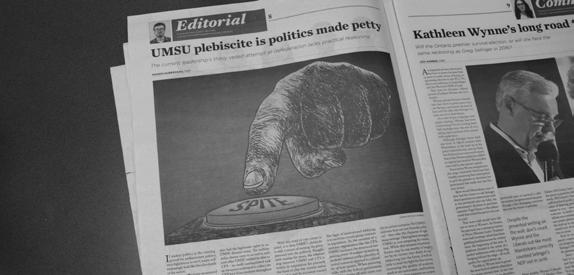
The editorial in question, “UMSU plebiscite is politics made petty,” appeared in the Jan. 24 issue of the paper and questioned the motivations behind a plebiscite asking students if
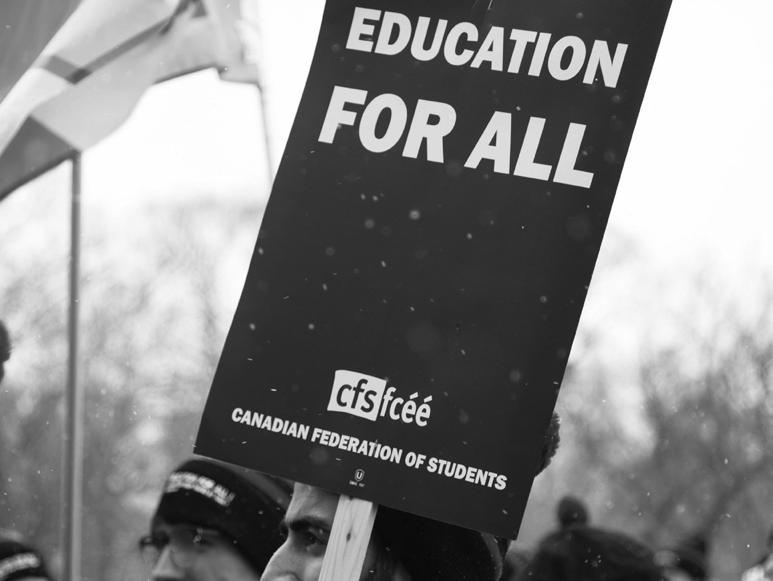
they “believe UMSU should remain a member of the Canadian Federation of Students, at a cost of $14.98 per student per year?” In the plebiscite, 64 per cent of ballots cast indicated support to remain affiliated with CFS.
The Jan. 31 UMSU press release announcing that the motion to defund the 104-year-old news organization had been withdrawn stated that Parsons' “original intention was to start a dialogue.”
“I thought perhaps students wanted an opportunity to re-evaluate this service that they pay for, but since putting it forward it’s clear that the Manitoban is an important service to many students,” Parsons is quoted as saying.
Parsons did not respond to a request for comment.
Garett Williams, editor-in-chief of the Manitoban, said “To threaten the Manitoban ’s funding through council is to threaten the paper’s independence. By explicitly citing an editorial critical of student union activities, the motion cannot be understood as anything other than an attack on the paper’s fundamental freedom to report and comment on UMSU - a body that represents 25,000 undergraduates.”
The levy currently paid by students to support the Manitoban largely goes to equipment and salaries, since the print edition of the paper - one of the largest student papers in west-
ern Canada - pays for itself through advertising revenues.
“Outpouring of support”
The same day the motion became public knowledge, the University of Manitoba Board of Governors approved the closing of the Gradzette, with the graduate student levy used to support it being re-directed to the Manitoban
Carl Neumann, president of the University of Manitoba Graduate Students’ Association, speaking to the importance of what he called “independent media,” said “we wanted to not just eliminate that fee, but just
Grad student paper to disband
sort of transfer it over to, you know, actual support - direct support for the Manitoban instead.”
The short space of time between the motion to defund becoming known to the public and being withdrawn saw what Malak Abas, managing editor of the Manitoban, described as an “outpouring of support.”
This outpouring included an editorial in the University of Winnipeg’s student paper, the Uniter, a flurry of supportive tweets from current and former students of the U of M, and coverage by the Winnipeg Free Press, the Winnipeg Sun, CTV News, and Global News.
Motion to transfer funds to the Manitoban passed unanimously
T
he University of Manitoba Board of Governors held a meeting Jan. 30 where, among other motions, the University of Manitoba Graduate Students’ Association (UMGSA) carried a motion to disband the Gradzette and alter the student levy that supported it. Former Gradzette funds will now go directly to the Manitoban
The Gradzette was originally the graduate students’ official student magazine, and had been published monthly by The Manitoban Newspaper Publications Corporation. However, due to decreased readership, it was unable to publish a print edition early last year. They ceased publishing online in May 2017.
While the operating funds have always gone through the Manitoban, rather than transferring said funds to the Gradzette, they will now remain within the Manitoban. The change will have no effect on the student fees paid by graduate students.
UMGSA president Carl Neumann said the changes were a natural progression of events.
“The Gradzette wasn’t serving our purposes, in our case, because the readership was very low, it wasn’t really reaching out,” Neumann said.
“Personally speaking, I’m always really supportive of independent media, and I think that’s really important to have out there”Carl Neumann, UMGSA president
“It wasn’t so much news as it was trying to report on grad student research, which is all fine and good, but our intention, as you may know, is to feature some grad student research on our own website instead.” Neumann explained that part
UMSU president Tanjit Nagra, speaking to Global News on her experience with editorials in the student paper, observed that “they’re opinion pieces and I think sometimes it’s tough for some folks to be able to understand that.”
Williams echoed Nagra’s sentiment: “If someone disagrees with an editorial or comment piece published by the Manitoban they are welcome to submit an op-ed challenging the position. A healthy newspaper fosters debate within its pages and the Mantioban strives to meet that standard.”
of why the levy made sense to the UMGSA was because of the Manitoban’s prior work and its role in campus media.
“Personally speaking, I’m always really supportive of independent media, and I think that’s really important to have out there,” he said.
“So that’s part of why I sort of initiated discussions of this and then got other people to agree, obviously.”
The motion was passed unanimously by UMGSA council, which Neumann called “definitely a good thing,” while also noting that
UMGSA research could be better promoted through the association's own website.
Neumann said the additional funding going towards the Manitoban, rather than being eliminated entirely, was important to the UMGSA board.
“It’s important to have that sort of independent voice to hold all of us to account,” he said.
“And just to sort of make sure people are informed about what’s going on - whether it’s, you know, in the UMGSA, with UMSU, with the university, and obviously beyond
as well.”
“That’s definitely an important part of why we wanted to not just eliminate that fee, but just sort of transfer it over to, you know, actual support - direct support for the Manitoban instead.”
UMGSA is now looking at ways to work with the Manitoban to increase visibility of graduate student affairs, including advertising both on the Manitoban website and within the print issue.
photo by asha nelson
The Jan. 24 editorial that was cited in a motion to hold a referendum on defunding the Manitoban.
photo by asha nelson
Students vote to continue CFS membership
More than 64 per cent of ballots cast voted against defederation in Jan. 31-Feb. 2 plebiscite
U
niversity of Manitoba students have indicated they wish to continue membership with the Canadian Federation of Students.
Students voted in a non-binding plebiscite last week asking if they “believe UMSU should remain a member of the Canadian Federation of Students, at a cost of $14.98 per student per year?”
After voting closed Feb. 2, 3,877 votes has been cast, with 64.6 per cent in favour of continuing membership. 35.4 per cent were against and 8.8 per cent abstained.
Online votes were tallied on umsu. simplyvoting.com and a polling station was set up in front of the student union office in the UMSU University Centre.
UMSU president Tanjit Nagra said she is glad to have seen active involvement from students in this “democratic way of expressing their feelings.”
CFS - Manitoba (CFS-MB) interim-chairperson Dele Ojewole said the federation is looking forward to a “collaborative and productive relationship with UMSU.”
“I’m very happy about the outcome,” he said.
“This result is a great testament to our work as a federation. It is a great testament of what we have been able to achieve over the past couple of
years and we thank the students for the confidence.”
Established in 1981, CFS is the largest student advocacy association in Canada. With over 650,000 post-secondary students represented, the association spearheads student advocacy at the federal and provincial levels.
CFS has been lobbying countrywide to challenge tuition increases - including Manitoba’s Advanced Education Administration Act, which lifted the cap on tuition hikes and removed restrictions on courserelated fees. The bill passed its final reading in November.
Universities in Manitoba are now free to increase tuition by five per cent plus inflation annually, beginning in September.
Rocky relationship
The plebiscite was first introduced as part of a council motion drafted by St. Paul’s College Student Association representative Arthur Coelho Reis on Nov. 9.
Coelho Reis said the plebiscite “allowed us representatives to democratically survey our membership on their opinion on the matter,” adding that he is “content with the voter turnout.”
“I will be following the will of my constituents and keep advocating on
their best interest,” he said.
The plebiscite has come in the wake of tensions between the federation and the students' union.
During the 2013-14 academic year, the then-UMSU executive refused to transfer fees to CFS following a dispute regarding ownership of the UMSU domain name. This was settled on July 2016 after UMSU agreed to pay $993,562.18, a sum which included provincial and national fees.
“This result is a great testament to our work as a federation” - Dele Ojewole, CFS-MB interim-chairperson
Most recently, in December 2016, UMSU demanded an apology from CFS, claiming that its executive members verbally harassed Nagra at a national meeting.
The harassment allegedly took place after UMSU brought forward a motion that would amend CFS’s policy on international students, calling for the national union to advocate for international student fee increases to be locked at the same percentage
increase as domestic students.
CFS Aboriginal Students’ commissioner Annie Beach called the move to hold the plebiscite surprising.
“It was interesting that UMSU was considering holding a plebiscite knowing that all of the hard work that the CFS does for students,” she said.
“I guess they just wanted to make sure that CFS is held accountable.”
Moving forward
Nagra said she is ready to leave her “personal concerns” with the federation in the past.
“I’m here to serve students and if that's what students want then this is what we have to do,” she said.
Noah Wilson, Indigenous students’ representative and co-president of the University of Manitoba Aboriginal Students’ Association, said he was happy to see the result “of the largely unnecessary CFS plebiscite.”
“I also believe the result shows that University of Manitoba students are tired and have no interest in the recent plague of counter-productive, self-serving, and quite frankly petty motions presented by some UMSU councillors that have done nothing but delay any sort of unified student movement in the province and across the country,” Wilson added.
UMSU Governance and Operations amendments
At its regular council meeting, Feb. 1, UMSU approved a series of changes to its Governance and Operations Manual.
UMSU’s governance committee presented a list of amendments at a previous meeting in January, which included changing the titles of the aboriginal student representative and the re-addition of the student senate caucus.
The caucus provides an open forum for student senators to discuss the affairs of the U of M senate and to further complement advocacy and student representation efforts on campus.
All amendments were grouped together in a single motion and approved unanimously by council members.
“Aboriginal
is not inclusive of the Métis, Inuit, and just [the] general sense of Indigenous cultures and the strong sense of diversity we have in Canada” - Noah Wilson, UMSU Indigenous students’ representative
Nagra said she is happy to see UMSU take a “step towards being more inclusive.”
Wilson noted the importance of the union being situated “at the leading edge of terminology” in terms of its respect for all cultures after the aboriginal represntative position was re-named Indigenous students’ representative.
“Aboriginal is not inclusive of the Métis, Inuit, and just [the] general sense of Indigenous cultures and the strong sense of diversity we have in Canada,” he said.
Another motion approved the introduction of a mature students representative position on UMSU council.
Nagra said the motion “came from a student wanting to create another community representative to have the voice of mature students.”
Qudus a busaleh, staff
photo by asha nelson
Winnipeg remembers victims of Quebec City Mosque shooting
Islamic Social Services president discusses impacts of Islamophobia
d iana u bokudom, staff
M
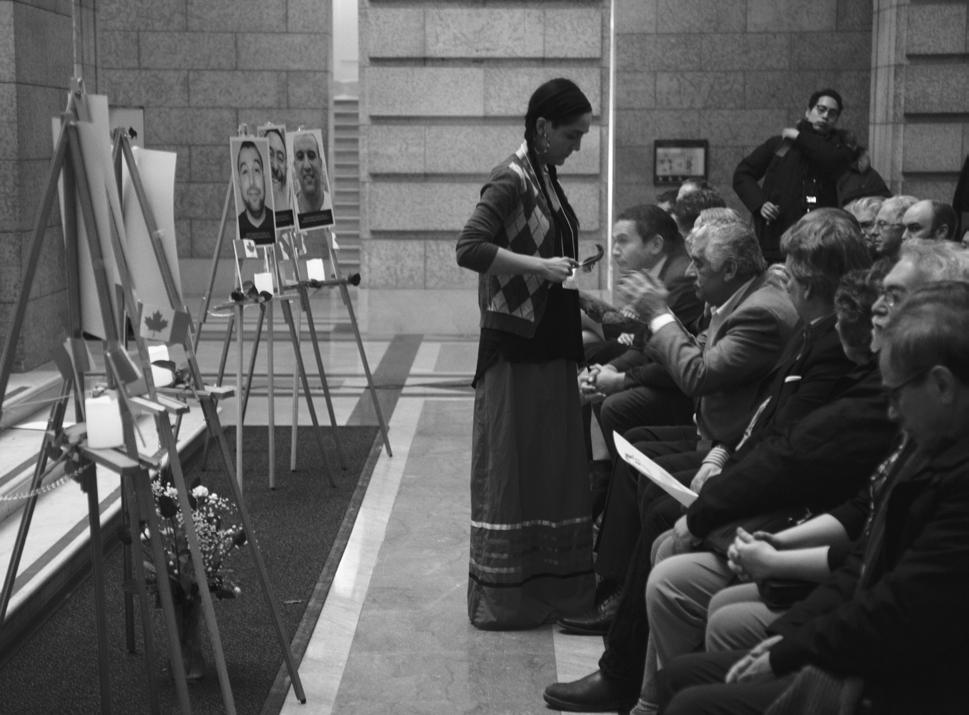
embers of the Muslim community and the general public gathered Jan. 29 at the Manitoba legislature to commemorate the Quebec City Mosque shootings which took place one year prior.
The mass shooting left six people dead and eight injured following an attack at Centre Culturel Islamique de Quebec. Alexandre Bissonnettea Université Laval student - faces six counts of first degree murder. His trial is set to begin in March.
The Winnipeg vigil was organized by the Islamic Social Services Association (ISSA), Social Planning Council, and community members.
It was attended by St. Vital councillor Brian Mayes, who represented Mayor Brian Bowman, Rochelle Squires, minister responsible for francophone affairs and status of women, and Wab Kinew, leader of the Manitoba NDP.
A flower-laying ceremony, held to honour the lives lost in the attack, was followed by attendees observing
a moment of silence.
Squires took to the podium and reminded the audience about the importance of standing in solidarity in the face of acts of violence.
“I believe that if we can come together and show our solidarity against Islamophobia, we are ensuring that their lives were not taken in vain,” she said.
lar fashion to speaking out against other forms of discrimination such as “sexism, racism, transphobia, or homophobia.”
“I think everyone from top to bottom has to be educated about Islam and Muslims so that they can address it in an informed way when they hear falsehood and demonization of Islam” - Shahina Siddiqui, ISSA President
“And in order for us to ensure that acts like this do not prevail, we have to stand in solidarity together.”
Squires said that being a Manitoban is synonymous with being multicultural, and part of this involved citizens freely exercising their right to freedom of worship.
Wab Kinew spoke after and stressed the importance of speaking out against Islamophobia in a simi-
The event was brought to a close with group singing and drumming and a candle lighting ceremony in honour of the victims.
Combatting Islamophobia
Shahina Siddiqui, president of ISSA, said acts of Islamophobia are nothing new.
“It’s been going on as we’ve seen the worst of it since 9/11, and it’s getting worse,” Siddiqui said.
This was “one of the worst massacres in recent history and Canada - that fear and hate and racism against Muslims - this was the ultimate expression of it.” Siddiqui said the commemoration was an opportunity to take collective action against Islamophobia.
“It should not be the responsibility of the Muslim community alone to address it, but it should be and must be the sole responsibility of every Canadian [. . .] because as I have often said, hate and violence against one Canadian is [hate] against all Canadians.”
She also criticized the biased representation of the issue by what she called the mainstream media, especially the reluctance to describe the attack as an act of “terrorism” even though the crime fits that descrip-
tion. Siddiqui said such reluctance is absent when the perpetrators have a “Muslim-sounding name,” and their actions are quickly termed “terrorist acts.”
Speaking on the government’s response in the wake of the shootings, Siddiqui said that although politicians have shown strong concern, government officials must take authoritative action to combat Islamophobia, and specifically called for the designation of Islamophobia “as an official form of racism.”
She said for that to happen, it will take proactive action from the community.
“Democracy is only as good as its citizens are active, and if we become complacent, we’re not going to bring a change.”
photo by asha nelson
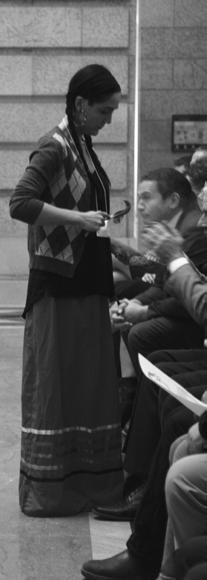
A commemoration was held to honour the victims of the Quebec City mosque massacre at the Manitoba Legislative Building Jan. 29.
Anti-abortion group asked to leave Fort Gary campus
UMSAN-RSM holds workshop on combating “anti-choice” groups
s haden a busaleh, staff
Members of the Manitoban chapter of the Canadian Centre for Bio-Ethical Reform (CCBR) - an anti-abortion advocacy group - were asked to leave the Fort Garry campus by U of M security services Jan. 29 after pamphleting in the tunnel connecting UMSU University Centre and the Engineering and Information Technology Complex.
UMSU VP advocacy Allison Kilgour, who was among the students that confronted the group from CCBR, said that after student concerns regarding the group’s distribution of graphic imagery featuring aborted fetuses were brought to the attention of UMSU, campus security was contacted.
“My issue wasn't with the content being shared - everyone has a right to their opinion,” Kilgour said. “It’s just the graphic imagery, I believe, can be very triggering for students.” Kilgour added that her choice to confront the group was one taken
independently of her position as an UMSU executive.
“Myself personally, I just wanted to be there because as Allison, the student, I just felt that was necessary,” she said.
The Manitoban chapter of CCBR is not a registered U of M student club and had not sought permission to advocate on university grounds. The group has previously pamphleted on campus, with Jan. 29 marking their fourth time doing so in the past year.
coordinator, Kyle Coffey, said that members of the group were on campus in a “peaceful display, reaching out to people, and exposing the injustice of abortion.”
images because of abortion?” he asked.
“If there’s any place where this discussion should be happening it is on a university campus.”
“A lot it is inherently misogynistic and wrong and I don’t think that University of Manitoba students should be subject to that when they’re trying to be in a safe space to get their education”Elizabeth McMechan, UMSAN-RSM
U of M executive director of public affairs John Danakas said that in accordance with the university’s policies, “there is the expectation that groups, before using university space, will seek permission to do so.”
CCBR Manitoba’s outreach
“The images that we’re showing are disturbing, because abortion - which tears apart tiny human beings - is a disturbing and violent death,” Coffey said.
“So the question is: should we be concerned about the images, or the fact that everyday 300 or more preborn children are becoming these
Coffey said that while CCBR - Manitoba has not determined whether it plans to return to campus, “We do want to make sure everyone who, maybe faced with a hard pregnancy, knows what abortion will do to their preborn children.”
“Exposing abortion for the injustice that it is is our principle means, in conjunction with compassionate and honest conversation with the people we meet,” he said.
Combating the “antichoice” movement
On Feb. 1, the UManitoba Student
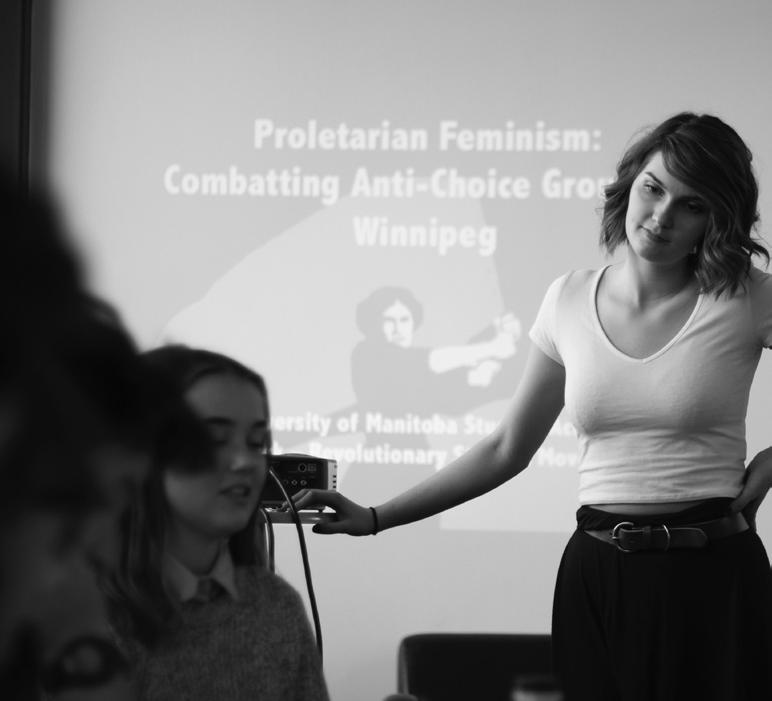
Action Network - Revolutionary Student Movement (UMSANRSM) hosted a presentation followed by an open discussion on “proletarian feminism,” and how to combat the anti-abortion movement.
“The anti-choice movement has become a lot of separate things,” said Elizabeth McMechan, a women’s and gender studies student and UMSAN-RSM member. “A lot of people associate it strictly with religious organizations, but other organizations have popped up that actually try to use pseudo-science in order to push forward their opinion of abortions.
“In its essence and across the board, the anti-choice movement is opposed itself to any sort of sex education as well as contraception and casual sex.”
In an interview following the event, McMechan highlighted her concern with the anti-choice rhetoric being “inherently fascistic.”
“They don’t believe that people who are looking for reproductive justice should be allowed to have complete bodily autonomy, which to me seems extremely dangerous, and a very fine line,” she said.
“A lot of it is inherently misogynistic and wrong, and I don’t think that University of Manitoba students should be subject to that when they’re trying to be in a safe space to get their education,” McMechan added.
McMechan cautioned students against engaging with anti-abortion groups, saying that doing so can be counterproductive and serve to legitimize such perspectives.
“We’re trying to organize ways that we can get them off of campus, so that we can combat them in ways where they can’t spread their information anymore,” McMechan said.
McMechan also cited the presence of the University of Manitoba Students for a Culture of Life, a student group whose purpose is to educate and advocate for an end to abortion in Canada, as one such group.
UMSU president Tanjit Nagra said that students uncomfortable with any student club should contact UMSU services and the union would “be happy to take any complaint very seriously.”
“Obviously we know content like that is triggering to many folks, and we take that seriously,” Nagra said.
“I have approached UMSU student services about having these groups removed as UMSU groups, and I haven’t really received a lot of helpful information,” said McMechan.
“I really hope that if UMSU cares about the safety of women on their campus and marginalized genders […] that they would maybe consider taking efforts to have them removed and be more concerned about the well-being of women on this campus.”
UMSAN-RSM member Elizabeth McMechan helps lead a discussion on “proletarian feminism” in response to the increasing anti-abortion presence on campus. photo by quincy houdayer
Editor-In-Chief: Garett Williams
Contact: Editor@themanitoban.com / 474.8293
If smokers are singled out, why not greenhouse gas emitters?
Climate change a greater threat to public health than secondhand smoke
e van Tremblay, staff
W
innipeg is poised to ban smoking on patios, the last major city in Canada to do so. The ban, set to go into effect April 1, and the logic behind it, represents the kind of public policy-making that we have a right to expect from city council.
This ban affects a specific subset of the population - smokers - negatively. It limits a previously enjoyed freedom in the name of public health. It is not necessarily popular with business owners, who would like to decide for themselves what their patrons are allowed to do while spending money in their establishments.
Unpopularity with the people directly affected by it, and especially with business owners, is usually the death-knell of a bylaw or other action by council. Consider the proposal
to build a seven-kilometer multimodal corridor along St. Anne’s Road, scrapped in 2016 by councillor Brian Mayes due to “local business opposition to building a cycling corridor.”
The smoking ban will come into effect not because it is inherently good public policy - though it is inarguably good public policy to limit exposure to carcinogens, such as diesel exhaust, in public places.
The smoking ban will come into effect because smokers are widely maligned in our society that values so much the semblance of good health and vitality. A society that valued actual health, rather than the idea of it, would not make such a fetish out of gym-muscles and yoga pants.
If councillors were serious about the health of Winnipeggers, there
are policies that would be much more effective in improving it than driving people who self-medicate with tobacco out of the last places that they can enjoy their vice while sitting down in public.
Having an adequately funded, affordable, efficient public transit system is much better for people’s health than having a population reliant on automobiles. Less cars on the roads means less exhaust and better air quality for everyone, and people taking public transit actually have to walk short distances to get to transit stops. What is city council doing to even discourage the use of automobiles, as the cost of public transit goes up and the quality of service goes down?
Having dense, walkable, vibrant
neighbourhoods is much better for people’s health than having a sedentary population living in isolated suburbs. Again and again, however, we see the approval of new suburbs by city council, draining limited municipal resources away from established neighbourhoods.
Having city-wide sustainability initiatives that allow for resilient neighbourhoods would be a boon to public health, and yet basic measures towards this - such as a city-wide composting program, where some have existed in other Canadian cities for decades - are repeatedly put off.
Climate change represents an existential threat to the health of all Winnipeggers, whether they smoke or not. And yet, the city takes no action to curtail the excesses of that
portion of the population - autoaddicted suburbanites - who contribute the most to it. As a constituency with more votes than smokers, the former are pandered to.
There is a distinct disconnect between the magnitude of the threat to public health posed by secondhand smoke and climate change: secondhand smoke increases your risk of cancer, whereas climate change may cause the extinction of our species. The disconnect in magnitude of Winnipeg’s response to these two real threats is laughable - provided you have a dark, macabre sense of humour.
City council should begin to pass bylaws aimed at protecting public health by curtailing activities that contribute to climate change through the emission of carbon dioxide
Speaking on the possibility of a smoking ban last year, councillor John Orlikow said "I think it's time to look at it, at least, and bring it forward for consideration. We do know the effects of smoking on a patio."
The effects of climate change are no less well known, and deserve to be addressed by city council in exactly the same manner as smoking has been. Though it be unpopular with those affected, and though it be unpopular with business owners, city council should begin to pass bylaws aimed at protecting public health by curtailing activities that contribute to climate change through the emission of carbon dioxide.
Like the smoking ban, this would affect some people much more than others. It would affect people whose lifestyles cause a decline in the health of the environment, and of future generations, more than those whose lifestyles do not.
What city council has done is show that they are perfectly willing to identify an activity (and by extension, the group of people who engage in that activity) and legislate against it. As much as this may rile up the group of people legislated against, public health is a pretty good justification - if, indeed, that is the reason a specific subset of citizens has been legislated against.
graphic by evan tremblay
Labour Board should enforce fine on the U of M administration
Admin learns nothing from a delicate slap on the wrist
k enny i ngram, staff
The University of Manitoba Faculty Association (UMFA) has won a recent battle with the U of M administration. The war, however, remains undecided.
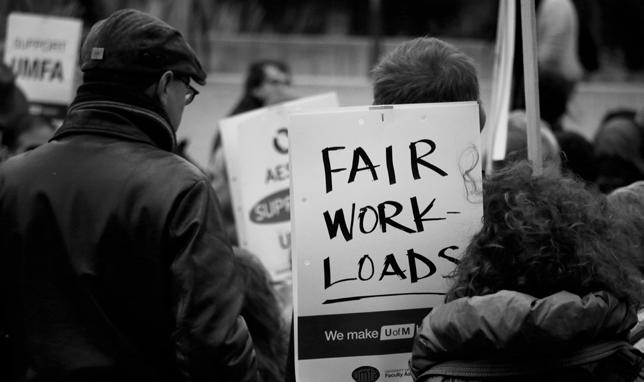
On Jan. 29, the Manitoba Labour Board ruled in favour of UMFA in a dispute over unfair labour practices occuring during the 2016 faculty strike. Specifically, the administration failed to notify UMFA that the provincial government ordered a pay freeze during the strike, which in turn jeopardized negotiations.
The administration put out a statement saying they “respectfully disagree” with this ruling, claiming they had bargained in good faith.
Many students would genuinely like to believe the administration when its issues statements like this: in other words, hold out hope that the administration would not tell a malicious lie. However, after three rulings against U of M labour practices in the past 11 years - two of which occurred in the past year - it is obvious the administration refuses to change. If anything, it is only getting worse.
This is only the tip of the iceberg for the administration in following a regressive approach, one that has taken us to a place where education is no longer the primary focus of the academic institution. The past
few years have seen the attention of the administration clearly directed toward the corporatization of a public university.
What with unfairly and poorly prioritized performance metrics for professors, cuts for three consecutive fiscal years running from 2014 to 2016, and the broad assortment of fundraising drives directed towards large capital projects - flashy new buildings and superfluous upgrades - students should now know where the priorities of the university administration lie: in polishing the exterior of the ivory tower, as its interior crumbles.
The unsettling truth is the administration will once again learn absolutely nothing from this ruling, especially as they have publicized in their statement that they are considering challenging the Labour Board.
The administration’s behaviour makes the ruling itself even more frustrating. Instead of having to deal with real repercussions, the administration has effectively been given a slap on the wrist for their actions.
The Manitoba Labour Board, instead of fining the administration a set amount, decided to let the administration and UMFA work out an amount on their own - which can be up to $2.4 million, or $2,000 per member. This is almost comical in
its irony. The party that was ruled to have compromised negotiations is now going to be negotiating the amount of their own fine with the party they used those unfair tactics against. Why should UMFA have to, yet again, negotiate with a party which has no interest in a fair negotiating process?
It should be made abundantly clear who will be paying the millions owed to UMFA by the administration: the university as a whole, not merely the guilty parties.
When the administration and UMFA negotiate and the members of UMFA lose, UMFA loses out on compensation and becomes governed by externally-imposed workplace rules. There is no such stake at play for the administration in negotiations.
Further, when the university administration is fined for unfair practices, they are most certainly not paying that fine out of their own individual executive salaries. When one party is bargaining for their livelihood and the other has virtually nothing to lose, it should be no wonder that the administration is willing to go to great lengths to compromise negotiations in its favour. It is yet another example of the imbalance of power at play.
Moreover, this ruling demon-
strates the detrimental effect of government interference in labour negotiations. It was never the job of Premier Brian Pallister to unilaterally interrupt negotiations simply to advance a policy that contributed to derailing negotiations. This takes on a disturbing political tone when the leader of the government has been on a warpath against organized labour precisely in the way Pallister has. Students must realize the implications of these actions. The takeaway is that the administration could not care less about the working conditions of its employees, and will do anything to nickel-and-dime the faculty it relies on to operate.
If not made abundantly clear last year through the strike, an attack on professors is an attack on students. Working conditions for professors directly affect their teaching, and cuts have long-term, disastrous effectsboth directly affect the education of students.
While this Manitoba Labour Board ruling is another win for UMFA, professors, and students, it ultimately fails to address the underlying issue. Ruling after ruling shows the administration has not acted in good faith.
Why should they suddenly be trusted now?
Canada can improve immigration by focusing on international students
Retaining international students should be key priority in immigration policy
h arman sandhu
I
f Justin Trudeau wants to improve immigration policy, then Canada's framework needs to focus on retaining international talent for the Canadian economy. The government can easily do this by increasing permanent resident admissions for international students.
Such a strategy is, simply, the best policy route to fit together the interests of Canadians and newcomers alike.
International students contribute to society at an early age through investment in their studies, gaining work experience, and applying their knowledge to their chosen fields. By improving their own lives, they are also giving back to Canadians by contributing to the economy and enriching Canadian culture. They are ideal candidates for permanent residency because they are proving themselves every day through study and work.
Canada relies on immigration to maintain population growth and fill the economic need for workers. Immigrants also bring in a substantial inflow of cash as they move to Canada to study, work, or travel. Canada is an attractive destination for international students who, as a
group, contributed $32.2 billion to our economy in 2016.
Of course, Canada’s immigration policy should not be reduced to economic policy. Trudeau has managed to avoid this outcome successfully in a host of areas.
For instance, Trudeau’s Liberals have made strides in improving family reunification by decreasing processing times and reducing application backlogs. The cap of sponsorship applications has been doubled, to 10,000 in 2016. In a decline begenning before the Liberals came to power, from 2012 on the pileup of applications for parents and grandparents has shrunk by 72 per cent. The Liberal government also settled more than 40,000 Syrian refugees from November 2015 onward.
Moving forward, the federal government should place a greater focus on settling international students, all of whom are considered temporary migrants. Gaining permanent residency through other areas such as skilled workers, family sponsorships, and humanitarian obligations is less ideal for the state since it puts a greater strain on the immigration process, requiring more resources to
settle immigrants who are often older in age and late into careers.
For those who are granted residency, getting to Canada is the easy part. The difficult part is settling in. Once immigrants arrive, there is a need for extensive resources: job training, language development, and other community services to help with the integration process.
These resources can be expensive for taxpayers, though demand varies by case. Overall, however, newcomers require support unique to their prior experiences which can be difficult for large-scale government programs to provide. Community programs are better suited for this task, meaning local levels of government should be entrusted with these program, at a drain of their own coffers.
Measuring the effectiveness of support provided to newcomers can be difficult not because of a lack of resources, but a shortage of time on the newcomer’s part. Immigrants are forced to focus on gaining employment and adjusting to their new lives in the short-term, such that improving language skills and education for the long-term can often become an afterthought. Gaining recognition
of previous credentials is a timeconsuming task as it often requires newcomers repeat their studies in Canadian institutions, a luxury many cannot afford because of a lack of time and money.
International students, however, are willingly investing their time and resources in post-secondary education. Many gain employment for the first time while still in school, giving them ample time to adjust to Canadian culture by expanding their social and professional networks while improving their English literacy.
While this is a longer road that requires years of post-secondary studies, followed by work permits before ultimately receiving permanent residency, it is ultimately the road best taken. International students are better able to contribute fully to society and achieve personal success due to their improved language skills, Canadian certification, and training in the Canadian labour force.
In 2016, of more than 266,000 international students, only 8,246 individuals were granted permanent residency. This ratio needs to be increased.
The addition of international students to our labour force makes it more diverse without being less educated, making us a stronger economic competitor in the global market. It also addresses the old stereotype that immigrants take away jobs from Canadian citizens, since immigrants who gain residency through work permits and post-secondary education have undeniably made their fair share of sacrifices and contributions to our economy. By denying international students the opportunity to participate in our society, we hurt our economy and lose the chance to develop our national culture. Canada needs a plan addressing how to settle international students at a measured pace. Ultimately, we should be focusing on retaining new talent developed at home, rather than importing skilled labour.
Editor: Shawn Huberdeau
A paper needs independence to function as check-and-balance
g are TT Williams, staff
Last week, the Manitoban sustained a direct attack on its freedom and independence.
A motion was included in the UMSU council package for its Feb. 1 meeting that meant to trigger a referendum on the Manitoban’s funding. It charged that the paper is impartial and cites an editorial published the previous week that “sought to influence the results of a vote of all UMSU members” as grounds to pull the floor out from under a more than centuryold institution at the U of M.
The editorial in question took issue with the possible motivations behind council’s unanimous decision to hold a non-binding plebiscite asking students whether they wish UMSU to remain affiliated with the Canadian Federation of Students.
The two organizations have tended toward an absurd and confrontational relationship for years - spanning sev-
eral executive regimes - and there is reason to at least question whether the plebiscite had the interests of U of M students at heart. When voting closed Feb. 2, more than 64 per cent of the over 3,800 ballots cast indicated a desire to remain affiliated.
By explicitly referencing a published opinion, the motion was a direct threat to the Manitoban’s independence. It suggests that publishing a critical word on UMSU council - an organization in command of a multi-million dollar budget - should be met not with a sound rebuttal but an underhanded attack on the paper’s resources.
The motion also noted that print media is largely turning digital to implicate the paper is dwindling in influence. It can be inferred, then, that the Manitoban should be defunded both because its audience has abandoned it and the editorial
board exercises an undue hold over the U of M student body; a curious square to try and circle.
Among a surge of support for the paper, the motion was withdrawn some 24 hours after it appeared when a seconder failed to come forward. But it did raise points that are worth addressing.
Aside from advertising revenues that largely cover the cost of keeping the print edition on newsstands, the Manitoban is funded through a student levy amounting to a little more than $6 per term for undergraduate students. Just last week, a process was begun that will establish a similar relationship with graduate students at the U of M.
The editorial board takes this responsibility seriously. The chief function of the paper is to report on the campus community and issues important to students while at the
same time offering a platform for students interested in journalism to hone their skills.
The paper strives for objectivity in its news pages, welcomes submissions from all students, and is renewing its ongoing efforts to reach out and broaden the scope of the voices it prints. The Manitoban is also expanding its online presence to reach those students less likely to pick up a physical copy.
For the Manitoban to succeed in its mission - to develop young journalists, to report stories of interest to the campus community, and to hold to account university institutions - its independence is paramount.
If dissenting comments or editorials are met with an effort to outright silence the paper, that mandate cannot be fulfilled.
Last week, rather than report on the third ruling of the Manitoba
Labour Board against the U of M in 11 years, editors and staff were made to argue for the right just to continue on with their work.
But the motion was far from enough to shutdown the presses. And the outpouring of support - from students current and former, faculty, and the community-at-large - has given the newsroom a renewed focus and energy to build on the tradition that began in 1914.
Here’s to another century.
Long live the press. Long live the Manitoban
graphic by ernest ZarZuela
“Will you support the actions of First Nations, the B.C. government, and their citizens or will you stand behind Big Oil and tear our country apart by going against the B.C. government on the Kinder Morgan pipeline?”
- Clayton Thomas-Muller, audience member
what is good for the economy,” he said.
“You have to take care of both of them fully at the same time.”
Stressing on the importance of balancing both, Trudeau said a thorough consultation process was undertaken by the federal government before the pipeline was approved.
He said approval of the pipeline is “in the national interest of all Canadians” and added that the Liberal government made necessary steps to invest in the “historic” Oceans Protection Plan in 2016 in addition to launching a Pan-Canadian framework to reduce emissions by setting a minimum price on carbon.
Only two provinces - Manitoba and
Saskatchewan - have not signed on to the national climate change framework.
“We need to both create a better future for Canadians and protect the environment,” said Trudeau.
During his town hall in Edmonton following the Winnipeg stop, Trudeau assured the residents of Alberta that the Kinder Morgan pipeline “is going to be built.”
Immigration Issues
Several attendees asked questions focusing on immigration.
One commended Trudeau for his efforts in helping create a safe passage to Canada, in collaboration with Rainbow Railroad, for many LGBTTQ* Chechens who were being tortured and killed in Chechnya.
"Would the Prime Minister be willing - I
understand what you are saying about specific cases - but would you be willing to intervene and advocate [to] the immigration minister to please stop the deportation to Nigeria of our lesbian friend?” asked the audience member, adding that their “friend was given an unfair refugee hearing by a homophobic adjudicator.”
“If she is deported this month, she will face imprisonment or death. There is a warrant out for arrest for being a lesbian.”
Trudeau said the system in place follows a certain set of rules and process while “at the same time leaving place for compassion.”
He assured that the minister of immigration, refugees and citizenship would take a look at “that specific case.”
“We have an obligation to hear them, understand them and perhaps look where mistakes have been made in the past,” Trudeau said.
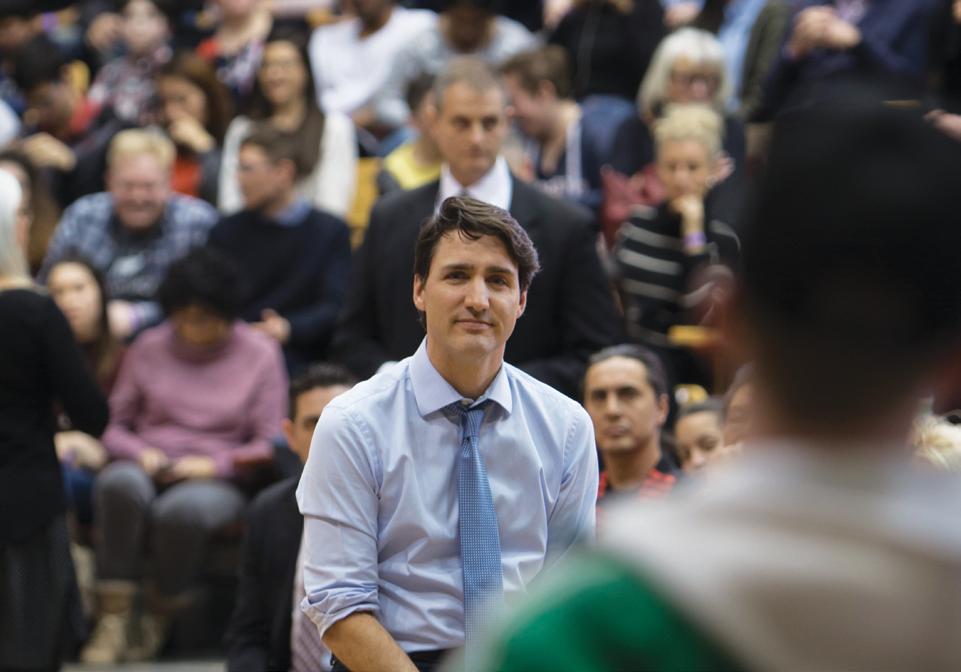
The Prime Minister was treated to a full house of eager Winnipegers.
Among the questions addressed included the state of Child and Family Services, immigration, and reconciliation