coordinating committee organizes month of events Page 16 arts
Green with envy
Huskies out cold after getting swept in Manitoba
Page 21
Daughters of the Vote
U of M students, alumni represented in delegation to Ottawa
Page 5
Dump Trump
Open borders create a safer world
Page 9
s
Design
Design eDitor Bram Keast
design@themanitoban.com
graphics eDitor Kelly Campbell graphics@themanitoban.com
photo eDitor Miguel Yetman photo@themanitoban.com
Design associate Kellie Huynh
graphics associate Aldo Rios
photo associate Chantal Zdan
photo associate Star Roxas
photo associate Megan Colwell
r eporters
n ews Osho Samuel Adetunji
n ews Diana Ubokudom
n ews Seamus Hamilton-Pattison
columnist Jeremiah Kopp
columnist Shaden Abusaleh
arts & culture Olivia Michalczuk
arts & culture Emelia Fournier
sports Kellen Taniguchi
sports Jason Pchajek
copy Joseph Gonzalez
Volunteer Contributors
MANITOBAN
109 HELEN GLASS UNIVERSITY OF MANITOBA WINNIPEG, MB R3T 2N2
General Inqu I r I es & a dvert I s I n G
Phone: (204) 474.6535
Fax: (204) 474.7651
Email: manitoban@themanitoban.com
Free Med I a Campus Plus Media Services
Phone: 1.780.421.1000
Email: advertise@free-media.ca
Canadian Publications Mail Product Sales Agreement #589160
A “volunteer staff” member is defined as a person who has had three volunteer articles, photographs, or pieces of art of reasonable length and/or substance published in three different issues of the current publishing year of the Manitoban. Any individual who qualifies must be voted in by a majority vote at a Manitoban staff meeting. Elected representatives and non-students may be excluded from holding votes as volunteer staff members in accordance with the Manitoban Constitution. The Manitoban is the official student newspaper of the University of Manitoba. It is published monthly during the summer and each week of regular classes during the academic year by the Manitoban Newspaper Publications Corporation.
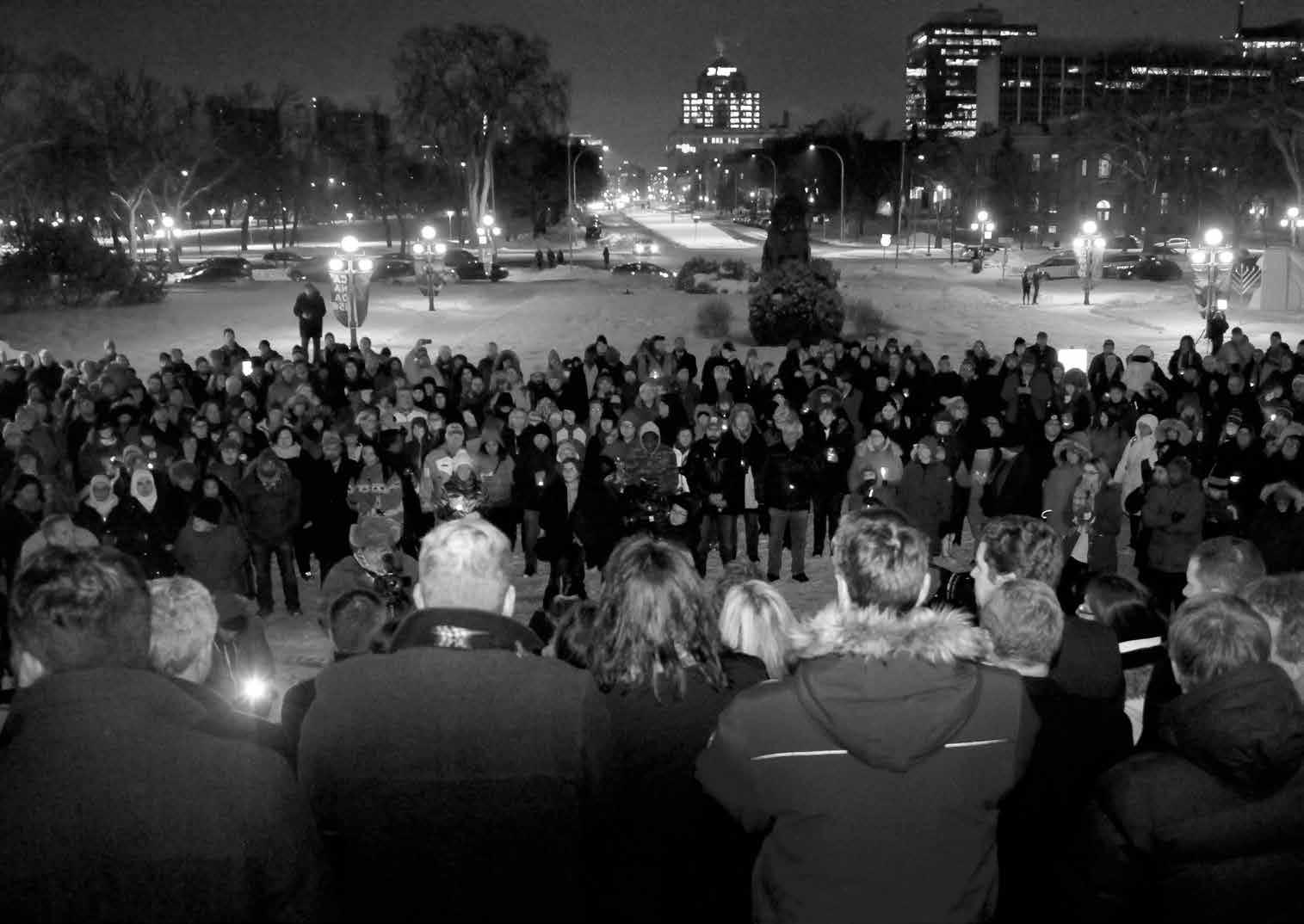
Hundreds attend Winnipeg memorial for victims of Quebec City mosque shooting
g arett Williams, staff
The University of Manitoba’s Muslim community is reaching out in the wake of the killing of six worshippers at a Quebec City mosque late last month.
Zeeshan Zamir, president of the U of M Muslim Student Association (MSA), said he is at a loss for words to describe the tragic and distressing Jan. 29 shooting that left six men dead and 19 people injured.
However, he said the immediate showing of support – which began the next morning with emails from professors and members of the university community, and continued in the evening when hundreds attended a vigil on the steps of the legislature – is an opportunity to build relationships.
“Our community members made the statement that this is not the time to be scared, this is the time to open your doors even wider and welcome others so that they can interact with us and we interact with them,” said Zamir, noting the association’s members mulled over increasing security
following the attack but the positive response eased their concerns.
He said the MSA is planning on opening its doors and inviting all university community members to visit the mosque on the Fort Garry campus to turn the tragedy into an opportunity to break down divisions and build alliances.
“In the community and media you just hear negative things,” he said, “and if you’re a Muslim and you have a beard, or you go to the mosque, there’s a stigma that follows you.”
“It was very sad but we cannot just sit and cry over it,” he said. “We have to analyze the situation and use all the support that we have been receiving from the community and just don’t stop there - we have to move forward.”
A white, 27-year-old Quebec man and Laval University student has been charged with six counts of first degree murder and five counts of attempted murder while using a restricted firearm.
Authorities have indicated that
“This
investigation.
is not the time to be scared, this is the time to open your doors even wider and welcome others so that they can interact with us and we interact with them”
– Zeeshan Zamir, president, U of M Muslim Student Association
Hundreds gathered at the provincial legislature Jan. 30 in a show of unity with the Muslim community. Many of those in attendance partici-
pated in a special prayer service at the Winnipeg Grand Mosque that same evening organized by the Manitoba Islamic Association.
The vigil was organized jointly by Manitobans for Human Rights and the MSA and included addresses from deputy premiere and minister of justice and attorney general Heather Stefanson, mayor Brian Bowman, and members of the Canadian Federation of Students-Manitoba, among others.
Bowman said such attacks aim to divide the community – and the country – but only bring people closer together.
“As Canadians, now is the time, more than ever, to stand with our friends and our neighbours,” he said.
“To let them know that we care about them, that we will protect them, and that this community, and our country, is a place for everyone.”
“A Winnipegger is a Winnipegger is a Winnipegger.”
Bowman led a march of hundreds of people Saturday in the Winnipeg
for Human Rights, which
Ahmed Farag, of the Manitoba Islamic Association, challenged the idea that Canada’s diversity is a weakness, pointing to the thousands who stood nationwide in support of the families of the victims.
“You may ask yourself ‘why are they out here in the cold standing in solidarity in a vigil for people who they have never met, or may never meet?’” he said.
“The answer is simply one word – humanity. Whether they are Muslims, Christians, Jews, Hindus, atheists or agnostics, we are connected to each other through our humanity.”
he may also face terrorism charges following an ongoing
Walk
circled from the Forks around the Canadian Museum for Human Rights.
photo by star roxas
Warming hut designs from U of M architecture students featured on Red River skating trail
Osh O samuel a detunji, staff
Agroup of University of Manitoba architecture students have their warming hut on display alongside award-winning designs from around the world as part of the 2017 edition of the annual international Warming Huts: An Art + Architecture Competition.
The six designs selected to adorn the Red River Mutual Trail were unveiled at a U of M faculty of architecture Food for Thought series event Jan. 26. The winners were announced in November.
Warming Huts is an open competition, sponsored by the Canada Council for the Arts, the Manitoba Association of Architects, and StackHouse, that started in 2009 and has received hundreds of entries from around the globe.
In January, designers of the
selected entries assemble in Winnipeg to turn their designs into reality and erect the huts on the Red River.
“I'm wowed by the opportunity to design and compete amongst big name artists and architects from around the globe” – Bianca Dahlman, U of M architecture student
Beyond the three winning designs, which were selected by a blind jury,
an additional three – including the U of M project – were selected for construction to sit on the Red River Mutual Trail until the end of the skating season.
The 2017 winners include:
“Greetings from Bubble Beach,” submitted by a design team from Chicago; “Ice Lantern,” designed in Nova Scotia; and “Open Border,” designed by a team in the Netherlands. An installation titled Stackhouse, designed by sculptor Anish Kapoor – known for works including Cloud Gate in Chicago’s Millennium Park – is being displayed as an invited submission.
“WarmHut,” designed by U of M architecture students, and a piece titled “On The Rails,” created by Nelson McIntyre Collegiate student Sean Kohli, make up the final
selections.
The University of Manitoba team consisted of 40 students and four professors.
The design reflects Scandinavian and Indigenous cultures, while giving its occupants a sauna experience.
U of M architecture student Jessica Piper said the competition is a rare opportunity for students to see their designs created in full scale.
“The most exciting thing about this competition for me is to get hands-on experience in a design-build project,” she said.
“I think that students don't often get to see their ideas come to life at a 1:1 scale.”
While Piper admitted the international scale of the competition brings a global perspective to the designs, she said growing local support will
only make the displays stronger.
“I think the more involved the community and students get in the competition process, the more powerful and exciting it will get,” she said. “It would be nice to see competition submissions not only from international designers and architects, but also from members of the local community.”
Bianca Dahlman, communication lead for the U of M team, called the hands-on experience of building the hut invaluable, adding that competing against an international field only sweetens the pot.
“As a student still early on in my academic career in architecture, I'm wowed by the opportunity to design and compete amongst big name artists and architects from around the globe,” she said.
“If it weren't for the Carbuncle design-build, many of the students would have completed their degree having only read about wood framing construction and having never actually lifted a hammer,” she added. “There's nothing quite like hands-on learning.”
Dahlman noted that the U of M’s sauna-inspired project is the first in the warming hut competition’s nearly decade-long run that is actually warm.
“ The skaters and strollers of the Winnipeg community can now enjoy a unique sauna space on the ice where they can relax and get toasty.”
The emotional toll of family violence explored in Arthur V. Mauro Centre’s lecture series
Osh O samuel a detunji, staff
T
he 2017 Arthur V. Mauro Centre for Peace and Justice brown bag lecture series opened Feb. 3 with a presentation examining responses to violence against women.
Judy Hughes, an associate professor with the faculty of social work, delivered a presentation titled “Finding Meaning in Our Response to Violence.” The half-hour talk centred on her research examining how women’s shelter employees work with victims of intimate partner violence. Her research was conducted through a series of interviews with both shelter workers and clients.
She emphasized that the longstanding notion of considering physi-
cal assault the only form of violence against women has to change because violence reaches beyond the spheres where force is used.
“I think ultimately, out of this, I would like to see people move away from an idea of thinking that in a way only physical violence is such a marker or definitive understanding of what violence is,” she said, stressing the need to shift focus beyond what happens to the body during moments of violence to the effects it has on the mind.
Hughes discussed violence as a violation of the victim’s agency to make their own choices, especially
women say that it was the psychological or emotional form of violence that stayed with them the longest.”
“It is not just what is done to the body – the shaping of the mind is important” – Judy Hughes, associate professor, faculty of social work
when it pertains to family violence and abusive relationships.
“It is not just what is done to the body – the shaping of the mind is important,” she said. “And a lot of
“People go into relationships with a lot of expectations,” she said.
“You just meet someone, you feel great and you want to spend time with them. And if that person turns out to be abusive, it changes all of that, all of those expectations.”
Hughes highlighted shelter workers’ efforts to restore some semblance of control to clients by having them
participate in cooking and meal preparations as an avenue toward emotional healing.
The brown bag series is a string of short lectures hosted by the Arthur V. Mauro Centre for Peace and Justice in its St. Paul’s College boardroom over the lunch hour.
Three more sessions are scheduled through the winter term, with the next lecture, “The Socio-Political Challenges Facing Refugee Camp Schools,” slated for Feb. 17.
photo by miguel yetman
U of M students, alumni selected as Daughters of the Vote delegates
Fourteen
Manitoba women among 338 selected to sit in Parliament on International Women’s Day
d iana u b O kud O m, staff
As part of events to mark Canada’s 150th anniversary – and to honour 100 years of women’s formal involvement in federal politics – 14 women from Manitoba have been selected to sit in Parliament on International Women’s Day on March 8 as Daughters of the Vote delegates.
The initiative is being spearheaded by Equal Voice, a national organization dedicated to seeing more women elected to all levels of political office in Canada. The 14 are among 338 young women from across cultural backgrounds selected to represent every federal riding in Parliament.
“Just to be amongst the 338 that were chosen is quite inspiring” –Taylor Morriseau, Daughters of the Vote delegate
Among the Manitoba selectees are University of Manitoba microbiology and genetics student Taylor Morriseau, representing Provencher, and U of M graduate Jacqueline Keena, representing Winnipeg South Centre.
Morriseau said she is extremely happy to be one of the delegates, given her strong interest in women’s participation in politics.
“Obviously it feels pretty amazing to be chosen,” she said. “I mean, all these amazing women across Canada, and just to be amongst the [338] that were chosen is quite inspiring ”
“Increasing the representation of women in politics is something that I feel quite strongly about, as well as increasing Indigenous women’s representation, so it definitely feels like a success.”
Morriseau also noted that although a science degree is not exactly related to politics, they are connected.
“It’s not really related with what I’m doing, which I find pretty interesting, but obviously there is a section of government that adheres to science,” she said.
Keena holds a bachelor’s degree in agribusiness from the U of M, and is currently pursuing a master’s degree
in economics at Carleton University in Ottawa.
She said it is an honour to have been chosen and commended the initiative.
“This event was kind of created as a part of Canada’s 150th anniversary celebration, so it’s a real honour,” she said.
“I think it is a really significant thing for the federal government to be part of, and for Equal Voice to put on [...] because just over half of Canada's population is female, but only about 26 per cent of the members of Parliament are women.”
U of M graduate medical student Carly McLellan, U of M women’s and gender studies student Johise Namwira, and University of Toronto graduate law student Alana Robert have also been selected to represent Saint Boniface-Saint Vital, Kildonan-St. Paul, and Charleswood-St. James-Assiniboia-
Headingley, respectively.
Morriseau called the opportunity to sit in Parliament on International Women’s Day “revolutionary and inspirational.”
“It might even change my career focus, I have no idea,” she said. “I have never really thought of politics but we’ll see.”
On Jan. 24, the fourteen selectees were also invited to a political forum at the Manitoba legislature to discuss women’s engagement in politics, one of 13 such events scheduled for each provincial or territorial legislature.
Betsy Kitchen of Equal Voice said the delegates were selected by a nonpartisan panel based on three main criteria: their demonstrated leadership potential, interest in public policy issues, and their level of community engagement.
Morriseau is a member of the Indigenous Circle of Empowerment, an Indigenous students’ group on the
U of M Fort Garry campus.
“We do a lot of leadership skills development for ourselves but we also translate that into a lot of community work,” she said, pointing to a Bannock and Backpacks project the group is organizing to support Winnipeg’s homeless population.
Morrisseau is also involved with Create H2O, a group that works toward providing clean water for Indigenous communities.
“That’s something that I obviously feel very strongly about,” she said, adding that “I’ve been translating that into public speaking engagements quite recently, and bringing awareness to the issue ”
While studying at the U of M, Keena served as a University of Manitoba Students’ Union (UMSU) chief returning officer, chaired the electoral reform board, and served as member of the UMSU bylaws committee.
Prior to the 2015 federal election, Keena also served on the board of directors for Be the Vote, a nonprofit organization that works toward increasing youth voter turnout.
“That was something we were really proud of and the youth voter turnout did increase during the election,” she said. “That was not all our doing but our creative awareness and information campaigns were effective in contributing to that ” Morriseau and Keena will join their national colleagues in Ottawa March 7 for a national leadership forum before the Women’s Day events scheduled for March 8.
photo provided by jacqueline keena
Jacqueline Keena
Nursing students challenge imported American entry exam
US-based entry-to-practice exam American-centric and disadvantages French students, says CNSA
s eamus h amiltO n-Pattis O n, staff
More than 400 nursing students and professionals gathered at the Canadian Nursing Students’ Association (CNSA) national assembly late last month and registered their concern with the NCLEX-RN entry-to-practice exam.
On the third day of the national conference, which was hosted in Winnipeg from Jan. 25-28, assembly goers drafted more than 1,500 letters outlining their concerns with the exam, which was introduced in Canada in 2015.
Three pre-written letter outlines issued by the CNSA each focus on a different complaint, including translation issues for the test and a lack of French prep material, mandatory third-party prep materials at a cost above and beyond tuition fees, and a lack of Canadian content on the American-produced exam.
According to a CNRA release, the first-time pass rate for Canadian nursing students writing the NCLEX-RN was 70 per cent in the test’s first year. Only 27 per cent of Francophone writers passed in their first attempt. That compares to an 87 per cent first-time pass rate students achieved on the Canadian Registered
Nurses Exam (CNRE), which the NCLEX-RN replaced.
The release, signed by the CNRA board, called the discrepancy “shocking” and president Bryce Boynton said students’ concerns have not been addressed.
“Francophones have a complete lack of preparatory materials for this exam when their Anglophone counterparts have an unlimited amount”
– Bryce Boynton, president, CNSA
“Students need to be heard and listened to,” he said.
“They have been ignored far too long. We are calling for urgent collaborative remediation and by going public, we are wanting to
hold Canadian nursing regulators accountable.”
The letters are addressed to the presidents of the Canadian Council of Registered Nurse Regulators (CCRNR) and the National Council of State Boards of Nursing, the US-based developer of the exam, and call for immediate constructive dialogue.
After decades of the Canadian entry exam, the CCRNR made the switch to the NCLEX-RN – an exam based on computer adaptive testing –in January 2015. The test was created to test the competency of American nursing students.
The CNSA, along with students across Canada, has expressed concerns about the NCLEX-RN’s lack of relevancy to “unique Canadian competencies.”
Boynton referenced a government review in New Brunswick that noted 20 of 60 questions reviewed included errors. He added that Francophone students have a “complete lack” of prep materials while their English colleagues have access to “an unlimited amount.”
“Many Francophones are being scared away from writing in their
native French language and taking a gamble on understanding the English version of the test,” he said.
The CNSA’s website specifically notes that the exam makes little consideration of cultural competence with respect to Canada’s Indigenous populations, “which impedes integration of [the] Truth and Reconciliation Commission [of Canada’s] calls to action.”
The lack of relevant material, Boynton said, has led to a shift in education as well, with classes growing more focused on preparation for the NCLEX-RN rather than emphasizing the experience of nursing in Canada.
Boynton took to task some of the main reasons the NCLEX-RN was initially favoured, stating that while computer testing is faster than the pen-and-paper process, studies have shown it is “not the best option for testing competencies due to computer literacy and the question styles associated with it.”
He also noted that while students are allowed to write the exam every 45 days – which he said is a necessarily small interval given the difficulty students have passing the exam –
students writing outside major city centres like Vancouver or Toronto have difficulty finding a testing centre hosting the exam.
Boynton noted that the testing centre in Regina hosts the exam only three days per year. In Newfoundland, it’s eight days, he said.
“If your testing date lies outside of these preset dates,” he said, “then writers are expected to travel out of province or even out of country to write the exam, which is just an additional cost for finances and stress.”
Boynton rejected the idea the test standardizes qualifications across Canadian and American borders.
“Why would Canada invest in creating world-class nurses just to have them emigrate to the US?” he said. “International regulation is not realistic. That is like saying nursing and healthcare are the same everywhere in the world. If one thing works here, it may not work elsewhere.”
Editor-In-Chief: Craig Adolphe
Contact: Editor@themanitoban.com / 474.6770
Liberals give a masterclass in spin with the nixing of electoral reform promise
s haW n g arbutt, staff
W
hen election time rolls around, Liberal party campaigns pull out tall tales. Be it the environment or the economy, a good Liberal knows the secret to success lies not in substance but appearance. Smile to the Assembly of First Nations and wear traditional clothing while promising a nation-to-nation relationship. Do the same when it comes to business interests in the energy industry, and when the time comes to make a decision, approve two gas-guzzling pipeline projects and remain indifferent to ensuing Indigenous outcry.
This is following the Liberals'
habit of making crystal clear promises while campaigning that are mystified once they assume power.
For example, the Liberals committed to implementing the United Nations Declaration on the Rights of Indigenous People (UNDRIP), an instrument that grants, among other things, a right to Indigenous peoples to declare nationhood. This would plausibly imply the sovereign power to block any pipeline that would cross First Nations territory. Upon forming government, the Liberals pumped the breaks on UNDRIP, the very instrument they made out as sacred,
as the justice minister said adopting UNDRIP directly into Canadian law would be “unworkable” and “a distraction.”
Simply put, the Liberals’ key to getting elected is by playing the spin game. A massive brokerage party –essentially a coalition of diverging political views held under the same banner – is driven by inclusive messaging that can appeal to voters of all stripes. And the Liberals are a brokerage party par excellence, having made standing on shaky ground and holding no core political commitments beyond vote-mongering into a certified art.
Trudeau’s reign so far, including his most shameful walk-about yet on electoral reform, is indication only of what more is to come. In brazenly arrogant style, the Liberals have now reneged on various campaign promises that acted as the pillars for their left-platform.
Trudeau has always walked on both lines of this issue. It’s the Liberal way to talk out of both sides of your mouth
The Liberal spin is evident when one examines their various green commitments made during the election that were walked back on, like phasing out subsidies to fossil fuel companies – an ode to their supposed commitment to creating a diversified, sustainable economy – and speedy, substantial investment in green infrastructure. In power, the subsidies remain as the government has already contracted itself into a natural gas subsidy until 2025. Oil companies, then, are allowed even more opportunities to profit at the public’s expense. This is due to the Liberal government’s stamp of approval on the pipeline projects and additional failure to follow through with their promise to strengthen the regulatory powers of the National Energy Board.
For the Trudeau government, promises mean nothing if the party has something to gain from dumping them. This level of self-interest in politics is as dangerous as it is shortsighted. What point is there to an election if parties can say whatever they please in an attempt to gain votes when there is no principled intent to carry out their very proclamations?
Trudeau infamously claimed that any appetite for electoral reform is based on a visceral hatred for former Prime Minister Stephen Harper. This is the Liberal mindset at its most explicitly patronizing, further shown when Trudeau declared in his mandate letter to the new minister of democratic institutions that there is no “clear preference” for reform, despite statements otherwise from the all-parliamentary committee on electoral reform.
This government has a damning view of voters. They are myopic “sheeple” that only desire a virtuous leader that knows better and will sort things out for them. Conviction and logically held beliefs are to be spoonfed to the public.
The Liberal campaign, premised on the silly reactionary slogan of “real change,” applied the simple claim
that Trudeau would “make every vote count” in Canadian democracy. The only plausible way of interpreting this claim is as an endorsement of proportional representation. No other system so literally makes every vote count. This is achieved through the use of an algorithm known as the Gallagher index, which is applied to election results in order to calculate the proportion between votes received and seats allocated for every party. The goal is to use this to achieve “perfect proportionality” in the House of Commons.
But the Liberals were keen to decry – in a viciously paternalistic attack – the intelligence of average Canadians during a particularly distasteful session of Parliament, where the recently replaced minister of democratic institutions Maryam Monsef joked about how no one could possibly have the brains to figure out how an equation like the Gallagher index works.
Unfortunately for the Liberals, Canadians do have the brains to figure out how promises work.
In this case, it’s basic math. Trudeau promised to reform the electoral system, got elected, and now refuses to go forward with reforms. It’s simply not adding up. Two plus two does not equal five, mister prime minister.
Canadians will only tolerate so much before stepping off their merry-go-round
Trudeau is on the record saying electoral reform is a “priority for a lot of Canadians,” clearly indicating that the government was aware that the promise for change in the electoral system was a game changer for many left of centre voters looking for a reason to vote strategically.
Of course, Trudeau has always walked on both lines of this issue. It’s the Liberal way to talk out of both sides of your mouth – to tell the left you believe in deficit spending while assuaging the right by talk of “eventual” budget balancing. Indeed, Trudeau had already concluded precisely that the moment electoral reform presented itself as a danger to his reign on Parliament Hill, it would be sent to the guillotine.
For the Liberals, politics is a spin game. But they would do well to remember that Canadians will only tolerate so much before stepping off their merry-go-round.
photo by miguel yetman
Want to solve the problem of radicalization? Open your borders
Western practice of clamping down on refugee intake is no solution
s
haden a busaleh, staff
On Feb. 3, Seattle district judge James Robart temporarily suspended Donald Trump’s travel ban, an executive order which barred the entry of citizens from seven Muslim majority countries including dual nationals from those same countries, for 90 days. Trump’s now-stalled executive order also prevented all refugees from entering the U.S. for 120 days and indefinitely suspended the Syrian refugee resettlement program while prioritizing Christian refugees. The list of Muslim countries included in the ban are Iran, Iraq, Libya, Somalia, Sudan, Syria and Yemen. Conveniently, this is a list of countries with which Trump has no business ties. The Trump administration has now formally appealed the suspension of the Trump travel ban, but the damage has already been done.
This travel ban was implemented on the premise of the need for extreme vetting measures for migrants – this measure was added on top of the extreme pre-existing vetting measures that are primarily imposed on refugees of war, autocratic governments, and ethnic cleansing.
The impact of Trump’s ban was immediate. Within minutes of signing, many were detained and prevented from returning to their studies, jobs, families, and homes in the United States. Soon after, there was intense backlash as thousands protested in airports across the country.
And while Trump’s pundits continue to respond with shock, confusion and denial over the term “Muslim ban” – because as it has been eloquently pointed out, “how can it be called a Muslim ban if Muslims from other countries are being allowed into the United States?” – the terrorists that Trump is trying to protect Americans from are sitting back and watching America as it spirals into decline.
The Muslim ban is a compromise to American security, as it exacerbates tensions and breeds hostility by telling Muslims that they are the very same terrorists whom they are fleeing from
The travel ban was crafted with the help of Steve Bannon, an alt-right “thought”-leader, who also happens to be chief strategist in the Trump administration. Whether intended as such or not, the Muslim ban he helped to produce is a gift to extrem-
ists and radicals everywhere because it instills the visceral fear that such fanatics are trying to inflame. In fact, the likes of Trump and Bannon are the best thing that has ever happened for the terrorists’ cause.
The Muslim ban is a compromise to American security, as it exacerbates tensions and breeds hostility by telling Muslims that they are the very same terrorists whom they are fleeing from. This Muslim ban perfectly aligns with the wishes of extremists because it only confirms their “Americans hate us, they don’t care about us, they are our enemies” narrative which they’ve been trying to infuse into the Muslim world for so long. For terrorist organizations, the West embracing this narrative is the perfect recruitment tool.
Islamophobia is real and the rise of Islamophobic, anti-Muslim, and anti-refugee rhetoric has had a significant impact, manifesting in mosques in western countries being vandalized and burnt and Muslim women having their hijabs snatched off their heads in public. Anti-Muslim sentiment is most clearly seen when mainstream media continues to repetitively associate terrorism with the Muslim faith, which is both insulting and demeaning.
Letting in foreign visitors, immigrants, or refugees is not a threat to Americans; the numbers speak for themselves. Data released in 2015 suggests that of the 750,000 refugees that have made the United States their home after September 11, 2001, only two have been arrested on terrorrelated charges – for trying to offer support to members of al Qaeda operating in Iraq – while zero have been arrested on charges of domestic terrorism.
Donald Trump may have been the best thing that has ever happened to terrorists
In fact, to justify the Muslim ban, counselor to the president and delusional woman Kellyane Conway fabricated the ‘Bowling Green Massacre’ which she explained was an attack executed by two Iraqi refugees. This attack, despite Conway’s wishful thinking, did not happen.
This Muslim ban divides Muslims
against the West, contributing to a rising tide of intolerance in the world. We’ve already seen examples of this in Quebec, when an Islamophobic, Trump-leaning white nationalist walked into a mosque in the middle of a prayer and shot and killed six worshippers, wounding 18 others. That didn't stop the internet, including right-wing media like Ezra Levant’s Rebel and Fox News, from reporting that the attacker was a Muslim who shouted “Allahu Akbar” at the top of his lungs as he killed his fellow Muslim brothers. It took the Canadian prime minister’s office to pressure Fox News before the media outlet would remove their false tweet accusing a Muslim of the Quebec shooting.
The Quebec shooting – a terrorist attack – should have been a wake up call for all Canadians who by and large seem to assume that we are the leaders of the progressive world because of our tendency to compare ourselves to to the United States. However, between 2012 and 2014, hate crimes against Muslims doubled from 45 to 99 per year. We also have the Canada-U.S. Safe Third Country Agreement, which requires refugees to apply for refugee status
in the first safe country they arrive in, meaning refugees who first land in the United States are ineligible to apply for refugee status in Canada. And so, while Americans have a long way to go to fight against the rise of hateful mantra and Islamophobia, we must also pull up our sleeves and get to work.
Fighting against extremism means opening our arms to those fleeing hateful rhetoric and violence. This starts with calling on our MPs to open up our borders, continuing to call out hate with our marches, and choosing to hold hands under the banner of unity in response to those that seek to divide.
photo provided by gage skidmore
Rest in peace: Canadian electoral reform, 2015-2017
An obituary for Canadian electoral reform, killed by the two-party system
jakO b sanders O n
The hopes of Canadian electoral reform died peacefully in the afternoon on Feb. 1, 2017.
Although many of us believed it was dead on arrival, it remained propped up on life support until Trudeau felt the public was distracted enough with American politics that he could safely kill it. Am I being too cynical? Perhaps. But no matter how sinister or longstanding the electoral reform scheme is, it does not change the final outcome. This is not a fouryear setback. Electoral reform will
not happen in Canada as long as the two major parties continue to stay in power.
Recently, Trudeau talked about the potential a referendum on proportional representation has to divide the country at a time when we need unity. I agree we need unity, but to achieve that we must have a government people believe in and one that helps all voters feel heard – not just those we agree with. First-pastthe-post (FPTP) has long served as a centrifuge by which the political
diversity that enriches our country is diluted. In our elections, most votes are wasted on unelected candidates, while 39 per cent of the votes transforms to 55 per cent of the seats and 100 per cent of the power – a phenomenon that occurs nearly every election. Many centrists cite this as an appeal of FPTP since it keeps out extreme political views. However, these scare tactics used to put down proportional representation are simply uninformed.
A threshold on the minimum percentage of votes required to gain a
seat could be levied to keep extreme parties out of Parliament, and even if they do get into Parliament, major parties could choose not to put them in their coalition and thereby minimize their influence.
Democracy is not designed so that politicians can ‘protect’ a wayward citizenry from the top down. Democracy is supposed to be a value neutral system; its purpose is to thoroughly represent the will of the people. While concerns over the likelihood of coalition governments are legitimate, these would only enhance likelihood of parties being forced to compromise and work together, something most Canadians would surely prefer to our polarized system. I would happily watch our parliament ‘suffer’ from a little deadlock if it meant our government would match our political culture. After all, conciliatory minority governments are how we got universal healthcare.
Perhaps the reason Trudeau couldn’t find consensus on the topic of electoral reform is because he did everything he could to avoid looking for it
The excuse Trudeau used to nix the preposterous thought that every vote should be counted equally was even more enraging than the decision in the first place. He blamed us.
Even though Canadians voted overwhelmingly for parties that campaigned on ending FPTP, Trudeau wasn’t convinced enough to follow through on his promise. He decided he needed more proof. Why? Is that not the point of an election? You put forward a list of policies you want to enact, and if the public votes for you, you have a mandate to pursue them. Still, he had a multitude of options to test this public support, none of which he seemed interested in pursuing. Polling showed that Canadians’ top two priorities for a new system were proportionality and local representation. In other words, it seems the public wanted mixed member plurality or single transferable vote.
But instead of pursing that directly by, say, having a referendum to determine the national preference, or even asking specifically which system was preferable through a direct survey, Trudeau sent former democratic institutions minister Maryam Monsef into the House of Commons to dismiss a multiparty committee report with a calculus flash card and a BuzzFeed survey, turning his youngest, most promising minister into an
international meme. Perhaps the reason Trudeau couldn’t find consensus on the topic of electoral reform is because he did everything he could to avoid looking for it.
It is clearer than ever that electoral reform will never happen as long as the two main parties stay in power
Over the last 16 months, I learned electoral reform was far more than my personal pet project. Many friends, politically motivated and otherwise, reached out to me to talk about how much electoral reform was necessary. When I was door knocking during the last election, numerous people cited it as a top issue. The polling, aside from the slanted and useless mydemocracy.ca results, speaks for itself. I truly believe that if the question of electoral reform had gone to a referendum, it would have passed – which is why it never did.
It is clearer than ever that electoral reform will never happen as long as the two main parties are in charge. The current system benefits them too much. While there are a multitude of reasons the NDPs’ federal campaign turned into a three-month bloodletting, the fact is that last election was the best chance to break that two party cycle.
I alongside many other Canadians watched electoral reform get chewed up by the Liberals and unceremoniously spit out 16 months after the fact. So, my fellow Canadians, I ask you to prove Trudeau wrong when he says you don’t have the appetite for reform. Write your MP, flood the newly-minted democratic institutions minister Karina Gould’s inbox, or best of all, consider whether or not the party you vote for in 2019 will listen to Canadians when they ask for electoral reform. Because when it comes to ending FPTP, to paraphrase a certain Papineau MP from last election’s Maclean’s debate: nobody believes you, Mr. Trudeau.
Jakob Sanderson volunteered for the NDP campaign during the 2015 federal election.
photo by miguel yetman
March for Science scheduled to challenge Trump presidency
m alak a bas, staff
Scientists across the United States will march to protest recent antiscience efforts by the Trump administration in what’s being called the “March for Science.”
The march is taking place on April 22, which is already globally observed as Earth Day, and has already gained a large amount of traction – both the Facebook group and Twitter profile have over 300,000 followers. The protest is being called a response to recent alarming policy changes by
the Trump administration, including planning to repeal Obama’s Climate Action Plan, and having a gag order placed on the U.S. Environmental Protection Agency.
The protest has received the official approval of groups such as the American Society for Cell Biology and the Association of Psychological Science in Washington D.C.
An official statement from the March for Science website declares that it is time to “walk out of the lab
and into the streets.”
“Mischaracterization of science as a partisan issue, which has given policymakers permission to reject overwhelming evidence, is a critical and urgent matter,” the statement reads.
“It is time for people who support scientific research and evidencebased policies to take a public stand and be counted.”
In the short few weeks of Trump’s presidency, he has made choices even outside of policymaking that
have been seen as red flags in the American science community.
Arguably, the most notable decision is choosing former Texas governor Rick Perry as the country’s Energy Secretary. Perry, who is replacing nuclear physicist and former MIT professor Ernest Moniz, has a bachelor of science in animal science and once told a nine-year-old child at a voter meet-and-greet that he was “not sure anybody actually knows completely and absolutely how long,
how old the earth is.” He’s wrong, by the way – give or take 50 million years, scientists have calculated that the earth is 4.54 billion years old.
The protest is being called a response to recent alarming policy changes by the Trump administration
Trump himself has a long history of being stubbornly anti-facts. Even a brief look into his many attempts to discredit basic science finds examples of him calling climate change a “very expensive hoax!” and saying that asbestos is completely safe, and in fact has gotten a “bum rap.”
While the march originated in just Washington, marches as far away as New Zealand are being planned. Canadian science groups are already planning parallel marches in solidarity. Canadian non-profit organization Evidence for Democracy is planning a science march in Ottawa, and “March for Science” Facebook events have been made for cities including Toronto and Winnipeg.
photo provided by meredith nutting
graphic by scott lercher
graphic by aldo rios
graphic by kellie huynh
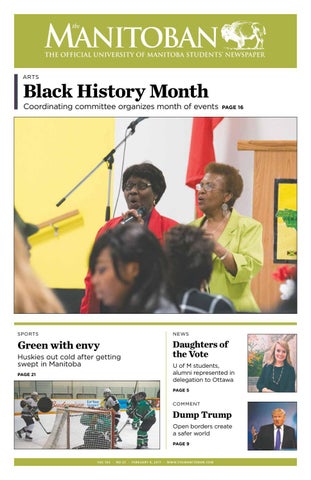
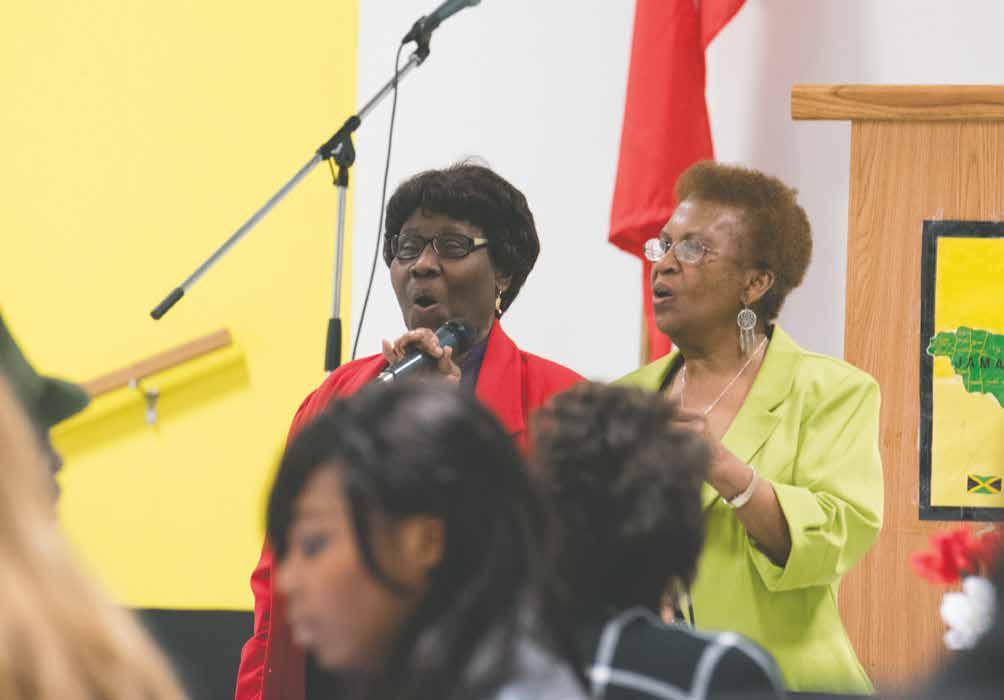
Winnipeg celebrates 36th annual Black History Month
The series of celebratory events will explore the cultural history, beauty, and challenges of black communities
e melia FO urnier, staff
E very year, the month of February presents a time for the celebration and appraisal of black history, and in honour of the tradition, Winnipeg’s Black History Month celebration committee (BHMCC) is holding the 36th annual Black History Month celebration event series all through this month. The celebratory showcase will feature concerts, symposiums, and workshops.
The goal of the Black History Month is to highlight the progress and accomplishments of the black community and explore the richness of black culture. The BHMCC’s goal is to celebrate black culture and history and use it to enlighten the public about ongoing issues.
“A lot of our events focus on youth, trying to find different avenues to get them more involved with Black
History Month, and with history as a whole,” said Nadia Thompson, chair of the BHMCC.
“When you’re in school, the information they’re giving about black history is very limited. We want to be a vessel of that information.”
Reaching out to youth is high on the committee’s list of priorities because young minds tend to be more receptive and open to learning and education. The committee, through a series of celebratory events, will enlighten young minds on the cultural history, relevance, and challenges of black communities.
with the future, and understand the conditions of today,” said Thompson.
The committee aims to become a hub for Winnipeggers to learn more about the black community.
Canadian black civil rights icon.
“It’s small stuff that will eventually grow through leaps and bounds. We have to start somewhere,” said Thompson. “Our goal is to make changes in the education system, to have a more indepth look at black history as a whole.”
“We need to know where we come from to move forward, to progress and understand the conditions of today” –
Nadia Thompson, chair of BHMCC
“We need to know where we come from to move forward, to progress,
Although the Canadian educational curriculum remains largely Eurocentric, the Canadian government has made some progress in engaging with and providing more information about black culture and history. For example, the new ten dollar bill will feature Viola Desmond, a
Over the years, the BHMCC has collaborated with libraries, schools, and communities to make educational resources more accessible.
“As a majority, Canadians are very open and understanding, and are committed to equality for everybody,” said Thompson. “[That being said], there is an underlying ugliness. There’s a lot of ignorance. People don’t
know, don’t understand, or just don’t take the time to understand other backgrounds and cultures.”
Whether you consider yourself a member of the black community or not, the series of events presented by Winnipeg’s BHMCC will prove to be both entertaining and eye-opening.
For a full listing of events, visit http://bhmwinnipeg.blogspot.ca. If you want to get involved with the BHMCC, you can reach them at bhm.winnipeg@ gmail.com
photo by miguel yetman
When everyone’s a critic
Toronto Generator panel reflects on the democratization of cultural criticism
h annah l ank, the Varsity
TORONTO — What does it mean to be a critic at a time when opinions flood our news feeds and Facebook timelines, and everyone claims to have an important critical perspective? In the era of fake news – or “alternative facts,” as Trump advisor Kellyanne Conway would have us believe – and a rising level of inflammatory rhetoric across the globe, should we be attempting to distinguish between various critical views? And if so, what makes a good critic?
These were among the questions asked at a panel discussion held on Jan. 12 by Generator, a Toronto artistic incubator, which brought together four prominent artists and intellectuals to debate the issue of cultural criticism in an age where mainstream critical reviews are losing prominence.
When consumers choose what to click on and what to ignore, and when social media feeds are largely tailored for our individual news preferences, critical pieces often go unnoticed. This was much less the case in the age of print media, where physical newspapers served as vehicles for curated content.
The panel attributed much of the decline of professional criticism to the rise of blogs and the prominence of opinion writing online. A strength of digital media is that it allows for
immediate dialogue between an audience, directors, casts, and critics, and it has resulted in a democratization of criticism with an increase in the diversity of voices being heard.
“What makes for a good critical perspective isn’t the pedigree of the publication, but the insight of the author”
– Scott Howard, University of Toronto department of philosophy
The question is: are all those voices worthy of being heard? Glenn Sumi, associate entertainment editor at NOW Magazine, wondered aloud if a theatre review provided by someone who hasn’t seen a theatrical production since high school is valuable – or, at least, as valuable as someone whose academic background and profession revolves around theatre criticism.
The question of objective value in art has long been debated by phi-
losophers. That we disagree on what is good and what is bad is obvious, but perhaps this inconclusiveness reveals a purpose of art: to generate discussion.
Philosophy lecturer Scott Howard, who has taught the University of Toronto philosophy department’s aesthetics survey course, said, “The idea that art criticism is fundamentally about giving value verdicts isn’t mandatory.”
We tend to view criticism as a consumer commodity: how many stars is an exhibit, performance, or other work of art worth, and is it worth spending my money on? In Howard’s view, perhaps we should be viewing criticism and the knowledge possessed by professional critics as a “tool for explaining the different ways in which [a piece] might be an interesting artwork.”
Howard referenced philosophers such as Arnold Isenberg and Alexander Nehamas , and their belief that “the activity of the best critics isn’t reducible to stamping art as good or bad... instead, critics are communicating why that artwork is interesting, or what kind of experience it might afford.”
Panelist Michelle MacArthur, assistant professor at the University of Windsor’s school of dramatic art and prominent researcher of theatre
criticism, expressed a similar view: “We cannot consider criticism and art as opposing forces. Together they are part of a healthy ecology.”
“If we think of criticism ... as people explaining why they think stuff is interesting ... then it doesn’t strike me as disastrous that the Internet lets everyone be a critic,” mused Howard. “I think there’s value in certain critical perspectives, but those perspectives aren’t only found in hallowed institutions like the London Review of Books ... what makes for a good critical perspective isn’t the pedigree of the publication, but the insight of the author.”
We are entering an era where many believe the role of art in our lives is becoming more significant than ever as an outlet for dissent and expression, as a means of inciting conversation and critical thinking. Perhaps criticism will have an imperative role in this, particularly as critics make sense of art from a variety of perspectives. It is not a time to shy away from the perspectives of others, but rather a time to internalize criticism, discuss, agree, and disagree.
Hannah Lank is a contributor at the Varsity
Ione Thorkelsson’s Synthia’s Closet is an artistic exploration of synthetic life
With current
exhibition, award-winning
artist highlights the nuance of rapid scientific development
Science is a discipline that pushes nature’s boundaries and questions known principles, and with today’s rate of scientific and technological advancement, there is a need to pause and ponder the impact scientific strides may be having on our society. With that in mind, Manitoban artist Ione Thorkelsson is determined to use her art to explore the interventive nature of science.
In a uniquely captivating and crafty manner, Thorkelsson is exploring the advent and advance of synthetic life in her exhibition Synthia’s Closet, on display at the School of Art Gallery from Jan. 12 to Feb. 24. With this installation, the recipient of the 2010 Governor General’s Award in Media and Visual Arts builds on her reputation as a conceptual contemporary visual artist and returns to her primary technique of glass blowing.
“I work with glass all the time, and I work with natural elements,” said Thorkelsson. “There was a new story
about synthetic life and that got me thinking about putting these things together. Everything just seemed to come together at the right time at the right place.”
The story in question was one that took the scientific community by storm back in 2010, when American biotechnologist and entrepreneur John Craig Venter and his team of scientists successfully produced synthetic life from scratch in a Boston chemistry lab. This feat spurred Thorkelsson to stay abreast of developments in the scientific community about synthetic life while simultaneously working on an exhibition that explores the power and potential of man-made genomes.
Over the next five years, Thorkelsson consulted scientists and technicians, as she crafted the exhibition, and named it after Synthia - the name Venter and his team gave their invented synthetic organism.
“Synthetic life seemed like a big biological step to me,” said Thorkelsson.
“A lot of my works are about difficult human interactions with the natural world and this seems to be about humans interfering with the natural world in a strange way. So it’s a continuation of themes that I have been working on.”
Synthia’s Closet forces one to perceive and react, apprehensively, to their natural environment. On entering the dark exhibition space, the visitor’s attention and focus is drawn to 31 hanging globes suspended from the roof and concentrated towards the far end of the gallery. Within each globe is a microenvironment containing vestigial elements of animal and plant species entwined with wire filaments. This spectacle, coupled with the silent ambience of the room, stuns the visitor – and is synonymous with man’s reaction to the seemingly nonintrusive interference of science with the natural order of life.
There are four panels at the entrance of the exhibition that visitors,
who are so enticed by the suspended spectacle, will most likely miss or overlook. These panels include John Craig Venter’s Wikipedia page, a screenshot of the synthetic organism Synthia “Syn” Venter’s Facebook page, a cover page of a September 2014 issue of Popular Mechanics themed “How to Make Anything” – an issue that expands on artificial life – and page 84 of the same publication featuring an article titled “How to Make Things Glow.” These carefully selected and strategically placed panels highlight man’s vulnerability to the allure of scientific feats and negligence to gaining complete knowledge and understanding of the scientific discovery or process.
discoveries that are being made, but with a little bit of hesitation that what if those things go wrong.”
For Thorkelsson, this installation is perfect for the School of Art Gallery as she had been crafting the exhibition with the space in mind. She believes the relatively new gallery space bodes well for the university and is telling of the progressive nature of today’s artists and arts.
“I am fascinated by the progress of current researchers, and there is a potential for things to happen rapidly. If all those things are happening at the same time, then it becomes a nuance to the situation” – Ione Thorkelsson, artist
“I think there is energy in young people and that is amazing to have and watch. Young artists now seem to be open to all kinds of possibilities so they combine all kinds of arts styles, media, and crafts. I think it is a lively world out there.”
“I am fascinated by the progress of current research, and there is a potential for things, scientific discoveries, to happen rapidly. If all those things are happening at the same time, then it becomes a nuance to the situation,” said Thorkelsson. “I am hoping that people experience both those things: the energy, beauty, and science of the
From Jan. 12 to Feb 24, Ione Thorkelsson’s exhibition Synthia’s Closet will be on display at the School of Art Gallery (225 ARTlab, 180 Dafoe Road). For more information about the exhibition, visit www.umanitoba.ca/schools/ art/800.html
Stacey James set to release debut solo album
New album highlights local singer-songwriter’s personal and musical growth
Winnipeg-based singer-songwriter Stacey James will be releasing her first solo album, 11 11, this month with an release show at the Park Theatre on Friday, Feb. 10. James was previously the lead vocalist and songwriter for both Grooveport and Stacey James & The KiK.
With her musical influences ranging from Prince, Aretha Franklin, and Alicia Keys to Jann Arden and Alanis Morrisette, James’ new album showcases her versatility and unique blend of blues, soul, pop, funk, and rock. The album features talented musicians like Joe Curtis, Brad Lazer, Keith Dzedzora, and Jim Jolly, amongst others.
“[11 11] is a good display of who I have been, and where I have been,” said James.
For James, this album reflects her
growth as an artist and takes the listener through different facets of life, from heartbreak to introspective selfdiscovery. 11 11 highlights her musical growth and confidence stemming from her extensive experience with collaborative musical projects.
“As an artist, I have become more comfortable with my authentic self, and my ability to express that to my art,” said James. “I used to write a lot more metaphorically, because I was afraid people would hear it and know exactly what I was saying.”
On 11 11, James allows herself to be more vulnerable with her listeners, writing with a deeper sense of frankness and authenticity than she has in the past. She has been writing songs constantly throughout her musical career, whether for the bands she has fronted or for other musicians. Making 11 11 felt like a natural
progression of her music career as she takes the bold step of writing and released her first solo album.
“[I had] to put myself back into the different places of my life that inspired the songs,” said James.
Performing, recording, and writing music is a labor of love and, this endeavor took longer than expected, due in part to the death of her live band’s guitarist over the course of recording. Despite this, James stayed strong and pushed on. To convey the emotion of the songs, both during recordings and performances, James has had to relive some of these past –and sometimes painful – experiences.
“There’s this place you can get to as an artist [where] you step outside of yourself and your insecurities and your thoughts. No one else is in that room but you and your own spirit,” said James. “There’s nothing in the
air except for you and your passion.”
The album’s name, 11 11, came about during the days leading up to and during the recording process. Ever so frequently, she would see the numbers in different places. Eventually, she decided to name the album 11 11
“Apparently when you keep seeing the number 11 it’s a sign of synchronicity, that you’re on the right path,” said James.
Stacey James’ album release show at the Park Theatre on Feb. 10. Tickets are available online or at the door . Physical copies of 11 11 will be available on Feb. 10, with a digital release set for Feb. 11. Visit www.staceyjameswriter.com for more information.
photo provided by stacey james
photo by miguel yetman
Sports Editor: Ryan Stelter
On the Hot Stove
Brett Stovin talks snipping the flow, and the men’s hockey rejuvenation
ryan s telter, staff
In this edition of the Hot Stove, Brett Stovin talks about how the men’s hockey season has turned around, his personal play this season, and cutting his hair for cancer on Feb. 9.
Manitoban: Last time we talked, you guys weren’t exactly where you wanted to be, but in 2017 you’ve gone 7-2-1, is this how you expected the team to play?
Stovin: I think the break was the biggest thing we needed, we were waiting for that for a few weeks before Christmas – we knew we needed it. We had a lot of banged up bodies and I didn’t want to use it as an excuse, but it does make a difference when you can get consistency in your lineup. So the break was huge for us. We came back and we’re healthy for the most part, we had the lineup we wanted and stuck with it, we’re healthy and we were lacking that consistency on the ice for the last year and a half and we seem to have found that since Christmas. We have the depth and the consistency and those are helping us right now.
M: You’ve scored less this season, but have assisted more than you have last season. Have you changed your game at all or is that just how things have gone for you?
“We’re both getting sick of our hair, so we decided to do something good with it, and we’ve all been affected by cancer” – Brett Stovin, Bison men’s hockey assistant captain
S: It’s a little bit with the just the way it’s gone but it's also been dealing with my injury. I'm not as an efficient skater, I’m not skating as well as I have in the past and I’m not thinking about it during the game, but it's
enough that it's actually affecting me. I’ve moved towards more of let everyone come to me. Suck in as many guys as I can and find the open guy, or go get the puck in the corner and instead of driving the net and trying to jam it myself, I drive the net and look for the open guy. Because someone is coming to me that supposed to be covering someone else.
I have changed my game a little bit but that’s also just how it’s been going, a lot of my assists have been shots on net, and someone cleans it up or it’s a face-off win and a great shot from my line mate. I'm just hitting posts, getting robbed; things like that so it’s been a little bit of both.
M: Before I ask about the fundraiser you and Jonah Wasylak are doing, who’s got the better flow?
S: I’ll give it to Jonah, he’s had it for three or four years and his is a little longer I think. I give it to him just because he’s had it longer and it’s a little bit thicker because of that.
M: What made you and Jonah decide to cut your long hair for cancer?
S: We’ve been growing our hair for a while, I've had long hair for about two and a half years now and he’s had long hair for three, four years. Last year we talked about it but we just didn't have long enough hair. So we decided we were going to grow it out, see how long we can get it before we decided we wanted to do something with it. We threw the idea around, but we never really took it to action. We were pretty busy with the first half with school and stuff so it never really happened.
We kind of seriously thought about it at the end of Christmas when we came back from break and then when we were stuck in the airport in Lethbridge for like seven and a half hours. We just decided ‘what the heck let’s go for it’ and we drew up a campaign, the mission goals, got the GoFundMe page going, and put it on Facebook. We thought it was just going to be a small thing, we just wanted to quietly cut our hair, wanted to raise just a little bit of money just
to donate and make a little bit of a change. Hopefully someone gets a wig out of it, and then it kind of blew up and in a day in a half we reached $500 and then we raised it to $2,000 and within four days we hit that goal. Then we decided to make it a bigger thing, we opened it up to the student population, we’re going to make a big event out of it, Cancer Care society reached out to us and they want to come down and present the cheque at one of the games to us.
We’re both getting sick of our hair, so we decided to do something good with it and we’ve all been affected by cancer, one of our teammates have been affected by it this year. So we decided we’d do something good with our long hair.
graphic by aldo rios
Fifth-ranked Bisons sweep Huskies in women’s hockey
jas O n P C hajek, staff
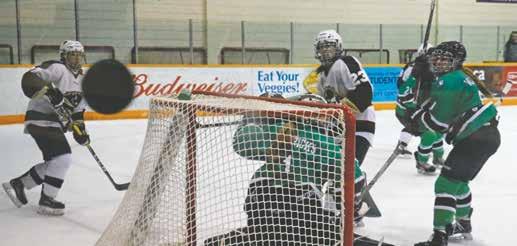
This weekend, the fifth-ranked University of Manitoba women’s hockey team played host to the Saskatchewan Huskies for their last regular season home series. The Bisons blanked the Huskies 3-0 on Friday, and won the rematch 3-1 on Saturday.
“To
know we can play different types of games, play defensive and lock teams down will be important for us going forward” –
Jon Rempel, Bison women’s hockey head coach
Friday
The playoff-bound Bisons were back at Wayne Fleming Arena Friday night, beginning their last home series of the regular season against the Huskies. The herd dominated the possession game, helping Rachel Dyck secure the 3-0 shutout win.
Second year winger Jordyn Zacharias opened the scoring, early in the first. Lauryn Keen came streaking down the left sideboards
and chipped a pass to Zacharias. She went forehand, backhand, and placed a shot above the pad of Huskies netminder Cassidy Hendricks to make it 1-0 Manitoba.
In the opening moments of the second period, the Bisons were able to extend their lead. Defenseman Megan Neduzak rifled a one-timer top corner and over the glove of Hendricks.
Winger Venla Hovi picked up her second assist of the night moments later, helping Zacharias pot her second goal. Hovi gave the puck to Zacharias who fought off a defender to get in close. She placed a backhander short side on Hendricks to make it 3-0 Bisons.
Dyck turned away all 24 shots she faced, while Keen picked up three assists and Hovi snagged two in the 3-0 win.
Manitoba was without key contributors Erica Reider and Alanna Sharman, who are off with Team Canada at the 2017 FISU Games in Kazakhstan. However, a few players have elevated their game in their absence.
“It’s an opportunity for different players to get some opportunities and trying to get more players a few more minutes as we head in to playoffs,”
Bisons head coach Jon Rempel said post game. “We have to play a team game regardless if those two are in the lineup or not and other people are doing what they need to do here.”
Saturday
Saturday marked the final home game of the regular season for the Bisons, as they looked for a sweep against the Huskies. The two teams battled it out, playing a physical game where the Bisons were able to come out on top 3-1.
Manitoba got out front early on the power play. Centre Karissa Kirkup took the puck from defenseman Caitlin Fyten, sending it crossice to winger Sheridan Oswald at the left faceoff dot. Oswald rifled a shot low under the blocker of Hendricks for the 1-0 Bisons lead.
Zacharias extended the lead to two in the final minute of the first. A mad scramble ensued in front of the Huskies goal and Keen popped the
puck over to Zacharias who potted her 10th of the season. Saskatchewan came storming back in the opening minutes of the second. Rachel Lundberg got the puck up to Kori Herner and took off like a rocket on a breakaway. Herner put a laser top shelf on Dyck to cut the lead in half.
Hovi did get on the score sheet in the third, assisting on a goal by Keen. The Bisons came into the zone, 3-on-2, and Hovi threw a backhand pass through a crowd. Keen picked it up on the other side of the goal, banging it home.
The Huskies threw everything they could at the home team, but it wasn’t enough as the Bisons took the game and the weekend series 3-1.
Dyck made 24 saves for the Bisons, earning her Canada West-leading 15th win.
“Solid, you only give up one goal against a good hockey team that can play and has good players and is well coached, that gives your team confidence,” Rempel said of his team’s work during the weekend. “To know we can play different types of games, play defensive and lock teams down will be important for us going forward.”
The Bisons head out to Edmonton to wrap up their regular season against the University of Alberta Pandas on Feb.10-11.
Bisons earn valuable split on the road in Saskatchewan
ryan s telter, staff
The second-ranked Saskatchewan Huskies have not had it easy this year against the Bison men’s hockey team. The Bisons are 2-1-1 against the top team in the Canada West after this past weekend. Manitoba fell 5-3 on Friday night, but shutout the Huskies 4-0 on Saturday.
The Bisons have clinched a playoff spot in the Canada West and sit in fifth place with a 13-11-2 record
The Bisons have clinched a playoff spot in the Canada West and sit in fifth place with a 13-11-2 record. They are four points back of Mount Royal for fourth place and a home playoff spot heading into the final weekend of the season.
Friday
The Huskies jumped out to a quick two-goal lead in the first period, getting goals from Jordan Tkatch and Josh Roach 53 seconds apart. Rookie centreman Remi Laurencelle got the Bisons on the board with his sixth goal of the year. The Huskies restored their two-goal lead late on with Levi Cable’s fifth goal of the season. Saskatchewan added to their lead when Logan McVeigh scored his 13th goal of the year 3:56 into the second frame. Defenseman Blake Heinrich got his second goal in as many games on the power play for the Bisons to make it 4-2 after 40 minutes of play.
The Bisons cut the lead to one halfway through the third period after former Winnipeg Blue Brett Brooks fired home his second of the season. The Bisons pressed hard for an equalizer, but were unable to tie the game, and Roach sealed the win for the Huskies with an empty net goal with ten seconds remaining. Byron Spriggs stopped 27 of 31 shots in the loss for the Bisons.
Saturday
After coming up short in the comeback on Saturday, the Bisons were able to blank the Huskies 4-0 on Saturday. The opening 20 minutes saw no goals scored for either team, with Saskatchewan outshooting Manitoba 12-7.
Liam Bilton opened the scoring for the herd halfway through the
second frame with his third goal of the season. Adam Henry doubled the lead for the Bisons late in the second with Laurencelle and Nick Zajac picking up the assists on the goal.
Henry got his second goal of the game and sixth of the year in the third period on the power play. 24 seconds later Henry picked up his third point of the game with an assist
The Bisons finish up their regular season at home against the sixth ranked University of Alberta
photo by megan colwell
on Warren Callis’ goal to make it 4-0. Spriggs was perfect in between the pipes for the herd, stopping all 36 shots he faced, earning him first star honours.
Golden Bears on Feb. 10-11.
photo by star roxas
Manitoba fields six first place individuals and three top relay teams at Bison Classic
k ellen tanigu C hi, staff
T
his past weekend, the University of Manitoba played host to the eighth annual Bison Classic track and field meet, at the James Daly Fieldhouse. Lethbridge, Regina, Alberta, and Lakehead were the four universities that made the trip for the event, and between Manitoba and those four schools, over 300 athletes were showcased during the two-day event.
The Bisons won the meet for the third consecutive year, scoring
a colossal 354.50 combined points, which was miles ahead of second place Regina, who scored a total of 247 points.
The 300 plus participants was lower than usual standards, but the athletes still gave it their all in what was a great competition.
“We didn’t have the same number of teams as years previous,” Bisons track and field coach Claude Berube said. “But the Bison Classic has always been a premier meet in
Western Canada. We are hoping to get back some of the numbers for next year, but the quality of this year’s meet was still very good.”
Individual performances Manitoba fielded six first place athletes, including three women and three men. Freshmen Rebekah Eckert finished first in the women’s triple jump, launching herself to an 11.85-metre jump. Rookie pole-vaulter Emily Blackner lifted herself to first
place, by propelling herself up 3.63 meters to clear the bar. The final woman to bring home a first place finish was second year runner Tayo Babalola; she zoomed through the 300-metre race in just 39.93 seconds.
Three male participants also got to the top of the podium, starting with pole-vaulter Adam Gundrum. The six-foot tall senior was able to clear a competition high 4.10 metres. Senior high jumper Alhaji Mansaray was able to clear the bar with a 2.10-metre jump, which was enough to claim first place at the meet. The Bisons were also able to claim first place in the 1000-metre race, with sophomore runner Simon Berube flying to the finish line in a lightning fast time of 2:30.41.
Relay Teams
The hosts were able to bring home three first place finishes in the relay races as well. The women’s 4x200metre relay team crossed the finish line first with a time of 1:40.41, while the men’s 4x200-metre team finished a respectable third place with a time of 1:29.23. The Bisons female 4x400metre team was also able to claim a first place finish for the herd, finishing with a time of 3:54.83; the men’s team was able to finish a close second place in the same race, coming in with a time of 3:21.93.
The lone men’s relay team to finish with the top time was the 4x800metre team, who kept their stamina long enough to outlast the other teams, and finished in just 7:43.71. The women’s 4x800-metre team also put
Bison men’s basketball eight-game win streak comes to a halt
k ellen tanigu C hi, staff
T
he University of Manitoba men’s basketball team was on the road in Brandon this weekend, where they saw their eight-game win streak come to a screeching halt. They fell 79-68 to the Bobcats on Friday night; Brandon picked up where they left off, and defeated the Bisons 92-77 on Saturday night. With the two losses, Manitoba is now 10-8 with just two games remaining in their regular season schedule.
Friday
The Bisons shooting woes were a big factor in their 79-68 loss Friday night, a night where the ball found the twine just 29.5 per cent of the time. The visiting Bisons got on the board first with a three-pointer by AJ Basi, and they maintained the lead for the majority of the opening frame. The teams exchanged points for the most part, with Brandon tying the game a couple of times, before taking the
lead on the last basket of the quarter; the Bobcats led 18-17 after the first. Manitoba fell apart in the second quarter, with Brandon opening on a 16-0 run to take a 34-17 lead. With just under four minutes remaining in the half, Ilarion Bonhomme got a jumper to fall, and finally got the herd on the board. The teams remained competitive for the final few minutes of the half, with the Bobcats taking a 42-28 lead into halftime. The play in the third was boomeranging from end-to-end, preventing the teams from changing the scoreboard much. Brandon still had the lead after three quarters of play, leading 62-50. Keith Omoerah netted five points for the Bisons in the third, and finished the game with a double-
double of 13 points and 11 rebounds. Manitoba needed to come out with a fire lit under them in the fourth quarter to have a chance, and that is exactly what they did. After Brandon hit a three pointer to lead 65-52, the Bisons went on a 10-0 run to cut the lead to just three points
led the home side, scoring a gamehigh 21 points.
Saturday
Brandon completed the weekend series sweep with a 92-77 win over Manitoba, a game where they dominated the paint area, scoring 54 points compared to the Bisons 32.
The Bisons shooting woes were a big factor in their 79-68 loss Friday night, a night where the ball found the twine just 29.5 per cent of the time
with six minutes left to play. The Bobcats however, fired right back with a 10-0 run of their own, and wouldn’t let the Bisons get any closer. Bonhomme had eight points in the second half, and finished with a Bison-high 14, while Tyvon Cooper
The Bobcats got out to an early 10-2 lead in the first quarter, but the Bisons answered back with a 10-2 run of their own to tie the game at 12. The Bobcats took a slim 17-15 lead into the second frame.
The teams were back-and-forth early on, with Brandon taking a 25-20 lead mid-way through the second quarter. The Bobcats pulled away, as they went on an 8-0 run to take a
in a fantastic effort, coming in second place with a time of 9:30.19.
“It was a very good two days and strong performances by our 4x200 and 4x800 relay teams for a good start to the season and into the national rankings,” Berube said. “The 4x400 teams also improved their times.”
“Overall, I am pleased with the meet and the team win plus our strong individual results” – Claude Berube, Bison track and field coach
The eighth annual Bison Classic was a huge success, with a lot of student-athletes putting in tremendous performances, which we can expect to see in future meets this year.
“Overall, I am pleased with the meet and the team win plus our strong individual results. I am excited for the rest of the season,” Berube said.
33-20 lead. The game went back to being tightly played, and Basi sank the final five points of the frame, shrinking the lead to 10 points at the half.
Brandon went on another 8-0 run early in the third, to extend their lead to 16 points, and built a lead as large as 20 points. After being held to 15 points in each of the previous three quarters, the Bisons offense came alive in the fourth, but Brandon kept up with them. Justus Alleyn scored 11 of his team-high 26 points in the fourth, but Earl Thompson Jr. also scored 11 of his game-high 27 points in the fourth, to help give the Bobcats the win.
Manitoba returns home on Feb. 10-11, where they will host the Mount Royal Cougars at the Investors Group Athletic Centre to finish off their regular season schedule.
photo by jeff miller
Bison men’s volleyball team crush Wolfpack, women’s losing streak continues
ryan s telter and k ellen tanigu C hi, staff
This weekend the Thompson Rivers Wolfpack came to town to play the University of Manitoba volleyball teams. The first-ranked men’s team dominated and won 3-0 on Friday and 3-0 on Saturday. The women had their losing streak extended after losing 3-1 on Friday and 3-1 on Saturday.
Men
The top-ranked university volleyball team in the country made quick work of the Wolfpack on Friday, dispatching them in three straight sets. It was an absolutely dominating performance from the herd, as they out-hit, out-served, and pounded the Wolfpack into the ground.
Devren Dear was up to his usual self, as he smacked home a team-best 13 kills on the night. The Bisons only made 12 errors all night, and had a team hitting percentage of .338. The second set saw the Bisons hitting an impressive .619, where they had 14 team kills.
Saturday was more of the same for the Bisons, as they once again won 3-0. The win comes during Manitoba’s final regular season home game, a night where their eight seniors were honoured (Ken Rooney, Devren Dear, Luke Herr, Evan Jackson, Kevin Falconer, Caleb Hickok, Alex Strachan, and Josh Crellin).
“It’s a large crew,” Bisons head coach Garth Pischke said. “I thought it was a good ceremony, and they deserved it. There’s a lot of talent there, and a lot of good memories.”
Manitoba dominated the first set,
a set that was plagued with service errors and aces. Thompson Rivers was able to put points on the board in large part to the Bisons eight service errors; the visitors made six themselves. Manitoba won the set 25-15 on a Caleb Hickok service ace, a fitting way to end the first set.
The Bisons continued their dominance in the second set, where they were able to score four straight points twice, and five straight points one time within the set. Thompson Rivers never scored more than three straight points. The home-side rolled on to another 25-15 set win.
The final set started off really competitive, with the teams exchanging points, but the Bisons had a 13-10 lead mid-way through the frame.
The Bisons won the set 25-16, and the match 3-0.
“It’s nice we got lots of guys on the floor too, and they all contributed,” Pischke said. “We played pretty steady throughout, and I’m happy with it.”
Women
After annihilating the Wolfpack 25-8 in the first set, the Bisons eventually lost on Friday 3-1. The rest of the match was a disaster for the herd, as they hit close to or negatively in every set after the first one for a total hitting percentage of .104. Sarah Klassen hammered home a team-best 10 kills for the Bisons, as well coming up with seven blocks.
Although both teams made a similar amount of errors, the Bisons were just unable to get it done offensively. Saturday was more of the same for the Bisons, as they had their losing
Rumours flying in Selkirk
streak extended to eight games after a 3-1 loss.
Prior to the game, Manitoba honoured the team’s two seniors, with Caleigh Dobie and Klassen playing in their last regular season home game as a Bison.
“It was a pretty emotional match for the players” – Jon Hykaway, Bison women’s volleyball head coach
“It was a pretty emotional match for the players,” head coach Jon Hykawy said. “Those two players
have been here for five years, and I’ve only been with them for five months, but they’re two special players.”
The Bisons once again won the first set, but lost three straight for the second night in a row. Manitoba was beaten in almost every single team stat category, and was flat out beat by a good Thompson Rivers side.
“We competed hard,” Hykawy said. “They’ve got probably the best player in the country, and we tried to do whatever we could do to stop her, but when she comes up with 25 kills, it’s hard to come up on the winning side”
The Bison volleyball teams go on the road to play the MacEwan Griffins in Edmonton on Feb.10-11.
Fate of Steelers seemingly up in the air after rumors surface on social media
jas O n P C hajek, staff
T
rouble appears to be popping up across the junior hockey landscape in Manitoba. Lost behind news that the Opaskwayak Cree Nation Blizzard may no longer receive funding from the band council, were some other rumblings within the Manitoba Junior Hockey League (MJHL).
On Jan. 29, Darryl Wolski of the 2112 Hockey Agency tweeted that the Selkirk Steelers had filed papers to relocate to Beausejour for the 2017/18 season. Steelers GM Kevin Petrash quickly came out to squash those rumours, saying that the Steelers were there to stay and would continue to be involved with the community.
“I can definitely say there has been talk in the inner circles about moving the Steelers,” Petrash said when reached for comment. “The team is severely underappreciated by the local community. It’s very frustrating for the people running the hockey club.”
These comments are a far cry from
those by Wolski, who mentioned that the city of Selkirk and the Steelers ownership group were “at war.” It doesn’t seem like the team has a problem with the city at all, but its fans.
“We’ve gone from an average of over 1,000 fans on a Friday evening in 2010 to a paltry 400” – Kevin Petrash, Selkirk Steelers GM
“We’ve gone from an average of over 1,000 fans on a Friday evening in 2010 to a paltry 400,” Petrash said. “With these numbers the hockey club is simply unsustainable. It’s a very sad
situation for a once proud junior A city, especially with it being the 50th anniversary season.”
Although community support is an issue for the team, Petrash continuously reiterated management and ownership’s commitment to Selkirk.
“We can only hope the locals wake up soon,” he said. “Or this will be a ‘you don’t know what you had until it’s gone’ story.”
When responding to the initial rumors online, Petrash mentioned that the team is doing everything they can to be visible in the community.
Petrash is correct about the work the Steelers have been doing, as the players – almost always with Steelers mascot “Beamer” in tow – have been fixtures at community events. On Feb. 3rd, Colby Dudek and Brady Castellano visited the St. Andrews Daycare as part of “I Love to Read” Month, and the day prior Taylor Fisher, Jake Dudar and Braden
Lozinski visited St. Andrews School for the same event.
The team will also be holding the 19th annual Hockey Night in Selkirk Dinner, hosted this year by NHL legend Ray Bourque. Tickets for the Feb. 21 event are currently on sale.
While Petrash has continuously preached that the Steelers will remain in Selkirk past the end of the 2016/17 season, Wolski has his doubts.
“I don’t know much more, but I do know the team is holding practices in Seven Oaks,” Wolski said. “Now the latest is the team will play home games in Gimli and Teulon next year.”
Those final comments could not be corroborated and Wolski did not share the source of his information.
If the team were to play in Gimli as Wolski mentioned, it would be a viable but temporary fix. Gimli is around an hour’s drive from Selkirk, but the community center is vastly smaller, closing in on a junior B arena
in size. Gimili’s population of just fewer than 2,000 wouldn’t have the same ticket sales potential as Selkrik. Teulon would not be much better, with population of just over 1,000. The current home of the Steelers, the Selkirk Recreation Complex, opened in 1992 and has a capacity of 2,751. A much more intriguing option for the club, and is also home to the Keystone Junior Hockey League’s Selkirk Fisherman.
From an organizational standpoint it would be far wiser for the Steelers to try and make it work in the only home they’ve ever known. Founded 50 years ago in 1966, the Steelers have brought home 11 Turnbull Cups as MJHL champions. The Steelers currently sit third in the MJHL and will look to drum up more support with a long playoff run. Hopefully that and continued community involvement will be enough to turn the tides for another junior A franchise.