

Dana Hat H erly, staff
The province has created an arm of government responsible for directing the long-term vision of Manitoba’s post-secondary education system. After dissolving the Council on Post-Secondary Education (COPSE) last year and replacing it with the advanced education advisory committee under the department of education and advanced learning, the new group begins its work this week.
“Through this change, the department now directly oversees the allocation of funding to colleges and universities, ensuring that funding is directed to programs and services that meet the needs of students,” said Peter Bjornson, the minister of education and advanced learning, in a statement provided to the Manitoban
The first meeting of the new advisory committee is scheduled for Jan. 20, according to Zach Fleisher, chairperson of the Canadian Federation of Students-Manitoba (CFS-MB). At that time, the new advisory committee will meet to establish the terms of reference and the direction that the committee will take as part of this opportunity for various stakeholders to provide strategic advice to the minister responsible for setting education policies in Manitoba.
Since 1997, COPSE acted as an intermediary between post-secondary institutions and the Manitoba government, reviewing and approving programs and providing advice and policy direction to the province.
Up until recently, other responsibilities of the council were to allocate funds to post-secondary institutions in the province and provide grants to the Canadian Mennonite University and private religious institutions in Manitoba. The council allocated $474.7 million in grants to the University of Manitoba, University of Winnipeg, Brandon University, Université de Saint-Boniface, and the University College of the North in 2013-14.
The changeover was implemented under the direction of James Allum, the former minister of education and present minister of justice and attorney general.
When the COPSE Act was repealed, the minister of education assumed the role of the council, establishing the advanced education advisory committee to give advice to the minister for improving the postsecondary education and advanced learning system.
Bjornson said that, “Unlike COPSE, which had been responsible for the day-to-day functions of funding allocation, program approvals, and public reporting, the new minister’s advisory committee will be entirely focused on the long-term vision for the post-secondary system in Manitoba.”

“They moved most of the functions of COPSE within the office of the minister,” Fleisher told the Manitoban, adding that the advisory committee would provide advice to the minister directly as part of the department of education.
“The legislation was also designed to better streamline the program approvals process, allowing institutions to adapt their programming more easily to the changing demands of the labour market and to align their offerings with the wider educational system,” reads the statement from Bjornson.
Students set to suggest
Manitoba’s Advanced Education Administration Act states that the minister is to appoint at least five persons to the advisory committee. In total, Fleisher said that there are 11 positions on the new committee, each appointed by Bjornson. The 11 members include a wide range of representatives from the education field in Manitoba, such as U of M president David Barnard and a representative from the Manitoba Teachers’ Society. Fleisher, who was also appointed, is the only student representative on the advisory committee.
“The CFS represents students on the committee,” Fleisher said about his role representing post-secondary student members from the U of M, U of W, Brandon University, and Université de Saint-Boniface.
UMSU sent a letter to the minister of education and advanced learning, advocating for student representation on the new committee
“We pushed to have a student representative on the group,” said Fleisher. “When they took apart COPSE they weren’t entirely sure what scope the advisory committee would take, so we encouraged the government [ . . . ] to have us there.”
With each university in the province having representatives on the CFS-MB provincial executive, Fleisher spoke to the significance of
his role to communicate between the student members and the advisory committee. On the provincial executive, the representative from UMSU is the union’s vice-president external, Christian Pierce, who said that he will continue to have open dialogue with the chairperson regarding the committee.
“I will be bringing forward the discussions that we have on the committee level to our board and at the same time listening to our board to look at what they want,” said Fleisher.
Organizations overlooked
In the fall, Pierce said UMSU sent a letter to the minister of education and advanced learning, advocating for student representation on the new committee.
“It is good that there is at least one guaranteed spot for student representation on the committee,” said Pierce, adding that ideally there would be one position held by each major student organization.
The current legislation is for a minimum of one student representative from post-secondary students, according to Pierce.
“We hope that [the committee] will be expanded,” he said. “It has
not been determined, though, at this time.”
Prior to its elimination, UMSU would present to COPSE on an annual basis in regards to university funding, according to Pierce.
“It was one 30-minute presentation that would provide COPSE with recommendations on how funds should be allocated with respect to what UMSU believed would be the top priorities,” Pierce said, adding that other major student organizations, including the U of M Graduate Students’ Association and the U of W Students’ Association, also presented to COPSE.
Pierce said UMSU did not feel that COPSE was an efficient way to conduct consultation between UMSU and the provincial government, adding that the new advisory committee was regarded as an opportunity for improvement.
“We viewed it as an opportunity to reduce a step in an already complex process where issues with [post-secondary education] could be addressed more directly to the minister of education and advanced learning, depending on how the new advanced education advisory committee is going to be structured in terms of student representation,” he said.
“There doesn’t seem to be a direct focus of funding within this legislation, so it remains to be seen how this will alter lobbying efforts for more [post-secondary education] funding moving forward.”
The previous COPSE model would often result in a lack of oversight, Pierce added.
“In the past, the minister’s office would implement a change with little to no heads up and we would be forced in a position to react instead of offering recommendations before changes are implemented,” he said.
“The committee could be an efficient mechanism to have the minister have new initiatives reviewed by it first before being implemented.”
However, despite opportunities for improvement under the new advisory committee model, Pierce said post-secondary education issues could be downplayed given that postsecondary and K-12 issues are now grouped within the same government office.
“The minister is conducting meetings at the end of this month to try and finalize the structure of the committee,” Pierce said, adding that UMSU is hoping to get a representative added to the committee.
“We would also recommend that the structure of the committee truly represent all students in the province equally and have meaningful consultation with all the respective student organizations.”
e t H an Cabel, staff

The University of Manitoba Students’ Union (UMSU) has settled its differences with the Canadian Federation of StudentsManitoba (CFS-MB) and is now supporting a CFS-MB-led coalition meant to oppose impending budget cuts at the University of Manitoba.
In December 2014, UMSU vicepresident internal Jeremiah Kopp told the Manitoban that “the CFS is irrelevant at the University of Manitoba and doesn’t represent students at the University of Manitoba any longer,” adding, “it’s an organization that I don’t respect and the average University of Manitoba student doesn’t respect because of the way they conduct their business.”
That attitude has since changed, with UMSU contributing some incidental resources like coffee and tables for CFS-MB to operate their Stop the Cuts campaign. Furthermore, UMSU had a Letter to the Editor published in the Manitoban clarifying their opposition to budget cuts at the U of M, which are slated to average four per cent this year and four per cent next year.
“Ultimately, UMSU is looking to support any student who has issue with something,” Kopp told the Manitoban last week.
“We believe in democracy, we believe in free speech, and UMSU has been, in its small way, supporting the Stop the Cuts coalition and facilitating that process as well, because every student should have a voice on campus.”
Unlike the University of Manitoba Graduate Students’ Association, which donated $1,000 to the campaign, UMSU will not be contributing any direct financial resources to the Stop the Cuts coalition, Kopp said.
As part of UMSU’s effort to oppose
budget cuts at the university, it distributed a report to all undergraduate students at the beginning of the winter term titled “Understanding the Cuts: How the University’s Budget Cuts Will Affect You.”
The document, assembled by members of the UMSU executive with help from the organization’s policy analyst, Chris Rigaux, outlines some modern history of Manitoba tuition policy, as well as a summary of the claims of various stakeholders, including the U of M administration and the University of Manitoba Faculty Association.
“If a student was asking for perspective [on the cuts], it is definitely a document I would encourage them to read” – Zach Fleisher, CFS-MB chairperson
“UMSU doesn’t have any interest other than representing the students that have elected us,” Kopp said.
“We don’t have any hidden agenda or outside interests in this besides representing our constituents,” he continued. “The University of Manitoba Students’ Union wants to make sure that all undergraduate students have access to the information they need to be informed on this issue.”
Zach Fleisher, chairperson for CFS-MB, told the Manitoban that the budget report is a valuable piece of information for students to access.
“If a student was asking for per-
spective [on the cuts], it is definitely a document I would encourage them to read,” Fleisher said.
“I don’t think these perspectives are finite, and as long as we’re encouraging a wide variety of perspectives on this issue, I think that’s important.”
The University of Manitoba Students’ Union consulted members of the university’s senior administration in compiling the report, Kopp said.
The report claims that academic programs or faculties are unlikely to close entirely, but that four per cent of cuts this year and next year will likely result in reduced hours of operation in the libraries, outsourcing of university services to private contractors, and less access to staff in various student services, such as financial aid.
“President Barnard has committed the administration to avoiding acrossthe-board budget cuts; however, he has also stated the cuts will be four per cent ‘on average’ across the entire university, meaning that even if the university avoids across-the-board cuts, the administration’s alternative is to require some units to take cuts of more than four per cent,” the report states.
The report adds that undergraduate enrolment is expected to dip slightly this year, resulting in decreased tuition revenue for the university.
“Even a small enrolment dip of a few per cent presents a financial risk for the university,” the report states.
“The university has been grappling with deferred maintenance costs— basically, capital projects that have been put off for lack of capital funding—well back into the 1990s. As funding dried up in the 1990s, capital projects (such as building maintenance, major equipment repair, and improvements) were delayed or deprioritized. This is exacerbated by the


fact that the university’s buildings are in many cases several decades old and have greater costs to maintain than newer buildings.”
John Danakas, executive director of marketing and communications at the U of M, told the Manitoban that university administration encourages students to be informed about issues on campus.
“The university encourages students to remain informed of significant decisions and developments that take place on campus,” he said in an email statement.
“Students, through UMSU and faculty representation, have a voice in senate and on the Board of Governors, and so will help inform decisions around the budget. The budgetary challenges facing the university are real and require close attention.”
Cameron Morrill, associate professor of accounting and finance at the U of M, has been crunching the numbers for the University of Manitoba Faculty Association and the Stop the Cuts coalition since the budget cuts were first reported by the Manitoban in late 2014.
According to Morrill, the U of M consistently generates operating surpluses but transfers that revenue into
its capital fund to pay for “acquisition of, or renovations to, buildings, land, office equipment and furniture, heavy equipment, etc.” Last year, the university showed an operating surplus of $43.3 million, but due to a $49.5 million transfer to the capital fund, the U of M budget came in $6.2 million in the red.
Furthermore, the U of M has built up $134 million in investments in corporate bonds through its general fund that are collecting interest rather than being spent on operating or capital expenditures.
Morrill also cites growth in administrative costs, particularly in the areas of marketing and communications at the U of M, as another culprit in the university’s current budget woes.
“Our priority should be teaching and research, because that’s really what we’re about,” Morrill said.
UMSU’s report can be found online at umsu.ca/images/ stories/PDFs/UnderstandingThe-Cuts-(2015-01-05).pdf
UMGSA vice-president external resigns over CFS-led Stop the Cuts coalition
e t H an Cabel, staff
The vice-president external of the University of Manitoba Graduate Students’ Association (UMGSA) resigned earlier this month, partly in protest over a donation made by UMGSA to the Stop the Cuts coalition – a campaign established by the Canadian Federation of Students-Manitoba (CFS-MB) to oppose budget cuts at the U of M.
“I believe in clear direction and strong leadership; unfortunately I received neither. Instead, I received a tremendous amount of pressure over the irreconcilable political differences I have had with the president,” UMGSA vice-president external Faizan Khan wrote in his resignation letter, sent to UMGSA Council at the beginning of January.
According to Khan’s letter, UMGSA Council expressed reservations about supporting the Stop the Cuts coalition in a November meeting on the issue. Despite these reservations, the UMGSA pressed forward with its support under the leadership of president Laura Rempel.
“I was asked by our president to assist CFS with running this campaign by chairing the anti-cuts meetings and such. Her rationale for asking so was that my participation would help decrease the workload on CFS officials, and ensure that ‘It does not look like it’s a CFS campaign.’ I could not comply with the president’s request, as our council showed reservations over joining the CFS-proposed coalition in its meeting held in November last year, and passed a motion to gather factrelated information,” Khan wrote.
$640,000 in unremitted student fees spark questions of defederation
Craig aD olp H e, staff
Oorganization is happy to have the support of UMSU after differences between the two organizations were uncovered by the Manitoban late last year.
Khan did not respond to multiple requests from the Manitoban for comment. Furthermore, Rempel told the Manitoban that Khan is still serving as vice-president external despite his resignation earlier this month.
“This is an ongoing internal UMGSA matter being discussed with council members and parties involved. Therefore, we will not make an official statement at this time. When the issue is resolved we will communicate the outcome with our members,” Rempel said in an email to the Manitoban
“I would like to clarify one thing: Faizan Khan is still a member of the UMGSA executive team.”
When asked to clarify how much money the UMGSA donated to the Stop the Cuts coalition, CFS-MB chairperson Zach Fleisher told the Manitoban on Jan. 16 that the organization donated $1,500 to the campaign. He later retracted that statement, saying that the amount donated was actually $1,000.
“We’ve been very pleased to work with [vice-president advocacy] Rebecca Kunzman from UMSU and Laura Rempel from the UMGSA,” Fleisher said.
The CFS-MB has contributed $2,000 to the campaign so far, according to Fleisher, and the
“In spite of the council’s hesitation to support the CFS campaign, the president continued to support the anti-cuts campaign and promised CFS a handsome amount of $1,000 towards it. (Strangely, the CFS budget document shows $1500 [ . . . ].) This amount was allocated from the UMGSA campaigns budget; a rushed process which [was] neither presented to the campaigns committee that I chair, [nor] the finance committee.”
Rempel told the Manitoban that both Fleisher and Khan were confused about the actual donation amount based on an error in the minutes taken at a meeting of the Stop the Cuts coalition late last year. At that meeting, Rempel floated the idea of a $1,000 UMGSA donation to the coalition. According to Rempel, the entire UMGSA campaigns budget amounts to $1,500, which may have been the reason for the error in the minutes, in addition to the fact that the Stop the Cuts meetings are more informal than official UMGSA Council meetings.
Rempel said that she subsequently corrected the minutes at the next meeting.
On Dec. 10, the UMGSA executive had a meeting whereby they discussed a $1,000 donation to the Stop the Cuts coalition. An online vote was held between Jan. 7 and 9 for UMGSA Council to vote on whether to approve the donation.
Rempel reported council approval for the $1,000 to a meeting of the Stop the Cuts coalition the afternoon of Jan. 9.
Khan sent his letter of resignation on Jan. 9, the same day that Rempel received the results of the vote, which approved the donation.
Rempel added that the Stop the Cuts coalition is an important grassroots initiative deserving of the UMGSA donation.
“It’s important to contribute to a process to hold the administration accountable and have student voices heard,” she said.

n Jan. 12, at the University of Manitoba Students’ Union’s (UMSU) biweekly council meeting, some councillors raised questions about the news of fees being withheld from the Canadian Federation of Students (CFS) by UMSU.
Fees owed to the CFS are expected to amount to roughly $640,000 after including fees for the current winter term – which were only finalized on Jan. 19, the last date for refunds for dropped winter term courses.
The amount represents the total in student fees, earmarked for CFS, collected during the 2013-14 and 2014-15 academic years.
The University of Manitoba Students’ Union has been withholding the fees as part of what the executive has characterized as an act of defiance after claiming the national student union had ignored their requests to relinquish control of the umsu.ca domain name.
At the meeting, a few councillors who had not been aware of the fees being withheld asked questions of the executive about the unremitted fees.
Reanna Blair, UMSU women’s representative, first raised the issue after a report from UMSU vice-president external, Christian Pierce.
“I just want to clarify, is that really over the issue of the umsu. ca domain?” she asked, referring to the withheld fees.
lack of communication on many issues; we’ve requested [ . . . ] basic documents from them and they haven’t provided it.”
Kopp pointed out that if UMSU is shipping that money out of the U of M and sending it to Ottawa without benefit to the membership body, then “that’s not really us representing our students in [any] capacity. These students are expecting that the money goes to CFS but they’re expecting that we’re getting a service in return.”
Jacqueline Robert, Nursing Students’ Association representative, asked the executive whether or not universities had to be a part of the CFS.
“The CFS makes it much easier to join than they do to leave,” said Turnbull. “We’re in a situation where we’re a very critical local.
“Again, we haven’t considered the CFS or defederation, because in our mind, that’s not really what students want or need.”
Turnbull asserted that it should be the same simple process to defederate as it was to sign up, saying that this was presently not the case.
“Doesn’t that seem a little bit harsh?” –
Reanna Blair, UMSU women’s representative
“I can say this definitely is a big issue, that we want our domain back,” Pierce responded. “And that’s been our only communication with them; we don’t get any answers unless they email us about money for them.”
“Doesn’t that seem a little bit harsh?” Blair asked.
Al Turnbull, UMSU president, interjected, “We’ve been trying to contact the CFS – asking questions, asking for documents, asking for our domain name for a year and a half.
“They email us, they respond to us saying, ‘Where’s our money?’ after we’ve clearly said, ‘Hey, we just want our domain back.’
“It’s a bit of a wedge issue, but we don’t want it to be. The second they transfer the domain name we’ll pay them.”
Jeremiah Kopp, UMSU vicepresident internal, added to Turnbull’s explanation.
“It’s not just the domain in that sense. There’s been a complete disregard for our communication, the
“I mean, you sign up for a membership at a golf course or at a gym, you should be able to terminate that membership just as easily as you signed up for it,” he said. “It’s not the reality of the CFS.”
Steven Anderson—gay, lesbian, bisexual, transgendered, two-spirited* students’ representative—asked the executive what was going to happen to the funds.
“They’re held in trust,” said Turnbull. “We don’t spend them. We don’t do anything with them. They’re just sitting in an account.
“If we wanted to leave, this is the worst way to go. A judge in Manitoba would just say, ‘This is illegal; you’ve got to pay them.’ This has nothing to do with us wanting to leave; this is about us trying to leverage some of the requests we’ve made which are really, really miniscule.”
Turnbull continued, “UMSU should own umsu.ca. So with that being said, we’re asking for that; we’re asking for a couple of documents. And until they respond, we’re not going to pay them.
“$700,000; how bad do they want it?”



Aggies fill the house for annual Eat Y’er Hat social, 800 attend week’s biggest event
Craig aD olp H e, staff


The Faculty of Agriculture
Students’ Organization (FASO) hosted their annual Eat Y’er Hat Social on Friday, Jan. 9, as the wrap-up to their Hoe Down week, which they host to welcome agriculture and food science students back to school.
The event featured local band Jump the Clutch—a band comprised of U of M students, including students from the faculty of agriculture—playing to a sold-out crowd of 800, filling the multipurpose room on the second floor of University Centre.
Tickets for the event were $15 and sold out by Wednesday, Jan. 7 after going on sale on Monday.
Jordan Dahmer, FASO special events rep, organized the event which ran with music playing until 2 a.m.
She said she believed the high turnout was representative of the high level of involvement by agriculture students in the faculty.
“The faculty of agriculture is a close-knit group,” said Dahmer. “For the most part people are very involved in the stuff that FASO puts on and are very loyal to their faculty.”
Hoe Down Week, which ran from Jan. 5 to 10, featured a number of events in addition to the sold-out social.
Monday featured Hen and Cock Night at the Pembina Hotel.
Tuesday included a FASO auction at which students could bid on having FASO members do chores for them throughout the week; a hockey tournament between agri-
culture students and engineering students; and an evening bud, spud, and steak event at Area Nightclub.
Wednesday featured a series of competitions under the name “Redneck Olympics” at the Hub during the day and erotic bingo and karaoke at the Nob in the St. Norbert Hotel during the evening.
On Thursday, FASO hosted a chili cook-off and quizbowl event during the day and an evening barnight titled “Saddle Up!”.
“Of course it’s something we do every year. It’s become a tradition now” – Jordan Dahmer, Faculty of Agricultural Students’ Organization special events rep
Friday, before the Eat Y’er Hat social, was the Hoedown Hockey Tournament at which students in the faculty of agricultural and food sciences degree program faced off against students in the diploma program. A visiting team came from Assiniboine Community College’s agribusiness diploma program to compete.
On the final day, Saturday, students were invited to a final event,
an all-day pub-crawl that ran from 10:30 a.m. to 2 a.m.
Dahmer said that Eat Y’er Hat was by far the most popular compared to the other Hoe Down Week festivities.
“All of the other events are smaller, most around anywhere from 50 to 200 people. But Eat Y’er Hat is definitely the biggest, just because it’s on the Friday, so a lot of people from out of town come in or past Aggies go to it,” said Dahmer.
“Of course it’s something we do every year,” she continued, “So it’s something a lot of people look forward to throughout the school year.”
Connor Fisher and Joseph Holtmann, faculty of agricultural and food sciences students, were both happy to be at the social.
“It’s the best social of the year,” said Fisher.
Holtmann said he had been particularly excited about the band, adding that he was their number one fan.
Both Fisher and Joseph said that the majority of the people knew each other because such a large portion of attendees were faculty of agricultural and food sciences students.
Lindsey Brooks, third-year faculty of agricultural and food sciences student, was attending the Eat Y’er Hat social for the third year in a row. “I really like it. I’ve been to it every year since I’ve been in university now so it’s kind of a tradition now.”

Editor-In-Chief:

e van t remblay, staff
We’ve all heard some variation of it by now: “Of course I believe in freedom of speech, but...” In the wake of the Charlie Hebdo shootings and the conversation which has ensued, we should be careful to consider the root of any arguments against a full and robust right to freedom of expression.
To argue that satire should be censored because offence might be taken is to misunderstand satire. If you misunderstand satire—and satire, like all humour, can have crude manifestations—then an explanation of it will not help you. In a 2007 court ruling a French court ruled that Charlie Hebdo ’s comics did not attack Islam. It found that their comics targeted a specific group—extremists—and were not hateful.
To argue that positions can be freely taken and expressed until some line is crossed is to argue that boys can wear any colour they want except for pink. If you have no pity for the dead cartoonists, have pity for the boys dead for wearing pink, who also sought nothing less than free expression.
To censor images because we do not like the ideas they bring forth is to deny that those ideas exist in us
To argue that artists, intellectuals, and the press should act according to the standards of any religion that they themselves do not profess is to argue for replacing “freedom of speech” with “freedom from speech.”
To argue that it is offensive to “Islam” to do something that is expressly prohibited by less than the totality of that religion, is to paint almost two billion people with one coarse brush, and to unthinkingly give in to lingering colonial tendencies to ascribe easy traits to a monolithic “other.” There is a rich tradition of illustrations of Muhammad, which are not prohibited in the Quran so long as they are not idolatrous.
To argue that images (and what are images but fluid ideas temporarily frozen for easier digestion?) deemed offensive by some should not be reproduced, so that all people may judge for themselves whether they are offensive, is to assume that all people are easily offended, and that the easily offended will be satisfied with eliminating the images while letting the ideas flow freely.
To argue that freedom of speech, expression, or belief can be fully exercised, by everyone—and to believe that feelings cannot be hurt, and offence not taken or given—is naïve. It is to hope for easy answers to complex issues, or worse, to hope that complex issues will not arise.
Images serve to bring up ideas in

us, from the highest to the lowest of thoughts and emotions. To censor images because we do not like the ideas they bring forth is to deny that those ideas exist in us. If we see an image and our first thought is negative, we should thank the imagemakers for what they have told us about ourselves. We should not, as a
knee-jerk reaction, assume that others cannot handle negative thoughts, or weighty ideas. There is no particular need for free speech, or at least for a particularly robust form of it. Words and images are censored all over the world. This is sometimes done to stifle hate, other times dissent. A nation can still be
powerful, and a culture fruitful, without free speech.
But doing away with free speech comes with a price, one that those least willing to pay are perhaps the ones who feel most entitled to air an opinion on editorial cartoons.
“Vivre Libre ou Mourir.” If you do not approve of how the cartoonists at Charlie Hebdo expressed their beliefs, remember that they died for the principle that you could say, “Fuck those guys.”
Letters published in the Manitoban are edited for spelling, grammar, and punctuation. Views expressed in the letters are those of the author and do not necessarily reflect the views of the Manitoban
Muhammad cartoon is disrespectful
Iam writing today to express how much I am offended by your publishing of the cartoon of the Prophet Muhammad (peace be upon him). We have a very respectful society in Canada where people from all sorts of demographics coexist in peace and harmony, and I am proud of it. But if we are to continue to coexist we need to keep respecting each other.
You have to realize that all Muslims love the Prophet more than they love their parents. Would you still side with freedom of speech if someone was bullying your mother in public? Would you still side with free speech if I was to publicly advocate and lobby to make racism (or any other grossly offensive thing) legal and widely acceptable? Of course not!
Similarly, we need to realize that no matter what kind of cartoons they are (funny or provocative), just the fact that the Prophet Muhammad is depicted pictorially is offensive to Muslims. And do realize that a quarter of the world’s population is Muslim.
We all condemn the killings in Paris, but that is no reason for all Muslims to be punished in this way.
I hope I have educated you a little on why Muslims take offence to these cartoons, and I hope you will remove the cartoons immediately and apologize to Muslims at the University of Manitoba and around the world for offending them.
Mohammad Anwar
Iwas very disappointed to hear the stand that the Manitoban has taken regarding the publishing of the image of Muhammad in order to depict what the victims in the Paris attack died for.
Having heard the opinion of the Muslim community, I feel the Manitoban should not have published the image. To offend not only members of our university community but Muslim community members as well is inconsiderate.
I also feel by publishing this image the Manitoban has also endangered students who attend the University of Manitoba. It was already proven in Paris that extremists have no remorse for attacking other citizens. I ask you: why would they be more merciful to a university which is a location of a large population of the city’s future workers?
I feel the Manitoban could have displayed the university’s support and condolences for those who passed better. This could have been done by publishing images of those who passed and explaining the situation that occurred in Paris rather than offending members of a community who have already faced difficulties with the events that occurred.
The Manitoban has offended and endangered University of Manitoba students. A better approach such as publishing the images of the ones who passed in the Paris event could have been taken.
Dixie Baldwin
r aylene paC i, volunteer staff
When I heard about the attacks in Paris last week, I was shocked and horrified. I sunk into my seat in grief as a CBC news reporter explained that 10 journalists from Charlie Hebdo and two police officers had been murdered. This couldn’t be real. Being an aspiring writer and a former French-immersion student who had just visited France, everything really hit me right at home.
But I disagree with the notion that we should all be Charlie. I reject Ethan Cabel’s recent statement—in his Jan. 14 Manitoban article, “Time to stand up to radical Islamism”—that all people, Muslim and non-Muslim, need to stand in solidarity with Charlie Hebdo. Let me tell you why.
Charlie Hebdo is not a synonym for free speech. It is a satirical magazine that pushes the boundaries of free speech, taunting numerous political parties, social groups, and religions in the process.
Regardless of the content published, the attacks in Paris were of course unwarranted and tragic. Acts of intimidation and violence should be condemned, especially when they are attacking the liberties of open societies. Thus, it is important to stand for the principle of free speech.
But, those same societies should practise free speech with some sense of decency, intelligence, and respect. Consistently attacking an entire religion just because you can should not acceptable.
Cabel wrote, “Charlie Hebdo continued to publish cartoons and commentary meant to give Parisians a chuckle at the expense of the powerful and the brutish even while its editor was on an alQaeda hit list.”
Radical Islamism is extremely different from Islam, something these cartoons don’t always differentiate
It’s quite easy to forget that the chuckles of these Parisians were not only at the expense of the “powerful and the brutish,” but of the millions of peaceful Muslims in France and around the world. When Charlie Hebdo chooses to publish cartoons depicting the Prophet Muhammad, they are violating Muslim law that forbids such images.
Muslims have long been a part of France; their presence there goes back to the eighth century. But, with legislation banning hijabs from France’s public school system and the introduction of a 2010 law prohibiting the burqa in public, Islamophobic ideas easily run rampant. Muslims are left feeling as though they are not wanted in French society. So naturally, when
a magazine like Charlie Hebdo chooses to overtly mock them, it is not taken well.
Since the attacks, numerous news outlets have refused to publish these images. While Cabel believes this to be a cowardly act, I believe there is a certain validity to it that has nothing to do with being afraid of a violent retaliation. Choosing to not partake in the public mockery of Islam isn’t “letting the terrorists win.” Radical Islamism is extremely different from Islam, something these cartoons don’t always differentiate. Should we offend terrorists? Yes. Absolutely. Journalists should be free to fight them in the only way they know how. However, including another religion in your offence strategy shouldn’t be part of the attack. There has to be another way. If anyone, Muslim and nonMuslim alike, is hesitant to stand in alliance with Charlie Hebdo, their reasons should be understood. This isn’t about the fear of terrorist retaliation.
I am an advocate of free speech. But if being an advocate for free speech requires me to automatically ally myself with a magazine whose cartoons further perpetuate discrimination against a religion, then I don’t want anything to do with it.


Jeremia H yarmie, staff

Researchers from Ireland have found that reading to your newborn may not be the only way to stimulate their brain. The study looked at how reading, along with other interactions like showing them pictures and talking to them, affected indicators of cognitive development in ninemonth-old infants. Not surprisingly, reading improved cognitive development, with infants scoring higher on problem-solving and communication measurements, while showing them pictures only increased their communication scores.
However, problem-solving and communication skills were increased the most by informally and frequently
talking to the infant during other tasks. So don’t be afraid to document your lives and point out the obvious to your newborns – they might actually benefit from it.
Panspermia is the hypothesis that life flourished by means of interstellar travel on comets or asteroids. It is suspected that these celestial bod-


ies might have been contiminated by micro-organisms from elsewhere, but recent research from Sweden supports the idea that even DNA could survive the harshness of space.
In a study, DNA was placed on the exterior of a rocket that entered space and re-entered the Earth’s atmosphere, on a sounding rocket providing up to 13 minutes of microgravity exposure. Around half of the DNA was recovered and about a third of the DNA was still functional. With these findings, it is possible that we will be the ones to send off life into the universe through DNA, like seeds in the wind.

The Ebola epidemic in West Africa that began in 2014 is still an ongoing health concern. The outbreak is four times larger than every previous Ebola epidemic combined, and has outlasted them all.
Ebola is a class of zoonotic diseases, which reside in animals. In the case of Ebola, the disease is carried by bats. Outbreaks of zoonotic diseases occur when a disease jumps the spe-
cies barrier, being transferred from an animal carrier to a human being.
The current outbreak can be narrowed down to an initial zoonotic event involving a two-year-old boy from Guinea playing in a hollow tree which was inhabited by a colony of free-tailed bats. Bats are known to carry a variety of zoonotic diseases, many of which are very serious when transferred to humans.
Researchers from Oregon have recently inebriated zebra finches in the name of science. These finches are a common model for the study of vocal production and learning, as they learn songs similar to the way humans learn speech.
The researchers observed that the finches would willingly consume alcohol when it was supplied. I guess even birds like an open bar. While intoxicated, researchers found that the birds were having difficulty maintaining volume and cohesiveness. In other words, they were slurring their speech.
Birds have been known to become intoxicated intentionally from fermented fruit. Bohemian waxwings in the Yukon have found themselves inspired by spirits after feeding on fermented mountain ash berries. Not unlike humans, birds can become too inebriated. British blackbirds feeding on fermented rowan berries have previously been found dead due to physical injuries sustained from midair collisions while attempting to fly drunk. Don’t drink and fly.

C H antelle Dubois, staff
The development of artificial technology has come into the spotlight in popular science as the result of a letter recently drafted by the Future of Life Institute (FLI), a volunteer organization that aims to mitigate technological risks posed to humanity.
The letter, titled “Research Priorities for Robust and Beneficial Artificial Intelligence: an Open Letter,” urges scientists to direct research in artificial intelligence such that it develops to benefit mankind.
This letter is accompanied by a research priorities document describing directions research should take in various fields relating to artificial intelligence (AI), emphasizing that AI research is worthwhile because of its potential to benefit mankind.
The letter itself is not ominous in tone, and states that AI may help alleviate some of humanity’s greatest problems, such as poverty and disease.
However, some prominent figures in the scienctific community have voiced less optimistic opinions on the future of artificial technology.
Famous physicist Stephen Hawking has previously made statements about the potential dangers of AI. In an interview with the BBC, Hawking is reported to have said, “It would take off on its own, and rede-
sign itself at an ever increasing rate [ . . . ] Humans, who are limited by slow biological evolution, couldn’t compete, and would be superseded.”
Hawking is one of the many scientists who have signed FLI’s open letter.
Elon Musk, the CEO of SpaceX, another famous signatory of the FLI’s letter, has made similar statements about the perils of AI. On Twitter, he has argued that humanity needs to be careful and that the technology could potentially be more dangerous than nuclear weapons.
Musk has shown further support of the FLI’s efforts by donating $10 million to the institute.
However, not everyone shares quite the same outlook with regards to humanity’s future relationship with artificial intelligence.
“Culturally, the West has a Frankenstein complex, where any new technology is seen as a threat. Hence, the terminator is the first image to come to mind for many in the West, whereas in Asia people think about Astro Boy helping people,” University of Manitoba computer science professor Jacky Baltes says.
“Deep down, I feel that empathy and emotion are fundamental to AI and that these super smart systems will need those as well to be super
smart.”
Computer scientist and futurist Ray Kurzweil also holds a more positive outlook on the future of artificial intelligence. In a response to the drafting of the letter, Kurzweil calls technology a double-edged sword, and uses biotechnologies, which can be used in bioterrorism but have largely been beneficial, as an example.
In an article published in Time magazine, Kurzweil writes, “Consider biotechnology, which is perhaps a couple of decades ahead of AI. A meeting called the Asilomar Conference on Recombinant DNA was organized in 1975 to assess its potential dangers and devise a strategy to keep the field safe.”
In his book, the Singularity is Near, Kurzweil predicts that the singularity, the point in time when machines transcend human intelligence, occurs in the year 2045. Instead of surpassing human capabilities and then eradicating humankind, Kurzweil believes technology will become increasingly integrated with human bodies to enhance our capabilities and prevent human diseases.
Microsoft co-founder Paul Allen does not believe the singularity is near and has stated that Kurzweil fails to takes into account the sophistication of software needed to reach the sin-

gularity. A complete understanding of human cognition would first be needed to develop AI capable of the same decision-making and behaviours as the human brain. While computer hardware has become more computationally powerful, it is not possible to predict that software can accelerate at the same pace to reach the singularity by 2045.
In an article in MIT Technology Review, Allen writes, “This prior need to understand the basic science of cognition is where the ‘singularity is near’ arguments fail to persuade us.”
Baltes is also skeptical about the
Jeremia H yarmie, staff
After 30 years, teixobactin, a new type of antibiotic, has been found which may be the answer to the growing problem of antibiotic resistance. This is wonderful news, but what is even more amazing is the novel way in which this antibiotic was found.
“It is definitely exciting to see something positive in the field of novel antimicrobials which has been quite depressing, to be honest, in the past few decades,” Ayush Kumar,
associate professor of microbiology at the University of Manitoba, told the Manitoban
Many antibiotics have been discovered in the last century from soil screening projects. A large number of antibiotics used today are derived from natural products of soil dwelling microorganisms such as streptomycin, made by the soil bacterium Streptomyces griseus
However, by the 1960s, the supply of soil microbes had been exhausted.

This is due to the fact that 99 per cent of environmental bacteria is unculturable.
Most bacterial cells have a special layer known as a cell wall, which protects them by adding structural support. Gram-positive bacteria have their cell wall exposed on the outside, while Gram-negative bacteria have their cell wall hidden by an outer plasma membrane. Gram-negative bacteria have been difficult to target with antibiotics as of late.
The research team that discovered teixobactin has developed a novel way to grow these otherwise uncultivable soil bacteria. They did this by allowing the cells to grow in the presence of their normal environment.
The team developed a device known as the iChip, which made this all possible. The iChip has many little channels, each of which are able to house a single bacterial cell. Once a diluted sample of bacteria is placed on the iChip, it is covered with a membrane and placed back in the soil. This membrane allows for all of the nutrients and molecules required for growth to pass into the chambers. This allows the bacteria to grow in their natural environment, while also
isolating them for study.
“This technique bypasses the need for an artificial growth media for organisms that are difficult to culture. [The] iChip, therefore, opens up numerous opportunities to tap these organisms to search for novel antimicrobials, hopefully even for Gram-negative bacteria in the near future,” said Kumar.
The iChip is able to culture about 50 per cent of environmental soil bacteria. With this technology, teixobactin is just the beginning.
Teixobactin protects mice from certain bacterial infections, including the superbug methicillin-resistant Staphylococcus aureus. Teixobactin has a mode of action similar to the antibiotic vancomycin.
In addition, teixobactin inhibits cell wall synthesis in Gram-positive bacteria, but is too bulky to get past the outer membrane of Gramnegative bacteria. This is beneficial for the Gram-negative bacteria that produce this compound.
Teixobactin doesn’t appear to select for resistant mutants in S. aureus or Mycobacterium tuberculosis This may be partly due to the fact that it targets lipid molecules, which are
imminence of the singularity. “From a practical point of view, the point where we have uncontrollable super smart AI is at least 50 years away.” Baltes also comments, “ I don’t want to imply that there are any issues or no real danger to human life and well-being if robots and AI deliberately or accidentaly misbehave. But that is true for any sophisticated technology. These are very real hard legal and cultural problems that we as a society need to address. However, they are a far cry from the AI apocalypse.”
harder to mutate to develop resistance. Vancomycin saw 30 years of use before resistant mutants started popping up. Teixobactin is also active against vancomycin-resistant bacteria, despite their possession of altered lipid molecule targets.
“The organism that produces this antibiotic, Eleftheria terrae, is a soil bacterium and therefore potentially a number of other organisms in the soil growing in close vicinity of this organism get exposed to teixobactin, and I would be very surprised if at least one of these organisms has not devised a way to resist its action,” said Kumar.
An important thing to consider with antibiotics is their toxicity. The highest dose of teixobactin used in the study did not have any toxicity on mammalian cells grown in a culture.
“We need to be a bit cautious about few things here – one, although teixobactin was found to be non-toxic in animal models, it still requires trials in humans before it can be approved for clinical use. This process can take years, so we may not be as close as it may appear to using this antibiotic in clinics,” said Kumar.
C H antelle Dubois, staff
Six astronauts onboard the International Space Station (ISS) have returned to normal operations after a glitch on Jan. 14 indicated ammonia was leaking into the American module of the orbital research centre. It is thought that a computer error or a faulty sensor is the cause of the false alarm.
Ammonia is a compound that is frequently used in fertilizer or in refrigerator coolant. Onboard the ISS it is used to help regulate temperatures of the station.
Since the ISS is a closed environment, when chemicals like ammonia begin leaking into the modules the astronauts onboard have to act
quickly to protect themselves. The chemical presents a fire and explosion hazard at a 15 per cent concentration and is harmful when inhaled.
The crew is said to have been managing the arrival of cargo from a SpaceX capsule, which included supplies and experiments, when the alarm went off. The astronauts proceeded to put on breathing masks, and sealed themselves in the Russian segment of the space station, closing a hatch which separates the modules.
Colonel Chris Hadfield, former commander of the ISS and celebrity Canadian astronaut, responded to the news via social media.
“[Ammonia] is an excellent cool-
ant, but it is poisonous to breathe. If it breaks through to the inside it is one of the big 3 emergencies. The other two we train for are fire/smoke & leak/depressurization,” wrote Hadfield on his Facebook page.
Had this been a real ammonia leak, Hadfield explained, procedures would be to vent the ammonia into space, repair the source of the leak, and have a new supply of ammonia sent to the space station. A secondary cooling system exists onboard the station that would have kept the space station’s overall cooling systems operating at half capacity.
The ISS has been operational for over 14 years, having had a crew

onboard since 2000. It orbits above the Earth between 330 to 410 km and is the result of an international collaboration. The space station is comprised of 13 different modules with two scheduled for addition in 2016 and 2017.
The ISS has had several instances of unexpected failures or problems since becoming operational. However, astronauts are highly trained and thoroughly prepared for emergencies in space.
Jan. 2, 2004 – An air leak was detected onboard the station, expelling five pounds of air into space. The source of the leak was a vacuum hose, caused by astronauts using the hose as a grip.
Sept. 18, 2006 – A potassium hydroxide leak activated smoke alarms, leading the crew to believe there may have been a fire. The leak was repaired and a charcoal filter used to ventilate the space station.
June 14, 2007 – Condensation caused the short-circuiting of the electrical system to shut down several computers, which operated thrusts, oxygen generation, and carbon dioxide filtration as well as various other systems. Without oxygen generation, the crew had 56 days of oxygen available on the space station.
Aug, 1, 2010 – A failed ammonia pump module resulted in cooling Loop A to fail and left the cooling system at half capacity. Three extra-
vehicular activities (EVAs), when an astronaut leaves a spacecraft, had to be carried out. The first EVA was to replace the faulty pump but was not successful; the second EVA was to complete the replacement of the faulty pump, and the third was to restore the cooling system to normal operations.
June 28, 2011 – Space debris was identified in near proximity to the space station, prompting crew to board the Soyuz capsules until the danger had passed.
May 9, 2013 – Crew noticed white flakes outside of the space station, which was determined to be ammonia leaking into space. An EVA was carried out to replace the leaking component.
Most safety occurrences on the space station have only resulted in minor disruption of routine activities, reduced capabilities, or, at worst, forced crew members to retreat to Soyuz capsules. In the event of an emergency, the crew would evacuate the space station.
With regards to ammonia leaks and how astronauts prepare and respond, Hadfield wrote, “I lost count of the number of times that we practiced this exact procedure in the simulators in Houston. Serious risk requires serious preparation.”








Vikings, Royal Canoe, and Magik Trix provide energizing show
m ike s till, staff

While it may have been chilly outside, the spirits of University of Manitoba students were kept warm on Thursday night at UMSU’s Frost Fest through the music of Vikings, Royal Canoe, and Magik Trix. All three bands are based out of Winnipeg, which gave the Festival du Voyageur-esque concert a hometown feel.
The many picnic tables packed into the heated tent provided for the night’s festivities on the quad were scarcely used, thanks to the danceworthy sound each group provided.
Vikings
Vikings, an electric/pop style group, kicked off Frost Fest. As openers for the main act, Royal Canoe, their goal was to get students out of their seats and into the infectious rhythm being produced on stage.
The trio—which mixes pop songs with a number of unique sounds and instruments, such as analogue synths and electric keyboards to create a oneof-a-kind sound—had the crowd up and moving in no time.
As a band that has performed at Festival in the past, Vikings knew how to get the most out of their audience, frequently cracking jokes and inciting spirts of laughter in between songs. Their set was upbeat, fun, and a great lead-in to Royal Canoe.
Royal Canoe
It was hard not to crack a smile when Royal Canoe was announced as the headliner for Frost Fest. The six-
person band exemplifies Winnipeg brilliantly through their music, especially with the 2013 release of the band’s newest album, Today We’re Believers. The strong, urban sound keys in on not only on the music the listener hears, but also the way it makes them feel.
“People can mess up, and there’s that push and pull of the tempos and feel. I think people, in the end, appreciate it” – Bucky Driedger, Royal Canoe
The band has stated in the past that their music is primarily inspired by Winnipeg, their hometown, making local performances that much more special. Playing at venues such as Festival, and now Frost Fest, adds an even more memorable aspect, according to vocalist and guitar/percussion player Bucky Driedger.
“It’s always good to play in Winnipeg, especially in the winter, because we have to deal with a lot of it,” Driedger said.
“It’s always good to be a part of making the winter suck a little bit less.”
Royal Canoe is well-known for
bringing a large number of instruments, pedals, and other items with them when they perform, which creates a much fuller sound when on stage, compared to backing tracks. Thursday night was no exception, as the crowd was treated to an intimate and entertaining display.
“We decided pretty early on that we didn’t want to play to backing tracks. When we go to shows, we like seeing the music being made, and that element of uncertainty,” Driedger said.
“People can mess up, and there’s that push and pull of the tempos and feel. I think people, in the end, appreciate it. You go to a show, and get to see people actually playing everything. What a novelty.”
The DJ trio Magik Trix finished off the night, leaving many attendees in good spirits. Another inclusive musical group, they fed off the energy of the crowd and finished off the evening with an all-out party. Playing a variety of pop, rap, and indie music, it was easy to get into the rhythms and beats they produced.
An enjoyable show from beginning to end, Frost Fest gave students a chance to take in talented local acts for the small price of $10. With the successful turnout and high quality of music played, there’s no doubt that the university should hold the event again next year.


l auren s i DDall, staff

Paint Nite, created in Boston in 2012, has finally made its way to Winnipeg, thanks to Manda Brownrigg. Founded upon the principle of facilitating adults being creative and social, Paint Nite brings the atmosphere of an art studio to a local bar or restaurant where patrons are encouraged to mingle and grab a drink while learning to paint a preselected image.
“Basically we take over local pubs and bars on their slow nights, typi-
cally Sunday through Thursday, and host 30-50 people and teach them how to paint a 16x20 acrylic painting while they drink,” Brownrigg told the Manitoban
“It’s typically about two hours, wherein myself will walk the whole group through step by step – whether that’s telling them what brush to use, how to mix a colour, and then how to put it on the canvas. Halfway through, we have a drink and dry where we encourage people to drink
The Pistolwhips tote live-ready debut album across Western Canada
i an t.D. tH omson, staff

Boasting a Saskatchewan brand of indie-rock and blues music, the Pistolwhips bring an energetic live show to the Cavern on Feb. 13.
The Saskatoon-based band started back in the fall of 2010 as a collaboration between friends Rylan Schultz (vocals/guitar) and Zach Davies (bass). The original lineup of the Pistolwhips carved out a humble beginning playing one-off shows. Only after the release of their foursong eponymous EP did the mem-
bers begin to see the full potential of the group.
“The response was super positive and the vibe was great so we decided to record a full album.
We recruited a new drummer, Tallus [Scott], and multiple tours and festivals later here we are,” Schultz told the Manitoban.
Their debut full-length album, On Your Side, was released back in July of 2014. The album introduces a new dynamic for the band.
“The album was much more collaborative, with the majority of the songs being co-written or at least co-arranged by the whole band,” explained Schultz.
Along with unifying into a more succinct unit of musicians, the Pistolwhips saw the album as a greater opportunity to flesh out their sound. Whereas the EP was recorded in only a few weeks, On Your Side was
while their painting background dries.”
But fear not if you don’t know the difference between acrylic and gouache paint; the event is designed to provide a creative outlet and unique experience, rather than act as a rigorous art class.
“Our tagline is ‘drink creatively,’ not ‘paint perfectly.’”
With a drink in one hand and a paintbrush in the other to keep inhibitions low and creativity high, everyone creates their own unique painting to bring home at the end of the night, no matter their level of artistic ability.
“They will leave with something that they’re proud of and looks similar to the painting we’re teaching, but at the same time it’s art. It’s not paint by numbers; it’s not going to turn out exactly the same.”
While fostering sociability and creativity, Paint Nite also creates an environment designed to promote individuals to evade the stressors of everyday life.
“As adults we’re taught to do certain things: you go to school, you get a job, you maybe get married and have babies, whatever. Those are the things you focus on and those are your overarching goals,” said Brownrigg.
“Goals are important and wonder-
ful but I think the goal to be creative and allow ourselves to explore that is equally, if not more, important for our mental and emotional health.”
Paint Nite allows individuals to unleash their creative side and gain back the freedom of painting without care. When people are young, they create without judging their work and comparing it to the work of others. But we lose that freedom as we get older.
“Paint Nite is really about remind-
ing people that you can have that freedom, to not judge themselves or their paintings and to just relax and allow themselves to create again. Maybe their painting is not going to be the best thing they have ever created, but they’re doing it. And they probably wouldn’t be doing it at home. It’s good to explore that side of ourselves.”
Paint Nite tickets are available at paintnite.com and must be purchased in advance. Supplies are provided.

recorded over a period of nine to 10 months.
With its 10 songs, the album breaks out in a reverb-drenched wall of guitars, a style reminiscent of early Bombay Bicycle Club songs or a heavier take on the Temper Trap’s music.
With the album in their back pocket, the four-piece plan on being on stage for most of 2015, touring Western Canada throughout the month of February, promising intense, high-energy performances.
“We take music seriously but the main reason we do all of the serious stuff is so we can get on stage and have fun with crowd,” explained Schultz.
“You can expect people getting sweaty, a lot of drinks, and a hell of a good time.”
You can listen to the Pistolwhips’ album On Your Side and debut EP at thepistolwhips.bandcamp. com. Catch the band in town at the Cavern on Feb. 13.

Winnipeg’s Union Sound Hall uses branding and atmosphere to bring you back
a lana
t raCH enko, staff

Themed events are a big deal in Winnipeg. Devotion, Big Dancing, Grippin’ Grain, New Music Wednesdays, and, more recently, Locals Only have all become semi-regular theme nights around the city – each with their own following of fans. Building a following requires consistent marketing and promotion, as well as providing an atmosphere worth remembering. Add in some talented performers, and the crowd will follow.
Josh Smith, an organizer of Union Sound Hall’s Together event, explains that there’s more to it than branding. Together has been taking place since September 2013, shortly after Union opened, and has seen success from the beginning.
them to come back.
“It’s different than most bars,” said Smith. “The vibe I get from it, which a lot of people have agreed with, is that it doesn’t really feel like a bar. It feels more like a basement or something more casual than being out.”
People know what to expect when they’re coming to Together, which makes them feel more comfortable than they would going out for a regular bar night.
“There’s a sense of griminess and simplicity to Winnipeg that people like” – Josh Smith, Together organizer
“You come for the vibe. The energy is amazing, everyone’s dancing, and the staff is awesome,” said Smith.
Together happens every Friday night and sees regular performances by DJ Lambo and DJ Drux, as well as guest DJs. Smith says they kill it every time.
“We definitely have a core group of people that have been there from the beginning,” said Smith. “But it changes around them. There’s always a different feel to the night, and our DJs are good at picking up on that.”
According to Smith, Together is the only weekly event that’s been promoted using social media and an easily recognizable logo, while most other branded events in the city happen monthly. The branding is what gets people in the door, but the feel of the party is what gets
a lana t raCH enko, staff

Dinner has limitless possibilities. It might be a homecooked meal that takes hours and is prepared while family and friends hang around drinking wine, or it may be half of a leftover Subway sandwich eaten in the car between school and work, which unfortunately drips mayo onto your only clean pair of pants.
When it comes to picking a restaurant to eat at, the number of options is equally vast – especially as Winnipeg is becoming a culinary hotspot. Winnipeg has seen a boom of ethnic cuisine, and is home to an impressive number of spots that can offer local, organic, vegan, or vegetarian food.
“They know this is what Fridays are for; they’re not going to come and be shocked at what’s going on,” said Smith. Knowing what to expect plays a big part in what makes these repeat events successful, but Smith, hailing from Toronto, agrees that Winnipeg likes its themed events.
“There’s a sense of griminess and simplicity to Winnipeg that people like,” he said.
“All of these events have no dress code, it’s really relaxed, and you don’t have to buy bottles or spend a lot of money. It’s not a show, it’s an atmosphere.”
Although Together has been taking place for just over a year, it has survived an impressively long life. Most themed nights tend to gain popularity for a couple of months before they come to an end. Success depends on a balance of familiarity as well as keeping things fresh.
Smith says bringing in DJs from other places brings in a new mood to the evening.
“Winnipeg’s on an uprise, and we have to guide it.”
More recently, tapas restaurants have become a must-try for many Winnipeggers, and when they go they aren’t disappointed. For those of you who aren’t sure what tapas are but know that they sound vaguely delicious, they are essentially small Spanish appetizers.
Segovia’s tapas menu includes items such as roasted quail together with confit piquillo peppers, aioli, and pickled red onion, to give an example. Just perusing the menu is enough to work up an appetite.
Dylan Wallace, a Segovia employee, said that customers can

choose to dine two different ways.
“You can be in and out in 45 minutes and order a couple of things,” said Wallace. “Or you can make a whole night of it, come in with a few friends, eat almost the entire menu, and stick around for two hours.”
“Everyone converses over the food and they’re on the same level” – Cory Ralke, server at Deseo Bistro
The thing about tapas is they’re made to share. Rather than ordering your own meal, everyone tries everything, which makes it much more of a shared activity.
“A lot of people will want to order entrees,” said Cory Ralke, a server at tapas restaurant, Deseo Bistro. “But we try to coerce them into sharing. That way everyone converses over the food and they’re on the same level.”
Dinner becomes less about shovelling food down as fast as possible,
and more about the experience of eating, because as Wallace believes, “it’s fun to go to dinner.”
Tapas restaurants certainly are making dinner an event, which would explain why people go to them not only when they don’t have the energy to cook, but for occasions such as birthdays, anniversaries, and engagements, according to Wallace.
“It gives people a chance to try a lot of different foods,” said Ralke. “Everyone is so used to chain restaurants, and this gives them a chance to come out of their shell.”
Both restaurants are designed to make dinner relaxing and comfortable. In turn, the staff has a chance to get to spend time with their clients and really connect with them which, according to reviews, is a large part of what makes the experience memorable and what keeps staff turnover down.
Ralke added that he hopes the success that restaurants like Deseo and Segovia have will lead to similar places opening, which would improve Winnipeg’s cultural food scene. In a city where food and ambience make up so much of our entertainment, it’s hard to argue with that logic.

i an t.D. tH omson, staff

They say that imitation is the sincerest form of flattery. In the case of cover music, this old saying rings especially true.
But what happens when the cover sounds nothing like the original?
On Jan. 25, musicians Daniel Péloquin-Hopfner and Kevin Roy will be performing ’90s pop-punk music in the style of folk-roots and bluegrass at the Good Will Social Club at the event BLINK I IV V.
The event came out of two established Winnipeg musicians jamming around a bonfire.
“Kevin and I have been picking bluegrass music since we’ve known each other, but somehow we started playing pop-punk songs at a bonfire party one night, and managed to get through hours of ’90s material we both knew,” explained PéloquinHopfner to the Manitoban
“[Blink-182] was the catalyst for this moment, and we’ve been jokingly jamming them since then.”
The night will feature two sets, with the first set tackling Blink-182’s album Enema of the State. Released in June of 1999 by the Californian poppunk trio, the album features notable hits such as “All the Small Things” and “What’s My Age Again?” Blink182’s third album helped to establish them as one of the biggest bands at the end of the decade, selling over 15 million copies.
Given their popularity, Blink-182’s music has been covered by artists such as 5 Seconds of Summer and Alvin and the Chipmunks. Blink-182’s simplistic musical rhythms have also made their music a staple for anyone beginning to play the guitar.
In translating the pop-punk music into folk-roots jams, PéloquinHopfner admits the seamlessly easy adaptation based around similar
i an t.D. tH omson, staff

Now that our New Year’s resolutions have fallen to pieces, it is time to reunite with our beloved junk food and sweet eats.
There are no better guilty pleasures than the various savoury sweets at Jenna Rae Cakes. With its storefront located at 580 Academy Road, Jenna Rae Cakes’ mandate is to “to provide Winnipeg with delicious and beautiful sweet treats for any occasion, baking fresh daily and using only the best ingredients.”
The business began as just a hobby for the now-full-time baker, Jenna Rae. Originally intending to pursue dentistry at the University of Manitoba, interests soon changed for the then-student. Rae admits to watching shows such as Cake Boss,
which helped reimagine her career path.
While Jenna Rae Cakes began its business back in 2010, it was only until March of last year that the business developed its storefront. While the business primarily focuses on production of wedding cakes, the neighbourhood shop has been met with much success.
“At first it was just there to help with rent and [the storefront has] actually been our number one seller lately,” explained Rae to the Manitoban.
When the business initially began, it was the sole proprietorship of Rae. Moving into 2015, Jenna Rae Cakes now employs 10 staff, including her twin sister Ashley Nicole.
chord structures of bluegrass music.
“Their songs all have simple changes, just like country and bluegrass music. The three most common chords are 1, 4, and 5,” explained Péloquin-Hopfner, referencing the event’s name.
“This event pretty much created itself.”
In addition to performing ’90s cover shows, both Roy and PéloquinHopfner are established folk artists in their own right. Roy is an alternative country singer-songwriter, having released his debut extended-play Taller than the Trees in February of last year. Roy has shared the stage with the likes of the Deep Dark Woods and Kathleen Edwards.
Péloquin-Hopfner is a member of folk-roots trio Red Moon Road. Playing everything from mandolin to lap steel, Péloquin-Hopfner and Red Moon Road have toured Canada and have 2012 and 2013 music releases to their names.
But all of their musical history is put aside as the duo translates late MTV memories into music more synonymous with the Folk Festival.
“We stayed faithful to nearly all the chord changes, hooks, and riffs, but snuck in some yodelling, talkin’ blues, fiddle tunes, and blistering solos,” said Péloquin-Hopfner.
The event BLINK I IV V will take place Jan. 25 at the Good Will Social Club, located at 625 Portage Avenue. Cover for the event is $10.
The Academy storefront offers a cornucopia of petit, yet delectable desserts. Offerings include gourmet brownies, peanut butter cup mini cheesecakes, cookie sandwiches, and a “cake of the day,” which can be purchased by the slice.
However, it is the assorted flavours of French macarons offered that have people clamouring for more.
“Our macarons are definitely our most popular item,” explained Rae. “People line up out the door for them, so they always sell out every day.”
Jenna Rae Cakes is open from Tuesday to Friday from 12-6 p.m. and Saturdays from 12-5 p.m. For more information regarding inquiries of custom items, visit jennaraecakes.com


Sports Editor: Mike Still Contact:
Volleyball splits weekend series against top-ranked Alberta
Davi D g ra D, staff

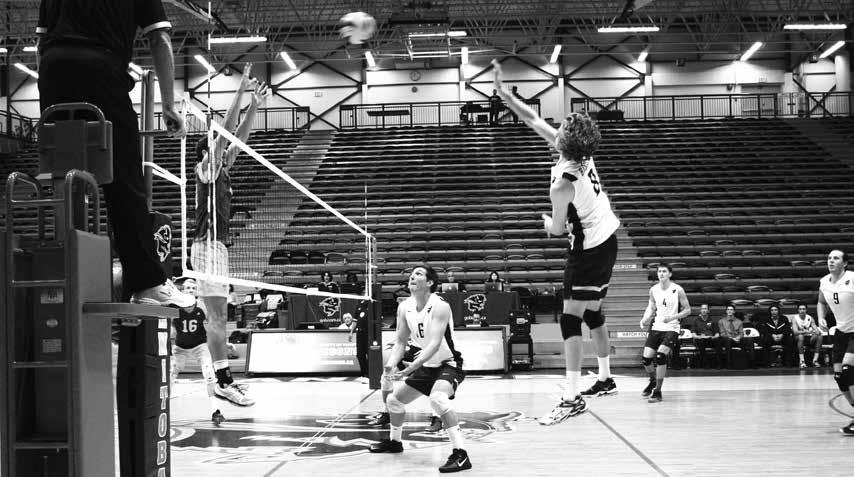
Coming off a win that saw their head coach Ken Bentley pick up career win number 1,000, the University of Manitoba Bisons hosted the nation’s top-ranked team at the University of Alberta over the weekend.
The double header carried with it serious playoff implications for the national champions who are currently fighting for seventh in the conference, the last playoff spot in the Canada West. Despite dropping Friday night’s matchup, Manitoba picked up crucial points in a 3-0 sweep of the Pandas on Saturday night, drawing even on the weekend series. Friday night saw Manitoba lose in three straight sets (11-25, 14-25, 21-25). The Bison attack was led Friday night by Rachel Cockrell, who picked up 13 kills. Defensively, Cockrell helped get things done, leading the team with 13 digs. Libero Caleigh Dobie had 12 digs, and a trio of players had eight digs: Kalena Schulz, Brittany Habing, and Lexi Janovcik.
When asked about how her team responds to a tough loss, starter Dobie confidently replied, “have a quick memory.” Dobie continued by saying, “there’s nothing you can do about it now. We’ll all
go home, have a good night’s rest, leave it away in our dreams and come back tomorrow, do a short little practice and prepare for the next game. That’s all you can do.”
Needing a win this weekend to continue their push for playoffs, the Bisons responded in emphatic fashion in the rematch.
Saturday night saw Manitoba rally to earn an exciting 3-0 sweep of the Pandas. Cockrell found her way offensively, nailing 25 kills. Sarah Klassen would add eight kills, and Jordana Milne picked up seven kills, including what might have been the hardest hit of the night. The Pandas had to call a time-out, likely to talk about how impressively hard Milne just smashed the ball.
Defensively, Dobie led the Bisons with 14 digs, with Habing and Milne adding 13 and eight digs, respectively.
Men
In men’s action, the Bisons also split the weekend with Alberta, losing Friday night 3-2 (25-21, 21-25, 25-21, 17-25, 12-15) and picking up a 3-1 win with a commanding performance Saturday night (25-17, 25-17, 15-25, 25-21).
On Friday, Manitoba was led by Devren Dear with 18 kills, Adam
Davi D g ra D, staff
The University of Manitoba Bisons continued their push for top spot in the Canada West this weekend, nearly tying the University of Alberta for the conference lead. This weekend’s unfortunate victims of Manitoba’s rise to the top were the University of Regina Cougars.
Leading the way for the Bisons this weekend were two rookie top guns, Alana Serhan and Alanna Sharman. Serhan played the role of overtime hero on Friday, burying her seventh goal of the season, and rookie Sharman discovered three is the magic number on Saturday, tallying a hat trick en route to a landslide win that saw the Bisons come within one point of the conference lead.
Friday night was highlighted by solid defensive play on both sides of the ice, while Bison goalie Rachel Dyck picked up 28 saves, including four in overtime in the victory.
for the floodgates to open in the second period, however, where the Bisons took a commanding 5-1 lead. Forcing overtime was not an option for the Cougars, as they had no answer for the solid passing and finish of rookie forward Alanna Sharman.
Captain Maggie LitchfieldMedd felt her team came into Saturday with more energy.
“For sure we had a little vendetta to play better and it showed this game. We really wanted the three points last game. Them pushing us to overtime, we knew we had to have a better game, faster pace,” LitchfieldMedd said.
Serhan played the role of overtime hero, burying her seventh goal of the season on Friday, and rookie Sharman discovered three is the magic number on Saturday, tallying a hat trick
DeJonckheere with 10 kills, and Kenney Rooney with seven kills. Luke Herr added 40 assists.
Saturday night saw the Bisons play a solid game all around, with libero Alex Strachan making several sprawling dives to save the play and Herr slamming down five service aces.
Playing in front of a large crowd, the Bisons energized the fans in attendance with a solid performance. Offence was spread out evenly, with Dear, DeJonckheere, and Kevin Falconer picking up 11, 10, and nine kills. Strachan led the way defensively, making nine digs in a strong performance.
Saturday’s win was big for the Bisons, who are currently battling several teams for a playoff spot. The Bisons sit tied for sixth in the Canada West, but are only a few points ahead of the eighth and ninth place teams, and a few points behind the fourth and fifth place teams.
With three weekends left in the regular season, each game is starting to feel like playoffs.
Manitoba will be on the road next week to take on the University of Saskatchewan in another critical matchup.
First-year defenceman Erica Rieder opened the scoring early in the first, netting her first goal as a Bison with a strong slapshot from the point. Dyck held her ground through a flurry of chances in the second, turning away a breakaway and some solid chances up close.
Regina tied the game early in the third, but eventually Serhan would give the Bisons the win, in the extra session.
Saturday night looked like it might be another tough battle, with the Cougars going up 1-0 early in the first period. It didn’t take long
“Everything just clicked. Those 10-foot passes were on and the quick shots to the net. We just found the holes I guess.”
Scoring in the game were Litchfield-Medd, Serhan, and Sharman with the hat trick. When asked about Sharman’s contribution, Litchfield-Medd lit up.
“It’s awesome. It’s nice having someone you can just give the puck to and she’ll put it in the net. Great kid off the ice too, she always comes in with a smile. She’s been a great addition to the team.”
The Bisons will take on the University of Saskatchewan Huskies on the road next weekend, looking to continue challenging the University of Alberta Pandas for the top spot. Game times are Friday and Saturday at 7 p.m.

Jets’ Chiarot warrants stay in NHL after impressive stint a n Dy C H e, volunteer staff
It’s been a truly unforgettable last two months for Jet rookie defenceman Ben Chiarot. After skating in the Thrasher-Jet pipeline for the past four seasons, the native of Hamilton, Ontario recently landed a long-term position in the NHL, and has been turning heads ever since.
A fourth-round selection of the Atlanta Thrashers in 2009, he earned his first call-up to the Winnipeg Jets in October of 2013, and made his NHL debut in November of that year, a 5-1 Chicago win. Last month, various injuries to Mark Stuart, Tobias Enstrom, Jacob Trouba, and Zach Bogosian resulted in another callup for Chiarot.
The 23-year-old notched four goals and five assists in 24 games this season for the AHL’s St. John’s IceCaps prior to his Winnipeg callup. Last season, Chiarot logged 20 points for the Calder Cup finalist IceCaps, adding a further five points in the team’s Cinderella story run in the post-season. Proof that his years in the AHL have been gradual yet imminent, Chiarot has now translated that development into the NHL.
Skating alongside Dustin Byfuglien for the majority of his shifts, Chiarot displays a physical shutdown style of game, combined with well-rounded use of his sixfoot-three frame.
He’s also familiar with the offensive side of the game, displaying occasional flashes of simple
yet effective puck-handling plays into the opposing blue line. His first NHL goal landed a 5-1 win vs. the Maple Leafs in early January, earning second star honors.
Whether his spell in Winnipeg is permanent or temporary, is a story yet to be told, but with his presence ticking and tolling on the Jets’ blue line, you wouldn’t bet against Big Ben any time soon
Analogous to his partner Byfuglien, Chiarot built his reputation in the AHL as somewhat of an enforcer. However, with an upgrade to the big leagues comes great maturity, as Chiarot has expertly exemplified in taking only three minor penalties since his callup to Winnipeg.
Part of the NHL’s most penalized team, the defenceman who killed off 93 penalty minutes last season with the IceCaps has come to realize the importance of playing physical and effective hockey while
maintaining a high level of discipline. It is even more impressive considering Chiarot’s time with St. John’s, where he was very aggressive on the boards. His play has merited 20 games in the NHL this year.
Although, it may be slightly ludicrous to see Chiarot as a definite all-star amongst a who’s who of NHL defencemen, the OHL graduate’s prolific rise in the previous few months certainly puts him in consideration as one of the Jets’ most prized young assets.
As the Jets’ blue line restores of full health, Chiarot’s two-month spell with Winnipeg certainly warrants a long-term future in the NHL, if not a permanent stay with the Jets for the remainder of the season.
His offensive upside could even take the places of Tobias Enstrom, Mark Stuart, or Jason Garrison within the near future, should Kevin Cheveldayoff view Chiarot’s potential as overriding the shortcomings of their veteran defencemen.
Though Chiarot has entered the NHL at a bit of a later age, it is without a doubt that the oncewaived Jet is making up for lost time.
Whether his spell in Winnipeg is permanent or temporary is a story yet to be told, but with his presence ticking and tolling on the Jets’ blue line, you wouldn’t bet against big Ben any time soon.

m ike s till, staff

Basketball
After getting swept at home by Victoria, the University of Manitoba Bison men’s basketball team headed to Alberta looking to recapture their winning ways. They started off on the right foot Friday, with a come from behind win, but Manitoba couldn’t carry the momentum in Saturday’s rematch.
Friday’s game saw four Bisons hit double digits in points, led by Andre Arruda, with 18. Manitoba trailed for much of the game, before exploding for 20 points in the final quarter, pulling out a 75-69 victory.
The comeback fourth quarter effort was led by Wyatt Anders, who was tough on the glass all night long, and finished with a double-double (17 points, 10 rebounds)
Saturday’s was 80-56. Vanessa DeVries led the way in points in Friday, with 17, while Robyn Eyer was the top scorer on Saturday with 23. Both teams are at home this weekend, squaring off against Saskatchewan. Games are Friday and Saturday at 8 and 7 p.m., respectively, for the men, and 6 and 5 p.m., respectively, for the women.
Men’s hockey
The comeback fourth quarter effort was led by Wyatt Anders, who was tough on the glass all night long, and finished with a doubledouble (17 points, 10 rebounds). AJ Basi also had a memorable performance, scoring all 12 of his points from beyond the arc, including the game-sealing three-pointer.
Saturday’s 90-73 Alberta victory saw the Golden Bears out-rebound the Bisons 56-39, in a strong defensive performance. Mamadou Gueye led the way with 25 points and 14 rebounds. Basi had another strong performance in the loss, recording a team-leading 18 points.
The women didn’t fare as well in Alberta, falling in both games. Friday’s result was 75-53, and
The men fell 5-3 on Friday, Jan. 16, and won by the same score on Saturday. A wild third period saw the Regina Cougars come out on top in the opening game of the weekend set against Manitoba. Heading into the final frame, the game was tied, until Regina erupted for four goals in the last 13 minutes. Four different players scored for Regina, led by Sanfred King, who recorded two goals. Both were registered in the third period.
Manitoba answered back on Saturday, thanks to a three-goal first period. Aaron Lewadniuk was the standout, finishing with a hat trick. He scored once in the first and twice in the second.
The Bisons return to Wayne Fleming Arena this weekend, taking on the Saskatchewan Huskies on Jan. 23 and 24. Game times are 7, and 6 p.m., respectively.

December 4, 1985
September 18, 1967