109 HELEN GLASS UNIVERSITY OF MANITOBA WINNIPEG, MB R3T 2N2
General Inqu I r I es & a dvert I s I n G
Phone: (204) 474.6535
Fax: (204) 474.7651
Email: manitoban@themanitoban.com
Free Med I a Campus Plus Media Services
Phone: 1.780.421.1000
Email: advertise@free-media.ca
Canadian Publications Mail Product Sales Agreement #589160
A “volunteer staff” member is defined as a person who has had three volunteer articles, photographs, or pieces of art of reasonable length and/or substance published in three different issues of the current publishing year of the Manitoban. Any individual who qualifies must be voted in by a majority vote at a Manitoban staff meeting. Elected representatives and non-students may be excluded from holding votes as volunteer staff members in accordance with the Manitoban Constitution. The Manitoban is the official student newspaper of the University of Manitoba. It is published monthly during the summer and each week of regular classes during the academic year by the Manitoban Newspaper Publications Corporation.
U of T law professor highlights risks of draconian counterterror efforts
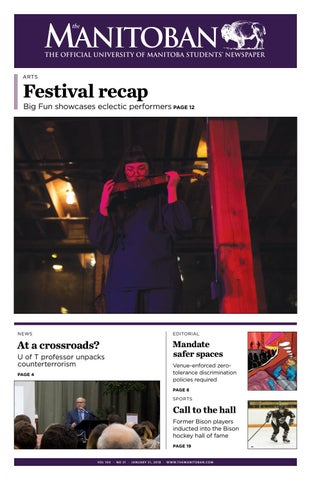
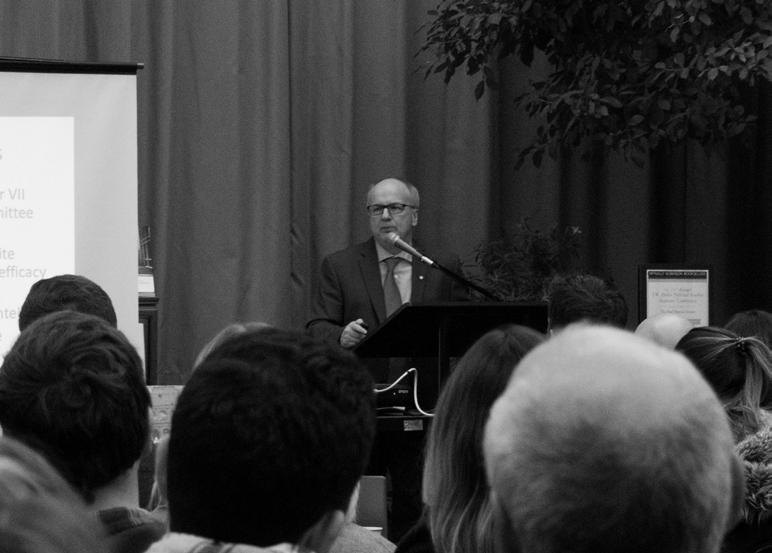
Kent Roach kicks off 34th annual J.W. Dafoe Political Studies Students’ Conference
Qudus a busaleh, staff
T
he potentially dangerous consequences of overreacting through counterterrorism measures were highlighted in the annual J.W. Dafoe Political Studies Students’ Conference keynote speech Jan. 24.
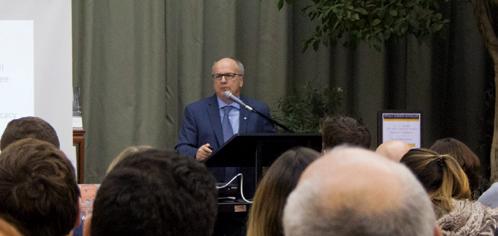
Kicking off the 34th annual J.W. Dafoe Political Studies Students’ Conference, University of Toronto law professor Kent Roach delivered a keynote address assessing the state of counterterrorism in light of the rise of Daesh, also known as the Islamic State or ISIS.
Titled “Counterterrorism at the Crossroads?” Roach’s address examined the sociopolitical implications of counterterrorism measures at the domestic and international levels.
The evolution of counterterrorism in Canada
“When we talk about terrorism,” began Roach, “we are in some ways captive of current and well-remembered events.”
Roach emphasized that terrorism, contrary to notions that tend to bind its emergence to the attacks on 9/11, has existed in Canada “since at least confederation.”
Referencing the assassination of Canadian politician Thomas D’Arcy McGee by a Fenian sympathizer in 1868, Roach said that an important lesson to learn from historical acts of terrorism is the “dangers of overreacting.”
An example presented by Roach is former Prime Minister Pierre Trudeau’s decision to invoke the War Measures Act in response to the Front de libération du Québec (FLQ) during the 1970 October Crisis, when the secessionist movement carried out robberies, bombings, and kidnappings of government officials.
The War Measures Act allowed the government to suspend civil liberties, resulting in 31,700 searches - including 4,600 searches with seizures - media censorship, and the prosecution of hundreds of Quebecers.
Roach also cited the case of Maher Arar, a Syrian-Canadian who was detained at John F. Kennedy International Airport on his way back to Canada from a family vacation on suspicion of being a member of Al-Qaeda in 2002.
“I spent two years working with Justice [Sandra Day] O'Connor on the Maher Arar inquiry which is another example of an overreaction to terrorism that harmed civil liberties,” Roach said.
Arar was held in solitary confinement in the U.S. for two weeks without access to legal counsel before being deported to Syria where he was detained and tortured for almost a year. After no evidence linking Arar to terrorism was found, he was released. In 2007, Arar received $11.5 million after the Stephen Harper
government formally apologized for Canada’s role in his “terrible ordeal.”
On Daesh, Roach noted that a key and unique component of the group has been its ability to utilize different forums, like social media, for recruitment.
“As you know from reading the news, Daesh has been defeated in Iraq and Syria [but] it has had a lasting and perhaps counterproductive effect on global counterterrorism,” he said.
“Some of this has to do with a confluence between Daeshinspired violence, such as the Paris attacks, the migration crisis in Europe, and concerns and anxieties about identity and integration in Europe, the United States and elsewhere.”
is one of the reasons why the United Nations has failed in its responsibility to spearhead global counterterrorism efforts.
“It seems to me that internationally, the UN really doesn't have a particularly good handle on what directions counterterrorism should go,” he said.
“And this produces kind of lurching
Rights and Freedoms.
Roach voiced his critique of the bill, saying that even if CSIS could accurately identify potential terrorists, “that’s not the same as convicting them criminally.”
In September, Prime Minister Justin Trudeau’s government introduced a new national security billBill C-59. Roach said that although the bill is not ideal, “it fixes quite a bit.”
“We will welcome migrants who are in part victims themselves of Daesh and other acts of terrorism and we will celebrate the considerable resilience that we have seen throughout the world” - Kent Roach, U of T professor and PrichardWilson chair in law and public policy
responses to particular acts of violence and it produces a range of tactics without any real sense of overall strategy behind it.”
“Having lived through 9/11 and lived through our response to 9/11 - and maybe this is just me getting older - I have to say that over the last four or five years, I have found this state of where we are going with counterterrorism to be even more disturbing,” he added.
Roach emphasized counterterrorism efforts should not only centre around foreign actors. This, he said,
He noted that the Parliament Hill attack in October 2014 represented a pivotal moment for Canadian counterterrorism efforts.
In response, the Harper government enacted Bill C-51, an anti-terrorism law that gave the Canadian Security Intelligence Service (CSIS) authority to take measures to reduce threats to Canadian security that critics charged violated the Charter of
Unlike under Bill C-51, CSIS is not authorized undertake any action that would impose a limit on rights outlined by the charter without judicial authorization.
While Roach said he thinks careful legislation is key to sound counterterrorism, he emphasized the role of continued evaluations and assessments of legislation.
“If you're going to have a wholeof-government approach to terrorism and security, you should match that with hope of government review.”
Two directions
Roach said that with counterterrorism efforts, two scenarios are possible.
He described the pessimistic sce-
nario where “we can have a spiralling of anti-Muslim and anti-immigrant sentiment combined with double standards towards other forms of political violence.”
“We could see a drift from a focus on violent extremism to extremism," he said. "We could see increased regulation of speech and we can see increased privatization of speech regulations, of finance regulation, of travel regulation that will create real accountability gaps that even things like Bill-C59 […] would not be able to plug.”
Roach said the optimistic scenario “is that we will have more evidencebased and multidisciplinary prevention and rehabilitation."
“We will define citizenship and the criminal law as a common strength that helps protect us," he said. "We will welcome migrants who are in part victims themselves of Daesh and other acts of terrorism and we will celebrate the considerable resilience that we have seen throughout the world of communities after acts of terrorism - which I fear will continue with some regularity for the foreseeable future.”
photo by shaden abusaleh
Equal Voice Manitoba hosts municipal election boot camp
National organization aims to boost female participation in political arena
Imreet Kaur, staff
Aday-long training workshop titled “Municipal Campaign
Boot Camp” was held at the legislature Jan. 27 in an attempt to get more women involved in the municipal elections coming fall.
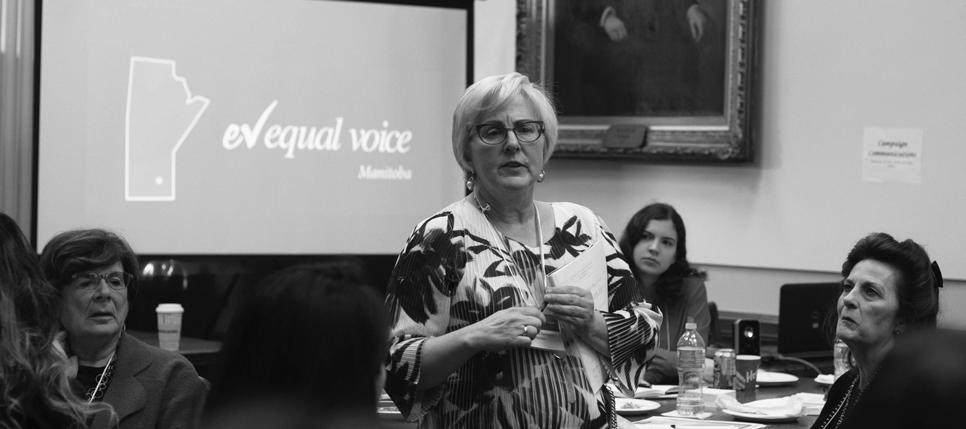
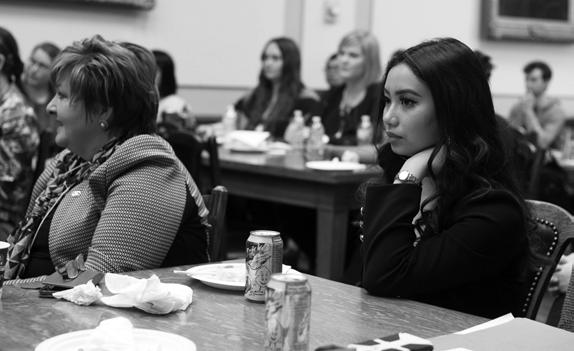
Co-hosted by the Manitoba chapter of Equal Voice and Myrna Driedger, speaker of the Manitoba legislature, the event offered networking opportunities for women interested in running for office or women keen to undertake various roles within a political campaign.
Since its inception nationally in 2001, Equal Voice’s mandate has been to increase the representation of women in all levels of government and to lobby for changes at the municipal, provincial, and federal levels to encourage the participation of women in politics.
Only 26 per cent of the members of parliament elected in the 2015 federal elections were women.
Similarly, of a 15-member city council, only four Winnipeg councillors are women, amounting to 25 per cent of council.
Winnipeg’s female councillorsJenny Gerbasi, Cindy Gilroy, Janice Lukes, and Devi Sharma - engaged with the attendees through a panel discussion on the challenges women face in politics.
Delaney Coelho, co-chair of Equal Voice Manitoba, said, “My hope for today was to start building or build on a community and network of women who are interested in running or supporting other women to run and have women walk away with some tangible skills that they could apply to their campaigns.”
The boot camp featured a “Civic Campaign 101” session with Rebecca
Blaikie, president of the federal NDP from 2011 to 2016, and “Dealing with the Media: What to Expect” with Shannon Sampert, the first female op-ed editor of the Winnipeg Free Press
Manitoba’s chapter of Equal Voice started in late 2016. The municipal elections to be held in October will be the first elections since the chapter has been active in the province.
“We have seen a consistent amount of women and people who support more women in politics coming out to events,” Coelho said.
“We are seeing continued support and continued encouragement and women are excited and I think that women and people who support more women in politics are eager for this,” she added. “They want to see a change.”
Participant testimonial
Ayat Mneina, a political staffer at the Manitoba legislature, said she attended the boot camp to learn about the campaign process leading up to the elections, although she does not intend on running in the civic elections.
Mneina said she has been involved in political campaigns, performing various roles and in different capacities, without any exposure to formal training and workshops.
“If I could get a how-to manual, that would be really helpful because campaigns are really dynamic and exciting times,” she said. “I felt like I would like to see how others have done it.
“A lot of people in the political world have come from places where
they’ve been exposed to politics for a very long time or it’s not their first campaign, not their first rodeo, and find that I’m on the newer end of the spectrum. So I am here to learn.”
#MeToo campaign
The #MeToo campaign, which began with women in Hollywood speaking out against sexual harassment, has made its way into Canadian politics as well.
Within the last week, well-known politicians Patrick Brown and Jamie Baillie - leaders of the Progressive Conservative opposition in the provinces of Ontario and Nova Scotia, respectively - resigned after complaints of sexual miscount were made public.
Federal Liberal Kent Hehr, member of parliament for Calgary Centre,
resigned from cabinet last week after being accused of sexual misconduct. Hehr served as minister of sport and persons with disabilities. He remians a member of the Liberal caucus.
“If I could get a how-to manual, that would be really helpful because campaigns are really dynamic and exciting times - Ayat Mneina, workshop participant
Commenting on the campaign, Myenina said, “We have heard from women in various roles in municipal council in their own experiences in political life and how they might have had to grapple with sexual harassment or their relation to the #MeToo campaign,” Myenia said.
Myenia said workshops like the one organized by Equal Voice are critical to increasing female representation within the political arena. “I do not think it’s a one-off,” she said. “I think it’s an ongoing conversation and making women feel safe to come into these spaces and seeking women out.”
Shannon Sampert hosted a workshop on“Dealing with the Media: What to Expect” as part of Equal Voice’s Municipal Campaign Boot Camp Jan. 27. photos by asha nelson
Suspension of Churchill field study course draws criticism
Churchill and the Manitoba Coastal Region travel/study program has been offered since 1995
s haden a busaleh, staff
The cancellation of a U of M Churchill-based field study course is drawing criticism from former students of the program.
A Facebook post published by the course’s instructor, Ryan Brook - associate professor at the University of Saskatchewan - Jan. 22 announced that “for reasons that remain unclear, the department head at [the] University of Manitoba has decided to cancel the course this year and potentially permanently.”
Brook urged former students of the program to write letters to the Clayton H. Riddell faculty of environment, earth, and resources’ dean, Norman Halden, and acting department head of environment and geography Mark Hanson to highlight the value of the university continuing to offer the course.
Brook said that like all field courses, the travel/study program is expensive to run, but much of its costs are offset “with research grants and amazing support from our northern partners.”
“In most years, the costs have been covered by tuition and travel fees paid by students, but not always,” he said. “As costs have gone up, student recruitment has gone down.”
Brook added that the university has “in some years” subsidized the program’s costs but “under current financial realities, all universities have to make difficult decisions and it comes down to priorities.”
“Is this course important enough to dedicate teaching resources to ensure it is sustainable over the long term?” he asked.
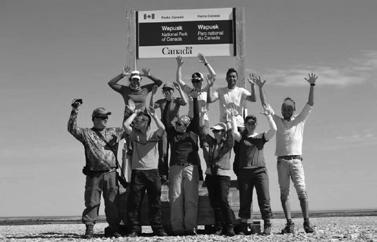
The travel/study program, Churchill and the Manitoba Coastal Region, introduced students to the ecological, cultural, historical, and economical setting of sub-arctic, coastal Manitoba, and provided an opportunity to be a part of an interdisciplinary research team.
The program was run in partnership with the region’s Indigenous community, Churchill Northern Studies Centre, Manitoba Conservation, and Parks Canada. Topics of study included vegetation dynamics, protected areas, ecotourism, and the connection between environmental change and human health.
Since 2012, the program has been offered jointly by the University of Saskatchewan and the University of Manitoba, with students from both universities participating.
Brook said the course began in 1995, when he initially participated as a teaching assistant before being asked in 2004 to take over instructing the course. He said the course was offered only every second year until 18 students from the university submitted a petition to the dean asking for the course to be offered yearly.
“It has been running annually since [2004],” he said.
Former U of M environmental
sciences student Astitwa Thapa participated in the program in 2014 and said he “absolutely loved it.”
“Experiential learning opportunities play a significant role in shaping your personal, academic, and career development goals,” he said. “For me Churchill, it was absolutely the best.”
“That course helped me get a job,” he added.
Speaking on the hands-on experience students gain from the course, Brook said “Students are immersed in the people, landscape, and wildlife of the Canadian sub-arctic.
“They snorkel with beluga whales, they see polar bears in their natural environment, they observe herds of caribou, arctic foxes at their dens, northern lights, and they interact with northern people and learn about traditional knowledge.”
Brook added that more importantly, students design and conduct their own research projects.
“Just like you wouldn’t want your pilot to only have experience on a flight simulator, our students need real world practical experience in order to do their jobs effectively,” he said.
Thapa said he is disappointed with the suspension of the course.
“Not letting the course happen is an absolute shame,” he said.
“It makes no sense to have billboards at [the] Toronto airport speaking about why we’re trailblazers if we can’t fund an arctic research oppor-
tunity,” Thapa added.
“This is not about money. This is about priorities and the faculty has got its priorities wrong. They’re focused more on advertising and not research opportunities.”
In an email signed by Hanson, Halden, and Mary Benbow - associate dean of the Clayton H. Riddell faculty of environment, earth, and resources - the faculty’s commitment to the Churchill field study course “that is unparalleled anywhere else in the country,” was affirmed.
“We want to clarify that the course has not been cancelled, rather we are not in a position to offer it through the University of Manitoba this year for a variety of reasons,” reads the statement. “We have told the instructors that any student in the
Panel discussion shines light on campus discrimination
Event attracted faculty, students, and community members
dI ana u bo K udom
The Critical Race Network at the University of Winnipeg (U of W) and the University of Winnipeg Students’ Association (UWSA) co-hosted a panel discussion titled “Challenging White Supremacy on Campus” at U of W Jan. 24.
The event featured four panelists discussing white supremacy within educational institutions.
The event began at 6 p.m. and was first open to members of the Black Indigenous and People of Colour (BIPOC) community before the panel discussion opened for all attendees.
Sadie-Phoenix Lavoie, a recent graduate of the U of W and former vice-president external of UWSA, shared her experiences being stereotyped at the university as a result of
her Indigenous heritage, saying she “had to be the one to defend my dignity and the dignity of my people.”
Alexa Potashnik, founder of Black Space Winnipeg, said white supremacy could be seen in many different areas, including educational institutions, where it is deeply rooted.
“To address the question of where do you see white supremacy on campus, where don’t you see it?" she asked. "And you can’t disconnect white supremacy from the institution because the people who built this institution didn’t have people of the community in mind.
“And this trickles down to not just academia but into our school system and every aspect you can think of in society, in the Western world, in North America, [and in institutions]
run by white people.”
Potashnik went on to caution against the tendency of members of the BIPOC community to water down their conversations to ensure inclusivity of the majority.
“People of colour really need to start becoming more comfortable when the majority are uncomfortable,” she said.
Jenny Heijun Wills, an associate professor of English at the U of W, said that although white supremacy exists in different forms, her research and interests are more focused on institutions and areas where supremacy is not easily visible.
"I’m most interested in where we’re not seeing it, in the sense that it’s always a slippery moving target,” she said.
“And so it’s hard to peg down and it’s hard to challenge and confront because it‘s always shifting in certain ways.”
Wills added that white supremacy is invisible at many institutions not because it “has been resolved,” but because “it’s somehow mutated in a way that” it is not noticed.
Wills cautioned that the issue of white supremacy should not be approached with the intention of fixing a “broken system.” The system is not broken, she said, but is “working exactly how it was intended to work."
Acknowledging her privileged position as an educator which provides a platform for her to be vocal, Wills also raised the issue of underrepresentation of BIPOC faculty members at the university.
faculty wishing to take the course can do so through the University of Saskatchewan listing and we will provide a credit transfer waiver.
“We are actively working towards seeing the course back on the books for 2019 under a University of Manitoba number.”
Hanson cited "the financial structure of the course” as reason for the suspension.
“There are other reasons, but unfortunately privacy and confidentially precludes me from elaborating further at this time,” he said.
“With respect to student credits that you can get from the University of Saskatchewan,” Thapa said, “then they should stop all research opportunities at the U of M because, of course, you can get it from other universities.”
Wills said one of the ways in white supremacy can be addressed in the university is “supporting the hiring of BIPOC faculty” and ensuring their retention, giving them “the liberty to talk about issues in a radical and meaningful way.”
Lavoie stressed the importance of having discussions that shed light on the issue as a way of raising awareness and combating discrimination.
“White supremacy is here,” she said, “but you know what’s also here? It’s us, having this talk in that same institution having discussions about what needs to be done because it can’t be like this anymore.”
photo provided by astitwa thapa
Locally produced documentary highlights community economic development
Documentary features U of M researcher and local social enterprises
Imreet Kaur, staff
Adocumentary titled “The Inclusive Economy: Stories of Community Economic Development (CED) in Manitoba,” premiered at Winnipeg Cinematheque Jan. 23.
The film highlights the role of social enterprises and cooperatives in building an economic system based on principles of inclusion.
The documentary is produced by the Canadian Community Economic Development Network Manitoba, Canadian Centre for Policy Alternatives Manitoba (CCPA-MB), Manitoba Research Alliance and Rebel Sky Media.
Canadian CED Network supports individuals and enterprises that “promote sustainable growth” by engaging with the community members and views development as a “bottom up process.”
Sarah Leeson-Klym, Manitoba regional director of Canadian CED Network, said the idea for this project was imagined two years ago when Molly McCracken, director of CCPA-MB, approached her.
“We wanted a shareable and easy to understand film that could get past the concepts and capture people's attention about community economic development,” said Leeson-Klym.
Leeson-Klym added that the aim of the project was to “raise the profile of community based economic development” in conversations being held around the province leading up to the provincial elections of 2016.
Leeson-Klym said it took longer than expected to raise funds for the project.
“When the Manitoba Research Alliance came on board, we added the component of a report documenting the history of CED in Manitoba,” she said, adding that it made the project stronger and more relevant with “tools that can serve a variety of needs to increase understanding of this way of approaching social and economic change.”
Though Winnipeg is revered as a leader in CED by practitioners across Canada, she said that broadening the scope allowed the documentary to link “ideas of convergence, economy, and connection to government in the never-implemented [Northern Manitoba Development Strategy].”
John Loxley, professor of economics at the U of M, is featured in the documentary.
Loxley, in the documentary, described how community organizations use an international approach known as convergence strategy to determine the needs of the community and fulfil those needs through employing local residents and retaining the surplus within the community as opposed to going elsewhere.
Loxley said the principles highlighted in the film are "Neechi principles."
These include the “use of locally produced goods and services, production of goods and services for local use, local re-investment of profits, human dignity, public health, long term employment of local residents among others.”
The Northern Manitoba Devleopment Strategy was a plan created by the government of Manitoba in the 1970s to undertake the development of the far-removed northern
communities of Manitoba and tackle severe poverty, but was never fully implemented.
Youth participation
Commenting on the struggles faced by youth and young adults, Leeson-Klym said, “It is hard to secure long-term, full-time employment and the education needed is expensive. We know this affects young people from marginalized communities more.”
She said social enterprises and organizations are mobilizing youth and creating spaces for them to develop and use their leadership skills, which is central to good community economic development.
One such social enterprise featured in the documentary is Mother Earth Recycling, which recycles mattresses and electronics and at the same time employs youth and mem-
bers of the Indigenous community in the North End of Winnipeg.
“That kind of shift starts to change dynamics in families and set an example for kids who might be struggling with issues of generational poverty,”
Leeson-Kylm said.
Role of governments
Leeson-Klym said that institutions and various levels of government can either champion or inhibit CED.
“They’d use the principles of CED to guide decision-making across government - not just focused on single departments or programs like community services or neighbourhood renewal,” she said. “They would move their citizen engagement processes past consultation into real co-creation and partnership with communities.”
She said supporting CED means understanding the needs of communities and responding to those needs in a responsible manner.
“There are elements of this happening, but to really get there, we need a blend of strong advocacy from communities, responsive political leadership and healthy political debate, and capable public servants with adequate resources allocated to this kind of approach,” she said.
“We think that blend could start to control the unsustainable and unequal effects of our current economic model while building resilience and local prosperity here.”
RCFFN supporting province’s functional food industry
Richardson Centre for Functional Foods and Nutraceuticals linking academics, industry, and government
s haden a busaleh, staff
Located in the Smartpark Research and Technology Park at the U of M’s Fort Garry campus, the Richardson Centre for Functional Foods and Nutraceuticals (RCFFN) supports the province’s functional food industry by establishing linkages between academics, industry, and government. Functional foods are modified foods claimed to improve well-being by providing benefits beyond the
natural nutrients the food contains.
The RCFFN’s director, Peter Jones, said the majority of the centre’s initiatives are built through partnerships with a variety of local, national, and global agricultural projects and companies, with an underlying goal of creating an “economically viable” functional food industry by working towards improving the standards of human nutrition in the country.
A catalyst for the research and
development of foods containing health benefits, Jones laid out how the centre can help provide a “big marketing push” for companies.
“We are dealing with a company that wants to test the cholesterollowering effectiveness of a beverage that has fermentable products in it,” he said.
“So, we will set up a trial with humans,” he continued. “The benefit of the company is that they will obtain, hopefully, a data set that shows that their product is effective in reducing bad cholesterol.”
“They can then go and put a label on the product that says: ‘ reduces cholesterol’ or ‘ lowers our risk of heart disease.’”
Jones highlighted one project currently underway, the Manitoba Personalized Lifestyle Research Program (TMPLR).
“The TMPLR program was
designed to really look at a crosssectional snapshot of Manitobans in terms of what do they eat, how much do they exercise, how fit are they, how well do they sleep, what does their probiotic micro-biome look like,” he said.
The TMPLR program, by evaluating this cross-section, can help determine an individual's risk of developing high cholesterol, heart disease, cancer, and arthritis.
Through its collaboration with the U of M’s faculty of agriculture and food sciences and the Rady faculty of health sciences, the centre offers undergraduate students the opportunity to engage in the growing scope of nutraceutical research through what he dubbed the “tripleD approach” - discussion, discovery, and development.
With more than 20 studies usually taking place simultaneously, students
not enrolled in a similar area of study can still play a part by signing up to participate in the many food trials carried out by the centre. The centre provides remuneration “to cover some of the costs incurred” for participating students.
“For [TMPLR], we are trying to recruit 800 students,” said Jones.
“We are at 650 right now,” he continued. “We are actually looking for help in terms of volunteers not only to participate in studies but we are also looking at some students to help us get on board the bus and head out to places like Dauphin, places like Brandon.”
Jones noted the centre's research aims “to better the functional food industry, from both the scientific and economic perspective here in the province, across the prairie region, across Canada and even internationally.”
photo provided by rCFFn
Rose Sagness, office manager at Mother Earth Recycling, John Loxely, University of Manitoba economics professor, and Jamil Mahmood, executive director at Spence Neighbourhood Association, answer audience questions at the premier of The Inclusive Economy, Jan 23. photo by asha nelson
Editor-In-Chief: Garett Williams
Safer spaces should be a requirement, not an option
chalczu K , staff
If someone is acting in a way that makes another person significantly uncomfortable, then that person should be made to leave.
Headline-worthy news last year was the Big Fun Festival adopting a zero-tolerance policy relating to discrimination. Anyone who made another person uncomfortable was first warned of the zero-tolerance policy. A second occurrence resulted in being banned from the festival. The fact that Big Fun’s policy was deemed trailblazing at the time is almost shocking.
A recognized safer space implies that the venue has mechanisms to ensure the space will be free from discriminatory conduct aimed at marginalized people. There is training, regulations, and consequences in place to ensure that the space in made as safe as possible for people that are experiencing discriminatory behaviour. Policies covering what actions and behaviours result in expulsion from the venue should be put in place and shared. This is an important step in the process of creating safer spaces since it states clearly what will happen if you commit an offense. It also describes avenues available to victims of descrimination.
Big Fun Festival, Real Love Winnipeg, and Rainbow Trout
Musical Festival are all prominent local examples of organizers creating and sharing their safer space policies. Big Fun Festival has the most extensive and comprehensive policy on its website. It includes all volunteers taking safer space training, and the stipulation that any performer or volunteers wishing to participate in the festival are expected to be clear of any history of sexual or discriminatory violence, or must show that they have undergone “demonstrable rehabilitative counselling.”
It is important we take steps to ensure that the person staying home and seeking help is the perpetrator, not the victim
Big Fun Festival also reserves the right to terminate a contract with a performer on the discovery that they violate the policy. Though discrimination is illegal and ought not to be tolerated at any venue, the mere letter of the law does not ensure that dis-
crimination is not occurring.
It is important that steps are taken to ensure the person staying home and seeking help is the perpetrator, not the victim. Unwritten house rules or policies are not enough. When someone is fearful of an event or venue, it needs to be widely known what precautions are put in place and what steps will be taken once a discriminatory behaviour occurs. It should not be expected of past or future victims of discriminatory behaviour to assume that they will be safe. It needs to be crystal clear: posted on business websites, at the door, and in the bathrooms.
When you attend a venue that does not adopt a safer space policy, you are supporting a business that not all people can use in a way that makes them feel accepted. You are silently stating with your presence that the business does not have to care about inclusivity. While venues such as The Handsome Daughter, The Good Will Social Club, and X-Cues’ Café and Lounge all have very clear policies on their website that state they do not tolerate discrimination, these policy stances are not universal. Marginalized people looking for venues with policies in place to keep them safe are therefore limited to a handful of venues.
What safer space supporters are attempting to do is to create space that is as safe as possible for as many different demographics of people as possible.
In 2018, it is unacceptable for venues not to have a safer space policy in place
In 2018, it is unacceptable for venues not to have a safer space policy in place because it ensures that everyone is treated fairly and respectfully at the time of an incident occurring while keeping other people at the venue safe from harm.
It is the responsibility of the consumer to support venues with safer space policies so that all have access to the art community we are part of. Venues should proactively combat potential future discrimination rather than reacting to incidences of discrimination at their venue.
Going out and having fun with your friends and seeing performances you like, attending art classes, or studying at a coffee shop should be
an experience that is clear of people who discriminate against others. When a venue does not remove the person being discriminatory, the person who is being discriminated against is forced to go home to prevent further trauma. If there are no consequences to the actions of discriminators, there will be no reason, in their minds, for rehabilitative action to occur. The people that deserve to go out are the ones that treat people with respect, no matter what age, gender, sexuality, ability, or culture.
Safer spaces are not designed to ruin venues. They are designed to make them accessible to all people, regardless of sexuality, ability, age, gender, or ethnicity. Active supporters of safer spaces are helping the arts community. Someone who fears going out in public spaces because of their past experiences of discrimination and is vocal about change, is helping the arts community.
What is ruining the arts community is apologists who excuse discriminatory behaviour.
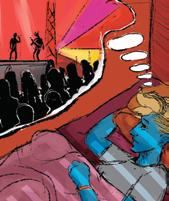
graphiC by ernest zarzuela
Strong Republicans and weak Democrats result in a spectrum shift to the right-wing
Gradually edging right has disastrous long-term effects
Kenny Ingram, staff
The state of affairs existing between the two major parties in the United States is extremely troubling.
The federal government was shut down Jan. 20 for little reason. Republicans, in the majority, essentially held hostage the Children’s Health Insurance Program (CHIP), which provides an inexpensive insurance option to children who belong to families who earn too much to qualify for Medicaid. The Republicans also refused to make a clean deal on the Deferred Action for Childhood Arrivals (DACA), which allows children of illegal immigrants - labelled “Dreamers” - to legally obtain a driver’s license, enrol in college or university, and secure over-the-table employment. The nearly 700,000 people falling under this program pay sales, local, and income taxes - contributing an estimated US $2 billion per year to the American economy.
The shutdown ended when the Democratic leadership was given a promise from Republican Senate Majority Leader Mitch McConnell that an open debate would be held on the fate of Dreamers before Feb. 8. Democrats then voted with the Republicans on a three-week extension of funding for the federal government.
This is hardly promising. Senate Minority Leader and top Democrat Chuck Schumer openly acknowledged there is no guarantee
McConnell can be held to his word. After the shutdown ended, President Donald Trump did not hesitate to take to Twitter to rub in a rare truth - per CNN’s chief white house correspondent Jim Acosta - that the Democrats “caved” on the shutdown.
As a part of these negotiations, the GOP - champions of small government - demanded an increase to the already swollen defence budget. Worse, Democrats in negotiations pledged more to defence spending than was initially requested by the White House.
The most frustrating factor in this whole situation is senate Democrats. Not necessarily all of them, but the party leaders and those who blindly follow. The program they were fighting for was DACA, which is supported by 87 per cent of Americans - not among only Democrats, but the entire country.
However, these spineless Democrats refuse to stand up and fight for DACA. What ever happened to the Democrats’ “resistance” against Trump and the GOP? Their “resistance” is nothing more than a sad punchline. It is obvious the Democrats have simply decided it is easier to side with Republicans on these military expenditures than to stick up for Dreamers in a principled fashion.
After all, the source of the Democrats’ campaign donationslegalized bribes - are not Dreamers,
but the same defence contractors as Republicans. Prominent Democrats in negotiations, Schumer and House Minority Leader Nancy Pelosi, have collectively received over US $700,000 from the defence lobby over the course of their careers.
When you have one party fighting for the most unpopular positions, and the other clearly afraid to fight for anything, there is no wonder why Americans are fed up
At the heart of the problem are the two main groups that reside in congress: strong Republicans and weak Democrats. Two sides of the same coin, sponsored by the same millionaires to do the same thing: drive the country further right. We’ve seen this play out time and time again, like when Democrats had a filibuster-proof supermajority in 2009 for two years. A supermajority - when a single party has complete control over the house, senate, and presidency - frees up the governing party from appealing to the other
to tally enough votes for legislation to pass.
Yet former President Barack Obama failed to use this effectively. Instead, his government attempted to gain bipartisan approval for the flagship Democratic proposal, the Affordable Care Act, or Obamacare.
The program was developed from an idea of a conservative think tank in 1989 and was first passed in Massachusetts under Republican Mitt Romney. Ultimately, every single Republican voted against the bill, and the U.S. was left with a healthcare system that was nothing more than a watered-down giveaway to insurance companies instead of the true socialized medicine it could have been. These constant half-measures only help to further the country’s right-wing momentum.
When Republicans gain any kind of power, they do the opposite - offering little to no olive branches toward bipartisan agreement. Gerrymandering districts, providing a substantial tax cut on corporations and billionaires, and refusing to confirm the Supreme Court choice of a president for almost a year all occurred at the hands of the Republicans before the present fight over DACA. These are all ways Republicans fought tooth and nail for what they want, regardless of their disturbingly unpopular positions - be it their desire to enrich corporations at the expense of the middle class,
their heartless desire to cut social programs, or their callous attempts to end legal immigration altogether.
All this does is cause further disdain for congress - which recently hit a low of 16 per cent in approval rating. When you have one party fighting for the most unpopular positions, and the other clearly afraid to fight for anything at all, it is no wonder Americans are fed up.
This style of political dysfunction has had disastrous effects on public policy, specifically economic policy. For example, the federal minimum wage of US $7.25 has not been increased in almost a decade. Meanwhile, worker productivity is sky-high. Adjusted for inflation and productivity, American minimum wage in 2017 should have been around US $20 an hour.
Why is it that the U.S. spends more on their defence budget than the next eight countries combined, yet cannot seem to have a debate on socialized medicine without some pseudo-intellectual claiming it just cannot be afforded? The country has drifted so far right, and they are being left behind by every other major Western country because of it.
Unfortunately, the same tragic effects of these shifts hit those who vote for these politicians the hardest. And the vicious cycle continues.
Editor: Shawn Huberdeau
photo provided by alex proimos
Comment Editor: Shawn Huberdeau
Widespread aesthetic violence contravenes modern commitment to humanism
Prevalance of graphic violence in media disturbing
s hawn h uberdeau, staff
Amodern-day adage is that we have become desensitized to violence. In immediate defiance of the so-called moral arc of the universe, we have outpaced desensitization; in contemporary society, violence has become aestheticized.
Considering we live in a liberaldemocratic society - a political system built atop the humanist philosophical revolution of the Enlightenment - we must be wary when our artistic practices consistently glorify the deformation of the physical embodiment of what humanism prizes: the human agent.
In 1969, the American National Commission on the Causes and Prevention of Violence reported that, within the previous decade, depictions of violence in children’s cartoons had increased by 94 per cent. Prime time television had ratcheted up the depiction of violent acts by 81 per cent.
Current data supports the conclusion that violence increasingly permeates popular media. The American Association of Pediatrics, for instance, has publicly endorsed studies that show violence to be an empirical regularity in film and television. Findings show not only that all American-produced animated feature films between 1937 and 1999
portrayed violence, but that the average American will be exposed to 200,000 violent acts on television prior to age 18.
The spectacle of violence is nearly ubiquitous across our public mediums. Yet the nature of violence - in both concept and execution - has steadily become wrapped up with status and glamour as an aesthetic motif in its own right.
For instance, the National Television Violence study, conducted between 1995 and 1997, found that much of the violence portrayed in television programming was of a “glamourized” or “entertaining” nature.
Relatedly, a 1998 study bankrolled by the National Cable Television Association determined that 40 per cent of all violent acts on television are committed by characters framed as heroic, attractive role models.
Hard data aside, one need only take a cursory glance of popular media to realize the extent to which violence has become stylized. The cinematography of Quentin Tarantino infamously instrumentalizes violence for the sake of elaborate choreography and praiseworthy camera shots. In this sense, Tarantino is picking up on the rich history of American sensationalism in aestheticizing violence:
making it cool, the stuff of principled action, a necessary tool in the repertoire of the powerful.
Even using physical violence as an expression of humour, as in the tradition of slapstick comedy, has the effect of debasing the human body for the sake of hearty laughter at the effects of brute force on the frail human form.
In immediate defiance of the so-called moral arc of the universe, we have outpaced desensitization; in contemporary society, violence is aestheticized
Given that individuals are inundated with media flows through unprecedented access to information via the Internet, society has become immersed in the deep end of personal formation by way of cultural influence. It would be absurd to deny the
influence of popular media in an era of historic growth and equally absurd to deny increasing levels of stylized violence therin.
William Friedkin’s 1973 film The Exorcist depicts the desecration of the innocent body of a child and inspired an intended revulsion in viewers.
The Saw franchise of the 2000s and 2010s, arguably an exercise in body horror with no modern competitor, induced no such widespread reaction. Between a film in the early 1970s that saw a young girl’s body temporarily degenerate into a corpse-like being whose head spun, and films across the 2000s that portrayed skulls cracked, bodies splintered, and ribcages thrust open - only one provoked fainting spells and flights of terror in their audiences. It was the movie that featured a little girl with the voice of a long-time smoker.
The massive popularity of the Saw saga problematizes cinema insofar as its efforts to paint human carnage onto the canvas of the silver screen has become more and more respectable as pieces of art. Progressively aestheticizing violence, the film series abandons its original, albeit flimsy, plot device of brutal torture as didactic moralism in place of the extravagant and senseless depriva-
tion of human life through as elaborately cruel a means possible. The Saw franchise comes out in favour of gratuitous violence for its own sake - popularizing “torture porn” as a subgenre in horror films - and has been rewarded with more than $873.3 million at the box office.
How can we take ourselves seriously as a purportedly humanist society when more and more of us faithfully feast on the very visual violation of that humanity? With a society allegedly founded on the principles of respecting human worth, dignity, and freedom, our popular media runs rampant with the symbolically savage desecration of the human form.
The increasing prevalence of aesthetic violence in contemporary media - and, perhaps tangentially, our increasingly nonchalant reactive attitudes to violence - is extremely disturbing.
Were we to live in a political society truly dedicated to celebrating the value of human beings, then one would expect these cultural expressions to be oddities, outliers, anomalies: not constituting the rising statistical trend of graphic gore as art.
&
Editor: Olivia Michalczuk
Seventh annual Big Fun festival
Winter festival brings artists from across the country to Winnipeg
Jen d oer K sen, staff
The seventh annual Big Fun Festival ran from Jan. 24 to 28. The winter music festival showcased local and national talent from multiple genres and put on a total of 14 concerts at multiple venues over the course of five days.
“We always want to have as many genres as possible and kind of showcase the different angles and elements and genres of the Winnipeg music community,” executive director of the festival Lauren Swan said.
“We’ve got a lot of indie and heavier stuff, and there’s always some folk. I try to have a bit of [a] hip-hop element. We try and get as much as we can,” she said.
Local performers included p o u t, Super Duty Tough Work, and Animal Teeth. Out-oftown acts included Wares, Braids, and BIG|BRAVE among others.
Braun booked the Saturday afternoon experimental show, which this year was held at Forth. He said that there is support for experimental and abstract music in Winnipeg, which is due in part to festivals like send + receive, though that type of music sometimes gets overlooked when there is not a large-scale event that is specifically focused on that style of music.
“I enjoy weird things, so I ended up just fighting for my experimental strange Saturday afternoon, and that
experience is a special part of their performance.
“I create a space to focus our attention inward and to explore these deeply personal emotions from which these songs arose,” they said. “I create an atmosphere that is vulnerable and sometimes heavy.”
FOONYAP performs a mix of classical violin and electronic soundscapes, creating music they call “introspective, moody, and dark.”
For Swan, the festival is something to look forward to in the middle of Winnipeg’s winter.
“We always want to have as many genres as possible and kind of showcase the different angles and elements and genres of the Winnipeg music community” - Lauren Swan, executive director of Big Fun festival
will always be what that is, and how it works," Braun said. "And it’s great, and it’s free, and it’s fun.”
Artistic director and curator Stefan Braun said organizers received around 300 artist applications for this year’s festival. Braun is responsible for listening to every artist submission and co-selecting the bands to perform along with artistic director David Schellenberg, who books the bigger headlining bands.
“This year was really enjoyable because, for the first time in a long time, I didn’t know many of the bands who applied this year. So everything was pretty fresh, which was pretty exciting, because one of the reasons we do this is to find new music in the city,” Braun said.
The festival kicked off Jan. 24 with local musician Matt Foster accompanied by Quintin Bart opening for Calgary native FOONYAP, who prefers gender-neutral pronouns, at The Ballroom.
FOONYAP said they applied to play the festival after meeting the Big Fun team at the Sled Island festival in Calgary. They performed in Winnipeg last fall alongside À La Mode and JohNNy SiZZle.
“It was wonderful," they said. "It was at the Crescent Fort Rouge United Church. It was a very appreciative crowd.”
For FOONYAP, creating a live
“We like it because it’s just something to look forward to, and it kind of breaks up the monotony of January and the post-holiday blues," she said. "We used to be really nervous about weather restrictions, because that’s a factor you can’t really plan for. Like if it’s -40 degrees out, we worry people won’t come, but they’ve proven us wrong time and time again.”
This will be the festival’s first year using the Times Change(d) High and Lonesome Club, and Forth as venues.
“I’ve obviously seen shows at the Times Change(d), but [hearing] what a show will sound like in the Forth café space is really cool," Swan said. "It’s nice to be a part of that history and legend that is the Times Change(d). That’s a big honour for us.”