Bisons complete sweep of Timberwolves for eighth straight win
• a stream of the media Q&A with Prime Minister Justin Trudeau from last week's town hall
n ews Diana Ubokudom n ews Seamus Hamilton-Pattison
Jeremiah Kopp
Shaden Abusaleh
sports Kellen Taniguchi
sports Jason Pchajek
“volunteer
and/or
articles,
is
or
in three
as
of
of
issues of the
of the Manitoban. Any individual who qualifies must be voted in by a majority vote at a Manitoban staff meeting. Elected representatives and non-students may be excluded from holding votes as
staff members in accordance with the Manitoban Constitution.
Pipeline protestors interrupt Trudeau town hall in Winnipeg
Young activists demand answers for pipeline approvals
Seamu S Hamilton-Patti S on, staff
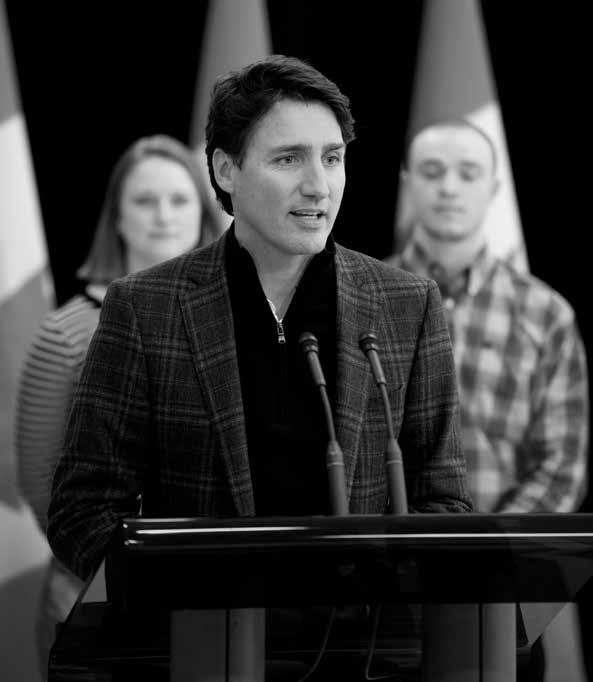
Prime Minister Justin Trudeau faced off with a small group of pipeline protesters at a town hall event at the University of Winnipeg’s Duckworth Centre on Jan. 26.
The interruption came during the Liberal’s response to a concern expressed by an audience member regarding his government’s recent approval of both the Kinder Morgan TransMountain pipeline expansion and Enbridge’s Line 3 pipeline.
The approved pipelines will pump nearly a million more barrels of oil a day from Alberta’s oil sands to refineries in the U.S. and British Columbian ports when completed.
“No real concrete, measurable promises were made” – Mandalyn Unger, protester
Trudeau heard the concerns about the approved pipelines and their environmental impact from a young audience member not long after beginning the town hall event.
“Given that many countries have drastically reinvented their energy systems to accommodate for climate change – countries like Sweden and Costa Rica are now powered 100 per cent by renewables – and the cost of oil is at an all-time low. And yet, Canada is still approving pipelines,” the audience member said.
“I don’t know if you understand the degree to which you are alienating the young voters and progressives who voted you in.”
The end of the question was nearly drowned out by cheering from many other audience members, some of whom behind and to the prime minister’s right stood up holding signs bearing slogans such as “No KXL, No line three, No Kinder Morgan,” and “Water is sacred. No pipelines” among others.
Trudeau repeatedly asked several protesters standing with their signs and interrupting his response with chants of “climate leaders don’t build pipelines,” and “keep it in the ground,” for permission to continue with his answer to the question, which began with a speech on the importance of balancing environmental responsibilities with a productive economy. The prime minister cited pipelines as a safer method of transportation than rail.
As the event ground to a temporary halt, two protesters continued to shout at Trudeau, while other audience members voiced their own objection to the protesters’ methods. In a particularly tense moment, Trudeau recommended the protesters either allow him permission to finish
his question, or leave the room. After the protestors refused, an Indigenous elder present stood up and began to approach the prime minister, requesting a respectful exchange between parties. Trudeau seemed alarmed by the man’s approach and exclaimed, “Stay seated sir, sit down please, you’re going to get tackled.”
Trudeau eventually finished his
answer, stressing that Canada must balance renewable, environmentallyfriendly methods of accruing natural resources with the need for a productive economy and good job creation.
He mentioned the provincial government of Alberta’s agreement to cap oil sands emissions and move to performance-based standards of taxing carbon as steps forward.
Mandalyn Unger, a representative of the group of around 10 protesters made up mostly of U of W students –which she described to the Manitoban as “a grassroots anti-pipeline collective” made up of concerned community members – expressed her disappointment with Trudeau and the event as a whole, referring to it as “a bit of an echo chamber, [with] a lot of copy-paste answers.”
“No real concrete, measurable promises were made, which obviously he had been told to avoid. Our goal wasn’t really to get him to speak the truth, because we knew he wasn’t going to – our goal was to make sure he knew that we knew that he was bullshitting us.”
Though Unger expressed some disappointment with the overall audience reception to the protest, she stressed it was not surprising and further enforces the movement’s goals.
“[The prime minister’s] PR is so onpoint, they’re such a polished brand. I feel like people can really become caught up in the emotions of identifying themselves with this young prime minister who presents as being all about change,” said Unger.
“That’s really the battle here, is breaking through that façade and that image, and letting people know these promises are hollow [...] he campaigned on the promise that he would implement [the United Nations Declaration on the Rights
of Indigenous Peoples] and he’s not only not implemented it, he’s broken it with the approval of the pipeline.”
Following his answer on the recent pipeline approvals, Trudeau faced questions for the next hour from audience members on issues such as reconciliation with Indigenous communities, Manitoba Child and Family Services, Syrian refugees, and Donald Trump, among others.
The event in Winnipeg was the 10th and last stop of Trudeau’s crosscountry town hall tour, as Parliament resumes this week in Ottawa.
An archived livestream of Trudeau’s pre-town hall Q&A with the media can be found on the Manitoban’s Facebook page at www.facebook.com/ themanitoban
photos by miguel yetman
“It’s a balancing act”: Paul Wells on Trudeau’s relationship with Trump
Political commentator discusses need to balance Canadian values, trading relationship
evi g arber, staff
l
The Trudeau government will have a tough balancing act ahead of them when it comes to relations with the Trump administration, according to political commentator and Toronto Star columnist Paul Wells.
Delivering the keynote address entitled “A Trudeau Government in a Trump World” for the J.W. Dafoe Political Studies Students’ Conference on Jan. 25, Wells discussed the challenges ahead for the Trudeau government in maintaining a progressive social agenda while keeping Canada’s economic relationship with the U.S. strong.
Wells outlined the efforts the Liberal government has already made to prepare Canada for a large shift in American domestic and foreign policy under the leadership of Donald Trump in his speech to a packed atrium at McNally Robinson Booksellers.
Pointing to meetings between Canadian government officials and Trump transition team members at Trump Tower in New York City in early January, Wells said that the scale of effort the Trudeau government is making to keep Canada-U.S. relations positive, avoid provocation, and safeguard Canada’s position in the North American Free Trade Agreement (NAFTA) has been “huge.”
Speaking with the Manitoban following his speech, Wells discussed Canada’s strong economic position in the event of any possible renegotiation of NAFTA or significant change to American economic policy.
“It’s true that our economies are tightly integrated. There are American jobs that depend on trade with Canada,” Wells said. “That’s a case you can make that I think [the Trump administration] will understand.”
Wells went on to discuss the political cost Trudeau will have to pay at home in maintaining a working relationship with the new U.S. administration.
“Justin Trudeau is not going to be the champion of people who want to yell at Donald Trump” –Paul Wells, Toronto Star columnist
“There’s a lot of Canadians who are really upset that Donald Trump is the president and are looking for people in positions of power to call him out and denigrate his unfortunate deci-
sions. Justin Trudeau is not going to be their guy,” he said. “Justin Trudeau is not going to be the champion of people who want to yell at Donald Trump.”
“[The Liberals] are telling themselves that there’s a bigger game, which is that even when Trump is president, there are Canadian jobs that depend on the United States.
And after Trump is done being president, we don’t want the relationship between our two countries to be a smoking crater.”
On Jan. 26 – the day after Wells’ address – Trudeau’s ability to balance Canada’s economic interests and the prime minister’s social values were tested when he stopped in Winnipeg for his 10th cross-country town hall event at the University of Winnipeg.
During the town hall, two fourth grade students worried about the businessman-turned-politician’s
rise asked Trudeau if he would “save Canada” from the new president.
“[Canadians] expect us to ensure stability, prosperity, opportunity that comes with the important trade relationship we have,” Trudeau answered. “Trade with the United States is an essential part to our success.”
“We have to have a constructive, working relationship with the new administration and that’s exactly what I’m focused on. But Canadians also expect for us to stand up loudly and strongly for the values that make us Canadians,” he said. “Openness, diversity, respect, rights. We are going to be focused on the future of our country, making sure that we are ensuring that Canada stays Canada and that Canada stays prosperous.”
photo provided by soraya atayee
Majority of students support multitiered health plan, UMSU survey
Potential plan will offer high-cost, high-coverage and low-cost, basic coverage options to undergrad and graduate students
Seamu S Hamilton-Patti S on, staff
U
niversity of Manitoba Students’ Union (UMSU) vice president internal Adam Pawlak presented a proposal for a multi-tiered health and dental plan at council’s regular meeting Jan. 19.
The proposal would offer students a choice between various levels of coverage at different costs. The enhanced option will offer both graduate and undergrad students a higher degree of coverage at a greater cost, while the basic plan offers limited coverage at a reduced fee.
Students will also have the option to mix and match their coverage and enrol in the enhanced level of health coverage with only a basic level of dental coverage or vice versa, or to pay for only health or dental coverage alone.
“At UMSU, we maintain the position that there is no one-size-fits-all model on many of the files we work with,” Pawlak said of the union’s decision to reexamine the health plan only months after approving a series of scale-backs in the fall.
“This led us to also look into our plan to realize that it can be even more encompassing for our students if we were to offer a flex plan framework.”
According to the plan’s framework, presented at the meeting, students will be able choose between a basic
level of health and dental coverage at an approximate fee of between $190-250, or an enhanced level at an approximate fee of between $290-350.
For the 2016-17 school year, students were billed $292 for UMSU health and dental fees.
A survey polling student desire for a more flexible plan was circulated through university email in November with nearly three-quarters of respondents supporting the idea.
The survey, circulated to both undergrad and graduate students, was returned by close to 400 respondents, above the minimum 300 Pawlak said makes the threshold for a representative sample of the U of M’s nearly 30,000 students.
Through the survey, 76 per cent of undergraduate students and 70 per cent of graduate students reported they would support the implementation of an enhanced plan. 74 per cent of the overall responses were positive.
When presented with the approximate annual costs for the enhanced and basic plans, 57 per cent of respondents indicated they would choose the enhanced level, while 35 per cent would opt for the basic level. 52 per cent of undergrads would choose enhanced coverage, while 38 per cent would choose the basic level. For grad students, 66 per cent would choose the enhanced level and 31 per cent basic.
Other statistics from the survey indicate that 78 per cent of undergrads and 76 per cent of graduates prioritize coverage for prescription drugs, while 70 per cent and 66 per cent, respectively, held vision care coverage as a priority.
Nearly 90 per cent of U of M undergrads are enrolled in the health and dental program, with 13 per cent of graduate students signed up.
With regards to an enhanced level of coverage, a majority of student respondents would prioritize basic dental coverage, a higher annual dental maximum, and a higher level of restorative coverage, which includes fillings and extractions.
Under the proposal, students will automatically be enrolled in the enhanced level of coverage but with the right to opt down to the basic package, to mix and match plans, or to opt out of the UMSU plan outright. Proof of equivalent coverage will be required to opt out of the program altogether.
Studentcare – the organization administering UMSU’s plan – will “absorb the cost and responsibility of refunding students who chose to drop to a low level of coverage.”
Students will be able to opt-down from the enhanced level during a change-of-coverage period and will receive a refund for the difference in
cost. This will require no documentation and can be completed online.
Studentcare will refund students via secure electronic deposit.
“It supports the idea that individual students are the best decision-makers for their own health needs” – Adam Pawlak, UMSU vice president internal
“I hear from students who use the plan and know how important it is for them to have their healthcare, dental, vision, and other costs covered,” Pawlak said. “I also know how important it is for some students to keep fees low. I think offering each student the opportunity to tailor their coverage is a great way for UMSU to be responsive to the needs of our membership.”
“It supports the idea that individual students are the best decision-makers for their own health needs.”
Scale backs
In June, UMSU council learned that a 58 per cent increase in the number of claims filed through its health and dental plan over the last three years had rendered the plan unsustainable.
Since 2011, the U of M plan has paid out more than $12.7 million in claims, including $3.9 million in 201415. Representatives from Studentcare, who have administered the program on behalf of UMSU since 2013, projected more than $4.5 million in claims for the 2015-16 academic year. Rather than increase the cost to students, the UMSU executive accepted a recommendation to reduce some of the plan’s dental preventative coverage and adopt the same pharmacare program used by other student associations in Manitoba. The changes also increased counselling coverage to $600.
With an increase of 3,000 students participating in the program over the last five years, the plan covers more than 17,000 U of M students.
photo by miguel yetman
Editor-In-Chief:
Craig Adolphe
Manitoba PCs share Trump’s disdain for regulation
Ideology shines through with proposed regulation removal legislation
Craig a dol PH e, staff
When the Manitoba PCs were seeking a mandate in the 2016 provincial election, they campaigned on a commitment to not cut frontline services. Other than that broad promise and a proposal to reduce ambulance fees, the PCs largely kept the focus off of themselves and off of specifics. They were looking to brand themselves as reasonable centrists after repeated losses campaigning from the far right.
But with a recent announcement related to regulatory cutbacks, the PCs are showing their true colours: Trump orange.
The government has announced plans to draft legislation mandating the government cut two regulations for every one they introduce, a ratio that is supposed to drop to one-forone after 2021, according to Deputy Premier Heather Stefanson.
The announcement should sound familiar to Manitobans, because it’s the same two-for-one policy announced by Donald Trump in his own 2016 election campaign, and the same one he signed an executive order to implement Monday.
Canadians – along with most of the rest of the world – have shown disdain for Trump, because, among
other things, the new president is an unrepentant liar with no interest in governing and plans to dismantle regulations that protect everyday Americans. But despite this, Manitobans don’t seem to have reacted much to the news about the same Trump policy being proposed here.
With a recent announcement related to regulatory cutbacks, the PCs are showing their true colours: Trump orange
It’s understandable that the rise of an authoritarian figure below the border is drawing our attention more than dry discussions around regulation and their impacts on everyday people, but it’s still critical that we recognize this for what it is: a stupid idea.
Laura Jones, executive vice president of the Canadian Federation of
Independent Business, was quoted about the significance of the regulation ratio by the CBC.
“Too many regulations is like having too many clothes in an overstuffed closet. What you’re doing with your two rules out for every one rule in is [you’re] cleaning the closet in Manitoba ... [your] one-in-oneout is about keeping the closet clean.”
The problem is, regulations aren’t like clothes. If you have 10 shirts, they all serve the same function and are essentially interchangeable (at least for the fashion-unaware, such as myself). Regulations aren’t interchangeable though. They’re designed to meet specific needs. A regulation that protects water safety isn’t interchangeable with a regulation that prevents fire hazards in residential housing. Cutting one because you’re introducing another doesn’t make any sense, and cutting two is worse still.
Some Manitobans may have had frustrating experiences running up against individual regulations, but that doesn’t mean they’re unnecessary. And even if some were, overall, the system does work. If there are individual regulations that don’t make sense, people can approach their elected officials and raise concerns, and the government can repeal them. But the idea of setting up an arbitrary ratio independent of the regulations at hand shows the PCs don’t understand what government is for.
Its primary purpose should be to protect citizens against private interests and ensure a certain quality of life. The most common manifestation of that for government is regulating
activities that might be damaging to the common good or threatening personal rights. This often means regulating corporations, with whom the profit motive is often pinned against someone else’s interests. For example, if you’re the owner of a business, you can make a larger profit if you don’t pay the costs required to make a workplace meet minimum levels of safety. The same argument can be made in terms of consumer protection with examples like food handling or processing regulations, or safety measures incorporated into automobile design. In these cases, government’s responsibility is to ensure private businesses are held to a standard that protects workers and citizens.
In order to recognize how useless this proposed legislation really is, it’s worth considering the best- and worst-case scenarios.
A theoretical worst-case scenario with the two-for-one proposal has the government unnecessarily struggling to pick between cutting two vital regulations like accessibility standards for new buildings and food inspection standards when they need to introduce another new regulation. A conservative defence of the proposal would likely argue that many regulations aren’t as critical as those two examples and that we could afford to lose those other ones. But if that’s the case, why wait to remove them?
Now that the PCs are in government, they’re free to look regulations over, assess them on their individual merit, and phase them out if they deem it necessary (and can effec-
tively argue their case to the public and stakeholders).
A best case scenario for the effectiveness of the legislation would be if it serves as a reminder to the government to keep looking for useless regulations to remove – regulations they could still remove without this legislation. However, it would only be binding until the government of the day decided to repeal it, and this still assumes that the government will only ever run into unnecessary regulations to cut.
A regulation that protects water safety isn’t interchangeable with a regulation that prevents fire
hazards in residential housing
The notion of a law mandating removal of regulations based on an arbitrary ratio signals an ideological distaste for regulations and the role of government; it might be a portent of a more Trump-like province moving forward. Manitobans should keep their eyes peeled.
left: photo by miguel yetman above: photo provided by marc nozell
Pipelines are bad for the environment and the economy
Oil extraction projects create little to no permanent employment
S H aden a bu Sale H , staff
After the disastrous 2016 American presidential election, speculation on what the world should expect from a President Trump were tossed around between experts on the nightly news, opinion articles, and social media feeds, one of which was the prediction that Donald Trump would bring back the Keystone XL pipeline project.
And indeed, within days of his presidency, Trump is doing what leaders around the globe rarely do: actually fulfilling the promises he made as a candidate, delegitimizing the democratic process and signing a series of executive actions – both executive orders and presidential memoranda – including an executive order to clear the way for the Keystone XL and Dakota Access oil pipelines, both of which have been halted by the previous Obama administration in response to immense opposition from Indigenous and environmental activists.
The revival of the Keystone XL pipeline, specifically, has been applauded by our government. Prime Minister Justin Trudeau is strongly in favour of building Keystone XL, citing its great potential for economic output.
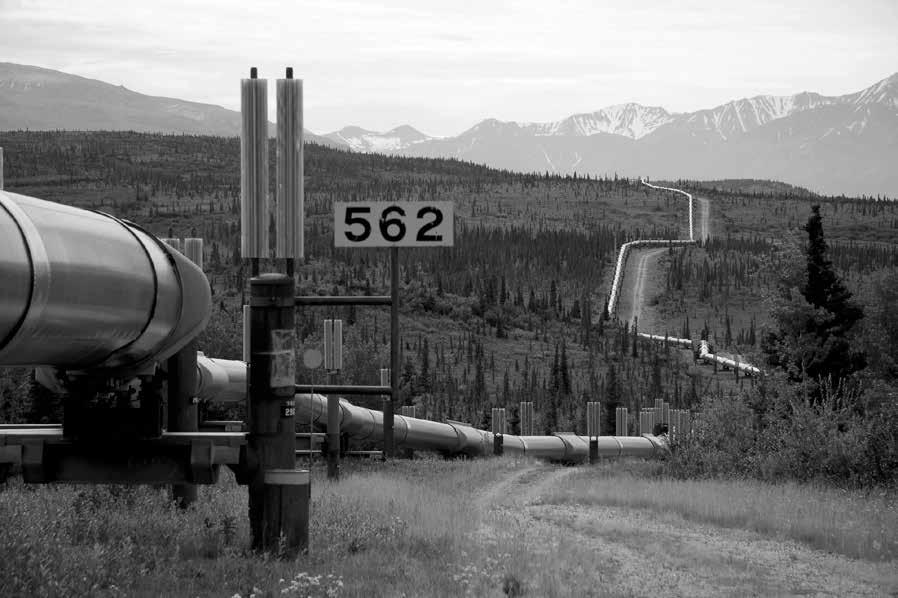
If built, the $8 billion Keystone XL pipeline would stretch from Alberta’s oil sands all the way to U.S. oil refineries located on the American Gulf Coast. This 1,897 kilometre pipeline would transport 830,000 barrels of crude oil a day and will run on top of underground reservoirs that provide water to millions of Americans, including many Indigenous communities.
Trump’s executive memorandums and Trudeau’s support came only days after 200,000 litres of oil spilled on First Nations farmland. When asked about the leak last Wednesday during a town hall in Saskatoon, Trudeau gave the same vague answer he’s been dishing out during most of his town halls, including at the recent town hall held at the University of Winnipeg. Trudeau danced around the question, claiming that while Canadians expect the government
to expand the economy and create jobs through building pipelines, Canadians also expect a high level of enviro nmental responsibility.
Contradictory statements aside, the case for job creation continues to be one of the biggest and repetitive claims made in support of building pipelines. During a press conference held in Calgary last Tuesday after a federal cabinet retreat, Trudeau pressed on the importance of pipelines for job creation. So too did Jim Carr, the minister of natural resources, who expressed his optimistic reaction in regards to Keystone XL, claiming this pipeline project will create up to 4,500 jobs for Canadians.
The more this is repeated, the more it rings true to our ears. However, the case for job creation in support of pipeline building is false.
In fact, a state department report issued under the previous Obama administration discovered that only 3,900 construction jobs will be created if Keystone XL takes a year to build. And if the construction phase stretches out for two years, only 1,950 construction jobs will be created.
These jobs are also temporary – as in, they will no longer exist once the pipeline is built. After its construction phase, the Keystone XL pipeline will create only 35 full-time permanent jobs and 15 full-time temporary positions. This is because in addition to not creating long-lasting jobs, pipelines don’t require much labour to operate long-term.
It is not plausible to continuously claim that Keystone XL, among other pipelines, is an effective and sustainable way of creating jobs for Canadians. All we are doing is trying to numb and momentarily stabilize the issue of unemployment instead of successfully attempting to prevent it in the first place. Opting for pipelines is not only environmentally destructive, but is also economically shortsighted.
Instead of leaning on the illusory hope that pipelines will help pull the Canadian economy back on its feet and bring down unemployment rates,
we should adopt policies that seek to eliminate and prevent the issue of unemployment in the first place. It’s been done before and it can still be accomplished.
It is not plausible to continuously claim that Keystone XL, among other pipelines, is an effective and sustainable way of creating jobs for Canadians
During the 1970s oil price shocks, the Swedish government sought to increase employment by pursuing policies that targeted barriers to employment. This included recreating school curriculums to provide special courses developed by both the local
labour market boards and boards of education. They also implemented effective monetary support mechanisms and established employment services that intensified placement efforts for young people.
Most importantly, the Swedish government adopted policies to fight against occupational stereotyping, which played an important role in decreasing the unemployment rate. Instead of building pipelines, the Swedish government created relief work or public service employment jobs, which contributed significantly to the rise of youth employment in Sweden throughout the 1970s.
Federally, Canada would do well to mimic a 1970s experiment by the provincial NDP government. Between 1974 and 1979, the government enacted a policy known as “Mincome” which issued a universal basic income to residents of Dauphin, a northern Manitoba town. The program virtually obliterated all stigma and barriers attached to members of the working poor by mandating that each and every citizen would receive monthly cheques – in total,
it amounted to nearly five times the average Statistics Canada claimed that low-income workers earned.
Rather than making a tradeoff between the environment and meagre economic activity, the federal government and its provinces ought to invest in a truly productive economy by giving each and every citizen the financial means to seek stable employment, that which would generate actual growth. Oil-mongering will only continue the trend of corporate executives reaping massive profits while the working class finds itself job hopping within the confines of precarious employment.
Canada can and should adopt policies that contribute to raising our employment rate without resorting to brutalizing our environment. The mistaken premise that these pipelines are a good investment for job creation is delaying the necessary transition to clean, renewable energy that our economy needs and environment deserves.
photo provided by luca galuzzi
Should Canada prepare itself for Prime Minister Kevin O’Leary?
Mr. Wonderful a shoo-in for Conservative leadership
Jeremia H Ko PP, staff
With all of the electoral excitement south of the border, it is understandable that Canadians have been distracted from their own political landscape. While Donald Trump deserves all the righteous indignation that he is receiving from my Facebook newsfeed, I can only hope that the decidedly centre and centre-left activists on my social media will be just as engaged in combatting our own populist candidate here at home.
The possibility of a Kevin O’Leary led Conservative government is a distinct possibility and must be taken seriously
The Conservative Party of Canada is currently in the midst of its leadership contest to find a permanent replacement for Stephen Harper. Up until this week, the 13 candidates in the race have attracted little attention, due to a fairly underwhelming group of hopefuls with little name recognition or appeal beyond existing political circles.
Throughout much of the race, Kellie Leitch has been the only candidate to attract consistent and widespread media attention. Presumably, this is because of how awkward and uncomfortable it is when a seemingly
well-educated and intelligent individual adopts xenophobic campaign policies for purely political purposes.
Maxime Bernier is another person who has attracted some modicum of interest. He has been largely applauded for a traditional libertarian campaign that has raised an impressive amount of money and articulated well-researched policies. One can’t help but wonder, however, if the praise won by Bernier and his predominant focus on issues such as dairy supply chain management are due to the relatively impotent campaigns of the remaining cast of candidates.
Unfortunately for Leitch, Bernier, and the other Conservative leadership contestants, they have been rendered irrelevant with Kevin O’Leary’s announcement that he would be entering the fray.
Many have been quick to distance themselves from O’Leary, attack his controversial sound-bites, and write off his candidacy as a publicity stunt. Sound familiar? In reality, Canada is not immune to the same brash, hardhitting, populist approach to politics that has gripped the United States and much of the western world over the past two years. O’Leary’s forceful presence and quick wit will play especially well with a Conservative base that is looking for a tough candidate to face off against Prime Minister Trudeau.
Kevin O’Leary will win the Conservative leadership race. While there are a number of factors at play, my reasoning can be overly-simplified
and summarized by acknowledging that celebrity matters in politics, even in a leadership race that uses a delegated system of election. The more interesting question is whether or not O’Leary has the ability to beat the Liberals in the next federal election.
An Ipsos poll released late January tested support amongst one thousand decided voters. A Conservative Party led by Kevin O’Leary received 37 per cent support compared to the Liberals’ 38 per cent. While this is only one poll, it is hardly an encouraging result for Justin Trudeau as his would-be opponent hasn’t even won the Conservative leadership race, let alone mounted a serious attack against the governing party.
Politics is usually cyclical and Kevin O’Leary may, in all likelihood, be one election too early. If historical precedent, voting trends, public support, current national issues, and world affairs are any indication, it seems Trudeau’s Liberal government likely has at least one mandate left from the Canadian people. This is by no means guaranteed, however, and it certainly does not mean that O’Leary will be unsuccessful if he plans on taking the long-view to his political career.
In building a two-election strategy for the self-styled ‘Mr. Wonderful,’ there is certainly a path forward to 24 Sussex. In the last election, the Conservative vote share declined by only 8 per cent and finished with a respectable 32 per cent of the popular vote. This reflects the strong base of support that Stephen Harper had
built during his tenure. While Harper is no longer in charge, O’Leary is not so different from the former Prime Minister in message, tone, and policy. If anything is different between the two, it is that O’Leary has no existing political record to attack, is significantly friendlier with media, and is more charismatic on camera.
The more interesting question is whether or not O’Leary has the ability to beat the Liberals in the next federal election
Many compare O’Leary’s style to Donald Trump and dismiss him as immediately unelectable. Despite our many similarities, it is often tempting to distance ourselves from our American neighbours if the chance presents itself. Yet perhaps we should look in our own backyard. While many friends and colleagues of mine are still gobsmacked that Trump managed to get elected, a full 30 per cent of Canadian respondents indicated that they approved of the way he handled himself as president-elect in the pre-transition period, according to an EKOS poll.
While this total may not seem large to some people, from an electoral standpoint it is easy to see how an equally forceful candidate with
more moderate policies could succeed given the way our federal system is structured. Even more indicative is an Ipsos poll, released one day before the American election, which found that 76 per cent of Canadians would consider voting for a candidate with similar policies to Donald Trump.
Despite his similarities with the new U.S. president, many of the comparisons taking place are superficial. O’Leary may take the same underlying populist message of creating jobs and building the economy, but his candidacy is decidedly pro-free trade and pro-immigration, important differences from the new administration south of the border.
He may be blunt and unapologetic by nature, but O’Leary will avoid the divisive identity politics that Trump engaged in to rally his base. His style and focus on the economy will resonate with broad swaths of Canadians who view him as a serious candidate with the necessary qualities of a strong leader. The possibility of a Kevin O’Leary-led Conservative government is a distinct possibility and must be taken seriously.
Law school: the good, the bad, and the ugly – but mostly good
In four months – barring unforeseen failure – I will graduate with a Juris Doctor degree from Robson Hall faculty of law. That is seven full-time years and 216 credit hours spent at the University of Manitoba. I want to share a few insights I stumbled upon along the way.
Let’s start with a few misconceptions. Most people, especially your family, assume that if you get into law school, you will end up with a job that makes a lot of money. In reality, the level of pay varies a great deal depending on the market, sector (profit, non-profit, and government) and area of practise. Even at the biggest corporate firms with the highest salaries, it can take years for a person to pay off their student loans and receive the kind of salary that the general public believes, probably from movies and television, is associated with a lawyer. While Robson Hall faculty of law has one of the lowest tuition rates in Canada , articling students in Western Canada, like Atlantic Canada and Québec, are also paid some of the lowest salaries in the country.
Another misconception is that if you get a law degree, you are guaranteed a job as a lawyer. In actuality, this is false. Canada’s legal market is highly saturated. That means there
are more law school graduates than articling positions. While Robson Hall’s career development office generously claims that 92 per cent of the 2012 graduate class secured articling or clerking positions, unemployment is becoming noticeably prevalent according to reports from my peers. A prospective student is left speculating, “Why is faculty’s information five years old?”
In Ontario, as of 2012, approximately 15 per cent – or 1,750 – of all law graduates do not find articling positions each year. With the exception of Ryerson University’s alternative law practice program in Ontario, students must complete articles with a qualified employer in order to be eligible to practise law. Despite its saturation, Ontario recently added Lake Head University’s Bora Laskin faculty of law in Thunder Bay and is now considering Ryerson University’s application for fully-fledged accreditation.
Finally, I have spoken to many students who feel pressured to go to law school immediately after their undergraduate degree. Many of my colleagues have been successful with this approach. By no means, however, is it better. In fact, in many cases it can be more difficult. Law is a profession of experience. And, while firms can teach you how to practise law,
they can’t teach you life experience. Personally, I chose to take three years off to work for the government in between my undergraduate and law degree. So far, this experience has been invaluable to my success in law school.
It is also never too late to go back to school. There are students in their thirties and forties that excel in the program. They are often the most exceptional students because of their experience.
I have also had my own misconceptions and biases about law school.
On the first day of orientation week, we were asked to anonymously write down our expectations for law school. I recall writing down something along the lines of, “I expect this bastion of socialism to attempt to indoctrinate me as a social justice warrior.” I turned the piece of paper over to a colleague of mine completely self-assured and with a smirk on my face.
The truth is, however, after nearly three years attending Robson Hall faculty of law, with the exception of a few instances, I have never felt pressured by my colleagues or professors to adopt their personal political agendas. By and large, the faculty is completely professional. Ironically, it was the professor that, at least on
paper, seemed the most likely to have indifference for or opposition to my success who turned out to be the most encouraging, influential, and empowering.
Whether you intend to practise or not, a law degree is one of the most valuable, stimulating, and rewarding academic experiences you can undertake
I also came into law school with a great deal of contempt for what I anticipated would be an overly theoretical and impractical curriculum. And, while I continued to be critical of the curriculum, like most things, there are both successes and failures. With the exception of some, such as “Legal Systems,” I have found the majority of courses to be rewarding in their own ways. This brings me to the good. Now, whether you intend to practise or not, a law degree is one of the most valu-
able, stimulating, and rewarding academic experiences you can undertake. Your mind is rewired to engage problems in logical, efficient, and strategic ways. You acquire the ability to understand, explain, and navigate some of the most complex social and economic issues. You are exposed to hundreds of intelligent professors and classmates from a spectrum of ages, expertises, socio-economic statuses, and opinions. This exposure broadens, strengthens, and matures your convictions and arguments. As a result, you learn to admire and respect your opponents and their professional accomplishments. And, at the end of it all, you receive one of the greatest privileges of all – the ability to practise law.
There are undeniable ugly truths about law school. But amidst the bad is an overwhelming amount of good to overcome it.
Kyle G. Mirecki is a third year law student in Robson Hall faculty of law.
photo by star roxas
Features Editor: Shawn Garbutt
Contact:
features@themanitoban.com
/ 474.6520
New players in an old game
The Manitoban’s first reporter inside the legislature gives a play-by-play of a day in provincial politics
l evi g arber, staff
It’s 1:25 p.m. on a November Thursday like any other at Manitoba’s legislative assembly. A bell echoes loudly through the limestone hallways, calling members into the chamber for question period.
MLAs and political staffers make their way to their respective entrances – the opposition NDP and Liberals on one side and the PC government on the other – going over final notes and sticking points for the session.
By 1:35, most of the 57 MLAs are in their seats and the visitors’ gallery is sprinkled with guests. There are only a few reporters apart from myself sitting up in the press gallery, which is a small line of seats positioned directly above the speaker’s throne, directly facing the members’ large horseshoe of desks. The rest of the political reporters at the legislature are listening in by speaker from their press offices.
The session begins with a prayer led by the speaker and then members’ statements. MLAs take turns acknowledging guests they have invited to sit in the visitors’ gallery that day: one is a group of film-making inner-city high school students whose showcase is later that night; another is a Métis rights advocate whose acknowledging statement is the only words spoken in French in the chamber for the rest of the day.
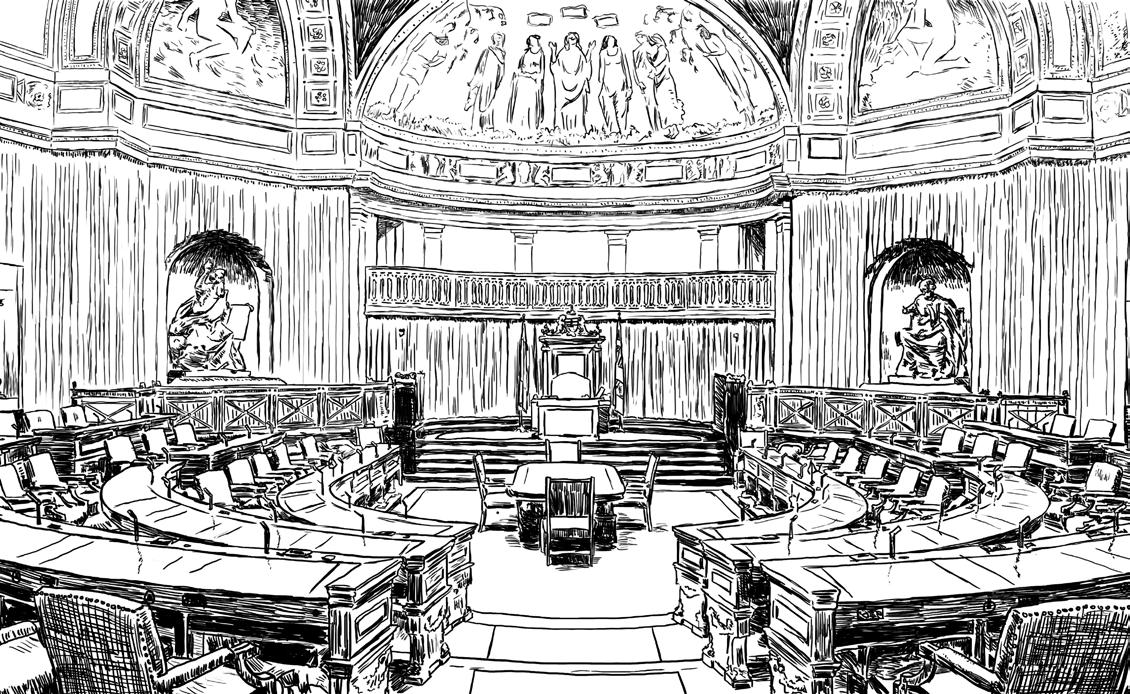
During these 15 minutes of waves and polite applause, I usually take a couple of minutes to admire the room. “Opulent” and “grandiose” are good adjectives for it. Gold-painted murals depicting biblical scenes encircle the members from above, and two large bronze statues, one depicting Moses in Michelangelo’s style – with horns – holding the 10 commandments, the other of the ancient Athenian politician and democrat Solon stand on each side of the speaker’s throne.
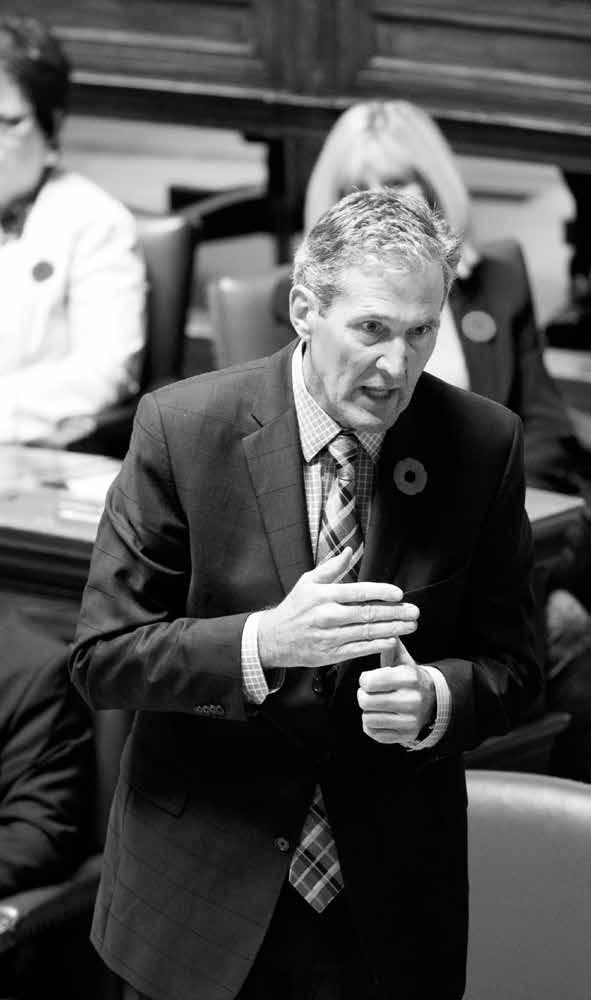
When I look back down toward the MLAs who are about to begin a 45-minute barrage of scornful remarks, insults, laughter, and heckling, the Premier of Manitoba, Brian Pallister, enters from a side door, possibly late due to a meeting or an extended lunch break. Pallister gives a small bow to the speaker and walks slowly to his desk at the front and centre of his PC cabinet.
All eyes in the room examine his behaviour as the last one or two members conclude their statements, looking for any sign of vulnerability today. The premier is chatting with his justice and finance ministers, who flank him on
either side. I’m just out of earshot and can’t hear whether the joke he told was funny, but both ministers laugh anyway.
At just after 2 p.m. the speaker calls on the interim leader of the opposition, NDP MLA Flor Marcelino, to ask her first question to the government. As she stands, two clocks on either side of the chamber begin to tick down from 45 minutes. The game begins.
The NDP are not used to being in this position. Only one MLA in the party was in the legislature the last time they were in opposition 17 years ago.
Pallister has yet to master a strategy of patience and calm during debate
Reduced from a majority of 35 seats to a meager 14 – now 13 with Kevin Chief’s departure – the NDP are struggling to find a clear strategy to navigate the uncharted waters of PC rule.
The NDP’s transition out of power has not been helped by a spate of crises following their failed reelection. Having lost star MLA and possible party leadership contender Chief and now dealing with sexual harassment allegations against the Maples MLA Mohinder Saran, the NDP is the farthest it has ever been from its heyday of public support under former premier Gary Doer.
To her credit, however, Marcelino does try.
During the three-week University of Manitoba faculty strike, in which Pallister was accused of interfering in negotiations between the U of M faculty association and administration over a wage freeze directive, the interim opposition leader repeatedly demanded in clear form that the government reveal the extent of their involvement.
Marcelino and the NDP education critic, Wab Kinew, took turns day after day grilling Pallister and his finance and education ministers on the PCs’ role in the long and frustrating strike. In return, they received ridicule and a response nearly without meaning the government has repeated ad nauseam: “We were elected by the people of Manitoba to fix this province’s finances and that is what we are going to do.”
The NDP continued their offensive for days – while input from the three Liberal members of the chamber was nowhere to be found – and although they never managed to elicit a meaningful answer from the PCs, they were able to get under the government’s skin.
In the middle of one question period, the premier, visibly frustrated with the claims being yelled from the opposition, accused Mr. Kinew of “peacocking for students.”
Peacocking? I’m not one hundred per cent sure what Pallister meant by that, but it definitely had everyone in the chamber doing a double take. It was one moment of many where the premier’s diplomatic grace faltered while under pressure during question period.
In response to a question on education on another occasion, the premier bitterly brought up misogynist lyrics from Kinew’s past as a musician, seemingly out of nowhere and in sheer annoyance with the member opposite.
Patience is key to any government’s performance in question period. Former Prime Minister Stephen Harper had plenty of it when taking questions from Thomas Mulcair, a skilled prosecutor who threw razor-sharp questions toward the government benches. Our current prime minister has also proven that he has the necessary tact to endure the onslaught of criticisms from both the right and left that his Liberal government has summoned since taking office.
Pallister has yet to master a strategy of patience and calm during debate.
This, however, is new territory for the PCs. They haven’t been in government since the Gary Filmon days of the 1990s and are used to the opposition politics of scornful accusations and demands rather than running the show.
And then there’s the heckling. A true staple of democratic debate. Grown men and women, yelling across the aisle at each other like arrogant schoolchildren, is far too common an occurrence at the legislative assembly.
Every party is guilty of participating in it and yet everyone seems so offended by the jeers when they are directed at their party’s benches. Political showmanship is at its finest between 2 and 2:40 p.m. Monday through Thursday. No, the chamber doesn’t sit on Fridays.
As the clocks on the wall slowly tick down to zero, I take my cue from the other reporters
to start heading to the rotunda for the daily scrum with the premier.
Mr. Pallister, flanked by a number of young, smartly-dressed staffers, strides toward the podium with confidence. If he’s in a good mood he’ll tell a short joke before the reporters begin. The scrum is when the actual answers are wrested out.
The NDP is the farthest it has ever been from its heyday of public support under former premier Gary Doer
The small group of reporters at the legislature is an experienced bunch. Getting one of my own questions in is not an easy task when they know the exact moments to interject and prod for the answers they want to hear.
However, today there are only six of us, so getting my own question and follow-up in isn’t too difficult.
After the speech from the throne a few days
earlier, it was a madhouse out in the rotunda. The ball got rolling when the head of the Manitoba Federation of Labour came out to decry the speech before it had even finished.
Reporters swarmed the premier, his cabinet ministers, opposition members, union representatives, and more the moment they stepped out of the chamber. It was fun.
Today is less of a spectacle. After the premier is ushered away by his staff to get to another meeting or function, an opposition member or two will come out of their caucus room to respond to a few of Pallister’s comments so as to have the last word of the day.
The other reporters are already off transcribing quotes and writing their stories for the day by 3:30. Deadlines are important, or so I’ve heard. Finding myself alone in the grand foyer, catching myself ogling the artwork again, I decide to pack up to head back to the office.
The most recent sitting of the legislature came to a close on Dec. 2 and the assembly is scheduled to return on Mar. 1, 2017. Until then, the government will be working on its next budget, which, if the hints coming from the finance and education ministers as well as the premier himself are true, will feature significant changes to post-secondary education funding from the province.
As the government and opposition parties are still coming to terms with their new roles under the golden boy, what better time would there be to introduce the Manitoban to the game? This is new territory for everyone and for a young, doe-eyed wannabe political journalist like myself, it’s exciting as hell.
Now, more so than in the last 17 years, it is important that students pay attention to what’s happening at the legislature. The goings-on of the chamber and the premier’s office may not be as nail-biting or dramatic as an episode of House of Cards, but the decisions made and debate waged will affect students profoundly.
Leaving the building’s grand entrance to a bustling city in the midst of rush hour, it becomes clear with a brisk rush of November air that 2017 is bound to be an interesting year for provincial politics.
I would pay attention if I were you.
graphic by kelly campbell
Five reasons Winnipeg is still better than Mars, even if it’s colder sometimes
Mars might be warmer, but Winnipeg’s got it going on
W
innipeg is colder than Mars. It’s a statement Winnipeggers love to repeat, some in a tone of disdain, some in a tone of pride. And in a way, it is true – Winnipeg often out-chills Mars when winter gets particularly harsh – but is it really fair to compare Winnipeg to Mars? Winnipeg has a lot going for it, after all. Let’s look at four of those times where, while Mars might trump us weather-wise once in a while, we still have Mars beat.
1. Winnipeg has access to water, and Mars only has theoretical water (for now)
Winnipeg finds itself right next to one of the most impressive bodies of water in the world. Lake Winnipeg is one of our planet’s largest freshwater lakes. We’ve got a lot of water. Once upon a time, Mars and its possible inhabitants had that in common with Winnipeggers – in fact, many scientists believe that Mars not only had water, but had water for at least one billion years.
Those days, however, are but a rueful memory for the Mars we know today. Just last week, newly released photos from Mars found not water, but cracked mud. This cracked mud was reminiscent of cracked mud here on Earth, as dried cracked mud here can be the remnants of a former body of water.
That being said, evidence from 2015 insinuates that liquid water flows on Mars even today. Hydrated salts found on downward slopes appear to cause a very shallow “briny” type of liquid to flow. So Mars does have some water, probably. But Winnipeg has lots more. At least we can say that.
The biting cold has turned Winnipeggers into a special, resourceful breed
2. Winnipeg’s
coldest day is warm for Mars
“Winnipeg is colder than Mars” is a rash statement. And while it’s a rash statement that’s had some positive consequences – the international recognition actually resulted in a team of scientists at NASA naming a patch of rock on Mars that they were studying “Winnipeg” – it was rash nonetheless. Turns out, this gives us an inaccurate picture of both Winnipeg (Earth Winnipeg, not Mars Winnipeg) and Mars. The -30° Celsius winters that Winnipeg’s residents have become accustomed to would actually be considered pretty balmy on Mars,
considering the fact that the average temperature any day on Mars is -60° Celsius, and it can get as cold as -125° Celsius on a winter night.
Mars, like Winnipeg, has an incredibly wide range of temperatures. In fact, if it’s summer, and near the equator, Mars can reach up to 20° Celsius. That’s not just nice weather for Winnipeg – that’s nice weather anywhere. You could wear shorts on a nice summer day on Mars. Well, you could wear shorts on Mars if a human could live long enough on Mars to enjoy the weather. Speaking of which:
3. Winnipeg might have more crime than Mars, but that’s only because Mars is uninhabitable
Any discourse comparing Mars and Winnipeg has to consider Mars’s complete lack of oxygen. The air pressure is so low on Mars that any human attempting to step out in shorts would immediately feel the oxygen in their blood turn into bubbles, causing instant death. Even warm temperatures on Mars only exist mere centimetres above its surface. Above that, however, lies a cold atmosphere that is almost entirely carbon dioxide.
Mars is uninhabitable for now. While whether or not Winnipeg was meant to be inhabited by people
really depends on who you ask, you have to admit that we can at least breathe air here.
Even if we were to create a system that allowed humans to breathe on Mars, living there may prove difficult for other reasons. As you probably know, Winnipeg has an unsavory reputation for violence (we were voted the country’s most dangerous city by our fellow Canadians in August of this year) and while Mars supporters might use this as a point to prop up their own argument, simulations of life in space have been equally chaotic.
Trying to recreate space colonies here on Earth has always had strange results. The infamous Biosphere 2, in 1992, turned seven friendly people living within it into enemies, even splitting up into two factions and refusing to speak. The damage was so immense that the entire science advisory committee involved with the project resigned at once. The conflict was attributed to several factors, including the lack of oxygen, badtasting food, and the psychological effects of isolation.
Winnipeg is fairly isolated, and we haven’t split up into warring factions ... yet. Take that, Mars. (NASA is attempting to recreate a space colony again this year, on top of a volcano in Hawaii, and is presumably hoping for less volatile results).
4. Winnipeg, like the rest of the planet, has a magnetic field
Earth, Winnipeg included, has got it made when it comes to planetary magnetic fields.
While studies of Mars’s crust suggest that Mars may have had a magnetic field as some point, as of now, Mars doesn’t have the global magnetic field Earth does.
Mars does have some water, probably. But Winnipeg has lots more. At least we can say that
And this is important. Earth has a super powerful magnetic field, and it is crucial to our survival. It serves as armour for our planet, protecting us from radiation from space, particularly solar winds from the Sun. Without it, the Sun’s winds would blow our atmosphere clean off. Whatever you want to say about Winnipeg, you have to admit-at least we have an atmosphere.
5.Winnipeg knows what to do with its harsh conditions
Sure, Winnipeg is cold, but in its peak event season, do you even notice it? The only tourist attractions Mars has to offer is its two moons, and they’re ominously named after the Greek words for “fear” and “panic.” Winnipeg only gets more and more interesting every winter.
While Mars may be warmer than Winnipeg sometimes, we have more fun in the cold. We have one of the longest skating trails in the world. We have the Festival du Voyageur. We are so enamoured with our chilly environment, that we actually have a restaurant that only opens in the dead of winter... on top of a frozen river. The biting cold has turned Winnipeggers into a special, resourceful breed.
Mars may be a home for humans in the near future (Elon Musk believes that as many as a million humans could be living on Mars by 2060) but no matter what the internet says, Winnipeg is not only usually warmer than Mars, it’s a lot more hospitable, too.
graphic by aldo rios
Major oil leak occurs on First Nation territory in Saskatchewan
Over 200,000 litres of crude oil has affected Ocean Man First Nation
Just over 200,000 litres of oil has been leaked on First Nations territory in Saskatchewan.
The oil leak affects farmland on the Ocean Man First Nation, treaty land southeast of Regina. While it is not a residential area, the leak has reached a cemetery that the band in the area deems sacred.
Clint Big Eagle, an Ocean Man First Nation resident, claims he came across the spill after investigating a bad smell that lingered in the air nearby for over two weeks.
The leak appears to have affected an area of land approximately 20 metres in radius, and happened on a frozen slough in lower terrain, which helped the spill remain relatively contained to one area.
According to an email update from the province, about 180,000 litres have been recovered so far. The Saskatchewan government reported that neither air quality nor wildlife appear to have been affected by the spill.
The pipeline was confirmed to have belonged to Tundra Energy Marketing Limited, an oil service provider based in Calgary and southwest Manitoba. While the
official cause has not yet been determined, assistant deputy minister to the ministry of the economy Doug MacKnight said that officials noticed a small hole on a weld near the pipeline while working on its excavation.
Clint Big Eagle, an Ocean Man First Nation resident, claims he came across the spill after investigating after a bad smell lingered in the air nearby for over two weeks
Tundra Energy Marketing released a brief statement confirming the source of the leak, and assured that they were “working closely with regulatory bodies and Ocean Man First Nation to determine the cause of the incident.”
Just last July, Saskatchewan faced
another major oil spill when 225,000 litres of Husky Energy oil leaked through a ruptured pipeline and into the North Saskatchewan River, resulting in the drinking water supply in two cities to be cut off. In just the last month, there have been 25 oil- or gas-related spills in Saskatchewan.
These spills come after several large pipeline approvals in both Canada and the United States. Just last week, after months of highly publicized negative backlash from American citizens over the proposed pipelines, President Donald Trump ordered that the Dakota Access and Keystone XL pipelines resume construction. In November of 2016, Prime Minister Justin Trudeau and the Liberal cabinet signed off on a $6.8-billion proposed expansion of the Kinder Morgan pipeline, a decision that he has been criticised by environmental groups.
The Saskatchewan government has no record of the Tundra Energy Marketing pipeline ever being inspected, but adds that it is the company’s responsibility to keep track of their pipeline inspections.
graphic by aldo rios
Onward and Forthwith
Three days of performances, visual art, and workshops take over Forth Projects
l auren Siddall, staff
Forth Projects – a café, bar, coffee roastery, restaurant, and art gallery – has quickly become a staple in the Exchange District. After opening its doors and getting its footing, Forth has become a dominating force in the arts and culture scene in Winnipeg, and it’s about to do it again.
From Feb. 10-12, Forth is hosting Forthwith, a multidisciplinary festival aiming to blur the lines between music, art, creativity, and technology. Local artists ranging from the Vinyl Salon to Kelly Ruth will display their artwork, perform, and run workshops over the three-day festival. And to top it off, they’re flying in 20 artists from South America, the United States, and Europe – including coorganizer Wouter Jaspers, an electronic music artist from Berlin and friend of the owners of Forth.
“The festival, for us, is a place but also a time that artists can come together and in a climate that not all of them are used to – the middle of winter in Winnipeg – and where they can share their ideas and share their art with all the visitors,” explained Jaspers.
“I think it’s a festival where artists and visitors come together, where new art is created, for which new art gets created, and where people can learn from one another.”
The idea for the festival originated when Jaspers visited Winnipeg last September and ended up playing a show on the rooftop patio at Forth.
“When I was there, the idea came up to organize something a bit bigger this time around, and to do it in winter this time – which makes it a lot more interesting. With outside being so wet and cold, I think it inspires you to be inside and to make good art, while also connecting you together.”
Through Forthwith, they hope to facilitate a coming together of many
disciplines of experimental artists and art appreciators. The three-day festival will consist of art installations, performances, and workshops – including one lead by Jaspers and Dutch experimental pioneer Frans de Waard – taking over the McDermot Space. According to Jaspers, the festival will take full advantage of the huge square footage Forth occupies, and Video Pool, a nearby media arts centre.
during those three days, you will be immersed in art.”
And not just art, but a wide variety of art to showcase the diversity within the experimental art scene.
“I think it’s a festival where artists and visitors come together, where new art is created, for which new art gets created, and where people can learn from one another”
– Wouter Jaspers, Forthwith organizer
“The performances will be everywhere. We will have acts playing in the main café floor, in the bar downstairs, and there will be events also on the roof, and there are also going to be a lot of different installations by Canadian artists and artists from abroad. Wherever you go at Forth
“Some of the artists are from a more pop music background, while others are from a more classical music background. What we tried to do was look at people who are very passionate, obviously we are about the music they play, and that are really good examples of different approaches in experimental music making.”
Choosing the variety of musical acts from all over the globe was not easy, according to Jaspers. He and the other organizers brainstormed a huge list of potential acts to include in the festival, with the goal of providing a large sample of electronic, experimental music. Then, they had to determine who could actually attend the festival based on other scheduling conflicts.
“We first started to look at who do we know, and who have we played with in the past that we think are really awesome. And who do we like to hang out with also, because we’re going to all be stuck together for a week,” Jaspers laughed.
If all goes well, Jaspers hopes to make the cold trip to Winnipeg in
the dead of winter again next year to do it all again.
“My goal for the festival is that everyone who participates in it, everyone who visits it, and everyone who is involved from Forth and Video Pool, and everyone who is helping us has learned something, has had a good time, and all want to do it again next year,” said Jaspers.
“Besides that, on an artistic level, I would like to see the artists happy with the art they have produced at the festival and for the festival, and I hope that we can talk with the visitors and grow together into next year, where we can present – hopefully –even more art.”
Tickets are available at Forth (171 McDermot Ave.) or at www.eventbrite.ca/e/forthwith-day-pass-tickets-31092493485. Day passes are $15 and weekend passes are $40. Visit www. forth.ca/forthwith for more information.
top: photo provided by rogers nbh bottom: photo by miguel yetman
SpaceFinder brings artists and creative spaces together
e melia Fournier, staff
On Friday, Feb. 3, Fractured Atlas, in partnership with the Arts and Cultural Industries Association of Manitoba (ACI Manitoba) will launch SpaceFinder Manitoba, an online platform for artists and venues in Winnipeg. The launch, which will take place as a part of the Exchange District’s monthly First Fridays events, and will run from 4 p.m. to 6 p.m. on the 4th floor of 245 McDermot Avenue.
SpaceFinder is a free online tool for venues to advertise their spaces for artists, and for artists to find studios, gallery spaces, creative and performance spaces. The online platform is accessible to all via a website - mani-
toba.spacefinder.org - and provides free matchmaking tools so artists can search for creative workspaces based on location, price, amenities, and availability. Winnipeg’s arts and culture staples like the Winnipeg Cinematheque and the Winnipeg Arts Gallery rooftop will be listed on SpaceFinder, as well as lesser-known and unconventional venues.
“[SpaceFinder] really is the Airbnb for artists and creative folk. It makes searching for and seeking out those creative spaces so simple you can do it from the comfort of your couch or a coffee shop,” said Arlea Ashcroft, facility manager at ACI Manitoba.
“It’s also pretty fantastic to see the
overall picture and variety of spaces that Winnipeg has. It really is a city that is art- and creation-heavy.”
Fractured Atlas created and launched SpaceFinder in New York City. Fractured Atlas began as a production company in 1998, then was reinvented as an arts service organization in 2002. Today, this non-profit
art service organization reaches over 250,000 artists and organizations through a variety of programs and services. The service is also available in Ontario, British Columbia, Alberta, and in 15 American cities.
“It’s breathing life into underused spaces and creating value for our city” – Arlea Ashcroft, facility manager at ACI Manitoba
SpaceFinder originally made its way to Canada through a collaboration with the ArtsBuild Ontario (ABO), the Toronto Alliance for the Performing Arts, and WorkInCulture. The funding for its initial launch was provided by the Metcalf Foundation. Lindsay Golds, the executive director of ABO, contacted various arts and cultural leaders across Canada, including ACI Manitoba, and was put in touch with Ashcroft. This led to what is now a partnership between ACI, ABO, and Fractured Atlas.
“I’m hoping that SpaceFinder
Manitoba becomes as big as any other online booking tool and that people see the intrinsic value of it,” said Ashcroft.
Ashcroft hopes SpaceFinder will eventually be available throughout Manitoba, from Brandon to Churchill. She believes it will provide a streamlined rental and venuefinding process that reduces the time artists spend figuring out the logistics of their projects and exhibitions, thus allowing more room for creativity.
“I don’t think there has ever been a resource offered which puts all the potential creative spaces in one area so that you can peruse and find the space that’s right for you.”
Created by artists, for artists, SpaceFinder will make venue rental more accessible, and allow the artistic community to explore the many unique venues Winnipeg has to offer.
“SpaceFinder Manitoba empowers artists and community to work together as a cultural hub,” said Ashcroft.
“It's breathing life into underused spaces and creating value for our city.”
For more information about SpaceFinder, visit www.245mcdermot. ca/spacefinder. To learn more about ACI Manitoba’s other projects and initiatives, visit www.creativemanitoba.ca/
photo provided by spacefinder manitoba
Manitoba Theatre for Young People’s Mess takes humorous approach to tackling anorexia
o livia m i CH alC zu K , staff
From Feb. 17 to 26, the Manitoba Theatre for Young People (MTYP) will be showcasing Mess, a play written by British performer and creator Caroline Horton. The play creatively tackles common sociocultural issues like anorexia, obsession, eating disorders, and addiction.
Though Mess is playing at the Manitoba Theatre for Young People, a venue typically geared towards children and teenagers, it is tackling issues that apply to people across all demographics. The subject matter is anorexia, an issue that most people can easily relate to by experience or knowing someone who has experienced the disorder.
In Mess, Caroline Horton takes her formal acting background and adds her own personal experience with anorexia to create a creative and captivating play. The play features three characters: Josephine, a woman in her 20s who suffers from anorexia, and her two friends. One is Boris, a male character played by a woman; the other friend Sistahl plays the music for Mess and Josephine comically interacts with her throughout the play.
Horton takes a humorous approach to tackling otherwise serious issues in her play. Mess exposes some of the deep truths of anorexia in a lighthearted manner and Pablo Felices-Luna, MTYP’s artistic director, believes this makes the play
unique and entertaining.
“It’s not just the humour, but [Horton] goes to some pretty truthful places because she goes deeper and deeper, and by doing so there is a beautiful sense of humour so it doesn’t feel like the audience is here for a lecture,” Felices-Luna said.
“It’s smart, relevant, funny. People in their 20s and 30s should see this play” – Pablo Felices-Luna, artistic director of MYTP
“It’s very approachable. There are many beautiful moments where you ask, why are you laughing, but she’s inviting you to laugh at the situation. It makes it easier to explore those difficult subjects. When you find something messy, unpleasant, uncomfortable, you keep digging. It’s called picking the scab. The humour comes from going all the way.”
Mess is a piece that is done so well, it speaks to people across many demographics. Nevertheless, it is recommended for teenagers 13 and up because it has such strong subject matter. The play’s originally intended audience is much older than the
MTYP’s usual audience age group, but when Horton performed Mess in the United Kingdom, she noticed that school groups were coming to the play because parents and teachers wanted to open the floor for a conversation and educate children.
“It’s smart, relevant, funny. It [is] not just for teenagers, but for me too, a 40-year-old plus man,” said FelicesLuna. “People in their 20s and 30s should see this play. It’s important
and compelling work.”
Felices-Luna describes most MTYP’s plays as for people of all ages and that the “Y” in MTYP deters people from coming to see plays they assume are only intended for children. He encourages everyone to look at MTYP’s programming to find plays that are interesting and offer a good time away for friends and family.
“When the work is done right, it tells the same story, just taken in dif-
ferent ways. Sometimes people think the work is just for children but when we do it right, it is for everyone.”
For information on tickets and show times, visit mtyp.ca
Sarasvati Productions’ One Night Stand series offers a space for feedback on theatre performances
Two University of Manitoba student playwrights to be featured in revamped production tobi
On Thursday, Feb. 2, Winnipeg experimental and transformative theatre company Sarasvati Productions will be relaunching their One Night Stand series at the Prairie Theatre Exchange’s Colin Jackson studio. The theatre production company had put the series on hiatus for a few years but are looking to offer three One Night Stand events this year.
Sarasvati Productions’ One Night Stand event is an evening of expository and premature performance. It involves playwrights and actors debuting snippets of their work for the entertainment and assessment of others, thus providing a safe and vibrant space to test run their plays.
“I think this idea is so much fun and I am excited to introduce it to the next generation of theatre artists,” said Tatiana Carnevale, the series producer.
The first of this year’s edition of the series will feature six ten-minute performances of plays written by local and upcoming playwrights.
The selection process began with a call for submission announcements, the deadline for which was on Jan. 15. Several writers sent in their pieces or works-in-progress and the series’ production team made their picks based on the plays’ respective character development.
“Trying to select just six to program for our first event was a pleasantly unpleasant task, as I got to read a lot of great work and had to make some tough decisions,” Carnevale said.
Manitoba faculty of arts fourth year student, and PhD candidate Kristy Cameron are two of the six local playwrights debuting scenes of their theatrical works-in-progress at the series.
fictional but that being said, there are some things in it that I have incorporated in it from some of the crazy things I have heard people say,” said Roden.
“This series will help to get immediate feedback and there are people from all walks of life who will be there, people from different backgrounds” – Marjorie Roden, playwright and faculty of arts student
“Ultimately, what all the pieces in this first series have in common is that they manage to pack a whole lot of action and character development into 10 minutes or less. These works prove that you don’t need three acts to have a play.”
Marjorie Roden, a University of
Roden, who is currently majoring in film studies and minoring in theatre, is excited to be shortlisted for the series and looks forward to getting immediate feedback about her play, Life in a Fishbowl, a dramedy centered around the complexities of students’ residence lifestyles.
“[It] is a play about what life can be like in a dormitory. It is about how simply complex life could be. It is
At One Night Stand , she will be debuting the opening scene of her play.
The play’s title was inspired by a statement a friend of Roden’s made during her first year as a student living in residence that compared life in residence to life in a fishbowl.
Roden, who is currently working on additional scenes for her play, hopes it is developed into a staged production soon. Nevertheless, she is excited to showcase an excerpt of her play at the event.
“I honestly did not expect it to get in. This series will help to get immediate feedback and there are people
from all walks of life who will be there, people from different backgrounds. I think it is a great opportunity and I’m absolutely thrilled to be part of it.”
Kristy Cameron is a University of Manitoba PhD in English candidate. The upcoming writer – whose latest short story “Sewing Factory, Circa 1880-1980” was published in Prairie Fire literary magazine – will be showcasing an excerpt of her new play: Jump or You’ll Die Laughing: A Tragicomic Short for the Endlessly Heavy Hearted.
The relaunch of One Night Stand will kick off at 7 p.m. on Feb. 2, at Prairie Theatre Exchange’s Colin Jackson Studio. The series is open and accessible to everyone and entrance will be by-donation. For more information about Sarasvati Production’s One Night Stand series, visit sarasvati.ca/ one-night-stand-returns
Bisons split Dinos in pivotal series
Manitoba sits three points back of Dinos after the weekend
and ryan Stelter, staff
I
n a key battle for home ice advantage in the playoffs, the University of Calgary Dinos and the University of Manitoba Bisons took to the ice at the Wayne Fleming Arena this weekend. The Bisons won 4-3 on Friday night, but fell 7-6 in overtime on Saturday afternoon.
Friday
Following their thrashing of the University of Lethbridge Pronghorns last weekend, where the Bisons outscored their opponents 13-3, the herd was back on the ice Friday to take on the Dinos. It was a black and blue affair throughout, but the Bisons came out on top 4-3.
The Bisons got on the board first seven minutes into the game with a Brett Brooks goal. Brooks shot from the side of the net, catching Calgary goalie Steven Stanford at an odd angle; he appeared to snag the puck but it snuck by him.
Calgary responded moments later on the power play after Brett Stovin took an undisciplined boarding penalty. A mad scramble in front of the Bisons’ net led to a shot from the side. Bison goalie Byron Spriggs got on it but the puck popped behind him and Adam Kambeitz of the Dinos pounced on the loose puck.
Manitoba restored their lead when Stovin won the draw back and the puck slid towards the slot. Shaq Merstay stepped into a shot and hammered the puck top corner on Stanford.
Defenseman Adam Henry
extended the lead near the end of the second frame when the Bisons broke into the Dinos’ zone with a three-ontwo. Winger Shawn Bowles sent a cross-ice pass to Henry, who ripped a shot low glove-side on the Calgary netminder.
“We showed character, resiliency, belief in each other to come back” – Mike Sirant, Bison men’s hockey head coach
Dylan Walchuk then scored a power play marker for the Dinos. He caught a pass drifting through the left faceoff dot, ripping a shot top corner on Spriggs to make it a 3-2 game.
The two-goal Bison lead was restored in the opening moments of the third. Stovin dangled the puck through the legs of two Dinos defenders, getting the puck low to Merasty. The six-foot-five forward centered the puck from the corner to Channing Bresciani, who hit it past the low blocker on Stanford.
The Dinos notched a shorthanded goal late in the game but fell to the Bisons 4-3. The final ten minutes of the game were physical, as tempers ran red hot.
“It’s intense, there’s a lot on the line,” Bison head coach Mike Sirant
said postgame. “We have to play with controlled passion. We need to play aggressive and relentless, but we need to play with that controlled passion.”
Saturday
A barn burner on Saturday afternoon saw the Bisons and Dinos combine for 13 goals, with the Dinos coming out on top 7-6 in overtime.
The Dinos drew first blood on Saturday five minutes into the opening frame. Late in the second, former Steinbach Piston Quinton Lisoway tied things up with a short side shot on rookie goaltender Matt Greenfield. The next shift, Stovin split the Dinos defensmen and backhanded a shot over Greenfield’s pad.
Walchuk knotted the scores at two 49 seconds into the second after he sniped over Spriggs's shoulder from the top of the circle. The Dinos reclaimed the lead when Drydn Dow scored his fourth goal of the year on the power play. The Dinos added two more goals in the second to make it 5-2 after 40.
After giving up a shorthanded goal, the Bisons were down 6-2 early in the third. Brad Bowles then cut into the Dinos’ lead with a scrappy rebound goal. A couple shifts later, Jordan DePape pounced on a rebound at the side of the net to make it 6-4. Defenseman Blake Heinrich made it 6-5 after firing a short side shot on the rush, forcing the Dinos to call a timeout.
Fifth ranked Bisons crush playoff dreams of Dinos with weekend sweep
Ja S on P CH a J e K , staff
Following a lopsided weekend where the Bisons swept the University of Lethbridge, the herd were back on the road to close out their season series against the University of Calgary Dinos. Manitoba won 4-2 on Friday night and edged the Dinos 2-1 on Saturday; the Bisons now sit in second place in the Canada West, eight points behind UBC.
Friday
Entering Friday night’s action, the Dinos were still fighting for a playoff spot, but these dreams were dashed by a 4-2 Bison win.
Manitoba opened the scoring midway through the first off the stick of Courtlyn Oswald. Oswald stepped out from behind the net and ripped a backhand shot over the blocker of Kelsey Roberts.
Lauryn Keen extended the Bisons’
lead in the second with her seventh goal of the year. Jayden Skoleski’s shot was stopped by Roberts but the rebound found its way onto Keen’s stick who made it 2-0.
The Dinos clawed back into the game with two goals a minute apart. First Sara Craven used a spin move to elude defenders, putting a shot past Rachel Dyck. A minute later, Merrissa Dawson unloaded a slap shot on goal and her shot hit Kira Makuk in front, deflecting past Dyck to tie the game 2-2.
Manitoba took over in the third, shutting down the Dinos offence. Jordyn Zacharias got her team back in front. Venla Hovi scooped up the puck, taking it end to end and dropping it to Zacharias. Zacharias got the puck in tight, sneaking a shot by Roberts to make it 3-2 Bisons.
Keen picked up her second of the game with an empty netter as the herd took the game 4-2. The loss knocked the University of Calgary out of the playoff hunt.
Saturday
Saturday afternoon the Bisons were back on the ice looking for the weekend sweep. Roberts stood on her head for the home side, but the Bisons pulled off the 2-1 win.
The 2-1 score line held, as the Bisons walked away from the weekend winners of four straight
Game two of the weekend was scoreless throughout the first 30 minutes of the game, and it was Calgary who got out ahead first. Dawson got the puck down low from Cheyann Newman and put a shot on goal. Dyck got a piece of it, but bobbled the puck and it somehow found its way behind her.
Liam Bilton tied the game at six with seven minutes remaining in the game as he showed great patience on the rush. Cain Franson broke Bison hearts with a backhand goal in the second overtime period.
“That’s a tough loss for our boys, that one stings,” Sirant said after the game. “We showed character, resiliency, belief in each other to come back.”
The Bisons go on the road to play the league-leading Saskatchewan Huskies on Feb. 3-4.
Roberts stood on her head, stopping 27 Bisons shots across that 30 minute span, but the 28th got through. Karissa Kirkup of the Bisons got in on goal, used a nifty move on Roberts and ripped one by her. The goal was Kirkup’s seventh of the year and tied the game 1-1.
The Bisons got the lead late in the second on the power play. The Hovi, Keen, and Zacharias line was at work again. Hovi got the puck down to Keen who fed Zacharias in front. Zacharias settled down a hot puck firing home the 2-1 goal.
The 2-1 score line held, as the Bisons walked away from the weekend winners of four straight. With three points on the weekend, Keen gains a cushion atop the Canada West scoring race. She now sits at 28 points on the year, four points ahead of Alberta’s Alex Poznikoff.
The Bisons will be back at home on Feb.3-4 for a matchup against the fourth-placed Saskatchewan Huskies.
photo by star roxas
photo by chantal zdan
Minimum wage lawsuit brings CHL treatment of players to light
Ja S on P CH a J e K , staff
Tensions are brewing in the country’s top level of junior hockey. Former players from the Western Hockey League (WHL), the Ontario Hockey League (OHL), and the Quebec Major Junior Hockey League (QMJHL) are coming together to take on their governing body, the Canadian Hockey League (CHL).
On one side, you have the players, current and former, who argue that they should be paid minimum wage by the owners of their teams, and that the standard player agreement signed by every player should be considered an employment contract.
On the other side you have the league brass and team owners, who argue that the nature of minimum wage across the areas covered by the three leagues, and the actual financial viability of the organizations, makes the move to paying players prohibitive. This is especially true when you consider the WHL, which not only includes the western provinces but teams from the United States as well.
There are actually three connected class action suits taking place in Alberta, Ontario, and Quebec. The suits involving the WHL and OHL are being handled by the same law firm, Charney Lawyers, while the QMJHL suit is being handled by a Quebec-based firm. Unfortunately little information has come out about the QMJHL suit, though it is still ongoing.
The plaintiffs: CHL players past and present
The argument posed by the players in the class action suit against the CHL is quite simple: hard work should beget fair pay.
The suit was originally launched in 2014, and argued that players should be considered employees deserving of
minimum wage. Players play, practice, travel, and appear at events, just like their professional counterparts, but do not receive any compensation for it. With seemingly even the smallest CHL teams making around two million dollars in revenue a year, it has been argued by Ted Charney –the class action lawyer in charge of the suit – that it would cost franchises in the range of $300,000 annually to pay players.
Whatever happens in the coming weeks, and in the case as a whole, has the potential to massively shake up junior hockey in this country
A copy of the motion for certification filed by the plaintiffs was released on their website which details their exact requests. In sum they would like the court to determine if the players could be considered employees, and thus if by not paying them the owners are in violation of the Applicable Employment Standards Legislation of the Employment Standards Act.
Further, the motion calls on the court to decide if the current and former players involved in the suit are entitled to wages, overtime, vacation pay, and punitive damages for essentially working for free.
The plaintiffs gained backing early on when a study by Kevin Mongeon of Brock University was commis-
sioned by Charney and his legal team. In the study, Mongeon valued the Ottawa 67’s – the most valuable OHL team – at $55 million with the Edmonton Oil Kings being the most valuable WHL franchise at $51 million. However, he admitted the study was not entirely scientific, as at the time no concrete numbers existed to determine the value of teams. The study did not contain numbers on QMJHL teams, as a different law firm is handling the case in Quebec.
The study was also scrutinized due to its valuation of the OHL superpower London Knights, who consistently fill all 9,000 seats and 38 luxury boxes of the $42 million dollar John Labatt Centre.
Mongeon estimated that ticket sales would draw in $2-10 million in revenue, along with the revenue generated by sponsorships and concessions. This would allow the clubs to pay their 24 players for 40 hours a week across the season’s 25-week schedule. This would result in $281,250 per year in wages at Ontario’s $11.25 an hour minimum wage.
The defendants: the leagues and owners
The other side of the suit is made up of team owners and the commissioners of the CHL, WHL and OHL. They argue that the leagues simply don’t make enough money, across all teams, for paying minimum wage to be feasible. Likewise they argue that the compensation package they provide players in terms of scholarships should be payment enough for the privilege to chase their dream at the highest junior level.
The defendants argue that junior teams don’t make enough money for it to be possible. Sure, some teams like the Kitchener Rangers, the Quebec
Ramparts – who sell out their 13,000 seat arena almost nightly – and the Edmonton Oil Kings could take the hit and still be somewhat profitable. However, smaller budget teams like the Swift Current Broncos – valued at just $970,000 by Mongeon – would go bankrupt.
“The majority of our teams either break even or lose money every season” – Ron Robinson, WHL commissioner
They also contend that CHL players are in fact just student athletes, such as those in the NCAA and their high school counterparts. Players do in fact qualify for a monthly stipend, along with various scholarships upon aging out of the various leagues. The stipend the defendants keep referring back to throughout court proceedings only amounts to about $40 weekly after taxes, meaning players technically make a whopping $1 per hour. That money doesn’t really go that far, even for the thriftiest of players. In 2012, Cam Charron of Yahoo Sports tried keeping track of his own expenses to see if he could live on a stipend budget for a week and found, living very conservatively and excluding expense that would theoretically be covered by billet families, he’d spent $38.19 in that time.
WHL commissioner Ron Robison appeared on Hockey Central at Noon to discuss the case and the report commissioned by the defendants.
“The majority of our teams either break even or lose money every season,” Robison said. “We’re very concerned as to the precedent that this would set. It’s not only about the Canadian Hockey League, it’s about amateur sport in this country, and we need to protect the interests of these athletes.”
“If you were to add minimum wage to the package we provide the players, including the scholarship program, 80 per cent of our teams in the OHL and WHL would be in a loss position,” Robison added.
“I think as everyone is fully aware, many of our markets across the country and Canadian Hockey League are in small centres, many of which are under 1,000 in population. Many of our smaller markets would have a hard time operating.”
Where to go from here
On Oct. 28, 2016 a Calgary judge filed a decision which would set the stage for the case moving forward. In the decision, Justice R.J. Hall ordered that all financial documents be made available to the plaintiffs.
“The defendants’ evidence has rendered these records relevant to the issues on certification, and necessary to supplement their affidavit evidence,” Justice Hall said.
“If I limited the financial production to those teams where owners or managers were affiants, it would allow the defendants to cherry-pick which teams provide financial statements and which do not.”
However this only extends to all WHL teams, as many OHL clubs are not listed as affiants. Justice Hall added that there is a way their records could be requested.
“If the defendants intend to use and rely on affidavits from OHL team representatives in this Alberta action, then all OHL teams must also provide the requested financial information,” Justice Hall said in the decision.
This decision by Justice Hall now makes all financial records of the WHL teams, and those from OHL teams listed as affiants or being used as evidence in defense, available to the plaintiffs in building their case. This represents a major step forward in this case, as before the players and their legal team had to rely on estimates of ticket sales and team value.
Certification hearings for the case begin in Calgary, running from Feb. 7-10, with the OHL certification hearings taking place in March. If the case is certified then legal action will move forward.
Whatever happens in the coming weeks, and in the case as a whole, has the potential to massively shake up junior hockey in this country.
The CHL is still the largest producer of homegrown NHL talent, and that will not change. It doesn’t matter which side you fall on; this case will be massive, not just for the leagues and their players, but Canadian hockey for years to come.
Bison men’s basketball sweep fourth straight series
Kellen tanigu CH i, staff
In a home series against the University of Northern British Columbia, the Bison men’s basketball team were riding a six-game winning streak. Manitoba made it eight after winning 86-85 on Friday and 77-68 on Saturday.
Friday
On Friday, the Bisons escaped with an 86-85 win over the UNBC Timberwolves. Both teams opened the game shooting well, exchanging looks throughout the opening frame. Neither team was able to go on a run, but the Bisons were able to exit the first quarter with a two-point lead. It was in the second quarter where the home side pulled away a bit; Manitoba went on a 13-0 run within the frame to build a 12-point lead.
AJ Basi powered the team’s second quarter with 12 of his team-high 23 points. The Timberwolves got back into the game, and cut the lead to nine entering the half. The visitors connected on eight of eleven threepoint shots, with Marcus MacKay hitting four of them, to keep the team in the game.
Mackay hit his first three threepoint shots to open the third, and finished the game with a game-high 28 points, helping UNBC remain in striking distance. UNBC went on an 11-2 run in the third quarter, cutting the lead to just one point, and eventually took a 72-70 lead into the final quarter.
Manitoba trailed for the majority of the fourth, but down 85-82, Basi and Ilarion Bonhomme both went 2-for-2 from the free throw line to take an 86-85 lead with under 30
seconds to play. UNBC missed the final shot of the game, as the Bisons squeaked out with their seventh straight victory.
The Timberwolves made 13 threepointers in the game, which was a major factor to keeping the game close.
“We knew they were a three-point shooting team, that’s what they do,” Bison head coach Kirby Schepp said. “They shot it really, really well, because they got great open shots, so we need to look at that and hopefully make some corrections.”
“Certainly the first half, I think we really defended well” – Bisons head coach Kirby Schepp
Saturday
On Saturday, the Bisons extended their conference win streak to eight games, by defeating the UNBC Timberwolves 77-68 in the second game of their weekend set. With the win Manitoba improved to 10-6, while UNBC dropped to 4-12 in conference play.
Defence was strong for both teams during the first half, with the Bisons allowing just two UNBC three-pointers to fall, a day removed from giving up 13 total. Manitoba also forced a lot of turnovers in the opening half, and were able to capitalize by scoring 12 points off of them.
Both teams shot under 50 per cent for the first half, resulting in a low-scoring 34-26 lead for the Bisons 20 minutes in. Justus Alleyn scored seven of his 19 points in the first half to lead the Bisons, while Rhys Elliot netted eight of his 19 for UNBC.
The offence came alive in the second half, with both teams shooting above 50 per cent in the third quarter. Basi led the Bisons in the third with two three-pointers. With the teams exchanging shots, no real dent was made in the Manitoban lead until the
visitors ended the frame on a 9-0 run, cutting the lead to just four points entering the fourth.
UNBC didn’t stop battling, but each time they scored to bring the game closer, the Bisons seemed to make a much-needed basket. Keith Omoerah and Jonathon Alexander made clutch shots late to ensure the herd’s victory.
Manitoba’s defensive play improved significantly from Friday night’s win over these same Timberwolves.
“Certainly the first half, I think we really defended well,” Schepp said postgame. “We need to play better offensively, I thought we weren’t really cohesive as a unit. That’s probably the next piece for us we need to get better and better at.”
Manitoba will be back in action Feb. 3-4, when they travel to Brandon to take on the Bobcats.
Bison men’s volleyball team stays hot, women’s losing streak continues
ryan Stelter, staff
This weekend, the University of Manitoba volleyball teams were in Brandon to take on the Bobcats. The men won handily, not dropping a single set all weekend to bring their current win streak to 16. The women lost 3-1 on Friday and 3-0 on Saturday; they have now lost six in a row.
Men
The third-ranked Bisons were riding high coming into this weekend, and they kept the momentum going on Friday when they crushed the eighth-ranked Bobcats in three straight sets, perhaps the toughest coming in the third when they won 26-24. Devren Dear led the way for the Bisons with 15 kills, as well as nine digs. The Bisons had a team hitting percentage of .258, compared to the .136 of the Bobcats.
It was more of the same on Saturday, as the Bisons dismantled their provincial rivals in three straight sets again. Adam DeJonckheere led the way for Manitoba with 12 kills, he
has now cracked the top 15 in career conference points with 1179. Manitoba has clinched a playoff spot with their pair of wins this weekend, and because Trinity Western lost a match to Alberta this weekend, the Bisons move into top spot in the Canada West. The Bisons have only lost 14 sets all season, and won 51 – a conference best.
It was more of the same on Saturday, as the Bisons dismantled their provincial rivals in three straight sets again
Women
The Bison women were looking to snap a four-game losing skid heading
into this weekend but were unable to do it. They won the the first set on Friday, but then lost every single one after that. They fell 3-1 on Friday, even though they dominated the serving with six aces compared to Brandon’s three.
On Saturday, the Bisons were swept out of Brandon after they fell 3-0. They only scored 32 points and were out-served, out-hit, and simply outplayed. The Bobcats only committed four errors all game, whilst the Bisons committed an astonishing 26. They had a negative hitting percentage in two of the three sets played.
A weekend to forget for Manitoba, as they are now 1-7 in the calendar year. The Bisons are tied for tenth in the Canada West with 12 points, two points out of a playoff spot.
The Bisons host the Thompson Rivers Wolfpack on Feb. 3-4 at the Investors Group Athletic Centre.
photo by chantal zdan
photo by star roxas
Bison Geoff Gray shines at the East-West shrine game
ryan Stelter, staff
Geoff Gray has been a key member in the Bison offensive line this past season, so much so that he is currently ranked fifth by the CFL Scouting Bureau for the 2017 draft. Gray also played in the prestigious East-West Shrine game in Florida a couple weeks ago. Gray was one of the two U Sports representatives at the game, as he was joined by Laval’s tight end Antony Auclair.
Gray is the fifth Bison to attend the event down south, as he joins the like of current NFLer David Onyemata, who attended last year. The list also includes former Chicago Bear defensive lineman Israel Idonije, defensive lineman Evan Gill of the Hamilton Tigercats, and 1991 CIS lineman of the year Jason Rauhaus.
“That’s the end goal, but I can get on an NFL team a number of different ways” –Geoff Gray, Bison offensive lineman
never missed a game due to injury during his time with the Bisons, and has dressed in a total of 32 conference games. He has shown his ability to play different positions on the offensive line, as he has played as a right guard, right tackle, and left tackle. The East-West shrine game is the longest running university allstar game in the United States. It has been going on since 1925, and was originally started to raise money for the 22 Shriners hospitals in Canada, the United States, and Mexico. Seventy players from last season’s game signed contracts with NFL teams, including Manitoba’s Oneymata, after he was drafted in the fourth round by the New Orleans Saints.
organized, the way it’s run, just so much more meaning to everything. It was a lot to take in, but I really just tried to focus on the football.”
The six-foot-six lineman thinks that his performance at the game helped his stock with the NFL scouts down south.
The 22-year-old native of Winnipeg was named a Canada West all-star this past season, as well as being named the conference’s best down lineman. He was also named a U Sports All-Canadian. Gray has
Gray talked about his experience playing at the East-West game at a press conference last week.
“Football down there is unlike anything I’ve experienced up here [in Canada],” he said. “The way it’s
“I definitely think what I did down there improved my [stock],” Gray said. “There was a lot of scouts who weren’t familiar with me or hadn’t seen my film. All the feedback I got was really positive.”
The game was a good opportunity for Gray to meet some of the NFL scouts in attendance.
“This was the first time any of them met me face-to-face,” he said. “Different teams were more familiar with me than others, but that’s just the nature of it.”
Gray hopes that playing in this game gives him a chance to be drafted by an NFL team, but is not putting all his eggs into the draft basket.
“It would be nice for it to lead to me being drafted but you never really
know,” he said. “There’s a lot that can happen until [the draft]. That’s the end goal, but I can get on an NFL team a number of different ways.” The NFL draft is a few months away, scheduled to take place in Philadelphia on April 27-29 where Gray could potentially be selected. The CFL draft will take place a couple weeks later in May, where Gray will most likely hear his name called.
top left: photo by Jeff miller above: graphic by bradley Wohlgemuth