Please contact designteam@themanitoban.com if you are interested in submitting a cover image. For other volunteer inquiries, please come to our office in University Centre (across from Tim Horton’s, behind GOSA) or email the editor of the section for which you are interested in writing.
Please direct all other inquiries to editor@themanitoban.com
Toban Talkback
from “The Big Wash” by Seth Woodyard
Rachel Wood, staff
Woodyard
The Hub finally open for business
Campus pub welcomes students after months of delays
Jill Patterson, stAff
After a long wait and much anticipation The Hub Campus Pub finally opened its doors to the public on Thursday, May 24.
The opening of The Hub has been long expected by students as, according to the first announce -
ment of its opening day, it was set to be open by mid to late November 2011. The opening day was further pushed back to December 2011. The final and actual expected opening day was then set to January 2012, first starting at early January, then
pushed back again to mid to late January. Now, after approximately six more months, The Hub is a reality and is open for business. The numerous delays were reportedly caused by construction postponements, more specifically issues con-
cerning the plumbing in the facility, according to UMSU.
Although The Hub kicked off with a relatively slow start, it did not take long for word to spread about its opening. Since The Hub is one of the only businesses open past 5 p.m. during the summer hours, there is a steady flow of people visiting the campus pub either looking for a meal and a place to relax, or just a place go over some study materials.
Although the new establishment is calling itself a pub, The Hub has something that may entice more than just pub-dwellers to pay a visit; from food, drinks, music, and lounge space.
The menu at The Hub has the regular expected pub food plus extra originalities like a specially prepared shrimp meal and burgers with their own uniqueness, among others, all offered at reasonable prices. The beverage list also offers the usual drink items, as well as signature drinks such as the “Charging Bison,” and the “Manitoba Frostbite.”
The Hub also features live music every night (Thursday to Sunday), mostly from local bands and artists, in keeping with the pub tradition.
Accompanying the large stage is a sizeable dance floor. Some of the artists that have performed, or are set to perform, at The Hub include Pop Vegas, The Perms, Jeff Adams, Chris Froome, Leanne Pearson, Pop N Lock, Nenah Barkley, and Johnny Russell.
For students looking for a more relaxed time there is also a VIP lounge area with comfortable chairs and televisions. The lounge is distanced somewhat from the stage which creates a quieter area to sit and socialize.
The Hub’s opening hours are Thursday, Friday, and Saturday 6 p.m. to 2 a.m., and Sunday 3 p.m. to 12 a.m.. Weekends at The Hub feature Ladies Night on Saturdays as well as “Sports Sunday” the following night, where wings are on special for 25 cents each and sports games will be shown on the various televisions throughout the pub. Cover charge is free for those who show up before 10 p.m. and is three dollars for those who arrive afterwards. ph OtO by beibei Lu
Hub staff member Chris Lourenco
Manitoba tuition bill passes despite opposition
r achel Wood, stAff
Bill 2, named “Protecting Affordability for University Students,” was discussed in a Human Resources Committee meeting on June 6 and resulted in no changes to the legislation, despite opposition from many university and students groups.
The Canadian Federation of Students–Manitoba (CFS-MB), university faculty, staff, and students shared their concerns with the bill at the committee meeting. CFS-MB presented their recommendations to the Committee to improve the bill and include adequate protection for all students. However, no changes were made.
UMSU released a fact sheet of the bill, outlining their apprehen-
sions of the legislation. The bill is geared towards aiding individuals in rising costs affiliated with being a student. UMSU states, however, that the bill will allow for tuition costs to increase along with the rate of inflation, while failing to provide a cap on the increases. This comes after promises of a tuition cap made by the NDP government in 2011. This could result in significant tuition increases with little warning to students. UMSU also states that the bill fails to include college students or international students in the legislation.
Karim Ammoumou, Chairperson of CFS-MB, states that universities can still raise tuition above the rate of inflation under this bill. If they do this, the province reduces the universities
funding equal to the amount that they have raised tuition. Therefore, the university is not affected financially by reduced funding, as the students will be compensating the difference through higher tuition.
Ammoumou explains that this bill also fails to protect professional programs, such as law, medicine, and social work from significant tuition increases.
President of UMSU Bilan Arte states that the name of the bill is misleading as it excludes approximately 53 per cent of students from the affordability claim. She suggests that an effective system be created that allows the government to implement tuition fee increases below inflation or, rather, tuition freezes or decreases
in general.
Liberal leader of Manitoba, Jon Gerrard, has also spoken out against Bill 2. He describes the bill as covering less than half of the post-secondary students in Manitoba. Gerrard maintains that the bill should not have been passed in this form.
Minister of Advanced Education and Literacy Erin Selby asserts that the bill will indeed protect students by tying the tuition fees to the rate of inflation. Selby explains that the bill will create notices of funding for the next three years to universities. This will allow them to plan and budget long term.
UMSU explains, however, that the province has no requirement to fulfill funding commitments made
U of M helping to make our roads better
Researchers aim to solve city’s pothole woes
ryan tabachuk
W
innipeg weather is not friendly to our roads, as the constant melting and freezing breaks down the integrity of the pavement, leading to our all-too-familiar cracks and potholes. The University of Manitoba is currently studying the types of road fillers that will be the most effective in Winnipeg climate.
A 2011 citizen survey conducted by Market Dimensions found that roads and infrastructure were one of the top three ways the City of Winnipeg could improve life for the citizens. This recent study from the University may help the City grant the wishes of Winnipeggers.
Road fillers are used to repair
damages in the pavement, increasing the amount of time the roads will last. This is done as an alternative to repaving the entire road.
In reality, these fillers have not always meet expectations and University of Manitoba pavement engineers have begun to study the types of pavement road fillers, evaluating various fillers under a variety of conditions to determine the effects that stress and weather can play on the road. U of M pavement engineers installed six different pavement road fillers side-by-side on Portage Avenue to understand exactly how each will react to the same conditions of heat, cold weather, salt, sand, and traffic.
U of M engineering professorAhmed Shalaby explained that the bonding of the road fillers and the pavement is essential to maintaining the integrity of the roads. The road filler needs to be able to expand as the road expands and shrink with the road. Without proper bonding the filler will fall apart and become useless.
Shalaby also explained, courtesy of the Winnipeg Free Press, that the technique of applying the road fillers is imperative to expanding the lifespan of our city streets. Applying the fillers when the roads are wet causes them to improperly bind to the existing pavement. This means that construction could be delayed during showers and
storms.
The City of Winnipeg does not have its own laboratory to test out these fillers. The City has spent considerable amounts of money on road repair in the past. In 2011, the City of Winnipeg spent approximately $47.9 million on roadway construction and maintenance. The preliminary budget for 2012 allocates approximately $50.3 million to this expense. Within this broad budget, $18.6 million is specifically set aside for local streets construction and maintenance in 2012. It could be more cost efficient to permanently fund a lab to do the necessary research, rather than constantly repairing roads because of improperly
HIV scare at Winnipeg’s Southeast Collegiate causes concern for students
U of M issues apology after mishandled diabetes testing
Jill Patterson, stAff
P
arents, students, and staff at Southeast Collegiate were outraged by potentially being exposed to HIV and hepatitis as a result of a botched diabetes test administered by a University of Manitoba professor, reported by The Winnipeg Free Press.
Students, and several staff members, at Southeast Collegiate, a Winnipeg high school for Aboriginal students, were given a diabetes test by a University of Manitoba professor who improperly administered the test. The improper use of the testing materials may have exposed students and staff members, who were tested, to HIV and hepatitis.
Although the university professor
is not a licensed physician and had not been authorized by the university to conduct diabetes testing, or anything similar, the test was given as a demonstration as part of a lecture the professor was giving at the school. The professor visited the school in order to give a lecture about diabetes as a part of the school’s Health and Wellness Day. While administering the test the used needles were discarded, but the glucometer pen, the device the needle is secured in, was used multiple times on different students and staff members. The professor was allegedly unaware that the pen had to be discarded after each use as well as the needle, according to the pro-
fessor who administered the blood tests, and the botched blood test was a mistake made of misinformation of instructions on how to conduct multiple blood tests.
Although there is a low risk of infection occurring, the students and staff who had been affected by these events will undergo futher testing to determine if they have contracted an infection. Some of the students’ parents have been contacted and informed of these events, while other parents have not been notified as communication has been difficult due to the remote areas some of the parents reside in. As well, an investigation will commence in order to review the events that took place.
Many of the students and their parents are outraged that such a thing could happen. Some parents even fear that this incident will affect their children’s concentration at school, and with final examinations coming up soon, a loss of concentration could be very detrimental to the students’ prospects of graduation.
The impact on the students’ physical health in the event that an infection has occurred could be dire. In the very unlikely event that an infection outbreak occurs the impact of the event for both the students involved, and the University of Manitoba as the party who is held most accountable, could have resounding and lasting effects.
in the budget projections. UMSU argues that the bill should include a legally binding clause for the government and their funding commitments. Arte recommends that the three-year funding projections be provided to the universities every year rather than every three.
Ammoumou states that CFS-MB remains optimistic that regular meetings with Selby will result in a solution to the flaws in Bill 2. He hopes that the government will accept their recommendations to improve the flaws of the bill. As it currently stands, Ammoumou argues, “Bill 2 is like an umbrella with holes in it. Some students are right under those holes.”
used materials and techniques. The allocated funds for roadway construction and maintenance, however, are restricted under a limited budget. According to Shalaby, a significant amount of the budget is going into expansions of new city roads. He states that many roads in Winnipeg are past due for repairs or replacements. Shalaby explains that, due to expansion into new areas, it can be difficult for the City to manage all the pavements in Winnipeg.
City officials and the U of M research team are planning to meet to discuss the results of their report later this month.
The university issued a formal apology and has stated that the professor who administered the tests has been reprimanded. The university representative did not state specifically the punishment the individual received. The apology was issued by Rockman-Greenberg, a University of Manitoba representative, who said, “This individual is a member of our department and disciplinary action has been taken…We’re very, very sorry about the stress that it has caused the students, the parents, the community.” The university has requested a full review of the incident.
Point/
Counterpoint
University is an investment
Taking financial responsibility for our choices
sPencer Fernando, stAff
Margaret Thatcher once said, “the problem with socialism is that you eventually run out of other people’s money.”
This quote is a reminder that our generation faces a clear choice. We can follow the path of nations like Greece where we try to find money for everything and end up with money for nothing, or we can choose the path of financial responsibility. This choice is brought into focus regarding the issue of who should pay for post secondary education.
On one side are those who believe that other people should be responsible for paying for their university education, and that we should emulate the socialist policies that are failing in Europe.
On the other side are those who recognize that attending university is an investment. This side understands that the responsibility for paying for their university education rests with themselves and their families. There is also the understanding that in cases where an individual cannot afford the upfront costs, student loans and support are reasonable and prudent ways to ensure access, but that over time, individuals must pay for their education. Most importantly, this side does not feel entitled to a university degree paid for at the expense of others, and do not want to see us follow the same policies that led Greece into an economic abyss.
This clear divide is between a small minority of students taking part in protests (such as those in Montreal) on one side, and individuals who support financial responsibility on the other.
The entitlement mindset has been on display in the Montreal tuition protests. At times during these protests, all sense of proportion and historical context has been lost. Protestors in Montreal began using the Nazi salute to greet the police, as if there was any comparison between a police force in a democratic nation and the vicious crimes of the Nazi regime. Students who tried to resume attending classes were subjected to roving groups of masked protestors who burst into their classrooms and shouted them down as “scabs”. In one case, masked protestors forcibly removed two female students from class, despite a court injunction for classes to continue.
The protesting students are louder and more adept at getting media attention. This creates the false impression that they represent what most students believe. While protestors are out on the streets, the majority of students are focusing on their studies or working to pay for university. This was made clear in Montreal, where the protestors claimed to speak on behalf of all students, despite the fact
that over two-thirds – the vast majority – of students in Quebec did not join the protests.
Regarding the specific events in Montreal, some points must be clarified:
The so-called “strike” is not a strike at all, it is a boycott. The Oxford Dictionary defines a strike as “a refusal to work organized by a body of employees as a form of protest, typically in an attempt to gain a concession or concessions from their employer”, while a boycott is defined as when an individual or group decides to “withdraw from commercial or social relations with (a country, organization, or person) as a punishment or protest.” Clearly, the events in Quebec are a boycott, not a strike.
Quebec students pay the lowest tuition in the country. The average tuition rate in Quebec is $2,519. In Manitoba the average tuition rate is $3,645.
Even after the proposed change in Quebec’s tuition policy, Quebec students will pay among the lowest tuition in the country.
To be clear, university is very important. Our economy and our society benefits greatly from strong universities. It is also important that, as I mentioned earlier, individuals who have difficulty paying for university have access to student loans and student aid. The real issue is whether, in the end, individuals are financially responsible for the choices they make.
I believe that the majority of students recognize that university education is an investment. They recognize that not everybody wishes to attend university, and that it is not right to force others to pay the costs for a form of education they won’t be pursuing.
The protesters are not freedom fighters taking part in a revolution or grand social cause. This is about a relatively small group, some of whom unfortunately have a very socialist mindset, trying to force other people to pick up the tab for the choices they make.
If the protesters got their way and implemented their ideological vision on the rest of us, the results would be devastating. We need only look to Europe to see this clearly. The youth unemployment rate is 51.5 per cent in Greece, and 51.1 per cent in Spain. We do not want that to happen here.
We must not let the small minority of students who are protesting be the only ones who speak on behalf of our generation. We must stand up for economic freedom, common sense, and financial responsibility. We are witnessing the failure of socialist policies in Europe. We must not follow that path.
Spencer Fernando is the Comment Editor for the Manitoban
Why the protests in Montreal are important
Protests a continuation of the Occupy movement
Do I back the student protests in Quebec? Yes I do. Why? Because, unfortunately, the future looks bleak for millions of people across the world, and this represents part of a global concern. There is genuine fear about where Canada in a globalized world is heading. In reality, the protests we see in Montreal are a continuation of the Occupy movement, morphed into a new post-Occupy package. It’s made up of people who see that the world is rapidly changing, and the effects are becoming painful.
From austerity measures throughout Europe, a struggling economy south of the border, and at home governments that are slashing and cutting services and programs, the world as we know it is changing fast. Governments seem to want to shift jobs over to the private sector, while the private sector is slashing jobs as well. And, at the core, there is still extreme anger over what is perceived to be a small portion of very rich people making money recklessly on the backs of the rest of the world. Sadly, the gap between the rich and the poor everywhere is growing and that, understandably, pisses people off.
There is already plenty of anger over how Occupy protestors were dealt with last year, as well as actions by police at the G20 summit in Toronto.
In March 2012 the Quebec government announced its intentions to increase tuition fees from $2,519 to $3,800. Here is the problem: we live in a country where, in order to get a decent job, a university degree is a necessity. And, as jobs become scarcer, the more qualified one is, the better their chances of getting a job. Choosing not to go to university is no longer an option. So, when tuition fees go up, it becomes increasingly difficult to afford this essential education, both for middle class students and, most importantly, for poor students who once again suffer the burdens of hard economic times. How, exactly, are people supposed to rise out of poverty if they can’t get access to the tools needed to do so?
The Organization for Economic Cooperation and Development (OECD) tabled a report showing the income gap in Canada is rising. In an interview with the Toronto Star from Dec. 5, 2011, OECD Secretary-General Angel Gurria is quoted as saying, “There is nothing inevitable
about high and growing inequalities. Our report clearly indicates that ‘upskilling’ of the workforce is by far the most powerful instrument to counter rising income inequality. The investment in people must begin in early childhood and be followed through into formal education and work.” This fact seems to have been lost on the Quebec government. There is plenty of uncertainty about the future for all Canadians in terms of pension plans, job security, a lack of full time positions, and an increase in short-term contract jobs. And this all comes, for many, after accumulating a student debt. People are rightfully scared about their futures. And with uncertainty comes anger. It has come out in the streets of Greece, Spain, the United Kingdom, France, Chile, the United States and it is now coming out on the streets in Quebec. At times, yes, there are protestors who have gone too far with their tactics, and I can’t say I back that. Smoke bombs and blocking students who do want to attend class from doing so is not acceptable. The Quebec government, however, has countered this by taking measures to stifle protests, and this understandably has not gone down very well. There is already plenty of anger over how Occupy protestors were dealt with last year, as well as actions by police at the G20 summit in Toronto. Many see the approach of police departments everywhere as being far too heavy-handed in dealing with protestors. So, to add insult to injury by passing laws to restrict protest, the Quebec government has managed to fuel protest. And the right to protest is always something worth fighting for. Of course, that doesn’t give a right to violence or vandalism, but it is a good reason to speak up and bang a few pots. Between demanding economic freedom, the right to an affordable education, and the right to protest, what is happening in Quebec is definitely important, timely, and worthy of support.
Society at crossroads with the mentally ill
How will we deal with Vincent Li?
a lex Passey
W
e, as a society, have come to a great crossroads. This statement may seem melodramatic, but if there is one thing that this case is not lacking in, it is dramatics. On one hand we have the innocent man young who was brutally murdered in his sleep, slaughtered in a fashion that few could imagine outside their nightmares. On the other we have the grieving mother turned activist, who donates every ounce of energy that she has towards seeing that her son’s killer suffers the full force of our criminal justice system. And at
Let’s face it, many of us humans have a vengeful streak in us a mile wide.
the center of it all we have the killer, a man who seemingly acted without any motive or even any humanity for that matter.
I feel that it is time that we, decide what our policy is regarding Vincent Li.
It seems to me that to the most cynical among us the term “not criminally responsible” is nothing more than a sham. For these people, the excuse of mental illness is nothing more than a piece of wool that criminals pull over the eyes of soft-hearted liberal judges. They would have us lock people up based entirely on the crime that they have committed, as everything a criminal ever has to say in their defence is merely a sob story, and should be discounted.
There are those who seem to me to be more moderate, like Carol deDel-
ley and those who support her in her crusade to instate “Tim’s Law” as public policy. Many of these people acknowledge that Li was suffering from untreated schizophrenia when he attacked Tim McLean, and was plagued by hallucinations so severe that he couldn’t form a true intent to kill. Whether they believe that Li will remain too great a threat no matter what treatment he receives, however, or simply think his actions too horrible, the people in this camp also believe that Li should remain incarcerated for the remainder of his life, though perhaps for somewhat different reasons than the more cynical crowd.
There is a third school of thought on the subject, which I ascribe too, though judging by the public reaction to Li recently being granted the right to visit Selkirk while escorted by a nurse and a peace officer, the people who share this opinion are few and far between.
Schizophrenia is a very serious disease, even when compared to other mental illnesses. People who are manic-depressive or suffer from bipolar disorder can attest to what it is like to have their emotions run rampant, running to extreme highs and lows for reasons completely beyond their control. But what happens when your entire reality becomes distorted? What happens when the world that you are experiencing isn’t the same world that is being experienced by everyone else?
None of us, save for those actually suffering from schizophrenia, can even begin to fathom what being trapped in such a false reality is like. Schizophrenia is a disease that isolates you from the real world, and that isolation only serves to worsen
Point/ Counterpoint
A new addition to the Comment Section
On the preceding page, you will notice that Point/Counterpoint is now in the Comment section. This will now be a permanent fixture of the Comment Section giving contributors a chance to share their views on the most important issues of the day. Instead of one topic going back and forth from one week to week, the Point/ Counterpoint format will offer a venue for two individuals with differing opinions facing off in the same issue of the paper. Topics for the Point/Counterpoint page will vary from week to week. The top comments and responses from our website will be featured in the following edition of the Manitoban. If you have any questions about the Point/Counterpoint page, email comment@ themanitoban.com.
the disease. People suffering from untreated schizophrenia often either don’t believe that they need help, or they simply don’t trust anyone to help them. So the hallucinations grow worse as time drags on, and sometimes get so bad that they drive the afflicted to commit violent acts.
There was a time not so long ago when the only option we had was to lock up schizophrenics in institutions, in the interest of public safety. They were potentially dangerous, we didn’t understand them, and we just didn’t know what else to do with them. We don’t live in that time anymore though. We have made incredible strides in understanding and treating all mental illnesses, including schizo-
phrenia. If you need evidence of this, you need simply look at the people who are now living with mental illness, yet are still living as functional members of society. Their numbers are far greater than even a few short decades ago, and you likely couldn’t even pick them out in a crowd. Yet still, some stigma towards mental illness remains, and when we see a case like Vincent Li’s it is easy to understand why. Tim McLean died a horrible death, and it would be foolish for us to expect Carol deDelley to ever take a sympathetic stance towards her son’s killer. But there is a reason that we don’t allow victims or their families to dole out the punishment for those who wronged them, otherwise
we would see everyone from petty shoplifters to teenage vandals locked up for their entire lives. Let’s face it, many of us have a vengeful streak a mile wide.
I feel that we need to stop stigmatizing mental illness, because by doing so we could discourage people like Vincent Li from seeking treatment for their disease when it is still at a manageable level. I think that if we decide that Vincent Li should be locked up forever, no matter how well he responds to his treatment and regardless of any progress he makes, then we have allowed schizophrenia to claim two lives where it may have only claimed one.
Science & technology
Neighbour planet makes rare appearance
The Transit of Venus attracts crowds across Canada
Jessica lockhart
On June 5, stargazers watched as Venus, our nearest planetary neighbour, passed directly between the Sun and Earth. During this rare astronomical event, known as a “transit of Venus,” Venus was visible from Earth as a small silhouette moving across the much larger surface of the Sun.
Over 600 individuals joined astronomers to witness the transit at the University of Manitoba’s Ewan Observatory. At least 2,000 more, myself included, gathered at Assiniboine Park where the Winnipeg Centre of the Royal Astronomical Society of Canada (RASC) hosted an observing session open to the public.
This was the last chance for humans alive today to experience a Venus transit; although the last transit was in 2004, the next one won’t occur until 2117.
“Every 100 years or so there are two transits, eight years apart,” remarked Heather Matheson, a graduate student from the University of Mantioba’s physics and astronomy department.
The orbital dynamics of Earth and Venus are responsible for this strange but predictable pattern.
“The orbit of Venus is tilted 3.4
degrees relative to the Earth’s orbit,” said Matheson. “If we look from above at the solar system, each time Venus catches up to and passes [the Earth], it appears as though Venus is located along the [same orbital plane] as the Earth and the Sun.”
Matheson went on to note that, from the point of view of Earth, “with the orbital tilt, if we look from the side we usually see that Venus is actually above or below the Earth’s orbit. From Earth we see Venus pass either above or below the Sun. Though on rare occasions, when the alignment is just right we see Venus pass directly in front of the Sun, [a transit by definition].”
To mark the rarity of this event, public observation sessions were organized across Canada And Winnipeg was no exception. Over 600 individuals joined astronomers to witness the transit at the University of Manitoba’s Ewan Observatory. At least 2,000 more, myself included, gathered at Assiniboine Park where the Winnipeg Centre of the Royal Astronomical Society of Canada (RASC) hosted an observing session open to the public.
For Dave Chapman, current editor of the RASC’s Observer’s Handbook, and Roy Bishop, professor emeritus in the department of physics at Acadia University and a graduate of the University of Manitoba, this once in a lifetime experience was not to be missed – rain or shine. Residing
Winnipeg, Calgary, and Vancouver,” recounted Bishop. “Winnipeg had, by far, the best likelihood of clear skies on June 5.”
So Winnipeg it was. Both Chapman and Bishop joined the crowd and fellow RASC members at Assiniboine Park where they saw, through clear skies, Venus travel
equivalent to the distance between the Earth and Sun). However, the absolute value of the A.U. could not be obtained by these same methods.
“The solution was to observe another body (Venus) from different points on the surface of the Earth, using parallax to infer the EarthVenus distance [and subsequently the Earth-Sun distance],” explained Tindall.
Indeed, the popularity of this year’s transit has been extraordinary. “Given that it is quite hard to observe, the media/public interest has been remarkable,” commented David Tindall, professor of astronomy at Dalhousie University.
“My own view is that it must have to do with the rarity of the event ... and the fact that no-one alive will see the next one. Halley’s comet has the same kind of effect ... with its 76 year [cycle], there’s only one chance in a lifetime to see it.”
in Nova Scotia, both Chapman and Bishop were clouded-out during the 2004 transit. With poor visibility and weather conditions forecasted once again for Nova Scotia days prior to the 2012 transit, Chapman and Bishop evaluated their options:
“When it became apparent that the weather was almost certainly going to be awful in Halifax, I had a decision to make: stay home and be grumpy, or find a place where the sky was likely to be clear, and go there at the last minute,” said Chapman.
“During the week prior to the transit I looked at the weather reports for Halifax, Toronto, Thunder Bay,
across the face of the Sun for the last time this century.
This last transit was only the eighth to occur since the invention of the telescope in 1609 and only the seventh to have ever been observed.
Although infrequent, these observations have provided important contributions to the field of astronomy.
“Historically, the transit was important in determining the size of the Solar System” said Tindall.
During the 18th century, Kepler’s Laws had enabled astronomers to calculate the relative distances between planets in astronomical units, or A.U. (one astronomical unit being
Following this recommendation, in the late 18th century, dozens of expeditions around the globe set out to observe and document the phenomena of the 1761 and 1769 transits, in what is known as the “first large-scale scientific endeavor,” reports RASC. The most famous of these expeditions involved Captain James Cook’s voyage to Tahiti in 1769, where the location of his observation is still known today as Point Venus. Incidentally, an expedition was sent to Hudson Bay, where the 1769 transit was observed by British astronomers, William Wales and Joseph Dymond at Fort Prince of Wales near Churchill, Manitoba. Today, transits of Venus are still of scientific importance. More recently, for example, transits of Venus are helping astronomers develop techniques for studying the atmospheres of planets. There are current studies testing whether or not we can learn about Venus’s atmosphere by measuring the variation in light emitted by the Sun during a transit.
Jessica Lockhart is a graduate student in the faculty of Natural Resource Management at the University of Manitoba.
iLLustRatiON by aNdRe bOuLet
Good Work
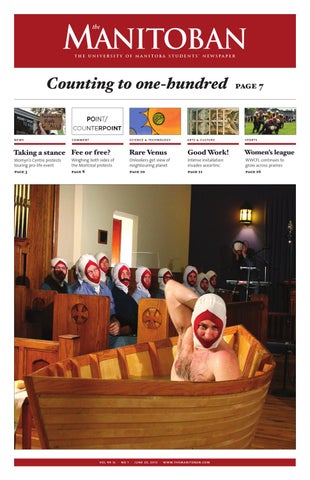
Seth Woodyard’s intense installation art transforms the aceart gallery
k ara Passey, stAff
I
visited Seth Woodyard the day before his opening reception at aceartinc. The gallery space was completely transformed; new walls were built, there were plastic tarps hanging from the high ceilings, a small wooden boat filled with crystal clear water, and two very peculiar looking gazebos. Scaffolding was still up and a handful of people were helping to smooth plaster and install video equipment.
“It’s going to be right down to the wire,” Woodyard said with a smile. He appeared confident, for him the process is more important than what he ends up with at the end.
Born in Prince Edward Island and raised in Ottawa, Woodyard moved to Winnipeg in 2003 to study history at Canadian Mennonite University (CMU). After one year at CMU he made the decision to enroll in the school of fine art at the University of Manitoba. His exhibition, entitled Good Work, is his first solo show since graduating in 2009.
ied art in a concentrated way for four years. After graduating I decided I wanted to do a history degree rather than art. When I started I didn’t leave any room in my life for making art. It made me realize that I needed art in order to be happy.”
In the beginning, Woodyard was primarily a painter but his work evolved into installation and sculpture.
“For me, installation is like building forts, I approach it in the same way as I did building forts as a kid with sort of a playful intention. My first major installation was at the U of M, I dug a cave in the side of the river bank, it was very much about creating a space and inhabiting that space.”
Woodyard’s current work ties together trade and art and is a return to sincerity and the discipline of ritualized labour.
“I didn’t want to finish my degree after the first year,” says Woodyard. “In Ottawa they had this amazing arts high school, so I had already stud-
Woodyard’s current work ties together trade and art, and is a return to sincerity and the discipline of ritualized labour. Through symbols, patterns, and repetition he creates a narrative about his personal history, his work, and his worship. He often appropriates images from art history (especially Christian iconography) and the vesica piscis is repeated throughout the exhibition.
“Vesica piscis is latin for fish bladder, it is made when two circles intersect,”
he explained. “The circumference of each circle intersects with the center point of the other, when they overlap the vesica piscis is formed. It is the intersection of two binaries, whether it be male and female, heaven and earth, or the sacred and profane.”
Through research, Woodyard found that the symbol had been appropriated by Christianity and was interested in the various meanings and religious connotations attached to it throughout history. Specifically he uses the symbol as a representation of a vagina, as both the object of male desire and as a symbolic way of talking about rebirth through repetition.
The purpose of installation art typically is to create an aesthetic experience for the viewer. In addition to an installation that the viewer is invited into, Woodyard tries to create a further aesthetic experience by incorporating video, music, and performance.
“Music is an art form that is easier to have an emotional response to than it is to an inanimate object,” he says. “When it is used in worship it creates an emotional response. It is performed repeatedly, the same songs and the same music over and over, and it gains significance through its repetition.”
“It’s going to be a riot!” laughed
Woodyard, when I asked what to expect opening night. Local indie, prog folk band, Alanadale, was commissioned to make the music used in the exhibition and will be performing live opening night along with the Riel Gentlemen’s Choir. The music is all Manitoban-themed with songs about plants, bodies of water, and socialism.
If you missed the opening reception, the exhibition of Good Work will run until July 13. Aceartinc is located at 2-290 McDermot Avenue and is open Tuesday through Saturday from noon until 5 p.m..
The beginner’s folk music playlist
Prepping for Folk Fest 2012
Michelle saroMo
Having been a newcomer to the Winnipeg Folk Festival last year, I arrived at Bird’s Hill overwhelmed and unprepared for the amount of talent I was about to be exposed to. After hours of walking around, scoping and catching bits and pieces of performances from each stage, I was really only able to settle down for one performance – maybe one and a half, tops (yes, I’m that indecisive). This year, I’d love to get the full fest experience and listen to some more. If you’re planning to check out the Fest for the first time this year and are anything like me, I’d bet that you’d want someone to alleviate you from the pains of indecision and throw their own musical preferences at you, wouldn’t you? Well, it just so happens that I have here a completely biased playlist of songs from some of the artists of this year’s lineup – I’ve even listed them by chronological order of performance! You’re welcome!
James vincent mcmorrow - “we Don’t eat”
One of my favourites from his debut album Early in the Morning, it’s a song that reminds you that life is more than just about the material things (if you’re planning to camp throughout the whole fest, you might need this reminder). McMorrow is a rising folk artist who has been compared to the likes of Ray LaMontagne and Bon Iver – he’s even done the whole “peace out, world! I’m going to lock myself up in the middle of nowhere for a couple months and come back with a painfully beautiful album” bit. Apparently it’s a formula that works. As a festival opener, McMorrow is definitely not to be missed.
Good old War - “ThaT’s some dream”
Sometimes we need to be cheerfully informed that we’re all going to die eventually, “but that’s okay.” Allow this track from Good Old War’s 2010
self-titled album to do that for you! This Philly-based band’s sound has a bit more of a light-hearted, folk-pop feel, which isn’t bad a thing at all. And hey, if being reminded about your own mortality isn’t quite your cup of tea, give their newest album, Come Back as Rain, a listen – it screams “summer fling soundtrack!”
Jimmy l aFave - “river road” Listening to this song makes me want to wrap myself up in a warm blanket whilst I cry over a campfire. LaFave’s music has that reflective storytelling quality, and he sings his ballads so sincerely that you can’t help (or at least I can’t) but feel compelled to say “I feel that” over and over again. With this year marking his 20th since the release of his first album Austin Skyline, LaFave is a wellseasoned musician deserving of respect.
The head & The hearT - “doWn in The valley”
Lord, have mercy. This band is easily becoming one of my favourites. There’s something about their sound that reminds me of Dan Mangan – I can almost hear the fest crowd singing along to their music in a cultlike fashion. The band members’ clear vocals harmonize beautifully, and I’m willing to bet that hearing them perform live is going to be an even more jaw-dropping experience.
The FreTless - “BriGiTTe mulholland” I love a good string quartet. I love a good string quartet that describes themselves as a Celtic band with a twist even more. Their music is a blend of classical and folk arrangements with a jovial Irish flavour. And how often do you hear played Celtic tunes played on a cello? Cellist Eric Wright brings in this unique component to the mix and it does not disappoint. Debuting this year, The Fretless is worth checking out.
iron & Wine - “The Trapeze sWinGer”
Probably the first to pop my folk cherry, Iron & Wine’s sound has definitely evolved over the years – singer/ songwriter Samuel Beam admits that his most recent album Kiss Each Other Clean was more strongly pop-influenced compared to previous albums. Still, whenever I think of folk music this song is at the front of my mind. When I listen to this meditative track, it reminds me of what I loved about the festival last year and why I’m coming back for more this year. Sitting on the grass and soaking up the sun while being surrounded by great music and great people – to me, that sounds like a perfect way to start off the summer.
The Winnipeg Folk Festival runs from July 4 to 8. For more artists and times of performances, check out the complete schedule at: www.winnipegfolkfestival.ca/festival/schedules.
Disaster rock and performance art
The Manic Shakes prepare to release their first 7” record
k ara Passey, stAff
The Manic Shakes are a Kijijifounded band and proudly give themselves the label “disaster rock.”
Members David Skene, David Van Den Bossche, Paul Shirtliffe, and Billy Elias are attempting to bring the suspense back to rock and roll by embracing all the imperfections and mistakes.
“We never play bad shows, we only play good shows,” says Skene (Ex-Modern Teen and Mary Jane Stole My Girl). “A bad show isn’t whether or not we make mistakes, a bad show is when we don’t have fun.”
The band was formed after the two singer/guitarists named David connected via Kijiji; drummer Billy and bassist Paul joined shortly after-
Reset:
ward. While the Davids share the front man duties, the band writes their songs collectively. They all come from various backgrounds and are influenced by genres such as alternative rock, stoner rock, garage rock and pop punk – “And that would be pigeonholing,” adds Skene.
The Shakes are releasing their first, self-titled, 7” record on June 22 at the Negative Space gallery (253 Princess). Supporting their show are local talents Kato Destroy and the Gunness. The record will have three original songs by the Manic Shakes and is one of the first albums to be released through the No Label Collective, a skill sharing collective consisting of about 10 bands, Home Street Recording Company, and No
Pie Publicity.
The No Label Collective was founded by Skene and friend Charles Granger (Ex-Modern Teen) on the basis that a collective could be started including their multiple bands, their members, and the other bands the members were in. There was a realization that the members within this group of bands have additional talents outside of music, such as music recording and production, film, photography, and graphic design. The two friends saw this as an opportunity for bands to help other bands succeed in a skill-sharing environment.
In addition to helping individual bands with their projects, the collective also works on group projects such as the Neil Hope tribute compila-
post-consumer gamer culture
tion with songs dedicated to the late actor’s character Wheels on Degrassi Junior High. The release date is still pending but original songs have been contributed by about 20 bands such as Kato Destroy, Hey Pilgrim, Crusty Cat, and Johnny Sizzle. The proceeds made from the compilation will be donated to the Canadian Diabetes Association.
“The Manic Shakes’ song is called ‘Excerpts From a Diary of a Teenager in the 90s Who Watches Degrassi Every Day After School’,” Skene laughs. “It takes longer to say the title than to play the song.”
The members of the No Label Collective have many faces, literally. The collective involves fictional members such as the Boss, Afro
Explore the connection between video games and art at Platform Gallery
leah h ansen
Pong was the first. Its ability to entertain people for hours on end with no visible narrative or plot line was the feature that distinguished it from other forms of media, namely music and movies. It was the setting
that counted here, and the setting alone. Of course, Pong ’s was only a preview of what was to come; a multibillion dollar video game industry that has both affected and influenced pop culture in ways that most of us
may not even realize.
Are you a fan of the Resident Evil films? 1980s hip hop? What about Lara Croft: Tomb Raider, Grandma’s Boy or Tron? Can you hum the Super Mario Bros. theme song on command?
I’ve never played the game in my life, and I can do it. The list goes on and on. Even though the influence of video games can be easily seen in mainstream pop culture, what about considering how gamer culture and the rise of digital media have influenced our attitudes toward art? Using video games as the medium is one of the more unexplored avenues of the influence of gamer culture, but it’s exactly what an upcoming Winnipeg exhibition is aiming to do.
Reset: post-consumer gamer culture, at the Platform Centre for Photographic and Digital Arts starting June 21, explores the connection between video games and art, and how gamer culture has infiltrated and influenced society around us. Through new media work in print, projections, and hand held interactive forms, Reset explores the ways in which video games have evolved from mere pixels depicting the simplest of scenes to an international industry with countless brands, “worlds,” and affiliations.
The artists whose work is featured have embraced the technology, culture and aesthetics of gaming as a medium. Their work also highlights the history of gaming technology through the devices that the pieces are viewed on. Some use the aesthetics of the games to create digital drawings and short animated loops; some use the technology as a filmmaking tool (this is known as “machinima”); others create their own interactive software applications and modify game controllers or interfaces.
Among the artists whose work will be included in the exhibition are native Winnipegger Clint Enns, a filmmaker whose work centers around creating something new out of broken and/or outdated technologies, and Canadian Myfanwy Ashmore, known for her software artwork. Also
Starchild, and brothers Lloyd and Selleck. Afro Starchild is an intergalactic traveler created by Skene and Granger. Skene performs as Starchild during Ex-Modern Teen’s live shows and with a fictional band called the Intergalactic Noise.
“The goal of the characters is the same as disaster rock,” says Skene, “to make music exciting again.”
For Skene, who is trained in theater, music crosses over into performance art. “I would like to make Afro Starchild into a fringe play,” he adds, “With different venues shutting down, Winnipeg has produced alternative spaces where you can go see shows. Moving rock and roll into a theater just makes sense because there is no where else to have it.”
featured is the work of Dr. Ian Bogost, an award winning designer and media philosopher whose games cover social and political issues and have been played by millions of people internationally. Max Capacity, a media and technology artist from Santa Cruz, California is also featured, his glitch work being derived from a variety of dead media like vintage video games, old and malfunctioning VHS machines and bent electronics.
“Party Time! Hexcellent!” is the name used by Rachel Weil, an artist who creates interactive, glitchable visual art for the Nintendo Entertainment System. And finally, Haydi Roket is an independent graphic designer and media artist from Istanbul whose work is preoccupied with the aesthetics of 8-bit computer and gaming technology; vintage video game consoles and computers are the source of his pieces.
While the sheer variety here would make for more than enough talent for one exhibition, the entire lot is curated by mrghosty (also known as Skot Deeming), a media artist as well as a curator whose own work seeks to challenge consumer models of play associated with video games and gaming culture.
Many various industries are now moving in digital directions. The predictable result is the convergence and interconnection of film, music, fashion, video games and now fine art. With such a unique form of art created by such considerable talents on display in Winnipeg, this exhibition isn’t one to miss.
Reset: post-consumer gamer culture is on at the Platform Centre for Photographic and Digital Arts from June 21 to July 28. The Opening Reception and Curator’s Tour is on Thursday, June 21 at 7 p.m.
EvEnt Listings
Séripop
Montreal artists bring worldly exhibit to Winnipeg
June 27-July 5, 4 Perspectives by Genevie Henderson, Suzanne Barrow, Pat Johnson, and Thora Barnett at the Cre8ery Gallery
June 15-July 13, Good Work by Seth Woodyard at aceartinc
June 15- July 27, La création de l’univers/The Creation of the Universe, work by Emmanuelle Jacques on display at Martha Street
June 21-August 30, Deux Temps, Trois Mouvements, Sans Doute by Séripop at La Maison des artistes visuels francophones
June 22-24, Circle & Square: Manitoba Festival of Craft 2012 at the Atomic Center
June 29 – August 2, “Ominjimdedaan / to remember,” by Charlene Vickers at Urban Shaman
MUSiC
June 21, Young Pixels and Merch Table Delite at Pop Soda’s
June 22, The Manic Shakes 7” Record Release Show at Negative Space
June 22, Death by Stereo with guests at The Zoo
June 28, Each Other, The Bokonosts, Thee Ahs, and Spirit Children at Frame Arts Warehouse
June 30, Dayglo Abortions with guests at Ozzys
July 4 – 8, The 39th Annual Winnipeg Folk Festival at Bird’s Hill Park
July 8, Brain Fever, Brain Attracts Flies and Dead Ranch at Negative Space
July 23, Beirut at The Burton Cummings Theatre
OtHER
June 22, World Naked Bikeride, starting at 6:30 p.m. at the Manitoba Legislative Building
June 22, Party in Solidarity! Supporting the students of the ‘Maple Spring’ at Gios Club & Bar
June 30, Art City Sky Parade starting at 2 p.m. on West Broadway
Séripop, the Montreal art group of Yannick Desranleau and Chloe Lum, are showing their art exhibit, Deux Temps, Trois Mouvements, and Sans Doute at the Winnipeg gallery La Maison des artistes visuels francophones from June 21 to Aug 30. The Winnipeg exhibition consists of two different art installations – Chandigarh Is One and More Time Than Space Chandigarh Is One focuses on the motivations and aesthetics behind the city in Chandigarh, India. Architect Le Corbusier created the city in 1953. First Indian Prime Minister Jawaharlal Nehru commissioned the city after the separation of India and
Pakistan. Chandigarh was created because the Indian province Punjab was split between Pakistan and India, leaving Punjab without a capital.
Nehru wanted a modern city to showcase the new India. Le Corbusier designed the city, and is one of the most prominent forces behind modern architecture.
The point of Chandigarh Is One is to examine Le Corbusier’s architecture and his modern motivations. Critics have argued that his cities are not pedestrian-friendly and are dictatorial in their structural imposition on native cultures.
Chandigarh is One examines the stylistic choices of Chandigarh in a
through pop art with ironic undertones. The installation is unique in that manner and should prove to be intellectually stimulating for gallerygoers.
More Time Than Space is a participatory sculpture. Guests of the gallery are invited to immerse themselves in the brightly-coloured art, examine the three objects clustered in front of them and reflect on possible architectural statements that the piece is trying to make. Séripop describes the work in terms of “saccades, visual rhythm, and a clear evolution.” More Time Than Space plays with the phenomenological elements of architecture and art – the relationship between the object in regards to humanity’s relationship with nature. Humanity is a part of nature and our dwellings shouldn’t dominate, but enhance our relationship with nature.
Séripop’s interesting art installations should be a treat of anyone that wants to experience groundbreaking art in a gallery setting.
The Séripop installations will be on display from June 21 – Aug 30 at La Maison des artistes visuels francophones, 219 Provencher Blvd. For more information on the exhibit as well as gallery hours, visit www.maisondesartistes.mb.ca.
Blue Bombers backtrack on cowbell ban
You know the CFL regular season is almost upon us when the Winnipeg Blue Bombers are caught up in a controversy that has almost nothing to do with their on-field performance.
The most recent ‘scandal’ revolved around a new game day policy letter that was included with season ticket packages that informed season ticket holders of a slew of changes to the game day experience.
The new Bomber game day policy expands the list of prohibited items to include almost all artificial noisemakers (specifically mentioning “musical instruments”), any sort of flagpole and all outside beverages and food—including sealed bottles of water—with the only exception being baby food.
The ban on noisemakers did not sit well with fans, especially those who had bought cowbells to ring on game day from the Bomber Store. Frustrated fans took to the internet and spoke with local media outlets to vent their frustrations, a press conference was called so that the club’s Chief Operating Officer Jim Bell could clarify the organization’s stance; cowbells would once again be allowed in the stadium and also available for purchase at the Bomber Store. ‘Paint cans filled with rocks’ and other homemade noisemakers would still be banned.
antics, the rowdy folks from Section S start stacking empty beer cups for seemingly no good reason. Before too long cups flew in from adjacent sections and even rained down from the upper deck. Shortly thereafter, the stack was long enough to snake from near the top of the section all they way to the walkway at the bottom.
It was never the beer snake itself that was inherently controversial; instead it was the way the snake would inevitably be destroyed. By the second home game against the Toronto Argonauts on July 9, the beer snake’s legend and length had grown exponentially.
When the Bombers collapsed in the fourth quarter and the game ended as a 36-34 loss, the cups
with the local media, Coach Kelly quickly became one of the more controversial figures in the CFL.
Perhaps the best/worst example of Mike Kelly’s interactions with the media came when a scout affiliated with the Winnipeg Football Club was caught taking notes at a closed Hamilton Tiger-Cat practice. In a media scrum specifically called to discuss the incident, Kelly was especially uncooperative with the media, and coined his very own catchphrase in the process: “It’s a non-issue, handled internally and I’m not talking about it.”
Keep in mind that this incident occurred two weeks into the regular season. The rest, as they say, is history, as coach Kelly’s head coaching stint with the Bombers was terminated Dec. 17 after a disappointing 7-9 finish.
Now with “Cowbellgate” promptly handled by the club, let’s reflect and take a moment to revisit some other Bomber controversies that were nothing but distractions for fans and the team alike.
The Beer snake
It was the 2010 season when the Section S beer snake first slithered into Blue Bombers folklore. Already notorious for their crazy
started flying. Allegedly, there were a handful of injuries caused by the flying plastic, forcing the Bombers to crackdown on any future beer snakes. The new rules were more or less accepted, although several smaller beer snakes—seemingly stacked in protest—were spotted in the stands throughout the remainder of the season.
mike kelly
As nice of a guy as Mike Kelly was one-on-one, he managed to be the king of controversy during his lone season as head coach of the Bombers in 2009. From referring to the province of Saskatchewan as the “crotch of Canada” in the offseason to his frequent clashes
Let’s get critical Bison briefs
Looking ahead to the fall
Marc l agace, stAff
Women’s soccer
The Bisons women’s soccer team will have a new bench boss when they kick off the 2012 Canada West season in September.
Hadyn Sloane-Seale was named the third head coach in the women’s soccer program earlier this month, and will be looking to coach the Bisons back into the post-season for the first time since the 2008 season.
Also in Canada West women’s soccer this season; UNBC, Mount Royal and Winnipeg will play their inaugural season in the conference, expanding the number of teams competing to 13.
With the additional teams, the total number of games played per team in 2012 has decreased from 14 to 12. Furthermore, the number of teams qualifying for the playoffs has doubled from four to eight.
The Bisons will open the regular season on the road against their new crosstown rivals from the U of W on Sept. 7.
BaskeTBall
The sTadium
The new stadium has been a constant source of controversy well before ground broke at the U of M campus. If Fort Richmond residents weren’t protesting the affect the stadium will have on the surrounding neighborhoods, then it was U of M students and faculty members voicing concerns about campus access and parking on game days.
But the biggest controversy was the ever-changing completion date that went from June, to late July, to late September. Fortunately, Bomber CEO Garth Buchko recently put that issue to bed.
In a statement sent to local media, the Bombers announced that poor weather conditions had slowed down construction, and that the club had postponed the stadium grand opening until 2013.
iLLustRatiON by kaRa passey
The addition of two new schools in the Pacific division won’t have a direct affect on the Bison men’s and women’s basketball teams, but there will be some significant changes to the Canada West playoff setup.
With both divisions at eight teams, there is no need for the Wild Card playoff format. Starting this season the top four teams from each division will qualify for the playoffs. Last season, both Bison teams missed the playoffs, with the women finishing in seventh, and the men fifth.
Both teams start the 2012 season on the road in Calgary on Nov. 2 and 3 before hosting the Brandon Bobcats Nov. 9 and 10.
volleyBall
The addition of Mount Royal to the Canada West conference means that all 12 teams will play every weekend throughout the 22-match volleyball season.
The Bison men and women’s teams will start the season on the road against the Winnipeg Wesmen on Oct. 25, and then host the Calgary Dinos the following weekend on Nov. 1 and 2.
The men’s team will be looking to improve on their bronze medal finish at the 2012 CIS National Championships, while the women’s team will be looking for a boost from their promising class of recruits after being eliminated in the first round of the 2012 Canada West playoffs by Winnipeg.
In other Bison volleyball news, the 1978-80 Bison men’s volleyball teams will be inducted into the Manitoba Sports Hall of Fame on Nov. 3. With a roster of players that included current men’s head coach Garth Pischke, the 1978 Bisons posted a 47-2 record before securing the U of M’s first CIAU (now CIS) national championship in volleyball.
The Bisons looked to repeat as champions the following year, but lost in the finals to the University of Saskatchewan Huskies. With the bitter taste of defeat still lingering in the back of their minds, the Bisons qualified for the CIAU finals again in 1980, and this time came out victorious over their hosts at the U of S, winning definitively three sets to one.
The 1978-80 Bison men’s volleyball teams and other 2012 inductees will officially be inducted into the Hall of Fame in the fall.
Marc l agace, stAff
The women of football
WWCFL continues to grow
Marc l agace, stAff
As most Canadian football fans know, the CFL regular season kick offs July 1. Meanwhile, for amateur athletes playing in Western Women Canadian Football League (WWCFL), the final games of the regular season were played on June 17. Playoffs are now underway, with each team hoping to making it to the 2012 WWCFL Championship game in Saskatoon, SK on July 14.
South of the border, there are two well-established women’s tackle football leagues—the Women’s Football Alliance and the Independent Women’s Football League—that collectively boast 92 teams from all across the nation (including one Canadian team, the Montreal Blitz).
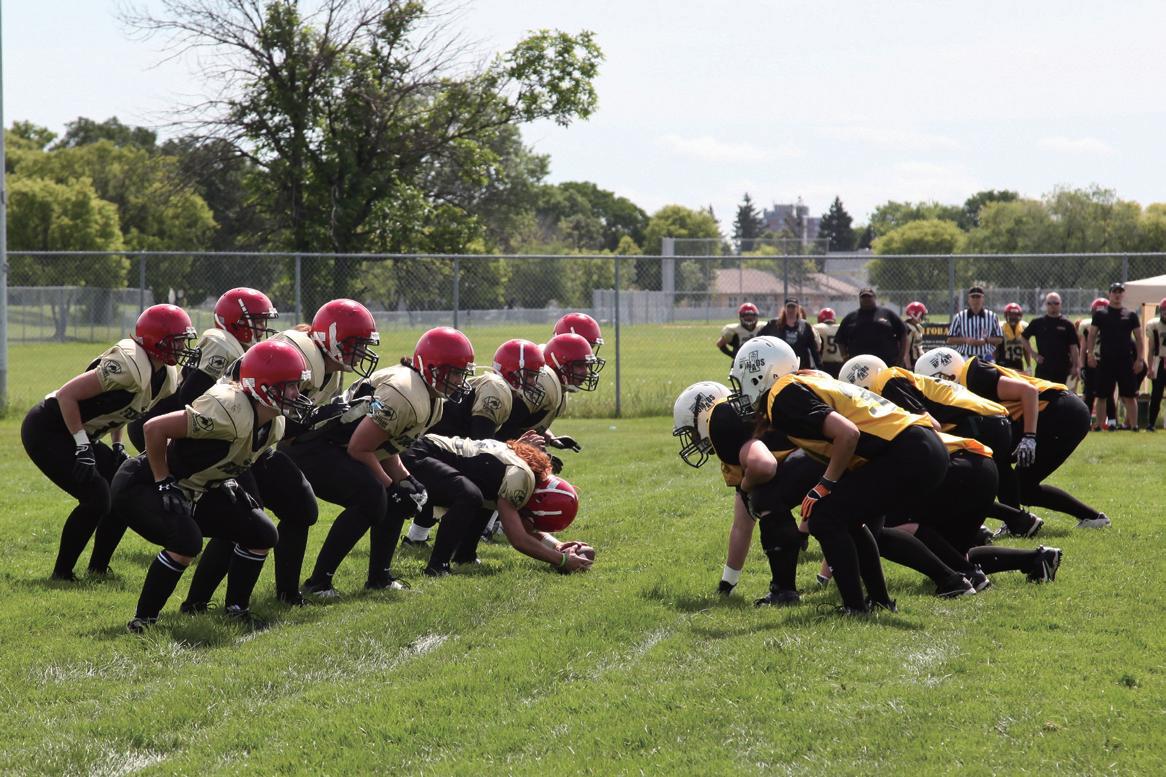
The WWCFL is an all-female full-contact football league that is currently comprised of seven teams from across western Canadian. In its second season, the league is divided into two conferences; the Western Conference hosts the three Albertan teams (Lethbridge Steel, Calgary Rage and Edmonton Storm), while the Prairie Conference is comprised of two Saskatchewan teams (Saskatoon Valkyries and Regina Riot) and two teams that play out of Winnipeg (the Manitoba Fearless
and the Winnipeg Nomads Wolf Pack).
For clarification, one would be remiss to confuse the WWCFL with the likes of the (in)famous Lingerie Football League (LFL). Unlike the LFL, WWCFL athletes wear traditional football uniforms and play the same game with the same rules as found in the CFL, CIS and all levels of Canadian football.
Having grown up in a football family, founding the Manitoba Fearless fulfilled a lifelong dream for Tannis Wilson.
“I created the team because I wanted to play [tackle football] my entire life,” explains Wilson. “Even though my dad coached, my brother played, my mom just said ‘no you’re not playing.’”
“It was kind of a selfish motive for me to start the team, because I wanted to play.”
Currently, Wilson is the general manager for the Manitoba Fearless and the commissioner of the WWCFL. She’s also responsible for introducing women’s tackle football in the province and getting the ball rolling on organizing the WWCFL.
Wilson says that women’s tackle football is one of the final frontiers
in terms of sports in North America. While still in relative infancy in Canada and Manitoba, the recent formation of the Manitoba Girls Football Association by Football Manitoba will hopefully open up the sport to younger generations of girls who are interested. Now, Manitoban girls between the ages of 9 and 14 can learn and play the unique team sport at a younger age alongside others looking for the same opportunity.
Allyssa Buckland, a U of M student and linebacker for the Fearless, first started playing tackle football for the St Vital Mustangs when she was 12 years old. Buckland says that playing with the boys was good fun, but that playing with all-ladies seems to bring out a bit more aggression.
“It’s different, but I definitely still enjoy it,” said Buckland. “I’d say that the girls are just as intense as the guys.”
While it helps to come into the league with playing experience, there are plenty of players who’ve joined with little to no previous experience. First-year running back Tabatha
Bandlow had never played any team sports, but signed up to play for the Fearless when they set up shop on the U of M campus last year.
The Fearless and the Nomads Wolf Pack wrapped up their regular season against each other on June 17.
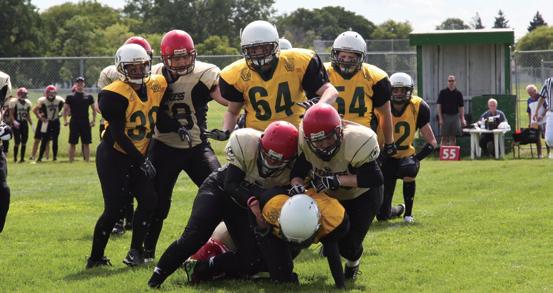
The game was a spirited match, with a healthy crowd of spectators looking on as the two teams showcased their skills on both sides of the ball. The game was as intense as you would expect it to be in an important game between fierce rivals. In the end, despite a last minute comeback attempt that almost went the distance, the Wolf Pack scored a touchdown as time expired to take the game 36-24.
Now both teams will prepare to travel to Saskatchewan for the playoffs, which start next weekend. Speaking with some of the players, the Saskatchewan teams appear to be the ideal model to follow for other teams in the league. For instance, the Saskatoon Valkyries garner support from all levels of football in the region, with the Saskatchewan
Roughriders of the CFL listed as a ‘Gold level’ sponsor on the team’s website. Meanwhile, the Riders allow the Regina Riot to use Taylor Field at Mosaic Stadium for their home games.
“Here in Manitoba, we definitely don’t get as much backing from the province or the Bombers,” said Buckland. “They definitely get a lot more money put into their program, and it shows.”
Hopefully that’s something that will change as the league’s visibility grows. With the league now firmly established after two years in existence, the WWCFL is hoping to add four new teams—including the first team in B.C.—in the next few years.
If you’re interested in playing or volunteering with either the Manitoba Fearless or the Winnipeg Nomad Wolf Pack, you can get in contact by finding their team page on www.wwcfl.com.