Writing a graduate research thesis sharpens time management and communication skills, but so does explaining your research in 180 seconds.
The Three Minute Thesis (3MT) competition is a contest open to graduate students across all disciplines. It is held in 65 countries around the world, including Canada.
Graduate students present their research to a live or virtual non-specialist audience in three minutes. The presentations are judged based on communication style, engagement and comprehension.
In Canada, the competition has three stages: the university contest, the regional contests — western, Ontario and eastern regionals — and the national contest.
The U of M 3MT is organized by the faculty of graduate studies.
The challengers for the U of M 3MT competition will be announced Feb. 2, after which the competitors will have the following three weeks to prepare.
A three-day heats event will follow, taking place Feb. 26 and 28 at the Fort Garry campus and Feb. 27 at the Bannatyne campus.
Finalists from the heats will compete in the final competition on March 18, and the top three winners from the heats will receive $200 U of M bookstore gift cards.
winner will receive the UM Retirees Association prize of $1,250, and the third-place winner will receive a $750 prize. The people’s choice winner will receive a $200 U of M bookstore gift certificate.
The first-place winner among the
competition which will take place on June 3.
The U of M has not placed top three in any of the regionals.
“Just writing the three-minute speech was an educational experience” — Rachel Nickel, 2017 3MT first place winner
At the finals, the top three winners and a people’s choice winner will be awarded. The first-place winner will receive the Dr. Archie McNicol prize of $2,500. The second-place
finalists will represent the U of M at the western regional 3MT where they will compete against other first-place winners from universities in Alberta, British Columbia and Saskatchewan. The top three finalists from the regional competitions, taking place in April 2019, will advance to national
Rachel Nickel was the first place and people’s choice winner at the 2017 U of M 3MT competition. At the time, she was a master’s student in the department of physics and astronomy. Her thesis presentation was titled Biocide-coated magnetic nanoparticles: a new way to treat infections
“Just writing the three-minute speech was an educational experience,” said Nickel.
“It forces you to identify the important aspects of your research and build a story that the general public can connect to.”
Nickel offered advice to students interested in applying to the 3MT competition.
“My biggest piece of advice is just to practice,” she said.
“Keep in mind that the judges come from a range of backgrounds and take advantage of friends and family to fine-tune your presentation.”
Nickel said the experience is a unique opportunity for graduate students.
“For the 2019 winner, my biggest recommendation would be to savour the experience and do your best.”
Applications for the seventh annual U of M 3MT competition must be submitted by Jan. 28.
U of M scientific journal announces best paper winner
Winning research involved pathogenic bacteria subspecies
MALAK ABAS, STAFF
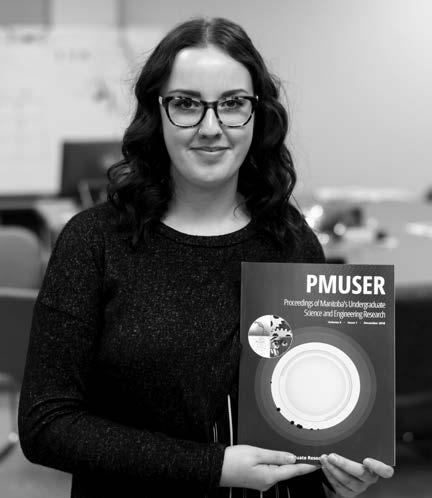
The final issue of 2018 of the Proceedings of Manitoba’s Undergraduate Science and Engineering Research (PMUSER) journal has been released, and U of M student Michelle Wuziniski has received the year’s best paper award for her research on distinguishing subspecies of a pathogenic bacteria.
Wuziniski, a fourth-year microbiology honours student, won for her paper titled “Developing a Genotyping Scheme for Myobacterium abcessus Complex Using Whole Genome Sequencing Data.”
“I’ve always been very passionate about diseases and their effect on humans” — Michelle Wuziniski, PMUSER best paper winner
The paper looks to support current methods of analyzing the data from all of bacteria’s DNA — whole genomes — to distinguish between different strains and subspecies.
“So basically, a way that they use to type bacteria, it’s called multi locus sequence typing,” she said.
“So they take a few genes, and then every time there’s like one base pair mutation of that gene, a new allele is created.
And then they’re typed based on the different combinations of alleles they’ll have.”
PMUSER is a peer-reviewed undergraduate journal which covers, according to its website, “a wide range of scientific disciples.”
While the journal was founded at the U of M, it accepts any research work done in Manitoba by undergraduate students.
Wuziniski, who received a $250 prize sponsored by the faculty of science, said she was not expecting to win the award.
“I found out through email and I was actually quite surprised,” she said.
“I was told that I was on the short list for the award but I had no idea how many submissions there were and what my chances were and I was about to write a final exam when I found out and it was a wonderful surprise. The winnings are probably going towards my tuition next year.”
While Wuziniski said she is not sure where she will pursue her education after finishing her final year at the U of M, she wants to continue in the field of microbiology.
“I want to go into medical microbiology because I’ve always been very passionate about diseases and their effect on humans.”