Correction: The article "New Third Thursdays initiative showcases University of Manitoba’s creative community" (Jan. 8, 2017) originally stated that Synthia’s Closet by Ione Thorkelsson would be on display at the Gallery of Student Art. In reality, Synthia’s Closet was on display at the School of Art Gallery and You Guys Look Like Shit by Kelsey Smith was on display in the Gallery of Student Art.
Two-page letter from CFS disagrees with UMSU’s allegations of harassment at national general meeting
LEVI GARBER, STAFF
University of Manitoba Students’ Union (UMSU) executives are not satisfied with the Canadian Federation of Students’ (CFS) response to the local’s demands for an apology regarding treatment of UMSU executives at the CFS national general meeting in November.
In a two-page letter sent on Jan. 17, national CFS executives and the chairperson of CFS-Manitoba responded to allegations that they did not adequately address harassment of UMSU delegates during the closing plenary of the general meeting.
The letter states that CFS officials made it clear to delegates at the meeting that there were anti-harassment officers available throughout the weekend and that when the meeting became “contentious” during closing plenary, CFS staff members suggested UMSU delegates speak with one of the officers.
“Despite several approaches from both CFS staff and the officer, UMSU delegates did not avail themselves of this support, nor file a complaint with the anti-harassment officers,” the letter reads.
No apology for any alleged harassment was included in the response.
UMSU president Tanjit Nagra claims that during the meeting in Ottawa, University of Winnipeg Students’ Association vice-president student affairs and CFS-MB women’s commissioner Laura Garinger verbally harassed her over union fee increases previously passed by UMSU.
The harassment allegedly took place after UMSU brought forward a motion that would amend CFS’s policy on international students, calling for the national union to advocate for international student fee increases to be locked at the same percentage increase as domestic students.
The response comes just over a month after UMSU council passed an emergency motion at its Dec. 8 meeting instructing the union’s executives to write a letter to CFS national executives demanding they apologize to UMSU delegates at the meeting, UMSU council, and University of Manitoba international students. The emergency motion also instructed UMSU executives to halt all attempts of reconciliation with the federation after years of tension.
UMSU vice-president advocacy Dara Hallock said that she was disappointed when she read CFS’ response and that it only serves to hurt an already-strained relationship between the two organizations.
“I was upset. I was kind of stunned,” Hallock said. “We want an apology for how we were being treated. The organization itself has it outlined in their governing documents that it needs to be a safe and inclusive space.”
Hallock also took issue with the CFS executives’ claim that UMSU delegates refused offers to speak with anti-harassment officers.
“There was incorrect information included in their letter,” she said.
“Saying that no one accessed the antiharassment officers provided to them prior to the last day and that no one had made a formal complaint because there were actually two made before the final meeting.”
“I was stunned that they wouldn’t even grant us an apology.”
CFS national chairperson Bilan Arte disagreed with the UMSU executives, saying CFS staff members worked hard to ensure the national general meeting remained a safe space.
“In every way that was possible, we did our very best to support and promote well-being for not only [UMSU] but also across the board,” Arte told the Manitoban . “[The demand] is a bit confusing because I do know that there was support offered to delegates at various points during the meeting.”
“Our position is that we provided the support that we could at that time and in fact on multiple occa-
sions while the incident had occurred and afterwards,” she said. “I think that our position is really clear in that respect.”
Nagra doesn’t buy Arte’s claim that CFS did everything it could to make UMSU delegates feel comfortable.
“I was stunned that they wouldn’t even grant us an apology” – Dara Hallock, UMSU vicepresident advocacy
“The tone of the debate was very turbulent and it did not have to be that way, but the tone at the beginning was set when a delegate incorrectly used a point of order to attempt to call myself and Dara out as board of governors reps for UMSU,” Nagra said.
“I don’t think that’s good debate, I don’t think that’s good governance. That was targeted specifically at us.”
Arte also disagreed with that point, explaining that at no time did the executives let delegates harass others during the meeting.
“I would disagree that the process was done out of order or anything like that,” Arte said. “That’s not at all what had happened. I think the person was very much in order and our meeting was conducted in a way that was very fair to all interventions.”
The letter from CFS executives also addressed the motion UMSU introduced at the general meeting calling for the federation to advocate for international student fee increases to be locked at the same percentage as domestic students. The response reiterated that the International Students Constituency unanimously opposed the motion because they viewed it as a weakening of the federation’s current policy opposing any form of tuition increases.
The official response from CFS also included a rebuff to UMSU’s claim in their Dec. 16 letter that the repayment of three years worth of unpaid fees to the federation earlier this year was an act of reconciliation.
“Member local student associations have a contractual obligation to remit
membership fees to the federation,” the letter read. “The remittance of three years’ worth of outstanding membership fees by UMSU should not be viewed as a reconciliatory measure but rather the belated fulfillment of a legal requirement.”
Hallock took offense to that segment of the response, claiming that CFS was discrediting months of attempts to re-establish good will between the organizations.
“They’ve delegitimized every single step we’ve tried to take moving forward with them,” she said. “We don’t even know where to go now. We’ve tried every step.”
The response was not discussed at UMSU council’s regularly scheduled meeting on Jan. 19, save for a few words from Hallock signaling a willingness to continue working with CFS-MB, as the provincial branch of the federation had little to do with UMSU’s treatment at the general meeting in Ottawa.
PHOTO BY LEVI GARBER
UMSU president Tanjit Nagra (left) and vice-president advocacy Dara Hallock (right) are calling for an apology from CFS.
CFS organizes with international students
Workshops to examine mental health, housing, and other issues facing global students
DIANA UBOKUDOM, STAFF
The Manitoba chapter of the Canadian Federation of Students (CFS-MB) is hosting a series of workshops Saturday to examine the unique issues facing international students across Manitoba.
Hosted at University Centre on the Fort Garry campus, the day’s scheduled programming includes panel discussions and workshops looking at international student rights and campaign organizing, Indigenous knowledge, mental health, housing challenges, and action planning.
Saif Baloch, CFS-MB international students’ commissioner, said the seminar is being organized to identify and propose solutions to the challenges faced by international students.
“CFS will be organizing this event for international students to find solutions to issues that might be serving as a barrier to education in our province,” he said, adding that the issues have been carefully selected by international student leaders
across four universities in the province: the University of Manitoba, the University of Winnipeg, Brandon University, and the Université de Saint-Boniface.
“Sometimes the stress is so much that you become frustrated and you just don't know what to do next” – Ayobami Ige, international student
“One of the things about international students is that they contribute a great deal to our university but the university often takes that for granted,” he said.
“It is very important that international students and their contri-
butions are acknowledged. They should be provided the services and opportunities that they deserve for the amount they pay.”
Baloch noted that the chief obstacles facing international students are developing housing and job opportunities.
Ayobami Ige, a fourth year computer science student from Nigeria, echoed Baloch’s comments.
“While I was looking for accommodation last summer, it was more difficult for me to get an apartment because I didn't have a job here,” he said.
“They didn't rely on my parents sending me money – almost like they didn't believe that my parents would send me money.”
Ige added that international students can also be burdened by issues from their home country and suggested the university have resources in place to support them.
“Different things are happening in different countries, like economic crises,” he said. “I don't know if it's
possible, but sometimes I think the school should try to see what is going on in these countries [and] to come up with policies to benefit students that may be going through things due to these problems.”
“As international students, we also have conditions that we must follow to remain here,” he added. “So if we are not able to attend classes due to these reasons back home [...] we might have to leave the country.”
Baloch said that some international students also experience challenges with their mental health, especially in accessing mental health services on campus.
“Often times when I interact with international students, they reveal that mental health services are inaccessible for international students,” he said.
“Sometimes the services provided are not culturally appropriate, so I think CFS–Manitoba, and me personally, we have to engage in this conversation and start it from somewhere, and furthermore, advocate for them.”
First-year international undergrad students at the U of M face tuition fees more than three times higher than their domestic colleagues. International students can pay up to $14,700 per year in tuition alone, compared to $4,400 for Canadian students.
Including housing and other fees, internationals students can face costs upward of $30,000 per year.
Ige said that with so much pressure on international students, mental issues are bound to arise.
“Sometimes the stress is so much that you become frustrated and you just don't know what to do next,” he said.
“If you are not thinking of tuition, you're thinking of rent, bills, or how to get into classes. It makes you think of things that you should not be thinking about. If there are no supports in place, you can end up doing something drastic.”
“Honestly, I feel like there's so much pressure on us, so many things that we are thinking about that we don't have enough resources to solve,” he said. “These issues might also affect domestic students but I think they affect international students more.”
Although the event is targeted specifically at international students, Baloch encouraged domestic students to attend as well, emphasizing the need for all students to be part of the conversation.
“Our idea of building a platform for creating a better understanding of the learning process would mean encouraging both international and domestic students to sit and listen to these issues, get into discussions, and just talk in detail," he said.
Baloch added that the students’ federation is also planning to organize campaigns to highlight and tackle the issues raised through Saturday’s workshops.
“After we talk about these issues, as a student organization, we are planning to move forward with these issues to advocacy campaigns,” he said.
Baloch said he believes the event will set the groundwork to tackle the issues facing international students for the long run.
“It will be positive,” he said.
“The goals are both short-term and long-term. Short-term goals will be addressed there and then. The longterm goals will be addressed through advocacy, and at the provincial level.”
PHOTO BY CAROLYNE KROEKER
Youth unemployment in Manitoba hits highest levels since mid-90s
Young Canadians face challenges searching for secure employment
LEVI GARBER, STAFF
Youth unemployment in Manitoba is at its highest rate in more than two decades, according to data from Statistics Canada.
In December 2016, Manitoba’s youth unemployment rate dropped slightly to 13.1 per cent from its August high of 13.8 per cent, the highest it has reached since May 1996 and more than double the province’s overall unemployment rate, which stood at 6.4 per cent in December.
According to the data collection agency, the national youth unemployment rate in December remained unchanged from when the Liberals formed government in November 2015, at 12.6 per cent. The Liberals campaigned on a promise to create thousands of jobs for youth in 2015.
University of Manitoba associate professor of economics Janice Compton said she believes the numbers are part of a decade-long trend following the financial crisis of 2007-2008. Since the crisis, she said, post-secondary students are staying in school longer and entering the workforce later.
“Since the recession, the labour force for 15-24 [year olds] has fallen, employment has fallen, and unemployment has stayed fairly constant,” said Compton, who specializes in
migration, labour, and household economics. “So, as a proportion of the falling labour force, the unemployment rate has increased.”
“Youth tend to remain in school longer during recessions, delaying entry into the labour market,” she said in an email. “I looked into this and there has absolutely been an increase in the proportion of those aged 15-24 who are in school full-time.
This is data for Canada, but [there is] no reason to think that Manitoba is different.”
Compton also noted that although youth unemployment is trending higher in recent years, compared to the years following the recession of the early 1980s it is relatively low.
“If you extend back to 1976, it [is] not that the unemployment rate at the current time is necessarily high but that the years prior to the last recession were slightly lower than average.”
Between 1980 and 1994, 38 per cent of months saw a higher youth unemployment rate in Manitoba than the 2016 maximum, peaking at 19 per cent youth unemployment in Februrary 1994.
Precarious employment
According to a 2015 special report on precarious employment in Canada
by TD Economics, 30 per cent of employed Canadians aged 15-24 work on a temporary basis, compared to 15 per cent in 1997. The share of precarious workers aged 15-24 is much higher than for employed Canadians aged 25-55 and 55 and over.
The report defines precarious employment as “having an outsized level of uncertainty, whether in terms of pay, ongoing employment, scheduling, or other dimensions.”
Delivering a lecture entitled “The Precarious Generation: Millennials Fight Back” at the University of Winnipeg on Jan. 18, NDP member of Parliament Niki Ashton said the struggles youth in Manitoba face in finding secure employment are similar to those of young people across the country.
“In terms of good jobs and how it’s difficult to access them did come up a lot in Winnipeg,” Ashton said, referring to a recent stop in Winnipeg during a cross-country tour on the issue of youth employment.
“What we’re saying is that this is a national emerging crisis,” Ashton said following her speech. “It requires national leadership and what better time than the time where the prime minister is [also] the minister of youth?”
Ashton – the MP for ChurchillKeewatinook Aski, NDP critic for jobs, employment and workforce development, and a University of Manitoba alumna – said the efforts made by the Liberals have not done enough to fight youth unemployment across the country.
“In December I did ask [the Prime Minister] to resign as minister of youth because his government isn’t actually doing anything for young people” – Niki Ashton, NDP MP for ChurchillKeewatinook Aski
“In December, I did ask [the prime minister] to resign as minister of youth because his government isn’t actually doing anything for young
people,” she said. “Commitments that were made in terms of investment in employment opportunities haven’t materialized to the extent that they were committed.”
During the 2015 federal election campaign, the Liberals promised to create 40,000 “good youth jobs” annually over the following three consecutive years by investing $300 million in the Youth Employment Strategy (YES).
Once in government, the Liberals followed through with that promise in the 2016-17 federal budget and added an extra $165 million on top of the $339 million initially planned, bringing YES’s total funding to $404 million.
The 2016-17 federal budget was presented to Parliament in March 2016. Since then, the number of youth with full-time employment in Canada dropped by 10,000, while the number of young Canadians employed part-time increased by 28,000, according to Statistics Canada.
PHOTO BY LEVI GARBER
NDP MP Niki Ashton speaking at the U of W Jan. 18
Rady Faculty of Health Sciences sets strategic priorities
Rady dean explains new funding model for faculty
OSHO SAMUEL ADETUNJI, STAFF
Administrators of the Rady Faculty of Health Sciences (RFHS) outlined their strategic priorities at a town hall meeting Jan. 19, charting the faculty’s course for the next several years.
Hosted in the Gaspard Theatre on the Bannatyne campus, the presentation summarized the faculty’s performance and set future goals regarding the department’s academic affairs, educational approaches, continuing competency and assessment programs, research, and meeting the call of the Truth and Reconciliation Commission of Canada’s action plan.
Dean and vice provost Brian Postl prioritized developing a strong and open relationship with Manitoba’s Progressive Conservative government and talked about how the university’s new budget model might affect the faculty.
The university announced in the
fall it is planning on moving away from its current budget model toward a more decentralized framework.
Under the current model, revenues are received centrally and then allocated into units across the university. Under the more decentralized proposal, according to a university release, faculties will retain a majority of their revenue but forward some toward a central pool.
“It is a new model where the money flows to the faculties and then the faculties, in effect, share the costs of the university and pay into a pool that supports the broader university,”
Postl said in an interview Monday.
He added that the new framework will be rolled out over the next three years, so individual faculties still have time to adapt to and plan for the changes.
“Many universities have moved to this model and I think most people
think that it is a much more transparent model than the one that has been in place the last several decades,” he said. “So I think it’s a step forward and we’ve got to get it started and then learn how it works and then use its levers to try and improve our teaching and research.”
The presentation noted that there is a renewed focus on interprofessional education and innovation across the health faculty, including the establishment of new research chairs.
Postl said the faculty is working to improve student wellness supports and noted that research funding got a shot in the arm with new grants that will boost investment by 16 per cent over their term.
Postl said that after a myriad of consultations – ranging from a review of strategic plans to examining resource-planning priorities and
consultations with college deans and faculty vice deans – a draft strategic framework was created.
The draft, which was reviewed by the health faculty’s dean’s council, will serve as a guideline and define the priorities for the next five years.
The RFHS strategic framework incorporated the shared vision, values, and strategic priorities of all the colleges in the faculty: dentistry, medicine, nursing, pharmacy, and rehabilitation sciences.
The six shared strategic priority areas identified by Postl include education and learner experience; research; teaching and the working environment; community, partnerships, and collaboration; Indigenous health and achievement; and resource base investment.
He noted that the faculty is looking at expanding its online programming, which includes online courses
offered through the faculty of human ecology. He said the health faculty is looking at expanding continuing education and professional development programs and education surrounding Indigenous issues to online formats.
Postl added that the Indigenous Institute of Health and Healing is working its way through final senate approvals but should be ready to launch in the coming months.
“Achieving these priorities will allow the faculty to realize its shared vision to be a leader in innovative research and health professional education that supports collaborative practice,” Postl’s presentation reads.
PHOTO BY MIGUEL YETMAN
Rady Faculty of Health Sciences administration presenting strategic priorities on Jan. 19
Editor-In-Chief: Craig Adolphe
Contact: Editor@themanitoban.com / 474.6770
activists and advocates,
A photo essay by Carolyne Kroeker
Many marchers stressed the importance of protecting reproductive rights in the wake of a Republican government which has already reinstated the Mexico City policy — a law which prohibits the U.S. from providing funding to international non-governmental organizations offering family planning services and resources if they include abortion — within its first week in office.
Indigenous elders led thousands of marchers down Portage avenue alongside the Buffalo Gals, highlighting the presence, voices, and experiences of Indigenous women within the context of the march and feminist dialogue.
Local
such as Uzoma Asagwara (above), spoke to thousands of passionate attendees, who packed the lobby as well as the second and third storey balconies of Portage Place before taking to the streets.
March organizers hosted speakers in Portage Place for the duration of the event for those unable to join the march. Johise Namwira (above) shared words of encouragement and solidarity to close the hugely successful event.
Feline imagery — a feminist reclamation and reinterpretation of Donald Trump’s “grab them by the pussy” comment — was a popular theme among marchers.
Feminist theory must welcome and embrace the healthy anger of marginalized communities, who are all too often made to believe that their anger is baseless or invalid by privileged people.
The future is female, Black, Queer, disabled. The future is Indigenous, transgender, immigrant, sustainable. The future is working class, Muslim, non-binary, and so much more. The future is everything but the status quo.
Several marchers underscored the importance of prioritizing voices diverging from the often white, cisgender, heterosexual, and upper-class face of commercialized, mainstream feminism.
We are far from immune to racism and misogyny in Canada. This marcher expressed a collective need to bring justice, reconciliation, and healing to Indigenous communities by honouring the lives of Indigenous women and girls stolen by violence and bigotry.
Trans inclusivity is essential to intersectional feminism, and many marchers highlighted this with signs urging the rejection of transexclusionary radical feminist (or TERF) ideology.
Women’s March provides hope in the face of a bleak Trump presidency
SHADEN ABUSALEH, STAFF
Heading into his inauguration with the lowest approval rating of any modern president-elect, at only 40 per cent, Donald Trump gave a dark speech vowing to put “America first” and to stop “American carnage.” Trump’s unapologetic appeal to nationalism is a terrifying reminder that we cannot take our democracy and freedom for granted. While Trump was raising his tiny fists in nationalistic fervor 16 minutes in during his inaugural address, there was an overhaul of the White House website; the Obama administration’s commitment to civil rights, LGBT rights, and stopping climate change instantly disappeared.
But on the very first day of a President Donald Trump world was one of the largest protests ever seen in modern America. Saturday, Jan. 21 was historic.
Less than 24 hours after being sworn in as the 45th president of the United States, an estimated 500,000 people – roughly triple the number
witnessed at Trump’s inauguration – headed to the National Mall in Washington D.C. in an inspiring showcase of bold resistance, defiance, and a powerful reaffirmation that women’s rights are human rights. Donald Trump will not have a honeymoon phase.
This number is not nearly as much as the millions of mothers, daughters, husbands, and brothers marching in a sea of pink ‘pussy hats’ across the world in solidarity with the Women’s March on Washington. In fact, there were over 670 “sister marches” across the globe in over 70 countries, including Russia, Brazil, Kenya, Japan, India, Canada, and even Antarctica. And we had our own sister march here in Winnipeg as thousands of Winnipeggers marched down Portage Avenue, filling in every corner of Portage Place.
What is important to remember about this monumental event is that the Women’s March was not only a protest against Trump, but one
against the rise of fascism and, specifically, misogyny. The Women’s March was a call for equality, democracy, inclusiveness, and most importantly, unity. It was a reminder that in the face of hate, fear, and darkness, we have the power to realign ourselves into an unbreakable bond of togetherness.
This march is not only a symbolic gesture of anger, but also an effective form of resistance
The Women’s March is proof yet again that true change does not come from world leaders. True change comes from a group of angry, ordinary, pissed-off people. If day one of Trump’s presidency is any indication, then I am hopeful that we are in good hands.
In the aftermath of our activism, we must start planning for what comes afterwards. We must prove that this march is not only a symbolic gesture of anger, but also an effective form of resistance. This march should be the first step towards unifying our communities and our everyday leaders. The Women’s March should be the catalyst for the expansion of grassroots movements that inspire, educate, and lead future generations and their change-makers.
Raising awareness and getting media attention is incredible, but it is never enough. It is one thing for us to voice concern about how our world works. It is another for us to step up and have a hand in shaping our world and history. This is what the Women’s March inspired in every single one of us.
Social movements exist to keep our governments in check. This means that social movements, like the one that manifested as the Women’s March, must make their
way into the political sphere in the form of lobbying, becoming political parties, adopting policy stances, and so on. If that does not happen, social movements will remain limited. This is because the number one challenge standing in the way of social movements is their inability to have lasting impact and political influence.
While we plan our future, however, we must remember that women have always played and will always continue to play a foundational role in revolutionary change, especially when they take matters into their own hands.
PHOTO BY CAROLYNE KROEKER
UMSU’s problematic erasure of decades of Indigenous advocacy bolsters settler saviourism
MITCHELL VAN INEVELD
H
umility is a virtue, especially in leadership; it is key that leaders of any description be able to recognize the role of others in achieving a particular objective, as opposed to only acknowledging their own contributions. This is why I found Levi Garber's Jan. 11 piece, “Federal finance committee recommends removal of funding cap on scholarship and bursary program for Indigenous students,” to reflect somewhat poorly on UMSU president Tanjit Nagra’s leadership skills, as well as playing into the harmful phenomenon of “settler saviourism.”
The article describes a recent recommendation by the federal finance committee to lift the two per cent cap on annual funding increases to the Post-Secondary Student Support Program (PSSSP), which provides grants to Indigenous people seeking to attend college or university. In the article, Nagra and Garber, by only mentioning ADVOCAN (the informal association of large student associations of which UMSU has recently become a part) imply that the finance committee’s recommendation to lift the PSSSP cap was a direct result of the work of that group.
This, however, is far from the truth.
The article, due in no small part to the fact that Garber relies only on Nagra as a source, fails to mention that the Canadian Federation of Students’ (CFS) National Aboriginal Caucus (NAC) has been working on this file since 1997.
While Garber’s unfortunate omission deserves to be called out, Nagra ought to be come down on much more harshly. It is hard to see UMSU’s erasure of the work of NAC, a group of Indigenous student leaders from CFS member locals across the country, as anything but deliberate.
There’s no question of whether she knows of NAC’s work, as Nagra has witnessed NAC’s advocacy on the PSSSP firsthand. She was present at the CFS national meeting in June when, following a particularly fiery speech by University of Winnipeg Students’ Association vice-president external Sadie-Phoenix Lavoie, Liberal MP Peter Schiefke was chased out of the room by NAC for refusing to sign their petition to lift the two per cent funding cap.
NAC’s work on the PSSSP looms large, speaking to how difficult it would be to unintentionally ignore.
The last 20 years have seen extensive research, lobbying, petitioning, and holding days of action, all framed within a broader effort to educate the public on education as a treaty right. Most importantly this work has been directed and led by Indigenous student leaders from across the country since day one.
UMSU erasing or taking credit for the work of the CFS to make the CFS seem less valuable to U of M students is par for the course these days, but for the UMSU president to celebrate “more supports for Indigenous students!” without acknowledging the
thousands of hours of work done by Indigenous students to make those supports a reality is where the line must be drawn.
It is hard to see UMSU’s erasure of the work of NAC, a group of Indigenous student leaders from CFS member locals across the country, as anything but deliberate
While they certainly may have had good intentions, UMSU practices here a form of “settler saviourism.” Settler saviourism, a specific manifestation of the white-saviour complex, fundamentally assumes that Indigenous people are helpless, that non-Indigenous people must force their help on them for any progress to be made. It is paternalistic in that those practicing it assume they are able to adequately speak on Indigenous issues despite a lack of firsthand experience.
Settler saviourism is what happens when non-Indigenous people use their voice to speak on behalf of, or over, Indigenous people without
first consulting those communities. It has the practical effect of denying Indigenous people their agency in how they are represented and what kind of solutions or reparations are demanded.
Not only is settler advocacy without consultation on these issues bound to be problematic, it is also bound to be of a lower quality. While ADVOCAN’s lobbying documents are not publicly available, I would be surprised if they framed education as a treaty right as comprehensively as NAC has. Furthermore, the demands of settlers on Indigenous issues will consistently be less ambitious than those of Indigenous students, as they have no personal stake in the outcome of the advocacy.
Groups like ADVOCAN talk about issues like the PSSSP out of benevolence, to boost their public profile, and, to paraphrase NigerianAmerican novelist Teju C ole, to satisfy the need for a big emotional experience that validates privilege; NAC does so out of self-defence.
Finally, settler saviourism often brings with it an inherent political and moral cynicism. While ADVOCAN works their personal connections to the governing Liberal party (like Nagra’s personal friendship with MP Terry Duguid) to win a handful of meagre victories such as non-binding committee recommendations, members of NAC and their family and friends are having their access to post-secondary education
jeopardized by the PSSSP funding cap, which was a Liberal policy in the first place.
UMSU is not the only group guilty of settler saviourism. It is something all of us as student leaders must all actively work to avoid if we strive to represent our constituents in a way that brings them justice. As Cole puts it, “there is much more to doing good work than ‘making a difference.’ There is the principle of first do no harm. There is the idea that those who are being helped ought to be consulted over the matters that concern them.”
While it is crucial that student unions not shy away from supporting the specific struggles of Indigenous students, we must always do so in a way that elevates them, centers their voices as opposed to our own, and gives credit to others where it is due. We must always do this work with humility, honesty and respect, and most importantly with the fundamental knowledge that we don’t know what’s best for Indigenous students, students with disabilities, international students, or LGBTTQ* students – they do.
Mitchell van Ineveld served as CFS–Manitoba’s deputy chairperson from May 2014 to April 2016.
Make legal education more practical, flexible, and hands-on
KYLE MIRECKI
Lawyers often caution students that law school is absolutely nothing like practising law. On one level, this is uncontroversial; learning about abstract, general principles and the rules of law are necessary. Doing so, however, is fundamentally different than having clients walk into an office with unique legal issues on a day-to-day basis.
That said, if the majority of graduates intend to practise law, shouldn’t the focus of law school be, as much as possible, to prepare students for it? I believe so.
An obvious solution is to bring in more practising lawyers to teach practical, hands-on, experiential courses. To the Robson Hall faculty of law’s credit, there are a number of practising lawyers that teach both as sessional instructors and volunteers. There are also some courses offered – such as clinical administrative law – that focus on training students in “lawyering skills.”
A challenge with sessional instructors who are practising lawyers, however, is that they are often busy being lawyers. Many lawyers understandably do not have time to come to law school to teach an entire course. And although sessional instructors are paid very little, relatively speaking, another challenge
is securing the financial resources to compensate them for their time. As such, the law school relies a great deal on volunteers from the legal community.
Rather than focusing on esoteric legal studies, students should be able to approach practising lawyers in specific areas of law and write a research memo based on real world legal issue
Short of moving the law school downtown, an idea that my colleague Benjamin Wickström entertained in a recent article in the Winnipeg Free Press, the question is, how can the law school incorporate more practising lawyers into the curriculum in a time-efficient and cost-friendly way?
In both second and third year, students are required to complete at least one “perspective course” involving a
written paper comprising of a minimum of 7,500 words that is worth at least 60 per cent of the final grade. The in-depth subjects are mostly based on the particular interest and area of expertise of professors. This includes courses such as “Law and Pop Culture,” “Children and the
Law,” “Aboriginal Land Claims,” and “Religion and the Law.” Students may, however, complete the writing component by proposing an independent research paper to any professor, with some restrictions, on a subject of their choosing within their specialty. This option allows the student some level of flexibility.
Rather than focusing on esoteric legal studies, students should be able to approach practising lawyers in specific areas of law and write a research memo based on real-world legal issues. This option comes with a number of desirable outcomes for students, the legal community, and the law school.
Since the program would be voluntary, no additional cost is incurred to the law school. The time commitment for the lawyer is minimal because communication between the lawyer and student is limited to in-office meetings, phone calls, and emails. It is also an opportune way for students to network with perspective employers and for firms to “kick the tires” of students before offering them an articling position. But, most importantly, students would receive invaluable practical legal training in an area of legal interest before they commit to articling and a firm.
This proposal is not without hurdles. For example, there are legal questions about whether or not firms
BY
could use research produced by the student upon submission. Can the law school ensure that the memos written are marked fairly and up to the academic standards required by the university? Could a student that is already employed by a law firm receive credit for research that they produce for it?
As long as it is not client-specific, the use of general research would be a small incentive for lawyers and firms to participate in the program. If the administration is concerned about fairness and academic standards, a supervising professor could be assigned to review the memos. The memos could also be assessed based on the often-used pass/fail criteria to address any issue of fairness. Also, to be fair to all students, those that are employed would not be able to do research for their own firm for credit. It would be reasonable, however, to allow them to do so for other lawyers or firms.
There are time-efficient and costfriendly ways to make legal education more practical, flexible and hands-on to better prepare students for actual legal practice. It only requires an open mind, creativity, and the administrative will to see it through.
Kyle Mirecki is a third year student at the Robson Hall faculty of law.
PHOTO
STAR ROXAS
U of M professor leads study that could end irreversible nerve damage
Drugs already being used for ulcers, myopia could reverse the effects of neuropathy
MALAK ABAS, STAFF
Astudy led by a professor at the University of Manitoba could result in new treatment for people suffering with nerve damage.
Researchers of this study – which was published in the Journal of Clinical Investigation last week – have found that certain antimuscarinic drugs, such as atropine and pirenzepine, are able to reverse neuropathy in people suffering from the condition. Neuropathy exhibits itself in humans through feelings of pain, numbness, or tingling, often in the extremities, and is often found in people suffering with diabetes, HIV, and previous physical trauma. It can be very painful, and if severe, can result in infection and ultimately amputation of the extremities.
Atropine and pirenzepine are already used in alternate tests and therapies, including optical testing, treatment of gastric ulcers, and treatment of myopia in children.
The Manitoban spoke with Dr. Paul Fernyhough, a lead author, and professor and acting head of pharmacology and therapeutics at the University of Manitoba, who said that these drugs’ long history of safely treating other illnesses is a good sign.
Neuropathy can be very painful, and if severe, can result in infection and ultimately amputation of the extremities
“You can see [...] that these drugs have a long history of safety,” Fernyhough said. “There’s been no nasty surprises for 20 years with these drugs.”
The particularly exciting aspect of this new research is that these drugs appear to actually repair and re-create damaged nerve fibres in cases involving neuropathy, something which has never been done before.
“One of the main take-home messages here is that we’re using an old drug for a new use. In the spring, we will be starting phase one trials with these drugs in humans,” Fernyhough said.
“Just to double-check the safety. Because what we’re doing is we’re placing these drugs in a topical formulation, so a cream.”
Fernyhough cited the reasoning for producing the drug in a topical format as an extra safety precaution, as the physical application made it easier to control the concentration of the delivery of the drug. Phase one trials will involve placing the cream on mainly the legs and feet in hopes of it protecting the nerve fibres there,
and observing to ensure the cream doesn’t cause skin irritation.
Fernyhough has co-founded the company WinSanTor for the purpose of further studying this theory. The company already has funding from the National Institute of Health to perform these studies.
“As long as we don’t have any
surprises, we have three different kinds of phase two trials, all funded, all ready to go, for New Year 2018,” Fernyhough said.
“So we should, if everything goes well, have some evidence this works in humans, in diabetic patients, by this time next year we’re hoping.”
Mr. D’s Darrin Rose set to bring stand-up tour to Winnipeg
The comedian and actor will be showcasing his talents at Rumor’s Comedy Club
EMELIA FOURNIER, STAFF
Darrin Rose will be bringing his standup comedy tour to Rumor’s Restaurant & Comedy Club from Jan. 31 to Feb. 4 before heading out east to perform his FUN NIGHT OUT Comedy & Variety show.
Before he became an internationally known comic by playing Bill the bartender in Canadian sitcom Mr. D, as well as hosting Match Game on the Comedy Network, Rose ran a software business. He left that to get into stand-up – a decision that has since paid off.
“It was motivated by a desperate need for attention, mostly,” said Rose. “Most standup comics start because they’re tired of being the funny guy at a party, because at a party, you have to let other people talk.”
Stand-up comedy gave Rose a medium to explore his humor and creativity and showcase his talent to an attentive room of people for a full hour, all the while getting paid for it.
Rose had initially underestimated the work required to create a standup show. After learning more about the comedic writing process, Rose honed
his own craft to make his own comedy appear as effortless as he once believed it to be.
“With stand-up, it’s just me and my thoughts, and I share them with everyone. It’s more like a highwire act” – Darrin Rose, stand-up comedian and actor
“My buddy had a TV show and I thought to myself, ‘maybe I’ll get one of those!’ and I didn’t know that that was hard,” said Rose. “I always thought standup comics were just making it up on stage, just being spontaneously hilarious. I didn’t realize they were like, writing a bit at home, and then trying it out, and
then reworking it based on feedback.”
However, working on a TV show is a very different experience. On the set of Mr. D, Rose gets to work with his friends and doesn’t have to do any writing, just perform and be funny. Nevertheless, he prefers stand-up. He gets to create his own content and figure out what makes people laugh.
“With stand-up it’s just me and my thoughts, and I share them with everyone. It’s more like a highwire act.”
Rose believes that finding your comedic voice and what makes you uniquely funny can only be done through the trial and error process of performing.
“I always tell people if they feel like they want to do it, just try it, see what happens,” Rose said. “The thing about laughter is it’s involuntary, so the audience cannot lie to you. You’re trying to force people to do something they don’t control, so it’s kind of a fun experiment to find a new way that you can, a new joke.”
Rose is currently working on his own sitcom for CBC, adapting his
stand-up comedy act for television. It will feature an aspiring mediocre model living with a blue-collar family and will be based loosely on his family life. At the moment, his current television sitcom series Mr. D is in between seasons, waiting for approval for their seventh.
Jennifer Still explores creative ways of writing
For information about tickets and show times for Darrin Rose’s upcoming comedy stand-up tour at Rumor’s Restaruant and Comedy Club, visit http://www.rumorscomedyclub.com/ acts/darrin-rose-all-shows/ orwww. darrinrose.com
New writer-in-residence set to mentor and actively engage student writers and artists
TOBI NIFESI, STAFF
This semester, the University of Manitoba’s Centre for Creative Writing and Oral Culture will be housing Winnipeg-based poet Jennifer Still. Still will be assuming the role of the centre’s writer-in-residence for the winter 2017 semester and, in this position, she will be mentoring aspiring student writers and creative thinkers during scheduled sessions at the centre and in a weekly workshop series.
Still, who is the recipient of the 2008 Saskatchewan Emerging Artist Award and the 2012 John Hirsh Award for Most Promising Manitoba Writer, grew up on Winnipeg’s Girdwood Crescent and has been reading, writing, and publishing poems since her days as a university student. Since then, her creativity and passion for writing has earned her several awards, nominations, and mentorship programs.
Her first collection of poems, Saltations, was nominated for three Saskatchewan Book Awards and her second collection, Girlwood , was nominated for the 2012 Aqua Lansdowne Prize for Poetry and won first prize in the 2008 John V. Hicks
Manuscript Awards.
Over the years, Still has worked to hone and perfect her craft in a unique way that has made her stand out in the Canadian writing community. She has explored creative ways of writing and publishing written pieces and is one of the few Canadian writers who is actively engaged in tactile writing.
“I am a poet and a writer, investigating alternative ways of composition. I’m playing with pages more physically, these days,” Still said.
“This includes composing using arrangement methods, blocking out of texts, piercing texts, and pairing them. I’ve got my third collection of poem, called Comma, coming out soon and a lot of those new techniques will be used in that book.”
Having had the opportunity to mentor and facilitate writing workshops as the University of Winnipeg Carol Shields writer-in-residence, as a poetry reader for the literary journal CV2, and in her work at the Banff Centre of the Arts Wired Writing Studio and the Manitoba Writers’ Guild Mentorship program, Still enjoys actively engaging with young
and local writers. She believes that Winnipeg creates a vibrant and creatively inspiring environment for young writers.
“When I see young people coming up and showcasing their works, I get so excited” – Jennifer Still, winter 2016 writer-in-residence
“Winnipeg has so many possibilities, and in some ways, it is sort of off the radar. I find that wonderful.
A lot of local writers, like myself, are willing to engage with the writing community informally. When I see young people coming up and showcasing their works, I get so excited,” Still said.
“There is so much tension here.
I mean, look at our weather, it’s so extreme! I think Winnipeg is a great
place to be creative, it’s really realistic and dreamy in sort of an odd and unromantic way.”
At the Centre of Creative Writing and Oral Culture, Still will be having one-on-one scheduled sessions for students who are seeking mentoring or have questions about writing.
Beginning Feb. 8, she will be facilitating a weekly poetry lab called “Papery Acts.” These workshops will provide an opportunity for writers, artists and creative thinkers to explore writing through the University of Manitoba campus’ architectural beauty and resource spaces.
“We are going to tour various locations on campus that are, for various reasons, atmospheric and can provide interesting filters. We will tour the school of art, the Buller greenhouse, the Ewen Campus Observatory, the Sea Ice Environmental Research Facility, a school of music ensemble performance, and the historic University of Manitoba administration building,” Still said.
“It will help us to consider engaging the environment right here and learn to sort of use those daily props around us to infuse our writing with
language or new ways to imagine things. Anyone can come, even if you are not a writer.”
On Jan. 31, to commence her term as the winter 2017 writer-in-residence, Still will be having an inaugural reading at 11:30 a.m. at the St. John’s College’s Cross Common Room on the Fort Garry campus.
For more information and to schedule sessions with Jennifer Still, contact the Centre of Creative Writing and Oral Culture at ccwoc@umanitoba.ca or 204-480-1065 or visit umanitoba.ca/ centres/ccwoc
PHOTO PROVIDED BY DARRIN ROSE
PHOTO PROVIDED BY DARREN BERNHARDT
’Toban turntable
On Jan. 27, Joshua Radin will be releasing his new album, entitled The Fall. Radin’s first-ever released song, “Winter,” was featured on the TV show Scrubs, transforming it into a hit. Since then, the Cleveland, Ohio native has gone on to release six albums, six EPs, and one live album. He’s also been featured on many US music charts.
His new album is much less melancholy than the songs he is most recognized for. The Fall explores Radin’s usual themes of love, but focuses more on staying together than the tragedies of falling apart. Overall, the album provides easy listening acoustic/folk-pop that
would serve well as background music at a coffee shop, or a soothing soundtrack to a cloudy morning. The tone is largely upbeat and optimistic, opening with “Diamonds,” a song with a swelling folk instrumental cadence that melds well with Radin’s soft vocal quality. “Falling” is a pop ballad a la Sam Smith. “Song for You” draws on country-folk influences.
Ultimately, though, the album comes off as generic and unsurprising. Radin’s musicianship is evident throughout the album in his quality of voice, and the instrumental arrangements are flowing and cohesive.
However, The Fall stays in the safe confines of the standard folkpop arrangements and lyrically often rests on commonly used
metaphors and themes. Radin tells his lover in “When I’m With You” how they bring rain to a dry environment, “Enough for You” professes his loyalty: “I won’t leave your side/I’ll be there for you/And I will always care for you.” These kinds of lyrical clichés weave through the album and are often the centerpieces of his songs.
There is an underlying kindheartedness to the tracks, beneath the sometimes-bland lyrics and instrumentals that have become so pervasive in mainstream folk/ acoustic music. While Radin adheres to the mainstream folkpop structure laid out by bands like Mumford and Sons, City and Colour, and the Lumineers, he provides well-produced, comforting music.
Big Dave McLean has been a staple in Canadian blues music for over twenty years. His latest release, Better the Devil You Know, continues his longstanding legacy of quality blues music.
You can virtually see the sweat on McLean’s brow through his rambunctious blues vocals. The opening track, “Life on The Road,” is a playful blues tune setting the tone for the album, which features guitar licks, harmonica, fiddle, mandolin, and gospel vocals woven throughout.
His Presbyterian upbringing comes through as well, with elements of gospel and religiosity integrated throughout the album, particularly on the tracks “You’ll Need Somebody on Your Bond” and “Old Time Religion,” Southern
Gothic tunes that highlight Ann and Regina McCrary’s backup vocals, as well as on “Swingin’ on Heaven’s Gate” and “Talking About A Revelation,” a humble call to arms for peace. “Angeline” is a darker track reminiscent of Tom Waits, and “I Need You” is an unpretentious, danceable love song with a country feel. While the tracks all fall in the blues genre, the variation between tracks keeps the listener on their toes, switching pace and styles through different instruments and guitar playing. Through it all, McLean’s voice ties the album together with its signature rich rumbling tone.
McLean covers Johnny Shines’ “Pet Rabbit” for the last track, staying true to the quality and sound of the original version. It’s produced to sound old, unlike the rest of the cleanly produced tracks, harkening listeners back to the roots of blues music.
Better the Devil You Know is a fun album to listen to. While the themes shift from love to struggle, McLean’s vocals and his band’s energetic arrangements provide consistently lively tracks from start to finish. Each song is distinctive and pairs well with whiskey and dancing.
Big Dave McLean Better the Devil You Know 5/5
EMELIA FOURNIER, STAFF
Joshua Radin
The Fall 3/5
PHOTO PROVIDED BY JOSHUA RADIN
Men’s volleyball coach Garth Pischke reflects after winning 1,300th match
Hard
work and knowledge of the game are factors in coach’s long-running success
RYAN STELTER, STAFF
When Garth Pischke started coaching at the University of Manitoba in 1979, Sony had just come out with the Walkman, the Berlin Wall was still up, and ESPN had just launched on cable television. In that time, Pischke has accomplished a lot, and has earned the title of being one of, if not the best volleyball coaches in North America.
On Jan. 14, the University of Manitoba men’s volleyball team defeated the UBC Thunderbirds in four sets to give Pischke his 1,300th career win. Pischke has been around the game of volleyball for a long time. He played for the Bisons during his university career, as well as the Winnipeg Wesmen, a team he has only lost to 48 times in 227 matches in his 35-year career as a coach. As a player, he also won the CIS Championship three times, twice as a Wesmen and once as a Bison.
Pischke played professionally in the International Volleyball Association in Denver and El Paso. He earned rookie of the year and MVP honours during his time in the now-defunct league. Apparently, during his time playing professionally in Denver, Pischke participated in a jump off against hall of fame basketball player, David Thompson. That
actually never happened according to Pischke – apparently after Thompson watched one of his matches and saw him jump he declined to participate.
“I like winning, I think everybody likes winning” –Garth Pischke, head coach, Bison men’s volleyball
Pischke has also represented Canada at the international level.
The Winnipeg native played for the national junior team from 197076 and in his grade 12 year, he was selected to represent Canada at the 1976 Olympic games in Montreal.
He also played in the 1984 Olympic games in Los Angeles. Pischke enjoyed a successful playing career, but he never thought his coaching career would take him to where he is today.
“I started coaching when I was still doing my masters in business, so I figured I was going to end up in the financial world,” Pischke said. Since he took the helm of the
Manitoba men’s volleyball team, he has reached the national championships 26 times. They have made it to the national finals 18 times, winning nine of them. They also have five third place finishes, two fourth place finishes, and just one fifth place finish.
“I like winning, I think everybody likes winning,” Pischke said. “I can honestly say that I don’t hate losing, I think losing is a fact of life. The important thing is that you learn from those situations and hopefully the next time we step on the floor we’ll be better for it.”
With a total record of 1,302 wins and 359 losses in his 35 years as head coach of the Bisons, the 61-year-old has done a lot more winning than losing. It is the most overall wins by any coach in U Sports history. Pischke attributes all that success to instilling a good work ethic amongst all of his players.
“We try to bring an attitude in practice that nobody is going to outwork us,” he said. “I think that when my players leave my program that they are not afraid to work hard and if they do work hard they know they can be successful.”
Players have been successful in playing for Pischke, as over 30 of his players have gone on to play nation-
ally after their time with the herd.
A lot of things have changed in the time Pischke started coaching, including the whole recruiting aspect, which he’s had to add to the list of things he does as a coach.
“When I first started I was actually coaching guys who were older than me”
“Recruiting wasn’t a big part of the job in those days,” he said. “Guys just came and you coached what you had. In fact, when I first started I was actually coaching guys who were older than me.”
Early in his coaching career, the Bisons made the national championships eight years in a row. Pischke attributes that success to his knowledge of the game, something other programs didn’t have at the time.
“The game was young and I really felt that I knew a lot more about volleyball than most of the people around the country,” he said. “I felt that for the first 10 years we were way ahead of everybody else, just based
on knowledge of the game, training methods, etc.”
The current Bison men’s volleyball team is enjoying a lot of success this season, currently ranked third in the country and riding a 12-game winning streak. Pischke is still eager to win the U Sports national title coming up in the spring.
“It’s been a few years since we’ve had [a national championship],” he said. “It’s much more difficult of a road to get there now then it was back in the day. I’m hungry for this squad. It’s a veteran squad and they’re good enough to go all the way if they play their best.”
The Bisons will hope they will be heading to Edmonton to play in the U Sports national championships in March. For now, they have some tough slugging ahead of them in the Canada West. They face the ninthranked Brandon Bobcats and the first-ranked Trinity West Spartans in the final four weeks of the season.
PHOTO BY MEGAN COLWELL
Bison men’s hockey team dominate Pronghorns in weekend sweep
RYAN STELTER, STAFF
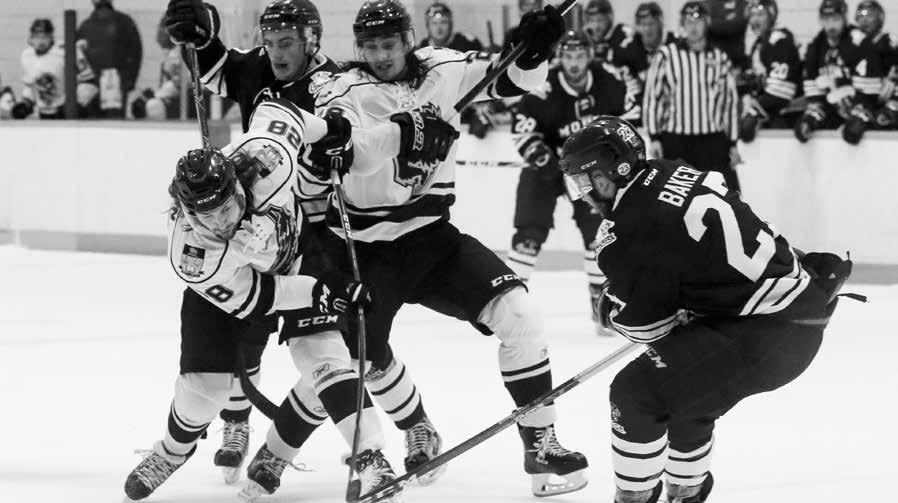
The Bison men’s hockey team continued their road trip this past weekend with a two-game series against the Lethbridge Pronghorns. The Bisons shut out the Pronghorns on Friday 4-0, then exploded for nine goals in a 9-3 win on Saturday. Manitoba is now 5-1 in 2017. With the pair of wins, the Bisons move into sole possession of fifth place in the Canada West standings. The Bisons are four points back of the Calgary Dinos for fourth place
and a home playoff date; Manitoba plays Calgary at home next weekend.
Friday
Special teams and goaltending played a factor in this one, as the Bisons came out 4-0 victors on Friday.
Winger Nick Zajac opened the scoring for the Bisons on the power play with the assist coming from defenseman Rene Hunter and centreman Remi Laurencelle. There was no scoring until the halfway point of
the third period when winger Liam Bilton scored a shorthanded goal –his first of the season.
Winger Jonah Wasylak grabbed his third of the season four minutes later, with Brett Brooks and defenseman Adam Henry earning the helpers. Wasylak’s tally was the only goal the Bisons scored during 5-on-5. Zajac got his seventh of the season and second of the game to seal the win for the Bisons on an empty net. Byron Spriggs was exceptional in
goal, making 31 saves for the shutout, earning him first star honours.
Saturday
In the Saturday rematch, the Bisons offence erupted for a convincing 9-3 win. This game seemed to be over after the first period, with the Bisons exploding for five goals. Centreman Brett Stovin got the ball rolling 18 seconds into the game when he scored his fourth of the season. That was the start of the end for Lethbridge netminder Damien Ketlo. Quinton Lisoway popped in his sixth a few shifts later to make it 2-0 Bisons in the first five minutes.
With the score 6-3 after 40 minutes, the Bisons put the pedal to the metal and continued their barrage
The Bisons then added two goals in 20 seconds to make it 4-0 after winger Warren Callis and Lisoway scored. Captain Jordan DePape’s 10th goal of the season made it 5-0 before the period was up and the Bisons
looked to be in full control.
In the second period, Lethbridge scored three straight goals to make it 5-3. At that point the momentum seemed to be shifting into the Pronghorns’ favour, but Callis’ goal with three minutes remaining put a halt to that.
With the score 6-3 after 40 minutes, the Bisons put the pedal to the metal and continued their barrage. Laurencelle scored on the power play less than a minute into the third period to make it 7-3. Justin Augert hit double-digits in goals when he scored his 10th of the season with five minutes remaining. Centreman Shawn Bowles rubbed salt into the gaping wound when he scored with five seconds to go to make it 9-3. His brother Brad Bowles picked up an assist on the play, his fourth of the day. Spriggs made 34 saves in the win for Manitoba; the former Winnipeg Blue now has a 9-7-0 record with a .917 save percentage.
The Bisons are back home to play the Calgary Dinos in a pivotal series on Jan. 27-28. First puck drop is at 7 p.m. on Friday at the Wayne Fleming Arena.
PHOTO BY STAR ROXAS
A legend retires
One of the world’s greatest hockey players calls it a career
JASON PCHAJEK, STAFF
Hayley Wickenheiser was one of the greatest Canadians to ever play the game of hockey. The Saskatchewan native broke into the game at the age of 15, making an immediate impact and while still a teen was beginning to be called the greatest women’s player in the world. 23 years later, number 22 has a trophy cabinet that would make even Wayne Gretzky jealous.
Five Olympic medals – starting back when the women’s tournament was first introduced in 1998 – comprised of four gold and one sliver. To go along with those medals and the 16 goals scored in Olympic play, she has seven world championship titles and was the first woman to score a goal in men’s professional hockey.
The 38-year-old took to Twitter on Jan. 13 to announce she was hanging up her skates to pursue a life after the
game. She indicated that she plans to pursue medical school and to spend more time with her young son, Noah. She leaves the game behind, a game she has had an indelible impact on, growing the women’s game and blazing a trail that few will be able to equal.
“You are the Gordie Howe of women’s hockey” –Wayne Gretzky
Carving her path in the hockey world was never easy for Wickenheiser. Before playing for Finnish club HC Salamat, she was denied eligibility to play profession-
ally in Italy by the Italian Winter Sports Federation. She also turned down an offer from NHL legend Phil Esposito to play for the Cincinnati Cyclones of the East Coast Hockey League, settling on Salamat after the Finnish Hockey Federation unanimously supported her selection.
After impressing the likes of Bobby Clarke during the 1998 Olympics and earning offers to take part in training camps for men’s teams, Wickenheiser jetted off to Finland. There she played division two men’s hockey, recording 2 goals and 10 assists in 23 games.
However, this was not the only pro hockey she would play, as she returned home to join the Calgary Inferno of the Canadian Women’s Hockey League (CWHL). In her only CWHL season, Wickenheiser tallied three goals and 13 assists while
helping the Inferno win the 2016 Clarkson Cup.
After Wickenheiser, no woman would get close to playing regular season hockey for a North American men’s club until American defender Angela Ruggiero suited up for the Tulsa Oilers of the Central Hockey League. Wickenheiser’s national teammate Shannon Szabados is the latest woman to join the North American men’s ranks, suiting up for a full season between the pipes for the Columbus Cottonmouths of the Southern Professional Hockey League.
Following professional success and characteristically excellent international play, Wickenheiser began to desire a change. In 2010, she joined the University of Calgary Dinos of the CIS (now U Sports). This was preferable to the women’s hockey star
because of their daily practices and the ability to stay close to her young family. Despite playing in only 15 of the Dinos’ 24 regular season games, Wickenheiser amassed 40 points – 17 goals and 23 assists – earning herself the Brodrick Trophy as CIS MVP.
While studying for her kinesiology degree, Wickenheiser recorded 55 goals and 79 assists, for a total of 134 points in 68 CIS games.
Wickenheiser leaves the game first in lifetime Olympic scoring, first in women’s World Cup scoring, fourth in all time CIS scoring, and the first female player to play in two men’s leagues. That goes along with her spot on the Canada Walk of Fame and being awarded the Order of Canada.
Gretzky spoke highly of Wickenheiser during a tribute at Rogers Place on Jan. 15 before the Flames and Oilers played.
“You are the Gordie Howe of women’s hockey,” Gretzky said. The ultimate compliment for any hockey player, even greater still is that it came from Gretzky himself. To be compared to arguably hockey’s greatest player, by the man literally called “the Great One.”
Wickenheiser leaves the game first in lifetime Olympic scoring, first in Women’s World Cup scoring, fourth in all time CIS scoring
There is no question that Wickenheiser will be inducted into the Hockey Hall of Fame, joining Cammi Granato, Angela James, and Geraldine Heaney. Sports writers such as Jeff Blair have argued that “the Gordie Howe of women’s hockey” deserves a little something more.
In an article written for Sportsnet, Blair suggested that Hockey Canada retire Wickenheiser’s number 22 across all national teams, men or women.
“I cannot think of another hockey player who has had as much of an impact on his or her sport at the grassroots level in this country,” Blair wrote. “With all due respect to Wayne Gretzky, Canadian boys would have played hockey with or without him.”
Blair goes on to pose the idea of having Wickenheiser’s number honoured, by having a banner with her name and number hanging in every Canadian NHL arena.
Whatever our nation’s hockey governing body does or does not do is of no importance. Wickenheiser will always be heralded as a trailblazer, inspiration and one of the greats, across both genders.
PHOTO PROVIDED BY SIMON FRASER UNIVERSITY
Bison men’s volleyball trounce Dinos, women come up short
RYAN STELTER, STAFF
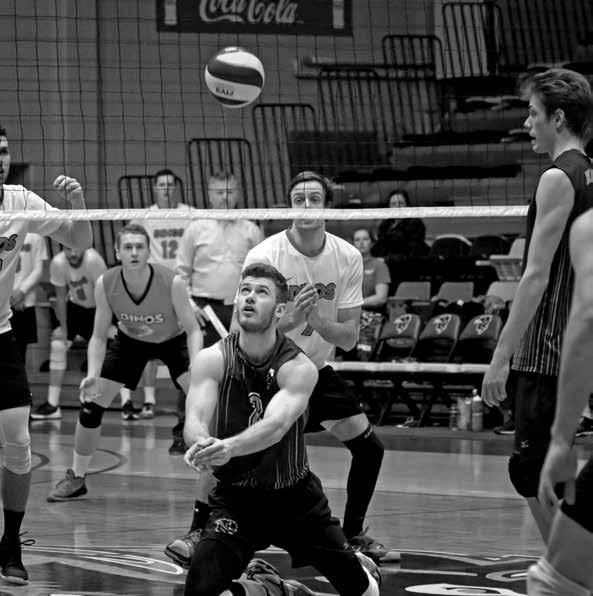
This weekend, the University of Manitoba Bison volleyball teams played host to the Calgary Dinos, each playing two game series. The third-ranked men’s team won 3-0 on Friday and 3-1 on Saturday. The women meanwhile, fell 3-2 on Friday and 3-0 on Saturday.
Men Coming into Friday’s match, the Dinos were on a five-game winning streak but the Bisons put that to a stop with a convincing 3-0 win. Manitoba jumped out to a quick 8-3 lead in the opening set, forcing the Dinos to take a timeout. The home side never really looked back as they cruised to a 25-15 first set victory.
“Devren
really shone, he’s really into it right now and playing some of his best volleyball” – Garth Pischke, head coach, Bison men’s volleyball
In the second set, the Bisons continued to dominate in the early stages, but let the Dinos come back into the set later on. The Bisons managed to hold on for a 25-22 set win.
The third set was a seesaw affair, but the Bisons managed to come away with the set win and match victory after Ken Rooney sent a punishing kill to the court floor. Devren Dear finished with 15 kills and a .424 hitting percentage.
“[The game] was very solid on our part. Everybody was contributing out there,” head coach Garth Pischke said postgame. “Devren really shone, he’s really into it right now and playing some of his best volleyball.”
The Bisons continued to roll on Saturday, winning 3-0 fairly easily. The first two sets went the distance, but the Bisons won 28-26, and the Dinos won the second set by the same score. The Bisons then went on to win the next two to complete the sweep.
Dear had an astonshing 24 kills, his second best output this season. The herd have now won 13 games in a row and sit tied with the Trinity Western Spartans atop the Canada West.
Women
On Friday, the Bisons surprised the seventh-ranked Dinos and came out to a 2-0 lead, but the Dinos came back to win 3-2. A slow start in the first set of the match had the Bisons in a 4-1 hole. The Bisons managed to storm back and led 16-11 at the technical timeout. The Bisons increased that five-point lead to seven and took the opening set 25-18.
The Bisons won the second set 25-18 after a long rally, where Courtney Kowk made a diving dig to keep the rally alive. Kearley Abbott finally hammered home the set-winning kill. She finished with a court-best 17 kills on the night.
After the Bisons jumped out to
a 4-0 lead early in the third set, the Dinos battled back and took a 16-12 lead into the technical timeout. The Dinos had some excellent serving, and won the third set 25-21 to keep themselves alive. The Dinos then took the fourth set 25-22 to force a decisive fifth.
The Dinos won an intense fifth set 15-12 and in the end, the experienced Calgary squad proved too much for the young Bisons to handle.
“We just got a little undisciplined. We had easy plays to make and we forced the ball to the net,” head coach Jon Hykawy said postgame. “That match was there for us to take, we just didn’t grab it.”
On Saturday, the Bisons fell 3-0
Bisons sweep Trinity Western in weekend series, win sixth straight game
KELLEN TANIGUCHI, STAFF
T
he University of Manitoba men’s basketball team was in Langley, B.C. this weekend, taking on the Trinity Western Spartans in a twogame series. The Bisons opened the weekend with a 108-76 win on Friday night, and completed the weekend sweep with a 115-91 victory on Saturday. With the two wins, Manitoba improves to 8-6 this season, and extends their winning streak to six games, while the Spartans drop to 2-12 in conference play.
Friday Manitoba opened the weekend with a dominating 108-76 victory over the Spartans. The win was powered by Justus Alleyn’s 20 points, as well as James Wagner (18) and Joey Nitychoruk (16) who also contributed big points to help lead the herd to
victory. Trinity Western was led by Pogos Trunyan, who was able to net a game-high 24 points for his team. The lopsided score was due in part to Manitoba shooting 58.5 per cent from the field, compared to the Spartans’ poor 38.6 per cent.
Manitoba improves to 8-6 this season and extend their winning streak to six games
The visiting Bisons got off to a quick start, as they connected on their first three shot attempts and opened with an 8-0 run. The herd performed
well the rest of the first quarter, connecting on over 60 per cent of the shots in the frame, which allowed them to build a 29-18 first quarter lead. They continued to roll in the second, and were able to go on a 14-0 run within the frame. The Bisons were able to take a 57-29 lead into halftime, led by Alleyn’s 12 points and Wagner’s 10.
The herd was able to build a 37-point lead with just over twominutes to play in the third quarter, but the Spartans finally responded, and ended the frame on an 11-3 run, cutting the lead to 29 points. The fourth quarter was competitive, with the two teams shooting the ball well and exchanging looks throughout the frame. Manitoba’s mammoth first half lead was just too much for the Spartans to overcome, though, and
the Bisons rolled to a major victory. Nitychoruk led Manitoba’s second half effort with nine points, while Alleyn and Wagner each added another eight.
Saturday
The Bisons completed the weekend sweep on Saturday, with a 115-91 win against the Spartans. Ilarion Bonhomme led the way for Manitoba, scoring 24 points and adding seven assists. Team captains AJ Basi (21) and Alleyn (19) also filled the net on the way to victory.
Trinity Western jumped to an early 8-4 lead, before the Bisons responded with a 9-0 run, contributing to the 10-point lead the herd was able to carry into the second quarter. Both teams shot over 50 per cent from the field in the opening half, and four
to the Dinos to bring their losing streak to four games. Every single set was only won by two points, but the inexperience of the Bisons showed, as they succumbed to the seventhranked Dinos again. Abott had a great afternoon, as she finished with 11 kills, better than anyone on the court. The rookie continues to shine this season for the Bisons.
The Bison volleyball teams hit the highway to play provincial rivals the Brandon Bobcats on Jan. 28-29.
players got into double-digits in the first half for the herd: Bonhomme scored 15 points, Basi 13, Alleyn 12, and Keith Omoerah 11.
Manitoba created more separation in the third quarter, by going on runs of 8-0 and 9-0 in the frame, which led to a 92-68 lead as they entered the final quarter of play. The Bisons slowed the pace down in the fourth; both teams scored 23 points, but their early lead ensured the Bisons came out on top with their sixth-straight conference victory.
The Bisons return home for a home for a two-game series on Jan. 27-28, when they host the UNBC Timberwolves.