“volunteer staff” member is defined as a person who has had three volunteer articles, photographs, or pieces of art of reasonable length and/or substance published in three different issues of the current publishing year of the Manitoban. Any individual who qualifies must be voted in by a majority vote at a Manitoban staff meeting. Elected representatives and non-students may be excluded from holding votes as volunteer staff members in accordance with the Manitoban Constitution.
UMSU confirms 10-year, $15.9 million contribution to Front and Centre
Funds raised through $64 annual student fee hike to be counted as part of campaign total
Levi G A r B er, staff
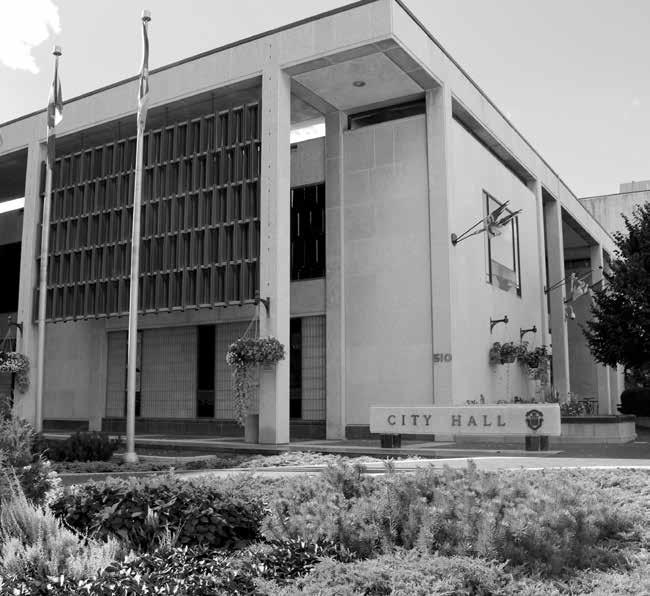
The University of Manitoba Students’ Union (UMSU) approved a motion Sept. 14 to label all earnings from a $64 per year student fee hike approved by last year’s council as part of the University of Manitoba’s Front and Centre fundraising campaign.
In total, the fees will amount to a $15.9 million contribution to the university over the next 10 years, although only a fraction of that amount – $2.4 million for new daycare spaces – will be directly administered by the university.
The remaining fees, amounting to roughly $13.5 million, will be managed by UMSU and count toward the Front and Centre campaign in name only.
Background of the fee hike
Last year, UMSU council passed a $32 per semester fee hike to support four projects: child care facility improvements, scholarships and bursaries for indigenous students, undergraduate research grants, and renovations to UMSU spaces in University Centre.
Under the proposed fee, in the next 10 years $2.4 million would be designated to expand the daycare centre on campus to create more spaces for children of undergraduate students, $5 million would go towards funding undergraduate research awards, and another $5 million would go towards fund indigenous scholarships and bursaries.
The remaining $3.5 million would go
towards renewal of UMSU spaces in University Centre.
The fee hike passed in a November 2015 omnibus motion that sparked questions on whether the increase should have been put to U of M students in the form of a referendum.
“I believe this year's UMSU executive is truly trying to make the best of an inherited and inherently flawed motion from last council” – Serena Gawryluk, UMSU Arts representative
Then-UMSU president Jeremiah Kopp rejected that notion, pointing to support from other U of M student leaders and an online survey the executive had done as sufficient consultation for the raise in fees.
The final vote on that motion had 25 councillors in favour, two against, and six abstentions.
Debate in UMSU council
The motion debated at last week’s council meeting, forwarded by UMSU’s executive committee, granted the executive the authority
to sign an agreement with the university regarding a donation to Front and Centre.
The motion follows negotiations between UMSU and U of M Front and Centre officials on how to allocate the money toward the four initiatives the fee hike was approved to fund.
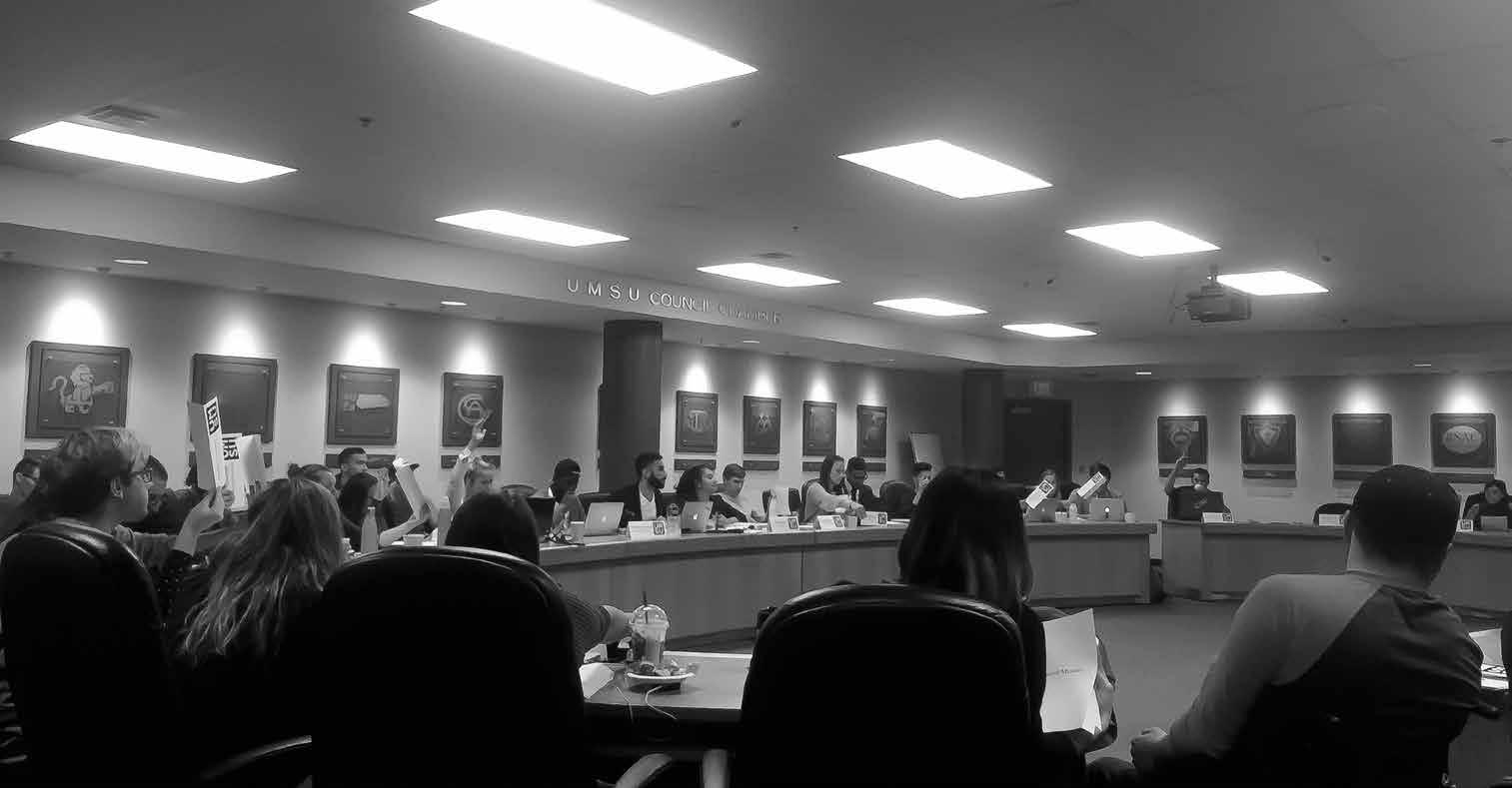
Arts Student Body Council (ASBC) representatives voiced their uncertainty over the merits of handing over student money to the Front and Centre campaign during an hour-long question and debate period.
ASBC representatives Serena Gawryluk and Andy Fenwick argued that students had not been adequately informed of the student-funded donation.
During the meeting, Fenwick referred to council’s ability to hand over millions of student dollars to the university without adequate consultation as “barebones democracy.”
In an email to the Manitoban , Gawryluk expressed her frustration with the wording of the motion.
“Trying to pass off a 10-year compulsory student fee as a gift or donation from students to show support for the university's Front and Centre campaign is misleading and not an accurate depiction of how these funds actually came to be raised,” she said.
UMSU council did ultimately pass the motion, but not until after accepting an amendment proposed by ASBC president Isaac Weldon to change the wording of the agreement – barring any contractual legal issues
– from “gift agreement” to “contribution agreement.”
In terms of the name change, Gawryluk said, “I felt that this wording eliminated the risk of being deceptive and instead was more accurate and truthful, which made me more comfortable with it.”
Gawryluk eventually voted in favour of the motion. Fenwick went on to abstain from the final vote on the motion.
“I believe this year's UMSU executive is truly trying to make the best of an inherited and inherently flawed motion from last council and that they are trying to partner up with the university, where appropriate, in order to foster a positive and mutually beneficial working relationship,” Gawryluk said.
President’s reaction
Following the meeting, UMSU president Tanjit Nagra spoke to the Manitoban about the debate at council.
“I appreciate any opinions from councillors. I appreciate everyone doing their job and expressing concerns and questions from people they represent and the student body as a whole,” she said.
On the motion’s approval, Nagra said, “I think this is an excellent opportunity to work with the university [...] and I’m really happy that we’re ensuring that student money is going back to students.”
Details of the agreement
The terms and references of how the $10 million earmarked for indigenous student bursaries and undergraduate research funding will be allocated is still under negotiation; however, in the council meeting, UMSU executives indicated that the U of M office of financial aid and awards (FAA) will distribute that money.
“This is an excellent opportunity to work with the university and I’m really happy that we’re ensuring that student money is going back to students” – Tanjit Nagra, UMSU president
In the meeting, Nagra insisted that working with FAA to distribute those awards, scholarships, and bursaries will ensure that the money will be allocated to students in an unbiased manner.
photo by levi garber
Gord Downie helps clear path to reconciliation
Tragically Hip frontman brings Chanie Wenjack’s story to life with new project in partnership with NCTR
G A rett Wi LL i A m S , staff
In August, Tragically Hip frontman
Gord Downie used the band’s final show to try and light a fire.
With the eyes of nearly a third of the entire country on him, Downie directly called on Prime Minister Justin Trudeau to make good on promises he made to Canada’s indigenous communities, which include supporting the ongoing efforts toward reconciliation.
“It's going to take us 100 years to figure out what the hell went on up there, but it isn't cool and everybody knows that,” Downie said to a live crowd of around 7,000 people, in addition to the more than 11 million Canadians who tuned in through television, radio, or digital sources.
Now, he is adding fuel.
In Secret Path, a project to be released Oct. 18, Downie tells the story of Chanie “Charlie” Wenjack, a 12-year-old Anishinaabe boy who ran
away from the Cecelia Jeffrey Indian Residential School near Kenora, Ontario in October 1966.
Seven days later, he was found dead of hunger and exposure more than 60 kilometres away, by the side of Canadian National railway tracks.
Reports of physical and sexual abuse were common in the Canadian residential school system, which saw indigenous children removed from their communities to be schooled and assimilated in government-funded, church-run schools for more than 100 years. The last residential school closed in 1996.
Reports of children running away to escape abuse were common. Wenjack told his friends he wanted to see his father.
Through a 10-song solo album, an animated feature, and a graphic novel illustrated by Jeff Lemire, Downie lifts the veil on a story that is only
a part of what National Centre for Truth and Reconciliation (NCTR) director Ry Moran called a misunderstood history.
“What we are trying to come to terms with as a country is a very long and complicated history that has not been understood – that is not understood – but requires the engagement of all Canadians to right the wrongs of the past,” he said.
“So when somebody like Gord shines his light, uses his voice, to call other Canadians to attention on this very real part of our fabric of who we are as a country, it’s very, very powerful. And exactly what we need to see happening not just once, but time and time again.”
In a release issued Sept. 9 from Ogoki Post, a remote fly-in community in northwestern Ontario, more than 600 kilometres north of Kenora – the home Wenjack was trying to walk to when he died – Downie called Wenjack’s story Canada’s story.
“Chanie haunts me,” he said. “His story is Canada’s story. This is about Canada."
“We are not the country we thought we were.”
Moran met with Downie and his brothers in Ogoki Post to present the project to Wenjack’s family, who still live in the community on the north shore of the Albany River.
“It was a very emotional experience,” said Moran. “It is a very powerful piece of work. Gord has really captured, I think, a very difficult part of our history in a very meaningful way.”
“Gord had the opportunity to share his work with the family and do it in a good way and a really meaningful way and I think in a way that was, in many ways, what reconciliation is all about,” he said.
All proceeds from the album and novel will be directed to the National Centre for Truth and Reconciliation,
hosted at the University of Manitoba, through the Gord Downie Secret Path Fund for Truth and Reconciliation. The fund will support the centre’s initiatives related to missing children and unmarked burials.
“We are not the country we thought we were” - Gord Downie
The NCTR, which opened its doors on the U of M Fort Garry campus in the summer of 2015, was created to ensure the memory and legacy of Canada’s Indian residential school system aren’t forgotten.
Moran said the support will give a valuable boost to the centre, which recently announced a partnership with the University of British Columbia (UBC) for its Indian Residential School History and Dialogue Centre (IRSC).
UBC hosted the National Event of the Truth and Reconciliation Commission in the fall of 2013 and suspended classes for the day so all students and faculty could participate in opening-day activities. Moran said thousands of people participated in the three-day event, striking the collaborative relationships that led to the dialogue centre.
The IRSC will focus on the experiences of indigenous peoples in B.C., where many residential schools were located, and is the first of what Moran said will be a collaborative, nationwide network of resource centres “to make sure that local communities have the full benefit of being able to participate fully in these conversations.”
“They are different indigenous cultures,” he said. “There’s different
historical realities. There’s different nations, even within our own country, and being very responsive and understanding of that is really important in this overall journey of truth and reconciliation.”
Moran said it is crucial to host regional dialogues, and to preserve and open up access to local information, to bring reconciliation to the national level.
“None of this can happen by any one person, it can’t happen by any one organization,” he said. “We need a collective, national response to this. So the more partners we can work with – and the more Canadians that pay attention to this – the better for everybody.”
The conversations will not be easy, he said. And some people will have to be open to feeling uncomfortable. But in the end, Moran said, knowledge is key and having a voice like Downie’s draw attention to a story like Wenjack’s will bring new voices to the discussion.
“I think what we saw happening in that concert was Gord realizing the power that he has, the power of his voice, and the need that we have as a country to rally around righting some very real past wrongs,” he said.
“I think Gord using his voice in that way was powerful and really was a gift to the country because it brought a lot of people into the conversation that perhaps hadn’t been in the conversation beforehand.”
Gord Downie’s Secret Path album and graphic novel will be available Oct. 18. An hour-long animated feature, The Secret Path, will be broadcast on CBC television Oct. 23.
Visionary Conversations looks at reconciliation
G A rett Wi LL i A m S , staff
The new season of the University of Manitoba’s Visionary Conversations series launches Wednesday with its sights set on reconciliation.
Titled “Reconciliation: What Needs to Happen Next,” four panelists will examine the first year since the Truth and Reconciliation Commission issued 94 calls to action in Dec. 2015.
The panel will feature provincial NDP MLA Nahanni Fontaine, who serves as critic for status of women, persons with disabilities, families,
and missing and murdered indigenous women and girls. Also on the panel are Winnipeg-based film producer Tina Keeper; Anishinaabe CBC Aboriginal associate producer, Lake Manitoba First Nation member, and Red Rising magazine co-founder Lenard Monkman; and National Centre for Truth and Reconciliation (NCTR) director Ry Moran.
Moran said the panel discussion, which will be lead by U of M president and vice-chancellor David Barnard, is an important step on the
path toward reconciliation.
“We need dialogue, and we need participation, and we need frank and open conversations about where we are and where we’re not,” he said. “That conversation is a really important step in the many steps that are being taken.”
The NCTR opened its doors in the summer of 2015 and will be the permanent home for all statements, documents, and other materials gathered by the Truth and Reconciliation Commission of Canada.
Moran said Canada needs to be prepared to face an uncomfortable history and noted some of those conversations are already happening.
“Are we there yet? No,” he said. “Are there still very real issues that are facing indigenous peoples now? Absolutely. Indigenous languages are just as endangered today as they were yesterday and they’re going to be even more endangered tomorrow because we are not taking the steps that we need to take yet.
“But I think the general trend that
we’re seeing is that things are generally heading in the right direction.”
The event will be hosted Wed. Sept. 21 at the Robert B. Schultz Theatre in St. John’s College, and begins at 6:30 p.m. with a reception. The panel discussion begins at 7 p.m.
album art provided by kill beat music
Bike Dungeon shuts its doors
Student cyclists frustrated at loss of vital repair service while new bike kiosk being developed
Levi G A r B er, staff
U
niversity of Manitoba cyclists are in the lurch after the Bike Dungeon in the Helen Glass Centre closed its doors indefinitely while plans to build a new ‘bike kiosk’ develop.
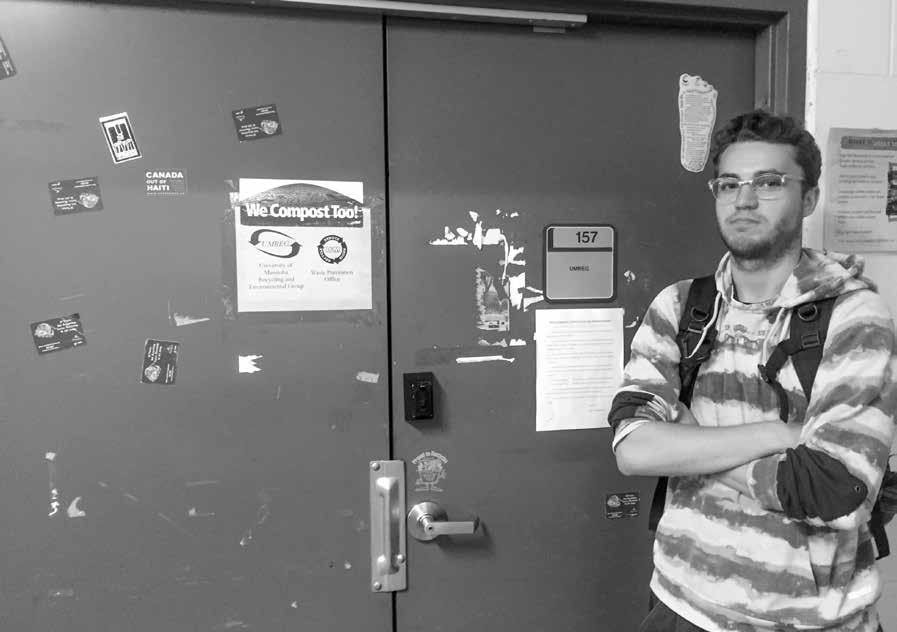
The University of Manitoba Students’ Union (UMSU) closed the Dungeon in July, to restructure the bike shop’s organization in preparation for a new kiosk, according to a notice posted on the previous shop’s door.
The University of Manitoba Recycling Group (UMREG) opened the Bike Dungeon in 2006 as a rudimentary bike shop with services for students, such as repairs and workshops on bike maintenance, winter biking, and cycling in traffic.
One full-time coordinator, Anders Annell, and a group of volunteers ran the Dungeon for eight years.
UMSU student fees funded the shop, along with profits from repairs that required new or ordered parts.
Bike Dungeon closure
In July, UMSU closed the Dungeon and posted a notice on the door of the shop indicating a new outdoor campus repair facility is scheduled to open in the spring of 2017.
This came as a surprise to both patrons and volunteers, who said they were unaware the closure was coming.
Part-time Bike Dungeon volunteer Mike Lipinski said he received a text from Annell the day of the closure telling him to collect his things from the shop.
“There was no notice given,” he said.
UMSU vice president external Wilfred Sam-King was unclear about exactly why the Dungeon closed almost a full year before the new bike kiosk is expected to open.
“Now when I have a problem with my bike, where am I going to go to fix it? I might be screwed” – Mike Lipinski, former Bike Dungeon volunteer and student cyclist
Sam-King said that by the time the current executive came to office, the previous UMSU council had already made the decision to close the bike shop.
However, last year’s vice president external, Astitwa Thapa, said, “We never decided to close down the Bike Dungeon. It was being restructured to expand services.”
Thapa directed the Manitoban to Annell for more details. However, when contacted, the shop’s only fulltime employee declined to comment.
The only remaining place on campus for cyclists to make any repairs
and the Architecture building.
New bike kiosk
Sam-King did, however, provide more details about the proposed kiosk, which will be a partnership with the university’s physical plant and sustainability office.
He said organizers are looking at placing the kiosk either on Sidney Smith Street or Curry Place,
The kiosk will have a repair shop, a workshop station, and bicycles for sale.
Lipinski said he supports the upgraded vision but said shuttering the Dungeon before the new kiosk is operable will push riders away from campus.
“I think that adapting that idea is good,” he said, “but the fact that they’re closing down what we already
U of M to host first ever LGBTTQI* homecoming event
have in the process is not good at all because that’s going to stray people away from cycling.”
“I biked all eight months last year. Now when I have a problem with my bike, where am I going to go to fix it? I might be screwed,” he said. “That’s the frustrating part, that they closed it and didn’t give any alternatives.”
T
he University of Manitoba’s LGBTTQI* alumni (UMqueer) community will host its first-ever event Friday, dubbed “Queers, Cheers and Homecoming Years.”
The event will coincide with the U of M’s homecoming celebrations and will be hosted in Marshall McLuhan Hall in University Centre.
U of M vice president external John Kearsey said the inaugural event will “bring people together and celebrate our diversity and who we are in a very safe environment here on campus.”
The event will feature Winnipeg DJ and U of M alumnus Joe Silva and a speech from engineering alumnus Mitchell Haw.
Haw, who graduated in May, was the inaugural recipient of the Jeff Kushner and Randall McGinnis
Scholarship for LGBT engineering students.
The scholarship was introduced in 2015 to encourage more LGBT students to enter fields of study that have historically been less accommodating to the LGBT community.
“We
The reception comes at a time when the U of M has shown greater support for the LGBTTQI* community on its campuses.
sity participated in Pride events in both Winnipeg and Steinbach over the summer.
Kearsey, who participated in those events, said the university’s commit-
what it means to be queer in our community by shedding both an academic and a social light on the issue.”
“We have to stay with this conversation to continue to show the university’s commitment in welcoming [and] supporting our queer community,” he added.
saw this as an opportunity to really bring people together and celebrate our diversity and who we are in a very safe environment here on campus” – John Kearsey, U of M vice president external
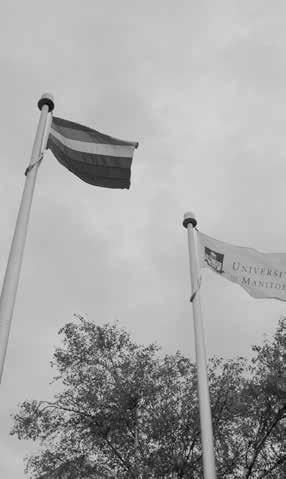
The university raised the rainbow flag at both the Fort Garry and Bannatyne campuses for the first time ever in June to celebrate Pride Month, and groups from the univer-
ment to inclusion runs deeper than flying a token flag.
“This is not about showmanship,” he said. “This is about engaging and letting people get a broader understanding of what queer issues are and
Food and drinks will be served and Bronuts has constructed a “doughnut wall” in pride colours for the event.
Tickets for Queers, Cheers, and Homecoming Years are available for at Answers or online for $25, $5 for current U of M students.
is a self-serve station located outside of the east entrance to the Frank Kennedy Centre.
between Migizii Agamik
photo by levi garber
photo by miguel yetman
Editor-In-Chief:
Craig Adolphe
Changes to academic policy point to troubling trend at U of M
Administration owes more to students than what we've been given
Sh AW n G A r B utt, staff
Recently, academic policy at the University of Manitoba took a frightening turn when unnecessarily aggressive changes were rushed through the senate during the slowest time of the year.
The changes were passed by the university senate in late June. It’s simply Machiavellian that the senate, a governing body virtually dominated by faculty and administrative figures, would choose to put new academic policy to a vote mid-summer. Most students, the constituents with the largest stake in the matter, had already left campus en masse following the conclusion of the winter term. Even students who serve on the senate are less likely to be available during the summer than other senators.
Furthermore, notice of this change did not occur for months after the policy was given the rubber stamp.
One of these changes was the implementation of a new voluntary withdrawal (VW) procedure that slaps student with “limited access” status should they drop a course following the end of any given registration revision period.
The limited access period lasts for three consecutive terms following the initial drop date. The punitive nature of this policy may hinder the completion of time-sensitive programs and compromises the ability of students to obtain their degrees in a reliable
and timely fashion. This is cruelly ironic, given the policy was introduced by David Collins, vice-provost of integrated planning and academic programs, who claimed the old policy on VWs was too lenient and made students prone to a “rash of course drops that have created negative consequences [...] including increasing the time it takes to graduate.”
The use of “tough on crime” rhetoric by our administration is, quite frankly, disturbing
This policy was delayed on two separate occasions: first, by a senate vote spurred by student representatives; and second, on Collins’ admission that the policy needed to undergo further review stemming from student recommendations.
The Manitoban previously reported that the policy change was virtually dead in the water and would remain so for quite some time.
A senate committee was convened to review the policy so it could recommend changes that would compromise between Collins’ initial plan and the objections raised by student senators. This was expected to last
a year, according to student senator Allison Kilgour.
So a promise was made by the administration. The purpose of sending this policy back to the purview of a senate committee was so the legitimate worries voiced by students could be properly assessed and thus addressed. This promise was reneged on. Ultimately, the policy was not changed in any meaningful fashion. Furthermore, the individuals who led the charge on this issue, including Kilgour, seem to be have been left in the dark.
The policy moved forward, having only adopted one of three changes requested by student representatives. This happened alongside the implementation of a newly revised grade point average (GPA) policy that counts all of a student’s course attempts in the calculation of their total grade point average (TGPA). In the past, students were able to retake classes with the promise that the grade translated to their TGPA would be the later and typically more successful attempt. Now the TGPA is calculated by producing an average of all the letter grades standing on a student’s transcript.
Citing high rates of VW and repeated courses, registrar Neil Marnoch claimed these measures are meant to remove the incentive for students to drop and retake courses as a “means of managing GPA.” However,
it’s highly unlikely that every single student who VWs or repeats courses is simply in it to budge their GPA by a few decimal points. There are a plethora of reasons as to why students drop and retake classes. Those who do VW for justifiable reasons shouldn't be penalized for it.
The long arm of the administration is overdue for a slap on the wrist
Mental health issues, family emergencies, the state of your finances; general life circumstances that are beyond a person’s control can all account for reasons why someone would drop a class. A poll disseminated by previous UMSU vice-president advocacy Rebecca Kunzman was completed by approximately 2,000 students and showed that course withdrawals were evenly split between personal and academic motivators.
At the same meeting, the senate did pass an authorized withdrawal policy meant to protect students withdrawing for reasons of physical or mental health, but it's unlikely to protect all the students that need it. A student dealing with serious mental health issues might not be
in a position to follow-up with university administration regarding an authorized withdrawal. Ironically, the stress of waiting out the processing time and the uncertainty about whether their request will be granted could actually worsen the problem.
The use of “tough on crime” rhetoric by our administration is, quite frankly, disturbing. Not only do Marnoch’s words paint an overly simplistic picture of students and their reasons for withdrawing from courses, but they also foster a hostile environment on campus. This has the effect of drawing a line between students and the administration; instead of facilitating meaningful dialogue, senior administrators are content to merely “crack down” on students.
It’s not acceptable that the administration has unilaterally moved on a policy course that disregards the input of students, especially when the area in question is of essential concern to students and students only.
We must remind ourselves that the administration is meant to work with us, for us. Passing punitive policies with little regard for our constructive criticism is indicative of anything but. Clearly, the long arm of the administration is overdue for a slap on the wrist.
photo by miguel yetman
Bowman’s proposed flat tax on city sprawl is as silly as it is short-sighted
Policies on city growth must be precise in effect
Growth fees, as a tool to stymie unsustainable suburban sprawl, force those responsible for stretching the city’s resources to the breaking point to pay their fair share. They are an essential tool for modern municipalities. Yet growth fees as they are currently being proposed by mayor Brian Bowman represent a foray into bad planning.
The idea behind growth fees is a simple one: people living in lowdensity suburbs require a higher per-capita expenditure on the part of the city if they are to be provided with the same level of services (fire, paramedic, police, libraries, etc.) than people living in older, denser neighbourhoods. High property taxes on new homes do not offset this cost; neither does the fact that developers pay for the initial installation of roads, sewers, etc. There are simply more roads, sewers, and land that need to be maintained for each suburban lot throughout the entirety of its existence.
Fundamentally, the suburban lifestyle is wasteful, and wasteful things cost more in the long run. Growth fees, applied to new subur-
ban expansion, are meant to provide extra money to the city to help offset these costs so that they are not unfairly borne by residents of preestablished neighbourhoods.
As currently proposed, the new bylaw calls for growth fees (termed “impact fees”) to be charged on all new residential development in the city. A new house being built as infill development in an older neighbourhood, such as St. Boniface, will be charged the same fee per square foot as a new house being built at the very edge of the city on former agricultural land in, say, Sage Creek. This is despite the fact that the St. Boniface home is being built in a neighbourhood already serviced, whereas the suburban home will require the laying of entirely new services. Rather than levying an extra charge on the construction that places new financial burdens on the city, all construction will be charged equally.
More money will flow to the city this way than it currently does, but nothing will be done to address the root problem: some growth is more expensive in the long run than others. No incentive is provided to not build
new suburban homes, since a nonsuburban home would still be subject to the same fees. Good development is punished along with the bad.
As proposed, this new growth fee will actually encourage suburban sprawl. If you are being charged the same fee per square foot wherever you choose to build your home, it will be cheaper to build your home in the suburbs as lots are less expensive there than in the inner city. The only positive aspect, other than producing new monies for the city, would be to encourage the sprawl that does occur to be in the form of smaller dwellings – and smaller buildings out in the boonies still require the same number of pipes and roads to be reached, which is what the city has to pay to maintain.
This situation is made even more flabbergasting because the city already recognizes that central growth is better than suburban growth. This is why it frequently forgives, for 20 years, property taxes to be paid on new condo towers downtown. This is an explicit acknowledgment that new infill housing is good and should be encouraged.
The director of the city’s planning department even sent out a letter, advising that these new fees not be applied to construction downtown. I would add that they should not be applied anywhere the city wants to actually encourage construction. Yet this has been ignored. What does Winnipeg’s chief city planner know about city planning, anyway? Bowman himself apparently admits that “provisions should be provided for infill and downtown redevelopment projects.” So why are we faced with the prospect of a bylaw that mandates blanket application?
New fees should be applied to the people who make those fees necessary, not across the board. This is a prime example of the kind of rampant idiocy and lack of foresight that holds our city back. Our mayor has managed to bungle a concept that works well and equitably in other cities; even copying the best-practices in city planning is apparently too much to expect from our civic leaders. That’s Winnipeg for you, eh?
Evan Tremblay has a degree in landscape and urbanism from the University of Manitoba.
Recent discovery that Harvard research was funded by sugar industry isn’t anything new
The long and storied history of prepaid science
mALA k A BAS , staff
Newly revealed documents show that the sugar industry funded research in the 1960s that cast blame for coronary heart disease on fat, with results more favorable towards sugar.
These findings, which were published by JAMA Internal Medicine, were discovered by former dentist Cristin Kearns, who found revealing letters in a basement of a Harvard library. The documents provide evidence that a trade group called the Sugar Research Foundation, which is still active today as the Sugar Association, paid Harvard researchers Robert McGandy and Mark Hegsted the current equivalent of just under US$50,000. The two, along with fellow researcher Fredrick Stare, worked alongside the sugar industry and provided research that shifted public opinion for decades.
The Sugar Research Foundation’s contribution, which was not disclosed after the original study was published, sponsored a review published in the New England Journal of Medicine in 1965. The study not only pointed to fat and high cholesterol and the sole cause of coronary heart disease, it also barely considered sucrose as a risk factor. The SRF received drafts of the study and provided supplemental information for the researchers to use.
The JAMA study also warns that “policymaking committees should consider giving less weight to food industry-funded studies.”
The Sugar Association has taken a defensive stance since the JAMA study was published.
“What is often missing from the
dialogue is that industry-funded research has been informative in addressing key issues,” the Sugar Association said in a statement.
“It’s much safer to give money to front groups to let them do the dirty work while the corporate brand image remains clean”
– Michele Simon
“We question this author’s continued attempts to reframe historical occurrences to conveniently align with the currently trending antisugar narrative, particularly when the last several decades of research have concluded that sugar does not have a unique role in heart disease.”
While sugar and fat have both been noted as contributing factors to heart disease, these early studies were widely used by everyday people and fellow researchers alike, and almost certainly affected the direction and focus of future studies.
The ethical dilemma of the industry-funded scientific study is not exactly a past issue. While the Sugar Association refers to its “historical occurrences” as “convenient,” there is no shortage of not-so-historical evidence that big food companies and
900-year-old
trade organizations continue to pay for research.
Just last year, Coca-Cola was under fire for backing research that claimed that overt exercise was the most proficient way to lose weight and be healthy, as opposed to cutting caloric intake. The study, which was provided by non-profit organization Global Energy Balance Network, received a US$1.5 million charitable donation by Coca-Cola.
This is only one incident in a long history of dealings between CocaCola and nutritional “experts.” The Beverage Institute for Health and Wellness is an organization set up by Coca-Cola that produces studies that distract away from topics that could affect sales, like aspartame’s possible side effects, or the correlation between soda and weight gain.
While it may feel like common knowledge to you that something with as wide a reach as Coca-Cola might have hands in the research industry, what may be surprising is that even food companies with slightly better public reputations do this too. General Mills funds the Bell Institute of Health and Nutrition, who in turn have hired “nutrition communicators” to both congratulate General Mills – again, the company who funds them – on improving the healthy qualities of their cereals, and to promote studies that ignore the negative effects of sugary breakfast cereals.
Michele Simon, author of Best Public Relations Money Could Buy: A Guide to Industry Front Groups, writes
that big food companies creating “research groups” is a way to promote biased research without getting their hands dirty.
“Most branded food companies (such as McDonald’s or Coca-Cola) have millions of dollars invested in their public image and so would rather not engage in the underhanded and mean-spirited tactics that some front groups utilize,” she writes.
“It’s much safer to give money to front groups to let them do the dirty work while the corporate brand image remains clean.”So what is the answer?
It’s an open secret that Big Food is actively promoting sometimes-faulty science to support their own brands, and we now have some evidence that this might have been happening for decades. The unfortunate truth is that at this point, nutrition researchers
need funding from massively wealthy companies like Coca-Cola to survive. Receiving unbiased grants from government institutes is not always easy, and they are not always as large as the sums big companies can offer.
When you are doing your own research, and making your own decisions, finding unbiased research is key. It is not always easy, but a good way to approach it is to look at who is funding the research you are reading. Does the sponsor have finances at stake? Are these same findings supported by groups devoted to nonprofit research? If the answer to the first question is yes, and the second is no, you may want to take their claims with a grain of salt.
Mayan book proven genuine
The Grolier Codex is now the oldest known book in the Americas
mALA k A BAS , staff
According to current research, the Grolier Codex, a Mayan book written approximately 900 years ago and widely considered to be fake until recently, has been proven genuine. This makes the codex the oldest surviving book in the Americas.
The story sounds like something straight from the Indiana Jones movies. In 1966, Mexican collector Josué Saénz received a message – if he flew to a remote area, and didn’t tell anyone about it, he would be shown a myriad of historical treasures. Saénz was flown to what they wanted to be a secret location, but Saénz knew the area and confirmed it to be the Sierra de Chiapas. When there, he
was approached by looters, who presented Mayan artifacts to him, claiming to have found them in a dry cave. There, he bought what we now call the Grolier Codex: 11 fig bark sheets, all painted on one side, and all extremely damaged by water.
The looters allowed him to pursue an expert opinion before buying it, and the expert deemed the codex as fake. Saénz bought the pages anyway. While this is all an unconfirmed story, it’s the story that archaeologist Michael Coe tells when asked how he got hold of the Grolier Codex (sometimes called the Saénz Codex) in 1971. According to Coe, Saénz allowed him to display the pages at the Grolier
club in New York in an exhibition called Ancient Maya Calligraphy after the pages were apparently proven fake. Eventually, the papers were donated to the Mexican government. The revelation was published in Maya Archaeology, and was lead by a team of researchers, including Coe, who used radio-carbon dating to prove that the codex had indeed existed in the 13th century. Another defining feature was the page’s lack of modern pigments, along with the page’s use of the elusive Mayan blue pigment, a color that scientists have only recently learned the ingredients of. The pages offer a stunning look
into the astronomy studies of ancient civilizations. They use illustrations to track the movement of Venus over a hundred years. It is one of only four codices we today have been able to retrieve, partially because of the fragility of fig bark over time, and partially because conquistadors and priests during the Spanish Conquest of the Americas burned many Mayan books, calling them “falsehoods of the devil.” The other three found their way into Europe in the 16th century, most likely as souvenirs.
Because of the strange nature in which the codex was discovered, questions about its authenticity remain. It is currently locked in
a vault at the Museo Nacional de Antropología in Mexico City.
grolier codex. photo from public domain.
photo by moyan brenn
The art of diversity
Winnipeg’s vibrant arts scene benefits from its multiculturalism
to B i n ife S i, staff
Winnipeg, the geographical heart of Canada, has become a melting pot for people of diverse cultures and backgrounds. Like many Canadian cities, the capital of Manitoba has welcomed many immigrants to its region over the past decade. In that time, Manitoba and other western provinces have had a 62 per cent increase in immigrant population.
The city, which is home to 718,000 people, is rich in tradition, culture, arts, and entertainment. It has the largest francophone community west of Ontario, one of the largest indigenous communities in North America, and is inclusive of several other cultures from around the word.
A lot of the city’s virtues and strengths stem from its multiculturalism and history. The once-upona-time fur trade capital of Canada played a big role as Canada’s gateway to the west and years later it became the financial capital of western Canada thanks to its immigrant influx and agricultural commercialization.
Winnipeg’s progressive and hospitable culture has paved the way for growth in many sectors, especially in arts and culture. Its diverse cultural expressions and background have helped shape its pool of creative and artistic talent.
Thom Sparling, the executive director of the Arts and Cultural Industries Association of Manitoba (ACI Manitoba) and a University of Manitoba alumnus, has worked in Manitoba’s arts and cultural industries for over 25 years. He has worked with several local artists and has seen the city’s arts scene grow to become what it is today.
“One of the strengths of
Winnipeg’s arts community is the diversity,” Sparling told the Manitoban
“Winnipeg has really exploded to become a more culturally diverse community in the last five or 10 years. Manitoba’s arts and culture used to be dominated by English and francophone communities and, to a certain extent, the indigenous artists.”
“But now, it is really remarkable to think the number of artists who have come to Winnipeg from all around the world – you can think of the South, Central Americans, French, Filipinos, and more. All of those ethnically diverse communities are really beginning to add to and change the dynamics of our arts communities.”
Today, Peg City (as Winnipeg is fondly referred to by Winnipeggers) is home to a number of internationally renowned arts and heritage institutions like the Royal Winnipeg Ballet, the Royal Manitoba Theatre Centre, Winnipeg Symphony Orchestra, and Le Cercle Moliere – Canada’s oldest francophone theatre.
The impact of Winnipeg’s cultural influx has caused several local arts and cultural institutions and groups to develop programs and initiatives that are more inclusive of artists from different backgrounds. One such program is the Winnipeg Art Gallery’s recently-announced Art Express’d project, which is part of the Canadian government’s Signature Initiatives to celebrate Canada turning 150 next year.
The Art Express’d project celebrates Canada’s upcoming anniversary by highlighting its unique cultural diversity. The $300,000 initiative involves sending three mobile art studios across Canada.
“This project looks at the subject
of diversity and how Canada is representative of different communities,”
Seema Hollenberg, the head of curatorial at the Winnipeg Art Gallery, told the Manitoban Hollenberg believes that Winnipeg’s artistic culture and progress are testament to its inclusiveness and diversity as the city’s arts community has grown to include renowned painters, sculptors, authors, musicians, and artists with different cultural experiences and expressions.
“It is the job of art galleries and institutions to represent the arts community. The arts community is a unilineal community and represents diverse experiences. Art is a universal language – you don’t need to speak the same language as the artist to understand or appreciate a great artwork.”
“Even if it is very abstract or culturally bound, you can always find something to learn from an artwork.
Art definitely contributes to making this world a global village.”
In many ways, Winnipeg’s cultural spaces, like the Forks – Winnipeg’s number one tourist destination visited by over four million people per year – have benefitted from the city’s artistic history and culture. This history and culture are rooted in diversity and Winnipeggers continue to imbibe this notion and values as the city grows to be even more inclusive and welcoming of all races, ethnicities, and cultures.
As the city’s largest educational institution, the University of Manitoba continues to welcome students from all over the world with international students making up close to 10 per cent of its student population.
Jamie Wright, the gallery project assistant at the university’s school of art, praised the university for making good efforts in recent years to encour-
age diversity on campus and in the school of fine art.
“I think the school of arts is doing a great job of focusing on the artists and their works regardless of their background. The student body here has a wonderful diversity. The work done by the university and the school of arts represents a broad and diverse cultural background,” Wright told the Manitoban
“The benefit of diversity is that it provides different ways to look at a problem, explain things, and improve creative processes.”
To a large extent, Winnipeg’s arts community has benefited and continues to benefit from its diverse culture. The city’s vibrant and growing arts and entertainment will only get better as Winnipeggers become more inclusive and welcoming of all cultures.