New academic policy cracks down on students repeating courses
Levi Ga R be R , staff
The University of Manitoba has introduced a policy to tackle students repeating faculty-required courses with the aim of achieving a higher grade.
Under the new policy, approved by the senate at its June 22 meeting, students looking to repeat a course will be subject to a limited access period of three consecutive terms during which priority will be given to first-time registrants. The new rules will affect both students who have completed and received a letter grade in a course and those who voluntarily withdraw (VW) at any time during the semester after the registration revision period ends on Sept 21.
U of M vice provost of integrated planning and academic programs David Collins began the administration’s push to have these changes implemented last February.
According to the administration, the U of M has averaged 17,445 VWs per year over the last six years. During the same period, 14,188 students repeated courses.
“Limited access is intended to give priority to students taking a course for the first time, so that new students can begin progress toward their educational goals” – Neil Marnoch, University of Manitoba registrar
Neil Marnoch, the U of M’s registrar, told the Manitoban, “The high number of students repeating courses often meant that students trying to take the course for the first time could not get space.”
“Limited access is intended to give priority to students taking a course for the first time, so that new students can begin progress toward their educational goals.”
Student reaction
When the Manitoban reported on efforts to amend the VW policy last year, pushback from the University of Manitoba Students’ Union (UMSU) successfully sent the repeated course policy back to the administration offices for review with student consultation.
Student senators, led by Arts Student Body Council (ASBC) senator Allison Kilgour, recommended a number of changes to the proposed policy.
These included giving the limited access clause a one-year limit and allowing students to retake a course
one time prior to being subject to the limited access clause.
The first proposal was included in the approved policy, but Collins, who cited limitations to the university’s current Aurora or Banner technology, rejected the second proposal.
“As much as we would like to think that students keep up with academic policies at university, they do not” – Dara Hallock, UMSU vice president advocacy
Kilgour said she believed the repeated course policy would not return to the senate for a vote until this year and didn't expect it to be implemented until the 2017/18 academic year.
The changes are now in effect, but are not retroactive. Students who VW a course this fall or winter will be subject to the limited access clause starting fall 2017.
Informing students
Since the policy passed in June, the administration’s attempts to notify incoming and returning students of the changes have caused frustration amongst both students and faculty.
On Sept. 1 – more than two months after the senate meeting in which the policy was passed – the registrar’s office circulated an email to all students, directing them to a website that they set up to outline the changes.
Current UMSU vice president advocacy Dara Hallock said she is not convinced the administration has done enough.
“As much as we would like to think that students keep up with academic policies at university, they do not,” she said. “So, UMSU’s position is going to be to get the word out there.”
Hallock said the responsibility to inform students of the changes is shared by UMSU, the university and faculty councils.
At this time, UMSU has yet to include any details about the new policy in any emails sent to students.
Other academic changes
Senators also passed an authorized withdrawal policy, voluntary withdrawal policy, and grade point averages policy at its June 22 meeting.
The authorized and voluntary withdrawal policies were proposed to separate the two from each other. Previously, the U of M’s voluntary withdrawal policy included regulations for students who wished to receive what is known as an authorized withdrawal.
Authorized withdrawals are
approved course withdrawals on account of physical or mental health reasons and do not subject students to the repeated course policy.
The new grade point averages policy includes all courses students take into their cumulative grade point average (CGPA).
Previously, if a student received an undesired grade in a course and then retook said course, the only grade reflected in their CGPA was from the second completion of the course. Now, both grades will be calculated into students’ CGPAs. However, like the repeated course policy, this
change is not retroactive.
Information on all changes to the University of Manitoba’s academic policies are outlined on the U of M registrar’s office’s website.
photo by miguel yetman
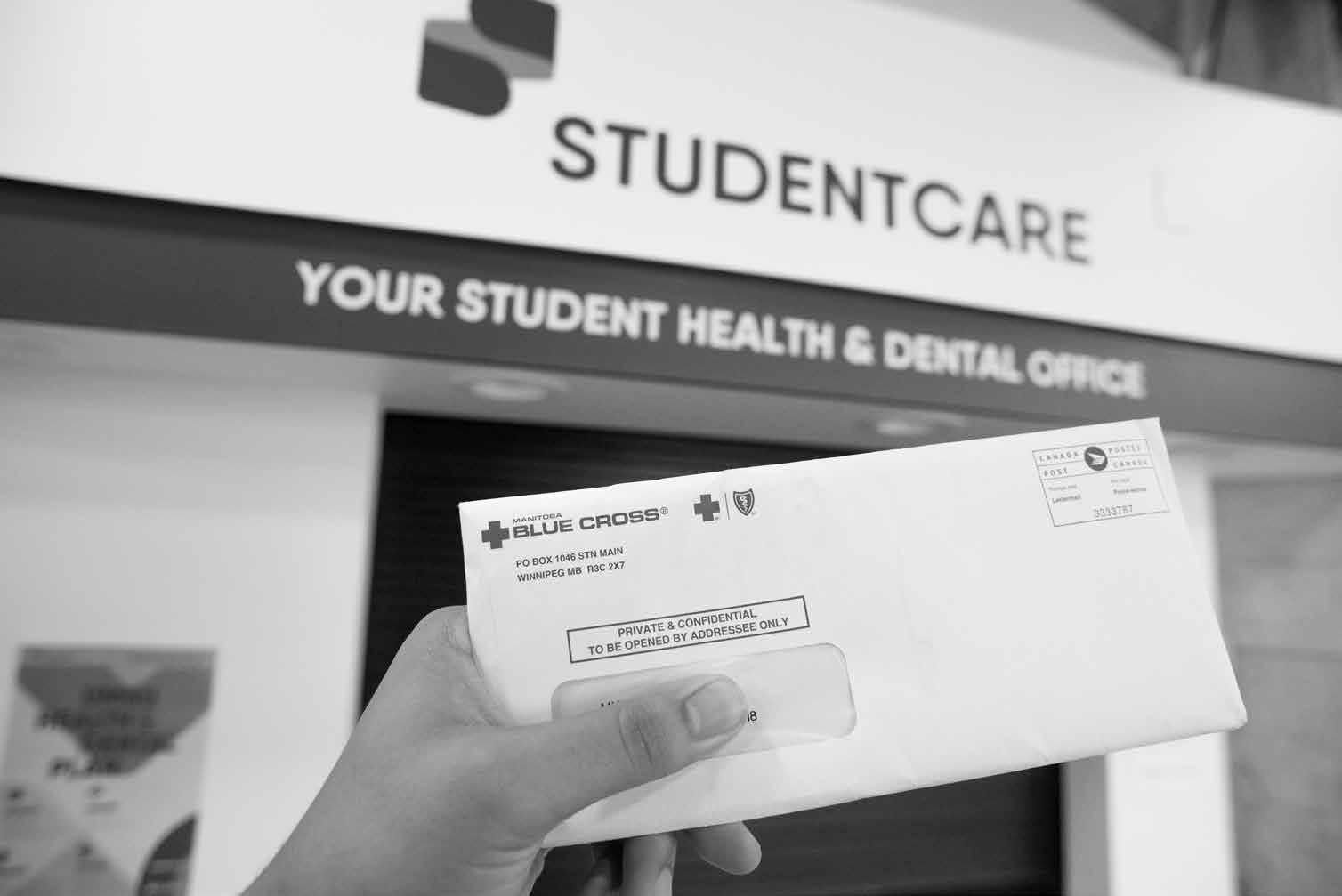
UMSU scales back health plan
58 per cent increase in claims driving program’s costs up
Ga R ett Wi LL iams, staff
Anearly 60 per cent increase in the number claims submitted through the University of Manitoba Students’ Union (UMSU) health and dental plan has lead the union executive to scale back some of the program’s coverage.
At its scheduled meeting on June 16, UMSU council heard from the plan’s administrators that a 58 per cent increase in the number of claims processed over the last three years has left the plan unsustainable. The administrators warned the council that premiums would either have to rise or coverage would have to be pared back.
Rather than increase the cost to students, the UMSU executive accepted a recommendation to reduce some of the plan’s dental preventative coverage and adopt the Manitoba Pharmacare Formulary, which is the same system used by other student associations in Manitoba. The changes will also see counseling coverage increase to $600.
Since 2011, the U of M plan has paid out more than $12.7 million in
claims, including $3.9 million in 201415. Representatives from Studentcare, who have administered the program on behalf of UMSU since 2013, projected more than $4.5 million in claims for the 2015-16 academic year.
“We haven’t seen this kind of exponential increase in the usage of a plan in a long time,” said Kristin Foster, a director with Studentcare, in the presentation to council.
“[A] 58 per cent increase over three years means that three years ago, less than half of members were using the plan at all, and I don’t see the point in designing the plan and having a student initiated fee that no one is using.”
Students are assessed a $292 fee toward the program on their fall tuition payment. However, opt-outs are available to students upon proof they are enrolled in another benefit system.
More than 17,000 students are enrolled in the program, which marks an increase of 3,000 individuals over five years, an uptick Foster said is unique to the University of Manitoba.
UMSU president Tanjit Nagra
said that by the time discussions around the program’s costs began in May, it was already too late to pass a fee increase through the University of Manitoba board of governors, and the only way to bring the plan into balance when the 2016-17 term began Sept. 1 was to modify the coverage offered.
However, she also said that moving forward, the student union is looking at instituting a flex plan that would have two tiers of coverage. This new plan would allow students who wish to pay higher premiums retain more complete coverage.
“We did hear a couple concerns about some students that would prefer to pay more rather than have some coverage reduced,” she said. “So that is something we’re looking at and perhaps it will be solved with having the flex plan model because then it is up to students.”
Rollbacks
The scale-backs approved by the UMSU executive see the maximum dental coverage capped at $600 and
scaling brought down to 30 minutes from 90, which Foster said puts the U of M plan in line with the majority of Canadian student plans.
“We haven’t seen this kind of exponential increase in the usage of a plan in a long time” – Kristin Foster, Studentcare director
Dental preventative services will also roll back to 80 per cent coverage, but that will be offset by a 20 per cent discount offered directly to students by participating dentists within an integrated network.
The revised plan will also adopt the Manitoba Pharmacare Formulary, which will cover 100 per cent of the cost of prescription drugs after a $100 deductible is met.
Foster noted the drug portion
of the plan has not been amended since the early 1990s, but the overall changes will keep the program balanced while the union and the plan’s administrators explore a flex plan.
“We looked at what are the benefit changes that make the most sense –or sometimes I say the least-worst,” said Foster.
“How do we achieve the kind of change to keep the costs down without cutting the things that students really need?”
Flex plan
Foster said that plans are in the works to survey UMSU membership regarding the two-tiered benefit plan.
“What do you do when you can’t make everybody happy with the same idea of planned benefits? You introduce a different level of benefits for those students who do have health concerns or want to take advantage of a plan that covers more.”
Foster said similar plans have been set up through ten university student associations but the U of M would be one of only two in western Canada.
photo by miguel yetman
Tuition fees continue to rise nationally
Statistics Canada releases data on tuition increases
Levi Ga R be R , staff
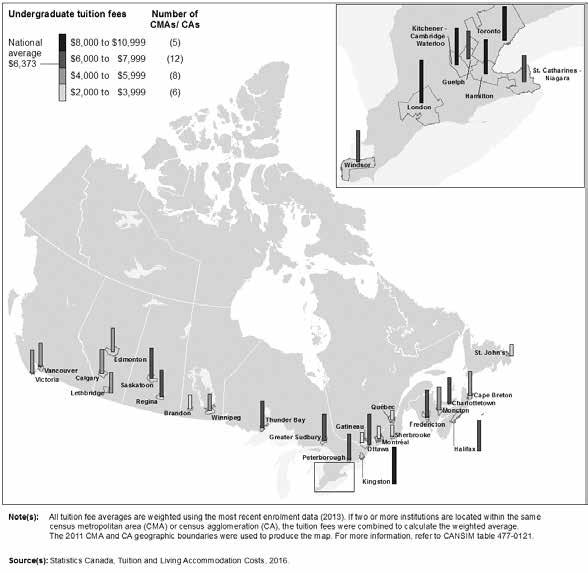
Tuition fees across the country are on the rise again, according to Statistics Canada. In a public release posted to their website on Sept. 7, the government data collection agency said that full-time undergraduate students in Canada will pay an average of $6,373 in the 2016/17 academic year. That is 2.8 per cent higher than the 2015/16 average.
Students in Ontario will continue to pay the highest fees in the country, averaging $8,114, while Newfoundland and Labrador students pay the lowest, averaging $2,759.
This year, the average undergrad tuition for Manitoban students rose by 1.1 per cent from $4,013 last year to $4,058 this year.
A 5.6 per cent fee jump in Nova Scotia is mostly responsible for the 2.8 per cent increase, bringing the average tuition in that province from $6,834 last year to $7,218 this year. In 2015, the Nova Scotia government lifted a three per cent tuition cap in the province, prompting the increase.
CFS reaction
The Canadian Federation of Students (CFS) blames the federal government for allowing tuition rates to rise.
In a release circulated on the same day that Statistics Canada published its tuition data, CFS national chairperson and former University of Manitoba Students’ Union (UMSU) president Bilan Arte said, “Rising tuition fees are the direct result of the federal government delaying investments in our future.”
“Rising tuition fees are the direct result of the federal government delaying investments in our future” – Bilan Arte, national chairperson, Canadian Federation of Students
“Education is a right, and it is unjust that any student is denied access to public education because of a financial barrier.”
In Manitoba, although the rate increase is less than half of the national average, CFS-Manitoba
chairperson Michael Barkman is equally concerned about the increases.
“What we’ve seen across the country is that the trend is still that tuition fees are increasing higher than the rate of inflation,” said Barkman.
“There are a lot of people who can’t even afford tuition, even in Manitoba where it’s cheaper.”
“What we really want to see in Manitoba is tuition kept to these affordable rates and then lowered.”
On Nov. 2, CFS will host its annual Day of Action to protest the trend of tuition increases across the country. Events across the province and in Winnipeg have yet to be announced.
Increases across the board
Across the country, increased tuition rates affected all undergraduate programs with the exception of pharmacy, which saw an average 18.4 per cent decrease in tuition. The programs that saw the highest increases were law, engineering, and dentistry, which all saw a tuition jump of 4.2 per cent.
Graduate tuition fees also increased nationally for the 2016/17 academic year, although not by as much as undergraduate programs.
The average cost of tuition for graduate students this year will be $6,703, a 2.5 per cent increase from last year.
In Manitoba, graduate tuition increased by 1.2 per cent, 0.1 per cent higher than that of undergraduate programs.
Tuition fees for international undergraduate students across the country also rose this year, but not at the same rate as in 2015/16. International students can expect to pay 5.6 per cent more this year, making their average tuition $23,589.
U of T student detained in Dhaka
Friends continue to fight for Tahmid Hasib Khan’s release
Ru P in D e R Li DDa R , the Varsity
TORONTO — Two months after a deadly siege occured in Bangladesh, friends and family of U of T student Tahmid Hasib Khan continue to await his release from Bangladeshi authorities.
On July 1, five militants entered the Holey Artisan Bakery in Dhaka, the capital of Bangladesh. During the attack, 20 hostages were killed. Khan was among thirteen individuals who survived the attack. Since July, Khan has been held without charges by the Bangladesh police with little communication to his friends and family.
Khan had finished his fourth year at U of T, completing a major in Global Health and two minors in Anthropology and Statistics. During his time at U of T, Khan was involved in Model United Nations and served as a director for the Bangladeshi Students’ Association. At the time of the deadly attack, Tahmid was en route to Nepal for an internship with UNICEF, when he stopped in Dhaka to visit friends and family.
“The situation has been incredibly tough to handle,” said Joshua Grondin, a third year who calls Khan one of his best friends. “Knowing him personally and closely, I can be 100 per cent confident in his innocence, and I will do absolutely everything in my power to make the world know it as well.”
Rusaro Nyinawumwami, another friend of Tahmid, said that she “was devastated at the news of his detainment,” but she has come “to accept the necessary legal processes adopted by Bangladesh, in order to ensure the country’s safety.”
Since the attack, Khan’s story has gained significant global attention. Grondin, also an administrator for a Facebook page called ‘Free Tahmid,’ states that the page’s purpose is “to raise awareness of the situation and create a support group for people most impacted by the situation.” Over the past two months, there has been an overwhelming response on the ‘Free Tahmid’ Facebook page and
Nyinawumwami is optimistic that the “garnered support [can] assist in ensuring his safe return.”
The attention has not been all positive. Weeks after the attack, a video was released showing Khan holding a gun alongside an alleged attacker, prompting a wave of people to accuse Khan of being a terrorist on social media.
“Our main objective has been to share articles that have been released since the event occurred.” Grondin explained, “We found that many of these people sharing negative opinions were simply unaware of particular, important aspects of the case.”
Such sentiments were echoed by Nyinawumwami, who said, “We have countered the hateful comments with facts and character statements about Tahmid. We do not necessarily want to ‘feed the troll,’ however we do our best to educate others by providing links to pertinent articles further explaining his unfortunate circumstance and advocating for his innocence.”
Some hostages anonymously recounted what they witnessed the night of the attack. According to Guernica , an American magazine, one “hostage confirmed previous reports that the gunmen had forced Khan to hold an unloaded gun during the night... the purpose [appeared] to have been to use Khan as a human shield.”
One witness claimed that “Tahmid was crying when the gunmen asked him to carry a gun.” The New York Times has also reported similar remarks from other witnesses.
In the continuous attempt to prove Khan’s innocence, Khan’s supporters sent still photos of him holding the gun to body language expert India Ford. During Ford’s analysis, she concluded, “It is very clear from the still photographs that Tahmid’s body language can’t be matched with that of the attacker... The body does not lie. In my opinion, Tahmid is an innocent victim of a dangerous incident... His
only crime was to be at the wrong place at the wrong time.”
Grondin stated that he believes they “have been so successful in advocating on his behalf because he had such a profound impact on so many people” and calls Khan “by far one of the most caring people you could ever meet.”
“He is a part of our U of T community,” said Nyinawumwami. “He is truly one of our own.”
“Tahmid, we’re keeping you in our thoughts and fighting for your safe return,” she added.
– New University Wire
Editor-In-Chief: Craig Adolphe
Contact: Editor@themanitoban.com / 474.6770
Stop saying ‘bottoms up’ to oil
If we want it in the ground, we have to keep it there ourselves
sH aW n Ga R butt, staff
Peaceful protest took a violent turn in North Dakota when activists leapt across fences at a site of pipeline construction and were met by police dogs and pepper spray.
Meanwhile, protests in Montreal have disrupted meetings held by Canada’s National Energy Board (NEB) that were convened to discuss the prospects of Transcanada’s Energy East project, a pipeline that would carry a little over one million barrels of crude oil daily from extractors in Alberta and Saskatchewan to refineries in Eastern Canada.
The pipeline’s projected path through Manitoba has also triggered outcry in Winnipeg as activists ceased the flow of traffic on major intersection Portage and Main during a recent demonstration. Blueprints have mapped out Energy East’s path as crossing southern Manitoba in the Shoal Lake region, the source of drinking water for the entire city of Winnipeg and other nearby communities. This has drawn the ire of many First Nations groups who have been mobilizing since the pipeline’s conception in an attempt to halt those who would see it come to life.
What happens now?
Environmentalists have seen Energy East wracked with delays, where come December it will have spent a total of 27 months under review. Additionally, all three members of a review panel put in place by the NEB to oversee Energy East regulations have stepped down after two of the members were exposed as having privately met with TransCanada last year to discuss the pipeline. Another victory was the dismissal of the Northern Gateway pipeline, buried in bureaucracy by both the federal and British Columbia governments, who imposed hundreds of stipulations on the project.
Yet pipeline activity has not come
to a halt, and the encouraging rhetoric backing it continues to move full steam ahead. City of Winnipeg mayor Brian Bowman exemplified this when he appeared on CBC Information Radio and replied to concerns about Energy East compromising the integrity of Winnipeg’s drinking water with, “We want this discussion to be focused on science and fact, not ideology.”
“The reality is oil and gas will need to be transported in Canada. It’s not a question of if it will be transported, but a question of how."
One study by a retired NASA scientist says superstorms of the future will be capable of producing wind speeds powerful enough to fling boulders into the air – rocks big enough to fit neatly through the gaping holes in Canada’s climate action plan
Elaborating, Bowman said he was simply concerned with transporting oil in the most “efficient” and environmental way possible.
The fact of the matter is that the development of oil resources exacerbates climate change. Bowman’s oil mongering, then, is the real ideology at play here. Unfortunately for him, contemporary studies on the effects
of climate change are more damning than ever.
The impact Governments across the globe were told they would regret it if the 90s-born Kyoto Protocol was not adopted and strictly adhered to. Well, it’s 2016, and the Kyoto Protocol was anything but adhered to, especially where it mattered most. Countries ranked as the top 11 greenhouse gas emitters in 2011 produced a little under 70 per cent of the global total, with China and the USA making up a little over 30 per cent of that on their own. I think you’d be more likely to find the signed documents in a landfill somewhere than existing as actual government policy in those states with the largest carbon footprints.
It’s now been a little over a decade since the Kyoto Protocol’s institutionalization. Global coastlines are more threatened than ever by a melting Arctic and rising sea levels, threatening to displace millions who live in coastal cities. Developing countries are trapped in simple yet dangerously unstable economies due to their largely agricultural base, the sector that has taken the most hits as global temperatures continue to fluctuate wildly and compromise farming communities.
If massive migratory disruptions and precarious labour situations don’t faze you, then take a moment to collect yourself before reading this one. The Arabica bean itself is being pushed to the brink by climate change. That’s right, latte aficionados and double-double enthusiasts: your ambrosia is teetering on the abyss. Coffee may near extinction by 2080 under current climate projections.
One study by a retired NASA scientist says superstorms of the future will be capable of producing wind
speeds powerful enough to fling boulders into the air – rocks big enough to fit neatly through the gaping holes in Canada’s climate action plan, which effectively absolves the federal government of any responsibility through delegating the issue of climate change to individual provinces.
We cannot continue to shrug off our obligations to this planet and the people who live off it onto the shoulders of First Nations tribes and environmentally minded political activists
Canada's climate action plan - or lack thereof
Were it serious, the federal government would be implementing more rigid accountability structures to hold both itself and provincial governments responsible when it comes to reducing greenhouse gas emissions and transitioning to a green economy.
The federal government is looking at some positive initiatives, including a national carbon tax and the creation of a $2 billion trust fund with the aim of financing low-carbon projects. Not to mention, the crown jewel of the new governments green policies: a phase out of subsidies for the fossil fuel industry.
Unfortunately, we must ask ourselves about the likelihood of the government actually moving forward with this when natural resources
minister Jim Carr has expressed reluctance on doing exactly that in light of low commodity prices. Meanwhile, the International Institute for Sustainable Studies has released a report that shows wealthy Canadian oil companies have been on the receiving end of $3.3 billion in government subsidies annually.
The federal government must move swiftly against those actors in the oil industry, but a simple phase out of subsidies for dirty energy companies is not enough. We should then redirect those resources to finance the aggressive development of the holy trinity of green technology: hydroelectricity, wind, and solar.
Instead, however, the federal government’s plans are best exemplified by its meek admission in February of this year that it is unlikely to have achieved reduced greenhouse gas emissions come 2020 compared to 2005 levels. The goal was a reduction of 17 per cent; instead, Canada is projected to increase emissions by two per cent. It is further projected that come 2030, the promise to reduce emissions by 30 per cent will be broken as rates of emission on its current trajectory look to actually increase by nearly 17 per cent.
Ultimately, it is clear we cannot rely on our leaders, Conservative or Liberal, to champion the front when it comes to fighting climate change. When looking to the left, there are few political allies to be found. The NDP, a party whose only provincial government, headed by Rachel Notley has come out as a staunch supporter for pipelines and the expansion of the Albertan tar sands. The Notley government’s magnum opus in its climate policy is the implementation of an economy-wide carbon tax. Yet if Alberta was serious about mitigating the effects of climate change, government policy would more aggressively target corporate emissions specifically.
Organizing
The way forward must be through grassroots organizing. It is high time that our communities form a united front to show the powers that be, both political and corporate, that action on climate change is no longer a promise we will tolerate on the backburner. We cannot continue to shrug off our obligations to this planet and the people who live off it onto the shoulders of First Nations tribes and environmentally minded political activists. Nor can we rely on Elizabeth May to keep the House of Commons’ conscience tinged green. Starting now, the campaign for climate justice must be supported locally. On campus, we must continue the push for sustainability and boldly march forth with oil divestment. Although reminding everyone of the dangers of climate change may seem like beating a dead horse with a stick, it is necessary – frankly, we’ll be the dead horse and climate change the stick unless we wake up and smell the coffee.
A perilous drop
Bridging the gap between high school and university is necessary for educational progress
aH me D sa L em, the Varsity
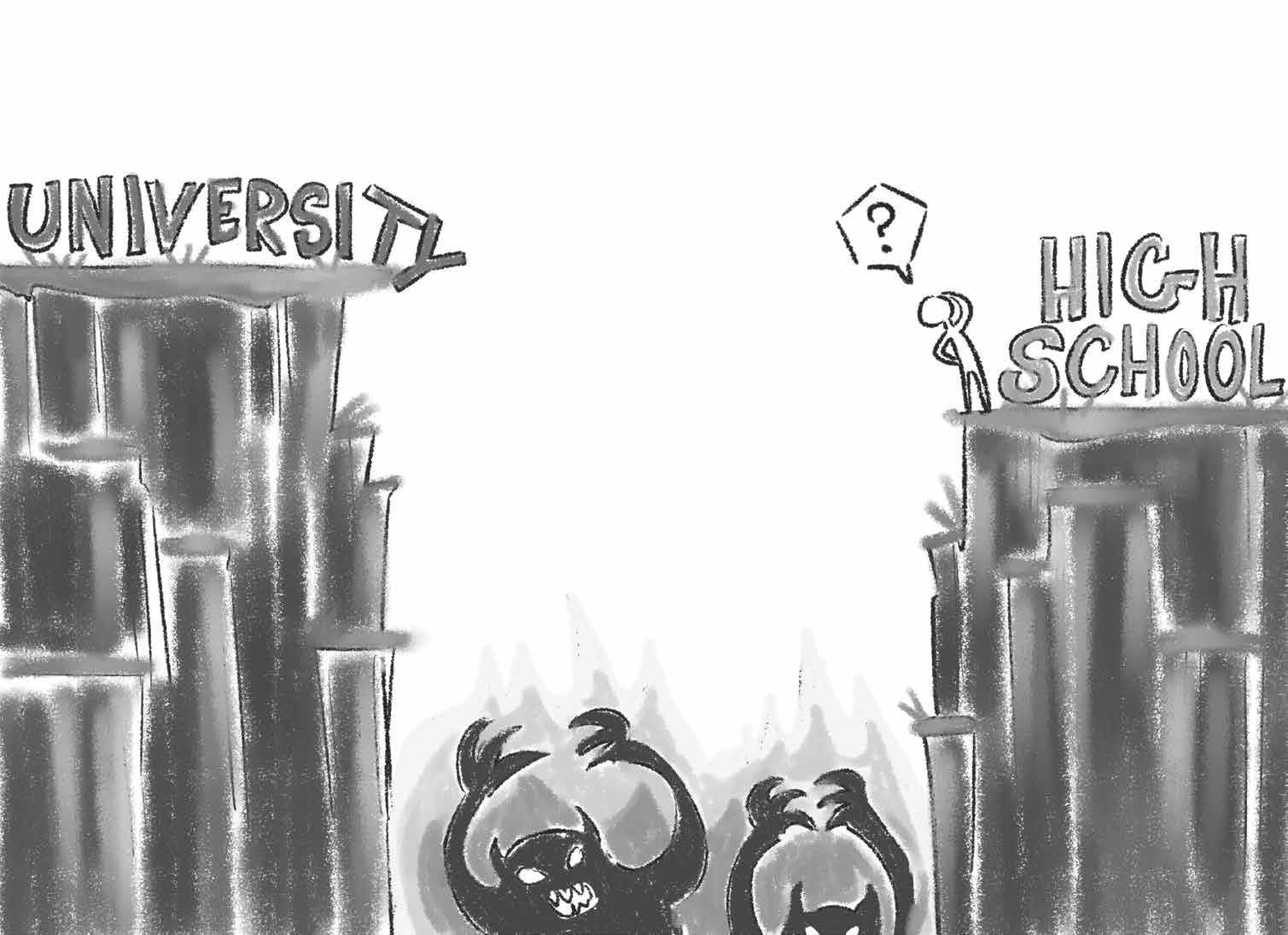
TORONTO — Scrolling through my Facebook feed at this time of the year always floods me with a rush of nostalgia. However, seeing happy high school seniors posing in their prom pictures or preparing for their final exams prompts me to ask myself: are these kids ready for university?
The answer, as university students know, depends on a number of factors. For some, transitioning to university from high school can be the same as transitioning from the minor leagues to the majors. While some students are better prepared than others, the “first year dip” – an academic hit new students often undergo due to the increased difficulty and volume of material – is common during the first year of undergraduate studies.
It is worth examining why high school doesn’t sufficiently prepare students to take on academic challenges following graduation.
The roots of this problem can be found in the history of public schooling in North America and Europe. During the Industrial Age more than 150 years ago, child labour was common as kids were beginning to replace adults in the job markets. As employees, children offered efficiency and
cost less to employ. However, moral outrage eventually led to the implementation of public education. Its primary purpose was not necessarily to breed intellectuals, but instead to produce a new generation of better workers.
Education developed further over the subsequent years, along with the creation of the multiple-choice test.
The impact of this invention is huge, because the mainstream school system now often aims away from teaching the subject matter and toward being able to pass standardized tests. Arguably, much of high school is all standardized testing with emphasis on rote memorization.
Schools often teach strategies to do well on these specific evaluations, regardless of whether such methods account for mastering the subject matter or honing the ability to convey information in concise terms.
The inevitable result of such a system is the redundant question asked in high schools around the world: “Will we be tested on this?”
This explains why a huge academic drop occurs when students graduate high school and are finally faced with questions that require deep critical
thinking and logical reasoning.
Additionally, psychological reasons also play a major role in the first-year dip. High schools, by nature, provide a very co-dependent environment, where students are constantly reminded of deadlines. The faculty knows their students and families by name; teachers have enough time and resources to tailor their teaching style to the needs of their students.
This is a marked contrast to many post-secondary educational settings where mammoth-sized classes are large enough to destroy any sense of security or belonging. Bigger classes in university unfortunately often result in little to no interaction with instructors or among peers.
Undoubtedly, this combined with the increased difficulty of academic materials creates a lot of unforeseen psychological stress. Professional, financial, and interpersonal responsibilities in university also seem to hit all at once without warning, which causes academic performance to falter. Seeing as how these difficulties are not uncommon, it is questionable why these issues and strategies to deal with them are not adequately addressed in high school.
Artificial intelligence will eventually replace many existing jobs, so memorizing information and filling in Scantron sheets is becoming the most inefficient way to spend one’s high school career
Problems with the education system have been discussed and approached in different ways throughout the years. Many proposed solutions, however, represent changes to techniques and methods, not to the fundamentals. The system may have served well so far, but effective changes must be made soon. The rise of technological advances means that the world is changing at an exponential rate, therefore a new learning environment is more timely than ever.
For instance, artificial intelligence will eventually replace many existing jobs, so memorizing information and filling in Scantron sheets is becoming the most inefficient way to spend one’s high school career. Instead, the aim of education should be to develop a person’s ability to ask provoking questions and think critically. Education should mean cultivating a love of knowledge for its own sake; it should develop morals and ethics that can be applied to solving our world’s greatest challenges.
– National University Wire
graphic by diana pham
U.N. meets over rise of antibiotic-resistant bacteria
The United Nations General Assembly will meet on Sept. 21 to discuss plan of action
In an unusual line of action, the United Nations General Assembly will gather later this month in New York to discuss the recent mass prevalence of drug-resistant bacteria. This phenomenon is also known as antibiotic resistance, or, in some cases, antimicrobial resistance (AMR).
This is only the fourth time in history that the U.N. has congregated to discuss a health crisis, but according to experts, the meeting is long overdue.
“There has been discussion of AMR in World Health Organization (WHO) since the 1960s, and plans since 2000,” said Dr. Marc Sprenger, director of the WHO’s AMR Secretariat.
“But it is now shifting from being a technical problem to a much higher level political issue.”
Antibiotic resistance is just a facet of the larger issue known as antimicrobial resistance. While antibiotic resistance refers specifically to bacteria that are resistant to antibiotics, AMR refers to other microbes that are becoming increasingly resistant to treatment, such as parasites and fungi.
What causes antibiotic resistance?
Antibiotic resistance is generally what happens when a drug that was once able to treat an infection is no longer effective. This is in part caused naturally, as it becomes a side effect of the evolution of the micro-organism causing the infection. Micro-
organisms can replicate themselves with errors that make them resistant to treatment, or resistant traits can be exchanged amongst themselves.
Antibiotic resistance was the cause of 700,000 deaths worldwide within the last year
The other cause of antibiotic resistance, however, is human error. Some resistance can be traced back to unsanitary medical conditions. The most pressing problem, however, is the misuse of our current antibiotics. While two-thirds of our antibiotics are actually used on livestock, either to help them with size or survival, bacteria within the animals can become more resistant to antibiotics, and can then reach humans, who are unequipped to fight them. Humans can create this resistance amongst themselves as well, through the overuse of antibiotics.
A growing problem
Antibiotic resistance has been a concern for some time now, with instances of resistance appearing as early as 1940. More recently, however, research shows just how urgent our current situation is.
Antibiotic resistance was the cause of 700,000 deaths worldwide within the last year. A video recently released by Harvard Medical School and the Technion-Israel Institute of Technology shows bacteria in a petri dish evolving to resist antibiotics in only 12 days. Within the last six years, scientists have found increases in resistance to drugs used to treat HIV and tuberculosis. If immediate action is not taken, gonorrhea, which is currently treatable, may become incurable as it slowly becomes more resistant to our current treatments, and there are no new treatment plans in development.
Drug-resistant bacteria results in patients staying sicker for longer periods of time, resulting in longer hospital stays, which in turn increases the chance of a worse prognosis or death. This also increases the risk of the infection spreading to other people. Surgeries that are considered “risky” by today’s standards may be near-impossible in the future, as surgeries run the risk of infection, and it may be infections that we are no longer able to effectively treat.
This new, longer span of treatment (and sometimes complete lack of treatment) will alter our approach to illness prevention and treatment immensely. Conditions that were once considered mainly inconvenient or easily treatable by most people may become serious, life-threatening illnesses.
To fight back against antibiotic
resistance, the WHO has proposed what they are calling a “global plan to combat antimicrobial resistance,” which they submitted to the 68th World Health Assembly in May of 2015. The plan has key points that revolve around improving awareness of the issue in both policymakers and the general population, increasing research, promoting appropriate levels of prescribed antibiotics by health professionals to both humans and animals, and to increase funding used to create new drugs, vaccines, and other treatments.
Promoting appropriate antibiotic prescriptions is especially important, as the overuse of a once-crucial antibiotic can have terrible consequences. A recent example of this can be found in a drug called colistin, which was originally used to treat livestock and was considered to be too toxic for human usage. It is now used as a last-resort treatment for humans with multidrug-resistant bacterial infections, but even that, according to researchers, may not last long.
Now, due to the overuse of polymyxins – a type of antibiotics that includes colistin – there have been cases of bacteria containing a gene that makes it highly resistant to antibiotics in humans and pigs in China. Scientists are recommending tighter restrictions on polymyxins, which are still used for livestock, and ceasing use of polymyxins entirely in noncrucial scenarios.
How you can decrease your risk of infection
This U.N. meeting will hopefully begin a level of discourse needed to finally take global action against antibiotic and antimicrobial resistance.
“The previous discussions have been held at the level of ministers of health and agriculture,” Keiji Fukuda, special representative for antimicrobial resistance in the office of the WHO director-general, told the Scientific American. “But this meeting will take this up to the level of prime ministers and presidents.”
While only time will tell whether this meeting will result in increased funding and research, it is obvious that the clock is ticking. If immediate action is not taken, some researchers speculate that the death toll could reach 300 million by 2050.
There are things people can do every day to help slow the growing resistance of some bacteria. For example, hand washing is a quick and simple way to help stop bacteria from spreading. Staying home from work or school when you are sick is also important. When you do get sick, take only the amount of antibiotics prescribed to you – not more or less, and definitely not antibiotics that were not prescribed to you for that specific illness. Never share antibiotics or take antibiotics from a past illness.
graphic by kelly campbell
Bison football suffers late game collapse in Regina
Bisons unable to hold on to lead, fall to 0-2 on the season
T
he University of Manitoba Bisons let an 11-point fourth quarter lead slip away against the Regina Rams, falling 41-38 on the road Thursday night.
Trailing 38-27 with just under five minutes left to play, Rams quarterback Noah Picton engineered two scoring drives of over 80 yards, including the game-winning touchdown pass to Ryan Schienbein with just 25 seconds left to play.
The herd looked to have the game all wrapped up after linebacker Houston Rennie recovered a fumble deep in Regina territory and took it all the way to house with just 4:37 to go, but the Rams kept on fighting. First, Picton drove 87 yards in 11 plays, finishing off the series with a one-yard plunge to cut the lead to five, and then the hosts got a massive play from their defense.
With the Bisons deep in Regina territory, Korey Greene stripped the ball from Manitoba running back Alex Christie, and the Rams were able to recover.
Manitoba is currently missing six offensive starters, including receivers
Kyle Patchell, Devin Csincsa, Stephen Ugbah, and Derek Yachison
It was all Picton after that, as the Rams offence went 104 yards in the
final minute, capping the drive with a 15-yard Picton toss to Schienbein to complete the upset over the previously eighth-ranked Bisons.
Statistically, both quarterbacks had impressive numbers, coming alive in the second half specifically. Manitoba pivot Theo Deezar finished 30-of-49 for 457 yards and two touchdowns, but also threw two interceptions.
Picton had a marvelous game, going 40-of-60 for 490 yards and four touchdowns, and distributing the ball to seven different receivers, five of whom had at least 60 total yards.
Shai Ross was the leading receiver for the herd, finishing with four receptions for 126 yards in what has quickly turned into a patchwork receiving corps for the Bisons. Manitoba is currently missing six offensive starters, including receiv-
ers Kyle Patchell, Devin Csincsa, Stephen Ugbah, and Derek Yachison, three of whom were major offseason recruits. Also missing on offence were veteran offensive linemen Tom Clarkson and Jordan Medal.
Defensively, Manitoba’s secondary was also depleted heading into the contest, as cornerbacks Eric Plett and Marcel Arruda-Welch didn’t make the trip.
Manitoba’s next two games are both at home, and will be critical in determining where they fall in the standings towards the end of the year. This week they play host to the Alberta Golden Bears and will follow that up with a tilt against the Saskatchewan Huskies. Alberta and Saskatchewan have both improved significantly since 2015, and both games should be relatively competitive.
The Bisons’ next game is at Investors Group Field against the unranked Golden Bears at 7:00 p.m. on Friday.
Canadian men’s World Cup drought continues
Canada unable to overcome 5-goal differential, fail to qualify for the 2018 World Cup in Russia
T
his year the Canadian men’s national team had an opportunity to break their World Cup dry spell, but yet again failed to qualify for the 2018 World Cup in Russia. The last and only time Canada has
ever participated in the World Cup was in 1986 in Mexico, where they lost all three of their group matches.
2018 World Cup qualifiers
There was some real belief within
Canada that their team would finally reach the World Cup. In round four of qualification, Canada competed in Group A with Mexico, Honduras, and El Salvador. They lost both of their games to the heavy favourite
Mexico by scores of 2-0 and 3-0. Canada split their two games with Honduras, winning 1-0 in the first game and losing 2-1 in the second. The last match they had was against El Salvador, who they tied with in their first meeting.
Canada defeated El Salvador 3-1, but the Canadian team came into the match needing a Honduran loss to Mexico to erase a five-goal differential between them and Honduras. Although Canada won their game, Honduras ended up drawing 0-0 with Mexico, officially eliminating Canada from any chance of qualifying for the World Cup.
Looking back at their group matchups, the 0-0 game they played with El Salvador is one the Canadians would surely like a chance to redo. Something along the lines of a 3-1 victory in the previous game would have helped the Canadian team, but they cannot dwell on the past.
The Canadians will need to learn from this experience and keep improving for the 2022 World Cup qualifiers.
Leading the pack
The leadership on this Canadian team stemmed from veterans Julian de Guzman, who was unable to participate in the final game, and 33-year-old Atiba Hutchinson. This may have been the last time we see these men wearing red and white on the pitch, as Hutchinson held back tears when asked about representing Canada in the future. Although they were unable to give their nation a team to root for in the World Cup this year, they still have a lot of belief in the up and coming talent within the Canadian system to accomplish
Bison soccer team earns split on the road
Ryan s te Lte R , staff
This past weekend, the University of Manitoba’s women’s soccer team opened up their 2016 regular season with a split. On Friday, the Bisons lost to the Alberta Pandas 2-0, but bounced back to defeat the UNBC Timberwolves 5-0.
Friday
In their first game of the year, the Bisons were outplayed by the Alberta Pandas in a 2-0 loss. The Pandas opened up the scoring in the 33rd minute when Brenna Mattiello fired home on a cross from Sydney Daines. Bison keeper Maddie Wilford was peppered with shots in the first half,
which continued throughout the game. Wilford made 11 saves on the evening.
After a disappointing effort on Friday, the Bisons came back in a big way against the University of Northern British Columbia
The second half saw the Pandas press hard for a second goal and they eventually got it in the 88th minute, when Madison Szafranski chipped a rebound over Wilford to put the nail in the coffin of the Bisons.
Manitoba had a chance to equalize through Selina Sperenza when she fired a low hard shot in the 80th minute that was easily saved. In the end, the Bisons only managed three shots on target.
Sunday
After a disappointing effort on Friday, the Bisons came back in a big way against the University of
Northern British Columbia. It took until the 41st minute, but the Bisons opened up the scoring through Sara Schur when she slotted home after a turnover.
Two minutes later, Sperenza, who looked dangerous on Friday, doubled the Bisons’ lead before the stroke of halftime. Sperenza picked up where she left off in the second half, netting two more goals in quick succession to earn the hat trick. She hit the back of the net with every shot she took on Sunday and now has a .375 shooting percentage.
Alyssa Daley buried any chance of the Timberwolves winning when
this goal in 2022.
Cyle Larin, the 21-year-old striker, is one of the young players that can help lead this Canadian team in the future. He is coming off a rookie record season for Orlando City SC, posting 17 goals throughout the year. Larin was also the leading scorer for Canada during this group stage, scoring two of his team’s five goals.
Coaching change?
Coach Benito Floro faced plenty of criticism for how he managed his team throughout the qualifying stages. He was especially criticized for how he managed substitutions late in their final game to add to their goal total. Floro has coached the team for the past three years, and with his contract expiring, it is hard to see him receiving a contract extension. This may be the end of the road for Floro on the Canadian bench.
Canadians have reason to be hopeful for the future of men’s soccer. With new management and Larin and other talented youth filling the roster, there is no reason to believe that the team cannot keep improving. Maybe one day we will see the red and white on the pitch in 2022 for the World Cup in Qatar.
in the 74th minute with a shot off the post from a bad angle. Amanda Wong had three assists on the day in a dominant midfield display. Wilford played excellent in between the sticks again, making five saves to get her first clean sheet of the year.
The Bisons are now 1-1 and are sitting fourth in the Prairie division.
The herd takes on the Saskatchewan Huskies and the Regina Cougars next weekend at home.
graphic by jen goertzen
World Cup of Hockey preview
Breaking down the groups, storylines, and predictions
Ryan s te Lte R , staff
The World Cup of Hockey is set to start on Sept. 17 when Team USA takes on Team Europe. This World Cup is comprised of six countries – Canada, USA, Russia, Czech Republic, Finland, and Sweden – as well as two teams comprised of players from a variety of nations, Team North America and Team Europe. North America is made up of players under the age of 23 from Canada and the U.S., while Europe has players from the likes of Germany, Slovakia, Switzerland, and more.
Some argue that this is not a best on best tournament because of the inclusion of Team Europe and Team North America, but it doesn’t really matter – hockey fans will be watching this tournament regardless.
The Manitoban breaks down the two groups, highlighting key players to watch, and predicts how the teams will finish.
Group A
Predicted finish (from order of first to last): USA, Canada, Czech Republic, Team Europe
USA
The U.S. have a loaded roster, and come in as one of the favourites in the tournament. They will want to forget their poor performance in the 2014 Sochi Olympics, where they bowed out to Canada in the semi-finals and were then trounced by Finland 5-0 in the bronze medal game. They have essentially the same roster as Sochi and will be looking to prove something, and for that reason, they will top the group.
Player to watch: Joe Pavelski will certainly be a player to watch after his marvelous Stanley Cup playoffs, where he racked up 23 points in 24 games en route to a Stanley Cup appearance. “Little Joe” will be looking to continue that for the Stars and Stripes.
Canada
Many will be surprised not to see the Great White North on top of this group, and it’s possible that they could do it. Canada is heavily favoured to win this whole tournament, and there is plenty of reason for that; Canada has won the last two Olympics and has the deepest talent pool in the world. Canada typically plays a little shaky in the group stages, but will most likely make it to the final.
Player to watch: Having missed the 2014 Olympics due to injury, Steven Stamkos will relish this opportunity to wear the maple leaf. Even coming off another season cut short by injury, he still managed 36 goals and
28 assists in 77 games.
Czech Republic
The Czechs were unfortunate to be placed in a group with the two North American juggernauts, but they have some young, exciting players on their roster. The only question mark for the Czech Republic will be their defense – after Radko Gudas, there is a steep drop off. This will likely cost them when they play the likes of the U.S. and Canada.
Player to watch: David Pastrnak will be wanting to make a statement this tournament, having bounced between the Boston Bruins and their farm team in Providence the last two seasons.
Europe
The Europeans have a talented roster, but they might struggle with cohesiveness, as almost none of these players have played together internationally. The Europeans will struggle with chemistry, but if they can manage to gel they might surprise, but they will most likely toil at the bottom of this group.
Player to watch: After a breakout season last year, Leon Draisaitl, who will be one of the German representatives on Team Europe, will be look-
ing to show that it wasn’t just a fluke. The Edmonton Oilers forward will want to prove that he belongs in the Oilers’ top six.
Group B
Predicted finish: Russia, North America, Finland, Sweden Russia
The Russians are always a team to watch out for in any international hockey tournament. Led by dynamic forwards Alexander Ovechkin and Evgeni Malkin, Russia’s firepower will be enough to see them top the group. As with any Russian team, defense is not necessarily their strong suit, but they have three solid options in the crease.
Player to watch: Artemi Panarin will have many eyes on him, as he won the Calder Trophy last season as the NHL’s best rookie. This is Panarin’s first significant international tourney and he will be wanting to prove himself.
North America
The most surprising prediction here is Team North America qualifying for the knockout stages, but if you take a look at this roster it shouldn’t be that surprising to see them finish
second in this tough group. Led by teenage phenoms Connor McDavid and Jack Eichel, Team North America will be the most exciting team to watch this fall.
Led by teenage phenoms Connor McDavid and Jack Eichel, Team North America will be the most exciting team to watch
Player to watch: The goal crease. North America boasts some of the brightest goaltenders in the game on their team. Winnipeg Jet Connor Hellebuyck, Stanley Cup-winning goalie Matt Murray and Anaheim Duck John Gibson are all options. It will be fun to see who wins the starting job.
Finland
“Those pesky Finns” is a phrase you will hear in any international tournament the Scandinavian country
participates in. They somehow find away to annoy opposing teams with their play. Finland might struggle in this group as their shaky defense will be punished by the flashy forwards of North America and Russia.
Player to watch: For Winnipeg Jets fans, and many hockey fans, watching Patrik Laine will be a real treat. The young Finnish forward has drawn comparisons to Ovechkin and will be looking to showcase his wicked wrist shot in this tournament.
Sweden
Sweden are coming off a silver medal in the 2014 Olympics but their international prowess might stall a bit in the World Cup this year. Made up of a mixed bag of forwards, the Swedes still boast plenty of talent but they will unfortunately be the scapegoats in this tough group.
Player to watch: Patric Hornqvist is coming off of playing a key role with the Stanley Cup-winning Pittsburgh Penguins. Hornqvist possesses a lot of speed and will want to play a key role with the Swedes as well.