Correction: In our Sept. 7 issue, we ran an article with the title “U of M bolsters indigenous support with two new endowment funds.” In reality, the two new university funds don’t operate as endowment funds – all of the funds’ money can be spent as opposed to just the interest generated by each. We apologize for the error.
Check the Manitoban's website and Facebook page for
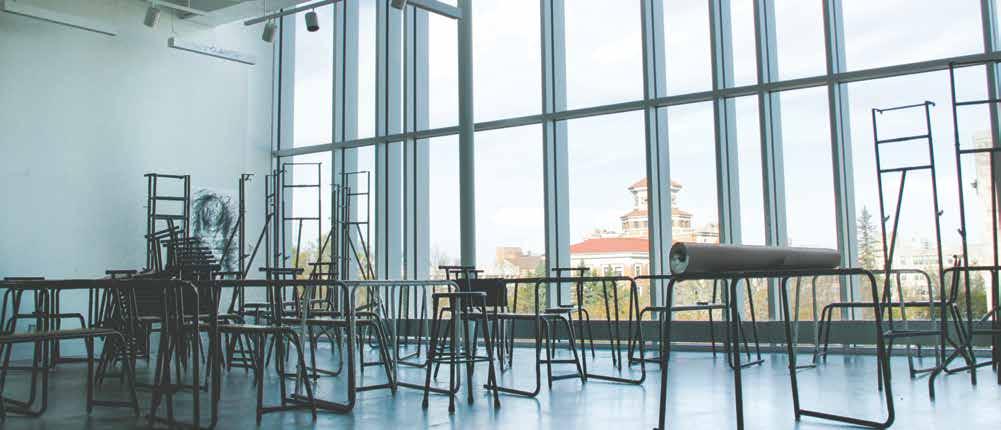
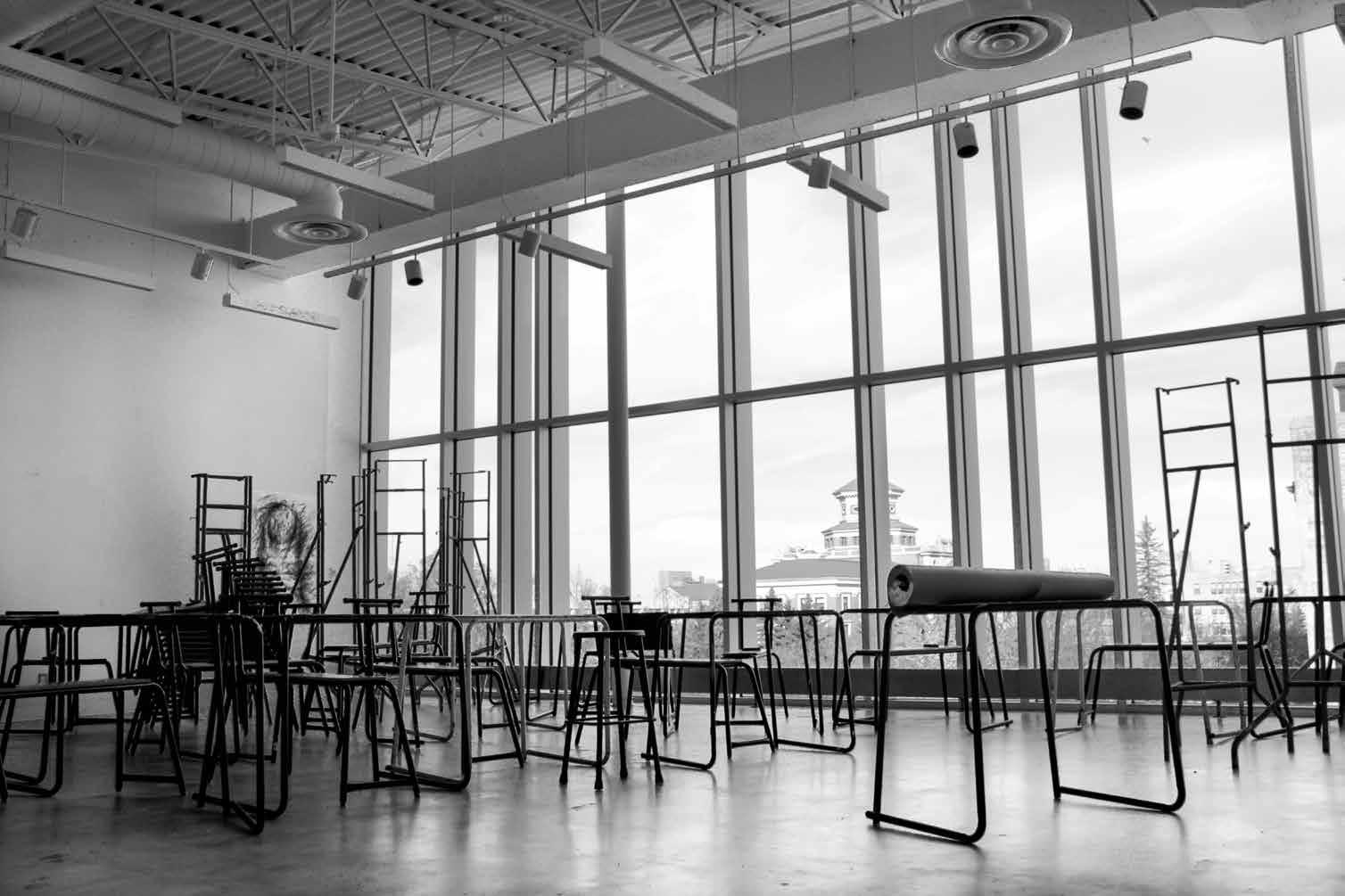
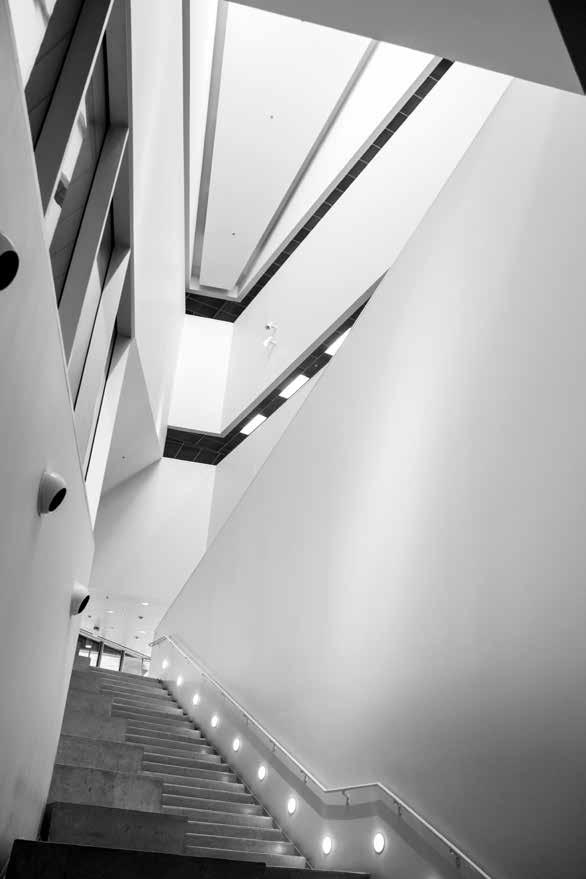
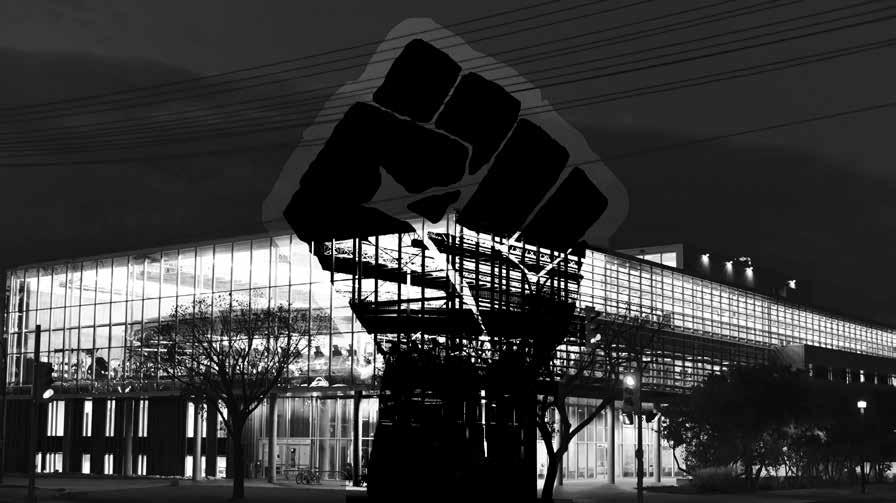
• the School of Art's award winning ARTlab building
• the campus Orange Shirt Day event hosted by the faculty of nursing
Will Gibson Sari Habiluk Anthony Labonte Aly Raposo
UMSU VP student services resigns
Executive mum on reasons for departure, by-election to be called
Lev I G AR be R , staff
University of Manitoba Students’ Union (UMSU) vice president student services Jessica Smith resigned from her executive position at the union’s regular council meeting Thursday.
Smith made the announcement, effective immediately, before presenting her executive report to council. Hours before the meeting began she issued an email to student group leaders stating that she would be stepping down.
“I loved meeting and building relationships with all of you that I had the opportunity to do so with,” she said in the email. “I am always happy to stay in touch as a friend, and assist you in any way that I can.”
Smith offered no reasons for
stepping down. However, a series of emails obtained by the Manitoban suggest a sour relationship had already developed between Smith, her executive colleagues, and some union staff members early in the summer.
Smith declined to comment further.
Following the meeting, UMSU president Tanjit Nagra would not elaborate on Smith’s resignation.
“Unfortunately, due to confidentiality reasons, I cannot disclose specific details in regard to the VPSS resigning,” she said.
“But on that note, I would also like to thank Jessica Smith for her service with UMSU.”
When the meeting’s agenda was
released Tuesday, it included a confidential motion that was to be tabled in a closed session. After Smith’s resignation was tendered the motion was struck.
UMSU councillors who reviewed the motion in the union’s office prior to the meeting confirmed it related to disciplinary actions toward Smith. Nagra said a by-election will be scheduled to elect Smith’s replacement. Details will be brought forward at UMSU’s next meeting on Oct. 13. The VPSS duties will be shared among the remaining executives and union staff in the meantime.
Email exchange
In an email exchange between Smith and her colleagues, leaked to
the Manitoban in the weeks before the meeting, Smith directed criticism toward an UMSU staff member and went on to accuse him of dishonest behaviour.
“I truly don’t respect [him] very much at all based on all the instances that he has lied to me and has been rude to me,” she wrote.
“That aside, if [he] makes a mistake then he needs to be told so, and he needs to fix it.”
After a heated exchange between Smith and UMSU vice president external Wilfred Sam-King, Nagra stepped in and recommended a meeting with the U of M’s human rights and conflict management department.
Sam-King declined to comment on the exchange or whether
any meeting with a mediator was arranged.
The previous UMSU VPSS, Jessica Morrison, resigned in March with a little more than a month remaining in her term.
Smith, who had recently been elected the position of VPSS in the 2016 UMSU general election, stepped into the position early in lieu of a by-election.
UMFA considers university proposal
Administration presented faculty union with four-year deal, including seven per cent increase
G AR e TT W ILLIAM s, staff
The University of Manitoba Faculty Association (UMFA) held a special general meeting Tuesday to discuss an offer from U of M administration toward a longterm agreement.
The university presented the association of professors, researchers, and librarians with a four-year settlement offer on Sept. 13 that includes a general salary increase of seven per cent across the term of contract.
In addition to the existing annual increases and proposed salary bumps that address specific areas of need, the average UMFA member’s salary increase will be closer to 17.5 per cent, according to a university release.
The additional increases would include adjustments to academic ranks that are currently below the national average for similar universities and disciplines with specific competitive contexts.
The offer also seeks to address job security, fair performance assessments, and improved benefits.
U of M administration chief negotiator Gregory Juliano claimed in the release that he is confident the package is attractive and responsive to UMFA’s positions.
However, UMFA president Mark Hudson said the union’s negotiation team signalled the two sides are still far apart on key issues.
“We haven’t even had a chance to talk to our members about it,” he said, noting the association was waiting on a response from the administration on crucial issues to the union after some details of the offer were published on the university’s online communication arm, UM Today, last week.
“We’re disappointed that the university moved out of the gates as fast as it did to go public,” said Hudson, who would not comment on where the agreement appears to fall short of the association’s expectations.
“We’re at kind of a delicate stage in negotiations, I think, and it probably wasn’t helpful to put it all out in public – especially when we haven’t had a chance to discharge our duty of talking to our members and getting their feedback on the proposals,” he said.
The university’s executive director of public affairs, John Danakas, said the administration will not elaborate further on the details of the package, saying “out of respect for the bargaining process, the university won’t be commenting beyond the information that’s been shared on the website.”
The initial release said the settlement offer would be published in full on Friday, Sept. 30. However, after meeting with UMFA negotiators earlier that morning, the university agreed not to post the entire offer
“with the intent of supporting positive future negotiations at the bargaining table.”
Comprehensive settlement offer
At the outset of bargaining, which began in earnest in late May, Hudson said a priority for UMFA is to see U of M salaries climb from among the bottom of the top 15 Canadian research universities, known as the U15.
The offer tabled will bring full and associate professors to 12th among the U15. Assistant professors will land at 13th.
The proposal would bring full professors’ base pay to $153 ,237 for the 2016-17 school year. Associate professors would receive $117,364 and assistants $92,321.
Over the four-year tenure, the general salary increase would be one per cent the first year, followed by two per cent annually for the remaining three years.
Professors at the U of M were paid a minimum of $101,423 in the 2014-15 fiscal year. Associate professors earned a minimum of $82,599 and assistant professors a minimum of $70,370.
At the University of Alberta, professors made a minimum of $116,473 annually in 2014-15. Associate pro-
fessors made a minimum of $93,944, while assistant professors a minimum of $75,403.
University of Saskatchewan professors earned a minimum of $124,618 in 2014-15, while associate and assistant professors made minimum salaries of $106,708 and $88,798 respectively.
“We’re at kind of a delicate stage in negotiations, I think, and it probably wasn’t helpful to put it all out in public” – Mark Hudson, UMFA president
The university offer also includes a commitment to a fair work evaluation framework that will prevent performance assessments based on formulas and quantitative metrics. The offer also commits to improving collegial processes regarding the assignment of teaching, promotion, and tenure.
Benefits, including maternity and parental leave, orthodontic coverage, drug coverage, and health care spend-
ing accounts would also be enhanced. Bargaining timeline
The most recent contract between UMFA and the university – which covered 2013-16 and increased salaries 6.9 per cent over the term – expired at the end of March.
In the throes of a provincial election and uncertainty surrounding who would hold office following April’s vote, the university forwarded a one-year, salary-only offer that included a 1.5 per cent base increase.
Looking for a longer-term deal that addressed outstanding governance issues crucial to the union, UMFA rejected the deal and fullscale bargaining began at the end of May with the goal of reaching an agreement before classes resumed in September.
The two sides met for at least 20 bargaining sessions over the summer break but an agreement was not reached and discussions continued throughout September.
The most recent offer was presented to UMFA Sept. 13 and published in part on UM Today Sept. 28.
This story went to print prior to UMFA’s general meeting. Check back online for further updates.
ARTlab bags prestigious design award
School of art facility earns 2016 Governor General’s medal in architecture
Osh O sAM ue L Ade T unj I , staff
The University of Manitoba’s cutting-edge ARTlab facility is once again in the spotlight, collecting a 2016 Governor General’s medal in architecture.
Announced in May, the award is the third recognition the building has been decorated with, following the premier’s award for design in 2015 and the Prairie Design award for excellence in 2014. It is believed to be the first U of M building to receive the distinction of winning the Governor General's medal.
Patkau Architects and LM Architectural Group designed the 6,300 square metre structure, which serves as a hub for the school of art. Construction ran from 2009 to 2012 at a cost of $24 million.
“There is a dynamic tension in the plan, creating simple yet idiosyncratic spaces inside and out,” reads a jury comment attached to the award.
Greg Boothroyd, a design architect and principal at Patkau Architects who was directly involved with the project, said the building gives the art school an authoritative presence on the Fort Garry campus.
“In the past, the school of art has been scattered all over the campus, so they did not have any strong presence on the University of Manitoba campus,” he said.
“When we had the opportunity to create a new building for them, for all the different parts of the school of arts altogether in one place, [it] allowed us to create a building that represented the school of art.”
“In the past, the school of art has been scattered all over the campus, so they did not have any strong presence on the University of Manitoba campus” – Greg Boothroyd, design architect and principal at Patkau Architects
Boothroyd, who is currently involved in the ongoing renovations to the adjacent Tache Hall music, art, and theatre complex, said the firm is proud of the recognition.
“It is an honour to get this award as it is the most prestigious architecture
award in Canada,” he said. “As a company, it is great to be awarded for all the hard work you put into a project.”
The ARTlab building is a blend of artistic features that symbolize the beauty of the arts – from the winding staircases and panoramic view of painting studios, to the terraced seating and V-shaped sculpted columns.
The ultra-modern facility is well-furnished and equipped with resources that afford students the capacity to engage with the diverse dimensions of digital technologies.
The ARTlab building showcases its uniqueness through its rare mix of drawing, painting, video, and print media studios.
Amy Zinn, a first-year student in the school of art who studies in the facility, said it is the kind of building that shows students what can be achieved through art.
“It is surreal, inspiring,” she said.
“It probably makes you think of a bigger picture when there is a faculty like this – that you can be successful in arts.”
Nearly 2,000 U-Pass opt-out forms submitted to UMSU
Lev I G AR be R , staff
N early 2,000 U-Pass opt-out forms have been submitted to the University of Manitoba Students’ Union (UMSU) from students looking to be refunded their fee from the universal buss pass.
UMSU vice president internal Adam Pawlak revealed the number in his executive report at the student union’s regular council meeting Sept. 29.
Pawlak said council’s U-Pass committee is currently sorting through the forms and discerning which are valid.
To qualify for an opt-out, students must prove they currently live outside of City of Winnipeg boundaries, are participating in a cooperative work program, are conducting research outside of the city, or are currently registered with the Canadian National Institute for the Blind.
Pawlak indicated that about 95 per cent of the opt-out forms UMSU received fit into the first category.
To prove residence outside of city limits, students must provide two pieces of written proof of address, such as a bank statement or driver’s license.
Students were given from Sept. 1-22 to submit their opt-out forms to the UMSU services desk in University Centre or Answers in the Brodie Centre on the Bannatyne campus. After the UMSU U-Pass committee completes its review of the just under 2,000 forms, successful applications will be sent to U of M administration with students being
reimbursed through their Aurora accounts, much like for UMSU health & dental opt-outs.
Full-time U of M students were assessed a $260 fee – $130 per term –that was payable along with tuition. The fee represents a $306 savings from regular student rates for monthly bus passes and gives students access to Winnipeg Transit from September through April.
Pawlak said that although he is pleased with how the process has gone so far, there are a number of places in which the eligibility and
application of the opt-outs can be improved.
He said a number of students are living in areas of the city that don't have bus routes within a reasonable distance to their homes. However, due to Winnipeg Transit’s set boundaries of the city, those students will still need to pay for the U-Pass.
One example he pointed to is St Mary’s Road, which has residential areas further south than the Perimeter Highway, but no bus routes whatsoever.
“I think an improvement of the
plan for our sake and for students is that we squeeze those boundaries just for the U-Pass’s sake,” he said. “Just within the Perimeter would be a start.”
Pawlak said the implementation of an electronic “E-Pass” system next year will prevent students from collecting their pass and then opting-out and taking advantage of the system.
As of right now, if a student received a U-Pass but then opted out successfully, there is nothing preventing that student from continuing to use the pass.
“[Students who opt-out] are sup-
posed to hand it back in, but there’s no way that we can hunt them or arrest them or anything like that, so they can actually still use that U-Pass,” he said.
In January, there will be less optouts, said Pawlak, as the number of students who will need to re-submit the forms for the winter semester is lower than those who submitted optouts for the full year.
Opt-out applications for the winter term will be posted on Jan. 3, 2017.
Turning enemies into allies
Nobel Peace laureate promotes human development as pathway to peace
hA nn A h F RO ese, staff
The key to achieving peace is positive human development, not violence against its enemies, argued Nobel Peace laureate Oscar Arias in a lecture at the University of Manitoba Sept. 28.
The two-time former president of Costa Rica delivered the 2016 U of M Sol Kanee lecture, “Seeking the Hero of Heroes: Human Development as the Key to Peace,” and pointed to the importance of positive international relationships as an antidote to divisive politics and long-term conflict.
In a globalized world, he said, “we must not use the inhumanity of the few as an excuse to turn our back on humanity as a whole.”
Arias studied law and economics at the University of Costa Rica and served as president of the Central American nation between 1986-1990 and again from 2006-2010. He participates in a number of international
organizations and holds approximately 60 honorary university doctorates including from Princeton, Harvard, and Ottawa's Carleton University.
Arias was awarded the Nobel Peace prize in 1987 after drafting a strategy – widely known as the Arias peace plan – to settle unrest in Central and South America. Signed on by five of the region’s other presidents, the effort culminated in the Esquipulas II accords.
With the funds Arias was awarded with the Nobel Peace Prize, he founded the Arias Foundation for Peace and Human Progress in 1988.
“We are living in terrifying times,” Arias said in his lecture. “Events and celebrations are twisted by violence. People desperate for safety and stability are forced [to flee] to other lands, where they are sometimes met with love, and sometimes with indifference.”
The nature of globalization makes it impossible for nations to isolate themselves, argued Arias. Citing U.S. Republican presidential nominee Donald Trump’s divisive campaign as an example of isolationist rhetoric, Arias said, “We cannot sustain the paradise within our borders if there is hell on the other side.”
Enemies into friends
Arias stressed that the issue cannot be met like the doctor carelessly prescribing medication to address only symptoms – the root causes must be faced head-on.
The real enemies, and the cause of violence, he argued, are poverty, inequality, disease, and illiteracy, which can “create ignorance anywhere in the world.”
Instead of fighting violence with weapons, he said meeting people's
basic needs will work to convert enemies into friends.
Arias said he believes this is not a dream but the only pragmatic way forward. “It is simply common sense.”
He pointed out that rich countries have the resources to address the root cause of the world’s unrest, yet those countries spend their resources on militaries and weaponry that will only further the violence.
“We cannot transform our enemies into friends as long as we continue the unregulated flow of small arms and light weapons across borders,” he said.
The weapons end up in the hands of poor youths, guerrilla groups, and drug cartels, fuelling violence and creating enemies, he said.
The result of this trade, Arias said, can be seen in the refugees fleeing those countries. But imagine what could be achieved, Arias asked, if military spending was reduced and
instead invested in people.
Year after year, he said, this argument is ignored.
“We do not ourselves possess the tools to resolve the conflict like the one in Syria [...] However, we can maintain the basic building blocks of peace.”
To accomplish that peace, Arias urged governments to act in the longterm to tackle poverty, implement universal education, and open borders so all countries can participate in the global economy.
“If we use the conflicts of today as an excuse to turn inward,” he said, “then we are not only promoting those conflicts, we are also fuelling the conflicts of tomorrow.”
photo by miguel yetman
U of M should focus on foundations
M AR k h uds O n
Negotiations currently underway between University of Manitoba administration and the U of M Faculty Association (UMFA) raise the question of whether we are building a university with a shiny image or a university that supports excellent scholarship and delivers great education for students. Over the past several years, the U of M’s branding has become ubiquitous around Winnipeg. The “trailblazer” campaign has blanketed our campuses and our community, and a highly sophisticated communications machine has kicked into gear to promote the U of M. Faculty, students, and staff at the university are happy to see the administration trumpeting our accomplishments.
What is far less admirable – downright worrying, in fact – is that concern for “telling the story” of the U of M has morphed into an obsession with image to the detriment of substance. Should this continue, the end result of this overriding preoccupation, one we are already starting to see, will be a hollow institution – a polished exterior shell surrounding an increasingly shabby core.
The gulf between the administration and its message on the one
hand, and the day-to-day reality of students, faculty, and staff on the other is remarkable. Core faculty budgets have been cut by eight per cent the last two years. We see the impact every day: layoffs in the library system, higher teaching loads, bigger classes, and less time for research and teaching prep. We are told there is no money to replace professors who retire or leave for higher salaries elsewhere. Course options are more limited. Students are not graduating on time in the program of their choice because of a lack of space in classes or because courses aren’t being offered consistently.
We want a university that refocuses on the foundation, rather than the
paint job
UMFA represents over 1,200 professors, instructors, and librarians. Our priorities in ongoing negotiations with the administration have been crafted to address this reality. Our members are in the classroom, the lab, or the studio every day, giving
students the best possible learning experience they can. We are out in Manitoban communities, doing joint research and teaching. We are on the front lines of the university, and we are deeply committed to our students. Yet we are being asked to do more and more to support students with fewer resources.
We want a university that refocuses on the foundation, rather than the paint job.
We are bargaining for manageable workloads, so that we have the time to reach our potential as researchers, teachers, coaches, writers, architects, artists, and musicians and to help our students reach theirs. These are the tasks for which we were hired, and we are bargaining for the space and time necessary for quality scholarships and better student outcomes.
We are negotiating for a meaningful say in how the U of M runs because we know it inside out. Collegial governance is a central part of the academic tradition. Recently we have been seeing a determined move away from the principle that a university should be run by its scholars. Upper level administrators, with little sense of what’s happening in labs and classrooms, have central-
ized decision-making in their own hands while the people working and teaching in those spaces have less say. Working to rebalance that decisionmaking is one of our main priorities.
While faculty salaries languish at the bottom of the U15, the U of M president earns more than every other university president on the list but two
We are also bargaining to narrow the gap in salary between the U of M and comparable Canadian universities. In the last nine years, instead of investing in its faculty, the administration has reduced the share of its budget that goes to professors, instructors, and librarians. In 2007, administration spent over 25 per cent of its budget on UMFA salaries; by 2015, salaries had fallen to 21.7 per cent of operating costs. The average
assistant professor at the University of Saskatchewan earns $18,934 more than their U of M counterpart; the salary gap between the U of M and Queen’s University is $36,779. It is not because the U of M is cash-strapped. Revenues have been growing at a healthy rate.
It is striking that the austerity imposed on front-line teaching and research does not seem to apply to senior administration itself. While faculty salaries languish at the bottom of the U15, the U of M president earns more than every other university president on the list but two.
The U of M has much to be proud of, but our image should not be built at the expense of our substantial quality and integrity. We are committed to working with the administration’s support to ensure that the basic relationship that makes the university happen – that between teachers and students – remains front and centre.
Mark Hudson is the president of the University of Manitoba Faculty Association.
photo by megan Colwell
Finding my way: a cyclist’s journey to the University of Manitoba
One student’s quest to find the best bike route to campus
Z Ach F L e I she R , staff
Iamnew to the University of Manitoba campus. After spending my formative years in post-secondary at the University of Winnipeg, I now find myself taking courses at the U of M. I am slowly learning how best to navigate the underground maze of tunnels and, perhaps most importantly, figuring out where the best coffee is on campus.
I am also what some might call a rabid cyclist, using my fixed gear as my primary mode of transportation. Naturally, I took interest in an article that the Manitoban ’s Levi Garber wrote bemoaning the state of our cycling infrastructure in Winnipeg, especially around the university. With that in hand, I made it my mission to regularly commute by bike to see if the perceptions so widely held were true and what myths could be busted.
Simply put, cycling to campus can either be a leisurely experience that keeps you fit or a series of frightening encounters avoiding traffic that regularly outpaces you. The number one tip I heard from more experienced cyclists than I was to avoid Pembina; the allure of some separated infrastructure is certainly helpful, but I found it to be inconsistent. As well, the underpass at Jubilee is in poor condition, which makes for a fairly bumpy ride. For Pembina, some stretches are fantastic, but they are preceded by open stretches where riders are competing with cars speeding by. I’d theorize that because most trips to campus follow this route, it seems like the
best way to bike down, which may scare off beginners. Sometimes, the longer route may be the safest and most enjoyable way to get around. Coming to school from
Simply put, cycling to campus can either be a leisurely experience that keeps you fit or a series of frightening encounters avoiding traffic that regularly outpaces you
South Osborne, I personally found that following the rapid transit line was pleasurable, allowing you to cross at Jubilee and continue through the meandering suburbs of Fort Garry.
At Kebir Place, you have to cut right and join Pembina (in a separated lane, thankfully), but you can follow a path emanating from beyond the Pony
Corral that will take you directly to campus via the Southwood Lands. You can also cut through St. Vital and take the Bishop Grandin Greenway, which consists of a wonderful paved path that hugs Bishop, but is open to large gusts of wind.
It doesn’t take much for someone to get confused with one of these paths, miss a turn and end up in the wrong place altogether. This vast network, while scenic in some ways, is not a direct route to campus, which means adding 10-15 minutes onto an already substantial commute. If the city of Winnipeg is serious about encouraging bike usage, as it has claimed in the past, then we need to build the infrastructure to
back it up.
One possibility is a fully separated lane that would follow Pembina going both ways. While it may seem odd to take away a full lane of traffic, studies have shown that removing street parking in favour of bike lanes helps increase commerce to neighbouring businesses. For a major thoroughfare such as Pembina, there is potential for strip malls and small businesses to benefit from riders, as well as improving commuting conditions to the U of M. Such a move would help to increase density in places where it is sparse and take traffic off a major arterial road, which would help save on costly road repairs down the line.
In the meantime, we’re stuck with a loose network of paths that mostly lead to the university. One only has to show up at a Blue Bombers game in warm weather to see the huge influx of people trying to cycle to a game. Improving our infrastructure will help sport attendees and the daily commutes of students and professors, alongside reducing greenhouse gas emissions and improving our health.
Of note in this debate is the fate of the Southwood Lands, a former golf course acquired by the U of M in 2011. Currently, a lot of riders use paths through this area as they approach the main campus. As the university moves to develop this land, they would be wise to use it as an opportunity to improve local infrastructure, instead of following the cookie-cutter, car-oriented development patterns that we’ve seen in Winnipeg’s history.
Are you a cyclist who regularly commutes to campus? Zach wants to hear from you: tweet Zach @ZachFleish to share your tips.
photo by miguel yetman
Reserved hours for women, nonbinary people make our gym facilities more accessible
Several universities across Canada have initiated exclusive gym hours for women and non-binary people in order to promote safer spaces on campus and equitable participation.
Recently, an initiative like this was put together at the University of Winnipeg by Jade DeFehr, the status of women director, and Jacq Pellend, the LGBT director. I was impressed not only with their dedication but with the direction they took towards this initiative, which included the creation of a comprehensive student survey.
In a recent article published by the Uniter, the U of W student newspaper, DeFehr was quoted while responding to criticism leveraged against instituting reserved hours as encouraging segregation.
“Lots of people started talking about segregation, which is a very racially charged term to be using,” said DeFehr. “Segregation is very different from safer spaces [...] segregation is applied forcefully by the dominant group, whereas safer spaces are asked for by the people who are marginalized.”
DeFehr and Pellend’s drive is what has motivated me to propose this initiative at the University of Manitoba campus as well.
I am a firm believer in a safe space being initiated on campus permanently. I am also very enthusiastic about having that safe space
be reserved hours for women and non-binary people at the gym. This is because the gym is considered a public space; in the U of M’s case, it’s a public space that every student on campus pays into through their tuition fees. Yet this particular public space is dominated by men, and even in this day and age, women are made to feel uncomfortable and basically not entitled to participate because of the overwhelmingly male presence. Because of this, an effort should be made to make the gym a more inclusive space.
However, the amount of time that is allotted for this group does not need to exclude others from using the gym for an entire day – it would only be for a few hours per week. This ensures that all demographics have more or less equal access to facilities we all pay into.
According to the U of M’s recreation services webpage, “The U of M recognizes the positive impacts of active living on students’ success, and it is the mission of recreation services to promote and create a culture of active living at the U of M. With the goal of creating a more vibrant, healthy, and active campus [...] the U of M recently completed construction of a new 100,000 square foot Active Living Centre; this fee represents a contribution by students to the improvement of university infrastructures for generations to come.”
It is the U of M administration’s own idea to get as many students using the facility as possible to promote healthy living. If there are students who aren’t currently using the facilities, we should figure out why and try to make it more accessible as we are all contributing to the cost of said facilities. This will aid in creating a more “vibrant, healthy, and active campus” for all registered students regardless of race, class, sexuality, or gender.
Of course, this initiative will come with pros and cons. Pros will include
more women and non-binary people feeling able to attend the gym, and by having a time where they do not feel a need to fight for their rights, these people may, in turn, feel more confident and empowered at other times. Some of the possible cons may be that reserved gym hours could draw attention to the problem at hand and this could cause backlash against these marginalized communities, resulting in worse behaviour at the gym in the short term.
With that being said, the Womyn’s Center coordinator, Taylor
Byrnes, and myself would like to propose in the near future the creation of a similar survey to the one circulating at the U of W. We do this in hopes of progressing towards a goal to promote safer spaces and equitable participation for all U of M students.
Aly Raposo is a women and gender studies major at the University of Manitoba. She and Taylor Byrnes are currently creating and distributing a survey regarding reserved hours for women and non-binary people at the Active Living Centre.
With friends like Trudeau and McKenna, Canada’s environment doesn’t need enemies
Approval of natural gas project in B.C. contrary to climate goals e
In 1879, Leonard Tilley said of a young Canada, “The time has arrived when we are to decide whether we will be simply hewers of wood and drawers of water.” On Sept. 27, Catherine McKenna, the federal minister of environment and climate change, approved the Pacific NorthWest liquefied natural gas (LNG) project in B.C. This is the sort of project that perpetuates our nation’s role as a colonial source of raw resources for more advanced nations. It is also the sort of project which adds to the mounting infeasibility of meeting our obligations for reducing greenhouse gas emissions under the Paris climate change agreement – obligations which McKenna herself had a hand in crafting.
From the time the forests of the Maritime provinces were denuded
to create masts for British ships, to the present destruction of the virgin boreal forest of Northern Alberta to extract bitumen, Canada has made its wealth by extracting and selling raw resources. This is a recipe for fast money and long-term poverty. Once natural resources are depleted, the communities that extracted them are left economically stranded. Just take a look at Atlantic Canada and the collapse of the cod industry. The various pipelines being built or proposed are meant to ship raw petroleum products out of Canada to refineries in other countries. Canada’s role in this amounts to simply digging holes and selling what we find. Along the way, Canada bears the risk of any environmental disasters that result from shipping these products across our vast and rugged landscape.
Canada also bears responsibility for the greenhouse gas (GHG) emissions created by these projects. The LNG terminal will increase our yearly national output of carbon by an estimated 0.75 per cent; it will be one of the single largest emitters in the country.
On April 22 of this year, Prime Minister Trudeau signed the Paris climate change agreement, saying “Canada's efforts will not cease [...] Climate change will test our intelligence, our compassion, and our will. But we are equal to that challenge.”
There is no intelligence in approving projects that will increase the very emissions we are committed to reducing. There is no compassion in shifting the burden of fighting climate change to future governments and generations of Canadians, in
exchange for a short-term boost in jobs and foreign capital. And there is a notable lack of will on the part of this government to make hard choices about the balance between our backwards, extraction-based economy and a sustainable future.
On voicing my distress over the approval of this project to a Conservative friend, her trite response was, “You should have voted for Harper.”
That’s a hard pill to swallow, but at least you can say one thing of Harper: he didn’t pretend to be something he wasn’t. He was fine with Canada’s main role on the global stage being as fossil-fuel extractor and made no secret that his government saw the environmental damage done along the way was of no concern. The same cannot be said of McKenna and
Trudeau. They lie through their teeth about their commitment to fighting climate change – and just recently adopted, without modification or improvement, the Harper government’s lax GHG emission reduction targets.
Continuing on the present course of approving new pipelines, terminals, and other heavy-emitting industrial projects, we can look forward to the day when we fail to meet even the goals of which McKenna herself once said, “Yes, that will be the floor, but certainly we want to try to do better.”
Capitalize today, reconciliation tomorrow
The Manitoban needs to start capitalizing the word "indigenous"
Words are very powerful. What we do with them has a significant impact on our communities and those around us. They can be positive or negative. They can uplift or they can tear down.
Terminology carries symbolism and can change history. In the case of the CBC’s recent move to begin capitalizing the word “indigenous,” a single letter is proving to be significant. A recent change of policy will
now see the words “indigenous” and “Aboriginal” capitalized throughout CBC’s publications in deference to what their editor-in-chief calls the proper recognition of distinct communities with official representation.
The argument for why this is important is neither long nor complex. In the English language, we capitalize proper nouns. This includes races and nationalities. The word “indigenous” is used with increasing
frequency as an inclusive term referring to the diverse communities of First Nations, Aboriginal, Inuit, and Métis peoples of Canada. As distinct peoples and nations within Canada, it would logically follow that the indigenous communities of Canada should be afforded the same grammatical respect that other nations and cultures are shown.
This change has implications for any individual or institution that is
engaged in efforts of reconciliation, including the University of Manitoba and all groups therein. The fundamental premise in this argument is that the indigenous communities of Canada have the right to nationhood based on their common descent, history, culture, and language within a particular territory.
In a recent column that I had drafted for this paper, I was told that capitalizing the word “indigenous” was improper given the variant of the Canadian Press style of writing that the Manitoban adheres by. This struck me as particularly odd.
The Manitoban has typically been a progressive voice on campus. With the CBC’s recent change, however, the Manitoban is now behind in what many community, advocacy, and academic groups would see as the basics of equitable terminology.
Many will look at this argument and see it as a trivial matter in the context of broader social narratives. How can we be concerned with grammar in the face of environmental disaster, the prospective elections of political demagogues, and a refugee crisis in the Middle East?
Yet the issues we grapple with on a day-to-day basis and the proper use of words are not mutually exclusive. Words are the infrastructure
U.S. bill allowing victims of terrorism to sue sponsor countries doesn’t make sense
JASTA marks yet another American foreign policy blunder
s h A den AbusAL eh, staff
Last week, the United States Congress overwhelmingly voted to overturn U.S. president Barack Obama’s veto of the Justice Against Sponsors of Terrorism Act (JASTA). This allows survivors and relatives of victims to sue countries known to have sponsored terrorist attacks and demand compensation. In other words, this controversial bill now allows families who were victims of 9/11 attack victims to sue the Saudi Arabian government for its alleged backing of the Sept. 11 attacks.
Think of Congress as a Saturday Night Live sketch gone wrong. In a series of petty attempts to secure positions of power, elected representatives of one of the world’s leading nations have thrown all sensibility and accountability out the door.
Let’s backtrack a little bit. 15 of the 19 men who carried out the Sept. 11 attacks that killed nearly 3,000 people were Saudi Arabian citizens, yet the Saudi Arabian government has maintained their denial of any involvement in these attacks. Despite this, several
proponents of this bill have been lobbying for 15 years to pass a law allowing families like 9/11 victims to file lawsuits against the country.
Whether the supporters of this bill have actually read through it instead of a half-hearted quick scan is something else entirely.
The Saudis are definitely dis-
pleased with this bill (something that tends to happen when a country’s sovereignty is undermined) and this could trigger a new wave of tensions in the 80-year American-Saudi Arabian relationship. Some analysts warn that the Saudi Arabian response will inevitably harm American interests. Saudi Arabia can pull billions of
dollars it has held in bank deposits and off-shore accounts in the U.S. (a humble estimation of US$500 billion to US$1 trillion). In fact, this bill could hinder Saudi Arabia’s cooperation against anti-American terrorism.
Calling it a “mistake” and a “political vote,” Obama was quick to criticize Congress’s vote to override his veto – the first override of his presidency – and further explained that this could mean that other countries would pursue similar avenues were they to oppose certain American policies or activities.
Following this precedent, countries should be lining up to sue the United States and demand compensation for the hundreds of thousands of lives lost in America’s “responsibility to protect” attempts: for example, their alleged efforts at democratization and so-called humanitarian interventions. From the Vietnam War, to the war in Iraq, to increasing drone strikes, the list is long.
What’s more maddening, on top of its hypocrisy, is Congress’s
by which public discourse occurs. This specifically applies within the context of addressing systemic issues facing indigenous peoples. If the very foundation of our communication is a form of implicit oppression, direct and obvious reconciliation will be impossible. This is more than just a simple lack of courtesy; the refusal to capitalize the word “indigenous” is tantamount to rejecting their selfdetermination and nationhood.
Admittedly, there is a great irony in making an argument to adjust the specific way indigenous peoples are referred to within a colonial language. So while Canada continues to exist within the framework of a constitutional monarchy governed by English common law, the absolute least that can be done is officiating the word “indigenous” in reference to specific communities within Canada. Our governments, media, and academic writing styles should recognize this – that includes the Manitoban
The word “indigenous” has been written in lowercase throughout the article in accordance with the Manitoban style guide.
incompetence. After the hype over JASTA died down, several members of Congress started “expressing reservations” about the bill, realizing that there may be room for adjustments here and there while saying that the White House should have communicated things better.
Basically, despite writing JASTA, unanimously supporting it, and then flexing their muscles when Obama vetoed the bill by overriding it without much thought, Congress has still found a way to blame the White House for its passage. Supporters have charged the administration with not really relaying the unintended consequences of the bill and its impact on U.S. international relations.
So, really, Congress is blaming the White House for not helping them understand their own bill. Donald Trump may fit in well in the American political system after all.
graphiC by kelly Campbell
Elon Musk wants to colonize Mars within the next decade
The charismatic CEO believes interplanetary life is possible, and soon
lon Musk is a man with a dream.
EAnd the dream is the stuff science fiction is made of: Musk, the billionaire founder and CEO of SpaceX, explained his goal to colonize Mars with a self-sustaining population of a million people starting in 2022 at the International Astronautical Congress in Guadalajara, Mexico.
His dream revolves around an enormous rocket named the Heart of Gold (a Douglas Adams reference) where anyone can be a passenger for a paltry US$200,000 per ticket. The spacecraft could hold 100 people per trip, and ideally, the rocket would perform a relatively routine round trip from Earth to Mars. The trip to Mars would last around 80 days, and Musk noted that he’s got the fear of boredom covered – he wants the rocket’s crew compartment to have games and movies for the ride. He casually noted that it would “be, like, really fun to go.”
It’s not all fun and zero-gravity games, though. Elon Musk also noted that to be considered a good applicant for both the journey and its destination, you have to be prepared to die, and noted that he would not want to be one of the first people on
the red planet.
His methodical approach to a fantastical idea was met with both idolation and skepticism. Chantelle Dubois, a former science editor at the Manitoban, was at the International Astronautical Congress, and told us that the mood was “like being at a concert.”
His methodical approach to a fantastical idea was met with both idolation and skepticism
“It was like Space Black Friday. There wasn't a lot of preamble before Musk finally took the stage, and of course everyone erupted into cheers and clapping, and quickly quieted down to listen to him talk about his plans,” she said.
While some worried that this was a profit move for Musk, he disagreed with the notion.
“Another moment that sparked a lot of cheering was when he stated he was committed to using his personal assets to getting humans to Mars. It's exciting that someone has so much dedicated to this goal,” Dubois added.
Flaws in the plan itself have been
pointed out, including some wondering why Musk barely touched on the agricultural and biological demands of beginning life on a new planet. Whether you choose to view Elon Musk’s plans with pessimism or positivity, there’s no doubt that his goals are lofty. Just this month, the world watched as a SpaceX rocket suddenly exploded due to a breach in its helium system. While the year 2022 doesn’t seem so far away, SpaceX has already planned to begin launching astronauts to the International Space Station within the next two years, and plans to send a spacecraft to Mars every two years starting in 2018.
photo provided by steve Jurvetson
World Health Organization reports 92% of world population breathes dangerous air
Lower- and middle-income areas are most often affected
M ALA k Ab A s, staff
I
n a report released this past Tuesday, the World Health Organization (WHO) estimated that 92 per cent of the world’s population breathes air that exceeds the WHO’s quality limits – meaning that the air would be considered unhealthily saturated with pollutants.
The report came in the form of interactive maps, which were colourcoded based on the location’s air quality. The data was collected via satellite measurements, air transport models, and ground station monitors.
“The new WHO model shows countries where the air pollution danger spots are, and provides a baseline for monitoring progress in combatting it,” said Dr. Flavia Bustreo, the assistant director general at WHO, in an official statement.
The map determines quality by the WHO’s ambient air quality guidelines, and measures this by judging PM2.5 (µg/m3), which is a type of atmospheric particulate matter. Atmospheric particulate matter can be the cause of health problems and is found in greater numbers in more polluted air. PM2.5 includes pollutants that cause cardiovascular health problems, such as sulfur and black carbon, and is particularly dangerous for its capability of easily entering the lungs.
The report adds that around three million deaths per year can be connected to exposure to unhealthy outdoor air. In 2012, 11.6 per cent of all deaths worldwide could be linked
to both indoor and outdoor poor air quality.
“Air pollution continues take a toll on the health of the most vulnerable populations: women, children, and the older adults," said Dr. Bustreo.
“For people to be healthy, they must breathe clean air from their first breath to their last.”
Lower income, lower
air quality
The unfortunate truth is that poverty-stricken countries are the most likely to have poor air quality, with nearly two out of three air pollution-related deaths occurring in southeast Asia and the western Pacific region.
The connection between air quality and median income level is in part due to the combination of less access to healthcare in lower income areas, along with the fact that many of these areas are more likely to have natural aspects of their weather that cause air pollution, such as dust storms.
Even in lower income areas, the WHO’s report adds that air quality varies, and adds, “people within countries are unevenly exposed to air pollution, depending if they live in a city or in a rural area, or if they live close to a busy road, or to polluting industries.”
Winnipeg’s air deemed “safe”
Canada has some of the best air quality in the world. The WHO’s
interactive map judges areas based on their annual average PM2.5 quality. Under this, the number can range from less than ten to over seventy. The higher the number, the less healthy the air quality in the area is. The WHO deems a mean PM2.5 of ten or under as the “safest.”
Canada has a mean PM2.5 of 7 µg/m3, placing it in the “safe” category. This also makes Canada the country with the tenth best air quality in the world, tying for the spot with Finland. Winnipeg matches the country-wide mean, sitting at 7 µg/ m3. To compare with our neighbors, Brandon has a mean of 6 µg/m3 and Edmonton has a mean of 8 µg/m3. Canada is ranked only slightly above the United States, which has a mean of 8 µg/m3. Countries with lower levels of unhealthy particulate matter than Canada include Australia, Fiji, and Sweden. New Zealand, the Solomon Islands, and Brunei Darussalam tie for the lowest levels of PM2.5, sitting at 5 µg/m3. At 108 µg/m3, Saudi Arabia has the highest levels.
A call to action
Even in countries with better air quality, combating air pollution should be considered crucial.
In June, the leaders of Canada, the United States, and Mexico met to discuss what was called the North American Climate, Clean Energy, and Environment Partnership. Amongst the many issues discussed
was the need to reduce air pollution. One of the ideas brought to the table was to “reduce air pollutant emissions by aligning air pollutant emission standards for light- and heavy-duty vehicles and corresponding lowsulphur fuel standards beginning in 2018.”
In 2015, over 150 world leaders gathered for the UN Sustainable Development Summit, where they discussed their goal to “substantially reduce the number of deaths and illnesses from hazardous chemicals and air, water, and soil pollution and contamination” by 2030.
In May 2016, delegates at the 69th World Health Assembly approved what they called a “road map for
responding to the adverse health effects of air pollution.” This map encouraged enhanced global action taken to reduce air pollution, and included points such as expanding general awareness of the issue, and enhanced monitoring and reporting of health trends.
In addition to this, the WHO has just launched their BreatheLife campaign to increase awareness of the effects of polluted air on health and climate. The campaign lists alternate methods of transportation and creating more efficient methods of cooking, lighting, and heating as goals to reduce overall air pollution.
Reviving culture
Winnipeg comes to life at Culture Days and Nuit Blanche
O LI v IA M I ch ALc Z uk, staff
W
innipeg's potential was once again realized during one of the city’s largest events of the year, with events that stretched through downtown, the Forks, the Exchange District, and St. Boniface. Nuit Blanche is celebrated on the first weekend of October in places all over Canada and Europe including Paris, Brussels, Rome, and Madrid.
Nuit Blanche was the highlight of the three-day-long Culture Days event that took place simultaneously across Canada in major cities like Montreal, Calgary, and Halifax, to name a few. Nuit Blanche Winnipeg opened the streets to artists of all types, creating a pop-up museum of sorts featuring back-lane galleries to roof top concerts.
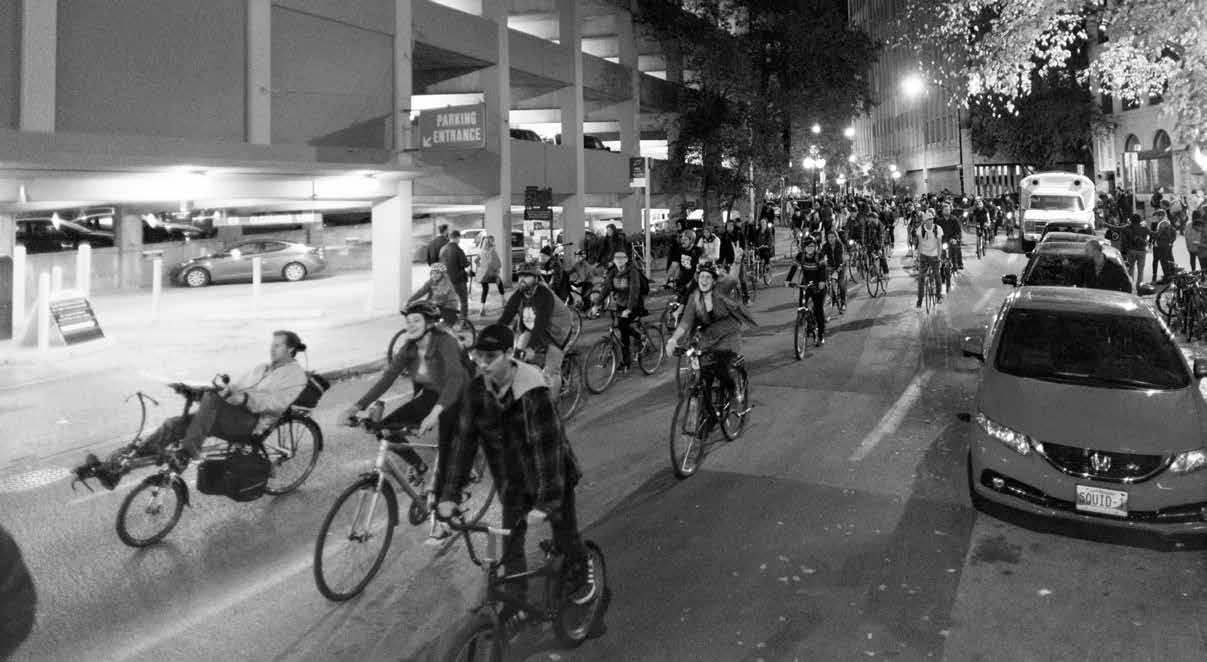
Touring the Exchange District, the streets were littered with a harmony of cars, pedestrians, and cyclists at volumes that could dizzy a typical Winnipegger. Walking from one exhibit to the next was nearly impossible in a group of people because party members would be roped in by a smile or embrace of a friend or acquaintance before you arrived at your desired destination.
One of the biggest draws of the night was the rooftop concert on top of restaurant Deer + Almond. The live performance of band Beth was intriguing and mesmerizing. The singer dangled his legs over the edge of the building, swayed in the light that projected 30-foot shadows on an adjacent building, and danced with various parts of disassembled mannequins while looking down at the hundreds of people in the parking lot leaning on cars and each other.
The festival is littered with hidden gems that, without an event guide, are guided by advice, intuition, and signs placed outside various venues.
After hiking four flights of stairs at a nearby building on McDermot, we arrived at Emergence: Kaleidoscope Café by artist Sandra Krahn. The exhibit features many pieces featuring cut out butterflies and light sculptures as well as oversized kaleidoscopes that projected evolving stained glass images on the walls. The butterflies were used to symbolize missing and murdered Aboriginal Women in Canada and the artist encouraged the audience to provide written feedback on the exhibit and stay for tea and bannock.
Head in the Clouds by Alexander Grant and Naomi Ratte was easily stumbled upon, as it was an exhibit
people were drawn to, possibly through subconscious childhood glee. The exhibit was an alleyway filled with illuminated balloons that resembled clouds and flickered to an orchestra of sounds. Standing on benches allowed the participants to view the exhibit from over top of the “clouds” and the contrast of billowing white balloons and cold brick was quite beautiful.
The most stunning piece of art at the exhibit and, judging by the social media attention, the most popular installations had to be CLOUD and The Deep Dark , both created by Caitlind r.c . Brown and Wayne Garrett.
Spare Some Change
The Deep Dark was a series of illuminated doorways that guide participants along a pitch-dark river path. Experimenting with the light and dark and the eerie nature of not knowing what is on the other side of the doorway until one passes through was both exciting and beautiful.
CLOUD is an instillation that was located between the Human Rights Museum and the Esplanade Riel, arguably two of the most well-known pieces of Winnipeg architecture. The playful and interactive instillation featured 6,000 lightbulbs that could be controlled by pull strings that were so long they almost brushed the floor. The sculpture was meant to symbol-
Inaugural installment of local film festival highlights important issues
TO b I nIF es I , staff
Siloam Mission is organizing a creative initiative to tackle poverty and homelessness in the city. The organization has teamed up with the Winnipeg Film Group and Cinematheque to create a twoday film festival called Spare Some Change.
The Spare Some Change festival is scheduled to be held at Cinematheque (100 Arthur St.) on Oct. 12-13. It will feature daytime programming for schools as well as discussions and film screenings about the state and rates of poverty and homelessness in our communities.
As a charity organization, Siloam Mission has worked with several individuals who have struggled with homelessness and poverty and
through this festival, the organization hopes to create more awareness for these issues.
Dave Barber, Cinematheque’s programming coordinator, has been working with Siloam Mission to bring the festival to life.
ize hope and optimism. Weather is something that can be understood regardless of culture barriers and it was meant to be an installation enjoyed by all, collectively looking up with wonder and amazement. Nuit Blanche opens the streets of Winnipeg to the people that want the city to thrive. People of all ages flock to see art, music, performances, and friends in parts of the city that are oozing with culture – from galleries and venues, to historic buildings and private studios. The city embraces the festival and provides the energy to have a thriving event that will certainly be a highlight for many for this year and in the years to come.
need for communities to tackle these issues together.
“[Poverty] is a complex issue and there are lots of factors involved” – Dave Barber, programming coordinator at the Winnipeg Cinematheque
He believes the festival will give people better insights and understanding of these issues.
“Poverty is a serious issue in Winnipeg and is important for discussion,” Barber told the Manitoban
“It is a complex issue and there are lots of factors involved. It is necessary to solve them and I think our
society tends to sweep them under the rug. This is Siloam Mission’s mandate. [Festival goers] will get to think about this subject and some possible solutions.”
The screenings at the festival will involve three documentaries – Us and Them , The Overnighters, and A Dog’s Life – that portray and highlight the struggles of people suffering from addictions, financial turmoil, unemployment, and homelessness, and the
Screening at 7 p.m. of the festival’s first day, Us and Them reveals severe challenges of life on the street in a humorous but emotive manner. It is followed by The Overnighters, which screens at 9 p.m. and is a captivating story of a pastor who ministers to the unemployed and uses his church as a shelter for the homeless.
On Oct. 13 at 7 p.m., the screening of A Dog’s Life will close the festival. Directed by Hélène Choquette, the documentary offers moving and heartbreaking stories of life on the
streets of Toronto and Montreal by exploring the unique relationship between people struggling with homelessness and their canine companions.
For more information about the Spare Some Change festival, visit siloammission.ca