UMSU election results in second consecutive mixed slate
Page 3-4
5 Days for RaY
Asper students head campaign to combat youth homelessness
Snapping the slump
Men’s basketball wins first playoff series in 15 years
Page 23
Hitting back
The Manitoban sits down with PC education critic Wayne Ewasko
Designed with everyone in mind
A discussion of accessible video games
In "Talking transportation" (March 2, page 7), Coun. Janice Lukes was misquoted. The original text quoted her as saying “Transit people don’t care about the sidewalk, the sidewalk people don’t care about
the transit. In all, it helps me to do my job better and that is really important.”
Lukes actually said “There's transit people that maybe don’t care about the sidewalks.
EDITOR-IN-CHIEF
ONLINE COORDINATOR Anu Lotay online@themanitoban.com
The sidewalk people maybe don’t care about transit. There's different groups of people in these conversations, but it helps me do my job better. I think that's really important.”
Tanjit Nagra wins presidency, will lead majority Strong UMSU executive in 2016-17
Mixed slate elected for second consecutive year after narrow vote margins, recount
CRAIG ADOLPHE, STAFF
For the second year in a row students have elected a mixed slate executive to lead the University of Manitoba Students’ Union (UMSU). The incoming executive will be led by president-elect and current Arts Student Body Council president Tanjit Nagra.
In an extremely tight race – in which the margin between first and second place candidates was smaller than the number of spoiled ballots for four of the five executive posi-
President
tions – two candidates from UMSU For You and Strong UMSU each won a plurality of votes in the initial count.
For the final position, vicepresident internal, two candidates (Harrison Katz of UMSU For You and Adam Pawlak of Strong UMSU) tied in the initial count with 1,161 votes each. A recount that extended into early Saturday morning put Strong UMSU’s Pawlak ahead by nine votes.
The final results were:
Tanjit Nagra, UMSU For You – 1,029 votes (28.0 per cent) – ELECTED
Astitwa Thapa, Strong UMSU – 990 votes (27.0 per cent)
Niall Harney, UMSU Forward – 847 votes (23.1 per cent)
Zachary LeClerc, Zach for Pres – 463 votes (12.6 per cent)
Andrew Fenwick, Take Back – 334 votes (9.1 per cent)
Spoiled ballots – 97
Vice-president advocacy
Allison Kilgour, UMSU For You – 1,215 votes (33.9 per cent)
Dara Hallock, Strong UMSU – 1,229 votes (34.3 per cent) – ELECTED
Ashley Penner, UMSU Forward – 1,144 votes (31.9 per cent)
Spoiled ballots – 172
Vice-president external
Wilfred Sam-King, UMSU For You – 1,299 votes (36.0 per cent) – ELECTED
Bénédicte LeMaître, Strong UMSU – 1,208 votes (33.4 per cent)
Hannah James, UMSU Forward – 1,106 votes (30.6 per cent)
Spoiled ballots – 147
Vice-president internal
Harrison Katz, UMSU For You – 1,161 votes (32.1 per cent)
Adam Pawlak, Strong UMSU – 1,170 votes (32.3 per cent) – ELECTED
Anatol Rennie, UMSU Forward – 914 votes (25.3 per cent)
Nick Kuznetsov, Take Back – 373 votes (10.3 per cent)
Spoiled ballots – 142
Vice-president student services
Ashley Richard, UMSU For You – 1,062 votes (29.2 per cent)
Jessica Smith, Strong UMSU – 1,271 votes (35.0 per cent) – ELECTED
Michaela Bohunicky, UMSU Forward – 939 votes (25.9 per cent)
Shahab Valipour, Take Back – 360 votes (9.9 per cent)
Spoiled ballots – 128
Community representatives
Five community representative positions – Aboriginal, international, LGBTTQ*, students living with disabilities, and womyn – were open for nomination. Only four received nominations, with three of the positions going uncontested. The international students’ representative position, which was contested, was put to a recount after the initial count registered a difference of only 9 votes – a 1.2 per cent difference.
Contested – international students’ representative
Masroor Khan, international students representative – 367 votes (49.0 per cent)
Steffan Aganbi, international students representative – 380 votes (51 per cent) – ELECTED
Uncontested – students living with disabilities, LGBTTQ*, and womyn’s representative
Alan Bridgeman, students living with disabilities representative – 85.4 per cent (181 yes; 31 no) – ELECTED
Theo De Silva, LGBTTQ* representative – 89.5 per cent (314 yes; 37 no) – ELECTED
Smriti Kunwar, womyn’s representative – 88.8 per cent (1,591 yes; 201 no) – ELECTED
No candidates were nominated for the position of Aboriginal representative. UMSU council is expected to open nominations and select a candidate to fill the position for the coming year sometime after May.
Referendums
The University of Manitoba’s chapter of the World University Service of Canada had their $2.50 fee increase pass by referendum with 66.6 per cent of the vote (2,446 yes; 1,224 no; 84 spoiled).
Campus radio station 101.5 UMFM had its proposed $1.50 fee increase defeated with only 45.6 per cent of voters supporting the motion (1,686 yes; 2,016 no; 61 spoiled).
Features Editor: Lauren Siddall Contact: Me@themanitoban.com
5 Days to combat youth homelessness
Asper students head campaign to benefit Resource Assistance for Youth, increase fundraising goal
LAUREN SIDDALL, STAFF
F
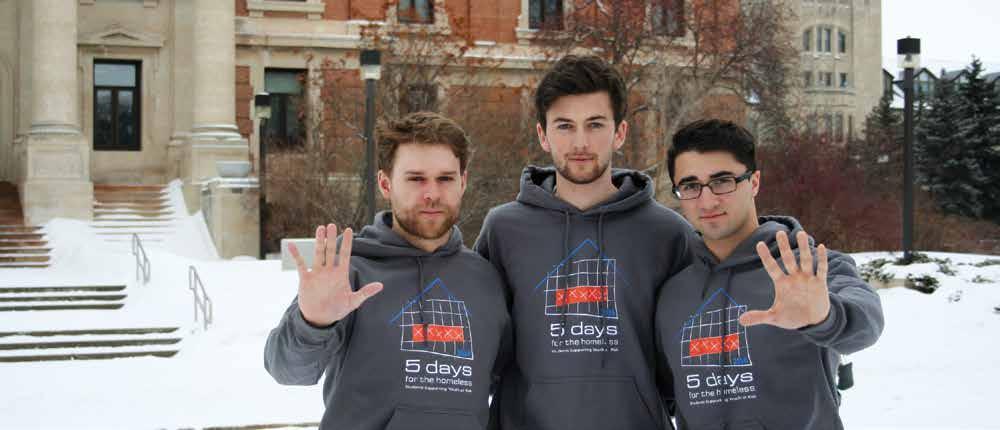
rom March 7 through 12, six University of Manitoba students will be living outside as part of the 5 Days for the Homeless initiative.
5 Days for the Homeless was founded by the University of Alberta’s school of business in 2005. The initiative quickly caught on, and business schools across Canada started taking part. Five “sleepers” live outside for five days to simulate the experience of homelessness in an attempt to raise money for local charities supporting homeless individuals, as well as raise awareness of the stigma surrounding homelessness.
This year, the co-ordinators for 5 Days for the Homeless have added extra events to try and make more of an impact and attract a larger crowd – including a five-kilometre run and a performance fundraiser.
The U of M chapter has set a lofty goal of $25,000 for their eighth year participating in the nation-wide initiative – $5,000 more than last year’s goal. All of the money raised throughout the campaign period will be donated to Resource Assistance for Youth (RaY), a non-profit organization working with youth experiencing homelessness in Winnipeg.
RaY, in addition to providing homeless youth a safe place to have a meal, take a shower, and do their laundry, also provides valuable resources such as job training. RaY also works with homeless youth and local landlords to help them come to a rental agreement and secure a place to live, in addition to addressing the issues associated with living
in a harsh environment that leads to the individual being homeless at a young age.
“RaY does a lot of great things there. We got to do a site visit and chat with some of these homeless youth. It was really a paradigm shift for me – it changed my perception to see how real it is,” said the U of M’s 5 Days for the Homeless co-chair George Semchuk.
“I got to know RaY really well and got to see what they do firsthand – they do have a big impact” – Myles Dancho, 5 Days for the Homeless co-chair
“These people are our age, and doing this campaign of simulating the experience to raise awareness for it here at the university is a great way to help out and give to that awesome charity that supports those youths,” he added.
Semchuk’s co-chair, Myles Dancho, agrees. After being involved with the initiative for two years collecting donations, he has nothing but good things to say about 5 Days for the Homeless, and the beneficiary.
“I got to know RaY really well and got to see what they do firsthand –
they do have a big impact,” said Dancho.
Cam Teschuk, one of the sleepers this year, is also excited to get involved with the campaign.
“This is an initiative that I’ve seen grow and evolve every year that I’ve been at this school, and it’s always something I’ve wanted to be a part of because it’s such a good cause – it’s an initiative that I care about. To have that experience as I’m now going into the workforce and moving on will help me spread what I’m going to learn to other communities outside the university,” he said.
As for the organization benefitting from the campaign, Teschuk couldn’t be happier.
“I think what distinguishes this campaign from Siloam Mission and Winnipeg Harvest initiatives is the fact that it is directed at youth and people our age. When you go to those bigger charities and shelters, you see a lot of older people and people who have struggled with homelessness for a long time and you almost feel detached from them. But what’s unique about RaY is that you’ll go and meet someone who’s been touched and affected by RaY, and it could be someone that you’ve met in class one day – that’s what it really feels like,” he said.
In his experience with the campaign over the last few years, Dancho has also noticed the amount of stigma surrounding homelessness, and around the campaign specifically, which they are looking to address this year.
“Being involved the last couple years, the first thing I notice is that stigma. We don’t want it to be seen as a mockery of homelessness. We understand that these individuals sleeping outside are not going through even close to what these individuals who are actually experiencing homelessness,” he said.
“It is a great cause – it’s just a matter of making people aware of it” –George Semchuk, 5 Days for the Homeless co-chair
To prepare for the upcoming week of fundraising, Semchuk and Dancho have been working closely with the University of Manitoba Students’ Union, and current president Jeremiah Kopp specifically, to try and establish corporate sponsors. But, according to the co-chairs, the main focus has been raising awareness and promoting campus-wide involvement.
“The overarching goal is definitely awareness, and full-campus involvement. Though it is facilitated by the Asper school of business and the Commerce Students’ Association, that’s the way it’s been set up, our big thing this year has been to make it campus-wide. We’re trying to
BY LAUREN SIDDALL
make every single faculty involved as much as we can, and make every single student aware of what we are doing and that it is benefitting local youths experiencing homelessness,” Dancho said.
“Once there’s that awareness out, people are very happy to help the cause. It is a great cause – it’s just a matter of making people aware of it,” added Semchuk.
Teschuk’s experience of preparing for the initiative, he says, has been quite the opposite of Dancho and Semchuck’s experience on the administrative side.
“I’ve tried to go out of my way to prepare as little as possible. It’s not an authentic experience if you’re planning out what you’re going to wear everyday or what you’re going to eat, or looking at the weather. I’ve tried to go in completely blank, trying to simulate the experience as close as possible in this unique atmosphere.”
“The only real preparation that I have done is talk to people and try and raise awareness, just letting people know about the campaign who haven’t heard about it before and trying to get more people involved outside of just the Asper school,” said Teschuk.
5 Days for the Homeless is taking place from March 7 to 12. For more information, or to donate, visit 5days.ca/schools/ university-of-manitoba
PHOTO
Science & Technology
Editor: Chantelle Dubois Contact:
Chimpanzee activity may be ritualistic
Theories abound after chimps filmed displaying odd behavior
MALAK ABAS, STAFF
Chimpanzees in West Africa have been filmed throwing rocks at trees. This alone seems not so unusual, but the real mystery is that no one knows why.
After discovering piles of stones up against trees with certain markings on them, scientists from the Max Planck Institute for Evolutionary Anthropology set up motion-activated cameras at four research sites
near trees with similar markings in West Africa.
The researchers observed chimpanzees flinging stones at tree trunks.
The video also showed other chimpanzees softly placing rocks at the base of the tree. They found chimpanzees displaying similar behavior in several areas, but the trees appeared to be specifically chosen for this activity.
Interestingly enough, this activity has not been observed anywhere besides West Africa. While it is known that chimpanzees use rocks as tools, this performance did not appear to aid the chimpanzees in foraging, mating, or even playing.
Laura Kehoe, a PhD researcher in wildlife conservation and land use at the Humboldt University of Berlin, was the first to discover this behavior.
“Nothing like this had been seen before and it gave me goose bumps,” Kehoe wrote in an article for Scientific American
Theorizing on the purpose of this activity has already begun, with a study published in Scientific Reports in February. The study considers two theories in particular.
The first is that throwing rocks could be a male display. The loud noise of the rock against tree bark could be a way to attract females and intimidate other male chimps. However, not only adult male chimps were observed throwing rocks, and the female and young chimps who were also doing it exhibited vocal behavior similar to the adult males.
Many things that were once believed to be specifically human activities, such as the building of tools, are traits found in chimps as well
“[Rock throwing as a male display] could be especially likely in areas where there are not many trees with large roots that chimps would normally drum on with their powerful hands and feet,” Kehoe said.
“If some trees produce an impressive bang, this could accompany or replace feet drumming in a display and trees with particularly good acoustics could become popular spots for revisits.”
The second theory, however, suggests that this activity is ritualistic in nature. It is possible that the chimps are throwing, placing, and arranging rocks as some sort of sacred ritual.
The activity could be considered a cultural one, seeing as it is confined to a certain geographical location. If this were the case, it would prove that there is much more to the nature of chimpanzees than scientists currently know.
“The Cultured Chimpanzee”
The study was a part of the Max Planck Institute for Evolutionary Anthropology’s project titled “The Pan African Programme: The Cultured Chimpanzee” (or PanAf), which seeks to understand the different natures of chimpanzees from different environments.
By using investigative methods such as camera traps, fecal samples, and isotope analysis, the project looks to connect varied chimpanzee behavior to the cultural evolution of human beings.
“The PanAf project represents a new approach to studying chimpanzees and will provide many interesting insights into chimpanzee demography and social structure,
genetics, behaviour, and culture,” said Hjalmar Kuehl of the Max Planck Institute for Evolutionary Anthropology, in a news release for the study.
“The PanAf is only possible due to the numerous collaborations with chimpanzee researchers, field workers and national wildlife authorities in 14 countries across Africa.”
The humanity of chimpanzees
Chimpanzees are innately social creatures. They have a strong sense of community and family ties, much like humans. Their similarities with human beings are stunning. Many things that were once believed to be specifically human activities, such as the building of tools, are traits found in chimps as well. Chimps also kiss, hug, and hold hands. Humans and chimps have DNA that differs by only one per cent.
The throwing and placing of stones might be a similarly human activity that chimpanzees also partake in. Kehoe notes that humans themselves have collected stones as a means of tribute throughout history.
“Indigenous West African people have stone collections at ‘sacred’ trees and such man-made stone collections are commonly observed across the world and look eerily similar to what we have discovered here,” she said.
Animals performing rituals that mimic the rituals of human beings is not an entirely new concept, and it has been found before in intelligent species. Elephants, for example, will sometimes visit the carcass of a recently deceased fellow elephant in their community. They will hover around the body, in a manner that could almost be compared with humans and funeral proceedings.
How to get involved
The Max Planck Institute for Evolutionary Anthropology has also initiated the Chimp & See project, which allows any person who signs up on their website to browse over 7,000 hours of chimpanzee footage collected by researchers. The project asks that volunteers who sign up online browse footage and identify different types of chimpanzees and note their activity.
To learn more about the PanAf project or to join Chimp & See, visit www. chimpandsee.org
GRAPHIC BY BRAM KEAST
Synthesizing substitutes for rare elements using inorganic chemistry
Researcher profile: David Herbert
JEREMIAH YARMIE, STAFF
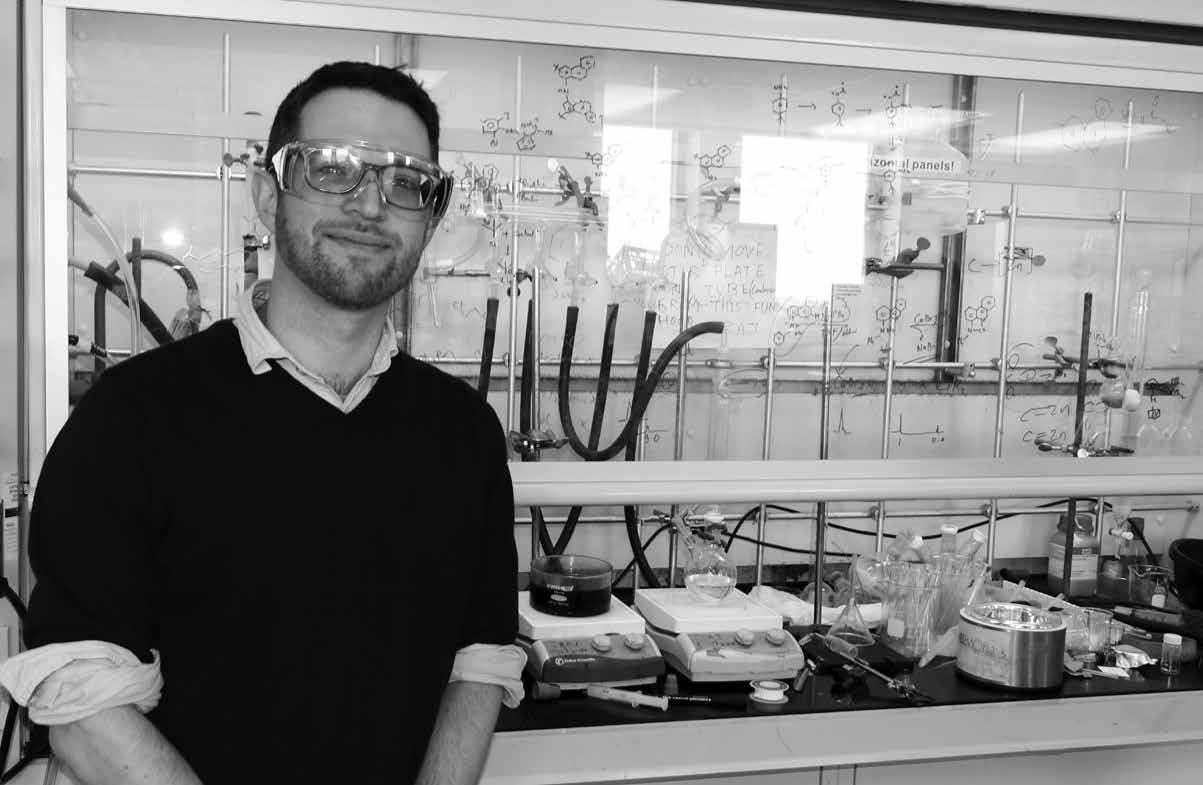
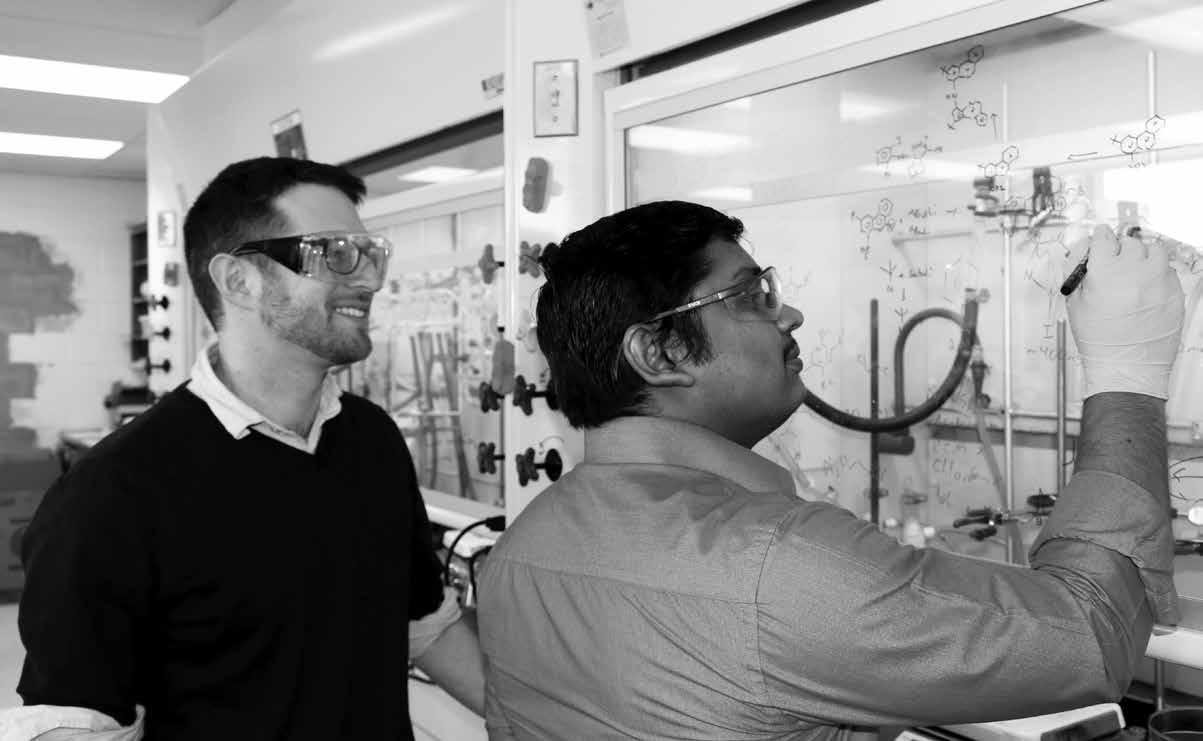
David Herbert is an assistant professor in the department of chemistry. As a synthetic inorganic chemist, he uses chemical reactions to produce particular molecules or compounds of interest.
“The focus of inorganic chemistry tends to be on the roles of elements other than carbon, hydrogen, nitrogen, and oxygen, which are the socalled organic elements,” Herbert told the Manitoban
“Synthetic chemistry is all about moving electrons around – forming and breaking bonds.”
Inorganic chemistry also focuses on organometallic compounds, or molecules that contain a carbon atom bonded to a metal.
“Our current interests are in using inorganic chemistry to try and solve certain problems that we think are important,” said Herbert.
Herbert’s lab designs and synthesizes molecules that can be applied in a variety of different fields, including the production of clean and renewable sources of energy.
“We’re really interested in converting electricity, either derived from sunlight or renewable sources like hydro, which is hugely important in Manitoba, and using that energy to drive chemical reactions,” said Herbert.
Through these reactions, energy can be stored in the form of fuel or used to create products that are currently created using fossil fuels.
Herbert’s lab also focuses on replacing scarce elements that are often used for their unique chemical properties.
Examples would include iridium and platinum, both of which are used in materials for their light-emissive properties.
“What we’re trying to do is design molecules that can be based on more abundant elements, like copper or zinc, to perform at the same level as we can get with the more expensive and scarcer elements.”
The Herbert lab is also interested in making organic molecules by deriving the carbon molecules from carbon dioxide, reacting through a sort of artificial photosynthesis.
Photosynthesis is a process in which plants use the energy from sunlight to convert carbon dioxide taken from the air into sugar. Unfortunately, artificial photosynthesis by humans has not gotten anywhere close to the efficiency of plants – a process perfected through millions of years of evolution.
“If you are trying have solutions for things like climate change that really require the globe to act in concert, those need to be distributable [...] That idea of distribution means that we have to target things that are abundant,” said Herbert.
“There is this interesting interplay between government policy and economics. There is a refrain that comes up often where politicians say,
‘We would love to do things that are expensive, but we just can’t right now because of the economy.’”
Herbert says it is important to find solutions based on abundant materials which don't require excess costs, in order to have a chance of convincing people to adopt such technologies.
Besides the environment, there are many other reasons why divesting from scarcer elements is beneficial.
For example, consider the sociopolitical implications of using conflict minerals sourced from the Congo in our electronics.
Herbert is also involved in the Solar Hydrogen Activity research K it (SHArK) North!, an outreach program in association with high school students from Daniel McIntyre Collegiate.
“One thing that I think is impor-
tant about the SHArK program is that it’s not simply outreach – it’s actually an opportunity for students from local high schools to do active research,” said Herbert.
Through the SHArK program, high school students are able to look at the chemical repertoire that the periodic table has to offer, and choose different compounds to test to see if they can help facilitate this water-
splitting reaction.
“The idea is to use crowdsourcing to try and discover new materials that are capable of performing water-splitting reactions.”
As the next generation is at stake if climate and energy issues are not solved, engaging young people in alternative fuel source research will help them better understand their future.
PHOTOS BY MEGAN COLWELL
GRAPHIC BY BRAM KEAST
COMIC BY KELLY CAMPBELL
Cre8ery hosts old campus art community
Collaborative exhibit features seven former school of art classmates
TOBI NIFESI, STAFF
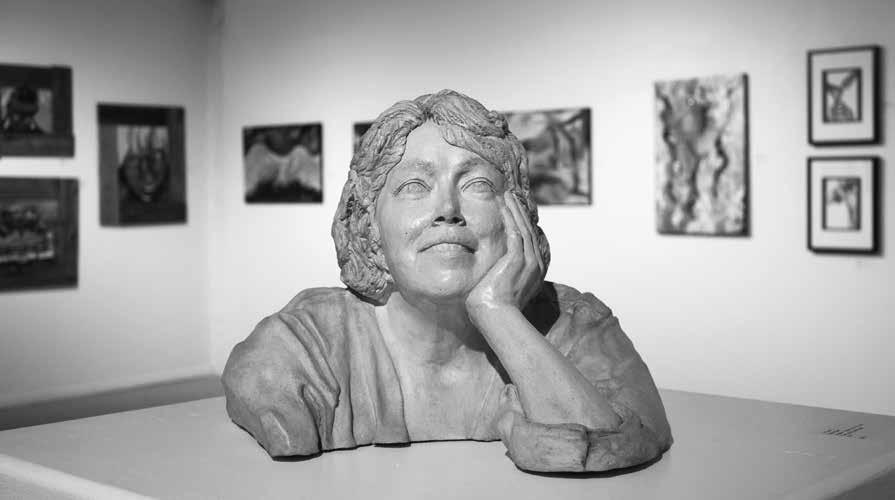
From March 5-15, seven local artists who all attended the University of Manitoba’s school of art together are collaborating to showcase an art exhibit aptly called Re:Union at Cre8ery gallery and studio, which is located at 125 Adelaide St. in Winnipeg’s exchange district.
The artists – Elaine Baril, Jordan Miller, Brian Pollreis, John Roshon, Dawn Wilkinson, Louise Valcourt, and Stevan Siemens – all attended the U of M together from 1997-2003 and have displayed shows with one another at a few venues over the years.
“Art-making can be a lonely process, so having a community brings strength and camaraderie”
– Lou Valcourt
The Re:Union show, however, marks the first time all seven former classmates will be displaying their work together since graduation. Each artist brings to the table their distinctive and unique art styles to spice up the exhibit.
Miller owns and runs Cre8ery, and it was her idea to finally get the group back together to display under one roof.
“We are all graduates of the U of M bachelor of fine arts honours programs,” Miller told the Manitoban
“Some of us started a gallery after art school, and some of us continued to exhibit together.”
According to Miller, in 2002, five out of the seven started a gallery called Five on Third, which was eventually renamed to Outworks Gallery and lasted until 2011.
Whether they owned a gallery together or simply collaborated on shows, all the artists have managed to keep in touch with one another over the past 13 years.
This show aims to promote the idea of long-term collaborations amongst artists.
“Over the years we have kept in touch through not only showing together, but have also made a point to reach out and get together as friends, and reconnect from time to time,” said Valcourt.
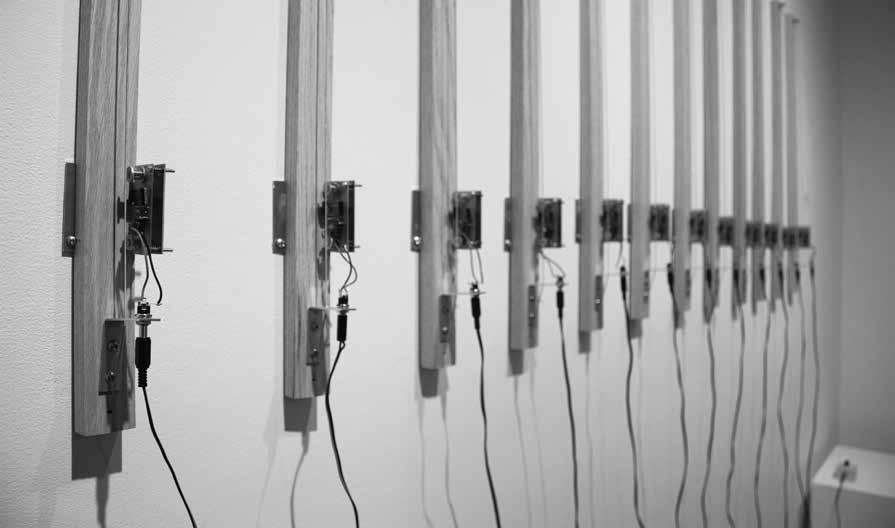
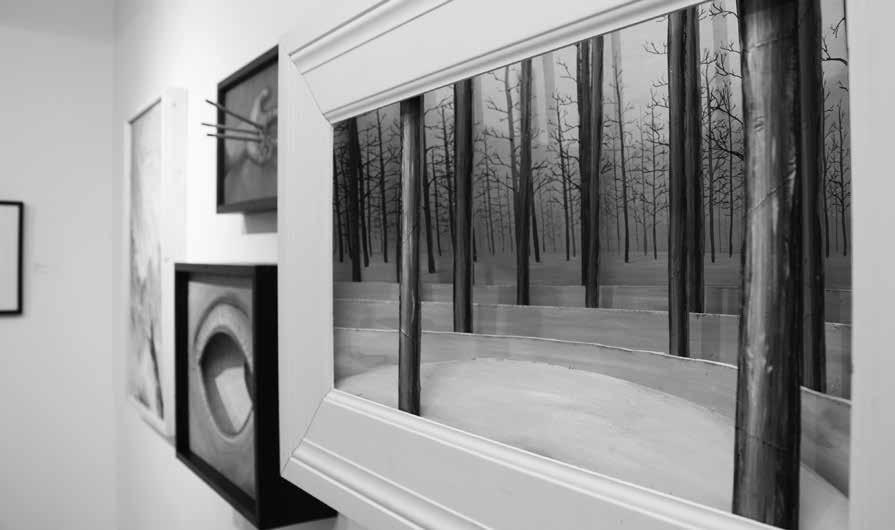
Re:Union works to highlight the artists’ unique styles, and how they complement each other: Baril draws inspiration for her paintings from
nature, while Miller wanders freely within the confines of her canvas by creating abstract paintings. Pollreis’s works explore three-dimensional media and his own perception of nature, whereas Roshon uses wood, paper, and sometimes beeswax to showcase the beauty of the cycle of life. Wilkinson uses photographic paintings to celebrate everyday life, Valcourt’s acrylic and mixed media paintings explore the subconscious, and Siemens’s art/science installation uses sound waves to express moods.
This collaboration of these talented artists and their art styles has created a common theme of bold and expressive colours, organic structures, and sheer fun.
“We have a nice mix of representational and abstract art, colorful bold styles and softer pieces, as well as sculptural and found art,” Valcourt commented.
“The contrasts work together well to form a unique voice that varies in visual tone.”
The artists hope to encourage both artists and art students to stick together and collaborate more. This way, they can continue to stay motivated in a line of work that can sometimes make one feel lonesome.
“The contrasts work together well to form a unique voice that varies in visual tone” – Lou Valcourt
“It can be daunting as new artist out of art school, trying to figure out your next steps on your own,” said Valcourt.
“Art-making can be a lonely process, so having a community brings strength and camaraderie, and resources that you can pull together. You can encourage and motivate each other. I find it very inspiring.”
For more information on Re:Union, including gallery hours, visit www. cre8ery.com
PHOTOS BY CAROLYNE KROEKER
Sarasvàti seeks solidarity through storytelling
This year’s Cabaret of Monologues to tackle gendered violence globally and locally
SEAMUS HAMILTON-PATTISON, STAFF
In honour of International Women’s Week, experimental theatre company Sarasvàti Productions will be hosting their 13th annual Cabaret of Monologues at the U of W’s Asper Centre for Theatre and Film.
“When we started doing the initiative, it was really about finding a way to tell as many stories as possible,” Sarasvàti Productions artistic director Hope McIntyre told the Manitoban
“It’s just been so popular that every year we talk about if there’s still a desire for it and yeah, there is, so that’s been fabulous for us.”
The cabaret – which will be
performed at 4 p.m. and 8 p.m. on March 12 – will feature ten actors performing traditional monologues or slam poetry/spoken-word pieces either written by themselves or notable Canadian playwrights.
The ten performances run the gamut from serious to comedic – with topics ranging from a game show for women (in which the winner’s sexual assault claim is deemed believable) to the silent issues faced by indigenous women in local communities.
“We’ve discovered that, every year, there’s something that clearly is the top of people’s minds in the community, so every year there’s an ability to find a theme, topic, or issue that we can use to create a tying or linking-in of all the pieces,” McIntyre said of the cabaret’s longevity.
This year, the production’s theme is Stolen Sisters. This is a clear reference to the prominent issues of missing and murdered indigenous women in Canada, though McIntyre said the theme is meant to extend to cover gendered violence as a whole.
“A lot of the pieces do deal with missing and murdered women and
are very specific to the indigenous community [...] but then also, we had submissions and response from people addressing it on a different kind of perspective, the whole concept of popular culture,” said McIntyre.
“We’ve had so many high-profile cases of sexual assault by media figures, by celebrities. The trials, the back-and-forth on them go on for years. Some writers were really interested in tackling that side of the story.”
McIntyre went on to explain that it was also important to explore the theme on a global scale, as gendered violence abroad can present itself in many entirely different forms.
“We specifically set out and talked to communities, and created a piece about the stolen girls [...] in Nigeria from April 2014 when the girls were taken by [Nigerian-based Islamic extremist group] Boko Haram.”
With regards to selecting pieces and performers for the cabaret, McIntyre told the Manitoban that the process is generally “as accessible as possible.” This year however, there was a distinct emphasis on engaging
’Toban turntable
The Zolas’ third studio album
Swooner is an upbeat, vibrant, and engaging experimental indiepop album.
Opening track “Molotov Girls” sets the mood for the album, with a busy backing band and catchy riff that carries on throughout the song, aside from on its equally catchy chorus. “Molotov Girls” seems like an introduction to all the instruments the Zolas have at their disposal, with certain sounds making one-time appearances to keep you on your toes.
An empowering, feministic pop anthem, Swooner ’s title track is the all-male band’s salute to the highfunctioning women that seem to have it all by working for what’s theirs.
The Zolas do a great job combining hard-hitting guitar with an overall really synth-y sound, especially with the track “CV Dazzle.” This combination makes for a successful, yet experimental-sounding tune.
“Freida on the Mountain” is a standout track simply because it’s so different from the others. It’s a complete throw-off from the album’s indie-pop aesthetic at points, and the chorus sports
Beatles-like vocals met with a memorable piano melody.
“Why Do I Wait (When I Know You’ve Got a Lover)” starts off with a guitar and vocal harmonies, before kicking in the synth and transitioning to a fuller instrumentation. This is one of the only slow tracks on the album, and it features some ethereal vocals playing between different effects to match the experimental nature of the song. Every track on the album is catchy and dynamic. Making it to number two on Texas-based Canadian indie music radio show
This Great White North ’s list of the “Top 10 Canadians to Watch at
SXSW” is evidence enough that the Zolas’ tour is going to sell fast – a tour that’s making its way to Winnipeg’s Park Theatre on April 2. The band’s combination of kinetic live energy and an album this solid definitely makes them something to check out.
www.thezolasmusic.com
Tickets to the Zolas’ show in Winnipeg are $20 in advance, and may be purchased online via www.ticketfly.com or in person at the Park Theatre and Music Trader.
the local community.
“We reached out to the community to find artists with lived experience, people who wanted to tell their stories,” McIntyre explained.
“That led to some different ways of telling stories. Definitely with Mary Black’s piece QUIET – which has kind of gone viral – it’s very much a different medium, because she’s throwing on her own story and storytelling tradition as an indigenous woman.”
With a collaborative event of this nature involving so many different performers, it comes as no surprise when McIntyre explains that one of the most incredible parts of putting on the production is simply watching the performers get to know one another.
“Bringing all 10 performers into one space, it’s this amazing energy,” said McIntyre.
“I think in the years we’ve done it, most of the artists have talked about that as part of the beautiful thing with this experience. Working with the other artists, coming into the room together, hearing their pieces –
it’s really a fabulous chance to share.”
With the acquisition of artists like Black and Shamin Brown – whose spoken-word piece, Finding Freedom, challenges the marginalization of women and girls in the sex trade –McIntyre said she’s pleased that the Cabaret of Monologues has grown beyond being a purely local event.
“I think when you talk about something like gender-based violence or some of the other topics we’ve tackled, you certainly see that both across this country and globally, there are commonalities,” said McIntyre.
“That’s very interesting to look at, how an indigenous Winnipeg woman’s story has some of the systemic issues that you would also see affecting women in Nigeria.”
The Asper Centre for Theatre and Film is located at 400 Colony St., adjacent to the U of W main campus. Tickets are $10 at the door, or $12.50 in advance from www.sarasvati.ca
The Small Glories Wondrous Traveller 5/5
Winnipeg folk/roots duo the Small Glories open up their debut album with a clap and banjopicking beat, followed by dueling male and female vocals throughout the entire song, titled “Had I Paid.” The two weave through unpredictable harmonies and play off of one another with extremely impressive, breathtaking ease.
Cara Luft is an ebullient and engaging earth mother, contrasted and complimented by JD Edwards – a seemingly intimidating “cross between a biker and a long-haul trucker.” Together, they’ve joined forces to put together a truly beautiful album.
The banjo flows through “Home,” and the vibrato in Luft’s voice is truly mesmerizing. First accompanied by only Edwards and then, unexpectedly, a full choir, it’s a beautifully emotional song with tear-jerking lyrics.
In “Fast Turning World,” Edwards and Luft trade verses, but share the chorus. It sounds like authentic 1960s-70s American folk with Luft sounding eerily like Joni Mitchell at points, with impassioned lyrics to boot.
“1000 Stars,” originally by fellow local songwriter Greg MacPherson,
reminded me of the first time I heard Fleetwood Mac’s Rumours It’s extremely unpredictable, and the decisions they make musically are so odd, but they never seem wrong. Once again, mesmerizing.
“Way Over Yonder” is a really fun song. On this one, Edwards and Luft have an additional twang to their voices, laughing and hollering on the track while accompanied by a wide assortment of instruments that tend to weave in and out of one another as opposed to remaining consistent throughout the song.
This is an altogether solid album from beginning to end, and by far one of the most diverse local albums I’ve ever encountered. Edwards and Luft are a perfect match – their voices together are magic in the making. They’re such accomplished solo musicians with a dozen critically-acclaimed albums between them – and together, they’re unstoppable.
www.thesmallglories.com
The Zolas Swooner 5/5
OLIVIA MICHALCZUK, STAFF
OLIVIA MICHALCZUK, STAFF
PHOTO PROVIDED BY SARAVASTI PRODUCTIONS
ALBUM ART PROVIDED BY INDOOR RECESS INC
PHOTO PROVIDED BY TAKE AIM MEDIA
Ratzlaff’s Reservations makes world debut
New play resonates personally and politically
TOBI NIFESI, STAFF
Steven Ratzlaff is set to debut
his new play Reservations at the Rachel Browne Theatre (211 Bannatyne Ave), where it will run from March 10 to 20.
This Theatre Projects Manitoba production attempts to challenge common views and opinions about the real cost of being settlers, and poses tough questions about our home, identity, and history as Canadians.
The first act of Reservations focuses on a battle between foster parents and the Aboriginal Child and Family Services agency responsible for their children, while the second tells of the philosophical and spiritual journey of a Mennonite farmer who gifts his land to the Siksika nation.
A playwright who does not shy away from politically controversial subjects, Ratzlaff points out that there are issues in this play that will resonate with every Manitoban regardless of their beliefs.
“I don’t think it is possible to be an awake Manitoban without feeling some kind of personal relation to issues like these,” Ratzlaff told the Manitoban
“It seems like there is an interesting legacy and situation that we are all implicated in. I feel like there is that personal connection of living in this place.”
Reservations will be co-directed by Ian Ross – a recipient of the 1997 Governor General’s Award for English Drama – and Emma Tibaldo, the artistic and executive director of Playwrights’ Workshop Montréal.
Together, Ross and Tibaldo hope to get their cast – consisting of Ratzlaff himself, Tracey Nepinak, and U of M alum Sarah Constible –
to creatively draw the line between performing and making political statements.
“Every good play asks good questions,” said Ross.
“How many movies have we seen about 9/11? Zero. Why haven’t we seen that discourse and engagement? There is a part of us that does not want to ask those questions [...] this is what theatre does. It pulls up a mirror and says, ‘look, this is who I see you as, do you like what you see?’”
Nepinak told the Manitoban that she too is excited about this type of politically charged, provocative theatre.
“This is what theatre is supposed to be about – to inspire discussions, make people think about the big picture in a way that is accessible.”
For these thespians, the issues addressed in this play are very close to home, and it could be quite challenging to stage a performance. However, all involved recognize the importance of raising awareness and provoking thoughts amongst their audience.
“It’s challenging but it feels dangerous,” said Constible.
“It’s nice to work on something so timely.”
According to Nepinak, Reservations is simply telling a story
with the honesty and directness it needs.
“My late husband said one time, ‘being an Aboriginal person in Canada is a political act, you can’t just be neutral about anything.’ For me, that is part of who I am,” Nepinak explained.
“This play in particular speaks to me for a lot of reasons [...] It is a story that needs to be told now. We need to have these honest, open discussions. It’s a little more than just art.”
The stories told in Reservations are curated to both educate and entertain Canadians of all ages. That being said, the play does pose a challenge
to young people who are unaware of, or have questions about our nation’s history.
“You are young and an adult, and in an intellectual stream of your life right now where you get to absorb so much different information and do something with it,” said Constible.
“For U of M students, seeing this and being aware is very essential.”
Tickets to Reservations are $15 for students, $20 for seniors, $25 otherwise, and are available online at www.theatreprojectsmanitoba.ca along with specific show times and dates.
PHOTO BY LEIF NORMAN
One last lap
Catching up with Bison swimmers Dillon Perron and Kimberly Moors as they complete their final year of CIS eligibility
MIKE STILL, STAFF
The fall of 2012 was a major landmark in the lives of Bisons swimmers Dillon Perron and Kimberly Moors, marking a second chance for both of their CIS careers.
Perron, 24, had originally swam with the team in 2010, while Moors, 29, had started in 2004. Neither, however, was quite happy with where they were academically and chose to take some time off. Though their stories may be slightly different –with Moors taking a more extended break – fate brought the two sprint distance swimmers back in the fall of the same year and neither have looked back since, leaving a permanent mark on the Bisons swimming program.
“I feel like I found myself a little bit. I was kind of going through some personal issues in my life, so I just kind of joined swimming to heal myself and I wanted to be a strong role model for my daughter as well” – Kimberly Moors
Perron’s accomplishments over the years have included a first place finish in the 50- and 100-metre breakstroke at the 2012 Canada Cup (shattering two Bisons’ and provincial records), as well as four medal finishes in the past two years at the CIS National Championships. Last season, Moors became the first Bisons women’s swimmer to medal at the National Championships since 2006, and followed that up with a silver medal in the 50-metre butterfly in this year’s championships.
Takeaways
While their time with the program has officially come to a close, both swimmers have nothing but fond memories of the past four years and have also learned a fair amount of about themselves in the process. For Moors, a dedicated single mother, her return to the pool was beneficial both mentally and emotionally.
“I feel like I found myself a little bit. I was kind of going through some personal issues in my life, so I just kind of joined swimming to heal myself and I wanted to be a strong role model for my daughter as well,” Moors said.
“I think now that I’m towards the end of swimming, and I’m graduating, it’s like wow, I did all this. I just feel like I can do anything I put my mind to now.”
Perron was quick to emphasize the
enjoyment aspect.
“I think, as cliché as it sounds, just learning to have fun [swimming].
You go through phases where you feel like you’re not having success in the sport and it feels a lot like work –not fun work,” Perron said.
“Especially this past year, I knew it was probably going to be my last year swimming and definitely my last year with the varsity team obviously, and just trying to enjoy it and really have fun in the water, so that’s kind of the way I attacked the CIS national championships this [past] weekend – just to remind myself to have fun while racing. I think that’s probably one of my biggest takeaways.”
For Moors, her biggest takeaway has been the ability to manage tension and anxiety.
“You learn that sometimes you just can’t control everything,” Moors said. “Sometimes my daughter is sick and I’m like ‘oh no, I can’t go to school or make swim practice and now I’m going to have to make up that swim practice,’ so for me, it’s just learning how to balance my roles and coping with stress.”
“I think I’m a better mom, because I’m able to tackle and organize my life in a certain way, so I just feel like I’m overall a better parent and even a better student, because swimming and training that much in a week, plus doing the schoolwork, that takes discipline as well.”
Maturity
Both standout athletes have become role models to their teammates due to their perseverance both inside and outside the classroom.
Perron, for example, struggled with his grades when he first enrolled at
the U of M and has now became an Academic All-Canadian.
“A lot of the determination and competitiveness that I have within myself has translated into school, so that’s obviously one thing that I took from the sporting world and was able to apply to my academics and it worked out really well,” Perron said.
“Obviously you don’t enjoy every course you take, but for me, I just wanted to see if I could get an A in this course just because I wanted to, and it’s the same thing I do in the water.”
Being a mature student, Moors has generated considerable respect from her teammates due to her past accomplishments as well as life
experience.
“Since I’m a mom, I kind of feel like a lot of the girls have looked up to me. I’ve driven a lot on the meets, so at the end of the meets, I do a three highlights of the meet, and the girls just love it, so I like to think that we’re both [herself and Perron] positive role models,” Moors said.
What’s next?
Swimming-wise, both Perron and Moors will head off to the Olympic trials in just over a month , and each have stated that will likely be the final event in their competitive swimming careers. Moors will graduate with her kinesiology degree this April and is planning to take a year off to be a
personal trainer and then apply to get into occupational therapy. Perron will continue his involvement as a swimming coach with the Junior Bisons as well as his own company, which he started last summer.
When asked if they plan to maintain a presence with the swim team after the year is done, both agreed unanimously that they would.
“It’s a really weird feeling getting ready to wrap it up, so I think it would be nice to kind of keep the ties,” Perron said.
PHOTOS BY CHRIS ZUK
Hot takes with Steltsy and Still
Talking Winnipeg Jets and concussion spotters in the NHL
MIKE STILL AND RYAN STELTER, STAFF
This week is an NHL edition of hot takes, as Ryan discusses why fans shouldn’t be too upset with the Winnipeg Jets’ current record and Mike provides his input on having spotters at NHL games to try and identify concussion symptoms among players.
‘C’-ing
Expectations are too high for the Jets
Many Winnipeggers are scratching their heads about the dismal season the Jets have had so far. With less than 20 games remaining in the season, Winnipeg looks primed to be
in the race for prized prospect Auston Matthews. I have some unfortunate news for Jets fans; this is the way they should be playing.
Last year was a fluke, to be frank. The Jets took advantage of a down year in the Western Conference, with
both the Los Angeles Kings and San Jose Sharks not making the playoffs. The lack of competition from the Pacific division allowed Winnipeg to squeak into a wild card spot.
This is a developing team and they have a plethora of young talents such as Connor Hellebuyck, Nic Petan, Josh Morrissey, and Marko Dano (recently acquired from Chicago). However, this might be a longer struggle, as the Moose have not had a stellar year in the AHL so far. They are currently tied for dead last – not a good showing from the Jets prospects playing down in the minors.
We have yet to see any proof of these kids being able to play at the NHL level, so until we see that, the Jets may be on the outside of the playoff picture for a couple years still. Hope should not be lost yet, but don’t expect the world from this Jets team.
Independent concussion spotters a step in the right direction for NHL
This season, the NHL – as part of their new concussion protocol –placed independent spotters in all 30 arenas in order to help identify potential concussion symptoms. The decision follows the NFL’s installation of the same policy four years ago.
In my opinion, the most critical piece of information about these
spotters is the fact that they operate independently from the NHL teams and are hired by the league.
Prior to this season, teams had the opportunity to hire their own spotters. However, there may have been a bias in that regard, as teams may not have firmly enforced concussion protocol since it wasn’t a league-wide consensus.
The league-appointed spotters also don’t have to be physicians. I believe this is a positive choice, as the “common” man or woman would likely be quicker to point out unusual behaviour displayed by a player as opposed to the former, who may have the tendency to brush off certain symptoms as not “specific” enough to qualify as concussion related, an issue that I’ve personally had in the past when dealing with doctors or trainers.
With an increasing amount of pressure being put on pro leagues to step up their concussion protocol, I have to tip my hat to both the NFL and NHL for finally beginning to take steps towards improving player safety.
You can catch Steltsy and Still’s hot takes every Tuesday morning from 10-11 a.m. on 101.5 UMFM.
the future of the Jets captaincy
W
hen the Winnipeg Jets traded captain Andrew Ladd to the Chicago Blackhawks late last month, Blake Wheeler quickly surfaced as the favorite to wear the “C” next in Winnipeg. The Minnesota
native’s dominant display on the ice and experience as a member of the Thrashers-Jets franchise warrants team captaincy. The choice appears a no-brainer. However, general manager Kevin Cheveldayoff may want
to hold off on the decision.
With the Jets undergoing a youth movement in key positions, the best option might be to allow one of their young lions to develop into a leading player – something that has been a popular choice among other NHL clubs as of late.
The Colorado Avalanche, for example, shocked the league last season with a dominant entrance to the Stanley Cup playoffs led by captain Gabriel Landeskog. Just 19 years old at the time of his promotion, the Swede was given the “C” on his sweater after veteran Milan Hejduk relinquished the captaincy ahead of the 2012-13 season.
The best examples of success with a young leader are Chicago’s Jonathan Toews and Pittsburgh’s Sidney Crosby – both Stanley Cup holders. To a lesser extent, the Islanders named franchise player John Tavares captain of their budding Brooklyn team three seasons ago.
Winnipeg’s line of young talent knows no bounds compared to the average depth chart of any NHL roster. Potential leaders such as Adam Lowry, Mark Scheifele, and Josh Morrissey are emerging. It is evident
that one day, the honor of wearing the “A” or “C” will be bestowed onto them.
Lowry’s father, Dave, captained the Calgary Flames from 2000 until 2002. The current Jets winger plays a similar power-forward role as his father, suggesting that he could also one day emerge as a captain in Winnipeg. Although he does not play a dynamic offensive game as many of the contemporary captains do, Lowry is a natural leader. Realistically, he could be wearing the assistant’s “A” within the next few seasons.
Scheifele, a 2011 first-rounder, is expected to fulfil the role of franchise centre and could be a captain in the NHL one day – although it might take a few years for Winnipeg to first test Lowry and Scheifele as alternate captains.
Two players rivalling Wheeler for the “C” are Bryan Little and Tyler Myers. Little is one of the longest serving players in the franchise since his debut in 2007. Myers, on the other hand, leads by example, with one of his finest moments in a Jets jersey being a selfless shot block with his face to help Connor Hellebuyck to a shutout against Pittsburgh.
However there is a danger associ-
ated with this vision of leadership. The most dominant player on an NHL roster may not be suited for team captaincy. Problematic scenarios have occurred when a supposed “best” player on a non-playoff team is promoted to captaincy, with the highest profile example playing out with the Tampa Bay Lightning in 2001. Vincent Lecavalier had his captaincy stripped that season, with the 1998 first overall pick demanding a trade as a result.
The most likely choice at this time for Winnipeg is Wheeler. With his promotion to captaincy, there is a high chance that either Dustin Byfuglien will regain his assistant status, or Myers will have a letter on his jersey for the upcoming season.
For the Jets, there is no way of figuring this out at the very moment, meaning Cheveldayoff will need to play the waiting game on his next skipper.
GRAPHIC BY BRAM KEAST
GRAPHIC BY CAROLINE NORMAN
Men’s basketball snaps 15-year playoff slump, sweeps Fraser Valley
Bisons move on to Canada West Final Four this weekend
MIKE STILL, STAFF
The University of Manitoba Bisons
men’s basketball team accomplished a huge feat this past weekend, winning their first playoff series since the 2000-01 season. Not only did they win, they did so in emphatic fashion, sweeping a Fraser Valley Cascades team that has made four straight trips to the Canada West Final Four. The sweep was also the herd’s first since 1999-00 – the first year they joined the Canada West conference.
Thursday
The herd dominated the opening contest, taking an early 9-0 firstquarter lead and never looked back, winning 78-59. Fraser Valley had numerous opportunities in the opening 10 minutes to take control of the matchup, however they couldn’t get any shots to fall. The visitors missed their first three shots – all clean looks – and scored just 10 points in the first.
Statistically, the game was relatively close. The Bisons had just two more rebounds (45-43) and neither team made more than two treys apiece, however it was the home side’s hustle and depth on the bench that made the difference.
The Cascades had copious opportunities for put-back points off offensive rebounds, but were simply unable to convert against the Bisons’ aggressive defense. Nate Brown – a commanding post player for Fraser Valley – was negated all game long by a combination of Wyatt Anders, Brett Jewell, and Jonathan Alexander, who was tremendous as a reserve once again and collected 12 points along with nine rebounds on the evening. Offensively, Keith Omoerah and Anders were both strong on the glass, collecting nine and eight rebounds respectively. Anders – who hadn’t seen game action in over three weeks – collected a team-high 17 points and
also got to the free-throw line four times due to his hard work down low.
“I think this recovery allowed me to be more aggressive – the shoulder and the hand weren’t really hurting and I was able to have more confidence,” Anders said post-game.
“Obviously these guys [Fraser Valley] are talented, their whole starting lineup is talented, so when I’m bringing it, now we’re really tough.”
Friday Game two was far more competitive, with both sides trading momen-
tum at different times in the contest. The Cascades entered the fourth quarter down by nine, but were able to claw back in the final four minutes of play to force overtime. The Bisons were no strangers to OT basketball, though – hitting OT on four separate occasions during the regular season – and they emerged with the 77-72 victory.
The visitors led 23-18 after the opening quarter, but saw their advantage evaporate heading into halftime thanks to Jewell, who scored eight of his 12 points in the second quarter
to give the Bisons a 38-34 advantage.
The herd entered the final 10 minutes up 57-48, after a 10-point third quarter by AJ Basi, but couldn’t ice their trip to the final four, as Brown scored eight unanswered points in the span of just over two minutes to bring the Cascades within two.
Guard Kevon Parchment – the lifeblood of the Cascades all season – capped the comeback in the final seven seconds of play with a midrange jumper that sent the game to OT tied at 64.
Justus Alleyn and Ilarion
Bonhomme II took over in the fiveminute extra session for the Bisons, scoring eight of the team’s 13 points in overtime and securing the Bisons’ trip to the final four. Alleyn used his speed and aggressiveness to drive to the lane and generate fouls from the Cascades, while Bonhomme capped the game with a three-pointer in the final 12 seconds.
Men’s volleyball crashes and burns in Alberta
Third-ranked Bisons get swept out of the Canada West Final Four
RYAN STELTER, STAFF
After a very successful regular season campaign for the University of Manitoba men’s volleyball team, their playoffs came to a horrific end this past weekend. The Bisons fell in three sets (22-25, 19-25, 22-25) in the semi-finals on Friday against the Saskatchewan Huskies and had to play in the bronze medal game against Alberta to still have a chance at the CIS National Championships. Unfortunately, they were swept 3-0 (18-25, 17-25, 14-25) in that game as well.
Friday
The herd was out-served and out-played by Saskatchewan, as the Huskies had six service aces to the Bisons’ one. Devren Dear led the Bisons with 16 kills and Luke Herr managed six digs – a team best.
The first set started off fairly well for the Bisons, as they held a 21-18 lead at one point, but they allowed the Huskies to come back and take the set 25-22. Manitoba managed to open up every set with a good lead but were unable to continue that momentum for a set victory.
The Bisons were completely
dominated in every single statistical category and just couldn’t solve the Huskies, who finished fifth in the Canada West. Ken Rooney, who has been reliable for the Bisons all year long, continued that trend by going seven for 12 at the net for a team-best .500 hitting percentage.
The Bisons as a whole had a good team hitting percentage, as they went .302, while the Huskies only had a .280 percentage.
Saturday
After a disappointing loss on Friday, the Bisons were looking for a
rebound to salvage their season and perhaps move on to the CIS National Championships. That was not the case, however, as they were swept by the first-ranked Alberta Golden Bears. Manitoba got beat out in three straight sets and it wasn’t even close. They were outscored 75-49 – something that didn’t happen often this season.
The Bisons only had 24 kills compared to the Bears’ 40. Adam DeJonckheere led the Bisons with 11. Manitoba finished an abysmal 19 of 71 hits, for a team hitting percentage of .070.
Kevin Falconer made an impact in this game, however, after not being much of a factor throughout this playoff run for the herd. He led the Bisons with six digs.
It wasn’t the ending to the season the Bisons would have hoped for, as they strung together a very good regular season campaign in which they finished second in the Canada West with an impressive 19-5 record. Alberta was unfortunately their weakness, as they were a combined 1-3 against the Golden Bears.
PHOTO BY CHANTAL ZDAN
Thunderbirds eliminate Bisons in women’s hockey
Manitoba’s Cinderella run ends at conference final stage after dropping series 2-1
ANDY CHE, STAFF
After two consecutive upsets in subsequent weeks, the University of Manitoba Bisons women’s hockey team saw their dream run come to an unfortunate end in the conference finals this past weekend, falling two games to one on the road against the UBC Thunderbirds.
Friday
Close games were an element of hockey familiar to the Manitoba Bisons this season, having played in seven one-goal contests since January. However, on Friday night, the herd was on the losing end in their game one tilt at UBC, dropping the contest 2-1.
The Thunderbirds took the lead midway through the first period, with Shiayli Toni scoring her first of the postseason.
Manitoba answered through Lauryn Keen with less than a quarter of the period left to play. Alanna Sharman set up Keen to beat UBC goaltender Danielle Dube.
The Thunderbirds regained the lead before the first period was over. Mathea Fischer managed to chip the puck over Bisons goalie Amanda Schubert one minute after the Bisons tied the game.
Fighting a 2-1 deficit, the visitors turned up the tempo on Dube. After firing five shots in the first period, the Bisons managed eight in the second, then 14 in the third period.
Despite their push to equalize for the second time in the game, Dube remained sharp. The fifthyear netminder could not be beaten in the last 40 minutes.
With a star-studded performance from their goaltender, UBC hung on for a narrow win.
Saturday
Manitoba gave themselves a chance to take out second-ranked UBC on Sunday, after a resounding 4-1 game two win on Saturday.
It was the hosts who took a very early lead in the game. Defenseman Kelly Murray opened the scoring just two minutes into the first period. Dube saved 10 shots in the frame to keep UBC in the lead after 20 minutes.
If the home side had any momentum entering the second, it was taken away in an instant. Venla Hovi struck just seven seconds into the frame to tie the contest at one. Sharman recorded the lone assist on the goal, extending her playoff
point streak to four games.
The Bisons did not let up for the remainder of game two. Erica Rieder scored the go-ahead goal midway through the third period, her first of the postseason.
Less than a minute and a half after taking the lead, the Bisons found an insurance goal through Erin Kucheravy, extending the visitors’ lead to 3-1.
The scoring was rounded out with Hovi’s second of the contest and playoff league-leading sixth goal in the Canada West conference.
Sunday
In each of the first two series of the Canada West postseason, the Bisons took their opponents to a game three and stole victories away from home. On Sunday night, their impressive run in the playoffs came to an end as the Thunderbirds clinched a decisive 2-1 win.
The Bisons trailed for the entire 60 minutes and despite Karissa Kirkup’s late goal providing a spark, the herd couldn’t overcome UBC.
The T-Birds began booking their ticket to nationals early in game three by getting their noses in front just three minutes into the game.
Defenseman Celine Tardif scored her first goal of her postseason and UBC took the 1-0 lead.
Although the Thunderbirds were on the board, momentum fully swung the way of the Bisons. Manitoba outshot the hosts 12-3 after one period, with Dube keeping the herd scoreless.
The T-Birds responded in the second, outshooting the Bisons 9-4 in the frame. Schubert was sharp to keep the game 1-0.
To begin the third period, Bisons blueliner Caitlyn Fyten took a body-checking penalty that proved costly for Manitoba. Logan Boyd capitalized for a two-goal cushion.
With their season on the line, Kirkup managed a powerplay goal with two minutes remaining and gave the Bisons some light. Unfortunately for the visitors, time was against them and the buzzer sounded to send them home with a 2-1 defeat.