UMSU executive candidate under fire over Facebook comments
Ashley Richard, UMSU For You candidate, regrets 2012 statements about Holocaust, Canadian Museum for Human Rights
GARETT WILLIAMS, STAFF
Acandidate on the UMSU For You University of Manitoba Students’ Union (UMSU) executive slate has come under fire for comments posted on Facebook in 2012.
Ashley Richard, current president of the Association of Aboriginal Commerce Students and candidate for UMSU vice-president student services, published a post to her Facebook account in September 2012 that has been called anti-Semitic in its reference to the Canadian Museum for Human Rights.
“There’s so much damn traffic everywhere. But let’s not build a highway, let’s spend millions on the construction of a Jew History Museum. Good job,” reads the post.
The museum, which was the brainchild of late media mogul Israel “Izzy” Asper and more than a decade in the making, was still under construction when Richard’s statements were published online.
Responding to comments below the initial post, Richard continues: “you can bet it [millions of dollars] won’t be spent on the measly Aboriginal ‘display’ they’re building.”
“[Because] you know, Aboriginals only get one exhibit, even though they are the hugest part of human rights history in Manitoba. Not even just Canada, but right here in our own city. But hey, spend the millions on Holocaust exhibits, as they clearly feel that the 6 million Jewish people who were killed in the Holocaust on the other side of the world is of much more historical importance than the 10 million Aboriginals that were killed right on this very land.”
The posts came to light last week through the anonymous This Is Our UMSU Twitter page accompanied by a statement calling for an apology from Richard and the UMSU For You slate, saying the comments made Jewish students at the U of M feel unsafe.
Richard, a fourth-year student in the Asper school of business, said she is “extremely regretful” about her comments, which were made before
she was a student at the U of M.
“I’m obviously not someone who promotes anti-Semitism or an unsafe environment at the university,” she said. “I’m extremely regretful for my poor choice of wording back in 2012. That is not something I would ever say today.”
“I would never, ever, intentionally say anything that would make any student feel unsafe at the university or anywhere and if those comments were taken that way, I’m extremely apologetic,” she added.
“I would never, ever, intentionally say anything that would make any student feel unsafe at the university or anywhere and if those comments were taken that way, I’m extremely apologetic” – Ashley Richard, vicepresident student services candidate
Richard emphasized her comments cannot be justified but said they were borne of frustration at a time when she believed there would not be a permanent display recognizing the struggles of Canada’s indigenous population at the museum.
“I was angry, of course. I was angry for my people,” she said.
“Why would they not have a permanent display in that museum, in the Canadian Museum for Human Rights, and that was where that post came from. It was passionate, it was angry, it was unfortunately worded.”
Richard said she has attended and
supports the museum, which now has an exhibit dedicated to the Truth and Reconciliation Commission into the Indian residential school system, which operated in Canada for more than a century.
“The comment was not to by any means downplay the severity of the Holocaust,” she said.
“But I just thought, if we’re going to have an exhibit on the Holocaust, we should also have an exhibit on the genocide that took place in Canada.”
Josh Morry, a third-year law student at the U of M’s Robson Hall law school and graduate of the Asper school of business, brought up the comments on Thursday on Ratio, a weekly radio show he co-hosts on UMFM.
He said the comments are concerning not only because they were offensive but also because there was anger behind them.
“What made them so troubling was not the fact she was criticizing the museum, it was the fact that she was attributing what she saw as problems with the museum to the Jews,” he told the Manitoban
“When you attribute it to the Jews in a way that meets the exact stereotype of the Jews – which is that we’re controlling, we only care about ourselves, we’re wealthy, we’re manipulative – that’s what made it upsetting,” he said.
As a member of the students’ union council himself in 2013, Morry, a Jewish student, was instrumental in decertifying the Students Against Israeli Apartheid student group.
He said Richard has reached out to him since the comments came to light and offered a sincere apology, saying, “We’re in a better place [now] than if she never made the comments.”
“Not that I forgive what she said, but I’m happy now that she understands why what she said was wrong,” he said. “That is one less person with those beliefs in the world.”
When the museum opened its doors with a ceremony in 2014, protestors demonstrated outside and folk
singer Buffy Sainte-Marie, who performed the opening night, called on the museum to use the term “genocide” in describing Canada’s legacy of Indian residential schools.
“What made them so troubling was not the fact she was criticizing the museum, it was the fact that she was attributing what she saw as problems with the museum to the Jews” – Josh Morry, U of M law student
The museum was criticized in 2015 when a former curator wrote in a book that she was ordered to remove the word from indigenous exhibits.
“She can still be pissed off at the museum, I don’t really care,” Morry said.
“I think the museum wants people to be either angry or happy with it
and to stir up those emotions. It’s just [concerning] when people get angry, when they take out their anger on the Jews.”
Tanjit Nagra, current president of the Arts Student Body Council and presidential candidate on the UMSU For You slate, called the comments inappropriate but said Richard still has her support.
“The Canadian Museum for Human Rights is a symbol of reconciliation on several fronts, I believe,” she said. “I’m not going to justify what she said. It was inappropriate of her to say that and she recognizes that, as well, and she has apologized.”
“I know Ashley for who she is today,” she added. “I didn’t know her in 2012. The comments do not reflect her views today.”
A similar controversy derailed then-vice-presidential candidate Christopher Bélanger’s campaign in 2015, when derogatory comments he made three years earlier surfaced in the last week of the campaign. These comments were also released by the anonymous This Is Our UMSU blog.
The result was the election of a mixed-slate executive after Bélanger was the only member of the Your UMSU slate to lose his race.
PHOTO BY DAN GWOZDZ
Features Editor: Lauren Siddall Contact: Me@themanitoban.com
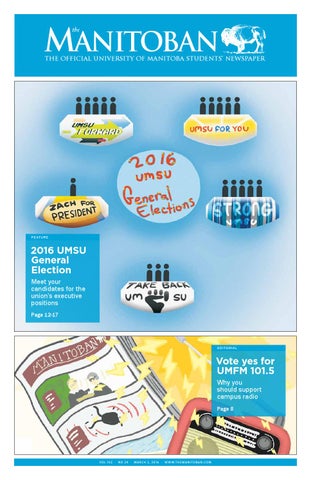
Meet your candidates
The Manitoban sits down with the UMSU executive hopefuls
LAUREN SIDDALL, STAFF
President
Astitwa Thapa (Strong UMSU)
I’m an environmental science student, and I’m the vice-president external of UMSU this year. I’m also the president of Divest Manitoba, a student group that is leading the fossil fuel divestment campaign at the university. Way back, I was the international student rep, I was a part of the university senate for two years, including several subcommittees. I’ve sat on UMSU on numerous committees, and I’ve sat on the sustainability committee, which I now chair.
I’m running for president because I want to provide for the students, and I want the students to be proud of the students’ union. I want to provide them with a union that cares about them, a union that students are proud of, a union where you have strong leadership to speak out, a student union that will be at the forefront of environmental sustainability, and be pioneers of social justice here.
This is my third year at the U of M. My first year, I was in U1 and was planning on going into pharmacy. My electives were more about political studies and I started to enjoy those more than the prerequisites for pharmacy. I would also like to get into law one day. I was really involved with everything in high school – I was president and valedictorian – and coming here, I thought I would just focus on academics and maybe start a political career or something related to that later on. I had a friend who was really involved with the U1 student council and told me I should run for a position. Since then, it’s just been a snowball effect. It’s opened so many doors and I’ve learned so much through being involved on campus.
I love seeing young people involved in politics and getting involved in the community. I worked with UMSU for about six months earlier this year, and I got to see two sides of UMSU – some of the governance and also some of the administrative – things I like but also things I would like to change in the upcoming year. I think through my experience being the president of the Arts Student Body Council (ASBC), I’m best for the job to take the next step for the campus as a whole. Everything in our policy is about students and what students want.
I’m graduating next year with a degree in global political economy. I started my university career in the sciences, moving towards a biomedical degree, but then found a lot of success in my arts courses, and really enjoyed them, so I decided to switch over. My involvement on campus has mostly centred on advocacy campaigns.
I worked a lot on the Stop the Cuts campaign last year – organizing events, creating communications, understanding what the issues were, and speaking to administration. I have also been working with international students on the fee hike that they had implemented last year on them, helping them mobilize against that. Additionally, last April, I was elected to the Canadian Federation of Students as provincial treasurer.
I think I have always been really politically active, and I’ve always had ideas about how the campus can be a better place. I’ve worked on campus a lot and I’ve spent a lot of time here, I know the campus really well – I worked in the AV department, so I know where everything is. What really drove me into putting myself out there was seeing the ways that the students’ union was not advocating for us and feeling like we really needed student leaders who were ready to stand up for what they believe in and for students on campus.
Andrew Fenwick (Take Back)
I double-major in politics and economics, I’m in my third year. I’ve been on UMSU council for two years as disability rep, where I’ve accomplished various things – such as the opt-out to the gym pass for quadriplegic students, I’m currently working on an opt out from the U-Pass for students living with disabilities, I got the accessibility centre started, I work on all sorts of projects with physical plant. I’ve also been the ex officio on ASBC, and I’m the vice-president finance for the Big Horns.
I’m also a member of the student group Beyond Abilities, which is a really great group that focuses on advocacy around accessibility. I have also been really involved with the Stop the Cuts movement, and I’m quite close with CFS. I’m very close with lots of people on campus.
For the past few years that I’ve been involved on campus, I’ve seen a very different outlook on student consultation. With the $64 increase, I was one of the only people who called for a referendum. That is a huge thing for me. I think that student consultation should come first in our union and on our campus. That is why I want to run. I want to make our union more of a bottom-up union, instead of the top-down culture that we currently have, where five executives impose their ideas on the student population.
Zachary LeClerc
When I came to the university, and even before that, I really wanted to go for medicine. Somewhere in the last year of high school, that flipped and I wanted to go for engineering, which didn’t really work for me. As a first-time university attendee in my family, it was unique and different experience, but I had academic troubles my first year.
I started shopping around for what else I wanted to do and eventually found the faculty of kinesiology and recreation management, which I really liked. I still had a passion for heath sciences, and I look at that faculty as preventative measures for medicine – it changes the way you think about medicine. I just graduated this past May and for the past eight months I’ve been thinking about what I want to do. Something that kept coming back to me was something I wanted to do my whole life – go into medicine. I’ve started MCAT prep and will hopefully apply next year.
I want to change the way the students are involved and the way executives are involved in the organization. It really isn’t the executives in charge of UMSU, the students are, and they just chose a vision or idea for the year. If I’m elected next year, it will be a mixed slate, which is my goal. My ideas can’t be the only ideas – we have to work as a team. I’m going to be paying attention to the opposition’s points and I’m going to put them on my list if I think they make sense –and obviously I’ll acknowledge where the idea came from.
Tanjit Nagra (UMSU For You)
Niall Harney (UMSU Forward)
(Independent)
Vice-president student services
Jessica Smith (Strong UMSU)
I started off as a nobody at the U of M. I had very few friends – a lot of my high school friends went to the U of W or weren’t going to university. Then I started getting to know some of the arts council, and they encouraged me to run for U1 student council. I started getting involved, I never thought I’d have time for student council but I made time for it and I sacrificed other things so that I could put on these socials, and put up posters, and advertise to try and get friends out there.
And then I was asked to run for ASBC, and I did successfully this past year. I had a good experience on how to plan events on campus and some off campus as well. Now I realize how much work has to be put in to run an event and how much help is required. I’ve also gotten involved with Justice For Women and Active Minds.
I decided to run for vice-president student services with the team Strong UMSU because I value the student experience. I compare the experience of being an uninvolved student to being director of social programming for U1 student council and ASBC, and it allows me to know how much more exciting my experience can be as a student here at the U of M.
I think it is important for all students to get involved in some capacity, whether that is attending a student event or running for UMSU. Being involved has also made me realize the room for change that is so readily available within the U of M community.
Ashley Richard (UMSU For You)
I decided to major in Aboriginal business studies because I got really interested in economic development and especially in the area of indigenous economic development. I’ve been the president of the Association of Aboriginal Commerce Students for two years now. There aren’t a lot of indigenous students in Asper right now, but I love working with the ones that are in the faculty. We’ve really built a sense of family and community.
We’re trying to just penetrate Asper to have a larger indigenous presence in a faculty that has not traditionally had one. I’ve tried to encourage indigenous students to come study business, because I think it is an area that’s lacking, not only in the university but also in the general Manitoba population.
Since the day I set foot on the campus, I was really excited to get involved. I respect students who come to class and go home, but I could never do that. I love to be involved – I love to know what’s going on. I’ve been involved heavily with Asper for the past two years and last year I really got involved with indigenous achievement in the greater university. I thought it would be such a great thing to bring to an UMSU executive slate – and that’s what I’m hoping to encourage and grow next year.
I am a fourth-year human and nutritional sciences major, in the dietetic stream. I think my first few years of university were pretty isolating – I stayed mostly with my high school crowd and went to some events, but never really found a place for myself. Then I got involved with the International Centre for Students, so I took place in their ambassadors program, which promoted international opportunities and issues to the general student body.
Through there, I applied to go on exchange to Melbourne, Australia for a semester. When I came back here, I ended up getting involved in a co-ordinating position with the Campus Food Strategy Group. Through that, I’ve gotten to see a lot of the inner workings of the university, especially as related to food. Through that, I also got involved with the Student Action Network.
From my own experience, seeing how hard it was to find a place for myself at university, and then finding that it was a shared feeling among a lot of students, which I think is definitely something we need to work to fix. I also saw a need for change right now, with students who really do care about making this campus more of a home for people. I don’t think I would have gone through this experience with anyone else – this team has been really wonderful. The opportunity to work with people like this, and the possibility of getting to work another full year with these people, is really special for me.
Shahab Valipourkolti (Take Back)
For three years, I have been involved with the Big Horns – a spirit group at U of M. Last year, I was the drum commander for the Big Horns and this year, I am the president. This year, we made some changes. We tripled our budget and became independent because we don’t want to use UMSU’s money. UMSU’s money should be spent on cultural groups –cultural groups aren’t getting enough support for their events.
That’s why I’m running for vice-president student services, to help the cultural groups fundraise money. I did it with the Big Horns and we tripled our budget. We have the opportunity to help other student groups raise money for themselves. UMSU’s budget is small – it can’t support over 150 student groups. But student groups are the heart of the school. Students should join student groups to get the experience, to learn, and to make friends. I found that the recent UMSU executives have been getting really separated from the students, it’s becoming a hierarchy. We’re all still students – if we get in, we’re all still students and we’re going to work for students as hard as we can.
Michaela Bohunicky (UMSU Forward)
Vice-president internal
Adam Pawlak (Strong UMSU)
I’m in my fifth year in the economics program at the university. At the very beginning, I was the kind of student that wasn’t involved at all – I would come to campus, go to class, and go home. After a little while, I started getting more involved here.
My dad is a professor here in the faculty of engineering and he encouraged me to get involved on council and involved in other ways too. So I joined the Polish Students’ Association and every year got more involved in it – this year I’m the president. I then decided to get involved in student politics and governance so I joined the ASBC. I also got involved with UMSU council. I’ve been involved in a large capacity on campus, and now I think I can bring that leadership and experience to the table for UMSU.
I’ve been here for a long time, and I’ve seen a lot of executives come and go, and I think that I can provide good input and good experience. I have lived the student experience – I graduate at the end of the semester. I’ve had a good student experience and I think I’ve lived it to the fullest, and I want to reflect that to others. Every student experience is different, so we want to enhance that as much as possible. We want every student to live up to their full potential.
Harrison Katz (UMSU For You)
In my first year, I went right into the faculty of science, which I absolutely adore. That being said, I felt really out of place – I didn’t know how to get involved, I just felt like one of those students who came to school to study and then went home. In my second year, I did get involved with the Science Students’ Association as director of programming. After that, I joined the St. Paul’s College council. I got very involved and ended up running for UMSU rep, which is the position I have now.
I put my name forward for finance committee during the first couple UMSU council meetings, and the executives came back to me asking me to be on the policy and bylaws committee, which I know nothing about. But I joined, and I’ve learned so much and love it, I think it’s so interesting learning about how UMSU actually operates on a fundamental level.
While UMSU is its own entity, and while small groups are their own entities, working together to make sure everyone can benefit is huge in my mind.
I’ve always had a passion for helping people, which is why I want to become a doctor – that’s my end game here. I love working with people one-on-one, and even in a small group. I think that communication and being able to connect with an individual and being able to learn more about their illnesses – whether it is mental, physical, can you see it, can you not see it, how much it hurts – I find that so interesting. And I think that’s really transitioned into me working with people not necessarily about the human body, but more so about policy and bylaws, and internal organization.
It’s been quite a shift, but I really enjoy it. It all comes down to me helping people and getting involved.
I’m in the faculty of music, just finishing up my fifth year. I’ve also been doing a lot of physics and computer sciences courses so next year, I’m going into that program. This year, I’m on the Faculty of Music Student’s Association as jazz studies representative. I’ve been advocating for students’ issues to be reflected in both curriculum and how the administration deals with students.
I truly believe that a student union is essential to make sure that students’ issues are heard, both to the administration and also at the provincial level. Unfortunately, I think in the last couple of years, it’s come to a point where students don’t really know what their union is or what their union can do for them. I really want to bring back a more collective spirit to this university, increase engagement, make sure students know that they have someone to turn to, and make sure they know they have a team fighting on their side.
One [of my slate's policy proposals] that I’m really proud of is participatory budgeting. That’s something UMSU should be adopting. What it is is that students have the opportunity to vote on their priorities and then the students’ union spends the money accordingly. Especially with the student fees going up next year, it’s really important for students to be able to access that funding.
Nick Kuznetsov (Take Back)
I usually stay away from politics. What made me change my mind this year was that I have had many friends tell me that they cannot afford university right now and that they have to move into a worse apartment or a basement, or they have to leave school all together. I’ve talked to people usually behind the scenes, I’ve talked to people who want to create change. The reason I joined Shahab and Andy is because I felt like there was someone saying something that I usually say – if you want to make change, you have to make it yourself. You cannot just keep advocating for it. This time, I found people who are prochange and these people are taking a stance on what they want and what they want the university to be like. I loved what they were saying and I was totally on board.
I’m fighting for the stable tuition program, that is my idea of how things should be for the students. For a student, the contract with the university is at least three years long but on the university’s side, the contract is only four months long – it’s only a semester and then they can change terms. I want to eliminate that. I want to make a contract that says how much in tuition you have to pay today, and throughout your studies you will pay, within one per cent accuracy every year. That’s the major point I wanted to bring forward this year.
Anatol Rennie (UMSU Forward)
PHOTO BY CAROLYNE KROEKER
UMSU fee hike divides candidates
Current UMSU president says Front and Centre donation will be put to a vote at UMSU council
ETHAN CABEL, STAFF
Fault lines are being drawn in the University of Manitoba Students’ Union (UMSU) general election over whether due process was followed in the approval of a $64 fee increase on all U of M undergraduate students late last year.
The fee hike has sparked considerable controversy since its near unanimous approval by UMSU council on Nov. 19.
The hike did not go to a referendum, and councillors were not given much time to review the motion before being expected to vote. The primary consultation mechanism used by UMSU to gauge student support was an online survey that garnered about 2,500 student responses.
Funds raised from the fee hike are slated to be managed by the UMSU endowment fund, with $15.9 million allocated to several big-ticket items over a 10-year period.
These projects include $2.4 million for a new childcare facility on campus, $3.5 million worth of renovations to the first floor of University Centre, $5 million for scholarships and bursaries for indigenous students, and $5 million for undergraduate research grants.
While UMSU councillors were fully briefed on these projects, they were not informed that the money could be counted as a donation to the university’s $500-million Front and Centre fundraising campaign.
A motion to approve the fee hike at the U of M board of governors on Jan. 26 said that the money would be included as part of the university’s capital campaign.
This is “something that was never acknowledged by the UMSU president, and never disclosed to UMSU councillors or students at large,” reads
a petition on change.org seeking to repeal the fee increase.
The petition has 636 signatures toward a 1,000-signature goal.
Jeremiah Kopp, current UMSU president, told the Manitoban that the board of governors’ motion simply opens the door to the possibility of the money being counted toward the Front and Centre donation total.
“The UMSU funds are not necessarily considered at the moment to be a Front and Centre contribution,” Kopp said.
“The board of governors motion was written in such a way that the door would be left open for such a possibility, but if it is to be a joint marketing effort and an effort to reflect collaboration and a culture of philanthropy, that will ultimately come before UMSU council.”
Kopp added that he expects to present a motion regarding this matter to UMSU council before the end of his term on May 1.
Take Back UMSU
Only one slate of UMSU executive candidates has vowed to repeal the fee and bring the question to a referendum in the fall.
Andrew Fenwick, the current UMSU students living with disabilities representative, is a candidate for president under the Take Back UMSU slate. At the Nov. 19 UMSU council meeting, he abstained from the vote against the fee hike, calling for a referendum on the issue.
If elected, Fenwick told the Manitoban that he will solicit 1,000 signatures for a petition to repeal the fee and call a referendum on the issue. Moreover, he said that he will seek to amend UMSU policies in order to prohibit the executive from cam-
paigning one way or another on the matter.
“Any proposition of a fee change should go to the students, it shouldn’t be 42 people voting on 27,000 students’ behalf and that’s exactly what I said at the Nov. 19 council meeting when they passed this,” Fenwick said.
“Any proposition of a fee change should go to the students, it shouldn’t be 42 people voting on 27,000 students’ behalf” – Andrew Fenwick, presidential candidate, Take Back UMSU slate
Fenwick is a signatory of the online change.org petition condemning the fee hike.
“I don’t want the executive to be able to influence the opinion of students based on their role in UMSU,” he said, adding that their role as executives gives them disproportionate influence over such issues.
Fenwick is also strongly opposed to the money being counted as a donation to the Front and Centre fundraising campaign.
Opposing the process, not the substance
The other UMSU executive slates all support the fee increase and would not seek a referendum on the matter. However, they all said that they are
against the process by which it was passed in November.
Tanjit Nagra, the current president of the Arts Student Body Council (ASBC), is running for UMSU president as part of the UMSU For You slate.
Given that the ASBC passed two motions condemning the process by which the fee increase was approved, Nagra maintains that she has shown leadership on the issue. Moreover, she vowed not to increase fees without a referendum going forward.
“The way in which the motion was passed I don’t agree with, and I think there should have been more consultation, however our whole team believes in the initiatives that the motion supports,” Nagra said.
“We’re not planning on any fee raises at all in the upcoming term if elected, but if there are going to be any we’re going to make sure it goes to referendum so that students are aware and can vote on it.”
Two candidates running on the UMSU For You slate, Harrison Katz and Wilfred Sam-King, are in favour of the fee hike. Although Katz currently agrees with the position of his slate on the need for a referendum on future fee hikes, he previously defended the process by which the fee was passed.
“I believe that we, as UMSU councillors, were voted in to do a specific job, and that is to vote on motions that are brought to UMSU council,” Katz said in November. “I think that gives UMSU councillors, not necessarily the right, but definitely the courage to represent their students.”
Niall Harney, the treasurer for the Canadian Federation of Students’ Manitoba branch and candidate for president as part of the UMSU
Forward slate, told the Manitoban that he will ultimately respect the wishes of students on the issue.
“I definitely agree with the initiatives that the fee increase was put towards,” Harney said, adding that he is bound by the motion to increase fees and spend the money on designated projects.
When it comes to whether his slate would seek to repeal the motion or go to a referendum on it, Harney said that he “would let students bring that forward and have council talk about it.”
Astitwa Thapa, current UMSU vice-president external and a candidate for president under the Strong UMSU slate, defends the fee hike as a necessary initiative, adding that he would not increase fees without a referendum going forward.
“Voting in favour of this motion was undoubtedly one of the most difficult decisions I’ve had to make as a student leader,” he said.
“But we desperately need child care, we desperately need undergraduate research, and my colleagues for UMSU For You, Harrison Katz and Wilfred Sam-King, wholeheartedly voted in favour of this particular motion.”
Zach LeClerc, current vice-president internal and independent candidate for president, told the Manitoban that he favoured the fee hike largely because of the child care component. He added that he will seek to do more with the money, including laying the groundwork for the union to eventually acquire its own building separate from University Centre.
Slates offer their stances on U of W course, discuss options for U of M
SHAWN GARBUTT, STAFF
W
ith the University of Winnipeg introducing a mandatory indigenous studies course this fall, all eyes are on the University of Manitoba. The topic has been raised informally in many on-campus discussions and events in the past year. It was the focus of this year’s Indigenous Awareness Week, with some speakers favouring a mandatory course and others preferring a softer approach to integrating indigenous topics into the curriculum.
The existence of a formal relationship between the U of M and the Treaty Relations Commission of Manitoba, alongside emphasis placed on indigenous education in the university’s 2015-2020 strategic plan, has bolstered public discourse surrounding the matter.
The Manitoban met with representatives from each executive slate running in the upcoming University of Manitoba Students’ Union (UMSU) election in order to explore their stances on the issue.
Take Back
Presidential candidate and current UMSU students living with disabilities representative Andrew Fenwick endorses the implementation of a mandatory indigenous
studies course at the University of Manitoba. However, Fenwick also stressed the need to host qualitative student consultations before the university can move forward with any policy action.
Fenwick announced plans to lobby the provincial government to ensure the newly levied fees associated with administering and maintaining a new compulsory course would be subsidized for both domestic and international students.
“Education is the path that we have to take to get rid of discrimination and oppression,” said Fenwick.
UMSU Forward
Presidential candidate and treasurer for the Canadian Federation of Students-Manitoba Niall Harney commended the university’s exploration of implementing a mandatory indigenous studies course or credit. However, Harney is reluctant to endorse any particular course of action this early in the deliberations. He sees UMSU’s role as working with the administration in implementing their final decision while voicing the needs and concerns of the student body during such a process.
“As a university, we should be respecting indigenous ways of know-
ing,” said Harney. Harney added that it’s important to recognize the U of M as a public institution that ought to reflect the needs and goals of the public, and consequently the indigenous population as the fastest growing demographic in Manitoba. Harney said he would also facilitate increased student consultations in regards to this particular issue.
UMSU For You
Ashley Richard, candidate for vice-president student services and current president of the Association of Aboriginal Commerce Students, clarified that the implementation of a mandatory indigenous studies requirement does not necessary entail the creation of a new course. Rather, existing courses could fulfill an indigenous credit requirement should their curriculum reach a designated threshold as indicated by the amount of indigenous education present within the course content.
“Generally, in life, everyone should have a basic understanding of indigenous education,” said Richard. However, she opposes the creation of a compulsory course, saying it would be unfair for students in programs with a small number of elective hours available.
Rather, Richard believes the integration of indigenous knowledge is best achieved by letting individual faculties make the decision autonomously. This way, she said, they can individually assess the best way in which to ensure their students leave university with an appropriate degree of insight on indigenous affairs.
Zachary LeClerc (independent candidate)
“It’s a step forward, but I don’t agree with it,” said Zachary LeClerc, presidential candidate and current UMSU vice-president internal on the topic of implementing a mandatory indigenous studies course or credit. Having consulted with active members from the student community regarding the UMSU initiative on indigenous achievement, LeClerc argued that mandating a compulsory course is not “the way to build bridges.” LeClerc stated a move in the right direction would be for the university administration to more clearly detail existing classes that include indigenous subject matter.
Through this course of action, LeClerc advocates for a staggered approach that gradually raises awareness of indigenous issues and knowledge. The most important steps for
LeClerc in dealing with this matter are grassroots involvement, student consultation, and collaboration between divided groups.
Strong UMSU Presidential candidate and current UMSU vice-president external Astitwa Thapa first and foremost called for the decolonization of post-secondary education. However, Thapa does not believe classrooms are the best avenues to choose in pursuit of that goal.
Thapa stated Strong UMSU is not in favour of implementing a mandatory indigenous course or credit, further saying the University of Winnipeg did a “horrible job” of consulting indigenous communities when they mandated the compulsory course at the U of W.
Thapa claimed the correct approach for the U of M is to identify currently existing courses that feature indigenous knowledge and to work on raising awareness and community building at the grassroots level.
Slates offer their stances, solutions on GPA requirements for international students
SHAWN GARBUTT, STAFF
International students took to the streets in summer 2014 and 2015, denouncing differential admission requirements and increased tuition fees.
There is a limited amount of space set aside for international students in various faculties – most notably in the department of civil engineering. Limited space for international students, makes admission more competitive, resulting in a higher grade point average necessary to be viable for entrance. The protesters targeted their criticism at what they call sudden, opaque, and arbitrary decisions made by the U of M administration that have failed to keep international students in the loop on matters concerning them.
Representatives of the executive slates running for the upcoming election met with the Manitoban to outline their respective stances on the issue, as well as to define the role they believe UMSU ought to take in resolving the situation at hand.
Strong UMSU
Astitwa Thapa, presidential candidate and current vice-president external for UMSU, deemed the rigorous
admission requirements for international students discriminatory. A participant in the original protest that took place on campus, Thapa says that it’s unacceptable that an international student with a 4.0 GPA is likely to face rejection from the faculty of engineering. Thapa went on to say Strong UMSU would work closely with international students to pressure the university into changing the current policy while also beginning the process of lobbying to increase the spaces available for international students within faculties.
Zachary LeClerc (independent candidate)
Presidential candidate and current UMSU vice-president internal
Zachary LeClerc said the issue at hand is class sizes and the university’s capacity to house international students, not GPA requirements. LeClerc claimed the university is failing to use space effectively and is thus not operating at full capacity, resulting in many of the woes international students currently face at the U of M.
LeClerc said he would use his position on UMSU to reconcile efforts
with the international student body and lobby the university to increase enrolment, capitalize on the professor-student ratio, and fill empty classrooms. By increasing the efficiency of space usage at the university, LeClerc argued availability would increase for international students and consequently solve the issue at hand.
UMSU For You
Presidential candidate and current arts student body president Tanjit Nagra claimed the larger issue at play is that the faculty of engineering, specifically, is over-crowded with students. Nagra said UMSU For You would like to work with the university administration in expending recent donation sums towards the renovation of existing buildings that would be allocated to the faculty of engineering, increasing its capacity to accommodate the current student body as well as higher levels of student enrolment.
“I think it’s a snowball effect. We need to start here, and then keep moving on,” Nagra said in reference to such plans. She added that a solution to the current dilemma will follow once the problem of overpopu-
lation in faculties lacking adequate resources is properly dealt with. Nagra also believes UMSU needs to work on expanding the number of services and resources that are available for international students to access.
UMSU Forward
Niall Harney, presidential candidate and treasurer for the Manitoban branch of the Canadian Federation of Students, criticized past actions of the administration, saying many international students are brought to Manitoba and supported throughout their first year but lose that framework of services as they progress in their studies. This, alongside differential admission requirements, is symptomatic of what Harney says is very poor treatment of international students at the U of M.
“International students are currently being treated very disrespectfully; they’ve coined the term themselves that they’re being treated like cash-cows on this campus.”
Harney advocates for more consultation to take place with the international student body, so as to not leave them in the dark when it
comes to policy decisions that greatly impact the trajectory of their academic careers.
Take Back
Andrew Fenwick, presidential candidate and current students living with disabilities representative for UMSU, said the current situation for international students at the U of M fosters a dangerous “us versus them” mentality on campus.
Fenwick argued that education is a universal right and called for an end to what he described as discriminatory practices deployed by the U of M in its treatment of international students. Fenwick further advocated for the creation of a special consideration category in the enrolment process for international students.
Editor: Chantelle Dubois
The University of Manitoba professor that helped launch a rocket
Researcher profile: Samar Safi-Harb
MALAK ABAS, STAFF
Samar Safi-Harb is the Canada Research Chair in Supernova Remnants and Astrophysics in the physics and astronomy department at the University of Manitoba. SafiHarb is a highly-regarded professor of physics and astronomy, former NASA employee, and recipient of the YMCA-YWCA of Winnipeg’s 2015 women of distinction award in the category of science, technology and research.
But her resume doesn’t stop there. On Feb. 17, Safi-Harb watched the Japanese rocket Hitomi launch, carrying the Canadian Astro-H Metrology System (CAMS), which is laser technology that she helped create. The Manitoban had an opportunity to speak with Safi-Harb about what brought her to Winnipeg and
her contributions to the Hitomi satellite.
From Beirut to NASA
Safi-Harb grew up in Lebanon in the midst of the civil war. She had always had a passion for science, and in particular a passion for physics.
While she ultimately ended up studying physics at the American University of Beirut, she had a wide variety of interests and considered several academic paths.
“I applied to the faculty of architecture, I applied to the faculty of engineering, and I got admitted to them all. I was always really keen on a lot of things,” says Safi-Harb.
Universities in Lebanon do not offer physics past the master’s level, and Safi-Harb eventually left the
Space briefs
country to pursue her passion, moving to the United States to attend the University of Wisconsin-Madison.
After receiving her master’s and PhD in physics in Wisconsin, SafiHarb completed a fellowship at the NASA Goddard Space Flight Center in Maryland.
“I was at the lab for high-energy astrophysics, which is, [...]to do high-energy astrophysics [...] one of the best places in the States, and in the world. So I got to continue the research I like to do,” Safi-Harb says.
After her time at NASA, it was a new and exciting opportunity that brought her to Winnipeg.
“What brought me to this place was the job. There was an opportunity to actually start a graduate program in astronomy […] and teach courses at the upper level in astronomy,” says Safi-Harb.
“So that’s what really excited me about this position.”
The Hitomi satellite launch
Safi-Harb, along with two other Canadian scientists, worked on CAMS, a system designed for the Hitomi (formerly named Astro-H) satellite. The satellite’s purpose is to collect data using x-rays that could not otherwise be found, and CAMS
helps keep them focused.
“CAMS is an instrument that helps focus high-energy x-rays,” says Safi-Harb.
“What CAMS does is it helps focus the light from [the] high-energy x-ray telescope, because it’s equipped with a set of lasers and detectors that help focus the light.”
Keeping the images collected by Hitomi focused is a crucial part of the mission, as it affects the quality of the data collected.
“When the satellite is launched in space [...] there’s temperature variations, there’s stuff happening that makes it vibrate. The vibration will cause the image to not be wellfocused,” said Safi-Harb.
“What CAMS does, with the laser technology, is to actually re-focus the light and see the images much sharper.”
This is not the first time scientists have attempted this mission. The mission has failed twice in the past, the second time having occurred about a month after the launch.
“It was a very depressing time, because people have worked so hard on this mission,” says Safi-Harb.
“People dedicate their time and life, basically their career, to this.”
Scientists will now keep an eye on
NASA closes astronaut applications, Scott Kelly comes home from the ISS, and SpaceX secures resupply contracts and most recent launch
Made of the right stuff
NASA closed its call for applications for astronaut candidates on Feb. 18, receiving an unprecedented 18,300 applications. The agency opened the vacancy on Dec. 14, 2015.
NASA will now move on to review applications and create a pool of highly qualified applicants who will then be contacted, asked to go through a medical exam, and have their qualifications verified. This process ends in September.
Initial interviews are planned to begin in Feb. 2017, with final candidates selected May 2017 and official announcements made in June 2017.
Applicants are required to hold at least a bachelor’s degree in a STEM field, have 20/20 vision (laser corrected vision is accepted as long as it has been a year since surgery with no adverse effects), and have three years of professional experience (advanced degrees like a masters or PhD are counted as one and two years of pro-
fessional experience, respectively). Additionally, applicants must be a US citizen.
To date, only 338 individuals have been selected as astronauts since 1959. Unlike the first group of astronauts, who were all pilots, today’s astronaut corps is comprised of a variety of expertise and backgrounds including engineers, teachers, scientists, and doctors.
The next generation of astronauts will eventually have an opportunity to work with the Orion spaceflight vehicle, which has been designed for missions beyond Earth’s orbits. Potential missions could take astronauts to Mars or nearby asteroids.
Astronauts in the astronaut candidate program eventually train as either a commander/pilot astronaut, a mission specialist, or payload specialist.
Return to Earth
NASA astronaut and current commander of the International
Space Station (ISS) Scott Kelly is set to return to Earth on March 1 after spending 340 days in space.
The mission is part of a unique twin study which will compare the differences between Kelly and his twin Mark, who have been living separately in space and on Earth respectively.
The study will focus particularly on physiological changes happening at the molecular level in their DNA. Since the twins are genetically identical, a wide range of useful information is expected.
Additionally, the study will observe changes in behavior such as decision making and perception, organ changes, and the effects of diet.
Kelly currently holds the record for the longest time an American astronaut has spent in space, with previous experience on missions like STS-103 Discovery, STS-118 Endeavour, Soyuz TMA-01M, and ISS Expeditions 25 and 26. Over all these missions and up until his return
Hitomi (which actually means “the pupil of the eye” in Japanese) and use the data collected to further study high-energy phenomena.
“I am a big enthusiast about highenergy astrophysics, especially for the objects I study, because I’m interested in extreme phenomena – things that you could never achieve on earth,” says Safi-Harb.
“We’re talking about magnetic fields that are billions of times greater than that of the sun’s, temperatures billions of times greater than the sun’s [...] the only way to study this is, actually, to do it with x-rays.”
We are all star-stuff
Safi-Harb has done extensive research on supernovae and their remnants, and she hopes that the Hitomi satellite will help bring new light to the explosion of stars.
She also believes that the data collected from this experiment has significance to all people, even if they are not involved in scientific study.
“What I tell [people] is all these elements that we are made of, the oxygen we breathe, this is all made in supernovae.”
She sums it up perfectly by smiling and quoting the iconic Carl Sagan: “We are star-stuff.”
from the current mission, Kelly will log 522 days.
The current overall record for most time in space is held by Russian cosmonaut Gennady Padalka, who has logged 802 days in space.
SpaceX secures five more ISS resupply missions
SpaceX has managed to secure five more resupply missions to the ISS. The contract is reported to be worth US$700 billion.
NASA is SpaceX’s biggest customer, and the first contract signed by the two companies in 2008 helped save the commercial space company from bankruptcy after several failed launches.
To date, SpaceX has been assigned 20 resupply missions to the International Space Station.
Currently, NASA has contracts with SpaceX, Orbital ATK, and Sierra Nevada Corporation for resupply missions to the ISS.
PHOTO BY MALAK ABAS
GRAPHIC BY BRAM KEAST
The fascinating compounds of plants
Researcher profile: Jake Stout
JEREMIAH YARMIE, STAFF
M embers of the plant kingdom make hundreds of thousands of molecules called secondary metabolites. These compounds aren’t crucial for life, but are instead used for things like communication and defense – think of the poisons found in hemlock, which was used to kill Socrates, or capsaicin, which is found in chili peppers to deter herbivorous mammals.
Jake Stout, an assistant professor in the department of biological sciences, is interested in plant metabolites, especially those with medicinal potential.
“Collectively, you could say that plants are better chemists than us,” Stout told the Manitoban
These medicinal compounds are often produced within specialized plant cells through a conveyer belt of enzymes called a biosynthetic pathway. A gene in the plant’s DNA encodes each of these enzymes.
Stout uses a genomic technique called transcriptome sequencing, which takes snapshots of the genes that are being used in plant tissue at particular moments in time.
Genes only work through intermediate messenger molecules. Transcriptome sequencing allows Stout to see what messages are being used where, and what those messages say.
From the information gathered using this technique, specific genes of interest can be singled out to answer questions like “what step along the pathway is this?” and “what goes in and comes out?”
“In doing that with a whole bunch of genes, we can reconstitute the entire biosynthetic pathway that a particular plant uses to make those compounds,” said Stout.
By understanding these pathways, biochemists stand a better chance of synthesizing these compounds in the lab.
A main subject of research in the Stout lab is the African shrub Tabernanthe iboga, which produces the psychedelic drug ibogaine.
Ibogaine isn’t commonly used recreationally – it has unpleasant effects and induces a rapid heartbeat – but it does show medical potential in the treatment of addictions.
“There is anecdotal evidence that ibogaine is able to partially reset the neurochemical pathways associated with addiction in the brains of people with dire opiate addictions,” said Stout. “They say that they don’t have withdrawal symptoms for weeks.”
Stout is also interested in the evolutionary history that resulted in the formation of medicinal compounds.
Information about ibogaine synthesis would lend itself to understanding the synthesis of other compounds as well.
“Ibogaine belongs to this whole class of compounds called monoterpene indole alkaloids,” said Stout. “They tend to be really complicated molecules, so we’re not very good at making them.”
Amongst this class of compounds are the chemotherapy drugs vinblastine and vincristine, which are isolated from the Madagascar periwinkle.
“In India and Madagascar, companies grow thousands of acres of these periwinkles to extract vinblastine and vincristine,” said Stout. “The Madagascar periwinkle only makes these compounds in at around 0.01 per cent by weight, which is just a whiff.”
In contrast to the periwinkle, iboga produces ibogaine in its roots at about four per cent by weight.
“The production of ibogaine is similar to the production of half of vinblastine,” said Stout. “One of those halves is catharanthine, and I think that the biosynthesis of ibogaine goes through catharanthine.”
If Stout were able to stop the biosynthetic pathway of ibogaine right after catharanthine, he would be able to produce the vinblastine precursor
in iboga at yields much higher than the finished product in periwinkles.
“I’m coming up with devious ways to make the other half of vinblastine,” said Stout.
“Collectively, you could say that plants are better chemists than us” – Jake Stout, assistant professor of biology, U of M
Perfecting this would lower the price of the anti-cancer drug, increase its accessibility, and open up land for agricultural use.
Using this information, Stout hopes to sample other plants in the iboga family for genes involved in the production of different monoterpene indole alkaloids.
“We could potentially produce a whole bunch of these molecules in the iboga system,” said Stout.
For his PhD, Stout studied the production of lignin, a polymer responsible for the rigidity of plants like trees.
“In looking at the way that biosynthesis works, I started looking at structurally related compounds,” said Stout. “Mescaline has almost the exact same structural pattern as some of the lignin monomers.”
Mescaline is a psychedelic drug found in the peyote cactus – it’s what Owen Wilson’s character was high on in The Royal Tenenbaums
“I think that mescaline biosynthesis might be the entire lignin biosynthetic pathway just moved over a step,” said Stout. “From an evolutionary standpoint, it would be like an entire pathway being co-opted, rather than just bits and pieces.”
“Plant-produced psychedelic compounds are really interesting because
they’ve been used for thousands of years by different cultures for medicinal and ritualistic purposes. Knowing how these compounds are produced adds to that indigenous knowledge, and will allow us to produce other medicinal compounds such as vinblastine at reduced cost,” Stout told the Manitoban when asked about what it’s like working with drugs commonly known for their hallucinogenic effects.
“Besides, it’s kind of awesome to work on plants that are illegal in a lot of the world because it cuts down on competition.”
More information about Jake Stout and his research can be found at http:// umanitoba.ca/Biology/people/stoutjm/
The science of LSD
Psychiatric interest in acid resurfaces after decades of silence
JEREMIAH YARMIE, STAFF
I
n 1943, a Swiss chemist named Albert Hofmann experienced the world’s first acid trip.
While the rest of Europe was gearing up for the Second World War, Hofmann found himself working for Sandoz Laboratories in Basel, Switzerland. Here, Hofmann was tasked with isolating chemical compounds from fungal ergot, a parasite of rye.
While Hofmann had successfully synthesized lysergic acid diethylamide (LSD) in 1938, the project was set aside for five years while he was tasked with other ventures. In 1943, Hofmann decided to resynthesize LSD.
Somehow, Hofmann ingested the potent psychedelic drug while working with it. LSD has an active dose of 100 micrograms, so small amounts can produce noticeable effects.
Perhaps Hofmann rubbed his eye or put his hand to his mouth – regardless, he accidentally gave himself a hit.
“In a dreamlike state, with eyes closed [...] I perceived an uninter-
rupted stream of fantastic pictures, extraordinary shapes with intense, kaleidoscopic play of colours,” wrote Hofmann in his 1980 book LSD: My Problem Child
Like the true scientist that he was, Hofmann decided to self-experiment by deliberately taking a 250-microgram dose of acid three days later.
As Hofmann began to hallucinate, he and his assistant cycled home –bicycle was the vehicle of choice due to the war.
“On the way home, my condition began to assume threatening forms. Everything in my field of vision wavered and was distorted as if seen in a curved mirror,” wrote Hofmann about the bike trip.
Hofmann believed that LSD had immense potential for use in psychotherapy. But by the 1960s the world had changed.
LSD became associated with the counter-culture revolution of the time, led by people like Timothy Leary.
The scientific community stopped taking the drug seriously, and LSD
Before LSD’s prohibition in the 1960s , more than a thousand research articles were published looking at the drug’s potential in a variety of applications
LSD was regulated in Canada in the 1960s in a campaign spearheaded by senator Hartland Molson, a member of the brewery family. At the time, LSD was being used extensively in the treatment of alcoholism.
Although physicians resisted the regulations at first, they later buckled. The brewing industry benefited from
this policy choice, which made treating alcoholism more difficult.
A recent analysis of several studies from the 1960s and 70s showed that even a single dose of LSD could help alcoholics resist drinking for up to a year.
Researchers on one study found the reason that the drug was effective at combating alcoholism is that it was common for subjects to develop insight into their problems, a new sense of openness and optimism, and the ability to make strong choices towards quitting drinking.
Unlike with drugs like cannabis and alcohol, LSD does not impair the mind – it simply changes perception. Individuals on LSD experience enhanced memory processes. If a person makes a revelation about their drinking while on acid, they are bound to remember it for a long time hence.
“For the entire duration of the experiment, I had even been aware of participating in an experiment, but despite this recognition of my condi-
tion, I could not, with every exertion of my will, shake off the LSD world,” wrote Hofmann about the first ever intentional LSD trip.
Before LSD’s prohibition in the 1960s, more than a thousand research articles were published looking at the drug’s potential in a variety of applications.
Clinical research into acid has reappeared within the last couple of years, fuelled by the hope that the promise LSD had shown in the 1950s and 60s can be built upon.
This resurgence is due to a seminal 2014 study that looked at LSD’s ability to decrease the anxiety of mortality in 12 individuals with lifethreatening diseases.
For the first time in 60 years, LSD was studied in a controlled manner for its use in psychotherapy. This study was inspired by a 1963 study that found LSD was able to reduce anxiety and depression in individuals with late-stage cancer.
Two months after their LSD experiences, the patients showed positive trends in the reduction of anxiety. This reduction in anxiety was seen even a year after the session in a follow-up appointment.
The U.S. government secretly experimented with LSD during the 1950s and 60s to determine its efficacy as a mind-control drug. The project, called MKUltra, did not seem to be fruitful for the U.S., but a recent study has shown that the drug does increase user suggestibility, the susceptibility and responsiveness to suggestion.
The suggestibility of participants was measured using the creative imagination scale, which measures imaginative suggestibility by prompting individuals to imagine different scenarios such as their arm becoming heavier.
While this suggestibility may not help with mind control, it shows promise for use in certain forms of psychotherapy, in which suggestibility is often used to direct sessions.
Another recent study showed that LSD enhances an individual’s emotional response to music. Music is an important element in psychotherapy, especially sessions aided by psychedelics.
In psychedelic-assisted therapy sessions, music is used to allow subjects to relinquish control through a structured experience, which often use musical progression to direct participants to a spiritual peak.
The study found that LSD particularly enhanced the feelings of wonder, transcendence, power and tenderness experienced from listening to music.
The story of LSD is a good example of the need for policy decisions to be made based on scientific and medical evidence. Who knows where LSD research would be today if we didn’t lose those 60 years.
fell into obscurity as it was criminalized as a hedonistic hippie drug.
GRAPHIC BY JONDELL COOMBS
GRAPHIC BY BRAM KEAST
COMIC BY KELLY CAMPBELL
GRAPHIC
GRAPHIC BY JONDELL COOMBS
Arts & Culture
Arts & Culture Editor: Seamus Hamilton-Pattison
Raising money for Manitoba Metalfest
Metalfest founder Cory Thomas talks upcoming benefit show, local metal history
SEAMUS HAMILTON-PATTISON, STAFF
On Friday, March 4, local heavy metal booking company
Ninjacat Productions is hosting a benefit show for the 13th annual Manitoba Metalfest at the Park Theatre.
The benefit show counts a few well-established local metallers on its bill, including the death/thrash metal hybrid Endless Chaos and the D.R.I.-inspired crossover thrash act Solanum alongside newer death and black metal bands Perilous and Cell.
The gig will also mark the live debut of Ninjacat Productions founder and sole member Cory Thomas’s new thrash metal band, Infecter.
“From Endless Chaos, you can just expect a ton of energy, lots of headbanging. We always try to bring the best out in our crowd,” guitarist Mike Menza told the Manitoban
“It’s just gonna be a fast, fun, heavy night.”
Thomas told the Manitoban that though he has attempted to fundraise in the past, benefit shows are still relatively new to Metalfest.
“The way I do the festival, I’m a one-man show, and if you wanna get grants or anything like that from the government, you have to be a notfor-profit organization. Not that we make any profit putting the fest on,” said Thomas.
“They want a board of directors, and meetings, and minutes, and all that stuff [...] Even the grants that I can look into getting because I’m not an organization, they give all that money to jazz and classical musicians.”
Thomas added that, like the festival, he aimed to pick local bands
working hard in Winnipeg’s metal scene to play the benefit.
“I heard about [local death/thrash metal act] Perilous from a bunch of friends going ‘hey, this band’s awesome, they’re an up-and-coming local band, got a good buzz going,’ so I put them on the bill,” said Thomas.
“Infecter is my band [...] Since we’ve got a good buzz going because we’re a new band on the scene, I think we’ll help the benefit a lot. Endless Chaos, like you said, those guys are awesome and killing it with that Wacken battle – they almost made it to Wacken [Open Air].”
Thomas was referring to last year’s Wacken Metal Battle Canada, a national competition in which upand-coming metal bands across the country compete for the chance to represent Canada on the international stage at Germany’s massive Wacken Open Air Festival.
“They made it all the way to the finals in Toronto. If they would’ve won Toronto, they would’ve made it to Wacken,” added Thomas.
In addition to booking metal shows in venues across Winnipeg year-round under Ninjacat Productions, Thomas has been running Metalfest as a one-man show for the past 12 years.
“The first one was with me and another guy, and he stepped down after the first year,” said Thomas.
According to Thomas, the festival’s evolution was slow but steady, as Manitoba Metalfest moved from booking only local bands, to small Montreal-based acts, to the legendary international metal bands the festival
can bring in today.
“That’s where we’re at now: we’re flying in bands for the show,” Thomas said excitedly.
Of course, Winnipeg’s own metal acts aren’t only a reliable part of the festival – they’re clearly fans at heart.
“First Metalfest I went to was in 2008. I think Into Eternity was playing one night, and Razor was the second night,” said Menza.
“It was cool, because that show got me into a ton of local bands that they had at the time when I was 19.”
It’s not just Metalfest that’s grown and evolved. Thomas says Winnipeg’s metal scene as a whole has grown exponentially since the festival’s debut.
“It’s just gonna be a fast, fun, heavy night” – Mike Menza, guitarist, Endless Chaos
“The scene was really struggling back then. There were like maybe six or seven metal bands in the scene, so it was the same bands at every show, the crowds were really small, so Metalfest was the only chance to really play for something big,” said Thomas.
“It’s been awesome. I feel in the last two years or so, it’s struggling a little right now – not like the 2000s – but I’d say around 2005-2012, it was pretty damn awesome. Really strong, local
shows packed all the time. Bands like Dreadnaut, Tyrant’s Demise, Electro Quarterstaff, Seventh Sin, all those bands were packing bars.”
However, even if Thomas doesn’t think Winnipeg’s metal scene is at its best right now, he’s expecting things to pick up again soon – a testament to his faith in the longevity and diversity of metal.
“I think the scene’s in a bit of a transitional stage. The Zoo’s gone, it’s definitely changing now. There’s always new bands that come in and take over the scene again, so I think we’re waiting for the next big local metal band to come out.”
Thomas is unabashed in his love for hosting Metalfest and for heavy metal in general. However, he cited one horrifically memorable incident from a Metalfest past – something anyone with a tendency to take moshing too far should heed as a cautionary tale.
“We did have one guy at the festival with Brutal Truth and Malefaction back in 2010. Some guy was moshing so hard that he snapped his foot right, clean-break off. I’ve never seen anything like that in my life,” said Thomas.
“His foot snapped. Not just broke, it was hanging by the skin and I almost puked right at the bar. It was crazy.”
With regard to this year’s Metalfest, which takes place at the Park Theatre from April 15 to 16, Thomas pointed out a few acts he’s particularly excited to have along.
“[Local death metal veterans] Immortal Possession. It’s gonna be
their first show with the original lineup since, I think they played in 2001 at the Zoo and then before that, they haven’t been around since 1994,” Thomas told the Manitoban
“So it’s pretty big that we’ve got Immortal Possession reuniting to play the festival. They’re classic death metal from the early 90’s in Winnipeg [...] it’s going to be amazing, I’m gonna be 14 all over again.” Thomas went on to make mention of the first day’s headlining act Terrorizer as another band he can’t wait to see live.
“They’re the pioneers of grindcore, and they got Pete Sandoval of Morbid Angel – and he’s one of my favourite drummers of all time.”
Looking to the future, Thomas mentioned that in addition to approaching Morbid Angel themselves about playing next year’s Metalfest, he also wants to integrate some hardcore punk bands – citing Dayglo Abortions as an ideal example – into the festival’s all-metal lineup. As for this year, Thomas is just hoping that everyone will enjoy the show.
“I just want it to be a great show where everyone has a good time. I don’t even care if we make money.”
All proceeds from the Manitoba Metalfest benefit go directly to support the festival. Tickets are $10 in advance and are available for online purchase via www.ticketfly.com
PHOTO PROVIDED BY CORY THOMAS
Chimerica launches at MTC
Manitoba Theatre Centre presents thrilling geopolitical play
TOBI NIFESI, STAFF
Chimerica, by British playwright Lucy Kirkwood, opened on the John Hirsch Mainstage of the Royal Manitoba Theatre Centre (MTC) Feb. 26 and will run to Mar. 19. The 2013 play was brought to Winnipeg by the production company Canadian Stage, and is sure to provide a gripping, edgy experience for its audience.
Chimerica – the title of which is a portmanteau of China and America –is a tense and scrupulous look into the complexities of the changing fortunes between the two countries, and their subsequently “tied fates.” The play highlights these political themes in a dramatic and occasionally funny manner.
The play is centred on a fictional story about the famous “tank man” images that were captured a day after hundreds of protesters were massacred during demonstrations in China’s Tiananmen Square in 1989.
The man depicted in the photos stood in the path of an advancing column of tanks, moving from side to side to prevent them from skirting around him. Eventually a small crowd of people grabbed him and pulled him away. The identity and fate of the “tank man” is unknown.
Chimerica is set two decades after this event. In the play, a fictional photojournalist who snapped the photo
– Joe Schofield – receives information that the photo’s subject is alive. This launches his thrilling hunt to find the unknown tank man.
Evan Buliung plays the role of Schofield, and he believes the piece’s political subject matter is still relevant to what’s going in the world today, specifically within China and America themselves.
“It is a political play but it also has a great storyline of friendship, love, and loss” – Chris Abraham, director
“[Chimerica] is about two countries that work through the culture of fear and repression,” Buliung told the Manitoban “There are more ways for government to control their people through keeping them ambivalent or ignorant of what is actually happening. Most young people in China do not even know Tiananmen actually happened.”
Playing Joe Schofield comes easily for Buliung, as he is able to relate to the character’s work-oriented
nature and fondness for witty, offhand expressions. Buliung added that many people will be able to relate to the play’s characters and themes.
“It is a political play but it also has a great storyline of friendship, love, and loss. We all relate to that. There are a lot of universal themes in it,” said Buliung.
Chris Abraham, artistic director for Toronto’s Crow’s Theatre, is directing the play. For him, the geopolitical overtones in Chimerica are familiar waters.
In the past, Abraham has directed productions such as For the Pleasure of Seeing Her Again and The Little Years, which had similarly complex themes to Chimerica.
“I tend to gravitate towards work that deals with complex subjects – be it scientific or political,” said Abraham.
“I like plays that are not afraid to challenge their audience and make them think.”
Given the complex nature of the production, it was important for Abraham to carefully pick his cast. He believes it’s important for Canadian stages to be creatively inclusive.
“I know that across the country, all leaders in cultural fields are looking for ways to recreate a more creatively inclusive expression of our country
on our stages,” Abraham explained.
“The opportunity to have very, kind of juicy roles for Asian actors on large stages is an opportunity that is very welcome.”
The tank man photos highlight the powerful effect an art piece can have on our world. With the advent of social media, a photograph can now go viral in a very short time, and powerful messages can be passed along that can in turn spark drastic change.
“The viral phenomenon of photographs circulated through social media and how those photographs can change behaviours as opposed to lame mainstream press has really changed,” said Abraham.
“A good example of a photograph that caused a big change in Canada was the photograph of the refugee child [...] on the beach. I think that had massive consequences in terms of Canadians’ response [to] the refugee crisis [...] So yeah, I do believe images remain very powerful.”
All in all, Abraham just wants audiences to go in prepared to have their minds blown by Chimerica ’s compelling story.
“It’ll feel like one of their favorite political thrillers.”
For specific showtimes and ticketing information for Chimerica, visit www.royalmtc.ca
Women’s suffrage showcase
Manitoba Museum exhibit marks 100 years of women voting
TOBI NIFESI, STAFF
On Jan. 28, 1916, Manitoba became the first Canadian province to extend voting rights to some women. This marked a significant advancement in the ongoing struggles for women’s rights.
To mark the 100th anniversary of the event, the Manitoba Museum is hosting an exhibit called Nice Women Don’t Want the Vote from now until April 10. After time on display in Winnipeg, the exhibit will tour around the province, then go into the Canadian Museum of History.
In 1914, popular Manitoban writer, politician, and social activist Nellie McClung led a delegation of male and female suffragists to the Manitoba Legislative Assembly to make one simple thing clear: Women have every right to vote.
McClung had been involved in several social reform movements in the early parts of the 1900s and on that day, she spoke her piece against the provincial government.
“Have we not the brains to think? Hands to work? Hearts to feel, and lives to live? Do we not bear our part in citizenship? Do we not help build the Empire? Give us our due,”
McClung asked of those assembled.
Sir Rodmond Roblin, the Manitoba premier, quickly dismissed her argument. His counter-argument expressed the common view and attitude that settlers at the time had about women and politics – women were perceived as being gentle, guileless, naive, and altogether too sensitive to be voters or politicians.
“Most women don’t want the vote,” Roblin said in retort.
“The mother that is worthy of the name and of the good affection of a good man has a hundredfold more influence in shaping public opinion around her dinner table than she would have in the market place, hurling her eloquent phrases to the multitude.”
For Canadian suffragists, the battle (but not the war) was won two years later when non-First Nations women were given the rights to vote in provincial elections in Manitoba. Other provinces soon followed suit.
It should be noted that many suffragists remained silent in regards to the voting rights of indigenous women at the time. It was not until the passage of John Diefenbaker’s
Canadian Bill of Rights in 1960 that First Nations women were allowed to vote.
The Manitoba Museum’s Nice Women Don’t Want the Vote exhibit – titled after the crux of Roblin’s counterargument – is a thoroughly detailed showcase of the events of the early suffragist movement. It highlights the “who, how, when, and why” of the successes and failures of the movement.
This exhibit presents the inequalities early suffragists sought to address, provides an objective perspective of the causes and opposition of the movement, and celebrates pioneering women’s suffragists such as Nellie McClung, Winona Margaret Flett Dixon, Ella Cora Hind, and Margaret Benedictsson.
The display includes official letters written by these women, as well as possessions and items they had used during their demonstrations and delegations.
The most exciting and interesting component of the exhibit is an interactive audio section, which includes oral recordings of early suffragists. There is also a detailed timeline of
salient events in the Canadian suffragist movements to date.
Last November, Prime Minister Justin Trudeau introduced a completely gender-balanced cabinet as part of one of his campaign promises. This is the sort of progress the suffragists would likely have sought after, and although there is still much
to be done, it’s a cause to celebrate nonetheless. Revel in some Canadian history and visit this exhibit.
For ticketing information and hours of operation, visit www.manitobamuseum.ca or call 204-956-2830.
Alumni profiles
Grads get into bikes and branding
OLIVIA MICHALCZUK, STAFF
Jordan Stephensen – Bachelor of fine arts (honours)
Jordan Stephensen is a graphic designer with a background in traditional illustration with a focus on typography, branding, and digital illustration and iconography.
Since graduating, Stephensen has worked for about a year in print production, in addition to designing clothing.
After a stint of freelance designing, Stephensen was hired by Relish Branding as a graphic designer. His focus with Relish is primarily front-end web design, desktop and
mobile user experience design, brand development, and advertising in print, on the web, and outdoors.
Stephensen’s designs are the faces of businesses across Winnipeg, from fine-dining restaurants to architecture firms.
His projects include producing branding for The Mitchell Block, Unit 7 Architecture, Maw’s Eatery and Beer Hall, and Gimli’s Flatland Coffee Co. – just to name a few.
Stephensen’s education has benefited his work from theory to handson designing.
“U of M for sure gave me a very conceptual approach to graphic design,” Stephensen told the Manitoban
“Colour theory, art history, as well as experiencing other fine arts practices gave me a well-rounded understanding of design as art, and how the two go hand-in-hand, which I feel is a perspective I don’t think I would have appreciated as much studying design in a context outside of a school of fine art.”
Robin Ellis – Bachelor of environmental design, 2012
While pursuing her degree, Robin Ellis began to critically observe the world around her.
“I began to recognize the influence of my actions in the space around me, and I gained trust in the capability of my own hands,” said Ellis.
“It gave me a new sense of perspective and scale and, most importantly,
’Toban turntable
Brand-new releases reviewed
horn sections, groovy percussion, organ, and sublime guitar.
4/5
With every song on Honest Man, the listener is guaranteed some powerful vocals. The album is quite diverse but makes for a relaxing listen. This is helped in part by the album’s amazing production.
Andersen’s feel-good lyrics are set perfectly to tracks full of soul with
The title track is an upbeat, soulinfluenced number featuring saxophone leads backed by a roaring horn section, and a choir singing, “who’s got time for an honest man?”
“Honest Man” the song makes you want to dance, and due to the full instrumentation and pristine quality, it feels like you are at a live show.
“Giving In” features just
SEAMUS HAMILTON-PATTISON, STAFF
Rococode
Don’t Worry It Will Be Dark Soon
2.5/5
Musically, Rococode is exactly what you’d anticipate from their indie-pop moniker.
Genre staples like propulsive drumbeats, an instrumentation mostly dependent on synths and keyboards, and intertwining, harmonized male/female vocals are all present in spades on the group’s second full-length release, Don’t Worry It Will Be Dark Soon. The album is slickly produced, and ready-made for alternative radio.
Duelling vocalists/multi-instrumentalists Andrew Braun and Laura Smith have talent and proficiency to spare; the number of perfect pop songs the two have crafted on this album are evidence enough of that. Unfortunately, it’s also the main reason why Don’t Worry It Will Be Dark Soon just can’t quite stand out from the crowd – most of these pop songs are just that, and not much else. Take “Panic Attack,” for instance – it’s rhythmic, driving, and catchy to be sure, but it’s also about as formulaic as it gets, with a chorus that doesn’t have the urgency to warrant that much repetition. “A Diamond” and “Until You’re Mine” are plagued
Andersen’s voice with piano accompaniment. This track in particular gives listeners the opportunity to truly appreciate Andersen’s pure, yet raspy vocals.
For a change of pace, “Quiet Company” sports country feel with crickets opening the track and a haunting lap steel from beginning to end.
Further demonstrating Andersen’s diverse influences, “Last Surrender”
ignited a kind of fearlessness that I have carried with me through each new creative pursuit.”
After graduating, Ellis took on a position at a project-managing company called Creative Spaces Inc. She became intimately familiar with the building construction process, and had the opportunity to prepare schematic design proposals for several home renovation projects.
Over the past eight years, Ellis has been involved in Winnipeg community bike shops that started at the bike dump, a place that offers the opportunity for bike repair and education among other things.
After a fulfilling term at Creative Spaces Inc., Ellis took on a position at the Winnipeg Repair Education and Cycling Hub (WRENCH) to work in a more community-focused environment.
The WRENCH is an organization that promotes education, mobility, skill-sharing, and recycling through the teaching of bicycle mechanics, and “learning through doing.”
With the WRENCH, Ellis was able to organize community-based programming. Over the past year her
focus has been primarily on programs for women and girls.
By enhancing the health, safety, and well-being of inner-city women, empowering marginalized women through skill-building programming, and increasing the number of female mechanics in volunteer bike shops, Ellis has taken a more communityfocused career path that still satisfies her passion to create.
“I am drawn to organizations such as WRENCH, Bike Again!, and Dal Bike Centre because of their grassroots approach to fostering community, inclusivity, and independence, all while offering mobility, employable skills, and a shared experience of city and space.”
Ellis – now pursuing a master’s degree in architecture at Dalhousie University – has been greatly influenced by her participation in bike culture and community services.
“My primary area of interest for my thesis is community-centred design. I intend to pursue research in the realm of bicycle-related public projects to explore how architectural designs can be used as a means to bring about social change.”
is a love song that sounds like a classic Motown hit, once again prominently showcasing strong vocals and the perfect groove, with lyrics made to be sung along to.
Overall , Honest Man is the perfect easy-listening album with consistently strong vocals and a variety of song styles and paces rooted firmly in R&B and soul.
www.stubbyfingers.ca
by similar problems, sounding a tad lifeless.
However, this album wouldn’t have gotten the rating it did if every single track was like this Don’t Worry It Will Be Dark Soon’s strong numbers are exceptionally so, and they often come about from the group choosing to add a little variety.
“Baddest Sun” is a dark, twangy, and mid-paced number that lyrically reads like a melancholic country song, but retains the group’s constantly driving, danceable backbeat.
“Dead and Gone,” on the other hand, seamlessly blends dream-pop guitar arpeggios with spacey vocals reminiscent of Porcupine Tree.
Contrasted with the rest of the album, these standout tracks are a great example of how a song can be memorable without necessarily being catchy. On the other hand, songs like “Panic Attack” and several others are plenty catchy, but don’t leave a lasting impression.
If you’re a fan of literally anything and everything labelled indie-pop then sure, give Don’t Worry It Will Be Dark Soon a listen. But a lack of experimentation and dull (albeit clear and pristine) production quality, means this album will not be one that ages well. www.rococode.com
Matt Andersen Honest Man
PHOTO PROVIDED BY JORDAN STEPHENSEN
PHOTO PROVIDED BY ROBIN ELLIS
ALBUM ART BY FIVE THOUSAND
PHOTO BY JOHN FEARNALL AND GOOD NOISE PHOTOGRAPHY
OLIVIA MICHALCZUK, STAFF
Bisons sweep Mount Royal in men’s volleyball
Manitoba moves on to Canada West Final Four
RYAN STELTER, STAFF
This weekend, the third-ranked University of Manitoba Bisons men’s volleyball team hosted the 10th-ranked Mount Royal Cougars in Canada West quarterfinal action. In the best–of–three series, the Bisons swept the Cougars 2-0. Manitoba won 3-1 (23-25, 25-23, 25-20, 25-18) in game one and took game two 3-0 (2624, 25-20, 25-20.
Thursday
Game one started out shaky for the Bisons, as the Cougars took the home team by surprise in the first set to win 25-23. They were able to take advantage of some Bison errors and expose the holes in Manitoba’s defense. The herd had four attack errors in the first set compared to the Cougars’ three.
The second set was a back-andforth affair, as a combination of free
balls and service errors from the Cougars allowed Manitoba to keep it close. The Bisons managed to grab a 25-23 set victory. With the set score knotted at one apiece, the Cougars’ errors continued to cost them, as they made 10 attack errors in the third set alone. Bisons head coach Garth Pischke also decided to insert third-year player Scott Vercaigne into the contest, to impressive effect.
“Vercaigne did a good job coming in,” Pischke said post-game. “He had a huge impact, he really is capable of being that impact player.”
The Bisons turned the corner in the decisive fourth set, thanks to some great blocking from Devren Dear and Josh Crellin. Crellin finished the game with a team-high five blocks, while Dear chipped in with four of his own. Adam DeJonckheere had a great game on the left side, finishing with 16 kills.
“I liked our attitude, I like our neversay-die mentality” – Garth Pischke, head coach, Bison men’s volleyball
Pischke talked post-game about what changed in their game to help them win.
“I thought we settled down passing-wise,” he said. “Our blocking took over, we adjusted to their attack.”
Friday
With a 1-0 series lead in the the best-of-three, the Bisons were looking to close out the Cougars with a sweep. Vercaigne, who had a marvellous performance on Thursday, found
Bisons progress to Canada West conference finals in women’s hockey
Alexandra Anderson scores series-winning goal in overtime of game three against 10th-ranked Alberta
ANDY CHE, STAFF
For the second consecutive season, the University of Manitoba Bisons women’s hockey team advanced to the Canada West conference championship, this time upsetting the 10th-ranked Alberta Pandas in three games this past weekend.
Friday
The opening game went perfectly for Bisons goalie Amanda Schubert. Fresh off a 66-save quintuple overtime win in game three of the CanWest quarterfinals, the fourthyear goalie earned a 25-save shutout in game one of the semis in Alberta – a 3-0 triumph for the away team.
The opening frame ended 0-0 with a limited number of pucks sent to either crease. Alberta led the shot clock 4-2 after 20 minutes.
In the second period, the shots picked up for both teams. Alberta’s powerplay unit saw action twice in the frame, but couldn’t beat Schubert
who made four saves on two penalty kills. Lindsey Post in the Alberta goal also kept the Bisons quiet.
Seven minutes into the third period, the Bisons broke through. Erin Kucheravy set up Alexandra Anderson, who fired a rocket past Post’s shoulder from the point.
Having suffered three shutout losses to the Pandas this season, the Bisons were eager to make the best of the third period after finally beating Post. At 13:20, Venla Hovi was stopped by Post on the rush, but Lauryn Keen scored on the doorstep to double the Bisons’ lead. The goal marked Keen’s seventh point in four playoff games. Unassisted, Cassandra Taylor scored an empty-net goal to finish the game off.
Schubert’s shutout marks her third of the entire season, improving her stats to 1.74 goals against average and 0.943 save percentage.
Saturday
A decisive third period saw the Pandas clinch victory in game two on Saturday. Alberta scored the eventual winner one minute after the Bisons had levelled the game in the third frame to win 2-1.
Three minutes into the first period, Cayle Dillon picked out Hannah Olenyk, who beat Amanda Schubert blocker side to open the scoring.
Alanna Sharman broke in alone against Post in the second period, but couldn’t apply the finishing touch as the puck went wide of the target. The winger later made amends at the start of the third period when she walked in on another breakaway and beat Post’s glove for the equalizer.
Manitoba only stayed level for just over a minute. The Pandas’ response was prompt when Ashley Morin fired from her knees in the slot to regain the lead for the hosts.
Morin’s goal would decide the
game as Alberta hung on to win 2-1.
Post played a pivotal role for the Pandas, making 25 saves while Schubert stopped 17 of 19 shots.
Sunday
In yet another game-three overtime performance, the Bisons were triumphant over the Pandas. Defenceman Alexandra Anderson clinched a 4-3 win in the first overtime for the herd, who now move onto the Canada West conference finals.
Manitoba took a 2-1 lead into the first intermission after the Pandas drew first blood. Megan Eady scored her first of the post-season to give Alberta a 1-0 lead six minutes into the game.
The visitors tied the game at one through Kayleigh Wiens with Courtlyn Oswald and Charity Price drawing the assists. The Bisons then took the lead with less than five min-
himself a spot in the starting lineup and finished with six kills.
Manitoba was down as much as 19-14 in the first set, but Dear was back at it again with his punishing kills, ripping holes through the Mount Royal defence. He collected a team-best 11 on the night as the home side managed a 26-24 opening set victory.
A back-and-forth second set saw the home side pull ahead and grab a 25-20 win. Manitoba was able to take advantage of a lot of free balls the Cougars were giving them, and Kenny Rooney finished off the set with a nice kill after some miscommunication by Mount Royal defence.
After gaining an 18-13 lead in the third set, the Bisons never let the Cougars come close and won 25-20. They will now head off to Edmonton for the Canada West final four, where they will be aiming to win a seat at the national championships in Hamilton.
Pischke talked post-game about the Bisons’ performance.
“I liked our attitude, I like our never-say-die mentality,” he said. “We were down in a couple of those sets and we were able to come back.”
utes remaining in the first period, as Karissa Kirkup scored unassisted to earn her first point of the playoffs.
Six minutes into the second period, Alberta got themselves level. Dillon beat goalie Amanda Schubert for her second point in as many games. Manitoba was determined to retake the lead, though, and did so when Hovi scored her league-leading fourth goal of the playoffs midway through the second.
As the clock ticked down, Sasha Lutz made herself an instant hero for Alberta. She scored the equalizer with 14 seconds remaining and briefly saved the Pandas’ season as the game went into overtime.
However, in the extra frame it was Anderson who rose as the hero. Her second goal of the series clinched a 4-3 overtime victory for the Bisons, sending Manitoba into the Canada West finals.
PHOTO BY CHANTAL ZDAN
Stamkos saga extends into the offseason
Assessing which NHL teams may be helped or hindered by acquiring the Lightning captain
ANDY CHE, STAFF
T
ampa Bay Lightning captain
Steven Stamkos will have to wait until the summer to decide his future. While his current contract with Tampa is set to expire at the end of the 2015-16 season, Stamkos’s potential departure was delayed after general manager Steve Yzerman confirmed his captain would not be traded at the deadline.
The Toronto Maple Leafs are the current favorites to land Stamkos, arguably the most desirable pending unrestricted free agent. The temptation is high for the Ontario native, since there is a strong possibility he could assume team captaincy with Dion Phaneuf’s departure to Ottawa.
Currently, there is still hope for Tampa Bay to lock up their captain long-term. Tampa was a legitimate Stanley Cup contender last season and with the imminent trade of Jonathan Drouin, there is more importance in attempts to retain their franchise player.
It’s no secret that the Lightning will have to splash the big bucks to keep Stamkos in Tampa. There is also no doubt that Stamkos has earned himself a contract of US$10 million per season for the next little while. In terms of contract length, he could be looking at between six and 10 years –possibly even a lifetime deal.
Countless examples have seen NHL superstars sign contracts that keep them in a franchise until their 40s. Stamkos’s pedigree surely places him within this group of players.
However, Yzerman shouldn’t be duped into taking the severe risk that has become a curse with many of the star players in recent years who are locked up long-term. Truth be told, any contract length that surpasses the 10-year mark has proven to be poisonous to NHL teams working against the salary cap.
Long-term disasters
The Bolts don’t have to look far for an example of a long-term contract failing. Lightning management locked up former captain Vincent Lecavalier in 2008 to an 11-year, US$85-million contract. Despite his superstar status, Lecavalier’s struggles with injuries shortly thereafter forced the Lightning to buy out the remaining seven years of his contract. To this day, his buyout is considered the most expensive in NHL history.
Other examples of recent lifetime contracts for franchise skaters include Ilya Kovalchuk and Roberto Luongo. Kovalchuk retired from the NHL favouring a return to Russia in 2013, three years after signing a 17-year contract with New Jersey. Meanwhile, the Canucks traded Luongo five years into his 12-year contract after he could not replicate the form that brought Vancouver to the 2011 Stanley Cup final.
At the age of 25, Stamkos still has plenty of firepower left in his game. With the average NHLer reaching the pinnacle of their career in their late 20s, the most sensible option for Yzerman is to offer Stamkos an exten-
sion in the five-year region.
With such a contract, the Bolts will be able to experience the best years of their captain’s career.
Should Stamkos then request a trade – likely to Toronto – the Leafs would then have less of a problem fitting in a shorter-term contract against their salary cap.
The next big thing in Toronto?
If Stamkos is unwilling to listen to offers from the Lightning, Yzerman will be expected to take advantage of the 2016 NHL Draft before letting his captain go to free agency on July 1. From that point on, the former Ontario Hockey League standout is most likely destined for Toronto.
The hockey market in Ontario’s capital is much more demanding than that of Tampa, and adding a bona fide scorer like Stamkos will make Toronto certain contenders in the NHL.
In such a case, Stamkos would be the best franchise player in Toronto since Mats Sundin. The comparison to the Leafs legend is fair, however it pressures Stamkos into a situation where he would need to lead Toronto into the playoffs on a consistent basis – something the franchise has not
accomplished since 2004.
Regardless of the competitiveness of a specific hockey market, Stamkos is expected to live up to his pedigree game after game. Yet, having spent his entire career in a relatively tame market in Tampa Bay, the 25-year-old will need to adjust to the challenge of representing a franchise that has not tasted from Lord Stanley’s mug in nearly 50 years.
Possibilities
The question, if the Stamkos saga escalates to a point of certain departure, is how the Maple Leafs would land Stamkos negotiation rights in case GM Lou Lamoriello wants to talk business before July 1. Yzerman is not afraid to pull the trigger on a superstar trade. If it involves a deal including Stamkos to Toronto, expect a few top skaters and prospects to head to Tampa.
A youthful return would surely compensate for the loss of a 60-goal scorer in 2011-12. With the delayed upcoming of defenseman Slater Koekkoek, the Lightning will be keen in including the 2012 10th overall pick along with Stamkos’s rights for defensive stalwarts Jake Gardiner or Morgan Rielly, along with two of Toronto’s top-rank prospects and
high draft picks. After all, the Leafs have an impressive teenage trio in their system that consists of Kasperi Kapanen, William Nylander, and Mitch Marner.
If the destination isn’t Tampa Bay or Toronto, there are plenty of markets that suit what Stamkos puts to the table. These clubs include Boston, St. Louis, Anaheim, and both New York teams.
While these clubs may not be able to support a salary of Stamkos’s figures, allocating the cap space to fit the 2008 first overall pick would benefit them greatly. The Bruins, Blues, Ducks, Islanders, and Rangers already have stable defensive corps and consistent goaltending allowing them to prioritize any chances in their offensive units.
Stamkos would certainly add some scoring depth to take the pressure off John Tavares, Rick Nash, and Vladimir Tarasenko in New York and St. Louis. Not to mention combining with pure playmakers in a deadly powerplay unit.
In the cases of St. Louis and Anaheim, Stamkos would be a timely inheritance for aging leaders in both franchises such as Ryan Getzlaf or David Backes.
For the Bruins – possibly the best
fit of any team – Stamkos would add legitimate primary scoring to a team with very distributive scoring amongst all four lines. Since losing franchise player Joe Thornton in 2005, Boston hasn’t had a defined pointproducer. Despite winning the 201011 Stanley Cup, their trade of power forward Milan Lucic to Los Angeles last summer didn’t help in the goalscoring department.
Centres David Krejci and Patrice Bergeron play versatile forward roles and would move to the wing in order to fit Stamkos into the lineup. Bergeron specifically would greatly benefit from playing a line with Stamkos, having played alongside Sidney Crosby at various stages of his junior career. The two were paired at the World Juniors and the last two Olympics – all gold medal triumphs.
Lastly, with the final chapter of Zdeno Chara’s NHL career coming to a close, the potential to wear the “C” for a historic franchise would get any NHL elite such as Stamkos excited to step into the spotlight.
GRAPHIC BY BRAM KEAST
Questions and Anders
Evaluating the regular season and looking ahead to the playoffs
MIKE STILL, STAFF
The 2015-16 regular season was a memorable one for the Bisons men’s basketball team as they posted a 15-win regular season, their highest total since going 16-0 in 1978. Primed and ready to host their first series in over a decade, the Manitoban caught up with Wyatt Anders to get his thoughts on what the post-season may have in store for the herd, starting on March 3.
MANITOBAN: This gym hasn’t seen post-season basketball action in quite a while. What does hosting a playoff series mean to both the team and the school?
ANDERS: Historically it means a lot. We know that it’s been a while since we’ve hosted. Personally, we love that we have the ability to stay at home and sleep in our own beds instead of travelling and missing school again, but the biggest difference maker will be how many fans come out. If we can keep this momentum and people keep realizing, “hey, Manitoba basketball is back,” not only for us but also for Winnipeg, then maybe we’ll get a cast of followers.
M: Is this post-season more important for both you and Bisons guard Amir Ali, as it’s your last run with the team?
A: I think Amir knows this is his last run for competitive basketball period because he’s going to be a doctor and he’s working as hard as he can. For me, I know there’s other opportunities elsewhere, and that as much as these may be my last games with the Bisons, I pretty much play every game as best as I can and like it’s my last.
There’s a corny Michael Jordan quote but it’s true. I play all of them the same – just hard and high intensity – and maybe this game will be a little bit different in the sense that I’ll be even more insane and Dennis Rodman-like just because it’s nearing the end and I have high energy from not playing in three weekends.
M: How much do you know about the Fraser Valley Cascades – your quarterfinal opponent?
A: They play six guys that are very talented and are senior men in the sense that they know how to play basketball. They’re not going to be a joke. They’re going to come in and what we’re going to exploit is pushing the ball and tiring them out a little bit.
M: How would you rate your team as a whole this season from a maturation standpoint?
A: We have improved mentally, as you can see we didn’t allow any close games to leave us. I’m happy that the team was able to close out Trinity even though it was scary watching from a live stream. If that was the start of the year, then I don’t think we would’ve closed it out. That doesn’t mean that we weren’t good, it just means that we’ve come from Saskatchewan losing that game that we shouldn’t have, to closing out one with a couple injuries.
Mentality-wise we’ve been better. It’s another challenge in the playoffs. When people say, “oh, it’ll be fine,“ no, it’s a different beast. [Fraser Valley is] going to be different, I just hope that we can adjust our mindset.
Recover like a pro with Recovery Spot
Former
Bisons athlete Isaac Ansah is bringing a new level of compression therapy to the herd
MIKE STILL, STAFF
As a former member of the Bisons men’s basketball team, Isaac Ansah understands the importance of proper recovery after a game. Years after the end of his CIS career, he’s now giving back to the campus as director of Recovery Spot, a brand developed by AccuCare Canada Inc. that specializes in compression therapy.
“I went through it as well. It’s the same principles of weight training, diet, and of course now with the recovery solutions,” Ansah said. “[The athletes] need to start understanding the benefits of it and that’s where I come in, and I’m confident that they’re going to see the benefits of the recovery pumps and the recovery socks.”
On top of the pumps and socks, Recovery Spot also offers other fitted medical-grade compression apparel,
hot and cold wraps, and 3D scanning knee braces.
Ansah first got in contact with the Bisons thanks to his prior relationship with men’s basketball head coach Kirby Schepp. The brand was able to become an official sponsor of Bisons Sports, and Ansah began working with the men’s basketball team in late October. Each member of the roster has access to the equipment and Ansah works with the athletes every Friday night after his or her game has finished.
“It’s
teams.
“We want to take Bisons athletics to the next level, and I’m hoping I can play a small part in that,” Ansah said.
of it.”
so important that we take care of our
body, obviously with nutrition but also with proper vascular return” – Isaac Ansah, compression therapist and former Bisons athlete
While Ansah currently works primarily with the men’s basketball team, his goal is to provide the products to all Bisons sporting teams down the line, and he has already met with the men’s volleyball and women’s soccer
“The word is starting to get out, and people have seen these things, but they have questions. I’m hoping I can answer a lot of their questions and allow them the opportunity to touch and feel the materials and see the product and to see the benefits
One of the more intriguing products that Recovery Spot offers is the recovery pump, designed by NormaTec. Used primarily on the lower body, the pumps are designed like a full-length boot to mobilize fluid out of the extremities.
The product is hard to come by, and is used by numerous professional football and basketball athletes such as Amare Stoudemire and Larry Fitzgerald. By offering the recovery pumps, Ansah is emphasizing the importance of providing quality recovery services to all, and not simply elite-level athletes in the pros.
“I just don’t think it’s fair that only millionaires get access to this equipment,” Ansah said. “What about the
common man like you and me? So that’s what we’re here to do.”
“It’s so important that we take care of our body, obviously with nutrition but also with proper vascular return and it’s the ones who take care of their bodies are the ones who are going to see the long-term benefits and the ones who are going to perform better on the court,” Ansah said.
For more information about Recovery Spot and what they offer, you can visit their website at www.recoveryspot.com or phone 204-975-4978.
PHOTO BY JEFF MILLER FOR BISON SPORTS
Hot takes with Steltsy and Still
Hitting in women’s hockey and better coverage of CIS sports
MIKE STILL AND RYAN STELTER, STAFF
This past week, Mike and Ryan chatted about the possibility of hitting in women’s hockey and the lack of coverage of amateur athletes at the CIS level.
Allow hitting in women’s hockey (Ryan)
Recently, I was doing some commentary for the Bisons women’s hockey team and I was witnessing a lot of body checking penalties being called by the referee. I thought to myself, why isn’t hitting allowed in women’s hockey?
According to Carlyn Schellenberg in an editorial written for the Manitoban last year, the men making the rules for women’s hockey thought that women were too dainty to be hitting each other and that it was unladylike to be hitting.
That is completely ridiculous. Women box, do MMA against each other, and wrestle each other. Why in God’s name are they not allowed to hit in hockey? It is extremely sexist
in my opinion, and something should be done about it.
You could say that because there is no hitting in the women’s game, it emphasizes skill rather than beating the hell out of each other. In my opinion that is false. The purpose of a body check in the game of hockey is to separate the player from the puck, nothing else. Taking hitting out of the game of hockey is like playing baseball with an orange – not effective.
CIS athletes deserve better coverage (Mike)
At the end of 2015, the Winnipeg Free Press published an in-depth feature on swingman Keith Omoerah from the Bisons men’s basketball
West conference scoring race.
Winnipeg only has four pro teams (the Jets, Moose, Bombers, and Goldeyes), and there’s only so much you can report about said teams before articles start getting repetitive
Women’s hockey has come a long way, and female hockey leagues should make an effort to allow hitting into the women’s game. I would stand by it and back it to the hilt. There is no reason as to why women shouldn’t be allowed to hit each other. The third most common penalty called in women’s hockey is body checking, so just let them do it already.
team. Just under a month later, a piece was written about co-captain Jordan DePape from the men’s hockey team. What do these two stories have in common? Both of the players featured were doing big things for their respective teams at the time – as the basketball team had posted a 6-2 start to the regular season with Omoerah averaging roughly 35 minutes per game, while DePape was leading (and ended up winning) the Canada
I’m not saying these players don’t deserve the publicity they’ve gotten (I went to high school with Keith and have covered Jordan’s journey before), it’s simply frustrating that in order for our Bison athletes to gain coverage, it appears that they have to be performing at a noticeable level or otherwise get ignored.
This past summer, I co-wrote an in-depth Bisons sports magazine with Scott Taylor and had the opportunity to learn the stories of a number of players on different teams for the herd. There’s a lot to be known about our university athletes, who come from a variety of different backgrounds, and just because their particular team may not have fared very well doesn’t mean they should be ignored.
University sport has increased in
popularity in terms of national coverage over the past few years (Jim Mullin and Krown Countdown U being the best example), and due to this boost, I believe it’s important that local newspapers follow the trend. Winnipeg only has four pro teams (the Jets, Moose, Bombers, and Goldeyes), and there’s only so much you can report about said teams before articles start getting repetitive. Why not increase CIS coverage and provide stories about our university athletes that are new, unique, and interesting?
You can hear more sports opinion from Ryan Stelter and Mike Still on Steltsy & Still, Tuesdays at 10 a.m. on 101.5 UMFM.