U of M trims nearly $11 million from operating budget
Canadian Federation of Students-Manitoba, faculty association criticize consecutive cuts
Gar ETT Williams, staff
The University of Manitoba approved a third consecutive year of cuts to its operating budget in May, trimming nearly $11 million from expenses and drawing criticism from faculty and students.
Facing an operating baseline budget shortfall of slightly more than $11.2 million, the university’s board of governors approved a budget at its May 24 meeting that includes across the board departmental cuts of three per cent, representing $10.7 million. The remainder of the shortfall will be made up from salary turnover savings.
The total budget rounds out at $637.6 million and includes a 1.2 per cent inflationary increase to tuition and course related expenses and a 2.5 per cent bump in the provincial operating grant.
University of Manitoba executive director of communications John Danakas said the U of M is experiencing a budget crunch faced by universities nationwide as expenses grow quicker than revenues.
“Costs have been rising faster than increases in revenues and that created a need, across the country, for postsecondary institutions to have to cut their budgets in order to balance their budgets,” he said.
“The University of Manitoba is a public institution committed to being prudent with public funds and balancing its budget. In order to balance the budget, when you have increased costs, you need to make cuts.”
Danakas laid the blame for the increased expenses on salaries, and affiliated benefit costs, which will draw an additional $11.97 million over the 2016-17 year. Increasing program, library, and non-salary inflationary costs also contributed to the shortfall.
Canadian Federation of StudentsManitoba (CFS-MB) chairperson
Michael Barkman questioned the university’s priorities in applying cuts to the operating budget while at the same time raising money for infrastructure projects, saying, “I think they’ve been focusing too much on capital projects and on infrastructure at the expense of education.”
In October 2015, the university kicked off its Front and Centre campaign, the first major philanthropic drive in more than a decade, with the goal of generating $500 million, a significant portion of which will support capital projects.
The campaign received its largest single philanthropic donation to date when the Rady Family Foundation gave $30 million toward the faculty of health sciences.
“I don’t necessarily believe that the cuts are inevitable,” said Barkman. “I think that budgets are about choices, and certain choices are being made to prioritize certain things at the expense of cutting budgets and putting the burden on faculties to deal with it.”
Danakas noted many of the recent U of M infrastructure projects – the construction of the Active Living Centre, which opened its doors in 2015, and upgrades and renovations to Tache Hall, which will house the faculty of music – were driven by demands from faculty, students and the community at large and accused Barkman of forwarding an argument driven from the national level of CFS.
“In order to balance the budget, when you have increased costs, you need to make cuts” – John Danakas, U of M executive director of communications
“I think this pitting infrastructure versus academic activity, it’s a national narrative but does it apply to the University of Manitoba? It probably doesn’t,” he said. “Because [...] the capital projects that have been developed emerged because faculty and students and staff and the community wanted them.”
UMFA responds
Mark Hudson, president of the University of Manitoba Faculty Association (UMFA), took issue with the university’s claim staff salaries are the primary force driving the need for cuts, noting base salaries made up 25.5 per cent of the overall budget in 2007 but only 23 per cent by 2014.
“The University of Manitoba will
actually enjoy a $68 million surplus of revenue over operating expenses, so we still don’t see any justification for three per cent cuts,” he said in an email. “UMFA is disappointed at yet another budget that fails to prioritize class size and course selection for students, while transferring money out of operating.”
“Far from driving the university into the poorhouse, academic staff salaries have been consistently falling as a share of the budget.”
Danakas called it misleading to characterize the operating budget as holding a $68 million surplus because it doesn’t account for certain expenses including debt repayment, capital allocations, and some scholarship and bursary payments.
Of the nearly $12 million in salary increases, UMFA accounts for more than half - or $6.2 million. Salaries for members of the Association of Employees Supporting Education Services take the next largest share at $2.2 million, followed by excluded management, administrative and professional staff at $1.2 million.
The university and UMFA are currently in negotiations for a longterm deal after the most recent contract expired March 31. $3.7 million in reserve funding was set aside in the budget for exchange rate fluctuations, provincial funding uncertainties beyond 2016-17, and ongoing labour negotiations.
Hudson noted the university did more toward sharing information of the budget planning process online this time around but said “when it came down to any substantive conversation across the campus about budget decisions – whether cuts are necessary, or how they might be made - there was none, as usual.”
“The final budget was dropped with little notice and no fanfare in front of the board of governors and passed with hardly a murmur.”
“The final budget was dropped with little notice and no fanfare in front of the board of governors and passed with hardly a murmur” – Mark Hudson, UMFA president
Impact of cuts
In anticipation of the current round of cuts, the faculty of arts prepared a report gauging the impact three previous rounds of cuts have had on the faculty and called the results sobering.
In the period between 2012 and 2015, the faculty saw $2.8 million trimmed from its budget, the cumulative impact of annual cuts beginning in 2013 with a 2.08 per cent cut, according to the report. The budget was trimmed a further 1.5 per cent in 2014 and four per cent in 2015.
The 25-page report also notes more than 30 full-time, tenured faculty positions have been lost in the last two years as a result of an early retirement initiative and the overall reduction in the number of courses offered is near 10 per cent.
University of Manitoba Students’ Union (UMSU) president Tanjit
Nagra, who was Arts Student Body Council (ASBC) president last year and contributed to the report, said while cuts have been felt most in smaller departments, even larger programs like political studies are suffering.
She said she had trouble finding upper-level courses available when she went to enrol for summer sessions.
Dara Hallock, UMSU’s vice-president advocacy, said this lack of selection and reduction in courses offered is forcing some students to extend their studies to enrol in required courses, which has a compounded negative impact on international students.
Both Hallock and Nagra cast votes against the cuts in their position on the board of governors.
Isaac Weldon, who took over as president of the ASBC in May, said he has seen the course offerings in his own history department shrink dramatically.
Given the recent change in provincial leadership to a Progressive Conservative government elected on a promise to reduce the provincial budget, he said it is vital Manitoba students to make known the impact further cuts to post-secondary will have on public education.
“Even more than just organizing within the faculty, I think it’s very important that we start organizing ourselves province-wide so that we’re not just worried about the problems that have [already] happened, that are affecting the university now, but making sure that we’re in a situation where we can prevent it from happening in the future.”
photo by miguel yetman
U of M raises flag on its first Pride week
Official support of Pride called ‘long overdue’
Tom i n G ram, staff
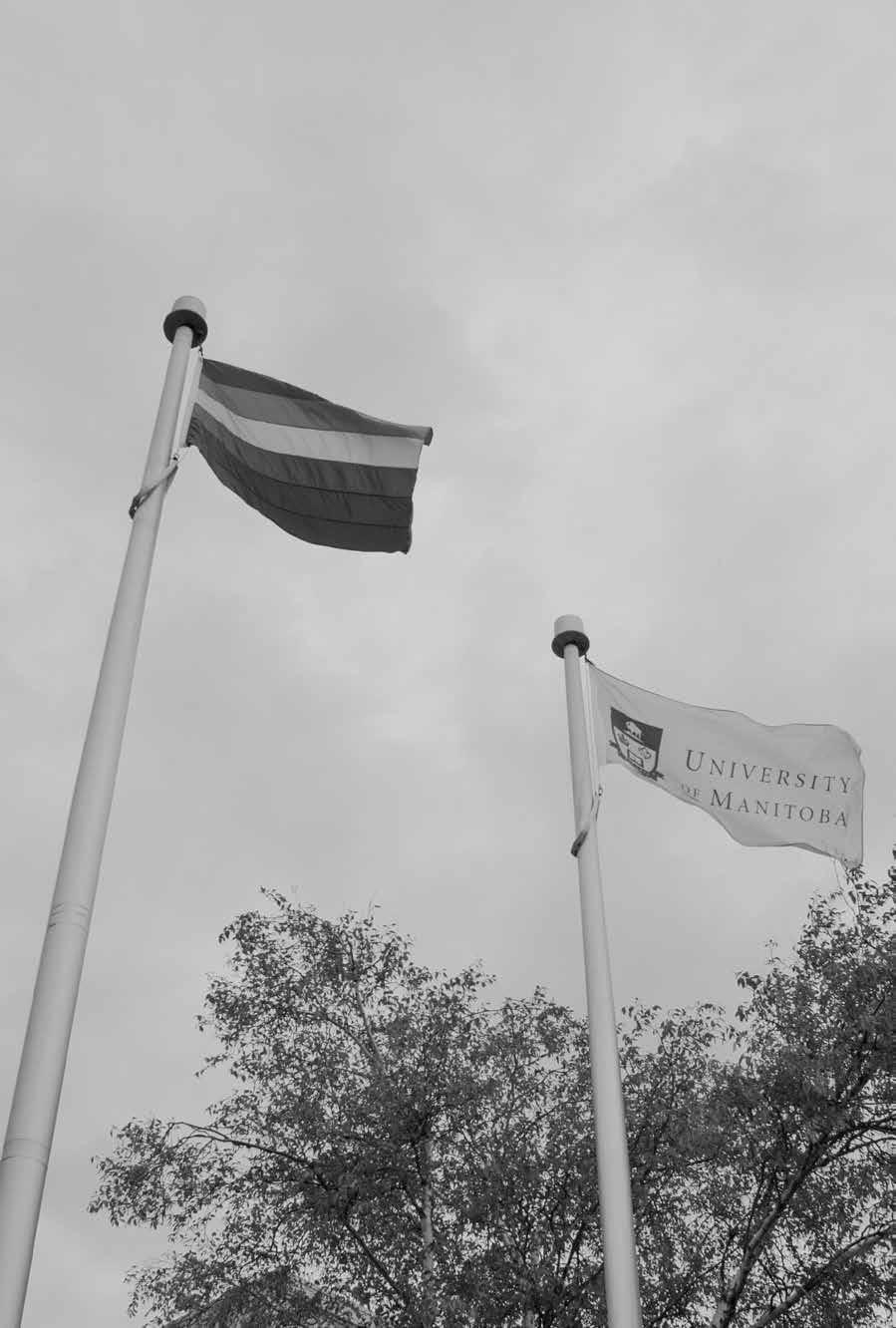
Students, university officials, and community members gathered in the atrium of the Brodie Centre on the Bannatyne campus May 30 for a flag-raising ceremony marking the University of Manitoba’s firstever official participation in Pride Winnipeg.
A flag was also raised without ceremony on the Fort Garry cam-
pus at the intersection of University Crescent and Chancellor Matheson Boulevard.
Medical students Tharuna Abbu and Shayne Reitmeier, co-founders of the LGBTTQI* Interest Group and LGBTTQI* Mentorship Group for medical students at the U of M, raised the rainbow flag following speeches from David Barnard, the
university’s president, and Albert McLeod of Two-Spirited People of Manitoba, Inc.
The ceremony kicked off a week of events including a drag show, a panel discussion on LGBTTQ* health care, an archival display at the Elizabeth Dafoe Library, LGBTTQ* awareness training sessions, and a Zumba party for all bodies and all genders.
The U of M also had a float in the Pride parade June 5 and a booth at the Pride festival at the Forks.
Aside from participation in the events, the U of M is also a sponsor. Taken together, this is a level of official involvement in Pride that has never been seen before at the university.
“When I started on the medical campus here, I felt very unsafe” –Shayne Reitmeier, co-founder, LGBTTQI* Interest and Mentorship groups
“The university wants to be a community that’s inclusive to everyone, inclusive of everyone, and welcoming to everyone,” said Barnard. “So when the idea arose it seemed a very natural thing to support it.”
In his speech at the ceremony, Reitmeier described the U of M’s official support as “long overdue.” In an interview afterwards, he added that overt and visible support is especially significant.
“The reason I keep emphasizing that it’s visible is we do have student counselling offices, we have certain faculty members who will put up the positive space flag in their office. However, it’s not a unified front by the entire university,” he said.
“So this means people who are at the U of M who might not know the supports are out there can finally know that there are, and that there are people who are trying to change the university.”
Reitmeier said the university is “doing a good job at starting to be an inclusive space.”
“However, I feel like we have a long way to go,” he said.
Unlike the Fort Garry campus, which has Rainbow Pride Mosaic, a student-run safe space for LGBTTQ* students, Reitmeier found the Bannatyne campus, which mainly serves students in the health sciences, to be lacking an overtly safe place.
“When I started on the medical campus here, I felt very unsafe,” he said.
“So one of the things that our group has done is have a positive space campaign, which really quite
simply was putting up posters around campus so that there was a visual indicator that this is a safe place for everyone.”
LGBTTQ* health care
The flag-raising took place just a stone’s throw from the front entrance of the Health Sciences Centre, and health care was a major theme of the ceremony. In an interview, Abbu discussed some of the ways new doctors can learn to be more responsive to the needs of LGBTTQ* people.
“I think for the most part people are on board with the fact that you shouldn’t be a jerk,” they said.
“For the most part people get that point [...] It’s a little more difficult to recognize how your physical environment or clinical space is unsafe or contributing to stress or unwellness of your patient population.”
Abbu cited education as a solution. For example, they said doctors can be trained on how to prescribe hormones to patients looking to transition, or given up-to-date, sex-positive sex education. Abbu said they see room for improvement in transgender-inclusive health care.
“Many trans people don’t even feel safe going to a family doctor or going to the ER because they’ve had either personal terrible stories in the past, or they’ve heard from other people about really terrible care.”
Being authentic
The theme for the 2016 edition of Pride is “Be Authentic.” In an interview, Abbu gave their two cents on what that means to them.
“I think for me being authentic is a work in progress. It’s something that can often take a lot of courage. There are often very many barriers [...] that people have to overcome in order to be their true selves, and it can take many years in order to get to that point where you feel comfortable and where you’re in a safe environment to do so.”
Reitmeier agreed.
“When I started medicine I was in a place where I wouldn’t even speak about my sexuality and I was very fearful,” he said.
“I was putting on a front that wasn’t genuine. But I had the opportunity to kind of drop a lot of those negative feelings over the years and slowly learn what it is to be authentic.”
Check out the online version of this story for a special video report by Asad Aman.
photo by miguel yetman
Fort Richmond residents begin to see results on rental housing
City to amend bylaws, flag tax claims of alleged rooming house owners
Tom i n G ram, staff
Aresidents’ association formed to deal with the proliferation of illegal student rooming houses in the neighbourhoods around the University of Manitoba is beginning to see results, according to an update delivered at a community meeting May 31.
The Fort Richmond-University Heights Neighbourhood Association, which was formed in partnership with Janice Lukes, city councillor for South Winnipeg-St. Norbert, is working to combat the illegal conversion of single-family homes to rooming houses largely used for rent to U of M students.
Residents complain of uncut lawns, too many cars parked in too little space, and noisy parties. The rooming houses are hastily renovated, and many of them are poorly maintained, ugly, and unsafe, residents say.
“We just pray that no disaster happens in these houses,” said Lukes. “Because ultimately, you can’t have nine people living in one of these houses and have something not go wrong.”
Residents claim that in many cases, these houses are rented to international students who do not know their rights as tenants. The association will be distributing postcards with a link to their website, which has information about the rights and responsibilities of residents, tenants, and landlords.
“This will be ongoing in perpetuity because the university won’t be going away,” said Lukes. “This is the very beginning of a long journey of educating, knowing responsibilities, and knowing rights.”
The website also has flyers residents who aren’t comfortable talking to their neighbours can print up and put in the mailboxes of offending houses.
These social pressures are a way to get results over and above calling bylaw enforcement officers, a slow process that Lukes described as “frustrating as heck for many of us.”
In addition, Lukes will be providing a list of alleged rental properties, gathered by members of the neighbourhood association, to city tax authorities. Cross-checking the list with tax filings will enable authorities to identify landlords who are doubleclaiming their provincial education tax credit.
A forthcoming bylaw change will also enable the Winnipeg Parking Authority to issue tickets on private property, which will aim to address illegal parking arrangements.
The student side
Although no solid numbers exist, U of M students, and in particular U of M international students, are widely believed to be the main source of demand for illegal rooming houses
in the area.
According to Dara Hallock, vicepresident advocacy for the University of Manitoba Students’ Union (UMSU), the undergraduate union is “still developing our position on the issue as it is a complex one with many factors contributing to the housing situation in the neighbourhood.”
“I probably wouldn’t have passed my classes if I did not stay in that house” – former rooming house resident
The UMSU executive has met with Lukes, who also presented to UMSU council. UMSU has also advised the U of M’s International Centre for Students on developing workshops on tenancy for international students in the fall. These workshops will educate students on their rights and responsibilities as renters.
However, the actual voices of rooming house residents have not been prominent in the discussion.
Tyler MacAfee, the university’s director of government and community engagement, said housing is not a major concern for international students, judging by the topics raised in meetings with student counsellors.
“Housing is not something that is brought to us by students very often.
I know this is a major issue for the community, but it’s not something
that we’re hearing a lot from students,” he told the neighbourhood association.
One international student, who spoke with the Manitoban on the condition of anonymity, lived in a rooming house in the Fort Richmond neighbourhood from 2014 to 2015 and said his experience was positive overall.
“I probably wouldn’t have passed my classes if I did not stay in that house,” he said in an interview.
According to the student, cost was the major factor that brought him to a rooming house with six other tenants, where he lived with two others in the basement.
“Residence was much more expensive. Also, for apartments, if you’re looking at staying in them you need to have a co-signer,” he said.
“If you don’t have a co-signer you need good credit, and if you don’t have good credit already – as a student that’s not always possible, right? So it’s just a little more complicated. Those [rooming] houses, they assess you based on a personal meeting.”
The student said his house was fairly well-maintained, his landlord was responsive, and he never received a visit from bylaw enforcement officers or had any conflict with neighbours. However, he did say that many rooming houses are worse than the one he lived in.
Houses that lack proper water, that are dirty, and that have many people crammed into a small space should be shut down, he said.
“But there are some good ones too that help students out a lot.”
Relieving the pressure
The neighbourhood association has had an uneasy relationship with the U of M, which doubled its international student enrolment between 2010 and 2015 without a corresponding increase in residence beds. Lukes has said the scarcity and cost of oncampus residence is one of the factors driving demand for rooming houses.
Listings for rental houses in Fort Richmond on Kijiji, a classified ad site, run between $2,000 and $2,500 a month. At a conservative estimate of five people living in the house, tenants would be looking at a rent bill of $500 or less plus utilities. The student interviewed by the Manitoban paid $450 a month in rent. By comparison, on-campus housing is more expensive. Unlike rent on a house or apartment, U of M residence fees are due in lump sums at the beginning of each semester. Divided over the eight-month academic year, the 2016-17 rates for U of M dorms run between $430 and $937 a month, depending on the residence. Residence students do not pay separate utilities.
Most residences also have mandatory meal plans. One semester of a meal plan typically costs about the same as one semester’s rent, ranging between $2,403 and $2,665 per term. A super saver rate is available to residents of University College for $1,305 per semester.
There are 1,316 residence beds on campus, including 140 at the affiliated religious colleges of St. John’s and St. Andrew’s. The last residence built at the U of M was Pembina Hall, which opened in 2011 and largely offset the
loss of bed spaces resulting from the closure of the Taché Hall residence.
The university announced at the May 31 neighbourhood meeting that its residence development plan, which is currently in the works, will explore the possibility of high-density affordable student housing on campus in order to relieve some of the pressure.
“What we’re talking to students about now, and the direction we’re looking at, is more affordable housing,” MacAfee said in his presentation. “So smaller rooms, no bathrooms, a mix of single spaces and double occupancy in the rooms, and that’s in response to what we’re hearing from students right now.”
MacAfee said in an email that the plan is still in development and there is no timeline as yet.
Lukes said she was encouraged by the announcement, but remains skeptical that a full solution can come from the university.
“We know that the university cannot make money on affordable student housing. It’s not a revenue generator,” she said.
Lukes said private-sector investment will help, pointing to a private student residence development planned at 2525 Pembina Highway, which will create 600 bed spaces costing upwards of $500 a month.
photo by miguel yetman
CFS-MB membership calls on UMSU to settle nearly $1 million in outstanding fees
Unpaid fees costing Brandon University students, says BUSU president
Tom i n G ram, staff
The University of Manitoba Students’ Union (UMSU) owes nearly $1 million in membership fees to the Canadian Federation of Students (CFS), and other member locals in the province are starting to get impatient.
A resolution passed at the CFS-MB annual general meeting (AGM) April 30 called for UMSU to pay back all outstanding fees immediately. Member locals, including UMSU, voted unanimously in favour of the motion.
The issue reaches back more than three years, when the then-UMSU executive questioned its membership in the federation and began withholding fees it collects from University of Manitoba students on behalf of both the national and provincial Canadian Federation of Students (CFS) bodies. UMSU owes fees dating back to the 2013-14 academic year.
The motion for immediate payment was proposed by representatives from the Brandon University Students’ Union (BUSU). Nick Brown, BUSU’s president, said UMSU’s withholding of fees for the last three years disproportionately hurts service to campuses outside Winnipeg.
“We offered to and intended to
host the AGM in Brandon, which would be the first time in at least five years,” Brown said in an interview.
“We were going forward with that plan, and then UMSU still hadn’t paid any fees, and then CFS couldn’t afford to pay all the travel and hotel expenses for all the delegates because it’s a free conference.”
The AGM was instead held in Winnipeg at the Université de Saint-Boniface.
“We’d like to engage, but if we can’t bring folks to Brandon, then we’re constantly having to go to Winnipeg,” Brown said. “And that’s fine for 90 per cent of things, but we’re 20 per cent of the voting power in CFS-MB and we’re getting five per cent of the engagement.”
Brown said student unions join CFS to connect, engage, and help each other out, and when smaller members want to host an event, the larger members support it with funding.
“Members and executives of UMSU are attending meetings and attending events hosted by the CFS, and then UMSU’s not paying back into it,” he said. “The CFS is spending lots of money and lots of time trying to engage on the U of M campus. They spent more time in the past
year on the U of M campus than in Brandon.”
Although Brown said there was engagement in Brandon over the past year, representatives from CFS-MB were only able to come out to campus five times for a day at a time.
“We know we’re only 3,000 students. But proportionally I think they’ve spent more time at U of M.”
Three years of tensions
In April, UMSU voted to uphold a decision to “denounce” CFS-MB for an allegedly biased provincial election campaign. This vote capped off three years of tensions with the national lobby group and its Manitoba branch.
In 2013, UMSU conducted a review of its membership in CFS and ripped CFS-related pages from 20,000 free student daytimers over a business dispute.
Since that time, UMSU’s dispute with CFS has shifted to the federation's alleged refusal to turn over certain web hosting information and legal documents, and then to determining the precise amount of outstanding fees.
UMSU pegs its outstanding membership fees at $980,555.54. According to UMSU president Tanjit Nagra, CFS “did not confirm through the
appropriate channels” whether the number is accurate. Nagra said this is the reason for the delayed payment.
Michael Barkman, chairperson of CFS-MB, noted in an email U of M students are members of the federation, with access to services and campaigns, and called it unfortunate UMSU has withheld fees for so long.
“Students’ unions have a responsibility to collect and remit membership fees based on enrolment of students [...] We are hopeful that UMSU will finally remit membership fees and continue to work together on campaigns and services.”
Barkman added he remains “optimistic that fees will be paid within the next week.”
Nagra said UMSU recently received a letter from CFS that may clear the issue up, but due to the amount of money involved it will have to be forwarded to UMSU council first.
“It’s UMSU council’s decision at the end of the day,” she said. “Any member of the union can put forward any motion to UMSU council [...] and if it passes we have to follow it.”
“But we have to go through proper channels. Given the amount of fees that are owing, we would have to go through UMSU council.”
UMSU council’s next meeting is scheduled for June 16.
A change of position?
Nagra said she could not comment on the decision to withhold the fees, which was made by past executives.
“However, at this point, the way I see it, we want to resolve any further issues there are with CFS and solve any conflicts that there are and we are working to do that every day,” she said.
She said UMSU’s goal is to ease tensions with CFS for the coming year. “It is unfortunate that it’s gotten to this point, but at this point we’re just looking to solve the problem and find a solution.”
However, Brown said he doubts the new UMSU executive has changed course much on relations between UMSU and CFS.
“It’s been over a month since the AGM, it’s been a month since the new executive for UMSU, and we’ve seen nothing.”
graphic by bram Keast
Negotiations between university, UMFA underway
Multi-year collective agreement sought after one-year, expedited talks fall through
Gar ETT Williams, staff
Full-scale negotiations between the University of Manitoba and its faculty union toward a multi-year agreement commenced late May, with nearly 30 days set aside and bargaining sessions scheduled into September.
Talks with the University of Manitoba Faculty Association (UMFA) kicked off May 25 after attempts to reach an expedited, oneyear deal prior to the 2016 provincial election fell through.
The university presented faculty with a one-year, salary-only offer including a 1.5 per cent base increase in March.
Including annual increments already allotted to faculty and staff and additional adjustments based on rank and discipline, the average actual increase would have been closer to 3.94 per cent for the 20162017 contract year, according to a university release.
The most recent three-year collective agreement expired March 31.
UMFA president Mark Hudson said outstanding governance issues critical to the faculty association could not be ironed out through the fast-tracked discussions and the effort was abandoned April 20.
“I think both sides saw some advantage to trying to get a deal done early and quickly, but once we took into account the governance issues that our membership saw as crucial, it just became apparent at the table that those were too complex to try to deal with in a very short-term bargaining process,” he said.
The April 19 election saw a Progressive Conservative government elected into office for the first time since 1995. Throughout the campaign, the PCs were mum on commitments toward post-secondary education, aside from a plan to
boost the Manitoba Scholarship and Bursary Initiative.
In its first provincial budget released May 31, the government increased operating grants to universities by 2.5 per cent.
While a deadline to reach a settlement hasn’t been set, John Danakas, the U of M’s executive director of public affairs, said the university is aiming to have an agreement in place when classes are set to resume in the fall.
“There is a strong desire on the
part of the university to ensure the bargaining process does not have a negative impact on student learning and activities,” he said in an email.
Negotiators have already held five bargaining sessions, with another 22 scheduled between now and September 1.
Hudson noted the U of M faculty is compensated among the lowest of the U15 group of Canadian research universities but noted, “on the financial issues there was a fair degree of agreement about what needs to happen.”
Professors at the U of M were paid a minimum of $101,423 in the 2014-15 fiscal year. Associate professors made a minimum of $82,599 and assistant professors made a minimum of $70,370.
At the University of Alberta, professors made a minimum of $116,473 annually in 2014-15. Associate professors made a minimum of $93,944, while assistant professors made a minimum of $75,403.
University of Saskatchewan
Progressive Conservatives hold line on post-secondary funding
Gar ETT Williams, staff
I
n its first provincial budget since being elected to office in April, the Manitoba Progressive Conservative government held steady on postsecondary funding.
Released on May 31, the provincial budget will increase university operating grants slightly by 2.5 per cent, while colleges will see a two per cent bump. The government also committed to implementing the master of social work in indigenous knowledges program at the University of Manitoba.
Overall, education and training funding will increase by $37 million, or 1.4 per cent, according to a provincial release.
Canadian Federation of StudentsManitoba (CFS-MB) chairperson Michael Barkman said he was reassured to see the new government maintain support for post-secondary education in line with commitments made by the previous government, including holding tuition rate increases to the level of inflation.
“It was something that we were
asking [for] throughout the election campaign and in the first months in government, so that was good to see,” he said.
“We’re hopeful – and we’ll continue to push over the rest of their mandate – that they continue to fund post-secondary education and increase their commitment to education in Manitoba,” he added.
The Progressive Conservatives made little mention of a post-secondary education platform throughout the spring election campaign,
beyond a commitment to bolster the Manitoba Scholarship and Bursary Fund.
“The University of Manitoba welcomes the increase to funding for post-secondary education, so critical to the future prosperity and competitiveness of this province,” said U of M president and vice-chancellor David Barnard in a release.
“We will continue to advocate for a vibrant post-secondary and innovation sector and to work with the government where possible to deliver
professors earned a minimum of $124,618 in 2014-15, while associate and assistant professors made minimum salaries of $106,708 and $88,798, respectively.
The 2013-16 collective agreement between UMFA and the university saw a 6.9 per cent salary increase over the contract’s term. The previous 2010-13 agreement gave faculty a 4.4 per cent increase.
solutions that benefit the people of this province.”
University of Manitoba Faculty Association president Mark Hudson said while he is pleased the new government didn’t roll back funding pledged by the previous government, overall support for post-secondary in Manitoba is down.
“We have a lot further to go to ensure accessible, affordable, and high-quality post-secondary education in this province,” he said.
photo by chantal zdan
Editor-In-Chief:
Craig Adolphe
The beginning of a conservative reformation
Acceptance of same-sex marriage, end of Harper era may modernize federal Tories
lE vi Garb E r, staff
“Ithink I'll look back on this moment in my political career, in my life, as something that was really transformative and really awesome,” Conservative MP Michelle Rempel told reporters last Friday at the party’s biennial national convention in Vancouver.
‘Transformative’ is a fitting word to describe the atmosphere at the Vancouver Convention Centre last weekend. Rempel, in her excitement, was referring to a closely won vote by delegates to bring a discussion and motion on ending the party’s traditional definition of marriage to the convention floor.
For decades, the official position in the party’s policy guide was that marriage was between one man and one woman, a stance that has caused rifts between younger, more progressive party members and older, more socially conservative ones.
In a 1036 to 462 vote the next day, the resolution passed and the divisive language was dropped from the constitution. This, despite the fact that same-sex marriage has been legal in Canada for over a decade, has conservatives all over the country buzzing. The Conservative Party of Canada, which in the past staked out a platform based on traditional
Christian values due its deep Reform Party roots, has just taken a big step to the left. But is this action significant enough to reconcile the more socially liberal faction of the party? And is the party going far enough to support the LGBTTQ* community?
Out with the old, in with the new
Later that same Friday night, former prime minister and Reform Party alum Stephen Harper stood behind the podium in front of thousands of supporters, staff, and delegates to give his final farewell to active political life. The official end to an era that defined Canadian conservatism had finally arrived.
Harper announced his official resignation as an MP and thanked the party for ten long years of unwavering support. He then waved his final goodbye and rode off into the proverbial sunset... or into the Conservative party’s fundraising office, where he will now serve as a director.
With the former prime minister’s departure, the delegates and MPs were finally able to breathe. The time to begin the rebuilding process after falling from a decade of power in Ottawa had come.
For the next two days, the Vancouver Convention Centre was filled with a range of discussions on controversial social policies, loud arguments about the party’s future, excited delegates bustling to and fro, and something the party has not been used to for over a decade: reporters. Everywhere. You know things have definitely changed in the Conservative ranks when MPs are lining up to speak with journalists rather than vice versa.
What’s next?
The Tories have not, however, thrown all of their fervent social conservatism to the wind. In votes following the one on same-sex marriage, delegates overwhelmingly supported a resolution to ensure “conscious rights” to medical practitioners who do not want to perform abortions or medically assisted suicides. Delegates also elected to have civilian gun ownership enshrined as an aspect of “Canadian heritage.” These kinds of policies are to be expected from the right-wing grassroots members of a party that is doing some serious soul-searching at the moment.
What was not expected, however, was the impassioned and exuberant reactions that many of the party’s
bigwigs, such as Michelle Rempel, Jason Kenney, Kellie Leitch, Michael Chong, Maxime Bernier, and Peter MacKay – all officially or prospectively vying to replace Stephen Harper at the party’s head – expressed toward the controversial and frankly stale conversation about the party’s renewed approach to marriage.
“We are a party of equal opportunity, we are a party that is inclusive,” Leitch, who has already thrown her hat into the ring for leader of the party, told the CBC.
“It's about freedom and respect. It's about us and telling Canadians that you can love who you want and that you can be in love,” Bernier said to delegates in a speech on the issue.
T hese assertions coming from members of a party that took a woman to court for wanting to wear a religious head covering during her citizenship oath speak volumes. On social issues at least, the Conservatives may be coming to the realization that, overall, Canadians are a lot more progressive then they took us for last October.
Despite this newly minted support for same-sex couples and their revived passion for discussing social issues, the Conservative party is still way behind the rest of Canada on
LGBTTQ* rights. With new transgender rights legislation on its way to Parliament, the ‘party that is inclusive’ must find itself on the right side of history and support the proposed laws.
Unfortunately, there are already Conservative senators threatening to kill the legislation with the same absurd justifications that Republicans in the U.S. are using over trans “Bathroom Bills.” It will take the combined effort of the Conservative party’s most influential members, such as those who excitedly supported the acceptance of same-sex marriage, to ensure that the party has any legitimacy when it calls itself the party of equal opportunity.
It has taken the Conservatives over ten years to come to terms with same-sex marriage and they have suffered for their tardiness. If they do not learn the lesson that Canadians want to live in a country that values inclusiveness, compassion, and equality for all, then the Conservative party will continue to have trouble climbing out of the pit Harper drove them into last October.
graphic by Kelly campbell
Putting education front and centre
m icha E l b ar K man
T
housands of young, fresh-faced students will pour onto the campuses of universities across the province, including the University of Manitoba, come September. Thousands of mature students, parents, part-time students, and others will be joining them as well, keen to learn and grow in the many fascinating programs that are housed in our post-secondary institutions.
In a recent piece for the CBC, U of M president David Barnard discussed the many intrinsic benefits of postsecondary education where students are “provided with the means to live thoughtful, rewarding lives [...] [to] know how to think critically and analytically, to see the big picture, to continue learning.”
He’s right. An education can enhance and shape the personal, professional, and collective lives of those that choose and can afford to attend a post-secondary institution.
Education is essential. It develops and grows careers. It moulds critical thinkers who push for social justice and equity for all. It improves our cultural and social health. It can grow our economy sustainably. I know that many who are a part of the University of Manitoba community understand this. Unfortunately, recent University of Manitoba budgets have not prioritized education. Three successive years of cuts to academic units have had a dramatic impact on students’ education. In May of this year, the university passed a budget with three per cent cuts across all academic units, now totalling almost 10 per cent cuts since 2013.
As a result, new and returning students will not be able to explore the options they deserve and everyone will experience a decreasing quality of education year after year. Students will come up to me in the hallways, bemoaning their 200-person biology class taught by a video screen or the
philosophy class they need to graduate with that is only offered every second year.
Cuts have resulted in course cancellations and fewer options for students, delaying graduation for students in faculties from computer science to fine arts. Cuts have changed programs, starving faculties of vital funds for programming and student services. Full-time faculty have been offered voluntary retirement packages and they are not being replaced with tenured staff. Instead, underpaid contract sessional instructors are filling gaps and trying to make do with the limited resources they have.
Budgets always reflect choices.
The University of Manitoba can make better choices and invest in the foundation of the university: education.
There are solutions. Included in this budget was $68 million in revenue that was transferred from the operating budget to capital. As a result, scheduled salary and operating increases suddenly created a deficit.
Meanwhile, this budget committed over $27 million of new spending to the administration’s ‘strategic priorities.’
are important public institutions. At the same time, public money should be spent appropriately at those institutions on what it is deemded for, the education of citizens.
“The University of Manitoba can make better choices and invest in the foundation of the university: education”
At the same time, provincial funding for universities went up by 2.5 per cent in the new provincial budget. Our post-secondary schools should receive strong provincial funding since they
A tale of two parties
If president Barnard believes that students have “opened up their lives to new possibilities and positioned them for future success” through education, then the university should prioritize academic programs, courses, and full-time staff in its budget. Our education should be the highest priority for the university
Comparing national conventions in the wake of change of government
J E r E miah Kopp
I
n late May, Liberals and Conservatives held simultaneous national conventions in a whirlwind of politicking and policy. It was a unique comparison that revealed particularly sharp contrasts in Canada’s two largest and historically successful political parties.
In Winnipeg, the Liberals were still basking in the glow of Prime Minister Trudeau’s ‘sunny ways’ and a come-from-behind majority government election victory. Giddy Liberal Party delegates took the prime minister’s cue and voted in favour of streamlining existing governing documents and removing the party’s long-standing membership fee.
The ideological and practical
effects of these decisions are significant. They signal a willingness to continue opening up the political process as Trudeau attempts to turn the Liberal party into the Liberal movement.
The Conservative gathering in Vancouver was understandably less jovial, as the party conducted an audit of the disorganized 2015 federal election campaign. Convention ‘highlights’ included a post-mortem that involved an MP adorning a grim reaper costume, a comical leadership race rap, and a full third of participants opposing a resolution that moves the official Conservative Party position on same-sex marriage to an overwhelming and progressive
neutral.
The respective conventions provide a cautionary tale and illustrate just how quickly political fortunes can turn. It has been less than a year since Stephen Harper and Thomas Mulcair were duking it out for first place in the polls. Since then, the New Democrats have unceremoniously dumped Mulcair at their own convention and were forced to confront the serious ideological division in their membership. While the Conservatives are hardly languishing, Canada’s ‘natural governing party’ has once again proven to be one of the most electorally successful democratic political party in the world. Despite many years in the political
wilderness and several failed attempts, the Liberal Party of Canada has once again reconnected with Canadians who, in turn, have trusted them with a majority government. In the last election, the Liberals effectively embraced their traditional role as a brokerage party, balancing the varied and oft-competing priorities of our diverse nation. However, Liberals must remain calm, steadfast, and humble in this time of euphoria. Politics is cyclical; inevitably the Liberal party will lose a future election and go through a rebuilding phase similar to that which the Conservatives are currently engaged in. Such is the ‘check and balance’ of our democratic system
administration. Students are suffering, and there are many ways that the hemorrhaging can be stopped. It’s about choosing the right priorities in the next budget, while pushing for greater public funding for postsecondary education.
President Barnard was correct in his assertion about the inherent value of post-secondary education. The university administration now needs to live up to their word and reinvest in our education.
Michael Barkman is the chairperson of the Canadian Federation of Students – Manitoba.
where parties are forced to reinvigorate policy and reengage with the grassroots after years of governance empties the figurative cupboards of both inspiration and drive.
The question is how long the Liberals will remain in favour with Canadians. If these recent national conventions are any indication of party vitality, the Liberals are in excellent shape.
Jeremiah Kopp is a former University of Manitoba Students’ Union president who holds a bachelor of arts in political studies and is completing a Master of business administration at the Asper School of Business. He is also a member of the Liberal Party of Canada.
photo by dana hatherly
Sports Editor: Ryan Stelter
Contact:
The best and worst of the Stanley Cup playoffs
Breaking down some of the best stories to come out of this year’s playoffs
E very year in the post-season we see surprises, miracles, and some heartbreak. Teams break the chains of their playoff identities, upsets happen, and phenomenal regular seasons are brought to a screeching halt. Role players become heroes, and superstars crash and burn. We see the bad, the good, and some downright ugly but the road to Lord Stanley’s Mug is always an entertaining one.
Here are some of the best storylines to come out of the 2016 Stanley Cup playoffs so far.
John Tavares steps up
Despite his team being quickly eliminated in the second round by an overpowering Tampa Bay team, the Islanders captain established himself as an elite playoff performer in their opening round series against the Panthers.
The Isles upset the top-seeded Florida Panthers in six games to propel the forgotten New York club out of the first round for the first time since 1993. John Tavares was a force, compiling 11 points in as many games. He practically willed the Islanders past the Panthers in their series, scoring both the tying and winning goal in the decisive game six. He finished
the series with nine points. Look out Henrik Lundqvist, there’s a new king in New York.
Lightning’s resilience
Most people predicted a deep run again by the Bolts from the start of the season. We know they’re a wellbuilt team; they have one of the most potent offenses in the East, an elite goaltender, and some solid defensive corps. They have an accomplished coach in Jon Cooper and the structure of their game is admirable. However, injuries have been a major issue in recent years and the 2016 campaign was no different.
Their captain Steven Stamkos played in all but one game during their entire playoff run. Their number two defenseman Anton Stralman missed most of the postseason up until their elimination by the Penguins, goaltender Ben Bishop went down with a leg injury in game one of that series just as he was leading all playoff goaltenders in save percentage and goals against average. Tyler Johnson was undoubtedly playing through an injury sustained in game one of the Conference Finals. Surely any team missing three of their top five players would crumble in the
Triple threat
playoffs, but not Tampa.
The Lightning stepped up and put themselves within one win of a second straight final appearance, but ultimately fell in seven games.
Penguin resurgence
Speaking of injuries, Pittsburgh is a team that seems almost cursed by the injury bug. They have arguably the best core in the NHL with Sidney Crosby, Evgeni Malkin, Kris Letang, and Marc-Andre Fleury. However, this core just hasn’t been able to get healthy for the playoffs. This year is different and the Pens are reminding everyone what a deep and talented team they are.
Crosby and Malkin are a lethal one-two punch down the middle, surrounded by the best supporting cast they’ve had in years: Phil Kessel, Chris Kunitz, Carl Hagelin, and Nick Bonino. Letang is healthy and producing like he can and, in the wake of Fleury’s concussion, rookie goaltender Matt Murray has emerged as the rock on the back end sooner than we expected.
With the Penguins rolling three real solid scoring lines, and a fourth that can chip in the odd goal while playing with energy, they are a force
to be reckoned with.
They play with incredible support through the middle of the ice and it wouldn’t be surprising if they overcome the San Jose Sharks finally bring the cup back to the Eastern Conference this year.
No crease Stars in Dallas
Two goalie systems in the playoffs don’t work. During the regular season, the carousel worked incredibly well in Dallas with Kari Lehtonen and Antti Niemi both splitting time. The Stars won the Central Division, which is considered by most to be the toughest in the NHL.
Carried by the best offense in the league (3.18 goals per game), the Stars looked poised to make a deep playoff run. Instead, we saw the both Stars goaltenders struggle and allow 17 goals in six games against a Minnesota squad that had the lowest regular season point total of any team to make the playoffs since they added shootouts to the league.
While the Stars were able to stretch their second-round series against a very competitive Blues team out to seven games, Niemi and Lehtonen were once again the Stars’ Achilles heel. They allowed 25 goals
in those seven games, including four or more in each of their four combined losses. Someone should tell Jim Nill that winning games 9-8 hasn’t been done since the 1980s.
Elliot being allowed to play
Every year the St. Louis Blues make the playoffs with a solid regular season record. Every year the St Louis Blues get upset in the first or second round. Every year Blues head coach Ken Hitchcock elects to go with another goaltender besides Brian Elliott.
This year, Elliott finally got his shot and he was stellar, as he carried the Blues past the defending champ Blackhawks in seven games in the first round. He even held his ground against the offensive juggernaut Stars in seven games in round two. Elliott stole game one of the conference finals – a 2-1 victory over the San Jose Sharks. He would falter in games two and three allowing three goals in each while the Blues were shutout in consecutive games. That was all it took for Hitchcock to flip the switch and start Allen the next two games. Ultimately, Elliott would start and lose game six and the series.
Trio of Winnipeggers making a name for themselves in the 3-on-3 basketball circuit
m i KE sT ill
I
n 2014, Wyatt Anders and Darcy Coss – two former Manitoba Bisons basketball standouts – were looking for ways to compete during the off-season. They stumbled upon the 3-on-3 World Tour online and were immediately hooked.
“We saw this 3-on-3 build up your points thing online. I was like ‘what is this, it looks kind of cool?’ He [Coss] dug a little deeper and we saw that there was big tournaments and money to be won and world champions,” Anders said.
The duo were hooked immediately, having been exposed to the 3-on-3 format in the past, however they needed a third member to round out their squad. Cue Graham Bodnar – a former two-time Association of Christian College Athletics (ACCA) national champion at Providence University College – who had been playing in 3-on-3 tournaments for over 10 years.
“The
idea was if we call ourselves something, if we become an actual team and not just the three of us and get a name and promote ourselves as such, that we will be able to acquire funding”
– Darcy Coss
Coss had developed a relationship with Bodnar previously and when he came calling, the wily veteran didn’t
let him down.
“When it [3-on-3] started getting more serious, I was going to Ontario just for the one tournament just because there was nothing here, literally asking people that lived out there to play with me,” Bodnar said.
“When they [Coss and Anders] started to do it, it blew my mind, because I’d never had anyone consistently. They wanted to travel and do it, it was mind-blowing.”
The “big three” quickly developed chemistry and were effective from the outset thanks to their size-athleticism combination, which made them tough to guard in space but also gave them an edge on the defensive side.
In their first year as a unit in 2014, they won the Winnipeg and Toronto tournaments before placing 10th in the masters tournament in Chicago. Last year, they improved upon their performance at the masters, placing fourth in Mexico City.
This year the squad – along with fourth member O’Neil Gordon –have stepped up their level even more. For the first time, they’ve gotten sponsorship, participating under the team name “Acceleration Performance,” a local sport performance centre where the group trains twice a week on top of their on-court sessions four times a week.
“The idea was if we call ourselves something, if we become an actual team and not just the three of us and get a name and promote ourselves as such, that we will be able to acquire funding,” Coss said.
“It’s hard to say, ‘support Graham, Wyatt, and Darcy.’ That’s fine, but people like supporting something not just a group of people.”
Additionally, they will be travelling all summer, participating in tournaments all over Canada and the United States, as well as one in Europe in an attempt to qualify for
the World Tour and gain as many points as possible along the way. The team will also be hosting a 3-on-3 fundraising tournament from June 17-19 at the U of W’s Duckworth Centre. A portion of the proceeds will also be going to CancerCare Manitoba. The link can be found on Basketball Manitoba’s website.
Team Acceleration Performance has set up a gofundme page to help cover the cost of travel. The link can be accessed, along with training and tournament updates on their Facebook page, 3x3 Acceleration Performance.
European soccer season review
Breaking down what happened in each of the top flights
ryan sTE lTE r, staff
This past year of soccer has been an entertaining one, with plenty of surprises and upsets. Every league had its own unique story and the Manitoban will break down what transpired over the season.
England
Leicester City was probably the best story in all of sports this season. Prior to the start of the season, the Foxes were faced with odds of winning the league 5,000 to 1. Manager Claudio Ranieri orchestrated some phenomenal soccer out of his players and with star front man Jamie Vardy , Leicester was able to surprise everyone and claim the Premier League title.
One of the more pleasant surprises this season was seeing Southampton enjoy success in the latter stage of the season. They put together a marvelous run and will play in Europe next season.
Spain
Spain enjoyed all the success in Europe this season, with Real Madrid and Sevilla taking the Champions League and Europa League titles respectively. Barcelona took the spoils of La Liga home with them after a dramatic title race . They also took home the Copa Del Rey to cap off a marvelous season.
It was an allSpanish affair in the Champions League final again as the two Madrid teams, Real and Atletico, played a rematch of the 2014 Champions League final with Real winning on penalties. Sevilla managed to overcome Liverpool in the Europa League final and took the trophy back to Spain for the third year in a row. Spain’s dominance in
Europe is a testament to the quality of the league.
Italy
Juventus took home their fifth title in a row after struggling out of the gates initially. Juve crashed out of the
them on to Champions League qualification next season.
Gianluigi Donnarumma stole headlines in Milan this season when he became the youngest goalkeeper in Italian history to tend the sticks.
Gianluigi Donnarumma stole headlines in Milan this season when he became the youngest goalkeeper in Italian history to tend the sticks
Champions League after a horrible collapse to Bayern Munich but still managed to win the Coppa Italia, the Italian domestic Cup .
Napoli also enjoyed great success in the Serie A, finishing second behind winners Juventus. The strong play of Gonzalo Higuain helped spur
Donnarumma certainly looks to be the keeper of the future for the Italians and he is definitely one to keep an eye on in the coming years – one of the better storylines to come out of Italy this year.
Germany
It was once again Bayern Munich’s year, as they won their third Bundesliga title under Pep Guardiola and fourth in a row – a first in German soccer history. The Bavarian club also took home the
DFB Pokal in a dramatic penalty shootout against rivals Borussia Dortmund.
Dortmund also had a great season under new manager Thomas Tuchel, who took a team with an uncharacteristically bad season last year and did not challenge for the title. This year, they made a race of it with Bayern but due to their own misfortunes of not being able to collect points against smaller teams, they ceded the title to the Bavarians.
Hertha Berlin was a fun team to watch this season, with Pál Dárdai having them sitting in the Champions League qualification places for much of the season, but they ended up collapsing towards the end and will have to play qualifying games in August.