Check the Manitoban's website and social media accounts for new video content this summer.
Out West
Bisons basketball's new season structure
Black hole discovery
Two U of M profs discuss breakthrough research
EDITORIAL
DESIGN
MANITOBAN
109 HELEN GLASS UNIVERSITY OF MANITOBA
of Manitoba, to provide an open forum for the free expression and exchange of opinions and ideas, and to stimulate meaningful debate on issues that affect or would otherwise be of interest to the student body and/or society in general. The Manitoban serves as a training ground for students interested in any aspect of journalism. Students and other interested parties are invited to contribute to any section of the newspaper. Please contact the appropriate editor for submission guidelines. The Manitoban reserves the right to edit all submissions and will not publish any material deemed by its editorial board to be discriminatory,
of the writer(s), not necessarily those of the Manitoban staff, Editorial Board, or the publisher.
Midwifery students rally for cancelled program
UCN-U of M students offered places in nursing as troubled program is shuttered
TOM INGRAM, STAFF
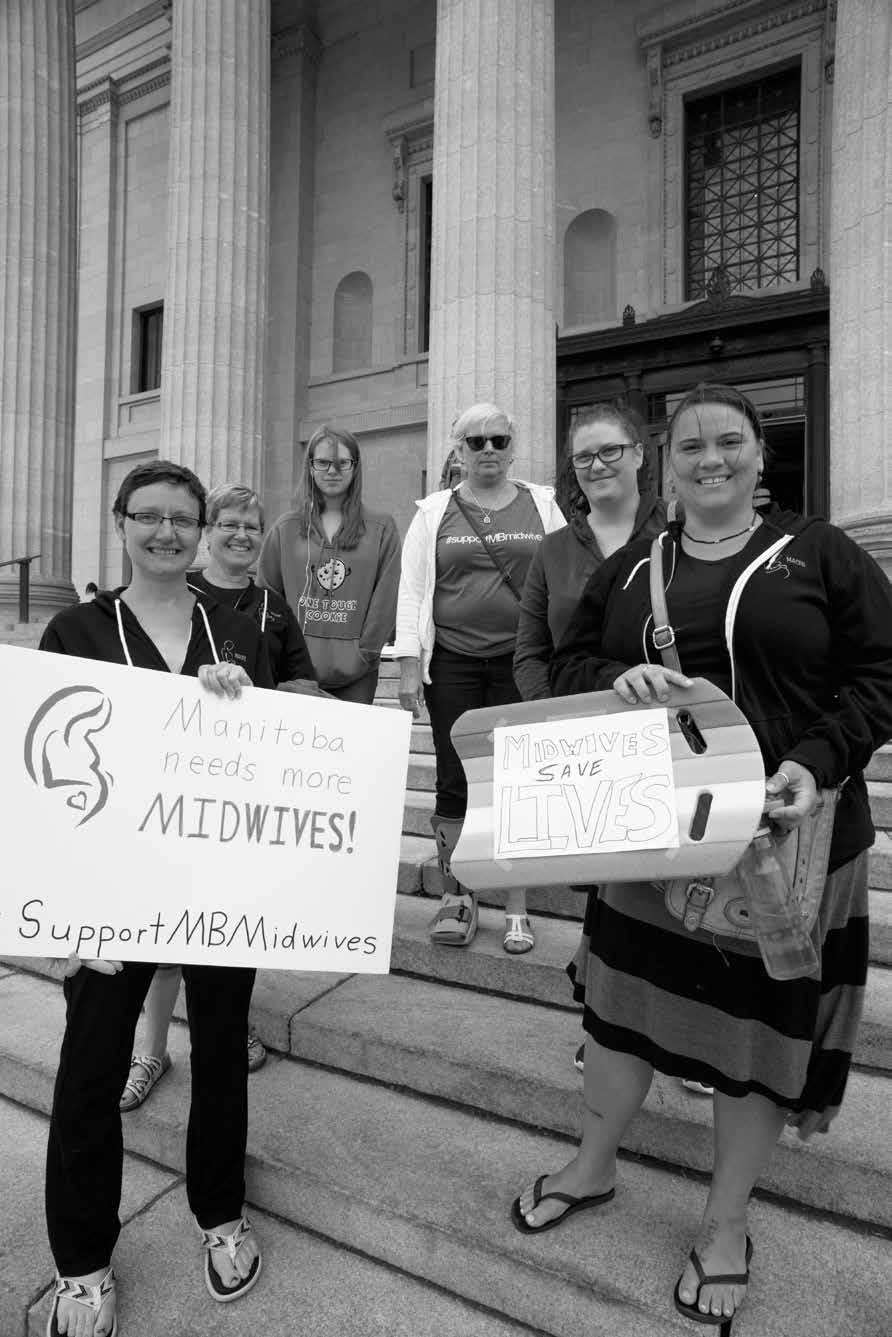
Students and supporters rallied at the Manitoba legislature June 30 in support of the province’s only bachelor of midwifery program, which the government announced last week will not offer courses in the fall.
The program, offered jointly by the University of Manitoba and the University College of the North (UCN), had been on track to enter its second year with a cohort of 14 students. The joint program superseded a previous UCN-only program that operated from 2006 to 2014 and graduated only nine students during that time.
In the run up to April’s election, Manitoba’s previous NDP government promised a funding increase of $844,000 to support the more expensive joint program, which would need full-time instructional staff, the capacity for an annual intake of students, and new academic supports for students. However, the new Progressive Conservative government’s first budget, released in May, did not include a funding increase for the midwifery program.
Funding was maintained at the previous level of $859,000, effectively making delivery of the joint program impossible. Since only the joint program is approved by the College of Midwives of Manitoba (CMM), while the standalone UCN program no longer has approval, the program as approved by CMM cannot proceed.
Jim Scott, the director of communications for UCN, said in an email the two universities have been working closely with the province to ensure the 14 students “have options for continuing their academic careers in September 2016.”
“This work is continuing,” he wrote.
A representative from education minister Ian Wishart’s office could not be reached by press time. Wishart said in question period June 13 that “there will be a program in place” for current midwifery students in the fall, and a June 28 government press release said the province is working toward a “new educational pathway” for midwifery students.
“We remain committed to the students who have completed the first year of UCN’s bachelor of midwifery program,” Wishart said in the release.
Midwifery students were subsequently offered places in the U of M’s nursing program for the fall.
According to NDP education critic Wab Kinew, remote communities in the north have a particular need for midwives.
“When you talk to people in northern Manitoba, one of the top overall health priorities that they have consistently identified is returning birthing to their communities,” Kinew said in an interview.
“People in large northern First Nations like Norway House don’t
want to have to come to Winnipeg or Dauphin or Brandon. They’d rather see the ability to deliver babies at home.”
“It’s a cut in pay, it’s a cut in position, and it limits what we can provide for Manitoba women and their families” – Jill Larner, midwifery student
In a committee meeting on June 23, Wishart suggested Manitoba may need nurses with midwifery training rather than ordinary midwives.
“Perhaps what we really need in those [northern] communities are nurses that are trained as – with an additional midwives course rather than midwives themselves,” he said. “Certainly, there’s a need in every community for nursing and in many of these communities it’s tough for them to find nurses and many of them are there under contract and in and out in the communities.
“So the nature of filling that need might change from midwives alone, stand-alone midwife positions, to something that is more an evolution of nursing.”
‘Where’s our program?’
The call for applications for the bachelor of midwifery program’s 2015 cohort said students would need “flexibility in their education plan and program delivery.”
Jill Larner, one of the program’s stranded students, was not expecting the program would be cancelled abruptly.
“Our acceptance letter told us that some of the policies and procedures were under review and if any changes were going to be made to this program, that there was a contingency plan in place and we would be seamlessly transitioned into it,” Larner said.
“Apparently that’s not the case right now.”
Lauren Henderson, another student, pointed to the cost of pursuing midwifery training as a particularly strong pressure on students.
“It’s not really a program where you can work. Especially going into our clinical placement, you can’t work.
You’re on call 24/7.”
Both Larner and Henderson said a spot in nursing at the U of M is not a substitute for midwifery training.
“A midwife is a primary caregiver,” said Larner. “Nurses are amazing at what they do. It’s a great profession, but currently in Winnipeg right now, they aren’t primary caregivers, so they wouldn’t be the ones in charge.”
“So for us technically, it’s a cut in pay, it’s a cut in position, and it limits what we can provide for Manitoba women and their families.”
Henderson agreed. “It would be like saying to an electrician, ‘you can’t be an electrician, but you can be a plumber.’ They’re completely different, but they’re both trades. We don’t want to be nurses, we want to be midwives.”
Both students pointed to sacrifices they and their colleagues have made in order to enroll in the program. Larner said she sold her house to finance her education.
When asked what their short-term future holds in the event that the
midwifery program is not delivered in the fall, both Larner and Henderson said they didn’t know.
Midwife crisis
Since its inception, the bachelor of midwifery program has been beset by troubles. Until 2013, no students had graduated from the program, in part due to the lack of available clinical spaces. Since 2013, only nine students have graduated. The province has spent just under $900,000 per graduate on the program since 2006.
The program’s annual funding and spending has held relatively constant for years, even when no students were enrolled in the program.
BY
The small number of midwives in Manitoba – about 40 during the height of the standalone UCN midwifery program – complicates the clinical placement portion of midwifery education. Midwifery students need to be supervised by practising midwives during this phase of their training.
In 2012, four students sued UCN for failing to provide sufficient instructors and clinical supervision for them to complete their degrees. The university settled confidentially.
PHOTO
MIGUEL YETMEN
UMSU Aboriginal rep position remains unfilled
Outgoing representative, council adopt position statement in support of indigenous students
SEAMUS HAMILTON-PATTISON, STAFF, WITH FILES FROM GARETT WILLIAMS
The University of Manitoba Students’ Union’s (UMSU) Aboriginal students’ representative seat has remained unfilled since May after no one ran for the position in the 2016 UMSU General Election.
The Aboriginal students’ representative is one of the five community representative positions, along with international students, LGBTTQ*, students living with disabilities, and women’s representatives. May 1 marked the formal turnover of the student union’s executive and community representative positions.
Waabishkigaabo (Will Landon) previously held the position from 2014 to 2016. He was first appointed by council to fill the position in October 2014 after no students were nominated in the 2014 UMSU General Election, and went on to win the 2015 UMSU election in an uncontested race.
Union bylaws dictate a by-election to fill the voting position on UMSU council cannot be held until October, after the regular academic session resumes.
UMSU president Tanjit Nagra said she is looking at options to have UMASA recommend a non-voting member who can attend council meetings and represent indigenous students until a by-election can be
held in the fall.
“I think that input and that voice is so important,” she said. “It would be a shame if we didn’t have anyone there at all.”
Building on previous work
Waabishkigaabo’s nearly two years as Aboriginal rep included several successes in pushing for indigenous issues – something he hopes a new rep can build on.
After Maclean’s published an issue in January 2015 labelling Winnipeg the most racist city in Canada, Waabishkigaabo spoke out on racism in the city and went on to lead a series of workshops on campus to address racial oppression . He later went on to get a motion passed at UMSU council calling on the university to create seats on the board of governors and senate for indigenous student representatives. The motion passed at UMSU council unanimously, though the university has not introduced any new indigenous student seats
Most recently, at their April 14 council meeting, UMSU adopted a position statement proposed by Waaishigaabo supporting reconciliation, advocacy, and support for ind igenous students on campus.
This motion, also unanimously passed by council, amended the
union’s position statements manual to include a seven-part position on the relationship with First Nation, Métis, and Inuit peoples and on reconciliation.
“The official adoption, I feel, says that the union is committed to go beyond discussing indigenous issues or reconciliation – to actually commit to acting upon them” – Waabishkigaabo (Will Landon), 2015-16 UMSU Aboriginal students’ representative
The statement outlines that UMSU explicitly supports “respecting and honouring the spirit and intent of Treaty #1” by acknowledging it at meetings and events. It
commits the council to advocating for indigenous students at the faculty and administrative levels, promoting greater indigenous voting representation in councils and governing campus bodies, and supporting greater awareness of indigenous culture on campus.
“The official adoption, I feel, says that the union is committed to go beyond discussing indigenous issues or reconciliation – to actually commit to acting upon them,” said Waabishkigaabo.
“These actions, whatever they may be, will be felt across the campus as the union continues moving forward in their relationship with indigenous students.”
Waabishkigaabo said he believes one of the main problems on campus is not a lack of awareness about indigenous culture and issues, but a lack of understanding.
“I have seen improvement on a ground level,” he said. “I have been approached by those who have begun to understand the impacts of colonization and either apologized or expressed shock. Some have admitted to being racist and having a dislike for indigenous people, but their opinions have changed to express empathy.”
“I believe international students still need to understand the treaties,
and to build a respect for the land on which the institution they learn from is built upon.”
Kristin Richard, president of the University of Manitoba Aboriginal Students’ Association (UMASA), said she welcomed the commitment from UMSU.
“UMASA looks forward to working with UMSU to continue to identify the needs of indigenous students,” she said in an emailed response.
“Having these discussions is the greatest value any student organization can add to the experience of indigenous and non-indigenous students at the University of Manitoba.”
Any movement of advocacy for indigenous students on campus now ought to be led entirely by indigenous students themselves, noted Waabishkigaabo.
“I can see problems with nonindigenous students leading this initiative on behalf of indigenous peoples. It can also raise tensions,” he said.
“I hope people will understand that these initiatives are made with the intention of building a better relationship and understanding as opposed to shame and guilt. We simply wish to live a good life alongside the other nations that we share our land with.”
U of M introduces sexual assault policy
TOM INGRAM, STAFF
T
he University of Manitoba has introduced a new standalone anti-sexual assault policy at a time when sexual assault is a hot-button issue at Manitoba universities and colleges.
The policy, which passed the board of governors on June 22, will deal specifically with cases of sexual assault, rather than subsuming them under the university’s broader behavioural policies. Also passed by the board of governors were revisions to the other behavioural policies to streamline and cross-reference them.
Development of the policy was a long process that included input from students, campus groups, faculty, and the broader community.
“As a community, we are pleased to have been able collectively to develop a sexual assault policy through a consultative process with a wide-ranging number of groups and individuals, including students, faculty, staff and subject area experts,” said U of M president David Barnard in an official release.
Tanjit Nagra, president of the University of Manitoba Students’
Union (UMSU), praised the policy in the release.
“It is important that UMSU and the administration work together to create a safer campus for students, and to ensure that the proper protocols are in place to help survivors of sexual assault, and other misconduct as well.”
The policy specifies how faculty and staff should respond to an incident of sexual assault in a supportive manner, and enshrines the principle that the person who experiences the assault should make the final decision about their own interests.
A page has been added to the U of M’s website with resources related to sexual assault, including guidelines for responding to a disclosure.
Bill 204
On June 8 , NDP education critic Wab Kinew sponsored a private member’s bill, bill 204, concerning sexual assault policies at post-secondary institutions.
Reviving a proposal from the NDP government’s last session that never got past its first reading,
Kinew’s bill would amend the acts establishing Manitoba’s various universities and colleges to include a requirement for the institutions to maintain standalone sexual assault and harassment policies.
Each institution would have to create a policy to raise awareness of sexual violence and harassment, take preventative measures, and enable reporting of incidents. The policies would have to be developed in consultation with students and include public reporting of the institutions’ actions under the policies.
“I think we need a consent culture on campus, both at the U of M and across Manitoba. So this policy will help advance that,” Kinew said in an interview.
“I think that the reason for the bill still remains, though, that we need not just the U of M, but we need every university in Manitoba to move in the same direction.”
Kinew, who worked as an administrator at the University of Winnipeg before being elected as an MLA in the spring, highlighted the importance of a standalone policy on sexual
assault, as opposed to a broad behavioural policy.
“When you’re designing institutional policy, if you want certain outcomes you have to be very intentional about it. So if you want to combat sexual violence and sexual misconduct, you have to really focus on it and you can’t just lump it in with other initiatives,” he said.
“It seems like the issue’s becoming more and more acute across North America of cases of sexual misconduct, and that just underlines the need to have a robust policy that includes student input and also has public reporting as part of it.”
The legislative session ended June 30 with no further debate on bill 204 beyond its first reading.
The U of M’s sexual assault and harassment policy was designed to meet bill 204’s standards.
Sexual assault policies in Brandon
The question of province-wide standards on sexual assault policies came to the fore when a CBC report in April revealed that Brandon
University students who reported sexual assault incidents at the institutional level were made to sign “behavioural contracts” – statements promising not to discuss the incident with anyone other than a counsellor on pain of suspension or expulsion.
After public pressure, Brandon University president Gervan Fearon apologized and said the school would end the practice of using behavioural contracts in cases of sexual assault.
The report of the university’s task force on sexual violence was later found to have several key bits of wording in common with a similar report released a year earlier at Queen’s University, leading students to allege that the report had been plagiarized.
A subsequent CBC investigation into the task force found that it had three members, met only 12 times, and kept no minutes or agendas.
UMSU settles three-year dispute with student federation
More than $990,000 in outstanding fees remitted to Canadian Federation
of Students
GARETT WILLIAMS, STAFF
The University of Manitoba Students’ Union (UMSU) has settled a more than three-yearold dispute with the Canadian Federation of Students (CFS), paying the lobbying group nearly $1 million in outstanding fees.
The dispute dates back to the 2013-14 academic year, when the then-UMSU executive questioned its membership in the federation and began withholding the fees it collects from University of Manitoba students on behalf of both the national and provincial CFS bodies.
At UMSU’s monthly council meeting June 16, council passed a motion to deliver $39 7,516.04 to the Manitoba chapter of the CFS (CFS-MB). A second payment of $59 6,046.14 has also since been submitted to the national body, clearing the union of all outstanding fees, according to UMSU president Tanjit Nagra. Nagra, whose first term on the executive began in May, said she took on the issue herself in hopes of quickly resolving the outstanding fees,
which UMSU continued to collect from U of M students during the stalemate.
“It’s been three years. I think this issue needs to be resolved,” she said.
“That’s why I took it on myself as president of the organization. I did make that a priority and I did want this issue resolved.”
Nagra added that she hopes to restore a relationship between UMSU and CFS-MB and realign the two organizations’ lobbying efforts, saying “the issue is resolved and we have to move forward from here.”
“At the end of the day, we are a lobbying group just like the CFSManitoba and we want to ensure student’s voices are heard and we’re doing what students want us to,” she said.
CFS-MB chair Michael Barkman said he is “very pleased” that UMSU has paid its fees.
“I’m very optimistic for a positive and productive year and really look forward to working with the
UMSU executive and students at the University of Manitoba over the next year.”
“It’s been three years. I think this issue needs to be resolved”
– Tanjit Nagra, UMSU president
Nagra noted Barkman has already reached out to set up a meeting and said the next UMSU council meeting will take time to explore what priorities the U of M students want to see the organizations jointly lobby toward.
For his part, Barkman said CFS-MB is “committed to working with UMSU for the best interests of students in Manitoba over the next year.”
“We’re working to improve the accessibility, affordability, and qual-
ity of post-secondary education in the province, ensure the safety of students from sexual and gender-based violence, and fight back against austerity measures at the university.”
UMSU’s repayment came less than two months after representatives from the Brandon University Students’ Union (BUSU) spearheaded a motion at the CFS-MB annual general meeting in April calling on UMSU to settle its accounts.
Nagra added she doesn’t expect any repercussions coming from a motion passed by the previous UMSU council in March condemning CFS-MB for expressing what it called political favouritism toward the provincial NDP during the spring provincial election.
“It’s a new council, a new executive as well,” she said. “I would look past that [...] I have had a good relationship with Barkman and I don’t think that will deter the relationship moving forward.”
Years of tensions
The vote to denounce CFS-MB capped off a third year of tensions with the national lobby group and its Manitoba branch.
In 2013, UMSU conducted a review of its membership in CFS and ripped CFS-related pages from 20,000 free student daytimers over a business dispute.
Since that time, UMSU’s dispute with CFS has shifted to the federation’s alleged refusal to turn over certain web hosting information and legal documents, and then to determining the precise amount of outstanding fees.
The June 16 motion said CFS-MB had satisfied all UMSU concerns and authorized the executive to remit the outstanding fees.
Editor-In-Chief:
Craig Adolphe
Contact: Editor@themanitoban.com / 474.6770
I refuse to be a target
Orlando is a shocking reminder that we all must continue the struggle for LGBTTQ* rights
LEVI GARBER, STAFF
Ihad recently turned nineteen the first time I went to a gay club. I was in Berlin and I had come out to my friends and family not long before. In all honesty, I was incredibly anxious. I was in a new place, going to my first gay club with new people and I had no idea what to expect.
Moments after walking through those doors, however, all of my anxiety melted away. This was not only because Beyoncé was playing loudly and the drinks were strong, but also the fact that no bar or club that I had been to previously had ever felt so comfortable, so inviting, and so safe for everyone there.
When I woke up the morning of
June 12 and scrolled through the news articles reporting that dozens of people had been killed at a gay nightclub in Orlando, I was too shocked to react properly. Many of us were. I went through the entire day in a daze, not knowing whether I, a gay man, was safe anymore going out at night. I had never felt like such a target in my life.
Watching and reading various news reports, it has become clearer with each new piece of evidence revealed, that this tragedy was another instance of hate-fuelled extremism. There have been, and there will continue to be, discussions and arguments about the true motives of the shooter and what should
be done to prevent these senseless attacks in the future. There has been and will be a great deal of shouted ignorance and highly charged, crude debates about religious extremism and gun control, but at this moment, I do not wish to wade into those waters.
I do however, want to express two important things. One: this shooting was an attack on the LGBTTQ* community and that should not be forgotten or brushed off as collateral damage in the war on terror. And two: I categorically refuse to lay any blame for this tragedy on Muslims or the Muslim community.
It would be so easy, wouldn’t it? To just say, “Islam caused this” and sleep
easy thinking that our society does not have a homophobia problem or, for that matter, a gun violence problem. Blatant antagonism towards the LGBTTQ* community not only in the U.S., but here in Canada as well, has been so common in recent years – manifesting itself in transgender bathroom bill fights, the same-sex marriage debate, and homophobic misinformation at school board meetings– that not addressing it now would be a grave mistake.
What the LGBTTQ* community needs right now, more than anything, is support and compassion. In response to the shooting, Ontario Premier Kathleen Wynne rightfully
stated that we cannot fight homophobia with islamophobia. We can however, fight for more basic rights for the LGBTTQ* community and continue to chip away at the rampant homophobia that continues to stain our values of freedom and equality. We have a long road ahead of us to reach that goal, but for now, let us at least work to make young LGBTTQ* people, like those who were so brutally taken from us in Orlando, feel something that I felt in Berlin when I entered my first gay club: safe.
GRAPHIC BY KELLY CAMPBELL
Muslim students enrich our campus community
As Ramadan comes to a close, students should reflect on the value of diversity
JEREMIAH KOPP
The waters of international politics have grown more turbulent as of late. By now, the news headlines are all too familiar. For the past year, many of us have watched in horror as presumptive Republican presidential nominee Donald Trump has gained political traction by proselytizing against immigration. Meanwhile, this last month saw the same antiimmigration sentiment spill over into the United Kingdom, as a majority of voters there opted to leave the European Union.
Much of the dialogue in these two countries has been distinctly racist. While both Trump and Brexit have given voice and vehicle to these views, they are not the causes themselves. They are merely manifestations brought about through political opportunism.
This is not a new phenomenon. It has existed everywhere – including in western liberal democracies that have often been on the wrong side of history on issues of immigration, race, and culture. It is, however, unnerving that there is such a distinct cleavage in popular opinion on the issues of immigration and multiculturalism in this post-war era. Globalization and improved international mobil-
ity were supposed to unite the world, not divide it.
Protecting against racism is not only the responsibility of our political leaders. Racism often occurs on a grassroots level long before political agents are motivated to either capitalize on, or resist it. Each and every one of us who supports pluralism and tolerance has a responsibility to uphold these beliefs in our day-to-day lives and ensure that our communities reflect our values.
Multiculturalism on campus
Universities and the education system as a whole need to continue playing a significant role in ensuring leadership on these issues. Universities are unique – it is difficult to find other communities that facilitate such direct, large-scale interactions of individuals from different walks of life.
This diversity is why a university campus is one of the best places to break down barriers between people on both an academic and experiential level. Multiculturalism on campus is something to be cherished. Through exposure to the myriad of cultures and collective experiences that our world has to offer, we are bet-
ter able to understand our differences and expand our perspectives. This educational process typically leads to acceptance and compassion, which is good for the individual student experience and for society as a whole.
These interactions often occur through the many groups on campus that work to service their constituencies, develop relationships with other university stakeholders, and uphold the broader ideal of a multicultural campus.
Muslim student contributions
The University of Manitoba Muslim Student Association (UMMSA) is one such group. The UMMSA hosts regular events for Muslim students, maintains and operates the university mosque, and promotes a greater understanding of Islam.
Given the prayer requirements in the Islamic faith and the needs of their many international students, the UMMSA is a student-group that doubles as an extended family for hundreds of students at the University of Manitoba. This is a serious responsibility throughout the entire year and becomes a truly
monumental undertaking during the month of Ramadan.
Ramadan is the ninth month of the Islamic calendar when Muslims believe that the Quran was revealed to the prophet Muhammed.
Ramadan follows the lunar calendar, which means that this year it took place from June 6 to July 5.
Throughout this month, the Islamic faith requires the world’s 1.6 billion practicing Muslims to fast from sunrise to sunset. Therefore, those observing the fast are restricted from eating or drinking – even water – for roughly seventeen hours per day.
While undoubtedly difficult, Muslims embrace fasting as a pillar of their religion and an important part of their faith.
An important part of Ramadan is iftar, the breaking of the fast. The UMMSA provides this meal (which traditionally involves dates and milk, along with a home-cooked meal) to hundreds of students on campus as an act of charity. The effort, organization, and dedication required in order to supply over 150 students with a meal each night is enormous.
I had the honour of attending two iftars this Ramadan, and witnessed firsthand how much preparation
went into the post-sunset meal. The president of the UMMSA, Zeeshan Zamir , works tirelessly and selflessly with his team to provide this service to the community.
We are indebted to the UMMSA for the work they do in service of their membership and strengthening the social fabric of our university. In practice, many students may never be exposed to groups such as the UMMSA. Both domestic and international students often become isolated in their respective friend groups, university programs, and cultural identities.
This is understandable – classes, course work, and the commuter nature of our campus are all obstacles to getting involved with campus life. That is why it is important for all of us to acknowledge and thank the UMMSA and their incredible volunteers who are making our campus a better place.
Jeremiah Kopp is a former University of Manitoba Students’ Union president who holds a Bachelor of Arts in political studies and is a masters of business administration candidate in the Asper School of Business.
GRAPHIC BY KELLY CAMPBELL
A new test in Canada West
Analyzing the revamped format and schedule and what it means for the Bison basketball teams
MIKE STILL
The road to the Canada West Final Four will take a slight detour this season with a new format in place for all 17 men’s and women’s teams
Gone are the Pioneer and Explorer divisions – replaced by a single, 20-game conference schedule – where each squad will play at least four regional or historically significant opponents each year and will round out the rest of their schedule against six of the remaining 12 opponents every other year.
The playoffs will also go through an alteration. There will no longer be a play-in series for the lowest four seeds entering the postseason. Instead there will be 12 teams that advance, with the top four seeds earning a bye into the quarterfinals. Each series will remain at three games, and the highest remaining seed entering the Final Four will host.
Playoff seeding will be determined by a rating percentage index (RPI), calculated using a combination of
winning percentage, opponents’ winning percentage, and opponents’ average winning percentage.
How will this affect the Bisons?
The inaugural schedule will see the herd face off against seven teams that were formally in the Pioneer division along with them last season.
Manitoba will battle against Calgary, UBC, Alberta, Winnipeg, Regina, Trinity Western, and Brandon. Rounding out the Bisons’ schedule will be matchups against former Explorer division teams Thompson Rivers, UNBC, and Mount Royal.
The men’s team – fresh off a Canada West Final Four appearance in 2015-16 – lose just two players from last season in Wyatt Anders and Amir Ali . While both offered strong leadership, the herd should be just fine as they return their starting frontcourt and will also have a
healthy Joey Nitychoruk, along with Jonathan Alexander, Brett Jewell, and Osahon Eghosa all back to fill in the void left by Anders.
In an unfortunate twist of fate for the men, their first three series will be against the three other teams that advanced to the Final Four last season: Calgary (Nov. 4-5), Thompson Rivers (Nov. 11-12), and UBC (Nov. 18-19).
The matchups against Calgary and UBC will also be on the road in gyms that are notorious for having a disruptive home-court advantage. If Manitoba can come out of their first three weekends with at least four wins out of a possible six, they should be in good shape. Especially considering the other two teams they face from the former Explorer division were a combined 14-26 last year.
The women retain every player from 2015-16, and will be led by last season’s co-captains Jenilyn Monton and Montana Kinzel. Second-year
guards Nicole Konieczny and Alyssa Lucier should also provide quality scoring in the backcourt.
The women will battle against six teams that advanced to the postseason last year, and won’t tip-off against a non-playoff bound team until week five against rival Winnipeg on Dec. 1-2. Their last three series of the season could very well determine their spot in the standings as they battle UNBC (Jan. 27-28), Brandon (Feb. 3-4), and Mount Royal (Feb. 10-11). Along with the herd, none of those three teams were playoff-bound in 2015-16.