Athan Drake. This results in it flushing often and usually before you are done your business. If I reach for some TP, it flushes. If I yawn, it flushes. If I check the time, it flushes. You must become a statue and hold your breath if you want to leave the stall unscathed. Even this is not always enough. I once went to sit down on an automatic toilet which flushed right as I sat down, spraying toilet water in places no one wants toilet water.
The U of M plays a huge role in water management and has an environmental and ethical responsibility
According to the progressive plumbing standards, toilets installed nowadays can flush a maximum of 6 litres. If we assume that every automatic toilet flushes 1.5 times per use, then there is 3 litres of water being wasted each time someone uses the washroom. And if all 28,804 University of Manitoba students use an automatic toilet five times a week, we’re talking about 432,060 litres of water lost weekly. The average Canadian adult only drinks about 547 litres of water a year
That is a ridiculous amount of clean drinking water being wasted for something completely unnecessary. Water is the most precious liquid in the world and we are squandering it carelessly and selfishly as people die of thirst in other countries. We know that ignoring this issue is morally and environmentally wrong.
My poor, wet buttocks aside, the real reason I wrote this article was to address the ethical and environmental problems associated with automatic toilets. The U of M plays a huge role in water management and has an environmental and ethical responsibility, regardless of whether the administration recognizes it or not.
s a first-year student, university has been a place full of new experiences – some good and some bad. Although I am a mere University 1 student, I am not afraid to speak out about an issue I have with the University of Manitoba. The issue I have is one not often discussed in today’s world; nevertheless it is one that must be discussed.
I’m talking about automatic flushing toilets. Certainly created by Satan himself, a number two on one of these is worse than a post-exam hangover. As a human being, when I need to relieve myself, I go to the
bathroom. And when I need to poop, I choose the nearest bathroom, simply out of convenience and sometimes, quite frankly, urgency.
Perhaps the result of a design flaw, or some sadistic plumber’s master plan, for some reason automatic toilets’ flush sensors are more sensitive
Taking a crap at university is far from relaxing; I would enjoy it much more if dirty water weren’t spraying up my ass every time I cough in the bathroom stall. I may hail from a European background, but that does not mean I want to adopt their barbaric cultural practice of getting cold water sprayed in my nether regions.
The administration may argue that this is not a big issue, and that I am simply complaining because I am not a fan of bidets or the French. However, I am concerned more about the environmental and ethical impact of automatic toilets.
I’m not asking that the university rip out all of the automatic toilets. However, there must be a way to fix the current sensor issue, or in the future, divest from automatic toilets. I am confident that the university will make the right choice, morally and environmentally.
More on the STEM gender gap
Responding to a response
CHANTELLE DUBOIS, STAFF
In early November, I wrote an editorial about the gender gap in STEM (science, technology, engineering, and math) fields. The article was met with polarizing opinions concerning what I had written: some people really agreed with me and some people did not.
I think the only thing I really regret about that editorial is the last statement I made, which comes off as flippant and shouldn’t have been included. However, I do not back away from my initial statement about gender-focused initiatives.
I do want to emphasize that my article was based mostly on anecdotal evidence. Gender issues, sociology, and economics are not fields I am well-versed in.
The context of an editorial to general readers may be lost, since it is purely based on opinion. I am not an authority on this topic by any means – it is not something I have studied, or explored in any academic fashion.
I have only my personal experience to go by.
I wrote my editorial because I became frustrated with the focus and emphasis on my gender. This, as someone has pointed out to me, might be the symptom of living in a male-dominated society. I also wrote it because, according to a lot of what I’ve read, the odds were against me for choosing to be in a STEM program, but it never felt that way to me.
I still don’t want the focus of my future career to be based on my gender. I am still very happy if someone looks up to me and relates to me based on my gender and feels empowered, but it’s not something I want to go out of my way to differentiate myself with.
I do want to make clear that I did read every thoughtful, insightful response to my article. I especially paid attention to those that disagreed with me. I am not afraid of having my opinions challenged; I think they need to be challenged on a regular
basis. I think growing involves a lot of self-reflection on ideas, identity, and goals.
I wonder about the effectiveness of gender-focused initiatives if the first time I was introduced to one was over 12 years ago, and the enrolment of women in engineering has in fact fallen since then
Some of the discussions I had with those who disagreed with me did make me want to analyze my
opinion a lot closer (this is especially true after being called anti-feminist).
I guess I wonder about the effectiveness of gender-focused initiatives if the first time I was introduced to one was over 12 years ago, and the enrolment of women in engineering has in fact fallen since then. I would also like to note that my peers from school who also attended this event did not pursue STEM careers.
Each initiative is different, but the ones I have been exposed to more or less try to teach me that I need to be prepared to be treated differently as a woman. This has not been true of my own personal experience, and I don’t see how this message empowers women. I also don’t see how the lack of inclusivity is solved by inclusive efforts. But I might be missing the point entirely.
I do want to continue to explore this topic of proportional gender representation in STEM fields, with a particular focus on engineering.
Personally, I think the wrong factors are being emphasized in what influences individuals’ career choices. Maybe the answer is obvious and I’m just ignorant or oblivious to it. But I can’t imagine it really is simple, or truly explained, if there is a continuing decline in female enrolment in engineering in Canada.
I sincerely would like to engage more directly with this subject. I am open to having my opinion changed, or in the very least, challenged. I would like to invite anyone who feels compelled by this topic to connect with me and explore it. Whether you agree with me, disagree with me, or somewhere in between, I would love to have this discussion with you.
Chantelle Dubois is the science & technology editor for the Manitoban and can be reached by email at science@themanitoban.com
GRAPHIC BY EVAN TREMBLAY
Science & technology
Science
Science in 2016
On upcoming and important developments in the new year
CHANTELLE DUBOIS, STAFF
W
e have now entered the year 2016. While hoverboards are still not ubiquitous (real hoverboards, that is) and we’re not quite sporting the fashion predicted to be haute couture in the movie Back to the Future,
many developments in the science community are bringing us from science fiction to science reality.
The Manitoban’s science and technology team have decided to cover three topics that we believe will be
important in the upcoming year: CRISPR technology for gene-editing, the Ocean Cleanup Array which will be implemented to help cleanup the Pacific garbage patch, and the second space race among billionaire
eccentrics.
These are only a small few innovations among many important developments in the science community.
The year 2016 appears to be a promising and exciting year for humankind,
and we’re all excited to explore and cover these developments. For now, enjoy this brief preview of science in 2016.
Genetic modification is now
The question isn’t where we can, it’s whether we should
Early in 2015, the Manitoban ’s science and technology editor Chantelle Dubois wrote a piece on the future of creating designer babies – children born with desirable traits selected by their parents. This possibility is all due to a molecular tool called Clustered Regularly Interspaced Short Palindromic Repeats (CRISPR).
The year 2015 turned out to be a whirlwind year for the up-andcoming gene editing tool – and yes, it is pronounced like the baked, not fried, snack.
Although the DNA sequences which lend CRISPR its name have
been researched since the late 1980s, the CRISPR system was first noted by researchers at a yogurt company as a bacterial defence mechanism against viruses in 2007.
They found that the bacteria store chunks of viral genomes between bacterial “clustered regularly interspaced short palindromic repeats,” hence the name.
The CRISPR system uses a molecule of guide RNA, which directs CRISPR-associated proteins (Cas), typically an enzyme with DNAcutting activity, to a specific sequence of DNA that matches the sequence of the guide RNA.
The chunks of viral DNA act as the source of these guide RNAs, and allow the Cas enzymes to search and destroy the DNA of any other invading viruses.
To use the CRISPR system in the lab, all researchers have to do to carry out gene editing is design their own guide RNA. CRISPR is useful because it is cheap, quick, easy to use, and can be applied to any organism. Researchers are no longer bound to common model organisms like mice. CRISPR’s potential in revolutionizing molecular biology has resulted in it being named Science ’s 2015 Breakthrough of the Year.
The most fascinating achievements using CRISPR in 2015 were also the most controversial.
Using CRISPR, researchers developed a gene drive, which has the capability to eliminate pests and the diseases carried by gene vectors, amongst other things.
Gene drives work by creating a genetic modification in an organism that is likely to be inherited by the next generation. The edited organism would then pass on its modified genes to its progeny.
In 2015 a gene drive was applied to mosquitoes, editing their gene vector so that they become immune to the malaria parasite.
The same mosquitos were also modified to cause females to become infertile through the disruption of egg production.
These gene drives have not yet left the lab, and many researchers are wary of the release of these technologies out into the wild, as they may disrupt ecosystems in unwanted and unexpected ways.
For example, the elimination of certain pests may create a favourable environment for other pests to arise. These population changes may also disrupt the food chain, negatively affecting higher-standing predators.
The year 2015 also saw the first instance of using CRISPR to purposefully alter the DNA of human embryos. This work – carried out in China – was done on nonviable embryos, but the controversial nature of the research prompted an international summit in early December to discuss the ethics of human gene editing.
The International Summit of Human Gene Editing concluded that using CRISPR to create geneticallymodified babies is irresponsible until the process has been optimized for safety and until there is social consensus that this technology is desired.
“The human genome is shared among all nations,” said David Baltimore, a Nobel Prize laureate, told media at the summit.
One major ethical concern is that designer babies could create and exacerbate social inequalities and discrimination.
“Every new technology holds out the possibility of aggravating
inequality in a world already marked by indefensible inequalities. But, if the benefits of the new technologies are diffused among those currently languishing ‘at the bottom,’ it’s possible that we might be able to promote societies with greater social and economic justice,” says Arthur Schafer, professor and founding director of Centre for Professional and Applied Ethics at the University of Manitoba.
“It’s up to us, the privileged and wealthy parts of the world, to ensure that new technologies are not monopolized by the already privileged but are instead used to promote a world of greater justice and fairness.”
The summit concluded that it supports basic research to perfect the CRISPR technique, including research done on nonviable human embryos.
The summit also concluded that CRISPR should be used in the treatment of genetic conditions in non-reproductive cells in adults. For example, by editing blood-forming stem cells, sickle-cell anemia and other blood disorders can be treated.
Some worry that the field of CRISPR research is moving too quickly to properly address ethical and safety questions regarding the technique.
Others worry, however, that banning heritable gene editing research may push such research to black markets and countries with unregulated scientific and medical jurisdictions.
The CRISPR system is not perfect, sometimes introducing changes elsewhere in the genome. Experiments have resulted in non-specific activity rates, which are changes in the genome that can easily cause cancer.
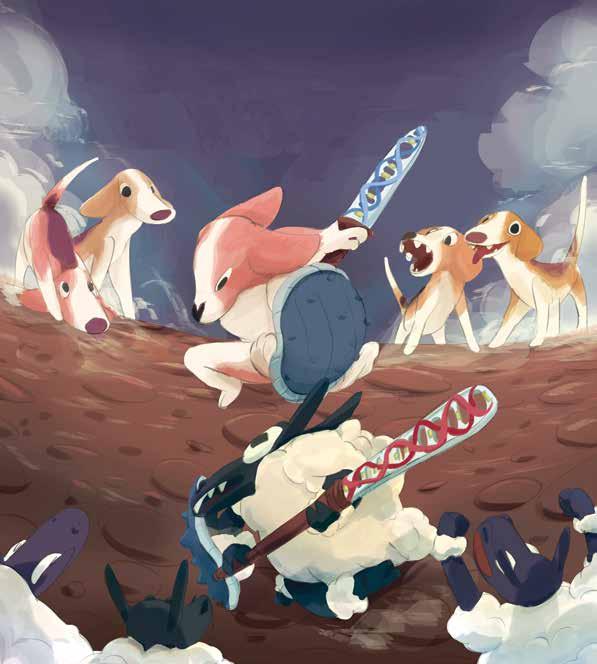
As we enter 2016, we won’t be seeing any designer babies. What we will see, however, is a zoo of novel genetically modified organisms. So far researchers have developed beagles and sheep that look like they hit the gym every day, pigs that may be suitable for safer organ transplants in humans, and wheat resistant to disease-causing fungus.
The year 2016 may also see CRISPR giving us hypoallergenic peanuts, dogs, and cats, oranges enriched in vitamins, and cattle resistant to tuberculosis.
JEREMIAH YARMIE, VOLUNTEER STAFF
GRAPHIC BY JONDELL COOMBS
Ocean-cleaning barrier set to launch
A new response to our growing ocean pollution is coming in 2016
MALAK ABAS, STAFF
The world’s first ocean-cleaning system to collect plastic pollution is expected to launch in 2016.
The system was conceptualized by 21-year-old Boyan Slat, Dutch inventor and CEO of The Ocean Cleanup, a nonprofit organization devoted to removing man-made waste from the earth’s oceans.
This system, which was announced at the Seoul Digital Forum in South Korea, has been named the Ocean Cleanup Array.
The system has a relatively simple structure. It will be composed of a set of floating barriers bound to the seabed and set in a “V” shape. The first barrier will be about 100 metres long, but the organization hopes to have a barrier that is 100 kilometres long in the north Pacific Ocean by 2020.
The natural current will push trash into the barriers, which will have screens below sea level to help separate plastic from sea life that may also be swept into the barriers. The system’s shape will funnel plastic into its centre, where the plastic will be collected, stored, and reused.
Cleaning up the plastic pollution in the world’s oceans is a difficult pro-
cess, due to both the sheer amount of pollution and the rapid pace of plastic production. A study published in 2014 found that out of hundreds of samples taken from bodies of water across the globe, 88 per cent of them contained plastic debris.
While there is approximately 40,000 tons of plastic waste accounted for in the open ocean, this number is low compared to the huge amount of plastic discarded by humans, leading some scientists to fear that marine life is eating our plastic waste, which can result in starvation. Plastic waste accounts for at least 100,000 marine mammal deaths per year.
The disturbing effect of plastic on underwater life goes even further, as plastic can block out the sun, which is vital to the survival of plankton and algae.
While The Ocean Cleanup is planning to only release a barrier into the North Sea, just off the coast of the Netherlands, the team plans to tackle a bigger opponent before 2020: the Great Pacific Garbage Patch, a collection of ocean trash which has accumulated in the Pacific Ocean.
Also called the Pacific trash vortex,
it spans waters from North America to Japan, and is made mainly out of microplastics. Plastic is not biodegradable, so microplastics are usually the result of plastic broken down into small pieces through continuous erosion and are not always visible to the naked eye.
The Ocean Cleanup Array is focused on passive, unobtrusive debris collection. It creates most of its movements by taking advantage of the ocean’s natural currents and avoids disturbing anything caught in the current by using filters that currents can pass under, taking any buoyant sea life with it.
The organization is also setting some lofty goals, stating that if the preliminary barriers prove successful, a larger barrier could filter away 42 per cent of the Great Pacific Garbage Patch over 10 years. The barrier being released this year will be monitored using sensors and cameras.
“It will be the first time our barrier design will be put to the test in open waters”, The Ocean Cleanup said in a press release.
“The main objective of the North Sea test is to monitor the effects of
real-life sea conditions, with a focus on waves and currents.” Slat, who dropped out of studying aerospace engineering to start The Ocean Cleanup, still believes that the answer to our growing waste dilemma lies in prevention.
Rocket size competition
Competition
among billionaires,
innovative space policy, and technological advances will make the space industry thrive in 2016
CHANTELLE DUBOIS, STAFF
Adecade ago, it would have been hard to believe that two eccentric billionaires would be making passiveaggressive remarks via social media on each other’s rocket capabilities. However, near the end of 2015, both Elon Musk of SpaceX and Jeff Bezos of Blue Origins did just that.
It all began after Blue Origin completed a successful vertical take-off and landing (VOTL) of the Shepard rocket on Nov. 23, which reached a maximum height of approximately 100 kilometres and maximum speed of 623 kilometres per hour.
Social media exploded with commendation on the feat, some crediting the company for doing what SpaceX failed to do during its last attempt to re-land a Falcon 9 rocket vertically.
Musk chimed in, adding in his congratulations via social media. However, this tweet was followed by several others, explaining that this accomplishment was not so ground-breaking.
“Jeff [may be] unaware SpaceX suborbital VTOL flight began 2013. Orbital water landing 2014. Orbital land landing next,” Musk tweeted from his personal Twitter account.
“But credit for 1st reusable suborbital rocket goes to X-15 [...] And Burt Rutan for commercial.”
SpaceX went on to successfully vertically land its Falcon 9 rocket on Dec. 21, which reached a maximum height of 660 km, hit Mach 1 (1,195 km/h), and launched a payload of 11 ORBCOMM satellites (each weighing roughly 172 kilograms) into lowEarth orbit.
Not missing a beat, Bezos tweeted his own congratulations, subtly returning jabs at Musk and SpaceX: “Congrats @SpaceX on landing Falcon’s suborbital booster stage. Welcome to the club!”
Without turning the Manitoban into the gossip column of space, it is important to point out the chest-beating among billionaire space giants to emphasize where the space industry is at now. We are now in a time where private companies are competing against one another for dominance in space technology.
SpaceX and Blue Origin are not the only commercial space companies on the block either. Many private companies are simultaneously throwing their hats into the reusable rocket ring, such as United Launch Alliance.
Just like in any other industry, increased competition will call for increase in innovation. The year 2015 saw plenty of that. 2015 also saw other developments that are sure to stimu-
late the commercial space sector in 2016.
The U.S. officially implemented the SPACE Act, which provides ownership rights to resources mined on asteroids. While there is no clear international law on this matter, it is the first step to encourage U.S. companies to invest in the technology and research required to do so.
Richard Branson of Virgin Galactic also vowed to get his company back on track for commercial space flight in the upcoming year, enlisting the help of famous physicist Stephen Hawking. Hawking will be unveiling the company’s newest spaceship once it is ready.
Additionally, Russia dissolved the country’s national space agency, which was reinstated as a state-run corporation on Jan. 1. This may put ROSCOSMOS in a better position to compete with commercial entities.
The activities of 2015 took us to an interesting point in space history. We now wait to see if 2016 will finally bring us sub-orbital space tourism, an official announcement of a mission to Mars, and the first launch of personnel from the U.S. since the shuttle program.
“We also need to close the tap to prevent any more plastic from reaching the oceans in the first place.”
The Ocean Cleanup Array is planned for release in the second quarter of 2016.
“Although a cleanup will have a profound effect, it is just part of the solution,” Slat said in an interview with the Inertia
GRAPHIC BY BRAM KEAST
GRAPHIC BY KELLY CAMPBELL
GRAPHIC BY BRAM KEAST
GRAPHIC BY JONDELL COOMBS
Arts & Culture
Arts & Culture Editor: Seamus Hamilton-Pattison
Contact: arts@themanitoban.com / 474.6529
Is The Force Awakens the sequel you’re looking for?
Three Manitoban editors’ thoughts on a monumental new movie
SEAMUS HAMILTON-PATTISON, CRAIG ADOLPHE, AND MIKE STILL, STAFF
Here at the Manitoban, some of us are huge nerds. When Star Wars: The Force Awakens was released last month, it didn’t seem fair to just pick one person to review it. Arts & culture editor Seamus HamiltonPattison, editor-in-chief Craig Adolphe, and sports editor Mike Still each submitted their own review of the film which we compile below.
Seamus Hamilton-Pattison
Going into The Force Awakens, I had one particularly prominent question on my mind, one that was likely shared by the many other lifelong Star Wars fans present on opening night.
Will this make up for the prequels?
From this fan, the answer is an unwavering, resounding yes. Writer/ director J. J. Abrams taking the reins has given us a far leaner, more actionpacked Star Wars devoid of stilted, meandering love scenes and galactic politics of episodes I-III.
Of course, many critics and fans alike have pointed out the movie’s numerous references to the movie that started it all, A New Hope The Force Awakens focuses on the conflict between two galactic forces, the Resistance (the new Rebel Alliance) and the ex-Galactic Empire offshoot, the First Order. The movie’s central characters are a ragtag group of misfits who must work together to deliver plans, thwart Stormtroopers, and blow up a weapon. Sound familiar?
While these clever homages aren’t exactly subtle, only one plot point feels particularly shoehorned in (really? Another Death Star?)
and the rest are actually kind of nice. We haven’t seen new footage of these characters, ships, and locations in years, so Abrams making a rather big to-do about their respective introductions actually comes across quite well.
The new protagonists are all immediately likeable and well-acted. The most memorable among these is the woefully under-present Resistance pilot, Poe Dameron. Oscar Isaac plays Dameron with so much enthusiasm and charm, likely drawing a little inspiration from Nathan Fillion’s wisecracking Captain Reynolds for the role. Here’s hoping we see more of this jovial, hilarious maverick in the sequels.
I cheered when Han, Chewie, and the Millennium Falcon each made their first appearances onscreen. Hell, I cheered for C-3PO. If you’re a fan of similar mind, then you will too.
The Force Awakens was a little cheesy, and perhaps slightly derivative, but we just started a whole new trilogy. There’s still two movies to go, and The Force Awakens has kicked things off in a shamelessly nostalgic, exciting, and over-the-top manner.
Craig Adolphe
For anyone looking for more than a fun action movie and a nostalgia trip, The Force Awakens might come as a disappointment. While writer/ director J. J. Abrams and his co-writers (Lawrence Kasdan and Michael Arndt) went to great lengths to ensure we never got near the chambers of the galactic senate, giving the movie a fast-paced adventure feel, they also
steeped the story in references to the original trilogy, sapping the movie of any opportunity to develop new lore – something that even the prequels, for all the scorn they receive, were able to do.
Despite the referential story and imagery, the cinematic style differs quite drastically from both the original and prequel trilogies
The movie seems almost entirely focused on banking on fandom for existing concepts and worlds, rather than contributing anything new. All the new settings that serve as a backdrop for the story act as pale imitations to the ones initially developed by Star Wars creator George Lucas.
While the new characters, including Rey (Daisy Ridley) and Finn (John Boyega) are exciting and welcome additions, they’re often crowded out by older characters, such as Han Solo (Harrison Ford) and Princess Leia (Carrie Fisher).
Despite the referential story and imagery, the cinematic style differs quite drastically from both the original and prequel trilogies. In place of Lucas’s wide panoramic shots and steady hand we have much more up-
close, intimate, and relatively speaking, crowded shots, as well as more active camera work.
The Force Awakens incorporates a lot more humour than previous Star Wars films. Instead of the sparse, wry humour in the original trilogy (Han Solo’s “I know” in response to Princess Leia’s admission of love) and the ineffectual humour of Jar Jar Binks and occasional physical humour of R2-D2 in the prequels, Abrams’s film is loaded with legitimately funny jokes. This differs drastically from the dramatic and sometimes sombre tone set out in the original trilogy (Ewoks notwithstanding).
Between this and his involvement in the new iteration of Star Trek films, Abrams has marked himself as a financially reliable (from a studio’s perspective) maker of referential popcorn flicks – a less objectionable Michael Bay.
Mike Still
As a diehard Star Wars fan, I was beyond thrilled to go see the new film. When the release date finally came and I got a chance to check out The Force Awakens, I was not disappointed.
Both the plot and a number of key characters are quite similar to episodes IV-VI, and I’m totally OK with that. It’s nostalgic in a way, but also sets up the next generation of good and evil.
There were a number of important questions left unanswered, which I loved, as viewers are now left to ponder certain characters’ backstories and fates, which episodes VIII and IX are sure to answer in the coming years.
In terms of the new heroes and villains that were introduced, there’s a lot to like. I thoroughly enjoyed John Boyega as Finn. He’s comedic yet relatable, and will be a fan favourite for sure.
It’s also refreshing to see a female (Daisy Ridley as Rey) play the lead protagonist. She’s powerful and intelligent, yet mysterious. It’s going to be an adventure just learning about her past – the one piece of information that intrigues me the most going forward.
Villain-wise, I’m not yet sold on Kylo Ren (Adam Driver). He showed far too much compassion throughout the film, and came across as weak in both of his critical scenes with Rey. I’m aware that he hasn’t harnessed his full powers yet, so it will be appealing to see how he progresses in the next two films.
The villain that captivates me the most is Supreme Leader Snoke. He only appeared as a hologram in The Force Awakens, so it’s still a mystery in terms of what his actual size and abilities are. He’s definitely the new version of Darth Sidious, and there are a ton of fans out there that think he’s Darth Plagueis (master to Darth Sidious, as referenced in Attack of the Clones), but I’ll save my theories for closer to the release of Episode VIII.
View all showings of Star Wars: The Force Awakens in Winnipeg at www. cinemaclock.com/man/winnipeg
GRAPHIC BY BRAM KEAST
Orange you glad
U of M architecture students highlight local icons with new project
LAUREN SIDDALL, STAFF
University of Manitoba architecture students Brooks Keen, Braden Funk, and Kevin Neufeld are leaving their mark all over Winnipeg during the final year of their degrees, and highlighting local businesses and icons in the process.
Their new project, the OrangeBench, aims to draw attention to Winnipeg staples by travelling to a new location each week, the idea being that patrons of the businesses will take photos with the bench and share the photos on social media using the OrangeBench hashtag to create a connection between the Winnipeg community and the local icons.
The project began as a complementary piece to the faculty of architecture’s design contest inviting professional designers across the world to create warming huts for the Red River Mutual Trail over the winter, but eventually evolved into an extension of the trio’s interest in exploring what makes Winnipeg unique.
“Initially we wanted the OrangeBench to kind of take a journey around Winnipeg and create hype for the warming huts. Then it would make a stop at the warming hut we designed,” said Neufeld.
“After the design contest [...] we decided to continue with
OrangeBench,” added Keen.
To start out the project, Keen, Funk, and Neufeld needed to decide what about Winnipeg is noteworthy.
“We asked a lot of people what they think makes Winnipeg what it is – which businesses, which places, which moments – to start out the project,” said Neufeld.
“We’re just seeing how much it can grow. If people keep enjoying it and if it continues to do what we want it to, we’ll keep going” – Brooks Keen, OrangeBench co-creator
Answers ranged from riding bikes in the dark during Nuit Blanche to wandering around the Forks, giving these non-native Winnipeggers some room to play with when deciding the bench’s next stop.
“The business the bench stop is at has to be local, so it can’t be some chain business – it needs to be unique
to Winnipeg, something that only Winnipeg offers,” said Funk.
“We’ve also started looking into how they contribute back to the community because we think that is a crucial staple to a local business: what is it doing for Winnipeg?” said Neufeld.
Keen added that collaboration between small businesses is a big part of Winnipeg’s communities.
“We really like when local businesses work together to grow and establish themselves. But that being said, our intention is not only to promote businesses, it’s also cultural spaces in Winnipeg,” he said.
Although the three creators only recently moved to Winnipeg for school, they have already developed an affectionate relationship with the city and its idiosyncrasies – and thanks to the bench, the relationship is continuing to blossom.
“Every place the bench goes, we physically go and talk to them and experience what they have to offer. We always want to go experience it so we know exactly what that business has to offer and what the bench is highlighting,” said Funk.
“It’s also helping us get to know Winnipeg. I didn’t know about half of these spots before the project. Even if it’s not helping anyone else, it’s helping us,” he added.
The trio, while jokingly blam-
ing their degrees for keeping them locked up in the studio, credits much of their success to their backgrounds in architecture.
“I think our background in design really influenced the project. That’s a big aspect of the project – how design can start helping the local community,” said Funk.
“People also have this preconception of what architecture is, that we just draw buildings, but there is so much more than that,” added Keen. “There are ties to local culture and the community that you’re based in.
I think it has helped us a lot.”
According to Keen, the project has steadily been gaining traction
Born and bred for style
through Instagram and word of mouth, which has been a pleasant surprise.
“I think other people are seeing it more than we are, actually. We have no idea how big it has gotten,” said Keen.
“We’re just seeing how much it can grow. If people keep enjoying it and if it continues to do what we want it to, we’ll keep going.”
Follow @orangebench on Instagram to learn more about this growing social media project, and search #orangebench to see all the photos shared thus far.
New high-end salon provides stylish and affordable hair services for students
TOBI NIFESI, STAFF
Located at 1104 Pembina Highway, BORN Salon is a new boutique hair salon that promises to provide unique hairstyling and image consulting services.
From the trendy studio to the clients’ wide assortment of hairstyles, the two-storey high-end salon has an aura of excitement and eccentricity.
Laine Burgess and Tanya Bye are the minds behind BORN Salon. Along with Chelsea Watson, they make up the BORN Salon team and between them they have almost four decades of hairstyling experience.
“[We do] everything from colouring, cutting, blow drying, up-do, and event styling, and Laine is always doing photoshoots every two minutes,” Bye told the Manitoban
The maturity, leadership, and professionalism with which Burgess and Bye approach their business allows them to provide the best possible service and experience for their clients.
When asked what it is that makes BORN stand out, Bye simply cited “the level of experience in this salon.”
“We obviously don’t have a lot of stylists right now, because we won’t just hire anybody [...] We just want
to hire experienced [stylists].”
Along with Watson, Burgess and Bye aim to create a hospitable space for clients of any age group.
“I think our age group is all over the map,” said Burgess.
“We tend to draw in people that want that highend experience without going downtown. People that want a bit of high-end without the pretentiousness, basically” – Laine Burgess, co-founder of BORN Salon
“We tend to draw in people that want that high-end experience without going downtown. People that
want a bit of high-end without the pretentiousness, basically. We want everybody to come in here, have fun and have a good time.”
Bye added that BORN wants to emphasize a more family-friendly atmosphere than a typical high-end salon for their clients.
Lately, the partners have been focusing on a new area of expertise for themselves – men’s hairstyling.
“We want to concentrate a little bit more on our men’s clientele right now. We want to bring it more to that direction and not just women only,” Bye said.
“We are going to have a barber division. Obviously, we have all our colours, cuts, and everything but [...] we just want to add that barbering experience to it,” Burgess added.
Due in no small part to the University of Manitoba, southern Winnipeg is usually filled with students and the team at BORN Salon has taken the initiative to provide haircut and styling services to students at affordable prices. They’re even giving discounts to students for as long as they are in school.
“We like to give discounts to stu-
dents. All they have to do is show us their ID and we’ll give them a 20 per cent discount on anything,” said Bye. Burgess and Bye are both artists and masters of their craft. Their passion has fuelled their creativity and
competence thus far; and for that, they are grateful.
For
more information about BORN Salon, visit bornsalon.com
PHOTO BY LAUREN SIDDALL
PHOTO BY CAROLYNE KROEKER
Raising the roof on the river
U of M graduates design city’s annual pop-up restaurant
OLIVIA MICHALCZUK, STAFF
Winnipeg’s annual winter popup restaurant, RAW: Almond, will soon return to its home on the frozen Red River near the Forks for a fourth time. The restaurant’s creators hold a competition judged by a jury of their selection to determine the restaurant’s design every year and this year, three recent graduates from the U of M’s faculty of architecture had the winning idea.
The design team, Et Cetera Projects, is a team made up of recent University of Manitoba graduates Kent Mundle, Caleb McGinn, and Mitchell McIntosh. They won with a simple concept that an artistic rendering revealed to be a simple, long, and rectangular structure with a low roof, similar in appearance to some Nordic mead halls. It appears that patrons are to enter through the structure’s side, using an elegant entryway that curves along the river’s bank. The restaurant will be erected on the frozen river for three weeks, from Jan. 21 to Feb. 14.
RAW: Almond was conceived in part by Mandel Hitzer, chef and owner of the year-round Deer + Almond restaurant. The menu of Deer + Almond leans heavily toward seafood with tuna carpaccio, smoked goldeye, and salt & pepper squid being among the main dishes. RAW: Almond, however, will likely be subject to more variation, as Hitzer has brought in additional chefs from across Canada to contribute to the
wintery fine dining experience.
The individual members from the winning design team have worked together in other groups on several competitions, but as a three-member team, this is their first competition entry and win.
Et Cetera Projects takes their name from a zine made and distributed by other architecture students at the U of M known as Et Cetera. The zine has made three small issues to date, and publishes the projects of student architects and designers as a casual and accessible way for them to present their work throughout the year.
“The intent of the publication is to cross over design with other things [...] including arts and architecture,” Et Cetera’s co-founder, Mundle told the Manitoban
“It’s hard to get someone excited about the formal qualities of some building [...] but if you can sneak it into other conversations, [that] might be a good way to do it.”
McGinn said the exposure that Winnipeg has gained from RAW: Almond and similar projects done on the river has brought design to the forefront in the city.
“When it comes to RAW: Almond, people are going there for dinner, but now slowly they are becoming more and more aware that it’s also an architecture thing,” McGinn said.
The designers’ experience with the restaurant in past years was useful in
conceiving a winning design.
“We knew what worked and didn’t work going to the restaurant in past years, so that’s the angle we took designing it,” said Mundle.
“One of the main ideas had to do with the entry. The sequence of entering the restaurant rather than sitting at the table [...] just prolonging it as long as you can. That had not been addressed in the other restaurants.”
Avoiding over-designing was also a factor in the design of the restaurant, added McGinn.
“How much do you program a space and how much do you just let happen? People are just going to eat dinner, that’s what we wanted to capitalize on because that’s really what it’s all about.”
The team’s mature attitude and respect for each other is key to their design process.
“If you’re working in a group and working on competition work, it needs to be collaborative because you need the good energy to foster each other’s ideas. When someone is too controlling, you don’t get to see everything through,” said McGinn.
“Someone has an idea, and you pass it on to the other person to work on. You have to get over having parts of your idea not in it,” added Mundle.
McIntosh shared his experience with collaborative work in both the undergraduate and graduate level at the University of Manitoba.
“We have all been through design school and have a mature attitude about working in a collaborative setting, we all understand that we need to make concessions to each other and criticize each other in order to make the project really good, and I think we have done that pretty well.”
To learn more about RAW: Almond, the restaurant on the river, visit www.raw-almond.com
PHOTO BY JOSEPH VISSER
PHOTO PROVIDED BY CALEB MCGINN
PHOTO PROVIDED BY MITCHELL MCINTOSH
Questions and Anders
A new bi-weekly Q & A with men’s basketball power forward Wyatt Anders
MIKE STILL, STAFF
T
he University of Manitoba Bisons men’s basketball team is riding high heading into the second half of the year. Fresh off their first Wesmen Classic holiday tournament win since 1991 and riding a four-game win streak from before the break, there’s plenty to get excited about.
Manitoba is currently deadlocked in a three-way tie for first place in the pioneer division, sitting at 6-2 with 12 points. But the players and coaches alike know there’s still plenty to be decided over the last 12 games, including co-captain Wyatt Anders, who currently leads the nation in defensive rebounds, rebounds per game, and total rebounds.
Anders caught up with the Manitoban over the break for the first instalment of “Questions and Anders”
to discuss the first half of the year and what to expect going forward from his squad.
MANITOBAN: What are your thoughts on the first half of the year and the way your team has performed as a whole?
ANDERS: From what I saw from the pre-season, to the first half, to now, we’re slowly getting our identity locked in place. If you looked at our pre-season on how individual we were, and how much we didn’t know how to work with each other, till now, now you see [centre] Brett Jewell dunking on people, now you see [forward] Malik Irwin gaining a steal, passing, and getting excited and not going ‘I’m going coast-to-coast, I
PHOTO BY JEFF MILLER
did my job, [guard] Justus [Alleyn] go do your job.’” Then you have [forward] John Alexander working when he gets in, you have [swingman] Keith Omoerah doing what he does best – attacking the rim. People are doing what they do best and they’re slowly buying in more and more and you can see it.
M: You’ve beaten two teams that are either currently in the CIS top 10, or were ranked there when you faced them, yet you’ve gotten very little recognition in the polls thus far. What do you think you have to do to earn that validation, and does it motivate you more knowing you’re still somewhat under the radar?
A: The player in me wants to be upset and wants to work harder on it, but trying to go on an unbiased opinion, I understand. We did the same thing last year where we started off the first half strong [8-2 heading into the break, 1-9 afterwards] but this schedule is a bit tougher than it was last year, so we do have some weight under us. When people look at our Calgary loss, it was an overtime loss, it’s not like they beat us by 30, so why can’t we get some recognition? When we lost to Saskatchewan, we were up the whole game and we blew it at the end, it’s not like we were down the whole time. Little things like that you’d think the coaches would put more thought into.
I think the biggest annoyance for our team was that out of the Canada West [in a pre-season coaches’ poll], we were ranked 12th or 13th, so it kind of shows what the league thought of us. If we handle business in the second half – just that first set of six games – we’ll be in the top 10. If we don’t, then I’ll be like “OK people hate us.”
Now that we’ve got Brett and Malik in, every time there’s help and communication and I love it, so huge shout-out to those guys
M: You brought up the strong start last season. What do you think the team has to do to avoid a second-half collapse occurring again?
A: Last year, there were a couple of lingering injuries that really set us away. Victoria we almost had in the first night at home, then we got beat the second night handily. When we went to Alberta and we won the first night, [former guard] Steph Walton had some hip issues that he was working out and both [former forward] Andre Arruda and Justus sprained their ankle which they were trying to recover from, John was out for a long time at practice, and it was really tough to try and keep that ship afloat. This year is a little different because we don’t have any injuries right now, thank goodness, and we have guys coming out of their shells.
This chemistry is completely different than last year, where you’d have Malik come in and be like ‘is he going to help out?’ Now, when Malik comes in, no one thinks that. Brett being a starter is helping him big time as well. It’s just huge, the cohesiveness we have, and our starting five plus the next two, three guys are all solid.
M: You’ve mentioned Malik and Brett on a few different occasions. Talk a bit about their role in the Wesmen Classic specifically in helping your squad secure the title.
This year is a little different because we don’t have any injuries right
now,
thank goodness, and we have guys coming out of their shells
A: We know what [guard] AJ Basi, Justus, Keith, as well as myself will bring. But the small things Brett and Malik bring don’t really get recognition. They had such a great tournament at the Wesmen Classic. Brett scored 16 in the third game and I think he shot 50 to 60 per cent in the whole tournament, and defensively he took care of work.
Then Malik, man, when you saw him against Lethbridge in the first game, he worked his tail off. He and I were just on the same circuit. Whenever I forced a guy to drive, boom, he was there at the help side. The biggest lingering factor of last year was that when I was on the perimeter guarding, there wasn’t a help side, but now that we’ve got Brett and Malik in, every time there’s help and communication and I love it, so huge shout-out to those guys.
M: Lastly, just how important have [guard] Ilarion Bonhomme II and a returning Keith been, in terms of making your squad more well rounded?
A: Having Keith back is a real blessing. The years off, maturity-wise, really helped him. If he didn’t have that maturity, he would still be a little bit loose, but since he was able to mature as a person, he’s shown his true potential and kept it on lock. As for Ilarion, the little dude is tough! I’ve never seen a guy get hit and hammered so much and still get up and ready to fight – he doesn’t back down from anyone and offensively he’s a firecracker that can blow by you really quickly.
Because of what he brings and his unselfishness, we’re able to be deep. Very few people with his experience and skill would want to come off the bench – and I know he was recruited by other teams – but he eventually chose to come here.
The Bisons kick off the second half of the season away against the University of Victoria on Jan. 8 at 10 p.m.
Sports opinion: Flag on the play
By failing to challenge the NFL, Concussion misses the mark
MIKE STILL, STAFF
When the first trailer for Concussion, a drama based on the true story of Bennet Omalu’s discovery of chronic traumatic encephalopathy (CTE) in deceased NFL centre Mike Webster, was released in August, I was immediately intrigued. I played football from age seven to 18 and during that time suffered my fair share of concussions – the side effects of which I still suffer from today.
CTE is long-term (chronic) trauma causing brain damage or malfunction (encephalopathy). This is common in high-impact sports such as football, where 131 out of 165 deceased former football players studied at the nation’s largest brain bank showed traces of CTE in their brain tissue.
A disappointing incompletion
I saw Concussion a few days after its Christmas Day release and was thoroughly disappointed. While the vast majority of the movie ground my gears, I was particularly upset by the lack of scenes involving NFL commissioners Paul Tagliabue and Roger Goodell.
In early September, the New York Times reported on emails obtained from the Sony email leak, showing Sony executives, writer and director Peter Landesman, and representatives of Will Smith (who played Omalu) discussing how to avoid antagonizing the NFL by making changes to the script. Other emails indicated that certain scenes that were unflattering to the NFL were
removed or edited.
When asked about the alteration of the film, Landesman stated, “We don’t want to give the NFL a toehold to say, ‘they are making it up,’ and damage the credibility of the movie.”
This is a huge problem to me. The movie’s credibility was damaged when Landesman let the NFL get into his head. When he chose to write the script, he had an obligation to tell the full story and not leave out the accused parties due to fear of how they would respond. It’s unfair to those who have already passed away from the lingering effects of CTE and those who still suffer today not to shine a bright light on the issue.
There still isn’t a clear depiction of Tagliabue’s reaction to the events that followed Omalu’s July 2005 article in Neurosurgery where he provides his findings of Webster’s brain. It’s Omalu’s word against the league’s when discussing the findings of CTE, and while I obviously believe the doctor in this case, perhaps seeing how Tagliabue and Goodell felt behind closed doors might’ve swayed the opinions of former or current NFL players and fans. Instead, Landesman opted not to ruffle any feathers with the multi-billion dollar industry, despite Sony Pictures having no immediate ties to them.
Tagliabue might have been affected by the news surrounding CTE, as he resigned as commissioner just a year after Omalu’s first discovery – a few short months before a second case of CTE was found, this time in Terry Long.
Dave Duerson
Another thing that makes me sick when thinking about this movie was how Landesman portrayed Dave Duerson, another former player who succumbed to CTE. He comes across cold-hearted, not only siding with the NFL but also telling former Philadelphia Eagles player Andre Waters that if he has a headache, he should just “go see a doctor.” This is the last scene we see Waters in before he kills himself and is later found to have CTE.
There are two reasons why I believe Landesman chose to depict Duerson in such a way. The first is that following his retirement, Duerson actually worked for the
league as a players trustee for the NFL player retirement plan.
The second and more controversial reason may be because Duerson requested that his family donate his brain for research shortly before he committed suicide. The NFL was likely not happy about Duerson’s request because it brought CTE even further to the forefront, and so displaying Duerson as a villain may have been Landesman’s way of showing them that he wasn’t trying to stir up any further controversy.
Things get even spicier from there though, as Duerson’s son Tregg flat out told the New York Times that Landesman and company “completely made stuff up.” Instead of
European breakdown
Taking a look at the big four soccer leagues midway through the season
RYAN STELTER, STAFF
W
e are at the halfway mark of most of the seasons in European soccer and there are some interesting storylines developing. The Manitoban highlights some of the biggest stories.
Spain
It’s FC Barcelona’s year, having won five trophies in the calendar year of 2015 and capped it off with the FIFA Club World Cup in December. At the other big horse in La Liga, Real Madrid, manager Rafa Benitez continues under serious concerns for his job despite sitting only two points behind Barca in the table.
One of the more surprising teams this year has been Valencia, as they have brought on England international and former TV pundit Gary Neville to manage the mid-table club. Neville has won everything there is to win in club soccer and will hope to translate that success into his managerial career.
England
It’s been a wild season in England, to say the least. Leicester City shocked the soccer world when they sat atop the Premier League at Christmas but have since dropped to second place. Riding the backs of English striker Jamie Vardy and winger Riyad Mahrez, Leicester has been playing fast, high-intensity soccer to overwhelm some of the bigger clubs.
London is the place to be or not to be this year as Chelsea and Arsenal are having polar opposite seasons. Chelsea have imploded just a year after winning the Premier League, racking up defeat after shocking defeat, and manager Jose Mourinho has paid the price with his job.
The other side of London sees Arsenal enjoying great success, leading the Premier League and staying alive in the Champions League. New managers have graced the top clubs in
England this season, as Jürgen Klopp took over in Liverpool and Guus Hiddink is now in charge of Chelsea, while Louis van Gaal’s job looks to be in serious jeopardy at Manchester United as the Red Devils continue to play listlessly.
Italy
A wild title race is being fought in Italy, with just a few points separating each of the teams in the top five. Juventus have finally started to regain their form after an abysmal start to the season and are sitting fourth in the table, three points behind leaders Inter Milan.
Fiorentina have had a marvelous season, sitting second in the table and just one point behind Inter. With a relatively unknown squad, Fiorentina have relied on cohesiveness and strong defensive play to get results. It’s paid off, and at the very least we should see them in the Champions
League next season.
League leader Inter is bouncing back after finishing mid-table last season. They’re led by young Argentinean striker Mauro Icardi who has seven goals in 15 appearances. Inter looks well on their way to capturing their first Scudetto since 2010.
Germany
The Bundesliga is commanded by FC Bayern Munich, as they hold a commanding eight-point lead over second place Borussia Dortmund. Bayern have been formidable this season, dropping points on only two occasions. Robert Lewandowski is a man on a mission, racking up 15 goals in 16 Bundesliga appearances including scoring an incredible fivegoal display in nine minutes against Wolfsburg, which proved to be world record breaking.
Dortmund have been productive under new man Thomas Tuchel. They
Tagliabue or Goodell taking the heat, it’s Duerson who finds himself in the spotlight while the NFL’s top brass linger behind in the shadows. Here’s hoping that some time in the future, the whole truth is uncovered. Until then, I’ll continue to grumble under my breath and say a prayer for all of those who succumbed to a game they didn’t know was slowly killing them while the higher-ups looked on, with nothing but dollar signs in their eyes and a smile on their faces.
currently sit second in the table and are having a fairly successful Europa League campaign, which will see them square off against FC Porto in February.
Hertha Berlin is raising some eyebrows in Germany, as they’re playing very well this season and are amongst the top four in the Bundesliga. Hertha battled relegation last season and they appear to have done everything right this year. They’ll be gunning for Champions League play next season, which is attainable for the Berlin side. It would be nice to see Champions League soccer being played in the historic Olympiastadion.
GRAPHIC BY BRAM KEAST
Big ice equals big problems for Canada
Defensive woes cost red and white a shot at back-to-back gold at WJHC
ANDY CHE, STAFF
The 2016 World Junior Hockey Championships (WJHC) will go down as a tournament Team Canada would much rather forget. After only five games, the reigning champions were eliminated at the quarterfinal stage by hosts Finland in a contest that was heart-pounding and heartbreaking.
After four games in round robin, Canada assembled a subpar 1-1-0-2 record. It was quite clear that the red and white were far from replicating the dominant form displayed last year. The Canadians trailed in three of the last four matchups in the group stage, after not trailing the entire tournament in 2015.
The tournament was played on a larger ice surface – 15 feet wider than a North American rink. In recent times, international ice has proven too much for Canada to handle as the last time they won gold away from home was 2008 in the Czech Republic.
The Manitoban broke down Canada’s performance in each of the four games of the round robin as well as the quarterfinal to provide a comprehensive analysis of what exactly went wrong in 2016.
Canada vs United States
The headline for Boxing Day’s opening matchup against the United States was MacKenzie Blackwood’s two-game ban as a repercussion for his slashing penalty in the Ontario Hockey League. The 19-year old’s
stealthy performance in the pretournament suggested that he would have claimed the number-one spot right from the get-go. As a result, former U18 goaltender Mason McDonald started the opener.
Dylan Strome scored a crucial third-period goal to tie the game at two after the Americans had erased a 1-0 Canada lead.
Based on the style which they displayed, Canada did not look like medal contenders right from the start
Toward the end of the third period, momentum was swinging towards the United States. Backstopped by the confident goaltending of Alex Nedeljkovic, the stars and stripes took a late lead when Louis Belpedio shot past McDonald. Auston Matthews capitalized just minutes later to kill off the game.
The US had forced Dave Lowry’s troops into taking their chances in the slot, rather than using the larger ice to maneuver around the offensive zone. Meanwhile, the Canadians did not cover their own zone particularly well, as all four US goals were set up at the attacking blue line.
McDonald’s 17 saves on 21 shots
did not sit well, and the fourth and final goal was particularly nasty, as he allowed a tipped Zach Werenski point shot to squirm through his pads and Matthews was there to tap it in.
With the 4-2 defeat, Team Canada suffered their first opening day loss since 1998.
Denmark vs. Canada
Team Canada regrouped and slayed the Danes 6-1 in their second matchup of the round robin, with Lowry opting to stick with McDonald despite his questionable start to the tournament. There was a possibility that the Canadians could’ve turned to Samuel Montembeault, an 18-year-old selected as cover for McDonald, in place of Blackwood after the latter’s suspension. McDonald conceded the game’s first goal while recording just 10 saves.
There were no questions being asked regarding Canada’s offense though. They produced 58 shots against Danish goalie Mathias Seldrup. Goals arrived from six different skaters – Mathew Barzal, Anthony Beauvillier, Lawson Crouse, Mitch Marner, John Quenneville, and Strome.
Canada vs. Switzerland
Blackwood got the start for game three against the Swiss, fresh off his two-game ban. However, Canada’s misfortunes continued right from the get-go. Just
two minutes in, Noah Rod’s high-slot one-timer nicked off Damian Riat for a Swiss lead. With under five minutes left in the opening frame, Dario Meyer’s point shot deflected off Thomas Chabot and past Blackwood for a daunting 2-0 lead.
The Canadians were gifted with a light when Strome snuck a wide angle shot past Joren van Pottelberghe with 23 seconds remaining in the frame. Midway through the contest, Joe Hicketts ripped a wicked shot past the Swiss goaltender to equalize on the powerplay.
Canada took Switzerland to a shootout, however it was that moment when Blackwood and company showed up. The Barrie Colts goaltender flashed the glove on Riat and stood firm against Timo Meier, while captain Brayden Point and Mathew Barzal tallied for Canada to win 3-2. With Blackwood established in the Canada goal, the reigning champions would close out the round robin against a feisty Swedish team on New Year’s Eve.
Sweden vs. Canada
The Canadians blew a four-goal lead in a pretournament contest to Sweden, eventually winning 7-6. In the final round robin matchup, however, the Swedes turned the tables.
Back-to-back goals from Alex Nylander and Gustav Forsling gifted the 2012 gold medalists a 2-0 cushion three minutes apart before Mitchell Stephens cut the lead in half.
Sweden would extend the lead to 4-1 courtesy of Adrian Kempe and Anton Karlsson before Marner’s late third-period goal kept Canada in the contest. Rasmus Asplund would eventually seal a 5-2 win with an empty net goal.
Canada vs. Finland
Though Canada took a 2-0 lead, the Finns managed to claw their way back. Marner added two powerplay goals which gave Canada a chance at saving their tournament, yet a painful 6-5 loss epitomized their defensive performance during the tournament.
Canada’s blueline could not tame the threat of Patrik Laine, Sebastien Aho ,and Jesse Puljujärvi – the tournament’s leading scorer with 12 points heading to the knockout rounds.
Though Blackwood kept Canada in the game as both sides exchanged goals, failure to cover up rebounds and questionable positioning played a part in their downfall.
Jake Virtanen perhaps contributed the most to Finland’s 6-5 victory. The Canadian-born Finn took two brainless penalties which negated Canada’s man advantage, while Finland scored on the ensuing powerplay for the eventual winning goal.
History managed to repeat itself at the final whistle, as Canada also failed to defeat the hosts on the two previous occasions when the tournament was held in Finland (1998 and 2014).
What went wrong?
Canada produced a strong forechecking game, but they needed to continue taking advantage of the bigger ice. They did so at certain times offensively – such as the 5-2 loss to Sweden – where Stephen’s goal on Chabot’s point shot gave them some hope, but it sadly didn’t last.
Defensively, the Canadians were outskated and didn’t possess the coverage to play on the backcheck. Often, the blue-liners were being passed way too easily on the larger surface, specifically in the games against the U.S., Switzerland, Sweden, and Finland.
For being one the most highly-touted prospects in the NHL as well as a returning gold medalist, Virtanen was not even close to performing at a Team Canada level
Who needed to improve?
Jake Virtanen did not give Canada the slightest spark while on loan from the NHL’s Vancouver Canucks. Even worse, he was expected to become a leading player in Canada’s lineup as a member from last year’s team. Through the first four games, the right winger was held pointless –disappointing to say the least. For being one the most highly touted prospects in the NHL as well as a returning gold medalist, Virtanen was not even close to performing at a Team Canada level.
The verdict
Canadian head coach Dave Lowry possessed the talent to clinch at least a medal at the 2016 World Junior Championships. However, with a side that was dominated by 18-yearolds, Canada seriously lacked in their defensive game.
Despite their obvious threats on paper, Canada didn’t perform like medal contenders right from the start. As the minutes went by in their tournament, it looked more and more likely that the red and white would be headed home without a top-three finish.
GRAPHIC BY BRAM KEAST
Culture for Kindness
Bison athlete helps young adults get involved in the community
MIKE STILL, STAFF
For the 11th consecutive year, all teams from Bison Sports volunteered at Siloam Mission over the winter break by helping with the distribution of breakfast and lunch. At the same time that assistance was being provided at 300 Princess St., current track and field athlete Eric Guy, along with 2014-15 member Chad Enns, their brothers Alex and Liam respectively, and fellow U of M student Wade Ryplanski were already planning their next volunteer initiative.
Their not-for-profit group Culture for Kindness was created this past August, and “offers a platform for people to help improve the lives of those in need, as well as create lead-
ers in the community,” according to Enns.
While the group was started in August, its origin can be traced back to mid-July, when Guy came up with the idea for a “week of kindness,” in which all five founding members were tasked with coming up with a different volunteering aim for a certain day of the week, such as a clothing drive or giving blood. The concept was a huge success and also brought together numerous young people throughout the city. Shortly afterwards, Culture for Kindness was born, its foundation being an assortment of activities within the community that give back.
Structure
Each month, Culture for Kindness offers two different volunteer opportunities and attempts to match volunteering with people’s availability in order to provide as many chances to help out as possible.
“I think that most people want to help,” Guy said. “I’ve never asked someone, ‘hey, would you like to help out,’ and had them say ‘no.’ It’s never been that way. It’s always been, ‘yes, I’m just really busy’ or ‘I’m not sure what to do.’”
“If I can create a platform and just give them the opportunity where it’s like, I’ve literally done everything, just show up for two hours, I think that a lot of people will be interested.”
In the fall term, for example, the group organized over 200 volunteering hours, which included supplying hygiene products to the rehabilitation centre for victims of abuse within the Women’s Hospital at the Health Sciences Centre, as well as helping out at Inner City Youth Alive – which provides a “safe, active, and nurturing environment for children and youth, many of whom experience poverty, abuse, and neglect,” according to its website.
Heading into the winter term, the founding five will sit down to discuss which programs they’d like to target and will get the word out accordingly.
A few of their main proposals include working alongside those with special
needs, as well as the simple concept of getting onto the streets to help eliminate the stigma of homelessness.
“My big thing is I want people to get out there. I’d love it if people donate money or whatever, but you don’t necessarily see that,” Guy said. “When you see a homeless person and you have a conversation with them and you realize, oh they’re actually just a really cool person, it’s so different.”
For more information about the group and to learn how to potentially get involved, visit Culture for Kindness’s Facebook group.