

Science & Technology Editor: Chantelle Dubois

Science & Technology Editor: Chantelle Dubois
The disease is a public health emergency, says World Health Organization
VARSHANA LOCKMAN
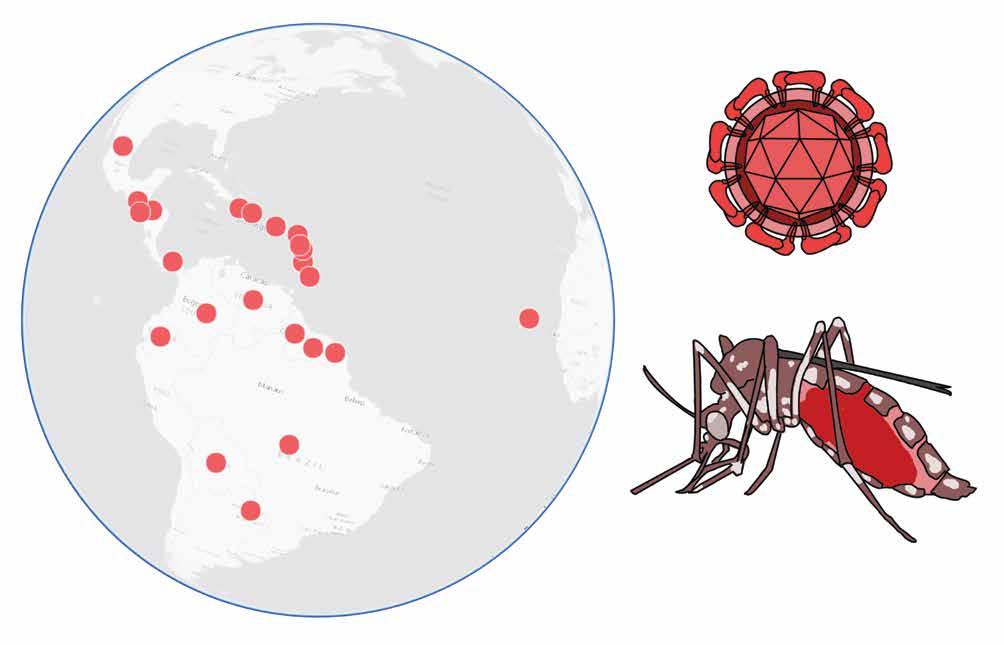
Only two years after the Ebola crisis in West Africa caused thousands of deaths and worldwide fears of its rapid spread, a new epidemic looms threateningly over the world. The Zika virus, which has now been declared a public health emergency by the World Health Organization (WHO), has flared up in Latin America. So far the virus has been detected in nearly all countries between Mexico and Paraguay.
Zika virus is an infection that is particularly detrimental to pregnant woman and has severe symptoms including mild fever, conjunctivitis, and headache, according to the WHO. There is no vaccine or treatment available for the virus.
For pregnant women, it is suspected that the virus can cause microcephaly in fetuses, meaning the baby will be born with an unusually small head and underdeveloped brain.
Women who are already pregnant and living in places where the virus is widespread have been advised to go for regular checkups and ultrasounds.
The disease originated in Africa, but spread to Brazil in 2015 and is now rampant in the Caribbean and parts of North and South America.
The governments of Colombia and El Salvador are urging women to delay getting pregnant for two
years until the disease can be properly controlled.
Unlike Ebola, Zika virus is not spread through bodily fluids or human carcasses, but through mosquito bites.
Zika is transmitted by mosquitoes of the genus Aedes, which are not native to Canada.
Zika has been around for quite some time, surfacing in the 1940s in Uganda before billowing down below the radar.
Peter Pelka, assistant professor in the University of Manitoba’s department of microbiology, spoke to the Manitoban about the virus.
“Zika virus is indeed a micro borne disease but seems to be stationed within tropical locations at the moment,” Pelka said.
“The problem arises if someone travels to Brazil, gets bitten and infected, then comes back to Canada and [the virus] survives in a different mosquito.”
Another question to ponder is whether the disease is present in other mosquitoes besides Aedes, Pelka said.
Pelka believes that governments asking women to avoid getting pregnant is a short-term strategy until a more sustainable solution can be developed.
“The reason for that approach is
to prevent children born with birth defects, particularly microcephaly. This is partially due to the effects of the virus, which affects neurons and essentially the developing brain of the child,” he said.
“The
problem arises if someone travels to Brazil, gets bitten and infected, then comes back to Canada and [the virus] survives in a different mosquito.” –Peter Pelka, assistant professor, U of M department of microbiology
“I think the approach to preventing pregnancy altogether is a temporary approach at the moment. Long term, you simply cannot stop people from getting pregnant.”
Pelka said that preventing the spread of the Zika virus is difficult
because it’s hard to stop mosquitoes from biting.
“The problem with mosquitoes is that they bite all the time so we’d have to wear protection all the time. Furthermore, fogging and pesticides are not a solution. Thus it’s really difficult to eradicate an issue like this,” he said.
“You cannot eliminate it obviously, but it depends on the virus as there may be ways of treating the viral infection. But generally viruses are notoriously difficult. However, I think if you stop people from getting pregnant for a couple years, you can certainly reduce the number of birth defects that way, and in that time develop a vaccine.”
As to why the Zika virus has re-emerged after decades of stagnation, Pelka said there are several possibilities.
The most obvious one was that the virus had mutated since the 1940s, causing a new and much more aggressive strain than before. He hypothesized that the mutation may have allowed the virus to spread more rapidly.
Another theory Pelka believes may explain this re-emergence is encroachment into new territory. The fast pace of Brazil’s expansion is causing people to venture into new areas.
Pelka said these people may be at risk since they do not have immunity to pathogens they have never encountered before.
Pelka said that this was the case with the Ebola crisis last year.
However, Pelka said that the Zika virus “does not kill the host, but instead wants to coexist with the host and survive.”
However, while the host may survive with the virus, it has detrimental impacts on unborn children, as has been seen with the increase in microcephaly.
Pelka said that Zika virus is a part of the genus Flavivirus, which includes West Nile and Dengue. The virus consists of “single-stranded RNA genomes which means these viruses are often more prone to mutations and alteration of genomes.”
“Vaccinations may be more difficult to find as a result and would have to be updated periodically,” he said.
The WHO has scheduled an emergency committee meeting for Feb. 1 to determine how the organization will respond to the Zika virus outbreak.
MALAK ABAS, STAFF
Conspiracy theories are nothing new. Conspiracy theories that escalate into Twitter beef and rap battles, however, are a sign of new and changing times.
Rapper B.o.B, who you may remember from the breakout 2010 single “Airplanes,” recently threw himself back into relevance when he sent out a flurry of tweets on Jan. 25 claiming that he believed that the Earth is actually flat.
His explanations included that the Earth’s curve wasn’t visible to him from over 16 miles, and that GoPro cameras sent above the earth were using “curved lenses” to falsify the appearance of a round planet.
Neil deGrasse Tyson, a wellknown science communicator and director of the Hayden Planetarium in New York, intervened in a few short tweets.
A few were educational – Tyson mentioned that while the Earth’s curve does block visibility, most buildings are tall enough that they pass the curve, and we can see them from miles away – and a few reminded readers that conspiracy theories can be harmful when influential people hold them.
“Flat Earth is a problem only when people in charge think that way. No law stops you from regressively basking in it,” Tyson tweeted to B.o.B at the end of their short online exchange.
B.oB was not convinced. After the Twitter conversation died down, he took to the recording studio and released a diss track titled “Flatline (feat. Neil Tyson).” Yes, you read that right.
The track, which has since been deleted from music sharing website Soundcloud, included lyrics such as “why is NASA part of the Department of Defense?,” and “feeding kids masonry, bruh, be careful what you read.”
Tyson would not be silenced.
Soon after “Flatline” was released, Tyson responded with his own track, with the help of his rapper nephew Stephen J. Tyson. Titled “Flat to Fact,” the track uses the beat from Drake’s song “Back to Back” and drops some hard truths.
Stephen J. Tyson mixed facts (“What about the change of seasons?/ The planet spins around the sun, do you need more reasons?”) and typical rap-beef status boasting (“I’m in the Hayden Planetarium getting shoulder rubs”), and many of us believed this beef was over. Neil deGrasse Tyson, with the help of his nephew, had won by a landslide.
The short feud ended on Jan. 27, when Tyson made a surprise cameo on The Nightly Show with Larry Wilmore, where he walked onstage eating a sandwich. He put down the sandwich, picked up a mic, and fin-

ished the discussion once and for all.
“Small sections of large, curved surfaces will always look flat to little creatures who crawl upon it,” Tyson said, before adding, “and by the way, this is called gravity” and dropping the mic.
As the dust settles, it’s up to us to decide what to take away from it. Is it a sign of our ignorance that “flatearthers” continue to gain traction in our society, or was this feud an opportunity for Twitter users to learn something new?
Tyson has over four million Twitter followers. If even one of them gained some knowledge on our planet as a result of this, then this might have been the most positive Internet beef of all time.
JEREMIAH YARMIE, STAFF
L
iFi is a new high-speed wireless technology that conveys data in the same way WiFi does – but with light. Created by University of Edinburgh professor Harald Haas in 2011, LiFi is expected to work with existing WiFi technologies to create a faster and more secure connection experience.
The electromagnetic spectrum is composed of radiation of all sizes and intensities. Some forms of radiation like gamma rays and X-rays are made up of very small waves that store a lot of energy. Gamma rays possess so much energy that acute exposures can cause serious damage to humans – they also created the Hulk.
On the other end of the spectrum are the very long and low-energy radio waves. Many forms of communication utilize radio waves, including WiFi. LiFi, however, is a form of visible light communication that uses the same range of radiation our eyes are fine-tuned to detect.
LiFi signals are produced by flickering light emitting diodes (LED). This flickering is too fast to
be detected by the human eye, but special photodetector sensors on electronic devices can detect these Morse code-like signals, which are then converted into a language computers can understand: binary.
“LiFi would allow me to transfer the extended edition of the Lord of the Rings trilogy in 2.3 seconds”
Early in 2015, research studies showed that LiFi could achieve data transfer rates as high as 28 gigabytes per second in the most optimal conditions and settings. To put it in perspective, LiFi would allow me to transfer the extended edition of the Lord of the Rings trilogy in 2.3 seconds.
An Estonian startup company took LiFi out of the lab for some real world tests around the same time. In their tests, LiFi achieved data trans-
fer rates as high as one gigabyte per second. While these results are slower than the top speeds achieved in the lab, they are still 100 times faster than current average WiFi rates. In real life, I would be able to complete my Lord of the Rings transfer in about 12 seconds – that’s still pretty damn fast.
Unlike Wifi, LiFi is unable to pass through walls, resulting in smaller connection ranges. This may be slightly inconvenient, but this characteristic also makes LiFi more secure than WiFi. Stealing Internet from your neighbor using LiFi would require you to break and enter, or at the very least, hold your laptop outside of an open window.
LiFi’s inability to transfer across rooms also decreases the likelihood of interference between electronic devices. This is attractive for use in places with sensitive equipment like hospitals, planes, and nuclear power plants. Organizations that deal with sensitive information may also be better off using LiFi within the confines of their offices.
It seems as though Apple has

already set its eye on LiFi. A post on Twitter shows a piece of code from the iOS 9.1 firmware that is labeled ‘LiFi Capability.’ Because of this, it is speculated that the iPhone 7 will be LiFi-compatible. Being on Apple’s radar is never a bad thing – the company is doing well. They recently reported a first quarter profit US$18.4 billion. Ultimately, any LED light source that can be outfitted with a controller microchip could be turned into a LiFi hotspot. As Haas described in a 2011 TED Talk, in the future every single light bulb in the world could be not only a source of illumination, but information as well.
JEREMIAH YARMIE, STAFF

Anxiety can produce some unusual behaviours. Two recently published studies looked into why our brains make us do particular things when we are anxious. One group found that the anxious brain tends to make us veer to the left as we walk, while the other group characterized the underpinning of performance anxiety.
Why anxiety makes us walk to the left
Research out of the University of Kent led by Mario Weick investi-
gated whether an anxious brain has spatial bias – that is, a preference for a direction in three-dimension space.
The study, published in Cognition, involved blindfolding research subjects and having them walk six metres across a room in a straight line.
Individuals that self-reported as feeling anxious and vulnerable walked with a leftward bias. These anxiety-associated feelings are associated with increased activity in the right prefrontal cortex, which is responsible for controlling the left
side of the body.
If an individual was feeling confident and goal-oriented, they walked with a rightward bias.
If an individual was feeling confident and goal-oriented, they walked with a rightward bias
This rightward bias is caused by asymmetrical dopaminergic signaling activity in the left prefrontal cortex –dopamine is a brain reward chemical, which makes you feel good for doing something “beneficial.”
Individuals feeling confident, but also anxious – yes, you can feel both –did not have the rightward bias.
It seems as though anxiety acts as a sort of circuit breaker for spatial bias.
The findings of this study may be implicated in individuals who have right unilateral neglect – they favour their left side, or, in extreme cases, lack awareness of their right side altogether.
Anxiety reduction would not only help balance these people out mentally, but spatially as well.
Scientists associated with the Brighton and Sussex Medical School investigated why it is harder to play clarinet at an audition or a recital compared to practising at home.
It’s all about being watched.
Published in Scientific Reports, the study used Magnetic Resonance Imaging (MRI) to observe changes in brain activity caused by being observed during performance.
The participants were tasked with gripping an object using a particular strength.
While laying inside of the MRI machines, the subjects were presented with a video of two researchers either evaluating their performance, which was communicated by staring directly forward, seemingly towards the subject, or another participant on a different monitor off to the side.
The individuals who were being observed reported being more anxious than the control individuals.
The anxiety-induced subjects had higher force outputs, holding more tightly in the gripping test.
Increased force output in response to being observed is beneficial in performances of simple tasks like sprinting or powerlifting, but causes us to fumble while doing finer tasks, like playing musical instruments.
The inferior parietal cortex is a
region of the brain involved in fine functions like grasping and manipulating objects. It is what allows us to rehearse a piano piece or play a video game.
The inferior parietal cortex forms a connection with the posterior superior temporal sulcus, a region of the brain that allows us to gauge the thoughts and feelings of others by analyzing their facial emotions and the direction of their gaze.
This brain connection is called the action-observation network, which connects our fine muscle performances to our evaluation of any observers.
If the posterior superior temporal sulcus picks up positive signals from their observers, it lets the inferior parietal cortex know the good news, ultimately benefiting a performance. Negative cues, however, cause the action-observation network to shut down. This derails a performance, as it causes the inferior parietal cortex to turn off.
It’s almost as if the brain is hotwired to burn it all down at the first sign of bad vibes from the audience.
Next time you find yourself anxious, you can consider the science behind it and perhaps understand your body’s response.
CHANTELLE DUBOIS, STAFF

Materials science is the study of new materials through the lens of interdisciplinary science and engineering. The discipline requires knowledge of chemistry, physics, and engineering to create innovative
materials that can make cars lighter, tools stronger, or solar panels more efficient.
Newly-developed material technology can be disruptive in nature, meaning it can lead to creating
improvements that can completely change and displace old ones suddenly. Here’s a look at a few interesting developments in the world of materials science.
Self-healing and selfstiffening material
Researchers at Rice University in Houston, Texas have developed what they call a self-adaptive composite (SAC) by combining polymers and solvent and heating them. After the excess liquid is evaporated away, a porous, viscous material is left behind with interesting properties. When the material is compressed or put under stress, it is able to return to its original shape.
The material is made using polyvinylidene fluoride (PVDF), a liquid, which is encapsulated by polydimethylsiloxane (PDMS) to form tiny spheres. Creating a spongey structure, the material is able to absorb stress and return to its original shape by allowing the spheres to move around each other, but still remain attached. It’s similar to how water molecules are able to easily move between each other.
The material’s stiffening and absorption properties can be adjusted by adding more liquid or solid. The researchers believe the material will prove useful in biomedical and structural engineering applications.
Newly developed material technology can be disruptive in nature, creating improvements that can completely change and displace old ones
The study was published in the American Chemical Society Journal and received support from the Air Force Office of Scientific Research and the Department of Defense.
A team from Zhejiang University, China have created a material
which can shift into multiple forms by applying or removing heat. The material is programmed to take on various shapes through covalent bond exchange.
The material uses two properties to achieve this: elastic deformation and plastic deformation. Elastic deformation is a temporary deformation of a material, while plastic deformation is more permanent.
The material reacts and shape shifts when different temperatures are applied. This causes the covalent bonds to change their behaviours.
In a video demonstration online, the researchers show a piece of material that starts as an origami swan. When exposed to infrared heating, it flattens out in a square piece of material. Further exposure to the infrared heating then causes the material to shape itself into an origami flower. All of this is done through heat exposure alone, using the properties of the material.
Shape shifting materials can be useful in medicine by creating temperature-sensitive medical devices.
MALAK ABAS, STAFF
Arecent study suggests there is no evident link between pregnant women taking antidepressants and the risk of their child subsequently developing autism spectrum disorder or attention deficit hyperactivity disorder (ADHD), contrary to previous concerns.
The study, performed by a research team in the Massachusetts General Hospital, also found that the appearance of an increased risk is most likely indicative of the severity of the woman’s depression, which is already considered a risk factor for many neurological conditions, rather than a side effect of antidepressants.
This research, published in the Jan. 5 issue of Translational Psychiatry, is connected to a study published in Molecular Psychiatry in 2014 that analyzed the electronic health records of thousands of children. Researchers found a connection between prenatal exposure to antidepressants and children developing ADHD, although the study did not find a link to autism.
Now, however, the link seems less consistent. The 2016 study, which refers to the 2014 results as being “without clear mechanistic explanation,” also reviewed electronic health records. The study used a 1:3 ratio of children with autism or ADHD to children without any neurological disorder to compare data.
The study also took socio-demographic factors into account, noting factors such as the age of the parents and children, ethnicities, and socioeconomic status.
While there seemed to be an increase of children with autism or

ADHD born of women who took antidepressants prior to pregnancy, there was no increase in either condition where women took antidepressants while pregnant.
Maternal psychotherapy, however, was associated with a heightened risk of the child developing either disorder, which caused a conflict
Maternal psychotherapy, therapy that is considered a treatment often used by people who have severe depression, was associated with a heightened risk of the child developing either disorder. While antidepressants themselves revealed inconsistent results, the chance of a mother receiving therapy and their child having autism or ADHD coincided.
This led the research team to believe that the link’s inconsistencies stemmed from the fact that the connecting factor was not antidepressants, but depression itself. Pregnant women who may need psychotherapy while pregnant are more likely to have children with either disorder.
Both studies were authored by Roy Perlis, the medical director of the Bipolar Clinic and Research Program in the department of psychiatry at

the Massachusetts General Hospital. Perlis says that both studies lend to the possibility that the severity of the parent’s depression is a risk factor.
“The fact that we now have found, in two large case-control studies, no increase in the risk for autism with antidepressant use itself should be very reassuring,” Perlis said in an

interview with MD Magazine
“Some of the studies that have suggested an association did not account for key differences between mothers who take antidepressants and those who don’t, in particular that those taking antidepressants are more likely to have more severe illness.”
Perlis hopes the results of this study will reassure women about seeking treatment for anxiety or depression during their pregnancies.







TOBI NIFESI, STAFF

The U of M’s Black Hole Theatre Company (BHTC) is currently performing Middletown , a drama written by Pulitzer Prize finalist Will Eno. The production – which premiered on Jan. 26 and ran until Jan. 30, and will run again from Feb. 2 to 6 – is the inaugural performance of BHTC at the new Conklin Theatre in the redesigned Taché Hall.
Eno is a renowned American playwright whose works include Thom Pain, The Open House, and Title and Deed. Charles Isherwood described him in the New York Times as “the Samuel Beckett for the Jon Stewart generation.”
Eno’s works impressed U of M film studies professor George Toles so
much so that he sought the rights to have one of Eno’s plays performed at the university and directed it himself.
“I am always on the lookout for a great contemporary play [...] or a new playwright whose work is challenging in a manner that I have not already encountered,” Toles told the Manitoban
“I read a summary online of Middletown and it immediately intrigued me, because it seems to have so much conscious allusion to Thornton Wilder’s American play
Our Town [...] so I got hold of the play and thought it was beautifully written, demanding [...] and if done properly [the performance] could be both hilarious and heartbreaking, which
for me is the ideal combination.”
Like Our Town, Middletown is a fictional satire set in a small town whose inhabitants have become too familiar with its stagnant and pedestrian nature.
Toles believes Middletown is a humorous and contemporary reworking of Wilder’s classic, and that Winnipeggers can easily relate to its characters and setting.
“Our opening night confirmed that this play has very wide doors. Audiences of almost any kind can find – rather quickly and readily – an orientation and identification point,” said Toles.
“All of the characters are trying to say as best as they can what their
dilemma is as human beings, but doing so in a way that is not just recognizable, but also funny and sharp, and sometimes painful. Anyone that watches this can say ‘that is something I know about or something I think about.’”
“By the time you are finished, you will feel like you’ve had a seven-course life meal” – George Toles, film studies professor, U of M
As the play’s director, Toles had to push himself as well as his cast and crew to connect with the plot, characters, and setting while fostering faith in the abilities of one another.
“It is so important with casting to get students or anyone playing a role to feel trust. Trust with fellow actors, with the director, and with themselves. They have to feel their collaboration is vital to their success,” said Toles.
Existentialism is a common theme in Eno’s plays. Middletown is no exception, as Toles confirms. Toles says the play attempts to balance and answer several questions about life, birth, and existences while simultaneously affirming the beauty of being alive.
Toles is excited to have a work with such complex themes be the first
OLIVIA MICHALCZUK, STAFF

O
n Friday, Feb. 5th, local rock and roll musician Romi Mayes will be releasing her sixth album Devil on Both Shoulders on vinyl at the Park Theatre.
Mayes is a lyrical treasure of the Prairies and has the hardware to prove it. Throughout her music career
Mayes has racked up a list of awards, including three Western Canadian Music Awards for Songwriter of the Year, two Western Canadian Music Awards for Album of The Year, and a Juno nomination for Album of the Year. The vinyl release of Devil on Both
Shoulders is taking place about eight months after the album’s initial release on CD.
“I had always planned to put it out on vinyl, but it just took a while to put the time and money and focus into making that a reality,” said Mayes.
“Grant Siemens’s production on the album will transfer perfectly to vinyl. I think the album was made to be heard that way.”
Music critics across the country have praised Devil on Both Shoulders as being a bluesy take on Mayes’s typical roots style.
Mayes makes a living as a fulltime musician, touring often and treating her hometown audience in Winnipeg to frequent shows.
“The only way to be a full-time musician is to play full time. You definitely need to find the balance of home life and touring life, but I think you need both to sustain a living.”
With fingers crossed on a Juno
nomination, Mayes will be touring throughout Canada and the United States, strumming through Saskatchewan and Alberta to join in the Juno celebrations followed by a trip south of the border to the central and southern states.
“Grant
Siemens’s production on the album will transfer perfectly to vinyl. I think the album was made to be heard that way” –Romi Mayes
While on the road, Mayes tries to maintain her creativity in support of
production at the Conklin Theatre, the new performance space in the newly redesigned Taché Hall. The theatre opened for business with the debut performance of the play, and Toles says the new space is everything he hoped it would be.
“The theatre is exceptionally beautiful, and any student who feels there is not much to look at or do on campus should give that theatre a look – not just as a spectator, but to consider getting involved in theatre,” said Toles.
Prior to Taché Hall, the BHTC performed out of a small theatre space on the 100 level of University College for years.
“I have been [at the old theatre] since 1976 [...] I will always have an attachment to it but I am very ready to move to another place,” said Toles.
“Expect to be surprised, delighted, and moved. First you think the comedy would carry the day, but then it will go into deeper places. By the time you are finished, you will feel like you’ve had a seven-course life meal.”
Middletown is currently playing at the Conklin Theatre, located on the 300 level of Taché Hall (162 Dafoe Road). The show starts at 7 p.m. on Feb. 2 and at 8 p.m. on Feb. 3-6.
Tickets are $15 for adults, $12 for students/seniors, and can be purchased at the door or in advance. For reservations and group discounts, contact the theatre’s box office at 204-474-6880.
creating music in the future.
“I’m always doing a little writing here and there, but it’s usually after a couple years and about 10 to 15 solid songs that I feel ready to think about another album,” Mayes explained.
Mayes stays so busy with touring, press, and creating music, that thinking about a new album is a goal that’s not at the front of her mind.
“It’s good to let an album play out until you’re antsy and ready with enough energy to give another one its fair commitment,” said Mayes.
“Until then, if you are lucky enough, you just ride the coattails of your most recent recording as long as it allows you to.”
Doors for Romi Mayes’ vinyl release open at 8 p.m., with music at 9 p.m. Tickets are $12 in advance and can be purchased online via www.ticketfly. com or in person at the Park Theatre or Music Trader.
TOBI NIFESI, STAFF
From now until March 12, Winnipeggers will be thrilled by a new multimedia exhibition at PLATFORM centre for photographic + digital arts, located at 121-100 Arthur St. in the Exchange District. The exhibition, Imaging Saturn, is a new longterm project of Regina-based media and visual artist Risa Horowitz.
Horowitz’s vast experience in media and visual arts has seen her live and work in seven provinces as an artist, writer, educator, and gallery programmer. Several of her works have been exhibited in Canada and abroad, including at the Canada House in London. Her recent works have seen the incorporation of astronomy and astrophotography. Imaging Saturn is a product of these explorations.
Imaging Saturn is a full-fledged artistic experience. This new multimedia installation focuses on Saturn, its 29.42-year orbit (2011-2040), and the apparent path of the sun, surrounding stars, and the planet itself through space in that time frame.
“In 2010, on the night of my PhD comprehensive exam, a friend mentioned that the observatory on campus [at York University] was open for public visitation. I had never looked through a telescope before [...] When
we looked at Saturn, it made me cry,”
Horowitz told the Manitoban
“It really had an effect on me that light from the sun had travelled all that way, bounced off Saturn, and came through the lens and had gone to my brain through my eyes. It made it very real for me to see it that way.”
“Saturn’s gorgeous, and it turns out that for so many amateur
astronomers, it’s Saturn that turns them on” – Risa Horowitz
The stellar installation includes yearly photographs of Saturn, an accurate mapping of the ecliptic (the sun’s path with respect to Saturn), a mechanized orbiter of Saturn, kinetic sculptures that represent each year of Saturn’s orbit, and a 10-minute video representation of Saturn’s orbit.
“Saturn’s gorgeous, and it turns out that for so many amateur astronomers, it’s Saturn that turns them on. For me,
because I am an artist, [when I saw Saturn] I very quickly started imagining how I might make something very interesting as a body of art,” said Horowitz.
Horowitz teamed up with local kinetic artist Ray Peterson to build the orbiter, and enlisted a handful of others to provide studio and technical assistance. Video Pool Media Arts Centre will present the exhibition in collaboration with PLATFORM.
Imaging Saturn is more than a representation of scientific or engineering concepts. The essence of the project is rooted in themes of participatory science and data visualization and Horowitz hopes it blurs the boundaries between the training that defines experts and the enthusiasm that defines amateurs.
“There is such a distinction that we make between disciplines of knowledge as if scientists are not deeply creative, or artists are not deeply intellectual or inquisitive people [...] This is a nice way to bridge those disciplinary gaps,” said Horowitz.
In curating the exhibit, Horowitz came up with several abstract ideas, many of which had to be discarded before the final display was decided on.

“As a conceptual artist, a good deal of my works has to do with ideas – not so much objects that are decorated or beautiful. I am very motivated by ideas. I threw away a lot of ideas before I came to this piece,” said Horowitz.
After Imaging Saturn’s premiere in Winnipeg has passed, the exhibition will find its way to galleries across the country.
PLATFORM’s director Collin Zipp believes that Horowitz’s exhibition fulfills the set mandate of the centre, which made the collaborative process seamless.
“[PLATFORM] started in 1981 [...] and we have always exhibited photography. As times change, so did photography, and so did we. Now we show any sort of lens-based works – anything that challenges the idea of lens-based practices,” Zipp told the Manitoban
“This is a show that explores the different aspects of lens-based art making and technology, so it really helps to fulfill our mandate.”
For more information about the exhibition, visit www.platformgallery.org
OLIVIA MICHALCZUK, STAFF
Local musician and blogger Ashley Bieniarz is challenging the conventional music interview form with her new show on 101.5 UMFM, Winnipeg Music Project
On this podcast turned radio show, Bieniarz gives listeners an opportunity to hear more in-depth conversations with successful local musicians about their lives, their art, and their accomplishments.
Winnipeg Music Project airs on UMFM every Wednesday between 11 a.m. and 12 p.m., and is posted in podcast form to Bieniarz’s personal website.
It began as a personal project to conquer stage fright and performance anxiety, but Bieniarz’s show is a valuable tool for fans of local music, as well as musicians both emerging and established. The show explores the artist on a more personal level than simply their next album, show, or tour, and uses their music as a vehicle to navigate through the artist’s experiences.
Essentially, other music interviewers might ask for the CliffsNotes where Bieniarz wants to read the book.
“I asked questions I wanted answered instead of focusing on what people might want to read about. I want to know what kind of train-
ing they have, how they got involved with the music community, and if they had any advice to share with other musicians who either look up to them or want to follow the same path,” explained Bieniarz.
“I asked questions I wanted answered instead of focusing on what people might want to read about” –Ashley Bieniarz
“Being a songwriter myself, I really like to ask what kind of music they listen to, and what inspires them to write. I’m always willing to learn new songwriting styles, and tips to improve my own songwriting.”
Local folk/country guitarist Logan McKillop was featured in a recent interview where he talked about his touring experiences, songwriting, and performance opportunities among many other things.
“Ashley is invested in showcasing the heart and soul of Winnipeg musicians through her work with the
Winnipeg Music Project. She creates a very welcoming atmosphere for artists to share their story – sitting down with her was a real pleasure,” McKillop told the Manitoban
Bieniarz initially focused on booking solo guests, but recently got the chance to sit down with local rockers Summer Dwellers to face her fears, a common theme in the creation of the Winnipeg Music Project
“When I was still doing written interviews on my blog, the idea of a full band talking all at once terrified me because it would be insane to transcribe everything effectively,” said Bieniarz.
“Now that I don’t have to worry about that barrier, I’m all for meeting with the whole band. I could focus on hearing everyone’s different point of view of being in the band and experiences they’ve gained since they’ve joined the band.”
Winnipeg Music Project is still only a few months along, and Bieniarz is hoping to change up the program little by little so that she can ride the wave of her successful format.
“I don’t really know where the show is going. I’ve been taken by surprise so many times that I can’t make any promises,” she said.
“I know that I’m always willing to have new bands and artists from

any genre no matter how big or small their project is, so I can say that you’ll always be in for a surprise as to how amazing and diverse the Winnipeg music scene really is.”
Most recently, Winnipeg Music Project has expanded to an hourlong timeslot, giving listeners twice as much material from Bieniarz and her guests.
“Right now, I’m just seeing where
the episodes naturally move and building off of that. I want the interviews to be as fluid and as natural as possible, without it feeling like I’m pulling questions out of thin air.”
To learn more about Winnipeg Music Project and download the latest episodes, visit www.umfm. com or www.ashleybieniarz.com/ about-winnipeg-music-project



MIKE STILL, STAFF
The University of Manitoba
Bisons made a huge statement this past weekend, defeating the Regina Cougars in both matchups at Investors Group Athletic Centre. Keith Omoerah and Jonathan Alexander led the charge – performing admirably on the glass with Wyatt Anders fighting through an injury – and also played aggressively on both sides of the court. Omoerah was particularly impressive, finishing with a double-double in both contests.
Friday
Heading into the weekend, Manitoba knew they’d need to shut down the Tull brothers – Brandon and Jonathan – and they did just that. Jonathan had just eight points all night while Brandon finished with 15 – however seven of those points occurred in the final 10 minutes.
Omoerah, AJ Basi, and Justus Alleyn did a tremendous job defensively. Along with the Tull brothers, shifty Cougars guard Alex Igual was also shut down, scoring just nine points and shooting 3-of-14 from the field.
Basi was the catalyst on offence for Manitoba with a game-high 27 points off of 5-of-10 shooting from threepoint range. He was also a perfect 8-for-8 from the free throw line in a game where the Bisons never trailed after the first quarter.
“What we were really looking for was to exploit our guard play,” Basi
said postgame.
“We feel like we have some of the best guard play in the conference and especially when Flash [Ilarion Bonhomme II] is healthy, but at the same time so does Regina with the two Tull Brothers and Igual and [Aaron] McGowan off the bench they’re right there with us, so we just really wanted to attack them and fortunately we were able to get them into foul trouble and get rolling in the first half.”
Trailing by as much as 15 points, the Cougars were able to trim the Bisons’ lead down to as little as two in the fourth quarter. However, that’s when Alexander came alive, scoring nine of his 14 points in the final six minutes of play, including an emphatic dunk to close things off as the home side pulled out an 89-82 win.
The rematch saw Manitoba’s starting five put on a show as each starter scored a minimum of 12 points. Alleyn led the way with 13 overall in a game where the herd never took their foot off the gas pedal, dominating from start to finish in a 77-63 victory.
The Bisons were able to shut down Regina’s three playmaking guards once more and also won the rebounding battle a night after being dominated on the glass. Omoerah and Alexander were spectacular, both recording a double-double. The former had a game-high 18 boards along
The herd drops a game against the WolfPack, Dear continues to dominate
T
he weekend brought a tough matchup against the Thompson Rivers WolfPack for the Bisons men’s volleyball team. The fourthranked Bisons were able to put away one of two games, after dropping a four-set decision on Saturday.
Friday
The Bisons men’s volleyball team won a tough four-set match against Thompson Rivers on Friday night, winning the game (23-25, 25-18, 25-21, 34-32). The intense back-andforth action gave both teams a taste of playoff volleyball.
Devren Dear, a fourth-year right side hitter, led the herd with 23 kills and 42 swings on the night, along with four digs. Left side hitter Adam DeJonckheere put up nine kills in 25 attempts, as well as
four digs of his own.
While the Bisons got another win under their belt, it was not a freebie. According to coach Garth Pischke, the WolfPack always brings the heat, especially with fifth-year right side Brad Gunter in their corner – a CIS and Canada West all-star for the 2014-15 season, despite missing half the year with an injury. He proved why Pischke flagged him as “the one to watch,” putting up 22 points for Thompson Rivers with 19 kills, six digs, and a service ace.
Saturday
Jan. 30 saw the Bisons men’s volleyball team round out the weekend series. After a good performance on Friday, the herd was unable to come up with a second win, losing

with 12 points a night after amassing 16 points and 14 rebounds, while the latter tallied 12 points and 10 boards. Cumulatively, the home side had 53 rebounds compared to 42 for the visitors.
With Anders sitting out the second game, Brett Jewell was looked upon to provide some offensive
output and he did just that, scoring Manitoba’s first eight points on the night and finishing with 12 overall.
As a team, Manitoba shot a strong 44.6 per cent while the Cougars were an abysmal 28.4 per cent. Their leading scorer was Jonathan Tull with 12 points, however he shot just 5-of-15 from the field.
With the sweep, Manitoba now sits in third place in the standings with just two weekend series left. Next up is a tilt with cross-town rivals Winnipeg in the Duckworth Challenge this coming weekend.
RYAN STELTER, STAFF
in four sets (25-10, 21-25, 25-27, 23-25).
After a dominant display in the first set, which saw the Bisons win by an astonishing 15 points, they were edged out in the next three by very close margins. The WolfPack only outscored the Bisons by a meagre five points.
Devren Dear scored 25 kills on the evening, his best output of the season so far. Dear also led Manitoba with 11 digs and five blocks – a stellar performance from the six-foot-six player. Next up for the Bisons is the much-anticipated Duckworth challenge, a home-and-home against crosstown rivals Winnipeg.
The Bisons women’s volleyball team’s losing streak continues, as the Thompson Rivers WolfPack took six of seven sets this weekend. With the losses, the herd drops to a 2-16 record and have now lost their last seven games.
Friday
On Friday night, the University of Manitoba Bisons women’s volleyball team played out a 3-1 loss (17-25, 20-25, 26-24, 19-25) to the Thompson Rivers WolfPack.
Haille Bujan of Anola, Man., led the Bisons with eight kills on the night and once again, libero Caleigh Dobie led the herd with 12 digs. Manitoba was outscored 81-53 and was dominated in just about every statistical category.
Saturday
On Saturday, the herd attempted to salvage something of the weekend, but the WolfPack dispatched the herd in three straight sets to sweep the weekend.
Manitoba was completely out of sorts in this one, coming up just short in every set (22-25, 13-25, 17-25). Tori Studler led the line for the herd with seven kills, and now averages 2.02 kills per set on the season. Kalena Schulz and Haille Bujan each had 10 digs, enough for team best on the evening.
The women will be tasked with facing off against local Canada West rivals the Winnipeg Wesmen as they play the 25th annual Duckworth Challenge next weekend.
ANDY CHE, STAFF
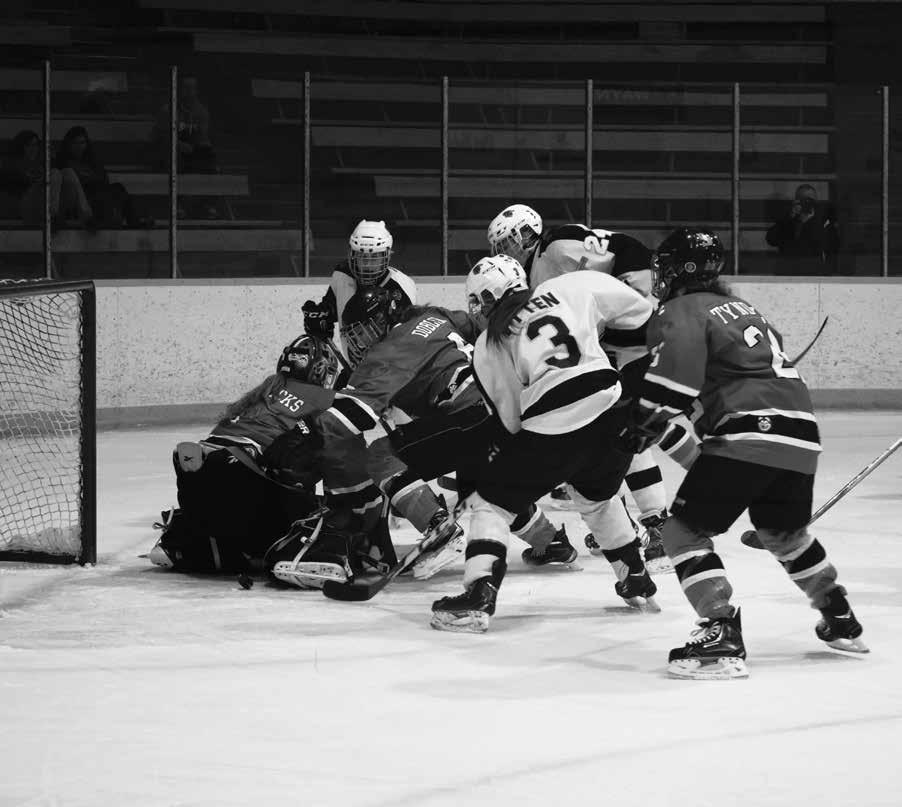
This weekend the Bisons women’s hockey team were looking to snag a win after three successive losses – one on the road to the Mount Royal Cougars and two in successive home games against the Lethbridge Pronghorns. Friday’s contest only served to extend the losing streak, which was finally snapped Saturday.
The Bisons could not manage to break free of a three-game losing skid heading into Friday’s matchup against the Saskatchewan Huskies.
After 60 minutes, the Bisons had extended that unwanted losing streak to four games.
Looking to take advantage of an increasingly goal-desperate Bisons team, the Huskies drew first blood
just before the midway point of the first period. Shyan Elias managed her first goal of the season, finishing off of a scramble in front of Rachel Dyck’s net.
A minute-and-a-half later, the Huskies doubled their lead when Lauren Zary scored her seventh of the season.
The Huskies were able to make good on their few chances of the
second period. Brooklyn Haubrich weaved possession toward the Bisons’ goal and beat Dyck for a commanding 3-0 lead after 40 minutes.
Meanwhile, the Bisons managed to outshoot the Huskies 13-8 after two frames, but had yet to be rewarded.
Saskatchewan goaltender Cassidy Hendricks was square to the Bisons on every attempt on goal heading into the second intermission.
“Heading
into Calgary next weekend, we are going to take this energy and use it against them” –Alana Serhan
Manitoba began to inflict heavy pressure on Saskatchewan in the third period, outshooting the opposition 10-1. Yet, like so many times already this season, the Bisons found their energy too late in the game.
Alanna Sharman destroyed Hendrick’s bid for a shutout, however Manitoba ultimately dropped the game 3-1. The herd can take a positive note from an otherwise unsatisfactory performance, having held their opponents to under 10 shots.
Hendricks made 22 saves for the victory, while Dyck made just six saves on nine shots in the defeat.
The Bisons snapped a four-game losing streak in an emphatic way Saturday afternoon. Hosting the Saskatchewan Huskies in the second game of the weekend series,
Manitoba clinched a 3-0 win – their fifth shutout victory of the season.
Coach Jon Rempel opted to swap netminders for the matchup, replacing orthodox starter Rachel Dyck –who gave up three goals on nine shots the previous game – with Amanda Schubert. The Bisons’ backup has posted stellar numbers this season, including a 0.91 goals against average and .959 save percentage in six appearances.
Midway through the first period, the Bisons took the lead on the powerplay when Saskatchewan’s Rachel Johnson took an interference penalty. Caitlyn Fyten tallied her second of the season with Karissa Kirkup drawing the lone assist.
The Bisons then effectively killed off a trio of penalties in the second period to keep their lead intact heading into the third frame.
The home team did not let up and doubled their lead shortly after the restart. Charity Price scored her fourth goal of the season just under two minutes into the third period.
Midway through the period, Lauren Keen scored an unassisted goal to kill any hopes the Huskies had at materializing a late comeback. Schubert starred when Manitoba needed her the most, making 21 saves for the shutout. Cassidy Hendricks stopped 16 of 19 in the Saskatchewan net.
Bisons forward Alana Serhan expressed the momentum the herd had gained for the rest of the season during the postgame.
“Winning was huge and the shutout was a bonus that really showed how hard we worked,” said Serhan.
“Heading into Calgary next weekend, we are going to take this energy and use it against them.”
10th-ranked Saskatchewan beats Manitoba in weekend series
RYAN STELTER, STAFF
In a weekend matchup in Saskatchewan, the Bisons men’s hockey team was unable to break the Huskies’ winning streak, securing a playoff position for Saskatchewan. With the losses, the Bisons’ record drops to 10-12-2.
Friday
On Jan. 29, the Bisons played the first of a two-game series against the 10th-ranked team in Canada, the Saskatchewan Huskies. The Bisons lost the opening game 8-3.
The game started out well for the herd, when 31 seconds in, Warren Callis scored his fifth goal of the year. Callis has now registered a point in his last three games. The Huskies
would then explode for four unanswered goals, with two of them coming off the stick of Andrew Johnson 17 seconds apart.
Saskatchewan scored their fifth goal at the halfway mark of the second, through a powerplay goal from third-year forward Josh Roach. The Bisons would get a powerplay goal of their own a minute later from the leading scorer in the Canada West, Jordan DePape. Another powerplay goal from the Huskies put them up 6-2 going into the third period.
The third and final frame saw more scoring from the Huskies, with an unassisted power player marker from Michael Sofillas a minute into the third. Brett Stovin scored his 11th
goal of the year by adding a shorthanded goal midway through the final frame. Cameron Blair rubbed more salt into the wound by scoring an eighth goal with four minutes left in the game. The Huskies ran out 8-3 winners.
A rough start for the Bisons never allowed them to get into the game, as well as a dominant display from the Huskies on the powerplay didn’t do the away side any good. The Huskies went three for nine on the evening.
The University of Manitoba men’s hockey team lost their second game against the best team in the Canada West 5-2 on Saturday. Saskatchewan
extended their winning streak to nine games and has now clinched a playoff position. The Huskies opened up the scoring with six minutes remaining in the first period through Andrew Johnson, who is third in rookie scoring in the Canada West. Kohl Bauml and Levi Cable would draw the assists on the goal; the trio of rookies are the one, two, and three in rookie scoring this season. Saskatchewan would only get to add to their lead in the second period, when Kendell McFaull scored his fourth goal of the season three minutes in. Bauml made it 3-0 for the Huskies nine minutes later. He leads all rookies in the Canada West with 32 points.
Cable got a goal of his own seven minutes into the third to bury the Bisons. Manitoba’s top line put the herd on the board a minute late r when DePape registered his 15th goal of the year. Saskatchewan got their fifth goal at the midway mark of the third through second-year forward Parker Thomas. Jonah Wasylak scored a meaningless goal with a minute remaining in the game to make it 5-2.
With the pair of losses, the Bisons drop below .500 with a 10-12-2 record . The Bisons welcome the Calgary Dinos next weekend in a key matchup in the standings for both teams.
ANDY CHE, STAFF
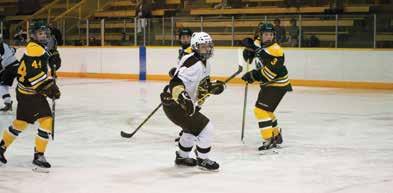
As the University of Manitoba Bisons women’s hockey team geared up for their series against the Saskatchewan Huskies on the road last weekend, one player felt right at home. For third-year forward Alana Serhan, it was a contest against her hometown team – the team she would’ve been suiting up for if she hadn’t met Bisons head coach Jon Rempel.
A native of Porcupine Plain, Saskatchewan, Serhan made the trip to Manitoba for a tournament as a grade 11 AAA midget player. It was during that tournament that she was introduced to Rempel. The Bisons’ interest in Serhan continued after that, and Serhan ultimately committed to the herd before graduating high school.
“I made my way to the University of Manitoba thanks to coach Jon Rempel. Jon approached me after one of the tournament games and asked me if I have thought about playing university hockey and I said yes. In January of my grade 12 year I made
the trip to Winnipeg, and shortly afterward I committed,” she said.
“I had originally wanted to go university in Saskatchewan or Regina, but looking back now I wouldn’t trade my Manitoba experience for anything,” Serhan said.
Serhan made quite the first impression in her first month of CIS hockey. Her first point was tallied in her fifth game against Mount Royal – a 4-1 victory. The next night, she scored twice in a 3-0 win. The following weekend, Serhan was on the board again at Calgary.
However, despite her hot start, Serhan admitted that there were obstacles as a CIS rookie in that 2013-14 season.
“CIS is fast-paced, intense hockey,” Serhan said. “In my first year I had a hard time adjusting to the levels of training and the speed of the game. Now, in my third year, I have transitioned very well.”
Serhan’s progression from a freshman to sophomore appeared flawless. Her rookie season of four goals and
11 points included a cold spell of 17 consecutive games without scoring a goal. She had 20 goals and 31 points the following season, though.
“My goal is to have our team be successful and win a championship,” said Serhan. “I think that is everyone’s goal.”
“Aside from winning, I just want to be able to have a team that has fun and gels well together. Although we are all here to play hockey, I still think building friendships between each other is very important and it helps build team chemistry.”
With only five players on the roster having four years of experience or more, there is a greater emphasis on younger players assuming veteran roles. At the midpoint stage of her CIS career, Serhan believes that leadership is a role that can be assumed by any third-year player.
“The reality of being a third-year on our team is that we are all leaders,” Serhan said. “We have a younger team than most and with only two fifth year players, all of our third and
fourth-year players have to step up and lead.”
Serhan is certainly living up to her standards on the ice, leading the team this season with 11 assists. Her 14 points after 22 games is second on the Bisons behind linemate Alanna Sharman.
The success that the Saskatchewan native has had throughout the past three seasons has been a testament of her attitude on a game-by-game basis. Serhan takes a positive approach, and the results have shown that she’s
BY
taken the proper mentality to CIS hockey.
“What I think about is what I can do so that I can put my team in a position to win,” Serhan said. “I like to be able to pump the team up and keep the energy positive both on the bench and in the dressing room between periods.”
In retrospect, the decision to join the herd ended up being an invaluable moment in her career – one that is still yet to fully unfold.