Comment Editor: Evan Tremblay
People are a product of their physical environment
Racism, misogyny less likely in healthy neighbourhoods
EVAN TREMBLAY, STAFF

W
innipeg is a city. This truth is self-evident, but was apparently not on our mayor’s mind when he declared “I have no interest in offering a platform for the types of violent and harmful views” held by members of a misogynistic group that was planning a meetup this past Saturday. Bowman was joined by the mayors of Toronto, Calgary, and Vancouver in denouncing the group –fans of the anti-feminist blog Return of Kings – and declaring them unwelcome in their respective cities.
Winnipeg is a city and not a theatre, and Bowman a mayor and not a booking agent. He should channel his denouncement into something constructive, rather than grand-
standing. Although the individual responsible for planning the meetup (it was to take place in the parking lot of St. Vital mall) is American, the attendees would all have been Winnipeggers. The solution is not to declare American misogynists unwelcome; the solution is to build a city without homegrown ones. Such a feat does not require elaborate acts of social engineering. Good neighbourhoods produce good people; or rather, good neighbourhoods do not systematically produce bad people. The city does not have a say in the creation of people, but it has a responsibility to create good neighbourhoods. Good neighbourhoods have
certain physical characteristics, which have been well-studied and documented. There is a whole field – urbanism, or city planning – dedicated to promulgating the knowledge of how to create healthy, wholesome, beautiful places to live. Winnipeg, like most North American cities, has a proud tradition of ignoring this knowledge (preferring to allow developers to decide where, and how, to build), and then scratching its head when the soulsucking habitats it provides for its citizens vomit up racists and misogynists, specific types of a general lack of civic pride or community spirit.
A
good neighbourhood has diversity of residents; a good neighbourhood shows its residents that people of different incomes, races, and religions are just that – people
neighbourhood has streets lined with trees, well-landscaped and appropriately scaled public parks. It has a mix of zonings and uses that allow its residents to work, play, and live in the same place. A good neighbourhood is one you can love – and not ironically.
halting the never-ending approval of new, cookie-cutter subdivisions – is the first thing Bowman should do. The second is taking a long, hard look at the quality of the neighbourhoods we currently have, and making planning decisions that nurture the good and heal the bad.
A good neighbourhood includes a mix of housing types, and densities. A good neighbourhood is as easy – if not easier – to navigate on foot or by bike than by car. A good neighbourhood has robust public transit. A good
A good neighbourhood is a community; you can be born, grow up, raise a family, and live the twilight years of your life in a good neighbourhood, and not miss out by doing so. A good neighbourhood has diversity of residents; a good neighbourhood shows its residents that people of different incomes, races, and religions are just that –people. Racism and misogyny are always present in some people, but in a good neighbourhood, you have to be willingly blind to the world around you to sustain such worldviews.
Stopping the creation of bad neighbourhoods – which would mean
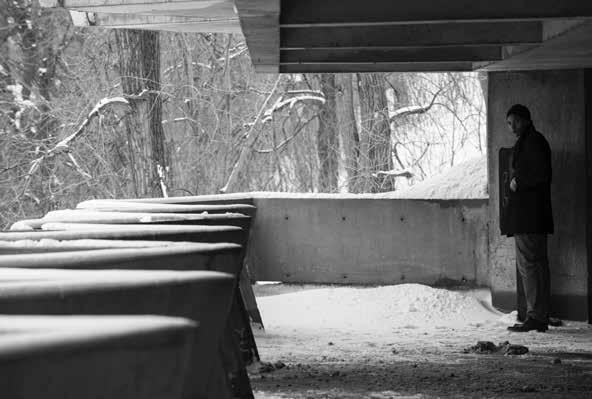
Of all the guys I know, those most likely to have attended the meetup live and grew up in South St. Vital. It is a neighbourhood where you need a car to get around, where there are no street-trees, few sidewalks, and endless repetition of cheap, single-family detached housing. There is little variety in lifestyle or demographics. They aren’t bad guys – but their worldview is a mirror of the physical world they grew up in: impoverished and distorted, compared to people who grew up in older, healthier neighbourhoods. It’s not hard to denounce misogyny. It is much harder to denounce poor planning, especially since good planning takes both time and money. But Bowman is the mayor of this city – he possesses an excellent platform from which to denounce bad neighbourhoods, and demand the creation of better ones. That would be the next logical step, if his statement had anything to do with erasing hate, rather than jumping on a media bandwagon.
Negative stereotypes still shroud “feminism”
Determining levels of equality depends on what metrics you look at, and what words you use
JILL PATTERSON, STAFF
In January, Manitoba celebrated the 100-year anniversary of becoming the first province to extend the franchise to women. In light of such a milestone in Manitoban history, it is worthwhile to reflect on how far women have come in terms of equality.
There are arguments to be made on both sides of the debate. On one hand, it has been shown time and time again that there is a gender wage gap. According to a UN report, women employed in the same profes-
sion, and with the same experience, make 24 per cent less than what men make.
As well, critics have pointed out that celebrating 100 year anniversary of women winning the right to vote is not entirely accurate – after 1916 many women, mostly racialized women, were still not allowed to vote. We should also keep in mind that the 1916 victory was won only for women in Manitoba, Alberta, and Saskatchewan. Women would not be able to vote in all provinces until 1960.
On the other hand, there are many examples that show women have in fact made great strides in terms of equality in the past 100 years. Women now make up the majority of students enrolled in Canadian universities. Women are also more prominent in politics, especially with the election of Justin Trudeau as prime minister, whose cabinet is half women. Women in Canada have gained the right to legal abortions, which women in many other countries (most notably in broad swathes of Africa and the Middle East) do not yet possess.
If you believe in equality for women and all that it entails, you are a feminist, plain and simple
If it’s true that the voices of women are being heard louder than in previous times, it is also true that there is still a long way to go for women to achieve full equality.
The idea that men and women should have equal rights, opportunities, and privileges – the basic tenet
of feminism – is something that most people, men and women alike, would agree with. But when asked if one is a feminist, many still scoff at the word and refuse to be associated with feminism. For some reason feminism has yet to shake loose its negative, stereotypical connotations.
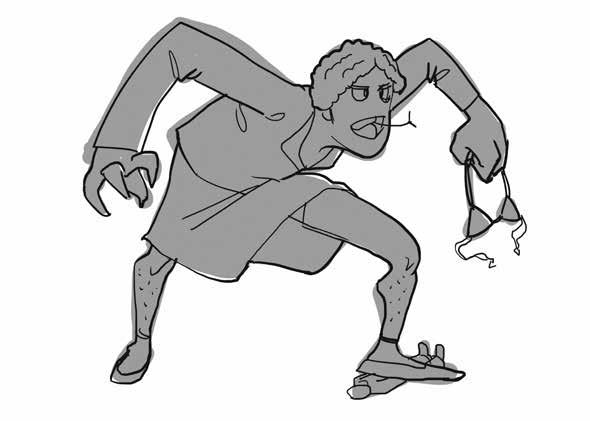
The word still summons the image of the man-hating, bra-burning, razor-eschewing, preachy female, and many people are afraid to be labelled as such.
Until we acknowledge that being a feminist and believing that women deserve equal rights with men does not mean that one hates men or that one necessarily defies socially defined femininity, there will always be a barrier to full equality for women. Society at large needs to embrace feminism for what it stands for, and not for how it has been represented by some feminists.
For other ideologies, this does not seem to be as great a problem.
If Donald Trump were the defining image of Republicanism I daresay many people would be reluctant to identify as a Republican. The same can be said of Josef Stalin and socialism, or any number of popular spokespeople of an “ism.”
If you believe in equality for women
and all that it entails, then you are a feminist, plain and simple. You can be a feminist and still like either men or women, still wear makeup or not, still be “manly” or “feminine.”
The word still summons the image of the man-hating, bra-burning, razoreschewing, preachy female, and many people are afraid to be labelled as such
It is just as important to accept what feminism stands for as it is to accept the label because only when the word feminism is accepted can the ideals and goals of feminism also be accepted and discussed in an open way. To shy away from the label means that any meaningful conversation about how to achieve equality for women will have push-back due to the negative connotations that that label still holds.
GRAPHIC BY JONDELL COOMBS
GRAPHIC BY BRAM KEAST


Science & technology
& Technology Editor: Chantelle Dubois
Science
Contact: science@themanitoban.com
Science MiniFeature: Love
An exploration through science and technology
In the spirit of Valentine’s Day, the science team has put together a mini-feature in the science and technology section of the Manitoban. Scientists are often left out of the fun, with odes to love left to the poets and artists.
Science and technology plays quite a role in love and relationships today. There were many ways in which this topic could be explored from a science and technology point of view.
In this feature, the team explores three topics of love in science: homosexual relationships amongst animals, the science of how your body reacts to heartbreak, and what relationships with robots may progress to be like in the future. We hope you enjoy!
Non-heterosexual sex in the animal world
Under the sheets in the animal kingdom
JEREMIAH YARMIE, STAFF
Throughout the animal kingdom, non-heterosexual sex is a common thing. Whether in the air, on land, or in the sea, animals don’t seem to have any problem with getting it on with members of the same sex.
At least 1,500 animal species have been documented having homosexual sex. Often, the behaviour is influenced by external factors like creating and maintaining social order, a lack of mates of the opposite sex, and for simple sexual release.
As it turns out, almost all animals that have homosexual sex do not do so exclusively. All of these animals could be labelled as bisexual.
Female warthogs have been observed to form long-lasting pair bonds with each other – even going as far as raising piglets together. If one of the pigs is unable to carry out its parenting duties, the other will take on more responsibility until the other is fit to help out again.
The majority of laysan albatrosses on the Hawaiian island of
Oahu are female. About 10 years ago, researchers found that almost a third of all pair bonds were between two female birds. Researchers believe that laysan albatrosses form female-female pairings because of the dearth of males on the island.
Pair-bonded female albatrosses will nest with each other, and can last as long as male-female pairings, often for life. Paired females will also rear chicks together. A male in a male-female relationship will often sneak away to mate with either, or even both, of the paired females.
Bottlenose dolphins use samesex intercourse as a way of strengthening social bonds; dolphins have very intimate relationships, regardless of the sex of the individuals. Both female and male dolphins have been found messing around with members of the same sex before going on to find a mate of the opposite sex later on in life.
When female dolphins get it on, it happens through something called “beak-genital propulsion,”
which is exactly what it sounds like.
Life is hard for the male Japanese macaque monkey. Not only do male macaques have to compete with other males for mates, they have to compete with females as well.
Homosexual sex amongst female macaques is extremely common – female-female pairings are typically very short, lasting around a week, but that doesn’t stop them from mounting each other hundreds of times. These pairings are entirely based on seeking sexual pleasure, and as such, females will still encourage male mating as well.
Japanese macaques are quite famous because of the Jigokudani Monkey Park in the Nagano Prefecture of Japan. During the winter, the macaques will come down from the cliffs that surround the park and relax in the hot springs until evening, when they return to their homes in the forest.
Penguins are by far the most publicized group of animals that have homosexual sex. Two popular
penguins – Roy and Silo – at New York’s Central Park Zoo successfully raised a chick together from an egg that they were given. Before they were given their own egg, the penguins were found trying to steal eggs from male-female couples. The penguins remained paired for six years before a new female stole the interest of Silo. Life is hard.
Domestic sheep are the one exception to this laundry list of animals that can be called bisexual. Up to 10 per cent of male rams will form pair bonds exclusively with another male. These rams do not mate, but act as lifelong companions in all other aspects of sheep life. Some rams are bisexual, however; about 20 per cent of rams display sexual behaviour towards both sexes.
Male-on-male sexual activity is very common in American bison populations. Male penetration occurs more frequently than female penetration during breeding season. These bulls are real trailblazers putting the bi- in bison.

The science of a broken heart
Why does it hurt so much?
CHANTELL DUBOIS, STAFF
Heartbreak is a nearly inevitable part of life. Almost everyone at some point, for some reason or another, will experience deep grief over the end of a relationship.
The pain is both physical and emotional. You literally feel like your heart is in pieces, you feel a pain deep inside you, you do and say things completely out of character, and it seems nothing makes you feel okay.
While time (and sometimes lots of it) is the only way to heal, perhaps knowing the science of what your body is going through may help you cope with the pain.
Broken heart syndrome
Aptly named, broken heart syndrome (BHS) occurs after a stressful event which causes your body to react like you are having a heart attack. Broken heart syndrome is also referred to as stress cardiomyopathy or takotsubo cardiomyopathy.
BHS occurs minutes after the triggering event, with symptoms
including shortness of breath, low blood pressure, and potential congestive heart failure. The heart beat becomes irregular, and the heart muscles rapidly weaken. These symptoms are not associated with factors typical in cardiovascular disease, such as clogged arteries.
The mechanism of BHS is not clearly understood, although some theories suggest a surge in stress hormones, such as adrenaline and noradrenaline, causes restriction of arteries and increased pressure on the heart. Alternative theories suggest the noradrenaline binds with the heart muscles, causing calcium buildup.
BHS is most likely to affect women, particularly middle-aged and older and post-menopausal. Fortunately, BHS is temporary, with no permanent damage and complete recovery within a few weeks.
Brain drain
When you fall in love, your brain undergoes changes similar to the way
a drug addict’s would. Interaction and time spent with your loved one releases dopamine and other reward hormones. Your brain becomes wired in a way to keep you motivated to retain your love. This is generally referred to as a goal-oriented motivational state.
After a breakup, your brain still remains wired in this state, which could explain why some jilted lovers will show up at an ex’s workplace or text them repeatedly trying to reconcile. Their brain is simply programmed to do whatever it takes to keep the relationship, and reward, going.
The longer a relationship lasted, the more neurons that need to be rewired in the brain to change this behaviour.
Additionally, the same neural pathways that respond to physical pain also respond to emotional pain. This is why grief feels like your body is in pain.
Some psychologists believe this is an evolutionary effect from when

humans were hunter-gatherers. In the context of social pain, it is theorized the brain is programmed this way since isolation could lead to real physical pain, when being separated from a group. This would make the isolated individual a target for predators.
If you find yourself spending Valentine’s Day alone this year,
pining over a loved one, you might find some comfort in knowing that your heartbreak is simply the result of evolution to keep our species thriving. And, while it might feel like your heart is literally breaking, you’re really just experiencing heart attacklike symptoms and will recover. Give your neurons some time to re-wire.

GRAPHIC BY JONDELL COOMBS
Humanoid sex robots are coming sooner than you think
All’s fair in love and robotic engineering
MALAK ABAS, STAFF

Are we ready to accept sex robots into our everyday lives?
Ready or not, they’re coming. Some experts predict that by 2050 robotic life companions will become as common as smartphones.
As human beings pursue scientific innovation, we collectively look for new ways to fulfil our deepest needs. With technological advances come new ways to go about our everyday lives.
We have reached a relative comfort zone with technology. Artificial intelligence past brief communication, however, is new ground.
Here’s a breakdown of how far we are with mass-marketable robot partners.
One of the leaders in the race to release a robot lover for the masses is Abyss Creations, who are known for their immensely popular realistic sex doll aptly named RealDoll.
RealDoll, which has been in production in California since 1996, is one of the most realistic sex dolls out there. They have skin that feels real, but they also have interchangeable faces, adjustable body temperatures, and are made of platinum silicone. The average RealDoll sells for about US$6,000.
The company is in the process of developing A.I. to supplement
RealDoll, led by their creator, Matt McMullen. The project, called Realbotix, is working to create a RealDoll that will be able to realistically blink, open its mouth, and answer your questions.
The project, called “Realbotix”, is working to create a RealDoll that will be able to realistically blink, open its mouth, and answer your questions
McMullen and his team also have devices in the works to supplement the experience, such as virtual reality headsets that will work in tandem with the RealDoll.
It won’t come cheap. The head alone (which will be adjustable to fit on interchangeable RealDoll torsos) will set you back about US$10,000. The whole body will cost between US$30,000 and $US60,000.
McMullen estimates that the Realbotix head will be available by 2017.
Americans are not the only people getting in on the companion robot market. The 2015 World Robot Conference in Beijing introduced Geminoid F, an extremely realistic robotic woman.
Geminoid F is a Japanese android that can answer questions, blink, smile, pose for selfies, and even sing. The android is five-foot-six with long black hair and was on display at the World Robot Conference. Geminoid F even has an IMDB profile, and will appear in the Japanese action film Sayonara
The android’s creator, Hiroshi Ishiguro, calls Geminoid F’s movie role an “an epoch-making event.”
Although Geminoid F wasn’t designed to be a sex robot, the reaction to it has definitely been sexualized – many headlines refer to her as “the world’s sexiest robot”.
The uncanny valley
The uncanny valley is a concept first coined by Japanese robotics professor Masahiro Mori, who hypothesized that any robot that had features that were almost human, but not exactly human, would repulse some people.
The uncanny valley is why many people find dolls creepy and what makes some films unintentionally
eerie. The Polar Express, a 2004 animated Christmas movie for kids, notoriously left many people with a feeling of unease. This is because the characters, all computer-animated and strangely dead behind the eyes, dipped straight into the uncanny valley.
"We are not supplanting the wife or trying to replace a girlfriend,” Douglas Hines, founder, TrueCompanion
Our innate nervousness around certain levels of CGI seems to parallel our advances with the technology. When Pixar screened their computeranimated short Tin Toy in 1988, audience reaction was largely negative due to how realistic the antagonist – a human baby – looked. Fear of the uncanny valley looms over any realistic robot life companion. This may be what keeps robot companions from becoming a commonplace commodity, mainly because experts know so little about it.
Revulsion due to the uncanny valley differs from person to person. Some people don’t experience it at all, and researchers still only have theories on what causes it and how to overcome it.
Ethics
Even if humanoid robots managed to push past the uncanny valley, some experts believe that creating robots that have an artificial consciousness but are built specifically for sex is unethical.
One of those experts is Kathleen Richardson, senior research fellow in Robotics at De Montfort University, and co-founder of the Campaign Against Sex Robots (TCASR), who argues that sex robots contribute to the misogyny that’s already prevalent in our society.
“The vision for sex robots is underscored by reference to prostitute-john exchange which relies on recognizing only the needs and wants of the buyers of sex,” TCASR’s website says.
“The sellers of sex are not attributed subjectivity and reduced to a thing (just like the robot).”
Producers of interactive sex dolls, however, disagree. Douglas Hines, an artificial intelligence engineer and the founder of the TrueCompanion sex robot company, says that the dolls are meant as another outlet for human interaction.
“We are not supplanting the wife or trying to replace a girlfriend,” Hines said in an interview with the BBC.
“This is a solution for people who are between relationships or someone who has lost a spouse.”
This being said, it may be important to note that TrueCompanion’s first and only sex robot is named Roxxxy. Yes, with three “x”s.
It’s crucial to remember that all of this aside, human-robot relationships beyond things like physical sex and pre-engineered answers are still a thing of the future. Robot technology and artificial intelligence just aren’t there – yet. So while you might love your Realbotix doll because she laughs at your jokes, that love is one-sided.
But people don’t seem to mind. There have been over 5000 RealDolls sold. In a particularly poignant scene of “Lars and the Real Girl”, a movie about a man who falls in love with a realistic adult doll, the doll is given a bouquet of fake flowers. Lars, delighted, notes that “they’re not real, so they’ll last forever.”
Indeed.
GRAPHIC BY KELLY CAMPBELL







GRAPHIC BY BRAM KEAST
COMIC BY KELLY CAMPBELL
GRAPHIC BY JONDELL COOMBS

Arts & Culture
Rae Spoon brings synth-pop stylings to Winnipeg
Veteran singer-songwriter on staying fresh, flexible in music
OLIVIA MICHALCZUK, STAFF

Montreal-based indie/pop singersongwriter Rae Spoon is gathering a lot of attention for their eighth album Armour, which they are taking on a cross-Canada tour from Victoria, B.C. to St. John’s, N.L.
The album will be released on Feb. 19, with Spoon playing in Winnipeg the following day at the Good Will Social Club with two acts from Toronto opening: world music collective LAL and electronica soloist Joanne Pollock.
Following Spoon’s Polaris Music Prize-nominated My Prairie Home, Armour has a much different theme both musically and lyrically.
Spoon’s music has evolved from country/folk to songs heavily based on synthesizers and other electronic instruments while still retaining some of its roots.
“I made a conscious decision to have more analog synths on the album. In the past, my programmed sounds have been generated inside of
the computer,” said Spoon.
“I’m always interested to see how changing instruments changes the feeling in compositions and arrangements. I lived in Germany in 2006 and 2007. I was introduced to electronic music by friends I made while living there. At first I doubted that computers could make music just like guitars could, but I’m fully converted now. I got my hands on a bunch of synths and spent a couple of years with them.”
Spoon’s previous album was based on their past and experience growing up as a queer youth in a Pentacostal Christian household in Alberta. Spoon explores the future in their new album that touches on themes such as trauma, hope, and the emotional ups and downs of adulthood.
Their creativity and versatility was evident when they mentioned some potential themes of new work in the future.
“I’m deeply interested in monstrous characters right now,” they said.
“I might write an album about monsters, or maybe even a book and album that are linked thematically.”
When asked what they’d been listening to lately, Spoon revealed their
presently sparse, yet specific tastes.
“I‘ve been taking a bit of an ear break lately, aside from producing Kris Demeanor’s new album,” said Spoon.
“I’m always interested to see how changing instruments changes the feeling in compositions and arrangements”
– Rae Spoon
“I will admit I was one of the million people who got Rihanna’s album for free. I’m also really excited about the new You Say Party album coming out.”
Though Spoon’s music has evolved over their musical career, they have maintained a strictly do-it-yourself approach to touring throughout.
“I have retained the way that I tour because I’ve always been really DIY. I
Festival du Voyager returns with 140 musical acts, new attractions
What’s new at Winnipeg’s favourite February festival

F
estival du Voyageur has been a staple of Franco-Manitoban culture for almost 50 years.
book my own shows, pick the venues, and I often book the opening act as well,” said Spoon.
“It’s allowed me to have a lot of flexibility and autonomy in my career. Maybe it’s one of the reasons I’ve managed to keep making albums for 15 years.”
Spoon’s Good Will gig functions as the closing party of this year’s Genderfest Winnipeg, which features a variety of events aside from musical performance focused around the queer community.
Spoon stays in contact with Genderfest organizers and this year, festival and tour schedules happened to line up.
“I’m particularly fond of trans- or genderqueer-related festivals. There’s nothing like being at a party with 200 other trans people.”
The doors to Spoon’s Feb. 20 show open at 9 p.m., with music beginning at 10 p.m. Tickets are $15, and are available in advance at the Good Will, Music Trader, and online at www.ticketfly.com. To learn about more events at Genderfest Winnipeg 2016, go to www.facebook. com/genderfest.winnipeg
this year, with 140 artists booked to play – more than there has ever been. He is particularly excited for the performance by Sweet Crude, an indie-rock band from New Orleans that has never been to Festival.
Other highly anticipated acts include Les Hay Babies – a popular Québec-based folk band – and Coeur de Pirate, an internationally known singer-songwriter from Montreal. There are a few English-speaking bands as well, such as Bend Sinister from Vancouver.
When selecting the bands to play at Festival, Desaulniers’ main goal is to reflect the francophone community and its culture.
“The goal is to reflect the community, so just as many francophone bands as we can get, and that’s it,” said Desaulniers.
He seeks out high-quality bands, starting with acts from Québec, New Brunswick, Nova Scotia, and sometimes a few international acts.
rapid-fire fiddling, and encouraging amateur jigging in the crowd. For those seeking a more relaxed environment this year, singer-songwriters will be performing more laid-back sets on select days in the Snow Bar at Voyageur Park.
The Université de Saint-Boniface Portage tent is another new addition to Festival this year. It used to be the Souvenir Tent, but was not being used to its full potential.
At night, the Université de SaintBoniface Portage tent is featuring events to appeal to a wider range of people, like karaoke and a singles night on Valentine’s Day.
While Festival is a staple of Franco-Manitoban culture, it’s by no means exclusive to just the francophone community.
“It’s about finding that balance,” said Desaulniers.
Festival usually falls on reading week and did so again this year, perfect for university students looking to unwind from their studies.
Chances are good that if you grew up speaking French in Winnipeg, you grew up going to Festival. Julien Desaulniers, artistic producer for
Hailed as the largest outdoor winter party in Winnipeg, Festival will bring French- and English-speaking Winnipeggers alike to Whittier Park from Feb. 12 to 21 to get their fill of diverse, quality musical acts, local history, and assorted winter activities.
Festival, is no exception: his first concert was at Festival when he was just a few years old.
At 18 years, Desaulniers found himself playing his first paying gig as a musician at Festival. A number of years later, he progressed to booking the bands himself.
Desaulniers has a lot on his plate
From there, he looks for talented musicians of Manitoba’s Frenchspeaking community. Festival is always looking to support emerging artists as well, to showcase new talent alongside more seasoned acts.
Many of the acts at Festival are high energy full bands, featuring
“The focus is francophone culture of course, but we’re trying to be as inclusive as we can with our programming, and we want everyone to be a part of it.”
Festival du Voyageur runs Feb. 12 to 21.
Further information on schedules, prices, events and activities, and exhibits can be found at www.festivalvoyageur.mb.ca
PHOTO PROVIDED BY FOXX FOTO
PHOTO PROVIDED BY FESTIVAL DU VOYAGEUR
Fifty Shades of Black is fifty shades of bad
Parody film makes original seem a masterpiece by comparison
LAUREL JOHANSON
It’s finally February, which means that the Academy Awards are right around the corner. There are a number of Oscar-contending films currently playing at a theatre near you that rightly deserve your attention in what has been another remarkable year for movies.
With those thoughts in mind, naturally, my attention this past weekend turned to the new Marlon Wayans parody film, Fifty Shades of Black.
In the same vein as Scary Movie, Vampires Suck, Meet the Spartans, and Dance Flick, Fifty Shades of Black is a parody of the book and movie that launched a thousand whips, Fifty Shades of Grey Marlon Wayans (who also co-wrote the film) stars in the film as Christian Black, with Kali Hawk playing the object of his bondage-filled desires, Hannah. Michael Tiddes of A Haunted House and A Haunted House 2 fame occupies the director’s chair.
We all know the timeless Fifty Shades story: girl meets boy; boy tries to convince girl to become his contractual sex slave; girl is introduced to the glorious world of inaccurately portrayed BDSM sex; boy claims he doesn’t “do” romance while displaying increasingly stalker-like tendencies; girl inevitably falls for him anyway; drama ensues.
The jokes in this film aren’t just unfunny; they’re too easy
Fifty Shades of Black follows the same basic story structure as its source material. Following in the general tradition of spoof films, it lifts certain shots and set-ups directly from the film it is parodying. In that regard, if you haven’t yet seen the Fifty Shades of Grey movie, then many of the jokes in Fifty Shades of Black will make little sense to you.
If you are one who has had the unique pleasure of seeing Fifty Shades of Grey, you may be asking yourself this: given that Fifty Shades of Grey is at times unintentionally hilarious and absurd in its own right, was it really necessary to create an entirely separate spoof film to point out its flaws?
Having now seen Fifty Shades of Black, the answer, without question, is no.
The film relies heavily on humour that is usually racist, sexist, or some combination of the two, and strives for relevance by trying to cram in as many references to current pop culture as possible, whether they relate to Fifty Shades or not.
Whether it’s Christian Black’s shady past as a stripper being explored through an extended Magic Mike spoof sequence, or his sexual awakening at the hands of an older woman seen through a parody of the infamous classroom scene in last year’s Whiplash (“Were you rushing or were you dragging?”), these clumsy

jokes are thrown at the viewer with all the subtlety of a sharp slap on the behind from Christian himself, and are just as painful and uncomfortable to endure.
The jokes in this film aren’t just unfunny; they’re too easy. Things that were glaringly obvious in the original Fifty Shades film (Christian is creepy! Anastasia has no personality!) are played up in this parody without
the joke ever really going anywhere. At one point when Hannah accuses Christian of being a stalker he claims to have “three restraining orders, working on a fourth,” and that’s the entire punchline.
As a whole the film reeks of unrealized potential for not really sinking its teeth into say, the many misogynistic and abusive aspects of the original Fifty Shades franchise,
and instead relying on ugly, low-brow humour that is all shock with no substance underneath.
Let’s just take a moment to reflect on Fifty Shades of Black ’s journey to the silver screen. It is well-known that the Fifty Shades of Grey book series has its origins as a popular Twilight fan fiction entitled “Master of the Universe” where the names “Christian” and “Anastasia” dis-
creetly replaced “Edward” and “Bella” respectively. And so since Fifty Shades of Black serves as a parody of Fifty Shades of Grey, in going to see this movie, essentially what you’ll be paying to watch is a parody of a Twilight rip-off.
Try to let that sink in.
GRAPHIC BY JONDELL COOMBS
The rise of new Dawn
U of M alum debuts solo art exhibition
TOBI NIFESI, STAFF


From Feb. 5 to 16, Cre8ery, an independent art gallery located on the second floor of 125 Adelaide St. in the Exchange District will be launching a new exhibition called Appearance of First Light by Ashleigh Dawn, a U of M alumna and middle years fine arts teacher.
Appearance of First Light is Dawn’s debut exhibition, and for her the show symbolizes the crack of a new dawn or the breaking of the day. It represents her introduction into Winnipeg’s art scene.
“This is my first solo show, so I am just sort of showing the world this new beginning that I am trying to take in my encaustic medium,” Dawn told the Manitoban
The majority of the exhibition is comprised of encaustic paintings. Encaustic is a style of painting that involves melting beeswax, adding color pigments, and applying it to a canvas, typically a wood surface. The most famous use of the medium dates back to the first and second centuries C.E. when it was used in the Egyptian Fayum mummy portraits.
Although she is adept in several media such as oil painting, acrylic, watercolour, abstract art, and ceramics, Dawn believes encaustic painting is her preferred medium for now. She appreciates the smooth texture and translucence that is characteristic of
encaustic paintings.
“The majority of my work is based on encaustic paintings,” said Dawn.
“They are beautiful pieces that are very soft, and the layers of wax sort of make them hazy.”
“It’s
very colorful, and your eyes kind of bounce around the room as you walk in” – Jordan Miller, Cre8ery gallery owner
The exhibition’s pieces are bold and vibrant. They include colorful paintings of birch trees, blooming flowers, and several birds native to the province. Dawn’s art sparkles and showcases a soft, yet glowing view of nature.
For Dawn, her quest to become a solo artist has been a long and enjoyable ride. Her journey thus far serves as the inspiration for the show. She believes this exhibition creatively highlights who she is as an artist and a person.
Although she appreciates art
works that provoke deep thoughts, Dawn pointed out that Appearance of First Light is simply about the appreciation of nature, colours, beauty, and light.
Cre8ery is owned and managed by Jordan Miller, a fellow fine arts graduate from the U of M. In addition to exhibitions, the gallery also runs a workshop program for young artists.
Miller, who was honored with the 2011 YMCA-YWCA Woman of Distinction Award in the Arts category, believes Appearance of First Light is unique to Dawn’s style, especially with beautiful encaustic paintings.
“I think [Dawn] has a nice balance of colours and style in her exhibition [...] it’s very colorful, and your eyes kind of bounce around the room as you walk in, and the encaustics are beautiful.”
For more information about Appearance of First Light, exhibition hours, and ticketing, visit www. cre8ery.com
Shum spotlights Canadian racism in Ninth Floor
Controversial new film reminds Canadians of forgotten civil rights violations
TOBI NIFESI, STAFF
I
n Canada, given our seemingly welcoming and generous culture, we are often quick to condemn highly popularized police brutalities and debates over immigration policies in the United States. We do not always, however, lend the same attention to our own history of racism.
In her controversial new film Ninth Floor – which was screened at Winnipeg’s Cinematheque on Jan. 30 as part of Canada’s Top Ten Film Festival – Chinese-Canadian direc-
tor Mina Shum (Double Happiness and Long Life, Happiness & Prosperity) reminds Canadians of their own history with civil rights by detailing the events of the mostly forgotten (and still unresolved) 1969 Sir George Williams Riot that took place at Montreal’s now-defunct Sir George Williams University.
What began as allegations of racism against assistant biology professor Perry Anderson from six black students turned into the student occupa-
tion of a computer room on the ninth floor of the university’s Henry F. Hall Building within a year.
The university administration’s perceived intransigence in handling the allegations 10 months later led to over 400 students storming out of a meeting with the university board to stage a 14-day peaceful occupation.
In the movie, scenes of peaceful student protesters trapped by a fire assumed to have been set by the police – as the crowd outside the building chant racial slurs and threaten violence – top off the display of vitriol from both university and police officials. It’s reminiscent of the riots and social justice movements of Ferguson, Mo. and Baltimore, Md.
The university’s actions gave the impression that they had no responsibility to students of colour and how they were treated. In other words, this educational institution refused to provide appropriate service to a group of people because of their colour – this is, by definition, institutional racism.
“Somewhere along the line, the implicit assumptions of slavery had become institutionalized,” Rodney John, one of the six biology students who started it all, says in the film.
Today, many of the Sir George Williams student protesters and their families are being haunted by the stigma they had faced from the press at the time.
“These people have carried this shame and stigma for the last four decades” – Selwyn Jacob, producer
Kennedy Franklin, one of the leaders of the protest, returned to his home in Trinidad after the incident and is said to have struggled with mental illnesses.
“The very nature of the [newspaper] headlines created such a stigma for everybody who was involved in this incident that everybody buried it,” said Selwyn Jacob, the film’s producer, via Skype at the Winnipeg screening.
Via surveillance tapes and interviews with some of the original complainants and other related parties, Shum’s narrative presentation of the controversial case gives the audience a first-hand, subjective view of how the affair unfolded.
However, some of the interviews and topics were not as forthright or as representative as they perhaps should have been. For example, Perry Anderson’s son and Kennedy Franklin’s daughter represented their parents in the film, but this only affords the viewer a second-hand experience.
The events that happened on that ninth floor in 1969 aren’t common knowledge among Canadians. With her film, Shum gives us an opportunity to both remember the students’ plight and be more socially aware.
Ninth Floor was released in 2015 and produced by the National Film Board of Canada. Learn more about the movie at www.nfb.ca/film/ninth_floor
“These people have carried this shame and stigma for the last four decades. The message is that [people should] view this film as a cautionary tale.”
PHOTO PROVIDED BY WINNIPEG FILM GROUP
PHOTOS BY CAROLYNE KROEKER



Sports
Bisons sweep Wesmen, improve to 13-5 on the season
Men’s basketball team inches closer to hosting home playoff series
MIKE STILL, STAFF

In a series that felt like a playoff contest, the University of Manitoba Bisons men’s basketball team emerged with a critical sweep of the Winnipeg Wesmen, pushing their win streak to an impressive five games.
Friday
The Bisons made a huge statement on Friday night at Investor’s Group Athletic Centre, snapping the visiting Winnipeg Wesmen’s six-game
conference winning streak. Manitoba never trailed in the contest, winning 79-65 and also claiming the 25th annual Duckworth Challenge in the process. It was the sixth time in the last seven years that the Bisons won the challenge.
AJ Basi led the way once more for the home side on offence, finishing with a game-high 23 points – 18 of which were scored from beyond the arc. Guard Denzel Lynch-Blair was Winnipeg’s leading scorer with 20
points, but was limited in the transition game – an area where he tends to be most effective.
Manitoba shot an astounding 47 per cent from the field and led by at least 10 points after every quarter. Basi was able to get going early from outside and that opened up Keith Omoerah, who had success driving into the lane and finished with 17 points as well as a team-leading nine rebounds. Discipline was another major key, as neither team had more
than nine free throw attempts overall.
The contest also saw the return of Ilarion Bonhomme II, who played 19 minutes off the bench for the herd and contributed 12 points – eight of which occurred in the opening quarter. It was also the first time Bonhomme had the opportunity to be part of the Bison/Wesmen rivalry, after three seasons with the Brandon Bobcats.
“It was awesome, we’re always excited about game day but it was
just a little bit different,” Bonhomme said post-game when asked about the Duckworth Challenge. “To see how excited the guys were about it, it was awesome to be a part of.”
Saturday
For the fourth time this season, the Bisons took a game to overtime – coming out on the winning side to improve to 2-2 in that department for the 201516 campaign with an 82-74 victory. Manitoba trailed by as much as seven points in the second quarter – failing to get their first basket in the middle frame until just over midway through – but clawed back into the game on the strength of their rebounding. The herd won the battle on the boards 57-41 on the night, including 16 from Keith Omoerah, who also finished with a game-high 22 points.
The Bisons also got inspired play from Jonathan Alexander off the bench, who once again scored in double digits, registering nine of his 13 points in the third and fourth quarters combined.
Trailing by five entering the fourth quarter, Manitoba went on to outscore Winnipeg 30-17 in the final 10 minutes and overtime session combined to pull out the win. Omoerah, Basi, Justus Alleyn, and Wyatt Anders all had at least one rebound in the five-minute OT, holding Winnipeg to just four points.
Manitoba has just one series left this season, taking on the lowly Trinity Western Spartans on the road this coming weekend and look well on their way to hosting their first home playoff series since the 2003-04 campaign.
Bison volleyball takes on the Wesmen
Men help win the Duckworth Challenge, women fall short on the weekend
RYAN STELTER, STAFF
This weekend saw the University of Manitoba Bisons volleyball teams pitted against their local rivals, the Winnipeg Wesmen. The pair of games on Thursday – part of the Duckworth Challenge – saw the men emerge victorious while the women were defeated. Saturday was the same story in terms of results despite the women putting up a much better fight.
Thursday
On Thursday night at the Duckworth Centre at the University of Winnipeg, the Bison men’s volleyball team was able to win 3-0 (25-23, 25-23, 25-17). Devren Dear once again led Manitoba in kills, with 14. Dear is now second in Canada with 4.51 kills per set. He also had five digs, tied for team best on the night with Josh Goossen. In a tight matchup, the
herd only outscored the Wesmen by 56-44, with the third set being the most decisive.
The Bison women’s volleyball team lost three straight sets against the Wesmen. It was a rough night for the herd, as they were completely dominated in every facet of the game.
Tori Studler had six kills on the evening, along with six digs. Cassie Bujan led the herd with seven digs of her own. The Bisons were outscored 62-35 on Thursday night and struggled to gain any kind of momentum.
Saturday
In a rematch of Thursday’s contest, the men found themselves down two sets, but were able to mount an incredible comeback to win 3-2 (26-28, 23-25, 25-15, 25-19, 15-13).
It was a thrilling matchup with many long rallies and some heart-
pounding drama. The game ended in the fifth set when Luke Herr came up with a massive block. The crowd erupted in elation shortly thereafter.
“This is big for us. We’ve lost a couple the last two weeks so this was nice to get” – Garth Pischke, head coach, Bisons men’s volleyball
Adam DeJonckheere finished ahead of usual suspect Devren Dear with a team-best 21 kills. Dear was not far behind however, finishing
with 20.
Bison head coach Garth Pischke talked post-game about the comeback.
“Kevin Falconer and Caleb Hickock turned that game around for us,” Pischke said. “The defense certainly helped. We did a better job of blocking.”
Pischke also talked about the importance of sweeping the very good Wesmen team, who have been nipping at their heels all season.
“This is big for us. We’ve lost a couple the last two weeks so this was nice to get,” he said. “We played really well on Thursday, but our best came in those last three sets.”
The Bisons now have a 16-4 record and will play host to a 5-14 Brandon Bobcats team next weekend at Investors Group Athletic Centre.
The women were looking to
rebound after Thursday’s disappointing. In a tight first set, the Bisons were able to squeak out a 27-25 victory. Tori Studler registered seven kills in the first set alone. She would finish with a team-best 11 on the night.
The Wesmen managed to draw level in the second set, with a 25-18 win. The Bisons responded with a 25-23 third-set win, but the Wesmen took two straight to end the game in a 3-2 finish (25-27, 25-18, 23-25, 25-18, 15-8).
In a much better effort than Thursday’s contest, Cassie Bujan came up with an impressive 20 digs.
The Bisons fall to a 2-18 record with the loss, while the Wesmen improve to 8-12. Next weekend the Bison women will also host the Brandon Bobcats in a two-game series.
PHOTO BY CHANTAL ZDAN
Bisons sweep Calgary in critical weekend set
Men’s hockey gets it done at home to stay in control of their playoff destiny
RYAN STELTER, STAFF
D
espite trailing to start both matchups this past weekend, the University of Manitoba Bisons men’s hockey team rallied and managed to sweep the visiting Calgary Dinos.
Friday
The Bisons earned a critical two points with a 6-4 victory in the first contest.
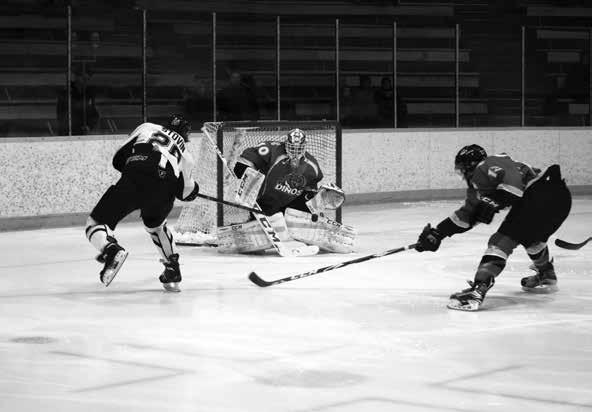
The game did not start well for Manitoba, as after just 58 seconds of play Dinos defenceman Alex Dzielski took a shot from the point that floated over the shoulder of Manitoba netminder Byron Spriggs. Shortly thereafter, Spriggs made a massive paddle save on the goal line to keep the score at 1-0. Spriggs was tested early and often in the opening minutes of the game.
Manitoba would tie things up when Jordan DePape came blistering in on a breakaway and went forehandbackhand, stuffing the puck home on Calgary goalie Steven Stanford. The Bisons would gain the lead through Jonah Wasylak at the midway mark after taking advantage of a Dinos mistake in their own end.
At 51 seconds in the second frame, Manitoba would add to their lead. A pinching Rene Hunter let off a shot from a sharp angle that deflected into the back of the net.
Jordyn Boyd’s first ever Bisons goal would give the Bisons a 4-1 after a great effort from Wasylak to get him the puck.
“Obviously, it’s nice, getting that first one late in the season, it feels good,” Boyd said post-game. “It was a great effort from Jonah [Wasylak]
to get it over to me, and I managed to squeak it five-hole.”
The Boyd goal prompted a timeout by the Dinos, which seemed to work as Calgary cut into the Bisons’ lead soon after, via the stick of Cain Franson.
“With these four points we control our own destiny. We don’t need to rely on anyone else, and we’re just going to focus one period at a time next weekend at UBC” – Mike Sirant, head coach, Bisons men’s hockey
Manitoba would restore their three-goal lead minutes later after rookie Liam Bilton wristed home a shot top-shelf. Calgary would storm back and score two goals a mere 38 seconds apart to end the period but wasn’t able to get the equalizer.
An uneventful third period saw DePape score his second on the night on an empty net to seal the deal for the herd.
Saturday
Manitoba came out on top by a score of 5-2 in the rematch, in a con-
test that the herd took control of in the final 25 minutes.
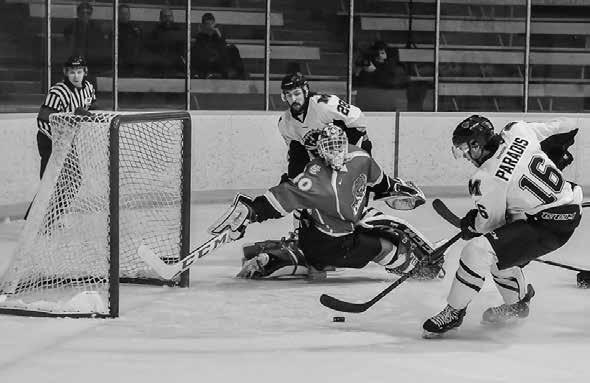
The Bisons dominated the early going of this game, a stark difference from Friday where they looked jumpy and out of sorts. With the Dinos on the power play, Brett Stovin and Jesse Paradis came in on a 2-on-1, however Stanford committed grand larceny on Paradis with a goal-line paddle save.
Calgary would get on the board first, though, through Dylan Walchuk. The Bisons would tie things up a few minutes later when Bilton fed a pass to hot hand Shaq Merasty on an odd man rush. Merasty made no mistake, sliding it between Stanford’s legs. The home side would gain the lead when Stovin and DePape combined in front of the net to give DePape his 19th goal of the year.
The second period saw a flurry of goals. The Dinos knotted things back up four minutes in after Luke Paulsen blocked a point shot with Elgin Pearce burying the loose puck from the slot. Manitoba would jump to a 3-2 lead after Warren Callis buried his own rebound on the power play. Before the period was up, Hunter had a shot trickle through Stanford which Bilton promptly finished off to make it 4-2 for the herd.
In the third, the Bisons gained a three-goal lead after Callis made a nice move to get around a Dino defender and dished a pass over to Paradis who got the easy tap in.
Bisons head coach Mike Sirant talked about the importance of getting a sweep post-game.
“With these four points we control
our own destiny,” he said. “We don’t need to rely on anyone else, and we’re just going to focus one period at a time next weekend at UBC.” Manitoba will head to Vancouver next weekend to take on the
series.
Bison women manage split against Dinos
Women’s hockey takes Friday’s game, but runs into penalty trouble in the rematch
ANDY CHE, STAFF
The University of Manitoba
Bisons women’s hockey team’s back-and-forth season continued this past weekend as they split a pair of contests against the Calgary Dinos.
Friday
The Bisons gained some valuable momentum in the opening game of their weekend set against the Dinos. On Friday night, they triumphed 2-1 at Calgary, winning back-to-back matchups for the first time since mid-November.
Amanda Schubert, starting her second game in a row, led the Bisons onto the ice. Bisons head coach Jon Rempel opted to start the third-year goaltender (who recorded a shutout in her last game) over Rachel Dyck. Just 30 seconds into the game, the Dinos set the tone. CIS-leading scorer Iya Gavrilova scored her 17th goal of the season, giving Calgary a 1-0 lead. The goal also tied her with Shawna Lesperance for most goals
this season and keeps her in the lead for regular season points.
The closest the Dinos would come to an equalizer was a slapshot off the crossbar from captain Stephanie Zvonkovic
Manitoba responded less than three minutes later. Nicole McGlenen’s second goal of the season got the visitors on the board. The fourth-year player also struck against Calgary earlier in the season, scoring the game-winner in a 3-2 victory. With less than five minutes left in the first period, the Bisons seized the opportunity to take the lead. Charity
Price scored her second goal in as many games to turn the game in Manitoba’s favour.
The Dinos generated chances to tie the game in the third period after an unconvincing second frame. The closest they would come to an equalizer was a slapshot off the crossbar from captain Stephanie Zvonkovic.
Schubert stood firm and made 18 saves on 19 shots for the victory. Her opposite number Hayley Downing made 13 saves on 15 shots.
Saturday
The Dinos put a halt to Manitoba’s two-game win streak in the rematch, as the visitors suffered a 4-2 loss.
Coach Jon Rempel opted to revert back to starter Rachel Dyck in net on Saturday, despite Amanda Schubert’s convincing back-to-back wins.
The Dinos got off to the perfect start after Sasha Vafina opened the scoring with her 13th goal of the season on the power play. The home side
extended their lead to 2-0 on another power play toward the end of the first period. Dinos captain Stephanie Zvonkovic’s shot from the blue line beat Dyck for her second point of the frame.
Further penalty trouble from the Bisons in the second period gave Calgary the opportunity to kill the game early. Just as Alana Serhan’s penalty was about to expire, the Dinos jumped out to a 3-0 lead.
Megan Grenon found the back of the net to score Calgary’s third power play goal of the game.
However, the Dinos’ advantage became their Achilles heel when Vafina took a tripping minor midway through the game. Kayleigh Wiens scored on the ensuing advantage to cut the lead to 3-1.
The Dinos restored their threegoal lead less than minute later. On a delayed penalty, Kate Lumley managed to tip Iya Gavrilova’s pass from the corner boards for a 4-1 lead.
Erica Rieder scored just before the end of the second period to cut the lead to 4-2, recording her fourth point of the weekend.
In the end, the Bisons would drop the contest 4-2 after a scoreless third period. Although Manitoba will be lamenting their lack of discipline on Saturday, the weekend still ended on a high note for Rieder. The blue-liner had a point on all four goals scored by the Bisons in the series.
The Bisons will return home next week to host the University of British Columbia in the final weekend of the CIS regular season on Friday Feb. 12 and Saturday Feb. 13.
University of British Columbia Thunderbirds in an important twogame
PHOTO BY CHANTAL ZDAN
PHOTO BY JEFF MILLER
Bisons track and field team claims seventh annual Bison classic
Win marks Manitoba’s second straight win at inter-university competition
MIKE STILL, STAFF
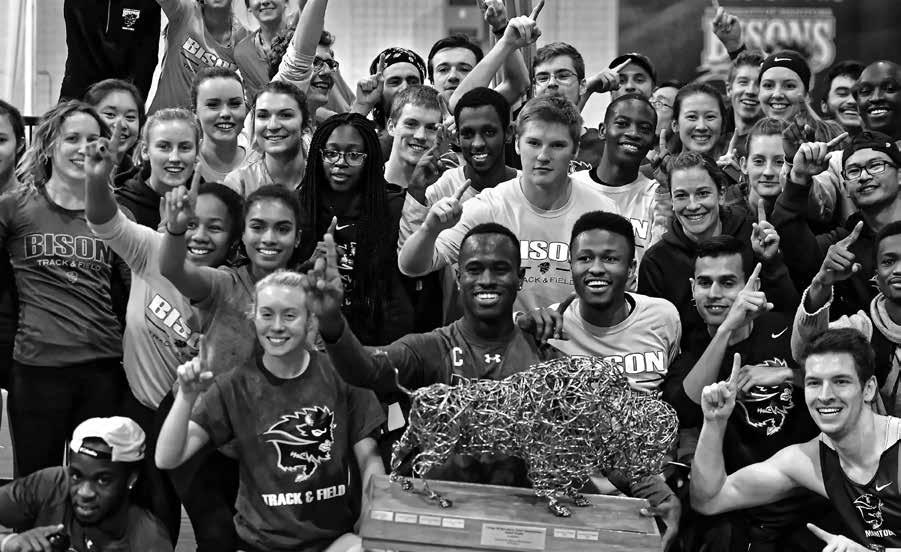
It was a weekend to remember for the University of Manitoba Bisons track and field team, as they won the Bison Classic for a second straight year at the James Daly Fieldhouse – a competition that saw over 350 athletes from eight different universities travel to the U of M to take part.
Manitoba’s combined team score of 300 points was well above the rest, with the second-place team (Calgary) having just 213.50 points overall.
Eighteen different athletes for Manitoba finished with a top-three result over the two-day competition, including Wilfred Samking, Tegan Turner, and Oyinko Akinola, who each had two separate top-three finishes.
Six separate Bisons also claimed first in their individual events, including Samking in long jump – setting a personal best in the process.
“There was a lot of team spirit, I
love my team and we’re all putting great results together,” Samking said when asked about the weekend as a whole.
Arguably the most impressive display from the hosts came in the women’s 4x200-metre relay, where their second-place time of 1:39.79 automatically qualified them for the 2016 CIS championships.
Next up for Manitoba is the South Dakota State University Invitational this coming weekend in Brookings, S.D.

PHOTO BY JEFF MILLER
2015-16 Canada West conference standings