





EVAN TREMBLAY, STAFF
Like any regular rider of buses in this city, I’ve come to hold a constant low level of loathing for the form of transit that I’m dependent on. The perennial lateness, overcrowding, and poor service to many areas of the city is just a fact of life that I’ve made my peace with.
When I heard that service was going to be reduced on several routes due to maintenance issues with the bus fleet my reaction was a study in indifference. It’s still nice out (warmest year on record, folks!), and I can still avoid buses by biking or walking. Come winter all bets for anything resembling regular service are off in a normal year, so I figured this year couldn’t possibly be worse.
But then I read that our mayor had said of the reduction in service that “The service level expectation needs to be more realistic than they were,” and my reaction was considerably more colourful than indifference.
My expectations of Winnipeg Transit are the most realistic and least idealistic part of my life – not out of choice, but because it’s some-
thing I have no control over, and so must accept. I expect buses to be late. Sometimes, especially in winter, I expect them to just not show up at all.
I expect buses to be overcrowded – sometimes to the point that they just blow by my stop. I expect that, if I have to do something that takes only an hour but is physically distant enough to require using the buses, that it will actually take closer to two or three hours.
I expect to hear people who never take the bus – Brian Bowman, I’m sure, is in this category – complain about the quality of the roads and snow-clearing schedule with absolutely no recognition of the fact that having a publicly funded system of roads for the use of a private vehicle is not a birthright.
I expect them to howl when money is announced for public transit, for people too poor to afford cars: “how dare the city, when there are unfixed potholes on my front street?”
I expect the mayor and councillors to bend over backwards to see those potholes filled.
Bowman promised to complete all legs of the bus rapid transit system by 2030 That’s all legs of a city-wide system, not just the single one to the U of M that was half done when he was elected. I have no doubt that the otherwise conservative Bowman did this to win the votes of people who genuinely believe in the need for rapid transit.
If he was personally committed to this promise, there might have been some evidence of plans on how to realize this massive project. There wasn’t during the election, and they have not materialized since. Politicians are as politicians do. His plan to accomplish his election promise? Ask the federal and provincial governments for money. That’s it: to say please, presumably while flashing his selfie-ready smile. Not very realistic, either as a plan for building infrastructure or as an expectation of the other levels of government. And yet, that’s all he has: rapid transit would be nice, and it would be nice if someone other than him figured out how to pay for it.
JORDYN LERNER
In June, Canadian Blood Services released a report on donor selection criteria relating to men who have sex with men (MSM). In that report, Canadian Blood Services recommended shortening the MSM deferral period from five years to one. Health Canada, the regulator of blood donations, will likely approve the change, and the deferral period will be shortened.
When this is announced, student leaders will make statements in the Manitoban applauding the decision, but lamenting that it does not go far enough. UMSU will then continue its campaign to replace MSM screening with high-risk behavior screening.
UMSU is correct in its assertion that specific high-risk behaviors, and not MSM, are a root cause of HIV transmission. A man in a long-term committed monogamous relationship with another man in which neither partner has HIV has a much smaller chance of contracting the virus than a man who has been with multiple male sexual partners without using protection. Despite this clear difference in risk, both men would be screened out at the same point in the blood donation process. However, this difference in risk is not yet supported by epidemiological data.
The Public Health Agency of Canada publishes an annual surveillance report on HIV infections based on data collected from its provincial
counterparts. This report includes a breakdown of newly diagnosed infections by exposure category. Current exposure categories include MSM, intravenous drug use, and being born in an HIV-endemic area, among others.
MSM is frequently the exposure category with the highest incidence and prevalence of HIV infections. In 2013, in people with a known exposure category, 49.3 per cent of newly diagnosed adult infections were attributed to MSM. When only newly diagnosed adult males were considered, 62.7 per cent were attributed to MSM.
By highlighting MSM as an exposure category, current data collection and reporting methods support Canadian Blood Services’ screening practices. If UMSU wants screening practices to focus on specific highrisk behaviours, it needs data collection to also focus on specific high-risk behaviours.
If the Public Health Agency of Canada collected and published data on unsafe sexual practices as an exposure category, rather than MSM, Canadian Blood Services’ screening practices would no longer be substantiated by epidemiological data. The newly documented high prevalence and incidence of HIV infection in people with unsafe sexual practices would cause Canadian Blood Services to screen for high-risk

Meanwhile, the people who actually use transit are left to explain to their bosses why they’re late for work, left to freeze in the winter and sweat in the summer waiting for buses that never show up. Left to feel every day of their lives like second class citizens.
So, Mr. Bowman: my expectations of Winnipeg transit aren’t unrealistic.
The only unrealistic thing about my expectations was that I didn’t expect the indignity of being chided by an empty smile that told a cynical lie to get elected, and then dropped that lie like a hot potato once he was. If you’ll excuse me, I’ve got a bus to catch.

behaviours in place of MSM.
One would think that the UMSU Campaigns Guide would advocate for improvements in epidemiological data collection and reporting. In fact, just the opposite occurs. The background information on the End The Ban campaign implies that while the limited epidemiological data of the 1980s supported MSM screening, today’s data no longer supports MSM screening. This is nonsense. Today’s epidemiological data contin-
ues to unequivocally support MSM screening. Implying the opposite is just wrong.
Rather than discussing the MSM deferral in terms of flawed data collection, UMSU’s End The Ban campaign continues to frame it largely as a human rights issue. The UMSU Policy Manual describes the MSM deferral as homophobic, gender exclusive, and discriminatory. This is an idealistic argument which the courts have already rejected.
Health Canada’s first responsibility is to protect Canada’s blood recipients. Fairness to potential donors must be an afterthought. Trying to re-frame the debate in terms of human rights has failed and will continue to fail. Until UMSU starts discussing data and other concepts that Health Canada recognizes, MSM screening will remain as is.
Jordyn Lerner is a medical student at the U of M



MALAK ABAS, STAFF

It seemed like a normal Monday. Ahmed Mohamed, a 14-yearold freshman at MacArthur High School in Irving, Texas, began the school week just like any other. It was Sept. 14, and the new school year had recently started. What he could not have possibly predicted was that he would end the day in handcuffs, and the week as a trend on Twitter.
Mohamed, a young engineering enthusiast, was arrested after bringing a clock he had built to school to show one of his teachers. His English teacher believed that it was in fact a bomb, and the school proceeded to call the police. In the hours that followed, he was fingerprinted, interrogated, and was not allowed to call his father.
There was one piece of the incident that transformed it from a potentially traumatizing experience for one person into a call to protest for many: a photo of Mohamed, handcuffed, looking frightened in a well-worn NASA t-shirt.
The photo exploded on Twitter and Facebook. Soon news outlets worldwide were pursuing the story, and by Wednesday, Ahmed Mohamed was a household name.
While the teachers at MacArthur High School and Irving police were accused of racism and Islamophobia, Mohamed was receiving support online from the likes of Hillary Clinton, Mark Zuckerberg, and Chris Hadfield. Barack Obama has invited him to the White House. By Wednesday, #IStandWithAhmed was trending on Twitter with an average of 2,000 tweets per minute.
By the end of the school week, he was no longer the top trending hashtag on Twitter. Many news articles began to focus more on the restitutions Mohamed had received and his newfound fame, rather than the injustice itself. What remains now is the roof of the problem: stereotypes and prejudices are turning minority youth away from the sciences.
This is not the first time a high school student has been arrested over a science experiment. In 2013,
then-16-year-old Kiera Wilmot, a student at Bartow High School in Florida, was arrested after an advanced model volcano she had created had released a small amount of smoke.
It has been shown that black people are much more likely to leave STEM careers after earning their PhD than their fellow white graduates
While charges were dropped, she still feels followed by her past, and her felony arrest record will be erased at the slow pace of five years per felony. Wilmot, like Mohamed, is a person of colour.The United States is currently facing a shortage of STEM graduates in the workforce. In 2012, 22,259 doctorates in the studies of science and engineering were awarded to U.S. citizens and permanent residents. Out of these, 1,140 doctorates were awarded to black graduates, while 15,255 of the graduates were white.
Neil deGrasse Tyson, who is one of the most popular scientists in North America today, has said that his childhood dream of becoming an astrophysicist was “hands down, the path of most resistance through the forces of nature, the forces of society.”
“Any time I expressed this interest, teachers would say, ‘don’t you want to be an athlete?’ I wanted to become something that was outside of the paradigms of expectation of the people in power.”
Yasmine El-Salakawy, a first year student in the U of M’s faculty of science and a practising Muslim, believes that Mohamed’s quick rise to fame is unlikely to inspire a discourse on lack of diversity in the field of science, especially among people who already have a biased
opinion.
“People who hate Muslims will hate Muslims regardless. I feel that way. It’s really hard to change someone’s mind,” El-Salakawy told the Manitoban Muslim youth in the United States are faced with hostility and suspicion on a regular basis. The Pew Research Center’s American Trends panel reported that after surveying a randomly selected group of U.S. adults, the most negatively viewed religion was Islam. And there is perhaps nowhere in the U.S. where this bigotry reveals itself so clearly than in Mohamed’s own home, the state of Texas.
Last January, a Muslim conference in Dallas titled “Stand With the Prophet Against Terror and Hate” was met with protests. The conference was being held to raise funds to build a Muslim cultural center. The following May, Pamela Geller organized the Muhammad Art Exhibit and Contest, which encouraged people to draw cartoons of the Prophet Muhammad, which is considered extremely offensive in Islam. The contest offered a US$10,000 cash prize.
Now, mere months later, a teenage boy in that same state has been arrested – most likely for being simultaneously creative, ambitious, and a non-white Muslim. It has been shown that black people are much more likely to leave STEM careers after earning their PhD than their fellow white graduates.
There have been no widespread studies concerning whether or not there is a connection between the rising severity of Islamophobia within the United States and the emotional state of Muslim youth, which makes it difficult to predict whether or not Islamophobia is affecting their academic choices. That being said, it’s not difficult to assume that when a police officer that Mohamed had never met looked him up and down after arresting him and said “Yup. That’s who I thought it was,” it probably didn’t feel too encouraging.


ETHAN CABEL, STAFF
The narrative perpetuated by political observers throughout this long election campaign has been that Canadian voters are looking for a change – that the winner on Oct. 19 will be the party that best embodies a shift away from the current Conservative government.
Under this narrative, Canadian voters are casting about looking for an agent of change to hang their hopes on and eventually the “change vote” will coalesce around either the Liberals or the NDP, catapulting that party to victory.
But after the second and last English-only federal leaders’ debate, it is clear that the current dead heat in public opinion polls can be ascribed to the fact that all three parties – the Conservatives, Liberals and NDP – are professional political organizations that could reasonably form a competent government.
They are also each afflicted with flaws severe enough to keep them perpetually hovering around 30 per cent support.
In the case of the Liberals, there is little doubt that Justin Trudeau has almost single-handedly rescued his party from the brink of collapse. Gone are the days of the hapless campaigning of Stéphane Dion or Michael Ignatieff – in Trudeau, the Liberals have found a leader that, regardless of his limited command of the issues, can inspire Canadians with his sunny charisma and Captain Canada persona.
Moreover, Trudeau has re-built the party’s once moribund grassroots organization while recruiting some of the best candidates in key swing ridings across the country – even if assembling “Team Trudeau” required flagrantly breaking his promise to hold open nominations.
The Liberal campaign strategy is also an advantage, depending on how you look at it. By promising to run modest deficits in order to spur economic growth, Trudeau has decided to take a page directly from the campaign playbook of the Ontario Liberals, who managed to squeeze out the NDP by presenting themselves as the only truly progressive option.
When Trudeau’s Liberal campaign volunteers go knocking on doors in Winnipeg, Montreal, Vancouver, or suburban Toronto, they can address questions about potholes and transit delays with real cash on the table – even if the level of spending promised by the Liberals will barely make a dent in the country’s massive infrastructure deficit.
But given recent news of economic
growth in June and Department of Finance predictions of a budgetary surplus, Trudeau’s adamant portrayal of widespread economic misery appears overblown and his policy response seems reckless.
As such, NDP leader Thomas Mulcair landed a damaging blow in the debate when he claimed the Trudeau camp was simply “pressing the panic button” in the face of a minor technical recession. Stephen Harper’s consistent refrain that the $10 billion per year in Liberal “stimulus” will morph into a long-term spending binge is equally valid given the terrible fiscal track record of the Ontario Liberals. It doesn’t help that Kathleen Wynne is stumping for Trudeau every chance she gets.
Finally, the Liberal rhetoric, which criticizes Harper’s deficit spending while simultaneously pledging to run more deficits, is incoherent and bolsters criticisms that Trudeau is a policy lightweight.
The NDP has also emerged as a major contender in this election.
Mulcair is reasonable, relatively moderate, and abundantly qualified to be the leader of a G7 country. He has led the New Democrats, in some instances kicking and screaming, into the political centre by promising to run a balanced budget in the first year while pledging to cut small business taxes and retain the Conservatives’ Universal Child Care Benefit.
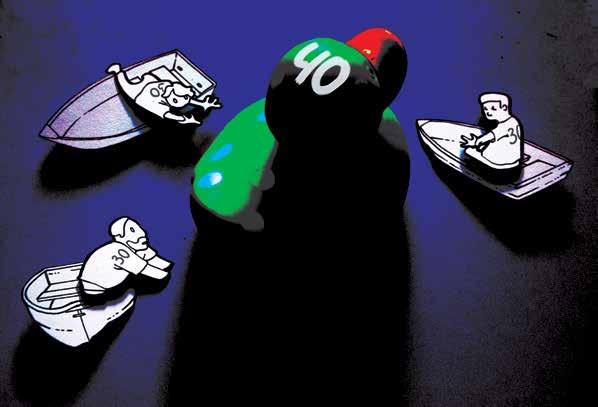
The Conservatives, Liberals and NDP are professional political organizations that could reasonably form a competent government. They are also each afflicted with flaws severe enough to keep them perpetually hovering around 30 per cent support
But his modest fiscal framework simply doesn’t add up to the ambitious agenda he has promised Canadian voters.
A small corporate tax increase and the closing of a few tax loopholes sim-
ply will not pay for a national pharmacare plan, massively increased health transfers to the provinces, a national childcare program, a $15 federal minimum wage, door-to-door mail delivery, the reversal of reforms to Old Age Security and Employment Insurance, a cap and trade system, and a democratic reform agenda that will require divisive and costly constitutional negotiations with the provinces.
In short, an NDP government will either have to run a deficit or it will have to scrap large portions of its policy platform in the name of fiscal discipline.
Finally, Harper still has a message that resonates. Regardless of the myriad ethical criticisms levelled by the Conservatives’ opponents, they are the only party who will not raise taxes on anyone and still maintain a balanced budget while keeping transfers to the provinces relatively stable. They are the only major federal party that talks about personal responsibility as a key tenet of social policy. In direct contrast with the state-run day care bureaucracy or mandatory increases in Canada Pension Plan contributions offered as solutions by their opponents, the Conservatives would rather encourage families to voluntarily use a tax benefit to pay for private child care provision and a tax-free savings account to put money aside for retirement.
The Conservatives keep the nuclear family central to their economic message. Whether by allowing
parents to split their income for tax purposes (with a maximum allowable benefit of $2,000) or through the home renovation tax credit, the Conservatives are offering direct investment in families as a key driver for growth.
For Canadians, especially millennials, who feel insecure about their job prospects, their ability to afford their first home, and to eventually retire with dignity, the Harper Conservatives have given them little to hang their hopes on
The Conservative Party is the only federal political party talking explicitly about crime or terrorism in this election – two issues that are top of mind for many voters who are horrified by the stories of crime victims or the images of Islamic State barbarism flashing on their television screens. They are also the only major party that talks about the limits of accommodation for religious minorities, as exemplified by the fight over wearing the niqab at citizenship cer-
emonies – all the while celebrating recent economy class immigrants who aspire to live their own version of the Canadian dream.
But despite these advantages, the Conservatives have consistently come across as insensitive to the concerns of everyday people and oblivious to global circumstances.
In particular, Harper has actively avoided talking about the inflated housing market and the imminent risk of an implosion in that sector –his home renovation tax credit could very well make that problem worse.
Furthermore, by increasing the eligibility age for Old Age Security while refusing to increase mandatory contributions to the Canada Pension Plan, he looks insincere on retirement security. And his response to the Syrian refugee crisis has been completely tone deaf and even jingoistic, such as his absurd claim that the Liberals and NDP would open the border to hundreds of thousands of refugees without security clearance or documentation.
For Canadians, especially millennials, who feel insecure about their job prospects, their ability to afford their first home, and to eventually retire with dignity, the Harper Conservatives have given them little to hang their hopes on.
In short, all three parties are competent, professional contenders for power – and they are all terribly flawed. It is going to take a lot more than last week’s debate to jump-start any of these stalled campaigns.




MURV BERKLEY, STAFF
The Rembrandts’ “I’ll Be There for You,” which was used as the theme song for the hit 90s sitcom Friends, is being hailed as “totally the song of my life” by U of M student Rorie Spelman.
Spelman, who recently began rewatching the series after it became available on Netflix, told the the Ivory Buffalo that the song had taken on increased significance since he last watched the show as a teenager. Spelman said since he’s turned 26 he
relates to the lyrics on a much deeper level.
“It was almost prophetic in its description of the young adult experience. No one did tell me life was going to be this way,” said Spelman before suddenly clapping four times.
“Your job’s a joke, you’re broke, your love life’s DOA,” he added, quoting the song. “It’s not just a catchy tune anymore. It’s now my life’s story.”
Tammy Blandt, assistant profes-
sor of sociology at the University of Manitoba, has been researching people’s connection to nostalgic sitcoms’ theme songs for the past eight years. Blandt said that Spelman’s experience isn’t uncommon among people in his age cohort.
“Friends came on the air in an era where the family as an institution was in decline. Like in that one episode where Rachel’s parents got divorced and the gang had to throw her two birthday parties. In many ways it

captured a seismic shift in societal dynamics,” Blandt said.
“The cohort of friends now represents the main locus of social interaction for a generation, stepping away from the more conservative, family-oriented values of the generation before it. What we hear in this song is a call out for support from our peers in coping with work and family problems – a complete role-reversal relative to earlier 90s sitcoms such as Family Matters.”



LAUREN SIDDALL, STAFF
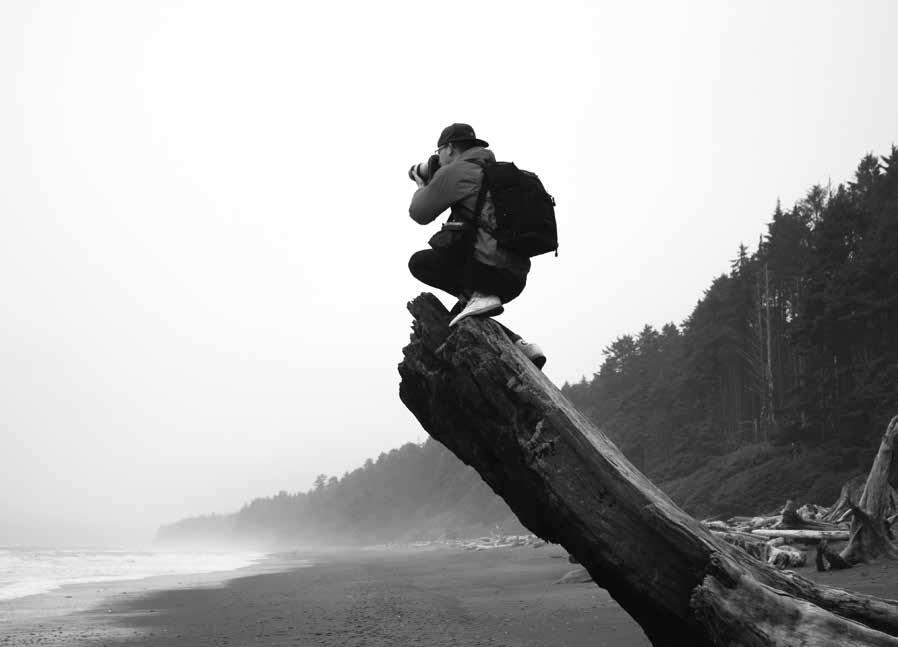
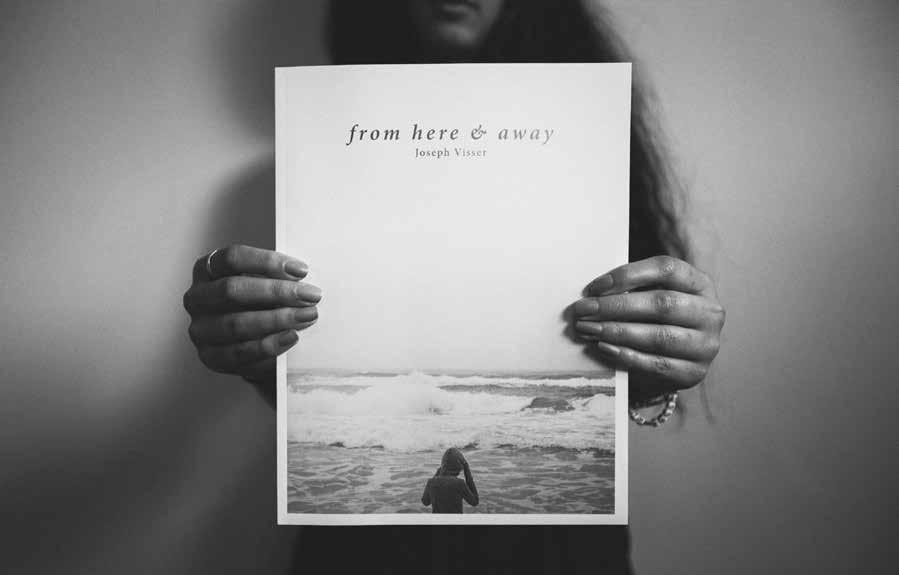
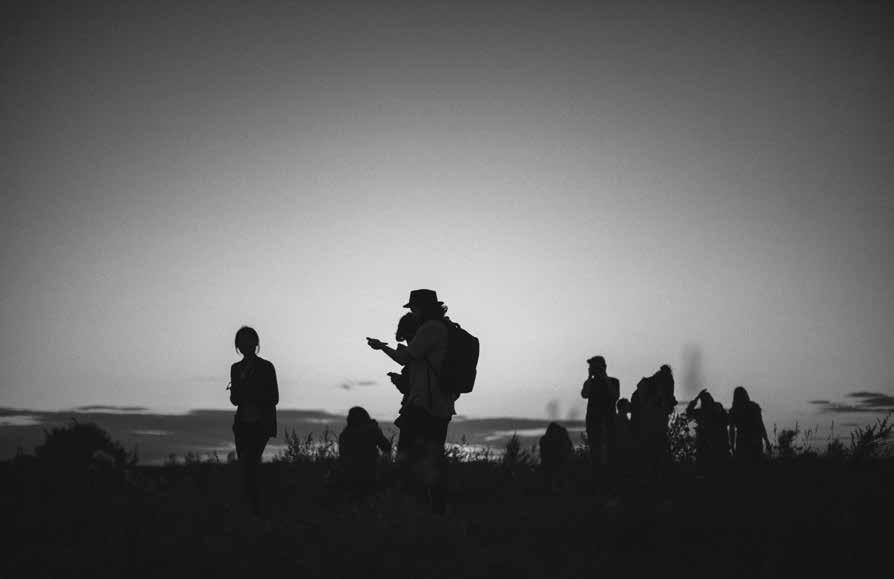
“Here” means something different to every person. The way in which we interact and engage with our environment varies widely – sometimes so much so that our connectedness is forgotten or lost. Joseph Visser, the founder of From Here & Away, looks to repair the severed and abandoned connections through artistic expression.
“From Here & Away has been a long time in the making. I remember I wrote down ‘From Here & Away,’ those words, four years ago. I didn’t really know what it was at that point, but I wanted to create a dialogue of interconnectedness between different people in different places [...] I wanted to start this conversation about how we interact with our environment,” said Visser.
“I believe that we’re all connected, and photography can connect us.”
And with that, he’s off and running.
What started merely as words scribbled on a piece of paper transformed into a photography book, which grew into a community on Instagram, and eventually into an organization to support artists around the world, primarily through photography.
“The reason I started From Here & Away is because I wanted to create something that I thought was lacking in the arts community. There are a lot of initiatives that do look to support artists or emerging artists but they’re kind of difficult to break into, and the art scene is sometimes hard to access for people,” Visser explained.
The idea behind From Here & Away, in contrast, is that it is incredibly accessible to anyone looking to share how they see the world –empowering individuals to explore, create, and understand different cultures.
“Hopefully, over time, we can form a dialogue if we’re all on this common ground of this non-threatening community of creative people that will encourage other people to create.”
For Visser, artistic expression has been an integral part of his being since childhood and he hopes to foster the same passion for creativity in others.
“I think it is important that people’s creativity is encouraged. That’s what makes me excited everyday. What drives me to be a human being, basically, is to create everyday. So I feel the more people that are doing that, the more interesting and beautiful our world becomes,” said Visser.
“I believe that anyone is capable of impacting our world in a positive way through creativity if encouraged or supported in the right way. I want From Here & Away to be an organization that can help people.”
He aims to do this with three pillars – community, programming, and artist support – all of which work together to foster a community of artists, both emerging and established.
“The community aspect is really important to me. If I can’t support
people financially right away, I hope that I can support them by giving them a platform to show their work,” said Visser.
“There are 15,000 images from every continent in the world now shared under the [From Here & Away] tag. I know that not every single person gets it, but it’s neat that there are so many people involved. It’s kind of taken a life of its own. It’s a little overwhelming, but it’s great.”
The programming aspect includes workshops, meet-ups, and group travel, all with the goal of inspiring people to create. The latest programming endeavor, a two-week workshop at Fort Whyte in August, was a massive success.
“The idea was to come together and encourage the idea that good photography is more of a mindset than it is a skillset. It’s about how you view the world and how you interact with the world. It was getting in tune with what is interesting to us, personally, and figuring out what we respond to,” said Visser.
The third pillar, artist support, is something Visser is beginning to explore as the organization gains traction. He is looking to make beautiful, practical products that he can sell to subsidize artist costs and create a higher level of accessibility.
Visser has also undertaken a new component – a gallery.
The gallery, located at 255 Vaughan St., will feature 10 different artists, with a new group of artists on the wall each month.
“The whole idea is that it’s inclusive to any style, any age, any skill level. I feel like it’s all good in its own way, as long as it’s created with honesty. When a photograph is created from a place of true inspiration, that’s when it’s good – when someone is inspired to take a photo. I think it’s always apparent when someone is present in their work.”
Visser hopes that displaying physical copies of the artists’ work will help them gain exposure and draw more apparent connections between each artist’s worldview. As the organization expands, he also hopes to include other mediums of art too.
“The thing that I’m excited about is that it can take on so many forms. Basically, I want it to be a platform for people to either start creating or continue to create, including beyond the realm of photography.”
He also plans on curating more group shows and working with communities lacking adequate access to the materials or training needed to pursue creative endeavors.
“At first, I didn’t really know what it was. It’s taken this long for me to fully realize what I want to do with it, and what it can do,” said Visser.
“Right now, it’s just starting. Everything I’ve done before this is just to reach this starting point. For me, it’s the very beginning.”
IAN T.D. THOMSON
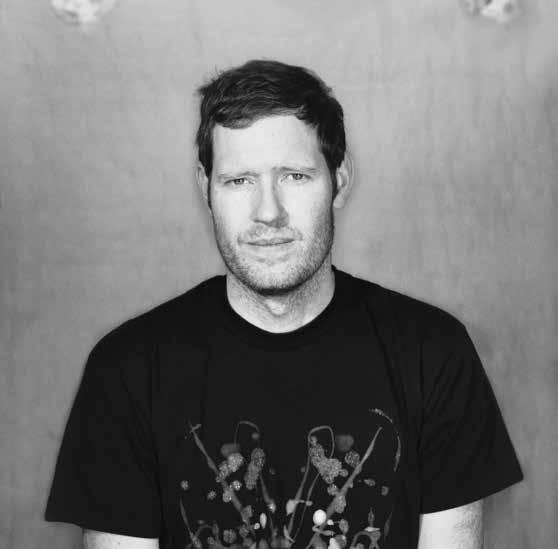
Calgary singer-songwriter Chad VanGaalen, who will play the West End Cultural Centre on Sept. 25, brings his unique blend of folk and experimental music to centre stage.
VanGaalen takes the definition of a solo artist to a whole new level.
Not only does he write, play, and produce his albums, he crafts many of his own instruments (including experimental percussion instruments) and develops his own music videos and artwork.
VanGaalen released his fifth full-length album, Shrink Dust, in April 2014. Much like previous releases, the album is an experimental mesh of various sounds and genres. The track “Evil” sounds like a psychedelic Everly Brothers song accompanied by a strong presence of slide guitar. The song “Where Are You” has the artist calling out its title in a distant, panic-like state on top of a commanding, strict drumbeat.
In keeping with his previous releases, VanGaalen produced the album in its entirety by himself in his home studio in Calgary.
When asked if he would consider bringing in an outside producer to assist, VanGaalen said he believes his current process is easier.
“It’s also really economical,” said VanGaalen in an interview.
“I can take a week to work on a song and at the end of that week I can say ‘that song’s garbage’ [...] and not worry about it.”
For his artwork and music videos, VanGaalen has created a look and aesthetic to align with his music. Featuring weird and highly detailed (sometimes obscenely graphic) imagery, the videos oddly fit with VanGaalen’s upper registers and echoing vocal melodies. The videos often directly depict the
lyrics of the song. His latest single “Monster” depicts several disturbing creatures, including a nude man with a head injury and claws coming out of his shoulders.
Although VanGaalen is known for his music, he admits that he initially used his songs as a platform for the videos.
“I was a visual artist before I was ever a musician” –
Chad VanGaalen
“I was a visual artist before I was ever a musician,” said VanGaalen in an interview.
“I love making cartoons. I feel like it is what I was meant to do.”
VanGaalen has also used his talents as a music video producer for other bands including Toronto noise-rock band METZ and psychedelic folk band Timber Timbre.
When asked what it is like collaborating with these artists, VanGaalen alluded to their having both an open mind to the creative process and a focused determination for the project.
“I don’t really know what’s going to happen with the type of animation that I am doing,” said VanGaalen.
“They just kind of have to put their faith in the fact that I am not going to put out a piece of shit and that I really am really going to sit down and work on it for real.”
Chad VanGaalen plays the West End Cultural Centre on Sept. 25 at 8 p.m. Tickets are $24 and are available online at Ticketmaster.
TOM INGRAM, STAFF
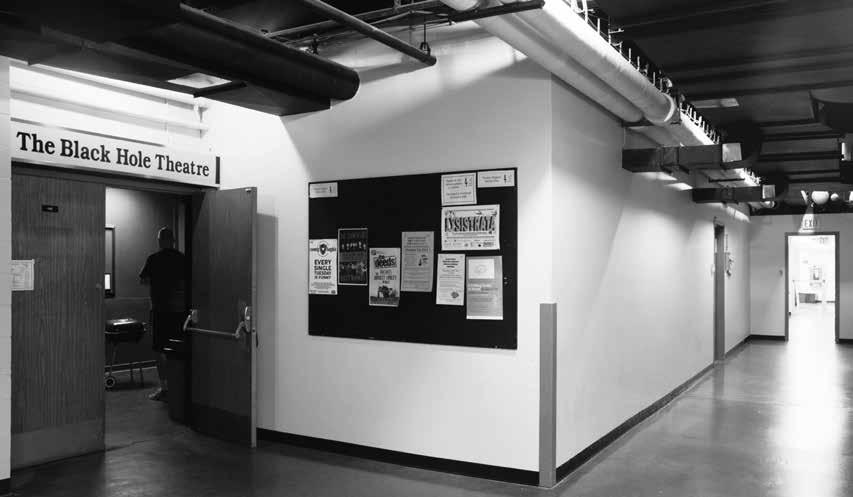
Nestled in an alcove of an obscure hallway behind the stairs in the basement of University College, you can find one of the University of Manitoba’s flagship performing arts venues. What is now the Black Hole Theatre used to be a floor hockey room, and this fact is the key to making sense of its design.
Though at 120 seats it is larger than it looks, the theatre gets cramped when it’s even partially full. The stage is a thrust, an unconventional layout with seats on three sides of a rectangular floor space and a backstage area on the fourth side.
“You can learn skills here that you may never use again,” said Tim Gray, an alumnus of the U of M theatre program and a member of the comedy troupe H.U.N.K.S.
The room is wider than it is long. The ceiling is low. The front entrance is not particularly inviting to members of the public.
In short, the Black Hole Theatre is a quirky little performance hall with decades of history and perhaps too much personality. Watching a play in the theatre is like being let in on a secret. But soon you won’t be seeing many shows there at all.
Possibly as early as this coming January, the Black Hole Theatre Company will be moving to a new performance space in the Taché Hall arts complex. The company is saying goodbye to its current venue in style, bringing together students and alumni for a production of Aristophanes’s Lysistrata, which was profiled in the Sept. 16 issue of the Manitoban
With tickets at $50 a pop, the production is intended to raise money to fund the ongoing construction of the new Conklin Hall Theatre. The current Black Hole Theatre will become a rehearsal hall for the theatre program.
For people involved in the program, it’s a bittersweet goodbye.
Chris Johnson, a professor in the department of English, film, and theatre and the director of the production of Lysistrata, had plenty of negative things to say about the current space.
When asked what is exciting about moving to the new Conklin Hall Theatre, Johnson laughed and said, “air.”
“The intimacy of the old space is pretty special” – Chris Johnson, U of M theatre professor
“This place [the Black Hole Theatre] is not well ventilated. With 120 people and all those lighting instruments it gets pretty warm in here. The new theatre’s comfortable. It’ll be a better audience experience.”
A better public-facing entrance is also an attraction for Johnson.
“We’ve got a real lobby instead of a hallway with pipes running down the middle,” he said.
Another limitation of the current space is the low ceiling height, which limits the construction of sets and makes lighting difficult.
“This is only 12 feet,” said Johnson. “You can’t light properly at 12 feet, or you can do so with great difficulty. It drives directors crazy because we can’t get off the deck. When you’re working with actors, you can’t get any height in the sets.”
But Johnson also admitted to some nostalgia. “Certainly I’ll miss the old place,” he said. “It’s so difficult to block and compose for three audiences at once that the old space is an excellent tool for teaching student directors to block and compose – if you can do it there, you can do it anywhere.”
“The intimacy of the old space is also pretty special. There aren’t
many theatres where the audience is so close to the performers, where every little movement of the face registers, or where you get splashed by the blood in Titus Andronicus.”
The new theatre will have a height of 40 feet, according to Johnson. The seating will also be retractable, meaning that capacity could vary from 130 to 150.
Aside from the theatre itself, there are some other new developments for the theatre program in the works at Taché Hall.
“We’re replacing the scene shop we’ve got here, which is not very good,” said Johnson. “It’s under a lecture hall, which means we can’t use it when there are lectures on. And there’s a prop shop and a costume shop. Again, proper shops with lots of headroom, big enough to build a set to go into the new theatre. All of this is glorious luxury for us.”
The Conklin Hall Theatre is being funded in part by a donation from the family of John James Conklin, a U of M alumnus who worked as a journalist and theatre critic for the Manitoba Free Press (later Winnipeg Free Press) for over 50 years. His son Elmer D. Conklin made the $1 million donation in 1989, and since then it has grown to $1.5 million. The total cost for the Conklin Hall Theatre will be $7 million.
The Black Hole Theatre’s production of Lysistrata will take place from Sept. 28 to Oct. 3 at 8 p.m. (8:30 on Oct. 3) in the Black Hole Theatre in the lower level of Unviersity College. Tickets are $50 and a charitable tax receipt will be issued for a portion of the ticket price.
SEAMUS HAMILTON-PATTISON, STAFF
N
uit Blanche, a multi-venue celebration of modern art that takes over downtown Winnipeg for one night each year, is set to take place on Saturday, Sept. 26. Nuit Blanche features a plethora of artistic exhibits and events in various locations throughout downtown, the exchange district, and St. Boniface. The artistic happenings are both organized and contributed independently by members of the local community and, as is the tradition of Nuit Blanche, all events are free and open to the public.
Molly Karp, the communications and events coordinator for Culture Days Manitoba, promised the Manitoban that the evening will be “bigger and brighter” than Nuits Blanche’s past.
One particular addition highlighted by Karp was an exhibit titled ARTery. With funding acquired from Downtown Winnipeg BIZ, the exhibit will illuminate Graham Ave (you know, that place you catch your downtown buses) from its beginning on Vaughan St. to its near-end on Fort St.
ARTery is set to be constructed by local design organization Lights Unlimited and a group primarily composed of students from the U of M’s own architecture faculty, In the
Middle. Both organizations have had their hands in artistic light installation in Winnipeg’s urban centre prior to Nuit Blanche.
The transformation of Graham Ave. won’t end with just the light display. According to Karp, ARTery will also feature DJ performances down the illuminated strip along with several dance groups, including the Royal Winnipeg Ballet.
“We got this funding from the Biz and we just really wanted to put it back into the arts community in a way that also showcased our downtown.
Graham Ave. is a strip of downtown that people don’t necessarily associate with being a hub of contemporary art, so we wanted to shift perspectives about our city and allow people the opportunity to see new sights in different ways,” Karp said of the new addition.
As always, the Winnipeg Art Gallery will be a significant focal point of Nuit Blanche. Every year, in collaboration with the event, the WAG stays open until 3 a.m., is licensed to serve alcohol, and invites all patrons to check out the gallery’s current exhibitions to a pulsing, allnight soundtrack. In the past, the WAG has hosted live bands to perform over the course of the evening.

However, this year’s musical entertainment will be a host of DJs performing various genres of electronic music, courtesy of local electronic festival organizers MEMETIC.
Despite the new initiatives and artistic endeavors to be put on display this year, Karp assured the Manitoban that Nuit Blanche veterans will still find plenty of familiarity with the return of exhibits from years past.
“There’s a really good mix of events that we’ve showcased in the past as well as new events. It’s nice to be able to work with new artists, but it’s also really good to have some consistency to the night and to develop the events that we’ve been working with in past years.”
The Boulevard of Books is one such event that will return to Nuit Blanche after a successful debut last year. This art installation, put on by Les Éditions du Blé in collaboration with the Maison des artistes visuels francophones will feature four outdoor “reading rooms” along Provencher Blvd.
“People really like those outdoor things where it’s kind of unexpected to see art or activities. I think it allows people to glean a new perspective of their city, and the way they experience night life in our city,” said Karp.

It seems city planning and urban design have become notably more frequent topics of discussion in the minds of Winnipeggers lately, with new initiatives in downtown ranging from the Interstellar Rodeo to Table for 1200 gaining varying degrees of prominence in the public eye. When asked by the Manitoban, Karp credited this to a younger generation’s desire to become more involved in their city, underscored by a sense of local pride.
“Young people in this city are starting to take an interest in their surroundings, and take initiative to be part of cool art collaboratives, and really work towards making
BY
Winnipeg a place that people want to stay. I think, largely, there’s been a trend towards moving out of Winnipeg to get that bigger-city life. But there are so many creative minds in this city that see Winnipeg as a place where cool stuff is happening and can happen.”
“It’s really showcasing the artistic talent we have here. The more we grow those events, the more people in Winnipeg are going to come out and see what a great place this is to live.”
Find out more information about everything this year’s Nuit Blanche has to offer at www. nuitblanchewinnipeg.ca





Profiling the Manitoba Bisons’ midfield sensation Amanda Wong
ANDY CHE, STAFF
U
niversity of Manitoba midfielder Amanda Wong is only in her second year, yet her astounding ability to control soccer matches has spectators and the Bisons taking notice.
With only a year of CIS experience under her belt, Wong was named co-captain of the Bisons ahead of the 2015-16 campaign. The bestowing of the captain’s armband on such a young player comes with pressure and lofty expectations – a part of the game that the product of FC Northwest does not view as negative, but rather embraces.
“It’s been a complete honour to have been named captain in my second year. In a way I do believe I have something to prove, I don’t see this as being a negative thing at all,” Wong said.
“I believe that everyone on the team should feel as though they have something to prove – prove that they belong and whatever decisions were made along the way were the right ones.”
Wong has also embraced the learning curve that comes with being a university-level athlete and a team leader. With a lone season of experience, she is already looking to enrich the future with the examples she has gained. Being a former youth coach even further enhances her quality as a leader.
“I’ve already gotten the opportun-
ity to coach several summer camps as well as high-level and recreationallevel teams, and I hope that through this I can share my knowledge of soccer with youth players and have a positive impact on them and their development,” Wong said.
The sky is the limit for this young skipper and the teams she will take charge of down the line
Her development as a captain has also been aided by the injury return of goalkeeper and skipper Chloe Werle. Suffering a back fracture last campaign, Werle has recovered remarkably well for this season. As the first-choice shot-stopper enters her final year of eligibility, the Bisons grasped the ideal opportunity to prepare a potential leader like Wong to take the reins.
“One player that is going to be my biggest inspiration for the rest of the year is Chloe Werle,” Wong said. “Working together with her as co-captains is fantastic, and she’s had the most amazing comeback from her injury last year.”
As she continues to emerge as a team cornerstone, her presence as
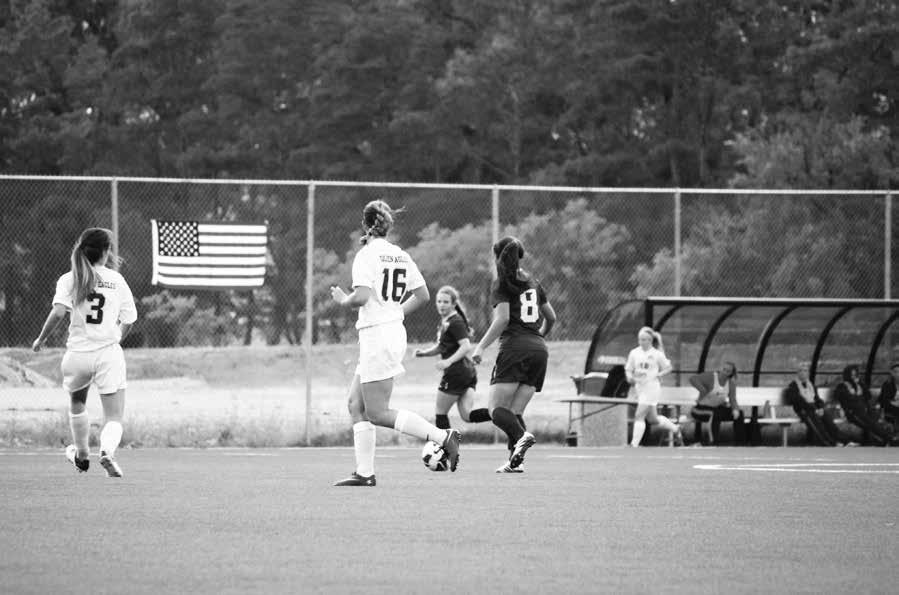
a pillar in the starting 11 is already speaking volumes for the Bisons.
A dominant two-footed player, Wong is blessed with a wide range of distribution. Fulfilling a box-to-box midfielder role, her combined skill set resembles that of Manchester United legend Paul Scholes and Italian maestro Andrea Pirlo.
As far as idols go, her overall style of play is fitting for her hero of choice
– Christine Sinclair. Much like Wong, the Canadian soccer icon is a composed difference-maker and natural leader.
“Ever since Canada’s Olympic Bronze in London 2012, I’ve really idolized her. She is always very calm and composed on the field, as well as very technically and tactically talented and also a great leader for her team,“ Wong said.
ANDY CHE, STAFF
W
hen the Manitoba Bisons women’s soccer team is hit, they hit back even harder. That has been the theme for Vanessa Martinez-Lagunas’s team so far this season, highlighted by a comeback draw 1-1 in their premiere weekend and coming back twice in a 3-2 loss to Saskatchewan last week. In their western trip this weekend, the Bisons exploited their ability to respond to deficits, rescuing a point for a draw at MacEwan while stealing victory against Mount Royal.
MacEwan
The Bisons visited winless MacEwan on Saturday afternoon, fresh off a 2-1 win at Regina in their last performance. Having scored just two goals in two matches, while conceding five, the Griffins were keen to invigorate their uninspired start to the season.
The home side was quick to start the match on a positive note and found a breakthrough after just 13 minutes. Striker Sheena Tracey picked out the top corner from a
Marlea Moroz delivery and the Griffins were up 1-0.
With halftime approaching, Manitoba had yet to respond to their early setback while their opponents were looking to widen the gap. Their problems escalated when MacEwan freshman Suekiana Choucair struck at 39 minutes, taking the Griffins’ lead to 2-0.
As soon as the second half started, Manitoba was in search of a spark that could turn the match around. The occasion called for a differencemaker in Alanna Shaw. The striker equalized three weeks ago at home to UBC-Okanagan when the Bisons were down 1-0.
Five minutes after the restart, Shaw pulled a goal back to get Manitoba on the score-sheet. More importantly, at 2-1, the Bisons had the remaining 40 minutes to complete the comeback.
Both goalkeepers stood firm as the match progressed. Bisons stopper Madison Wilford produced five saves after replacing captain Chloe Werle at halftime. MacEwan number-one
Rebecca Reif kept Manitoba at bay as the time approached 90 minutes.
At this stage of the CIS season, the Manitoba Bisons are undoubtedly making a name for themselves with their sublime comebacks as the rest of their opponents have to settle playing catch-up
Hoping to avoid their second defeat of the season, the Bisons pressed late into the match. At 87 minutes, relief finally came for Manitoba when midfielder Megan Graca lobbed Reif for a dramatic
equalizer. The final ball was played in by Shaw, who is quickly developing a knack for delivering at crucial times of games.
Bruna Mavignier and Graca created chances during injury time, which would have seen Manitoba spectacularly clinch all three points. Wilford preserved the points for the Bisons with a pair of 90th-minute saves in the 2-2 draw.
Mount Royal
The Cougars were coming off a 1-0 loss to the Winnipeg Wesmen on Saturday and searched to avoid two consecutive home defeats. Midfielder Amanda Schafer struck midway through the first half, giving the Cougars a 1-0 lead.
For the second match in a row, the Bisons had conceded the first goal. However, they were not in deficit mode very long, as Mavignier scored her fifth goal of the season three minutes later to even the score. The two sides entered the halftime break with the score all square at 1-1.
The physical nature was then
It’s evident that Wong has the qualities to be a captain. With her in the role, much of the future leadership of the Manitoba Bisons is beginning to take shape. The sky is the limit for this young skipper and the teams she will take charge of down the line.
heightened as the Bisons and Cougars combined for 11 fouls during the second half. Manitoba left back Elyce Molyneaux collected the lone booking – a yellow card at 52 minutes. Having missed a late opportunity to score an injury time winner in the 2-2 draw the previous day, Mavignier was looking to make amends. At 74 minutes, she struck again and the Bisons snatched the lead 2-1.
Manitoba held on for a win, seeing out their third victory of the season. Perhaps more importantly, this spirited Bisons team is using momentum gained from previous fixtures to produce the right results.
At this stage of the CIS season, the Manitoba Bisons are undoubtedly making a name for themselves with their sublime comebacks.
The Bisons host the Calgary Dinos and Lethbridge Pronghorns on Sept. 26 and Sept. 27, respectively.
RYAN STELTER, VOLUNTEER STAFF
This past Saturday, the Manitoba Bisons football team fell three points short in a 51-48 loss to the high-flying University of British Columbia (UBC) Thunderbirds, in a game where the herd was primarily playing catch-up.
Manitoba got on the board first after a 45-yard touchdown reception from Jesse Walker. The Thunderbirds answered back, scoring 13 points in a spell where the Bison offence struggled.
Aerial attack
UBC’s starting quarterback, Penn State recruit Michael O’Connor, showcased his poise and ability at many times during this game. He strung together a number of long drives that wore down the Bison defence. O’Connor finished the night with 398 yards passing and four touchdowns.
Despite the loss, Bison quarterback Theo Deezar had an absolutely stellar performance.
The St. Paul’s High School grad went 28 for 39, with a whopping 519 yards and four touchdowns. His 519 yards sets the Bisons’ single game passing record and is also the seventh most in conference history.
“I think going forward our biggest challenge is going to be staying focused and motivated,” Deezar said post-game. “I think losing to UBC and Calgary will be the big-
gest thing to happen to our team this year.”
Receivers come up big
In a game where almost a thousand yards passing were accumulated, the receivers on both sides played a big role.
In a game where almost a thousand yards passing were accumulated, the receivers on both sides played a big role
For the Bisons, Walker and veteran Alex Vitt led the line for the herd. Walker had six grabs for 109 yards and one touchdown, while Vitt had five grabs for 161 yards and made some key catches to extend drives, including a 49-yard reception made in the third quarter in double coverage.
Head coach Brian Dobie had some high praise for Vitt, commending him for his ability to play with heart and passion.
“That kid is a warrior,” Dobie said. “Alex Vitt will make catches in any league, in any kind of traffic.
He plays absolutely without fear, he’s got a tremendous heart and he’s got great hands.”
Thunderbirds dominate special teams
Special teams also played a big part in this game, with UBC’s kicker, Quinn van Gylswyk, punting for an astonishing 333 yards and pinning the Bisons deep on many occasions. The Thunderbird kicker executed a perfect onside kick to start the second half, recording precision and accuracy all game.
Dobie admitted to being outplayed in the special teams aspect of the game.
“We absolutely got out-coached, out-called and our guys got outplayed,” he said. “I thought the call at the beginning of the half was aggressive, confident, and gutsy.”
Dobie also commented on the big takeaway the herd can take from a game like this.
“We are not there yet. We have a lot of fight, but we are not there yet,” he said. “Every quarter in every game is so important and every game has importance.”
The Bisons travel to Alberta next week to take on the Golden Bears. The Bears are coming off a crushing 80-18 loss to Calgary.





RYAN STELTER, VOLUNTEER STAFF

The air is getting colder and the days are getting shorter, signalling the beginning of hockey season. The Bisons men’s hockey team have already started training camp, and there is plenty to look forward to this year. Manitoba announced eight new recruits for the 2015-16 Canada West season.
Forwards Liam Bilton, Jordyn Boyd, Brett Brooks, Brett Stovin, and Jonah Wasylak, goaltenders Justin Paulic and Dasan Sydora, and defenceman Adam Henry will all be joining the herd this year.
Head coach Mike Sirant talked to the Manitoban about this year’s recruiting class and the quality of the players coming into the Bison program.
“We’re thrilled, we’re excited to have these players commit to us,” Sirant said. “We had some outstanding players. Not only on the ice, but we also look for character players with value that fit into our Bison culture, so we couldn’t be more excited with the group we have joining our program.”
Last Tuesday, Sirant introduced two of the eight rookies for 2015-16, Liam Bilton and Brett Stovin at a press conference.
Stovin is a 20-year-old local player from Stony Mountain. He spent five seasons in the WHL with the Saskatoon Blades and even had an eight-game stint with the Missouri Mavericks of the East Coast Hockey League, where he scored five goals and added one assist.
“I’ve spent the last two seasons being a leader on a team that was rebuilding, getting a lot of ice time and getting an opportunity to play a lot more offensively whereas in the past with the Blades I’ve been a defensive player, playing in a tough
role,” Stovin said.
“I can bring whatever role is need from the coach this year. I know I am expected to produce offensively.”
Bilton played three seasons with the Winnipeg Blues and his coming off his best campaign last year, when he scored 52 points in 55 games. The six-foot-four winger from Winnipeg is ready for this season and said he did a lot of intense training in the off-season to prepare.
“We had some outstanding players, so we couldn’t be more excited with the group we have joining our program” – Mike Sirant, head coach, Bisons men’s hockey
“We had a pretty strict training regimen through the summer, we were working out together as a team,” Bilton said. “Lots of off-ice stuff and lots of on-ice [training] which is a bit different for me.”
Manitoba’s six other recruits, who weren’t in attendance, also have their fair share of on-ice experience to lend to the Bisons.
Boyd, hailing from Winnipeg, has played for the Everett Silvertips and Kootenay Ice in the WHL and the Portage Terriers in the Manitoba Junior Hockey Leage

(MJHL). He’s fresh off an RBC Championship this past season with the Terriers and has proven to be a playoff performer, notching 17 points in 12 playoff games in 2015.
Brooks spent last season playing for the Winnipeg Blues in the MJHL, contributing 62 points in 58 games in the regular season. The six-foot, 190-pound forward has spent time with the Moose Jaw Warriors in the WHL as well.
Wasyluk is a big six-foot-three forward with an eye for the net. The Calgary native recorded career high totals last season with the MJHL’s Steinbach Pistons, adding 48 points in 60 regular season games.
Paulic is one of two goalie recruits for the Bisons. Hailing from Thompson, he split three seasons in the WHL with the Moose Jaw Warriors and the Victoria Royals. His best season came in 2012-13 when he posted a 3.15 goalsagainst average (GAA), and a 0.899 save percentage.
Sydora rounds out the goalie recruits. The five-foot-nine, 165pound native of Red Deer, Alta., played last season with the Winkler Flyers of the MJHL. He put up solid numbers, with a 0.921 save percentage and a 2.60 GAA.
Henry has spent four seasons in the WHL, suiting up for the Lethbridge Hurricanes, Seattle Thunderbirds, Saskatoon Blades and most recently the Portland Winterhawks. The journeyman finished off his WHL career with 115 points in 238 games.
The herd heads to Saskatchewan on the weekend of Sept. 18-20, where they will play against Regina at Ochapowace First Nation on Friday and then travel to Regina to play Calgary on Saturday.


MIKE STILL, STAFF



At the start of the 2015 CIS football season, it appeared that the Saskatchewan Huskies boasted the most diverse backfield, with Tyler Chow, Jarvis James, and Shane Buchanan. Three games into the current campaign, however, it’s become evident that the Manitoba Bisons have earned that distinction.
Veteran running back Alex Christie and newcomers Jamel Lyles and Cameron Fox have quickly become a dangerous force for the opposition, racking up a combined 1,090 all-purpose yards after week three.
It’s a group with varying running styles, effectively keeping other defences on their toes with every play. Christie, at five-foot-nine and 195 pounds, is the agile, elusive one of the group, while Lyles, at 205, and Fox, at 220, are both power backs who can move in space.
While the trio bring different elements to the Bison backfield, it’s their varying backstories that are even more intriguing.
Lyles, a British Columbia native, was one of the most highly touted recruits coming out of high school two years ago, after accumulating over 3,000 combined rushing yards in his grade 11 and 12 seasons at Lord Tweedsmuir Secondary School in Surrey.
Lyles decided to take the following fall off in order to pursue a few NCAA Division 1 offers from schools such as Montana, Wyoming, and Nevada-Las Vegas. That route ultimately didn’t work out, but Lyles was just as happy to commit to Manitoba for the 2015 season.
“[Division 1] was definitely the goal. I’m not going to say that was the main road I wanted to go to, because the opportunity I had here was also great,” Lyles said. “When I came on a recruiting visit [to Manitoba], the players were awesome, it felt great right when I got here, and it was just like family right off the bat.”
Fox, a talented prospect out of Calgary, took a bit of a different route in his football journey. He was originally recruited by Regina to play linebacker after an impressive high school career at Father Lacombe High School, but ultimately didn’t go.
Fox then spent two years working before returning to the sport in 2012 with the CJFL’s Calgary Colts. He played there for three seasons, and was given the honour of practising with the CFL’s Calgary Stampeders for the entire 2014 season.
Fox impressed with the Stamps, and actually had the chance to sign with them, but instead chose to pursue his CIS dreams, coming to Manitoba in order to gain valuable knowledge and hone his game.
“Just talking with other guys that kind of went that same route, they said they wished they would’ve played CIS football too, to try and get that experience,” Fox said.
Christie, a Winnipeg native entering his third year of eligibility with the herd, played the majority of his high school football in Ontario, moving there at age 14 due to his father’s job in the RCMP. He had offers from a number of Ontario universities after high school, but chose to come back to his hometown.
Part of his decision was due to the talented core of running backs Manitoba already had at the time, in current CFLers Anthony Coombs, Nic Demski, and Kienan LaFrance.
“My thought process behind it was, why not learn from some of the great players in the program?” Christie said.
Christie, at five-footnine, 195 pounds, is the agile, elusive one of the group, while Lyles, at 205, and Fox, at 220, are both power backs who can move in space
Interestingly, it’s now Christie who’s assumed the leadership role that Coombs, Demski, and LaFrance once had. That’s something that Lyles and Fox both appreciate.
“When I came to spring camp, Christie pretty much was like, ‘any questions, just ask,’” Fox said. “A lot of things he’d simplify it for us too. That’s definitely the impression I got from Christie coming in, he’s definitely a team guy.”
Lyles agreed wholeheartedly, using the “three-headed monster” analogy to represent Christie’s role.
“There’s a brain to the three headed monster, and [Christie’s] it,” Lyles said.
While all three players have had success in the past, at no point did any of the running backs feel the need to one-up any of their teammates in order to gain more reps – noted particularly by Christie, the senior member of the group.
“If they’re better than me, they deserve to be on the field,” Christie said. “I don’t care, because they’re going to make us win and that’s really what football’s all about, is winning.”
As the stats show, each player has made an impact so far this season, and as the campaign continues all three players will surely continue to make their names known, both individually and as a unit.