

Editor-In-Chief:
Craig Adolphe
Contact: Editor@themanitoban.com / 474.6770

Editor-In-Chief:
Craig Adolphe
Contact: Editor@themanitoban.com / 474.6770
CRAIG ADOLPHE, STAFF

Canada’s 42nd general election campaign is now well under way and the media is in full campaign coverage mode, although for one party that might not mean much.
The Conservatives’ campaign has been the subject of controversy recently after journalists began reporting on the way Conservative candidates and the Prime Minister’s Office have handled interaction with them. Problems with that dynamic are not new – in fact many of the complaints relate to ongoing issues that date back years – but they signal a toxic relationship that has only been made worse by the Conservatives’ recent tactics.
Last week, citing a party insider, the Toronto Star reported that Conservative candidates across the country have been told not to speak to reporters or attend all-candidate meetings. This story tied together numerous instances reported by other journalists of being unable to receive comment or interviews with local candidates during the campaign.
Toronto Star national affairs columnist Tim Harper detailed his experience crossing the country as part of his federal election coverage, noting the bizarre circumstances in which he was unable to find a Conservative candidate who would sit down to talk to him in British Columbia, Alberta, and Ontario.
His experience included being ignored or otherwise passed over in ridings where every other party’s candidate spoke to him. Even Tim Uppal, who holds the role of minister
of state for multiculturalism, passed on an interview. Mark MacDonald, Conservative candidate for Nanaimo–Ladysmith, said he would not be available for an interview until after the election.
Perhaps the most disturbing example highlighted by le Soleil is Pierre-Thomas Asselin, candidate for Québec, whose campaign team has reportedly refused to give even the most basic information, including age and profession, about the candidate to the local press, telling them that “if he starts deviating from the game plan we’ve established, we’ll completely lose control.”
“We’re better than news, because we’re truthful” –Kory Teneycke, Conservative campaign spokesman
The recent blitz of coverage first came after Ottawa Citizen reporter Glen McGregor was told by someone in Conservative MP Joe Daniels’s campaign office that the incumbent MP would not be doing interviews until after the election. An audibly incredulous McGregor uploaded a recording of the brief phone call to the Internet.
Broader trend
To whatever degree candidates are currently trying to avoid reporters and public scrutiny, it’s not a new phenomenon. The Conservatives’ contempt for critical media has been an ongoing issue.
In a letter to supporters in late 2013, the party complained about a “new low for the Ottawa media elite” after camera operators refused to film one of Prime Minister Harper’s speeches unless reporters were allowed in.
This was the culmination of a notice laid out by the Prime Minister’s office that kept media outlets from doing anything other than filming the speech by Harper – no reporters, no questions. Sun News was the only media outlet to agree to the Conservatives’ terms and ended up being the only media allowed inside.
The Conservative party has blown up the pact held together by a coalition of Canada’s major media outlets and political parties by refusing to participate in the country’s traditional consortium debates, instead handpicking a list of smaller debates – with specific topics and, arguably, smaller audiences – that they would be willing to participate in.
Since announcing plans to skip the English consortium debates (opting to only participate in the French version), Harper has rolled out a limited and restricted question and answer format which sees the Prime Minister answer only five questions a day – four from the four media outlets paying to have media access on
his campaign bus, and one from a handpicked local reporter.
The four outlets paying for placement on the campaign bus pay $12,000 a week (or $70,000 for the whole tour) for the privilege. This practice is commonplace with the NDP charging $12,500 a week and the Liberals a yet-undisclosed amount, but by restricting questions entirely to these few reporters who can be counted on one hand, he’s able to squeeze out smaller, critical media outlets and create a culture of fear for reporters who are currently on the inside.
Win or lose, genius strategy or gross miscalculation, candidates have an obligation to be available to the public and participate in public debate and an exchange of ideas
As stringent as this format already appears to be, it says nothing of the vetting process local questions go through before media are given the “okay” to ask them.
When the three major parties’ leaders stopped in Winnipeg in August, each helming their own political rally, it came as a disappointment, but no surprise, that the Conservatives event was by invite-only.
The dismantling of the CBC is another example of an assault on the media. The national broadcaster, a Canadian institution, has been defunded at an alarming rate over the past several years. And while cuts to the organization do predate Harper’s ascent, it wasn’t until the Conservative’s tenure that we saw it done with such glee – with individual Conservative’s presenting petitions to defund the CBC calling it an “honour,” and a “pleasure” to do so from the floor of the House of Commons.
The common thread
In a late June interview with Global News’s Tom Clark, Kory Teneycke, campaign spokesman for the federal Conservatives, defended the Conservative party’s use of music and imagery created by ISIS in their advertisements, framing it as part of a debate about how to deal with ISIS.
Clark questioned whether it in fact contravened new rules, brought in by the Conservatives, about promoting terrorism through use of such imagery while Teneycke, a former vice-president of Sun News Network, compared the Conservative party’s use of the imagery to its use on the news.
“But you’re not news. You’re there advertising,” Clark replied.
“We’re better than news, because we’re truthful,” Teneycke interjected with a wry grin.
That grin didn’t last long; a look emerged on his face as though he just realized he had said that out loud. It was only a brief slip up, but it did give us an insight into the mind behind the party’s campaign.
The common thread across all facets of Harper’s philosophy regarding the media and the public’s right to information is that anyone who seeks to criticize or question the party should be crushed, ignored, or worked around.
For the public
Working for a student paper I’ve had the opportunity to interview a reasonable number of student politicians, a group that has often, fairly or not, been labelled as petty.
Even when conducting interviews in which the interviewee has known the questions would be pointed or likely not reflect well on them, I’ve never encountered anything even remotely as childish or combative as the behaviour displayed by the federal Conservatives’ approach to media.
Last week the Winnipeg Free Press ’s Mary Agnes Welch wrote an insightful piece about how the Conservative party’s approach to media was having the unintentional effect of preventing opportunities for positive media coverage, as they shut reporters out for fear of the potential (and to be fair, likely) negative coverage that would come with access.
Pointing out the flaw in their strategy and how it might come back to haunt them is an interesting thought, but it’s still not the main issue at hand. Win or lose, genius strategy or gross miscalculation, candidates have an obligation to be available to the public and participate in public debate and an exchange of ideas – particularly during an election. There’s much more at stake than the Conservatives’ political fortunes.
Their participation can’t be limited to door-to-door canvassing, as they had hoped.
Whatever other negative consequences might come along with it, the existence of a mass media gives us the opportunity for professionals to vet information and critique claims made by our political class – when done well, it serves as an effective check on power, to keep things honest. Having people who spend hours sifting through data, conducting interviews, analyzing and compiling it all, and presenting it in a digestible format for the public is indispensable. That’s the value of a vocal and independent news media and it’s time for the Conservatives to stop trying to work their way around ours.


Comment Editor: Evan
Tremblay
Contact: comment@themanitoban.com / 474.6529
TOM INGRAM, STAFF
Recently, the University of Manitoba Students’ Union (UMSU) announced that the premium on the new health and dental plan will increase by $45.25 per student for the fall. This is a complicated issue with its roots in events that occurred a few years ago, and since it is our first issue of the fall term I think it would be worthwhile to revisit it.
These are the students who will be paying the increased premium: those who can least afford it
UMSU is a member of an organization called the Canadian Federation of Students (CFS). For some time now UMSU and CFS have been at odds over many issues, and UMSU has been gradually shifting away from using the services that CFS provides. Among these services is a health and dental insurance plan: through its broker, CFS negotiates with Greenshield for a favourable rate for its members.
In 2013, UMSU signed a deal with a new broker, StudentCare, which provides insurance through Manitoba Blue Cross. The next year UMSU agreed to a five-year deal with StudentCare, an agreement which required them to amend their bylaws to permit long-term health
and dental arrangements. The purpose of signing with StudentCare was supposedly to ensure a low premium rate with long-term stability.
Evidently StudentCare was not able to deliver: now, in the second year of the five-year contract, rates are being raised. Meanwhile, students attending the University of Winnipeg, which has stayed with the CFS plan, are paying nearly $100 less per year than UMSU members.
There are many reasons that a number of student unions are trying to defederate from CFS or reduce reliance on the services it provides. Some of the services CFS provides are of dubious utility. Its political advocacy is often quixotic and many feel that large student unions representing diverse student bodies should not be a part of an organization that is so overtly left-wing. Its national office is notoriously evasive and difficult to get in touch with.
But there is one thing that CFS is evidently able to do with some success, and that is providing a low rate for a health and dental plan. This is no surprise: CFS is a national machine with several hundred thousand individual members and tremendous bargaining power. Meanwhile, UMSU can’t even turn a profit selling beer to students.
UMSU’s failure to find an alternate insurance plan comparable to CFS’s is made even bleaker when you consider who uses the plan. During my degree, I opted out of the health and dental plan every year because, as bourgeois scum, I had coverage
through my parents. The students who live comfortably and receive some form of parental support will not even notice this premium increase, as they will never have to pay it.
The plan is in place so students without such support – often students from low-income families, single mothers, international students, etc. – do not go without health coverage during their studies. These are the students who will end up bearing the burden of an increased premium: those who can least afford it.
The students who live comfortably and receive some form of parental support will not even notice this premium increase, as they will never have to pay it
At this point, UMSU is probably locked in and has no other choice but to continue through its contract and attempt to negotiate the best deal it can each year. But from a long-term view, it looks in essence as if UMSU has forced its poorest members to subsidize its penny-ante factionalism.

JORDYN LERNER
For over a year, the faculty of engineering has faced allegations of discrimination towards international students.
These allegations stem from engineering’s goal to admit between 12 and 15 per cent international students each year. Once this quota has been met, academically qualified international students are denied admission in favour of domestic students with lower GPAs.
The oft-cited example is that in 2014, the last international student accepted into civil engineering had a GPA of 4.13, while the last domestic student accepted had a GPA of 2.94. Student groups held multiple protests on this issue, including one last year profiled in the Winnipeg Free Press
Readers of that paper might remember that education reporter Nick Martin took a cynical tone. He noted that several students held signs reading “ I have a 4.0 and I
couldn’t get in.” But when he interviewed the students holding those signs, none were actually in that situation. On his blog, Nick Martin later quipped, “What part of ‘I’ is so hard to understand?”
I’m sympathetic to international students who were denied admission by engineering’s quota system. My paternal grandfather was subject to the Jewish quota when he applied to medicine at the University of Manitoba in the 1930s. It’s frustrating to be denied admission to a faculty based on a single, non-academic characteristic.
Students can, and will, protest against seemingly arbitrary quotas, but they can’t so easily protest against evidence-based admission policies
As the province’s most prominent public engineering school, the faculty of engineering has a social mandate to supply Manitoba with engineers. To accomplish this, the faculty limits admission of international students, who are more likely
But the quota placed on international students is a different beast than the Jewish quota. The Jewish quota was based on the erroneous belief that certain ethnic groups would never be welcomed as physicians, and therefore it was pointless to provide them with a medical education. The rationale behind the international student quota is more substantiated than that.
to leave the province after graduation than students from Manitoba. If the faculty of engineering gave into protesters’ demands and eliminated the international quota, the faculty would risk failing its social responsibility.
Protesters would never want a public institution to fail its social responsibility. The protesters’ frustration could be alleviated if engineering was more transparent about the rationale behind its admission policy. The faculty needs to publish and publicize the data on graduate retention. It needs to clearly show that students from Manitoba are more likely to stay in the province than international students are.
Students can, and will, protest against seemingly arbitrary quotas, but they can’t so easily protest against evidence-based admission policies.
More than just publishing the data, engineering needs to conduct ongoing studies to enhance its admis-
sion model. The faculty needs to find more characteristics than simply country of origin by which to evaluate an applicant’s likelihood of staying in Manitoba after graduation. With a sample size of over 300 students admitted each year, engineering can easily collect this data over several admission cycles.
The more the faculty of engineering studies and understands student retention, the more factors it can integrate into its admission model. Deciding admission based on GPA and a single personal characteristic screams discrimination. Deciding admission based on GPA and multiple personal characteristics is deciding admission on individual merit, which is the opposite of discrimination.
IAN MCDONALD AND ASTITWA THAPA
The fossil fuel divestment movement has been called the fastestgrowing divestment movement in history. Huge institutions such as the University of Glasgow in Scotland have committed to the cause after pressure stemming from student initiatives. It is time for the University of Manitoba to follow this progressive movement into the future.
Universities, like other large bodies, invest capital with the intention of having more returns for the future. The return of a greater sum occurs when the company invested in is successful and generates a profit. Fossil fuel companies are successful when they sell their oil, gas, or coal, which are, needless to say, burned and consumed – and are therefore destructive to the environment. The result of investment in fossil fuel companies is that investors have an interest in the burning of fossil fuels.
The choices themselves are clear: we either take actions towards a better future, or we allow our universities to support that future’s destruction
Divestment is the opposite of investment. In divesting, a university can declare that they do not have an interest in industries that contribute to ecological destruction.
Our environment is in disarray. The current level of carbon dioxide in our atmosphere is an all-time high 400 parts per million (ppm). Scientists tell us that we must reduce this to below 350 ppm to avoid catastrophic change in the living conditions of our planet. To do this we must cap our fossil fuel emissions.
Researchers from the University of Oxford and elsewhere have advocated for more than half the planet’s coal, oil, and gas reserves to be left in the ground to keep global warming below two degrees Celsius – that being another threshold that we cannot cross if we want to avoid catastrophic change.
Global warming is continuing to put our collective futures at serious risk. Public intellectuals such as Stephen Hawking and David Suzuki have spoken out against climate change, warning us of the dangers that await us.
In addition to environmental degradation, the continued expansion
of the fossil fuel industry has negative social effects on First Nations communities. Fossil fuel companies continually infringe upon the treaty rights of First Nations, exacerbating the social problems that aboriginal communities already face. Many communities such as the Athabasca Chipewyan First Nation have taken stands against proprietors of the fossil fuel industry. The University of Manitoba prides itself as a champion of indigenous rights while at the same time contributing to their destruction through direct investments in fossil fuel companies.
This is only our current state. For a fossil fuel investment to be successful, these products must be burned, and more must continually be found and extracted to be burned in the future.
The capital that is invested in companies is used in part to support the search for more fuel. It is also used by companies to transport oil by means that have been shown to be precarious at best and too often detrimental to the communities they pass through.
A relevant question was raised in a letter signed by 295 Stanford professors in support of divestment: “If a university seeks to educate extraordinary youth so they may achieve the brightest possible future, what does it mean for that university simultaneously to invest in the destruction of that future?” The truth is that the two are impossible to reconcile. If a university will not divest from fossil fuels, they are not seeking the brightest future for students. In fact, they are supporting a grim future for all.
The University of Manitoba must support our environment and First Nations communities by divesting from fossil fuel companies and supporting the environment. Is it not hypocritical of us to call ourselves “defenders,” “visionaries,” and “trailblazers” if our investments are contrary to the principles of a clean environment and indigenous rights? These campaign slogans seem disingenuous if we are not putting our money where our mouths are.
Although the reasons outlined above make a strong moral case for divestment, fossil fuel divestment also makes economic sense. A recent news article in the Guardian confirmed that fossil fuel free funds outperformed conventional funds by 1.2 per cent yearly according to MSCI, a U.S.-based provider of equity, fixed income and hedge fund stock market indices. Even former Shell chairman Mark Moody-Stuart said “divestment is a rational approach [...] If you think your money can be used somewhere else, you should switch it. Selective divestment or portfolio switching is actually what investors

should be doing.”
There are choices to be made in the near future that will have a great impact. The choices themselves are clear: we either take action towards a better future, or we allow our universities to support that future’s destruction. The right choice is clearly the former – we must choose to divest.
Fossil fuel divestment also makes economic sense. A recent article in confirmed that fossil fuel free funds outperformed conventional funds by 1.2 per cent
The fossil fuel divestment campaign at the U of M is spearheaded by Divest Manitoba, a student group under the umbrella of the University of Manitoba Students’ Union. The fossil fuel divestment campaign has gained significant momentum since council voted in favour of adopting the fossil fuel divestment campaign as proposed by Divest Manitoba and Fossil Free Canada, a campus-based fossil fuel divestment movement.
Currently, Divest Manitoba is in contact with over 50 professors to draw attention to the fossil divestment campaign. Divest Manitoba will also be organizing numerous events including a speaker series to discuss the divestment campaign throughout Canada.
Ian McDonald is the vice-president of Divest Manitoba.
Astitwa Thapa is the vice-president external of the University of Manitoba Students’ Union and president of Divest Manitoba.




CHANTELLE DUBOIS, STAFF

Those who know me know that I have aspirations to eventually work in the space industry. Why space? I like to think I just have a very extreme case of wanderlust. I have this intense, selfish desire to know what is out there beyond our solar system. I want to be a part of the future exploration and discovery of our universe.
This fall I have been given the opportunity to do an internship in Vienna with the Space Generation Advisory Council (SGAC).
The SGAC is a global non-governmental organization which has permanent observer status with the United Nations Committee on Peaceful Uses of Outer Space. The SGAC is meant to provide students and young professionals between the age of 18 and 35 the opportunity to engage with the advancement of space policy and present their perspectives to the United Nations. The organization also connects with many
other agencies and organizations in accomplishing this goal.
The SGAC hosts two major events annually: the Space Generation Congress, and the Space Generation Fusion Forum. At these events, there are opportunities to network with other students and young professionals, as well as participate in work group sessions, plenaries, and presentations with industry and academic leaders.
Prior to my exposure to the SGAC, my only true engagement with anything space-related was through the University of Manitoba Space Applications and Technology Society (UMSATS), a design competition student group which designs and builds triple-cube nanosatellites for the Canadian Satellite Design Challenge. I joined UMSATS in 2013 as the outreach lead, and then became the business lead in 2014.
The team attracts members who are passionate about space and, like
me, hope to eventually have careers in the space sector. Others are attracted by the challenge of building a spacecraft. Some are there just to gain experience doing something a little different. Overall, the team consists of many talented, dedicated, and passionate individuals. It makes it very easy to get excited about our satellite projects.
After my time in Toronto, I came home to Winnipeg with a completely new perspective on my future. A career in the space industry is no longer my back-burner pipe dream, it is now an all-or-nothing effort
Being a part of the team has presented me with many great opportunities, including the opportunity to attend Neil deGrasse Tyson’s first Canadian lecture at the U of M, and to visit the Canadian Space Agency’s David Florida Laboratory in Ottawa, where spacecraft are assembled and tested.
A colleague I met through UMSATS made the recommendation that I attend the 2014 Space
Generation Congress that was being held in Toronto. The congress is followed by the much larger and more prestigious International Astronautical Congress, which attracts delegates, professionals, and academics from around the world.
It took me a little while to make the decision to go. I was intimidated by the idea of being thrust into the real world of space professionals, and wasn’t sure what I had to contribute other than my enthusiasm.
My decision to go has possibly been one of the most important decisions I’ve made in the last decade of my life.
It was a surreal experience meeting people from around the world my age at the Space Generation Congress who were actively working in the space industry, or who simply shared the same passion and enthusiasm I did. It suddenly made the space sector feel much more accessible and real. Even as a student, I could contribute in some way to the future of the space industry. My passion and enthusiasm was enough, although I hope in the future to contribute much more.
At the International Astronautical Congress which followed, some of my UMSATS colleagues and I attended fascinating presentations, met quirky yet incredibly knowledgeable individuals, connected with other nanosatellite teams, and wandered the exhibition floor in awe of all the bigname companies present.
After my time in Toronto, I came home to Winnipeg with a completely new perspective on my future. A
career in the space industry is no longer my back-burner pipe dream, it is now an all-or-nothing effort.
Part of this effort has included becoming more involved with the SGAC. I applied to be a web editor for the organization last Fall, and this summer was appointed as the web team coordinator. Over the summer, a vacancy for an intern at their head office was posted, and I applied, and was subsequently accepted.
During my internship, I will be assisting the executive director at the SGAC head office by helping with preparations for the next Space Generation Congress being held in Jerusalem in October, representing the organization at other international conferences, attending the first SGAC European Student Workshop in Padova, Italy, assisting with completing the SGAC’s annual report, and other administrative work.
While this work isn’t related directly to my studies in engineering, the opportunity to expand my network, make new friends, and learn more about the space industry with an organization that has such a global perspective will surely provide invaluable insight and experience that would be difficult to gain elsewhere. Most importantly, this is an opportunity for me to contribute to the space industry using my current set of skills, and to become a more informed contributor to the future of space exploration.
I’ll be writing about my experiences for the Manitoban throughout the term. I am both incredibly excited, and incredibly nervous.
CHANTELLE DUBOIS, STAFF
I t used to be that when preparing for your death, you would write a will to ensure your estate is handled how you want when you pass. Now, end-of-life preparation includes planning what will happen to your social
media accounts.
Earlier this year, Facebook rolled out the legacy feature, which enables users to select an individual from their friends list who can manage their account once they pass. This legacy contact is given the ability to change the deceased’s profile and cover photo, accept friend requests, and post one final status message on their wall once their account has been memorialized.

The legacy contact, however, is not able to log in to the deceased’s account, delete friends, read or send messages, or change past posts.
An account on Facebook may be memorialized once a family member or friend submits a request to Facebook, with either a link to an obituary or other documentation. Once an account has been memorialized, they no longer appear in searches, and their name is preceded with “Remembering.”
Alternatively, Facebook users may also use the legacy feature to request that their account is deleted once their death has been reported to Facebook. Family members or friends may also request that the Facebook account of a deceased loved one is deleted instead of memorialized.
It is common for friends and family to use Facebook accounts of the deceased as a place to share memories, acknowledge special dates, and to assist in the grieving process.
Google also offers a way for users to decide what happens to their
accounts after death, by either assigning an inactive account manager, or choosing to have their account deleted.
How the death of a user is handled varies between platforms. What is common is that no social media platform will release passwords or give access to an account as per their privacy policies.
For Twitter users, an immediate family member or the estate may submit a copy of a death certificate, and proof of relation, to deactivate an account.
Friends or family of a deceased Instagram user may submit a request with a link to an obituary or news article to have an account memorialized. Immediate family members or an estate may request for an account to be deleted.
Some online services, such as Legacy Box, are also available which
allow users to select an heir to their digital assets once they pass.
We are soon to enter a time when a whole generation has grown up with a social media presence for their entire lives – perhaps beginning with baby photos their parents posted on Facebook, and now entering their pre-teens with their own social media presence.
Social media began as a way to simply connect and stay in touch with friends and family. However, as time goes on, entire lives are being documented and shared from beginning to end. Digital property is becoming a real concern when it comes to how it is dealt with after those we care about pass. Having to consider how data is managed after death is certainly a characteristic which separates this generation from the last.

This feature edition of the
Manitoban serves as a survival guide for new and returning students at the University of Manitoba, covering some university basics and including welcome notes from U of M president David Barnard and University of Manitoba Students’ Union president Jeremiah Kopp.
To alleviate anxieties and provide general insight about university student life, the Manitoban’s editorial team has compiled some snippets of advice. Read. Ask questions. Get involved. Make friends. Remain critical. Be practical. That basically sums it up, but tease through our tips to find out what some of our editors have learned or wished they would have implemented over the course of their own university experiences.
The down-low from Dana
Ask questions about coursework in class. Chances are that you are not the only one wondering, but be mindful of hogging the floor. You are not an expert, and your colleagues are not paying for and attending postsecondary education to hear your opinions and potentially ill-informed inquiries.
Sometimes it is best to contact your instructor outside of class for direction on coursework. You are not expected to be an expert, so try to remain relaxed while reasonably prepared and on point with your questions.
Don’t expect immediate responses
from instructors. They may have anywhere from a few to 300 pupils in a similar position as you, on top of various other work and research-related commitments, and – surprise – a life outside of the academy.
Seek help as issues arise. Procrastination and panic are normal, but can be averted.
Invest in a backpack. Look for a spacious separate main compartment, sizeable additional zippered partitions, comfortable, adjustable shoulder straps, and chest and waist straps to take the weight off of your shoulders.
Tom’s tips
Don’t worry too much about grades, even if you have scholarships that depend on them. Spend your time at school learning as much as you can and the grades will take care of themselves.
Read outside of class. Read widely both inside and outside your chosen field. Today’s university doesn’t offer a liberal education. If you want to be a well-rounded person, you have to become one on your own time.
Get to know people with similar interests. If you weren’t very social in high school, it’s probably because you didn’t like the people that surrounded you. You’re more likely to find friends at university.
If you’re not doing a professional degree (law, business, engineering, education) don’t expect your degree will give you much of a leg up in the
job market. Study what you can’t not study, or else switch to a professional program or drop out.
Lauren lays it out
Get involved. It’s way too easy to get so wrapped up in studying that you forget there’s a world outside of your textbook.
Take a break; grab a beer (or five) with some friends; talk to the person who you always sit beside in class; read a book that you actually want to read. Get out there, experience more, and try to enjoy yourself.
It’s okay to skip class to go out for breakfast or sleep in every once in a while. Your GPA is not the be-all and end-all of your university career, nor is it the deciding factor for potential employers. Grades lower than you were hoping for happen. Suck it up and move forward.
Seamus says
I really wish I had known how to effectively use any spares or blank spots in my schedule when I first enrolled in university.
You may have just started your post-secondary education, and so have many of your friends from high school and elsewhere. Even if you’re in different faculties or programs, you’re all bound to spend many days on campus simultaneously. My advice is this: think twice about trying to find one another during your spares. Especially on a campus the size of the University of Manitoba, you’ll spend
much more time looking and walking around than actually socializing.
Grab a beer or a coffee on campus, or invite your buddies over to hang at the end of the day. The hour or two you might have to yourself in between classes is best used studying or working, so you won’t have to when the day is truly done.
Ethan’s edicts
Do not waste this period in your life. While you may feel that you are automatically on the path to success by the sheer fact that you are a university student, that is the wrong attitude. Resolve to engage with the university community and to discover what you are passionate about.
A university degree is not a ticket to a good job and your professors are not baby-sitters. You are here to learn and to work, so take it seriously.
Forget about "C's get degrees." Good grades pay dividends. Nothing comes easy. More often than not, you will fail. But keep learning, asking questions and debating with professors and colleagues. Regardless of all the late night parties and myriad distractions, hard work and intellectual discovery is why you are here. These four years can either act as a solid foundation to a good life, or they can haunt you with regret, so put down the king can and crack the books!
Chantelle chimes in
Making friends might feel difficult in your first year. Don’t feel bad


if you go through an entire semester and haven’t made a new friend. Everyone is sort of scared, awkward, and wants to stick with their high school pals.
The best way I’ve found to meet people and make friends is by volunteering or joining a student group. There are many opportunities on campus that cater to a wide variety of interests and experiences. Find one that interests you and join. If you don’t feel like you fit in right away, don’t feel discouraged. A lot of groups have an established social dynamic, but with time you’ll fit in, too.
Many of my closest friends on campus I met through student groups and volunteer opportunities. They are part of what has made my university experience so enjoyable.
Real talk from Mike
If you’re struggling, whether that be mentally or emotionally, and don’t feel comfortable talking to any of your friends or your parents, I would highly suggest checking out the U of M’s student counselling centre. It’s located at 474 University Centre and is totally free to U of M students due to fees you pay in your tuition. The people there are great and really help make you feel comfortable talking about whatever is on your mind. I didn’t go there until my third year and I really wish I had used its services earlier. It’s a great asset to have on campus.

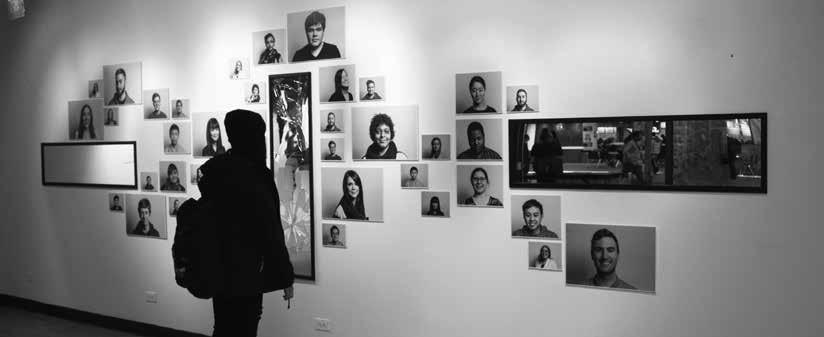
Features Editor: Dana Hatherly

It is a great privilege for me to welcome you all, students old and new, to the 2015-2016 school year at the University of Manitoba. For those of you returning to the Fort Garry campus, you will notice some significant changes, particularly the new Active Living Centre and renovations to the Taché Arts Complex. These state-ofthe-art facilities foster engagement with the broader Winnipeg community, enhance the vibrant cultural life of our province, and support students, faculty, staff, and community members in creating healthier lifestyles. For new students, you will discover the university is a vibrant, dynamic, and inviting community that is above all a place to learn and define yourself. Whatever your interest or passion, I am confident you will find a field you want to explore. You will find instructors and professors with globally recognized expertise
to inspire, educate, and guide you. I hope you will find the U of M to be your academic “home” where you can share and contribute to a diversity of ideas and participate in the wealth of experiences available to you both in and out of the classroom.
Members of the U of M community continue to make advances and have become players on the world stage. Some have been nominated for (and won) Nobel Prizes, while others have developed partnerships with visionaries such as Bill Gates. Many of our graduates manage international corporations in media, transportation, and entertainment. Across the globe, in 131 countries, there are 132,000 U of M graduates carving their own paths.
And with the Oct. 19 federal election drawing near, I note that several candidates running for office are alumni or have U of M connections, seeking to help lead this country to greater things.
This fall, the university will launch a major philanthropic campaign called Front and Centre. This campaign will help us create a future in which the U of M will be nationally and internationally recognized for its teaching, research, and creative excellence. Through this campaign, the university will be able to provide a more outstanding student experience through new teaching chairs, scholarships and bursaries, and experiential and service-learning opportunities such as student exchanges, co-operative and work placements, undergraduate research, and community service-learning.
Demand for university graduates across Canada continues to increase at all levels, and the majority of job shortages are in fields requiring a university degree. The U of M can help make your dreams of innovation, leadership, or exploration a reality. The skills and knowledge you acquire as a result of your education at this institution will be the keys that will unlock opportunities for future employment in both traditional fields and in those that are just being defined today. Advances in scientific exploration, medical specialization, and social programs are being made every year, and some fields of study in which you may one day work have yet to be created.
When we are surrounded by impassioned teachers, advanced technology and resources for education, inspiring settings in which to learn, and resources at our fingertips, our potential for achieving our goals can be better realized. Students are our future leaders, business professionals, and global citizens, charged with making a better world for all.
From here, you can go anywhere.

I would like to welcome University of Manitoba students to what promises to be another exciting year at your University of Manitoba Students’ Union (UMSU).
UMSU strives to enhance your student experience through events, advocacy, services, and student businesses by offering exciting and wellrounded student opportunities.
Our team has set ambitious goals for the year ahead and I want to clearly communicate how we will be working for you.
One goal is to increase the number of child-care spaces on campus by working with community stakeholders. Another plan is to implement a five-day mental health and wellness fall reading break for the Thanksgiving long weekend.
UMSU will continue working to create positive change through advocacy campaigns on campus about mental health and wellness, sexual
assault, accessibility, and sustainability. We plan to host exciting cultural, academic, and social programming events such as the Frosh and Frost Festivals and speaker series.
We will revitalize student spaces by investing in a capital project to renovate UMSU Street, located on the third floor of University Centre.
UMSU is also working to implement a 10-year strategic plan that establishes a progressive, sustainable, and visionary course of action for the student union’s future as an organization.
We will represent your student interests in a democratic, transparent, and steadfast manner, working with students, staff, administration, government, and the community to create the best possible student experience at the University of Manitoba.
I truly believe that this is an amazing place to go to university. The culture of our campus is changing for the better and we are working to make sure that your student experience is the best that it can be. We have accomplished a lot, but there is more to do. These are some of the best years of our lives, so get involved and help make a difference in your community. You will make lifelong friendships and memories along the way.
You are always welcome at UMSU – do not hesitate to stop by our offices in University Centre at any time. My door is always open to students!
CRAIG ADOLPHE, STAFF
Any undergraduate or graduate students interested in student and community media should be happy to know that the Manitoban is not alone on campus. For those with a predilection for music or the spoken word, UMFM, the university’s campus radio station, is on the third floor of University Centre and broadcasts on 101.5 FM.
UMFM features an eclectic programming schedule with content including, but not limited to, punk, funk, metal, folk, jazz, hiphop, classical, world music, and talk radio – mostly written, produced, and recorded by local volunteers. They also feature popular imports such as Democracy Now, Radiolab, Radio Ecoshock, and Exploration, which is hosted by theoretical physicist Michio Kaku.
Along with a variety of student volunteers, the station’s board of directors includes seats reserved for student representatives to ensure it is meeting the needs of students.
Although UMFM has been operating since September of 1998, the station only established itself as autonomous for the first time this past January when they incorporated as a separate entity, UMFM Campus Radio Inc., during their seven-year license renewal at the suggestion of the Canadian Radio-television and Telecommunications Commission.
Station manager Jared McKetiak has been involved with UMFM since 1999 and has seen hundreds of volunteers through the station’s doors.
Emphasizing its local focus and open structure, McKetiak said that UMFM sets itself apart from a lot of other radio stations in the city by giving a voice to the voiceless.
“I think the number one difference for us is that our biggest goal, first and foremost, is to support local music and local arts. We give priority to local musicians and we try to promote Winnipeg’s music scene as much as possible,” said McKetiak.
“Secondly, we tend to do more
grassroots programming when it comes to spoken word – so you’re going to hear lots of different things in terms of shows, things like alternative politics.”
In addition to playing politics, arts, and culture, the station broadcasts unconventional campus-related stories and sports coverage.
“We’ve got a bunch of different grassroots sports shows. You know, we talk about sports, but not much of it on the professional level. We tend to focus on the stories behind the athletes, plus we do a large focus on campus news and campus events.”
McKetiak said that on top of the listening experience for students, the station is also an excellent place to learn, for those interested in radio.
“We provide training on all different aspects of working in a radio station, from writing and copy, to producing and voicing ads. You can work in our music library or, of course, the big one for a lot of folks is hosting their own radio program.”

He suggested that anyone interested in getting involved visit the station to fill out a volunteer application form.
“We’ll sit down with you. Based on that application form we’ll discuss what sort of interests you might have and how your time would best be served here at UMFM and then we’ll put together a training curricu-
lum for you and get you on your way.”
UMFM, the Manitoban, and the Gradzette will be cohosting a media mixer at the Hub on Oct. 1 from 5-8 p.m. People interested in learning more about campus media and how to get involved are welcome to attend the free event.

KASEY RAE MORGAN

E very year the same advice is given to students heading to university, whether it’s their first or final year. You’ve probably heard it, or maybe even said it to someone: “You should get involved on campus!”
While inherently good advice, this phrase and its many variants is useless. For one, it doesn’t leave the listener with any desire to follow it, nor does it tell them anything about what getting involved means or why it’s important. To clear this up, I have constructed a handy-dandy guide to getting involved on campus, and why it really is a good idea.
“But wait,” you say, “what exactly does it mean to get involved on campus?” I’m glad you asked. As cliché as it sounds, it can mean almost anything – whatever you want it to mean. Being involved means participating in groups, activities, or organizations which extend your experience on campus beyond the classroom. This could include researching with a professor, participating in athletics, or attending events on campus like guest lectures and movie nights. From student groups to volunteering, politics to service-learning and the myriad of programs and job
opportunities available, our campus provides hundreds of opportunities to go beyond the classroom to create a unique experience that interests you.
Now for the important part: why?
Aside from the obvious entertainment value offered by interest-based student groups and activities, being involved on campus can have some great career benefits.
Certain opportunities are eligible to be tracked on your co-curricular record – provided by Student Life – meaning that future employers or graduate schools can see that you stepped above and beyond to contrib-
ute to your campus community. They can also provide valuable life and career experience, whether it’s the ability to organize events, showcase your creative or professional abilities, or uncover hidden skills.
Additionally, becoming involved in student groups and volunteering can help you to network and find valuable contacts, references, and friends. It can even extend beyond that – depending on how you choose to be involved, you can get personal satisfaction in knowing that you have helped others, or taken advantage of some of the various off-the-beatenpath opportunities that not many people know about.
Now that you can see why getting involved can help you, it’s time for you to know how you can enter the world of campus involvement.
If you like to run things and be a strong voice for others, you can reach out to the University of Manitoba Students’ Union, or find out more about your department or faculty student councils and associations. These groups serve to advocate for students and organize events and activities for everyone. There are elections every year, so you can have a chance to put forth your ideas and work with other people to influence the student experience for others.
If you want to connect with people who have similar interests to you,
there is a plethora of special-interest student groups on campus run by people just like you. Whether you’re interested in activism, arts, athletics, culture, environment, politics, hobbies, religion, or anything else, there is more than likely a student group to suit your needs. If not, you can always found a new one.
If you want to become involved in, or learn more about, social change, Student Life provides many services and opportunities that often go unnoticed. If you’re interested in travel and learning about other cultures, they offer service-learning opportunities abroad in places such as Ecuador and Tanzania, as well as within the province and Winnipeg. Student Life also offers several leadership and volunteer programs, and organizes orientation at the beginning of each academic year.
Hopefully you have more of a sense of what’s available on campus, and how you can make the most of your few years here. The possibilities are endless: you can do as much or as little as you like, just make it memorable.
For a full list of official student groups, organizations, associations, and additional ways to get involved, visit: https://communitylink. umanitoba.ca/organizations

U
can be the best time of your life – or the worst. The key to making it the best time of your life is having the right knowledge and information to achieve goals and gain the experiences you want to have, and having some fun while doing so. As a disabled student attending classes, there are many things that will come up throughout your campus journey that you may need some
kind of help with tackling. Student Accessibility Services, located on the main floor of University Centre across the hall from the Digital Copy Centre, is a great resource for everything you might need. From class accommodations to proctoring, note-taking, test-taking, and more, the folks at Student Accessibility Services will do whatever they can to help you succeed
to your fullest potential.
For any questions you might have regarding student life on campus, housing concerns, community support, or if you just want to have a conversation, the University of Manitoba Students’ Union (UMSU) has a students living with disabilities representative. Their role is to help with whatever you feel you need help with and to bring those issues up to UMSU council members and executives in order to ensure those needs are addressed.
There is also a great relaxation spot designated for students with disabilities in room 187 in the basement of Helen Glass. Known as the “Safe Space” for those with disabilities, this recently renovated lounge is equipped with a couch, computer, television, fridge, coffee maker, and more. Here you can get your homework done, take a quick nap between classes, and even medicate with your medical marijuana, if you prefer.
If you are a legal patient who uses cannabis, then don’t worry, as the University of Manitoba has a very
liberal stance on medical marijuana.
In fact, the first official medical marijuana student group in Canadian history sparked up on this campus in September 2013, which shows it is a relatively easy-going place for cannabis users.
The folks at Student Accessibility Services will do whatever they can to help you succeed to your fullest potential
Not to mention the great local places around campus to munch out at when you are in the mood.
If you are into the outdoors and fresh air, the campus has a plethora of chill outdoor spots along the river to relax, read a book, or chat with friends. Between the amazing scenery and architecture, it is a wonderful area to hang out and enjoy downtime
between classes.
And finally, the Elizabeth Dafoe Library has an excellent disability reading room. It is private, quiet, and has a wheelchair-accessible computer. You may not think it now, but during your time as a student you will spend more time in a library than you ever thought you would. It is well worth it to spend your time there.
If you use this information and take advantage of all the opportunities offered to you on campus, then I am sure you will have the most entertaining, enjoyable, and thoughtprovoking time of your life.
Enjoy the next few years of your life, get that degree, and make the world a better place for you and those around you.
Peace.
University of Manitoba alumnus Steven Stairs is the former UMSU students living with disabilities representative, as well as founder of the Medical Marijuana Student Association
CHANTELLE DUBOIS, STAFF
Whether you are a new or returning student, there are many student groups on campus to get involved with. For students in science, technology, engineering, or math the options are numerous.
Connect with a student group today and meet other students who share a similar interest. Here is a taste of some opportunities available on campus.
Let’s Talk Science
Let’s Talk Science Outreach is a national volunteer-based non-profit organization which brings hands-on, exciting science activities to schoolaged children in the classroom and community for free. The goal of the initiative is to increase science literacy in children, and encourage an interest in science, technology, engineering, and mathematics.
Website: http://outreach.letstalkscience.ca/umanitoba.html
Biology
The Biology Undergraduate Student’s Association (BUGS) is a relatively new student group on campus which strives to create a community among students interested in biology. The group is open to all students.
Membership is $5 for an academic year, which includes discounts for food and event admission for BUGS events, academic resources such as access to past term exam banks and textbooks, the opportunity to net-
work with campus professors and researchers, as well as a BUGS button and sticker.
Website: https://sites.google. com/site/bugsuofm/home
Chemistry
Formally known as the University of Manitoba Undergraduate Chemistry Society, Chem Club regularly organizes social events for its members such as Sky Zone trips, movie nights, and barbecues. Fundraisers organized by the student group include the sale of periodic table of elements cookies. Additionally, the club offers tutoring services for all undergraduate chemistry courses.
Membership is $30 per academic year. Members must be students in the faculty of science, registered in a minimum of 18 credit hours over the fall and winter terms, and either currently or previously enrolled in 2000level or higher chemistry courses.
Website: http://home.cc.umanitoba. ca/~davisrl/Chem_Club/index.html
Physics
The Organization of Physics Undergraduate Students (OPUS) is open to all students on campus. The goal of OPUS is to promote interest in further study of physics.
OPUS operates a free drop-in tutoring centre for first-year physics courses and hosts review sessions for final exams for first year physics
courses with an admission fee of $20.
Website: http://www.physics.umanitoba.ca/undergraduate/OPUS/ Astronomy
The University of Manitoba Astronomy Club (UMAstro) is open to all students on campus. The organization’s goals are to promote interest and understanding, encourage further study, and raise community awareness of astronomy. The organization also assists members with mentoring for astronomy class tests and exams.
Website: http://www.facebook. com/groups/195179190589480/
Biomedical engineering
The University of Manitoba Biomedical Engineering Society (UMBMES) is open to all students. This organization brings together students interested in the biomedical field by organizing tours of relevant facilities, opportunities for research, and events inviting industry experts to interact with members.
Additionally, the organization provides information to its members on courses related to biomedical engineering, information on the local industry, lab access both on and off campus, and opportunities to meet professors on campus who are doing biomedical research.
Website: http://www.umbmes.com
UMSAE
The University of Manitoba Student Chapter of SAE International (UMSAE) is open to students from any post-secondary institution and program. This student group is comprised of four design teams, each of which focuses on a distinct vehicle. Over the course of a year, the teams design, build, test, and compete with their vehicles at official SAE events, learning critical engineering, research, and management skills.
The Aero Design team designs and manufactures an aircraft that can be controlled remotely, with the goal of carrying the heaviest payload possible.
The Baja team designs and manufactures a lightweight, four-wheel, all-terrain vehicle which must endure rugged-off road driving in harsh conditions.
The Formula Electric team constructs an electric power-train formula race car to compete in an autocross environment.
The Formula team devises an internal combustion engine formula race car, which competes in an autocross environment.
Joining UMSAE requires members to pay a mandatory fee. To find out more, contact the design team you are interested in joining.
Website: http://www.umsae.com
UMSATS
The University of Manitoba Space
Applications and Technology Society (UMSATS) is open to all post-secondary students from any disciplinary background. The group participates in the Canadian Satellite Design Challenge, in which universities across Canada compete by designing, building, and testing triple-cube nanosatellites. On top of designing the mechanical, electrical, and software components of the satellite, the team also must develop a scientific payload and participate in outreach efforts to promote engineering and space.
Participation with UMSATS provides opportunities to develop skills in engineering, research, design, management, and academic writing.
Website: http://www.umsats.ca
LAUREN SIDDALL, STAFF
The benefits of volunteerism are virtually infinite. Whether you are interested in advancing your employment opportunities, building a network, or making an impact in your community, there are plenty of reasons for you to exercise your altruistic side.
And there is a myriad of media in which you can practice your compassion.
For Lisa Reed, University of Manitoba human nutritional sciences student and long-term volunteer, it was at the Children’s Hospital.
“What are you interested in? What are you passionate about? Find that and work with it. If you want to work at a hospital, that’s great. If you like working with animals, work with animals,” Reed said.
“I was looking for volunteer opportunities and I ended up seeing a poster or something at the univer-
sity. I applied, and they gave me a call and placed me where they felt I’d be a good fit, which happened to be the Children’s Hospital in-patient playroom.”
Reed’s job is to play with the kids at the hospital and keep them entertained – though the parents also appreciate a listening ear.
“I think the most rewarding part for me is seeing kids smile and have fun, even in a stressful situation,” said Reed.
“No matter how stressed you think you are with a paper and a midterm and other assignments, you can’t be stressed when you’re at the Children’s Hospital. What the families are going through is a gazillion times more stressful than what you’re enduring as a student. It really puts things in perspective.”
While volunteerism is advantageous for all involved, it has benefits
that serve students particularly well.
“I think a lot of people would say that the biggest benefit of volunteering is that it looks good on a resume and that it is good to have that kind of experience,” said Reed, who has volunteered at the Children’s Hospital for two and a half years.
“And it helps if you have volunteered somewhere for a while. Consider it to be a commitment. Don’t just try it out for a week. Don’t go into it thinking you can just quit. I think that the commitment is important, stick with it.”
But the benefits of volunteering go beyond having something to add to your resume.
“Giving back to the community is a big benefit, too. You get realworld community experience that you wouldn’t get in a classroom and likely wouldn’t get at a job.”
In the classroom – and frankly in

life – we have a tendency to think more about the self than about the things surrounding the self. We live in an individualistic society, where the focus is on getting ahead and not helping others get ahead.
Shifting our focus from an individualistic to more collectivist ideology has the potential to radically change our world, and we will all reap the benefits.
Editor: Dana Hatherly
TOM INGRAM, STAFF

If you’re a new student, you’re probably overwhelmed by all the fees you’ve just paid. Your tuition is by far the largest of these, but don’t be deceived: the most valuable, in terms of dollars per unit of education, is the $40 library fee.
The University of Manitoba offers an extensive system of libraries to students, faculty, staff, and community members. As a U of M student, everything from scientific journals and volumes of German literary criticism to children’s books and Metallica albums is freely available to you. I urge you to learn how the system works and use it to the fullest extent in order to learn as much as you can during your time here.
In that spirit, I’d like to provide some information about the libraries and tips on how to make the most out of them.
The U of M library system consists of 10 branches on the Fort Garry campus, with nine health sciences libraries spread across the Bannatyne campus and Winnipeg’s hospitals. The central branch is the Elizabeth Dafoe library. The smaller Fort Garry libraries are mostly subject-specific branches – such as the music, management, and engineering libraries.
Current U of M students can take out 200 regular items at a time, and can place hold requests on up to 25 items at a time. Ordinary loan periods for books are till the end of the semester, meaning that for most items there are three due dates a year (and you can renew up to three times).
Some items, such as CDs, DVDs, and journals, have shorter loan periods. Items that have been placed on reserve by faculty or staff are kept
behind the desk and usually have very short loan periods, sometimes on an hourly basis.
In addition to the physical items, the library subscribes to a large number of online journals and databases. These vary from collections of academic journal articles to archives to online specialist encyclopedias. As a student, you can access most of these databases remotely from your own computer, and it’s worth your time to get to know the ones in your subject area.
As a student, you can access most of these databases remotely from your own computer, and it’s worth your time to get to know the ones in your subject area
Most items from the library do not ordinarily carry late fees. This means that if you are a few days late in returning your books at the end of term, you will not be charged for them. However, if you keep an item so long overdue that it’s declared lost, a fee will be charged to your account. This fee is waived when you bring the item back – as long as you do so within a reasonable amount of time. Reserve items are the only ones that usually carry late fees – in some cases hourly late fees, which can be quite expensive, so it is unwise to
keep a reserve item overdue. Pieces of equipment that need to be signed out, such as headphones or USB drives, are treated like reserve items.
If a normal item that is signed out to you is requested by another patron, you have a week to return it to the library. After that, you are charged a late fee.
For the most part the system is forgiving and you won’t be charged late fees unless you keep items months overdue or inconvenience other patrons by keeping reserve items or items they’ve requested. But everyone makes mistakes. What do you do when your account is blocked due to a large fee?
First of all, don’t panic. Return the overdue items as soon as possible. Lost item fees will be waived shortly after you return the items. Overdue fines on reserve and requested items will not be waived, but at least they won’t grow any bigger.
Once you’ve returned the overdue items, speak to a library staff member to confirm the status of your account.
The U of M libraries use the Library of Congress classification system. If you’re familiar with the Dewey decimal system, used by the Winnipeg Public Library and many high school libraries, you may need time to adjust.
Generally, if you know the title of the item you are looking for, it is best to use the online catalogue search for the title and author. Find the item’s call number (a combination of letters and numbers that looks something like this: “BR 100 K475 2013”) and the library branch that holds it, and go look for it in the stacks at the appropriate library. Call numbers are
arranged in alphanumeric order on the shelves.
You can also request the item online and have it delivered to the branch of your choice, but I recommend you don’t do this until you’re already well acquainted with the stacks.
Can’t find what you’re looking for?
Why not order it in from another library?
On the other hand, if you’re looking for books on a specific topic (e.g. “ancient Rome”), it’s best to search online for that topic or keywords related to it instead. Find the general call number range where these books can be found – typically you want the first set of letters and numbers (“DG 78”). Then go to that area in the stacks and look around for titles that jump out at you.
Looking at the shelf in person is an intuitive process that is likely to produce more surprising and interesting results than searching online, though searching online is much faster if you know what you’re looking for.
If you’re looking for journal articles or other items that are typically accessed online, you may not see them in an ordinary catalogue search. Often you can find these items by typing keywords into the One Stop Search field on the libraries homepage. Some results will have a yellow “Get it @ UML” button on them. Click this button to see how to get access to the item.
Needless to say, if you ever have
difficulty finding an item, you can ask any librarian or library staff member for help. If you’re off campus or just feeling shy, you can ask questions anonymously through a live chat service: just click on “ask a librarian” on the libraries homepage during business hours.
The U of M libraries boast a vast collection of books, journals, and other items, but they don’t have everything. Can’t find what you’re looking for? Why not order it in from another library? Thanks to interlibrary loan agreements, you can order almost any item as long as it exists in a library somewhere.
In my experience, the U of M libraries have copies of almost all the standard readings in just about every subject (though there are holes, of course). But once you get into more specialized subfields, you’re more likely to run into items that U of M doesn’t have, and that are difficult to get ahold of otherwise.
For me, it was clarinet scores. When I wanted a copy of Arnold Bax’s clarinet sonata or of Samuel Coleridge-Taylor’s quintet – obscure pieces, but by no means unheard of –the U of M music library didn’t have them. Luckily, other libraries in Canada did, and through document delivery I was able to get copies of these scores sent to me.
To request an item through document delivery, click the “Document delivery” link on the U of M libraries homepage. Fill in the patron request form as best you’re able – a good source for information about many items is WorldCat.org.








Arts &
Contact:
SEAMUS HAMILTON-PATTISON, STAFF

On Thursday Aug. 27, local architecture and design firm 5468796 Architecture opened public registration for their new non-profit competition, Chair Your Idea.
The competition is designed to generate both ideas and funds from the community. To do so, Chair Your Idea challenges Winnipeggers to submit an idea of no more than 140 characters in length along with a $25 registration fee and one white chair to commemorate the addition of their idea. The chair must have the applicant’s idea, registration number and www.chairyouridea.ca written on it, and will be looked after by one of many participating local businesses. The idea itself can be absolutely anything, as long as it fits the required length and is made with the intention to improve Winnipeg.
5468796 Architecture hopes to raise approximately $30,000 and receive over 1000 submissions. The competition will run between Aug. 27 and Sept. 17. After that point, all entries will be judged by a “high-calibre jury,” with the funds raised going towards financing the winning idea.
Caroline Inglis, a partner at 5468796 Architecture, told the Manitoban that Chair Your Idea was conceived as an extension of Table for 1200 – a pop-up dining event that took place in May of last year and featured a 1200-foot long din-
ing table across the Esplanade Riel –with Inglis joking that there are “1200 white chairs lying around somewhere, so let’s bring ‘em out and do another event.”
She added in earnest that the event was to be one that “really gets people talking about this city, and what we can do for it.”
In order to get the ball rolling, 5468796 Architecture opened the competition to the public by simultaneously revealing 17 ideas put forth by an assortment of prominent local community members. With one glance at the list of names, one sees a veritable “who’s-who” of Winnipeg with ideas from Mayor Brian Bowman, morning radio DJ Ace Burpee, improv comedian Stephen Sim, and many more. Further, each “celebrity chair” is specially designed by a local architect or designer, and will be prominently displayed around the city during the competition, while being auctioned off online.
“The intention was just to get as many Winnipeggers involved as possible, so we were looking for people who were involved in different aspects of the community and of the city to really help rally everyone in Winnipeg together for this event,” Inglis told the Manitoban.
According to Inglis, the white chairs carry a somewhat symbolic significance for the event as well.
“What it means is to take your seat at the table. If there’s an idea, designers, planners, architects, and city officials are the ones who make the decision. They happen at a place that’s removed from the public, so it’s an invitation to take a seat at that table and to share their ideas.”
Inglis stated that after the competition, the focus of Chair Your Idea will make the logical shift to implementing and constructing the winning idea, stating the possibility of the reoccurrence of the event hinges on its success in this, its inaugural year and if “Winnipeggers find this is a good outlet for sharing their ideas.”
Inglis closed by encouraging all Winnipeggers to participate, stating that 5468796 Architecture has “tried to make it really easy, so that anyone can share any idea, all the ideas will be heard, and we want to put them all together in a public location and make an idea bank.”
“City council has promised to read each and every one of them. So if you have something to say, please share it. We’d love to hear it.”
Got an idea to improve Winnipeg’s urban design and planning? Visit www.chairyouridea.ca to read all the rules and regulations and register for the competition.
British experimental pop singer-songwriter collaborates with former Beyoncé producer on latest release
MICHEL GHANEM, THE MARTLET
VICTORIA – To FKA twigs’s most dedicated fans, M3LL155X (pronounced “Melissa”), or EP3, came after what felt like months of teasing, song releases, and live performances. To the rest of the world, the five-track release was a complete surprise, dropping without notice or warning on Aug. 13 paired with a 16-minute short film of self-directed music videos.
Following her first EP releases (EP1, EP2), and a critically acclaimed album in August 2014 (LP1), the world kept a fascinated and curious eye on FKA twigs. Her name filled tabloids and gossip rags digging into her private relationship with actor Robert Pattinson, while she made waves in the fashion world by appearing in Vogue and showing up at the very exclusive Met Gala.
With the help of Boots, a musician known for his production of Beyoncé’s self-titled fifth album, twigs reportedly finished the EP as
early as November 2014, but waited until after her debut album’s tour to release anything officially. Once completed, twigs named the EP “Melissa” as a way to objectify her female energy – perhaps to properly understand it.
“Let me live [...] I feel in ten breaths, it’s a miracle if we’re still alive,” twigs groans on “Figure 8,” the first track on M3LL155X. The song, which twigs has been performing on tour since early this year, explains her newfound fascination with vogue dancing. The voguing scene in New York helped her deal with the common feelings of isolation and sadness that come with a gruelling, non-stop tour following the release of an album. A representation of eternity in vogue dancing, twigs would practice her figure-eight in the mirrors of hotel rooms.
The light, repetitive percussions are reminiscent of the previously released singles “Water Me” and “Video Girl,” combined with a hushed
spoken-word interlude, flashes of explosive sound, and ending with a deep, eight-second groan – twigs letting go of her unravelled touring state, and regaining autonomy over herself through vogue.
When asked about the track’s creation on Zane Lowe’s Beats 1 radio show, she said, “I was just feeling actually quite sad and feeling a bit lost, because after you release a record you get thrown into this weird world and it’s difficult to keep hold of who you are and what you want to do.”
Similarly to “Figure 8,” “In Time” showcases a new vocal range for twigs, opposite from the quiet, whispering tone from LP1. The vaguely ’80s melody captures the emotional ache preceding a breakup: “In time, your hands on my body will resonate through me, like they did before.”
The track is refreshing, light, and radio-friendly – unlike everything twigs has ever produced, and a significant change in her melodic style.
“One, two, three / now hold that pose for me,” twigs sings on “Glass & Patron.” The track was originally presented at the 2015 Youtube Music Awards, and picks up where “In Time” left off – buzzing, bells, a driving, fast-paced bass, and singing in a higher vocal register.
The track is quick and full of energy, and reminisces on her past as a backup dancer. Between holding poses and “moving alone,” she expresses her fatigue of her day-today routine in the track: “I wait all week for a moment’s break away from being told who I am.”
“I’m Your Doll” and “Mothercreep” are similar in production to her first EPs, but evolved in terms of depth and lyrical brilliance. To the unfamiliar, the tracks can be difficult to follow through the layers of sound and vocals, completely opposite from tracks like “Two Weeks.” Once unpacked and understood, the dark tracks become underestimated,
powerful anthems, decoding twigs’s sexual and psychological desires.
“Dress me up, I’m your doll. Love me rough, I’m your doll,” twigs sings on the track she wrote when she was 18. She alludes to the sexual objectification of women by comparing them to sex dolls, but is simultaneously admitting the unease and emptiness that occurs with her sexual submission: “I’m here, I’m here, look into my eyes, and tell me that you’re here too.” M3LL155X is a success, and a sign of things to come. Twigs’s music is carefully crafted, riddled with emotional depth and truths about sexuality and relationships. She finds a way to harness her pain and sadness, and birth brilliant creativity. For those who don’t understand the appeal, the heavy melancholy behind her words, or the twitching sounds in her songs, you are missing out on one of the most creative individuals of our time.
– National University Wire
LAUREN SIDDALL, STAFF
Beautification is a common goal for most metropolises. Cities quickly turn into masses of concrete where buildings become cookie-cutter and plants growing in the cracks of pavement offer the only hint of vibrance.
Enter CommerceDesign.
CommerceDesignWinnipeg – an initiative of StorefrontMB, a nonprofit organization dedicated to the awareness of architecture, design, and urbanism, in partnership with Downtown Winnipeg BIZ – aims to motivate local merchants to improve the aesthetic of their businesses and thus, improve the aesthetic of our city.
“CommerceDesign is a program that rewards businesses for investing in the quality of their establishments and by doing so, hopefully encourages more businesses to do the same. It recognizes that storefront businesses are important extensions of public spaces, streetscapes, and places, and have a significant impact on the image of our city,” explained David Penner, StorefrontMB president.
Though this is only the third year the program has been in Winnipeg, CommerceDesign has already had a positive effect on cities globally –including New York, Luxembourg, and Marseilles – after being established in Montreal 20 years ago.
The sustained efforts of CommerceDesign in the founding city have proven to the public, and
to business owners, the value of good design. The program was created with the goal of encouraging Montreal merchants and restaurant owners to invest in the design quality of their establishments. After 10 successful years of the program, the city obtained designation as a UNESCO City of Design in 2006.
“Our ultimate goal is for all new businesses to invest in the quality of their establishments and for Winnipeg to foster its reputation as an emerging city of design” – David Penner, StorefrontMB president
“The program was developed and fine-tuned by Montreal over a number of years and has proven to positively influence how high quality design is valued. It fosters a hunger for all things design,” explained Penner.
“Big picture, it promotes a higher
quality urban environment.”
CommerceDesign works by framing the initiative as a contest to captivate the competitive.
“Each year, the contest begins with a call for entries from the business and design communities. A jury of professional designers and distinguished laypeople is assembled to review the submissions and tour the facilities, a process that takes a day and a half,” said Penner.
“Jurors look for interior design and storefronts that are harmonious, functional, and strengthen the branding of the businesses themselves. They should demonstrate that high quality design is more than the sum of its parts. Or even better, they create a milieu that inspires, surprises, and lifts people.”
From there, the polls open to the public to determine the People’s Choice winner. Between July 31 and Oct. 31, patrons are encouraged to visit the vendors and vote online for “the most beautiful business” of those pre-selected by the jurors.
The Winnipeg contestants for this year include SMITH, Lunch Bell Bistro, the Merchant Kitchen & Bar, Yoga Public, Beet Happening, and Green Apple Skateboard Shop – with the winner receiving a significant promotional campaign to reinforce their efforts of beautification.
“Our ultimate goal is for all new


businesses to invest in the quality of their establishments and for Winnipeg to foster its reputation as an emerging city of design.”
For more information and to vote for your favourite, visit commercedesignwinnipeg.ca






ANDY CHE, VOLUNTEER STAFF
As the CIS soccer season draws nearer, the University of Manitoba Bisons will have a collective goal in mind: to improve on last season.
The team missed the postseason in 2014-15 following a 4-4-4 record in the Canada West Prairie Division. The Bisons have added eight fresh faces to their squad over the off-season, meaning their key players will have to assume more instrumental roles for the 2015-16 campaign. Here is a breakdown of this talented squad’s players to keep an eye on for the upcoming season.
Heading into her final year of CIS eligibility, captain Chloe Werle enters the new season resuming the position of first-choice stopper. Fellow goalkeepers Brittany MacSween and Martina Arran, in their third and fourth years respec-
tively, will push Werle for the number one jersey, something that head coach Vanessa Martinez-Lagunas refers to as a “positive rivalry.”
Martinez-Lagunas is gradually turning a squad with youthful exuberance into a core of talent who can rival any side in Canada West
Last year, the frequent Bisons starter underwent surgery in the offseason, which kept her sidelined for the entirety of the 2014-15 campaign. Having lost a year in her CIS career, Werle will be looking to make up for lost time before hanging up the gloves
with the Bisons.
In a 1-0 victory over the Minnesota-Crookston Golden Eagles during their preseason finale last Friday, the Bisons coach fielded all four of her goalkeepers. In the post-match interview, she welcomed competition within the squad.
“They are a team but they also know that they are competing for a spot. Each player makes the other players better and the whole team better,” Martinez-Lagunas said.
Defenders
Elyce Molyneaux, the Bisons’ most senior defender, enters her fifth year of eligibility. The spirited leftback will also endure more than a fair share of leadership on the backline, as the next two most senior defenders – Kayla Gagliardi and Robyn Coffey – are only in their third season.
Despite her primary defensive role, Molyneaux plays a two-way style that


includes the occasional run up the left flank. Possessing such versatility allows her to join to the attack, especially through whipping crosses into the box from wide areas.
Manitoba’s diverse group of midfielders is very well-suited for their style of play, by controlling matches with the depths of the midfield area
Midfielders
Manitoba’s diverse group of midfielders is very well-suited for their style of play: controlling matches with the depths of the midfield area. The collective skill set of players in the middle and out wide makes the Bisons a difficult team to dispossess.
With a very senior-based group at that position, Manitoba also retains a very high soccer IQ in midfield – a crucial element in both their attacking and defending options.
At the base of midfield is Amanda Wong. Primarily a central figure, Wong possesses a dynamic skill set with a precise first touch, a vast range of passing with both feet, and a knack for creativity with the ball.
Capable of performing both a defensive and attacking role, expect for Wong to be used to greater effect in 2015-16. She was also recently handed the honor of being a captain – an incredible feat for being only in her second season.
In a more advanced midfield position, Megan Graca provides the team with creativity in and around the penalty area. A fourth-year playmaker that is very positionally sound, Graca can also handle the duties of handling set pieces.
Confident with the ball at her feet, Selina Speranza is a tricky figure on the flanks. Capable of performing on either side of midfield, the fourth-year winger is quick-footed and fearless when taking on opposing defenders. Speranza also combines creativity with playmaking as she has the vision to deliver crosses from the wide areas with both feet.
As Alyssa Robinson has proven, she is not afraid to have a crack at goal. Her brilliant strike from distance in Manitoba’s final preseason match certainly confirmed her nose for the net. Heading into her final season of eligibility, Robinson will be eyeing the chance to score a few more goals before bowing out of the CIS.
Though primarily a left-side midfielder, Robinson could also be deployed more centrally this season, which allows her a more favorable sight and angle at the opposition goal. However, with Graca and Wong typically starting at centre midfield, she could also be used as a defensive
figure, which allows her to retain a more key position.
Perhaps the greatest weapon in Martinez-Lagunas’s arsenal is Bruna Mavignier. With a tremendous skill set honed in her native Brazil, the gifted striker is the complete attacking package.
Confident with using both feet and her head, Mavignier impressively led the Bisons with eight goals last season as a freshman. The Bisons coach is expecting more of the same for the upcoming season.
“She’s really unpredictable and has great technique. Last year was her first year and she scored many goals for us,” Martinez-Lagunas said.
“She finished as third-best goalscorer in Canada West so we hope she gets into the zone again this year and scores many goals for us.”
Aside from her ability to score goals, she possesses an astonishing work rate in dribbling past opponents. On more than one occasion, she has succeeded in leaving two or three of her opposing defenders in the dust on just one run.
Already having shown a lot of promise, Mavignier’s hopes remain high that both she and the Bisons can live up to the hype.
“I have high expectations. I think the team is more mature,” said Mavignier, following her performance against the Golden Eagles on Friday.
“We have more chemistry and have been working really hard so I think we’re going to have a better season than last year.”
As the days count down to opening night, it is evident that the Manitoba Bisons are gearing up for a playoff push. In her third year at the reins, Martinez-Lagunas is gradually turning a squad with youthful exuberance into a talented core who can rival any side in Canada West.
The former Bayern Munich player and German National Team coach has already implemented two objectives over the course of the season. She was very straightforward when asked what she would consider a successful campaign.
“The first goal is to improve our record from last year. We want to do better than last year,” MartinezLagunas said.
“The second objective is we want to make it to the playoffs. Last year we were very close to making it. We were fighting for a spot until the last weekend. This year we are really, really excited and we will do our best to achieve those two goals.”
Martinez-Lagunas and the Manitoba Bisons kick off the season hosting the Thompson Rivers Wolfpack on Sept. 4.
Bisons win final preseason friendly against Minnesota-Crookston with Robinson wonder-goal
ANDY CHE, VOLUNTEER STAFF
The Manitoba Bisons women’s soccer team is set to kick off their 2015-16 season to the right tempo following a victory in their final preseason match, hosting Minnesota-Crookston on Friday night. A 1-0 score was enough to clinch their third win in five friendly games, before entering the competitive season next week at home against Thompson Rivers. In a thrilling match which saw the Bisons out-compete the Golden Eagles in the final third, Alyssa Robinson scored the lone goal with a scintillating strike from long range.
First half
Manitoba looked to be the livelier side right from the get-go, attacking early and often. Striker Bruna Mavignier already created two chances within the first five minutes, which included a spectacular acrobatic effort that sailed just over the bar.
Golden Eagles goalkeeper Lexie Gauger was forced into action midway through the first half when a deflected cross from the left flank fell for Selina Speranza inside the box. Gauger smartly smothered the chance to keep the Bisons at bay. At 35 minutes, the home side drew first blood. From 25 yards out, Robinson unleashed a cracking shot that caught the crossbar and post before nestling over the line. The goal marked a true touch of genius, and Mavignier was quick to express her delight about the midfielder.
“It was so amazing, it was a really beautiful goal. I’m so proud of her. I hope she can score more goals during the season,” said Mavignier in
a post-match interview.
Moments after going up 1-0, Mavignier won a free kick in a promising position. The Bisons attempted to replicate Notts County’s famous deceptive free kick goal against Arsenal Ladies, which featured a fake argument before a player hit the dead-ball on target.
In the end, 1-0 was enough for the Bisons to hang on to a deserved victory
On this occasion, Manitoba nearly executed the plan to perfection. Megan Graca took the run-up, while Amanda Wong curled a dead ball just wide of the far post.
Having the confidence of planning a seemingly unachievable set piece shows the Bisons’ freedom in the game. In the bigger picture, it emphasizes the philosophy of coach Vanessa Martinez-Lagunas.
“We need to enjoy each single game. Enjoy the game, play free and play like we play usually. That is what I want to see during the games,” said the third year bench boss.
The Bisons continued to press for a second goal before halftime, coming closest at 42 minutes. Mavignier provided a ball for Alanna Shaw, who forced a decent save out of Gauger inside the area. On the ensuing corner kick, Mavignier had a goal-bound header cleared off the line.
Second half
Martinez-Lagunas introduced her third goalkeeper of the match after halftime. Calgary native Brittany MacSween was tested within minutes of coming on, quickly smothering a partial breakaway. Just seconds later, the Bisons ran into some injury trouble when defender Kailyn Balfour was forced to come off. The freshman injured her left knee after colliding with an Eagles player.
Late in the match, the Golden Eagles gained momentum and began to exploit the flanks through winger Delaney McIntyre. The Manitoba native gave the Bisons back-line some concern with her long bursts of speed, yet generated few chances.
The Bisons nearly clinched an insurance goal within the final few minutes.
First, they slammed the crossbar after a barrage of desperate attempts. Mavignier then twinkled around three defenders and forced a timely save out of Golden Eagles substitute goalkeeper Olivia Mecham on Manitoba’s final attack. In the end, 1-0 was enough for the Bisons to hang on to a deserved victory. If Robinson’s wonder-strike is any indication of what is to come, then this group of talent will be a very lethal team in the CIS.
The regular season kicks off next week, on Sept. 4 when the University of Manitoba hosts the Thompson Rivers Wolfpack.

How the new High Performance Centre has helped the women’s soccer team prepare for the 2015 season
RYAN STELTER, VOLUNTEER STAFF
This season, the University of Manitoba Bisons will be using some new technology.
The High Performance Centre for Bison athletes is right across from the new Active Living Centre on the U of M’s Fort Garry Campus. The women’s soccer team is one of many squads taking advantage of this new facility.
“Having that facility has increased the motivation level of the players 100 times,” said women’s soccer head coach Vanessa Martinez-Lagunas. “Sometimes we have to say that’s enough, time to go home.”
The High Performance Centre has professional equipment that no other Canadian universities, and not many other NCAA schools, have.
“We have the best sporting facilities in Canada, and the best equipment in Canada,” MartinezLagunas said. “Not even NCAA Division 1 schools have what we have now, so it’s fantastic.”
One example is the Smart Scan system, which uses LED lights to measure an athlete’s acceleration and responsiveness, captured on the 30-metre track inside the facility. The Smart Scan technology aids in fitness tests and motivates the players to always improve and get better by milliseconds.
Other new technology includes devices connected to barbells to track velocity, and a computer system to log data. Each individual also has a personalized wristband, which they use in connection with the Smart Scan to track progress.
There are two advantages to having this top-level equipment. It not only helps the athletes improve their overall performance, but also gives them the chance to use
their newfound knowledge of the devices at an elite level. According to Martinez-Lagunas, having the knowledge in training is one of the first steps to upping your game and potentially making it to the national level, much like Olympic bronze medallist and former U of M standout Desiree Scott.
“If we develop more athletes of Desiree’s calibre, then all of them are going to be trained, and they will know how to work with this equipment, so it wouldn’t be new to them,” Martinez-Lagunas said.
The U of M’s strength and conditioning coach Matt Barr also aids Martinez-Lagunas by overseeing the athletes’ progression.
Barr is a former elite-level rugby player who holds a masters of science degree in biomechanics and coaching from the University of Western Ontario. He is also a certified strength and conditioning specialist with the National Strength and Conditioning Association, and holds a Level II Olympic Weightlifting certification.
The U of M alumnus has helped change the culture of strength and conditioning on campus by making training sessions mandatory.
“[Strength and conditioning] has become a lot more structured and a lot more scientific,” Barr told UM Today. “Now, it’s at the point where it’s an essential part of the training that’s incorporated.”
Put all these aspects into play, and the herd has the recipe for a winning formula, which will hopefully lead to a playoff berth this season.

MIKE STILL, STAFF
Tyler Fong has been forced to make a few adjustments during his football career. The first was adapting to a change in rules while in junior. The second was moving provinces to pursue his CIS dreams. The third? Well, that was saving his own life.
Fong grew up in British Columbia, and started playing football in grade nine for a now dominant Mount Douglas program. He played both ways, as a quarterback and a defensive back, winning a provincial championship in the process.
While he played on the provincial team as a quarterback, Fong was ultimately recruited to local Simon Fraser University for 2011, to play defensive back. After a year there, he made the move to junior football, playing for the Westshore Rebels as a safety in 2012.
The most intriguing part of his shift in 2012 was the fact that in junior football, they play Canadian rules, whereas in high school in BC, as well as at Simon Fraser – where the team plays in the NCAA, they play American rules, with a smaller field and 11 players as opposed to 12.
“It was interesting. I’d never played Canadian football before – like the Canadian rules – so that was nice prep to coming to the CIS,” Fong said.
The next jump for Fong occurred when he left the island behind the following year in favour of the Bisons.
“[Head coach Brian] Dobie called me one day. I never thought of anything about Manitoba before, and then he called me up and talked to me and got me out here,” Fong said.
Entering a new province, and a team with a complicated coverage scheme that already has a relatively experienced secondary, presents its fair share of challenges. Fong, however, took them head-on, landing the starting safety spot in his first season – a position he has held onto ever since.
“Coming in it was tough. I’d never

played in a system really like that,” Fong said. “It was just nonstop studying for me, which was probably a good thing. All I did was get in my dorm room and just study and make sure I knew everything I was doing so I could put myself in the best situation I could.”
now looked upon as a leader and mentor for this squad.
That commitment to the system has paid off for Fong, who’s amassed 40 tackles and five interceptions in his first two years with the herd
That commitment to the system has paid off for Fong, who’s amassed 40 tackles and five interceptions in his first two years with the herd. With a large core of rookies entering the fold in 2015, he’s
This off-season though, Fong was faced with his biggest barrier, and it didn’t occur on the gridiron.
While taking a hike with a friend at Goldstream Provincial Park, just
northwest of Victoria, Fong fell 156 feet after slipping on a wet rock that was near the edge of a waterfall. Falling headfirst, he knew he had a better chance of survival if he flipped himself over, and landed with his feet to protect against a broken neck. Fong did so in the nick of time, with just over three seconds to make the adjustment.
“Something told me to just throw my hands up, and I just managed to somehow come around,” Fong said.
While he suffered a broken rib
and punctured lung, Fong pushed through and made it for Bisons training camp back at full health.
“My main goal was just to be in the best shape possible, so I could play this season. That was on my mind,” Fong said.
If you were to watch the starting safety out on the field this season, you’d be hard pressed to tell that Fong was ever involved in a near death experience. But that’s just secondnature now for a guy that’s proven he can consistently break down the barriers that are in his way.
Winnipeg Rowing Club captures Lipton Cup in 112th NWIRA Championship
MIKE STILL, STAFF
On Friday, Aug. 21 and Saturday, Aug.22, the Winnipeg Rowing Club (WRC) sent 43 athletes to Regina to compete in the North West International Rowing Association (NWIRA) Championship Regatta. The regatta is an annual competition between Canadian and American midwestern rowers. This was the 112th instalment of the competition, which began in 1886. In 2015, there were 486 entries from nine different clubs, and the Winnipeg Rowing Club came out on top, winning the prized Lipton
Cup. The cup is awarded to the club that wins the most overall points, and for the second time since 2012, it was the Winnipeg squad who accomplished that feat, after coming in second overall in both 2013, and 2014.
The two-day competition was quite taxing for every club due to the nasty weather system that moved in on Saturday. Some of the second day’s races were moved to Friday as a precaution, which made for a long, and strenuous opening to
the weekend.
Saturday featured winds of up to 80 kilometres per hour, with sideways rain and huge waves. The nine clubs battled the conditions, with the exception of the larger boat races, which ended up being cancelled.
Despite the setback, the WRC still managed to gain enough points to win the cup, including gold medals in master women’s, men’s, and mixed squad, as well as master women’s and men’s single.
Despite the setback, the WRC still managed to gain enough points to win the cup
Emily Erickson, a current U of M student, was one of the members of the Lipton Cup-winning WRC squad, and was very pleased with how the team pulled through the tough conditions.
“It was an awesome win for us, as it has been a major goal for the
entire club all summer,” Erickson said. “Despite the weather and cancelled races, we pulled through and it was well worth it!”
The regatta is a culmination of the entire club’s hard work all season, but teamwork is also imperative. Due to the nasty weather, that was emphasized even more.
“Our club always looks forward to this regatta, because it’s not so much about individual success, but all teams at the Winnipeg Rowing Club working together for a common goal,” Erickson said.