

The lack of meaning in Christmas
Like Westernized yoga, Christmas serves as a vessel for consumerism
EVAN TREMBLAY, STAFF
What do yoga and Christmas have in common? Both are ancient, both are deeply spiritual, and both have been swallowed by the gaping wound that exists in place of our collective soul. Our consumer culture has rendered the most beautiful fruits of human endeavour, living spiritual traditions, into experiences engaged in for personal pleasure.
Things that were the epitome of the sacred – the mastery of the body by the soul, the celebration of the mercy of the divine – are profaned, and not innocently so. To innocently profane yoga would be to do it unmindfully. To innocently profane Christmas would be to ignore it. But instead, both these have been defiled by consumerism: emptied of their original meanings, they have been re-filled with the most disgusting aspect of our culture.
The body is nothing more than a shell for the soul: I suspect there is a high degree of resistance to that sentiment among the yoga-pants wearers (so eager to adorn their shells). I suspect there is an equally high resistance to it among those eager to exchange cheer-generating presents (what use does the soul have for presents?). But it is an old sentiment; one as consistent across religious traditions as the denunciations of materialism.
Soul and sanctity go together; it is hard to have a strong sense of sanctity without a concept of the soul. Without a sense of sanctity, a sense that some things are more special, important, true than others – there is no reason to treat any event or practice differently.
Remove all the presents, all the decorations, all the things that bear no relation to “the
meaning of Christmas,”
and what do you have? Not much
There is no reason not to make Christmas into a shopping holiday, since that is our main source of happiness, and we do not remember that we once knelt and prayed for something other than happiness. There is no reason not to commodify yoga, since everything else in our society is bought and sold, and a series of motions should be no different.
There is also no reason to think
you can ever be wrong, since there is no yardstick greater than yourself to compare actions and motives to. No sins, since there is nothing at the opposite end to balance them out: a moral freefall that looks a lot like our economic system – scary, predatory, utterly empty.
Trees, silence, wilderness, simplicity; when we do not ignore them, we bastardize them, commodify them. Anything that was once sacred is treated with the same shoddy lack of care we show consumer goods made in China. “All that is solid melts into air,” said some guy with a beard. We know this, in our hearts. We see that those things which were an unending source of light and guidance to earlier men – to whole cultures through thousands of years – is scarcely enough to keep our sense of emptiness at bay. Remove all the presents, all the decorations, all the things that bear no relation to “the meaning of Christmas,” and what do you have? Not much.
Christmas is about mercy, something we do not value because we possess so little of it. Christmas is about forgiveness, something we are so far gone that we do not admit we even need. Christmas is about the birth into the world – into possibility – of eternal love. In the end, that’s what all spiritual traditions are about: love
and forgiveness. All spiritual traditions are greater than, and exist above, material things. There is a reason it was an offence to have money-changers in the temple. There is a reason yoga in India looks
Solidarity with what?
Why Erdoğan’s Turkey deserves scrutiny
DEVON HANEL
The recent downing of a Russian Su-24 jet by Turkish forces over Syria is the first time a NATO member has destroyed a Russian aircraft since the 1950s. Given the complex, fractious conflict that is the Syrian civil war, such a move could have proved catastrophic. This is especially true considering the authoritarian and uncompromising nature of both Russia’s Vladimir Putin and Turkey’s Recep Erdoğan, neither of whom is keen to appear weak.
Putin has demanded an apology from Turkey, while Erdoğan has counter-demanded an apology from Russia. Erdoğan is quoted as saying “those who violated our airspace are the ones who need to apologize.” The violation in question lasted all of 17 seconds.
Also bear in mind that Turkey violated Greek airspace 2244 times in 2014 alone. But it’s worse than that; in 2012, when Syria downed a Turkish F-4 fighter thought to have entered Syrian airspace, Erdoğan made the following remark: “a short-term border violation can never be a pretext for an attack.”
One can only imagine the unease,
or just outright frustration, Western leaders must have towards the Turkish president at the moment. Despite this, Turkey is a NATO member, and U.S. President Barack Obama has expressed the United States’ support for “Turkey’s right to defend its sovereignty.”
Meanwhile, NATO Secretary General Jens Stoltenberg has said that NATO stands “in solidarity with Turkey.” But what kind of government is it that Western powers feel the need to express such solidarity with?
Turkey, under the centralized rule of Erdoğan and his right-wing Justice and Development Party (AKP), has followed a repressive domestic policy coupled with a capricious foreign policy. Elected president in 2014, following 11 years as prime minister, Erdoğan has sought to increase the power of his office.
Last year, Haşim Kılıç, then head of the constitutional court, accused Erdoğan of threatening the rule of law in Turkey and the very survival of the judiciary. Just this month, after the AKP regained a majority government, Erdoğan reiterated his demand
for a constitution that grants greater presidential powers.
Turkey, under the centralized rule of Erdoğan and his right-wing Justice and Development Party, has followed a repressive domestic policy coupled with a capricious foreign policy
The AKP’s authoritarian rule is most visible in the country’s restriction of free speech and the press; Reporters without Borders ranks Turkey 149th out of 180 on their Press Freedom Index. This is a regime under which TV stations critical of
the government are seized, cartoonists are prosecuted for the crime of satire, publishers of the work of Noam Chomsky face prosecution, the editor of a daily newspaper is personally threatened by the president, and even a 16 year old is arrested for daring to insult Erdoğan’s integrity. None of this should come as a surprise from the regime of the man who said: “I am increasingly against the Internet every day.”
Importantly, thanks to the efforts of journalists from the newspaper Cumhuriyet (two of which are currently being charged for espionage), we have evidence that the Turkish National Intelligence Organization has been supplying arms to Islamist rebel groups in Syria.
There would also appear to be evidence (retrieved by U.S. Special Forces) indicating an “undeniable” link between Turkey and ISIS oil operations. In addition, it is known that innumerable foreign fighters have crossed Turkey’s porous border to join ISIS. All of this gives weight to the view that Turkey supports, or has at least turned a blind eye to, ISIS.
This information helps to explain
nothing like yoga in North America. Until we understand this, Christmas will continue to be a once-a-year intensification of what yoga is every day: children using holy books as toys.
Turkey’s heavily disproportionate bombing of Kurdish forces over ISIS targets. Turkey has primarily focused on hitting the Kurdistan Worker’s Party, which Erdoğan sees as Turkey’s “primary threat.” Turkey has admitted to attacking positions in Rojava (the Kurdish autonomous region in Northern Syria) held by the People’s Protection Unit, a force with which the U.S. coordinates. Erdoğan’s brutal response to the Kurdish question, therefore, is not limited to the borders of the Turkish state.
In an article in the Guardian , David Graeber described Rojava as a “bright spot” in the region, one engaged in a “remarkable democratic experiment.” The Kurds of Rojava are not only an effective fighting force, but also an emancipatory one seeking autonomy, equality, and self-determination. Solidarity ought to be lent to those Kurdish forces that, despite Erdoğan’s foreign policy, continue to fight fascism by their attempt to carve out a free society.
GRAPHIC BY KEEGAN STEELE

Features Editor: Dana Hatherly Contact: features@themanitoban.com / 474.6520
A way with words
The Manitoban presents the winners of the literature competition
LAUREN SIDDALL, STAFF
To write is to create a world outside of one’s own, to transcend one’s place in time and space. Good writing allows others to do the same, to escape the blustery Manitoba winter and final exams looming over your head. Grab a coffee, get cosy, and let yourself escape. Or at the very least, read something other than your textbooks.
The Manitoban literature competition was open to all residents of the province over
the age of 18. There were two categories for submission: poetry and prose. Following the submission deadline, our esteemed panel of judges read and reviewed all the entries while the authors of the works were kept anonymous. The winners are Arden Raaen for “ourLove()” and Travis T. for “Reconnecting.”
Here are the top two entries for each category from the competition.
ourLove()
ARDEN RAAEN
public boolean ourLove(Person me, Person you) { // this is something I must do // a Person you and a Person me // to show the world what ourLove() can be me.myLove = true; you.yourLove = inLoveToo(); // inLoveToo() returns false or true // because I can’t force love upon you if(you.yourLove == true) { print(“I’m happy I’m with you.”);
} else if(you.yourLove == false) { // there are errors in your result // I don’t understand, how can it be? // I will show you why you love me
while(you.yourLove == false) { // I will change the errors in your result // I must fix them until it becomes true // I must fix them because I love you
boolean sameInterests = checkInterests(me, you); // we must find what interests us two // so I’ll checkInterests() for what overlaps // but if there’s nothing, then I must adapt if(sameInterests == true) { print(“I confess, I love you.”); you.yourLove = inLoveToo(); // we leave this loop once yourLove is true
} else if(sameInterests == false) { // that is no problem, I’ll change my faults // I’ll adapt to like what you like to do me.interests = interestsOf(you);
} }
// you now love me like I do you
// we can show the world ourLove() is true // if anyone questions ourLove() we’ll say // that ourLove() is true, it was made this way
} return true; }

Man Journey: Notes On ‘The Origin of Species’ by Charles Darwin
CHRIS MACALINO
Introduction note:
Remember to keep reading on and on and on ...
two, He doesn’t seem to be speaking ‘f actually’ or the voice, the author is non-fatalistic as writer
“Where was I?” -Is the question I’m looking for.
Now -- that’s what I /always say when I continue reading!
Aside:
Throat Ocean was one of the most sensitive “sob stories” in my generation written in hyper narrative as a postmodern novel and I wrote it lol.
Party line: “If you could have one thing about yourself, last forever, what would it be?”
Cause of Variability note:
He follows through, every time the reader wonders “why?”
And leads on keeps us guessing while all four hands are full “Help me, lift this up from the other side”
The nature of organisms are put before The nature of conditions the argument is not behind like strange sweetness
The rhetoric I gather is: “When conditions have been controlled or are under control and plants seem to be predictable, then Where does its new character come from, strange, no?”
“Love is like a birthmark, only two people in the world have the same one!” xox
Aside:
If I were in a poker game with Charles Darwin, I would not mention clovers. He might be allergic to them.
He would not want to hear about how I began reading his book, while looking after lucky charms.
He’s more interested in bigger and greener things like turtles.
Listen, I would not just talk about clovers all together.
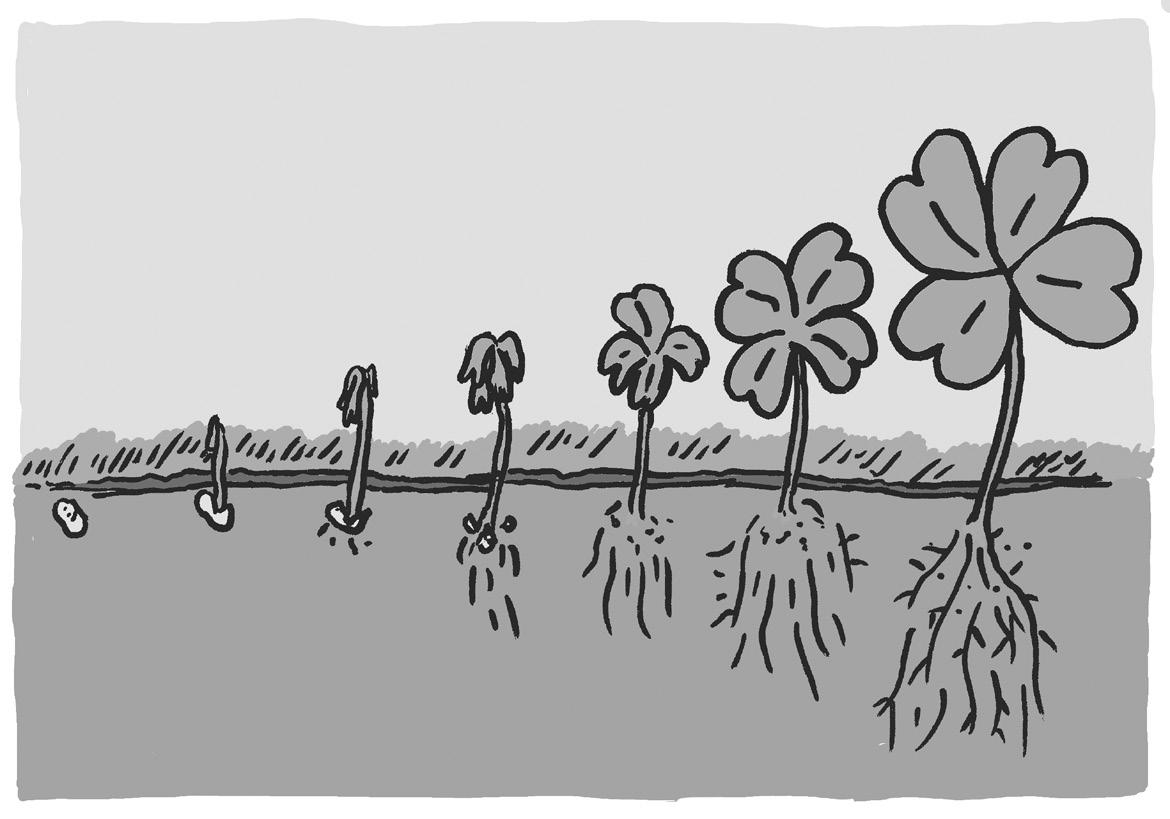
He would prefer a rock than a pack, of clover cigarettes.
Even if the clover cigarettes are from China, keep them. And don’t bring them up.
Party line: “...and If it was just a single protein strand in your DNA, what would it be?”
Effects of Habit note:
So he’s using a lexicon which is when a school has its own dictionary. So when he says “aboriginal” he’s not exactly talking about the peoples of America. He’s using the word “aboriginal” in his own original way as a guy who believes chickens taste better fresh.
When-ever someone uses a lexicon, it’s usually a good idea to not pretend like you don’t know what they’re saying. Get it?
I can see why the actor who played Darwin also played Chaucer, what was the actor’s name?
(Oh yeah, Paul Bettany!)
But I’m only upset by the idea that he didn’t end the section, heading with, a preposition. It would have been so much better. Although, it’s nice we didn’t all starve to death... Chicks-lexicon!
(Remembering my sister’s copy of GIRL TALK by L.E. Blair.)
Characters of Domestic Varieties note:
Verging on verses he adamantly goes to say “it has been difficult” for everyone but we did it. We domesticated dogs and that is a cause for celebration.
The last word of the section is a clear sound: manifest. It’s like saying or declaring victory for all the world to hear, his love for dogs and how far dogs have come.
Once the hate passes these strong words begin to sound vivacious, he was excited to tell everyone the good news.
He jests without mockery and this reader is coming along, having a sense of humour wallops here’
He had a farm:
Dear Mister MacDonald,
How much would it cost for you to raise a chicken especially for me? I want you to feed the chicken lots of butter, flour, herbs, and also spices. And talk to the chicken, making sure to be nice. You might even take the chicken out for a walk in the park some days. Then, with all that, tenderness, the chicken will be nice and tight, so plump and juicy! I want to cook and eat a nice, tight, fresh chicken like that! So how much for one of those super food poultries? Can you quote me a price? By the way, I want to come to your farm and pick which one I want, it might take a couple of visits to choose but I want to know what I’m eating. When I’m at your farm, maybe you could hold the camera and take a picture of me beside the big chicken, kind of like a sly used car salesman.
Love, Pherlan
Aside:
I thought I already knew a lot about Charles Darwin, thought even that it might be easy...
But my regard for him has changed from genius to proclaim-er.
And the word “transform” got to be very singular -And the comic books I grew to love get on touchingly.
I wanted to know if I was right; that survival had little to do with selfishness but unity.
I don’t want more anymore just a classmate who will study and transform with me.
Is it you, my age, no longer upset?
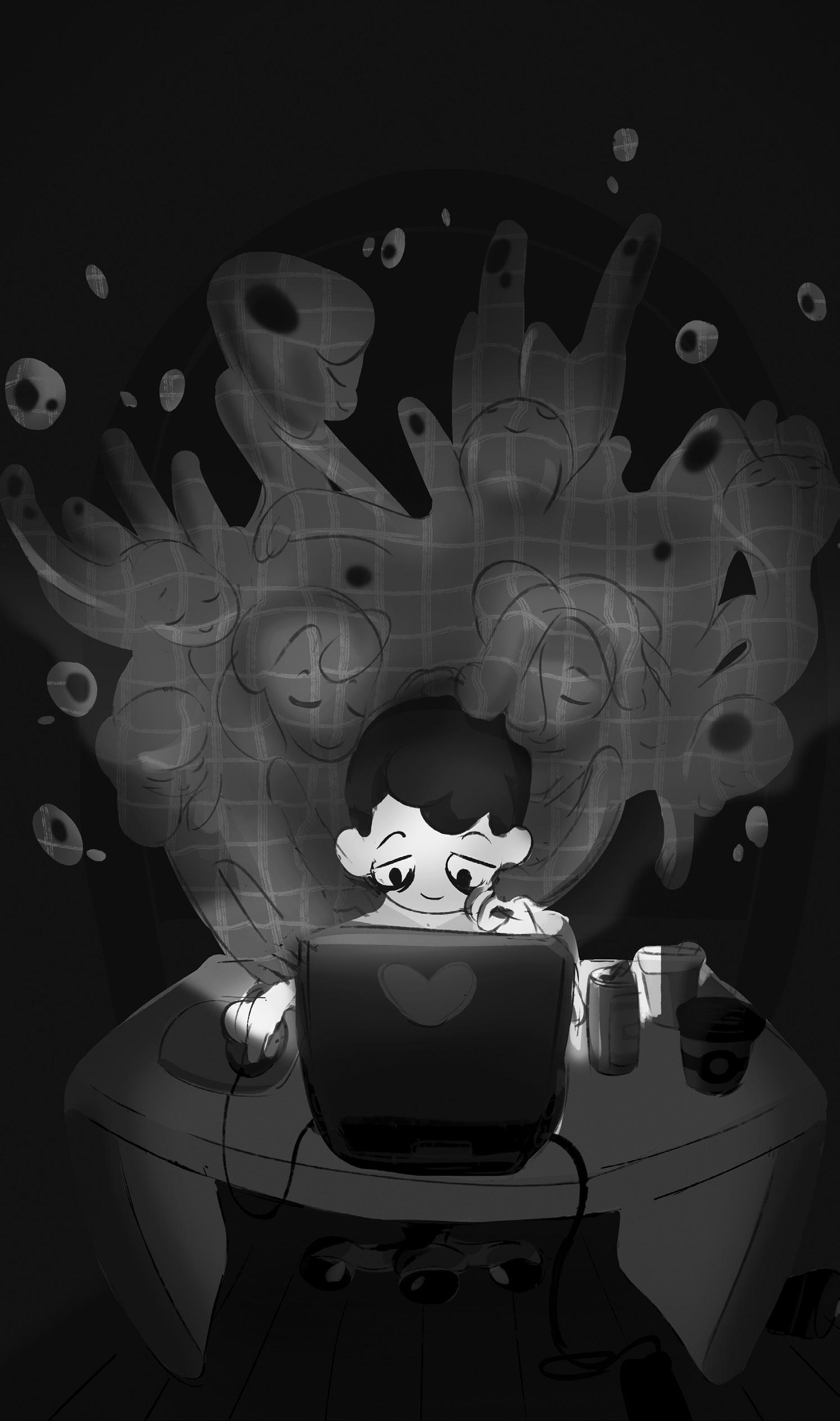
GRAPHIC BY KELLY CAMPBELL
Features Editor: Dana Hatherly
Reconnecting
TRAVIS T.
It has been a while since I have seen my uncle. I’m hesitant to contact him because I feel less respectable, less worthy of his time. But I also feel forced to reconnect because I have no other way to reconcile the damage that I’ve caused.
And so this is where I stand in my life – by a phone. A payphone. Looking up for strength before looking down to search out my uncle’s number in a large, white phonebook, convincing myself, eventually, to give in to the patter of my mind: just do it! Just fuckin’ do it! Quit being weak!
But then I consider how easily I could stretch this loose change a long ways. I could take this dollar seventy-five in quarters, dimes, and nickels to the VLTs, double up to five bucks, and then call up buddy to go halves with me on a—
I rub a quarter with a nervous, clammy, oxygendeficient thumb and forefinger. And then I “just fuckin’ do it.” The quarter clinking its way around in the slot before bottom banking on the others in this device. I begin dialing, moving slow making sure to get the numbers right. The ringing begins. I’m fretting. I’m frozen. Two rings in and I motion to slam the phone, but then I hear my uncle’s direct voice holler and echo in this halfbooth —
“Hello!” he answers, hell- emphasized, with a snapping closed o, as if the word were less than a word. I cringe, but I react soon after with a hesitant, “Uh, hey. Uncle… It’s me.”
“Me who?”
“Jack – uh – Jackson.”
His tone and phonic flow level out together from here on out. The conversation is short and then it’s over. I’m feeling better – bigger. Proud of this trivial achievement, this progress, for it is a testament to the person that I think I am becoming. Baby steps, I tell myself, goofily, in glee. And then I get my act together and race over to his place in my mother’s lemon.
Here, there is never much talk. I just show up in a car once in a while and it becomes the center of attention, relieving most of the social inadequacies that we compile together as one. We work for hours on cars, me as his gopher – go-fer this, go-fer that – his helper, at his service. I never really learn much; we’re both just grateful for the company.
I begin to notice this time, however, that his
mechanical work is much like the work of a doctor. He begins his assessment by attempting to diagnose the problem through questioning. Then he checks the vitals: he checks the fluids with his dipstick-like swabs, and with his light flashing into greasy orifices; he checks the Engine Control Unit (ECU), its blood pressure (BP) perhaps, with a little machine that plugs in under the steering wheel to reveal a numeric code linked to the Christmas-lit dashboard and all of its sensory Service Engine warnings; and then he engages his acute ears, his natural stethoscope, listening for any extraneous rattles over the “purr” of the engine as he starts, revs, and then test drives it, the car, correlating and disconfirming sounds to and from the hypothesized diagnosis in his mind that he has not yet revealed.
I think he conjectures that the car is shorting out somewhere, thus causing it to stall inconveniently in intersections and whatnot – leaving my little agoraphobic guardian scared and alone in the chaos of traffic, wanting nothing but to just get home, to be alone in solace, in her basement with her smokes and her wildflowers and her downtime. I can tell that he is thinking that it’s a short by the way that he is folding back the different layers of the car’s wires (as if his tools are his surgical instruments slicing through protective coverings – tissues, fascia, fatty myelin sheaths). A ground must be feeding power to another wire where it shouldn’t be, somewhere in its peripheral nervous system, wreaking havoc in the junction box, it’s central nervous system.
Yup, it’s weak nerves, I confirm. I’ve driven the car too hard and fried its circuitry as a result. All the tension applied by the pressure of my foot has resulted in the vehicle’s burnout, and so the dirt-encrusted filaments need to be rewired, redirected, in order to correct the malfunctioning altered motor recruitment patterns that the vehicle is exhibiting.
I watch him; he thinks hard, seemingly searching out the root of this problem – he knows I’m to blame, but he doesn’t say anything. He’s quiet, rubbing his stubbly chin, which is disproportionately loud in the still air of his garage. I imagine that he is ruling out a checklist of possibilities in my defense: a) it’s not a weak stomach nor its colons – the fuel tank or the exhaust; b) it’s not a weak heart nor is it the SA node or the Purkinje fibers – the engine or its alternator; c) it’s not a damaged endocrine system – the battery’s juices... etcetera, etc.
He is able to check that the battery is healthy with his little car battery load tester device, similar to the bioelectrical impedance device that measures fat percentage, knowing that this car, this patient, is old, with lots off abused miles fueled using cheap, simple, unleaded calories that burn unforgivingly, leaving rusty, fatty deposits in and around the places that help it, and us, tick; too, he gets the resting heart rate (HR) from this device, I assume, for it is much like a finger pulse monitor revealing HRs in volts, not beats per minute – Should he not have done this first, when he was checking the vitals?
He falters not, I rebuke. Just a natural hiccup, a habit not seen as negative in an already imperfect world it just is. And so he continues on. It’s the car’s motor recruitment patterns that are all wrong, again, that I have altered and burned through the careless misuse of its mechanics. He asks for tools as he crawls under the car and extracts its wires, its nerves, bit by bit, from the engine all the way to rear brake lights.
He scalpels, snips, and splices pieces here and there, then re-covers each mended bit in new plastic flesh, heating it up with his heat gun, and voila, I think he thinks. “That should do it!” he says.
But he’s duped and so he continues on down the nerves of the car, continually revealing bits here and there that are problematic, problems of which he declares to be the actual problem until he realizes again that the problem persists.
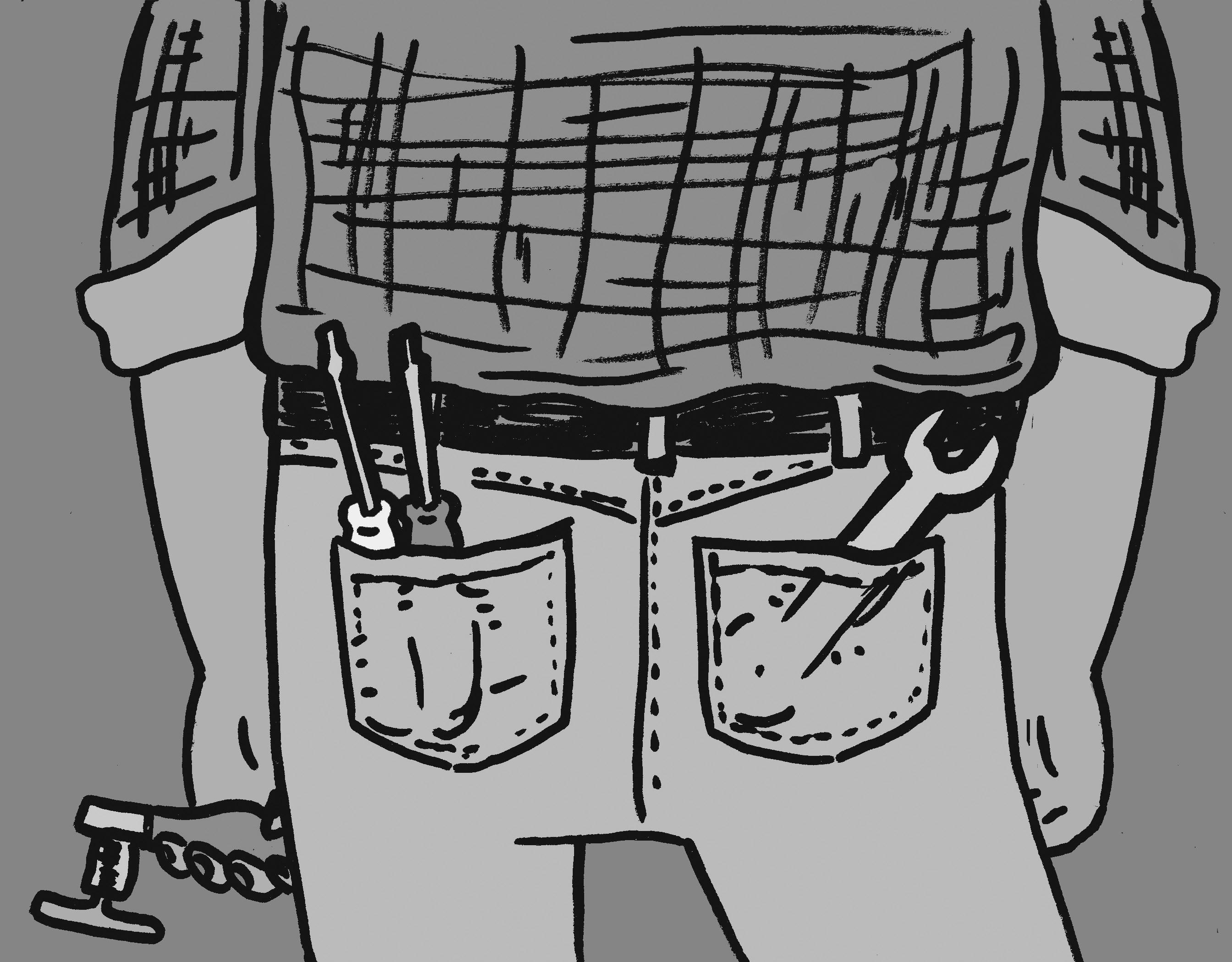
Still, he just scratches his stubble and furrows his brow before trying again and again. Placid, he shows only mild irritation from time to time, usually only when he hurts himself, or when his wife asks him a question, or when a tool goes missing. “It was just right here!” he’ll say about the tool from beneath the car, and then a minute later, after we pace around looking for it, I will notice that it is in his back pocket, stuck to his ass, right where he left it; other times it stays missing until he doesn’t need it anymore, put down somewhere unconsciously in a place so asinine – the fridge, for instance – that he feels slightly embarrassed into taking another sip of his beer to calm his own overworked nerves.
After each sip, he says something quirky – for instance: “If only cars could be serviced with a beer!” – which is a sign, I think, that he feels his drinking is frowned upon, not because he’s a drunk or anything, but, rather, because it’s booze and it’s Canada, a different drinking climate than he’s used to. Growing up in the Azores, alcohol was pretty much cheaper and safer to drink than water, and so it was, in a sense, their soda, their cultural beverage of choice. My effete, millennial thinking concludes that his post-sip quirks are simply his paternal understandings re the stigma of the absentee sipper.
He continues slicing open myelin sheaths and snipping out burned and frayed wires, re-splicing them as he goes. We continue on until he has solved the problem
he more satisfied than I, more proud, knowing full well that it is better to give than to receive. I feel that our connection is reestablished now. Without any awkward mentioning of my recent disappearance, either, or of his sister, my mother, that refuses to speak to any of her family, including him, regardless of all of his goodness toward her.
There was, however, a slightly animated grunt of acknowledgement – You’re alive!? – during that brief phonic transmission preceding this encounter, a signal that he may have wondered whether or not I was alright during my time away – perhaps, it could be said, this grunt was a shock of disappointment, but for some reason or other I recognized this grunt as regard. I leave feeling loved. Cared for — reconnected.
GRAPHIC BY KELLY CAMPBELL
Pilaka Colaka
ARDEN RAAEN
The bar is packed. Everyone laughs while they nurse their beers and down their shots. The bartender is on duty, attending only to the drink orders slurred towards his general direction. People spit. People spill. No throw up yet.
It isn’t yet midnight. Still, too late to be stuck here alone. “Let’s just leave,” my hands keep saying. The nerve of some people makes you nervous. But it’s just the body, not the mind. The mind has to focus on only one thing.
I walk up to the bar, waiting for people to move. It’s a queue with no line. How could anyone handle it?
Not properly, I suppose
It’s my turn. Let’s just leave – “What are you getting?”
The bartender is brusque, matching his expression. Heavy, but more fat than muscle. We know each other, but he still wears the smile of a slave. His look is very much expected.
“I’ll get a –”
“Lemme guess, pilaka colaka?”
“Yes. Pilaka colaka, virgin. Please.” Please leave.
The bartender is unhappy. He spits with force, unlike anyone else. Doesn’t matter. He sets a blender on the counter and scoops some ice, pouring it in with pineapple juice and something else. The blender, barely audible, revs up, crushes the ice, then stops. The drink is poured, sloshing around in an odd-shaped glass, then topped with a cherry. I hate cherries.
The bartender hands the drink over. “That’s $7.” “Here’s $10. Thanks.” I walk away.

There’s an empty seat in the back corner of the bar, well away from the crowd but not the noise. I sit, against my will. All I can think of is the bartender, and my friend who hasn’t shown up.
Where is that bainchod? He was supposed to be here a half hour ago
I drink the colaka. It tastes excellent. At least the bartender is good for something.
I stop drinking and look up. “Hey hey hey, what took you?”
“Polish. Amake thamte holo jate polish amare pich na ashe.”
My friend stands there. He looks like he’s hiding drugs. Or maybe it’s all the drugs around him. His hands are clenched tight in the pockets of his black sweater, matching his black sweatpants. I know what’s bothering him.
“Ingreji, Mohan.” It’s less suspicious.
“Right, right.”
“And of course the cops are going to follow you, you’re wearing all black. Did you tint your car windows, too?”
Mohan disapproves.
He’s about to sit down, but I get up. I’m done with my drink, anyway.
“You wanna leave?”
“Of course, buddy.”
The bar is no longer inaudible. It’s probably time for people to start throwing up. I gag a little, remembering once walking up to a bathroom urinal and finding chunks spewed half in the drain, half on the floor. Please, let’s just leave.
I exit through the front doors, Mohan following closely. We walk down the street. No one follows us. I look behind me; Mohan’s eyes dart each and every way. The streetlights and his stress are too apparent.
“It’s OK, buddy. It’s karma.”
“You sure?”
“Yes, you’ve heard what’s happened. Let’s go down a quieter street, where it’s not so bright.”
We walk for a couple blocks, silent and unseen.
After ten minutes I stop, right in front of a smaller rundown house. The paint is peeling, the roof is stained brown. Unmistakable.
At least there’s a tree on the lawn. That’s nice.
“This is the place.”
“Right, right.” Mohan looks around, surprised. “It looks like karma has already been here.”
“Haha. You know, you’re funny when you’re not pissing your pants.”
“What can I say?”
“That this is worth it.”
His mood reverts. He is silent for a moment, eyes fixed on the house.
“Why?”
“Because we have to stand up for ourselves. The shit we’ve been through? We weren’t denied to live here, and we shouldn’t be treated like it.”
“Right, right,” Mohan says. “How long do we wait?”
“An hour.”
We wait. We stay away from the streetlights, keeping to the sidewalk opposite the house. No one walks near us, but there’s no need to be diligent because we’re invisible in other ways.
The hour goes by, and my body tenses. I keep shaking, my heart offbeat, but I stay quiet when a dark car pulls onto the block. We hide behind a large tree. The car drives close to us, and parks. After a couple minutes, a man exits the vehicle. He looks around, suspicious, then locks the car door. He walks to the front door, opening and closing it abruptly. I watch as the living room light turns on, then off again with footsteps slugging upstairs. A light turns on upstairs, and a shadow covers the ceiling.
“Let’s get closer.”
Mohan follows me. We cross the street. I keep watch. Satisfied, we crouch by the tree on the man’s front yard. The shadow paces back and forth, the light staying on.
Mohan taps my shoulder. His hands are shaking.
“When?”
“When the lights are off.”
The shadow disappears. It morphs into a man who looks out his window, before closing the blinds. The lights go off, and our hands warn us it’s our last chance to leave.
“Let’s go.”
I sneak back to the street, looking for a rock by the side of the curb. I find one and walk back towards the house, tossing the rock in the air a couple times, just to gauge its weight. Mohan disapproves.
“On my mark, buddy.”
I position myself on the lawn. The grass is freshly cut, perfect for a game of cricket. I breathe in, enjoying the moment. I only hope I don’t bowl the rock right into the ground.
“3, 2, 1, . . .”
I throw the rock. The upstairs window shatters, pieces of glass falling onto the lawn. I hear a yell, followed by heavy footsteps. The living room light doesn’t even turn on when the front door swings open. OK, we have to leave.
“Now, now, now!”
Mohan, hands in his pocket, pulls out a firecracker and lights it. Like a grenade, he aims for the man’s feet. It explodes, and I hear another yell. “Go, go, go!”
Mohan sprints, I’m not even sure which way. I try to follow, crossing a street into a backline. Sirens are off in the distance; Mohan hops a backyard fence. We stop, hide behind the fence, and hear a police car drive past. I can tell it turns onto the bartender’s street, and I know we have to keep running. Mohan agrees. We book it, sticking to the backyards, hopping fences until we’re a safe distance from the scene.
We reach a street where bright lights shine. I walk to a streetlight. It’s right by the bar. I collapse.
“Are you OK?”
“Better than ever.” I am finally liberated, and I laugh.
Mohan sits beside me. “I get it, I really do. But should we have done that?” He’s no longer shaking.
“Why not?”
“It gives him more reason to hate us.”
I understand Mohan, so I think before I reply. “No, it gives him more reason not to fuck with us. I work with him. He knows me, so he probably knows we were at his place. But he can’t do anything. If he blames us, I’ll blame him. What’s worse: broken glass, or a hate crime?
“Look, Mohan. You won’t get in trouble, if that’s what you’re worried about. He’s not even tough, and he doesn’t even know you. If you saw how he treats people like us, and, shit, how he acts, I think you would completely understand. This is karma. I’m just showing him what everyone thinks about him. Because he lives here, he thinks he’s a good person. But because he was born here, he thinks he’s better than us.”
Mohan sits still, internalizing. He stares for a while, then nods his head.
“So. He’s really that bad.”
“Mohan,” I said. “O ekta bainchod.”
“Ingreji, buddy. You speak it just fine.”
“Haha, Ingreji. Right, right.”
I pause, anger surfacing. Then, words come to me.
“Pilaka colaka? What a fucking racist.”
GRAPHIC BY JONDELL COOMBS

Notes from the Star Field
Preparing for UNISPACE +50
CHANTELLE DUBOIS, STAFF
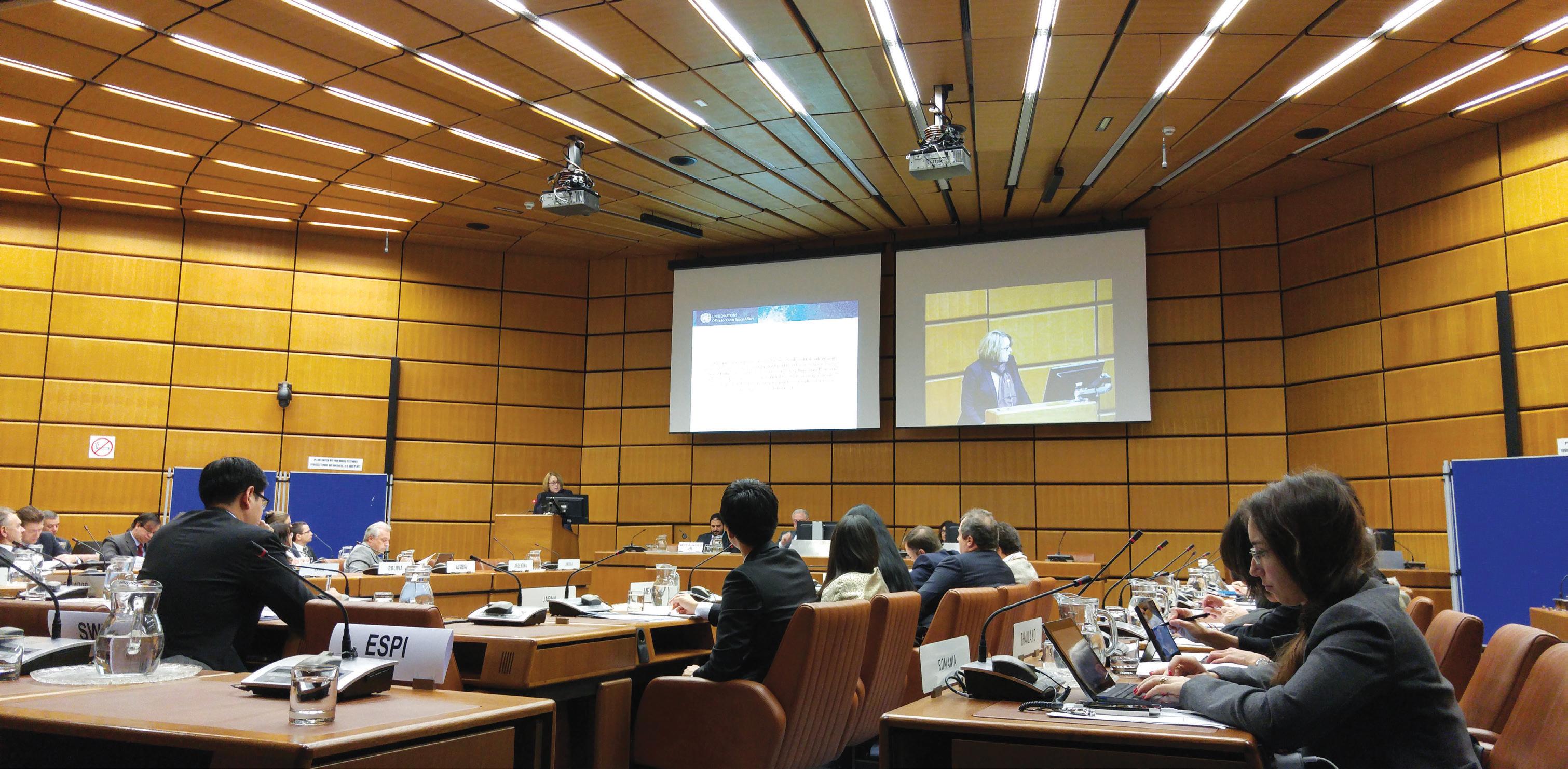
On Nov. 19 I attended one of several planned high-level preparatory meetings in anticipation of UNISPACE +50 to be held in 2018. The UNISPACE conferences are organized by the United Nations Committee on Peaceful Uses of Outer Space (UNCOPUOS), with the intent of bringing nations together to collaborate and discuss the benefits and potential of space technology with respect to socioeconomic development.
UNISPACE began as a three-part conference series, all held in Vienna: UNISPACE I in 1968, UNISPACE II in 1982, and UNISPACE III in 1999. In 2004, UNISPACE III+5 was held to review the results of the recommendations from the previous UNISPACE conference.
The focus of each UNISPACE conference is very indicative of the era they were held in.
In 1968, the focus was on how to use the benefits of space for all of humankind, how to benefit developing countries, and international cooperation. These three points would remain part of the UNISPACE discussion in the future.
In 1982, maintaining the peaceful use of outer space and preventing an arms race were two of the main focuses.
In 1999, the focus shifted more towards protecting the Earth’s environment, space environment, and natural resources.
The Space Generation Advisory Council (SGAC), the organization I am interning with, was created during UNISPACE III as a means to engage youth in space activities and provide their perspective on current space issues.
The SGAC holds an annual
event called the Space Generation Congress, which is meant to be an opportunity for students and young professionals to discuss topical space issues and have the results of these discussions reported to the United Nations. This serves as an opportunity for them to learn about the current state of the space sector, and to give the United Nations the input of the youth in the sector.
The focus of each UNISPACE conference is very indicative of the era they were held in
UNISPACE +50 will mark the 50th year since the first UNISPACE conference, and will be another opportunity to review the outcomes of the previous conferences and to once again open the discussion on current and future developments in the space sector. Since UNISPACE III+5 in 2004, a lot has changed in the space industry.
I attended the meeting as part of the SGAC delegation. The SGAC was granted permanent observer status in 2001 with UNCOPUOS, affording them the privilege to attend all of the committee’s meetings.
However, unlike member states, permanent observers generally are not permitted to contribute to a discussion unless called upon, do not have voting power, and cannot propose resolutions.
The SGAC gives statements at three of the UNCOPUOS annual meetings: the general assembly,
the legal subcommittee, and the science and technical subcommittee meetings. These reports summarize the recommendations and results from the annual Space Generation Congress, the activities of the SGAC’s project groups, and other updates on the progress of the organization.
The preparatory meeting was focused around the four pillars of space as a driver for sustainable development: economy, society, accessibility, and diplomacy. Each pillar had one or two speakers and a moderator.
Among the speakers were representatives from the United Arab Emirates Space Agency, the European Global Navigation Satellite Systems Agency, Eurisy, the European Space Agency, Sierra Nevada Corporation, McGill University’s Institute of Air and Space Law, and the International Committee on Global Navigation Satellite Systems.
The meeting was opened by a presentation by the director of the United Nations Office of Outer Space Affairs, Simonetta Di Pippo. She explained the four pillars of the meeting and their context.
The United Nations has 17 sustainable development goals. One of these goals is revitalizing global partnership for sustainable development, joining governments, civil society, and the private sector to strive for sustainable development.
The space sector is a perfect platform for this, with government agencies, commercial entities, and private individuals now all participating in space activities. There is a potential for space to be a means of socioeconomic sustainability, and the four pillars focus on how that is possible.
Most presentations seemed to repeat information I had already heard before in some form or another. They seemed to be mostly updates on current issues or activities. The biggest issues seem to be the lagging of space law, policy, with respect to technology, and ensuring equal access to space.
Even
just using satellite data, a country can monitor food resources, study climate change, or respond to disasters
One concept that was new to me was that equal access to space does not mean physical access alone. Access to space also includes access to data obtained from space technology, which can still be incredibly useful for nations which do not have their own satellites or launching capabilities. Even just using satellite data, a country can monitor food resources, study climate change, or respond to disasters.
Only a week before this meeting was held, the U.S. Senate passed the 2015 Spurring Private Aerospace Competitiveness and Entrepreneurship Act (SPACE Act), with one of its more interesting segments being the granting of rights to celestially mined resources to its citizens. The topic came up many times during the meeting, with one delegate comparing the reception of space mining to how remote sensing was perceived.
Remote sensing was originally a technology used for reconnaissance missions, and when the technology moved from military to commercial use, there was some resistance and a lot of concern over potential misuse. However, remote sensing is one of the most beneficial space activities today. I found it to be an interesting comparison, and it really made me look at the SPACE Act a little differently. I really appreciated the optimistic comparison.
Having only read about UNCOPUOS meetings before, it was interesting to see one in action. I was told this meeting was less formal than a typical UN meeting, as it invited a lot more open discussion and questions among member states. Overall, the mood seemed positive.
The next high-level preparatory meeting is scheduled to be held in mid-November 2016 in Dubai.
Although it is still quite a few years away, I look forward to UNISPACE +50 in 2018. It’s hard to say if I’ll be able to attend, but it will be a great opportunity to show how much the SGAC has grown since its inception. I feel as though the SGAC has certainly achieved its purpose.
It is also certainly very nice to see cooperation remains important among nations when it comes to using the benefits of space for humankind.
Chantelle Dubois is currently interning with the Space Generation Advisory Council in Vienna, and will be writing about her experiences in the Notes from the Star Field series for the Manitoban.
PHOTO BY CHANTELLE DUBOIS
Dementia Hack
Toronto event focuses on technology-based solutions for patients with dementia
CHANTELLE DUBOIS, STAFF
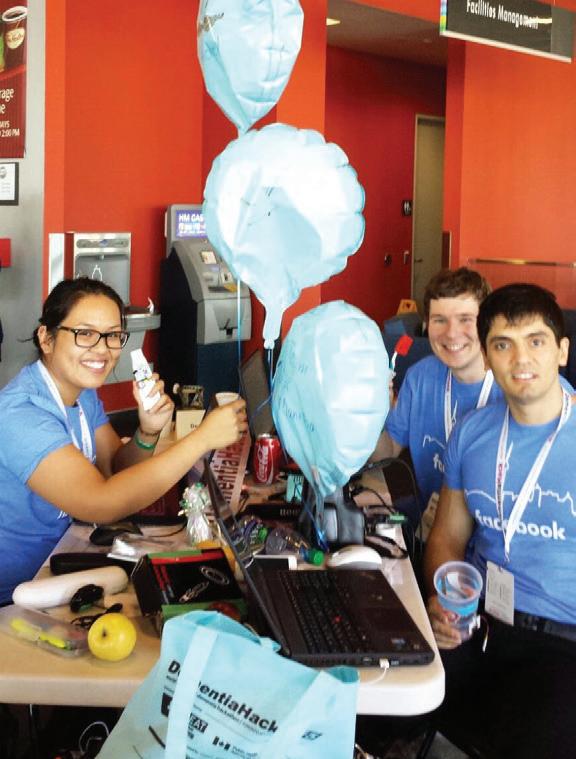
This November, three graduate students from the department of electrical and computer engineering attended Dementia Hack in Toronto, focusing on technology-based solutions for patients with dementia.
For those unfamiliar with the concept, hackathons are usually 24- to 72-hour events where programmers and inventors work together in selfassembled teams to develop techbased solutions to problems.
Sometimes non-technical participants are also invited to provide other necessary disciplines to solve a problem. An example would be Hacking Health, which partners health caregivers with developers to come up with tech-based solutions to health problems.
Hackathons can cover a wide range of themes including general healthcare, humanitarian efforts, and
space exploration.
Ahmad Byagowi, Paul White, and Cassandra Aldaba were sponsored by the U of M Biomedical Engineering lab to attend.
The hackathon had four categories for submissions: solutions for a diagnosed individual, family caregiver, clinician, and researcher.
The U of M team selected to develop a solution for a diagnosed individual, and focused on developing a method to help enable patients to brush their teeth.
“People with dementia have a hard time following a sequence and they forget [what they are doing] quite often”, Byagowi explains.
Their project involves the use of a device called the ArduIMU V4, which Byagowi and White helped developed.
The small device has various sen-


sors which can track the position of the user’s toothbrush, toothpaste, and glass, and helps them keep track of what they are doing, while providing feedback on the next step in the task.
This project could also help a patient with dementia complete other similar tasks.
This project was selected based on some of the team members’ own personal experiences with the struggles of individuals with dementia.
While the team did not win in their category, they found the experience to be valuable.
“It was very interesting to see how the group came up with the idea, and [to see that idea] turned to a real prototype,” Byagowi told the Manitoban
The winning projects include an app to help individuals with dementia to navigate and travel independently, an application for a family caregiver
to track dementia-related behavior to help them manage and understand it, an app which provides a caregiver with personal care information for patients, and a care management system for researchers to collect big data.
Runner-up projects include an interpersonal video feed for constant communication between family and patients, a home monitoring system to track a patient, and a bubble pack which indicates to caregivers if a patient has taken their medication.
The U of M team worked with Zahra Moussavi, who holds the Canada Research Chair in biomedical engineering and serves as director of the biomedical engineering program. Her work primarily focuses on detecting early signs of Alzheimer’s using virtual environments that patients use to navigate inside a house.
Moussavi’s work was inspired by
her mother’s diagnosis of Alzheimer’s, turning the course of her career. Her hope is to one day open a centre for healthy brain aging.


PHOTO BY AHMAD BYAGOWI



COMIC BY SARAH WALKER
COMIC BY ANTHONY LABONTE
COMIC BY SARI HABILUK
IVORY BUFFALO
Student association petitions university for mandatory major in indigenous studies
Proposal would add only two years to undergraduate degrees
MURV BERKLEY, STAFF
The University of Manitoba Students’ Association (UMSA) is calling on the university senate to pass a motion that would make a major in native studies a requirement for graduation.
The motion would require completion of 60 credit hours’ worth of courses taken through the department of native studies, on top of their normal faculty-specific requirements, before any student can receive
their diploma.
Normally an undergraduate degree would take a minimum of three years to complete but because the major is being added to another degree, electives and any other graduation requirements should already be covered. As such, the student union argues the additional courses could be completed in as little as two years.
The change would take effect for any

students starting at the university in or after the 2016-17 academic year.
UMSA president Calvin Bergeron said the decision to push for the change came after student leaders assembled for a comprehensive weekend seminar covering the history of the relationship between First Nations communities and European settlers.
“This is literally this least we could do,” said Bergeron.
UMSA’s aboriginal representative Bill
by the scale of the
when he first saw it.
“It’s OK, I’m not opposed to it or anything. But honestly, we were just asking for the one course,” said Lamonte.

Lamonte told the Ivory Buffalo he was taken aback
motion

Arts & Culture
Arts
Sex in the city
An informative introduction to Winnipeg’s sex shops
SEAMUS HAMILTON-PATTISON, STAFF
Adult stores have been around for ages, but whether through apprehension or simply the feeling of not knowing how or where to start, it’s not uncommon to find oneself over the legal age, never having set foot in one of these places.
Until last week, I was part of that demographic. It was in the hope of educating myself (and hopefully some of you, dear readers) that I chose to dive face-first into Winnipeg’s sex shops and tour three local establishments: Osborne Village’s Smitten, the St. James St. location of Adam & Eve, and Taylor Ave.’s Love Nest.
What I found in each was a positive, welcoming atmosphere with both staff and management dedicated to providing customers with a fun yet educational environment to explore their sexual preferences.
According to Cheryl DePaulo, manager of Smitten, an increasing number of people are beginning to realize this.
“Everything’s a lot more mainstream,” DePaulo told the Manitoban
“You’ve got TV shows that are talking about toys and advertising them, which has people coming into the store that normally wouldn’t.”
Linda Zuzanski, president of the Love Nest, cited registered nurse, media personality, and sex educator
Sue Johanson as an early driving force behind growing sexual education and awareness in Canada.
“She was the woman who started the birth control pill movement back in the 70s in Toronto,” said Zuzanki.
“She got known all across Canada and the universities as a sex educator. She started a radio show back in the
80s [Sunday Night Sex Show]. We’d have customers come in on a Monday or Tuesday morning and say to us ‘do you have that toy that Sue talked about last night?’”
Each establishment displayed an acute awareness of the need to acclimatize newcomers to their line of products. According to Adam & Eve sales associate Joanne Byra, this was exemplified by the very layout of their store.
“The lingerie’s first, then your lotions and lubricants, then your smaller toys that, like [fellow sales associate] Tracy said, don’t look like big phallic penises. If people are shy, they don’t have to go past that point. They can stay up here,” said Byra.
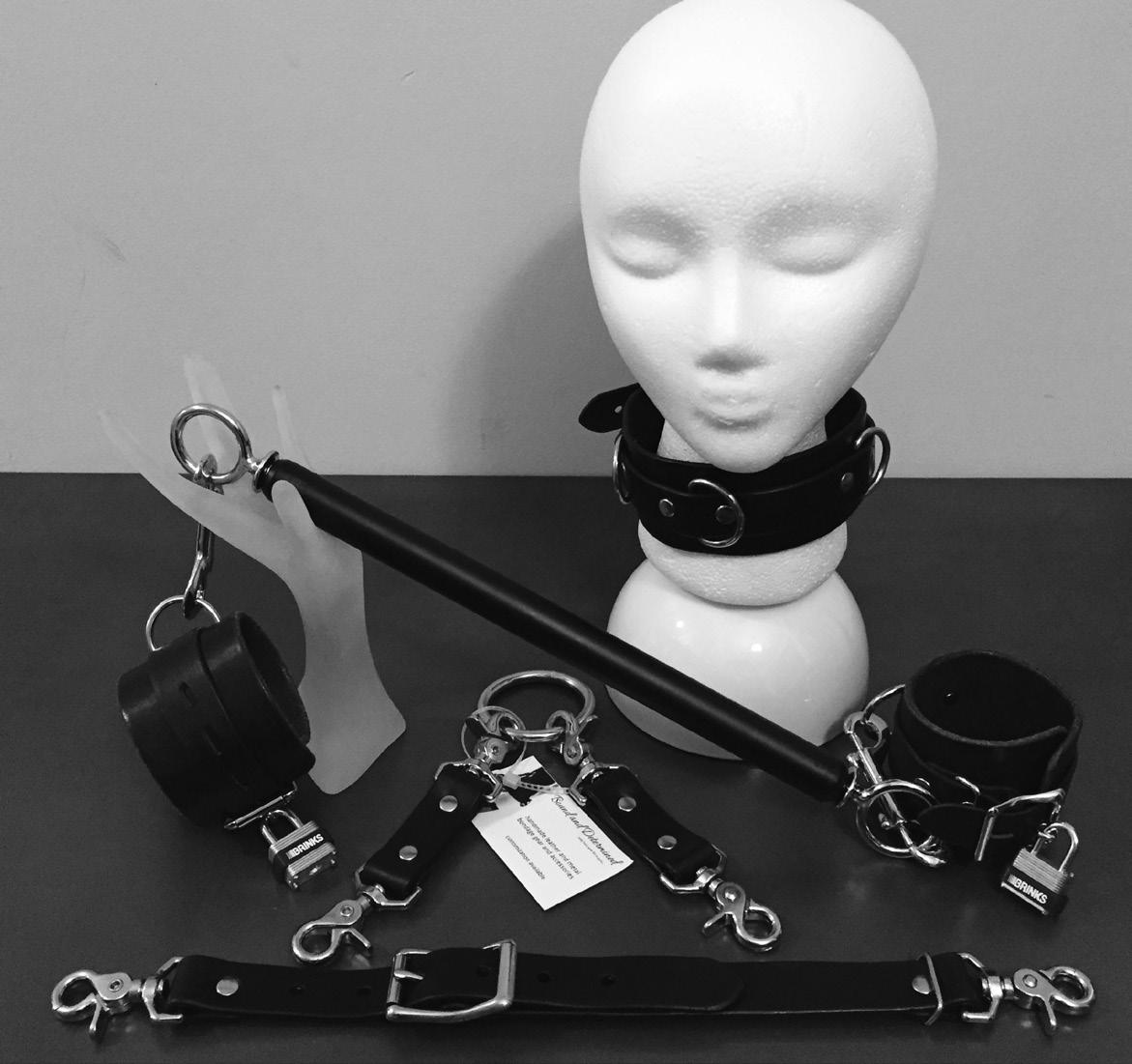
With slight variation, each shop was laid out in this manner. From the entrance of each location, I could see the aforementioned “accessible” sex items displayed in plain sight. Upon venturing further into the store, sensual lotions and lingerie would be gradually replaced by larger, realistic dildos and vibrators, as well as fetishspecific sections (like the wall dedicated to BDSM/bondage gear that could be found in each shop).
A positive demeanour and tactical layout was shared by all three locations, but my sources at Smitten, the Love Nest, and Adam & Eve each spotlighted a different focus or specialization of their shop.
According to DePaulo, Smitten prides itself on its support of Winnipeg’s LGBTTQ* community, dedicating a kiosk to rainbow flag-emblazoned items year-round. DePaulo also stated Smitten is the only shop in Winnipeg that consistently carries merchandise specifically geared to transgender individuals.
This includes, but was certainly not limited to, packing dildos designed for “comfortable, all-day wear.”
DePaulo also stated the importance of education to Smitten, pointing out an entire wall displaying free pamphlets, with titles ranging from “Choosing a vibrator” to “Sexual Intimacy and Aging” to “Sex Toy Care” to “Finding the Female G-Spot.”
“We have a lot of training in sexual education. We’re here more to help than just sell” –Tracy Chlopecki, sales associate, Adam & Eve
Zuzanski also cited education as an imperative aspect of Love Nest, pointing out a stand near the front of the store that displays a variety of documents pertaining to the health benefits of masturbation, the power exchange and lifestyle employed in role play and BDSM, among many other topics. The stand also included business cards for drop-in health clinics, as well as copies of Outwords, a free magazine for the LGBTTQ* community and its allies.
Another Adam & Eve sales associate, Tracy Chlopecki, cited the store’s emphasis on sexual education, as well as the store’s self-identification as a sex “boutique,” rather than a shop.
“We have a lot of training in sexual
education. We’re here more to help than just sell,” Chlopecki said.
“We’ve had a few seminars, we’ve had them on the female orgasm, knowing yourself. Last year, we had one for Fifty Shades of Grey on Valentine’s Day on rope-tying, the right way of doing it. Our next one starts December 3rd and that’s on percussion play [...] it’s like, the floggers [whips] and the proper ways to use them safely, how to bring them into the relationship. We want people to be safe before just buying it and trying it.”
The erotic drama Fifty Shades of Grey, in both novel and movie form, has gained pop culture infamy for not only its writing – one critic called it “a sad joke” – but an inaccurate portrayal of the relationship that occurs within BDSM practices.
However, Chlopecki told the Manitoban she believes there’s a silver lining to Fifty Shades of Grey
“More people are more interested to get to know the real, behind Fifty Shades story. That’s why we do seminars on the proper ways, the safe ways,” she said.
“I think Fifty Shades did open a lot of eyes. It’s not just behind locked doors. It had bad ways of doing it, but it did make people want to be more educated.”
Regardless of the particular, defining aspects of each shop, all staff and management expressed a genuine, profound enjoyment of the business.
“It’s a fantastic job,” said DePaulo, who has been working in sex shops and boutiques for 10 years.
“You get up looking forward to going to work in the morning [...] You never know what a day of work is going to hold in this type of industry. It’s a lot of fun, I get to talk about sex all day.”
Zuzanski, who has been in the sex shop business for 28 years, agreed wholeheartedly.
“It’s fun helping people. Everybody that comes in here is happy, or sad because maybe their body parts aren’t working 100 per cent. So, because it’s this kind of environment, it’s fun to help them.”
“I’ve loved lingerie since I probably shouldn’t have,” said Byra, also a 10-year veteran of the business.
“Once you get a taste of this industry, once I realized how comfortable I was and how comfortable I make customers feel, you can’t put a price tag on that. I don’t care if they spend $5. When they tell you they drove out of their way to come and see you because of the service they receive, that is the biggest bonus ever.”
For more information about the stores in this article, please visit www.adamevewinnipeg. com, www.areyousmitten.com, or www.lovenestonline.com.
PHOTO PROVIDED BY BOUND & DETERMINED
Promising the moon
Local prog-rockers Moon Tan set to release new cover song, embark on winter tour
OLIVIA MICHALCZUK, STAFF
Winnipeg progressive funk/ rock trio Moon Tan looks like they’re from another planet and sounds like they were plucked from a hidden gem in your dad’s vinyl collection.
The trio parades their tight pants and long, flowing hair that, by midshow, is stuck by sweat to face paint representing three separate moon phases. Beams of light bounce off their “moon goggles” as they play powerful rock songs from their latest album New Age Renegade
In the words of vocalist/bassist Adrian Dyer, “your body, mind, soul, and loins will explode with ecstasy.”
The band was conceived by drummer Nicholas Kula in the hopes of creating a cover band. Through word of mouth, Dyer and guitarist Brady Mitchell fell into place.
The three decided that original music would be the way to go, and after fruitless Kijiji ad attempts to find a frontman and vocalist, Dyer assumed the roles himself.
Moon Tan released New Age Renegade earlier this year and the reaction has been positive, landing them gigs at shows and festivals across the province.
“People really dig it. It adds a different dimension to our songs,” said
Dyer of the band’s latest release.
“At a live performance, people unconsciously have to decide which sense to be captivated by: visual or auditory. The album gives listeners a chance to catch any tasty licks they may have missed at the show due to overstimulation or inebriation.”
Moon Tan’s live performance is enhanced with an appearance that is especially unique in Winnipeg, as the band has frequently performed alongside folk and indie groups.
“At times the contrast really makes us stand out on a bill, as we always deliver high-energy performances,” said Dyer.
“It also makes the other artists stand out contrast-wise. It’s a winwin situation for everybody. We can’t grow beards, so folk wasn’t an option for us.”
The rock trio is committed to putting on an unforgettable performance, pulling inspiration from the energy and stage presences of bands like Genesis, Alice Cooper, and the Red Hot Chili Peppers.
“We want to create that same emotion in our audience members when they watch or listen to us,” Dyer told the Manitoban
“We are committed to putting on one of the most stimulating, enter-
taining live shows people have seen from a local band. We feel that our stage appearance, musical chops, and energy really give the audience the feeling that they’re at a ‘performance.’ Fans recognize that, and they appreciate it. Bottom line, we want to give people their money’s worth.”
With the success of their album, Moon Tan is planning a Western Canadian tour over the course of December, finishing up with a homecoming show at the Windsor Hotel on Saturday, Dec. 12.
“To be a real Canadian band, I think it’s something you have to do at least once,” said Dyer of the tour.
“We keep a large candle under the seat in case anything goes awry with the van. We’ll be releasing a ‘Spirit of the Radio’ [by Canadian prog-rock legends Rush] cover video, and we are hitting the road promoting it. Also, we’re overdue for a string of shows out west, it’s always a great time.”
The band’s plan to hit the road with Moose Jaw-based rock trio Johnny 2 Fingers and the Deformities arose after bonding over the love of rock and Italian cuisine.
“We have an unspoken kinship that is beyond words, space, and time. They play rock and roll, we do too. [Vocalist/guitarist] John took
Alice in the Peg
Royal

us under his wing in Moose Jaw and showed us an awesome restaurant with spectacular pasta,” said Dyer.
“We were discussing doing something like this for a while and finally our schedules lined up enough for this gruesome twosome tour to be unleashed upon the west.”
This is just the beginning for Moon Tan, and they don’t plan on slowing down anytime soon.
“At the moment, we have been working hard on new material that we think fans will really enjoy. We have a few surprises up our sleeve, and we’re really excited to share our
newest video, yet to be unveiled,” said Dyer.
“We are dedicated to continually improving our live show, making it more entrancing and engaging than ever, both sonically and visually, and we will never stop doing that. For all of you on the Moon Tan ride: buckle up, it’s gonna get crazy.”
Moon Tan, Johnny 2 Fingers, and the Deformities will be joined by Sapphire Empire for their homecoming show in Winnipeg. Cover is $10 at the door, and music is set to begin at 10:15 p.m.
Manitoba Theatre Centre presents a fun classic with an all-Manitoba cast
TOBI NIFESI, STAFF
T
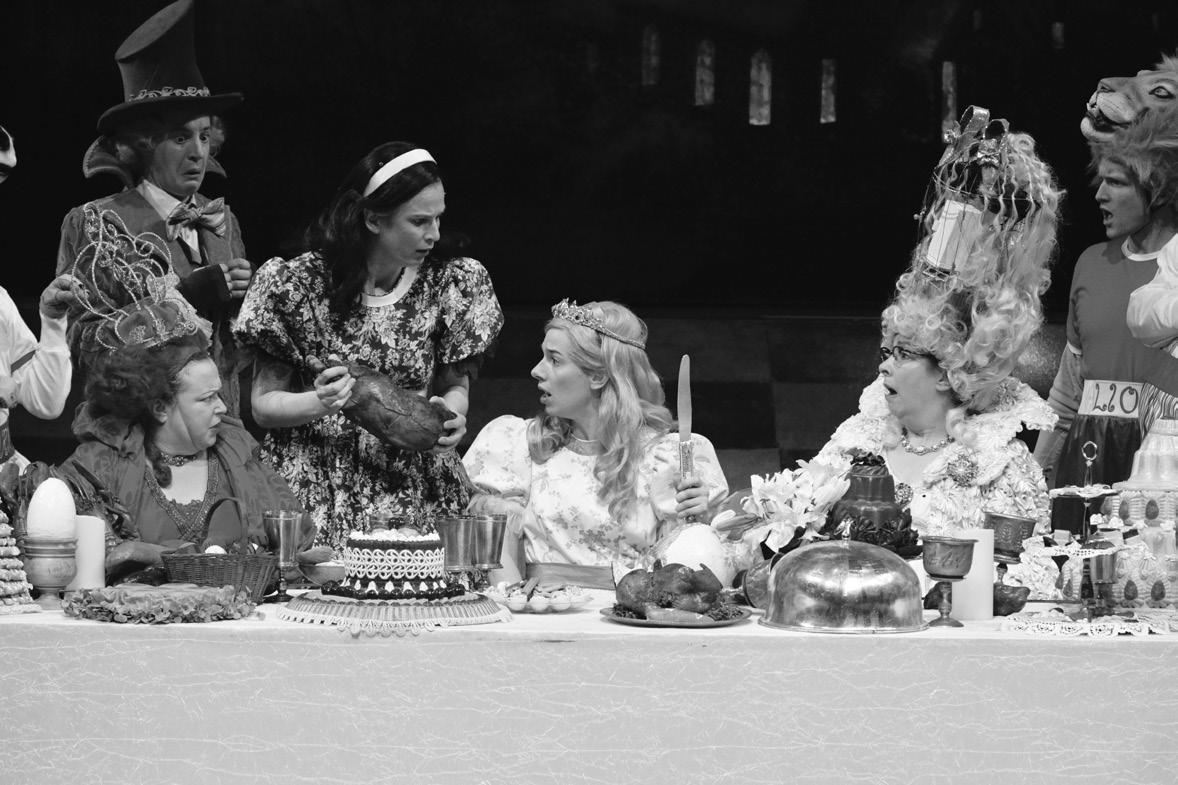
he Royal Manitoba Theatre Centre (MTC) is administering a healthy dose of fun to Winnipeggers over the next three weeks. This prescription comes by way of a debut production of Alice Through the Looking Glass, a play based on Lewis Carroll’s Through the Looking-Glass
Renowned Canadian playwright James Reaney adapted the Alice in Wonderland sequel for stage production in 1994. Since then, the play has been performed on several stages.
In Canada, the most recent performances of the play were a production at Ontario’s Stratford Festival in 2014 and another at this year’s Charlottetown Festival in Prince Edward Island.
Jillian Keiley, artistic director at Canada’s National Arts Centre, teamed up with the MTC to bring the show to Winnipeg. Keiley, who is also the original director of the show, worked with an all-Manitoba cast for the Winnipeg production.
“We did the show at Stratford and ran it at the National Arts Centre. Steven Schipper, who is the artistic director here, saw the show at Stratford and said ‘I would like you to come to Winnipeg and our own actors to do it,’” Keiley told the
Manitoban
The play covers the well-known story of Alice, a seven-and-a-halfyear-old girl, who explores a fantasy world through a looking glass.
The world through the looking glass operates on strange logical principles, wordplay come to life, and pure nonsense.
Gwendolyn Collins, who plays the main character Alice, had to turn back the wheel of time and tap into her much younger seven-year-old self to get in the right frame of mind for the role.
“The director really wanted the seven-year-old to come from me. So what I – Gwen as a person – was like at seven-and-a-half [...] instead of trying to pretend to be seven-and-a-half,” said Collins.
“I went to my parents’ place and was going through photos, and I tried to remember things that happened to me [at that age] and what that felt like. The most helpful thing was taking away the adult qualities and finding what’s at the core.”
The wonders displayed on the stage translate into an exciting experience for both actors and the audience. Everything about the play oozes an infectious sense of fun.
“There are few jobs you can go to and just play all day. It’s tremendously tasking work but we have so much fun and the cast is absolutely amazing,” said Tristan Carlossi, who doubles as both Tweedledee and Tweedledum.
“People who’ll come to see the show would also tap into their sevenand-a-half year-old self. This is the kind of show that people see and want to come play with us onstage.”
The production’s all-Manitoba cast is a noteworthy feature. It reflects the belief in the proficiency and potential of actors in the province and bodes well for the future of Winnipeg theatre.
“A lot of the actors are my friends and it’s really cosy. This is such a great opportunity for Manitoba actors,” said Collins.
The creativity and experience of the production crew gives this show a unique and authentic edge. The artistic team consists of people who have worked behind stages all over the country.
“Although [the show’s] been done many times, every time this creative team does it, it’s a brand-new show. It does have a freshness and likeness to it because we were given the ability to
bring ourselves into it,” said Carlossi.
The show promises to be a fun experiences for all ages. That being said, the show’s original director Jillian Keiley believes there is more to the show – enough to interest an existentialist.
“There are deeper philosophies in the book and in the show about existentialism, ontological things, mathematics, and there’s a lot of commentary on religion.”
Alice Through the Looking Glass
will be performed on the MTC mainstage from Nov. 26 to Dec. 19. Tickets for the show start at $26 plus GST. For show times and ticket information, call the Royal MTC Box Office at 204942-6537 or visit www.royalmtc.ca
PHOTO BY ROBERT TINKER
PHOTO BY ZY PHOTOGRAPHICS
Ask Her Talks
African and Canadian activists call Winnipeg to action in the fight against AIDS
OLIVIA MICHALCZUK, STAFF
O
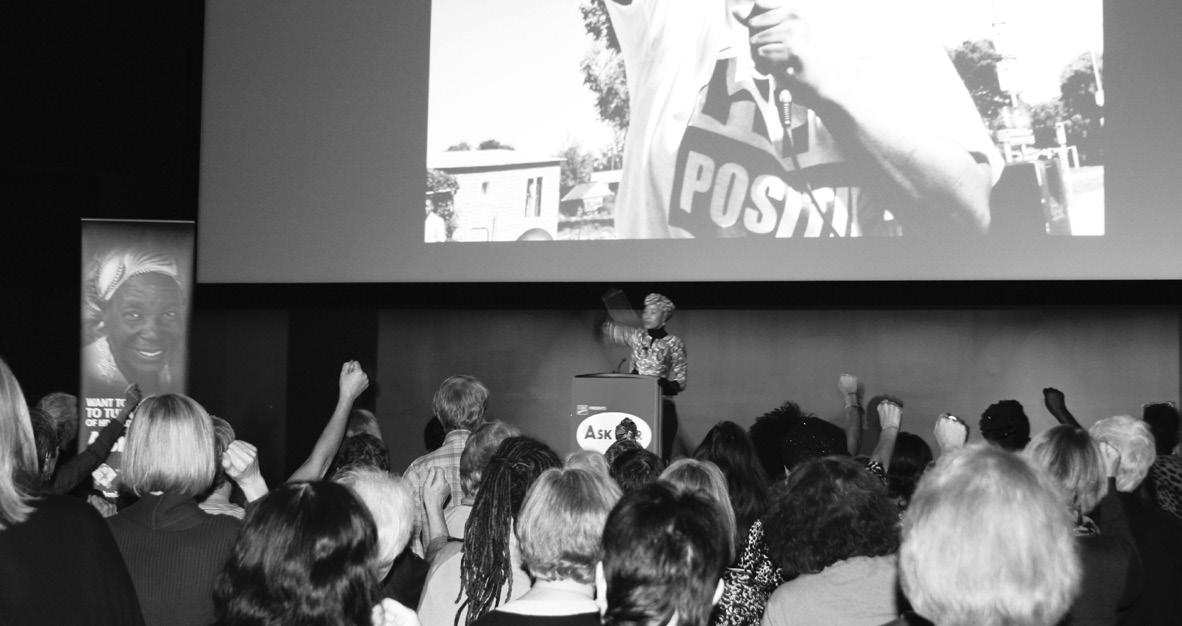
n Nov. 25, the Metropolitan Entertainment Centre hosted the second national stop for the Stephen Lewis Foundationsponsored Ask Her Talks in conjunction with World AIDS Day on Dec. 1.
Five women from Africa and two from Canada provided a stimulating and thought-provoking presentation discussing the role of women in the fight against HIV and AIDS in Africa.
The women speaking were activists from Ethiopia, Kenya, South Africa, and Zimbabwe, two of whom are HIV-positive themselves.
Canadian award-winning actress and gospel, blues, and jazz singer Jackie Richardson hosted the night and special guest “Britta B.” Badour from Toronto performed a spoken
PHOTO BY OLIVIA MICHALCZUK
word poetry piece.
A prevalent theme throughout the night was that voices of African women were often ignored when it came to the discussion on AIDS. The problem with that is that in subSaharan Africa, women and girls account for almost 62 per cent of new infections.
AIDS is the biggest killer of adolescent girls in South Africa, and girls between the ages of 15 and 24 are five times more likely to contract HIV than boys of the same age category.
“It seems that people have stopped hearing about HIV and AIDS. The media has stopped talking about HIV and AIDS like they used to. But in actual fact, the HIV pandemic is still affecting people,” said speaker Kidist Belete.
“Transmission is still a huge problem, especially among youth – university students and high school students. So it seems as though the world is quiet about HIV and AIDS, but it is still there. That’s the most important thing for people to understand.”
A prevalent theme throughout the night was that voices of African women were often ignored when it came to the discussion on AIDS
Among those in attendance was a Winnipeg group called Grands ’n’ More whose goal is to raise awareness and funds to help fight the AIDS pandemic in Africa.
Grands ’n’ More is one of 240 groups nationally that are affiliated with the Grandmothers to Grandmothers Campaign of the Stephen Lewis Foundation. Members of the group in attendance emphasized the importance of raising funds for children orphaned by AIDS in Africa, but also supporting the women who end up

looking after them, who are primarily grandmothers.
As founding executive director of grassroots organization Developing Families Together in Ethiopia, Belete underlined the importance of community development and creating a network of grandmothers who are often heads of the family when children are orphaned due to AIDS.
The Ask Her Talks aim to inspire people to start helping in the fight against AIDS in Africa. According to the speakers, the way to do that effectively is by helping the women who are experts in their communities and know what those communities need the most.
“We suggest people contact and support the Stephen Lewis Foundation. Through the foundation, small organizations like ours have been able to get grants that support the work we are doing at the grassroots level and support more people at the grassroots level,” said Belete.
“It’s so important to fund community-based work at the grassroots level, like all the organizations represented by the Ask Her Talks speakers.”
Ask Her Talks is already creating the necessary conversation to help in the fight against AIDS in Africa. Though it is unclear whether or not an increase in charity is occurring quite yet, it is an issue coming under
the spotlight.
“What I have seen is that people are really listening to what myself and my fellow speakers are saying. And it seems like they are questioning – they are asking themselves: ‘We have to do something, are we doing enough?’” said Belete.
“It’s too early to know for sure, but it seems people are listening and learning. In some cases, they didn’t have much information about HIV, and this talk is helping them to understand that still the battle is not yet won, and that there are still many, many people who need their support.”
Richardson closed the night with a message for all in attendance.
“I did promise you inspiration and stimulation. We thank you for your insight, your courage, your timeless work, and your leadership. I know we have all come here tonight, with open hearts and minds ready hear from these African women leaders,” she said.
“Well, we heard you, and on the occasion of World AIDS Day we pledge to you that we will carry your message to the world.”
To learn more about the speakers and their message, visit www.askhertalks.com

The bro-cative case
U of M undergraduate conducts research on the use of contemporary slang
TOBI NIFESI, STAFF, WITH FILES FROM CAITLIN GRIFFITH
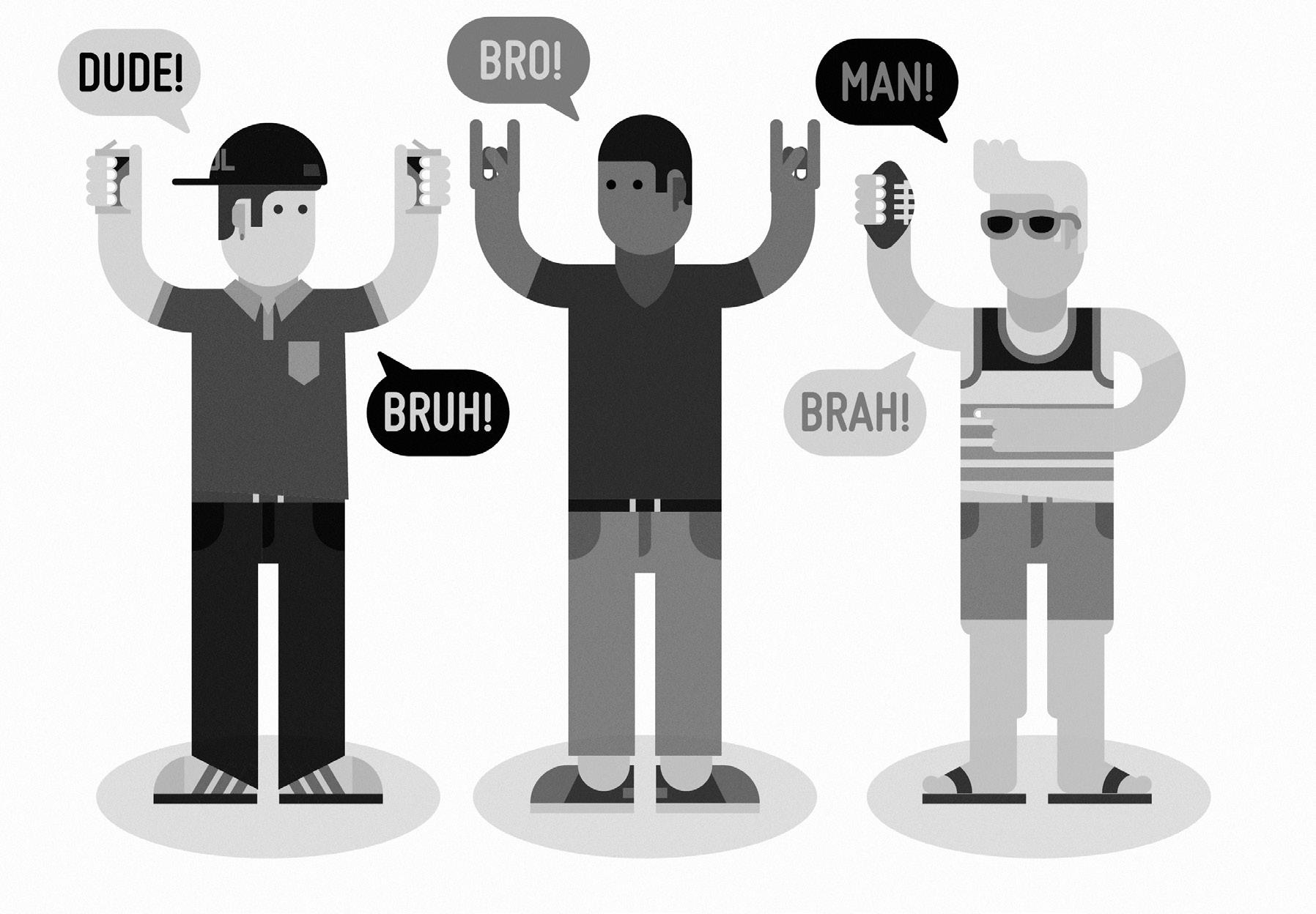
Matthew Urichuk is a thirdyear linguistics studies student at the U of M who conducted a research study on the use of “dude,” “man,” “bro,” and “brah/bruh” in conversations. The research was conducted under the supervision of U of M linguistics professor Verónica Loureiro-Rodriguez.
Urichuk’s interest in conversations and contemporary word usage may seem unique, but it is not unprecedented. The former computer science student developed a genuine interest for linguistics after learning an additional language.
“It wasn’t until my second year, when I took an intro to linguistics course, that I started realizing that ‘hey, this is interesting and this is what I actually enjoy,’” Urichuk told the Manitoban
“I just think it is interesting how everyone communicates with one another [in any language]. There’s always communication that happens between people and being able to study conversations that go on between two or more people is interesting.”
In 2003 Scott F. Kiesling, a professor at University of Pittsburgh, published his study on the titular word, Dude. With reference to this word and observational data gathered, Kiesling studied the listener-speaker relationship and interaction.
In one of her classes, LoureiroRodriguez uses this study as a basis for a project. Two years ago, Urichuk took Loureiro-Rodriguez’s class and worked on the project himself.
The study and project inspired Urichuk to broaden the scope of Kiesling’s study and probe into the
use of dude and its modern variations – “man,” “bro,” and “brah/bruh.”
Last June, he decided to design a research study with new sample data to analyze these terms. So far, the research has been presented at a few conferences and was recently submitted for a journal entry.
Like Kiesling, Urichuk was interested in the listener-speaker relationship. He wondered if people speak differently depending on who is listening and how this affected word usage.
“Originally, in the class, it was related to how the listener and speaker interacted with each other [...] I think how the listener and speaker interacts is a major point of my study.”
To conduct the research, Urichuk ran a survey through a Facebook group of interested participants, primarily from Manitoba. He advertised the survey by putting links to it on a few Manitoba-specific Internet forums.
A good number of participants – more than Kiesling’s sample size – consented to the anonymous publication of the study’s results and completed the survey online.
“We ran statistics on a lot of the data and made sure it was statistically significant – there was a large enough sample size. We ended up running statistics on 250-260 respondents.”
There are number of factors that could influence how a person speaks to the listener and their choice of words. Urichuk’s research has considered a range of factors including – but not limited to – ethnicity, gender, age, and race.
“I know that our data did show that
the gender of the listener did affect word usage more than the gender of the speaker [...] all the time in quite statistically significant ways.”
“Male-to-male usage, as was found in Kiesling’s study, was the most popular,” said Urichuk.
“Then it’s female-to-male – which was actually the opposite of what Kiesling found [...] Then we found that male-to-female interactions were by far the least common.”
Urichuk believes that there are a lot of preconceptions about these words. Their usage could be associated to a certain gender, age, or race. So far, the results of his research have

refuted some of these beliefs.
“There was no connotation between race and the usage of these words. A lot of the time, people can preconceive that a certain race, or gender, or age group use certain terms. In our data, there was nothing statistically significant to [prove this].”
“It kind of shows people that, hey, the preconceived notions you have about languages, societal classes, or race may not actually be accurate [...] Also, we shouldn’t necessarily base someone’s intelligence on the use of these terms.”
As the research’s supervisor, Loureiro-Rodriguez plays the role
of guardian to Urichuk’s undertaking. While Urichuk conducts the survey and statistical analyses, she provides him with advice and articles on methodology. She believes the study is essential and would be enlightening, especially to non-linguists.
“I think it is going to make people think a little bit more about how they use language and be more conscious about it,” Loureiro-Rodriguez told the Manitoban
“I hope that it does get [used as lecture material] in classes and used for further research [...] It would be nice to do a follow-up study, maybe in 10 years, to see how language changes.”

GRAPHIC BY JUSTIN LADIA

Brown and gold at the Grey Cup
LaFrance, Steele, and Oramasionwu return to their stomping grounds for the CFL’s biggest game
MIKE STILL, STAFF
The 103rd Grey Cup on Sunday, held at Investors Group Field in Winnipeg, signified a homecoming for three former Bisons football players, as Ottawa running back Kienan LaFrance and Edmonton defensive tackles Eddie Steele and Don Oramasionwu all got the chance to return to the province where their football careers started.
LaFrance – who didn’t strap on the pads for the first time until age 15 – won a Winnipeg High School Football League (WHSFL) title in 2008 with the Sturgeon Heights Huskies, before playing two seasons with the Winnipeg Rifles (2009-10) of the Prairie Football Conference and then another four years (2011-14) with the Bisons.
He was a conference all-star in his final season with the herd, amassing 785 rushing yards along with 10 total touchdowns.
This past May, LaFrance was drafted by the East Division’s Ottawa Redblacks in the sixth round of the CFL draft and finished his rookie season second on the depth chart, with 86 all-purpose yards.
On the West Division’s side were two players whose football journeys have been interlocked ever since high school.
Oramasoinwu is two years senior to Steele, however both attended Kelvin High School where they played two years together on the Clippers WHSFL team.
The highlight of their time with the herd occurred in 2007, where the duo won the Vanier Cup
“I remember the day I met [Steele] at Kelvin High School. We were just training and my coach introduced me to him. He was just a little kid with an afro,” Oramasionwu said prior to the game. “I took him under my wing, and every level we’ve been together at some point in time, so it’s pretty cool too.”
Oramasionwu moved on to the Bisons program, but would be joined by Steele not long after. The highlight of their time with the herd occurred in 2007, where the duo won the Vanier Cup.
Being the elder, Oramasionwu was asked if he shared any tricks of
the trade with Steele.
“I didn’t teach him everything he knows. It’s just when there’s an older guy who’s been through certain things, it’s just like any program you go to, you look at the older guy who’s been there a while. That’s just football,” Oramasionwu said.
Oramasionwu – a CIS SecondTeam All-Canadian in 2008 – was originally drafted by the Winnipeg Blue Bombers in the fifth round of that years CFL draft, while Steele – a 2009 CIS Second-Team AllCanadian – would get his name called in the third round by the Hamilton Tiger-Cats in 2010.
While their CFL journeys started on different teams, the pair of defensive tackles eventually came back together in 2014 when the Eskimos acquired them both. One year later, they landed themselves back on home soil for the Grey Cup.
“It’s pretty neat. The fact that we played high school ball together, played on the Bison field back here together, and now we’re at the Grey Cup in Winnipeg together, it’s pretty cool. It’s like a movie, it doesn’t happen often,” Steele said.
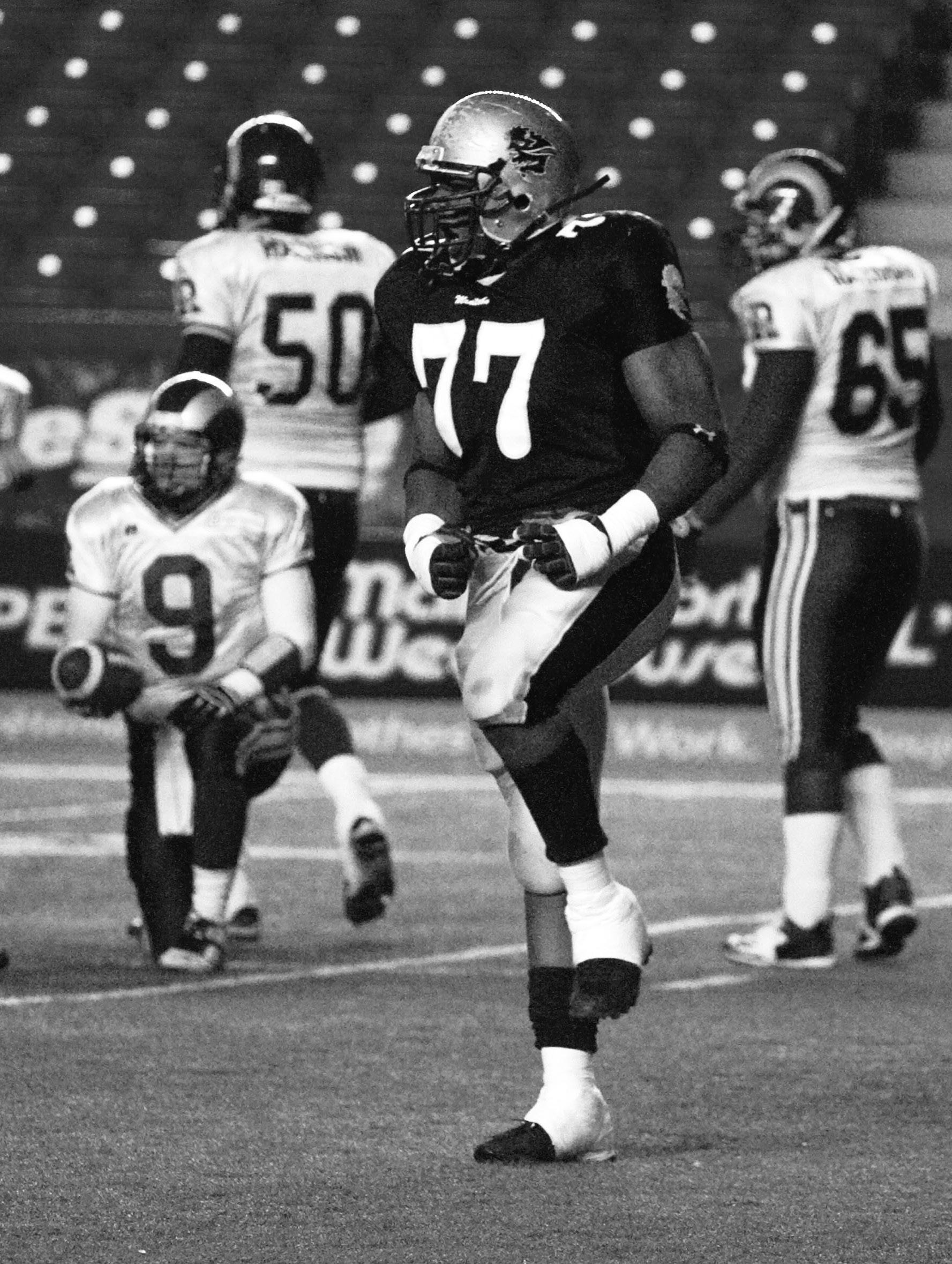
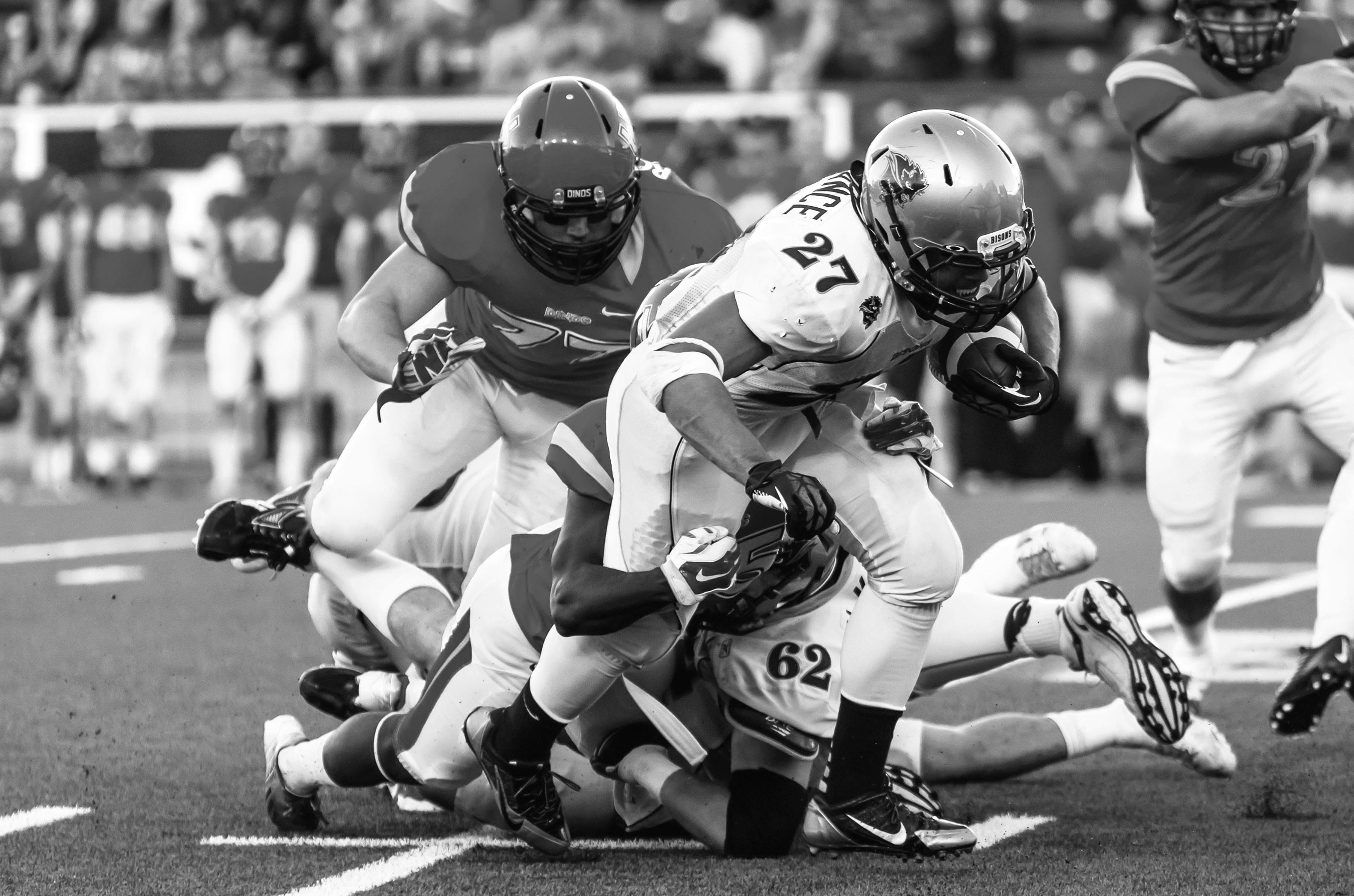
PHOTO PROVIDED BY BISON SPORTS
PHOTO BY JEFF MILLER
Bisons bounce Bobcats
Men’s basketball enter holiday break on four-game win streak
MIKE STILL, STAFF
The University of Manitoba Bisons
men’s basketball team ended the first half of their season on a high note, sweeping the Brandon Bobcats on the road this past weekend. The herd never trailed in any of the eight total quarters, coming out on top 86-75 on Friday and 89-72 on Saturday.
Manitoba dominated in the second and third quarters of both games – effectively pulling away from their competition heading into the final ten minutes.
It was the second weekend in a row where the Bisons were able to hold their opponent to under 80 points, as the visitors outrebounded the Bobcats on both nights. The home side was also abysmal from the
free throw line – shooting just 63.3 percent in game one and 56.3 percent in game two.
Friday
The first quarter of the opening game was a tight battle, as Manitoba held just a two-point lead. The Bisons erupted in the second and third, however, outscoring Brandon 53-38 en route to the win.
Manitoba got a well-rounded performance, with Keith Omoerah, AJ Basi, Justus Alleyn, and Wyatt Anders all cracking double digits in scoring.
While Brandon also had four players score more than 10 points –including forward Earl Thompson Jr. with a game-high 21 – the differ-
ence was shooting percentage, where the herd shot 52.3 percent compared to the Bobcats’ 38.5 percent. Alleyn, the leading scorer for the visitors with 18 points, shot 7-of-12 from the field, while Anders was 6-of-9 with 13 points.
The rebounding battle was closer on Friday, as the visitors held a tight 43-37 advantage. Anders led the way, recording another double-double with 14 boards. The versatile power forward got some help, though, as swingman Omoerah added a doubledouble of his own, contributing 11 rebounds.
Saturday
Manitoba completed the sweep in game two, thanks to well-distributed
scoring yet again. The herd had five players with more than 10 points –led by Basi with 18 and fellow guard Ilarion Bonhomme II with 15, who had a tremendous game off the bench, adding six assists, four steals, and three rebounds in 16 minutes of play.
For Bonhomme, the game against the Bobcats was a return to familiar confines, as he played with Brandon for three seasons, starting in 2011-12 where he was named Canada West Rookie of the Year and was also appointed to the CIS All-Rookie team.
Additionally, the herd won the battle in the post once again, with 45 rebounds compared to the home side’s 33. Brandon limited Anders to just six boards, however his team-
Series finale shutout
Manitoba and Regina split regular season series
ANDY CHE, STAFF
The University of Manitoba Bisons women’s hockey team hosted the Regina Cougars last weekend recording a 2-1 loss and 1-0 win on Friday and Saturday respectively. The victory improved the Bisons’ record to 2-2 against the Cougars in the season series while Rachel Dyck’s shutout notched the team’s fourth of the campaign thus far.
The Bisons also improve to 9-6-1 in the regular season, maintaining their position with Alberta for the top seed in the Canada West standings.
Friday
The puck dropped on the herd’s final weekend series in 2015 on Friday evening at Wayne Fleming Arena. Both sides contributed to an end-to-end first period, where each
goaltender stood sharp to preserve a scoreless frame. The Cougars outshot the Bisons 13-11.
The heavy influence of the goalies extended far into the second period.
Dyck bailed the Bisons out midway through the frame on a shot from Regina’s Kylie Gavelin. The forward pounced on a loose puck inside the crease only to see Dyck stick out an instinctive left pad to make a gamebreaking save.
The Cougars didn’t let up, though.
At the 13-minute mark of the second frame, forward Bailey Braden found the net after Dyck was unable to cover a Regina dump-in.
Regina’s lead would not last for long, as the Bisons equalized just 1:06 after falling behind. Venla Hovi fed Courtlyn Oswald on the rush, who
picked the corner on the Cougars’ goalie Toni Ross to tie the game. Both sides once again took a level score into the second intermission.
In total, her 34-save effort earned her a second shutout this season to end the 2015 calendar year on a high note
The third period proved to be the difference in the game when Regina retook the lead early in the frame. Jaycee Magwood reaped the rewards of her consistent presence in front of
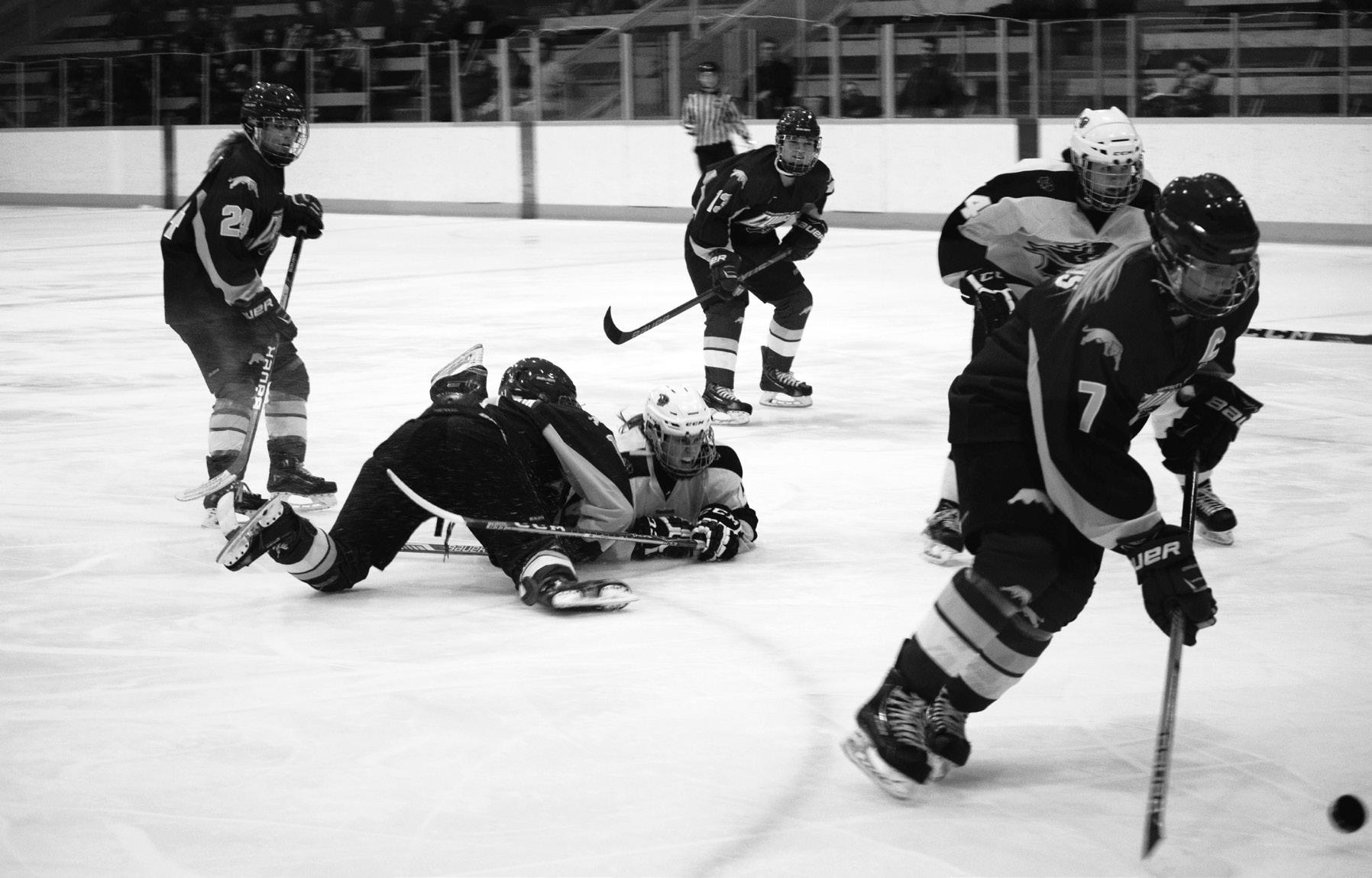
goal and scored the go-ahead goal at the five-minute mark. The freshman forward leads the contest with nine goals on target.
Ross then took the reins for the away side, turning aside all seven shots she faced in the third period.
She finished the game with 24 saves on 25 shots for the 2-1 win. Dyck also performed valiantly, producing 31 saves on the night.
Saturday
The home side took advantage of Saturday’s rematch right from the get-go. Manitoba peppered Ross’s goal with 17 shots in the opening 20 minutes alone. The fifth-year netminder held her ground and the kept the game scoreless into the first intermission.
The momentum shifted in Regina’s direction as the game entered the second period. The Bisons only managed four shots on goal dur-
mates stepped up, as all but one player managed to record a rebound.
Defensively, Manitoba held all but two Bobcats players to less than 10 points. Those same two players –Thompson Jr. and guard Troy Grant –were the only members of their squad to have more than 10 shot attempts.
Once more, the game was close after one quarter, with the Bisons up 20-17 before separating in the second and third quarters for a second straight contest, outscoring Brandon 51-33.
The entire conference now breaks for holidays. Manitoba’s first games back will occur on Jan. 8 and 9 on the road against Victoria.
ing the middle frame, compared to the Cougars’ 11. The home side almost scored on an Alexandra Anderson breakaway yet could not beat Ross with mere seconds left on the clock.
The hero of the previous matchup, Jaycee Magwood, eventually led to the Cougars’ downfall after taking a hooking penalty at the 13-minute mark of the third period. Just 1:23 into the ensuing powerplay, defenceman Caitlin Fyten drilled her point shot past Ross and into the top corner for the lead.
For the remainder of the game, Dyck emerged as the standout performer, producing 15 saves in the third period alone. In total, her 34-save effort earned her a second shutout this season to end the 2015 calendar year on a high note.
The Manitoba Bisons will hit the ice again in January, visiting the firstplace Alberta Pandas to kick off 2016 on Jan. 8 and 9.
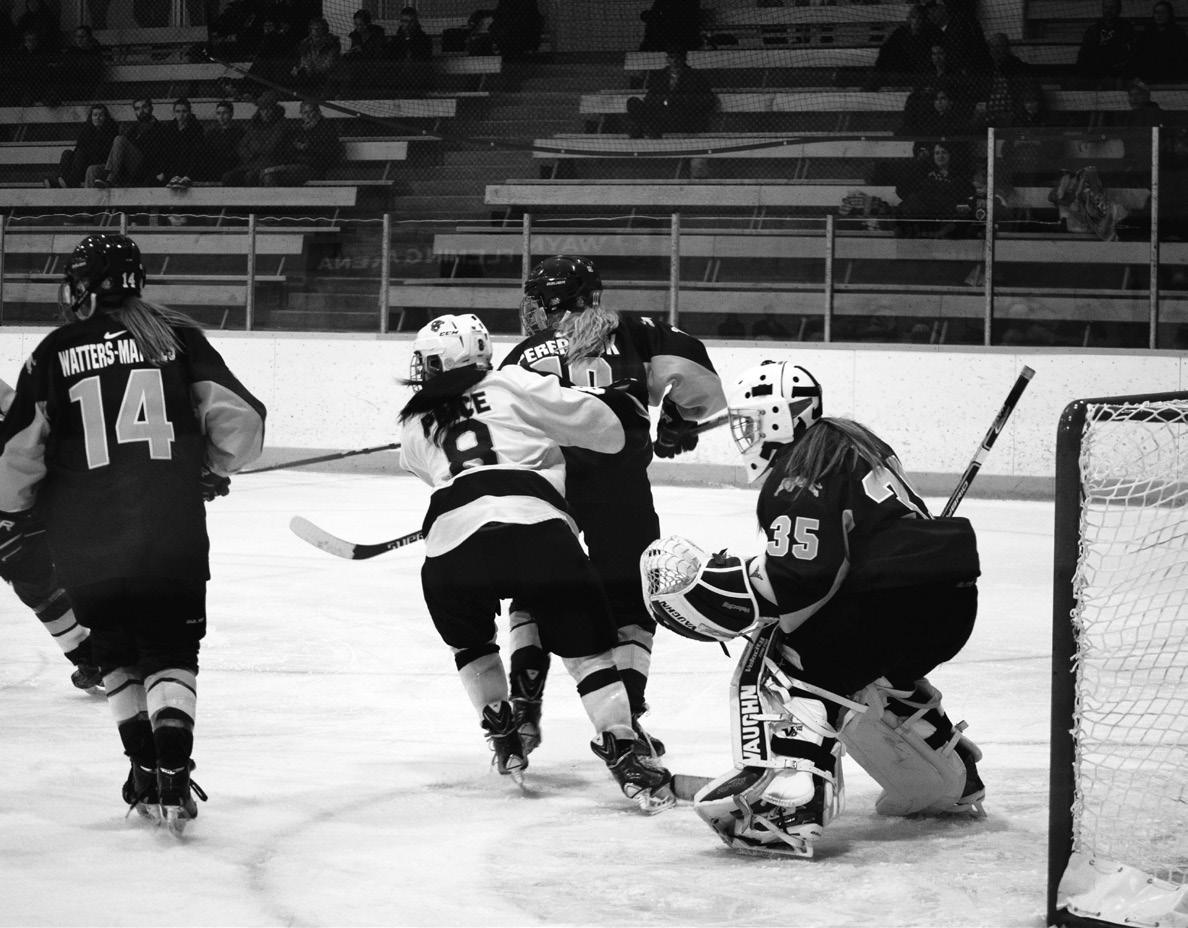
PHOTOS
Finishing on a high note
Bisons men’s hockey sweep the Cougars in Regina
RYAN STELTER, VOLUNTEER STAFF
L
ast week, the University of Manitoba men’s hockey team traveled to Regina in search of some wins to snap their four-game losing streak. They did just that, thumping the Regina Cougars 6-2. In the rematch on Friday, the Bisons came away with another two points as they beat the Cougars 5-3.
Captain Jordan DePape had a stellar weekend, racking up five points in two games. He extended his point streak to 11 games, currently the longest in the Canada West. DePape is now tied for first in the Canada West in scoring, with 24 points in 16 games.
DePape’s linemate Brett Stovin also had a good weekend offensively, scoring three goals in the pair of games. He now has registered at least a point in his last nine games. Stovin is tied for third in scoring among rookies, and looks to be adjusting to the Canada West well.
The Bisons played well offensively in the two game set against Regina, combining for 11 goals on the weekend.
Manitoba scored four unanswered goals in the second and
third periods of Thursday’s contest to put the Cougars away. The Bisons also converted on two of their five power play chances.
On Friday, the game was a little closer, as the herd allowed Regina back into the game in the third period, but a Zach Waldvogel empty net goal with 44 seconds remaining sealed the win for the Bisons.
Manitoba is now 7-7-2 on the year and are sitting fifth in the Canada West Conference, three points back of British Columbia
Manitoba is now 7-7-2 on the year and is sitting fifth in the Canada West Conference, three points behind British Columbia. They are riding a two-game winning streak heading into 2016.
Bison volleyball emerges victorious versus Regina
Men sweep, women earn a split
RYAN STELTER, VOLUNTEER STAFF
The Bisons men’s and women’s volleyball teams were in Regina last weekend and had a successful end to their first half campaigns.
The men won both of their games against the Cougars, only dropping two sets all weekend. St. Paul’s product Adam DeJonckheere had a team-best 13 kills on Friday, while Caleb Hickok led the herd with 14 digs.
In a closer affair on Saturday, the Bisons managed to come back from 0-2 down and pull through to win 3-2 (20-25, 23-25, 25-17, 25-22, 15-10). In a game that went the distance, Devren Dear was able to smack home an astonishing 22 kills, the best of anyone on the court.
Sitting tied for first place in the Canada West, the Bisons are in a good position heading into the break and will hope to continue

their success in 2016.
Sitting tied for first place in the Canada West, the Bisons are in a good position heading into the break and will hope to continue their success in 2016
The Bisons women were able to get their second win on the season on Friday, beating the Cougars by a score of 3-1 (16-25, 25-10, 28-26, 25-19). Cassidy Pearson had 12
kills on the evening, the best for Manitoba.
On Saturday, the Bisons were unable to hold on to a 2-0 lead and collapsed to fall 2-3 (25-23, 25-20, 22-25, 16-25, 11-15). It was a disappointing night for the herd, who played well to start the game off but couldn’t win the deciding fifth set.
The win was the first of the season for Regina.
Once again, the Bujan sisters led the team in both kills and digs, with Haillie Bujan getting 15 kills and sister Cassie providing 18 digs.
The Bisons women finish 2015 with a 2-9 record and are sitting second last in the Canada West. The herd will look to climb out of the basement in 2016.


Half-time report
Taking a look at where the Bisons basketball, volleyball, and hockey teams stand heading into the halfway point of the season
MIKE STILL & ANDY CHE, STAFF, AND RYAN STELTER, VOLUNTEER STAFF
Men’s basketball
Record: 6-2 (tied for first in Pioneer Division with 12 points)
Record in last six games: 5-1
Team leader in scoring: AJ Basi – (19.4 PPG)
Analysis: Heading into the holiday break, this team deserves to be included in the CIS Top 10 conversation. They battled tough against two of the top teams in the country in Saskatchewan and Calgary and dominated some lower rung teams in Alberta and Brandon. Three straight matchups against B.C. teams to start the second half of the year could very well decide where the herd finish in the standings, as UBC, Victoria, and Lethbridge all have at least 10 points.
Women’s basketball
Record: 0-8 (last in Pioneer Division)
Record in last six games: 0-6
Team leader in scoring: Nicole Konieczny – (9.4 PPG)
Analysis: This team is among the youngest in the conference, and is still going through a developmental process. They have been competitive at times this year, but haven’t been able to mount a full four quarters of basketball all season. It’s going to
take some time before this squad is even considered a playoff contender, but once the roster matures in two to three years time, they could be dangerous – but it’s simply not going to happen in 2015-16.
Head coach Mike Sirant has brought in some great recruits, including Brett Stovin, who is third in rookie scoring, and defenceman Adam Henry, who is sixth in rookie scoring
Men’s Volleyball
Record: 10-2 (tied for first in conference)
Record in last 6 games: 4-2
Team leader in kills per set:
Devren Dear – 3.94 K/set (142 kills in 36 sets played)
Analysis: The Bison men’s volleyball team is putting in a stellar perfor-
mance this year, their only blip being a pair of losses to conference-best Alberta in mid-November. The herd should stampede into the playoffs this year and will most likely finish in one of the top two positions in the conference. A conference championship showdown against Alberta seems inevitable, as the two will likely meet again there.
Over the last nine games, the women have averaged 2.67 goals per game –more than twice the offensive output of their early season
Women’s Volleyball
Record: 2-10 (second last in conference)
Record in last 6 games: 1-5
Team leader in kills per set: Jordana Milne – 2.43 K/set (97 kills in 40 sets played)
Analysis: The 2015-16 season
has proved to be a difficult one for the women, as they have struggled mightily to finish games, dropping countless 2-0 set leads. With so many first year players, this is to be expected, but the playoffs look like a distant dream at this point in the season.
Men’s Hockey Record: 7-7-2 (fifth in conference)
Record in last 6 games: 2-4
Team leader in scoring: Jordan DePape – 24 pts (9 G, 15A)
Analysis: A young, fast, exciting hockey team to watch, the men’s hockey team have a lot of promise. Head coach Mike Sirant has brought in some great recruits, including Brett Stovin, who is third in rookie scoring, and defenceman Adam Henry, who is sixth in rookie scoring. Manitoba has struggled at home this season, only winning two games at the Wayne Fleming arena. This team is also prone to mistakes, as they still are a very young team with plenty of first year players having to get adjusted to the Canada West. Manitoba is currently sitting in a playoff position, but have the ability to climb the standings in the second half of the year.
Women’s Hockey Record: 9-0-6-1 (tied for first in conference)
Record in last 6 games: 4-2
Team Leader in scoring: Karissa Kirkup (3 G, 8 A), Alana Serhan (2 G, 9 A), Alanna Sharman (6 G, A) – 11 pts
Analysis: Over the last nine games, the women have averaged 2.67 goals per game – more than twice the offensive output of their early season. Offence has been well-distributed in Jon Rempel’s roster after 16 games, with 14 different players scoring at least one goal this season. With 14 games remaining in the regular season, the Bisons should have no trouble finishing as one of the top seeds in the division should they maintain their form. Heading down that stretch, there will be greater emphasis on consistent offensive production on all four lines in order to make a deep playoff run.
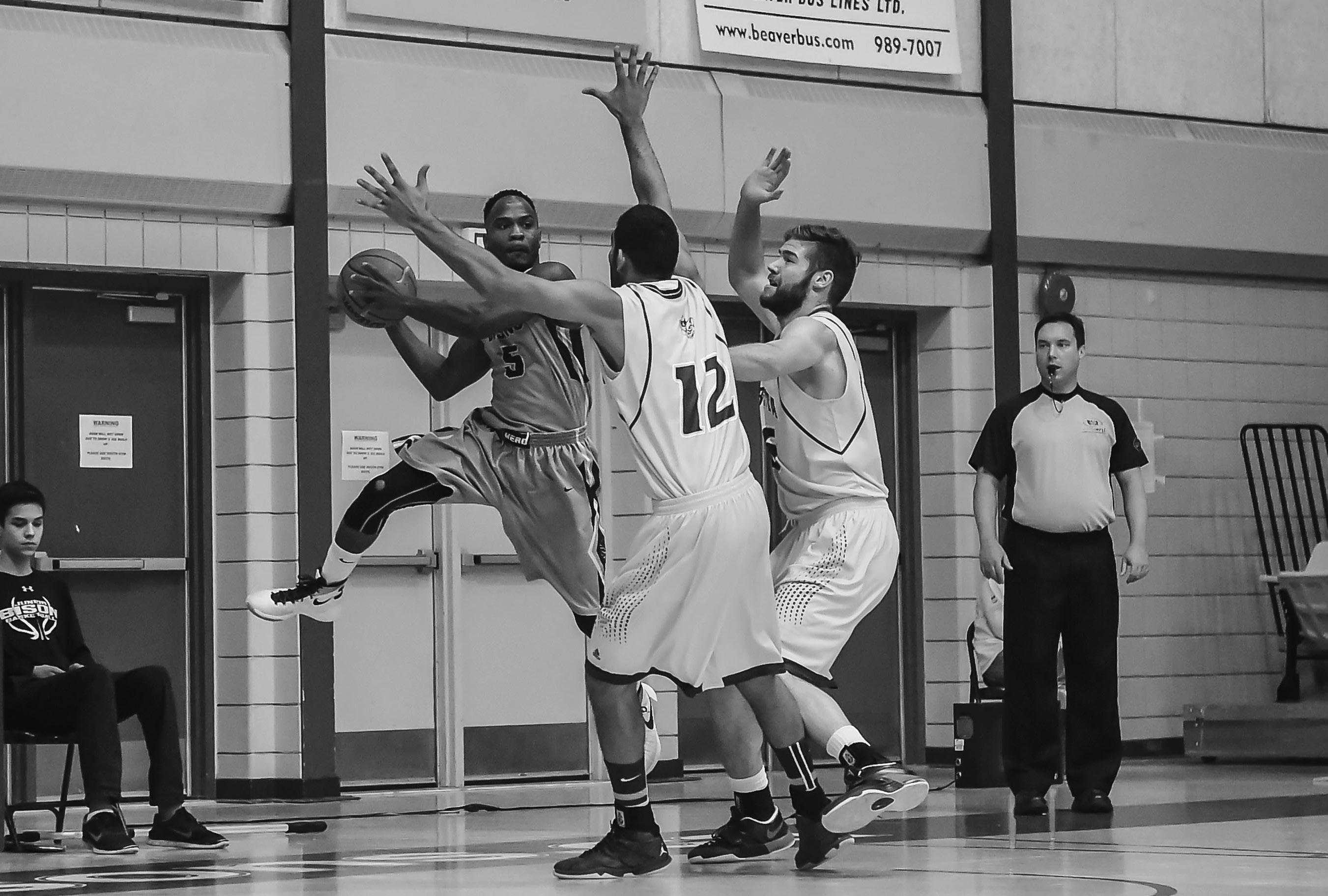
The logo seen around the world
Adidas already has most of Europe – now for North America
RYAN STELTER, VOLUNTEER STAFF
Adidas is a massive global company that, in current years, has been acquiring more and more lucrative sponsorship deals. They are perhaps more prevalent in the European market, but they are slowly making their way into North America.
A key factor in Adidas’ dominance was the purchase of Reebok in 2006, the company that led the North American sports market for many years.
European dominance
With soccer being the world’s most popular sport, it’s also one of the most profitable. The top five most valuable soccer teams in the world according to Forbes are Real Madrid, Barcelona, Manchester United, Bayern Munich, and Manchester City.
Adidas has sponsorship deals with three of those five teams, recently replacing Nike in supplying English giants Manchester United’s kits.
Adidas also has a large partnership with FIFA, begun in 1970 and due to continue into 2030. It is one of the longest partnerships in the history of modern sports. As a result, Adidas supplies all the match balls and its logo is seen everywhere around World Cup stadiums.
Another high-profile deal, up in 2017, is with UEFA (Union of
European Football Associations), which includes the UEFA European Championships, the UEFA Champions League, and the UEFA Europa League. The Champions League is known for showcasing perhaps the best soccer on earth, and the best of the best are using Adidas.
The Adidas North American takeover is slowly happening, and in the coming years we are likely to see more and more Adidas logos popping up
They also sponsor a few big-name national teams, including Germany, Spain, and Argentina. Adidas is currently paying the German soccer association a whopping 20 million euros to supply their kits.
North American Invasion
In recent months, we have seen Adidas ink deals with both the CFL and the NHL, with the three stripes
coming to the CFL next year and the NHL beginning in 2017-18.
The speculation of jersey ads have also come as a result of Adidas’ sponsorship in the NHL – an idea most hockey traditionalists scoff at. Not to worry though, as NHL commissioner Gary Bettman said in an article with the Globe and Mail that there will be no jersey sponsors when Adidas takes over.
Adidas managed to get a sponsorship deal with one of the brightest young stars in the NHL as well, in Connor McDavid. Previously not known for their hockey involvement,

it appears that Adidas is slowly taking the NHL by storm.
Their main competitor has been Nike, which has a sponsorship deal with the NFL, not to mention an upcoming eight-year, USD$1 billion deal with the NBA set to start in 2017-2018. Those are perhaps more lucrative deals to have, as both leagues are bigger in the U.S. than the NHL, but Adidas still has their foot in the door in North America. Adidas is also making moves in the world of college football, recently announcing deals with Louisiana Tech and East Carolina along with
an extension with North Carolina. They also currently hold four sponsorship deals with teams currently in the Big Ten. In a market typically dominated by Nike, Adidas is making some noise. The Adidas North American takeover is slowly happening, and in the coming years we are likely to see more and more Adidas logos popping up.