Second consecutive Slutwalk marches through downtown Winnipeg
r achel Wood, staff
AToronto police officer and a Winnipeg judge were two main catalysts in the formation of the Winnipeg Slutwalk. When Const. Michael Sanguinetti warned women in a personal security class that they should avoid dressing like sluts in order to not be victimized, Canadian women reacted. When Judge Dewar ruled, “sex was in the air” when a woman was sexually assaulted while wearing a tube top, heels and no bra, Winnipeg females brought the Slutwalk to the prairies.
Hundreds of women and men gathered for the second Slutwalk on Sept. 15. The walk began at the law courts and concluded at the Legislative Building.
Sherrie-Lee Chiarot, a member of the organizing team, was drawn to the Slutwalk from a deeply personal experience. She had been 14 years old (and dressed conservatively) when an 18-year-old family friend raped her.
For years after the rape the man defended his actions by arguing that Chiarot’s body language was inviting the action. Chiarot explains that
victim blaming, like the one that she experienced, is her motivation to partake in the Slutwalk.
When the man contacted Chiarot years later under a fake Facebook profile, Chiarot brought the issue to the police. The police responded by suggesting that she should change her privacy settings to avoid contact from the rapist.
The police explained that since
she wasn’t under any “physical threat” they could not grant her a restraining order. They would, however, issue him a warning and call her after the warning was given. Two years later, Chiarot is still waiting for that call.
Chiarot argues that they key to eradicating victim blaming is education. At 14 years old, she said that she should have known that it was not her fault that she was raped.
Chiarot explained that criticism of this event often comes from the name. She said that people often respond to the march with the argument that women need to take responsibility for their actions.
“Rapist should take responsibility and not do the action to begin with,” said Chiarot.
Kevin Reilly, a man from Booth College who attended the walk, explained that he came to support his fellow human beings. Reilly explained that, unfortunately, he knows many men who continue to treat women like objects.
Chandra Mayor, a local novelist and poet, was a speaker at the Slutwalk and stated that she was exhausted of the continued victim blaming in rape cases.
“I feel tired because everything about this matters to me. I cannot freaking believe that we still have to do this and I am so, so goddamn tired of this,” said Mayor.
Mayor explained that camp counselors, boyfriends, and landlords all sexually assaulted her, the “usual list,”
as she described it.
Mayor argued that the common denominator in all rape cases was not the clothing of the victim, but that someone thought it was permissible to use their bodies as a weapon against another person.
“The only person accountable for the rape is the rapist. Period. No one asks to be raped. Seriously, think about it for a second,” exclaimed Mayor.
Mayor suggested that instead of teaching young girls to police themselves, society should teach young men to not rape in the first place. Participants in the walk held signs with statements such as, “I can control myself, can you?” and marched through the streets chanting, “2, 4, 6, 8, consensual sex is really great”
This year’s Slutwalk concluded with a self-defense class at the University of Winnipeg, with entry donations being accepted for Osborne House.
phOtO by DaNieL Jia
Strength in numbers
As Manitoba’s population increases, the economy strengthens a lycia rodrigues
M
anitobans can rest easy with their current economy despite previous downfalls and the turmoil of the world’s economic situation.
Manitoba Economic Highlights show that our province has the second best average of annual growth of 1.9 per cent over five years in comparison to the rest of Canada, which is at 1.2 per cent.
The Federal Agency states that Manitoba recently added 7,300 new full-time jobs, which drove down the recent unemployment hike to 5.4 per cent.
Wayne Simpson, professor of economics at the U of M, said that there
are two parts to population growth.
The first part is the natural increase rate, which takes births and deaths into consideration. The second part is migration, which is the main reason for the current population increase.
Manitoba is currently offering many jobs, the reason that many immigrants are coming to Canada, especially Manitoba.
“One of the things [contributing to population growth] is an increase in migration to Manitoba, a lot of which has been the PNP [The Manitoban Provincial Nominee Program],” said Simpson
The Manitoban Provincial
Nominee Program was created to give immigrants a certificate that allows the process of permanent residency to speed up.
Effects of rapid expansion can be found in Winnipeg. Simpson said there are advantages to becoming a bigger city. It creates a larger labour market, which in turn creates more wealth per capita.
According to the Manitoba Bureau of Statistics, Manitoba’s Gross Domestic Product (GDP) has risen by 2.2 per cent. Simpson explained that GDP is a measure of an economy’s wealth and the goods and services produced within a province. This
amount would be portioned out to people in terms of their incomes. It creates higher wages and generally a higher sense of well-being.
Simpson said that of this is interconnected with the job market. There is an increase in jobs available with higher wages, yet at the same time it creates more competition. There is a lot of competition in a city like Toronto, but also a lot more opportunity. More opportunity and competition will be created in cities like Winnipeg and Brandon as they continue to grow. As this occurs, people start capitalizing on other ways to generate income, which also positively adds to the economy
and GDP.
The current benefits of the Manitoban economy, especially in Winnipeg, are attracting people to migrate to the city or elsewhere in the province. The economy is strong and diversified, which is causing people to stay. The current mass construction is proof of all this, and also another huge source of employment.
Moving all depends on what an individual is looking for in terms of their goals and aspirations. Manitoba may not be the first choice when thinking about a place to call home but, judging by the current economy; many people feel that it is a great choice.
Tip # 123: Never buy your textbooks before classes start. See if your professor teaches directly out of them, so that you don't have to do unnecessary readings.
University of Manitoba research:
A very quick glance
Jill Patterson, staff
T
here have been many interesting and important research studies that have involved the University of Manitoba, as well as people from the university. Some have had far reaching implications and have been important in various policy changes in Canada.
As a UofM student it is important to learn what your university has done, what it is capable of doing, and, depending on your area of study, what kinds of far reaching research studies you have the chance to be a part of. The following is an overview of only a few select cases; some of the more interesting and important research studies from various faculties that have been done at the university to showcase the types of talent U of M is home to.
Globalization and Cultural Studies – The effect of globalization on cultural notions of belonging
Dr. Diana Brydon is the Canadian Research Chair, the Director of the Research Centre for Globalization and Cultural Studies, and is a U of M professor of English studies. She is currently conducting research on the topic of how notions and concepts of belonging, home, and citizenship are changing with regards to globalization.
Brydon has three main areas of interest in research. The first is centred on literary, visual, and analytical representations of home. In this area of interest her main research question asks: “How do images and descriptions of home shift ideas of accountability, belonging, and social responsibility?”
The second part to Brydon’s research looks at how “cosmopolitanism, diaspora studies, and theories of planetarity” change the practice of various academic disciplines and cultural studies, as well as their structure.
The third part of her research aims to answer a variety of questions: how does globalization affect what people need to learn and know, how can we change the practices of governance to ensure a proper social well being, and how can people communicate their level of understanding.
Plant Science – The creation of canola
Dr. Baldur R. Stefansson is a professor and researcher who graduated with a PhD from the University of Manitoba in 1966, within the faculty of Plant Science. Stefansson is considered today the “father of canola” for his work in plant science developing an edible form of rapeseed. His research culminated in the creation of canola, which is now the world’s second largest oilseed crop and Canada’s top edible oil.
Stefansson began his research by surveying different variations of the seed around the world. He found one in particular, Liho, which he used as the parent in a breeding experiment and found that the oil could in fact be extracted from the rapeseed.
Psychology – The psychology behind exercising
# 49: Take Facebook off your phone and study 150 per cent more effectively.
Tip # 993: In writing courses professors don't want your views and opinions, they want to hear you repeat their own.
An incredibly brief history of the University of Manitoba
From
creation to now, in the blink of an eye
ryan h arby, staff
Dan Bailis is a professor of psychology at the University of Manitoba, who conducted research on the subject of the psychology behind our motivations to exercise and keep an exercise routine.
Bailis experimented with upwards of 1,000 undergraduate students who were considered to be highly motivated to keep exercise and stay healthy and in shape. He then divided the group of participants into different groups, some of which received subtle reminders of other goals or priorities they may have – such as academic or relationship related priorities. These reminders usually came in the form of pamphlets, videos, or a task such as writing a statement about their academic goals.
The result was that those who were subtly prompted with reminders of other goals and priorities were more likely to change their exercise routine by exercising less.
According to Bailis, “In the week following, people who have been put through a goal conflict will exercise less. Even in the few minutes after they’re done a task, their mood and self esteem temporarily gets worse.”
Sociology – Social impacts of Winnipeg’s bedbug problem
Dr. Elizabeth Comack, a University of Manitoba professor of sociology, is interested in sociology of law and feminist criminology. Comack conducted a study entitled “What Happens When the Bed Bugs Do Bite? The Social Impacts of a Bed Bug Infestation on Winnipeg’s Inner-City Residents.”
The study looked primarily at the “social impacts of a bed bug infestation on inner-city residents” of Winnipeg. Research was conducted through interviews, which included: 16 residents, five workers at inner-city agencies, three landlords, and two public health inspectors.
The results of the interviews showed that the consequences of bedbug infestation were extremely distressing for people’s “daily lives, their social relationships, their identity, and their physical and mental health.”
The study also outlined the social conditions under which bed bug infestations occur. While anyone can be subjected to a beg bug infestation, people with low incomes are more susceptible to infestations.
So you’re an eager new university student bursting at the seams with a childlike sense of wonder and curiosity.
By now you’ve been to your first classes, visited a few buildings, met a professor or two – you’ve gotten to know this place a little bit.
One thing you probably haven’t done, though, is learn much about this very institution you are attending. So, in the name of brevity let’s run through an all-too-short history of the University of Manitoba. Read this and you can forever say: “Yeah, I know all about that whole U of M thing.”
The largest university in the province and the first in Western Canada, the University of Manitoba was founded on February 28, 1877. The U of M was actually created so founding colleges—St. Boniface College, St. John’s College, and Manitoba College— could confer degrees on their graduating students. At the time, the U of M was one of approximately 20 other degree-granting institutions within the Dominion of Canada.
In 1882, the Manitoba Medical College became a part of the university; in 1902, the Manitoba College of Pharmacy joined, followed by the Manitoba Agriculture College in 1906. By this time the university had completed construction on a science building on Broadway Avenue, fully housed with the first six professors of the U of M’s new faculty of science: A.H.R Buller, Frank Allen, M.A. Parker, R.R. Cochrane, Swale Vincent, and Gordon Bell. Shortly thereafter the Agriculture College was erected in Tuxedo.
As the U of M continued to grow, administrators began showing interest in a more permanent site for the university, complete with a board of governors, a president, and more teaching departments. After much lobbying from many parties, a 570 acre site adjacent to the Red River was chosen to be the future home of the University of Manitoba. The new campus’ first buildings—Taché Hall, the Home Economics Building, and the current Administration Building—opened in 1912.
By 1914 the U of M began offering arts courses, and in 1919 the University of Manitoba Student’s Union (UMSU) was created. It was during this period of growth and expansion that the university finally became a provincially-funded institution.
In 1932, scandal erupted when John A. Machray, honourary bursar and chair of the Board of Governors, was arrested under charges of embezzling from the U of M. Machray was found to have lost nearly $869,000 in investments outside the interest of the U of M.
Tip # 67: Make friends with your teachers and meet with them during their office hours! You will have a better experience and will learn more if they can get to know you on a personal level. It's not sucking up, it’s showing that you want to learn and care about the material being taught.
Colleges such as St. Paul’s and Brandon College continued to join the U of M in the 30s but student placement, as ever, continued to be an issue. Up until the 1950s students were split between locations, with junior students attending the Broadway campus and senior students Fort Garry. In 1961, the U of M’s building on Broadway was demolished and Fort Gary became the new permanent campus.
The U of M grew at an exponential rate through the 1960s and it is during this period that we see the emergence of many organizations and structures still present today. Forgive me for moving at breakneck speed, here.
Today the University of Manitoba has a second campus once more; the Bannatyne campus, which houses the faculties of Medicine, Dentistry, Pharmacy and the Schools of Dental hygiene and Medical Rehabilitation.
In 1999 the university saw the creation of Smartpark, a 100-acre research and technology park on the Fort Garry campus, which hosts over 1,000 employees, many of whom are co-op students and U of M graduates.
Approximately 22,000 undergrad students attend the U of M every year, 3,000 at the graduate level.
Tip
Accessibility not an issue at the U of M
Resources available at Student Accessibility Services
r achel Wood, staff
University can be overwhelming for any student. When you have a disability, however, there are additional challenges that one must consider. The U of M has many resources and services for students with disabilities that can be utilized to make your university experience easier and more enjoyable.
Carolyn Christie, coordinator at Student Accessibility Services (SAS), explained that in order for students to access these services, an in-person meeting with an advisor should be arranged. Students need documentation from an accredited health profession outlining their disability. If students do not have this documentation they can still contact the office to receive a referral for assessment.
SAS is specifically available to students with hearing, injuryrelated, learning, mental health, medical, physical, visual or temporary disabilities.
Services available include alternative test arrangements, notetaking services, sign language interpreters, adaptive technology, and on-campus transportation. Individual accommodations plans are adapted to fit each student’s unique need.
Support programs that the SAS provides include an academic attendant program, adaptive technology, alternate format materials programs, and coaching programs. There are also notetaking programs and different workshops that allow students to develop self-advocacy techniques, explore job-searching tools and increase management and coping skills.
Support from peers may be one of the most vital ways to ensure that university is enjoyable and manageable for students. Workshops are offered through SAS that allow students to connect with peers who may be dealing with similar situations or challenges.
Christie welcomed enquiries of any kind and encouraged students to contact SAS if they are experiencing any difficulties. Even if SAS is not the right fit for your concern, the staff there will ensure that you are referred to the proper resource on campus.
“Our goal [ . . . ] is to collaborate with the [U of M] to ensure equal access for students with disabilities by providing supports and programs that recognize our diverse student environment, promoting partnerships between students, faculty, and staff; and educating the university community about accessibility,” said Christie.
There may be areas of the university that remain inaccessible. Christie invites individuals to contact SAS to inform them of these areas in order to ensure that the campus is accessible to all.
Staff members who specialize in accessibility are also available on the Bannatyne and Inner City campus on a regular basis.
Students can contact SAS by calling 204-474-6213 or 204-4749790 (TTY). SAS is located at 155 University Centre. On the Internet, SAS can be found by going to umanitoba.ca/student/saa/ accessibility or by emailing student_accessibility@umanitoba.ca
Food on Campus
Yum yummm
m arc l agace and ryan h arby, staff
Best soup
Armark provides the best soup variety at their locations around campus (off the top of my head, the soup place in University Centre, and the Greenhouse Cafe). If you’re looking to soup-up your lunch, they’re your best bet for sure.
Best coffee
Don’t let all the coffee chains that operate around campus lure you in with their convenience and flashy marketing powers. The best coffee in our estimation is available at the smaller, independent coffee stops, like the one in St. John’s College. Kicking Horse all the way.
Best sandwich
This award was going to go to Degree’s club sandwich—which is totally awesome—but then we tried the Pulled Pork Grilled Cheese sandwich from The Hub and we had a new winner. Its a grilled cheese sandwich combined with pulled pork and sautéed onions. I’ll give you a moment to wipe the drool off your face.
Best poutine
Degree’s wins almost by default, since they’re possibly the only place on campus that uses honest-to-goodness cheese curds in their poutine. Anything less than that is an abomination in the eyes of the poutine Gods.
Best greasy options
Looking for a quick and greasy bite to eat on the go? Bison Grill in the University Centre cafeteria fits the bill. Their burgers and chicken fingers are great, but make sure to try their Philly Cheesesteak sandwich.
Best healthy options
The Daily Bread, located in the basement of St. John’s College, is like a hidden gem. It’s got an awesome menu and is open daily from 8am-10pm. Well worth the voyage if you don’t typically have classes in that part of the campus.
Best sweets
If you need a quick snack or have a nagging sweet tooth, GPA’s is your one-stop shop. The other day, I saw they now have clodhoppers in their bulk bin. Need I say more?
Local spots of interest
You may be eating most of your meals on campus but that doesn’t mean you have to eat all of your meals on campus. Live a little!
Take a trek to the Smartpark (some will say this is technically still on campus but they are wrong) and check out Edna’s Café, a sister restaurant to Winnipeg’s own Stella’s Café and Bakery franchise. The food there is absolutely terrific.
Also of interest to students is the new Five Guys burger restaurant, located less than three kilometres from campus on Pembina Highway. The cholesterol is plain delicious.
Tip # 633: *Shameless plug!* Volunteer to write for your campus newspaper. There's bound to be a section and a story that's aligned with your interests. You will gain great experience and practice for all those term papers and essays you'll be writing as the year goes on.
10th Annual Moon Festival Social
A decade of moon cake and celebration
chuthan Ponnam Palam, staff
If you love moon cake then mark this Saturday on your calendar, because the 10th annual Moon Festival Social is happening and it will have plenty of moon cake for all. The Manitoba Chinese Tribune, a free bi-monthly publication produced by volunteers for the Chinese community, has been hosting the Moon Festival Social every year for the past decade.
The festival will feature Chinese dancers and singers, a bakesale, an auction, comedy skits, and even gymnastic performances. The performances will be a mix of both traditional Chinese acts, as well renditions of pop songs and dancing by Canadian Born Chinese (CBC) performances
According to Helen Wang, editor-in-chief of the MCT, the
UMSU has got your back
Take advantage of your students’ union
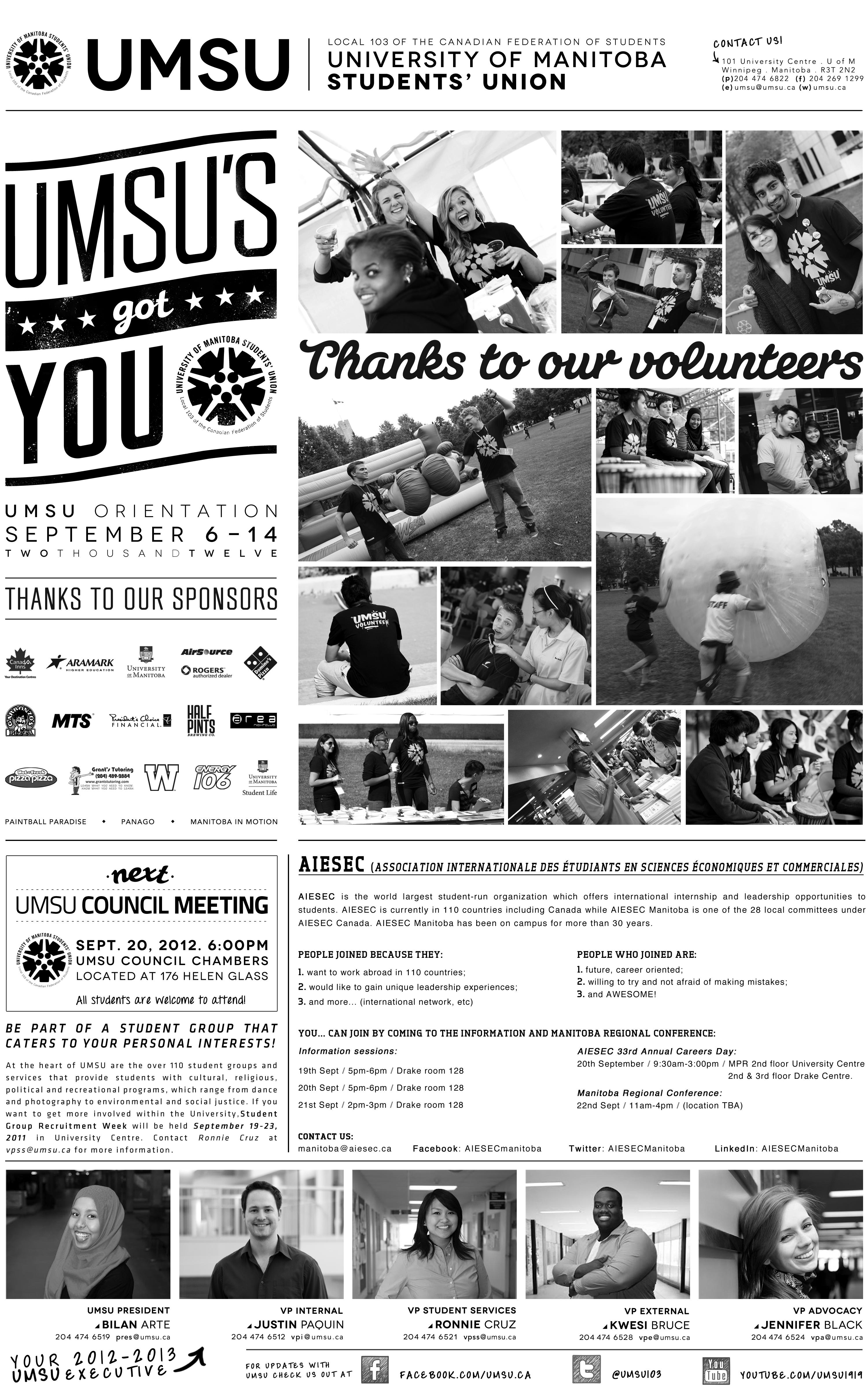
UMSU president Bilan Arte said that students often ask her what the role of a students’ union actually is.
According to Arte, “a students’ union is everything its members make it!”
The students set the direction in which UMSU goes. Executive council members exist to look out for the best interests of students, and make sure that students’ voices are heard when decisions are being made at all government and administrative levels.
You may be familiar with UMSU through a number of events they hold throughout the year – from September Orientation to the Malpractice Halloween Social, and Celebration Week in January. However, UMSU is not just an event-based council, because it also provides a wide range of services that aim to make your time at the University of Manitoba easier and cheaper.
For example, the weekly Bison Grocery Run provides free transportation for students to and from the local Superstore. There is also a textbook and iClicker lending program that is both good for your wallet and the environment.
UMSU’s Answers Information Booth offers a service to student groups and faculty councils by offering to sell social tickets at no cost. UMSU also offers many cost saving programs through national and provincial lobby group affiliations, such as the International Student Identity Card, which offers discounts at both local and international retailers.”
If you wish to get involved with UMSU, you can complete a volunteer sign-up sheet to help with various UMSU events throughout the year.
You can also join the Government Relations or Environmental Sustainability Committees –groups that help make decisions regarding the issues and campaigns UMSU will take on every year.
UMSU council meeting are open to all students, and students can even contribute to the discussion. Meetings take place every second Thursday at 6 p.m. in the UMSU Council Chambers at 176 Helen Glass, or 211 Medical Services Building at the Bannatyne Campus.
Whether you are keen on getting involved or would rather fly under the radar, Arte wants you to know that “UMSU’s got your back” and that it is here “to support [you] every step of the way.”
If you would like further information about UMSU, drop by their offices at 101 University Centre or check out umsu.ca for a complete list of services, an online event calendar, and other ways to get involved.
Tip # 77: Keep track of the syllabus. It's perhaps the most valuable sheet that your professor gives you, especially if it has all the readings/ assignments that you will do over the course of the year. It also comes in handy when studying for exams and tests.
Moon Festival Social started as an event designed to bring together the Chinese community in Winnipeg and connect them with newcomers from China.
“We wanted to get the people together to celebrate. It’s more like a community event, because if people were home in China they would be with their families and friends, but they are in Canada, so we created this opportunity for people to get together,” explained Wang.
The first Moon Festival Social was a small potluck-social at the Epiphany Lutheran Church in 2003. The inaugural event saw about 200 attendees.
The event has been steadily growing over the years, and Wang expects to see about 1,500 people attend on Saturday.
While culturally the event is important for bringing together the Winnipeg Chinese community, the event is also vital to the . . . continued on page 11
All about Asper
Student groups at the school of business
Foster lyle, staff
The largest student group stemming from the Asper School of Business is the Commerce Students’ Association (CSA), which includes all 1,600 students of the faculty.
The CSA puts on some of the most notable events on campus, including the annual Business Banquet consisting of hundreds of students and professionals, as well as JDC West, the largest student business case competition in Canada, and the famous Commerce Socials that pull out thousands of students each year.
Aside from the CSA though, the Asper School of Business boasts an impressive 13 additional students groups focusing on student interests and relating closely to their future careers. These groups, ranging from human resource management to actuarial math, create an important academic network for students to connect with each other, as well as professionals in their respective industry.
“Each student group offers a variety of events and services to its respective members,” said Commerce Students’ Association president Emily Ashley.
“From networking opportunities like wine and cheeses, guest speakers, charity initiatives and student competitions – our student groups allow students to apply what they have learned in the classroom to the real world.”
Ashley continued to explain how every major in the Asper School of Business has their own student group, and that their main draw is not only the academic and professional development side, but also the social side.
Student groups within the Asper School of Business bring students together to not only work hard, but to play hard as well. A prime example of this is the Asper School of Business Accounting Association. Professional events such as the CA Wine and Cheese and the Gathering of Accounting Associates and Professionals Case Competition also highlight the less seen “fun” side of accounting with their annual Show Off Your Assets social.
“Our student groups stand out from others due to our strong connections with the Winnipeg business community,” explained Ashley. She believes that without these relations, student groups in the Asper School of Business would not exist as they do today.
Opportunity awaits
Here you are free to stand up for what you believe in
W
hen I was asked to write for the University Survival Guide, I wasn’t sure what exactly to write about. If you are a regular reader of the Manitoban, or if you plan to be, you will know that I generally write my opinions on various issues, often political, which are close to my heart. Whether you agree or disagree, you will know where I stand. In that respect, I think the best thing I can share with you, especially if you are a new student, is the importance of being grateful for the opportunity you have at this campus to stand up for what you believe in.
Thinking about this, I’m reminded of the story of a man I know from Ethiopia, an activist opposed to the government there. In his country, things we take for granted are freedoms only dreamt of. He did not have a choice of what he studied; the
Rubbing elbows with other artists students
Get involved with SOFA!
Kara Passey, staff
My experience in the School of Fine Art at the University of Manitoba was pretty dull until I got involved with the School of Fine Art Students Association – better known as SOFA. I spent a few months with them as a volunteer and then jumped on board to be their director of communications in the last few years of my degree. I met a lot of great artists (and friends), threw parties, and learned a lot about what it is like to be a working artist.
“Its our goal to get students actively involved with each other,” says current SOFA co-president, Joy Balmara.
“ We also want to get students involved with the many artist run galleries that our city is endowed with. Winnipeg’s artist community is fairly small but sometimes a seemingly hard and daunting circle to break into. We want to make this easier by bringing these artists and gallery directors to the school and the students to the galleries.”
“[We hold fundraisers to] provide funding for students and student groups for the projects [and] shows. We [also] provide a voice for students – for example we just reclaimed our only student lounge. [We have given] students back a space to eat and relax without having to use space [belonging to another faculty],” says Sara Perkins, the other co-president.
Currently SOFA meets every second Tuesday of the month at 7 p.m. in the ARTLab building. There are still positions for councilors and SOFA always welcomes new volunteers for events or committees.
On Saturday Oct. 5, SOFA will be holding their first social, which they’ve named the “2-Phase party!” It is a two-part event that will start at on campus at the U of M at the Degrees Diner and then move down the hall to the Hub. Tickets will be on sale soon, and will be $15 for the dinner and social – or just $10 for dinner and $5 for the social.
If you want to learn more about SOFA—or even join them—just look them up on Facebook under Sofa Sa.
Science groups on campus
W.I.S.E., Let’s Talk Science, and the U of
M Science Students Association (SSA)
b ryce h oye, staff
Many science-based, student-oriented campus community groups are eagerly awaiting a fresh inrush of new members!
W.I.S.E. Kid-Netic Energy (Women in Science and Engineering)
Where: Engineering Information and Technology Complex in room E1-263. They’re currently looking for new “instructors”— that’s you, U of M science, engineering, and/or education students—at a wage of $14/hr.
“[Instructors] travel all over Manitoba promoting science and engineering in the classroom [and at camps] – from kindergarten to grade 12,” remarked Nusraat Masood, Program Administrator at W.I.S.E. Kid-Netic Energy.
Masood explained, “We [at W.I.S.E.] really believe in experiential learning [ . . . ] in order to have the determination and the discipline to study from a text book [ . . . ] you have to have passion first. We’re trying to take care of that passion.”
As a student in the faculty of education, Peiki Loay, Girls Club Coordinator, reflected on W.I.S.E.; “It’s really changed my approach not only to teaching but also to learning – having known those students, those girls have made me a better person.”
SSA (U of M Science Student Association)
Where: 209 Armes Building. All students of the science faculty are honourary members and urged to take part!
Volunteer counsel member of the SSA, Aryan Poushangi cited that,“[Their] focus is to make student life better for science students” by bringing the price of lockers down recently to organizing events like barbecues, socials, “[and] exam-crams closer towards exams, and offering free tutoring.”
Fourth year science faculty member and volunteer Reese Rahman said, “We’re here to help all science students. They have a tight schedule; we know that. Anything we can do to make it a little easier.”
government decided it for him. He did not have the freedom to write freely or speak openly.
One day during a protest, government troops were sent in to enforce their restrictions on freedom. The troops opened fire on the crowd, forcing the activists to run for their lives in a chaotic scene of desperation and a hail of bullets. The activist’s good friend, only a moment ago running by his side, was shot, fell to the ground and passed away; killed because he had his own opinion.
This tragic story reminds me to be grateful for the freedom I enjoy on this campus, and in this country, to write what I like, stand up for what I believe in, and seek out others who share those beliefs. I hope this will inspire you as well.
As a new student, you will find countless opinions being shared on campus. People of different faiths, political views, and cultures will be sharing their thoughts and perspectives through recruitment weeks, events, and the pages of this newspaper.
Always remember that you are free to get involved with whatever cause you wish, and whatever your views may be, whatever groups or organizations you wish to join, there are hard-working and good-hearted people who will welcome you into their world.
You are at the beginning of a journey of learning, personal discovery, and lifelong change. Where you go from here is up to you.
Let’s Talk Science! (LTS)
Where: 510 Machray Hall. They’re having a meet-and-greet on Sept. 28 and are currently in need of a new crop of volunteers! Like W.I.S.E. in some ways, LTS is focused on science outreach for kids.
“We engage [kids] through fun hands-on science experiments,” remarked one of the coordinators, Danielle Chu.
“You can volunteer as little or as much as you want. We do offer co-curricular (CCRs) records if [volunteers] do 10 hours [or more] volunteering a year [ . . . ] and there’s rural and aboriginal volunteer opportunities as well.”
Become familiar with the various student groups on campus. This can be a great way to network, meet like-minded people and make a slew of connections that you wouldn't otherwise have.
Tip # 495: Commerce socials are cooler than school.
Tip # 596: Start liking coffee. Now.
Tip # 294: If you are a fine arts student, don't leave projects until the last minute. Your professor will know.
Tip # 294: Ask people who have done the class before what the professor tests on – whether it's on textbook readings, lectures, etc.
Tip # 5380:
MCT, because the Moon Festival Social serves as the publication’s main fundraising initiative to cover operating costs.
Even though the Moon Festival Social is a Chinese event, it draws many non-Chinese attendees. Wang noted that U of M faculty members, homestay families (families that host international students), members of local businesses, and even government representatives attend to show their support of the Chinese community.
Wang encourages anyone that is interested to attend even if they aren’t of Chinese descent, and says that the event is an excellent opportunity to learn about the Chinese culture.
In Chinese culture the Moon Festival is a harvest festival dating back about 3,000 years, and it is held on the 15th day of the eighth
Volunteer with the ELC’s Language Partner’s program
Help an international student and learn some culture in return
chuthan Ponnam Palam, staff
Perhaps you have aspirations of becoming a teacher or a linguist? Maybe you want to work for the United Nations, or want a career on the international stage? It could even be that you enjoy learning about other cultures – whatever the reason, checkout the Language Partners program offered by the English Language Centre (ELC), because you won’t regret it.
The ELC is a major feature of the University of Manitoba’s international facet, because it teaches international students English.
Nancy Chislett, the ELC’s assistant director explained that, “the purpose of the ELC is to provide intensive, academic English classes that prepare international students for university studies.”
Upon graduation from the ELC, international students can continue their education at the U of M by enrolling in one of the many programs offered.
Now if you aren’t an international student learning English, it might seem that the ELC has very little to offer you, but that’s just a misconception. Through the ELC’s Language Partners program you accumulate some serious experience, by volunteering to help an international student master English.
If you have commitment issues don’t worry the program only asks of you an hour per week, and all you’re expected to do is hang out with an international student.
“Even “hanging out” helps improve international students’ listening and speaking skills. The volunteer gains cross-cultural as well as some leadership experience,” noted Chislett explaining the Language Partners program.
If you’re interested or have questions get in touch with Crystal Beyak, the ELC’s program assistant – e-mail her at crystal.beyak@ad.umanitoba.ca
Tip # 1090: If you ever write something down that you would never conceivably say out loud, erase it. Your point will always be clearer and your argument stronger if you use a linguistic tool-set that is comfortable for you. It's better to come off honest then to come off entirely confusing.
Talking Points
Getting the conversation started with international students
chuthan Ponnam Palam, staff
Alarge part of university life is spent talking. For whatever reason though, talking can become a daunting task – if you’ve ever experienced public speaking anxiety, you know the feeling.
Now consider an international students learning English for the first time, can you imagine how difficult it might be for
lunar month (in the Chinese calendar).
The Moon Festival serves as a cornerstone of Chinese culture and tradition, with the date being a public holiday in China. The festival is also a major part of Vietnamese and Taiwanese cultures.
What has perhaps become the most symbolic feature of the festival is the moon cake – thick pastries filled with red bean sauce and/or egg yolks, which are round or rectangular in shape with an intricate design imprinted on the top of the crust.
Whether you are a homesick Chinese student, or just a Winnipegger looking for your moon cake fix, checkout the Moon Festival Social on Sept. 22 at 6:30 p.m. in the Investor’s Group Athletic Centre. Tickets are $8 – $5 if you’re an MCT member.
The International Centre for Students
Student exchange programs, international internships and more
chuthan Ponnam Palam, staff
The International Centre for Students (ICS) is probably well-known to international students, because it provides them with resources and services to help them in their journey to Canada (and their subsequent transition and settlement), but ICS also has a lot to offer non-international students.
Through ICS, U of M students can participate in an extensive range of international programs.
“The ICS Exchange Program is an excellent opportunity for U of M students. With partner schools on every continent, students can spend one to two semesters abroad, earning credit towards their U of M degree, all while paying U of M tuition fees,” explained Breanne Guiboche, the student mobility and exchange coordinator.
“U of M students who have completed 30 credit hours and have a GPA of 3.0 or higher are eligible.”
According to Guiboche there is over $80,000 in scholarships and awards available to assist students who qualify to participate in the program.
About 50 to 70 students partake in the program (inbound and outbound) every year.
ICS also has an international internship program through Students Without Borders in Vietnam and Malawi, and has plans to add Peru.
“We also run international service learning programs, a type of experiential learning where students work with an NGO on various needs-based projects,” shared Guiboche.
“Most recently, we had four students participate in Girl Power, a six-week service learning experience in Tanzania. Our students worked in two schools, delivering a curriculum on women’s rights, sexual health and relationships.”
ICS also runs the World W.I.S.E (Work, Internship, Study, Exchange) Resource Centre, where students can go to get information about all the international opportunities available to them.
World W.I.S.E. Resource Centre also holds events, such as World Opportunities Week in October and International Development Week in February.
If you’re interested in getting involved with ICS and studying aboard Guiboche invites you to make an appointment—as early as first year—to discuss the opportunities available to you.
them to get talking?
“Many of the international students I’ve spoken to want to meet Canadian students, but they find it very difficult. Often, they are hesitant to speak because of their lower English proficiency. They may find it embarrassing, “explained Nancy Chislett, the English Language Centre’s assistant director.
If you encounter an international student about campus, make the effort to say hello – you just might have an excellent conversation with them, and make a new friend.
Chislett offers some tips on talking:
To speak and be understood:
Be patient
• Slow your rate of speech, if necessary
• Use simplified English, if possible
• Remember that speaking louder probably won’t help
• Enunciate
•
Smooth transitions
Advice for international students in Winnipeg
chuthan Ponnam Palam, staff
J
oel Trenaman, coordinator for international student programs at the International Centre for Students (ICS), provides some tips for international students in his interview with the Manitoban
The Manitoban: As an international student there are obvious tasks/consideration that need to be completed (e.g. obtaining necessary paperwork, finding a place to live, etc.) to ensure that studies aboard are successful, but what are some of the less obvious things that students might forget to consider/address?
Joel Trenaman: Familiarize yourself with the local amenities available prior to arriving, be familiar with local conditions and laws, and ensure you have applied for you Manitoba Health Insurance Card as soon as you arrive.
M: Do you have any other tips/advice for international students that might make their transition and subsequent study period abroad go smoothly?
JT: Attend an International Student Orientation session upon arrival. Attend workshops/activities offered for international students throughout the year.
Familiarize yourself with the services available to you on campus as a student and make use of them!
M: Do you have any suggestions to help students familiarize themselves with local culture? What should a student do if they feel intimidated by the language barrier, or have trouble adapting to cultural differences?
JT: Join organizations and groups on campus offered through UMSU, this is a great way to meet other students! Utilize the Volunteer English Practice Program offered through ICS. Branch out from your cultural group and build relationships with locals. Speak with an international student advisor who can provide support and advice with cultural transitions
M: In your opinion what is a valuable service/resource offered by the ICS that isn’t utilized enough, or that students might not be aware of?
JT: The workshops that ICS offers about academics and culture are very useful and interesting, but often not well attended. Students can also use the lounge area of the office to just hang out with their friends.
M: Is there anything else that you would like to say to the international student population, or that you think they should know?
JT: Take advantage of the services, activities and trips offered through the U of M! These are great opportunities to meet new people and become familiar with your new city and University! The International Centre for Students is here to assist international students with any personal, cultural and academic transitions you may have. Please be sure to meet with one of our advisors if you require assistance or support.
To listen and to understand
•
•
Be patient
Ask for repetition, if necessary
• the message
Re-state what you’ve heard to clarify if you’ve received
• tion issue
Ask the student to write it down, in case it’s a pronuncia-
Keep in mind that not all international students lack proficiency in English, and a lack of proficiency isn’t a reflection of the student’s skill or level of education.
“English proficiency in one language skill does not mean they are poor students. They may excel in other areas, which is consistent with most people learning any language,” said Chislett.
Tip # 4167: Find two good places to study. One where you know people and can have some down time while you study and one where you know no one and will really get studying done.
Tip # 808:Do everything you can to supplement your studies with real-world experience.Even if it is just volunteering in the field you are studying,it can be helpful to go outside the university environment to increase your chances of finding meaningful employment in the career path you have chosen.
Tip # 7495: Practice selective reading.If you've taken a full-schedule course load, you simply will not have the time needed to read all of your course materialsthoroughly.Learn to skim anything that is redundant and focus on the material that is important,especially to your own personal studies.This is a skill you'll be developing throughout the duration of your university career,and possibly afterwards.This rule applies doubly if you're doing supplemental reading for a research paper.
Getting to know your Bisons
Recent and past history of the eight Bison spectator sports
The University of Manitoba is a proud member of the Canada West conference, one of four major conferences that make up Canadian Interuniversity Sport (CIS), the national governing body of university sports in Canada. Currently, Bison Sports has 13 athletic teams. Featured below are the eight major spectator sports teams. Not featured here are the cheerleading, crosscountry, golf, swimming, and track and field teams.
Football
Record last season: 4-4
Head coach: Brian Dobie
Home field: University Stadium (moving into Investors Group Field next season)
Key athletes: runningback/punt returner Nic Demski, defensive tackle Adam Hindley, linebacker Thomas Hall, defensive back Teague Sherman, quarterback Cam Clark
Notable history: The Bisons have won the Vanier Cup three times: 1969, 1970 and most recently in 2007. DL Israel Idonije is the most notable Bison football alumni, having played in the NFL with the Chicago Bears since 2004.
Soccer Record last season: 2-9-3
Head Coach: Hadyn Sloane-Seale
Home field: U of M Outdoor Turf Fields – West Field
Notable history: 2012 Olympic bronze medalist Desiree Scott played five years with the school team (2005-09), and is listed as an assistant coach with the team for 2012-13.
Notable history: The Bisons made it to the CIAU Championships five times from 1972-1996, winning their first national championship in the 1995-96 season.
Basketball (men’s)
Record last season: 8-12
Head coach: Kirby Schepp
Home Court: Investors Group Athletic Centre
Key athletes: guard Stephan Walton, guard Kevin Oliver, forward Braedon Speer
Notable history: The U of M men’s basketball program won their first and only national championship during the 1975-76 season. After reaching the championship game the previous season, the team was nearly unstoppable during their championship run, going 31-5 through their conference regular season. The team’s achievements were recognized with an induction into the Manitoba Sports Hall of Fame in 2011.
Volleyball (women’s)
Record last season: 11-9, eliminated from Canada West playoffs by Winnipeg Wesmen in first round, 2-0
Head coach: Ken Bentley
Home court: Investors Group Athletic Centre
Key athletes: setter Christina Souza , left side Taylor Pischke, libero Nicole Hall, right side Crystal Mulder
Notable history: The U of M are no strangers to the CIS National Championship tournament. Since 1981, the Bisons have played 53 matches at Nationals, winning 38 for a 71.7 win percentage. The program has won five golds, four silvers and four bronzes at Nationals, their most recent coming with backto-back gold medals in 2000-01 and 2001-02.
Volleyball (men’s)
Record last season: 18-2, settled for bronze at the CIS National Championships
Head coach: Garth Pischke
Home court: Investors Group Athletic Centre
Key athletes: left side Chris Voth, right side Dane Pischke, libero Derek Nieroda
Notable history: The Bisons have qualified for the CIS National Championships 26 times in the 31 years that Garth Pischke has been at the helm of the program. Heading into 2012-13, head coach Pischke has a record 1,209 victories, including 885 against Canadian universities. The Bisons’ most recent
Notable history: Most recently, the Bisons qualified for the CIS National Championships in 2010-11 after winning the Canada West conference title. Since 2004-05, the Bisons have finished as high as third at the National tournament.
Hockey (men’s)
Record last season: 20-5-3, swept in the first round of the Canada West playoffs by the Calgary Dinos
Head coach: Mike Sirant
Home ice: Max Bell arena
Key athletes: forward Blair Macaulay, forward Tyler Dittmer, defenseman Jeremy Schappert , goaltender Joe Caligiuri
Notable history: Hockey has a proud history at the U of M, dating as early as the late 1800s. The Inter-Collegiate Hockey Association was formed at the University of Manitoba in 1898. Since then, amateur teams from the University have won the Memorial Cup in 1923, the Allen Cup in 1928, and a World Championship in 1931. The Bisons won the University Cup in the CIS in 1964-65. Last year, the Bison finished the regular season atop their conference for the first time since the 1970-71 season.
Tip # 13: Get an agenda or day planner and organize your life. Even schedule when you're going to do readings and study– this can be especially helpful during exam week.
Tip # 333: The higher you go up in a building, the quieter it gets.
Tip # 808: When studying for exams seek out past exams and practice exams. When you just review notes you think you know the material, but when you do past exams and practice exams you develop a keen understanding of what you know, what you don't know, and practical application of your knowledge. Finally, of course, past exams and practice exams offer you a glimpse of what to expect.
Tip # 333: Looking for random tables in hallways is a good idea. After about 6 p.m. traffic pretty much stops in most hallways.
Intramural sports leagues
Play sports, stay active and make new friends
m arc l agace, staff
For those of us who missed the cut trying out for the Bison teams fear not, the Bison Recreation Services intramural leagues are ready and waiting for you to sign up.
There are nine different intramural sports leagues running this fall, and they are available to any student with a minimum four-month Bison Recreation Services membership. Leagues are designated as open (any male or female combination), co-ed (at least two members of the opposite sex) or women’s (women only). There is a $12 registration fee per team.
Registration for teams ends Sept. 19, but students can register as free agents from Sept. 21 to 27.
The following table includes all the fall leagues being offered, including the minimum number of players per team, the weekly schedule and where each sport is played on campus.
Tip # 1: Ignore all advice; reject tips.
Basketball (Co-ed)
Climbing (Co-ed)
(Co-ed)
Ice Hockey (Open)
Hockey (Women’s)
Tube Waterpolo (Co-ed)
(Co-ed) 5-on-5
Soccer (Open) 5-on-5
Ultimate Frisbee (Co-ed)
(Co-ed)
To register a team or as a free agent, or for more information, visit the Bison Recreation Services website: http://www.umanitoba. ca/faculties/kinrec/bsal/programs.
4:00-6:00 p.m.
How to win an online debate
Fun for the whole internet
Jess cha Pman
AFacebook friend of yours has posted a link to some political article or video or cartoon with a comment to the effect of “OMG! SO WRONG.” But it doesn’t seem that wrong to you. You say as much in a comment. Your friend lists all the ways it is, in fact, wrong. Suddenly your mouth runs dry. You can’t think of a counter-argument. You just made a fool of yourself by getting your friend to make their original argument. You have nothing to say that won’t make you look stupid. You leave the comment thread with your tail tucked securely between your legs. Or, even worse, you point out a grammatical error of theirs . . . giving everyone who sees this ample opportunity for your verbal destruction.
It sucks, doesn’t it? Well, don’t let bad experiences hold you back from making a good point. All it takes is practice. As you learn more about politics and the way others approach it, you’ll make your own approach that much stronger. Here are some tips I’ve devised after years of picking online fights:
SNARK FIRST, LoGIC SECoNd.
Open by saying something mean about the politician or group with whom your opponent has sided. They will typically retort with a mean comment about the politician/group with whom you’ve sided, or perhaps you. By this point, they could be expecting a lengthy exchange of insults. This is when you throw them off completely by tearing apart the substance of their argument for the rest of the debate. Keep building upon it until you’ve established your position as superior. You may even throw in something complimentary about the original target, to prove further that you aren’t running on blind dislike.
STAy ABoVE ad hoMineM ATTACKS
Let’s say your opponent calls you a name, or accuses you of being unattractive and lonely, or says something about your mama. You say: “I find your use of epithets and
personal commentary unproductive and childish.” They hear: “Why are you so mean to meeeeeeeeeee?”
If they misrepresent you in a way that undermines your credibility in the argument, by all means correct them. But stay above outright immaturity. They didn’t.
doN’T qUIT
There are no excuses for leaving a debate unfinished. Whoever gets the last word will subsequently get the joy of (apparent) victory. Obviously it’s not always possible to be online at all times, so take a break if you have to, but get right back to it as soon as you can. Exhausted? Do it anyway. Your computer crashed? Use your smartphone.
IF THEy CATCH yoU IN A MISTAKE, AdMIT IT
Only assholes do otherwise. If either one of you is going to be the asshole, let it be them.
THEoLoGy? doN’T EVEN BoTHER
No amount of advice or experience will help you convince an opponent that their perspective on the existence of (a) God(s) is wrong. That’s a debate that isn’t even worth starting. Keep your thoughts on religion where they belong – in your head.
SHoW yoU’VE ENJoyEd IT
End the round with something like “This was fun. Let’s do it again.” A seasoned debater will find a way to re-engage you at some point soon, and both of you will get a good mental workout when they do. On the other hand, a noob (and there are many) will be intimidated by your enjoyment, and reminded that you’ve been doing this sort of thing much longer than they have and are just salivating over your next chance to demolish them.
If anyone would like to practice their debate skills, fortified with these tips, I’m available on Twitter at @Jess_TFA. I look forward to meeting you.
How to ride the F#&%ing bus
Tips for a smooth ride
b randon Findlay
I
t’s September again and once more the early morning buses are crammed. But, if we follow a few simple rules, the ride will be less crowded and more comfortable. And no one will get left behind on the curb.
RULE 1: MoVE To THE BACK
This one is pretty self-explanatory. Enter at the front, exit through the rear if possible, and until you get a seat keep moving backwards. There’s a natural tendency for people to clump at the front of the bus and just before that raised area near the back, which makes it difficult for everyone else to get on OR off.
rule 2: take off your Backpack.
feet if it’s been raining).
rule 3: stanD Back to Back, facing the winDows.
People riding on the bus fit into the aisle space imperfectly at best, leaving a lot gaps and wasted space. On first blush this isn’t necessarily a bad thing – everyone likes to have personal space. Strangely though, it rarely seems to work out that way. The gaps usually rest in people’s blind spots, while their nose is jammed into their neighbour’s armpit.
Please, I tend to be grumpy in the morning.
The average backpack occupies about as much space as half a person. Worse, when the bus is busy backpacks seem to magically find the worst possible orientation, either jamming into the side of whoever is standing behind you, or hitting the closest sitting person in the face. So please, take off the backpack and put it between your legs (or on your
The best solution I’ve found is to face the sides, alternating in a left-right-left pattern with the people on either side. This maximizes personal space, since no one is on either side of you, and also creates a nice corridor down the middle for people who have reached their destination. A sidewise stance is also more stable, helping you to keep your feet if the driver slams on the brakes.
And that’s it! Follow these three simple rules and both our commutes to and from campus will be so much easier. Please, I tend to be grumpy in the morning.
www.ovariancanada.org
September is National Ovarian Cancer Awareness Month
There is no screening test for ovarian cancer, so awareness about the disease is critical.
Signs and Symptoms:
• Abdominal discomfort, bloating, a feeling of fullness, gas
• Frequent urination
• Nausea, indigestion, change in bowel habits
• Pelvic discomfort and heaviness
• Weight loss or gain
• Fatigue, backaches
If you have one or any combination of these symptoms and they persist beyond three weeks please see your doctor.
Ovarian Cancer Canada is always looking for new volunteers to help run a variety of different programs, if you are interested in volunteering please contact us at 1-866-591-6622.
phOtO by beibei Lu
iLLuStRatiON by CaROLiNe NORmaN
Science & technology
Survival of the Richest?
Wealthy families producing fewer children, study explains
i an t d thomson,
Arecent study from the London School of Hygiene and Tropical Medicine, Stockholm University, and University College London has shined some light on the relationship between socioeconomic position and fertility rates. Published in the journal Proceedings of the Royal Society: Biological Sciences on Aug. 29, the study aims to describe “demographic transition” in today’s modern post-industrial society. The findings claim that as people become wealthier, they tend to live longer and have fewer children.
Researchers used data from the “Uppsala Multigenerational Birth Cohort Study (UBCoS), a unique Swedish dataset that tracks 14,000 individuals born in the early 1900s and all their descendents to the present day.” The study was able to show that having a high parental socioeconomic position (SEP) and low parental fertility increases the descendant’s SEP over generations. However, the researchers’ findings also disproved the notion that high parental SEP and low parental fertility increases the descendant’s own reproductive success across generations. That is to say, although descendents tended to have greater income and more exposure to higher education than their parents or grandparents did, they did not then experience
reproductive advantages (higher fertility) than their older generations. They, in fact, averaged less children than the generations which preceded them.
The study analyzed datasets using the evolutionary selection strategies of “r/K selection theory.” The theory explains how, depending on certain variables, an organism may opt to produce more or less offspring. For stable environments with a constant population size, “K-selection,” where less offspring are produced, is favoured. In “K-selection,” parents devote more energy to rearing only a few offspring into maturity; humans are an example of a “K-selected” species. For unstable environments where there may be a real or perceived
higher infant mortality rate, “r-selection” is preferred: many offspring are produced with the expectations that few will survive. Because of the higher number of offspring, parents invest little energy raising them. The population grows fast and dies even faster, but some survive to the point of maturity.
“Demographic transition,” then, is a model that describes population growth rates and how they change over time.
For the study in question, researchers noted that the demographic transition could be explained by a shift observed between r-selection and K-selection over the generations in the sample population.
he Office of Research Integrity (ORI) of the U.S. Department of Health and Human Services has released a report on the research misconduct of discredited Harvard scientist Marc Hauser. Focusing on research projects supported by grants from the National Center for Research Resources and the National Institutes of Health. The ORI found six instances of misconduct, including one case of outright data fabrication.
Hauser said in a statement that he has “fundamental differences with some of the findings in the ORI report,” but has agreed to a threeyear period of probation.
Hauser, a primate biologist and psychologist renowned for his work on the evolutionary origin of language and morality, began his fall from grace in 2007, when members of his lab came forward to Harvard officials with concerns about his research practices. A three-year internal investigation followed, and in 2010 Hauser was found solely responsible for eight instances of research misconduct. Hauser went on academic leave the same year, and resigned his position in 2011.
This new report lists the studies that Hauser worked on that are
known to be problematic. In the biggest case, a 2002 paper in the journal Cognition with Hauser as the lead author, a graph indicated that tamarin monkeys had been exposed to a certain sound pattern when, in fact, they had not. This paper was retracted in 2010 after the Harvard investigation, but Gerry Altmann, the editor of Cognition, said at the time that he had not been told the reason for the retraction.
Another paper, entitled “Grammatical Pattern Learning by Human Infants and Monkeys,” provided numbers for “inter-observer reliabilities,” when there had only been one observer watching the test subjects. The paper also falsely reported its findings about the way the sixteen test subjects responded to grammatical and ungrammatical patterns. The issues with this paper were fixed prior to its publication in 2007.
Two more experiments included misrepresentations, but their results were later replicated by Hauser’s team. Two more were unpublished and never written up for publication. One researcher, Bennett Galef of McMaster University, objected to these last two. “How can you
get somebody in such trouble over something that they didn’t publish? I just don’t understand that,” he said. Galef acted as a consultant to Hauser’s lawyers during the Harvard investigation.
Altmann responded, saying, “Even if the ONLY transgression was the fabrication in Cognition, the field would consider that totally unacceptable and reprehensible behavior. The fact that he has misled collaborators in unpublished studies shows that this is a recurring pattern of behavior. This was not a raw deal. It was fully deserved and he brought it upon himself.”
According to the ORI report, Hauser “neither admits nor denies committing research misconduct” but “accepts ORI has found evidence of research misconduct.” He has agreed to restrictions on his research for the next three years. All Hauser's research funded by the U.S. Public Health Service (PHS) must be supervised. Any institution employing Hauser must certify that his research is genuine when he applies for PHS funding. Hauser is also barred from serving on PHS committees, acting as a peer reviewer, or otherwise acting as an advisor to the PHS.
consisted of all live births, which occurred at the Uppsala University Hospital in Sweden between 1915 and 1929, provided by the Uppsala Multigenerational Birth Cohort study (UBCoS). The data tracked approximately 14,000 individuals born at the hospital and all of their descendants across four generations with a cut-off year of 2009. The sample was also deemed a fair representation of both Sweden’s infant mortality rate (two per 1,000 live births in 2009) and fertility rate (1.9 births per woman in 2009).
Compared with similar studies, Anne Goodman, Professor at the London School of Hygiene and Tropical Medicine and the first author of the published study, stated that “previous studies of modern populations have used smaller and potentially biased samples.”
According to Goodman et al., past studies have used samples of men at military services stations, US military personnel and German physicians as their sample groups with data across only two generations of lineages, compared to four generations in the current study. Although these past studies are perhaps more limited in scope or less reliable due to the nature of their sample groups, the study by Goodman et al. was able to replicate many of the same findings.
Researchers defined “socio -
economic position” (SEP) as “an individual’s or group’s position within a hierarchical social structure.” SEP being dependant on a combination of variables—occupation, wealth, education—researchers combed through such indicators of SEP as school marks, enrolment in university, as well as disposable family income as measures of the sample groups’ SEP. Reproductive success of each generation was measured with three direct indicators: survival to age 16, mating success and marriage before the age of 40, and fertility (number of children up to 2009).
The study was able to show statistically that the average fertility for each successive generation declined, while the cohort’s socioeconomic position rose, providing strong evidence for the prediction that fertility limitation enhanced descendant SEP. And the opposite was also true: the lower the rung a family occupied on the socioeconomic ladder, the more children they had in relation to those wealthier families of society.
The subtly troubling implication is, in the authors’ own words, that their “findings highlight that differ- findings ences in fertility and SEP can have important long-term effects on the persistence of social inequalities across generations.”
iLLuStRatiON by SiLVaNa mORaN
iLLuStRatiON by RyaN haRby
Winnipeg’s troubled past, political tensions, and gothic histories
Review: No Place Like Home
Currently running at the Plug In Gallery is the No Place Like Home exhibit, which is the opening chapter of the four part series—with the main title from Guy Maddin’s film of the same name—My Winnipeg
The first part of the exhibit is a scaled down version of Winnipeg artists that were featured in La Maison Rouge last year by Chantal DeGagné. She took the hands on approach to host and expose Winnipeg's artistic elements. Neither the cold political elements nor several other of mother nature’s enduring qualities are held back in each of the charismatic pieces.
The second room hosted artwork that stimulated the mind with visions of the past floods, our winter past times (I never knew tobogganing could be so sexually alluring), and clippings from atrocious depression and wartime events.
Tucked away in the corner hung a familiar piece by Rosalie Favell called “I awoke to Find My Spirit Had Returned” – imagine awaking at the ending of the Wizard of Oz , surrounded by the ones you love, Louis Riel in the window, tucked inside of a warm Hudson’s Bay signature stripped blanket. Peculiar, indeed.
The next room featured The Indian Group of Seven, who came together in the 70s and emerged as artists who told their stories and showcased them to everybody who wanted to be exposed to cultural storytelling in ways that were unattainable in the past. This exhibit took on a couple pieces that had an abstract view of surrealism.
On the other side of this room lies the last gallery area filled with larger scaled floor to ceiling mixed media works. Adrian Williams’ “ Trains” has a statuesque form as it suspends from a large block of wood, carving out boxcars lying to waste in a rail yard while a young girl peddles her way through under the cascading hydro pole lines.
Lastly before you exit is a huge diorama that seizes your eyes and imagination for quite some time. Marcel Dzama amuses your senses with a comical twist of hunters shooting into the sky at anything that moves. They just happen to be a group of bats, birds and bison that once roamed the prairies.
Admission is Free and No Place Like Home runs until Oct. 7. Visit www.plugin.org for more information on the three remaining exhibits & dates of My Winnipeg.
Anarchy on Albert Street
The fifth annual Anarchist Bookfair and DIY Fest graces the Exchange District
Kara Passey, staff
If you are looking to brush up on your radical politics and activism, venture down to the lot located at Albert St. and Bannatyne Ave. this weekend for the 2012 Anarchist Bookfair and DIY Fest. If reading isn’t your style, maybe you’ll be interested in the talks, panel discussions, workshops, and even live music that are going to take place as well.
This is the bookfair’s fifth year, and it’s safe to say that it is continuing to grow. Exhibitors display a wide array of politics and DIY ethic – AKPress, Communist Party of Manitoba, Junto Local 91 Lending Library, Mondragon, The Night Nurses, Kustom Kulture, and Of Course You Can! are just a few of the tables that you can expect to see at this year’s fest.
The weekend will get kicked off on Friday, Sept. 21 with a panel discussion by a group of local activists who will be talking about books that opened their minds, inspired them, and motivated them to action. The discussion will be held either at the Mondragon or the Rudolf Rocker and the panelists in attendance will be Marie Baker, Shelagh Pizey-Allen, Collin Smith, and, of course, Chris Hannah of Propaghandi.
On Saturday the tables will be set up outside on the corner of Albert St. and Bannatyne Ave. (or inside the Rudolf Rocker if the weather does not permit) and full day of events will take place within the Autonomous Zone (A-Zone) building. There will be workshops
on organizing community gardens and discussions on building solidarity against bosses and landlords as well as the relationship between anarchy and education. There will also be a screening of the film Our
Common Roots by Glenn Axford. Saturday will also hold the World Car-Free Day afternoon Streetfest, where there will be games, presentations, and workshops. Starting at noon there will be live music by Süss and friends, a presentation on Steve Langstons bicycle tour of Manitoba, and more music by Billy Cromb, and John K. Samson (everyone loves a free John K. set, right?). The day will end at the Urban Forest Café and Lounge with a talk by Jerome Raza about the Quebec student movement and combative unionism.
On Sunday things will get started at 11 a.m. with a Community Brunch at the Mondragon. The bookfair tables will return and attendees can go to the A-Zone to indulge in “hungover Yoga” or an interactive theatrical workshop about gender and masculinity. There will also be a talk by author Nik Barry-Shaw about his book Paved With Good Intentions: Canada’s NGOs from Idealism to Imperialism at the Mondragon.
The 2012 Anarchist Bookfair and DIY Fest takes place from Sept. 21 to 23, for more details visit a-zone.org.
Ramp Locals
The Thrashers release a new 7-inch record of surf punk goodness
Jenna d iubaldo
T
he Thrashers “dropped-in” to the Winnipeg music scene in 2007, unleashing their signature 80s influenced brand of prairie-surf-punk on the world with the release of their debut EP Man Re-Enters Sea. Their high-intensity live show boasts crisp guitar licks dripping with reverb, and frantic vocal lines that are sure to get your hips shaking.
Now, with a full length LP and a few Canadian tours under their belt, the Thrashers are poised to release their third album, a threesong, skateboarding-themed 7-inch record. With songs such as “We Hate This,” an anthem for anyone who dislikes un-skate-able objects, and the title track “Ramp Locals,” which talks about decapitating lurkers and hating cops, this tasty vinyl snack
is sure to satisfy your rock and roll hunger. I had the chance to chat with the Thrashers about their upcoming record release, and here’s what was shred, er, said.
the Manitoban: Your last album, Make A Splash, was reviewed by Beatroute AB, and deemed “rock and roll built for reckless fun – like stealing your shitty uncle's shitty beater of a car, drinking a shitty case of shitty beer with your shitty friends, hoping to god you can find some shitty fun in this shitty town of yours because you're only young for so long and soon life is going to turn real shitty." Is this an accurate description of your music?
iaian loeppky: I think that [the] reaction to the songs on Make a Splash comes from the same place we were when we wrote a few of them – [being frustrated]. When you feel like that you can do a couple different things: give up and decide everything is shit and it’s gonna stay that way, or you can decide “fuck this,” and make your own action. We chose the latter.
M: Ramp Locals comes out this week – how does this 7-inch measure up compared to your last two releases?
il: We wrote the title track way back, and when it came to planning our next release we thought it would be cool to write a couple
more songs to go along with it, and do a skateboard themed EP. We’re all really happy with how it turned out – even with all three tracks focused on the same [thing], we still manage to cover a lot of ground.
M: This is your second release on Transistor 66 Records – how has being signed to Winnipeg’s premier authority for all things rock and roll benefited or advanced your career as a band?
il: I feel like [Transistor]’s taste in music is much revered in the rock and roll community. It’s like a seal of approval to put that logo on our releases. If Transistor put it out, it’s probably worthwhile. Most of the bands we enjoy going out to see were either on Transistor when we signed or have since joined the group.
M: The artwork for your last release featured photos of the band at a rock and roll concession stand, sporting short-shorts, and eating foot-long hotdogs. Are we in for any treats with this album’s packaging?
il: There’s less nudity on this release. You can’t give it all away up front – we have, however, gone all out with the packaging. We love putting everything we have into our product so that those who buy it really get their money’s worth. Yellow vinyl in a yellow and pink jacket! We took heavy inspiration from Toy Machine Skateboard ads in how we laid it all out.
M: The band recently played a set at the University of Manitoba during orientation week festivities. How was that experience?
Jesse Bercier: We had a lot of fun with that. It’s always a little out of place for us to be playing while the sun is still up, but on the plus side of that I could actually see the people who we were playing [music for]. A LOT of cute girls go to the U of M. Really makes me wish I had paid more attention in school, or at least hung out at the university before now . . .
The Thrashers are releasing their 7-inch record Ramp Locals on Sept. 21 at the Cavern.
Take Back the Night
A march to end violence against women
Jodie l ayne, volunteeR staff
With the highest crime rates per capita in Canada and the recent murders of three Aboriginal women by an alleged serial killer casting a dark shadow over the streets of Winnipeg, it’s understandable to see why women might feel unsafe on our streets.
On Thursday Sept. 20, people from all over the city will gather to march for safer streets for all and an end of violence against women at the annual Take Back the Night (TBTN) March.
“For me TBTN is necessary because it is a worldwide issue that impacts us all—to some [it is] first hand experience, to others it happened to a friend, family member, co-worker—it is important to take a stance and build awareness in our communities,” says community member Lindsay Hourie.
The first documented march to reclaim a feeling of safety on the streets was in Philadelphia in 1975 when a young woman was stabbed and killed by a stranger a block from her home. In the past 32 years, the march has evolved to not just reveal the fear and danger a woman faces when walking alone at night, but to shine a light on domestic violence and safer streets for all.
The Canadian Association of Sexual Assault Centers designated the third Friday evening of September
for communities to march in solidarity. This year's march takes place in the North End, in the Turtle Island community, a deviation from a frequent previous location at the Magnus Eliason Recreation Centre.
“The organizing committee was thoughtful about the area of the city we wanted to march through,” said Jann Ticknor, Advocacy Coordinator for Women’s Health Clinic.
“Marching through the communities around Turtle Island Neighbourhood Centre is to honour and acknowledge the women missing and murdered in an area historically known as dangerous for young women in particular.”
Although the statistics are grim—in 2009, 48,000 Manitoba women reported sexual assault in a Stats Canada General Social Survey—the event is always buzzing with optimism and positive energy for the future.
“My 15 year old son had no idea. I am encouraging him and his girlfriend to join me on this march. He needs to feel it, hear it and embrace it [ . . . ] I hope that he will contribute to discussions about violence against women,” Hourie says.
As hundreds of women and their allies head out to reclaim the night with their noisemakers, one can only hope that someday this sense of safety and community will be permanent.
UMSU hosts largest concert in their history
K’naan and Ludacris tear it
up at the U of M
On Friday night UMSU hosted their largest orientation event of the year at the Max Bell Field House. While it was impressive that UMSU was able attract two mainstream rap artists—K’naan and
Ludacris—the event did not feel like a large-scale stadium concert. It felt like a back-to-school kick-off event, and it resulted in a laid back atmosphere where attendees were able to get more up close and personal with the two performers.
K’naan kicked off the show and delivered a really fun and high energy performance, and the crowd was very receptive – especially, as he performed hits such as “Take a Minute.” K’naan ended on a feelgood note performing his big hit “Wavin’ Flag,” which was recorded in 2010 for to fundraise for earthquake relief in Haiti.
After K’naan concluded his set for the night, the crowd was eager to see the main attraction and everyone chanted, “Luda, Luda,
Luda!” enthusiastically. However, the pumped up fans were made to wait for a good 45 minutes before Ludacris took the stage.
Admittedly, it must be said that K’naan’s live show was more impressive than that of Ludacris.
Although Luda has accumulated more Top 40 hits over his career recognizable to concert-goers, in the most recent of those hits he is only featured and therefore only able to sing his part of the song. The rest he was either forced to continue singing not well, or just cut short in some cases.
All in all it was a great night out to start off the school year with some mad beatz.
phOtOS by beibei Lu
“Whatever we wear, wherever we go, yes means yes and no means no!”
This and other catchy chants became popular in the past year. In the wake of things like police officers and judges telling women that their revealing outfits were “asking for it” or being the cause of “sex in the air,” consent is a hot buzzword in the media regarding sexual assault. But what does it really mean and how can it protect you and your partners? And can it be hot?
The best definition I have ever heard and will not try and outdo comes from the Consent is Sexy campaign: “Consent is a voluntary, sober, imaginative, enthusiastic, creative, wanted, informed, mutual, honest, and verbal agreement.”
Active and enthusiastic consent is so important when getting it on with new or frequent sexual partners. Here’s how to know if the sexual encounter you are having is consensual: if you ask permission to do a certain act or to have sex or to touch a certain place and the answer is “yes,” congratulations, you have
obtained enthusiastic consent!
“Not right now” does not mean yes, silence does not mean yes, “maybe” does not mean yes, “I don’t know” doesn’t mean yes. Consent is not just for women either – all genders need to be consenting to all sexual interactions.
Asking for consent doesn’t have to feel clumsy or awkward. A simple “Would it be okay if I _______?” or “Can I touch your _______?” or “Would it be hot if I _______?” not only gets consent, but is super hot! Checking in during sex with a “Does that feel good?” or “Do you like it when I _______?” is important.
Aside from getting consent, it’s also important to make sure you are doing the best job at pleasing your partner that you can! Just because you get consent, it doesn’t mean that you retain it. Just as we are free to give our consent, we are free to revoke it at any time with the expectation that whoever our sexual partner is will respect that and stop. Immediately.
There are some situations where consent is not even possible. If
any of these elements are present, you need to take a step back and reconsider if having sex is the wisest choice:
If you or your partner is • intoxicated. Consent cannot happen while you are intoxicated. Period.
If your partner is asleep • or passed out. Unless you have arranged it beforehand, beginning a sexual act while your partner is asleep is definitely not cool. If you know your partner • is afraid to say no to you or won’t speak up. If you are afraid to say no, it is not a true yes. Consent is not only something that is necessary, but can be fun and make your sex that much hotter. Hearing your partner voice their desires not only gives you the chance to say no, but the choice to say, “Yes, yes, oh baby, yes!” A nd what’s hotter than that?
You can confidentially submit a question or topic to jodie.m.w.layne@gmail.com
Jodie l ayne, volunteeR staff
by LauReN bOuLet
CuRtONbummiNgS.tumbLR COm
by emiLie St. hiLaiRe
Hockey business fight
The NHL lockout explained
T
he prospect of an NHL lockout, the second in eight seasons, has been looming since the last season concluded. NHL fans should have seen this coming, but likely wanted to keep it firmly buried in the back of their minds. Unfortunately, it has arrived and at the time of this publication will be a reality for players, owners, and fans alike.
The main issue regarding the current lockout is revenue sharing between the NHL and its employees, or more specifically the owners and the players. The debate over what is hockey-related revenue—that is, money derived from NHL games and events as well as the use of names and likenesses—is very fragmented between both sides. Indeed, this is the core issue that drives the rest of
the bargaining process – before any other real progress can be made, the players and owners have to agree on who gets what.
In short, the players are concerned with a couple major issues surrounding the revenue sharing. The owners’ latest offer asked the players to take an average hit of seven per cent over the life of the new collective bargaining agreement. For comparison’s sake, during the past season players were taking 57 per cent of the revenue generated, while the new agreement offered by the NHL would see the players taking less than 50 per cent going forward.
The owners take issue with the ever-increasing salary cap and salary cap floor, which hit $54-million last year. Teams like the Winnipeg
The better team won Bison
Jets—who are still $3-million under the cap floor—are more conservative with their money, and would benefit from a lower salary cap. They would not be forced to over-spend on free agents when they cannot afford to. The NHL needs money to bail out their have-not teams each year –think along the lines of the Phoenix Coyotes.
I find it hard not to sympathize with the players in regards to their demands in the new Collective Bargaining Agreement (CBA). As revenues have increased for the owners, it can almost solely be attributed to the players. A talented and marketable player can almost singlehandedly make a team profitable. Take the Pittsburgh Penguins, for example. The Penguins were very close to folding or relocating in the years before they drafted MarcAndre Fleury, then Sidney Crosby, Evgeni Malkin and Jordan Stall. In the case of Sid the Kid—whose presence alone has allowed them to become one of the most profitable teams in the league—his incredible success with the Penguins helped make the case for a new arena, and helped Pittsburgh become one of the most marketable team in the league.
So why wouldn’t players like Crosby, Alexander Ovechkin (who prompted the same turn around in Washington), and Steven Stamkos want more money for that? Is it unfair for them and their fellow play-
blunders prove that Calgary Dinos still best in the West
m arc l agace, staff
T
he formula for success was cut and dry. If the (#7) U of Manitoba Bisons were going to beat the (#2) U of Calgary Dinos at the 2012 Homecoming Game, they would have to establish the running game early, capitalize on their opportunities and win the turnover battle. Sadly, for the throngs of Bison alumni and U of M residence students in attendance, the Brown and Gold simply weren’t up to the task.
the Canada West, as they scored 17 unanswered points in the fourth quarter in a 33-12 victory over the now 2-1 Bisons.
In a game that was close through the whole of the first half, the Dinos showed why they were the four-time defending Hardy Cup champions of
ers to ask for raises based on their performance and what they bring to the business side of their team?
What would happen to teams like Pittsburgh, Washington, and Tampa Bay if their best players jumped ship to the KHL? Would those teams still keep bringing in the revenue that they are now? Or, would they go back to being on the cusp of failing like they were less than 10 years ago? It is a delicate debate with fans divided on both sides, some even crying foul about both sides being greedy. Is this really the case though?
Are the players being greedy?
Relatively speaking, their contracts are what they are. They are worth millions because owners and GMs decide to pay them millions. So as a player, should it be expected of them to take a pay cut? Would you take a pay cut from your current line of work? Would you give into your boss’ demands and surrender a percentage of your livings?
I know I wouldn’t.
i LLuStRatiON by Si LVaNa mORaN
Cam Clark, starting at quarterback for the third time this season, went 10 of 27, throwing for 211 yards, one touchdown, and three interceptions. There were multiple plays in the game where his receiver had beaten Calgary’s man-defence coverage, but the passes were just out of reach. Had one of those passes connected, the entire outlook of the game might have changed as the Bisons were only down by four points heading into the fourth quarter.
The Bisons were forced to play without RB Anthony Coombs for a second time this season. Kienan Lafrance rushed for 119 yards on the day, but only 36 of those yards came in the first half and one third of his total yards were earned on the final play in the fourth quarter
Turnovers proved to be the Achilles heel for the home team, as Clark’s aforementioned interceptions and a botched punt return allowed Calgary to control field position for most of the game. Clark’s second interception of the game came early in the fourth quarter and led to a Calgary touchdown that gave the Dinos a two-possession lead and they never looked back. Calgary committed no turnovers. With the loss, the Bisons’ record drops to 2-1, while the Dinos remain a perfect 3-0 on the season. The Bisons finish off their three-game home stint Saturday, Sept. 22 at 1p.m., as they host the 0-3 University of Alberta Golden Bears.
phOtO by beibei Lu
Stadium sneak peek
The Manitoban gets a preview of what IG Field looks like on inside
m arc l agace, staff
( next to the copy centre )
Hours: 8:30 a.m. to 4:30 p.m.
in association with
EndNote X6 (X5 for Mac) for Students**
Alumni from the Faculty of Kinesiology and Recreation
Management were invited to visit the Investors Group Field construction site for a sneak peek of the new stadium on campus. The same invitation was extended to the Manitoban, so we tagged along as project manager
Mike Klynes gave a concise update on the stadium’s progress and what to expect once it’s complete.
From the outside, the stadium sure appears to be coming along quickly, but once inside, it’s clear to see all the remaining work that will easily take several months to complete.
The field, the lower bowl seats, and the concourse areas are still under construction and most of the private suites still need work done.
But for those of us who have been watching from afar, progress has been slow but steady. Klynes reiterated the fact that high winds that lasted through winter and early spring really set the whole project back, as the arches’ trusses that run along the roof required two 300-tonne cranes to carefully lift them into place.
Klynes went over some of the ame-
nities that fans should expect once the stadium is open. All washrooms and concession areas have been “overdesigned,” meaning that they’ve been built larger than typically necessary so there should not be excessive lines even when the stadium is at capacity. Despite a concourse layout that should provide adequate sightlines of the field at all times, the concourse will feature 250 flat-screen HD televisions strategically dispersed around the stadium for added convenience.
Deep in the guts of the new stadium, Bison football will be getting 17,000 square feet of training and locker room space.
As the Bisons continue to trample opponents at the decrepit University Stadium throughout the remainder of the 2012 season (while the Bombers submit to opponents at CanadInns Stadium), fans of both teams should take solace in the fact that their new home should provide a comfortable and convenient sporting event experience.
FOLLOWING THE HERD
Bison football preview – Week 4
Bisons vs. U of Alberta Golden Bears
m arc l agace, staff
If there truly is such a thing as a trap game in football, the Bisons’ game this weekend against the 0-3 Alberta Golden Bears has all makings of one.
The Bears have been outscored an embarrassing 128-23 through three games, including a 32-0 shutout on the road against Saskatchewan Huskies and a 65-6 mauling at the hands of Calgary. But if the Bisons think that Saturday’s game at University Stadium will be a cakewalk, they might be in for a rude awakening.
Sure, the Bisons are off to an improbable 2-1, having beat the top quarterback in the nation—Billy Greene and the UBC Thunderbirds—on the road in week one, and then prevailed over the Huskies and the elements in a gutsy victory at home the following week.
But this is a team that had a rude wake up call this past weekend, in the way of a 33-12 loss to the high-octane Dinos offence.
The Bisons showed some ugly tendencies in that game. They turned the ball over four times, and failed to take advantage of prime opportunities on offence. Furthermore, the defence appeared to lose their edge in the second half despite holding the Dinos out of the end zone after 30 minutes of play. Whether it was fatigue or a lack of ability to adapt to Calgary’s offensive tweaks, it’s something that must be remedied quickly if the Bisons are going to remain key figures in the Canada West playoff picture.
Cam Clark will have to bounce back
after a mediocre showing in which he did a good job managing the game, but threw three interceptions and had a completion percentage under 50 per cent.
A healthy Anthony Coombs would surely give the Bisons the edge on the ground. While Kienan Lafrance and Nic Demski are big threats in and of themselves, this offence is most dangerous when all three running backs are available, as they each have unique skill sets that make it incredibly difficult for another defence to game plan accordingly.
Despite their record, the Bears aren’t necessarily the sad sack team that they appear to be from afar. In their most recent loss to Saskatchewan, the two teams were tied 10-10 heading into the half. A series of bad penalties throughout the second half gave the Huskies 88 yards of free real estate, which essentially eliminated any momentum Alberta had achieved up until that point. If the Bears regroup and play smart, they seem capable of stunning the Bisons and bringing them down to earth – and back to a .500 record.
To prevent that catastrophe, the Bisons will have to buckle down this week at practice and focus on three things: protecting the ball, establishing the run game early, and keeping up the intensity on defence.
The game kicks off at University Stadium on Saturday, Sept. 22 at 1p.m.. Tune into UMFM 101.5 for complete coverage and commentary of Bison football.
Bisons drop two games to Saskatchewan Universities
Fall to eighth in conference
m arc l agace, staff
It was a rough road trip to Saskatchewan for the Bison women’s soccer team, who found themselves ranked among the CIS top ten for the first time since 2009 after starting the season 2-0.
The Bisons played the U of Regina Cougars on Sept. 15 and the U of Saskatchewan Huskies on Sept. 16, and were on the losing side of both matches.
In their game against the Cougars, both sides managed to get three shots on net, but it was the Cougars who netted the lone goal of the game.
Jayde McFee scored the game-winning goal just before halftime, and the Cougars managed to hang on for a 1-0 victory that boosted them to 2-0 on the season.
The following day, the Bisons
were defeated by the Huskies as their record dropped to 2-2 two weeks into the Canada West season. Saskatchewan goaltender Lisa Evans stopped six shots on goal to preserve the shut out as two first-half goals stood up in a 2-0 loss for the Bisons.
The losses may reflect a drop off the CIS top ten for Manitoba, as they’re currently eighth in the Canada West standings. With eight games remaining in the season, there are still plenty of games left to get back in the win column.
The Bisons return home for their next two games. They play Trinity Western University on Sept. 22 at 11 a.m., and then play UBC on Sept. 23 at Noon. Both games are played at University of Manitoba Outdoor Turf Fields – West Field.