
Page
MANITOBAN


Page









r eporters
Volunteer Contributors
MANITOBAN
A “volunteer staff” member is defined as a person who has had three volunteer articles, photographs, or pieces of art of reasonable length and/or substance published in three different issues of the current publishing year of the Manitoban. Any individual who qualifies must be voted in by a majority vote at a Manitoban staff meeting. Elected representatives and non-students may be excluded from holding votes as volunteer staff members in accordance with the Manitoban Constitution. The Manitoban is the official student newspaper of the University of Manitoba. It is published monthly during the summer and each week of regular classes during the academic year by the Manitoban Newspaper Publications Corporation.
The Manitoban is an independent and democratic student organization, open to participation from all students. It exists to serve its readers as students and citizens.
The newspaper’s primary mandate is to report fairly and objectively on issues and events of importance and interest to the students of the University of Manitoba, to provide an open forum for the free expression and exchange of opinions and ideas, and to stimulate meaningful debate on issues that affect or would otherwise be of interest to the student body and/or society in general. The Manitoban serves as a training ground for students interested in any aspect of journalism. Students and other interested parties are invited to contribute to any section of the newspaper. Please contact the appropriate editor for submission guidelines. The Manitoban reserves the right to edit all submissions and will not publish any material deemed by its editorial board to be discriminatory, racist, sexist, homophobic or libellous. Opinions expressed in letters and articles are solely those of the authors. Editorials in the Manitoban are signed and represent the opinions of the writer(s), not necessarily those of the Manitoban staff, Editorial Board, or the publisher. All contents are ©2014 and


Selinger, former ministers raise a ruckus in the caucus
New minister of education and advanced learning has full plate, proposed University of Manitoba budget cuts to chew on P H ilm A Sc H ee P er S , staff
M
anitoba’s New Democratic Party (NDP) caucus underwent several major alterations this month, including a change in the minister of education and advanced learning, predicated by the resignation of five senior ministers from cabinet. On Nov. 3, changes to the provincial cabinet were made, which saw some ministers shuffled and some Members of the Legislative Assembly (MLA) promoted to fill the gaps that the five left behind.
The five ministers who stepped down are: Fort Rouge MLA and former minister of finance, Jennifer Howard; Dauphin MLA and former minister of municipal government, Stan Struthers; Seine River MLA and former minister for jobs and the economy, Theresa Oswald; Minto MLA and former minister of justice, Andrew Swan; and Southdale MLA and former minister of health, Erin Selby.
The former ministers resigned after their public calls on Premier Greg Selinger to resign were ignored.
Citing concerns about Selinger’s leadership as the cause of their resignation, the former ministers were accusing him of prioritizing the objectives of ministers who support his agenda.
On the day of the resignations, Selinger released a statement referring to conversations he had with the five outgoing cabinet ministers. He told them that if the ministers refused to work as part of Selinger’s team, then they should resign.
Several other ministers had their roles alternated or enhanced such as: Kirkfield Park MLA, Sharon Blady, was appointed to minister of health; Point Douglas MLA, Kevin Chief, was made minister of jobs and the economy; Fort Richmond MLA, Kerri Irvin-Ross, was appointed to minister of housing and community development and minister responsible for persons with disabilities; and Kewatinook MLA, Eric Robinson, was made minister responsible for Manitoba Hydro.
James Allum, MLA for Fort Garry-Riverview and former minister of education and advanced learning, has taken over as minister of justice and attorney general. Peter Bjornson, MLA for Gimli, was instated as the new minister of education and advanced learning.
Since 2003, Bjornson has held a place in Manitoba’s caucus, being first appointed as the minister of education, citizenship and youth, then as minister of entrepreneurship, training and trade in 2009. Before his most recent advancement, Bjornson was the minister of housing and community development.
Before entering politics, Bjornson spent 13 years as a teacher in Gimli and served as president of the Evergreen Teachers Association executive in 1996.
“I’m cautiously optimistic given the fact that Minister Bjornson has held the education portfolio back when it was K-12,” said Peyton Veitch, vicepresident advocate for the University of Winnipeg Students’ Association.
Veitch said that he also finds it encouraging that Minister Bjornson
The new ministers appointed to cabinet included: Selkirk MLA, Greg Dewar, as minister of finance; St. James MLA, Deanne Crothers, as minister of healthy living and seniors; Brandon East MLA, Drew Caldwell, as minister of municipal government; and Burrows MLA, Melanie Wight, as minister of children and youth opportunities.
held the housing portfolio, which means he could be well attuned to some of the social needs of students such as access to affordable housing.
Mitchell van Ineveld, deputy chairperson for the Canadian Federation of Students-Manitoba (CFS-MB), is currently leading the CFS Education for All campaign.
Van Ineveld told the Manitoban that the CFS-MB is currently working on a request for Bjornson to do a meet and greet on all four university campuses in Manitoba.
“One of the things that my colleagues and I appreciated about his predecessor, James Allum, was that he really did have an open-door policy when it came to his attitude toward students. We found that it was always quite easy to get a meeting with him and for him to listen to us, so I think that’s really the starting point for Minister Bjornson,” said Veitch.
In light of recently proposed budget cuts at the University of Manitoba, the new minister already has a lot on his plate. The proposed budget cuts for the 2015-2016 academic year has been met by questioning from students and faculty members, with a public assembly to be held on Nov. 26 in order to seek information about— as well as resist—the impending cuts.
As one of his first acts as the new minister of education and advanced learning, Bjornson held talks with the U of M on its capital needs as part of the university’s Front and Centre campaign, which aims to collect $500 million in donations and government grants. Bjornson, however, did not confirm whether the provincial government has signed off on any grants so far.
According to the CFS-MB web-

site, the Manitoba NDP government had “promised a five per cent annual core funding increase during the most recent election.” However, that number is proposed to be cut in half to 2.5 per cent, which is a large part of the reason for the universitywide cuts.
The consequences of underfunding are already being felt, according to Veitch, as greater reliance has been formed on user fees and tuition fees.
The result is “forcing students to increasingly pay for the cost of their education as opposed to society collectively investing in education.”
Canadian Federation of StudentsManitoba passed a motion on Nov. 6 to renounce the proposed budget cuts.
The federation resolved “to call on the provincial government to increase post-secondary education funding in the upcoming provincial budget.”
The changeover in ministry has van Ineveld worried that the efforts of the Education for All campaign
may be overlooked.
“Despite the change in ministry, we don’t want them to forget that we do have a significant number of students pushing for lower tuition costs. We want the department of education to know that there is a lot of pressure still to reduce barriers to an education,” said van Ineveld.
In terms of recommendations for Minister Bjornson, Veitch said that it is important to include students in the consultation process in a substantive way.
“I think one of the things that students have been calling for—for years—is continued, steady, stable funding increases for post-secondary institutions,” said Veitch.
“As always, we are prepared to work with anyone and everyone. We will be meeting with Minister Bjornson soon to see how best we can preserve the interests of students here at the University of Manitoba," said UMSU president Al Turnbull.

Trick or Eat is a treat
Campus event raises awareness about food security
c r A ig Adol PH e, staff
he national Trick or Eat cam-
Tpaign held an event at the University of Manitoba’s Fort Garry campus on Oct. 30 and 31, hosted by Student Life’s Praxis group in partnership with Residence Life’s Thrive team.
The annual campaign, which is overseen by the Canadian charitable group Meal Exchange and implemented by a variety of local community groups across Canada, aims to collect food items for those experiencing food insecurity. The campaign is also directed at shifting the focus of discussion about food insecurity to the systemic nature of hunger.
“It was my first time being involved in Halloween events! Back in Korea, we don’t have Halloween” –Chaeyoung Kim, Korean exchange student
The Praxis program brings students together to tackle social justice problems in the public sphere.
“Members learn about and discuss social justice issues that affect our community on the local, national, and international level. These discussions provide a framework for students to volunteer or create projects that address social justice issues (like Trick or Eat, or Gowns for Grads),” according to the Praxis program’s profile on the U of M’s website.
Linda Lam, the Praxis program assistant, helped co-ordinate the event at which U of M students collected food items for Winnipeg Harvest and learned about food security issues.
Health Canada defines household food insecurity as “the inability to acquire or consume an adequate or sufficient quantity of food in socially acceptable ways, or the uncertainty that one will be able to do so.”
In 2011, 1.6 million Canadian households—just over 12 per cent— experienced food insecurity, according to a report produced by PROOF and supported by the Canadian Institutes of Health Research. These households represented 3.9 million individuals, 1.1 million of which were children. These figures are up from 2008, when 3.5 million Canadians experienced similar conditions.
Food insecurity is most prevalent in Nunavut, where over 36.4 per cent of households experienced a lack of access to healthy food in 2011. No province or territory is immune. The province with the lowest levels of food insecurity was Newfoundland and Labrador where it was measured at 10.6 per cent. That same year, Manitoba was at the median of Canada’s 13 provinces and territories with 12.4 per cent of households experiencing food insecurity.
On Oct. 30 a representative from Winnipeg Harvest came to the Fort Garry campus to make a presentation to students in the Praxis program about food insecurity in the city. On Halloween, the following night, 45 students split into groups and went out to collect non-perishable food items in the Fort Richmond neighbourhood.
Lam told the Manitoban that the students collected a total of 278-kg of food – 802 items.
While they collected food items, student-participants asked community members, “Hunger is on the rise in Canada, what can Canadians do to end it?”
People’s responses were tweeted with the hopes of sparking discussion on the topic of access to healthy food.
Chaeyoung Kim, an exchange
student from Korea in the faculty of arts who took part in the Trick or Eat event, said it would take collective action to end hunger in Canada.
“Communities should work out the problem together. People should be aware of the issue first.”
For Kim, the event also served as an introduction to Halloween as a cultural phenomenon.
“It was my first time being involved in Halloween events! Back in Korea, we don’t have Halloween,” said Kim. “I really enjoyed [this] event.”
“I know what lack of food can do to a child [ . . . ] Access to food and shelter are just too important to be left unattended to” – Falilat Mobolaji Ibrahim,
graduate student
Despite the fun of the cultural exchange, Kim recognized the importance of the food security element of the Trick or Eat event.
“Food is one of the most important requisites in our lives. Sharing our food itself can’t be a long-term solution, but we need immediate measures, too. It gives people in hunger hope and it is the starting point for helping them overcome poverty,” said Kim.
Falilat Mobolaji Ibrahim, a graduate student from Nigeria studying law at the U of M, also attended the event and shared a personal connection to the issue of hunger.
“My passion for access to food stemmed from childhood. I had a hard time while growing up and I know what lack of food can do to a child; it can be the source of all kinds

of wrong decisions. Access to food and shelter are just too important to be left unattended to.
“I must say that [ . . . ] we need a long-term solution; skills acquisition for people or communities that have a high rate of food insecurity, provision of employment, and maybe increase in minimum wage.”
When asked if he felt proud
about how much food was collected, Ibrahim said, “I cannot say I am proud. I think the pride goes to Winnipeg Harvest who thought of the initiative [and] the kind people who went to their kitchen and stores and gave food to people they may never know. I was just honoured for a chance to contribute.”

Photo by DaviD arenas oroPreza
Questioning corporatized campuses
Concerns about influences on higher education, research
dA n A H At H erly, staff
The corporatization of higher education and the corporate prioritization of research questions are serious concerns challenging the intellectual integrity of the academy and public research institutions.
Since the 1980s, the corporatization of universities has become an increasingly significant concept, with the wider, deeper impacts of privatization on both local and global scales. Cambridge Dictionaries Online defines the term “corporatize” as “to change a government organization into a privately owned company.” The corporate structure and influence on state-owned, public institutions like universities has obvious implications.
According to Robert Chernomas, University of Manitoba professor of economics, the core issue is the allocation of funds; influenced by and the determining factor of who controls the research and who does not. With the presence of various corporate entities at universities, are there legitimate grounds for concern about the corporatization of higher education and the corporate prioritization of research questions?
Questioning the priorities of the current Conservative government, Jamie Brownlee—U of M master of arts graduate and author of Ruling Canada: Corporate Cohesion and Democracy —suggested that there are legitimate reasons for concern. In his presentations, about the commodification of education, offered at the U of M in 2013 and the University of Winnipeg in 2014, Brownlee asserted that underfunding for public universities leads to austerity measures and leaves public research institutions dependent on corporate funding, leading them to support corporate mandates.
Brownlee proposed that the three major problems facing universities were: austerity measures to save in expenditures due to tax reductions; prioritizing short-term economic research; and performance evaluations which are problematic for longterm research.
Universities are the primary locations for basic research to take place and for scientific knowledge to develop. The dynamics of power systems driving corporatization (complex relations between corporations, governments, and public institutions) in determining funding requirements have set the stage for implicit influences on research questions, guiding scientific development of knowledge within public research institutions.
To what extent is the production of scientific knowledge based on the prioritization of corporate interests? What are the impacts of this prioritization on learning, education, and research in the academic setting?
Within institutions of higher learning, various existing perspectives about discovering, representing, and stating the truth—demonstrated by the plethora of faculties, departments, and contradictions within and across fields of study—inform
research and reform educational implications.
The prioritization of research interests and direction of research has major implications on both students’ opportunities and the formulation of research questions. Certain research questions—under guidance in the form of grants and funding incentives—and evidence may be used to fulfill capital interests over public concerns.
Is the university setting an appropriate place for addressing public questions and concerns?
The production of scientific knowledge—which provides evidence for informing debates about government and industry development projects—is becoming increasingly limited due to the growing corporate prioritization of research questions and perspectives. The debate about the shifting theoretical and practical implications of the academic truth in post-secondary institutions sets the stage for significant public inquiry.
For instance, there is a growing desire among the student and civic population for opposing power structures to mount resistance against the existing social, political, economical, and ecological circumstances. Dominant approaches to development tend to prioritize corporate matters—perhaps motivated by the need to secure funding—at the expense of marginalizing public questions and concerns.
Will reigning scientific theories and practices of development induced by post-secondary research institutions succeed in dismantling dominant power structures and addressing daily living conditions and distresses? Academics have expressed concerns that the current approaches at the core of research institutions are insufficient. The dominant approach may be inadequate in determining the relevancy of measured variables and explaining or interpreting certain processes affecting living conditions.
In the context of research and development in the university setting, it is vital to consider the likelihood of under-representing scientific knowledge such as in the natural sciences and humanities. With quantifiable results indicating mechanisms of funding, there are inherent problems with the proposed use of metric assessments for evaluating studies that are qualitative in nature.
Metric assessments will validate certain data gathered through research and fieldwork, subsequently prioritizing and directing the significance of some research questions over others.
In the past, fundamental questions driving scientific inquiry have lacked solid grounds for determining the basis for what the scientific truth should be and how to obtain knowledge about it. It is necessary to understand these fundamental assumptions by developing methods of reasoning for discerning truth. How do universities determine

whether particular research questions or guiding theories fit their research mandate? How does academia discern truth?
Some notions about scientific truth assert that it should be determined by the evidence used to support it. This doctrine states that all valid or truthful scientific knowledge must originate in experience and observation. The source of our scientific knowledge and our basis for evaluation of scientific claims is determined by the type of evidence that we use to prove it and our means of interpreting data.
Theory limits our scientific understanding of the world in the way that it dictates and influences our perception and determination of research questions. In the above theory, science is not based on complete knowledge of all the facts. Rather, the construction of scientific knowledge is based on dominating worldviews that guide analysis and determining factors based on analysis.
The dominant basis for accepting or rejecting claims in higher educational and research settings shapes how scientific theory in the classroom leads to the selection of certain topics for research and approaches to finding evidence and solutions. The process may lead to the imposition of research questions through emphasizing problems or variables which are quantitatively defined or monetarily addressed.
Some academics would argue that it is impossible to include all variables or collect all data. There are simply too many variables and too much data. Selective evidence and observations are used. The outcome is biased interpretation.
Furthermore, as much as researchers strive to be objective, they will inevitably choose to focus on particular elements and factors that are worth noticing and writing about, at
the risk of excluding other crucial indicators that may seem insignificant at the time and under their particular lens of study.
Objective observation is impossible. Each observer maintains their own worldview, social standing, political perspectives, economic status, and scientific biases varied within and across disciplines.
Consider the impartialities—or lack thereof—for selecting problems for investigation, advancing tentative solutions, and testing said solutions. Objectivity may depend on whether researchers’ definition of science is based on the dominant framework characterized by the progressive accumulation of data and knowledge; or refinement and repeated revolutions in which previous systems of knowledge are overturned and alternatives are produced.
Some theorists argue that scientific research is organized by paradigms. Does this extrapolate to universities? Members of specific scientific communities share the same training or the same goals. These members refer to the same literature and are trained to pose research questions; study different facets linked to their particular lens; and propose specific ways of understanding systems of knowledge.
Political and economic bases shared within paradigms particularly condition how researchers approach data collection and perceive evidence at hand. Our political and economic exposures fundamentally narrow our viewpoints and prioritize certain research questions and perspectives. This trend allegedly produces students who are inherently taught to uphold certain beliefs in order to ensure that alternative paradigms within the institution will have difficulty competing.
The result is that students either subscribe to dominant approaches
or face challenges common to minority groups engaging in any alternative perspectives. Since alternative perspectives may not be financially supported by the university, funding issues could be major concerns – particularly if these approaches come into conflict with conventional approaches enshrined by major sources of funding.
On the other hand, resurgences of alternative perspectives—alongside critiques of previously dominant systems of knowledge—will lead to scientific revolution. The overthrow of scientific paradigms provides grounds for critically understanding the world and lived conditions. By criticizing power relations and disempowering classifications involved in the production of scientific knowledge, disadvantaged people may become active components of research rather than objects of study. For this to happen, universities need to develop frameworks for working with people in their communities to promote their active roles in seeking objective ways for understanding the environment, humanity, and our social, political, and economic circumstances based on lived conditions.
This requires the collective academic will to develop a framework for academic freedom which permits and encourages basic research, as well as critical thinking and alternative perspectives. It requires direct analysis of the institutional dismantling of the academic setting for undergoing basic research as well as challenging the accepted truths undermining public research priorities and concerns in the humanities and physical sciences. It requires serious inquiry regarding threats to academic freedom on campus and the impacts on undergraduate students, graduate students, and faculty members in learning, research, and teaching environments.
graPhic by bram Keast, staff

Comment Editor: Tom Ingram Contact: comment@themanitoban.com / 474.6529
Letters to the editor
Although the "Letters to the editor" section is intended to be a public forum and therefore to represent as many diverse opinions as possible, personal attacks or libellous statements will not be published. Letters will be routinely edited for spelling, grammar, length, clarity, and when appropriate, content.
re: UMSU political neutrality
While there are many qualms that I would raise with Ethan Cabel’s recent article around the perceived political neutrality of student unions, I would first ask him to consider both recent and not so recent historical trends. For years, student unions have found injustice on their campuses and instead of standing idly by have pushed for alternatives. For example, while Cabel praises UMSU for “supporting policies to mitigate sexual harassment,” he fails to recognize that this is the culmination of a decades-long battle for equality not only on our campuses, but in our societies. Campus groups have long been at the forefront of those battles.
Similarly, Cabel praises programs such as the U-Pass. Again, as someone who emerged as an early champion of the program and who guided it through City Hall, I can point to a dominant car culture in an era of potentially catastrophic climate change as my main motivation for putting forward this effort. While the end result may seem like a minute exertion of political capital, the motivations behind the program are much grander. As students, we need to push to create the world that we will inhabit post-graduation – full time or part time alike. Complacency and sitting idly by while poverty, climate change, and gender inequality continue to occur is simply not an option and working on these issues in a democratic framework is the best way to move forward.
As famed American president John F. Kennedy once said: “The hottest places in hell are reserved for those who, in times of great moral crisis, maintain their neutrality.” Students unions have a duty to shift the paradigm and fight for what is right especially in our modern era. Instead of neglecting the process, I’d invite those who share Ethan’s views to get involved and bring their perspectives to the table; we’d welcome their presence.
Zack Fleisher, chair of the Canadian Federation of Students-Manitoba
The facade of neutrality
In an article in the Nov. 12 issue of the Manitoban , “UMSU Gets it Right With Political Neutrality,” Ethan Cabel asserts that political action has a limited place within the mandate of today’s student unions.
Singling out the “radical” University of Winnipeg Students’ Association, where we are executive members, he suggests that our student activism is out of touch with the needs of our membership.
We beg to differ. Were we to pursue Cabel’s “neutral” path to student unionism, the result would be devoid of meaning and direction. Instead of passively accepting inequalities and injustices, we choose a different path.
In the face of a postsecondary system that is increasingly inaccessible, the persistence of racism, homophobia, and misogyny on our campuses and a labour market where the only jobs for young people seem to be parttime or precarious, “neutrality” means a forfeiture of responsibility
As tuition fees continue to rise, outstripping inflation, it’s clear that more and more students are having a tougher time paying for their education. It now takes twice as long for a student working a minimum wage job to pay for one year of tuition as it did in 1972. Average student debt in Canada stands at $27,000, while the total federal student debt has ballooned to over $15 billion and continues to grow.
As Cabel points out, this has consequences on the livelihoods of university students, who are forced to work longer hours, for low wages, all while balancing an education with severe implications for their future should they fail. As the pressures mount, students are increasingly put in precarious and unjust positions in their pursuit of higher education. Students’ unions are witnessing the impact of this. Too many students don’t know where their next meal will
be coming from. This year, we have seen the percentage of University of Winnipeg Students’ Association Food Bank users who are students increase to 25 per cent. Demand for our new Student Support Program— offering emergency food, housing, and transportation—continues to grow.
A high debt load and a lack of personal stability isn’t just a burden for the student. Debt makes graduates less likely to start a family or take on entrepreneurial risk. Insecurity stifles creation and muzzles the opportunity afforded to those who access higher education.
This is troubling, as universities are fundamentally agents of change. As institutions, they provide opportunities for research, debate, disagreement, and ultimately progress. Our responsibility is to build a better world on behalf of our members: to break down the barriers between the rich and poor, the privileged and the oppressed, the haves and the have-nots.
If our union fails to challenge an economic system that forces students to attend class on an empty stomach amidst a sea of food waste and conspicuous consumption; that ignores the intersectionality of economic privilege with patriarchy, sexism, ableism, homophobia, and transphobia; then we must be judged to have failed.
Cabel is correct that there are “no easy answers to some of the problems post-secondary institutions must confront.” Rather than shying away from the challenge, student unions have a responsibility to embrace it.
We must not simply acquiesce to the pressures of the present. We must defy, innovate, and strive to address our shortcomings with a fierce belief in the art of collective action.
We are proud to partner with groups like the Winnipeg Peoples’ Social Forum, trade unions, and indigenous movements that share our values and vision of a fairer society. The same neoliberal doctrine that undermines workers’ rights and slashes environmental protections also starves our post-secondary institutions of funding and forces students to graduate with crippling debt loads.
Cabel labels the Canadian Federation of Students (CFS) as “notorious for harbouring a leftwing or social democratic ideology.” Perhaps he’s forgotten the gains made
by working people in Canada; public healthcare, a national pension plan, old age security, and employment insurance are available to him because of the victories won by progressives.
We’re proud to build on this legacy through our membership in the CFS. We’ve been able to secure gains that not only work towards larger social goals, but better the lives of our members immediately. Ask one of the over 350,000 students that are now able to access $695 million in federal student grants; ask any international student who can now rely on the same health coverage all Manitobans benefit from.
Far from the irrelevance that Cabel characterizes it as, the CFS is a genuine force for policy changes that directly benefit students and society as a whole.
The late American historian Howard Zinn famously said that “you can’t be neutral on a moving train.” In the face of a post-secondary system that is increasingly inaccessible, the persistence of racism, homophobia, and misogyny on our campuses and a labour market where the only jobs for young people seem to be part-time or precarious, “neutrality” means a forfeiture of responsibility.
“Neutrality” is the facade behind which the unimaginative, unambitious defenders of the status quo hide.
While we all have different life experiences and identities, students share a desire to be treated equitably inside and outside the classroom. If receiving flak from pundits is the price we pay for seeking this goal, we’re glad to pay it.
Rorie Mcleod Arnould, president of the University of Winnipeg Students’ Association, and Peyton Veitch, vicepresident advocate of the University of Winnipeg Students’ Association re: Manitoban covers
The front page used to grab my attention with its eye-catching, colourful, and original design. It now lacks these qualities, and seems to remain constant as the weeks go by. The new three-row layout does no justice to the images it portrays, and the weeks just blend together. It’s difficult to identify the actual images and text that make up the front page without getting extremely close to the paper itself. It used to be that the front page could be seen from a mile away, and always grabbed my attention, especially since you started
using colour. I would always take notice of the Manitoban; it would be like a beacon in my life. Being an undergraduate, then graduate student here for the past eight years, I’m starting to feel as though my life is not changing and that I’ve been doing the same thing over and over again, always working on some project or some assignment that’s due yesterday. The days blend together; the weeks, months, years all combine into one hazy blur that is university life. There was one beacon in this haze that always made me stop, made me think about why I was still here – the Manitoban
There was one beacon in this haze that always made me stop, made me think about why I was still here –the Manitoban
When your front page was as eyecatching as it was, I stopped, picked it up, leafed through it if only for a moment. I carried that newspaper the rest of the week, read the articles when I could no longer focus on my work. It was nice, but all good things must come to an end, I guess. The paper seems to always have the same front page, that format with its tiny images and drab colour scheme that make it difficult to distinguish one week from the next. Why take notice of something I’ve picked up and thoroughly digested before? I’m not saying you should change the front page format to what it used to be; instead I just want you to know the impact it had on me. It is something I will always remember about the university, a fond memory of a time that seemed to slip though my fingers. This new front page reminds me of life, nothing can remain constant, everything changes for the better or worse. I will eventually graduate for the third time, and move on with my life. I will turn the front page that is my life, only this time, I’ll be writing the stories.
Sincerely,
Cale Bergmann

Attendance policies harmful
It’s none of your business whether or not I go to class
tom i ngr A m, staff
In my first year at the University of Manitoba, I encountered something I had never imagined before. On arriving at my first English class and receiving a syllabus, I discovered that there was an attendance component to the course’s evaluation, to be enforced by calling the roll on three random days throughout the term. In other words, if you did not religiously attend class, your grade could take a hit.
The official policy of the University of Manitoba is that all students are expected to attend all classes. Enforcement of this policy is at the discretion of course instructors. An instructor may choose to take attendance at every class and incorporate it into the grade; they may choose not to take attendance at all; or they may do any of a number of things between these two extremes.The attendance taking seemed strange to me then, and nearly four years later it still does. Along with most of the people in that class, I was old enough to vote, join the army, drink, and own firearms. And yet we apparently had to be managed like a gaggle of five-year-olds.
Calling the roll is legally required of public school teachers in Manitoba, and students of school age are required to attend classes. This makes sense. The purpose of a public school system in a modern industrialized nation is to set a lower bound on education.
We as a society have collectively decided that there are certain things everyone should know and be able to do, and part of the function of public schools is to provide this instruction. This is why, unlike in the vast majority of past civilizations, you can reasonably expect that anyone you meet in Canada is literate. This system only works if students are on average and for the most part required to attend every class.
after them. Recording and enforcing attendance ensures that students are being cared for by the teachers who are responsible for them. It is noteworthy that in high school, where students begin to assume some of the responsibilities of adulthood (and some are in fact adults), the practice of taking attendance tends to fall off.
If you can do all the coursework without showing up, more power to you
Another consideration that gets less important as children progress through the school system is that, as minors, they need someone to look
The university is a different kind of place. While public school teachers are responsible for their students, the academy has no equivalent duties toward its students, most of whom are adults. Professors are not teachers and deans are not principals. A course instructor stands in a peculiar relationship to his or her students that is almost totally devoid of authority. This is why a university education can be so intellectually freeing: you get mentorship without tutelage.
And while public schools are meant to enforce a minimum of education—and are therefore compulsory for all school-aged children—a university is meant to provide something additional beyond the bare minimum. There is no legal impetus for everyone in Canada to get a university education, and this is the way it should be.
People learn in different ways. Some people think of learning as a social activity that requires someone explaining things in a way that appeals to them. For them, rigorous attendance at lectures might be necessary to their education.
For me, learning is a solitary activity that characteristically takes place alone in a library when I’m supposed to be doing something else. I’ve always thought that if you frequently hear things in lectures that are new to you, you’re not reading enough books. Missing a lecture is not a big deal for me, and it is a major inconvenience when I am compelled to attend classes that are not useful.
As adults, university students should be expected to take responsibility for their learning. This means
that if you need to attend class, you should do so without coercion. If you can do all the coursework without showing up, more power to you. You’re responsible for the course material either way, but how you deal with it is your own lookout.
There are exceptions to this, of course. Labs obviously require attendance, though there is no reason to incorporate that into the grade since attendance is a prerequisite for the rest of the evaluation. For rehearsals in music or drama, it’s necessary for everyone to attend every rehearsal, and the entire group suffers if anyone is missing.
But for a lecture-style class, there is no reason to ever evaluate people based on attendance or lack thereof. Whether I show up to classes is none of the university’s business, as long as I do high-quality coursework in an honest manner. Taking attendance in a university classroom is insulting to students and counterproductive to the goals of higher education.

Responding to Poloz
Students don’t need to work for free; they need to stand up for labour rights
PAul Bell
L
ast week Stephen Poloz, governor of the Bank of Canada, said to a House of Commons committee that out-of-work students should work for free to bolster their CVs. His remarks have since been condemned in the media, and for good reason.
Calling on unemployed young people to work for free is an abysmal response to what is a growing trend in Canada. It devalues who we are, what we contribute to the economy, and the experience we have. As a group we need to oppose the idea that we are easily taken advantage of, and this starts with connecting us with our identity as labourers.
Amidst the systematic culling of labour unions and activists over the past 35+ years it seems our ability to understand our identity as labourers has been constrained. How often do we think of ourselves as selling our labour as a product to a company?
Regardless of whether you work as a researcher, business analyst, nurse, or mechanic this is what we do when we work for a wage. We sell labour. We can’t go into a store and take something off the shelf without buying it. Why then should we be expected to offer our labour for free?
I find myself wanting to say that Poloz’s statements are naive and show no understanding of how working for free hurts students, but I have a hard time believing that this is the case. Someone in his position has to understand the economics of free labour and that it stands to benefit corporate Canada far more than the students who donate their labour in the hopes the experience might get them a job later on down the road.
What we really need are mechanisms and policies that end the barriers to finding employment, mechanisms such as apprenticeships,
work co-ops, paid internships, and junior positions that offer experience and training. As a recent grad I have seen very little along these lines, and it’s made it incredibly difficult to find work. The last thing I need right now is a corporation thinking they can use me as a free means of generating profit.
The cost of labour can greatly affect the profitability of a company, and high unemployment allows for lower wages to be offered to labourers. Confronting low pay by employers is enough of an obstacle in our lives: we don’t need the abhorrent expectation that we are going to work for free. By getting students to work for free under the guise of earning experience, companies are decreasing their costs while continuing to produce profits. This is exploitation. If Poloz does not realize this—or worse, if he thinks this is good—then his leadership of the Bank of Canada needs to be seriously brought into question.
So how do we tell Stephen Poloz that calling on us to exploit ourselves is unacceptable? While he has been scrutinized and chastised by the media for his comments, we cannot let that be our only response. If there has ever been a time for a resurgence of the labour movement this is it, and it needs to be driven by young people.
If you are a student and out of work, don’t accept Poloz’s bleak advice. Instead, take time to learn about what it means to be a labourer, and develop this identity. Connect with those around you who are in the same circumstances of unemployment or underemployment, and start discussing ways to overcome it. Stephen Poloz is wrong. Students don’t need to start working for free; they need to start standing up for their rights as labourers.




graPhic by bram Keast, staff

A mission 20 years in the making
European Space Agency first conceived idea of landing on a comet in 1993
B oi S , staff
d u
cHA ntelle
On Nov. 12, 2014 the European Space Agency (ESA) accomplished a very important first: they landed a probe on a comet. While it is common knowledge that the mission has been one of the most complex tasks attempted by mankind, what may not be so widely known is that Rosetta is a mission over 20 years in the making.
The Rosetta mission was first proposed to ESA’s Science Program Committee in 1993. The mission would serve as part of the Horizon 2000 program, a science program operated by the space agency from 1985 to 2000. Other missions that have been part of this program include the Solar and Heliospheric Observatory to study the Sun, the Cluster satellite mission which used four satellites to monitor solar wind and the Earth’s magnetosphere, and XMM-Newton, which is an on-Earth observatory to study soft X-rays which are produced by forming stars and galaxy clusters.
The Rosetta probe was named in honour of the Rosetta stone, the ancient Egyptian tablet famous for its inscriptions in hieroglyphics and Greek. The lander of the probe

was named Philae, after the Philae obelisk in Egypt. Both the Rosetta stone and the Philae obelisk helped Egyptologists translate hieroglyphics to give insight into the ancient way of life. European Space Agency scientists hope that studying a comet will give us insight into the origins of the universe.
It took 10 years from the proposal acceptance to completion before the
probe was ready for launch. The original launch date was for January 2003 but a failed Ariane rocket launch the month before pushed the date back. Finally, on March 2, 2004 the probe was launched into Earth’s orbit.
The time it took for Rosetta to reach comet 67P was nearly equal to the time it took to build the spacecraft.
For a year, the probe followed Earth’s orbit around the Sun before
looping around the Earth for a gravityassisted swing towards Mars. This gravity assist took place on March 4, 2005.
In February 2007 Rosetta reached Mars, and another gravity assist was performed to slingshot it back towards Earth, coming back to the planet’s orbit in November of the same year. This gravity assist helped the probe pass the orbit of Mars.
In November 2009, Rosetta would
make its last flyby of Earth, finally on its way towards Comet 67P.
In May 2011, the space probe went into hibernation mode, waking up 3 years later in January 2014.
Months later, in August 2014, Rosetta finally rendezvoused with comet 67P, and after over two months would land the Philae probe onto its surface.
Perhaps showing its age, the Rosetta probe uses two RTX2010 processors – a 16-bit, 8MHz processor. The 80c3x microcontroller is also used, which operates with 256 bytes of RAM. To compare, the Snapdragon 801 quad-core processor used in the Samsung S5 smartphone is a 32-bit chip and has a speed of up to 2.5 GHz/ core. The S5 also has 2GB of RAM. For perspective, 2.5GHz is 2,500 MHz and 2GB is 2 billion bytes.
The Rosetta mission accomplished something amazing: sending a space probe to land on a moving comet for the first time in human history. Equally impressive is the amount of planning that went into this mission, and the amount of time it took to reach its final destination.
Medicinal and hallucinogenic plants
Course profile: BIOL 3290
Jeremi AH yA rmie, staff
The course “Medicinal and Hallucinogenic Plants” is described as “a botanical and historical survey of medicinal, hallucinogenic and poisonous plants used in various cultures.” BIOL 3290 catches the eye of many science students at the University of Manitoba because of its unique subject matter.
The course is organized and taught by department of biological sciences professor Norm Kenkel. The course was first offered in 2006 in the former department of botany. Kenkel began painstaking work to develop the course in 2003, at the encouragement of his wife.
The material covered in the course was consolidated by Kenkel at the time of its fruition.
“I decided to endeavour to pull it all together, and it was a lot of work, but [the course] has proven to be, as I anticipated, exceedingly popular,” said Kenkel.
“It was impossible to find a text. I read hundreds and hundreds of articles, and acquired quite a large library in order to put these notes together. Nobody has compiled this information before in the way that I have, which is rather surprising,” said Kenkel.
“I had a lot of fun with it,” he added.
“What the course tries to do is give
some historical context to the utilization of plants medicinally, primarily, but also in terms of their psychoactive properties [ . . . ] the use of psychoactive plants actually has a very interesting cultural component to it, which I really emphasize in the course,” said Kenkel.
“Most people tend to think of [psychoactive plants] purely as entertainment.”
The course looks at the anthropological influence of these particular plants. “There is a commonality there; it’s interesting. Different cultures and societies use [psychoactive substances] for exactly the same purposes – to divine illness, to communicate with the gods or the ancestors or the future [ . . . ] And one can see why – you’re entering into a completely different mind space,” said Kenkel.
The course extends its gaze across the world and far back in time.
“The whole issue of why hallucinogens are frowned upon by Western society is a really interesting question [ . . . ] I believe, personally, it has, probably, a historical legacy to some extent. Certainly, another factor that was hugely contributing was the 1960s cultural revolution,” said Kenkel.
We endeavour to understand things better through science. The
knowledge shared in the course about these plants allows us to better respect them.
The use of plants is particularly pertinent to medicine. “The main reason I did it was because of the lack of recognition by most people that plants still remain exceedingly important as medicines. That’s not fully appreciated,” said Kenkel.
“The search for cancer drugs is really fascinating [ . . . ] The fact is that some of the most important recent cancer drugs are derived from plants,” said Kenkel.
An example of such a cancer drug is the chemotherapeutic drug paclitaxel, also known by the trade name Taxol. Taxol is derived from bark of the pacific yew tree.
Medicinal and Hallucinogenic Plants was recently featured in Huffington Post Canada list of the coolest classes offered at Canadian post-secondary institutions.
Medicinal and Hallucinogenic Plants does not have any prerequisite courses. Enrolment in the course requires at least 30 credit hours or special consent from the department of biological sciences.

graPhic by scott forD, staff
graPhic by evan tremblay, staff
The Rosetta mission took over 10 years before it finally landed on a comet
Science & Technology
Science media roundup: YouTube
Profiling vlogs and channels that make science accessible
Jeremi AH yA rmie, staff
Since its creation in 2005,
YouTube has been a staple entertainment website. Through their streaming services, one can find videos on anything from cats to the latest sports highlights.
YouTube can also be an excellent educational tool. Sal Khan’s website, Khan Academy, gained momentum through the accessibility of YouTube. With over 19 million members, Khan Academy’s success is an example of YouTube’s capacity for being an educational resource.
There are many YouTube channels dedicated to communicating science in fun and quirky ways.
MinutePhysics is a YouTube channel created by Henry Reich. The channel addresses physics concepts with videos that are about a minute in length. The videos employ the use of “timelapsed drawings,” typically of stick figures, depicting interesting physics concepts. The videos are illustrated by Reich himself. The most popular MinutePhysics video, which has over nine million views, addresses the collision between an immovable object and an unstoppable force. Other topics covered in a minute or so include quantum tunnelling, cosmic inflation, and why there is no such thing as pink light. Reich’s second channel, MinuteEarth, addresses the science of our planet in the same short manner.
AsapSCIENCE is a Canadian channel created by Mitchell Moffit and Gregory Brown. Equipped with a white board and a charming voiceover, their channel focuses on addressing science topics in a quick and snappy manner, much like MinutePhysics. Some of the topics that the channel has addressed include what would happen if we stopped sleeping, and the science of orgasms. The channel has collaborated with Bill Nye on a video about humanity’s ability to stop an impending asteroid collision, and with the CBC on a series about how Olympian bodies have changed since 1924, which aired during the 2014 Sochi Olympics.
Sally Le Page is a interdisciplinary biosciences doctoral student at the University of Oxford. Le Page’s YouTube channel, Shed Science, covers many quirky and interesting biology topics. Her video “Without Evolution” depicts Le Page trying to, unsuccessfully, explain many biological concepts without referencing evolution
by natural selection. “Without Evolution” won Le Page a British national short film competition run by the Guardian Veritasium is a science video blog created by Derek Muller, who has a PhD in physics education research. His thesis showed that individuals were more likely to learn a difficult physics concept after viewing others fail at it first. The results of Muller’s PhD research are reflected in his channel. Many Veritasium videos involve addressing scientific topics by first presenting related popular misconceptions. The concepts covered in the channel are as broad as they are interesting. Muller travels the world and provides demonstrations to add context to topics about our universe, which range from the world’s roundest object to the northern lights.
Myles Power is a chemist and skeptic from England whose channel, powerm1985, is partially dedicated to the destruction of pseudoscience. Power's videos have targeted movements that he believes employ pseudoscience, including AIDS denialism, the 9/11 truth movement, and antivaccination beliefs. Power has enjoys his work, too. In his videos, he has demonstrated the fun science can be, notably by playing with ferrofluid, a magnetized liquid. Power also tackles interesting scientific phenomenon, recording his own reactions to explain the science of hot peppers and wasabi.
Finally, the University of Manitoba’s own YouTube channel is worth mentioning. The Ask An Expert video series addresses a variety of topics, including scientific ones, with the help of U of M researchers and academics. Some scientific topics include a discussion on the importance of flu shots with physician Dr. John Embil, and an explanation on why we treat icy roads with salt by chemistry professor Philip Hultin. By exploring what science communication channels YouTube has to offer, you can learn a little bit about our universe in many different ways. At the very least, you can procrastinate a bit more educationally!
Spotlighting the Uof M Biomedical Engineering Society
Emerging interdisciplinary student group spreads the word about the field
Biomedical engineering is the process of applying engineering concepts to problems in medicine and biology. It is an emerging industry in Canada, as fields of study begin to overlap and evolve into their own industries.
A student group on campus strives to connect U of M students to this industry by providing opportunities to attend tours in local laboratories, attend biomedical focused events, and meet professionals in the field.
Olivia Essex, a mechanical engineering student completing her final year of her undergrad program, is the president of the University of Manitoba’s Biomedical Engineering Society (UMBMES). She founded the group after finding that her program lacked a strong focus in biomedical engineering. She wanted to find opportunities to get involved in the field. Her solution was to start a student group. In 2012, she founded UMBMES.
“You can approach [biomedical engineering] from an electrical, computer, biosystems, and mechanical engineering background. You can also be from the biology, physics, or chemistry department. Those in medicine are also involved.
The field is very interdisciplinary.
Although I would say that probably 95 per cent of our members are engineers, the group is definitely willing to grow,” said Essex.
University of Manitoba’s Biomedical Engineering Society is free to join, and so far the group has approximately 100 members.
One of the ways that UMBMES reaches out to students is through their annual outreach event. The event provides both an industry and research perspective, while also being engaging and informative.
During this event, members of the student group give presentations to the first-year students explaining what biomedical engineering is and the different aspects of it. This is followed by an industry tour of a facility in Manitoba, and then presentations by professors from the U of M who are currently doing their research in the biomedical field. The event also includes a handson biomedical tutorial and design challenge.
The University of Manitoba’s Biomedical Engineering Society recently took 16 students on a tour to Monteris Medical. At the facility, students were able to learn about and see firsthand the MRI-guided,
laser-based neurosurgical devices Monteris has developed to treat brain tumours.
This year is the first time the student group has taken on a project. This project was commissioned by the Rehab Centre for Children and consists of redesigning the mechanism commonly used for articulation in ankle foot orthoses (AFO).
Essex explained that the AFO is a brace which prevents plantar flexion of a patient’s foot, for individuals who experience foot drop. Foot drop is a condition where a person is unable to lift the front part of their foot while walking. The AFO limits plantar flexion while allowing dorsiflexion so that the patient is able to walk without tripping over or dragging their feet.
Students in UMBMES are working on this project voluntarily during their free time.
Essex hopes that the student group can enable students from all disciplines to become interested in and get involved with the exciting, fast-growing biomedical field.
For more information on UMBMES, visit umbmes.com or email president.umbmes@gmail.com
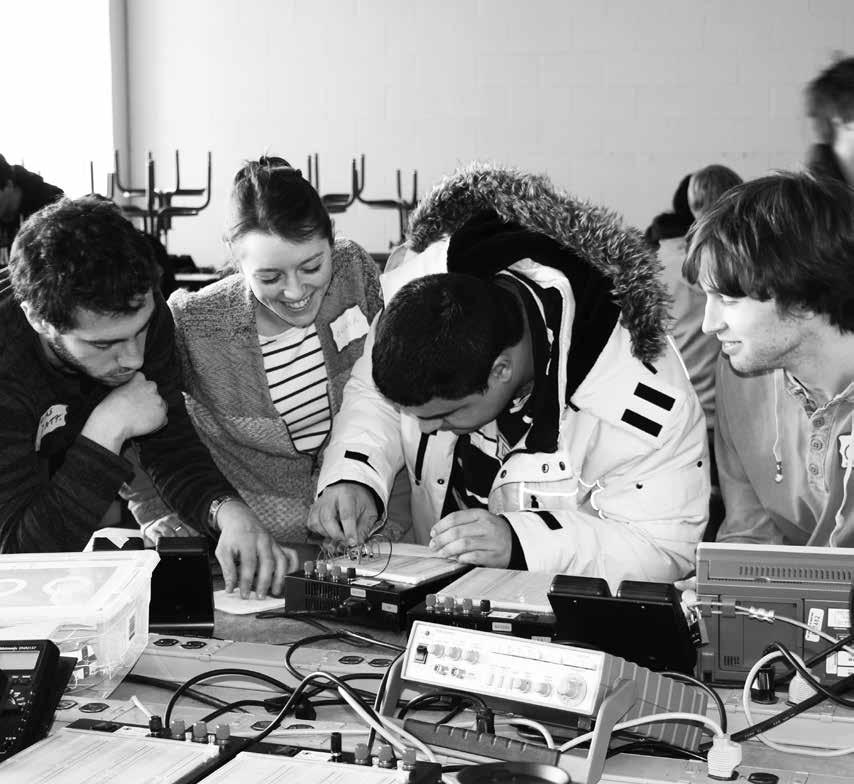
Photo by ahmaD byagowi
Olivia Essex (second left) and co-founder Cameron MacGregor (first right) help students build a DIY pulse oximeter during UMBMES’ annual outreach event.






illustration by carolyne KroeKer


Arkells ‘Come To Light’ With Latest Album
Hamilton rockers Arkells slated to play Winnipeg during Canadian tour
dA niel m ontA nino
Coming off of the summer release of their newest album, High Noon, Hamilton band Arkells is set to stop in Winnipeg during their 12 city Canadian tour.
Featuring 11 songs, including singles “Come to Light” and “Never Thought That This Would Happen,” High Noon is comprised of pieces that are upbeat, energetic, and catchy –and is bound to have listeners pressing repeat.
The album boasts a roster of songs that are dexterous and differ in sound, which not only keeps things fresh during each listen, but also shows the versatility of the musicians.
The piano-driven “Hey Kids!” is reminiscent of 70s rock-and-roll style music, whereas “11:11” employs a more modern sound.
Then there are songs like “Dirty Blonde,” featuring a progressive sound through the combination of 80s synth pop and present-day rock –blending old and new styles together to create a melodious track.
As a whole, it is easy for the listener to see just how musically inspired the album is. High Noon is an amalgamation of past, present, and future styles of music all tightly compiled together.
High Noon displays its multidimensionality from its first notes forward. The opening track, “Fake
Money,” juxtaposes Max Kerman’s raspy and powerful vocals with a folkinspired instrumental sound.
The album boasts a roster of songs that are dexterous and differing in sound, which not only keeps things fresh during each listen, but also shows the versatility of the musicians
Packed with infectious lyrics, a spirited rhythm, and lively piano riffs, High Noon will attract new listeners for the Arkells while encouraging current supporters to revisit past projects.
Over the years they have been together, the Arkells have been recognized for their talent, decorated with two Juno award wins. Their first Juno award came in 2010 for “New Group Of The Year.” In 2012, they won again at the Junos, this time for “Group Of The Year.”

A Canadian project from its inception, High Noon was written by the band in their hometown of Hamilton, Ontario. This winter, tour will bring the Arkells back to Winnipeg for the first time since July 19, 2014, when they performed at the MTS SuperSpike volleyball tournament.
The Arkells’ upcoming Winnipeg
date will be a must-see show for fans of high velocity music accompanied by lyrics that demand to be sung. For listeners of energetic and melodic music, High Noon is definitely an album worth checking out.
The Arkells will be in town performing at the Garrick Centre (330 Garry Street) Feb. 28, 2015. Tickets are on sale now and are available in store at Music Trader, located at 97 Osborne Street, as well as online at www.unionevents.com. $1 from each ticket sold will be donated to Partners in Health, an organization working to battle the Ebola epidemic in West Africa.
Musical rewiring: Cold Specks
Soul singer-songwriter experiments with sophomore album, Neuroplasticity
iA
H
ailing from Toronto, Al Spx— better known as Cold Specks— expands the possibilities of what a singer-songwriter can be. Coinciding with the release of her second album, Neuroplasticity, on Aug. 26 of this year, Spx and her five-piece band will be performing her soulful music at the Park Theatre on Nov. 30.
Cold Speck’s debut album, I Predict a Graceful Expulsion (2012), quickly put Spx and her R&Binspired indie rock music on the map. Singles such as “Blank Maps” and “Holland,” which primarily focus on Spx’s soulful voice, soon caught the attention of music critics across Canada, earning her a spot on the 2012 Polaris Music Prize short-list.
With extensive North American and European touring spanning the two years since the debut’s release, Cold Specks gained an international audience.
For Cold Speck’s sophomore album, she found solitude in a cottage in Wick, England. After time off between a North American and European tour, Spx found it difficult to get the song-writing sparks flying.
“I’d been staying in London at the time and wanted some space to write songs. I was finding this impossible
in London,” explained Spx to the Manitoban
“It was my friend [British producer] Rob Ellis who suggested his friend’s cottage in Wick.”
For three months, off and on during England’s winter, the singersongwriter found herself heading to the cottage to work on songs for her sophomore album.
“The time I was there was entirely devoted to creating. I’d wake up and make breakfast. I’d then hop on the old piano or pick up my guitar and make things happen,” said Spx.
Sophomore albums have a reputation for making or breaking the continued success of a popular artist. While a band such as Vampire Weekend may rise to the occasion (see 2011’s Contra), other acts such as Best Coast may crack under the pressure and release an album that fails to capture the imagination in the way its predecessor did.
This has lead artists to feel pressured when constructing the everimportant second album. Cold Specks rose to the occasion with ease.
“I think that’s only natural. I don’t think there’s any harm in a little pressure,” said Spx to the Manitoban
“I can only make the best music I
can and hope the rest works itself out.”
The result is Neuroplasticity: ten tracks that fuse R&B, indie rock, and soul. Although Spx’s voice remains at the forefront of the music, one is immediately made aware of the album’s experimental instrumentation.
Tracks such as “Absisto” exemplify the continuation of Cold Specks’ music. Featuring a distorted piano riff and a wall of delayed electric guitars, the ear is immediately drawn in by an eerie synth line that would feel at home on an Air or Queens of the Stone Age record.
Cold Specks made a clear statement when “Absisto” was released as Neuroplasticity ’s first single. With a new sound, Spx wanted an album title that communicated the change in her musical style.
“I had realized that the record sounded quite different than the first [record] and so I wanted a title that would reflect change. I felt as though a creative rewiring process had taken place,” said Spx.
“Neuroplasticity is the process by which the brain rewires itself. I thought it was a fitting title. It implies an aesthetic change.”

by
Tickets are $20 and are available through Ticketmaster or the Winnipeg Folk Festival Music Store.
Photo
The Winnipeg Folk Festival presents Cold Specks on Nov. 30 at the Park Theatre (698 Osborne Street.)
Photo
steve gullicK
Sitting down with the Strumbellas
The Strumbellas talk touring, their latest album, and upcoming ventures
lAuren SiddA ll, staff

Toronto-based band, the Strumbellas, have seen massive success this past year. Between their Juno win for “Folk and Traditional Album of the Year,” their Sirius Indie Award for “Folk/Roots Album of the Year,” and being long-listed for the Polaris prize, this band is dominating the music scene.
Although their latest album,
We Still Move on Dance Floors, has received the best feedback, lead vocalist Simon Ward says either of their albums could have received such a decorated response.
“Some of the songs on this record were actually written before the first EP (The Strumbellas, 2009) even came out. So it’s kind of weird because I don’t see that we’ve progressed really,
in terms of the songs we write,” Ward said to the Manitoban
“I think you could take songs from the last record and interchange it with the other record and you wouldn’t even miss a beat.”
The major difference with their new album is the larger production and the new producer, Ryan Hadlock, brought in to pilot the project. Hadlock—producer of the Lumineers’ eponymous, chart topping album — brought a bigger, fuller sound to the six-piece band.
We Still Move on Dance Floors ranges from the rocking and rollicking “Did I Die” or “Home Sweet Home,” to the quieter, more intimate “The Fire” – the latter favourited by Ward.
“I think my favourite song—I don’t know if it’s a favourite song—but my favourite thing is to play a slow song in a sit-down theatre vibe. That’s my favourite musical experience overtop the fast stuff. Don’t get me wrong, I love playing to people who are dancing and shouting along, but I love to play a slow, intimate song.”
Comfort food for thought
Chew restaurant owners open up the Store Next Door
m ic H elle SA romo, volunteer staff

Even before popular restaurant
Chew opened on Waterloo Street in the River Heights neighbourhood in 2013, owners Kristen Chemerika-Lew and Kyle Lew had always wanted a store right beside their restaurant.
“We called it a ‘storestaurant,’” Chemerika-Lew said while kneading dough at their new bakery/espresso bar/food/cookware shop located right beside Chew. “We didn’t think it was going to happen. We rented the place next door, we opened [Chew . . . ] and then the hair salon moved out. So we figured, why not?”
In place of that hair salon stands
The Store Next Door. The new store opened on Oct. 27, and while business is still pretty quiet on this side, it won’t be long before it becomes a bustling neighbourhood meeting place. It has a casual, cozy atmosphere that gives off the feeling of being at a friend’s place (albeit a distinctly epicurean friend’s place). A wooden
communal table, soft lighting, and open shelves of foods make the intimate space feel warm and inviting.
Chemerika-Lew describes The Store Next Door as being “a little more accessible for families and people just wanting a quick bite, a cup of coffee, [or] somewhere quiet to sit where you might not feel as comfortable doing that in a sit-down restaurant [like Chew] in the middle of the morning.”
You can also expect to see a lot more of the classic comfort food favourites at the Store.
“Our prepared foods are a combination of either the things we did for catering clients that aren’t on our regular menu, or the things we did for ourselves and our family and our friends that all said, ‘This is really good, you should make it in your restaurant!’ Except we don’t really have the restaurant that sells the chicken shepherd’s pie,” Chemerika-Lew laughed. “So it’s nice to do things
that are a little more comfortable and casual and a little more reflective of who Kyle and I are.”
The couple have a global set of culinary influences.
“Kyle’s dad’s family is Chinese, my dad’s family is Jewish. We’re classically trained French chefs, as is our full-time pastry chef, Jamie,” said Chemerika-Lew.
On that particular visit, she told the Manitoban that they were selling bialys—her Jewish grandfather’s favourite pastry—for the first time at the bakery: “It’s like a cousin to the bagel, except instead of having a hole in the centre, the centre is actually filled with good stuff, so things like poppy seeds and caramelized onion and cream cheese.”
Their most popular bakery item? So far, it is the savoury brie and chives scones, a hearty upgrade from the typical run-of-the-mill cheese scone. They are—as Chemerika-Lew puts it— “a surprise sleeper hit.”
Although there aren’t very many regular items at the shop yet, according to Chemerika-Lew, “We’re hoping to find our niche as a comfy neighbourhood bakery.”
In the heart of the neighbourhood, right beside their already wellreceived bistro, no doubt they’ll soon find it.
532 Waterloo Street, beside Chew.
During their performance of “The Fire” at the Park Theatre, the Strumbellas illustrated their wide musical scope – opting to play the number acoustically and unplugged to showcase the strong lyrical and vocal abilities of Ward.
Paired with the intimacy of the Park Theatre—though it would have been brilliant in any venue—the ballad showcases the versatility fuelling the Strumbellas success, both in studio and on tour this year.
Despite their extremely lucrative year on the road, including performances and workshops at the Winnipeg Folk Festival, Ward looks forward to their upcoming break and returning to his favoured endeavour – writing.
“Over the break, I’m going to try and write and get this next record ready to go so we can record it and release it as soon as possible. That’s all that’s on my mind right now – making the best record we can possibly
make.”
Though his song-writing process may be unorthodox—citing songwriting locations such as in the bathroom, brushing his teeth, or watching Naked Gun in the tour van for the millionth time—writing is where Ward’s true passion lies; he is always looking forward to the next song he will write.
“What excites me is having a new melody to make a new song; that’s what excites me the most. The other songs were written and they were recorded and they’re on a record. But for me, the excitement is having something new come up and being able to work on something that you hope is better,” said Ward, grinning from ear to ear.
“I think for me, my favourite thing is writing music. I like being by myself, in my room, writing music. That’s my number one favourite thing to do in the world, next to being with my family.”


The Store Next Door is located at
Photo by heather PollocK
Photo by michelle saromo,
The 100-Year-Old Man Who Climbed Out of the Window and Disappeared
Successful Swedish film makes its way to Cinematheque
iA n t d tH om S on, staff
“If you want to kill me, you better hurry, because I’m a hundred years old” – Allan Karlsson.
Best-selling Swedish novel The 100-Year-Old Man Who Climbed Out of the Window and Disappeared tells the tale of centenarian Allan Karlsson and his wild travels outside his retirement home. With a Swedish film adaptation of the same name, The 100-Year-Old Man will be screened at Winnipeg’s Cinematheque later this month.
Written by journalist Jonas Jonasson, the story has subsequently been published in 38 countries in several different languages. As his debut novel, The 100-Year-Old Man Who Climbed Out of the Window and Disappeared has sold over six million copies worldwide.
“It is always difficult to adapt a book to film, but I could not resist The 100-Year-Old Man when I got the chance,” said director Felix Herngren, in a press release.
“It is a delightfully twisted story with rich characters, and situational comedy at its best.”
Uninterested in his upcoming birthday celebration, the 100-year-old Allan Karlsson—as the long-winded title suggests—escapes through the window of his retirement home. After stumbling upon a briefcase full of drug money, the old man finds himself on the run from an angry drug
lord and a slew of criminals.
The story also explores the greater historical context of the centenarian’s life. As a man involved with the development of explosives through the 20th century, Karlsson found himself in comedic situations with important historic figures, such as Joseph Stalin, Winston Churchill, and Harry Truman. Karlsson was present for some large historical events, such as the testing of the atomic bomb. In this way, The 100-Year-Old Man is reminiscent of 1994 Academy Award Winner Forrest Gump.
“Allan Karlsson is doing what many of us westerners should do. Do not worry about the future, use your gut instinct and do not fret over yesterday’s troubles,” explained Herngren.
The 100-Year-Old Man was released in Sweden on Christmas of 2013. The adventure-comedy has subsequently set record numbers in its homeland.
Ranked number one in the box office for 2013, The 100-Year-Old Man is on track to overtake The Girl with the Dragon Tattoo as the top-grossing film of all time in Sweden.
The Scandinavian film has yet to mobilize a similar audience in North America – despite its universal subject matter. The demographics of Sweden—25 per cent of their population fall over the age of 60, placing the country 8th in the world—may account for the film’s popularity. In
comparison, Canada and the United States did not make it into the top 23 in this category.
James Borja, host of “Ultrasonic Film,” one of Canada’s longest running community radio film shows (live every Thursday at 10 p.m. on UMFM 101.5), hypothesizes a difference in business models between the continents to account for the differences in attendance of the film.
“This is certainly going to be a generalization, because of course a lot of big budget Hollywood films do very well in Europe [ . . . But] I think European audiences embrace a lot of different types of films. And I think we do [too], but I think we’re faced with a corporate business model that perhaps Europeans filmmakers are not so controlled by,” explained Borja to the Manitoban
With a reputation for international eclecticism, the Cinematheque is the only theatre in Winnipeg currently planning to screen the Swedish success.
“The Cinematheque strives to bring in international and independent films of a high artistic calibre which do not play here otherwise. We chose this film based on its artistic merit and critical acclaim,” Cinematheque program director
Dave Barber told the Manitoban
“Large venues such as Silver City are set up to cater to Hollywood and whatever will make the most amount

of money,” said Barber. “We are screening films for the love of cinema. We get it.”
The 100-Year Old Man Who Climbed Out of the Window and Disappeared will be playing at Cinematheque (100 Arthur Street) on Nov. 23, 28 29, 30, and Dec. 4. For more information on shows and show times at the Cinematheque, visit winnipegfilmgroup.com/cinematheque

Photos ProviDeD by mongrel meDia

Sports
Editor: Mike Still Contact:
Developing into stars
Junior football’s impact on Kienan LaFrance and Alex Vitt
m ike Still, staff


Playing junior football can serve as a springboard towards a university career for a number of players, and with running back Kienan LaFrance and receiver Alex Vitt, that has been exactly the case.
Vitt’s path started in community football with the Greendell Falcons, and then the St. Vital Mustangs. With the Mustangs, Vitt won two Midget Football League of Manitoba championships, including being named MVP in the 2008 final.
After finishing off his midget football eligibility in the 2008 season, Vitt opted to attend both a CIS and Canadian Junior Football League football camp, with the University of Manitoba Bisons and Winnipeg Rifles, respectively. Ultimately, Vitt chose the Rifles.
“Coming out of high school, I was small, and I wasn’t very fast, so I wouldn’t have been anything on the Bisons,” Vitt said. “I took the Rifles, because I just wanted to play and develop there.”
LaFrance’s football journey started relatively late. He didn’t strap on the pads for the first time until age 15, with the St. James Rods. After a year of playing community ball, he moved onto Sturgeon Heights High School, where he won a Winnipeg High School Football League champi-
onship in his senior season in 2008.
LaFrance’s abilities as a ball carrier led to interest from universities such as Alberta and Simon Fraser. However, LaFrance ultimately chose to take the junior football route as well.
“I think that in terms of goals, you need to set mini goals in order to get to those major ones” – Kienan LaFrance, running back, Manitoba Bisons
“[Playing with Sturgeon Heights] was my second year of real competitive football, where I’m applying to get better, and play to be the best,” LaFrance said. “I felt like [CIS football] kind of wasn’t a good fit, to go and compete against guys who had been playing for 10 years.”
While with the Rifles—Vitt from 2009-11 and LaFrance from 2009-10—both players earned CJFL All Canadian honours (LaFrance in 2010, Vitt in 2011), and
Dunking and dominating
Men sweep Brandon, first in Canada West to score 100 in a game
m ike Still, staff
Men’s basketball
The University of Manitoba men’s basketball team continued their hot start to the 2014-15 season, grabbing a pair of wins over the weekend against the Brandon Bobcats. Manitoba led early and often in both games, taking it to the winless Bobcats. AJ Basi led the team in points in both games, recording 25 on Friday and 19 on Saturday.
Friday’s game was the closer of the two. The Bisons took a 24-12 lead into the second quarter, but Brandon was able to fight back, using their speed to get a number of good looks. The Bobcats outscored Manitoba 27-15 in the second frame, and the two teams went into the half tied up at 39.
The second half was a different story entirely, as the Bisons outscored Brandon 54-39 over the final two quarters, securing the 93-78 win.
made names for themselves locally. Vitt was on top of the Prairie Football Conference in receiving yards during his final season, while LaFrance led the Rifles in rushing during both of his two years with the team.
After impressing in junior, the two local products were recruited to the U of M, where they are now in their fourth year of eligibility, and have put up big numbers in 2014.
LaFrance played in all eight regular season games, finishing second in the Canada West conference in rushing yards, with 785, while Vitt played in seven of eight games, logging 489 receiving yards, good for eighth in the conference and second on the team.
“I think that in terms of goals, you need to set mini goals in order to get to those major ones. I figured that [junior football] was the best stepping stone in order to prepare myself for [the CIS],” LaFrance said.
Both players made an intelligent decision to hone their skills in junior football, instead of moving directly to CIS football, and their patience and hard work has paid off. With one year of eligibility remaining for each, the best is likely yet to come for LaFrance and Vitt.
up everything for all of the other guards.”
Saturday’s rematch was never close. Manitoba led by 10 after the first quarter, and then erupted for 34 points in the second quarter to pull away. Five different players scored in double figures for Manitoba, and Anders was a phenom on the boards, picking up a double-double, with 14 rebounds and 10 points in the 102-67 shellacking.
Women’s basketball
Manitoba led by 10 after the first quarter, and then erupted for 34 points in the second quarter to pull away
Basi scored four three-pointers in the second half, and credited his open looks to the play of the team’s power forwards, specifically Wyatt Anders, who was aggressive in the paint all game long.
“It was for sure a product of what Wyatt [Anders] was doing down low,” Basi said. “Him getting a couple of easy buckets opened
The women didn’t fare as well against the Bobcats, falling 71-47 on Friday, and 66-56 on Saturday. Vanessa DeVries was the leading scorer for Manitoba in the opening matchup, with 12 points, while Robyn Eyer put up a team-high 11 points the following night. When asked what the team needs to do to improve going forward, head coach Michele Hynes said they need to display more “effort and passion.”
Both basketball teams will now travel to take on the Calgary Dinos, on Friday, Nov. 21, and Saturday, Nov. 22. Women’s action will be at 7 p.m. and 6 p.m., respectively, while the men will duel at 9 p.m., and 8 p.m.

Photos ProviDeD by bison sPorts
Photo by shawn coates
Treading in the right direction
The story of fourth-year Bison swimmer Dillon Perron
m ike Still, staff
Dillon Perron is no stranger to the pool. The native of Lac du Bonnet started swimming when he was six years old, and moved to Winnipeg in grade nine in order to train with the Manta Swim Club at Pan Am Pool. He stayed with Manta until he graduated from high school, moving onto the Bisons from there.
The training schedule for Perron during high school was fairly intense. He would go to the pool every evening after class for three hours, and participated in morning sessions four times a week.
While he was able to balance school and training fairly well in high school, his first year of university was a larger adjustment.
“My first year at the university was very tough,” Perron said. “It was sort of a new adjustment for me to actually have school with that regime, and that first year didn’t work out the best for me.”
Perron ended up taking a full year off from school, which resulted in a loss of two years of eligibility, as players needed to have 18 credit hours from the previous year to continue
competing at meets, which Perron didn’t have.
Despite losing his eligibility for an extended period of time, Perron continued to hone his craft at the university.
The winter of 2012 was Perron’s last semester as an ineligible swimmer, and once he returned to the university circuit in the fall of that year, records began to drop
“During that time I was just swimming with the club at the university,” Perron said. “Nothing majorly changed for me, except that I couldn’t swim at university meets.”
The winter of 2012 was Perron’s last

semester as an ineligible swimmer, and once he returned to the university circuit in the fall of that year, records began to drop.
Perron started off by placing first in the 50- (28.05 seconds), and 100metre breaststroke (1:01.32 seconds) at the 2012 Canada Cup, held in November of that year – a score that shattered both the Bisons’ and provincial records. He also qualified for the CIS swimming championships that season.
Perron credited his attendance
at the 2012 Olympic trials, held in March in Montreal, as one of the big factors that changed his mindset once he returned to competition in the fall.
“That sort of opened me up to a whole new world of swimming,” Perron said of the event.
“I’d already been swimming for 15 or 16 years at that point, but I’d never really been to a meet quite as emotional as that. As focused as I was with the sport at that time, it was even more so after that.”
Perron has kept his drive going
Bison Briefs
Hockey and volleyball
dAvid g r A d, staff
Men’s hockey
The men’s hockey team took on the Calgary Dinos at home. Entering the matchup, the Dinos were sitting in second place in the Canada West, three spots ahead of the Bisons. Manitoba played an excellent game defensively in a 4-1 victory Friday night. Manitoba kept the Dinos to 20 shots and limited threatening scoring chances. Deven Dubyk stood tall in net yet again, and the Bisons received contributions on the score sheet from Reid Gow, Aaron Lewadniuk, Justin Augert, and Jesse Paradis.
Coach Mike Sirant noted that his team had a strong team defensive game and played smart positionally.
When asked about how much time his team has to celebrate a big 4-1 win against Calgary, Sirant was quick to answer, “30 minutes. Very little time to enjoy this, it’s back to business to prepare for tomorrow.”
The Bisons were unable to carry the momentum from Friday night into Saturday’s game, losing 3-0 to the Dinos, despite managing 25 shots on net.
The Bisons will now head to UBC to take on the Thunderbirds on Nov. 22 and 23.
Women’s hockey
The women’s hockey team wasn’t able to find success on the road
against the Dinos this weekend, losing Friday and Saturday night’s matchups 3-2 and 3-1, respectively. Charity Price notched her second and third goals of the season on Friday night. The Bisons were in tough against a Calgary squad that has one of Canada’s top female players internationally, Hayley Wickenheiser. Wickenheiser had two assists on Friday night and a goal and assist on Saturday night. Standout first-year Alanna Sharman scored the lone goal on Saturday against the Dinos.
Men’s volleyball
The men’s volleyball team was in tough against a strong Brandon squad on the road this weekend. Brandon beat the Bisons Friday night in three straight sets (22-25, 13-25, 22-25).
Devren Dear and Kenny Rooney led the Bison offence on Friday with 11 and nine kills, respectively. Libero Alex Strachan picked up 11 digs in the effort. The Bisons came out with a stronger effort on Saturday night in a tight five-set loss (26-28, 25-19, 23-25, 25-16, 8-15).
Luke Herr picked up a staggering 54 assists in Saturday nights effort, and Dear led the offence with 19 kills. Adam DeJonckheere had 16 kills, Rooney picked up 11 kills, and Strachan led the defensive effort with 17 digs.
ever since. He’s had a number of notable performances, including placing third in the 100-metre breaststroke at the 2014 CIS championships. His bronze medal was the first hardware for a Bison at the national competition since 2006.
Perron plans to continue swimming after his university career ends next season, with the ultimate goal of making a national team. Considering the adversity that he has already battled through, it wouldn’t be a surprise to see him continue to surge forward.
Women’s volleyball
Continuing their tough first half stretch, the Bisons, looking to get above .500 before Christmas, split the weekend against the Bobcats. Manitoba got off to a hot start on Friday night, beating the Bobcats in three straight sets (25-16, 25-23, 25-19).
Rachel Cockrell continues to light up her opponents, picking up 26 kills on the night. Brittany Habing had 41 assists, and the defence was led by Caleigh Dobie and first-year Kalena Schulz, with 17 and 15 digs, respectively.
The Bobcats responded on Saturday night, taking the match 1-3 (20-25, 25-21, 14-25, 25-27). Cockrell and Schulz led the offence with 17 and 10 kills, while Habing collected 31 assists and 14 digs. Dobie finished her weekend strong with 16 digs.
Captains Cockrell and Habing are still topping the leader boards in the Canada West. Cockrell leads the conference with the most kills, while Habing has the second most assists. Also of note are Dobie, with the fourth best digs per set, and Schulz, with the third highest service aces per set.
Both volleyball teams return home this weekend, taking on Thompson Rivers on Nov. 21 and 22.
Photo ProviDeD by bison sPorts
The best in the Canada West
Bison football upsets Calgary, wins first Hardy Cup title since 2007
m ike Still, staff
The Hardy Cup has made its way back to the province of Manitoba. On Saturday afternoon, the University of Manitoba Bison football team dethroned the Calgary Dinos at the top of the Canada West conference, winning 27-15 at McMahon Stadium. The Hardy Cup win was the Bisons’ first since 2007, when they went on to win the Vanier Cup.
The victory was also Manitoba’s first-ever post-season win on the road against Calgary, who had won six straight conference titles heading into the weekend matchup.
The turnover battle made the difference in this one, as Calgary conceded 10, compared to none from Manitoba. The Bisons’ secondary had arguably their best performance of the year, holding Canada West MVP Andrew Buckley to 224 yards passing, along with four interceptions – the same number of picks Buckley threw over the entirety of the regular season.
Summary
Things got off to a shaky start for Manitoba, as Calgary running back Mercer Timmis shot through the line for an 81-yard rushing touchdown on the first play from scrimmage.
Despite going down early, Manitoba stayed composed, tying things up on the shoulders of their defence. Jonathan Jones jumped a route in the flats, taking it back 20 yards to the house to tie the game up, less than five minutes in.
The Bisons grabbed the momentum after the pick six. They took their first lead of the game with 7:47 left in the first quarter. Kienan LaFrance found a hole, made a few defenders miss, and rumbled 40 yards to the endzone, capping off a three-play, 75-yard drive.
Both offences stalled until a missed Manitoba field goal less than two minutes into the second gave Calgary some life.
Manitoba’s defence shut down the highest scoring team in the nation in the final two quarters, forcing five more turnovers
The Dinos retook the ball after a failed 37-yard attempt from Ryan Jones, and capitalized with a five-play, 90-yard drive of their own. Rashaun Simonise hauled in a pass on a slant route, and utilized his breakaway speed to tie the game up at 14, on a 42-yard reception.
The game would remain tied for less than four minutes, as Manitoba secured the lead for good, on a 17-yard Jones field goal. The three points came off of the second forced turnover by the Bisons, as Colton Farago stripped Dino returner Michael Klukas, and Brett MacFarlane recovered the ball on the Calgary 10-yard line.
The fumble recovery by MacFarlane marked the first of four consecutive drives where the Dinos turned the ball over. Backup QB Eric Dzwilewski failed on a third down conversion, two straight interceptions, thrown by Buckley, followed – the first to Tyler Fong, and the second to Cam Teschuk, who stole the ball from the outstretched hands of Simonise.
The Fong interception resulted

in a touchdown for the Bisons, as QB Jordan Yantz found Zach Regert from seven yards out on the ensuing drive, to take a 10-point lead heading into the break.
The second half produced a total of just four points, with a single from the Dinos, and a field goal from Manitoba to round out the scoring.
Manitoba’s defence shut down the highest scoring team in the nation in the final two quarters, forcing five more turnovers, including two failed third down conversions, a fumble recovery by Evan Foster, and interceptions from halfbacks Jayden McKoy and Jordan Linnen.
Calgary also lost Buckley to a hamstring injury midway through the third quarter. Dzwilewski entered the game in relief, producing 105 yards, no touchdowns, and
one interception.
Yantz did an effective job managing the game for the Bisons. He finished with 263 yards, one touchdown, and no interceptions.
LaFrance was the biggest playmaker offensively for Manitoba, putting in a workhorse effort. He carried the ball 30 times for 155 yards and a touchdown.
The Winnipeg product was pleased with the way the team has come together all season to get to this point.
“There’s not a group of guys I’d rather be sharing this victory with. Everyone had put in so much work to get where we’re at, and it’s finally paying off,” LaFrance said.
“It’s definitely the best experience I’ve had in this program and is truly the most amazing feeling.”
On the defensive side of the ball, DJ Lalama led the way, with eight total tackles. Lauren Kroeker and Foster put in strong efforts from the end positions, both recording four tackles, with Kroeker adding a sack. After him romping 81 yards for a score on the first play, the Manitoba defensive held Timmis to just 52 yards rushing for the remainder of the game.
Uteck Bowl
The Bisons will now head to the CIS National Semi-Finals in the Uteck Bowl to take on the secondranked Université de Montréal Carabins on the road. Game time is Saturday Nov. 22, at 11:30 a.m. CT. This will be the first time the two teams have ever squared off.

Photos by DaviD moll