ARTS & CULTURE EDITOR Olivia Michalczuk arts@themanitoban.com
SPORTS EDITOR Ryan Stelter sports@themanitoban.com
COPY EDITOR Evan Tremblay copy@themanitoban.com
DESIGN
DESIGN EDITOR Bram Keast design@themanitoban.com
GRAPHICS EDITOR Kelly Campbell graphics@themanitoban.com
PHOTO EDITOR Asha Nelson photo@themanitoban.com
SOCIAL EDITOR Carolyne Kroeker social@themanitoban.com
DESIGN ASSOCIATE Kellie Huynh
GRAPHICS ASSOCIATE Ernest Zarzuela
PHOTO ASSOCIATE Chantal Zdan
PHOTO ASSOCIATE Quincy Houdayer
REPORTERS
GENERAL ASSIGNMENT Qudus Abusaleh
GENERAL ASSIGNMENT Diana-Abasi Ubokudom
COLUMNIST Levi Garber
COLUMNIST Kenny Ingram
ARTS & CULTURE Jen Doerksen
SPORTS Jason Pchajek
COPY ASSOCIATE Matthew Doering
VOLUNTEER CONTRIBUTORS
MANITOBAN
109 HELEN GLASS UNIVERSITY OF MANITOBA WINNIPEG, MB R3T 2N2
GENERAL INQUIRIES & ADVERTISING
Phone: (204) 474.6535
Fax: (204) 474.7651
Email: manitoban@themanitoban.com
FREE MEDIA
Campus Plus Media Services
Phone: 1.780.421.1000
Email: advertise@free-media.ca
Canadian Publications Mail Product Sales Agreement #589160
A “volunteer staff” member is defined as a person who has had three volunteer articles, photographs, or pieces of art of reasonable length and/or substance published in three different issues of the current publishing year of the Manitoban. Any individual who qualifies must be voted in by a majority vote at a Manitoban staff meeting. Elected representatives and non-students may be excluded from holding votes as volunteer staff members in accordance with the Manitoban Constitution.
The Manitoban is the official student newspaper of the University of Manitoba. It is published monthly during the summer and each week of regular classes during the academic year by the Manitoban Newspaper Publications Corporation.
Residents discuss access to healthcare, privatization at town hall gathering hosted by NDP leader
IMREET KAUR, STAFF
M
anitoba’s NDP is criticizing of the opening of Prota clinic, a private, for-profit medical testing facility in Winnipeg.
In a letter dated Jan. 3, Manitoba NDP leader Wab Kinew and NDP health critic Andrew Swan requested the federal minster of health, Petitpas Taylor, examine whether the clinic is in violation of the Canada Health Act (CHA) for charging Manitobans for necessary medical tests.
“What I do know is that in other provinces, their citizens are able to access services and in Manitoba they have not been able to and I don’t understand why we should be treated as second class Canadians” - Kelvin Goertzen, provincial minister of health
The private clinic offers echocardiograms for $650 for those who can afford to pay for testing out of pocket.
The NDP letter said this creates a “VIP health system for the wealthy in our communities” while it drains “resources and trained staff from the public system, and hurts the quality of care we can all expect, leaving the rest of us with second class care.”
The provincial government has not objected to the private clinic and argued that such clinics have been operating in British Columbia, Alberta and Saskatchewan for many years.
Kelvin Goertzen, Manitoba minister of health, seniors and active living, said not offering these services will make Manitobans “second-tier Canadians.”
“If those services are available for purchase in other provinces, there is no legal reason, then, they shouldn’t be available in Manitoba, and I don’t know why the NDP would want to subrogate Manitobans to secondclass Canadians,” Goertzen told reporters.
The NDP letter argues that privatizing essential elements of the healthcare system does not solve the problem of wait times and that creating a service fee for health care runs against the health act.
“Encouraging profiteering in our health system is against the values of public health that Canadians and
Manitobans hold dear and that is enshrined in law,” the letter reads.
“The challenges of illness are difficult enough without getting a bill in the mail afterwards.”
The letter argues accessing healthcare should not be “determined by the size of your bank account” and that it should be accessible to all regardless of socio-economic status.
Goertzen retorted that the system is already being interfered with “in that way” given the availability of existing private clinics in other provinces that offer tests.
According to Goertzen, tests are not subject to the CHA as the “feds haven’t acted on any of those provinces.” He added that Manitobans should not be treated differently.
Goertzen said he hopes the clinic's opening has a positive effect on wait times in the province.
“What I do know is that in other provinces, their citizens are able to access services and in Manitoba they have not been able to, and I don’t understand why we should be treated as second-class Canadians,” he said.
a local psychiatric nurse, hosted a town hall at the West Broadway Community Ministry Jan. 13 to
“Encouraging profiteering in our health system is against the values of public health that Canadians and Manitoba hold dear, and that is enshrined in law. The challenges of illness are difficult enough without getting a bill in the mail afterwards” – Wab Kinew, leader of the Manitoba NDP
more than 100 people, many of whom spoke about the social determinants of health, which include housing, income, gender, race, sexual orientation, first language, and religion.
and they feel as though maybe they are not being heard, or they are not able to access some of the treatment that they need if they have a mental health issue,” Kinew said in an interview.
“I also think that one of the big things that stood out to me was the amount of people who talked about social determinants of health, like poverty or housing issues, and how that can impact peoples’ well-being and I think that is where, as a government and as political leaders, we need to focus more of our attention,” he added.
Kinew again expressed his criticism of for-profit diagnostic clinics and said the language being used by the provincial government is concerning. “They are going to use a similar approach in other areas,” he said.
Healthcare town hall
Kinew and Uzoma Asagwara,
discuss the state of health care in Manitoba, access to mental health services, and to explore policy options surrounding mental health and addictions in the province.
The town hall was attended by
Asagwara said these “determinants can act as barriers to accessing health care” and the government should invest in preventative care for the overall well-being of people.
“I heard a lot today about the needs around mental health in our community - particularly with addictions - but also just mental health in general and how people face barriers
“My concern for what that will mean for the health care system overall is that it could potentially drain the talent out of public health care towards the private health care system,” he added.
Kinew said he is looking forward to engaging with the federal minister of health to discuss the issue in detail.
“They have acknowledged that they have received the letter," he said, "but we haven’t had the some of follow up. So we’re still waiting on [that]."
Provincial NDP leader Wab Kinew and Uzoma Asagwara, a local physchiatric nurse, host a healthcare town hall meeting attended by more than 100 community members at the West Broadway Community Ministry Jan. 13. PHOTOS BY ASHA NELSON
Federal minister Navdeep Bains leads Q and A session
Minister of innovation, science, and economic development talks government, sustainable development, and social innovation
QUDUS ABUSALEH, STAFF
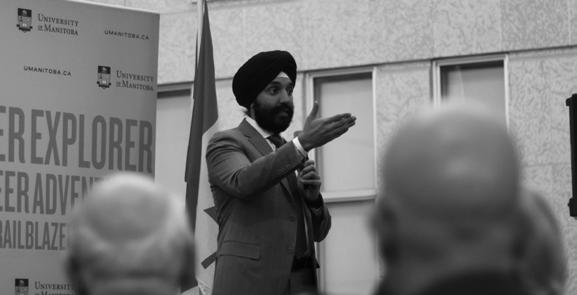
F ederal minister of innovation, science, and economic development Navdeep Bains took part in a Q and A session on the government’s role in sustainable development and social innovation with U of M students Jan. 8.
Held in the Engineering Information & Technology Complex atrium and hosted by director of the Asper School of Business’s Stu Clark Centre for Entrepreneurship, La Royce Batchelor, the session’s theme was created around Canada’s continued innovation at home.
“ We are here to ask some questions, truly in a representative government fashion,” Batchelor said.
“ Something that a lot of other countries don’t get to do.”
The role of government in innovation
The first question posed to the minister was on the Canadian government’s role in the innovation sector.
Bains said the Canadian government today is particularly crucial within the realm of many emerging global markets that place the country in the context of “a global innovation race.”
“We are competing with other jurisdictions when it comes to innovation,” he said.
Bains said the government can best serve innovation by using its abil-
ity “to bring industry and academia together to solve problems.”
“ The role of government is to put out our ability to bring people together, and to deal with these areas that are challenges for us,” he said.
“ Innovation is about challenging the status quo. It’s about solving problems. It's about better outcomes, for ourselves, our children, and grandchildren.”
Bains also emphasized that the government's capacity to engage in this global innovation race is through driving innovation and creating “the conditions for innovation to succeed.”
Sustainable development
Bains noted that the pivotal sustainable development change forwarded by the current Liberal government has been to ensure “the environment and the economy go hand in hand.” This, he continued, creates a “compelling case” for meaningful growth.
Bains highlighted that the government’s increased focus on qualitative data analyzed through Statistics Canada has enabled it to formulate tangible targets for sustainable growth in Canada’s the clean technology (cleantech) sector.
Cleantech refers to technologies,
processes, or services that reduce or eliminate harmful environmental impacts through energy efficiency improvements.
“We wanted to understand the cleantech sector - the cleantech market in Canada - and last year, we measured this information,” he said.
Bains said the clean technology sector represents three per cent of Canada’s gross domestic product, with about 274,000 Canadians employed in the sector nationwide.
“ This is an area where we are making big investments,” he said.
The minister added that sustainable development is an important
fixture of Canada’s global trade agenda, citing the government's goal to “ double the cleantech market share for Canada globally” as an example.
Social innovation
Asked about the social role in determining the Department of Innovation, Science, and Economic Development’s programs, Bains said the government has emphasized “promoting diversity” by being “inclusive in our approach when it comes to economic policy.”
“ This is about making sure that we look at our Indigenous population, young people, more women, people of visible minorities,” he said. “We have that lens when we talk about creating programs and incentives.”
Bains said that the way the government implements this view is by examining social challenges such as poverty, and then asking questions like, “How can we inject innovation in that?”
“ When we have programs that we assign, or funding that we assign, we actually have a social lens to it,” he said.
“We say, ‘What problem are you trying to solve and how would that impact your community in a positive way?’”
UMSU to hold plebiscite on continued membership with Canadian Federation of Students
DIANA UBOKUDOM, STAFF
UMSU is preparing to hold a plebiscite asking U of M students if they want to continue their membership in the Canadian Federation of Students (CFS).
The motion to hold the plebiscite was approved by UMSU council in the fall at its Nov. 9 meeting. U of M students are assessed a $14.98 annual CFS membership fee.
UMSU president Tanjit Nagra said the vote will allow students to express their opinions on the working relationship between UMSU and CFS.
"It’s not a referendum. It’s nonbinding," she said. "It’s essentially to get the students’ input on the relationship with the Canadian Federation of Students.”
Nagra said the plebiscite will direct the future of both organizations.
What Nagra described as “personal issues” also led to the council’s decision to approve the plebiscite motion. She has claimed she was
verbally harassed by CFS-MB executives during the CFS annual national general meeting last year.
“UMSU has had several issues with this organization,” said Nagra.
The plebiscite will ask students: “Do you believe UMSU should remain a member of the Canadian Federation of Students, at a cost of $14.98 per student per year?”
When challenged whether the question posed is leading for its including the annual fee, Nagra said “That was approved by UMSU council. It was approved by a board of 49 voting members with input from all faculties and all different residences, colleges, and community groups. So ultimately it was their decision to go with that wording choice.”
Nagra also noted that UMSU council reserves the right to determine the final course of action on the future relationship between UMSU and CFS regardless of the outcome of the non-binding vote.
Dele Ojewole, interim chairperson of CFS - Manitoba, said the federation has always been committed to working with UMSU, as well as other student unions in Manitoba, to advance the interests of students in the province.
He said CFS “intends to continue working with the UMSU executives and students at the University of Manitoba.”
Ojewole noted that in the fall of 2017, UMSU and CFS worked together to advocate for students and campaign against Bill 31 - the Advanced Education Administration Amendment Act. The bill rolled back legislation put in place by the NDP in 2012 that capped tuition increases to inflation.
“As recent as this fall, we had overwhelming supports and responses from University of Manitoba students by participating in our Education for All Campaign,” he said.
Voting on the plebiscite will be
open for two days - Jan. 31 and Feb. 2. Online votes will be tallied on simplyvoting.com. A polling station will also be set up in front of the UMSU office in University Centre.
IQ’s “grand re-opening”
IQ’s Café & Billiards had its grand re-opening Jan. 11 after renovations over the summer and the first part of the fall semester.
The renovations were the first significant improvements the space has undergone in 18 years. The café was initially scheduled to fully reopen last fall.
UMSU council initially approved spending up to $1 million in January 2017. An additional $200,000 was approved in the fall to cover cost overruns.
The café had a soft opening in September.
Nagra said requirements like permits and certain construction work had delayed the initial re-opening,
even though UMSU was ready to proceed.
Some of the improvements to the café include: professional-grade Diamond League pool tables, a stateof-the-art audio visual and speaker system, USB plug-ins and power outlets at every table.
Ayobami Ige, who is in his final year of computer science, expressed his admiration for the newly improved area, while also commenting on some of the things he missed having prior to renovating the space.
“The new place is beautiful, it looks good," he said, noting the elimination of separate study space. “There is no separation anymore - which used to be an option.”
“That’s just the only set back," he added, "but overall, I think I like it.”
PHOTO BY QUINCY HOUDAYER
U of M international students express worry, hope in response to Iranian protests
Thousands arrested, reports of torture in Iran uprising
SHADEN ABUSALEH, STAFF
Ongoing protests in Iran, which began on Dec. 28, mark what Reuter's has referred to as the country’s “most audacious challenge to its clerical leadership” in nearly a decade.
Demonstrations in reaction to Iran’s weakening economy, rising food and fuel prices, and widespread corruption began in the country’s second largest city, Mashhad. Online videos showed crowds of hundreds gathered in Mashhad chanting things like “Death to the dictator” and “Death to Rouhani.”
Hassan Rouhani is Iran’s president and was re-elected in May.
According to activists, protests in Iran have spread to include up to 130 cities and towns.
On Jan. 9, it was reported that up to 3,700 Iranians had been arrested during the protests, with reports emerging that many have been tortured. Of those arrested, 90 per cent are under the age of 25 years old. Violent clashes between protesters and security forces have resulted in at least 21 deaths.
U of M fourth-year biology student Behnam Beizaei, who immigrated from Iran to Winnipeg seven years ago, spoke of the economic hardships faced by the Iranian people, particularly young Iranians.
“It’s rooted in the frustration,” he said. “Like many of the countries in [the] Middle East, Iran has also a population of young people who are the majority. So when you have a lot of young people, they need jobs, they need to have enough income to start a family.”
“I know that there are some sort of inequalities,” Beizaei continued.
“There is a gap. There is a gap between very poor people and very rich people. And most of the people in the middle class, they’re kind of getting divided between these two, and a lot of them are leaving the country, like my own family.”
Beizaei noted that the economic frustrations stem from high levels of inflation, unemployment, and prices of goods.
Improving the Iranian economy
was an important part of Rouhani’s political agenda when he campaigned.
This included signing the 2015 Joint Comprehensive Plan of Action, also known as the Iranian Nuclear Deal.
The agreement between the Iranian government and the P5+1 countries - China, France, Russia, the United Kingdom, and the United States, plus Germany - saw Iran agree to heavy restrictions on its nuclear development program to relieve the country of US and European-backed economic sanctions.
“Maybe our appearances are different, but we’re all after the same thing” - Amin Montazeri, second year U1 student
In spite of the four to five per cent growth in the country’s gross domestic product under Rouhani, Iran’s economy remains in trouble, with inflation sitting at 9.6 per cent, unemployment rates at nearly 13 per cent, and youth unemployment at almost 29 per cent.
Iran’s youth, who make up more than 60 per cent of the country’s population, have been the driving force of the recent protests.
Second-year U1 student, Amin Montazeri, called the protests “worrisome.”
“If there was going to be a clear revolution in Iran, it could be a second Syria,” he said.
“I’ve been away from home for a long time,” Montazeri explained. “So I haven’t lived in [Iranian] society to tell you authentically that this is what the people are experiencing.”
“The economic [troubles] that are being piled up on people,” Montazeri continued, “that’s the main thing that’s driving the protests.”
Such economic struggles include an increase in the price of fuel and other basic goods by roughly 40 per cent. This, combined with an outbreak of bird flu which killed between 15 and 17 million chickens, resulted in a spike in the price of eggs by up to 50 per cent.
A leak of Rouhani's new budget, which proposes an end of subsidies to the poor, tax increases, and an increase to fuel prices, all while military expenditures climb, appears to have acted as a catalyst for the protests.
While the uprising in Iran began in response to a stagnant economy, these ongoing protests have now evolved into a deeper political disapproval of the country’s government, with protestors calling for the overthrow of Iran’s supreme leader - where fundamental, uncontested authority rests.
Iran’s government is composed of a combination of elected officials – members of the legislature and the president – and an unelected cleric, currently led by Supreme Leader Ali Khamenei, who has the authority to override the presidency's policy decisions. Basic rights, like the freedom of expression, are tightly controlled by the government.
“I just feel bad for the parents of those people that were killed,” Montazeri said. “Because most of them are like our age, maybe a bit older, university students.”
“That’s what I resent about what is happening.”
While the protests in Iran have died down, the anger and tensions remain.
Beizaei said the protests affect Iranians living both at home and abroad.
“ Anything that happens in [the] Middle East kind of affects the life in here [in Canada] in general,” he said.
“Every Iranian that is living in Iran and outside, they do feel the frustration.”
“We are fortunate that we have access to free press [in Canada],” he added. “We can talk to people, we
have access to open internet that is not filtered, and we can talk to each there and see if we can do anything.”
Adding to this, Montazeri highlighted the importance of sympathy and understanding.
“I think what keeps us connected as a human race is empathy,” he said. “Many people aren’t involved or aware of what is happening in the Middle East. I think if we see something in a headline - a BBC, CNN headlinedon’t just turn away. Maybe consider that there are these people that are fighting for their human rights.”
“Maybe our appearances are different, but we’re all after the same thing.”
From ground zero
Another U of M student, who recently returned from Iran and requested anonymity, said the protests in his hometown, Sari - located in northern Iran - were unexpected.
“My hometown [stood] up for one day [and] they destroyed us,” he said, referring to Iran's Revolutionary Guard Corps - a branch of Iran’s armed forces led by Qasem Soleimani.
“The security destroyed everyone," he said. “Two of my friends, they got arrested and I couldn’t say bye to them.”
He said what started out as lunch with friends quickly turned dangerous when “around 500, 600 people
just came to the street" to demonstrate against the Iranian regime.
"But after [an] hour, the revolutionary guard just came," he said. "They started hitting people."
As soon as the protests turned violent, he fled.
"The day after, the parents, they were looking for their kids all the time. They were asking other people where are their kids, but no answer," he said. "No one would answer and that's really hard.”
“You see the mother crying all the time in front of the police station and asking for her kids and it's really hard to see that."
He expressed his frustration in the government's failure to meet the needs of the Iranian population, saying Rouhani’s reelection was supposed to bring about positive change to the country. But the economic grievances worsened.
"I don't want to say that, but sometimes they are calling our country [a] dangerous country," he said. "Our people are not terrorists. Our people are really nice people."
"I feel like this country should get changed. My people deserve moredeserve better lives."
Iranian students protest at the University of Tehran on Dec. 30 2017 as a part of the widespread demonstrations that took place across the country. PHOTO FROM GETTY IMAGES
UM ecoMotion preparing for April competition
University of Manitoba’s Shell Eco-Marathon team set to compete in Sonoma, California
SHADEN ABUSALEH, STAFF
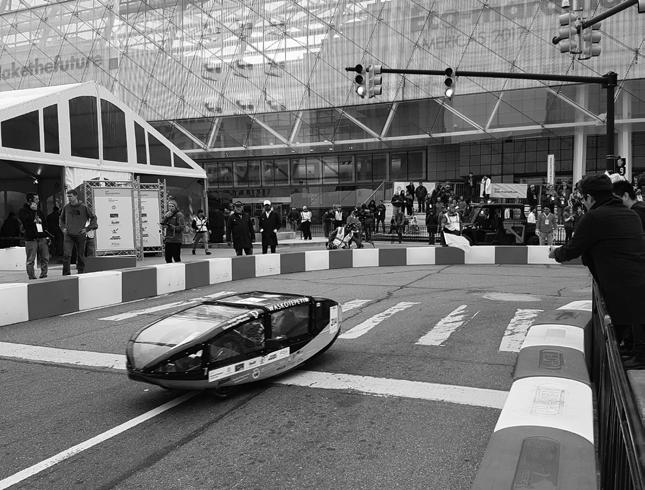
UM ecoMotion - a design team of over 50 engineering students - is designing and building an efficient, battery-powered vehicle that will compete in the Shell Eco-marathon Americas 2018 competition.
The competition, held at Sonoma Raceway in Sonoma, California, will run from April 19 to 22.
UM ecoMotion is the first and only Shell Eco-Marathon team at the University of Manitoba. The team formed in September 2016.
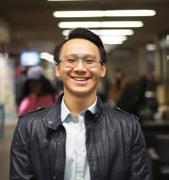
Fourth-year electrical engineering student and UM ecoMotion’s communications lead, Alan Huynh, said that while most competitions focus on performance and speed, the Shell Eco-Marathon competition is “about efficiency - so more about towards the future of sustainability, especially with electric vehicles.”
“This competition is a little bit different than the usual ones,” he said. “This one is based on the efficiency of your vehicle, so how far you can go on one litre of gasoline or how many kilowatt joules you use per lap.”
UM ecoMotion’s beginnings
Huynh reflected on the team’s beginnings, noting that forming the eco-marathon team posed initial challenges.
“ It wasn’t very easy at first,” he said. “Being a new team, you need to create your brand awareness.”
“Last year, being a first-year team,
it’s very difficult getting funding and support,” he added. “We needed to prove to people and sponsors, specifically, that we are going to take them seriously, use their funding and resources responsibly.”
“Seeing something that you put work into and seeing it run for the very first time and seeing it move, it’s priceless”
– Alan Huynh, UM ecoMotion communications lead
Huynh said that the team’s funding comes from a combination of sources which include private sponsors UM ecoMotion reaches out to, and different groups at the university such as Friends of Engineering, the University of Manitoba Engineering Society, and the Faculty of Eng ineering Endowment Fund.
An additional difficulty, Huynh said, was the team’s small starting group size which made it “quite impossible to build a vehicle, and design, and get members and funding.”
Now with over 50 members from a variety of engineering disciplines on the team - including biosystems, mechanical, electrical, and computer engineering - Huynh said the number of group members is no longer a challenge.
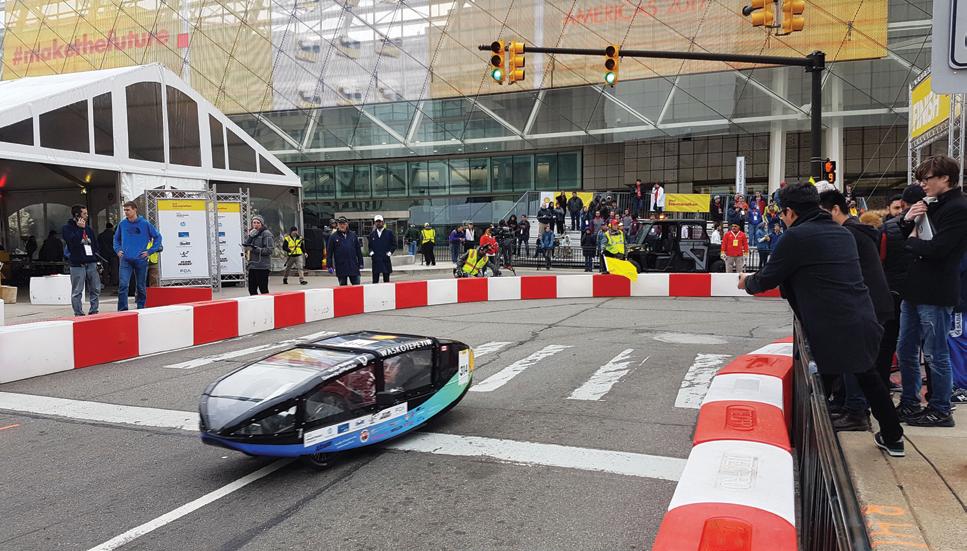
The team participated in its first Shell Eco-Marathon competition last April in Detroit, Michigan, where they placed 14 out of 17 on-track competitors with an efficiency of 80.1km/kWh. On-track competitors are teams that pass technical inspection, a 10-stage process ensuring the battery-powered vehicle complies with the competition’s rules and is safe to drive on the track.
Lynn Le, fourth-year mechanical engineering student, said, “In my opinion, our team did absolutely fantastic and surpassed all my expectations.”
“I remember panicking in January about the vehicle,” she said. “At the time, in my section, nothing was definite in design.”
“My doubt of the vehicle being able to be completed continued with me even through me helping load the parts of the vehicle into the trailer to head off to Detroit for the competition.
“My doubt lasted until Alan [Huynh], our driver, completed a lap around the track. When I saw our vehicle finishing the first lap out of 10, I was ecstatic. I remember look-
ing at other members of the team and yelling to each other that we made a lap. At that point, my doubt for the team disappeared.”
Off to the West Coast
Andrew Saygnavong, a fourth year mechanical engineering student, said his decision to join UM ecoMotion stemmed from his interests in the automotive industry and renewable energy.
“The team fit my interest perfectly as I am able to work on a vehicle that could potentially help the environment,” he said. “As fossil fuels slowly become more depleted on earth, it really intrigued me that the designs this team creates could potentially be used in the industry, in the near future.”
Le and Huynh echoed Saygnavong , highlighting their interests in sustainability as a primary factor in their decision to join the eco-marathon team.
For this year’s competition, Huynh said that the preparation was immediate - it began as soon as the team returned from Detroit.
“Design of this newer vehicle started basically right away when we came back because we were so excited,” he said, adding that the team’s goal is to reduce the vehicle’s weight.
Huynh also said that with the design already finished, the team is
in the process of manufacturing the battery-powered vehicle and speaking with potential funders and sponsors to get it built.
“The thing I’m looking forward to seeing it run for the first time,” Huynh said. “Seeing something that you put work into and seeing that run for the very first time and seeing it move - it’s priceless.”
Both Le and Saygnavong added that they hope the team will improve efficiency and place higher than last year.
Beyond competition
In addition to their preparation for April’s competition, Huynh said UM ecoMotion’s goal is to engage in youth outreach. Huynh said this involves expanding young people's interest in STEM careers - careers in science, technology, engineering, and mathematics - and working towards a sustainable future.
“We need to get them interested about these electrical vehicles and sustainable living now so when they are our age they know what to do,” he said.
“Last year the team started with about 20 to 25 members and our team has about doubled from that number,” Saygnavong said.
“More and more people are understanding the energy problem that we face and are eager to join our team.”
PHOTO PROVIDED BY ALAN HUYNH
U of M's EcoMotion placed 14 out of 17 teams in its first Shell Eco-Marathon competition in Detroit, Michigan, in April.
Editor-In-Chief: Garett Williams
Contact: Editor@themanitoban.com / 474.8293
Canada’s favourite coffee isn’t so fresh after all
Benefit cuts following Ontario minimum wage increase more than just economic theory
MALAK ABAS, STAFF
“It is with great regret that Ron Joyce Jr. Enterprise Ltd (Tim Hortons) finds it necessary to make the following changes to our incentive programs, paid breaks, and policies.”
So began the document that changed the lives of employees at one Tim Hortons location in Cobourg, Ont., just last week. The documentwhich employees were forced to sign in acknowledgment of its contentexplained that due to a recent raise in Ontario’s minimum wage, workers would lose some of the benefits they had previously enjoyed.
This included breaks no longer being paid and changes to dental and health benefits that, depending on seniority, would force employees to pay between 50 to 75 per cent of the cost of their benefits. Workers would also lose incentives that Tim Hortons previously offered for working six months without taking a sick day, and for working on their birthday.
Perhaps the most dystopian facet of the letter - more dystopian even than offering minimum-wage employees incentives for not getting sick - is the borderline conversational tone the letter signs off with:
“Sincerely, Jeri, Ron, and Lisa.”
The Jeri and Ron in question here are, in fact, Jeri Lynn Horton-Joyce and Ron Joyce Jr., the married children of Tim Hortons co-creators Tim Horton and Ron Joyce. They also own this particular franchise. The letter
blames “the lack of assistance and financial help from our head office and from the government.”
The silencing of the minimum-wage employee seems to be the end game for the other players in this game
The government the letter vaguely refers to is most likely lead by Ontario Premier Kathleen Wynne. Wynne ushered in Bill 148, the Fair Workplaces, Better Jobs Act, in November 2016, which brought about a jump in minimum wage from $11.40 to $14.00, with plans to increase it to $15.00 in 2019. This resulted in several Tim Hortons franchise operators, and other businesses in Ontario, resorting to dire measures in an attempt to recoup some of their inevitable losses.
That’s where Jeri and Ron are pointing the finger of blame. While they attempt to present themselves as struggling business owners through avenues like the Great White North Franchisee Association, Ron’s father, Ron Joyce Sr., is worth $1.39 billion today. Jeri and Ron themselves are currently scraping by as struggling
business owners in their “winter home” in Florida.
However, Wynne, who has since called the Tim Hortons cuts “the act of a bully,” has something to gain from this massive jump in wages. It’s an election year in Ontario, and while six in 10 voters approve of the minimum wage increase, Wynne herself held a 70 per cent disapproval rating in June 2017 as the leader of the Liberal Party that is generally polling second to the Progressive Conservatives. Yet critics of Wynne and the new labour law note that such a quick and large increase in wages could result in thousands of potential job losses.
Whether or not the cause-andeffect between wage increases and job losses is a real phenomenon - a literature review by the Canadian Labour Congress in 2015 suggests that “it is difficult to say with conviction how the two factors are related, if they are at all” - a cynic could argue that Wynne’s highly-publicized anger at this franchise is a grab at votes. Restaurants Canada’s interim vice-president, Steve Virtue, has said that because of Wynne’s refusal to communicate with small business owners, the province has “pitted owners against employees.”
Let’s recap: Jeri and Ron, children of some of the most successful business owners in Canadian history, feel great regret about forcing borderline inhumane conditions on
their minimum wage workers. They blame Katherine Wynne, another wealthy, powerful person. Wynne fires back, effectively asking the franchise owners to pick on someone their own size. The Tim Hortons corporate arm releases a statement waxing poetic about “brand values” and said it does not support this “rogue group” of restaurant owners. And while the corporate side of things, another group of rich and powerful people, bravely states that “Tim Hortons team members should never be used to further an agenda or be treated as just an ‘expense,’” Tim Hortons employees in Scarborough have been forced to surrender their tips into the till at the end of the day.
A lot of voices are being heard in this brouhaha, but none less so than those at its centre. Tim Hortons holds an important place in Canada’s economic landscape - not because of its saccharine, cloying depiction of itself as a producer of “Canadian values” in commercials and advertisements - but because of the function it serves for low-wage earners in Canada. It provides a steppingstone job for students and part-time workers, but also offers an option for older people, people without the prerequisites to work in more specialized careers, and newcomers to Canada to make a steady income. The wages at Tim Hortons were never exactly lush, but the health and dental benefits offered - those same benefits now
being denied at some Ontario locations - were enough to at least make the thankless job of food service relatively remunerative.
The silencing of the minimumwage employee seems to be the end game for the other players in this game. In Whitby, Tim Hortons owners Susan and Jason Holman “encouraged” employees to contact Wynne to protest Bill 148, suggesting in the same letter they tell Wynne that the employee will not be voting Liberal in the upcoming election. The fact that these employees are so vulnerable to the whims of franchise owners speaks to a gaping hole in Ontario’s labour laws, which makes it difficult for franchise workers to unionize and engage in collective bargaining.
While Bill 148 brings a lot of benefits to Ontario, from banning mandatory high heels to changes to paid vacation leave, employees within franchises such as Tim Hortons are still not able to easily, safely unionize. While Bill 148 did introduce “cardbased” union certification, it still only applies to certain careers and services, leaving what are arguably some of the most vulnerable workers in Canada between a rock and a hard place.
There seems to be no real system of ethics for these wealthy business owners to adhere to - while there are rules in place to qualify you as a potential Tim Hortons franchise owner - one must have a net worth of $1.5 million, along with $500,000 in liquid assets, to even be considered - there seems to be a sort of free-for-all mentality when it comes to the wellbeing of the employees that keep the owners’ massive wealth flowing.
As the billion-dollar corporation continues to ignore the strife of its labourers, and its million-dollar phalanges continue to impose on their employees in unethical ways, the single mother, the student, and the newcomer to Canada working at Jeri and Ron’s Tim Hortons locations are left with the short end of the stick. While the greed of their employers continues its unchecked growth, and - even after Wynne’s minimum wage increase - employees find themselves taking home less money at the end of the day than before, one must wonder: where are those Canadian values we’re always bragging about?
GRAPHIC BY SCOTT LERCHER
The banality of bourgeois ethics
Consternation over Trudeau simply doing as the rich do misses the moral mark
SHAWN HUBERDEAU, STAFF
GRAPHIC BY ERNEST ZARZUELA
Aristotle became a crucial figure in the Western canon of moral philosophy through his specific and germinal inquiry into the nature of virtue and what it means to lead a good life.
Aristotle thought virtues were practices conducive to human flourishing, cultivated by reason and habituation, further claiming that to know virtue is simply to behave as the virtuous individual does. The pretence of morality paraded about by our parliamentary officers is more fitting of the later, 20th century German critical theorist Adorno’s conclusion - that to live a good life in modern society is impossible.
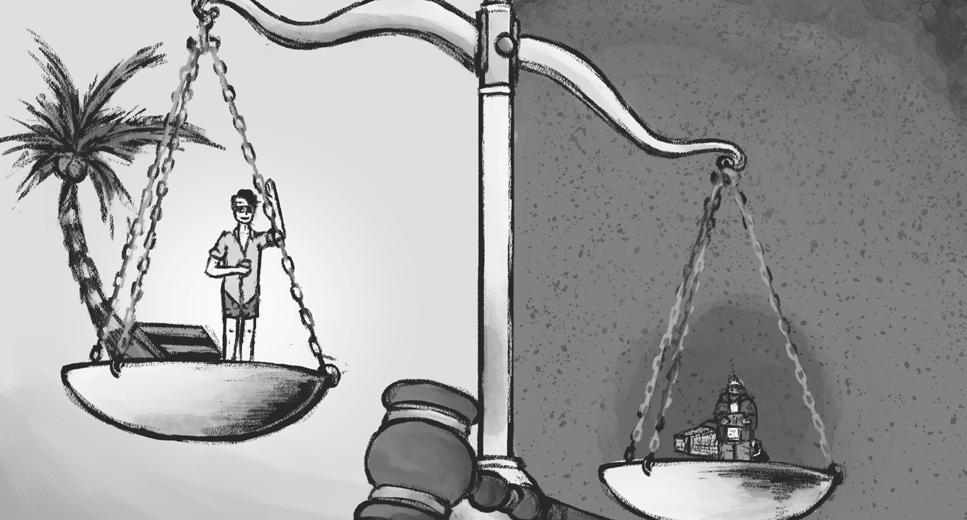
A year-long debate has raged in political circles over whether Prime Minister Justin Trudeau’s acceptance of a free vacation to a privately-owned island - extended to him by the Aga Khan, reportedly a Trudeau family friend, multimillionaire spiritual leader of Nizari Ismaili Muslims, and head of two Canadian organizations registered to lobby the federal government - constituted a breach in federal ethics law. For what it is worth, the former ethics commissioner Mary Dawson concluded that Trudeau was guilty of breaching four codes of ethical conduct as laid out in the Conflict of Interest Act, the legislation which guides and gives the office of the ethics commissioner its mandate.
There are two elements of tragicomedy at play here. First is that the ethics commissioner has no real power. As punishment, Trudeau has been chastised as making an “unfortunate” decision that should have been presented to Dawson’s office for consideration. Dawson further
stated that the negative publicity surrounding Trudeau’s violation of ethics laws sufficed as punishment for his misdeeds - for a prime minister who is treated by the press as a celebrity in his own right, no less.
Yet second, and more tragically comical, or comedically tragic, is the entire farce upheld by this fanciful office of the ethics commissioner and its so-called ethics law.
The trials and tribulations Trudeau was subjected to are treated as serious formal procedures, as if these parliamentary structures carry legitimate moral weight. Yet distilled down to its essence, the ethical quandary at hand may be put simply: when is it morally inappropriate for one millionaire to accept a vacation to the private island of another millionaire?
Merely framing this question as one worthy of ethical investigation is rank with absurdity. The prime minister - whose office is one of the most powerful institutions in Canada when governing over a parliamentary majority - eloped with wealthy lobbying interests on privately owned land. This is an obscene display of nonchalant opulence in a time when unprecedented economic inequality wracks the livelihoods of people whose informed interests are meant to be dutifully served by the prime minister of a representative democracy.
There is nothing representative of the people of Canada in currying the favour of the rich and powerful, nor in basking in the luxury that power grants. Like former interim leader of the federal Conservative Party Rona Ambrose, who vacationed on a billionaire’s yacht while in a seat
of public power, Trudeau’s actions speak to a fundamentally compromised morality. Gorging oneself on cloud nine in previously unimaginable excess, while there are pressing problems of public policy at hand, is a gross violation of the principles of equality that underwrite democracy.
One may protest that Trudeau was on a private vacation, and so the details of his vacation are private and outside the scope of public adjudication. This would be to spout bourgeois apologetics: despite his uniquely sleek and shiny prime ministerial aesthetic, Trudeau is a public servant. In holding the highest public office the state has to offer, Trudeau has consigned himself to four years of answering to the people.
Moreover, the invocation of private affairs here is a confused one, for many citizens formally said to be represented by the prime minister lack the economic status necessary to entertain “private affairs” of the like involved in globe-running vacationing - or to even take a vacation to the nearest campsite. On these grounds, it is perfectly reasonable not only to demand answers and rectification from Trudeau, but also to denigrate the practice of prosperous private vacations from a public official whose mandate it is to seek and materialize the interest of a public whose situation is a poor one.
So long as the public fails to see its interests realized, the private actions of those in public office are worthy of scrutiny and condemnation.
In 2018, 121 First Nations are under boil water advisories. Millions of Canadians are reported to live in poverty. Debt loads are at record
levels as contractual job insecurity spreads its corrosive affect across the economy, destroying traditional long-term employment that played a role in bringing prosperity to earlier generations. The security net baby boomers were enmeshed in, a major equalizing factor that contributed to decent quality of life for their generation, is now being shredded by the application of a neoliberal logic of individuation and privatization to governmental social services.
So long as the public fails to see its interests realized, the private actions of those in public office are worthily under the purview of scrutiny and condemnation
Of course, bourgeois flights of fancy consisting in gluttonous material consumption is the standard decorum of ruling political classes across the globe. Yet the mere existence of this style of political practice - wining and dining diplomacy, if you will - is evidence of its moral corruption, not justification for its continuation. Should we wish to install a proper ethical framework to guide the actions taken by individuals vested with the authority of parliament, we must first render obsolete
the disconnect between our state’s peoples and our state’s rulers.
Focusing on the premise of Trudeau's action instead of the structural makeup of the context which tends toward such action is both a distraction from, and a trivialization of, a system that is unjust in and of itself.
"Parliamentary ethics" under capitalism represent an attempt to legitimate immoral behaviour through installing a formal façade of moralism. Indeed, an office like that of the ethics commissioner is but a crude instrument of legitimation, one which obfuscates the mortal sins of a ruling class awash with a flood of cash while ever-expanding segments of the people they are supposed to serve are starved of the dignity of possessing even basic necessities.
There is no moral authority in an office of these stripes: only a display of the banality of a bourgeois ethics, whose main moral currency trades in the optics of pomp and circumstance. If this office manufactures a moral to be found in Trudeau’s encounter vacation with the Aga Khan, it is that the rich and powerful must be more wary in adhering to an abstract code of ethics that deals not with substantive actions but rather formalities and presentation.
We must reject this bourgeois ethics that would deem acceptable a depraved act on the condition that it is performed in an acceptable fashion. Should we ever achieve virtuous conduct among the ranks of our rulers, it will be in abolishing the unjust system that leads to the basic, problematic, material distinction between ruler and ruled.
Personalities of politicians influence voters more than the policies they represent
KENNY INGRAM, STAFF
I
n today’s political climate, it is no wonder people like Mark Zuckerberg, Kevin O’Leary, and, most recently, Oprah Winfrey have been regarded as legitimate candidates for political office.
As we are now neighbours of a country with a sitting president who previously made a living as a reality TV host, it should not be surprising that any public figure who manages to successfully live out life on camera can now be seriously considered for the top job in politics.
There are many reasons someone in the bottom 90 per cent may feel compelled to support their favourite celebrities politically, especially recently. With income inequality growing throughout North America, and politicians appearing to do little to appease their voters - where leaders are either part of or allied to the one per cent - voters may feel they have little left to lose.
But the most telling reason is the fact that politics in Canada and the United States are by and large the domain of politicians who are extraordinarily charismatic. Cults of personalities are set up to dominate elections that are increasingly framed as horse races. Now, it is important to note that this is positive in some aspects. Having charisma - especially as the leader of a country - can lead to positive relationships with other world leaders, international organizations, and generally improved diplomacy. The detrimental side of this position is that we often have leaders that simply appeal to the public with poise instead of good policy.
This is nothing new in politics.
Staging politicians has been prominent ever since the TV set became a home staple in the 1950s and ‘60s.
John F. Kennedy was one of the first to effectively use TV as a way to communicate directly with Americans and promote his image, which played a signigicant part in his 1960 election to president. In Canada, John Diefenbaker was used TV to craft himself as a personable, relatable character. When his opponent Louis St-Laurent failed to embrace the platform, it arguably cost him and the Liberals the 1957 federal election.
We have created a snowball effect of electing more and more ‘likeable’ candidates whose policies fail to represent the people who vote for them
What came along with this new age of political showmanship was a watering down of policy. Politicians are no longer held accountable to their party’s platform, but rather to an image the public has subscribed to. In turn, these policies became something that, election after election, have benefited less and less of the population. We have created a
snowball effect of electing more and more “likeable” candidates whose policies fail to represent the people who vote for them.
Today in Canada and the U.S. we have leaders who rely on their publicity and image more than policy.
Previous U.S. president Barack Obama was elected at age 47 after gaining publicity for his keynote address at the 2004 Democratic National Convention - a speech which had a combined audience of nine million people. Although Obama offered a progressive direction for the country, much of his popularity during his presidential run was built upon his debates with John McCain, where he was able to demonstrate his personable character.
Most recently, Canadians elected Justin Trudeau, who defeated Stephen Harper in the 2015 federal election. Despite campaigning heavily on a middle-class tax cut, Trudeau's greatest appeal seemed to be his youthful, fresh, and polished look - an alternative to the dated, outlived Harper, who represented the past. Through debates, he was able to put his charisma and ability to identify with young voters in particular on display.
Even to this day, Trudeau’s downto-earth approach to politics has been extremely successful. He has maintained a constant 52.7 per cent in popularity ratings, and consistently gets standing ovations in town hall meetings when responding to questions or hecklers alike.
Through both Obama’s and Trudeau’s charismatic nature, both Canada and the U.S. have exercised
great diplomacy in various ways. For example, through the U.S.’s disarming of Iran’s nuclear program, and attempts at improving relations with Cuba, and Canada’s attempt at finding a nonviolent solution to the North Korean crisis.
Politicians are no longer held accountable by their party’s platform, but rather by an image that the public had subscribed to
The real issue comes when discussing their true policy. When it comes down to it, both of these leaders have been nothing but slightly more progressive versions of their successors, even though they were elected on the premise of offering something far different. Obama will be remembered primarily for his implementation of his insurance company cash-grab healthcare bill - which will likely soon be dismantled under the Republican government anyway - and the fact he was the first black president in America’s history. An escalation of drone strikes and deportation rates as well as a continuation of George W. Bush’s war in Iraq and Afghanistan also contribute to Obama’s legacy, along with his doing little to fix a corrupt campaign finance system and private prison system.
While Trudeau is only about halfway through his four-year term, he has not been all that different from Harper when it comes down to policy. Trudeau approved two major pipelines just a year into his term, he has failed to forward any kind of meaningful legislation to reform the loophole allowing wealthy Canadians to dodge taxes in offshore havens, and his government followed through with an arms sale to Saudi Arabia.
When people feel as if character and rhetoric is directly correlated policy, things only get worse. It is then that television celebrities come into the equation. There is a troubling disconnect between reality and fantasy in the mind of someone who thinks that an immensely wealthy billionaire has the priorities of the lower- and middle-class families in mind. Yet the celebrity ranks of the upper class still have broad appeal to people upset with current governments due to their popularity and suave personalities on TV shows viewed by millions. What has become clear is that we as a society are hooked on a political system not based on policy, but on who is captivating. If we want good, representative policy, then we must look beyond the slim-fitted suit jacket and perfectly styled hair and elect a candidate who has our best interests - and not their own best ratings - in mind.