science & technology eDitor Malak Abas science@themanitoban.com
arts & culture eDitor Tobi Nifesi arts@themanitoban.com
sports eDitor Ryan Stelter sports@themanitoban.com
copy eDitor Sarah Doran copy@themanitoban.com
Design
Design eDitor Bram Keast
design@themanitoban.com
graphics eDitor Kelly Campbell graphics@themanitoban.com
photo eDitor Miguel Yetman photo@themanitoban.com
Design associate Kellie Huynh
graphics associate Aldo Rios
photo associate Chantal Zdan
photo associate Star Roxas
photo associate Megan Colwell
r eporters
n ews Osho Samuel Adetunji
n ews Diana Ubokudom
n ews Seamus Hamilton-Pattison
columnist Jeremiah Kopp
columnist Shaden Abusaleh
arts & culture Olivia Michalczuk
arts & culture Emelia Fournier
sports Kellen Taniguchi
sports Jason Pchajek
copy Joseph Gonzalez
Volunteer Contributors
MANITOBAN
109 HELEN GLASS UNIVERSITY OF MANITOBA WINNIPEG, MB R3T 2N2
General Inqu I r I es & a dvert I s I n G
Phone: (204) 474.6535
Fax: (204) 474.7651
Email: manitoban@themanitoban.com
Free Med I a Campus Plus Media Services
Phone: 1.780.421.1000
Email: advertise@free-media.ca
Canadian Publications Mail Product Sales Agreement #589160
A “volunteer staff” member is defined as a person who has had three volunteer articles, photographs, or pieces of art of reasonable length and/or substance published in three different issues of the current publishing year of the Manitoban. Any individual who qualifies must be voted in by a majority vote at a Manitoban staff meeting. Elected representatives and non-students may be excluded from holding votes as volunteer staff members in accordance with the Manitoban Constitution. The Manitoban is the official student newspaper of the University of Manitoba. It is published monthly during the summer and each week of regular classes during the academic year by the Manitoban Newspaper Publications Corporation.
Hundreds of Winnipeggers to march in solidarity with Women’s March on Washington
Di A n A Ubok UD om, staff
Hundreds of women will assemble in downtown Winnipeg Saturday to walk in solidarity with the hundreds of thousands expected to attend the Women’s March on Washington in the American capital the day after Donald Trump is inaugurated.
In what is being reported as potentially one of the largest protests in U.S. history, nearly 200 groups have signed on to the main even as supporting partners. Additionally, at least 64 sister marches – including the Winnipeg action – are being organized in 32 countries in solidarity with the leading event.
Aly Raposo, women’s representative for the Arts Students Body Council and co-organizer of the Winnipeg march, said the event is inspired by Trump’s hate-fuelled campaign, during which the president-elect was repeatedly accused of misogynistic and racist behaviour. Other main organizers of the event include the Women’s Health
Clinic, Black Space Winnipeg, and the Immigrant and Refugee Organization of Manitoba.
“A lot of it is sparked by Trump’s election and the hatred fuelling all of his campaigns, speeches, and slogans in the form of racism, sexism, transphobia, Islamophobia – everything,”
she said
“Everybody has a unique and diverse reason for why they want to march and why they would like to be a part of it,” she added.
“Winnipeg is really focusing on the minority groups. All of our keynote speakers are either people of colour, or queer, or any marginalized group in the community.”
The Winnipeg event will feature blessings and words from elder Mae Louise Campbell and will feature Amal Shire, Cynthia Fortlage, Joan Dawkins, and Johise Namwira as speakers.
Elizabeth McMechan, co-founder of the University of Manitoba Women’s and Gender Studies
Student Association (WGSSA) and event co-organizer, said it is critical Canadian movements support their American counterparts.
"I think it's really important that we show them that we care here up north – show them in numbers how much we care” –Elizabeth McMechan, co-organizer
“I think international support is really important for these groups in the United States who might have a really long road ahead with the new government,” she said.
“It’s really important that we show them that we care here up north –show them in numbers how much we care.”
Raposo explained why she felt it was important to help organize and take part in the event.
“I'm marching on behalf of all my LGBTTQIA friends who have a hard time living in the states now and for anyone here in Canada who’s going to be travelling to the States,” she said.
McMechan said that while the march is building off of an American movement, the underlying issues are global.
“I think it’s really important for issues like this that we consider it to be a global issue,” said McMechan.
“It shouldn't matter where the person is coming from.”
“I hope that this brings attention to any other sort of hate culture that's developed anywhere else in the world so that we can work on it together and I hope it creates a really powerful base
of people who are willing to rise up against hateful language,” she added.
Raposo agreed, saying the time has come to take action against hate.
“Honestly I think that people recognize when you have a person in power – with a lot of power – who has proposed to do a lot of really hateful things and who can do a lot of really hateful things, that it’s time to take action,” she said.
“If this happened in any other country, I would be marching still.”
The Women’s March on Washington – Winnipeg begins at 11 a.m. on Saturday, Jan. 21 with speeches in Portage Place followed by a march to the U.S. consulate at the corner of Portage Ave. and Main St.
graphic provided by women's march on washington winnipeg
Education and textbook tax credits discontinued in favour of bolstered student grant program
CFS commends move toward direct, up-front support for post-secondary students
Afederal government move eliminating some post-secondary tax credits in lieu of more direct financial support is being both welcomed and criticized by Manitoba students.
Beginning Jan. 1, the education and textbook tax credits, which could be claimed by both full- and parttime students, have been eliminated in exchange for up-front funding through a bolstered Canada Student Grants program.
The education tax credit provided a non-refundable credit of $400 per month for a full-time student and $120 monthly for students enrolled part-time. The textbook credit was worth $65 per month for full time and $20 per month for part time students.
A tuition tax credit offered by the federal government will remain unchanged.
Liberal MP Terry Duguid, who represents the U of M’s Winnipeg South riding, said in an email that the move to drop the tax credits was motivated by the increasing cost of
post-secondary education.
“For too many Canadians, rising costs have made post-secondary education increasingly out of reach,” he said.
“It is harder and harder for middleclass families to save for their kids’ education, while many lower-income families are not able to save at all. At the same time, the federal government spends billions each year on non-refundable tax credits that offer little direct help for students when they need it.”
Duguid said other income tax provisions, including exemptions for scholarship, fellowship, and bursary income, will remain unaffected.
He said the government is taking a more targeted approach by boosting Canada Student Grant amounts available to students. The grants climbed to $3,000 from $2,000 for full time students coming from low-income families and to $1,200 from $800 for middle-income family students. Part-time students from
low-income families are eligible for $1,800, an increase of $600.
The tuition tax credit was not affected by the changes and unused education and textbook credits can be carried forward for the 2017 year and beyond.
“Students need up-front financial help at the beginning of their school year, not at the end” –Michael Barkman, chairperson, CFS-MB
Michael Barkman, chairperson of the Manitoba chapter of the Canadian Federation of Students (CFS), commended the move toward direct support.
“CFS has always advocated for an
increase in grants because students need up-front financial help at the beginning of their school year, not at the end,” he said.
“It is important to note that tax credits, such as the textbook credit, are not up-front and the student must bear the brunt of the cost long before the tax credit can be claimed.”
Barkman encouraged the federal government to continue to adopt policies that provide direct financial assistance to students and increase access to post-secondary education.
“It is imperative that the government continues to invest in students up-front and lessen the financial barriers that prevent many people from accessing post-secondary education,” he said.
Adam Pawlak, University of Manitoba Students’ Union vice president internal, said that while some changes to the student grant program are positive – including revamping the eligibility criteria and bumping the minimum salary threshold before
student loan repayments are required to $25,000 – the credit eliminations are a letdown.
“It is disappointing to see them get cancelled as I feel they are very beneficial for individual students and Canadian families,” he said.
Pawlak said the credits could be claimed by nearly all Canadian students with a taxable income and noted students could transfer unused credits to relatives, which enabled them to finance their own education.
Pawlak further added that the government can support students by sharpening its focus on the economy and creating job openings for graduates.
“The next focus by the federal government should be providing students who graduate a good, growing economic environment so there are many innovative, high-paying jobs available for youthful citizens.”
photo by miguel yetman
University under fire for offcampus housing issues
U of M master’s students propose solutions, city counsellor criticizes administration for lack of action
T
he University of Manitoba is facing continued criticism from neighbouring communities for its lack of action in dealing with a number of allegedly illegal rental units housing students.
On Jan. 11, a dozen city planning master’s students from the U of M presented a report on land use, zoning, illegal housing, and rental challenges within the neighbourhoods surrounding the university’s Fort Garry campus, with a particular focus on the Fort Richmond and University Heights areas.
The Fort Richmond-University Heights Neighbourhood Association, which was formed in 2016 with support from Janice Lukes, city councillor for South Winnipeg-St. Norbert, is working to combat the illegal conversion of single-family homes to rooming houses largely used for rent to U of M students.
Residents complain of uncut lawns, too many cars parked in too little space, and noisy parties. The rooming houses are hastily renovated, and many of them are poorly maintained, ugly, and unsafe, residents say.
In addition to highlighting issues within the communities immediately surrounding campus, the presentation also focused on possible solutions – and their implementation – to issues further raised in the study.
“They had some really good shortterm and long-term solutions,” Lukes said.
“The biggest roadblock there is university inaction, but they don’t feel it’s part of their problem.”
Since taking office in 2014, Lukes has been pushing for solutions to the lack of legal housing available to students.
There are 1,316 residence beds on campus, including 140 at the affiliated religious colleges of St. John’s and St. Andrew’s. The last residence built at the U of M was Pembina Hall, which opened in 2011 and largely offset the loss of bed spaces resulting from the closure of the Taché Hall residence.
In 2016, Developer Rise Real Estate presented its proposed project to construct a 14-storey apartment complex at the corner of Bison Drive and the Pembina Highway. The development would bring more than new 200 new rental units to the area.
Further strategies to increase affordable housing highlighted by the presentation team include mandating at least 10 per cent affordable housing for residential units in the to-be-developed Southwood lands property adjacent to the university.
The U of M took over ownership of the property in 2011 with plans to develop more than 4 ,000 multidwelling units, along with retail and hospitality space.
Lukes has previously spoken out
about university inaction on the issue, claiming the U of M has been uncooperative and is at least partly responsible for driving up demand for cheap rooming houses as it increases the number of international students on its rolls.
“I think it’s maybe a sense of losing a little bit of control of the direction that your neighbourhood – the one you’ve lived in for decades – is taking” – Michael Wakely, U of M city planning master’s student
“I think morally and socially it’s appalling what’s happening to the students and the university should care about that,” she said. “This is students’ safety. It’s great to bring in all these students, it’s wonderful. The community has no problem with the students, it’s the landlords.”
“It’s easy to say ‘it’s not our responsibility’ as the university, being an educational institution, but what about for the students’ sake? It’s horrific.”
International student enrolment at the U of M has nearly doubled since 2010 to more than 5,000 in 2016, accounting for 16.9 per cent of total enrolment.
John Danakas, the U of M executive director of public affairs, said the
university has met several times with Lukes and community members to discuss off-campus housing.
“We intend to continue that dialogue,” he said. “At the same time, we don't see the value in assigning blame on a complicated matter, or in stereotyping groups of students. We do see the value in working with partners to address concerns and needs, and we are more than willing to continue to do so.”
Lukes’ suggested the university reach out for support and “make some applications to the federal government.”
“I do not see the university doing any movement to that at all,” she said. “What I do see them doing is building a beautiful, fancy building and smart park, and internally funding it and taking loans for that.”
“I guess, to me, their priorities are mixed up.”
Proposed solutions
Strategies proposed by the study include density benefit incentives for developments within the Southwood property, including: affordable housing initiatives, alternative parking solutions that make use of available space rather than constructing more, incentivizing the construction of secondary suites, and promoting the university’s Homestay program, which merges English lessons with immersion in an English-speaking home.
“We came into this with the understanding that because we don’t live there, we don’t know the issues as intimately and we don’t live with the same emotional connection to the neighbourhood,” master’s student Michael Wakely said following the presentation.
“We’re trying to get a sense from
the community, based on their opinions, and that’s why this kind of meeting is really important.”
The presentation also touched on strategies to encourage more interaction and conversation between residents and students, including the creation of a “town and gown committee” comprised of members of the neighbourhood association, the University of Manitoba Graduate Students’ Association (UMGSA) and the University of Manitoba Students’ Union (UMSU).
“I
think morally and socially, it’s appalling what’s happening to the students and the university should care about that” – Coun. Janice Lukes, South Winnipeg-St. Norbert
The students recommend the UMGSA and UMSU circulate an online student housing survey to identify the number of students living off-campus in non-family housing situations and to collaborate with the neighbourhood association to determine how many illegal rooming houses operate in Fort Richmond.
“I think what needs to be done is both the student body and the neighbourhood have to be at that table when a local area plan is formulated and insist on affordable housing for students,” said Wakely.
Wakely noted other universities
create arms-length development agencies for projects similar to the U of M Southwood initiative.
“Hopefully that agency will be savvy enough to the situation but you can’t rest on your laurels and have that be sorted by them,” he said. “You have to have action.”
Following the presentation, the floor was opened for questions with many of the nearly 80 residents in attendance sharing their concern with the number of students they claim are occupying single rooming houses throughout the neighbourhood and the resulting noise complaints and by-law violations.
“I think it’s maybe a sense of losing a little bit of control of the direction that your neighbourhood – the one you’ve lived in for decades – is taking,”
Wakely said.
“They want their voice and I think their frustration is with the university because there hasn’t been a very productive relationship there [...] I think, given the opportunity, the residents are very willing to work with students and very willing to work with the university.”
Wakely emphasized that the responsibility to address the issues is shared and requires an equal effort from university administration, the student body, and homeowners to obey city by-laws and safety regulations.
“Residents, unfortunately, are kind of stuck in the middle and they react the way that I think any normal human being would react,” he said. “We’re doing this with the hopes of starting some kind of conversation anew.”
photo by megan colwell
2017 UMSU general election set to go online
UMSU council approves electronic voting
T
he University of Manitoba Students’ Union (UMSU) voted at its regularly-scheduled meeting Jan. 5 to approve purchasing software from online ballot specialists Simply Voting for the 2017 UMSU elections.
The deal is yet to be finalized but UMSU president Tanjit Nagra said she is hopeful the move from paper ballots to online voting will boost turnout at the polls, which has been slipping in recent years.
She noted that despite a nearrecord number of candidates who ran in the 2016 election, the number of UMSU members who cast ballots decreased from the year before.
“The biggest thing is that we want to engage students in the voting process,” she said. “It is their right as a member of UMSU and we want to make it easy on them as well.”
Four slates of candidates and an independent ran for the UMSU executive in the 2016 campaign but only 3,760 of nearly 20,000 eligible voters cast ballots.
Nagra added that the online system opens voting to students who are off-campus during the election period, something unavailable in previous years, while at the same time reducing the ecological footprint of elections.
“The biggest thing is that we want to engage students in the voting process”
– Tanjit Nagra, UMSU president
“We want to move in a more ecofriendly way and be more sustainable and I think if we can get more of the campaigning and such online, the better,” she said. “We can save more trees and we can, hopefully, engage more students in the process.”
Simply Voting is a web-based
online voting system that manages secure online elections for more than 1,000 organizations, including 15 Canadian university student associations. The University of Toronto Students’ Union and the Students’ Society of McGill University are among Simply Voting’s clients.
UMSU’s move to electronic voting brings the U of M in line with a number of other university student associations that have dropped paper ballots, including the University of Victoria, the University of British Columbia and the University of Calgary.
Nagra said the software – which is expected to cost the student union close to $5,000 – will be in place for the upcoming election.
“This is more of a test run year, obviously, to see if the students like the software or not,” she said, adding, “We would like to see if it increases voter turnout, if the students are in favour of it.”
The University of Manitoba
Graduate Students Association (UMGSA) moved to online voting in 2011 and reported an immediate increase in voter turnout.
Jessica Whattam, the chief returning officer for the 2016 UMGSA general election, said allowing remote voting opened up the elections to students too busy to make their way to a polling station.
“Many graduate students are quite busy between research, writing, conducting their studies, creating their pieces, et cetera,” she said.
“Many may not have had time to get out to any specific voter station, especially for those who may have been off-campus or even out of the province. Offering the voting online opened the availability for students to vote whenever they had access to an internet connection.”
Whattam noted that the online software makes tallying votes simpler and returns quicker results than paper ballots. However, she acknowledged challenges, including some students
who registered late for their programs being left off the voter list or voting links ending up in junk mailboxes.
Nagra said the system will be evaluated following the 2017 UMSU elections, which will take place in March.
She added that UMSU also amended its election by-laws to eliminate floor campaigning during the election, which she said will ratchet down election-period chaos for students.
“I think this is a way to beat the lines and a way that they can continue on and go to classes and continue on with their day-to-day school life without being disturbed by the craziness of elections,” she said.
“Hopefully students are in favour of the new process.”
photo by megan colwell
Editor-In-Chief: Craig Adolphe
Contact:
Staying calm, cool, and collected post-UMFA strike
Be kind and don’t let stress create fault lines in your relationships
S HAwn G A rb U tt, staff
The end of the U of M strike has brought with it many changes. Two exam schedules, deadlines sprinkled throughout late December and early January, and a new winter term that begins almost immediately after the end of the fall term. Of course, the new academic schedule has thrown many a wrench into the gears of our daily lives.
Even if you are one of the few lucky winners of the two-month break, for those who had no strikeaffected classes, it’s still important to remember the situation most students
are currently finding themselves in.
It’s no easy feat to adjust as quickly as most students have to the drastic schedule changes and all entailed by it. Meanwhile, it’s easy to forget the impact it has on stress levels in an environment that’s already hostile toward mental health. Ivory tower aside, academia is no cakewalk.
The U of M, through the academic schedule reshuffle, has brought campus into the twilight zone. After suspending the term for three straight weeks – when total limbo was achieved and thousands of students
(including myself) were left walking about in an unblinking haze – poststrike reality has careened at breakneck speed into the academic fast lane.
While campus was a ghost town during the strike, it’s now become inhabited by ghosts – disenchanted students, doing the impossible by actively juggling schoolwork, jobs, social lives, and more. Students with a dull gleam to their eyes, taking in a wintry day
on campus, Dec. 23, had to spend Christmas Eve Eve with befuddled professors who hardly wanted to show up to their own classes.
At the very least, there’s solidarity in suffering
So, take some time to yourself and decompress. Don’t let the looming shadow of a deadline crush your spirits. To crack under pressure is okay – shattering, less so. Taking care of yourself so these fault lines don’t show up is essential. Not only do you owe
this to yourself, but also those around you, so get over the cringing that goes along with buzzwords like ‘self-care’ and simply care for yourself.
Now that the university has returned to its daily grind, it’s more important than ever to be mindful of your community and the value of the people that make it up. The post-strike phase is the best reminder that people are stronger together; at the very least, there’s solidarity in suffering.
Take the time to learn about Syria
Conflict in the Middle East demands our response
S HAD en Ab USA le H , staff
The Syrian conflict, one of the deadliest humanitarian crises of our time, has become synonymous with death, gore, and sheer hopelessness as war-torn images of Syrian cities dominate our front pages.
After nearly six years of fighting, between 300,000 and 450,000 people have been killed, more than two million are injured, and more than 65,000 have been ‘disappeared.’ 13.5 million Syrians are in need of immediate humanitarian assistance, and over half of the country’s prewar population – over 12 million Syrians – have been displaced from their homes both within and outside of Syria, with more than half being children. These numbers are so large that it’s easy to become detached from the horror of the situation.
The world has done a very good job at numbing itself in response to never-ending breaking news on the refugee crisis, airstrikes, and most recently the fall of Aleppo. As this crisis drags on, one may feel lost, not knowing where to begin when it comes to understanding such a complicated and convoluted situation. But it is important that we take steps in learning and educating ourselves about the crisis. As we’ve witnessed in Aleppo, the silence of the world has cost too many lives and destroyed what was once a vibrant cosmopolitan city overflowing with rich history and cultures.
Most date the beginnings of the Syrian conflict back to the early months of 2011, when a group of teenagers were arrested and tortured in the southwestern Syrian city of Deraa for graffiti. The graffiti featured messages in support of the Arab Spring — a series of anti-government protests and uprisings that spread across the Middle East in countries such as Tunisia, Egypt, Yemen, and Libya. In response to a slew of peaceful demonstrators demanding the release of the boys, the authoritarian Syrian regime, led by Bashar Al-Assad, brutally cracked down on civilians, killing and imprisoning protesters.
Struggles for freedom and economic worries mixed with public anger over harsh government retaliation on peaceful protesters, adding to the demonstrators’ resentment of the oppressive Syrian government. The successful toppling of the Tunisian and Egyptian regimes fuelled hope among Syrian protesters, who continued to risk their lives as they flooded the streets calling for justice and liberty from a regime that had oppressed them for over four decades.
As months of peaceful protests were continuously met with military attacks on civilians, soldiers began defecting from the Syrian military, joining civilians to form the Free Syrian Army, and taking up arms to overthrow the government. This is how the conflict first became weaponized, making room for the involvement of interventionist foreign powers.
To understand the Syrian crisis, it is easiest to think of it in three levels.
The first is the conflict between the Assad regime’s forces and the rebels who oppose the regime (who are divided into multiple groups, radical and moderate, that include local and foreign fighters with fundamental disagreements). There has also been the rise of Kurdish groups in Syria seeking autonomy from the Syrian state.
The situation may seem hopeless, but this should not be an excuse for us to remain idle
The second is the conflict with Daesh or the Islamic State (ISIS), which is a battle-ridden militant group that has risen out of the rubble of the decade-long war in Iraq. The third level is foreign intervention. It is difficult to pinpoint who is backing who, but while the Assad regime is supported by Russia, Iran, and Hezbollah (a Lebanese militant group), countries such as the United States, Turkey, Saudi Arabia, Qatar, and Jordan have backed moderate rebel groups diplomatically and logistically by supplying them with weapons to fight forces loyal to the Assad regime. At times Turkey, Saudi Arabia, Qatar, and Jordan have supported Islamist groups as well.
Foreign powers have involved themselves in the conflict for different reasons, and their involvement, which has prioritized violence over diplomacy, significantly worsened
the situation in Syria and increased the death toll. For example, Russia, which is integral to Assad’s hold on power, has been blocking UN Security Council resolutions critical of the Assad regime and since 2015 has been launching airstrikes targeted at Syrian rebel forces – airstrikes which always seem to find their way into Syrian homes, hospitals, and schools. Despite international criticism, Russia continues to be a key ally to the Assad regime. As history has taught us time and time again, militaristic foreign intervention as a tactic to pacify humanitarian crises never works.
There has been international outcry in response to the crisis as haunting images and videos of refugee rubber boats capsized in the Mediterranean Sea or infants being pulled out of destroyed buildings continue to draw the world’s attention. However, international response has not been enough. The most prominent example has been the situation in Aleppo.
Aleppo, which is the oldest continuously inhabited city in the world, has been stuck in the middle of the whole conflict. During the end of November, the Syrian army launched an offensive on Aleppo to regain control of the rebel-held eastern part of the city. This bloody end to a long battle culminated in what officials have called a civilian massacre by progovernment forces during a siege on the city.
Undoubtedly, it’s difficult to reduce what is happening in Syria to words printed on paper and there’s much more to the conflict which has been left out, but what the Syrian crisis has taught us is that we cannot be disillusioned with the idea that prob-
lems ‘over there’ are just that and have no effect on our lives right here. The crisis in Syria has had horrible global spillover effects: from the European migrant crisis, to the assassination of the Russian ambassador in Turkey, to the surge in ISIS-backed attacks across the world.
As history has taught us time and time again, militaristic foreign intervention as a tactic to pacify humanitarian crises never works
The international community has failed the Syrian people and we must act. While our attention to the Syrian crisis may only come in doses, rubber boats carrying fleeing refugees drown at sea, Aleppo remains a warzone, refugees across the world continue to suffer from this brutal and cold winter, and ISIS-backed attacks continue relentlessly. The situation may seem hopeless, but this should not be an excuse for us to remain idle.
First, and most importantly, we must continue to educate ourselves because the more we know about the crisis, the more we will understand its underlying causes and the more we are able to spread the world and mobilize to help those in need. Monetary aid is also crucial because donations are one of the only ways that many organizations working to help refugees are able to continue doing so.
The UNHCR, Unicef, and the International Red Cross are among the bigger, more well-known charity organizations working to relieve the plight of refugees. There are also smaller organizations doing equally incredible work that we should support, such as the Migrant Offshore Aid Station, Refugees Welcome, Karam Foundation, and Hand in Hand for Syria.
We can advocate, fundraise, and use social media to call attention to the Syrian crisis and the suffering of the Syrian people. Lastly, we can take action within our own city to help. We don’t need to travel abroad to the shores of the Greek islands or refugee camps in Iraq, Turkey, or Lebanon to help Syrian refugees. Manitoba has received over 1,000 newcomers, some of which are still struggling to live stable lives, and so the least we can do is support them into their transition to their lives here in Winnipeg.
We can volunteer for organizations working with newcomers in Manitoba, such as the Immigrant and Refugee Organization of Manitoba, Newcomer Employment and Education Development Services Inc., and Manitoba Start, among others. From running a clothes drive, to starting up grassroots programs for newcomers, to even sponsoring a Syrian refugee, there's so much we can do to help; it all starts with getting informed.
Canada’s global peacekeeping role undermined by lack of attention to Egypt
Hate manifests itself in many forms. It can be bigoted beliefs, rude behavior towards a subset of society, systemic mistreatment of a group, or genocide. While hate in society must be addressed, it seems that Canada deals with it in a hypocritical way. While Islamophobia in the West is condemned, Christophobia – discrimination against Christians – in the Middle East is ignored. Either both are problems, or neither is a problem. Hate is hate.
We only fight hate when it is convenient for us or when it pertains to groups that influence the electoral process
Canadians have long considered this country a peacekeeping nation. Canada has involved itself in countless peacekeeping missions and efforts to ensure that people all over the world are given adequate protection. However, more recently, Canadians have started to get involved only where it is politically expedient.
On Dec. 11, a vicious terrorist attack left 25 people killed and
dozens injured from a bomb blast at the St. Mark’s Coptic Orthodox Cathedral in Cairo, home of the Coptic Patriarch. To put it into perspective, this is akin to attacking a church in Vatican City. While this deadly tragedy has Coptic Christians around the world in mourning for the memories of those lost, this assault has broader implications for Copts as the minority indigenous population of Egypt.
The word “Coptic” is derived from the Greek word for “Egyptian.” The Coptic People are the direct descendants of the ancient Egyptians, who converted to Christianity in the early first century. They are an ethno-religious minority and are distinct from the majority Arab population; Copts have their own culture, language, and way of life. As can often occur with minority groups, however, Copts have consistently faced systematic discrimination and oppression from their government.
This latest attack is hardly the first time Christians have been killed in Egypt. In 2010, in Naj Hammadi, extremists shot and killed six Christians church-goers and one security guard following the adjournment of a church’s Christmas service. No one was arrested or convicted of the crime. In 2011, on New Year’s Day, a car bomb killed dozens of people in an Alexandria church. Once again, no one was convicted for this hate
crime. In May of 2011, 23 Copts were killed during a protest.
These are only a few well known examples, as many of these attacks go unreported by western media. The Egyptian government has, for years, systemically discriminated against the Copts. Tragically, the Coptic community has faced over 1300 years of persecution.
The Egyptian government has, for years, systemically discriminated against the Copts
Typically, governments and the media respond to this terrorism by condemning attacks against the Copts while ignoring the root of the problem. The response to the most recent attack has been even more disappointing and disheartening. There has been no official condemnation by the government of Canada. Why is that?
Justin Trudeau has fast-earned a reputation as the champion of the downtrodden and persecuted. He has not hesitated to bring Syrian refugees to Canada since the moment he took office and I commend and sup-
port him in that endeavour. During our last federal election, Trudeau prided himself on dispelling xenophobic rhetoric and commentary. As Canadians, we rightly fight against and condemn Islamophobia and other forms of xenophobia. We believe that all people are equal and that hate based on race, or any other basis, is contrary to our values.
So how is it that we stand idly by as Copts are massacred? Could it be that we only fight hate when it is convenient for us or when it pertains to groups that influence the electoral process?
This apathy and ignorance, unfortunately, isn’t limited to our political leaders. Just a day before the Dec. 11 bombing, Kenneth Roth, the executive director of Human Rights Watch, tweeted “Egypt’s Copts discover after backing [Egyptian President] Sisi’s coup that his persecution isn’t limited to the Muslim Brotherhood,” with a link to an article by Foreign Policy This kind of rhetoric frames Copts as responsible for their own persecution. While this tweet was subsequently deleted, other posts bearing the same sentiment remain on his account. Roth's ignorance about the situation in Egypt is concerning to say the least. I am appalled to think that he has any role to play within Human Rights Watch. When did it become okay to justify hate?
Regardless of your stance on
the legitimacy of Morsi’s ousting, he is a scapegoat for these acts of hate. Discrimination existed under President Anwar Sadat, Hosni Mubarak, Morsi, and now Sisi. The Cairo bombing was an act of bigotry and racism. Plain and simple. Canada is globally recognised for its peacekeeping efforts. We pride ourselves on our cultural mosaic and we believe in upholding freedom of religion, expression, and association. In ignoring the atrocities that happen to the Coptic people, Trudeau, and the Liberal Government, are ignoring what makes us Canadian.
graphic by aldo rios
Study suggests a new possible purpose for the appendix
appendix may be a storage space for good bacteria in our bodies
The purpose of the appendix has remained an enduring mystery to scientists. New research, however, presents a new theory: the appendix provides a secondary immune function.
What this means is that appendices would theoretically catalyze (accelerate) immune cell response and release good bacteria into your body if your immune system becomes depleted. This would give the appendix a useful purpose as a reservoir for healthy gut bacteria.
The appendix was previously considered a vestigial organ, and relatively useless. However, it isn’t alone – other parts of the human body, such as wisdom teeth or the coccyx, are remnants from millions of years of human evolution, and serve no real purpose within the present-day human body.
The study, which was led by scientists at the Midwestern University Arizona College of Osteopathic Medicine, used an international team of researchers who looked at 533 species of mammals and whether or not they had an appendix, and then created a genetic tree to map the evolution of the appendix throughout said species.
What they found was that the appendix has had a storied evolution history, and has evolved anywhere between 29 and 41 times, which suggested that the appendix had a more useful purpose than researchers already knew.
Researchers also found that animals with appendixes had a higher concentration of lymphoid tissue in the cecum. The cecum is where the appendix stems from, and lymphoid tissue is theorized to set off an immune reaction when the body is put under stress.
healthy gut microbes. This can happen for several reasons, including antibiotic use, which can result in the trillions of microbes of bacteria within our digestive system to be flushed out. This can be harmful, as it leaves us more susceptible to infections. The theory here is that the appendix contains good bacteria that can flood our guts, should this ever happen.
The appendix was previously considered a vestigial organ, and relatively useless
“This finding suggests that the appendix may play an important role as a secondary immune organ,” the team wrote in a press statement.
“Lymphatic tissue can also stimulate growth of some types of beneficial gut bacteria, providing further evidence that the appendix may serve as a "safe house" for helpful gut bacteria.”
The study also suggests that the appendix could use its reservoir of bacteria if we were to lose our own
Possible new treatment for tooth decay could encourage teeth to repair themselves
A drug being tested to treat Alzheimer’s disease has been shown to improve dentine production
New research has shown promising evidence that a drug originally used to treat Alzheimer’s disease could simulate tooth regrowth to the point of repairing cavities.
The drug is called “tideglusib,” and it has already been tested extensively as a possible component of
Alzheimer’s therapy. While being tested on mice, it was shown to stimulate stem cells in the tooth, and improved dentine production. Teeth are innately already able to use stem cells to make small repairs to their inner pulp, but are only able to create a small layer of dentine – not nearly
enough to repair advanced tooth decay.
Researchers at King’s College London then tested the drug’s effectiveness by putting a sponge soaked in the drug into 0.13 millimetre holes in the teeth of mice, and covering the sponge in a protective coating.
The sponge, which is biodegradable collagen, then broke down over the course of six weeks, and was replaced by dentine, thus healing the tooth.
This discovery could revolutionize restorative dental treatment. The current go-to procedure for repairing cavities, which fill the hole with metals or plastic, never fully restore the tooth’s mineral level.
While being tested on mice, it was shown to stimulate stem cells in the tooth, and improved dentine production
“The simplicity of our approach makes it ideal as a clinical dental product for the natural treatment of large cavities, by providing both pulp protection and restoring dentine,” Paul Sharpe, the lead author of the study, said in an official news release from King’s College London.
The study was also able to disprove several hypotheses put forth previously. Several previous studies have attempted to link the appendix to dietary or environmental factors, but these genetic trees did not show any connection.
This study supports previous findings, including a 2012 study that suggested people were more likely to recover from severe gut infections if their appendix had not been removed previously.
“In addition, using a drug that has already been tested in clinical trials for Alzheimer’s disease provides a real opportunity to get this dental treatment quickly into clinics.”
This is not the first time King’s College has released research on alternatives to current tooth fillings. Another research group has suggested repairing teeth by applying a mixture of different minerals into cavities or cracks in teeth using an electric current.
Researchers believe that because the drug has passed clinical trials for other uses, they are looking at a relatively quick three-to-five-year period, assuming it passes human clinical trials, before the drug could be used to fix cavities on a commercial scale. While the clinical trials concerning Alzheimer’s have proven that tideglusib can be taken safely by humans, the study (which was published in Scientific Reports) plans to first attempt this procedure on rat teeth, which are approximately four times the size of mice teeth. Human trials are expected to begin later this year.
photo provided by ed uthman
photo provided by conor lawless
New
research says the moon may be comprised of smaller “moonlets” that crashed together millions of years ago
mA l A k Ab AS , staff
Where did the moon come from?
According to new research, the moon may have been created by many “mini-moons” crashing together.
The previous belief was that the moon was formed as the result of a singular collision between a Marssized asteroid and Earth, which caused debris to enter the Earth’s orbit, which in time coalesced and became the moon we know now.
This study, which was published in a Nature Geoscience article, theorizes that the moon we know now was a result of many smaller collisions with asteroids spread out over millions of years
This new study, which was published in Nature Geoscience, theorizes that the moon we know now is the result of many smaller collisions with asteroids spread out over millions of years. The study utilized computer simulations, which researchers used to examine nearly 1,000 possible scenarios that could result in the creation of the moon. What they found was that it would take approximately 20 small-to-medium sized collisions to gather the debris needed to form
the moon.
These collisions would have been with bodies ranging from one tenth to one hundredth the mass of the earth. The debris would then become “moonlets”, or smaller versions of the moon, as they cooled.
The original theory had always come with some controversy, because while in some aspects the idea of a singular crash makes sense – for example, the chemical composition of moon rock is nearly identical to
that of Earth rock – but it also leaves unanswered questions. While moon rock is similar to Earth rock, it also has no trace of a second planetary body or of the big asteroid that supposedly collided with Earth. Along with this, small collisions were much more common in the early solar system.
This new theory comes from researcher Ralucu Rufu and professor Oded Aharonson of the Weizmann Institute’s Earth and Planetary
Sciences Department in Israel, who argue that the original theory of the moon’s origin requires too-specific conditions, and this new theory gives the moon more time to have formed.
“The new scenario does not require finely-tuned initial conditions, and if the smaller moonlets, as we think, were drawn into the same orbit, they could have merged over millions of years,” writes Ruhu, on the Weizmann Institute’s official website.
The “finely-tuned initial condi-
tions” refer to the fact that for the simple-impact theory to be plausible, it must be assumed that the asteroid was a very specific size, and hit the Earth at a very specific angle. While the possibility of the moon having a different origin story is interesting , even the scientists involved agree that much more research is needed, especially on the merging process.
graphic by kellie huynh
graphic by abbas khudair
New Third Thursdays initiative showcases University of Manitoba’s creative community
e meli A Fo U rnier, staff
On Jan. 19, a coalition of University of Manitoba’s arts institutions led by UMFM, are kicking off a new monthly event called Third Thursdays to celebrate creativity on campus. Running from 12 p.m. to 3 p.m. the third Thursday of every month in the school year, this event was inspired by the Exchange District’s First Fridays and is set to feature special performances and showcases by student artists.
For the inaugural edition of the event, UMFM, the Gallery of Student Art, the School of Art Gallery, the University of Manitoba Ceramics Club, and the Manitoban will all be involved and hosting special programming.
UMFM will be offering a radio production workshop, entitled “How to Make Great Radio,” which will cover key concepts about radio show preparations, the experience of being on air, and technical aspects of run-
ning a radio show. The Gallery of Student Art will hold a reception with free snacks for its current exhibition, Synthia’s Closet by Ione Thorkelsson. At the Ceramics Club, visitors will be shown the process of making ceramic products. The Manitoban will present a walkthrough of the process of producing a newspaper from storyboard to print.
To close the event, after all workshops and exhibitions have been concluded, there will be an informal mixer at the Hub for those who want to discuss art.
From award-winning musicians to internationally renowned visual artists, there is a sizable population of talented people that are associated with the University of Manitoba, but who haven’t yet been recognized by the campus community. Sara Enns, UMFM’s marketing coordinator and lead organizer of Third Thursdays, believes this showcase presents a spe-
cial opportunity to appreciate and inspire the creative talents being groomed at the university.
“We
produce world class art, music, and performance here. It doesn’t get talked about
enough” –Sara Enns, marketing coordinator for UMFM
“We produce world class art, music, and performance here. It doesn’t get talked about enough,” Enns said. “I was at the Museum of Contemporary Art in Los Angeles and their gift shop had a set of Marcel Dzama art cards.
Marcel Dzama is a U of M graduate, and is a well-known contemporary artist in the global community.”
“I want to see more groups on campus get involved. I’ve talked to a few other organizations about getting involved and there is a lot of excitement around the idea,” said Enns. Enns said that in the future, more activities like walking tours of permanent exhibits and studios, interactive art projects, and live music at unconventional venues will be included in the programming for Third Thursdays.
UMSU’s Frost Fest is set to entertain campus community
The first Third Thursdays event will take place on Jan. 19 from 12 p.m. to 3 p.m. at different venues on the University of Manitoba’s Fort Garry campus. Artistic groups on campus interested in participating or showcase their talents at future Third Thursdays should contact Sara Enns at sara@umfm.com for more information.
On Jan. 21, the University of Manitoba Students’ Union, will be hosting the second annual Frost Fest, a winter orientation event meant to showcase a variety of local talents to the university’s campus community.
This year’s Frost Fest will use UMSU businesses IQ’s and the Hub Social Club as venues and will feature live performances from local artists and bands.
The lineup will include local DJs and musicians like the Barefoot Brotherhood (featuring Myles Dancho and George Semchuk), DJ KeesSH, Myazwe, and Those Liabilities. Events will commence at 9 p.m. at the Hub and 10 p.m. at IQ’s.
Muzo, a local hip-hop artist, is excited to be performing at the Frosh Fest. He believes that, for local hip hop artists, opportunities to perform at events like this are few and far between and when they do come up, it is important to make a lasting impression on the audience. Frost Fest is an opportunity for local artists to share what they have been working on, and Muzo takes this opportunity seriously.
“Hip hop is a very competitive sport – you have to be ready to compete.”
“There is no denying that there is a lot of talent in Winnipeg. We are a very small city so we constantly have to prove ourselves – that we deserve to have the share of the market” – Muzo, local hip hop artist
“There is no denying that there is a lot of talent in Winnipeg. And this statement is not only limited to hip hop but other genres too. We are a very small city so we constantly have to prove ourselves that we deserve to have the share of the market,” said
He encourages other local artists to step up their game to put Winnipeg on a more competitive market and put hip-hop artists in our city on the map.
“Compared to other bigger cities we are pretty much in the struggle. There is not a lot of exposure or avenues to showcase your music,” said Muzo.
Although the January event is a scaled back version of UMSU’s Frosh Fest, which occurs every September, Frost Fest presents an opportunity for students and staff to come out and be entertained by local artists and music. Through this initiative, UMSU hopes to liven up the campus community and encourage support for local artists.
Tickets for the upcoming Frosh Fest are available for sale at the Answers booth on the first floor of University Centre.
Muzo.
graphic provided by
Editor: Ryan Stelter
The 2026 World Cup expansion’s effect on Canada
Expanded playing field could potentially benefit the Canadian national team
k ellen tA ni GU c H i, staff
Beginning in 2026, the FIFA World Cup will feature 48 teams fighting to be on top of the soccer world, instead of the usual 32. Canada is part of the Confederation of North, Central American and Caribbean Association Football (CONCACAF). Canada has only qualified for one World Cup, and that was way back in 1986, so the expanded playing field could potentially benefit the Canadian national team. Although the event is expanding, still just under one-quarter of the teams that attempt to qualify will actually make it to the big dance.
In the current format, the CONCACAF teams hold just three of the 32 World Cup slots, with the possibility of a fourth team qualifying via playoff with a team from the Asian Football Confederation. Canada has struggled in the CONCACAF qualifying rounds,
with nations such as the USA and Mexico dominating. With the expansion to 48 teams, CONCACAF could potentially hold up to six slots for the 2026 tournament. You don’t have to be good at math to see that Canada has a better shot at qualifying with six slots available, compared to just three.
Canada has only qualified for one World Cup, and that was way back in 1986
Canada hasn’t reached the final stage of CONCACAF qualification, also known as the Hex, since 1998. The Hex is where the top six teams in the region compete for the final World Cup spots. The United
States, Costa Rica, and Mexico have qualified for every single Hex, showing their dominance in the CONCACAF. With the expansion of the World Cup, it seems that the teams that make the Hex would have a better chance to qualify for the big games. Since Canada hasn’t qualified for the Hex since the 20th century, it is likely that the Canadians will miss out on the World Cup if they can’t make it to the Hex. However, the Canadian men’s national team is on the rise.
The team’s future
There is some promising up and coming young talent that Canadian teams could field in the future. A player such as Cyle Larin, who participated in Canada’s latest attempt to qualify for the World Cup, is only 21 years old and should be a major part of the team moving forward. Larin
scored 14 goals in 32 games during his 2016 campaign for Orlando City in the MLS. Also, Winnipeg natives Marco Bustos and Kianz Froese are both currently playing for the Vancouver Whitecaps and were invited to the 2016 men’s national camp. Just starting out their young careers, Bustos only played three games for the Whitecaps in 2016, and Froese only played in five, but both were able to find the back of the net once. Canada may be growing some young stars that could lead them to a 2026 World Cup berth, or maybe even earlier.
Plan B
Qualifying through competition is not the only way that Canada could find themselves in the 2026 World Cup, as they are one of the nations currently favoured to host the event. By rule, European teams are unable to
host due to hosting the 2018 games in Russia, and Asian countries are also off the table, as Qatar will play host to the 2022 games. European nations will only be able to host if teams from the other regions are unable to submit a successful bid. There are other nations that could host in 2026, but the latest reports have CONCACAF associations co-hosting the event. As of now Canada, USA, and Mexico are all linked to the 2026 games, and if Canada successfully becomes a host country, then they will make a rare World Cup appearance as they would automatically qualify as a host.
International call up for two Bisons
Alanna
Sharman
jAS on Pc HA jek, staff
and
Erica Rieder
selected to represent Canada in Universiade
Every Canadian hockey player, young or old, dreams of pulling on that maple leaf sweater. Very few athletes are lucky enough to get that opportunity, and two University of Manitoba Bisons will do just that in the coming weeks.
Forward Alanna Sharman and defenseman Erica Rieder will both represent the University of Manitoba at the International University Sports Federation (FISU) games this winter in Almaty, Kazakhstan. The tournament – which runs from Jan. 28 to Feb. 8 – is the 28th edition of the Winter Universiade, and will see 122 Canadian hopefuls representing their country.
“It hasn’t hit me yet,” Sharman said regarding her selection. “I’m sure I’ll be nervous when I get there but I’m looking forward to this weekend and next weekend of Bisons and then I’ll start thinking about it.”
When asked if she was nervous about the Universiade, Rieder let out a laugh.
“Yeah, I’ll be honest, I’m nervous,” she said. “It’s not every day you get to go overseas and play with Team
Canada.”
Wearing the maple leaf is a dream of many young hockey players, something not lost on Sharman.
“It’s definitely an incredible feeling,” she said. “I’m definitely looking forward to it.”
Likewise with Reider, the chance to dress for team Canada is the chance of a lifetime.
“It’s my first time wearing the maple leaf but, I’m incredibly excited to go, especially going with [Sharman],” the defenseman said. “It’s gonna be an awesome experience.”
Both Sharman and Rieder were invited to the tryout in Calgary, although neither knew that the other got an invite.
“I texted Jon [Rempel] and asked if anyone else made it, hoping that [Sharman] would’ve made it,” Rieder said. “Then she texted me and was like ‘please tell me you made it.’” Both players are ecstatic to be experiencing this together.
Sharman currently sits second in Bisons’ scoring, tallying seven goals and 14 points in 15 games. Rieder, meanwhile, sits third amongst
Bisons defenders with four goals and 10 points in 18 regular season games heading into this week’s matchup against the Lethbridge Pronghorns.
“We’re really proud of what they’ve been able to do and how they’re going to represent our program,” said Bisons head coach Jon Rempel. “I was fortunate to be a part of that in Spain two years ago and it was a really cool event.”
“It’s not every day you get to go overseas and play with Team Canada”
– Erica Rieder, Bison defenseman
“Any time you get to put on the maple leaf and play for your country, I don’t care what level you play at, it’s a huge honour. They deserve it, they’re a huge part of our program and when they go that’ll be a challenge for us.”
Sharman’s offensive ability is one of the strongest aspects of her game, and Rempel was quick to point that out.
“Offensive creativity is probably her strongest suit,” he said. “She can do things with the puck in small spaces that most kids can’t, extremely unselfish with the puck and the best practice habits on the team.”
Rieder is a really strong player on the Bisons blueline, and extremely hardworking.
“Erica is just a force,” Rempel said. “She’s one of those kids that I think comes along very, very rarely in your coaching career. Big, strong, she’s a gym rat, an incredibly strong leader.”
Rempel was part of the coaching staff during the 2015 Universiade in Spain, where Canada came home with a treasure trove of medals. Athletes wearing red and white took home five medals in the six events at the games, with bronze in alpine skiing, short-track speed skating, and men’s hockey, adding silver in both curling and women’s hockey.
On the women’s side, Sharman and Rieder are part of a group look-
ing for a comeback. After taking home gold in the first three tournaments since women’s hockey was introduced. Team Canada came up short of the four-peat, taking home a silver medal in 2015.
The two Bisons will be joined by a number of fellow Canada West talents. Jaycee Magwood from the University of Regina, Kaitlin Willoughby from the University of Saskatchewan, and Alex Poznikoff from the University of Alberta – all top 10 Canada West scorers – will join the red and white along with Kylie Gavelin and Alexis Larson of Regina and Kelly Murray of UBC. Sharman and Reider will get right to work on day one of the tournament, when Canada squares off against China in the opener. The rest of the round robin schedule has Canada facing Great Britain on Jan. 30, and host Kazakhstan on Feb. 1. Teams from Japan, Kazakhstan, the United States and Russia will also be vying for the gold medal.
photo by miguel yetman
Bison women’s hockey split weekend series with UBC Thunderbirds
Aweek after earning a split in Regina to open the second half, the seventh-ranked Bisons were back home for a pivotal series against the top-ranked UBC Thunderbirds. The Bisons won 2-0 on Friday night, but fell 4-3 on Saturday afternoon.
Friday
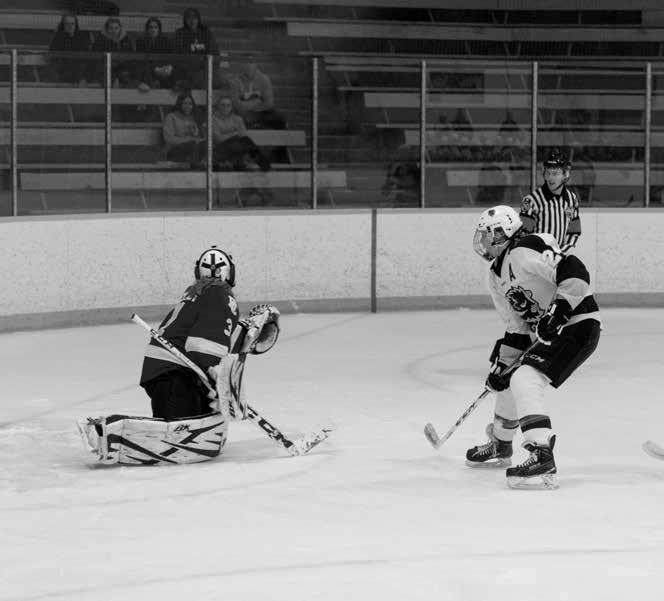
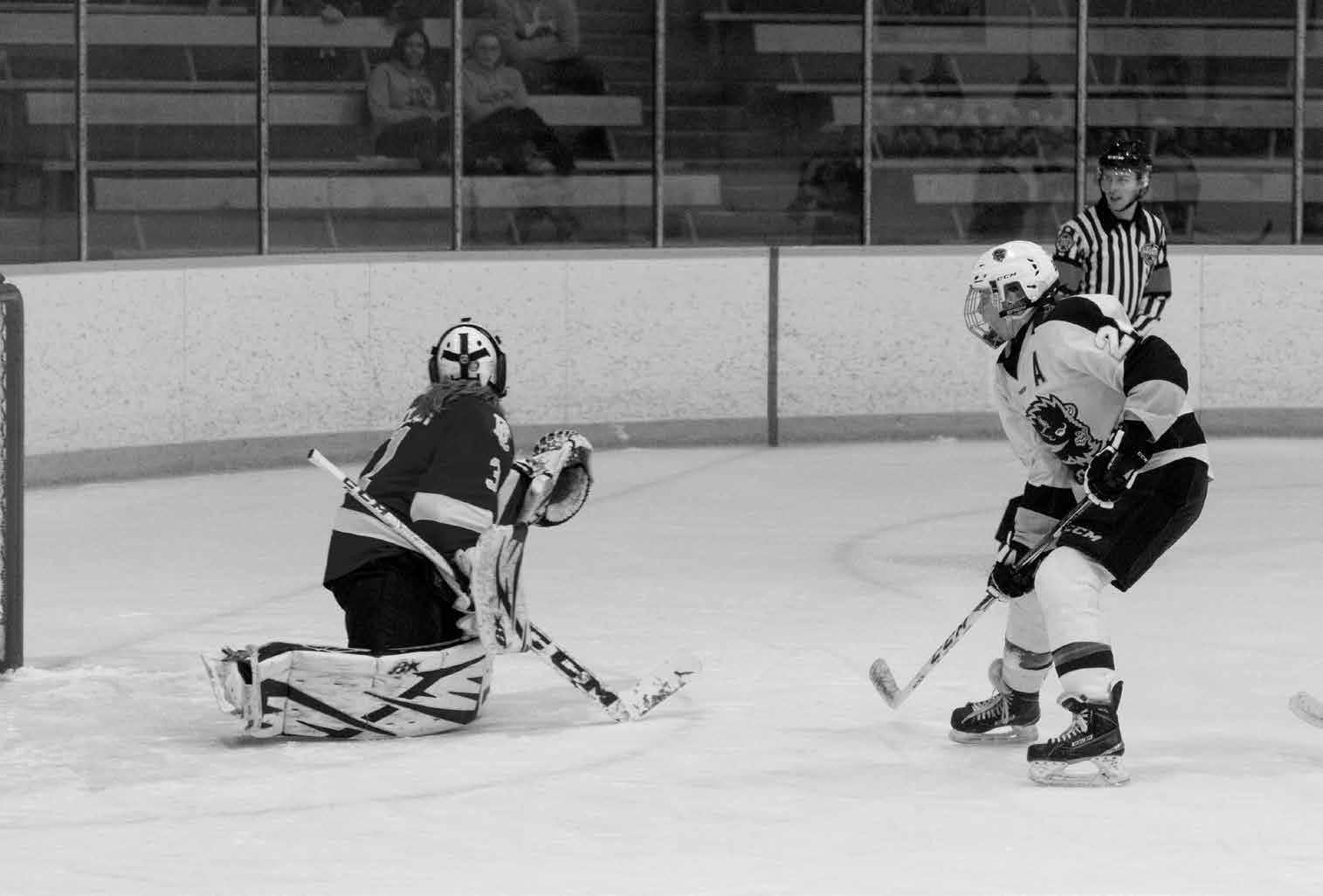
On Friday night, penalty trouble kept the Bisons quiet for most of the game, but a 4-on-4 goal was enough to change that and the Bisons added
an insurance goal for a 2-0 win. The teams traded chances for most of the first, with the Bisons applying a good deal of pressure. Winger Alanna Sharman got the home team in front during a 4-on-4 stretch, using the extra space to her advantage. An outlet pass from Lauryn Keen was almost picked off by a Thunderbirds defender, but Sharman snagged the puck at centre for a breakaway chance. She roofed the puck with a wrister over goalie Tory Micklash’s glove to
put the Bisons up 1-0.
No goals were scored in the second and or third periods. The Bisons had a great number of chances in tight on Micklash, but couldn’t get anything past the UBC goaltender.
Sharman was stopped but drew a penalty late in the third, which allowed Venla Hovi to put the Bisons up by two. The Bisons went circle-tocircle with passes, and ended with a pass by Alexandra Anderson going in front to Hovi. The Finnish forward got just enough on it to tip the puck top shelf, sealing the 2-0 Bisons win. Rachel Dyck recorded her 4th shutout of the season with the victory.
In her return from injury Sharman picked up the game-winning point, and her seventh of the year.
“It’s hard to replace the minutes, the positivity, and the work ethic,” head coach Jon Rempel said postgame. “The work is what makes her such a good player because she doesn’t stop and she doesn’t quit.”
Saturday
Following a hard-fought win Friday night, the Bisons were back on the ice Saturday looking to sweep the weekend series against the powerhouse UBC Thunderbirds. The herd closed a major deficit, but a late goal was enough to put them away 4-3.
The Bisons came flying out of the gate, but an early UBC goal stopped their momentum in its tracks. A shot
was stopped by Bisons goalie Dyck, but the puck couldn’t get cleared and wound up on the stick of Haneet Pahar at the side of the goal. She tapped it into the yawning cage to put UBC up 1-0 at the 1:51 mark.
“We’re
there, again we have to be consistent in our approach to weekends. We have to be ready to play” – Jon Rempel, Bison women’s hockey head coach
This was followed up by another goal by Pahar four minutes later. The Thunderbirds got another, this time off the stick of Emily O’Neill who sent a one-timer low blocker-side on Dyck to make the game 3-0 early.
Before the period was over, Manitoba got on the board. Hovi broke into the UBC zone on the right side, using a side-step move to get inside towards the slot. She fired a wrist shot on goal which found its way through Ameila Boughn’s fivehole, sliding in to cut the T-Birds’
Bisons split against UBC Thunderbirds in men’s hockey
ryA n Stelter, staff
After earning their first home sweep of the 2016-17 season, the Bison men’s hockey team traveled to Vancouver to play a two-game series against the UBC Thunderbirds. The Bisons lost a close one on Friday 4-3, but won on Saturday 4-2.
The Thunderbirds were nipping at the Bisons’ heels for the sixth and final playoff spot heading into the weekend. This was a critical weekend for both teams, as they are currently separated by only three points in the Canada West.
Friday
Friday was the Winter Classic for UBC, and 5,036 fans came out to watch the Bisons and the T-Birds battle. The Bisons wanted to spoil the party, and they started out great with Nick Zajac scoring halfway through the first. Jordan DePape added one on a power play early into the second but it was downhill after that for the Bisons.
In a span of four minutes, the Thunderbirds struck three times –twice on the power play – to make it 3-2 for the home side. The ’Birds
added another power play goal with three minutes to go in the second to make it 4-2 after 40 minutes of play.
Shaq Merasty scored with two minutes remaining in the third period, but it was not enough. The second period collapse was good enough to send home the 5,036 fans in attendance happy. Brett Stovin had two assists on the day, tying him for the team lead of 12 with Remi Laurencelle.
Merasty has now scored in his last three games, earning five points in that stretch
Saturday
The Bisons were looking for redemption on Saturday after a poor showing on Friday night. Manitoba came out strong in the first period, leading to a 4-2 victory. The Bisons
lead to two.
The Bisons drew closer in the second thanks to Alana Serhan. Winger Karissa Kirkup picked up a loose puck, letting a shot loose towards the UBC net. Serhan got just enough of her stick on it to tip the shot by Boughn, making the game 3-2 UBC.
After Nicole Saxvik restored the two-goal lead for UBC, Anderson responded for the Bisons in highlight fashion. Manitoba got the puck low in the UBC end and a pass from Courtlyn Oswald found its way to Anderson in front. Anderson picked up the puck, spun around to avoid two UBC defenders and roofed a backhander on Boughn.
That’s as close as the Bisons got, with the Thunderbirds taking the second game of the weekend series 4-3.
“We weren’t ready and they were,” Rempel said postgame. “I liked our fight and compete to not let it get away on us.”
When asked about the main takeaway from the weekend, where his team earned a spilt on the topranked team in Canada, Rempel urged consistency.
“We’re there, again we have to be consistent in our approach to weekends. We have to be ready to play,” he said.
The Bisons will be at the Wayne Fleming Arena again for a series against the Lethbridge Pronghorns on Jan.20-21.
left no time to waste on Saturday, with Stovin scoring 74 seconds into the game. Quinton Lisoway scored 96 seconds later to make it 2-0 for the away team.
Justin Augert scored his ninth goal of the year to make it 3-0 for the Bisons after one period of play. The ’Birds cut into the Bison lead halfway through the second via Austin Vetterl. Merasty scored his second of the weekend to restore the three-goal lead in the third period. Merasty has now scored in his last three games, earning five points in that stretch. He’s also tied with DePape for the team lead with 17 points.
With the split this weekend, the Bisons move into fifth in the Canada West with a 9-10-1 record. This weekend’s series against the Pronghorns will be pivotal as they are both tied with 19 points, but Manitoba has more wins, so they hold the tiebreaker. It will be a good chance for the herd to get some breathing room and push for finishing high enough in the standings to be able to host a playoff series.
This weekend, the University of Manitoba volleyball teams hosted the UBC Thunderbirds. The men brought their winning streak to 12 with a sweep, while the women had their four-game winning streak snapped after getting losing both games.
Garth Pischke, head coach of the third ranked Bison men’s volleyball team, made history on Saturday, winning his 1300th game
Garth Pischke, head coach of the third-ranked Bison men’s volleyball team, made history on Saturday, winning his 1300th game. He now holds the North American all-time coaching match win record for men’s volleyball. Pischke holds a winning percentage of 78 per cent and has the most overall wins as a coach in U Sports history.
Men
The men’s volleyball team were red-hot heading into this weekend, and continued that trend on Friday, winning in five sets over the Thunderbirds. It was a hard-fought battle, as the Bisons jumped out to a 2-0 set lead, but the Thunderbirds clawed their way back to make it 2-2 and had all the momentum heading into the fifth set. The Bisons man-
aged a 15-12 third set victory, which gave them their 11th straight win.
Devren Dear had 20 kills on the evening, leading everyone on the court. UBC only made 10 errors in total, while the Bisons made a whopping 18. In the fourth set, the Thunderbirds made no errors at all, combined with their set-best 19 kills.
On Saturday, with head coach Pischke gunning for the history books, the Bisons came out with a 3-1 win. In another closely contested fight, the Bisons won the opening set 25-23. Then in a back-and-forth second set, with neither team having more than a two point lead, the Thunderbirds won 29-27. The Bisons won the next two sets though to take
the 3-1 match victory.
The Bisons served a lot better in this match, with nine aces compared to UBC’s three. Dear had a seasonhigh 27 kills on the night; Adam DeJonckheere smacked home 15 of his own. DeJonckheere has a .327 hitting percentage on the year, which is good enough for third in the Canada West. He has also cracked the top 20 in career kills in the Canada West with 981.
Dear is chasing history as well this season, as he is third in all-time Canada West points with 1352.5 in his five year career with the herd.
Women
Riding a four-game win streak
heading into this weekend, including a pair of wins over local rivals Winnipeg, the Bison women’s volleyball team were hoping to keep that momentum going.
The Bisons’ win streak was stalled when they took to the court against UBC. On Friday, the Bisons lost 3-1 (25-18, 21-25, 25-9, 25-16). Their 25-21 second set victory was their only set victory of the weekend. The Bisons were dominated in every aspect, with the ’Birds managing 14 service aces and a total team hitting percentage of .323.
Saturday was worse for the herd. They dropped all three sets against the Thunderbirds as UBC completed the weekend sweep. It was a good
Bisons trample Cougars in weekend sweep, extending winning streak to four games
This weekend, the University of Manitoba men’s basketball team took on the Regina Cougars in a twogame series. The Bisons won 93-81 on Friday, and completed the sweep with an 84-75 win on Saturday. With their current streak, the Bisons bring their record back to 6-6.
Friday
On Friday, the Bisons cruised to victory against provincial rival Regina by a score of 93-81. The game began pretty competitively, with Regina taking a 20-14 lead by the end of the first quarter. The Bisons responded in the second, keeping things close before they closed out the half on a 9-0 run, taking a 10-point lead into halftime. Alleyn led the herd, scoring 11 of his 21 points in the first half. The teams played a pretty tight
third frame, with the Bisons expanding their lead to 17 entering the final quarter. Manitoba led by as many as 20 points, but later the Cougars went on a 9-0 run, cutting the lead down to just 10 points with just over six minutes to play. The herd answered back with a 9-1 run, and that was enough to hold on for a 93-81 victory. Manitoba was led by Basi second half, who converted 12 of his 19 points.
Justus Alleyn led Manitoba in points with 21, AJ Basi netted another 19; Ilarion Bonhomme (12), Joey Nitychoruk (11), and James Wagner (10) all got into the double figures as well. The Cougars were led by Brandon Tull, who was able to score 16 points, and Alex Igual, who put up another 13 for the home side.
Shots fell 52.5 per cent of the time for the Bisons, and just 37.5 per cent of
the time for the Cougars. Manitoba was able to hit 12 three-point shots, including Alleyn and Basi hitting five each, compared to Regina’s six. Those numbers speak volumes about how the herd managed to win the game.
Saturday
On Saturday, the Bisons completed the weekend series sweep, as they defeated the Cougars 84-75. The win was Manitoba’s fourth consecutive victory. Alleyn once again led the Bisons in scoring with 22 points. Keith Omoerah also contributed, with 16 points on the day, while Nitychoruk
netted another 13.
Shots fell 52.5 per cent of the time for the Bisons, and just 37.5 per cent of the time for the Cougars
The first quarter opened with the two teams playing some competitive ball, and the Cougars were only able to take a slim 17-15 lead into the second frame. Neither team was able to go on a big run in the second quarter, but the Bisons were able to distance themselves enough to take a 33-28 lead into halftime. Bonhomme and Nitychoruk led Manitoba to their halftime lead, as they each put up seven points in the first half.
Regina made things interesting in the third quarter, as they tied the
day individually for Kearley Abbott, however, as she led Manitoba in kills, digs, and aces. Abbott has the fifthbest hitting percentage in the Canada West, sitting at .276 on the year. Despite a poor showing this weekend, the Bisons have shown vast improvement from last season. Currently they are sitting at a 6-8 record and in a playoff position in the conference.
Both Bison volleyball teams host the Calgary Dinos at the Investors Group Athletic Centre on Jan. 20-21.
game up early on. The teams continued to exchange chances throughout the frame, but the Bisons were able to go on a late 13-0 run, to give them a big 61-44 lead entering the final quarter. The Cougars made a push, as they put up 31 points in the final quarter, but the Bisons were able to score enough points to hold a lead and win the game. Alleyn scored 16 of his 22 points in the second half, and Basi added another nine. The pair led the Bisons’ second-half charge.
The Bisons are on the road again, as they travel to B.C. to take on the Trinity Western Spartans on Jan. 20-21.