U of M vice-provost of Indigenous engagement resigns
Lynn Lavallée said efforts to address racism left unheard by
BY MALAK ABAS, STAFF
T
he vice-provost of Indigenous engagement at the U of M has resigned, citing a lack of response on Indigenous issues by the school’s administration.
Lynn Lavallée resigned from the position Dec. 6 after serving as the university's first vice-provost of Indigenous engagement for just over a year.
Lavallée, who is AnishinaabeMétis, said the resignation was something she had been considering “for a while.”
“In general, over time, I realized my vision for this role was not in alignment with administration,” she said.
“And I felt that the things that I wanted to do, I wasn’t effective in achieving them. For me, that really had to do with my perceptions of the starting point — where the U of M is
at — especially given their strategic plan.
"And I thought that I would come here, and I wouldn’t have to do the same old, same old that Indigenous academics, people in the academy, have been doing for literally half a century.”
The U of M’s 2015-2020 strategic plan includes “creating pathways to Indigenous achievement” as a key priority.
to Indigenous achievement,” Ristock said in the statement.
Just months earlier, the Circle of First Nations, Métis and Inuit Students released a statement condemning the university that included claims that Lavallée had requested
administration
the only Indigenous administrator.”
At the time, U of M spokesperson John Danakas would neither confirm nor deny whether the presidential executive team had in fact turned away Lavallée.
“I felt that the things that I wanted to do, I wasn't effective in achieving them” — Lynn Lavalée
When reached for comment, the U of M provided a statement from provost and VP academic Janice Ristock that said she “respect[ed] Dr. Lavallée’s opinions.”
“The University of Manitoba shares Dr. Lavallée’s commitment
and was denied a meeting with the U of M’s presidential executive team on behalf of the U of M Indigenous Students’ Association (UMISA) to discuss instances of anti-Indigenous racism on campus.
The statement referred to “the [U of M’s] utter disregard and disdain of
Lavallée, who chose not to speak publicly on the issue at the time, called the situation “just icing on the cake” upon her resignation.
“It wasn’t one situation. It was the deeply embedded systemic racism that is at the University of Manitoba, it’s in Winnipeg, it’s in Manitoba, it’s across Turtle Island,” she said.
“But it’s expressed in different ways in different institutions.”
Lavallée took on the position of “strategic lead, Indigenous resurgence”
at Ryerson University in Toronto, a position she said clearly recognized the inherent system of oppression within academia.
“With resurgence, you’re acknowledging that you’re starting with a colonial system,” she said.
Lavallée said that while she believes there are some in administration involved with the creation of the strategic plan “whose heart is in the right place,” a greater understanding of the anti-Indigenous racism endemic in the education system is needed.
“What exists at the [U of M] systemically that doesn’t allow Indigenous voices to come forward?” she said.
“I think everybody needs education on that. So if you don’t understand that, you’re going to be a performative ally.”
Students respond to Indigenous admin’s resignation
UMISA members say Indigenous engagement seat gave students a “bigger voice”
BY MALAK ABAS, STAFF
I
n the wake of U of M vice-provost of Indigenous engagement Lynn Lavallée’s resignation in December, some Indigenous students on campus are looking toward an uncertain future.
“The U of M needs to focus on Indigenous resurgence” —
Alannah Mckay, UMISA co-president
Lavallée, who was appointed to the position in September 2017, announced her resignation Dec. 6, citing a lack of response on Indigenous issues from the university’s administration.
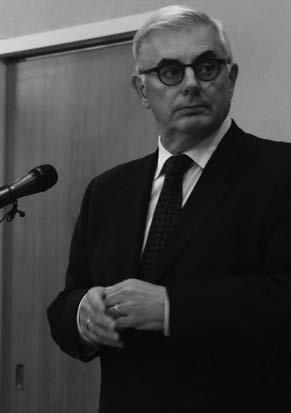
University of Manitoba Indigenous Students Association (UMISA) co-president Alannah Mckay said Lavallée’s presence on campus, even for only one year, created a markedly different environment for Indigenous students.
“With Lynn here, I feel like Indigenous students had a bigger voice on campus,” Mckay said.
“We were able to voice our concerns and be able to go to somebody and let her know what was happening — if certain profs, if they were making a racist comment here or there, we were able to go straight to her.
"She was amazing in that aspect.”
Mckay said that while she hoped Lavallée would remain in the position until at least the end of the school year, she was aware Lavallée was dissatisfied with the position.
Jack Theis, a member of UMISA, said Lavallée kept an open channel of communication between students and administration.
“It was clear that she was dedicated to the students, and that she saw that change could be created, or could come from the University of Manitoba, and spread throughout Turtle Island,” he said.
“But it just wasn’t happening the way it was supposed to.”
Mckay referred to “pushback” from the board of governors and the senate as a reason for Lavallée’s resignation.
“We have 2,400 Indigenous students, we have the [National Centre
for Truth and Reconciliation], and we have amazing professors, and she’d seen that as an opportunity to let the U of M be the champions of starting lot of new initiatives toward reconciliation, especially for Indigenous students,” she said.
“But the U of M clearly just didn’t want it.”
Should the university fill the vacancy again, Mckay said the position should be changed from the ground up.
“The U of M needs to focus on Indigenous resurgence,” she said.
“Because I feel like if they have something like that, like Ryerson, like [the University of Victoria], it’s
the U of M acknowledging that we are a colonial institution, and there have been so many harms done in the past, and that they’re willing to build the relationship between Indigenous and non-Indigenous peoples further within the academy.”
Mckay added that when Indigenous students met with U of M president David Barnard and the presidential executive team in November, they emphasized the importance of Indigenous students being actively involved in the hiring process of administrative positions involving Indigenous engagement on campus. Theis said for the university to
move forward with the process of replacing Lavallée, it needs to “willingly hire someone who’s going to fight for the students, even if [that’s what] some of the higher-ups aren’t accustomed to.”
“Someone who’s going to be willing to disrupt the system,” said Mckay.
“The university has to talk about race, has to talk about anti-Indigenous racism, has to talk about denying us the resources to be able to revitalize our languages, about reallocating resources, and the university has to get comfortable [talking about it], just like every individual does, just like all of society does,” Theis said.
“Or else nothing will ever change.”
PHOTO BY MEGAN COLWELL
Year in Review: Revisiting the
From plebiscites to protests, here’s what happened on campus last year
MALAK ABAS, STAFF
As the U of M re-opens for a new year the door closes on 2018 — and with it, we inevitably reminisce on a year filled with progress, protest and struggle.
In the spirit of looking back, here is a rundown of some of the biggest stories on campus this past year.
1. U of M president apologizes to students amidst a windfall of sexual violence complaints against faculty
On the first day of the 2018-19 school year, U of M president David Barnard held a media conference and apologized to students affected by sexual violence on campus.
The apology, and ensuing confirmation that there were five open investigations against faculty, came after a slew of sexual violence complaints against U of M faculty, and shortly before another would come to light.
Days later, police confirmed former jazz professor Steve Kirby had been arrested on charges of sexual assault.
Kirby left the university in June 2017 after being on leave for six months, but reports claim the U of M was approached with complaints regarding the well-known instructor as early as 2012.
The U of M administration faced criticism after Kirby was hired at Boston-based Berklee College after it had received what some called a positive recommendation from the U of M.
In August, oncologist and former associate dean at the faculty of medicine Gary Allan Joseph Harding was convicted of professional misconduct and stripped of his medical licence after he allegedly made repeated sexual advances toward two students.
More recently, U of M professor and director of the Richardson Centre for Functional Foods and Nutraceuticals Peter Jones was placed on leave when it was revealed he had been accused of misconduct, including inappropriate student relationships.
Barnard indirectly referenced the allegations again in his year-end message on Dec. 19, where he said issues of sexual violence on campus “have not always been dealt with as effectively as they could have been.”
with the phrase “It’s Okay to Be White” overnight on Halloween.
Members of the anonymous message board 4chan developed the phrase in 2017 with the purpose of creating a slogan that would be, as one commenter put it, “linguistically harder to subvert.”
The posters were mainly concentrated in the faculty of arts, including the Isbister, Fletcher Argue and Tier buildings. Similar posters were found on university campuses across Canada.
Students, faculty and staff swiftly condemned the campaign.
anti-Indigenous racism on campus, demand UMSU president step down
A statement made by the Circle of First Nations, Métis and Inuit Students — a group operating within the Canadian Federation of Students — condemned the U of M community for what it called “blatant disrespect for the safety and security of Indigenous students” in October.
The statement said the now-former vice-provost Indigenous engagement Lynn Lavallée requested and was denied a meeting with the U of M’s presidential executive team on behalf of UMISA to discuss instances of anti-Indigenous racism on campus.
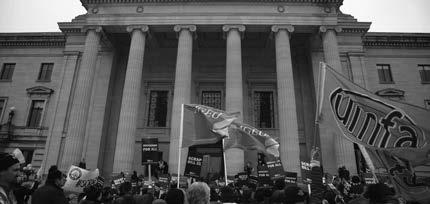
Both undergraduate and graduate students were hit with a 6.6 per cent — the maximum percentage allowable — increase to tuition fees in September
He said he had met with the university’s board of governors the week prior to present several initiatives to address these issues.
UMSU has since called for university policy banning sexual relationships between faculty and students, “whom they have a direct power imbalance over.”
2. Campus community pushes back against hate
As part of a racist campaign orchestrated by alt-right groups across North America, the U of M campus was papered with posters
Barnard released a statement a day after the posters were first discovered condemning the act and called upon students, staff and faculty to “fight back against ignorance with knowledge.”
Members of the School of Fine Arts Students Association (SOFA) led a poster initiative of their own, gifting posters reading “My love for my people is stronger than anyone’s hate” and “Reclaim your power” to members of the Muslim Student Association and the U of M Indigenous Students’ Association (UMISA).
3. Student groups call out
At the time, U of M spokesperson John Danakas would neither confirm nor deny whether the presidential executive team actually turned Lavallée away. Lavallée resigned from the position in December, citing a wider lack of response from the administration on Indigenous issues.
Earlier in the year, UMSU published a public apology after a student was allowed into the Hub Halloween Haunt wearing a costume that had been criticized as culturally appropriative.
In November, UMISA members presented a statement at an UMSU board meeting that included the demand that UMSU president Jakob Sanderson step down from his posi-
tion, referring to “utter disregard and disrespect for Indigenous students.” Sanderson said he has no plans to step down.
4. Pro-life campaigns met with pushback, UMSU legislation amendments Students took full advantage of their constitutional right to demonstrate on campus this year, and the UMSU executive took notice.
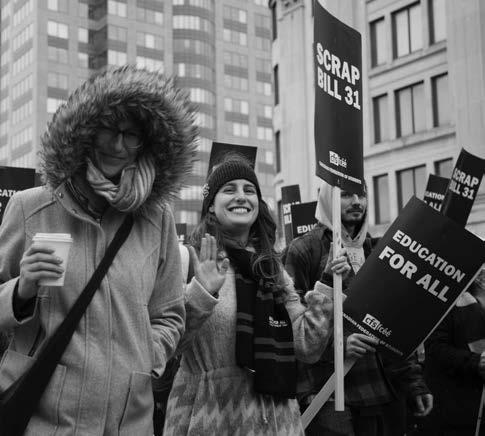
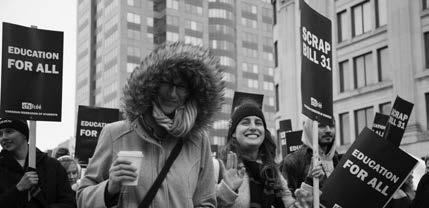
Following pro-life campaigns on campus by the Canadian Centre for Bio-ethical Reform (CCBR) in October that included graphic imagery, students engaged in peaceful protest against the group, some carrying signs with statements including “bodily autonomy is not up for debate” and “it is okay to have an abortion.”
Weeks later, UMSU moved two motions that amended the union’s official position on reproductive rights.
The motions — both of which passed with an overwhelming majority — included amendments to UMSU’s “equitable campus” position statement and its safe environment policy to include the union’s support of “one’s right to freedom of reproductive choice; and one’s right to be free from coercion or attempted coercion with respect to making reproductive choices” and its official opposition of any attempt at reproductive coercion.
Sanderson said the motions would prohibit UMSU student groups from “harassing students who don’t want to be talked to — this would include