Cape Breton University leaders seek to eliminate post-secondary tuition
Dana HaTH erly, staff; with files from Paul Bell
C
ape Breton University (CBU) officials released an open letter last week demanding that the federal government and provinces develop a strategy to eliminate tuition fees for post-secondary education.
Cape Breton University president David Wheeler, faculty association president Scott Stewart, and students’ union president Brandon Ellis are calling on governments to eliminate student tuition rates in a letter addressed to federal political parties as well as the provincial Liberal government in Nova Scotia.
The three university officials from CBU urged their counterparts across the country to sign onto the letter.
The letter is intended to “appeal to the leaders of Canada’s federal political parties to seek a new strategic relationship with the country’s vital but currently underfunded and undervalued universities.”
With tax-funded tuition existing in over 40 countries, and tuition-free models in Finland, Germany, and Norway as their bases for comparison, the CBU leaders are calling for “the
phased introduction of tuition-free higher education (backed by a progressive system of taxation at the federal level and targeted living expense grants at the provincial level).”
The plan proposes free tuition “for all those who require it, including all First Nations students” before eventually abolishing tuition fees altogether after consultation between the provinces and the federal government.
Although higher education is part of provincial and territorial jurisdiction, university officials from Cape Breton argue that only federal funding will induce the potential for systemic nationwide change. Campaign organizers suggest that eliminating tuition and providing needs-based grants would eliminate student debt, equating the merits of their proposal with the introduction of publiclyfunded national health care.
U of M officials respond
University of Manitoba president David Barnard and UMSU president Al Turnbull were not contacted by CBU about the letter.
University of Manitoba Faculty Association president Thomas Kucera responded that the association is aware of the campaign and the open letter on the elimination of tuition. He would not comment further until the executive council and board of representatives have had the opportunity to consider it.
When asked for comment on the matter, John Danakas, executive director of marketing and communications at the U of M, said that Barnard has spoken publicly on the matter of tuition.
As part of the wider U of M budget discussion in preparation for up to four per cent budget cuts to academic and non-academic units, Barnard spoke out against low tuition fees.
University administration has justified the proposed cuts as a necessary response to various financial constraints—specifically, insufficient government grants, rising faculty salaries, and low tuition—stating that the university’s budget challenges are in line with what is happening at universities around the country.
In a recent lecture organized by
the Student Action Network at the U of M, Alan Sears, a sociology professor at Ryerson University, spoke about the economic state of post-secondary institutions as part of a series of rallies and meetings with regards to the university’s planned budget cuts.
“The cutbacks here [ . . . ] are part of a broader pattern of transformation across the university system in Canada and, in fact, globally,” said Sears to the crowded U of M lecture hall, opposing what he refers to as the neoliberal restructuring of universities.
“The universities everywhere are under tremendous stress of restructuring.”
Turnbull told the Manitoban that he thinks the CBU letter on tuition is a phenomenal campaign.
“I would need to know more about the political climate [in Nova Scotia] though; it could be different than here. This is certainly worth exploring further,” he said.
On behalf of UMSU, Turnbull argued that improved federal financial support is required to create more sustainable change in post-secondary
funding.
In Manitoba during the 1990s, government funding in general decreased relative to past levels. As the UMSU website points out: “Massive federal funding cuts to postsecondary education along with the ensuing cuts in provincial operating grants to Manitoba universities and colleges resulted in tuition free increase of more than 170 per cent.”
For about a decade from 19992009, tuition fees across the province remained frozen under the NDP government. Tuition fees were subsequently increased by 4.5 per cent in 2009. Since 2011, tuition increases have been capped at the rate of inflation.
The Association of Universities and Colleges of Canada recently compiled a report on Statistics Canada research regarding tuition fees paid by full-time students at their member institutions across Canada. Their report found that CBU students pay $5,097-6,119 per year for post-secondary education, whereas U of M students pay $3,397-3,961 for their full-time studies.
5 Days for the Homeless
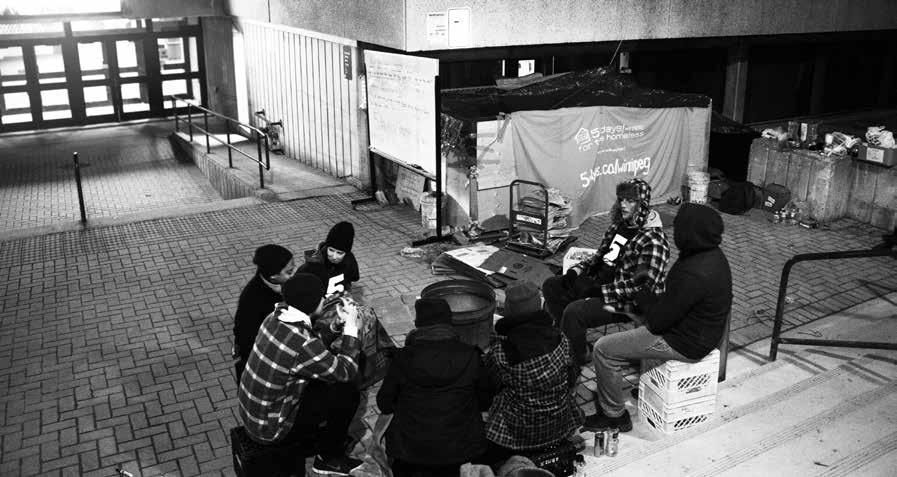
Six U of M students camp in front of University Centre to raise money and awareness for homeless
Crai G aD ol PH e, staff
Six students will be sleeping outdoors from March 15-20 in front of University Centre as part of “5 Days for the Homeless,” a national campaign to raise funds for the homeless.
The University of Manitoba is one of 26 Canadian universities and the only one in Manitoba to participate in the campaign this year. Commerce Students’ Association president Dale Camuyong, UMSU president Al Turnbull, Karli Kirkpatrick, Riaz Mahmood, Alannah Matte, and Deanna Mirlycourtois have signed up as sleepers for the U of M’s campaign. Camuyong, Kirkpatrick, Mirlycourtois, and Matte are business students; both Turnbull and Mahmood are arts students.
Funds raised by U of M students will be going to Resource Assistance for Youth (RaY), a local non-profit that works with Winnipeg’s homeless youth. As of March 16, the 5 Days for the Homeless U of M campaign had raised $4,385 of their $20,000 goal.
youth
been co-ordinated by business students, but has received support from other faculties.
The Arthur Mauro Students’ Association and the Arts Student Body Council are both sending guest sleepers for one night each.
Student associations have offered financial support as well, with the Arthur Mauro Students’ Association donating $300, the Arts Student Body Council donating $1,000, and an as yet undetermined amount to be donated by the Residence Students’ Association Council.
“People are sleeping out on the streets – people our age. What on earth must have happened at home that sleeping outside is the number one option?” –Dale Camuyong, Commerce Students’ Association president
The campaign was first developed by three students from the University of Alberta’s School of Business in 2005 as part of an effort to raise money for homelessness. In their first year, the group raised $2,000 for a local emergency shelter. Since then, it has grown into a national campaign, with over $1,212,000 raised for a variety of charitable agencies across Canada.
Participants in the 5 Days campaign are expected to follow certain rules while living outdoors.
They must remain on campus, have no income, have no food or drinks other than those provided through direct donations, keep only a pillow and sleeping bag—although they can be exchanged for an emergency meal—have no access to showers or facilities other than when campus buildings are open, sleep outside unless weather becomes a health risk, continue to attend all classes, and avoid personal communication media such as cell phones and social media.
In addition, participants are expected to write about their experience or film themselves as part of a contribution to the Five Days campaign blog.
Alissa Smith and Chris KirkFisher, the co-chairs organizing the event, have been working with 12 other committee members since January to plan the local leg of the campaign.
The local campaign has largely
Kirk-Fisher told the Manitoban that the committee had placed a high priority on reaching out to faculties outside of Asper and that they had found that students from other faculties were receptive to working on the 5 Days campaign.
“It’s been great to have [the support of other faculties].
We’ve had troubles in the past with everyone thinking it’s an Asper event, and Asper only, so we only have the Asper volunteers, we only have the Asper donors,”
Kirk-Fisher said.
“We’re trying to do everything we can this year to make everyone realize it’s a university campaign rather than just an Asper campaign.”
Camuyong said that the 5 Days event was reflective of what impact the Commerce Students’ Association and the Asper school of business hope to have on the community.
“We’re more than just a business school. I think we really try to be well-rounded contributors to the community that we’re operating in. And it’s not just charity as well. We try to have an economic impact in terms of job placements. We try to have kind of a social impact, obviously, with our commerce socials and charities,” Camuyong said.
“It’s weird to say, but I can say comfortably that our focus on business is almost secondary, where our first focus is more so engaging in the community that we’re in, and obviously charity is a big part of that.”
Camuyong said that youth homelessness was an issue that more students need to be aware of, and one that needed to be addressed.
“People are sleeping out on the streets, people our age. What on earth must have happened at home that sleeping outside is the number one option? Something must be wrong if sleeping outside is the best option,” he said.
“There are issues beyond Canada,
and even beyond Manitoba in terms of homelessness and poverty, but this is something that’s happening at home, and this is something that I think people should be more aware of in terms of their everyday lives.”
Alex White, director of communications and development for RaY, said that the funds raised by the U of M’s 5 Days campaign help fund essential services to youth who need them. He added that the 5 Days event can have a much more personal impact because of its student involvement.
“With the 5 Days event, in one sense it’s fantastic to see all these young people to stand up for other young people who’ve kind of been given a bad break. There’s something [
. . . ] special seeing that happen.
“Quite often there will be participants of ours that will go on to university too. And I’ve heard that when they see that happen they’re really thrilled to see that other youth and their peers care just as much about the topic and their well-being as they do.”
Over another dozen volunteers will be assisting by co-ordinating and staffing various other activities throughout the week including bake sales in Drake Centre and University Centre, a food sale hosted by the University of Manitoba Marketing Association, a pancake sale hosted by the University of Manitoba Leadership Organization, and 5 Acts for the Homeless, a fundraiser
event featuring five local performers at the Hub.
The five acts will be local musicians George Semchuk and Leanne Pearson, comedian Ben Walker, and local bands Benowa and the Fighting Hellfish.
5 Acts for the Homeless starts at 7 p.m. on Thursday. Tickets will be available for sale in Drake Centre for $10, or $5 and two gently used pieces of clothing.
5 Days for the Homeless started at 5 p.m. on Sunday and runs until 5 p.m. Friday.
photos by carolyne KroeKer
City committee takes brakes off U-Pass implementation
Universal transit program endorsed by unanimous vote
Dana HaTH erly, staff
The universal transit pass (U-Pass)
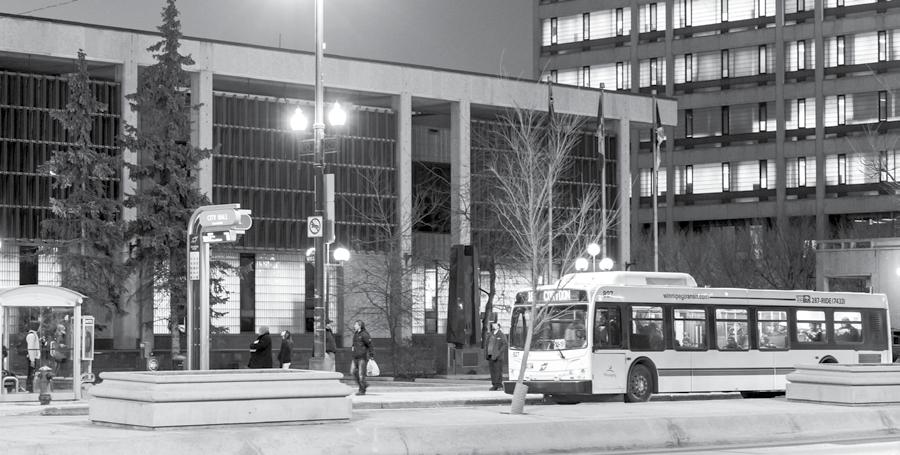
is now in the hands of Winnipeg city council and the University of Manitoba Board of Governors (BOG) after recommendations were made by the city’s standing policy committee on infrastructure renewal and public works, with major implications for the already controversial 2015 city operating budget.
The committee voted unanimously to endorse the U-Pass implementation on Monday.
“With the approval of the motion, recommendations will be sent to city council next week for adoption and the U-Pass will be implemented for September 2016,” Christian Pierce, UMSU vice-president external, told the Manitoban in an email.
“The U-Pass motion was recently sent to the [U of M BOG’s] finance committee where they put forward the recommendation for approval to the board.”
The BOG had not met as of press time. They must approve the finance committee recommendation in order to ensure that U of M students receive a U-Pass.
Monday’s decision by the infrastructure and public works committee is subject to each students’ association’s U-Pass proposal receiving approval by their respective university’s governing bodies, which is compulsory in order to move forward on any remaining recommendations.
“We are optimistic that the board will take the finance recommendation and approve the U-Pass motion. This is the final step on UMSU and the University of Manitoba’s side of things,” Pierce said.
Pierce added that he has been in communication with Winnipeg Transit since January to discuss the implementation since they sent the motion to the city this month.
“Our communications included updates to them about where the university was at in terms of getting the U-Pass motion passed through the BOG,” he said, adding that he sought confirmation that the University
of Manitoba Graduate Students’ Association (UMGSA) was to be included in the U-Pass motion.
“I also wanted to confirm that they were creating the plan with the UMGSA in mind as they weren’t a part of the original city council U-Pass motion in 2014.”
This rudimentary development regarding the U-Pass would give Winnipeg Transit authorization to proceed with plans to implement the program, having satisfied the conditions set by city council last February and following successful referendums held at participating post-secondary institutions.
The universal transit pass program is meant to provide students attending participating post-secondary institutions across the city with more affordable access to public transportation, paid for in part by a mandatory fee assessed to post-secondary students, tacked onto their tuition for each academic term.
This past November, students from those participating schools voted in favour of the U-Pass at the cost of $260 per fall and winter terms, in referendums held by UMSU, the UMGSA, and the University of Winnipeg Students’ Association.
At the U of M, 53 per cent of students voted in favour of the U-Pass.
A much higher proportion of U of W students voted in favour of the U-Pass, with 82 per cent voting in favour of the pass.
Monday’s infrastructure and public works committee at city hall had a busy agenda, with many relevant transit recommendations considered by councillors.
St. Norbert Councillor Janice Lukes is the chair the committee, alongside council members Shawn Dobson, Cindy Gilroy, and Devi Sharma.
Dave Wardrop, director of Winnipeg Transit, was the spokesperson from the transit department, reporting administrative cost analysis of the U-Pass to the committee on infrastructure renewal and public
works.
A number of student leaders were also in attendance at the committee meeting, including Pierce; Zach Fleisher, chairperson of the Canadian Federation of Students-Manitoba; Rorie Mcleod Arnould, University of Winnipeg Students’ Association president; and Laura Rempel, UMGSA president.
Fleisher told the committee that
the U-Pass implementation ensures that university students are taking the bus at higher rates, with long-term investment to improve the service for students and others who rely on transit.
Joseph Kornelson of local advocacy group Functional Transit Winnipeg stressed that transit users prioritize more buses and more frequent bus service as well as convenience, affordability, and minimized walking distance when it comes to transit service.
Improved frequency of service and more operating hours have been linked to an increase in ridership, he told the committee.
Kornelson recommended that the city invest $19.7 million, which constitutes a 25 per cent funding increase to be used for more frequent service.
Some recommendations presented to the standing committee include additional operating hours added to transit routes identified to accommodate increased ridership as well as an increase in the operating budget by $994,000 in 2016 for four months and a $2,185,000 annual increase in 2017.
An augmented operating budget would cover the loss of revenue,
additional service costs required for the universal transit program, and charges for the planned purchases of nine additional buses.
The proposal from Winnipeg Transit included $5,164,000, financed by external debt, to be added to the 2016 capital budget in order to purchase additional buses. Additionally, Winnipeg Transit recommended that the city increase staff to accommodate higher ridership, adding more bus operators, maintenance, and supervisory staff to their service team.
For those who have long been involved with the planning process for the U-Pass, the 2015 budget proposal signals that their plans have begun to materialize.
“Our initial discussions with members of city council weren’t always positive and it took a lot of persistent lobbying, working together, and hard work to get the bus moving on this one,” Fleisher said in an online statement.
“We’ve been there lobbying council members, seen it survive two referendums, had our hopes and dreams dashed only to see it come back to life in the form of a budget amendment.”
photo by Matt dUboff
Jon Stewart’s serious comedy
The impact of The Daily Show
Crai G aD ol PH e, staff
On Tuesday, Feb. 10, during the last minutes of The Daily Show, Jon Stewart announced that he would be resigning from his position as the show’s host sometime in 2015.
In his brief speech to the audience, Stewart thanked Comedy Central for the opportunity to host the show, adding, “In my heart I know, it is time for someone else to have that opportunity.”
I can’t say that I’ve watched it consistently since Stewart started. But I have watched every episode of The Daily Show for at least 10 years. Along with every episode of the spin-off The Colbert Report before it went off the air in late 2014, John Oliver’s new series Last Week Tonight with John Oliver, and the early seasons of This Hour Has 22 Minutes and the Rick Mercer Report – Canada’s closest parallels. Stewart’s brand of fake news has been a constant through all of my adult life, and much of my adolescence.
In that time I've witnessed the impact of Stewart's serious comedy.
Stewart took over as host of The Daily Show in early 1999, bringing his own brand of self-deprecating humour. He quickly established his personal voice by honing in on political issues. He criticized political elites for failing to represent people’s interest through both corruption and general ineptitude, and the news media for its frequent failures to hold them to account.
Jon Stewart has played a major role in the media landscape over the last several years. Although he’s suggested laughs are always his first priority, on a number of occasions his influence has stretched beyond the world of late-night television.
Zadroga bill
In 2010, Stewart dedicated an entire show to lambasting Senate Republicans for filibustering the Zadroga bill. The bill promised to provide medical coverage to first responders who were on the scene after the September 11 attacks, and would have been paid for by closing tax loopholes. It had already been passed by the house, and only needed the approval of the Senate to be passed into law. Even though the Democrats had a majority in the Senate and had enough support to pass the bill the Republican caucus was able to prevent it passing by stalling debate.
“This is an outrageous abdication of our responsibility to those who were most heroic on 9/11,” said a visibly irate Stewart in his monologue.
Stewart interviewed a panel of four of the first responders who had each developed medical conditions, in the last segment of the episode. It was impossible to directly connect their illnesses to their work after the attacks and without coverage provided by the Zadroga bill they were not covered for their medical bills.
The episode put a face to those suffering as a result of the Republican’s
politicking and people responded. The news media began to cover the bill and it ended up being put into law days later.
John Feal, founder of the FeelGood Foundation, said that although the applied pressure was a team effort it was largely due to Stewart’s contribution that it was a success.
“What Jon Stewart did was he literally shamed conventional media and the U.S. government into doing the right thing,” said Feal.
Shaming conventional media was ultimately the way in which Stewart had the most impact on his show.
Jim Cramer interview
In that same vein, Stewart famously took Jim Cramer, host of CNBC’s Mad Money, to task in an interview on The Daily Show, after a back-and-forth between the two through the media.
Stewart criticized Cramer personally for his overconfident predictions and flippant attitude to investment advice leading up to the 2008 financial crisis. But his harshest criticisms were reserved for CNBC, which he suggested perpetuated a systemic failure to provide meaningful coverage of the misdeeds on Wall Street that caused the financial crash.
Stewart had spent much of the past week criticizing CNBC for its lack of critical financial reporting, and the way they laid blame after the financial crisis. Rick Santelli, a CNBC commenter, who had originally been scheduled to appear on the show, had criticized mortgages holders for their role in the 2008 financial crisis, calling them “losers.”
Days before the Cramer interview, Stewart used his half-hour comedy slot to point out the hypocrisy of commentators, who themselves had not predicted the financial collapse, blaming their viewers for not seeing it coming. Particularly in light of the network’s milquetoast, entertainment-style, coverage.
“The financial news industry is not just guilty of a sin of omission, but a sin of commission,” Stewart said in his interview with Cramer.
“CNBC sells itself as financial experts [ . . . ] And they have the access to the CEOs. And yet they didn’t catch any of this. And yet here they are blaming people who don’t have the financial expertise and saying they’re part of the problem.”
Cramer tried to defend his work at CNBC, to no avail.
“I understand that you want to make finance entertaining,” said Stewart in the final minutes of the episode. “But it’s not a fucking game.”
It was probably the closest our generation will ever get to a Frost/ Nixon moment.
Crossfire cancellation
Stewart also famously played a role in the demise of the long-running CNN debate show Crossfire, which originally ran from 1982 to 2005.
The show, which was co-hosted by left and right archetype pundits Paul Begala and Tucker Carlson, had people from opposite ends of the political spectrum—political spectrum being as narrowly defined as you would expect from a 24-hour news channel—“debate” in front of a live studio audience.
Stewart made an appearance in October 2004 to promote The Daily Show with Jon Stewart Presents America (The Book): A Citizen’s Guide to Democracy Inaction , a book he co-wrote with members of his staff. Being a vocal critic of the coverage, and the very nature, of the 24-hour news channels, Stewart didn’t hold back in his appearance.
He started with a message to the show’s hosts.
“I made a special effort to come on this show today because I have privately, amongst my friends and also in occasional newspapers and television shows, mentioned this show as being bad. And I felt that that wasn’t fair and I should come here and tell you that it’s not so much that it’s bad as its hurting America. So I wanted to come here today and say [ . . . ] stop. Stop hurting America. And come work for us.”
Stewart was both unrelenting and hilarious through his 10-minute interview. He pulled the show apart, calling out the show’s hosts for its theatrical format, which he argued, distracted from real debate. The studio audience was, more often than not, clearly in Stewart’s corner, as both of the show’s hosts tried to argue the merit of the show’s existence.
On Jan. 6, less than three months later, CNN announced that the show was being cancelled.
At the time, CNN president Jonathon Klein, suggested that Stewart’s criticisms may have played a role in the decision.
The New York Times reported Klein as saying, “I agree wholeheartedly with Jon Stewart’s overall premise.”
He also suggested that Crossfire, or rather the essence of Crossfire, may play a role on other CNN programs “in small doses.” It may have turned out to be more than small doses as the show was revived for a second run from 2013-2014, and Stewart has spent the better part of the past 10 years mocking CNN on a regular basis for their continued, over the top theatrical approach to news, describing the network as “terrible,” and during an interview on Larry King Live, calling its host, who had announced plans to retire, “the last man out of a burning building.”
Stewart’s impact
Since taking over at The Daily Show Stewart has become a dominant voice in late-night television. No one else has been as widely regarded.
A 2009 online poll by Time magazine identified Jon Stewart as the most trusted newscaster, after the death of Walter Cronkite. Stewart
received 44 per cent of the vote. Brian Williams received 29 per cent. Katie Couric and Charlie Gibson received 19 and 7 per cent of the vote. respectively.
He’s been on duty through the wars in Iraq and Afghanistan, Hurricane Katrina, and the September 11 attacks. He provided criticisms of the Obama administration for its use of drone strikes, the department of veteran affairs’ failure in delivering benefits to veterans, and the Republicans’ ongoing denial of climate change – all from a half-hour evening slot on a basic cable comedy network.
Even though, more often than not, he’s found his comedic muses in the political realm, Stewart has always rebuffed commentators’ attempts to label him as a newscaster or political figure, claiming comedy will always be his real work.
In an interview with Fox News’s Chris Wallace, Wallace implied Stewart was an aspiring political player and a left-wing ideologue. Stewart responded by asking Wallace “What am I at my highest aspiration? Who am I? Am I Edward R. Murrow or am I Mark Twain?”
“The embarrassment is that I’m given credibility in this world because of the disappointment that the public has in what the news media does,” said Stewart. When people identify Stewart as a newscaster they miss the longer occupational tradition of jester, which Stewart consciously throws in with. Comedians like Stewart, Stephen Colbert, John Oliver, and Rick Mercer, are able to bring light to serious injustices by highlighting
the absurdity of our reality.
At its best, comedy can make ideas accessible. It can get past mental blocks and present information in a context that leave people more open to new considerations. I’ve taken courses in advanced sociological theory in which I was able to relate most of the core ideas theorists and philosophers put forward back to George Carlin routines.
Stewart has done something special in bringing that medium to a nightly format – drawing on current events every night to keep his show topical and informative. But under all of that he’s still playing the role of the court jester.
Moving forward
Stewart leaving The Daily Show will leave a hole in comedic news. Fortunately his time as host of the show has had a significant impact. An entire generation of comedians have come up under and around him who can carry that banner. People who have watched have seen a master walk the line between a cathartic comedy and informative news and make it through unscathed – relatively so, anyways.
I am a great fan of what he’s done. I’ll miss his New Jersey character; I’ll miss his impersonations of Lindsey Graham and Donald Trump; but more than that I’ll miss his tenacity and ability to take a seemingly neverending parade of bad news and turn it into something hysterical. It’s been a pleasure to watch.
Graphic by braM Keast
Music to a cat’s ears
Meow that’s a tune
Jeremia H yarmie, staff
Research shows that cats like music, they just have different taste than us humans.
Cats are stereotyped as being apathetic about most things.
Does your cat love you? Sure – you feed it and give it attention when it desires some.
Does your cat love your laptop when you’re working away at an important project? Probably – it’s warm and any reason to bug you when you’re busy is good reason for a cat.
Does your cat love the smooth grooves of Taylor Swift playing in the background as you work away?
Well, probably not. Even Taylor Swift’s cats probably don’t care much for “Shake It Off.”
Perhaps this perceived apathy is because we are trying to fit their round-peg interests into our squarehole human archetypes.
Cats don’t care about our music, but they seem to enjoy music that is tailor-made for them (sorry Swift, not Taylor-made).
The study, published in Applied Animal Behavioral Science, was carried out by psychologists from the University of Wisconsin. The researchers analyzed how cats reacted to deliberately-composed “speciesappropriate” music.
The researchers presented the cat-specific music to pet cats in an
“exposure session” under controlled conditions.
The control songs used in the study were “Elegie” by Gabriel Fauré and “Air on a G String” by Johann Sebastian Bach.
The cat-specific music was engineered to incorporate tones that fall within the frequency range of and have similar tempos to the vocalizations that cats use for communication.
human music to ensure that it was still “acceptable” for cat owners.
The researchers tested 47 pet cats in these music exposure sessions. The exposures involved three-minute sessions of a cat-specific song played alongside its respective control counterpart.
Cats like music, just not yours
This cat-specific music differs from human music since we typically do not share these frequency ranges and tempos.
One cat song used in this study, “Cozmo’s Air,” was composed with a pulse reminiscent of purring.
The other cat song used, “Rusty’s Ballad,” had a pulse similar to the sound of kitten suckling. Salon’s Joanna Rothkopf wrote, “‘Rusty’s Ballad’ sounds mysteriously like a Sigur Rós track.” It is still unclear if cats like Sigur Rós.
Both pieces incorporated sliding frequencies, which are common in cat meows but not in human speech. Neither piece attempted to imitate the cries of a cat.
Both cat-specific songs were, on average, two octaves higher than the control songs. Despite this, the two pieces contained elements of
To ensure that each song was new to the cats, they were only ever played once.
Cat behaviours were analyzed twice, first in person during the exposure session, and afterward by observing recorded footage.
While listening to the control music, the cats acted as their usual indifferent selves. But when the catspecific music was played, some cats would rub up against the speakers.
Collectively, the cats showed notable preference and interest in the cat-specific music.
The researchers hope to carry this work further and develop music that uses ultrasound frequencies to act like “sonic catnip.”
For more information about cat-specific music, check out the website musicforcats.com
Foam prevents spilled beer
How bubbles can help you get the most out of your drinks
Jeremia H yarmie, staff
R
esearchers have figured out why carrying a glass of beer seems so effortless when compared to a glass of water. It’s all within the head of bubbles.
When a volume of liquid is moved about in a container, it tends to slosh around the top. Depending on how fast the container is going, the liquid may even spill over the sides.
If this liquid is a drink, it may mean wet hands and the loss of some of your beverage. If the drink is coffee or beer, then it probably means that the carrier is having a day that just got a little bit worse.
Princeton University researchers used high-speed cameras to observe sloshing liquids.
The experiment involved a liquid mixture of water, glycerol, and a surfactant—Dawn dish soap—which the researchers jerked around in a rectangular container upon rails.
The paper defined foam as “an assembly of densely packed bubbles produced upon aeration of a surfactant solution.” The glycerol was used to extend the lifetime of the bubbles.
A layer of foam was added to the
top of the liquid by flowing air into it, fitting our definition. The researchers found that the bubbles prevented the liquid from sloshing, as long as they touched the sides of the container.
Five layers of bubbles were enough to keep the sloshing to a minimum. Around 15 layers of foam prevented sloshing completely.
A beer’s head prevents it from sloshing around
The energy from the waves of liquid sloshing about is dissipated through the friction caused by the bubbles rubbing against the sides of its container.
This damping effect increased with the amount of foam used –more bubbles meant more friction and more energy dissipated.
This bubble effect can also be seen when comparing sloshy black coffee to stable and frothy pints of beer.
If you have a long walk back from
the bartender, a pint of Guinness may be your best choice.
Understanding how foam prevents sloshing has industrial applications.
Sloshing is a huge problem that arises when large volumes of liquids are transported as cargo since the motion damages the liquid’s containers. It is especially important to reduce sloshing when transporting hazardous fluids.
The benefits of using foam in industrial settings include being able to store the liquid in a more stabilized way in any container, and the low cost and ease associated with making foam.
So when you show up to class late with Starbucks, perhaps go for a latte instead of a regular cup of coffee. You may be able to limit unwanted caffeine loss while you run to class.
This study was published in Physics of Fluids. The article, entitled “Damping of liquid sloshing by foams,” is open source.
Graphic by evan treMblay
Graphic
Comment
Why student politics matter
Cynicism is understandable
Tom i n G ram, staff
This year’s election for the University of Manitoba Students’ Union (UMSU) executive had a different character than usual. There was a sense that the stakes were higher than they’ve been in the past. Even my music friends—of all undergraduate students, the ones who are most disconnected from the broader campus community—were aware of and talking about the issues. Some of them even campaigned.
In the face of all this passionate involvement, a certain subset of people is inclined toward cynicism. This group has sometimes included myself: this is the first UMSU election I have ever voted in. In the past I either was unaware of the election or refused to vote on the grounds that I didn’t want to encourage the bastards.
I’m not going to lecture anyone about the moral duty of voting. The cynical attitude makes a certain amount of sense when you’re talking about student politics: what can student politics possibly affect? I’m a busy guy, and I don’t have time to vote in an election that doesn’t matter to me.
After all, a vote is a greater time investment than the time it takes to go to the polls. If you’re unwilling or unable to track issues over time and understand the platforms of the different candidates, everybody including you is better off if you don’t vote at all.
A broad understanding of the role and significance of our leaders is a sine qua non of democracy. With that in mind, let’s talk about some reasons you should care: not wishy-washy statements of principle, but solid, practical reasons that your involvement matters.
They control a lot of money
The UMSU operating budget for 2014-15 is $1,232,500. That is a lot of money – more money than anyone around my age should be in control of. The 2013 Frosh Fest lost almost $150,000 due to poor management. To me, that’s an almost unfathomable sum.
This money comes from student fees; it’s my money, it’s your money, it’s everybody’s money. We appoint executive officers to spend it—hopefully wisely—and we appoint councillors to authorize major spending decisions.
Your vote has a direct and measurable effect on who occupies these positions, and therefore on how this money is spent. By voting for UMSU executive officers and the UMSU Council representatives within your own faculty, you are playing a role in determining whether this money is managed well or poorly.
If you are at all interested in seeing that the collective wealth of U of M undergraduate students is spent on projects that are in our collective interests, then student politics ought to matter to you.
They run services you may depend on
Every cynic must eventually take a turn as Paul on the road to Damascus. My own conversion happened when UMSU announced the closure of the Gallery of Student Art last summer – the same day they amended their statement to say that its budget had merely been gutted and its sole employee fired to be replaced with a clunky and amorphous volunteer program.
As someone with a personal stake in robust funding for the arts, this struck close to home. I got rather haphazardly involved in student politics, writing an open letter to UMSU in ominous and bombastic Allan Bloom-ish language and speaking (poorly) at a council meeting after sprinting across campus from a late rehearsal. I accomplished nothing, but a spark was ignited in me.
If you have an interest in public and university policy taking into account the needs and desires of students— and you do—then you have an interest in student politics
There are plenty of opportunities for others to have a similar experience. There are dozens of services and organizations on campus run by UMSU. All official student groups receive at least some support from UMSU, even if it’s just help in setting up a website. The University of Manitoba Students’ Union operates the Answers booths, which are among the very few places in Winnipeg where post-secondary bus passes are sold.
If you live in residence, you may depend on the Bison Grocery Run if you intend to eat food. For support, resources, and education, many
students depend on the Womyn’s Centre, Rainbow Pride Mosaic, and the Aboriginal Students’ Association. For the culturally inclined, UMSU runs the UMFM 101.5 radio station and still grudgingly funds the Gallery of Student Art.
They also provide some support to a certain publication you may have heard of.
You almost certainly depend on at least one of the services UMSU provides, and therefore have a stake in determining who manages them. With the right people in control, these services can flourish. With the wrong people, they can be horribly mismanaged if they are allowed to continue to exist at all.
They negotiate with government and university administration
The U of M’s Board of Governors has three seats that are appointed by UMSU. Outgoing UMSU president Al Turnbull sits on the senate, and the vice-president advocacy, Rebecca Kunzman, acts as an assessor. On a smaller scale, the student council members in your faculty likely sit in on faculty council, curriculum committee, and other meetings that have a major effect on the way the university is run, both on macro and micro scales.
Zach Fleisher, chair of the Canadian Federation of StudentsManitoba (CFS-MB), is the sole student representative on Manitoba’s newly formed advanced education advisory committee. Christian Pierce, outgoing UMSU vice-president external, is the UMSU representative on the provincial executive for CFS-MB; a fact of incidental interest is that Pierce has not deigned to attend CFS-MB meetings during the present academic year.
The people that you elect to lead student organizations attend meetings and speak face-to-face with major decision-makers. They play a key role in representing the voices of students to our leaders, whether they be university administration or provincial government.
Whether it’s negotiating with government on the U-Pass or student loans, or negotiating with U of M administration on budget cuts, the right person can make all the difference, while the wrong person can do a poor job of representing you – if they bother to represent you at all. If you have an interest in public and uni-
versity policy taking into account the needs and desires of students—and you do—then you have an interest in student politics.
You have the power to make a difference
I understand electoral cynicism. It is conceivable that, in certain large elections, the effect of your individual vote might be negligible. If you engage in other political activity, you might be having an effect much greater than that of your vote, and if you refrain from political activity altogether you at least aren’t muddying the waters.
But this is much less true as the elections get more and more local. There are less than 25,000 UMSU members, and our voter turnout for elections has historically been low: this year’s figure is 21.9 per cent, which is uncommonly high for UMSU.
This means that your vote is a noticeable portion of the total. It’s an even more noticeable portion of the difference between candidates: the closest executive race this year, for vice-president external, was won by just 94 votes.
This year all but one of the executive positions were won by a margin of less than 500. This means that a rather small number of uninvolved people deciding to vote might have made the election results entirely different. Of course, getting that many people involved would noticeably lower the value of each individual’s vote. But 1/25,000 is still nothing to sneeze at. The University of Manitoba Students’ Union is a small enough community that if every single UMSU member came out to vote, each individual voice would still have a detectable effect on the result.
I am not interested in purveying platitudes about what is and isn’t your responsibility, and certainly nothing makes me angrier than people who suggest that not voting takes away your right to complain. I understand where the cynics come from, and I agree with them a lot of the time. But the case for student politics is clear: they have a significant effect on the world around us, and you are able to have a significant effect on them. If you are at all concerned about the way we are governed as citizens or the way we are led as people, I can’t see why you wouldn’t get involved.
photo by carolyne KroeKer
Leave us alone
Proposed directorship an unwanted imposition on Bannatyne
Jor Dyn l erner
Bannatyne is not Fort Garry.
While this statement is selfevident, it is not always so to the University of Manitoba Students’ Union (UMSU).
The most common UMSU strategy to woo the Bannatyne campus is to promise them Fort Garry. If Fort Garry has something, then Bannatyne must want it too. In the past, that’s meant an Answers booth, a speaker series, and dedicated office hours with the UMSU executive.
The results of these promises have been so-so. Bannatyne now has Answers. Its hours and functionality are much less than Answers of Fort Garry. Two years ago, while Fort Garry heard from George Stroumboulopoulos and Fred Penner, Bannatyne hosted Terry Fox’s younger brother, Darrell Fox. Fox is a worthy speaker, but he doesn’t have the same draw as George Stroumboulopoulos or Fred Penner. The UMSU executive has graced Bannatyne with their presence for office hours in years past, but these were as unpopular as you’d think they’d be.
In council, Al Turnbull mentioned the “isolation and alienation that Bannatyne experiences from the union.” He also said that Bannatyne students “aren’t as fully integrated into campus culture as Fort Garry students.” As a Bannatyne student, I disagree. Bannatyne students are integrated in campus culture; it’s just a different campus culture than Fort Garry’s.
It’s important to remember that Bannatyne students are different than Fort Garry students in age and academic program. Bannatyne students are older. Since most of the Bannatyne programs require an undergraduate degree as a prerequisite for admission, it’s uncommon to see students who are fresh out of high school on campus. And unlike on Fort Garry, all Bannatyne
undergraduate students are in a professional program. This contributes to a distinctly Bannatyne campus culture.
Culture on Bannatyne is less political and more professional than Fort Garry. It’s very rare to see someone tabling for a cause; it’s even rarer to have a rally on campus. Most posters on Bannatyne are for lectures and professional development opportunities.
Recently, UMSU has created a director of Bannatyne operations to better represent Bannatyne students. However, UMSU already has enough of a presence on Bannatyne campus.
Bannatyne currently sees UMSU twice a year. At the beginning of the fall and winter terms, UMSU uses student money to buy breakfast and lunch for Bannatyne. Recently, UMSU increased expenses by buying Bannatyne breakfast and lunch for an entire week, rather than the usual three days.
The best thing that UMSU can do for Bannatyne students is to focus on issues common to all students. The University of Manitoba Students’ Union should continue to represent students on the board of governors, to administration, and the provincial government. They should advocate for high quality education in high quality facilities.
That’s not to say that UMSU has no role in Bannatyne-specific issues. UMSU can certainly assist in negotiations with the university regarding food options on campus, library hours, and Wi-Fi in hospitals. Bannatyne senior sticks and UMSU reps are more than capable of relaying those concerns to UMSU. Bannatyne doesn’t need its own director of operations to act as a middleman.
It’s great that UMSU takes an interest in Bannatyne from time to time. But while their intentions are good, their actions are not.
Whose student experience?
UMSU candidates failed to provide meaningful choice
KaiT lyn Gib S on
Another UMSU election has come and gone. As tradition requires, students were bombarded with the fresh, enthusiastic faces of two different slates running to provide the best possible university experience for undergraduate students – or so they claimed.
As in past years, this election was characterized by a distinct lack of choice when it came to voting for a slate to represent students on campus. Both Your UMSU and Clear Slate ran on platforms that pivoted on issues such as Frosh Fest and new options for food services on campus. Both are legitimate points that are certain to draw the attention of many students.
But when it came to the possibility of budget cuts, student activism, lobbying the provincial government for lower tuition fees, making our campus accessible to low-income students and numerous other issues, both slates were relatively silent. Though these issues were not completely ignored, they were never centralized during the campaign.
University of Manitoba students were not offered many choices when it came to voting for the executive positions in our student union, and this is a systemic problem in our university political system. As a whole, we are uncomfortable with challenging the status quo on campus. Candidates ran on platforms related to the “student experience,” a phrase that was thrown around during the campaign. However, I would like to challenge the idea of the “student experience” on campus.
Many of us understand the challenges of being students in a neoliberal university – working one or two jobs to pay for tuition, fighting for the limited research jobs available on campus, trying to balance work and school with volunteering to add to our resumes and CVs, and so on.
For a lot of undergraduates, this is the “student experience.” And yet these things were not addressed by the candidates running for Clear Slate and Your UMSU.
Both focused on the student experience that includes partying and relatively unimportant matters such as a new patio for the Hub. As the Your UMSU policy document suggests, the culture on campus is indeed changing. Capital and marketing projects are taking precedence over student education, and the university’s administration has yet to offer any compelling explanation regarding the three to four per cent budget cuts hitting the campus this coming year.
I would challenge the newly-elected executive officers of UMSU to remember that they are now the representatives of thousands of students, all of whom face issues that go beyond their weekend plans
The culture will continue to shift towards profit-driven commodification of the university experience as students see class sizes increase and watch as professors are left without jobs, and courses are cancelled. Our campus is not immune to the commodification of education happening at universities nationwide, and yet the representatives of the undergraduate student
body are more concerned about expanding the scope of Frosh Fest and encouraging school spirit at sporting events.
Granted, it isn’t very much fun to think about this kind of student experience. A student protest just doesn’t have the same feel to it as a big, expensive music festival. And yet, as students, we are in a prime position to advocate for our rights and fight for better access to quality public education. Historically, students have been at the forefront of social movements, advocating not only for their own rights, but for the rights of many in society. Neither slate adequately addressed the real issues that are hiding below the surface of our shiny new buildings or our expanded food court in University Centre. These issues only begin with the dilapidated Tier classrooms in contrast to new capital projects and expand to things like rising student debt in contrast to a contracting labour market. These issues are very real and they will worsen if students are unable to move in solidarity against the commodification of our education.
I would challenge the newlyelected executive officers of UMSU to remember that they are now the representatives of thousands of students, all of whom face issues that go beyond their weekend plans.
The University of Manitoba Students’ Union could organize powerfully against things like budget cuts, but it requires taking a stand for student rights and fighting for the true student experience: the right to an affordable, quality education that teaches students to think critically and stand up for their rights as individuals on campus and in the greater world.
photo by dana hatherly photos by chantal Zdan and carolyne KroeKer
A look at the different ways we think about excrement
Crai G aD ol PH e, staff
Defecation is something that everyone deals with.
Although we don’t often talk about it, it plays a role in every person’s day-to-day life.
We use a variety of words to describe it: shit, crap, feces, scat, poo, turd, dung, droppings, excrement, and waste. Each has different connotations and is generally used in different contexts. Babies poop; animals leave dung, scat, or droppings; cities deal with waste; and you might “look like shit” after catching the flu.
The terms we choose to describe our excrement have a major impact on how we collectively think about it. Shit was the first of the seven dirty
words George Carlin famously said that “you could never say on television,” and it’s still considered a vulgar word.
On a societal level we tend to think of feces as waste – a by-product to be disposed of as opposed to a resource to be harnessed. A prophetic environmentalist friend of mine once described our modern waste disposal system as “an extremely expensive water slide for shit.” As you might imagine he also took issue with the term “waste disposal,” preferring the more shit-respectful “materials management.”
It’s this tension that I hoped we could unpack in our shitty feature.
The intent was for our contributors to take a more comprehensive and analytical look at a topic that affects everyone’s life but that’s normally reduced to something “gross.”
At the most recent meeting of the Manitoban’s Editorial Board, at least one editor was incredulous at the thought of focusing our next centrefold on excrement.
On a societal level we tend to think of feces as waste – a by-product to be disposed of as opposed to a resource to be harnessed
When I began to explain the intent, members of our editorial board, including the shittopic skeptic, began interjecting with examples of interesting ways the topic could be addressed.
“What about how different cultures deal with it?”
“How about its role in agriculture?”
“Someone could write about the different words we have for it!”
Winnipeg’s dilution dilemma
A look at the city’s systematic problem with sewer overflow
Dana HaTH erly, staff
Along with the swift arrival of spring comes Winnipeggers’ worries about sewer overflow.
Overflows occur when, during heavy rainfalls or rapid snowmelt, drainage exceeds the capacity of combined sewer systems, which are designed to direct excess drainage into the river. When this happens, the overflow does not reach the sewage treatment plant. Land drainage, wastewater, and debris are discharged directly into the river system.
One of the major issues leading to overflows is drastic variations from cold, to hot and dry, to wet weather. During dry weather conditions, small dams prevent waste from discharging into the river, diverting sewage to the interceptor system. In wet weather conditions, wastewater levels may rise above the level of the dams, or weirs, causing combined sewers to overflow into the river system.
This past weekend, the City of Winnipeg’s water and waste department website signalled an “increased likelihood of overflows.” The current status has since dropped to “low probability of overflow.”
Combined concerns
Combined sewer systems discharge drainage, including sanitary sewage and stormwater, directly into the river system, without it undergoing treatment at a plant.
“Experts say we have to stop treating our rivers and lakes like large
toilets” – Vicki Burns, Lake Winnipeg Foundation’s former outreach co-ordinator
In the same pipeline, combined sewer systems are developed to collect land drainage, enveloping rainwater and snowmelt, and wastewater drainage—sewage from homes, businesses, and industries—transporting all to a sewage treatment plant. From there, the amalgamated drainage is ideally treated before being discharged into the river. However, not all discharge undergoes the process of wastewater treatment.
The foundation feared that, although the sewage is diluted, there could be serious long-term environmental impacts of dumping it into rivers. Case in point, the city produces about seven per cent of the total phosphorus flowing into Lake Winnipeg, with overflows accounting for the largest identified, potentially controllable source of phosphorus entering the lake. Phosphorus is blamed for fuelling toxic algal blooms in the region.
On March 16, the Winnipeg standing policy committee on infrastructure renewal and public works, met to review a presentation of the prelinary 2015 operating and capital budgets.
Costs associated with sewage discharge clocked in at $262 million dollars, which counted for 82 per cent of the civic budget.
"There's still more to come, because we have the combined sewer overflows that are still to come, so we're working on a master plan," said a spokesperson from the water and waste department.
To my joy, the conversation quickly ran away from anyone’s control – it turned out to be an engaging topic for us, and hopefully for you. This feature will include a look at how human excrement was dealt with through history, a profile of Winnipeg’s sewage management system, a look at some medical bowel disorders, a poem about a parent’s experience, and a personal narrative about installing a composting toilet. I hope this unconventional topic piques your interest, and that it makes you think about shit in a new light.
When river levels are high in Winnipeg, flood pumping stations are utilized to avoid basement flooding, pumping excess diluted water into the river system. When river levels are normal, flood pumps are not required, with most drainage flowing to treatment plants and some diluted wastewater overflowing into the river.
To track the probability of overflows, the city maintains a sewer overflow information system, indicating current conditions with regards to recent overflows into the Red and Assiniboine rivers.
Winnipeg’s wastewater collection system involves an intricate network of sewer pipes, which ends up sending about 910 million litres of diluted sewage per year, directly into local rivers – more than enough wastewater to fill 364 Olympic-sized swimming pools. In 2013, the Winnipeg Sun estimated that costs to fix the issues were $2.5-4 billion.
“Experts say we have to stop treating our rivers and lakes like large toilets,” said Vicki Burns, the Lake Winnipeg Foundation’s outreach coordinator at the time.
Janice Lukes, the chair of the standing committee, said the combined overflow presentation "conveyed the pending doom and gloom" facing the city.
Various North American cities continue to rely on combined sewage systems, including Winnipeg. In mid-19th-century Europe, increased urbanization prompted cities to find “more efficient, aesthetic, and sanitary solutions for treating and disposing of sanitary wastewater, than backyard privies vaults and cesspool systems”; thus began the practice of combining sanitary wastewater with stormwater, which was believed to effectively dilute the wastewater for discharge.
Later developments in the sci-
ence of bacteriology proved links between wastewater discharge, polluted receiving waters, and disease outbreaks. “With these advances, the notion that dilution rendered wastewater harmless became obsolete, and thus began a shift to treating wastewater prior to discharge,” reads a report by the Environmental Protection Agency.
Although many older cities continue to operate combined sewers, the designs are no longer prevalent for building infrastructure in new communities, as the systems have been proven to be flawed.
The City of Winnipeg developed an interceptor sewer system in the 1930s to carry sewage in the combined pipe to the North End Treatment Plant. Before then, all drainage was discharged into the river system, without undergoing treatment.
Combined sewer systems continue to serve older areas of the city,
with outfalls located along the Red, Assiniboine and Seine rivers.
In Winnipeg, there are about 1037km of combined sewer pipes scouring the underground city. With some pipes dating back to 1880, combined sewers make up to 31 per cent of the total sewer system.
Although over 119-km of interceptor sewer pipes typically divert sewage from the combined system to three local treatment plants, there are 79 combined sewer outlets emptying overflow drainage directly into the river system.
Winnipeg experiences about 22 overflows annually.
The Sewer Overflow Information System and incident reports, related to interruptions in routine sewer system operations resulting in the release of raw sewage into the system, are available on the City of Winnipeg website.
photo by dana hatherly
A brief history of the toilet
A historical and cultural analysis
C H an T elle Duboi S , staff
For much of the Western world, the toilet is a modern convenience taken for granted on a day-to-day basis. Modern plumbing, water treatment, and sewage systems are perhaps some of the most important inventions to have enabled large cities to thrive, limiting the impact of water-borne illness and disease, and giving mankind the foundation to innovate and thrive in the modern day. The porcelain throne is the combined efforts of technology, science, and architecture, and is rarely given the credit it is due when it comes to how much its invention has impacted health and culture with respect to human life.
An excellent way to come to appreciate modern toilets and water systems is to take a look at the history of the latrine, and how it has changed over time.
Ancient Rome (753 BCE to 476 CE)
The Ancient Romans invented the aqueduct, one of the most important inventions of the ancient world. The Aqua Appia, the very first aqueduct, was built in 312 BC to meet the growing need for water in Rome. The aqueduct remains one of the most effective ways to deliver water to cities, with similar systems being used in cities like Los Angeles.
The aqueduct consisted of a system of pipes, made from lead or concrete, which brought water from sources up to 97 kilometres away. Sedimentation tanks removed impurities, and siphons (curved segments of pipe which arched) enabled water to gain momentum to move upwards and overcome hills or elevation changes.
Additionally, aqueducts were capable of delivering 1,000 litres of water per citizen per day, outpacing many water systems existing in the modern world.
When Ancient Rome fell, its aqueducts also fell. However, during the Renaissance, several aqueducts were rebuilt and remain standing today.
While the Romans were very forward thinking with respect to effective water supply, toilet hygiene still left much to be improved.
Toilets in Ancient Rome were communal, often the site of discussion and social engagement. The ancient sewer system carried waste away through channels, just as modern plumbing does. However, superstition led Ancient Romans to believe that demons lived in sewer systems and that people were vulnerable to possession when using the toilet.
in illnesses being spread quite easily. Romans had yet to learn about bacteria.
Middle Ages (400 CE to
1500 CE)
Toilet hygiene still required some improvement during the Middle Ages. Toilets varied from being just a hole in the ground with a wooden seat above them, or stone latrines built over bodies of water.
The invention of the toilet resembling more of what we know today occurred in 1596
The reason Romans believed this was because since they didn’t have toilet paper, a communal sponge on a stick was used. This resulted
In castles, “garderobes” were stone seats above a vertical shaft which led to moats, or a cesspool. Aside from toilets built over moving bodies of water, waste would generally build up in stagnant pools, creating conditions where illness and disease thrived. Privacy still remained elusive, as garderobes remained shared facilities without any sort of barriers to your neighbour. However, instead of shared sponges on a stick, the wealthy in the Middle Ages used rags for cleaning. Other people used plants.
During the Middle Ages, many water-borne diseases tore through towns, causing the death of a large
portion of Europe’s population.
One such disease was dysentery, which spread due to poor toilet hygiene. Dysentery causes inflammation of the intestines, bloody diarrhea, vomiting, fever, and abdominal pain. Dysentery also had a large impact during the Crusades, causing many deaths and weakening armies.
The Black Death, or, bubonic plague, owed part of its rapid transmission to poor sanitation during the Middle Ages. Chamber pots were often emptied into the street, and waterways were contaminated and untreated before consumption. The Black Death claimed roughly a third of Europe’s population between 1347 and 1350.
1500s and forward
The invention of the toilet resembling more of what we know today occurred in 1596. Sir John Harington, a well-known inventor, wanted something better than a chamber pot. He invented the water closet, a chamber pot which flooded with water and took its contents away.
This invention ultimately ended his career as an inventor, as he received ridicule from peers over the device.
The development of the toilet continued in 1775, when Alexander
Cummings patented a water closet with a valve for flushing. Shortly afterward, another improved design surfaced in 1778, created by Joseph Bramah.
The indoor flushing toilet remained a luxury until the 19th century when outdoor flushing toilets began to gain prominence.
The first public toilet opened in 1852 in London. Non-pliant toilet paper first appeared in 1857 and was considered a luxury item. Toilet paper rolls appeared in 1890 in the U.S. and 1928 in Europe. Soft toilet paper appeared in 1942.
Bolts on public bathroom stalls, indicating if the cubical was occupied or not, was first invented in 1883.
The first Hollywood film to show a toilet flushing was Alfred Hitchcock’s Psycho in 1960.
Today, toilets are commonly found in most homes, businesses, and in public places throughout the Western world.
Space toilets
One of the most common questions asked of astronauts is how the toilet works. Onboard the space station, astronauts secure themselves to their toilet with leg restraints and use suctioning hoses to collect waste.
The waste is then dehydrated, and
the water is treated and recycled. The rest of the waste is collected in a tank which is eventually collected by resupply ships and is released to burn up in the atmosphere.
Impact of toilet and water sanitation
Since the emergence of toilets and sanitation, many of the conditions caused by poor sanitation have been prevented. People are able to live safely and cleanly in their homes, and are able to practise good hygiene to prevent the spread of illness. While toilets and water treatment are widely accessible in the Western world, such amenities remain inaccessible to a large portion of the world’s population. Approximately 2.5 billion people do not have access to toilets or sanitation, leaving many at risk of sanitation-related illness or disease.
It is clear by reflecting on the history of toilets and sanitation that this is an often overlooked part of our daily lives. Hopefully in the future, the toilet will be seen as a symbol of human accomplishment similar to the steam engine or the computer.
Graphic by evan treMblay
The toilet wars
Change viewed through the lens of a low-flush toilet
Tom i n G ram, staff
There was a brief period, from the late 1990s to the early 2000s, when Canada was a major supplier of bootleg toilets to the United States.
As Canadians we are blessed with a fairly abundant water supply, which makes it easy to forget that this is not
the case south of the border. The combined facts of the United States’ large population and the vast geographic region it encompasses make water conservation a major issue there.
In 1992, the United States enacted the Energy Policy Act. Among the
numerous provisions of the act were new standards for toilets. The maximum water use for residential toilets was set at 1.6 gallons per flush, where previously most toilets used 3.5 gallons per flush.
The new regulation prohibited the sale of the old toilets – though they could still be manufactured and exported, as they were not illegal in Canada.
The complaints began almost immediately. All across America, people claimed that their toilets were not working, that it took multiple flushes to consign their cyclopean bowel movements to the watery depths, cancelling out any watersaving feature.
As might be predicted, a black market sprung up. High-flush “assault toilets” could be purchased in Canadian border towns like Windsor, carried across the border (duty-free thanks to the North American Free Trade Agreement), and installed at leisure. Many people would install a low-flush toilet in their new home, wait for it to pass inspection, and then replace it with a bootleg model.
Most of this was technically legal, or at least unenforceable. As
one plumbing inspector said in connection with people who switch their toilets after inspection, “What they do is their business. We’re not the Gestapo.”
But the backlash on the new regulation from America’s vigorous libertarian community was as inevitable as it was merciless. The most cursory research on the history of lowflush toilets reveals scathing articles from the Foundation for Economic Education, the Mises Institute, the Competitive Enterprise Institute, and the Heartland Institute – all libertarian think tanks.
An article published by the Mises Institute only five years ago, entitled “The relentless misery of 1.6 gallons,” describes the mandatory low-flush toilets as “a devastating setback in the progress of civilization” and argued that “the environmentalists didn’t account for the present reality in which people typically flush twice, three times, or even four times during a single toilet event.”
A widely circulated video shows U.S. Senator Rand Paul scoring points off of U.S. energy official Kathleen Hogan, claiming that regulations on toilets and lightbulbs are
“anti-choice” and restrict the freedom of the consumer.
Ironically for the libertarians, the reason the early low-flush toilets did not work was that businesses did a poor job of adapting to changing market conditions. Many early low-flush toilets were just slightly modified versions of the old toilets, reducing the flow rate but not otherwise changing the flush mechanism. Modern low-flush toilets are able to function better with an even lower flow rate, and many places now use dual-flush toilets that have a low-flow flush and a higher-flow option for bigger jobs.
Stories of black market toilets being bought in Canada have been less frequent of late, and we are making a slow crawl toward low-flush toilets ourselves. Ontario has capped newly installed toilets at a six-litre flush. In 2011, B.C. mandated 4.8 litres for single-flush toilets or 4.1/6 litres for dual-flush toilets. What used to be an unfathomably low flush rate is now the upper limit, and hardly anyone notices. All the apocalyptic doomsaying was a bunch of crap.
Inflammatory bowel disease and irritable bowel syndrome
A profile of 2 bowel-related medical conditions
Carlyn S CH ellenber G , staff
F
eces aren’t something everyone is readily willing to talk about. But everybody poops – varying in frequency, degree, and form.
Chronic bowel diseases and disorders are a reality for a large number of Canadians. In fact, Canada has one of the highest rates of inflammatory bowel disease in the world. Conditions involving symptoms such as diarrhea and bloody stools are often followed by stigma. Therefore, it’s important to give these diseases the exposure and awareness they deserve.
Inflammatory bowel disease
Inflammatory bowel disease (IBD) is characterized by chronic inflammation in the digestive tract. Diseases falling under this spectrum include Crohn’s disease and colitis, which impede the body’s ability to “digest food, absorb nutrients, and eliminate waste in a healthy manner.”
Symptoms include fatigue, abdominal pain, gas, diarrhea, bloody and frequent stools, nausea, and vomiting. People will have either Crohn’s or colitis, not both, and people living with IBD can also have irritable bowel syndrome (IBS).
The main form of colitis is ulcerative colitis, which affects the colon and rectum, and causes long-
term ulcers in the digestive tract. Indeterminate colitis is a term used when it is “unclear whether inflammation is due to colitis or Crohn’s.”
Crohn’s disease is characterized by inflammation anywhere in the gastrointestinal tract. People living with Crohn’s disease often find that they have to avoid certain foods, particularly during flareups. These can include milk, popcorn, spicy or greasy foods, and gluten.
Women living with Crohn’s also experience a higher risk of oral contraceptive failure.
medication such as steroids.
Genetics and environmental factors are believed to play large roles in the development of IBD. Inflammatory bowel disease is prevalent in urban areas, moderate climates, and developed countries.
According to the Canadian Digestive Health Foundation, sick leave and absenteeism related to IBD costs the Canadian economy
$104.2 million per year
According to the Canadian Digestive Health Foundation, sick leave and absenteeism related to IBD costs the Canadian economy $104.2 million per year.
Diagnosis for IBD can be done through endoscopic and imaging procedures, as well as blood tests.
There is no cure for Crohn’s disease, but ulcerative colitis can be alleviated with a surgical removal of the colon. Both can be managed through
Food additives in processed foods have recently been linked to IBD, according to research recently published in Nature by an immunologist at Georgia State University. One in 150 Canadians suffers from Crohn’s and colitis, and since 1995, the prevalence of Crohn’s has nearly doubled in children. Young immigrants to Canada are also at a higher risk of developing IBD.
Risk factors associated with IBD include a heightened risk of colorectal cancer. The longer a person has Crohn’s or colitis, and, therefore, the older they become, the higher the chance of colorectal cancer. According to Crohn’s and Colitis Canada, someone living with Crohn’s
or colitis for 30 years has a 30 per cent chance of developing colorectal cancer.
Since the symptoms of colorectal cancer, such as bloody stools, resemble the everyday experiences of people living with IBD, regular screening is imperative for early detection. It is recommended that people who have had IBD for more than 10 years undergo a colonoscopy once or twice a year.
Irritable bowel syndrome
Irritable bowel syndrome is a chronic gastrointestinal disorder that affects the colon. Symptoms include abdominal pain, bloating, mucus in the stool, constipation, and diarrhea. People suffering from IBS will typically experience either constipation or diarrhea, or alternate between the two.
According to the Mayo Clinic’s website, IBS can flare up during stress and menstrual periods, and by eating foods such as: spicy foods, carbonated drinks, fats, beans, and alcohol. Obesity also increases the severity of IBS symptoms.
After the common cold, IBS is the highest reason for absences at school or work, according to Canada.com.
Diagnosis of IBS is achieved by examining the symptoms. If the
patient experiences two of the following characteristics, the chances of IBS are likely: “the pain or discomfort is relieved by defecation; the pain or discomfort is associated with an increase or decrease in stool frequency; and/or the pain or discomfort is associated with the stools becoming harder or softer in consistency.” Other diseases must be ruled out as well, which is done through blood and stool tests, X-rays, and endoscopic procedures.
Irritable bowel syndrome can be treated by removing certain foods from the diet such as gluten and those high in gas; and with antidiarrheal medication, fibre supplements, antibiotics, and probiotics.
Canada has one of the highest rates of IBS in the world, with five million Canadians affected, and Maritime provinces with the highest prevalence. Irritable bowel syndrome affects women twice as much as men.
Raising awareness of diseases and disorders like irritable bowel syndrome and inflammatory bowel disease helps bring visibility to, in some cases, debilitating lifelong conditions that are not always outwardly noticeable.
Graphic by evan treMblay
My experience mastering composting toilets
A second option for the disposal of waste
W
ho hasn’t got a personal toilet story? Crappy humour has plugged humanity for eons. I grew up experiencing some rustic outhouses and have had some plunging good times during a few shitty janitor jobs. Yep, I’ve faced the feces for five decades but it’s only in these last few years that I’ve made doing our business a personal education.
My partner and I share an old two-storey home in Fort Rouge. The main floor’s back porch has a very small washroom with a flush toilet but every winter we have had to turn off the water to that room because of cold temperatures freezing its pipes. Our second floor has the bathroom, which we left as the previous owners had decorated it, for our first dozen years here. However, we gradually became tired of the wallpaper, the homemade vanity shelves, and the smelly old flush toilet.
rotating from freezer to “fridge.”
We also installed a highly efficient furnace and a wood-burning fireplace insert, with a fan that heats our living room for much of the winter. So, when that smelly old upstairs toilet became leaky over the winter four years ago we decided it was time to replace it with a composting model.
I am very proud of our throne. My partner has made a few crowns which hang on the wall nearby so that each user can feel royal
During those years we became fanatical gardeners in our back and front yards, using grey water from the tub and washing machine to water our fruit perennials and veggies. Giving up private car ownership meant we could convert our back lane parking spot to a prime vegetable garden bed. We have a freezer for preserving our own produce, so when our kitchen fridge blew out some years ago, we just removed the motor and used it as a large icebox with frozen two-litre water bottles
We researched and priced out the suitable self-contained models. In June 2011, we renovated the bathroom by removing everything to make way for the big white throne – the US $1,645 Sun-Mar Excel NE. It is designed for two adults or a family of three so we felt it could handle us with occasional guests. The seat is 30 inches from the floor— compared to 15 inches for a standard toilet—sitting atop a large drum, which is atop a finishing drawer.
The unit comes with a small twolegged step which hooks onto the front, hiding the drawer and allowing an average person to step up and turn before sitting down on the throne.
There is a tiny electric fan somewhere inside which is always purring, drying the waste and pushing the vapour out and up the vent pipe. There is no smell!
The best part of the installation process was punching a hole in the side of the old furnace chimney, gluing together sections of provided PVC vent pipe, feeding it up to the roof, and capping it. If you know what to look for, you can always tell
Don't know shit
there’s it spread thin throughout the crib’s bedding
I’ll not let you play there any longer no I don’t disapprove it’s just
you are getting dextrous and need always wear something over your diaper
that the toilet fan is working when you’re out back because you can look up at the chimney and see a slight movement in the leaves hanging near it.
Not included with the toilet unit but highly recommended were SunMar’s composting aid products: “Compost Sure” bulking material containing a mix of peat moss and hemp stalk—we get high on the throne— which is added with a scoop for every poop; “Compost Quick” spray, which is an enzyme solution added every second day before cranking the drum 36 times; and the “Microbe Mix,” a powder added to the drum every two weeks.
In place of the “Compost Quick” spray, I sometimes just use baking soda and water, but we still buy the other products to ensure timely decomposing. As soon as we had the unit installed and understood the basic steps in daily use, I sat down to study the manual. We’ve heard that things can go wrong, horribly wrong, if you don’t follow through.
I am very proud of our throne. My partner has made a few crowns which hang on the wall nearby so that each user can feel royal. We’ve replaced the supplied plastic step with a full wraparound wooden deck for more comfortable access and for a full magazine rack, so we can reach books and other items from the toilet. It’s all very comfortable and pretty regal.
And then the after-chores begin. We mix some dry bulk, such as sawdust, with water in a little pail, and put a scoop in the drum on top of the poo. There is nothing extra to do if it’s just pee. However, we have to watch our volumes.
During our first winter we had a major party and everyone wanted to
try out the new toilet. Everyone was drinking so there was a lot of pee. It was quite a bit of work cleaning out the bottom drawer and the evaporation chamber, which is the area behind and below the drawer. Now there is a calendar on the wall above the throne and that’s where I keep track of when to turn the drum, when to add the “Microbe Mix,” when I’ve emptied the drum into the drawer, and when it’s time to take the drawer outside.
Also, there is a shelf above the
throne where I keep the manual, the Microbe Mix, and a flashlight for checking levels in the drum, the patented “Bio-drum.” Talk about making one’s personal business “the business!”
Some people are a little grossed out by using it or hearing about it but maybe they just don’t get the whole Zen concept. I actually enjoy raking our shit, with the little plastic rake that came with our “Excel” – because I know there is something I am good at taking care of.
Graphic
photo by tiM brandt
Arts & Culture
Mid-Ocean’s 20
Manitoba’s sole audio production school celebrates 20th anniversary
i an T.D. T H om S on, staff
The Mid-Ocean School of Media Arts (MOSMA), Manitoba’s sole audio production school, celebrates their 20th anniversary in 2015. Beginning in 1995 as a partnership between Doug Blakely and Carlos Vela, MOSMA offers lectures, mentorships, and workshops for individuals interested in developing skills in audio production.
The idea of the audio school had humble beginnings with the MidOcean Recording Studio offering evening courses for multi-track recordings developed by audio professional Doug Blakely. When
Mid-Ocean Recording Studio ceased operations as a studio in 1994, Blakely teamed up with assistant engineer and teaching assistant Carlos Vela to develop the programs and curriculum for MOSMA.
“Both Doug and I saw the importance to continue training in this field,” explained Carlos Vela, MOSMA director and head instructor.
“We decided to build a facility focused solely on training students in audio production.”
The school’s mandate is focused on teaching the fundamentals of audio production. As Manitoba’s only
audio production institute, the school offers both full-time and part-time courses to its students. These programs include learning multi-track recording – techniques for mixing and editing audio.
The facilities also offer programs such as “Music with Reason,” which is an evening program that teaches students basic music elements, such as rhythm and harmony, as well as the fundamentals of the digital audio software program Reason.
Since the initial collaboration by Blakely and Vela, the school has doubled in staff and in the size of its facil-
Lost Luggage
ity. With this growth, MOSMA’s training facilities encompass three production rooms: Studio A, Blakely Studio, and Studio C. All three rooms include industry standard equipment to provide a real-world environment for their students.
“An element of this growth comes from the experience and contribution from a strong faculty and their dedication to continuously improve our curriculum,” said Vela.
“During this time, our relationship with our industry has also grown. “
Since the school’s inception, several local artists and musicians have utilized its facilities to teach students important skills in audio production. Artists such as Canadian singer-songwriter Greg MacPherson, funk band Moses Mayes, and jazz musician Steve Kirby have all come through the institute. With these interactions, MOSMA offers their students useful connections to build relationships with the local music and
contest captures travel experience, real or imagined
T
he event of travelling is a distinctive concept with many different variables. A unique story may arrive as one enters the airport, when one reaches the destination, or even on the return trip home. Travelling stories are relatable: we have all experienced frustration at an airport due to a delay or because of the security line. However, no two travel stories are ever quite the same.
To capture these stories, the University of Manitoba and City
University of Hong Kong created the “Lost Luggage” travel writing competition. The contest accepts entries of fiction, non-fiction prose, or poetry of stories regarding the event of travelling from U of M and City University of Hong Kong English students. The contest began in 2014 with U of M associate professor Lucas Tromly. Tromly works within the department of English, film, and theatre, teaching courses such as “Literature and Travel” and “Asian
American Literature.”
In an interview with the Manitoban, Tromly spoke highly of how travel writing can encompass general themes of a similar human experience.
“In some ways, your travel experiences reflect the real specifics of your life. On the other hand, travel and modern tourism is a sort of horizontal experience that [ . . . ] ignores certain kinds of diversities and homogenizes things,” explained Tromly.
Unique to the Lost Luggage contest is its cross-cultural connection with City University of Hong Kong students. The travel writing competition accepts submissions from students of both universities, selecting a winner from both universities, with a cash prize to boot.
Tromly explained that a travel writing competition showcasing writing from the two cities allows readers to bear witness to similarities and differences between Winnipeg and Hong Kong.
“It’s interesting because initially being there [in Hong Kong], it struck me how different students’ lives are here and there. Winnipeg and Hong
arts community.
Looking further along into 2015, MOSMA is hoping to expand training and exposure to their “Sound for Film” audio production.
“As we did with music production, building a stronger relationship with our local film industry would allow us to offer our students more skill and opportunities as engineers,” said Vela. For the foreseeable future, Vela is content with what MOSMA has accomplished for the greater Winnipeg community.
Artists such as Canadian singersongwriter Greg MacPherson, funk band Moses Mayes, and jazz musician Steve Kirby have all come through the institute
“We celebrate 20 years of our success with our faculty, our students, our graduates, and the community that has supported us,” he said.
“We hope to celebrate a 40th!”
The Mid-Ocean School of Media Arts is located at 1588 Erin Street in Winnipeg’s West End. For more information on MOSMA and its programs, visit midoceanschool.ca
Kong are very different cities. Young people have really different pressures on them,” Tromly told the Manitoban
“The more I thought about it though, the more I thought about common ground as well.”
Tromly also saw it as an opportunity to create a discussion. With this competition, the submissions will be posted on the contest’s blog to allow readers of both universities to read the essays.
“I thought this would be a way of creating a ‘trans-hemispheric dialogue’ without anybody having to get on a plane [ . . . ] in a sort of way that was cheap and easy,” said Tromly.
Last year’s winners were Christy Mak Long Ying from the City University of Hong Kong and Joelle Kidd from the University of Manitoba.
To Tromly, Kidd’s essay (entitled “See the Sunrise”) hits home with relatable themes of distrust as well as optimism involved in the travelling process.
“Her piece, on one hand, was really cynical about the travel industry and about travel writers lying,” said Tromly. “But in some ways [ . . . ]
idealistic about why travel is actually important.”
“I have felt that cynicism, but also feel that sense of possibility.”
Christy Mak Long Ying’s piece, entitled “The ‘Sweetest’ Hug,” is a first-person narrative about someone travelling to Mississauga from Hong Kong, only to be cheated on by their significant other.
“It was funny and kind of charming. But underlying that was a sense of how lonely travel can be,” explained Tromly. “It’s a nice story with a lot of dark undertones.”
The “Lost Luggage” travel writing competition is open to students currently enrolled as a U of M English, film, and theatre major. Submissions for the contest can be a maximum of 1,000 words and must be written in English. Submissions should be sent to lucas.tromly@ad.umanitoba. ca. The deadline for submissions is April 1. To read entries for last year’s competition, visit blogs. cc.umanitoba.ca/lostluggage/
Graphic by aldo rios
photo by claire d falGUi
Monthly meetup for the municipally-minded
Urban
enthusiasts celebrate 1 year of engaging Winnipeg’s design
Crai G aD ol PH e, staff
The Winnipeg Urbanist Meetup has proven to be a popular initiative after its first year of activity. The group, which first met in March of 2014, has held seven meetups and will be hosting its eighth on March 27, at Cousins Deli & Lounge.
The group’s organizer, Matthew Carreau, decided to initiate the meetups after noting that the city lacked places to meet to specifically engage in discussions and share ideas related to cities and urbanism.
Although the group has not met every month—taking time off during the summer and for holidays— it builds on the format of other monthly-meetup organizations in Winnipeg such as Green Drinks and Secret Handshake, which provide environmentalists and creative professionals a venue to socialize. The Winnipeg Urbanist Meetup caters to urban enthusiasts who want to socialize and hear presentations about, and discuss, a variety of civic issues.
At the event in February, attendees took a walking tour of Winnipeg’s skywalk system. The tour was done in conjunction with the Canadian Association of Planning Students Conference and featured student participants from across the country. Afterwards, the tour group went to Maw’s Eatery and Beer Hall for drinks and additional discussion.
Other meetups have included an evening of casual conversation at Cousins Deli & Lounge on Sherbrook, a series of presentations on the topic of mobility in the city at La Maison des artistes visuels francophones in Saint-Boniface, a small group design jam in the Exchange District, and a discussion about the future of Winnipeg’s libraries at the Millennium Library.
“The informality about it is also what’s kind of fun [about the meetups],” said Carreau.
“It’s also meant to be opportunistic. So for example, the skywalking
tour – it was just perfect because this conference was happening and they were looking for people to do programming for the conference [ . . . ] I never really know what the next one is going to be until very close to [the event].”
Carreau hopes to keep attendees on their toes by changing the location, format, and theme of meetups as often as possible – although he also notes that each event seemed to have brought out a number of new attendees.
Dylon Martin has attended three of the meetups and said that there were a lot of creative and interesting people involved.
“It tends to be a mix of students and young urban professionals [ . . . ] Each meeting is pretty different. I know that they were talking about even going out to different parts of town as the group progresses.”
Martin said he appreciated the creation of the group and was drawn
to the meetups by the opportunity to talk about urban issues.
“It seems to be an idea whose time has come, as people seem to recognize the need now to have a more smartly planned, smartly laid out city. And it looks like even at the higher levels of government, that’s a vision that’s being steered to or being shared.”
Carreau said that the meetup is meant to drive that vision.
“My hope is that the group can continue to grow and serve as a place for people to meet and launch new ideas and creative projects.”
He noted that most of the initial participants came through his own networks and as a result there are many people who have not heard about the monthly events yet. He hopes that members of other communities including First Nations, newcomers, and students will come to the event and participate in greater numbers.
Attention pizza lovers
New Neapolitan-style pizzeria opens in Winnipeg
In December, Winnipeg welcomed Vera Pizzeria, a brand new pizza place in south Osborne. The restaurant, at 670 Osborne Avenue, features a selection of Neapolitan-style pizzas, as well as a variety of wines, beers, and sodas.
Terik Cabildo is the owner and operator of Vera Pizzeria. His passion for cooking and cuisine is no coincidence; Cabildo is a native of Neepawa, where his parents owned a restaurant while he was growing up. Today they run the Kopper Kettle, a restaurant in Morden.
Cabildo, a graduate of Vancouver’s Pacific Institute of Culinary Arts, worked at Pizzeria Prima Strada in Victoria, British Columbia where he was introduced to cooking Neapolitan pizza.
“I fell in love with Neapolitan pizza for many reasons. You’re working with something alive: the yeast in the dough. The fire in a wood-fired oven is dynamic, not static. You’re cooking food that has direct connection to something done for hundreds of years,” said Cabildo.
Cabildo brought his culinary skills
and passion for Neapolitan pizza back home to Manitoba, and opened Vera Pizzeria. The pizzeria has attracted restaurant-goers from the neighbourhood and beyond, who are eager to try the crispy, thin crust style of traditional pizza.
Vera hosts a warm, easygoing atmosphere; patrons of the restaurant can easily see into the bustling open kitchen from the cozy dining room and the staff are authentic and friendly.
Vera’s authenticity extends beyond the ambience. The restaurant boasts a menu full of traditional Neapolitan-style pizzas made with authentic Italian ingredients. Fresh mozzarella, San Marzano tomatoes, oregano, Italian sausage, and a handful of other simple ingredients come together in different incarnations to make up the nine pizzas on Vera’s minimalist menu.
Aside from the straightforward ingredients and compact menu, the dishes are all reasonably priced and the interior is clean and uncomplicated. Their slogan, found on their website, is “Keep it simple, stupid.”
So far, Vera has been living up to their slogan, attracting restaurant-goers to their dining room with promises of good food and a comfortable atmosphere.
Cabildo says the human side of the restaurant business and creating
Carreau acknowledges that a number of considerations need to go into outreach efforts for the group.
“It’s more just about intentionally inviting: connecting, say with aboriginal youth outreach, letting them know about the event and copresenting, maybe co-organizing something with them, maybe inviting them to propose something. There’s so many different ways that it could happen.”
“I’m still thinking about other ways to open it up and get other people involved in helping to organize it.”
The Winnipeg Urbanist Meetups has a varying schedule but generally meets once a month. The next event will be on March 27, at Cousins Deli & Lounge.
For more information on the Winnipeg Urbanist Meetup and future events, check the group’s Facebook or Tumblr pages.
a space for people to come together is the priority for him and Vera.
“I wanted to create a space and offer something that I can do. I guess it’s pizza.”
Vera Pizzeria is located at 670 Osborne Street. They
open
photo by laUren siddall
Purity Ring switches focus
Canadian duo’s new album leaves behind their dreamy past
a lana TraCH en Ko, staff
Purity Ring’s new album, Another Eternity, is an evolution for the Edmonton-based group. The songs retain the full-bodied sound despite being performed by a duo. Megan James (vocals) and Corin Riddick (instrumentals) have built on past themes in their work, such as the question of the malleability of physical bodies. The band seems to be making a determined progression. While James’ vocals have the same transcendent quality, they take a step behind the instrumentals.
James’ voice is what made listeners feel so familiar about the music, and the new tracks certainly create more of a distance between the vocals and the listener. However, what’s lost in intimacy is made up in story-like lyrics and absorbing drum sections.
The album’s opening tracks, “Heartsigh” and “Bodyache,” signal that the group has continued to build on the theme of the body. The ephemeral discussion of feet moving on floors, sinking below the floor, and putting one heart into another seems literal rather than metaphorical, consistent with Purity Ring’s style.
Previous music feels a bit like an acid trip, but the new album’s hip-hop inspired drums and instrumentals feel more grounded. James is also using her voice in different ways – she relies less on drawn out notes and sings more quickly.
The production value is excellent, but the direction of Another Eternity is overall disappointing. The group had a niche sound that relied more on well-timed pauses than fleshed out instrumentals which, despite listening carefully, is hard to find. The music is more decidedly pop than previous work, but the band’s appeal came from not subscribing to any specific genre.
“Stranger Than Earth” is one of the more distinctive tracks. James combines epic storytelling with the cutting and catching mantra, “I wasn’t
thinkin’ bout you.” Riddick’s instrumentals support more than showcase, and the song benefits.
As indisputably talented as Riddick is, his contribution had more of an effect when it was pared down and it was not so obvious what the sound lacked. The type of songs the pair produced previously seemed proportional to a two-person project, while the new magnified tracks beg for a more substantial bass and worked over vocals.
“Flood on the Floor” proves worthy of multiple listens. The upbeat
track is one of the few that feels as dark as fans are used to, and Riddick does not overpower James, who sings with a singular focus. The track veers refreshingly away from the others on the album.
Perhaps the biggest difference in this album is the self-awareness and superficiality. It is almost as if enough people told them how great they were and they decided to max out in all the areas they could. However, the charm and magnetic quality of their music came from being sparse and compelling.
After seeing two of their shows, it is difficult to imagine the energy of the new tracks on stage. James and Riddick cast a spell in their shows that left the audience content to watch in a trance; the new tracks seem to demand movement. Attending a show may be necessary, to see if the band’s energy will keep up with their production.
The duo usually uses lights to add another element to the performance, a feat that may be more difficult with the instrumental cues.
Overall, the album is worth a lis-
ten for fans that already know the group, but those who have never heard them before may enjoy it more. Without any expectations, the album is creative and just strange enough. However, their older work had the ability to construct a mood and distinctive energy that are now absent. The pair will likely tap into audiences that enjoy the trance end of the electronic spectrum, but may lose some of the hard-earned fans that were surprised and intoxicated by the original, and truly weird, music.
photo by renata raKsha
A rapidly expanding league is helping grow the game in Canada
ryan S T elT er
T
he Major League Soccer season has officially begun and North American soccer fans can finally watch some quality footy in their own backyard. The MLS has been rapidly expanding, adding five new teams since 2010 — two of which have been Canadian teams.
The MLS hopes to have 24 teams by the year 2020 with teams in Atlanta and Los Angeles confirmed
Looking to soar The Rise of the MLS
Graphic by laUren GoWler
in 2017. This rapid expansion is great for the growth of soccer in North America. It gives North Americans the opportunity to attend games and see the sport live, something that many people would only think to go Europe to do.
For Winnipeggers, our best chance to have an MLS team close by would be Minneapolis. League commissioner Don Barber has seen
the Twin Cities as a potential expansion city. Winnipeg has not yet been considered.
The three MLS teams in Canada have been great for youth soccer in the country. Toronto FC, the first of the Canadian teams, established a youth academy in 2008, a year after becoming an MLS expansion team.
The Vancouver Whitecaps, the second Canadian team to enter the MLS, also opened up a youth academy, with training centres all over British Columbia and even one in Saskatchewan.
The Montréal Impact, established in 2012, had a youth academy going in 2010.
The Whitecaps in particular have drawn from their youth academy –including seven players in their active roster, five of them being Canadians. Having professional soccer teams in Canada provides more opportunities for budding youngsters to go and pursue their dreams.
In a country dominated by hockey players, it is a refreshing sight to see these youth academies help young soccer players.
The presence of the MLS in North America has also helped both the US Men’s National Team, as well as our
A preview of the 2015-16 edition of the Toronto Blue Jays
Ju ST in Kran T z
With the 2015 MLB regular season quickly approaching, the Toronto Blue Jays have been under a lot of pressure to find the players that will take them to the playoffs. In the off season, Toronto made some big moves, acquiring catcher Russell Martin, third baseman Josh Donaldson, and left fielder Michael Saunders.
These were great moves by Blue Jays general manager Alex Anthopoulos due to the fact that the AL East is at a low point right now, with the Red Sox and Yankees struggling to re-build. Anthopoluos knows the Jays’ time to win is now, and this may be the best chance to do just that.
The Blue Jays now have unbelievable depth all around the ballpark with right fielder José Bautista and first baseman Edwin Encarnación coming off great seasons in 2014.
The pitching staff seemed to be rock solid coming into spring training, with rookies Marcus Stroman, and Aarón Sánchez having breakthrough seasons in 2014.
Big names R.A. Dickey and Mark Buehrle have also proven themselves in their many years of work on the mound.
Early into spring training, the Blue Jays got a dose of the injury bug,
with Saunders tearing his meniscus. Without a doubt, this was a massive blow for the Jays, as they originally claimed he would be down for the count until at least the all-star break.
Fortunately, it looks like they will have him back much sooner, as only two weeks into his injury he is taking batting practice and successfully doing agility drills.
Just as things were starting to fall into place for the Blue Jays, they took another massive hit when Stroman tore his left ACL, putting him on the sidelines for the whole 2015 season.
There is nobody on the roster that could immediately replace Stroman and have the same impact as he had. This might force the Blue Jays to go out and look for another pitcher. With this devastating blow, it seems almost imminent that Sánchez will be in the rotation, not in the bullpen.
Brett Cecil is coming off an above average year in 2014, being used strictly as a bullpen thrower. He also suffered an injury earlier in the year but looks to be back throwing this week.
This is outstanding news, as the Jays lost their number one closer Casey Janssen in the offseason. Cecil might be the perfect man to fill his spot.
On defense, the Blue Jays seem to have gotten a whole lot better with their off season acquisitions. Already, the Jays have outstanding defense from shortstop José Reyes, franchise player Bautista, and second baseman Ryan Goins.
It has been a very long time since Toronto fans have gotten a taste of the playoffs, but general manager Alex Anthopoulos and head coach John Gibbons have a clear vision for this 2015 team
Martin also brings tremendous experience and athleticism to the team and proved himself very well with Oakland.
Even though he is one of the best catchers in the AL, there has been
Canadian Men’s National Team. Nine players in the Canadian squad play their trade in the MLS, seven of them playing on Canadian teams.
Having
professional soccer teams in Canada provides more opportunities for budding youngsters to go and pursue their dreams
Two of the three Canadian teams in the MLS saw a rise in attendance from the 2013 season. Toronto FC saw a 22 per cent spike while the Whitecaps, although a small change, saw a two per cent increase in attendance from the 2013 season.
The Montreal Impact, however, saw a significant decline in 2014, a drop of 15 per cent.
Performance of a team is crucial in order to maintain attendance, a concept that is prevalent throughout all sports. However, in Canada, where soccer is not as popular as other team
sports, you need attendance numbers to stay consistent. So how do MLS teams acquire top-end talent? Toronto FC managed to sign English striker Jermain Defoe in 2014 and despite an injury ravaged season, he potted 11 goals in 19 appearances. The signing of Defoe was huge for the club and garnered significant interest from Toronto fans.
Although Defoe didn’t help Toronto make the playoffs that year, the fact that a big English name was playing in Canada was a big deal.
The MLS has traditionally been a league for European superstars to play out their twilight years. Names such as David Beckham, Thierry Henry and more recently, David Villa and Kaká have all played in the MLS.
The MLS will continue to grow and with that growth, we could potentially see a World Cup in North America again. Canada is hosting the FIFA Women’s World Cup this summer and has a confirmed bid for the 2026 FIFA World Cup. If that were to happen, it would only help the game of soccer in Canada. By then, the MLS may have pumped out some great Canadian talents to play for the national team.
some controversy on whether or not he could catch knuckle-baller R.A Dickey’s pitches.
The 2012 NL Cy Young winner has mainly worked with Josh Thole since 2010 and with chemistry like that, it might not be a great idea for the Blue Jays to experiment with Martin.
It has been a very long time since Toronto fans have gotten a taste of the playoffs, but Anthopoulos and head coach John Gibbons have a clear vision for this 2015 team: to win the World Series.
There is a lot of adversity for the Blue Jays to overcome this season, but if their pitchers can stay healthy, along with Bautista, Encarnación, and Reyes building off their hot bats from 2014, they should put themselves in a great position to compete in the October Classic.
Graphic by caroline norMan
Canadians across the border
CIS football players making their presence felt in the NFL
m i K e S T ill, staff
In 1945, University of Western Ontario kicker/running back Joe Krol became the first ever CIS football player to grace the turf of the NFL. Since then, 32 others have done the same, effectively bridging the gap between the CIS, and the NFL.
As the decades have gone on, the number of Canadians reaching the NFL has increased significantly. A total of 17 players (including Krol) made the transition to the NFL, between 1945-1998, a span of 53 years.
In the past 13 years however, that number has spiked to 16, and it shows no sign of stopping in 2015, as eight CIS players recently made appearances at NFL regional combines.
With a heightened level of participation down south from Canadian players, the Manitoban decided to take a closer look at the presence some these athletes have had in the NFL, as well as what others may have in store down the line.
Jon Ryan: The cream of the crop
Ryan was a standout in the CIS, playing from 2000-2003 with the Regina Rams, both as the team’s punter, and a wide receiver. In his sophomore season, he led the team in receiving yards, to go along with his impressive kicking skills on special teams.
Ryan didn’t go to the NFL immediately, instead joining the Winnipeg Blue Bombers for two seasons, between 2004, and 2005. He was selected 24th overall in the 2004 CFL draft, and finished second in the league in punting average as a rookie. The following year, he led the league, with a booming 50.6 yard average.
While Ryan’s stint in the CFL was short, he will still go down as one of the Bomber’s most memorable punters, alongside the likes of Bob Cameron.
In 2006, Ryan signed with the NFL’s Green Bay Packers, performing the punting duties until 2008. Ryan then moved onto the Seattle Seahawks, where he has been a mainstay for the past seven years. He has a career punting average of 44.8 yards, in nine NFL seasons.
In Feb. of 2014, Ryan became the first CIS graduate to play in, and win a Super Bowl, as the Seahawks defeated the Denver Broncos 43-8. Two other CIS graduates (Dan Federkeil-Calgary, and Tyrone Williams-Western), had actually won NFL rings before Ryan, but neither one stepped foot on the field for their team’s victories.
Vaughn Martin: Making history in the NFL draft
In 2009, former Western defensive lineman Vaughn Martin made history, becoming the first CIS player to be taken in the NFL draft. San Diego took the six-foot-four, 297 pounder in the fourth round of that year’s draft. Martin earned a strong reputation as one of the most athletic defensive lineman in the entire CIS, during his
time with Western.
He moved back and forth between the end, and tackle positions, and also saw time at fullback, where he scored on two separate three-yard runs, during the 2008 season.
In Feb. of 2014, Ryan became the first CIS graduate to play in, and win a Super Bowl, as the Seahawks defeated the Denver Broncos 43-8
While Martin didn’t actually get invited to the 2009 NFL combine, he did attend the University of Michigan’s pro-day, where he set the draft class bench press record, putting up 225 pounds a whopping 44 times.
Martin signed a four year contract with the Chargers in July of 2009, and most recently, made the move to the Kansas City Chiefs, where he signed in February.
Israel Idonijie: Making Manitoba proud Idonijie, arguably the most well known Bison football alumni in school history, had a very memorable CIS career. A native of Lagos, Nigeria, the defensive end didn’t pick up the game until his senior season at Vincent Massey High School, in Brandon.
He would eventually make his way onto the Bisons squad, recording 16 sacks between 2000-02, which stands fourth in school history. He was also a member of the 2001 Vanier Cup winning team, where he had a strong role.
Despite not being invited to the NFL combine, Idonijie eventually made his way onto Cleveland Browns practice squad in 2003, moving onto the Chicago Bears, later in that same year.
Idonijie had amassed 283 total tackles, and 29 sacks, making him one of the most productive CIS players ever to play in the NFL
He played with Chicago until 2013, and was on the field for their Super Bowl appearance in 2007. As of 2013, Idonijie had amassed 283 total tackles, and 29 sacks, making him one of the most productive CIS players ever to play in the NFL.
Gill and Demski: The next generation of Bisons
In 2014, former Bisons defensive end/tackle Evan Gill was invited to the East-West Shrine Game, a showcase for some of the top American talent looking to make it into the NFL. He also attended an NFL Regional Combine that March, in Tampa, Florida.
While a quad injury set Gill’s NFL aspirations back a step, he is still working just as hard, and was drafted in the first round of the 2014 CFL draft by Hamilton. At sixfoot-three, and close to 300 pounds, it wouldn’t be a surprise to see Gill make an appearance in the NFL a few years down the line.
This past February, Nic Demski took the same route as his former teammate, attending an NFL Regional Combine in Houston.
Demski is one of the most highly touted players heading into this year’s CFL draft, and with his playmaking abilities all over the field, it also wouldn’t be a shock to see the four time CIS All-Canadian make the move to the NFL.
photos provided by bison sports
Nic Demski
Evan Gill
A trip down memory lane
A quick glance at the recent heroes of the Manitoba Moose
a n Dy C H e, staff
As the American Hockey League’s Board of Governors hold talks over a potential franchise relocation, Winnipeg awaits the fate of their second AHL franchise. The Manitoba Moose, former affiliates of the Vancouver Canucks, were primary inhabitants at the MTS Centre and Winnipeg Arena for 15 seasons before the return of the Winnipeg Jets in 2011.
The AHL, along with True North Sports and Entertainment, have yet to pan out all the details over materializing such a task. As they as do, the Manitoban reflects on the memories created by the original Manitoba Moose franchise, whose presence alleviated the prolonged pains from the 1996 sale of the Jets to Phoenix.
Many of the fine faces who suited up for Manitoba eventually reached the summit of North American hockey. Here are some of the franchise’s most prolific heroes.
Captain Moose
Perhaps no members were more loyal to the franchise than captains Nolan Baumgartner and Mike Keane.
A native of Calgary, Baumgartner holds the longest tenure in the Moose franchise, serving over two stints. He is also the club’s record appearance maker with 385 games to his credit.
An AHLer for the vast majority of his career, Baumgartner enjoyed one full season in the NHL with the Vancouver Canucks, posting 34 points in 70 games before returning
to the Moose two seasons later.
Winnipeg’s Mike Keane endured an early NHL career, which included three Stanley Cup championships with three different teams in a sevenseason span. In the limelight of his NHL career, Keane signed with the Vancouver Canucks, but was reassigned to the Moose for the 2005-06 season.
The alumnus of the Winnipeg Monarchs and Winnipeg Warriors played five seasons in the minors, playing a franchise second-best 365 games before his release in 2010.
Winnipeg could be welcoming another franchise to its hockeyhungry community, which would be their second in four seasons
No Lack-ing goaltenders
The Manitoba Moose have been the bridge which many goaltenders have taken from the amateur ranks into the NHL.
Perhaps the most notable netminder to have suited up in Manitoba is Cory Schneider. In 2009, the
native of Marblehead, Massachusetts backstopped the Moose to the Calder Cup playoffs, and came within two wins of capturing the franchise’s first ever championship in Manitoba.
The Canucks’ 26th overall selection of the 2004 NHL Entry Draft spent three seasons as a Moose in addition to five seasons in Vancouver. He inherited the starter’s role in New Jersey following the departure of Martin Brodeur.
Schneider’s 133 games for the Moose ranks only second to Alexander Auld’s 148 outings in four years. The 1999 draft selection made it as a number-one NHL goaltender with the Canucks during the 200506 season following Dan Cloutier’s season-ending injury.
He served the majority of his NHL career as a backup for nine different teams.
Current Canucks goaltender Eddie Lack was the number-one in the Moose’s final season in Manitoba, before transferring affiliations to the Chicago Wolves. The Swede remained in the AHL for two more seasons as a Wolf before upgrading to the NHL in 2013.
Currently, Lack has admirably stepped into the starter’s role for Vancouver, with Ryan Miller on injured reserved.
NHL elites
Some of the NHL’s most elite names have entered through the Moose pipeline in its 15-year history.
In recent years, the talent crop who have suited up for Manitoba have proven to be high in quality. In 2003, a trio of prospects reported to the Moose and blossomed into fan favourites in Vancouver later on.
Power forward Ryan Kesler, a graduate of the USA Hockey’s National Team Development Program, entered professional hockey via the AHL. Within two seasons in Manitoba, he had retained a permanent position with the Canucks and would eventually rise as one of Vancouver’s dominant pillars in their 2011 Stanley Cup run.
That year’s Selke Trophy winner as best defensive forward, Kesler totalled 10 seasons as a Canuck before signing as a free agent in Anaheim earlier this season.
Prior to securing a position with the Canucks in 2005 and entering Vancouver’s lineup as a prominent regular, Alexandre Burrows played three seasons as a Moose. Now in his 10th season with the Canucks, Burrows has established himself as one of the most effective undrafted players in recent generations.
Although the past few years of Kevin Bieksa’s career may have been ravished with injury, the former NCAA star foreshadowed his NHL performance while suiting up for the Moose. Three seasons in the AHL saw Bieska rise as a blossoming two-way defenceman. He graduated to the NHL in 2005, and emerged the Canuck’s top shutdown player in their 2010 Stanley Cup run.
Perhaps the most unfamiliar NHLer to have ever don the Moose colors is Nashville Predators’ James Neal. Prior to becoming an efficient sniper for the Dallas Stars and
Pittsburgh Penguins, Neal starred in five games for the Moose, scoring four goals and adding one assist. He went on to fulfill NHL duties with the Stars later on that season.
In loving memory
There are many tragic and unexpected circumstances that occur in professional hockey. In the history of the Manitoba Moose, two members have lost their lives in unfortunate situations.
The first was defenceman Luc Bourdon, a two-year member of the Moose. At only 21 years of age, the World Junior gold medallist died as a result of a motorcycle accident in 2008. His promising NHL career only lasted 36 games, scoring two goals before the time of his passing.
The 2011 summer marked a period where the NHL was rocked with the death of enforcers due to repeated head trauma.
Among them was Winnipeg Jets forward Rick Rypien, only 27 when he died of suicide from long-term depression. A consistent journeyman between the Canucks and Moose organization in his six seasons, Rypien’s passing, along with the tragic suicide of Wade Belak, opened talks of mental health programs for current professional hockey players.