Field of particle physics to go open. Is that good?
Lethal Weapon The Commish
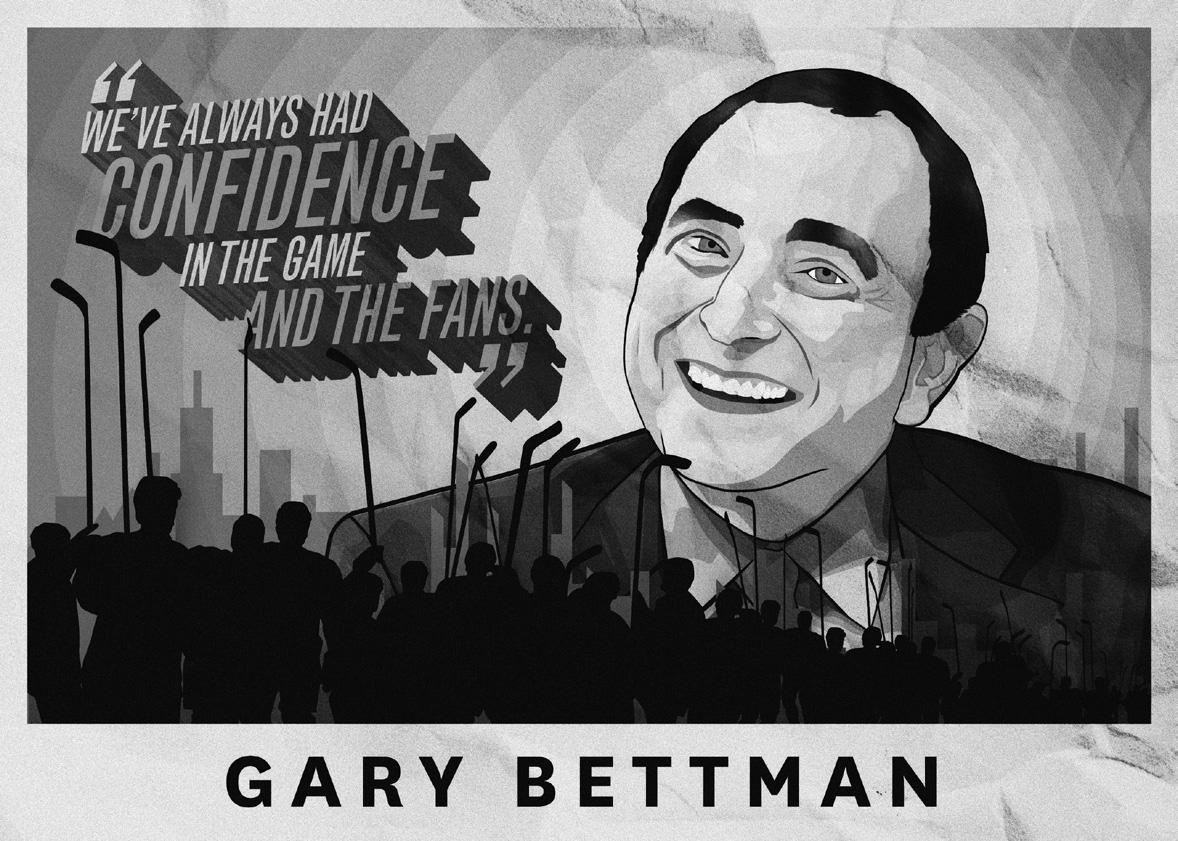
Shortlisted Polaris rapper coming through Winnipeg Does Gary Bettman deserve more respect from NHL fans?
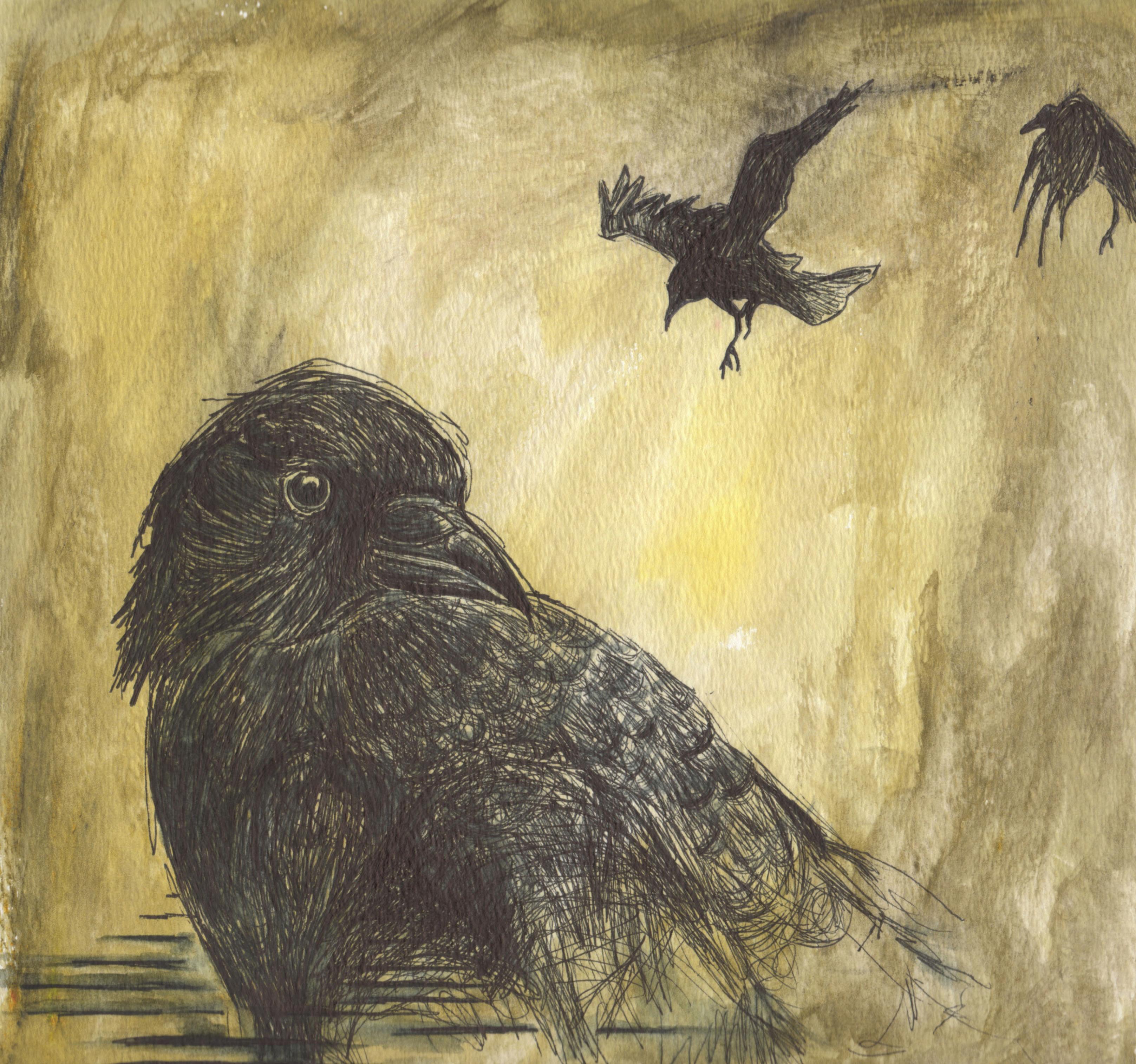
“Painting 1” by Lauren Boulet http://www.laurenboulet.com cover image
Please contact designteam@themanitoban.com if you are interested in submitting a cover image.
For other volunteer inquiries, please come to our office in University Centre (across from Tim Horton’s, behind GOSA) or email the editor of the section for which you are interested in writing.
Please direct all other inquiries to editor@themanitoban.com
Correction:
In our Oct. 10 issue of the Manitoban an article entitled “send + receive: a festival of sound” incorrectly stated certain dates and times significant to the history of the send + receive festival.
In effort to correct our mistake, the Manitoban would like to clarify that the send + receive festival began in 1998, and was incorporated in 2001. Additionally, current director Crys Cole took over as Director of S+R in the year 2008.
| page 17
| pages 18–20
Don't diss the commish
Following the herd
Toban Talkback
Grace Romund and Rachel Wood, staff
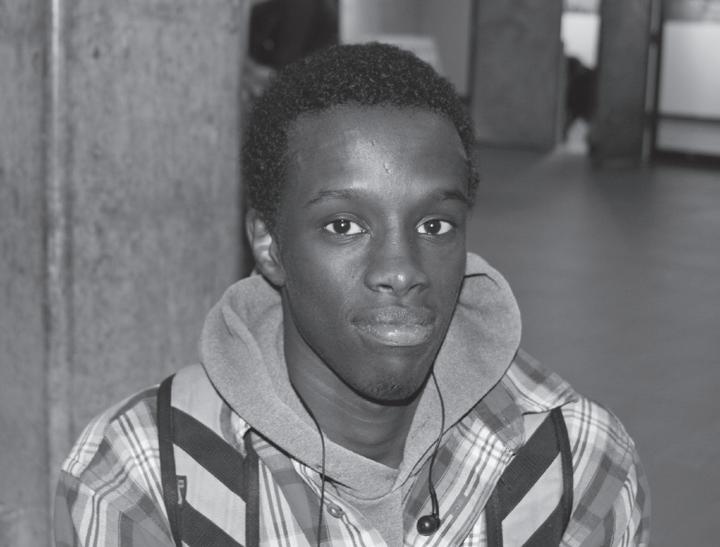
Abdi Hassan Asper school of business
Do you ever attend extracurricular lectures on campus or in the community?
Erin Opitz faculty of arts Taylor Schiller university 1 Kaitlyn Obedzinski university 1
“I'm too busy, and schedule conflicts. If there was better scheduling, then I'd go.” “I have once. I went to a dentistry lecture, to find out what it takes to become a student there. That's the only one I've been to.”
“I haven't yet but I've definitely been interested in a lot of the topics that have come up. Right now I'm busy with midterms, studying, papers, and that kind of thing.”
“I haven't attended any of them, but I would be interested in going. The problem is that I don't find out about them until they're happening. I see them online, on Facebook, but usualy it's too short of notice.”
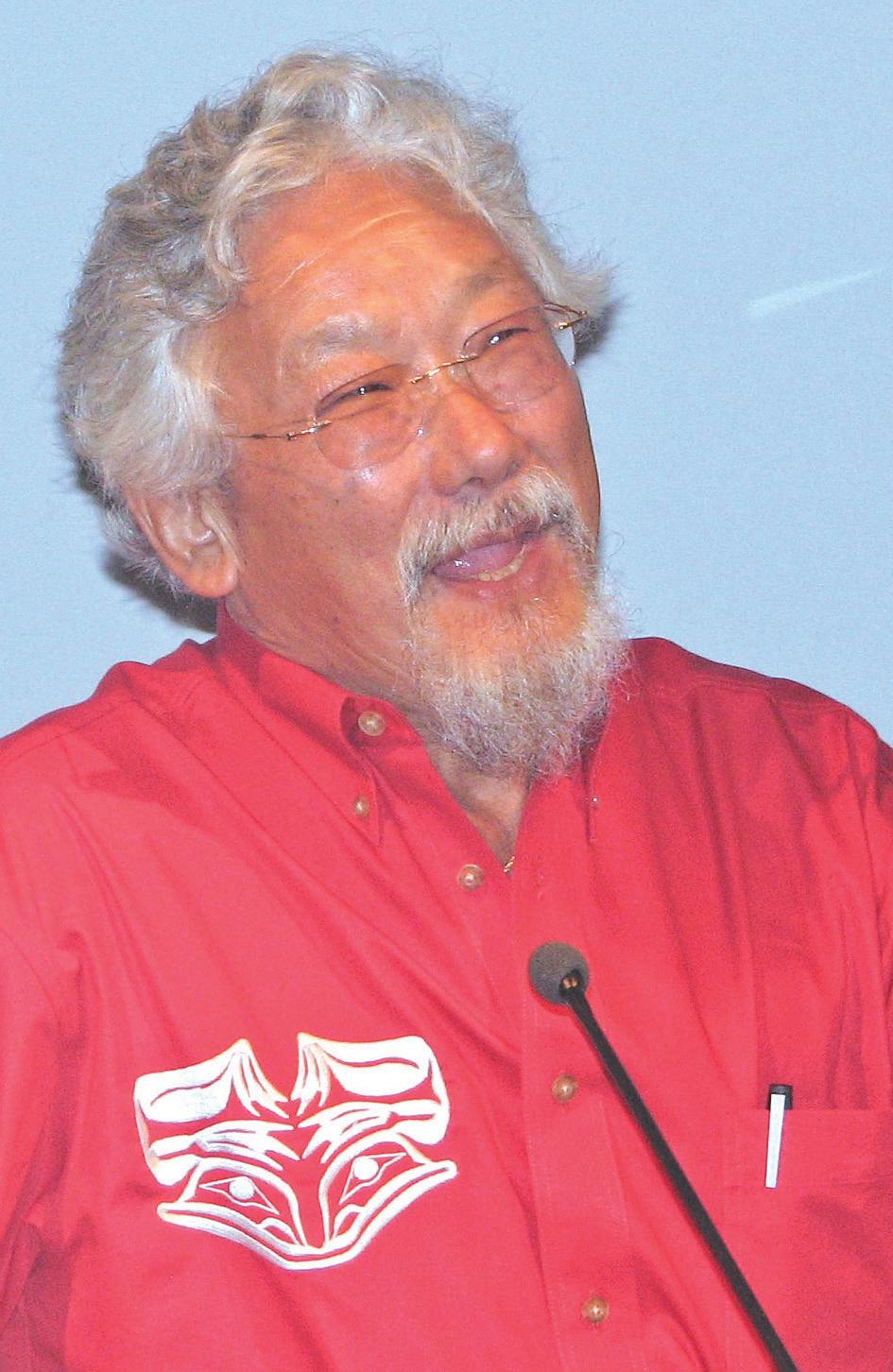
3 Suzuki and Rubin give lecture on sustainability
Biologist and economist team up to talk about the environment
Jill Patterson, staff
On their new cross-country speaking tour authors Jeff Rubin and David Suzuki made a stop in Winnipeg’s Manitoba Theatre Centre. The lecture was held at the John Hirsh Theatre in Winnipeg’s Exchange District on Oct. 1.
The two authors lectured to a sold out theatre on issues surrounding economics, of which Rubin specializes in, and ecology, which is one of Suzuki’s areas of interest.
The speaking tour, continuing on until Nov. 8, elaborates on the main points made in both of their newly published books, Everything Under the Sun: Toward a Brighter Future on a Small Blue Planet, by Suzuki, which was published May of this year, and The Big Flatline: Oil and the No-Growth Economy, by Rubin, which is to be published Oct. 16, as a follow up to his previous book Why Your World Is About To Get A Whole Lot Smaller
The tour includes an additional eight more talks throughout six provinces, and will end with the last lecture in Victoria, BC on Nov. 8.
The Winnipeg lecture lasted a little under an hour and began with an introduction by CBC Radio host Terry MacLeod.
The speakers took turns at the podium, with Rubin up first followed by Suzuki, and ending with a question and answer period.
What makes this series of lectures interesting, as was pointed out by MacLeod, was the fact that both speakers “come from very different backrounds.” Rubin has his background in economics, being the ex-chief economist and managing director of CIBC World Markets, and Suzuki is mainly interested in ecological and environmental issues.
Rubin focused his portion of the lecture around the economics of oil and stressed the fact that oil prices have been, and will continue, to rise and that it should no longer be an energy source for us to rely on.
“Oil continues to remain the world’s largest source of fuel, and while we’ve been successful in using other things to replace oil, such as natural gas, we still rely on it heavily as a transit fuel.”
He continued, explaining the connections between the economic recessions the world has been experiencing and the fluctuation price of oil.
Rubin claimed, “every major global recession that we have had in that last four decades has been caused by oil [. . . ] If oil prices would have stayed at $30 a barrel Leman Brothers would have never gone under.”
Similar to that is the fact that, according to Rubin, “peak oil isn’t about how much oil you can drill its how much you can afford to extract [
. . . ] the very fuel that our economy runs on is way beyond our reach.”
Rubin concluded by calling for economic change for the sake of the environment.
“We need to accept that our economies cannot grow as rapidly as they have in the past, and our efforts to make them grow that fast are going to be counterproductive. It’s going the make the issue of triple digit oil prices that much more difficult.”
Suzuki spoke on our biological beginnings and how we have become detached from nature.
Suzuki said, “We no longer see the world in a way that allows us to see the reality of nature.” By that he meant that we have lost focus on how everything humans do has an environmental consequence.
“We seem determined to take over the entire biosphere and change it and shape it as we want.”
To illustrate, Suzuki made the point that “in only 100 years we have gone through an absolutely amazing change such that in Canada over 85 per cent of us now live in big cities, and over 50 per cent of us around the world live in big cities. We have become an urban-dwelling humancreated environment.”
Along with our new urban dwelling tendencies, Suzuki claims that humans have also evolved such that we are heavy consumers of manmade products. This has resulted in extreme harms to the environment.
“We have become the most numerous living being on the planet. The very act of living leaves a huge ecological footprint,” noted Suzuki.
“We need to accept that our economies cannot grow as rapidly as they have in the past, and our efforts to make them grow that fact are going to be counterproductive. Its going the make the issue of triple digit oil prices that much more difficult.” – Jeff Rubin
phOtO by JOhN W. MaCDONaLD phOtO by stepheN MiChaeL baRNett
Ground officially broken on Active Living Centre construction
World-class facility to encourage student, community to get fit
Construction for the University of Manitoba’s new Active Living Centre will get underway shortly, as jackhammers broke ground at the future site of the $46 million fitness and research centre on campus. The state-ofthe-art facility—slated to open in 2015—will be adjacent to the Frank Kennedy Centre and sit at the corner of University Crescent and Dafoe road.
Connected to the university’s existing tunnel system, the facility will make up 100,000 square feet of new space which will house brand
new training facilities including an elevated 200-metre indoor running track, a 40-foot climbing wall, and a cardio and resistance training area.
The ultra modern, eco-friendly, open concept building is expected to attract new students and ultimately become another major social hub on campus for students, faculty, and the community.
On top of athletic and recreation, the building will also serve academic purposes; the facility will be home to brand new research space for faculty of kinesiology and recreation management. The Applied
Research Centre will allow faculty and students to help populations affected by chronic diseases related to inadequate physical activities, such as diabetes, cardiovascular disease, and hypertension.
Representatives from all three levels of government were in attendance to speak about the importance of the world-class health, wellness, and fitness centre.
“We all know that active living is a key, not only to good educational outcomes, but to good life outcomes,” Manitoba Premier Greg Sellinger told the Manitoban, “This facility, with the faculty of kinesiology being the organization in charge of it, will make a gigantic difference.”
“We have to promote this kind of research, and we have to encourage people to have active living at all stages of their life.”
Other important dignitaries present at the ceremony included Minister of State (Transport) and Charleswood-St. James MP Steven Fletcher, Winnipeg mayor Sam Katz, U of M president and vice-chancellor Dr. David Barnard, dean of kinesiology and recreation management Jane Watkinson, and former U of M Bison and Chicago Bears end Israel Idonije.
The project received funding from all three levels of government, including $2.5 million provided by the City of Winnipeg, which accounts for the net proceeds from the sale of the Polo Park Stadium site.
The University will end up covering the majority of the costs, which will be reflected with a raise to student tuition. The added cost will allow students to make use of the University’s facilities – negating the required purchase of a Bison Recreation Services membership. Students will also get into Bison Sports events once the new tuition fee is put into place.
According to the U of M president, about 180 groups—which include Sport Manitoba, school divisions, and private groups— make use of the U of M’s current facilities. Once the Active Living Centre opens its doors in 2015, it has the potential to influence the activity levels of the over 35,000 U of M students and staff, as well as 25,000 users from around the Winnipeg community.
Campus News Briefs
r achel Wood, staff
Study on eleCtroniC monitoring for C ar thieveS
Completed by u of m Student
A study of the effect of electronic monitoring (EM) for high risk car thieves, conducted by Ashley Pearson, U of M criminology student, found that the devices had an impact on the decline of car thefts in Winnipeg.
Pearson’s master’s thesis, “An Evaluation of Winnipeg’s Electronic Monitoring Pilot Project for Youth Auto Theft Offenders,” was defended on May 25, 2012 and found that 44 per cent of youth declared that EM would deter them from stealing cars.
U of M criminology professor Rick Linden guided Pearson while she studied teenage car thieves in the province to determine the success rate of EM. The study found that, while EM was effective in deterring auto theft, the installation of mandatory immobilizers in some vehicles had a larger affect on the decline of auto thefts.
Decline in auto theft due to EM, however, did not mean that crime in general declined in the youth offenders.
“My life was worse after EM. I stopped stealing cars but I started doing other crimes instead [ . . . ] I did not want that bracelet, but it did help me stop stealing cars, but I have moved on to more severe crimes,” said a study participant.
open houSe held for viSionary (re)generation Competition
An invitation for students, staff, and faculty to learn more about the Visionary (re)Generation Open International Design Competition included an open house on Oct. 11 from 12:00 p.m. – 6:00 p.m.
The purchase of the Southwood lands in 2008, which included land inside the border of the Red River, the Fort Garry campus, the new Investors Group stadium, and Pembina Highway, led to this competition.
Those eligible for creating the plan for the open land space include any team of architects, ecologists, engineers, urban planners, and other professionals from across the globe.
The competition begins in December, 2012.
More information can be found on umanitoba.ca/admin/ campus_planning_office.
ConferenCe on artiStiC repreSentationS of global atroCitieS held by u of m
The U of M, in partnership with the Languages and Cultures Circle of Manitoba, discussed atrocities throughout history as represented by artistic mediums such as literature, film, photography, museums, and public discourses.
Global tragedies, including the Holocaust, the Rwandan genocide, the Middle East conflict, and Indigenous issues were discussed.
The conference took place Oct. 11 to Oct 13 at the Fort Garry Campus and Inn at the Forks.
diamond Jubilee medalS awarded to u of m faCulty, Staff, and alumni
Fourteen U of M faculty, staff, and alumni were awarded the prestigious Queen Elizabeth II Diamond Jubilee medals on Oct. 11. The recipients included U of M president and vice-chancellor David Barnard, associate VP (external) John Alho, Dr. Madhav Sinha, and pastor Mark Hughes.
Winnipeg South MP Rod Bruinooge presented the medals, which were awarded due to the individual’s contribution to the community, province, or country.
The diamond jubilee medals were created to celebrate the 60th anniversary of Queen Elizabeth II’s appointment to the Queen of Canada. Recipients were nominated by partner organization, members of the public, or NGOs. world opportunitieS week held by world w i.S.e reSourCe Centre
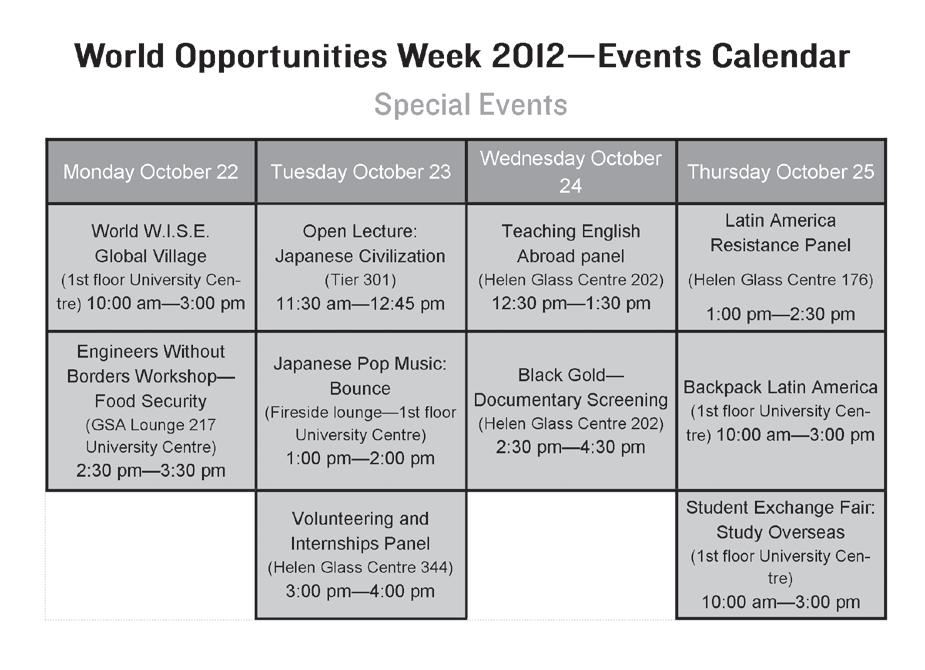
The U of M World W.I.S.E. Resource Centre is holding the World Opportunities Week from Oct. 22 to Oct. 25.
The four-day long event includes different workshops being held on campus, including sessions and lectures focusing on campus diversity, food security, exchange programs, and other educational and volunteer opportunities available internationally.
The World W.I.S.E. Resource Centre is a place for students to access information regarding international opportunities. It also exists to raise awareness of global issues to students on campus.
They are located at 541 University Centre.
For more information on the event go to umanitoba.ca/student/ics/wwise/ wow_2012.html.
Marc l agace, staff
Federal government ends non-Christian prison chaplain contracts
Experts worry decision may violate prisoner’s rights
Quinn richert, staff
The Canadian government’s recent decision to cancel its contracts with non-Christian prison chaplains has many law and human rights experts worried that the rights of religious prisoners are at risk of being violated.
This month the federal government announced that as of March 2013 only about 80 full-time chaplains would continue to work in the federal prison system. All but one identify as Christian. Non-Christian prisoners will be expected to receive religious counseling from one of the 80 left on staff acting as “interfaith” chaplains.
Conservative MP Candice Bergen defended the contract terminations in the House of Commons, characterizing the plan as an attempt to cut costs for taxpayers. She also compared the interfaith chaplain system to that used in the Canadian Army.
“The Canadian Forces have used this type of chaplaincy program for years. If it is good enough for our armed forces, then it is good enough for inmates in our federal penitentiaries,” said Bergen.
Minister of Public Safety Vic Toews, who is responsible for overseeing Canada’s prison system, also released a statement on the decision to do away with non-Christian chaplains.
In an email to CBC news from Toews’ office, a media relations employee of Toews’ wrote, “the gov-
ernment [ . . . ] is not in the business of picking and choosing which religions will be given preferential status through government funding. The minister has concluded [ . . . ] chaplains employed by Corrections Canada must provide services to inmates of all faiths.”
The email also states, “the Minister strongly supports the freedom of religion for all Canadians, including prisoners.”
Although the removal of nonChristian prison chaplains is being defended by the Conservative gov ernment as an attempt to demon strate religious impartiality, many law experts have said that the cuts violate prisoner’s rights.
Debra Parkes, an associate profes sor of law at the U of M commented, “most legal experts who work in this area agree that the decision to de-fund chaplaincy services for minority reli gious groups violates both the equality guarantee in s. 15 of the Charter of Rights and Freedoms the prohibition against discrimina tion in the provision of services in the Canadian Human Rights Act.”
Lisa Kerr, a lawyer and doctoral candidate at New York University, argues that the 1992 Corrections and Conditional Release Act puts an onus on the government to not only
allow, but to facilitate, religious practice by inmates.
“Section 75 says that an inmate is ‘entitled to reasonable opportunities to freely and openly participate in, and express, religion or spirituality.’
Prior to the Harper government, both the CSC [Correctional Service of Canada] and the federal government understood that to mean there is a positive duty to provide religious
order for freedom of religion to actually exist [ . . . ] freedom of religion means the state has a positive duty to provide what is required to engage in religious life.”
The decision may also violate rights protected in certain sections of the Canadian Charter of Rights and Freedoms as well. Kerr notes that section 2 of the charter guarantees the right to religious freedom.
This guarantee “must be interpreted in context,” says Kerr. An environment such as prison translates to “a positive duty on the part of the Correctional Service to facilitate religious contact and practice.”
Restricting the religious services available to the degree outlined by the federal government may seriously inhibit the ability of some to adequately practice their religions in
When asked about the government’s assurance that volunteer chaplains will still be permitted to visit prisons, Kerr points out that such an arrangement does not meet the standard of equality in the delivery of services, which is protected in the Canadian Human Rights section 5 “Only Christian prisoners will receive religious counsel directly from regular paid employees, who will be in a position to build ongoing relation-
Aboriginal education in need of reform
Funded education systems for reserves an ongoing battle
The Ministry of Aboriginal Affairs and Northern Development recently came out with new figures showing that funding for education is equivalent for aboriginal students, if not more than funding for nonaboriginal students.
The announcement was made amid criticism from Aboriginal and human rights activists who have claimed that the government underfunds education for First Nations people.
A decision was made last year to resolve the inequalities between native and non-native primary and secondary school systems. Records show that Aboriginal students received approximately $13,542 per student in 2010-2011, while non-aboriginal students received $10, 439 in 2009.
Assembly of First Nations contradicts these figures by stating that Aboriginal students only received $7,101 per student on average. The government claims the funding
is equal without including money for infrastructure and building maintenance.
Churchill Member of Parliament Niki Ashton raised this issue to the Harper government last week. She said she would like to see the government step in to improve the conditions of First Nations learning environments.
“On First Nations across Canada there are schools that don’t have enough paper. They don’t have enough materials, the classes are overcrowded, the rooms are full of mould,” said Ashton.
Minister of Aboriginal Affairs John Duncan stated that this issue has already been raised and the government is aware of the issue.
The government is currently working on a First Nations Education Act which is aimed to improve governance and accountability. The plan includes making improvement in First Nation’s educational systems a top priority by infusing $275 mil-
lion into the system with a focus on infrastructure and building literacy rates. A portion of the money will be used to build three new schools on reserves this year, while another portion of the money will be used toward renovations of five other schools.
The new schools are scheduled to be built in Canada’s reservations most in need of educational reform. These areas are Pikangikum and Fort Severn in Northern Ontario, as well as Shamattawa in Manitoba.
Shamattawa is a reservation 1,200 km northeast of Winnipeg. Records show that the approximate population of Shamattawa was 1,101 in 2011.
Conditions on this reservation, along with many others, are said to be bleak with high suicide rates. From January to May of 2007, 37 children and 10 adults attempted to commit suicide, while 52 people told a health care provider or family member that they plan to attempt suicide. The youngest of those who tried to commit suicide within the five-month period was
nine years old. Attempted suicide rates among youth raised to 74, while 82 said they contemplated suicide.
Those who attempt suicide within the reservation are flown into Winnipeg for treatment. Youth told health care workers Nancy Thomas and Victoria Redhead in 2007 that many of the attempts are due to boredom, in that there is nothing to keep them occupied. The reservation is rife with peer pressure, and drug and alcohol abuse is rampant.
“It’s getting really out of hand. They tell me they’ve got nothing to do, there’s peer pressure. They just want to get out of here,” said Redhead.
Shamattawa will now be able to access a school system after five years of being in this state. Situations similar to this are common on other reserves. Various programs have been implemented, such as a $100,000 suicide prevention program in Shamattawa, however, the programs appear to be bandages on an
ships with those prisoners. Only Christian chaplains will have prison offices and everyday access to all prisoners [ . . . ] Volunteers are more likely to attend on an occasional basis, and will not have the benefit of standing security clearance.”
Another concern raised by many has been the impact chaplain job cuts might have on the rehabilitation of religious prisoners, many of whom see their spirituality as a fundamental aspect of preparing for re-integration into society.
David Koschitzky, chair of the Centre for Israel and Jewish Affairs, recently articulated this concern to CBC News.
“It is no stretch to say that chaplains are at the forefront of the rehabilitation process, and work every day to ensure that inmates awaiting release have the tools they need to avoid re-offending [ . . . ] While this is a matter of protecting freedom of religion, there is also an important aspect of public safety at stake in this decision.”
Currently about 12.5 per cent of inmates in federal prisons identify themselves as followers of non-Christian religions.
Contracts with aboriginal elders will be unaffected by the government decision.
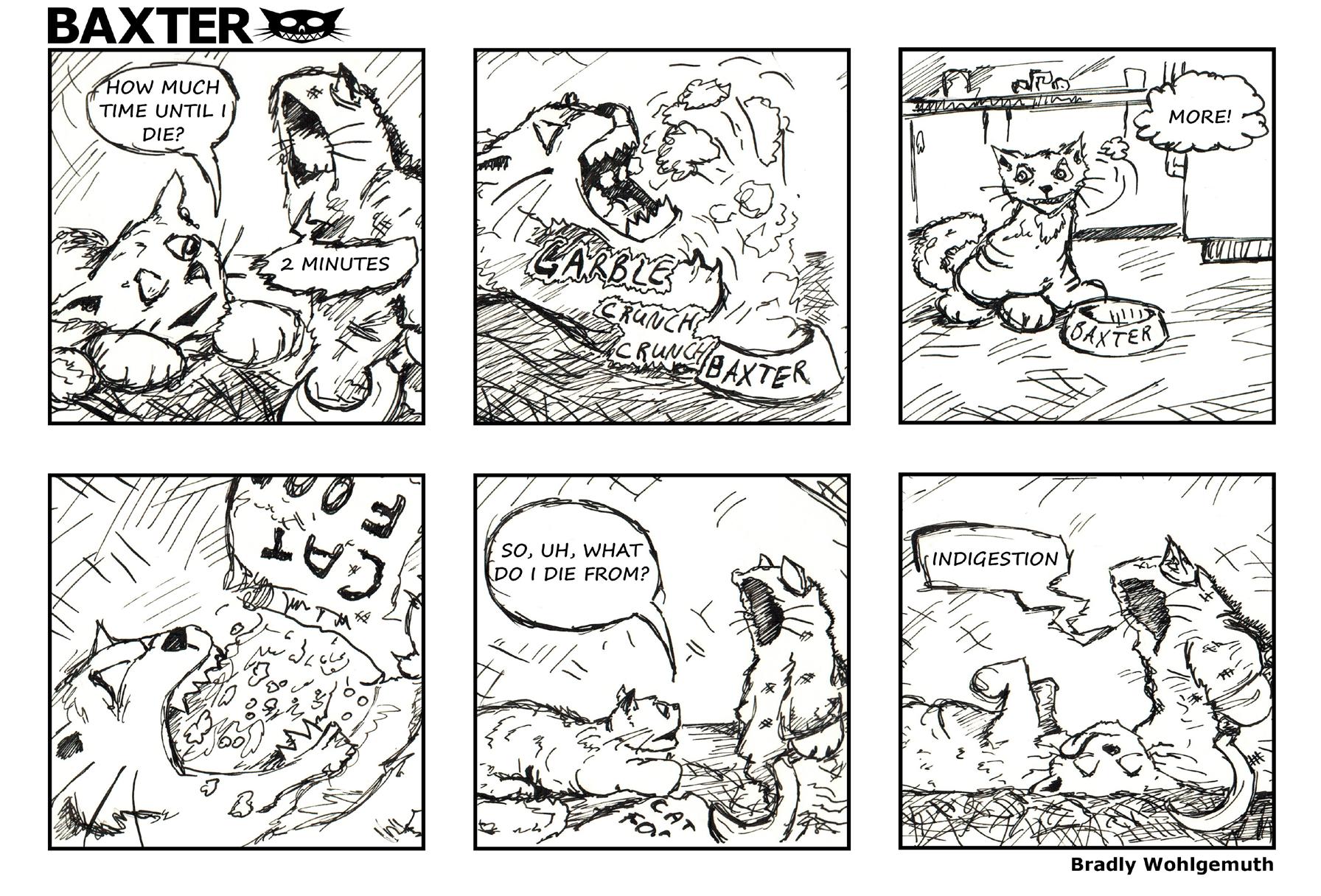
iLLustRatiON by bRaDLy WOhLgeMuth
overflowing wound. The government acknowledged this ongoing situation is in need of a long term solution.
The First Nations Education Act is aimed to be used as a tool for a long term solution. The target is directed at youth for early prevention. The goal will be for reserves to eventually become self-sufficient and take control of their own education systems.
“We are working to put students first and ensure they have an education that supports strong, self-sufficient individuals who can participate fully in Canada’s economic opportunities,” said Duncan.
Pressure has been placed on the government due to the sense of urgency attached to this situation and commitment has been made for a legislation to be passed by 2014. The $275 million is the first step to improve the school systems with school-board equivalent procedures that give First Nations control over the general direction of their curriculum.
XL Foods recalls beef after 11 cases of E. coli appear across Canada
Tainted beef recall one of Canada’s largest
Canada has experienced one of the largest beef recalls of its history. XL Foods, a beef-processing factory that exports to over 20 countries, has been under scrutiny since Sept. 4. Public alerts were issued after E. coli cases appeared across Canada. Cases have appeared in Alberta, Quebec, Newfoundland, and Vancouver, with a total of 11 cases in Canada so far. The recall included beef products produced on or after Aug. 24 , 27, 28, 29, and Sept. 5.
The recalled meat came from approximately 20,000 cows, which were packaged, processed, and sent to stores across Canada and more than 20 countries, including the U.S., Hong Kong, and Japan.
that 1.134 million kilograms of potentially tainted beef was distributed in the U.S. alone.
News of the tainted beef reached the Hong Kong Centre for Food
system is responsible for watching the plant to ensure the company is taking the correct steps to ensure food safety.
The recall occurred on Sept. 16 after an accumulation of positive tests and illnesses linked to the tainted meat occurred.
The U.S. Food and Safety Inspection Service tested the beef, which was positive for E. coli, on Sept. 3. The Canadian Food Inspection Agency (CFIA) was notified on Sept. 4. The same day the CFIA also found more beef that tested positive for E. coli.
Some meat product was stopped at the U.S. border but it is estimated
Safety where they advised stores to recall or stop selling the potentially tainted beef. According to the centre, the amount of beef that reached Hong Kong was a small. Future imports of XL products produced after Aug. 24 have been suspended.
There has been widespread criticism of both the CFIA and XL Foods since the recall. There are two systems involved in the safety of food: the plant’s own system and the government’s system. The government’s
XL Foods is one of the largest employers in Brooks, Alberta with over 2,000 employees, and is one of Canada’s largest
mum requirements that have to be met before the beef will be processed or shipped elsewhere. These requirements are based on maturity, meat colour, sex, fat colour, carcass muscling, fat coverage and texture, meat texture, and marbling level based on U.S. Department of Agriculture (USDA) marbling scores. The quality grades met for their beef include Canada Prime, Canada AAA, Canada AA, and Canada A. Their business vision is built on four pillars that their people, their products, their performance, and their passion.
“I understand them to be good honest people, but now is the time for them to be stepping up out in public and putting a face to the product and saying, ‘Look, we’re fixing this.’”
beef processors. The company claims to be federally inspected and Hazard analysis and critical control point (HACCP) approved, with state-of-the art food safety inspections in order to produce high quality beef.
According to XL, there are mini-
Personal care bed shortage at risk if no action taken
The Nilsson brothers, who bought the familyrun company from their father, have, for the most part, stayed out of the public eye throughout the beef recall.
However, on Thursday, Oct. 11 Brian Nilsson commented on the recall.
“We absolutely take full responsibility and apologize to all those affected,” said Nilsson.
Doug O’Halloran, the local 401
Study predicts increasing demand for beds across the province, through 2036
Astudy released this month by the Manitoba Centre for Health Policy (MCHP), a U of M faculty of medicine research department, predicts that the province is set to undergo a rise in demand for personal care home (PCH) bed equivalents between 2012 and 2036.
The increasing need for long-term care is attributed to a growing senior population in Manitoba. As the baby boomer generation continues to age, PCH bed requirements are projected to increase accordingly.
From 2011 to 2021, only a slight increase in demand is predicted for Winnipeg. Other health regions of Manitoba, including the Interlake and Northern regions will feel a somewhat greater pressure.
A sharper rise in demand across the province is anticipated to occur between 2021 and 2031, when the first baby boomers are aging from 75 to 85.
The study asserts by 2036, between
5100 and 6300 additional bed equivalents (on top of the current 9700 PCH beds in Manitoba) will be needed. This translates to a 55 to 69 per cent increase in beds.
The research also shows that an individual’s marital situation, as well as whether or not she or he has children, impacts one’s likelihood of requiring long-term care. For example, a senior who is a married man has a 40 per cent decreased chance of requiring long-term care. A married woman has a 23 per cent decreased chance. An individual with two children has a 34 per cent decreased risk of requiring admission into a PCH.
The report, entitled “Projecting Personal Care Home Bed Equivalent Needs in Manitoba Through 2036,” makes two significant improvements on prior studies.
First, this month’s release, which succeeds a report published in 2011 (released by the MCHP and authored by Doupe et al.), provides analysis of
PCH bed equivalent needs by region. Although the report is being released simultaneously to the reorganization of Manitoba’s 11 regional health authorities (RHAs) into five, it is able to show, according to a summary written by Michelle Houlden, “how Manitoba’s older population is likely to grow in each of the new RHAs as well as the former ones.”
Additionally, the new study considers PCH bed equivalents. This takes into account a finding from the 2011 report showing that some PCH care can be provided “by other means” – for example, in supported housing.
Dan Chateau, lead author/ researcher on the study, explains that the findings do not necessarily mean that Manitoba is doomed to endure a shortage of bed equivalents.
“I don’t think we can make the assumption that what we are facing is a bed shortage. It is not a shortage unless nothing is done. I’d say it’s the
coming need for care that this study deals with.”
An upcoming study at the MCHP, lead authored by Greg Finlayson, entitled “The Cost of Publicly Supported Housing for Seniors - Implications for Future Funding Approaches,” will investigate the cost-effectiveness of supportive housing compared to nursing home care. Data from this project will be “used to help plan future Aging in Place initiatives in Winnipeg and other health regions,” according to MCHP’s website.
Aging in Place refers to the Manitoba government’s long-term care strategy for seniors. The program focuses largely on finding alternatives to PCH placement for aging Manitobans when possible.
Chateau also commented on the impact a rise in need for PCH beds and PCH bed equivalents will have for current post-secondary students.
“There’s no two ways about it, it’s definitely going to increase the need
president of the United Food & Commercial Workers (UFCW), who represents the 2,000 workers at the XL Foods Lakeside Packers plant, the plant which is the source of the recall, acknowledged that the Nilsson brothers have remained in the background, but also acknowledged their need to step up to the public scrutiny.
“I understand them to be good honest people, but now is the time for them to be stepping up out in public and putting a face to the product and saying, ‘Look, we’re fixing this,’” said O’Halloran.
After the Nilsson brothers moved into the processing side of beef production, their goal was to expand through buying out American companies. They achieved this and became one of Canada’s largest companies involved in beef processing. Their motives for moving into processing were questioned by a parliamentary committee on agriculture in 2004.
“When we bought the plant, I had every guy in the cattle business tell me, ‘Boy, you’re stupid. You should never do that. You can’t fight those big Americans.’ Well, I built a business around it. Anybody can get into this business if they want. That’s how it works. We’re entrepreneurs,” said Neilson.
iLLustRatiON
by bRaD WOhLgeMuth.
for human resources to address the increased demand for care. There will be a linked demand for all those positions if more personal care homes are made. Even in the alternatives, if it’s more supportive housing, you’re going to need staff there as well.”
Students currently attending postsecondary institutions will also be affected, according to Chateau, when their parents and relatives begin to require long-term care.
“Post-secondary students’ parents will eventually begin to require longterm care at some point in this era. Many people begin to require PCH placement, or an alternative form of long-term care around the age of 75. So, although it isn’t necessarily immediate, it is worth considering and planning for.”
MCHP conducts research on the health of Manitobans using an anonymous database of health care service usage by residents of the province.
Quinn richert, staff
editor-in-Chief Ryan Harby editor@themanitoban.com / 474.8293
buSineSS manager Foster Lyle accounts@themanitoban.com / 474.6535
Jeff Kent, Phillip Fische, Emilie St. Hillaire, Dany Reede, Will Gibson, Justin Ladia, Richard Jung, Bilan Arte, Lauren Boulet, Tiff Bartel, Scott Billeck, Kyra Nia
MANITOBAN
105 UNIVERSITY CENTRE UNIVERSITY OF MANITOBA WINNIPEG, MB R3T 2N2
General Inqu I r I es & a dvert I s I n G Phone: (204) 474.6535 Fax: (204) 474.7651
Email: manitoban@themanitoban.com
n at I onal & Mult I -Market a dvert I s I n G Campus Plus Media Services Toll-Free (In Canada): 1.800.265.5372
Email: info@campusplus.com
Canadian Publications Mail Product Sales Agreement #589160
A “volunteer staff” member is defined as a person who has had three volunteer articles, photographs, or pieces of art of reasonable length and/or substance published in three different issues of the current publishing year of the Manitoban. Any individual who qualifies must be voted in by a majority vote at a Manitoban staff meeting. Elected representatives and non-students may be excluded from holding votes as volunteer staff members in accordance with the Manitoban Constitution.
The Manitoban is the official student newspaper of the University of Manitoba. It is published monthly during the summer and each week of regular classes during the academic year by the Manitoban Newspaper Publications Corporation.
The Manitoban is an independent and democratic student organization, open to participation from all students. It exists to serve its readers as students and citizens.
Those who find solitude and comfort in burrowing their heads in large newspaper centrefolds are now grieving the state of the written word. Last month’s news of the layoffs of several Winnipeg Free Press staff came as a shock to many in Winnipeg, particularly those in love with the idea of the newspaper. It meant the loss of many talented writers and, for myself, fear of the future for individuals with journalistic aspirations.
The demise of many journalism careers expanded when it was recently announced that weekly arts magazine Uptown would undergo similar staffing cuts and replace Winnipeg Free Press’s weekly entertainment pull-out “The Tab.”
The aftermath of these journalistic rampages has brought many writers to social media lamenting the death of the written word. This editorial is no different – it is a eulogy of the literary talent that has been killed far too soon.
I became obsessed with the idea of the newspaper after graduating high school. Although the idea of journalism always drew me in, it wasn’t until I was living abroad that I fell in love. Every morning I consumed myself in the daily issue of the UK paper, The Guardian. It became a way to adjust to the unfamiliar culture. It gave me a sense of home – that for a short time, I belonged to England.
In a nearly entirely technological world, the printed newspaper has become increasingly threatened. In a society that demands instant gratification, news has become immediately available on the Internet. In a culture as impatient as ours, there is less of an appreciation for the black ink that stains your fingers as you read yesterday’s news in the morning paper.
Technology has a valuable place. It has
allowed for a world that is closely interconnected. It has enabled more informed citizens. It makes it possible for individual’s to be informed of tragedies and triumphs across the globe minutes after they take place. It enables me to carry around five of my favourite news sources on my trusted iPhone and keep the constant updates in my pocket all day long.
Technology, however, has also allowed for misinformation. It has enabled anyone to post inaccurate facts, producing a sometimes ill-informed culture. Anyone can become a journalist on the Internet. Anyone can claim error as truth on Wikipedia.
A website dedicated to reporting both the decline and rise of newspapers, newspaperdeathwatch. com, lists 14 daily US papers that have shut down since the site was created in 2007. These include the Kentucky Post, Cincinnati Post, Albuquerque Tribune and the Oakland Tribune. The site also lists 10 daily papers that have transformed into mainly or solely online news sources.
This literary rampage goes beyond just Winnipeg. The CBC has continually endured financial problems as funding cuts persist under Harper’s government. While not necessarily a form of written word, the CBC allows for culture and news to come in the forms of other important mediums, including radio. The emergence of the Tories’ federal budget publicized a $115 million cut from financial support to CBC over three years. Political and economic discussions and debates are bound to materialize from this statement, but that is not the point. The point is that funding is cut from a valued and important part of the news scene and CBC, along with Winnipeg Free Press and Uptown, will suffer.
This developing trend is consistently attributed to one main killer: the budget. The world’s bleak economic environment has lead to the death of the aforementioned papers. With more and more content being available online and less print subscriptions being paid for by citizens, the cuts have to come from somewhere. Money is the game we all play. The executives of these papers are lovers of the written word as well (at least, I hope) and I am guessing that they don’t revel in these losses. They are just trying to keep their papers afloat. Unfortunately, it is the writers that suffer.
So what is the solution? Will the death of the written word be prevented by any one action or budgetary solution? Can I convince the greater part of society to find appreciation in the newspaper centre fold and allot $20 a month to the local daily? Or should I merely accept the fact that news is slowly, but surely, turning into a mainly electronic medium?
In a society that demands instant gratification, news has become immediately available on the Internet. In a culture as impatient as ours, there is less of an appreciation for the black ink that stains your fingers as you read yesterday’s news in the morning paper.
These statistics paint a bleak picture of the future of the literary world. In a city like Winnipeg with three daily papers, such severe cuts to one of them leads to a depressing void in the journalism scene.
I don’t know what the answer is. I don’t know if I will still be reading the written word, my ink-stained finger tips gripping my coffee cup in one hand and turning the page of the daily paper in the other, in 20 years. I don’t know if I will get to be that crazy old lady with stacks of old newspapers in her closet, each issue signifying the date of something meaningful that happened in her life.
I do know that maybe, just maybe, I can be that old lady. Maybe everyone can ask themselves if they see importance in the written word. If so, maybe everyone can help fill the dark void of the literary world. Pick up your pen, laptop, tablet, whatever, and try to write something. Buy the next issue of a local paper and see if you see value and worth in its existence. If you do, join the fight to save the written word.
r achel Wood, staff
iLLustRatiON by RyaN haRby
Re: “For those who are concerned,” – Oct 3, 2012
Dear Manitoban,
I wish to respond to Joshua Van Benthem’s Motion 312 Comment article. I found the title “For those who are concerned” to be particularly apt, though likely not in the way that the author intended. I’m concerned, alright. I’m concerned about the human rights of women, and those who seek to limit them.
The author argues, because some fetuses might be capable of surviving independently outside of the womb prior to the moment of complete birth, that “there should be a line” at some undetermined point in fetal development at which the fetus would be deemed a person and, thus, aborting it would become a criminal offence.
The Parliamentary Committee that would have been created by Motion 312, had it passed, would supposedly have looked at where this “line” ought to be drawn.
I noted that conspicuously absent from the items that would have been addressed by the Committee (as listed by the author) was, “What are the legal impacts and consequences of altering Subsection 223(1) on the fundamental human rights of the mother?” Clearly, the reason
this query was omitted is that the answer to it will, in all cases, be that the impact on her rights would be unconscionable, and would render the committee’s other queries moot. While the “viability” of a fetus outside of the womb at any given point of its prenatal development will inevitably vary from case to case, the rights of each individual pregnant woman are necessarily invariable at all times during her pregnancy.
Turning our minds for a moment to the practical implications of what the author proposes, the notion that pre-natal “viability” can somehow be definitively determined and codified in law borders on absurdity. For example, is this “viability” with or without medical intervention? A baby can be born several months premature and survive with the help of incubators, intravenous nourishment, and other intensive therapies; would this be sufficient to be considered viable? What about the fact that a fetus with a chromosomal or other abnormality would very likely achieve “viability” much later in its development than would a “normal” fetus; were the author’s proposal to take effect, would this not create an untenable difference in legal treat-
Re: “What we talk about when we’re talking about entitlement” – September
T
he University of Manitoba student newspaper has a clear mandate as stated on your website “The newspaper’s primary mandate is to report fairly and objectively on issues and events of importance and interest to the students of the University of Manitoba.” If this holds true then I suggest you take a look at page 10 [of Sept. 12, 2012], titled as “Quebec protestors are no heroes: What we talk about when we’re talking about entitlement.” First off I think we should take a critical look at Jess Chapman when it comes to talking about entitlement, they write “I confess that [I] have not had my own struggles for education. My tuition, books, and fees were covered by a savings account my family set up for me as soon as I practically left the womb.” Talk about self proclaimed entitlement at its finest. They even go so far to say, “If any protestor interrupted my class to yell about neoliberalism or some such nonsense, I would go Katniss Everdeen on their whiny ass before they could say ‘drop fees.’”
The Manitoban is a student newspaper funded for in part by diverting $4 of dues from every student member of UMSU. The University of Manitoba Students Union Local 103 is a member of The Canadian Federation of Students, which has
12, 2012
an active campaign on tuition fees, student debt, and student solidarity. Maybe Jess Chapman should do some preliminary research before bashing the student movement that UMSU is an engaged part of. For Jess Chapman it’s pretty easy to make such brash statements considering their parents set them up as they practically left the womb; but for many students in Canada they’re carrying huge amounts of debt. Today Canadians owe over $15 billion in student loan debt alone. It’s interesting to note, that annually the Federal govern ment issues $2.4 billion in educa tion tax credits and savings schemes. Restructuring these credits as upfront grants that would be non-repayable, the government would have a surplus of $200 million left over annually. For many students unlike Jess Chapman they carry their debt load for decades, Jess Chapman shouldn’t be so igno rant toward those that weren’t “set up” by their parents.
To touch on Jess Chapman’s state ment, “to yell about neoliberalism or some such nonsense,” neoliber alism is no nonsense, it’s alive and well. Neoliberalism supports the privatization of nationalized industries, deregulation, and enhancing the role of the private sector in modern society. It’s these principals that
ment based on disability? Further, making this determination would necessarily be based on speculation; presumably the fetus would not be excised from the mother and left lying out in the open to see if it lived without her. Any information as to the physical state of the fetus to bolster the speculation would, of course, have to be gained via an invasion of the mother’s physical person. This only serves to highlight, yet again, the inseparability of a woman and her fetus at all moments until complete birth takes place, regardless of its stage of development.
Any attempt to ascribe independent personhood to the contents of a woman’s womb is a clear abuse of that woman’s physical autonomy and human rights. Canada’s highest court decided this in 1988, and no “medical evidence” can justifiably vary it.
Sincerely, Elizabeth Mitchell Co-Chair, Feminist Legal Forum
Letters to the Editor are printed in the Manitoban as we receive them, with minimal editing done for purposes of spelling, punctuation, etc.
Letters to the Editor are printed in the Manitoban as we receive them, with minimal editing done for purposes of spelling, punctuation, etc.
Graduate & Professional Schools Expo
October 24, 2012 - 9:30am to 2:30pm 2nd Floor University Centre
Have you considered graduate school, professional programs or continuing your education?
Are you exploring careers in Social Work? Medicine? Business? Speech-language Pathology? Counselling? Physical erapy? Chiropractic and Naturopathic Medicine? Law? …and more.
At the 2012 EXPO…
Meet with representatives from the U of M and schools in Manitoba, Canada, U.S. and overseas. Attend a mini-workshop on graduate school. Enjoy co ee and a snack in our co
house.
Mitt Romney cracks down on Sesame Street
Getting rid of Big Bird won’t fix the U.S. economy
richard Jung
On the night of the first U.S. presidential debate, Mitt Romney had announced his first target if he was to be elected into the highest office in the United States.
“I’m sorry, Jim. I’m going to stop the subsidy to PBS. I’m going to stop other things. I like PBS. I love Big Bird. I actually like you, too. But I’m not going to – I’m not going to keep on spending money on things to borrow money from China to pay for it. That’s number one.”
Romney had told the moderator Jim Lehrer in advance that he would have to search for a new job once Romney had won the presidency. The question that immediately arose in my mind was this: how much does the Public Broadcasting Corporation receive from the Federal government every year?
$444.1 million, which is about 0.012
The CPB estimates that it would cost $1.35 per American every year, but PBS returns six-times that amount in programming and services. What I fail to understand is why Romney would focus on 0.012 per cent of the federal budget, instead of talking about exit strategies for the War in Afghanistan or cutbacks on the national defense budget.
Romney plans on cutting PBS because the United States cannot afford to borrow money anymore. He is proposing to “cut back” on the US expenditure by slashing PBS while planning on having a US $5 trillion tax cut! The Tax Policy Centre has shown the price tag for the first year of his tax cuts will cost US $360 billion in revenue, up to US $5 trillion in one decade alone. He plans to, get this, balance out and a net tax increase for lower- and or middle-income taxpayers.” As if
It seemed that Romney was more confident and more prepared than
Newsroom moderating this debate. The problem is, until Romney releases his full platform and specifics on what types of programs that he would slash and move to the State level, we still have no idea what kind of president he would be if he were to win. Romney was a better debater in round one than Obama, who often doesn’t do well in debates as was shown with his debates against Hillary Clinton four years ago but to suggest from one debate that Romney will take this election is farfetched. Obama is attempting to win this election by presenting the facts, and although this may be boring at times, I believe it is what a politician needs to do. I believe Obama put it better than anyone else could have during the debate when he said, “Governor, it is not possible to come up with enough deductions and loopholes that only affect high-income individuals toit’s
A Fair Trade Campus A Fair Trade Campus A Fair Trade Campus
How you can help
“is a way for all of us to identify products that meet our values so we can make choices that have a positive impact on the world.”
Why should we become a fair trade campus?
fair trade campus?
In order to receive designation as a fair trade campus, we must meet the three standards of availability, visibility, and committee:
a regular basis to challenge and grow the meaning of fair trade campus within the university community.
When will we become a fair trade campus?
ments by January 2013, and then apply for official designation from Fairtrade
If you are interested in becoming a part of this important work, join the Fair Trade Campus Working Group www.facebook.
Get info on the UMSU Website: www.umsu.ca/about-umsu-umsumenu-2/campaigns-umsumenu-15/ fair-trade
designated campus. If successful, we would be one of only a few campuses across Canada to receive this designation, and it’s important everyone
Bilan Arte is the president of the University of Manitoba Student’s Union. Kyra Nia is the fair trade executive with Engineers Without Borders at the University of Manitoba. and decency in the marketplace.
Becoming a fair trade campus provides an opportunity for students, faculty, and staff at the University of Manitoba to make a real impact on
Availability Requires a campus provide the following: 100 per cent fair trade certified coffee, three fair trade certified tea options, and one fair trade certi-
UMSU and EWB have made terrific progress in advocating with the University to meet the standards to become a fair trade campus. We are planning to meet all of the require-
Dutch psychologist to be prosecuted, and Monsanto’s GM corn
toM i ngra M , staff
dutCh authoritieS to proSeCute
p SyChologi St d iederik Stapel
Dutch psychologist Diederik Stapel is under investigation by the Openbaar Ministerie (Public Prosecution Service) of the Netherlands for alleged fraud and misuse of government money. Authorities have confiscated Stapel’s equipment and records and are attempting to determine whether the academic misconduct for which he was fired last year constitutes a criminal offence. When the investigation is concluded (which could take several months), they will decide whether or not to prosecute Stapel.
In September, 2011, Stapel, a major researcher in his field, was
suspended from his post at Tillburg University when it came to light that he had fabricated large amounts of data in dozens of studies. The commission that investigated his work recommended that the university file a criminal report and consider the possibility of revoking his degree.
On Nov. 10, Stapel voluntarily gave up his PhD from the University of Amsterdam.
Stapel’s fabrications varied in scale. In some cases he massaged the data to get a desired result, and in others entire data sets were faked – questionnaires were “administered” by Stapel alone at nonexistent public schools. Stapel’s work was funded with EU $2.2 million in grant money from the Netherlands Organization
for Scientific Research. Dutch investigators are trying to determine whether Stapel, in falsifying his accounts and using the money for research he did not actually carry out, committed fraud.
To date, at least 25 papers with Stapel as a co-author have been retracted. According to the science website Retraction Watch, if he is convicted and jailed, he would be one of only three people to serve jail time for offences involving fabrication of data.
v erdi C t out on mon Santo’S gm Corn
The European Food Safety Authority (EFSA) has deemed a controversial study of genetically
Open Access is a red herring
Have academic journals lost their value?
toM i ngra M , staff
The entire field of particle physics is going to switch to open-access publishing within the next few years, making almost all new research available for free.
This move will be paid for by SCOAP3, an international consortium of libraries, laboratories, and research funders. The strange thing about the deal is that it will hardly change anything – currently, the articles aren’t open access, but they are almost always available for free from the authors’ websites or the arXiv preprint server. It’s safe to say that anyone who wants to read particle physics research (and a good many who don’t) already can.
This deal has not changed the amount it costs to publish these articles, and these costs are still being paid by the same groups. The money is flowing from the same source to the same destination, it’s just been rerouted slightly in the middle. This might be pointless, but at least it’s not harmful, right? Well, open access advocate Stevan Harnad has argued that the arrangement is unstable. Once the SCOAP3 consortium has made the articles available for free, he says, “non-members are free-riders, and members can cancel if they feel a budget crunch.” The deal has very little if any benefit, and may introduce some problems that did not exist before. That something like this could happen highlights some of the major flaws of the journal system as it exists today.
The point of a journal is to get the research out to others in the field. But in this day and age, when you can upload a PDF to a globally accessible website for virtually no cost, it seems that journals are providing a lot of expensive services that are no longer needed. Open access is a distraction, a buzzword, a red herring. What is really needed is a complete overhaul of the way we disseminate research in the twenty-first century.
modified food to be “of insufficient scientific quality to be considered as valid for risk assessment.” The study, published in the journal Food and Chemical Toxicology, observed tumours earlier and with greater frequency in rats fed the NK603 variety of genetically modified corn, created by Monsanto. Since it was published, it has been seized on by organizations concerned about genetically modified crops. However, several scientists have pointed out design flaws in the study.
EFSA criticized the study’s small number of test groups and small sample sizes, the use of a strain of rats prone to tumours, and the unconventional statistical analysis, among other things. They have asked the
study’s author, Gilles-Eric Séralini of the University of Caen, to provide them with additional information not contained in the published article so they can make a more indepth assessment. Séralini said in a press conference last month that an EFSA review of his study would be a conflict of interest, because the EFSA approved the strain of corn that is being investigated.
The German Federal Institute for Risk Assessment came to conclusions similar to the EFSA’s. The French Agency for Food, Environmental, and Occupational Health & Safety is currently reviewing the study, and is going to publish its findings on Oct. 20.
of journals often detracts from the much more important goal of making high quality research available to as many people as possible.
There is no logistical reason why we still need scientific journals to publish research. They are lumbering, unwieldy relics of an era where quarterly magazines were an efficient way
of distributing information around the world. The main reason scientists are still publishing in journals is that publications do double duty as credentials. Your status in the academic world depends largely on the number of your publications, and the exclusivity of the journals in which you publish. But this secondary goal
For example, replication of studies is not more common because journals often will not publish replications. They are miserable, uninteresting drudgery that no one wants to read and that do not look impressive on a CV. But they are also integral to the smooth operation of certain sciences. Diederik Stapel, the Dutch psychologist who was fired last year for fabricating data, was able to keep up the ruse for so long because very few attempts were
made at replication, and none were published or followed up.
Negative results—“we tried X, it didn’t work, X is a dead end”—are also unlikely to appear in journals, but these can be some of the most important results we get. Psychiatrist and science advocate Ben Goldacre recently published an article in The Guardian about the antidepressant reboxetine. Goldacre prescribed reboxetine for a patient on the basis of published academic research showing that it was safe and effective. However, in 2010, researchers put together all the data on the drug and discovered that seven trials had been conducted between reboxetine and a placebo. Only one showed reboxetine was more effective. Coincidentally, this was the only one of the seven that was ever published. Other unpublished studies showed more frequent side-effects in patients given reboxetine.
The problem with academic publishing today is much deeper than high subscription prices – they are barely even a problem at all. The system is a weird Frankensteinian mishmash that does not meet all our needs or make the best possible use of today’s technology, and in some sciences, this can be a matter of life and death.
Open access cannot save us. Only a ground-up revolution can do that.
i LLustRatiON by si LVaNa MORaN
Corvids and causal reasoning
Further evidence of higher-level cognitive processing in crows
ryce h oye, staff
b
Corvids (birds of the crow family) have long been accepted to be among the most intelligent bird species.
Crows have proven imaginatively playful, adept at problem solving, as well as being keen surveyors of their environment. One study published in the journal Animal Cognition in May, 2012 demonstrated that individuals from a species of carrion crow were able to recognize and differentiate between familiar and unfamiliar human voices.
Authors of the book
Gifts of the Crow, John N. Marzluff and Tony Angell, communicate the findings of researchers in northern Japan that observed crows stuffing deer dung into the deer’s ears, seemingly in a spirit of playfulness. In another case, researchers revealed New Caldonian crows to be industrious tool manufacturers and users, capable of forming hooked implements from pandanus tree materials for prying food from crevices. And we can now add “capable of causal reasoning” to that list.
‘Sensory systems are tuned to alert animals to moving objects in their environment at a very basal level in the sensory system, activating all sort of responses’ – Professor James Hare, University of Manitoba.
cognitive tasks and tool-using strategies, was featured once again in a study released this summer. Published on Aug. 16, 2012 in the journal Proceedings of the National Academy of Sciences, Alex H. Taylor et al. observed, “that the crows can reason about hidden causal agency [HCA].” Causal reasoning—the ability to make inferences about unknown cause(s) based on their known effects—was previously only known to occur in the human species.
The same species of New Caldonian crow just mentioned, prized for its completion of complex
When from our vehicles we see, for example, a murder (or group) of crows circling and diving an area of the highway off on the distant horizon, though being unable to directly see what is causing them to behave in this way, we might make inferences to make sense of their behaviour. Based on their nature as scavengers, we might surmise that the crows are picking over road kill or maybe assaulting another bird – this would be an example of causal reasoning. Because we cannot readily detect what is causing them to behave in this way, we infer the cause based on a mix of well-established observations and conventional wis-
dom. That is, until our vehicle reaches the horizon and affords a direct view of the goings-on.
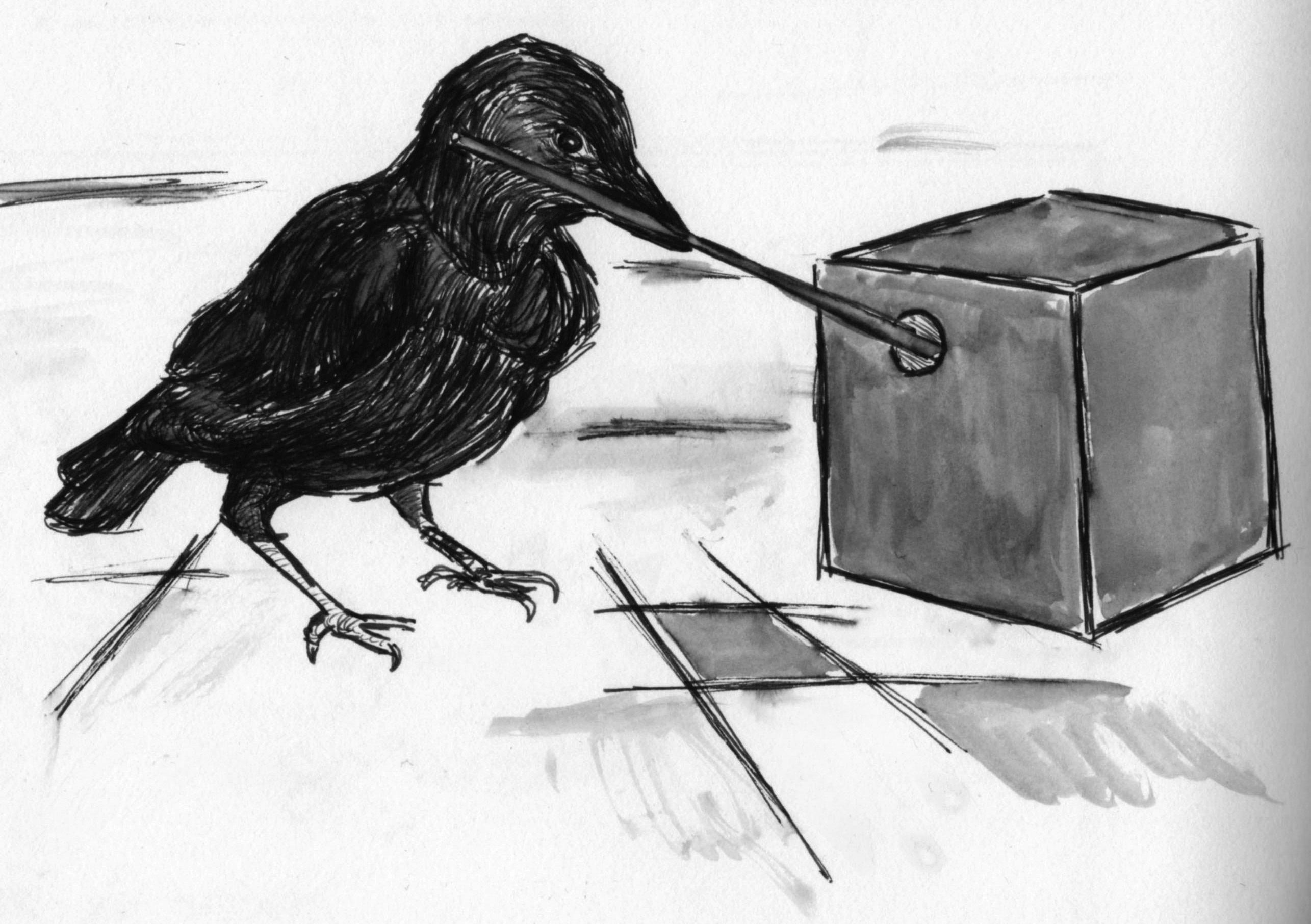
Taylor et al. designed an experiment with two scenarios in order to measure the sample group of eight crows’ capacity to make connections between a series of events, and infer the presence of a hidden causal agent. “[The crow] had to infer what caused an inanimate object to move,” cite the authors. The object: a wooden stick protruding from a hide (or blind).
The crows were first habituated to using a tool to extract food from a box that lay atop a table, facing the hide (and protruding stick) in the crows’ aviary enclosure. In both scenarios, a passive researcher stood in the room with its back turned to the crow, hide, and table.
In the first scenario of the “unknown causal agent” experiment, crows perched atop a beam in the aviary witnessed an actor enter the room, walk behind the hide, and a wooden stick protrude from said hide. The stick was then wiggled back and forth by the hidden actor, followed by the actor reemerging from the hide and leaving the room. The crow then came in to investigate the box for food with a small tool, turning its back to the previously moving, now static stick.
The second “hidden causal agent (HCA)” set of events occurred similarly, although no actor ever entered or left the hide, and the behavioural outcome observed in the crows was quite different. Researchers operated the movement of the protruding stick from outside of the enclosure. Following the cessation of stickmovement from the hide, the crows came to investigate the food-box once more; however, this time the crows were more cautious then in the previous trial, exhibiting flighty behaviour
suggestive of increased nervousness.
“To test between [hypotheses], we measured the degree of caution in the crows’ behaviour,” explained Taylor et al. “[In] the second, unknown condition, if the crows were capable of causal reasoning, they would predict that the stick might move again because they had not observed a potential causal agent leave the hide.”
The authors conclude that the increased “inspection” rates in the unknown causal agent scenario is proof that the crows were capable of something analogous to the kind of causal inferences humans are capable of.
“Animals are predisposed to associational learning,” remarked animal behaviour specialist and professor at the University of Manitoba, James Hare. “[It] is highly adaptive in their environment to associate things that are occurring, the movement of objects, with those things that preceded them.”
In a recent conversation with the Manitoban, Hare discussed the merits of the causal reasoning experiment, where he emphasized the importance of moving objects in nature. These crows, in some sense, are assessing the causal relationship underlying the movement of the protruding stick.
As Hare noted, “Moving objects should never be ignored [ . . . ] Sensory systems are tuned to alert animals to moving objects in their environment at a very basal level in the sensory system, activating all sorts of responses.
So where there’s something moving, it’s not surprising they’re cuing in on other elements.”
The experimental design, according to Hare, is not unlike previous expectancy violation experiments that have been performed with mammals and birds. Hare cited an
example where rhesus macaques were presented with eggplants. A curtain would drop down, and when it was lifted an eggplant would be present and the macaques would happily eat it. However, when the curtain would drop and lift to mysteriously reveal, say, two or three eggplants, the confused macaques would “fix their gaze on that outcome because it had violated what they had expected, revealing that they have this expectation [of one eggplant] and a cognitive ability to work with numbers.”
What’s interesting about the HCA experiment with the crows is that their increased level of caution, inspection, and nervousness is demonstrably related to the absence of the human actor entering the blind. “They are clearly having their expectancy violated when they can’t have a human associated with [the movement of the protruding stick],” reflected Hare.
When the human is known to be behind the hide, the crows may be attributing the stick movement to the benign actor they’ve witnessed enter and leave the hide. When that actor isn’t present, information pertaining to the nature of the mechanism operating the moving stick is no longer publicly available, or reliably known to be benign, and thus suspicious. This explains why the crows are, in Hare’s words, “engaged in more vigilance to collect more private information” in the HCA condition versus when they witness the human enter and exit the blind.
It appears that Taylor et al. may have made a very important contribution to the growing cannon of crow cognition research, providing tentative first evidence of sophisticated “causal reasoning” processes previously only attributed to humans.
LLustRatiON by LauReN bOuLet
Down-toearth humour
The self-deprecating,
observational
and societal comedy stylings of Louis C.K.
Jenna d iubaldo, staff
Louis C.K. has quickly become one of the biggest names in the comedy world over the past few years. Performing stand-up comedy since 1984, C.K. is known for his signature style of subversive comedy that features self-deprecating, observational, and societal humour that is in your face and knows no bounds.
With the release of his most recent full-length special, Live at the Beacon Theatre, C.K. has been thrust into the limelight and has singlehandedly changed the business of comedy.
Live at the Beacon Theatre is C.K.’s fourth full-length special and was independently produced and directed by the comedian himself. Rather than utilizing physical media, the special was released via C.K.’s official website, made available digitally for the price of US $5.
The special was released on Dec. 10, 2011, and by Dec. 21 C.K. released a statement confirming that he had grossed over US $1 million.
“So it’s been about 12 days since the thing started and yesterday we hit the crazy number – one million dollars,” wrote C.K. in a news post on his website. “That’s a lot of money. Really too much money. I’ve never had a million dollars all of a sudden, and since we’re all sharing this experience and since it’s really your money, I wanted to let you know what I’m doing with it.”
In the same statement, C.K. announced that he would be dividing up his new found wealth in four ways: US $250,000 was used to cover the costs associated with creating the special and promotional website, US $250,000 was given back to the comedian’s staff in the form of substantial
bonuses, US $280,000 was donated to various charities as suggested by fans following C.K.’s Twitter account, and the remaining US $220,000 went to C.K. himself, to care for his daughters and pay his rent.
It’s acts of humility like this that contribute to the success of C.K. and make him such a likeable celebrity. He is a regular guy, with a regular family, who happens to tell hilarious jokes that make millions of people laugh.
I recently had the pleasure of experiencing Louis C.K. live for the first time at the Minneapolis Convention Centre. His performance was as expected – no fuss, no muss, just straight up comedy for an hour and a half.
While his comedy was still dark and boundary-pushing at times, it felt as though his material was a bit more PG than usual. C.K. focused more on topics such as annoying interactions between the comedian and his neighbours, or strangers at the airport, rather than past topics such as C.K.’s failed attempts at sexual encounters, or simulating hilarious masturbation fantasies on stage.
C.K.’s success has not come without a cost. Recently, the FX network announced that it would be delaying the return of C.K.’s successful comedy television show Louie until spring, 2014. The show features the comedian living everyday life and dealing with the hilarious, and sometimes dark or scary situations, that come with it. Given that C.K. produces, edits, and stars in the show, along with creating it, the hiatus will provide what C.K. describes as “a little breathing room.”
phOtO by spC eLayseah WOODaRD-hiNtON
A fucking tidal wave of synthesizers
Mahogany Frog’s Senna
Jenna d iubaldo, staff
Mahogany Frog, one of Winnipeg’s most well-known, long-standing, and weirdest instrumental electronic rock bands, recently released their sixth fulllength album.
The album, entitled Senna , is a fucking tidal wave of synthesizers, fuzzed-out guitar riffs, and indescribable sounds. I don’t know what constitutes a good instrumental/ prog-rock/experimental/electronic album but, there are two things I am certain of when listening to this album – these guys know how to play their instruments, and they know
how to write one hell of a song.
Graham Epp, one of the band’s founding members, discussed the band’s newest release, as well as their recent trip to Brazil, the experience working with producer John Paul Peters, and beluga whales. Here’s what this instrumental mastermind had to say:
the Manitoban: Mahogany Frog has been playing music in various incarnations since 1998 – how have you guys managed to keep things interesting, and maintain your friendship for so long?
graham epp: I guess one key to our longevity is that we don’t perform a lot, at least here in Winnipeg. We get together with the purpose of getting new material ready for a tour and then every few years we record the best songs and release a record. As long as we are challenging each other musically then the band will go on.
M: Senna is your sixth full-length release as a band – how do you feel this album differs from your past releases?
GE: We knew how to perform the material on Senna very well by the time we entered the studio. This
preparation allowed us to focus more on the tones and textures of the instruments rather than on the performance itself. The record sounds live and natural and that is what we’ve always tried to capture on our records.
M: How do you feel that working with John Paul (JP) Peters, one of Winnipeg’s most sought after producers, added to this album in comparison to your last few releases?
ge: It was a real treat to work with JP. I was always impressed by [ . . . ] his meticulous microphone placement. He would always record [using] several microphones, and when we would listen back to a take he would play each microphone track separately so we could really hear the subtle, and sometimes not so subtle, differences between them. This practice enabled us to capture the hot and dirty sounds we like and give the different instruments separation in the mix.
M: The song “Aqua Love Ice Cream Delivery Service” includes a track of beluga whale sounds recorded in Churchill, MB. Why did you do this, and how did you go about recording it?
ge: The belugas are part of a sound collage that Andy [Rudolph] put together for the close of the record. They were recorded by a local duo called WHALE whose aim is to connect with beluga whales through experiments in art and sound. There’s a short film about what they do. Who wouldn’t want belugas on their record?
M: The band recently played in Sao Paulo, Brazil – how was that experience?
ge: Our trip to Sao Paulo was a unique experience and pulled us in a new musical direction. For years we’ve been intimidated by the prospect of doing shows overseas. Reason being that we rely heavily on the instruments we use and shipping several old, heavy, and fragile keyboards really isn’t an option. The Brazil gigs forced us to relearn our music on rented gear. All of the sounds we’ve created on three of our keyboards were saved onto a computer and then loaded onto the rented models in Brazil. The experiment worked and we’re now able to do more South American, and possibly European, shows in the spring.
Orgasms are awesome: Part 2
L
ast week we talked orgasms; what they are and why they are amazing for your health, and why they aren’t the most important thing when having sex. So how can you have an orgasm? What does it feel like?
Read on, fearless pleasure-seekers, read on.
A common question is: “How do I know if I’ve had an orgasm?”
There are many erogenous zones on our bodies, but orgasm is achieved primarily by stimulation below the belt.
Trust me – you will KNOW. Everyone experiences orgasm differently, so there is no one sensation or “symptom” that you have.
Universally, it can be said that cumming feels like a buildup of sexual tension that reaches its peak and then breaks, like a boiling kettle. For some people, this can lead to wholebody tingling or tingling in their extremities, shaking or trembling, increased heart rate, breathing heavy, ejaculation, or a throbbing feeling in the genitals. Although people can experience orgasm with few or none of these sensations, it is also typical for orgasm to not be experienced the same way every time.
While there are physical reasons you might not be able to experience orgasm (anorgasmia), there are also psychological barriers that keep the gates to pleasure locked. Things like stress, trauma, depression, substance abuse, or past sexual abuse can make it harder for you to cum. As well, sometimes the pressure to have an orgasm can alone be self-defeating.
If you have been trying to orgasm, try being a little less hard on yourself and enjoy the pleasurable sensations that trying to get there brings you. Try masturbating or having sex when you are fully mentally and physically relaxed. If you are still unable to orgasm and desire to experience The Big O, check in with a doctor.
Orgasms can occur with a partner or during solo play, so if you’ve never had one the good news is you don’t
have to wait until next time you are getting it on with someone else to try and make it happen. Well—if you are reading this in a public place—please wait until you get home to give it a go.
Only 25 per cent of women* consistently orgasm during penetrative intercourse, which means that “P in V” sex is usually not enough to do it.
Self-pleasure is an amazing skill to have and important self-care because it increases your knowledge of your own body and what feels good. This way, if you are one of the 75 per cent of women who aren’t cumming during sex, you can help direct your partner to the places and techniques that get you feeling hot.
There are many erogenous zones on our bodies, but orgasm is achieved primarily by stimulation below the belt. For people with vaginas this means
a combination of the clitoris, vulva, vagina, g-spot, or anus are particularly good areas to focus on if you are looking to cum. For people with penises the most sensitive areas are the penis, the testicles, the anus, and the prostate. People report that orgasm from stimulation of different body parts can feel different – a g-spot orgasm can feel much different than a clitoral orgasm or a prostate orgasm could be much different than a penile one. Next week, I will wrap up my series on orgasms when we talk about multiple orgasms and ejaculation! Until then, have an orgasmic week. *It is, unfortunately, best to assume studies like this are overwhelmingly hetero and cis-normative.
You can confidentially submit a question or topic to jodie.m.w.layne@gmail. com
Jodie l ayne, staff
Hope in Dirt City
Cadence Weapon brings his new album to the Park Theatre
Jodie l ayne, staff
Cadence Weapon is my kind of rapper; I can’t decide if I want to sit down and talk literature and philosophy with him – or party really hard to his music. His new album, Hope in Dirt City, was shortlisted for the Polaris Prize this year, and he also recently finished his two-year stint as poet laureate of Edmonton. Cadence Weapon is a musician who embodies the title artist – his love and enthusiasm for his craft are incredibly evident in all the music he makes, but on this album especially.
Hope in Dirt City is the third album from Edmonton native/ Montreal transplant, Rollie Pemberton.
“To me, it’s a maturation of my style. I’ve always experimented with genre and had certain themes in terms of content but on this album, I crystallized my ideas better than on any other release of mine,” says Pemberton.
In true Cadence Weapon style, the beats are complemented by heavy electronic elements. However, this album adds collaboration with instrumental musicians and blends genres. On tracks like “Hype Man” he seamlessly moves from oldschool rap to reggae to rock to pop with careful care and obvious mastery to pull the collection of songs together.
“I think I’ve improved as a songwriter and producer, especially in terms of using live instrumentation and working with other musicians,” he says.
On the title track, his flow is stylistically lazily spit over 80s-style synth and the track “Jukebox” lets the horns do their thing in what is easily the highlight of the album. The best part is that it just sounds like he is having fun; creating, experimenting, and making music that will make you think and dance. While the instrumentation demands attention and is easily the focus on Hope in Dirt City, the
lyrics take a different tone than we have come to expect from Cadence Weapon. Pemberton attributes this to his heightened awareness of the writing styles of different genres.
“Over the past few years, I’ve gotten heavily into 60s and 70s pop music, stuff like Van Dyke Parks, Robert Wyatt, Harry Nilsson, Brian Wilson, and Randy Newman. As weird as it may seem, I relate to these songwriters more than a lot of rappers,” he says.
Pemberton cites “Surf’s Up” by the Beach Boys as a song he dismantled and claims helped him become clearer in his own writing process.
“That said, I think rap is already extremely relatable. It appeals to basic human instinct and contains universal themes. If anything, I’m trying to get closer to the essence of what rap is meant to provide,” adds Pemberton.
The honouring of rap tradition paired with the progressiveness of the music makes for an interesting meeting of old-school/new-school avant-rap.
He will bring his show, with local DJ Tim Hoover (a.k.a DJ Co-op), to Winnipeg this week.
“Rollie and I have a great set with a mix of new and classic Cadence Weapon tracks, with a few surprises in there as well. It’s a great show if having fun is something you’re into. Obviously, the Lytics rule and are going to put the evening over the top,” says Hoover.
The two recently performed a set together for the Polaris Prize awards show, which Hoover describes as exciting and surreal.
“It’s a trip to be playing and look out to see Leslie Feist nodding her head and rapping along to the hook. The coolest thing about our performance that night is it went exactly as rehearsed. Imagine that!”
Catch their near perfect performance skills this Friday, Oct. 19 at the Park Theatre.
The Heist
Review: Macklemore & Ryan Lewis
Marc l agace, staff
Macklemore & Ryan Lewis deliver the goods with their first independent full album release, The Heist. A project three years in the making, the entire album is a labour of love for the Seattle-born Macklemore, aka Ben Haggerty. What we get here feels like a breakthrough album that pushes the hiphop genre into a new and exciting direction.
Macklemore has been making waves in Seattle since his 2000 EP,
Open Your Eyes, then going by the moniker Professor Macklemore. With The Heist, Macklemore tackles political and cultural issues much like other “socially conscious” rappers have done in the past. What really sets Macklemore’s lyrics apart is just how open, honest, and blunt he is. Haggerty candidly shares stories of growing up, making it as an independent artist, and his struggles with addiction.
Lewis’ production values shine as he blends traditional hip-hop rhythms with live instrumentation that lays down rich layers of sonic bliss for Macklemore to rhyme over. The use of piano specifically is beautifully executed on several tracks.
“Wake” (feat. Evan Roman) and “Starting Over” (feat. Ben Bridwell of Band of Horses) are some of the best examples of Macklemore’s penchant for social consciousness and honesty. “Wake” in particular has perhaps the smartest verse on
the album, as Macklemore cuts to the core of social issues and the apathy that appears to persist within the YouTube and Twitter generation. “Same Love” (feat. Mary Lambert)—made in partnership with a Seattle-based campaign called Music for Marriage Equality—is an emotional gem that cuts to the core of the issue. The music video—released on YouTube Oct. 2—has over three million views and only adds more momentum to an already powerful song and positive message.
As independent artists—hustling their own wares the hard way on tour and through social media—Macklemore & Ryan Lewis managed to top the iTunes album download charts on the day The Heist dropped. That’s an impressive feat, but completely deserving for these talented up-and-comers who should get everyone’s attention with this one.
First Spring Grass Fire Musician Rae Spoon publishes
Kara Passey, staff
Rae Spoon is a transgender musician/writer/workshop facilitator who has been nominated for a Polaris Prize, released six solo albums, toured internationally, and now has published their first book, First Spring Grass Fire, in September, 2012 with Arsenal Pulp Press.
“My own identity is based on a narrative I am constantly revising for myself.”
First Spring Grass Fire is a collection of relating short stories inspired by coming of age as queer and transgender in Calgary, Alberta. Each story encompasses a moment worth remembering for the narrator – whether it be a moment of hope for a world outside of the narrator’s evangelical family, or a realization of a new piece of their own identity. The book jumps all over the timeline and delivers the narrator’s very personal, vulnerable inner dialogue along the way.
The narrator, Rae, knows from
their first
book
a young age that they are different; they struggle with being comfortable in their own skin and being accepted socially. Rae attends church in spite of constant doubts and experiences a power struggle with their father who has schizophrenia. Between stories of surviving abuse, selfharm, religion, finding love, and self-acceptance – it’s impossible not to relate to one of these stories, and reconsider the effect that the experience has had on your own identity.
While First Spring Grass Fire is categorized as fiction, the narrator shares Spoon’s first name and the writing draws from their life experiences.
“My own identity is based on a narrative I am constantly revising for myself, so I see fiction and nonfiction as things that inform each other. I do believe the cliché
that people write the best about what they know and I’ve tried to stick to that without being too specific about my actual history,” says Spoon.
Rae—in the book—expects that the completion of high school will be the end of their struggles. Instead, their girlfriend goes off to university, they break up, and Rae learns that adulthood doesn’t come easily either. Rae concentrates on writing music and eventually moves from Calgary to Vancouver. They attempt to grow a new history but come to the realization that their past is responsible for constructing the identity that they have now.
“The narrator [ . . . ] has a difficult childhood, but there is always the possibility of escape,” says Spoon. “I think the message of survival and acceptance is important. Also, finding something to be passionate about and live for in spite of loss.”
Rae Spoon is currently on tour promoting their new book and playing music. You can see them at the Mondragon on Friday, Oct. 19 or at McNally Robinson Booksellers (Grant Park) on Saturday, Oct. 20.
Good People Bad Things
Daniel Thau-Eleff’s new one-person show to play at the Rudolf Rocker Centre
tiff bartel, volunteeR staff
Moving Target Theatre Company
founder Daniel Thau-Eleff isn’t just a triple threat – aside from starting his own production company, writing and starring in his own plays to much critical acclaim, he is also an artist, an activist, and has worked as an actor, assistant director, and stage manager for numerous other theatre companies.
After successful runs of his own company’s last productions, Remember the Night and King’s Park, Thau-Eleff’s newest piece, Good People Bad Things, a one man show black comedy about evil, makes its debut Oct. 18 to 28 at the Rudolf Rocker Centre.
the Manitoban: How would you describe Good People Bad Things? What is it about?
daniel thau- eleff: It’s about evil, but it’s also about connecting [and] acknowledging the terrible things that happen in the world; Adolf Eichmann and his role in the Holocaust. We also tell a fictional story about a couple who get into an abusive relationship, we also talk about the events going on in Israel/ Palestine and, in the show I’m asking, “How do we do something about this? How can we do better? How do these things begin? And how do they play out?” [In] theatre, but especially one-person shows, [what] the show is really about is an artist pouring out
their heart and brain, and creating connections - between myself and the audience, between different events and ideas.
M: Some of the aspects of the plot of this production seem to be quite dark. How do you maintain a balance between tragedy and comedy in a play such as this?
dt: This is probably one of the most difficult things about Good People Bad Things. I’m trying to embrace the darkness and horror and heaviness of the material, while keeping a sense of lightness. It will probably be more about lightness than comedy –but there will be at least a few laughs, I promise.
seem to have multiple pieces involving with aspects of Jewish identity – how did you choose to write about this?
dt: One commonality is the tension between the personal and the political, or in other words between internal and external struggles. [ . . . ] I think this is an interesting time to
America over the past half-century. [These] are particular experiences, but I think these are experiences people from other cultures and ethnic groups can also relate to. I talk about Jewish identity, but I think there are lessons in it for everyone.
M: What inspired you to start your own theatre company?
M: Would you say there are some common themes in your work? You
be Jewish. Particularly in the fallout of some of the major events of the twentieth century – the Holocaust, of course, and then the first sixtysome years of the State of Israel, the changes in Jewish culture in North
Eight Days of Pledge-O-Rama
Tune in and donate!
Jenna d iubaldo, staff
T
he first annual UMFM fun(d) raiser—Pledge-O-Rama—kicks off this Friday, and will run from Oct. 19 to 26. This is not only a time for listeners to pledge their hard earned cash to help support this volunteerdriven radio station, but it is also a time for those unfamiliar with the station to take advantage of the quality programming that UMFM and its many hosts broadcast 24 hours a day, seven days a week.
Here’s a little sampler of the shows that this community radio station has to offer – one for every day of PledgeO-Rama. So, get out your transistor radios, tune your dial to 101.5, and start pledging!
SHIFT R ADIO
time: Friday 9:00 p.m. – 11:00 p.m.
hoStS: André Bisseck & Oxide genre(S) Electronic
Featuring artist interviews and information on local events, André Bisseck and Oxide keep things electric with a healthy dose of techno to give your Friday night the jump start it needs.
My GeneRATIOn
time: Saturday 10:00 a.m. – 12:00 p.m.
hoStS: John Einarson genre(S) Indie Rock / Folk & Roots
Jump into John Einarson’s time machine, while he takes you on a wild ride back to the 60s and 70s! This DJ knows his shit, so allow him to not only educate your ears with chart toppers, B-sides, and rarities of this era, but your mind as well through his vast historical music knowledge.
Tell THe BAnD TO GO HOMe
time: Sunday 2:00 p.m. – 4:00 p.m.
hoStS: Jeff Robson
genre(S) Folk & Roots
A show for fans of the singer/ songwriter genre, listen in for tunes from some of the greats such as Lyle Lovett and Fred Eaglesmith, as well as interviews and in-studio performances from some fantastic local talent such as Scott Nolan, and the Wailin’ Jennys.
SMASH IT Up
tiMe: Monday 8:00 p.m. – 9:00
p.m.
Hosts: Ryan Filteau
Genre(s) Loud & Punk
If you’re into straight-up rock and roll, this show is one you won’t want to miss. Hosted by devastatingly handsome DJ Ryan Filteau, this show boasts garage rock and roll from some of the best talent across the prairies, as well as RNR from classic names that made the genre what it is today.
CJUM CHART ReVU
time: Tuesday 9:00 a.m. - 11:00
a.m.
genre(S) Funk & Soul / Jazz & Classical / World / Folk & Roots / Loud & Punk / Indie Rock / Hip Hop / Electronic Need some new music? This show is counting down the top 35 artists with the most plays on UMFM every week. Featuring lots of great music and lots of local and Canadian content.
dt: For an independent artist, it’s basically a necessity. I think everyone should do it. It’s a lot of work, depending on the scale of your productions, and it involves developing a whole skill set that I didn’t learn in acting school.
M: How long have you been working in theatre? How did you get into it?
dt: I studied acting and directing in university. I produced and directed my first show in the Fringe in the summer of 2000. I started Moving Target Theatre Company in 2003. That year, there were some artists I really admired coming to Winnipeg to create a one-person show—Daniel Brooks and Rick Miller—and I asked them if I could assistant-direct and basically sit in on their process. That got me wanting to write and perform a one-man show, which I did in the summer of 2004.
M: Are you working on anything else at the moment?
dt: I have a new play in its very early stages. Mostly what I’m working on, other than Good People Bad Things is making theatre connections outside of Winnipeg. I toured my first soloshow on the Fringe circuit. My next three shows were just in Winnipeg. So it’s time to start getting my work seen in other cities again. I’ve been attending Canadian theatre festivals in other cities and meeting people, and we’ll see what kind of fruit that bears over the next couple of years. Good People Bad Things opens on Oct. 18, and runs until Oct. 28 at the Rudolf Rocker Centre (91 Albert Street on the third floor, above Mondragon). To reserve tickets, call (204) 221-1120 or e-mail movingtargettheatrecompany@ gmail.com
JAM IT On THe One
time: Wednesday 9:00 p.m.
– 10:00 p.m.
hoStS: Paul & DJ Jeff
genre(S) Loud & Punk Music to skateboard to! Spinning high-energy punk music from the 90s up to present day; fans of NOFX, SNFU, and whatever the fuck else acronym punk bands there are, will not be disappointed! Keep up-to-date with the latest Winnipeg punk news including local content and concert announcements.
TOBAn neWS DeSk
time: Thursday 11:30 a.m.
– 12:00 p.m.
hoSt S: Marc Lagace & Bryce Hoye
genre(S) News & Current Affairs
Get your weekly news fix with everyone’s favourite campus student newspaper, the Manitoban! Featuring news briefs from the lovely and talented journalists who bring you high quality, student relevant reading material each week. Tune in to learn more
about current events happening on and off campus, and don’t forget to pick up a copy of the Manitoban while you’re at it!
THAnk GOD IT’S FRee R AnGe!
time: Friday 6:30 p.m. – 8:00 p.m.
hoStS: Michael Elves
genre(S) Funk & Soul / Jazz & Classical / World / Folk & Roots / Loud & Punk / Indie Rock / Hip Hop / Electronic Free range radio = whatever, whenever! UMFM program director, Michael Elves, covers a diverse range of artists and genres including local, national, and international music and interviews. This will be the last show during Pledge-O-Rama and your last chance to donate, but also the perfect start to a weekend not filled with class.
To make a donation to Pledge-ORama, call (204) 474-6610, 24 hours a day, between October 19 and 26.
By Matthew Herbert
LauReN bOuLet
Men’s hockey splits home opener against Huskies
Bisons now 1-3 after two weekends of play
d ere K g agnon, staff
The Bison men’s hockey team entered this past weekend’s two game series against the University of Saskatchewan Huskies after having a bye week in Canada West play. The boys stayed fresh by playing a pair of non-conference exhibition games in the USA, losing 5-3 to the University of North Dakota and playing Bemidji State to a 3-3 tie.
The games in the States seemed to help the 0-2 Bisons squad, as they came out looking sharp on Friday night against the Huskies.
Manitoba was the dominant team throughout the night and were able to maintain consistent pressure in the Saskatchewan zone throughout the first period.
Good physical presence sent Huskies players sprawling about with crushing body checks, as the pressure eventually led to a Bisons goal with three minutes remaining in the first period. A soft floater of a shot by fourth-year player Blair Macaulay found its way passed the glove hand of Huskies goalie Ryan Holfeld.
Holfeld might have been distracted by the boisterous Engineering Faculty Band on the play, as the rowdy bunch were in full voice behind his goal throughout the game.
The Huskies managed to catch the Bisons napping to start the second period, as they evened the score just 19 seconds into the frame and silenced the crowd at Max Bell Centre. A slap pass by Garrett Thiessen found Jimmy Bubnick alone to the right of Bisons goalie Jesse Deckert, and Bubnick was able to walk out front uncontested and slip a backhand shot through the five hole. Moments later the Bisons’ Tyler Dittmer took a stick to the mouth that went unnoticed by
the refs and was forced to temporarily leave the game to receive medical attention in the dressing room. The Bisons and Huskies each took a pair of penalties in the period, but both teams failed to take advantage of the extra man and the game went into the second intermission tied 1-1. The Bisons appeared to grab the lead at the 18:04 mark of the third period when first-year centre James Henry wrapped the puck around the net and passed Holfeld, but the Huskies managed to knock the net off its moorings to both disallow the goal and somehow evade a delay of game penalty. The Bisons took the lead for real at the 15:14 mark, as nice pass-
ing by the top line of Tyler Dittmer, Ian Duval and Blair Macaulay saw Macaulay net his second of the night and third of the year as his linemates picked up assists on the play.
The Bisons’ inability to score on the power play came back to bite them in game 2 of the series on Saturday night.
The game continued to get testy as a minor brawl erupted during a Manitoba power play that sent two Bison and one Huskies player to the box, nullifying the remainder of the power play.
The Bisons managed to kill off their penalties, but continued to face mounting pressure from the Huskies.
Bisons goalie Deckert made two stellar saves and Del Cowan made a diving block as the Bisons endured an onslaught late in the third. Bisons coach Mike Sirant called timeout
with 1:52 remaining after an icing call prevented his team from getting a late line change. The strategy worked, as the Bisons put the game to bed just 20 seconds later. Macaulay and Duval hooked up once again, this time a 2-on-1 resulting in a deft pass from Macaulay to Duval, who deked out the Huskies goalie and slipped a backhander into the vacated net, giving the Bisons a 3-1 lead they would not relinquish.
Game two on Saturday night saw more aggressiveness from the Bisons, but it was the Huskies who capitalized on the few opportunities they had. The Bisons had possession for most of the first period and outshot the Huskies 11-6, but it was Saskatchewan who had the best chance when Deckert robbed Huskies forward Craig McCallum with his glove while on a breakaway.
The Huskies did capitalize on a breakaway in the second period, as Chris Durand broke in after Bisons Captain Dane Crowley blew a tire
and slipped a shot passed a sliding Deckert. The Huskies almost made it 2-0 moments later when a sloppy line change lead to a two-man breakaway that was denied by a great pad save by Deckert.
The Huskies scored their second goal of the frame when a shot by McCallum was spilled by Deckert and Brennan Bosch knocked in the rebound. The Bisons got one back before the period was out when a shot by Ian Duval was deflected up by Holfeld, off the legs of Tyler Dittmer and into the net. It appeared referee Ryan Galley had swallowed his whistle during the second period, as numerous questionable hits went uncalled, including a couple of hits from behind that the Bisons bench didn’t like.
The Bisons had numerous opportunities to tie up the score in the third period, including three power plays, but Ryan Holfeld and the Huskies shut the door to hold on for the 2-1 win.
The Bisons power play went 0-for-6 in the game, and is 3-for-21 on the season. The lack of production with the extra man came back to haunt them in the second game of the series on Saturday night.
The schedule does get easier for the 1-3 Bisons, having now faced the two top ranked teams in Canada West (Alberta was ranked #2 in the nation, Saskatchewan ranked #4), The boys play on the road against Mount Royal this weekemd and then in Calgary following weekend.
The Bisons do not play another game at home until Nov. 9-10 when they host Lethbridge at Max Bell Centre.
Women’s hockey earns a victory in Saskatoon
Team goes 1-1 against the Huskies
d ere K g agnon, staff
Head coach Jon Rempel and the 0-2 Bisons women’s hockey team travelled to Saskatoon this weekend to take on the 0-1-1 U of Saskatchewan Huskies. The Bisons were looking for their first positive result of the season after a pair of losses at home against the U of Alberta Pandas.
The Huskies dominated the first period of Friday’s game, scoring a power play goal and outshooting the Bisons by a margin of 17-8. However, the Bisons were the better team for the duration of the game. Maggie Litchfield-Medd scored her second goal of the year on the power play
two minutes into the second period. Nellie Minshull and Jessica Carswell added even strength goals for the Bisons before Saskatchewan got one back as Manitoba outshot the Huskies 17-5 in the period. Neither team scored in the third period as the Bisons held on for a 3-2 victory.
Leiette Klassen turned aside 26-of-28 shots for the Manitoba’s first win of the season.
The script was much different on Saturday. Despite Manitoba outshooting Saskatchewan 14-5, the Bisons would see their 1-0 lead disappear, as Saskatchewan scored three goals in quick sucession. Leiette
Klassen was pulled in favour of DéeAna Marion before the period was out. The Bisons got one back in the second period, but the Huskies put the game to bed in the third by adding two more, winning 5-2. Caitlin MacDonald and Captain Amy Lee had the goals for Manitoba.
The Bisons now have an improved record of 1-3, and will play against the Mount Royal Cougars next weekend at Max Bell Centre here on the University of Manitoba campus. The Cougars’ record is 2-1-1 after a pair of losses against the Alberta Pandas this past weekend.
phOtOs by beibei Lu
Amazing weekend of soccer at U of M
Bisons pull off back-to-back wins to stay in the race for the last playoff spot
g race roMund, staff
It was an action-packed weekend of soccer on the University of Manitoba Turf Fields West as the Bison women fought with all they had to ensure they stayed in the running for a playoff spot in their last home games of the regular season, winning back-to-back games on Friday and Saturday night.
First, the Bisons faced off against University of Lethbridge Pronghorns. The Bisons knew that they had to get some points out of the game if they were going to have any chance at the playoffs, but after a six-game losing streak with only one goal scored, poor results had become the norm midseason.
However, Manitoba did have a series of incredibly tough matchups. The combined record of the six teams they lost to is 31-7-2. By comparison, Manitonba’s last four games of the season are against opponents with records much more similar to their own.
Against the Pronghorns, the Bisons rallied and came away with five goals
and three points in the standings.
Head coach Hayden Sloane-Seale was very pleased with the performance by the team in the Lethbridge game.
“We knew we had to get something out of the game, we knew we had to get at least a point. It was great that we got the win. The [Bisons] played really well: knocked the ball around, had great spells of possession, and really outclassed Lethbridge, which is hard for us to say that typically, but we did do that, I felt.”
The final score against Lethbridge was 5-0 for the Bisons.
A great result again, the Bisons only increased the pressure going into a do-or-die game against the Calgary Dinos, who sat directly above Manitoba in the eighth and final playoff spot.
Even in the opening minutes of the first half, the Bisons looked hungry for a win. They created a series of goal-scoring opportunities through organized short passes up the field, but were unable to find the back of the net until the 35’ of the first half. After
Don’t diss the commish
Give Gary Bettman the respect he deserves
s
W
hen you think of the most hated figure in the NHL, who comes to mind? In all but a few rare cases (Peter Pocklington, Oilers fans?) the image that comes to mind is one of a short, cocky looking fellow named Gary Bettman. Indeed, Bettman has become a household name, one that is synonymous with the sound of hockey fans booing. Certainly NHL fans have many reasons to hate Mr. Bettman—he has orchestrated three lockouts during his tenure as league commissioner and paved the way for the Jets dismissal from our city back in 1996—but what about all the good work he has done for the NHL?
Undoubtedly, the NHL has grown since he took the reins after receiving mentoring from NBA commissioner
David Stern. As hard as this is going to be, I offer a shameless plea to you to think about the positive side of Gary.
Bettman came onto the scene in 1993, becoming the first commissioner of the NHL, as the incumbents before him were referred to as presidents. He came from the NBA, where he was the Senior Vice-President under David Stern. The league had 24 teams and annual revenues of around 400 million dollars. What Bettman has done since, in terms of marketing, television rights, and revenues, additional teams and annual revenue league-wide, has been nothing short of amazing. Like it or not, Bettman has grown Canada’s game like no other – even if it hasn’t always been on this side of the border.
a great run to beat out the defender, impressive first-year striker Daniella Scerbo chipped the ball just past the reach of the Calgary keeper and across the goal line.
The Bisons managed to hold onto the 1-0 lead for the rest of the match.
Head coach Sloane-Seale stated, “We’re really, really pleased with how the [Bisons] performed because we haven’t put together two back-to-back wins like that for quite some time, so fantastic job by the players [ . . . ] abso-
lutely outstanding.”
The only goal-scorer of the game, Scerbo noted that the Bison women knew this one was pivotal in their road to the post season.
“This game was really important for us to us to win. This is the one we needed if we wanted to get into the playoffs. It was really crucial to win this one so I’m really glad we did.”
Although there was no scoring in the second half there was definitely no shortage of excitement as Manitoba
and Calgary exchanged threatening free kicks right outside the crease. There were also a number of yellow cards handed out as the Dinos ran out of time to find the equalizer. In the end, Calgary received two yellow cards to Manitoba’s one.
“We knew we had to beat Calgary. This was a must-win for us. If it had gone differently, or if Calgary had gotten a tie even we would have really been up against it, and we’re still up against it. There’s nothing safe now,” said Sloane-Seale.
Despite a great weekend for the Bisons women’s soccer team, nothing is guaranteed yet. The Bisons will have to continue this momentum into the last week of the regular season if they want to continue on into the playoffs.
The Bisons play back-to-back games against Mount Royal and Alberta in Alberta on Oct. 20 and 21
As mentioned above, since Bettman took the reins the league has expanded to 30 teams – the Minnesota Wild, Anaheim Ducks, Florida Panthers, Nashville Predators, Columbus Blue Jackets and the team formerly known as the Atlanta Thrashers. He has advocated for expansion in the southern United States, and while some franchises have been less than successful, like the Phoenix Coyotes, several Bettman-era teams—the Ducks, Carolina Hurricanes, Dallas Stars and Colorado Avalanche—have hoisted the Stanley Cup. Bettman has created profitable hockey markets in regions that were previously thought to be uninhabitable for a sport that wasn’t the NFL or the NBA.
Bettman has flexed the majority of his Cornell-educated muscle by growing league revenue. The NHL hockey-related revenue in 1993-94 was around $700 million. Eighteen years later, Bettman has overseen a $2.9 billion dollar increase to where it sits today at an estimated $3.3 billion. Staggering increases in television revenues are nothing short of incredible. In the American market, Bettman negotiated television rights with FOX Sports in 1994 at a paltry $155 million over a five-year term. Seven years later, in 2011, Bettman struck gold landing an otherworldly $2 billion dollar 10-year contract with NBC and Versus. Meanwhile in Canada, CBC agreed to a $569 million deal in 2007 that is set to expire in 2014.
Gary Bettman has done wonders
for the NHL in terms of business, marketing, and increased revenues. I’d also argue that you would be hardpressed to find a fan these days that doesn’t find post-2004-05 lockout hockey better than its previous iteration. You may also find it important
to note that Bettman had the final say on bringing the Thrashers to Winnipeg. Regardless of how you look at it, it is hard to argue against his accomplishments.
iLLustRatiON by JustiN LaDia
MEN’S
WOMEN’S
Huskies victory pushes Bisons to brink
Must win against UBC to keep playoff hopes alive
Marc l agace, staff
Saskatchewan Huskies quarterback Chase Bradshaw tied a Canada West record for most completions in a game, as Manitoba lost a heartbreaker on the road to Saskatchewan 44-39.
The Bisons led through most of the game, and even had a 13-point lead heading into the final quarter, but the Huskies offense turned it on and outscored the Bisons 28-10 in the fourth.
Bradshaw completed 38-of-60 pass attempts for 426 yards, three touchdowns, and two interceptions, including two touchdowns during the fourth quarter comeback.
Offensively, the Bisons struggled at the quarterback position. Cam Clarke was pulled at halftime after completing 8-of-17 passes for 112 yards and no touchdowns. Second string quarterback Ryan Marsch saw his first significant action of the season, but could do no better against a Saskatchewan defense that essentially shut down the Bisons pass attack.
“This game was really important for us to us to win. This is the one we needed if we wanted to get into the playoffs.” – Bison forward Daniella Scerbo.
The Bison special teams and defence accounted for 18 points on the day; Bison fifth-year defensive back Teague Sherman recovered a blocked punt in the end zone in the second quarter, and defensive end Ranji Atwall returned one of Bradshaw’s interceptions 77-yards for a Bison touchdown late in the third quarter. Nick Boyd was 1-for-2, completing a 27-yard field goal in the fourth after settling for a rouge on a 16-yard attempt in the second.
Anthony Coombs was the outstanding offensive player for Manitoba, as he ran for 161 yards and two touchdowns on 13 carries. The majority of his yards came on his two scores –49-yards on the final play of the first quarter, and 70-yard run in the fourth quarter. Excluding those two huge plays, Coombs averaged under four yards per carry on his other 11 rushing attempts. Kienan LaFrance also scored on a 5-yard run, his only carry of the game.
With the loss, Saskatchewan and Manitoba are tied for third in the conference with identical 3-3 records, but Manitoba is bumped down to fourth on account of Saskatchewan now holding the tiebreaker between the two schools.
The Bisons find themselves on the cusp of missing out on the playoffs for the fifth straight year since winning the Vanier Cup in 2007. With two games remaining, the Bisons will be playing for their playoff lives in their final home game of the season against the UBC Thunderbirds on Oct. 20.
UBC got off to an awful start losing their first four games, but have since won two straight and will head into University Stadium with confidence and momentum. A UBC win this weekend would mean that Manitoba and UBC would be tied at 3-4 heading into the final week of the Canada West regular season.
In that final week, the Thunderbirds are on the road in Saskatoon, while the Bisons finish their season with a tilt against the yet-to-be defeated Calgary Dinos. If Manitoba’s playoff chances come down to winning against Calgary, then they’re in for a rough outing: through six games so far this season, the Dinos have outscored opponents by a staggering margin of over 240 points. It all comes down to this Saturday’s game—at home—against the team that the Bisons defeated in their season opener 31-24. Win and the Bisons are in. Lose, and Manitoba’s playoff hopes are all but dashed.
Kick off is at 1 p.m. Saturday, Oct. 20 at University Stadium.