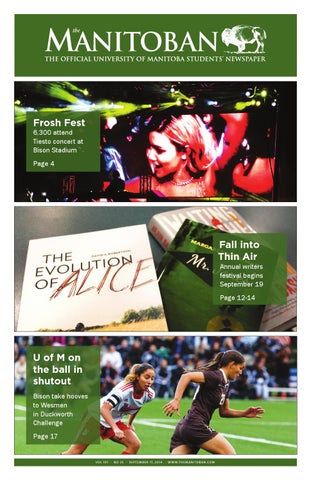
Bison take hooves to Wesmen in Duckworth Challenge
Page 17
Fall into Thin Air
Annual writers festival begins September 19
Page 12-14
EDITORIAL
DESIGN
REPORTERS
VOLUNTEER CONTRIBUTORS
MANITOBAN
A “volunteer staff” member is defined as a person who has had three volunteer articles, photographs, or pieces of art of reasonable length and/or substance published in three different issues of the current publishing year of the Manitoban. Any individual who qualifies must be voted in by a majority vote at a Manitoban staff meeting. Elected representatives and non-students may be excluded from holding votes as volunteer staff members in accordance with the Manitoban Constitution.
The Manitoban is the official student newspaper of the University of Manitoba. It is published monthly during the summer and each week of regular classes during the academic year by the Manitoban Newspaper Publications Corporation.
The Manitoban is an independent and democratic student organization, open to participation from all students. It exists to serve its readers as students and citizens.
LGBTTQ* ally training certification workshop at capacity
UMSU-based sessions attract diverse participants in support of the LGBTTQ* community
DANA HATHERLY
T
he LGBTTQ* (lesbian, gay, bisexual, transgender, twospirited, queer, and other gender minorities and sexual orientations) ally training workshop, hosted by a collaboration of service groups from on and off campus, has reached its maximum number of participants.
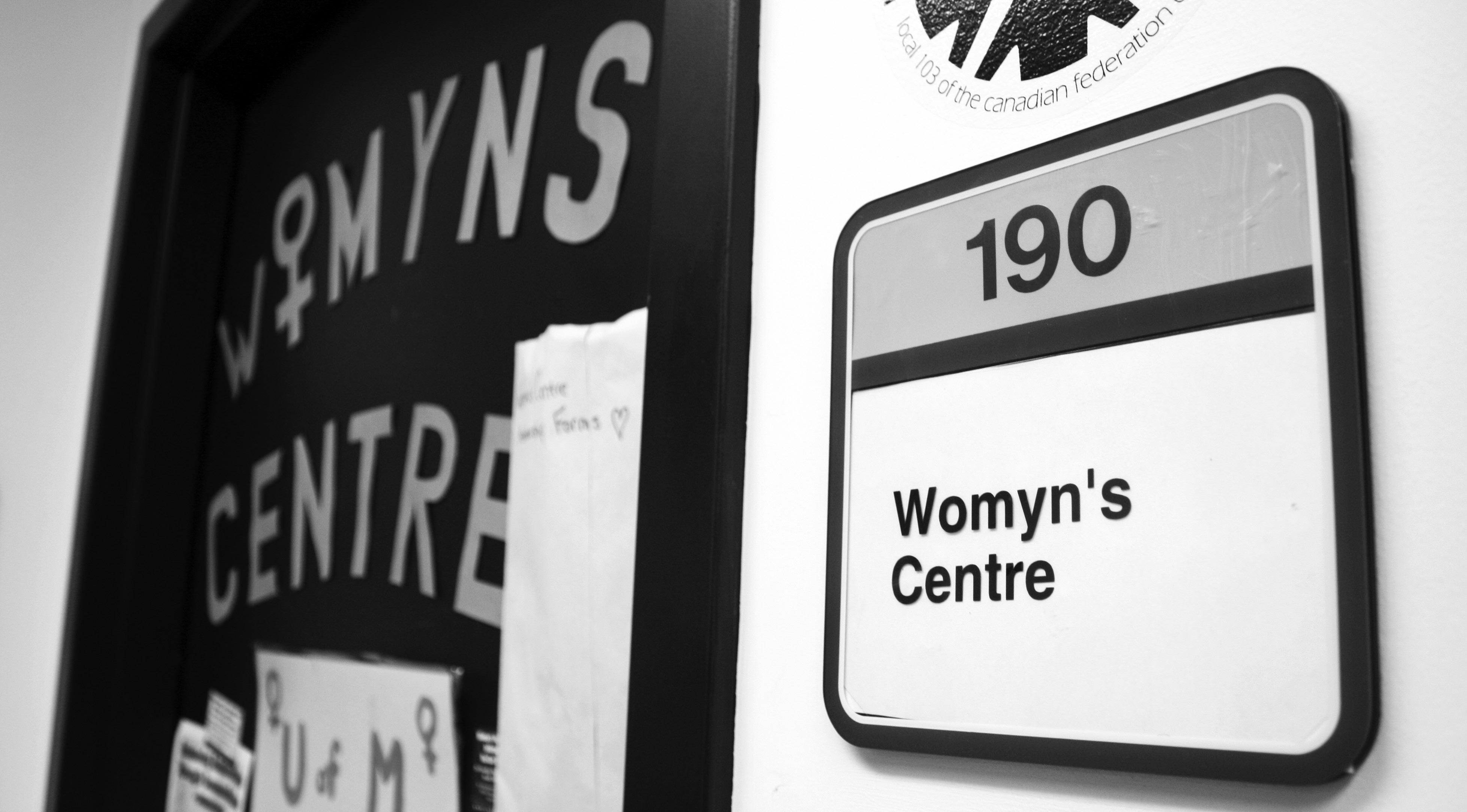
The Womyn’s Centre and Rainbow Pride Mosaic (RPM) worked together with the Rainbow Resource Centre to facilitate training, awareness, and education about issues faced by the LGBTTQ* community.
The ally training workshop is a two-part certification course taking place on Sept. 17 and 24 from 5-9 p.m.
Students must attend both dates to receive full certification.
The ally training event poster reads, “Upon completing 6.5 hours of ally training, individuals will receive [proof of certification].”
With 25 participants, the course reached the initial maximum capacity before the fall semester had officially commenced.
The maximum number of participants was later increased to 30. Womyn’s Centre co-ordinator Hira Sabzwari told the Manitoban that those extra spots were also quick to fill.
She said that even though the course is at capacity, she would strive to meet the needs of those who are still interested in attending.
Many people from different back-
grounds attend for various reasons of personal and professional development, including students, volunteers, teachers, and medical professionals.
Sabzwari told the Manitoban that the purpose of the workshops are to welcome, support, and advocate for more open, inclusive, and safe environments for the LGBTTQ* community.
Participants are exposed to LGBTTQ* situations and issues faced in life and on campus. The course covers various topics for discussing safe space, how to be a better advocate, how to confront homo-negativity every day, and how to apply these in real-life contexts with family and friends.
Sabzwari explained that the content covered each time these training sessions were held depended highly on the facilitator and participants’ experiences.
“It provides an opportunity for diverse people to meet new people and gain new perspectives, and is more personalized to address campus-based issues.”
Steven Anderson, LGBTTQ* representative on UMSU Council, is another student who works closely with RPM and other students who identify as LGBTTQ* on campus.
He told the Manitoban that the ally training course content typically provides information about what is represented by each letter and sym-
bol of the LGBTTQ* acronym, and about the daily struggles faced by people who identify as such.
“To be an ally is to be supportive of the community and not be afraid [ . . . ] part of that support is telling people when they’re being homo-negative or heteronormative” –Steven Anderson, LGBTTQ* representative on UMSU Council
For instance, he explained that those who identify as two-spirited encompass both male and female spirit. Some people lack support for and awareness, understanding, and acceptance of these types of concepts – whereas the ally training workshop provides opportunities to learn and apply this knowledge.
“To be an ally is to be supportive of the community and not be afraid
to speak out.
“Part of that support is telling people when they’re being homo-negative or heteronormative,” Anderson said.
“A straight white guy on campus doesn’t [necessarily] understand what it means to be part of a minority that is constantly facing [oppression and struggles related to] homo-negativity, racism, and sexism.”
Rebecca Kunzman, UMSU vicepresident advocacy, stressed that ally training is crucial and provides awareness and education to the public.
“The goal is to end oppression by supporting and advocating for people who are stigmatized, discriminated against, and treated unfairly,” Kunzman said.
“There is a huge stigma and a huge amount of misinformation about [LGBTTQ* people].”
Kunzman explained that based on different privileges, some people will not face stigma or understand systems of oppression. She said that privileges are something of our subconsciousness:
“[A privilege is] something that is inherent—you’re born with it—and something that you are not aware of unless you are stripped of that privilege. We need to continue remembering and being conscious of our privileges so that it manifests in our actions.
“We need to continually check that privilege.”
Kunzman explained to the Manitoban that UMSU’s role is to support and provide resources for these types of valuable personal and professional development experiences.
She said that the Womyn’s Centre, RPM, and Rainbow Resource Centre have the experts and the people, and UMSU has the resources, to meet people’s needs.
“We’d like to see these efforts continue [ . . . ] They’ve got the experts and the people and [UMSU is] here to provide the resources to ensure that it meets the maximum number of students as possible.”
Kunzman said, “If [the ally training certification course] is in fact at capacity, [UMSU] would absolutely look into hosting more sessions.”
Ally training workshops are organized based on interest and the number of requests received from inquiring students. Service centres will try to offer ally training sessions to match those requests. If you are interested in attending future ally training workshops, contact your Womyn’s Centre co-ordinator at womynscoordinator@umsu.ca, the Rainbow Pride Mosaic co-ordinator at rpm@ umsu.ca, your UMSU LBGTTQ* Council representative at lgbttqrep@ umsu.ca, or your UMSU vicepresident advocacy at vpa@umsu.ca
BY
PHOTO
CAROLYNE KROEKER
Frosh Fest’s second year sees increased ticket sales
Thousands attend UMSU’s Sunday concert
CRAIG ADOLPHE, STAFF
T
he second annual Frosh Music Festival took place this Sunday, Sept. 14 drawing thousands out to listen to electric dance music performances by DJ Tiesto, DJs Dzeko and Torres, and a variety of other opening acts.
The Frosh Festival website’s main page boasts, “In its second year, Frosh Music Festival is one of Canada’s largest student-run music festivals. Frosh Music Festival is a full-day festival and concert series that will include a variety of different world renowned artists.”
The early counts of attendees, provided by UMSU vice-presidant external Christian Pierce, totalled 6,300 putting attendance above the 6,000 UMSU president Al Turnbull identified as a break-even point in the executives projections.
The overall figure was significantly higher than attendance for the Frosh Music Festival’s first year, which saw 2,800 people attend.
Turnbull said he was excited to have such a big name taking the stage for Frosh this year.
“We landed a whale,” said Turnbull.
“When you go whale hunting sometimes you come up empty handed. When you go any kind of big game hunting you know that some days you may go home without a catch. So rather than trying to be everything for all people this year we did go for a big name.”
Turnbull noted the impact a popular musician such as Tiesto had on attendance, but also emphasized that this year the festival was garnering much more attention in part because it was its second year.
“Last year we had great acts. We had [Childish] Gambino. We had Chromeo, Dragonette, Tim Hicks, Emerson Drive. We had big acts last year,” said Turnbull. “The difference is we had to tell people what Frosh Fest was. So it’s like: ‘Hey, this is what
Frosh Fest is. Now buy a ticket.’”
“If we call this a three-step process, we’ve eliminated one step. So now instead of saying, ‘Hey have you heard of Frosh Fest?’ It’s ‘Yeah, I’ve heard of Frosh Fest, now who are you getting?’”
Martin Rickey and Connor Boyd, two first-year students, bought their tickets for Frosh the Friday before the concert and were attending Frosh for the first time.
Both were excited to see a major
“I think everybody is really enthusiastic about it. Like, everybody from first years to fifth years is really excited. So, it’s a good atmosphere walking into it” –Connor Boyd, first year student
act such as Tiesto headlining. “I haven’t heard who else is performing,” said Rickey, but “[Tiesto’s] pretty big.”
“I think everybody is really enthusiastic about it. Like, everybody from first years to fifth years is really excited. So, it’s a good atmosphere walking into it,” said Boyd.
Kaia Campanella, a second-year student, also planned on attending Frosh for the first time.
Campanella said she was looking forward to the concert, and that her friends attending is what made her decide to go.
“I got invited – going with a bunch of friends. That’s what I’m going for,” she said.
PHOTO BY CHANTAL ZDAN
UMSU daytimers feature Refresh logo
UMSU distributes 15,000 daytimers which prominently feature Refresh’s branding
CRAIG ADOLPHE, STAFF; WITH FILES FROM BRYCE HOYE, STAFF
New UMSU daytimers prominently featuring the Refresh executive’s logo have been distributed to students by the University of Manitoba Students’ Union in University Centre as part of the start of a new academic year.
The Refresh logo is displayed as the centre piece of the front cover of the daytimer, just above the UMSU logo. The Refresh logo appears on the bottom of each page describing UMSU groups and services, these pages comprise most of the front section of the agenda.
It is also presented on the first page of the daytimer, which includes the sentence, “brought to you by #refreshUMSU” on the bottom of the page.
UMSU president Al Turnbull said the executive wanted to emphasize the changes they have made since the Fresh slate first took office for the 2013-2014 school year.
“Refresh was something that we wanted, because we wanted students to know that there has been a change in the last two years—and there has. I mean if you look at the last eight years of UMSU politics, the last two have been radically different politically,” said Turnbull.
“When we were doing an agenda design, it was something our graphic designer and [we] talked about. ‘How do we make it different? How do we make it new?’
“We were scrapping the old logo. And we decided as an executive that [ . . . ] we’ve really tried to reshape the campus and the experience, so we want people to know that it was Refresh.”
The total cost for the 15,000 daytimers for the 2014-2015 academic year was $37,000.
The sale of ad space in the agendas also brought in $54,000, leaving the student union with a $17,000 surplus.
Promotional mailers
Promotional mailers were sent out to all UMSU members in a package that also contained information about UMSU’s Health and Dental Plan. These promotional mailers prominently featured the Refresh logo,
and included a four-page coloured print with a front page displaying the names of the UMSU executive members and their positions beside said logo.
The print offered a list of achievements and commitments from this year’s executive as well as promotion for the Frosh Music Festival and various UMSU businesses.
CFS information
The daytimers do not include any information about the Canadian Federation of Students (CFS) and services provided by them, aside from a line listing them as a recipient of student fees on a page that provides a breakdown of all student organization fees.
“We wanted students to know that there has been a change in the last two years, and there has” – Al Turnbull
Turnbull said the omission of CFS information was something that the executive was aware of, but that it was not necessarily an intentional exclusion.
“We just filled out our handbook and we had more information that we wanted to put in there,” said Turnbull. “We felt also last year to have 20 pages of CFS material prior to the UMSU material was ludicrous.”
Daytimers were a point of contention last year for the UMSU executive, of which Turnbull and vice-president external Christian Pierce are still members.
Last year’s executive removed the CFS promotional materials from the daytimers prior to distribution across campus after finding that they were contractually obligated to pay CFS for 20,000 agendas for the 2013-2014 school year.
The executive had hoped to pay a cheaper rate for their agendas by
going with another provider but were told by CFS that if they cancelled their order, placed by the outgoing executive, they would still be obligated to pay the $61,000.
CFS response
Brent Farrington, a representative for the Canadian Federation of Students, suggested that UMSU has a responsibility to include information about the Canadian Federation
of Students in outgoing materials.
“There’s a basic responsibility that a students’ union, [or] students’ association, has to the federation for its members and that’s to promote the work of the federation on campus, including the campaigns and services to them, and in exchange for that, the local represents students on campus,” said Farrington.
“It seems to be that there’s a withdrawal of Local 103 or UMSU [ . . . ]
and when that happens, it’s really the members on campus that lose their ability to access these services and campaigns.
“So, it’s unfortunate that UMSU has (I guess) decided they no longer want, or are speaking on behalf of the rest of the members on that campus... that they don’t want them to have access to these things that they’ve actually already paid for.”
PHOTO BY CAROLYNE KROEKER
PHOTO BY CAROLYNE KROEKER
The more you know about H2O
Local siblings launch project supporting clean water access around the world
MIKE STILL, STAFF
During the spring of 2013, 17-yearold student and Winnipegger
Cole Wielgosz got the opportunity to travel to Kenya to help construct a school, as part of a volunteer trip with Me to We, which partners with the international charity Free The Children.
Free the Children is an organization that has provided one million people around the world with clean water since 1995.
On this trip, Wielgosz was able to observe many aspects of developing regions, which included a lack of access to clean water. He experienced firsthand how far the members of the community had to go to find clean water, as well as its cleanliness compared to Canada’s. This discovery hit home for him.
“When we got to the water, it was insane. I was like, ‘Oh my God, I would not consider this drinkable,’”
said Wielgosz.
“Obviously, you see [this in] commercials on television, and you’re [wondering], ‘Well, is that an exaggeration?’ This [firsthand experience] confirmed that it’s not an exaggeration; this is a real thing in so many communities.”
When Cole returned home from the trip, he told his older brother Connor about what he had seen, and how much it affected him.
Soon, the two brothers came up with an idea, later referred to as the Water Cycle Project – a fundraising initiative to support access to clean water for families and communities around the world.
Throughout the project, which officially commenced on Sept. 1, 2014, the Wielgosz brothers will be hosting a variety of events to raise awareness and funds. A number of these events will involve some form
of biking – hence the play on words in the project’s name.
“This [firsthand experience] confirmed that it’s not an exaggeration; this is a real thing in so many communities” –Cole Wielgosz, co-founder of the Water Cycle Project
To draw attention to their cause, the two siblings plan to bike the total distance of the circumference
of the earth over the course of one year. All of the proceeds of the Water Cycle Project will be going to Free the Children .
The culmination of the project will occur over the last three months, where the brothers will be biking coast-to-coast across Canada.
“Ending things off with the trek across Canada, for the most part people know the scale of that, and it’s something physical that people can watch and see pictures of. It feels more material.”
Cole added that they are also hoping to meet with members of each city that they travel to in order to spread awareness.
He said the cycle is extremely focused on addressing the issue of access to clean water faced by many communities worldwide.
“So, even if you don’t donate to us, maybe you’ll spread the word and talk
to someone, and [then] they might donate, or go [to these communities] and actually help.”
The brothers’ ultimate hope is that their year-long project inspires others to take risks and stand up for causes that impact others and are meaningful to them.
“One of the biggest things we hope is that [the Water Cycle Project] inspires other people to do the things that they enjoy, and to help the issues that they’re passionate about,” said Connor.
For further information about the project, as well as upcoming events, go to www.thewatercycleproject.com. Contact Cole and Connor directly on Twitter (@colewielgosz and @ connorwielgosz) or via email at thewatercycleproject@outlook.com
GMO pesticide Roundup risk to fish?
Investigating the effects of pesticides at the cellular level
BAILEY RANKINE, STAFF
In Canada, agriculture and forestry are leading industries in pesticide use.
Currently, at the University of Manitoba, research is being done to investigate the environmental effects of these chemicals.
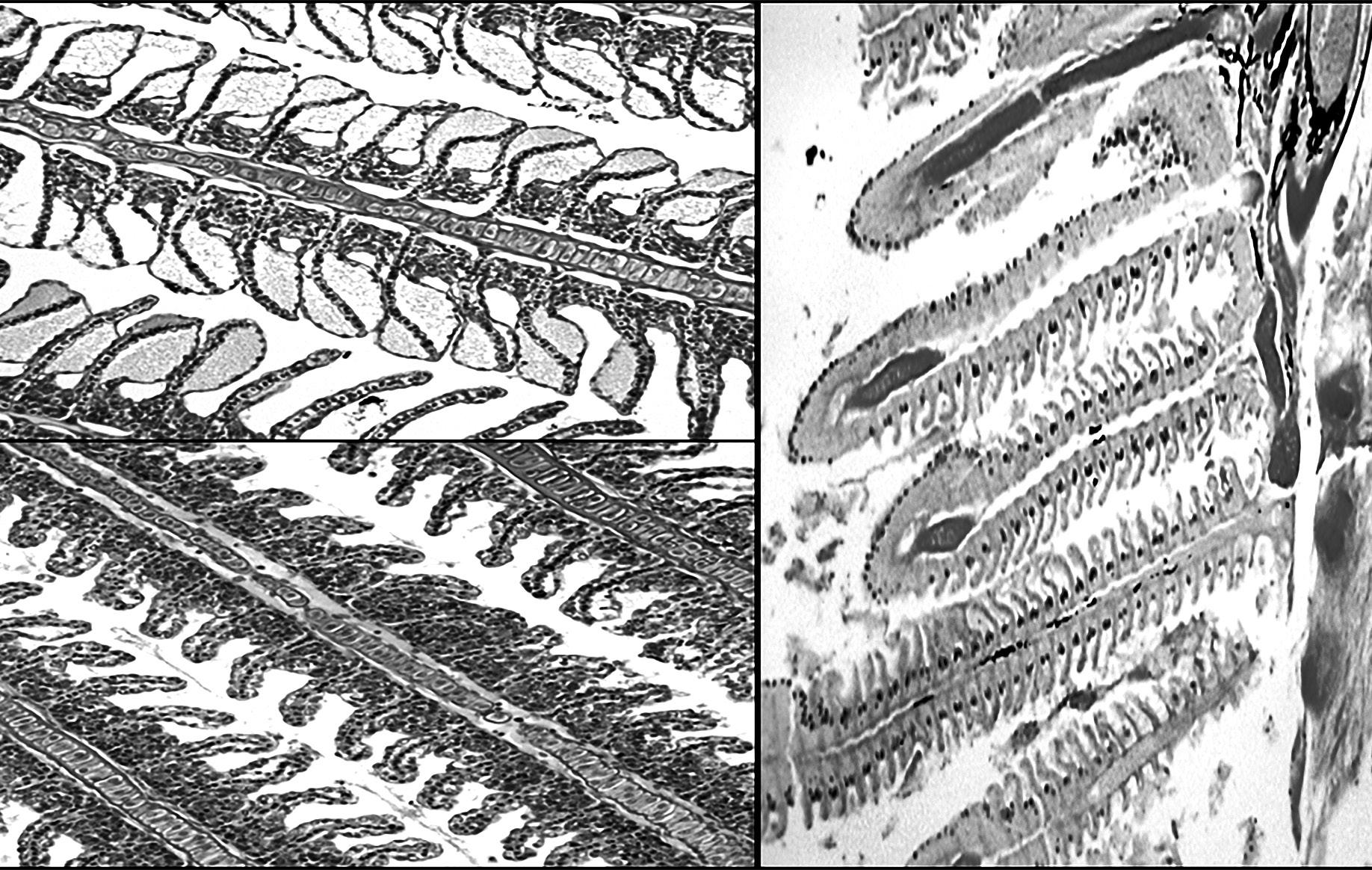
For the past two years, I have been examining the environmental impacts of polyethoxylated tallow amine (POEA), a surfactant paired with the glyphosate in Roundup herbicide.
The surfactant acts to break down the waxy outer layer of weeds allowing the active ingredient, glyphosate, to then rapidly enter the plant and inhibit the production of essential amino acids.
Most recently, I’ve paid particular attention to the effects POEA has on fish gills.
Water bodies close to pesticide application sites are at risk of contamination by spray drift and runoff.
Shallow ponds are considered to be at greatest risk because they have a lower ability to dilute contaminants and are also rich with life.
As it happens, small fish are key in maintaining a balance as both predator and prey in these ponds.
Monitoring the effects of pesticides on these fish can give insight to long-term impacts of pesticides to the greater aquatic ecosystem.
Their gills have two primary functions: gas exchange (oxygen uptake from the surrounding water) and ion regulation (the uptake of sodium chloride and the excretion of metabolic waste).
Since the gills are one of the first organs exposed to a hazardous substance, any changes at the cellular level can be observed to determine how bad a contaminant really is to the aquatic environment.
There are a number of tests that can determine the toxicity of a substance, but if you actually want to track the effects first hand, then histopathological techniques are your best bet.
Diseased and dying
Histopathology is defined as the study of the structure and function of cells in diseased tissues. The word is Greek in origin and is a composite of the root words histos “tissues,” pathos “disease or suffering,” and logia “ study.”
Histopathology incorporates the use of a microscope to examine sections of tissue for changes to the function of cells, which may not be outwardly visible to the naked eye.
Specialized stains are used to highlight specific tissue structures or cellular components, such as cartilage, connective tissue, carbohydrates, and lipids.
It’s often best to implement a series of histological methods in order to confirm findings.
Having the ability to apply multiple techniques to an experimental sample size that may not be considered statistically sound can add sup-
port to otherwise flimsy results.
Applying the techniques
With the help of these techniques, I am currently investigating the histopathological effects of POEA on fathead minnow gills.
Ecosystems are delicately balanced and the slightest offset may cause a cascade of effects.
Hematoxylin and eosin is one out of two stains that I use in my analysis and the most frequently associated with histopathology.
The hematoxylin stains the nuclei of the cells blue and the eosin counterstains the cytoplasm of the cells pink.
One of the most commonly observed alterations to gills is the increase of cell number and size, known as hyperplasia and hypertrophy.
It’s speculated that this swelling of cells is a mechanism to inhibit the contaminant from entering the fish and to protect internal organs.
The trade off, however, is reduction in gas exchange which seals an unfortunate fate for fish.
In order to measure this, I calculate the percentage of surface area of the gills – the smaller the percentage, the less oxygen uptake.
Another alteration associated with injury of gills is the increase of mucous cells.
It’s not difficult to guess what mucous cells do; they secrete mucus. Mucus production increases in response to the exposure of harmful substances.
This happens to us as well – just think about how much you have to blow your nose when you get sick.
Well, fish have this natural response too, and in order to increase mucus production the number of mucous cells increases.
Since mucous cells are carbohydrate-rich, I use a special stain called Periodic-Acid Schiff, which makes it easy to identify these cells.
Remember, these defences come at a cost. Cell damage in gills reduces ion exchange and impairs respiration.
Exposure to contaminants for long durations or at high concentrations can ultimately lead to fish death.
Luckily, no fish died during my exposure and the preliminary results revealed that though cellular damages are observed early on, they decrease over time.
This indicated that POEA at concentrations estimated in the environment breaks down rapidly in water and does not cause permanent damage to the gills.
This is not to say that the results would be the same in a real-life scenario where POEA may be applied up to five times over a growing season.
The design of my experiment is based only on a one-time, mid-sum-
mer herbicide application.
Polyethoxylated tallow amine’s short time in the water column may be good news for fish, but there are many other organisms to consider that live in other niches of aquatic environments – for example, sediment.
Ecosystems are delicately balanced and the slightest offset can cause a cascade of effects.
An organism as insignificant to us as a minnow may have a critical role in the healthy function of the system – remove the minnow and the system collapses.
GRAPHIC PROVIDED BY BAILEY RANKINE
Freaks of Nature: The gastric-brooding frog
The frog that turns its stomach into a womb
BAILEY RANKINE, STAFF
For the first instalment of the “Freaks of Nature” column, we’ll take an up close and personal look at the gastric-brooding frog.
This Australian critter went extinct in the 80s, but just last year, through advanced genomic science, researchers from the University of Newcastle succeeded in creating viable embryos containing all the genetic material of the extinct frog.
Unfortunately, the embryos did not survive longer than a few days, but the advancements in technology provide hope for the re-establishment of species lost due to human impacts.
When it thrived, it occupied small regions of the Blackall and D’Aguilar mountain ranges of Queensland.
Bullfrogs, cane toads, freshwater crayfish, and rats commonly prey on amphibians in this area, but the introduction of the mosquitofish in 1925 was the likely driving force behind this unusual mode of parental care.
The mosquitofish is a major predator on frog eggs and tadpoles and will likely continue to play a role in the decline of Australian amphibian populations.
To avoid digestion of the young, the production of hydrochloric acid in the frog's stomach is stopped by the jelly, called prostaglandin, surrounding each egg. Once hatched, the tadpoles continue to produce this substance through their gills.
When gestation is complete, she vomits her froglets into the world
These ranges are lush with rainforest, providing critical breeding habitat for amphibians.
So, aside from being resurrected, what makes this frog a freak of nature?
Frogs typically lay their eggs in water to prevent dehydration, but the gastric-brooding frog has a different strategy.
It lays its eggs just like any other frog, but then swallows them whole to incubate in the bowels of its belly.
Although permanent water bodies were available, this adaptation was likely developed to protect its offspring from predators.
The mother does not eat for six weeks, while approximately 20 tadpoles hatch and grow inside of her.
Eventually an expanding stomach causes the mother’s lungs to collapse, forcing it to breathe through its semipermeable skin – another very cool adaptation.
When gestation is complete, she vomits her froglets into the world. This process can take as long as a week to complete, but if disturbed, she can regurgitate all of her young in a single, violent heave.
Following their birth, the tiny frogs set out to face the perils of the Australian landscape alone.
GRAPHIC BY BRAM KEAST
ManyFest 2014
September 5-7
Moshi Moshi: Circus, Comedy, Chaos
Circus performers combine laughter with awe
MICHELLE SAROMO, VOLUNTEER STAFF
It was a happy surprise to see the Sept. 5 opening night of the Moshi Moshi: Circus, Comedy, Chaos show at the Gas Station Theatre met with a full house and an enthusiastic crowd.
Winnipeg’s circus arts community is one not often celebrated as audibly as some of the other domains of the performing arts. In the summertime many local circus performers can be seen busking at Old Market Square during the Fringe Festival, but throughout the rest of the year they don’t seem to receive as much press.
Moshi Moshi is a collaborative showcase between local duo Street Circus, composed of seasoned performers Daniel and Kimberly Craig,
and intercontinental comedic pair Funny Bones, composed of Chris Peters and K-Bow Miyagi.
Looking at the quartet together, they appeared to be a haphazard alliance, but their respective acts actually served to complement each other. The comical antics of Funny Bones balanced out the dramatic performances of Street Circus. The transition between acts was harmonious. One moment, Daniel was on the Cyr wheel, showing his strength and self-mastery as he maneuvered around the stage with utmost control, the audience watching his every movement with bated breath.
The next moment, Peters broke the intensely reverent atmosphere as he mimed Daniel’s performance with a jealous grimace; with his ability to read a crowd and play off of their reactions, he made them laugh and put them back at ease.
Kimberly was the epitome of grace, and her previous formal training as a competitive figure skater was made apparent in the admirable discipline she displayed throughout her performance. Smiling as she hung only by her feet on a swinging hoop, she made it look easy – and surely, it couldn’t be.
Miyagi’s subtlety and quiet wit kept the audience guessing at what
he’d do next. A master of distraction, he won the audience’s sympathy as he acted profusely apologetic, then shook them into laughter as he maniacally bolted from the scene. His exacting performance was refined and consistently delightful, garnering laughs from beginning to end.
Each artist brought something unique to the circus and kept it from ever having a dull moment.
The show was littered with a lot of comedy as promised, but relatively less chaos – which wasn’t necessarily a bad thing. The only time it was somewhat chaotic was when the Funny Bones troupe tried to interact or “pick fights” with audience members.
And even then, they improvised off of members’ reactions so well that any disorderliness started was quickly adjourned.
The duo kept the aspect of unpredictability in chaos intact, without all of the confusion that goes along with it.
Moshi Moshi is a true collaboration of talents. It was a pleasure to witness such experienced artists really sharing the stage with each other and showcasing skills that are not lauded often enough in the Winnipeg arts scene.
PHOTOS BY KATY MACKINNON
Word up: Wordsmiths gather for annual event
Events planned for all reading levels, hilarity to ensue
KATY MACKINNON, STAFF
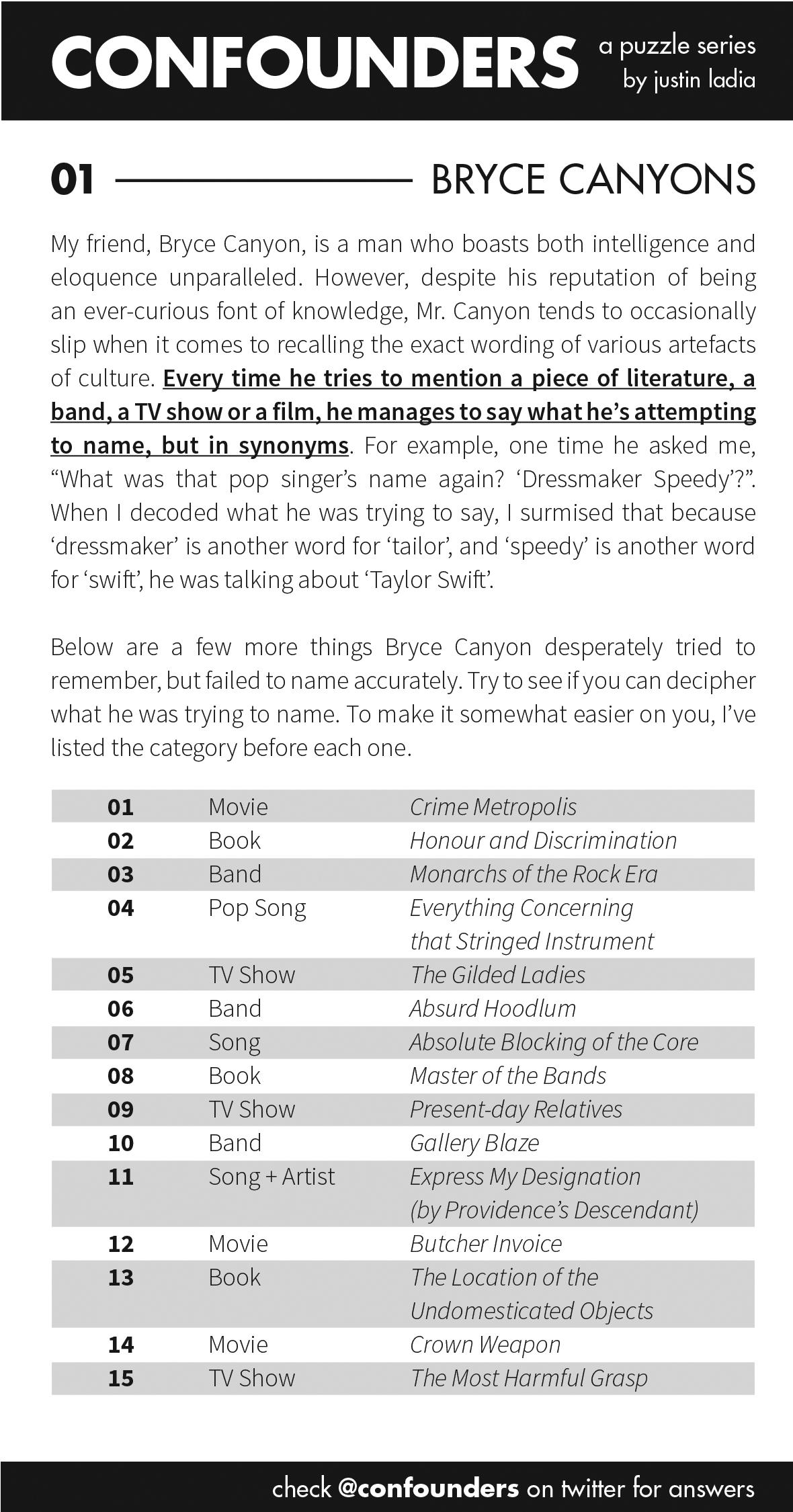
Distinguished authors from around the world will be gracing our city during Thin Air, the Winnipeg International Writers Festival beginning this Friday, Sept. 19. The nine-day festival is filled with a variety of events for all ages and reading levels, including lectures, book chats, readings, and more.
Governor General’s Awardwinner Eleanor Catton is set to open the evening programming of the festival at 7:30 p.m. on Sept. 19 at the Centre culturel franco-manitobain.
Catton will be reading from her most recent novel, The Luminaries, and will follow that with a discussion with festival director Charlene Diehl.
The novel takes place during the New Zealand gold rush of the 1860s. The pages are filled with mystery as the main character finds himself involved with a group discussing unsolved events, including a wealthy man who has vanished.
Forewords, a performance-oriented event sure to attract a crowd, takes place Sept. 20 at 8 p.m. During the event, the Winnipeg Poetry Slam Team is set to perform pieces of their winning work.
Tom Howell, a lexicographer (dictionary writer) will be giving the “uncensored history of English, full of all the bad words and dubious histories.”
“It’s very funny,” says Diehl. “It’s
kind of like a cross between the Oxford English Dictionary and the Monty Python sketch.”
The evening will end with a Haiku Death Match, where contestants will recite original haikus and perform them to the vote of the crowd. The match has been very amusing in previous years, according to Diehl.
“These contestants say things you cannot believe they would have the nerve to say, all in 17-syllable chunks,” says Diehl.
The festival is hosting a campus program, with events at the University of Manitoba, the University of Winnipeg, Red River College, Canadian Mennonite University, Université de Saint-
Boniface, and Brandon University.
Three free events will be held at the U of M.
Hear a reading from Caroline Adderson from her novel Ellen in Pieces, a story about a single mother navigating the challenges of middle age, on Sept. 23 from 1-2:15 p.m. in 108 St. John’s College.
Leanne Betasamosake Simpson will be reading from her story collection, Islands of Decolonial Love, on Sept. 23 from 1-2:15 p.m. at Migizii Agamik Aboriginal Student Centre.
Literary gothic writer Eric McCormack will read from his new novel, Cloud, on Sept. 25 from 1-2:15 p.m. in 108 St. John’s College.
“He’s an absolute delight, with an
outrageous sense of humour and very sparkly eyes,” says Diehl.
The festival will end with an openmic poetry slam on Sept. 27 at the Free Press News Café. If you’re a spoken-word enthusiast aged 22 and under, you can participate in the slam; if you’re older, well, you’ll just have to sit back and enjoy the “music” to your ears.
Whether you’re a novice reader, an English major, or looking for an entertaining way to spend an evening, Thin Air is sure to bring delight to all audiences.
Miriam Toews and her Puny Sorrows
Celebrated author comes home to Thin Air
LAUREN SIDDALL, VOLUNTEER STAFF
ward-winning author Miriam
AToews is making her way back to Winnipeg to take part in Thin Air, the Winnipeg International Writers Festival.
Toews will be participating in two events at the Thin Air Festival, both on Sept. 23.
The first (free) event is the Afternoon Book Chat at McNally Robinson from 2:30-3:30 p.m. Toews accompanies Audrey Thomas, author of Governor General’s Awardnominated and Ethel Wilson Fiction Prize-recipient novel Intertidal Life, to discuss their tendency to confront difficult, imperative themes within their critically acclaimed novels.
Later that evening, Toews will join Caroline Adderson, Monia Mazigh, Audrey Thomas, Alison Pick, and Joan Thomas on the main stage at the Shaw Performing Arts Centre (MTYP) from 7:30-10 p.m. These Canadian women will be speaking about adventuring into the lives of girls and women within their recent novels. Admission is $12.
Toews was born in Steinbach before moving to Winnipeg.
She draws from her experience of growing up in a strongly religious community in her novels, most notably in her Governor General’s Awardwinning and Giller Prize-nominated novel A Complicated Kindness. This novel is centred on 16-year-old Nomi Nickel, who lives in East Village, Manitoba – a thinly veiled version
of her hometown, Steinbach.
Nickel has ambitions of travelling to New York City, rather than being trapped in her oppressive hometown where the biggest opportunities are slaughtering chickens or churning butter, and where there is absolutely no drinking, dancing, recreational sex, jewelry, makeup, or staying up past nine o’clock.
Already receiving incredibly upstanding reviews, All My Puny Sorrows offers an illuminating reflection of the limits of love and the seemingly unimaginable challenges we overcome
Within the novel, Toews’ brilliant first-person narrative alternates effortlessly between the past and the present as Nomi reminisces on the time spent with her recently moved out sister, Tash, and her mother. In Toews’ most recent novel, All My Puny Sorrows, Toews explores the lives of two sisters, Elf and Yoli.
Elf is a world-renowned pianist who pours her heart into every piece she performs. She is about to go on her highly anticipated world tour. She also wants to die.
Following Elf’s latest suicide attempt, Yoli takes it upon herself to ensure her sister’s well-being. She balances this tremendous task with keeping her teenage kids happy, keeping her exes and her newly exhusband from hating her, and maintaining her own sanity.
This proves to be a lot for Yoli, yet she manages to preserve her wickedly funny sense of humour as she navigates through all her sorrows.
Already receiving incredibly outstanding reviews, All My Puny Sorrows offers an illuminating reflection of the limits of love and the seemingly unimaginable challenges we overcome.
A novel of somber meditation of suicidal thoughts, Toews draws from the extremely personal experiences of both her father and sister’s suicides to create the major conflict in All My Puny Sorrows
Toews’ personal connection to the plot creates an underlying feeling of sadness throughout the novel, even underneath Toews’ signature sense of humour. All My Puny Sorrows is impossible to put down.
Be sure to welcome this celebrated author home at this year’s Thin Air.
BY
PHOTO
LAUREN SIDDALL
Review: Black Rock, by John McFetridge
Murder mystery characters lack depth
MEG CRANE, VOLUNTEER STAFF
Whiney teenage girls. Strippers. Hippy college students who are political around men and flirty when alone. Dead women.
Black Rock by John McFetridge is packed with women, but their personalities are flat and stereotypical.
As the cops run around in 1970s Montreal to find bombs and kidnappers, the protagonist Eddie Dougherty is searching for the murderer of five women, all who are suspected sexual deviants, prostitutes, or drug users. His search leads him to packed bars, strip clubs, and the neighbourhood he grew up in.
While the novel touches on feminist topics like women in the workforce, specifically the police force, there isn’t actually a woman police officer in the novel.
Even the love interest, Ruth— who Dougherty refers to as different from other women—really isn’t that deep. She only cares about discussing murders and having sex with him.
Beyond the characters, references to a 15-year-old’s cleavage and “dykes” make this an uncomfortable read. It’s hard to understand why Dougherty feels like he was supposed to be looking at his server’s ass when eating at an A&W drive-in, and it’s pretty awkward when Dougherty’s dad asks how long it will be until his teenage daughter’s friend is knocked up.
The male characters in Black Rock aren’t that developed, either.
We don’t learn much about Dougherty, besides that he likes to talk to his childhood bully now that he’s a cop (it makes him feel powerful).
Before you can get past the lack of original characters, you must get past the run-on sentences, often containing more than one character’s dialogue. Dougherty does not have enough of a distinct voice to set him apart from other characters.
Despite it being confusing, the style works for a 1970s cop mystery. It
becomes easier to read as you adjust to paragraph-long sentences.
For most of the book, the plot seems worth trudging through.
Wanting to know who committed the murders was enough suspense, but the reader also becomes curious as to why the murders were so different, why the murderer wrapped torn bed sheets around some of the victim’s necks, and what the murder of a man had to do with the plot.
In the end, these questions were either left unanswered or a letdown that seemed like a cheap way out.
If you can get past the lack of diversity in the characters, it’s a good read when you need something trashy to kick back with but want to learn a bit of Montreal geography and history.
Hear a reading of Black Rock from John McFetridge on Sept. 20 from 3-4 p.m. at the Park Theatre. Admission is $5.
Cover to cover with Carlyn
Waiting for the Man, by Arjun Basu
CARLYN SCHELLENBERG, STAFF
J
oe is a 30-something New Yorker searching for meaning in his life beyond the falsity of his copywriting career. So much so that when he envisions a man that no one else can see, a man that sits around and, once in a while, tells him what to do, Joe decides to sit on a set of steps and wait for the man to direct him. There’s also camera crews documenting his every move; people dig this stuff.
Of course, it’s an allegory – for instant celebrity and the entertainment of today. Joe ends up travelling west across the country courtesy of his growing media following and at the word of the man. Partway through his journey he picks up a Japanese hitchhiker wanting to see America, who consequently becomes famous in both of their countries.
Joe ends up in Montana, at first working in the kitchen of a dude ranch (a luxurious nature getaway) and eventually moving up to advertising – a field, ironically, he had run away from.
The chapters in the novel alternate between the time in which he is waiting, and the future in which he has presumably found what he’d been looking for – leading up to what the reader can only hope is some sort of epiphany after the theatrics.
The
protagonist’s inner thoughts are incessantly provided, and he is an asshole to basically every other character
Waiting for the Man, by Montreal writer Arjun Basu, is a spot-on allegory focusing on advertising and reality television – fitting from an author who writes 140-character stories on Twitter.
The product placement through-
out the novel is apt, and in this passage, Joe reaches at the emptiness of working in advertising:
“How would we know what to buy or wear or eat or watch on TV without advertising? How would we know who to cheer for without advertising or marketing or PR? How would we consume the world’s stories? How would we get out of bed?”
Waiting for the Man soon becomes pretentious, as the narrator’s questions don’t stop. The entitled protagonist’s inner existential thoughts are incessantly provided, and he is an asshole to basically every other character, especially Dan, the journalist/makeshift PR person footing Joe’s expenses and finding him sponsors.
Still, Waiting for the Man had this reviewer glued to the page. The premise is so preposterous that it’s entertaining. Basu has tweeted against claims that the plot is unrealistic, citing an example of the public following a story of a woman who walked across the U.S. in two months this summer.
Waiting for the Man is an important look at the current state of media and our relation to it. The novel is captivating, regardless of its pretension.
Arjun Basu will be reading and speaking at Thin Air: Winnipeg International Writers Festival on Sept. 22 at 11 a.m. at Red River College and 7:30 p.m. at MTYP
Bisons boot Wesmen back to downtown campus
University of Manitoba shuts out University of Winnipeg 2014 Duckworth Challenge opener
DAVID GRAD, VOLUNTEER STAFF
The University of Manitoba Bison women’s soccer team played host to the Winnipeg Wesmen this weekend in the first Duckworth Challenge event of the year.
Last year, Manitoba dominated the Wesmen, winning every Duckworth Challenge between the two city rivals in all varsity sports. On Saturday the Bisons kept the streak against Winnipeg alive with a wellearned 2-0 shutout.
Coach Vanessa MartinezLagunas was enthusiastic about the improved play of her team.
“We worked really hard this week preparing for this game [. . .] especially since our last game against Saskatchewan,” said Martinez-Lagunas.
“We got scored on by two corner kicks that game. We are a lot stronger in that aspect. We also worked a lot on ball possession, combination play, and our finishing,”
The Bisons poured the pressure on early and often. Rookie forwards Bruna Mavignier and Camille Plett continue to cause problems for opponents with their chemistry on the attack.
teams went into the break scoreless.
The crowd was sent into a frenzy in the second half by a flash of speed and skill from forward Selina Speranza, who outpaced the Wesmen defence down the wing and buried a shot low to open scoring in the 50th minute.
Deja vu struck moments later when Speranza’s speed beat the Wesmen down the same wing and forced the Wesmen goaltender into a bumbling save.
“Players that
came from the
bench
made
the
difference.
That
shows that the competition level on
In her first game, forward Jasmine Flett put the Wesmen away late in the second with a highlight reel goal. The crowd was brought to their feet after Flett maneuvered past a Wesmen defenceman, dodged a sprawling goaltender, and hauledin a wayward ball to bury a strike in an open net.
our team is really high” –Vanessa MartinezLagunas, head coach, Bison women’s soccer
In the early stages of the game, Mavignier weaved through the Wesmen defence and found an open Plett for a great strike that beat the goaltender but sailed just high of the cross bar, narrowly missing out on a chance to put the Bisons ahead.
Manitoba dictated the pace for most of the first half, but was unable to find the back of the net, as the two
Youth and energy continues to be the story for the Bisons as they improve to 2-1, with contributions on the score sheet from a rookie in each game. The energy and skill brought by the young Bison players has had a significant impact on the competition level for this squad.
“Players that came from the bench made the difference,” Martinez-Lagunas said on the contributions from Speranza and Plett. “That shows that the competition level on our team is really high.”
The Bisons take to the road for the next two weeks, as they continue their push for playoffs. First up is Grant MacEwan in Edmonton on Sunday, Sept. 21 at 1 p.m.
PHOTOS BY SHAWN COATES
‘Home is where the heart is’
Bison football gets first win of season in home opener
MIKE STILL, STAFF
Coming off a tough loss in Saskatchewan to start the season, the University of Manitoba Bisons returned home this past weekend and put on a show for the 6,435 fans in attendance.
Manitoba was dominant in all three facets of the game, which led to a 42-16 victory.
In a matchup that was billed as a battle of the quarterbacks, it was Jordan Yantz who stepped up for the Bisons. The offensive captain ended the night with four scores –two through the air, and two on the ground.
Cayman Shutter didn’t fare as well for Regina, frequently feeling pressure from the Bison front seven. He threw for just 157 yards, and two interceptions before being benched late in the third quarter.
The potent Ram attack was stymied by the Bison defence all night long, with Regina’s triple threat of receivers turning into virtual non-factors.
First half summary
Much like last week, the Bisons got off to a blazing start on offence. Yantz flashed his speed on the first drive for Manitoba, taking a bootleg 55 yards all the way to the Regina 16-yard line. Kienan LaFrance finished things off on the following play, waltzing into the end zone on a pass from Yantz, at 3:19 of the first quarter.
Regina had a huge chance to
answer back just over nine minutes in, after a forced fumble by Joey Dwyer was recovered by the Rams. They looked to have tied things up on the ensuing drive at the Manitoba 42-yard line, as receiver Mitch Thompson got behind the Bison secondary with the ball in the air. Unfortunately for Thompson, the goal post had other ideas, stopping him directly in his tracks. Thankfully, he was able to get up and walk off under his own power.
The Rams would get on the board with 4:33 left in the first quarter, after Manitoba was forced to concede a safety. The two points were set up after a sack by defensive lineman Dean Viena deep in Bison territory.
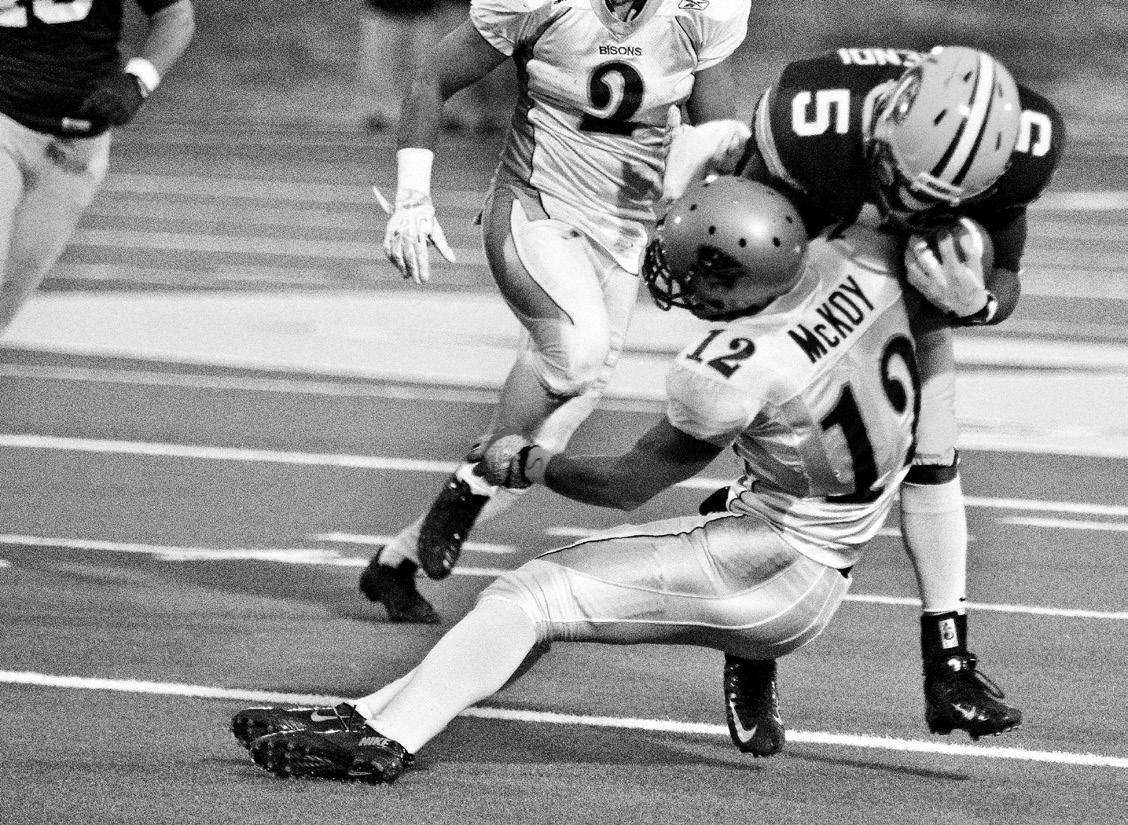
Regina looked to find the end zone on their final drive of the first quarter, as a pass interference call set them up on the Manitoba 27-yard line. However, Jayden McKoy was able to pick off the following Shutter pass that was thrown into double coverage. It was McKoy’s—who redshirted last year—first career CIS interception.
The turnover fired up Manitoba, who proceeded to outscore Regina 20-0 in the second quarter, and 15-7 in the third.
LaFrance initiated the onslaught, scoring from one yard out on a run play with 6:55 left in the half. The touchdown was aided by the Bisons’ special teams unit, as Alex Christie busted through and blocked the
attempted Andrew Fabian punt, setting up Manitoba at the Regina one-yard line. Ryan Jones would miss the convert, making the score 13-2 for the Bisons.
Manitoba opened up the second half with three consecutive scoring drives, putting the game completely out of reach
Manitoba kept on rolling from there. Linebacker Jonathan Jones intercepted Shutter on the ensuing drive, taking the pass 52 yards to the house. He finished the night with three tackles, a pick six, a sack, and a forced fumble.
The home squad would finish off their first half destruction with 1:12 left, as Yantz would keep it himself from four yards out. Just like the LaFrance rushing touchdown, Yantz’s score was set up by stout special teams. This time it was Houston Rennie, who stuffed Fabian as he attempted a fake punt.
Second half summary
Manitoba opened up the second half with three consecutive scoring
drives, putting the game completely out of reach.
The opening drive for Manitoba turned into the Nic Demski show. After being held catch-less in the first half, he went off for 71 yards to begin the third quarter. Demski had all three catches for the Bisons, finishing things off with a 26-yard reception less than a minute and a half in, making the score 34-2 for Manitoba.
The Bisons would put another seven on the board on their next drive, which lasted eight plays, and took up 3:16 on the clock. Yantz provided his second rushing major of the game, this one from eight yards out.
Manitoba would cap their scoring with 4:18 left in the third, after Andrew Jones missed a 19-yard field goal, resulting in a single.
Both teams would rest their starters shortly afterwards, as the final minutes of the third quarter, and all of the fourth saw numerous amounts of backups for either side.
Regina got on the board late in the third, and provided the only points of the fourth, as backup quarterback Noah Picton found receiver Mitchell Picton twice. The first connection was at 13:32 of the third quarter, and the second at 8:42 into the fourth. Regina added a safety in between to round out the scoring.
Discussions with Dobie
Head coach Brian Dobie felt the team lacked a rhythm to begin the
matchup, but was proud of the players stepping up as the game went along. He used the examples of the blocked punt from Christie and the interception from McKoy as important factors that turned Manitoba’s performance around.
“The players made plays, I don’t know how else to articulate [that],” said Dobie.
“It was certain plays, I think, as much as anything that sparked us. Then once that happened, then it became three units – special teams, offence, and defence were pretty much in sync.”
Takeaways for Manitoba
On offence, Alex Vitt was yet again the favourite receiver for Yantz, hauling in six receptions for 105 yards. Demski—the number-one-ranked CIS prospect in the fall CFL scouting bureau—successfully returned to action, recording all three of his receptions in the third quarter.
On defence, two Miles Macdonell graduates—McKoy and Rennie— had big games for the Bisons. McKoy recorded an interception and three tackles; along with stuffing Fabian on a fake punt, Rennie also recovered the blocked punt from Christie in the second quarter.
Manitoba will stay at home this week, as they welcome UBC to town on Sept. 20 at 2 p.m. for their annual homecoming game.
PHOTO BY DAVID LIPNOWSKI
Dakota defensive lineman becomes youngest recruit in Bison football history
MIKE STILL, STAFF
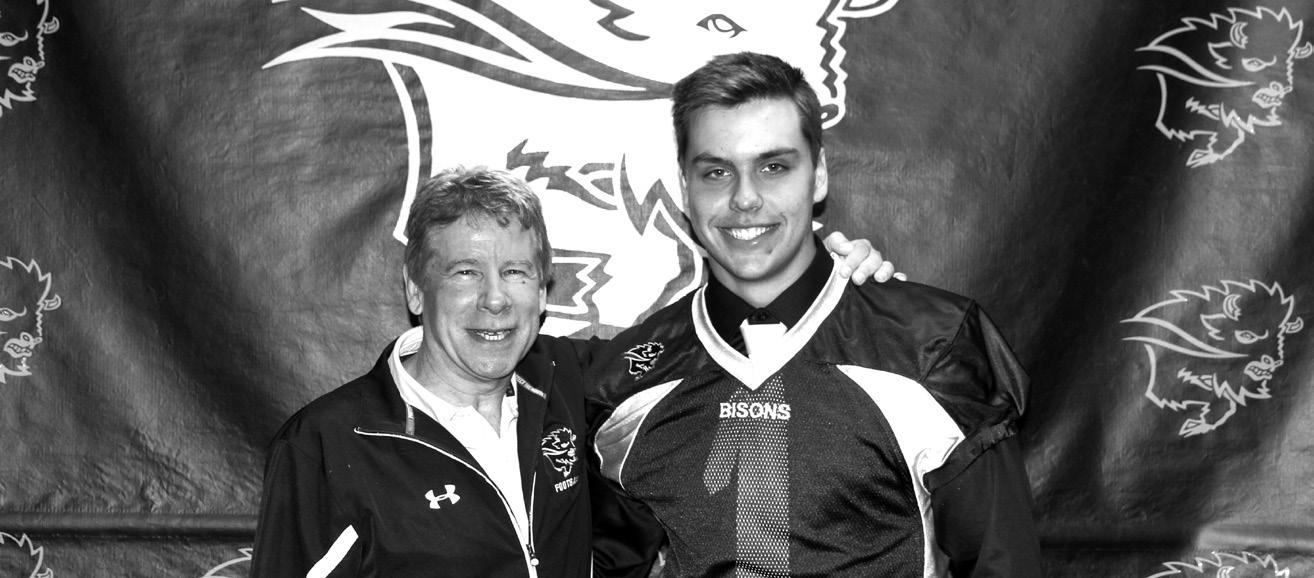
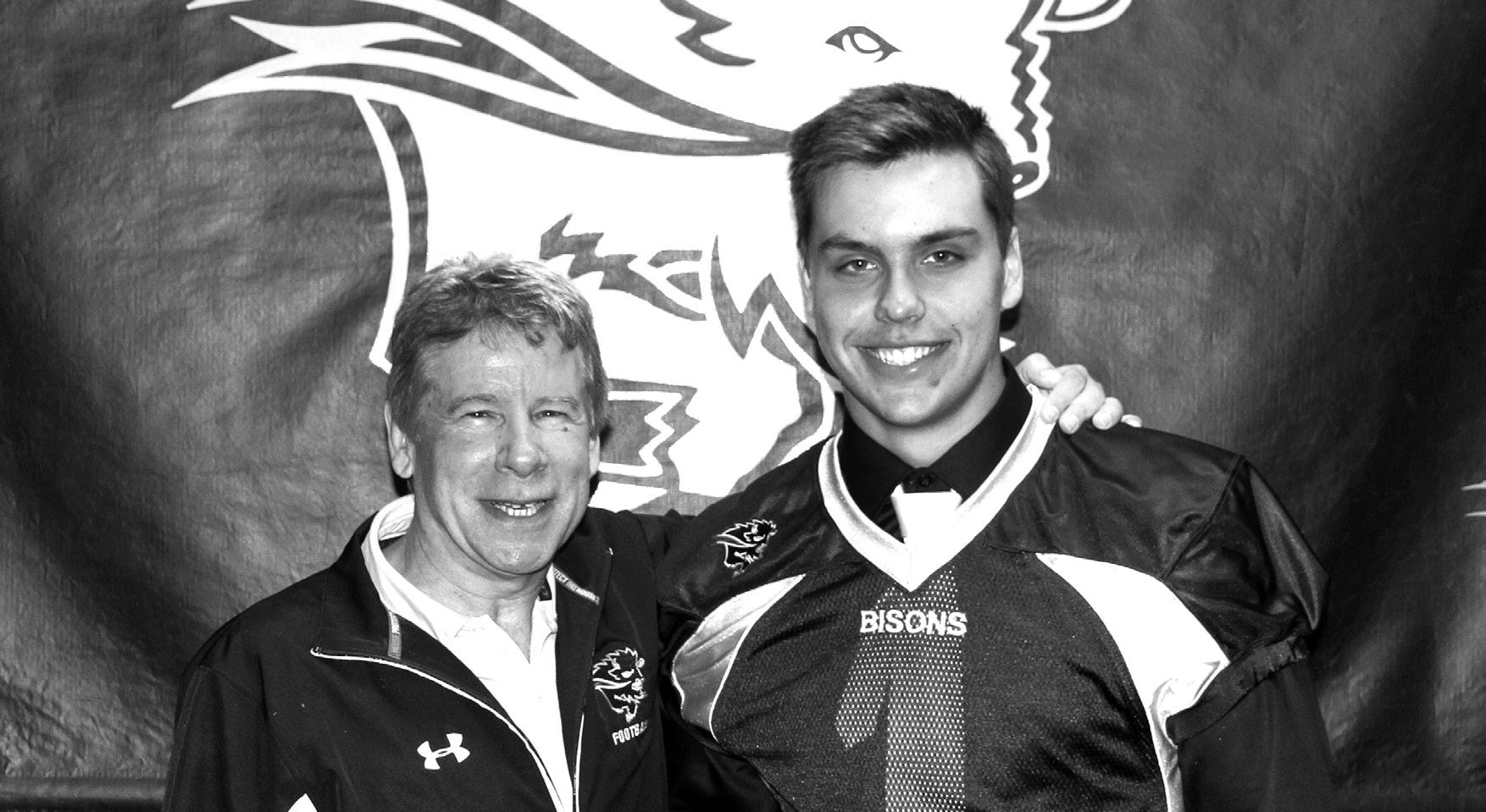
Sept. 1, 2014 will forever be a memorable date for Derek Dufault.
It was on this day that the 16-year-old defensive end took the next step in his football career, verbally committing to play for the University of Manitoba. Eight days later, he signed his letter of intent, becoming the youngest player ever to commit to playing with the Bison football team.
According to Dufault, there were a number of factors that aided in his decision to commit so early.
“It’s home and when I was at the facility I just felt at home,” Dufault said. “It’s a really good program, really competitive. The stadium is amazing to play at, the weight room is unbelievable, and all the coaches treated me very well.”
According to Dufault, there were 10 or 11 universities actively recruiting him, but only two others (McMaster and UBC) that he thought long and hard about.
Looking at Dufault’s current football resume, it’s not difficult to figure out why so many schools wanted his talents. Last season, the 6’2”, 227-pound product from Dakota Collegiate led the John Potter (AAA) Division with 10 sacks, 32 tackles, two forced fumbles, one safety, and a blocked punt. Dufault was also a defensive captain for Team Manitoba at the U18 Football Canada Cup this past summer, and was named an all-star at the U16 Red River Cup in 2012. His performance earned him a
spot on the Canada Football Chat Top 100 list for 2015, as he still has one more season of high school football remaining.
The 16-year-old said he has been playing football since he was eight years old, and started thinking about playing post-secondary in grade nine, when he began getting attention from scouts. That attention only increased as the years went along, including from Manitoba, and head coach Brian Dobie.
Dufault described the decision-
“We have plans too, and we have a structure, and he fits into our plans. It’s a big relief to sign Derek Dufault” – Brian Dobie, head coach, Manitoba Bison football
making process, emphasizing Dobie’s persistence.
“I’ve been thinking about [playing university football] constantly,” said Dufault. “Talking to a lot of coaches, talking to Dobie constantly for the last month straight.”
Dobie also touched on the ongoing process of recruiting a young player like Dufault.
“There’s a lot put into it, there’s a number of visits,” said Dobie.
“Positional coaches meeting with him, our defensive co-ordinator Stan Pierre had meetings with him [ . . . ] We’ve signed one of the best defensive ends in the nation, it affects the rest of my recruiting in that positional area.
“[Derek’s] a great kid, a great person first and foremost, and an outstanding athlete.”
Knowing how many teams wanted Dufault made his commitment that much more rewarding to Dobie.
“Did we want to sign him early? Yes we did,” said Dobie. “We have plans too [for our team], and we have a structure, and he fits into our plans. It’s a big relief to sign Derek Dufault.”
The defensive end said that there was a certain amount of hesitation at first when trying to make his decision. He had even considered playing junior football for a year after high school in order to increase his speed and size, but was convinced otherwise.
“It’s pretty stressful, of course,” Dufault said. “University is where you’re going to spend the next six years of your life so you’ve got to make sure you know where you want to go.
“As soon as I made up my mind that I wanted to stay at home it was an easy choice: U of M, all the way.”
The
two Bison football players share experiences in U19 World Championship
MIKE STILL, STAFF
It was a very special summer for two University of Manitoba Bison football players.
From June 29 until July 17, second-year defensive back Jayden McKoy and first-year receiver Trysten Dyce had the opportunity to represent Team Canada at the 2014 International Federation of American Football U19 World Championship. The 45-man roster was chosen from a pool of 93 players.
Dyce said the practice schedule was intense.
“We started practising from six until 10 every night, so we had a four-hour practice cut up into two. It was really tough, actually.”
The training camp for Team Canada occurred from June 29 to July 4 in Italy.
Once the team finished camp, they flew directly to Kuwait, where the tournament was hosted, beginning on July 5. Canada played in a division with three other teams: Kuwait, France, and Austria.
While Team Canada outscored their divisional opponents 183-7, McKoy still felt that there was a fair amount of competitiveness, and was excited to see football gaining momentum in other countries.
“The guys we went up against knew what they were doing, they knew how to play football,” said McKoy.
“It was cool just to see that countries like France and Austria have been playing football, and that it’s developing across the world.”
After winning their division, Canada advanced directly to the gold medal game, where they fell 40-17 to their rivals from the United States. Despite the loss, McKoy
felt that Canada is closing the gap between the two countries.
“Against the U.S., everyone hypes them up so much, but we kind of felt that we belonged,” said McKoy. “I don’t think the score really showed the difference in level of competition.”
Despite the loss in the gold medal game, both Dyce and McKoy enjoyed the experience as a whole.
Dyce said Kuwait did a great job of hosting the event.
“One of the princes of Kuwait was there to greet us when we landed, and he was at every game. He seemed to support [football] a lot,” said Dyce.
For McKoy, the World Championship gave him the chance to hone his skills as a defensive back. The second-year player said he had previously played safety in high school, but didn’t get the opportunity to broaden his skills at the other positions in the secondary.
“It was good to be able to play four games just playing DB, getting kind of used to it, because it wasn’t something that I really did back in high school.”
Due to the World Championship taking place in June and July, the two Winnipeg natives also got the opportunity to hone their skills before main camp with the Bisons started.
“To be able to play football, it was the first time playing in six months,” said McKoy.
“Not everyone gets the opportunity to play that much football during the off-season, so it was good to be able to bring that back.”
PHOTO BY RANDY SAVOIE
PHOTO PROVIDED BY BISON SPORTS
Player profile
Sitting down with Bison goalkeeper Martina Arran
DAVID GRAD, VOLUNTEER STAFF
Martina Arran is a third-year player from La Salle, Manitoba in the faculty of agricultural and food sciences. She previously played for the St. Norbert Celtics, as well as Winnipeg South End United. This is her first year as starting goalie with the Bisons.
Marti, as she is known, also organizes Bison Pride Fridays on campus, where she brings together a group of athletes every week to hand out prizes, interact, and invite students to Bison games.
Emily Erickson, from the CIS national championship women’s volleyball team, interviewed Arran.
EMILY ERICKSON: What’s your favourite colour?
MARTINA ARRAN: Orange. Not really a fan of teal [her goalie uniform is 100 per cent teal].
EE: What kind of music gets you
pumped up before a game?
MA: It’s a very varied playlist. [I] kind of like to put a lot together; everyone’s taste kind of comes into one, so everyone gets pumped up.
EE: What goes through your mind when you make a save?
MA: “Holy shoot I just did that, now I gotta breathe!”
EE: Is goalie your favourite position?
MA: I think it’s my favourite. Sometimes in scrimmages I like to play forward, it’s good to get a feel for different positions. I’m actually not bad at it.
Watch the full interview at www. themanitoban.com and the Big Horns’ Facebook page (www. facebook.com/thebighorns).