A “volunteer staff” member is defined as a person who has had three volunteer articles, photographs, or pieces of art of reasonable length and/or substance published in three different issues of the current publishing year of the Manitoban. Any individual who qualifies must be voted in by a majority vote at a Manitoban staff meeting. Elected representatives and non-students may be excluded from holding votes as volunteer staff members in accordance with the Manitoban Constitution. The Manitoban is the official student newspaper of the University of Manitoba. It is published monthly during the summer and each week of regular classes during the academic year by the Manitoban Newspaper Publications Corporation.
UMSU council demands apology from CFS executives over alleged harassment at national general meeting
LEVI GARBER, STAFF
The University of Manitoba Students’ Union (UMSU) council passed an emergency motion Dec. 8 demanding an apology from the national executive of the Canadian Federation of Students (CFS) for its treatment of UMSU executives at the CFS national general meeting in November.
The motion also recommends UMSU’s ongoing efforts to reconcile with CFS following a three-year dispute be halted until a formal apology is issued.
The emergency motion was introduced to council following a presentation from UMSU vice-president external Wilfred Sam-King, vicepresident internal Adam Pawlak, and the union’s governance assistant Mark Stewart, detailing UMSU’s contentious history with CFS and the events that took place at the general meeting last month in Ottawa.
UMSU president Tanjit Nagra claims that during the CFS national general meeting last month in Ottawa, University of Winnipeg Students’ Association vice-president student affairs and CFS-MB women’s commissioner Laura Garinger verbally harassed her over union fee increases previously passed by UMSU.
The harassment allegedly took place after UMSU executives brought forward a motion that would amend CFS’s policy on international students, calling for the national union to advocate for international student fee increases to be locked at the same percentage increase as domestic students.
In Manitoba, this would ensure international students’ tuition fees don’t rise faster than the rate of inflation, as domestic students’ tuition
increases are currently capped at the rate of inflation.
In provinces where there is no cap on domestic student tuition fee increases, it would only ensure that international students’ tuition fees don’t increase at a higher percentage than other students.
“The motion presented at the UMSU council meeting was largely in response to the presentation that was made in the meeting” - Karas Elbardisy, outgoing UMSU chair
CFS’s policy handbook currently calls for the union to advocate for the abolishment of tuition fees altogether, as well as for the removal of any difference between domestic and international students’ fees.
The presentation given on Thursday by Sam-King, Pawlak, and Stewart claimed that when Nagra became emotional when speaking about the motion, CFS national executives laughed at her.
“UMSU personnel were personally victimized and verbally attacked during closing plenary,” the presentation reads. “The situation was not remedied until UMSU demanded the plenary chair and CFS executive director to remove the harassers from the area.”
Emergency motion
President of the Pakistani Students’ Association Masroor Khan, who attended the meeting as a proxy for international students’ representative Steffan Aganbi, introduced the emergency motion.
Emergency motions may only be voted on by council if the chair rules that the motion is both time-sensitive and could not have been brought forward at an earlier time.
The outgoing UMSU chair Karas Elbardisy, who is vacating his position due to a scheduling conflict for future council meetings, said that the motion qualified as an emergency.
“The motion presented at the UMSU Council meeting was largely in response to the presentation that was made in the meeting,” Elbardisy said in an email. “As such it could not have been prepared and submitted ahead of time by the member, as he was not aware of all the issues [...] prior to said presentation.”
“The motion was in response to a specific set of circumstances, the [NGM] in November, and the motion would be less relevant after the winter break,” he said. “No councillor raised an objection, which serves to validate the decision.”
The next UMSU council meeting is scheduled for Jan. 5.
Khan said he brought forward the motion because he feels the mistreatment of the UMSU executives in Ottawa is not only disrespectful to the union, but to international students as well, whose concerns he said were being represented in the motion that UMSU had put forward.
“I thought that the mistreatment that the national body [of CFS] has done with our executive was completely an act of hypocrisy,” he said.
Khan also said that although the provincial wing of CFS has been receptive and understanding of international students’ issues, the national executive has been the opposite.
“On the one hand, the provincial body seems to be very collaborative, but on the other hand the national body seems to ridicule and ignore the demands of international students and disrespects them”
- Masroor Khan, president of the Pakistani Students’ Association
“On the one hand, the provincial body seems to be very collaborative, but on the other hand the national body seems to ridicule and ignore the demands of international students and disrespects [them],” Khan said.
The emergency motion passed overwhelmingly by a hand vote, with only three councillors voting against it.
Past disputes
The presentation delivered by Sam-King, Pawlak, and Stewart also went through a number of instances
over the last three years in which UMSU and CFS have been at odds with one another.
In 2013, UMSU held a review of the union’s membership in CFS following a dispute regarding day-timers. Members of the then-UMSU executive ripped pages of CFS promotional material out of 20,000 student day-timers after learning they were unable to cancel a contract signed by the previous executive for the purchase of the promotional materials.
In June, UMSU council finally agreed to pay CFS nearly $1 million in outstanding fees that had been withheld over the previous 3 years.
In March, then-UMSU council voted to condemn the provincial chapter, CFS-Manitoba (CFS-MB), for expressing what it called political favouritism toward the Manitoba NDP during the spring provincial election after the lobbying group made statements praising the party’s education-related campaign promises.
At the CFS general meeting in July, Sam-King and Brandon University Students’ Union president Nick Brown got into a verbal altercation over UMSU’s unpaid membership fees to CFS, according to Sam-King.
On Nov. 2, Sam-King was allegedly prevented from addressing students at CFS’s National Day of Action at the Manitoba legislature, where students from all of the province’s major universities rallied, demanding free post-secondary education.
PHOTO BY CHANTAL ZDAN
University picks up tab to extend U-Pass
U of M will cover transit costs for more than 2,000 students not enrolled in winter term to finish fall semester
GARETT WILLIAMS, STAFF
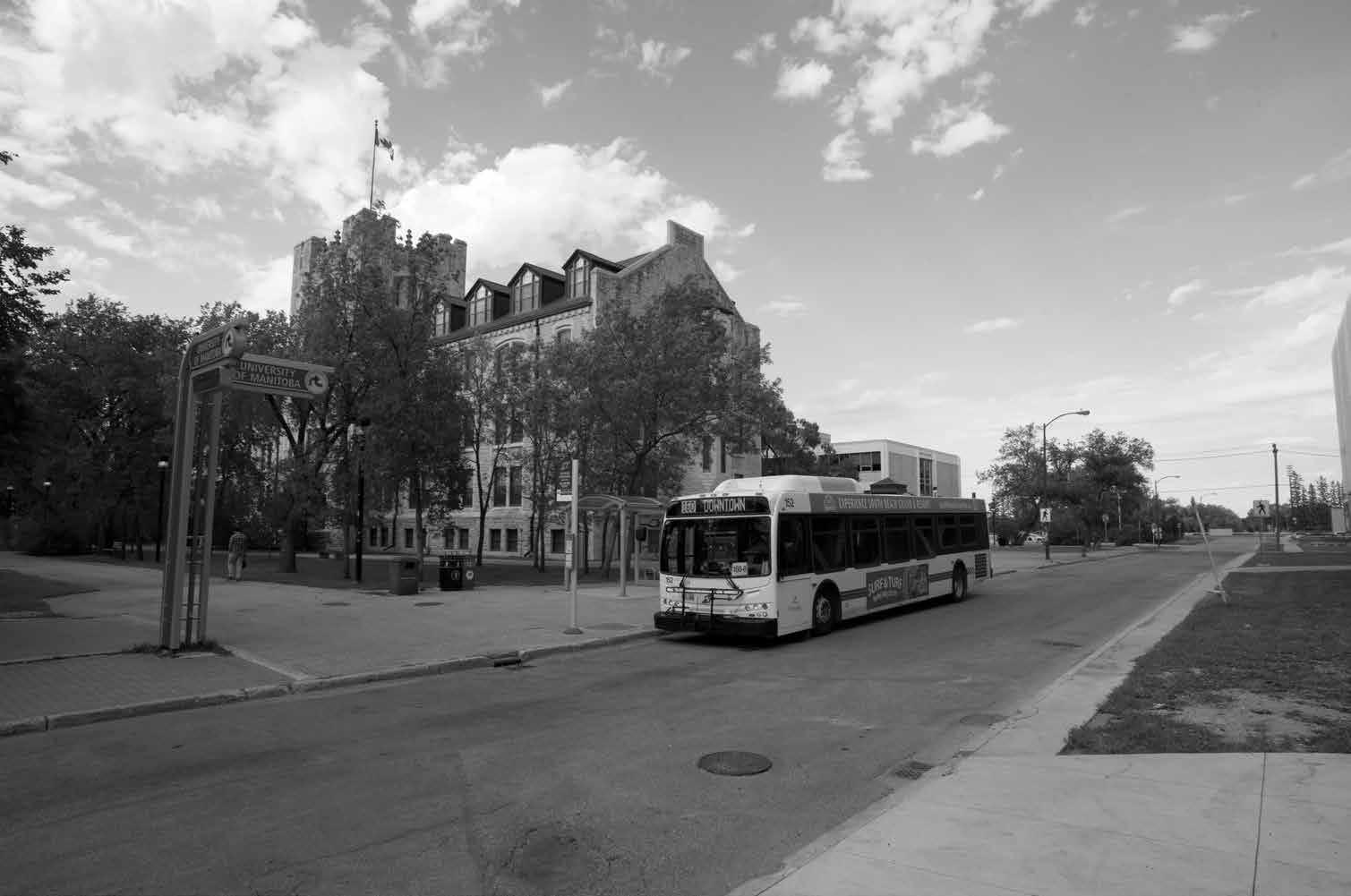
The University of Manitoba is covering the cost of extending the fall U-Pass for students who were scheduled to finish studies in December but had courses pushed into the new year following a faculty strike.
The three-week strike in November led the university to extend the fall term into the first week of January with an exam period running until Jan. 17.
John Kearsey, U of M vicepresident external, said that when the university learned in December that Winnipeg Transit would not extend the fall term U-Pass – which was valid from Sept. 1 t hrough Dec. 31 – it moved to cover the costs for affected students.
“The moment we became aware of it, we said the right thing to do was make sure this was not an added burden for the students who are affected by this because of circumstances beyond their control and, certainly, at the time we were heading into holidays and it’s a time when people don’t need one more financial worry,” he said.
ate and graduate students could be affected.
University of Manitoba Student Union president Tanjit Nagra said UMSU will be handing out the
“It was an easy decision for us to make, quite frankly” – John Kearsey, U of M vice-president external
“It was an easy decision for us to make, quite frankly. Once it was brought to our attention we acted that very morning.”
The university registrar’s office estimates about 2,200 undergradu-
extended passes and affected undergraduate students were contacted before the holidays. She said the union is still awaiting a final list of affected graduate students from the registrar’s office.
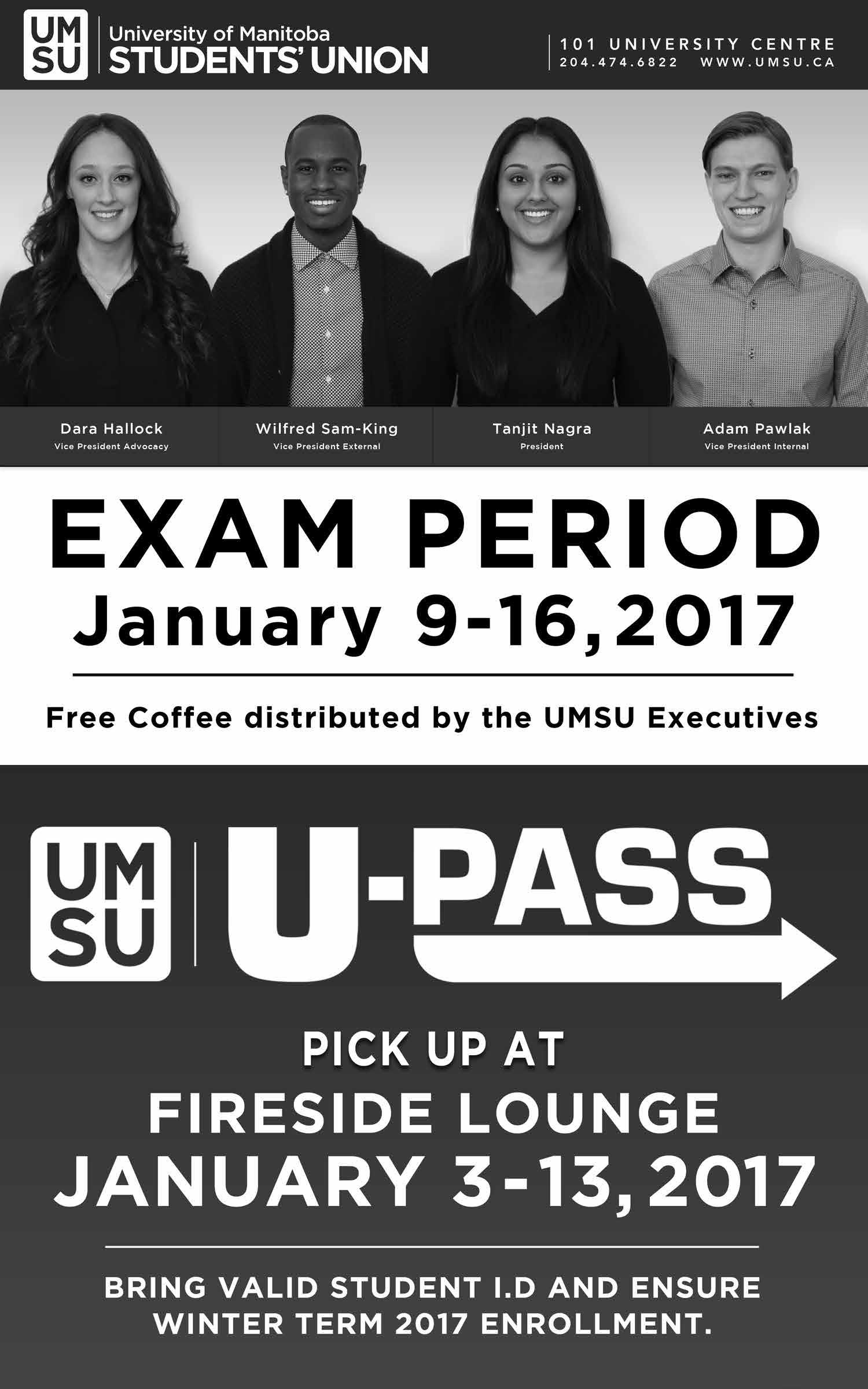
Students enrolled in a full course load for the winter term are not impacted and can pick up their U-Pass at the Fireside Lounge in University Centre on the Fort Garry campus until Jan. 6. After Jan. 6, the passes can be picked up at Answers. Students on the Bannatyne Campus can pick up their passes at the Brodie Centre.
Adam Pawlak, UMSU vicepresident internal, said that while he was frustrated that discussions with Winnipeg Transit did not settle the matter sooner, the university “stepped up to the plate and delivered a very
positive thing for students.”
“We’re very happy about that,” he said, “and, obviously, [it is] something students will be happy about as well.”
The universal transit pass was introduced at the U of M this fall and offers full-time students unlimited access to Winnipeg bus services at a cost of $130 per term. The fee represents a $306 savings from regular student rates for monthly bus passes.
The adjusted winter term is scheduled to have exams finished by April 29. The winter U-Pass is valid until the end of April.
PHOTO BY MIGUEL YETMAN
Editor-In-Chief:
Craig Adolphe
Contact: Editor@themanitoban.com / 474.6770
A post-strike letter to University of Manitoba students from UMFA president Mark Hudson
MARK HUDSON
Over a month has passed since members of the University of Manitoba Faculty Association (UMFA) closed our picket lines and returned to work in labs, offices, and classrooms. The post-mortems of the strike will, with the benefit of hindsight, variously pronounce worldhistorical failure or qualified success. Rather than pick at the remains of the strike as though it were now rotting away, today I am sending a message of appreciation to the U of M community – particularly the student activists, but also UMFA members and the members of Unifor 3007, CUPE 3909, and AESES – for what you all helped accomplish during those three weeks in November, and now, I am issuing a call-to-arms for a struggle in which the strike was simply one moment. The strike was not an easy time for anyone, and I recognize that it has complicated lives and plans. Sometimes, though, you have to take a determined stand for what you believe in. We believe that the
U of M can and should live up to the promise of “inspiring minds.” But the realization of that promise has to be fought for by those who make up the core of the institution – faculty and students. Its realization runs against the currents of change pushing on post-secondary education in Canada and internationally.
What was gained?
The issues we were striking over were, and are, pragmatic and directly relevant to the university as you experience it. For example, the limits we were able to put in place on workload increases are an example of the kind of collegial governance we would like to see more of at the U of M. Used appropriately by faculty, they offer the opportunity for more time to stay on top of our fields, more time to prepare for classes, and more time to engage with students outside of class.
We also won important limits on the use and misuse of performance metrics, and forced a full inquiry into their effects on teaching, learn-
ing, scholarship, science, and creative work. The things we achieved together hold the potential to change business-as-usual at the university and to hold at bay significant threats to our ability to teach and research fully and freely.
The strike has forced us to grapple with questions about the role of the university, how it should be governed, and what kinds of priorities should drive it
What was not?
Unfortunately, even with a strong strike, we were unable to move the administration to extend protections
Letter to the editor
against layoffs for financial reasons to librarians and instructors. UMFA did win a spoken-word guarantee of no layoffs for either of these groups until 2019, but this is nowhere near the same as winning fair and equal job protections.
The challenge we now face is keeping conversation and organizing alive now that we are “back to normal”
The academic freedom that professors of all ranks enjoy derives from the fact that the administration can’t just lay professors off without a genuine and demonstrable financial exigency. If a professor is making unorthodox statements, or is challenging the way that the university is being run, they can’t be singled out and given the axe on the pretext of a budget crunch. Instructors and librarians, in order to do their jobs well, also need this freedom, and we must continue to push for it.
One other area we didn’t get movement on in this agreement was closing the wage gap between staff at the U of M and other comparable universities. This is bad news for hiring, retaining, and keeping and developing original, passionate, and responsive teachers and researchers. It needs to be addressed, and we will continue to work towards narrowing that divide.
Going forward
But the strike has had a wider impact than those reflected in our new collective agreement. It opened up a space for a conversation – maybe even an argument – about what kind of university we want and how we can build it. The strike has forced us to grapple with questions about the role of the university, how it should
RE: Liberals on the wrong side of history with pipeline approvals
Thanks for the excellent piece by Jeremiah Kopp criticizing Trudeau for approving the Enbridge and Kinder Morgan pipelines.
I too am so disappointed in this Liberal government and their unwillingness to stand for the environment and against big business.
People created a movement that
be governed, and what kinds of priorities should drive it. It gestured to the broader context of post-secondary education: a context that no single strike or action can adequately address, but one that clearly needs to be questioned.
The UMFA strike served as a platform for students to engage in these conversations and arguments. It was incredibly heartening to see how students rose to this, became informed, talked to their classmates and to faculty on the picket lines about the issues, debated in their student associations and councils, and became central actors in the dynamic of the strike.
The challenge we now face is keeping conversation and organizing alive now that we are “back to normal.” “Normal” as it has been defined over the past couple of decades is what created the conditions for the strike. The “normal” pressures on universities to become more narrowly “efficient,” to squeeze more teaching from an overworked faculty, to dehumanize education, to be responsive to the will and wishes of private funders, to evaluate the success of our endeavours and justify our existence on the basis of reductionist measures, are no less present post-strike. And new threats to the public mission of the academy are on the horizon.
We continue to hear rumblings of tuition increases, paired with a provincial budget context guided by the blinkered mindset of austerity. Things are likely to get bumpy for faculty and students concerned about the creation of a university with the principles of affordability, access, free inquiry, and engaged learning at its heart. We will need all of our collective will and capacity to confront that rough road, and to build the university whose possibility we glimpsed during the strike.
Mark Hudson UMFA president
I can remember when gas prices reached an all-time high, and I thought, “Great – maybe people will drive less and less as gas goes up.” Why haven't governments brought in taxes on gas to keep it at
pushed back against Big Tobacco and got smoking almost outlawed and certainly shamed into the margins. It's time to do the same against Big Oil and get gas-burning cars shamed right off the public roads. Smoking cigarettes is a minor sin compared to car exhaust, which is polluting and killing the whole earth. We need a sin tax on gas at the pumps that will offset a transition to green energy and pay for free mass transit.
that higher price to deter driving? Gas is so cheap now that there is no thought to conserving, which is leading to demand, which of course leads to more pipelines. It's up to us. This government won't lead us into a healthier future unless we show we are willing to change and that we demand change.
But cars are so convenient – maybe, like the Liberals, we're still all on the wrong side of history.
Tim Brandt
PHOTO BY CHANTAL ZDAN
In defence of pragmatic tuition policy
NATHAN HOOD
Irecently read Mary Asekome and Sofia Descalzi’s piece “Don’t Tell International Students To Accept Fee Increases” and I would like to address some comments and suggestions that were made therein.
There is evidently much division surrounding a motion proposed at the Canadian Federation of Students’ (CFS) national general meeting in November that would have had the CFS advocate for the capping of international student tuition increases to the same percentage as domestic student tuition increases. Opponents of this motion suggest that the motion conflicts with the CFS’s central policy stance of free tuition for all.
There are many issues that could come with a free tuition system. First, students from higher-income backgrounds are more likely to benefit from such changes than those from lower-income backgrounds, as the former are more likely to pursue a postsecondary education. It is highly unlikely that such an across-theboard policy would be the most fiscally responsible and sensible policy to improve access to and participation in post-secondary education, especially for those students who have the most difficulty accessing it currently.
Secondly, such a system could make admissions to Canada’s universities and colleges increasingly competitive should the government decide to subsidize only a set number of seats for students. Grades could become an increasingly important factor in admissions, which would benefit academic high-achievers, who are more likely to be students from higher-income backgrounds.
Furthermore, given that funding would be primarily provided by the government, universities would be opened to an increased risk should the government choose to reduce its funding. We have seen recent examples of this in international
jurisdictions such as Denmark, where government austerity measures have forced the University of Copenhagen, the country’s largest university, to cut over 500 professors, researchers, and administrative positions. In Chile, it has been reported that at least half of the universities committing to a fully funded public system have suffered financially as a result of a free tuition policy, and some universities have warned that quality may decrease and others have postponed infrastructure and research projects as a result. Ignoring the many issues that could be associated with free tuition policy, I do not think it was prudent to oppose this motion, especially when opposition rests upon a policy stance that is based more in ideology than feasibility.
Fervently promoting the policy position of free tuition, for which there is currently little to no governmental appetite, should not occur at the expense of more reasonable policy positions
When I read what the motion asks of the CFS, I do not see a motion supporting tuition increases. Rather, it recognizes that tuition does increase, often at levels that are disproportionate and unfavorable to students. However, recognizing that increases occur is not an admission of support for those increases, unlike the characterisation that was provided in the aforementioned article. Instead,
this motion is asking the CFS to ensure that international students are treated more fairly by fighting to limit their potential tuition increases to the same percentage as domestic students’ tuition increases.
The authors note that they seek the support of domestic students in addressing flaws in the Canadian postsecondary system; this is expected and completely reasonable. Having said that, rather than criticizing the domestic students who supported this motion – those who were elected to represent the interests of their memberships, including international students – I think we should be proud that domestic students would support such a motion in the first place. Given that international student tuition could not be
raised by exorbitant percentages with the same ease should such a policy be implemented by government or a postsecondary institution, it would not be improbable to see domestic students bearing some of the financial burden that would have once belonged to international students. That should not be understated. Close to a month ago, I was in Ottawa advocating on behalf of students to members of Parliament, senators, and federal ministers. It was clear to me that our politicians are seeking pragmatic solutions to student issues. Fervently promoting the policy position of free tuition, for which there is currently little to no governmental appetite, should not occur at the expense of more reasonable policy positions that have far
Calm reflection must prevail during the next round of faculty negotiations
TAMI JACOBY
Happy New Year to all my university colleagues, administrators, and students! I am excited, as I’m sure you are as well, about the prospects of 2017. I write this letter to reflect somewhat belatedly on the UMFA strike. Like many, I was angry and anxious during the strike. I too said things I shouldn’t have said. I would like to humbly take this opportunity to share some reflections now that I have had the chance to think clearly. Had I written this a month ago, it would have been a very different letter. I would have tried to prove my point; I would have rallied statistics and secondary literature to try to convince others that I am right and they are wrong. Now it is water under the
bridge. Here are, briefly, some of the lessons I have learned from the strike. The world became very divisive with the U.S. elections in November 2016. I agree with Merriam-Webster’s 2016 word of the year “surreal” as the best one to describe the global condition today. People are worried and scared. Global politics has always been a struggle between those who benefit and those who do not benefit from the changes underway. However, with the penetration of social media and real-time politics, there has been no period in world history more immediate when it comes to the impact of global politics in our everyday lives. I have heard the term “apocalypse” penned on contemporary
reflections. Perhaps the turmoil is that serious. Perhaps not. All I know is that no rational decision was ever made in the heat of intense emotions. We all need to calm down.
No rational decision was ever made in the heat of intense emotions. We all need to calm down
A strike is a very divisive and emotional phenomenon. Livelihoods, reputations, and fundamental
belief systems are at stake. From the moment people head to the picket lines, there is no controlling the course of events, whether that involves slander, relationship endings, or even violence. I understand that some passers-by blared rap music in their cars while driving through pickets, others honked in support, and a very few others veered into the crowds.
Since the strike ended in a oneyear contract and we will be going into bargaining again soon, I find it crucial to think through what happened very carefully. The way forward cannot be through the same patterns and thought processes that fuelled the original divisions. It would be
greater chances of implementation. Besides, the provinces with postsecondary financial aid systems that are the closest to “free tuition” –Ontario and New Brunswick, according to the CFS’s “ Time To Think Big ” document – just happen to have strong provincial student advocacy groups that pursue more pragmatic policy solutions than free tuition. Maybe they’re onto something. Nathan Hood is the president of the University of Prince Edward Island Student Union.
better to be more, rather than less, tentative about our views. Instead of trying to be right, let us all think about what would best move the university forward and create a more collegial environment. This does not necessarily involve compromising one’s views. Perhaps it relates more to the delivery. Perhaps it can be a more unifying process, if we are all kinder. We all have to work and study here together. The University of Manitoba belongs to us all. Let’s do better the next time around.
Tami Jacoby is a professor at the U of M in the department of political studies.
2017 promises to be a big year for Canadian science
From astronauts to advisors, here’s what’s happening in Canada’s science community this year
MALAK ABAS, STAFF
Canada’s science community had a very eventful 2016. One of the most effective vaccines against the Ebola virus was developed right here in Winnipeg. Canada celebrated the 15th anniversary of the revolutionary Canadarm2, the 17-metrelong robotic arm that built the International Space Station. Prime Minister Justin Trudeau’s political campaign had a strong focus on “unmuzzling” Canadian scientists, and federal scientists recently negotiated with the Government of Canada to be protected within their rights to speak freely about their work.
2017 is shaping up to be just as innovative and historical for Canadian science. Let’s take a look at what’s happening in Canada in the upcoming year.
Canada begins search for a chief science advisor - January
On Dec. 5, the federal government began its search for a chief science advisor.
The announcement, which was presented by Minister of Science Kristy Duncan, came after promises from the Liberal government to create a position if elected that would advise the government on scienctific decisions.
“This search for a chief science advisor is a historic moment,” said Duncan.
“This position is critical because science affects everything from the health and well-being of Canadians to the economy and the environment. Science is also the foundation of sound decision making within government.”
“Our astronauts have been a source of national pride for our country. If you have aspired to go beyond our planet's frontier, now is your chance to make this dream a reality” – Navdeep Bains, Minister of Innovation, Science and Economic Development
The chief science advisor will report directly to Duncan and the prime minister, and will have a team of scientists and policy experts to consult with. They will also work to maintain Justin Trudeau’s promise to keep federal scientific research transparent and available for public access.
Canada is not the first country to appoint an advisor to government leaders for science-focused issues. Many countries, including the United
States, have science advisors, and it has been proven to be an especially crucial position in times of weather or environmental crisis in countries all over the world.
Criteria for the position was decided after Duncan spent a year consulting scientists on just what role a science advisor should play in a government setting.
The position is open to all Canadians, and those interested can apply online at the governor in council website. Requirements to be considered for the position include a doctoral degree in natural sciences, mathematics, engineering sciences, health sciences or social sciences, experience in scientific research and peer reviews, and proficiency in both English and French. The application process closes on Jan. 27, 2017.
Two new Canadian astronauts will begin training – August
On June 17, 2016, the Canadian Space Agency announced it would begin Canada’s fourth astronaut recruitment campaign.
The announcement was led by Navdeep Bains, the minister of innovation, science and economic development.
“Our astronauts have been a source of national pride for our country. If you have aspired to go beyond our planet’s frontier, now is your chance to make this dream a reality,” said Bains.
“This class of Canadian astronauts
will be part of a new generation of explorers to advance critical science and research aboard the International Space Station. Just like the astronauts before them, they will inspire young Canadians to view science and technology as accessible and interesting tools they can use to build their own adventures.”
This announcement came after previous good news for Canadian astronauts. In March 2016, the Canadian government allotted $379 million over the next eight years to increase Canadian participation in the International Space Station until 2024.
People interested in becoming a Canadian astronaut have to meet many rigorous requirements, including 20/20 vision, being between 110 and 209 pounds, and having a science-based educational background. Applicants for the new astronaut positions were asked to have either a bachelor’s degree in a science or engineering field, or a doctorate in either medicine or dentistry. Consideration was also given to those licensed to practice medicine in Canada.
Basic training once selected is equally intense, and includes a military aquatic survival course.
The application period ended in August 2015, and candidates will be announced in the summer of 2017. Starting in August 2017, the selected few will begin training at NASA in Houston, Texas.
The Canadian Science and Technology museum is re-opening – November
The Canada Science and Technology Museum is set to re-open in November of 2017.
The museum – which started as the National Museum of Science and Technology in 1967 – is located in Ottawa, Ontario, and was the first in the world in incorporate interactive exhibits.
“Science is also the foundation of sound decision making within government” – Kristy Duncan, minister of science
The museum was forced to close its doors in 2014, due to what was referred to as “unacceptable” amounts of airborne mold in the air and walls.
On Sept. 8 2016. the museum had to be evacuated because of the mould, and the museum has remained closed since. No health issues related to the mold were reported.
The renovations, which required just over $80 million in funding, includes a complete re-haul of the museum’s roof, and updates to keep the building up to fire- and earthquake-resistant code. The upgraded
museum will also include six new galleries, and will have double the amount of artifacts on display. While there will be a completely new children’s gallery, some of the well-loved exhibits will remain as is. The reopening will also include a week of activities to celebrate the museum’s 50th anniversary.
The new museum also promises to “address gaps” in inclusivity through its galleries, and cited women in science and Indigenous-led research and innovations as topics that would be expanded on more thoroughly in the renovated museum.
“The redevelopment of the Canadian Science and Technology Museum permitted us to redo the envelope of the museum, along with the mechanical and electrical systems,” said Fern Proulx, chief operating officer of the Canada Science and Technology Museum Corporation in a public video.
“The envelope of the museum has now enhanced the insulation to provide better energy efficiency for the building. So the mechanicalelectrical system will now permit us to have an experience for the visitors, which reflects the expectations of a national museum”.
To keep up with the final year of renovations, you can follow the #MyMuseum2017 tag on Twitter for regular updates.
GRAPHIC BY ALDO RIOS
The best local albums 2016 had to offer
Check out our picks for standout albums released by Manitobans in 2016
TOBI NIFESI, STAFF
For local music enthusiasts in Manitoba, the year 2016 had its fair share of excitement as several local artists and bands ignited the music scene with new singles and albums.
Some of these musicians and their catalogs have been critically acclaimed nationally, showing that, indeed, these are exciting times for Manitoba music. The Manitoban has picked out some standout local releases from 2016.
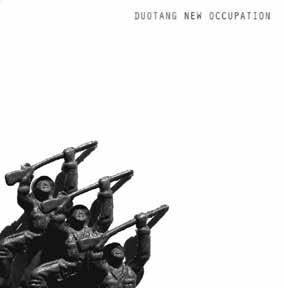
New Occupation by Duotang
Formed in 1995, the two-piece band have garnered a reputation for their unique ability to fuse modern rock sounds with post-punk instrumentation. From 1996 to 2002, the band released three albums and toured across North America and Europe. In 2015, after a 13-year hiatus, Duotang began touring again and last year released their fourth album, New Occupation. Since its fall release, the 12-track album has topped several Canadian music charts and proves to be the band’s best album so far.
Something Got Lost
Between Here and the Orbit by Royal Canoe
Since its inception in 2010, Winnipeg indie pop band Royal Canoe have worked to showcase their unique sound and credibility. After five releases, the sextet gave Manitobans one more reason to appreciate local music by releasing their long-awaited album Something Got Lost Between Here and the Orbit
The Juno Award-nominated band’s latest album is their most colorful and versatile body of work yet. Despite being a pop album, it fuses sounds from several genres such as hip hop and soft rock and is a testament to the growth the band has experienced over the years.
Perfection Salad by À La Mode
It is rare to find a band that makes an instant and lasting impression with its debut release, and it is rare to find a band with a sound as distinct and enthralling as À La Mode’s. The Winnipeg quartet produce music reminiscent of classics by Metric, the Shins, or Elliot Smith. The band’s cleverly written songs are simultane-
ously emotive, amusing and rhythmic; they can be heard on their debut full-length bilingual album Perfection Salad
It is rare to find a band that makes an instant and lasting impression with its debut release, and it is rare to find a band with a sound as distinct and enthralling as À La Mode’s
Where the Good Way Lies by Steve Bell
Winnipeg-based singer-songwriter Steve Bell continues to prove that good music is timeless. One of Canada’s most accomplished songwriters, Bell began performing at
The five best films of 2016
MALAK ABAS, STAFF
Another year has come and gone, and with it came some great movies. As we head into awards season, here's a rundown of some of the cinematic triumphs of the past year.
5. Christine
One of two films released this year based on the life of Christine Chubbuck, a news reporter who committed suicide live on television, Christine ’s genius sits on the unbelievably nuanced performance by Rebecca Hall, who plays the titular Christine. While many critics are pointing to the other film inspired by Chubbuck’s story, Kate Plays Christine, as the superior film, Hall’s performance is enough to carry any of Christine ’s few flaws and more.
The film travels through Chubbuck’s struggles with human connection and mental illness so that while you know how the film is going to end, you’ve grown to at least feel for Christine, and it really hurts to watch anyway.
4. 13th
The only documentary on this list (although it wouldn’t be if this list was longer – Weiner and Cameraperson were also great), and one of only two films on this list that you can watch on Netflix right now. Ava Duvernay (the director of 2015’s Selma ) directed
this powerful unpacking of America’s difficult history with mass incarceration and racism. Named after the 13th amendment, this documentary is well paced and accessible despite being incredibly information-dense and packed full of interviews with academics and activists.
The absurdity of this concept works to the film’s advantage, as that suspension of disbelief allows room for the best dark comedy of the year
3. The Witch
The Witch (sometimes stylized as The VVitch) follows a 17th century New England family who have chosen to distance themselves from their church and live isolated on a farm due to a difference in certain religious beliefs. In a different film, this could be the plot of a mundane TV drama. In this film, their isolation breeds slow-burning paranoia that explodes into horrifying violence. In what may be the worst decade
of horror in American film history, The Witch is such a welcome relief because, above all, it’s scary. It’s so scary. This movie has everything: Satanism, a dark and endless forest, original sin, a goat that ends up saying some creepy stuff, and, of course, witches.
2. The Lobster
As cruel and unrelenting as it is funny and lovable, The Lobster follows a heavier-set mustachioed Colin Farrell as a single man in a world where people who remain single too long are transformed into animals and left to fend for themselves. The absurdity of this concept works to the film’s advantage, as that suspension of disbelief allows room for the best dark comedy of the year. Watching Colin Farrell stumble through reluctant heroism is cathartic and deeply strange.
1. Moonlight
If you’ve been following other “best of” lists, this may not come as a surprise to you, but Moonlight ’s accolades are absolutely deserved. Moonlight follows Chiron (played by three different actors in different stages of his life) as he navigates through the world as a queer black man. The film approaches (to say “tackles” is too strong a word, as the
the age of 13 and, last year – at age 56 – he released his 20th album titled Where the Good Way Lies. On his latest album, the veteran artist showcases his lyrical expertise and his musical versatility. He gave us an album that was laden with truth and set over a backdrop of masterful instrumentation. Bell is proof that Manitobans make good and timeless music.
Captain Tomorrow and The Dream Orphans by Sebastian Owl Sebastian Owl seems like a band from a prior era who just came back from a long hiatus. Formed in 2010
in Brandon, the band has a knack for writing deep lyrics, creating comforting melodies, and staging energetic live shows that are reminiscent of legendary bands like the Band, the Byrds or Little Feat. The quintet has performed on stages across the prairies and have produced a reputable catalog for themselves. Last year, they built on their success and experience with the release of their album, Captain Tomorrow and The Dream Orphans. Regardless, the band is just getting started and will surely be singing their way into the hearts of many Manitoban classic rock lovers.
These are not all of the standout albums released by Manitobans in 2016. Some honourable mentions include Ken Mode’s Nerve EP, Yes We Mystic’s Forgiver, Tin Can Bandits’ Rushing River, The Catamount’s St Nuomatic, and Micah Erenberg’s Poor Mic Toe
If you missed any of these album releases last year, why not start 2017 by giving some of these local musicians a listen?
film fortunately pushes no agenda) Chiron’s sometimes painful search for peace and identity in a world that often confuses and disappoints him. The movie approaches everything in Chiron’s life, from his sexuality to his painful interpersonal relationships, with an empathetic eye. His kind and charismatic father figure is a drug dealer, his mother is an addict, but Moonlight never falls into the formulaic traps these characters are too often written as in Hollywood. Many
critics have claimed it somehow “transcends” race or sexual orientation, which is incorrect.
The film is not about “transcending” these factors of ourselves so crucial to our identity, and in fact beautifully explores how these facets of our being shape our humanity. Moonlight is compassionate, haunting, gorgeous to look at, and required viewing for any film enthusiast.
PHOTO PROVIDED BY DUOTANG
MOONLIGHT. PHOTO PROVIDED BY A24
2016 sports review
The biggest stories from North American major league sports over the past year
ALEX MICHAELS
Two thousand sixteen was a recordbreaking year in sports, with the Chicago Cubs and the Golden State Warriors having historic seasons in the MLB and NBA respectively. Canadian football had an epic finale, and down south “Deflategate” ran rampant in the NFL. In hockey, the Toronto Maple Leafs and Winnipeg Jets scored big at the NHL draft.
Here are the Manitoban’s top five sports stories of 2016.
1. Chicago Cubs win World Series champions
On Nov. 2, the world stopped turning for just a minute when the Chicago Cubs won a thrilling World Series over the Cleveland Indians. The Cubs hadn’t won since 1908. To put that into perspective, since the last win the world has seen two world wars and the formation of the NBA, NHL, and NFL. Every other Chicago sports team has won a championship in the interim.
The series was a thriller, with the Cubs winning in the 10th inning to take home the championship that had been eluding them for 108 years. Ben Zobrist was named the World Series MVP after hitting .357 and driving in the winning run. It had been a long time coming for Cubs fans and it showed in the parade that followed with approximately five million people watching.
2. Golden State Warriors’ historic season
The Golden State Warriors are the team to beat in the NBA right now, with MVP Stephen Curry raining down three pointers and Klay
Thompson mirroring his excellence.
The 2015-2016 season was historic for the team as they won the most regular season games in NBA history, finishing 73-9 to break the Chicago Bulls’ previous 72-10 record.
Early in the season it seemed like they were never going to lose. They were blowing every team out of the water. Curry and the Warriors defeated the Oklahoma City Thunder in seven games to advance to the NBA finals against LeBron James and the Cleveland Cavaliers. Like early in the season, it looked like the Warriors were going to roll over the opponent, holding a commanding 3-1 lead in the series. LeBron and Kyrie Irving had other plans, winning the fifth game and then the sixth to force a game seven in Oakland.
The world stopped turning for just a minute when the Chicago Cubs won a thrilling World Series over the Cleveland Indians
Game seven was a back and forth affair with Irving hitting a big-time shot late in the game to put the Cavaliers ahead for good. With the disappointment of the finals lingering, the Warriors made the biggest move of the NBA offseason: signing star player Kevin Durant to bolster
the already impressive roster.
3. Ottawa Redblacks win Grey Cup
In just the third season since the team’s return to the capital, the Ottawa Redblacks are Grey Cup Champions. Their victory against the Calgary Stampeders proved one of the biggest upsets in recent memory.
The Stampeders were heavy favourites to win the Grey Cup with a 15-2-1 regular season record and the league’s most valuable player in Bo Levi Mitchell, who threw for 5,385 yards and 32 touchdowns.
To add to the drama before the game, the Redblacks’ 41-year-old starting quarterback Henry Burris limped off the field during warmup. Fortunately, former Stampeder Burris was good to go for kickoff.
The game itself was a thriller, with Ottawa scoring early and often and forcing Mitchell to turn the ball over multiple times. Calgary were against the wall, down 20 points, but refused to give up and slowly clawed their way back to force overtime.
In extra time, the Redblacks took possession of the ball first, scoring a quick touchdown thrown by Burris to receiver Ernest Jackson. This put the pressure on Mitchell and the Stamps offense. They were unsuccessful in moving the chains in their first two chances and had one last opportunity. Mitchell dropped back and threw it over the middle, but the ball deflected up in the air, dropped incomplete, and the game was over.
4. Tom Brady’s suspension In 2014, New England Patriots
star Tom Brady shut down the Indianapolis Colts, winning 45-7 in the AFC Division championship game. The Patriots then advanced to play and win against the Seattle Seahawks in the Super Bowl. The main story didn’t become that the Pats won the Super Bowl but that they got there using an unfair advantage.
In just the third season since the team’s return to the capital, the Ottawa Redblacks are Grey Cup Champions
In what became known as Deflategate, it was suggested that in the AFC championship game against the Colts, the Patriots deflated footballs making it easier to throw. NFL commissioner Roger Goodell began an investigation.
The findings revealed that the footballs used in that game were deflated. Tom Brady was suspended and the team lost its first and fourth round draft picks in the upcoming draft in 2015. The team argued their position for months before eventually conceding. However, Brady continued to fight the league, taking the NFL to court in 2015. He was successful in his efforts, preventing himself from getting suspended for the 2015-16 season.
Brady played the entire 2015-
2016 season. The NFL appealed this decision in March of 2016. The decision was reversed and Brady got suspended for the first four games of the 2016-2017 NFL season.
Following his suspension, Brady picked up right where he left off, throwing for 3,554 yards and 28 touchdowns with just two interceptions in 12 games played. Which leaves an important question: can Brady still win the MVP award having played only 12 games?
5. 2016 NHL draft
The 2016 draft was like Christmas for Leafs and Jets fans. At 20 per cent, the Leafs had the best odds to win the first pick in the draft and that’s exactly what happened. However, the real winners might be the Jets. At 7.5 per cent, they had the sixth best odds to get number one pick, but ended up receiving the second pick, four spots ahead of what was expected.
On the draft floor the Leafs management stepped up to pick expected number one pick Auston Matthews. Jets general manager Kevin Cheveldayoff then took Finnish sniper Patrik Laine. Both teams acquired exactly what they were looking for: the Leafs got a number one centre and the Jets got a winger who has the potential to score 40 goals a season.
Matthews has 20 goals and 12 assists in 36 games. Patrik Laine has 19 goals and 12 assists in 39 games. Both players will be the cornerstone for their teams and we will see who can potentially help their team to a deep playoff run in the future.
PHOTO PROVIDED BY JON KOZUB
Winnipeg sports resolutions
What will the New Year bring for the city’s sports clubs?
JASON PCHAJEK, STAFF
I
n every sense, 2016 was an interesting year for sports fans in Winnipeg. The Goldeyes won yet another championship, the Jets were gifted a superstar in the draft, and the Bombers somehow made the playoffs. Heading into the New Year, things seem to be looking up in a city where disappointing was the adjective for previous sports outings. Here is what you can expect from Winnipeg’s teams in 2017.
Winnipeg Jets
2016 highlight: Drafting Patrik Laine second overall and the emergence of Mark Scheifele
2017 resolution: Make the playoffs
After making the playoffs a year prior, the 2015-16 NHL season represented a major step back. The Jets finished dead last in the Central division with 77 points and were left 25th in the league. A team that appeared to be on the edge of great things was
bitten hard by their Achilles heel: their propensity for taking penalties.
Laine has performed as advertised, at one time being the league goalscoring leader and vastly outperforming first overall pick Auston Matthews
However, as the season came to an end, all was not lost as the Jets went on a four-game tear to surge in the standings. Even more promising was Scheifele’s play through that stretch. After Bryan Little went down with a season-ending injury, Scheifele
took the top centre spot and proved he should be considered among the league’s best pivots. He tallied a league-best 29 primary points over the final two months of the season.
Months later, the team’s luck improved even further. Despite long odds due to their 25th place finish, they moved all the way up to second overall in the 2016 draft and were able to select Finnish phenomenon Laine. Laine has performed as advertised, at one time being the league goalscoring leader and vastly outperforming first overall pick Auston Matthews.
The 2016-17 season has been much better for the Jets, who came out of the Christmas break with a win over the Chicago Blackhawks. The new-look Jets, led by the dynamic Ehlers-Scheifele-Laine line, are sitting a single point off a playoff berth. This year, if the Jets resolve to take that spot and keep it, they will make Winnipeggers very happy.
Winnipeg Blue Bombers
2016 highlight: A winning season and a playoff spot
2017 resolution: Keep momentum going from last season
Perhaps the biggest surprise of the year in Winnipeg sports came courtesy of the Winnipeg Blue Bombers. The perpetually disappointing Bombers finally pulled it all together, thanks in large part to numerous high profile signings. If conventional wisdom says you have to spend money to make money, perhaps you have to spend money to win football games.
The Bombers went 11-7 in the 2016 season, their first winning season since going 10-8 in 2011 – both times got them into the playoffs. Unlike in 2011, where they marched all the way to the Grey Cup but ultimately lost to the B.C. Lions, the 2016 Bombers were stopped in the west semifinal by the Lions by a score of 32-31.
Looking towards the 2017 CFL
season, it seems Winnipeg football fans are only asking one thing of their team: please don’t take a step back. The 10-8 season in 2011 was followed by a 6-12 stinker of a season, so Bombers fans should keep their fingers crossed.
Winnipeg Goldeyes
2016 highlight: Winning the 2016 American Association title 2017 resolution: Keep dominating In 2016 it was another season, another championship for the fish. The ball club won its third American Association title, beating the Wichita Wingnuts 11-4. This was their second title in five years, and the division win was their ninth in team history. For the Goldeyes, a New Year’s resolution will be very simple: keep on rolling and maybe bring in some more in ticket sales.
GRAPHIC
Manitoba wins 50th annual Wesmen Classic
KELLEN TANIGUCHI, STAFF
On Friday Dec. 30, the University of Manitoba men’s basketball team defeated the eighth-ranked University of Alberta Golden Bears 86-78, capturing the 50th annual Wesmen Classic Championship. With the win, the Bisons successfully defended their 2015 tournament win, and have now won nine total Wesmen Classic Championships (1973, 1975, 1976, 1977, 1985, 1986, 1991, 2015, and 2016).
The Bisons successfully defended their 2015 tournament win, and have now won nine total Wesmen Classic Championships
Manitoba began their Wesmen Classic run on Wednesday, as they defeated the University of Regina Cougars 100-79. The Bisons shot the ball well, hitting 55.9 per cent of the shots they took in the game, and were able to hold the Cougars to just 34.6 percent from the field. With the lopsided shooting percentages, the herd took an early 50-35 lead into halftime. Manitoba continued their dominance in the third frame, outscoring Regina 32-20, increasing their lead to 27 points, and never looking back.
The Bisons were able to spread the ball out in their first game of the
tournament, as Joey Nitychoruk led the herd in scoring with 21 points, Justus Alleyn netted another 15, and both Ilarion Bonhomme and James Wagner added 12 more points. The Cougars were led by Samuel Hillis, who was able to knock down 19 points for his squad.
The Bisons advanced to the championship match with their 60-55 victory over the host Wesmen on Thursday. Both sides struggled to shoot the ball for the majority of the game, as both teams connected on just over 25 per cent of their shots.
Manitoba took a 32-24 lead into halftime, with Winnipeg struggling just
a little more in the first half. The Wesmen held the Bisons to just 13 points in the third frame and trailed just 45-42 entering the final quarter. However, the herd held the Wesmen off and went on to win the game.
Omoerah set a tournament single-game record, as he grabbed 25 rebounds in the contest; he also led the Bisons with 17 points. AJ Basi put up another 14 points for Manitoba, and Narcisse Ambanza led the Wesmen with 15 points in the game.
The first half of the championship game featured a lot of back and forth play, with the herd taking a 40-37 lead into halftime. The herd was also
more successful from beyond the arc, hitting nine three-point shots compared to Alberta’s six. With the upper hand in shooting, the Bisons were able to extend their lead, and defeated Alberta 86-78.
Justus Alleyn led the Bisons with 22 points in the game, and Ilarion Bonhomme netted another 15.
Omoerah also came up big, posting a double-double of 10 points and 12 rebounds. Alberta was able to keep the game close, thanks in large part to Brody Clarke, as he led his team with 21 points.
Omoerah was named tournament MVP and set a Wesmen Classic
Can the Jays still compete without big hitter Edwin Encarnacion?
KELLEN TANIGUCHI, STAFF
O
n Dec. 22, the Toronto Blue Jays lost a key contributor to the team’s recent success: designated hitter and first baseman Edwin Encarnacion signed a three-year deal with the Cleveland Indians, reigning American League champions. Toronto’s management previously offered Encarnacion a deal, but once it was rejected the Blue Jays decided they could not wait on Encarnacion, and went out and signed a couple of free agents of their own. With Encarnacion being a constant contributor and big hitter, Toronto had some big shoes to fill, and they may have done so with the signing of Kendrys Morales.
Morales was signed to a three-year
USD$33 million deal, and he fills part of the position that Encarnacion left behind, as he is a very impactful designated hitter. Morales brings with
him something that the Blue Jays lack, and that is World Series experience. Morales was a key part of the 2015 Kansas City Royals championship team, and also won the Edgar Martinez award as the American League’s best designated hitter that same year. After a slow start to the 2016 season, Morales finished the year strong as the Royals’ home run leader. Encarnacion had a batting average of .263, hit 42 homers, and drove in 127 RBIs in the 2016 season for the Blue Jays. Morales also held an average of .263, hit 30 home runs, and accounted for 93 RBIs this past season for the Royals. Morales has a slight drop off in production compared to Encarnacion, but fills the needed designated hitter spot as well as anyone else could, with his stellar stats and championship experience.
The Jays lineup has been known
for containing a lot of power and right hand hitters, and when the power hitters weren’t hitting big shots, the team faltered. Jays management wanted to find a left-handed contact hitter, and that is exactly what they have found themselves with their free agent signing of first basemen Steve Pearce. Toronto signed Pearce to a two-year USD$12.5 million deal, in hopes that he will fill the first base spot that Encarnacion left open. The Jays have Justin Smoak, who hit a .217 average last season, at first base as well. Pearce definitely increases the skill
The presence of Morales and Pearce at least keeps them where they would be if they still had Encarnacion
and depth at the position, as he averaged .288, hit 13 homers, and also had 35 RBIs in his 85 games in the 2016 season which he split as a member of the Baltimore Orioles and Tampa Bay Rays. The one question still lingering over the Blue Jays is whether or not they will re-sign Jose Bautista. Bautista has struggled in the field at times, but his bat always seemed to come up big in crunch time, as everyone must remember the iconic bat flip in 2015. He hit a .234 average, 22 homers, and 69 RBIs last season, so his bat is not where it
record of 45 rebounds, a record previously held by the University of Winnipeg’s Belaineh Deguefe, who came up with 42 rebounds in 1991. Nitychoruk also had a stellar tournament, and was the lone Bison named to the Wesmen Classic All-Star team. The Bisons won their last two games before the winter break, and went 3-0 during their Wesmen Classic run. Now with five straight wins, Manitoba will look to carry their momentum into the second half of Canada West division play.
used to be either. The Jays will have to decide if they want to retain Bautista’s clutch bat, or maybe go after another contact hitter who fields the ball better in the outfield.
So can the Jays still compete at the same level as the past couple of years? They still have the same solid pitching rotation, and most of the other hitters still in the lineup. With players such as Josh Donaldson, Troy Tulowitzki, and Russell Martin still in the lineup, the presence of Morales and Pearce at least keeps them where they would be if they still had Encarnacion. Morales can replace Encarnacion’s power, and Pearce can take his spot at first base and be the contact hitter the organization has been searching for. All the pieces seem to be in place for the Jays to make another run at the World Series come the 2017 MLB season.