Sanderson calls Canadian Federation of Students motion “ill-considered”
MALAK ABAS, STAFF
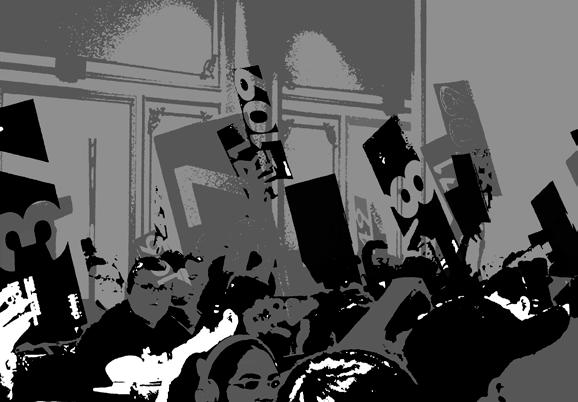
The UMSU executive spoke out and voted against a motion supporting the boycott, divestment and sanctions (BDS) movement and condemning the illegal occupation of Palestine by Israel according to international law during the Canadian Federation of Students annual general meeting Nov. 19 in Gatineau, Que.
The motion, which passed after several amendments, also included support for Palestine-Solidarity organizing nationally and moved to “support locals in launching weapons divestment campaigns targeted towards their individual administrations.”
The Canadian Federation of Students is an organization representing over 500,000 students at 64 student unions across Canada.
UMSU president Jakob Sanderson called the motion “divisive” and “ill-considered.”
“My problem is not necessarily as much with the BDS movement, my problem is with this motion and with the idea of a student federation getting involved in this,” he said.
“So it’s sort of my view that a student union, especially a Canadian federation of students […] should be trying to focus on issues that will unite as many students as possible. And I don’t think that this motion does that.”
The movement calls for nonviolent activism to, according to the webpage of the Palistinian BDS national committee, “end international support for Israeli violations of international law by forcing companies, institutions and governments to change their policies.”
Sanderson said choosing to abstain from the motion entirely would have been unproductive.
“I would say that essentially by voting against this, it’s the idea that we should essentially, as a student union, be abstaining from this issue,” he said.
“But to just abstain from the vote is to succumb to the will of the majority in the room, and I don’t think that was the right thing to do.”
No motion on the issue was raised at UMSU’s bi-weekly board meeting held Nov. 22.
“I have talked with students who want to see […] UMSU take a stance on this,” he said, “so I would not be surprised if there was a motion brought forward, and we’ll treat that accordingly.”
Given the motion does not involve bylaw changes, any motions brought forward by students will be referred to the executive committee. The committee would then, according to Sanderson, “consult with stakeholders and communities at that time on campus and try to determine an appropriate way to move forward.”
Groups across Canada have spoken out on both sides of the motion from the Canadian Federation of
Students.
Independent Jewish Voices Canada, a “grassroots organization grounded in Jewish tradition” that has eight student chapters across the country, released a statement supporting the federation's motion.
“To just abstain from the vote is to succumb to the will of the majority in the room” — Jakob Sanderson, UMSU president
Hillel Canada, a nationwide group which provides programming to Jewish college or university students, swiftly condemned the motion, calling it an “obsessive campaign against exclusively one country” and “anti-academic, fuelled by hatred and is counterproductive to peace.”
Ariel Glikman, a third-year science student and member of the U of M’s Hillel Winnipeg branch, called the motion an act of anti-Semitism.
“It’s either that the [Canadian Federation of Students] is ignorant as to what BDS stands for, or that they are blatantly anti-Semitic,” he said.
The BDS movement has been the
topic of contentious debate since its formation in 2005. While supporters note the movement seeks to confront Israel’s policies rather than Jewish identity, critics — including Prime Minister Justin Trudeau — associate it with anti-Semitism.
"Essentially, their demands call for the destruction of a Jewish state, which isn't called for to any other country in the world, and that's what makes it anti-Semitic," Glikman said.
He added that he believed the motion’s existence is indicative of a wider failure within the federation.
“I feel like I’ve been disrespected by a federation that’s mission is to represent students,” he said.
“So I feel like they’re not doing their job.”
Sanderson said his position was not a matter of determining whether or not BDS is based in anti-Semitism, and instead said he believed the federation's motion “clearly picks one side” and “makes the other side feel unwelcome on campus.”
“I’ve come up with many Jewish students that feel with this motion that they are not represented by the [Canadian Federation of Students], an organization that they pay fees to and that UMSU is a member in,” he said.
“This is of great concern to me.”
Co-VP external for the Arab Students’ Association and external relations manager for the Muslim Student Association Qudus Abusaleh, who previously worked as a reporter
for the Manitoban, said calling the BDS movement anti-Semitic disregards its historical context.
“I strongly believe that calling BDS an anti-Semitic movement really shows that the essence of the movement is not understood,” he said.
“And it’s not analyzed in the proper lens it should be analyzed in.”
He added he believed this because the movement “aims to basically revoke or work against illegal Israeli settlement on Palestinian territory as outlined by several U.N. resolutions,” “aims to ensure full equality for Palestinian citizens of Israel,” and “aims to uphold and ensure the rights of Palestinian refugees are upheld.”
In 2013, UMSU passed a motion de-recognizing a Students Against Israeli Apartheid group as a student group on campus, which was later criticized as an infringement of freedom of speech.
Sanderson said he would not support a similar motion to remove BDS groups from campus should it come to a vote today, as long as they followed UMSU student group policies.
“What I would not do is support a motion on UMSU’s board or [the Canadian Federation of Students] or any other organization for that matter, that goes out and says that a BDS group is entirely unwelcome on our campus, because I don’t think that’s right,” he said.
“I think that we have to, as a student union, respect a great variance of different beliefs on our campus
and try and be a place where we can support those two beliefs in as neutral of a way as possible.”
Abusaleh said the response to the motion by UMSU has made it more difficult to open up a discussion on the subject.
“The union going against the motion sort of decreases, or narrows, the discourse,” he said.
He added that UMSU should take a closer look at where it stands on the federation’s motion.
“The union should consider changing its position on it,” he said.
“They should consider how strongly they want to oppose the motion, and they should strongly consider whether they are against the motion because they’re going against [the movement], or because they’re unhappy with the way [the Canadian Federation of Students] mandated some of the things that they’ve mandated.”
Sanderson said he was concerned for students who may feel “othered” by the motion’s passing.
“I am troubled that the [Canadian Federation of Students] would come in and introduce a motion that quite clearly alienates many students that pay their membership fees to the Canadian Federation of Students,” he said.
“And when students have come forward and put that opinion to me, I definitely am sympathetic [to] that.”
GRAPHIC BY EVAN TREMBLAY
A day to remember
Memorial service held honouring those lost to anti-transgender violence
SHAUNA MATTHEWS, STAFF
A s part of Transgender Day of Remembrance (TDOR) campus events, a memorial service was held Nov. 20 honouring the lives of transgender people that have been lost to anti-transgender violence.
“That generally makes transgender people uncomfortable and it makes me fear for the future” — Eun-Bi Kang, UMSU LGBTTQ* representative
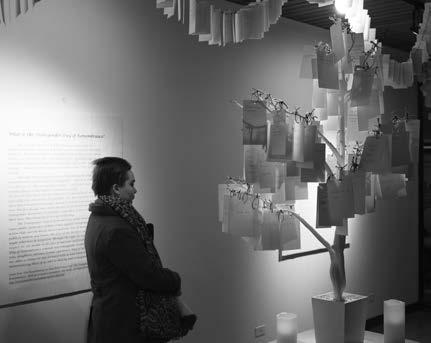
The service, hosted by Rainbow Pride Mosaic (RPM), was held at the Gallery of Student Art (GoSA).
The TDOR is held every year on Nov. 20 and originated in the memory of Rita Hester, a prominent figure in the Boston transgender community who was killed in 1998.
Hester’s death remains unsolved.
UMSU LGBTTQ* representative Eun-Bi Kang said the day “was set aside to memorialize those who were killed due to anti-transgender hatred or prejudice.”
During the service the names of the 368 transgender people killed in the last year were read aloud, followed by a minute of silence.
These names were incorporated into an installation at the GoSA, on display until Nov. 23. Strings of cards,
each with the name of a transgender person who was murdered, were hung around the gallery.
“On the name cards we write the name on one side and then as much detail as possible that humanizes the person on the other side,” Kang said.
The names were sourced from Trans Respect Versus Transphobia’s Trans Murder Monitoring (TMM) research project.
Between January 2008 and September 2018 the TMM tracked a total of 2,982 reported murders of transgender and “gender-diverse people” worldwide.
A significant number of these murders occurred in Central and South America. Between October 2017 and September 2018, 167 murders were reported in Brazil.
Kang spoke out about the recent election of president Jair Bolsonaro in Brazil during the memorial, expressing fear that the rise of right-wing movements in Brazil and around the world will incite new waves of violence against the transgender and the wider LGBTTQ* communities.
Recent events on campus, including the “It’s okay to be white” posters found on campus last month and pro-life campaigns throughout the term, had not gone unnoticed by the university’s LGBTTQ* community, said Kang.
“That generally makes transgender people feel rather uncomfortable and it makes me fear for the future,”
Kang said.
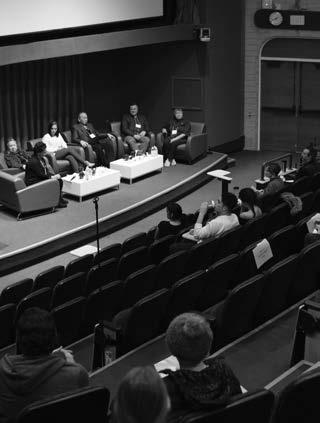
On Thursday, RPM hosted a panel featuring transgender and
non-binary speakers who shared their experiences.
“The point of the panel is to share what it’s like to be a transgender person,” Kang said.
“The physical, mental, social, legal and medical challenges that we face on a daily basis.”
In 2016, police reported a 25 per cent increase in hate crimes targeting
sexual orientation compared to the year prior. According to Stats Canada, hate crimes in the country are also becoming more violent — meaning assault, threats and other violent offenses are on the rise.
Kang hopes working to bring public awareness to transgender issues will shed light for those who may be unaware of the particular struggles
trans people face.
“My hope is that people who don’t really know what trans people are like, or what they have to go through, that they’ll attend the event, hear what these people have gone through and realize that they’re humans just like everyone else.”
Student advocates for decolonizing policy at federation AGM
Ryan Beardy drew from personal experience
MALAK ABAS, STAFF
Students from Manitoba and across the nation gathered in Ottawa from Nov. 16 to 19 for the Canadian Federation of Students annual general meeting (AGM) in Gatineau, Que.
One student, University of Winnipeg Students’ Association (UWSA) Aboriginal students’ codirector Ryan Beardy, had a particularly meaningful role.
Beardy was appointed the Manitoba Component of the Canadian Federation of Students’ policy review and development committee, an experience he said left him feeling “blown away.”
“I was surrounded by so many amazing, intelligent people — and I absorbed so much, and I learned so much in that space,” he said.
“And I kind of caught on to, essentially, the processes and how to motivate, and how to propose something and how to amend something, and the nuances of a comma, and the nuances of a certain wording.”
During the meeting, Beardy proposed two motions and one amendment, all of which passed.
Beardy proposed an emergency motion at the meeting that called for the Canadian Federation of Students to officially condemn the use of solitary confinement in Canada and for the the federation to release a statement “urging the federal government to the UN Standard Minimum Rules and hold meaningful consultation with inmates and prisoner’s rights advocates.”
severe psychiatric and psychological damage.”
Beardy also proposed to add that the federation would “engage in an inclusive approach to mental health that does not pathologize, medicalize, generalize or devalorize First Nations, Métis and Inuit mental health practices, values and worldviews” to the federation’s mental health policy.
He also “helped to shape” policy
provide mental health services that offer First Nations, Métis and Inuit healing practices and access to First Nations, Métis and Inuit Elders.”
Beardy was also involved in a motion that resolved the federation “stand in solidarity with the prisoners at Burnside,” referring to a prison in Nova Scotia that joined a prisoner strike in the U.S. in August 2018.
“Everybody just stood behind me — I mean, literally stood behind me” — Ryan Beardy, UWSA Aboriginal students’ co-director
While his own experience spending three days in solitary confinement while incarcerated was part of his motivation for the motion, Beardy said it was not the only factor.
“I think it’s on all of us because it’s a violation of human rights,” he said. “It’s unconstitutional. It’s causing
that stated the Canadian Federation of Students “acknowledge and address the impacts of colonialism, forced assimilation, residential schools and intergenerational trauma for First Nations, Métis and Inuit students, commit to decolonizing services and policies on campus and
“It was really emotional for me to do that,” Beardy said, adding that the motion was a “collective [effort] of the UWSA and Aboriginal Student Council.”
By continuing to advocate for marginalized groups on nationwide platforms like these, Beardy said students can help to create a decolonized system of policies in Canada.
“Whereas earlier, it wasn’t inclusive or encompassing of decolonizing policies, it wasn’t encompassing of
mental health services,” he said.
“We need access to these mental health services. If you think of a traditional Indigenous worldview, where they need that smudge to feel better, for that peace of mind. But in some spaces, maybe that’s devalued or maybe that’s put underneath other procedures.”
Beardy said bringing forward an emergency motion was difficult, but he felt the overwhelming support of the federation’s members.
“Everybody just stood behind me — I mean, literally stood behind me,” he said.
“When I went to the mic, and I got up there alone to propose this emergency motion, I was nervous and in that space of re-traumatization, and in that space of passion of wanting this to go through. And I spoke, and it was hard, and when I was done […] I turn around and there was literally people behind me.
They all stood with me, and it was huge for me to see that.”