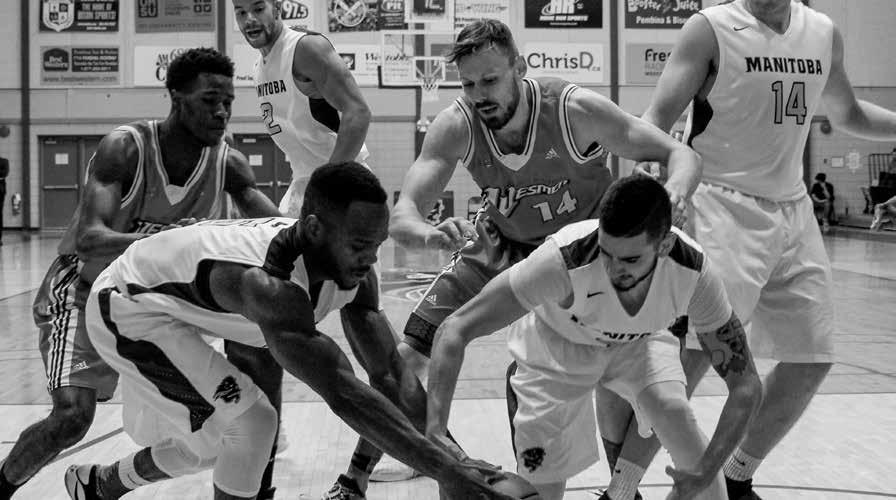
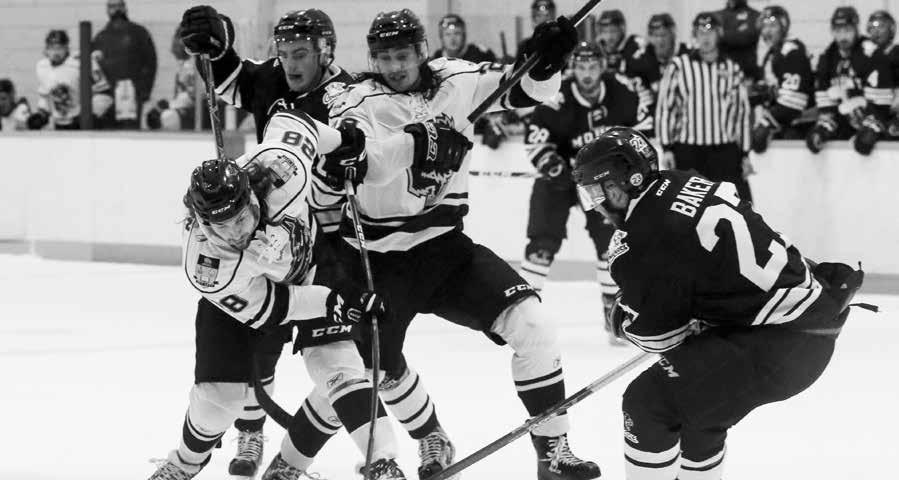
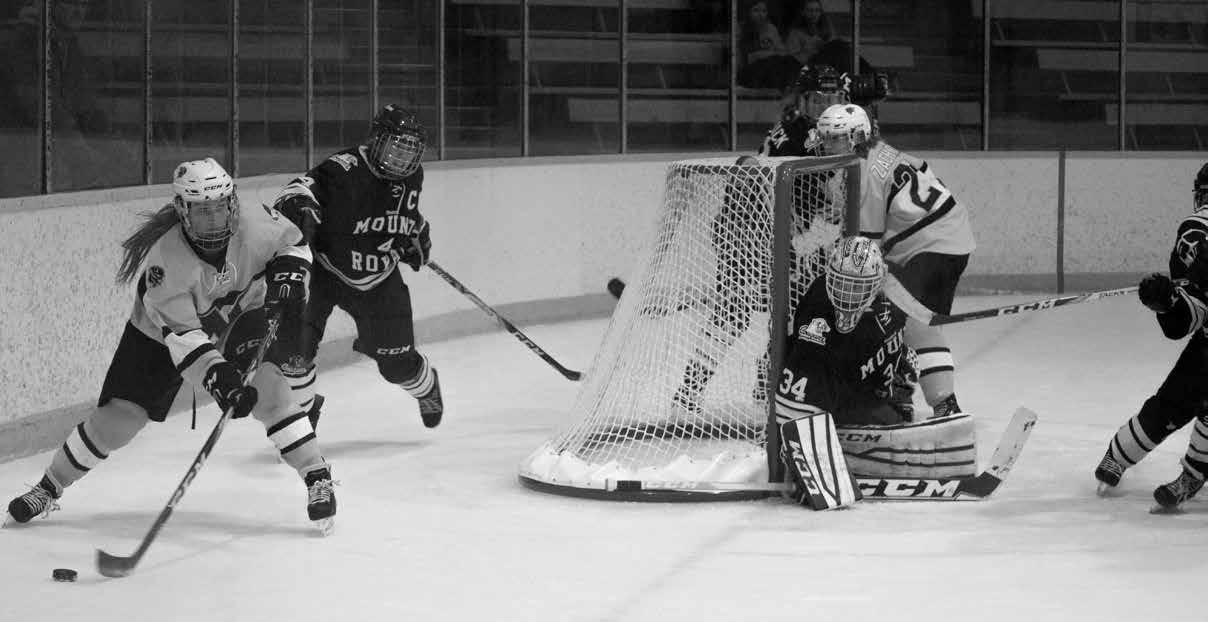
Manitoba wins men’s basketball portion of Duckworth Challenge
Design
Local music promoted over Facebook Live
Gallery of Student Art Current Exhibition: melt on you Madeline Rae
December 5-14, 2016
melt on you is a collection of videos of Madeline Rae’s recent work . Drawing from artists like Pipilotti Rist and Bill Viola, Madeline Rae creates an immersive and meditative experience within the gallery.
Still from honeybox. Photo by Julian Kirchmann
Design eDitor Bram Keast
design@themanitoban.com
graphics eDitor Kelly Campbell graphics@themanitoban.com
photo eDitor Miguel Yetman photo@themanitoban.com
Design associate Kellie Huynh
graphics associate Aldo Rios
photo associate Chantal Zdan
photo associate Star Roxas
photo associate Megan Colwell
r eporters
n ews Osho Samuel Adetunji
n ews Hannah Froese
n ews Diana Ubokudom
columnist Jeremiah Kopp
columnist Shaden Abusaleh
arts & culture Olivia Michalczuk
arts & culture Emelia Fournier
sports Kellen Taniguchi
sports Jason Pchajek copy Joseph Gonzalez eDitor-in-c
Volunteer Contributors
MANITOBAN
109 HELEN GLASS UNIVERSITY OF MANITOBA WINNIPEG, MB R3T 2N2
General Inqu I r I es & a dvert I s I n G
Phone: (204) 474.6535
Fax: (204) 474.7651
Email: manitoban@themanitoban.com
Free Med I a Campus Plus Media Services
Phone: 1.780.421.1000
Email: advertise@free-media.ca
Canadian Publications Mail Product Sales Agreement #589160
A “volunteer staff” member is defined as a person who has had three volunteer articles, photographs, or pieces of art of reasonable length and/or substance published in three different issues of the current publishing year of the Manitoban. Any individual who qualifies must be voted in by a majority vote at a Manitoban staff meeting. Elected representatives and non-students may be excluded from holding votes as volunteer staff members in accordance with the Manitoban Constitution.
The Manitoban is the official student newspaper of the University of Manitoba. It is published monthly during the summer and each week of regular classes during the academic year by the Manitoban Newspaper Publications Corporation.
Governance reforms also include creation of union judicial board, rebranding VPI position, removal of boycott list
H ANNAH Froese, staff with files from levi Garber
The creation of an anonymous executive oversight committee was included in changes to the University of Manitoba Students’ Union (UMSU) governing documents adopted at UMSU’s regularly scheduled council meeting Nov. 24.
The oversight committee will be made up of three randomly selected UMSU councillors as well as three students-at-large, randomly selected from all those who apply.
According to the 22-page document detailing the reforms, the committee will ensure executives are investigating union members’ complaints, meeting workload commitments, and sending reports to UMSU council, among other day-to-day operations.
Members of the executive oversight committee will remain anonymous and their operations will be confidential: meetings will be held in closed session, reports and other communication outside the committee will be via email, and meeting minutes will only be distributed to committee members.
The committee will submit written term reports to be presented to UMSU council four set times a year, at the end of what are described as “assessment terms.”
UMSU president Tanjit Nagra explained why she supported the creation of the anonymous committee but noted that she did not take an active role in advocating for it, as she felt it was a “conflict of interest.”
“What we’ve seen in the past couple of years is some executive mem-
bers that have been phenomenal and some that have not been the best with their work ethic in terms of their outputs and what they’re actually doing for the students,” Nagra said.
“So the biggest part of this committee is to have people who aren’t internal in the office, but a group of people that are able to oversee what exactly the executives are doing, their actual progress,” she said.
UMSU governance committee chairperson Cole Kubay said he proposed the formation of the oversight committee in consultation with past UMSU governance committee chairs and the current union governance assistant, Mark Stewart.
Kubay also explained why the governance committee felt it was important for the executive oversight committee to remain anonymous.
“We didn’t want the people on the committee to be persuaded or bribed or anything by other members [of council],” he said. “We were just worried that people would be influenced.”
Kubay also said that based on how well the committee works next year, the governance committee will recommend that UMSU council reevaluate the merits of keeping the panel and its members secret.
“Basically, every aspect of the committee will be up for review after the end of the year to see if it’s functioning as it should,” Kubay said. “We’re keeping it so that there’s anonymity unless council deems that there shouldn’t be.”
That recommendation is not included in the actual governance
changes and is to be introduced to council by the governance committee separately, according to Kubay.
The oversight committee will also handle complaints against executive members.
The committee may deliver citations to any executive member in response to a complaint. Approved citations may be appealed, and these appeals are to be handled by the judicial board.
Examples of what citations may be given for include inadequate time in the office and/or conducting UMSU-related business, improper “office decorum,” actions determined to be detrimental to the union, and violation of governing documents or procedures.
However, the judicial oversight committee can review the minutes and other relevant documentation in the case of appeals.
Performance incentives
The executive oversight committee will also have the power to award “performance incentives” to union executives based on “various performance assessment criteria” that are not specified in the documents.
The committee can award up to $500 to each executive at the end of each assessment term and up to $1500 at the end of the year.
Kubay said that money is not additional; it will come out of each executive’s pre-determined salary, created by the finance committee each year.
“There’s parts of it that are vague and they have to be vague because
there’s so little that we’ve done with this,” he said. “We don’t know how it’s going to run and sometimes you really can’t plan for circumstances.”
“There’s parts of it that are vague and they have to be vague because there’s so little that we’ve done with this” – Cole Kubay, UMSU governance committee chairperson
Other changes
The reforms passed at the Nov. 24 council meeting also include the creation of a judicial board.
The judicial board, will oversee and deal with matters related to elections and examine appeals that must be reviewed by a third party.
If a motion passed by UMSU has violated a clause in the UMSU bylaws or the union’s election and referendum manual, it can be appealed within 30 days. If determined valid, appeals will be considered in a closed meeting of the judicial board.
The judicial board is to be comprised of three members of UMSU
council and five students-at-large to be selected by the UMSU selections committee. Union executives may not sit on the judicial board and the chairperson must be a student-at-large.
The judicial board will only meet when an appeal is brought forward.
To make quorum there must be six voting members in total present.
UMSU council may not overturn any decisions made by the judicial board.
Both the judicial board and the executive oversight committee will be allowed access to the confidential executive committee meeting minutes.
Another notable change included in the reform package is the removal of the UMSU boycott list. The list allowed UMSU to boycott companies as well as goods originating from a country on the list. According to the report, the list was lost years ago and has not been seen since. The contents of the list are unknown.
The executive position of vicepresident internal, currently held by Adam Pawlak, will also change to vice-president finances and operations.
The governance reforms were passed unanimously by council. Changes to the UMSU governing documents will take effect May 1, 2017.
photo by Chantal zdan
Researcher challenges belief that academic dishonesty is common among international students
Findings show international students no less prepared to act with academic integrity
Recent research from a U of M master’s student challenges a stereotype portraying international students as regular violators of academic integrity.
Miriam Christoph, a student advisor in English language studies and international programs, looked to challenge reports that incidents of cheating are more common with international students than domestic students.
She designed a qualitative study and interviewed 11 international undergraduate students at the U of M representing eight different coun-
tries and nine departments or areas of study.
The survey examined the extent to which culture was reflected in the perspectives of international undergraduate students on issues related to academic integrity.
The results were analyzed, and Chritoph found that “regardless of cultural background, the participants in this study understood the importance of academic integrity.”
“They may have come from different educational backgrounds – note that some participants were from ‘western’ educational backgrounds –
but they were no less prepared to act with integrity than any other student,” she said.
“To say that international students are more inclined to cheat or plagiarize is inaccurate and places an unfair stereotype on this student group. Trying to exhibit desirable behaviour or doing the right thing in an educational context is universal.”
The University of Manitoba has over 5,000 international students enrolled representing more than 100 countries.
In recent years, a perception that international students are more prone
to cheating than domestic students has taken hold, including in articles in the Globe and Mail and the Wall Street Journal
Christoph said there are no conclusive numbers of how many more international students are accused of cheating than their domestic colleagues, saying “ it’s mostly anecdotal evidence that suggests international students are accused more often than domestic students. Normally, country of origin is not recorded when an accusation is made.”
Christoph stated that though her findings will demystify existing mis-
UMSU Holiday Hamper and Toy Drive kicks off ahead of the holiday season
The University of Manitoba Students’ Union’s (UMSU) annual Holiday Hampers and Toy Drive program kicked off last week to assist students who have food security challenges throughout the holiday season.
The program, running for its 18th season, helps students and student families in need over the holiday season with a hamper that includes all the fixings for a traditional holiday meal.
However, Dara Hallock, UMSU vice-president advocacy, said the goal is not as much to furnish a holiday meal as it is to simply ensure students have food security over the break.
“I think it's more about helping students have food on the table,” she said. “Yes, some items are traditional ‘holiday foods’ but the program helps
students who have difficulty providing food for themselves and their families year round.”
“The toys are a special addition for families with children. Of course this aligns with Christmas, but not all families celebrate this holiday, so it's more about spreading some joy.”
The hamper program supports more than 250 students and their families annually.
UMSU has issued calls for donations and sponsorships, encouraging students and faculty members to get involved in three basic ways: adopting a hamper, sponsoring a hamper, or donating toward a hamper.
Adopting a hamper includes purchasing the specific items from a provided list, packaging it, and delivering it to a student. To sponsor a hamper, donations of $200 for a
small hamper or $500 for a large hamper can be made at UMSU’s office in University Centre. Collection bins have also been set up in University Centre.
All donations in cash and kind are welcomed by UMSU to get as many hampers together as possible.
Hallock said there is no specific criteria screening students requesting hampers. She said UMSU has sent out notices to students registered with the food bank and faculty advisors who may know students that are in need.
The toy drive, which is merged with the UMSU hampers program, oversees the donation of new and gently-used toys to families with children in the holiday season.
Hallock said the university community has been very supportive of
conceptions with respect to academic dishonesty and international students, there is a need for further research before the results can be generalized to a larger international student population.
“To say that international students are more inclined to cheat or plagiarize is inaccurate and places an unfair stereotype on this student group” –Miriam Christoph, U of M researcher
“It highlights potential misconceptions that are held in regards to international students and academic dishonesty,” she said. “I’d like to see further research conducted that would allow for generalization to the larger international student population.”
the program and noted that more student groups than average have donated to this year’s drive.
“We set aside money in the annual budget to help cover the cost of additional hampers we may need to purchase,” she said.
“We have been trying to get as many staff and students involved in the donation process as possible, but there are quite a few requests and they aren't normally all met by donations.” Donation bins will remain in University Centre through December 12.
photo by miguel yetman
photo provided by FederiCo Feroldi
Cambrian College signs partnership agreement with National Centre for Truth and Reconciliation
d i ANA u bokudo M , staff
On Nov. 23, Cambrian College officially became the first college in Ontario to sign a partnership agreement with the National Centre for Truth and Reconciliation (NCTR) located at the University of Manitoba.
Director of the NCTR Ry Moran said the large body of Indigenous students at Cambrian College motivated the partnership.
“They have a good, strong number of Indigenous students, and some really fantastic elders there,” Moran said.
Of the 4,000 students at Cambrian College, nearly 900 are Indigenous, according to Moran.
Moran also added that the partnership with Cambrian, like other post-secondary institutions that the NCTR has partnered with, such as
the University of British Columbia, Dalhousie University, and the University of Winnipeg, was part of the centre’s ongoing efforts to achieve a regional hub model.
Moran noted that Cambrian College is committed to preserving and honouring Indigenous history.
really understanding what this history means at an institutional level,” he said.
Moran said the partnership with Cambrian is one that will be benefi-
approaching their relationship, but, at the same time, there’s a lot that we can offer as well,” he said.
“There’s a lot that we can learn from them in terms of the way that they are approaching their relationship, but, at the same time, there’s a lot that we can offer as well” – Ry Moran, National Centre for Truth and Reconciliation director
“Cambrian College recognizes a critical need to really provide support to their students and to their institution. They want to make sure that they are providing good services and good information to their students and
cial to both partners, as they both bring positive contributions to the table.
“Like most partnerships, there’s a lot that we can learn from them in terms of the way that they are
Moran said the NCTR would provide Cambrian College access to some of their materials and archives with the hope that it would foster a positive relationship between the two institutions.
“On the education side of things, it can mean working to deliver training to both employees and to students. There’s also good potential on the research side of things: to link and make connections between researchers and
collection of the materials across the country,” Moran said.
Moran also said that through engagement between survivors and communities , the NCTR hopes to increase its presence in Ontario and empower Cambrian College to provide better access to its surrounding communities.
“I was really pleased to see their desire and passion to jump into this important conversation of truth and reconciliation,” Moran said. “I think that they’re really grounded, in a good way, in terms of respecting and honouring Indigenous people’s histories, by making sure that’s fairly and authentically represented, so I think it’s really good.”
photo by star roxas
Editor-In-Chief: Craig Adolphe
Contact: Editor@themanitoban.com / 474.6770
Justin Trudeau must deliver on proportional representation
The Liberal Party’s consultation process is being used to delay and derail change
Cr A ig Ado L p H e, staff
During the campaign period of the 2015 federal election, the Liberal party promised that, if elected, 2015 would be “the last federal election conducted under the first-past-thepost voting system.”
The campaign promise, listed on their website, went on to say that an all-party parliamentary committee would review a variety of reforms including ranked ballots, proportional representation (PR), mandatory voting, and online voting, and that the government would introduce reform legislation within 18 months of taking office.
Unlike the NDP or Green Party – who both favour forms of PR – the Liberals’ shotgun approach to reform ideas gave very little indication as to what their eventual plan would be (even the Conservative Party was clear about their support for the status quo).
In the past week, the all-party committee has reported back, calling on the government to adopt a PR system and implement a national referendum to gauge support across the country.
Unfortunately, it’s looking increasingly like the Liberal Party would like to get out of their commitment to reform. In a dissenting report, Liberal members of the committee effectively called for Trudeau to abandon plans to implement electoral reform before the next election, saying it would be “irresponsible for the government to act in haste just to meet the 2019 deadline.”
Roughly a month prior to that, Trudeau hinted at a hedge when he, now firmly in a position of power, told Le Devoir that the Liberal’s
popularity meant “the motivation to want to change the electoral system is less urgent,” since people were happier with their government. Minister of Democratic Institutions Maryam Monsef has also refused to comment on the merits of specific proposals and has criticized the all-party committee’s report, which she later had to apologize for.
This absorption of reluctant voters (particularly from the left) and disproportionate distribution of seats have kept the Liberals as the country’s governing party for most of our history
The benefits of proportional representation
In discussing the possibility of electoral reform, it’s important to recognize just how undemocratic Canada’s current method of electing representatives is. First-past-the-post (FPTP), the system we currently operate by, crowns whoever has the most votes in any specific riding as winner. Because Canada has multiple political parties, ridings are often won with less than half of the vote. FPTP creates false majorities
– where a party has a majority of seats, without a majority of ballots cast in favour of them – which leads to winner-take-all governance and fewer people having a voice in the political process.
In the 2015 election, the Liberal party won 39.5 per cent of ballots cast, taking 54 per cent of seats in Parliament, and as a result now hold almost absolute power in the House of Commons.
The Conservatives, who won 31.9 per cent of ballots cast, secured 29.3 per cent of seats; the NDP, who won 19.7 per cent of ballots cast, secured 13 per cent of seats; the Bloq Québécois, who won 4.7 per cent of the vote, won 2.4 per cent of seats; and the Greens, who won 3.5 per cent of ballots cast, won only 0.3 per cent of seats.
The system favours the powerful as well as the political centre, both at the expense of a diversity of opinion. Rather than voting for the party they believe in, many voters are stuck voting for whichever party – of those they feel they can live with – has the best chance of winning. This may be why the Liberals are so hesitant to actually move towards PR. This absorption of reluctant voters (particularly from the left) and disproportionate distribution of seats have kept the Liberals as the country’s governing party for most of our history. Beyond the skewed distribution of seats and political power, FPTP is also likely to reduce voter turnout. Under FPTP, a voter who lives in a riding where their preferred party is unlikely to win has less incentive to go to the polls. For example, if we know that the Conservative candidate is almost certain to win the rural
Manitoba riding of Portage—Lisgar, where the Conservatives regularly get upwards of 60 per cent of the vote, Liberal, NDP, and Green voters are disincentivized from going to the polls at all. If their local candidate loses, their vote has no effect on the composition of Parliament. In fact, even for those who were motivated enough to vote in 2015, more than nine million votes cast in the federal election – over half – didn’t go towards electing anyone.
It’s looking increasingly like the Liberal Party would like to get out of their commitment to reform
PR addresses these problems by making sure the final composition of parliament reflects the overall vote count. If the Liberal party wins 39.5 per cent of the vote, they’ll receive 39.5 per cent of seats in parliament; if the Conservative Party wins 31.9 per cent of the vote, they’ll receive 31.9 per cent of seats; and so on. So even if you’re a political outlier in your community, your vote will count.
In a Parliament that regularly produces minority governments, as is the case in any country that utilizes PR, politicians are much more incentivized to work collaboratively and develop non-partisan legislation. This runs counter to popular wisdom in Canada about the efficacy and stability of minority governments, but once majority governments become almost impossible to achieve, the political culture changes, and politicians adapt.
Proportional representation has also been shown to lead to more women holding elected office. European countries that use proportional representation to elect their representatives have consistently higher rates of female representation (anywhere from 37 per cent to 45 per cent among northern European and Scandinavian countries). Meanwhile, similarly developed countries that use a first past the post model like Canada, the United States, and the United Kingdom hold 25, 18, and 23 per cent respectively.
Dr. Joanna Everitt, professor of political science and dean of arts at the University of New Brunswick, has said that if Canada were to adopt proportional representation, we could expect to see at least a 10 per cent jump in the percentage of female MPs at the next election.
Hiding behind consultations
Now, with a deadline to prepare a new electoral system in time for the next election approaching, the
Liberal party is preparing a massive series of consultations with the Canadian public, including online surveys and 15 million post cards –one to every household in the country.
But there’s very little in the way of new information to collect. The Liberals are trying to use the search for consensus and the idea of consultations to hide their agenda.
The CBC has reported that the survey will include questions of whether participants agree or disagree with statements including: “there should be more parties in Parliament that represent the views of all Canadians, even if some are radical or extreme” and “it is better for several parties to have to govern together than for one party to make all the decisions in government, even if it takes longer for government to get things done.” But even with all these leading questions the Liberals had space to incorporate, it's reported the final survey won't present people with any specific examples of systems we could use.
They took a similar approach on the issue of climate change, by implementing a series of consultations, including one in Winnipeg with Terry Duguid and Minister of Environment and Climate Change Catherine McKenna. No concrete options were presented and no concrete outcomes were expected from the event.
The Liberals are trying to use consensus and the idea of consultations to hide their agenda
After this and numerous other consultations that showed the same concerns from Canadians, on Nov. 29, Trudeau – with McKenna and a handful of other cabinet ministers behind him – announced the approval of Kinder Morgan’s Trans Mountain pipeline and Enbridge’s Line 3.
This consultation first approach lets the government say they’ve done something, find that there isn’t absolute agreement among Canadians, and then scrap the idea as something that didn’t have broad enough support to move forward with or otherwise do what they want to.
It looks as though the Liberals are preparing for a similar action with electoral reform in the coming months, looking to protect their own interests above the interests of the country as a whole. That’s not something we can abide.
graphiC by aldo rios
Liberals on the wrong side of history with pipeline approvals
Decisions of the Trudeau government ignore the pressing need for immediate action on oil divestment
j ere M i AH kopp, staff
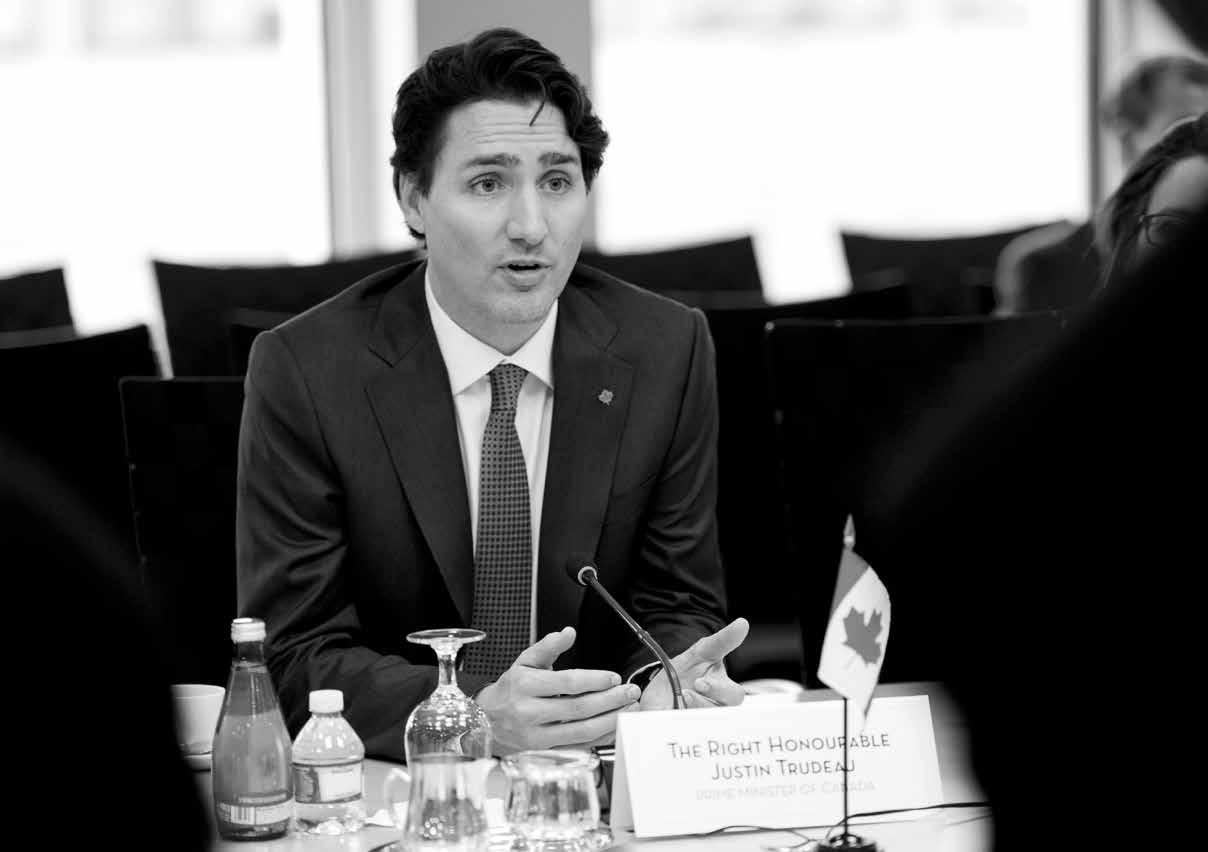
Prime Minister Justin Trudeau has broken the hearts of progressives across the country by approving Kinder Morgan’s Trans Mountain and Enbridge’s Line 3 pipelines. Over the course of the last few months, there has been increasing speculation that the Liberal government would green-light these projects –so while the result is not altogether unexpected, it is no less disappointing.
Ten years ago, I became a member of the Liberal Party of Canada at the earliest available opportunity. I still remember how thrilled I was for my fourteenth birthday, the time at which I could receive my membership card in the mail. My motivation to join the Liberals was due in large part to the Conservative government's environmental policy. Even at that young age, I was incredulous that Stephen Harper refused to take any serious measures to fight climate change. I wanted to do everything I could to try and stop him.
With Trudeau’s decision, I feel the same anger that I had regularly experienced with our last federal government. It is the familiar sting of having elected representatives that blatantly disregard our environment and the future generations that will be forced to deal with the ramifications of climate change. While the Liberal government has ratified the Paris Agreement, promised to implement a carbon tax, and invested in sustainable infrastructure, these pipeline approval announcements serve as a slap in the face to everyone who supported the party in the hopes that our country would become an environmental leader at home and around the world.
If you are not actively fighting both the consumption and production of fossil fuels, you are part of the problem
In 2008, the non-governmental organization Environmental Defence published a report that called the tar sands of Alberta one of the most damaging environmental industries in the world. While Canada is not a large emitter of fossil fuels in absolute numbers in comparison to much larger countries, it is still our moral imperative to take responsibility for our enormous per capita emissions and the fuel we supply to other countries.
I was impressed when our federal government announced a national carbon tax - this was a bold policy proposal designed to transition us
off of a carbon economy. Now, the pipeline announcement threatens the entire environmental agenda of the Trudeau government. Good luck selling the message to Canadian families that they need to be taxed on carbon consumption when oil and gas companies are allowed to increase their capacity and distribution. This is an incongruous message which tells us that there are a different set of rules for the oil giants.
The public is now being told is that we will grow our economy through expanding the oil and gas sector while simultaneously transitioning off of fossil fuels. This sounds awfully similar to ‘we want to have our cake and eat it too.’ I am sorry, building pipelines and responsible environmental stewardship are mutually exclusive. If you are not actively fighting both the consumption and production of fossil fuels, you are part of the problem.
If environmental responsibility is not enough of a reason to oppose this decision, I would like to tackle the notion that these pipelines are beneficial for our economy head on. While it is true that the short-term profits generated by large oil and gas companies will pay shareholders, employees, and the government through the sale of Canada’s natural resources, this practice is a shell game. It is only profitable because of
what we choose to actually measure on our financial statements. There are real, tangible financial costs to harvesting our resources and pumping fossil fuels into the atmosphere – just because it isn’t recorded on the balance sheet, doesn’t mean that it doesn’t exist.
The prime minister helped create thousands of new jobs, billions of dollars in new revenue for our country, and strengthen international trading relationships. But at what cost?
In this world, not all money is equal and we should not pretend that it is. A dollar earned in the oil patch comes at a more significant cost than we are led to believe. It is a cost to the environment but ultimately to our economy as well.
It is true that our country’s
economy currently runs on natural resources – this has been the case since the English and French first arrived on the continent – but it doesn’t necessarily have to be this way. We have a disproportionately large resource economy because it is easy, not because it is smart. We harvest resources, sell them to other countries as raw material, and then buy back the final processed goods from them because they were made with cheap labour. Globalization has allowed us to remain wealthy not through what we have created, but by selling what was here long before us.
Since the industrial revolution and the development of modern-day North America, western economies have been built in large part due to fossil fuels. Now, while facing an existential threat in the form of climate change, the world must adapt or we will pay an ecological and economic price. This argument might seem naïve considering our current reliance on the oil and gas industry, but the pitfalls of ignoring the science and economics of our situation will cost more in the long run.
As an economy changes, there are those who are inevitably left out and one need not look farther than the rust belt of the United States. Donald Trump has curried favour with despondent and unemployed coal workers who have had their live-
lihoods stripped away by a changing world economy. There is no question that many Canadians are suffering similar fates and I empathize with their position. This is a systemic issue that no individual can change on their own.
Meanwhile, the government says that this will create 23,000 new jobs in western Canada. I would like to see metrics that assess what the longterm impacts of climate change will be on the entire Canadian economy within the next 50 years. The impending effects of climate change in the form of extreme weather, flooding, wildfires, and rising sea levels will come at a heavy price. Jobs on the oil patch will start to look awfully expensive when compared to the very real costs of climate change.
This week, the prime minister helped create thousands of new jobs, billions of dollars in new revenue for our country, and strengthened international trade relationships. But at what cost? In the process he has also undermined Canada’s commitment to the environment, proliferated fossil fuel emissions on a global scale, and pushed the burden of these decisions on to a future generation.
photo provided by Franz mahr
A historic opportunity squandered: reflections on the UMFA strike settlement
With widespread support, and mounting union solidarity, UMFA had more to gain than lose by standing strong
As one of us wrote in these pages a few weeks ago, the recent University of Manitoba Faculty Association (UMFA) strike stood to win historically significant gains in the ongoing battle against the commodification and corporatization of education. Sensing this, faculty unions across the country and around the world were watching us, sending us funds and messages of support. However, the strike settlement we ratified on Nov. 21 shows that we have squandered that opportunity. Understanding this in a clear-eyed fashion – and discussing the implications – is critical since we must struggle for these goals in the structures of university governance in coming rounds of bargaining and in the overall battle for public legitimacy.
The following reflections seek to contribute to these processes. They are based on the information about the settlement made available to UMFA members on the night of Nov. 21, when the union membership voted to accept a new collective agreement.
The key goals of the strike – job security for instructors and academic librarians, protection against arbitrary use of performance indicators, and top-down increases in workload – were not attained. The settlement, we believe, leaves us in a situation where, in the place of clear rules and regulations that are written into the contract, administration and faculty will be locked in exhausting rounds of individual battles on everything from workload to performance metrics to collegiality. For this, of course, the administration and the corporate model it has been trying to impose bear primary responsibility. But UMFA could have brought matters to a more decisive end by standing firm in this “battle for the soul of the university,” as our colleague Arthur Schafer dubbed the strike, by better using the opportunity its strength provided.
We had cast the strongest vote ever in UMFA history to strike. That was, in turn, the result of a groundswell of revulsion among faculty at fast-deteriorating conditions on many fronts. Workloads were increasing in a multitude of ways. Collegial governance was being more and more openly violated, such as when the workload of arts faculty instructors was unilaterally raised; spending priorities were diverging ever more from the university’s goal of public higher education; the threat of the use of performance metrics without the consent of faculty members concerned was looming; numerous library assistants had been summarily sacked, leaving academic librarians without much-needed support; and the number of instructors with heavy workloads and without job security was increasing.
UMFA members made their views on these and other issues known in a survey conducted before the bargaining process began and they formed the basis of bargaining. With this firm bedrock of spontaneous opposition to the administration’s actions, strike compliance was, unsurprisingly, impressive.
Moreover, we had student support of a
nature and scale that was historically unprecedented. The wider public too, already wary of neoliberal discourse and concerned about the quality of higher education for their children, was more sympathetic than during previous strikes. Our strike’s legitimacy only grew when we shelved the matter of money for this round of bargaining, not because we were not concerned about our pay but because we felt it was more important to halt the commercialization and corporatization of higher education which was eroding the quality of education that we provide to our graduate and undergraduate students and, if possible, reverse the trend.
The weekend before we settled, though we had been on strike for nearly three weeks, spirits on the picket lines were as high as ever. We had known from the start that it would take time for the administration to register the strength of feeling on the picket lines and we were prepared to wait. On Nov. 17, the Thursday before we settled, an UMFA members’ meeting – called because so many of our members wanted to speak to each other and their leadership – packed Knox United Church. One after another, members expressed continuing support for our principles and their determination to make solid gains. No one mentioned ending the strike; it was almost an hour and a half before anyone mentioned money, and then only to seek certain clarifications. The following day witnessed the most massive show of student support for faculty the U of M has ever known.
After those two events, we knew that developments that weekend could be decisive: surely these shows of strength would finally knock some sense into the administration and budge it from the unreasonable, and frankly, from what we could tell, incoherent positions it was taking. We were hardly unaware that strikes never win everything and that we would have to steel ourselves for some disappointments.
What we did not expect, however, was the settlement we got, particularly with so much wind still in our sails.
The UMFA leadership is, unsurprisingly, caught in a deep ambivalence, calling the settlement a “fair deal” and inviting us to celebrate “success” while saying the same goals we were fighting for remain to be fought for.
Let us make a more systematic inventory of the settlement, taking the three major issues first. Certainly, everyone agrees that the settlement’s biggest failure was not winning job security for instructors and academic librarians. However, the seriousness of this failure is worth pausing over. Instructors and librarians, who constitute between 10 and 15 per cent of our membership, wanted this above all else. Solidarity is the most fundamental value of the union movement – but what solidarity can we boast of if we fail to protect our weakest members? Few would blame them from asking whether UMFA membership is worth it anymore. Moreover, this failure weakens UMFA by creating a space in which future management
could divide and isolate us. The only secure defence against such tactics is the solidarity of a united workforce, which has been undermined by the settlement. What UMFA “won” was a commitment from the administration that “there will be no layoffs of academic librarians or instructors” until the end of 2018. As if to add insult to injury, one instructor, who spoke at the ratification meeting of the 700-plus students he would be facing later that week, was told from the platform that he need not fear a layoff: since he taught so many students, he was a “gold mine” to the university.
Solidarity is the most fundamental value of the union movement – but what solidarity can we boast of if we fail to protect our weakest members?
This response highlights the larger failure. The administration’s drive toward commodifying and corporatizing higher education relies on the progressive elimination of faculty members with the standard 40-40-20 contract (40 per cent teaching, 40 per cent research and 20 per cent service) which expects, and pays, faculty members to devote equal time to teaching and research, ensuring that the latter keeps the former on the cutting edge of their field. Such positions are to be replaced by faculty members who are paid as little as possible in jobs with as little security as possible, to teach as much as possible. They are not to be paid to do research at all. This is why instructors’ job security was such a bone of contention.
The administration would like to turn the overwhelming majority of faculty positions into something like this. We, while understanding that some instructor positions are necessary, are determined to ensure that the norm remains the 40-40-20 contract and that those instructors who wish to pursue research have positions from which to do this.
One of our gains in this strike settlement is the renewal of a letter of understanding between UMFA and the administration that guarantees that the number of UMFA members at the university will not fall below a certain minimum. However, this is no protection against the trend toward eliminating research faculty: it does not specify how many of them will be instructors, paid only to teach and do service, and does not prevent such faculty from becoming a majority.
UMFA needed the victory on instructors’ job security as a first step toward ensuring against this. This would have to be followed by action to better the terms on which sessionals – who have an even worse deal than instructors and are more numerous – are hired as part of a push
to reverse the trend toward corporatization and commodification of higher education. It should be noted that the threats to academic librarians’ job security is part of the general withdrawal of support for research in the corporate university.
We have won a general and rather vague commitment against performance metrics becoming a “substitute for comprehensive assessment of quality and quantity” and a more concrete agreement to set up a joint committee consisting equally of UMFA and university administration to “examine issues relating to metrics.” Details of how this committee will be constituted are not clear. Information released by UMFA highlighted a provision that its recommendations, provided there are “no more than two dissenting,” will be incorporated into the collective agreement.
If the terms of the settlement are anything to go by, the weakest could once again be left behind: after all, this is how the university administration divides and rules
However, if the failure to win anything more than this is any indication, there is no reason to believe this joint committee will be anything more than another arena of endless dispute. If the terms of the settlement are anything to go by, the weakest could once again be left behind: after all, this is how the university administration divides and rules. The principle of “an injury to one is an injury to all” indeed tells us that this is exactly what the union needs to avoid.
The administration’s insistence on performance metrics is a central part of the erosion of collegial self-governance: with such metrics, there will be no need for peer assessment. People unable to judge academic work can then evaluate academic performance. If this is the prize the university is after, there is no reason to believe that it will not fight tooth and nail for it in the joint committee.
Finally, on workload, we have won a commitment that every faculty will set teaching guidelines as a body – “meeting in committee,” usually known as the faculty council. This seems like textbook collegial governance until one reads on. Administrators, normally excluded from collegial governance processes, are included in
these deliberations “for the purpose of advice.” No doubt, their already too-great power over the rest of us will ensure that their role is correspondingly greater than these words suggest. The result of these deliberations will be a dean’s report on how teaching guidelines are to be changed. Faculty councils will then vote on this but, if it rejects the report, a revised report only needs one third of the members present and voting to become effective.
Quite apart from permitting a minority to decide, this ignores the many conditions that already make it quite easy for deans to muster the small numbers required to meet this muchreduced vote threshold. In the present environment of cuts, small departments are already agreeing to higher workloads, even demanding them for instructors. What is going to prevent them from constituting the required third? Moreover, in some smaller faculties, these collegial processes are so frayed and weak with decision-making so centralized that the settlement leaves faculty members with little protection against workload increases.
This last point was made by a member in such a faculty during at the ratification meeting on Nov. 21. The circumstances in which it was made provide a clue to how the settlement got ratified. The allotted hour before voting began was taken up by a delay and then presentations on the settlement from the bargaining team. By the time members could rise for questions or discussion, other members were already lining up to vote and talking amongst themselves. So following the bargaining team’s presentation, there was effectively no debate on the settlement. This is democracy emptied of substance and reduced to ritual.
There is one other critical point which must be made. During the prior Nov. 17 meeting, we were also told that the bargainers were going to try to get back to work protocol which included restoration of pay lost during the strike. This only made sense, as there were plans to make up teaching lost during the strike to ensure no one lost a term and that the university would not face a mass of rightly outraged students demanding their fees back. At the ratification meeting, however, we were informed that there would be no restoration of pay in the settlement and that it was rather unusual for faculty on strike to get back-pay. We were not told how usual it was for lost teaching to be made up.
So now, while the administration is not making up for lost pay, we as professors are back at work, making up lost teaching time for nothing while losing precious non-teaching time needed for research and writing. Many of us are missing
photo by levi garber
deadlines that were set based on expectations that we’d have this time to research and write. Under these circumstances, not only does the university have little to fear or lose from strikes; strikes have become occasions where it may save on payroll to divert more funds away from the university’s teaching and research functions.
Following the bargaining team’s presentation, there was effectively no debate on the settlement. This is democracy emptied of substance and reduced to ritual
This is what we have lost. What did we gain? There were some worthwhile gains, such as on privacy protection, parental leave, and slight increases to travel and professional development funds and health benefits. But perhaps the biggest gains of the strike were the ones not in the settlement. The strike showed the university administration, the provincial government, and the public the depth and extent of opposition to the direction of the current university administration. And while walking the picket lines, we built new bonds of understanding and solidarity amongst ourselves and with students, a process that we hope will continue in the coming months and even years of struggle that we face because, although we put the problems on the agenda, the strike did not resolve them.
It is certainly possible that the UMFA bargaining team judged that we could not be relied on to strike much longer. We don’t know about that. What we do know is that they did not ask us.
Radhika Desai is a professor in the department of political studies at the U of M. Henry Heller is a professor in the department of history and author of the recently published book The Capitalist University
Don’t tell international students to accept tuition fee increases
M A ry Aseko M e AN d s o F i A d es CAL zi
F
ar past the closing of the 35th annual general meeting of the Canadian Federation of Students (CFS), tweets rang out early into the night with various 140-character accounts of what went down. We have seen these claims repeated since the meeting ended, where delegates who were at the meeting have claimed that the CFS does not support the voices of international students.
These claims reference the fact that delegates attending the AGM voted to table a motion brought forward by local 103, the University of Manitoba Students’ Union (UMSU), that proposed a policy tying international students’ tuition increases – our tuition increases – to those of domestic students.
As international students, we disagreed with any move to support increases in tuition fees, especially after we just started a national fight to eliminate fees for all. As co-chairs of the CFS’s international students’ constituency group, it is our responsibility to clear the air.
We are unapologetic in our
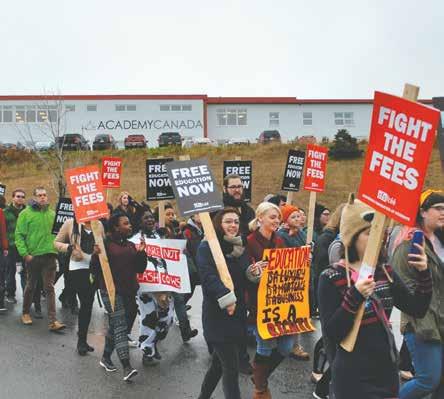
demand for fairness. While we can discuss reforms to the structure of the organization, the CFS cannot compromise on our foundational principle of opposing tuition fee increases.
If the intent of UMSU’s motion was to show solidarity towards international students, then it failed dramatically
At CFS general meetings, motions get debated vigorously – arguably more than any comparable organization in size or scope (650,000 members, 80 locals, 9 provinces). Not only do all of the motions make it to the plenary floor, but also over the course of the AGM, member locals discuss, debate, and amend the motions in multiple contexts.
One of these spaces is the international students’ constituency group.
Any delegate attending the AGM who identifies as an international student can be a part of this group. This constituency group is the only national democratic forum for international students in Canada. It is an important and supportive space that has given many of us the courage to bring international students’ issues to the forefront of our student movement both nationally and locally.
The motion from UMSU ended up being one of the most contentious motions at the meeting, but it did not have to be. In our constituency discussions, international students from across Canada unanimously opposed having our national body support tuition increases. International students today pay on average 3.7 times more than domestic students for postsecondary education because of the nationally-condoned, xenophobic practice of charging international students differential fees.
The policies of the CFS matter because they define what we fight for in the streets and what we lobby for from government. The future that we strive for is one without any
differential fees, and better yet, no fees at all. The CFS’s current policies already oppose all differential fees for international students and supports the establishment of institutions to enshrine that.
Following cross-country mobilization for free education for all students, including international students, it would be a massive step backwards to amend our policies to advocate for tuition fee increases. It is on these grounds that the international students’ constituency group voted unanimously to reject UMSU’s motion.
Confident in our position, we reached final debate on the motion, asking delegates to support us. What we did not expect was to see some domestic students, including delegates from the University of Manitoba, line-up at the microphones to condemn the unanimous voice of international students. Instead of listening to our voices, those of us who are the object of the motion, they echoed what we have heard from government and administration for many years – that we
should accept tuition fee increases. If the intent of UMSU’s motion was to show solidarity towards international students, then it failed dramatically. We ask for support from domestic students in Canada because the system here disrespects us at every turn. We are not allowed to vote for a government that will support us, and often cannot access healthcare, good jobs, or predictability around immigration. International students need the support of a national student movement, which is not what we were provided by the few but vocal supporters of UMSU’s motion. We need a strong student movement to fight against tuition fees and xenophobia now more than ever.
Mary Asekome and Sofia Descalzi are co-chairs of the international students’ constituency group at the Canadian Federation of Students.
Letter from UMSU
UMSU disappointed by CFS choice of ideology over progressive policy
International students to receive no tuition fee support from the organization
At the November 2016 national general meeting of the Canadian Federation of Students (CFS), the University of Manitoba Students’ Union (UMSU) executive presented a motion to protect international students from unpredicted tuition fee increases, in response to concerns of our own international students. The motion was an attempt to translate efforts made by UMSU to the national level, as it reflects the efforts that have been undertaken by UMSU council and the executive team. A similar motion has already been passed though UMSU council, and initial discussions have been started with the board of governors and the Manitoba minister of education.
Incremental changes are a pragmatic method of moving forward public policy, and it is the belief of UMSU that these changes would produce a more equitable environment for international students. The
motion called for international differential tuition fees to be capped to only increase by the same percentage as domestic tuition rates. Currently, domestic tuition fee increases in Manitoba are capped at the rate of inflation while international tuition fees are at the discretion of the administration.
The motion called for the CFS to add to the existing policies on international tuition fees to include for parity between the way that international student fees and domestic tuition fees are increased, as well as examine legislation that would ensure that both tuition rates can only increase by the same percentage. Protections such as this were made necessary when international students’ tuition fee differentials increased by as much as 18 per cent in the summer of 2015. This increase caused our international students to feel like “cash cows,” as these students
were forced to cover the financial shortfalls of our institution.
The motion immediately received intense criticism because it went against the current policy of the CFS – that suggests differential fees for international students are bad, and that tuition itself needs to be free. The intent of UMSU’s motion was not to go against current CFS policy, but to begin moving in the right direction. The intent was to make a progressive step to meet the needs of our international students now, and to protect our students from bearing the brunt of future budget shortfalls. In the end, it was decided that rather than allow the motion to be defeated outright, it was better to table it until the June meeting, to allow a second chance to advocate for this position to the national membership.
It was extremely discouraging to hear the pointed personal attacks, especially considering that the
majority came from the University of Winnipeg – both from their delegates in attendance and other leaders via social media. This disappointment is compounded by the fact that the Manitoba provincial component endorsed this motion as a whole. Despite this, the U of W showed their true commitment to solidarity. Anyone following #fcee16 on Twitter got front row seats to what true “solidarity” looks like in the modern student movement. UMSU has heard from our students that they need supports now, and we are prepared to accept pragmatic steps now as opposed to holding for ideological landslides.
Student representation has come to a crossroads, as evidenced by this meeting. UMSU proposed solutions that would help current students, and it was rejected. In its 35 years, the Canadian Federation of Students has unsuccessfully lobbied for free
post-secondary education. It is not on the immediate horizon. This motion represented a progressive step, progress towards a system where students are not forced to return home midway through their studies for lack of funds. Progress towards a system where all students feel valued. Progress towards a system where no individual is blindsided with an 18 per cent tuition differential fee hike overnight. UMSU will work to advocate for international students as the council and executive team have committed to furthering this campaign for the duration of their term, and shall continue to explore this option with University of Manitoba administrators and the provincial government, regardless of the negligence of the CFS.
2016 Manitoban Literature Competition Winners
Backyard Memory
Joelle Kidd
Fiona watches the sun rise. She hasn’t been sleeping lately. She floats for eight hours a night in a dreamless blur. She wakes up for good around 5:30 am and she stares at the ceiling in the low light. The sun rises, and a golden sliver jimmies its way up through the window, and then slowly widens, slowly slowly. The light touches the end of her bed and then her toes and then her knees and she can feel the warmth moving slowly up her body until she is lying under a blanket of sun.
In the kitchen, Father sits at the Formica-topped kitchen island, reflected in its blue-grey speckled sheen. Around him is a wall of books, which he constructs every morning, fat old books, bulging with knowledge: a concordance, three commentaries, and the Bible in several translations. Fiona sits down across the island and he peers over the stack of books and slides a box of cereal across the counter towards her.
She fills her bowl with cereal and with milk, which is skim milk, which she hates, but which is the only thing Mom buys. Mom runs through the kitchen and tosses a box of granola on the table, saying, there’s this too, even though everyone is already eating.
While they crunch cereal between their molars, Mom slurps coffee, standing up, at the kitchen sink – too noisily. Each slurp makes a muscle appear and shiver in Father’s jaw.
A new noise is added to the mix. Father looks around, perplexed, and then finds the source. The cat is visible through the doorway into the living room, where he is sitting on the ground with his front paws in the air, calmly dragging his claws in neat rows down the length of the caramel coloured sofa. Father begins to bellow, no no what is it doing, and Mom begins flitting around like a bird, chirping and waving her hands. Father tries to pick up the cat and throw it outside. Fiona says he can’t do that and when he screams, why not, Mom squeaks that cats have to be kept inside now, it’s the law. Fiona leaves the scene, retreating to her room to slowly put on her school clothes. Father is banging heavy books downstairs. The cat comes up to join her, pooling its slinky body in the sunlit folds of her blanket.
Mom picks up Fiona after school and takes her along to pick up dinner at the Chinese take out place. While she pays, Fiona taps out a rhythm with a pair of wooden chopsticks and sings the words from a nearby placemat in her head. Year of the tiger, year of the dog. Year of the dragon …
Back at home, their chopsticks tap on the surfaces of the Everyday Plates (not as nice as the Company Plates). Mom scrapes sweet and sour chicken from the bottom of a styrofoam container. Father looks at her and she raises her eyebrows high so that her forehead becomes an accordion of wrinkles. Oh did you want more of this? she asks. How was school? asks Father and Fiona tells him the truth: I don’t remember.
The cat is throwing up a hairball in the corner. Father throws his napkin down and begins yelling again. He grabs the cat around its little waist and heads towards the glass doors in the back of the dining room, to throw it outside. Mom runs after him. Fiona eats the last of the fried rice.
When Mom comes back she says Father put the cat on a leash so it can’t wander around the house and get away. Father isn’t coming back to the table. Father has a headache. He had a long day. The cat was bothering him all day. Mom cleans up the hairball. She says, the sermon is giving him some trouble this week. Fiona asks if it’s something to do with cats and Mom’s face goes funny and then she says no, what she meant was, he’s finding it hard to write. In the dark it’s hard to sleep because sounds seem louder. Mom almost forgets about the cat, but the leash can reach almost right up to the sliding patio door, so the cat sits by the glass and mews until he’s brought back inside. When Fiona has brushed her teeth and said her prayers, she lies in bed, blinking slowly, until the cat joins her. His padded feet announce his presence before the warm wiry body slides in beside her. He curls onto her stomach and vibrates softly until she blinks and the cat is gone and the sun is pushing its sliver of light over the edge of the neighbour’s rooftop. In the kitchen, Father has constructed his wall of books again. He
drains three cups of coffee while Fiona eats her rice crisps. His eyes are surrounded by creases, making his skin look like crumpled paper. He stares at Fiona while she chews her cereal and he says, you eat like your mother.
Father puts the cat out on the leash before Fiona leaves for school. He says he needs the cat out of the house so that he can concentrate. Fiona goes to school and Mom goes to work and Father goes inside to Struggle with his sermon.
A squirrel taunts the cat from the top of the backyard fence.
The leash is attached to a tree in the centre of the yard. The leash is just long enough to let the cat circle around the yard to where the garbage cans are kept. The leash is just long enough for the cat to jump up from the top of the cans to the narrow top of the wooden fence that surrounds the yard. The leash is just long enough for the cat to scurry nimbly after the squirrel.
When the squirrel dashes down the outside of the fence and the cat slips off after it, the leash is not long enough.
When Fiona comes home from school, she goes out into the backyard and sees the leash, stretched taut from the tree in the middle of the yard, slicing up diagonally across the sky, up to the top of the fence, where it disappears from view.
That night the house is gently rumbling with the sounds of shouting in the other room, alternating with biting clips of poisonous words. Fiona lies awake between her chilly sheets and watches the moonlight trace a path across her bedspread through the window. If she shifts her head and looks into her tilted vanity mirror, she can see the backyard, the gray lawn and the small lump of freshly turned earth, with a little cross poking out of the ground, two spindly sticks tied together.
graphiC by kelly Campbell
The Redwood
Melissa Bulloch
I turn the silver knob and push, stepping out the back door of my home. My senses instantly become realized as I take in the smell of fresh air, the sound of crickets, and the sight of my source of wealth. Stretched out before me is a thousand acres of flat gold in each direction; gold that I harvest to make a living. Not ten feet from my home is an astounding sight, a wonder that never ceases to amaze. A redwood tree towers over the land, as if to protect it from the bright blaze of the sun. I sit on my porch, shaded, and observe how the leaves dance in the soft, warm breeze. They sway gently to nature’s song. The wind picks up, causing the leaves of the tree to rustle as it passes by them. A dozen or so leaves take off, carried away from their home. Their dancing becomes less rhythmic and more panicked as they scatter from each other, individually deposited within the field of gold. The tree does not move. It stands as still and as confident as it did before, though it knows more of its offspring will fly away, as they always do this time of year. The time of year when the sun’s glow is slightly duller and the sky looks as if it were an artist’s portrait before falling into darkness. The wind whispers ‘change’ and the earth obeys. The leaves change colour, looking livelier than ever, before they are ripped from their life source and fall, forgotten. As autumn gives way to winter the world turns white, and the earth all but freezes
to death. At that time the tree will be bare, exposed for all to see. It will be truly alone and I will look upon with a sense of pity. Yet, time will pass, and the wind will whisper again, rekindling the earth with new life. The tree glows as the green leaves are restored to its branches, and my pity turns to awe. It is this cycle that engulfs us all, and yet humans live out their lives without ever truly comprehending that there will be an end. We believe we are like trees, masters of our own fate, towering over the land, forever standing still. We believe we are the ones that bring about new life, when the truth is we are the ones that bury the dead. We believe we are connected to the earth when we are only walking across its surface. So what are we to become then, but leaves on a tree that fall, only to never return?
I stand up and walk out into the field where the leaves are scattered. I part the golden rods to make a path for myself, strolling forward until finding what I seek. Lying on the earth is a radiant red leaf. I put one knee down to the earth, gently picking up the fallen leaf. I look up, shielding my eyes from the
sun so that I may look up at the redwood tree. The leaves continue to dance slowly, as if they were unaware that they would ever fall. As if there were no season that they would not live through. How wonderful it must be, to never know fear or doubt. How wonderful it must be to live life always feeling connected and safe, right up until the moment you die. I look away from the strong tree, back to the leaf in my palm. Perhaps it is because I know that I too will die, that I cannot feel sorry for the leaf. Or maybe it is jealousy, because I know that when I die, I will not return.
I curl my and into a fist, driving it into the moist soil. I envy the leaf. I want to feel safe and secure. I want to dance for eternity. I feel the roots of the golden crop in my hand as I realize that I am not a part of the earth like the redwood tree. I have no roots with which I can connect myself to nature. I have only hands with which I can desperately grasp at roots. I place the leaf in the hole my fist created, and cover it with the loose soil. I will eventually leave this world, but perhaps that is what makes my life valuable. I will live many seasons, witness many changes, lives and deaths, and in the end I will lie down peacefully. I will have dignity, and I will be proud of the impact I have made on the world. There can be no life without death, and there can be no death without life. Therefore, it is my tragedy and my gift that I will only live and die once.
Sessions
Kelsey Krempasky
what did you do last night?
i was on my knees. i was on my knees trying to pray but all that came out was his name.
who is he?
he is the Sun.
who does that make you?
icarus. icarus who flew too close but if i die I want it to be with Him on my lips.
Kinder Morgan pipeline could be disastrous for Canada’s environment
Approval of the pipeline expansion comes with many wildlife and climate consequences
M ALA k Ab A s, staff
On Nov. 29, Prime Minister Justin Trudeau and his cabinet made history by approving two pipeline projects: Enbridge’s Line 3 pipeline and Kinder Morgan’s Trans Mountain pipeline. This recent approval would put billions of dollars into the repair, expansion, or replacement of both pipelines. Another pipeline request, Enbridge’s Northern Gateway, was rejected. The approved projects will cost $6.8 billion dollars.
The approved construction on Line 3 involves replacing a 50-yearold pipeline that runs from Alberta to Wisconsin. When completed, the pipeline should be able to ship up to 760,000 barrels of oil per day from Canada to the United States – about twice the current pipeline’s potential.
The expansion of the Kinder Morgan pipeline would lay just under 1,000 kilometers of new pipe to its existing pipeline, which would increase its shipping capacity to 890,000 barrels of crude oil and petroleum daily, tripling its current ability. This pipeline runs only in Canada, from Alberta to British Columbia.
Both pipelines were mired in controversy leading up to this decision, and the response to this project approval has been strong on both sides. Its supporters believe that the pipeline expansion will help bring Canadian oil to an international market. Its detractors cite the environmental impact and the pipeline’s infringement on traditional First Nations territory.
If plans proceed as scheduled, construction is slated to begin in September of 2017, and the pipelines are expected to be in use by December 2019.
“Everyone will benefit”
While vocal supporters of the Kinder Morgan pipeline expansion are few and far between, Kinder Morgan itself believes the expansion will bring positive changes to British Columbia and Canada in general.
“The Trans Mountain Expansion Project will help make sure Canada gets full value for its oil. Everyone will benefit,” the company wrote in a public statement. “Workers will benefit during a $6.8 billion construction project. Oil producers will earn more revenue for their product. Government will collect more tax revenue from oil that will go towards services that benefit all Canadians.”
Kinder Morgan also cites the addition of 15,000 jobs per year during construction, and the addition of 37,000 direct or indirect jobs added during operations.
It is perhaps worth noting here that as of July 2016, Kinder Morgan Inc. is just over US $40 billion dollars in debt.
The environmental impact
Others are not so optimistic about the future of the Kinder Morgan
pipeline. One of the most common arguments against the expansion is the environmental impact it may have on British Columbia’s idyllic landscape.
While Justin Trudeau has consistently said that a balance between a prosperous economy and fair treatment of the environment is possible, the Kinder Morgan pipeline’s effect on the environment is anything but fair. As of now, as in before this expansion has even begun, 40,000 barrels have leaked due to corrosion and eventual rupture from the existing Kinder Morgan pipeline. These barrels, filled with crude oil and petroleum, can kill underwater flora, sea life, and even migratory birds. The Trans Mountain Pipeline’s record for longest amount of time spent without an oil spill since the 1960s is four years.
These barrels, filled with crude oil and petroleum, can kill underwater flora, sea life, and even migratory birds
Several large environmental preservation groups, including Greenpeace, have expressed their disdain for the project. Environmental activists fear the increase of tanker noise due to the expansion may also cause a negative impact on the endangered killer whales on the south coast of B.C.
The expansion of the pipeline also comes with a climate change cost. With the expanded pipeline comes increased production of tar sand extraction, the processing of which releases greenhouse gases into the air. The expansion of this pipeline would create the same climate impact as 2,700,000 million cars.
Even the increased production of diluted bitumen will have widespread effects on Canada’s air. Bitumen, a type of petroleum, is different from typical oil in its consistency. It’s thicker, more viscous, and it requires a rigorous dilution process to be used as oil. While oil companies are not required to explain just how they dilute bitumen, the process includes dangerous carcinogens such as benzene, which are in turn released into the air. Kinder Morgan’s company stance on transporting bitumen is to treat it the same as its lighter counterparts, despite the fact that if bitumen was being transported during one of Kinder Morgan’s many oil spills, typical oil spill response procedures may not be as effective.
Earlier this month, Kinder Morgan Canada president Ian Anderson commented that he was “not smart enough” to know how
deeply humans have an impact on climate change, but climate scientists overwhelming agree that humans are the main cause of global warming. With the expansion of pipelines comes the increased rate of greenhouse gas emissions from oil sands. Kinder Morgan and any other pipeline expansion flies directly against Trudeau’s original climate change plan, which was to actually reduce Canada’s total emissions to 30 per cent below 2005 levels by 2030.
Preparing for protest
The Tsleil-Waututh First Nation, whose traditional territory is crossed by the Kinder Morgan pipeline’s route, believes that they were not properly consulted on the proposal – Tsleil-Waututh leaders have announced plans to oppose it by any legal means possible.
Rueben George, a spokesperson for the Tsleil-Waututh community,
cited the dangerous environmental effects on their land and the low level of jobs being created for First Nations people as reasoning behind their stance.
Both pipelines were mired in controversy leading up to this decision, and the response to this project approval has been strong on both sides
Green Party Leader Elizabeth May has recently stated that she is willing to face jail time for protesting the expansion of the Kinder Morgan pipeline.
“The National Energy Board process was a sham. There was no testing of the evidence, there was no cross-examination, there is no factual evidentiary case that you can clean up bitumen mixed with diluent (a thinning agent) spilling in a marine environment,” May told the Huffington Post after the approval of the pipeline expansion.
The approval of these projects –along with the claim that the process behind its approval was misdirected – comes at the heels of recent claims that Canada’s scientific review process of research and environmental assessment of projects is woefully lacking. Just earlier this month, an open letter signed by over 1700 earlycareer scientific researchers that was addressed to Trudeau and several of his cabinet ministers called out what it called a lack of “scientific integrity.”
photo provided by mark klotz
Community profile: Rebecca Haverluck
Honours student combines craftsmanship with natural skin care products
eM e L i A Four N ier, staff
Rebecca Haverluck is currently working towards her honours degree from the school of fine arts at the University of Manitoba. Her preferred art mediums are oil paint, collage, and ink drawing. These mediums involve working with her hands. This translates well to her business, Art.Soap.Life, a handmade soap and skincare company that features her artwork on its labels and signage.
“The idea is to use art and handmade craft to connect with those around me,” said Haverluck. “As an artist, I have a serious appreciation for handmade items of all kinds, for the creative time and care that goes into them.”
Her father encouraged her to work with her hands and figure out the way things are assembled, and her mother taught her to appreciate and identify natural healing sources. Combining these two skills, Haverluck experimented with different combinations of natural ingredients to create her own line of skincare products over the first year of Art.Soap.Life.
After developing products that gave her the results she wanted for her own skin, she was excited to share her success with others through her business.
Haverluck started out by designing labels for her products, but when she decided to incorporate her own artwork into the labels, she noticed people were more responsive to her
products. Their unique designs caught the eyes of potential customers.
“Designing my own packaging also means I have the flexibility to approach local businesses to incorporate something unique of theirs into a collaborative product,” she said.
“I approach soapmaking as a creative medium and as an aspect of self-care” – Rebecca Haverluck, founder of Art.Soap.Life
One of Haverluck’s goals with Art. Soap.Life is to foster further connection and growth within the local arts and crafts community.
Like most small business owners, especially ones who are just starting out, Haverluck takes on all the roles involved in running a business, from manufacturing to advertising – and in her case also trying to balance it with school.
“Being around other artists and students at the University of Manitoba keeps my brain active and excited about new ideas and gives me confidence to approach others for collaboration,” said Haverluck.
While university is demanding,
her passion for her art and craft helps keeps her going, as well as support from her family, friends, and partner.
“I approach soap making as a creative medium and as an aspect of selfcare. I want to make things that are elegant and indulgent, but are also really good for your skin and affordable to use every day,” said Haverluck.
Haverluck hopes to eventually have a retail space for Art.Soap.Life as well as a co-operative gallery that would hold art exhibitions and arts and crafts workshops.
One of her goals with Art.Soap. Life is to foster further connection and growth within the local arts and crafts community. With her products, she hopes to reach out to, connect, and collaborate with more local artists.
“The social aspect of teaching a craft that continues to benefit a community is important,” said Haverluck.
To learn more, visit Art.Soap.Life on Facebook or at http://www.artsoaplife. com/
Community profile: Adewale Owulade
Fine arts student builds on his passion for photography, videography, and graphic design.
eM e L i A Four N ier, staff
University of Manitoba undergraduate Adewale Owulade initially moved from Nigeria to Canada to study engineering. He later decided to follow his true passion and love for photography by applying for the university’s fine arts program. That decision has paved the way for some major changes in Owulade’s life.
Through photography, Owulade has been able to creatively showcase his unique gift. “My father is an engineer, my mother is a lawyer, I AM DIFFERENT,” is the title of his recently released photobook. In the book, he highlights what makes him stand out as an artist.
Earlier this year, Owulade opened a photography, videography, and graphic design company, Primotive Studios. His Bronzed series, which was recently featured in the university’s Gallery of Student Art, is one of many photographic series that has been curated by his company.
The company began as Owulade’s online portfolio, but he decided to
develop it into a business. He is currently focusing on developing his portfolio and completing his degree.
“[Primotive Studios] is still about my work, it’s still my platform for people to see my work, and at the same time get familiar with the name,” said Owulade. “I’m developing a brand.”
“I try to combine my own definition of what I’m trying to communicate with people with my skills of fashion photography,” said Owulade.
Initially, he drew his inspiration for photography from shoots in highfashion magazines. Attending art school has encouraged him to think about photography more conceptually. He now blends conceptual ideas with themes of high fashion to create his own unique brand of photography.
His ideas for his photographs come to him intuitively, and then he tries to find a subject that serves as a good representation of his message. He tries to highlight his subject’s individuality in his photos.
“I find someone with a unique face,
and I try to create something out of them,” said Owulade.
“You don’t have to feed off other people’s creativity or be under someone else – you can go out on your own” – Adewale Owulade, founder of Primotive Studios
The name, Primotive Studios, comes from combining the phrase “prime motivation” together to form one word. Owulade believes in being motivated by one’s own artistic sense of creativity rather than trying to follow trends or norms.
“You don’t have to feed off other
people’s creativity or be under someone else – you can go out on your own,” said Owulade.
Owulade hopes to eventually have his own studio space and has his sights set on starting his own magazine running on the same ideas as Primotive Studios. He hopes his efforts will inspire and motivate others to pursue their passions and take control of their work and self-expression.
“I want the studio to be about photography, videography, and graphic design, but at the same time, I want it to be like a forum for people to talk and express themselves in terms of photography or art in general,” said Owulade.
For now, Owulade continues to balance school and running his own company, and hopes he inspires others to create their own path to success.
To learn more about Adewale Owulade’s and his company’s portfolio and commissions, visit www. primotivestudios.com. His book, My
Father Is An Engineer, My Mother Is A Lawyer, I AM DIFFERENT, is available on www.blurb. com/b/7487272-adewale-owulade.
photo provided by primotive studtios
photo provided by rebeCCa haverluCk
Live at the Roslyn promotes local artists and bands
Four friends come together to showcase local music via Facebook Live
oL i V i A Mi CHALC zuk, staff
At some point in their career, your favorite local band or musician may have had to deal with the heartbreak of low turnout at a show. Local music fanatics Rylie Saunders and Kevin Repay employed the help of local artists Scott Miller and Joey Senft to tackle this problem in their own way: by creating the Village Idiots, a local group dedicated to promoting and sharing local music.
The Village Idiots have brought music by local musicians into the comfort of people’s living rooms.
Since Nov. 2, every Wednesday at 8 p.m., the Village Idiots post a Facebook livestream called Live at the Roslyn from their apartment. The stream is public. Anyone can tune in and enjoy the music without worry-
ing about cover for the show or even needing to get out of their pyjamas.
The show resembles a Wayne’s World-esque variety show, with sketch humour, joking references to the show’s sponsors, and interaction with audiences’ live comments, featuring shoutouts to friends, family, and strangers from across Winnipeg and beyond.
nearly as full as they should be. So, they began their current project and quickly found it was gaining traction, with nearly 150 people sharing and
about it and just do it,” said Saunders.
“One thing we noticed is that lots of artists aren’t going to each other’s shows because they have never heard of them before.”
“Now all my friends are going to be exposed to music they would have
never heard before and they don’t even have to pay cover or leave their living room”
– Rylie Saunders, co-founder, The Village Idiots
Before hosting their first live show, one thing the Village Idiots noticed was that shows fronted by fantastic local musicians were not
over 8,000 viewing Micah Erenberg’s performance in their fourth week.
“It started out as an idea and Scott finally gave me the kick in the ass I needed and told me to stop thinking
The show has gathered a fanbase which brings together artists and fans of rock, folk, and country music. With a goal of promoting artists and their upcoming shows,
Live at the Roslyn exposes music lovers to artists and bands of diverse music backgrounds.
“We had someone drop out recently and I had just happened to
go to Micah [Erenberg]’s CD release show. I had never spoken to him until last week and he agreed to be on the show. Now all my friends are going to be exposed to music they would have never heard before and they don’t even have to pay cover or leave their living room,” said Saunders.
Check out the Village Idiots’ shows on their Facebook page every Wednesday at 8 p.m.
This weekend, the University of Manitoba men’s basketball team took on the University of Winnipeg Wesmen in a two-game series. The Bisons swept the series with a 91-60 win on Thursday and won the men’s basketball portion of the Duckworth Challenge on Saturday with a thrilling 79-78 win.
Thursday
On Thursday, the Bisons ended their five-game losing streak, defeating the Wesmen by a score of 91-60. Due to the inner city rivalry, when playing Winnipeg there always seems to be more on the line for both squads.
“There’s no question it means more,” Bisons head coach Kirby Schepp said. “More people from the basketball community are here to watch, more people pay attention to the results."
Keith Omoerah led the home side with a double-double of 21 points and 12 rebounds, while Narcisse Ambanza led the visitors with 17 points. Wesmen forward Ryan Oirbans also had a double-double, with 11 points and 10 rebounds.
The first half was dominated by defense, although Bisons guard Ilarion Bonhomme was able to net 12 points. Both teams struggled to make shots in the first quarter, with the herd taking a 14-9 lead into the second frame. Shots began to fall a little bit more in the second quarter, with
Winnipeg able to outscore Manitoba 22-21. The visitors were never able to reclaim the lead in the half, with the Bisons taking a slim 35-31 lead into halftime.
“More people from the basketball community are here to watch, more people pay attention to the results" –Bisons head coach Kirby Schepp
Manitoba began to run away with their lead in the second half, opening the third quarter on a 16-4 run and never looking back. The herd protected the ball in the half, turning it over just three times compared to Winnipeg’s 11. Omoerah led the second half charge with 11 of his gamehigh 21 points, helping the Bisons to a 91-60 win over the Wesmen.
Saturday: Duckworth Challenge
On Saturday, the Bisons defeated the Wesmen 79-78. With the win, the herd improved to 4-6, and the
Wesmen fell to 6-4 in Canada West division play.
Omoerah led the Bisons with a double-double of 21 points and 11 rebounds. AJ Basi also netted 19 points and Bonhomme added 16 more to contribute to the huge win. The Wesmen were led by Sean Tarver with 14 points.
Both teams shot the ball well in the first quarter, with Manitoba shooting 61.5 per cent, and Winnipeg shooting 50 per cent from the field. Omoerah led the herd with eight
points in the first quarter. The Wesmen led 23-21 after the first frame, led by Ambanza’s seven points. The Wesmen widened their lead in the second quarter, as they tightened up defensively, and took a 37-46 lead into halftime.
After an even third, the Bisons came out firing in the fourth, as they opened on an 11-2 run, capped off by an Omoerah slam dunk, to give the Bisons a 68-66 lead. Tarver hit a three-pointer to tie the game for the Wesmen with just under 24 seconds to
The experienced freshman in the paint
Bison
go. On the final possession, Omoerah missed a three, but Joey Nitychoruk grabbed the rebound, and drew a foul with just a half-second to play. He made the first free throw and missed the second, but the Bisons took the win 79-78.
The Bisons have now completed the first half of their season, and resume play on Jan. 13-14 when they travel to Regina to face the Cougars.
rookie James Wagner brings wealth of talent to the men’s basketball team
k e LL e N tAN igu CH i, staff
B
ison forward James Wagner has been playing basketball since he was eight years old. Despite interest in a number of other sports as a child, the six-foot-seven freshman is following in his father’s footsteps, and still playing basketball today.
“I played a bunch of sports when I was younger,” Wagner said. “My dad played basketball. So I kind of wanted to try it out, and that’s where it all started, back at the community club.”
Wagner already has championship experience from his time at John Taylor Collegiate. He was a part of the 2014 junior varsity, and 2016 varsity championship teams for the high school.
“There we had a real special group of guys,” Wagner said. “We all played together since we were in grade five. We all held each other to a high standard there, and all worked hard, so that kind of carried over to the U of M.”
Another impressive part of Wagner’s resume, is that he played for the U18 Canada team at the FIBA America’s Championships in Chile this past summer. He hopes to make
this year’s team as well, which will be held in Egypt.
“We lost to team USA in the finals by a couple points, so it was a close one,” Wagner said. “The team qualified for the championships next year in Cairo, Egypt, but you’d have to make the team again, it would be a really neat experience.”
Coming from a team of guys he has played with since grade five, Wagner is now a new face to the veteran-heavy Bisons locker room. They have a few fourth and fifth year players, like captains AJ Basi and Justus Alleyn.
“We have a lot of older guys,” Wagner said. “They made the transition really easy, they’re always helping us out, and making sure were always learning and getting better. They’ve made the transition to U Sports a lot easier than if we had to do it on our own.”
Wagner had some recruitment across the country, but decided to stay home and play for his local university.
“I had a fair amount of schools across the country, but U of M was just a good fit. I wanted to stay at home, and they have a really good
group of guys, it was just a good fit for me,” he said.
When Wagner is off the court, he is hitting the books, and looking to get into business at the University of Manitoba.
“My dad played basketball. So I kind of wanted to try it out, and that’s where it all started, back at the community club”
– James Wagner
“I’m in the faculty of science, but will be switching over to business,” he said. “Right now I’m interested in the area of finance and accounting, that could change, but that’s kind of where I want to lean towards now.”
Wagner hasn’t watched as much NBA as of late, but is more interested in the college game. Although he has never filled out a bracket, he enjoys
watching the big March Madness tournament unfold and usually cheers for Duke, or the individual players that he follows. If there is any player that Wagner bases his game off of, it is Doug McDermott of the Chicago Bulls. He is not a big name in the NBA, but was a very good player at Creighton University.
“I really like the way he plays,” Wagner said. “He’s not a great athlete, neither am I, he just thinks the game and still manages to be a very good player, so I kind of try to work out like that.”
In just his first year of eligibility,
Wagner knows he isn’t going to put up massive numbers, but hopes that he can just do what’s asked of him, and contribute to the team.
“I’m a first year guy, I’m not going to be a huge scorer, but I can contribute in a variety of ways,” he said. “I can rebound a bit, make open shots when I need to, defend, and just blend in and compliment some of the older guys.”
With the Bisons team having a lot of veterans, Wagner could be that scoring guy and leader for the team for years to come when the opportunity arises.
photo by star roxas
photo by star roxas
Bisons dominate on Friday, fall on Saturday against Cougars
jA so N pCHA jek, staff
This weekend the seventh-ranked University of Manitoba women’s hockey team played their final series of the 2016 calendar year against the Mount Royal Cougars at home. The Bisons dominated on Friday night, claiming a 4-0 win, but fell on Saturday with a score of 5-3. The Bisons now head into the winter break 11-4-0-1, good for second in Canada West.
Friday
The Bisons were back home at Wayne Fleming arena Friday night against the Cougars. The pace of the game was fast from the drop of the puck, but penalty troubles sank the visitors as the Bisons took the game 4-0.
The Bisons were the first to get
on the board, with Jordyn Zacharias recording her third of the season at the 14-minute mark. The puck was cycled down low to Nicole McGlenen, who put a pass down the goal line to Zacharias who was waiting in front. She put the puck past Cougars goaltender Emma Pincott to give the Bisons the 1-0 lead.
Four minutes into the second, Kate Hufnagel of Mount Royal took a holding penalty to give the Bisons the opportunity to extend their lead to two. Venla Hovi sent the puck cross-ice to Erica Rieder, who was waiting just above the right faceoff dot. Rieder hammered a one-timer, putting the puck top corner over Pincott’s glove.
The Bisons lead grew larger in the third, once again on the power play.
Jayden Skoleski sent a pass to Karissa Kirkup in the high slot. Kirkup got past a Cougars defender, and ripped a wrist shot from the slot. The puck went top shelf on Pincott, giving the Bisons a 3-0 lead. Kirkup struck again minutes later, another goal on the power play to put the Bisons up 4-0.
The 4-0 margin held as the Bisons cruised to a dominant shutout victory over the Cougars. A wide shot margin told the story of this game, with Manitoba out-chancing Mount Royal by 25-12.
“There’s some consistency there, there’s some confidence,” Bisons head coach Jon Rempel said regarding the team’s power play. “Teams clearly respect our power play.”
Bison men’s hockey team gets swept in Calgary to end first half
ryAN s te Lter, staff
Aweekend to forget for the Bison men’s hockey team, as they dropped both games against the Mount Royal Cougars. They lost a close one on Friday by a score of 4-3, and were dominated 5-1 on Saturday.
The Bisons head into the break with a 6-9-1 record and sit in sixth place in the Canada West, six points back of fifth-place Lethbridge.
Friday
The game on Friday saw the Cougars explode in the first period, as they scored four goals with two on the power play. The Bisons fought back admirably; they scored a goal in the second, and two in the third to draw within one.
It wouldn’t be enough, as the herd dropped a hard-fought contest. Brad Bowles got his second goal of the season in the contest, his first goal since Oct.22 against Regina. Byron Spriggs took the loss, but
made 29 saves. Nick Zajac continued his hot streak, scoring in his third straight game, Remi Laurencelle earned two assists on the night.
The Bisons head into the break with a 6-9-1 record and sit in sixth place in the Canada West, six points back of fifth place Lethbridge
Saturday
The second game of the weekend was a tough one for the herd, as once again special teams was the difference. Mount Royal scored two on the power play and even managed a
short-handed goal in the first. It was a penalty-filled affair, as the Bisons and the Cougars both took 17 minors. The Bisons got their only goal of the day on the power play via the stick of Jordan DePape.
DePape is now 13th in the Canada West scoring with 14 points in 11 games (8G, 6A). Despite missing five games so far this season the Bisons captain is stringing together a great year so far, averaging over a point per game.
The Bisons head into the winter break on a two game losing streak and will open conference play again on Jan. 6-7 at home against the Regina Cougars.
Saturday
Following their 4-0 win over the Cougars Friday night, the Bisons took the ice to try and head into the break with a series sweep. The game was a back-and-forth affair, but ultimately Mount Royal came out on top 5-3
“We’ve been going hard since August. We could use the rest mentally” – Sean Fisher, women’s hockey assistant coach
The Bisons controlled the game through most of the first period, but it was Mount Royal who opened the scoring in odd fashion. A shot by Rachel Piitz bounced off Devonie Deschamps, then the skate of a Bison defender to send it in the air. The puck flew over the head of Amanda Schubert who spun around to try and grab it, but was unsuccessful.
After heavy pressure saw a platoon of Cougars skaters stuck on the ice for nearly four minutes, Manitoba finally evened the score. A Mount Royal clearing attempt was blocked by Zacharias, who settled the puck and beat two defenders to get in all alone on Zoe DeBeauville. Zacharias deked right, putting the puck on her backhand and slid it under the Mount Royal goaltender’s pad.
Mount Royal snagged the lead again with three minutes left to play in the second off a point shot by Mairi Sorensen. The shot went past a couple defenders and over Schubert’s right shoulder.
The Cougars only needed 57 seconds to extend their lead in the third on the power play. Shawni Rodeback sent a pass down low to Sorensen who threw the puck in front of the Bisons goal. Sarah Weninger was waiting in front and tipped the puck underneath Schubert to give Mount Royal a twogoal lead.
Hovi responded for the Bisons two minutes later. She fought off a defender, putting a backhand shot under the arm of DeBeauville to cut the Mount Royal lead down to 3-2. Alexandra Anderson evened things up for the Bisons on the power play. She stepped forward, putting a wrist shot low right on the Cougars’ goal, and tied the game 3-3.
The Mount Royal lead was restored by Gabrielle Seper on a penalty shot. Seper used a shimmy move to get Schubert to bite and tucked home the goal. Mount Royal added an empty net goal, and took game two of the weekend series 5-3.
“We needed to play a full 60 minutes today and I don’t think we did that,” assistant coach Sean Fisher said of his team’s effort. “We’ve been going hard since August. We could use the rest mentally.”
The Bisons will be back Jan. 6-7 to take on the University of Regina Cougars on the road.
photo by star roxas
Bisons first half wrap up
This men’s hockey team is still searching for an identity
To say the University of Manitoba Bison men’s hockey team had an up-and-down first half is to sell the team’s rocky road to Christmas short.
The first half was filled with the highest of highs (beating the Saskatchewan Huskies, the second-ranked team in the country at the time, by a 5-2 count at Wayne Fleming Arena) and the lowest of lows (losing all four games to the Mount Royal Cougars for the second straight year).
Often unpredictable, at times vexing, but never boring, the Bisons are a team hunting an identity. They’ve had to sift through the dark waters of injuries, illnesses, losing streaks, and
lineup changes in search of it.
So what is the identity of the 2016-17 Bison men’s hockey team?
The team will tell you they are a fast, aggressive, up-tempo team with depth and physicality. They’ll tell you their record, a pedestrian 6-9-1 through 16 games, doesn’t show the kind of team they are. Our last look at them on home ice, a weekend in which they took three of a possible four points from conference powerhouse Saskatchewan, would seem to vindicate that statement.
One of the major obstacles for the Bisons, however, was inconsistency. You never quite knew which Bison team was going to show up on any
given night, and at times that could be taken literally. They have one of the biggest rosters in Canada West, and the lineup changes for them came on a nightly basis.
Of course not all of their lineup changes have been voluntary. The injury bug didn’t just bite the Bisons, it sank its teeth in to the bone and hung on like a tick. Taking everyone from captain and leading scorer Jordan DePape to rookie scoring leader Remi Laurencelle out of the lineup at various points in the first half.
While the team says they won’t let injuries be an excuse, it will no doubt be nice to have the break to
get healthy, and await reinforcements in the form of defenseman Blake Heinrich.
Often unpredictable, at times vexing, never boring, the Bisons are a team hunting an identity
The Bisons will need all the reinforcements they can get, because back-to-back losses to Mount Royal have them sitting in sixth place, six
points back of Lethbridge. Eight points back of Mount Royal for the final home playoff spot, and – most worrying of all – just two points up on UBC for the final playoff spot in the Canada West Conference. When the second half begins, this Bisons team will need to be healthy and ready to grind. The last 12 games of the season will be the hardest fought yet as the playoffs near. If the Bisons want to get into any playoff action this year, they’ve got their work cut out for them.
photo by megan Colwell
Doing it for the team
Lauryn Keen doesn’t let career year overshadow team success
jA so N pCHA jek, staff
The 2016-17 season for the University of Manitoba women’s hockey team has been one of promise.
The Bisons started the season on a tear, dominating games until hitting a brick wall against the University of British Columbia Thunderbirds.
Despite that early setback they regrouped and kept trucking, heading into the break 8-4-3-1.
“I think the trip to Europe really helped us,” Manitou native Lauryn Keen said of the hot start. “I think it helped us bond as a team and really got the rookies in there.”
Keen is in the midst of a whirlwind season of her own, as she is currently sitting in third place in
Canada West scoring with 17 points in 16 games. But Keen tries not to let that become a focus for her.
“I try not to think about it too much, because personally when I think about it, it messes with my head,” she said. “It’s important for me not to think about it too much.”
Through the first 16 games of the season, Keen has recorded 17 points, putting home a team-leading six goals while adding 11 helpers. She’s already eclipsed her 11 points from last season and all odds point to her surpassing the 18 points she put up in her rookie campaign.
When asked if a difference in preparation could be linked to this
spike in scoring Keen said no, mentioning that old-fashioned hard work is the key to her success. She’s prepared the same way her whole career and it’s worked out so she hasn’t changed.
“I’ve just been working hard in the gym and worked hard in the summer and it’s just paying off,” Keen said. “I’m doing it for the team and trying to win for the team. I’m not trying to go out there and get as many points as I can.”
Keen doesn’t find the workload of being a top-flight hockey player to be an issue. The agriculture student is taking six courses, noting that all it takes is a little advanced planning
to make sure everything works out.
“It’s definitely a balancing act,” she said with a chuckle. “It’s something you have to learn over time, the biggest thing is just staying on top of things, planning two, three weeks ahead.”
Being a third year player means that Keen has to begin confronting the end of her collegiate hockey career, but she doesn’t let that get her down. She’s looking forward to life after hockey, taking time off before eventually using her agriculture degree and country background to settle into the workforce.
“I think about it, but I don’t try to think about it much,” she said, add-
Bison volleyball slaughters Saskatchewan
Both men and women earn weekend sweeps against the Huskies
ryAN s te Lter, staff
After a conference bye, the University of Manitoba volleyball teams were on the road against the Saskatchewan Huskies. Both the men and women earned sweeps on the weekend.
Men
The thirdranked men’s team was in tough against the eighth-ranked Huskies. They made quick work of their provincial rivals this weekend however, dropping only one set on the weekend.
The Bisons completely dominated the entire weekend to continue their eight-game winning streak. Manitoba has the third-best hitting
ing that a trip to Australia would be something to consider.
Keen does see hockey playing a role in her life moving forward. She has aspirations to continue coaching young players back in Manitou, and also has been mulling over coaching her old AAA club out in Morden.
“Maybe be an assistant coach out there, if that’s something I want to do,” Keen said laughing. “I’m not sure I’ll be able to give it up completely, it’s a lifestyle thing.”
“I’ve just been working hard in the gym and worked hard in the summer and it’s just paying off” – Lauryn Keen, women’s hockey forward
With the rise in popularity of women’s hockey in North America, the chance for women to earn a paycheque playing the game they love is now a reality. When asked if she would ever play in the National Women’s Hockey League or the Canadian Women’s Hockey League, Keen said she would consider it.
“If the offer was there I would definitely consider it, but there’s a lot to consider,” she said with a laugh.
For now though, Keen and the Bisons head into the winter break in a comfortable position, sitting second in the Canada West.
Kearley Abbott had a monster weekend for the herd, racking up 18 kills on Friday, and 13 on Saturday
percentage in the Canada West and is currently second in the conference with a 9-1 record.
Devren Dear had a combined 28 kills on the weekend; he leads the Bisons with 107 on the year. Third year libero Dustin Spring had a good weekend, emerging on Saturday and led the herd with six digs and three blocks.
Women
The women snapped a four-game losing streak when they defeated the Huskies on Friday. The Bisons went the distance in both games on the weekend, needing five sets each game. Kearley Abbott had a monster
weekend for the herd, racking up 18 kills on Friday and 13 on Saturday. She leads Manitoba with 116 kills, and averages almost three kills a set. The Bisons are tied for eighth in the Canada West with a 4-6 record, two points back of the final playoff spot.
The Bisons take on crosstown rivals Winnipeg next weekend, with the Duckworth Challenge portion taking place on Dec.8 at Investors Group Athletic Centre and then again on Saturday at the U of W.
photo by star roxas
photo by Chantal zdan
What happens in Vegas hopefully stays in Vegas
Looking at how other expansion teams have fared in the NHL
j oe g o N z AL es, staff
O
n Nov. 22, 2016, it was made official by majority owner Bill Foley that the new Las Vegas NHL franchise would be called the Vegas Golden Knights. Months after it was announced that expansion was in the works and that Las Vegas had been awarded an expansion franchise, it seemed fitting that, responding to a crowd of boos, NHL commissioner Gary Bettman replied, “Keep booing, it proves you’re now an NHL city.”
Of course, it will take more than booing the commissioner to really know if Las Vegas will be able to sustain a professional hockey team. In the end, pro sports teams are really just businesses with a product looking to maximize profit. A popular tourist spot, Las Vegas at first glance seems like a great location for pro sports to expand in. Mark Davis, owner of the NFL’s Oakland Raiders, has expressed determination to move the team there.
It can’t be denied that some of the ticket sales made by the Knights will come from tourists passing by looking for something to do or the fans of opponent teams looking to see their team play, among other things. But the team has already sold 14,000 season tickets in a 17,500 capacity arena, so it seems enthusiasm for the team is high. Compared to former expansion teams, optimism for success may be high as well.
That’s not to say that there was less optimism for success for all former expansion teams. Some have gone to establish themselves as a franchise and have their city’s embrace. Others however, didn’t fare as well. The Manitoban takes a look at those teams to explain what happened, and what Vegas could learn from their stories.
California Seals/Oakland Seals/California Golden Seals (1967-1976)
Three name changes, along with three different owners for the team’s first four years of existence. That fact seemed to spell doom for the Seals from the start. They never finished above a .500 average in record standing, but were able to make the playoffs twice. They were ousted in the first round for both of those appearances. The World Hockey Association (WHA) was also created during the Seals’ time, which only amounted to more woes as several of their players
left to join teams in the WHA for better salaries.
Eventually, the Golden Seals moved to Cleveland in 1976, but that team folded and merged with the Minnesota North Stars in 1978. This was during a time that hockey might not have been as popular in the U.S., as the Seals had an average attendance of 5,607 over their nine seasons in California.
It
can’t be denied that some of the sales made by the Knights will come from tourists passing by looking for something to do
Atlanta Flames (1972-1980)
A slow start for the team in Atlanta was compensated by consistently decent hockey for the rest of its time there, emphasis on decent. In the team’s eight-year history, they made the playoffs six times, but had merely two wins to show for it. There were a couple bright spots for the Flames, such as Eric Vail and Willi Plett winning the Calder trophy in 1974-75 and 1976-77 respectively. Jim Craig, the goalie who backstopped the U.S. Olympic Hockey Team to a gold medal and was part of the “Miracle on Ice” during the 1980 Winter Olympics, made his debut shortly after that historic run to Atlanta’s first sellout crowd of 15,156. The magic fell flat soon after, though, as Craig only played four games for the season.
Attendance started to dip, which resulted in more financial losses for owner Tom Cousins. Low viewership meant no TV deal for the team to try and save it, and soon enough the Flames were sold to Calgary in 1980. The team still exists today, of course, and the “A” patch they use on their jerseys for assistant captains resembles the old logo of the Atlanta Flames.
Kansas City Scouts (1974-1976)
They were there and then they
were gone. That’s about all you would need to write on the Scouts’ history, as they lasted only two seasons before being sold. In the 160 games they played from their two 80-game seasons, they managed 27 wins and 23 ties, to go along with their 110 losses.
A season ticket drive that had only 2,000 sales out of their goal for 8,000 indicated that pro hockey just wasn’t going to work in Kansas City. The team moved to Colorado, and then that team moved to New Jersey, which still exists today as the Devils.
Hartford Whalers (1979-1997)
The NHL and WHA went through a merger in 1979, and the Whalers were one of four teams to move on over. At first glance, seeing that they lasted for 18 years in the league might lead one to believe that they were relatively stable. Indeed, it seems they would have been able to stay in Hartford, had it not been for poor management.
Another thing is that they were at the epicenter of three NHL teams surrounding them geographically. On one side, there were the neighbouring state rivals and more popular Boston Bruins. On the other were the established New York teams, the Rangers and the Islanders. With a situation like that, it would be hard to try and market yourself to fans next to those three powerhouses.
The Whalers had big names in their inaugural season – Gordie Howe and Bobby Hull, to name a couple. But they soon retired after getting swept in the first round of the playoffs. Ron Francis was the face of the franchise and loved by the Whalers’ fans, but after being sent to the Pittsburgh Penguins in a lopsided trade in 1991, that left a bad taste in the mouths of the Hartford faithful. The performance of the team during the 18-year tenure earned them the nickname “Forever .500s.” Though they were able to make the playoffs eight times, they made it past the first round once and had opening round exits in the other seven appearances.
With rumours of movement, fans banded together to get involved in the season ticket drive for 1996-97 campaign. It turned out much better than what the Scouts had tried, but crumbling talks in the form of a deal for a new arena resulted in owner Peter Karmanos Jr. moving
the team to Carolina. Today, they are the Hurricanes.
What Vegas can Learn from history
Three other teams were omitted from the list: the Quebec Nordiques (1979-1995), Winnipeg Jets 1.0 (19721996), and the Atlanta Thrashers (1999-2011). A weak Canadian dollar was a big factor in Quebec and Winnipeg moving, as rising salaries were being paid in USD; exchange rates reached 73 cents to the dollar from 1994-1996.
“Believe me, we won’t screw up the first game like we screwed up the video” – Bill Foley, Vegas Golden Knights owner
Regardless, it seems like almost every expansion team that had to make a move went through such similar stories that it can be reduced to a formula: poor performance = poor attendance = poor profits = poor morale = potential for moving.
I say almost every team because Hartford, Quebec, and Winnipeg had rabid and loyal fan bases that would have done almost anything to keep their team close. But money is the motive, and in the end, that was the one problem that fans couldn’t collectively solve. Winnipeg, luckily, has brought a team back.
Now, the impromptu formula listed is probably obvious to a lot of people. But it’s worth looking back at
history to see what Vegas can do to make sure what happens there stays there. How the team performs at the start will be key, but it’s clear from projected rosters that they won’t be a playoff or even a wild card contender from the start. They’ll need to draft high and start building from the ground up.
Attendance, as mentioned, seems to be in good hands: 14,000 season tickets sold, with fans vacationing in Vegas to be filling the rest of the seats. T-Mobile Arena, where the Golden Knights will be playing, is owned 50-50 by MGM Resorts International and Anschutz Entertainment Group. So it looks like Foley won’t be having to dig into his pockets should arena troubles come by.
Vegas will just need to weather the storm, and hope they can maybe come by a miracle for their assumed impending lackluster start once the franchise begins play for the 201718 season. Hopefully their fans will stay and they can get new ones on board, or else run the risk of being another former expansion team in the history books. However, given Bettman’s previously adamant stance on keeping the Coyotes where they were despite factors that would’ve led the team to move, maybe Vegas will be alright.
“Believe me, we won’t screw up the first game like we screwed up the video,” Foley said, after a botched introduction to the team’s name. The sports world will be watching to see if he can hold true to that statement.