GRAPHICS EDITOR Emma Gillich graphics@themanitoban.com
AUDIO AND VIDEO
AUDIO EDITOR Max Reid audio@themanitoban.com
PHOTO EDITOR Mike Thiessen photo@themanitoban.com
VIDEO EDITOR Zulkifl Rafah video@themanitoban.com
DIGITAL MEDIA EDITOR Faisal Rahman social@themanitoban.com
The Manitoban is the official student newspaper of the University of Manitoba. It is published monthly during the summer and each week of regular classes during the academic year by the Manitoban Newspaper Publications Corporation.
The Manitoban is an independent and democratic student organization, open to participation from all students. It exists to serve its readers as students and citizens.
The Manitoban is a member of the Canadian University Press, and our journalistic standards can be found on the Manitoban’s website.
The newspaper’s primary mandate is to report fairly and objectively on issues and events of importance and interest to the students of the University of Manitoba, to provide an open forum for the free expression and exchange of opinions and ideas and to stimulate meaningful debate on issues that affect or would otherwise be of interest to the student body and/ or society in general. The Manitoban serves as a training ground for students interested in any aspect of journalism.
Students and other interested parties are invited to contribute to any section of the newspaper. Please contact the appropriate editor for submission guidelines.
The Manitoban reserves the right to edit all submissions and will not publish any material deemed by its Editorial Board to be discriminatory, racist, sexist, homophobic or transphobic, ableist or libellous.
Opinions expressed in letters and articles are solely those of the authors. Editorials in the Manitoban are signed and represent the opinions of the writer(s), not necessarily those of the Manitoban staff, Editorial Board or the publisher.
VOLUNTEERS Adam Johnston
interested in volunteering? email me@themanitoban.com today!
A “volunteer staff” member is defined as a person who has had three volunteer articles, photographs or pieces of art of reasonable length and/ or substance published in the current publishing year of the Manitoban
Any individual who qualifies as a volunteer staff member must be voted in by a majority vote at a Manitoban editorial board meeting. Elected representatives and non-students may be excluded from holding votes as volunteer staff members in accordance with the Manitoban Constitution.
Nepali students’ association hosts first Tihar celebration
Tihar celebration illuminates campus life with tradition, gratitude and community
Roy Albright Obah, staff
T
he Nepali Students’ Association (NSA) is organizing its first-ever Tihar celebration at the U of M on Oct. 18 at 5 p.m. in the Multi-Purpose Room at University Centre. The event aims to create a sense of community for Nepali students while sharing the festival’s cultural significance with the wider university population.
Neha Saru Magar, founding president of the NSA, explained the inspiration behind the celebration. “We were inspired by a desire to create a ‘Home away from home’ for Nepali students,” she said. “We saw an opportunity to share our culture with the wider university community.”
The celebration is designed to promote cultural diversity and inclusion on campus. “Instead of diversity being just acknowledged, we want it to be experienced,” Magar said. “We’re welcoming students, staff and faculty from all backgrounds to participate — not just observe. Whether it’s trying Selroti for the first time or joining us in Rangoli-making, it’s about connection through shared joy.”
Tihar, also known as the Festival of Lights, is celebrated over five days, each with unique rituals and meanings. These include Kaag Tihar (Crow Day), honouring crows; Kukur Tihar (Dog Day), celebrating dogs’ loyalty; Gai Tihar and Laxmi Puja, worshipping cows and the Goddess Laxmi; Govardhan Puja/ Mha Puja, reflecting gratitude toward nature and self; and
Bhai Tika, when sisters pray for their brothers’ long life.
“What makes Tihar truly special is that it goes beyond religion — it celebrates relationships, gratitude, harmony and coexistence,” Magar said.
The event has been a collaborative effort involving weeks of planning. The NSA executive team worked closely with UMSU, the Nepali Cultural Society of Manitoba and a Pandit Ji who will conduct the Puja. Magar stated, “It has truly been a community-driven initiative.”
The celebration will feature traditional Puja, Selroti and other authentic Nepali cuisine, Prasad distribution,
traditional song and dance. Magar hopes both Nepali and non-Nepali attendees gain meaningful experiences from
“When we celebrate together, it reminds us that distance doesn’t dilute identity”
— Neha Saru Magar, founding president, Nepali Students’ Association
Rangoli art displays, a photo booth and music and dance performances. The event will conclude with Deusi-Bhailo, a
the celebration. “For Nepali attendees, I hope it feels like home. For non-Nepali attendees, I hope they walk away
with new friendships, full stomachs and a warm appreciation of our traditions. More than just learning — we want them to feel included in our celebration,” she said.
NSA plans to make Tihar an annual tradition and eventually collaborate with more cultural groups. “This is just the beginning,” Magar said. “When we celebrate together, it reminds us that distance doesn’t dilute identity. It strengthens our cultural roots [...] while embracing where we are.”
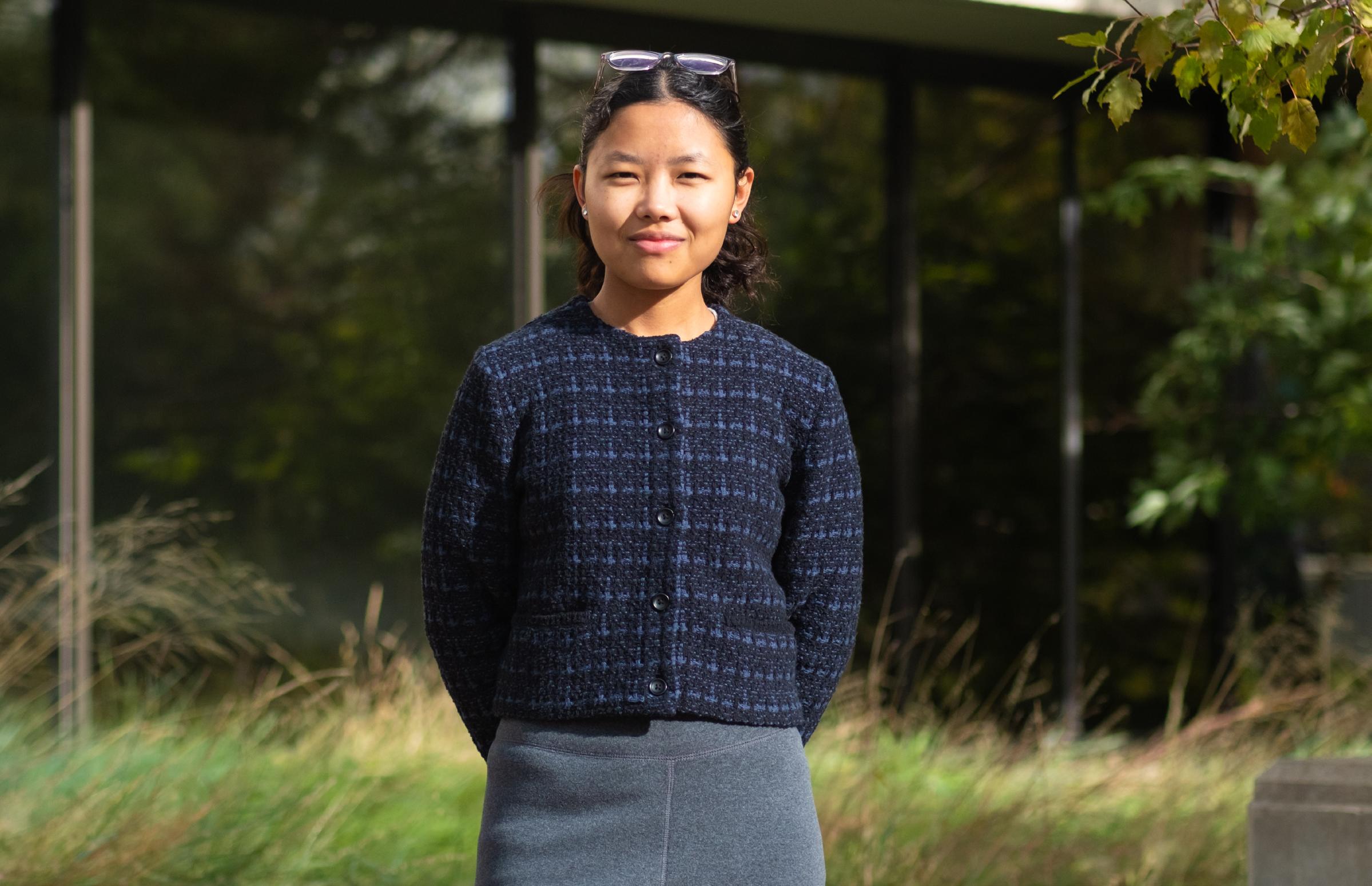
PHOTO BY MIKE THIESSEN / STAFF
NEHA SARU MAGAR, PRESIDENT OF THE NEPALI STUDENTS’ ASSOCIATION. THE ASSOCIATION IS HOSTING A TIHAR EVENT ON OCTOBER 18.
Cineplex case prompts exclusivity conversation
Students and film fans alike share their thoughts on how it shapes moviegoing
Jesse Brogan, staff
Cineplex Inc.’s $38.9 million drip-pricing penalty, which is currently under appeal, has ignited local conversation over whether theatres are making moviegoing feel increasingly exclusive.
The case, centred on an online booking fee of up to $1.50 that was not immediately transparent, has become a proxy for a larger question in Winnipeg — are cinemas adding perks with fees that push people away, or providing value that keeps the bigscreen ritual alive?
For film student Theo Hatch, the answer started with what public spaces should feel like.
“I’m really partial to an inconvenient movie-going experience,” said Hatch. “I don’t want to be feeling like I’m at home […] if I wanted to watch a movie in the comfort of my own home, I would stay home.”
Hatch connected that feeling to design and cost. Hatch
remembered budget Tuesdays and unassigned seating at older venues.
“Before […] it’s like five bucks on Tuesdays […] now it’s like twenty,” said Hatch. “Why is there an arcade in my movie theatre?”
“Public spaces should feel like public spaces […] a little inconvenient […] a little uncomfortable,” said Hatch. These are conditions that Hatch thinks keep audiences present and engaged.
Hatch pointed to the city’s growing micro-cinema as a countermodel to Cineplex, with lowfrills rooms, folding chairs and a film-club vibe. That, Hatch said, is “such a human experience […] I prefer human experiences.”
the cheapest cinema in town. Who wants to spend that much money on a cinema?” said Korolyk.
With the addition of recliners and alcohol, the overall theatrical trip has shifted into “a specialized event. It’s not something you want to do every week,” said Hatch.
Korolyk worried that the “event-izing” of the moviegoing experience can corrupt
admitted he didn’t mind the reclined seating and alcohol service. Still, rising costs have changed his own habits.
“Going to the movies now is super expensive,” Roach said.
“I don’t go to the theatre as much as I used to because of the prices of everything.”
Roach now gravitates to the city’s popular indie venue.
“Two tickets [cost] $30 for the cheapest cinema in town. Who wants to spend that much money on a cinema?”
— Lee Korolyk, U1 student
etiquette, with more chatter, sing-alongs at non-sing-along screenings and even roughhousing.
U1 student Lee Korolyk talked about frustrations with the pricing.
“Two tickets [cost] $30 for
However, not everyone opposes the premium addons.
Luke Roach, rentals and technical coordinator at the Winnipeg Film Group,
“I like going to the Cinematheque. I do like the smaller, more intimate theatres,” said Roach. “The best part of the Cinematheque is that we play random movies, we play foreign films […] we play movies that don’t necessarily play in Landmark.”
With independent theatres screening foreign films and harder-to-find works, it is one of the strengths of the Cinematheque. But the bigscreen experience still holds an allure.
“There’s something kind of romantic about going out and watching movies in the cinema,” said Roach.
As Cineplex argues that its online fee was disclosed and avoidable by purchasing at the box office, the case’s outcome could be an example for other businesses. For students like Hatch and Korolyk, the verdict may matter less than the larger trajectory if theatres end having fewer midpriced showings, more bells and whistles and the growing sense that the mainstream moviegoing experience is selling an exclusive night out rather than a weekly habit.
The decision from the appeal is yet to be announced, but on campus the conversation is already about creating choices. Keeping premium experiences for those who want it while rebuilding the affordable, intimate spaces that make moviegoing fun and accessible seems to be the dream of modern moviegoers.
PHOTO BY JESSE BROGAN/ STAFF
Crop or weed?
U of M student applies computer vision to help agriculture and beyond
Mansura Akter Meghla, staff
Alex Senden, a secondyear master’s student in the U of M’s department of computer science, is developing artificial intelligence (AI) tools that could help researchers distinguish crops from weeds in agricultural images.
“My research is in the domain of AI machine learning,” Senden said. “It’s basically computer vision, which is this idea that you’re trying to get computers to understand and make intelligent decisions about images or videos or visual data.”
Senden works on image generation, training models that learn to create realistic new images from random noise. “You basically start with a bunch of random noise, complete TV static, and the model […] learns to go from this noise to something that looks like a real image,” he explained. By feeding the model a bunch of real images during training, it learns to reconstruct order from randomness, turning static into a believable picture.
He is especially interested in models that not only create images but also know exactly what each pixel represents. “I want to be able to generate images where we know where things are in the images,” Senden said. “When
I say that, I mean literally pixel by pixel, I can tell you what object this pixel is representing.”
This research approach is being applied in collaboration with the department of agriculture to develop crop field imagery. “They have this big problem right now where they want […] a machine learning model that can go through real images in real time and tell you, ‘Here’s where the weeds are, here’s where the crops are,’” Senden said. Beyond this, such an approach also holds broader potential for agricultural research as U of M collaborates closely with Agriculture and Agri-Food Canada.
The challenge, he added, is that such models need huge volumes of annotated data — images that researchers need to label manually, marking each pixel to show which areas represent crops and which represent weeds. This process is often slow and extremely expensive to carry out. “To do that for every single pixel in an image, it takes way too
scale of a crop field [is] pretty infeasible.”
“Computer vision […] is this idea that you’re trying to get computers to understand and make intelligent decisions about […] visual data.”
— Alex Senden, master’s student in the U of M’s department of computer science
much time,” he said. “You can do it for small amounts of images, but to do it […] on the
Senden’s long-term goal is to address this challenge by generating artificial images with built-in labels. With data-labeling automation, his system could provide the data needed to train models without relying on years of manual work. The same
method could support other fields that depend on detailed imagery, such as medical diagnostics, where identifying tumors or lesions also requires large, labelled datasets.
“I would like […] to make this type of machine learning model or computer vision model […] easier to train so that it’s really easy to implement across industries or research,” he said. Beyond his own project, Senden follows emerging work in federated learning — a framework that
lets multiple users train AI models collaboratively without sharing private data. “This has really big implications for data privacy,” he said. “Now we don’t actually have to share data in order to make this one model that has basically […] learned from all of our data.” According to Senden, data privacy will become an increasingly important issue in the future, and federated learning might be able to offer a solution to one of AI’s biggest current challenges.
PHOTO PROVIDED BY ALEX SENDEN
The merits of a beater car
A driving force, if it drives at all
Mike Thiessen, staff
Earlier this summer, I took my 2008 Honda Fit to a shop for a quote on replacing my exhaust system. It would cost $1,000, the mechanic told me, but I would get back the $53 that I spent to have them look at it. I said thank you and drove my loud car home.
My exhaust problems started about this time last year, directly following two months during which my car would not start at all. Once that problem was resolved, I had about a week of normal driving before my muffler fell off on the Trans-Canada.
Most of the plastic clips holding my front and rear bumpers to the body have broken off and are now held together with tape. There is rust on every fender.
My Honda Fit is a certifiable beater.
I have known beater cars for a little while. The car I drove
in high school, a 2003 Nissan Altima, once lost its rearview mirror on the highway and had similar muffler problems. The driver’s side door handle broke off in my hand one winter day, and it died a sudden death when the coolant line inexplicably detached itself and antifreeze mixed with every other fluid in the engine.
My most recent car, a 2008 Honda Accord, burned so much oil that I kept a jug of 5W-20 in the trunk and topped it up nearly every time I filled up with gas. That one nearly died in the parking lot of the Portage la Prairie Canadian Tire — again, it simply would not start. Once revived, a week and a half later, I sold it as quickly as I could for a little over half of what I paid for it before any other problems
could arise.
I have never been one to name my cars, unlike many people I know, perhaps akin to the phenomenon of parents from days of old postponing naming their children until it was clear they would survive beyond infancy. Owning a car like this can be a headache like no other, but there is also a beauty in it. These cars keep you on your
circumstances available to you. What sort of configuration of zip ties will keep my front bumper from flapping around in the wind until I get home? How many pieces of scrap metal and hose clamps will hold an exhaust system together?
“Owning a car [beater] like this can be a headache like no other, but there is also a beauty in it”
toes. I’ve found that the threat of a piece of your vehicle falling off keeps me quite in tune with the driving experience. Increased attentiveness to the car means increased attentiveness to the road, hopefully.
A beater teaches you how to adapt and work with the
Mostly, though, my beater cars have fostered bonding experiences. There are the brief, circumstantial moments, where people roll down their windows to ask if I’m ok while I’m taping my car back together. Then there are the more intimate moments, like loading my Accord onto the trailer with my dad and getting a box of Timbits after.
Some of my fondest and final memories of my late grandpa involve us working (or, often, rather, him working
and me watching intently) on all the various problems of all my various cars, standing in the shop on our phones looking for answers on 12-yearold internet forums, and the quiet and mutual satisfaction of solving a problem in an unorthodox way.
My hometown shop recently echoed the city shop, quoting me $1,000, but adding a caveat — that would only be if they were willing to work on it, which they’re not, really. My 2008 Honda Fit is too far gone to be worked on in any way that matters without it being a complete waste of money. All I can do, then, is have some combination of semi-mechanically inclined family members and myself weld the pieces back together, cross my fingers, and drive that car until it rattles itself into a pile of dust. I will do it with a smile on my face.
PHOTO BY MIKE THIESSEN / STAFF
We’ll love you forever
Robert Munsch will continue to live on within his stories
Quinn Mayhew, staff
Robert Munsch, the famed Canadian children’s novelist, has always been one of my favourite authors. His whimsical stories enchant me, with both his drawings and pictures eliciting a form of childhood nostalgia whenever I read his books.
If you were to ask a person who grew up in Canada if they had read a Robert Munsch book as a child, they would most likely say yes. His stories also transcend age. Despite his books being written for children, I sometimes yearn for the familiarity they always bring me.
In a world where everything is online and AI is beckoning, I find comfort in the pages of his books, The Paper Bag Princess, Stephanie’s Ponytail and Something Good. These are just a few of the books that have really resonated with me during my childhood.
Munsch is not only an author, but also a person who lived a prolific life, often going to classrooms at random and speaking to children or serv-
ing as a prize in contests and staying with families of those contest winners.
Despite all these, Munsch lived a life of struggle. He was diagnosed with obsessive-compulsive disorder (OCD) and manic depression, which led to addiction problems and mental health struggles.
As a person who lives with OCD, Munsch’s diagnosis surprised me a lot. I know OCD affects people differently, and I know there is no distinguishing factor for someone who has this mental health disorder. But Munsch, being such an influential author and person, made me proud as a person who also suffers from OCD. I find myself thinking of Munsch more in recent days, a lot more than I usually would. This is due to Mun-
sch being approved for physician-assisted suicide after previ -
ously being diagnosed with dementia and Parkinson’s disease.
Munsch first said it years ago, “The stories will be the last to go.” Even though Munsch, as a person, is succumbing to the disease of Parkinson’s and dementia, his story and the impact of his novels will stand the test of time and will live on within the children he influenced
with his work.
Munsch, despite being approved for physician-assisted suicide, continues to stay optimistic, even going as far as cracking jokes about his dying. “Hello, Doc — come kill me!” Munsch joked to the New York Times. “How much time do I have? Fifteen seconds!”
Even though Munsch, as a person, will no longer be physically with “us,” he lives in his ultimate creation, which is his books. As a person who has thoroughly enjoyed Munsch’s books all my life, I can say that I am grateful for the memories he always brought me through his storytelling. I also speak for the majority of people who also loved Munsch when I say that “We’ll love him forever.”
Winning the transportation game
Why public and active transportation are key players in the playbook
Adam Johnston, volunteer
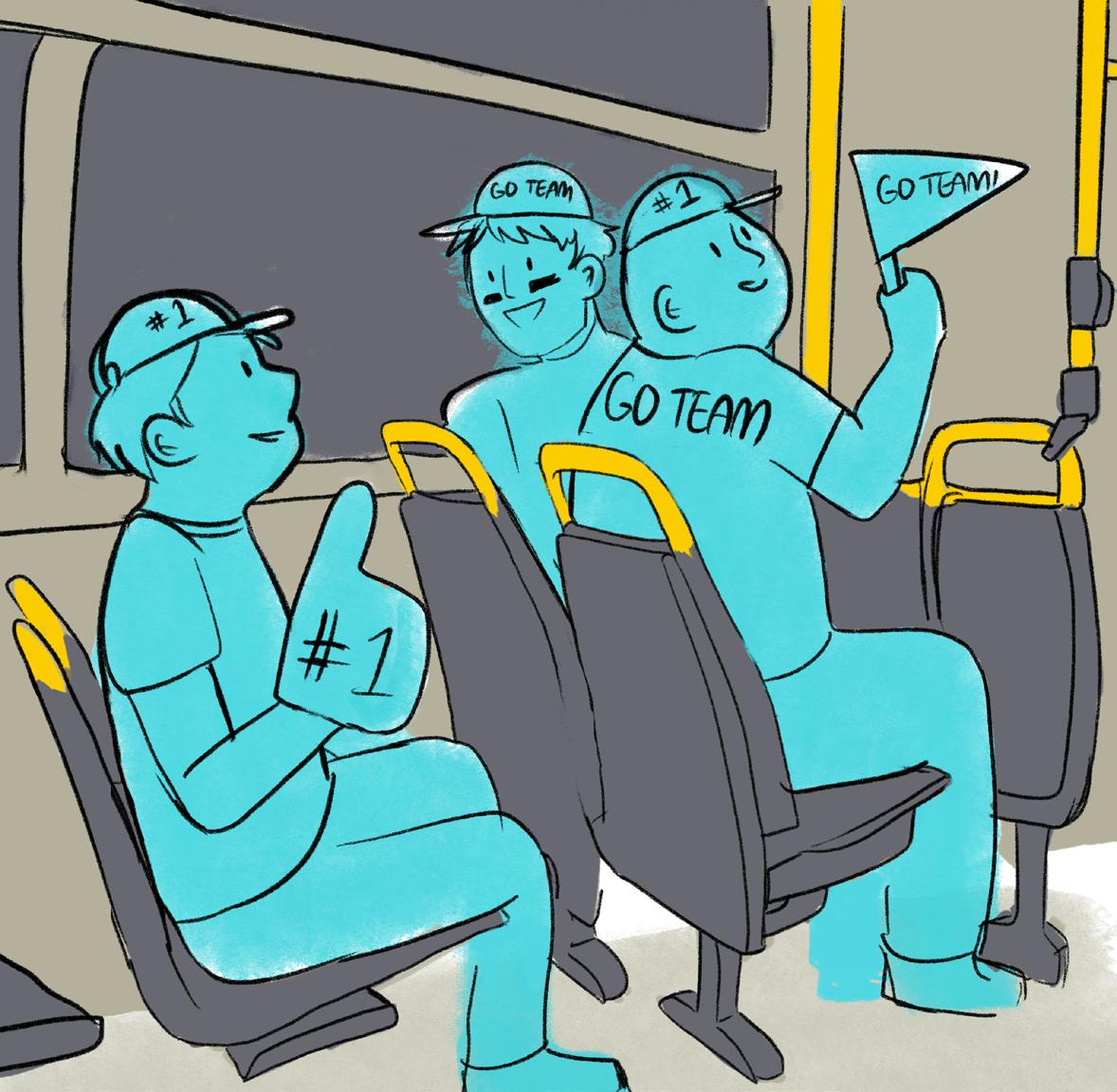
Game night in Winnipeg is electric — Jets in overtime, Sea Bears in target time, Bombers crushing the Riders in the Banjo Bowl. But getting there? Downtown is gridlocked and on Pembina, driving appears to be slower than usual. Parking, depending on the event, can cost $10–$20, and postgame idling spews emissions while fans wait 10–15 minutes to exit. Analysts warn we lose economic time to congestion. So, Winnipeg — can we cheer without choking our streets and our air?
Winnipeg’s car-centric event-planning is a losing game. Traffic jams before and after games frustrate fans, lengthen commutes and clog roads. Analysts warn that parking space is diverted from housing. Worse, transportation accounts for nearly half of Winnipeg’s carbon emissions. All this to see a goal or touchdown? Low-income residents, students and those without cars are priced out entirely. As cars crawl, emissions rise and access falls. It is time to rethink how we cheer, without
choking our streets or sidelining our most vulnerable fans.
Public transit is the unsung MVP of Winnipeg sports nights. While Winnipeg Transit faces challenges, such as underinvestment, safety concerns and fare costs, it remains vital to fans citywide. Whether it is a Blue Bombers game at Princess Auto Stadium or Jets action at the Canada Life Centre, buses connect communities like Elmwood and St. Vital to the games. Transit boosts accessibility, especially for low-income residents and students, and reduces emissions.
As planners improve frequency and affordability, fans get a cleaner, fairer alternative to gridlock and pricey parking.
Past events, such as the 1999 Pan Am Games and Bombers playoffs, saw expanded service, and free fares were proposed last month by Winnipeg City Council for Grey Cup volunteers during the event and for fans attending the Grey Cup game. Let us cheer for a system that gets us to the game without the car chaos.
Walking and cycling to
Winnipeg sporting events are innovative, affordable and healthy options — especially for residents in the downtown area. With the Canada Life Centre and Blue Cross Park centrally located, fans can skip traffic and pedal or stroll to Jets, Sea Bears and Goldeyes games. However, the Canada Life Centre does not offer a permanent bike valet service. Bike lanes recently added over the past two decades, plus the Southwest active transportation corridor, make cycling to Blue Bombers and Valour FC games from across the city easy and safe. The Bombers’ bike valet service at Princess Auto Stadium sets the bar, offering secure parking for cyclists at all games and major events. It’s time for other teams to follow suit and embrace active commuting as a win for fans, health and the environment.
Want to support Winnipeg sports and fight climate change? Consider taking the bus, walking or biking to the game. Fans, teams and the city must invest in better transit accessibility, through bike
valets, free to low-cost bus fares and a completed active transportation network. Climate experts warn we’re nearing the 1.5°C threshold, so every car trip avoided helps. Plus, ditching the car saves money that can instead be spent on season tickets and merchandise, boosting the local economy. Let’s rally behind our teams — the Jets, Moose, Sea Bears, Goldeyes, Bombers and Valour FC — not just in the stands, but on the streets. We only get one kick at the can. Let’s make it count.