Michael Benarroch will assume the role after David Barnard's exit in June
TY BRASS, STAFF
The U of M has announced Michael Benarroch — Ryerson University provost and vice-president academic and previous dean of the I.H. Asper School of Business — as its 12th president and vice-chancellor.
Outgoing president David Barnard will finish his term in June. Benarroch, who moved to Winnipeg at the age of three and obtained his bachelor of arts at the University of Winnipeg, will take up the position on July 1, 2020.
Benarroch said he plans to focus on getting in touch with the community during his first few months on the job.
“I’m really thinking about the first three and six months, and developing a network of really listening to people, and really coming to an understanding of where the community wants to go, and where the province needs the university to go,” he said.
Benarroch said he believes his experience as Asper dean will serve him particularly well as president and vice-chancellor.
“As a dean of a business school, I had an opportunity to really connect with the broader community,” he said, “to connect with the government, to connect with the business community, to connect with non-profits, and I think those things have really helped me.
“I did a fair bit of fundraising in my last couple of years at the Asper school, and I think that will be a
big part of what I’m doing in this position.”
Discussing the university’s ongoing goal of Indigenizing the campus,
Benarroch noted that the U of M had made it a priority even during the presidential hiring process, and said he plans on working in partnership with newly-appointed vice-president Indigenous Catherine Cook to move forward.
“This is one of the reasons I want to come to the University of Manitoba, is because [of] their commitment to Indigenize the university,” he said.
Research plays a large role at the U of M, with the institution being the province’s foremost research institute, and Benarroch emphasized its importance to students and faculty, and society at large.
The provincial and postsecondary “partnership”
Manitoba’s Progressive Conservative government is expected to send mandate letters to provincially-funded universities “outlining expected students’ outcomes and financial accountability” in the next few weeks. Last month, the government transferred responsibility for post-secondary education from the education minister to the minister of economic development and training.
Asked how the provincial government’s vision of post-secondary
universities do that extremely well,” he said.
“I think in part we have to do a better job of educating the public that we’re doing that. And it doesn’t matter what degree you get at a university, I believe that students leave university better prepared to contribute to society.”
Benarroch said that the ideal relationship between a university and its province is a partnership.
“I did a fair bit of fundraising in my last couple of years at the Asper school, and I think that will be a big part of what I’m doing in this position”
— Michael Benarroch, incoming U of M president
“I believe that research is a core fundamental of what all universities should do,” he said. “It’s a really important way that faculty are engaged and it’s a big part of their job, and I think students have a huge role to play in that.”
“If you look at the heart of a lot of inventions, of a lot of products, of a lot of social change, they found their seeds originally in universities,” he said.
institutions aligns with his own, Benarroch said he believes that universities are doing their part in economically and socially improving the province.
“If you look at what governments are doing, at the heart of it they’re asking universities to be part of the equation of preparing students to become successful when they leave the institution, and to help promote social and economic advancement in the province. I actually believe
“The province is the largest funder to the post-secondary institution, but I think it should be a partnership,” he said, “and that partnership should be one in which both parties speak to each other, both parties try to understand each other, and both parties come to a mutual understanding of how we should move forward.”
Benarroch said there is a need to keep the university flexible and to be cognizant that in today’s world many students will likely return to school for further education.
“The world is changing,” he said. “It used to be that you went to university, you went out and got a job and worked at that job for 25 years or 30 years, and maybe you moved once in your career, to another job.
It’s different now.”
“We don’t know what there will be in five years, and so what we have to do at universities is be nimble enough to be able to adapt our programs to those changing markets.”
Speaking about how humanities and arts programs fit into the university’s mandate to improve the province’s economy, Benarroch stressed that such programs are essential for a labour market.
“I actually believe that the humanities programs are critical to educating students who will be successful,” he said.
“When we talk about innovation, we talk about creativity, and if you look at the programs in the humanities, they require a lot of critical thinking, they require a lot of creativity in the work that people are doing.”
“If you’re just training for a job, we will train fewer people ready for the job market, because the job market is changing all the time,” he added.
“What we need to do is give people general skills and knowledge to be able to adapt to changes in the market also, and I believe that that’s also a responsibility, and I think the humanities, the social sciences, and those fields, have gotten a bad rap around this.”
See UMFA | Page 4
PHOTO
UMFA criticizes closed search
Continued from page 3. “Secretive” search
The U of M began the process of searching for Barnard’s successor in February. The presidential search committee included UMSU president Jakob Sanderson, UMGSA president Carl Neumann and a University of Manitoba Faculty Association (UMFA) member, but was closed to the larger university community.
At that time, UMFA voiced concerns over what it called a “closed, secretive” process. According to UMFA, the senate supported a motion to make the selection process open to the entire university community earlier this year, but the board of governors rejected the proposal.
UMFA president Janet Morrill talked about what the organization would have liked to have been different about the process.
“We would have really welcomed the opportunity to ask our own questions and to see who all the candidates are, and to be able to express our opinions, and hopefully have had our voices heard,” she said.
“We argued pretty strongly that we would like it to be an open search.”
Sanderson, who earlier this year voted in favour of a successful motion which partly opened the search process to the senate, said that after having experienced the process he has a better understanding of why it was closed.
“We were in support of the open search at the outset of this, but I do think that I am understanding of the reasons for it being more closed,” he said.
“In terms of the candidate pool that we were able to get, I think we got a lot of extremely strong candidates, and it would be difficult for me to say definitively if those would have come through as well in an open search process.”
After having sat on the selection committee, Sanderson said he was no longer strongly opposed to the closed search process.
“We need to continue to have consultation with the university and stakeholders in terms of what works best for the university, but I do think that this process led to a number of great candidates,” he said.
Morrill criticized the closed nature of the search.
“I think it’s clear that it shuts people out of the process,” she said. “It doesn’t allow the members of the university community to see who the shortlisted candidates are, to be sure that they understand the candidates, and to have their voices heard.”
“That being said,” she added, “we look forward to working with president Benarroch, I think that we are hopeful that he’ll be really good for the University of Manitoba community.”
Campus food bank demand surging
With two months left in the year, visits have surpassed 2018 levels
GILLIAN BROWN, STAFF
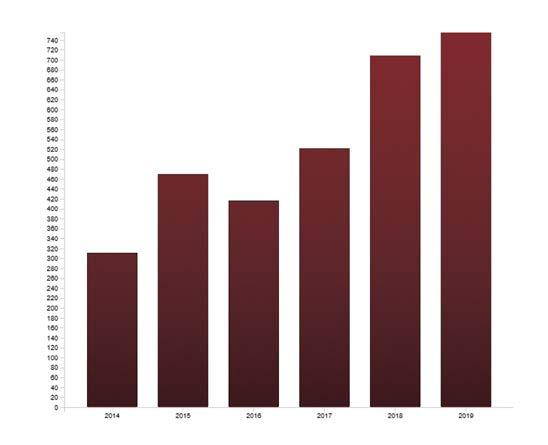
of M Food Bank Visits per Year
U
Aconstantissue among cities and universities across the country is food insecurity. At universities across the country, the crisis is only rising — especially at the U of M.
When the University of Calgary’s food bank hit 83 users this September, it began running out of food on its shelves.
In 2018, Dalhousie University’s food bank saw a 30 per cent increase in demand and reached 200 users.
Last year, the U of M food bank had 298 users who made over 708 visits. It was the second consecutive year demand increased going back to 2016.
Demand in the first two months of this academic year has increased significantly. There have been 182 users and over 250 visits, not including November numbers.
Visits have also taken a sharp upturn in recent years — 2017 saw just over 500 visits to the U of M food bank, and just over 700 in 2018.
Between January and October of this year, visits to the food bank have already surpassed the entirety of 2018’s numbers.
Full-time enrolment at the U of M increased by 2.8 per cent this year, and overall enrolment surpassed 30,000 students for the first time. The University of Calgary has comparable enrolment. Dalhousie University’s enrolment is just over 19,000.
U of M food bank co-ordinator Kelsey Bencharski said it is unclear if demand is increasing because more students are facing hardship or more are aware of the service.
Students can attend the food bank once every three weeks to choose from available items off of the shelves. Bencharski said she knows food banks are not the entire solution to solving food insecurity for students on campus, but the service helps alleviate costs.
ments, so people are having to pay a lot more of their income now on housing, which doesn’t leave a lot left for food.”
“I think for students the big one is just [that] a lot of them are not working full time — some are not working at all, some are working part time — and so trying to pay those bills plus tuition is really challenging,” she added, noting there
understanding of the stresses and pressures of poverty.
PACA program assistant and community volunteer Kae Normandeau said the workshop gives participants a “glimpse into the life of living on a low income for somebody in Winnipeg.”
“We know that people are having to make hard choices every month”
“Everyone comes in here knowing that’s not enough food for anyone for three weeks,” she said, “but it’s really just to help offset the cost of some other groceries they might want to buy.”
— Grace Weigelt, director, Winnipeg Harvest
are many international students who visit Winnipeg Harvest.
Food banks provide assistance for low-income households, but fall short of meeting the complete needs — and food is not the only expense to worry about.
Winnipeg Harvest director of client services Grace Weigelt said while demand for food has remained consistent this year, nearly half of all regular users are single adults, including students.
“We know that people are having to make hard choices every month,” she said. “There’s not a lot of low-rent housing or apart-
Louis Gheorghica, a volunteer with Poverty Awareness and Community Action (PACA), has experienced food inequality first hand, and said there is an additional stigma faced by students.
“You’re a student, so people automatically think you have the money for food, which is not necessarily the case,” she said. “There’s a lot of people on low-income able to go to school, but they are either paying so much into their schooling they can’t pay for food.”
The Nov. 22 PACA workshop had student and faculty participants role-play to develop a deeper
“Students and faculty are given the opportunity to speak to somebody from Winnipeg who has lived experience in poverty so that they can see what the truth of poverty is versus what they hear outside of it,” she said.
PACA hosts workshops throughout the community, and Normandeau, who has experienced food insecurity, said getting more people involved is crucial to addressing poverty.
“The name of the group is Poverty Awareness and Community Action and the most important part of that is community action because poverty impacts everybody,” she said.
“It’s not just people who are in the low-income bubble, it’s everybody because it impacts every part of our society.
“Everybody needs to get involved. Everybody needs to recognize that we all need to work towards making this change.”
Indigenous voices lead Transgender Day of Remembrance
MMIWG report acknowledgment of LGBTTQ* violence only a start, organizers say
DAMIEN DAVIS, STAFF
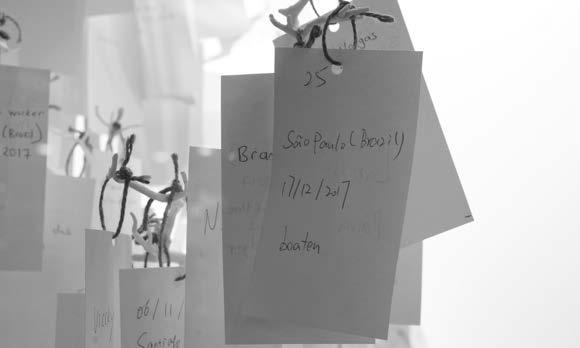
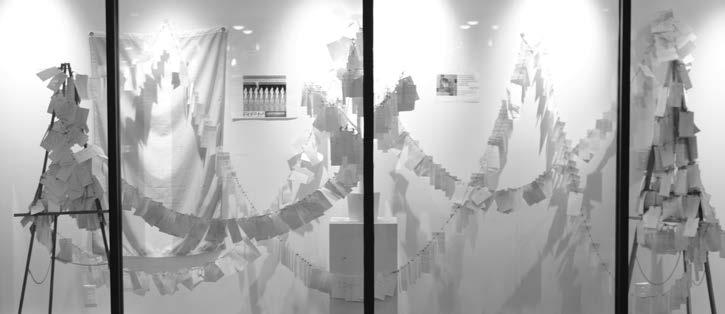
Transgender Day of Remembrance was Nov. 20 and, along with city-wide vigils and community gatherings, students at the U of M remembered those lost. Members of Rainbow Pride Mosaic set up an installation in UMSU University Centre featuring cards with names of murdered transgender people on strings to honour those lost to anti-transgender violence.
W
innipeg’s LGBTTQ* community came together inside the WestEnd Commons Neighbourhood Resource Centre Nov. 20 for a Transgender Day of Remembrance that brought attention to two-spirit voices.
The vigil was volunteer-run and organized by grassroots communities within the city.
While acknowledging and mourning lives lost from transgender violence around the world — including deaths in the city this year — the vigil focused on putting Indigenous voices at the forefront.
Brielle Beardy-Linklater, whose Rainbow Warriors helped organize the vigil alongside Trans Manitoba and Mx. Media Projects, said all the organizers supported highlighting Indigenous voices.
“I suggested that we put an Indigenous focus on the healing portion of it and that it include two-spirit stories and voices,” she said.
“A lot of my trans kin around the organizing table actually supported the decision to have two-spirit voices at the forefront.”
In June, the National Inquiry into Missing and Murdered Indigenous Women and Girls (MMIWG) released its final report, which acknowledges that “the rates of violence are equally alarming for members of the 2SLGBTQQIA community, who are often erased or left out of national statistics.”
with the inquiry’s investigators and said she consulted with researchers when it was noticed there were no statistics for missing and murdered two-spirit people.
she said. “So it's a small step in the right direction, but I also feel like we have a larger responsibility within our trans community.”
tion faced by the LGBTTQ* community, she remains “hopeful for the future, because we need to have hope.”
While people were taking their seats at the vigil, volunteers handed attendees self-care packages.
“The youth absolutely give me so much hope” — Brielle Beardy-Linklater, organizer
Beardy-Linklater said she was brought to Toronto in 2018 to meet
She said the report is a start, but its recommendations need to be put into action.
“I did look at the report and the calls for justice, and the language is there, but I think it goes so much more than advocacy actually,” she said.
“It has to transfer into action and the way that we do that is by centring trans voices and their calls to action,”
Contents varied, but common items included honey and notebooks.
The organizers put effort into creating a space where people could feel comfortable and safe to mourn while also taking care of themselves afterward. This was expressed during the vigil as well with two-spirit individuals providing songs and playing drums.
Beardy-Linklater said that, despite the violence and discrimina-
“We understand and acknowledge the reality of our trans brothers and sisters and non-binary kin being targeted by colonial and gender-based violence,” she said.
“We need to continue to fight for them to honour their memories, but also because there’s so many transgender and two-spirit youth who are still looking to come up and they deserve to be here with us today too.”
“They need to live a life free of violence, free of ridicule, and know that there are community supports that are there for them,” Beardy-Linklater added.
“The youth absolutely give me so much hope.”
PHOTOS BY ALEX DECEBAL-CUZA
Architecture, engineering faculties search for next dean
Jonathan Beddoes, dean of both faculties, set to finish his term this year
GILLIAN BROWN, STAFF
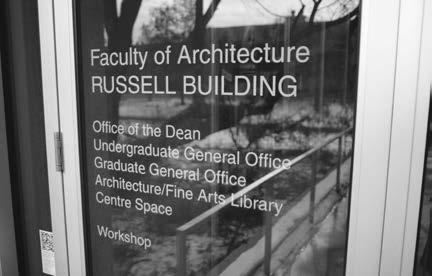
Dean of the architecture and engineering faculties Jonathan Beddoes is set to complete his terms for both positions this year, and the search for someone to fill the roles is underway.
Of the candidates nominated for the faculty of architecture in 2017, Beddoes — who possesses an engineering degree — was selected for the position halfway through the five-year decanal term after the recommended leave of dean Ralph Stern by the Canadian Association of University Teachers in 2015 because of a “culture of fear and retribution.”
Fourth-year architecture student
and vice-stick external of the Student Architectural Society (SAS) Hanna Henriksson-Rebizant — one of two students sitting on the committee who will select the next dean — said she is nervous to see Beddoes go.
“[Stern] stepped down, and they got Beddoes, and he kind of saved everything,” she said. “He really brought us back up.”
“He’s actually done a pretty good job I think so far, especially being from engineering.”
Henriksson-Rebizant, along with fourth-year architecture student and SAS president Samantha Miller and third-year interior design
student and SAS vice-stick internal Keland Newton, was impressed with Beddoes’s willingness to involve students in decision making.
“I was honestly so surprised at how much he actually wanted to hear from me, and cares about how we feel,” said Miller.
While she appreciates the work Beddoes has done as dean of the faculty of architecture, HenrikssonRebizant said it would be an asset for the next dean to have more familiarity with the design process.
“It’s a different schooling,” she said. “All of our profs went through the same thing as us, really. And that
can be good and bad. At least with that, they understand our concerns and needs and our wants.”
The students noted a certain mentality among the professors within the faculty that doesn’t allow for spare time or smaller projects.
“This faculty really teaches you how to work hard and be your own person,” said Henriksson-Rebizant.
“It teaches you how to toughen up.”
The three students noted that they would like to see more integration between the disciplines offered through the faculty of architecture, with Miller calling the current system “frustrating.”
“I only know a third of the information that my degree sort of should know,” she said.
“Anything that should be improved, it should be collaboration.”
The students also said that compared to the faculty of engineering — which Beddoes is also the dean of — architecture students have to pay much more out of their own pockets for access to machines and materials.
Miller compared it to her experience in the faculty of arts.
“I remember we were printing a couple assignments per year,” she said, “and maybe used $5 total throughout the entire year. [Now] I use $50 every few months of printing.”
The additional costs come from the fact that students in the faculty use more materials than those in others for their projects, assignments and models.
FABLab manager Jason Hare noted in an email that costs for using equipment in the workshop — which
UMSU president urges city to scrap fee hike
AMIRA TEKLE, STAFF
PHOTO BY ALLY GONZALO
president
U-Pass,
The U-Pass program, imple -
mented at the U of M in the fall 2016 term, currently comes at a cost of $136.25 to students per term.
The fee increase would see that cost rise to $160.75.
According to Sanderson, the program has single-handedly removed 5,000 vehicles from routes leading to and from the U of M.
He said that 62 per cent of students said they take transit more often now than prior to fall 2016, and that the U-Pass increased ridership on routes to the U of M by 25 per cent.
“The U-Pass, though, I think is essential and [should] not be seen just as a subsidy for students,” said Sanderson, “but actually as a program that reduces traffic on major thoroughfares, frees up parking spaces, and makes a major impact on the city and sustainability,” he said at the council meeting.
UMSU is required by law to take any fee increases above the rate of inflation to a referendum of the student body.
This leaves the fate of the program in the hands of city council, and if the increase is passed, UMSU members.
The primary reason given by the city for the cost increase is the inclusion of Red River College students in the U-Pass program.
Sanderson related to council fears that students would vote down the prospect of a more expensive U-Pass that would not bring any additional benefit directly to U of M students.
“Increasing costs on our students by $24.50 per term with no additional benefits to U-Pass users is something that is, frankly, a tough sell,” he said.
“Even Winnipeg Transit, in their report, has expressed concern that this recommendation could put the program at risk, which is something I believe strongly the city should not want to do.”
The current contract between the city, Winnipeg Transit and UMSU expires May, 31, 2020, though Sanderson has previously mentioned a clause that would allow for a oneyear continuation of the pass’s current terms while negotiations continue and has voiced support for that option.
Construction recently concluded on Stage 2 of the Southwest Transitway, which links downtown to
are based on consumables used for the equipment — are not covered by the faculty because the equipment is not used equally across the faculty’s four graduate departments.
Hare also said that engineering
“People don’t understand this faculty, they think it’s the easier version of engineering, and it’s completely different” — Hanna HenrikssonRebizant, SAS vicestick external
students in certain courses may end up paying for fewer materials outof-pocket because the materials are covered by the lab fees they pay.
Henriksson-Rebizant, Miller and Newton said that funding for student projects and materials is lower than required.
“Our faculty is not just arts and crafts,” said Henriksson-Rebizant.
“People don’t understand this faculty, they think it’s the easier version of engineering, and it’s completely different.”
the U of M via dedicated rapid transit lines. According to Winnipeg Transit, the cost of the project is $467.3 million.
UMSU has previously attempted to negotiate a summer U-Pass program with the city and Winnipeg Transit.
In October, the public works committee was mandated to examine an UMSU plan that would justify an increased U-Pass fee by stretching its coverage period through the summer term.
The committee is set to report back within the next two months with a verdict on the plan.
While Sanderson conceded that he can not promise an UMSU endorsement of the fee increase, he said he would be in favour of a continuation of the program regardless of the fee increases in a referendum.
“If this fee increase does go through, at that point it’s up to the students, what they want to do,” Sanderson told council.
“I can tell you that I would vote ‘Yes’ because I’d like to see the U-Pass program continue.”
UMSU
Jakob Sanderson went before the Winnipeg city council during its Nov. 21 meeting to urge councillors to scrap the expected upcoming $24.50 increase to the
calling the impact the pass has made on students and sustainability in the city at large “unambiguously positive.”
PHOTO BY ALEX DECEBAL-CUZA
Malak Abas
Editor-In-Chief:
Contact: Editor@themanitoban.com / 474.6770
Government
meddling in higher education irresponsible Post-secondary education only suffers from higher provincial oversight
MALAK ABAS, STAFF
“Crazy Marxists” rejoice — Doug Ford’s “Student Choice Initiative” (SCI) has been shot down by Ontario courts.
The initiative, announced by Ford’s Progressive Conservatives (PCs) in January, allows post-secondary students to opt out of any ancillary fees they do not consider essential. By May, the Canadian Federation of Students had taken the case to Ontario’s Divisional Court, which unanimously ruled the SCI unlawful last week.
The argument held by Ford and the PCs was simple: students shouldn’t pay for what students don’t use and, according to Ford, students don’t use student unions. In an email requesting donations sent by Ford in February, he said students are “forced” into student unions.
“I think we all know what kind of crazy Marxist nonsense student unions get up to,” Ford added in the email.
In reality, the verdict by the courts should come as a comforting appeal to common sense to students at any intersection of the political spectrum.
The reasoning was cut-and-dry to say the least. Universities require a certain modicum of independence from government intervention to be productive, and part of that freedom
includes the ability to make agreements with student government and the wider student body to collect and allocate fees to be budgeted and accounted for democratically.
Student union fees provide students with so much that it is almost impossible to attend university without benefiting from their services.
Here at the U of M, some of the many supports UMSU fees are at least partially responsible for include scholarships and bursaries, community group funding, UMFM and childcare services. Part of UMSU’s agreement with the university and wider student body echoes the reasoning of the Ontario courts that if students don’t want to pay for these supports, they can say so via referendum. There is something inherently ironic about Conservatives calling for intensified government intervention, but attempts like these to creep further control over postsecondary operations is nothing new to Conservatives across the country. In Manitoba, it is becoming a more regular occurrence by the day.
The same week the SCI was deemed unlawful in Ontario, Manitoba Premier Brian Pallister announced in his throne speech that the province’s post-secondary institutions would be receiving mandate
letters from the province.
The premier was quoted the very next day saying he believed it was an attempt to keep post-secondary institutions “relevant” to “the people of the province who pay their bills.”
Knowing this comes after
The slippery slope of government intervention in postsecondary matters has historically hurt the U of M
Pallister’s latest cabinet shuffle that removed post-secondary responsibilities from the education minister and handed them to the minister of economic development and training, one might wonder if Pallister is fully aware of what universities do.
The slippery slope of government intervention in post-secondary matters has historically hurt the U of M. After communications between the then-new Progressive Conservative government and university administration became apparent during the University of Manitoba Faculty
Association (UMFA) strike in 2016, the U of M was ordered to apologize and pay fines to UMFA when the Manitoba Labour Board ruled the university had been directed to engage in unlawful labour practice by the government.
Treating universities and the people who work within them, be they faculty or student government members, as pawns to clumsily insert their own biases into what should be a space kept at an arm’s length from political interference seems to be a disturbing new trend for Canada’s Conservative premiers.
A recent study published by the Canadian Journal of Higher Education found that universities in the country have been facing a declining level of autonomy and an increasing level of supervision from the province. While this makes some sense if you consider the direction the country has been going in terms of job requirements — more jobs require a university degree, and universities are accepting more students — the fact remains that the core goal of post-secondary institutions should not change.
The idea that being hireable or “relevant” in the workforce is somehow entirely parallel to higher education as a pursuit is dangerous. Setting
mandates based on workforce trends is an ouroboros that creates a more dysfunctional society — a university that doesn’t fund programs outside of those creating the most jobs inevitably results in communities without a diversity of knowledge or skills.
It is a difficult task for universities — who have to juggle accountability to stakeholders and to the economic status of the province with the responsibility they have to create an environment of academic freedom without the looming constraints of government intervention. But it is undeniable that the premier flaunting that the provincial government is the “most significant funder” of universities in Manitoba and thus deserves looming input is not the right answer. It is not the responsibility of the government to decide how universities form their mandates, just as it is not the responsibility of the government to decide how students spend their money within those institutions. For a provincial government to seek control beyond the governmentappointed boards that already exist is irresponsible. Students and potential students should consider the failure of the SCI in Ontario and watch for the impact these mandate letters will have on the future of higher education in Manitoba.
GRAPHIC BY EVAN TREMBLAY
Solution-focused
Connect with Empower Me
Call the 24/7 helpline at 1-844-741-6389 (toll-free) from anywhere in North America and ask your counsellor for support in your preferred language.
The first time you connect, a counsellor will determine the severity of your issue and plan a course of action with you.
For more
information
Only UMSU and UMGSA members covered by the UMSU Dental Plan have access to Empower Me. Visit www.studentcare.ca for complete details.
You can also download assistance tools through the iAspiria mobile app by entering “Studentcare” as the Login ID and selecting “Student” from the drop-down menu.
Comment Editor: Kenny Ingram Contact:
The housing dilemma of capitalism leaves many behind
Fight for a system that goes beyond individualism and ensures we are all fairly valued
CAM CANNON, STAFF
Over the last few years, news stories about lone parents and their children being left homeless by a lacking social support network have been periodically popping up.
As austerity is ramping up in Manitoba, we can only expect these stories to become more common.
Last week, a mother with six children was evicted from Manitoba Housing in Winnipeg’s North End when a fire was accidentally started by one of her children.
They are now being forced to find housing on the private market — something much easier said than done.
The mother will need to find a home with four or more bedrooms to avoid intervention by Child and Family Services.
The challenge is that any apartment of that size is likely to be unaffordable.
According to a 2018 report from the Canadian Centre for Policy Alternatives (CCPA), the vast majority of units with three or more bedrooms would be out of reach even if the family was receiving the maximum shelter benefit with Rent Assist.
It seems that the social assistance
creates a situation where parents must choose between accommodations that are affordable and ones that are suitable.
On top of that, even when factoring in the possible supports from Employment and Income Assistance, total income remains well below the poverty line.
This case is far from being the only one.
It is part of a wider collection of crises in Manitoba encompassing everything from housing shortages and flaws in social assistance to our particular political-economic arrangements.
According to a recent report from Campaign 2000 and the CCPA, two federal ridings in Winnipeg — Winnipeg Centre and Winnipeg North — have some of the highest rates of childhood poverty in the country at 40.5 per cent and 31.5 per cent respectively. The report also notes that the ridings with the highest levels of childhood poverty also have the highest proportion of lone parent families.
The obvious question is: Why doesn’t the government just provide adequate support for lone parents and
their families?
The answer is two-fold.
On a very basic level, capitalism structurally tends toward the impoverishment of working-class families that fall outside the norms of the “nuclear family” — a family consisting of two parents and their children, residing together.
Capitalism structurally demands that families, at the very least, resemble the nuclear family
Welfare reform can ease this, but not resolve it.
But further, the ideological commitment to individualism that’s central to liberalism and conservatism makes long-lasting effective solutions unthinkable to politicians.
Capitalism structurally demands that families, at the very least, resemble the nuclear family.
Such an “ideal” family has a clear
division of labour with one parent to support the family with wages, and another to take on the reproductive labour, including child-rearing, cooking and cleaning.
One parent to sell their labour directly, and another to do the work of ensuring there is labour to be sold in the future.
As of 2015, however, this is the case for only 27 per cent of Canadian families.
Regardless of how many families actually resemble the nuclear family in practice, the fact remains that a lone parent does the work of what our society considers to be two people. Removing one parent from the equation results in the loss of what can be provided in terms of material provision and reproductive labour.
Individualism —which is actually familism — is at the centre of each of the two dominant ideologies in Canada — liberal and conservative, essentially two sides of the same coin.
What this means is that the championing of a pure self-sufficiency, those loud proclamations that no one owes you a living when people ask for more of anything — lately, a common refrain to calls for higher wages
and improved social safety nets — is really claiming that only your family is responsible for you, not society.
If you or your family can’t lift you up by your bootstraps, you’re just not trying hard enough and are making poor decisions. Society assisting you will only encourage you to keep making those decisions.
If a person wants to have a family outside of the “traditional” nuclear family structure, they absolutely should have the right to do that without being punished for it.
In the short term, it is important to rally and fight for improvements to what supports do exist. We need to defend our communities against the austerity being handed down on us by the government.
In the long term, we need to come together and fight for a system that goes well beyond the constraints of capitalism and individualism. We need to value each other as humans and make sure absolutely nobody can fall through the cracks again.
This is not just a fight for lone parents, this is a fight for all of us.
MASTER OF TAXATION
Become a highly-valued member of the Canadian tax community. Join Canada’s most comprehensive English-speaking program for the development of tax professionals. O ered through the University of Waterloo at our downtown Toronto classrooms.
ISP censorship is a recipe for internet corporatization
Federal Court’s ruling must be overturned in order to avoid the end of independent media
KENNY INGRAM, STAFF
Canadian courts have revealed their true priorities in the move to censor the internet.
On Nov. 15, the Federal Court officially ordered Canadian internet service providers (ISPs) to block access to a website selling pirated content.
In the rationale for making the decision, the court deemed that the ruling would not infringe on freedom of expression or net neutrality.
The case made its way up to the Federal Court when Canada’s largest telecommunications companies teamed up to file a complaint earlier this year.
The court’s rationale is shortsighted. Ordering ISPs to censor the
internet is a recipe for disaster, and contrary to what should have been done to address piracy.
Concerns should have been addressed through the parliamentary process.
Canada already has legislation which deals with this type of theft, including the Copyright Act, the Telecommunications Act and the Broadcasting Act. They just need modernization since each are over 25 years old.
Rather than going through these channels and making legislative recommendations, ISPs — because of their power — were rushed into a court case and given a ruling which sets a dangerous precedent.
ISPs should not be dictating what is and isn’t viewable on the internet. Giving them this power will obviously have adverse effects on the free and fair exchange of ideas.
This dynamic can be seen in the U.S.
While the gigantic ISPs and the biggest corporations who own content always win, independent media and free and fair expression lose.
ISPs have an incredible amount of control over the internet in the U.S., and the control was only strengthened when the Federal Communications Commission eliminated net neutrality rules.
During a CNN Democratic presidential candidate debate in August,
many independent media networks gave commentary on the debate in real time.
Instead of being allowed to stream the content and comment — the personification of fair use — their streams were instead, almost immediately, shut down by streaming platforms like YouTube and Twitch.
These streaming platforms are not held accountable to the U.S. government and its copyright laws, but rather how the ISPs’ interpretation of what is deemed to be fair use.
CNN’s parent company, Turner Broadcasting System, is owned by AT&T — one of the largest ISPs nationwide.
If websites are accountable to gigantic corporations that drive the traffic to their site, they will ultimately side with those same corporations.
In Canada, the Federal Court’s ruling is a ticking time bomb.
Canada’s largest ISPs also own much of the content Canadians consume online.
This includes the news media, with CTV owned by Bell Media and Global News owned by Shaw Communications. The same goes for sports networks, with Rogers Media owning Sportsnet and Bell Media owning TSN.
This newfound authority of ISPs to censor content will have adverse effects, and the effects will come soon.
Any smaller, independent person or company that is not well-connected will be subject to the rules of ISPs, who now wield the authority to literally shut down entire platforms.
Big telecom — who provided internet services to nearly 90 per cent of Canadians in 2017 — is widely known
to work together with its oligopoly to raise prices.
Why would they then not use these new rules to similarly benefit themselves and their content by drowning out smaller voices?
In Canada, the Federal Court’s ruling is a ticking time bomb
Any independent outlet is likely not to stand a chance.
In sports, independent podcasts rely on the large corporations’ coverage of games to provide commentary. Similarly, with news, independent media largely relies on the coverage of the large companies who have the resources to do investigative journalism.
Who’s to adjudicate the interpretation of what can and cannot be used for the purposes of commentary? If it’s up to the corporations who own the content, it will not be a benevolent interpretation.
It’s clear that this Federal Court ruling must be appealed.
But more than just an end to ISPs’ control over internet content, ISPs’ stranglehold of the market and power as a whole must be broken up.
It is only due to the immense power of an oligopolistic industry that a case like this — arguing over the right to make a profit off of content — made its way to the Federal Court in the first place.
Black Friday shopping a high-stress bargain
Retail during the peak season is tough on stressed-out workers and patrons alike
MEAGAN HUGHES, STAFF
The holiday season can be a particularly stressful time for everyone. This is for a myriad of reasons, including financial constraints and the pressure to find perfect gifts for family and friends.
These stresses can be greatly amplified by the kickoff of the holiday shopping season, usually beginning with Black Friday.
Black Friday is one of the biggest retail shopping days of the whole year. According to data from the Retail Council of Canada’s Holiday Shopping Survey 2019, 43 per cent of Canadians intend to shop Black Friday deals this year, and 32 per cent of Canadians plan to shop online for Cyber Monday.
But what is this surge in pressure to buy things and spend money doing to our mental health?
Holiday shopping itself has a definite effect on our brains. When we are surrounded by pressure to spend
and are manipulated by retail and online marketing to “hurry while quantities last” and take advantage
Perhaps if instead of feeling pressured to spend more during the holidays we embraced spending less, we could eliminate some of the headache of the holidays
of the “last chance to save 60 per cent,” we are coerced into making an on-the-fly decision about our hardearned money.
When we give in and buy nonessential things that we desire in the moment, our brains anticipate this as a reward and we then experience a rush of the neurotransmitter dopamine, which is associated with addiction. However, this leaves a chemical imbalance in our brains which can leave us feeling a need to bring back the rush and in turn leading to overspending and even shopping addiction in the most extreme cases.
According to PwC Canada, Canadian consumers plan to spend an average of $1,593 on expenses this holiday season, including gifts.
Shopping centres and retail stores are a common source of worry during the holiday season, not just for shoppers but for retail employees as well.
Retail employees report higher levels of emotional distress such as anxiety and irritability as compared to other professions.
This leaves employees feeling
meaningless, with the end result being workers who have to deal with deep depression and who are barely able to function.
There is a multitude of retail horror stories out there told by past and current workers, and the holiday season can certainly bring out some extreme emotions in people.
As someone who has worked in retail for years, I have seen a stark personality shift in a lot of my colleagues at this time of year, and in customers as well.
Tensions are high and retail employees must work hard to manage the higher volume of customers who also tend to be stressed out during this season from all the demands and expectations.
This can cause customers’ stresses to be directed toward retail workers as they may become inpatient if they are shopping at a busy store and can be especially snarky when discounted
prices are involved, or rather when the amount of the discount is not satisfactory.
Perhaps if instead of feeling pressured to spend more during the holidays we embraced spending less, we could eliminate some of the headache of the holidays. Opting for less expensive and more personal or handmade gifts may be good options for people wanting to bring more meaning to gift giving and wanting to contribute less to the commodification of the holidays.
If we focus more on spending time with our loved ones instead of spending our hard-earned cash, we may have an easier time keeping our cool.
Then perhaps we can really enjoy the season and make the best of this time.
It can be hard to find balance, but it is crucial that we make time for ourselves and take care of our needs amid the chaos.
Building student community through anime
UMAnime members say the group is more than just another student club
ZACHARY SIGURDSON, STAFF
From live-action remakes, to streaming services like Crunchyroll and old-fashioned bootlegs, anime’s continually growing influence on pop culture makes the case that Japanese animation is not quite the niche interest it once was.
The potential for animation to be a medium for adults has always been constrained by the western cultural notion that reserves animation for younger audiences.
But the members of the U of M’s anime club, UMAnime, make an argument for why anime shouldn’t be seen in this light.
Edison Guillermo, former president and 2019-20 club advisor, said anime “is not just geared toward children, it’s more toward young adults and older audiences as well […] It caters [to] pretty much audiences of all ages.”
Guillermo said the club encourages members “to have a sense of community.” Not only does the group have a clubroom where members can
hang out and discuss their favourite shows, Guillermo said that the group hosts game nights.
“We’ll book a room for the entire club, have fun, play games, socialize, eat food,” he said.
UMAnime even hosts events — such as screening anime films — for the general student community.
“It’s not just stereotypical nerds” — Jappan Behl, UMAnime member
After the club screened Your Name by Makoto Shinkai — one of the highest-grossing anime films of all time and critical darling — they had a major influx of new members.
As for the general community of Winnipeg, the U of M Anime Club was central to the creation of Ai-Kon
— Winnipeg’s annual Japanese anime and pop-culture convention — in 2001. The convention is an annual delight for anime fans throughout the city.
UMAnime continues to contribute to the convention by having a booth and providing volunteer hours for its members.
The club’s outreach to the student community is so wide, students who never had an interest in anime before have found a home in the club.
Jappan Behl, a first-year member of the club, said he “didn’t really know anything about anime” before joining the club.
“And after I joined the club, people started really trying to bring me in and tell me about all the different anime — that’s when I started watching anime,” he said.
“I found a lot of different experiences throughout my first year of university. Last year was my first year, and I didn’t really have a lot of friends outside of a few people who
came to [the] U of M from my high school. The anime club helped me find a community of people and a group of friends.”
Behl said the diversity of the club was a major draw for him.
“There are so many different types of students in the club,” he said.
“It’s not just stereotypical nerds. It’s not like everyone sits around and watches anime all the time, it’s just a normal group of people.”
Recent members of the club who had a passion for anime, but lacked a community to share their passion with, have found the community they have always longed for in UMAnime.
Victor Gomes, a recent member who describes himself as “a huge anime freak,” is one of those students.
“I spend a whole lot of time watching anime, researching a whole bunch of things about different characters in different animes,” Gomes said.
“I just wanted someone or a group of people that had similar hobbies and interests as me — that I could
have a conversation with.”
Part of Gomes’s objective as a member is to educate other students about anime and help straighten out unflattering stereotypes that are often associated with his cartoon passion.
“Anime is sophisticated,” Gomes said. “There’s often a whole lot of topics that are encountered or discussed […] You can deal with death or you can deal with betrayal or deal with loss or depression [through anime].”
In fact, Gomes thinks “people underestimate the reach and influence of anime.”
“They underestimate the kind of medium it is […] If they were to give it an honest and sincere look, they’d realize that there’s much more to it than they could ever imagine.”
For more information and regular updates, UMAnime can be found on Twitter, Facebook, Instagram and Discord. For further information visit the student clubs page on umsu.ca.
GRAPHIC BY ERNEST ZARZUELA
“Dancing from the inside out”
‘Actualize’ opens the Winnipeg Contemporary Dancers’ 55th season
GRACE PAIZEN, STAFF
Canada’s oldest and longest running contemporary dance company, Winnipeg Contemporary Dancers (WCD), will debut their all-Winnipeg talent show Actualize on Nov. 29.
As part of its 55th season, WCD artistic director Jolene Bailie hopes to celebrate both contemporary dance as well as her love for Winnipeg with the show.
“Part of [the show] comes into my
place in the community and what I have done for the last 20 years.
“Part of it comes from my absolute love of the Winnipeg dance community and the dancers that have devoted their lives [to contemporary dance],” Bailie said.
“It’s abstract, it’s contemporary dance, all of those things […] it really is dancing from the inside out, and often dancing about ideas and subjects that people have a hard time
dialoguing about or even finding the words to describe the sensation they’re feeling.”
Actualize is composed of 10 dancers, five completely new to WCD and five who have experience with the company. The three works featured in the show are all choreographed by local choreographers, one by Bailie herself.
Bailie said this is her first work in a WCD show. Called “The Space In-Between,” Bailie’s piece is “a reflection on how we really get to know people, how we relate to people and who we are in those moments in between.”
“We see things like a prism — [our perspective of the world] bounces off different edges and reflects back on us — but we also do that to other people, and I think the things we take in on that sort of subtle subconscious level about people, and that intangible sense of who somebody is, is also really reflective of who we are.”
The main purpose of Actualize is to capture a glimpse of what Winnipeg is, as a community, right now.
Contemporary dancers “are really
driven to expressing the very personal side of humanity,” Bailie said.
“It’s kind of like, realistic fiction in a sense.
“It could really happen, or you really felt that way at some point in your life and it has that sort of open deep connection in the gut as opposed to watching a very pretty show.”
The name of the show, as explained by Bailie, is to create an opportunity for the dancers, the creators and the audience to really express and share the present moment.
“The gift of present is something that is so unique to dance,” she said.
“Dance is an artform that doesn’t live in a manuscript, or on a wall, or in a book.
“It really requires the absolute, hundred per cent gift of presence in that moment.”
Bailie hopes the show will bring the audience into the experience and hopes the audience will reflect on how they actualize themselves in the different pieces — if they can see themselves in the work and if they can relate to the work.
“We’re not telling the audience, ‘This is what the show is about and this is what we want you to see,’” she said.
“It’s like, ‘What is your actual experience?’”
Actualize is a work designed to reflect “on humanity on a deep level” and get an “inner glimpse of people right now.” The show is “important for our evolution, for us to realize our potential and capacities of human beings.”
“People who choreograph and work in dance are very good at reading people,” Bailie said.
“It’s their job to decipher body language, what’s going on in scenarios and then to create work.”
“Contemporary dance is not just the form of dance that is contemporary […] it’s a form of dance that is created by a very contemporary mindset,” she said.
“That’s what drives the work.”
Actualize runs from Nov. 29 to Dec. 1 at the Rachel Browne Theatre. For tickets or more information visit winnipegscontemporarydancers.ca.
A musical history lesson of the Winnipeg General Strike
Based on the popular musical, ‘Stand!’ is set to make its nation-wide film debut
GRACE
PAIZEN, STAFF
Marking the 100th anniversary of the Winnipeg General Strike, Winnipeg playwright and composer Danny Schur’s adaptation of his popular musical Strike! will hit screens nationwide Nov. 29 as Stand! the motion picture.
Shot entirely in Winnipeg in the summer of 2018 — with two Winnipeg actors billed in title roles — Stand! brings a Winnipeg event that changed the course of labour rights forever to the big screen.
The beginning of the film foreshadows the turmoil of that fateful six-week period in 1919 by using shots of newspaper headlines warning of Bolshevik uprisings, emphasizing the small pittance made by immigrant labourers and focusing on injured
The best feature of the film is how it deals in signifiers
soldiers not only returning from the First World War, but also acknowledging how soldiers who fought were unable to find work when they returned home from the war, with their employers opting for immigrant labourers they could pay at a reduced rate.
Colour is extremely relevant to the storyline starting from the first scene. Greyscale is used to document
main characters Mike and Stefan Sokolowski’s search for accommodations and jobs, juxtaposed against the richly coloured environments of the wealthy’s houses later in the film.
The film’s themes read as important in our present time of labour uncertainty — there’s even a duet between Stefan and love interest Rebecca that addresses the gender wage gap.
But the song sequences are where Strike! The Musical may have worked better than its movie twin. The freezeframe moments — where actors freeze in place while another actor sings around them — is a method best accomplished on the stage, letting the audience in on the thoughts of the character singing. In the movie, this practice comes off as jarring more than artistic.
Though, that is not to say all the songs in the movie are like this. The title song “Stand” — sung by Winnipeg actor Lisa Bell — is a powerful sequence, and her reprieve of the song to conclude the film nicely frames the movie.
Another shortfall of the script is the role of Helen Armstrong. Though an important and arguably still unknown figure of the strike, Armstrong’s character in the film comes off as a white saviour role. Her entrance explaining the foreigners’ problems to the foreigners is uncomfortable, and her encouraging the ethnic minorities that they are doing a fine job with the strike comes off as
condescending.
The eastern European accents in the film are also — at times — patchy. It is understandable to want historical accuracy in a re-enactment of an event that was centred on race and ethnicity but, unless done well, accents can become disconcerting very quickly. That said, the best feature of the film is how it deals in signifiers. The ability to sing “God Save the King” is the signifier of assimilation, whiteness and Canadian patriotism. The Métis veteran’s uniform gives soldier Gabriel a superpower of being treated the same as a white man for the first time in his life, and his refusal to take it off can be read as the struggle to embrace his own roots in the white world of Canada, where he would be easily stereotyped without his uniform.
And in a too-close-to-home feel, the Canadian soldiers out of work rail against immigrants coming to their country and disrespecting them in a very Don Cherry-esque rant. Even if the Romeo and Juliet subplot of the movie isn’t your cup of tea, Stand! certainly educates its audience about the Winnipeg General Strike. These are important lessons, reminding us that democracy and labour rights are fragile practices in need of constant gardening.
Stand! debuts at both the Scotiabank Theatre, at CF Polo Park, and the Cineplex Odeon McGillivray Cinemas Nov. 29.
PHOTO PROVIDED BY PRESS KIT
PHOTO PROVIDED BY DANNY SCHUR
’Toban Turntable
KAELEN BELL, STAFF
Eagle & Hawk — ‘Liberty,’ 3.5/5
Whether or not we really are blindly hurtling toward the apocalypse, these can feel like dark and scary times.
The naively imagined bounty of politically-driven protest art that was supposed be born from fascism’s western rise hasn’t necessarily materialised.
Instead we’re left with an increasingly fractured world and the question of what protest music is meant to sound like in 2019.
Should it be angry, sly and humorous like Slowthai’s Nothing Great About Britain? Glittering and mournful à la Anohni’s Hopelessness? Dirty and indirect like U.S. Girls’s In a Poem Unlimited ?
The answer, of course, is all of the above. However, there is something to be said for a sunnier kind of protest song — a protest powerful not for its righteousness and rage, but for its refusal to be anything but light in the face of growing darkness.
Think the sunny psychedelia of Kacey Musgraves’s blockbuster Golden Hour in service of the planet rather than a new love.
It’s in this realm that Eagle & Hawk’s Liberty finds itself — an album whose loudly political subject matter is offset by a heartening, decidedly summery soundscape.
The long-running, proudly Indigenous band’s first collection of songs in nine years was released Nov. 13, and acts as a sort of love song to the earth and its people — a solidly constructed set of major-key contemporary rock songs pleasantly subverted by softly glowing synth figures and a refusal to wallow in despair.
The songs on Liberty are more
interesting than they seem on first listen, and though there’s a certain naivety to the record — a clunky lyric here and there — there’s also a refreshing positivity, an uplifting sense that all is not lost.
Traditional drums, horns, blushing keys, electronic touches and lush backing vocals weave in and out of relatively standard rock structures and grant the record a playful liveliness that belies its heavy subject matter — environmental degradation, spiritual disconnect, the rights of women and immigrants and both literal and figurative borders.
There is something to be said for a sunnier kind of protest song
It’s the keys, courtesy of recently passed icon Gerry Atwell, that help raise this record above standard fare. A celestial counter to all the fist raising and bluster, Atwell’s touch is the playful heart of Liberty, floating through these songs like will-o’-the-wisp.
It’s in these guiding beams that Eagle & Hawk make their best case for Liberty ’s sunny disposition. It’s not enough to simply be simply angry and scared.
Instead, there must also be levity, a way forward, a belief in humanity’s essential goodness.
Perhaps there is a light in all that darkness.
Want us to review your band? Email arts@themanitoban.com today!
Manitoba mainstays form local supergroup
New Wales debuts first single ‘Winnipeg’
Creating music, touring and exposing oneself to the world — these things are rarely easy. But for the members of New Wales, forming a new band with a combined century of music-industry experience between them, is cause for a new kind of stress.
“The anxieties are a little bit different now,” said David Pankratz — a member of the newly formed Winnipeg super-group.
“We just have so many balls in the air right now — I think there’s 10 or 11 kids between all of us. We’re all working full-time jobs.”
Pankratz, along with fellow Manitoba music-world mainstays Sandy Taronno, Matthew Harder, Rob Mitchell and Jamie Taronno, created New Wales as an outlet for a breezier facet of their musical expression — an offset to the worries that come with balancing family, work and artistic creation.
“There really wasn’t any pressure to create anything specific,” Pankratz said.
“I think, if anything, writing for so long — we’ve been writing for 20 years together — we kind of just wanted to write songs that were fun,
but still had some depth to them.” However, even the best-laid plans go astray, and Pankratz said hints of darkness still wormed their way into New Wales’s surging pop rock.
“For these songs, I was kind of trying to draw on the city itself and our experiences here” — David Pankratz, member of New Wales
Their debut single “Winnipeg,” said Pankratz, “has some of the darkest lyrical content I’ve ever put into a song.”
“But the idea, initially, was just to try to keep things light and fun.”
The single stays true to Pankratz’s goal of crafting songs that can be played from car speakers, top down — but there’s an
JOE SHOW
inescapable weight to its searching lyrics, a weight that comes naturally when creating in a city as complicated as Winnipeg.
“For these songs, I was kind of trying to draw on the city itself and our experiences here,” he said.
“It obviously changes the way we think about things.”
Pankratz describes the song as embodying the democratic nature of New Wales — the creative veterans coming together and sharing ideas freely, massaging songs into the best versions of themselves.
“‘Winnipeg’ I had written pretty much in full, but then when I brought it in I really wanted all the guys to kind of put their touch on it,” he said.
“It was a fun group effort.”
This synergy will soon coalesce into more singles with shows to follow. For now, the band carries on with their tricky balancing act — taking life’s stresses, joys and harsh realities and molding them into something new.
New Wales plays at the Good Will Social Club Dec. 4 and at the Park Theatre Nov. 8.
KAELEN BELL, STAFF
PHOTO PROVIDED BY EAGLE & HAWK
PHOTO PROVIDED BY PRESS KIT
Brown leads Bisons in split against Golden Bears
University of Alberta handed its second loss of the season
ISAIAH WAGNER, STAFF
The University of Alberta Golden Bears had a seven-game winning streak grow to eight, only for it to be dashed over the weekend as the U of M Bisons men’s hockey team split the weekend series.
The Bisons were led by goaltender Tyler Brown in a game-one loss, and a three-goal second period propelled the herd to a victory over the Golden Bears in game two.
Friday
A roar from the bench erupted each time Brown made a save to keep his club alive Friday. Yet as the game got closer to the finish, that roar was silenced by an empty-netter and 2-0 loss to the Golden Bears.
The Winnipeg-born netminder was the hero of the game for the U of M, making save after save for the defensively troubled Bisons squad. The rookie netminder stopped 45 of
the 46 U of A shots he faced in the loss.
Post-game, when asked about his goaltender, Bisons head coach Mike Sirant was pleased with Brown’s play.
“This, by far, was his best game,” he said.
“You can see he’s taking the steps to getting back to being up to his full capabilities.”
This was Brown’s third game of the season, coming after a year of rehab due to surgery.
The U of M came out flat to start the game. The Golden Bears dominated in puck possession all the way through the first period.
The U of A took advantage of an exhausted U of M line trapped in its own zone and struck first for a 1-0 lead. Luckily, after the first period, the U of M was only down one thanks to save after save from Brown.
The Bisons gave it all in a late-
game push with Brown out for the extra attacker, but a Steven Owre empty-netter sealed the Bisons loss 2-0.
When asked about the red-hot Alberta team and the message in the locker room before the game, Sirant was optimistic.
“We had a certain game plan that we wanted to execute,” he said.
“Alberta plays so fast that although we tried to prepare for it this week, we just weren’t playing at their pace or their tempo […] but as the game went on, we got better.”
The pace was high and the chances were there Friday, but the U of M could not produce. Despite only having 20 shots, many of them were high-opportunity scoring chances.
“We had enough chances to get a goal or two — we just have to take the next step of putting the puck in the net when we do create those chances,”
Sirant said.
Saturday
After a tough loss the night before, the U of M looked to strike back and even the weekend series at one apiece. It did just that with a wild 5-3 win to give the U of A its second regulation loss of the season.
The Bisons struck first on the man advantage after Colton Veloso was driven into the net without the puck by a Golden Bears player.
On the ensuing powerplay, Jonah
“They are one of the top teams in the country every year […] and if that doesn’t give us confidence, I don’t know what will” — Adam Henry, Bisons men’s hockey defender
Wasylak did all the work down low, drawing two defenders to him. He dished the puck to second-year forward Jeremey Leipsic who made no mistake, snapping a shot past Matt Berlin for the 1-0 Bisons lead.
As the pace got faster, bodies started to fly from both teams. Big hits came from all over the ice as bad blood seemed to boil. Although the U of M was outshot 12-3 in the first period, it locked down and escaped to intermission with a 1-0 lead.
The Bisons continued to apply pressure to start the second and were rewarded with another tally.
The crowd erupted as Nathan Halvorsen rushed up the ice on a 3-on-1 with captain Adam Henry and rookie Tony Apetagon. Apetagon finished off a stellar passing play to double the Bisons lead.
Shortly after, the Bisons two-goal lead was erased when the Golden Bears put a couple quick ones past Brown to make it 2-2.
This lit a fire on the Bisons bench, as the herd answered back with two goals of its own. The first marker came off the stick of Lucas Skrumeda, while the second was popped in by Ryan Carlson.
The Bisons headed into the third period hoping to hold on to a 4-2 lead. Instead, they built on the lead.
Midway through the third, Wasylak shoveled home a goal on the doorstep to give the Bisons a 5-2 lead that was quickly cut back down as Cole Sanford scored for the U of A.
The Golden Bears poured on the pressure late but could not break through as the U of M skated away with the 5-3 win.
First-placed Golden Bears was handed its second regulation loss of the season by Henry and the Bisons, something the captain says will give his club a boost.
“I think it just lets us know that we can do this,” Henry said.
“They are one of the top teams in the country every year […] and if that doesn’t give us confidence, I don’t know what will.”
The Bisons travel to Lethbridge to play the University of Lethbridge Pronghorns Nov. 29 and 30. Game one will be at 8 p.m. CST and game two at 2 p.m. CST.
PHOTO BY QUINCY HOUDAYER
Jason Pchajek
The Duckworth trophy stays downtown another year
Early lead thanks to women’s soccer evaporates, Wesmen claim third straight Duckworth
JASON PCHAJEK, STAFF
The Duckworth Challenge trophy will remain at the University of Winnipeg for one more year.
Despite entering the week’s action up 1-0 thanks to a win by women’s soccer on Oct. 10, the U of M Bisons let the U of W Wesmen come back
to win the challenge for the third straight year.
Thursday: Basketball
The U of W tied it, but the U of M took back the lead on Thursday night as the Wesmen won in women’s bas-
ketball while the Bisons won in men’s.
The evening’s action got started with the women, as the Wesmen thumped the herd 73-56 to tie the Duckworth Challenge 1-1.
Things started off tight in the first quarter, with the two sides going
bucket-for-bucket until a Robyn Boulanger layup gave the U of W a lead it would not relinquish. The Wesmen had a six-point lead at 17-11 coming out of the first quarter and only built in the second, leading to a 35-28 lead at halftime.
The slow build continued in the third quarter, as every time the Bisons sank a shot the U of W came down and took back the lead. The U of M brought the Wesmen lead down to eight with a Keziah Brothers free throw, but Boulanger sank a threepointer to build chasm back up.
The U of W had a 14-point lead heading into the fourth quarter at 57-43, and the U of M could not close the gap as the Wesmen cruised to a 73-56 win.
With the challenge now tied, the
A pair of Keiran Zziwa free throws built the Bisons lead to 13 points before Winnipeg began the comeback
ball was passed to the men’s team, and they brought down the jam on the U of W with a 96-91 win to put the downtown rival on the ropes.
The herd and Wesmen went backand-forth in the first half. The U of M had a slight edge at 42-38 at halftime, and put the U of W in a deeper hole at 65-54 heading into the fourth quarter.
The fourth, though, was not the last.
A pair of Keiran Zziwa free throws built the Bisons lead to 13 points before the U of W began the comeback. Narcisse Ambanza dropped 10 points for the Wesmen and his team cleaned up the rest, with a buzzerbeating layup by Spas Nikolov sending the game to overtime.
In extra time the Bisons meant business, taking an early lead which, despite the best efforts of the U of W, it never was able to wrest away. Dwight “DJ” Dixon knocked down a three-pointer to make it 93-91 U of M and those were the U of W’s last points, as the U of M picked up five to close out the game 96-91.
Friday: Volleyball
All it needed was one win, but the U of M could not even win a set
Friday, as the Wesmen swept both Bisons volleyball clubs 3-0 to win the Duckworth Challenge.
The pain started with the women’s volleyball team which, despite early promise in the match, were outmatched by the Wesmen in a 3-0 loss.
In the first set, the U of M built a quick 3-1 lead, ending with a Light Uchechukwu kill, before the U of W stormed back with a four-point run to claim the lead. From there the advantage bounced back and forth like the ball itself until the U of W used a five-point run to claim the opening set win 25-22.
The second set was not even close, with the Wesmen coming out of the gate swinging. The U of W jumped out to an early 9-2 lead. The U of M responded, and the U of W fired back with a five-point run to make it 15-4, a lead the Bisons could not even up.
The Wesmen took the second set 25-14, and then closed out the match with a 25-16 third set win.
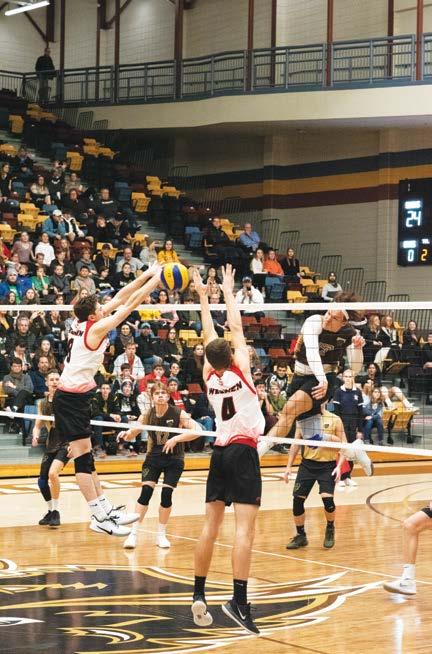
It all came down to the men, with the Duckworth tied 2-2, the Wesmen and Bisons men’s volleyball clubs took to the court.
Despite a scrappy third set, the Wesmen swept the herd off the floor with a 3-0 win to take the Duckworth Challenge.
The opening set started off with some promise for the herd. It jumped out to 3-1 and 7-4 leads before the U of W came back with a five-point run to snag a 9-7 lead. The U of M never led again, with the Wesmen taking the set 25-20.
Set two was much the same, with an early 4-0 lead by the U of M evaporating under a four-point run by the U of W. The U of M briefly took the lead back, but the U of W responded with pairs of points to build a gap the Bisons could not close.
The U of W took the set 25-20 and put the U of M on the edge.
It was in the third set where the U of M locked down and gave the U of W all it could handle. The lead bounced back and forth between the two clubs for most of the set, with each volley matched or exceed by one from the other side.
The U of M took a 25-24 lead and needed a single point to win the set, but the U of W came back and the two clubs battled until Daniel Thiessen scored back-to-back kills to end it.
The Wesmen took the set 29-27, the match 3-0 and the Duckworth trophy.
PHOTO BY ALLY GONZALO
More disappointment on the court for the Bisons
Bisons stumble through a difficult weekend, even outside of Duckworth Challenge
JASON PCHAJEK, STAFF
W
ith the Duckworth Challenge settled, the U of M Bisons and University of Winnipeg Wesmen still had conference obligations to fulfill over the weekend.
Yet if you were a fan watching you would think it was more of the same, as four sweeps were completed between the programs.
Basketball
There was no vengeance for the women, while the men walked off the court happy Saturday. The women were swept and the men did the sweeping to finish off the rivalry series.
Although it fared better in game two, the women’s basketball team could not withstand a fourth-quarter wave from the Wesmen in a 90-83 loss.
All seemed well early on as the teams traded quarters, with the U of W outscoring the U of M 27-19 in the first and the Bisons returning the favour 26-18 in the second.
The two sides went into halftime tied 45-45 and the herd looked to pull away.
It did just that in the third quarter, erasing a five-point lead by the
Wesmen and using a triplet of threes to build up a gap.
Good shooting the rest of the way helped the U of M to a 69-61 lead heading into the fourth quarter, where it all fell apart for the Bisons.
Despite holding the lead through the early part of the quarter, the U of W was able to chip away at the deficit, eventually getting ahead thanks to Lena Wenke.
The Wesmen held the lead and used a five-point run to finish off the Bisons 90-83.
The loss drops the U of M to 2-4 on the season and a three-way tie for 12th in the conference.
While the women walked away empty-handed on the weekend, the men continued a strong season by beating the Wesmen 77-71 Saturday for the sweep.
The game was fairly even through two quarters, with the Bisons holding a slight edge 37-34 at halftime.
The U of W came back in the third quarter — outscoring the U of M 19-17 — to shorten the Bisons lead to just a point.
Like with the women’s game, the fourth quarter was where the game was won.
A Don Dayrit three-pointer wrested the lead away from the Bisons, and the Wesmen held the advantage until a James Wagner jumper tied things back up at 63-63. From there, the Bisons built a healthy
The losses over the weekend drop the Bisons to 2-8 on the season, tied for 10th in the conference
lead the Wesmen could not overcome, en route to a 77-71 win.
The U of M now sits 5-1 on the season, tied for fifth in the conference and two wins back of the first-place University of Alberta Golden Bears.
Volleyball
It is tough to be a Bisons volleyball player right now.
Despite some improvement Saturday, the men’s and women’s clubs could not overcome a strong Wesmen front and were swept at
home by identical 3-1 scores.
The men got things started, showing some promise with an early-set win in a match loss.
The U of M dominated in the opening set, using a split 7-2 run to build a 9-4 lead before a U of W timeout.
Coming out of the break, the Bisons kept up the pressure leading to a 25-16 first-set win.
The Wesmen responded with a 25-21 second-set win to tie the match and followed up with a tight 26-24 third-set win, weathering a Bisons storm to get the advantage. The fourth set turned out to be the last, as the Bisons could not withstand the Wesmen attack in a 25-18 loss.
The U of W took the set, match and, with that, the weekend.
The Bisons now sit ninth in the conference at 3-5.
Like the men’s side, the Bisons women’s volleyball team had trouble coming back against the Wesmen in a tough 3-1 loss.
The Wesmen came out strong in the opening set with a 25-18 win to take an early 1-0 lead in the match.
On its heels, the U of M struck back with a lopsided set win of its own,
25-19 in the second to tie things up.
The third set — a 25-20 Wesmen win — was a bit closer, but it was the fourth and final set where fans got their money’s worth.
The U of W jumped out of the gate strong, slamming down kills to an early 6-2 lead. After a timeout, the Bisons rallied with a run to close the gap to 6-5 and from there it became a slugfest.
The two sides traded scores, building leads only for them to be brought down. Then, after an Emma Parker error got the U of M even at 17-17, the U of W was done playing games.
A massive 7-0 run buried the herd, with the only relief coming off an Ashleigh Laube error. Parker made up for her earlier mistake by powering down the final kill to give the Wesmen the win and the sweep.
The losses over the weekend drop the Bisons to 2-8 on the season, tied for 10th in the conference.
The U of M was thoroughly dominated across the board in a tough Duckworth weekend, losing six of eight games against the Wesmen.
Only the men’s basketball team provided a bit of light in a dark stretch for the U of M’s court clubs.