U of M alumnus and partner donate funds for LGBT engineering students
LAUREN SIDDALL, STAFF
T
he LGBTTQ* community has seen massive steps toward inclusivity and equality over the last several years in Canada and around the world, including at the University of Manitoba.
And thanks to U of M alumnus Jeff Kushner and his partner Randall McGinnis, the U of M has taken another step in the form of a scholarship for LGBT students in engineering – the first of its kind at the U of M.
The scholarship, approved by the senate committee on awards on June 24, is designed to recognize and encourage LGBT students in the faculty of engineering.
Kushner – who graduated with a bachelor of arts as well as a bachelor of science in mechanical engineering, and served as president of the University of Manitoba Students’ Union in 1985 – credits much of his vocational success to the university and wants to give something back.
“I do my best to put in as much as I take out, and if circumstances permit, to put in more than I take out,” Kushner said.
“The University of Manitoba faculty of engineering provided me with much of my foundation [...] now it’s my turn to return the favour.”
The scholarship is offered to self-declared LGBT students who are enrolled full-time in engineering, have completed a minimum of
36 credit hours toward their degree, have a minimum GPA of 3.0, and have displayed leadership skills with an emphasis on community service.
“I have a strong sense of the need to protect and foster the underdog, in this case LGBT engineering students. As well, I want to foster excellence, hence the dual requirements of demonstrated academic excellence and leadership potential,” Kushner said.
“While there are targeted scholarships and bursaries available for other uniquely defined groups, none existed for LGBT students. At least until now.”
UMSU’s Rainbow Pride Mosaic coordinator Steven Anderson is also pleased to see the faculty headed in a more inclusive direction.
“ I think the new scholarship is fantastic. LGBTTQ* students often face a challenge in feeling safe and comfortable in many classrooms and faculties. I think a scholarship would help not only the students financially, but also raise awareness about the importance of providing a safe learning environment for all students on campus,” said Anderson in an email.
“ I think this scholarship definitely sets a precedent for other faculties around campus. I would love to see scholarships available to all LGBTTQ* students in all faculties.”
While the faculty is infamous for culture of heterosexual male dominance, Kushner – though not out at
the time as gay – had only positive things to say about his experience during his studies at the U of M.
“I was part of a good class group, many of whom have had notable successes. I had some memorably good professors. It was tough work, and to this day I remain very proud of having graduated as an engineer,” he said.
“There was a surprising degree of diversity in our class, though at the time engineering was no different than society as a whole with regards to inclusivity where LGBT people were concerned. I am pretty certain that things have changed a lot in this regard, but I am also reasonably certain that further opportunities remain.”
Welcoming women?
Although the faculty of engineering’s vision statement specifies an “aim to provide engineering programs [...] whose participants reflect societal diversity especially with respect to gender balance,” the faculty has low female enrolment and a reputation for harbouring an exclusive, maledominated culture.
“ It’s a well known fact that there is a greater percentage of male students relative to female students,” said André Marchildon, senior stick of the University of Manitoba Engineering Society, the students’ association for engineering students.
“Currently in engineering at the
U of M there are 20 per cent female students, which is an encouraging improvement considering the percentage of female students in engineering in 2008 was only 14 per cent.”
With plans to create a more balanced population – and Engineers Canada aiming to have female engineers account for 30 per cent of registered professional engineers in Canada by 2030 – initiatives like the LGBT scholarship are steps in the right direction, according to John Beddoes, dean of the U of M faculty of engineering.
“A part of the fabric of gender balance are those that identify as LGBT and we aim to have these students appropriately represented in the faculty of engineering,” Beddoes said.
“I’m pleased that this new award directed to LGBT students will help us work toward gender balance. It is just one component of a series of efforts within the faculty of engineering to achieve our vision.”
Funding slashed for Manitoba Institute for Policy Research
Discussions with government continue, outcome uncertain
ETHAN CABEL, STAFF
T
he Manitoba Institute for Policy Research, a provincial public policy think tank out of the University of Manitoba’s political studies department, has halted most of its activities after its funding dried up last month.
The Manitoba Institute for Policy Research (MIPR) has been a fixture in the province’s public policy circles for the last four years, facilitating debates and networking opportunities for policy wonks and interested individuals.
For the past four years, MIPR has been funded through a Manitoba government grant that was then matched by the U of M’s office of the vice-president research, the department of political studies, and the faculty of arts.
The latest two-year funding agreement ran out on June 30, with the various parties failing to renew funds for the institute.
“This request [for funding] was discussed within various departments of government over the course of
eight months, and was ultimately not funded,” the institute wrote in a statement.
“A follow-up request for bridging funding is still in process with the government of Manitoba and with the office of the vice-president research [...]
While all involved have expressed support for the activities undertaken by the institute, MIPR will not continue in its current form, with its current activities or purposes.”
events for provincial civil servants.
The institute also conducted original research, including a website on financing post-secondary education. It published two academic journals,
“It's entirely possible that there will be a Manitoba Institute for Policy Research that continues on, but it's unclear at this point what it will look like [and] what its mandate might be” – Andrea Rounce, academic director, Manitoba Institute for Policy Research
Among its central activities included three monthly outreach events: the Policy, Pizza, and a Pint events at the Winnipeg Free Press News Café, the Café Politique series at McNally Robinson Booksellers, and the Take Away lunch and learn
including the undergraduate peerreviewed Manitoba Policy Perspectives Student Journal and the policy section of the Manitoba Law Journal: Underneath the Golden Boy
“The institute did a fantastic job of bringing together academics, practitioners in public policy, [and] citizens
to have discussions and to become more informed about issues facing Manitobans and Canadians,” said Andrea Rounce, associate professor in the department of political studies at the U of M and the academic director of the MIPR.
According to Rounce, the institute will seek to continue its work on the journals and post-secondary education website.
However, all social activities have came to an end as of June 30 and the MIPR, which once had a complement of two staff and three research assistants, will no longer be a campus employer.
“There were certainly lots of opportunities for students to build networks and skills and to apply some
of the research that they were doing to more real world connections, so it is a loss from that perspective, for sure,” Rounce said.
Rounce remains hopeful that the MIPR will be able to continue with some of its operations going forward and may receive funding renewal from the province and the university once current discussions between the various parties reach a compromise point.
“There are still discussions that are ongoing between the university and the government of Manitoba,” Rounce said.
“I am not part of those discussions, but they are ongoing so it’s entirely possible that there will be an MIPR that continues on, but it’s unclear at this point what it will look like [and] what its mandate might be.”
PHOTO BY LAUREN SIDDALL
Keeping your head in the game
Concussions a major risk for proud football players
MIKE STILL, STAFF
Playing football can be different things to different people.
For some, it’s an escape from the real world, a way to release frustration and anger in a controlled environment. For others, it’s a much needed adrenaline rush, letting the endorphins flow freely.
One way or the other, the game can be very beneficial to the wellbeing and mental state of those who participate.
I can speak firsthand to the benefits and joy to be had from the sport.
I started playing football at the age of seven and was hooked immediately. I loved the strategy and planning that was involved. I loved the one-on-one battles between opponents, with each trying to get the better of the other.
Most of all, though, I loved the hitting. It gave me such a euphoric feeling, and sense of accomplishment to stop the opposition dead in their tracks.
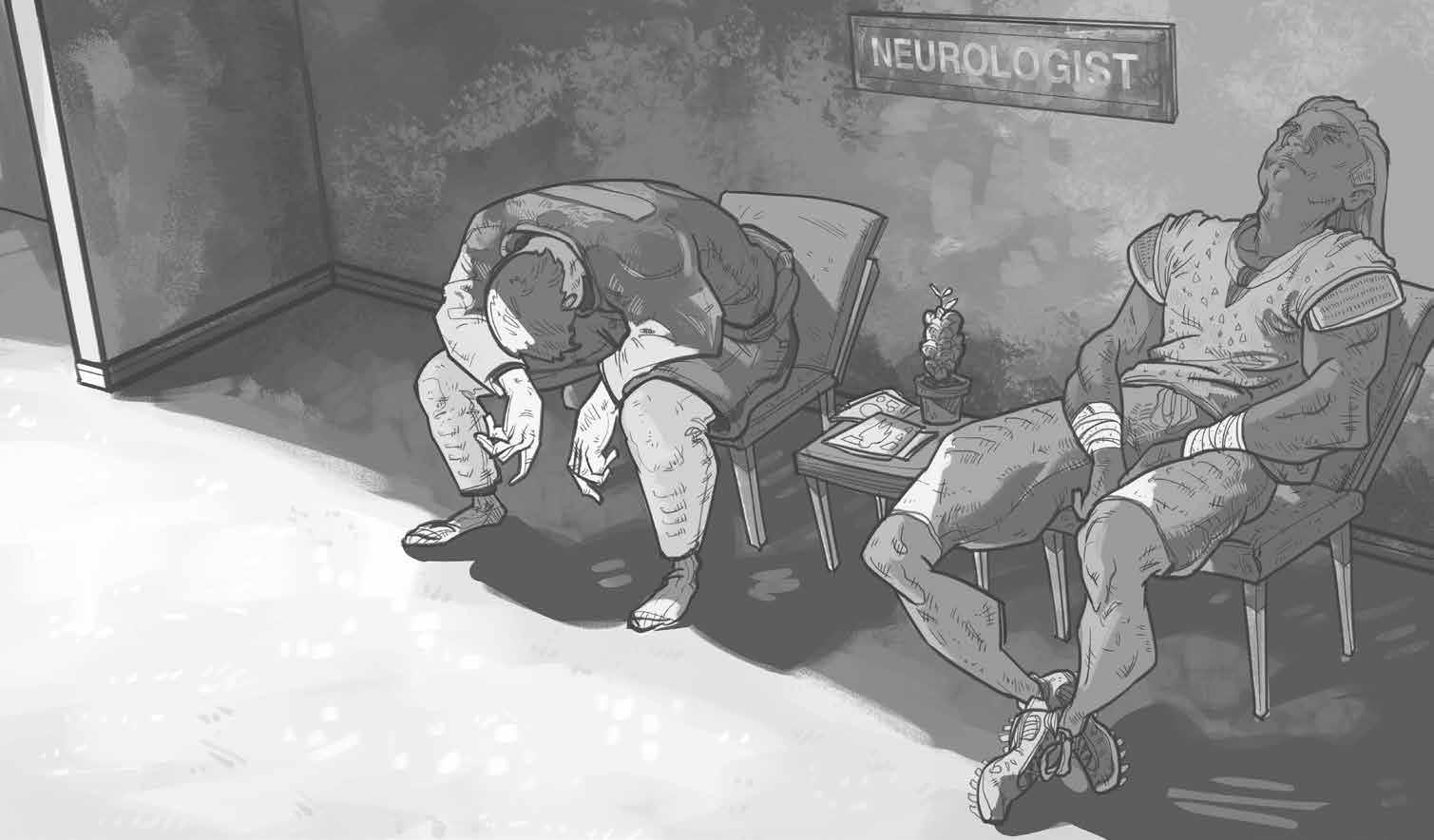
I played football for 10 years, winning two provincial championships in the process. I would still be playing today if concussions hadn’t stopped me dead in my tracks.
If you didn’t lose consciousness, it’s not that bad, right?
I got my first concussion when I was still fairly young. At age 10, I was participating in an indoor football camp in the winter. The practices were held in a gym and during one of the tackling drills, I landed fairly
hard on the back of my head. Because there was no turf to “cushion” my fall, my head bounced off the solid ground, and snapped back up.
I had some minor dizziness and nausea, but it went away after about four days. I thought nothing of it, assuming I was just dehydrated. I continued to compete in the following two days of the camp despite still having neck pain. While I didn’t get any worse during that time, I know now that my brain was taking a serious beating.
What I failed to realize until my doctor told me later down the line was that most concussions occur without a loss of consciousness. In fact, at no point in time have I ever lost consciousness after getting a concussion, and I’ve now had 13 of them.
Most football players are fairly stubborn when it comes to leaving the game due to injury. I used to want to stay in the game after an injury and my former teammates were the same way. Unless it involved a limb being amputated, and even in that case, they’re probably not going to exit the field.
The problem with head injuries specifically is that there isn’t any outward visual sign, such as with a broken arm or leg, that anything is wrong. The majority of the time, it falls primarily on the athlete to tell their trainer or coach that they aren’t feeling well.
As players, we have a lot of pride. We don’t ever want to leave the game.
The only thing that runs through my mind if I have to get taken out of a game is that I’m letting my team down.
Most of these players banked their whole lives on the game of football. Once it is taken away from them, it’s hard to find happiness in anything else
The culture of toughness plays a part in that decision. There’s an expectation that if you show any sign of weakness to your opponent, they will pounce on the opportunity to get the better of you. You have to pretend at all times that you are fine and able to perform.
This is exactly what I did. I never displayed any form of pain while on the field. If I was hurting, I did it in silence, and away from my teammates. I realize now that it’s caused me a lot of suffering, and has taken the game that I love away from me.
I am lucky though. I’m still standing here today. I partially credit my best friend for that.
He took me out of a game during my senior season – a game that
to this day I don’t remember playing in – because he knew something was wrong. I will be forever grateful, because if he hadn’t who knows if I’d be able to share this story.
For amateur athletes, not showing pain on the football field has to do with pride. But eventually, your future becomes more important, and you learn to back off.
For professionals, it’s a different story. It’s their livelihood, and what they do to survive and make a living.
CTE related to concussions
A study published in 2012, in the journal Brain, looked at the prevalence of chronic traumatic encephalopathy, or CTE in NFL players. CTE is a progressive degenerative disease, which can unfortunately only be diagnosed after death, and is linked to major brain trauma and multiple concussions. Many of the athletes diagnosed with CTE have committed suicide.
Of the 35 professional players whose brains were studied, 34 showed evidence of the disease.
There are a few key points to bring up based on these findings.
The first is a question. Why did so many athletes feel the need to commit suicide? While this question cannot be answered easily, I believe it has to do with despair.
Most of these players banked their whole lives on the game of football. Once it is taken away from them, it’s hard to find happiness in anything else.
The other piece that is interesting about this has to do specifically with CTE. Since it cannot be diagnosed until after the athlete is already deceased, there isn’t a lot that can be done to help.
These athletes have built their whole lives around toughness. Even if they are suffering from depression, or experiencing suicidal thoughts, there’s a very slim chance that they will want to share that information.
What’s next?
The final question is: what can be done to help athletes who may be suffering from CTE, or post-concussion syndrome?
In April of this year, a U.S. judge approved a settlement which is expected to cost the NFL US$1 billion over the next 65 years in order to resolve thousands of concussion lawsuits.
“Awards” of up to US$5 million could be given to athletes diagnosed with Parkinson’s or Lou Gehrig’s disease in their 30s or 40s, or whose deaths are linked with CTE. While this is great news, and a step in the right direction, it doesn’t solve any of the on-field concerns. Player safety must be taken far more seriously. This could be addressed by requiring all players to undergo weekly concussion testing. While this seems overbearing, it’s the only way that athletes will be forced to swallow their pride.
GRAPHIC BY BRAM KEAST
Greek referendum: pride over pragmatism?
‘No’ vote brave but shortsighted
CÉDRIC GOUSSEAU
“No” to a deal with creditors. “No” to further austerity measures. It appears that after five years of drastically declining wages, ever-growing unemployment and a rapidly contracting economy, hope is finally on the horizon. But is this sense of hope well-founded?
Greece is a proud country, and I believe that national pride almost certainly interfered with voters’ capacity for rational decision-making in the referendum held on July 5. Standing up to oppressive European Union (EU) leaders and cash-hungry creditors certainly seems honourable. But this thinking may have eliminated Greece’s best shot at stable economic recovery.
Greek Prime Minister Alexis Tsipras has made it abundantly clear that he disagrees with the bailout conditions outlined by his country’s creditors, urging his countrymen to vote “no.” It must be said, though, that a prime minister’s wishes do not necessarily align with the best interests of his people. A prolongation of tough austerity measures reflects poorly on a government which has been vocally critical of them, which means Tsipras has an incentive to act to end austerity measures.
The outcome of the referendum has numerous implications, some of which may not be fully grasped by the average Greek citizen. A further bailout agreement is unlikely to materialize in the future, seeing as Greece has just rejected a relatively fair compromise.
Without a bailout package, Greece will almost certainly be forced
to abandon the euro and print its own currency, reverting to the drachma. This will leave then no choice but to exit the Eurozone (the community of states using the Euro as currency) – a rather frightening scenario called the “Grexit.”
The disparity between the best and worst case scenario is significant, and it is doubtful that “no” voters willingly signed up for this level of risk
I believe that voters may have lacked the foresight and economic knowledge to rationally evaluate the long term impact of a Grexit. In the short run, it would carry many benefits: the removal of austerity policies would have an immediate effect, and a heightened sense of pride and hope would temporarily drive happiness and national unity.
In the long run, however, a Grexit may eventually lead to a slow recovery. Or it could launch Greece into economic oblivion. The disparity between the best and worst case scenario is significant, and it is doubtful that “no” voters willingly signed up for this level of risk.
Examining the events leading up to the referendum on July 5, we
Imbalance at UMSU
Balance of powers essential to functioning student government
JORDYN LERNER
There’s a power imbalance within the University of Manitoba Students’ Union (UMSU) between UMSU Council and the executive. Though council is supreme in theory, in actuality, the executive holds the power. The tail wags the dog.
On paper, the executive is accountable to council. The University of Manitoba Students’ Union Act assigns council to manage the business and affairs of UMSU. The act makes no mention of an executive and assigns it no specific powers. Council, as laid out in the Bylaw Manual, creates the executive and gives it certain responsibilities. As a creation of council, the executive is subservient to council.
The supremacy of council is seen in many UMSU formalities. For instance, the executive submits regular reports to council detailing its activities. Council has the opportunity to question these reports and
express any concerns it might have. There are also situations where the executive expressly seeks council’s approval, such as expenditures of $5,000 and over.
In practice, the executive holds all the power. Executive members are full-time officers of UMSU. They can devote their entire day to furthering their agendas. They can utilize the expertise of UMSU staff to develop large-scale plans and proposals. Most importantly, the executive controls the flow of information to council.
In contrast, council members are student volunteers with heavy academic commitments. They lack the time and expertise to adequately scrutinize the executive’s proposals. How many council members could fully dissect the executive’s plan to spend $64,500 to build UMSushi, or $78,000 for a freestanding electric sign on University Crescent?
The executive seeking council’s
approval is just a formality because council lacks the ability to properly challenge them.
When council rubberstamps executive proposals, it’s not doing its job
The executive can justify their power because of their democratic mandate. Each executive member is elected by popular vote. The will of the executive is the will of the majority. The executive is elected based on a campaign platform which students expect them to deliver.
But council, too, has a democratic mandate. Council members are elected as representatives of student associations, constituency groups, and affiliated student organiza-
tions. Although larger student associations elect more representatives than smaller student associations, the formulation of council ensures that smaller student associations have meaningful input. The structure of council protects the interests of minority groups against the tyranny of the majority. How can council reclaim control of UMSU and the executive? Ideally, each council member would be fulltime, just like the executive currently is. Of course, the cost of salary and benefits for over 40 new employees is fiscally unworkable. Furthermore, it’s unfair to ask 40 students to disrupt their studies and devote a year towards UMSU.
While council can never have as much time to spend on UMSU as the executive, it is possible for council to have staff expertise just like the executive has UMSU staff expertise. Council can hire its own
are reminded of a flaw inherent to referendums: when public opinion is expected to be broadly split, it boils down to a large-scale marketing contest.
It is much easier for the Greek government to convey a message to its own people via a relatively wellliked prime minister than for creditors and EU leaders to do the same. “No to austerity” also happens to be a catchier phrase than “Yes to staying in the Euro.”
Although unlikely, it is plausible to conceive a future whereby an agreement is reached between Greece and the other members of the Eurozone, propelling Greece to economic recovery. In the seemingly inexorable Grexit scenario, the “heroic” voting results may one day prove to have been a major catalyst to Greece’s financial downfall.
Either way, it is no stretch to conclude that the decision to vote “no” may have had more to do with national pride, which has a tendency to be short-sighted, than with longterm economic well-being.
policy analysts to scrutinize proposals from the executive, and provide councillors with an informed second opinion. This independent analysis would provide councillors with all the facts they need and help them to fully understand the issues instead of just voting along with the executive. When council rubber-stamps executive proposals, it’s not doing its job. The University of Manitoba Students’ Union Act intends for council to remain supreme. Council needs to take charge and take UMSU back from the executive. It won’t be easy for a volunteer council to compete with the time and staff expertise of the executive, but it can be done. If UMSU is to function as it should, the dog needs to wag the tail.
GRAPHIC BY EVAN TREMBLAY
Peace, bound
Federal use of peace bonds shows alarming lurch towards totalitarianism
EVAN TREMBLAY
On June 4, the Royal Canadian Mounted Police (RCMP) descended on a Charleswood home. They took into custody Aaron Driver, a young man who in February was interviewed by the Toronto Star about his conversion to Islam and support for ISIS, as well as his experience with CSIS, Canada’s spy agency, taking interest in his Internet activity. The RCMP executed a warrant and took the man into custody so that he could be “asked” to sign a peace bond. No criminal charges were levelled against him, and none are expected. No charges, and yet this man’s liberty is restricted. He is being punished for expressing his political opinion: in this case, support for a foreign group. It should not, in a free society, matter what this group does. We are all entitled to support whom we choose and to give voice to that choice. To listen to our conscience and act upon the things it tells us about the world. If we do so without violence, there can be no case for the use of government force against us. In a free and just society, the use of government power to punish individuals for speaking their beliefs, no matter how unpopular, is oppression. Such oppression is becoming more common in Canadian society. We should all be familiar by now with the muzzling of federal scientists and the Canadian Revenue Agency’s investigations into various charities (mostly environmental in focus) which are critical of the Harper government. That same government recently enacted subtly reworded hate-speech legislation (“national origin” has been
added to “race” and “religion”) that could apply to groups advocating a peaceful boycott of Israel – groups which include the infamously pacifistic Canadian Quakers and shamelessly progressive United Church of Canada.
This growing trend of suppression of free speech has entered into an alarming new stage. Peace bonds, previously little-used, and then usually against sex offenders released into the community and considered a high risk to reoffend, are being issued to a new class of citizens: citizens that the government believes may, at some point in the future, commit a crime. In the name of preventing these future crimes (I do not know whether to shiver or marvel at the cruelty of the concept of “future crimes”) these bonds revoke an individual’s freedom of movement, assembly, speech, and association.
If the government does not like what you say on the Internet, you will not be allowed to use the Internet. If the government does not like who you talk with, it will remove your right to speak to them. If an individual breaks the conditions of a peace bond, they can be immediately arrested. Peace, so long as you do as you are told, with jail as the stick.
As things stand, the issuing of peace bonds is restricted to people who are vocally supportive of terrorist groups, or whom the RCMP believes are at risk to commit an act of terrorism. But we must remember that the legal definition of terrorism is much broader than it used to be in Canada. The government is vastly
expanding what it defines as a “terrorist group,” which may now include environmental groups who protest oil pipelines, and broadening what it considers “support” to potentially include merely voicing the opinion, in private, that such acts may have moral justification.
In a free and just society, the use of government power to punish individuals for speaking their beliefs, no matter how unpopular, is oppression
Terrorists become extremists. Extremists become radicals. Radicals become sympathizers, and so on. These measures will be used against more and more Canadians, with less and less justification. We must confront, unpleasant as it is, the real possibility that these powers will go from being used against those who support a group, to those who do not support a group.
The current government is not given to considering such fine distinctions as that between supporting terrorists and not supporting the Harper government. The office of Public Safety Minister Steven Blaney, commenting on Driver’s arrest, said that the government “must combat
terrorism.”
Canada is blessed with a peaceful history, and a proud tradition of pluralism. I grew up being told that the world yearned for and learnt from our example as a peaceful society which worked hard to celebrate differences. But Canada equally must remember and learn from the histories of other countries. We should look with heavy hearts to the countries that fell to fascism before the start of the Second World War.
History shows that this is how fascist systems expand their power and cement their hold on government: they begin by restricting the liberties of those who are disliked, and are already seen as enemies by the larger society. People who, when they are locked away, or have their liberties stripped, will not be missed.
But there is no internal mechanism of control once a government begins to police the political views of its citizens.
Driver was released on bail after 8 days of being held without charge. The conditions of this bail – again, remember, the man has committed no crime – have no place in Canada or any other nation whose people are proud to call themselves free. These conditions include a 9-6 curfew, not owning a computer, not using social media sites, wearing a GPS tracking bracelet at all times, and submitting to “religious counselling.” Failing to meet any of these terms will see him arrested.
Whether or not we agree that this use of government power is justified, against this particular individual
or against anyone, we must recognize what kind of power it is. It is not a power that allows dissent, that promotes dialogue. It is not a power willing to err on the side of caution, or even to err on the side of justice. It is not a power that is often seen in liberal democracies, or in any democracy, where the government serves the will of the people, who must sometime surely doubt its good judgement, whatever their reasons. We should recognize it as a totalitarian, and not democratic, wielding of power.
Totalitarianism is a dreadful thing. It should not be allowed to grow. If it does, it will bear (as it always has in the past) the fruits of oppression, censorship, cruelty and suffering. Fascism comes of it, and we are foolish if we think that a democratic government which tracks the every move of a citizen who spoke against it will not, given the chance, grow into a fascist state. Budding fascism should be opposed because it is fascism, not accepted because it occasionally locks up people we don’t like.
First they came for the Socialists, and I did not speak out—
Because I was not a Socialist.
Then they came for the Trade Unionists, and I did not speak out— Because I was not a Trade Unionist. Then they came for the Jews, and I did not speak out—
Because I was not a Jew.
Then they came for me—and there was no one left to speak for me.
- Martin Niemöller
PHOTO BY CAROLYNE KROEKER
Eye of the storm
U of M students chase tornadoes for credit
CHANTELLE DUBOIS, STAFF
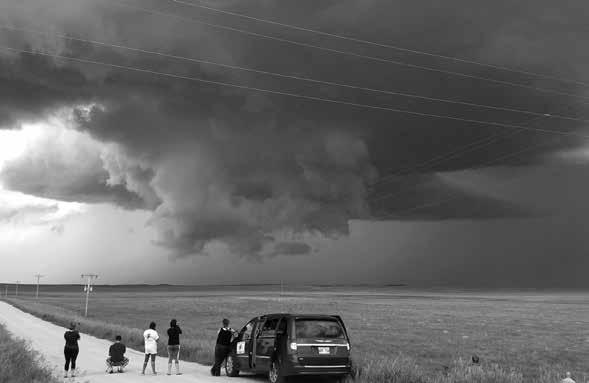
Students in GEOG 4670: Severe Thunderstorms – Storm Chasing and Field Techniques, took part in a storm chasing trip across six states this summer.
The course, which is offered once every two years and has no prerequisites, is offered to all students and to the public, giving anyone the opportunity to learn about weather systems and partake in the exciting trip. Only permission from the department head is required to enrol.
The course comprises three weeks of in-class study, followed by one
week on the road. In the classroom, students learn about the basics of weather, storm formation, and how to analyze real data using various methods.
Once the in-class portion is completed, students leave to the USA where they split into groups, each led by an instructor or professional, and chase storms. The students this summer departed on June 20 and visited South Dakota, North Dakota, Colorado, Wyoming, Nebraska, and Montana.
A typical day on the road for these
students involves getting up around 7 a.m., eating breakfast, and then analyzing publicly available data from sounding stations and satellites. Once their analysis is complete, the groups decide which targets they will pursue.
“We never got into real danger, and there was no real damage, but we were what we call ‘dancing in the bear cage’” – Brock Tropea, student from the faculty of environment, earth, and resources
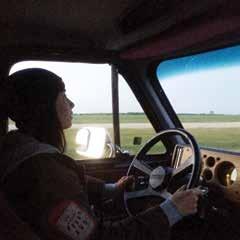
In each vehicle, everyone has a specific role. These include the driver, the navigator, and the radio operator who communicates between the teams. All other passengers are observers. A radar is used to keep up to date with new data.
Brock Tropea, an undergraduate student from the faculty of environment, earth, and resources, was a student in GEOG 4670 this summer, and says that he has always had an interest in weather and climate. He had no second thoughts about participating in a storm chasing course.
“I’ve always personally been interested in weather. It’s a childhood fascination, and I happen to enjoy the raw power and beauty of nature. When you look up at this puffy little cloud, and all of a sudden it explodes with energy, [...] it’s humbling and beautiful to look at.”
Tropea acknowledges that while the students’ experiences chasing storms were nothing like what you’d see on television, there were some moments where he felt a little anxious.
“You can really feel the power of these things. If you are standing in the right spot, you can either feel them sucking the air from behind you, or if you are standing in the downdraft from the outflow, you can feel the air blowing the other way.”
“We never got into real danger, and there was no real damage, but we were what we call ‘dancing in the bear cage.’ We say that ‘anywhere in the bear cage, there could be a bear,’”
said Tropea, referring to the tornadoes and small twisters they were encountering.
During the trip, the students saw various types of storms every day, and even saw four twisters in a single chase. “A lot of professionals sometimes don’t see this many twisters on one day,” says Tropea. “The fact I was able to see that many on my first day out was pretty insane. I feel very lucky.”
The students even had the opportunity to meet Sean Casey, who was on the road with his Tornado Intercept Vehicle. Casey is a filmmaker who has been professionally chasing and filming storms for 12 years.
Tropea believes that being able to apply theoretical knowledge to data and see the real world results has been an incredibly valuable experience.
“This trip gave me a new perspective and has helped me become a more skilled meteorologist [with a] better understanding of atmospheric dynamics,” he said.
For more information on this course and its offerings in the future, contact the course instructor Gordon Anderson by email at jander@cc.umanitoba.ca
The science behind Jurassic World
The movie was a blockbuster hit, but was the science a bust?
SOPHIE FIOLA
When the film Jurassic Park was released in 1993, debates were raised about the scientific accuracy behind the film. This year’s summer blockbuster sequel, Jurassic World, is reigniting the debate.
The film’s premise revolves around the creation of the genetically engineered Indominus Rex , a genetic hybrid of multiple dinosaur species, cuttlefish and tree frog DNA. In the film, the inclusion of this foreign DNA allows the dinosaur to acquire multiple strange abilities.
In reality, recreating dinosaurs is implausible due to the very nature of DNA. DNA degrades even under ideal conditions. In a cool, sterile environment, DNA could potentially last up to one million years. In comparison, dinosaurs disappeared 65 million years ago. However, creating a genetically engineered dinosaur is probably a lot more feasible than recreating an ancient dinosaur.
Jack Horner, the real-life paleontologist and museum curator who served as inspiration for one of Jurassic Park ’s main characters, is currently working on recreating a dinosaur using chicken embryos.
The premise of his research revolves around recreating three key
traits: a long tail, a toothless, beaked head, and arms with claws instead of wings. By the time these traits have been recreated, he will have what is essentially a small velociraptor complete with feathers.
In reality, recreating dinosaurs is implausible due to the very nature of DNA
Horner’s team is already a portion of the way there; the mechanism to generate the toothy snout has been elucidated by Matthew Harris, a molecular biologist from Harvard Medical School. The most difficult feature to complete so far has been the generation of a long tail. Horner estimates that the “chickenosaurus” could be complete within a decade.
Genetically modified dinosaurs aside, how many liberties did Hollywood take in recreating iconic dinosaurs such as Tyrannosaurus Rex, Pterosaur, and the film’s iconic pack of Velociraptors?
Aaron Kilmury, a geological sciences student from the University of Manitoba, shared his opinion on the accuracy of the film. He believes the dinosaurs were mostly correct, but with a few key errors.
“Jurassic World shows the velociraptors to have both eyes on the sides of their heads, but when Chris Pratt or another dinosaur jumps in front of them, they don’t turns their heads at all,” Kilmury explains. “Steven Spielberg had the head movements of the velociraptors right in the first movie.”
The marine reptile shown in the film, Mosasaurus, was portrayed as an impressive, shark-eating, dinosaurfighting monster. In reality, according to Kilmury, the Mosasaurus shown in the movie was almost double the size of the largest known mosasaurid. The movie did get one small detail almost right: the extra set of teeth on the roof of the reptile’s mouth.
Kilmury says, “Although extra care was taken to show the extra set of teeth, the number of teeth is actually incorrect. Fossil mosasaurid skulls typically have two rows of six teeth. The movie incorrectly showed a row of three teeth and a second row with two teeth. To make matters worse a
very unnecessary extra row of ‘regular’ teeth were added behind the frontal row of ‘regular’ teeth, which makes no sense at all!”
When the trailer for Jurassic World was released, many paleontologists were disappointed by the dinosaurs’ lack of feathers. In the film, geneticist Henry Wu explains that the dinosaurs in the film were engineered not to have feathers, as they were more visually appealing without them. Kilmury considers this “a dreadful excuse not to use some imagination.”
“Showing feathered dinosaurs would have been an excellent opportunity to show the public some of the more recent research that universities are doing on the topic,” he explains, “I can only dream that feathered dinosaurs will be featured in all their mighty feathery splendour in the near future.”
GRAPHIC BY BRAM KEAST
PHOTO PROVIDED BY BROCK TROPEA
Science briefs
Bite sci-zed science stories
JEREMIAH YARMIE
A white-nosed problem
Results of recent laboratory and field work show that a soil bacterium can inhibit the growth of a fungus which causes a deadly and devastating disease in bats.
White-nose syndrome is an infectious disease caused by the fungus Pseudogymnoascus destructans. The disease is named after the white fungal growth which appears on the muzzle of infected bats. The disease has decimated North American populations in recent years.
In 2012, researchers from Georgia State University first noted that the bacterium Rhodococcus rhodochrous inhibits the growth of the white-nose fungus in the lab. This bacterium has recently shown promise in protecting wild bats from acquiring this disease as well.
The infectious fungus first poked its conidia in caves on the east coast about five years ago, and has since rapidly spread.
Unfortunately, it seems as though it may be too late to save the east coast bat population, but there is hope that western populations can benefit from R. rhodochrous protection.
P. destructans prefers colder environments like those found in areas where bats hibernate in the winter.
The fungus colonizes the skin and wreaks havoc because the immune system of a hibernating bat is nearly dormant.The infection eventually causes death by dehydration and the depletion of caloric fat stores.
What’s lurking in cat poo Toxoplasma gondii is my favourite infectious agent. This is because this cat-dwelling parasite has the ability to change minds.
The definitive host of T. gondii is the domestic cat. Cats typically shed these parasitic protozoans in their feces, and from there they are passed further to other individuals. If these parasites infect rodents like rats, something interesting happens: the rats become less scared of our feline friends. By altering the rats’ behaviour, the parasite can be reunited with the host in which it can reproduce through the form of a self-sacrificed meal.
Since humans domesticated cats long ago, it’s no surprise that the parasite is very common in our populations. It has been shown that T. gondii infection in humans is associated with slight behavioural changes like increased aggression and impulsivity, behavioural changes similar to those seen in rats.
Researchers have been investigating the relationship between T. gondii infections and schizophrenia for decades. A recently published paper analyzed a previously unpublished survey from the 1980s consisting of data collected about cat ownership and mental illness, including schizophrenia.
The results of the analysis were similar to a 1995 study and a 1997 follow-up study which both show an apparent association between cat ownership early in life and the development of schizophrenia later on. The increased risk was found to be about two times greater in this recent study.
The researchers urge others to use these findings as the basis for experiments into the causal relationship between Toxoplasma infections and schizophrenia.
There are some hypotheses which attempt to explain the relationship between the parasite and schizophrenia. One such hypothesis includes parasite-production of the neurotransmitter dopamine, increased levels of which is thought to contribute to the onset of schizophrenia.
Restoring radial symmetry
Researchers have discovered a new way in which certain marine animals can carry out self-repair. For humans, losing a limb is permanent, with no chance of regeneration. When it comes to non-human animals, self-repair is a much more common and diverse happening, especially in marine life. Some animals, like certain starfish, can easily regenerate lost limbs.
The newly discovered process, called symmetrization, involves the restoration of an ordered body plan after disruption to it caused by damage.
The studies were done on ephyra, juvenile individuals of Aurelia aurita also known as moon jellyfish. These ephyra have a body plan known as radial symmetry – the same kind that a pinwheel or a sunflower has –consisting of a centre disc with eight arms projecting from it.
The researchers carried out amputations of the ephyra’s arms and observed how they reacted to this dismemberment.
Instead of regenerating the arms like a starfish might, the jellyfish instead reorganized their remaining arms in a way that restored their radial symmetry.
This reorganization was surprisingly done without the creation of new cells or destruction of old ones.
The reorganization was instead driven by the actions and rebuilding of the animal’s muscular system.
This limb reorganization can quickly occur in just a couple of days. Interestingly, jellyfish that went on to reorganize themselves in a proper way were able to fully mature into adults.
The restoration of a symmetrical body plan is essential for the survival of the jellyfish. Their locomotion depends on precise flapping of their evenly distributed and symmetrical arms. If they can’t move, they can’t eat. So it goes.
Predators often cause this kind of dismemberment. Sea turtles are particularly good at munching on jellyfish – an average adult eats more than 200 jellies a day.
It pays to be picky
New research finds picking the right partner can make you more successful
LAUREN SIDDALL, STAFF
Most people say they have a type – an image of the sort of person they find themselves attracted to consistently. Some people are attracted to athletes, some people prefer musically inclined partners, and others are simply looking for people with blue eyes. What most people do not consider is their significant other’s effect on their success in the workplace. But maybe they should.
New research fresh out of Washington University in St. Louis, by psychology researchers Joshua Jackson and Brittany Soloman, found that not only does your significant other dramatically affect your life at home but they also play a major part in your career prosperity.
The recently completed study followed roughly 5,000 married individuals, about 75 per cent of whom were dual-career partners, ranging in age from 19 to 89, over the course of five years. Participants took several psychological tests at the beginning of the study to gauge their scores in five basic domains of personality: openness, extraversion, agreeableness, neuroticism, and conscientiousness – also known as the “Big Five” inventory.
The “Big Five” questionnaire poses several self-reflective statements and requires the participant to state how strongly they agree with the statement. When the questionnaire is complete, the participant is placed on a continuum for each broad factor, resulting in an extremely detailed and accurate analysis of their personality, so long as the questionnaire was answered truthfully.
Participants of the study also completed measurements of occupational success by tracking on-thejob performance, job satisfaction, salary increases, and the likelihood of receiving a promotion throughout the entirety of the study.
Most researchers believe partners who rank high in agreeableness tend to facilitate career success, and their theory has been backed up by several studies. In this study, however, they found that workers with the highest level of occupational success tended to have a spouse who scored high in the conscientiousness domain – regardless of whether the working partner was male or female.
Conscientiousness, in this case, refers to the way in which people control, direct, and regulate their impulses. Individuals who rate high in conscientiousness are selfdisciplined, aim for achievement, and act dutifully. These people are organized and dependable, provide reliable support, and are skilled at managing and planning their lives. Therefore, through their actions and attitudes they are able to create an environment to facilitate occupational growth and success.
According to Jackson, the small tasks and occurrences at home individually do not effect job performance, but rather the accumulation of daily interactions and experience. Having someone reliably replace the toilet paper roll or make coffee every morning can profoundly affect your vocational prosperity.
“The experiences responsible for this association are not likely isolated events where the spouse convinces you to ask for a raise or promotion,” said Jackson.
“Instead, a spouse’s personality influences many daily factors that sum up and accumulate across time to afford one the many actions necessary to receive a promotion or a raise.”
Next time you’re perusing a Tinder profile or on a first date, subtly (or not so subtly) find out how conscientious your potential partner is – maybe you’ll be the next Warren Buffett.
GRAPHIC BY JEN GOERTZEN
GRAPHICS BY JUSTIN LADIA
Features Editor: Dana Hatherly Contact: features@themanitoban.com
/ 474.6520
Travel feature
Tensions, trials, and tribulations of tourism
DANA HATHERLY, STAFF
This page, and the seven pages following, feature various individual travel stories submitted by the Manitoban ’s editors, former and current University of Manitoba students, and one professor who organized a recent travel writing contest held jointly at the U of M and the City University of Hong Kong.
experience, comes into question.
Popular
obsessions to travel to every corner of the world are paired with newfound curiosity for uncovering the treasures in ones’ own backyard
The battle between being a generic tourist and travelling to take in the local culture and cuisine in order to gain the “most genuine”
Popular obsessions to travel to every corner of the world are paired with newfound curiosity for uncovering the treasures in ones’ own backyard.
The establishment of bureaucratic routine is challenged by embracing liminal experience encountered through travel.
Policies in the public’s best interest are countered by costs of individual freedoms and community interests.
Top-down, internationally imposed standards are weighed against bottom-up, locally derived solutions to struggles.
Students recall their memories and personal connections to the university’s Service-Learning Experience and Icelandic Field School.
Grounded in culture, history, human rights, political and corporate development, social and economic struggles, and the environment, manifested uniquely in each author’s expression of their own experience, we will go on explore the very essence of travel writing from very different points of view.
We are all tourists
An exploration of the frivolous distinction between traveller and tourist
LAUREN SIDDALL, STAFF
Pedestrians pour over the perfectly manicured grass and onto the street, obstructing the cars attempting to drive by. Everyone seems to move at a glacial speed; no one has anywhere to be. Even the cars seem to move slower as they make their way up the gentle incline that eventually ascends into the peak of the mountain.
Everyone is outfitted with a camera fastened to their neck, their index fingers prematurely fixed on the shutter release.
People sporadically start and stop during their saunter, striking the same pose in front of every alleged landmark – but still ensuring the mountains maintain their glorious presence in the background of every frame. Photographers wait for a break in traffic – which will never come – to appear as though they are the only people privileged enough to have discovered that particular location. Between photo shoots, beaming faces settle into disgruntled semi-frowns while they scout their next location.
Everyone idles with no regard for the wave of people encroaching, acting like rocks in a tumultuous river rushing downstream.
I dart in and out, sidestepping the multitudes of sightseers, too caught up in sharing their individualistic experience with the world through the convenience of their phones –somewhat defeating the purpose of the entire trip.
As I zigzag around them, admit-
tedly cutting them off, I am struck by this indescribable disdain for tourists – for their catalogue smiles that magically appear whenever a camera is raised, for their desultory movement, for their obsession with finding the “hidden treasures” that only the locals know about, for their need to document every minute detail no matter how insignificant.
And then I realize: I’m a tourist, too.
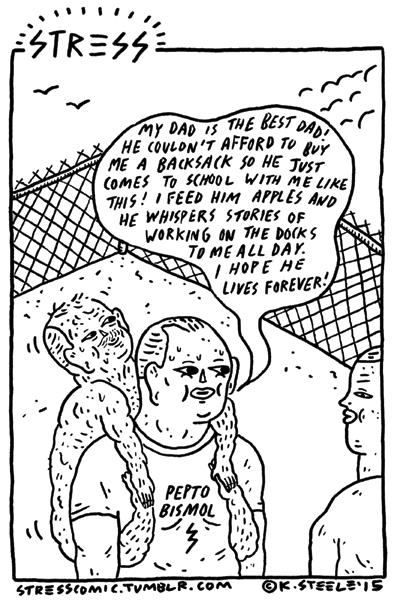
Everyone, myself included, strives to be the furthest thing possible from a tourist when we travel. The term “tourist” connotes images of sweaty, overweight men wearing terribly tacky Hawaiian shirts and fanny packs stuffed with Pepto Bismol and antacid tablets because their inexperienced digestive systems are unable to process the local cuisine.
Rather, we all like to think of ourselves as travellers, effortlessly assimilating into the local culture and being mistaken for a resident of the exotic place we temporarily inhabit. We love the idea that we are so incredibly culturally aware that we cannot possibly be contained to one city, or country, or continent.
The distinction between the two almost identical and completely arbitrary tiers is essentially the notion that tourists observe, while travellers experience.
Tourists leave with a tan and a thinner wallet, while travellers gain valuable insight and life experience.
Tourists are oblivious, while travellers are conscientious.
Tourists naively overpay for “authentic experiences,” while travellers naturally stumble upon them.
Tourists travel to escape the world, while travellers travel to be a part of it.
The difference is so minimal, so insignificant, yet the distinction between travellers and tourists somehow manages to permeate the perception of travelling.
Tours have sprung up globally, promising the most authentic experience available – creating a paradoxical concept of synthetically fashioned authentic adventures. Companies have created tours specifically for travellers, claiming to offer a oneof-a-kind experience while neglecting the fact that their special tour is available for anyone privileged enough to travel. This creates a spurious elitism for tourists who think, and claim, they are not tourists.
The only difference between the two classes is their conceptualization; there is no measurable, empirically testable difference.
There is no ceremony during which you are officially bestowed the coveted title of traveller. The categories hold no tangible power. All these arbitrary labels do is create another platform to facilitate inequality and fuel new campaigns for tourist companies.
The reality is: we are all tourists.
The term “tourist” connotes images of sweaty, overweight men wearing terribly tacky Hawaiian shirts and fanny packs stuffed with Pepto Bismol and antacid tablets
GRAPHIC BY BRAM KEAST
GRAPHIC BY BRAM KEAST
A change in perspective
Exploring the world is an opportunity to explore yourself
CHANTELLE DUBOIS, STAFF
The term wanderlust is defined in the Oxford Dictionaries as “the strong desire to travel,” but I feel as though it is more than just that: wanderlust is a contagious, and potentially lifealtering, condition.
All dramatics aside, it is a common desire within my immediate social circle – and perhaps my generation as a whole – to go out and explore as much of the world as possible.
The ideal conditions for wanderlust to thrive vary.
For me, curiosity has been the main driving force behind my urge to explore wherever, and whenever, possible. Curiosity about what a place looks like, smells like, what the local cuisine tastes like, what amazing pieces of human history or natural wonders exist beyond my Winnipeg backyard.
Symptoms of wanderlust first started to appear when I was in high school. I had several opportunities to travel in the United States, going as far south as Kentucky.
However, these places never seemed far away enough from home.
My family never went on exotic trips, my school did not offer school trips to Europe, and as a high school student it was not possible for me to hop on a plane overseas alone.
For a while, I was convinced continent-hopping would have to wait until I at least finished my university degree. Time and finances did not make overseas travel particularly convenient.
The first opportunity I had to travel overseas came suddenly and was almost recklessly decided.
My best friend, Lisa, had been hired as an au pair in Venice for three months in 2012. Au pairs are typically young adults who are provided room and board and sometimes a small wage in exchange for childcare and some household chores. She left for Italy near the end of September with plans to come home shortly after Christmas.
I never considered being an au pair as an option. I am not particularly experienced with children and find them overwhelming. As well, a fear of temporarily leaving my life behind prevented me from taking on such a major and distant commitment.
Instead, Lisa shared stories about her new, short-term living arrangements, and frequently sent photos of her life on the other side of the Atlantic.
One day she suggested I come to Italy for Christmas. I could stay with her, and we would spend as little money as possible travelling from the east coast of northern Italy to the west coast, and back.
The only major thing I had to worry about was my airfare.
It was one of those decisions that I didn’t want to think too much about. If I thought too much about the trip I
would figure out a way to talk myself out of it.
I made the jump to purchase a plane ticket from an online travel site. I remember exactly where I was when I made the purchase, and I remember my hands shaking after I authorized the purchase on my credit card. I have no idea why I had such a violent, physical reaction to this purchase. To think that I now had a relatively significant financial obligation to get on a plane to cross the Atlantic caused a type of anxiety I had never experienced before.
The rest of the term went by quickly. My flight left the morning after I wrote my last final exam, and I soon found myself checking in at the Winnipeg airport. I had flown domestically several times before, but never internationally. My first leg of the trip was from Winnipeg to Toronto, then Toronto to Frankfurt, and finally Frankfurt to Italy.
Another memory I will never forget is lifting off from the tarmac at the Toronto Pearson International Airport, knowing that when I landed it would be the first time I landed on a different continent.
I was too excited to experience jetlag. Or maybe my circadian rhythm was just very out of sync because I had just finished pulling several allnighters during final exams. Either way, I landed in Venice in the morning, met with Lisa, had lunch, and immediately took to exploring the city.
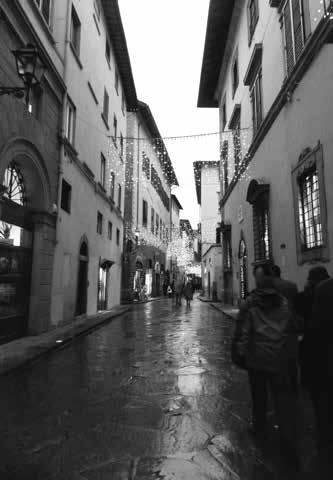
I have travelled a few times since then, but no trip has felt as surreal or as magical as Italy had. I think I was just overwhelmed by the novelty of it all. Drinking cheap Italian wine, wandering the softly lit Venetian streets, peering into the canal from the Bridge of Sighs, standing in buildings older than the country I came from.
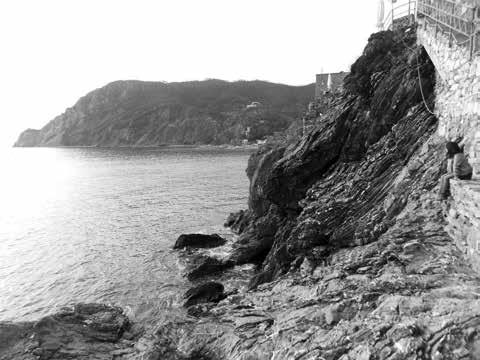
I was in Italy for less than a week, but managed to travel from Venice to Pisa, Florence, Cinque Terre, and back.
We slept on train floors – we took the late train thinking we could sleep on it instead of booking a hostel, but the train ended up being packed, so our only option was the floor. We cried together in some sort of lemon tree farm – the towns on Cinque Terre are on steep slopes, and because it was off-season we couldn’t find an open hotel, and were just very exhausted and overwhelmed. We climbed onto rocks and ledges that hung precariously over the Mediterranean Sea, just to get a good photo.
We made it back in time to spend Christmas with Lisa’s host family. Dinner consisted of more courses than I can remember, each made with local seafood and paired with more wine and grappa than I’ll ever need to drink again in my life. Lisa and I
made eggnog as our North American contribution to the dinner. The children were weary of the beverage, and the adults immediately asked if they could add alcohol to it.
At midnight, we partook in the tradition of the children hiding in the bedroom, counting down, and coming out to find Christmas gifts left for them by Babbo Natale, the Italian version of Santa Claus.
One conversation I remember having, that I will always remember, was when Lisa and I were speaking to one of the family members, who was about our age, about our visit. At some point he said, “I think you’ve seen more of Italy than I ever have, and I’ve lived here all my life.”
I had only seen a relatively small part of Italy, but found so many incredible things.
Then I realized: I haven’t explored a lot of Canada. What am I missing in Canada that overseas explorers experience? There must be lots.
Since Italy, I have been fortunate enough to visit friends living in Egypt and the United Kingdom. Every new place brings a new perspective and a new appreciation of where I come from. I always come back and look at home completely differently, almost like I forgot to take off my tourist glasses.
Exploring Canada is becoming more of a priority to me. In 2014, I travelled east of Winnipeg for the first time outside of an airport connection. I spent some time in Toronto and Ottawa, and consider the former city to be one of my favourite places in the world.
I feel like travelling has made me a braver and more humble person. Braver, because I can think of few experiences that force you to confront the unknown in quite the same way; more humble, because the world is bigger than I could ever know and I will never see it all.
But at the same time, the world isn’t that big at all. People, no matter where they are, share similarities that transcend continents, borders, and languages.
To me, wanderlust is more about exploring yourself than exploring the world, as my perspective of myself has changed just as much as my perspective of Canada.
That understanding led me to a new definition of wanderlust: “The strong desire to travel; to explore your soul as much as you explore the world.”
To me, wanderlust is more about exploring yourself than exploring the world
Then I realized: I haven’t explored a lot of Canada. What am I missing in Canada that overseas explorers experience?
If I thought too much about the trip I would figure out a way to talk myself out of it
People, no matter where they are, share similarities that transcend continents, borders, and languages
Lotus-eater vibes
A certain kind of travel
EVAN TREMBLAY
It goes without saying that British Columbia is rotten with hippies. Especially in summer, when the gentle people travel from many provinces and countries to attend a string of festivals, the Canadian expression of the flowering West Coast electronic festival scene. Here are some thoughts from my thesis notes, exploring the sacred elements in the landscape architecture of psytrance festivals.
At the bottom of a gorge, a river roars smoothly by. People sit in small groups on the rocks shaded by cliffside forests. Some talk and laugh softly in French, some play instruments, some stare out at the water. The smell of tobacco and weed mingle in the air, floating up to the tents and mandalas stretched between tall pines at the top of the steep trail that winds down to cool rocks.
Sylvan and peaceful, yet there is a heavy vibe in the air. Everyone present is focused on the moment –they are all of like mind. Hitchhiking is easy, as the locals are getting used to the sights of what I would describe
as a series of interlinked modern pilgrimages: life is good.
Pilgrimages are holy because the journey takes on the character of the destination. The number of people travelling to, from, and between fes-
The smell of tobacco and weed mingle in the air, floating up to the tents and mandalas stretched between tall pines
tivals in the summer is great enough, and has been going on long enough, that a particular style and community can be felt. For many of these travellers resting by that river, the same journey – at least to the same ultimate destination – is repeated year after
year, becoming richer with meaning and memory, as traditions bloom slowly into spiritual significance.
The binding element – and goal of their individual pilgrimages – is the dance floor. Not a club and not available for the price of a ticket, this dance floor is a shared ceremonial space in which to enact rituals of sanctity. There, lulled to group consciousness by ecstatic dance, repetitive bass beats, and entheogenic sacraments, the weary soul rests and is renewed. Leaving, the participants are fortified to enact their shared vision of life in the world beyond the space delineated for the sacred – souvenirs taken home from the shrines of saints. These souvenirs are seen in attitudes and in lived choices. Comfortable clothing, beautiful jewellery and tattoos, useful camping tools and light tents. A willingness to try going without, and eagerness at the chance to do more with less. Experience eclipses all physical things in value – to be in beautiful places, with beautiful people, doing
beautiful things. To share the gentle knowledge of the sanctity of the world, by seeing the sacred in all things, and hopefully, to spread it.
The joy, exuberance, and community which began its life at festivals slowly seeps out into the landscape around it, instructions waiting to be read.
A willingness to try going without, and eagerness at the chance to do more with less
Each new visit by one of these travellers to a new dance floor is a chance to share experience, ideas, and hopes, fortifying and strengthening the community.
The festivals have workshops on ecological living, arts, and spiritual practices. Outside the work-
shops, participants are happy for the chance to learn from each other, to be inspired by each other. There is a palpable willingness to achieve personal growth, and the almost universal practice of dance, object manipulation, and meditation as acts of leisure.
There is a shared understanding that the richness of the journey contributes to the splendour of the destination, and the tongue-in-cheek knowledge that, for real travellers, the festival is everywhere, and the journey is replete with the sweetness of its end. The travel to the destination is undertaken to enrich that destination; once the destination is reached, the experiences and beauties known on the path to it can be shared with other travellers through dance, and as artful living.
There is an undercurrent of hope that, someday, somehow, the wider culture of the West can be made into an image of this lived truth, and that travelling holds the key to coming home.
GRAPHIC
Snapshots from the Road
This summer, I joined local band Sc Mira on keys and vocals. As a member of the band, I had the opportunity to go on a three-week tour through parts of Canada and the United States to promote our new EP, Waiting Room Baby. This tour gave me the opportunity to travel to Toronto, New York, and cities throughout Indiana, Wisconsin, Minnesota, and central Canada. We met old and new friends along the way, who were sometimes kind enough to let us use their shower.
ROOFTOP
TORONTO, ONTARIO
SMOKEY NIGHT SOMEWHERE IN SASKATCHEWAN
DOWNTOWN BEACH PARTY TORONTO, ONTARIO
CENTRAL PARK NEW YORK, NEW YORK
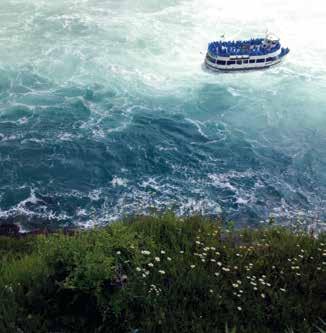
NIAGARA FALLS ONTARIO
CAROLYNE KROEKER, STAFF
Editor: Dana Hatherly
Lost Luggage
Reflections on the international travel writing contest
LUCAS TROMLY
My decision to organize “Lost Luggage,” a travel writing contest between students at the University of Manitoba and City University of Hong Kong, came out of two preoccupations: one scholarly and the other personal.
First, as someone who teaches and writes on the subject, I was curious about how students in Winnipeg and Hong Kong approached the central themes of travel writing. How did the authors describe people they met while away? What motivated their trips in the first place? I was particularly interested in how the participants’ sense of having a placed self – of having an identity grounded in a region, city, or community – was troubled or expanded by travel.
Second, I looked to this project to get perspective on my own expe-
Business as usual
K. R. MORGAN
Everything loses beauty with overexposure.
Even the sunrise becomes devalued when one sees it constantly with tired eyes from the seat of a 747.
Cycles repeat: flowers die and new ones rise, as the earth spins eternally around a globe of gas and flame.
When an event happens more than once, it is no longer an event,
but rather another addition to the succession of things that one is forced to experience before one dies.
My life has been filled with many such rotations of experience: when one set ends, another begins. Always there remains this illusion of newness, as if somehow this job will be different or the place that I’m in will alter the way the system of life works
PHOTO BY CAROLYNE KROEKER
around me.
And yet it all blurs into each other
* * *
I remove my passport and boarding pass from the inside of my jacket, and roll up my newspaper.
“Now boarding flight number AC846 to Munich,” murmurs a woman over the intercom. I work my way through the throngs of people toward my gate.
Every airport has the same exhausted vacationing families, bickering lovers, and men and women in suits, holding their newspapers and coffee in preparation for their business trips.
I make my way to my first-class seat, ducking under the curtain which protects me from the people who paid for their own places on the same machine. My place is clearly better because taxpayers covered the cost.
All is sweeter when it comes for free.
* * *
At times, novel experiences seem imminent. The illusion of progress seeps into every action, every word.
In my line of work, it is important to follow a routine; newness is dangerous.
Our flights leave at the same times, the destinations are secured upon arrival.
My job deals with maintenance – of order, of peace, of reputation. There are teams of people who make sure that everything I do follows the plan and nothing can disrupt the order that we have created.
The plan, the plan, the plan. Everything has been orchestrated. All is safe.
riences as a tourist. My wife grew up in Hong Kong, and over the past ten years I have spent a lot of time there. I’ve learned a lot about this fascinating, difficult city, but have done so from the position of an outsider, though one with lots of connections. I wanted to learn how people from Hong Kong feel when they are tourists – maybe to ease my anxieties about the limitations of my own touristic knowledge.
I was very pleased with this year’s “Lost Luggage” entries, which span a range of literary registers, from memoir to fiction. I have tentatively become aware of differences between the two groups of contributors: while authors from Winnipeg write about travel in a way that is more abstract and prone to fictionalizing, for Hong Kong students travel is more directly
political, particularly when it takes them to mainland China.
The following two entries were the winners of "Lost Luggage" 2015. The Hong Kong City University winner is Maya Shuchang Yu, who is in her final year in the English department. The University of Manitoba winner is K.R. Morgan, an Honours student in English, Film, and Theatre.
I hope readers will enjoy all of this year’s submissions and encourage everyone to look for a new round of submissions next year.
Lucas Tromly, organizer of the “Lost Luggage” travel writing contest held over the 2015 winter term , is an associate professor in the department of English, film, and theatre at the University of Manitoba.
Upon arrival in Munich, the first class passengers disembark before everyone else.
I join the group of appointed security officers – both the ones who accompanied me on the plane and the ones we met at the airport – and am led to my transportation.
We arrive at the hotel: eat, sleep, wake up, and eat.
Oceans and beaches look the same on every continent, and man-made structures are no longer impressive when they’re compared to every other manmade structure
I go to a full day of meetings with various people, and we talk about the same things we always do. The most important people flew in from their respective cities at the same time I did, and we will all leave around the same time.
We pretend that we will change policies and the general order of things, and that we’ll come up with solutions for the various problems that we have gathered to discuss.
Ten brains are better than one.
We fulfil our expected roles, then disband and return to our allotted hotel rooms across the city.
When I began this position, “business trips” – as we have vaguely labelled them – were a source of excitement for me.
I would make sure that I had scheduled time to admire the sights of each city. I wanted to experience the world, and representing my country in international meetings was the perfect way to visit the most influential places on the planet.
It didn’t take long for the trips to become tedious.
The destinations began to blur into one another. Oceans and beaches look the same on every continent, and man-made structures are no longer impressive when they’re compared to every other man-made structure.
Once you’re required to keep the company of intimidating security personnel, even tourist traps lose their appeal as you draw more attention to yourself.
* * *
I spend four days in Munich, before exchanging formal goodbyes and professional pleasantries with my companions.
I return to the airport – which looks just as generic as every other one – and wait for my chance to embark on my flight home.
We take off, and I stare blankly at the sun, which arises to bid me adieu. My eyes hurt, and I slide the window panel closed.
Home will be the same as any other place.
PHOTO BY CAROLYNE KROEKER
The smog
MAYA SHUCHANG YU
“What do you want?” Ian looked at me, as direct as his question. I didn’t know him at all.
I came with Justus, whom I met from the class “USA Today and Tomorrow.” I took it to substitute my core course “American Literature and Culture” back at my home university. Justus took it as an optional module –he was a social science student.
We came for a drink and thought we’d talk about our presentation on legalizing marijuana. This is, after all, an ideal place for such a thing.
I noticed Ian once I entered the bar. He was Latino.
Berlin was very international, but behind a rusting iron gate hidden in an abandoned building, this bar was not. He stood out the same way that I did.
I ignored his constant glances, but eventually he came over.
“I want to have choices,” I said.
“I assume you are not a big fan of the Communist Party.” Ian smirked.
“Not a big fan, but not a hater either.”
“You just said you want choices,” he said. He was being provocative.
“Look, what I’m saying is, it would be nice to have some options to choose from. I might still choose the Communist Party, but that would be an active decision.”
I sounded like an activist.
I took a glance at Justus – he was concentrating on rolling a cigarette.
“You know what I really don’t understand?” he asked.
He didn’t wait for my response. “That one child policy thing.”
He was probably expecting my amazement at his knowledge of China. But I just nodded. Not that I didn’t want to satisfy his pride; I simply didn’t know how to answer.
“Are you the only child?” he continued.
“Yes, unfortunately.” I gave a bitter smile.
It was funny though. Whenever I told people in Berlin I was the only child, I spontaneously put on this miserable look, as if I was a victim of the policy. In fact, I was a big supporter.
I never felt lonely in my childhood, as many would have presumed. I
enjoyed being the focus of my parents and I didn’t want to share their love with anybody. But somehow, I felt obliged to put on this pitiable look, to meet a social expectation.
“Having no say on how many children you want? That’s crazy,” Ian was getting excited.
I’d actually never thought about it that way.
“You’re probably right. My mom always wanted more children,” I said. That was true; my mother loved kids.
“See, that’s what I am talking about,” he said triumphantly.
After taking a long drag, Justus handed me the cigarette. He slightly tilted his chin, meaning that I should take a drag.
I told him the other day that I had never smoked in my life. It was very considerate of him to offer this, especially when a stranger was sitting with us.
“It is cigarette, right?”
“Yes, it is,” Justus chuckled.
In hopes of covering up my clumsiness, I imitated him and took a long drag. Then I started coughing like an idiot.
“You inhaled too much,” Justus said to me earnestly.
He then turned to Ian and explained, “She never smoked before.”
It was so very considerate of him.
“This is so embarrassing,” I could barely utter a sentence.
“No, no. This is normal.” Both of them were eager to express their understanding.
“This is exactly why we travel, to try out different things,” Ian comforted me.
“How does it feel?” Justus asked.
“Like torture,” I said. It was actually not that bad.
“Only at first,” Justus said.
They both laughed.
OK, enough on me smoking.
“I get the point of implementing the policy, though.”
I turned to Ian and said, “There are too many people in China, and that causes severe problems.”
“But in sacrifice of human rights?”
Ian stared at me.
“I think you are too used to labelling China. Everything China does violates human rights, right?” I was
suddenly very upset.
Then nobody said anything for a while.
“I think what Maya wants to say is, sometimes individual freedom cannot be the sole principle. It is a tricky question when freedom is up against starving babies and poverty.”
Justus tried to ease the tension.
Ian shook his head.
“I don’t get it.” He looked at me. “First you said you want choices, but seems to me there’s nothing to be changed.”
I was tongue-twisted. The conversation made me exhausted. I found my eyes fixing on Ian’s super long sideburns. I wondered how far we were from monkeys. Justus got up to get another beer.
“There are things to be changed, lots of things,” I finally said, “but I don’t know what, and I don’t know how.”
I ended up making a confession to a person I knew for 20 minutes.
When Justus came back, Ian had already left. He proposed to exchange numbers, but I said I was leaving Berlin in a week. Of course, I didn’t tell Justus this part.
“I was hoping he would leave us at some point,” Justus said.
“Is it normal here,” I asked, “for people to invite themselves over?”
“It happens sometimes,” Justus chuckled. “I am sorry that you had to talk about China all night. It must have bored you to death.”
I felt many things that night, but boredom was not one of them.
“Not really. I seldom talk about things like this.”
“You don’t?”
“No. I guess it’s part of Chinese philosophy. We are taught to be satisfied with what we have.”
“That’s interesting,” Justus said, thoughtfully.
“I find it very hard to express what I think.”
“Those are difficult questions,” Justus said.
“Wanna try again?”
“Sure, why not?” I took another long drag.
“There are things to be changed, lots of things. But I don't know what, and I don't know how”
GRAPHIC BY BRAM KEAST
Editor: Dana Hatherly
City girl gone bush
Reflecting on food struggles in the old mining community of Leaf Rapids
ELYSSA CHAN
It’s been just over one month since my return from a five-week placement at a boreal garden working with the Grow North Corporation in Leaf Rapids. As a participant in the University of Manitoba’s Service-Learning Experience, I learned about some of the challenges faced by this northern community and solutions that they have developed in response to their local food struggles.
This buildup of problems over the years in Leaf Rapids has severely impacted the residents and their opportunities for food security, food sustainability, and food sovereignty.
an exclusive group of people who were granted this special status because of an extraordinary bond – one that they earned. Now, that particular group has become more open for me.
I
do
not
believe that
I would have begun
to understand the struggles faced by residents of Leaf Rapids, without having stayed there and learned about their stories
Upon returning to Winnipeg, it was a ridiculously smooth transition getting back into the regular pace of my pre-departure life.
Even though things at home remained basically the same, I have personally been changed by my time spent working with the community on the garden in the old mining town. The most obvious transformation is that I’ve become a city girl gone bush.
My perspective has changed on how to spend my free time. Now, I love spending time in nature. I’ve even been begun planning some camping trips with my friends, which is something I never would have considered before my trip. A newfound love for gardening has also been uncovered. Spending time with plants is extremely relaxing for me.
Besides connecting me with my love for the outdoors, it has changed my perspective further. Prior to this service learning experience, community development was not on my radar as an interest.
Don’t get me wrong: each one of my oldest, closest friends remains special to me. Each bond is unique and could never be substituted. But now, I am significantly more open to engaging with new people I meet and hearing their stories.
The biggest thing I learned about community development in Leaf Rapids was that once I cared about a place and its people, everything changed for me. A deep passion for others was tapped.
Typically when I saw my closest friends get hurt or mistreated, it made me furious. I would defend them. But I never knew that I could feel so upset and defensive about injustices against someone I had met fairly recently – let alone an entire community.
Building these irreplaceable bonds has led me to retain a deep attachment to Leaf Rapids. I continue to wonder about the people there and the challenges they are still faced with. To understand food sustainability issues on a textbook level seems quite straightforward. However, the reality I witnessed in Leaf Rapids was much more complicated.
To address such issues regarding the consumption and production of food, unique circumstances and particular challenges facing communities must be looked at
Before, I believed people should be generally friendly to everyone they meet, but the interaction stopped there. I believed that the only ones who truly wished to understand someone – their perspective – were the ones who were already closest to them.
To me, one’s closest friends were
Food issues, and responses like boreal gardens to counter these problems, are part of an amazingly complex situation. Rooted in systemic issues, and intertwined with local and provincial matters in politics and cultural identity, these are just a few of the various factors contributing to the complexity.
I do not believe that I would have begun to understand the struggles faced by residents of Leaf Rapids, without having stayed there and learned about their stories. I have never felt so frustrated – with the government and the general situation at hand – before this experience.
The answers to seemingly “straightforward” questions about food security, food sustainability, and food sovereignty are still perplexing to me. I have come to realize that during my time there, I only scratched the surface of these major issues. On the last day of our trip, my new university friends and I realized this, as we were chasing our last northern sunset.
To address such issues regarding the consumption and production of food, I have learned that unique circumstances and particular challenges facing communities must be looked at.
My experience in Leaf Rapids has changed my life forever. I know that. My passions have shifted; my personality has changed. I am asking different questions, learning new things.
Personally, I believe it is for the better.
Since working on the boreal garden in Leaf Rapids, I have been fortunate enough to continue my learning by taking on the University of Manitoba Students’ Union’s campus garden programmer position. This way, I have had the opportunity to continue gardening, as well as sharing my knowledge and passion with fantastic volunteers and passersby.
Moving forward, I’m excited for the ways this experience will shape my future.
To other students who are considering participating in these types of service-learning trips: just go for it. I can almost guarantee that participants will leave with a lot more than expected, including a new perspective on their own life and the lives of others.
The University of Manitoba provides access to a variety of local and international service-learning programs through Student Life. These programs offer opportunities for students to participate in innovative approaches to education that integrate community service work with activities designed to develop skills for public engagement, critical thinking, and intercultural communication
One student tells all
Recollection of the Icelandic Field School 2015
CORI KULBABA
With so many new things to do, see, eat, and experience, travelling can be exhilarating.
The University of Manitoba Icelandic Field School was unique because it gave students the opportunity to try new and exciting things in Iceland. Participants experienced Iceland in a way regular tourists would never get the chance to.
Iceland is a funny country when it comes to tourism, because the majority of people who visit there only stay in Reykjavik, the capital and largest city. The Icelandic Field School 2015 started out in Reykjavik, which was a great way for students to find their legs in this new country.
It is a beautiful city, and the 24-hour daylight Iceland experiences in June gave us what felt like a lot of time to explore the city and get to know each other. Guesthouse Odin became home between trips to museums, galleries, and for midnight waffles. The showers smelled like sulphur, and we had to hang dry our underwear in the hallways.
Everything we encountered was a new and exciting adventure.
Phase two of the field school was a totally different journey.
Cars were rented, bags were packed. We drove away from the
city and into the Westfjords, using tunnels and ferries, and traversing over terrifying mountain roads, until finally, we arrived at Holt.
This small former schoolhouse in the middle of a fjord became our new home. Students plunged into experiencing this “other Iceland.”
The showers smelled like sulphur, and we had to hang dry our underwear in the hallways
Some artists travelled with the school to the Westfjords, and those of us who stayed at Holt became family. We cooked meals for each other, went swimming as a group in the evenings in nearby towns, and spent our days together at the University Center of the Westfjords in the nearby village of Ísafjörður. Surrounded by the beauty of the Westfjords, and immersed in the Icelandic language, medieval literature, and each other, this is where the bulk of our field school memories were made.
Moving to our next home in
Hrafnseyri wasn’t too difficult. Still in the Westfjords, we slept in a traditional turf house there. We hiked up and down local fjords and poured our hearts and souls into our assignments. We explored towns in other fjords and saw everything from steampunk festivals to abandoned artists’ houses. Our days became one big road trip, which allowed relationships between students and instructors to flourish in some cases, and wane in others.
Leaving the Westfjords was more difficult.
By the time we reached our third stop in Akureyri, the accommodations felt less like home – more like we were just staying there for a few days. Our stay there sped by, in a myriad of waterfalls and other natural sites, punctuated by a few slow moments, like an afternoon which turned into an evening with newfound friends at the thermal pool in the Lake Myvatn zone.
The artists and one of our instructors discontinued their travels with us. Relationship dynamics shifted yet again. This was the most difficult part of the trip for many.
Driving back to Reykjavik was emotional for most of the group. Morale was low when we finally
returned to the capital. The city felt different now.
Somehow the group dynamic shifted back to where it all started the first time we were in Reykjavik.
Those of us who stayed at Holt became family
We had few scheduled activities once we settled back in. Our assignments were due, but the group still found time to experience a house party and night club, thanks to our teaching assistant who had spent several years living and studying in the city.
Walking home through the stillbright streets at 4 a.m. is something I will not soon forget.
Guesthouse Odin felt very much like home, once again. The sulphur smell in the showers seemed less intense, and the group became extremely tight as our last few days approached.
The final reunion dinner was an emotional experience. Many of the guests who we encountered along the way were in attendance.
Our last night together was even more emotional. At this point, the trip has become less about the country and more about each other.
And then we start to depart.
A few of us left each hour. My last morning was spent walking around the city with my closest friend from the trip.
Saying our goodbyes as the airport shuttle driver watched wasn’t how I hoped things would end.
I know I wasn’t the only who cried on the drive to the Keflavik International Airport.
Arriving back in Winnipeg, feeling the difference in weather and climate as I walked out of the airport, it hit me like a pile of bricks: I missed Iceland in a more tangible way than anything I have ever missed in my life.
Travelling to a new country was exciting. But experiencing a new country as a field school experience was particularly exhilarating for me.
The Icelandic Field School 2015 provided students with an incredible opportunity to visit another country, learn a little bit of the language, and experience the contemporary and medieval culture Iceland is known for – and far more.
PHOTOS PROVIDED BY CORI KULBABA
20 Diversions
IVORY BUFFALO
Making the grade
Researchers discover link between marks and how much professors hate you
MURV BERKLEY, STAFF
New research from the University of Waterloo has found a link between students’ grades and the degree to which their professors hate them.
Researchers sat in on hundreds of classes at six major Canadian universities and rated professors’ hatred for individual students based on the facial expressions they made while listening to the students speak. Students were each assigned a number on a scale from one to seven to identify how much contempt the professor had for them, with higher numbers representing increased contempt. These numbers were then compared to students’
grades at the end of the semester.
“What we found is, students who elicited signs of thinly veiled rage from their professors – usually manifested through rhythmic nodding, constricting pupils, and pursed lips – are more likely to receive lower grades,” said Gwendolyn Fairbanks, professor of behavioural psychology at the University of Waterloo and lead researcher.
The research team was able to explain 78 per cent of variation in a students’ grades through the professor’s level of hatred towards the student. Other factors which affected the variation in students’
grades include the season, which explained five per cent, and amount of time spent studying, which explained two per cent.
“I think the big takeaway here is that if you’re performing poorly in one of your classes it’s almost certainly because your professor has an unjustifiable vendetta against you,” said Fairbanks.
“Don’t waste your time studying or working on your assignments. You’re much better off dropping the course and trying another section in a later semester with a professor who doesn’t hate you – maybe summer session.”
ILLUSTRATION BY BRAM KEAST ILLUSTRATION BY CAROLINE NORMAN
José González re-sharpens his claws
Critically acclaimed Swedish singer-songwriter plays Winnipeg Folk Fest, releases new album
IAN T.D. THOMSON
One of the highlight performers at the 2015 Winnipeg Folk Festival was singer-songwriter José González. Having released his third album Vestiges & Claws in February of 2015, González took the main stage on Saturday around 9:30 p.m. with a stripped-down set of his solo material.
José González is an indie-folk singer-songwriter from Gothenburg, Sweden. González gained popularity with his 2003 debut album Veneer, as part of a new group of popular folk artists such as Bon Iver and Iron & Wine. However, González uses an especially distinct playing style. He fingerpicks a classical nylon-string guitar, often in a continuous looping riff. González’s music is perfused with his soft, shy-sounding voice. Notable releases include his 2003 cover of The Knife’s “Heartbeats” and the 2007 track “Fold.”
González’s 2015 album marks his return after seven years since his last full-length album: 2007’s In Our Nature
When asked about this long break between albums, González said he never saw the seven years as a hiatus, having kept busy during the time between albums.
“Of course it’s a break from my solo career but for me as a person, I have
been sort of doing the same, writing, recording and touring,” González explained to the Manitoban
“From my point of view I haven’t been taking any breaks.”
Between solo albums, he contributed to the soundtrack of the 2013 film The Secret Life of Walter Mitty, starring Ben Stiller. González performed four tracks which were present at key moments in the film as the character of Walter Mitty travelled to various exotic locations.
Going back into the studio to record his solo album, González chose not to go with an outside producer. This was a conscious decision by the songwriter, who picked up techniques from other producers over the years.
different tricks of producing and mixing,” said González.
The outcome of González’s work is Vestiges & Claws. The ten-song album feels like an expansive continuation of González’s two previous solo releases with the songs still heavily focused on González’s talents on the classical acoustic guitar.
“Of course it’s a break from my solo career but for me as a person, I have been sort of doing the same – writing, recording and touring” – José González
The six-minute track “What Will” is among the more notable on the album. The song starts off with a deep, pulsing drumbeat and guitar riff. Picking up midway with a faster beat, González’s guitar grows heavier as he sings the album title: “Vestiges and claws/Free your mind/To leave dogma behind.”
Zeroes and Dan Mangan. “I am really looking forward to it [...] I have heard that it is a great festival and the focus on folk music fits me well.”
Touring in support of the new album, González has been performing with a five-piece band to recreate the music. His Folk Fest performance marked the first time González had performed a stripped-down show whilst touring the new album.
José
this year and is available on iTunes. For more information, visit jose-gonzalez.com
“I felt like it was fun to do it on my own. I had already done a couple of recordings where I tried out the
As one of the performers at this year’s Folk Festival, González felt his music was a good fit for the event alongside other indie-folk artists such as Edward Sharpe & the Magnetic
What’s your Fringe Fest fancy?
A sampling of plays to look out for at the 2015 Winnipeg Fringe Festival
SEAMUS HAMILTON-PATTISON, STAFF
From July 15-26, Winnipeg’s Exchange District and the venues that surround it will play host to the 17th annual Winnipeg Fringe Festival. The Fringe Festival provides an outlet for both local and touring theatre companies to present their productions at a number of venues across Winnipeg’s urban centre. The companies selected to appear in the festival are allowed total artistic freedom and receive the entirety of the revenue generated from their productions’ ticket sales.
After reviewing the current year’s lineup, the Manitoban has reached out to five theatre companies for comment on the plays they will be presenting at this year’s Fringe with the hope of providing a sampling of sorts – as well as the companies’ own descriptions of their art – for new and seasoned festival-goers alike.
American story-teller and writer Randy Ross is bringing his one-man show, The Chronic Single’s Handbook to the festival for its debut performance in Winnipeg. Ross told the Manitoban his play was based off his own life experiences and his unpublished novel about a “chronically single guy who takes a trip around the world looking for the woman of
his dreams.”
Ross admits that the show is “not for everyone,” as it includes mature content and features Ross’s “personal opinions about love, sex, marriage, and paying for a hand-job,” but concludes that the show “should be a good fit for adventurous Winnipeg Fringers.”
Touring company Sizzle and Spark bring another comedic, mature production to Winnipeg’s festival. Described in the troupe’s press release as a “theatrical adult clown show,” the play features a couple desperate to spice up their love life with secrets from an ancient document known only as the “Sama Kutra.” Performer Jacqueline Russell described the play to the Manitoban as “sexy, naughty and hilarious,” noting that the show is subject to a degree of improvisation with each performance.
“Because we are clowns, no two shows are ever exactly the same. So much of our show is shaped by the audience and all the wonderful, unexpected things that happen in live theatre”, Russell said.
Meghan Chalmers and Franny McCabe-Bennett make up the entirety of the touring theatrical company Two Juliets. They hail from
Ontario, and are bringing their stylistic mash-up XOXO: The Relationship Show to Winnipeg directly following the Toronto Fringe Festival.
“So much of our show is shaped by the audience and all the wonderful, unexpected things that happen in live theatre” – Jacqueline Russell, Fringe Festival performer
The plot of XOXO is centred on the concept of dating and relationships “from a funny, feminist point of view.” The two actors use a variety of genres to get their message across, combining “the honesty of stand-up comedy, the theatricality of a Shakespearean tragedy and the bone-chilling horror of an R.L. Stine novel in a queer-positive and gender-inclusive sketchy comedy/
theatre hybrid.”
Chalmers and McCabe-Bennett recommend the show to anyone aged 15 or older, and promise “an hour of high-energy fun that everyone can relate to.”
Local theatre company Downside Up Productions is set to present a slightly darker production than the touring acts listed above. Downside Up is performing a play called SHARDS, which explores the manner in which violence can manifest in one’s everyday life. The aforementioned violence is presented and explored through 23 disjointed scenes, and sports a cast of two playing the parts of 24 separate characters.
Director and writer Wren Hookey told the Manitoban he believes the play will stand out as a result of its “intensity and range,” also noting that “having all 24 characters written to be played by actors of any gender is not something you can see anywhere else.”
Last but not least, another local company called Half Empty Productions will perform playwright Annie Baker’s Pulitzer Prize-winning show, Circle Mirror Transformation Half Empty Productions features former and current students of the University of Manitoba as well as dis-
tinguished U of M Film Professor George Toles as the company’s director. According to Toles, the play itself is set in a drama class, and the plot is based around a “six-week course in which five people go through this progression, and many of the things that reveal the most about the characters come through the theatre exercises, which anyone who’s done theatre for any length of time will recognize.”
Toles informed the Manitoban that he believes the play will stand out in the festival due to its “beautifully unforced, lifelike feel, which on one hand suggests casualness [...] but in fact, closer examination of the play reveals that nothing going on is arbitrary or ill-considered.”
The Chronic Single’s Handbook and XOXO: The Relationship Show will both be running at Fringe Venue #11 (Red River College), The Sama Kutra at Venue #2 (MTC Up The Alley), SHARDS at Venue #8 (The Rachel Browne Theatre), and Circle Mirror Transformation at Venue #6 (MTC Warehouse). For show times, ticket prices, and more information, please visit www.winnipegfringe.com
González’s third album, Vestiges & Claws, was released in February of
PHOTO PROVIDED BY MALIN JOHANSSON
Stop and smell the roses
The Department of Floristry delivers art in the form of flowers
LAUREN SIDDALL, STAFF
As with most artists, Candace Fempel of the Department of Floristry stumbled upon her talent quite naturally – but perhaps more so than most.
“I think my interest in floristry really comes from spending countless hours exploring in the northern Whiteshell with my family growing up. I learned about various plants and varieties of flowers by working on the yard, or in the garden, with my grandma and my dad,” said Fempel.
“I love the immediacy of making something with my hands and being able to have an idea and execute it myself.”
After being introduced to a local flower shop by her mom during middle school, Fempel decided to pursue her passion for environmental design further, including completing her masters of architecture at the University of Manitoba and founding the Department of Floristry.
“My goal, with the Department of Floristry, is really just to offer various ways – flower arrangements, terrariums, wreaths, vessels, prints, paper flowers – that a person might liven up their space. I like having the ability to do this at a small, accessible scale. Flowers, plants, succulents, and cacti, among others, have a natural ability to connect to people.”
With her degree in tow, Fempel transforms ordinary natural occurrences into living works of art
designed to gild the everyday.
“ I find my process seems to be evolving each time I design. Because flowers and plants are organic, they have a natural language that requires attention and care to work with. The more I work with them, the better I’m getting at reading that dialogue. The process of creating and making is not always clean and beautiful, but the outcome each time is unique and the work continues to change as time goes on,” explained Fempel.
“I love the immediacy of making something with my hands and being able to have an idea and execute it myself” – Candace Fempel, Department of Floristry founder
“Working with organic materials teaches you that even if you think you had a perfect plan, the nature of the material is to change and it will do so with or without your permission. With that in mind, my aim is always to respect and accentuate the natural beauty – the texture, colour, and layers – of the flower or plant.”
Fempel’s terrariums, bouquets, wreaths, and paper flowers may have had humble beginnings as a hobby, but have quickly gained a fanbase in the city – especially her pop-up shops at Tiny Feast in the Exchange District.
“ The pop-up shops with Tiny Feast came out of a shared appreciation for smaller-scaled, well-designed home wares. I had met them before they opened, so when I found out they’d be starting a stationery shop I thought they might have some interest in the paper flowers I had been developing at the time. The connection to paper goods actually might be really where it started, and it’s just grown from there,” said Fempel.
“ The reaction and support for the pop-ups has been fantastic. We’re trying to create a really convenient but unique environment by centring the pop-ups around popular holidays.”
Following the success of the popup shops, Fempel looks to expand her business further – eventually looking to provide floral arrangement for events and designing more vessels for her creations, in addition to her current collaboration with graphic designer Evan Marnoch.
Check out the Department of Floristry’s website: deptof.ca and follow them on Instagram @ Deptof to stay up to date on the latest news and pop-up shop dates.
The funniest night in Winnipeg
Comedy showcase at Park Theatre sees another full house
ALANA TRACHENKO
There’s definitely a downside to laughing all night: a sore face the next day. The Winnipeg Comedy Showcase, hosted by Jared Story at the Park Theatre, saw a packed house on July 4. The showcase takes place every three months and features a rotating cast of local stand-up comedians. With a comedy scene as developed as Winnipeg’s, promising the best is no small thing, and Story takes his job of selecting performers seriously.
Writer by day and comic by night, Story scours the city’s open mics and comedy nights for a variety of acts. Saturday’s show offered everything from comics just starting out to those who’ve performed internationally, and still managed to have the crowd laughing consistently.
Comedy nights in Winnipeg take place almost every day of the week. Whether it’s scheduled performers or open mics, the city seems to love watching comedy.
“It wasn’t always like that,” Story said. “I first went on stage eight years ago, and there were some nights hap-
pening, but not like this [...] People have gotten really good.”
Some Winnipeg comics, like Chantal Morastica, have moved on to continue with comedy in other cities, while others are making a living by performing full time here at home. After seeing Matt Falk close the show, it’s no wonder that we are on the map when it comes to up-andcoming comics.
Falk will be performing as a part of the Homegrown Comics Competition at the Just for Laughs Festival in Montreal, thanks to his inviting stage presence and his creative twist to old stand-ins like impressions and accents. Sometimes sticking to the basics is the best way to go.
Matt Nightingale performed as Lawrence Bleachman, motivational speaker, Honda driver, world class inventor and registered voter. Nightingale says that while some comics are comfortable making jokes off the cuff, he feels most prepared when he’s had time to write out his material.
“Confidence is knowing your lines, in my world,” Nightingale says. And after seeing his act, it’s no surprise –Lawrence Bleachman has a lot to tell his audience, and was a particularly clever act that not only made people laugh but actually imparted some motivation. By the end of his set, the audience had memorized the six steps of success, most notably “spot the need!”
Story doesn’t reserve spots in his show for only those that have been performing for years or as professionals. Florence Spence was scouted by Story at a few open mic nights.
“She’s starting to come into her own unique voice,” Story says. “It’s her biggest show yet, and I’m hoping it’s the start of many more for her.”
Spence spoke openly about her experiences as a mother, and a member of the Aboriginal community with a candidness that had some people squirming in their seats – it’s not often one gets to joke about racism and drug abuse so close to home, though perhaps we should be more comfortable with humor as an outlet.
Story said having a full house of attentive guests is exciting, but it doesn’t stop him from being nervous every time he goes on stage.
“I’m more nervous before I go on stage, then I’m just a wreck,” Story laughs. “But then it’s like, I guess I’m doing this [...] I think people like comedians who aren’t the most confident. No one likes a person who’s full of themselves. It’s about being able to poke fun at yourself and everything around you.”
Nightingale echoes the sentiment that being nervous isn’t a bad thing. In fact, it means you’re doing something right.
For those who are nervous, but remain committed to comedy Nightingale has one piece of advice.
“You just gotta go out there.”
Follow Story on Twitter @jrockarolla to keep updated on the next showcase and other events around the city.
PHOTOS PROVIDED BY CANDACE FEMPEL
PHOTO BY ALANA TRACHENKO
From subway car to skyscraper
The importance of public art and culture programming
LAUREN SIDDALL, STAFF
Since its humble beginnings as graffiti plastered illegally on subway cars, public art has flourished from a nuisance into a means of community revitalization, and right at the centre of the movement in Winnipeg are Chloe Chafe and Andrew Eastman of Synonym Art Consultation and founders of the Wall-to-Wall Mural and Culture Festival – an annual, multifaceted five-day festival in Winnipeg designed to make art more accessible by creating both interior and exterior murals, and pairing each mural unveiling with a public culture event.
“There’s an automatic thought that public art is spray paint, which is vandalism, which is destruction of our community. What we’re trying to do is bring contemporary, beautiful works of art onto walls that you would drive by everyday,” said Eastman.
There’s the key: seeing the art everyday Public art removes the potentially pompous facade of fine art and breaks down the fusty gallery walls. It creates an environment in which art is not only for the elite; it is for everyone.
strings of people that benefit from [Festival D’Art Public]. There’s the obvious art community and street art community, but there are also all these businesses that are financially benefitting from it; they get over a million patrons walking up and down the street, experiencing the art, and going to these shows. It’s unbelievable to be able to reach such a broad audience – it’s really inspiring,” said Chafe.
The prodigious structure of the Montreal festival, while not necessarily directly transferable to Winnipeg, illustrates the numerous benefits of public art, as well as the potential of the movement.
“We need to get people excited about street art and about beautifying our city and excited about growing our community from the ground up. Let’s all get on the same page because it’s so beneficial for everyone” –Andrew Eastman, Synonym Art Consultation
“The accessibility is important because it leads into the democratization of art. No matter your income, no matter your background, when the art is accessible, it’s taken out of the ivory tower of the fine art world and bringing it to the streets and bringing it to everybody,” said Eastman.
“Beyond that, street art right now is such an international movement that it instantly connects cities and communities, as opposed to just connecting the art community within your city, it’s connecting you to an art movement that is going on around the world right now.”
As the movement continues to gain momentum, public art festivals are starting to emerge all around the world, including the Festival D’Art Public in Montreal, from which Chafe and Eastman just returned.
For each of its three years, the festival has commissioned both international and local artists to create a total of 50 full-scale murals down Boulevard Saint-Laurent, to show films, and to partner with local vendors. This year, 24 murals were created during the 11-day festival, completely shutting down one of Montreal’s major streets to make way for over one million patrons.
“It’s so amazing to see the different
“It was really amazing to let our imaginations run wild and just be overloaded with sensory input from the festival, but then we had to bring it back down and think about how Winnipeg could be a unique player in this international street art scene. We started to think more about how we could develop the community from a grassroots level here, as opposed to just hiring a bunch of international artists to come in and plaster all of our walls [for the Wall-to-Wall Festival]. It would be amazing, but it’s not really feasible,” said Eastman.
“I think for us to do the exact same model, and bring in 10 international artists and 10 national artists, for our type of community, wouldn’t necessarily have the same benefits,” added Chafe.
At this point, it makes more sense for us to establish a strong foundation from which to build. To import a handful of international artists, while it would result in amazing work, would not have the same long-lasting benefits as it does in Montreal.
“We need to continue to promote the awareness of what we’re doing and we need to promote the viability of the street art movement. In Montreal, that already exists. For them to be able to create 20 large-scale murals in 11 days is possible, and it’s possible for 10 blocks of a main street in Montreal to be closed down for this festival. The businesses understand it and the people understand it. We need to get Winnipeg onboard with this,” explained Eastman.
“We need to get people excited about street art and about beautifying our city and excited about growing our community from the ground up. Let’s all get on the same page because
it’s so beneficial for everyone.”
Winnipeg, in fact, is in an optimal position to join the movement. We have the talent, we are developing the awareness, and we get to choose what kind of player we want to be in the scene and use it to facilitate community growth.
“That’s both the amazing thing about Winnipeg and also the somewhat terrifying thing. A lot of us are starting these different ideas or movements basically from the ground up. There is a street art community in Winnipeg, absolutely, but the scale of it is a lot smaller [...] We’re trying to make a really strong foundation so that we can move up,” said Chafe.
“Art education has always been a big element for us; it’s never just about the party or just about the art. We want people to understand all of the benefits art will bring.”
Cover to cover with Carlyn
Boy Lost in Wild, by
Brenda Hasiuk
CARLYN SCHELLENBERG
Acclaimed Winnipeg writer Brenda Hasiuk used her hometown as a setting in last year’s Your Constant Star, which follows three Winnipeg teens as they enter adulthood. Boy Lost in Wild , published
last fall, is Hasiuk’s first short story collection, and takes place in Manitoba. Some of the stories in the collection have previously been published in the Malahat Review, and the anthologies Up All Night and Kobzar’s Children: A Century of Untold Ukrainian Stories
A wide array of cultures inhabit the stories in this collection, fitting for an exploration of humanity in our multicultural city. Like in Your Constant Star, many of the stories in Boy Lost in Wild examine cultural differences between characters.
In “Little Emperor,” a Chinese international student is at odds with Western customs in his downtown apartment while recovering from a brutal attack. In “Back Lane Lullaby,” a Ukrainian-Canadian family’s everyday existence is interrupted when
a man from Ukraine claiming to be their relative shows up on their doorstep. “Sandwich Artists” chronicles an unlikely friendship between an ignorant young man and his new Iranian-Canadian co-worker.
The majority of the male and female protagonists are teenagers – damaged but hopeful and persevering
Each story begins with a set of facts about different cultures and history, including Winnipeg’s. Each set of facts sets the context for the story, and perhaps informs the Winnipeg audience of something they don’t know. For instance, “It’s Me, Tatia” indicates that the Winnipeg General Strike was not generally taught in Canadian schools until the 21st century. In “Blood,” Métis history is provided in a story about a 14-year-old girl who’s just discovered she’s Métis. The majority of the male and
female protagonists in Boy Lost in Wild are teenagers – damaged but hopeful and persevering. First, second, and third person narration is employed throughout.
“Roma Raj,” one of the most engaging stories in this collection, uses a melodramatic voice. In the tale, an Indian father recounts his university transgressions with a woman on campus named “Gypsy Joan” to his young son undergoing medical tests for a lump.
Melodrama manifests in this passage, in which Raj, the father, speaks to his son: “Over the course of our whole marriage I’ve never indulged in such extramarital musings except in dreams, and now, when our only son, our shining star, is in mortal peril, I’m adrift. But you see, Jagat, it’s not that I don’t care. It’s that I can’t seem to shake this thing I must share with you, somehow, somewhere.” The father’s voice is jarring, but his detailing of his short relationship with “Gypsy Joan” is one of the most enjoyable parts of Boy Lost in Wild
“Little Emperor” is also a notable piece. First-person narrator Xaio, a new international student navigating Winnipeg alone and impaired after
a mugging, uses humour to describe his plight. Albert, Xaio’s landlord who refers to him as “Chow,” buys food for him. “The West has failed the visiting international student. So all Albert can do is bring me food I cannot eat. It would be all laughable if it weren’t so painful.”
The sharpest prose in Boy Lost in Wild emerges in “Sandwich Artists.” Casey, who at the beginning of the story, had “accepted that his sex life was a date with a dirty sock and computer screen,” meets his new coworker Dorri, who is in love with an older guy “in a league all by himself, larger than life rather than popular, leaving her happy to follow alone and admiring and invisible, eating his dust.”
Each story briefly glimpses into Winnipeg lives and their hardships, and Boy Lost in Wild is overall an informative and interesting read.
PHOTO PROVIDED BY TURNSTONE PRESS
The kids on the runway
Reviewing the newest Jets taken at the 2015 NHL Entry Draft
ANDY CHE
While the NHL spotlight was fixated on Connor McDavid as the inevitable number-one pick, the Winnipeg Jets welcomed eight prospects at the 2015 NHL Draft. For the third time in Thrashers-Jets history, the franchise owned two picks in the first round of the draft and did not disappoint with their selection of USHL stars Kyle Connor and Jack Roslovic.
Fellow Americans Erik Foley and Mason Appleton arrived on the second day of the draft, along with Jansen Harkins and Matteo Gennaro of the WHL, as well as Europeans Michael Špaček and Sami Niku.
Here is a complete breakdown of the Jets 2015 draft selections.
First round
Youngstown Phantoms left winger Kyle Connor was picked with the 17th position and will continue his hockey career with the University of Michigan Wolverines this upcoming season.
Connor possesses soft hands, dynamic speed, and an instinctive scoring touch – highlighted with back-to-back 74-point seasons in the United States Hockey League. However, his size and forechecking are still of concern.
At six-foot-one and 177 pounds, Connor is far from NHL maturity and will need to hone his physical play as well as body mass before pro-
gressing in the Jets pipeline.
With the 25th pick, acquired from the Evander Kane trade, the Jets selected US U18 Developmental Team graduate Jack Roslovic.
A linemate of Auston Matthews, a projected top pick in 2016, Roslovic is positionally sound and finds open ice very well without the puck.
Perhaps his best attribute is his playmaking ability, punctuated by his 46 assists in 57 games with the developmental team this past season.
Roslovic is committed to the Miami University RedHawks for the upcoming season. Both players selected in the first round are expected to star in the NCAA. Do not be surprised if either or both are named to the U.S. National World Junior Team for the 2016 tournament.
Second Round
From the WHL’s Prince George Cougars, Jansen Harkins became a steal of a pick upon his selection at the 47th position. The 15th ranked North American forward has a set of quick hands combined with an outstanding IQ in the offensive zone, making him lethal on the attack.
Don’t be deceived by his 30 career goals in the WHL; Harkins’s ability to drive the puck to the net easily gives him the potential to be a goalscoring machine one day in the NHL.
The son of Prince George General Manager Todd Harkins, a second
round NHL draft selection in 1988, Jansen joined the Cougars in 2012. He was selected by the WHL club with the second overall selection of that year’s bantam draft.
It’s not difficult for the second generation Harkins to find his hockey inspiration. Every time he hits the ice, Jansen has in his heart his brother Nicklas, who was diagnosed with mucopolysaccharide disease (MSD), a joint developmental defect, at the age of five.
It’s expected that Harkins will return to Prince George prior to the upcoming campaign. Since he already donned a Canada jersey in two previous tournaments, look for Harkins to be involved with Canada’s 2016 World Junior plans.
He looks to be the most NHLready of the draft class, but it would be premature for Harkins to earn himself an AHL call-up.
Third Round
At the 78th position, the Jets selected another USHL standout, Erik Foley. Although his six-foot frame can be misleading, Foley has the potential to develop into a dominant power forward.
He’s not afraid to be a physical presence, get into the dirty areas around the net and find open ice very well to position himself for a pass. Having finished only his freshman season, Foley’s inexperience is a major
restriction for the progression of his hockey career.
Junior hockey with Cedar Rapids is surely the route for Foley for the upcoming campaign, possibly with World Junior commitments to Team USA.
His inexperience in junior could be the deal-breaker in holding down a position with the Americans, despite performing in this season’s Ivan Hlinka tournament.
Fourth Round
Michael Špaček, the fifth-ranked European prospect, was selected by Winnipeg at the 108th position. Developed by the Czech Republic ranks, he stood out at the U18 and junior levels, yet failed to show the high level of production in the country’s top league.
Špaček has shown he has the creative skills on the puck to become a playmaker in the NHL. Despite playing a satisfactory offensive game, his consistency as a senior Czech player and eventual adjustment to the North American game are the two major hurdles in his way to appearing in the NHL.
Since he has already appeared in one World Junior Championship, expect him to wear the Czech colors at the 2016 edition of the tournament.
For the next little while, Špaček will have his nation in his plans. He will continue to develop his game in
the Czech Elite League and represent the country at the 2016 World Juniors before continuing in North America.
Sixth Round
The Jets forfeited their 2015 fifth round selection as a condition pick to the Carolina Hurricanes, in a deal to acquire forward Jiří Tlustý. Originally, the pick was agreed to be a sixth round selection, yet turned into a fifth rounder when the Jets made the 2015 Stanley Cup Playoffs.
With the 168th pick, Winnipeg selected Tri-City Storm center Mason Appleton. Although relatively unknown and unranked in Central Scouting, he is a casual point-producer with 40 points in 54 games as a USHL rookie last season.
While Appleton’s offensive game is satisfactory at the junior level, he possesses decent defensive upside and could one day fill the role of a two-way forward. Yet, his speed and skating ability appears to be of some concern and needs to be addressed.
Committed to Michigan State University next year, Appleton possesses the potential to be a diverse player in the NCAA. However, the odds are against him to blossom into a high-end prospect and must prove his worth within the following seasons.
Seventh Round
Winnipeg held an extra seventh round selection, acquired from the Eddie Pasquale trade to Washington in June of last year.
Defenceman Sami Niku from the Finnish Elite League was selected with the 198th pick. Although relatively undersized at six feet, Niku is a skilled mobile blueliner with a shot that combines both power and accuracy.
While his defensive upside continues to emerge, Niku’s power and quick release gives the Jets a new dimension in their pipeline with a potential power-play anchor.
With their final selection at position 203 Winnipeg picked Prince Albert Raider Matteo Gennaro, a cousin of former NHLer Fernando Pisani.
The six-foot-two centre experienced an improved season offensively, doubling his output from that of the previous campaign, yet his potential is fairly unknown. A former teammate of 2013 first rounder Josh Morrissey, Gennaro recorded 31 points in 72 games this season.
Niku will likely play in Finland for the upcoming season and should be featured in the 2016 World Junior Championships. At only 176 pounds, Niku will begin adding mass to his six-foot frame as his physical game continues to develop.
For Gennaro, the 2015-2016 season will be a defining year as it is determined if he can fulfill a higher role offensively in the WHL.
GRAPHIC BY CAROLINE NORMAN
Battling with the best
Winnipeg 3-on-3 tournament sees Bison alumni move on to Mexico City
MIKE STILL, STAFF
Four former local collegiate standouts will be making their way to Mexico City this September for the International Basketball Federation (FIBA) 3-on-3 North American
World Tour event, after placing second in the Hoop It Up basketball tournament. The event was held from June 27-28 on the University of Manitoba
campus, and was the only Canadian stop on the Hoop It Up North American tour, which also included Houston, Sacramento, and Louisville.
The four athletes – Wyatt Anders, Graham Bodnar, Darcy Coss, and Chris Byrnes – were one of eight teams competing in a round robin-style tournament. They ended up beating Team Ignite, Canada’s toprated 3-on-3 team, in the round robin before falling to them in the final.
Because Team Ignite had already qualified for the tour from a previous tournament, Team WMBA, as they were referred to, also made it in. Almost all of Team WMBA’s
members have a connection with the Bison basketball program.
Anders was a captain for the squad in 2014-15, while Coss and Byrnes were both standouts in the early 2000s. Bodnar also made a name for himself in the local scene, playing four years with Providence University College.
Team WMBA will now take on Team Ignite, as well as 10 other teams from North and Central America, from Sept. 9-10
According to Anders, the players originally joined the 3-on-3 circuit as a way to stay fit.
“We are four players that wanted to compete in the off-season and found out about 3-on-3,” Anders said. “We have been practising hard together and really meshed well this year.”
This isn’t the first go-round for
most of the group. In 2014, Anders, Coss, and Bodnar, along with Xavier Smith, won the Hoop It Up event and travelled to Chicago for the FIBA World Tour Masters Qualifier event.
While the group didn’t fare as well as they would have liked in Chicago, it was a positive learning experience, as they were able to see what the best 3-on-3 players in North America had to offer.
Anders said that the biggest change from the Winnipeg tournament to the North American tour was the level of competition, as well as the speed and athleticism.
“There was both on display but the physicality was different. It was way more physical.”
Team WMBA will now take on Team Ignite, as well as 10 other teams from North and Central America, from Sept. 9-10. If they succeed in Mexico City, they will then move onto the FIBA 3-on-3 World Championship in Abu Dhabi, in October.
Delivering the knockout punch
Time to get rid of fighting in hockey
RYAN STELTER
It’s become a hotly debated subject, a talking point for many water cooler conversations: fighting in the NHL. Your typical traditionalist will tell you that it’s always had its place in hockey because it influences the game and pumps the teams up.
This may be true of junior hockey, when these kids are more susceptible to emotional twists and turns. Even then, fighting in junior doesn’t help a kid’s development. At the professional level, how much does a fight “pump up” the average player?
We’re just coming off a very entertaining Stanley Cup final involving two of hockey’s most exciting teams, the Chicago Blackhawks and Tampa Bay Lightning. With Lord Stanley’s mug on the line, not a single fight happened.
When it all matters, does dropping the gloves really affect the outcome of a game?
Another example is the Olympics, the ultimate prize at the international level. The IIHF doesn’t permit fighting at any level; it is a game misconduct if you do decide to drop the gloves.
Once again, is it really worth fighting a guy if you know you’ll have your team down a man for the remainder of the game? Is it worth it with a 3-2 lead against Russia in
the gold medal final? Would it provide a boost to your team’s morale if you cleaned some Russian’s clock in a fight?
No. Fighting has no place in the game anymore. Hockey has evolved so much as a sport that it really is unnecessary.
Over the past few years, we’ve started to see the diminishing role of the “enforcer” with fewer of them able to find work on an NHL team’s fourth line.
A “tough guy” has a different meaning these days, with players such as Milan Lucic and Andrew Shaw who play hard-nosed hockey but can contribute in other ways besides fighting.
Fighting also takes a toll on NHLers. A few years ago Rick Rypien, Wade Belak, and Derek Boogard all took their own lives, and it shook the hockey world. Those three men were enforcers, put out on the ice simply to fight.
No other professional sport in North America permits fighting. If you do fight, you are ejected or even suspended.
You don’t see linemen in the NFL duking it out after one made a comment to the other; they know they’ll receive an ejection for doing so.
There is no such thing as a line
brawl in the NBA; you don’t see coaches putting out their tough guys for the opening tip off just to fight each other. What do you gain from knocking someone out? Not much. The NHL should adopt player ejection for fighting. If the NHL handed out game misconducts for fighting someone, you would see a lot less of it.
The future of the NHL relies on the growth of the game, something that the NHL has been attempting to do for years. Hockey is viewed as a second-rate sport in the U.S. because of the fighting.
With less fighting in the NHL, the marketability of the sport would likely increase. Suddenly, the average American family living in Florida will want to see a Panthers game because they know there won’t be a potential bloodbath breaking out on the ice.
Why should the fastest, most exciting sport on the planet be seen as violent? Fighting simply doesn’t belong in hockey anymore.
PHOTO PROVIDED BY WYATT ANDERS
GRAPHIC BY BRAM KEAST
Looking to get on top
Projected depth chart for 2015-16 Bison football training camp
MIKE STILL, STAFF
With over 20 players from 2014-15 not returning this season, the 2015-16 edition of the University of Manitoba Bison football squad will look a bit different.
With a decent amount of turnover at certain spots, the Manitoban decided to layout a projected depth chart, as well as analyze key positional battles.
Wideout
Dustin Pedersen is basically automatic for this year. He has experience in the starting rotation from previous seasons, and understands the plan that offensive co-ordinator Vaughn Martin runs.
With Matt Sawyer now graduated, it’s up to his former Vancouver Island teammate, Pedersen, to provide the
range that the Bisons will need.
Akeeno Williams and Zach Regert should also see themselves at the top of the depth-chart this year.
Williams, who was a big contributor two years ago, will also be valuable in the deep game thanks to his burst and breakaway speed.
Regert stepped in as a starter midway through last season’s campaign and didn’t look back. His massive six-foot-six frame is tough to cover, and he already has rapport with projected starting quarterback Theo Deezar from their time in Okanagan. The main competition at wideout
will come from Malcolm Williams, and Lerenzo Ihanza. Williams was recruited from BCFC powerhouse Langley, and has been wreaking havoc with the squad for the past three seasons. He will be Akeeno’s biggest competition, due to their similar size and athleticism.
Ihanza was one of the biggest
physical threat. If he doesn’t redshirt in 2015-16, he has an outside shot at cracking the starting lineup.
SAM linebacker
The SAM linebacker spot will see two converted defensive backs battling it out, as Brett MacFarlane and Houston Rennie will vie for a position in the front seven
receiving prospects in Canada this year, and is a well-rounded route runner. At six-foot-two, he’s another
The SAM linebacker spot will see two converted defensive backs battling it out, as Brett MacFarlane and Houston Rennie will vie for a position in the front seven. MacFarlane has experience in the starting rotation already, as a halfback. He was arguably the most physical defensive back on the squad, and as a fifth-year player, his leadership and understanding of the CIS game is
invaluable. For this reason, he should begin camp as the starter.
MacFarlane’s physicality could be what ultimately wins him the spot, as he’s built a bit bigger than Rennie, and may be able to handle his responsibilities in the run game more effectively.
Rennie, however, brings a higher level of athleticism, which is also critical. Of the two, he would likely be better in coverage, which is another key component for the SAM position.
This will be the most hotly contested battle in camp, and it will be interesting to see who comes out on top.
The Canadian gut punch
Canada’s time in the Women’s World Cup and other moments that had me clutching my stomach
JULIAN MCKENZIE
As the final whistle sounded on Canada’s 2-1 loss to England in the quarterfinals of the 2015 FIFA Women’s World Cup, I felt like I had been punched in the stomach. It’s a painful experience that I’ve often endured with sport, whether through playing or watching.
Thanks to three of the most disastrous minutes in Canadian women’s soccer history, which saw a Lauren Sesselmann miscue at the back and keeper Erin McLeod misplaying a cross, Canada found themselves down 2-0 to England.
While captain Christine Sinclair brought one back for the host nation, the deficit proved to be too large for Canada.
I guess I shouldn’t be too negative. Canada should be proud for going as far as they did. Their result will surely brush the taste of the 2011 World Cup, where they finished dead last in the group stage, out of our mouths.
But you’ll have to forgive me for being less than satisfied with their result. I have a few reasons.
First, the 2010 Winter Olympics changed my view of Canada in any Olympic sport. We’re a strong nation. We shouldn’t be going into a tournament just to participate. We want to win. If that’s not the goal, don’t bother taking part.
Secondly, while Canada did have chances, they just did not impress offensively. Canada didn’t score more than one goal in any game throughout the tournament. Going forward, coach John Herdman will have to answer questions about how to attack. Meanwhile, Sinclair and fellow forwards Melissa Tancredi and Josée Bélanger, aren’t getting any younger.
Fortunately, there are younger options in Adriana Leon and Jonelle Foligno, but at any rate goal scoring must be a priority for Canada at the next World Cup. Oh, and counterattacking. That’s got to be fixed.
Simply put, you aren’t going to win many games if you rest on one goal and expect the team to hold the fort for the rest of the match.
Thirdly, why was Herdman so happy to rely on Sesselmann for defence? While she did have some bright spots, she will be remembered for her defensive gaffes, feeling relatively uneasy at the back, and falling on her behind, leading to England’s
first goal in the quarterfinal loss.
It’s a harsh way to go out, and I feel awful for her considering her run of play, but why was Herdman still willing to put her in defence? Was there no other option for Canada off the bench?
France, and the Americans ended up on the same side of the draw. Canada had a seemingly favourable road to the final but England bumped them in the quarterfinals.
France and Germany played to penalties after a gripping game. Alas, the French lost to the Germans, who are usually bred to be automatic in penalties. As expected, France wasn’t too happy after their loss.
Bollocks!
England has found ways to dash the hopes of their fans in World Cups for years now. The women’s team continued this tradition in the most heartbreaking of fashions in their semi-final game against Japan. It was the 90th minute. Japan and England were tied at one goal apiece. The teams played for extra time. Hey, maybe some penalties! And then disaster struck for the English side. It was like witnessing a car crash. My jaw dropped wide in horror as I watched the own goal by Laura Bassett. Before I knew it, the referee whistled for full time. There were only a few highlights this year that made me say “oh no” out loud. Bassett’s own goal for England was one of them.
It was the saddest moment of this tournament by far, and one of the saddest moments you’ll see in sports this year.
An honourable mention goes to Celia Sasic’s missed penalty versus the United States in the semi-finals Germany could have taken a lead that would have sucked some life out of the Americans. Instead, the U.S. scored two goals to seal the deal in front of a pro-U.S. crowd at the Olympic Stadium.
Merde!
Casual fans can take pride in Canada’s run at the Women’s World Cup. I say: let’s do better next time
Casual fans can take pride in Canada’s run at the Women’s World Cup. I say: let’s do better next time.
France and Germany played the game of the tournament in the quarterfinals. Someone had to lose, but if the fans had their way, we’d have had the trophy ceremony after the game. Due to unfortunate circumstances (ultimately, money), France and
Germany ended up on the same side of the draw when their game really could have been the final. There was no seeded draw at the Women’s World Cup, as FIFA decided where all teams would be organized prior to the tournament.
The reasoning? According to Grant Wahl of Sports Illustrated, FIFA sought to place teams in certain cities in order to aid with ticket sales and TV ratings. As a result, Germany,
The Women’s World Cup has provided some entertaining moments, but there were also too many stomach-churning events for my liking. That’s sport for you.
Julian McKenzie (@JulianTheIntern) is the online sports editor for the Link , Concordia University’s official student newspaper.