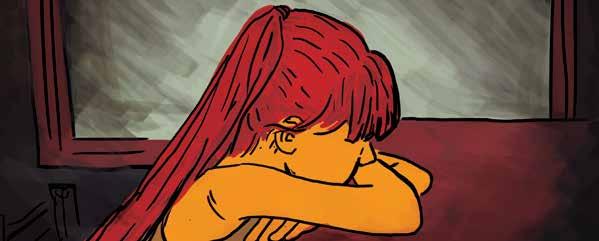
The University of Manitoba Ceramics Club’s annual Christmas Show and Sale features student’s works, from beginner to advanced levels. Stop by the Gallery of Student Art from Nov. 28 to Dec. 3 to get your Christmas shopping done early and support local student artists.
Design
Design eDitor Bram Keast design@themanitoban.com
graphics eDitor Kelly Campbell graphics@themanitoban.com
photo eDitor Miguel Yetman photo@themanitoban.com
Design associate Kellie Huynh
graphics associate Aldo Rios
photo associate Chantal Zdan
photo associate Star Roxas
photo associate Megan Colwell
r eporters
n ews Osho Samuel Adetunji
n ews Hannah Froese
n ews Diana Ubokudom columnist Jeremiah Kopp columnist Shaden Abusaleh arts & culture Olivia Michalczuk
arts & culture Emelia Fournier
sports Kellen Taniguchi
sports Jason Pchajek copy Joseph Gonzalez
MANITOBAN
109 HELEN GLASS UNIVERSITY OF MANITOBA WINNIPEG, MB R3T 2N2
General Inqu I r I es & a dvert I s I n G
Phone: (204) 474.6535
Fax: (204) 474.7651
Email: manitoban@themanitoban.com
Free Med I a Campus Plus Media Services Phone: 1.780.421.1000
Email: advertise@free-media.ca
Canadian Publications Mail Product Sales Agreement #589160
A “volunteer staff” member is defined as a person who has had three volunteer articles, photographs, or pieces of art of reasonable length and/or substance published in three different issues of the current publishing year of the Manitoban. Any individual who qualifies must be voted in by a majority vote at a Manitoban staff meeting. Elected representatives and non-students may be excluded from holding votes as volunteer staff members in accordance with the Manitoban Constitution.
The Manitoban is the official student newspaper of the University of Manitoba. It is published monthly during the summer and each week of regular classes during the academic year by the Manitoban Newspaper Publications Corporation.
Student groups, individuals stand in solidarity with months-long North Dakota standoff
Diana Ubok UD o M , staff
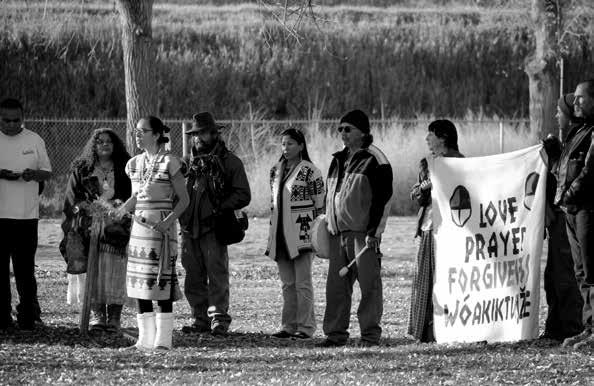
University of Manitoba students are showing solidarity with North Dakota’s Standing Rock Sioux tribe in its months-long effort to block the construction of the Dakota Access Pipeline project.
The U of M Womyn’s Centre and the Justice for Women student group organized a fundraising bake sale last week and members of the University of Manitoba Aboriginal Students’ Association (UMASA) travelled south to the Oceti Sakowin camp in North Dakota earlier in November.
The Dakota Access project is a proposed 1,880 kilometre pipeline that will connect North Dakota oil projects with refineries in Illinois. If successfully completed, the pipeline will transport more than half a million barrels of oil a day through four states.
Indigenous activists began protesting the US $3.8 billion construction project in April, claiming the pipeline could contaminate the Missouri River, the water source for the Standing Rock reservation’s thousands of residents as well as millions of people that live downstream.
Amanda Fredlund, female vice president of UMASA, visited Standing Rock weeks ago and said the motivation was born out of the association’s initiative to support students wanting to go to the front lines of the protest.
“We had heard about Standing Rock and the protest and we really wanted to show our support and encourage the Indigenous student population to be part of this fight,” she said, noting that the organization is helping cover travel costs for students who are heading to North Dakota to participate.
Fredlund said the pipeline was initially designed to cross the river north of Bismarck, the capital of North Dakota, but was rerouted in part because of the potential threat it posed to the city’s water supply.
She said it is disappointing the same consideration is not given to Standing Rock.
Fredlund called on everyone –whether directly impacted or not – to join the fight against the pipeline’s construction.
“Being vocal is so important and I think that’s a huge inspiration that’s coming from North Dakota right now,” she said.
“Just because they are in a different country doesn’t mean that they aren’t our brothers and sisters.”
Fredlund added that the media is representing the protest as an issue that only affects Indigenous people.
“When you look at the water source affected, should there be a spill from that pipeline, the effects are astronomical,” she said. “This is not an Indigenous issue – it is a human issue.”
Jennifer Parisian, an organizer with the Justice for Women student group, said the support for Standing
Rock stems from the group’s humanitarian efforts, which expand beyond strictly women’s issues.
“We do try to focus on women’s rights, but because we are trying to be more intersectional, Indigenous rights is something that we really try to focus on,” she said.
Parisian expressed disappointment in what she described as the U.S. government’s apathetic behaviour toward members of the Standing Rock Sioux tribe, noting the pipeline’s rerouting away from non-Indigenous communities to its current path.
“It's been rerouted many times away from other communities that aren’t Indigenous, and this just shows who is important and who is not,” she said.
Dozens of protesters have been hospitalized and more than 300 injured in the last two weeks after policed turned water cannons, tear gas, and other non-lethal weapons against the unarmed activists.
“Just over the [Nov. 20-21] weekend, the police went in and sprayed the protesters with cold water, teargas, shot them with rubber bullets,” Parisian said.
“One woman even [may] have her
arm amputated. And so the money that we are raising right now is to treat these medical problems, and improve sanitary conditions for the protesters.”
Parisian said the Justice for Women group is hoping to be sure no one who travels to North Dakota is without the essentials.
“A lot of people right now are coming to support them, but a lot of times, they don't have the resources,” she said. “Many people don’t know what it will be like, so they don't bring enough resources, which is where we come in.”
Fredlund said that when she was at the front lines of the protest, it was very peaceful and it is hard to imagine how things have deteriorated in the last few weeks.
“We participated in a peaceful prayer walk through Mandan, North Dakota, and there were no conflicts when we were there,” she said.
“It's a little difficult to imagine that people are being shot with rubber bullets. The media is just really trying so hard to paint these warriors in a horrible light, which is just not true.”
Violence notwithstanding, support for Standing Rock continues to grow.
Fredlund said that as a Canadian, she is elated by the show of support for the people of North Dakota.
“We’re Canadians helping Americans fight their fight, and it's really exciting because it’s sparking that fire in a lot of young people today who maybe never felt connected to a certain fight,” she said.
“This is not an Indigenous issue. It is a human issue” –
Amanda Fredlund
“Seeing the people in North Dakota rallying support in protest of something that they don't think is right kind of gives us inspiration.”
It inspires “our generation, especially in an academic setting, to stand up and say ‘we can do this,’” she said.
Parisian said she saw a strong showing of support at the fundraiser, noting several students stopped by to make direct donations toward the protest.
“There has been a lot of generosity,” she said. “A lot of people have been coming, just giving us $20 bills, even without buying anything. They just hear what the bake sale is for and are happy to donate.”
Fredlund also condemned the efforts of the company behind the project, Energy Transfer Partners, and similar companies, for attempting to build more pipelines rather than seek alternative energy sources.
“How much longer are we going to have oil?” she questioned. “Here we are contaminating our lands when really we should be finding alternate resources, or more sustainable ways of getting our energy and our fuels.”
Fredlund said she believes the protests have sparked an energy that will carry over north of the border.
“We have companies that are trying to build pipelines currently in Canada,” she said, “and I think that seeing the fire that has been created in North Dakota – that spirit, resilience, and wanting to make change – is really encouraging people in Canada to do the same.”
above and bottom right: provided by amanda fredlund. bottom left: by megan colwell
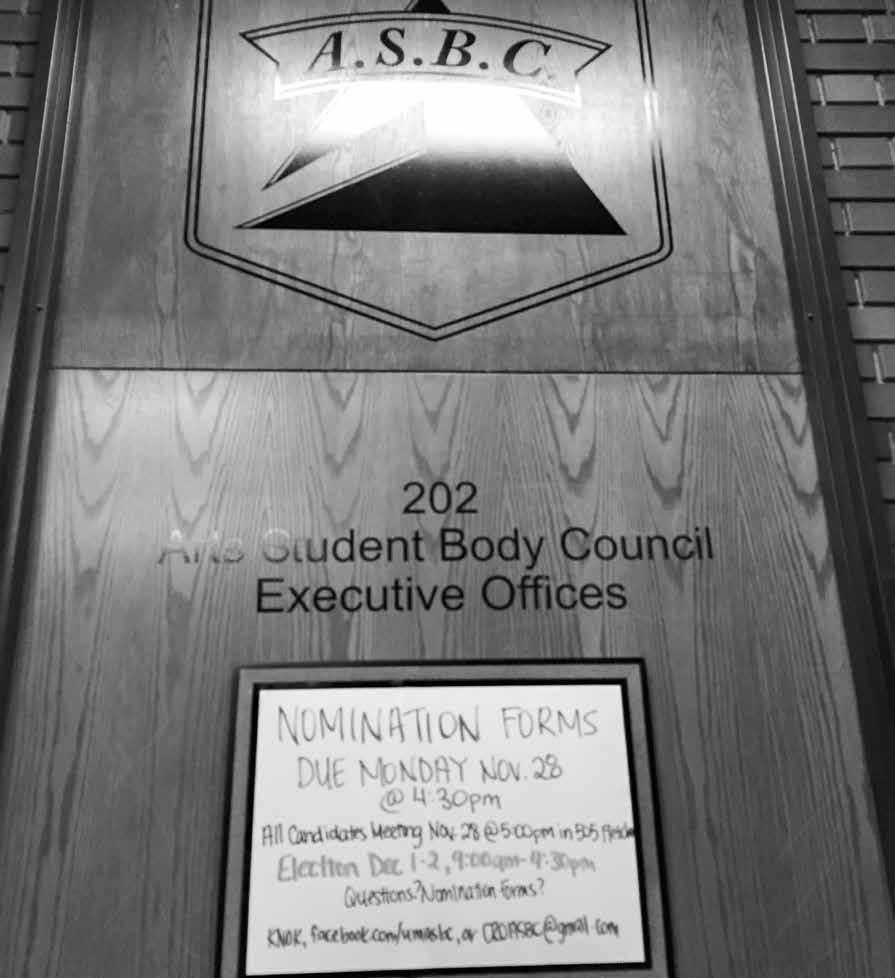
ASBC by-election to be held
Thursday, Friday
Six candidates vying for four positions on arts council, two to remain unfilled
l evi Garber, staff
The Arts Student Body Council
(ASBC) is holding a by-election Dec. 1 and 2 to fill four vacant positions: women’s representative, LGBTTQ* representative, social programmer, and Arts Resource Centre (ARC) director.
The women’s and LGBTTQ* representative positions have been vacant since May, since no students ran for those positions during the ASBC’s general election last March. The social programmer and ARC director elected last March both stepped down from their positions at the beginning of the school year.
Katie Finlayson, the former social programmer, resigned in August as she was accepted to the faculty of nursing and was no longer a student in the faculty of arts. Rico Ilag, the former ARC director, stepped down in September before moving out of province.
David Teffaine, a third-year political studies honours student, is running unopposed for social programmer.
Raphael Villanueva, a second-year arts student, is also running unopposed for the LGBTTQ* representative position.
Aly Raposo, a fourth-year women’s and gender studies student, is running against Nina Lam, a first-year arts student, for women’s representative.
Julius Chester, a third-year political studies student, is competing against Egwaikhide Ohiozoba, a fourth-year economics student, for ARC director.
U of M students react to university’s revised fall and winter terms
oS ho Sa MU el aD et U nji, staff
As regular classes resume at the University of Manitoba following a three-week faculty strike, students are coming to terms with the revised academic calendar.
Shortly before administration and its faculty came to an agreement and the 21-day strike was called to an end last week, the U of M senate approved an adjusted academic schedule extending the fall term into January and pushing the beginning of the winter term back several weeks.
Voluntary withdrawal dates for both uninterrupted and strikeaffected classes have been moved to Dec. 1 and Dec. 7, respectively.
Classes uninterrupted by the strike will end on the regularly scheduled Dec. 9, with an exam period scheduled for Dec. 12-22. Strikeaffected classes will run through until Jan. 6, with a Jan. 9-17 exam period.
The holiday break remains unaffected and the university will be closed for holidays between Dec. 23 and Jan. 2.
“I wanted to go through the first year without any kind of stress” –Bailey Wilson, first year student
The modified winter term kicks off Jan. 18 and runs until April 21. While a tentative schedule released prior to the resolution had the winter reading week on the chopping block, the midterm break was salvaged and will run
from Feb. 21-24.
The new schedule – which will see strike-affected classes continue through the exam period for continuing courses – has been a source of stress and concern, according to some impacted students.
Bailey Wilson, a first year film studies student who had three out of her four classes interrupted by the strike, said she became concerned as the strike dragged on.
“I thought [the strike] was a good idea but I started to become a little anxious towards when it started going to the third week,” she said.
“I didn’t want anything to be affected and I wanted to go through the first year without any kind of stress.”
Second-year engineering student Jerrod Alcantara said that while he supported the faculty in its strike, the
disruption was an inconvenience and created uncertainties for students.
“It is easy to complain about the strike and everything that has happened but if you are to put yourself in the position of the professors, I can definitely see why they were upset and then went on strike,” he said. “I was in support of the strike but at the same time I do feel bad for some of my fellow students it may have caused a lot of stress.”
According to Laura Conrad, another first year arts student who had two of five classes disrupted, professors have been supportive in managing the amended deadlines.
“This week is really busy now because all my assignments and tests were rescheduled for this week,” she said. “They adjusted the assignment dates and they were very supportive.”
Danielle Diona, a fifth year stu-
ASBC president Isaac Weldon said that it is important that the four positions on the ballot be filled.
“The lack of positions has definitely been felt in terms of the representation and programming and there’s definitely a lot of potential that isn’t being met,” Weldon said.
“Hopefully the six candidates generate enough interest in the issues,” he said. “I would like to see a little more participation and that’s something that we’re struggling with this year overall.”
The positions of students with disabilities representative and Indigenous students’ representative will be left vacant, as no students were nominated for either position.
Weldon said that he is disappointed that there will be no candidates running for those roles and that ASBC will attempt to fill them by appointment in the coming year.
“We’ll continue trying our best as a council to make do and to try our best to make sure that every demographic is being covered,” he said. “In the new year, we do have the ability to appoint members and that’s definitely something that we’re going to pursue.”
Only undergraduate arts students who identify as a woman or a member of the LGBTTQ* community are permitted to vote for the women’s and LGBTTQ* representative positions. All undergraduate arts students are eligible to vote for the social programmer and ARC director positions.
Polling will take place Dec. 1 and 2 from 9:00 a.m. to 4:30 p.m. in the main hallway of Fletcher Argue.
dent in the faculty of health sciences who had all her classes continue during the strike, said that while she has not been seriously affected by the disruption, she has friends whose holidays are going to be more stressful as a result.
“I am glad that they got the deal,” she said. “[But] I feel bad for my friends – they were affected and they don’t really get a chance to relax after the term because the term is not over until late January and after that they have to go back to class again.”
Katie Kutryk, a health and wellness educator with the university’s student support centre, said there has been no significant increase in the number of students seeking support during or after the strike.
photo by levi garber
Provincial government to introduce reforms to Manitoba Scholarship and Bursary Initiative
PCs fulfilling election promise to increase size of initiative and change funding ratio
l evi Garber, staff
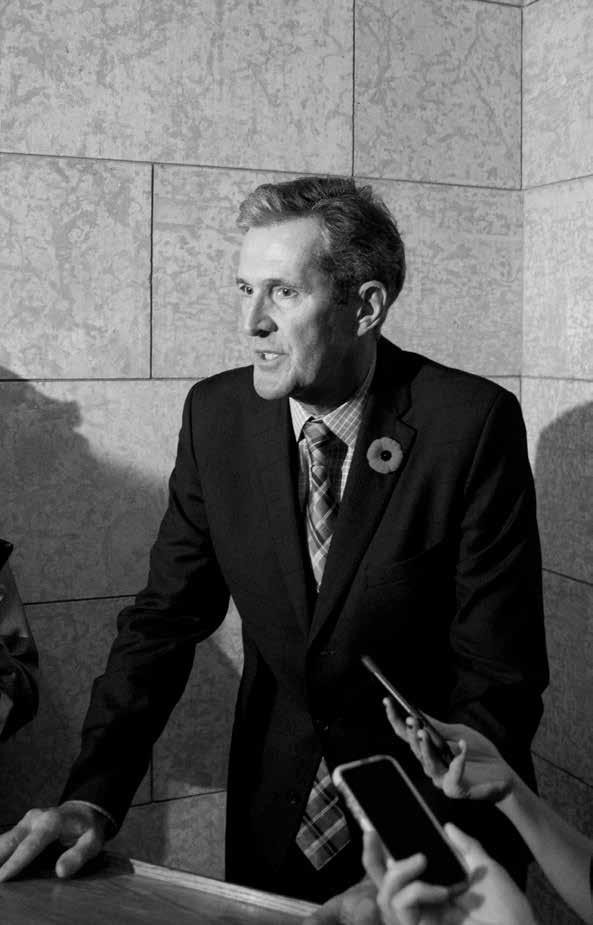
The provincial government has revealed it will introduce reforms to the Manitoba Scholarship and Bursary Initiative (MSBI) in its next budget, making good on an election promise from April to double the initiative’s size and increase private sector investment in post-secondary education.
The announcement was made in the speech from the throne delivered Nov. 21 to open the second session of the 41st Legislature of Manitoba.
The MSBI, which hands out millions in scholarships and bursaries every year, is backed by a one-to-one funding ratio between post-secondary institutions and the province. The province matches every dollar that institutions contribute to the $9 million initiative, investing $4.5 million a year.
The Progressive Conservatives’ plan to expand the size of the MSBI and change the ratio of funding so post-secondary institutions contribute more.
The size of the MSBI will increase to just over $20 million, with a third of that – up to $6.75 million – coming from the province if post-secondary institutions manage to fundraise the remaining $13.5 million, according to minister of education and training Ian Wishart.
“We think this is a really good news story for the students in particular, because it is going to increase the amount of money that is available for scholarships and bursaries by four
or five times of what we’re at right now,” Wishart said.
The changes will also encourage a higher level of contributions to the initiative from private industries, according to the minister.
“It also gets industries better linked with post-secondaries,” he said. “They [will] have more interest in the graduates accordingly.”
Student consultations
Wishart met with student union leaders from the University of Manitoba, University of Winnipeg, Brandon University, Red River College, and Université de St. Boniface in September to discuss the proposed changes.
The meeting went well, according to the minister, and consultations between the government and student groups on the reforms are ongoing.
“I think they were very encouraged by what they heard, related to the MSBI money in particular,” Wishart said. “We’ve heard from some of them since and they’re actually very encouraged once they got a chance to look at the numbers.”
University of Manitoba Students’ Union vice-president internal Adam Pawlak said the meeting was “very positive.”
“Everyone in the room essentially got their questions addressed and agreed that these changes will strengthen MSBI [...] and put us on the right path so that everyone comes out on top,” he said.
Endowments
The MSBI was created in 1997 by the Filmon government and has provided a total of $89 million to postsecondary institutions.
Post-secondary institutions placed $61 million of that into their endowment funds and accumulated interest from that money went to grants and bursaries, while $28 million was awarded to students directly from the initiative.
Wishart said the provincial contributions to endowment funds would change in the next budget.
“Up until now, any money that went into endowment, we matched on the way in. We’re going to change that to matching it on the way out of the endowment,” he said. “That means that there will be much more money available directly to the students right away.”
Institutions will not receive the provincial contribution to the MSBI unless the money is awarded directly to students, not placed in an endowment fund, said Wishart.
“From our government’s perspective, it is really that we want it to go [directly] to the students,” he said.
Wishart said the reforms will take effect for students applying for scholarships and bursaries in fall 2017.
photo by miguel yetman
Comment Editor: Shawn Garbutt
Canada’s student movement is split between practicality and ideology
Pragmatism, international students lose out at the 2016 Canadian Federation of Students’ AGM
jakob San D er S on
Upon hearing of the events on Nov. 21 at the Canadian Federation of Students’ (CFS) national annual general meeting (AGM), it has become clear that there is a sharp divide in the student movement that goes beyond right- and left-wing – our movement is split between practicality and ideology.
While many of the motions passed at the AGM were highly encouraging, the resistance to UMSU’s motion calling for the CFS to advocate for a cap on international student fee increases, tying them to domestic student fees, was alarming. Admittedly, the UMSU executives themselves tabled their own bill – however, this was only after facing backlash from other members.
While I am a progressive, I am also a pragmatist. Contrary to what you may hear, those are not mutually exclusive roles
This is the latest in a series of instances in which the left-wing student movement, with which I typically identify, has put ideological dogma ahead of tangible progress. If this does not change, the student movement will only become further divided. If an international fee cap proposal were to be realized, it would
mandate that international students could not have their tuition fees raised post-entry at a higher rate than their domestic counterparts. Such a proposal is worthwhile because international students already face exorbitantly high tuition fees when compared to domestic students. In Manitoba, this would be especially beneficial. Because domestic tuition fees in our province are currently capped at the rate of inflation, while the percentage by which education is funded by the federal government has dropped over recent decades, international students are treated like an ATM that our institutions and province can go to whenever they feel like increasing revenue streams.
International students at the U of M, who make up 17 per cent of our student body, experienced a 10 to 18 per cent increase in tuition fees in 2015 alone. A motion to oppose these fee increases has already been passed and adopted by UMSU council, but having a unified national movement towards this goal would undoubtedly make a larger impact. However, the motion was rejected by the room at the CFS AGM before it had a chance to be voted on.
With this decision, the federation has proven that they are opposed to any and all measures aimed at incremental reform, even if it means there is less chance of immediately achieving a positive impact. In a sense, this idealism is touching, although the international students of our university are likely less sympathetic to that stance.
I, like the CFS, do not think that we should accept piecemeal solutions from our institutions as satisfactory in
the long term. But we can still fight for a future with publicly funded tuition, while recognizing that an international student fee cap is a more targeted and attainable goal at this time.
This is not meant to discredit the CFS mandate against differential tuition for international and domestic students – the international student section of their policy manual says that they oppose all differential fees for international students – nor their case for publicly funded postsecondary education (they also state they are opposed to any user fees for students generally, calling for postsecondary education to be entirely publicly funded). Their case for the abolition of tuition fees is sound. When someone grows up in a poor socioeconomic situation, their best path to move forward is through postsecondary education. This allows them to get a job with a good salary and break out of the mould they were assigned. In this way, education can be the great equalizer. But the likelihood of that person conjuring up the funds necessary to attend university in Canada, even in Manitoba where tuition is comparatively affordable, is low. This leads to a cycle of continuous poverty that many are unable to break out of, despite their best efforts. That is why I stand with CFS in their goal to make tuition more accessible. While I am a progressive, I am also a pragmatist. Contrary to what you may hear, those are not mutually exclusive roles. And we must be pragmatic enough to admit that to universalize post-secondary education, the money has to come from somewhere. Speaking broadly, there are
few options currently at hand, all of which would likely involve a considerable tax increase that governments and the general public would likely oppose. Until this sentiment changes, the best we can hope for are modest reforms, such as the fee cap proposed by our UMSU executive. We are not sacrificing the long-term goal of free tuition by moving to incrementally lessen the gap between where we are and where we want to be.
While the students united may never be defeated, we are in danger of becoming increasingly divided
We must not be so idealistic that we defer the opportunity to make tangible gains along the way to our lofty goals. Beyond this, a lack of pragmatism is just part of the problem facing the federation these days. An overall lack of flexibility has tainted the organization and many parts of our left-wing student movement. We must recognize that not all students and institutions across Canada share the same unified vision. The CFS states on their website that “regardless of where you are born, how old you are or the background you come from, everyone should be able to access higher education.” I would argue too that everyone, regardless of their background, which member local they are a part of, or which political ideology they espouse, has
the right to be represented equally by our national student advocates.
It is undeniable that UMSU and the CFS have had a tumultuous relationship over the past few years with neither side fully innocent. But despite the fact that UMSU has no incumbents from previous executives, and has paid out their outstanding fees to the CFS, members of this year’s executive have reported being verbally abused at both AGMs this year to the point of feeling unwelcome and unsafe. Further, a number of motions aimed at decentralizing the power of the federation and generating more transparency from the organization were not addressed. Having not been there myself, I cannot speak to the verbal abuse allegations, but it would not be the first time those of us on the left have “shamed” those we disagree with.
Indeed, the left loves to preach tolerance and equality, but our chief student organization has not made it a priority to promote those values across personal and ideological divides. This is an issue that goes beyond the CFS, and we have seen this type of divisiveness on campus and through social media as well. We must not distort our right to disagree with someone’s opinions into the right to browbeat them into submission. It is equally incumbent upon people of all political stripes to heal a divided student movement. In fact, this is an especially crucial time to do so.
I believe in the goals of the CFS and see value in having a unified student movement with an active lobbying role and the infrastructure for national campaigns. These can shape public opinion towards our goals, and create invaluable opportunities for students to feel part of a powerful movement. I can personally attest to this through my overwhelmingly positive experience working with CFS-MB, the federation’s provincial counterpart in Manitoba. Nonetheless, I can hardly blame local unions for questioning their place in the organization when it has proven inflexible and dismissive to their unique goals.
Despite my criticism, I remain steadfast in my belief that the CFS national branch still has a valuable role in the student movement. I remain hopeful that under renewed pressure and a change in leadership they can reform and act as a more representative body. But to do so, they must embrace flexibility and practicality, because while the students united may never be defeated, we are in danger of becoming increasingly divided.
Jakob Sanderson is a third year student at the U of M in the department of political studies.
graphic by aldo rios
What’s in store for students now that the strike is over?
Student senator talks changes to the academic schedule
The past few weeks have been hard on everyone at the University of Manitoba, but I think we can all agree that students have been hit the hardest. As a student senator, I have spent the past few weeks listening to students about how the strike affects them. No one situation is the same; most students have different opinions on how the semester should continue, and it appears unlikely that the semester will be salvaged in a way that benefits all students. Unfortunately, there is no solution that will work for everyone.
On Nov. 10, the U of M senate passed a contingency plan that laid out the academic schedule should the strike continue for three, four, or five weeks. Immediately after this was passed, a petition was released claiming that students’ rights were being stripped as a result of these proposed changes. I do not entirely disagree with this claim, because many will be negatively impacted by the changes. However, I want to ensure that students understand how this proposal came about, why we will not be able to find a fit-all solution, and how student representatives have fought tirelessly for changes that are fair to students.
The first question many ask is why students were not informed of these changes sooner. The senate agenda was released Nov. 9, one day before the meeting. Even those of us who
have a seat on the senate executive committee (which allows us to view the proposed agenda sooner) were only given access to the proposal a few days in advance. This was not enough time for effective student consultation. Between the senate executive committee meeting and the general senate meeting, the other student representatives and I asked as many questions as possible. Here is a brief rundown of the issues we raised.
First, reading week. We stressed how many students rely on this break for mental health and to visit family, and it seems that our efforts paid off. On Nov. 21, an email was sent out from the U of M administration expressing their intention to keep reading week entirely. This is a win for most students, but we should also be concerned about the university extending the winter semester, as this will be harmful for many students. An extended semester is likely to affect graduation dates, co-op programs, employment, and travel. It may also prevent students from abroad from finishing the semester if they are to return home on a specific date. We need to ensure that these issues are not lost in the excitement over maintaining our reading week. There is still work to be done to ensure success for all students this year.
Next up are exams. We raised concerns about balancing coursework for regularly proceeding classes and
final exams for the disrupted classes at the same time. How will mental health be affected by having to study for exams over Christmas break? Some have asked why we can’t just condense course material and shorten the semester. The problem with this is that many faculties are required to complete a certain number of weeks of coursework in order for students to obtain their degrees, meaning that shortening their semester is not possible. There is also the fact that most students don’t take classes solely for credit. For many, the content is more valuable than the credit itself.
On top of this, student senators raised questions regarding refunds and whether or not students should be reimbursed for delayed classes. We also suggested academic forgiveness, asking that voluntary withdrawals be absent from transcripts if students needed to drop courses as a result of the strike. Neither administration nor faculty could give a definitive answer to any of these questions as the document passed in senate is more of a guideline than a concrete schedule. Furthermore, most of the changes will not be implemented by a single body. Accommodations will largely be in the hands of our deans and professors now that classes have resumed.
I want to remind students that there are some benefits to these changes. While all of us would have preferred the original schedule, at
least with these proposals we will still finish the school year in April. This is huge for many students who can’t afford to extend their semester, and who need to graduate by a certain date to start a job or apply to a grad school. We will also still get to go home for the holidays, and if our instructors are flexible, we may be given alternatives to final exams which would decrease stress levels over the holidays and allow us to have a legitimate break. Also keep in mind that students have a voice at the bargaining table when it comes to these changes. What we say matters, which is why it’s important to reach out to your student representatives to make sure that your voice is heard loud and clear.
This leads me to my final point. Now that the strike is over, the question is no longer about what side we were on, but rather how best to move forward as a student body. We must now look to the modified schedule posed by the administration, which carries significant changes. Our efforts have to be redirected toward encouraging all parties to consider how to best accommodate students. This is where my efforts have been solely focused during the past few weeks, and the same can be said for other student representatives.
To my fellow students: please do not feel as though nobody is on your side. It is the job of student represen-
tatives to listen to your concerns and relay them. Tell us if there is more that we can do, and tell us what the strike means for you. I promise that we will listen, and that we are on your side no matter what opinions you hold.
Lastly, to the deans, professors, and administrators: please do all that you can to accommodate your students. The schedule has been changed, and it will not benefit all students. Our success this year will depend on how willing both professors and the administration are to work with students now that the strike has ended. Grant us exam deferrals so we can go home for the holidays. Give us assignment extensions so that we do not have to write finals and complete a term paper simultaneously. Listen to each individual student and how they have been impacted, and find a way to make it right for them. All parties involved in this strike have said that students are their top priority. If this is true, now that a fair deal for UMFA has been reached, ensure that a fair deal for students follows.
photo by chantal zdan
Women’s and gender studies should be a mandatory requirement for all university students
a ly r apo S o
Iwas once a young student entering my first year at the U of M with no idea which direction I was heading. However, if there is one thing that I am absolutely certain about now, it is my choice to major in women’s and gender studies (WGS). This department has many myths and misconceptions that surround it, ranging from the content you learn to the applicability of the degrees it issues. I would like to clear that up for anyone who thinks that this department is solely about women and gender.
I am now in my fourth year of this degree and it has changed me as a person. In WGS, we learn about the history of race, racism , gender, gender equality, culture, politics, sexuality, violence against women, and so much more.
In WGS, you learn about impor-
tant historical issues and issues that we currently face in society. In fact, this includes several of the issues we face on campus every day, such as the debate around implementing reserved hours at the Active Living Centre and the recently resolved faculty strike.
uniquely lived social realities.
The WGS department at the U of M not only has some of the most welcoming professors that provide
tory for all students, considering how important the curriculum is to our future as a society and our futures as individuals.
A women’s and gender studies course should be mandatory for all students, considering how important the curriculum is to our society’s future and our futures as individuals
Not only has the WGS curriculum made me a better person, it has humbled me. It has made me recognize the privilege I have, the privileges that I do not have, the oppression that I face, and that which I do not. Most importantly, you learn to respect one another the way we should given everyone’s
a warm and accepting educational setting – the students in these classes also become family. In class, we learn each other’s identities, and we learn to fight against the systems of oppression operating throughout the world. I’ve come to the conclusion that taking a WGS course should be manda-
Had I not taken one of these courses, my life and perception of life would be completely different. It is a step to humble the hearts and minds of the future students going forward with their education.
WGS curricula has an abundance of meaningful material on many of the issues students face on and beyond campus, like racism, homophobia, sexism, transphobia, and so on.
Instituting a WGS course require-
ment for all students would be an important step towards ending the harmful manifestations of systemic oppression on our campus. This may also give students an enlightened conscious of who they are and who they want to be moving forward.
Taking a WGS course is truly an eye-opening experience. All students should be privy to that. In fact, should we truly care about making society a more inclusive place, the first step is to bolster voices and perspectives that are currently crowded out by mainstream discourse. This is what WGS does, and that is why it should be a course requirement.
Science & technology
Science
Contact:
14 per cent of Manitoba’s children diagnosed with a mental disorder, study finds
Study finds children living in social housing are more at risk to develop a mental health issue
According to an annual report by the Manitoba Centre for Health Policy (MCHP), an alarming number of youth living in Manitoba are dealing with at least one mental disorder.
The study, which was included in the MCHP’s annual report, states that 14 per cent of children in Manitoba have at least one mental disorder, with most of the children involved in the study dealing with mood and anxiety disorders, behavioural disorders, and substance abuse disorders.
The study also highlighted the negatives outcomes associated with mental disorders. The study observed
that children suffering from a mental disorder are at a higher risk of eventual incarceration (Manitoba currently has the highest level of per capita incarceration in Canada), less likely to graduate high school, and even more likely to die as a result of injury or poisoning.
The Manitoban spoke with the lead author of the study, Dr. Mariette Chartier, who is a research scientist at the MCHP and an assistant professor at the Max Rady College of Medicine at the University of Manitoba.
The study observes that children living within social housing, or with families that require income assis-
tance, are more at risk to develop a mental disorder.
While the study did not go specifically into why this correlation exists, Chartier mentioned that other studies on the mental health of children in low-income situations back up the MCHP’s findings.
“It’s the stress that comes from living in poverty,” Chartier said.
“Poor access to nutritious foods, which is needed to build a good nervous system, it’s residing in unsafe housing and neighborhoods, and just having those fewer resources to face challenges.”
Chartier notes that while children
in poverty are more at risk, the issue is certainly not restricted to them.
“It’s not just an issue among people in lower socioeconomic areas, though. So I want to make that clear too. But for sure, kids living in poverty are at a higher risk,” Chartier said.
“It’s not just an issue among people in lower socioeconomic areas, though. So I want to make that clear too. But for sure, kids living in poverty are at a higher risk” – Dr. Mariette Chartier, lead author of the study
The study also provides several suggestions to improve treatment and quality of life for Manitoba’s children living with mental health issues. Increased diagnosis, and then more ways for children to receive help
after said diagnosis, was stressed in the study.
“We’re not spending enough, I think, in the province, to address all the different levels. So what we’re recommending is that the province really come up with a comprehensive plan,” Chartier said.
“First of all, how do you promote resilience and well-being in children? How do you prevent mental disorders from happening in the first place? How do you detect early, and once you do detect, how do you treat? Those are all the different levels.”
Chartier says that another way to work on improving the mental health of youth in Manitoba is to provide adults who work with children, such as educators and counsellors, with additional training to work with children who may want to reach out for help.
“Everyone learns about how you’re supposed to eat well and you’re supposed to exercise, which are actually really good for your mental health as well,” Chartier said.
“But it’s also the importance of being aware of how you’re feeling, and to be to talk to somebody about it. Just improving literacy across the board.”
Canadian scientists pen open letter to Trudeau government
Letter calls out lack of transparency, scientific integrity at the federal level
Malak a ba S , staff
Scientists from all across Canada have come together to ask that Prime Minister Justin Trudeau ramp up his efforts in reviewing energy projects, in the form of an open letter.
The letter, which was also addressed to several members of Trudeau’s cabinet, has over 1,700 signatures so far, including several from researchers and students residing at the University of Manitoba. It was
inspired by recent natural disasters (the letter references the 2013 floods in Calgary as an example) that signatories believe show the dangerous consequences of improper environmental assessment on the federal level.
The letter proposes a five-step plan of action to improve Canada’s scientific review process. The plan stresses transparency and public exposure to research, including cultural and his-
torical elements in their assessments, and installing a list of set criteria for decision-making that places scientific integrity over economic gain.
The letter adds that Canadian researchers want, most of all, to work together with the Canadian government and its citizens to “serve the public good.”
The letter goes on to say that federal reviews of environmental issues in Canada lack transparency and the input of Canadian researchers.
“Science thrives by upholding strong standards of integrity,” the letter states.
“Carefully conducted and independent science is crucial to evaluating the consequences of actions: objectivity and transparency are essential, and inconvenient information cannot be dismissed.”
Trudeau was well-received by Canada’s science community during his electoral run for his promises to make government research more accessible to the public. His predecessor, Stephen Harper, was criticized for government policies “muzzling” scientists that greatly restricted Canadian researchers’ ability to speak
out about their research.
The letter states that its co-authors hope to work with the Liberal government and hope that with increased discussion between researchers and government officials, the quality of federal assessment of scientific studies will improve.
“We
recognize that science is not the only basis upon which project decisions are made; Indigenous knowledge, values, and socioeconomic considerations
play critical roles”
“We recognize that science is not the only basis upon which project decisions are made; Indigenous knowledge, values, and socioeco-
nomic considerations play critical roles,” the letter states.
“Nevertheless, input from and engagement with Canadian researchers could significantly improve the scientific standards and process used to assess proposed and existing projects.”
Catherine McKenna, the minister of environment and climate change, has created an “expert panel” which is currently travelling across Canada to gather national input on environmental assessment. The panel will continue until early 2017, when the information it’s gathered will be reviewed by McKenna.
The Liberal government is also currently working on creating a chief science officer position. While the details of the job have yet to be revealed, minister of science Kirsty Duncan has stated that similar positions in governments around the world have been looked at for ideas.
If you are an active early-career researcher in the science field currently in Canada or a Canadian studying abroad, you can sign the open letter.
graphic by Kelly campbell
We Are The Halluci Nation is A Tribe Called Red’s most political album yet
Canadian EDM group explores colonial brutality on newest release
eM elia Fo U rnier, staff
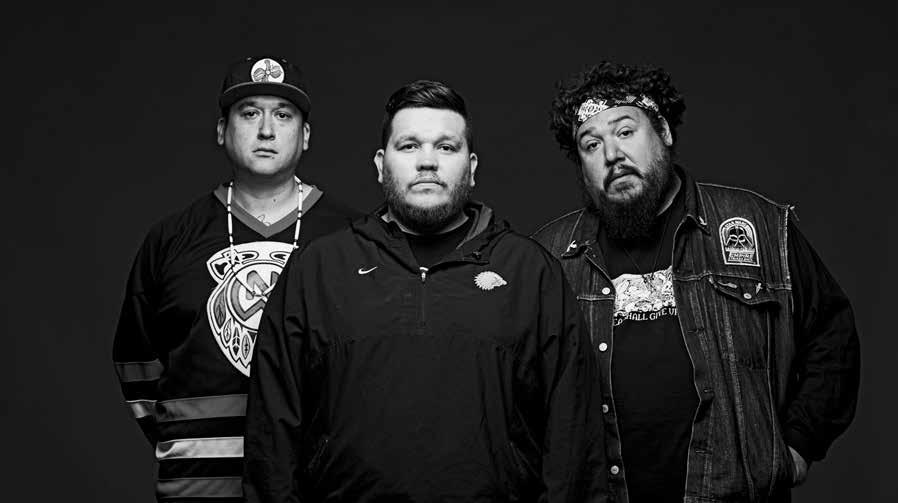
Formed in 2008, Canadian electronic music group A Tribe Called Red (ATCR) is made up of three Indigenous DJs: DJ NDN, Bear Witness and 2oolman. The group produces a unique style of music that is now being called “pow-wow step.” Their music combines elements of electronic music and hip-hop with traditional Indigenous drum beats and vocals.
On Sept. 16, ATCR released their third album, We Are The Halluci Nation, and it is by far their most
dynamic, political, and thoughtprovoking album yet. The musical trio explores the brutal history of colonialism throughout the album, all while maintaining a sense of hope for the future and change.
We Are The Halluci Nation delivers danceable, infectious tracks that incorporate elements of dancehall, hip-hop, Indigineous electronic dance music. It is laced with meaningful lyrics sung over pulsating drum beats and unique sound combinations.
The featured artists add their own
touch to each track without resorting to mainstream tinny vocals.
The album features international and local artists such as hip hop artist Yasiin Bey (formerly known as Mos Def), Columbian visual artist and musician Lido Pimienta, the late Native American poet and musician John Trudell, drum group Black Bear, and Inuk throat singer Tanya Tagaq amongst others. Collectively, these artists make this album a solidsounding body of work that blends electronic production with traditional
pow-wow instrumentation and modern hip hop.
We Are The Halluci Nation opens with the hypnotic title track featuring Trudell, who introduces listeners to the Halluci Nation and what they represent. The Halluci Nation is evoked throughout the album, calling those who want to come together in the spirit of resistance against colonialism and capitalism and in the spirit of love for one another.
The album features interludes of phone calls from a man trapped in Alie Nation correctional facility, voiced by Joseph Boyden, author of The Orenda, offering a glimpse into the oral history of the impact of residential schools and poverty on the Indigenous community.
The first single of the album, “R. E. D.,” features Bey and Narcy, who rap striking lyrics over intense instrumentals and singing by Black Bear. Narcy’s lyric “Coca-Cola soul controller holy waters” highlights the song’s themes of commodification, spirituality, and their intersection.
As a signature of ATCR’s music, the iconic Indigenous drum beats and vocals are pervasive throughout the whole album. This is prevalent in Tanya Tagaq’s featured spot on “Sila.” ATCR integrates Tagaq’s Inuit throat singing into the track to make it sound like another layer of instrumentals at times and vocals at
others. Nevertheless, there are more mellow and soft-sounding tracks on the album as well, such as “The Light,” featuring Lido Pimienta, and “Eanan,” featuring Maxida Märak.
On We Are The Halluci Nation, ATCR showcases their musical prowess as the album goes from intense spoken word over drum beats, to dance music, to contemplative, more mellow electronica, all tied together by the philosophy and innovative style that has become synonymous with ATCR.
We Are The Halluci Nation offers protest through music. It is a showcase of Indigenous talent. At times the lyrics may prove hard to swallow – cue Joseph Boyden’s interludes about harrowing experiences in residential schools. However hard to swallow, these words need to be heard.
We Are The Halluci Nation manages to be equally danceable and thoughtprovoking. Despite being politically inspired, it also stands its own ground musically as a thoroughly enjoyable album to listen to.
We Are The Halluci Nation is available on iTunes and Spotify. A Tribe Called Red will be performing at the Garrick Centre on Dec. 3. For ticket details, visit atribecalledred.com/tour
Funk Hunters cap off record year with festive tour
Vancouver EDM duo stopping in Winnipeg as part of Western Canada tour
tobi n i F e S i, staff
I
n many ways, 2016 has been a record year for Vancouver’s electronic dance music duo the Funk Hunters. The charismatic band is looking to close out the year with a festive and funky tour called Funk the Halls, which kicks off on Dec 8. The Funk the Halls tour bus will be making a stop at Winnipeg’s Park Theatre on Dec. 14. The Funk Hunters is made up of
Nick Middleton and Duncan Smith, two friends and DJs with a passion for dance music. The duo have pursued their passion and honed their craft, and this pursuit has led them to performing on over 450 stages across 16 countries. Despite that, they have had some of their biggest musical milestones in the last few months. The DJs spent most of this year on the road and performed at dif-
ferent festivals including Burning Man, Pemberton Festival, Winnipeg Folk Festival, and Shambhala Music Festival. The highlight of their year was making their debut at the Coachella Valley Music and Arts Festival back in April. Duncan Smith believes this feat bodes well for their career and artistry.
“It has been a really crazy year for us. Every year, we continue building and getting more inspired,” Smith said. “Performing at Coachella was a dream come true. One thing about us is that we try to bring our best, our A-game, to a place like Coachella. As an artist, it was a real treat and as a band, it was a great place to experience music.”
The duo, with the help of four turntables, put on creative stage performances for their audience. They try to deliver a unique audiovisual experience with stunning customdesigned visuals and music. Their performances keep the audience engaged, intrigued and dancing.
“Our name has the word funk in it but ultimately, we love all kinds of music. Blending electronic music and hip-hop with other genres as well is something we love. It is interesting to us rather than just sticking to one sound,” Smith said. “Because of this, our music resonates with a lot of people.”
On Oct 14, The Funk Hunters and Chali 2na – a founding member of the hip hop group Jurassic 5 - released the ‘ILLECTRIC EP’ together. The collection’s two singles, “Word to Spread” and “Get Involved,” have garnered over 350,000 views across all social media platforms.
“As we grow as artists, we are constantly learning and evolving. We learn from our experiences performing on several stages and try to bring something new to the next show or tour,” Smith said.
“Funk the Halls started as one show in Vancouver last year. It sold out quickly so we added another show but this year, we decided to make
Funk the Hall bigger and take it on the road across Western Canada. It is going to be great time for people to get out this Christmas and be together.”
During the Funk the Hall tour, a few bands such as Dirty Radio, Astrocolor, Pigeon Hole, and Russ Liquid amongst others will support Funk Hunters. In Calgary and Edmonton, there will be special guest appearances from Chali 2na. For the Winnipeg stop, the Funk the Halls tour will feature appearances from Dirty Radio and Klassick.
Funk Hunters’ latest EP, ILLECTRIC EP, is available now at fanlink.to/ILLectricEP. To buy tickets for their upcoming show at Park Theatre on Dec. 14, visit myparktheatre.com
photo provided by a tribe called red
photo provided by frtizmedia
Bisons earn split against high-flying Huskies
ja S on p chajek an D ryan Stelter, staff
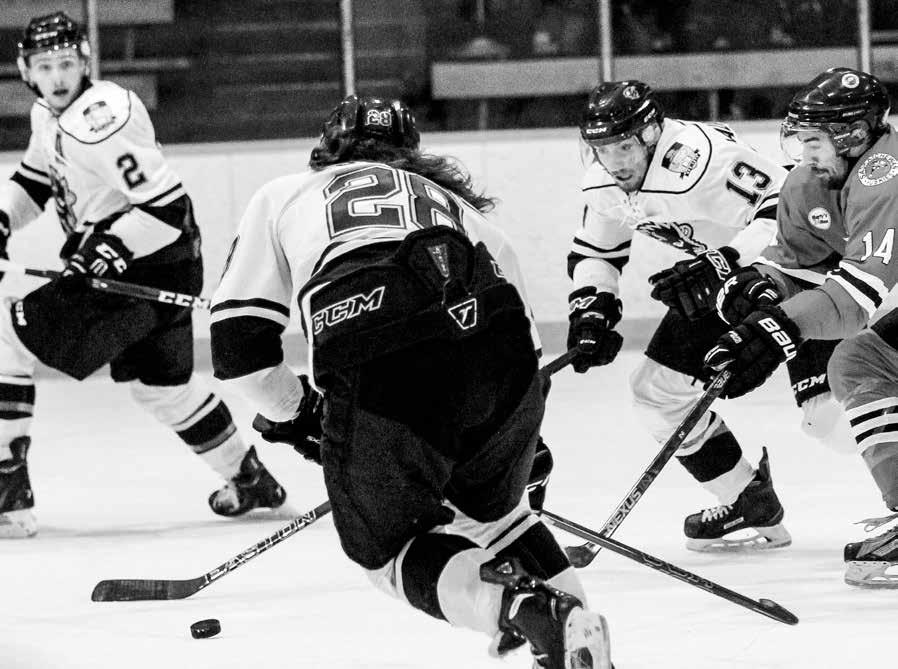
The University of Manitoba men’s hockey team played a tough home series against the secondranked University of Saskatchewan Huskies this weekend. The Bisons lost a close game on Friday, falling 2-1 in overtime, but came out with a big 5-2 win on Saturday.
Friday
On Friday night, the Bisons returned home to Wayne Fleming Arena for a date with the Huskies. The game was chippy and physical from the drop of the puck, with both teams finishing their checks and try-
ing to agitate their opponent. The game was hard-fought, but ultimately the Huskies took it 2-1 in overtime.
The Bisons wasted no time, getting out in front just 13 seconds into the contest. Brett Stovin pounced on a loose puck along the boards, and fired a pass towards the front where Nick Zajac was waiting on the doorstep.
Zajac fought off a defender, tipping the puck past Huskies goaltender Daniel Wapple for a 1-0 Bisons lead.
It took Saskatchewan until the middle of the first to tie things up.
Hudson Friesen took an ill-advised slashing penalty after a scrum, which
sent the Huskies to the power play. Jesse Forsberg stepped into a shot from the point, which went through a crowd and top corner on Byron Spriggs to tie the game 1-1.
Three successive penalties early in the second put the Bisons on their heels, but Zajac once again made his presence known. After a somewhat questionable tripping call on Justin Augert gave the Huskies the advantage, Zajac made two blocks within moments of each other. The first caught him in the hand and appeared to sting the Manitoba forward, but he got back in the play to make a second
block with his shin moments later.
The game was settled in overtime, with the Huskies taking the game thanks to a goal by Colby Harmsworth. The puck was controlled down low in the Bisons’ corner by Levi Cable, who sent a pass cross-ice and past the Bisons’ defense.
Harmsworth received the pass at the side of the net, burying the game winner under the pad of Spriggs who slid to try and make a stop.
“Our
guys should be proud of their performance and their effort” – Mike Sirant, men’s hockey head coach
“Well it’s a hard-earned point but we’re not satisfied with that,” Bisons head coach Mike Sirant said postgame. “The point helps but we’re not satisfied.”
Sirant also noted that it was bad coverage on the backside that lead to the game winner but felt Spriggs did all he could to make the stop.
Saturday
Spriggs saw his second start in a row on Saturday, and he was tested early in the first period, making a couple key stops. Spriggs made 41 saves on the night in the 5-2 win for Manitoba. The physicality was on full display, as the provincial rivals lost no love from the night prior.
The home side struck first late in the opening frame through Quinton Lisoway when he came barreling
Bison rookies dominate in the pool
down the right wing and fired over the shoulder of Jordon Cooke. The Bisons held their first lead of the weekend after 20 minutes.
The Bisons made it 2-0 at the halfway mark of the second. Zajac scored his second of the weekend after Remi Laurencelle sent a pass cross-ice and Zajac finished short-side shelf on Cooke.
Saskatchewan cut the lead to 2-1 the very next shift after Parker Thomas jumped on a loose puck at the top of the slot and finished high on Spriggs.
With Josh Roach off for goalie interference, the Bisons capitalized on the power play to restore their two-goal lead. Brett Dudar managed to get a puck through at the side of the net during a scramble in the crease.
Manitoba made it 4-1 when Zajac threw a nifty backhand pass from the corner to Laurencelle who one timed it far-side on Cooke. Saskatchewan drew back within two after Jordan Tkatch buried a rebound on the power play.
Rene Hunter slid a puck five hole on Cooke with two and a half minutes remaining in the third to put the home side up 5-2. The Bisons took this game and earned three points out of a possible four on the weekend.
“Our guys should be proud of their performance and their effort today,” Sirant said postgame. “They showed sacrifice, courage, and the will to win.”
The Bisons head out to Calgary to play a two-game series against the Mount Royal Cougars on Dec. 2-3.
Bison swimmers Alex Shogolev and Kelsey Wog shine at Canada West championships
This weekend, both the Bison men’s and women’s swimming teams were in Edmonton for the Canada West swimming championships.
The Bison women’s team finished in seventh out of eight teams with 188 points and the men also finished in seventh with 135 points.
Day 1
On the first day of the championships, Wog won the 50-metre breaststroke with a time of 30.54 seconds, setting the championship meet
The Bisons had eight swimmers from both the men’s and women’s swim teams, but it was Alex Shogolev and Kelsey Wog who stole the spotlight this weekend
The Bisons had eight swimmers from both the men’s and women’s swim teams, but it was Alex Shogolev and Kelsey Wog who stole the spotlight this weekend. Wog especially had a stellar performance this past weekend in her Bison debut.
record. Both the men and women’s 4x100-metre relay teams came in sixth on the day.
Day 2
Wog brought home even more silverware on the second day of the
championship meet. To go along with her 50-metre breaststroke gold medal, she also took the 100-metre breaststroke gold with a time of 1:06.30. She beat the second place swimmer by a full second – a championship meet record. With her two victories in the breaststroke, she earned Canada West first team all-star honours. Shogolev qualified for the U Sports national championships after he swam 23.14 seconds in the men’s 50-metre freestyle. Shogolev will be joined by second year swimmer Anthony Iliouchetchev, when
he reached the standard time with a ninth place finish.
Day 3
On day three it was once again Wog ending up on the podium, as she won the 100-metre freestyle and finished second in the 200-metre breaststroke. Shogolev placed second in the 100-metre men’s freestyle. He was named a Canada West second team all-star.
Wog was named the rookie of the meet after winning three gold medals and getting on the Canada West all-star first-team.
ryan Stelter, staff
photo by star roxas
photo provided by don voaKlander
Bisons sweep Huskies in women’s hockey
ja S on p chajek, staff
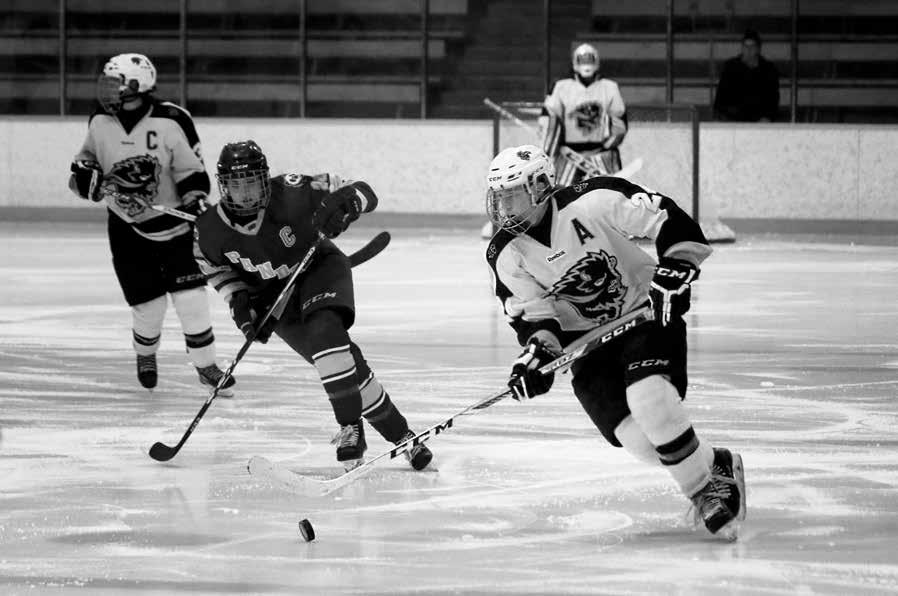
This weekend, the seventhranked Bison women’s hockey team played a two-game series in Saskatoon against the Saskatchewan Huskies. The Bisons needed overtime to settle both games, as they took Friday night’s contest 2-1 after two overtimes. On Saturday the Bisons did it a little earlier and won 3-2 in the first overtime.
Friday
After a disappointing weekend following the bye, the Bisons were back on the road Friday night to take on the University of Saskatchewan Huskies. Manitoba rolled into Saskatchewan, and despite being on their heels for most of the game, was able to take contest 2-1 in double overtime.
Kaitlin Willoughby opened the scoring for Saskatchewan midway through the first. After a Bison shot was blocked, a clearing attempt bounced off the boards and up the ice where Willoughby was waiting. She took the puck and broke into the Bisons’ zone all alone. A deke to the right caused Bison goaltender Rachel Dyck to stretch out, but Willoughby was able to fire the puck over her pad and in. The goal was Willoughby’s sixth of the season and gave the Huskies the 1-0 lead.
Saskatchewan controlled the game through the first two periods of play, keeping the Bisons to just eight shots through 40 minutes. However, momentum swung the Bisons’ way in the third frame where Venla Hovi was able to tie things up at one. Lauryn Keen won a faceoff in the Huskies’ end and sent the puck back to Hovi who was placed at the point. She fired a shot which snuck past Saskatchewan goalie Cassidy Hendricks and under the crossbar,
tying the game 1-1 with a little less than five minutes to play.
This goal was followed by some bad news for Hovi and the Bisons, as the Finnish forward earned a game misconduct. Hovi was assessed the misconduct after hitting a Huskies player from behind, however Saskatchewan was unable to capitalize on the power play.
Despite missing one of their top scorers, the Bisons were able to take the game thanks to more heroics from Keen. The game appeared to be headed for a shootout, but with two seconds left on the clock in the second overtime, Keen was able to put her team-leading sixth goal past Hendricks. Keen pounced on a rebound during a mad scramble in front of the Huskies goaltender, and tucked in the goal for the 2-1 win.
The Bisons recorded back-to-back two point wins, and surpassed the University of Saskatchewan to take second place in Canada West
Saturday
After a double OT thriller Friday night, the Bisons were back on the ice again to take on the Huskies. The two high-ranking teams traded goals throughout the night, and once again needed extra time to settle the contest. The Bisons took the game 3-2 and swept the weekend series, taking
control of second place in the Canada West.
The game was scoreless through the first 20 minutes of play, but the Bisons needed only 50 seconds to take the lead in the second. Jayden Skoleski put home her first of the season on Huskies goaltender Hendricks to give the Bisons the 1-0 lead.
Emily Upgang knotted the game up for the Huskies minutes later with a rocket from the point. The puck was caught up in the Bisons’ end, allowing Upgang to scoop it up and circle to the point. She hammered a slap shot through a crowd and past Dyck to even things up at 1-1.
Saskatchewan took the lead three minutes into the third period off of a strange goal by Elizabeth Salyn. The puck was cleared out of the Bisons’
zone, where Bailee Bourassa was able to pick it up. She fired a shot on Dyck who stopped it, but Salyn was able to get her stick on the rebound. Dyck appeared to make the second save, but it trickled through to give the Huskies the 2-1 lead.
With five minutes to play, Skoleski snagged her second of the night to send the game to overtime. Keen once again was credited with an assist on the play, her 10th of the season and 16th point. With that, Keen is now second in Canada West scoring.
In the overtime period a tripping call on Salyn gave the Bisons a power play chance they did not waste. A faceoff win by Erin Kucheravy made its way onto the stick of Caitlyn Fyten. Fyten circled up to the point, sending a cross-ice pass to Karissa Kirkup
who ripped a one-timer. The shot from the faceoff dot went between the pad and blocker of Hendricks to give the Bisons the 3-2 overtime win.
The Bisons recorded back-toback two point wins, surpassing the University of Saskatchewan to take second place in Canada West. They now sit six points back of the first place UBC Thunderbirds, who are riding a 10-game win streak.
The Bisons will be back at home next weekend when they take on the Mount Royal Cougars. Game one is Friday Dec. 2 at 7:00 p.m., and game two is Saturday Dec. 3 at 1:00 p.m. at the Wayne Fleming Arena.
photo by megan colwell
Keeping their cards close
Which Jet will be boarding
a
one-way ticket to Las Vegas?
k ellen tani GU chi, staff
On Nov. 22, the NHL’s 31st team debuted its new name, and the Vegas Golden Knights will begin play in the 2017-18 NHL season. Now that the name is settled, all that is left is to figure out which players will fill the roster. The Golden Knights will participate in an expansion draft, where they will select a player from each of the current 30 NHL teams to build their opening day roster. They must select 14 forwards, nine defensemen, and three goaltenders. With another team entering the league, it affects all the current ones, including the Winnipeg Jets. They could potentially lose players such as Mathieu Perrault or Tyler Myers when the Golden Knights announce their roster on June 21, 2017.
Vegas does not get to select all the league’s superstars, as each team will submit a list of players they will be protecting in the draft. First and second year players are exempt from the draft, and players with no-trade or movement clauses are automatically protected unless willing to waive their clause.
Teams have two options of how many players they can protect. The first option is protecting a total of 11 players: seven forwards, three defensemen, and one goaltender. The second method is protecting nine players: eight skaters regardless of position, and one goalie.
Players across the league have been rumoured to be Golden Knights next season, specifically some big names in the crease. Marc-Andre Fleury has
been the most common name floating around, due to Matt Murray taking over. Murray stole the show en route to a Stanley Cup for the Pittsburgh Penguins in 2016. Another goalie that will be interesting to monitor is the Tampa Bay Lightning’s Ben Bishop. He may be unprotected due to the emergence of young Andrei Vasilevskiy, who could be seen as the team’s future goaltender.
The Winnipeg Jets could potentially lose players such as Mathieu Perrault or Tyler Myers when the Golden Knights announce their roster
How does this affect the Jets?
Exempt from the draft are rookies Patrik Laine, Kyle Connor, and Josh Morrissey, due to not playing more than two full seasons. This rule also protects forward Nikolaj Ehlers (who has been a key piece to the Jets the past couple of years), forward Nic Petan, and AHL goaltender prospect Eric Comrie.
Winnipeg has four players with a no-trade clause, and one with a nomovement clause. Luckily for the Jets,
Blake Wheeler, Dustin Byfuglien, and Bryan Little have a no-trade clause, but most likely would have been protected regardless. On the other hand, defenseman Tobias Enstrom has a no-movement clause, meaning if he doesn’t waive it, the Jets are forced to protect him.
With this in mind, Winnipeg will most likely go with the first option and protect seven forwards, three defensemen, and a goalie. They are only able to save one more blue liner, with Byfuglien and Enstrom already protected. Some fans may see this as a problem, as it means either Myers or recently re-signed Jacob Trouba will be exposed while Vegas is drafting its team, unless Enstrom waives the clause, or is traded this season.
Trouba is a big question mark moving forward, as he is fresh off signing his new two-year deal. Does Trouba want to be a Jet at the end of his contract? That is the question Jets management must figure out before protecting him. Myers has been a solid defender for the team since coming over from Buffalo in the Evander Kane blockbuster trade. If the Jets roll with Trouba, and Enstrom refuses to waive his nomovement clause, then Myers would be the odd one out, which would be a huge loss to the Jets. Trouba and Myers were key parts to the Jets blue line this past season, with Trouba leading the team with a plus-minus of plus 10, and Myers just behind him at a plus six.
Assuming the Jets decide to pro-
tect seven forwards, veterans Wheeler and Little will be automatically protected. An obvious player to protect is Mark Scheifele, who currently leads the team in points, and has become a true NHL number one centre. Adam Lowry is another player Winnipeg will strongly consider protecting. Lowry has been a consistent player for the Jets as of late: second on the team in faceoff percentage, trailing Little.
Joel Armia has emerged as a consistent top-nine forward and a major member of the team’s penalty kill, before sustaining an injury earlier this season. Those are five players most likely to be protected by the team, leaving just two spots open.
This leaves Drew Stafford, Andrew Copp, Marko Dano, and Perrault for these two spots. Stafford will be a free agent this offseason, and with the infusion of youth Winnipeg has, Stafford returning seems unlikely.
Perrault has one more year left on his current deal, so management must decide if they want to extend his term in Winnipeg, and also take into account how injury-prone he has been since signing with the squad.
Copp possesses the skill to be a third or fourth line centre in the NHL, and the Jets might see his potential as enough to keep him around. Lastly, Dano, who was acquired via the Andrew Ladd trade, has made the most of the injuries plaguing the Jets this season, scoring some goals in his NHL opportunity this year.
The Jets have a very young core,
and when protecting players, you may see them protect some of their up and coming kids. Copp and Dano could possibly fill those final two spots, depending on what the team wants to do with Perrault. If they decide to leave him unprotected, he is a player that will draw a lot of interest from the Golden Knights.
The goaltending situation seems clear in Winnipeg, as the obvious choice is to protect Connor Hellebuyck who is currently manning the crease, and could be for a while. Hellebuyck led the team in save percentage (.918) and goals against average (2.34) in the 2015-16 season, while racking up 13 wins in his 26 games played. Michael Hutchinson just signed a two-year deal, short-term as he will be exposed come June 21. Hutchinson has proved to be a good backup option, with a .904 save percentage and 2.84 goals against average last season in his 30 games.
Ondrej Pavelec, the starting goalie for the Jets since returning to Winnipeg, was sent down to the Manitoba Moose this season, visibly ending his tenure as the Jets’ starter. Last season he played in 33 games, posting a team low .904 save percentage, and allowing 2.78 goals per game.
General manager Kevin Cheveldayoff will have some decisions to make in terms of constructing the future Jets lineup. It begins with this year’s trade deadline, which could paint a clearer picture of who they will protect.
photo by Kelly campbell
Manitoba gets swept in weekend series against Alberta in men’s basketball
k ellen tani GU chi, staff
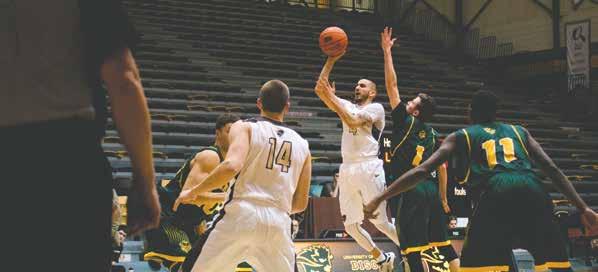
This weekend, the Bison men’s basketball team played host to a two-game series against the 10thranked University of Alberta Golden Bears. The Bisons were swept, losing a heartbreaker 88-85 on Friday, and fell again on Saturday by a score of 72-64. Manitoba moved down to a 2-6 record, and Alberta improved to a perfect 8-0 in Canada West division play.
“They’re
probably one of the best shooting teams, maybe the best shooting team in the league” – Kirby Schepp, men's basketball head coach
Friday
On Friday, The Bison men’s basketball team fell in a nail-biter to the University of Alberta Golden Bears 88-85. The herd kept the game close for the most part, but Alberta’s highflying offense was still the deciding factor.
“Defensively I didn’t think we faired all that well,” Bisons head coach Kirby Schepp said. “They’re probably one of the best shooting teams, maybe the best shooting team in the league.”
Keith Omoerah led the home side with a double-double of 18 points and 10 rebounds. Justus Alleyn added another 17 points, and James Wagner put up 16 more. Alberta was led by Austin Waddoups, who scored a game-high 31 points.
The first half featured a lot of back and forth play, and resulted in a 47-42 halftime lead for the visitors. Alleyn led in scoring for the home side with 13 points, while Waddoups had 21 points at the half, including five three-pointers. Joey Nitychoruk also netted eight points to help keep Manitoba in the game. Alberta was able to knock down shots from beyond the arc, which was the difference in the half – they made eight three-pointers to the Bisons’ four.
Alberta added to their lead to start the third quarter, but a late rally from Omoerah and Alleyn cut the lead back down to five points entering the final frame. The home side went on a 7-0 run, and reduced the lead to three with under a minute to play.
After two missed Alberta free throws, Manitoba had one last shot to tie the game with a three, but missed on two
attempts from beyond the arc.
Saturday
On Saturday, the Bison men’s basketball team fell to the University of Alberta Golden Bears 72-64. Despite their improved defensive play, Manitoba was still unable to beat the undefeated Golden Bears.
“We were much better defensively,” Schepp said postgame. “We held them to 38 per cent shooting for the game, which is outstanding. I’m really happy with that.”
Alleyn led the Bisons in scoring with a game-high 17 points. Omoerah put up a double-double of 10 points
and 10 rebounds. The visitors were led by Brody Clark, who netted 15 points.
Manitoba opened the game with a 10-2 run, as Alleyn netted eight points. The visitors answered with a 10-2 run of their own. The teams exchanged shots for the remainder of the quarter, with Alberta leading 18-16 heading into the second frame. The second quarter contained back and forth play for the majority, with the herd still trailing by two points as they entered halftime.
For the first half, Alleyn led the home side with 11 points, and Joey Nitychoruk added 10 of his own with five rebounds. The Golden Bears were
led by Mamadou Gueye, who put up nine points and five rebounds. Alberta led 51-48 entering the final frame. The teams continued to exchange shots, but with just under two minutes to play, the visitors expanded their lead to seven points. Despite getting their chances, the herd weren’t able to get their shots to fall, and fell 72-64 to Alberta.
The Bisons will be back in action on Dec. 1 as they host the Winnipeg Wesmen at 8 p.m. at the Investors Group Athletic Centre.