Please contact designteam@themanitoban.com if you are interested in submitting a cover image.
For other volunteer inquiries, please come to our office in University Centre (across from Tim Horton’s, behind GOSA) or email the editor of the section for which you are interested in writing.
Please direct all other inquiries to editor@themanitoban.com
Correction:
Toban Talkback
Jill Patterson, staff
Luan Galuao faculty of human ecology faculty of engineering
In a Mar. 6 article, entitled "Anti-bullying bill creates contention," we at the Manitoban mistakenly used the pronoun "he/him" as opposed to "she/her" in reference to Jay Rahn. We at the paper sincerely regret the error. “No,
Voluntee R contR ibuto R s Eusebio Raposo, Laura Groening, Ian T.D. Thomson, Adam Pawluk, Chris Hearn, Akash Sharma, Justin Ladia, Mathieu Boulet, James Culleton, Will Gibson, Dany Reede, Emilie St. Hilaire, Lauren Boulet, Michelle Saromo, Sarah Petz, David Skene
MANITOBAN
105 UNIVERSITY CENTRE UNIVERSITY OF MANITOBA WINNIPEG, MB R3T 2N2
General Inqu I r I es & a dvert I s I n G
Phone: (204) 474.6535
Fax: (204) 474.7651
Email: manitoban@themanitoban.com
n at I onal & Mult I -Market a dvert I s I n G Campus Plus Media Services Toll-Free (In Canada): 1.800.265.5372
Email: info@campusplus.com Canadian Publications Mail Product Sales Agreement #589160
A “volunteer staff” member is defined as a person who has had three volunteer articles, photographs, or pieces of art of reasonable length and/or substance published in three different issues of the current publishing year of the Manitoban. Any individual who qualifies must be voted in by a majority vote at a Manitoban staff meeting. Elected representatives and non-students may be excluded from holding votes as volunteer staff members in accordance with the Manitoban Constitution. The Manitoban is the official student newspaper of the University of Manitoba. It is published monthly during the summer and each week of regular classes during the academic year by the Manitoban Newspaper Publications Corporation.
The Manitoban is an independent and democratic student organization, open to participation from all students. It exists to serve its readers as students and citizens.
Being able to freely say or do whatever you want is a right that people in North America value immensely. You can have any opinion or belief, no matter whom it offends, and can protect yourself with the often-used claim, “It’s a free country.”
Not only does this excuse get thrown around in casual settings when your outspoken, opinionated friend says something offensive, but groups have also used it in court to protect their hate speech.
The Westboro Baptist Church (WBC), a notorious small religious group in Kansas, have defended their vulgar and anti-Semitic, homophobic, anti-liberal, anti-everything actions in the Supreme Court in Washington.
The group believes that homosexuality is degrading America. Their logic follows that god is punishing the U.S. and its support of homosexuality by killing people through war, mass shootings, AIDS, etc. Many in the group are lawyers by day and won the church a landmark case regarding hate speech and freedom of speech.
Albert Snyder, the father of Marine Matthew Snyder who died in Iraq, brought the group to court after the WBC picketed Matthew’s funeral. In October, 2007, the court ruled in favour of Snyder and awarded him a total of US $10.9 million.
The WBC appealed the ruling in 2009 and the court reversed the verdict, ruling Snyder to pay US $16,510 for WBC court costs.
Justice John Roberts said about the ruling, “Speech is powerful. It can stir people to action, move them to tears of both joy and sorrow, and—as it did here—inflict great pain. On the facts before us, we cannot react to the pain by punishing the speaker.”
This group used their right to freedom of speech and freedom of religion as a way to infringe on others’ rights to love who they want and live the way they view as right.
The WBC is an extreme example of the freedom of religion and speech used as a defence mechanism. Thankfully, organizations like this are rare in Canada. There are groups, however, that use their freedoms as a way to condemn other individuals’ freedoms.
Recently, a new anti-bullying legislation, Bill 18, has been introduced in Manitoba. Private faith-based schools have argued that this legislation, which states that gaystraight alliances (GSA) must be permitted in schools, impose on their religious rights.
Religious groups, mainly in the City of Steinbach, have vehemently opposed this bill. They believe that the allowance of LGBTT* students to feel safe and supported should not be permitted in an institute that interprets homosexuality as a sin. And so, words of disapproval and judgment are passed on to young LGBTT* students who already feel isolated and frightened in the name of freedom of speech.
A Steinbach city councillor, Susan Penner, recently told the CBC that she felt that Mennonites were again being persecuted for their beliefs due to Bill 18. Mennonites founded the city of Steinbach after fleeing from religious persecution in Russia.
What is ironic is that religious groups in Steinbach are persecuting a minority, LGBTT* students, by saying that these students’ right to feel supported infringes
on their religious rights. They seem to be doing the very same thing that they fear will happen to them – persecution.
It is not only religious groups that seem to use their freedom of speech to violate others’ rights. Countless religious groups themselves have also experienced discrimination and persecution for being the minority and believing what they believe.
If the above examples don’t properly illustrate people using freedom of speech as a defence against hurtful and offensive judgments, one needs to look no further than online comments on news articles.
People feel that their right to freedom of speech allows them the right to say any hurtful, sexist, racist, or judgmental comment online.
It seems that we are all, in general, quick to judge or voice our sometimes extremely hurtful opinions when it’s convenient to us. We find it easy to judge other people’s actions when it benefits our way of thinking and the way that we live our life.
It’s always easy to protect our own rights when, at the same time, passing judgment while imposing on others'.
Everyone has their convictions that they choose to live by. People have their gods that they pray to, their ideas of what happens after death. And people have the
right to freedom of speech. But eventually, that freedom to say whatever it is that you believe, even if it is protected in the courts, violates other people’s rights to live the way they choose.
It’s easy to be the majority. It’s easy to say how others should live their lives. It isn’t easy, however, to accept people’s beliefs, actions, and life choices when it contradicts your own personal values and ideologies.
The simplistic, and perhaps seemingly naïve, idea that everyone should have the right to be who they are and believe what they want to believe rings truest in these situations.
Despite freedom of speech, people should also have the right to love who they want, to believe in the god that they choose, to not have their funeral picketed, and to live the way that they desire. One of the most important choices that we make is that, despite how much we disagree with others’ choices, we withhold our judgments on them. That we withhold our hate and, perhaps, withhold our right to freedom of speech, if it means that we no longer infringe on others’ right to live the way they choose. iLLustRatiON by JustiN Ladia
Inconvenient facts
Issues with Canadian democracy
AdA m PAWl A k
Recently, the Economist magazine posted its Democracy Index 2013 and had Canada ranked eighth, scoring it a 9.07 out of 10. Is this something to be proud of? It ought to be, but it is difficult to picture in a country where voter turnout has been drastically declining and trust in government is at a record low. I don’t know how exactly they rated this index, but I wonder if they took into account many of the flaws in some of our democratic institutions we have today.
Canada is one the freest and most open countries in the world, but some ridiculous institutional norms are seriously threatening its credibility. The typical powerful political institutions that have defined democracies around the world, such as a Parliament, political parties, and individual public officials have all been given poor ratings in opinion polls. I wouldn’t disagree either, because some institutions provide incentives for the public to have little or no faith in Canadian politics.
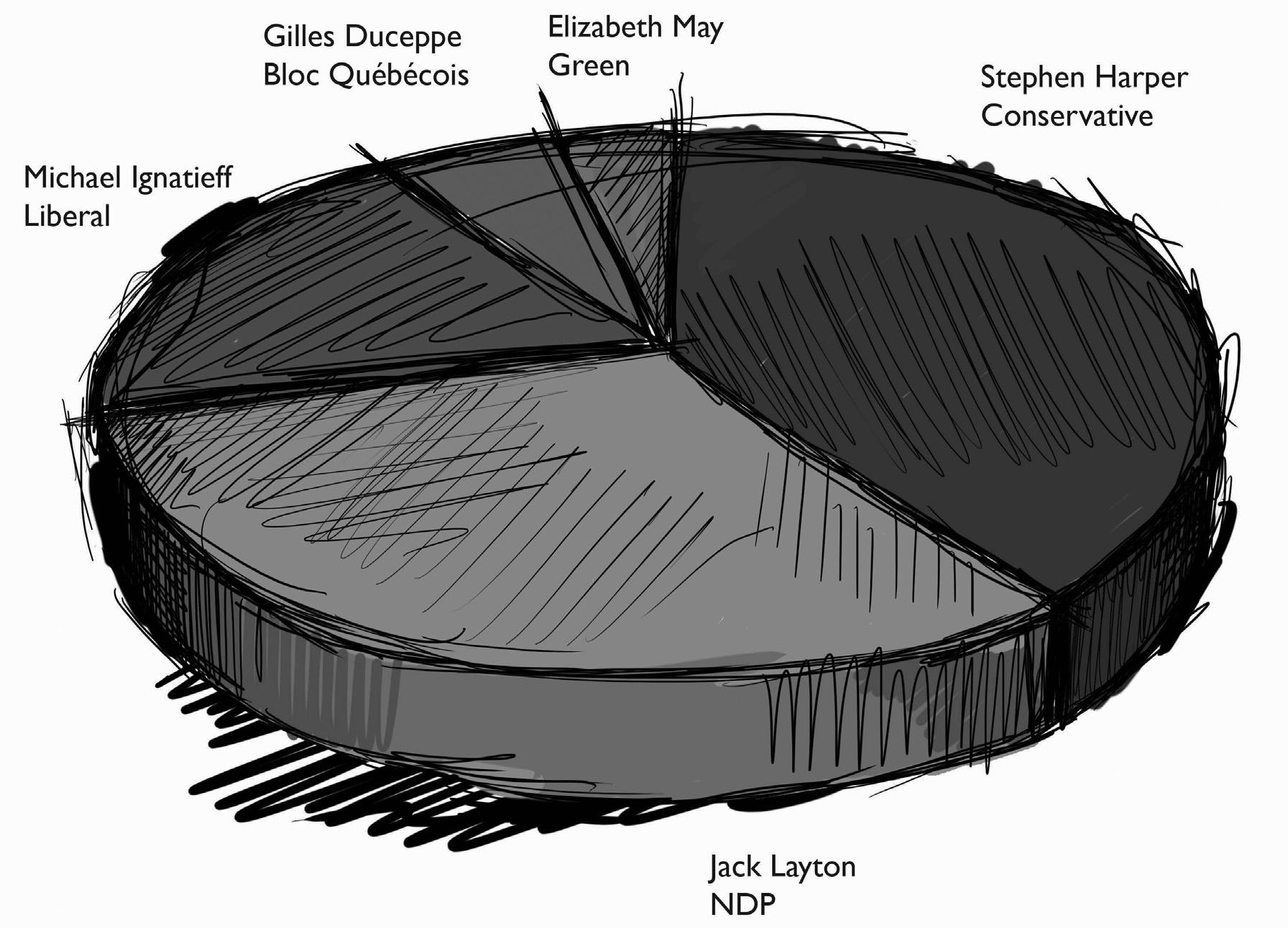
A lot of these problems are taken from the fact that we have a purely majoritarian-themed electoral system: a system that is systematically designed to favour a majority government outcome even when a majority of the population would vote against the winning party. In the 2011 election, 61 per cent of people voted for parties other than the Conservatives, and yet the Conservatives hold a 57 per cent majority of seats in the House of Commons. In the 2008 election the Green Party received almost as many votes as the Bloc Quebecois but gained zero seats to the Blocs’ staggering 49-seat total.
You can see my point that our system allocates either an over or underrepresentation of results. Our current government is way overrepresented and its Conservative majority shouldn’t even be a majority government. This is a problem because
many Canadians don’t feel properly represented in Ottawa in our current format of electoral system. Our system actually discourages smaller parties or independent candidates to run because they don’t stand a chance. It also discourages people with complex or mixed sets of values from even coming to the polls, hence the lower turnout rates.
Besides our electoral system, major institutional settings and rules in Parliament must also be reviewed for their damaging effects on Canadian politics. For instance, we should all be aware that we still have an unelected and unaccountable chamber in Parliament: the Canadian Senate, which our tax dollars pay for and still has a degree of authority over us. It’s the 21st century and yet we are using an 18th-century idea of a “democratic” chamber. All we hear about it in the
news is scandal after scandal that lowers the transparency and trust in Parliament as a whole. Just look at the Patrick Brazeau or Mike Duffy scandals. Frankly, it’s making the public and me sick.
The parliamentary norm of party discipline is another terrible institution in Canadian politics. I don’t even understand its existence. It basically makes the MPs we elect end up becoming the employees of their parties’ leadership. Party discipline is the ability of the executive party to get all of its members to support initiatives and bills proposed by the leadership. If you don’t, the potential consequence is removal from the party caucus. The MPs or their constituents’ personal beliefs don’t matter, only the parties’ agendas do. In Canada there is a sense of “party over people” when it should be the other way around. How can the
public have any faith in their MPs if they are restricted themselves? It’s not healthy for our democracy.
The political tone and culture of Ottawa is also disturbing; political life is currently all about partisanship and gaining the upper hand on your opponents, not about finding rational comprises and working together. Sure, during elections all parties are your opponents, but once the election is over so should be the bickering and fighting; it should be about doing what’s collectively best.
The funny thing about all of this is that Stephen Harper was once the man who advocated for strengthening Canadian democracy. He supported positive actions, such as: recall voting, more referendums, democratizing the Canadian Senate, and bringing a new tone and transparency to Ottawa. And what now? Even with a major-
ity government he has done almost nothing. Harper may have credibility on his economic record but his record on democratic principles is abysmal. He has closed Parliament twice, continued the expanding powers of the Office of the Prime Minister at the expense of Parliament, and if anything has brought a sense of shadiness to Ottawa and grown impotence to the institution of Parliament.
The parliamentary process is supposed to be made up of lengthy and robust debates of bills between Members of Parliament across party lines. However, recently this is no longer the fact. Debates have been limited, or even cut off; the Conservative majority government has pumped through bills without much consultation or discussion from the opposition, acting as they were not even there. Majority governments govern with ease but that shouldn’t make them authoritarian in any way. Even Conservative backbencher MPs, whose original role in Parliament is to seriously question and analyze the bills proposed by the cabinet to hold them accountable, have turned into cheerleaders for Mr. Harper and his cabinet. They hold their dreams of becoming one of the inner elite cabinet members as their main priority. Parliament is truly irrelevant.
All these issues are harming Canadian democracy and they are part of the overall decline in faith and trust in the Canadian political landscape. We, as the next generation of future leaders, will be responsible for what’s next. Let’s all agree: an appointed Senate, parliamentary norm of party discipline, and a culture dominated by party politics and power must end. The hardest part is to actually make it happen and agree upon the next step.
TO CANADA PERMANENTLY.
The Canadian Experience Class program offers foreign graduates with Canadian work experience the opportunity to apply and stay in Canada permanently. Visit immigration.gc.ca/cec for more details and see if you’re eligible.
ÉTUDIANTS ÉTRANGERS.
IMMIGREZ EN PERMANENCE AU CANADA.
Le programme de la catégorie de l’expérience canadienne offre aux diplômés étrangers ayant une expérience de travail au Canada la possibilité de faire une demande en vue d’habiter en permanence au Canada. Visitez le site immigration.gc.ca/cec pour en savoir plus et pour voir si vous êtes admissible.
Pope Benedict XVI
My thoughts on his legacy
ch Ris h e ARn, volunteer staff
As most everyone with access to a television set or a computer knows, Pope Benedict XVI has resigned his position as, well, the pope. He will now be referred to as “Pope Emeritus,” and is the first pope in 600 years to leave the job without dying. That’s a pretty impressive feat no matter how you look at it.
The pope leaves behind a church that, in my opinion, is failing under the weight of scandal, financial mismanagement, hypocrisy, and a complete disconnect to the world around it; although, to be fair, this decline began long before Benedict. But, under this pope, it seemed that the old ways of the church were accentuated and ended up looking more pathetic than ever.
Old dogmas and antiquated ideas were continually pushed, with the pope going so far as to tell SubSaharan Africans fighting a devastating HIV epidemic that they shouldn’t use condoms. While flying on his
private plane—would Jesus fly on a private jet?—on his first trip to Africa, he told reporters that the epidemic is, “A tragedy that cannot be overcome by money alone, that cannot be overcome through the distribution of condoms, which even aggravates the problems.”
The continuous child sexual abuse scandals that have plagued the Catholic Church over the last number of years have been met with what seems to be a slow and even halfhearted response. And, as has been pointed out many times, Benedict
The pope’s departure is a time for the Catholic Church to regroup and choose a new leader.
This, of course, flies in the face of science, which tells us that a simple condom can save lives. I’m sure the pope would love all humans to abstain from sex unless it is absolutely positively necessary, but that shows only how out of touch he and his organization is. The reality is that humans are sexual. Sex will happen. Now, let’s make it safe for people! Science has done this, the church has not.
was more than aware of cases of abuse and was in a position to do something about it before he became the pope. The old boys’ club just protected its own, seemingly unconcerned about the impact the abuse was having on children and families. The ego of the church was too large to allow these crimes to taint its image. But the truth came out anyway.
Same-sex marriage and LGBT equality gets the standard damn-
ing and, compared to child sexual abuse, a very swift and determined response. The Catholic Church sees homosexuality as a terrible sin and the idea of same-sex marriage as an attack on traditional family structures. Apparently, homosexuality is a “manipulation of nature,” with no acknowledgement for the idea that being LGBT is not a choice, and that if there is a god that created us all, he also created LGBT folks just the way they are.
And, of course, the notion that women could be priests? No way! This was the domain of men, as instructed by god. Are women not close enough to god? Can they not convey god’s “message” as good as a man can? What’s the problem?
The problem is age-old traditions, dogma, arrogance, and misplaced opportunity.
Pope Benedict XVI towed the line. He had a “fire and brimstone” approach to contentious issues. He used rhetoric that could be seen as
hostile and aggressive. It left me feeling more disappointed with the Catholic Church than ever.
One of my favorite Internet memes shows the pope covered in gold and silk carrying a giant golden cross. It says, “Pray for the starving children while I hold this gold cross.” That sums it up nicely in my opinion. To me, the gold, silver, gems, and jewels, the silk robes, the Prada shoes, the popemobile, the billions of dollars in assets around the world, and, indeed, the gold crosses, are so far removed from anything and everything that Jesus taught that I don’t believe this organization even bothers to understand its sole reference book!
The pope’s departure is a time for the Catholic Church to regroup and choose a new leader. But it needs more than a nwew leader; it needs a complete overhaul. Do you really need a multi-billion dollar organization in order to believe in a higher power? In my opinion, the answer is no.
CRTC taking a step in the right direction
New draft code inspired by Canadian consumers
Ibelieve that I speak for many of us students when I say that we hate dealing with cell phone carriers. Yes, we come, sometimes in flocks, when a certain company unveils its “ultimate” smartphone, lining up a day before because it really is worth getting. Yet, we all dread coming to the till and negotiating our “contract” and “terms.” Oh, I have to sign up for three years just to get the subsidized phone price? And there is a minimum price I have to pay for those 36 months? And even if your phone and patience survive those three years you can’t even change carriers, as the phone will be locked to your carrier. These are some of the pitfalls of Canadian wireless companies that the CRTC (Canadian Radio-television Telecommunications Commission) has allowed for so long. However, all of that might change; Canadians have a chance in an open forum to address what changes they would like to see their phone carriers adopt. In this article I will explain two major changes I think should happen with our current wireless code.
The first thing is changing the standard three-year “$50 minimum” term agreement in order to get, for instance, an iPhone 5 for $180 – erroneously believing that you will “save” $580. However, they’ve got you for
three years, and within about a year you have already paid Rogers, Telus, Bell, or whomever, the difference in cost owed to the manufacturer. It is interesting to note that these three mega companies have 94 per cent of
the mobile phone market in Canada. I understand that not everyone can pay a lot more than $180 up front for purchases like these, but the lack of options really gives the carriers a huge advantage. Indeed, Canada’s
Competition Bureau reports that “the large proportion of wireless contracts are three years in duration.”
I propose that they introduce both one-year and two-year contracts instead, because a lot can change even after just one year, and termination fees should not have to be such a nightmare. You should be able to opt out anytime and just pay the difference from the MSRP (manufacturer’s suggested retail price) if it’s early enough in the contract agreement, or not at all if you’ve reached that certain point where they’ve paid off that difference. Nevertheless, offering choices tailored to individuals’ needs are commonly established in many industries and I hope to see that happen in the wireless industry as well.
It is interesting to note that these three mega companies have 94 per cent of the mobile phone market in Canada.
possible for a carrier to warn us or set up a cap on additional fees? Perhaps going over or $50 or $100 would help remind people of this crucial step to make sure they aren’t roaming. To be fair, they are technically providing a cap, but the average person’s monthly fee on their plan does not stray too far from $50 before taxes. So when your “new” bill from roaming and other charges is about 400 per cent over your average bill, only then do they start capping or actually caring about you. Lowering these cap levels to 100 per cent would make much more sense. I suggest they change that right away. As you can see, there is currently only one clear winner in this situation, and it is not the consumer.
Another issue is data charges, especially concerning roaming charges on trips. No way do I want to be charged an extra $100 or $200 for sending a couple of text messages or accidentally downloading an app. Is it
It’s important for Canadians to speak out on these issues. You can do so by going to the CRTC website and becoming a part of the process.
iLLustRatiON by bRadLy WOhLgeMuth
Science & technology
Crowdsourced gunsmithing
3D-printed firearms raise unsettling questions
tom i ng RA
m, staff
“Information wants to be free.”
This is the motto of the Internet.
At this moment I can go to one of several shady websites and download a fully functional copy of almost any film – in some cases within minutes.
In 2007, when the MPAA (Motion Picture Association of America) sent legal notices to websites publishing an encryption key used by Blu-ray and the now-defunct HD-DVD discs, users responded by posting the key on hundreds of thousands of websites. You could even buy T-shirts. Once something is online the best you can do is hope no one notices it. Attempts to suppress it invariably backfire and cause it to be disseminated more widely than it otherwise would be. This new way that information tends to behave in the Internet age is called the Streisand effect, after an early example involving pictures of Barbra Streisand’s home in Malibu.
Now, what happens if (when), through the wonders of modern technology, information can be freely converted into stuff? If, rather than downloading a file off the Internet that tells you how to bake a cake, you can download a file off the Internet that gives instructions to a cakebaking machine, which bakes a cake for you? Well, one inevitable result is that your birthday party will be somewhat cheaper and easier to plan. Another inevitable result is Defense Distributed.
The technology to change information into stuff already exists. It’s called 3D printing, and though it’s expensive, it’s getting cheaper. Defense Distributed is a non-profit organization dedicated to creating and distributing open-source files that will instruct a 3D printer to make a functioning plastic gun. Most recently they have successfully printed the lower portion of an AR-15 rifle (the design that the U.S. Army’s M16 is based on) and test fired over 700 rounds of ammunition with it.
The organization’s public face is American law student and firearms enthusiast Cody Wilson. Wilson, a self-described libertarian, is wellspoken (though somewhat prone to ready-made slogans). He’s clearly an intelligent man, and he understands
the deep implications of what he’s doing. For him, at least, that’s the whole point.
“I see a future of federal communities and slowly disintegrating and reactionary states,” he said in an interview with the libertarian magazine Blink Defense Distributed would make gun control virtually impossible because anyone could make their own fully functioning gun in a matter of hours.
This eats away at what is often considered a defining feature (or even the defining feature) of the state: the monopoly on the use of force. In this sense Defense Distributed continues in the vein of several other high-tech projects that seek to take over functions traditionally performed by the government – such as Bitcoin, a digital peer-to-peer currency with no central regulating bank (which Wilson enthusiastically supports).
The idea is scary – not just the readily available guns, about which the Canadian mind is instinctively squeamish, but also the apocalyptic political philosophy. Perhaps most disturbing is the fact that the files that have been developed so far are already out there, and we’ve seen that once something has been posted online, it is archived quasi-permanently. You can’t take it back any more than you can unring a bell.
If it is any consolation, this was inevitable. 3D printing is making steady advances, and radical forms of libertarianism are widespread in high-tech circles – for example, the influential programmer and opensource theorist Eric S. Raymond has voiced support for Defense Distributed. Sooner or later someone would have made the connection between 3D printing’s applicability to gun manufacturing and the Internet’s culture of open information.
The question is: where can we go from this point? 3D printing will cause a lot of our assumptions to become obsolete. It will do for everything else what The Pirate Bay did for movies and music. We still haven’t found a really good way of dealing with the problems of intellectual property in the Internet age. When this uncertainty is expanded to include all forms of property – then things will get interesting.
Living with w ildlife
Biologist Ryan Brook discusses human perspectives on wildlife conflict
lAu RA gRoening, volunteer staff
As wild areas shrink and human populations expand, there is more contact between humans and wildlife, and inevitably more conflict.
Consider Bambi, the pet deer that was put down by Manitoba Conservation officers in early February in the Windy Bay Hutterite Colony. Colony members had found the deer injured in a ditch near the community over a year ago, named it Bambi, and nursed it back to health. Bambi was fed by colony members and became a fixture in town.
In February, one colony member called Manitoba Conservation concerned about whether the deer would become a threat as it grew older. In response, conservation officers shot the deer, as is their policy when dealing with potentially dangerous tame animals.
The result was a huge media fallout, anger from the public, and a heated debate about how we should and should not respond to similar cases in the future.
These type of conflicts are familiar territory to Ryan Brook, whose research into human wildlife interactions has taught him about the passion and emotion these incidents can generate. Brook spoke about the complications of living with wildlife at last week’s Annual Meeting of the Friends of Birds Hill Park, a non-profit volunteerbased organization that seeks to educate the public about the natural history of the park and conserving the park’s natural environment.
Brook’s previous research focused on the relationship between elk in Riding Mountain National Park and the impact of bovine tuberculosis on cattle producers in the surrounding area. His current work with the University of Saskatoon focuses on the rising
moose population in Saskatchewan farming country, as well as the growing issue of invasive feral wild boar in Western Canada. His work in both of these areas seeks to gain an understanding, not only of the biology of his research species, but also about human interactions with wildlife and the perspectives that inform these interactions.
“Difficult questions often have simple, easy to understand wrong answers. ”
– Ryan Brook
During the evening lecture, Brook described a moment early in his research career when he first realized that the complexity of human wildlife conflict was largely due to competing perspectives on wildlife. He depicted a close encounter he had with a polar bear while working in the Canadian Arctic: he was immediately exhilarated and ecstatic to have seen such a majestic creature, but when he turned to his co-worker, Brook found the man was petrified and convinced that they had almost died.
The frustration and anger expressed after Bambi was killed was brought about by two opposing viewpoints. The conservation officers were under strict orders to destroy the deer, having ascertained that it was unable to survive in the wild and was potentially dangerous. From their perspective, the response was a necessary safety precaution, however unfortunate. On the other hand, the colony members saw their pet and friend
killed before them, horrified by the cruel nature of the act. Each side felt justified in their viewpoints. According to Brook, humanwildlife conflict is more often human-human conflict, and the debate often centres more on human reactions to wildlife than the actions of wildlife themselves. He suggested that animals are sensible enough; they eat when they are hungry, move when they have to, and try to avoid run-ins with humans, for the most part. People, on the other hand, are often irrational, and consistently make choices based on belief systems and values that are not in their best interests. These complex dilemmas require similarly complex solutions. Brooks quoted a saying he uses with his grad students: “difficult questions often have simple, easy to understand wrong answers.” He has found that the best way to develop solutions to these problems is to engage in dialogue with communities, using new platforms such as Facebook.
Social media can allow researchers to interact with communities in a way that can not only diffuse conflict, but also increase knowledge about wildlife populations by connecting with local and traditional knowledge from the communities that interact with wildlife.
The fallout from the Bambi incident has resulted in new policies put in place within Manitoba Conservation, which will take into consideration all possible options before destroying an animal. These new policies represent a more informed and engaged response to wildlife conflict, and show promise for continuing conversation about our relationship with the wildlife in our environment.
phOtO by RyaN bROOk
Not as advertised
Horse meat scandal reveals cultural divide
Earlier this year a controversy surrounding the use of horse meat in beef products found across Europe dominated headlines. Although the story has since caused many companies in Europe to withdraw several products from the market, the scandal hasn’t incited any such reaction in North America.
The story first came to light on Jan. 15 when the Food Safety Authority of Ireland (FSAI) announced results of research they had conducted from November and December regarding the composition of different animal species in food products. Through DNA profiling, the FSAI were able to confirm the presence of equine, or horse, DNA within several frozen beef burgers that were being sold across various UK supermarket chains. With these preliminary findings, several more companies and stores began recalling beef meals that tested positive for equine DNA.
One of the products found to contain horse meat were Swedish meatballs available at European IKEA locations. After tests from the Czech Republic found traces of horse meat within the meatballs and Wiener sausage, the world’s number one furniture retailer pulled the meat goods produced by its main supplier in Sweden. A statement by IKEA noted that outlets across Canada and the United States were unaffected by this defect and the meatballs and sausages in North America are produced by another supplier.
Other major products that have been found to contain horse DNA include the ground beef produced for Taco Bell outlets in the United Kingdom, beef ravioli and tortellini by the European Nestle supplier,
and beef burgers supplied by Tesco supermarket.
As of Mar. 1, the Food Standards Agency, an independent organization from Great Britain, has performed over 5,430 tests since Jan. 20 on several meat-based products from a range of retailers and shops throughout Europe. These tests have shown that only 0.3 per cent of samples contained traces of horse meat. However, included in the research by the agency is the infamous test showing a beef lasagne product by Findus containing between 60 to 100 per cent horse meat.
European consumers have become cautious. One statistic links the controversy to a 30 per cent increase in purchasing beef burgers and meatballs through independent butcher markets across the UK.
Health-wise, horse meat may only produce legitimate health concerns when traces of phenylbutazone, a commonly used medicine for horses for short-term treatment of fevers and pain relief from infections, are found within the horse. While phenylbutazone may have deleterious health effects in humans, common practice dictates that if a horse is given the medication it becomes illegal for the horse to be slaughtered for human consumption. The FSAI also tested the preliminary beef burgers in January for phenylbutazone and found no traces, stating that there was “no risk to consumer health associated with these findings.”
Is horse meat dangerous?
Ethology is the study of healthy animals exhibiting normal behaviour within their natural environment. There is much
Early intervention
Infant may have been cured of HIV
tom i ng RA m, staff
The child was born in rural Mississippi in July of 2010. The mother was infected with HIV, a fact that the doctors were unaware of until a test was given while she was in labour. Although antiretroviral treatment has made the transmission of HIV from mother to child very rare, in this case there was no chance to treat the mother before the baby was born. Because the baby was premature, she was moved to the University of Mississippi Medical Center (UMMC) in Jackson. Two HIV tests were then performed that ordinarily would have taken up to six weeks. These tests confirmed the presence of an HIV infection, and the baby was started on antiHIV drugs 31 hours after birth.
accumulating. These cells contain a latent form of the virus that is not detected by the immune system or targeted by drugs.
The child may still have an infection. At the moment this is being called a “functional cure” rather than a “sterilizing cure”; a sterilizing cure would mean the definite eradication of all HIV from the patient’s system. Still, this child’s case has made many hopeful about the future of HIV research.
interplay between ethology, and animal rights and welfare. University of Manitoba ethologist James Shapiro stated in an interview with the Manitoban, “it appears to me that there is no ‘scandal’ that involves animal rights and welfare or human safety with respect to the consumption of horse meat.”
Much of the negative press may come from the fact that horse meat is considered taboo in many cultures. Countries like the UK, Ireland, the United States, and major parts of Canada do not consider horse meat part of a conventional diet. Conversely, the Jewish faith technically condones the consumption of horses because they do not have cloven hooves and are not ruminants. Several countries including France and Italy celebrate horse meat, or “viande de cheval,” as a delicacy.
With this in mind, Shapiro stated, “the companies involved are concerned about their public image and are engaged in damage control with their customers. That, however, is a marketing issue and not an animal rights issue.”
Consumption of the protein in horse meat is no better or worse than protein from cattle, according to Shanleigh Thomson, a food science lab technician from Purdue University. She stated that the difference comes in the standards for raising and slaughtering beef cattle and the absence of such regulations for horse meat in Canada or the U.S.
To date, there is no evidence that consumption of horse meat is inherently more dangerous to human health than beef.
iLLustRatiON by Mathieu bOuLet
The first three follow-up tests still showed HIV in the baby’s plasma, but by the fourth test, at 29 days after birth, the infection had become undetectable. At 18 months the parents stopped treatment for reasons that have not been disclosed, and at 21 months, when the baby returned for medical care, a UMMC doctor was unable to find HIV or HIV antibodies on standard tests. The doctor, Hannah Gay, sent blood samples to a team at Johns Hopkins University to have them tested more thoroughly. The Hopkins team, led by paediatrician Deborah Persaud, first examined the samples 24 months after the baby’s birth. They found only one copy of HIV RNA, likely a defective version of the virus that cannot copy itself.
Persaud’s team mixed the blood samples with uninfected CD4 cells – the cells targeted by HIV. Tests at 26 months found traces of the virus, but it had not mixed with the cells, indicating that it was incapable of copying itself. Persaud believes that the early intervention prevented infected CD4 cells from
“This is one case and we definitely need to have more, and hopefully we can have more,” said Persaud. This is actually the second case of a human being cured of HIV. The first is Timothy Brown, a 46-year-old American man living in Germany known as the “Berlin patient.” Brown found out he was HIV positive and began treatment with the anti-HIV drug AZT in 1995. In 2006, however, he received even more bad news: he had developed a highly lethal form of leukemia, independent of his HIV. When Brown was given a bone marrow transplant for the leukemia, the doctors found a donor with a genetic mutation known as delta 32, which prevents HIV from infecting CD4 cells. The doctors were not sure what would happen, but Brown’s HIV infection apparently disappeared. At present, he is free from leukemia and no traces of HIV can be found in his body.
Although Brown’s cure is only of value to those unfortunate enough to have HIV and leukemia at the same time, this new case has a much broader applicability.
“This has very important implications for paediatric HIV infection and the ability to achieve cure,” said Persaud.
If research into this phenomenon pans out, HIV infection in infants could become a thing of the past.
Managing editor: Chuthan Ponnampalam
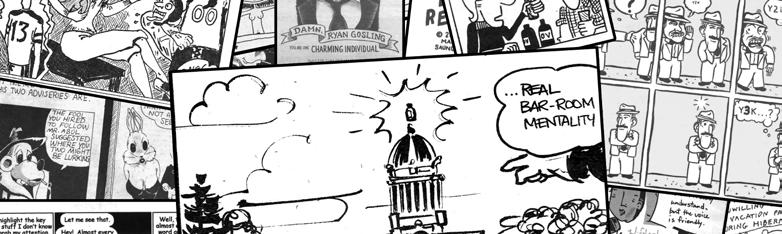
A history of Manitoban Comics
RyA n hARby, staff
This old student newspaper has had a long and storied history, spanning nearly 100 years (we’re about a year away from that mark, actually) and in that time a lot of great, interesting work has gone into it.
Recently, efforts have been made to digitally archive the entire 99+ year collection of the Manitoban, all the way back to our first issue from Nov. 5, 1914. The project has been progressing at a steady pace and soon, in the near future, the archives will be made available to the public, free for anyone to search through the annals of Manitoban history.
There have been quite a few prolific figures who’ve written for the Manitoban in the past—Marshall McLuhan, Andrew Coyne, Graham Spry, and Izzy Asper among them—but for every notable author there has been an equal number of talented artists who have contributed their time and effort, honing their skills within the tabloid-sized pages of the U of M’s student paper.
Last year our paper put out a special limited edition run of several Marshall McLuhan contributions all collected to celebrate the 100th-year anniversary of McLuhan’s birth. Today, as we press on closer and closer to the paper’s centenary, we thought it would be an excellent time to again look back into our dusty archives in an effort to celebrate the history of comics as they have appeared in the Manitoban throughout the years.
It has been an interesting process thumbing our way through each year’s issues to find comic content that is
either uniquely special in its own way or that speaks to the era and generation from which it appeared.
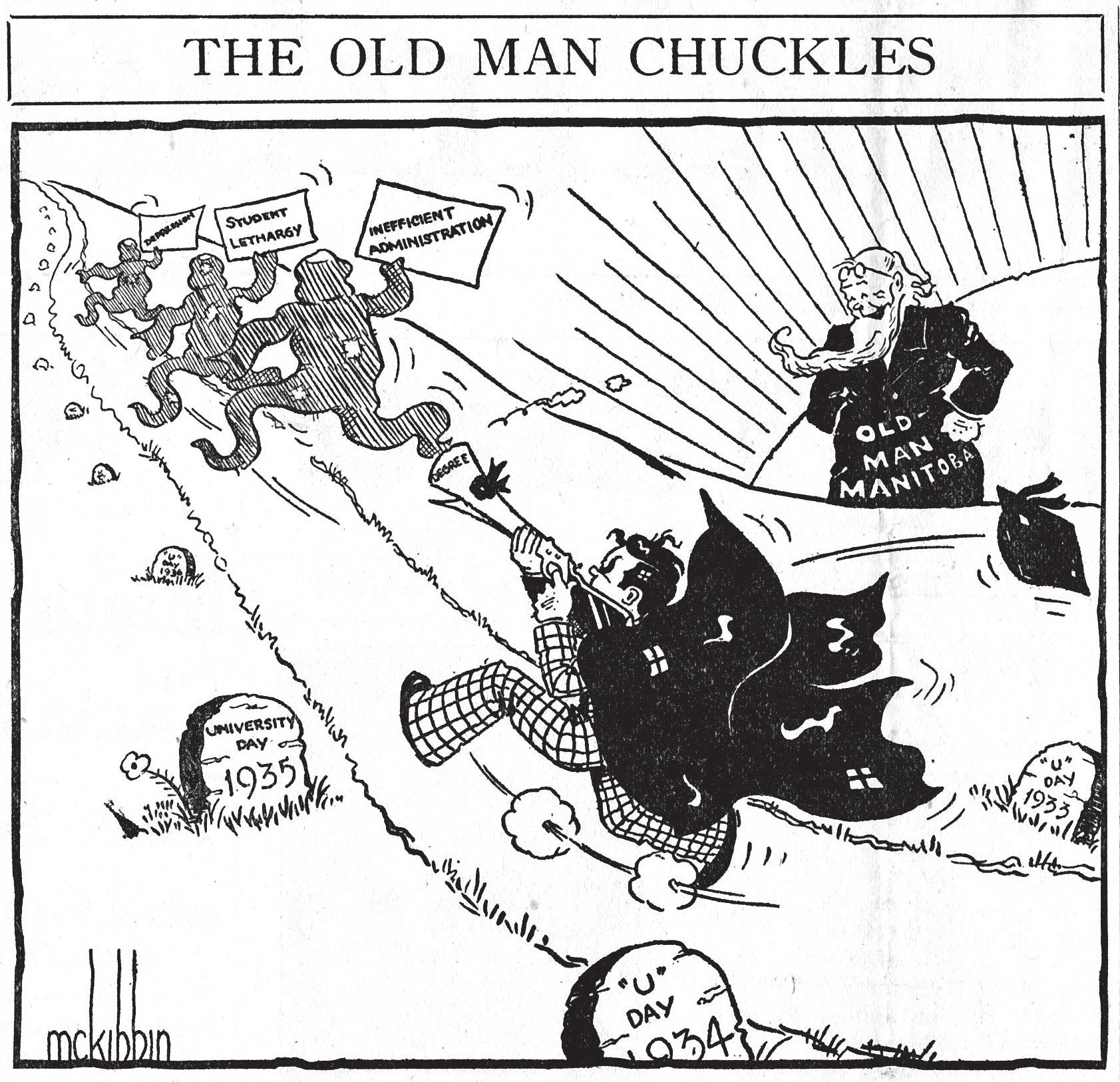
In the early years there was hardly any “comic” material to speak of, and anything that might be associated with a comic aesthetic usually turned out to be an advertisement for 7 Up, the Bay, Eaton’s, or Vaseline Hair Tonic. By the mid-30s, however, complex graphic illustrations began accompanying various news stories, and on occasion these graphics would stand alone, providing commentary on campus or U of M related topics.
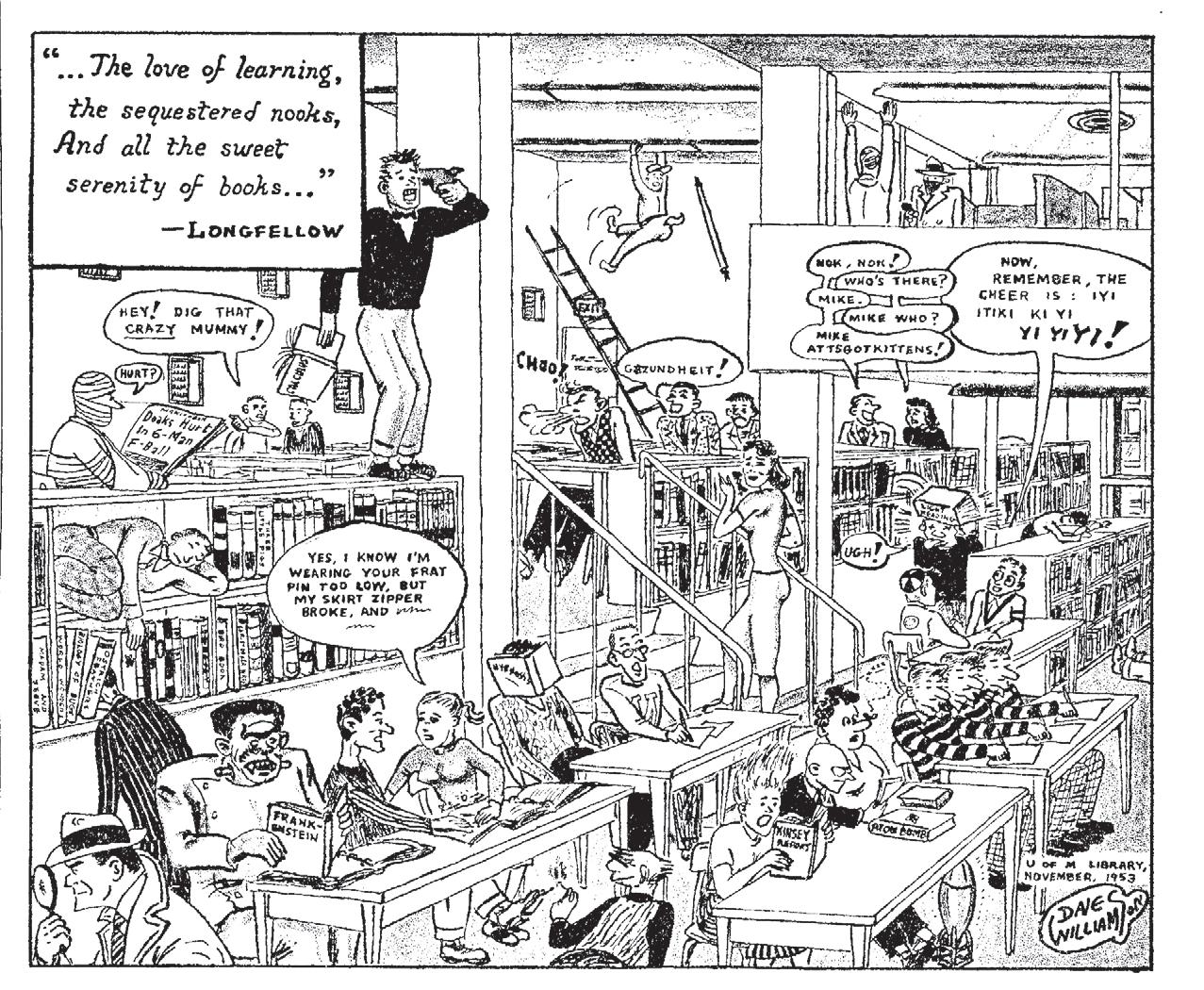
In the 50s much of the comics appearing in the paper were used for comedic relief, most often parodying some form of university life, whether it be the campus football team, popular study locations, or even the staff of the paper itself.
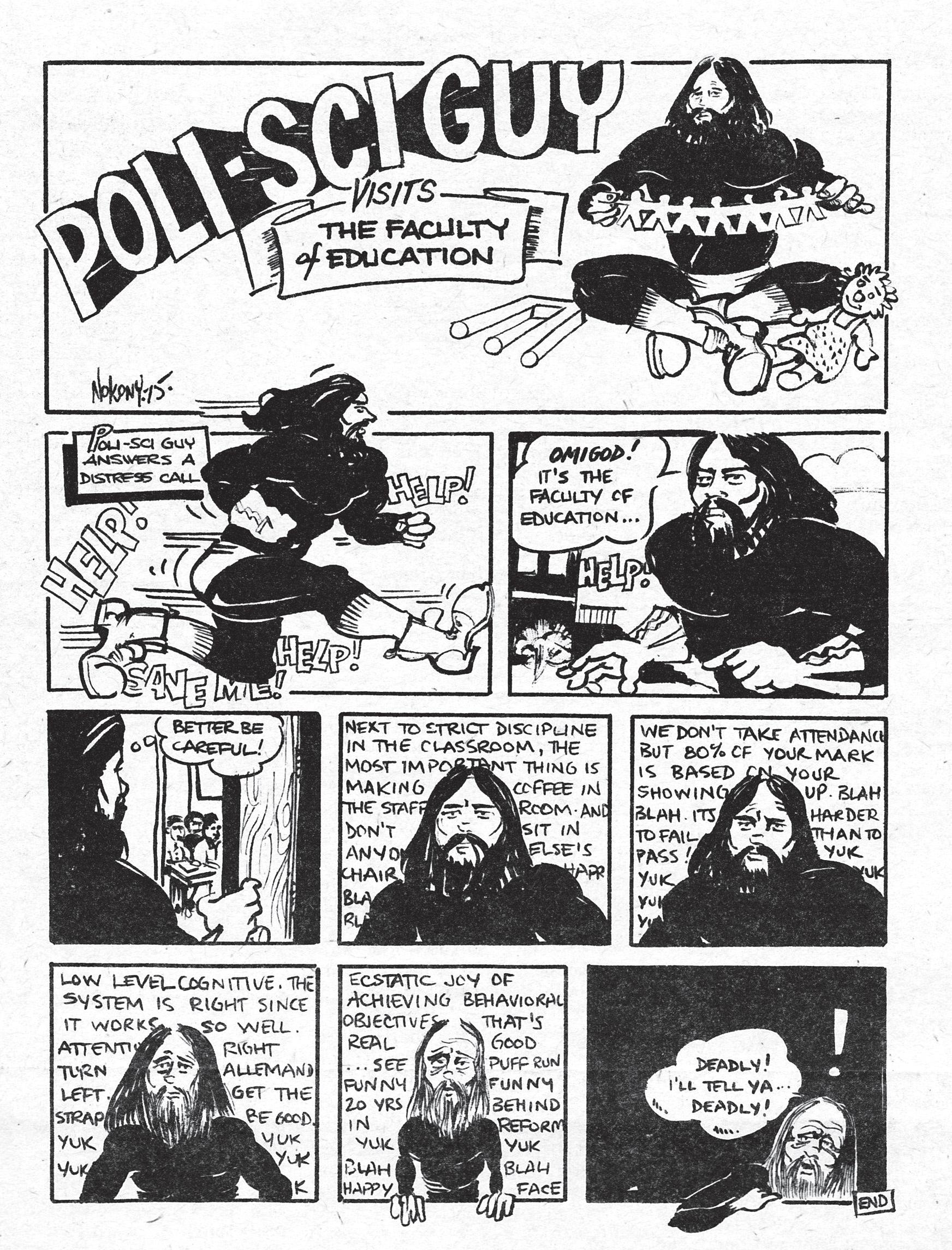
Comics from the 70s and 80s still lambasted the university regularly, but more and more artists were beginning to express opinions outside the scope of the U of M. Comics like Destroy All Monsters (1978) and The Shepherd (1986) were more interested with the fictional world taking place within the panels rather than the politics on campus.
We here at the Manitoban staff had a real hard time choosing which comics to include from the 90s and 2000s; the variety and the quality grew so much over these last couple decades. Colour comics became a regular option for artists, and the overall pool of talent contributing at any one point was, especially compared to the earlier days of the paper, overwhelming.
Q+A with a toban comic artist!
Brendan
Salakoh,
creator of Bear Warlock
RyA n hARby, staff
How long have you been drawing comics?
Do you remember your first comic?
I’ve been drawing comics since I was about seven or eight years old. At that time, they were Sonic the Hedgehog and Spider-Man comics, rather than Bear Warlock. Bear Warlock himself emerged during high school. At that time, he didn’t have a name. I’d draw him saying random—and often funny— things in my notebooks when I was bored. My friends loved it, so it kind of grew from there.
what made you decide to get involved with Manitoban?
I got involved with the Manitoban at the beginning of my second year at the U of M. One day, a few friends and I were browsing through the paper. “Hey, you should submit your Bear Warlock drawings!” one suggested. I thought it would be cool to turn a bunch of random sayings and characters into an actual weekly strip, so I sent a few samples to the graphics editor. He loved it, and from then till I graduated in 2009, Bear Warlock was a weekly strip in the Manitoban! The Manitoban is a great group, and I always loved going to the meetings and hanging out in the newsroom.
Was there any particular inspiration behind the comic? How did you conceive of it? What are your thoughts on it looking back?
Some highlights that come to mind include Mark Saunder’s run as graphics editor at the turn of the century (in which U of M administration and UMSU were caricatured on a regular basis) and Marcel Dzama’s Super Happy Fun Comic, which ran for multiple years. Dzama would go on to provide album cover work for the Weakerthans’ Reconstruction Site and Beck’s Guero, amongst other things.
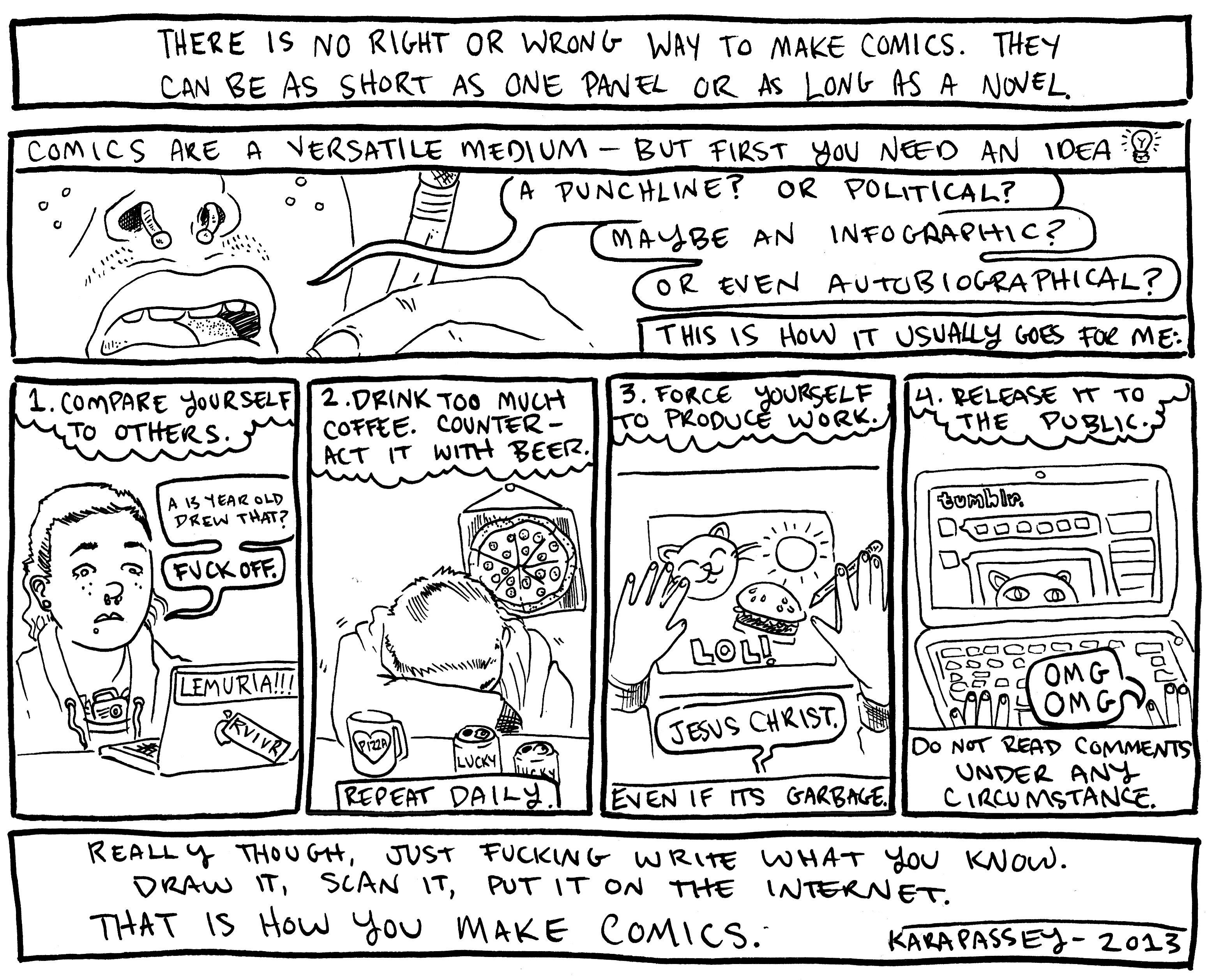
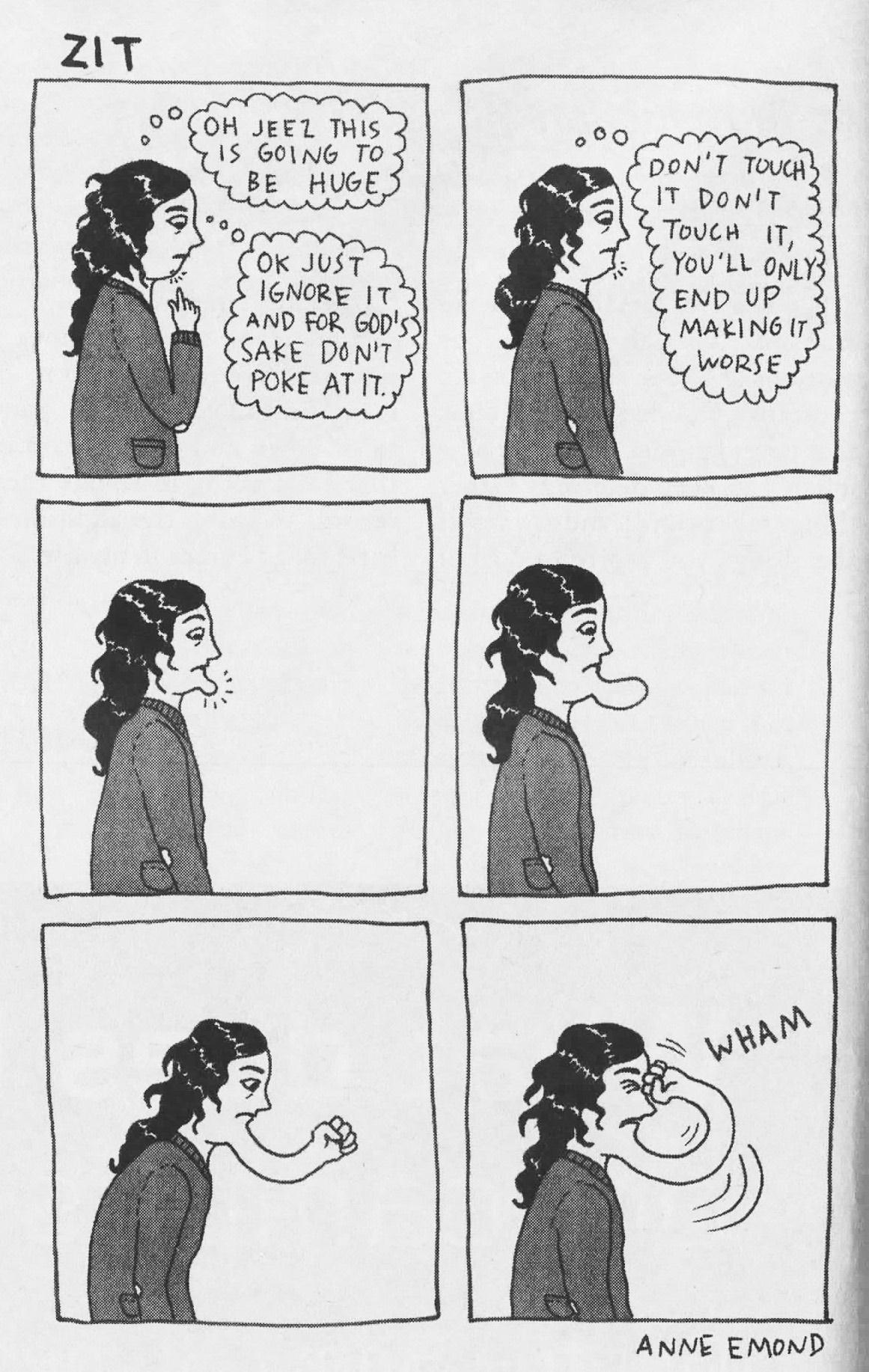
In recent years, names like Skeleton Babies, Bear Warlock, Mr. Fish, and Teenage Pizza have occupied the page dedicated to all things visual in the paper. Where once there was a random comic appearing every so often throughout the publishing year, there is now an official Diversions page (some years called the Comic page) devoted to printing weekly comics and other non-text-stimulants.
Perhaps now more than ever, the paper aims to support budding artistic talent in various forms. And while the comics, or “funnies,” of many publications are often seen as the lighter side of a newspaper, these in particular have generated great interest, great contemplation, and great joy on par to any written article.
The history of Manitoban comics is one that is rich, and one that deserves to be celebrated. If, like others before, you are interested or inspired by any of the work showcased in this feature, please do your heart and soul a favour and get involved!
ment (YouTube it!). His name was just the amalgamation of Bear, and “Adam Warlock,” an obscure Marvel character that I had an old trading card of. Clam Factor and Handsome Horse were conceived of in high school, and I have to give my friends credit for all their sayings and ideas that helped shape the characters and their words. In terms of content, the inspiration was every-
What is your favourite Bear Warlock piece and why?
I’m not sure that I have a favourite, but there are a few that stand out. The time they get frustrated playing communist monopoly; the one where Bear Warlock gets arrested for Facebook creeping; and the one where Bobble Booty’s dance becomes a viral video.
There were a lot of different inspirations for the comic. The bear himself was my poor attempt at drawing the bear mascot from Weird Al’s “Camp Superfun” seg-
where: inside jokes with friends from high school and undergrad; pop culture; politics; everyday problems; and often, just random ideas that I thought others might find amusing. Every so often I’ll dig up a few of the old comics, and they still crack me up.
What are you up to nowadays? Do you still draw comics?
The last Bear Warlock comic I did was in 2009, just before graduating from the U of M. I went on to do my masters of city planning at the University of Toronto, and now work as a planner for Dillon Consulting. I love my job, as I’ve wanted to be a planner since my days playing SimCity and building towns out of Lego. Bear Warlock would even sometimes touch on urban planning issues in the comics! Unfortunately, I haven’t kept up with drawing lately, but it’s definitely something I could see myself getting back into eventually.
If your current self could give your past self one piece of advice, what would it be?
If I could give 2007 Brendan some advice, it would have been to develop the characters a bit more. I’m not talking about in-depth character analysis like The Wire or Breaking Bad , haha, but maybe just more recurring themes and background on the main players. But then again, for the casual reader, having each comic stand alone is probably best.
Q+A with a toban comic artist!
Emilie St. Hilaire, creator of Emiliest comics
RyA n hARby, staff
How long have you been drawing comics?
Do you remember your first comic?
I’ve always doodled but I didn’t get serious about Emiliest comics until this year. It just clicked because I think in the form of tweets now so my ideas are more concise. I remember drawing a comic of my brother when I was about six or seven years old. I drew him with his eyes popping out of his head looking at a busty girl. My sister told me our mother would wash my mouth with soap if she saw it.
what made you decide to get involved with Manitoban?
When I was doing my undergraduate degree I had friends who were involved with the paper; I think that’s why I started. I liked the open forum, democratic aspect of it. Contributing regularly is a great way to impose deadlines for getting work done.
Is there any particular inspiration behind the Emiliest comics? How did you conceive of it?
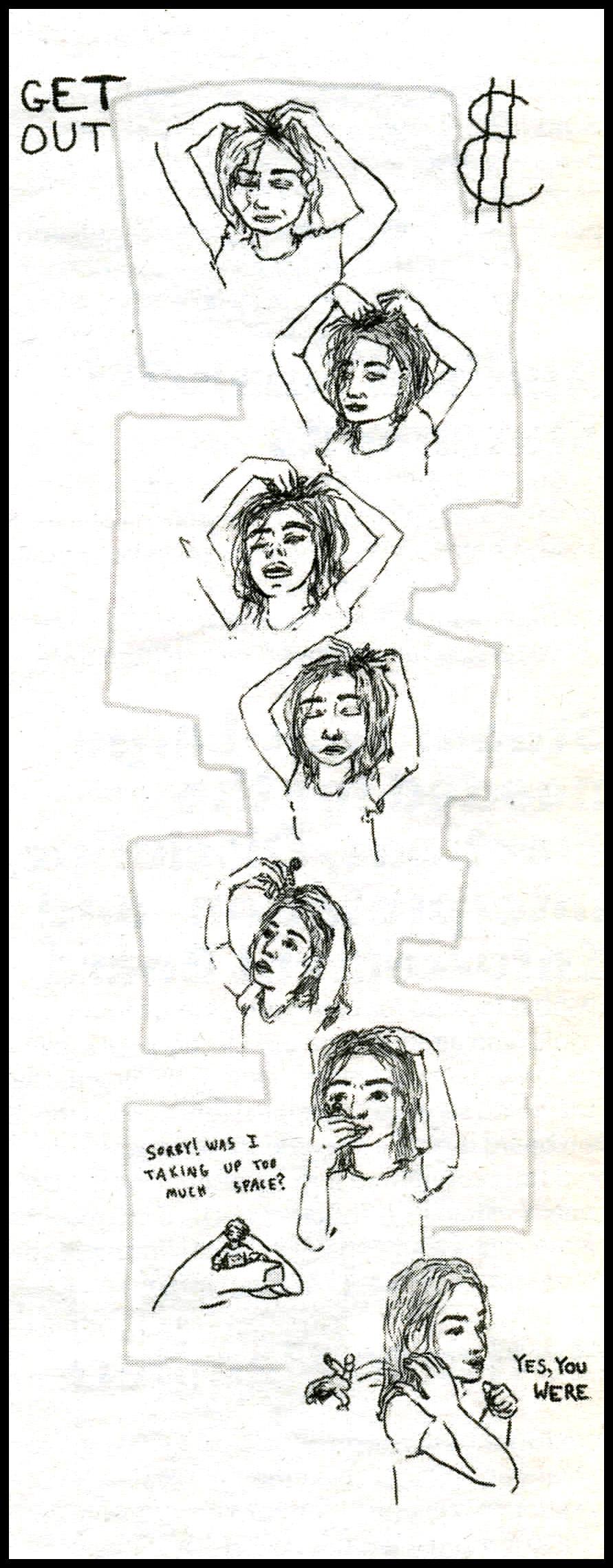
I go about my daily life and then a phrase or idea will pop into my head. I try to tweak it to be effective
and then after a few ideas have piled up I sit down and draw them.
What is your favourite comic that you’ve done and why?
I have different favourites for different reasons/occasions. “I was following you” was popular, and I’m fond of my Halloween special because it was actually humorous. The ideal comic for me is lighthearted yet profound, and the image should compliment or complicate the text rather than just illustrate it.
You’re a U of M alumna, is that correct? What are you up to nowadays, since your time on campus?
Since graduating from U of M I’ve done some travelling and I am currently in the master of fine arts program at the University of Alberta in Edmonton. I have my comics in the paper here too (the Gateway), but I get more love from Winnipeg. Don’t tell them I said that. ; )
If your current self could give your past self one piece of advice, what would it be? Draw!
Q+A with a toban comic artist!
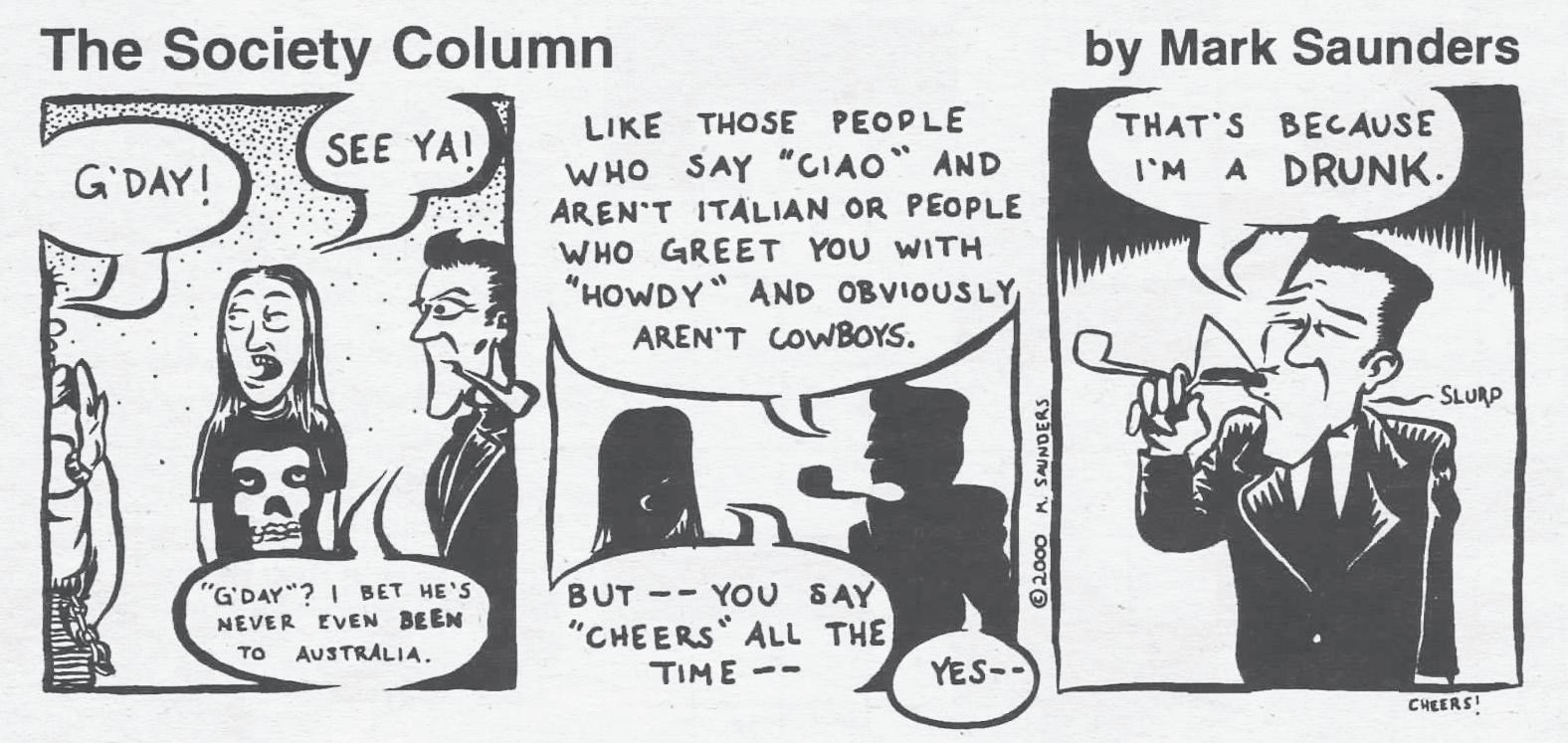
Mark Saunders, creator of the Society Column
huth A n Ponn A m PA l A m, staff
c
How long have you been drawing comics? Do you remember the first comics you ever drew?
I began drawing comics in high school for my school’s “student newspaper” – a photocopied pamphlet, more accurately. I would love to say that I still draw comics but, unfortunately, it’s something that has been pushed to the side in favour of more lucrative artistic endeavours like illustration and, especially, graphic design.
Aside from the Society Column, you did a lot of graphic work for the paper, and you were also an editor at one point. How long were you active at the paper and what was your involvement? How do you look back on your time at the paper?
I began volunteering for the Manitoban in the first week of the 1998/99 school year – my first year of university after high school. I drew a weekly comic strip and illustrated articles at the request of Kevin Matthews, who was the graphics editor at the time. At the end of the
year, the paper’s editorial board kindly voted me “Volunteer of the Year.” I was hired as Graphics Editor the year after and again the year after that. In 2001 I became the Managing Editor of the newspaper, overseeing advertising and finances. My editor-in-chief that year, the lovely Bernice Pontanilla, is currently a reporter working for the Metro newspaper out of Winnipeg’s City Hall. The people I met and the experiences I had during this time continue to be some of the most important of my life.
The Society Column featured quite a bit of humour about being a university student. Was there any particular inspiration behind the comic? What are your thoughts on it looking back?
Yikes. Looking back, it seems so juvenile and amateur. The ideas were simple and the artistic execution was still in development. I suppose the same could be said for many aspects of university – it is a “student” environment, after all.
In my strips, I attempted to be topical
and humourous – doing my best to deal in satire, wordplay, artistic experimentation, and professional quality illustration (or, y’know, so I thought at the time). Most important, though, was that there needed to be a central idea and a real plan for the comic before beginning. Examining the issues of the week and trying to think of something funny was what it boiled down to.
Do you remember any favourite comics you did for the paper? Perhaps any favourites from other artists?
Shortly after 9/11, I produced a comic pointing out the physical similarities between Osama bin Laden and Uncle Sam. That was funny.
In 2000, I poked fun at the—still hilarious—proclamation of art dealer David Loch that the acquisition of a $285,000 Winnie-the-Pooh painting “may change the destiny of our city.”
Sometimes reality is funnier than anything you can possibly think up. There are always so many insane things happening in our city and our world – they need to be looked at in just the right light for the insanity to be apparent to everyone.
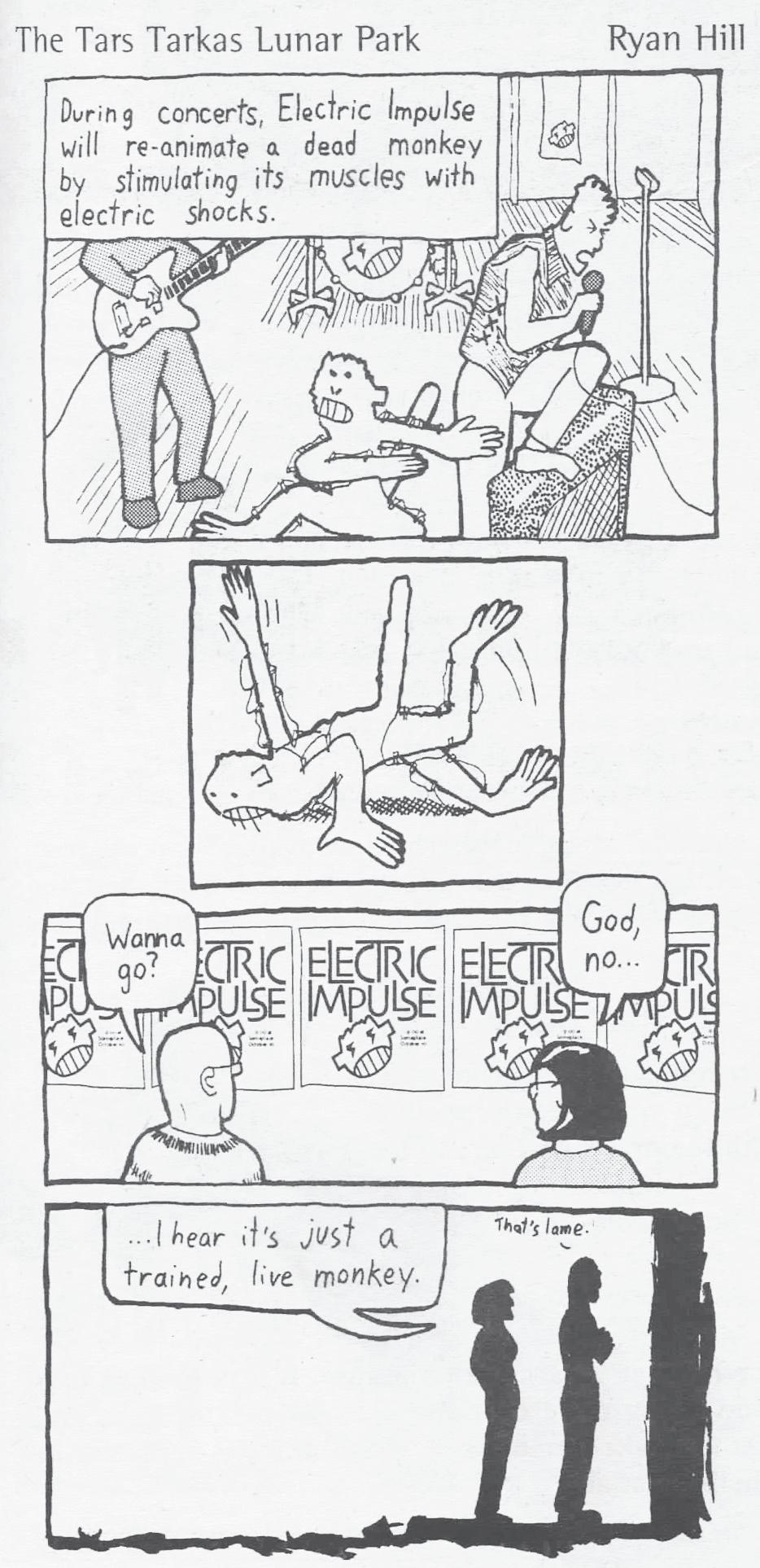
In those days, the ‘toban comics page was home to many talented artists: Garrett Van Winkle, the Royal Art Lodge, Marcel Dzama, Ryan Hill, Kevin Matthews, Ryan Yoo, Terry Corrigan, Tim Hoover (aka DJ Co-op), and Paul Kim, to name a few. I’m forgetting many, I’m sure, but it’s been, like, more than a decade!
Can you explain the process of putting together pieces like the U of M president dress-up paper doll or the UMSU election all-star cards?
Those are a big hit in the office; what was the response like on campus at the time?
[The] response was positive! They were fun to do, but the work in executing them was crazy! Phil Koch, a colleague at the time, wrote the copy for the UMSU cards. He may have done it for the paper doll thing, too. I just know that the work on pieces like those was all-consuming. Eventually, I dropped out of my BA in English and film (and, earlier, history) and entered fine arts. The ‘toban changed my life, you could say.
From what I can remember, the pieces weren’t necessarily mean-spirited. They made fun of campus public figures, but never in an extremely negative light. For that reason, the satire subjects probably never objected to the strips or editorial pieces in any significant way.
Do you have a funny/ interesting story that you can share about your time at the paper, or connected to the Society Column?
Well, I just said that the people being made fun of never objected; that’s a lie, I guess. I have it on good authority that current member of parliament and thenUMSU president, Steven Fletcher, really hated a caricature I drew of him. Again, accuracy is sometimes more damning than fiction.
By the way, this was the year that UMSU tried to shut down the Manitoban, under the guise of “financial accountability.” Fletcher attempted to halt funding to the paper, effectively silencing the voice any opposition might have. In my opinion it was supremely undemocratic and I’m surprised muzzling the campus press isn’t something that’s dogged him more during his political career.
Relations between the the paper and UMSU remained frosty the next year, too, as Fletcher was re-elected, this time teaming with current CTV Winnipeg weather specialist Colleen Bready as his vice-president.
If your current self could give your past self (from the Society Column days) one piece of advice, what would it be?
“Hey, you’re all right, buddy boy.”
Managing editor: Chuthan Ponnampalam
Contact: me@themanitoban.com / 474.6520
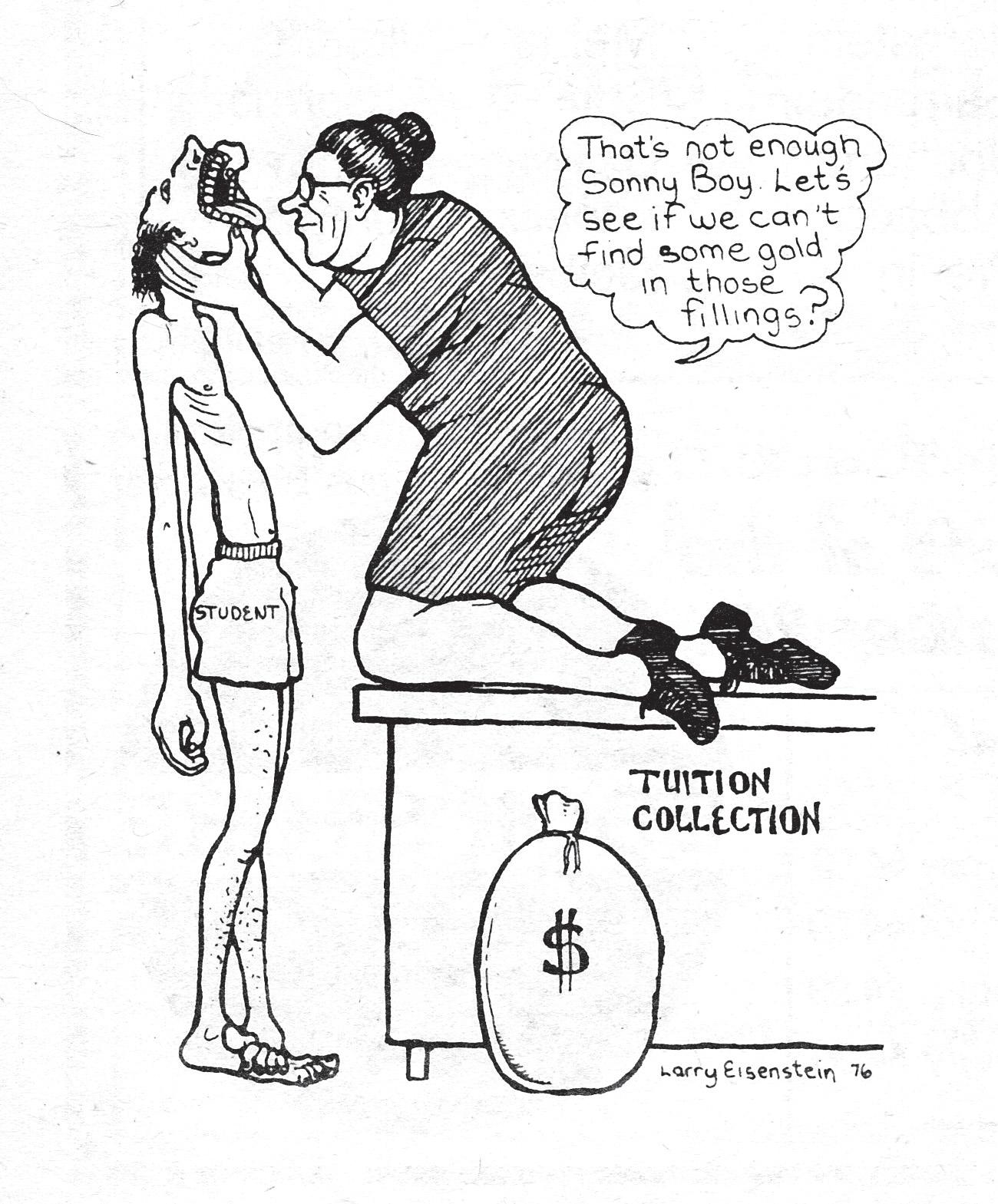
1977, NOV 24, tuitiON COLLeCtiON (LaRRy eiseNsteiN)
1975, JaN. 30, pOLi-sCi guy (deNis NOkONy)
1953, NOV. 17, u OF M LibRaRy (daVe WiLLiaMsON)
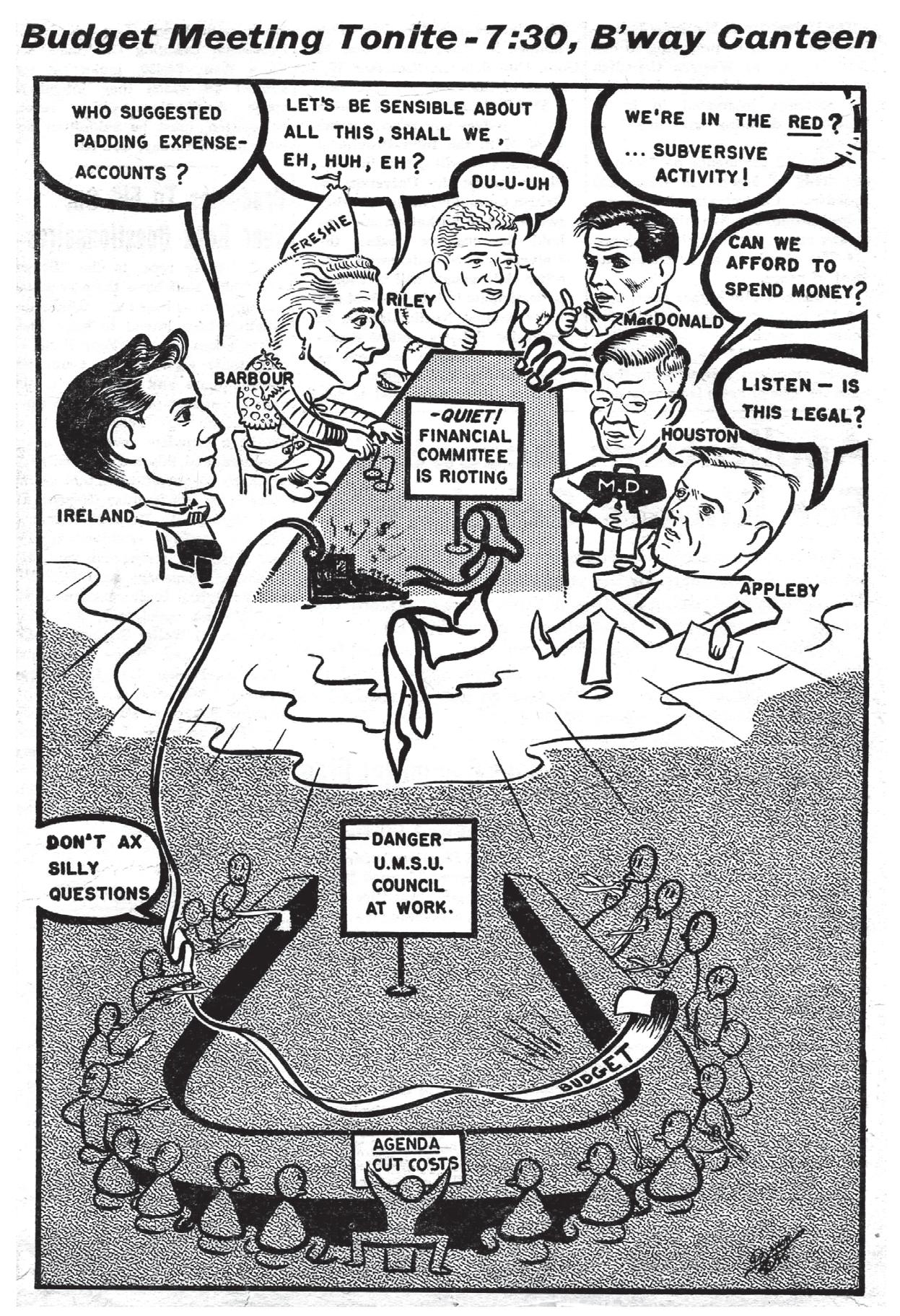
1949, OCt. 18, uMsu COuNCiL
1935, NOV 14, OLd MaN ChuCkLes (MCkibbiN)
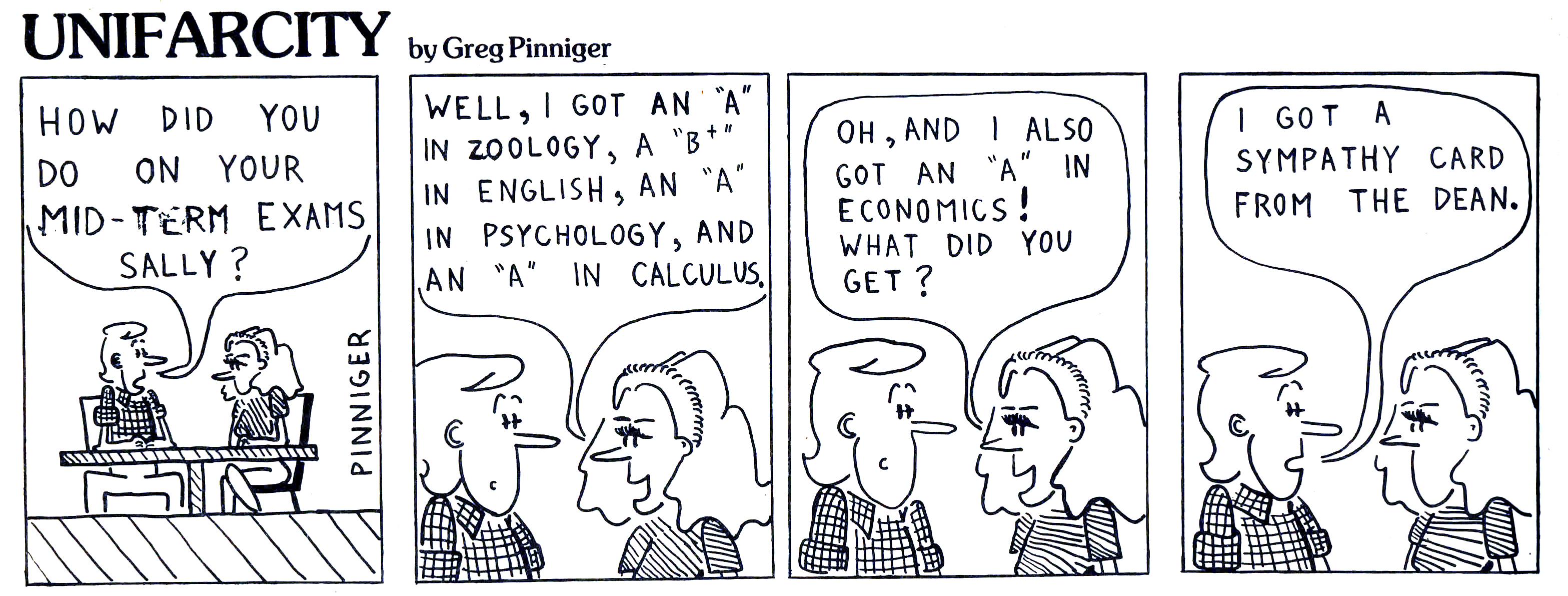
1990, OCt. 31, tWiN sLabs (“k.O.p & JuLiO eCCLesiastes”) 1986, MaR.
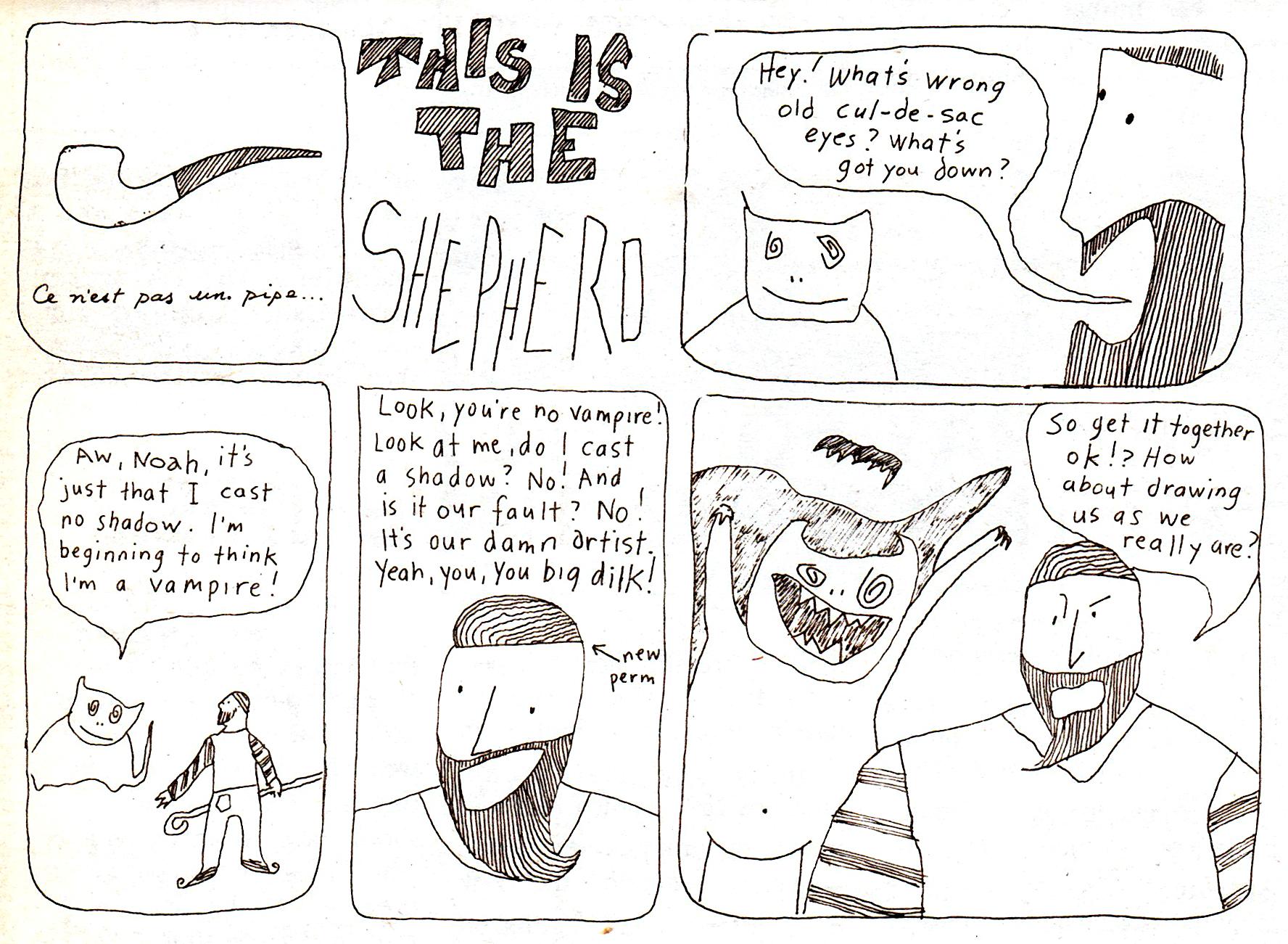
1978, apR. 3, destROy aLL MONsteRs (J. d Lees & tOhO CO.)
Managing editor: Chuthan Ponnampalam
Contact: me@themanitoban.com / 474.6520
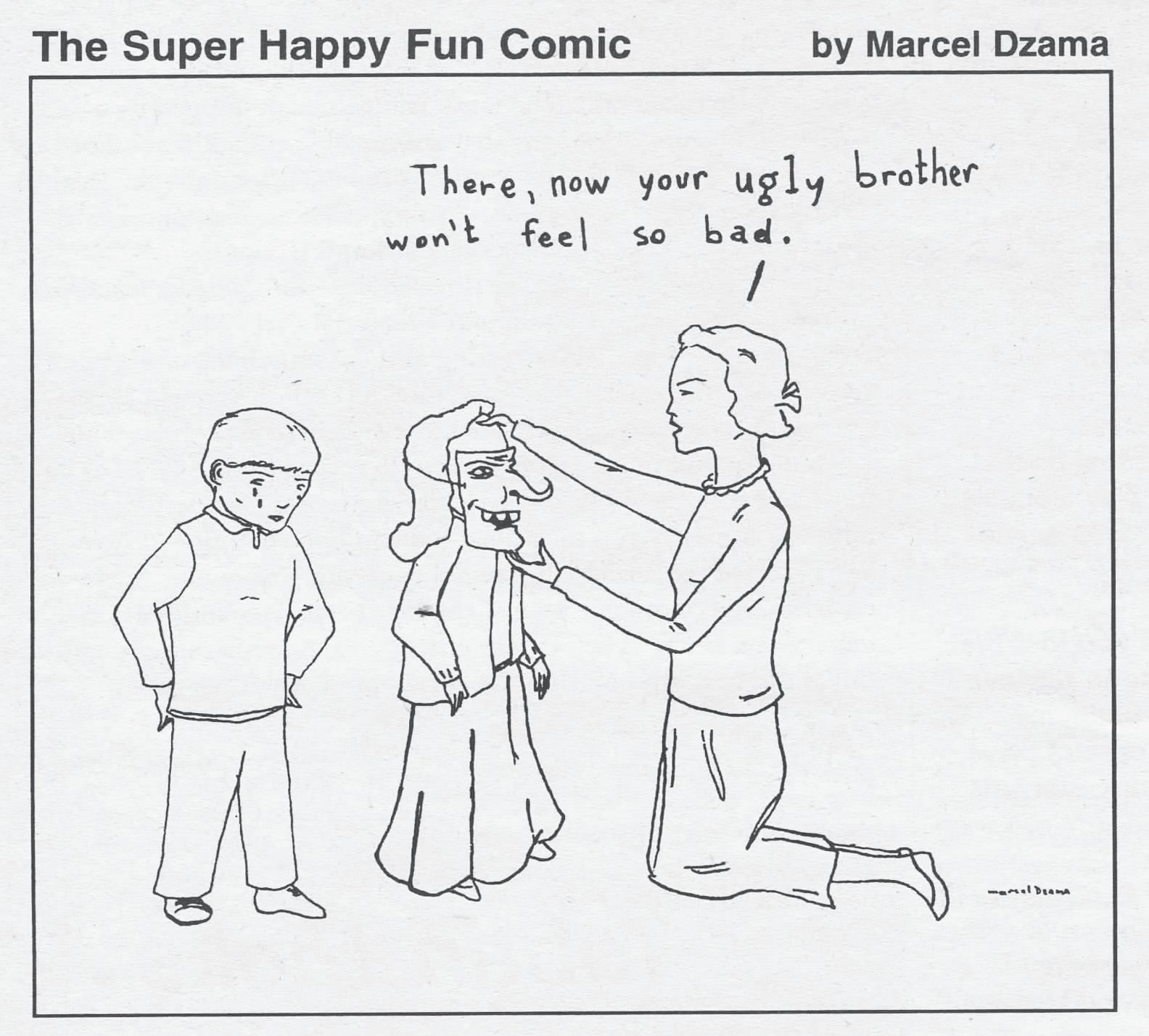
2000, OCt. 27, supeR happy FuN COMiC (MaRCeL dzaMa)
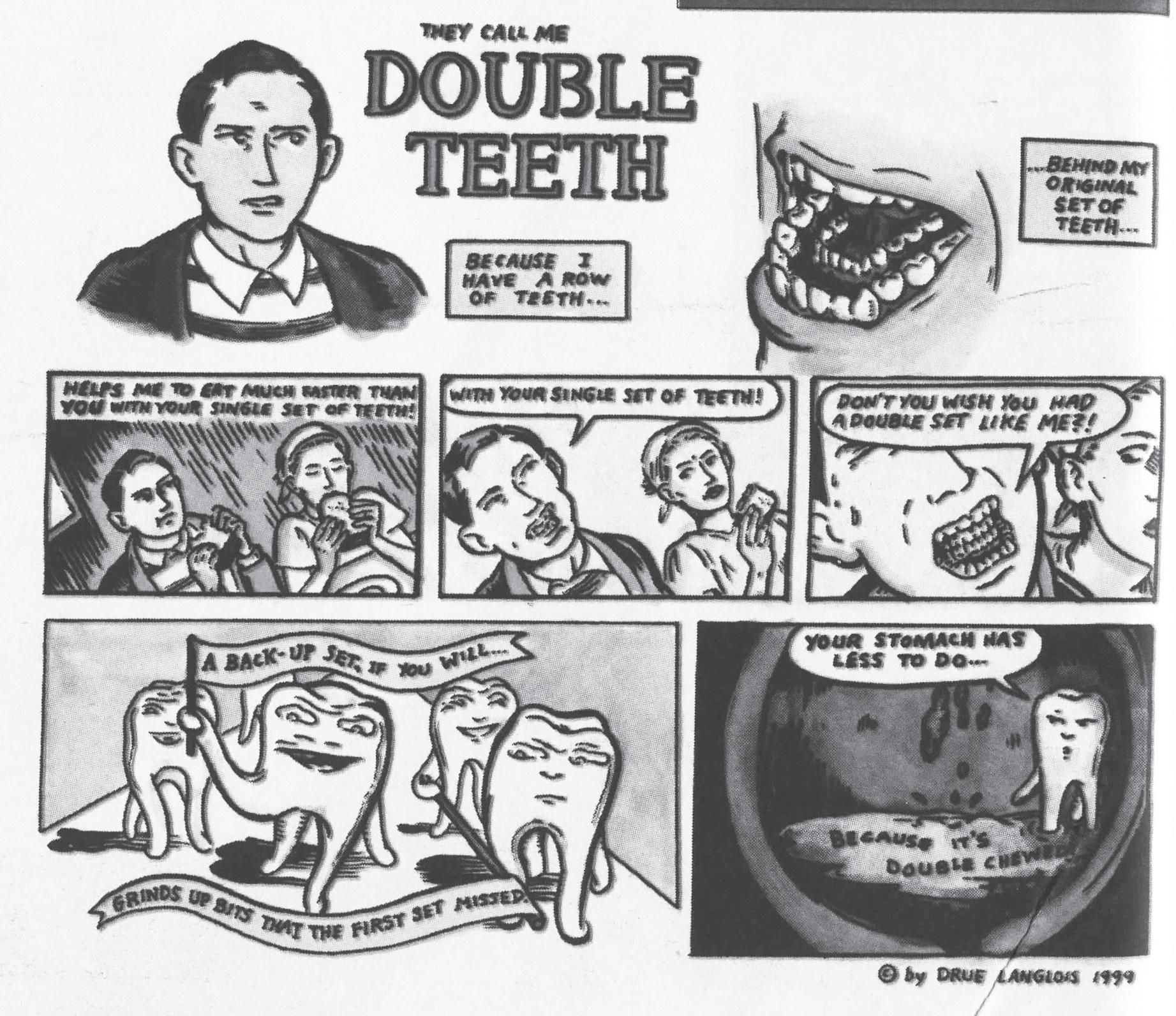
2000, MaR. 22, dOubLe teeth (dRue LaNgLOis)
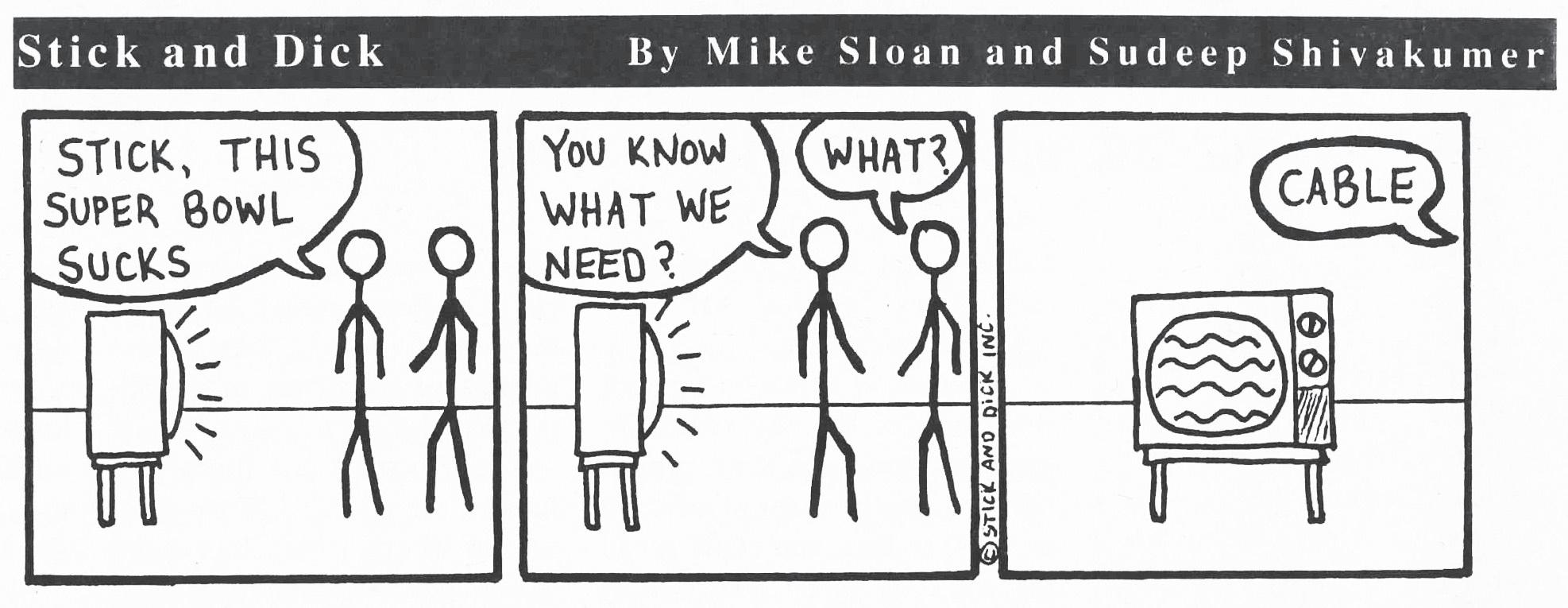
1997, JaN. 29, stiCk aNd diCk (Mike sOLaN aNd sudeep shiVakuMeR)
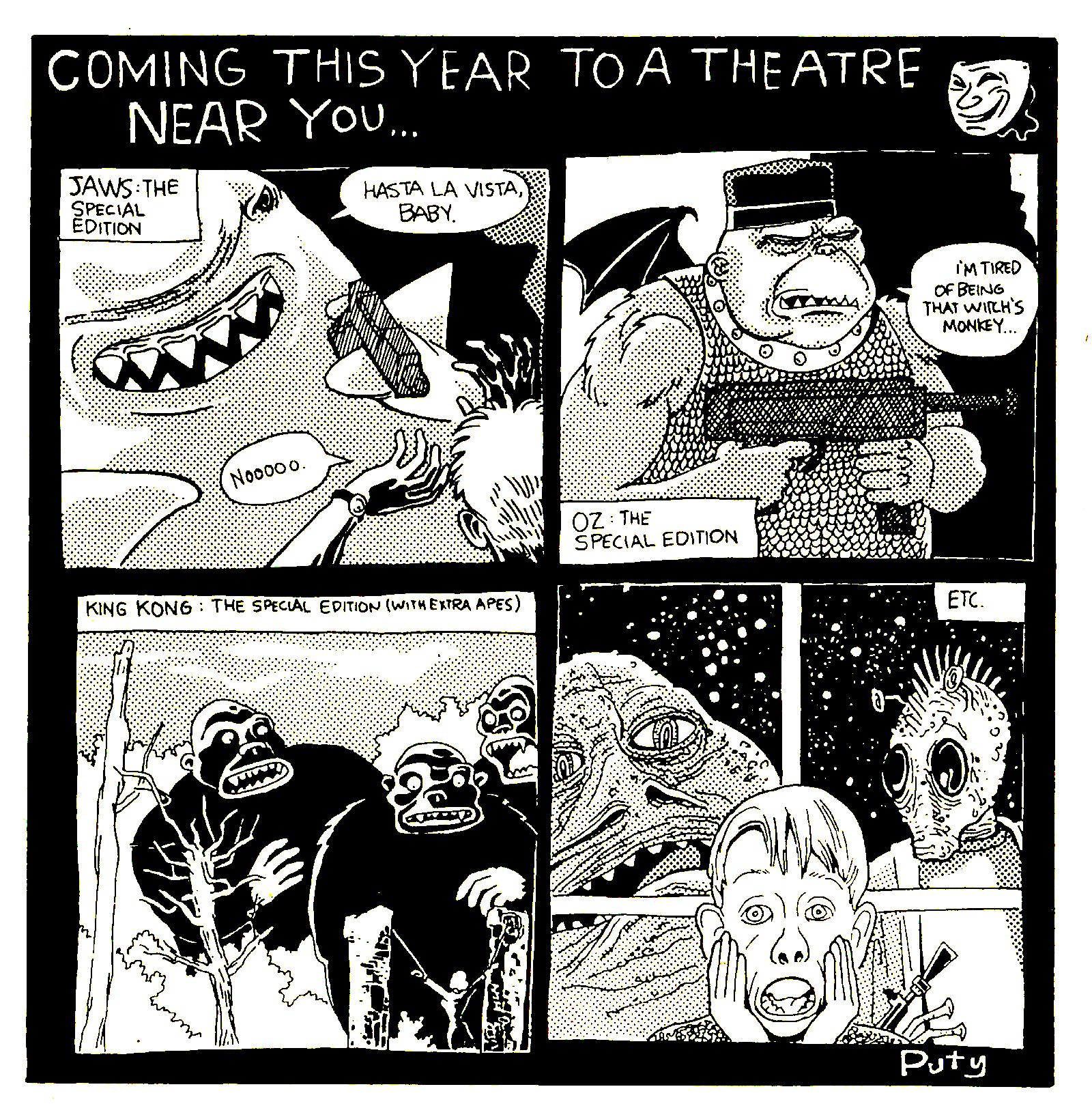
1997, Feb. 5, COMiNg tO a theatRe NeaR yOu (“puty”)
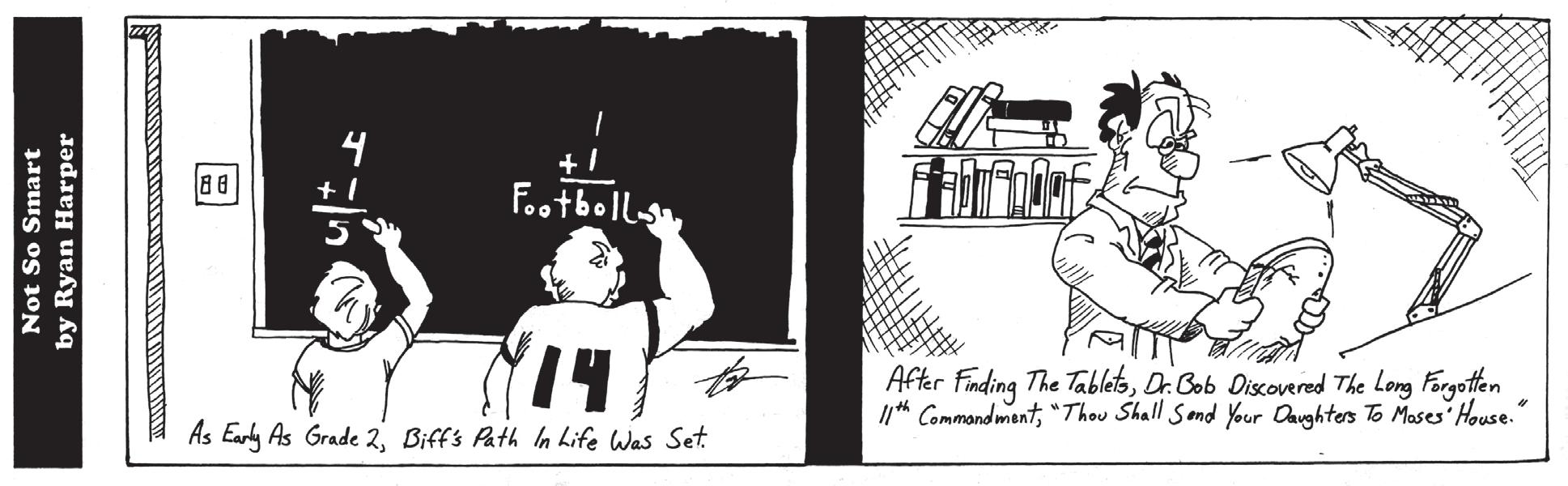
1994, OCt. 5, NOt sO sMaRt (RyaN haRpeR)
Managing editor: Chuthan Ponnampalam
Contact: me@themanitoban.com / 474.6520
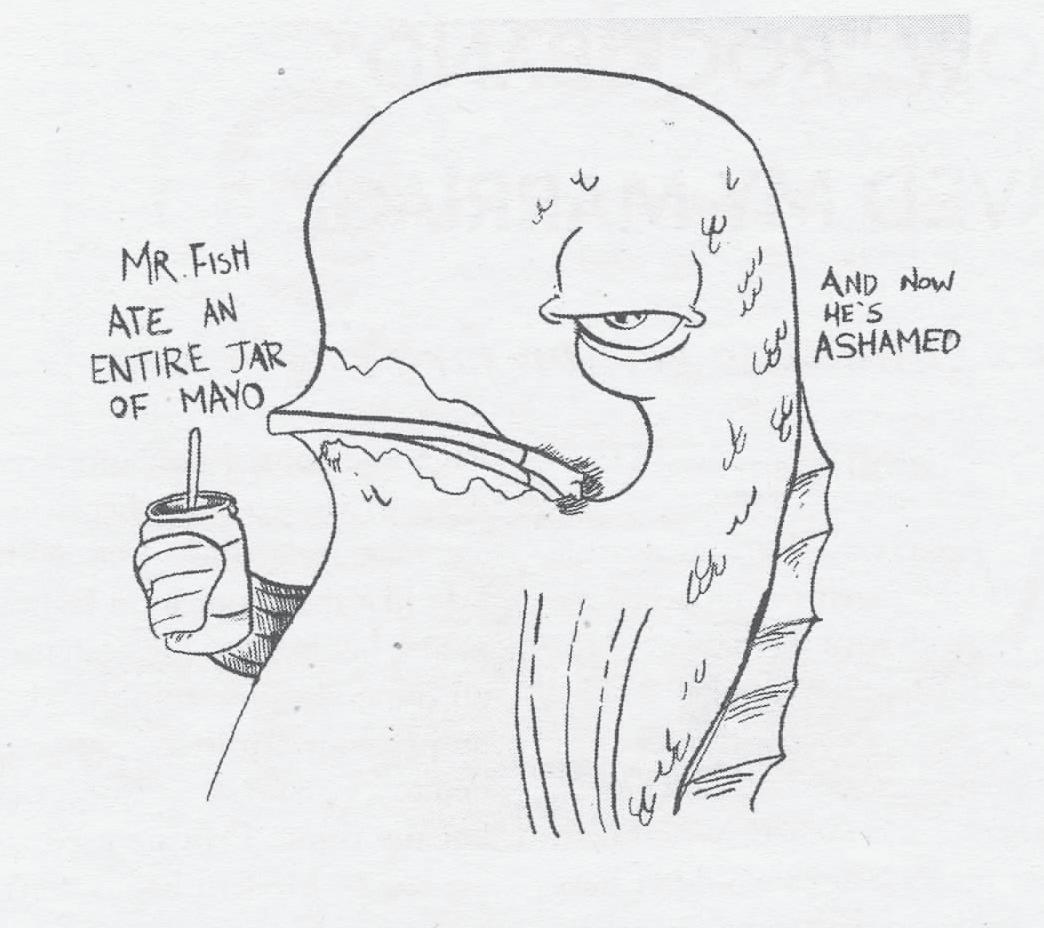
2009, JaN.6, MR. Fish (beN CLaRksON)
2009, Feb. 13, beaR WaRLOCk (bReNdON saLakOh)
2005, OCt. 26, skeLetON babies (ted baRkeR)
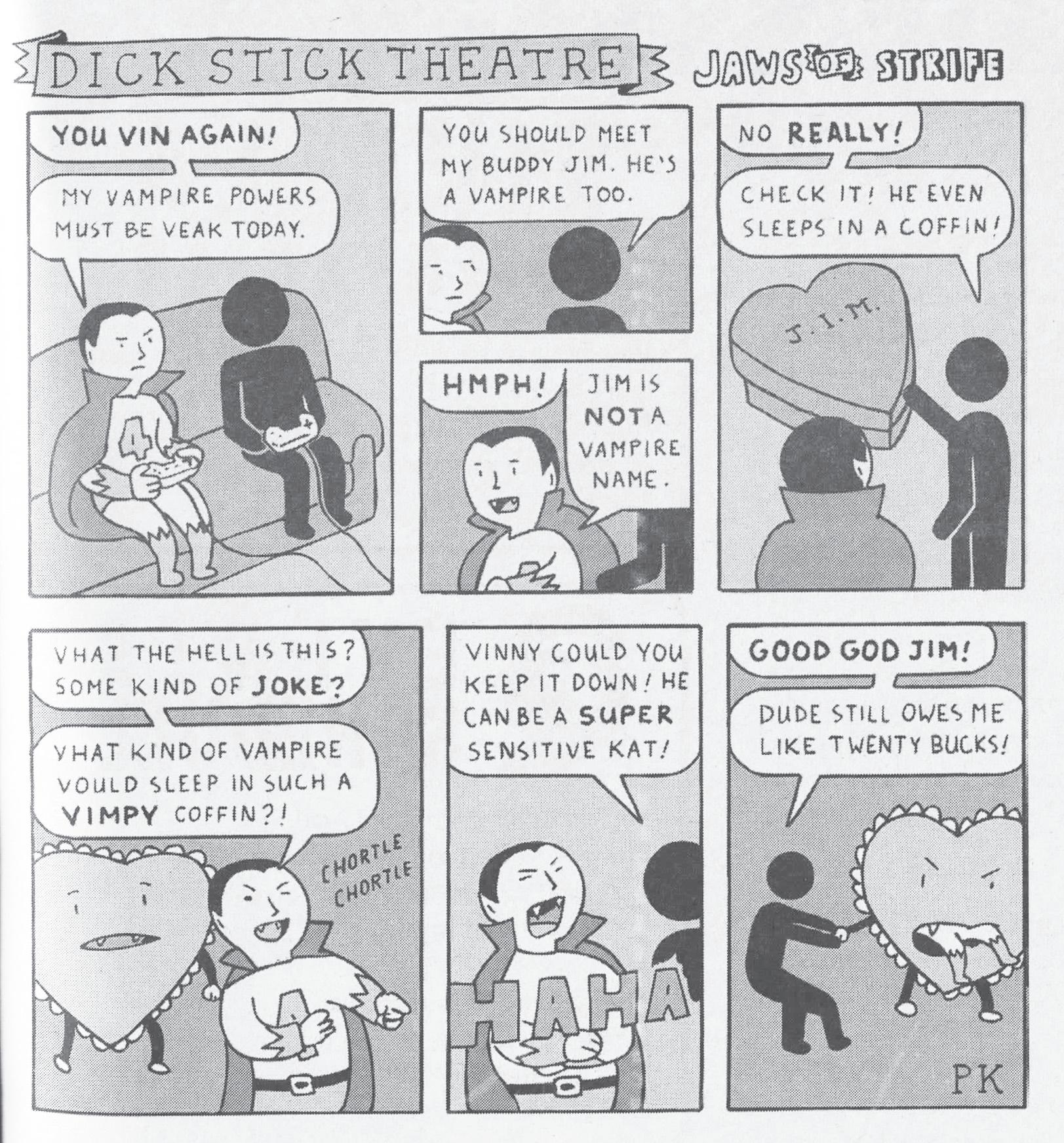
2004, sept. 8, diCk stiCk theatRe (pauL kiM)
JOB POSTINGS
position: Editor-in-Chief company: The Manitoban salary: Approximately $20,000 annually contract: May 1, 2013 – May 14, 2014
dutiEs: The Editor-in-Chief (EiC) is one of two executives of the Manitoban. The EiC is responsible for the day-to-day running of the editorial side of the paper, and has final say over the editorial content within. The EiC is also the chair of the Editorial Board and Manitoban Newspaper Publications Corporation, which oversees the long-term operations of the paper.
Qualifications: The ideal candidate will have experience in student media and will be familiar with the Manitoban. They should have a strong understanding of the English language including spelling, punctuation, and grammar as well as a working knowledge of Canadian Press style. Previous experience managing employees and working in a non-profit environment will be considered an asset.
how to apply: Email your resume and cover letter to hiring@themanitoban.com before March 20, 2013. Visit themanitoban.com for more details
position: Business Manager company: The Manitoban salary: Approximately $20,000 annually contract: May 1, 2013 – May 14, 2014
dutiEs: The Business Manager is responsible for overseeing the general business functions of the Manitoban newspaper including accounting, payroll, taxes, human resources, marketing, and management. Day-to-day duties include managing accounts receivable and payable, invoicing, and general administrative duties. Long-term duties include strategy development, marketing, and process planning.
Qualifications: The ideal candidate has business experience through work or school that includes basic accounting knowledge. They have ideally worked in an office setting and have experience in a decision making role.
how to apply: Email your resume and cover letter to hiring@themanitoban.com before March 20, 2013. Visit themanitoban.com for more details
position: Advertising Coordinator company: The Manitoban Newspaper Publications Corporation salary: Summer: $600 biweekly + commission (30 hr. per week) School Year: $400 biweekly + commission (20
- May, 2014
Qualifications: The Manitoban is seeking to hire a responsible, dedicated, and detail-oriented individual to handle all print and online advertising sales for the newspaper. The successful candidate will gain valuable experience in marketing strategy and tactics, sales and negotiation techniques, product demonstration, and customer needs assessment.
This position is full time from June 1 until the end of August, and 20 hours per week during the school year.
dutiEs: Protect and increase existing client base. Explain benefits of advertising to potential clients. Recommend appropriate sizes and formats for advertising. Prepare and deliver sales presentations to new and existing clients.
how to apply: Send resumes to hiring@themanitoban. com. Applicants must have taken post-secondary courses within the past two years. All applications due April 1, 2013.
Visit themanitoban.com for more details
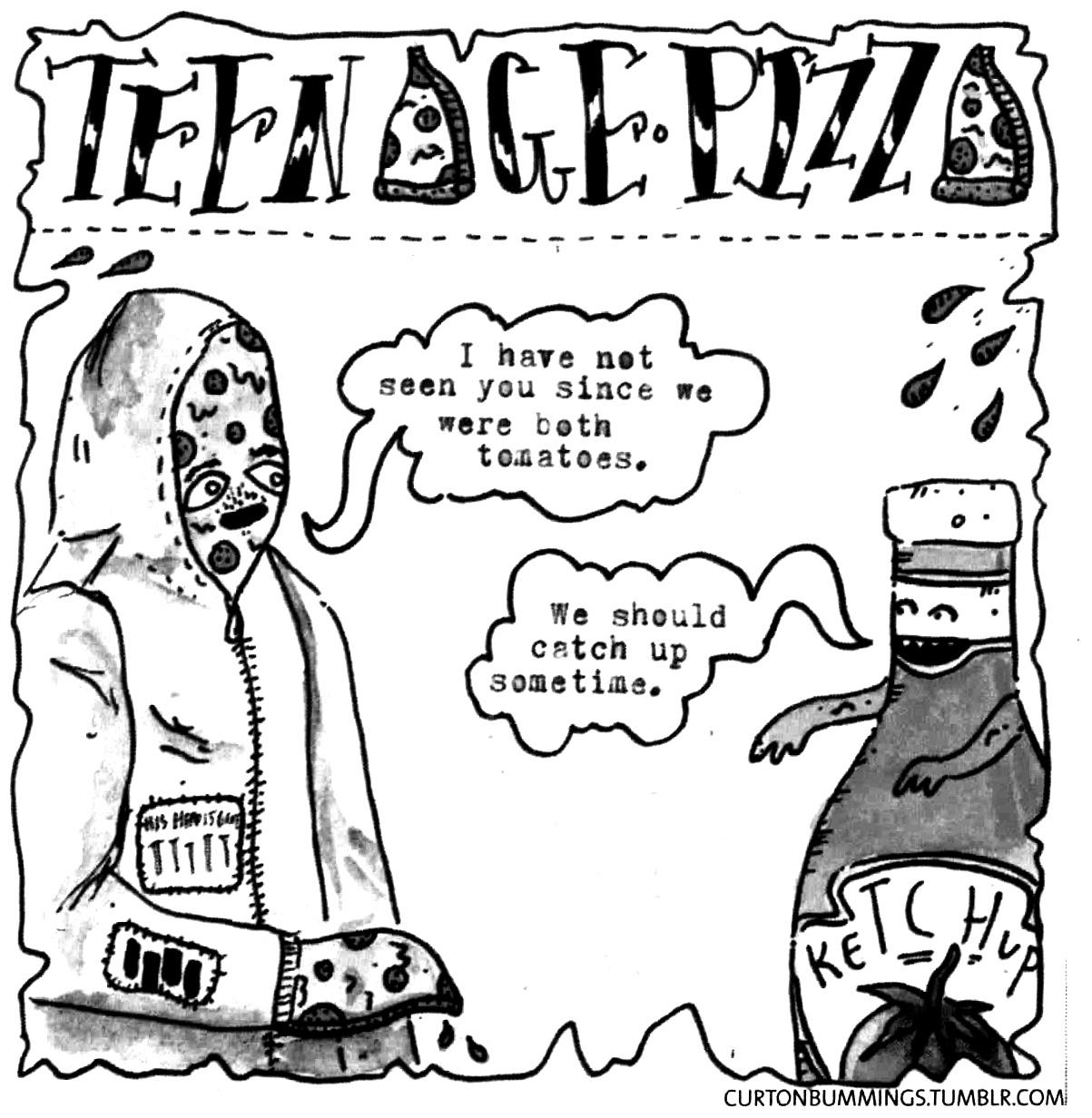
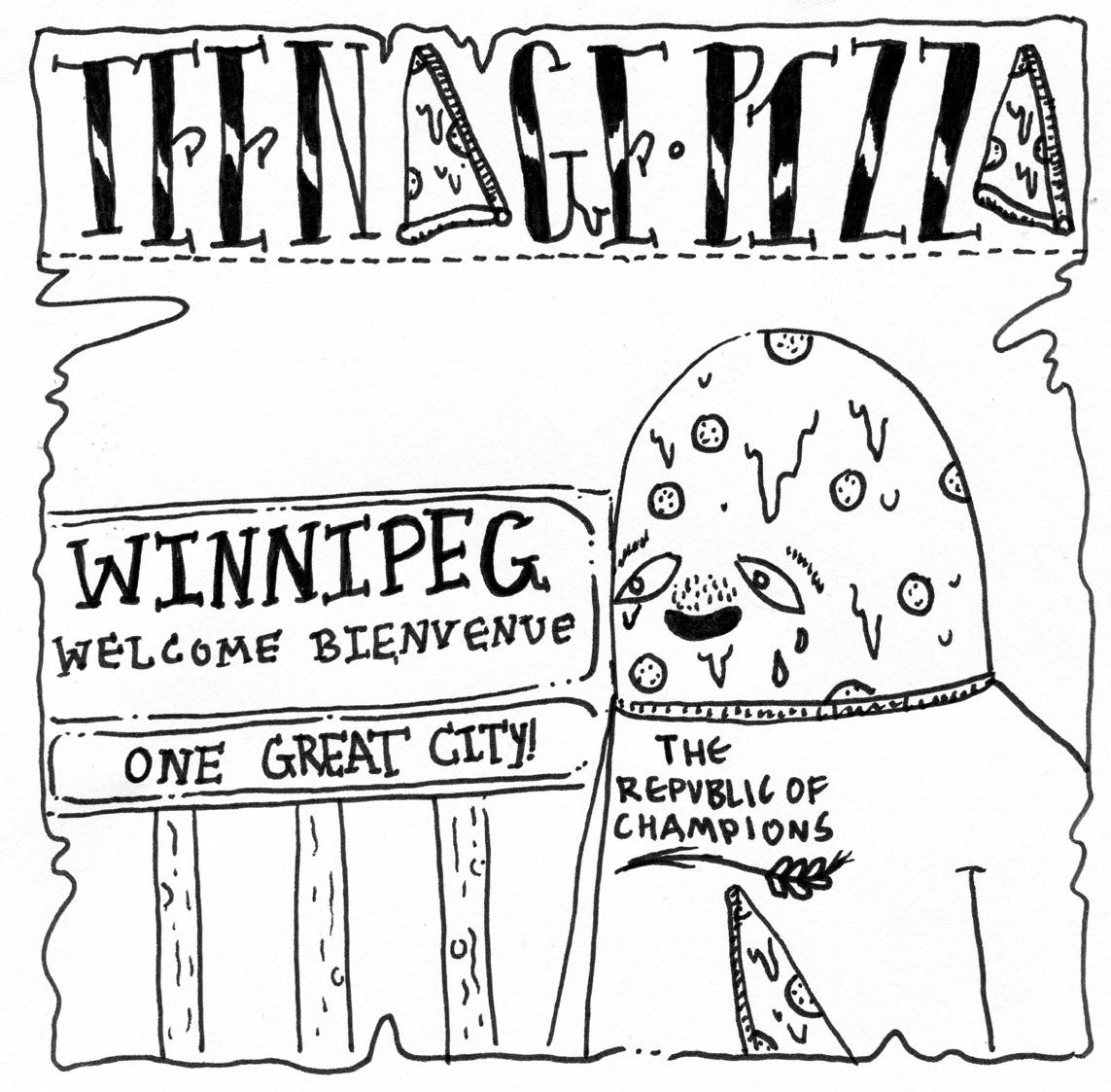
2012, JaN. 25, teeNage pizza (daNy Reede)
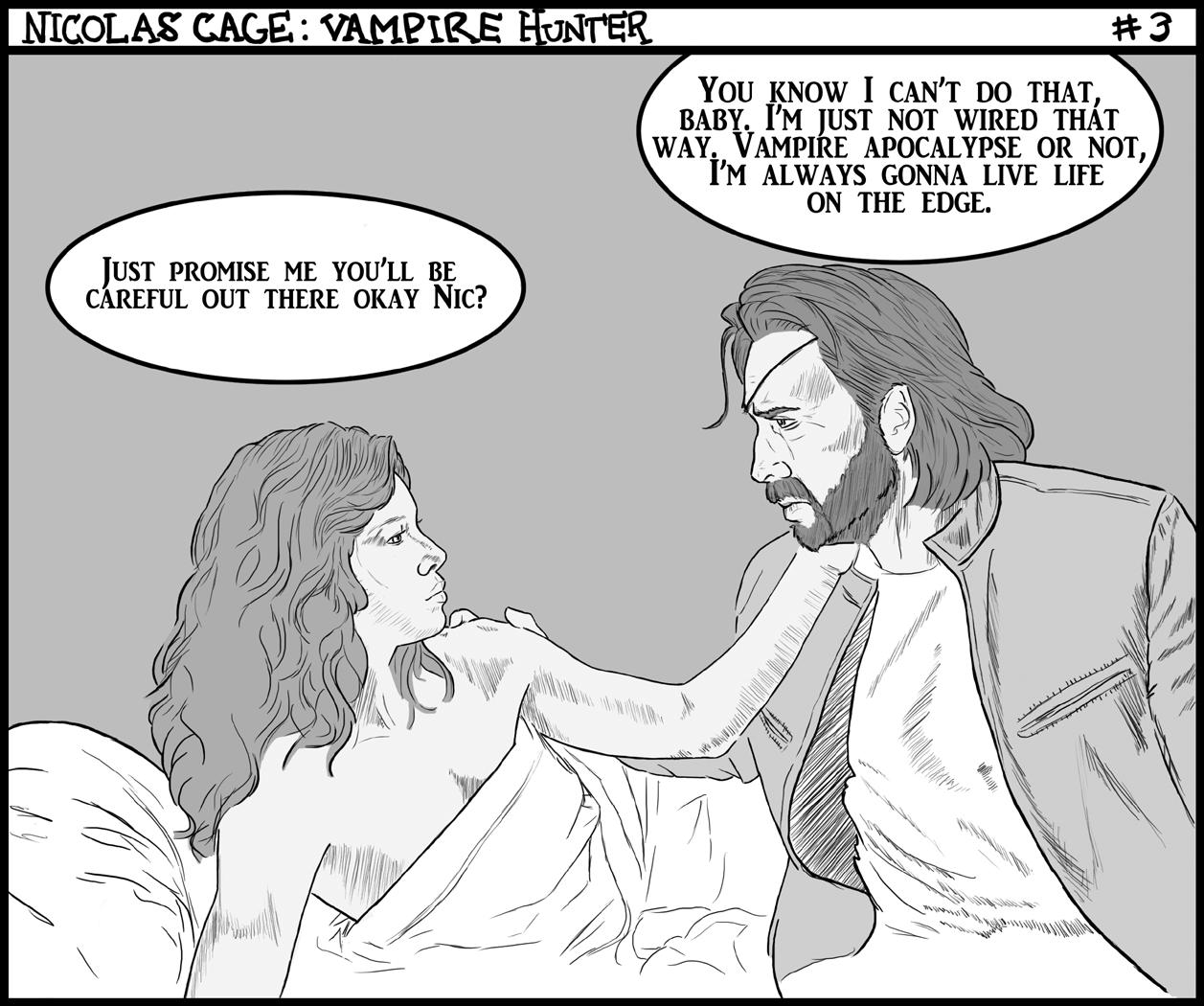
2011, Feb. 2, NiC Cage VaMpiRe huNteR (RyaN haRby)
LauReN
Arts & Culture
Gimme Some Truth
Cinematheque
plays host to the fifth annual festival of innovative documentary films
m ichelle sARomo, volunteer staff
The fifth annual Gimme Some Truth Documentary Festival, hosted by the Winnipeg Film Group, will run from Mar. 14 until 17 at the Cinematheque; the festival will be showcasing a series of screenings from some of the most innovative filmmakers in recent years.
There will also be panel discussions, master classes led by visiting filmmakers, and networking event opportunities. The festival strives to highlight the work of both local and international artists alike, and acts as a public forum for discussing the art of the documentary.
“Let’s be honest – we’re stuck in the middle of Canada with no ‘big’ film festival. We’re trying to rectify that by bringing in some of the most exciting filmmakers in the documentary genre and at the same time celebrate the incredible community of filmmaking in Winnipeg,” says festival producer Jaimz Asmundson of the Winnipeg Film Group.
“I think it’s evident from the programming this year that documentary film is not synonymous with ‘after school special’ conventional storytelling. We have some very
innovative storytellers in town this year that are pushing the medium to the limit.”
Visiting music documentary filmmakers Sam Dunn and Scott MacFadyen will be opening up this year’s festival with Metal: A Headbanger’s Journey. The film follows Dunn as he explores heavy metal culture in Europe and North America and contemplates the stereotypes associated with the genre. Dunn and MacFadyen are known for making documentaries on the heavy metal genre and have even filmed
for the likes of metal rocker legends Iron Maiden and Alice Cooper. In addition to featuring their films, they will also be hosting a master class on their approach to the music documentary.
Jonathan Caouette’s documentaries, Tarnation and Walk Away Renee, will also be featured during the festival and he will play host to another master class. Caouette is internationally known for entrenching his documentaries with highly personal elements and chronicling his dysfunctional childhood and the teeter-
totter relationship between him and his mother. Caouette’s class will be focusing on his approach to personal documentary filmmaking.
Many of the screenings lined up at Gimme Some Truth come from some of the city’s great local talent – University of Manitoba alumni Stéphane Oystryk is one filmmaker among them. Most documentaries on musicians tend to be made after they’ve hit it big, but his documentary Alors, t’as soif de quoi? (avec Mahogany Frog) drives the gears in reverse. Following the daily lives of local band Mahogany Frog, the documentary tells the story of a band with a day job that continues to make music that they’re passionate about, despite the lack of mainstream acceptance.
The closing screening of the festival, Dollar Store Dreams: The Films of Mike Maryniuk, will be featuring a compilation of Maryniuk’s short films. Maryniuk has been lauded for his unique take on the art of film documentary. His hybrid experimental style mixes bits of animation into traditional documentary.
“I kinda make these celebration documentaries, as opposed to
explanation documentaries,” says Maryniuk. “It’s less about telling the story in kind of a linear fashion, and more about celebrating certain aspects about the person and kind of creating an experience as opposed to creating a narrative of events.”
Maryniuk says he also infuses his works with humour.
“I want people to enjoy the experience. I want people to kind of want to learn more about these people or this place afterwards and so humour is one way of getting those things across.”
Gimme Some Truth doesn’t just celebrate the art of documentary filmmaking; it also honours the power of storytelling and its ability to enrich the public.
“Documentary is a really important cultural and social tool. I mean, it can change the world,” says Maryniuk. “It has changed the world. [But] it can also be just purely entertaining and remind us of who we are as Winnipeggers, as Canadians, as fans of a certain genre of music, or just as humans.”
For a list of the full program screenings, visit gimmesometruth.ca/ program-2013
Ah, Saint Patrick’s Day, a holiday celebrating binge drinking and the colour green. Maybe once it might have had something to do with Irish people and snakes, but that connection has been buried by the sands of time.
I can’t think of a better soundtrack to a night of brain-cell-killing fun than the bill that the Rose n’ Bee has planned for this Sunday. The R n’ B has put together three bands of unpretentious and unapologetically fun music.
The Unbelievable Bargains
Those of you who follow Locals to Look Out For might remember the Unbelievable Bargains from my very first column, when I discussed the creative exploits of Mr. Steve Basham, a solo artist and front man for the Girth. In the Bargains he hops on bass and the man holding the reins is the ever-talented Marshall Birch, a songwriter whose unique blend of humour and honesty has delighted
fans across Manitoba.
The group is rounded out by Winnipeg’s most energetic rhythm monster, a man that drums so hard he’s often known to fly right off his stool: the one and only J.P. Perron (This Hisses, ex-Mahogany Frog).
The Thrashers
If you wanna party like a modern day Frankie and Annette but don’t know how to get a beach blanket boogie going at the local skate park, the Thrashers will show you how it is done.
Mixing high energy surf rock with anthem punk rock abandon might not sound novel on paper, but believe you me: these guys do it with such freewheeling enthusiasm and genuine ‘peg city style that you can’t help but fall in love with this band. From Jesse Bercier’s switchblade-sharp guitar licks, to Iaian Loeppky’s wild bass lines and even wilder hair, to Sean G’s beats rolling like thunder in the distance – the Thrashers are relevant
retro that can’t be stopped. The Bad Nerves Before I give the lowdown on the Bad Nerves, I have some questions. Why do the kids from Selkirk make such great music? Was there something in the water in the early 2000s? Did their high school have some kind of experimental garage rock music program?
Whatever the cause, the effect has been a tidal wave of excellent rock n’ roll sweeping over this fair city, leaving blown-out brain cavities and buzzing ear drums in their wake.
The Bad Nerves are no exception; they spit angular keyboards sounds, grinding distortion, and propulsive rhythms that would make Jay Reatard grin, sneer, or smash something –whichever of those would best signal his approval.
So now that you are in the know, if you want to celebrate St. Drunkard’s day with me, I’ll see you at the Rose n’ Bee.
The Unbelievable Bargains, the Thrashers, the Bad Nerves
20 years of Ruins
Shakespeare in the Ruins celebrates 20th anniversary
sARA h Petz
Amidst the rustic ruins of a Trappist Monastery, a small group of Winnipeg actors put on a barebones production of Romeo and Juliet in the summer of 1993.
That group of ragtag actors became known as Shakespeare in the Ruins. Twenty years later, the theatre company has survived wind, rain, impossibly hot Winnipeg summers, and almost losing the ruins themselves to become a mainstay in the local arts scene.
Michelle Boulet, one of the artistic co-chairs for Shakespeare in the Ruins, has been there from the very beginning.
The original monastery was established along the La Salle River in 1892. The monks left their home in 1978 when the area became too industrialized for their comfort. Fire gutted the vacated church and residential wing five years later. What was left was a rustic setting full of brick archways, walls, and foundations.
To the ragtag group of actors, it seemed like the perfect setting for Shakespeare, says Boulet.
“There was only really three locations, and there was not really anywhere for them to sit, so they kind of just stood against the walls. Whereas by year two, we had realized we could go outside the ruins, we could go out
into the field, we could go down by the river bank, we could come back in,” says Boulet.
Shakespeare in the Ruins uses promenade-style audience movement, where audience members are lead from scene to scene each held in different locations throughout the ruins. This created quite a bit of confusion during the company’s first production.
“The first year was a little bit ‘bunny in the headlights.’ We were trying something completely new and we weren’t quite sure how it was going to work. But it was fun.”
The company was forced out of the ruins in 2002 after the structure of the buildings began to deteriorate. For ten years, the company moved through several locations throughout Winnipeg, performing in parks and even on top of a parking garage.
“The
theatre company has survived wind, rain, impossibly hot Winnipeg summers, and almost losing the ruins themselves to become a mainstay in the local arts scene.”
After the province of Manitoba invested in a $1 million renovation of the site, the company returned last year for its first performance in the ruins in nearly a decade.
Feminism is still relevant
Kevin Klassen has been with the company since 2002. What he finds sets Shakespeare in the Ruins apart from the rest of the local theatre community is the lack of barriers between the actors and their audience.
“There’s no lip of the stage, there’s no seating area, and this is where the stage starts. You’re sharing the exact same space; in between the actors are directing the audience where to go and speaking directly to them,” says Klassen.
A performance that highlighted this aspect of the company’s performances for Klassen was a production of Romeo and Juliet at a small school in Gladstone, Man. Klassen was Juliet during this performance, and a group of five-year-olds were so entranced by seeing Juliet and Romeo together that they started chanting.
“I was lying in the tomb near the end of the show. And Romeo came in to the tomb and there were like five or six kindergarten kids sitting in the front row. And as Romeo started walking toward Juliet’s dead body, they started chanting under their breath ‘kiss her, kiss her, kiss her,’” Klassen said.
“Just the idea that these five-yearold kids were following along and knew exactly what was happening,
and were so engaged that they were trying to influence the outcome of the play – that’s exactly what Shakespeare in the Ruins is here to do.”
Because performances are all held outdoors, the weather becomes an element of each performance as well, he said.
“Because we’re outdoors, we’re sharing the same atmosphere, the same weather, and it’s not controlled. So it really creates an intimate contact between the actor and the audience that you get nowhere else, at least in Winnipeg.”
“And because the elements are uncontrolled, birds will fly in from nowhere, squirrels will appear, dogs. So it reminds the audience that it is a live experience. That in every performance, every moment, it is truly unique.”
Considering many small theatre companies don’t survive past their 10th birthday, the 20th anniversary of Shakespeare in the Ruins is a unique feat, says Boulet.
“In the whole scheme of theatre companies, we’re a relatively small operation. So it’s a big deal that we’re still around.”
Shakespeare in the Ruins’ 20th anniversary celebration will take place at the Prairie Theatre Exchange Mar. 15.
Film review: Status Quo? The Unfinished Business of Feminism in Canada
Jodie lAyne, staff
T
he opening scene of Status Quo? The Unfinished Business of Feminism in Canada interchanges and overlaps footage from the first Royal Commission on the Status of Women hearings in 1967 and the 2nd PanCanadian Young Feminist Gathering in 2011 in Winnipeg. While it’s striking how deftly director Karen Cho weaves together the similar images of what women gathering looks like, she’s able to even more shockingly show us how similar the attitudes of society and the struggles are many years later.
How have things changed for women in Canada? Have they changed at all? This film explores those questions.
Status Quo? examines some of the most pressing issues of modern feminism: domestic violence, missing and murdered Aboriginal women, abortion access, domestic international worker struggles, and reproductive justice (including mothering resources and daycare). The film not only covers decades of the struggles of women, but puts individual human
beings on screen instead of just speaking about them broadly.
Putting faces to the issues at hand makes the struggles of women irrefutable. Cho shows women who are personally affected by laws and policies put in place by the government as well as the attitudes of society, a brilliant directorial choice.
The ideas and struggles documented are apt and relevant for our political climate. Under the Harper Government, women’s initiatives have suffered a huge blow; “equality” was removed as an objective in the Status of Women Canada’s mission statement, funding for independent research projects as well as advocacy and lobbying (all funded by Status of Women Canada) experienced a 100 per cent research cut, the Aboriginal Healing Foundation and the Sisters in Spirit Initiative were defunded, the pan-Canadian childcare funding ($1.2 billion) was revoked, and 12 out of 16 regional Status of Women Offices were closed.
These points are noted in the film and some are illustrated through the
personal experiences of women and those who do the work affected by these cutbacks. However, I feel that Cho really misses the mark when it comes to linking the issues and demonstrating the intersectionality that modern feminism acknowledges and thrives on – at least, concretely. While it’s suggested and hinted at abstractly, Cho never really spells it out for the viewer. While some may like the ability to connect the dots, I worry that those new to feminism
or non-feminist viewers might miss the importance. In an age where Sady Doyle’s decree that, “My feminism will be intersectional or it will be bullshit,” has rung out loud and clear as the mandate for this wave of feminism, I do think that making this connection for the viewer falls short.
The film features many scenes from the RebELLEs gathering in
“Putting faces to the issues at hand makes the struggles of women irrefutable.”
2011, which serve as optimistic and inspirational aside from the harrowing discussions and facts that show the real current status of women. They also serve as bookends and dividers between the segments, so their utility is understandable. However inspiring and hopeful, these scenes do feel
a bit disjointed with the rest of the film and their subject matter doesn’t necessarily correspond with the issue being discussed prior to their inclusion. I understand the importance of including this material and the role that it plays in the film, I’m just uncertain about where it’s placed.
Regardless of my critiques, this film is an absolute must-see and eye-opener. Even for those who consider themselves well-informed, you can’t really grasp many of the realities behind that information until you hear it from the mouths of the women affected. It’s one thing to know how difficult it is to attain an abortion under the stringent laws of New Brunswick, but it’s another to hear women who have tried talk about how difficult it was.
My hope is that this film will leave skeptics and seasoned feminists alike realizing how relevant feminism still is in today’s society.
You can watch Status Quo? The Unfinished Business of Feminism in Canada at http://www.nfb.ca/ international-womens-day/
Over the Top
MAWA’s ninth annual art auction and cupcake sale
Jodie lAyne, staff
How many cupcakes can you eat?
No really, how many?
Mentoring Artists for Women’s Art (MAWA) will push your sugar consumption and stomach capacity to the limits with its ninth annual all-you-can-eat cupcake party and art auction, Over the Top.
“Over the Top is pure madness and fun,” says Shawna Dempsey, co-director of MAWA.
The event is a major fundraiser for the arts organization and crucial in continuing its programming, which enriches Winnipeg’s arts scene and the lives of the women it mentors.
“This event is almost essential to MAWA. It covers over 10 per cent of our annual projects. It’s really unusual for a single event to make up so much of an organization’s income.”
Dempsey adds that the fundraiser not only helps them to stay open, but to remain more independent and less reliant on grants and other organizations for funding.
Aside from over one thousand
cupcakes decorated and donated by MAWA bakers, there will also be art for auction and raffle prizes.
“130 artists lovingly donated their works and that shows how supportive of the event they are and how much the programming means to them,” says Dempsey.
Those who have donated work this year include noted artists such as Wanda Koop, Melanie Rocan, Shaun Morin, Paul Robles, and Pauline Brau, amongst others. Pieces from emerging and student artists will be auctioned off as well, starting at $50.
“The pieces are hung cheek to
jowl, side-by-side, and is a non-hierarchical free-for-all celebration of the art that is being produced in our community.”
For MAWA, staying open means
Aside from over one thousand cupcakes decorated and donated by MAWA bakers, there will also be art for auction and raffle prizes.
being able to run programs that support artists and the community.
MAWA offers lectures, residencies, workshops, and the international craft program, which pays newcomer women to teach their traditional crafts to other women during
monthly workshops. The mandate of the organization is to be an art education centre, involving the entire community, no matter their gender –although its mentorships are available exclusively to women.
MAWA, which was formed in 1984 as a way to support female artists who felt they didn’t have a place in the Winnipeg art galleries and art departments at universities, has been connecting and supporting these artists for nearly 30 years now.
“Our programming is peer-based, so it’s artist to artist,” says Dempsey. “Art is an essential service. They need art in their lives and MAWA makes art happen.”
Over the Top will take place on Sunday, Mar. 17 at MAWA, which is located at 611 Main Street. Advance tickets are $10 or you can pay $12 at the door, which is pretty damn good for having a buffet of cupcakes (vegan, glutenfree, and otherwise) spread out before you and an opportunity to grab some amazing artwork
Local new releases
Jenn A d iubA ldo, staff
In… Ready to Go by grEg arcadE
The newest release from rock and roller Greg Arcade is another example of this Winnipeg oneman-band’s ability to write catchy and simple pop songs that you’ll be humming for days. The EP, entitled In… Ready to Go, features five little ditties that provide the perfect soundtrack for highway driving with the top down and your honey by your side.
The album starts out with the track, “If You Don’t Mind…” which is a fast-talkin’, hot-doggin’, good ol’ tune about travelling the world and making love with your sweetheart. Next up is “Hunny Bee,” another ode to love gone right, in the style of Hank Williams.
The album continues on in this fashion, with cute, simple, three-chord melodies proclaiming this six-stringed heartthrob’s love for his baby, song by sweet little song.
This record is stripped down in just the right way and makes you feel like you’re sitting in a living room with Arcade and his guitar. The songs do become a bit repetitive, but that’s the nature of the twelve-bar blues.
Do yourself a favour and pick up two copies of Greg Arcade’s new album – one for yourself and one to share with your main squeeze.
Chalet by kids & hEroEs
Chalet is the first fulllength album from Winnipeg pop-punk outfit Kids & Heroes, and the band’s second release overall.
Chalet draws obvious influence from iconic punk bands such as NOFX and Guttermouth. Tracks like “What If” and “Take It Back” feature fast, no frills punk rock, whereas songs such as “Give Up or Give In” and “Sidewalks” are very reminiscent of some of the earlier work of Blink-182.
Kids & Heroes certainly aren’t reinventing pop punk in any way, but rather getting back to their roots and really embracing the fundamentals of this genre with fast drums, power chords, and generally not giving a shit.
If you’re looking for some good, old-fashioned punk rock then pick up Chalet and let Kids & Heroes be the soundtrack to your next party.
entRenCh by kEn modE
Local noise-punk/metal/ hardcore trio KEN Mode are set to release their newest full-length release, Entrench, on Mar. 19 and it’s destined to be one of the best albums to come out of Winnipeg in 2013.
Entrench follows suit with KEN Mode’s previous albums, but with each release the band gets tighter, more mature, and seems to push their music to new places while still holding true to their signature sound.
This album is loud, fast, and heavy, featuring vast walls of sound comprised of intricate guitar riffs, punchy bass licks, complex drum lines, and passion-
ate lyrics. Each song hurtles you into a vortex of buildups and breakdowns, destroying any preconceived idea of how a song should be structured. Just when you think you’re drowning in an ocean of noise, you get pulled back to the surface as the band leans into a catchy hook.
The album takes off with “Counter Culture Complex” propelling it forward at full speed. Songs like “The Promises of God” and “Why Don’t You Just Quit?” maintain this energy and sense of urgency, while tracks such as “The Terror Pulse” and “Figure Your Life Out” provide not only interesting song titles, but also more laid-back grooves.
It’s likely that Entrench could again garner some award attention, much like KEN Mode’s last release, Venerable, which won them a Juno award in 2012. This album is a must-have for fans of noisecore, metalcore, or whatever other derivative of some obscure music genre. It’s just good, OK?
FoReveR PotentIal by sons of york
Sons of York provide 50s-influenced bubble gum pop with an indie edge that is the perfect soundtrack to any high school dance, and their new six-song EP is no exception.
Forever Potential is the fourth release from brothers Luke, Cody, and James Kennerd, and demonstrates a songwriting ability that is beyond their years. The songs on this album are poppy, well-composed, and filled with catchy hooks.
Sons of York clearly draw influence from bands such as The Strokes and OK Go, with songs like “Young Blood Unite” and “Smoke/Drink” featuring danceable drumbeats and infectious bass lines that will have you uncontrollably tapping your toes and bobbing your head.
Tracks “Answer” and “Sweet Sarah” are a bit more sentimental, with heartfelt lyrics and honey-dipped, three-part harmonies that provide a great balance to the aforementioned high-energy numbers.
Fans of fun, danceable indie pop should surely pick up Forever Potential, and keep your eyes peeled for future releases from Sons of York.
anhedonIa by this hissEs
Anhedonia is by far This Hisses’ strongest release to date, leaving behind their garage rock aesthetic and moving towards a darker and more evil-sounding brand of rock and roll that embodies a new wave/post-punk vibe and borrows influence from bands like the Smiths and Joy Division.
Guitarist Patrick Short takes a front seat on many of the tracks on this album, leading the charge with guitar lines that drive the melody and still seem to know exactly when to fall into the background and let lead singer/ bassist Julia Ryckman take the reins with her warbly, operatic pipes.
The second track on the album, “Blacksmith,” very audibly demonstrates this new change of influence for the band with Ryckman’s very Morrissey-esque vocal approach, while “The Long Slow Crawl” and “Winter’s Grip” take the band in more of an aggressive, punk direction.
It’s clear that This Hisses have found their groove and will likely only continue to grow stronger with each album released. If you haven’t yet checked out This Hisses, then Anhedonia is the album to pick up.
Bison athlete profile
Wilfred Samking, sprinter
mARc lAg Ace, staff
In his third year at the University of Manitoba, Wilfred Samking has proven himself as one of the fastest sprinters in the CIS, and the fastest man on campus*.
Samking raced to a bronze medal with a time of 6.89 in the 60-metre sprint at the 2013 Canada West Track and Field Championships held in Regina Feb. 22 and 23. He was then seeded fourth in the nation in the men’s 60 for the 2013 CIS Track and Field National Championships, held March 7-9 at the University of Alberta. Having qualified to compete in both the 60m and as a member in the 4 x 200 metre relay, Samking finished sixth in the 60m final with a time of 6.94.
The Manitoban got an opportunity to sit down and talk with Samking,
just days before the Bison Track and Field team took off to Edmonton for nationals.
the Manitoban: When and how did you get involved in track and field?
wilfred samking: From a very young age, I was one of the fast kids. In elementary school, before you play any ball sports—or stick sports in the case of hockey— [the] first thing you do is you run. There was always a lot of positive reinforcement from my friends. Through high school I was mostly a basketball player – then my coaches from Fort Richmond, Keith Redfern and Andre Favreau, they really pushed me and said, “you could be really special.”
From there, my senior year in high school, I decided just to stick with track and so I left basketball. Since then I’ve been quite serious with [track and field].
M: If you weren’t focused on track and field, would you be playing basketball instead?
ws:
You know, probably not, because I was good, but I wasn’t the greatest. With basketball, it can be a little bit political, unlike track. If you run a really good time, no one can really tell you anything – you’re just one of the best. With basketball, it’s a little bit harder to gauge that.
M: What’s your favorite event to compete in?
ws:
Probably the 60 metre; it’s short and sweet. Then for outdoors, the 100 metre—once again because it’s short and sweet—but I’m also a hurdler. Some days I really enjoy hurdles. If you have a really great hurdle race it’s more rewarding than a really good sprinting race.
M: What is your daily routine on a race day?
ws:
I usually wake up three or four hours before my race. That way, your body has a chance to wake up because when you wake up you’re pretty groggy. I don’t eat very much, actually; I usually bulk up the night prior to [the race] with pasta. So I usually eat something small like a banana or a little bit of cereal. But I can’t hold very much in my stomach. It might be nerves, but it might just be because I’ve done [the same routine] for such a long time.
M: What sort of training do you go through to improve your speed as a sprinter?
ws: We train six times a week. Monday, Wednesday, and Saturday are your speed days. That’s speed endurance, and speed coming out of your blocks. Speed endurance is your [longer runs]. You need to work on your endurance, and then since I’m a sprinter everything is shorter but it’s higher intensity.
M:
When you’re not competing or training, what do you do to unwind?
ws:
I like dancing. There are a lot of people who like to go to the bar for other reasons, but generally when I go it’s to dance. I find it boring to stand around.
M:
Seems like you’ve always got to be on the move…
ws:
Not always. I do like to stay in as well, because sometimes I am very exhausted. But, if it is to do something that’s not track that’s enjoyable, it’s usually going out with friends and dancing.
M: Do you have any idols, or people who give you inspiration to keep working hard?
ws:
Probably my mom—that’s probably the most immediate [inspiration]—and I always have support from god I feel, so those are my main two idols.
*Note: the claim that Wilfred Samking is the fastest man on campus is purely speculation on the part of the reporter, based on his impressive sprint times in competition. If anyone reading this is interested in challenging this claim, please contact the Manitoban’s sports department so we can test your sprinting ability.
Selfish decision plagues Canada at World Baseball Classic
National team crashes out of WBC as top players stay home
d e Rek gAgnon, staff
I
n the months leading up to the 2013 World Baseball Classic, it seemed as though Baseball Canada might be able to field a truly competitive team and achieve some tournament success.
Canada finished in 13th place at the 2009 edition of the World Baseball Classic. Since then, Canadian baseball players have become amongst the biggest names in the Major Leagues, so if everybody showed up they could field a truly competitive lineup.
Not everybody showed up.
The bad news began when the likes of Ryan Dempster, who would have been Canada’s best starting pitcher, and outfielder Jason Bay declined invitations to play. Pitchers Rich Harden and Jeff Francis would have also bolstered the Canadian rotation, but declined the option to play. These players, while good, are in the autumns of their pro careers, and the fact that the tournament occurs less than a month before the start of the Major League Baseball season makes it understandable to an extent, but it is still disappointing, as they put themselves before their country.
The most selfish of all decisions had to go to Russell Martin. The
catcher of the Pittsburgh Pirates was the best option for Canada behind the plate, but decided not to take representing his country seriously and was resolute that if he was going to play it was going to be at shortstop.
Martin had never played pro at third base, and neither Team Canada nor his pro club in Pittsburgh thought it was a good idea for him to play out of position. Rather than accepting the offer to play catcher, he made up his mind to quit the team when he didn’t get his way.
Pretty childish stuff from a 30-year-old “pro.”
With that decision, it came down to Chris Robinson, a career Minor Leaguer, to be behind the plate for Canada. Unlike Martin, who whined about having to learn the nuances of a new pitching staff, Robinson took to the role and was one of the most consistent Canadian players in Round 1.
Joining him were veteran Major Leaguers Justin Morneau, John Axford, Michael Saunders and 2010 National League MVP Joey Votto. Unfortunately, the pitchers throwing to him weren’t nearly as good. Canada was bombed in a 14-4 loss in
game one against Italy, as the mercy rule came into effect.
Canada put in a great effort against Mexico – the two sides fought it out both literally and figuratively as Canada eliminated Mexico with
a 10-3 win, setting up a winnermoves-on-loser-goes-home match against the U.S. on Mar. 10. Canada jumped out to an early lead, but poor late inning pitching and coaching saw them blow a lead and lose 9-4.
One can only imagine how the results may have differed if Canada’s elite players had been more concerned with the name on the front of the jersey, as opposed to the name on the back.
The 2013 Manitoban Hockey Pool brought to you by
We’re more than halfway through the NHL season (and into the last month of the hockey pool) and things are certainly heating up in both the league and pool standings.
I was interested in seeing whether or not the teams currently in a playoff position were also averaging the most points in the hockey pool. Not including teams with only one player selected, the following teams are the best-averaging point-getters in the Manitoban pool:
1. Pittsburgh Penguins (avg. 36 points per player)
With a total of six players represented in the pool, the Penguins were an extremely safe pick in any box of the pool, and an annual
contender for the Stanley Cup. There’s really no weak link amongst the Penguins, as Kris Letang is the only Penguin player who hasn’t reached 30 points in the pool – yet.
2. Carolina Hurricanes (avg. 32.33 points per player)
Of the three Hurricane players in the Manitoban pool, two are the Staal brothers: Eric and Jordan. Eric, the team captain, is one of the pool leaders with 44 points, and he’s certainly helping to boost the team average. And yet, the Hurricanes are currently leading the Southeast Division with a four-point lead on the Winnipeg Jets.
3. Montreal Canadiens (avg. 30 points per player)
Montreal currently sits atop the Eastern Conference with a record of 16-5-4. Two of the three Montreal players in the pool—Max Pacioretty and Carey Price—are big reasons for the Canadiens’ success. Pacioretty leads the team with 21 points, while Price has picked up 13 wins (including two shutouts) in 20 starts.
Montreal, Pittsburgh, and Carolina currently make up the three Eastern Conference division leaders.
Surprisingly absent amongst the top ten point-getting teams in the hockey pool are any of the division leaders in the Western Conference.
The Anaheim Ducks have scored 77 goals so far this season, but are the second-least penalized team in the NHL. That has helped
on the ice, but hasn’t worked out well for those who picked Ducks for their pool team.
In the case of Chicago, had we known that they would go on such an incredible run perhaps we would have included goalie Corey Crawford. His stats would have been among the goaltender leaders in the pool. Meanwhile, his teammate Patrick Kane (12 G, 15 A) would have been a great pick – if penalty minutes weren’t a factor.
In the matter of Vancouver, no one in the pool seemed to have much confidence in the Canucks. Of the four players included on the entry form, only two were selected by a total of three pool entrants. It also didn’t help that there was the mother of all goalie controversies surrounding the team at the start of the season.
mARc lAg Ace, staff
UFC brings bloodsport to the Peg
Mixed Martial Arts event to occur at MTS Centre on June 15
d e Rek gAgnon, staff
The Octagon is coming to Winnipeg!
The Ultimate Fighting Championship will host UFC 161 at the MTS Centre on June 15, as the UFC tries its hand in a new Canadian city, having previously hosted events in Vancouver, Toronto, and Montreal.
“We’re proud to add Winnipeg to our list of Canadian UFC cities,” said Tom Wright, UFC director of operations for Canada, Australia, and New Zealand. “The city has an impressive resume in terms of teams including the Jets and Bombers as well as major events such as the Grey Cup and Pan Am Games. We can’t wait for Winnipeg to experience the UFC.”
“Canadians love their MMA and we love bringing it to them,” added UFC president Dana White. “There are many Canadian cities on our radar and we hope to visit as many as possible.”
“We’re excited to make Winnipeg happen and can’t wait to bring a stacked card to the MTS Centre.”
White looks to be good to his word, as the fight card is shaping up nicely. Just like in the previous
fights in Canada, the undercard fights promise to have some good Canadian Mixed Martial Arts talent, with Sean Pierson of Toronto already signed on to fight in welterweight action. No, there will be no Georges St-Pierre on this card, as the premiere Mixed Martial Artist from Canada will be between fights after his title bout against Nick Diaz this upcoming weekend.
An interim bantamweight title fight is slated to occur between Renan Barao and Eddie Wineland, as the two fighters go at it at 135 lbs. However, the big draw of the evening has to be a pair of light heavyweight fights between UFC veterans.
Mauricio “Shogun” Rua will face Antônio Rogério “Lil Nog” Nogueira, and “Suga” Rashad Evans will be taking on Dan “Hendo” Henderson. These are fights of surprising quality, as each of those four fighters has established themselves in MMA with over 20 bouts.
Those two bouts alone should be enough to fill the MTS Centre, provided the tickets aren’t too costly. We’ll find out if that’s the case when tickets for the event go on sale on April 12.
Not your childhood toboggan
Beausejour hosts 51st annual Canadian Power Toboggan Championships
bRyce h oye, staff
Snow machines scream around an ice oval, filling the air with the smell of burning engine oil. Such was the atmosphere on Mar. 2nd and 3rd in the town of Beausejour at the 51st annual Canadian Power Toboggan Championships (CPTC).
“During the March 1997 races, we could hear the sounds of sleds racing from inside our house. Out of curiosity, we bundled up our children aged two and five years and went to the race track to see what all the ‘noise’ was about,” said CPTC photographer Darryl Gershman in an interview with the Manitoban
After moving to Beausejour in 1996, Gershman and his family quickly became involved with the CPTC.
“We saw that the CPTC races were a world-class event in our own backyard and decided to get involved as volunteers,” remarked Gershman.
Though he is the resident photographer now, Gershman started working behind the scenes in the canteen and was eventually put in charge of recording racers’ speeds using radar –a responsibility his 17-year-old daughter has upheld the last 10 years.
“We were never motor sports fans but there was something about watching these snowmobiles racing around the ice track at 160 kph that fascinated us,” noted Gershman.
Indeed, top speeds from Mar. 3 were closer to 170 kilometres per
hour, with the winner of the day’s Pro Champ 440 Final, Jordan Wahl, charting among the fastest. Amy Boyd took home top honours in the Women’s Formula 500 Final.
Though Wahl and Boyd make it look effortless, it takes tremendous skill to ride a snowmobile on ice, surrounded by other snowmobiles, all racing at high velocities within arm’s reach of each other. The quality of the ice and the temperature outdoors can influence the tempo and safety of the races. The ice oval is between 12 and 18 inches thick and, depending on weather conditions, by the end of the races that can change dramatically.
One year, reflected Gershman, temperatures rose to 14 degrees Celsius “and it was a ‘race’ to finish the races before the track melted.”
According to Gershman, Beausejour’s CPTC Raceplex is recognized as one of the safest ice oval tracks in North America.
“Flax bales surround the entire half mile oval, and these bales have saved many racers from serious injuries over the years. An ambulance is always at the track during the races if needed. But injuries are a risk that racers accept when they participate in the sport.”
Every year the rural Manitoba town attracts riders and fans from all over North America to take in the competitive fringe sport. Attendance
for this year’s weekend of races was upwards of 4,000.
“We had a great crowd, we had a great turnout for racers. We covered pretty much all of North America,” noted Andy Baker.
“We had guys from as far south as Texas and all the way [ . . . ] from B.C. to New Hampshire.”
Baker is the director of the CPTC, a former racer, a member of the ice oval Snowmobile Hall of Fame, and his father was one of the original organizers in the early 60s. Unlike other ice oval tracks across North America, Beausejour’s track is run entirely by volunteers. Baker and other board members work tirelessly throughout the year to make the CPTC a success.
According to Baker, though the economical woes still facing large parts of the U.S. have led to less American entries, the sport as a whole is expanding its Manitoban base of racers.
“We have a really good turnout of local racers now and that’s really encouraging,” remarked Baker in an interview with Steinbach Online, adding, “It also helps our crowd because local people like to watch local racers.”
“The sport itself is growing and we are getting more young people involved so that’s always encouraging.”