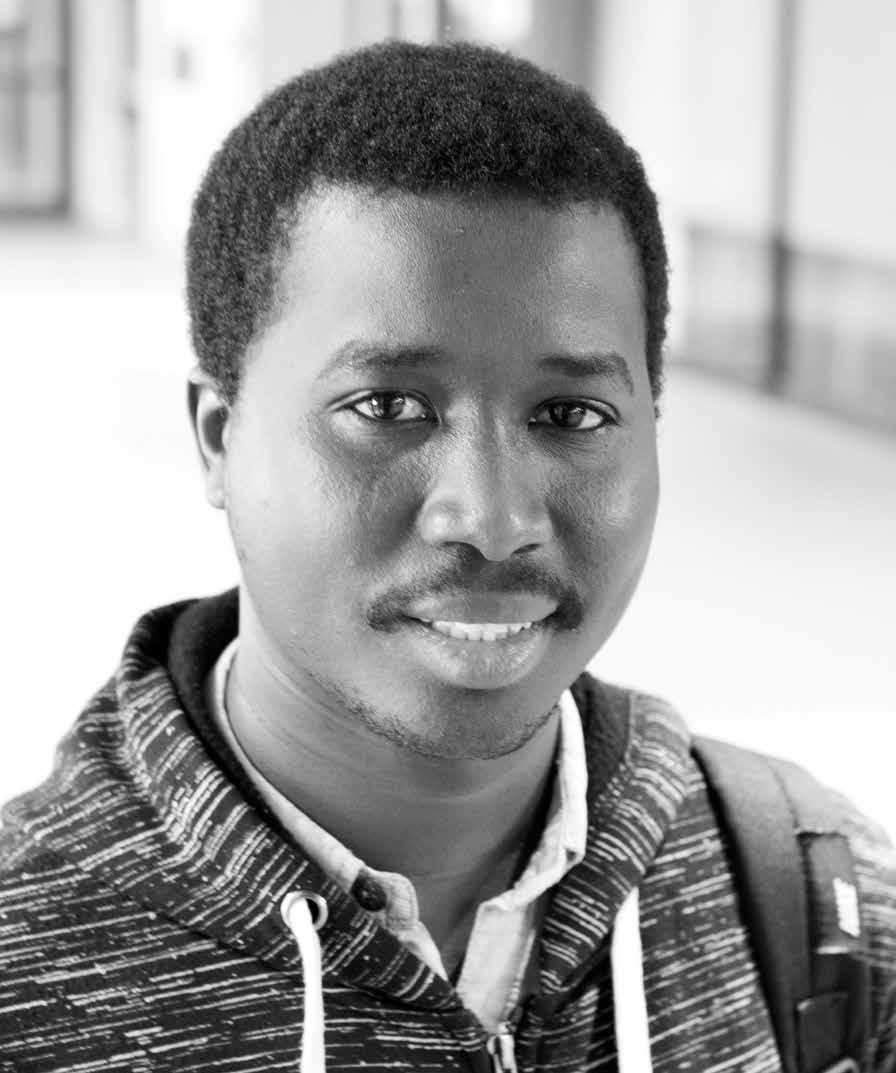
Sudanese refugee studying at U of M discusses struggles and achievements
H A nn AH Fro E s E , staff
Abbas Abdelrahman Ali left
Sudan for Jordan in the fall of 2013 amidst violent police clashes and political conflict.
During his time in Jordan, Ali, 26, d id not have the documentation in order to work legally.
“It was a very terrible situation,” he said. “We tried to work – sometimes illegally – because you need to rent your house. You need to eat.”
Ali said that despite their work, there was no obligation for employers to pay undocumented, illegal workers and people would often not receive their wages.
Through the World University Service of Canada’s (WUSC) Student Refugee Program, Ali was given the opportunity to become a primary resident in Canada and pursue a university education.
“WUSC gave me a great, incredible opportunity,” he said.
With the help of the program, Ali settled in Winnipeg to attend the University of Manitoba. He is currently enrolled in English language studies courses in preparation for pursuing a degree program. He said he plans to study engineering.
After graduating, Ali said he wants to help Sudanese refugees in neighbouring Chad.
Compared to destabilized regions that receive worldwide attention like Iraq and Syria, Ali said Sudan is neglected by the media “in spite of the conflict in Sudan still getting worse every day.”
“The media,” he said, “should pay attention to the whole world.”
Global concern
In an October lecture presenting her research into settling refugees in Canada, University of Manitoba sociology professor Lori Wilkinson said the number of refugees in the world is increasing exponentially.
In 2004, 37.5 million refugees were displaced worldwide. This year, there are more than 65.3 million refugees –the highest number since World War II, Wilkinson said.
The majority of displaced people live near a conflict zone. Overwhelmingly, refugees upended in 2016 come from Syria, Afghanistan, and Iraq.
Wilkinson said most refugees aren’t fleeing to developed nations but to the less wealthy countries near the conflict zones they are trying to leave behind. The increasing burden to host the refugees falls on these less-developed nations.
According to Amnesty International, the top refugee host countries this year include Turkey, Lebanon, and Pakistan, as well as Jordan, where Ali spent years as a refugee.
Less than three per cent of refugees worldwide actually live in a developed nation such as Canada.
Refugees in Canada
Refugees who do land in Canada
often come in one of two ways: either through private or government sponsorships.
Privately sponsored refugees often have family already living in Canada and more than half – 57 per cent – speak English. Governmentsponsored refugees are less likely to have family or other contacts in Canada, do not speak English, and are generally younger.
“It
was a very terrible situation. We tried to work – sometimes illegally – because you need to rent your house. You need to eat” – Abbas Abdelrahman Ali
The language barrier creates a problem for many of the governmentsponsored refugees looking for work.
Other barriers to work include large gaps in refugee employment records, a lack of references, and a need for Canadian experience to be hired.
In 2013, 11 per cent of refugees in Manitoba were unemployed. Refugees in Alberta faced only five per cent unemployment. However, more than 28 per cent of refugees in Saskatchewan were without work.
Discrimination
In spite of the sponsorships and aid, refugees and other immigrants face racism and discrimination after arriving in Canada, Wilkinson said in an interview.
“I often have students that’ll tell me things like ‘I didn’t realize I was different until I came on campus and people started treating me differently,’” she said.
An online petition to stop Syrian refugees from coming to Canada has more than 48,614 signatures and Wilkinson said a Canadian Institute for Identities and Migration study found Canadians have a more negative perception of Muslim immigrants and refugees.
“If you look at the polls from this year and years prior, there are about a third of Canadians that are still threatened by immigration for various reasons,” she said.
“They feel like immigrants are going to be taking their jobs, they might be making a threat to the cultural cohesion of Canada [or] maybe they hear that religion will be rammed down their throats.”
However, she said, there is potential for change.
“Some of the newer research says that the more we get to know each other, the less discriminatory that we are.”
Education
Once in Canada, it can prove difficult for refugees to verify their previous education, as governments often destroy academic records after refugees flee, Wilkinson noted.
People don’t think to bring their high school diploma, she said, adding that it can be almost impossible to verify a transcript if the institution has been destroyed.
Due to their inability to prove what the highest form of education they received was, refugees are often over-skilled for the jobs they hold, said Wilkinson.
Of refugees that have a university education, 43 per cent of women and 35 per cent of men hold jobs that require a high school education or less. In contrast, only 15 per cent of Canadian-born people with a university education hold these types of jobs.
Many refugee children have never attended school or have gaps in their education because of time spent in refugee camps or travelling to a host country. The problem of access to education is amplified by the language barrier.
“Research out of Alberta shows that 74 per cent of [English as second
language] students actually don’t finish high school,” said Wilkinson in her lecture. “Or they do finish high school but they don’t have the right credits they need to go to on to get a college certificate or a diploma.”
“They
were my family already before I came here” – Abbas Abdelrahman Ali, U of M refugee student
However, Wilkinson said refugee children find success catching up and average learning two years of material in one year of school.
Many refugee youths also go on to a university education. This summer, Statistics Canada released a study that showed 29 per cent of government-assisted and 32 per cent of privately assisted refugee youth have earned university degrees –both higher than the 24 per cent of Canadians who graduate university.
Community
When Ali first arrived in Winnipeg, he said he didn’t know anyone.
After the Jordanian government deported hundreds of refugees back to Sudan in December 2013, Ali said the WUSC rescued him.
The organization helped him –and many others – find a home in Canada and become a student at the U of M.
When he landed at the airport in Winnipeg, a group of people he had never before met welcomed him to Canada and to the university.
He said they showed him his new house, took him shopping, and brought him to 3D movies to help him settle in to his adopted home.
“They were my family already before I came here,” he said.
“We are like a family. Not just for me, [but] other people who came from WUSC or who are coming, they don’t suffer from any kind of terrible situation because we are family.”
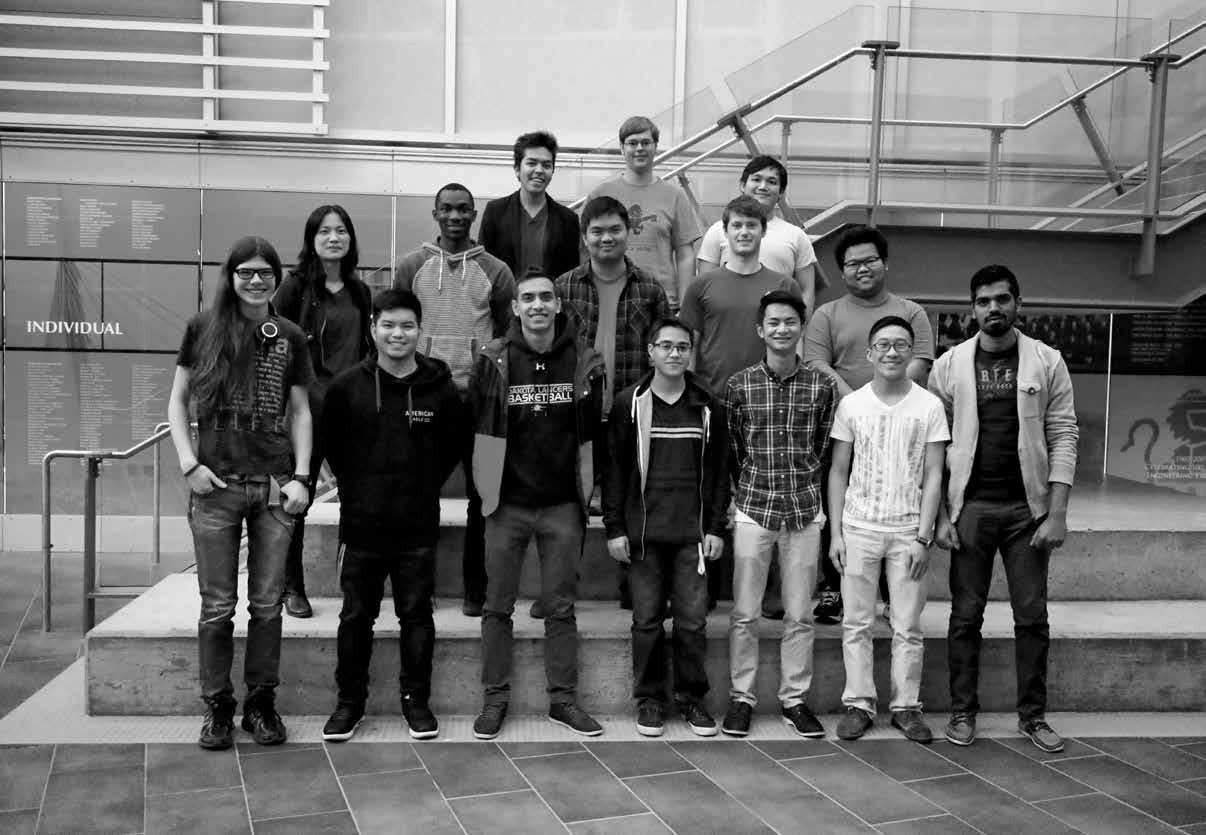
Photo by miguel yetman
UMSU adopts new motion supporting faculty
Council passes motion supporting UMFA on workload protections, job security, childcare, and salary
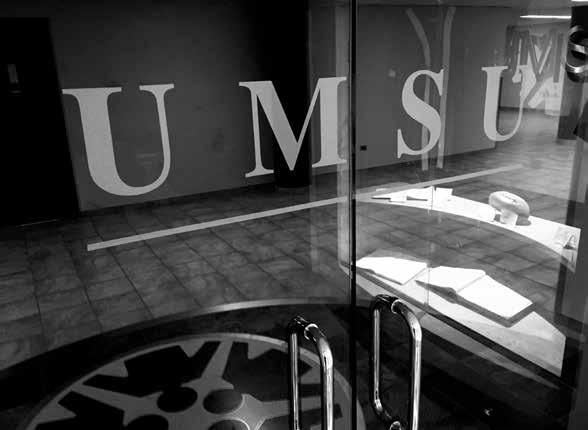
Photo by chantal zdan
The University of Manitoba Students’ Union (UMSU) affirmed support for striking U of M faculty’s educational and workplace demands at its regular meeting Thursday, Nov. 10.
The University of Manitoba Faculty Association (UMFA) has been on strike since Nov. 1, cancelling hundreds of classes and leaving the fall term in limbo. Negotiations between the university and UMFA
have been ongoing since May.
The two sides have been in discussions with a provincially-appointed conciliator since Nov. 2.
Thursday’s meeting was the first time council met since the strike began.
The emergency motion, introduced by UMSU president Tanjit Nagra, was originally aimed to pressure both sides of the negotiating table to come to an agreement as
soon as possible.
However, after a lengthy debate and question-and-answer session with UMFA president Mark Hudson and U of M vice-president external John Kearsey, Arts Student Body Council representative Niall Harney introduced an amendment affirming that UMSU council side with faculty in relation to its demands surrounding workload protections, job security, childcare, and salary.
The motion passed 18 votes to 10 in a secret ballot, with four abstentions.
The motion also compels Nagra to draft a letter on behalf of council addressed to Hudson and U of M president David Barnard outlining council’s support for UMFA. UMSU will also organize a day of action for students to join UMFA pickets by Nov. 18.
Following the meeting, Nagra said she hopes the motion will hasten a resolution.
“I’m hoping that our stance works alongside the current discussions and we’re able to pressure the negotiations to go quicker,” she said.
“Let’s hope that a fair deal is reached sooner and people can get back to their classes.”
Nagra said UMSU’s support for faculty draws from a survey the students’ union circulated to students through an e-newsletter last week.
“I’m
hoping that our stance works alongside the current discussions and we’re able to pressure the negotiations to go quicker”
– Tanjit Nagra, UMSU president
Of the just over 800 responses, 64 per cent said they support UMFA. That includes 20 per cent who said they support UMFA but not the strike.
Just fewer than eight per cent said they do not support UMFA. Six per cent said they remain neutral.
Twelve per cent of those surveyed checked off “whatever ends the strike.”
“We did our best to inform students, to get their opinions,” Nagra said. “The survey we sent out was obviously a small sample but I think it was a fair sample size of the student body.”
Academic schedule revisions
UMSU’s position comes the same day the U of M senate approved a package of potential changes to the academic schedule to manage the fallout from the strike, which is set to enter its third week Monday.
The package includes four contingencies for resuming classes: one if the strike ends before Nov. 16, one if classes resume before Nov. 21, another if faculty is back in class before Nov. 28, and a final option if the strike is resolved by Dec. 5. Under the worst-case scenario imagined, which would see classes resume the week of Nov. 29-Dec. 5, the fall term would on Jan. 20 with an exam period from Jan. 21-28. The winter term would begin Jan. 30 and run until April 28. The winter exam period would be April 29-May 6.
UMFA labour board complaint alleges provincial interference in collective bargaining
Arepresentative of the Pallister government discouraged the University of Manitoba from entering into mediation discussions with the University of Manitoba Faculty Association (UMFA), according to an unfair labour practice complaint
submitted by UMFA against the university.
The complaint, which UMFA submitted to the Manitoba Labour Board Monday, details a number of grievances against the university that stem from the government’s actions leading up to an ongoing faculty strike that began Nov. 1.
Interim provincial NDP leader Flor Marcelino tabled the documents in question period Wednesday, Nov. 9. Since picket lines went up at the start of the month, the provincial NDP has continuously questioned Premier Brian Pallister about the government’s role in the events leading up to the strike.
The complaint, which was made public Nov. 9, alleges that Gerry Irving, secretary of the public sector compensation committee, made it clear “the university was not to agree to mediation” and the government would not fund binding arbitration between the two sides if it did.
The complaint also claims the government directed the university to pull back a four-year settlement offer presented to the union in September and “completely withdraw its salary proposal.” The offer included a seven per cent increase over the four-year term.
According to the document, the university repeatedly attempted to convince the government to reconsider its position.
U of M president David Barnard allegedly attempted to telephone the premier more than once but received no answer. The complaint also alleges that Barnard sent a letter to the premier two days before issuing a joint statement with UMFA president Mark Hudson criticizing an “11th hour” government mandate directing the university to extend the faculty contract an additional year without a salary increase.
During question period
Wednesday, Marcelino and NDP education critic Wab Kinew repeat-
edly demanded the government release its correspondence with the university.
Pallister spoke to reporters following question period, but would not address any specifics of the complaint, instead referring to them as merely accusations aimed to benefit one side of the negotiating table.
“I won’t comment. It’s unhelpful in the middle of a labour dispute,” he said.
“Every effort is being made by our government to reach a resolution here and to assist in any way we can,” he said. “All our behaviour and conduct is aimed towards helping with that goal. So our first concern remains the students at the university and that’s where it will stay.”
Kinew repeated his demand that the government reveal whether or not the allegations were true following question period.
“The premier knows the truth and he has it in his power to either repudiate the allegations or to confirm
whether they’re in fact true,” he told reporters.
“We want to see what the truth is in this case, because if there are unnecessary restrictions being put on the negotiations at U of M, then that’s keeping students out of class longer than necessary,” he said.
The complaint also details a list of 10 potential actions UMFA would like the labour board to take to remedy the situation, including ordering the university to compensate UMFA and its members for all costs associated with the strike and write a formal apology to all members of the union for committing unfair labour practices.
Photo by miguel yetman
UMFA rejects administration call for membership vote on latest offer
Conciliation talks break off, administration continues to push weekold proposal rebuffed by faculty bargaining team
The University of Manitoba is insisting that a settlement offer rejected by the leadership of its faculty association more than a week ago be put to a membership-wide vote after conciliation sessions broke down this weekend.
In a release issued Sunday, administration said negotiations with a provincially appointed conciliator failed to bring the two sides closer to a new collective agreement and called on the University of Manitoba Faculty Association (UMFA) to let its members vote on a Nov. 6 offer that was unanimously rejected by the association’s bargaining team.
The union’s collective agreement committee – made up of about 20 members representing a breadth of faculties and departments from both the Fort Garry and Bannatyne campuses – met Monday, reaffirmed the offer falls short of meeting UMFA’s long-standing bargaining priorities, and decided against calling a vote.
“We’re going to keep asking them to take the offer we made last week,” said John Kearsey, the U of M’s vicepresident external.
“We don’t know what else to do right now because we feel that we have done everything possible to try and end this strike,” he said. “We have presented offers that have shown significant movement.”
UMFA has been picketing since Nov. 1, cancelling hundreds of classes. Negotiations toward a new agreement have been ongoing since May after the previous three-year contract expired March 31.
When the latest offer was turned down more than a week ago, UMFA president Mark Hudson said the proposal does not adequately address workload, job security, and performance assessment concerns critical to the association.
He said this week that conciliation was progressing and the first he heard of talks breaking down was after the university issued the release on its online communications arm, UM Today.
“It kind of felt like they had just taken their ball and gone home,” Hudson said.
“We think that students and their families expect us to be at the bargaining table getting this thing done rather than trying to turn back the clock a week to get our members to vote on a proposal that they have already seen and which our collective agreement committee rejected unanimously as having completely and utterly failed to address any of our issues.”
Hudson disputed the university’s claims the union is refusing to accept any administration proposals, noting UMFA accepted a one-year, provincially mandated wage freeze in
October to keep negotiations going.
“This whole idea that they are somehow bargaining with themselves or that we won’t accept anything that is put across the table, for them to say that and then throw their hands up and walk away from the table – it’s a hissy fit,” he said.
“We don’t know what else to do right now because we feel that we have done everything possible to try and end this strike” – John Kearsey, U of M vicepresident external
“We think they should take this seriously. They owe it to students to get back to the table and really negotiate.”
UMFA, which represents some 1,200 professors, librarians, and researchers, filed a complaint with the Manitoba Labour Board last week claiming the university is fail-
ing to bargain in good faith after it withdrew a proposed salary increase.
Both UMFA leadership and the provincial New Democrats have accused the Progressive Conservative government of interfering in collective bargaining after the province directed the U of M to renege on its salary proposal and extend the existing contract an additional year.
Short of seeing the Nov. 6 proposal put to a membership-wide secret ballot, Kearsey said the university will not return to the bargaining table unless the association significantly changes the language of its demands concerning teaching a ssignments and workloads.
He said the association’s proposal strips deans of the final decisionmaking authority in favour of an arbitration scheme in the event of a conflict with faculty.
“We have seen no give from the very staunch position that they have taken that we can’t accept,” he said.
“If they’re not going to do that, we really want them to engage their membership and ask their membership: are these issues the issues that they want to continue a strike over?”
Arbitration
The conciliator overseeing negotiations last week proposed setting
aside the outstanding issues for arbitration to foster a return to classes but the union would not agree.
“It kind of felt like they had just taken their ball and gone home” – Mark Hudson, UMFA president
Hudson said the union accepted arbitration on similar issues to avoid a strike during negotiations in 2013. However, he said when sessions began the university argued the administrative governance matters were outside the arbitrator’s authority.
“Our history with the University of Manitoba in arbitration is not a great one,” he said. “We know pretty much what they will say to the arbitrator –that the arbitrator can’t really rule on these issues.”
“We might as well fold up our tents immediately and go home if we’re looking at arbitration.”
Kearsey accused UMFA of contradicting its own workload protection proposal by refusing arbitration.
“Arbitration is not worthwhile to decide on these two big issues,” he said, “but yet arbitration is OK for someone outside the university, who doesn’t know the university, to decide on teaching workload issues, which have all sorts of ramifications for the university?”
Given that a one-year contract would only run until the end of March and a third full week without classes could result in the cancellation of the winter reading week, Kearsey said he would prefer the two sides strike a sort-of bridge deal to get students back into the classroom while the outstanding issues are addressed.
“We could sign this collective agreement and we could get people back in the classroom and we could engage in a meaningful, thorough, collegial discussion around these two issues and leave the students out of it for now,” he said.
“This is not rhetoric, it’s not spin. It’s nothing like that. This is about getting our students back in the classroom.”
As of press time, no meetings have been scheduled.
Photo by chantal zdan
Cross-institutional survey reveals urgent need for food security solutions for students
Post-secondary students in Canada facing continued food constraints
Di A n A Ubok UD om, staff
Arecent study conducted by Meal Exchange , a charity aimed at tackling food problems on postsecondary campuses, revealed that food insecurity was a serious issue faced by a large portion of students at Canadian post-secondary institutions.
The study, titled “Hungry for Knowledge,” surveyed over 4,000 students from five Canadian universities and is the first of its kind in the country.
According to Meal Exchange, the study was motivated by the failure of existing reports to address the urgency of food insecurity among post-secondary students.
The survey revealed that nearly 40 per cent of students experience moderate to severe food insecurity. Twenty-five per cent said this affected their physical health and 20 per cent reported it negatively affected their mental health.
The institutions surveyed included Brock University, Dalhousie
University, Lakehead University, Ryerson University, and the University of Calgary.
Dalhousie and Lakehead students reported the greatest food insecurity. The universities were selected due to their geographic location and regional differences.
The report examined how the insecurity can be driven by factors including a lack of money for food - especially healthy foods. Students surveyed reported skipping meals to prolong available food and admitted to worrying they might lack access to acceptable food in the future.
The high cost of tuition and housing, as well as limited finances, were the most reported contributors to food insecurity among surveyed students.
Food bank
usage
Meal Exchange program coordinator Merryn Maynard said that despite the many students who were
food-insecure, few made use of food banks.
“Of all food-insecure students, only 16.8 per cent reported that they had accessed a food bank, which reflects trends in other food-insecure Canadian populations,” she said. “This demonstrates that a fraction of people experiencing food insecurity access food banks.”
Maynard said this discrepancy, which was most common amongst African, Aboriginal, and Caribbean students – the most food-insecure groups – was caused by difficulty in accessing traditional foods.
Meal Exchange has plans to expand its research to other Canadian institutions and to conduct intermittent national surveys relating to food and housing security, as well as other constraints students face in accessing post-secondary education.
The charity also hopes to increase government support in providing steady financial subsidies to students and other vulnerable populations, as well as establishing truth and reconciliation initiatives aimed at understanding and reducing food insecurity among Aboriginal students.
U of M food insecurity
Tori Sutyla , food bank coordinator at the University of Manitoba, agreed with the study’s findings. Sutyla noted that over the years, the majority of food bank users have been international students.
“We do have a high population of international students that use the food bank,” she said.
She added that the high number of international students using food bank services may be attributed to the lack of support from family members or other close relations.
“If you're from another country and you do not have any family to fall back on, I could see how that would be an issue,” she said. “If you have family, you can always go to them for help. But if you're here all by yourself, then that could be challenging.”
“Of all food insecure students, only 16.8 per cent reported that they had accessed a food bank, which reflects trends in other foodinsecure Canadian populations” –Merryn Maynard, Meal Exchange program coordinator
However, Sutyla added that the same could be said for students from other cities or provinces, rural students, and even students who have lived in the province their entire life but lack these supports. She added that graduate students, as well as single parents, are also regular users of the food bank.
“Because grad school is expensive, and you don't always get paid that much, you could be affected,” she said.
“We do also have a lot of people that have kids and are trying to make ends meet.”
The U of M food bank is modeled after Winnipeg Harvest and is available to all registered U of M students,
both full-time and part-time.
Sutyla also said the amount of food provided depends largely on the number of dependents a student has.
“Unfortunately, we can't feed people with too many dependents, so we limit the number of dependents to three at most,” she said.
Sutyla said that the number of students who use the food bank has remained relatively stagnant since its inception.
When the food bank previously stocked foods such as fresh fruits, frozen milk, and bread, usage was at an all-time high but Sutyla chalked that up to user abuse.
“Due to budgeting, we weren't able to continue offering that, and students were abusing the services because of these foods,” she said. “I think our use went down in a sense because people aren't abusing the food bank anymore but our usage hasn't really gone down that much since then.”
Sutyla also noted that use is seasonal.
“If tuition’s due or Christmas is coming up, we see higher numbers,” she said. “During the summer, we see lower numbers because there's less people in class.”
“Use also varies from month to month,” she said. “In January and September, at the start of the school year, we see so many students. During exams, use also goes up because people aren't working as much and they're studying more.”
Photo Provided by vancouver food bank
Editor-In-Chief: Craig Adolphe
Contact: Editor@themanitoban.com / 474.6770
America chose hate
On Nov. 8, Donald Trump became the leader of the world’s preeminent superpower. What began as a joke has quickly become a dark reality for many Americans.
After over a year of erratic tweets, blatant lies, and rambling speeches, one thing is clear: America’s newest president-elect is the least prepared in the country’s history.
At best, Trump’s victory has shown that America is ready for a change. At worst, his win has taught people that hateful, sexist, racist, Islamophobic rhetoric is a winning message. And he has demonstrated that he is not alone in his views.
Trump’s campaign was fuelled by the underlying anxiety from a predominantly white following – and he ran with it. Their hatefulness fed his hatefulness in a vicious cycle. He used the anger of the declining middle class as momentum, touting the need to stop foreign countries from stealing jobs and rallying to protect the southern American border.
Trump ran on a platform of fear and hate, and won.
To millions of Americans, Trump
is an outsider to the political scene who is upfront and will bring about much-needed change. The problem is, the majority of the people who voted for Trump do not need someone fighting for them; their privilege does that already. The ones needing a champion – the LGBTTQ* community, women, minorities – are now left with a rich president who was born into a wealthy family and has not a care in the world about the issues that affect them every day.
Trump ran on a platform of fear and hate, and won
Was Clinton a perfect candidate? No. But she was an intelligent, competent, resilient leader who is a hell of a lot more qualified than the president-elect – and is certainly a better role model to young people. Throughout her campaign, no matter how you feel about the strategic model she used, there is no denying
Letter to the editor
Not my UMSU
I pay fees to the University of Manitoba to learn and receive an education. A portion of those fees are redirected to UMSU, to cover the costs of services, events, and representation. Students expect UMSU council to make decisions in their best interest.
So, imagine my dismay when I learned that council voted in favour of supporting UMFA on the issues of salary, childcare, workload protections, and job security (“UMSU
adopts new motion supporting faculty,” Nov. 11, 2016). On a basic level, I agree that everyone should be paid equitably and have sufficient benefits to guarantee a certain quality of level.
As well, I recognize that UMFA is within their rights to strike and that its members are concerned about the above – rightfully so. I also recognize that contract negotiations are not an easy thing for either side, especially in such a public setting. However, I take issue when both
that her candidacy was inspirational to young girls and women nationwide. In her concession speech, in addition to directly addressing her disappointment, she offered a message of hope to those looking up to her: “To all the little girls who are watching this, never doubt that you are valuable and powerful and deserving of every chance and opportunity in the world to pursue and achieve your own dreams.”
She is a dedicated public servant who has been heavily involved in American politics as senator, first lady, secretary of state, and presidential nominee. Yet she was unable to overcome the distrust the American people felt towards her – which developed as scandal after bogus scandal emerged.
Now compare her to Trump, an egotistical, greedy businessman who has cheated his customers for decades – not to mention his incredible sexism, racism, Islamaphobia, and misogyny. One would think the racism and sexism exhibited by Trump are irredeemable character flaws and yet this man has been elected the 45th
president of the United States.
Yes, the American people wanted radical change, and Clinton was not the one to do that. But the radical change Trump will bring to the country is not the type of change it needs; in fact, it will undo much of the progress made over the course of recent decades. If Trump follows through on the promises he made, millions of immigrants will be deported, the country will fully embrace a “trickledown” economic plan that has proven time and time again to be ineffective, and women’s rights will move back roughly 40 years – which is ironic after seeing a woman come so close to achieving the country’s highest political office.
How could someone with a mother, daughter, wife, or any sliver of a sense of social responsibility vote for a man who says he grabs women “by the pussy,” ridiculed a disabled reporter, has had 24 women come forward claiming Trump sexually assaulted them, wants to defund Planned Parenthood because “of the abortion factor,” and pledges to repeal the Affordable Care Act?
The implications of his election are devastating. Photo after photo of people in tears have emerged. Supporters being upset following the defeat of their candidate is normal, but this is something new. Some people didn’t like Obama, and some people didn’t like Clinton, but this goes beyond not agreeing with a politician’s politics. People are genuinely fearful of what their lives will look like – and rightly so.
People are genuinely fearful of what their lives will look like – and rightly so
Almost 60 million people voted in favour of oppressing the rights of LGBTTQ* individuals, minorities, and women. Devout Muslim women across the U.S. are too fearful to wear their hijabs because Trump’s rhetoric has already been linked to an 89 per cent increase in hate crimes against Muslims. Young men across the country have learned that sexually
assaulting a woman is not enough to keep you from holding office, and women have learned that their alleged abusers can become president. LGBTTQ* children will grow up needing to persuade people that they do not need conversion therapy to
America has been irreversibly broken from the inside out. It has become a country that is dramatically less free for many of its citizens – for four whole years
“cure” them. The former leader of the KKK has said that Trump’s election is “one of the most exciting nights of [his] life.”
What is perhaps even more terrifying is the fact that Trump’s fear and hate rhetoric has resonated with other politicians across the globe –including in Canada.
Conservative leader hopeful and former Status of Women Minister Kellie Leitch has latched onto Trump’s victory, claiming that it’s an “exciting message that needs to be delivered in Canada as well.” She has proposed screening incoming immigrants, refugees, and visitors to Canada to ensure they have “Canadian values.”
America has been irreversibly broken from the inside out. It has become a country that is dramatically less free for many of its citizens – for four whole years. This isn’t something the world should forget; this is something we need to remember and never let happen again.
UMFA and the administration tell students that we are their top priority but have failed to reach an agreement. If students were really the priority, the contract issues would have been worked out in the summer so as not to affect classes. Beyond that, it pisses me off when the group that is supposed to represent me votes in favour of allowing one side to use students as a bargaining chip to expedite the process.
I am not paying to be used. My
relationship with the university is an exchange of cash for a service; I pay for an education that I can use one day to build a career of my own. In paying to attend the U of M, I did not consent to be used to influence labour negotiations between two divorcing parents who only want to keep the kids so they get paid child support. It's not appropriate for UMSU to involve themselves in a labour dispute between employer and employees by telling one side that the organiza-
tion supports them over the other. Support who you want on your own time, but dragging 25,676 undergraduate students into labour negotiations is not an appropriate way to represent the student body.
Joshua Mitchell-Dueck
Photo Provided by marc nozell
One nation under Trump: what are the implications for Canada?
Policy, politics, and rhetoric are all subject to change
sHADE n Ab U sALEH , staff
In what was a disastrous and outrageous presidential election, Donald Trump won America’s heart by riding on hate and fear, becoming the first not-qualified-to-be-president-president of the great U.S.A. He is also a sexist, racist, wall-building, climate change-denying, tax return-stashing, company-bankrupting, hate-spewing demagogue with a puny set of hands that, months before his inauguration, have already been put to use picking apart American political stability piece by piece.
Tapping into America’s worst impulses with his “Make America Great Again” mantra, Trump is an embarrassment to the political credentials of the United States. But Trump’s victory has also become an ode to the Democratic Party’s miserable exercise in champagne liberalism. Fundamentally, they rooted for a candidate who offered no tangible change to an electorate desperate for exactly that. Instead, the Democrats were concerned with protecting corporate interests and have long lost touch with the American people. Among his campaign promises, Trump has vowed to remove illegal immigrants, repeal Obamacare, ban Muslims, defund Planned Parenthood, end gun-free zones, suspend Syrian refugee resettlement, appoint a conservative pro-life Supreme Court justice, and build a great, big, beautiful wall between Mexico and the United States. These are terrifying policy plans with seri-
ous domestic repercussions. But considering how the United States and Canada are so deeply interweaved in many ways – language, culture, regulation, trade, international relations, etc. – we must also ask ourselves: what does a Trump presidency mean for Canada?
Other than crashing our immigration website, experts predict that Trump will affect Canada on three fronts: trade and economy, security, and climate change.
Trump’s victory has become an ode to the Democratic Party’s miserable exercise in champagne liberalism
Trump has spent his election campaign brutally criticizing Hillary Clinton for her husband’s signing of the North American Free Trade Agreement (NAFTA), which he eloquently called the “worst trade deal ever.” Trump has taken a strong anti-trade position, so it is important to keep in mind that 23 per cent of our GDP is comprised of goods and services exported to the United States. Renegotiations or new agreements would inevitably have great conse-
quences on Canadian businesses and trade.
Since the War of 1812, Canada and America have for the most part been in agreement on approaches to international issues, from the Cold War to the conflict in Syria. However, because Trump has offered no practical foreign policy plan – he’s said he doesn't want ISIS to find out what his plans are – many experts are still unsure as to what Trump’s presidency means for Canada and America’s relationship on the international security front, leaving Canada in an awkward position of uncertainty. Most believe, however, that Trump’s administration will push the Canadian government to increase its expenditure on defence .
What most are worried about is what Trump’s presidency will mean for climate change. Calling global warming a Chinese hoax, Trump has promised his voters that he would pull the United States out of the Paris climate change agreement, a definitive blow for Canada as America’s closest ally. Additionally, Trump may end Obama and Trudeau’s agreement to lower methane emissions. He might also bring back the Keystone XL Pipeline, which is supported by Justin Trudeau. Despite the devastating consequences if built, the Canadian government will likely welcome the pipeline with open arms under Trump.
There are more things than policy to fear under a Trumped-up America.
It is, perhaps, the emergence of a new political culture revolving around Trumpism that we should be most on guard for.
We too have issues that require a much closer eye than what the myopia of late has provided. We cannot take freedom and democracy for granted
Congratulating Donald Trump on his win, Prime Minister Justin Trudeau put out a statement promising to work “very closely” with Trump and his administration. Ex-prime minister and current member of the band Van Cats Stephen Harper posted a tweet congratulating Trump on his “impressive victory” calling for a move forward on the Keystone Pipeline project. Most worrying, however, was Conservative party leadership contender Kellie Leitch’s response. Leitch sent out an email to her supporters hoping to spread Trump’s “exciting message” to Canada. This is not okay. In the 24 hours following the election results, a wave of hate crimes against minorities has swept through
America. My worry is that Trump’s presidency will provoke hate crimes across Canada and would similarly embolden racists and hate-mongers as has happened in the U.S.
Nearly two years ago, Maclean’s framed Winnipeg the most racist city in Canada. This may have been reaffirmed when a nationwide poll conducted by Mainstreet/Postmedia found that Manitoba has the highest proportion of Trump supporters across Canada. We need to pay attention to this. We cannot remain complacent, and we’ve got to stop expressing relief about not being American. We need to shake off this smugness because, while we may assume otherwise, we are not really any better. We too have issues that require a much closer eye than what the myopia of late has provided. We cannot take freedom and democracy for granted.
graPhic by kelly camPbell
The U of M stands at a historic crossroads
rADH ik A D E sA i
As I walk the picket lines with my colleagues, still strongly supporting the strike in its second week with no sign of a resolution, our stakes are very concrete: increased workloads, performance indicators, and arbitrary management decisions affecting job security, tenure, academic freedom, and collegial governance. At the same time, as a scholar of politics and political economy, I can’t help seeing things in a wider and longer frame.
The UMFA strike is stalemated because it turns on fundamental principles. That is also why it is being watched by university communities the world over. This is why it has received such widespread support: from five student bodies – the U of M Arts Student Body Council, U of M Science Students’ Association, Manitoba Medical Students’ Association, Manitoba Dental Students’ Association, and recently the University of Manitoba Students’ Union which represents roughly 21,000 students – from the trade unions in Manitoba and beyond, and from university associations across the country and the world. If UMFA’s demands are fulfilled, the strike could number among the forces that began to turn the mighty ship of higher education in Canada, and possibly the Western world, away from the commodification and corporatization of education – its transformation into an arena for profit – and towards a renewed commitment to the ideals of public higher education.
Sound overblown? Read on.
For UMFA, the non-monetary issues relating to workloads and governance are so important that it has even signaled willingness to set aside salary demands, urgent as they are given how long U of M salaries have languished at the bottom of its class of Canadian universities. Media coverage has so far failed to note UMFA’s pecuniary forbearance and fails to report, discuss, and appreciate what our nonmonetary demands are about. That requires historical context.
Postwar investment and expansion began to transform universities, widening access to these institutions whilst systematic and rigorous research, education, and training, relevant to the major questions of the day, displaced their original elitist and at times obscurantist functions. To be sure, as Cambridge University professor of English and history Stefan Collini noted, this process was far from complete when neoliberalism – the market fundamentalism which posited the state and public sector could do no good and markets and the private sector no harm – abruptly shunted public higher education onto the free market track.
As the world has found out in the decades that followed, free markets do not deliver and the promised Valhalla was not attained. More than three decades on, it is clear that something curious happened on the way there. As Warwick University business professor Colin Crouch pointed out, what advanced behind the covering fire of rhetoric about free markets and competition were large uncompetitive monopoly corporations enjoying cozy relationships with others of their ilk and with governments. As they came to dominate our economies, we experienced stagnant wages, rising inequalities, per-
manent and unsustainably high unemployment, financial bubbles and crises, and, last but not least, deteriorating public services and public life. The excoriation of public higher education was a central part of the last.
The UMFA strike is stalemated because it turns on fundamental principles
It was a long and involved process. Public services do not easily lend themselves to corporate profit-making. A great deal of government effort, directed by corporate input, goes into it.
The opening move was to starve universities of public funding, increasing their reliance on tuition fees and corporate research funding. Raising fees eventually led to the marketing of higher education (as the U of M has taken to doing in recent years) as a commodity, a lucrative investment in one’s future earning capacity. That this strategy eventually runs aground can be seen in the United Kingdom. The high cost of education combined with the increase in the number of severely indebted university graduates alongside no improvement of job prospects has shrunk the educational premium, leaving many to question whether it’s such a good investment after all.
Meanwhile, turning education into a highpriced commodity is constricting access once again just when greater numbers of women, minorities, and Indigenous people have begun to access it. These are among the reasons why UMFA supports low or no fees, greater public funding of post-secondary higher education, and a return to universities’ core educational, researching, and training functions.
As professor Ursula Franklin noted in her Massey Lectures, corporate research funding became part of university life in the late nineteenth century. Although some form of collaboration between industry and universities is undoubtedly necessary, it has taken problematic forms in recent decades. Since public funding still accounts for most of research funding, relatively small amounts of corporate funding often tend to buy more or less complete corporate control over the direction of research, not to mention control over its dissemination, which clogs up the arteries along which scientific discussion courses to advance knowledge.
Turning public institutions, such as public health care and higher education, into sites for profit-making entail many processes that are jointly sponsored by corporations and states. Their often intangible and indivisible products – health and education – have to be converted into discrete commodities such as pills or course modules. Patients and students have to be converted into willing but also ‘buyer-beware’ customers. Doctors, nurses, and professors, who are imbued with a strong sense of public service and a pride in their vocation, have to be turned into pliant employees. None of these processes are pretty. They are part of what is making so many aspects of university life intolerable for faculty, staff, and students and has made support for
the UMFA strike so solid.
A university education is supposed to be one in which students are, on the whole, taught by professors actively engaged in research, each picking away at one or another part of the vast coalface of the unknown and imparting not only the results but something of the experience of seeking knowledge and the tacit and codified skills required to gain it. In Canada, the standard academic was supposed to devote 40 per cent of her job to teaching, 40 per cent to research, and 20 per cent to service. Over recent decades, university administrations appear to want to reduce such positions if not do away with them entirely. They have been pushing most professors to teach more – assigning them more courses or increasing their class sizes – reserving a small number of elite research positions whose occupants students rarely see. Administrations have also been expanding the number of ‘teaching only’ positions and saddling them with even more teaching.
While UMFA can proclaim the principles for which it is fighting from the rooftops, the administration is fighting for a cause it dare not name and seeks to camouflage behind talk of lack of funds
Moreover, while such positions have long been critical for universities, their recent expansion has been at the expense of the standard academic teaching and research positions. The result is that all-too-many who would prefer to do research as well as teaching are forced into the new positions instead, with costs to their own research aspirations, not to mention students and society. The current increase in workloads that UMFA is fighting against is part of this trend.
The service component of academic work is critical. Like the modern professions, universities are self-governing because their governance involves knowledge not available to lay people; though unlike individual professions, a much greater range of knowledge is involved in university governance. Under collegial governance, the faculty body judges what to teach and research, how to do both, how to evaluate career progress, how to allocate resources, etc. through a whole range of committees – on graduate and undergraduate curricula and programs, academic discipline, research funding, appointments, tenure, promotion and so on at the department, faculty, and university levels. Faculty members also serve their respective disciplines, participating in peer review, editing journals, organizing seminars, workshops and conferences, running learned societies nationally and internationally (such as, for instance, the Canadian Political Science Association and the International Political Science Association).
Without such pro bono work, the entire institutional apparatus on which contemporary scholarship operates would grind to a halt. Collegial governance requires that university administrators be drawn from the faculty body, be accountable to it, and return to it after relatively short stints in administrative office.
Contemporary university governance, on the other hand, has favoured professional administrators. Though most still start out as scholars, they effectively abandon teaching and research and have no intention of returning to it. With the transition to administration being made at earlier and earlier career stages alongside the rising number of administrators who were never scholars, university administrations are increasingly removed from the intrinsic teaching, training, and research functions of universities, less concerned with preserving these and more easily moulded for the corporate agenda.
University administrations are increasingly removed from the intrinsic teaching, training, and research functions of universities
The proliferating connections between university administration and the corporate world mean that university administrators can expect to move between the two, as the U of M’s current president has, for instance. They are judged by how they create and maintain relationships between universities and various corporations, or how far they advance corporate and pecuniary values in universities, rather than how well they advance teaching and training at our public institutions of higher education.
This is where the increasing frequency with which the universities’ proliferating exclusive relationship with large corporations – whether as travel agencies exclusively supplying all the university’s travel needs, or suppliers of software for everything from maintaining academic records, scheduling classes, booking rooms to accounting, or suppliers of printing and copying
equipment and services – which has been the source of so much frustration among students, staff, and faculty alike, fits in. Their efficiency gains remain questionable even as they vastly increase workloads for all concerned.
Collegial assessment of the quality and quantity of a faculty member’s work for tenure and promotion is being replaced by simple, not to say often simplistic, performance indicators because they will permit non-academic administrators to wield them. No matter that such indicators reduce quality to quantity, penalize long-gestation fundamental research or research that does not require high levels of funding (since research excellence is judged only by amounts obtained in research grants) and overlook what is considered excellent in particular disciplines. Such methods of evaluation also endanger academic freedom as professors’ research and teaching priorities are channeled in determinate direction while criticism within the university is increasingly silenced. That is why UMFA is fighting performance indicators.
Why has this now come to a head? Not because UMFA leadership has unilaterally decided to be intransigent – as its flexibility on salaries shows. Rather, it is the membership that has decided ‘enough is enough.’ Extensive surveys revealed that practically all UMFA members are sufficiently affected and alienated by whatever combination of these problems they confront that they have told UMFA to prioritize them. That is why support for the strike is strong.
UMFA is one of the strongest and oldest faculty unions in the country with a long and honourable record of fighting these changes.
Partly as a result, and partly because an NDP government ruled in the critical decades during which public higher education was being hollowed out elsewhere, the process is less far advanced at the U of M. UMFA is in the relatively privileged position of fighting to retain what has long been lost elsewhere and now stands between the U of M’s advance towards the precipice.
The final piece of the puzzle is the disrepute into which neoliberalism has fallen, so serious that even the International Monetary Fund, hitherto its chief proponent world-wide, is questioning its own principles. The result is
that while UMFA can proclaim the principles for which it is fighting from the rooftops, the administration is fighting for a cause it dare not name and seeks to camouflage behind talk of lack of funds. The effects of neoliberalism and the corporate agenda on universities is increasingly widely chronicled, lamented, and resisted. That is why the UMFA strike is being watched across the country and even internationally.
Public services do not easily lend themselves to corporate profit-making. A great deal of government effort, directed by corporate input, goes into it
We in Manitoba have what is sometimes called the ‘privilege of backwardness’: having advanced less far along the neoliberal and corporate road, we could have the privilege of leading others back from it to restore to our universities their public, educational, researching, and training functions.
Radhika Desai is a professor at the U of M in the department of political studies. The views expressed here are her own, not those of UMFA or any other body.
graPhic by kelly camPbell
Breast Cancer Awareness is hardly more than a marketing stunt
J E ss E bLAckm A n
Another year’s Beast Cancer Awareness Month is behind us.
The Canadian and American Breast Cancer Foundations take the lead on the massive pink campaigns in October. Part of the campaign’s success is the phenomenal involvement within professional and amateur sports. Over the past few years it has become incredibly fashionable to wear pink in October. Pink skate laces, athletic tape, gloves, pom-poms, jerseys, towels, football penalty flags, and whistles are commonly purchased and used in game play.
At first blush, wearing pink shows a personal dedication to supporting people affected by cancer. A team or athlete taking the time to alter their equipment is a touching sign of solidarity.
Despite best intentions there is disconnect between the campaign to bring awareness and the people actually affected by cancer. Money spent on products is siphoned off towards production costs and profit, while the finances that do reach charities are limited in their reach when it comes
to research and providing direct support for families and individuals affected by cancer.
Corporations are given the agency to choose what issues in society are worth funding and which are not
Consider the fact that, according to an article from Business Insider in 2013, only five per cent of sales on NFL items that are on average marked up in price by 100 per cent go to the American Cancer Society. From there, the ACS only directs about 70 per cent of donated money towards research and outreach programs.
The fact that some money will end up in the purse of a reputable organization is fantastic, but the story
doesn’t end there. Because of the way we’re approaching funding, corporations are given the agency to choose what issues in society are worth funding and which are not. Fighting cancer through consumerism chokes much-needed funding to a trickle. Again, a portion of the purchase goes to the retail outlet, a portion to manufacturing, a portion to transportation, and, finally, a portion to the charity. The money that reaches charity, including direct donations, is split between administrative and other operational costs before reaching the frontline battle with cancer.
People looking to fight against cancer should make donations directly to universities and not-forprofit organizations that are responsible for research and the provision of care. But there is no glory in good deeds if they can’t be worn.
Wearing pink is often as much a show of support as one of ego. While there is some value in showing collective support for people affected by cancer, wearing pink all too often redirects focus from the cause to
the clothing. Placing the person or team investing in pink apparel ahead of people living with cancer, survivors, victims, and family and friends affected by this terrible disease – which we do when we purchase their pink products – warps the message into a shallow one.
Companies offering pink merchandise build goodwill with customers, increase sales with feel-good alternatives to existing products, and benefit from tax rebates for making charitable donations. Picking a cause becomes part of a corporation’s interest because it matters, financially speaking, for their bottom line.
Again, this is troubling because of the fact that corporations then play an increasingly larger role in what causes are worthy of support. Applying a free market approach to public health concerns is not in the public interest.
There is no need to rely on the concept of corporate social responsibility when it comes to major public health concerns. Corporate activity can be overcome by public funding directed toward research. Governments
should have greater motivation to provide public funding for research in prevention, care, and cures for diseases, and they have the capacity to do so in ways corporations never will. Individuals looking to donate can take their money directly to frontline organizations rather than passing the buck to grant-giving charities, and they can feel secure in the knowledge that their money will generate a more substantial impact.
Of course, a sea of pink must leave positive feelings for some people battling cancer. Knowing that millions of strangers have your back may break some of the isolation cancer patients often feel. But when November comes and the pink is gone, cancer and the fight against it remain.
graPhic by kelly camPbell
Military expansion is vital for a secure Canadian future
J E r E mi AH kopp, staff
On Nov. 11, we remembered and honoured the men and women in uniform who have made the ultimate sacrifice for our country. To this day, Canada has played an important role in international wars, conflicts, and peace-keeping efforts as the Canadian Armed Forces have upheld our values at home and abroad.
While we pay our respects, we must recognize that honouring our military is as much about the decisions that we make today as it is about remembering the past. We continue to place extraordinary responsibilities on the shoulders of our navy, air force, and army as our military sets a high standard of exemplary leadership, superior technical ability, and a willingness to improve the lives of others around the world. This level of service must be reciprocated in the form of unequivocal moral and financial support from our people and government. It also demands a constant national conversation about the role of our armed forces.
Since the days of Lester B. Pearson, much of Canada has embraced the notion of our country serving as ‘peace-keepers.’ For decades, this terminology has assuaged bleeding hearts who believe that this is a relatively safe and inexpensive way to make the world a better place. There have always been strong anti-war elements woven into our Canadian fabric and it seems that every time there is an increase to defence spending or discussion of entering into active combat zones, a backlash inevitably follows.
The cold, hard reality is that evil
ts in this world and must be met with an equally forceful response. Whether it was combatting the Nazis in the Second World War or helping to eradicate the Taliban in Afghanistan, our world is a dangerous place that necessitates a robust and highly capable military force. As a developed and wealthy country, it is our responsibility to show leadership when such conflicts arise.
The complacency amongst our generation of conflict-adverse millennials does nothing to change the reality of impending global instability
If Canada wants to be a relevant voice in international affairs, strong values must be backed up by equally strong action. It is why Barack Obama told the Canadian Parliament this summer that the world “needs more Canada.” This was his diplomatic way of saying that the rest of the world is well aware that we spend less on defence than any other G8 country.
Canada’s military expenditures place us at 23rd out of 28 NATO countries in defence spending as a percentage of GDP. If you are won-
dering why a country with the second largest land mass in the world has lower military expenditure ratios than Albania, Portugal, and Slovenia – that’s understandable. Canada is not upholding its commitment to spend two per cent of its GDP on defence and this jeopardizes both our capabilities as a state and our international partnerships.
In the most recent federal budget, Canada’s Liberal government has increased 2016 military spending to $20.3 billion. This, in concert with commitments to NATO’s high-readiness brigade in Eastern Europe and a three-year African deployment, are positive first steps. The demands on our armed forces will only continue to grow, however. The complacency amongst our generation of conflictadverse millennials does nothing to change the reality of impending global instability. The international post-war peace era is almost at a close and the luxury of bordering three oceans and the world’s most powerful nation will not deter the 21st century security concerns we face.
The European Union is teetering on the brink of collapse, the United States has just elected a demagogue, China grows increasingly imperialistic in the Pacific Rim, the Russian bear is rearing in the Arctic and eastern Europe, and the Middle East remains divided by oppressive theocracies, dictatorships, and terrorism.
Meanwhile, the world’s population has already reached unsustainable levels and will continue to see explosive growth in Asia, the Middle East, and Africa. Fossil fuel emis-
sions through energy consumption, agricultural production, and industrial waste will not be curbed as China, India, and other developing countries are only just now seeing the creation of an aspirational middle class. Countries such as ours will be protected but not immune from the first waves of climate-change driven extreme weather, famine, and disease. By the time the developed world takes the necessary action to address climate change, it may be too late.
This new global context begs the question of what our defence policy will be moving forward. If you think that these issues will not require direct support from our armed forces, think again. Our military capability will need to respond to a vast array of unique and increasingly volatile situations. Emergency services will continue to be a core component of the Canadian Armed Forces’ mandate, but our ability to use force if necessary will be just as important given the challenges on our horizon.
Should the Arctic passage become permanently open to travel and the United States not recognize our territorial waters, what position will we be in to assert our sovereignty? When Russia and others exercise their claims to the North Pole, what strength will we have to defend our own position? When extreme weather rocks our coastal regions and we face increasing inland flooding and fires, what support will we be able to offer to our citizenry? And when millions worldwide are displaced by climate change, what will the extent of our capacity be in aiding them? These are
only some of the very real problems that must be answered sooner rather than later. These are issues that will require very real political dialogue and funding.
If Canada wants to be a relevant voice in international affairs, strong values must be backed up by equally strong action
Prioritizing military funding does not necessarily mean that Canada will increase its participation in conflicts. It means that we have the capacity to provide badly-needed international social and economic development in areas of instability, as well as the ability to enforce our national security, no matter the threat. As a country, we must look forward and recognize the coming storms. In our lifetimes, we have lived in relative safety and security. Most people understandably assume that this trend will continue and that adaptation is not required. This, however, is a mistake. When it comes to a national dialogue about our role in the world and the future of our armed forces, we must act now or it will be too late.
Editor: Shawn Garbutt
Local photography collective ventures into clothing
From Here & Away uses clothing and art to promote community and social activism
L
ast year, local artist Joseph Visser funded From Here & Away – a community of individuals working together to encourage creativity and increase accessibility to art. The project started as a tag on Instagram intended to create connections between individuals all over the globe. Quickly – more quickly that Visser imagined – the community evolved into a brand dedicated to encouraging others to make art, and helping bring art to people who do not otherwise have access to it. Now, From Here & Away is more than just an idea – it is a tangible brand offering support, community, and workshops for its supporters and followers.
“Throughout the year, I’ve been working to build trust with a broader audience, beyond the people who have supported From Here & Away from the beginning. Now, I feel like the things I wanted From Here & Away to represent have been realized: accessibility, encouragement, and establishing a safe space to be creative in,” said Visser.
Visser has also been working with various manufacturers and businesses to create From Here & Away products to contribute toward the community art initiatives the brand wants to support. The products, so far, range from mugs, to hats, to button packs –all with the goal of being useful and serving a higher function.
“Before I even started making any sort of goods, I looked at what I wanted to do and achieve with it, and who I wanted to support, and I decided 25 per cent of anything that I earn profit-wise would go toward funding community art projects for people who might not have access otherwise for socio-economic reasons. That was a huge thing for me – I wanted to make products that represented something real, and I also wanted it to have a direct benefit to supporting creativity and art-making.”
Visser saw his idea become a reality following the success of the first line of From Here & Away products – a leather travel journal, an enamel camping mug, and wool toques.
With the proceeds from the products, Visser funded an art project for children attending summer camp at the Indigenous Family Centre.
He bought 15 disposable film cameras and gave them to the children, after a quick lesson in the art of pointand-shoot photography and a short workshop.
“My main message to them was that I wanted them to go and take photos of whatever is interesting to you – it doesn’t matter if it’s interesting to anyone else,” explained Visser. “For me, the reason photography is valuable is that it can help you connect and communicate. What I wanted this project to achieve is a view of that neighbourhood from a first-person perspective, from kids who actually live there and experience that neighbourhood.”
After getting all the photos processed and printed, Visser framed and displayed all the photos in the Indigenous Family Centre.
“I think what we were left with was this really beautiful, accurate,
untainted project. And the great part is, that project was completely funded by people who bought From Here & Away products.”
Now, Visser is set to launch the first collection of From Here & Away clothes at the end of the month after a long year of developing the brand and designing the clothes.
“I wanted the clothing and the designs to embody the ideals I see in From Here & Away and put them on display in a tangible, wearable, functional way” – Joseph Visser, founder of From Here & Away
“The transition to clothing was always something I wanted to do, and now I really hope that people get it. I know it will take a while for people to really get it, and that’s okay. I really feel like it’s a natural, organic progression and I hope it can strengthen the existing community and finally provide an answer to the ‘what’ after I’ve spent the last year answering the ‘why,’” said Visser.
“The reason that I wanted to make clothes is because I wanted to make a brand that represented something real, and also took actual action to support the community that it claims to support. The last year was me trying to make From Here & Away into something that held meaning for people and actually impacted lives in one way or another,” he said.
The collection is inspired by the rawness and honesty of the Canadian Shield – and is all ethically manufactured in Canada. The collection is made to be extremely wearable and functional, with comfort being a major emphasis during the design process to help the wearers survive the brash Winnipeg winters. Visser sees the clothes as a tangible realization of the ideals From Here & Away actively promotes – leadership, respect, and artistic integrity and encouragement.
“In terms of how this collection looks and how it feels, it’s probably a little bit out of left field for some of the followers and supporters. I wanted to create something honest and different – just honest to who I am as a person and as an artist, and what I think From Here & Away has developed into,” said Visser.
“I wanted the clothing and the designs to embody the ideals I see in From Here & Away and put them on display in a tangible, wearable, functional way.”
From Here & Away launches their first clothing collection on Nov. 27 at Forth Projects rooftop patio (171 McDermot Ave) from 7 – 10 p.m. Visit the From Here & Away Facebook page for more details.
Employee at Winnipeg lab possibly exposed to Ebola virus
Public risk is considered low
mALA k Ab A s, staff
An employee at Winnipeg’s National Centre for Foreign Animal Disease has potentially been exposed to the Ebola virus.
The employee who was working with six Ebola-infected pigs in a Level 4 lab on November 7 noticed a rip in their protective suit during the pre-exit decontamination process. The pigs were all anesthetized, and were being moved by the employee at the time.
Ebola was first discovered in 1976, but captured the world’s attention in the midst of a large outbreak in 2014. Its symptoms are flu-like in nature, but belie Ebola’s huge fatality rate; half of the people who contract Ebola die from it. This, along with its simple human-to-human contact transmission method, resulted in a worldwide panic. During the current outbreak, over 11,000 people, most of whom are from West Africa, have died of
the disease.
While officials would not speculate on how the suit was torn, they confirm that every step is taken to ensure that safety is a priority. Dr. John Copps, director of the Canadian Food Inspection Agency (CFIA), noted that the suits go through a lengthy inspection at least once a week.
“Our employees are well aware of the risks and how to control them,” Copps said in a news release last week.
“The employee had worked in the suit previously and the suit was checked rigorously and it was a new suit.”
While there is no official vaccine for the Ebola virus, the employee was offered an experimental Ebola vaccine. Due to privacy concerns, it’s not confirmed whether they took it. The employee remains in isolation (at an unconfirmed location, also due to pri-
vacy concerns) and will be observed there for at least 21 days.
While officials would not speculate on how the suit was torn, they confirm that every step is taken to ensure that safety is a priority
The latest updates say that the danger to the public is low, and that the employee is not showing any symptoms of Ebola.
The World Health Organization (WHO) officially declared Ebola to no longer be a global risk in March
of this year, and research based in Winnipeg was formative to slowing down the Ebola outbreak. Earlier this year, the Microbiology Laboratory in Winnipeg developed a vaccine that pre-emptively protected any recipient against the Ebola virus.
The Canadian Science Centre for Human and Animal Health in Winnipeg is one of the only labs in North America with the facilities to
study highly contagious pathogens. The lab has also done ground-breaking research in fighting other dangerous epidemics, including swine fever and avian influenza.
The employee was working as part of a study researching the effects of interferon, an FDA-approved drug, and its ability to possibly be a therapeutic strategy against the Ebola virus.
Meet the U of M’s first eco-marathon team
The Manitoban speaks to the leaders of UMecoMotion about building a battery-powered car
mALA k Ab A s, staff
The University of Manitoba officially has their first eco-marathon team.
UMecoMotion, which began as a U of M student group in September of this year, is a design team of 40 engineering students, all of whom have a dream: to design and build a battery-powered vehicle, and to get that vehicle to the 2017 Shell Ecomarathon. The club is the first of its kind at the University of Manitoba.
The Manitoban spoke with co-leaders Alan Huynh, Mykel Gallajones, and team captain James Harper about the process of building a battery-powered car, the marathon, and the possibility of a more energy-efficient future.
The Shell Eco-marathon
The 2017 Shell Eco-marathon is scheduled for April in Detroit, Michigan, and the UMecoMotion team is already hard at work at designing the vehicle they plan to enter into the competition.
“From the mechanical side, our team is currently working with the body on an integration plan with the welding details,” Huynh explained.
“Our team is working hard on meeting the limited timeline set by the academic year and the competition,” Harper added.
“In terms of overall per cent complete, we are near 40 per cent. This means we are beginning to wrap up detailed design and are preparing for fabrication and testing through the winter break and into the second semester.”
While James Harper describes the learning curve as “sharp,” he also notes that the fast-paced environment
is similar to industry standards.
“Considering that we must also build what we design, it is actually simulating actual industry level experience with budget and timeline constraints, while also ensuring that the design is practical in manufacturing and integration,” he said.
The UMecoMotion team believes that while this competition utilizes vehicles meant only for small distances and not regular use, battery-powered vehicles for the masses are coming.
While the summit also includes forums and opportunities to meet fellow enthusiasts from all over the world, the main attraction is the marathon itself. When the vehicle is complete, about 10 of UMecoMotion’s members will travel to Detroit, where their vehicle will be tested in a closedoff street. The rules are relatively simple: the car must maintain an average speed of 15 mph over a distance of 10 miles. Fuel consumption is then calculated based on the car’s starting and ending fuel levels. The vehicles, after several attempts, are then ranked based on miles per kilowatt
hour (m/kWh).
The principle of the marathon, however, is not necessarily speed, but rather it is efficiency. While the competition includes a variety of categories based on propulsion – including gasoline, diesel, and hydrogen-fuel cell-propelled vehicles – UMecoMotion chose battery power as their method of propulsion as a reflection of the province they’re representing, according to Harper.
“Our team chose this as a reflection on how Manitoba has a high potential to be a world leader in electric vehicle development,” Harper said.
“Abundant hydroelectric power, and a strong technical industry, [UMecoMotion] can help drive this dream.”
“The principle is simple: identify all of the areas of loss in vehicular transport, and either reduce or eliminate them. The challenge comes from the how.”
Canadian pride on a worldwide stage
There are several different Shell Eco-marathons in different locations around the world. If they win, UMecoMotion won’t be the first Canadian team to do so. In the 2016 marathon, “Beyond,” the vehicle entered by the Université de Sherbrooke in Québec earned first place.
The UMecoMotion team’s logo – a bison’s head – was chosen to showcase their pride for their university and province. The team also chose to name their vehicle as a reflection of the land on which the vehicle was
built.
“With respect to the lands we stand on, honouring the Cree, Ojibway, and Dakota Nations, as well as acknowledging the homelands of the Métis, and that we are on Treaty 1 territory, we have named our battery electric vehicle to be “Waskotepeyiw” which means lightning,” said Gallajones.
Waskotepeyiw (pronounced WAS-coat-TEY-pey-yew) is a name that holds a lot of weight to the UMecoMotion team.
“Waskotepeyiw comes from the root word ‘iskote’ (IS-coat-TEY) meaning powerful, center of home, center of family. United as a team, I believe we are a powerful force,” Harper added.
The future of electric cars
The UMecoMotion team believes that while this competition utilizes vehicles meant only for small distances and not regular use, batterypowered vehicles for the masses are coming.
“The movement towards batterypowered electric vehicles has already began. Many car manufacturers such as Nissan, Toyota, General Motors and Tesla have manufactured electric powered vehicles,” Huynh said.
“This shows that our future is moving towards a more environmentally friendly approach to transportations and that big companies are getting aware of our environment’s situation.”
“Very soon, electric vehicles will become cost competitive to ordinary gasoline vehicles, as advancements are made in energy storage,” Harper added.
While Harper is optimistic, he
says that there is still work to be done, and hopes that Manitoba will be quick to get on board with energyefficient vehicle innovations.
“Reducing losses from aerodynamics, to internal friction, to improving driving patterns - all of these are currently in research and development as a brand new market comes into play,” he said.
“This is a market I hope to see Manitoba participate in, and one that should happen very soon or else the opportunities will emerge elsewhere.”
Energy efficiency for a sustainable future
The UMecoMotion team is also involved with programs within the province. Co-leaders Huynh and Gallajones also lead communications for the team, which involves social media outreach and youth programs.
“We have also conducted a few youth outreach activities where we introduced elementary students to aerodynamic topics, efficiency, and renewable energy, then let them build their own paper airplanes,” said Huynh.
“The principle is simple: identify all of the areas of loss in vehicular transport, and either reduce or eliminate them. The challenge comes from the how” – James Harper, team captain of UMecoMotion
Encouraging people to examine their country’s energy efficiency policies is another goal that UMecoMotion wishes to achieve.
“What needs to change now for an energy efficient future are policies. Government, industry, and organizations need to quickly implement programs and incentives for everyone from the average consumer, to the largest of corporations,” Harper said.
“To encourage investment and development in renewable generation, more efficient use of energy, and an overall decrease in the demand of energy.”
Harper also said that sustainability in the future will be a matter of educating everyday people.
“If we begin by empowering people to make conscious decisions, the progress to a sustainable world can be achieved.”
image by megan colwell
H.U.N.K.S.’ Tim Gray prepares to record first comedy album
Local comedian to bring physical comedy to live in first recorded performance
oL ivi A m ic HALcz U k, staff
Winnipeg comedian Tim Gray is set to record his first comedy album, titled You Gotta Laugh, at the Park Theatre on Nov. 26. The set will feature well-known local comedians Jordan Welwood, Matt Nightingale, and Dana Smith, who have performed on several stages locally and across the country.
Gray is a member of the local sketch comedy group H.U.N.K.S., and alongside director and fellow H.U.N.K.S. member Rory Fallis, Gray is creating and presenting a comedic experience the city has never seen before. The nature of the showcase will follow his physical style of comedy, which involves slapstick and miming.
“I've designed the comedy album to acknowledge and embrace the physical aspect of my comedy,” said Gray.
“It's going to be a conceptual standup comedy album. I'll be playing with the form of a comedy album a lot. Hopefully, the secret twists I have planned will play out on the comedy album and help fill the blanks my physical comedy will create.”
Gray’s comedy career started at the University of Manitoba in 2008. He produced a monthly show at Degrees, a weekly radio show for campus radio station UMFM, and formed the U of M Comedy Club.
Since then Gray hasn’t slowed down, and although his resume is chock-full of hilarity on many platforms, this will be his first comedy album.
“This will be my first endeavour in creating a comedy album of this nature. I have created three different radio shows and two podcasts. This experience has given me a strong appreciation for the art of recording audio,” said Gray.
“One of the comedy albums that is a major inspiration for me is Steve Martin's Let's Get Small and his other album Wild and Crazy Guy. He was also a very physical comedian and managed to transfer a lot of that humour perfectly into the audio form.”
Gray has performed countless stand-up, improv, and sketch comedy shows at venues all across Winnipeg. One of his recent projects is a successful monthly themed comedy show at Wee Johnny’s that has appeared on CBC’s Top 5 Things to do in Winnipeg on several occasions. In January 2017, this project is set to evolve into a weekly Friday Night Comedy Show which features Dana Smith’s Women’s Open Mic, improv performances, sketch skits, live podcast tapings and stand-up comedy.
Gray has become a familiar face at the Winnipeg Comedy Festival
and most recently performed with Sean Cullen and Andy Kindler at the Alternative Comedy Show. In 2015, he opened for Canadian comedy legend Mark Forward. He performed in the 2015 and 2016 Oddblock Comedy Festivals, including this year’s Closing Gala alongside Kate Berlant, Brent Weinbach, and Matt Braunger.
Most recently, Gray traveled to sketch festivals in Montreal, Vancouver, and Edmonton with H.U.N.K.S. The Winnipeg improv troupe recently received their second five-star review from the Winnipeg Free Press for their show at the Winnipeg Fringe Theatre Festival earlier this year.
Gray is also producing weekly podcasts available on platforms such as iTunes, Stitcher Radio, and Google Play Music. If you have heard Gray on any of these platforms, you know that his show is not to be missed. The show will be a culmination of his career as a comedian as he will showcase his best works as well as new material.
“Some of the material I will have on the album I have been doing for six years. I have been working on my stand-up comedy voice for eight years now in Winnipeg. I'm largely trying to capture that content and style I've
’Toban turntable
been working in over the past four years,” said Gray.
“There will absolutely be new and unheard material on the comedy album. I have some parts of the show that are intentionally left unplanned so that I can improvise in the moment.”
If you can’t make it to the show, you should expect minor delays in getting your hands on the material Gray will be performing. The comedy album is slated for a February 2017 release.
“My goal is to have it released by February 2017. I'm shopping it around
to record labels, so that might affect when and where it will be released.”
Updates for the album’s progress will be shared on Gray’s social media pages.
To buy tickets for Tim Gray’s show at the Park Theatre on Nov. 26, visit myparktheatre.com/ticket-outlets
S
ince 1996, Hamilton, ON native band Blackie and the Rodeo Kings have been releasing folk-rock alternative country music and, in that time, have racked up a Juno award and several nominations. Their folk-rock sound is highly influenced by blues music and this is evident in their latest album, Kings and Kings
Each
The album, which is a companion piece to their 2011 collaboration album, Kings and Queens – which featured all female collaborations – features male friends of the band, such as Eric Church, Buddy Miller, and Vince Gill. These artists are masters
in the musical world of roots, blues, and country.
One of the album’s stand out tracks, “Beautiful Scars,” features the familiar soothing voice of City and Colour’s Dallas Green and a slide guitar. Green’s vocal abilities are well suited for a country-influenced track and sets the pace for other songs on the album. The high-flying harmonies in “Playing by Heart,” which features the extremely talented and decorated musician Buddy Miller, along with the country twang, slide guitar, and organ/piano pieces create an excellent country tune.
From its first note and bass line,
“Bitter and Low” – the album’s central tract – showcases the band’s inspiration from blues music. The Fantastic Negrito collaboration has blues sound poking through as his raspy and high-pitched voice. The track is the highlight of the album’s several genre-crossovers as it combines blues with punk rock. Other featured artists on the album include Raul Malo, Nick Lowe, the Men of Nashville, and Bruce Cockburn. Each of the album’s 12 songs are collaborations, providing listeners with a unique perspective to every song. Together, they combine well to create a beautiful-sounding collaboration album.
Canadian singer-songwriter and multi-instrumental musician Donovan Woods’ pure voice carries his poetic lyrics and easy listening acoustic sound across his new four-song EP, They Are Going Away. The Ontario-born folk rock artist has been strumming his guitar and writing songs since he was a teenager and his new release showcases his growth as an artist and songwriter.
The first song on the album is extremely stripped down with an acoustic guitar and a haunting electric slide weaving in and out of a tune about love, heartbreak, and “what they mean when they say crazy.” Woods keeps the storytelling on this track simple but emotive, priming the listener for the remaining songs that have the same stripped down and pure poetry. The sound of country music
with pop and folk influences set the perfect tone for the lyrics of his emotional songs. The last song on the album, “Empty Room,” is an emotional journey through the end of a relationship and is perfectly composed to leave you breathless on the last note.
The Sarnia, ON native left these four tracks off of his last album, Hard Settle, which was released earlier this year. The lyrical similarities on these tracks allow for a nice congruence on the EP. The EP is named to comment on the ephemeral and fleeting nature of life.
Photo Provided by tim gray
There’s More Than One Way to celebrate arts, culture, and history
Local curator highlights Winnipeg arts history in a collective showcase
tobi n i FE si, staff
The Collections Gallery at the University of Manitoba’s school of art gallery is currently housing a special exhibition that highlights the city of Winnipeg’s arts history in a unique way. The exhibition, which is titled There’s More Than One Way, features artworks by local collectives from the city’s history.
Organized by Winnipeg-based writer, curator, and artist Kegan McFadden, There’s More Than One Way is presented in conjunction with the 20th anniversary of the Centre for Contemporary Canadian Art –a not-for-profit organization that recently organized a symposium called The Winnipeg Effect: Should I Stay or Should I Go? For McFadden, this exhibition is a way to showcase the city’s artistic history.
“I was asked to curate the exhibition as part of [The Winnipeg Effect] symposium that attempted to look at various parts of Winnipeg’s art history and the effect it has had on Canada,” Mcfadden told the Manitoban
“Having worked here for over a decade, I’ve heard of various collectives and have known a lot of the artists personally who make up this show. I wanted to recognize the
numerous art collectives that have been producing work in Winnipeg over the years.”
“I
wanted to recognize the numerous art collectives that have been producing work in Winnipeg over the years” – Kegan
McFadden, curator
The collectives featured in the exhibition are groups of artists who, at some point in Winnipeg’s history, came together to make art in one form or the other. Amongst the ten collectives featured in the exhibition are General Idea, Who are the 500, the Royal Art Lodge, and the Ephemerals.
McFadden divided the collectives into four camps: those who came together to produce a work under a singular entity (General Idea), those who worked together to achieve a
common goal (Average Good Looks, the Ephemerals), those who worked together once and disbanded afterwards (Mondo Trasho, Who are the 500, and the Fish Brides Collectives), and those who continuously work together (the Royal Art Lodge, Abzurbs, and Places for Peanuts).
“Some of these collectives have been famous for their moments in history while others may not be so memorable. Nevertheless, each of these collectives made significant contributions that have paved the way for the growth and development of Winnipeg’s arts community as we know it today. The exhibition features artefacts, art works and fixtures that highlight the contributions they made over time.”
“Some collectives I am naming for the first time – like Mondo Trasho, a group that got together for a few months in 1978 to form a punk band out of Plug In Gallery. Trasho has lived very large in the memory of Winnipeg’s downtown art community – some even mistaking it for Plug In’s ‘house band.’ But the truth is that they only performed once,” said McFadden.
“I’ve just edited a book that collects all of that material: photos, set
list, original lyrics, and promotional materials. The book is published by As We Try & Sleep Press and is part of the show alongside some of that material. This is the first time since 1978 that anyone has seen this material.”
Collectively, the diversity of and inspirations behind the works of these collectives make this exhibition unique. Besides being a representation of the city’s arts history, some of these collectives’ works were produced to send political and socio-economic messages. McFadden believes this exhibition highlights those same messages.
“There’s also a political aspect to this show. The collective Average Good Looks formed in the early 1990s as a reaction to a gay bashing that took the life of a local man. They went on to challenge homophobia through public art pieces that inhabited to realm of mass media. They used billboards and other public spaces to send their messages,” said McFadden.
“I think now, in light of a lot of right wing sentiment, we must remember that artists have a voice and that there can be dissent.”
McFadden believes students will
find that this exhibition exciting as it connects history with the present. Many of the collectives includes artists who have either been students or professors at the University of Manitoba.
“I think it’s important for students to realize they are being taught by professional artists – artists with histories, with active practices. This show is just one way of contextualizing that information,” said McFadden.
“In a serendipitous way, there’s a little bit of history repeating: the Royal Art Lodge formed during the faculty strike on campus in the mid ‘90s and now 20 years later we’re amidst another strike. Perhaps there are some students, somewhere, huddled together plotting a new collective? I hope so anyway.”
There’s More Than One Way is on display at the Collections Gallery in the University of Manitoba’s school of art until Dec. 5. On Dec. 1, an exhibition tour of the show will be held. For more information, visit www.umanitoba.ca/ schools/art/799.html
Alumni profiles
oL ivi A m ic HALcz U k, staff
In 2002, Jordan Miller graduated from the University of Manitoba with a bachelor of fine arts degree (honours) with majors in drawing, painting, and mixed media. At the time, there were no galleries in Winnipeg accepting recent art graduates, and few available studio spaces for artists.
With the help of a group of friends, she decided to open a gallery named 5 on Third. Later on, the ownership of 5 on Third changed hands and, with Miller acting as the president, it was renamed Outworks Gallery. Miller’s relationship with Outworks Gallery lasted till 2006, when she took the step to start her own: cre8ery gallery and studio.
Miller opened cre8ery while working on an arts and cultural management diploma at the University of Winnipeg, and, given her skillsets and passion, it appeared to be the right course of action for her. At that time, she had worked for and with several galleries and studio spaces in the city and, as such, she knew the inner workings of galleries and the need for young artists to find receptive spaces to enhance and display their creative talents.
Cre8ery has been open for 10 years now. In that time, Miller has run the business as a sole proprietor – managing and financing the gallery’s daily operations. She runs the rental and membership-based gallery with a mandate to give artists an accessible and affordable space to showcase their work. As a selfemployed gallery owner and artist,
she takes pride in the independent business she has built for herself and other artists.
“I never tell an artist they can't have a show at cre8ery. The only catch is, everything needs to be [up] for sale as I need to make a living,”
Miller said, “I would like to see artists be success stories and survive off their art.”
“I would like to see artists be success stories and survive off their art” – Jordan
Miller, owner of cre8ery
Cre8ery gallery and studio pays key focus on the artists by offering workshops, studio rentals, consultant services, and lesser commission rates. While most art galleries collect up to 50 per cent commission on sales, cre8ery takes only 25 per cent.
Miller, who is a professional painter, considers art to be a continuously evolving process. Personally, she has delved into diverse art styles and media and based her works on a wide range of themes – from her environments to her relationships. She believes each of her paintings’ voices become fully defined upon completion.
“In art school, in my third year advanced drawing class, Sharon Alward [a professor at the University of Manitoba] changed
my concepts in art to be less about others and more about me,” Miller said.
“This took me on a journey of relationships with my family, and struggles I had in my youth with a sense of belonging to ‘something’ as I grew up in a small town where art was a hobby and a class in junior high.”
Since graduating from the University of Manitoba, Miller has made a name for herself in the Winnipeg arts community, mentoring several artists on the creation and marketing of their art. In 2011, she was the recipient of the YMCAYWCA of Winnipeg’s 35th Annual Woman of Distinction Award (Arts Category) and most recently she was named as one of the finalists of the 2015 Future Leaders of Manitoba Award.
Currently, Miller is working on an exhibition for the Gallery in the Park in Altona, Manitoba, open from June to July 2017. The exhibition will be titled relationships
Visit www.cre8ery.com for information on upcoming exhibitions and hours.
Jeff Melanson
U of M alumnus establishes himself as a leader in Canadian arts and culture community
Over the last 15 years, University of Manitoba alumnus, and former president and CEO of the Toronto Symphony Orchestra Jeff Melanson has worked at several prestigious art institutions across the country, including the Banff Centre, the National Ballet School, and the Royal Conservatory School of Music. Nevertheless, the 2009 finalist for Canada’s Top 40 under 40 still owes much of his success to his prairie home and the University of Manitoba.
“The University of Manitoba was pivotal in my development. My studies in music lay the groundwork for everything I have done, exposing me to diverse ideas, creative growth opportunities, Indigenous culture, and of course the big prairie sky,” Melanson said. “I would not have succeeded in my career without the University of Manitoba and its faculty.”
After graduating with a bachelor’s degree in music from the University of Manitoba in 1997, Melanson continued his education at Wilfrid Laurier University where he received his master’s degree in business administration. This paved the way for his journey as a staff and executive in several arts and culture institutions across Canada.
In 2006, Melanson was appointed executive director of the National Ballet School in Toronto, where he further strengthened his connection and commitment to the Canadian arts and culture com-
munity by fundraising, marketing, developing strategic management, and board governance.
After leaving the National Ballet School in 2012, Melanson moved across the country to Alberta, where he served as president of the Banff Centre. The renowned centre serves both local and international artists, mathematicians, business leaders, and innovators.
In 2014, Melanson was drawn back to Toronto where he took over as president and CEO of the Toronto Symphony Orchestra (TSO). During his time at the TSO, Melanson played an integral role in boosting attendance, spearheading a broader community engagement campaign, and bringing the TSO to wider audience through a weekly radio show.
Melanson’s career-long commitment to national arts and culture advancement has also earned him a number of accolades and designations, including distinguished visiting professor at Ryerson University, senior fellow at the Munk School of Global Affairs at the University of Toronto, and senior resident at Massey College.
Melanson uses knowledge of music to further himself and others in Canadian fine arts and culture and has become a well-known figure advocating for the sustained support for artists.
For more information about Jeff Melanson, visit jeff-melanson.com
University of Manitoba alumna creates space for artists
Jordan Miller
Bisons dominate weekend, only get split in men’s hockey
This weekend, the Bison men’s hockey team played a two-game series at home against the Lethbridge Pronghorns. The Bisons managed a split, with a 4-2 loss on Friday, but a commanding 6-4 win on Saturday.
The Bisons are now 5-5 on the year and are currently fifth in the Canada West with 10 points.
Friday
On Friday, the injury-plagued
Bisons lost 4-2 in a game they thought they should have won. The Bisons outshot the Pronghorns 32-24 but were unable to get enough past Garret Hughson, who was dynamite for the Pronghorns in goal.
“If you look at the stats we outshot them, we out-chanced them, we just didn’t score,” head coach Mike Sirant said post-game. “Give credit to their goalie, and [the Pronghorns] played well in front of him.”
The Bisons were dominated in the early going after a tipped shot went over Justin Paulic’s shoulder to put the Pronghorns up 1-0. Jordan DePape tied the game for the herd on the power play, and ripped a wrist shot high-glove side over Hughson. In the second, the Pronghorns showed a lot of life and grabbed another goal early on. The Bisons had plenty of chances to tie the game up, but Hughson was stellar
for Lethbridge.
The ’Horns added to their lead late in the second after Brandon Clowes barreled in on the rush and fired a low, hard shot under Paulic's blocker. He had allowed three goals on 12 shots.
Dasan Sydora manned the pipes for the Bisons in the third period, and he was tested early on. Justin Valentino had a marvelous chance on a breakaway early in the third stanza, but couldn’t find the handle to slide the puck past Sydora.
The Pronghorns made it 4-1 after Clint Filbrandt jumped in on the rush and slid the puck five-hole off a nice feed from Artsiom Kalashnikov.
Shaq Merasty cut Lethbridge’s lead to two after he one-timed his third of the year on the man advantage. It was too little, too late for the home side, as they dropped this decision 4-2.
Saturday
A wild first period saw a combined five goals being scored. At the 8:20 mark of the first, Nick Zajac scored his first goal as a Bison and gave them their first lead of the weekend. He collected the puck at the Lethbridge blue line and showed some great patience and fired a low, hard shot on Hughson.
“That goal personifies how Zajac plays,” Sirant said. “He brings a lot of energy every shift, a lot of leadership and that goal just describes his personality.”
At the halfway mark of the second,
Hughson was chased from his net after he gave up another rebound goal to Brett Dudar to give the Bisons a 5-2 lead.
“It was huge to get the two points to keep us in the mix in this league” – Mike Sirant, head coach, Bison men’s hockey
Late in the second, Lethbridge forward Dalton Sward capitalized with a tired Bison group on the ice and cut the lead to two.
Lethbridge drew within one six minutes into the third after Valentino came in on the left side and made a fool of Lee Christensen with a slick toe drag and finished low glove. Shawn Bowles iced the win for the Bisons with an empty net goal with 45 seconds remaining.
“Our guys showed resiliency and character to come back this afternoon,” Sirant said postgame. “It was huge to get the two points to keep us in the mix in this league.”
The Bisons head out to Edmonton to play the Alberta Golden Bears in a two game series on Nov. 18-19.
Men’s volleyball sweeps UBC, women lose both contests
This weekend, the Bison volleyball teams headed out to Kelowna to play a pair of games against the UBC Okanagan Heat. The men won both of their games, while the women lost both of theirs, only winning one set.
Men
The Bisons won three closely contested sets on Friday, with the biggest set victory coming in the first where they only won by four points. Adam DeJonckheere had 11 kills on the night, and now averages 3.24 kills per set this season. DeJonckheere is second in the Canada West in total kills with 68. He is also fourth in the conference with a .340 hitting percentage.
Kevin Falconer had 11 kills for the Bisons, which was the second-most out of anyone on the court. The herd only made 14 errors, while the Heat made 20 on the evening.
On Saturday, the Bisons won 3-1 (25-21, 16-25, 25-20, 25-22) and dropped their only set of the weekend. DeJonckheere smacked home 20 kills, which was the best out of anyone on the court. Falconer again led the Bisons with 11 digs, and now has a team-high 36 on the season.
The Bisons had 25 errors, which was a steep rise from Friday night, and UBC actually outscored the Bisons 64-58. Despite the scrappy performance, the Bisons got their fifth win of the season.
The sixth-ranked Bisons are now 5-1 on the year and sit in third in the Canada West.
DeJonckheere is second in the Canada West in total kills with 68. He is also fourth in the conference with a .340 hitting percentage
Women
This young women’s team struggled against UBC, who are number one in the Canada West. On Friday the Bisons were in every single set, but lost 3-1.
Kearley Abbott had 17 kills for the herd, as well as a team-best four blocks. The Bisons as a whole had a great hitting percentage, going .236 on the night. Caleigh Dobie came in clutch many times for the Bisons on defense, providing 16 digs. Saturday was more difficult for the herd, as their hitting percentage dropped to .118 and they only managed 30 total kills. They dropped all three sets in this contest, and were never really in the game. Laura Findlay had a team-best eight kills. Abbott had five on the night, bringing her total to 69 on the year, which is tied for third best in the Canada West. Teammate Tori Studler is one behind her in fifth with 68 kills.
The Bisons drop to 2-4 after this weekend and sit in a three-way tie for sixth in the Canada West.
The Bison volleyball teams return home to the Investors Group Athletic Centre to play the University of Alberta on Nov. 18-19.
ryA n s t ELt E r, staff
Photo by star roxas
Photo by megan colwell
Jacob Trouba’s two-year contract gives Jets management options
JA son p c HAJE k, staff
After a stalemate that lasted months, Jacob Trouba will once again suit up for the Winnipeg Jets. The 22-year-old, right shot defender inked a two-year, six million dollar contract to remain with the team that drafted him. However, this had done nothing to fully quiet the rumours surrounding Trouba’s long-term status with the Jets, or the supposed gripes he had with the city and team. What this deal does, is give Jets general manager Kevin Cheveldayoff more options than he had with the Michigan product as a restricted free agent.
Trade him?
As many Jets fans know, the rumour mill has been swirling in the months following the news that Trouba wanted out of Winnipeg. The defender was consistently linked to trades involving the Boston Bruins and the Detroit Red Wings, and it would be a good idea for the Jets to move the young blueliner out of the conference if the Jets end up trading him.
In interviews that followed the signing, Trouba noted that he had rescinded his trade request but this does not fully close the door on the issue. The bridge deal that Trouba signed only heightens his value on the trade market. An annual salary cap hit of three million dollars would make any team looking for a cornerstone defenceman salivate, especially those close to the cap like the Bruins.
Cheveldayoff was quoted in an interview with Sportsnet saying he has no interest in trading the young defenseman.
“He’s a Winnipeg Jet. I’m looking forward to him playing. I’m not looking to trade him,” he said.
This does not fully disqualify him from being traded, however. After all, Shea Weber and PK Subban swapped sweaters this summer. Anything is possible in today’s NHL.
Perhaps the Jets could look to the New York Islanders for a potential trade partner. Although Travis Hamonic rescinded his own trade request this summer, it still may be worthwhile for him to be traded to
his home town. A one-for-one trade involving two young, right-handed defensemen with cap-friendly contracts could be something to consider.
Keep him?
The prospect of keeping Trouba as a member of the Jets may be a curse more than a blessing. The main issue surrounding Trouba’s desired departure was his deployment. Trouba was not happy playing on the left side, as a right-shooting defenseman. With the likes of Tyler Myers and Dustin Byfuglien taking up the first and second pairing spots on the right side, Trouba was placed on his off side to get the minutes he wanted.
Another issue arising from depth is the arrival of Josh Morrissey, who now occupies Trouba’s place in the lineup. Morrissey is a left-handed defenseman, much better suited to be playing on that side. He also has stepped up his play this season, making it Trouba’s job to take the spot from him. Likewise, the consistent play of Ben Chiarot means Trouba will have to prove to head coach Paul
Maurice that he deserves the assignments he wants.
In interviews that followed the signing, Trouba noted that he had rescinded his trade request but this does not fully close the door on the issue
The one positive we can glean from keeping Trouba is the incentive provided by his new contract. With the amount set aside for Trouba’s contract, he must be willing to step up his game. Trouba simply wasn’t worth the six million dollars a year he was originally asking for.
Aaron Ekblad of the Florida Panthers signed an extension this offseason with an annual value of 7.5
million dollars, while Morgan Reilly of the Toronto Maple Leafs signed a contract worth five million annually. The dollars Trouba was asking for would’ve put him between these two players, who have performed well beyond what Trouba has done the past few seasons.
With the relatively low value and term of this contract, we can hope Trouba will step up his game to prove he’s worth what he says he is. This will be good in the short term for the Jets as he will provide the level of play necessary to get them in the playoff picture, while driving up his value to potential trade partners as well as the team itself.
What then is the final verdict on the signing? It’s a good one. It ends the media circus, quiets the murmurs from the media and lets the boys get down to business. However long Trouba will remain in a Jets jersey is unknown, but this contract certainly is a step in the right direction.
Three Bison football players given Canada West awards
ryA n s t ELt E r, staff
At a press conference last week, three Bison football players were announced as Canada West award winners for their play the 2016 season. Geoff Gray has been named the Canada West Outstanding Down Lineman of the Year, making him a finalist for the J.P. Metras trophy which is given to the best down lineman in all of Canada. New Orleans Saint and former Bison David Oneymata took that award last year.
Linebacker DJ Lalama was named the 2016 Outstanding Defensive Player of the Year; he is the first Bison to win it since 2006. Defensive back Cam Teschuk took home the 2016 Canada West Student-Athlete Community Service Award, an honour bestowed on Lalama last season.
Gray is a fourth year offensive lineman who was also named a Canada West all-star and has been a dominant member of the Bisons
offensive line. Gray attributes his award to his training.
“It’s a major award. It definitely means a lot to be recognized for your play,” he said. “It’s about making smart decisions in training. It’s more about doing the right things instead of doing the hard things. Following the program, the way it’s supposed to be done and training smart.”
The six-foot-six 310-pound guard is ranked number 11 by the CFL’s scouting bureau for the 2017 CFL draft. Gray is excited about heading to the CFL combine and the possibility of hearing his name called at the upcoming draft.
“I’m really looking to build on what I did at the East-West Bowl,” he said. “I have a whole winter to focus on the specific events [at the combine]. I think I can improve a lot and raise my stock even more.”
Lalama has already had his
named called at the 2016 CFL draft, as he was taken with the last pick in the draft by the Edmonton Eskimos. Lalama was a menace for the Bisons line backing core, as he led the Canada West with 72.5 tackles – 16 more than second place A.J. Blackwell of Calgary. He also averaged a conference-best 9.1 tackles a game.
“It’s a nice honour. It’s humbling to know that coaches around the conference respect the game you put forth this season,” Lalama said on winning the Outstanding Defensive Player Award. “I couldn’t have done it without my teammates and coaching staff. Definitely a humbling experience.”
The 24-year-old Winnipeg native opted to come back to the Bisons after being drafted by the Eskimos and still has one year of eligibility left. He is unsure about his future, as he would like to get into law school but
would also like to pursue playing in the CFL.
“It’s a nice honour. It’s humbling to know that coaches around the conference respect the game you put forth this season” – DJ Lalama, Bison linebacker
“Contract talks are being done via my agent, and we’ll see what happens on that front. I’m also trying to get into law school,” he said. “Once you get into law school, you can defer a year so the ball is really in your court.
Football-wise, that window is so short to play in life, if an opportunity that’s right presents itself, I’ll definitely take it.”
Teschuk is a four-time U Sports Academic All Canadian with a cumulative GPA of 4.13. He is an active member of the Winnipeg volunteer community, volunteering for the Five Days for the Homeless, Siloam Mission, and the True North Foundation. Teschuk has also worked with Bison Book Buddies and the Bison Buddy Bash, where studentathletes go to different schools and play sports with kids.
His football IQ is evident off the field, as he coaches the Blue Bombers Crunchers Youth Football Camp.
Photo by ryan stelter
Bison men’s basketball opens season at home with a split against the Wolf Pack
kELLE n tA ni GU c H i, staff
This weekend the University of Manitoba men’s basketball team opened up their season at home with a series against the Thompson Rivers Wolf Pack. The Bisons won 90-68 on Friday, but fell short on Saturday 77-72. The Bisons are now 2-2 and sit in a tie for sixth place in the Canada West conference.
Friday
On Friday, the Bisons defeated the Thompson Rivers Wolf Pack 90-68 in their season home opener. Keith Omoerah was huge for the home side, scoring a team-high 20 points. Captains AJ Basi and Justus Alleyn were held to a combined nine points in the first half. Omoerah kept his team close, and let the captains take over in the second half en route to their victory.
“He’s so valuable for our team and what we’re trying to do,” Basi said of Omoerah. “He doesn’t need to lead us in scoring every night, but sometimes he does. Offensively and defensively, he’s huge.”
Shots just did not seem to fall for the Bisons’ captain in the first half, but Basi knew they just had to stick to their game.
“It was just a matter of staying patient. We were going to get our looks eventually,” said Basi. “We missed a few shots, me and Justus, but we got it going after.”
The Bisons got off to a slow start, as they shot just over 26 per cent in the opening quarter. The Wolf Pack took advantage of Manitoba’s missed
shots, and had a 20-15 lead into the second quarter. The Bisons improved in the second quarter; they capped it off with a 6-0-run to take a 38-36 lead into halftime.
“It was just a matter of staying patient. We were going to get our looks eventually” – AJ Basi, Bison guard
Both teams put up 24 points in the third quarter, with a lot of back and forth play in the frame. The Bisons held on to their slim lead and took a two-point lead into the final quarter. The herd started the fourth with a 16-1 run giving them a 78-61 lead midway through the frame. Manitoba’s big lead rooted from captains Basi and Alleyn combined 20 points in the second half, leading to the Bisons’ win.
Saturday
On Saturday, the Bisons lost to the Thompson Rivers Wolf Pack 77-72. With the loss, the herd dropped to 2-2 and the Wolf Pack improved to 1-3 in early conference play.
Omoerah led in scoring for the home side with a game-high 26 points, while Joe Davis and Volodymyr Iegorov led the visitors with 22 points.
The Wolf Pack were able to contain the Bisons’ offence, which they
were not able to do in the first game of the weekend.
“Thompson Rivers came out much harder,” said Schepp. “They were more disciplined defensively.”
Shots did not seem to fall for the Bisons on the night, which contributed to their loss.
“We got a lot of shots we wanted to get,” said Schepp. “We got a fair number of open looks, but they didn’t go down.”
It seemed like the Wolf Pack couldn’t miss in the first half, as they shot 69.2 percent from the field. The visitors went on an 8-0 run in the first quarter to help them take a 22-13 lead into the second frame. Omoerah kept
the home side in the game with seven of his 13 first half points, including a monster slam dunk to end the first quarter. Manitoba came out better defensively in the second quarter, holding Thompson Rivers to just 10 points. The Bisons cut their deficit to three points heading into the half, as two huge three-pointers from Basi had the herd within striking distance, down 32-29 at the half.
The third quarter was very back and forth, with both teams exchanging shot after shot. Noticeably, Alleyn got involved as he scored 10 points in the quarter after scoring zero in the first half, cutting the Wolf Pack lead to 52-50 entering the final quarter.
In the fourth, Thompson Rivers went on a 7-0 run, expanding their lead to 10 points with just under six minutes left in the game. The Bisons clawed their way back to within three points, but that was as close as they got. The herd ultimately fell short, trailing the Wolf Pack by five points.
Manitoba will go on the road going during the Nov. 18-19 weekend, as they travel to Vancouver to take on the UBC Thunderbirds.
The Goldeyes are champions, and nobody noticed
This city’s baseball club enjoys period of quiet dominance
JA son p c HAJE k, staff
On a cool Monday night in September, Winston Abreu tossed a strike that secured the American Association title for the Winnipeg Goldeyes. Most Winnipeggers probably woke up the next day with no idea that their hometown club had won the championship. Fewer still likely knew that it was their second in five years.
The Goldeyes took the championship series against the Wichita Wingnuts 3-2. The win was the third in club history, with the last win also against the Wingnuts back in 2012. Before that, their last championship was all the way back in 1994, the year the team was founded.
Winnipeg took game one, and shutout the Wingnuts 5-0 at home.
Wichita stormed back, and took the next two 9-2 and 7-5, putting the fish on the brink of a championship loss. But, the Goldeyes buckled down, and took the next two games in Wichita 5-4 and 11-4 to snatch the title away.
The past decade has been good to the Goldeyes, who have been dominating the American Association right under the nose of every Winnipegger. This ambivalence towards the city’s now second oldest professional sports franchise is understandable. Winnipeg, for all intents and purposes is a hockey city, with the Bombers filling the void once the ice melts. However, while their attendance and popularity are far below the Jets, Bombers, and even the Moose, the Goldeyes are potentially the most successful group when it comes to producing winning seasons.
In the 22 years the team has existed, the Goldeyes have been very consistent winners. As previously mentioned, the fish have won
the American Association crown three times since 1994, but their division titles are the clearest evidence of regular season dominance. In 22 years, the team has won the division title nine times, meaning the club has been the top performer in the division for almost half its existence.
The dominance of the Winnipeg Goldeyes may in fact be this city’s bestkept sports secret
The team won its first division title in 1994 along with its first championship, following it up with two division title three-peats from 1997-1999 and 2001-2003. The eight-year gap between the 2003 and 2011 division championships represents the longest period where the Goldeyes weren’t
successful.
Compare this to the Bombers who haven’t won a championship since 1990, and have ten total in over 80 years of play. Or the Jets 2.0 who have made little noise in the NHL outside of one playoff appearance, but an eventual sweep by the Anaheim Ducks. You can even go back to the original Jets, who won 3 Avco cup titles but no Stanley Cups in 24 years.
So while we patiently wait for the Jets to develop into a dynasty, and cross our fingers that the Bombers might bring back the Grey Cup, another Winnipeg-based franchise will be padding its trophy case. The dominance of the Winnipeg Goldeyes may in fact be this city’s best-kept sports secret.
The Goldeyes won’t remain hidden for long, the success of the Toronto Blue Jays has brought baseball back to the forefront of the Canadian sports consciousness.