Total cost of renovations to UMSU University Centre space estimated at $2.5 million
AMIRA TEKLE, STAFF
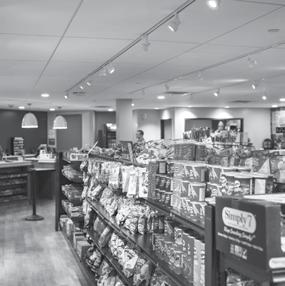
Following months of extensive renovations, the ribbon was cut and GPA’s Campus Convenience store was officially reopened for business Thursday.
The student union-owned space on the main floor of UMSU University Centre that includes the store, the UMSU offices and Answers had not seen major renovations since 1999. The store and offices reopened for business within the last month.
UMSU vice-president finance and operations Mbuli Matshe said the renovations were driven by student demand.
“A lot of what we changed in GPA’s was on the recommendation of students from a survey that we put out,” he said.
“They wanted more from GPA’s — not just in terms of quantity but in terms of variation and different goods and things that we supply there.”
He added that survey responses also raised issues of sustainability and
the creation of more jobs on campus.
UMSU general manager Thomas Blumer noted that there are about 20 students currently employed by UMSU at GPA’s.
“So
far we’ve had a great response”
— Mbuli Matshe, UMSU VPFO
The store was expanded from 1,500 to 2,700 square feet.
Matshe said the larger space helps accommodate a larger selection of stock, including the healthier options that many students, faculty and staff asked for.
The project was pegged at an estimated cost of $2.5 million dollars. The final cost is not yet known.
Major renovations were also
UMSU gearing up holiday hamper program
Student union incentivizing donation efforts for annual food and
GILLIAN BROWN, STAFF
For many students on campus, the holiday season is more worrying than it should be. To help out, UMSU’s holiday hampers are back for another year.
As tuition and course material fees increase across Canada, food bank usage for students is rising as well. The situation is so severe at the University of Calgary that its food bank is running out of food.
UMSU VP community engagement Kyra Fanning said that she wants to ensure that students can focus on studying for exams in December, instead of having to worry about providing for their families or going hungry over the holidays.
“We just want to take a little bit of stress off of their plates during the holidays,” said Fanning, who is acting as head of this year’s holiday hamper program.
“Obviously we can’t write their exams for them or do that sort of thing but this is something that we can [do]. All they have to do is a little application process and we can hopefully help them and provide for them."
The hampers will supply a family with food — including the ingredients for a traditional holiday meal — and wrapped gifts for children.
Every year, like the year-round
toy drive
tion this holiday season between the faculties to incentivize fundraising. Donation collection stations will be put in place, and every food item or donation will count for points.
“We just want to take a little bit of stress off of their plates during the holiday” — Kyra Fanning, UMSU VP community engagement
Applications opened Monday and will be received until Nov. 22.
food bank, success relies heavily on donations of food and toys from students and faculty.
UMSU is holding a competi-
The winning faculty will have a meeting catered by Degrees.
This year, the longstanding initiative for U of M students and families has made some changes.
In the past, UMSU offered only small and large hampers. This year,
undertaken to improve the UMSU office space and Answers, which were amalgamated into a single desk in the UMSU office now branded the UMSU Service Centre.
Matshe said the reaction from students has been positive.
“With GPA’s we’ve had an increase [in usage],” he said.
“We had an estimation of revenue that we thought we were going to hit by this period in time, and we’ve exceeded that revenue [compared to] this time last year.
“In terms of Answers, as you can obviously see, the process has now been streamlined to a point where students can come in [and] we have more staff available to them.”
Matshe said UMSU will continue to collect feedback from students, faculty and staff.
“At the end of the semester we want to put a survey out which will get a more concrete review process of what the student experience actually is.”
a medium size is being introduced for families of three to five people to provide enough food for the anticipated demand of between 115 to 150 hampers.
UMSU will be publishing a list of food needed to fill the various sizes on its website and social media outlets.
The goods will be packed and assembled into hampers by UMSU staff and volunteers between Dec. 9 and 11 so they are ready for pick up or delivery Dec.12 to 14.
Anyone interested in volunteering or applying for a hamper can email hampers@umsu.ca.
November 20 - 22
Campus Centre - 2nd Floor 9am - 8pm Last Day 9am - 5pm
JOE SHOW
Cody oss
Julia Minarik
Ehsan Tahmasebian
istation
Senator 2
HSGSA President
VP Academic
Carl Neumann
Comment Editor: Kenny Ingram
Contact: comment@themanitoban.com / 474.6529
It’s time for city council to stand up for taxpayers
Sam Katz case a reminder that needs of many must come ahead of those of millionaires
KENNY INGRAM, STAFF
In dealing with big business, it’s time for city council to finally put the needs of the average citizen over those of the elite owners.
City officials have recently attempted again to renegotiate the Shaw Park lease with former mayor and Goldeyes baseball team owner, Sam Katz. Officials wish to change the current arrangement, which has Katz profiting $525,000 annually off of two city parking lots and a lease that has him paying $1 per year on property with a market value of $150,000.
The original agreement was made in 1998 by city council for a 25-year period. In 1999, the stadium we now know as Shaw Park was built for roughly $20 million. Just over half of that was paid by Katz and his partners with the rest of the bill — $8 million — footed by the city, province and federal government.
In addition to this, Katz was allowed to set up a non-profit organization, Riverside Park Management, to funnel all of the city-Goldeyes business dealings through. At the time, critics argued that Katz should make the organization’s books public
— something he refused to do.
In his first term as mayor of Winnipeg, city council’s executive policy committee coincidently voted 4-1 to eliminate $223,000 in taxes he would have otherwise had to have paid to the city.
A city report found that the team also receives over $700,000 in corporate welfare each year.
Let’s call the current arrangement between Katz and the city what it really is: legalized corruption.
Despite this reality, Katz recently had the temerity to tell city council he has no intention of paying the fair rate council is asking for.
Instead, he made egregious statements suggesting that council would like to put the Goldeyes out of business.
Unbelievably, city councillors are taking this bait. Charleswood Councillor Kevin Klein is already caving to Katz’s demands by proposing a quarter-measure deal that would see Katz continue to receive all of the subsidies he’s currently receiving, while increasing the lease to a third of its market value.
This recent display further under-
lines just how poor a job Winnipeg city council has done to represent the average citizen. Because while Winnipeggers — who have a median annual income of between $30,000 and $40,000 — are working hard just to get by, city council has a constant knee-jerk reaction to pad the pockets of the richest few.
Let’s call the current arrangement between Katz and the city what it really is: legalized corruption
This siding with big business and its owners over taxpayers is an alarming pattern in Winnipeg.
Winnipeggers watched it play out in the True North deal, where investors were paid millions in taxpayer funds to build luxury condos, while an affordable housing requirement
was scrapped.
They saw the trend continue when council sold Portage Place to “Canada’s biggest landlord,” Starlight Investments, in a likely move toward gentrification.
With the millions of dollars in subsidies doled out to Katz over the past 20 years, Winnipeg could have instead invested in public transit to make necessary improvements, built affordable housing for those who are struggling to get by or invested in the city’s crumbling infrastructure — an area where the city has a deficit of nearly $7 billion.
In Katz’s case, up until now, council has been little more than gutless. They have been attempting to renegotiate this deal since before 2016 and have accomplished nothing.
This time, the city cannot cave. Council must demand that Katz stop fleecing the taxpayers, as he has for the past 20 years, and pay a fair rate.
It is only after council plays hardball with him that Katz will cave.
This is because while he has claimed that the Goldeyes “don’t always make money” — a claim which he refuses to back up with
any real numbers — anyone with any common sense knows if this were truly the case, he would have sold the franchise and cashed out years ago.
Instead, Katz likely understands what he has to lose. He would lose a favourable deal to another profitseeking tenant, the ability to continually overcharge for tickets and turn profits year after year and lose the ability to hand over the entire business to his seven-year-old son to keep those profits in the Katz family in perpetuity.
Not only this, but the average Winnipegger has seemingly fallen out of love with the franchise.
With lowest-priced tickets more than doubling in price over recent years and the games no longer being affordable for the average family, it’s no wonder that the attendance has fallen almost every year since it peaked in 2004.
When it comes to the negotiation table, it is not Katz with the upper hand.
City council must finally go forward with a deal that puts the needs of the average tax-paying citizen ahead of millionaires like Katz.
Meth crisis fuelled by institutionalized neglect Communities
suffer consequences as drug epidemic remains unresolved
MEAGAN HUGHES, STAFF
The meth epidemic in Manitoba is a complex problem that can only be solved with progressive legislation.
Manitoba Liquor Mart store thefts have become a serious issue. So much so that it’s hard to escape the viral videos swirling around Facebook — as people in masks storm the stores taking as much as they can carry while bystanders look on in dismay.
The Winnipeg Police Service (WPS) has reported a current average of 10 to 20 liquor store robberies per day with a warning to the public not to intervene in the event of a theft so as not to endanger themselves.
According to the WPS, this increase is largely driven by the increased use of meth.
Meth is an extremely addictive substance that may cause people to engage in aggressive or compulsive behaviour. When someone is caught up in the addiction of this powerful drug, they often do whatever it takes to obtain the means to feed their addiction and survive. This includes shoplifting and reselling goods on websites such as Kijiji to generate
quick cash.
But it’s not only shoplifting that has seen an increase with the rise of meth use. The July statistical report released by the WPS shows that property crimes increased almost 25 per cent from July 2018 to July 2019, and in July 2019, were almost 39 per cent higher than the five-year average.
Similarly, needles have been found littered in the streets of Winnipeg in increasing numbers. The Bear Clan Patrol, a volunteer-based neighbourhood patrol group, has found a record number of needles on their patrols of the city this year. As of March, the Bear Clan had already found approximately 20,000 needles on the streets since the beginning of the year. This means that they are on track to pick up 80,000 by the end of 2019 — double the amount found in 2018.
that both civic representatives and provincial legislators have a choice to make. They can either spend our limited resources to hire more police and build more prisons or they can understand that the vast majority of this crime comes from people who just need help. Sadly, it seems they’ve chosen the former, and the problem
of urgency by the provincial government, which is unacceptable, given the current situation.
In similar fashion, the provincial government established the Illicit Drug Task Force (IDTF) with the federal and municipal governments.
The solution is not only the economical approach, but the humane option
is only getting worse.
Manitoba Premier Brian Pallister has opted to obfuscate and mislead the public by selectively choosing the few data points that contradict the larger provincial trend.
As a society, we now know the uptick in theft and crime is due to the meth crisis. It’s now a matter of what we’re going to do about it. It’s clear
The most egregious part of all is the $4.1 million Manitoba received from the federal government in December 2018 to help the province fund addictions treatment programs — money which has remained unspent. The province has the funding needed to take action and simply has not. This shows a shameful lack
The IDTF's final report was released in June outlining recommendations for reducing the impacts of illicit drugs on our communities, but the report is underwhelming in its lack of clearcut solutions and strategies to combat the drug crisis.
The experts are already clear on what will solve the issue at the root. The solution is not only the economical approach, but the humane option.
This solution is to establish supervised consumption sites all across Manitoba. A 2014 review of 75 studies found that supervised consumption sites lower the rate of overdoses, public injections and dropped needles while improving access to healthcare. The majority of these studies
were based on safe injection sites in Vancouver, B.C.
These types of harm reduction practices are an integral component of any addiction treatment strategy.
Along with safe consumption sites, representatives must take things a step further by providing the necessary volume of supportive services where people can go to detox and seek immediate treatment, an area where Manitoba has been dangerously lacking. People who want help should not be forced to wait and further suffer due to a lack of funding.
It’s clear that we are at a crossroads in Manitoba. We can either spend our finite resources to hire more police for our streets and more security guards for our liquor stores or we can combat the problem with the humane and empathetic approach it deserves.
The problem demands immediate action, or we will continue to see more ill effects due to the lack of it. Manitobans need support and our representatives must get on board by doing everything possible to bring balance into the lives of citizens before any more harm is done.
15 Arts & Culture
The intricate art of resistance and survival
U of M student Jack Theis uses beadwork to reconnect with his ancestors
GRACE PAIZEN, STAFF
Passionate about his AnishinaabeMétis roots, third-year U of M native studies student Jack Theis became a beadworker as a means to connect with his ancestors.
“All my life pretty much, I’ve been obsessed with my ancestors,” he said, “because I was raised on their stories, their photos.”
“Being raised in Dallas, [Texas,] which is hundreds, even thousands, of miles away from any of my homelands, the only way I could connect with my culture and my ancestors, or one of the only ways I could connect with them, was through art.”
Moving to Minneapolis at 22 with the hope of reconnecting with his ancestral roots, Theis discovered “a culture of beadwork […] in the Twin Cities.”
“I was willing to learn beadwork from any Native person in the community,” he said.
“I’m very grateful to my Dakota friends for teaching me […] [how to do beadwork] because that’s been an integral form of connecting with my ancestors and it’s led to so many other things in my life.”
While in Minneapolis, Theis began beading portraits of his ancestors and “their photos that I grew
up with which are all in black and white from the 1800s and turn of the century.”
“So that I can invite them to be in my life and to be with me at all times […] to keep them close by,” he said.
After moving to Winnipeg three years ago, Theis discovered “twice as many beadwork circles” and began focusing on traditional Ojibwa and Métis beadwork designs.
This past summer, Theis was an Indigenous scholar-in-residence at the Manitoba Museum where the inspiration for his next big project came to him.
Theis said he “got to do extensive archival research in both the Manitoba Museum archives as well as the Parks Canada archives.”
At the end of the research, Theis said he was supposed to do a project, “preferably involving beadwork.”
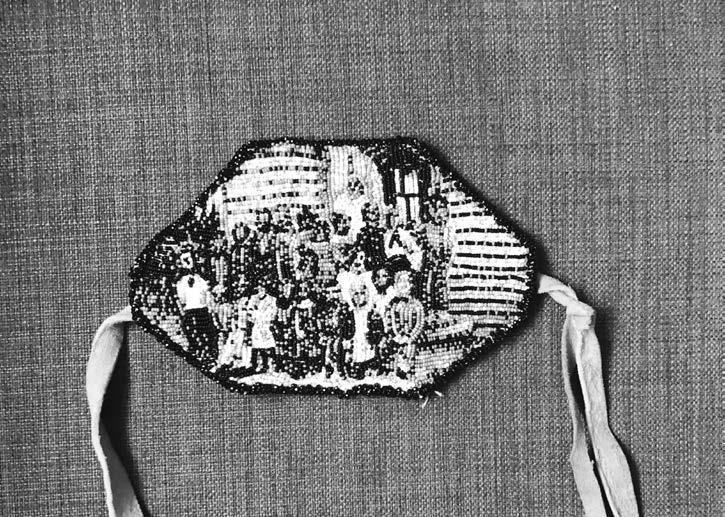
“For my project I wanted to focus on my ancestors,” he said, “so I decided that I would use this passage in the journals of Alexander Henry (the Younger).”
Theis recounted that this passage is an eyewitness account written in 1803 that depicts his ancestors and several other families getting ready to depart for a smaller satellite fort
in the Pembina Hills for the winter months.
“This may be one of the only eyewitness accounts of my ancestor,” Theis said.
“It’s a very vivid and beautiful passage.”
“I don’t want all the beadwork I do just to be a piece of art, or something that looks pretty”
— Jack Theis, artist
Theis said the passage had been used in academic texts to describe the culture of this region at the time.
“But this has never been depicted in any way through art,” he said, “so I was like, ‘This is a perfect chance for me to get a hide’ […] I started beading the image. I did hours and hours and hours of research, I mean, just to make sure it’s historically accurate.”
Theis wants to bead each family along the edges of the hide in detail,
down to each family’s cart and horses.
“So that it looks like […] they’re moving,” he said, “it’s not just pictures on a hide up and down, and that way you have to move if you want to view the piece, you have to move around the hide.”
The purpose of Theis’s project is “to break down a bunch of stereotypes about Indigenous life at the time about Indigenous histories and identities — stereotypes that I’m met with all the time that I’m tired of breaking down.”
Theis’s hide project has been requested to be exhibited at a museum and the Festival du Voyageur has asked him to present it at this year’s festival.
As well, his ancestral portrait project that he started while in Minneapolis has been requested by a gallery and a museum in Winnipeg.
“The homeland is definitely the place for me,” he said.
Though Theis thinks more can be done at the University of Manitoba to promote beadwork as a high art form, he believes it is still not seen in this light.
“It’s not white art,” he said.
“It’s connected to women. A lot of beadworkers are women, histori-
cally and currently. […] Women have, in all areas of art — European art, Indigenous art — have always been kind of cast aside, but you know, of course, Indigenous women, it’s tenfold.”
As for who gets to do beadwork, Theis said “beadwork as an artform — no one really owns that.”
“Humans have been doing that for, like, a hundred thousand years.”
However, Theis emphasized that Indigenous people “have the right to safeguard our ancestors’ designs and our peoples’ designs.”
“I’m not against white people teaching a class on beadwork,” he said.
“It depends on what’s being taught, so if you’re trying to teach a class on […] Métis beadwork, but you’re not Métis, there’s a slight issue there and if you’re not Indigenous at all there’s a huge issue there.”
For Theis, beadwork is a form of cultural resistance and survival.
“I don’t want all the beadwork that I do to be just a piece of art, or something that looks pretty,” he said.
“I want it to make a statement and I want it to be a form of healing, survival, resistance, education, all of that.”
PHOTO PROVIDED BY JACK THEIS
Playing passive on the kill does not work for Bisons
Analysis: Herd needs aggressive penalty kill, better usage of star players
JASON PCHAJEK, STAFF
The U of M Bisons men’s hockey team has a problem.
No, it is not the club’s record — it currently sits 4-4-0 on the season and fifth in the conference. No, it is not the club’s relative inexperience — of its top 10 scorers, only two have played more than two seasons in Manitoba.
The problem is that Manitoba’s penalty kill — to put it mildly — is faring quite poorly. Currently last in the conference, just behind the University of British Columbia Thunderbirds, at 66.7 per cent, the Bisons have given up 13 goals on 39 short-handed situations.
This does not need to be the case, as the herd has all the tools necessary for a strong penalty kill, preventing goals against and turning the tide in games. It all comes down to how the kill is deployed.
The problem: Passivity
When Manitoba takes a penalty and the opposing team sets up in the Bisons zone, the puck is kicked to the point, with the opposing team setting up in an umbrella — the typical offensive scheme favoured in hockey today.
In response, the Bisons retreat into a tight diamond setup around the slot. One player stays in the high slot to pressure the defender at the top of
the umbrella, two players man either faceoff dot to cover movement down to the corners and the last player battles in front of the crease.
Unfortunately for Manitoba, the way it plays this style sacrifices shot quantity for cutting down on shot quality
What this setup does effectively is protect the home plate area of the ice, clogging up movement through the slot and toward the goal. Unfortunately for the herd, the way it plays this style sacrifices allowing shot quantity for cutting down on shot quality.
The root cause of this issue comes down to how Manitoba plays passive defence in its own end.
Instead of challenging the puck carrier no matter where they are, the Bisons sit back in the diamond using positioning to try and force the opposition to take shots from low-danger areas, and then collapsing on the
crease to clear loose pucks away. A similar style is used at even strength, and has led to heavily lopsided shot counts.
Bisons starting goaltender Riley Lamb has faced the second most shots of all goaltenders in Canada West, at 247, in his six games played. Only Taz Burman of the University of Lethbridge Pronghorns has faced more, but Lamb faces more on average — 41.17 to 37.71 shots per game.
This passive defending style may cut down on the high-quality chances Bisons head coach Mike Sirant is trying to limit, but the increased workload on Lamb will wear down the rookie netminder while still giving opponents plenty of chances to score.
The passivity does not end there, as when the herd clears the puck down to the offensive zone, a new issue arises.
Unlike most penalty-killing schemes in Canada West, which emphasize speed and pressure on the forecheck once the puck is cleared from the zone, Manitoba goes its own way.
Where other clubs elect to send a forechecker deep into the opposition’s zone to pressure players trying to set up transition back down the ice, Manitoba sends one skater in for
a shallow patrol.
The effect is to give the opposing team a chance to breathe and set up their zone exit, while Manitoba gets to keep a player near the neutral zone to cause more pressure in transition. When it works, it’s effective, but the plan can leave the herd open for oddman rushes, and more aggressive forechecks on the penalty kill serve to create pressure and kill more time off the clock.
This is playing conservative hockey, and in Canada West this just does not work.
The solution:
Aggressiveness
Thankfully for Manitoba, the solution to this problem is simple. While on the penalty kill, speed and physicality can be used to create pressure all over the ice.
The herd can broaden the diamond while in the defensive zone, pressuring the top of the umbrella and forcing attacking players to the boards where you can tie them up and kill precious seconds off the clock. Then, when the puck is dumped down the ice, it can use an aggressive forecheck to pressure backcheckers and force them to make mistakes.
With Manitoba’s mix of speed and
PHOTO BY DAVE MAHUSSIER
physicality on the roster, this can be easily accomplished.
Colton Veloso springs to mind as the best man for the job, being the prototypical power forward, similar to former Bisons captain Brett Stovin. Though, where Stovin could take draws and be used as both a forward and defender, Veloso brings more size and strength which can be used to wreak havoc in the defensive zone.
Veloso also has the speed and offensive awareness to be used as a deep forechecker once the puck is dumped down the ice, being a physical presence able to worry defenders into making mistakes or physically removing the puck if needed.
Also effective for this role — albeit in a slightly different deployment — is Jeremey Leipsic, who has the speed and stick skills to irritate opponents, knock down passes and strip pucks off sticks.
Both forwards do a great job in the offensive zone at pressuring puck carriers and battling with defenders. They take away time and space, forcing opponents to make mistakes and generate scoring chances.
This same aggressive style they play can be used to kill time and create turnovers while on the penalty kill — the Bisons just need to use it.