A “volunteer staff” member is defined as a person who has had three volunteer articles, photographs, or pieces of art of reasonable length and/or substance published in three different issues of the current publishing year of the Manitoban. Any individual who qualifies must be voted in by a majority vote at a Manitoban staff meeting. Elected representatives and non-students may be excluded from holding votes as volunteer staff members in accordance with the Manitoban Constitution.
The Manitoban is the official student newspaper of the University of Manitoba. It is published monthly during the summer and each week of regular classes during the academic year by the Manitoban Newspaper Publications Corporation.
The Manitoban is an independent and democratic student organization, open to participation from all students. It exists to serve its readers as students and citizens.
Austerity measures in Quebec provoke mass protests
Marches gain momentum in the streets of Montreal
Amarch against government austerity took place in the streets of Montreal on Friday, Oct. 31. An estimated 82,000 people took part in the march, which was organized by a coalition, composed of more than 70 local unions and multiple community groups, called the Coalition opposée à la tarification et à la privatization des services publics (the coalition against the privatization and the taxation of public services).
University students and students of the publicly funded pre-university institution exclusive to the Quebec education system, Collège d’enseignement général et professionnel (CEGEP), went on strike on Halloween.
Among others in the coalition was a student association called L’Association pour une Solidarité Syndicale Étudiante (ASSÉ).
The internal affairs secretary for
ASSÉ, Virginie Mikaelian Camille Godbout, told the Manitoban that the recent march was not the first antiausterity protest the association had taken part in. According to Godbout, ASSÉ had organized another antiausterity protest last April, which gathered more than 15,000 people in the streets of Montreal.
The recent protest was specifically aimed at the austerity measures taken by Philippe Couillard’s Liberal government.
“Couillard keeps on cutting services without really measuring the negative effects of these measures,” said Godbout. She said that the government is determined to go back to zero deficits without really measuring the consequences on the population.
“The Liberal party [in Quebec (PLQ)], like the previous government, has a tendency to consider our public services—and especially
education—as a simple commodity that needs to respond to the needs of our economy, thus reinforcing the dominance of profits over people,” said Godbout.
“Never in Canadian history has there ever been less of a reason for austerity, if there ever was a reason for austerity”
–
Robert Chernomas, U of M professor of economics
According to Godbout, ASSÉ is focusing on protecting Quebec’s
public services, especially its education systems.
“At ASSÉ we believe in an education system free from private business interests,“ Godbout told the Manitoban
University of Manitoba economics professor Robert Chernomas weighed in on the subject of government austerity. He said that “never in Canadian history has there ever been less of a reason for austerity, if there ever was a reason for austerity.”
Chernomas said that he believes Canada has never been in a better position than it is now to spend on improving infrastructure, lowering or eliminating tuition, and on health and education in general.
According to Chernomas, the issue of austerity is especially relevant in Quebec at the moment, because many still remember the Quiet Revolution and what it entailed.
“During the Quiet Revolution, Quebec was very far behind compared to other provinces and countries, and they began to build their public sector – using those revenues to build the universities and keeping tuition low, which has made Quebec a much more advanced economy than in the past,” Chernomas explained.
“We need to fight to maintain the rights acquired by social and student movements in the past. In the last few months, the government and its regressive measures and policies have managed to set us decades back,” said Godbout.
The fight is far from over, according to Godbout.
“October 31 was only a beginning; the government can expect that we will be in the streets if they continue with its austerity project.”
The referendum conundrum
What requires a referendum at our university?
The University of Manitoba
Students’ Union voted in favour of a referendum question that will see a $260 annual fee added on to all of its members’ tuition payments—with exceptions for those with disabilities or who live outside the city—while providing them access to unlimited transit access from September to April.
However, not all cost increases for students result from a referendum. A potential additional fee for the Active Living Centre is a prime example of a financial decision that students may not be given the opportunity to vote on.
The University of Manitoba is currently completing expansion of its existing faculty of kinesiology and recreation management’s recreation facility. Fundraising for the $48-million project is already underway, according to the University of Manitoba’s website, and is “now focused on gaining donor and community support.”
The Active Living Centre may require an additional fee, at the discretion of the U of M Board of Governors that may be implemented and charged to U of M undergraduate students, but will not be determined until completion of the project – expected in 2015.
The Manitoban spoke to UMSU president Al Turnbull and students for their input about referendums on
campus.
Turnbull told the Manitoban that neither UMSU nor the Board of Governors are required to pass a referendum on any issues regarding tuition. Instead, he said, they have the authority to make decisions as representatives of the student body and university, respectively.
“I personally don’t think I’m going to be using the Active Living Centre; however, I don’t have a problem with the fees. It improves quality of life, and that’s one of the prices—literally speaking—of being part of a community of several thousand people,” said Anthony Wightman, a thirdyear political science student.
Wightman said that he thinks there should have been a referendum nonetheless, stating that he is in favour of the fees in theory but that students should have the right to decide on whether or not they want them.
Allisa Venema, who is a third-year fine arts student, said that she was surprised when she transferred to the U of M to find out that a gym membership was not included in tuition as it is at other universities, including the University of Winnipeg.
“There are a lot of fees already that I don’t agree with and a lot of money spent in my own faculty that I don’t really agree with, but it happens and you have to make the most of what you’ve been given,” said Venema.
According to the U of M’s website, the Board of Governors “may exercise in the name of the university any powers conferred on the university as a body corporate (and which are not reserved to Senate).”
Among those powers, it explicitly lists the power to “set all fees and charges to be paid to the university.”
“The board of governors and UMSU don’t need to run referendums for anything. With UMSU it has become a formality that to implement any major program it needs to have a referendum,” said Turnbull.
The U-Pass referendum, according to Turnbull, was vital because of the imbalance of opinions.
“To not have done a referendum for the U-Pass would have been political suicide because we are talking about such a disparity between drivers and riders,” said Turnbull.
Turnbull said that “[the potential fee for the Athletic Living Centre] is far less controversial than the [fee for the] U-Pass just because of the sheer numbers that would be able to access it.”
According to him, the cost of hosting a referendum is one of the main reasons that not all major issues are put to the vote.
“Referendums are expensive,” Turnbull told the Manitoban. “They are messy and a lot of work. This last referendum cost us over $12,000. You have to pay for poll clerks and sta-
tions and materials, and you have to co-ordinate them properly.”
Many students were upset by the U-Pass referendum results, especially those who do not ride the bus to campus.
Justin Punton, a fourth-year science student, stated that he did not believe that the referendum was properly advertised to both demographics and that only those who were in favour of the U-Pass were motivated to vote.
Another concern was that because of the time it would take to implement the U-Pass (approximately two years), the decision—at least for some students—would not affect their university careers at all.
“I’m voting for something that may never affect me in the future,” said Isaac Weldon, a second-year arts student.
Turnbull responded to negative feedback about the U-Pass by reminding students that the vote had been left up to them. With a 19.5 per cent turnout, Turnbull said students who did not participate in the vote should not be complaining about the results.
“Our message has been very clear. We left it up to students and if you didn’t vote, then you don’t have a say,” said Turnbull.
For those who did vote, with 53 per cent of votes in favour of the U-Pass, Turnbull stated that it was still a majority and that is simply the way a democracy works.
“We are going to carry out our mandate, and if anyone asks, we are just doing what the students voted for us to do,” said Turnbull.
photo by Carolyne KroeKer, staff
U-Pass passes for second time
UMSU’s recent political stance on the transit question
Dana HaTH erly, staff
W
innipeg students from the University of Manitoba and the University of Winnipeg voted last month to determine whether or not the U-Pass should be implemented for students from participating postsecondary institutions.
Based on the will of the student body, the vote indicated that the student body wanted the U-Pass program to be introduced at the recently proposed rate of $260 for members of UMSU and the University of Winnipeg Students’ Association (UWSA).
The UMSU referendum results had 53 per cent of students approve
of the U-Pass. The U of M Graduate Students’ Association (UMGSA) held a separate referendum to determine the will of their student body’s inclusion in the U-Pass program. With 59 per cent of voting members in favour of the transit pass, the vote by the UMGSA signalled to city council that their members were also seeking inclusion in the program. On the other hand, the UWSA vote—which showed 82 per cent in favour—included U of W graduate students.
History of the referendum
Two years ago, 74 per cent of U of M undergraduate students voted in favour of the U-Pass. The first referendum garnered the highest UMSU voter turnout in over 15 years.
During that time, former UMSU vice-president advocacy Jennifer Black took an unpaid leave from her position at UMSU in order to organize in her full capacity as a student member, without overstepping her executive role.
The result of the first referendum meant that UMSU was given a mandate to negotiate for a pass at a rate of $85 or less per semester,
which totals $170 per academic year. Based on negotiations between the City of Winnipeg, Winnipeg Transit, UMSU, and UWSA, the total annual price increased by $90 to reach the current price of the proposed U-Pass program. The price increase led UMSU and UWSA— and additionally, UMGSA—to hold referendums last week.
“The Winnipeg city council adopted a resolution in Feb. 2014 endorsing a U-Pass program provided that students held a successful membership referendum before Nov. 1, 2014 to approve a price of $260 per student for the fall and winter semesters,” read the UMSU Council meeting minutes from Sept. 29.
At the U of M, the U-Pass referendum was motioned for by the 2014-15 UMSU executive; motivated by UMSU president Al Turnbull; and resolved by UMSU Council at that same meeting.
The UWSA executive gave their endorsement to a similar question regarding the U-Pass, according to UWSA president Rorie Mcleod Arnould.
The University of Manitoba Students’ Union maintained a neutral stance on the issue, content to pose the question to members.
Based on the UMSU mandate, members were to be informed about the U-Pass over the course of the campaign period prior to the voting days.
“My role as an UMSU executive for this referendum is to give the student body the opportunity to vote on the U-Pass program,” said Christian Pierce, UMSU vice-president external.
Turnbull said that, with the civic elections occurring at the same time, he would have preferred to have held the referendum at a later time. Since the UWSA and UMGSA were holding their referendums at the end of October, he suggested it would ultimately be better to co-ordinate the UMSU referendum to coincide with theirs and in accordance with the city council resolution.
UMSU’s role
The U-Pass forum hosted by UMSU, UMGSA, and the Manitoban on Oct. 23 was held on the same day as advanced voting.
At the transit forum, students were invited to direct questions to Pierce, UMGSA president Laura Rempel, and participating panellists.
One question from the transit forum audience read:
“The initial U-Pass referendum gave a clear indication—74 [per cent] in favour—as to the will of the student body, yet UMSU seems, until recently, not to be actively pursuing it. The question is: Where does UMSU stand [with regards to] the U-Pass and why has it not been on their agenda until recently?”
“We’ve been pursuing it with city council and the UWSA,” responded Pierce. “Our goal is to give them the
best possible price point and let the students decide by giving them all the facts.
“The big part of the U-Pass is to promote the use of public transit and sustainability.”
At the same forum, University of Manitoba Students’ Union executives told the Manitoban that they chose to remain neutral on the subject of the U-Pass.
“During the initial referendum in 2012, the UMSU executive chose to take a stance on the U-Pass,” Pierce said.
“As I mentioned, it was a decision by our executive during the election to remain neutral during the referendum and allow our members to make the decision ultimately.
“As an executive, we are taking a neutral stance and allowing students to register ‘yes’ or ‘no’ sides on the issue.”
UMSU’s bylaws
The chief returning officer (CRO) is responsible for advertising and informing students about elections and referendums, “promoting the election/referenda beginning at least 19 days before the close of the nomination period.”
The minutes from the Sept. 29 UMSU Council meeting indicate that “Turnbull reported that the CRO selections committee, the elections referendum, discipline, interpretation, and enforcement board, as well as the campaign expenses and advisory committee need to be struck.”
Bylaw 1020 states the CRO’s duties, including advertising for registration of campaign sides—“yes” or “no” sides in this case—prior to the registration period.
On the nomination and registration day, each side of the referendum debate presents their registration forms to the CRO. The registration period opened on Oct. 13, according to Pierce.
According to the Oct. 14 UMSU Council meeting minutes, the chair reported that the CRO selections committee had met and selected a candidate to bring forward to UMSU Council. Last year’s CRO, Jacqueline Keena, was again appointed as the CRO at the same UMSU Council meeting. Advanced voting opened on Oct. 20, and the referendum took place from Oct. 29-31.
“The role of the CRO, as outlined in UMSU Bylaw 800 is to ensure that elections and referenda operate safely, fairly, and in accordance with the election rules,” Keena told the Manitoban
The bylaws also state that the CRO’s role is to encourage students to get informed and “actively participate in the democratic process.”
Whenever possible the CRO must advertise for elections. Keena was given less than one week to advertise for advance voting.
photo by beibei lu, volunteer staff
UWSA hosts by-election
New business and economics director elected, international students’ director position remains unfilled
Cra I g aD ol PH e, staff
The University of Winnipeg Students’ Association held a by-election last month in which two seats on their board of directors were supposed to be filled and students were asked to vote on a referendum question meant to gauge support for the U-Pass.
Polls were open from Oct. 27-29 and saw a 47.5 per cent increase in voter turnout compared to the general election which took place in March – jumping from 922 voters in the general election to 1,360 in the by-election.
On the referendum question 1,112 voted yes, 243 voted no, and 5 ballots were spoiled.
For the position of business and economics director, Mathew Joseph was elected over co-candidates Kyle Karpish and Jordan Sobey who had run for the position as a team, hoping to be co-directors. A recount was required before Joseph was declared winner because of a narrow margin of victory in the first count - a single vote difference, according to Joseph.
Figures released after the recount showed that Joseph received 625 votes and Karpish and Sobey received 576 votes, with 11 spoiled ballots.
The position of international student director was left unfilled.
An advertorial, written by the UWSA and published in the Uniter ’s Oct. 23 issue, profiled all the candidates in the by-election including Chun Hoe Ho, the then sole candidate for international students’ director.
The UWSA’s chief elections commissioner, Michael Walpole, told the Manitoban that the sole candidate in the running for the position dropped out days before the election.
One candidate did run for the position of international students’ director in the general election that took place in March. Beatriz Carazo del Hoyo, a bioanthropology student from Spain, was the only can-
didate to apply during that election but has resigned since winning the directorship.
Bylaw 4.03 ii. of the UWSA bylaws states, “A vacancy in the non-executive director position occurring on or after September 30 of any year, except that which is the result of an increase in the number of Directorships, may be filled by appointment by the Board of Directors so long as the executive committee is in a position to make recommendations pertaining to the filling of this position. The duration for such an appointment shall be the balance of the unexpired term of the vacating director.”
However, Rorie Mcleod Arnould, president of the UWSA, said that they had not looked at appointing anyone to the directorate before the election because they expected it to be filled during the by-election and an appointment would run for the entire year.
“While I know that we have done so in the past, I don’t sense any movement among board members to fill this seat by appointment. We will continue to work with international students to address the issues that affect their communities through all other available channels.
“All director positions are filled via the electoral process, and so that position will be filled as the new Board of Directors takes over in April.”
Like the number of ballots cast for the U-pass referendum, the number of ballots cast for the business and economics director position ended up being significantly higher than any other directorship won during the UWSA’s general elections – only two of which were contested.
Mcleod Arnould said the referendum played a major role in the increased voter turnout for the by-election.
“Referendum questions that address issues as significant as the
U-Pass do raise voter turnout significantly, and it’s likely that the high turnout was driven at least in part by the consequences of the question.”
Mcleod Arnould said that on top of being happy with referendum results he was also looking forward to working with Joseph.
“Mathew is someone I’ve worked with in the past at CKUW [95.5 FM], as hosts of ‘People of Interest.’ His
background and personal experience will be invaluable to us as we work to unite students from all areas of study, move forward on government lobbying efforts for equitable and fair tuition rates for international students, and work with universities to ensure appropriate supports for international students studying in Manitoba, which are currently insufficient.”
Joseph shared Mcleod Arnould’s excitement and was looking forward to starting work with the Board of Directors.
He said he would be meeting with representatives of the Business Administration Students’ Association and the Finance and Economics Students’ Association soon, to talk about ideas for the student association.
Independent TEDxUManitoba event at U of M
Researchers present their exciting and groundbreaking research at the inaugural TEDxUManitoba
C H an T elle D ubo IS , staff
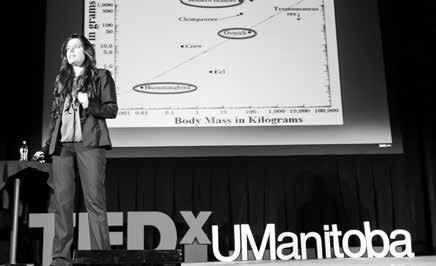
On Nov. 4, 2014 the University of Manitoba hosted its first independently organized TEDxUManitoba event. The event invited nine speakers from varying disciplines to discuss their research and share their ideas with an audience of 100 individuals. Out of the nine speakers, seven gave their presentations on scientific topics and research.
Of the science speakers, the first to present was Ahmad Byagowi, a PhD candidate from the department of electrical engineering, on making space accessible and understandable. Through a small satellite, his team is exploring big ideas such as panspermia, the theory that life came from other planets, by exposing tardigrades to the vacuum of space. He believes this experiment, if successful, could build evidence that perhaps life travelled to Earth by a meteorite from another planet.
Next was Debbie Kelly, a Canada research chair in comparative cognition, who spoke on the bird brain. Her research involves observing bird behaviour in categories such as problem-solving capabilities, spa-
tial memory, and social interaction. During her presentation she showed videos of birds solving problems by manipulating tools, storing caches, and being able to locate them quickly and accurately months later, as well as displaying an awareness of when other birds were watching them store their food.
“Exactly what the TEDxUManitoba organizers wanted”
Emmanuel Ho, assistant professor of pharmacy, offered his presentation, “Nano-Medicine: The Way of the Future?” During his presentation he told audiences about the importance of nano-medicine, medicines with molecules that are nanometers in scale,and how it can be beneficial. In cancer therapy, nano-medicines can accurately treat cancer cells while healthy cells remain untouched, reducing the side-effects and damage usually caused by current che-
motherapy treatments.
Jeremy Strong is not a scientist, but his research for his PhD in English involves science fiction literature. In his topic, “How Imagining the End of the World Might Help Us Save It,” he discusses many examples of literature that express humanity’s fear of certain technologies destroying us, or hope that they might save us. An example includes artificial intelligence and robotics, both of which have been portrayed in stories where they end humanity or offer it salvation.
Michael Paterson is the chief research scientist at the International
Institute for Sustainable Development -Experimental Lakes Area. He and his team of scientists perform experiments on isolated lakes to observe the effects of human activity on them. His team has observed the effects on phosphorous on algae blooms.
The last, but most certainly not least, was David Barber, research chair in arctic system science. His presentation was titled “Seven Surprising Results from the Ongoing Reduction of the Arctic Sea Ice Cover.” Barber’s talk focused on the loss of sea ice in the arctic and the implications this loss has.
During the breaks, groups of
individuals congregated to discuss the research they had just learned about, which is exactly what the TEDxUManitoba organizers wanted. Organizer Mohamed Ouf said he hoped the event would highlight the University of Manitoba and all the things happening on campus. He has previously been involved with TEDxCairo.
The annual TEDxUManitoba is an independently organized event. Anyone interested in presenting at next year’s event or being in the audience should visit TEDxUManitoba.com for updates.
Shooting tardigrades into space with UMSATS
The experimental design of this endeavour and two courses dedicated to it
Jerem I a H yarm I e, staff
The University of Manitoba Space Applications and Technology Society’s (UMSATS) TSATS-2 Systems Team intends to probe the hostility and forgivingness of the vacuum of space.
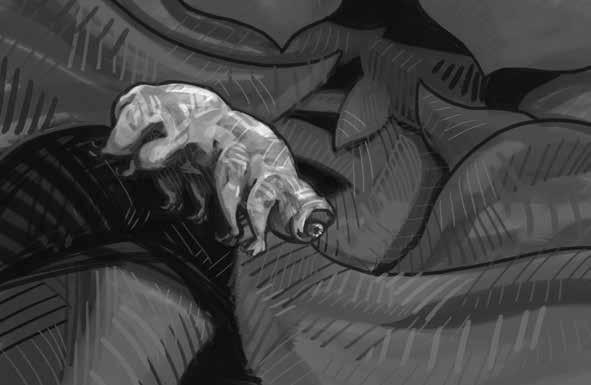
Tardigrades, also called water bears, are micro-animals that are invisible to the naked eye. These animals are of particular interest due to their ability to survive in extreme environments.
The UMSATS team plans on introducing tardigrades to the vacuum of space and observing their ability to endure this seemingly inhospitable environment.
The European Space Agency program has previously shown that tardigrades of the species Milnesium tardigradum can survive this exposure while in a dehydrated state.
This venture is being carried out by U of M researchers and students from several disciplines. Graduate student and biology systems lead Viridiana Urena Ramirez is overseeing the tardigrade project.
The team was able to cultivate small tardigrade samples from the U of M campus, but was unable to obtain enough specimens for the experiment.
“It says in the literature and everywhere you look on the Internet that [tardigrades] are everywhere [ . . . ] but we couldn’t find any,” said
Ramirez.
Viridiana contacted a tardigrade researcher from St. Mary’s University College in Calgary, who supplied the UMSATS team with a sample of two different species, one of which was Milnesium . The UMSATS team decided to use the same species as the specimens used on the European Space Agency experiments.
Upon rehydrating the sample, the team observed that the larger tardigrades were eating the smaller ones
Upon rehydrating the sample, the team observed that the larger tardigrades were eating the smaller ones.
“We realized that they needed a food source,” said Ramirez. They soon found out that the tardigrades ate rotifers, microscopic animals found in freshwater environments.
Since the tardigrades inhabit the same sample as the rotifers, distinguishing their movement from the rotifers was challenging.
The team decided on genetically altering the tardigrades to make them glow by expressing fluorescent pro-
teins, molecules derived from those naturally found in glowing jellyfish. When exposed to UV light, these proteins shine back with a particular colour. This way, it is possible to distinguish the tardigrades in orbit on the satellite.
Department of biological sciences associate professor Steve Whyard is overseeing two special topics courses in which the tardigrades will be manipulated.
“We are trying to add two different fluorescent proteins [ . . . ] green fluorescent protein and red, whichever one works, or perhaps both,” said Whyard.
In the first course, which is currently ongoing, the team is attempting to introduce the genes for these fluorescent proteins into the tardigrades. They are doing this by injecting the genes directly into adult gonads and by using a device called a gene gun.
“The gene gun delivers tiny microparticles, little gold particles, which are coated with the DNA. We’ll try shooting both adults and eggs, and see if we can get delivery into the cells,” said Whyard.
The team is utilizing a transposon system known as PiggyBac. Transposons are pieces of DNA that have the ability to jump around between different DNA sites in a cell, and could therefore help insert
the fluorescent protein gene into the tardigrades’ DNA.
A second special topics course for the winter term involves investigating the inheritance of the glowing trait throughout generations. Whyard is looking to recruit a student to take on this project. The student would carry out molecular analyses, while also receiving academic credit for their work.
The tardigrades will be contained in a simulated ecosystem chamber within the nanosatellite. The experiment involves exposing the tardigrades to the vacuum of space for one week. After that the chamber will be observed to see what the effects are on the tardigrades.
Currently, a control sample of tardigrades are being examined to determine what their typical diet and reproduction patterns are like.
“We want to evaluate how much oxygen they need and how many rotifers they eat [ . . . ] so that we have enough for the experiment,” said Ramirez.
The team plans to have their satellite completed by summer 2016.
For more information about the special topics course, stop by the team’s meet and greet occurring on Nov. 21 from 11 a.m. to 1 p.m.on the first floor of Armes. Follow the progress of the UMSATS team at umsats.ca
graphiC by bram Keast, staff
photos by beibei lu, volunteer staff
Science & Technology
Evolution and creationism in education still under debate
Bill Nye’s new book brings the classroom science education discussion back into the spotlight
Earlier this year Ken Ham challenged Bill Nye to debate on the topics of creationism and evolution as models of the origins of life. The debate took place on Feb. 4, 2014 at the Creation Museum in Petersburg, Kentucky and was streamed online to approximately three million people worldwide.
Ken Ham is a young Earth creationist who previously taught high school science. Young Earth creationism promotes the religious belief that the Earth was created less than 10,000 years ago as a result of an intelligent creator, a literal interpretation of the timeline of events presented in the Bible.
Ham is also the president of the Answers in Genesis organization. Answers in Genesis is a non-profit global organization which actively refutes ideologies of evolution. Both organizations promote creationism as the models for origins of life on Earth.
Many know Bill Nye as the host of the PBS children’s show Bill Nye the Science Guy. He is currently the executive director of the Planetary Society, an organization co-founded by astrophysicist Carl Sagan in 1980 to promote and advocate space, science, and engineering education to the public.
Nye’s book Undeniable: Evolution and the Science of Creation was published on Nov. 4 of this year, months after the debate. Nye dedicates a chapter of this book to the
claims made by Ham during the debate.
Nye is strongly opposed to teaching creationism in classrooms in lieu of evolution. “I pointed out that without young people entering the science fields, especially engineering, the country will fall behind other nations who do educate their kids in real science rather than the pseudoscience of creationism.”
Approximately onethird of Americans reject evolution as a theory of origin. Around half of Canadians accept the theory of evolution
Approximately one-third of Americans reject evolution as a theory of origin. Around half of Canadians accept the theory of evolution.
In the United States, six out of 50 states require students to analyze important aspects of evolution, providing them the opportunity to critically think about the theory.
Creation Ministries International, a spinoff from
Science Fiction: we use 10 per cent of our brains
Appreciating the power between our ears
Jerem I a H yarm I e, staff
Discussed in this issue of Science Fiction: do we humans use only 10 per cent of our brains?
Answers in GenesisAustralia, has a Canadian branch with a headquarters in Ontario, which is actively involved in outreach across Canada to promote their viewpoints to the public.
In Manitoba, evolution is included in the grade 12 biology curriculum, and the grade 11 topics in science curriculum. Both classes are optional science electives for high school students. The theory is not included in science curriculums for the grades prior. The province does not make alternative viewpoints on origins a mandatory classroom science topic.
Regardless of an individual’s viewpoint on creationism and evolution, Nye continues to bring the issues to the forefront of classroom science education; it is a topic he is clearly passionate about.
Ham explained his creationist approach to science during the debate with the statement, “creationists and evolutionists all have the same evidence [ . . . ] It’s not the evidences that are different. It’s a battle over the same evidence in regard to how we interpret the past. And you know why that is? Because it is really about worldviews and starting points. It is a battle over philosophical worldviews and starting points with the same evidence.”
Near the end of the debate at the Creation Museum, Bill Nye stated, “As my old professor Carl Sagan said so often, ‘When you’re in love, you want to tell the world.’ And I base my beliefs on the information and the process that we call science. It fills me with joy to make discoveries every day of things I’ve never seen before. It fills me with joy to know that we can pursue these answers. It is an astonishing thing that we are—you and I are—one of the ways the universe knows itself.”
“The statement is a myth [ . . . ] We use every part of our brain, and areas that are really busy actually try to take over nearby areas that are slightly less used, or less strong,” said Tammy Ivanco, associate professor in the department of psychology.
Brain regions overtaking neighbouring areas is an example of neuroplasticity. Neuroplasticity refers to the brain’s ability to rewire neural pathways in response to behavioural or environmental changes, such as damage through physical injury. Through these neuroplastic mechanisms, the brain can change and remodel itself throughout a lifetime.
Neuroplastic remodelling can be observed in individuals who have lost the ability to utilize a specific region of the brain. In blind individuals, the region of the brain that deals with sight, the occipital cortex, can be overtaken and utilized by regions involved in processing other senses. The efficiency of overtaking unused regions shows that the brain is invested in maximizing the use of all of its real estate.
The human brain utilizes approximately 20 per cent of oxygen breathed while only comprising roughly 2.5 percent of overall body mass. It would be strange for evolution to have allowed for the development of an organ with such a high demand on bodily resources to be 90 per cent non-functional.
Different areas of the brain have different designated functions. These different regions work in concert to act as a fully functional cohesive unit.
The most evolutionarily ancient region of the brain is the brain stem, which controls necessary life functions like breathing and heartbeat. Damage of the brain stem can be critical, possibly resulting in a vegetative state or death. Brain stem injuries are particularly concerning because this area is involved with these critical functions.
The hippocampus is a region of the brain involved in learning and memory. A compromised hippocampus is the most common cause of brain injury-related memory and learning problems. Individuals with hippocampal injury demonstrate impaired ability to learn and contextualize information.
Interestingly, individuals with hippocampal injury typically do not show perceptual and skill
learning impairment. This type of procedural learning, like how to ride a bike, is associated with brain regions like the motor cortex and cerebellum. Damage to the cerebellum has been shown to impair procedural learning.
The amygdala is involved in fear and emotional reactions. This area of the brain is part of a region known as the limbic system, which is highly invested in emotions. The left amygdala of a 44-year-old man was removed due to an abnormality which was resulting in him having seizures. The man, who previously had arachnophobia (the fear of spiders) found that after the surgery, he was no longer afraid of the eightlegged arthropods.
“The statement is a myth [ . . . ] We use every part of our brain, and areas that are really busy actually try to take over nearby areas that are slightly less used, or less strong” – Tammy Ivanco, associate
professor
in the department of psychology
Despite only touching on a few areas of the brain, it is clear that every process has its own place, and each brain region has its own purpose.
The human brain is organized in a very precise way to optimize and carry out its many functions.
“I think the misperception is based on the idea that our brains are capable of so much more than most of us ever accomplish,” Mark Fry, department of biological sciences assistant professor, told the Manitoban
The idea that each of us has the potential to access some hidden untapped inactive region of the brain may be desirable, but in reality the brain is fully utilized. The brain makes use of every region that is available to it, whether the regions are sufficient or lacking. How we, as individuals, make use of our brains is another story.
graphiC by Justin ladia, volunteer staff
Someone you like has done something bad
Don't
jump to Ghomeshi's defence just because you like his show
When the CBC announced that they had ended their relationship with Jian Ghomeshi, the Internet exploded, with fans of Ghomeshi tweeting their collective outrage.
Musician and author Amanda Palmer was one of the first celebrities to vocally defend Ghomeshi—though she later had a change of heart—and the structure of her defence is chillingly representative of most arguments in Ghomeshi’s favour. She initially refused to acknowledge the allegations against him, stating that “what happens behind closed doors is never knowable,” and instead focused on him as a person, describing him as a “ninja interview MASTER,” seemingly suggesting that his skill and charisma as an interviewer make him unlikely to be guilty of sexual abuse. This seems like a pretty strange way to interpret these events, but a quick glance at the comment section of any one of the many articles written about the “Ghomeshi Scandal” reveal that this view is only too common.
Let’s look at what happened: Ghomeshi, after it became clear that the allegations against him were going to go public, took to Facebook and posted an eloquent account of the events from his point of view.
He explains that he and his partner were engaging in consensual acts of BDSM and that they “ joked about [their] relations being like a mild form of Fifty Shades of Grey or a story from Lynn Coady’s Giller-Prize winning book last year.” In this way, Ghomeshi subtly reframes the entire situation to suggest that he is somehow being attacked for his “tastes in the bedroom,” as they “may not be palatable to some folks.”
Ghomeshi also makes a point of discrediting the woman who brought forward accusations of sexual abuse against him. He portrays her testimony as a childish attack by an angry ex-girlfriend.His entire statement essentially dismisses the woman as an unreliable or less credible source than himself, exploiting the same dynamic of power that fuels sexual abuse. Ghomeshi offers no evidence to support his interpretation of the events. He simply presents himself as inherently trustworthy while reducing the accusations of this woman to an angry ex-girlfriend’s insubstantial “campaign of vengeance.”
So far, at least nine women have come forward with accounts accusing Ghomeshi of sexual abuse. In an interview with the Toronto Star, actor Lucy DeCoutere (Lucy from Trailer
Park Boys) recounted an incident in 2003 in which Ghomeshi choked her to the point she could not breathe, explaining: “He did not ask if I was into it. It was never a question. It was shocking to me.”
Other women have presented similar reports of unwanted sexual aggression, making it pretty difficult to view Ghomeshi as anything but a serial sexual predator.
The roles of man exploiting his position of power to commit sexual abuse and thoughtful and charming radio personality are not mutually exclusive. It is possible for a person to be both.
The idea that a sexual predator is bound to be some kind of trenchcoated outcast creeping up behind you in a dark alley is both naive and dismissive of the wider range of sexual abuse that can be committed against a person.
The fact that you like the way Jian Ghomeshi conducts interviews does not mean you should jump to his defence when he is accused of doing something bad. The fact that he seems like a nice and intelligent guy does not discredit the stories of these women. They deserve to be listened to.
photo by sarJoun faour
UMSU gets it right with political neutrality
Radical politics have no place in student unions
eTH an Cabel, staff
At a time when more and more Canadians are attending university at different stages in their lives and for vastly different reasons, the idea of students comprising a uniform political constituency is increasingly absurd.
Even the cultural lingo of university life—characterized by tired, broke, and hungry young students cramming for their next midterm—is more and more removed from reality.
A full-time student living in residence, immersed in classes and the campus community, is now the exception rather than the rule. Increasingly, students are attending university part-time and working to make ends meet, or living with their parents and working to pay their university tuition.
Moreover, as Canada approaches 70 per cent post-secondary education attainment, degree inflation is becoming a serious concern. A bachelor’s degree is slowly taking on the value of a high school diploma while a graduate degree has begun to replace a bachelor’s as the benchmark of higher education.
This has essentially created a market for post-secondary degrees that responds to supply and demand. Departments or faculties like theology, classics and philosophy—fields once valued as intellectual pursuits in their own right—are now subject to budgetary review and tough questions as universities compete with colleges to facilitate applied skills that can lead directly to employment.
In short, there is nothing uniform about university student life anymore. And, given that universities are now inextricably linked with the wider economy and labour market, there are no easy answers to some of the problems that post-secondary institutions must confront.
This is the environment that student unions like the University of Manitoba Students’ Union (UMSU) and the University of Winnipeg Students’ Association (UWSA) must contend with. To what extent can a student union advocate for issues or
take a political stance given the different, and often contradictory, political views and practical interests of the student body it represents?
During the recent municipal election in Winnipeg, UMSU and the UWSA provided different answers to this increasingly important question.
As far as UMSU was concerned, there was no preferred result in the municipal election. Winnipeggers would determine the best mayoral candidate and council candidates to represent them without UMSU’s help.
“We supported the vote and the democratic process but we certainly did not endorse a candidate because we knew we’d have to work with whoever won,” said Al Turnbull, UMSU president.
Meanwhile, UWSA president Rorie Mcleod Arnould voiced disappointment at the success of several right-leaning councillors while supporting re-elected councillors Jenny Gerbasi (Fort Rouge-East Fort Garry) and Ross Eadie (Mynarski). Both Gerbasi and Eadie have ties to the NDP, the Canadian Union of Public Employees and the Canadian Labour Council.
The difference between the two student unions is illustrated by their degree of support for the Canadian Federation of Students (CFS), which collects fees from student unions across the country in order to advocate for what it determines to be uniform “student causes.”
The CFS is notorious for harbouring a left-wing or social democratic ideology, supporting tuition freezes, bottled water bans, lower fees for international students and a plethora of other left-wing causes. In 2012, they supported the Quebec student strike over a modest increase in tuition fees in the province, which led to clashes with police in Montreal.
It was instructive that, when the Manitoba chapter of CFS retracted a Winnipeg mayoral candidate report card due to unclear assessment criteria, UMSU came down hard against the report card.
“It was a juvenile gradient of the candidates that failed to mask the subjectivity and bias of the organization; the Canadian Federation of Students represents all students and should be focused on presenting the information to its members and leaving them to decide,” Turnbull told the Manitoban
“An arbitrary evaluation based on no metric is a fairly disgraceful way for a seemingly reputable organization to weigh in on civic politics.”
Zach Fleisher, the chairperson for CFS-Manitoba, is the former vicepresident advocate for the UWSA. He refused to comment on the report card when contacted by the Manitoban last month.
Indeed, the UWSA seems to agree with the CFS’s left-wing politics to a great extent.
In July, the UWSA was involved with a Winnipeg Social Forum event titled “Building a People’s Agenda.”
The Winnipeg Social Forum is part of the national People’s Social Forum organization, which, according to its website, seeks to build “a broad strategic alliance against neoliberal and neo-conservative policies in Canada.”
While the idea of a neutral and benign organization that simply delivers services and fosters respectful pluralism isn't palatable to the more politically outspoken, it is ultimately the most realistic option available
Imagine for a moment that the president of the UWSA presented at a right-wing forum or was affiliated with an organization that sought to build a broad strategic alliance against socialist and social demo-
The July event was held at the University of Winnipeg. Other groups involved with the event included the left-wing Canadian Dimension magazine, the Canadian Labour Congress, and the Council of Canadians. It included workshops like “How do we stop Energy East?” (a pipeline from the Alberta oil sands), “How do we defeat the Conservative agenda?” and “Neo-liberalism and the assault on public education.” The latter workshop was led by the president, Rorie Mcleod Arnould and vice-president advocate, Peyton Veitch, of the UWSA.
cratic policies in Canada. They would rightly be dismissed as paranoid and politically exclusionary.
Ultimately, as student demographics change and as the utility of a post-secondary education evolves, student unions are faced with tough choices. They can either indulge in their own political activism, largely separate from the diversity of political views and practical concerns of a changing student body, or they can accept their limited role in political and campus life.
In this, I think UMSU has taken the right approach. While the idea of a neutral and benign organization that simply delivers services and fosters respectful pluralism isn’t palatable to the more politically outspoken, it is ultimately the most realistic option available.
It is also an option that doesn’t preclude taking strong stances on specific issues. For example, supporting policies to mitigate sexual harassment is important in ensuring a respectful campus environment for everyone. Furthermore, the U-Pass is a policy with broad-based appeal and universal benefits for students. But these issues are few and far between, and should be debated and eventually supported for their universal benefits, not because they correspond to some radical ideological agenda, either from the left or the right.
graphiC by evan tremblay, staff
Scratching the surface: Stories of self-harm
TRIGGER WARNING: SELF-HARM
Carolyne Kroe K er, staff
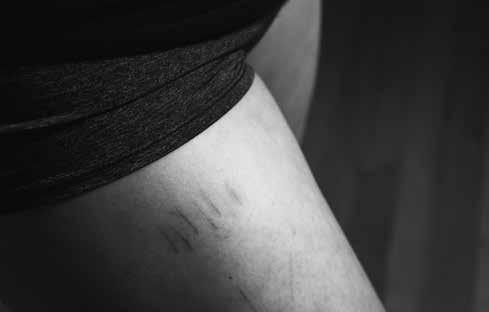
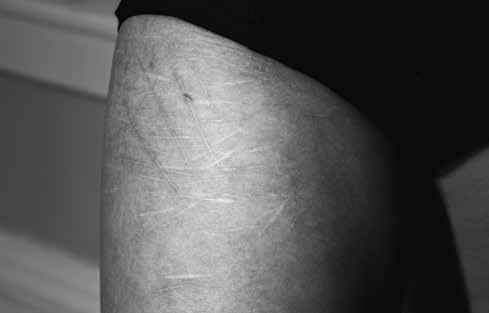
I have been self-harming since grade seven, but haven’t cut myself since April. I was diagnosed with depression at a young age and was most recently diagnosed with PTSD, social anxiety, and OCD. Anything involving sex triggers me to commit selfharm as I was raped in grade 7. Thoughts about my best friend Eddie, who committed suicide earlier this year, trigger me as well. For me, self-harm was an escape from my emotional pain, which I find intolerable in comparison to physical pain. My cutting became an addiction, and I found myself needing to cut three to eight times a day just to get by. Although I haven’t been cutting for seven months, I sometimes pick at superficial wounds or put myself in harm’s way while playing sports to receive pain. I have never felt comfortable going public about my selfharm story. My immediate circle is aware of my history with self-harm, but I have lost several “friends” who immediately labelled me an “attention whore.” Those who truly care about me stayed by my side and supported me by concerning themselves with the depth and cleanliness of my cuts. Although self-harm often accompanies many mood disorders, I believe it is a mental illness in itself.
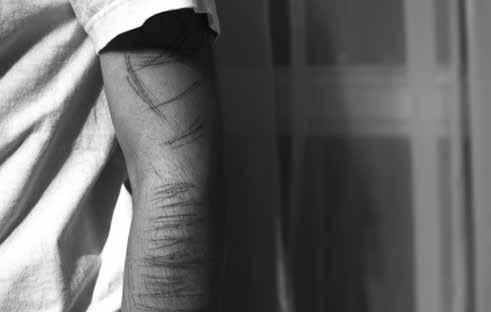
I have been engaging in self-harm since I was in grade 10 and I have been cutting myself since grade 12. I have only told a select few people that I cut myself, and I will likely never go to see a therapist or doctor due to a lack of trust. The number one thing that triggers me to engage in self-harm is the ability to be in control, as almost all of the traumatic situations that have occurred in my life have been cases where I had no way to stop them/do anything about them. Cutting enables me to express my frustration and anger in a way that serves as a reminder that I am in control. I see my arms, and know that everything that occurred was because of me. I hide my scars and come up with lies about how they developed, since I don’t like to attract attention to myself. I don’t think many people feel comfortable showing what they have done to themselves due to a fear that others won’t understand and will treat them differently. Self-harm is a serious issue, and if everyone was open to the discussion, it would truly help the healing.
I began engaging in selfharm in my early high school years, hoping to communicate the severity of my mental state to those who saw my scars. Translating emotional pain into physical pain somehow made what I was going through more tangible and immediate, partly because society continues to prioritize bodily harm over mental trauma. I wish people wouldn’t so readily conflate selfharm with suicidal ideation. Although these often go hand in hand, someone engaging in self-harm is not necessarily seeking suicide. For some, selfharm keeps suicidal impulses at bay. I think some people do not understand this, and in wanting to help self-harmers, simply tell them to stop. This said, I’ve found that the most positive way to support someone practising self-harm is to make them feel welcome in approaching you about it. Secrecy around self-harm only worsens the situation, as a selfharmer may seek to conceal their habits, making it difficult for their loved ones to check in with them. A thoughtful, non-judgmental way to support someone engaging in self-harm is to encourage them to take care of their wounds in order to avoid infection. However, above all, listen.
My mother tried to commit suicide when she was 14, yet it wasn’t until she was 27 that she was diagnosed with major depression and anxiety. My mother would engage in self-harm when she was stressed, namely about me and my brother or her financial situation. I can’t personally speak for her, but as we were very close, I think that she engaged in self-harm in hopes of feeling anything other than sadness, even if it was pain. Physical pain was easier to cope with than mental pain, since she could control the physical pain. She would always cover the scars on her arms by wearing long sleeves, and wanted to get tattoos on them to cover them. I think she hid her self-harm because of the stereotypes associated with mental illness, as people tend to see self-harm as a ploy for attention. Considering that she was a grown woman with a professional background, her self-harm could also interfere with her work and how people perceived her. My brother, my step-dad, and I only became aware of her self-harm after I found her on the bathroom floor, unconscious and covered in blood. After that, we were all much more aware of what she was doing. I feel that self-harm is an uncomfortable and taboo subject, mostly because it is difficult for many to understand why someone could possibly harm or kill themselves. What they do not understand is that the person wanting to engage in self-harm is often influenced by their mental illness. My mother took her own life last March.
I can pinpoint the beginning of my self-harm to the year I was sexually assaulted. At 12 years old, I was too nervous to try anything deeper than digging my nails into my skin. I didn’t want scars, and I feared being caught. Ten years went by before I tried it again. Last year, my PTSD symptoms violently spiked, and one night, my vision was completely overloaded by flashbacks over which I had no control. Selfharming brought me back to reality. When I feel a loss of control in my life, thoughts of self-harm manifest. Through self-harm, I’m hoping to either gain a sense of control over my body, have a routine that gives me stability when my life is unstable, or force myself to feel pain so I can focus on something other than my disturbing mental state. I fear the stigma against self-harm; I don’t want to be judged. It’s my body, and I should be able to do with it what I want. I hurt myself because it soothes me and helps me cope. I think this is very hard to understand for people who do not self-harm, since they see it as inherently negative without really considering how helpful it can be for people. I’m not condoning self-harm, but I am saying that it should be my choice, and, sometimes, desperate times call for desperate measures.
-K
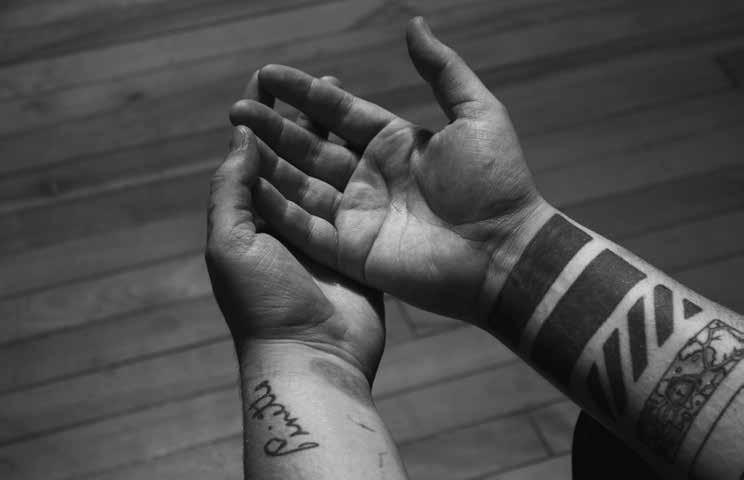
I started cutting when I was 15 and stopped when I was in my early 20s. When engaging in self-harm, my mantra was always “release.” I could see, physically, the departure of my troubles through cutting. It became a ritual: the preparation of tools, the anticipation, the fear, the acute pain followed by a rush of calming numbness. The release of stress, anger, frustration, and anxiety was made visible by the blood. I could spend time watching drops of “bad blood” leave my body and finally lie down feeling renewed. For years I kept my scars hidden under long sleeve shirts, armbands, and bracelets because I felt ashamed. Today I wear my scars with pride. I see them as markers of my progress in my mental health battles. About five years ago, I decided to get black bars tattooed over the scars near my right wrist. I see these tattoos as daily reminders to stop and think before resorting to cutting. I have found new ways to release the negativity inside: art, music, exercise, and, most importantly, talking to others. With medication I now experience less lows and live a much more balanced life. -B
photos by Carolyne KroeKer, staff
‘Diversity is our Strength’
Two Winnipeg filmmakers winners at national diversity committee’s film competition
Ian T.D. T H om S on, staff
On Oct. 17, the Alliance of Canadian Cinema, Television and Radio Artists (ACTRA) announced the winners for their national diversity short film competition. Two out of the four winners are Manitoba filmmakers Alan Wong and Fernando Dalayoan.
The Alliance of Canadian Cinema, Television and Radio Artists is a union representing over 22,000 performers within English-language media in Canada. Representing a variety of professions including actors, choreographers, and puppeteers, ACTRA’s mandate is “to negotiate, administer, and enforce collective agreements to provide performers with equitable compensation as well as safe and reasonable working conditions.”
Within ACTRA is the national diversity committee, which focuses on the concerns regarding casting of ethnic minorities, Aboriginal Peoples, and performers with disabilities. Past initiatives by the volunteer committee include the administration of an online guide for auditioning deaf performers.
The short film competition—conducted by the diversity committee— was the first of its kind within the
union. The Alliance of Canadian Cinema, Television and Radio Artists hopes the competition will promote and reflect the diversity in Canada with the stories shared on screen.
“‘Diversity
is our Strength’ speaks to the mandate to allow all actors, in all groups and categories, an equal opportunity to appear on our screens, and tell our Canadian stories” – Talia Pura, president, ACTRA Manitoba branch
“ACTRA Manitoba is very proud that two of the four winners of this challenge come from our branch.
This challenge was open to diverse members right across the country,” explains ACTRA Manitoba branch president Talia Pura.
Having won the competition based on their script proposals, the winners now must complete a short one- to two-minute film based on the theme “Diversity is our Strength.”
“‘Diversity is our Strength’ speaks to the mandate to allow all actors, in all groups and categories, an equal opportunity to appear on our screens and tell our Canadian stories,” Pura says.
For the two Manitoba filmmakers, the theme hit close to home.
“As an Asian male, I tend to get typecast into the following roles: doctor, office nerd, triad thug/gang boss. I’ve had to audition with an accent countless times and always for supporting or small roles,” explains Asian-Canadian filmmaker and actor Alan Wong.
Alan Wong is the eldest son of two Chinese immigrants. An actor for 20 years, Wong began his career in theatre at the University of Brandon. Over time, he began learning about writing and cinematography through Manitoba organizations such as the Winnipeg Film Group and Film
Training Manitoba. Wong is also a singer-songwriter, having released a five-song EP, Sand & Stone, earlier this year.
“The theme of ‘Diversity is our Strength,’ to me, means that the more diverse our representation in films and television programming, the more appeal and acceptance those shows will have with our changing demographics,” Wong tells the Manitoban
“Visible minorities make up the largest growing portion of our population; yet, traditional white-centric casting is still pervasive in most of our [television] shows and movies –not just in Canada, but all of North America.”
Fernando Dalayoan, of Blue Water Buffalo Productions, is the other Winnipeg winner.
Dalayoan has had success making short films as a writer, director, producer, and actor. Having had his work featured at events such as the Filipino International Film Festival and Vancouver Asian Film Festival, Dalayoan’s films reflect his cultural heritage as a Filipino-Canadian.
In his 2010 short film Tutulungan Kita (I’ll Help You), Dalayoan tells the story of a relationship between
a Filipino man new to Canada and a Filipino-Canadian woman at a Winnipeg bus stop. Faced with different forms of discrimination, the two connect at more than just a cultural level.
For the competition’s upcoming short film, Dalayoan will continue with themes he has explored in past projects.
“The title of my film is called Hearing Diversity,” Dalayoan says.
“The film’s message is to move diversity beyond being seen on the screen. We should not marginalize diversity, but instead provide it with a greater, stronger voice.”
“What makes Canada so great for me [is] the diversity of individuals, talents, and cultures [that are] alive in this wonderful nation. It’s important to have that heard on screen loudly with confidence,” said Dalayoan. “Diversity is a strength we have in Canada and we need to make sure we nurture it well.”
The winners are set to complete their short films in January of 2015. For more information on ACTRA, visit actra.ca
30 years worth of Rumor’s
Comedy club celebrates anniversary with four nationally renowned comics
Ian T.D. T H om S on, staff
There is nothing inherently funny about Winnipeg. Apart from being the butt of jokes regarding our cold winters, rarely do Winnipeggers have much to laugh about. Rumor’s has always been the exception to the rule.
In celebrating its 30th anniversary in Winnipeg, Rumor’s Restaurant and Comedy Club will be hosting a concert series on Nov. 14 and 15 featuring four renowned headlining comics: Derek Edwards, Mike Wilmot, Darryl Lenox, and Dave Hemstad.
Rumour’s remains Winnipeg’s only comedy club. Having lasted three decades, Rumour’s’ success cannot be attributed to dumb luck; several competing comedy clubs have failed over the years.
While the comedy club is celebrating its longevity now, there was concern when it initially began in 1984.
“In the beginning it was tough,” says general manager and booker Tyler Schultz.
“In the 80s it was a brand new concept of having a venue just for standup comedy. But, once they got it going, it’s been going strong for 30 years.”
Schultz cites a few ingredients that have led to Rumor’s’ longevity.
“There’s the business of trying to go after bigger name acts and bring them to an intimate atmosphere [ . . . ] Nearly all the major top comics have come through here at one point.”
Rumor’s has showcased performances by some of the leading comics of the past 30 years. Household names such as Jerry Seinfeld, Chris Rock, and Louis C.K. have all performed at the club. The club still continues to be a hub for comedy in Winnipeg, having brought in Kevin Heffernan and Steve Lemme of Super Troopers fame earlier this month.
“The reason this club is also successful is the room itself [ . . . ] It’s a very intimate atmosphere,” Schultz explains to the Manitoban
From September to October of this year, Rumor’s was shut down for renovations. The comedy club now has a new look. Along with the brand new paint job and new flooring, there have been extensive updates to the kitchen.
After its grand re-opening on Oct. 31, Rumor’s is ready to celebrate a big anniversary with an even bigger celebration.
“This is probably the greatest lineup you’ll ever see for a show in Winnipeg,” says Schultz. “The four headliners we’re bringing in are all comedy legends. They’re all really big, like heavyweight, headliners.”
“I’m even struggling to figure out the order [for the acts].”
The four comedians featured for
the night—Derek Edwards, Mike Wilmot, Darryl Lenox, and Dave Hemstad—all bring a unique spin to the comedy game.
While the four have gained success across Canada, all have a connection to the Winnipeg club. One of the comedians, Hemstad, speaks highly of the club and its impact on his career.
“I feel like I’ve grown as a comedian through my experiences working there, so I’m always happy to come back. They treat me like family there and I love playing it,” says Hemstad.
Hemstad is the youngest of the four comedians to take the stage for the anniversary show. Beginning his professional career as a comic in 2001, Hemstad has been nominated three times for the Canadian Comedy Award. Hemstad has also played the Winnipeg Comedy Festival, as well as the nationally recognized Just for
Big time [Austin] star
Shakey Graves
l auren S IDDall, staff
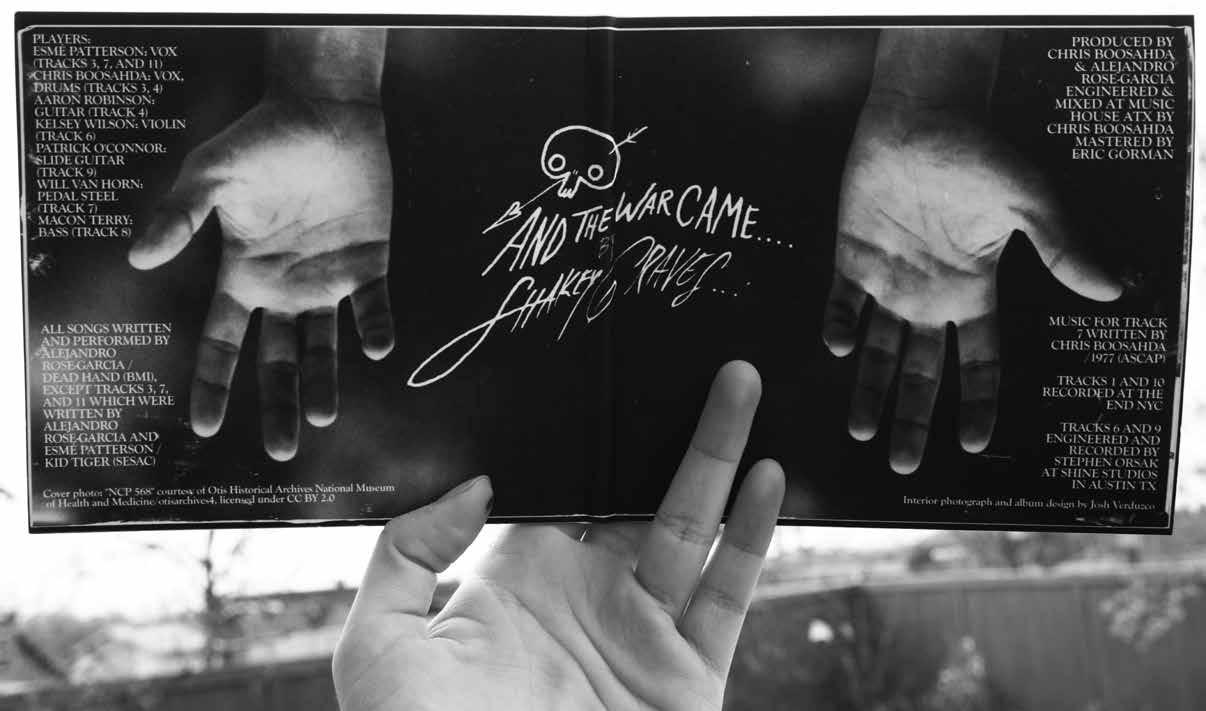
Austin, Texas native Alejandro Rose-Garcia—dubbed Shakey Graves by his friends around the campfire—extends beyond his Bandcamp digital bestselling, angstfilled debut album Roll the Bones in his new record, And the War Came
“The first album was me wanting to burn my life down, cut my hair off, and run screaming into the woods. This album is the trials and tribulations of becoming domesticated, letting people into your world, and letting go of selfishness – the story of becoming a pair, losing that, and reconciling the loss and gain of love,” says Rose-Garcia.
In addition to the matured themes within the new album, there is also an expansion of musical complexity, starting with the recording process. Roll the Bones introduced Shakey Graves’ mesmerizing voice—ranging from raspy to smooth as silk—accompanied by himself on the guitar and makeshift kick drum made from an old suitcase.
And the War Came grows beyond Shakey Graves’ charming introduction, illustrating his development as an artist while establishing his place in the musical world.
“This time, I was making something people were going to listen to out of the gate. I tried to maintain everything I enjoy about recording, the weird homemade aspect, but I was seeking a new, shining sound quality. The concepts for the songs are a little bigger.”
Although at the core of the home recording of his latest album is Shakey Graves and his guitar,
other instrumentalists were added to enhance the sound and create the musical complexity depicted within And the War Came
Shakey Graves also collaborated with another singer/songwriter, Esme Patterson, on three songs on the album. Patterson—member of the Denver-based band, Paper Bird— contributes to Shakey Graves’ sound with hauntingly beautiful harmoni-
zation and lyrical work.
“We started out just having fun and writing, and then that turned into some of my favourite songs on the album,” says Shakey Graves.
“We actually wrote ‘Dearly Departed’ on Halloween as a tonguein-cheek, haunted house sex joke, and then we played it that night and people went bonkers. Esme and I write so similarly it kind of freaked
us out, and I really learned the power of writing music with someone you get along with.”
Their compatibility is clearly illustrated through the interwoven harmonies of the songs Patterson contributed to, and is crucial in the development of the underlying theme of the album: the idea of the other.
“It’s not about any single person; it’s about being that second, other per-
Laughs Festival in Montreal.
Accolades aside, Hemstad remains modest for the Rumor’s anniversary show and praises the other three comics.
“On this show, I sure wouldn’t be offended if they thought somebody else was funnier. Because it’s one of the funniest shows I’ve ever been a part of,” says Hemstad.
“I mean each one of these guys [ . . . ] were guys I was huge fans of when I started up [ . . . ] It’s really awesome to be on the show with them.”
Rumor’s Restaurant and Comedy Club celebrates their 30th anniversary Nov. 14 and 15 . The night will also feature a special surprise comedian. For more information on the event and upcoming events, visit rumorscomedyclub.com
son. Even the title – I never thought about whether I was able to handle that aspect of things, of having these relationships. And the War Came is a little bit of ‘be careful what you wish for.’”
Shakey Graves plays at the Park Theatre in two sold out shows Nov. 24 and 25. His album, And the War Came, is available now.
photo lauren siddall, staff
Ar ts & Culture
Fuel your caffeine addiction
Explore Winnipeg’s local coffee shops while stocking up
l auren S IDDall, staff
In the heat of finals, midterms, and research papers, it is easy to fall to the same coffee shop every day –where each barista at all the chain coffee shops in a 10-km radius of your house knows your order. Take a walk on the wild side and explore some of Winnipeg’s local coffee shops to support local businesses while fuelling your ever-growing caffeine dependency.
The Good Will No, this is not the thrift store.
Located in West Broadway, one of our city’s trendiest emerging neighbourhoods, the Good Will is definitely a top new Winnipeg venue. This coffee shop doubles as a concert venue at night, set to showcase the Strumbellas on Nov. 11, and has already seen dancers from the Royal Winnipeg Ballet perform on stage – and the Good Will has only been open for approximately two weeks.
During the day, they serve the standard coffee drinks one would expect: cappuccinos, lattes, Americanos, and good, old-fashioned brewed coffee – but if you’re lucky, they’ll add chocolate to your drink to sweeten your morning. If that isn’t the sweet you’re looking for, they also receive fresh bakery goods from the Tall Grass Prairie Bakery.
They cater to savoury-loving Winnipeggers too, with A Little Pizza Heaven serving their pizza
starting at 11 a.m.
Bonus: if you stick around long enough, they start serving liquor at 5 p.m. They have over 12 craft beers on tap, including the locally brewed Fort Garry and Half Pints. Accompanied by a great playlist, this location is a win on all sides.
Stated in their mandate, the Good Will intends to “provide and support a home away from home for Winnipeg’s ever changing members of the community.” Supporting art, music, and most of the city’s eclectic trendsetters, the Good Will is heading in the right direction.
The Good Will is located at 625 Portage Avenue, and is open Monday through Saturday.
Thom
Bargen
In the heart of Sherbrook, Thom Bargen has quickly become a favourite for hipsters and businessmen alike. Roasting beans from Phil & Sebastian, Matchstick, Bows & Arrows, and 49th Parallel Coffee Roasters, these folks serve only the good stuff. They also have all the coffee they serve available for purchase to brew in the comfort of your pajamas at home.
The décor is something to rave about. With the recent installation of Natalie Baird’s mural, the atmosphere has been perfectly crafted for sitting down to study or meet with old friends. The counters and tables
are made out of natural wood, creating a rustic, inviting location.
This intimate coffee shop has been essential in the establishment of a fresh community in West Broadway. The stunning natural light and open concept have made Thom Bargen a hub for artists, musicians, students, and families to meet for a cup of perfectly brewed coffee.
Thom Bargen is located at 64 Sherbrook Street and is open Monday through Sunday to fuel your day.
Parlour Coffee
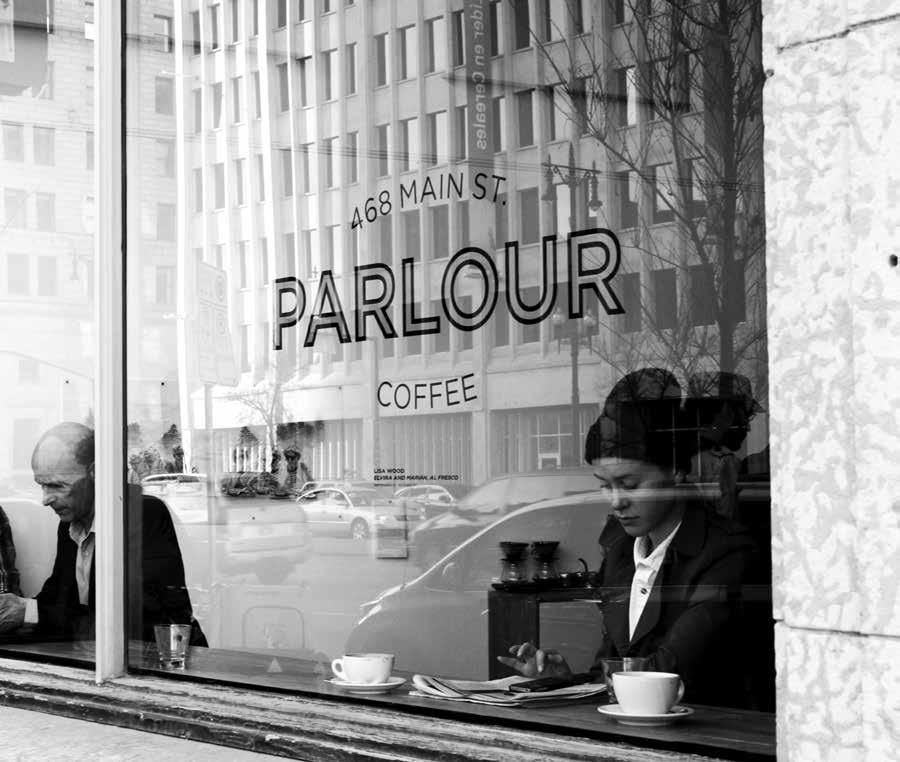
Located on Main Street, Parlour Coffee has become a staple source of brewed beverages for many Winnipeggers. Each cup of coffee is ground to order, ensuring the freshest brew for customers. Proudly serving and selling North America’s leading micro coffee roasters, including the popular 49th Parallel and Phil & Sebastian, Parlour Coffee chooses the best.
If coffee is not enough for you, Tall Grass Prairie Bakery, Jonnies Sticky Buns, and Oh Doughnuts supply fresh baked goods daily because “Day olds are so yesterday.” Parlour Coffee also likes to give away secrets and share brewing tips with customers; for those without the time to come talk to the baristas in person, they are in the process of putting videos and recipes online.
Parlour Coffee aims to support
artists, opting to display art within the café that is available for sale when inquired.
Paul Butler’s “Who Cares?” will be exhibited until Dec. 4. Butler’s practice is primarily focused on the community, collaboration, and artistrun activity. Butler’s work is held in several public and private collections including the Winnipeg Art Gallery, the Royal Bank of Canada, the Art Gallery of Ontario, and the Art Gallery of Nova Scotia, in addition to his ongoing studio practice.
Parlour Coffee is located at 468 Main Street and is open Monday through Saturday.
Little Sister Coffee Maker
The “younger sibling of Parlour Coffee,” Little Sister Coffee Maker is slotted in Osborne Village. Decked out in white, teal, and black, this
coffee shop has a retro feel to it –accented by a record player, their musical medium of choice.
They serve the same qualityroasted coffee as Parlour Coffee— focusing on Bows & Arrow and Detour—and have more seating, as well as a mouth-watering selection of pastries served fresh daily. They also follow Parlour Coffee’s model of selling the coffee they roast in store, as well as all sorts of other coffee accessories and, most importantly, fair trade organic chocolate – yum.
Little Sister Coffee Maker combines the best of Parlour Coffee with a more convenient location and more accessible parking. Little Sister Coffee Maker is located at 470 River Avenue and is open seven days a week.
photos by lauren siddall, staff
Casting Shadows
Manitoba artist encapsulates the beauty of our province
Dan I el m on Tan I no
Beginning Nov. 7, Manitoba artist Bette Woodland’s exhibit, Casting Shadows, will be showcased at the Gurevich Fine Art gallery. The exhibit features scenes of Manitoban life and landscape.
Woodland creates paintings of people and places within Manitoba by capturing the vast beauty of the prairies through the juxtaposition of bright highlights and dark shadows.
This exhibit will include 20 paintings by Woodland and with titles such as “Churchill Park” and “Storm: Lester Beach,” it is easy to see how local the focus will be.
Woodland says “the experience of a specific landscape of whatever sort is central to an understanding of who we are as individuals.” As Manitobans, this is relevant to the blistering hot summers and frigidly cold winters found within our province.
The paintings featured in this exhibit differ from each other in size but are all effective at pulling the viewer in.
The small and vibrant “Zeus in the Garden” captures nature in a tight space that draws whoever is looking at it in for a closer look, while the large painting, “Wave,” engulfs and surrounds the viewer with its immensity.
The curators at Gurevich Fine Art believe that “at her core, Woodland is concerned with the capturing of life’s moments.” This is apparent in her paintings – most evidently in “Lester Creek,” which features three boys playing in a creek together during the summer. This piece brings up memories of exploration and adventure experienced by people during childhood.
Woodland creates paintings of people and places within Manitoba by capturing the vast beauty of the prairies through the juxtaposition of bright highlights and dark shadows
Shown in Woodland’s paintings are images of dogs, cats, and children, none of which are ever seen directly
by the viewer. Woodland obscures the faces of these characters by showing them from the side or from behind. This creates an interesting contrast of anonymity and familiarity within the pieces.
In addition to Casting Shadows, the Gurevich Fine Art gallery has older pieces from Woodland on display.
Woodland also illustrated a children’s book entitled A Walk in Pirate’s Cove, written by Winnipeg author Marisa Hochman. This book features oil paintings similar in style to the ones included in Casting Shadows
This is an important exhibit for any Manitoban to view. Not only does it invoke feelings of nostalgia in those who grew up in Manitoba; it reminds us of the natural beauty that our province has. Viewing these pieces will have Manitobans remembering their time spent with friends, at the beach, or looking up at the clouds in the sky.
Casting Shadows will be displayed from Nov. 7-29 at Gurevich Fine Art (200-62 Albert Street), open 9 a.m.-5 p.m. Monday to Wednesday, 9 a.m.-6 p.m. Thursday to Friday, and 11 a.m.-5 p.m. Saturday.
“Wave,” photo taKen by ian mCCausland
graphiC by evan tremblay, staff
illustration by mariana munoz gomez
Split decisions
Men and women’s volleyball teams split weekend series vs. UBC
Dav ID g ra D, staff
Both the Bison men and women’s volleyball teams were in tough this weekend at home against UBC Thunderbird squads, ranked second and fourth place in the Canada West, respectively.
The Bison men’s team lost Friday night’s match against UBC 3-1 (2516, 26-24, 26-28, 25-20), but came roaring back on Saturday night to earn the split decision 3-1 (16-25, 22-25, 25-23, 15-25). Saturday’s result was the first loss dealt to UBC in six games and demonstrated how good the Bisons can be.
“I’m excited when we beat a team I consider to be one of the top three teams in the country,” head coach Garth Pischke said.
“To control the match like that, it’s a good feeling to know we can do it. We just have to find a way to keep that passion and that support on the court every night.”
we’re in a really tough stretch right now.”
Despite the split, Bentley was happy with his team’s level of effort.
“I’m very pleased with the fight we had; we put ourselves in a position to win every set.”
Friday night was a rollercoaster ride of emotions for the crowd, as the Bisons started the weekend off by completely dominating UBC in the first set 25-12. The Thunderbirds crawled back into the game, narrowly winning the next two sets. Neither the crowd nor the Bisons quit on the game, and the home team fought their way back with a dominating performance in the fourth and a blow-for-blow battle in the fifth.
“We just have to find a way to keep that passion and that support on the court every night” –Garth Pischke, head coach, men’s volleyball
The Bisons came out with energy and precision Saturday night, completely dominating UBC in the first and fourth sets. Manitoba continues to get big offensive production from Devren Dear, Adam DeJonckheere, and Luke Herr. DeJonckheere led the Bisons this weekend with 36 kills and 14 digs, Dear had 27 kills plus 15 digs, and Herr picked up 87 assists plus 15 digs.
The Bisons also received solid contributions from Kenny Rooney and Kevin Falconer, who had 16 and 13 kills, respectively. Rooney also picked up 14 blocks.
The Bison women’s team faced the UBC Thunderbirds this weekend for the first time since beating them in Regina in the CIS gold medal game. The Bisons won Friday night’s matchup in a fiveset thriller (12-25, 25-23, 25-22, 18-25, 17-19), but dropped Saturday night 3-1 (25-22, 19-25, 25-21, 25-22).
When asked about any lingering emotions from Nationals between the two teams, head coach Ken Bentley felt both teams were more focused on their current fight in the CIS standings than in the emotions of a rematch narrative.
“The weekend was so important for both of our teams. We had a chance to get back to .500 tonight. The split is a bit disappointing, but
Saturday night was a tougher matchup for the Bisons. The loss keeps the Bisons below .500, but Bentley doesn’t feel their record merits panic.
“We’ve had a chance to win every match except one. We are playing an incredibly difficult first half schedule, and so I am really pleased with the level of fight we have.”
Captains Rachel Cockrell and Brittany Habing continue to be bright spots for the team. Cockrell picked up 32 kills over the weekend and Habing added 64 assists. In the absence of departed veterans from last year’s National Championship team, Cockrell and Habing have led by example for younger players seeing action this year.
“First of all, their level of work is extraordinary,” Bentley said.
“They are so committed to this university and our program. I think the first-year kids really appreciate seeing that; I mean how could you not?”
The Bisons are in tough again next week as both the men and women’s teams take on strong University of Brandon squads on the road.
Opposites attract, collide
Men’s hockey suffers two tight losses against first-ranked Alberta
mIK e S TI ll, staff
Moving into this weekend’s men’s hockey action, the University of Manitoba Bisons and Alberta Golden Bears were heading in two different directions. Alberta, the top team in the CIS, had won 10 straight games, whereas Manitoba had lost three out of their last four games. Despite the disparity in the two teams’ records, Manitoba gave the Golden Bears all they could handle, falling just short in both matchups.
Friday’s contest featured a third period come-from-behind victory, as Alberta pulled off a 3-2 win. The Golden Bears were all over the Bisons offensively, applying 46 shots to goalie Deven Dubyk, who stayed composed all game long.
Alberta threw 26 shots at Dubyk in the first period alone, but could only come up with one goal, from T.J. Foster 3:03 into the first frame on the power play. The Bisons appeared to be overwhelmed by the Golden Bears in the first 20 minutes, as they struggled to find a rhythm.
The second period was a different story, as Manitoba tied the game up at 9:37. Shaquille Merasty crashed the net, and potted his
fifth goal of the season. Manitoba would take their momentum into the locker room, and came out aggressive in the third.
Taylor Dickin gave the Bisons their first lead of the game at 5:56 of the third, capitalizing on an Alberta giveaway in their own zone. Manitoba would hold onto that lead until the final seven minutes, where Alberta took over.
The Golden Bears tied the game up at 13:12 on a Johnny Lazo goal, and retook the lead just over two minutes later off of the stick of Riley Kieser, which proved to be the game-winner for Alberta.
After giving up a late third period lead, the Bisons were looking for redemption on Saturday night. Unfortunately it wasn’t meant to be, as Alberta emerged with a 4-2 win.
Manitoba came out flat in the first period, perhaps still rattled from the night before. They managed just three shots on net, and found themselves down off of a Kruise Reddick goal at 7:50.
The second period saw the tempo pick up, as both squads increased their physicality and pressure. The Bisons would receive goals from
Reid Gow (4:28) and Merasty (14:26 on the power play), while Alberta answered back with goals from Levko Koper (1:43) and Foster (12:41 on the power play).
Manitoba had a few quality chances to even the score in the third period, but Alberta goalie Luke Siemens stayed poised in net. The only goal came from Jordan Hickmott, who tallied an empty netter in the final 15 seconds to cement the Alberta win.
Despite the two losses, Manitoba head coach Mike Sirant was proud of his team’s play against the top team in the nation, noting their shift in aggressiveness on Saturday.
“I thought overall we had a really strong performance. Friday night’s game we hung around to keep it close, and tonight we actually put a lot more pressure on Alberta,” Sirant said. “I thought our guys competed hard tonight, I thought we played well.
The men will stay at home this weekend, welcoming the Calgary Dinos to town, on Nov. 14 and 15. Game times are 7 and 6 p.m., respectively.
Taking the road less travelled
Bison football team endures hotel disaster, secures trip to Canada West final
mIK e S TI ll, staff
Battling the odds, and an hour and a half bus ride, the University of Manitoba Bison football team pulled off a character win on Friday night in Saskatchewan. Forced to stay in Prince Albert due to a lack of available rooms in Saskatoon, the team channelled their frustrations on the football field, en route to a 47-39 victory over the Huskies, their first on the road this season.
In a back and forth contest that featured over 900 yards of total offence, it was the Bison defence that stepped up to change the momentum in the second half. Starting halfbacks Jayden McKoy and Jordan Linnen led the way with two interceptions apiece, while defensive end Evan Foster recorded a team-high 9.5 tackles, to go with two sacks.
The first seven minutes of the
opening quarter were all Manitoba’s. They scored touchdowns on backto-back drives to start the game, as quarterback Jordan Yantz—who was making his return to lineup after suffering a concussion against his opposition, the Huskies earlier in the year—found receivers Matt Sawyer (16-yard pass) and Nic Demski (26 yard pass) to open up a 14-0 lead.
After giving up two quick scores, Saskatchewan woke up, outscoring the Bisons 30-4 in the following quarter-and-a-half. Running back Tyler Chow was unstoppable during that time, putting up 79 yards on the ground, and two majors.
After beginning the game with momentum, the Bison offence went cold, registering just three first downs in the second quarter. Heading into the break, the Huskies led 30-18.
The second half looked to be much of the same for Saskatchewan, as Chow continued to chip away at the Bison defence. He scored on the opening drive of the third quarter – this time on an 18-yard pass, to increase the Huskies’ lead to 19.
Just as it looked like Manitoba was fading away, McKoy woke the team up. After a Bison turnover on downs gave the ball right back to Saskatchewan, the Miles Macdonell graduate made the game-shifting play, intercepting Drew Burko for the second time, and taking the ball 54 yards to the house.
The pick six began a string of 22 unanswered points for Manitoba, who would retake the lead. This time, they wouldn’t give it up.
Along with the McKoy interception, Manitoba got two field goals
from Ryan Jones, a 21-yard fumble recovery off of a blocked punt for a touchdown by Linnen, and a safety to make the score 40-37.
When asked how the team was able to able to respond so effectively in the second half, McKoy was very direct.
“You just have to trust in your teammates and your coaches, have the will to win, and go out and play football,” McKoy said.
Saskatchewan would narrow the lead to one, with just over seven minutes left to play, but couldn’t pull off the comeback, as the Bison defence held strong. Linnen intercepted Burko on two consecutive drives at the end of the fourth to seal the deal.
Yantz, who finished the game with 373 yards passing and two touchdowns, also added his first
receiving touchdown of the year, on a flea flicker from Demski to cap the scoring.
Despite the frustration of having to bus in from Prince Albert, Linnen said the team’s spirits were pretty high.
“Our mindset was we can either let all the things that were not going our way, in terms of where we were staying, affect us, or we could use it as fuel to the fire and take it out on Saskatchewan, and that’s what we did.”
With the win, Manitoba moves onto the Hardy Cup for a second consecutive season, and will travel to face the Calgary Dinos in a rematch of last year’s Canada West final, which the Dinos won. Game time is 2 p.m. on Saturday, Nov. 15.
by
Bison briefs
Hockey and basketball
Dav
Women’s hockey
The University of Manitoba Bison women’s hockey team took on one of the Canada West’s top teams this weekend, losing Friday night 1-0 and winning Saturday night 4-3 against the University of Alberta.
The weekend series ties the Bisons in points with the University Alberta in the conference, but keeps them one place behind in the standings due to the Pandas never having to close out a game in overtime.
Friday was a tough defensive matchup, featuring only 40 shots between the two teams. Rachel Dyck continued her stellar year for the Bisons, stopping 18 of 19 shots
sent her way in the loss.
Manitoba broke the ice Saturday night, netting four goals past Panda goaltender Lindsey Post in a 4-3 victory. Caitlin Fyten, Charity Price, Nicole McGlenen, and Alanna Sharman all scored for the Bisons.
On Thursday, McGlenen told this reporter she was going to score against the Pandas, and came through with her first goal of the season on Saturday. Also notching her first goal of the season was Price.
Sharman scored her eighth of the season, the second most goals scored by any skater in the Canada West.
The Bisons face off against Calgary on the road again next weekend.
Women’s basketball
The Bison women’s basketball team dropped both their matches against the Regina Cougars this weekend, losing Friday night 71-60 and Saturday night 91-55.
The Bisons led the Rams 48-42 after the first three quarters on Friday night, but weren’t able to maintain their strong play, conceding an 18-6 run in the first five minutes of the fourth quarter. Robyn Eyer led the Bisons with 22 points, eight baskets, and two three-pointers.
The Bisons trailed in three of four quarters on Saturday night, losing by a wide margin to the Rams.
Samantha Pyke led the Bisons, scor-
ing 10 points. Eyer also contributed nine points in the loss.
Men’s basketball
The men’s team faced their first loss of the season on Friday night, losing 98-85 in a high scoring affair.
The Bisons rallied back Saturday, narrowly edging out the Cougars 90-88 to stay above .500 with a 3-1 record.
Friday night was a tough match for the Bisons, who were unable to keep pace with the motivated Cougars. A.J. Basi, who had 18 points from the field and buried four of his 12 three-point attempts, led the Bisons in scoring. Andre Arruda and Jonathan Alexander
both contributed 16 points from the field in their first loss of the season. Saturday night was a close match that saw the Bisons exchange leads with the Rams every quarter. The Bisons went on to win in overtime by two points – a fitting ending to the game.
Arruda led the Bisons from the field with 14 points and Basi drained three shots from beyond the arc..
Both basketball teams will host Brandon at home next weekend at the Investors Group Athletic Centre.Game times are 6 p.m., and 5 p.m. for the women, and 8 p.m., and 7 p.m. for the men.
photo
Jordan dumba
Picking the rookie
Calvin Pickard: The story behind a young goaltender from Winnipeg who made it to the big leagues
a n Dy C H e, volunteer staff
Introduction
Winnipeg, Manitoba. The city home to around 700,000 marks the stomping ground to some of the NHL’s most elite players, past and present. The Manitoba capital is highlighted with a collection of youth hockey clubs harbouring the next generation of Bill Mosienkos, Mike Keanes, and Jonathan Toews. It’s an especially proud moment when this continually growing municipality sees one of its own succeed. On Oct. 16th, the Manitoba AAA Winnipeg Wild witnessed one of their very own mark his entrance into the NHL with the Colorado Avalanche.
The debut
When the Colorado Avalanche visited the Ottawa Senators on the fifth game of the 2014-15 season, the team had scored just four goals in their previous four games and were shut out in their opening two.
Starting goalie Semyon Varlamov had been placed on injured reserve just hours before puck drop, backup Reto Berra would get the nod against the Senators, who boasted a 3-1 record. Scrambling for an emergency backup, Colorado called up prospect Calvin Pickard, a three-year veteran of the AHL’s Lake Erie Monsters.
Three minutes into the game, Colorado’s John Mitchell checked Kyle Turris in the crease, causing the Ottawa forward to collide with Berra. Turris’ shoulder drove into the goaltender’s mask, prompting Berra to collapse into the back of his net, before he was removed as per concussion protocol. With the Avalanche up 1-0 at the time, Pickard entered the game, marking his NHL debut under dire circumstances.
Pickard held Ottawa at bay for the first two periods of his NHL career, making 17 saves on 19 shots. The Avalanche seemed destined to leave their sluggish start to the season behind them, bombarding the Senators, leading 3-1 after the first period. The home side diligently recovered, though, scoring four unanswered goals in the last two periods, including an empty netter. Pickard stopped 23 shots from 27.
Two days later, Pickard made his first NHL start at the Bell Center in Montreal. The occasion came in a stadium where the rafters featured the retired numbers of goaltending legends Jacques Plante and Ken Dryden. Pickard more than held his own during a second NHL appearance, making 33 saves in a 3-2 loss.
Though the 22-year-old debutant could not halt the surging Senators team nor the triumph of the Montreal side, his timely appearance and persistent performance in his first tastes of NHL action is evidence that the top-ranked goaltender of the 2010 draft is emerging into a reliable figure for a young and budding Colorado franchise.
“It was a very good experience for me. I mean, playing in two Canadian buildings and in packed houses and getting thrown into the game on Thursday,” Pickard said, after his first two games in the NHL.
“I had no time to think about it so I got right in there and it was nice for me, and then to have the start on Saturday in Montreal – every kid dreams of that, and I thought I did pretty well.”
Brotherly love
Calvin isn’t the first member of the Pickard clan to have taken the goaltending position to a professional level. Chet, three years Calvin’s senior, was the Nashville Predators first-round draft selection in 2008.
Earmarked as one for the future, Chet starred for Tri-City between 2005 and 2009, admirably stepping into the starter’s role for the Americans in place of Carey Price, who departed junior to challenge for a spot in the NHL in 2007.
Drafted 38th overall by the Western Hockey League’s (WHL) Seattle Thunderbirds, Calvin had some serious work to do in order to catch up to his big brother. At nine years old, their father asked Calvin to choose between carrying on his hockey as a skater or a goaltender. Following in his brother’s footsteps, Calvin opted for playing between the pipes, and the rest is history.
While Chet represented the Manitoba AAA Midget Hockey League’s Winnipeg Monarchs in
AAA, Calvin played for their league rivals, the Winnipeg Wild, before making the jump to the WHL in 2008.
Despite carrying similar résumés in the WHL, Chet somewhat overshadows Calvin at a quick glance of their junior careers.
Chet won the Del Wilson Trophy as the WHL’s regular season top goaltender and bagged a gold medal with Team Canada at the 2009 World Junior Championships. Calvin became a finalist for the most valuable WHL goaltender in 2010 and won gold with the U18 Canada side at the 2009 Ivan Hlinka tournament. He was shortlisted for the 2011 Canadian World Junior team, but did not make the cut.
Minor adjustment
Both goaltenders spent time in the AHL – Chet with the Predators affiliate the Milwaukee Admirals, and Calvin with the Lake Erie Monsters. If the AHL stage is a testament of how a prospect’s short-term future will pan out, then it certainly yielded trusty insight into the fate of the Pickard brothers.
Chet spent a frustrating three seasons with Milwaukee and Cincinnati of the East Coast Hockey League, unable to climb up the Predators’ goaltending pipeline. In 2012, Nashville cut their ties with the 18th overall pick of 2008, as Chet signed in the Swedish Elite League at age 22.
On the other hand, the younger Pickard had spent the last two
seasons splitting time with Sami Aittokallio in Lake Erie, before a call-up to Colorado marked Calvin as the first Pickard brother to appear in the National Hockey League, also at the age of 22.
The young net-minder who had been on his brother’s tail for so many years had finally overtaken his elder.
“We are proud to select…”
Amongst North American goaltenders, Calvin, and World Junior Championship standout Jack Campbell, who had won gold with Team USA that draft year, had separated themselves amongst the rest of the competiiton heading into the 2010 NHL Entry Draft.
Despite Calvin’s ranking as the top North American goaltender, the eventual second round selection went behind Campbell (11th), and OHL goaltender Mark Visentin (27th), a future Canadian World Junior medallist.
A projected late first-rounder, Calvin was not called until position number 49, a Colorado pick. Despite Colorado’s selection of Aittokallio later in that draft, and the slew of goaltenders in the team’s system, Calvin would eventually rise to top of the Colorado prospects class.
Beware of future Avalanches
In an organization which featured the likes of Patrick Roy, David Aebischer, and Jose Theodore between the pipes, Calvin has huge
pads to fill down the road. Though it’s too early to predict his fate with Colorado, the franchise’s emphasis on youth is an indicator that their young core will play an integral role sooner rather than later.
Avalanche fans may have had a glimpse of Calvin in his first two NHL games. Yet, what’s more significant is they’ve had a glimpse of what’s in store for the future. Calvin Pickard may not be a household hockey name, but the player underneath number 31 on the back of a Colorado Avalanche sweater is only beginning his professional journey after an arduous climb to the NHL.
The ascent, which consisted of three years in the AHL, four years of junior hockey, a near trip to the World Juniors, and good deal of time following his brother, has finally ended in the ultimate destination. The young Winnipegger who chose the goaltending position in his early playing days is now living out his hockey dreams, and hasn’t looked back.
When asked what he’s taken away from his NHL experience thus far, Pickard was very direct.
“Every shot matters. There’s so many good players, obviously, at this level. It’s the best level in the world,” said Calvin.
“If you give a guy an inch, he’s gonna make you pay, and you can’t let your guard down for one split second because that puck’s gonna be behind you.”