109 HELEN GLASS UNIVERSITY OF MANITOBA WINNIPEG, MB R3T 2N2
General Inqu I r I es & a dvert I s I n G
Phone: (204) 474.6535
Fax: (204) 474.7651 Email: manitoban@themanitoban.com Free Med
“volunteer staff” member is defined as a person who has had three volunteer articles, photographs, or pieces of art of reasonable length and/or substance published in three different issues of the current publishing year of the Manitoban. Any individual who qualifies must be voted in by a majority vote at a Manitoban staff meeting. Elected representatives and non-students may be excluded from holding votes as volunteer staff members in accordance with the Manitoban Constitution.
Negotiations in deadlock after weekend offer fails to sway faculty association
G A rett Wi LL i A ms, staff
The University of Manitoba Faculty Association (UMFA) rejected a settlement offer from the university Monday, saying the proposal continues to ignore workplace issues raised by the union since negotiations began in May.
The association, which represents some 1,200 professors, researchers, and librarians, has been picketing since Nov. 1, cancelling hundreds of classes.
The latest offer, forwarded to the union Sunday after two days of conciliation sessions last week, fell well short of addressing workload, job security, and performance assessment concerns critical to the association, said Mark Hudson, UMFA president.
“It is a little bit frustrating for us, obviously,” he said Monday.
“It’s disappointing for our members and no doubt disappointing for students. But when we took the fine tooth comb through the proposal that was handed across last night, we didn’t really find hide nor hair of any kind of adequate response to any of the core issues that we have been talking about.”
Hudson said a proposal by the university to set aside $1.5 million to hire grad students to act as instructors or graders over an 18-month period does not adequately answer the union’s call for protections against increasing workloads.
He said the one-time fund offers faculty members a paltry 1.5 hours of assistance per week and accused the university of using graduate students for cheap labour.
Hudson said language in the proposal also marks a rollback from where previous offers stood on faculty assessments, opening the door to the use of performance metrics.
The offer also failed to address job security concerns for instructors and librarians, and included no salary increase, he said.
“That’s what I feel is happening here – our students are being held hostage” – John Kearsey, U of M vicepresident external
John Kearsey, the U of M’s vice president external, said he is disappointed the offer was refused and disagreed with the assumption the university has made no movement toward addressing the union’s concerns.
However, he said some of the union demands are untenable and the university aimed to strike a compromise.
“We feel that we at the University of Manitoba have been reaching out to make a compromise on the issues UMFA’s negotiating team says is important to them and those compro-
mises continue to be rejected,” he said.
“And meanwhile, we have 30,000 students who are displaced in their academic program this year. It’s beyond disappointing.”
At the request of faculty, he said the administration has been pursuing a one-year agreement that would achieve some stability until the end of March, when it would expire, but accused the union of leveraging students for a better deal.
“Nothing would change for faculty members in terms of what was [and] we can live with what is [currently in place] for the next five months as we continue on to our next round of negotiations,” he said. “But let’s not hold our students hostage.”
“And that’s what I feel is happening here – our students are being held hostage.”
While Kearsey said the university has been inundated with questions from worried students since before the strike began, Hudson accused the university of employing divideand-conquer tactics in the face of a wave of student support for UMFA.
“I think students at the U of M understand that the things that we are at the table bargaining on are the things that go to the heart of their educational experience,” he said.
“They understand that overworked professors are not going to be able to deliver them the best education that they can deliver.”
As of press time, no new sessions with a provincially appointed conciliator have been scheduled.
The two sides have been in full
negotiations since May. UMFA has been without a contract since its last agreement expired March 31.
Manitoba Labour Board complaint
The university also announced Monday that UMFA has filed a complaint to the Manitoba Labour Board.
Hudson said the complaint that the university is not bargaining in good faith stems from a development in October when the university abruptly withdrew its financial offer from the negotiating table.
In September, the university forwarded a four-year proposal that included a seven per cent increase over the contract’s term. In October, the financial offer was pulled after the province issued a directive mandating the university extend the existing contract an additional year without a salary increase.
Kearsey only said that “we will file a defence [and] it will be a vigorous defence to the charges.
Rally around administration building
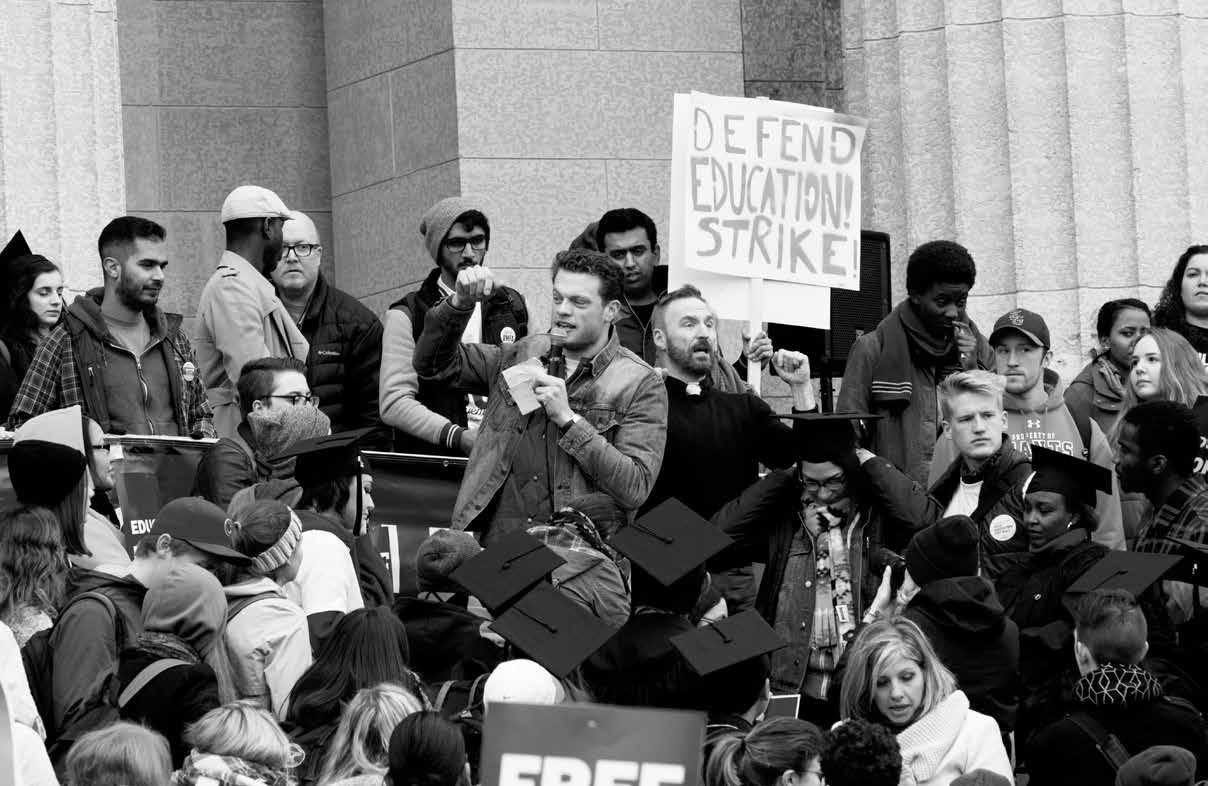
Hundreds of UMFA supporters, including representatives from Manitoba labour unions, students, and faculty members from universities across the country, converged on the administration building for a rally supporting picketers Friday.
The rally began with a gathering at the intersection of Chancellor Matheson and University Crescent before a group of more than 200 supporters marched toward the admin-
istration building for a rally on the front steps.
Addressing the crowd, University of Manitoba Student Action Network (UMSAN) member Ian McDonald called on students to support the faculty in its push for quality education.
“Students understand that overworked professors are not going to be able to deliver them the best education that they can deliver” – Mark Hudson, UMFA president
“Professors, librarians, students, sessionals, support staff – our struggles are one and the same,” he said.
“We are a single working class and we are struggling against the same obstacles.”
McDonald noted that an UMSAN petition pledging a show of support for faculty has collected more than 500 signatures.
Brianne Goertzen, an organizer for the Manitoba chapter of the Canadian Federation of Students and a U of M alumna, said it was the mentorship and guidance of the professors that helped her succeed in
her studies.
She said it is those one-on-one relationships that are being threatened by increased workloads and class sizes.
“[UMFA is] standing up for students,” she said. “They are education defenders. They are fighting for quality education.”
“The opportunity for UMFA to throw students under the proverbial bus is real. They are fighting to ensure student get the time, dedication, and support necessary to prepare them for the future.”
The rally broke off with a march around the administration building.
Despite the large show of support Friday, not all students are standing with UMFA.
Third year law student Kyle Mirecki is petitioning the provincial government to legislate teachers back to class. The petition gained the support of 36 signatures in a week.
Mirecki said he wants the government to intervene because students are being unfairly impacted by the dispute between administration and its faculty.
“Both parties have been negotiating for several months,” he said in an email. “Most classes have been cancelled. It is absolutely unfair for thousands of students who have paid tuition to be impacted by a strike a month before exams.”
photo by chantal zdan
University scrambles to plan response in event of long-term strike
Administration hopeful agreement will be reached before fall term scrapped
H A nn AH Froese, staff
More than a week into a faculty strike that has cancelled hundreds of classes at the U of M, university administration has not shared with students its plans in the event the strike persists into a protracted dispute.
U of M director of public affairs John Danakas said the university is hopeful that the ongoing conciliation process between the administration and the University of Manitoba Faculty Association (UMFA) will achieve an agreement and end the strike.
Danakas said in an email that “right now the university is focusing on the immediate needs and concerns of students.”
Conciliation between the university and UMFA began Nov. 2 with a conciliator appointed by the province.
The immediate priority for the university is reaching an agreement as soon as possible, Danakas said.
“At the same time, attention is being paid to all potential scenarios, and these will be addressed as necessary,” he said.
He declined to go into further detail.
In an email to students last week, vice-provost Susan Gottheil said “your successful completion of this academic term is our top priority.”
The letter notes midterm tests for uninterrupted classes not instructed by UMFA members may resume as scheduled and students should contact the course instructor for information.
Midterm tests for classes that resume after the strike is resolved will not be held the first day back, according to a post on the U of M's official Facebook page.
“An appropriate schedule to make up for lost time in courses will be determined once they appear on the list of courses being offered, or at the
end of the strike,” said Gottheil in the email. “Please check the official list of continuing classes often as it will be updated regularly.”
“Right now the university is focusing on the immediate needs and concerns of students” – John Danakas, U of M spokesperson
“We know that many of you have other questions that we haven’t yet answered – for example, the voluntary withdrawal deadline and the impact of the strike on the final examination schedule, as well as how much notice you will have before returning
to class once an agreement between the university and UMFA has been reached,” she said.
“We are doing our best to answer these important questions, and will pass on that information as soon as we can.”
The email also confirms that the university will be closed for holidays from Dec. 23 to Jan. 2.
Danakas said that a decision on how long the strike must run in order for the fall term to be lost is one for the senate and reiterated that the university will continue to try to reach an agreement with UMFA.
The U of M strike info website states that the university anticipates successfully completing the academic year and has “no intention of ‘writing off the year’ because of labour disruption.”
“In the worst-case scenario, the commencement of the winter term may be delayed until classes and
UMSU snubbed at CFS Day of Action
Levi G A r B er, staff
University of Manitoba Students’ Union (UMSU) vice-president external Wilfred Sam-King said he was prevented from addressing students during the Canadian Federation of Students’ (CFS) Day of Action demonstration on the steps of the Manitoba Legislature on Nov. 2.
According to UMSU president Tanjit Nagra, the Manitoba chapter of CFS told Sam-King he would have time to address students from the steps of the legislature. However, after waiting with other speakers for his turn, Sam-King was removed from the speakers’ list.
According to Nagra, CFS-MB had originally approached her to make a speech but she declined due to a scheduling conflict. Sam-King was to speak in her place.
Among the speakers who did address demonstrators at the legislature were CFS-MB chairperson Michael Barkman, University of Manitoba Faculty Association president Mark Hudson, University of Winnipeg Students’ Association vice-
president external Sadie-Phoenix Lavoie, CFS-MB international students’ commissioner Saif Baloch, and U of M student and mental health advocate Aly Raposo.
“I’m very disappointed that I was pulled from the speaking list as a representative of our membership and CFS UMSU rep” – Wilfred SamKing, UMSU vicepresident external
Despite being unable to address the gathered crowd, Sam-King said he was happy to see a University of Manitoba presence at the rally.
“I was so proud of our U of M students today,” he said.
“I’m very disappointed that I was pulled from the speaking list as a representative of our membership and CFS UMSU rep.”
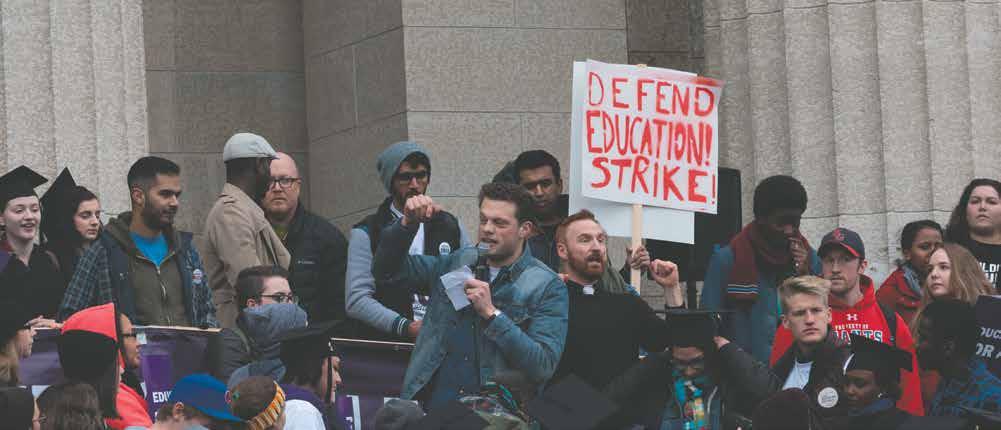
Hundreds of students from across the province, joined by members of numerous labour unions, marched from the University of Winnipeg to the legislature calling on the provincial and federal governments to eliminate tuition for post-secondary education and increase funding to education in the province.
The Day of Action event consisted of an opening rally on the quad of the U of W, followed by a march down Memorial Boulevard to the Manitoba legislature and speeches on the front steps of the government building.
Several emails and phone calls to CFS-MB chairperson Michael Barkman requesting comment were not returned.
Past disputes
Disputes between the U of M stu-
dent union and CFS are nothing new.
In 2013, UMSU held a review of the union’s membership in CFS after tensions had grown between the two student-run groups regarding day-timers.
Members of the then-UMSU executive ripped pages of CFS promotional material out of 20,000 student day-timers after learning it was unable to cancel a contract signed by the previous executive for the purchase of the promotional materials.
The relationship continued to sour and for the next three years UMSU refused to pay its fees to the advocacy group.
In March of last year, UMSU council voted to condemn CFS-MB for expressing what it called political favouritism toward the provincial NDP during the spring provincial election.
In June, UMSU council agreed to pay CFS nearly $1 million in outstanding fees after settling the dispute.
examinations of the fall term are completed,” says the webpage.
Planning for changes in the exam period and decisions on missed classes and tuition refunds are dependent on how long the strike lasts as well as which classes are still being offered.
The website also notes that mid-term and final exams may be rescheduled when the strike ends. It is anticipated that papers already submitted for grading will be quickly returned.
Danakas said that plans developed for situations other than the strike’s end will be shared with students as needed.
UMFA began picketing Nov. 1 after mediation failed the evening of Oct. 30.
UMSAN also snubbed
Members of the University of Manitoba Student Action Network (UMSAN) said their group was also prevented from speaking at the protest.
In a release issued on Nov. 5, UMSAN stated that it first requested an opportunity to address the demonstrators in September. The release states that they did not receive a response from any CFS executive until the day of the event, when they were told they would have one minute to address the crowd.
However, the release goes on to detail that when an UMSAN member attempted to address the protestors, he was immediately interrupted.
National Day of Action demonstration attracts large turnout of students, union members
Students
protest tuition fees, advocate for affordability and more funding for post-secondary
Levi G A r B er A n D Di A n A U B ok UD om, staff
Hundreds of students marched from the University of Winnipeg to the steps of the Manitoba legislature Nov. 2 in a demonstration calling for free postsecondary education across Canada and higher rates of provincial funding for education.
The National Day of Action, hosted by the Canadian Federation of Students-Manitoba (CFS-MB) in Winnipeg, took place across 30 Canadian cities through coordination by the Canadian Federation of Students (CFS).
Students from the U of M, U of W, Brandon University and Université de Saint Boniface participated in the Winnipeg demonstration and were joined by members of labour unions such as the Canadian Union of Public Employees, the Manitoba Government and General Employees’ Union, Unifor, and the University of Manitoba Faculty Association (UMFA), among others.
Michael Barkman, chairperson of CFS-MB, kicked off the event on the quad of the U of W with a speech welcoming attendees and thanking labour union representatives for their show of support.
Following a short march from the U of W to the steps of the Legislature, students from both the U of W and U of M, and UMFA president Mark Hudson gave speeches to those who participated.
Barkman then invited attending students to join him and other CFS-MB executives to sit in on that day’s question period, where tuition and the state of Manitoba’s education system were discussed.
What the students say U of M criminology student Elizabeth McMechan said she supports the call for free post-secondary because the current framework creates financial barriers for some potential students.
“I think that right now, university education is not accessible for everyone because our priorities are mistaken,” she said, adding that the provincial and federal governments should be more concerned with making education available to everyone by reallocating funding into postsecondary programming.
“The money is available, it's there,” she said. “I think that with careful maneuvering from our government, and by making education a priority, free education is possible.”
Some students in attendance expressed the belief that making post-secondary education completely free may not be realistic with the current Progressive Conservative government, but said they will fight to keep it affordable.
University of Winnipeg Students’ Association vice-president external Sadie-Phoenix Lavoie said during the demonstration that post-secondary education must be more accessible to students from low-income
backgrounds.
“Rising tuition has huge detriments to students to the point where they won’t be able to graduate and won’t be able to come to university next year and finish their degrees,” she said. “We need tuition to be lower and not to be higher.”
“I think that there is a lot of fearmongering that is taking place out there today and we certainly would not want to add to those fears” – Cameron Friesen, Manitoba minister of finance
One student who disagreed with this sentiment was in attendance on the U of W quad before students began marching. The student, who refused to give his name, stood towards the back of crowd and held a large sign with the painted words: “Nothing is free, Socialism doesn’t work.”
What the politicians say Barkman spoke to the media following the demonstration and explained that although tuition is generally affordable right now in Manitoba, things may change soon.
“We’ve seen an increasing move
towards the corporatization of postsecondary education where it has gotten harder and harder for anybody to access an education,” he said. “The affordability we have in this province isn’t permanent.”
“Right now, this government has threatened to eliminate the legislation that protects tuition fees to be [only be] increased at the rate of inflation,” Barkman said.
Provincial finance minister Cameron Friesen said those worries were misguided.
“I think that there is a lot of fearmongering that is taking place out there today and we certainly would not want to add to those fears,” Friesen said after question period at the Legislature Wednesday.
“We understand that affordability matters to students and Manitobans,” he said.
In 1999, the provincial NDP government implemented a tuition freeze. That freeze was lifted in 2009, and eventually, in 2012, the provincial government passed legislation mandating tuition increases be held to the rate of inflation.
MLA for St. Boniface Greg Selinger served as premier in 2012 when the provincial government passed the tuition cap. On Wednesday, he marched with the protesting students to the Legislature.
“We have legislation in place that keeps [tuition] no higher than the cost of inflation; we think it should stay that way,” he said.
Fort Rouge MLA and NDP education critic Wab Kinew also attended the demonstration, citing his belief that education “is a right”
and must remain affordable.
“If they raise tuition, I think that would be a mistake because tuition kept at an affordable rate is a policy that would benefit every student,” he said.
“We’ve seen an increasing move towards the corporatization of post-secondary education where it has gotten harder and harder for anybody to access an education” –Michael Barkman, CFS-MB chairperson
“We want everyone to get educated at the post-secondary level, so if we have an incentive in the form of affordable tuition, I think that benefits everyone in our society.”
Speaking to reporters following question period Thursday, Premier Brian Pallister said he sympathized with students who have trouble affording post-secondary education.
“I understand the challenges posed by a lack of monetary resources on a lot of our young people,” he said. “What is important is that we make sure we’re cognizant that those barriers can’t be too high.”
Since being elected, the PC government has hinted it will raise tuition fees in its next budget.
In an interview with the CBC in October, Minister of Education and Training Ian Wishart said, “[Manitoban universities are] considered a deal, especially by foreign students. So we have to keep those things in mind, but we also have to make sure post-secondary institutions have sustainable funding arrangements. And that means we have to review where we sit.”
In the shadow of the strike
The ongoing faculty strike at the U of M galvanized many taking part in the demonstration who believed the students there and the faculty on the picket lines have shared goals for post-secondary in Manitoba.
In his speech at the legislature, Hudson lauded the students who stood in solidarity with UMFA and joined the ongoing pickets set up at the U of M Tuesday, saying their aim for quality post-secondary education was a shared one.
Jakob Sanderson, a third year political studies student at the U of M, said he supports the strike.
“I can’t speak for everyone here, but I feel that the majority of us do support UMFA in their strike,” he said. “We believe that our goals are aligned in providing a higher standard of education.”
photo by miguel yetman
NDP, PCs row over government involvement in faculty strike
Premier denies directly intervening in negotiations
Levi G A r B er, staff
photo by miguel yetman
As picket lines continue to greet those still attending classes or working at the University of Manitoba, politicians continue to debate the role the provincial government played in events leading up to the faculty strike.
The University of Manitoba Faculty Association (UMFA) began striking the morning of Nov. 1 after mediation between the university and the faculty broke off the evening of Oct. 30.
On Oct. 28, following the first day of mediation discussions between the two sides, university president David Barnard and UMFA president Mark Hudson issued a joint release criticizing an “11th hour” provincial government mandate directing the university to extend the faculty’s current contract an additional year without any salary increases, effectively mandating a wage freeze.
The Progressive Conservative government denied directly interfering in the negotiations, instead saying they had merely outlined their goals of financial accountability across the public sector to the university’s administration.
“We’ve communicated to the negotiators, as we must, as is our right and obligation, where we feel the negotiation needs to go but it’s in their hands,”
Manitoba Premier Brian Pallister told reporters Nov. 1.
“I don’t bargain in public, so I won’t be outlining in detail anything other than I have said previously, that we believe that it’s really important to keep our word to Manitobans and Manitobans did ask us to help fix the finances of the province,” he said.
During question period that same day, interim NDP opposition leader Flor Marcelino repeatedly accused the government of interfering in the
U of M’s collective bargaining process and undermining negotiations.
“It was [the premier’s] choice to offend negotiations when offers were already on the table,” she said.
Fort Rouge MLA and NDP education critic Wab Kinew also accused the government of interfering in the bargaining process.
“I hope the government stops interfering politically with the process because it’s only muddying the waters,” Kinew told reporters following question period Tuesday.
“You had [the] faculty association and administration really talking about the issues around quality of education and then all of a sudden the premier comes in with the curveball around the wage freeze and then totally derails the collective bargaining process,” he said.
The next day, at the Canadian Federation of Students’ Day of
Action protest for tuition free postsecondary education, Hudson – who participated in the rally – told the Manitoban that he also doesn’t buy the government’s denial of intruding.
“Let me be clear, the University of Manitoba is our employer, we bargain with them. Did the province interfere in the bargaining process? Absolutely,” he said. “In my view, they’re a shadow at the bargaining table.”
Wednesday’s question period proved no less tense, even as the premier was absent for a funeral, as the NDP directed its offensive instead at the finance and education ministers, again accusing them of interfering in negotiations.
Those accusations were amplified given that the same day, U of M vicepresident external John Kearsey said the province had begun discussions around the zero per cent wage hike mandate as early as Oct. 6.
On Thursday, following another heated question period, Pallister answered questions surrounding the timing in which the government mandated the zero per cent wage hike directive.
The premier told reporters that Barnard’s joint statement with Hudson was “factually inaccurate” where the university’s president said the mandate was given just days before mediation began.
“I think the university spokespeople have already said that the communication made last week was a misrepresentation of the facts,” he said, referring to Kearsey’s statement.
Pallister went on to emphasize his belief that the government’s mandate was an attempt to “assist in the negotiations.”
“The assertion that’s been made is that somehow giving a clearer mandate for negotiations wasn’t helpful when, in fact, I believe it will be helpful,” Pallister explained. “We’ll know soon enough.”
On Friday, following an information picket hosted by UMFA on the steps of the U of M administration building, Hudson again refused to accept the government’s line that issuing the wage freeze directive was an attempt to aid in the negotiating process.
“The province has no business intervening in this way,” he said. “There’s no question in my mind that dropping something so late and something so fundamental into the bargaining process can only help to derail.”
Editor-In-Chief:
Craig Adolphe
Contact: Editor@themanitoban.com / 474.6770
Donald Trump: Building walls and burning bridges
Make America great again (by electing Clinton)
W
hen people find out that I’m American, I am usually asked two questions. The first is, reasonably enough, “What state are you from?” The second inevitably has something to do with Donald Trump.
In a way, perhaps it’s fitting. I’m from a country whose major historical contribution consists of getting overinvolved in everyone else’s business and making absolutely everything about itself. You could say Trump is merely condensed essence of America in the body of a malevolent cheeto.
Really, is it so bizarre that everyone’s favourite talking hairball with the personality to match has a serious shot at becoming president?
Needless to say, the U of M faculty strike is not the only political event occupying my attention at the moment.
By the end of Tuesday, Nov. 8, voters will have decided the course of my country for the next four years.
On one hand, there’s a candidate with some skeletons in her closet whom many people disagree with vehemently, but who has decades of experience at the highest levels of global politics. On the other, there’s a man who has zero political experience, who consistently shows a fundamental misunderstanding of how the U.S. government works, who brags about getting around the laws he is campaigning to uphold, who refuses to agree to honour a peaceful transfer of power – perhaps the most basic tenet of a successful democracy – and that’s just a few of his political deficiencies! There are real reasons to dislike Hillary Clinton. But when her opponent is a man who unabashedly brags
about assaulting women and speaks about them like they’re nothing but objects for his pleasure, on top of him appearing to be gleefully racist and Islamophobic, this election should have been over the moment Trump accepted the Republican nomination.
And yet I find myself checking every new poll with manic desperation, because Donald Trump has a serious shot at winning and I have never been so scared in my life.
I’m a disabled female student working for minimum wage. The issues in this election will affect my life in a very tangible way. That there is even the slightest chance that someone as violently opposed to my very existence as Donald Trump could be my president is genuinely terrifying, and I’m not even a member of any of the major demographics he
treats as his favourite punching bags. What’s even worse is that there is a hardcore base of rabid fans who stand ready to vote for him. Millions of people see nothing wrong with his destructive policies and support his bigoted views. Trump counts among his supporters the former leader of the Klu Klux Klan and the chairman of the American Nazi Party. “Make America Great Again” keyboard warriors infest comment sections everywhere, giving us such gems as “I hope Hillary wins. I’ve never seen a presidential assassination before!” with over 200 likes.
Millions more look between Hillary Clinton and Donald Trump – a man who’s so small, orange, and petty that he might as well be an Oompa Loompa – and honest-togoodness think they’re equally dubi-
Letter to the editor
Education for profit
When it comes to the administration’s agenda, becoming a top school means sacrificing education for the sake of marketing.
We’ve lost touch of what a university is supposed to be: a place for education. A top university should aim to provide the best education possible.
Larger class sizes means less one-onone time with the students.
The administration is increasing the number of introductory courses and cutting specialized courses. This may make the university more profitable by increased mass enrolment, but at what cost? What happened to
academic integrity ?
Our university wants to use “performance indicators” to police and evaluate what professors are publishing. So, basically, the administration only wants papers published on already-marketable fields in order to win rewards on their journey to be a
“top university in Canada.”
ous. Which, to be frank, boggles my brain even more than the Trump fans. How can people possibly be neutral in this election? How can people who recognize that a Trump presidency would be like playing Russian roulette with a fully loaded gun think that Clinton would somehow be just as bad?
This is the society I live in. These are the people I get to call compatriots. Even if Clinton wins, the people who hold these opinions still make up a significant part of the population, and the aftermath is going to be tense, to say the least.
In other words, Canadians, take this time to be grateful that the leader of your country is best known for being good-looking. At this point, Justin Trudeau’s smile is brighter than America’s future.
The use of performance indicators will promote mainstream ideas and sacrifice already marginalized fields. True social justice requires giving a platform to voices from all fields, on all topics, including the ones that might not make the university a lot of money.
The focus of our university should be to improve education and better the world, not move toward becoming a corporation or, in other words, a money-making monster.
Tori Myskiw
graphic
Professors are striking for students
S
ince the dawn of the 2016 faculty strike at the University of Manitoba, one phrase has become all too familiar in the mouths of students who are opposed to the picket lines.
“If the professors really were ‘for the students,’ then they wouldn’t be on strike in the first place.”
Coming from a place of entitlement, comments like these are being used in an attempt to validate arguments against UMFA members on strike. With the strike continuing for the seventh consecutive day, faculty and supporting students alike show no signs of backing down. And why should they, if the administration has not made any significant strides in resolving the matters raised by UMFA through conciliation?
What we must understand is that this situation revolves around much more than a dispute over wage levels. This is a stand against the administration, and one that has been a long time in the making.
But even though UMFA has made clear that wages are no longer a primary issue, they still have a strong case to make for higher salaries. If workloads are increased, then compensation for employees carrying out the work should be increased as well. With the university operating in sound financial health, this shouldn’t be a problem. If the monetary benefits cannot be increased at the rate UMFA has proposed, a simple, transparent explanation of the financial report could have been conducted by the administration, outlining its implausibility, and then negotiations would have continued accordingly. After all, why would UMFA continue the argument if quantitative justification was put forward? I’m sure we can all agree that our professors are rational enough to cease fighting for a solution that is not realistically attainable.
Beside the issue of compensation, many faculty members are not neces-
sarily professional educators. Rather, they are experts in their field of academia, sharing their knowledge, research, and passions with the student body. Contrary to popular belief, they have not been hired solely to cater to the beck and call of the students. The point I am trying to make here is that the role of a professor is multidimensional. They are more than just educators – they are also scholars, researchers, writers, and so on. They have a number of other responsibilities, and the goings-on of the classroom are only part of them. Be that as it may, I do find many professors are invested in creating and sustaining a rich educational environment for students.
The problem arises when they have to make a trade-off between priorities.
On one side, faculty have a number of undergraduate and graduate students that need their instruction and guidance. But on the other, there is an administration that is holding
faculty to a standard at which they cannot be accountable to the students. At least, not to the extent that they want to be without compromising other parts of their role at the university.
I’m sure we can all agree that our professors are rational enough to cease fighting for a solution that is not realistically attainable
The faculty is not the body creating these rules – it is the administration. They are perpetuating a culture in which the strength of the student-
educator relationship is diminishing. If our professors were okay with this, they would simply allocate less time to the students, more effort towards getting promotions and published, and the semester would continue on as usual. But they are not okay with this, and that is why they are taking a stand: ultimately, for the students. Let’s take a moment to consider this: if employees were passive about the way that employers treated the workforce, we would not have the pieces of legislation in place that we see in the labour world today, such as minimum wage and health and safety regulations. If employees, the faculty members in this case, fail to collectively take a stand, the problematic situation we find academia in will never change. So if not now, when? If we want to be a part of an institution that is proactive in shaping the future for all of its stakeholders, then the time to stand is now.
Free tuition is possible and pragmatic
sHAD en A BU sAL e H , staff
In October, Manitoba Premier
Brian Pallister and education minister Ian Wishart confirmed that the government may end their practice of capping annual tuition hikes to the rate of inflation. This means government policy that may result in substantive tuition fee increases – a potential increase of as much as $2,000 per year for fulltime undergraduate students, which would make tuition at the U of M much closer to that of the University of Saskatchewan.
This has only reinvigorated university students’ fight for free postsecondary education.
United in their belief that education is a right rather than a privilege, university students and faculty members chanted, danced, and marched their way from the U of W to the legislature demanding free tuition during last Wednesday’s National Day of Action.
Students have had enough with mortgaging their futures. Over the past 25 years, tuition fees across the country have increased by more than 137 per cent, making it increasingly difficult for students to access postsecondary education, particularly students who come from low and middle-income households. On average, university students are graduating with over $28,000 in student-loan debt, which is a significant amount of money for graduating students to owe as they try to establish their careers and personal lives. The Canada Student Loan Program is owed over $19 billion dollars, and this number continues to increase by a terrifying $1 million each day.
Free post-secondary education is a very realistic goal and it can be achieved by rearranging our gov-
ernment’s priorities and channeling political will toward helping students. For example, a very simple solution can be found through changing our tax code by taxing high income earners and corporations – this has been done before and has proven to be successful. We have even witnessed such successes in Canada.
Free post-secondary education can be achieved by rearranging our government’s priorities and channeling political will toward helping students
A simple example is Québec’s pre-university program known as CÉGEP (Collége d’enseignement général et professionnel). These general and vocational colleges emerged in the 1960s as part of the provincial government’s attempt at providing free education and eliminating financial barriers for those embarking on their journey toward post-secondary education.
The government of Newfoundland and Labrador has also made notable progress, eliminating provincial student loans and replacing them with non-repayable grants for students attending post-secondary institutions between 2015 and 2019. This was done in an attempt to allow more students, especially those from lower-income
families, to pursue a post-secondary education.
The governments of Québec and Newfoundland and Labrador have prioritized providing favourable social and economic conditions to post-secondary students. This is worthy of applause not only because of the inherent value of post-secondary education but also because university graduates are able to contribute more significantly to the economy.
Debt-free students will have better chances at engaging in activities such as participating in worthwhile work, renting apartments, and increasing their consumption, hence generating demand. This is one of the many benefits of free post-secondary educa-
tion. An elimination of tuition fees is not only about equality of opportunities, but equality of conditions and outcomes.
When students are forced to juggle part-time jobs while simultaneously going to university or college, their capacity to meaningfully contribute to society is limited and their mental health is put on the line. Free tuition allows students to more effectively participate in their communities, increasing civic and economic engagement.
Myths about the disadvantages of free post-secondary education and attitudes about the benefits of postsecondary education being a personal rather than public good need to be
dispersed. Nothing could be farther from the truth.
The mobilization of students in their fight for the elimination of tuition fees should not be disregarded as futile or ineffective, because these battles have made fruitful gains around the globe. Students have won such battles in countries like Argentina, Brazil, Chile, Ecuador, and Venezuela. Were it not for the mobilization and political participation of concerned members of society, we would still be working 16-hour shifts and scraping through horrific working conditions. We can make tuition free for post-secondary; it’s incumbent upon us to try.
Smartphone hacking is easier than you may think
A healthy dose of skepticism and some technical know-how are your best defense
De L ic A Le B oe- m cGoWA n
Smartphones evolved from cell phones by acquiring the capabilities of personal computers. For those who own smartphones, the surrounding environment needs to compete with access to limitless games, social media, and the entirety of the Internet. Beyond these recreational features, smartphones also provide a way to access private accounts for banking, course registrations and grades, and professional e-mail. According to a report from the Canadian Radio-Television and Telecommunications Commission, 66 per cent of Canadians aged 18 and older owned smartphones in 2014. Although smartphones can be helpful personal assistants, their loyalty is not guaranteed. Smartphones, like any computer, obey the commands of whoever gives them instructions. Put simply, hackers can tell smartphones to betray their owners. Fortunately, there are some simple ways for smartphone users to minimize this risk.
While a passcode can seem tedious at times, it remains the most prominent security tool any smartphone owner can use. As people entrust their smartphones with more private information, losing a phone becomes more costly. If the owner of a lost phone has installed “find and wipe” software, which allows users to remotely locate and erase data from a lost device, the loss can be at worst
inconvenient and expensive.
For smartphones without the “find and wipe” program, a strong passcode (i.e., not 1234) is a final wall of defense between personal data and whoever stumbles upon a lost phone. The owner can easily remember a four-digit code, whereas there is a lot more technical know-how required to unlock a passcode-enforced phone.
According to a report from the CRTC, 66 per cent of Canadians aged 18 and older owned smartphones in 2014
Researchers at Symantec, a cybersecurity firm, studied how the absence of a passcode endangers the information on smartphones. Across major Canadian cities, Symantec left 60 unlocked phones in public spaces, monitoring what information strangers accessed after finding them. The results show that both personal and professional information was vulnerable. In the case of personal information, the finders tried to access online banking on 35 percent of the phones.
On 52 percent of the phones, they accessed a passwords app.
While these results are disappointing, and should be cause for concern for anyone with sensitive data on their smartphone, it is apparent that much of the snooping by the phone finders went well beyond innocent curiosity.
The report also addressed how the loss of an individual’s phone can be damaging to an entire organization. On 63 per cent of the phones in the Symantec study, the finders who chose to look through the phones accessed confidential information about the owner’s employer. For instance, finders attempted to access professional files called “HR Salaries” on 42 per cent of the phones and “HR Cases” on 32 per cent of them. Even the good Samaritans who tried returning the phone (which amounted to just over half of the cases) peeked at more than what was necessary to identify the owner. If these lost phones actually belonged to a real person, using software to erase the personal data or simply having a passcode could have prevented these invasions.
Even when a smartphone is in the possession of its owner, there are still ways to access the private information stored there. From a distance, hackers can manipulate the owner into giving them access. This strategy is called social engineering. Hackers who employ this tactic craft texts or e-mails to disguise malicious code as
seemingly innocent links or attachments. In other cases, hackers will use e-mail or text messages to trick their victims into disclosing confidential information.
For example, the Canadian Revenue Agency (CRA) has warned that some Canadians have been receiving fraudulent texts and emails from people who claim to be representatives of the CRA. These messages are designed to persuade people either through the promise of a tax refund or through misleading people into believing that they have unpaid and overdue taxes. If convinced, victims of these scams end up providing sensitive personal information. These include social insurance numbers, banking information, and passport numbers. Avoiding these scams depends on always verifying the source of an electronic message and avoiding the impulse to provide private information.
Hackers apply similar psychological strategies in convincing smartphone users to download malicious apps. In contrast to previous examples where hackers could only access information on smartphones, downloading the wrong app can allow hackers to change how a phone functions. The easiest way to reduce this risk is to download apps only from official online stores, such as Apple’s App Store. The App Store requires all app developers to undergo
a rigorous screening process before their software becomes available to the public.
Despite this advantage of purchasing from official stores, there are some smartphone users who still accept the risks of downloading apps from less regulated sources. Some eager fans of Pokémon GO became familiar with these risks when they found a way to access the popular game before it was released in their country. In the code for an unofficial (but internationally available) version of Pokémon GO, cybersecurity researchers at Proofpoint discovered a form of malicious software that enabled the developer to remotely control the installer’s smartphone. After taking control of a victim’s smartphone, hackers could anonymously commit identity theft by stealing personal data or sending messages from the owner’s number. As with text and e-mail scams, skepticism is the best defense against this kind of attack. Before downloading any app, smartphone users should carefully evaluate the source.
One challenge in cybersecurity is that the threats are often not visible and can be cloaked by sources that seem safe and official. To protect ourselves, we are all going to have to get a lot more jaded and cautious.
First instance of dinosaur brain fossil found in England
Fossil studied for over a decade has finally been labelled brain tissue by paleontologists
mALA k A BA s, staff
Scientists have discovered what they claim to be the very first instance of a dinosaur brain fossil.
The study, published in a Special Publication of the Geological Society of London, stated that through a chain of coincidences, a “remarkable preservation” of dinosaur brain tissue has been found.
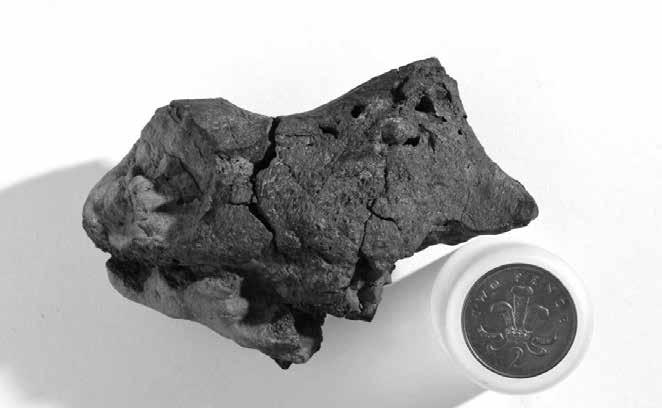
The fossil, which is about the size of an orange, was first found in 2004 by fossil hunter Jamie Hiscocks in Sussex, England. After he brought
it to Martin Brasier, a University of Oxford paleobiologist, they confirmed it to be an endocast – a fossil that is formed when a cavity in a dinosaur’s skull is filled with rock, thus creating a mold of the brain cavity.
They also believed the fossil to be from the skull of an iguanodon, a herbivorous dinosaur that roamed the earth 133 million years ago.
While finding an endocast in itself is very rare, what jumped out
to Brasier after further inspection was rarer still. The fossil also had irregular grooves and indents along its surface. With the help of a scanning electron microscope (SEM), those grooves and indents began to look surprisingly similar to the fibrous bundles that occur in the brains of present-day reptiles and birds.
While Brasier passed away in 2014 – the study was published in tribute to him – the fossil continued to intrigue scientists. David Norman, an iguanodon expert whom Brasier collaborated with prior to his death, confirmed that the fossil fit perfectly into a mold of an iguanodon skull.
Norman, along with a team of researchers, used SEM and computed tomography (CT) scans and found instances of what were once blood vessels, capillaries, and meninges –the membranes that cover the brain. While the scans definitely showed brain tissue, they also showed that the inside of the fossil was filled with rocks, sticks, and charcoal. The new
question became that of coincidence. What steps of misfortune had to befall this iguanodon for some of its quickest-decaying tissue to somehow fossilize?
They also believed the fossil to be from the skull of an iguanodon, a herbivorous dinosaur that roamed the earth 133 million years ago
Paleontologists believe that the brain tissue was able to fossilize despite its quick rate of decay due to the brain being “pickled” in a highacidity swamp immediately after the dinosaur’s death.
“What we think happened is that this particular dinosaur died in or near a body of water, and its head ended up partially buried in the sediment at the bottom,” said Norman, in a press release by the University of Cambridge.
“Since the water had little oxygen and was very acidic, the soft tissues of the brain were likely preserved and cast before the rest of its body was buried in the sediment.”
These results do not come without naysayers. Mary Schweitzer, an evolutionary biologist and expert on dinosaur soft tissue preservation, brought up the confusing nature of the tissue’s fossilization, and the fact that the brain tissue was preserved while the skull was not, at the presentation of the fossil on Oct. 27.
The study’s co-authors agree that more research on the fossil is needed, and Hiscocks and Norman hope to get the fossil to a public museum collection for further examination.
photo provided by jamie hiscocks
Winnipeg Aboriginal Film Festival showcases Indigenous talents
Local festival addresses Indigenous issues through filmmaking
rnier, staff
The 15th edition of the Winnipeg Aboriginal Film Festival (WAFF) is set to take place at Towne Cinema 8 from Nov. 24 to 27. It will present a wide collection of films by both local and international filmmakers, all centering on the theme of reconciliation.
“Reconciliation means Aboriginal people taking their rightful place in Canadian public life, hopefully at the center, but no longer at the margins,” said Coleen Rajotte, the festival’s director.
“It means no more discrimination in the workplace in schools and in our communities – it means building safer more positive atmospheres for our children to grow up in and many of our films and filmmakers have spoken to these themes.”
Duane Howard, a First Nations actor who is best known for his role as Arikara chief Elk Dog in The Revenant, will be the keynote speaker on the opening night. With years of experience in Hollywood, Howard will discuss the need for
greater Indigenous representation in the media.
WAFF will showcase voices often left unheard by our city’s mainstream media and celebrate Indigenous talents by creating a platform for selfexpression. It will highlight the need for Indigenous people to be better showcased and represented on television and in theatres.
"We're still dealing with the effects of the residential schools our parents and grandparents went through, but our festival offers a venue for a lot of really great stories of resilience and achievements – a lot of great things happening that young Aboriginal people are not offered anywhere else," said Rajotte.
The festival will be screening a selection of films, amongst others, that specifically address the subject of missing and murdered Indigenous women. This includes Nathaniel Arcand’s Sister, Daughter, Tasha Hubbard’s 7 Minutes, and This River by Katherena Vermette, an awardwinning Winnipeg Métis author,
whose film won the grand jury prize at this year’s Montreal First People’s Festival.
This year’s edition of the festival will also feature more films by members of international Indigenous communities, like My Bicycle from Bangladesh, and The Head Hunter from India. A successful New Zealand comedy film, Three Wise Cousins, will kick off the festival on Thursday, Nov. 24. This film, which was created with a budget of $80,000, has netted over two million dollars at the worldwide box office.
Every year, WAFF collaborates with the Adam Beach Film Institute (ABFI). The ABFI works with Indigenous youths and filmmaking enthusiasts by traveling to remote communities with their mobile studios, sometimes referred to as youth centers on wheels.
Rajotte believes filmmaking is essential, as it allows young Indigenous people to improve their self-esteem and sense of culture and identity, and develop relationships
with non-Indigenous communities.
“Not only does media training help to break the sense of isolation often experienced by young people in remote communities, but it also provides the tools they need to express themselves. In this way, film and music can act as powerful tools for social transformation in communities with high rates of suicide, violence, and substance abuse,” said Rajotte.
The Adam Beach Film Institute’s artistic director, Jim Compton, is excited by the submissions from young Indigenous film makers in this year’s edition of the festival. This highlights the effectiveness of the festival’s efforts to reach out to youths over the years.
“This year we’re seeing more and more submissions from younger Canadian Aboriginal filmmakers and that shows there is a growing industry out there. WAFF has helped develop that over the years which is something we are very proud of,” said Compton.
While the WAFF’s goal is to
showcase Indigenous issues, nonIndigenou s people are encouraged to attend. The stories told will explore universal themes, and such stories bring communities together, and is a key component of reconciliation.
“Our goal with this festival is to present films that offer nuanced portrayals of dynamic human beings,” said Rajotte.
The Winnipeg Aboriginal Film Festival will take place Nov. 24-27 at Towne Cinema 8. For more information, visit www.waff.ca
photo by winnipeg
The Trews’ Time Caspule tour comes to Winnipeg
Canadian band goes back in time with new album and tour
e
rnier, staff
Off the back of a new album release, Canadian hard rock band the Trews kicked off their national tour earlier this month and will be making a stop at the Burton Cummings Theatre on Nov. 26. While on tour, they will be performing songs from their latest compilation, Time Capsule. Released in September, Time Capsule is a collection of the band’s hits songs and new tracks.
“We tried to put [music] that reso-
nates the most with our fans,” said John-Angus MacDonald, the band’s guitarist.
Despite being an album of predominantly hit singles, Time Capsules is not a mere compilation of charttoppers. Tracks such as “Ishmael and Maggie” that were never released as singles but became live staples are included. Despite never topping the charts, fan favourite “Highway of Heroes” is featured along with four new tracks on the album. One of those new tracks, “Beautiful & Tragic,” was co-written by Canadian pop artist Serena Ryder.
Time Capsule provides a great introduction to the Trews, giving young hard rock fans and enthusiasts the opportunity to go back in time and listen to the best of the band’s catalogue. The album showcases the
range of the band’s songwriting and musical capabilities.
The Trews, whose first studio album was released in 2003, are originally from Antagonish, NS and eventually moved to Toronto.
MacDonald, who has been with the band since its inception 13 years ago, is grateful that the band has made commendable strides and grown over the years as this allowed them to deliver better music and performances to their growing fan base.
As the band grew, they discovered and solidified their sound as a group. Their heavy rock tunes, often featuring loud guitars and smashing drums, have become their signature sound – one that resonates with their fans.
Although the band has undergone many changes over the years, MacDonald believes that their song-
writing has evolved the most.
“Now [our creative process] is more expressive, everybody’s starting to write more, we’re more focused on the ‘bones’ of the song as opposed to the arrangement necessarily as we write,” MacDonald said.
“We feel like we’ve written the best stuff that we’ve ever written like, right now, or at least we’ve remained curious about songwriting [as a] craft.”
Re-releasing tracks is often seen as a bookend to a band’s career. This is not the case for the Trews, however, who already have another album in the works. The band members’ vast experience motivates them to continue making music and further refine their sound.
“[Time Capsule] is a new record, but it features 16 songs our fans have already heard, so we want to
make sure we follow up with a brand new album as soon as we can,” said MacDonald.
Over the course of their illustrious career, the Trews have played in Winnipeg numerous times and will be returning this month. The band has had some memorable moments in the city and is relishing playing in front of their Winnipeg fan base again.
“We’ve had so many great Winnipeg experiences. Our first ever sold out headlining show was in Winnipeg back in ’03 or ’04 at the Zoo,” said MacDonald.
The Trews will be performing at the Burton Cummings Theatre,Nov. 26. For tickets and more information, visit www.thetrewsmusic.com/live
Euterra Rising creates a new world order
Local author tackles overconsumption in new novel
to B i n i F esi, staff
News outlets and social media updates constantly expose us to the downsides of modern civilization and the effects it could have on Generation Z. From environmental degradations, polarizing – and sometimes outrageous – political views, terrorism, and sustainability issues, the fate of our society can easily be likened to those dystopian movies and novels from the 70s – cue Logan’s Run
In the midst of these realities, our imaginations serve as a refuge of inspiration and relief. Fortunately, Canadian author and transformational educator Mark A. Burch’s imagination has birthed a latest fictional novel, titled Euterra Rising: The Last Utopia Set in the 23rd century, Euterra
Rising presents a utopia that speculates on what the world could be like post-internet age. It is a story of the countercultural values that could well be the norm in a future society. Following the collapse of consumer culture and a so-called ‘Great Forgetting,’ a new world develops and is founded on the bedrocks of Euterran civilization.
new existence and in the process, come to terms with nature.
The novel is outlined like a timeline with chapters representing a certain period in the 23rd century. This provides a unique perspective of
with values of a former existence – the Brotherhood – and the collision of the two makes for a very strong plot.
Burch’s latest novel is compelling, intriguing and capable of inspiring its readers’ imagination
Burch’s Euterran civilization is neither apocalyptic nor post-apocalyptic; instead, it represents a nearapocalyptic time where current world value systems don’t hold any weight. Euterra is an intriguing time where people and communities must string together to come to grasp with their
cultural changes over time. Through strong character developments, it explores possible ways humans would survive in a world sans surplusage of common resources such as fossil fuels.
A plethora of refreshing ideas, plot twists, and suspense carries the reader along and through to the end of the book. The arrival of Euterra clashes
A brilliantly written novel, Euterra Rising touches on themes of consumer culture, simplicity, and sustainability. These notions are neither easy to describe or fictionalize but, as a staunch advocate of better and stronger sustainability value systems, Burch does a good job of buttressing his views in one way or the other in this novel.
Burch, a retired director of University of Winnipeg’s Campus Sustainability Office and the former codirector of Simplicity Practice and Resource Centre, has previously
published seven books on voluntary simplicity and sustainable livelihood. Euterra Rising expands on his ideals and vision for a world with lesser consumption rates.
Burch’s latest novel is compelling, intriguing, and capable of inspiring its readers’ imagination by providing a convenient escape from the realities of our trying and tiring society.
The official book launch for Euterra Rising: The Last Utopia will be on Nov. 19 at 7 p.m. at the McNally Robinson Booksellers (1120 Grant Avenue) and is available for sale on amazon.ca. For more information, visit www.markaburch.ca
Sports Editor: Ryan Stelter
Battle tested veterans
Bison men’s basketball team is an experienced group, with experienced captains
k e LL en tA ni GU c H i, staff
The University of Manitoba men’s basketball team opened up the 2016-17 season this weekend. But, before season tip-off, the Bisons named new team captains. Senior guards AJ Basi and Justus Alleyn lead the herd into the new season with the hope of replicating their success from last year.
The Bisons had a good season last year, as they made it to the Canada West final four, but were eliminated by the Calgary Dinos. The Bisons will have an opportunity to get their revenge when they open the new season this weekend in Calgary.
The Bisons fill the court with a lot of experience, as well as having some young players such as freshman forward James Wagner. Alleyn talked about the atmosphere of the locker room with the mix of veterans and rookies heading into the new season.
“I think it’s going pretty good,” Alleyn said. “All our older guys, we have been playing together for a few years now, at the same time we have kind of known the younger guys just through this basketball scene in the city. Everyone gets along great, so it is a pretty good environment.”
Kirby Schepp is entering his
eighth season as the Bisons head coach, and he also gave some insight into his team’s locker room.
“We have a very veteran crew this year, a number of fourth and fifth year guys,” he said. “We also have a number of young guys who are playing very well. We think we’re ready to compete right now but also our future is bright with these young guys.”
The veteran presence on the team is big this year, as the veterans have been through all the ups and downs with the team. Two of them were rewarded, and were named team captains because of their experience
with the herd.
“Alleyn, Basi, and a number of other guys, are providing tremendous leadership for us,” Schepp said. “These are guys who have kind of been through the wars, are battle-tested, and are certainly ready for all the things that are going to come.”
After being eliminated by the Dinos last season, the team is ready to take another shot at the division favorites.
“Our seasons ended there the last two seasons,” Basi said. “We’re excited to get back there and get some payback, it’s still pretty fresh in our minds.”
Bison men’s basketball earn split against second ranked Dinos
k
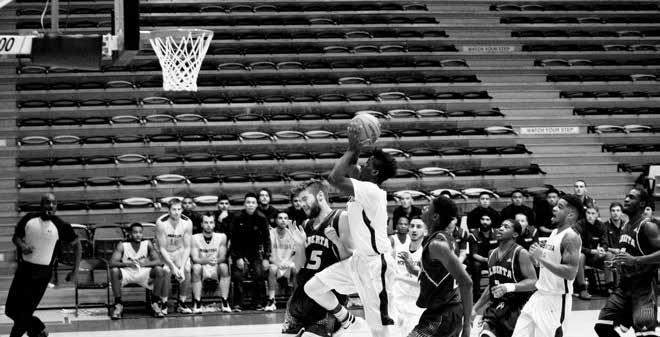
This weekend, the University of Manitoba men’s basketball team opened up their season on the road to the Calgary Dinos. The Dinos have eliminated the Bisons the past two playoffs. The Bisons won a close won on Friday 85-81, but fell 102-77 on Saturday.
Friday
Last season, the herd were eliminated from the final four after losing to the Dinos, a loss that was still fresh in their minds. The Bisons opened up the season with an upset victory over the second-ranked Dinos, winning 85-81.
The Bisons were led by captains Justus Alleyn and AJ Basi. Alleyn had a team-high 25 points, and went four-for-four from behind the threepoint line. He also connected on seven of his ten free throws which helped the herd to hold the lead.
Basi finished with 21 points, most of which came from beyond the three-point line as well, as he nailed six of his ten attempts.
Calgary guard Thomas Cooper led the way for the home side with 39 points. Cooper was 14-for-24 on field goals, and added seven free throws on his 13 attempts. Cooper was a workhorse for his team; he played 37 minutes and led in scoring for the Dinos. Lars Schlueter was second with only 12 points.
Manitoba had a very good opening half, as Alleyn led the team in the first quarter with 11 points and cashed all three of his three-point attempts. There was a lot of back and forth action in the first quarter which included three lead changes, but the Bisons took a 19-16 lead into the second quarter. The herd expanded the lead in the second frame and took a 42-32 lead into halftime.
In the second half, Alleyn and Basi each had 12 points and the team expanded their lead to a game-high 16 points, leading 71-55 in the fourth quarter. But late in the fourth, the Dinos made an epic comeback as they had an 11-to-one run to cut the lead down to six. From then on it was a
free throw battle for the Bisons. They did well enough and walked away with the 85-81 victory in Calgary.
The Dinos have eliminated the Bisons the past two playoffs. The Bisons won a close won on Friday 85-81, but fell 102-77 on Saturday.
Saturday
On Saturday, the Bisons were looking to open the season up with an upset sweep in Calgary. But the Dinos came out firing, as they dominated the herd and won 102-77, to end the opening weekend with a split.
The Dinos improved from last game, as they spread the ball around
and did not rely solely on Cooper. It seemed like the Bisons could not get anything to fall, as they shot a poor 39.4% from the field. The combination of Calgary getting everyone involved, and the herd unable to get shots to fall, led to them taking their first loss of the season.
The Dinos put up points in a hurry, as they jumped out to a first quarter lead of 30-16. Calgary’s defense was tough, as the Bisons were only able to score 16 points in each of the first two quarters. The Dinos took a 20-point lead into the half. The Bisons were led by Alleyn in the first half, as he put up 12 of his 23 points. The herd had trouble shooting the ball in the first half, shooting just 28.6% from the field, while Calgary shot 62.1%. The home side was led by Cooper who scored 13 points, and David Kapinga who netted another 12.
The Bisons improved their shooting from the first half, hitting 51.6% if their shots, the Bisons outscored the Dinos 25-23 in the third quarter. Alleyn was feeling it, and led the herd
The Bisons hosted a playoff game last season and hope to do so again, but that is not their major goal of the season.
“It would be nice, probably a goal along the way,” Basi said. “But we sort of want to build on that and do better, I don’t think it’s our end all be all of the season, we’re looking to do more than just that.”
Season outlook
The Bisons did not have the greatest preseason, but will hope to leave that behind them when the regular season starts.
“We struggled a bit in the pre-season, that’s kind of dampened expectations slightly,” Schepp said. “But at the same time we’re as optimistic as we’ve been this year, expectations are high, and so they should be.”
Starting the season with upset wins in Calgary would be huge for the team. Again, the team still remembers how their season ended last year, and are excited for the chance to get some revenge.
“Our guys are really looking forward to the challenge,” Schepp said. “Getting a sweep would be huge, getting a split even would be really big, and set the tone for our year.”
The Bisons begin their season at home with a series against Thompson Rivers, which will tip-off on Nov. 11-12 at the Investors Group Athletic Centre.
in the third frame with 11 points. Manitoba still had a large hill to climb, as they were still down by 18 points entering the final quarter. The Bisons had help in the second half from seniors Ilarion Bonhomme and Jonathan Alexander. Bonhomme posted seven points, and Alexander netted another six for the Bisons in the half. The Dinos had a more balanced attack in the second half, led by Kapinga and Mambi Diawara. Kapinga added nine points to his name, finishing with a team high 21, and Diawara helped hold the lead with his 11 points in the second half. Ultimately, Manitoba was unable to catch up, and Calgary won the second game of the weekend.
The Bisons open their home schedule next game as they host the Thompson Rivers Wolfpack on the November 11-12 at the Investors Group Athletic Centre.
Ready for a championship
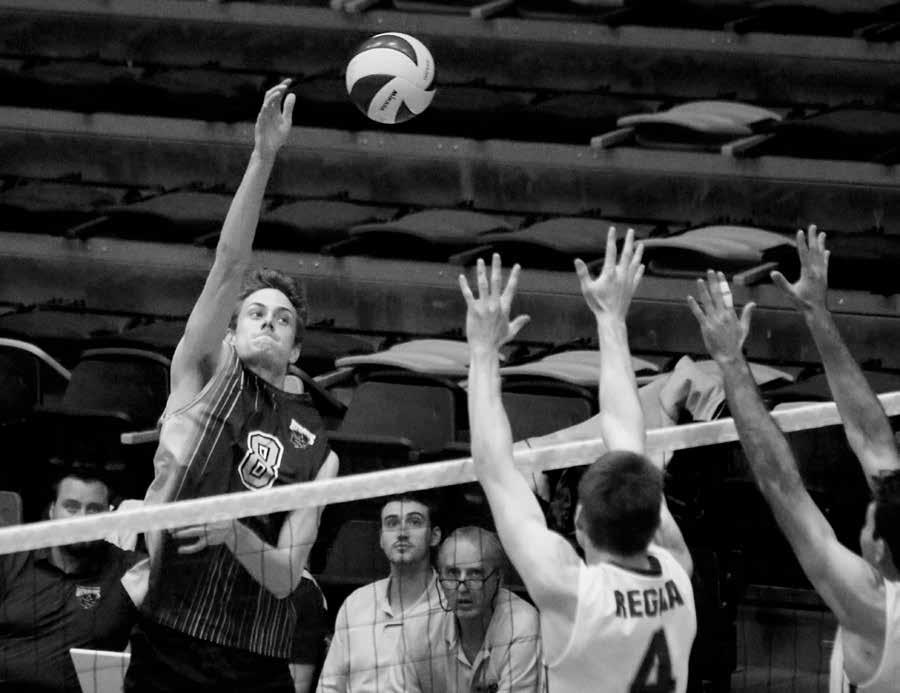
Expectations are high for the Bisons men’s volleyball team this season
ryA n s te Lter, staff
The University of Manitoba men’s volleyball team is currently ranked sixth in the nation, and are considered a powerhouse not only in the Canada West, but also in all of Canada.
Last season, the Bisons crashed and burned out of the Canada West final four, failing to win a single set. They are hoping to get back to the final four this year and take it one step further by winning Canada West – and ultimately the U Sports championship.
“With injuries building up to some key players, guys stepped up and performed well in expanded roles proving the value of the depth on this team this year” – Brett Stovin, Bison forward
“We’re capable of getting that far and further,” middle Ken Rooney said. “The ultimate goal is a national championship. This year I think we have seven fifth-year guys and a few more fourth-year guys. So this is it, this is as experienced as any team gets.”
Rooney has been a captain with the Bisons for four consecutive seasons, and is in his final year with
the herd. Known as “Mr. Reliable,” Rooney is a stalwart for the Bisons in the middle of the court.
Kevin Falconer and Adam DeJonckheere were named assistant captains for the Bisons for the upcoming season. Falconer, like Rooney, has been a captain for four years, and is playing in his fifth and final year with the Bisons. The 22-year-old is a force for the Bisons on the court, always being vocal.
DeJonckheere, the soon to be 21-year-old hitter, is entering his fourth season and third as a captain. The six-foot-three native of Winnipeg was a part of the 2013-14 CIS allrookie team.
“We’re in great shape with leadership, with Kenny being our captain, but we get leadership from a lot of other guys,” head coach Garth Pischke said. “We got some real veteran guys on this team so that helps a lot when it comes to playing.”
The Bisons are going to want to use that veteran presence to get over the hurdle of the Canada West final four and get to the big dance with some of the best volleyball teams in the nation.
“We have the skill to go all the way, it’s just a matter of putting it together on a consistent basis. I think we’ll get there,” Rooney said. “With that being said, though, we can’t look too far ahead. We’ve got to take it weekend by weekend, point by point, and just focus on what we’re doing. If we follow the process, I think we’ll get where we want to be.”
This Bisons team has been playing together for many years now, with many fourth and fifth year guys, so it is a tight-knit group.
“We’re a group of guys that have played together for a long time and gets together really well,” Rooney said. “I guess sometimes I think we can be a bit harder on each other, we’re such good friends.”
Last season, Manitoba’s offence was deadly, with Devren Dear being one of the main catalysts. He was third in the Canada West in kills per set with 4.47 and fifth in total kills with 349. The Bisons also had the second best hitting percentage in the Canada West with .316, and as a team
averaged 13.35 kills per set, which was second overall in the conference.
This year it is not any different, and the Bisons will have one of the top offenses in the Canada West this season.
“Our offence is pretty unstoppable if we’re passing the ball well,” Rooney said. “What we do need to work on is our defensive side of the game.”
The Bisons seem to have worked on their defensive side pretty well so far, as they are third in the conference with 48 blocked attacks so far
this season.
After a disappointing opening weekend split, the sixth-ranked Bisons team got back on track in their home opening series against Regina with a dominating sweep. Fans will have to wait a bit to see this potential championship-winning side to play again at home, when they play the number one ranked Alberta Golden Bears on Nov. 18-19.
Bison men’s hockey team splits weekend series against Calgary
ryA n s te Lter, staff
This weekend, the Bisons men’s hockey team was on the road in Calgary to play the Dinos in a two-game series. Calgary knocked Manitoba out of the playoffs last season, and they got the better of them again on Friday with a comeback 4-3 win. Manitoba came out strong in Saturday’s contest and took the game 3-2 to manage a split.
The Bisons are 4-4 on the year, and are currently tied with UBC for fifth place in the Canada West.
Friday
The Bisons got on the board with Jonah Wasylak’s first goal of the season seven minutes into the opening frame. Calgary then tied it up early in the second through Elgin Pearce, his first of two goals on the night.
Justin Augert got the lead back
eight minutes later with his sixth goal of the season. The Bisons held a 2-1 lead after 40 minutes of play. Pearce grabbed his second goal of the evening at the halfway point of the third to knot the score at two apiece.
Calgary got a late power play goal off the stick of first year defenseman Braiden Doucette and gave the Dinos their first lead of the night. Calgary sealed the deal with an empty net goal with a minute and a half to go. Shawn Bowles managed to get his first goal as a Bison but it was too little, too late and the Bisons fell 4-3.
Saturday
The Bisons did all their scoring in the first period on Saturday, as Shaq Merasty and Augert scored power play goals. Shawn Bowles also got
Calgary attempted a comeback and notched two goals in the second period to draw within one. But, Justin Paulic stood tall for the Bisons in net and registered 30 saves for his first win this season.
“With injuries building up to some key players guys stepped up and performed well in expanded roles proving the value of the depth on this team this year” – Brett Stovin, Bison forward
his second career U Sports goal. Augert and Merasty are now tied in team scoring with eight points each. Augert is second in Canada West in goals, with seven.
Brett Stovin talked postgame about the team’s performance on Saturday and the depth this Bison team possesses this year, that allowed them to manage a split against Calgary.
“Coming out of the first up 3-0 was all the offence we needed. With Paulic shutting the door on a couple breakaways and the guys grinding the game out defensively we came out
with the win,” he said. “With injuries building up to some key players guys stepped up and performed well in expanded roles proving the value of the depth on this team this year.”
The Bisons head back home to play a two game series against the Lethbridge Pronghorns on Nov.11-12, first puck drop is 7 p.m. Friday at the Wayne Fleming Arena.
photo by megan colwell
Bisons get back on track with weekend sweep over Dinos
JA son p c HAJ ek, staff
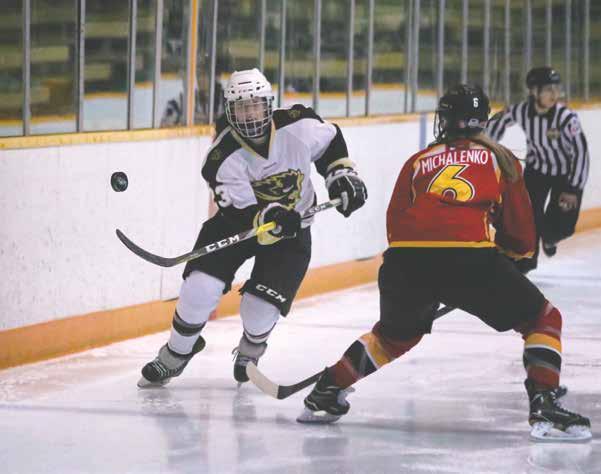
This weekend, the Bison women’s hockey team played a two game series at home against the Calgary Dinos. The Bisons squeaked out a 1-0 overtime win on Friday, and dominated for a 5-0 win on Saturday.
The seventh ranked Bisons are now 7-2-1 and sit in second place in the Canada West behind the UBC Thunderbirds.
Friday
After suffering back-to-back defeats at the hands of the UBC Thunderbirds, the Bisons looked for redemption against the Calgary Dinos. Calgary managed to weather the storm of the Bisons’ offence for most of the game, but fell in overtime 1-0.
The Friday matchup was a goaltending duel. Kelsey Roberts kept her team in the game and stopped 29 of the 30 Bison shots, but Rachel Dyck stood tall for the Bisons and earned the shutout win over Roberts.
Though the game remained scoreless throughout regulation, the Bisons had great chances throughout. The game almost didn’t reach the extra period, as Jordan Zacharias had a great breakaway chance with under four minutes remaining. Zacharias entered the Dinos zone and fired a shot past the Dino goaltender, but ringed the puck off the iron.
The Bisons finally got a chance past Roberts in the extra frame. Alana Serhan got the puck and sent it cross-ice to Courtlyn Oswald who beat Roberts for the win. This was Oswald’s first of the season and gave Manitoba the win over Calgary 1-0.
With the win Manitoba improved to 6-2-1 on the year, sitting just three points back of the first place UBC Thunderbirds.
The hard-fought home win is welcomed by the Bisons after their back-to-back losses at the hands of the same Thunderbirds last week.
“Anytime you’re going on at a good clip and get your feet cut out from under you, you’ve got to regroup and refocus,” Bison head coach Jon Rempel said post-game. “It hasn’t been an easy week for these girls. I think they feel a little bit of the monkey off their back.”
“It hasn’t been an easy week for these girls. I think they feel a little bit of the monkey off their back” – Jon Rempel, Bison women’s hockey head coach
Saturday
Following a hard fought overtime contest, the Bisons and Dinos were back in action Saturday afternoon. The Bisons opened the floodgates, and swept the weekend series with a 5-0 win.
Calgary goalie Roberts had to be sharp early and often, as the Bisons carried their control over from Friday’s game. However, she could not hold on as long, and Manitoba took the lead early in the first.
A scramble ensued in front of the Dinos’ net, but the puck slid out of the crowd to the faceoff dot. Taryn Kokesch grabbed the puck, and fired her second of the year over the glove
of Roberts to give the Bisons the 1-0 lead.
Two minutes later, a Calgary giveaway in the neutral zone sent the Bisons in on a 3-on-1 opportunity. Erica Reider connected on a cross-ice pass with Sheridan Oswald who was wide open on the far side. Oswald hammered a slap shot top corner on the blocker side, and popped Roberts’s water bottle in the process.
The Bisons got a power play late in the second, and used it to go up 3-0. Captain Caitlin Fyten took a pass at the point, walked in and put a hard
shot on net. The slapper passed by everyone and went bardown.
The Bisons capitalized on another minor penalty by the Dinos. A point shot was stopped by Roberts, but Zacharias was able to jar it loose. The puck slid under the goaltender and just across the line to make it 4-0 Manitoba in the second.
Alanna Sharman roofed a slap shot over Roberts’ shoulder in the final minute to seal the 5-0 victory for the Bisons
Although she was not tested often in the game, Amanda Schubert was
Bison women’s soccer crash out of Select Six
L
ess than a week after winning a playoff spot against the Calgary Dinos, the Bison women’s soccer team were back in action for a playoff match against the host UBC Thunderbirds. The herd played a hard game, but could not get through the UBC defense, and ended up falling 2-0. The game was all Thunderbirds in the first half. UBC controlled the possession game and kept the Bisons hemmed in their end, directing eight shots towards the goal in the first 20 minutes of play.
UBC got on the board first in the 14th minute, as Jasmin Dhanda broke into the Bisons’ zone and pulled off a slight deke to get a clear angle on goal. Dhanda fired a shot low and right,
beating Bison goalkeeper Maddie Wilford.
Dhanda and Wilford went headto-head the entire first half. There were six shots taken by the forward, but she was only able to get one by the Bison keeper.
The Thunderbirds extended the lead further in the 42nd minute, thanks to Rachel Jones. A scramble ensued in front of the Manitoba goal after an initial shot by Jones was stopped. She managed to find her own rebound and put it past Wilford for the 2-0 lead.
UBC followed this up with three shots in the final minutes of the half, but Wilford stood tall to keep her team in the game. The Bisons were unable to get much offence going in
the first half and did not register a shot.
The herd was able to get some time in the UBC end in the second half, as Amanda Wong tested UBC keeper Marlee Maracle in the 65th minute for the Bisons’ first shot of the contest. However, this was all the team could get from the stingy UBC defense, falling 2-0.
The Bisons will return home after a great playoff match, with strong promise for the 2017 season.
able to keep focused and with the shutout, earned her second win of the season.
“The girls always play hard in front of [Schubert],” Rempel said “I think they do a little extra for her because she’s a battler.”
The Bisons have a week off, and will be back in action when they take on the University of Alberta at the Wayne Fleming Arena on Nov.18-19.