Audit reports 869 metric tonnes of waste disposed of on campus yearly
DAVID ZIRANGEY, STAFF
October is sustainability month in Manitoba.
The U of M’s office of sustainability is hosting events throughout the month to promote awareness about the impact human behaviour has on the planet and to advocate for social, behavioural, political and economic changes that will help preserve the environment for the next generation.
One of the events planned is Cup Mountain. Volunteers have collected hundreds of paper cups from around the Fort Garry campus and began building them into a mountain at UMSU University Centre on Monday.
Sustainability ambassadors will provide free coffee Oct. 18 and 19 to people who bring a reusable mug.
The Cup Mountain project was developed to quantify the amount of single-use disposable paper cup waste generated by the U of M Fort Garry campus.
The office found the campus is responsible for 1.19 million singleuse disposable paper cups per year.
Office of sustainability promotion and outreach co-ordinator Christie Nairn said the number of disposable cups used on campus may be higher than students think.
“If you line those [paper cups] up face to face, it reaches between Winnipeg and Kelowna,” she said.
“The greenhouse gas emissions associated with that will actually get you from Victoria to Halifax 21 times.”
Nairn added projects like these help visualize the collective impact
“If
you line those [paper cups] up face to face, it reaches between Winnipeg and Kelowna” — Christie Nairn, sustainability office outreach co-ordinator
people have on the environment.
“The idea of Cup Mountain is to display what impact, or how many disposable cups we’re using in a week,” said Nairn.“So, a snapshot of what U of M uses.”
U of M student Sydney
Nicholauson is the Cup Mountain project leader.
She and her team are advocating for more people to use multiple-use beverage containers instead of singleuse paper cups to reduce the amount of waste and plastic sent to landfills.
“It’s a common sight on campus to see trash cans absolutely overflowing with cups,” she said.
“I know Degrees [restaurant] […] has compostable cups. But Starbucks, Tim Hortons […] those cups aren’t even recyclable. A lot of people don’t know that. They think they can be recycled. I thought they could be recycled until four months ago, but they can’t.”
Nairn noted the ideal response to the project is to inspire people to make more environmentally sustainable choices.
“That whole demonstration is to kind of help people realize the impact it has and to encourage them to use their own mug,” said Nairn.
The project raises questions about the fate of compostable materials disposed from campus, and whether the infrastructure even exists to deal with the amount of compostable waste disposed of by the U of M.
A 2017 waste audit report by the
office estimated 869 metric tonnes of waste is generated and disposed annually by the U of M.
While about half of waste generated from both U of M campuses is made up of compostables, no largescale programs exist to deal with organic compost. Like non-recyclables, compostable materials are sent to landfill.
The report also highlighted the “strong potential” of organic waste prevention programs at the U of M, considering half of the amount of organic and compostable waste.
The report called for a three-stage pilot composting program and a multi-level implementation strategy involving management, students and staff.
Most single-use disposable beverage paper cups are lined with a type of plastic to keep them waterproof. While paper decomposes in landfills, these plastics do not.
In Manitoba, paper cups end up in landfills because they are nonrecyclable. Styrofoam, foil, plastic bags and black or dark-coloured plastics are non-recyclable, despite many being stamped with the recycle symbol.
Nicholauson said the lagging of
BY
businesses to invest in compostable products comes down to profit.
“This is a problem that is preventable if big retailers essentially were to shell out a bit more money to get the more expensive, compostable cups,” said Nicholauson.
“But of course they won’t, because they have to maximize profit margins.”
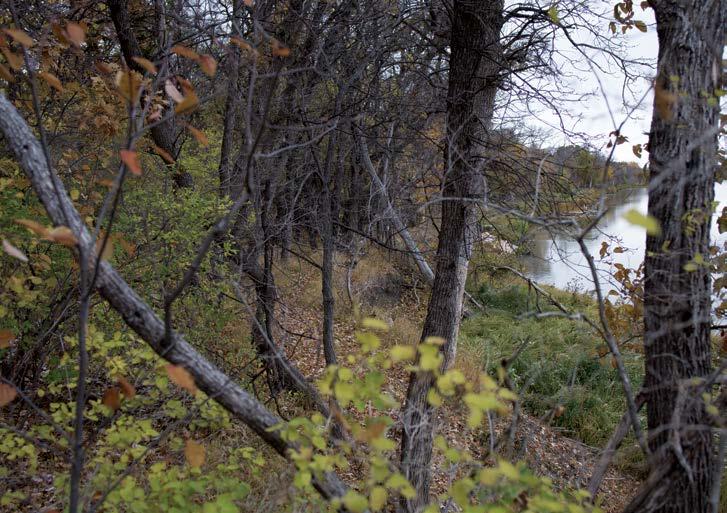
On another front of sustainability month, student volunteers and staff from the U of M cleaned the forest area and river bank behind the Drake Centre, U of M Asper school of business, Oct. 11.
About 45 kilograms of garbage was collected from the area.
Alexandra Caporale, a U of M master’s student in the department of city planning, led the cleanup.
“Over the spring or summer, I was walking around here [...] then I started looking at the river and I was like ‘What is this terrible mess?" she said.
"This is really upsetting.”
The office of sustainability will be hosting events for the rest of October, including a nature walk and circumnavigation of Lake Winnipeg.
PHOTO
ASHA NELSON
Associate prof arrested on child porn charges
Child psychologist not formally employed by university
MALAK ABAS, STAFF
AU of M associate professor and child psychologist has been arrested and charged with possession of child pornography.
Gary Shady, 72, was arrested in his Fort Rouge home Wednesday.
An investigation by the Winnipeg Police Service’s internet child exploi-
tation unit began in early October after an online storage service notified the National Center for Missing and Exploited Children of
sexual abuse imagery being held on its service. The centre then notified Winnipeg police and the National Child Exploitation Co-ordination Centre in Ottawa.
Police seized an electronic device containing child sexual images, along with several other electronic devices. The charges were announced Thursday.
Shady was listed as recently as Friday morning on the U of M’s website as an associate professor at the faculty of health sciences and he saw patients as a child psychologist at the Manitoba Adolescent Treatment Centre. He also had patients at the Health Sciences Centre.
While Shady was technically an associate professor, he did not have a teaching position on campus, according to U of M spokesperson John Danakas.
“His association with the University of Manitoba would have been limited to a nil appointment as an associate professor […] providing clinical training for residents and medical students, primarily residents,” Danakas said.
According to Danakas, nil
appointments typically provide training to medical students and residents, and are chosen by the university, but not formally employed by the U of M. They are typically employees of the Winnipeg Regional Health Authority (WRHA).
Clinical training by Shady would have been held at a WRHA facility.
“The university doesn’t pay this individual […] the WRHA does,” Danakas said.
“This is not an employee, in that sense, of the university.”
Winnipeg police service spokesperson Const. Jay Murray called the images “concerning,” and noted the investigation will look into whether his patients had been victimized.
“Whenever we release on an incident, whether it be of this nature or something else, there’s always a possibility that other victims may come forward,” Murray said in a release.
The WRHA has confirmed he has been placed on administrative leave.
Danakas said he is no longer involved with the university in any way, as “the association with the university relies on that appointment.”
The investigation is ongoing.
Manitobans protest for safe housing, affordable transit
Marchers
call for voters to make poverty an election
issue
MALAK ABAS, STAFF
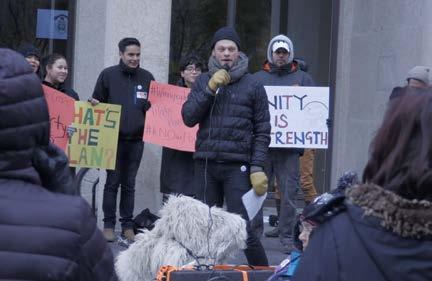
Manitobans marched from City Hall to the legislative building Thursday to advocate for a povertyfree province.
The walk, organized by Make Poverty History Manitoba — an activist group focused on changing public policy to identify and reduce causes of poverty — first received blessings from a local Indigenous elder. The march included a bus provided
by Winnipeg’s Amalgamated Transit Union (ATU) Local 1505 to transport protesters and drummers from the West Central Women’s Resource Centre drum group.
Lorie English, chair of Make Poverty History’s city working group and executive director of the West Central Women’s Resource Centre, spoke to the congregation about the Winnipeg Without Poverty report. The report, which was published
by the Canadian Centre for Policy Alternatives and has been endorsed by over 90 organizations, calls on mayor Brian Bowman to develop a productive poverty reduction plan.
“It’s time now that we pull together and we force the city, we make this an election issue, and we challenge them to really start talking about poverty and in a good way,” she said.
The plan includes 50 recommendations to the city, including the
implementation of safe and accessible housing options, developing policies to monitor food security in the city and replacing the Winnipeg Police Board with a community safety group to oversee the Winnipeg Police Service.
The report also calls on the city to increase transit accessibility and service, especially in low-income neighbourhoods and spaces with recorded high public transit dependency.
President of ATU Local 1505 Aleem Chaudhary spoke in support of reinstating recently-cut provincial funding toward transit.
The 50-50 transit funding deal saw the city and province splitting the cost of Winnipeg Public Transit operating costs.
The deal, which was instated in the 1970s, ended in 2017. Any increases in cost are now the city’s sole responsibility, resulting in an increase in regular transit fare to $2.95 from $2.70.
“It is a responsibility of our government, civic or provincial, to be able to provide the important transportation that the people need to get to and from work,” Chaudhary said.
“Many people are making the choice between putting nutritious food on the table for their children or to be able to provide transportation to get to and from work, to be able to get to their job.”
According to a poll conducted by the union, 79 per cent of
Winnipeggers support the restoration of the funding agreement.
English asked the crowd to make poverty reduction a priority when holding city leaders accountable.
“We’re asking all of you, ask your candidates for city council and mayor, what is their plan to address poverty,” she said.
“We’re asking all of you, ask your candidates for city council and mayor, what
is their plan to address poverty” — Lorie English
“How are they going to step up and be leaders that we know their city can be? Winnipeg is a great city with great citizens, and the majority of those citizens care about lifting up the most vulnerable people in our community. And it’s time to see that same leadership from our community, from our community leaders, in terms of our city councillors and our mayor.”
PHOTO BY PAYMUN NEMATOLLAHI
PHOTO BY QUINCY HOUDAYER
UMSU wellness week rolls out cannabis workshop
UMSU programming sparks dialogue over mental health
SHAUNA MATTHEWS, STAFF
UMSU held a workshop looking at the science behind cannabis use and mental health last Wednesday as part of its Mental Health and Wellness week.
The workshop, “Mental Health and Cannabis 101,” sought to educate students on the potential risks and benefits cannabis consumption can have on users.
Mental Health and Wellness week, which ran from Oct. 9 to 12,
“I see these campaigns as a platform to educate, raise awareness and reach out to the student body” — Sarah Bonner-Proulx, UMSU VP advocacy
brought mental wellness programming to students and was hosted by UMSU.
The aim of the campaign was to begin a dialogue concerning mental health and illness.
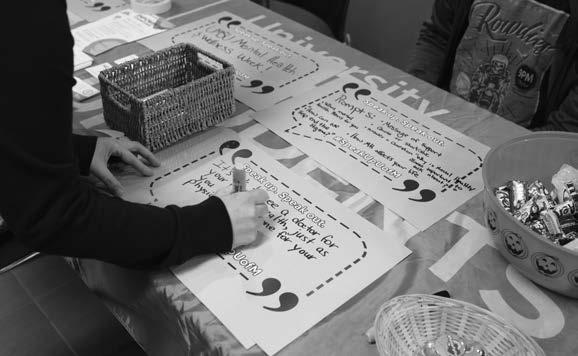
UMSU hosted a series of other events, including a hand print pledge and art therapy.
The campaign also gave students the opportunity to share their thoughts on mental health, provide messages of support to their fellow students and offer suggestions to UMSU on how to improve the services they provide.
UMSU VP advocacy Sarah Bonner-Proulx said the campaign is a chance for students who may have
questions concerning mental health to find resources on campus.
“Each year UMSU organizes two mental health and wellness week campaigns, one in October and one in January, where we invite both internal and external organizations and groups to participate and host events and workshops,” she said.
“For me, I see these campaigns as a platform to educate, raise awareness and reach out to the student body and to normalize the idea of mental illness.”
Bonner-Proulx said UMSU is making education and support for students a priority.
“The goal is to work to normalize mental illness so that students feel more comfortable talking about this still-sensitive topic and seeking support if needed, and [to] debunk myths and misconceptions surrounding mental health and illness,” she said.
Though there has not been any significant evidence proving cannabis causes mental illness, there are some disorders directly associated
with cannabis consumption, such as social anxiety, bipolar disorder and schizophrenia.
The workshop went into depth on the science behind getting high, including how cannabis works as a mental stimulant, what bodily functions it affects and its medicinal effects.
While the workshop discussed the possible negative side effects of long-term cannabis use there was also discussion on how cannabis can be used to relieve pain and provide
comfort for people suffering from serious illnesses like multiple sclerosis and AIDS.
According to a statement from UMSU, the board of directors hopes to form a “realistic drug strategy” and believes “easily accessible educational resources for students will help eliminate misconceptions about cannabis and subsequently promote safe usage.”
Liberals announce $13 million in funding for U of M
Discovery grant awarded to STEM students and researchers
MALAK ABAS, STAFF
T
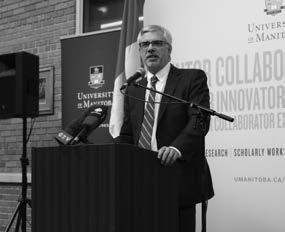
he Natural Sciences and Engineering Research Council of Canada (NSERC) announced $13 million in research funding and scholarships for U of M students Oct. 12.
The grants are part of a nationwide $558 million investment into discovery research funding announced by minister of science and sport Kirsty Duncan on Oct. 9, the largest investment in discovery science in Canadian history.
The U of M grants have been awarded to students in a range of STEM disciplines. Projects include research into autonomous agricultural machines, thermostat dynamics and the reaction of fungi to extreme environments.
Winnipeg South MP Terry
Duguid spoke to the U of M’s dedication to scientific advancement.
“The University of Manitoba employs thousands of people, contributes one billion dollars to Manitoba’s economy, and is a world leader in many fields, including infectious diseases, climate change, agriculture, intelligent infrastructure and the humanities,” Duguid said in a media release.
“I am proud that our federal government’s investment of more than $13 million in discovery research funding will give the researchers, scientists and students at the U of M the support they need to work on cuttingedge research that will impact the wellbeing of all Canadians.”
U of M food and human nutritional sciences researcher Filiz Koksel,
a recipient of the NSERC discovery grant, introduced her research project during the announcement.
“I feel very fortunate to hold an NSERC discovery grant myself, especially as an independent researcher. My discovery grant has opened and will continue to open several doors for me,” Koksel said.
“With these funds, I [will] train the next generation of highly qualified personnel.”
The project Koksel received funding for focuses on processing pulses — seeds from the legume family — and cereals.
Koksel invited those in attendance for the announcement to observe a demonstration of a manufacturing device that aerates food products.
PHOTO BY ASHA NELSON
PHOTO BY ASHA NELSON
Cannabis remains banned on U of M campus
University to provide marijuana education and resources to students
MALAK ABAS, STAFF
While cannabis legalization means Canadians will be able to legally smoke for the first time, students will not be allowed to light up on campus.
The provincial Non-Smokers Health Protection and Vapour Products Act prohibits smoking marijuana on school grounds. Once legal, smoking marijuana will remain illegal in public spaces.
The growth and sale of cannabis is also illegal on campus — including in dormitories — in accordance with provincial legislation.
An email was sent to all students living on campus reminding them the student residence cannabis policy forbids consuming, preparing, selling and growing cannabis.
The email also warned students if they smelled of marijuana or presented a “delayed response” in opening their door, it would “raise further suspicion and increase the severity of
the sanction levied.”
Students caught breaking these rules in residence will be fined a minimum of $50 for a first-time offense.
Non-recreational marijuana use on campus is restricted to those with a prescription and must be in accordance with the U of M’s clean air procedure, which enforces non-smoking areas on campus with the intent of maintaining public safety and a clean environment.
According to U of M spokesperson John Danakas, there will be no new policies in place for disciplining recreational cannabis use on school grounds, but that may change in the future.
ments to the policy,” he said.
Discussions are already underway between UMSU and the university to allow edible cannabis products in private dorms.
Danakas said the university will be focusing on providing support for students who are looking for further education on cannabis use or feel they
action itself, it’s the same disciplinary processes that are in place now for abuse of substances.”
He added if security was to catch students smoking cannabis on campus, disciplinary procedure would be decided on a case-by-case basis, ranging from simply asking the students to butt out to more serious disciplinary action.
“The university will be monitoring the impact of legalization and stay on top of that in terms of making adjustments to the policy”
John Danakas, U of M spokesperson
have developed a dependency.
“The university will be monitoring the impact of legalization and stay on top of that in terms of making adjust-
Greening out
ASHA NELSON
“The focus is moreso on behaviours that might harm individuals that result from abuse, rather than on the action itself,” Danakas said.
“And that in dealing with the
Timothy Appleyard, a computer science student, said while he would not have a problem with students smoking up on campus, precautions should be taken to ensure people with respiratory issues are considered.
“I know for me, having asthma, knowing that there’s designated spots where people could be smoking, I’d know to avoid those,” he said.
“I’m personally just all fine with the use of cannabis, but just having that happen in random spots around university, I just don’t like the smell. So a designated spot I know I could avoid would be nice.”
Fellow computer science student Luke Delatorre agreed with the implementation of possible designated smoking areas on campus in the future.
“For the most part, the designated spots would be nice, just to make sure — you know, you don’t want to influence the kids or anything,”
Healthy U, a volunteer-based peer-to-peer health education service on campus, will be available to answer questions students may have about cannabis use. Students are invited to visit the service if they are looking for counselling services.
Healthy U will also direct students who are concerned about their cannabis use to helpful resources.
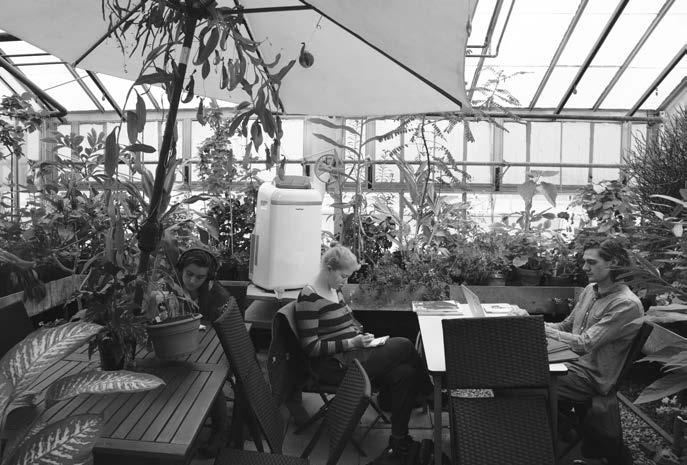
Students take refuge from the cold and study in the Buller Greenhouse Monday.