M ichael Benarroch, president and vice-chancellor, Diane Hiebert-Murphy, provost and vice-president (academic) and Mike Emslie, CFO and comptroller, hosted the university’s third annual budget town hall on Oct. 16.
The budget town hall is an event where the president and his executives engage the campus community in the university budget for the fiscal year.
Benarroch stated that “it’s our priority to continue to hold these types of events to engage in our community, to listen to you and take that information back.”
The budget town hall dis-
cussion addressed the university’s budgeting and planning process, 2023-24 financial results, 2024-25 operating budget and plans for upcoming years.
Emslie started the budget discussion by presenting the university’s revenue sources. According to his presentation, the university’s revenue sources are divided into two parts — operating activities and non-operating activities.
Revenue classified for operating activities is controlled by the university. It includes instructional activities, administrative support, operational costs, ancillary services and income funded activities. These are funded by tuition, provincial grants and
income from other revenues.
However, revenue for non-operating activities is restriction-based and needs to be spent according to the restrictions imposed by the funders. This includes sponsored research projects, donations, special trust accounts and capital funding. It is financed by the provincial government, federal government and other revenue sources.
The presentation also showed that as of Mar. 31, 55 per cent of the university’s revenue came from provincial grants, while 30 per cent came from tuition and 15 per cent came from other fees.
Federal government launches Canada Water Agency
Milan Lukes, staff
The federal government launched the Canada Water Agency at the Forks Historic Port — situated at the junction of the Red and Assiniboine Rivers — on Oct. 16. The agency’s mandate is to improve freshwater management across the country.
“Freshwater has been facing challenges,” said Steven Guilbeault, the federal minister of environment and climate change. “Challenges that are intensifying due in large part to climate change. Droughts, floods, deteriorating water quality, pollution from farming and industrial activities have significant impacts on water quality. Impacts that are very serious and costly.”
Guilbeault explained that the agency will help the federal government address current and future water challenges. “We need to be better prepared for what comes into the future. We need to recognize that water is becoming more scarce and more precious. We have a responsibility to protect the waters we have.”
In 2019, the federal government introduced the Canada Water Agency as a platform commitment to keep the nation’s water safe and ensure it is well-managed. In Budget 2023, $85.1 million was allocated over five years for the creation of the agency, a branch within Environment and Climate Change Canada, with $21 million ongoing
thereafter. Legislation was introduced as part of Bill C-59 to create the standalone Canada Water Agency, which came into force on Oct. 15.
Terry Duguid, parliamentary secretary to the prime minister and special advisor for water, said that the agency “will have significant
Parking fines increased and expanded on campus
Milan Lukes, staff
The U of M’s board of governors approved revised parking regulations during their Oct. 15 meeting, effective immediately. The new parking regulations include fine increases to five citation violations and the implementation of nine new citation violations.
In the submission to the board prepared by Kristina Manaigre and Cameron Neufeld of the office of parking and transportation, it was indicated that the parking regulations — including fines — were last updated in 2016.
The office of parking and transportation recommended to the board that most fines be kept at their current levels, but recommended new rules to reflect changes, such as the introduction of electric vehicle charging stations and lanes for cyclists. Changes to parking regulations were also recommended due to inadequately addressed matters, such as parking on a landscaped area or camping overnight, according to the submission.
“We are also recommending increases in fines for certain safety related violations to align with similar fine levels at the City of Winnipeg,” read the submission.
“The proposed citation fine increases are to discourage rare, yet significantly disruptive violations to the University of Manitoba community and to enhance campus safety. The addition of new citation violations and overall language updates will ensure that proper enforcement can occur.”
Fine increase to existing citation violations
Fines for parking within three metres of a fire hydrant on university property, at a bus stop or that cause obstruction or hazard on a roadway have all been increased. Fines for stopping in an area desig-
nated by the university as a “no parking” or “no stopping” zone have also increased. This equally applies to “no idling” or “ridesharing/taxi parking only” zones. An increase in fines for parking at hooded meters is also now in effect.
All of these fines were originally $70 when paid in full and $35 when paid within the first 10 days (discounted). With the approved changes, these fines have been increased to $100 when paid in full and $50 when discounted.
New citation violations
The new parking violation that has the lowest fine is for overtime parking in an electric vehicle stall, fined at $40 in full and at $20 when discounted.
Other new violations include parking or stopping on a boulevard or landscaped area, parking in a carpool stall without arriving with more than one person in the vehicle and parking an oversized vehicle without an oversized vehicle permit. An oversized vehicle is defined as a motor vehicle that is longer than 6.7 metres — whether that is the vehicle length alone or with any connected trailer. Occupying a designated electric vehicle charging station stall without actively charging is another additional violation to the parking regulations. Individuals can anticipate a $70 fine in full and $35 when discounted for each of these violations.
Stopping, parking, leaving or operating an unauthorized powersport vehicle on university property is the last new violation with the same penalty fee. Authorization may be provided by the university’s vice-president (administration) or designate. The office of parking and transportation defines a powersport vehicle as a motorized vehicle for offroad use, citing snowmobiles,
EDITOR-IN-CHIEF Milan Lukes editor@themanitoban.com
BUSINESS MANAGER Alice Teufack accounts@themanitoban.com
BUSINESS SUPPORT MANAGER Joshua Herold ads@themanitoban.com
SOCIAL MEDIA EDITOR Devvrat Nathwani social@themanitoban.com
REPORTERS
NEWS Ngozi Okose
RESEARCH & TECHNOLOGY Divyata Gosai
COMMENT Quinn Mayhew
COMMENT Thandeka Katsika
ARTS & CULTURE Boris Tsun Hang Leung
ARTS & CULTURE Carrington Dong SPORTS Faiyaz Chowdhury
SPORTS Israel Abejoye
VOLUNTEERS
VOLUNTEERS
Michele Melendez, Anthony Nardella, Adam Johnston
interested in volunteering? email me@themanitoban.com today!
THEMANITOBAN.COM
109 HELEN GLASS BUILDING
UNIVERSITY OF MANITOBA WINNIPEG, MB 204. 474. 6535
The Manitoban is the official student newspaper of the University of Manitoba. It is published monthly during the summer and each week of regular classes during the academic year by the Manitoban Newspaper Publications Corporation.
The Manitoban is an independent and democratic student organization, open to participation from all students. It exists to serve its readers as students and citizens.
The Manitoban is a member of the Canadian University Press, and our journalistic standards can be found on the Manitoban’s website.
The newspaper’s primary mandate is to report fairly and objectively on issues and events of importance and interest to the students of the University of Manitoba, to provide an open forum for the free expression and exchange of opinions and ideas and to stimulate meaningful debate on issues that affect or would otherwise be of interest to the student body and/ or society in general. The Manitoban serves as a training ground for students interested in any aspect of journalism.
Students and other interested parties are invited to contribute to any section of the newspaper. Please contact the appropriate editor for submission guidelines.
The Manitoban reserves the right to edit all submissions and will not publish any material deemed by its Editorial Board to be discriminatory, racist, sexist, homophobic or transphobic, ableist or libellous.
Opinions expressed in letters and articles are solely those of the authors. Editorials in the Manitoban are signed and represent the opinions of the writer(s), not necessarily those of the Manitoban staff, Editorial Board or the publisher.
A “volunteer staff” member is defined as a person who has had three volunteer articles, photographs or pieces of art of reasonable length and/ or substance published in the current publishing year of the Manitoban.
Any individual who qualifies as a volunteer staff member must be voted in by a majority vote at a Manitoban editorial board meeting. Elected representatives and non-students may be excluded from holding votes as volunteer staff members in accordance with the Manitoban Constitution.
The university’s finances and investments shared with the community
Cont’d from front page
Seventy-five per cent of the generated revenue was spent on salaries and benefits, while the remaining 25 per cent was spent on other costs, such as utilities, maintenance, supplies and travel.
Emslie emphasized how low the university’s tuition rate is compared to other universities in the country.
“It’s worth noting that U of M’s tuition is very low relative to our peers,” Emslie said. “In 2000, the province froze tuition for about a decade and has regulated domestic tuition increases since, and this resulted in Manitoba having the lowest tuition rates in the country.”
Following Emslie’s presentation, Hiebert-Murphy presented the university’s budget planning. She discussed how revenues from provincial grants, tuition and other fees are allocated based on U of M’s budget model.
According to the budget model, funds from provincial grants, tuition and other fees are allocated to faculties and schools. Faculties take from that revenue to support central service units, such as finance, human resources, IT, student affairs, research office and physical plant. The remaining revenue from charges and fees are allocated to the ancillary units.
Hiebert-Murphy also talked about the university’s budget cycle and resource planning.
According to the presentation, the cycle for the university’s budget begins each spring and ends the following spring with the board’s approval.
“The timing of the budget process is dictated by our fiscal year which ends Mar. 31, and by funding announcements that come from the government,” Hiebert-Murphy said. “The timeline doesn’t always nicely match up to our decision-making processes. So many of our processes around funding are collegial processes.”
Hiebert-Murphy continued, “the province usually informs us about our grant and tuition increases that are allowable, very close to or sometimes even after the start of the fiscal year. Once we have confirmation of our funding we can actually start moving ahead on some of our plans, but that planning can sometimes take months or even longer and it’s that leg that can lead to surpluses in the budget.”
Emslie continued the presentation with the 2023-24 financial results.
According to the presented data, the university reported a consolidated surplus of $79.4 million for the 2023-24 budget. This surplus was a result of a late notice grant increase, a late notice in approved program expansion funding, the time to recruit or hire and the delays in renovation projects.
The data also entailed the cumulative balances for carry-over and provisions by fiscal year.
As of March 2024, the cumulative balance carryover and provisions for faculties and university priorities was $160 million and $167 million respectively.
Furthermore, Hiebert-Murphy presented the 2024-25
operating budgets and plans for the coming year.
“We are about halfway through the 2024-25 budget. Planning for the budget started in June of 2023, and the budget was approved by the board in May of 2024,” Hiebert-Murphy said. “That time, the board approved an operating budget of $820 million, and that included a two per cent increase on the grant from the provincial government, as well as a 2.7 per cent increase in the domestic tuition.”
Hiebert-Murphy also mentioned salaries and enrolment as the two biggest factors for the 2024-25 budget. She explained further, saying that “as some of you may recall, in January of last year, the federal government announced caps on international students’ study permits. This has increased a lot of uncertainty around international enrolment levels across Canada.”
She continued, “enrolment last year and the previous year was higher than expected, so we adjusted the current year budget to reflect that expectation, but we also offset it by an anticipated five percent decline in overall international student enrolment due to those caps.”
In addition, she said that “to mitigate the gap between the U of M and other institutions on international tuition, we increased international tuition rates by 5.75 per cent.”
The 2024-25 budget had an increased investment in key areas like student services, competitive wages, program expansion, academic programming, one-time strategic
investments, utilities and other inflationary costs.
In terms of the university’s plan for the 2025-26 budget year, Hiebert-Murphy said that “the most significant change we’re making is in how we allocate the provincial grant. We are aligning that allocation to more closely align with how the grant is received by the university.”
The provincial grant will be allocated as a base grant to each academic unit, tuition will be allocated based on enrolments and there will also be an introduction of new carry-over procedures to spend funds more effectively while maintaining an appropriate financial reserve.
Furthermore, Emslie presented the university’s budget plans for 2025-26 to 2027-28.
The proposed plan showed that there will be limited provincial grant increases, increases in enrolment with less tuition revenue, increases in wages to remain competitive, increasing demand for student supports, an increas-
ing volume for central support units and upgrades in teaching and learning infrastructures.
The plan also showed that the university’s expenditure for the 2025-26 to 2027-28 budget is projected to exceed the revenue.
Lastly, Hiebert-Murphy closed the presentation saying that “we do have some clear and unexpected financial challenges that we’re going to be facing over the next few years, but we are going to continue to use our resources in a fiscally responsible way and do the best that we can to continue to invest in our core mission at the university and make some gains in some of the areas that we have identified as strategic priorities.”
She continued, “we are going to implement revisions to the budget model in support of those goals, and we hope to see some stabilizing of our international student enrolment which will help us plan as well for the future.”
National agency to improve freshwater management and collaborate with U of M
Cont’d from front page
independent decision-making power to be that advocate for freshwater from coast to coast to coast.”
“Tackling today’s freshwater challenges will require strong collaboration among governments, Indigenous partners, non-government organizations, academia, industry and others,” said Duguid. “The Canada Water Agency will provide the leadership to foster the partnerships that we need to protect fresh water.”
Duguid stated, “the guidance of First Nations, Métis and Inuit people has been instrumental in shaping the establishment of the Canada Water Agency, and we look forward to continuing our partnership.”
The agency’s current initiatives include leading the Freshwater Ecosystem Initia-
tives in eight waterbodies: Lake Winnipeg, the Great Lakes, Lake of the Woods, Lake Simcoe, the St. Lawrence, Saint John, Fraser and Mackenzie Rivers. The goals include restoring and protecting the water quality and aquatic ecosystem health, as well as advancing monitoring capabilities.
Other initiatives of the agency entail the modernization of the Canada Water Act — federal legislation proclaimed in 1970 which provides legal framework relating to the treatment of water resources. The agency will also develop a national freshwater data strategy while supporting freshwater science.
As of this year, the Canada Water Agency has committed to providing over $90 million to 175 different projects across the nation to improve freshwater management.
Daniel Wolfish is serving as the agency’s interim president.
The agency’s headquarters is located in Winnipeg at 510-234 Donald Street. “The agency right now is about 215 employees. A hundred will be located in downtown Winnipeg,” said Duguid. Five regional offices will also be situated across Canada.
“It will bring more sustainable jobs to our city, boosting our economy [and] building on the innovation already happening,” said Mayor Scott Gillingham.
“It’s a huge vote of confidence for our city and province’s expertise, resilience and leadership when it comes to managing one of the most precious resources that we have.”
When asked whether the agency will collaborate with the U of M, Duguid
clarified that it is a “definite yes.” Duguid added, “we have incredible water expertise at the University of Manitoba.” He stated that scientists on campus will be working closely as part of the collaboration. Wolfish indicated that student involvement has also transpired through internships.
Mario Pinto, the university’s vice-president (research and international), stated that “we have been working for the past year to convene the researchers working on all aspects of water across the faculties of the university as well as the Experimental Lakes Area scientists, working toward formation of a senate-approved institute.”
Pinto indicated that the institute would embrace all disciplines, and once approved as an institute, the researchers would collabor-
ate with those at the Canada Water Agency to positively impact water security — one of the themes of the university’s Strategic Research Plan 2024-29.
“We have come to ground on a strategy that incorporates Indigenous perspectives and concepts, starting with the concept of water as the giver of life,” stated Pinto.
Duguid mentioned that significant progress has been made in the management of our freshwater bodies, but added that there is still much to do. “Together, with all of you, we will protect and restore Canada’s freshwater for generations to come.”
photo / Nischal Karki / staff
University board of governors approves revised parking regulations
all-terrain vehicles, personal watercraft and dirt bikes as examples.
Parking or stopping a vehicle on university property that is a sidewalk, where a sidewalk crosses a roadway or on a bicycle or pedestrian path will now cost you $100 in full and $50 when discounted. The same fine is now incurred when ridesharing and taxi services stop to pick up passengers in designated pick-up zones outside of specified times.
Camping overnight on university property in a vehicle — oversized or not — is the latest violation with the greatest fine at $300 in full or $150 when discounted.
Cameron Neufeld, director of the office of parking and transportation, clarified that “there are no rules prohibiting parking permit holders from parking in their lot overnight. Overnight camping refers to individuals planning to sleep on campus overnight either in a camper or a vehicle,” said Neufeld.
There are now 30 individual violations under the university’s parking regulation that carry a fine. Theft of service, such as tampering with a parking meter or transferring your permit to another person, has the greatest fine at $350 with no discounted fine available.
Citation violation statistics for 2023
Records obtained under the Freedom of Information and Protection of Privacy Act indicated that the university received $584,974.40 in total revenue collected for citations during the 2023 calendar year. During this time, 13,316 citations were paid — the majority (6,693) were for vehicles parked without payment or that had exhausted the parking time. Over 2,700 citation violations were issued and paid for parking in a reserved staff lot, 1,979 for parking in a reserved student lot and 536 for improper parking.
Recognizing contributions with two honorary degrees
Walter and Maria Schroeder and David Barnard to be honoured at convocation
Sylvester Delali Agbado, staff
The U of M will award two honorary degrees during its fall convocation ceremony, recognizing the achievements of David T. Barnard, president emeritus, and Walter and Maria Schroeder. The event will celebrate the contributions of these individuals alongside the graduation of over 5,500 students in the class of 2024.
The honorary degree, the highest honour the university can confer, acknowledges individuals for their leadership in science, culture, scholarship or public service. The recipients for 2024 have made significant contributions to education, healthcare and the U of M community.
The Schroeders will receive their honorary degree on Oct.
22 at 2 p.m. Walter and Maria Schroeder’s philanthropy has impacted education and healthcare in Canada. Maria Schroeder’s personal experience of receiving financial support to attend the U of M has impacted the couple’s dedication to reducing barriers for students.
The Schroeders founded Dominion Bond Rating Service in 1975 with an initial investment of $1,000, growing it into the fourth largest bond-rating agency in the world. After selling the business in 2014, they committed over $500 million to charitable causes, with plans to increase their contributions to $1 billion to benefit the Canadian community. Their philanthropy includes an annual $5 million investment in Win-
nipeg’s education system and support for healthcare initiatives related to arthritis, brain health and heart care.
The Schroeders are also developing a new ambulatory surgical centre in Ontario to improve patient care and medical training. Their efforts reflect a commitment to improving lives and fostering positive change in Canadian communities.
Another fall convocation honorary degree recipient is David T. Barnard, president emeritus. Barnard will receive his honorary degree on Oct. 23 at 3 p.m. Barnard served as president of the U of M for 12 years, leading several initiatives in reconciliation, research and community engagement. Under his leadership, the
U of M established itself as a leader in Indigenous education and became the first university in Canada to apologize for its role in the residential school system and later became the host institution for the National Centre for Truth and Reconciliation. Barnard also created the office of the vice-president (Indigenous) to promote Indigenous excellence.
During Barnard’s tenure, the U of M increased its research funding by 50 per cent and became a member of the U15 group of Canadian research universities. He spearheaded the Front and Center campaign, which raised $626 million, and critical infrastructure projects such as the Active Living Centre and Southwood Circle. Bar-
nard has also contributed to higher education through service on various boards across Canada.
The fall convocation will confer 1,429 degrees, bringing the total number of graduates for the year to more than 5,500. Many of these graduates will remain in Manitoba, contributing critical skills to the local economy. Collectively, new alumni are expected to inject nearly $300 million annually into the province’s economy every year.
The U of M celebrates not only academic achievement but highlights the lasting impact of individuals like Barnard and the Schroeders, whose work has shaped the university and the wider community.
photo / Milan Lukes / staff
< Cont’d from front page
photo / Nishcal
Karki / staff
Gates grant totaling US$12.5M boosts health research
Gates Foundation backs U of M for health research in parts of Africa and Pakistan
Sylvester Delali Agbado, staff
The U of M has received
US$12.5 million in funding from the Bill and Melinda Gates Foundation to support research through the Institute for Global Public Health (IGPH). The project will focus on identifying barriers and improving access to family planning, maternal and newborn health services in some regions of Africa and Pakistan.
“UM is grateful to the Bill and Melinda Gates Foundation for this important support that allows UM to continue to make positive impacts around the world. This grant allows Dr. Blanchard’s team to continue its valuable work helping to improve access to family planning and maternal, newborn and child healthcare in more regions,” stated Mario Pinto, the U of M’s vice-president (research and international), to UM Today.
“Collecting data from these unique geographies is an important step to furthering efforts that remove constraints and close gaps in the health care systems and improve the lives of women and their children,” he added.
The IGPH, led by Dr. James Blanchard, Canada’s research chair in epidemiology and global public health, has conducted extensive work in Uttar Pradesh, India in alignment with the Gates Foundation’s
strategy to reduce maternal and infant mortality. This new US$12.5 million funding will enable IGPH to expand into new regions, forming partnerships with local governments and health organizations to strengthen family planning practices and access to healthcare services.
Blanchard stated that the new project will focus on Senegal, Côte d’Ivoire, selected states in Nigeria and the Sindh province of Pakistan. He explained that these areas have been prioritized to accelerate progress in access to family planning, maternal and child health services. He further noted that the selection of these countries resulted from assessments conducted by both the governments and the Gates Foundation to improve the supply of family planning and maternal and child health services.
supplies that these health services have in the area of family planning, maternal and child health.”
Blanchard and his team are committed to completing the project within 15 months, barring any delays, and plan
“Collecting data from these unique geographies is an important step to furthering efforts that remove constraints and close gaps in the health care systems and improve the lives of women and their children”
— Mario Pinto, U of M’s vice-president (research and international)
to release some information concerning the project soon.
They are also working closely with governments and local partners to ensure they see the value in the information being collected.
associate professor of community health sciences and Faran Emmanuel, associate professor, community health sciences. Additional members include Preeti Anand, family planning senior technical advisor for the IGPH, Pranav Bhushan, health systems advisor for the IGPH, Vikas Gothalwal, senior advisor for the IGPH, Tahira Reza, Pakistan country coordinator for the IGPH and Kalada Green, Nigeria country coordinator for the IGPH.
“For maternal, newborn and child health, we anticipate that improving the supply of maternal, newborn and child health services, a greater proportion of women will be able to access antenatal care and effective delivery care and postpartum care so that it can reduce neonatal and maternal mortality,” he added.
The U of M is on a mission to engage its faculty, staff and students in activities that will significantly improve the well-being of people around the world. This project is a testament to how U of M is changing the narrative and making a positive impact.
Blanchard stated that “the funding will predominantly support teams in [the] country to collect, to do mapping of health services and then to collect some detailed information about the human resources, the equipment and drug
He mentioned, “we work very closely with the governments in each of these countries as main partners so that they can help to facilitate the data collection, and so that they can also help us to ensure that we’re collecting information that can be used for their planning.”
Some of the team members for the project from U of M include B.M. Ramesh, assistant professor of community health sciences, Shajy Isac,
The research team will also work with the African Population and Health Research Center, which will include the Senegal office director, Cheikh Faye.
This project aims to understand the gaps in the availability of services and work with governments and other health system providers to improve the availability of these services. “Ultimately, for women who have an intention to access family planning services, we anticipate that there will be greater availability and greater utilization of modern methods of family planning,” Blanchard mentioned.
Blanchard emphasized, “I think the first benefit will be an opportunity for U of M faculty and staff and students to contribute to well-being. I think that’s a positive thing for the U of M in terms of its service role.”
“Beyond that, I think it also expands opportunities for the U of M and the faculty to improve their experience in strengthening health systems in different geographies around the world. And I think the third thing is that it will provide an opportunity for developing methodologies that can be then used for training other people around the world and as well as within the U of M,” he added.
Research & Technology
Supporting the Deaf community
Researcher’s personal connection to the Deaf community leads to scholarly work
Rhea Balla, staff
Sixty per cent of Canadian adults have hearing problems and many are unaware of it. Approximately 382,700 are deaf, with another 3,827,000 being hard of hearing. Others have high-frequency hearing loss and/or tinnitus, a persistent ringing sound in the ears that may worsen over time.
Tracey Bone is an associate professor in the U of M’s faculty of social work who conducts research in mental health and deaf studies.
Bone’s connection to the Deaf community is personal. Her older brother is deaf and uses sign language. Growing up, Bone’s family was advised to only communicate orally to her brother, rather than learn sign language. Her brother’s inability to communicate orally made this challenging.
“As the youngest of three siblings, I just realized I need to learn sign language, and so I did,” Bone said. “He and I communicate only through sign language. And so that really brought me into the Deaf community.”
Before joining the U of M’s faculty, Bone was a social worker for four decades, as well as a parole officer for the federal government. Parole officers work with individuals who have been released from prison, providing them with guidance and support to ensure their successful reintegration into society.
“Because I’m fluent in sign language, if there was a deaf person that was released to Winnipeg, then I supervised them,” she said. “I saw not only their experiences in trying to manage as a former inmate, but also the mental health challenges that associated with that.”
In a presentation at the Canadian Criminal Justice Association’s 2022 conference, Bone examined audism in the prison and release systems. Audism is the idea that an individual is superior based on their ability to hear and is often a cause of discrimination faced by the Deaf community.
interpret and lowering expectations for a deaf individual’s work, education or program completion.
Bone also included the
preters are also valuable.
“These relationships and partnerships [with the Deaf community] have extended my knowledge and appreciation, and enriched both my personal and profession and professional life in so many ways”
—
Tracey Bone, associate professor in the U of M’s faculty of social work
In the justice system, audism can manifest with a lack of sign language interpreters in programming and case management, not accommodating sign language requests or assuming a deaf individual can lip read/ write, using staff or family to
importance of deaf-friendly room layouts. This often involves participants seated in a circle, rather than traditional rows of seats, as it allows a deaf person to see everyone’s faces and read their lips. Sign language inter-
Bone also examined mental health in the Deaf community. A study she completed with Manitoba Possible — an organization that provides a range of services to Manitobans with disabilities and their families — looked at deaf people’s experiences accessing health and mental health services.
Her team interviewed 68 members of the Deaf community and asked them if they knew of any resources for deaf or hard of hearing individuals who were struggling with feelings of sadness, anger or an inability to cope. Seventy-five
per cent of them reported that they did not.
“The reality is there are very few resources,” Bone said. “There are very few mental health resources available to deaf, hard of hearing and deaf-blind individuals.”
Following Bone’s attendance at a two-day conference held at the Manitoba School for the Deaf, she was contacted separately by two women explaining that they or their deaf child had been discriminated against when seeking medical care at a local hospital after experiencing suicidal thoughts. The hospital had refused to provide sign language interpreters, stating that none were available.
The situation had left both feeling powerless. The decision to refuse sign language interpreters for the delivery of medical care to a deaf person is a violation of the Canadian
Charter of Rights and Freedoms.
Bone requested a meeting between the women and the provincial minister for family services to discuss the incidents, and the request was granted without hesitation. The meeting was successful, and the next day, the provincial minister issued an internal memo to medical services reminding them of the rights of deaf people to access sign language interpreters for medical care.
“These relationships and partnerships [with the Deaf community] have extended my knowledge and appreciation and enriched both my personal and professional life in so many ways,” Bone wrote in an article detailing the incident. “Our continued partnerships remain today.”
graphic / Fumnaya
Ifeadi / staff
Tiny magnets mimic brain cells for computers
Researcher examines how nano-magnets, like neurons, boost computer efficiency
Divyata Gosai, staff
Recent research at the U of M explores how nano-magnets can simulate neural networks, potentially transforming computer efficiency and reducing energy consumption.
Robert Stamps is a professor and head of the department of physics and astronomy at the U of M.
His enthusiasm for physics, mathematics and philosophy motivated him to pursue a career in physics.
“I was interested in many things,” Stamps said. “So I chose physics. It did everything.”
His research journey began with an undergraduate project focused on the interaction between photons and magnetic materials.
As a computational physicist, he focused on theoretical studies and conducted several
closely related experiments.
“We were developing and learning about how magnetic materials in small scales can be tailored and designed so that you can use them for magnetic storage,” Stamps said.
This led him to investigate magnetism on nanometre scales, allowing for the creation of complex systems.
About 25 years ago, Stamps collaborated with a student and neuroscientist.
This collaboration helped him understand the connection between magnetic systems and neural networks in the brain. “I began a collaboration with a student and a neuroscientist,” Stamps said.
The neuroscientist was studying how the neurons that connect with the eyes processed information even before thinking about it.
Stamps and his student explored mathematical models, which help to infer how information travels between cells in that region of the brain.
similar to the principles he had been applying in his study of nano-magnets in data storage. “They are the same mathematics I would use to
“And once you taste it, you want to do more of it. You want to see where this leads. Because if you’ve got curiosity, you can never satisfy it. It just keeps going.”
— Robert Stamps, professor and head in the U of M’s department of physics and astronomy
Stamps also discovered that the mathematics used to describe Hopfield neural networks, which are composed of one layer of fully connected neurons, was surprisingly
describe my little nano-magnets that I was playing with for data storage.”
Over the last five to ten years, researchers including Stamps have realized the potential of nano-magnets to mimic the behavior of neurons in the brain. This revelation holds substantial practical benefits for boosting the energy efficiency of computers and has shifted his research focus toward creating systems by using magnets that mimic neurons.
Nano-magnets interact through magnetic fields rather than electric currents, which reduces energy loss and significantly increases computer efficiency.
“You don’t have energy losses due to resistance,” he said. “They will be factors of 1,000 or more [times as] power efficient.”
In the global energy economy, a significant portion of energy is consumed by servers that operate the internet and support machine learning, which is constantly growing. Consequently, many individuals are seeking alternative methods for both conventional and unconventional computing, including the use of magnets.
For the past two decades, Stamps and his team’s research has focused on implementing different machine learning algorithms using magnetic systems.
of machine learning algorithms, implementing them, trying to see how they can be implemented with magnetic systems and also how they can be applied to other problems in condensed matter physics,” he said. His research aims to enhance computing efficiency and address key questions in complex systems within condensed matter physics.
“We’ve learned from the neuromorphic side of things and bring it back to bear on some long outstanding questions in complex systems,” he said.
Additionally, Stamps’s team collaborates with an experimental group and has gathered data using X-rays at a Berkeley light source. This research also emphasizes how nano-magnets mimic realworld complex systems like thermostats or cruise control in vehicles.
The research is linked to neuroscience theories, explaining how neural systems operate. It opens up new possibilities for understanding how nano-magnets can function in neuromorphic systems, potentially leading to more efficient computing systems.
Stamps emphasized the value and satisfaction of seeking knowledge, gaining insight and asking questions.
“The most exciting time I ever had was when I was just finishing my undergraduate degree and thinking about what to do afterwards, because I got to experience that,” Stamps said. “And once you taste it, you want to do more of it. You want to see where this leads. Because if you’ve got curiosity, you can never satisfy it. It just keeps going.”
“We’re still working on different kinds graphic / Teegan Gillich / staff
Is neighbourliness a lost art?
The loss of spontaneous social connection and community
Deveney Jarrow, staff
Whenever I tell a story about the apartment buildings I’ve lived in, it usually involves my neighbours. The girl with the threelegged dog, the loud upstairs neighbour with sorrels or Christin and her cat, Meep. I don’t necessarily know each of these people, but they are quintessential characters, not only to my stories but to my community. If I didn’t hear or see them after a few days, I would begin to worry and check in on them, as I’m sure they would do for me.
When I first moved out on my own, I had the phone numbers of half of my neighbours within the first year of living there. Whenever I shared that information with friends, they would think it was strange, but it helped me feel safe and like I wasn’t completely on my own. That if something were to go wrong, I had people to turn to in an emergency, which I did.
For example, the time I woke up to someone trying to get into my unit. I immedi-
ately texted the upstairs neighbours to see if they could see what was going on, which they did, and suddenly, I felt a lot safer. This sense of familiarity added to my experience of being on my own for the first time, making it a lot easier than if I hadn’t had these people looking out for me. Why is it, then, that this concept seems so strange or a rarity to others? Are people no longer getting to know their neighbours?
In the podcast How to Talk
coffee or bite on the go.
We go from point A to point B without pausing anywhere unless it’s convenient to chain our task-related stops together. We rarely stop and linger anymore. Self-serve checkouts have eliminated the classic grocery line conversation to pass the time.
People are constantly on their phones when on public transportation. Or they pretend to scroll on their phone when waiting to meet a friend in a public space in order to
Is this lack of familiarity with strangers causing us to lose our sense of community?
to People, they discuss how “efficiency is the enemy of social life” and how we currently live our lives by prioritizing efficiency, which doesn’t provide much opportunity for us to slow down and strike up spontaneous conversation. We are always hyper-focused on getting to the next place, getting in and out of the store or grabbing a
avoid the feeling of awkwardness that is lingering with no “purpose.”
In doing so, we are immediately closing ourselves off from the people that surround us. We no longer strike up conversations with people in the coffee shop line, or chat with the strangers that take the same bus as us on our commute each day.
Is this lack of familiarity with strangers causing us to lose our sense of community?
Is this a skill that we are losing due to prioritizing social connections online? Perhaps spontaneous conversation is a lost art, or perhaps our way of life and how we use space today doesn’t allow for it. However, I strongly believe it adds a certain level of enjoyment and connection when sharing experiences with those around you, whether you know them personally or not.
With that, I challenge you to strike up a conversation with a stranger today. It can be very brief. Ask someone how they styled their hair, or share a joke about cats being picky eaters in the cat food aisle. These are just some examples of my favourite recent encounters with strangers. It adds to your day, to theirs and most importantly, it adds to our collective sense of community.
Strike up a conversation today, slow down, linger and talk to your neighbours!
graphic / Fumnaya Ifeadi / staff
Technology is a lifeline
How devices have become irreplaceable in our everyday lives
Thandeka Katsika, staff
A bout a week ago, my laptop stopped charging. As a digital notetaker with a job in journalism, I knew I needed it fixed as soon as possible. I went to a place recommended by a friend to buy a new battery and get it installed. Unfortunately, they did not have a battery for my laptop model, which meant they had to order one. My battery is still on the way, so this week, I have been living laptop-less. And as you can imagine, it has not been easy.
Going a week without my device has opened my eyes to how reliant I am on it. I have seen so many negative criticisms of people’s dependence on technology. While I understand that there are dangers in being addicted to screen media, I think it is an oversimplification to merely say it is bad to rely on our technological devices — in this day and age, it is almost impossible not to.
For instance, technology is essential to our academics. Everything from our course syllabi to our lecture slides are digital. I am in my second year now, and I cannot think of a
single time I received a paper handout in any of my lectures (excluding, of course, exams and midterm tests).
No device means I would have no access to my school material and essentially no chance of succeeding in any of my classes. There are also online textbooks which are sometimes linked to the quizzes in courses like WileyPLUS is to CHEM 1100 and CHEM 1110. Furthermore, certain courses offer remote learning opportunities. So, students who cannot get ahold of a technological device cannot be enrolled in these courses. Having access to a device gives students the opportunity to take online courses for certain classes where in-person lectures are perhaps filled. Technology has become so integrated in tertiary education. And not without reason.
Devices have proven to be far more time and cost-effective than paper resources, especially in a university setting where there are tons of students and a large amount of information. Attempting to print out notes, even for a single unit, for an entire lecture hall would cost so much
for both the ink and the paper. And it would take an inconveniently long time to do so.
Comparatively, uploading a syllabus that students can download is cheaper and takes far less time. Devices also provide slight health benefits. The introduction of digital textbooks and notes has caused the average weight of students’ bags to decrease, which helps prevent back injuries and back pains.
It is important to note that without access to a computer, laptop, iPad or tablet it can be very difficult to go through university. While cellphones can be sufficient for many online functions, it may be straining for the eyes to read longer documents or documents with smaller fonts on phones. I find it harder to type longer assignments and essays on them. When typing on my phone, I run into challenges with the smaller keyboard. Because the letters are so close together, it’s hard to write without making a typo every few words. But you are reading this article, and my battery is still in transit, which means there is a solution to
this drawback. The university provides computers for students to use in various library buildings on both campuses. This greatly advantages students who cannot otherwise access a largescreen device. The computer access is prepaid in the tuition under library fees and so no payment is needed before access. This is also convenient since most people will probably already be on campus
for lectures, clubs or studying with friends. Technology continues to be an integral aspect of tertiary education. We have seen paper resources being edged out and a dramatic increase in device usage over the years. And, we can estimate that this dependence on technology in academia will only grow.
Parking services creating financial strain
Difficulties finding and paying for parking spots on
Quinn Mayhew, staff
If you have ever tried to find parking at the U of M, you know how difficult and frustrating it is to acquire a parking spot, regardless of whether you have a parking pass or are simply trying to find a place for the day. Overall, it is an infuriating ordeal.
I am no stranger to the daily parking lot duels between students struggling to find a parking spot despite paying for one. These parking lot battles are the bane of my existence. Although, while some might argue it is easier to bus, when you live far from the U of M, it can be a trek.
The number of tickets I have been issued from U of M parking services is astronomical. Whether it’s not parking perfectly between the lines, parking in the wrong lot or getting caught before even having a chance to pay at a pay station, they will find a way to ticket you. No matter the case or where you seem to be, U of M parking services are always waiting to leap out of the bushes and ticket you. Despite all these troubles
of finding parking and being fined, you also have the scramble at the beginning of every school year to get a parking pass. If you did not manage to nab a parking spot in late August, you are then added to a waitlist. Unfortunately, you never know when a spot will open to grant you a parking pass. Permits are also extremely expensive for fulltime commuters. A parking pass costs roughly $82 dollars a month, adding up to $328 a term, limiting those who can get a permit to an exclusive bunch.
The lack of parking spots and permits creates disadvantages for those students who have long commutes to campus. The lack of awareness for students spending hundreds and thousands of dollars at a university that cannot accommodate their student population is disingenuous to students’ needs and wants.
Throughout 2023, between Jan. 1 and Dec. 31, the U of M issued over 13,000 parking citations according to the Freedom of Information and Protection of Privacy Act, which
enables students and staff to access public information from the U of M.
The total revenue collected from these citations was $584,974.40, paid to the U of M.
One may ask where all the money from these parking citations is going, and that is a great question.
Where is all the students’ money from these parking citations going?
From my own experience with U of M parking services, I have probably paid them enough money to build a small section of a parking building.
The U of M is also phasing out parking pay stations across campus, making physical payments even more inaccessible for students and drivers in general. Parking transactions are being limited to strictly mobile payment. These changes make students’ access to services they need limited and exhausting.
Students already have enough to handle without duelling each other for parking spots on campus. The prices and fines for parking
campus
are ridiculous, and the prices are financially straining and an overall hassle.
The hope is that one day, these prices and fines will be managed responsibly without having to price gouge the students on campus who have no other option but to pay and find parking on campus. That is, parking should be regulated and priced so students
can afford it. Parking should be the least financially draining or time-consuming thing on campus. Education should be the top priority of administrators and staff whose morals should be helping students accommodate their daily needs instead of adding to the already stressful and financial burden of attending school.
graphic / Teegan
Gillich / staff
graphic / Michele Melendez / volunteer
Summer of discontent
Automobile collisions stoke frustration and reveal a safety crisis
Adam Johnston, volunteer
A series of cycling and pedestrian deaths, including a senior, a teen and two Indigenous women, sparked outrage amongst the local cycling community this summer. Poor city planning, toxic car culture and built-in racism within our transportation system have fueled fingers pointing toward city hall to make a change.
The summer of discontent began when commuter cyclist Rob Jenner was killed in early June on Wellington Crescent and Cockburn Street after a hit-and-run with a 19-yearold motorist, touching a nerve within the cycling community. Jenner’s family stated that he was safety conscious while cycling, as he loved it. Jenner’s death rallied the city, invoking a crowd of cyclists demanding safer conditions for cyclists.
Weeks after Jenner’s death, a teen was injured while cycling on Wellington and Academy road in July, sparking another protest. Winnipeggers called again to demand cycling safety in our streets while bringing signs with the slogans Whose kid is next? and Stop running us over.
Meanwhile, two Indigenous pedestrians were killed by automobile collisions, adding fuel to a combustible summer.
Doris Porter, a 49-yearold, was hit by an automobile near Redwood and Main in early August, and Tammy Bateman was hit by a Winnipeg Police car on Labour Day.
Family members of both Porter and Bateman have demanded more thorough investigations by the police.
or killed, sometimes making me, the host, numb. Due to my prior experience of being hit by a reckless driver a few years ago, the stories hit a nerve with me. Jenner’s death highlights the ongoing concerns with poor city planning, the lack of safe streets for cyclists and pedestrians and
If cycling/pedestrian safety and a transportation system that continues to discriminate amongst the vulnerable are not addressed, the summer of discontent may lead many Winnipeggers to vote for change at city hall in 2026
A protest over Bateman’s death nearly turned tragic when a driver injured a cyclist and ran over their bike while attempting to drive through the protest.
By August, Winnipeg had more automotive collisions with pedestrians/cyclists causing death than in 2023, with eight pedestrians and two cyclists killed in 2024 versus five pedestrians and zero cyclists killed last year.
Not Necessarily The Automobile on 101.5 UMFM frequently featured one to two stories weekly involving a pedestrian severely injured
the toxic car culture. Drivers feel entitled to the roads, as transportation infrastructure is catered to cars. Entitlement bleeds into how car users treat pedestrians and cyclists. Cyclists in real life or on social media are either treated like second-class citizens or degraded just for riding a bicycle to get around or advocating for active transportation in our city.
Even a more undeniable trend noticed this summer is how pedestrian/cycling safety and systemic racism within our transportation system are
built in. We can look to Rooster Town (now Grant Park), where Métis families were forced to leave by the City of Winnipeg in favour of suburban development. As an example, the reallocation of Indigenous peoples has impacted land use. Increased land use then increases sprawl and creates inefficient public transit services, which, in turn, increases city costs.
Despite the city acknowledging these harms, we see systemic racism built into our transportation system.
The road construction of Kenaston Boulevard and Chief Peguis Trail would cost over $1 billion combined. These projects are funded instead of basic road repair in mature communities, completing our active transportation network or lowering adult bus fares (adult cash fares will reach $3.45 by 2026).
Analysis shows a higher use of public transportation by Indigenous peoples.
Residents in Winnipeg’s downtown area, which has a
high Indigenous, newcomer and immigrant population, regularly cycle. These statistics show that some of the most vulnerable communities in Winnipeg rely on public transportation and cycling to navigate their city.
Winnipeggers are waking up to see that Scott Gillingham and the city council do not have the confidence to solve issues, including safety and traffic, based on recent polls.
Pedestrian and cycling safety concerns will hibernate this winter but will rise again next spring. If cycling/pedestrian safety and a transportation system that continues to discriminate amongst the vulnerable are not addressed, the summer of discontent may lead many Winnipeggers to vote for change at city hall in 2026.
Adam Johnston hosts Not Necessarily The Automobile Thursdays at 11:30 a.m. on UMFM 101.5. He can be reached at notnecessarilytheautomobile@gmail. com.
graphic / Fumnaya Ifeadi / staff
no single number can repeat in any row or column. But... rows and columns are divided by black squares into compartments. These need to be filled in with numbers that complete a ‘straight’. A straight is a set of numbers with no gaps but can be in any order, eg [4,2,3,5].
To complete Sudoku, fill the board by entering numbers 1 to 9 such that each row, column, and 3x3 box contains every number uniquely. In Straights, like Sudoku, no single number 1 to 9 can repeat in any row or column. But rows and columns are divided by black squares into compartments. Each compartment must form a “straight.” A straight is a set of numbers with no gaps but it can be in any order, eg [7,6,9,8]. Clues in black cells remove that number as an option in that row and column, and are not part of any straight. Glance at the solution to see how “straights” are formed.
Symphony orchestra presents Along the River Elbe
Journey
from
Norway to the Czech Republic in upcoming concert
Boris Tsun Hang Leung, staff
The Elbe river runs from the Czech Republic to Northern Germany, connecting major cities such as Berlin and Prague, and is one of Europe’s most significant waterways. Over the centuries, the Elbe and its surrounding regions have inspired a rich tradition in classical music. For instance, Johann Strauss II, the Austrian composer famed for his waltz “The Blue Danube,” even composed a piece dedicated to the meandering river.
This week, the U of M Symphony Orchestra prepares for its upcoming concert Along the River Elbe on Oct. 24. The performance will showcase several pieces composed in Central and Northern Europe in the 20th century.
While some people might think classical music is one homogenous genre, there is great cultural diversity within it — one can spot the influence of traditional European dances, folk musical scales and national landscapes in pieces by listening carefully or learning more about the composers.
Monica Chen, the orchestra’s musical director, said she constantly searches for diverse sounds and musical flavours when planning con-
certs.
“Whenever I’m planning orchestra concerts with the university, I’m always thinking about a wide variety of styles, of sound, landscapes of different countries and different composers,” she said.
In Along the River Elbe, concertgoers will begin their journey in Norway with Edvard Grieg’s Holberg Suite, a neoclassical suite with five movements. Each movement is inspired by a different dance, such as the sarabande or rigaudon, all with a subtle Norwegian twist.
The next set of pieces, Romanian Folk Dances by Hungarian composer Béla Bartók, will transport the audience to Romania and Hungary, regions renowned for lively fiddling and flute folk music. Each song was collected by Bartók during his travels through the countryside, showcasing the dark scales and irregular rhythms of Transylvania. According to Chen, these folk dances are unique because the solo violin can be evocative of the cold, which contrasts with the rustic and fast folk dances later in the suite.
Following that, is the Finnish composer Einojuhani Rautavaara’s Divertimento, a whimsical three move-
ment suite written around 70 years ago but only published in 2022. His use of mystical, soaring melodies on stringed instruments are reminiscent of the majestic winters of Finland.
Chen noted that a unifying element in these sets is their use of church modes, which are scales that are neither major nor minor. These modes give the music a distinctive folk sound, whereas much of the earlier works in the baroque and classical era often fall into major or minor scales.
Finally, the Elbian adventure will conclude in the Czech Republic with Antonín Dvořák’s renowned Serenade for Strings
“And Dvořák, I just really love that piece,” said the director as she reflected on her favourite thing about Central European classical music.
“I feel that the Dvořák [piece] encompasses so many different areas of both very active, lively dances, as well as like, a very luscious and, you know, that kind of late 18th century Romantic style that I personally really gravitate towards.”
Chen also remarked that Dvořák has a very Czech sound, and how music from different countries each has
its own unique character.
“The journey of this side of Europe is quite different to an American — the more open sound of America or the pastoral vibes of England or the bombastic, usually dramatic sounds of Russia,” she said.
“Each country really has its distinctive sound, but you just have to, I guess come to hear it to really hear what those sounds are.”
The Along the River Elbe concert will take place on Thursday, Oct. 24, from 7:30 p.m. to 9:30 p.m. at the Desautels Concert Hall. To learn more about the concert and purchase tickets visit showpass.com. Connect with the U of M Symphony Orchestra on Instagram at umsymphonyorchestra.
Canadian country singer’s debut album achieves acclaim
Amanda Keeles’s music tells stories and blends genres
Carrington Dong, staff
Born into a family of musicians in London, Ontario, Amanda Keeles does not really remember a time when she was not singing.
Introduced to country music at a young age through her mother’s work in the music industry, she began writing her own songs in her teens.
“Everything that I sang had a country flavour to it, and I think it’s just because I had it from such an early age that it was just kind of embedded in me,” she said.
Keeles’s songwriting process begins with formulating the chorus first, she explained. From there, she moves to the piano and starts creating a story for the song based on her ideas for the chorus. Her talent for songwriting took her to the Canadian Open Songwriting contest and was pleasantly surprised to win back-to-back with her songs “Blame it on
the Moonlight” and “My Heart Feels The Same Way Too.”
While primarily a country artist, Keeles is also influenced by other genres, specifically pop and classic rock, which she incorporates into her sound.
“I’m a country singer, but I do love classic rock,” she stated. “I love the heavy guitar riffs and the heavy drums, so when we go in the studio […] we add those things that I love so much.”
Describing her overall artistry and the music on her debut album she said, “There seems to be a sound for everyone. No matter what genre you like, there’s a little something in there.”
Keeles’s debut album, Can’t Stop Me Now, was written over different periods of her life and is based on life experiences. The album was recorded over a period of two years, with the title track — a powerful self-motivation song —
being the last song that she wrote.
“It’s a personal anthem, but it can be anybody’s anthem really,” Keeles said. “It was such a powerful song in the studio that I was like, that’s the song […] that is going to be the title track.”
One of the other singles from the album, “Saving Grace,” released in fall 2023, was written about a first love that brings one a special feeling of joy. Keeles said it is one of her favourite songs from the album and a favourite to perform on tour.
For the music video of “Saving Grace,” Keeles collaborated with Roadhouse Productions and videographer Jake Sauve, plus two actors to weave the song’s story throughout the visuals. The video has achieved great success, winning Best Music Video at both the London Music awards and the Toronto Independent Film Festival,
and becoming a finalist at the Los Angeles Film awards.
“It has just gotten such distance […] It’s just got this new life going into these different film festivals,” she remarked.
“It is exciting.”
Keeles’ latest single, “Playin’ It Cool,” released in September, turns the classic trope of “cool guy gets the girl” on its head. The song was partially inspired by boys she knew in high school and university.
“Everybody knows that guy,” Keeles remarked. “The guy that really thinks he’s all that, and he’s a serial heartbreaker, and I thought you know what, […] there’s always one that he doesn’t get, right? And it’s the one that is playing it cool, who doesn’t fall to his lines or his good looks […] It’s kind of turning the tables on the serial heartbreaker.”
Looking ahead to 2025, Keeles plans to expand her performances across Can-
ada and release new singles, including one scheduled for early in the year. She also plans to collaborate with other artists and will return to the studio to record a new single for release in the spring.
The advice that Keeles wished to impart on other aspiring singer-songwriters mirrors her album’s title track.
“There’s a lot of work to it, but just enjoy it […] You have to just learn to continue to do what you love and drown out the negativity. And don’t stop doing it,” she advised.
Keeles also encouraged university students to continue to work hard on their degrees!
Keeles’s debut album, Can’t Stop Me Now, and her latest single, “Playin’ It Cool,” are available now. She is currently on the second leg of her Ontario tour.
photo courtesy of / University of Manitoba Symphony Orchestra
Concert master Amir Bissen on the left, and Josiah Wurch (sitting 2nd assistant principal for this concert) on the right
School of art gallery presents dynamic figure paintings
Artist Sheila Butler explores gender, narrative and transformation with art
Boris Tsun Hang Leung, staff
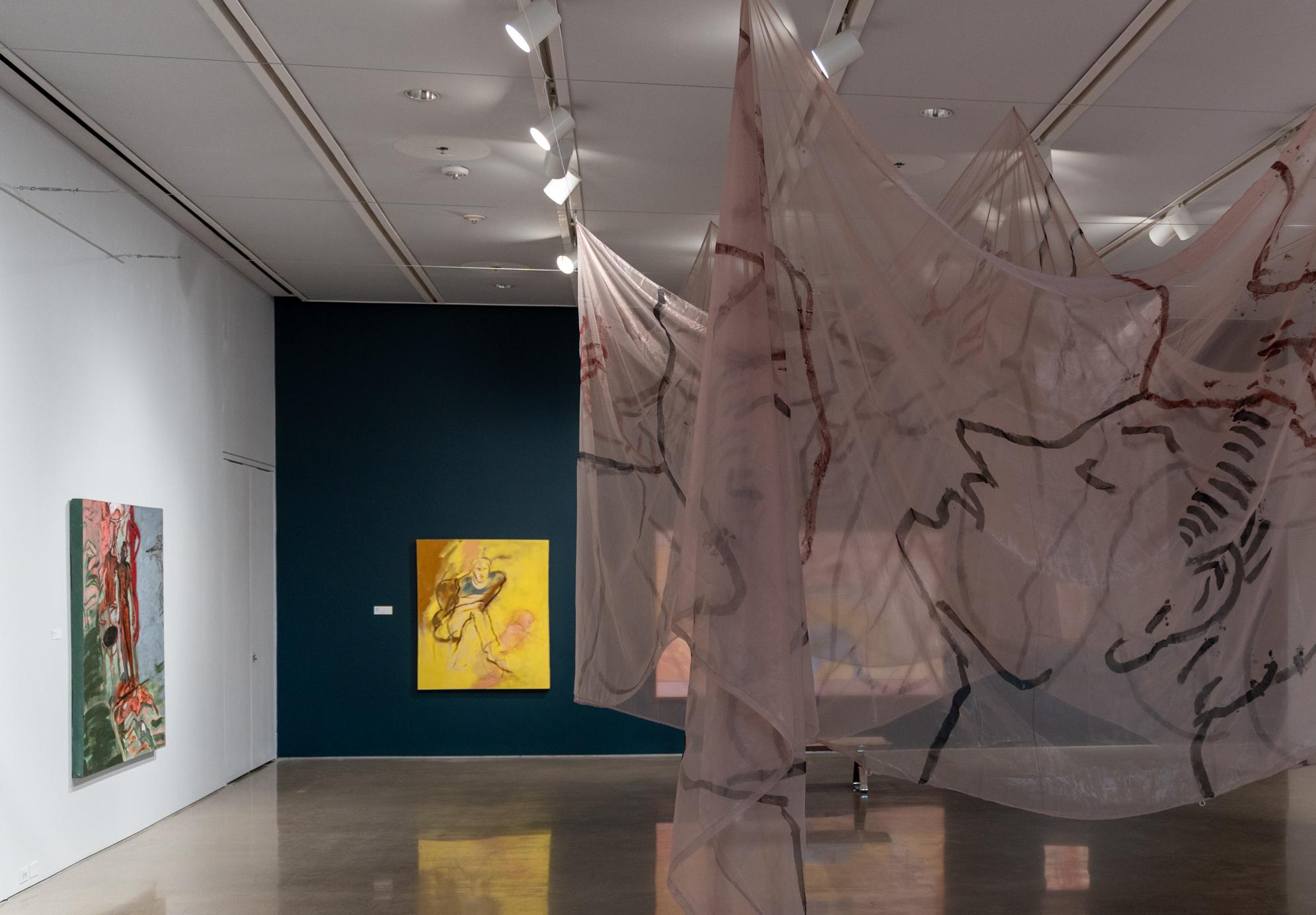
T his fall, the U of M’s School of Art Gallery is showcasing the work of Sheila Butler, an American Canadian painter whose work explores themes such as gender, narrative and transformation through paintings of human bodies in motion.
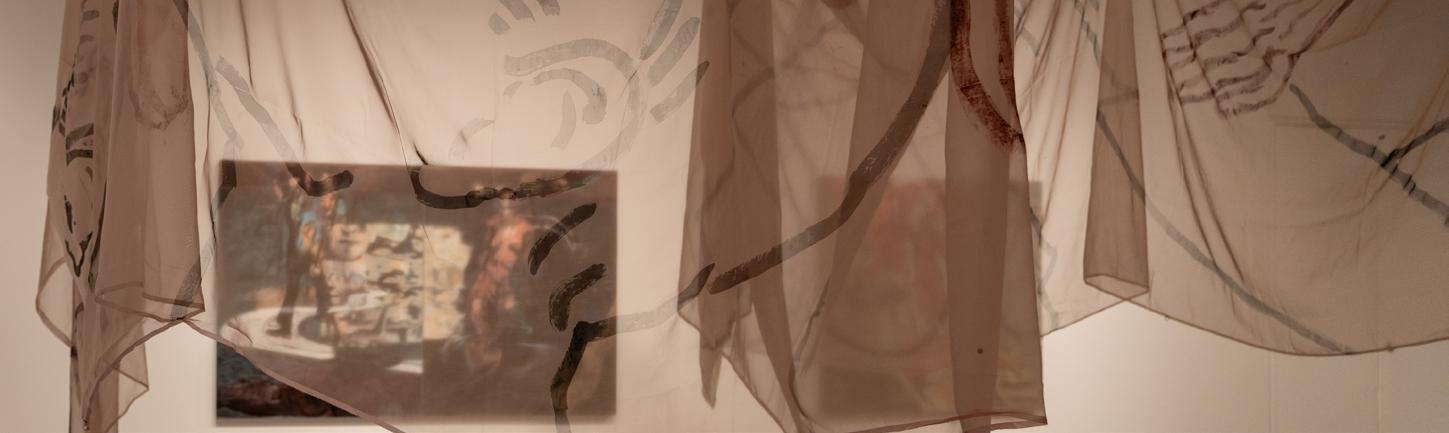
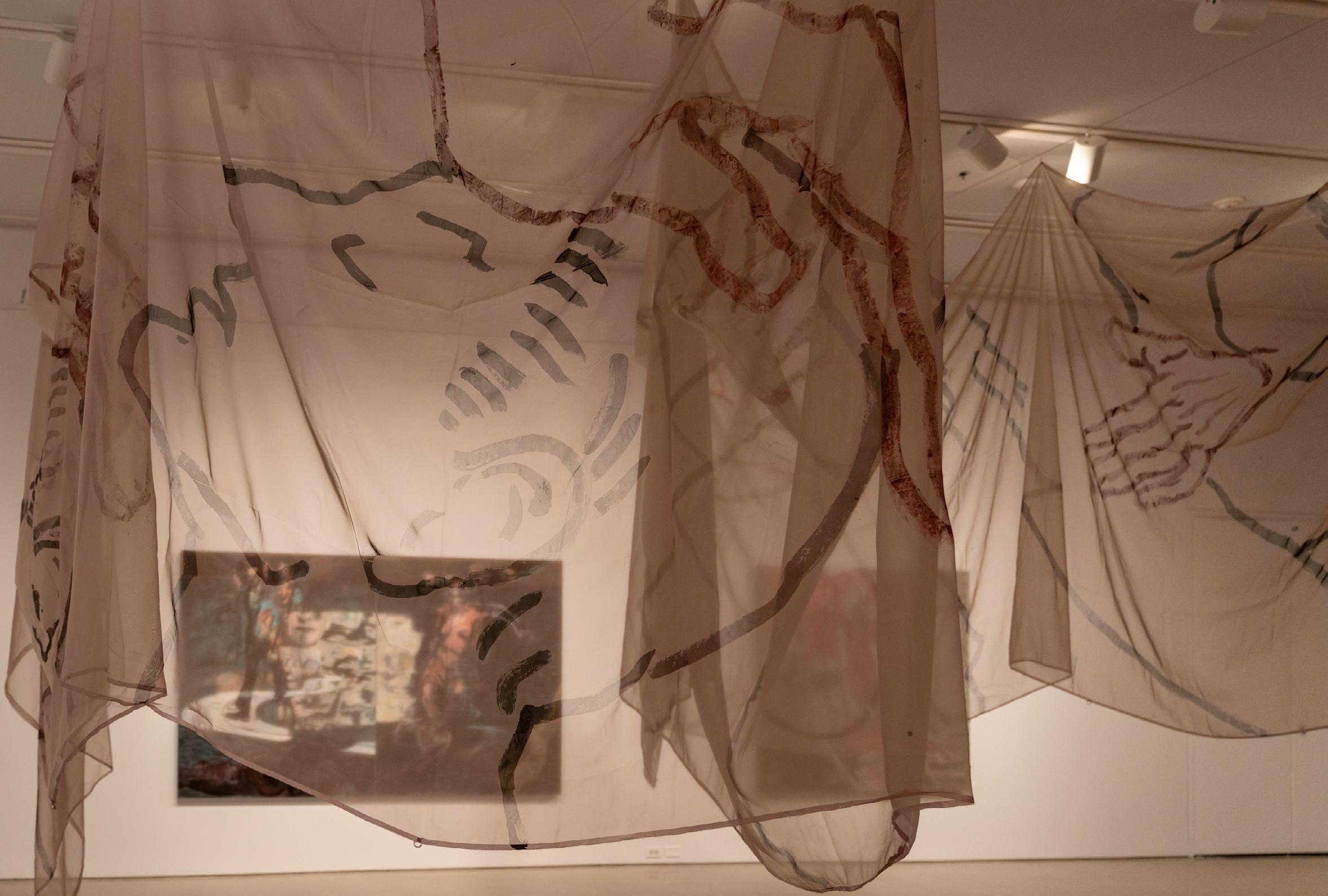
The exhibition, cryptically entitled Other Circumstances, features Butler’s work from as early as the 1970s. Upon walking into the gallery, visitors will see walls decorated with paintings of spectral, often faceless figures swimming, flying and falling across canvases. In the centre, the installation “Essential Tremor” — an approximately 22-metrelong translucent fabric painted with bodies, hands and faces — hangs from the ceiling, quivering slightly in the air.
In addition to her signature dynamic figures, Butler’s paintings also prominently feature water, symbolizing transitions between realms. The characters fall into or emerge from swimming pools, oceans or streams, with their bodies slightly distorted beneath the water’s wavering surface.
Some of her paintings are also gendered retellings of classical myths and stories from renowned works of literature. “Female Icarus,” for example, draws inspiration from the Greek myth of Icarus, who flew too close to the sun while escaping captivity. His wax and feather wings melted under the sun’s heat, causing him to plunge into the ocean. Butler’s version reimagines Icarus as a woman, now equipped with a modern parachute and the ability to swim.
“Ophelia,” inspired by Shakespeare’s Hamlet, portrays the famous scene of the young woman drowning in a river after her father had been killed. “Ophelia” has been a subject of fascination for many artists over the years, with Sir John Everett Millais’s 1852 painting being the most famous rendition. Butler paints her with a ghostly hand near her head, as if to stop her from sinking into the murky waters while hazy figures of a man and a woman appear next to her.
Blair Fornwald, director and curator at the U of M’s School of Art Gallery, commented that Butler’s choice of medium and subject matter makes her work unique and compelling.
“Sheila Butler is a really interesting figurative artist who has a longstanding inter-
photos / Nischal Karki / staff
est in the body and depictions of emotional or psychological spaces that I think would be difficult to represent in any other way but drawing and painting,” she said. It is not always easy to tell what is happening in the paintings because of their spectral quality, but Fornwald highlighted that Butler’s art champions in how it creates an almost recognizable but
ultimately dream-like quality that defies real world logic.
“I think she creates really kind of fantastic and complex narratives and really unusual spaces. Her figures and the spaces that they kind of float in, they feel, kind of both real and not real, and kind of familiar and strange. I guess I like the way she kind of incorporates dream logic into her work — you know the way
that dreams kind of suggest a narrative, but the narrative doesn’t really hold together.”
Building on the exhibition, the gallery also hosted two community engagement events on campus — a panel discussion with the exhibit’s co-curators, Pamela Edmonds and Patrick Mahon, along with school of art professor Suzie Smith — in September. Also, there was a gallery tour
and a live
Other Circumstances will conclude on Oct. 26, 2024. Visit umanitoba.ca/art/ other-circumstances to learn more about Butler, the exhibition and its co-curators.
by Fornwald
figure drawing session featuring local dancer Carol-Ann Bohrn last week.
Movie review of The Wild Robot
New release centred on family and nature is filled with humour and heart
Carrington Dong, staff
Afriend invited me to see The Wild Robot on a Friday night. I had seen that the film’s ratings were extremely high, so I was excited to see if it lived up to the praise.
This film exceeded all my expectations, and then some.
The movie is based on Peter Brown’s bestselling and identically named 2016 novel. It is directed by Chris Sanders, who also directed Disney’s Lilo & Stitch and co-directed DreamWorks’s How to Train Your Dragon. The film has received such positive reception that a sequel is already in the works.
The film follows a stranded robot, ROZZUM unit 7134 or “Roz” (voiced by Acad-
emy Award winner Lupita Nyong’o), who washes up on an island inhabited by woodland creatures. As a helper robot, Roz needs a task — but the animals have none for her. She must adapt her programming to her new surroundings and learn to connect with the wildlife, who are initially hostile toward her. But, Roz is then given a task that goes beyond her programming. After an unfortunate accident, she finds herself tasked with being the adoptive mother to an orphaned runt gosling, Brightbill (voiced by Kit Connor).
Right from the beginning, The Wild Robot captured my attention with its beautiful animation and design. Rather than the photorealism
often favoured in computer animation, the film takes an approach that mimics paintings. Sanders drew inspiration from classic films such as Bambi and built on the animation style used in Puss in Boots: The Last Wish. The animation elevates the film and brings out the beauty of the woodland setting. It would have made for an amazing viewing experience all on its own.
While some of the humour can be quite dark, it is done in a way that would not be overwhelming for younger or more sensitive audiences. The Wild Robot is blunt about the harsh realities of wildlife survival, which makes the heartwarming moments even more rewarding to watch.
The cast, which includes Pedro Pascal, Catherine O’Hara, Bill Nighy, Stephanie Hsu and Mark Hamill alongside Nyong’o and Connor, all give great performances. Some, particularly Nyong’o and Pascal, disappeared so thoroughly into their characters that I forgot or did not realize it was them until the end of the film. I found myself rooting for each character, cheering for their successes and feeling sorrow for their struggles.
If there is any small criticism I could make about the movie, it would be that, one of the major conflicts in the film is resolved a little too quickly. It was surprising that a sad moment between Roz and Brightbill, where Brightbill
learns the truth about what happened to his family, was resolved in a matter of about 10 minutes on screen. While it is good that the conflict was not dragged out for too long, it was less impactful for me due to how quickly it was resolved. However, it did not ruin the movie.
The Wild Robot is a dazzling film with beautiful animation, wonderful performances and a compelling storyline that the whole family can enjoy. It is already an early favourite for me, for Best Animated Feature at the Academy Awards. Only time will tell, but when you see it in theatres, it would be easy to understand why.
photo courtesy of / IMDb
Bisons clash in an impasse encounter against Huskies
Bisons women’s soccer team receive a clean sheet from the Huskies
Israel Adeogo Abejoye, staff
The Bisons women’s soccer team went all out with their last two opponents in their last games of the 2024 regular season.
It was a tug-of-war between the Bisons and their second last opponent, the Saskatchewan Huskies, on Oct. 19. The no-retreat-no-surrender match ended in a goalless draw that left the Bisons with a hope of finding a win against their last opponent, the Regina Cougars, on Oct. 20.
The Bisons had their seniors, Jessica Tsai, Janelle Chomini, Alexandria Paul and Camila Goldsztein, as well as their rookie, Nyema Prentice-Whyte, featured in the match. The match happened to be the second last match for the Bisons seniors as they will be hanging their jerseys after their last home match against the Regina Cougars.
Mike Still, the Bisons sports information and social media coordinator, mentioned that the two matches were also important “to develop connections for the team because a lot of the players will be back next year, so developing that connection and the chemistry on the pitch is really important still.”
Still noted, “we are mathematically eliminated from the play-offs unfortunately, but there is still a lot to play for this weekend.”
“We have four seniors in our line-up this weekend,” stated Still. These players included defender Alexandria Paul and forward Janelle Chomini, who has the 10th most points in the school history. “Then Camila Goldsztein, another forward. And our captain, Jessica Tsai,” said Still. “So, it’s a big weekend for Jess. These will be her 69th and 70th games played and started — didn’t miss a start her whole career, that is the school record and she is only two assists away from the school record of 26. That’s been held since 2009 by Desiree Scott, […] an Olympic gold medalist.”
As the match continued, the Bisons went head-to-head with the Huskies from the start. At about 32 minutes, the Bisons captain Jessica Tsai almost gave her team a winning goal when she hit the ball in the air with the right leg, but unfortunately the Huskies goalkeeper denied her the chance.
In regards to the chance missed, Tsai said, “that is a tough one honestly, even that shot itself was pretty lucky, I
was just trying to do my best to get a touch on it toward the net and it ended up being a much harder shot than I thought it was going to be but keeper did a good job.”
Tsai continued, “she was in a good place and sometimes that’s just the way it happens, but it would have been nice to get one for sure.”
Speaking on the final moments of the season, Tsai said, “I’m just really grateful that I have been able to be on this team for so long and that I have stayed healthy enough to keep doing it for as long as I have been.”
She continued, “but more than anything, I am trying to treat it like another game, we still want to go out there and give the great team performance, I want to give one last go as best as I can for myself and for my team.”
Speaking on her future plan for her soccer career, she said, “honestly, I don’t have much planned. I want to make sure I get my degree before anything, maybe start working and I just have plans to play in the [local] women’s league, […] I for sure want to keep playing, but I haven’t thought too much about anything other than that though.”
The captain continued, “I don’t want to say the door is completely closed, it’s definitely open a little bit, it’s not necessarily my top priority at the moment. My top priority is just making sure I give it like one last go, I finish the season strong, and then after tomorrow I will start thinking a little
more about that.”
Despite the Bisons’s struggle to get the ball into the back of the net, the match ended in a peaceful draw.
The Bisons women’s soccer head coach Vanessa Martinez-Lagunas said, “I am very proud of the team. [Saskatchewan] is a very good team and I think that getting the point is important for us in terms of finishing the season strong and our main objective this weekend is to play for our seniors.”
Martinez-Lagunas continued, “I’m just very proud of the team and the other thing is we got another clean sheet. We basically shut down one of the best offences in the conference so I’m very proud of the team.”
“We were great [consistently] for 90 plus minutes from the whole team. From the goalkeeper all the way to the forward, to our frontline, so that’s how we did it. We talked about it, we said that was the number one key and they did it, they implemented it and I am very proud of them.”
Speaking on how this match against the Huskies would impact their last match, Martinez-Lagunas said, “the most important thing is to keep our tactical discipline, I think we played a really good, disciplined game overall and what we need to do tomorrow, we need to be skillful in the attack, we need to score at least one, two, three goals if possible.”
Bisons men’s hockey defeat Regina Cougars 6-3
Coach Burnett comments on highlights and room for improvement
Faiyaz Chowdhury, staff
The Bisons men’s hockey team defeated the Regina Cougars 6-3 on Friday, Oct. 18.
The Bisons started the game with a strong offensive approach, immediately showing their intentions in the very first moments. They quickly established dominance, with Hayden Ostir scoring just 20 seconds into the game, setting an impressive tone for the team.
This early goal energized the Bisons, who followed it up with Skyler Bruce netting a goal at 1:47, demonstrating their offensive mastery right from the start. Codey Behun added another at 13:03, giving them a commanding 3-0 lead. The impressive play did not only showcase their skills, but also allowed them to pressure the Regina defense consistently throughout the period. This relentless offensive effort laid the foundation for their success as they dominated the ice.
Once the Bisons were up by four goals, they appeared to ease off the intensity, allowing the Regina Cougars to gain some momentum in the second period. Codey Behun scored again at 3:01, extending the lead to 4-0, but the Bisons’s relaxation proved costly. The Regina Cougars capitalized on this shift in focus, with Paycen Bjorklund finding the back of the net at 3:31 and Carson Whyte following suit just seconds later at 4:05, ending the second period with a score of 4-2.
This quick succession of goals caught the Bisons off guard and served as a wake-up call. However, after conceding those two quick goals, the Bisons had enough and refocused, asserting their intensity once again. This shift demonstrated their resilience and ability to close out the game effectively, emphasizing the importance of maintaining focus even when holding a comfortable lead.
As the third period began, the Bisons showcased the same offensive spirit they demonstrated in the first. They went all out, taking shots on goal and applying pressure on the Regina Cougars defense, determined to put the game out of reach.
Riley Zimmerman scored at 2:37, extending the lead to 5-2 and further asserting their control over the game. At 4:20, Paycen Bjorklund scored another goal, making the score 5-3. The Bisons maintained their relentless pressure, refusing to allow the Regina Cougars any breathing room. Hayden Ostir capped
off the game with his second goal at 19:59, bringing the final score to 6-3. This renewed intensity did not only stifle the Regina Cougars’s attempts to gain any momentum, but also reinforced the Bisons’s determination to maintain control of the game until the final whistle.
The Bisons’s solid defensive strategy was crucial in maintaining their lead. They demonstrated their ability to absorb pressure and counter effectively, which was key to their success in the game. Their defensive coordination allowed for quick transitions, enabling them to regain control when needed and thwart the Regina Cougars’s offensive efforts consistently.
The Bisons’s goalie showcased impressive focus and
preparedness during the game, practicing his movements and staying active, while the team pressured the Regina Cougars. His awareness and readiness to react were evident as he anticipated plays, contributing significantly to the team’s overall defensive effort.
In a post-match interview, head coach Gordon Burnett said, “I really like how we started the game. We’re assertive in all areas of the game, we were able to put the puck in the net early, which obviously changes a little bit of the way we play. But I thought as a group, I thought we did a good job and then just cleaning things up at the end and learning to play with the lead is a little bit new for us. But, we’ll take a look at it
tomorrow and we’ll make sure that we clean that up.”
Regarding the strategies for today’s game, he noted, “we played them three times in the pre-season and I think we tried to learn a little bit from what was good and what was bad. But they’re a good hockey team that plays hard. They come after us. They’re aggressive in all three zones. They play the game hard, and we have to make sure that we’re ready and make sure that we understand what they’re going to do and play our structure against what they’re doing.”
Assessing the player that made an impact, coach Burnett noted, “I think Codey Behun has two goals and one short-handed and so I think just that alone and the way
he played and the amount of hockey that he played today, I thought he was one of our standouts today.”
On his team’s defensive play, especially with two goals allowed, he remarked, “yeah, I think for the most part we are pretty good defensively. There were a couple of breakdowns, but it was mostly in the third period when we got running around in our own end. I thought that there’s some things that we can do a little better there.”
Bisons fans can catch the team in action at the Investors Group Athletic Centre, Wayne Fleming Arena. With their next games on the horizon, the Bisons look to build on this momentum and continue their strong start in the season.