Students line outside chambers, emergency status of motion contested
Alicia rose, staff
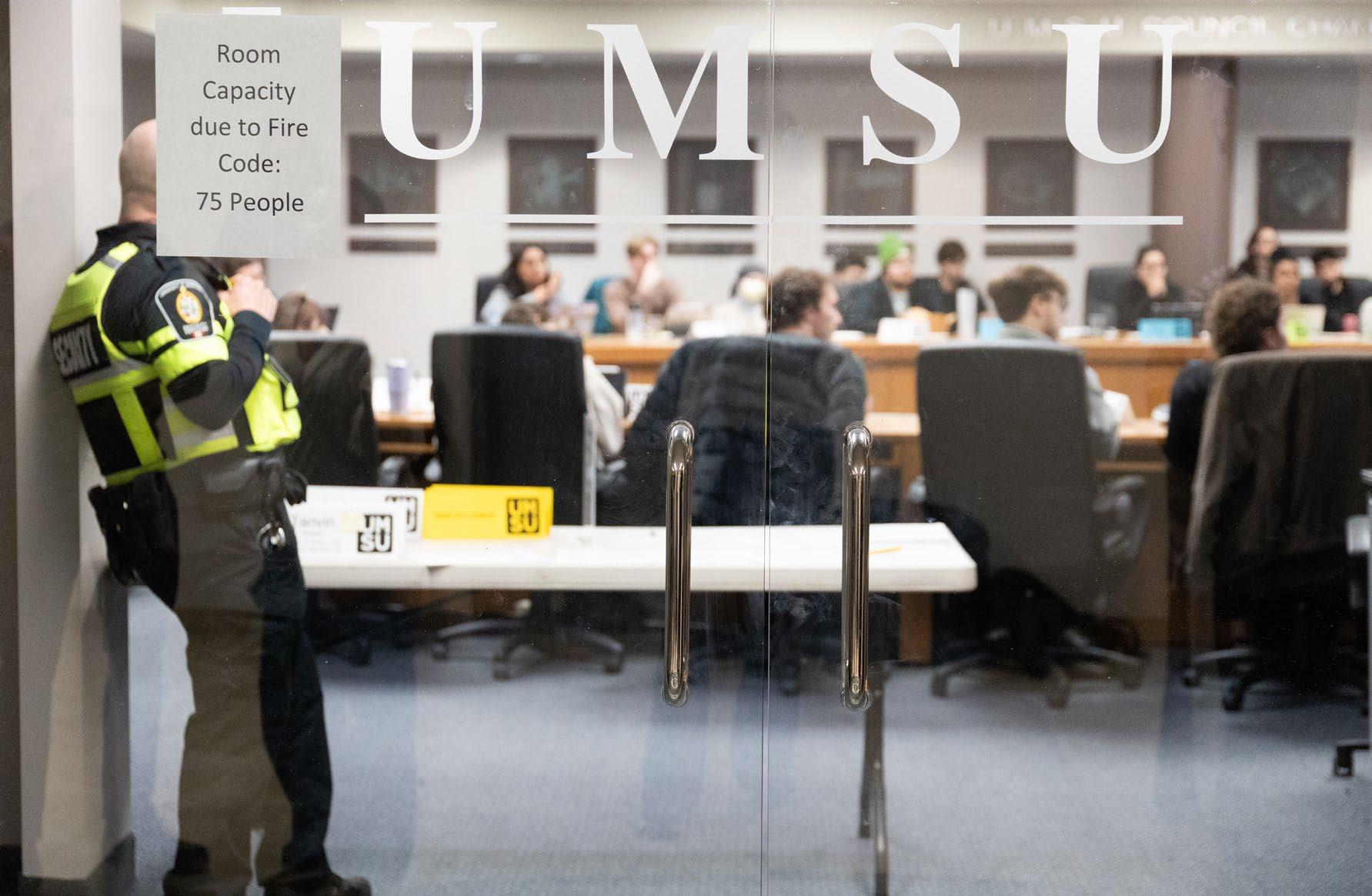
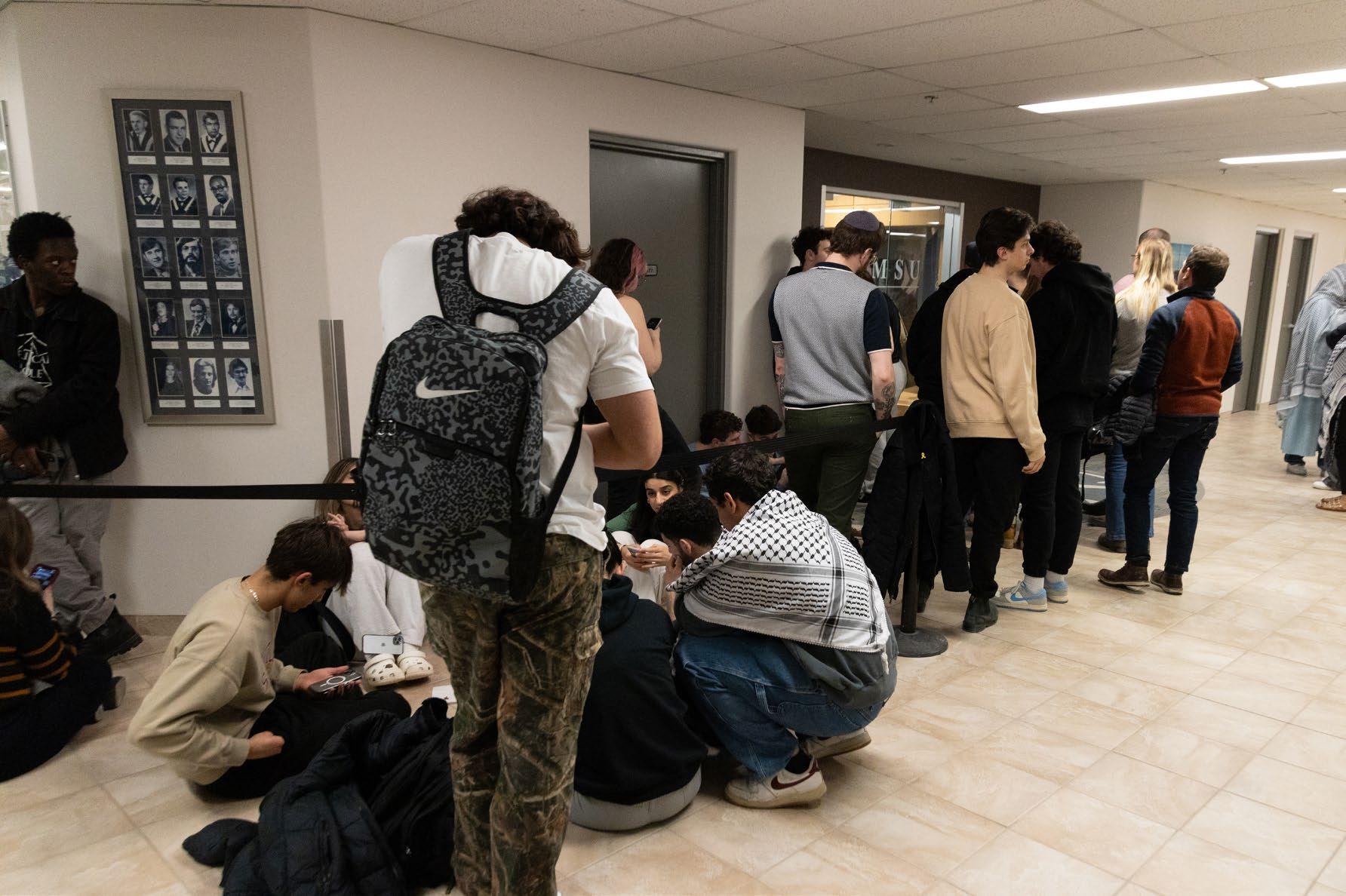
Dozens lined up outside the UMSU council chambers waiting to attend the most recent UMSU board meeting on March 28 which saw deliberation on motion 0604, a proposal for UMSU to adopt the Arab Canadian Lawyer’s Association’s (ACLA) definition of anti-Palestinian racism.
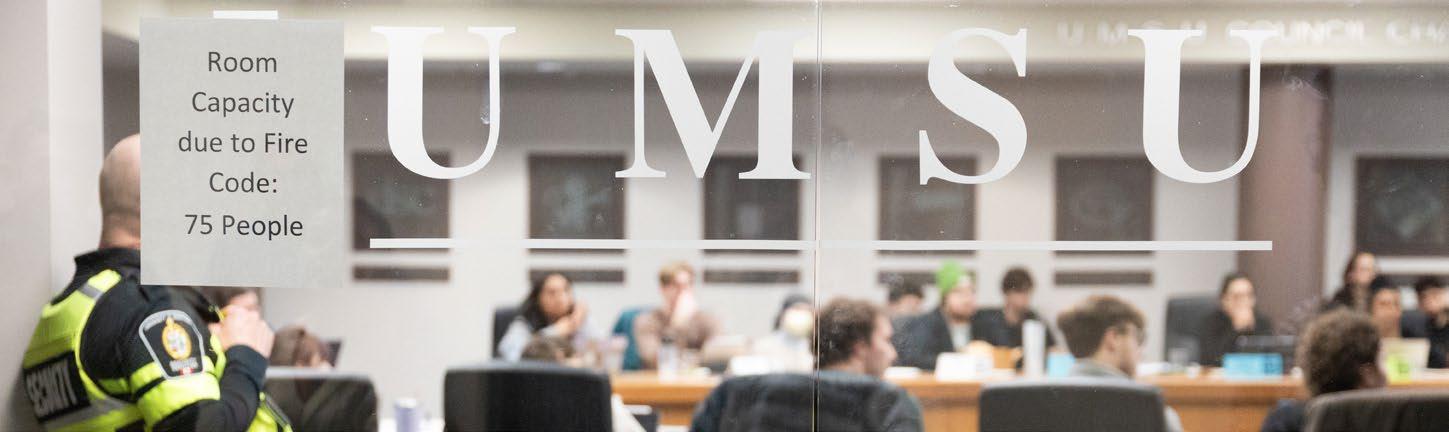
The line extended around the hall, but a sign on the room’s door stated it had a capacity of 75, including UMSU board and staff, meaning only some of those waiting gained entry to the meeting itself.
The governance committee was granted the opportunity to give a presentation on the matter, but deferred it to “a student at large, and any students that wish to present,” said Charli Feener, UMSU governance committee chair. They said after presentations were completed, there would be a “consultation period.”
“I do want to reiterate, that this is not a discussion, but rather a chance for students to voice their opinions, their concerns, their perspectives,” said Feener.
A vote on the motion was not scheduled for the meeting and did not take place.
Emily Kalo, a student representing the Jewish community, said the community had been given little notice to prepare for presentations and argued that discussion of the motion should not have taken place that night.
“Rather, it should be had over the weeks to come, through true consultation, where both communities have the opportunity to compare and contrast with one another, before coming to the board of directors,” said Kalo.
Vaibhav Varma, UMSU vice president finance and operations, challenged the emergency status of the motion. Varma said the motion did not “satisfy [the] requirements” of being an emergency, as the board had voted already to discuss it in future meetings.
Varma said governance should have allowed “appropriate time to engage in consultative process with all relevant stakeholders and parties, rather than thrusting this on the board of directors at the very last minute.”
not supposed to be brought forward to the board, and was not included in the board
“Apparently it was an open session, but the doors were closed”
— Roleen Alarab, UM student who proposed motion
members’ packages.
Varma said the motion was
Board of directors’ chairperson Elbethel Masresha
said the reason she granted the motion emergency status was to give “an opportunity to allow people to be a part of the consultation process, and to allow that to be an inclusive experience.”
After a 17-3 vote to continue the meeting and presentations, Varma said he believed
that Masresha “has a conflict of interest, and clear personal position,” and as such, was “not fit to chair this delegation” on the basis of social media posts he said indicated bias.
Masresha left the meeting, saying, “my capacity to chair has been consistently undermined.”
After Masresha left, Tracy Karuhogo, UMSU president, assumed the position of interim chair to continue the meeting. When the meeting resumed following a recess, Varma announced his resignation from his position as vice president finance and operations, a position which was set to end soon after the end of the winter semester. He did not say whether the conflict of the meeting was a factor in his decision.
Following this, a vote was held on whether to adjourn the meeting due to the conflict, which did not pass.
The meeting continued after Brendan Scott, director of Bannatyne operations, was voted as interim chair for the remainder of the meeting.
The meeting allowed members of each community an equal amount of time to present.
Roleen Alarab, the student who brought the motion forward, said there was miscommunication about the board meeting’s capacity.
“There was definitely overcrowding, or even difficulty hearing, because apparently it was an open session, but the doors were closed,” she said.
“So, the people outside, that were waiting for the entire duration of the meeting didn’t know what was happening inside.”
Alarab said that the presentations during the meeting were a “catalyst for solidarity and understanding.”
“They invited others to see through our eyes, feel our heartbeats and share our dreams of justice and equality,” she said.
photos / Ebunoluwa Akinbo / staff
EDITOR-IN-CHIEF Gillian Brown editor@themanitoban.com
BUSINESS MANAGER Alice Teufack accounts@themanitoban.com
ADVERTISING CO-ORDINATOR Diego Castro ads@themanitoban.com
EDITORIAL
MANAGING EDITOR vacant me@themanitoban.com
COPY EDITOR Simon Pensato copy@themanitoban.com
COPY ASSOCIATE Paula Samaniego-Ayllon
NEWS EDITOR Sarah Cohen news@themanitoban.com
NEWS EDITOR Colton McKillop news@themanitoban.com
RESEARCH & TECHNOLOGY EDITOR Elah Ajene research@themanitoban.com
SOCIAL MEDIA EDITOR Violet Baker social@themanitoban.com
REPORTERS
NEWS Alicia Rose
NEWS Kyra Campbell
RESEARCH & TECHNOLOGY Rhea Bhalla
COMMENT Lakshmisree Shaji
ARTS & CULTURE Kelsey Chin
ARTS & CULTURE Alison Holliday
SPORTS Quinn Mayhew
VOLUNTEERS
VOLUNTEER STAFF
Bahareh Rashidi, Christina Tran, Romin Cheema Adam Johnston, Michele Melendez
VOLUNTEER
Jonah Corne
interested in volunteering? email me@themanitoban.com today!
109 HELEN GLASS BUILDING
UNIVERSITY OF MANITOBA WINNIPEG, MB 204. 474. 6535
The Manitoban is the official student newspaper of the University of Manitoba. It is published monthly during the summer and each week of regular classes during the academic year by the Manitoban Newspaper Publications Corporation.
The Manitoban is an independent and democratic student organization, open to participation from all students. It exists to serve its readers as students and citizens.
The Manitoban is a member of the Canadian University Press, and our journalistic standards can be found on the Manitoban’s website.
The newspaper’s primary mandate is to report fairly and objectively on issues and events of importance and interest to the students of the University of Manitoba, to provide an open forum for the free expression and exchange of opinions and ideas and to stimulate meaningful debate on issues that affect or would otherwise be of interest to the student body and/ or society in general. The Manitoban serves as a training ground for students interested in any aspect of journalism.
Students and other interested parties are invited to contribute to any section of the newspaper. Please contact the appropriate editor for submission guidelines.
The Manitoban reserves the right to edit all submissions and will not publish any material deemed by its Editorial Board to be discriminatory, racist, sexist, homophobic or transphobic, ableist or libellous.
Opinions expressed in letters and articles are solely those of the authors. Editorials in the Manitoban are signed and represent the opinions of the writer(s), not necessarily those of the Manitoban staff, Editorial Board or the publisher.
A “volunteer staff” member is defined as a person who has had three volunteer articles, photographs or pieces of art of reasonable length and/ or substance published in the current publishing year of the Manitoban.
Any individual who qualifies as a volunteer staff member must be voted in by a majority vote at a Manitoban editorial board meeting. Elected representatives and non-students may be excluded from holding votes as volunteer staff members in accordance with the Manitoban Constitution.
Michael Benarroch to serve another term as U of M president
Board of governors unanimously votes to grant president another five-year term
Alicia rose, staff
The U of M board of gov-
ernors approved Michael Benarroch’s second term as university president on March 20.
Initially selected as the university’s president in 2020, Benarroch’s second term is set to begin July 2025.
“We have a really exciting future here in the next five years,” Benarroch said.
Benarroch said he sees “a lot of potential for the university around student supports.”
“We want to continue to invest in our students,” he said, listing several services, such as childcare and mental health, that are already in place at the university.
Benarroch said the university has been working with the provincial government toward supporting international students, including returning to the provincial health care plan for international students.
He said he plans to work toward “reconciliation and Indigenization” in the upcoming years, saying “there’s a lot more work to be able to do,” especially around “recruiting and retaining” Indigenous students.
Benarroch believes that there is a “really bright future” in making the U of M a “place where Indigenous students can prosper and come and learn”
Benarroch began his first
term during the outbreak of COVID-19, which “completely turned upside down what I expected my job to be in my first two years,” he said.
He said during the pandemic, he found that students, faculty and staff came together. He learned to be “flexible” and “adjust” with new information and policies from the government.
“You really have to remain flexible at times and put your ego aside and do what’s best for the institution” he said. Benarroch said that he has to “admit sometimes, you know, we didn’t get that right, we’re going to shift.”
Benarroch said he is “very proud” of the university and
U of W disrupted by cyberattack
Colton McKillop, staff
The University of Winnipeg will delay the end of classes and its exam period following a cyberattack that disabled the school’s networks, leading to the temporary cancellation of classes just weeks before exams were originally scheduled to occur.
The school announced that its academic year will be extended by a week during a virtual town hall last Wednesday. Classes will now end on April 12 and exams will run from April 18 to May 8.
Classes were cancelled last Monday after campus wi-fi went down, along with a variety of online academic tools, including Nexus, a portal where students can find course content, and WebAdvisor, the school’s online course registration tool.
Courses resumed last Tuesday, but many online tools remained inaccessible throughout the week, including Nexus, meaning classes delivered through the website were still unavailable. Access to email was restored March 29 and school officials asked students, staff and faculty to reset their passwords at a Monday virtual town hall as part of a campus reset that will allow the school to begin restoring access to Nexus and WebAdvisor.
U of W biology professor Scott Forbes teaches many online courses, which he said have been “the most severely affected.”
Last Monday evening, he worried no one would be able to access his Tuesday evening class as the Zoom link is typically posted on Nexus.
The next morning, Forbes
acquired an email list for his course from December. This allowed him to contact his students outside of the school’s network, about half of whom showed up for his Tuesday class, although he said has “no way of knowing” if he has reached everyone.
However, Forbes said “the faculty have adapted really quickly.”
“The big problem is the loss of access to course materials, because that’s all stored in our Nexus system and so we had to find an alternative place to store it and then get students access to it.”
Forbes eventually decided to post class materials on a Google Drive for students.
Rhetoric, writing and communications and English instructor Murray Leeder said he is concerned that his students have been unable to log into the library’s website and access databases and e-books they may need for “researchheavy assignments.”
“What I’ve told the students is, because I happen to have access to other library databases, if they find something they can’t access, just let me know and I’ll try to find it and pass it on to them,” he said.
The U of W initially claimed its network issues were caused by an internet service outage before confirming Tuesday that the school had experienced a cyberattack.
Forbes said the school did not offer very much information in the first few days. He said the university told students to contact their instructors to discuss alternatives to Nexus for delivering course material, but that faculty were not given “any assistance as
to how we’re supposed to do that.”
Forbes acknowledged that following a cyberattack, “releasing as little information as possible about the nature of it is par for the course.”
“You wouldn’t want to give the hackers any tips as to how to improve their attack,” he said.
Spring registration has been put on hold for the time being.
This has presented challenges for students like secondyear English major Kieran West, who is not currently taking classes, but whose spring registration date was supposed to be last Monday. He was unable to log in that morning and learned later that registration was being delayed entirely.
“For a person like me, I have a family, I’m trying to juggle school, and working a job, and my other pursuits in life, like music, and it’s very important that I’m able to build my schedule in a way that is conducive to my lifestyle,” he said.
“The past week has been pretty anxiety-provoking for me, because I’m just not sure what’s going to happen with spring registration, and I really need a certain number of courses this spring.”
West said updates from the school have been “very few and far between” and that he would “definitely appreciate more information,” since the situation is having such a big impact on his life.
“I’m caught between feeling really frustrated with the school, and also trying to understand that it’s a very unprecedented situation.”
the work that has been done as a “team effort”.
“There continues to be a bright future for the Univer-
sity of Manitoba,” he said. “The past was bright, but I think the future will be even brighter.”
Classes cancelled in Tier, Ellis due to fire and flood
Causes unknown, classes resume
Sarah Cohen staff
University of Manitoba students faced class cancellations on Friday, March 22 and the following week after a fire broke out on the fifth floor of Tier and the Ellis building flooded.
Winnipeg Fire Paramedics Services (WFPS) responded to a fire in Tier at 9 p.m. on March 21. The fire was extinguished by 9:17 p.m.
Arts students were notified by email from the faculty of arts that, at the provost’s recommendation, classes held in the Tier building would be cancelled as of 9:49 a.m. on March 22. The email stated that the faculty was unclear “when the building will reopen.”
WFPS was not available for an interview, but a statement from public information officer Terryn Shiells said crews from WFPS “found light smoke and a small fire” and were able to clear the scene at around 10 p.m.
According to a statement from the university, the fire was found in a bathroom garbage bin, and was successfully extinguished with “limited” damage to the area. The building was closed for air quality evaluations.
The cause of the fire is unknown, according to the statement.
Classes resumed as normal in the Tier on Monday, March 25. The Ellis building was evacuated in the morning of Monday, March 25 following the discovery of flooding. A sign posted on the building’s door that day advised it was closed due to a power outage.
The university’s media relations provided the Manitoban with a statement identical to the information available on UM Learn. Crews worked on Monday to repair the cause of the flooding and assess damages, the statement said.
Classes held in Ellis were cancelled Monday and class locations were reassigned for courses on Tuesday, Wednesday and Thursday. Regular class locations resumed on Monday, April 1. The cause of the flooding and its potential relation to the power outage is still unknown to the public.
photo / Provided
Navigating the gut-brain connection
UM Knowledge Exchange explores the brain, gut, health and disease
Elah Ajene, staff
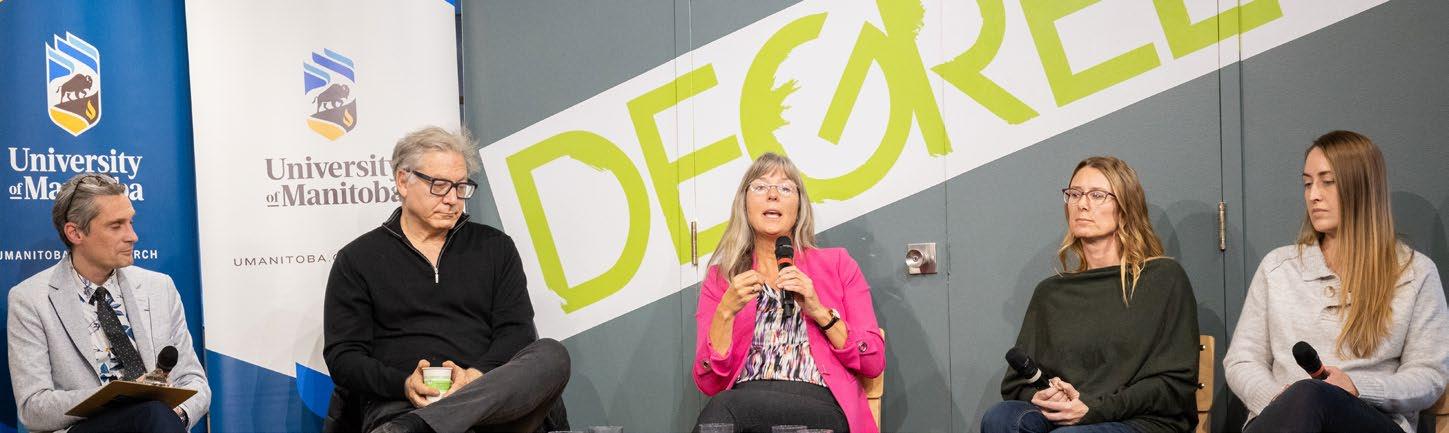
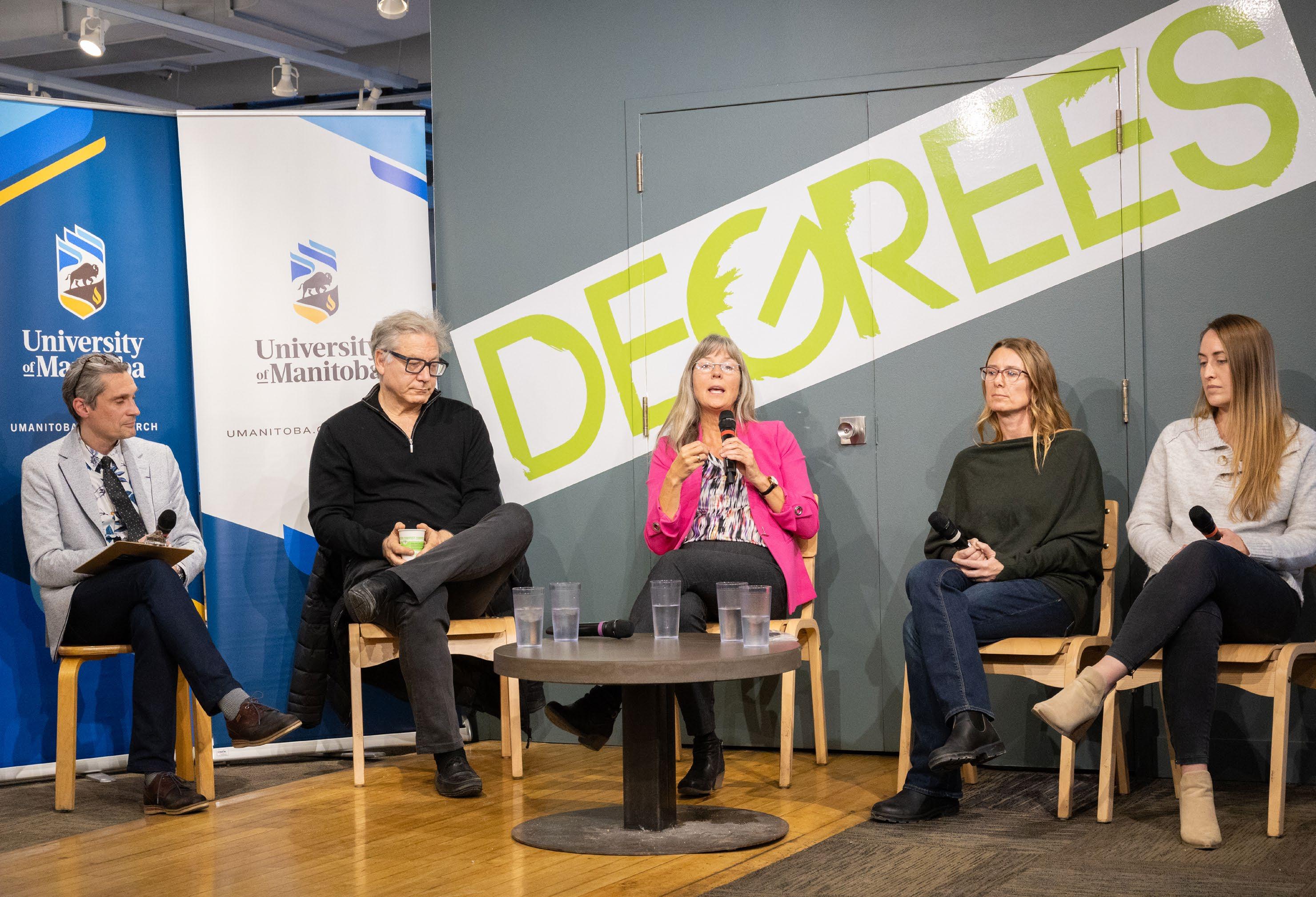
Last Wednesday, U of M
hosted its Knowledge Exchange panel discussion where experts from a variety of backgrounds explored the brain and the gut and their connection to Inflammatory Bowel Disease (IBD) and health.
The panelists included researchers from the Max Rady college of medicine and was moderated by Jean-Eric Ghia, professor in the department of immunology.
“[Gut] microbes communicate with us as a human being and all of the cells throughout our body, and they help tell those cells and those organ systems what they need to do, how they need to function correctly,” explained Heather Armstrong, assistant professor in the department of internal medicine.
In IBD, the composition of gut microbes can change, leading to health issues. Dietary fibres, which we are unable to digest but are broken down by gut microbes through fermentation, play a crucial role. However, in certain diseases, this process is disrupted, lead-
ing to gut damage and inflammation.
Armstrong emphasized that even in healthy individuals, everyday factors can alter gut health, impacting overall well-being.
Through her research, Armstrong aims to define what constitutes a healthy diet and lifestyle for individuals, potentially reducing gut-related issues.
Initially, it was uncommon to have psychologists in gastrointestinal (GI) clinics. Yet studies have shown how closely the gut and brain communicate — involving nerve pathways, neurotransmitters and the microbiome.
Stress, for example, has been identified as a signifi-
the need to address the holistic needs of patients. Her projects focusing on integrated care aim to embed psychologists and dieticians within GI clinics to provide comprehensive support directly, rather than referring patients externally.
“That is an extra sort of burden or challenge to live with a disease”
— Lesley Graff, U of M professor and head of the department of clinical health psychology
“So really what can we change about our day-today life to make sure that our microbes are healthy so that we are healthy,” she said.
Lesley Graff, professor and head of the department of clinical health psychology, stressed the vital link between clinical practice and research in treating gut issues, highlighting how insights from patient care shape scientific inquiry and vice versa.
“I really value the ability to move between those two worlds because we learn so much,” Graff said.
cant factor affecting GI health, impacting disease progression and outcomes. IBD patients are twice as likely to experience depression or anxiety, indicating a significant connection between gut health and mental well-being.
“That is an extra sort of burden or challenge to live with a disease,” Graff explained.
Graff’s research efforts have now extended to integrating mental health screening into routine GI care, recognizing
Charles Bernstein, distinguished professor in the department on internal medicine has been involved in researching IBD for over 30 years, aiming to provide comprehensive care to patients. He established the IBD Clinical and Research Center at the U of M, collaborating with researchers and physicians.
Bernstein emphasized the importance of addressing mental health alongside physical symptoms in GI diseases.
“It’s quite apparent to me that patients with gut-related problems are greatly impacted by their mental health,” Bernstein said, high-
lighting the need for further research to understand how addressing mental health issues can improve outcomes for patients with GI diseases.
When Jennifer Kornelsen, assistant professor in the department of radiology, joined the U of M, she collaborated with Bernstein to explore how IBD affects the brain — investigating whether individuals with IBD exhibit structural or functional differences in their brains compared to those without the condition.
Despite the seemingly normal anatomy observed in some IBD patients, Kornelsen’s research revealed differences in brain structure and function.
These findings show that IBD is more complicated than just a gut problem — it affects the brain too.
“We’re finding in our Manitoba sample that show that there is an actual pattern of the brain regions that are involved,” she said.
Studying young minds
Research lab explores conceptual development, how children perceive the world
rhea Bhalla, staff
The U of M’s Young Minds Research Lab explores how an individual’s perception of the world changes as they age.
Shaylene Nancekivell, director of the lab and assistant professor of psychology at the U of M, studies conceptual development.
“There’s lots of things in our world that we can’t see or touch,” said Nancekivell. “I can’t see or touch my rights. I can’t hold them in my hands and look at them. I find the problem of how kids learn about things, like belief systems, values, rights, those kinds of things, really interesting.”
She explained that while a child can learn to hold a cup through observation, learning about intangible aspects of life, such as rights, lack the same visual parallels. Understanding how children learn and represent these intangible aspects drives her research.
“The thing I spend the most time studying […] is children’s digital thinking,” she said. Nacekivell expressed interest in exploring at what age children begin to “think that they have rights,” when “they should be entitled to make decisions about their images, their data,” and “what kind of individual differences might exist in their thinking about those types of things.”
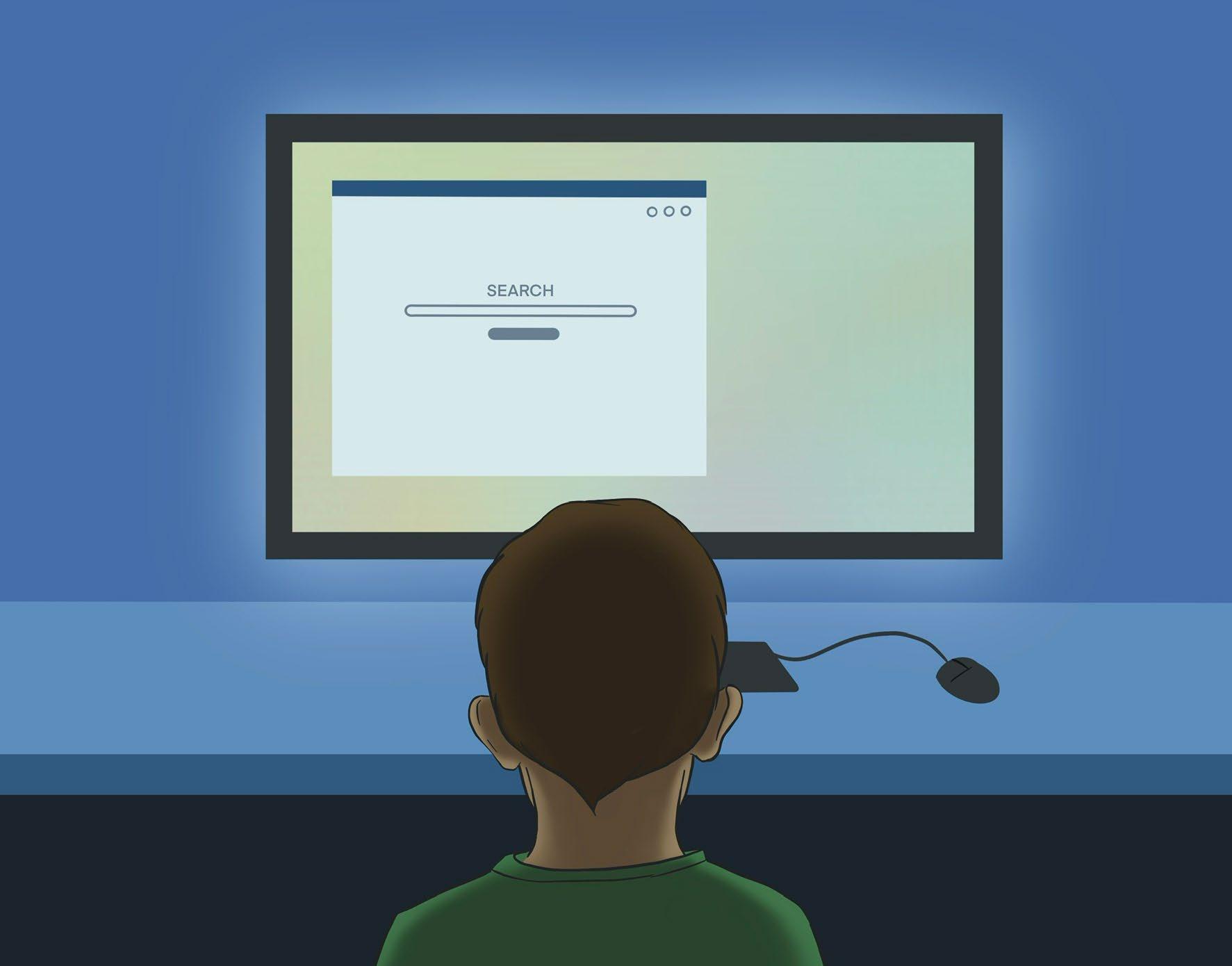
A study Nancekivell co-authored examined children’s perspectives on ownership of information they share with apps. As children spend increasing amounts of time on the internet, they often use apps that access personal information about them, including their images, location and name.
erties like personal information can also be owned.
Nancekivell emphasized the value of initiating meaningful conversations with young children about consent, data sharing and image sharing.
“If you have kids in your life, don’t underestimate what
process, the scientific method and what it means to test hypotheses.
She highlighted the importance of science, not just as an academic discipline, but as a valuable life skill. Whether allowing an individual to navigate misinformation or making a recipe, an understanding of science is an asset.
“If you have kids in your life, don’t underestimate what they can think about”
— Shaylene Nancekivell, director of the U of M Young Minds Research Lab
Older studies have found that, by six years old, children can appreciate that the first person to come up with an idea owns it. Nancekivell’s study determined that children as young as eight understand that non-physical prop -
they can think about and what they learn about digital context,” she said. “My research shows that by seven or eight, kids are really sophisticated thinkers about these things.”
Another focus of Nancekivell’s work aims to help both the general public and students learn about the research
“We do science all the time and don’t know it,” she said. “We’re evaluating science all the time and maybe don’t know it.”
In a recent study, Nancekivell and two co-authors explored the widely endorsed myth of learning styles. It is commonly believed that every child has a dominant way of learning, such as visual, auditory or kinesthetic or tactile
“hands on” learning. Studies show this myth is unfounded.
Nancekivell found that, despite there being no evidence to support distinct dominant styles of learning, belief in this myth may influence how parents, children and teachers view a child’s academic potential.
In a series of experiments, researchers found that parents, children and teachers view students who learn visually as more intelligent. Visual learners are also seen as more capable in “core” school subjects like math, English and social sciences, and hands-on learners are viewed as more skilled in non-core subjects like gym, music and art.
According to the report, individuals are adviced to exercise caution when characterizing children as hands-on or visual learners. Like other social categories, these clas-
sifications are prone to inducing misconceptions about children’s abilities among parents, educators and peers.
Nancekivell encouraged everyone, even those who are not working toward a career in research, to involve themselves in science. Whether it’s volunteering in a lab for a semester, job shadowing or having a conversation with a professor to learn more about their role, engaging in the research community can offer valuable perspective.
“I think that learning about science and how it works is really important,” she said. “There’s a lot of hidden barriers that may make you think that science isn’t for you. If you try it, you might realize it is, and you might find a sense of belonging where you thought you might not.”
photo / Teegan Gillich / staff
Critiquing media is our resistance
Enjoyment without critique is ignorant
Harmatpreet Brar staff
English class tends to bury the lede.
There are well-settled questions within the realm of spelling, syntax and synonyms that make up the purpose of English Language Arts: What does it say? What does it mean? Why does it matter? These questions were childhood companions, featured on posters within English classrooms. But like other components of childhood, we may appreciate their significance more with every passing year.
The questions affirm our moral obligation to critique the media we choose to consume, including television, movies and books. Critiquing media is vital to the fabric of democracy. It is our method to build resistance to propaganda and corruption. By critiquing narratives, we position ourselves to think critically, and we are compelled to support others in peril.
Conversely, enjoying media fulfils us and offers an escape for our souls. Thankfully, it is not necessary to avoid this enjoyment. As consumers, we may not have immediate control of the narratives that we are told. Yet by critiquing
and enjoying media, we can command what we internalize from the narratives, which can amplify our satisfaction with the media. For example, we can revel in Game of Thrones’ fantastical elements while condemning its horrific depictions of violence against women.
However, the problems develop when our enjoyment is not coupled with critique.
That becomes blissful ignorance. Simply put, if something is questionable, we must question it.
The film In the Heights received praise for capturing the Latinx experience with refreshing authenticity. Still, the film faced backlash due to its erasure of Afro-Latinos who occupy Washington Heights in real life. The backlash generated an important discussion about colourism that can inform future Latinx media. Without that critique, we could have accepted the film as a win for Latinx people without tackling its nuances.
rative skeletons stacked up in our closets. The more often we see a narrative, the more familiar we become with it, and the more it informs our worldview.
With Apu from The Simpsons, Ravi from Jessie and Raj from The Big Bang Theory primarily representing Indian people on Western television over the years, how can people’s perception of Indian people be nuanced?
These are caricatures that, internalized over time, give people a false confidence that they know what Indian people
But what if we evaluate all of them with the principles of today, treating it as practice for the arena of life? Alice Cullen was beloved in Twilight for her easygoing demeanour and charming approach to life.
Yet, a brief evaluation of her actions reminds us of racism towards the Quileute shapeshifters and her inability to respect Bella’s boundaries. If we cannot critically examine our favourite waifish vampire girl, how will we oppose her attitudes when someone displays them in real life? The approach I am describing may feel daunting or extreme.
We must also confront the narrative skeletons stacked up in our closets
are like. Thus, while enjoying this media, we must grapple with the understanding that we deserve better than rinseand-repeat traditions.
Critiquing media in this isolated way can be useful, but we must also confront the nar-
These examples show that we must conduct overall critiques of the narratives and caricatures we are presented. However, I propose that we also critique individual characters and hold them to a high moral standard. We tend to idolize some characters and actively hate on others.
Critique and nuance occupy a lot of brainpower, so must we do this all the time? The answer is yes, it is the least we can do.
You know what is truly daunting and extreme? In the hellish political climate of March 2024, Meta created a new setting on Instagram requiring users to opt into suggestions for political content from accounts they do not follow. This decision follows Meta banning content from Canadian news sources, which has been in effect since
August 2023 as a response to Bill C-18.
The action taken by Meta on Instagram limits our ability to engage critically on its platforms. We must train ourselves to resist these dystopian decisions by engaging critically in the critique of media. The choice to engage is a luxury most cannot afford. Thus, we must sooner exhaust ourselves with action than forsake our humanity under the guise of comfort.
If you feel overwhelmed by this responsibility, you can always refer to our three questions from English class. What does it say? We must critique media. What does it mean? We must confront the narratives and characters in the media presented by streaming services, television networks and publishers. Why does it matter? It matters because media is our vessel for messages. Without examining it, we allow narratives to define us as they are presented.
In 2024, critique is our resistance to a dystopian nightmare.
On Israel-Palestine, media analysis and HonestReporting Canada
Jonah Corne, staff
As a teacher of film studies, I spend a lot of time encouraging students to resist habits of passive media consumption.
In the classroom, we slow down and reflect at length on the details of scenes and shots. It is a critical practice whose applicability extends far beyond the realm of cinema. Any student who learns how to put a film under the microscope, as it were, might do something similar with the massive, multi-media information flow that so powerfully envelops us all today.
HonestReporting Canada (HRC) describes itself as an “independent grassroots organization promoting fairness and accuracy in Canadian media coverage of Israel and the Middle East,” projecting an image of rigorous media scrutiny.
However, its analytic procedures are the exact opposite of anything that I teach my students.
As the Maple recently covered in an exposé, HRC combs the Canadian media landscape — from major daily papers and news broadcasts to student-run papers — and sends out “action alerts” about material it deems objectionable (a determination that effectively
boils down to anything that falls outside the official Israeli political narrative) to its over 60,000 members, encouraging them to send a pre-written message to the publishers, and thus flood these outlets with emails.
In this way, in the words of HRC’s executive director Mike Fegelman, the organization aspires to “create a digital army for Israel.” Since Oct. 7, HRC has published several alerts about pieces written in the Manitoban, including a piece of my own that argued for the overturning of the suspension of Arij Al Khafagi, and for a campus climate conducive to freedom of speech and to the ability to criticize the state of Israel without fear of harsh administrative reprisal.
In the alert’s tool that allows the reader to “take action,” the pre-written letter accuses me of “downplaying Hamas’ genocidal killing of Israelis, writing it off as coming [as] a result of Israel’s ‘colonial occupation.’”
What I actually wrote was this: “In response to the Hamas attacks, which left
1,200 people dead, the majority civilians, and involved a mass seizure of civilian hostages — that is to say, attacks that, while emerging out of conditions of colonial occupation, involved unambiguous atrocities — Israel has responded with atrocities and civilian-slaughtering of its own of an order of magnitude several times higher, as is characteristic of its response to assaults, and as Hamas would well have anticipated.”
One can judge for oneself, but I don’t believe such a sentence in any way minimizes or offers tacit justification for the attacks of Oct. 7, or could in any way be construed as consistent with “regurgitat[ing] pro-Hamas talking points,” as I am further accused in the main article.
Consequently, for HRC, the real problem is that I merely described the pre-existing and inevitably formative situation in Gaza as a colonial occupation. Indeed, in its headline and elsewhere, the alert obsessively comes back to the phrase, quoting and requoting it as if to condition the reader
always to treat the phrase with a scare-quote sense of dubiousness and unreality.
Another HRC alert in response to a Manitoban article provides further insight into this dynamic. This time, the article was by the Manitoban’s comment editor Jessie Krahn, who references the Israeli historian Ilan Pappé’s characterization of Israel as embodying a form of settler colonialism.
Calling this characterization “absurd,” Fegelman — the alert’s author — elaborates: “Colonialism is when a foreign power invades a land in order to dominate it for economic or other means. Israel is not a foreign power to the land it possesses; it is the culmination of three thousand years of habitation in the Jewish People’s historic and ancestral homeland.”
Such vehement objections to terms like “colonial occupation” and “settler colonialism” in the context of Israel-Palestine reflect a recent move by hardline defenders of Israel, who invoke the concept of Jewish indigeneity to justify
any and every Israeli action, no matter how colossally violent.
As this argument goes, Jewish indigeneity means that it is structurally impossible for Jews to be colonizers, and by extension that only one people can be indigenous to Israel-Palestine, and that is Jews. You’ll notice that Fegelman’s description of the land says nothing at all about Palestinians.
The hawkish trumpeters of Jewish indigeneity drastically simplify, falsify and occlude. Why can’t it be the case that Jews at once have a deep-rooted connection to Israel-Palestine supported by archeology and religious expressions over millennia — call this an indigenous connection or whatever you want — and that the Zionist project has entailed the violent dispossession and oppression of another people indigenous to the very same land?
Cont’d p. 11 / A shield >
A shield against reality
< Cont’d from p.10
By the same token, why should such a deep-rooted connection provide carte blanche for unlimited violence and the nullification of human and civil rights?
In a recent webinar organized by the Jewish Faculty Network, criminology professor at Toronto Metropolitan University Shiri Pasternak usefully parses the question of Jewish indigeneity this way: “Jewish people do share a history with Indigenous peoples of survival in the face of ethnic cleansing, assimilation and genocide. But what Jewish people do not share with Indigenous people is a current history of being colonized.”
What this point allows us to see is that when the hawks mobilize the concept of Jewish indigeneity to garner support for Israel’s actions they implicitly adopt — or rather appropriate — the position of being in a condition of ongoing colonial subjection, which is patently not the case. In reality, echoing the situation of other Indigenous peoples around the world, Palestinians are in this position: a fact that the exclu-
sionary, endlessly self-licensing claim to Jewish indigeneity precisely tries to cover up and erase.
Back in January when HRC launched its hit piece on me, I could never have imagined writing all these words in response. Why reply to such bad faith critics?
However, things changed when I became aware that Fegelman had been invited to Winnipeg to serve as the keynote speaker in the Sol and Florence Kanee Distinguished Lecture Series, held by the Jewish Heritage Centre of Western Canada, with sponsorship from the Asper Foundation. Billed as a fundraiser for the centre, and titled “Fighting Bias in the Media,” the lecture is being held on April 7 at the Adas-Yeshurun Herzlia synagogue.
ical falsehood and omission.
To be clear, I am not demanding that Fegelman be censored, or prevented from speaking. I wish to be consistent in my defence of free speech.
Rather, I share in the sentiments of a petition started amongst a group of Jews in Winnipeg — a petition that now has 200 signatures — that registers opposition to HRC’s contentious practices,
event is being held happens to be the synagogue where, a long time ago, I had my Bar Mitzvah. It was there where I publicly read from the Torah for the first time, and, as the custom goes, was initiated into adulthood.
Why should such a deep-rooted connection provide carte blanche for unlimited violence and the nullification of human and civil rights?
To me, HRC represents the antithesis of this vital rite of passage. The organization spares its readers from ever having to grow up about Israel, keeping them in a bubble of arrested development in which they never have to face the troubling and knotty realities of the Israeli state.
ganda,” that is, “a long-term propaganda, a self-reproducing propaganda that seeks to obtain stable behaviour, to adapt the individual to his everyday life, to reshape his thoughts and behaviour in terms of the permanent social setting.”
It’s especially disturbing that a historical society — indeed an invaluable historical society with extremely important archival holdings — is giving a lionizing platform to an organization that perpetuates so much histor-
expresses concern that the event will divide the community even more and send a message of bad faith to other communities,” and asks the institutions involved to think in more reflective and expansive ways, and accordingly foster programs that advance “the universal and Jewish values of Tikkun Olam (repairing the world), Shalom (peace), and Akhdes (solidarity).”
To this I can add one more personal note. The Orthodox synagogue where the HRC
As Fegelman has remarked in another military metaphor, HRC aims to “act as Israel’s sword and shield.” In doing so, the organization merely serves to shield its readers from uncomfortable truths, soothingly infantilize them and perpetuate decades of injustice and catastrophe in the region.
In this sense, HRC’s tireless output shares deep qualities with what the French social philosopher Jacques Ellul calls “integration propa-
“ The permanent social setting” in question here is one where Israel is granted infinite amnesty while retaliating upon the Gazan population, with genocidal, famine-inducing force, for the actions of a government that was last elected before half the population was even born — and beyond that, where we find a decades-long, highly oppressive colonial occupation (no quotation marks necessary). What is urgently needed right now is not more consolidation of the ideology that supports this dire, entrenched situation, but rather a vigorous challenging and puncturing of such so-called thinking.
Jonah Corne is an associate professor in the department of English, theatre, film and media, where he serves as the co-ordinator of the film studies program.
Breaking down Vanderpump Rules
Be cool and dive into the Bravo universe
No. 2057
Violet Baker, staff
As the end of my undergrad degree approaches, I’ve been thinking about how I’ve spent around 60 days watching Bravo shows.
I’m like a medieval king. I always need to have my little jester present to do anything. Whether I’m eating, reading, or changing my cat’s litter, I’m watching Bravo. This has inspired a lot of conversations with people close to me about why I like reality television and, specifically, these Bravo shows.
I think the best example of the addictive quality of the genre is the show Vanderpump Rules (VPR).
VPR is a spinoff of The Real Housewives of Beverly Hills (RHOBH) and follows the staff at SUR Restaurant & Lounge run by Housewife Lisa Vanderpump. It’s the perfect mix of relatability and high-spirited television.
Unlike franchises like The Real Housewives — most people will never relate to flying across the country in a private jet with their besties while downing a glass of champagne — lots of people have worked in the food service industry and have had a few messy relationships of their own.
I even find myself relating to their issues and drawing parallels in my own life.
The relationships between the cast members are the same as that group in high school that all dated each other. Stassi Schroeder is the popular friend who is just a little too mean sometimes. James Kennedy is the random guy who produces SoundCloud remixes and manages to get hold of the AUX at every party. They are all extra, but it’s these basic similarities that make the show that much more relatable and enjoyable to critique.
In the same way they are all relatable, they all do things that just seem psychotic. Scheana Shay is introduced as Real Housewives Brandi Glanville’s ex-husband’s mistress. By the end of the first season, Jax Taylor admits to cheating in Las Vegas and getting a girl pregnant, Stassi Schroeder makes very uncomfortable and violent descriptions, Tom Sandoval shaves his forehead with a body razor, and Kristen Doute just looks greasy — and makes me feel similarly — whenever she is on screen.
5687342 65231 6 92 1 7 How to beat Str8ts –Like Sudoku, no single number repeat in any row or column. But... rows and columns are divided by squares into compartments. These need to be filled in with numbers complete a ‘straight’. A straight of numbers with no gaps but can any order, eg [4,2,3,5]. Clues in cells remove that number as an in that row and column, and are of any straight. Glance at the solution see how ‘straights’ are formed.
But, like all reality TV, it’s the over-the-top arguments, drama and backstabbing that make a show amazing.
Take the most recent drama, “Scandoval,” for example.
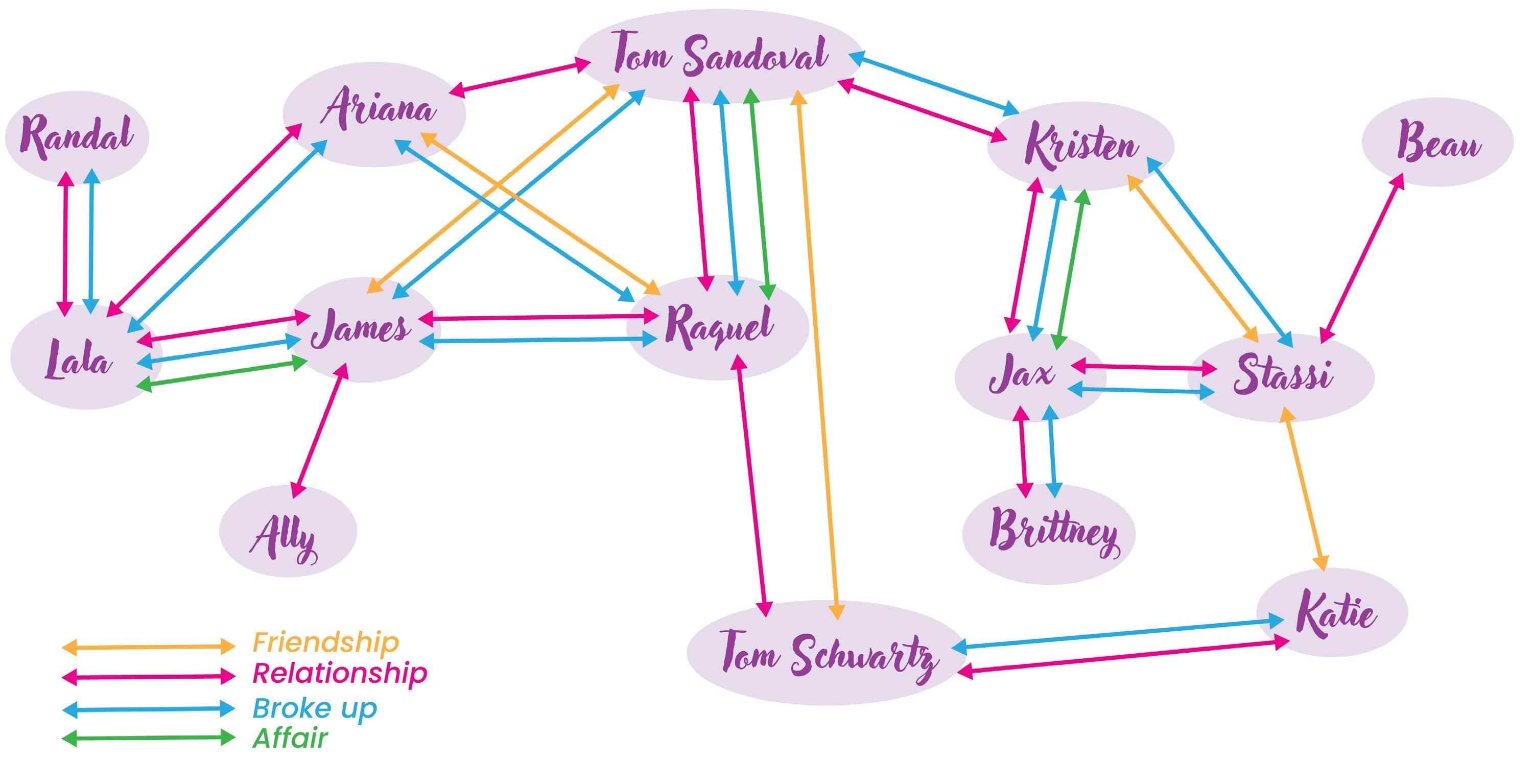
Just over a year ago, Ariana Madix found proof that her boyfriend of nine years, Tom Sandoval, was cheating on her with her best friend Rachel “Raquel” Leviss.
This in itself is terrible, but the situation has become more and more appalling.
But as the show has gone on, some of the cast matured and became better, more emotionally aware people, including Madix. She became better friends with Schroeder and Katie Maloney, opened up about her sexuality and overall grew on viewers.
We have also come to love Leviss.
Leviss has become more interesting. Her banter with now-single Tom Schwartz is awkward but kind of adorable, and she begins to blossom into her own being.
We have finally gotten to a place in Vanderpump Rules where you aren’t meant to hate the entire cast like in the earlier seasons. People are still
annoying, but that is a given for shows like this. It isn’t until Leviss sits down with producers a few days after the reunion that we actually understand the betrayal.
Not only did Leviss and Sandoval have an affair, it started before filming season 10. Meaning Schwartz, Sandoval’s best friend, knew and didn’t say anything about the affair.
While Madix flew out to her grandmother’s funeral, Sandoval and Leviss were getting down and dirty in Madix and Sandoval’s new home in the Valley. At the holidays, multiple people were welcomed into Madix’s home knowing about the affair and didn’t say anything. Now that half of season 11 is out, it seems like the show is at a crossroads.
There is a very obvious divide between Madix and Maloney versus the rest of the cast and Sandoval.
One option is to follow Madix. I would prefer this, but Madix is the first cast member to really have her big break from the show. She is currently playing Roxie Hart in Chicago on Broadway, she’s on Dancing With The Stars and
she’s the new host for Love Island USA
The other option is to follow Sandoval. From what it seems, that is the direction the show is going. Lala Kent and Shay have both expressed their sadness over the loss of their friendship with Sandoval even though Sandoval was a jerk to both of them and helped Leviss file a restraining order against Shay. But Sandoval would probably be in jail before he would ever willingly leave Vanderpump Rules. And production knows that. Production probably knows that Madix would leave if she got her big break into more serious roles. So, they are putting their eggs mainly in Sandoval’s basket while making sure they have other avenues to keep the cash flow coming in, like the release of the spinoff The Valley. I have enjoyed watching Vanderpump Rules, but I don’t think it will last much longer unless the cast gets mean again. No viewer likes Sandoval, and with the release of The Valley, it seems like even production is getting ready to call it quits.
graphic / Teegan Gillich / staff
Sudoku, no single number can repeat in any row or column. But... rows and columns are divided by black squares into compartments. These need to be filled in with numbers that complete a ‘straight’. A straight is a set of numbers with no gaps but can be in any order,
To complete Sudoku, fill the board by entering numbers 1 to 9 such that each row, column, and 3x3 box contains every number uniquely. In Straights, like Sudoku, no single number 1 to 9 can repeat in any row or column. But rows and columns are divided by black squares into compartments. Each compartment must form a “straight.” A straight is a set of numbers with no gaps but it can be in any order, eg [7,6,9,8]. Clues in black cells remove that number as an option in that row and column, and are not part of any straight. Glance at the solution to see how “straights” are formed.
Tawāw Pihtokī invites all to student showcase
Indigenous student showcase ran from March 20 to 27, welcomed many
Kelsey Chin, staff
tudents and artists
Salike flooded the School of Art Student Gallery on March 21 for the opening reception of the Indigenous Student Showcase curated by school of art students Mackenzie Anderson Linklater and Kasey Pashe.
The exhibit, entitled Tawāw Pihtokī, displayed works from numerous Indigenous student artists and ran from March 20 to 27. Snacks provided during the reception included bannock made by Linklater.
Despite initial nervousness about the opening day, Pashe said it was “a really good time with so many people” and that she was excited for more of her classmates to visit and hear their feedback on it.
Both Linklater and Pashe are students in their final year of studies at the school of art. Linklater studies in the honours studio program, while Pashe is a student of art history. Using their joint connections, they were able to collect and curate pieces to bring the show to life.
“I had initially seen two paintings from artists who are at the school of art […] and I
was so struck by those works and I was really inspired to put something together and get this shown. I’d known Kasey’s work with Gallery 1C03 and I knew this had to be a bigger thing than just me on Instagram,” said Linklater.
The showcase features a recurring theme of welcoming people inside, with the first piece hanging on the wall by Linklater entitled “Nikik Itwew Tansi,” meaning “Otter Says Hello.”
The piece, which is silkscreen on Stonehenge, is an image of an otter with a word bubble trailing from its mouth that says “Tansi.” It also serves as the basis for the promotional poster for the show, as Pashe replaced the word inside the dialogue bubble with the show’s title. The meaning of Tawāw Pihtokī is “welcome” or “come in” in Cree.
Linklater said that since both she and Pashe are Cree, there was a desire to title the showcase in Cree. After some searching, “welcome” and “come in” ended up feeling suitable to the project.
“We both just wanted a
word to represent the welcoming feeling and openness to inviting everyone into our exhibition on campus,” said Pashe.
“We were going through different names and deciding which one to pick and I think that one sounded pretty good.”
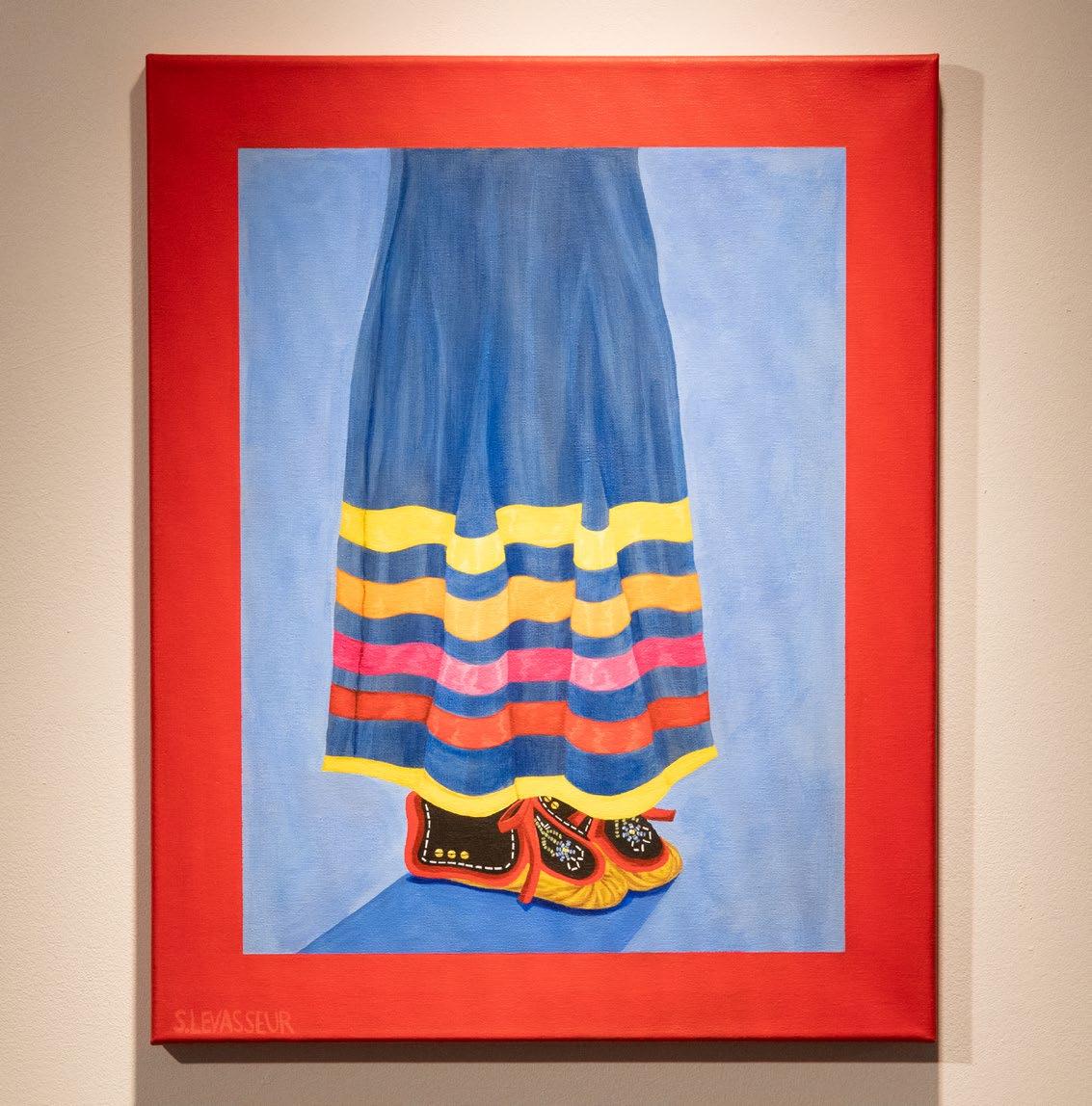
The showcase included a wide range of works from paintings and silkscreen prints to sculptures, beadwork and embroidery. Many evocative pieces filled the gallery with themes touching on various Indigenous traditions, including a piece by Sunshine Levasseur that depicted a ribbon skirt and a pair of moccasins, aptly named “Ribbon Skirt and Moccasins.”
The artists in attendance and the two curators themselves wore ribbon skirts to represent and proudly display their Indigenous heritage and culture. Ribbon skirts, Linklater said, are worn in many different contexts.
“So much of it is about being proud of who you are and proud of yourself whether you’re Anishinaabe, Cree or Métis,” said Linklater. “I think
when we talk about decolonizing art galleries, or universities for that matter, being able to, as Indigenous students, show that identity and be proud of that, that’s what that’s doing.”
With the exhibit having ended and graduation around the corner, the experience of
Shakespeare as flashy high fashion fun
hosting and curating Tawāw Pihtokī left both Linklater and Pashe inspired to pursue art — as well as curation in Pashe’s case — outside of school, even curation in, as they move to the next phase of their lives.
The Comedy of Errors showcases student joy and encourages others to try arts
Alison Holliday, staff
When Katrina Dunn, assistant professor in the University of Manitoba theatre program, asks her students to raise their hands if they love, hate or don’t care about Shakespeare, “most people hate it.”
Dunn admits that Shakespearean language can be difficult to understand, but “when you dig into the actual stories there’s a lot to connect to.”
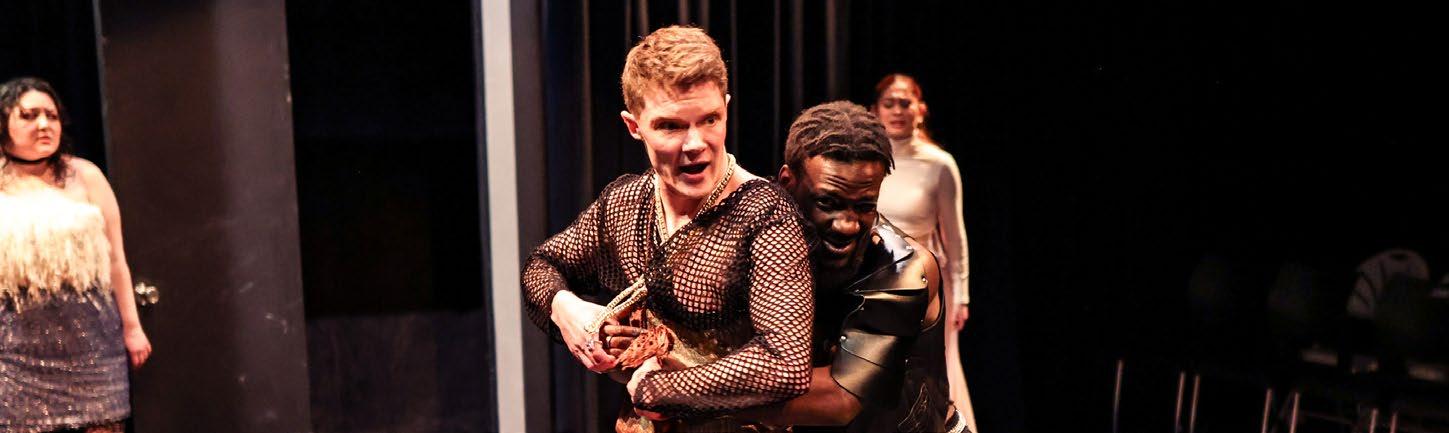
The University of Manitoba theatre program’s production of The Comedy of Errors, which ran from March 27 to 31, aimed to prove that point.
The text is thought to be one of Shakespeare’s earliest plays, based upon the Roman comic Plautus’s Menaechmi, and was written for what Dunn “like[s] to call a ‘frat party.’”
The central plot surrounds two men, Antipholus and Dromio of Syracuse, wandering into the town of Ephesus where everyone seems to recognize them and calls them by name.
A mistaken identity trope
is popular in many forms of media. As Elise Britton, who plays Adriana in the show, told the Manitoban, this trope is “the building blocks of comedy, baby!”
As director, Dunn chose to set the production in a “high fashion house of mirrors,” working like a runway with characters strutting across the stage in outlandish outfits and wacky movements. Audience members are encouraged to take photos and videos of the show.
“I’m really interested in the themes of image in this particular play,” she said.
“I think it has something to say to us about our fascination with our own images and also the sort of the making of our own images into currency.”
From actors energetically running across the stage to slamming doors and hastily searching through racks of clothing, the show has a high level of physicality, but its casting also plays a significant role in its success. “It’s a really fun cast,” said Britton.
“[It’s a] play full of an insane range of different types of
people, so that’s super fun to play off of each other.”
The Comedy of Errors was a showcase to the new and continuing theatre students, all featured in the large cast.
Stefanie De Leon, who played Luciana, said the production provided a way for her to make new friends at university.
“You get to know people at a really nice, pretty deep and intimate level.”
Kyler Humble, Dromio of Syracuse, echoed this sentiment and continued, “having such a large ensemble coming out of COVID […] that’s really nice to get to work with so many people and just have fun on stage together.”
The production also granted the cast the opportunity to try new things for the actors, like stretching their physical comedy skills, performing in the alley staging configuration, translating Shakespearean and even flying a drone. Dunn describes in-class exercises as focusing often on the psychological scene work whereas The Comedy of Errors called for “bold
muscular acting.” Humble said this element helped the cast bond, as actors had to be “comfortable looking a little silly.”
Dunn expressed that due to COVID-19 the culture of programs such as the theatre, film and music have been forgotten alongside community-based events on campus like student and recreational groups.
“It’s all part of a total university experience and so many of those things fell away during the pandemic, it was like students were just left with, ‘I’m in my room studying and that’s university,’” Dunn said.
“And that, I think, was so sad.”
Dunn said that it was important for students to experience other things that the U of M has to offer, and that theatre students do and can come from different faculties, departments and paths of academia.
“You are bound to see someone you have had in a class or have passed in the hallway somewhere onstage, and that just humanizes that experience.” Dunn said about the University of Manitoba productions.
“It’s not something other people do, it’s something that somebody that you know also does and that you might even want to try yourself.”
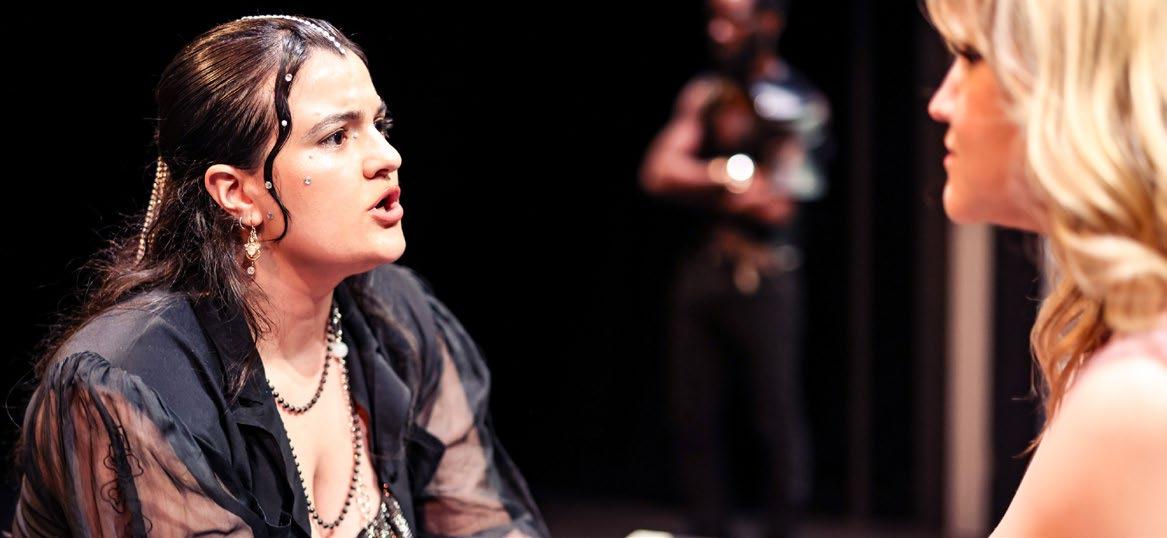
photo / provided
photo / Ebunoluwa Akinbo / staff
“Ribbon Skirt and Moccasins” (2024) by Sunshine Levasseur
U of M swim teams compete in championship Bisons
make a mid-March
Quinn Mayhew, staff
The University of Manitoba swim teams made a splash between March 16 and 19 at the Western championships, which took place at the Pan Am Pool.
Women’s Team
The women’s team finished one of the last meets of the year, and it went swimmingly.
The women’s relay team, consisting of Kelsey Fillion, Hannah Schanel, Kara Dziadek and Indi Halldorson Haines, swam into fifth place in the 4×100-metre freestyle with a collective time of 3:59.88.
The herd continued to improve throughout the meet, as Schanel obtained fourth place in the 50-metre freestyle with a time of 26.98.
With resident swimmers Ella Howe, Georgia Pengilly and Shea Guest absent from the women’s roster at the meet, the herd was missing
splash
key assets to the team.
However, others stepped up.
Another powerhouse swim for the herd was from Fillion, who placed fifth in the 100metre freestyle with a time of 57.94.
The herd improved from its previous year’s standing at the Westerns with a total of seven medals. Last year, the herd won four.
Overall, the U of M women’s swim team had a lot of momentum at this meet and throughout the swim season.
The Bison women really came together this year, improving both individually and as a team.
Men’s Team
The men’s team started ripping up the pool on March 16 with phenomenal performances both as a team and individually.
Carson Beggs swam very well at the Westerns, earning
two silver medals. The first medal was in the 50-metre breaststroke. He finished with a time of 29.23. The second silver medal was in the 100metre breaststroke, in which Beggs swam a time of 1:05.09.
Another notable swim was Rhade Kostelnyk’s third-place finish in the 100-metre breaststroke. He finished just below Beggs with a final time of 1:05.27.
The real MVP of this meet was Andriy Usan, who won
three individual medals. Usan earned gold in the 200metre butterfly with a time of 2:09.62, silver in the 100metre butterfly with a time of 56.24 and finished in third place in the 50-metre butterfly with a time of 25.41.
The men’s team came together near the end of the meet to earn a bronze medal in the 4×100-metre medley, as teammates Eric Dupre, Beggs, Ty Unrau and Usan combined for a time of 3:53.04.
The University of Manitoba men’s team did a great job staying on its A-game, yielding a handful of medals. The team has really grown as the university’s swim program continues to expand.
The University of Manitoba will finish off its last swim meet of the athletic year at the Olympic trials in Montreal, Que. from May 13 to 19.