VIDEO EDITOR Kennedy Legault video@themanitoban.com
SOCIAL MEDIA EDITOR Violet Baker social@themanitoban.com
REPORTERS
NEWS Alicia Rose
NEWS Kyra Campbell
NEWS Michaela de Hoop
RESEARCH & TECHNOLOGY Rhea Bhalla
COMMENT Braden Bristow
COMMENT Hanako Teranishi
COMMENT Lakshmisree Shaji
ARTS & CULTURE Kelsey Chin
ARTS & CULTURE Alex Braun
SPORTS Joshua Brandt
SPORTS Quinn Mayhew
VOLUNTEERS
VOLUNTEER STAFF
Bahareh Rashidi, Christina Tran
VOLUNTEER
Evelyn Lekivetz, Adam Johnston
Robert Moshe Thompson
interested in volunteering?
email me@themanitoban.com today!
109 HELEN GLASS BUILDING
UNIVERSITY OF MANITOBA WINNIPEG, MB 204. 474. 6535
The Manitoban is the official student newspaper of the University of Manitoba. It is published monthly during the summer and each week of regular classes during the academic year by the Manitoban Newspaper Publications Corporation.
The Manitoban is an independent and democratic student organization, open to participation from all students. It exists to serve its readers as students and citizens.
The Manitoban is a member of the Canadian University Press, and our journalistic standards can be found on the Manitoban’s website.
The newspaper’s primary mandate is to report fairly and objectively on issues and events of importance and interest to the students of the University of Manitoba, to provide an open forum for the free expression and exchange of opinions and ideas and to stimulate meaningful debate on issues that affect or would otherwise be of interest to the student body and/ or society in general. The Manitoban serves as a training ground for students interested in any aspect of journalism.
Students and other interested parties are invited to contribute to any section of the newspaper. Please contact the appropriate editor for submission guidelines.
The Manitoban reserves the right to edit all submissions and will not publish any material deemed by its Editorial Board to be discriminatory, racist, sexist, homophobic or transphobic, ableist or libellous.
Opinions expressed in letters and articles are solely those of the authors. Editorials in the Manitoban are signed and represent the opinions of the writer(s), not necessarily those of the Manitoban staff, Editorial Board or the publisher.
A “volunteer staff” member is defined as a person who has had three volunteer articles, photographs or pieces of art of reasonable length and/ or substance published in the current publishing year of the Manitoban.
Any individual who qualifies as a volunteer staff member must be voted in by a majority vote at a Manitoban editorial board meeting. Elected representatives and non-students may be excluded from holding votes as volunteer staff members in accordance with the Manitoban Constitution.
As UMSU runs holiday hampers, UM food bank use rises
At time of publication, application process for hampers unclear
Alicia rose, staff
UMSU is currently holding its annual Holiday Hamper program, which aims to support students in need during the holiday season.
This year, the hamper program is only accepting monetary donations, and plans to distribute hampers in the form of gift cards to allow students to choose the groceries they need.
page. Both webpages contain information on how to donate to the program, both in person and online.
The Manitoban reached out to multiple UMSU executives to receive clarification on the hamper application process. Only vice-president advocacy Liam Pittman was able to
food bank serves over 600 students a month.
“There [are] so many students who need so much, because food insecurity is not only a university problem, it’s a world problem,” Sharma said.
“There [are] so many students who need so much”
Divya Sharma, UMSU vice-president community engagement, pointed to programs like the GPA’s round up program, where students can choose to round up the total cost of their orders to the nearest dollar and donate the difference to the holiday hamper program.
— Divya Sharma, UMSU vice-president community engagement
respond by press time. He was unable to provide information on how to apply.
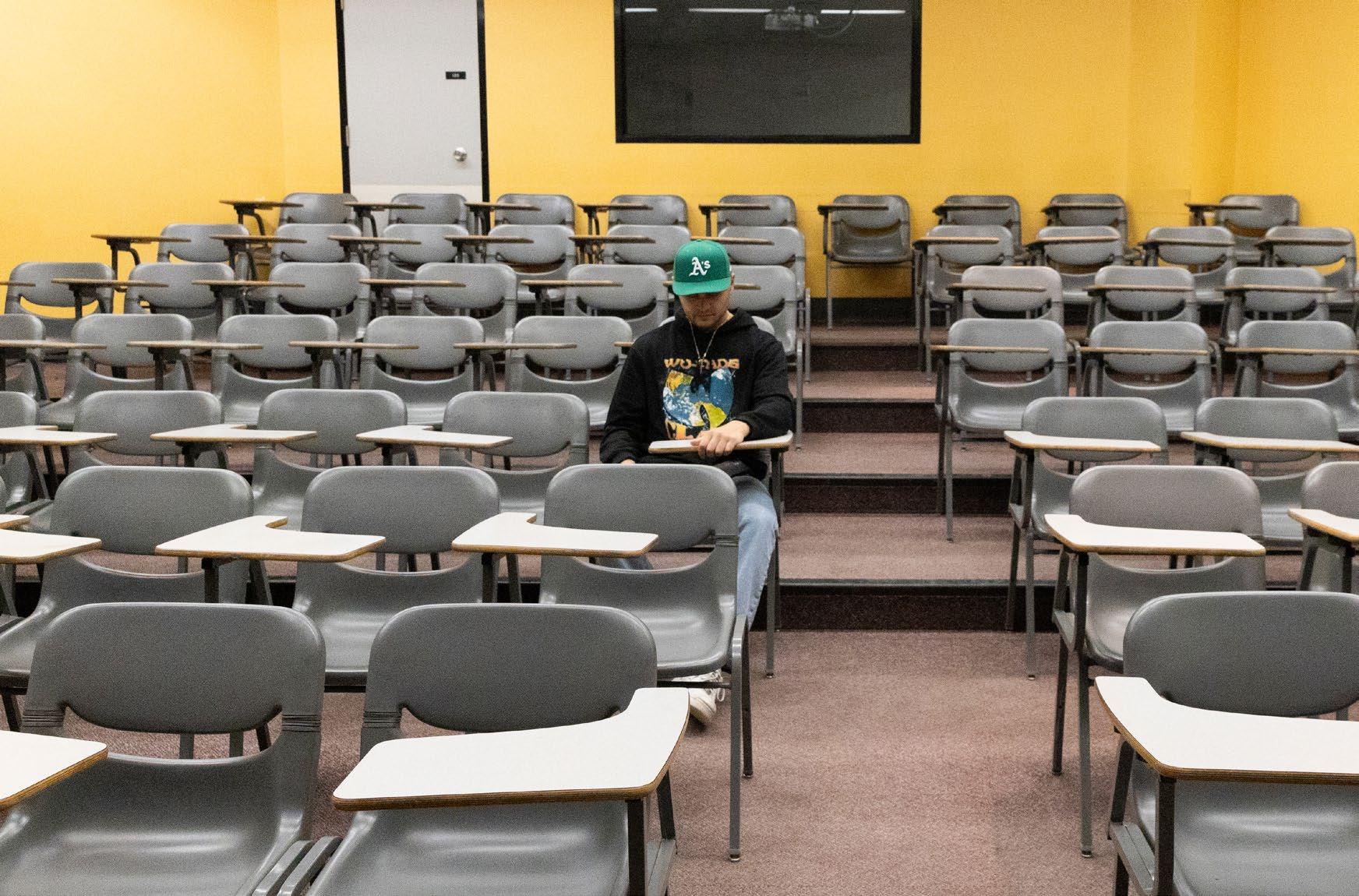
As both the holidays and end of term approach, the need for student food assistance programs at the University of Manitoba is increasing.
“I think that’s the beauty of the program, where everyone in the community pitches in,” she said.
Sharma said over 100 students are currently registered for the hampers.
At time of publication, there is no way to apply for a hamper through UMSU’s website, and no directions for how to apply appear on its Instagram
Anastasiia Bielokolos, awards officer with the financial aid and awards office at U of M, oversees operations at the U of M food bank. She said usage of the student food bank has increased this past fall compared to previous years.
In 2018, 298 people made 708 visits to the food bank throughout the year. Now, the
Suspended nursing student seeks appeal
colton mcKillop, staff
University of Manitoba Nursing Students’ Association president Arij Al Khafagi is currently appealing her suspension.
Al Khafagi was suspended after university officials deemed social media posts she made criticizing the Israeli military’s actions in Gaza antisemitic.
One Instagram post featured a cartoon which likened an Israeli soldier to a soldier in Nazi Germany, captioned “the irony of becoming what you once hated.” Another post Al Khafagi shared was a video of people searching for a missing child in Gaza, condemning supporters of Israel for supporting a government committing mass violence against Palestinian civilians.
Al Khafagi told the Free Press she was called into a meeting to discuss her posts
and was told senior staff at the nursing college were considering expelling her from the program after receiving a number of complaints, some of them anonymous. She confirmed her suspension on Instagram on Nov. 23.
If Al Khafagi’s appeal is denied, she will graduate at least one year later than expected.
Students held a rally in front of the administration building to protest Al Khafagi’s suspension last Thursday.
At the event, Ramsey Zeid, president of the Canadian Palestinian Association of Manitoba, accused the university of censoring students. Zeid led the crowd in a series of chants, including “shame on you U of M, this censorship has got to end.”
Students can access the food bank once every four weeks. This has changed from previous years, when students were able to access it every three weeks, due to the increase in use.
The food bank receives a fund from the university, but mainly relies on donations from students, faculties, departments and Food Fare.
Bielokolos said she doesn’t “see the usage decreasing any time soon.”
Bielokolos said there tends to be a rise in students coming to the food bank during finals and the holidays, as some working students may not have as much time to work as exams approach.
The food bank is available to all U of M students free of charge, and access records are kept confidential and are
not associated with students’ names.
Sharma said there has also been an increase in applicants for the UMSU hardship fund, which gives financial aid to students who are in need.
The Holiday Hamper program has received contributions from various sources, such as student clubs and associations.
UMSU is also holding its own events to raise money for the hampers during December and is donating money from its fall orientation events.
— with files from Sarah Cohen
UMSU board unanimously votes out community rep
Sarah cohen, staff
The UMSU board of directors (BOD) unanimously voted to remove Black students’ representative Anita Ayame from her position during a special meeting held on Thursday, Nov. 30.
The BOD struck an ad hoc committee in late October to investigate complaints made against Ayame. At the time of the committee’s creation, Ayame was suspended from her role in accordance with the UMSU bylaws.
According to motion 0583, Ayame had been accused of violating several sections of the governance and operations manual, including the harassment policy and safe environment policy.
In a complaint obtained by the Manitoban, Ayame was accused of disrespectful and rude behaviour and failure to attend meetings or communi-
cate with her team.
The ad hoc committee was made up of five BOD members. The committee was allowed a maximum of four weeks to conduct its investigation.
The special meeting advertised on the UMSU Instagram page was held in closed session, with the UMSU executives waiting in the hall along with students at-large. The hour and a half-long meet-
ing allowed ad hoc committee members to present their findings to the board.
The 23 voters unanimously voted in favour of Ayame’s removal from the BOD. Ayame could not be reached for comment.
The position of Black students’ representative will be filled in a by-election. The date of the by-election is not yet confirmed.
graphic / Teegan Gillich / staff
photo / Matthew Merkel/ staff
Exam schedule posted just shy of exam period
Technical challenges, submission delays result in month-long delay of exam schedule
Sarah cohen staff
U niversity of Manitoba students are up in arms over the delay in the fall term exam schedule.
Second-year biochemistry student Benzeta Adun said, “as an international student, the ability to return home and spend holidays like Christmas with family is something I cherish deeply.”
The delay in getting the finalized exam schedule meant Adun could not visit family this holiday season due to the expense of air travel. The university does not accept travel as a suitable reason for deferring exams.
“Having at least a tentative schedule to plan with is often the difference between paying $400 or $950 for a flight ticket,” Adun said.
The complete exam schedule listing dates and times has been published online since Nov. 14 according to Jeff Adams, university registrar and executive director of enrolment services. He said that in a typical fall term, the schedule would have been
released within the first two weeks of October.
The creation of the exam schedule is a “joint effort” between faculties and the registrar’s office, Adams explained. Faculties are required to let the office know which classes need to have exams scheduled and the office is then responsible for creating the schedule.
Adams said the delay this term was due to delays in exam submissions and technical challenges involving a recent upgrade to the software being used to schedule exams.
At time of publication, exam locations are no longer missing from the online timetable, but student exam schedules are still not available on Aurora accounts.
The exam period will begin Dec. 12 and end Dec. 22. Exam dates, lengths, times and locations can be found on the final exam schedule page of the University of Manitoba website.
“I realize that this was an inconvenience for students,” Adams said, noting that the
office tries to get information to students in a timely manner.
Adams said that the registrar’s office is committed to “reviewing our processes and systems just to do everything we can to prevent a delay like this happening in the future.”
“Having at least a tentative schedule to plan with is often the difference between paying $400 or $950 for a flight ticket”
— Benzeta Adun, biochemistry student
Winnipeg Transit sets Dec. 11 strike deadline
Exam season to proceed as planned regardless of strike action
Kyra campbell, staff
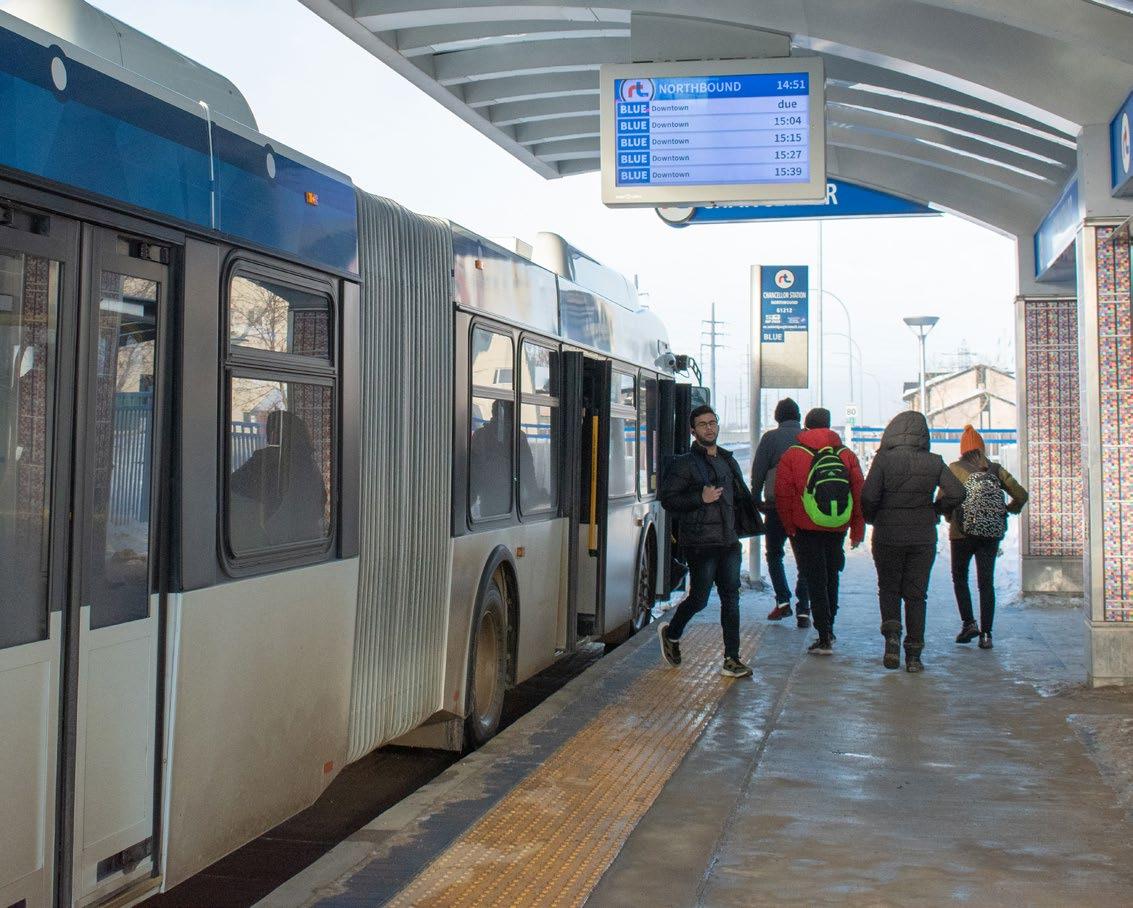
W ith exam season on the horizon, some students could be left without a reliable way to get to campus in the near future. Winnipeg’s transit union has set a strike deadline of Dec. 11, which may take effect if ongoing contract negotiations with the City of Winnipeg do not produce a deal.
Amalgamated Transit Union Local (ATU) 1505 has been without a contract since January. Since then, the city has proposed two tentative agreements, but both have been rejected by union members.
Students in the master of human rights program
Avery Selby-Lyons and Imtiaz Mahmud both support the labour action of ATU 1505 workers but are concerned about how they will get to campus.
“I don’t know how I would get to school otherwise,” said Selby-Lyons.
Mahmud said that, given his unfamiliarity with the downtown area and the possibility of increased bus disruptions, he has concerns regarding his safety. The costs of travel are also at the top of both students’ minds.
ATU 1505 president business agent Chris Scott told the Manitoban he apologizes to students for any inconvenience, stating that the possibility of a strike “is not a decision that we take lightly.”
Scott said strike action is a “powerful tool” that unions can use to improve the conditions of workers, but it is a “last resort.”
Chief administrative officer for the City of Winnipeg Michael Jack said the effects of a strike would be “widespread.”
“The impacts of a strike would hit every corner of this city and across industries and across demographics,” said Jack.
He said a strike would cause disruptions for the city unlike any in “recent history.”
“The city really is trying to make every reasonable effort it can to avoid that, I would like to believe that the ATU is as well,” said Jack.
Jack said the city will continue working on negotiations every day if that is what it takes to avoid a strike and find a fair deal.
The city has urged ATU 1505 to figure out the “sticking points” with membership and bring them forward so they
can reach a “mutually agreeable” deal.
Safety and working conditions are key points of contention for transit operators and the workers who are responsible for maintaining the buses — plant and equipment members.
The main concern for transit operators is unsafe working conditions, including an increase in violence from bus riders. Scott said the issue appears to have been “exacerbated by the pandemic.”
For the plant and equipment members, health concerns include overheating, as the facility lacks air conditioning, and the possibility of asbestos in the garage.
Scott said “a little bit of headway” was made during negotiations on Nov. 30 and both parties continued negotiations throughout the day on Dec. 1.
A press release from ATU 1505 following its rejection of the second deal noted that “compensation is not adequate for the increased risk that the job entails,” and that a lack of improvements to benefits prompted the decision to pursue further labour action.
Scott said that Winnipeg
Transit experiences difficulty retaining employees due to their working conditions.
Winnipeg Transit relies heavily on overtime to meet effective levels of transit service.
ATU 1505 members have stopped taking on voluntary overtime, leading to scheduling disruptions.
The union claims Winnipeg Transit needs a five per cent increase in transit operators to return to pre-pandemic levels.
Vice-provost students Laurie Schnarr said whether or not a strike occurs on Dec. 11, the fall exam season will
go ahead as planned. She stated that students have had “ample notice” to make travel arrangements.
Schnarr noted that the issue is on the administration’s agenda for an upcoming meeting with UMSU. She said that any updates regarding bus disruptions or a strike will be communicated to students.
Schnarr said she has reached out to UMSU and proposed they create a “carpool initiative” to support students with no alternative travel options, though she has not yet received a response.
photo / Faith Peters / staff
A new celebration of Indigenous achievement
Indigenous Leaders Gala honours students’ hard work
michaela de Hoop staff
As a finale to Indigenous students’ month at the University of Manitoba, the first-ever Indigenous Leaders’ gala was organized with the hope of inspiring Indigenous students across the university.
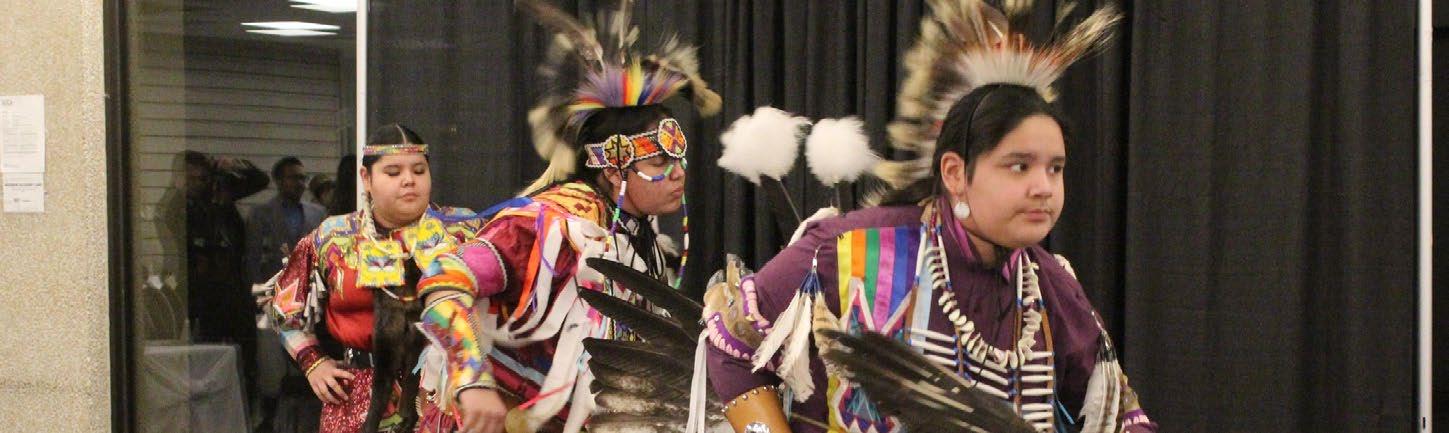
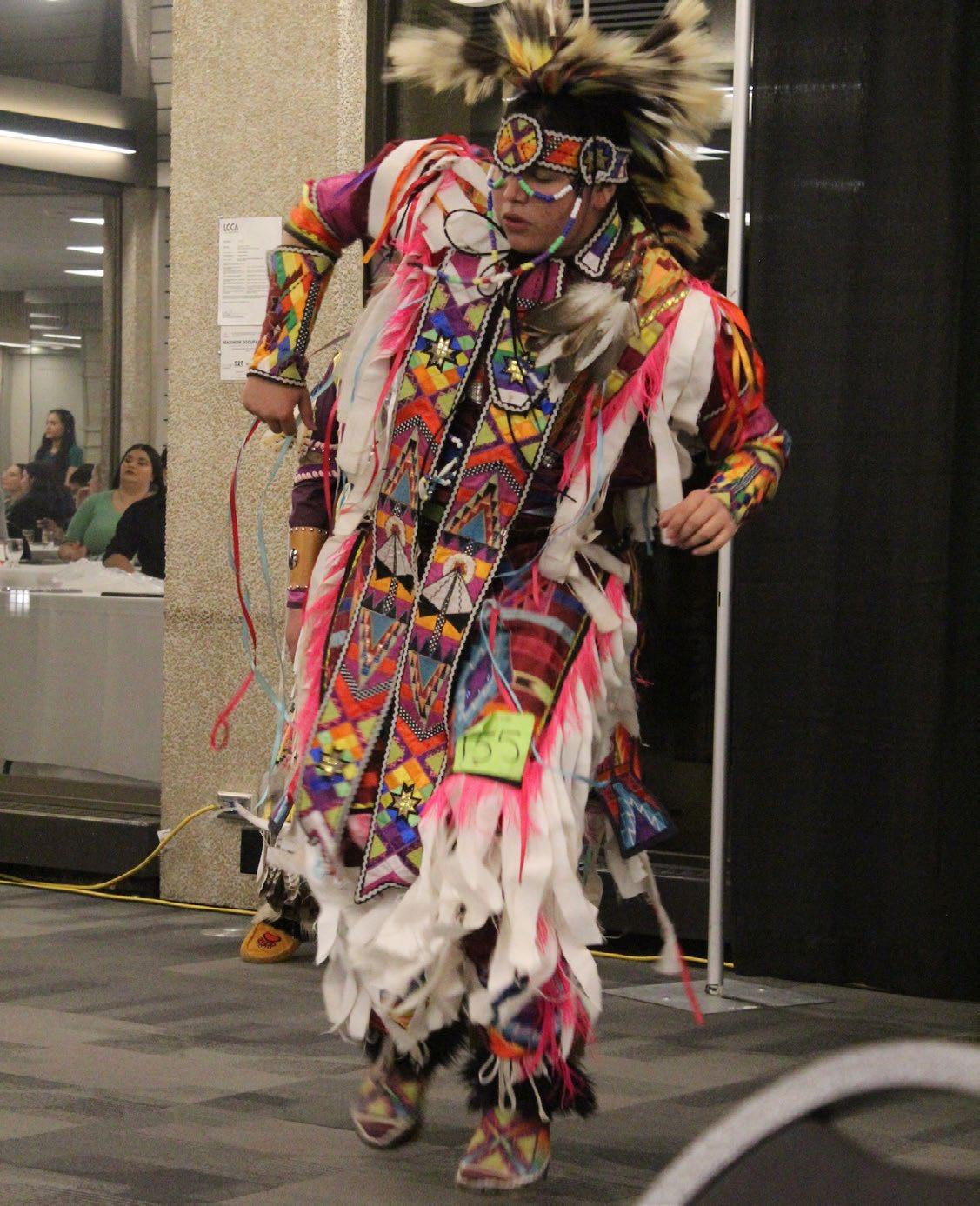
Nov. 28 marked the new university event, which featured an award celebration, dinner and traditional performances such as powwow dancers, Métis jiggers and a drum group.
UMSU Indigenous students’ representative Ishkode Catcheway co-ordinated the gala in order to create a gender-inclusive celebration of Indigenous students on campus.
Awards ranged from faculty-specific to more humorous ones like “most Creeative” or “most deadly,” the latter recognizing a particularly cool student.
Winner of the most Creeative award faculty of arts student Alexis Ross said winning made her feel honoured and humbled. She is proud as she works toward reclaiming her Indigenous identity.
“We deserve to take up space,” Ross said. “We deserve to be acknowledged for all the unnoticed hard work that we do.”
Ross expressed how motivational witnessing the event is for the Indigenous community. It “empowers youth to go after what they want,” she said. “You can do what you put your mind to.”
Catcheway said she hopes to see the Indigenous leader Gala become an annual event. In the future, she would like to include awards recognizing student parents and twospirited individuals.
Sheri Shorting, co-president of the University of Manitoba Indigenous Students’ Association, received the trailblazer award. She noted the encouragement the award gave her to continue creating more inclusive spaces for Indigenous students and serving Indigenous Peoples. The event was a step toward “representation, reconciliation and creating a more inclusive space,” Shorting said. Shorting believes the gala will help Indigenous students
“feel safe, seen and welcome on campus.”
“It is important for the university to hold an event that recognizes and celebrates Indigenous culture, Indigeneity, and especially, Indigenous accomplishments,” said Shorting.
Brad Albert, a fourth-year student in the faculty of science, received the most supportive award. He emphasized the importance of the gala when it comes to bringing the Indigenous community together toward healing and reconciliation.
“This is a really great event for Indigenous students to appreciate each other and become a community again,” he said.
The awards were student-nominated, with nominees open to undergraduate students, graduate students and faculty members. The recipients were selected by the Indigenous student working group.
The person in business award recipient, John Lodge, expressed the significance of celebrating all 19 winners at
the gala.
“We don’t get these opportunities as Indigenous students,” Lodge said. “We don’t get to go out there and show
our achievements and what we were able to accomplish, so it was really nice to get the recognition that we deserve.”
Faculty of engineering hosts Polytech shooting memorial
Event commemorates those lost in 1989 anti-feminist
colton mcKillop, staff
The Price faculty of engineering is hosting a memorial this Wednesday for those lost in the the 1989 École Polytechnique shooting.
The event is a collaboration between the Price faculty and the University of Manitoba Engineering Society (UMES).
On Dec. 6, 1989, a man with a gun walked into a mechanical engineering class at École Polytechnique in Montreal and killed six women, wounding three. He went on to kill a total of 14 women and injure 14 people before shooting himself.
UMES senior stick Jasper Caners called the shooting “a tragedy that affected the whole country.”
Caners said the memorial has been held for a number of years and noted that engineering tends to be “male-dominated.”
“That has definitely been something that we have been trying to improve over the past number of years,” he said.
He referred to Engineer Geoscientists Manitoba’s 30 by 30 campaign, which aims for 30 per cent of newly licensed engineers to be women by 2030.
“We have a similar goal within our own faculty to do that,” he said.
As expressed in his suicide note, the shooter’s actions were motivated by misogyny and anti-feminism.
U of M women’s and gender studies professor and program co-ordinator Shawna Ferris said that the Polytech shooting was a sign of a “culture of fear, loathing and violence against women, and in particular, women who get identified as feminists.”
“Violence against women and gender-based violence generally is pervasive, so
Remembering
mass shooting
about it every day,” she said. “It’s hard to talk about gender without talking about violence.”
Sonia Pelletier, Barbara Daigneault, Anne-Marie Edward, Barbara Klucznik-Widajewicz, Anne-Marie Lemay, Geneviève Bergeron, Annie St-Arneault, Hélène Colgan, Annie Turcotte, Nathalie Croteau, Maud Haviernick, Michèle Richard, Maryse Leclair and Maryse Laganière
talking about it on Dec. 6 is important, but in women’s and gender studies, we talk
She said focusing on such “monstrous acts” as mass violence against feminists “misses the point” and sends the message that violence against women is a “monstrous exception.”
Ferris pointed out that Nov. 25 to Dec. 10 is the 16 Days of Activism Against GenderBased Violence, an international campaign endorsed by the United Nations (UN).
In the wake of the shooting, in 1991, Canada marked Dec. 6 as the National Day of Remembrance and Action on Violence Against Women. The Government of Canada’s webpage about the day says that the “National Day of Remembrance and Action on Violence Against Women is about
remembering those who have experienced gender-based violence and those we have lost to it.”
White ribbons and white roses have become symbols to commemorate the tragedy. The memorial will take place this Wednesday at 9:30 a.m. in the Engineering and Information Technology Complex atrium and is open for anyone to attend.
photo / Ebunoluwa Akinbo / staff
photo / provided
Research & Technology
Getting vaccinated before the holidays
U of M prof talks importance of COVID-19 and flu vaccines
rhea bhalla, staff
As the holiday season approaches, Manitoban health authorities are advising people to protect themselves, their families and their community by getting their COVID-19 and seasonal influenza (the flu) vaccines.
Jordyn Lerner, assistant professor and medical director of the Rady faculty of health sciences immunization program, encourages Manitobans to stay up to date with both vaccines.
Lerner noted that all Manitobans six months and older are eligible for both vaccines. Although people who have had allergic or severe reactions to the COVID-19 vaccine should speak to their physician before vaccination, the vast majority of the population is advised to get vaccinated.
“We are in peak COVID season right now,” said Lerner.
He explained that, over the past two years, COVID-19 cases have increased around this time of year. Currently, cases have peaked in Manitoba.
“It’s as intense, hopefully, as it’s going to get,” Lerner said. “I’m hoping it starts to decline in the next few weeks, over the next month or so. But COVID is out there.”
Coronaviruses like COVID19 tend to survive longer in the lower temperatures, decreased sunlight and lower humidity of winter. With less water vapour in the air, small liquid particles containing the virus are able to remain suspended in the air for longer. This gives the virus more opportunities to be transmitted.
When winter arrives, people tend to spend more time indoors. Poorly ventilated indoor spaces allow COVID19 to spread more easily. The travel and social gatherings that accompany the holidays
further this effect.
“A lot has changed with COVID since it was first introduced,” said Lerner. “It’s not this new disease. We now have some immunity, we have tests, we have treatments, but people do still die of COVID.”
People over the age of 65 and racialized people are more likely to die of COVID19. Those with dementia or Alzheimer’s disease are especially at risk.
“One of the best ways you can protect yourself is getting vaccinated,” Lerner said, adding that staying home when sick and wearing a mask in crowds can help to reduce the spread of COVID-19 as well. COVID-19 vaccines are the safest means of avoiding hospitalizations, severe illness, long-term health effects and death from the disease.
Even for those who have
contracted COVID-19 and recovered before, getting vaccinated is still important. Though recovering from COVID-19 may provide temporary immunity against the virus, that immunity seems to reduce. Though generally milder, reinfections do happen. Some people may experience an increased risk of hospitalization and other medical problems each time they contract COVID-19.
Research shows the virus that causes COVID-19 can change and mutate over time. Staying up to date on vaccinations helps people stay protected as new viral strains emerge. The current vaccine is updated to provide protection from the XBB.1.5 COVID19 strain.
The flu, Lerner said, is similarly on the rise. Like COVID19, the flu virus thrives in the
cold weather of winter.
Lerner explained that COVID and flu vaccines differ in important ways. While the earlier iterations of the COVID-19 vaccine may have been able to prevent transmission, this is not the case for current versions. The flu vaccine, however, decreases flu virus transmission rates. This means an infected individual who has been vaccinated is less likely to infect others with the flu.
People who are at high risk of complications from the flu are especially encouraged to receive the flu vaccine. This includes Indigenous people, people who are pregnant, people under five or over 65 years of age and people with chronic illnesses.
“Even if you’re not going to get the flu shot for yourself, get it for your loved ones,
get it for your family, for the infants who are in your house, the elderly, the people with chronic medical conditions,” said Lerner.
Like COVID-19, flu viruses can mutate and change over time. Because of this, new flu vaccines are produced every year. Each flu shot protects against 3 to 4 different strains of the virus. Even when the vaccine does not exactly match a circulating strain, it can still provide some protection.
“Get your flu shot, get your COVID shot,” Lerner said.
The COVID-19 and flu vaccines are available at medical clinics, pharmacies and other locations across the province. If you have questions or concerns about the vaccine, contact your family physician.
photo / Ebunoluwa
Exploring arctic climate change
UM researcher provides insight on climate challenges
elah Ajene, staff
The Arctic region, with its vast landscapes of ice and unique ecosystems, is undergoing significant changes due to climate change.
U of M research associate at the Centre for Earth Observation Science Alex Crawford’s research explores the Arctic climate system and how it is affected by climate change.
Crawford’s journey into climate science began during his undergraduate years, when a research opportunity involving sediment from the bottom of the ocean near Antarctica ignited his interest. This experience laid the foundation for his exploration of climate change, leading him to pursue graduate studies with a focus on Arctic climate science.
One of his primary research areas is the study of Arctic sea ice. Using large climate models, Crawford analyzes historical variations in sea ice cover to make projections for the future. Currently, his work involves examining polar bear and seal habitats in Hudson Bay, considering factors such as the duration of sea ice cover.
Another area of focus for Crawford involves Arctic storm systems.
“A lot of my work has been better understanding how these systems develop, how they interact with the surface,” he said. “That includes the sea ice, but also how they interact with land, ocean, vegetation [and] the animals on the surface.”
Crawford emphasized the accelerated rate of warming in the Arctic compared to the global average. The loss of sea ice, a consequence of rising temperatures, significantly influences the region’s ecology.
In the northern regions of Manitoba, Northwest Territories and Nunavut, residents are grappling with the consequences of thawing permafrost. Permafrost, a layer of permanently frozen ground, is transitioning from a stable landscape to a more dynamic, mobile environment that expands and contracts as it thaws and refreezes. This thawing during summer and freezing during winter poses challenges for infrastructure development, such as airports, railroads, roads and pipelines.
tions due to the impact of freezing and thawing land, places like Northwest Territories or Nunavut have not had to deal with this concern until the onset of thawing in recent times.
Climate change in the Arctic region is also significantly
the ecosystem. They require sunlight to generate essential sugars and cell structures for survival.
With the diminishing sea ice and snow cover in the Arctic Ocean, more sunlight penetrates the water than in the past. Consequently, this alters the timing of phytoplankton blooms.
“A lot of my work has been better understanding how these systems develop, how they interact with the surface”
— Alex Crawford, U of M research associate in the Centre for Earth Observation Science
altering the habitats of polar bears, seals and other marine mammals.
Crawford noted that unlike Winnipeg, where road systems need frequent renova-
Crawford explained that even microscopic organisms like phytoplankton are affected by this environmental shift. These single-celled organisms similar to plants play a crucial role in
The change in when these blooms occur disrupts the seasonal cycles of other Arctic species that rely on this schedule. This disturbance at the base of the food web can have far-reaching consequences, influencing various aspects of the Arctic ecosystem.
In Hudson Bay, a focal point of Crawford’s recent research, sea ice projections are critical for understanding the future
of polar bear populations and the local tourism industry.
While climate models initially suggested a biased outlook, Crawford’s research — incorporating observations and satellite data — provides a more optimistic perspective. However, challenges remain, especially concerning the reproduction and survival of polar bears.
“Right now, the state of the sea ice in Hudson Bay is already impacting the recruitment rates of polar bears in and around Churchill,” he said. “They’re already seeing declines.”
When considering the broader implications of Arctic climate change on the global climate system, Crawford explained the complex interplay between Arctic warming and tropical climate changes. The potential weakening of the polar jet stream, a key component of mid-latitude weather patterns, could result
in more erratic weather conditions in regions like Winnipeg.
Crawford highlighted how the Arctic and the rest of the world are deeply interconnected, emphasizing the need for collective action to address climate change. While Crawford encourages individuals to be aware of their own environmental impacts, he stressed the need to advocate for policies that address the broader implications of climate change.
“In the end, it’s only collective action that can really do it, not just your individual decisions,” he said. “You’ve got to put pressure on your elected officials to make decisions that will both help mitigate how much climate change there is and help us adapt to the changes we’ve already committed to.”
photo / provided
Palestine Teach-In: In our own words
U of W professors weigh in on community response to event
Kerry Sinanan, Alyson brickey, chigbo Arthur Anyaduba
W e write as faculty who are part of the Palestine Teach-In Collective. We seek to address bad-faith criticisms and attempts to cancel our event, “Palestine and Genocide: Reflections on Imperialism, Settler Colonialism, and Decolonization,” a teach-in and roundtable that took place on Nov. 24.
This event included 14 speakers with multiple perspectives from a range of academic areas: English literature, cultural studies, genocide studies, women’s and gender studies, Indigenous studies, Black studies, history, peace and conflict studies, philosophy, environmental studies, critical race studies and decolonial studies.
The event was cross-institutional and cross-national. It comprised and was sponsored by colleagues who are Métis, queer, Nigerian, East-Indian Caribbean, white Canadian (with multiple ethnic heritages), South Korean Canadian, Palestinian (Christian and Muslim), Jewish and Indian Canadian. It is hard to think of a one-day event that could be more diverse, inclusive or respectful of multiple perspectives from our communities.
Claims that our event was somehow imbalanced, non-inclusive or biased are racist: they confuse perspective with political ideology and reduce the richness of our actual diversity.
The week prior to the event, Liberal Member of Parliament Ben Carr used his platform to call our “academic integrity” into question, arguing that the university had abdicated its responsibility by letting the event go forward. He made unfounded alignments between our invited
speakers and antisemitism that were patently false. His words worked to shroud the event in controversy and fuel wider criticism that made our speakers feel so unsafe that some were forced to withdraw entirely.
In an organized backlash that involved Zionist colleagues and community leader Belle Jarniewski, our jobs were threatened on social media, and we endured many life-threatening comments on Facebook pages and on X. The result of this attack was that many of us felt unsafe doing the event from campus and instead Zoomed in from home, and those who were on campus required extra security.
and are undermining a solution that would protect life. On the contrary, our invocation of the word “genocide” comes from our collective conviction that every life is precious and that the Israeli attacks on Gaza that have cost upwards of 15,000 lives in eight weeks must stop immediately.
Muller stated that it is “debatable” whether geno -
lences of Zionist settler colonialism.
As Norman asserted in her talk, “Zionism is not Judaism. Zionism uses Jewish identity as ideological cover for a settler colonialist project.” This is a perspective shared by many Jewish people and organizations worldwide, such as Jews Against White Supremacy.
What are universities for if not to hold space for these difficult and important discussions?
cide is occurring in Palestine. The teach-in referenced many organizations that are naming this as genocide. Peace does not exist under settler-colonial occupation. Palestine has not known peace since 1948.
Our teach-in was again pre-emptively denigrated the day before our event took place by professor and director of peace and conflict studies at the University of Manitoba, Adam Muller. He was interviewed by CBC Radio on Nov. 23. Muller stated that our collective lacked expertise and accused us of “bias.”
Such undermining comments about colleagues and their clear expertise are shameful and expose Muller as not practicing the even-handedness and “respect” he supposedly espouses.
He branded the event a “lost opportunity,” “not doing everything it could be doing to promote peace.” This was a veiled accusation that we support violence
Muller also criticized our inclusion of professor Judith Norman, who is Jewish and a member of the Jewish Voice for Peace. Muller’s criticism, implying that professor Norman does not speak from an authentic Jewish perspective, tokenizes anti-Zionist Jewish voices who commit to peace by nam - ing the vio -
We see Muller’s comments as a clear attempt to silence us, prevent academic freedom and gatekeep intellectual thought and discourse in ways that replicate settler colonial power itself. It is not for settlers to dictate the terms of our intellectual inquiry into genocide and empire. We centre the voices and perspectives of the oppressed and their rightful desire for freedom.
We remain shocked that those familiar with the fundamental principles of academic freedom — the most important collective right conferred upon scholars — could so invidiously invoke it to silence and slander an event before it took place. Scholarly work is not the same as journalistic inquiry and does not require neutrality, unbiased opinion or an “all sides” approach to discussion. There is overwhelming support for the state policies of Israel from the
who encouraged us to push ahead despite these criticisms, and for everyone who fought for our right to hold this event and to hear directly from those with lived experience of colonization, dispossession and oppression. We are grateful that the University of Winnipeg Faculty Association supported our academic freedom and that our university allowed space for this important conversation that included global voices. We feel this bodes well for a strong culture of academic freedom and equitable learning in the future at the University of Winnipeg.
All of the premature criticisms of our event were addressed in our discussions. We are collectively proud of the intellectual exchange and careful rigour that characterized this event and, as many of the hundreds of people who attended have already commented, there was absolutely nothing antisemitic or hateful about the presentations.
United States, the United Kingdom, Canada and many institutions worldwide. The balance that is needed is one that values Palestinian life.
We are grateful to those
On the contrary, viewers said they learned vital truths about the nuanced history and important voices of the colonized. They have sent us messages saying that their understanding of the situation in Palestine was sharpened by this event and that they felt educated and illuminated by the lived experiences and scholarly expertise shared. We accomplished all this in the face of McCarthyist attempts to silence us, and we urge other institutions to follow U of W’s lead and let these conversations take place, free from censorship and censure. What are universities for if not to hold space for these difficult and important discussions?
U of M prof ’s concerns regarding nursing student suspension
Professor in Judaic studies reflects on antisemitism, political expression
ben baader
Dear Netha Dyck, Michael Benarroch and Eleanor Coopsammy,
I am writing as a U of M professor in Jewish studies and Jewish history to protest against the suspension of Arij Al Khafagi, as it had been reported in the Free Press article from Thursday, Nov. 30 (“U of M nursing student suspended, accused of antisemitic posts”).
According to the information provided in this article, Al Khafagi’s posts are not antisemitic within the parameters of established definitions of antisemitism. They are not hateful or threatening, and they do not deploy stereotypes about Jews. They fall squarely within the realm of protected and common political expression, whether one agrees with them or not, or if one finds them distasteful. Antisemitism is real, but this is not it.
Considering Al Khafa-
gi’s posts antisemitic means embracing a definition of antisemitism that is highly controversial. Such a politicized understanding of antisemitism has been adopted in recent years by significant segments of the Jewish world, and it considers critique of Zionism or Israeli politics antisemitic. It is unworthy of an academic institution to uncritically follow suit here.
The suspension of Al Khafagi is likely to lead to a dramatic polarization and radicalization on campus. The University of Manitoba has been immensely fortunate not to have been experiencing the type of confrontations, intimidations and hostilities in matters of Middle East politics and antisemitism among students and faculty that are common on campuses across North America. I am deeply concerned that this will change now.
What we need on campus is to foster a culture that allows
for respectful, nuanced and intellectually honest discussions of these and other complex and controversial issues. In any case, we are to lead with educational rather than disciplinary initiatives. As a political act, the suspension of Al Khafagi is bound to create a hostile and divisive climate that forecloses productive intellectual engagement and undermines educational processes. Students may rightfully be on the barricades about Al Khafagi’s suspension.
I urge the administration to limit the damage already done and to immediately reinstate Al Khafagi as a student in good standing.
Dr. Ben Baader is an associate professor in the history department at the University of Manitoba, specializing in European history and Jewish history.
graphic / Dallin
Chicoine / staff
Make time for community and culture over the holidays
Reconnecting with roots through eating and belonging
Hanako Teranishi staff
M y favourite part of the holiday season as a student is the break we are finally rewarded with after the fall semester’s constant bombardment of work.
During the break, there are always many fun festivities. But what I value most is the time I am allowed to nurture the connections I share with my family and friends. Nurturing can vary from sharing food, to meeting for drinks without having to worry about an assignment being due next Friday to reading in silence with one another.
While family gatherings can be difficult and complicated, I have always appreciated the times my family comes together and shares food.
I am a mixed Japanese Canadian, or Nikkei. My family was interned during the Second World War. My family was uprooted from Strawberry Hill, B.C. and relocated to work on sugar beet farms in Manitoba. Like many other Japanese Canadian families
who were dispossessed, forcibly relocated and dispersed across Canada, amongst everything my family lost, we also lost our language and cultural roots.
I grew up with incredibly limited ties to my community with the exception of the Japanese Cultural Association of Manitoba’s yearly children’s Christmas party, curling bonspiel and picnic. There were some ways I was more disconnected from my culture. I did not grow up learning Japanese, eating Japanese food outside of some occasions nor feeling any connection to my culture in general.
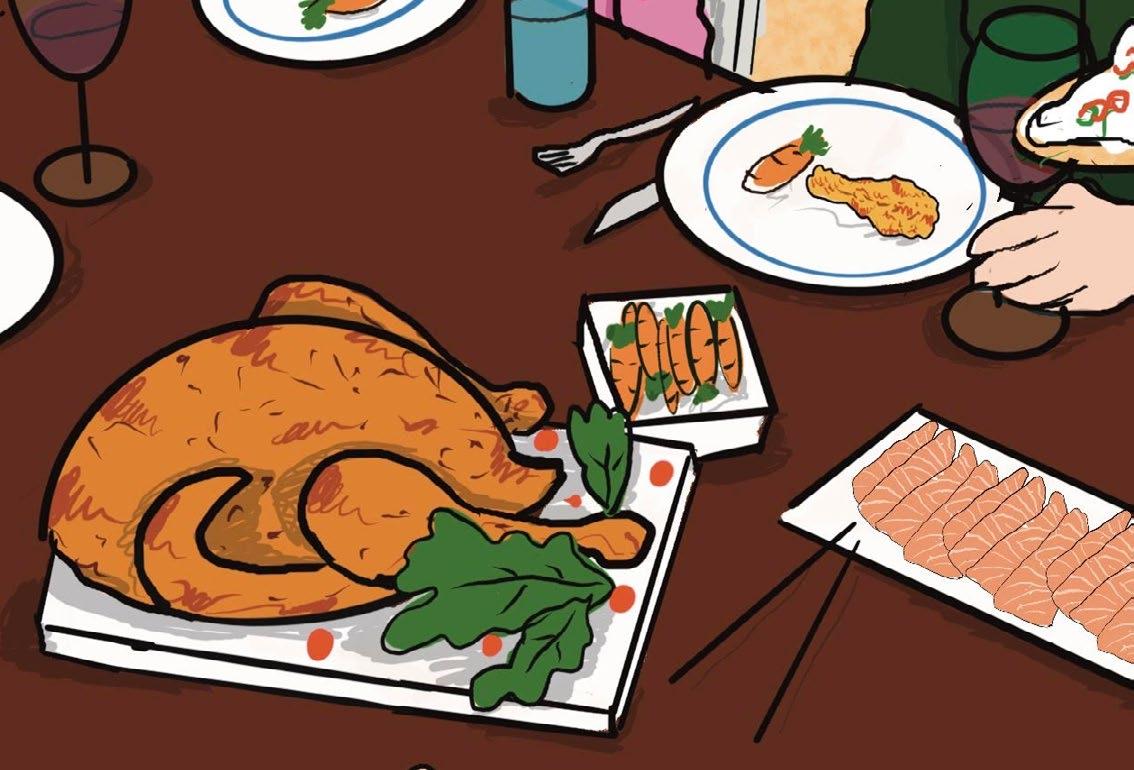
However, the winter holiday is a time where my family gathers and our togetherness creates a connection. Our dinners are a clash of cultures.
The spread features the typical Western holiday dinner standbys like turkey, potatoes, stuffing and cooked vegetables.
It doesn’t stop there. We also have a bucket of KFC fried chicken, plates of sashimi, inari and futomaki prepared
by my grandmother. While this menu may appear to be a mismatched clash of tastes, to me it makes perfect sense and it all belongs.
These dinners, especially around the holiday season, are when my family’s mixedness is something we actively engage with and consume. The intimacy we share comes not from the words off our tongues, but from the food we share that fills our stomachs.
We acknowledge our history and present through food, loading our plates full of chicken, tuna sashimi, turkey, potatoes and futomaki.
Food has become a strong point of my connection with culture, spanning from cooking family recipes to local community’s recipes and beyond.
I love looking for ingredients in local Asian grocery stores. I love the smell of flavours that envelop my house while I cook, snacking throughout the process and tasting the familiarity of home. I love sharing this taste with my family and friends,
knowing the labour and care I put into cooking will nourish others.
While it is easy to get swept up in the worry of buying gifts, organizing and attending parties, I think it is important and essential for all of us to take a collective deep breath and remind ourselves of our own needs and desires.
Feminist thinker Audre Lorde argues that desire, joy and intimacy are essential components to human existence. Our engagement with life should demand joy and
intimacy through every facet of our lives.
While this may be hard to remind ourselves of and implement these notions into our daily lives as students when it feels like we are always drowning in assignments and exams, we should still strive to find and create these moments of joy and intimacy. This winter break is a great time to begin nurturing this joy and intimacy we share between and within ourselves and others.
Arlington Bridge closure neglects North End residents
Negligent transport policy is just business-as-usual in Winnipeg
Adam Johnston, volunteer
The recent closure of the Arlington Bridge by the City of Winnipeg is another prime example of the city council trying to find a homemade solution to Winnipeg problems that never materializes.
On Nov. 21, city officials released a statement calling for the closure of Arlington Bridge immediately due to a bridge condition assessment. Corrosion and rapid decay were the main reasons why the 111-year-old bridge was closed.
Many North End residents, including motorists, cyclists and pedestrians, will now need to use alternative routes including the McPhillips Street underpass or the Slaw Rebchuk Bridge to avoid the Canadian Pacific Railway (CPR) lines and traffic-related chaos.
Closures like the Arlington Bridge affect marginalized Winnipeggers the most.
Lower income residents, Indigenous people, and students who rely on alternative methods of transportation like cycling and walking face increasingly challenging situations as a result of this closure.
Shutting off an option like the Arlington Bridge causes headaches for vulnerable residents who rely on the bridge for transportation access, including lost time.
Users must now plan different routes earlier, leave earlier to take their kids to daycare — if they can afford it — and then work, likely using a mix of public transit and walking. They’ll have to repeat the same route after work by adding 30 to 60 minutes daily while reducing family time.
Another headache is that such closures can cause personal lost wages from being late due to traffic problems. Individuals using public transportation to get around are now impacted more by traffic jams and snarling city streets in car-centric cities from traffic delays that affect the public transportation system.
When we keep putting off fixing older infrastructure problems in our older neighbourhoods, these problems are exposed. There have been public talks about repairing the Arlington Bridge, but the City of Winnipeg has been slow to act. Costs to repair the Arlington Bridge were
estimated to be $330 million by 2024 if city hall had the money, according to a 2018 CBC news article.
Meanwhile, the 100-plusyear-old Louise Bridge connecting Point Douglas and Elmwood also needs significant repairs. There was a planned expansion in 2009 that was abandoned, and now, the city may throw away $16.5 million in future repairs for the bridge, depending on our city’s new Transportation Master Plan.
Time in and time out, our
graphic / Dallin Chicoine / staff
city still needs to address our crumbling infrastructure in two of our oldest neighbourhoods. The demise of the Arlington Bridge will have a disastrous effect, and there is potential for a catastrophe if the Louise Bridge is not addressed soon.
Instead of spending hundreds of millions of dollars on extending Chief Peguis Trail and Kenaston Boulevard, which would only really benefit wealthier areas, that money would be better spent elsewhere. The city should start
removing the CPR rail lines near the Arlington Bridge and repairing the Louise Bridge while investing in Winnipeg Transit and our active transportation networks.
At the very least, the money should go to mature communities rather than let the infrastructure and social capital crumble.
Adam Johnston hosts Not Necessarily the Automobile on 101.5 UMFM on Thursdays from 11:30 a.m. to 12 p.m.
graphic / Bahareh Rashidi / volunteer staff
Family and finance in the holiday season
The ups and downs of spending time and money during the holidays
braden bristow, staff
M
erry Christmas and happy holidays to all my loyal readers. To everyone else, have a decent December or whatever.
Whether you celebrate Christmas, Hanukkah, Kwanzaa or any other wonderful holiday or non-denominational winter festival, we are officially entering the holiday season. I grew up nominally Christian, so Christmas was my favourite time of year, other than my birthday of course.
As I got older and learned that Santa Claus, the guy from the Coke commercials, wasn’t real, my enjoyment slightly faded until I got old enough to make stacks of cash. Once I had some semblance of an income, I started buying gifts for others, at which point my joy returned in force.
Years later as a 22-year-old, I feel a sense of childlike joy in getting gifts for others, but an adult sense of dread looking at my chequing account. Of course, I could always spend less money on people. But my mother might stop loving me if I don’t spend enough money on her.
Well, probably not. But still, there is a certain pressure to get the right gift and spend the right amount of money. Giving and receiving gifts is a critical part of the Christmas holiday, and my family goes all out for Christmas.
school for me and my siblings. To complement this, my dad would often take around a
I can’t buy my mom and dad waiting for me at the dinner table on Christmas Eve
Of course, this process of exchanging gifts feeds into consumerist tendencies since we live in a capitalist society. I spend my money on gifts which I buy anywhere from the beginning of November to Christmas Eve. I try to set about a $50 limit, and in the long term that is not much. But when I compound all the people in my life whose presence I enjoy, that number adds up.
However, between all this spending money, there is something that is, very possibly, more important than gifts. That something is time spent with loved ones.
Growing up, because of winter break, the better part of December was free from
month off from work as well. As a result of our combined days off, the days leading up to and follow -
ing Christmas were one of the few periods of the year where we all had free time together. All the time spent decorating the Christmas tree, eating Christmas Eve dinner and the days spent lazing around eating leftovers after Christmas are memories I will never forget.
The image of my mom and grandma playing dice while my dad and grandpa sipped coffee after we opened all our presents is almost more memorable than the gifts themselves — almost. Make no mistake, I enjoy watching people open the gifts I spent too much money on and I enjoy getting gifts my family spent too much on.
But when I have a family of my own and years have passed since I woke up on Christmas mornings, eagerly waiting to open gifts, I’ll miss the time spent with my parents. I can always buy a
video game or a snazzy new jacket, but I can’t buy my mom and dad waiting for me at the dinner table on Christmas Eve.
Before you get teary-eyed, my family and I still spend most of the holiday season together. But when I was a kid, I wasn’t as appreciative of our time together as I am now, especially since I have started spending Christmas Eve with my boyfriend’s family. I appreciate his family of course, and his mom is an excellent cook, but this change in tradition has made the memories of Christmas Eve spent with my family so much more valuable.
I would say I spend too much money around Christmas, but being able to show my family I appreciate them is worth the cost of the few gifts I end up giving each person in my family. We have to remember what the holidays are all about: family, as corny as that is. And by family, I mean anyone you care about who you surround yourself with. Money will forever be a part of life, but family might not be, so appreciate it while it’s here.
graphic / Teegan Gillich / staff
by black squares into compartments. These need to be filled in with numbers that complete a ‘straight’. A straight is a set of numbers with no gaps but can be in any order, eg [4,2,3,5]. Clues in black cells remove that number as an option
To complete Sudoku, fill the board by entering numbers 1 to 9 such that each row, column, and 3x3 box contains every number uniquely. In Straights, like Sudoku, no single number 1 to 9 can repeat in any row or column. But rows and columns are divided by black squares into compartments. Each compartment must form a “straight.” A straight is a set of numbers with no gaps but it can be in any order, eg [7,6,9,8]. Clues in black cells remove that number as an option in that row and column, and are not part of any straight. Glance at the solution to see how “straights” are formed.
The ’Toban staff’s holly-jolly holiday movie picks
Holiday films to make you laugh, cry and believe again
A Christmas Fury (2017)
If you’re looking for a holiday film with a large dose of Canadiana, look no further.
Based on the same characters from comedy icon Mary Walsh’s 2005 award-winning CBC show Hatching, Matching, & Dispatching, Walsh, alongside a bevy of other Canadian television alumni from the likes of This Hour
Has 22 Minutes, The Kids in the Hall Murdoch Mysteries and Republic of Doyle, are a dysfunctional family who run a combination-ambulance-wedding-funeral business in a Newfoundland town.
Set at Christmas time, the Furey family find themselves in charge of a problem foster child, Nevaeh, when the Furey’s oldest daughter and her buffoon husband think having a child will grant them ownership of the family business.
Cue hilarious shenanigans.
The film even compares Nevaeh, the epitome of chaos, to The Shining with hilarious nods to psychic abilities between the girl and her badly damaged, out-of-a-horrormovie looking doll.
Even the Canadian weather is a part of the film’s laughs, where black ice plays just as much of a character as the rest of the cast.
The film’s ending will also fill you with warm-hearted cheer and a yearning to spend time with all the characters that make up your own families this holiday season.
-Grace Anne Paizen, sports editor
Tokyo Godfathers (2003)
The third and secondto-last feature from one of the anime industry’s most imaginative directors, Satoshi Kon, Tokyo Godfathers is an essential and often overlooked entry in the gay holiday film canon.
While all of Kon’s four feature films are lauded for their feminist overtones, delving into questions about gender, the multiplicity of identity and the violence women navigate in the world, Tokyo Godfathers deviates from Kon’s dark cerebral signature and exhibits the director’s more playful visions.
Three unhoused pals stumble on a baby in the trash in Tokyo on Christmas Eve. Waffling between raising her in their weirdo polycule and tracking down her parents, the film is a profound lesson on the importance of the families we find and the ones we’re born into.
In the scene that’s always stuck with me, Miyuki holds a conversation with another woman. Neither of them speak the other’s language, but their talk flows as if they do.
There’s something so full of heart in this scene, the belief it has in its misfit wastrel characters and that unspoken thing that unites us across our differences.
-Jessie Krahn, comment editor
Klaus (2019)
Are you looking for a holiday movie featuring stunning animation, loveable characters and a moving narrative of healing and finding joy in a cold world once again? Then Klaus is the film for you.
The movie features Jesper, a self-centred postman who has never done a hard day’s work in his life. Jesper is inevitably stationed on a frozen island in the village of Smeerensburg to be their new postman and finds the village to be full of angry citizens too busy feuding with each other to care about the mail, of all things.
Jesper teams up with the reclusive carpenter living on the outskirts of town, and through their friendship, brings joy back to the dreary community.
Beyond the story itself, Klaus has unique animation that breaks from the status quo, mimicking a 3D animation style to create gorgeous winter scenes.
If you are looking for a new favourite Christmas movie that will make you laugh and move you to tears, I promise you, this is worth the watch.
-Teegan Gillich, graphics editor
Rise of the Guardians
(2012)
Holiday legends known as the Guardians come together in the 2012 animated film to stop the Boogeyman, who is extra scary just by being British, from taking over the world and destroying the imagination, belief and dreams of children across the globe.
Jack Frost, our guide into this world and narrator, takes the viewer on a journey of remembering what it’s like to be a child and to believe in something whimsical and grander than oneself.
This movie is such a refreshing take on holiday folklore as well. Without spoiling too much, it goes into detail on how these legendary figures became who they are, hinting at each of their lives prior to taking up their titles.
Something about this film heals an inner child in you.
When I saw this film in theatres back then, I was 15 years old and not the intended demographic, but watching Jack Frost say farewell and tell everyone in the audience, “when the Moon tells you something, believe it,” got me so emotional I went home and cried.
So, if you’re looking for a film to reignite that childlike wonder in you, Rise of the Guardians is your holiday film.
-Jacob Davis, arts & culture editor
The Holdovers (2023)
Alexander Payne’s The Holdovers is an instant Christmas classic that doubles as a lovingly crafted period piece set in the 1970s.
Paul Giamatti stars as a crotchety boarding school teacher alongside Da’Vine Joy Randolph, who plays the school’s lonely head cook, and Dominic Sessa, who plays Giamatti’s rebellious student.
The three actors carry much of the film, as all three characters find themselves isolated at boarding school over the holiday season.
The actors bring the characters to life as they develop their relationships against their personal and interpersonal struggles. Despite being a ship-in-a-bottle type of film, the movie never drags on and is wonderfully paced for a dramedy.
The aesthetic of the film is spot on, complete with the brown palette of the 1970s and film grain galore. The soundtrack is also wonderful, whether it serves as the background or foreground, depending on the scene.
The writing is excellent. The film can bring you to tears of sadness or laughter in equal measure.
The Holdovers is, in this humble and honest writer’s opinion, the best holiday movie of 2023.
-Braden Bristow, columnist
Reflecting on Filipino diaspora through the rearview mirror
SOFA students reflect on their joint exhibition that challenges ‘fine art’
Kelsey chin, staff
he School of Art Stu-
T
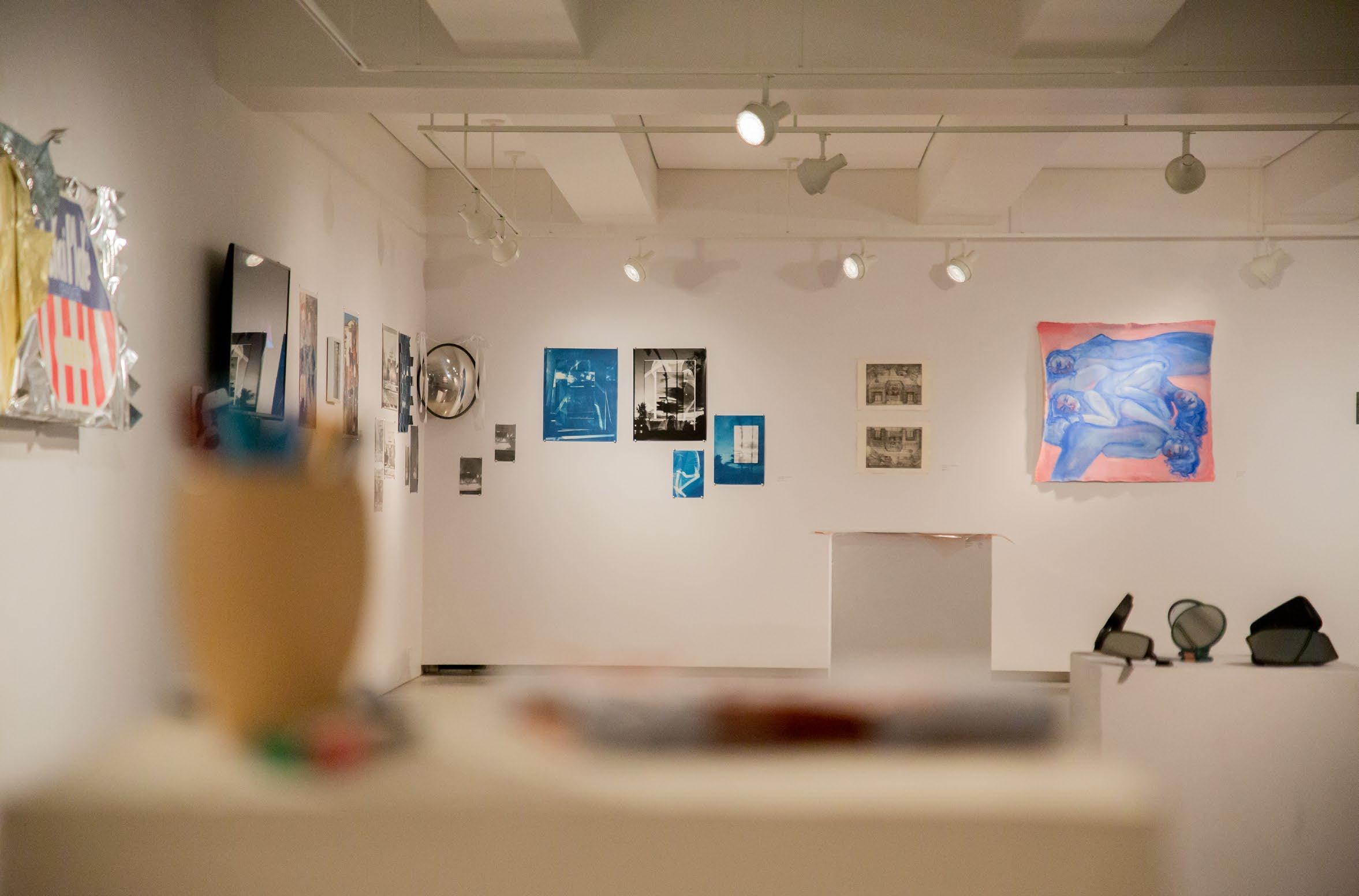
dent Gallery at the Taché Arts Complex hosted an art exhibit titled Re: Collecting: Memories From The Rear View Mirror, featuring artists Sharyn Gutierrez, Herlinda Dalayoan, and Brian Guevarra from Nov. 22 to 29.
The exhibition featured an array of multimedia artworks that ranged from silkscreen to digital prints, traditional paintings and illustrations, and even a Filipino karaoke video, complete with lyrics to sing along to mounted on one of two television sets at the back of the gallery.
The theme was first developed through one of Guevarra’s pieces titled “Follow and Return,” which features the concept of a person stuck between two stages of their life. More specifically, between childhood and adulthood.
The piece represents “this idea of looking forward to look backwards,” said Guevarra. “Or, looking at a memory as if you are looking toward the future.”
Gutierrez said that although the three artists have been friends for a long time, they only started working on their art together during the summer.
It was during this time that they realized they had a lot of shared experiences, whether that be through their culture, the way they process things that have happened in their lives or their stages in life.
“I really do feel that it is a show about Filipino diaspora perspectives,” Dalayoan said.
“But also, [it] has grown to
be more than that,” she said.
She said reflection and processing oneself in the present when there was no chance in the past is a recurring theme.
These shared feelings are why they wanted to work on the exhibit together.
However, finding the time to get together to work on their exhibit proved difficult for the trio, each of whom are students at the school of art.
The three agreed that it was a very busy time for them with the art exhibit, schoolwork and other commitments, but Gutierrez said “it was very rewarding.”
On opening night, the show hosted a reception for visitors that was well-received by guests, which included an assortment of Filipino foods.
Before the positive response, Guevarra said he was initially nervous about how not only the food, but the presentation of the art would be received, because of its “unconventional way of installing things.”
The artists employed many features not commonly used in the gallery space, such as poster poles and showcased artworks that wouldn’t necessarily be associated with “high
class” or “elitist” art, like a guest book that visitors could add messages or their own doodles to.
Guevarra said it was important for the group to showcase their work in a school setting, as it means to challenge the perceived standard of “institutionalized” or “fine” art.
“It’s a very colonial and western and Eurocentric standard of what ‘good art’ or what ‘art that deserves to be displayed’ should be,” Guevarra said.
Initial fears about how the exhibition would be received were quelled by the amount
of stickers that the group had printed for the show and how little food they had left by the end of their reception. The appreciation for the space was clear.
While Dalayoan said she wasn’t sure how the show would come together at first given the artists’ different styles, her apprehension disappeared during the final stretch of setting up.
“It was only in the final hours of setting things up that I really, truly [saw] how harmonious everything was, and it was really beautiful to witness that.”
photo / Rebecca Smith / provided
Eulogy for the Good Will
Local West End venue will shut down Feb. 1, 2024
Alex braun, staff
egendary bar and
Lvenue the Good Will Social Club is shutting its doors after nearly a decade of business.
An Instagram post on Nov. 22 broke the news, and though the owners described the announcement as “not a goodbye, but rather a ‘see you later,’” this change suggests to some the end of a beloved and unique space for Winnipeg’s artistic community.
The Good Will opened its doors in late 2014, run by a group of 9 owners from largely creative backgrounds. They began the project with the goal of creating a space for Winnipeg’s musical and creative scenes to expand and flourish — not just as a venue, but also as an inclusive place for community building.
The venue’s first show was a tour stop for Calgary postpunk veterans Preoccupations. Since then, the space has held countless concerts from local artists and touring acts from across the world. Posters for these shows are proudly displayed on the walls of the Good Will’s middle room, a sort of hall of fame for Winnipeg bands of the past 10 years.
Musician, co-founder and booking agent with First Date Touring, Gil Carroll, who plays in the band Living Hour and is the co-artistic director of local concert promotion company Real Love Winnipeg, described the venue as a crucial room for the local music scene.
“I’ve been playing there since the first year it opened, and it’s always been a super fun place to play with really good sound,” Carroll
explained. “It sort of felt like a rite of passage the first time Living Hour headlined the Good Will.”
The venue’s 200-or-so capacity fills a very important niche in the music scene, large enough for notable touring acts like Jonathan Richman, R.A.P. Ferreira, Iceage and Sloan, while still being a reasonable size for smaller local bands to fill.
Beyond its indispensability to the city’s live music scene, the Good Will has also served as home to other community events like weekly trivia hosted by Jeff Sinclair on monday evenings, drag per-
formances, queer bingo, spelling bees and karaoke.
The Good Will has also served as home to several restaurants throughout its time at 625 Portage Avenue, including the excellent fusion restaurant Khao House and latest occupant Primo’s Deli, makers of some of the best sandwiches in the city, who closed up shop on Dec. 1 and went on hiatus until a new location is secured.
Carroll said the venue has always been reliable for musicians, liked by many, and said he’ll miss it once it’s gone.
“I have so many amazing memories from playing there.”
Carroll said. “I’ll miss it. Definitely. So much. And I’m really, really happy that we’re doing one last show there.”
As a regular attendee, diner, performer and occasional worker at the Good Will myself, words cannot describe how important the space has been for me and the massive role it’s played in my life.
It was the first real venue I played as a musician and has been the central meeting place for my friends and I during my entire adult life.
In its last couple of months of operation, make sure to pay your respects to the Good Will. There’s still lots of mem-
ories to be made in its halls. May the Good Will live on as an inspiration to current and aspiring venue owners on how to hold community as top priority, treat people fairly, build a creative community and make your city a better place to live in.
The Good Will is open until Feb. 1, 2024. For information on future events, visit thegoodwill.ca/events. Tickets for Living Hour’s final show at the Good Will on Dec. 9 are available at reallovewpg.com.
photo / M etthew Merkel / staff
Swim team finds success at CanWest Championships
Bisons claim
four medals at 2023 tournament
evelyn Lekivetz, volunteer
The University of Manitoba Bisons swim team made strides toward nationals with its success at the 2023 CanWest Championships.
Hosted from Nov. 24 to 26 by the University of Calgary Dinos, the Bisons achieved several impressive times that paid off with podium finishes and a personal best.
Women’s co-captain Ella Howe continued to make a name for herself at the tournament. She swam to a goldmedal finish in the women’s 50-metre freestyle with a time of 25.64 — a personal best. She returned to the podium for the women’s 100-metre freestyle, achieving bronze with a time of 56.71.
Howe was not the only captain who took accolades from the women’s 100metre freestyle. Kelsey Fillion claimed gold with a time of 55.81, almost a full second ahead of her second-place competitor. Fillion competed in a total of four individual finals over the weekend, the highest number out of all the Bisons.
spotlight by qualifying for nationals in the women’s 50-metre backstroke with a speedy time of 29.22. Guest is the 10th member of the Bisons’ swim team this season to earn a spot in the U Sports Championships next March — the highest number in the last five years.
A handful of Bisons made a splash by reducing preliminary finish times in the finals.
his preliminary race times to 25.06 in the 50-metre and 2:07.19 in the 200-metre.
Third-year Rhade Kostelnyk reduced his final time in the men’s 50-metre breaststroke, placing 12th overall with a time of 28.80. Rookie Ty Unrau placed sixth in the men’s 50-metre freestyle, cutting down his preliminary result to a final time of 23.05. Veteran Georgia Pengilly placed sixth overall in the women’s 100-metre backstroke, cutting her time down to 1:03.72.
The Bisons achieved several impressive times that paid off with podium finishes and a personal best
Second-year Shea Guest joined her teammates in the
Veteran and men’s co-captain Carson Beggs and rookie Eric Dupre cut significant time off their preliminary numbers in the men’s 200-metre breaststroke and 200-metre freestyle, respectively. Beggs removed nearly 2 and a half seconds, placing fourth in the breaststroke with a final time of 2:15.81. Meanwhile, Dupre finished 11th overall in the freestyle with a time of 1:52.16, reducing his preliminary time by 1 and a half seconds.
Men’s co-captain Andriy Usan cut down his times in both the men’s 50-metre butterfly and the men’s 200metre butterfly. Usan reduced
It was the women who dominated the group races at CanWest. Fillion, Howe and Pengilly worked together with third-year Hannah Schanel to secure silver in the 4x100metre freestyle relay, clocking in with a time of 3:49.82. The foursome also finished just off the podium in the 4x200metre freestyle.
Schanel, second-year Gavin Reimer and thirdyear Kara Dziadek also made finals appearances. Schanel managed times of 26.80 and 29.26 in the women’s 50-metre freestyle and butterfly, respectively, while Reimer
finished the men’s 50-metre butterfly with a time of 25.55 and Dziadek secured a time of 59.82 in the women’s 100metre freestyle. The Bisons finished the 2023 CanWest Championships meet with a total of 426.5 points. The women finished fifth overall — dropping down a spot following a two-year, fourth-place-overall run — while the men ranked
For the herd — take time to enjoy winter
There’s always something to do in Winter-peg
Grace Anne Paizen, staff
As the holiday season commences, it can feel awfully dreary this time of year with the sun setting before 5 p.m. and the impending cumulation of heavy winter snow.
But this is no time to hibernate. Grab winter by the horns and go have some fun — the snow is going to be here until at least March, so you might as well enjoy it.
When the river finally freezes, the Nestaweya River Trail will be opened at the Forks. You don’t even have to own a pair of ice skates, there are skate rentals available at the Forks. There will also be the famous warming huts along the river to warm up in.
You don’t even have to skate at the Forks. There are plenty of trails to walk with a cozy cup of hot chocolate if walking around is more your type of exercise.
But if you are the skating type and the river doesn’t freeze until January, you
can check out the community rinks throughout the city. There are plenty of rinks that offer free skate time, including the university’s own Wayne Fleming Arena. There are even recreational hockey and ringette leagues to join. There are also ski hills relatively close to the city for those yearning to throw on some skis or a snowboard. In fact, Travel Manitoba has just introduced a new Manitoba Ski Pass that gets you access to one or all three ski hills — your choice of Springhill Winter Sports Park, Asessippi Ski Area & Resort or Falcon Ridge Ski Slopes. If the slopes aren’t to your liking, consider taking up snowshoeing. There are plenty of snowshoe trails within the city limits. And if you decide you don’t like snowshoeing, these same trails double as hiking trails if you just want to go for a nice winter walk in the falling powder.
If walking around is your
thing, the city boasts several locations where you can take in the winter lights. The Zoo Lights at the Assiniboine Park Zoo are always a treat, and if it’s a bit too chilly outside, you can always hop in a car with your friends and drive over to the Canad Inns Winter Wonderland drive-thru, hosted at the Red River Ex festival grounds. Sometimes seeing the beautiful winter lights is the best way to battle any winter blues.
There’s always tobogganing as a favourite winter pastime. You can find toboggan slides in parks throughout the city, or you can find a hill of your own for some good old-fashioned winter fun.
Instead of staying inside this winter, try going out and enjoying the cold. Shoveling doesn’t have to be the only way to get outside and exercise this time of year.
Remember, exercise helps mental health — so if the sun setting early is really starting
sixth overall — one placement higher than their ranking in the 2022 tournament.
The Bisons swim team looks to finish 2023 on a high note at home with the Prairie Winter Invitational at the Pan Am Pool from Dec. 7 to 10.
to bother you, go walk around and see those winter lights to brighten up your mood both emotionally and physically.
graphic / Teegan Gillich / staff
Happy winter, Bisons.
photo / Faith Peters / staff
They were the champions
2023 marks 100th anniversary year of men’s hockey hoisting Memorial Cup
Grace Anne Paizen, staff
The University of Manitoba men’s hockey team won the Memorial Cup in March of 1923. It would be remiss to close out 2023 without acknowledging the 100th anniversary year of the history-making triumph, and the gruelling road that led to the Bisons 1922-23 Memorial Cup win.
Known originally as the Ontario Hockey Association (OHA) Memorial Cup, the Memorial Cup remains one of the most coveted junior hockey trophies.
First donated by the OHA in 1919 in remembrance of Canadian soldiers who lost their lives during the First World War, the cup is awarded to the winner of the annual junior hockey tournament. Through the expansion of hockey leagues in the Great White North, the leagues participating in the cup have changed, but pre-U Sports, the U of M was once part of an eligible, provincial junior hockey league.
Cue the 1922-23 Bisons hockey team’s quest for national junior hockey glory. Remembered in the Brown and Gold yearbook by their last names alone — and an egregious spelling error of the captain’s last name — the 1923 junior hockey champions
of Canada consisted of captain J. Murray Murdoch, forwards B. H. Watson, J. Mitchell, J. A. Wise and R. E. Moulden, defencemen A. I. Chapman and A. Johnson and goaltender A. T. Puttee.
A member of the Winnipeg and District Junior Hockey League, the U of M faced the Winnipeg Victoria Bisons in the 1923 league final. Victorious, Manitoba went on to defeat the Brandon Tigers 8-1 in the provincial championships, winning the Turnbull Memorial Trophy.
The Turnbull Trophy was donated in 1920 in honour of Winnipeg-born Capt. Walter James “Ollie” Turnbull, who was killed in action during the First World War. It is awarded to the Manitoba junior hockey team that wins the provincial championships.
With the Turnbull Trophy in hand, the Bisons faced the Calgary Canadians in the Western Canada final. Manitoba pulled off the twogame series win against Calgary, with a tightly contested 5-4 game one victory before defeating the Canadians 5-3 in game two to win the Abbott Memorial Cup.
The Abbott Cup was presented in 1919 in memory of the late Capt. E. L. (Hick) Abbott, who also died in action during the First World
War. From 1919 to 1970, teams that won the Abbott Cup went on to play for the Memorial Cup.
Winning both the Turnbull and Abbott Cups, the U of M was set to compete for the national title.
In the first leg of the tournament, the Bisons took on the Fort William Cubs. Game one ended in a 3-3 tie before the U of M defeated the Cubs 6-1 in game two, going on to face the Kitchener Colts in the Memorial Cup final.
The Bisons won the Memor-
ial Cup handily, defeating the Colts 7-3 in both games of the two-game final series March 22 and 26.
The 1922-23 MVP during the Bisons tournament run was Murdoch, who put up five goals against Calgary and four goals against Fort William. In the national title series alone, Murdoch netted nine goals against Kitchener, scoring four goals in the second period of game one and netting the game, and cup-winning, goal in game two.
Murdoch went on to play
11 seasons in the NHL with the New York Rangers, winning two Stanley Cups with the team in 1928 and 1933 and amassing 84 goals and 188 points. After retiring from the NHL, Murdoch became head coach of the Yale University Bulldogs men’s hockey team for 27 seasons, achieving a then-Yale record 278 wins in his tenure with the team from 1938-65.
Hockey and Bisons fans alike can see the 1923 Memorial Cup banner in the Wayne Fleming Arena.
photo / Matthew Merkel / staff
Bisons volleyball sweeps Heat at home
Women’s and men’s team each go 2-0 over weekend
Quinn mayhew, staff
he University of Mani-
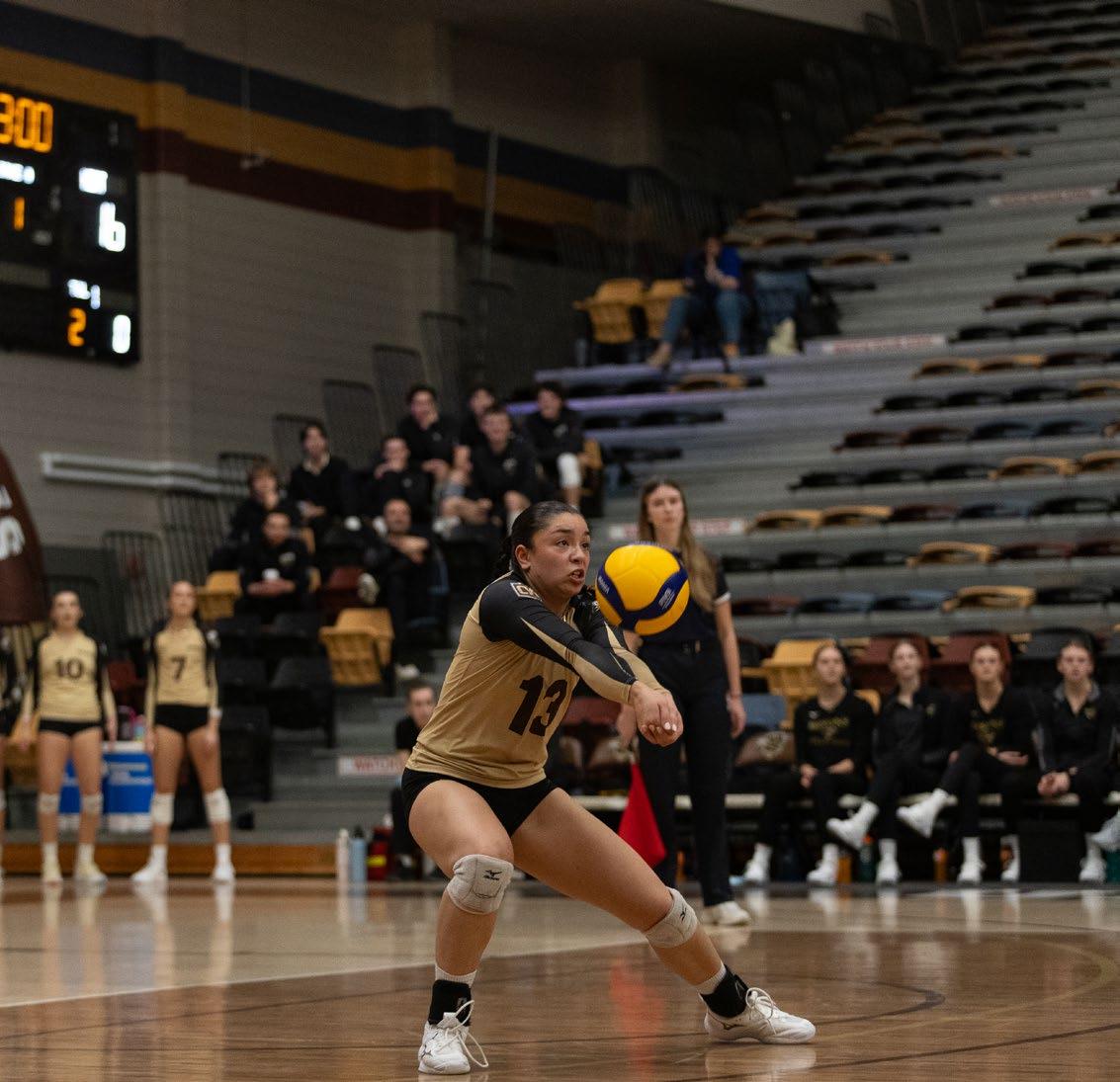
Ttoba women’s volleyball team had blazing start to its weekend series against the University of British Columbia–Okanagan (UBCO) Heat.
The herd had its eyes on the prize and the ball. Every kill and assist meshed together like a well-oiled machine — so much so that anyone could step up to the court and play a phenomenal game.
The first set of Friday’s match was close, the Bisons winning 25-23 with a total amount of 17 kills compared to UBCO’s 15.
UBCO began to struggle as the game progressed, and the herd was able to handily take the second set 25-11.
The Heat got a little closer in the third set, but the U of M pulled off the sweep, winning 25-17.
Katreena Bentley had a whopping 35 assists in Friday night’s game and second-year phenom Raya Surinx had 14 kills.
Another instrumental player in Friday’s match was
Andi Almonte, who racked up eight kills, two aces and six digs while hitting .500.
Saturday’s game saw the second sweep in a row for the Bisons, the herd holding the Heat to no more than 15 points in each set of the three-set match.
The Bisons took the first set 25-10, achieving 18 kills.
The herd took the second set 25-15, capping off the weekend sweep with a dominating 25-8 third-set win.
Surinx again added on to her impressive total number of kills this season. She recorded a three-set, career-high 21 kills, and after Saturday’s game holds a U Sports-leading 195 overall kills.
Bentley also leads nationally with assists per set at 10.61.
The herd rides into the holiday break with an overall record of 10-2.
The men’s team fared just as well against UBCO over the weekend.
The herd’s first game was a five-set grinder. The Bisons won the first set 25-18, but
UBCO took the second set 25-23.
The U of M fell behind in the third set, leaving room for UBCO to sneak in and claim it 31-29.
The fourth set was evenly matched for some time, but the Bisons collected 15 kills to UBCO’s 13 and pulled off the win 25-18.
The herd capped off the deadlock in the fifth set, going toe-to-toe with the Heat to win the hard-fought set 15-11.
Leading the charge in game one’s win was Eric Ogaranko, hitting a career high 19 kills. Harrison Ens also recorded a career high with eight assisted blocks. Meanwhile, Sammy Ludwig made a whopping 51 assists and Josh Jehle remained the Bisons’ dig king with 14.
Saturday’s game started off with the U of M narrowly closing the first set 25-21 over the Heat.
The herd won the second set easily 25-14 before UBCO hit back in the third, recording 18 kills to Manitoba’s 10 and winning 26-24.
But the herd took over in the fourth, winning the set 25-18 and collecting the series sweep.
Ben Carleton was a huge help in Saturday’s game, leading in kills with 15 and achieving a career-high six aces.
With the series sweep, the men’s team improved to 8-4
on the season.
After the winter break, the volleyball teams will start the new year in Edmonton hosted by the MacEwan University Griffins Jan. 5 and 6.
Bisons basketball clashes with Spartans
Semi-successful trip out west sees men sweep Spartans and women get swept
Joshua brandt, staff
This past weekend, the University of Manitoba basketball teams faced off against the University of Trinity Western Spartans (TWU) for a two-game series in Langley, B.C.
Women’s team
Going into its series against the Spartans, the Bisons women’s basketball team was attempting to end a six-game losing streak.
Primed and ready, the herd thundered out to a great start against the Spartans in the first game, trailing only 37-35 at halftime.
In the third quarter, however, TWU’s offence caught fire — scoring 22 points — while its defence clamped down, holding the Bisons to 16 points.
After another hot shooting quarter in the fourth, the Spartans cruised to a convincing 80-64 victory.
Bison star Lauren Bartlett was limited to eight points in game one on a woeful 1-for-13 from the field.
Nonetheless, making up for Bartlett’s lack of scoring, Autumn Agar poured in a sea-
son high 23 points.
In the second game of the weekend, the herd gave TWU everything it could handle.
The game went right down to the wire, with both teams exchanging baskets in the dying seconds.
Clinging to a narrow onepoint lead with seven seconds left in the game, Agar committed a foul, sending Trinity to the line. Making both free throws, the Spartans closed the game out 66-63 after a costly turnover by Bartlett on the very next play.
Bartlett, however, played a much better second game, registering 23 points on an efficient 11-20 from the field.
Unfortunately, the women’s team’s losing streak now sits at eight games heading into the winter break.
Men’s team
Unlike the women’s team, the men’s team — recently ranked as the ninth best team in the country according to the pundits at U Sports — entered play against TWU riding a four-game winning streak.
Despite the Bisons’ favourable press, the Spartans played
the Bisons extremely tough in the first game between the two schools.
Once again, Simon Hildebrandt led the charge for the herd, scoring 16 points while chipping in with nine rebounds and three steals to lead his team to a 75-70 victory.
It was not just Hildebrandt who facilitated the win. Andre Gray II was a lightning rod off the bench, too, scoring 11 points in his 10 minute total play action on the court.
The prolific scoring of the Bisons’ bench certainly seemed to turn the tide of the game, for the herd’s bench outmatched the Spartans’ by a total of 30 points to 14.
Adjusting to Hildebrandt’s dominance in the first game, TWU made a concerted effort to double — and sometimes even triple — team him in the second game, meaning his teammates needed to pick up the offensive slack.
Daren Watts, Wyatt Tait and Cieran O’Hara certainly did just that. Watts dropped 17 points, O’Hara 13 and Tait 14 — Tait recording his second double-double of the season with 11 rebounds.
Mason Kraus also orches-
trated the offence well, dishing out five assists, six steals and 10 rebounds.
While Manitoba led the game by as much as 25 points, in the fourth quarter the herd let the Spartans close the gap to one point, bringing the score to 62-61.
However, the Bisons quickly got things back on track and closed the game out with some excellent defence, winning 75-63.
With the Bisons sweep of
Trinity this
overall in the CanWest standings, showing itself to be one of the most formidable teams in
After the holidays, the Bisons basketball teams will resume CanWest regular season play by hosting the University of Regina Cougars Jan. 5 and 6.
photo / Matthew Merkel / staff
weekend, the team’s winning streak reaches six games. The herd currently sits third
the conference.
photo / Matthew Merkel / staff
Bison briefs
Grace Anne Paizen, staff
Bisons football
Bison offensive lineman Mark Rauhaus has been honoured with the Russ Jackson Award. The national honour is awarded to a Canadian U Sports football player for their achievement in academics and athletics. The Bison centre is just the fourth member of the herd to win the award.
Fresh off their CanWest honours, Bison receiver AK Gassama and offensive lineman Giordano Vaccaro have received U Sports First Team All-Canadian honours. This is the second year in a row Gassama has received All-Canadian honours and a first for Vaccaro.
Bison offensive co-ordinator Vaughan Mitchell has also been nationally honoured, winning the Gino Fracas Award in his thirdstraight season being nominated. Mitchell has been a volunteer coach for the past 25 seasons.
The Winnipeg Blue Bombers have signed Bison defensive tackle Collin Kornelson back to the roster. A Bombers national draft pick, Kornelson previously played for the Bombers in the 2023 pre-season.
Finally, the Saskatchewan Roughriders have signed Bison linebacker Nick Thomas
back to the roster. A Roughriders national draft pick, Thomas played for Saskatchewan in the 2023 pre-season, taking on his teammate Kornelson in the June pre-season match-up at IG Field.
Bisons track and field
Track and field held its annual Brown and Gold Intersquad competition Nov. 24.
The top Bisons at the event on the women’s side of the team were Donnae Gordon, who took first in the 60-metre dash, Kendall Marriott, who took first in the 300-metre dash, Dana Poulton, who won the 800-metre run and Lena Klassen, who finished first in the 3,000-metre run.
In high jump, Jaylyn Deurbrouck claimed first, while Arianna Pilat took fourth in pole vault, Eniola Odeleye took first in long jump and Eniola Adepoju took first in triple jump.
Anna McConnell started the season right where she
left it — having won gold in women’s shot put at last season’s nationals — claiming first in both the shot put and weight throw.
Top finishers on the men’s side were Tyrell Davis, Roy Tambal Musa and Dawson Mann, who claimed first in the 60-metre dash, 300-metre dash and 800-metre run, respectively. Justin Kroeker finished second in the 3,000metre run.
John Olukoju tied for first in high jump, Max Speiser claimed first in pole vault — picking up where he left off at last season’s nationals — and Daxx Turner claimed first in both long and triple jump.
Finally, Joshua Suelzle won first in shot put and Graham Wright won first in weight throw.
Thompson Rivers University WolfPack
On Nov. 29, three members of the Thompson Rivers University (TRU) men’s volleyball
team were involved in a fatal car crash near TRU’s campus in Kamloops, B.C. One member was killed in the crash, while two others are in critical condition.
Owyn McInnis, a fourthyear outside hitter for the WolfPack from Guelph, Ont., was identified on Friday by his family as the volleyballer killed in the crash.
McInnis and his two teammates, who both remain in hospital, were struck by a pickup truck while waiting at a red light and pushed into traffic. An RCMP investigation remains ongoing.
Both Bisons volleyball teams held a moment of silence before Friday’s games against the University of British Columbia-Okanagan Heat, and Canada West has cancelled all remaining TRU games before the winter break.
The Bisons and Heat players wore WolfPack-orange ribbons, tape and socks in memoriam.