Research, experimentation at the core of Straub Thurmayr design
Elah Ajene, staff
The science courtyard sits behind the Armes lecture building, between Parker building and Machray Hall.
The outdoor space was designed by professors in the department of landscape architecture Anna Thurmayr and Dietmar Straub back in 2019.
“The last two summers, I was in the courtyard almost every week,” Straub said. “It’s such a pleasure to see how students, teachers, visitors, flowers and insects now inhabit the place. That’s the best feedback you can get as a designer.”
Their science courtyard project on the Fort Garry campus reflects the landscape architecture duo’s commitment. The courtyard serves as a classroom for Straub, weaving the geological history of materials into the fabric of students’ education. The stones, with tales dating back millions of years, become narrative tools for understanding Manitoba’s geological evolution.
“This helps me take students very far back into the history of our landscape,” Straub said.
This approach — integrating unconventional use of materials, community involvement and a commitment to ongoing engagement — characterizes the unique ethos of Straub Thurmayr Landscape Architects. The landscape design practice’s projects are small in scale, yet symbolize a means of initiating positive change and fostering a deeper connection between people and their environments.
Straub and Thurmayr trace their journey back to their meeting at the Technical University of Munich during their studies in the landscape architecture program.
Now a couple for 35 years, their successful collaborative work for design competitions led them to contemplate
establishing their own firm. In 2000, Straub Thurmayr was born out of their shared passion.
When asked about their overarching vision, Thurmayr expressed a deep commitment to improving the world through their projects. Rooted in a desire to enhance the living conditions of all beings, their philosophy extends beyond typical design firm projects.
As professors and designers, they consider themselves agents for change in the face of global challenges such as climate change and social conflicts. The duo believes that their small-scale projects, though not capable of rescuing the world, can challenge existing norms and facilitate positive change.
Straub emphasized their outlook on projects, often pursuing research and experimentation. By encouraging openness and a willingness to take risks, they aim to transcend the conventional
boundaries of landscape architecture and inspire a new perspective with their projects.
“They can really be seen as a catalyst for change,” Thurmayr said.
The duo shed light on their unconventional approach to projects, emphasizing the absence of a standardized method. Operating primarily on a pro bono basis, they collaborate with communities across Manitoba that lack the financial means to hire landscape architects.
Thurmayr and Straub embark on a journey of mutual trust-building with community members. The process involves preliminary designs, discussions and, in many cases, starting with minimal to no budget.
“There’s no money available, which I think can be great because this challenges your creativity,” Straub said. Fundraising becomes a pivotal step toward realizing these projects, and Straub and
Thurmayr explore avenues such as grant applications and partnerships with schools.
The team also embraces an eco-friendly philosophy, seeking discarded materials for their projects — transforming the “worthless” into valuable components through recycling and upcycling.
Straub stressed the importance of challenging aesthetic norms, using unconventional materials that may not initially be considered aesthetically pleasing. He believes this approach contributes to a necessary shift in ethical considerations toward land use, fostering biodiversity and complex environments.
Notably, the duo’s projects never reach a definitive endpoint. Instead, they require continuous maintenance and attention. By involving community members and volunteers from the project’s inception, the two aim to create stewards for the landscapes, ensuring a sustained connection between the community
and the space.
In contemplating the future of landscape architecture and urban design, Thurmayr and Straub acknowledged the challenges posed by multiple global crises. Despite the uncertainties, the duo emphasized the multifaceted nature of their projects as a means to instill hope for communal survival in an era of crisis.
The idea that initiated their journey as students — to improve the world — remains at the core of their mission. They envision creating little paradises collaboratively, fostering improvement through collective effort.
Straub stressed the need to relearn to inhabit environments with humility and modesty, particularly given the considerable carbon footprint associated with the construction industry and its contribution to climate change.
The duo highlight the role of plants as a foundational layer to address contemporary issues like climate change.
“I strongly believe in the power of the sun, the sunlight and chlorophyll in order to initiate changes,” Straub said. “It can be very, very simple.” Their approach draws inspiration from the process of photosynthesis, where plants contribute to oxygen production while absorbing carbon dioxide.
This philosophy aligns with their larger vision to leverage the inherent power of plants, learning from the invaluable processes they offer. Straub said landscape architects should embrace and apply these principles to projects, contributing not only to the improvement of the environment but also to human well-being.
“There’s an inherent po wer to do something great with out using too many resources,” Straub said.
photo / Dietmar Straub / provided
EDITOR-IN-CHIEF Gillian Brown editor@themanitoban.com
BUSINESS MANAGER Dhruv Patel accounts@themanitoban.com
ADVERTISING CO-ORDINATOR Diego Castro ads@themanitoban.com
EDITORIAL
MANAGING EDITOR Ezra Taves me@themanitoban.com
COPY EDITOR Simon Pensato copy@themanitoban.com
COPY ASSOCIATE Paula Samaniego-Ayllon
NEWS EDITOR Sarah Cohen news@themanitoban.com
NEWS EDITOR Colton McKillop news@themanitoban.com
RESEARCH & TECHNOLOGY EDITOR Elah Ajene research@themanitoban.com
VIDEO EDITOR Kennedy Legault video@themanitoban.com
SOCIAL MEDIA EDITOR Violet Baker social@themanitoban.com
REPORTERS
NEWS Alicia Rose
NEWS Kyra Campbell
NEWS vacant
RESEARCH & TECHNOLOGY Rhea Bhalla
COMMENT Braden Bristow
COMMENT Hanako Teranishi
COMMENT Lakshmisree Shaji
ARTS & CULTURE Kelsey Chin
ARTS & CULTURE Alex Braun
SPORTS Joshua Brandt
SPORTS Quinn Mayhew
VOLUNTEERS
VOLUNTEER STAFF
Bahareh Rashidi, Christina Tran
VOLUNTEER
Indiana M. A. Humniski, Michele Melendez
Allie Stone, Romin Cheema
interested in volunteering?
email me@themanitoban.com today!
109 HELEN GLASS BUILDING
UNIVERSITY OF MANITOBA WINNIPEG, MB 204. 474. 6535
The Manitoban is the official student newspaper of the University of Manitoba. It is published monthly during the summer and each week of regular classes during the academic year by the Manitoban Newspaper Publications Corporation.
The Manitoban is an independent and democratic student organization, open to participation from all students. It exists to serve its readers as students and citizens.
The Manitoban is a member of the Canadian University Press, and our journalistic standards can be found on the Manitoban’s website.
The newspaper’s primary mandate is to report fairly and objectively on issues and events of importance and interest to the students of the University of Manitoba, to provide an open forum for the free expression and exchange of opinions and ideas and to stimulate meaningful debate on issues that affect or would otherwise be of interest to the student body and/ or society in general. The Manitoban serves as a training ground for students interested in any aspect of journalism.
Students and other interested parties are invited to contribute to any section of the newspaper. Please contact the appropriate editor for submission guidelines.
The Manitoban reserves the right to edit all submissions and will not publish any material deemed by its Editorial Board to be discriminatory, racist, sexist, homophobic or transphobic, ableist or libellous.
Opinions expressed in letters and articles are solely those of the authors. Editorials in the Manitoban are signed and represent the opinions of the writer(s), not necessarily those of the Manitoban staff, Editorial Board or the publisher.
A “volunteer staff” member is defined as a person who has had three volunteer articles, photographs or pieces of art of reasonable length and/ or substance published in the current publishing year of the Manitoban.
Any individual who qualifies as a volunteer staff member must be voted in by a majority vote at a Manitoban editorial board meeting. Elected representatives and non-students may be excluded from holding votes as volunteer staff members in accordance with the Manitoban Constitution.
The article incorrectly credited the play it covered as a production of The Black Hole Student Theatre Community, which is a student group affiliated with theatrical activity at U of M. In fact, the show was produced by the Theatre Program of The Department of English, Theatre, Film & Media. The Winter Term 2023 production of Scorched, also mentioned in the article, was incorrectly attributed to The Black Hole Theatre, a historical name associated with Theatre at U of M, when in fact this show was also produced by the Theatre Program of The Department of English, Theatre, Film & Media.
University to offer combined JD and MBA degree
Asper and Robson Hall add UM to list of U15 schools with the program
Sarah Cohen, staff
Hytem Elgubtan hopes that his chaotic experience taking his LSAT earlier this month will pay off and result in his acceptance into U of M’s new joint JD/MBA program.
“It would honestly be a dream come true,” he said.
Beginning fall 2024, the University of Manitoba will join 10 other U15 schools that offer a juris doctor (JD) and master of business administration (MBA) concurrent program.
Elgubtan is in his last year of a bachelor of arts in psychology with a minor in business management. He wants to pursue either corporate or international law. U of M offering the new program allows Elgubtan to “stick two plans into one thing that I’ve always wanted to do.”
“The fact that I’m able to get two degrees in one is an opportunity that really caught my eye as soon as I began my law school application.”
Even though other Canadian law schools offer the joint degree, Elgubtan said that
being able to attend the U of M means that he could stay close to family and friends.
The new program will mean that students will have the opportunity to obtain their law degree and MBA in a total of four years, where previously, the two separate degrees would take three and two years each to complete.
Richard Jochelson, dean of the Robson Hall faculty of law, said the idea for the joint program had “been bubbling around” for at least 10 years. According to Jochelson, the then-dean of the Asper school of business Michael Benarroch and the then-dean of law wrote a preliminary proposal for the program, but it did not go past that.
“I am excited by the work we are doing to connect more faculties and programs to each other,” said Benarroch in a statement provided to the Manitoban Later, Jochelson was able to restart working toward the program in collaboration with Asper. Jochelson said that, as the only law school and “most important” MBA in the prov-
ince, they had a “responsibility to offer” the program.
“It could be career defining,” he said. A graduate of the program “could end up being a really important person contributing to the Manitoba economy.”
Getting into the program itself will be rigorous according to Jochelson. Students will first have to take the LSAT, be accepted into law school and be admitted to the business school once the first year of law school is complete. Entrance to the MBA program is reliant on a score of 550 or better on the Graduate Management Admissions Test and work experience, according to
acting associate dean of the Asper school of business graduate program Nathan Greidanus.
Although, the outcome is “a real chance to come out with two high profile credentials.”
Students who complete the program will obtain both their JD and their MBA.
Previously, students interested in this sort of program had to go out of the province to access it. Now there is the “opportunity to keep some of those folks in Manitoba, have those opportunities grow locally, and it should serve the Manitoba economy better, and also provide a more affordable alternative,” Jochelson said.
A symbol of hope and inspiration
Jochelson noted that of the applicant pool of law school for the fall 2024 term, about 50 per cent have indicated that they are interested in the JD/ MBA program.
Greidanus said the new program is “something the market would appreciate.”
“I think it’s a great option for law students to add that business acumen piece to it,” he said.
Jochelson said that feedback from Winnipeg law firms has been quite positive. It is “exciting that the news is reaching some of the big players on the industry side,” he said.
UMSU president honoured on CIBWE list of top 100 Black women to watch
Sarah Cohen, staff
Tracy Karuhogo’s journey to being an honouree on a list of the top 100 Black women to watch in Canada began before she moved to Canada from Uganda in 2019.
Karuhogo, UMSU president, was “shocked” to find out she was listed as a recipient of the award hosted by Canada International Black Women Excellence, which was presented on Oct. 28.
“I felt so honoured to have been chosen and to have been recognized,” she said.
Coming from a family with four children in Uganda, Karuhogo was the first in her family to move to a new country to pursue higher education.
In Uganda, Karuhogo said she faced intense sexism, and that there are very few women in Ugandan politics. Coming to Canada, she realized “how racism could affect” her.
“When I moved to Canada, I had to really modify who I was in the beginning,” she said. “I was afraid of using my accent, or I was afraid of knowing where to go. I was afraid of
walking at night.”
Karuhogo began her university studies at the International College of Manitoba (ICM) for a year before transferring to the U of M to study psychology and women and gender studies.
After serving on the ICM student council and seeing the faces of the current UMSU executives, she was inspired to become an executive herself, but really she wanted “to contribute something more.”
Despite the pandemic beginning in 2020, which made it difficult for Karuhogo to find friends and community, she started to get involved in student leadership.
Previously, she served as the women’s representative, then the vice-president student life (VPSL), and she is now the president of UMSU.
Karuhogo found her time as VPSL “really incredible” as she was able to work with many different students and support the various community representatives.
“I’m a really huge advocate for women,” and “a really
huge advocate for any marginalized group,” she said.
Karuhogo knows the struggles that many women and people in marginalized communities face well. She was diagnosed with PTSD and panic disorder after being sexually assaulted during her first month in Canada. She tells this story to share that despite the trauma someone has been through, “it doesn’t mean that your story has to end there.”
She hopes that other students can think of her story and know that they can make it through difficult situations.
“I hope to inspire them as well,” she said.
Karuhogo is passionate about being an advocate for women, and during her time in student leadership, she has become interested in government relations.
Once her undergraduate degree is complete, she wants to work in government “to make sure there are no laws that are actually causing more harm than good.”
Karuhogo said her ultimate goal is to create a notfor-profit organization that
helps to inspire women to enter leadership positions and reach their full potential.
“As long as I can inspire more and more women, more and more international students, I feel like that’s what my main goal in life is,” she said. She hopes “to inspire people to really take that step and move forward.”
Karuhogo said the award is not just for her, it is for all the Black girls who are going through adversity.
“It is a sign of hope,” she said, “that we can still push through barriers and trials and tribulations.”
photo / Ebunoluwa Akinbo / staff
photo / Tracy Karuhogo / provided
Babysitter directory launched to help parents on campus
Additional resources and options available for caregivers
Alicia Rose, staff
new babysitter direc-
Atory has been created with the aim of addressing the needs of U of M students and faculty who must bring children to class because they have no other childcare options.
U of M family resources launched the UM babysitter directory on Nov. 1. The directory is a resource to help parents and guardians at the university find student babysitters.
Francene Perehinec, the U of M family resource co-ordinator under the vice-provost (academic), formed the directory to support parents and guardians who are part of the university community in their work and studies. The project took around eight months to develop between Perehinec and her colleague Melissa Melo, the family cen-
tre co-ordinator at the Rady college of medicine.
Only two weeks after the program launched, there were 200 requests for access to the directory from parents and guardians, around 65 per cent of which are students. Currently, there are over 70 students listed as babysitters, and services are available to those with infants, toddlers and children under the age of 12.
The directory is meant to give parents access to a list of available student babysitters
national students, have faced challenges in finding childcare, Perehinec said.
“It affects people’s ability to attend work, study for exams, even attend classes.”
Perehinec said faculty and students provided feedback indicating that a lack of available childcare support put them “in a predicament” because they had to bring their kids to class. Perehinec said she was inspired by the University of Toronto family care office’s program, and knew a similar program could be brought to the U of M.
“We were pleasantly surprised that we had an influx of applicants wanting to join the directory”
— Francene Perehinec, family resource co-ordinator
and their information. Once parents have accessed the list, it is up to them which sitter they proceed with.
University staff and students, particularly inter-
“We were pleasantly surprised that we had an influx of applicants wanting to join the directory,” she said.
Perehinec hopes that the directory will help students and staff achieve their goals during their time at the university.
parents who have been bringing their children to classes,” she said, “and to reduce workplace barriers for staff too by providing childcare options for them.”
“The original intent for this was to help specifically the ferences.
Perehinec mentioned that the babysitter directory can help parents that have late night work meetings or con-
Students interested in becoming babysitters can contact the centre via email or view the posting on UMConnect. Perehinec emphasized that students should be aware and prepared with documents and references when parents call them with potential jobs.
Law student attends United Nations tax committee
Intersection of taxation, human rights discussed at committee meetings in Geneva
Kyra Campbell, staff
Robson Hall second-year law student Isha Khandelwal’s interest in tax law happened by chance, but eventually led her to the 27th session of the committee of experts on international cooperation in tax matters at the United Nations (UN) in Geneva, Switzerland.
“It was a spectacular experience, I really enjoyed it,” Khandelwal said. “The kinds of people I met, the levels of discussion, it’s unlike anything I’ve ever experienced or been a part of in my life.”
The UN committee took place from Oct. 17 to 20. The committee discussed a wide range of topics including tax treaties, environmental taxes and wealth taxes. One area that interested Khandelwal was the disparities between lower and higher income nations.
Khandelwal became interested in taxation and human rights after she was chosen to participate in the Donald G. H. Bowman National Tax Moot this upcoming March. In order to participate in the moot, Khandelwal had to take a course on tax law, which forced her to rearrange her entire course schedule, ulti-
mately resulting in her enrolling in human rights law.
Khandelwal had no prior interest in human rights law, and was unsure what to write for her term paper in the course until she spoke to her professor about her interest in tax law and he explained that the intersection of taxation and human rights was a significant topic of recent discussion in global affairs.
In 2022, the UN general assembly adopted a resolution supported by human rights experts that would lay the foundation for a new UN tax convention, allowing lower and middle-income countries to have more of a say over global tax affairs.
Along with becoming more knowledgeable on international taxation, Khandelwal said she made multiple connections with others attending the committee, including Canada’s representative on the committee, Stephanie Smith.
“I think a lot of people there were really excited to see someone so young, and someone who’s not necessarily a professional come to the UN tax committee meeting,” said Khandelwal.
Khandelwal explained that the link between taxation and human rights is not as clear as connections between other issues such as employment and poverty.
She described the connection of taxation to human rights as a “chain” of events that governments conduct using tax revenue for social services for individuals who
cannot afford privatized options, often those who live in poverty.
“You have to draw that chain in order for people to start realizing that this is even an area of consideration,” said Khandelwal.
After attending the committee, Khandelwal is still skeptical about the change making abilities of the UN,
but acknowledged it provides a unique forum for discussion among member states.
“The reality is that there are conversations happening at the UN that allow developing states to actually have their voice heard and I don’t know any other platform where that is possible,” said Khandelwal.
photo / Ebunoluwa Akinbo / staff
photo / Matthew Merkel / provided
Canadian Federation of Students holds day of action
National event saw rallies for accessible education in Winnipeg and across Canada
Colton McKillop, staff
he Canadian Federa-
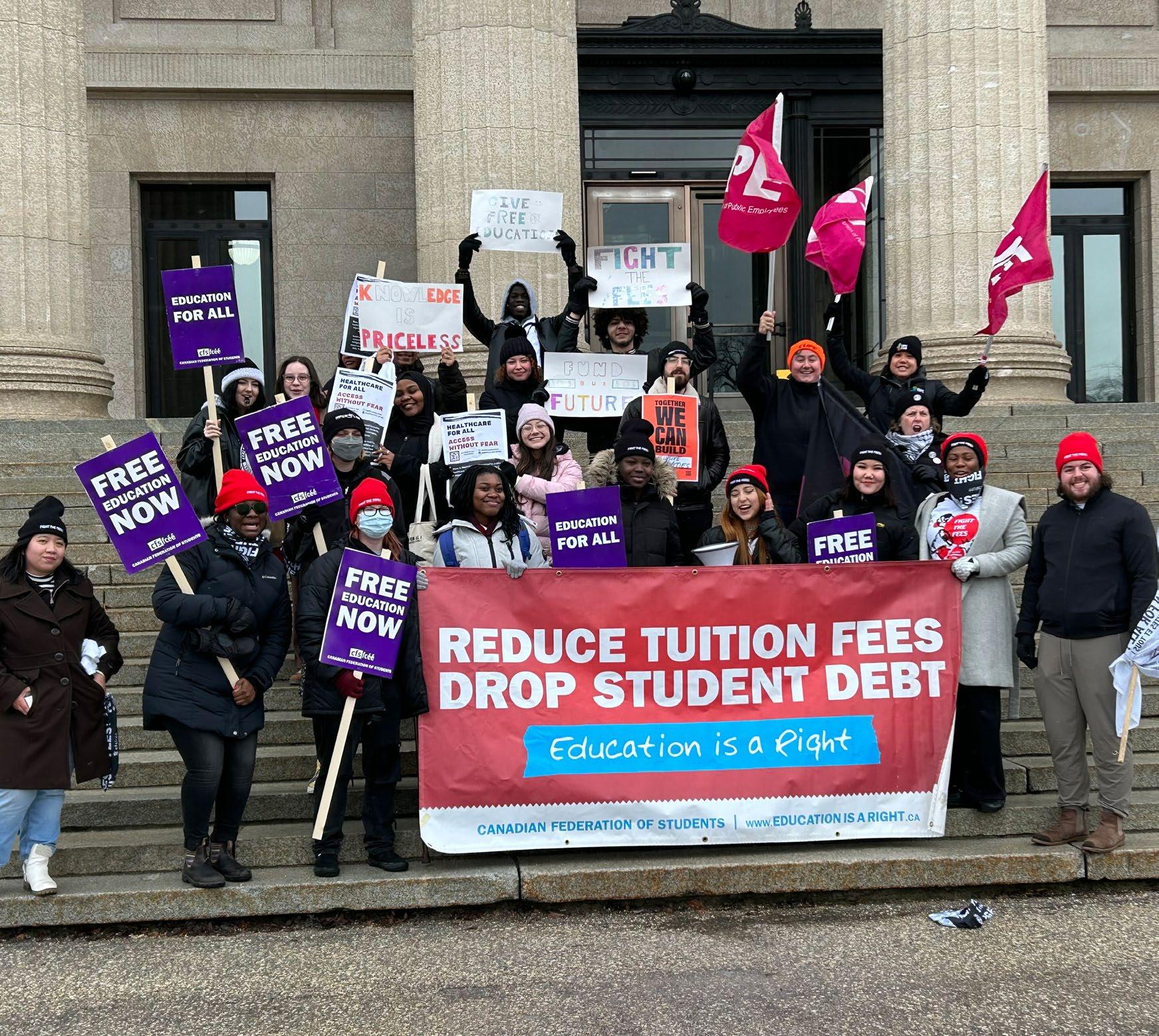
Ttion of Students held a series of rallies on Nov. 8 advocating for free and accessible education throughout the country, including one in Winnipeg, as part of its national day of action.
A crowd of over a dozen gathered on the steps of the Manitoba legislative building to present their demands, which included free and accessible education, fair treatment of international and Indigenous students and more grants for graduate students, rather than loans.
National deputy chair for the Canadian Federation of Students Natalia Tola said that with a housing crisis, inflation and rising costs of education, “it’s just not feasible for students to be able to go to school now.”
“It’s a moral question of whether people deserve education or not and the answer is yes,” she said.
Rallies were also held in Halifax, St. John’s, Regina, Surrey, Toronto, Ottawa and throughout Ontario.
Tola said “one of the biggest issues” the federation was hoping to address is education costs for international students. Across Canada, international students pay an average of five times as much in tuition as domestic students.
tion’s concerns.
She noted that the federation’s representatives had met with Minister of Advanced Education and Training Renée Cable two days before the rally. Tola believes they share mutual goals, including reinstating international students’ health care after the previous Manitoba Progressive Conservative government revoked free access for students from abroad.
Cable said she also thought the meetings with the federation have gone well so far, pointing to discussions concerning access to student aid and grants. She also said she has had “many discussions” with Minister of Health, Seniors and Long-Term Care Uzoma Asagwara regarding reinstating international students’ health care, although she was not able to offer a timeline for when the policy would be implemented.
Victoria Romero, a fourthyear political studies and history student and one of the speakers at the rally, told the crowd how her own struggles with affordability have interfered with her education.
When she completes her undergraduate degree,
photo / Colton McKillop / provided
when she graduates.
“It’s a moral question of whether people deserve education or not and the answer is yes”
“I had been under the impression that I would be able to afford my education and be able to enter into grad school immediately upon graduating from my undergrad,”
— Natalia Tola, national deputy chair of Canadian Federation of Students
“Especially thinking about the great contributions that international students bring, it’s important that we value and we retain these students and we don’t price them out of their education,” Tola said.
She pointed out that international students contribute over $22 billion to Canada’s economy.
Tola said she expects the newly elected Manitoba New Democratic Party government to be receptive to the federa-
Romero hopes to continue her education in law school or seek a PhD and aspires to work in academia or legal consultation. She will not be able to proceed with her plans immediately due to costs, however.
Romero told the Manitoban that her neurodivergence makes it difficult for her to balance education, mental health and working enough to afford classes. She worries about taking on debt “without the guarantee of having a job”
Romero said.
She said her challenges with balancing disability with work and education led her to add a few years to her degree, which also increased the cost.
“Now I’m at the point where I’m having to accept the fact that I will not be able to go on to do my graduate studies next fall when I graduate in the spring,” she said.
Romero worries that once she enters the workforce she will never “be afforded the time and the opportunity to go back to a space where [she]
can focus fully on learning.”
Marie Paule Ehoussou, the chairperson of Canadian Federation of Students Manitoba, said that while the federation’s ultimate goal is access to free, high quality post-secondary education, this is “not something that’s going to happen overnight.”
“We make it more affordable to start with, by giving more grants, more scholarships and less loans to students and then building up on that and eventually letting students have access to free education across Canada,” she said.
When asked whether she supported free tuition, Cable said that her “mandate is to support students” and make their lives more affordable.
She pointed to her own experience needing financial assistance to complete her education.
“What I want to do is ensure that we get as many people as possible through post-second-
ary, that as many students as possible know that there is a place for them in post-secondary,” she said.
In her speech to the crowd gathered at the legislature, Romero said that universities with rising tuition and fees are “not the education system we deserve.”
“No one should ever have to make the heart-wrenching choice between putting food on the table and keeping a roof over their head, and purchasing textbooks and attending classes,” she said.
“It is not a choice, it’s a systemic injustice.”
She said “education should empower us, not enslave us,” and that the rally was not just for students struggling to afford their studies.
“This fight is for every individual who will never even have the chance to dream of university-level education because they know they can never afford it,” Romero said.
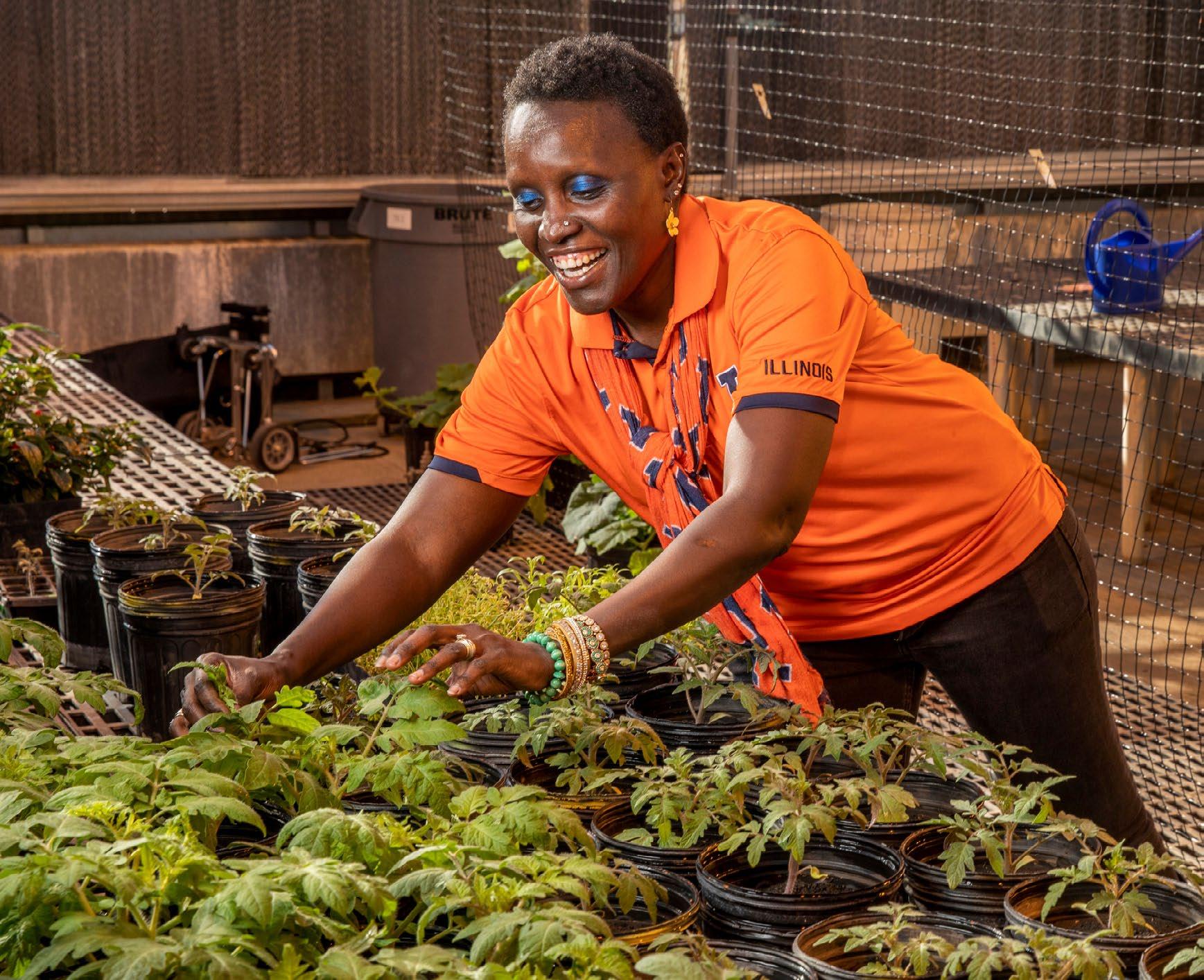
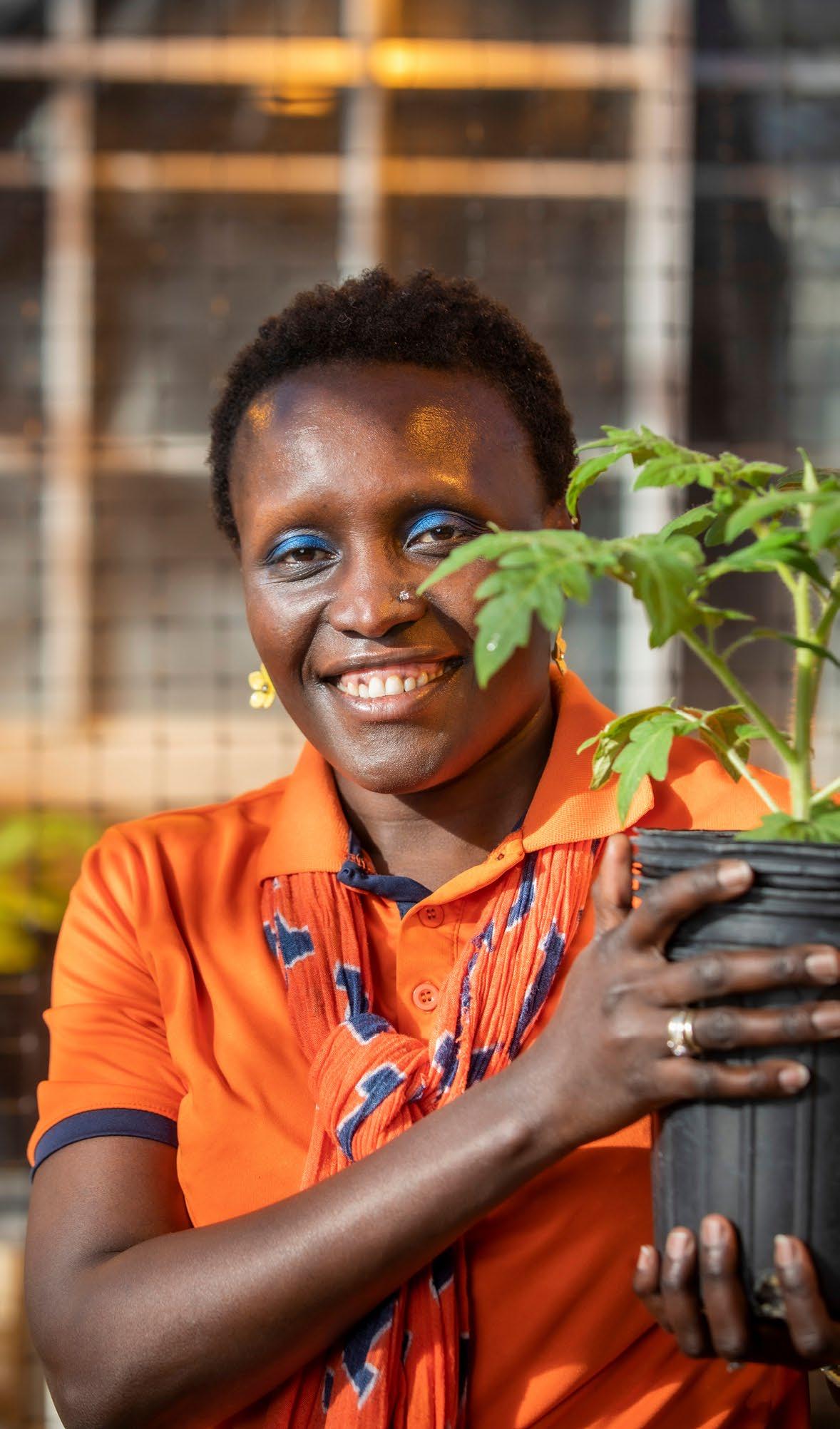
grew up in a rural farming community on the Kenyan coast. Her parents worked as teachers and cultivated crops to supplement their income. When not in school, much of her time was spent working on the family farm.
“Halfway during the season, I would watch all our hard work go to waste because insects would come around and eat our food crops,” Ngumbi said. “What insects had not taken, sometimes drought would. What drought had not taken, sometimes flooding would.”
Even after being harvested, the little food that could be salvaged and stored was still targeted relentlessly by insects.
“At the end of the season, when insects and all these stresses would take away our food, it would mean that we would […] have to miss multiple meals,” Ngumbi said, “it would mean that my parents would have to struggle.”
With these first-hand experiences of food insecurity in mind, Ngumbi set out to understand how insects find food crops, and why plants are often unable to defend themselves from their attack.
To find solutions to these challenges, she began a career in entomology, the study of insects. She is now an assistant professor of entomology at the University of Illinois Urbana-Champaign, where she runs the Ngumbi Lab. Research at the lab is aimed at understanding the “chemical-mediated conversations” insects and plants have using chemical signals.
The airborne chemical signals that plants release have many functions.
Some signals are intended to reach other plants. For example, the smell of freshly cut grass is a warning signal released when a plant is in distress. These signals may stimulate the formation of new cells at the wound site, allowing it to close. Other signals may prevent bacterial infection and fungal growth at the wound site.
Plants may also send airborne chemical messages to insects. Ngumbi explored this phenomenon in her 2011 doctoral dissertation studying the ability of parasitic wasps to locate hosts, such as caterpillars.
“We know that plants, once they start getting eaten, their chemistry changes and they’re attracting these natural enemies,” Ngumbi
explained. “If we take these synthetic compounds and put them into lures and put them in the fields, can we attract these natural enemies?”
The answer, her study found, is yes.
When certain cotton plants are under attack from caterpillars, they release compounds that attract parasitic wasps. The wasps then lay eggs inside the caterpillars’ bodies. After the larvae hatch, they slowly devour the caterpillar, making sure to avoid eating vital organs to keep it alive for as long as needed. Eventually, the larvae release chemicals to paralyze the caterpillar while they eat their way through its skin and into the outside world. Once released, the wasps mature until they are ready to continue the cycle.
Ngumbi’s current research, which she presented on Oct. 31 as part of a seminar hosted by the U of M’s faculty of agricultural and food sciences, is Unravelling chemical mediated interactions between plants, beneficial soil microbes (Bacilli PGPR) and insects. In this project, Ngumbi aims to explore how crop breeding impacts plant defences and plant-microbe interactions. When crops are bred, they may produce different chemical signals. With every decade, crops with new genotypes (genetic makeup) and characteristics are bred.
Early results from the study show that the genotype of maize, a crop examined in the study, significantly impacts the composition of chemical signals produced. Similarly, the variety of maize impacts the abundance of soil microbes.
This research and many other studies conducted at the Ngumbi Lab look to reduce the biotic (bacteria, insects, viruses, etc.) and abiotic (floods, droughts, etc.) stressors faced by crops and sustainably manage pests.
Speaking to graduate students in the sciences, Ngumbi emphasized the value of scientific research for agriculture and the environment.
“Our work as scientists is important,” said Ngumbi. “We’re in the frontline […] observing some of these would-be solutions for not only farmers, but many other challenges that we face.”
“Our biodiversity is at stake.”
She explained that the contributions of scientists can allow societies to not only overcome food insecurity and crop shortages, but to do
“Our biodiversity is at stake”
— Esther Ndumi Ngumbi, University of Illinois assistant professor of entomology
so in a way that avoids harming the environment. The research produced by scientists like her is informed by “challenges that are happening on the ground,” and aims to addresses obstacles faced by farmers and stakeholders. Continuous funding is vital to meeting these goals.
Ngumbi stressed the need to collaborate across scientific disciplines. Insects interact with plants, which grow in and are affected by broader agricultural conditions, which interact with communities at all levels. To address the challenges of food insecurity, scientists in many fields must work together.
“Entomology cannot solve it all,” she said. “Collaboration would allow us to holistically start to solve challenges and develop science-based solutions.”
Ngumbi pointed to diversity as another important tool for scientific innovation. A diverse team of scientists allows for the sharing of a myriad of perspectives, with each person bringing unique experiences, passions and curiosities to the table.
At the end of the day, Ngumbi said, “we’re all trying to find a solution to a challenge that is affecting someone.”
photos / Esther Ndumi Ngumbi / provided
Midwives and the changing maternal health landscape
How midwifery fits into the changing maternal health landscape
Rhea Bhalla, staff
Each year in Canada, over 300,000 people give birth. High quality, accessible care helps ensure their safe transition from pregnancy, to birth, to the postpartum period. More Canadian jurisdictions are regulating and funding midwives, and demand for midwives has grown in recent years.
Kellie Thiessen, a registered midwife and nurse with experience in both child and maternal health and the previous director of the bachelor of midwifery program at the U of M, highlighted the importance of midwives in health care.
“Midwives are a critical player in the health-care system because they have a broad scope,” she said, noting the ability of midwives to meet the unique needs of different communities, whether rural, remote or urban.
Though midwives are often associated with birth, their range of care extends beyond that. Midwives are the primary care providers for birthing parents and infants up to six weeks postpartum, a formative period of transition and adaptation. Birthing parents and infants experience physiological adjustments, while the entire family navigates social and emotional changes.
The postpartum care given by midwives and other healthcare providers has been shown to help patients recover faster
after giving birth.
“I think one of the most valuable things a midwife does is that postpartum care,” Thiessen said.
Thiessen also emphasized the ability of midwives to provide care for people at home, bringing care to the community. While other providers are often unable to offer care outside of hospitals and clinics, midwives allow patients to choose where they give birth.
Additionally, because midwives take on smaller caseloads, they are able to spend more time with each patient.
“They provide a complement of care that is more comprehensive in terms of their ability to stay engaged over a longer period of time because they don’t carry high volumes,” Thiessen said.
“There are some very unique aspects of the care,” she added.
In 2016, Thiessen co-authored a study comparing maternal outcomes of Manitoban women’s experiences of midwife-led and physician-led birthing care. The study found that women cared for by midwives experience lower odds of having an episiotomy (incision into the perineum to ease childbirth), epidural and caesarean delivery. Their infants are less likely to be admitted to neonatal intensive care units.
The study concluded that increasing integrated midwifery services can improve the effectiveness of Manitoba’s
maternal services.
Other studies similarly demonstrate the importance of midwives. A 2021 report by the Commonwealth Fund found that integrating midwives into global health-care systems has the potential to provide 80 per cent of essential maternal care. This could avert 41 per cent of maternal deaths, 39 per cent of neonatal deaths and 26 per cent of stillbirths.
Thiessen aims to encourage more midwives to engage in research, and to help mentor midwife researchers. She noted that midwives’ participation in research, even in an informal capacity, helps to inform the work of those leading maternal health research. Building capacity by increasing the number of midwives in research ensures that midwives have a voice at decision-making tables and can influence policymaking.
She explained that midwifery research provides politicians with the information needed to make decisions about maternal health care. Leading research allows midwives to be “influencers” of policy.
“The other goal is to continue to be in leadership positions to help move the profession forward, so we become more of a critical mass and are seen as an essential service to families,” Thiessen said.
“We’re not there yet.”
To get there, Thiessen emphasizes the importance
Interested in Participating in a
of communities advocating for midwifery services. While midwifery may be integrated and regulated in Manitoba, Thiessen said midwives lack the support needed to steadily grow the profession. This is especially important considering the lack of healthcare providers in rural areas of Manitoba. Supporting midwifery improves the quality of mater-
nal health for rural and urban parents alike.
“We absolutely need people to continue to advocate for the value of these services and how they affect families across the lifespan,” Thiessen said.
“We need to be looked to as experts in the field, and we need to be considered an essential service.”
Research Project?
Engaging Men and Boys Against Sexual Exploitation and Sex Trafficking
Principal Investigator: Dr David Delay,
Faculty of Social Work University of Manitoba
The purpose of this project is to explore men’s beliefs, attitudes, opinions and behavioural motivations relating to purchasing sexual services within Manitoba’s sex trade. “Sex trade” is a term used to describe a broad range of sex-related activities/services including but not limited to: escort services, street-level sex work, exotic dancing, erotic massage, pornography, internet sex work, and phone sex services. You can complete the survey anonymously. There is a draw for a gift card for those who provide an email address .You can also indicate whether you would like to be contacted for future related research.
If you have any concerns: Contact the Principal Investigator, Dr. David Delay: david.delay@umanitoba.ca or the Human Ethics Officer at University of Manitoba: humanethics@umanitoba.ca graphic / b ahareh r ashidi / staff
Complete the Survey at:
https://cssrp.ca1.qualtrics.com/jfe/form/SV_9WGslPBvYRXcEXI - or -
Scan the QR code
Research Approved by University of Manitoba Research Ethics Board Certificate # HE2023-0208
My struggle with name and identity
Embracing your identity requires accepting your name
Harmatpreet brar, staff
We are fragile mosaics of everything we have ever known, and that starts with what we believe is truly our own — our names. Harmat was the name I was supposed to have until my uncle suggested making it compound: Harmatpreet. Being named Harmatpreet was an afterthought, so its endless impact on my identity is bizarre to reflect on.
In Gurmukhi, which is the script used by Sikh people for writing Punjabi, each part of my name has meaning: “Har” expresses all of something or belonging to God, “mat” signifies wisdom or intellect, and “preet” expresses love or adoration. I felt honoured to carry the name as my own, at least until circumstances led me to resent it instead.
One of the earliest ways I began exploring my name was through religion. Raised in a Sikh household, I attended gurdwara — the Sikh place of worship — during weekends, celebratory occasions and summer camps. Needless to
say, Sikhism occupied a major portion of my childhood.
At gurdwara and at home, I spoke in Punjabi and was called Harmat. Harmatpreet seemed like a mouthful, and Harmat was the logical derivative.
When I was five years old, I moved to Winnipeg and began attending school. One of the schools asked if I could be called Preet. I mumbled something in quiet agreement, but truthfully, I was just confused, never having considered that nickname before.
For a few years, it felt novel to distinguish Harmat at home from Preet in public. And as an early hopeless romantic, I revelled in declaring loudly and passionately that my name meant love.
But going by Preet didn’t erase my legal name from attendance sheets, nor did it prevent comments about knowing every other “preet” or Brar in the city. Still, it did compel me to question: why are people proud to master another long name like Chrysanthemum, yet they cannot
be bothered to grasp one portion of Harmatpreet?
My name began to feel like another aspect of my identity that was too intense and too foreign yet somehow not enough. Preet was one syllable, with two boring e’s in the middle, and just far enough away from pretty to be a cruel joke. It was a name bruised and battered beyond belief. I spent years trying to escape its confines, clinging onto the hope that by changing my name, I could change how people perceive me.
I began to chase autonomy over my name. I gave myself the nickname H.P.K.B. to represent my initials: the entirety of my name and of my being. When I moved schools, I was overjoyed to introduce myself as Harmat. It sounded raw and melodious, and it filled me with utter euphoria even on the worst of days.
Little did I know that changing my name without confronting the issues would simply transform my problems. Harmat was my introduction to poorly crafted puns
and strange misspellings. The intentional badgering could be endearing, but the accidental slip-ups are what brought me back to my Preet days of feeling inadequate. It made me feel like I must be the issue, since my name clearly was.
Over the years, the delight of the name Harmat waned as it became the name I was called in most settings. A deluge of nicknames took its place. I was Harm during rugby, Harms at work, Har by some friends, and so on.
As the nicknames grew, so did my comfort with myself and within my identity. With the fading euphoria disappeared the obsessive desire to evaluate my name. And over the years, I’ve pieced together what was truly happening.
With the struggles of being a first-generation immigrant, my name was one of the few tangible pieces of identity that I had. With others constantly emphasizing my name, I began to do the same. It became a persona and an
escape whenever I was unsure of who I was or wanted to be. I clung to it for dear life until I could learn to develop my identity elsewhere.
Over time, my name served as a catalyst for my internalized racism. But now, I recognize that it can serve as a catalyst for anything. It is a fresh canvas on which I celebrate my identity. It is the vessel by which I experience the world. My name is distinct. It does not carry a reputation. I am free to mould it as I wish.
So, as I learn to embrace my name and my life, I have three vows: to give nicknames out of care instead of convenience, to listen to all the songs that are titled after a name and to honour the words of the great Christopher John Farley. A brilliant journalist and author, he once declared, “Whisper to the flashing water your real name, write your signature in the sand, and shout your identity to the sky until it answers to you in thunder.”
A Swiftie spotlight on Shakespearean soliloquy
How Richard III’s opening soliloquy mirrors Taylor Swift’s “Anti-Hero”
Indiana m. A. Humniski, volunteer
Acommon question that I hear almost every day as an English major is, “why?”
From discussions with my peers, it’s painfully clear that this experience is not unique to me.
There is a simple truth that I have preached to new students for a few years: finding meaning in your major is key to surviving four or more years on campus.
For me, one of the major ways of finding meaning in my major resides in the connection of famous literary works and figures to whatever is playing out of my AirPods that week. In my case — as all my friends would attest — it is usually Taylor Swift.
This past month, one of my classes studied Shakespeare’s Richard III, which was entered into the Stationers’ register — a guild in London that handled bookbinding and bookselling — on Oct. 20, 1597. Coincidentally, I was also primarily playing a lot of Swift’s album Midnights this past month, which was initially released on Oct. 21, 2022.
Not only do these two texts — in English classes, everything is a text — almost have a release date in common, they both somewhat surprisingly share incredibly similar themes and motifs. Swift’s song “Anti-Hero” mirrors the soon-to-be-King Richard’s opening soliloquy in the 1597 edition of the play, with both openly centring on themes of self-loathing.
Swift famously sings, “Sometimes, I feel like everybody is a sexy baby and I’m a monster on the hill.” Describing yourself as a “monster” is a form of self-hatred, particularly when compared to the “sexy babies” that surround you. This line not only enforces beauty ideals through the use of “sexy,” but additionally emphasizes the importance of youth. While this line has been joked about since the song’s release, it relates to Richard’s self-hatred about his appearance. In terms of sexiness, Richard openly laments how a knight, who possesses prior glory from the Wars of the Roses, which resulted in Richard’s reign, now “capers nimbly” in the bedrooms of women. Capering to a bedroom, in this context, could be thought of as a sneaky link — implying the knight is experienced with sex. Richard, however, lacks the
ability to follow the romantic trends of the time. Additionally, the physical action of capering refers to a trotting motion, requiring a certain level of physicality. Richard feels as if he cannot do this because of his physical disability, something Shakespeare intensely caricatured. With the frequent dehumanizing language used toward Richard throughout the play, I can easily see the potential link of Richard feeling as though he is a “monster on the hill.” Earlier in the soliloquy, I see explicit word-for-word connections between Swift’s lyrics and Shakespeare’s lines.
Swift declares “I’ll stare directly at the sun but never in the mirror,” in “Anti-Hero,” highlighting a self-reflected ability to achieve incredible feats, yet not to face the truths of her inner self. While many may believe celebrities are paragons of confidence, no one can escape the treachery of their own mind. Some may dub this a case of imposter syndrome. Further, Swift’s mention of a mirror links to a moment when Richard states he is unable to “court an amorous looking-glass.” In simpler terms, he cannot look in a mirror either — for some of the very same reasons.
While I am not trying to say that Taylor Swift and Richard III are twins, it is still incredibly interesting how Shakespeare’s perspective on a murderous monarch can be reasonably connected to Taylor’s radio hit — even over 425 years later.
Back to the making of meaning: especially as a new honours stream student, it seems as if everyone has spent a varying amount of time questioning their majors – even I have. Yet, there are bright moments where I am reminded of the core reason behind my choice to study English. I maintain the belief that we as students can find
great multidimensional value in connecting our favourite tracks with the books, films and television shows we’re currently consuming. I think this is especially true when analyzing infamously difficult texts such as Shakespeare’s plays. Whatever tunes are coming up on your playlist, whether through Spotify, Apple Music or — shudder — Amazon Music, I hope you take this article as a sign to make some meaning, even if it doesn’t include hypothesizing about a history-hated king in connection to the greatest pop star of our era(s).
graphic / Michele Melendez / volunteer
Why 2SLGBTQIA+ e ducation is so important
Shielding kids from important topics hurts everyone
Allie
G
Stone, volunteer
rowing up, I was never taught anything about sexual orientation or gender identity. I had to figure that all out on my own.
Everyone sees gender and sexuality differently. What being a girl or being queer means to me could have a whole other meaning to someone else. We have no idea what other people are thinking and feeling, so why do we like to pretend that we do?
I know that when people live in a heteronormative society, it’s hard to understand what people, especially kids, in the 2SLGBTQIA+ community are going through in school. When going to school, the only thing that students should be worried about is the test they have in the second period, not the violent and discriminatory environment caused by misinformation and bigotry.
Sexual orientation and gender identity (SOGI) is a topic British Columbia and Alberta are introducing into lesson plans. By including SOGI into lesson plans, schools are ensuring that all students, queer or not, are included and learning is diversified.
The SOGI website states that 62 per cent of students in the 2SLGBTQIA+ community feel unsafe at school. And it’s not just the students feeling the problem. 64 per cent of bachelor of education graduates are unprepared to discuss SOGI with their students.
There is a stigma around the idea of using preferred pronouns or names at school in apprehension of the backlash from parents. But the more we continue to restrict 2SLGBTQIA+ youth, the more they will feel they cannot be themselves and the more they will feel like they do not belong.
The rate of suicide for 2SLGBTQIA+ youth is exponentially higher than for their cis-heterosexual peers. The Canadian Medical Association Journal published a survey showing that 64 per cent of participants who were transgender or gender non-conforming reported having seriously thought about suicide in the past 12 months. Studies report that 2SLGBTQIA+ youth are three and a half times more likely to attempt suicide than their cis-heterosexual peers. This doesn’t sound like we are protecting children.
The “1 Million March 4 Children” led by parents and community members on Sept. 20, 2023 was blatantly anti-queer and anti-trans, and all-around harmful to everyone. A flurry of news coverage and 2SLGBTQIA+ allies emerged overnight to combat the claims of “indoctrination” that the antiqueer protesters were voicing, without really knowing what the word means.
An anti-queer protester, Carol McGann, told the CBC, “What I am against is children being indoctrinated, children making decisions and choices based on an adult coming into
[…] a school system.” This protester was raising concerns about teens seeking hormone replacement therapy and gender affirming surgery “before being mature enough.”
Former Manitoba premier and leader of the Progressive Conservative party Heather Stefanson said “Parents know what’s best, in the best interest of their kids, but that will all be part of the consultation process.”
These particular statements are not only misinformed, but extremely harmful. There is a difference between kids being indoctrinated and kids being educated and taught how to treat each other with dignity and respect, regardless of such differences.
When SOGI is taught in school, it is about both 2SLGBTQIA+ students and cis-heterosexual students. SOGI-inclusive lessons validate the queer experience without erasing the straight experience. This ensures that everyone is represented and knowledgeable of others’ experiences.
Learning about the heterosexual experience was really hard for me because I didn’t relate. I didn’t understand and it took me a long time to figure myself out. If lessons are more inclusive, then the confusion and frustration gets minimized. Students are more understanding of one another, and that is paving the way for future generations to eliminate homophobia.
Stefanson’s statement that “parents know what’s best” is simply untrue. If parents truly knew what was best, they would not be so ignorant to the rules and processes that come with transitioning.
When trans teens specifically are entering the process of transitioning, they might cut or grow out their hair and alter their appearance in any way they can to quell their gender dysphoria. They may purchase a binder or binding tape which, when done correctly, is only meant to flatten the person’s chest. Alternatively, people might create or buy breast forms and bras to enhance their chest.
Eventually they might seek out professional care. This can include but is not limited to hormone replacement therapy. They can also go through gender affirming surgeries if they choose, such as chest procedures, genital reconstruction and other surgeries.
Learning SOGI in school can make this whole process a lot easier for everyone, not just for the people transitioning, but for their friends and family too. When you learn about the queer experience beforehand, it will be a lot easier to understand and empathize with queer people around you.
When I was 10, I came out to my friends as bisexual. Being queer was something that I think I knew from a very young age, but having a safe space to figure myself out without having to tell my par-
ents right away was exactly what I needed at the time. Then, two years later when I was 12, I finally shared that information with my parents and family. But that was something that I needed to do myself. I needed those two years to prepare myself and to attempt to find myself. I’m still on that journey.
There is no way to safely force someone to come out, it’s only harmful. Everyone has the right to come out when they feel safe and ready. SOGI, in the long run, will ideally teach everyone that sexuality and gender are things that shouldn’t be shamed. Wherever you are on the gender and sexuality spectrums, you deserve to be treated with respect and compassion. I hope that Manitoba will follow suit and adopt SOGI so we can create a safer environment for Manitoban youth. I still don’t know what my exact sexuality is and that’s okay. Labels can be very confusing. I was taking my time and getting ready to unveil my identity. It wasn’t easy, even when I grew up in a home environment and had a friend group where everyone was accepted.
I encourage everyone to take a step back and stop having selfish ideas about other people’s lives. If being queer is not a part of your journey, that’s okay. But don’t take someone else’s chance to find their identity away because of that.
graphic / Dallin Chicoine / staff
The hidden cost of technology
Coltan exploitation in the Democratic Republic of Congo explained
romin Cheema, volunteer
VER the course of his-
Otory, colonial powers driven by unbridled greed have exploited the Democratic Republic of Congo’s (D.R.C.) abundant mineral resources and enslaved its people.
Millions of Congolese people have been killed in a conflict that enables foreign countries — particularly western nations such as France, the United Kingdom and the U.S. — to benefit from the D.R.C.’s natural resources. The forced conscription of child soldiers for mineral mining perpetuates an ongoing cycle of misery, further exacerbating the nation’s challenges.
The most notable resource that is extracted is coltan, a critical component in technology like cell phones and laptops. The D.R.C.’s resources are primarily mined in the eastern regions of North and South Kivu.
Western nations have allowed and funded militia groups in Rwanda and Uganda to invade the D.R.C. for these resources.
The D.R.C. faces significant challenges, from smuggling and illegal mining, with most of its gold being illicitly sent to countries like Rwanda and Uganda before reaching the United Arab Emirates (U.A.E.) for refining and export, according to the U.S. treasury. Accusations against Rwanda for smuggling minerals and supporting armed groups have led to calls for international sanctions.
In response, the D.R.C. has partnered with a U.A.E. company to export responsibly mined gold, but the issues of conflict and resource exploitation require comprehensive solutions and global co-operation
Renewed conflicts in the D.R.C. involving the March 23 Movement (M23) rebels, other armed groups and possibly armed forces of the Democratic Republic of Congo (FARDC) soldiers have disrupted six months of relative calm. In North Kivu, a conflict between a miners’ co-operative and the coltan mining firm SMB resulted in violence and fatalities at the Rubaya mining site.
The clashes are centred in the strategically significant Masisi territory near the Rwandan and Ugandan borders. Tensions between the D.R.C. and Rwanda could escalate into military responses.
Concurrently, D.R.C. President Felix Tshisekedi is pushing for the UN’s D.R.C. peacekeeping operation, MONUSCO, to accelerate its
withdrawal due to its perceived failure to protect civilians and recent protests. Ongoing violence in Goma and the East African Community’s extension of a regional military force’s mandate reflect public dissatisfaction with MONUSCO’s effectiveness.
For years, the exploitation of Congolese individuals in the coltan industry has persisted. While some articles touch on the issue, it often gets dismissed. A thorough investigation by major media outlets is lacking, although smaller media sources have addressed the problem.
However, a lack of information paves the way for false information. An example is an article from the Economist on Jan. 21, 2021, titled “Why it’s hard for Congo’s coltan miners to abide by the law.” The click-bait headline implies coltan miners are in the wrong by not abiding the law. One reason for not abiding by the law could be that many miners are living in enslavement without any legal protection.
A report from Amnesty International and the Con-
golese organization Initiative pour la Bonne Gouvernance et les Droits Humains (IBGDH) reveals that major mining operations in the D.R.C. are displacing residents from their homes and lands, resulting in serious problems such as physical harm, sexual assault and forced evictions. Former UN special rapporteur Agnes Callamard emphasized the urgent need to cease these forced evictions.
Amnesty and IBGDH interviewed over 130 individuals in the D.R.C. to assess the situation in a 2022 report. The report uncovers numerous violations of international human rights and national laws, particularly in the context of mining expansion in the D.R.C. According to the report, communities affected by these developments “have not been adequately consulted,” which is destroying their homes and livelihoods without fair compensation.
This highlights a pattern where multinational mining companies operating in the D.R.C. fail to adhere to ethical standards and neg-
lect their responsibilities.
The examples provided in the IBGDH report include the displacement of 39,000 residents in Kolwezi due to a Chinese-D.R.C. joint venture’s reopening of a mine, and incidents of violence, including home burnings and assaults, in the Mutoshi and Metalkol projects, respectively.
The report also highlights how the growing demand for clean energy technologies is leading to grave human rights violations, including forced evictions, sexual assault, displacement of communities and environmental harm. These instances call into question whether the industry is genuinely driving positive change or maintaining business as usual.
Coltan exploitation is destroying ecosystems and affecting wildlife habitats, such as the critically endangered eastern lowland gorilla in Kahuzi-Biega National Park. Animals are being displaced from their natural habitats, which Oluwole Ojewale writes is “leaving them vulnerable to poachers.”
Coltan extraction in the D.R.C. frequently occurs without adequate assessments or oversight, leading to deforestation, topsoil erosion, habitat loss and pollution.
Despite changes in D.R.C.’s mining regulations in 2017 that prohibit child labour and the sale of minerals mined by children, over 40,000 children continue to work in hazardous coltan mines. These children face health risks, mistreatment and lack of access to education.
The D.R.C.’s immense potential for prosperity remains unrealized, as its history has been marked by exploitation, violence and the ruthless pursuit of mineral wealth.
This is a tragic tale of how the D.R.C.’s natural blessings have, paradoxically, become a curse, leaving its people trapped in a cycle of poverty, conflict and despair. It is a stark reminder of the interconnectedness of our world and the moral imperative to address the root causes of suffering.
graphic / Teegan Gillich / staff
There have been 48 journalists killed in northern Gaza
What philosophy can teach us about our duty to journalists
Lakshmisree Shaji, staff
According to the Committee to Protect Journalists, at least 48 journalists and media workers reporting on events in northern Gaza were confirmed dead as of Nov. 19, 2023. These killings have occurred during what the former director of the New York office of the UN high commissioner for human rights calls the genocide happening in Palestine.
i keep thinking about what the lives of the remaining journalists are like. I think about them living in a country exploited by settler colonialism and western extraction, losing family members, sometimes finding them in the rubble covering a once beautiful city, and continuing to work, being brave and sharing with the world what happens in Gaza.
In thinking about journalists and media in Gaza, I am reminded of the work of philosophers like French critic and theorist Roland Barthes.
Barthes writes in his essay collection Image Music Text that photographic images can be paradoxical. Accord-
ing to him, the photograph is a denoted message. It communicates “objective” reality to the viewer. It’s like an unencrypted message.
However, for Barthes, the photograph also carries a connoted message. This message is more like commentary that society makes about itself. So not only do photographs literally communicate what reality looks like, photographs also communicate interpretations of reality. In other words, connoted messages are coded, unlike denoted messages.
To put this in perspective, the photographs that come from Gaza denote the images of people resisting violent settler occupation, but they connote suffering. Today, we have videos, Instagram lives and so many other means to receive news. Therefore, the denoted and connoted messages are not confined to Barthes’s understanding of photographs. Things are more complicated now. However, I want to focus on Barthes’s idea of the connoted message because I’m
interested in understanding the reasons that have caused people like the United States’ president Joe Biden to doubt the Palestinians’ reported death tolls in Gaza. He did so despite the live reports that Palestinian journalists share with the world, risking their lives every day as they do. Why would any country have an X handle in the first place and tweet like a chronically online person?
In a news video published by CNN that has since been edited, a journalist goes inside
North America, and that message is shaped by Islamophobia, or the belief that things associated with Islam are bad.
Model Bella Hadid said she lost jobs because she voiced support for the Palestinian cause, while actor Noah Schnapp was publicly promoting stickers that read “Zionism is sexy” without facing any consequences. There is even a connotation in the political affiliation of a successful person of colour and a white male attempted actor.
We need an immediate ceasefire
a hospital in Gaza with Israeli forces. An Israel Defense Forces spokesperson explains the terrorist connection to the hospital by pointing to a “guard list” pasted on the wall written in Arabic.
This was soon found to be a blatant lie, because that list was just a calendar that had days of the week written on it. Why was it easy for people to believe the first narrative? There is a connoted message to Arabic letters in post-9/11
Considering most of these examples were shared with the world through videos and photos, the paradox of the co-existence of denoted and connoted messages is, in the case of Palestine, that both denoted and connoted messages are coded. North American media encodes those messages with its classic Islamophobia, whiteness and settler-colonial history.
So the question really is, would you rather believe the unbelievable Israeli government, which has an interest in the gas and resources of the
land it occupies, or would you believe people, real and true, who are sharing news with the world while being continuously bombed? Which is the connotation you are interested in believing?
I have been following journalists like Plestia Alaqad, Hind Khoudary, Wael Al-Dahdouh, Motaz Azaiza and Saleh Aljafarawi for quite some time now, and I see these people alternating their jobs between journalist and rescue operator. Wael Al-Dahdouh’s wife and two children were killed by the Israeli forces at the Nuseirat refugee camp on Oct. 25, but he continued to cover the tragedy of the Palestinian population.
The day I’m writing this column, Nov. 17, marks 41 days of the siege on Gaza and 75 years of colonialism, apartheid and what the Center for Constitutional Rights argues is genocide. The denotation and connotation of these messages, of people getting injured, dying and losing family members should be that we need an immediate ceasefire.
The best artists steal
Art is derivative and great artists borrow from others
braden bristow, staff
M y high school film teacher gave me a critical piece of advice when I asked how to compose a good scene: “The best artists steal.” He did not advise me to remake my favourite movie shot-for-shot and pass it off as my own, even though that would be interesting. What he meant was that to become a great filmmaker I need to follow in the footsteps of those who are better than me.
Art, most art anyway, by its very nature is derived from other pieces of art. For example, Pablo Picasso’s 1907 work “Les Demoiselles d’Avignon” takes clear inspiration from early Iberian sculptures.
The Iberian sculpture “Head of a man” from 4th century BCE is an example of this. The deformation of the sculpture’s head, its emotionless expression and somewhat muted colour are echoed in Picasso’s piece, particularly in the faces of the women.
Furthermore, Picasso’s piece also takes inspiration from African masks. The more uniquely shaped and colourful women in “Les Demoiselles d’Avignon” look strik-
ingly similar to the Mbuya and Dean Gle masks of the Pende and Dan peoples, respectively. One particular Mbuya mask, “Mbangu,” has a curved bisecting line that closely resembles the woman in the bottom right of Picasso’s piece.
Picasso’s piece is not reduced by the inspiration he takes from other works of art. If anything, it is enhanced by the history behind Picasso’s inspiration and the fascinating result of it.
or kabuto, of a samurai.
George Lucas and Pablo Picasso are completely different artists, but the point stands. Both took strong inspiration from artists other than themselves and used that inspiration to create something great.
We all walk in the footsteps of the old masters. There is no brushstroke that hasn’t been made and no shot that hasn’t
ing” other artist’s content — whether it’s music or video — remixing it, transforming it and creating something new. Parody and remix are, in my opinion, the sincerest form of homage.
There is no brushstroke that hasn’t been made and no shot that hasn’t been taken
In the world of pop culture, George Lucas’s Star Wars: Episode IV - A New Hope borrows from Akira Kurosawa’s films. Lucas was particularly inspired by Kurosawa’s 1958 film The Hidden Fortress. The opening of Star Wars closely resembles the opening of The Hidden Fortress, with C-3PO and R2-D2 being parallels to the bickering peasants in Kurosawa’s film Not only was Star Wars’ story inspired by Kurosawa’s film, but so were its designs. Specifically, Darth Vader’s iconic helmet closely resembles the helmet,
been taken.
Video games can take the derivative nature of art even further, with works such as 2023’s Dead Space being outright remakes of a previous work. While narratively and mechanically the game remains quite similar, the act of recreating a work of art is an engaging pursuit on its own, and there are enough changes to make Dead Space a worthwhile endeavour.
If you are open about inspiration and influence, then there are very few rules when it comes to artistic expression. Something I enjoy is “borrow-
When my film teacher told us to steal from better artists, he tasked us with studying those better than us, replicating what made them great and then using that practice to build something of our own. A huge part of artistic expression is finding your voice, but art does not exist in a bubble. We are constantly exposed to media and art from across the globe and throughout history. Internalizing what we are exposed to is how we find that voice. Of course, taking someone else’s art, copying each brush stroke then passing it off as your own is immoral. I use the term “stealing” quite liberally but there is a distinct difference between borrowing an artist’s technique, style or ideas to adapt to your own vision and outright hijacking their work.
Reproducing someone
else’s work without making any adaptions or changes takes little to no work whatsoever. If I take a photo of someone’s work at the Winnipeg Art Gallery, then upload it to my Instagram, that is hardly an artistic endeavour. Erasing all the effort and expression of an artist in an attempt to fake originality is an insult to the original artist and is simply unnecessary when it is so easy to admit inspiration.
However, it would be different if I took a photo of that same piece, studied it, replicated aspects of it and produced my own piece while citing it as inspiration.
One of the great things about art is that it is culture in motion, replicating and building upon itself. In a time when typing a prompt into a machine can create a hideous mockery of real art, it is important to be honest about inspirations.
When ancient humans began etching carvings into stone or putting paint onto walls, they never worried about copying the old masters too closely and neither should you, within reason of course.
graphic / Teegan Gillich
/ staff
But... rows and columns are divided by black squares into compartments. These need to be filled in with numbers that complete a ‘straight’. A straight is a set of numbers with no gaps but can be in any order, eg [4,2,3,5]. Clues in
To complete Sudoku, fill the board by entering numbers 1 to 9 such that each row, column, and 3x3 box contains every number uniquely. In Straights, like Sudoku, no single number 1 to 9 can repeat in any row or column. But rows and columns are divided by black squares into compartments. Each compartment must form a “straight.” A straight is a set of numbers with no gaps but it can be in any order, eg [7,6,9,8]. Clues in black cells remove that number as an option in that row and column, and are not part of any straight. Glance at the solution to see how “straights” are formed.
Detangling human rights dilemmas in Messy Ethics
Contributors reflect on diverse human rights concerns in new book
Kyra Campbell, staff
Human rights work can be messy. Without having dilemmas neatly organized and presented, few human rights workers speak about the mistakes, missteps and problems that they encounter when working within the practice.
Messy Ethics in Human Rights Work seeks to unpack these dilemmas through reflective writing by contributors with a relationship to the world of human rights work.
U of M anthropology professor Lara Rosenoff Gauvin, along with her fellow editors of Messy Ethics, felt the book should be written in a way that doesn’t appeal just to academics but to a diverse group of people working to progress human rights across disciplines.
In the spirit of open access knowledge, the editors of Messy Ethics worked together to ensure the book was free to read online.
“Knowledge shouldn’t be behind paywalls, because how
is that equitable in any shape, way or form?” said Rosenoff Gauvin.
Messy Ethics contains chapters on various human rights topics including migration and asylum seeking, allyship, self-governance and sex work.
Community activist and U of M alumni Claudyne Chevrier’s chapter focuses on the experiences of sex workers in Winnipeg and the important voices of those directly affected by human rights work.
Chevrier was “relieved” to have Messy Ethics as an outlet to reflect on many questions she has faced in her work as a community activist, including “what is the community I’m working with getting out of it?”
In her chapter, Chevrier reflects on being asked to do a talk on the topic of sex work, and the internal conflicts she dealt with speaking as an ally of, but not a member of, the sex work community.
When working with communities, Chevrier makes
’Toban Turntable
Land of Talk — Performances
Alex braun, staff
4/5 Stars
Led by Montreal-based singer-songwriter Elizabeth Powell, Land of Talk has strayed rather drastically from its standard formula with its new record, Performances
Land of Talk is one of the great stalwarts of Canadian indie, quietly building a 17-year-long career as a constant producer of great rock songs. Though its path has led to collaborations with legends like American Football, Bon Iver’s Justin Vernon and Sharon Van Etten, it still feels like Land of Talk has never quite gotten its due as a consistently excellent band.
Albums like 2008’s stellar Some Are Lakes and 2017’s comeback record Life After Youth established the project’s unique blend of confessional, intimate songwriting with alternately angular and dreamily country-inflected instrumentals.
But from the opening “Intro (high bright high),” Performances shows Land of Talk’s disinterest in returning to freewheeling guitar music.
Instead, it leads with spare, twinkling electric piano as the introduction to a brief but wide-ranging record that draws from post-rock, hip hop and synth-pop.
The lead single, “Your Beautiful Self” is at once propulsive and heartbreakingly vulnerable. Powell sings in an uncharacteristically low range, spitting lyrics that sound like a self-effacing but ultimately motivational letter to themselves. The track is eerily quiet, bristling with an understated anxiety.
“Fluorescent Blood” is a murky and clattering 80s-inspired synth ballad that features unrecognizably distorted vocals from Powell.
The period of time spent writing this album was described by Powell as one of “identity confusion,” which manifests itself both in the newly strange music and here, in their self-presentation, hiding their usually prominent and confrontational vocals in the mix.
The ballads “Marry It” and “Rainbow Protection” are easy to imagine as more traditional Land of Talk songs, but in their
sure to dismantle the idea of “giving a voice” to the groups affected by human rights violations.
“It’s not about giving a voice, it’s about passing the mic,” said Chevrier.
Chevrier’s chapter further highlights the stigmatization of sex workers in Winnipeg by organizations and politicians, and how it is difficult for sex workers to speak about their own experiences in the city due to the culture around sex work.
Rosenoff Gauvin noted that while “Winnipeg has become a ‘human rights town’ in many ways,” with a community of folks focusing on human rights and social justice, there are also many across the province who have had their rights abused.
An important concept throughout the book is making sure to conduct work that is helpful and supportive to the communities directly affected by the human rights work being done.
Rosenoff Gauvin said the
harms that can potentially occur when doing human rights work tend to be overshadowed by the larger human rights issues such work aims to address, but that conversations about those potential harms need to be had.
“If you don’t make space for those more intimate conversations about how to actually do the work in a good way that is respectful, that isn’t contributing to the violence, then I don’t see how the work can
be done,” said Rosenoff Gauvin.
Chevrier shares this sentiment, and is hopeful when it comes to the next generation of students working to advance human rights.
“I think there’s so much knowledge and so much energy and desire for social justice and for human rights to be respected within that generation, and I can’t wait to see what happens.”
form here they become enveloping, overwhelming experiences, amplified in intensity by their barebone arrangements.
“Semi-Precious” meanwhile suggests Vespertine-era Björk with its mix of dense strings, floaty vocals and skittering drums.
But the album’s most outlandish experiment comes with the seven-minute-long instrumental closer, “Pwintiques,” evoking experimental rock bands like Tortoise with a technically impressive, busy drum track colliding with ambient synths and pianos.
In abandoning their preconceived notions of what a Land of Talk album should be, Powell has arrived at something new and exciting with Performances. It is a brave album, with a remarkably wide scope for its modest runtime and hopefully a sign of more expansive work from the veteran project.
Performances is available on major streaming services.
Powell has arrived at something new and exciting
image / provided
photo / Lara Rosenoff Gauvin / provided
Growing up undead
Quirky Quebecois coming of age film at Dave Barber Cinematheque
Alex braun staff
Vampires have captured the imagination of western audiences for many decades, all the way from Bram Stoker’s Dracula and the numerous Hollywood adaptations thereof, through romantic takes like Twilight, comedic ones like What We Do in the Shadows and action films like Blade or Morbius.
In most of these takes on the undead bloodsuckers, they are treated as alien — either old freaks with silly accents and arcane rules like Dracula, or shiny, brooding, godlike objects of desire like Twilight’s Cullens. But what if vampires are actually just like us? Nervous, awkward outcasts just trying their best to make it in this crazy world of ours.
This is the question asked by the new film Humanist Vampire Seeking Consenting Suicidal Person, the debut feature by Quebec writer and director Ariane Louis-Seize that screened at the Dave Barber Cinematheque from Nov. 11 to 16.
The movie follows the life of Sasha, a stoic, deadpan young woman navigating the stresses of growing
up as a vampire. Namely, the fact that she is a late bloomer, not yet fully equipped with fangs, more attracted to playing piano than hunting and was born with a rare active empathy for human life — an issue that has limited her diet to prepackaged blood bags rather than sips straight from the source.
While busking outside a dépanneur, Sasha discovers a suicidal bowling alley attendant who would make for ethically acceptable prey. But before she can chow down, she feels her conscience creep up and is unable to follow through.
She eventually befriends the boy, Paul — who is a bit of a black sheep himself, bullied in school and maudlin in the same wide-eyed, Tim Burton way that Sasha is — eventually meeting up for consensual consumption presented in the same stumbling tone that a normal teen movie might present a first sexual experience.
However, after hesitating again to eat, she grants him a final wish in life, which leads them on a bloody and silly journey that brings them closer together and shows
Paul that life might be worth living.
Despite Sasha’s advanced age of 68, the film largely plays out like a coming-ofage story, showing Sasha inching toward adulthood through a first love, a move out of her parents’ house and plenty of hijinks. Indeed, though LouisSeize carefully avoids vampiric clichés, the movie is rife with coming-of-age ones.
The film’s aesthetic and sensibility is quirky and offbeat in a distinctly ’00s way, recalling the deadpan yet twee dark comedies of Wes Anderson or Richard Ayoade’s Submarine in its presentation of morbid youths losing their innocence.
Lead actors Sara Montpetit and Félix-Antoine Bénard convey this style very well, delivering their lines with the genre-trademark fast and flat affectation. Other cast members get to display a bit more juice, and the film is chock full of lovable characters such as Sasha’s ultra-violent roomie Denise, her adopted human bro CJ and Sasha’s sweetly concerned parents.
Though the film is light on actual laughs, it elicited a respectable number of know-
Food as the ‘great equalizer’
ing smirks and sharp exhales from me for its wry dialogue and zany characters. Coming in tight at 90 minutes, Humanist Vampire Seeking Consenting Suicidal Person is a quick blast of vampiric fun, but is paced strangely and takes a little too long to arrive
at its actual plot and tone. Overall, if you are a fan of bloodsucking ghouls, indie comedies or, like me, a sucker for coming-of-age films, you would be hard-pressed to find a more offbeat and fun example in 2023.
Author and Free Press journalist discusses her Winnipeg-based cookbook
Kelsey Chin, staff
aficionados of Cookbooks and all things homemade gathered at Fort Garry library on Nov. 14 to listen to author and award-winning Free Press arts reporter Eva Wasney talk about her work on her community-based recipes cookbook, Homemade: Recipes and Stories from Winnipeg and Beyond
The project, which Wasney took on last year, took eight months to complete from start to finish.
She said the book started out as a project for the Free Press’ 150-year anniversary to “create a little memento for readers and the community to engage with the Free Press’ content over the years.”
One of the best parts of the project for Wasney was experiencing the second-hand excitement from people and understanding how, for some, the weight of a recipe transcends the dish.
“It’s about personal history, it’s about family memories, it’s about formative experiences,” she said.
“Being able to talk to people about all of the experiences and memories they have wrapped up in the recipes that they submitted for this project, that was pretty fun and amazing.”
The cookbook collected 150 different recipe submissions along with some anecdotes explaining the personal meanings behind each recipe.
It also features a look into the Free Press’ food journalism history. Wasney said she spent a lot of time digging through the paper’s archives, and ultimately included a section on food columnist Madeline Day and Recipe Swap columnist Ilana Simon.
“The idea for the cookbook came about from a home cooking feature I had been doing, and it seemed like a good way to mark the 150th anniversary of the newspaper,” said Wasney.
Regarding some of her favourite recipes from the cookbook, Wasney explained that since the cookbook is primarily submissions, “every recipe is someone’s favourite
recipe,” but, a memorable one for her was a vintage recipe from the Free Press archives— Banana Meatloaf.
“Turns out ground beef and bananas work surprisingly well together,” she said.
Wasney said the task of putting together a cookbook was daunting, to say the least.
What ended up helping her was having some shorter deadlines by which she had to hand in some of her stories, as the Free Press published some of them incrementally in the paper.
Working for the Free Press and writing about home cooking wasn’t something Wasney knew she wanted. She said she wasn’t sure at first about what she originally wanted careerwise, but knew that she always enjoyed writing, and eventually, found herself securing a writing position for the Arts & Culture section at the Free Press community paper.
The best part of her job, she said, is “getting to ask a bunch of nosy questions of somebody I’ve never met before, and getting to talk to all kinds
of different people.” She feels that food and discussion around food is “a great equalizer.”
“It’s a very democratizing
thing to talk about food with people,” she said
photo / Eva Wasney / provided
photo / provided
Track and field season preview
Storylines to watch for in 2023-24
Grace Anne Paizen, staff
The Bisons 2023-24 track and field season is off from the starting blocks Friday with the annual Brown and Gold Intersquad at the James Daly Fieldhouse in Max Bell Centre.
After a podium-topping 2022-23 season, here are some of the storylines to follow this year.
Bison blitz
Last season, the Bisons racked up medals at both the CanWest and U Sports Championships.
At CanWest, the herd won seven individual gold, two team gold, four individual silver, four individual bronze and four team bronze, including Max Speiser taking second in the men’s heptathlon and Madisson Lawrence winning the women’s pentathlon. The men’s team also won the CanWest Championships banner for the second year in a row.
Tristan Allen was named Male Track Athlete of the Year and Daxx Turner won Male Field Athlete of the Year, with Lawrence winning Female Field Athlete of the Year.
Head coach Claude Berube took home Coach of the Year honours for the second straight season and assistant coach Mingpu Wu won Assistant Coach of the Year.
At U Sports, the Bisons bagged three individual gold,
a team gold in the men’s 4x400 metre relay, a team silver in the men’s 4x800 metre relay and the men’s team placed bronze in the tournament. Individually, Anna McConnell took home gold for women’s shot put, while Lawrence won the women’s pentathlon, high jump and Female Athlete of the Meet.
Lawrence also set a Bison record with her 4,114 pentathlon points, as well as her individual high jump at 1.80 metres. Her points record at the championships is currently the fourth-most in U Sports history.
Because of the spectacular season, Lawrence went on to win the 2022-23 Bison Female Athlete of the Year, as well as women’s track and field MVP.
Wu was named the 2022-23 Bison Sports Assistant Coach of the Year and the track and field men’s MVP award went to Dawson Mann — who earned valuable points at both the CanWest and U Sports Championships that aided the men’s team in winning gold and bronze overall, respectively.
Most of last year’s ath-
Even more depth
On top of the bevvy of returning athletes, the Bisons have secured commitment from two of the top jumpers in the country.
letes are eligible to return to the team this season, so the depth of the Bisons is there for another podium-topping push into the conference and national championships.
Sarah McChristie already has accolades in the form of podium finishes and MVP honours. The Thunder Bay, Ont. native’s personal best in the long jump is 5.05 metres and 11.41 metres in the triple jump.
Meanwhile, the hometown-bid Yinka Odeleye is a veteran with Winnipeg Optimist Athletics. Odeleye was ranked number one in the province for long jump in the 2022 season and was a provincial finalist in the triple jump and long jump.
The championships live here
Bison fans will be able to cheer on their home team as the University of Manitoba is set to host the 2024 U Sports
Championships March 7 to 9 in the university’s very own James Daly Fieldhouse. This will be the eighth time the championships have been held at U of M, and will be a once-in-a-degree and not-tomiss event for current students.
Sports teams’ schedules
U of M Bisons — Women’s Basketball
Bisons @ Calgary Dinos
Bisons @ Calgary Dinos
Bisons @ Mount Royal Cougars
Nov. 10 — Final: 47 – 84
Nov. 11 — Final: 62 – 74
Nov. 17 — Final: 66 – 72
Bisons @ Mount Royal Cougars Nov. 18 — Final: 65 – 81
Lethbridge Pronghorns @ Bisons
U of M Bisons — Men’s Volleyball
Bisons @ Calgary Dinos
Nov. 24 — 6 p.m.
Lethbridge Pronghorns @ Bisons Nov. 25 — 5 p.m.
U of M Bisons — Women’s Hockey
Regina Cougars @ Bisons
Regina Cougars @ Bisons
Calgary Dinos @ Bisons
Calgary Dinos @ Bisons
Bisons @ Alberta Pandas
Bisons @ Alberta Pandas
Nov. 9 — Final: 0 – 2
Nov. 10 —Final: 3 – 2
Nov. 17 — Final: 3 – 5
Nov. 18 — Final: 1 – 4
Nov. 24 — 8 p.m.
Nov. 24 — 8 p.m.
U of M Bisons — Women’s Volleyball
Mount Royal Cougars @ Bisons
9 — Final: 3 – 1
Bisons @ Calgary Dinos Nov. 10 — Final: 2 – 3
Mount Royal Cougars @ Bisons Nov. 17 — Final: 3 – 0
Mount Royal Cougars @ Bisons Nov. 18 — Final: 1 – 3
Bisons @ Mount Royal Cougars Nov. 17 — Final: 81 – 60
Bisons @ Mount Royal Cougars Nov. 18 — Final: 85 – 77
Lethbridge Pronghorns @ Bisons Nov. 24 — 8 p.m.
Lethbridge Pronghorns @ Bisons Nov. 25 — 7 p.m.
U of M Bisons — Men’s Hockey
Bisons @ Regina Cougars
Nov. 10 — Final: 1 – 4
Bisons @ Regina Cougars Nov. 11 — Final: 3 – 2
Bisons @ Calgary Dinos Nov. 17 — Final: 1 – 2
Bisons @ Calgary Dinos Nov. 18 — Final: 1 – 9
Alberta Golden Bears @ Bisons Nov. 24 — 7 p.m.
Alberta Golden Bears @ Bisons Nov. 25 — 2 p.m.
Western Final: BC Lions @ Bombers
Grey Cup: Bombers @ Montreal Alouettes
Jets
11 — Final: 13 – 24
@
Arizona Coyotes @ Jets Nov. 18 — Final: 2 – 5
Jets @ Tampa Bay Lightning Nov. 22 — 6 p.m.
Jets @ Florida Panthers Nov. 24 — 7 p.m.
Jets @ Nashville Predators Nov. 26 — 7 p.m.
Dallas Stars @ Jets Nov. 28 — 7 p.m.Si acidess inihit as et autatiis
Into the deep end
Swim season off to a sizzling start
Quinn Mayhew, staff
The University of Manitoba Bisons swim team continues to make a splash this season.
At the recent Colleges Cup Nov. 4 and 5, hosted by the University of British Columbia Thunderbirds, the herd came away with quite a few triumphs.
Third-year Rhade Kostelnyk accomplished a huge feat at the swim meet, qualifying for the U Sports Championships in the men’s 50-metre breaststroke with a time of 28.65. Kostelnyk tied for silver in the race.
Women’s team co-captain Kelsey Fillion swam to bronze in the women’s 100-metre freestyle with a time of 56.73.
Rookies Eric Dupre and Ty Unrau made a splash of their own, capturing silver and bronze in the men’s 100-metre butterfly and men’s 50-metre freestyle with times of 58.30 and 23.09, respectively.
Veteran and co-captain Carson Beggs swam his way
to a bronze in the men’s 100metre breaststroke with a time of 1:02.61. Ella Howe, Georgia Pengilly, Hannah Schanel and Fillion also secured a team win, taking bronze in the women’s 4x50-metre freestyle relay, clocking in with a time of 1:45.28.
Howe achieved a time of 26.24 in the women’s 50-metre freestyle, placing just off the podium in fourth and placing fifth in the women’s 100metre freestyle with a final time of 56.96.
The men’s team co-captain Andriy Usan swam into ninth place in the men’s 50-metre butterfly with a final time of 25.74 and 11th place in the men’s 100-metre butterfly with a final time of 56.11.
“I think we have lots of team spirit,” veteran swimmer Pengilly said.
Indeed, the group has the momentum it needs to be within medal contention while achieving personal bests.
“I think this will be, so far,
the biggest team we have for U Sports,” Pengilly said. “I think we’re going to have more people qualify this weekend,” she added, referring to this coming weekend’s CanWest Championships.
Pengilly said the team has implemented Friday night racing into their training schedule.
“People are swimming so fast, we have a bunch of people get best times in practice,” she said.
The Bisons have been improving both individual best times and as a team during the season despite losing major powerhouses Megan Mozill and Dora Modrcin, who both graduated last year.
As one of the most anticipated meets of the year, the upcoming 2023-24 CanWest Championships is looking to make for an action-packed weekend from Nov. 24 to 26.
While last year’s CanWest tournament yielded best times and fast relays from both the men’s and women’s
team, the Bisons finished with a combined 365.5 points for the 2022-23 season. In the previous 2021-22 swim year, they earned a total amount of 575 points.
The Bisons will take on the CanWest conference in the championships from Nov. 24 to 26, hosted by the University of Calgary Dinos.
Josh on the Jets: Early season storylines
Kyle Connor, Cole Perfetti and the dominant third line
Joshua Brandt, staff
Upon publication, the Winnipeg Jets boast a record of 10-5-2, which most Jets fans would have taken had it been offered to them before the season began.
Moreover, if the team continues to play as well as it has thus far, it will finish the season with 106 points — easily enough for it to nestle into a playoff spot with comfort. It would also be only the second time in the Jets’ history that the team cracks the 100-point plateau.
Things seem sunny in Winnipeg at the moment and it’s all because a choice few are shining bright.
Kyle Connor’s torrid pace
Former University of Michigan Wolverine-turned-professional-goal-scorer Kyle Connor is currently firing home pucks at an almost unbelievable clip — almost. Through 17 games thus far, Connor has scored 14 times, which puts him on pace for a whopping 68 goals for the season. As he terrifies NHL netminders with his lethal release, rocks the Tom Petty hairdo with a bulbous orange
caterpillar of a mustache luxuriating above his upper lip, Connor seems the very image of an Old West, cattle-rustling gunslinger. But in all seriousness, Connor has elevated his game to new heights in the burgeoning 2023-24 season.
Connor’s shooting percentage is at a career high — just a notch above 20 — which, granted, will likely come down, regressing to his career norm of about 15 per cent. However, the Clinton Township, Mich. native is also shooting more this season than he typically does, so it stands to reason that even though his shooting percentage may dip, the goals will keep coming due to the sheer volume of shots he’s taking.
And while goals help the Jets win games, they also help win individual awards. With the season Connor has strung together thus far, the Maurice “Rocket” Richard Trophy — awarded to the NHL’s top regular season goal scorer — is certainly something he could rustle.
No Jet has ever won the award, and only one player in the franchise’s history has — Ilya Kovalchuk, back in the 2003-04 season when the team still played under the scorching Georgia heat as the
Atlanta Thrashers.
The emergence of Cole Perfetti
With the trade of PierreLuc Dubois to the Los Angeles Kings this summer, the Jets needed either someone within the organization to step up and help carry the offensive load, or needed the three players they received from the Kings to fill the offensive void.
Unfortunately, both Rasmus Kupari and Gabriel Vilardi — two of the three players acquired in the trade — are currently on the injured list, pressing internal contribution to the forefront.
Nevertheless, the 10th overall pick in the 2020 NHL Draft, Cole Perfetti, is making up for the loss of Dubois’s scoring and then some.
Always a high scoring offensive player, registering 111 points in his last year of junior hockey in the Ontario Hockey League as a member of the Saginaw Spirit, Perfetti’s first two years in the NHL were something of a learning curve.
Up until this season, the Whitby, Ont. native had scored a respectable 37 points in 69 games. However, some-
thing in his play always left one wanting more.
But this season it seems the deft forward has put it all together, amassing 14 points in 17 games, which puts him on pace for 68 points on the season. Perfetti’s most welcome statistic may be his plus/minus. Currently, he is plus seven, meaning that more often than not when he’s on the ice, good things will happen for the Jets.
A thunderous third line
Arguably the best storyline of this young season might be the dominance of the Jets’
hulking third line.
Each member of the line — Adam Lowry, Mason Appleton and Nino Niederreiter — stands at least six-foot-twoinches tall and each member is over 190 pounds.
And of all four Jets lines, it is the third line that boasts the highest expected goals while frequently playing a shutdown role against the NHL’s best. In other words, the trio is a coach’s dream.
What’s more, each member of the line is on pace to set new career highs in points, and Appleton has already scored more times this season than he did the entire 2022-23 season.
photo / Faith Peters / provided
graphic / Teegan
Gillich / staff
Around-the-horns, vol. 4
Everything you missed over fall reading week
Grace Anne Paizen, staff
Bisons
basketball
The basketball teams spent reading week in Calgary, taking on the University of Calgary Dinos Nov. 10 and 11 and the Mount Royal University Cougars Nov. 17 and 18.
The women’s team was swept by both the Dinos and Cougars. In the first game against the Dinos, the herd lost 84-47, and dropped the second game 74-62. Emerson Martin led the team with 10 points in the first game and had 11 points in the second game, alongside rookie Anna Miko.
Against the Cougars, the Bisons lost the close Friday contest 72-66 and Saturday’s match 81-65. Emily Johnson recorded her second double-double of the season in Friday’s loss, registering 16 points and 12 rebounds, while Ayva Khan led the team with 14 points in Saturday’s loss.
The men’s team went 3-1 over the past two weekends. The herd won its first game against the Dinos 87-72. Wyatt Tait recorded a doubledouble with 12 points and 10 rebounds, while Simon Hildebrandt led the team with 23 points. The second game was a tight loss, the Bisons dropping the contest 84-77. Daren Watts led the herd in points during the second game with 21.
The Bisons bounced back against the Cougars, walloping the cats 81-60 on Friday. Hildebrandt had his first double-double of the season racking up 13 points and 10 rebounds. Saturday’s game was closer, the Bisons pulling off the 85-77 win. Jonam Kazadi led the team with 21 points while Hildebrandt had his second double-double of the season, recording 15 points and 10 rebounds.
Bisons cross-country
The 2023 cross-country season wrapped up on Sunday, Nov. 12 with the U Sports Championships hosted by the Western University Mustangs.
Fresh off being awarded the CanWest All-Rookie honours, Bison rookie Lena Klassen has been named U Sports cross-country female Rookie of the Year.
Klassen finished with a time of 30:32.3, while Angela Kroeker and Hailee Morisseau crossed the finish line at 31:28 and 32:47 in the women’s race, respectively.
On the men’s side, Justin Kroeker was the fastest Bison with a time of 25:46.7. Noah Fillion ran a time of 26:04.8,
while rookie Carson Kroeker and veteran Calvin Reimer crossed the finish line within seconds of each other, posting times of 27:17.9 and 27:19.1, respectively. The eighth Bison at the championships, veteran Alexander Brandt-Ganding, finished with a time of 27:44.8.
Bisons football
CanWest announced two Bisons to the 2023 CanWest football Offensive All-Stars list. Offensive lineman Giordano Vaccaro and receiver AK Gassama received the honours.
Vaccaro protected and bought precious time for his quarterback this season, while Gassama finished the season with 85 yards rushing, 465 yards receiving and four touchdowns.
Bisons hockey
The men’s first win of the season came over reading week.
The herd started its road trip in Saskatchewan, taking on the University of Regina Cougars. The Bisons dropped the first game 4-1 with Jonny Hooker as the team’s lone goal scorer, while goaltender Kolby Thornton made 41 saves. However, the first win on the season came in game two of the weekend. In the comeback win, Hooker, Colton Veloso and Jackson Arpin scored consecutively in the third period, and goalie Ross Hawryluk’s 39 saves helped keep the herd in the game to pull off the win.
The team continued its road trip this past weekend to take on the University of Calgary Dinos. Unfortunately, the Bisons could not find a win streak. The herd was swept by Calgary, losing Friday’s game 2-1 and Saturday’s game 9-1. Friday’s lone goal for the Bisons came courtesy of Codey Behun, while Hawryluk made a whopping 52 saves. Saturday’s lone goal came courtesy of Josh Paulhus, while Hawryluk and Thornton combined for 43 saves.
The women’s team hosted the Cougars and Dinos over reading week, going 3-1. The Bisons shut out the Cougars 2-0 on Nov. 9, with Dana Goertzen and Aimee Patrick as goal scorers and goalie Meagan Relf registering 18 saves. The herd dropped the second game against the Cougars 3-2, with Ashley Keller and Sarah Dennehy as goal scorers and goalie Kimberley
Davidson registering 19 saves. This past weekend, the Bisons swept the Dinos. Four separate Bisons found the back of the net in the team’s 5-3 win on Friday. Goals came courtesy of Dennehy, Molly Kunnas, Jena Barscello and Goertzen, with Goertzen scoring twice. In net, Relf made 28 saves. The herd won Saturday’s game 4-1, with Kylie Lesuk completing her first career hat trick. Julia Bird netted the fourth goal for the herd in the win, while goalie Emily Shippam made 25 saves.
Bisons
volleyball
The men’s team played both weekends at home over reading week, going 1-1 over the first weekend against the University of Calgary Dinos. The herd dropped its first game 3-1, winning only the second set 25-18. Ben Carleton led the team with 11 kills, while Sammy Ludwig led the team with 25 assists and Josh Jehle was dig leader with seven. The Bisons bounced back in game two, winning the tightly contested match 3-2. Carleton, Ludwig and Jehle led the team once again, with 19 kills, 38 assists and 13 digs, respectively.
Hosting the Mount Royal University Cougars Nov. 17 and 18, the Bisons were swept 3-0 in the first contest. Spencer Grahame led the team with 10 kills, and Ludwig and Jehle added to their tallies with 27 assists and five digs, respectively. On Saturday, the herd bounced back with a 3-1 win. Eric Ogaranko led with 11 kills, Ludwig with 32 assists and Grahame with seven digs.
Meanwhile, the women’s team started reading week on a bye week, picking up its season this past weekend hosting the Cougars. The herd swept Friday’s match in three straight sets. Raya Surinx led the team with 18 kills, while Katreena Bentley led in assists with 34 and
Julia Arnold led in digs with 11. Saturday’s contest was close, with the Bisons coming out on top and winning 3-2. Surinx, Bentley and Arnold once again led in kills, assists and digs, serving up 16, 40 and 22, respectively.Ximagnit