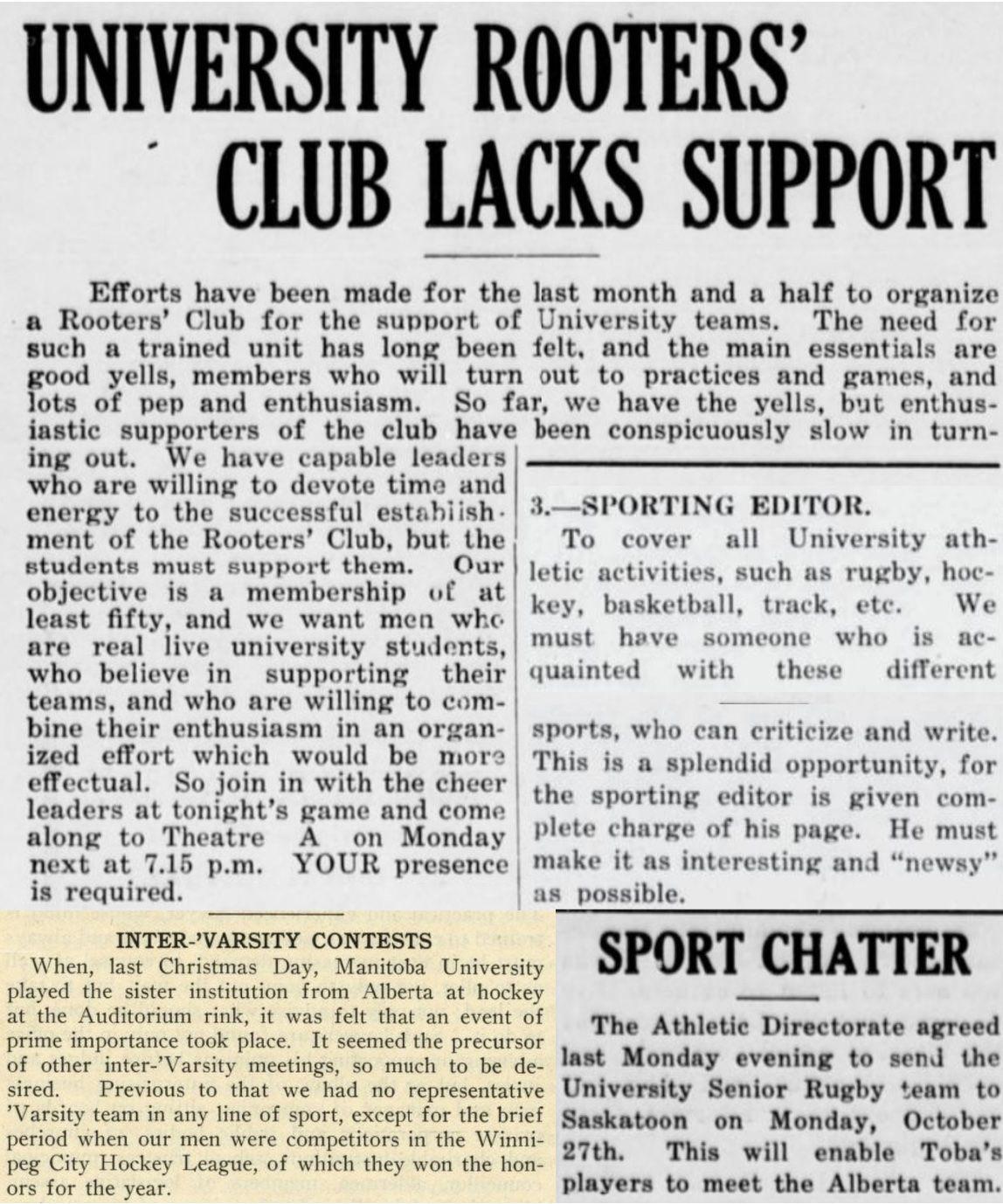
Just at this time, when our great Empire is standing firm and united in the face of a national crisis, it is fitting indeed that the various Colleges and Faculties of the University find at last common cause; and though scarred and battered in many a family encounter, emerge as a unit to support a project of common interest — a new bond of union. It is a marked and signal advance in the history of Manitoba University that the students of every College and Faculty have enthusiastically welcomed “The Manitoban” as the official student publication. In providing a medium of communication and an organ for the expression of the University life in all its phases, the columns of this paper will, it is hoped, exert a powerful unifying force and promote a broad
University spirit.
“The Manitoban” is a journal for all University men and women. The artist and the athlete, the poet and the preacher, the doctor, the druggist, the lawyer and the engineer — each has his part in the college life, and each has his contribution to make to the University journal. The graduate, too, carried back to those fabulous days in the eighties and nineties, from which time has effaced all but the romantic, the ideal — will find recorded within its covers the triumphs of his classmates; and in the light of his mature experience will foreshadow the victories and defeats of his younger brothers and sisters.
In introducing the Manitoban, therefore, as the magazine of the University of Manitoba, we claim for it the support of all our college men, old and new.
The Manitoban enters 110th year
Military Training Plans Announced
Oct. 10, 1941
Students who have applied for C.O.T.C. will assume that they have been accepted and will continue to train with the C.O.T.C. unless or until they have been interviewed and recommended to take U.M.T.U. training for this year.
Students who were graded category E last year and students who have certificates from their own medical doctor advising against military or physical training will not
be required to take military training immediately. All such students will, however, present themselves to the medical board arranged by the C.O.T.C. for verification of category. Dates of medical examinations will be announced later.
No military parades are being held at the present time at McGregor Armory. All students who have applied for training at McGregor will report to Minto.
By Marc Lagace, staff
June 22, 2011
May 31, 2011 will be remembered by Winnipeg hockey fans as one of the greatest days in the city’s history.
As members of the Canadian sports media congregated at 300 Portage Avenue on that windy Winnipeg morning, thousands of Winnipeggers converged at The Forks and Portage and Main in exuberant anticipation. At the press conference, held near ice-level of the MTS Centre, True North chairman Mark Chipman took to the podium to announce that a deal had been reached between True North Sports and Entertainment and the owners of the Atlanta Thrashers, Atlanta Spirit Group, to move the NHL franchise to Winnipeg.
After enduring 15 years of regret and despair when the Winnipeg Jets left our small prairie market for the deserts of Arizona, the announcement was a long time coming for Winnipeg hockey fans. A planned celebration at The Forks brought out thousands of Jets-clad partiers, despite the miserable weather conditions.
By Lisa Whittington-Hill
Jan. 12, 2000
University of Manitoba Director of Administrative Systems Marvin Kocay expected Monday, Jan. 3 to be a busy day. As chair of the university’s Year 2000 Committee Kocay was prepared to deal with any damage to the university and its systems as a result of the year 2000 bug. Fortunately for Kocay and other committee members the
damage was minimal.
“We’re continuing to be on the lookout and we’re fixing problems as they come up, but there have been no major disruptions and we’re pleased with that,” says Kocay. Minor problems with dates occurred, but Kocay says there haven’t been significant problems or disruptions with service.
The university began serious preparations for Y2K in early 1998. Preparations included examining build-
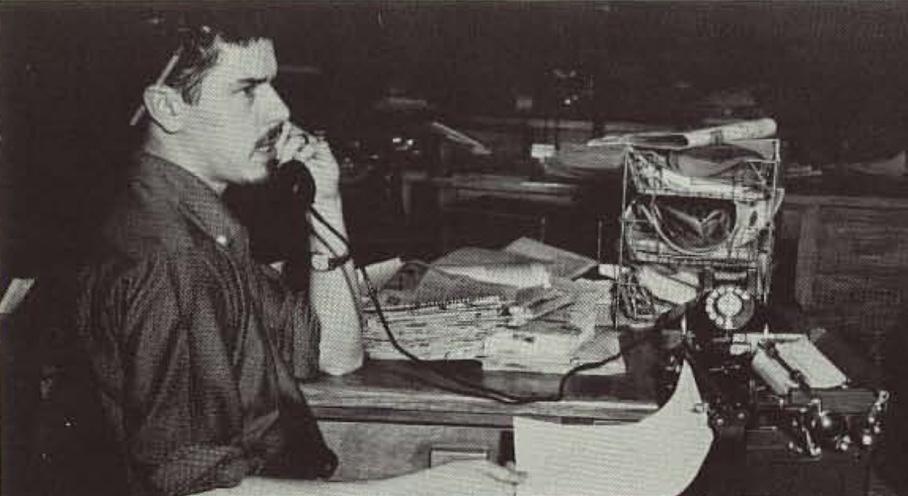
Campus editor, Kip Park, gathering more important information over one of the Manitoban’s busy phones (1961).
ing systems and heating systems, as well as taking inventory and assessing the university’s administrative systems, such as human resources and student information systems. Part of the preparations also included the establishment of the Year 2000 Committee, featuring members of the university community. The committee’s mandate was to examine various areas where problems might occur and determine how they might be fixed.
By Penny Tennenhouse
Nov. 29, 1963
A formal, solemn memorial service for the late President John F. Kennedy was conducted in the St. Paul’s College chapel Monday morning. Government, military, and university dignitaries joined with teachers and students
of all faiths to pay tribute at a requiem mass for the late president of the United States. Lieutenant-governor Errick F. Willis and Premier Duff Roblin were among the mourners. The chapel was filled to capacity. Many had to stand. About 600 people were in attendance.
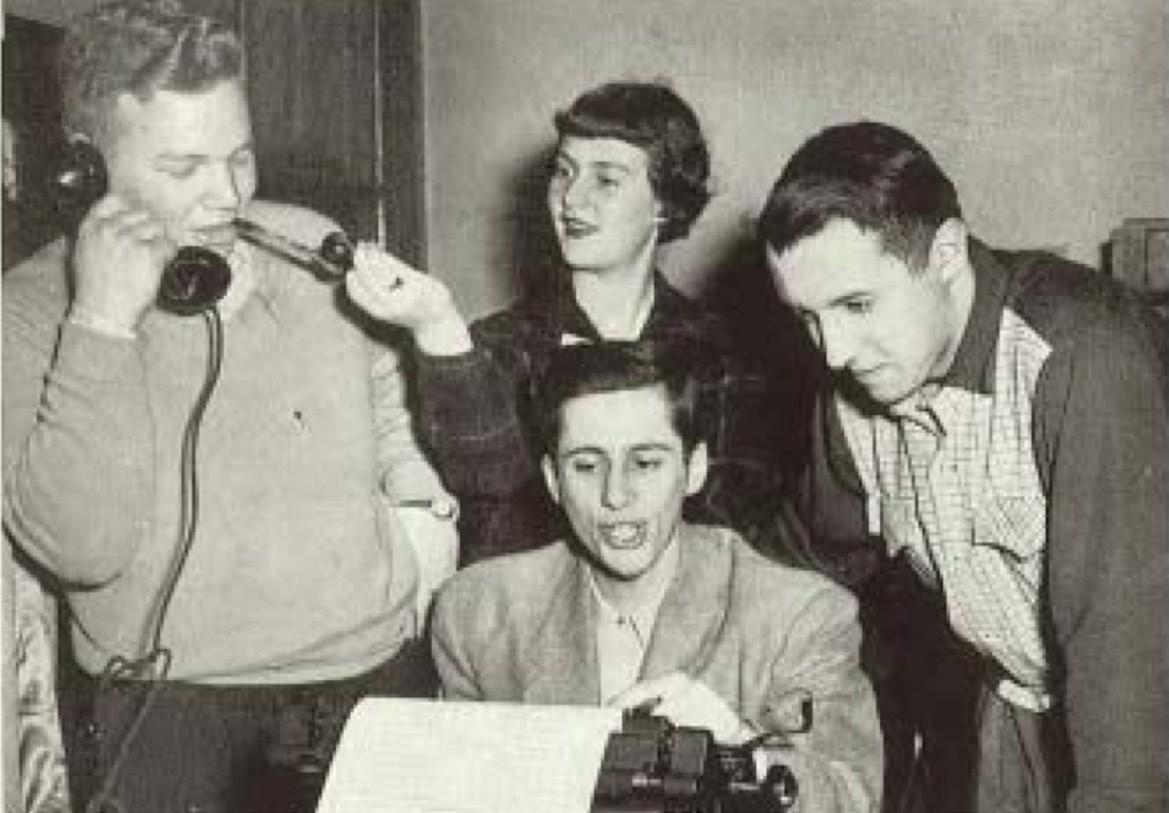
Some of the sports department, plus a gal. Mark Waldman holds the phone, sports editor Ronald Meyers says something, Aubey Rusen listens politely. Behind, reporter Myrna Maslove helps Waldman fire his pipe (1954).
The Big Brass looks over the last pages. Standing: John Kennedy—advertising manager, Brian Knapheis—news editor. Seated: Reg Skene, editor, and Gordy Morantz, managing editor (1957).
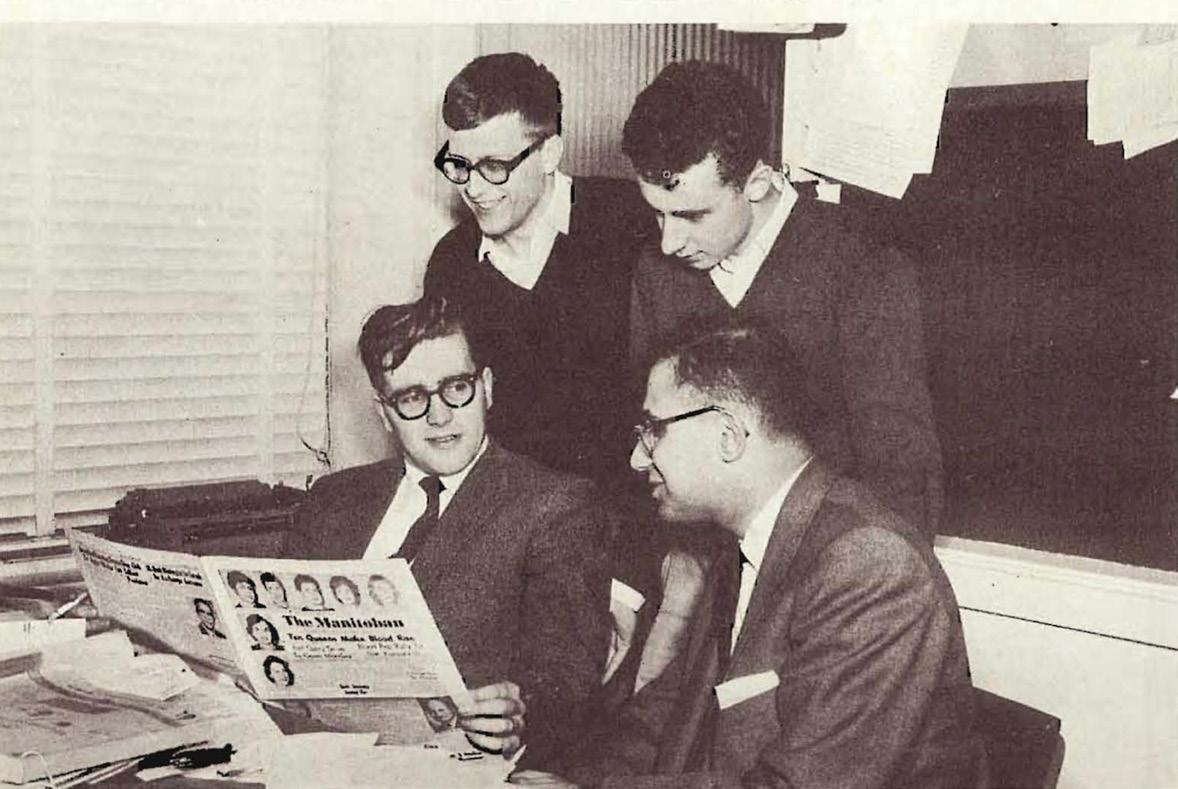
Michael P. Moore, News Editor; Shelley Tessler, Associate Editor; Cynthia Berney, Layout (1964).
EDITOR-IN-CHIEF Gillian Brown editor@themanitoban.com
BUSINESS MANAGER Dhruv Patel accounts@themanitoban.com
ADVERTISING CO-ORDINATOR Diego Castro ads@themanitoban.com
EDITORIAL
MANAGING EDITOR Ezra Taves me@themanitoban.com
COPY EDITOR Simon Pensato copy@themanitoban.com
COPY ASSOCIATE Paula Samaniego-Ayllon
NEWS EDITOR Sarah Cohen news@themanitoban.com
NEWS EDITOR Colton McKillop news@themanitoban.com
RESEARCH & TECHNOLOGY EDITOR Elah Ajene research@themanitoban.com
VIDEO EDITOR Kennedy Legault video@themanitoban.com
SOCIAL MEDIA EDITOR Violet Baker social@themanitoban.com
REPORTERS
NEWS Alicia Rose
NEWS Kyra Campbell
NEWS vacant
RESEARCH & TECHNOLOGY Rhea Bhalla
COMMENT Braden Bristow
COMMENT Hanako Teranishi
ARTS & CULTURE Kelsey Chin
ARTS & CULTURE
SPORTS Joshua Brandt
SPORTS Quinn Mayhew
VOLUNTEERS
VOLUNTEER STAFF Bahareh Rashidi
VOLUNTEER Christina Tran
interested in volunteering? email me@themanitoban.com today!
109 HELEN GLASS BUILDING
UNIVERSITY OF MANITOBA WINNIPEG, MB 204. 474. 6535
The Manitoban is the official student newspaper of the University of Manitoba. It is published monthly during the summer and each week of regular classes during the academic year by the Manitoban Newspaper Publications Corporation.
The Manitoban is an independent and democratic student organization, open to participation from all students. It exists to serve its readers as students and citizens.
The Manitoban is a member of the Canadian University Press, and our journalistic standards can be found on the Manitoban’s website.
The newspaper’s primary mandate is to report fairly and objectively on issues and events of importance and interest to the students of the University of Manitoba, to provide an open forum for the free expression and exchange of opinions and ideas and to stimulate meaningful debate on issues that affect or would otherwise be of interest to the student body and/ or society in general. The Manitoban serves as a training ground for students interested in any aspect of journalism.
Students and other interested parties are invited to contribute to any section of the newspaper. Please contact the appropriate editor for submission guidelines.
The Manitoban reserves the right to edit all submissions and will not publish any material deemed by its Editorial Board to be discriminatory, racist, sexist, homophobic or transphobic, ableist or libellous.
Opinions expressed in letters and articles are solely those of the authors. Editorials in the Manitoban are signed and represent the opinions of the writer(s), not necessarily those of the Manitoban staff, Editorial Board or the publisher.
A “volunteer staff” member is defined as a person who has had three volunteer articles, photographs or pieces of art of reasonable length and/ or substance published in the current publishing year of the Manitoban.
Any individual who qualifies as a volunteer staff member must be voted in by a majority vote at a Manitoban editorial board meeting. Elected representatives and non-students may be excluded from holding votes as volunteer staff members in accordance with the Manitoban Constitution.
U of M contributes $7.3 billion to Manitoba’s economy
Study: U of M spending, research, graduate income comprises nine per cent of GDP
Colton McKillop, staff
The University of Manitoba is estimated to have contributed $7.3 billion to Manitoba’s economy in the 2022-23 fiscal year — nine per cent of the province’s GDP — according to an economic impact study commissioned by the university.
In 2022-23, the school generated approximately $1.2 billion in direct spending, which, combined with additional add-on spending of nearly $585 million, amounts to a direct annual economic contribution estimated at almost $1.8 billion. The figure of $7.3 billion includes the impacts of the university’s research output and the alumni education premium — a measurement of how much more those with a degree earn than those without.
U of M president and vice-chancellor Michael Benarroch noted that the previous economic impact study, conducted in 2019, used a different methodology which only examined the direct impact of one year of post-secondary spending, rather than the “dynamic impacts” measured by the more recent study.
Benarroch said the study’s goal was to broaden the prior study, and ask, “Over time, what’s the impact of our graduates? And what’s the impact of the university on
how the province evolves?
And can we pick up some economic impacts that aren’t picked up in the static measure?”
The university is involved in half of all research and development in Manitoba and the research impact is estimated to be just under $3 billion.
Benarroch pointed out that the university’s research not only generates products, but also provides training to students.
“Our students get a lot of training in labs,” he said.
“They get training on how to do research in their fields, and it’s hands-on research,” he said.
“It’s something that’s practical, that then when they go into the workforce, they could use.”
Benarroch also noted that the economic impact of research is not seen immediately.
“It doesn’t happen in one year, but over time, the impact accumulates and grows and has a very large impact within the province.”
The report also found that the province receives $4.10 back for every dollar it spends, not including the amount associated with research and the alumni education premium.
Benarroch said the uni-
versity would use the study to help explain “to different levels of government, to the public, to our own students” the value that the institution brings to the province.
“In addition to the impact of us being an institution that spends a billion dollars, we have these other dynamic impacts which have had a huge positive benefit to Manitoba,” he said.
Benarroch hopes the study can be used to convince the new government to restore spending in areas like
post-secondary research and graduates, and “increase it for the whole post-secondary sector.”
Funding for graduate students gets cut “at the peril of the future growth of the province,” he said.
The direct impact of the alumni education premium to Manitoba’s economy was estimated to be $1.75 billion.
According to the report, almost three quarters of UM graduates stay in the province.
“It’s a big part of who we are
as a university,” said Benarroch, “most of our graduates stay in Manitoba.”
He said students in Manitoba should “see a really bright future for themselves when they graduate.”
“I think that what they should take from this is that, as graduates of post-secondary institutions, they have the potential to make a really big impact on the economy and on our society,” Benarroch said.
Law students attend national Indigenous legal conference
Event featured workshops, panel discussion on Indigenous legal topics
Kyra Campbell, staff
law students from Robson Hall stepped out of the classroom for the 35th annual Indigenous Bar Association (IBA) conference on Rama First Nation last month. Third-year student Shelby Sinclair, who attended IBA conferences in previous years, noted the focus on landbased learning for this year’s student day, saying that the component was different from years prior. She said they explored the outdoors looking for plants and learning about their medicinal properties.
cation on Indigenous law.
Only six weeks into her degree, Sarah Shuttleworth was initially hesitant to be the only first-year student from Robson Hall in attendance, but she found the conference
Indigenous people,” she said.
Both Sinclair and Shuttleworth said they valued the opportunity to connect with Indigenous students from other universities across the country.
“There’s so many opportunities to connect with Indigenous people that are in the legal profession”
— Shelby Sinclair, Robson Hall law student
gave her a better understanding of what she was learning in her classes.
Moving student day from meeting rooms in urban centres to the Ontario First Nation allowed students to incorporate field work into their edu-
One example she highlighted was her constitutional law class discussion of the Canadian Charter of Rights and Freedoms and the Constitution Act.
“ We were able at the conference to talk about it, but more specifically geared towards
“I was able to share my experiences with others and get some advice from people that had been in my shoes in the past,” said Shuttleworth.
Students were also able to discuss the diversity of Indigenous courses and programs offered in their law schools.
At the conference, Sinclair was re-elected as vice-president First Nations for the National Indigenous Law Students Association (NILSA) In this role, Sinclair supports and advocates for Indigenous
law students nationwide, providing resources and meeting with law faculty.
Sinclair encourages Indigenous law students to get involved with NILSA.
“ There’s so many opportunities to connect with Indigenous people that are in the legal profession and that can help you in so many ways throughout your career,” she said.
The event also saw U of M professors Leo Baskatawang and Daniel Diamond and U of M director of Indigenous legal learning and services Marc Kruse discuss the Truth and Reconciliation Commission’s Call to Action 28, which calls on all law schools to require students to take a course on Indigenous people and legal traditions.
Some other concepts highlighted at the conference were upcoming legal cases that
will affect Indigenous Peoples in Canada. The event also included discussion of people who fraudulently identify as Indigenous.
Sinclair said she worries about people who fraudulently register in the Indigenous category when applying for law school. The University of Manitoba hopes to combat this through the eventual implementation of an Indigenous identity policy.
Sinclair would also like to see the introduction of more Indigenous law courses and more content covering “how Indigenous law can be implemented in the Canadian justice system.”
“Robson Hall is definitely lacking on Indigenous law courses,” she said.
photo / Matthew Merkel / staff
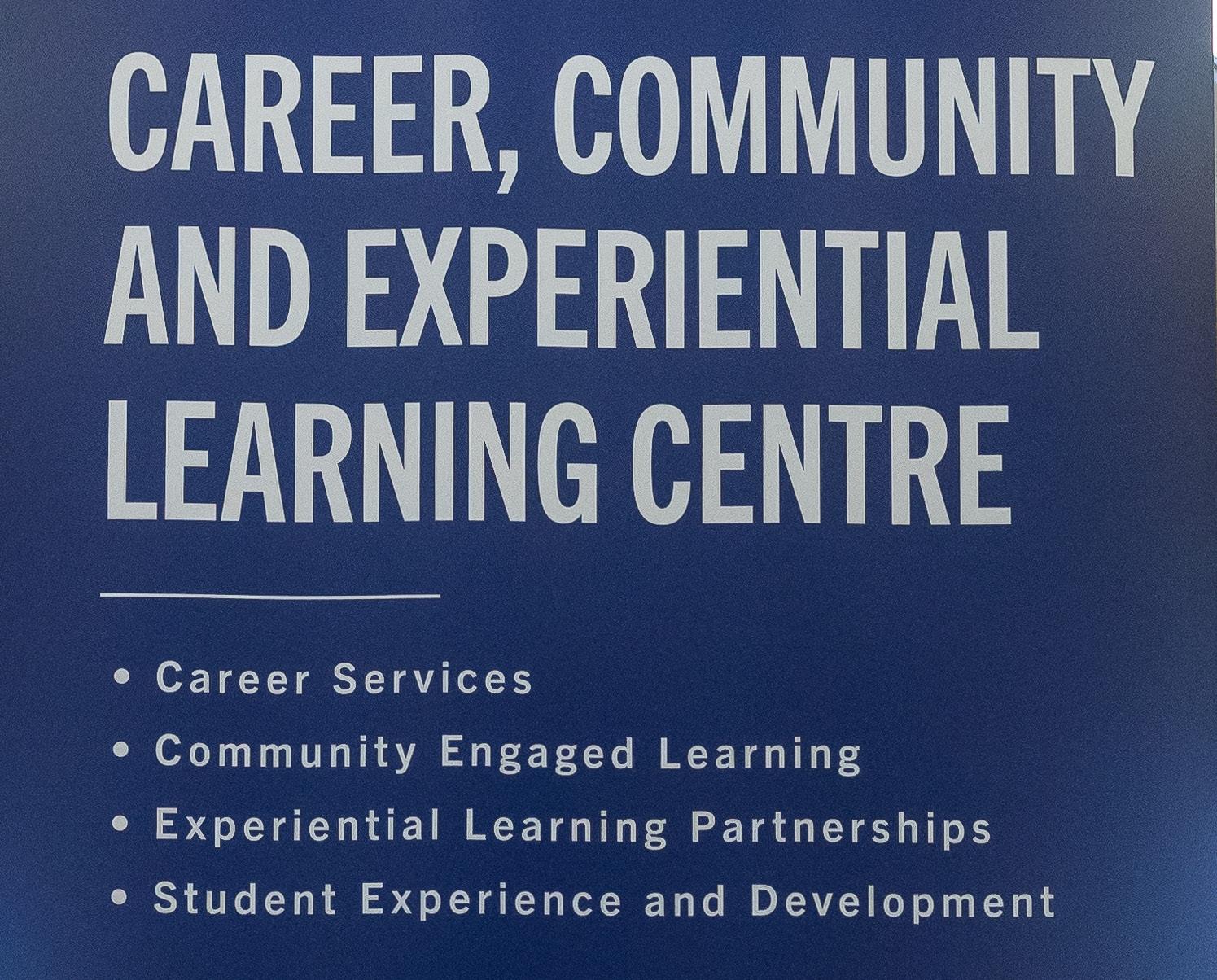
November marks Career Month at U of M
Students will see a volunteer fair and a range of events, workshops
Colton McKillop, staff
U MSU, career services and the University of Manitoba Alumni Association will be hosting a series of over 30 events and workshops throughout November for Career Month.
The month will begin with the Career Month Kickoff on Nov. 1. Those attending will receive coffee and pastries as they learn about the variety of events offered throughout the month.
UMSU vice-president community engagement Divya Sharma said UMSU is “very happy that this partnership is happening.”
“There’s so many students who come and ask us about how they can get employed on campus and we’re really happy that this month is dedicated to providing them with the support that they’ve been asking for,” she said.
On Nov. 2, Volunteer Manitoba and UMSU will host a volunteer fair which will feature booths from “a range of community organizations,” according to Lisa MacPherson, the lead co-ordinator of
career services.
“It’s going to be set up like an expo with booths on the main floor of the University Centre,” she said. “Students can come through the volunteer fair and essentially network, connect with different organizations and learn a little bit more about how they can get involved.”
The volunteer fair will feature booths by Canadian Blood Services, Festival du Voyageur, Winnipeg Child and Family Services and more.
Students looking for paid work in research can explore options at a Nov. 14 Zoom info session detailing undergraduate research opportunities at Bannatyne Campus. This event will allow students to connect with professors in fields such as neuroscience, physiology, immunology and epidemiology.
“It’s an opportunity for the principal investigators that work at the Bannatyne campus in the health sciences faculty to be able to promote their work, their part-time research assistant opportunities to students at the Fort Garry cam-
pus,” MacPherson said.
She noted that many students at the Fort Garry campus aren’t aware of the research job opportunities that exist on Bannatyne campus.
Career services will host an open house at 474 University Centre for faculty, staff and students on Nov. 16.
MacPherson said the open house is “really geared to faculty and staff members” and noted that many students are referred to career services by professors and staff.
“This is just really an opportunity for folks to come by, learn a little bit more about what we do to aid in referrals, to pick up some resources that they might want to have in their respective offices to better refer students to us and to just discuss potential collaboration opportunities,” she said.
There will be a number of workshops on career-building skills offered throughout the month. These include workshops on LinkedIn, and cover letter and resume writing which are also offered by career services monthly, as
well as workshops on occupational health and safety, marketing foreign credentials and a (Re)Writing your Career workshop. MacPherson said this workshop will give students a chance to “reflect a bit about their career story and what they want their journey to look like.”
“It’s a bit more of a creative approach to career planning and reflecting on your journey and your story,” she said.
There will also be a prize draw of $1,000 toward the winning student’s tuition. Every time a student attends a workshop or event they will be entered into the draw.
For information about Career Month, including more details on the prize draw, please visit https://www.umanitoba.ca/ career-services/career-planning/career-month.
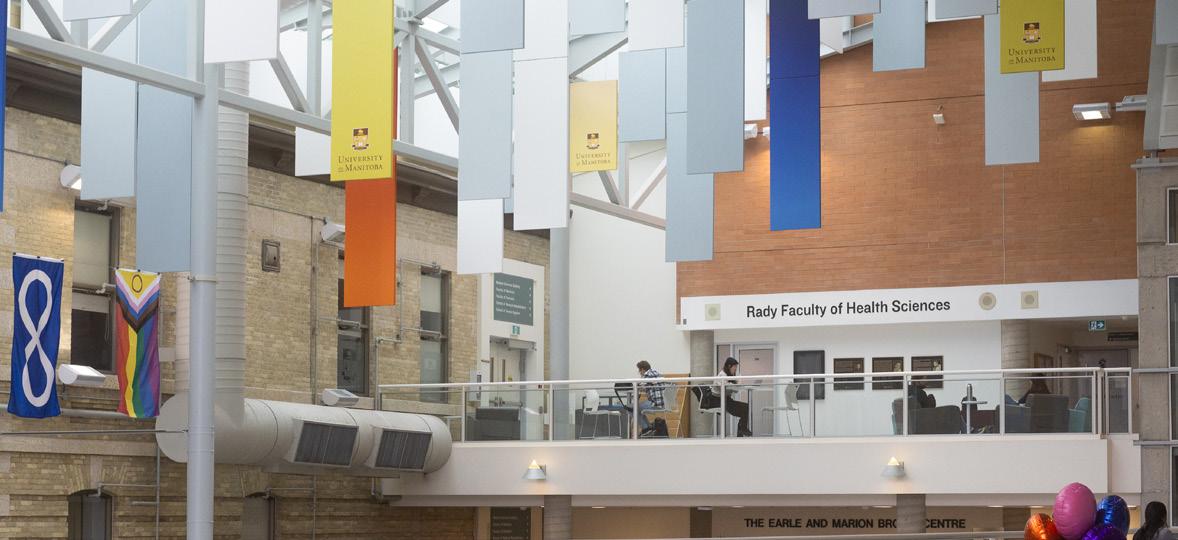
Rady faculty of health sciences hosts open house
All five colleges to present graduate programs to prospective students
Sarah Cohen, staff
Graduate programs in nursing, medicine, dentistry, pharmacology and more are available here at the University of Manitoba.
The Rady faculty of health sciences’ graduate studies program is hosting its annual open house in November for all prospective students.
Curator Hope Anderson first organized the event over five years ago in hopes of presenting the various graduate-level degrees offered in the health sciences at the U of M.
medicine, Dr. Gerald Niznick college of dentistry, college of pharmacy, college of nursing and college of rehabilitation sciences.
Before she was vice-dean, Anderson got both her bachelor’s and PhD from the U of M. She said the only way she
Anderson said that her office, the organizers of the event, have invited each college and respective masters or PhD program to present the various degrees and programs of study available to prospective students.
Associate dean of graduate studies at the college of nursing Donna Martin provides support to the graduate students in all of the college’s programs.
— Hope Anderson, vice-dean of graduate studies, Rady faculty of health sciences
knew that a graduate degree was an option available to her was through “word of mouth.”
“I decided that at some point, I was going to create opportunities for students at the University of Manitoba, and beyond, to learn about these graduate programs,” Anderson said.
Anderson is the vice-dean of graduate and post-doctoral studies in the faculty of health sciences. The faculty combines the Max Rady college of
Years later, Anderson herself had a PhD student who only knew about the programs offered through a conversation with her dentist.
Within the college of nursing, graduate students can work toward three different degrees. The master of nursing has been a degree available since 1980, the nurse practitioner program since 1998 and the PhD in nursing that has been available since 2013.
place in Manitoba where registered nurses and registered psychiatric nurses come to pursue their graduate education,” Martin said.
Martin said that graduate of the master of nursing program, Emily Hyde, used to tell incoming students that “once you have your master of nursing degree, no one can take it away from you.”
“We’re really excited that Rady faculty of health sciences is offering the open house,” said Martin.
schools in Regina as well.
“There’s no harm in coming,” Anderson said regarding the event, “knowledge is power, right? And [knowledge] can empower future decisions.”
“This is really designed for undergraduate students who aren’t sure of their next career step,” Anderson said. “We look forward to welcoming whoever registers.”
The open house on Nov. 15 from 10 a.m. to 4:30 p.m. can be found on the Joe Doupe and Hildes Concourse at the U of M’s Bannatyne campus. Shuttles from the Fort Garry campus to the Bannatyne campus will be available at 9 a.m. “I decided that at some point, I was going to create opportunities for students at the University of Manitoba, and beyond, to learn about these graduate programs”
The five colleges that make up the faculty of health sciences all offer graduate programs, Anderson said. Some are more clinical and some more research based, while some are entirely educational.
The faculty allows students who have completed their pre-requisite work in the master of nursing program to transfer directly into the PhD program.
“We are looking at being the
The open house is available to any undergraduate student in Manitoba or beyond. Anderson and her office have invited students from the University of Winnipeg, Brandon University and students from
photo / Matthew Merkel / staff
photo / Matthew Merkel / staff
Working to end intimate partner violence
U of M researchers advocate for survivors of intimate partner violence
Rhea Bhalla, staff
M
ore than one in four women experience intimate partner violence before the age of 50. A form of gender-based violence, intimate partner (IPV) violence refers to harm or abuse caused by a current or former intimate partner. In 2021, police reported over 100,000 survivors of IPV in Canada. As these incidents often go unreported, the true number could be far higher.
With police-reported incident rates steadily rising over the last seven years, combatting the “shadow pandemic” of IPV is more vital than ever.
U of M professor in the faculty of social work Kendra Nixon is a researcher and advocate for the cause.
As a student in high school, Nixon developed a passion for social issues, particularly those affecting women. She has been involved in women’s rights issues throughout her life, both as a volunteer with women-focused non-profit organizations and as a shelter worker.
Nixon’s foray into research began as a research assistant for RESOLVE—a tri-prairie research network focused on family and gender-based violence. Today, she is the director of the organization.
“The reality is that women are targets of violence,” she said. “Intimate partner violence is a serious social concern.”
Having worked in the field for nearly 30 years, Nixon noted that though many improvements have been made, there is still much to be done to address IPV.
Rather than adopting onesize-fits-all approaches to preventing and alleviating IPV, Nixon emphasized the complexity of the issue. Educating others on this complexity is important, she noted, as people experience IPV in many ways.
“When I have speaking engagements, when I lecture in classes, when I work with community members, that’s one thing I try to do,” said Nixon. “I try to explain how complex [intimate partner violence] is, and how our understanding of it is continually evolving.”
Though IPV occurs across all demographics, some groups are more affected than others. Women living in rural areas face disproportionately high rates of IPV.
Nixon was the principal investigator of Responding to Women Who Experience Intimate Partner Violence in Rural Municipalities Across the Prairies, a research project tackling this issue. The project interviewed rural women across the provinces of Alberta, Saskatchewan and Manitoba about their experiences with IPV.
The study found that not only do women in rural areas experience one of the highest rates of IPV in Canada, but a lack of resources, isolation and several other barriers make it difficult for them to seek help. IPV often involves physical, emotional, financial or sexual abuse, and may involve children.
Among other recommendations, the report suggested improving access to services, transportation, health care and police-dispatch to ensure long-term support to IPV survivors. Assistance in navigating the justice system and more diversity among police, welfare officers and shelter staff were also recommended.
Nixon highlighted the importance of protecting IPV survivors by investing in intervention, prevention and increasing funding to programs. Non-profit organizations that work directly with survivors and perpetrators of violence remain underfunded.
“Intimate partner violence continues to persist,” said Nixon. “We need to be constantly taking it seriously. We need to be constantly investing in it.”
Co-author on the report and research associate at RESOLVE, Masha Kardashevskaya, focuses her work on the impacts of gender-based violence in Indigenous communities. She explores the intersection of culture, customs and gender-based violence.
“When you do research on gender-based violence in the context of Canada, there’s always going to be that component of either Indigenous women or immigrant women,” Kardashevskaya said.
“That deals with the question of culture and cultural
tions to violence.”
“The reality is that women are targets of violence”
— Kendra Nixon, U of M professor in the faculty of social work
safety, and cultural understanding of the dynamics of violence, as well as of solu-
Her current research focuses on increasing cultural safety for Indigenous women in non-Indigenous shelters. The experiences of Indigenous survivors accessing shelters are often very different. Forty-four per cent of Indigenous women have experienced physical or sexual assault by an intimate partner, almost double the rate of non-Indigenous women.
Kardashevskaya noted the
significant negative effect of IPV on those who experience it. There are direct impacts on those experiencing violence, as well as indirect, intergenerational impacts experienced by children who grow up in homes where IPV occurs. Violence “trickles down,” she said.
“If we’re able to stop violence at this level of generation that we’re working with currently, then it’s possible that we can minimize violence in future generations too.”
Understanding and practising healthy relationships is crucial to ending IPV. This includes learning to graphic / Teegan Gillich / staff
negotiate differences and resolve power dynamics in healthy ways. Healthy relationships involve open communication, honesty and respect. Setting boundaries and practising consent are also key.
Kardashevskaya underscored the importance of taking action in one’s personal life by being educated on avoiding and addressing different forms of violence. This, she said, is crucial to being “not a bystander, but an advocate.”
From rust to innovation
U of M researcher investigates the application of epsilon iron oxide in magnets
Elah Ajene, staff
U of M doctoral stu-
dent in the department of physics and astronomy
Rachel Nickel is exploring the use of nanoscale particles in the application of magnets.
Nickel started off working in biomedical applications after completing her undergraduate studies. During this phase, she focused on using magnetic nanoparticles to combat biofilms — matrices of microorganisms that form on surfaces.
Over time, Nickel shifted her focus to a more in-depth study of a specific magnetic nanoparticle called epsilon iron oxide.
“I always knew I liked magnets,” she said.
“I really fell in love with how interesting this material is and the potential for it.”
gives rise to intriguing properties, making epsilon iron oxide an exciting candidate for various applications.
One of the standout features of epsilon iron oxide is that it is magnetically hard, meaning that when it is magnetized, the magnetic domains within the material strongly resist changes to their alignment.
“Say you have all the little compass needles in the iron pointing the same direction, they want to stay the same direction,” Nickel explained.
“It’s really hard to twist them around and flip them.”
This characteristic is particularly advantageous for developing permanent mag-
permanent magnets, such as neodymium magnets — the strongest commercially available permanent magnets.
Nickel explained that these magnets are typically mined and often come from conflict regions. Canada, on the other hand, has abundant iron resources, she noted.
“It provides a really interesting and exciting alternative to what we currently use for permanent magnets,” Nickel said.
In August, Nickel and her team published a paper in Nano Letters on epsilon iron oxide.
“I really fell in love with how interesting this material is and the potential for it”
The material, which has only been studied for the past two decades, exclusively occurs at the nanoscale.
— Rachel Nickel, U of M doctoral student in the department of physics and astronomy
Unlike common rust, epsilon iron oxide exhibits a “frustrated structure,” where the arrangement of atoms takes on a more twisted and less orderly pattern.
This structural complexity
nets, which are crucial components in many devices such as motors, loudspeakers or hard drives.
The significance of epsilon iron oxide becomes evident when considering the current reliance on rare earth-based
Instead of bulk quantities, epsilon iron oxide is found in the form of nanoparticles.
“You can fit about a thousand of them in the width of a single hair,” Nickel said.
The size of these nanoparticles impacts their behaviour and properties. Nickel’s research focused on investigating how the properties of
epsilon iron oxide change as a function of size using three different particle sizes.
“Size dependence is something that we need to understand in order to use this material in the future,” she said.
To conduct her research, Nickel collected her measurements using a range of advanced research facilities and equipment at the U of M, including the Manitoba Institute for Materials, which offered a transition electron microscope for viewing tiny particles.
Her final set of measurements were collected at the Advanced Photon Source facility in collaboration with the Canadian Light Source facility using a synchrotron, a machine that accelerates charged particles such as electrons to generate high-intensity X-rays.
Ultimately, these tools enabled Nickel to gain insights into the structure of epsilon iron oxide.
“All those measurements put together paint a full picture of how things change as a function of size,” she said.
Looking ahead, the most promising direction for Nickel’s research lies in harnessphoto / provided
ing epsilon iron oxide for technological and magnetic applications. Epsilon iron oxide’s appeal lies not only in its potential for permanent magnet uses but also in its electronic behaviors including its resonant frequency, which could have a significant impact on advanced wireless communication systems.
While this journey may be in its foundational stages, Nickel believes that epsilon iron oxide’s distinct properties make it an exciting candidate to meet the growing demand for magnets and magnetic materials in various fields.
“It’s something that we can really look into,” she said.
An ode to The Real Housewives from a history lover
The importance of gossip from now to Ancient Rome
violet baker, staff
Bravo’s The Real Housewives is my Roman Empire. I mean, the Roman Empire is also my Roman Empire, as a classics student. One way or another, I love and am obsessed with The Real Housewives and history.
For some reason though, when I tell people this, they look at me like I grew a second head. Unless of course they have seen the show — then their eyes sparkle. Because honestly, The Real Housewives and history have more in common than you would think.
They are both gossip.
History is gossip mostly written down by men, about men studied by men. In my opinion, The Real Housewives is gossip told by women viewed mainly by women, and is about women.
Both illustrate events, themes and lessons that we can learn from. Both discuss alliances, marriages, affairs, divorces, prejudices, religion, frauds, lies, declarations of war and more.
These similarities pervade The Real Housewives, especially in specific relationships or events.
Take The Real Housewives of New York City (RHONY) for instance. The show reminds me of the evolution of the Roman Empire. The Roman monarchy lays out the gen-
eral vibe of the future empire with the Books of Sibylline, which supposedly predicted the future, while the first seasons of RHONY lay out some of the raw craziness to come. Specifically, the season three cast trip, nicknamed “Scary Island.”
This cast trip is one of the most dramatic trips in the early seasons and comes with some still-iconic lines in RHONY. The ladies take a vacation to the U.S. Virgin Islands, where Housewife Kelly Bensimon becomes “cuckoo for cocoa puffs” and believes fellow Housewife Bethenny Frankel is out to kill her. All the while, Housewife Ramona Singer is trying to escape for some fun “turtle time.”
in which Hannibal crossed the Alps in 16 days with his army of 30,000 troops, 15,000 horses and 37 war elephants, followed later by Hannibal s tactical masterpiece against the Romans at the Battle of Cannae.
Both of these events marked pivotal moments for the show and state, respectively. Drescher finally left the show, fan-favourites “the countess” Luann de Lesseps and Frankel returned and Dorinda Medley joined the cast. Meanwhile, Rome finally got control over
concerns over her then-fiancé’s cheating even when faced with photos and multiple eyewitnesses.
These themes and sayings have made an impact on our modern society
long-time enemy Carthage and Roman hegemony over the western Mediterranean.
The following seasons lay out who Bravo will follow through storylines and who will lead the show. This is similar to the Patricians, the ruling class group of families, that were impactful in the Roman Republic into the Roman Empire.
While RHONY has Housewife Aviva Drescher lose the plot and scream, “the only fake thing about me is this!” while throwing her prosthetic leg onto the table in the season six finale, “The Last Leg,” the Romans have the Punic Wars,
The Roman Empire holds some of the most iconic and truly insane moments in history, as does RHONY seasons eight through eleven.
De Lesseps is truly on par with the entire Julio-Claudian family for the insanity she instigates. Caligula planned to name his favourite horse a consul, de Lesseps wiggles her way out of handcuffs in an attempt to escape arrest from the Palm Beach police. Nero ignored his responsibilities as emperor to be a musician while Rome was burning, de Lesseps ignored Frankel’s
There, of course, is the downfall. For Rome, it began in late antiquity with the crisis of the late third century, which was plagued by enemies, illnesses and economic downturn. In RHONY, the age differences between the audience and the women catches up to them. Specifically in seasons 12 and 13, when the women seem only satiated by exorbitant amounts of alcohol and make multiple racist comments toward Housewife Eboni
K. Williams, the first Black Housewife in RHONY history.
Both however get a bit of a revamp. RHONY completely scraps the cast to bring on a group of younger, hip and more diverse women, while the Roman Empire scraps itself to become the Holy Roman Empire. Same name, but completely new group of players and a vibe change.
The similarities between the franchise and history don’t stop just at major themes, but also iconic sayings. The Roman Republic has the phrase “Senatus Populusque Romanus,” Latin for “ The Senate and People of Rome.” The Real Housewives
have their opening statements for every intro to an episode. One of my favourites being Singer’s tagline in season 9, “I’m an acquired taste. If you don’t like me, acquire some taste!”
Beyond the realm of phrases consistently used in the show or empire, there are still the iconic one-liners.
One of the most wellknown from The Real Housewives is from the season nine reunion of The Real Housewives of Orange County. In the episode, Housewife Tamra Judge goes from zero to ten thousand while discussing Vicki Gunvalson’s then-boyfriend Brooks Ayers, suddenly screaming “That’s my opinion!” across the couches.
Although the Roman ones might have had less screaming, it doesn’t make them any less iconic. Such as “Veni, vidi, vici” translated in English to “I came, I saw, I conquered” said by Julius Caesar after winning a battle in Asia Minor.
Even if you don’t realize it, these themes and sayings have made an impact on our modern society from the way we interact to the sayings we use. Everything can be seen in a larger lens through ancient history or reality TV shows such as The Real Housewives
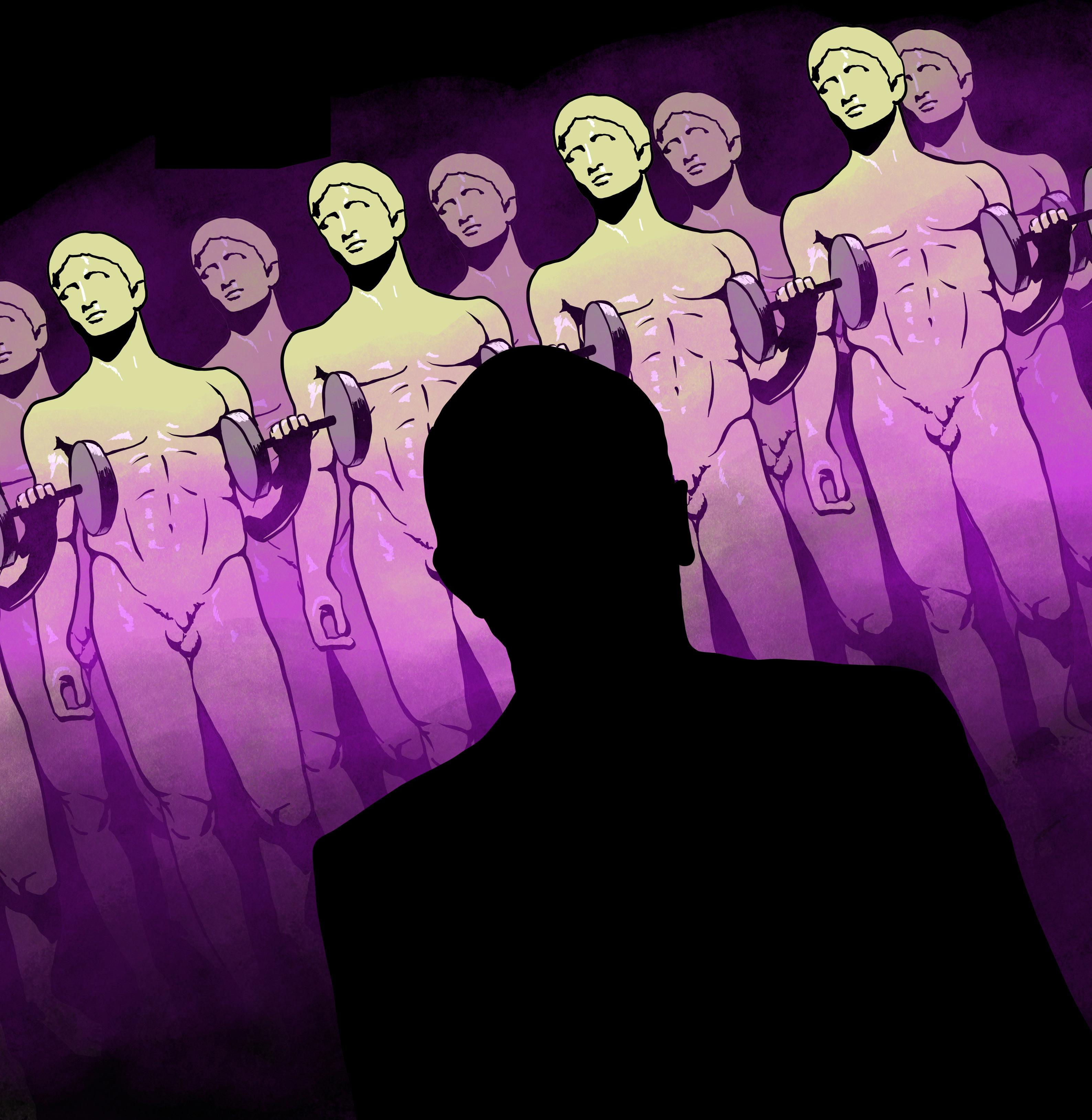
Fitness culture and fatphobia are fascistic
Our obsession with looking the same is culling joy and body diversity
Jessie Krahn, staff
In 2021, around two thirds of Canadians had gym memberships. The third who didn’t presumably were doing Chloe Ting’s monthlong YouTube workout regimens. Meanwhile, internet body-building personalities like Jeff Nippard are animating pictures of their bulbous pecks to slide up graphs, and nobody is trying to stop them. We fawn over fitness.
Fitness culture and fatphobia are fascistic fads, although their fans feign them as the favoured formulae for fleeing our mind worlds towards a flab-free one. Fitness influencers are basically peddling Nazism.
Imagining fascists, people likely think of goose-stepping Germans. Nazis are scary, but the SS’s marching chokehold on the public’s imagination when we broach the subject of fascism leaves the vast majority of us ill-equipped to identify fascistic tendencies elsewhere.
Nazis propagandized fitness as Germans’ duty to the nation. This was highly compatible with other parts of the Nazi project, namely to manufacture a homogenous Aryan population and erase all bodies that did not match their ideal. These are heinous strains of logic which have been exported from fascist movements and sewn into the fabric of public life.
The fascistic part of fitness culture is the way it frames exercise as a moral lifestyle that we should all — every single one of us — aspire to. The Centers for Disease Control and Prevention suggests that the reasons why you want to lose weight might include wanting to “see your kids get married” and this can be attained by organizing one’s entire lifestyle around weight loss.
Missing a workout in these circles is tantamount to failing not just yourself, but everyone around you. You’re letting your future child down on their future wedding day by eating fries and skipping chest day this week. If you slip up and miss a workout, fit-fluencers will tell you it’s okay, all you have to do is just not do that very often. Consistency is key.
our lives around our fitness regimens, and those five days a week when we’re supposed to work out must be in service to making ourselves as strong as possible.
Fitness fanaticism constipates our personal growth. Think about what it means to “work on yourself.” It often
The veneration of fitness is the worship of sameness
Prof. Brian Pronger points out that almost everything that we stress about physical education centres around maximizing the body’s performance. It’s the way that we are all expected to structure
means to work out, as if your character is tied to your physical strength and muscle tone. Where improving your self probably ought to mean expanding your empathetic range, exposing yourself to new people and ideas, learning new skills and strengthening your moral codes, the fascistic undercurrents of fitness culture teach us to moralize our bodies.
For philosopher Walter Benjamin, fascism introduces
aesthetics into politics. That is, good politics for fascists are an aesthetic. Fitness is an aesthetic that gives us information to judge people with. Being fit is good and legible. We see a six pack or ski-slope traps and we are supposed to know a person has worked on themselves. Whereas fat people must be read as either earlier in their journey to self-improvement or contemptible because they refuse to do it.
Many of us have motivations to exercise irrespective of our bodies’ appearances. I do yoga because my joints are falling apart from my sedentary lifestyle, and I go on runs when I need to escape the horrifying maw of my mind. Human life has always involved joyful movement. Dance and sports exemplify the ways exercise keeps human culture moving.
It’s not the concept of exercise that is fascistic, though. Pronger explains that physical education’s one-note emphasis on performance could not capture the “infinity” and joyfulness he feels while swimming. It’s the cultural phenomenon of lifestyle fitness that’s objectionable, demanding everyone to prove their allegiance to the perfect body type through a constant and lifelong regimentation.
Fitness culture saps the joy from movement, encouraging us to spend around five days a week alone at exercise machines moving for the sake of our shapes. North America’s fitness frenzy stunned French philosopher Jean Beaudrillard, recalling what he saw apocalyptically. “Nothing evokes the end of the world more than a man running straight ahead on a beach,” he wrote. Joggers especially freaked him out, but he thought of body-build-
ers too as living in a “ blank solitude.”
What ultimately reeks of fascism to me is the way fitness culture is advertised as the key to disappearing fat bodies. Fear of fatness is at once a disgust for certain types of bodies and a way of reminding everyone what they exercise for. You work out so you never become like the fat people who are content being that way. The veneration of fitness is the worship of sameness, the celebration of the absence of variations in humans’ physical forms.
The next time you’re binging YouTube videos of bulky boys blending boiled unseasoned chicken breast into an abominable muscle growth potion, take a pause. Is doing deadlifts appealing because they might make you look like Joey Swoll after a pump, or is it because you’re afraid of what will happen to you if you don’t look like him?
graphic / Dallin Chicoine / staff
A Jewish perspective on the Israel-Hamas war
Consider how your social media posts affect others
Sarah Cohen, staff
The Manitoban does not publish any facts that are not backed up by evidence from a reputable source. However, this article is in the comment section, which means that I can write my opinions and interpret situations how I see fit. I urge you to read this with an open mind, understanding that we probably come from different places and my experiences may be different from yours.
Reading my byline, “Sarah Cohen,” some readers will correctly assume that I am Jewish. I mean, the name is almost as Jewish as it gets.
I want to explain another perspective on the IsraelHamas conflict from my specific social position. The authors of articles on this topic in recent issues of the Manitoban are not Jewish or Palestinian. While they are free and welcome to have an opinion on the topic, they do not have the same connections to it that I have.
Being Jewish is a hard thing. It has never, ever been easy and I highly doubt it ever will be. We were persecuted and our temples were destroyed by the Romans as far back as over 2,000 years ago and villainized in Shakespearian plays like The Merchant of Venice
Our movement was restricted by Russians during the Pale of Settlement, and our culture and lives destroyed during eastern European pogroms. Then came Adolf Hitler, who organized the hunt for and torture and mass murder of millions of Jewish people: the Holocaust.
Even now, our temples are the sites of gun violence, and Nazi swastika flags abound. Antisemitism is rampant, and Canada is no exception.
Antisemitism is discrimination, hostility and prejudice against Jews in thought, speech and physical or social action. It is not limited to certain places. According to the Canadian Museum for Human Rights, support for Nazis and antisemitism was “widely and openly promoted” by the everyday individual and by political leaders in Canada leading up to and during the Second World War.
In the 1930s and 40s, when Jews were trying to escape Nazi Europe, Canada restricted the number of Jewish people allowed to immigrate to less than 5,000. That is not a lot.
I am not explaining antisemitism to deny the existence of Islamophobia and xenophobia. The Christian world seems to do anything to marginalize the other two
Abrahamic religions, sometimes pitting us all against each other.
To put this into perspective, out of the eight billion people on earth, around 15 million are Jewish. That’s not even half of one per cent of the world population. So why, if we make up a literal sliver of the earth’s population, are we hated and persecuted so much?
Since the terrorist group, Hamas, launched a heinous attack on innocent and unprepared Jewish and Israeli civilians a few weeks ago, I’ve seen and heard many things about it on social media, in mainstream media coverage and through conversations in class, at work and with friends and family.
Here is what I want you to know: not all Israelis are Jewish. Not all Jewish people or Israelis support the Israeli government. Neither are all Palestinians part of Hamas.
Many Jews and Palestinians live in diasporas, which means many of us don’t live in our homelands. The unfortunate thing is that we both believe our homelands are on the same, small piece of land.
From my understanding, Israel was established after the Second World War as a place for the Jewish survivors of the Holocaust who were still facing antisemitism to exist in peace. This would be
a place that we had originally come from that we could go back to and be safe.
Jewish people want to feel belonging and safety, as do Palestinians.
While the Israel-Palestine conflict has been ongoing and unfair for decades, the current war is not Israel-Palestine. It is Israel-Hamas.
Solutions regarding the longstanding Israel-Palestine conflict and tensions are not black and white. While the discussion seems to be only pro-Israel and pro-Palestine, there is still a two-state solution. I wholeheartedly believe that Palestinian civilians should be allowed to move freely with Israeli civilians in a two-state solution.
Let the Jewish people finally have a place to call home and let the Palestinian people live in collaboration with them. Allow the space to be both Israel and Palestine.
Since Hamas attacked Israel, I have seen an immense amount of misinformation and hate from both pro-Palestine and pro-Israel groups. I understand that everyone wants to voice an opinion, whether this situation actually pertains to their person or not. But there are things that are not okay to say or to post. No matter what your stance is, please know that words mean things. What you repost may make your friends feel in dan-
ger.
Promoting the destruction of Israel, the only country in the world with a Jewish majority population, is inherently antisemitic.
Promoting the death of innocent Palestinians and Israelis is inherently evil.
At the end of the day, we are all human beings — humans who have friends and family members missing or killed.
Sometimes, what you post on your Instagram story can have huge repercussions. Posting a story that says something that promotes Hamas or the destruction of Israel is directly implying that you promote the obliteration of Jewish people.
Article seven of the original Covenant of Hamas — Hamas’s governing document from 1988 to 2017 — specifically illuminates the terrorist group’s intention to kill Jews. It reads, “the Day of Judgement will not come about until Moslems fight the Jews (killing the Jews), when the Jew will hide behind stones and trees.”
It is evident that Hamas’ intention with its October attack was to kill all Jewish people. Jewish people have already gone through a genocide. Supporting Hamas is supporting another genocide of Jews.
What the Israeli government has done to innocent
Palestinian civilians is not okay. War is never okay, but the way of the world is war, apparently. While the Israeli government has commissioned certain acts in Palestine that are inhumane, it is defending itself from a terror attack.
Inform yourselves before you post, make sure your sources are reliable and the facts that you are reposting are accurate. Ensure that what you promote does not put a marginalized group at risk.
Jews have had to grieve repeatedly for the longest time. Often we are forced to start the grieving process over again before we’ve finished the last aggrievement. I understand the pain that all Jews, Israelis and Palestinians are enduring. We are all grieving. Our individual circumstances and histories make this a fight that is extremely emotionally charged, and we all need to approach the discussion around it with kindness, respect and understanding.
Jews in the diaspora often don’t feel safe, especially with popular rhetoric right now, even from our friends. We are all humans trying to get through each day. None of us should die at the hands of another just because of where we come from or which religion we follow.
graphic / Christina Tran / staff
Mental Health Week
Journalism, responsibility and influence
Reflecting on responsibility in journalism and reporting
braden bristow, staff
F or over a century the Manitoban has been at the forefront of the fight for a slightly more informed world. This fight has raged since humanity first started lying to each other, but continues to this very day.
Journalism as a discipline is important, but also easily misused and poorly applied. Journalists have a critical responsibility to the readers and the public because of the popularity and impact of journalism as a discipline.
One study illustrates the social impact of newspapers by looking at readership numbers that illustrate their general popularity. In 1955, a Royal Statistical Society study conducted in the United Kingdom compiled readership data and found that an average of 80 per cent of the more than 12,000 respondents polled read a national daily newspaper.
A more recent 2013 study conducted in the United States found that 71 per cent of polled respondents watch local television news.
However, journalists also have a responsibility to the public not just because of the historical popularity of the news, but because of the influ-
ence that journalism can have.
Another 2013 study conducted in the United Kingdom found that respondents believed that the proportion of those fraudulently claiming disability benefits was anywhere between 10 per cent to 70 per cent, while in reality it was around 0.5 per cent. Furthermore, respondents also held negative prejudices to those they believe have fraudulent disability claims.
These beliefs were, according to the respondents, informed by newspaper articles focused on disability claims. Simply because of their exposure to frequent articles politicizing fraudulent disability claims, the individuals in this study experienced a negative shift in opinions.
positively direct thought.
Way back in the first issue of the Manitoban, published Nov. 5, 1914, where articles discuss the First World War, there is an article titled “Dr. Allison’s lecture on the war.”
The article uses terms which could easily influence perception of events, such as “German barbarities” when referring to crimes committed by German soldiers and “the titanic struggle” of the British Empire’s war effort. There is also mention of the “remark-
noteworthy when it comes to a conflict such as the First World War in which the British Empire and Germany both used thousands of tons of poison gas.
Journalists such as myself have a responsibility to the reader and to the public at large
able” and “splendid preparedness” of the government.
The ability to impact readers to the point where their perceptions are not in line with fact, especially in a negative sense, needs to be taken seriously.
The Manitoban, while employing rigorous citation, sourcing and fact checking has been responsible for articles that could both harmfully impact public perception and
The language of the article along with sympathetic reporting could shift a reader’s perception of the conflict as a mightily prepared British Empire against a vile and barbaric Germany. War, and conflict in general, is rarely as simple as a good guy and a bad guy.
Characterizing one side of a conflict as the good guy and the other as the bad guy is both reductive and irresponsible. This is particularly
Going forward 89 years, there is an article from the Manitoban published only six days after the outbreak of the Iraq War. The article published March 26, 2003, titled “The costs of war” approaches the topic of war from a different, less biased perspective. The article written by David Leibl, was an editorial — unlike the article on Dr. Allison — and used less biased language approaching the Iraq War while critically questioning the conflict itself.
Leibl’s article challenges the reader to think critically about the conflict, asking important questions and offering potential alternatives for humanitarianism rather than conflict. Meanwhile, the article on Dr. Allison approaches the First World War encouraging a nationalistic positivity for the British Empire, with prejudiced language toward Germans.
Journalists writing com-
ment or editorial pieces are entitled to their opinions, as long as these opinions are backed up by facts and reason. However, news must approach topics as objectively as possible. Compelling news is going to have an angle, but having an angle and engaging in irresponsible reporting full of bias are two different things. As a columnist, all of my pieces are filled with my unwarranted opinions, but any facts, claims or accusations have to be backed up with rigorous fact checking. Because the frequency of pieces and the content of pieces can impact audiences, journalists such as myself have a responsibility to the reader and to the public at large. Writers can affect perception and thought, and lead the reader to draw certain conclusions.
As a final note to the writers of the Manitoban and any other writers reading, continue publishing great pieces of comment, editorial and news while exercising responsibility and critical thought. To the reader, think critically when you read any journalistic pieces or see articles frequently touching on the same topic.
Safe spaces on campus do not include police
Police presence conflicts with safety policies
Hanako Teranishi staff
The Manitoban’s Oct. 18, 2023 issue ran a feature covering the memorial Friday, Oct. 13 organized by Students for Justice in Palestine. During the memorial, police asked students not to display Palestinian flags, storing them in a police patrol car. Later, students’ flags were returned, but officers asked students to keep their flags “understated” due to “political sensitivities.”
The police presence was allegedly meant to increase and provide security, yet through police interference students felt understandably frustrated and upset.
Security personnel do usually appear in different forms on campus. The University of Manitoba’s security services offers the app UM Safe, and transportation safety programs. University security guards also often patrol campus, too. However, police presence on campus is incredibly uncommon and concerning for a host of reasons.
The incident between students and police on Oct. 13 is
indicative of a larger issue of policing, and specifically policing on campus.
The University of Manitoba stresses students have a right to a safe and respectful space. One of its policies is preserving a respectful place of work and learning, which entails providing an inclusive environment free from discrimination or harassment.
The university also has a policy regarding violent or threatening behavior, which emphasizes “creating and maintaining a safe, positive and productive work and learning environment that is free of violence.”
These university safety policies align with the foundations of what safe spaces are. However, there are flaws within the construction of safe spaces that police presence amplifies.
Bennett Carpenter, Laura Goldblatt and Lenora Hanson illustrate issues with safe spaces in their article “The University Must Be Defended.” They argue there are problems with safe spaces,
specifically with how the feeling of security can only be derived “in relationship to danger or a lack of security.” If there are spaces that are safe for some people, that implies there are other spaces — and therefore other people — that are unsafe.
A second issue the article outlines lies in how security is targeted against “unauthorized,” racialized bodies, or those who appear to be out of place. This is emphasized further when these bodies “have been displaced and dispossessed by the physical expansion of the university.” Safe spaces result in the maintenance of areas of exclusivity through police surveilling and being ever more violent toward people.
The presence of police on campus impacts the safe spaces the university intends to create by enabling and legitimizing policing and surveillance in these spaces. On campus, this surveillance does not encourage a feeling of security, but rather creates tension and fear because of
the history and ongoing cases of racism and police brutality within universities.
Police also differ from security guards in that there is an intense increase in militarization. Having armed police officers in uniform on campus to provide security often causes an adverse effect on students.
These impacts directly challenge the policies set forth by the university. At the Oct. 13 memorial, the police presence and intervention intended to provide security created tensions within the student body and resulted in frustration because students
felt they were unable to carry the flag that represents them.
If the university intends to create inclusive environments where students feel safe, a police presence on campus directly conflicts with that aim.
Students should always feel safe on campus and are promised the right to be free from any form of discrimination and violence. All campus spaces should be safe for all students, and this cannot be done with the presence of police.
graphic / Teegan
Gillich / staff
To complete Sudoku, fill the board by entering numbers 1 to 9 such that each row, column, and 3x3 box contains every number uniquely. In Straights, like Sudoku, no single number 1 to 9 can repeat in any row or column. But rows and columns are divided by black squares into compartments. Each compartment must form a “straight.” A straight is a set of numbers with no gaps but it can be in any order, eg [7,6,9,8]. Clues in black cells remove that number as an option in that row and column, and are not part of any straight. Glance at the solution to see how “straights” are formed.
Clues
As the Manitoban approaches the midway point of its 110th publishing year, we are reminded of the vital role that student journalism plays in a university’s society.
Journalism is essential to a functioning democracy. Good journalism holds institutions accountable and keeps members of the public informed on issues that matter to them. Student journalism has a particular part to play, covering stories and issues that major outlets often overlook. It also gives students a platform when their voices might not be heard elsewhere.
Student publications provide aspiring journalists and creatives with opportunities to develop key skills in writing, reporting, photography, editing, illustration and design. Because the University of Manitoba has no journalism program, the Manitoban has had a crucial role in forming many future journalists within the province over the past century.
The Manitoban has influenced the lives and careers of many students, former and present, and they in turn have shaped what the Manitoban is today. Every person who walks through the doors of the newsroom makes an impact on the paper in some way.
If you’ve picked a copy of the Manitoban during your time at the U of M, thank you. We do this job because we love it. You have supported the many hours of dedication and effort that go into each and every issue.
-30-
Gillian Brown, Ezra Taves and Jessie Krahn, staff
graphic / Teegan Gillich / staff
On marronne? (Si ça te dit, viens) and its quest for identity
Théâtre Cercle Molière’s play will finish for the season Nov. 4
Jacob Davis, staff
Identity and mythologies of a people come alive in Théâtre Cercle Molière’s On marronne ? (Si ça te dit, viens) written by playwright Gustave Akakpo and directed by Geneviève Pelletier. The production has four final days of showing before it finishes for the season on Nov. 4.
The story follows Adelaide, who is from Senegal but ends up in French Guiana, her journey of moving to a new land overnight and the struggles of identity that come with it.
Presented through her character, questions rise about topics like collective identity, memory and the mythologies of a people.
Adelaide is in a new environment that she calls home, but while preparing to preach at an Evangelical gathering, she decides that she wants to teach Indigenous ways of teaching, said Pelletier, artistic and general director at Théâtre Cercle Molière.
Pelletier said the play discusses subject matter on how spirituality and religion can affect someone on a daily basis, spiritual journeys and a
variety of other themes.
The goal of the play was to ask, “how can we talk about these things, and feel like everyone has a space to talk about their perspective on things?” Pelletier said.
“We felt that because Indigenous cosmogony has been so vilified and sort of underground for so many years, where do we place those with what we call ‘the book religions?’”
Pelletier said the book religions, in contrast with Indigenous spirituality, “have been more colonial approaches to Indigenous lands.”
Pelletier pointed out Senegal’s creation stories have been vilified by colonial statutes. Despite these heavy subjects, the production infuses itself with rap, dancing, music and slam poetry, adding a lightness to it.
Théâtre Cercle Molière believes that performing arts should be accessible, which is why they have a pay what you can system for tickets. However, accessibility does not end there for the company. During shows, including for
On marronne? (Si ça te dit, viens), there are tablets available that feature subtitles in both English and French, providing anglophone or nonFrench speakers with a means of understanding what is being said on stage.
“I think access is really important,” Pelletier said. “I feel there are lots of barriers for people to come to the theatre, and we really try to examine those in a variety of ways.”
Pelletier hopes to see a variety of different folks at the last showings, and added that there is a question and answer period almost every night in order to create dialogue around the productions occurring this season.
Théâtre Cercle Molière will be showing On marronne ? (Si ça te dit, viens) until Nov. 4 2023. Tickets and more information are available on its website.
OurToba brings the blizzard with Cold Reading Event
Actors and writers gather together Nov. 1 for a night of creative exploration
Kelsey Chin staff
The King’s Head Pub will once again be filled with actors set to take on brand new works by women, non-binary and gender-diverse writers on the evening of Nov. 1.
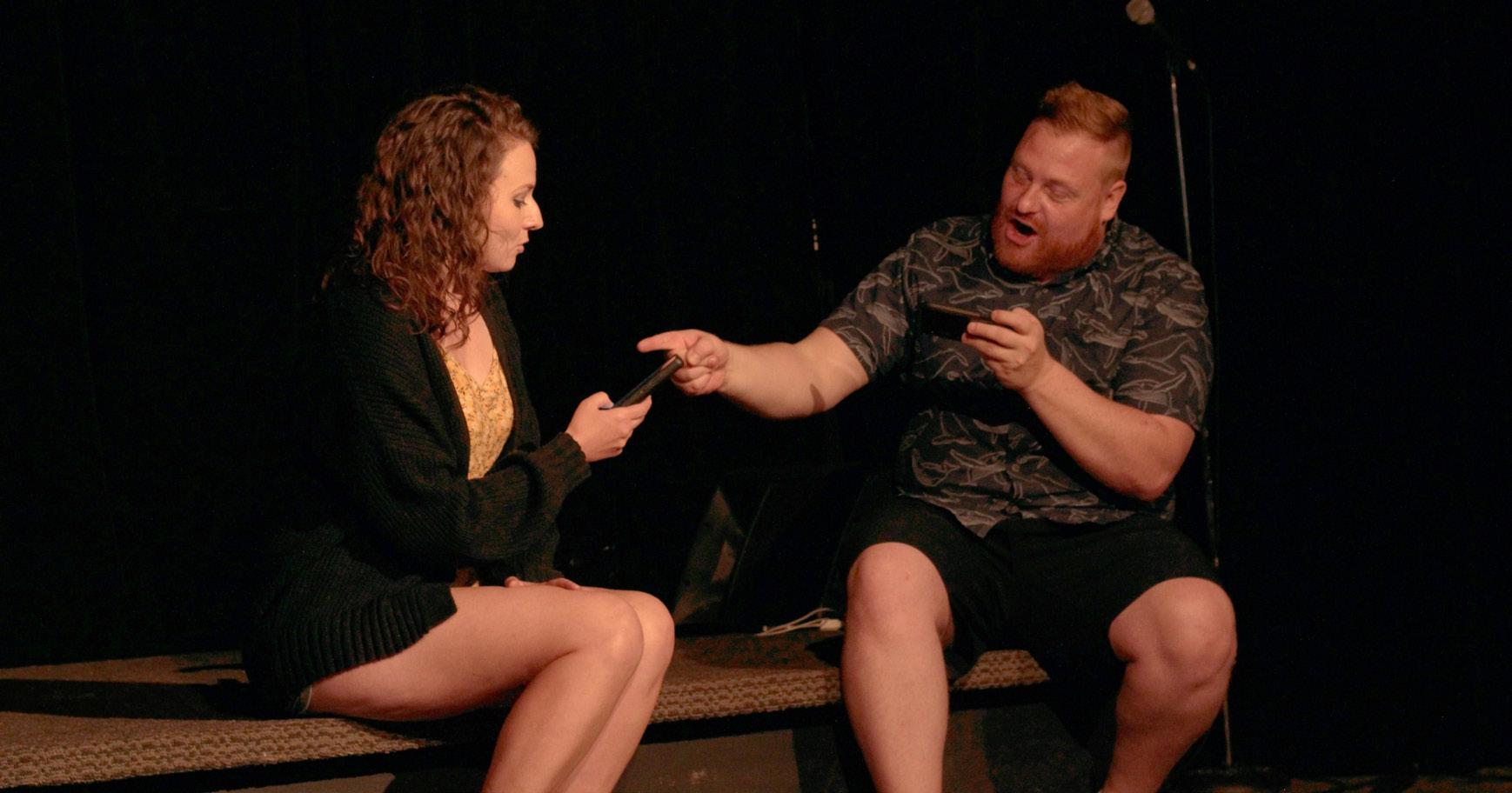
Put on by the OurToba Film Network alongside ACTRA Manitoba, the Cold Reading Event is part of a series of casual cold readings where actors, writers, directors and producers come together to showcase their talents and network with their peers.
Kathleen Gallagher, president of the board of directors at OurToba, said the goal of the event is to create a comfortable environment where writers and actors can feel confident.
“It’s not about perfection, it’s really about just creating work, putting it out there [and] building a community,” she said.
Gallagher said writers don’t always get to hear their works as they would be performed, so the Cold Reading Event
helps give writers that insight.
Lauren Cochrane, guest host of the Cold Reading Event and previous participant, said the event aims “to give a voice to people who might not always get to showcase their work in a way where they can have an audience and constructive feedback, and build and grow work that might not get to be seen and produced in a larger scale.”
Cochrane herself has participated as a writer for the event in the past, and said having actors who are capable of portraying a wide variety of characters read through a work is very helpful for the writing process.
“It really provides an opportunity for writers to have character be brought to life, and then they can make notes and hear it in real time,” she said.
“I think it’s kind of an untapped resource that Manitoba can use, especially with all the creativity that we have here.”
She said she is excited about
the opportunity to be hosting the event this time around.
Cochrane is no stranger to the stage, with a background in improv and stand-up comedy. She has previously hosted events herself and with her husband as a comedy duo, and she has also been the go-to MC for most of her close friends’ weddings.
“You know, I’m that gal,”
she said. “Never a bridesmaid, always an MC.” Gallagher said she hopes any women, gender-diverse and non-binary actors, filmmakers and others within the community will stay connected with the organization.
“We’re here to support you and give you space and help you thrive,” she said.
Spectator tickets for the
Cold Reading Event are available for a suggested price of $10, and a portion of the proceeds will go toward the participating actors and writers.
The event runs from 7 to 10 p.m. on Nov. 1 at the King’s Head Pub, 120 King Street.
Tickets for the Cold Reading Event are available through OurToba’s website.
photo / Kathleen Gallagher / provided
photo / provided
Bikers and babes and bingo, oh my!
Fundraising event for Sunshine House taking place Nov. 11
Jacob Davis, staff
Bikers, Babes and Bingo, a fundraising event organized by Dykes on Bikes (DOB) Winnipeg, CA, will be revving up at Club 200 on Nov. 11 from 4 to 9 p.m.
The DOB Winnipeg chapter is the first Canadian chapter of the widespread nonprofit women’s motorcycle contingent, which originated in San Francisco, Calif.
The event tickets for Nov. 11 are priced at $25 with a meal and drag queen bingo. Attendees can pay $10 for a ticket to just the event, without food.
There will be a 50/50 raffle and silent auction occurring the entire evening, a scheduled meal and drag bingo hosted by local drag performer
“They are in dire need of funding in order to continue that really important work”
— Jenn Rands, one of five founding members of Dykes on Bikes Winnipeg
Much like its San Francisco parent, Winnipeg’s DOB is committed to supporting the endeavours of the 2SLGBTQIA+ community, as well as women’s communities, from travelling to small town Pride events in Manitoba to providing extra safety support, motorcycle riding and fundraising for community organizations.
Since its official formation in 2019, DOB has always hosted a fall fundraiser, with the previous two years being Bikers, Babes & Bingo, its themed event.
Anita Stallion alongside some special guests. Proceeds will go to Sunshine House, specifically to the Mobile Overdose Prevention Site (MOPS). Jenn Rands, secretary and one of the five founding members of DOB Winnipeg said MOPS is “in dire need of funding in order to continue that really important work.”
“We decided that we were going to do some beneficiary work there,” Rands said.
Sunshine House is a community drop-in and resource
centre that focuses on harm reduction. It operates MOPS, which launched in 2022. There, people can access harm reduction supplies like naloxone and use substances in a supervised safe environment. Rands said that Sunshine House is pivotal for the community. She said the work done there isn’t just MOPS, but programming such as Like That, which provides a space for folks exploring gender and sexual identity to come together for skill building or to simply have fun.
Rands said that DOB was able to make a few thousand dollars at the previous event.
“We’d like to try to do the same going forward,” she said.
Tickets for Bikers, Babes & Bingo are available online. Check the Events page at dykesonbikes.ca for more information.
Get a Clue at Royal MTC
Board game-turned-play is RMTC season opener
Kelsey Chin, staff
On Oct. 17, the Royal Manitoba Theatre Centre (RMTC) opened its 2023-24 mainstage season with a production of Clue, an adaptation of the classic board game-turnedmovie. On Oct. 24, I attended a show with a packed house.
The 90-minute murder mystery comedy kept the crowd on its toes and had many audience members laughing throughout. With big personalities, Clue’s spectacle did not disappoint.
Among the highlights of the show was the enormous, showstopping turntable house, Boddy Manor, where the characters congregate for a mysterious dinner party.
The set design was incredible. The flooring was extremely reminiscent of the board game, and the mansion itself was a sight to behold. It was two levels, with a climbable staircase and multiple rooms, all with their own different colour schemes, furniture and feel.
Each of the well-known and beloved characters Mr. Green, Mrs. Peacock, Col. Mustard, Mrs. White, Prof. Plum and
Miss Scarlet brought something unique to the table.
Reena Jolly, the actress who plays Miss Scarlet, said when she first heard about the role, she knew immediately she wanted to play her.
As a child, Jolly played the CD-ROM version of the game with her siblings, and she would be Miss Scarlet everytime. She always loved how the character was “saucy” and “elegant.”
She remembered thinking to herself, “I don’t know what a ‘madam’ is, but she’s got sauce, and I want it!’”
When Jolly heard that RMTC was putting on Clue, she knew auditioning for Miss Scarlet “was a no-brainer.”
Jolly spoke about how the character resonated with her, exuding an eye-catching confidence that she admired and aspires to portray. To prepare for the role, Jolly said she really had to hype herself up and convince herself that “she is that girl.”
“I really needed to work on portraying and maintaining confidence,” she said. She emphasized that needed to be “an easygoing, not manufac-
tured confidence.”
Jolly said she has many iconic figures she looks up to as role models for “it-girl energy,” including Beyoncé, Nicki Minaj and Rihanna. She said that watching and listening to them really helped to bring out that energy in herself, which then helped her channel that energy into the character.
Jolly is a former theatre student from the U of M’s Black Hole Theatre Company and said studying at the university has been invaluable in helping her develop the skills necessary to start taking on professional acting roles.
Initially, Jolly started taking theatre and acting classes as a GPA booster, but quickly fell in love with the art.
She did not know a lot about the technical and practical sides of theatre, but her studies at the U of M helped her become acquainted with them.
While Jolly went on to do another theatre program in Montreal, she said she learned things at U of M she was not taught in Montreal, such as how to conducting oneself in
photos / Dylan Hewlett / provided
rehearsal halls and how to prepare for long days on the job.
Royal MTC will be showing Clue until Nov. 11. Tickets
are available at Royal Manitoba Theatre Centre-Clue (royalmtc.ca)
photo / Jenn Rands / provided
Ups and downs for volleyball over weekend in B.C.
Men’s team sweeps Cascades, while women’s team swept
Joshua Brandt, staff
The University of Manitoba’s volleyball squads were in balmy Abbotsford, B.C. this past weekend facing off against the University of the Fraser Valley (UFV) Cascades. The men’s team played its first two games of the season, while the women’s team entered this past weekend’s matches coming off two convincing victories against the University of Regina Cougars.
Men’s team
Going into the 2023-24 CanWest volleyball season, in the annual “coaches poll,” the Bisons ranked ninth out of 13, two spots ahead of the Cascades. In Friday’s match, the herd certainly played like the superior team.
The Bisons got off to a blazing start and never looked back, taking the first set 25-23 as team captain Spencer Grahame found a slot through the UFV block for the set-winning kill.
The second set was a tight affair — at one point, knotted at 18 apiece — until Rosenort, Man. product Jonah Dueck went on a sizzling serving run for a remarkable three aces in a row. Dueck made use of
his beautiful cross-court float serve, which whizzed a couple of inches over the net, dipping and diving all the way.
Thanks to Dueck’s serving heroics, the herd took the second set 25-20.
In the third, UFV looked as if it was going to mount a comeback. Led by Jonas Van Huizen, who accumulated an impressive 18 kills in the match, the Cascades were up by as many as five points.
But the herd kept chipping away, keeping it close.
With the Bisons up 23-22, Dueck stepped up to the service line again. This time it was not his serve that befuddled UFV players, for they made two critical attacking errors of their own and were twice thwarted by the Bison block, handing the men’s team its first win of the season.
Going for the weekend sweep in the second match on Saturday, the herd lost a very evenly played first set 27-25.
Even is exactly what the match was, as it went all the way to a decisive fifth set, each side trading sets to get there.
Ultimately, in the fifth set, the herd pulled away from a tired-looking Cascades team thanks to some powerful serv-
ing and consistent, error-free volleyball.
With the win, the Bisons improved to 2-0 on the season.
Sammy Ludwig was also outstanding for the herd, contributing much to the second victory of the season by amassing 48 assists and 10 digs.
Women’s team
This past weekend’s matchup against the UFV Cascades may very well have been a CanWest gold-medal match preview — at least, CanWest coaches seem to think so. The Cascades and Bisons were ranked first and second respectively in the women’s volleyball CanWest “coaches poll.”
Unlike the men’s first match, the women’s team did not pick up the victory, although one could still see why the Bisons’ squad is so highly regarded.
The herd dropped the match 3-1, winning only the first set 26-24 courtesy of a fabulous Light Uchechukwu block.
The Bisons did get as close as 17-18 in the fourth before UFV pulled away and took it
For the herd — concussion protocol
What to know about concussions as sidewalks turn to ice
Grace Anne Paizen, staff
While concussions may seem like a predominantly sports-related problem, they are just as rampant in ordinary student life. With the snow firmly on the ground and slippery walkways to class, the risk of hitting your head in a fall is a reality in a Manitoba winter.
A concussion is a brain injury that will not only affect physical well-being but increase emotional and behavioural health issues as well. This is why concussion prevention is key.
Investing in a proper pair of winter footwear is your best bet to prevent falls. If winter boots break the tight student budget bank, crampons are a fabulous option and can easily be purchased on a retail website. Crampons are metal spikes that fit over your shoe and supply extra grip on icy surfaces.
If a student unfortunately falls and hits their head or
even suffers whiplash while saving their noggin from the pavement, look for common symptoms of a concussion like headaches, dizziness, sensitivity to light and sound — including screentime — difficulty concentrating or even feeling overly emotional.
Seek medical attention if you actually hit your head. A brain bleed is a very serious medical emergency and can be caught with a CT scan. It is always a good idea to contact a doctor if one does not immediately recover from a winter fall, just to make sure no sprains or breaks have occurred on top of a potential concussion.
Remember, a person does not need to have lost consciousness after hitting their head to have suffered a concussion.
If a student does suffer a concussion, instructors and professors should treat their malady as a proper injury. While this may involve getting
a medical note, it is a priority that healing takes place first instead of classroom assignments and paper deadlines.
Recovery from a concussion will often involve helpful steps provided by a doctor, or even a concussion specialist. Mild physical activity such as exercise aids in concussion recovery, and eating protein — meaning not skipping that breakfast — will also help the brain begin to heal.
Mental health is also an important factor in recovery and counselling services are recommended, as even a mild concussion can cause mental health distress or disorders.
Remember, while school is important, your physical and mental health are of the utmost importance. So, wear those winter boots, strap on those crampons and make sure to take care of yourselves, Bisons.
25-20.
Despite the loss, Raya Surinx was excellent once again, hammering home 17 kills and adding 10 digs.
Arguably, the best Bison on Friday night was Eve Catojo — a middle blocker who hit .600 and had a very respectable four digs.
Seeking to avenge its first loss of the season, the herd seemed poised to knock off the Cascades in Saturday’s rematch.
Nevertheless, the game did not go as planned. UFV dominated the entire match against an uninspired Bisons team, winning easily, three sets to zero.
One bright spot for the herd, however, was local B.C. native Ella Gray who hit .267, had five kills and made eight digs. Moreover, after another 13-kill effort, Surinx currently leads CanWest in kills with 53 and kills per set with 4.08. After being swept by the Cascades, the Bisons dropped to 2-2 on the season and to seventh in the CanWest standings.
Both the women’s and men’s teams will travel a couple of hours west next weekend to play a twogame series against the Brandon University Bobcats.
As sports reporting at the Manitoban enters its 110th year, it has been a privilege to continue the legacy of “sporting editor” as a woman. In honour of the anniversary, here are some of my favourite headlines from the Manitoban “sporting” archives.
photo / Matthew Merkel / staff
Grace Anne Paizen, staff
Basketball season preview
Storylines to watch for in 2023-24
Grace Anne Paizen, staff
The Bisons basketball season will tip off in a back-to-back women’s and men’s homestand on Thursday night at Investors Group Athletic Centre against the Brandon University Bobcats.
The women’s team is coming off a much-to-be-desired 6-14 regular season in 2022-23. This year’s roster looks promising, with four rookies added to the mix. Meanwhile, the men’s team will feel the pressure to live up to last year’s historic 18-2 program-record-setting regular season.
With the stage set, here are some storylines to follow this 2023-24 basketball season.
Women’s team
Entering her 10th season as head coach, Michele Sung has already coached the women’s team to an impressive pre-season, winning six of its nine pre-season games.
Last year’s regular season record is also somewhat misleading when it comes to the
incredible talent of the team. With the majority of the herd’s 2022-23 season losses being close contests, the amount of returning players will certainly aid in this year’s push for a post-season berth.
Point guard and women’s basketball 2022-23 Most Valuable Player Lauren Bartlett returns for her fourth year. She set multiple records last year, including the single-game assists record, the second most-single game steals record and the fifth triple-double in program history in a winning-contest against the MacEwan University Griffins.
Veteran forwards Emily Johnson and Autumn Agar also return to the team this year. Johnson scored 156 points and recorded 27 steals last regular season, and has an impressive .818 free throw percentage, while Agar recorded 188 points and 23 steals.
Men’s team
The men’s team will once
Bison briefs
Grace Anne Paizen, staff
Bison cross-country
Sending the largest Bisons roster since 2019 to the CanWest Championships, the herd raced impressively in Kelowna, B.C. on Saturday.
On the women’s side of the team, all three runners finished in the top 50. Rookie Lena Klassen led the pack, placing 21st with a time of 30:00. Angela Kroeker finished close behind in 24th at 30:14 and veteran Hailee Morisseau placed 43rd with a time of 31:18.
The fastest Bison times overall came from the men’s side of the team, with Justin Kroeker crossing the finish line just outside the top 10 with an 11th place time of 24:52. Veteran Calvin Reimer finished 32nd at 26:08 with teammate Noah Fillion finishing just seconds behind to capture the 33rd spot.
Rookie Carson Kroeker placed 41st with a time of 26:37 and was named to the 2023 CanWest All-Rookie Team, while veteran Alexander Brandt-Ganding rounded out the group in 53rd with a time of 27:07.
Bisons football
A Bisons football win would
have made securing a berth in the post-season easy, but with the University of Calgary Dinos 35-23 win on Saturday afternoon at McMahon Stadium in Calgary, the Bisons recorded the best loss of the season.
Heading into Saturday’s match, the Bisons had to win or lose by less than 13 points to advance to the Hardy Cup semifinal.
Aided by the blustery conditions on the field, Calgary came out firing, putting up 16 points in the first nine minutes of the game before Bison quarterback Jackson Tachinski would find receiver AK Gassama in the endzone for the herd’s first points.
The Dinos countered with another major before the herd mustered a counterpunch with a grinding 15-play drive for the Bisons’ second touchdown.
While the elements were a factor, the herd did not capitalize on defensive back Sebastien Reid’s interception or use kicker Maya Turner’s sure foot on the same drive from the Dinos 39-yard line for a potential field goal before halftime.
Calgary would put up four more field goals on the day before the Bisons mounted a rocky comeback. The herd’s offence was stopped four
again be helmed by head coach Kirby Schepp, who is entering his 15th season with the herd and won the Canada West Coach of the Year honour last season with the Bisons’ historic regular season win record.
Fresh off his summer with the Winnipeg Sea Bears, 2023 Canadian Elite Basketball League U Sports Player of the Year Simon Hildebrandt is entering his second year on the men’s team. Hildebrandt racked up 297 points in his rookie season, with a killer .848 free throw percentage and 44 three-point baskets. He was awarded the 2022-23 Bison, CanWest and U Sports male Rookie of the Year honours for his phenomenal first season.
Tito Obasoto and Cieran O’Hara are both returning to the team for their third years. At guard, Obasoto racked up 144 points, 25 steals and held a respectable .788 free throw percentage last season, while forward O’Hara had 112 points and 14 steals last season and
grabbed an impressive 121 rebounds.
Mirroring the women’s squad, the men’s team has added four rookies this year, with the majority of last year’s roster returning this season. The team is also coming off a fantastic pre-season, only losing one of the five pre-season contests.
Both teams will host the Brandon Bobcats in their respective home and regular season openers Nov. 2 and 3, playing back-to-back with the women’s games starting at 6 p.m. and the men’s games starting at 8 p.m. on campus at the Investors Group Athletic Centre.
times in the last quarter, even turning the ball over on downs at the Dinos’ two-yard line.
However, down 35-15, the Bisons miraculous loss came in the last 12 seconds of the game when defensive back Stephen Adamopoulos forced the Dinos’ running back to fumble. Fellow defensive back Nick Conway performed the scoop and score with zeroes on the clock, followed by Tachinski finding receiver De Shawn Le Jour for the twopoint convert post-season clinching walk-off.
Punching a historic fifth consecutive ticket to the Hardy Cup semifinal, the Bisons will face the 6-2 University of British Columbia Thunderbirds in Vancouver on Nov. 4.
Bisons swimming
There were plenty of podium finishes for the Bisons swim team at the St. James Seals Invitational Oct. 21 to 22 at Pan Am Pool.
On the men’s side of the team, veteran Carson Beggs claimed a bronze and three gold, third-year Rhade Kostelnyk took home two silver and fellow third-year Andriy Usan claimed two silver and a gold.
Second-year Gavin Reimer claimed two bronze and a sil-
ver, while Eric Dupre swam to a bronze, a silver and two gold. Brayden Stacey took a silver and three gold and Ty Unrau claimed a bronze and three gold.
On the women’s side of the team, veteran Georgia Pengilly took home two silver and a gold, Kara Dziadek claimed a gold, Kelsey Fillion claimed two silver and two gold and Hannah Schanel’s best finishes came in the 50-metre freestyle and backstroke, placing just outside the podium in both at fourth place.
Shea Guest claimed a bronze, two silver and a gold, Indigo Halldorson Haines took home two bronze and a silver, Ella Howe scored a
bronze, a silver and three gold and Ava Toyata claimed a gold. Rookie Eilishrose Hazlitt took home a silver and a gold, while fellow rookie Avery Weiland claimed two bronze.
Bisons women’s soccer Rookie midfielder Taryn Cabak has been named to the CanWest Women’s Soccer AllRookie Team. Cabak scored her first U Sports goal in September against the University of Regina Cougars before recording three more goals on the season. Cabak also recorded 14 shots on goal and nine points, holding second overall on the team in all three stats.
photo / Matthew Merkel / staff
photos / Matthew Merkel / staff
Bisons hockey falls short in weekend series
Men’s team still looking for first win of season
Quinn Mayhew, staff
he University of Mani-
Ttoba women’s hockey team started its weekend series off against the Mount Royal University Cougars on Friday night struggling to defend its zone, while puck passing looked laboured. Mount Royal profited off the Bisons being off their A game.
The Cougars struck first in the two-game series, with Kaia Borbandy of Mount Royal scoring in the middle of the first period.
Mount Royal was aggressive from the start, outshooting Manitoba 41-29.
The herd’s scoring drought continued until the third period, while the Cougars scored consistently.
The first and only goal of the game for Manitoba was scored by Camryn Gillis. The Bisons finished Friday night’s contest losing 6-1.
The herd looked to use its strong offensive players to help secure redemption as the series against the Cougars continued on Saturday.
Mount Royal were on a mis-
sion the minute they stepped on the ice, opening up the scoring with the first goal of the game on an early power play.
The momentum continued for the Cougars but not without challenge from the herd, as the Bisons outshot the cats 29-28.
Manitoba’s first goal came in the second frame courtesy of Camille Enns, and the Bisons scored two more times in the third period — with Ashley Keller and Dana Goertzen capitalizing as the Cougars grew tired. The Bisons managed to push the game to overtime, but would lose 4-3 early in the first frame.
While the women’s team were hosted by the Cougars in Calgary, the men’s hockey team played at home at Wayne Fleming Arena.
Mount Royal was on the puck from the beginning, showcasing stellar teamwork, amazing passing skills and overwhelming speed.
The first period ended without a goal from either side. Despite the Cougars hav-
ing the upper hand, their advances were halted by great plays from Bison veteran Colton Veloso.
The Cougars and the herd traded goals in the second period, with Tony Apetagon finding the net for the Bisons. While the Bisons had a 2-1 lead early in the third frame courtesy of Veloso, the Cougars had a massive comeback thanks to their tight-knit offence. Mount Royal capitalized on a Manitoba holding penalty to tie the game in the third, and followed up with another power-play goal just two and a half minutes later to take the lead.
The men’s team ultimately collapsed as the Cougars scored another unanswered goal in the dying seconds of the game, the herd losing Friday night’s match 4-2. Saturday afternoon’s contest saw the herd fare no better. The Cougars jumped out to an early lead before the Bisons capitalized on a power-play goal courtesy of captain Jonny Hooker. Mount Royal punched back soon after with
The Bisons men’s hockey team plays its next series against the Trinity Western University Spartans Nov. 2 and 3, while the women’s hockey team plays its series against the Spartans Nov. 3 and 4. its second goal in the frame. The Cougars would go on to add a power-play goal of their own in the second before going up 4-1 on the herd in the third frame. While the Bisons would score a second goal by Josh Paulhus, Mount Royal would score an empty-netter and the herd would lose 5-2.
Sports teams’ schedules
U of M Bisons — Women’s Basketball
Brandon Bobcats @ Bisons Nov. 2 — 6 p.m.
Brandon Bobcats @ Bisons Nov. 3 — 6 p.m.
U of M Bisons — Women’s Hockey:
Bisons @ Mount Royal Cougars
Bisons @ Mount Royal Cougars
Bisons @ Trinity Western Spartans
Bisons @ Trinity Western Spartans
U of M Bisons — Women’s Volleyball:
Bisons @ UFV Cascades
Bisons @ UFV Cascades
Bisons @ Brandon Bobcats
Bisons @ Brandon Bobcats
U of M Bisons — Men’s Basketball:
Brandon Bobcats @ Bisons
Brandon Bobcats @ Bisons
U of M Bisons — Men’s Hockey:
Mount
Trinity Western Spartans @ Bisons
U of M Bisons — Men’s Volleyball: Bisons @ UFV Cascades