U of M tuition to increase for 2023-24 academic year
Sarah Cohen, staff
Fleur Almeida came to Canada for her post-secondary education in order to have more opportunities career-wise and a better quality of life. Now, Almeida is having to worry about the potential weight of student loans to compensate for the increasing international fees she and her family are facing.
This upcoming year, the U of M will see an increase in tuition by 2.75 per cent for undergraduate and graduate programs, for both domestic students and international students like Almeida, now in her second year of a bachelor of science.
“I just hope that [increasing tuition] doesn’t continue,” she said.
“There are a lot of international students who come here, and everybody comes from different financial backgrounds, and we’re already paying so much more […] if this goes on, it’s going to be really difficult to afford education.”
“Everybody deserves a chance. Everybody needs to be able to have access to education.”
The 2.75 per cent increase in tuition fees this fall is creating concern for undergraduate and graduate students alike.
The increase was approved at the March 28 board of governor’s meeting, where U of M president Michael Benarroch outlined the proposed 2023-24 budget for the university.
All domestic and international
undergraduate and graduate programs will undergo an increase in tuition, except for the undergraduate doctor of pharmacy program.
The increase will also extend to all university fees.
Vice-provost (academic planning and programs) Greg Smith noted that “recent inflationary pressures [have] meant that some costs have shot up very quickly.”
According to Smith, that means that as the costs of running a university go up, such as faculty salaries, maintenance and equipment, so does tuition.
The percentage increase is mandated by the provincial government, Smith explained.
Minister of Advanced Education and Training in the Manitoba legislature Sarah Guillemard was not available for an interview.
Jon Lovlin, spokesperson for the minister, said in a statement to the Manitoban that while the province sets the maximum, each college and university is allowed to adjust their tuition how they see fit as long as they do not exceed that maximum. The maximum for the 2023-24 academic year is 2.75 per cent for universities and $133 per program for colleges.
At the University of Manitoba, the increase will result in a cost of $444.75 for the average three credit-hour course in the faculty of arts. During the 2022-23 academic year,
the domestic tuition for that course was $432.84.
An international student in the same course will be paying approximately $1,700, where they would have been paying $1,654.44 in the academic year prior.
Smith said the 2.75 per cent increase is below the inflation rate, and that the need to reach that maximum increase for additional revenue was clear.
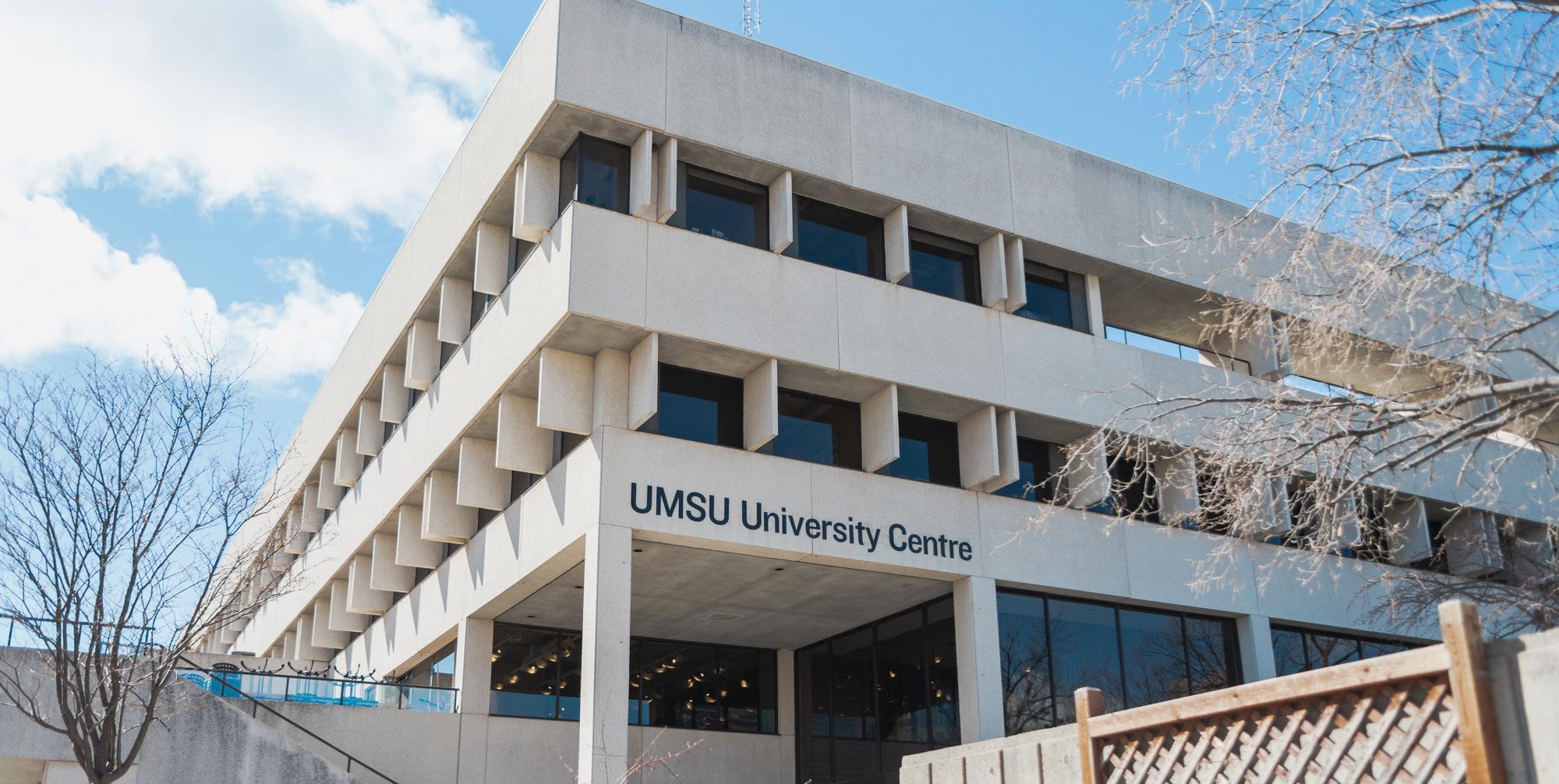
University of Manitoba Graduate Students’ Association president Christopher Yendt and UMSU president Tracy Karuhogo both brought up concerns for students amidst the rising cost of living.
Inside the U of M’s Village Lab
Elah Ajene, staff
Gigii-bapiimin is an Ojibwe language term meaning, “we survived.”
It is an expression that reflects the resilience and strength of Indigenous people.
The Gigii-Bapiimin study, launched by the Village Lab — U of M’s faculty of social work community-based interdisciplinary health research lab — applies this concept to the continued survival of Indigenous people through past and present pandemics.
In this study, the research lab explores the impact of the COVID-19 pandemic on the well-being of Indigenous
people living with HIV-AIDS in Manitoba and Saskatchewan communities, as well as the resilience of those living in said communities.
Community is at the centre of the Village Lab. For its director, Rusty Souleymanov, this entails collaborating with community members
“While the university exists in its own little context sometimes, we can’t forget the fact that cost of food has gone up, cost of rent and living as gone up […] and yet we still struggle within the campus environment to meet those needs and those challenges for grad students,” said Yendt. Yendt also emphasized that graduate students are both employees and students, putting them in a situation where the university is asking for more from students when really the students “need more from the university.”
Cont’d p. 4 / Undergraduate >
and using community-based research practices while operating at an intersection of health and social sciences.
“It’s all about peers, it’s all about community, and that’s where the power lies with our lab,” he said.
Souleymanov, who received his PhD at the University of Toronto, is currently an associate professor at the U of M’s faculty of social work and director of the Village Lab, and has been actively engaged as a community-based HIV and harm-reduction researcher in Canada over the past 13 years.
Souleymanov seamlessly blends his expertise in social
work, public health and psychology in working with socially and economically marginalized communities to address both health and social equity issues.
Since its launch in 2021, the Village Lab has focused on three main aspects — creating meaningful research partnerships, producing novel research and building skills and increasing capacity among community partners and peers through training community members and students.
Cont’d p. 5 / Group >
photo / Ebunoluwa Akinbo / staff
photo / provided
EDITOR-IN-CHIEF ? editor@themanitoban.com
Gillian Brown
BUSINESS MANAGER ? accounts@themanitoban.com
Dhruv Patel
ADVERTISING CO-ORDINATOR ? ads@themanitoban.com
Diego Castro
MANAGING EDITOR ? me@themanitoban.com
Ezra Taves
COPY DESK ? copy@themanitoban.com
Matthew Doering (ed.)
NEWS DESK ? news@themanitoban.com
Sarah Cohen (ed.)
Kyra Campbell (ed.)
RESEARCH & TECHNOLOGY DESK ? research@themanitoban.com
Elah Ajene (ed.)
COMMENT DESK ? comment@themanitoban.com
Jessie Krahn (ed.)
ARTS & CULTURE DESK ? arts@themanitoban.com
Damien Davis (ed.)
SPORTS DESK ? sports@themanitoban.com
Grace Anne Paizen (ed.)
PHOTO DESK ? photo@themanitoban.com
Ebunoluwa Akinbo (ed.)
DESIGN DESK ? design@themanitoban.com
Taeran An (ed.)
GRAPHICS DESK ? graphics@themanitoban.com
Teegan Gillich (ed.)
AUDIO DESK ? audio@themanitoban.com
Harmatpreet Brar (ed.)
SOCIAL MEDIA DESK ? social@themanitoban.com
Violet Baker (ed.)
VOLUNTEERS THIS ISSUE ?
Matthew Merkel
VOLUNTEER STAFF ?
interested in volunteering? email me@themanitoban.com today!
THEMANITOBAN.COM
109 HELEN GLASS BUILDING
UNIVERSITY OF MANITOBA
WINNIPEG, MB 204. 474. 6535
The Manitoban is the official student newspaper of the University of Manitoba. It is published monthly during the summer and each week of regular classes during the academic year by the Manitoban Newspaper Publications Corporation.
The Manitoban is an independent and democratic student organization, open to participation from all students. It exists to serve its readers as students and citizens.
The Manitoban is a member of the Canadian University Press, and our journalistic standards can be found on the Manitoban’s website.
The newspaper’s primary mandate is to report fairly and objectively on issues and events of importance and interest to the students of the University of Manitoba, to provide an open forum for the free expression and exchange of opinions and ideas and to stimulate meaningful debate on issues that affect or would otherwise be of interest to the student body and/ or society in general. The Manitoban serves as a training ground for students interested in any aspect of journalism.
Students and other interested parties are invited to contribute to any section of the newspaper. Please contact the appropriate editor for submission guidelines.
The Manitoban reserves the right to edit all submissions and will not publish any material deemed by its Editorial Board to be discriminatory, racist, sexist, homophobic or transphobic, ableist or libellous.
Opinions expressed in letters and articles are solely those of the authors. Editorials in the Manitoban are signed and represent the opinions of the writer(s), not necessarily those of the Manitoban staff, Editorial Board or the publisher.
A “volunteer staff” member is defined as a person who has had three volunteer articles, photographs or pieces of art of reasonable length and/ or substance published in the current publishing year of the Manitoban.
Any individual who qualifies as a volunteer staff member must be voted in by a majority vote at a Manitoban editorial board meeting. Elected representatives and non-students may be excluded from holding votes as volunteer staff members in accordance with the Manitoban Constitution.
Micro-diplomas to focus on German lifestyle, mythology Arts programs seek to expand learning options for students
Kyra Campbell, staff
F or those interested in taking a diverse array of courses within the faculty of arts, but who do not have the available time commitment, the departments of classics and German and Slavic studies are promoting new micro-diplomas for the upcoming academic year, where students can delve into the worlds of German lifestyle and mythology and folktale.
This spring, the department of German and Slavic studies held its first offering of the micro-diploma introduction to German language, life and culture. The program took place from May to June and was quite successful, explained Lars Richter, instructor and curriculum representative for the department of German and Slavic studies.
“You can speak German like a native speaker, but if you do not know what is going on in Germany and know nothing about the politics or the history, then this only goes so far,” Richter said.
Those who have an interest in travelling abroad will have the opportunity to take the diploma as a travel course in Germany from May to June of 2024, where the students will become immersed in contemporary German lifestyle. The three courses taught throughout will be an introductory German 1 and 2 along with the course discovering German life and culture.
Richter further emphasized that the German diploma is about both language and culture, as students will have the opportunity to meet with those within the German community. In the first instalment of the program, students met with president of the German-Canadian congress and students from the University of Winnipeg completing research on German immigration to Canada.
In the fall 2023 semester, students will have their first opportunity to undertake the mythology and folktale micro-diploma through the classics department. Within the diploma, students have a
cross course opportunity to take classes from the departments of religion, classics, Icelandic and German and Slavic.
For students to earn the mythology and folktale diploma, they must take on 12 credits of designated courses from the involved programs. Some of the 10 courses that students could take to achieve their diploma include: Icelandic folktales in a European context, Greek and Roman mythology and Ukrainian myths, rites and rituals.
The idea for the micro-diploma sparked as a way to weave together several departments across the faculty of arts that have mythology or folktale classes. As classics department head and graduate student chair James Chlup has observed, students are very interested in taking them, with 500 students enrolling in the introductory Greek and Roman mythology course each year.
“A significant minority of them, up to about a third, take at least one other mythology or folktale course somewhere
Expansions expected for multiple health sciences programs
Steep increase in applications leads to need for changes
Kyra
Campbell, staff
To meet post-pandemic admission demands within the faculty of health sciences, the university is looking to expand numerous programs including undergraduate medical education, doctor of pharmacy and master of physician assistant studies.
Due to a sizable increase in applications post-pandemic, acceptance rates to the bachelor of health sciences program dropped from 20 per cent in 2019 to 9.4 per cent in 2022.
The largest increase proposed will occur within the bachelor of health sciences (B.H.Sc.) program, which will see an increase from 40 students to 100 students annually.
The proposal to the provincial government for admission expansion outlined that students find interest in the B.H.Sc. program due to its core focus on human health in a holistic manner and its focus on health and wellness within cultural contexts.
To convince the government of the necessity for expansion, the proposal also outlined that the healthcare system is ever-changing and continues to face increased stress due to the gaps highlighted by the
COVID-19 pandemic. To counter such gaps, U of M health-care programs, including the B.H.Sc. program, can complement and support burdened health-care efforts.
Separate to the program expansion, an Indigenous admission category will be implemented in preparation for fall 2024. The new category would hold 17.5 per cent of the spaces in each program for self-declared Indigenous students.
The faculty cited the need for the new category as the proportions of non-Indigenous to Indigenous students in the B.H.Sc. and bachelor of health studies programs are not representative of the Manitoba Indigenous population. The goal of the new category is to relieve application barriers that Indigenous students may face.
All program proposals are yet to go ahead, as funding negotiations must occur with the provincial government. If negotiations are successful, proposed expansions for all programs could occur by fall 2024.
news@themanitoban.com
in the university,” said Chlup.
To further understand the decision behind the micro-diploma, Chlup has seen attitudes towards traditional ways of learning changing, with students finding more interest in creative aspects of study and being able to tell their own stories.
“Mythology really cuts to the heart of that, because mythology is about storytelling and understanding the interpersonal relationships that we create,” said Chlup.
Students will have the opportunity to analyze how myths are acquired through poetry, art, storytelling and music, and then learn how to question and challenge such myths.
Micro-diplomas can either complement a degree that a student is pursuing or they can be a stand-alone achievement. Micro-diplomas can also enhance students’ interests, as they may wish to expand one of the programs of study into a major or minor.
micro-diplomas are valuable additions of knowledge for after graduation. The micro-diplomas are a “further credential certificate that proves that they have this expertise in a certain field,” Richter said.
“What a lot of students find is they are attending university and they are going towards a certain degree because they think it is going to lead to a certain profession,” said Chlup. “But they also have genuine interests in other things, and a micro-diploma is really nice because it is fairly small and compact.”
Chlup added that these diplomas are something you could easily fit into your electives, and they provide the chance to follow something in more detail that you find interest in.
“You want to be interesting,” he said.
Professors Chlup and Richter both agreed that the news@themanitoban.com
College of nursing expands to meet provincial demands
More opportunities for aspiring nursing students
Sarah Cohen, staff
In order to meet the province’s demand for nurses, the college of nursing at the U of M is expanding, welcoming a third intake of nursing students.
Earlier program changes have allowed nursing students to complete their studies in 28 months, expediting the previous four-year timeline. This is possible because the program has expanded into three terms per year — fall, winter and summer. The class of 120 starting in summer 2023 is the first semester of the expanded intake.
In a December 2021 press release, the province addressed the need for a strong future workforce of nurses. The conversations around the expansion of nursing programs across the province began around December of 2022, only allowing for approval and implementation to reach the U of M within the last few months.
The provincial government and hospitals decide when nurses are not in as high a demand, a situation in which the increases may be discontinued.
With 120 seats to fill per cohort, and three or four applicants per seat, the addition of another 120-person
cohort allows more opportunities for students to enter into the program.
One major post-COVID-19 concern for the college of nursing deals with the degree program’s mandatory theory courses. While students enrolled in the program during the pandemic attended in-person clinicals and simulations, with the return to in-person learning, theory classes are seeing a lower engagement and attendance rate.
During the 28-month program, academic and mental health support is available for students, as well as accommodations for time off.
news@themanitoban.com
Report set to protect Indigenous identity on campus
Nine recommendations aim to combat Indigenous identity fraud
Kyra Campbell, staff
Indigenous identity is a personal journey for all who experience it. However, such identities can face exploitation through acts of fraud. Fraudulent identifications are a reality facing growing attention. In 2021, for example, one University of Saskatchewan professor was found to have falsely claimed Métis ancestry.
Following a CBC investigation that found Carrie Bourassa had falsified her identity, the university lauched a portal that required Indigenous faculty, staff and students to verify their identity when applying for a position or award specifically meant for an Indigenous person.
Currently, the U of M has a self-identification structure for Indigenous students. As UMSU Indigenous students’ representative Ishkode Catcheway explains, the current system can lead to room for identity fraud.
“The current way to self-declare, for students anyways, on Aurora [is] just literally clicking a checkbox that says ‘Yeah, I’m Indigenous,’” Catcheway said.
To work toward addressing this issue of fraud, the university held dialogue sessions throughout 2022 to produce a report and recommendations toward an Indigenous identity policy.
The consultations were headed by Métis, Inuit and First Nations community leaders, who met with multiple interest groups to construct main themes to guide the potential policy.
In March, the Indigenous identity report was completed, encompassing nine core recommendations for students to validate their identity, and to report cases of fraud.
The top priority highlighted by the consultations was the need to avoid increasing barriers for Indigenous people in validating their Indigeneity.
Within the report, a tiered system outlines how students and faculty can confirm their Indigeneity.
The first tier outlines presenting identification issued by provincial, federal and Indigenous governments. The second tier involves genealogies and identity circles within a community. The third tier calls for a signed declaration that confirms connection to a
graphic / Teegan Gillich / staff
specific Indigenous community.
For those who may not be able to present their identity through the three tiers and to honour Indigenous tradition, there is also the possibility for oral testimonials and additional assistance for application processes if needed.
Catcheway and University of Manitoba Indigenous Students’ Association co-president Sheri Shorting are optimistic for the eventual policy based on the new recommendations, but worry about the barriers and strain that could occur for those reconnecting with Indigenous roots and those who are non-status.
“The umbrella under Indigenous is so complex, especially having to carry a card that declares what we are,” said Catcheway.
Continuing equity, diversity and inclusion at the U of M
New working group struck at June 8 UMSU meeting
Sarah Cohen, staff
Equity, diversity and inclusion (EDI) continues to be a priority for the University of Manitoba Students’ Union (UMSU). At the last board meeting, the union passed a motion to strike an EDI working group for the 2023-24 academic year.
Motion 0569, brought to table during the June 8 meeting, designates a group “to serve as a safe space for members of designated UMSU communities to discuss the subject of equity, diversity and inclusion.” improving EDI in UMSU president Tracy Karuhogo and the rest of the executive team described the need to “prioritize the level of engagement, success and opportunity available to marginalized members of the university community” within the language of the motion.
The group’s voting body will be composed of the UMSU Indigenous representative, women’s representative, 2SLGBTQIA+ representative, Black student representative, international student representative, accessibility representative, racialized representative and three
self-identifying students belonging to a marginalized community selected through an application process.
The working group will be tasked with bringing concerns regarding EDI on campus and within student groups to the university in order to make suggestions on how to address these issues in the future.
Motion 0569 passed without opposition and the group has been struck for the year.
This EDI working group is not the first of its kind. In years past, striking the group has been moved by the executive committee. The group was also struck during the 2020-2021 year, with similar goals.
news@themanitoban.com
“Then, we have these people who are taking up space in places that they are not necessarily belonging to because they are not Indigenous — so that is why we need this.”
After reading the report, Catcheway found the recommendations to be great steps but worries about their prioritization. In both Catcheway and Shorting’s eyes, Recommendation 9 should instead be top of mind and shape the future policy. Recommendation 9 states that “The policy must be transparent and should clearly state the process for verification of identity as well as a process for review of complaints of Indigenous identity fraud.”
Both are also concerned about the awareness and promotion of the consultations
leading up to the report, as neither were aware of the plans for such a policy until the recommendations were released. However, they are hopeful that the plans result in a successful policy, since students and staff will be the ones greatest affected.
“You can write about it but to see the action from that, is going to be pretty interesting to see how this will roll out,” said Shorting.
The report outlines next steps for the report and proposed policy. Within three months after the report has been received, the U of M president and executive will create a group whose responsibility will be to outline the timeline and steps intended to implement the recommendations and address any additional supports deemed necessary.
As outlined in the report, next steps of implementation are occurring as UM Indigenous Identity Policy and Procedures Committee meetings are in progress, and the policy is under development
news@themanitoban.com
Undergraduate, graduate students concerned about rising tuition
< Cont’d from front page
Yendt continued, saying that, in return, graduate students “would like to see things that are a little bit more conscious” like the price of parking or food on campus, aspects that make university life a “powerful and challenging piece for students.”
“I think we’re losing sight of the fact that every hour a graduate student has to work, or a student for that matter, has to work off campus in another field or job that is not related to their field of study, is an hour lost of capacity and potential.”
Karuhogo raised the question, “How are students going to afford this increment with the way inflation is going and things being so expensive?”
She noted that UMSU is happy that tuition was not increased by a higher percentage as students may struggle to pay tuition already in
the scheme of managing other life expenses.
“The education we’re giving students has to be accessible and […] UMSU has to always advocate for [it to be] accessible and affordable ”
Smith said tuition at the U of M is low among other schools in Canada’s U15 division. He acknowledged that the pandemic is still affecting students’ lives economically, and reported that the university has allotted an additional $2 million in student financial aid for this upcoming year.
Yendt and Karuhogo are both anticipating conversations with the university to address the challenges impacting both undergraduate and graduate students.
news@themanitoban.com
“Everybody deserves a chance, everybody needs to be able to have access to education”
— Fleur Almeida, second year faculty of science student
Going forward, golf must be stopped
From environmental effects to paywalls, golf is a drag
MJessie Krahn, staff
y parents tried to raise me to be a golfer. It didn’t work. There is no sport with which I have a greater enmity than golf.
The avid golfer reading this editorial will have paused midway through the last sentence, pensively stroking their moustache, to exclaim, “But why? Golf gets people outside!”
The incentive to leave the house is not particular to golf. I go outside to meet neighbourhood cats and talk to gardening retirees.
Furthermore, golf is expensive and time-consuming in a way that many other recreational sports are not. By comparison, a sport like soccer could theoretically be played in a dark alleyway with a tumbleweed made of crumpled receipts and a dream.
Golfers not only have the luxury of between two and five leisure hours to spend on the course. They also have the time and means to get to the course. Even the quickest bus routes to Crescent Drive — which is the nearest short course to the University of Manitoba’s Fort Garry campus — involve a journey that is barely under half an hour with a transfer.
The steep cost of entry makes golf’s luxuriousness even more visible. Someone who doesn’t own clubs and sets aside a mere two to three hours to sneak in nine holes at Crescent Drive will be spending $24 to start. If they haven’t sunk $700 or more into owning a middling set of clubs, Crescent Drive charges $30 for club rentals along with an additional $5 for a pull cart if they just walk the course instead of lugging the clubs around. For the privilege of a motorized cart, players shell out a further $24 to rent one.
Enjoy that $78 three-hour outside time.
At this point, reader, you will pound your fist on a table, moustache quivering, and shout, “Some of us are willing to pay for sports!”
I object to the restriction of access to green space with fees, and I think endorsement of that system is obliquely applauding class divides. Like the golf course that was lauded for giving a face lift to what the New York Times dubbed a crime-ridden area of New Orleans, golf courses are often gentrifying tools. They are buffer zones between poor places and wealthier ones.
One of Winnipeg’s privately owned courses, St. Charles
Country Club, does not allow even the paying public to play on its course. Instead, patrons of St. Charles must either purchase a membership or be invited by someone who has one. The course boasts its exclusivity too. Its website advertises itself as hosting “20 per cent less” rounds than most private clubs.
The vein in your forehead just pulsated a bit, reader, and I know what you want to say next. Golf courses preserve green space in a time when corporate greed devours the natural world in perpetuity. Even though all people can’t afford to access them, that must be a net positive.
In truth, the construction of golf courses is an overwhelmingly bad thing for the planet.
As Kit Wheeler and John Nauright summarized in a 2006 paper, the construction of golf courses necessarily involves deforestation and changes to
topography and hydrology. That is, we terraform to make those immaculate greens, and we do so to the detriment of existing ecosystems.
That’s to say nothing of the toll the upkeep of courses has on the environment. The amount of chemicals required to keep those fairways and putting greens pristine is equivalent to an astounding seven times that of industrial agriculture.
To top that all off, 78 per cent of the world’s golf courses are concentrated in just 10 countries, all in the global north. Even better, almost 17,000 of the nearly 39,000 golf courses on the planet are concentrated in the United States alone. Canada is in third place with more than 2,600 courses.
In short, the global north is accelerating total planetary collapse because some people need a place to hack at balls. From where I sit, the whole
point of preserving green space is so that everyone from current and future generations can enjoy it. That appeal fades when the space can only be accessed if you pay upwards of fifty bucks a day for the privilege of poking through ponds, looking for the ball you drove off the fairway on your third beer. The appeal explodes into dust when course upkeep is poisoning the land with chemicals.
This did not used to be the case. In 15th century Scotland — where modern golf originated — golf courses were just natural landscapes. People would try to hit pebbles over sand dunes.
business sense. Now your moustache is bristling again, and I imagine you will say, “But what about those people who like to golf? What do you expect them to do?”
People used to flock to the Globe Theatre to watch bear baiting in London and tossing wine was once a celebrated sport in Ancient Greece. You can play golf until it doesn’t matter anymore, and Scottie Scheffler will likely be part of ancient memory before he has to learn VRChat foosball or competitive mall walking to earn a living. As for me, I’ll be hanging out with the gardeners and the cats.
Golf courses are glorified manicured lawns, except lawns are not constantly barraged by spherical nightmare pellets shot by polo-wearing accountants and alpha dads harrumphing about their editor@themanitoban.com
graphic / Teegan Gillich / staff
What are critics for, anyway?
Despising dissent is an act of anti-intellectualism
WJessie Krahn, staff
hile gamers are, in my opinion, among the most morally malnourished subgroups in the world, patrolling the internet and being hateful to someone for having an opinion you disagree with is unfortunately universal behaviour in fandom.
This behaviour has recently come to prominence in the critical conversation surrounding The Legend of Zelda: Tears of the Kingdom (TOTK). Near unanimous praise from critics has not been sufficient for many avid fans of the game.
Released on the Nintendo Switch as a sequel to 2017’s The Legend of Zelda: Breath of the Wild, TOTK is looming large as a major pop culture moment this summer. For perspective, the game surpassed 10 million copies sold in the first three days after launching in May. That commercial success is mirrored by its critical acclaim, as the game’s Metacritic score is resting at a crisp 96 out of 100.
A small minority of reviewers have scored the game less than perfectly, and the comments sections on these reviews online are filled with users writing angry responses that vary from accusations that the reviewer is incompetent to caustic personal attacks.
Slant Magazine’s review saw a wave of outraged comments after rating TOTK three out of five stars. In reaction to veteran games critic James Stephanie Sterling awarding the game a score of seven out of 10, commenters began writing outright transphobic slurs on their website.
Being a beloved pop culture artifact, like any of Taylor Swift’s albums, TOTK inevitably ended up at the centre of a pack of rabid stans that stabs at the jugular of anyone who approaches it. I think Taylor Swift’s songwriting is digital detritus mashed together with the sticky residue left by a marketing executive’s fingers, and I love Banana Yoshimoto’s books. Yet I won’t call anyone names for saying the former is good and the latter is bad.
If critics try to articulate a flaw in a work of art, no amount of positive feedback can quell the outrage they provoke so long as one dissenting voice exists.
Dissent does seem to be the problem. We have drifted into a collective state of mind wherein we interpret popularity as a sign a work of art is
flawless, and if someone disagrees, we react to them as we do to people who question fundamental properties of the universe. One commenter explicitly compared Slant’s review to a flat-earther argument, actually.
Many of the comments responding to Sterling argue that the dozens of perfect scores from other review outlets are evidence that Sterling is wrong. This is really troubling. If we accept that popularity and consensus are synonymous with perfection, quality or merit, we are essentially arguing that popularity is natural and that disagreement is unnatural.
relation either way between the merits of art and its public reception.” Frye sees criticism as a way of making sense of the arbitrary relationship between public reception and a work of art. He sees criticism as a part of “cultural memory” in that way.
For Frye, it’s not that popular art has no merit. I think he
of hours on a project only for your own family to be too busy to engage with it. Imagine if people took the time they were spending cyberstalking contrary reviews of global pop culture smash hits to support an independent artist whose dad can’t remember the name of her YouTube channel.
Near unanimous praise from critics has not been sufficient for many avid fans of the game
means that having merit does not necessarily lead to popularity.
Maybe equating popularity with quality feels intuitive, but what is popular changes all the time.
I was recently reading literary critic Northrop Frye’s book Anatomy of Criticism. I think he puts this point best when he writes “there is no real cor-
The other side of the conflation between popularity and quality is a sort of depressing idea that obscurity is deserved. Artists who toil thanklessly with small, slightly detached audiences for years to decades seem like they lack merit until they do break out under this way of thinking. After all, if they were good, they would be popular. Truly, nothing is more humbling than spending hundreds
I will now catastrophize and jump straight to talking about fascism.
In 1937, the lead propagandist of the Nazi party, Joseph Goebbels, banned art criticism on the justification that it was a sign of “Jewish influence.”
I’m not arguing that being anti-criticism is in and of itself antisemitic or fascistic. However, the furious tone of some responses to negative criticism hints that many people do not understand why art criticism is important and do not care to. That incuriosity benefits a specific way of organizing society, one that does not allow for liberated
people with different points of view.
Really the criticisms of reviewers who said negative things about TOTK are that those critics are not saying the exact same thing that everyone else already said. Why is that a bad thing?
The point of critics of film, literature, painting, video games, music and theatre, among others, is they are specially trained to ask particular questions about works of art and come equipped with a specific knowledge background.
Critics draw out important details others fail to notice or don’t realize they ought to care about. At the very least, the advantage of critics, when they’re doing their jobs, is they disrupt the terrifying boredom of echo chambers.
comment@themanitoban.com
graphic / Teegan Gillich / staff
Why they tried to hide pride
Casting ignorance as safety ultimately harms children’s education
Jessie Krahn, staff
Despite Winnipeg’s Pride parade drawing record-breaking numbers this year, my reflection on the month is soured by how urgently necessary this support was, coming on the heels of a recent surge in homophobic and transphobic action in Manitoba.
Prairie Rose School Division also heard a call to ban 2SLGBTQIA+ content from its school libraries on June 19. Morden faced a corrosive wave of anti-2SLGBTQIA+ vandalism in early June. In May, one Brandon constituent proposed banning “transgender books” from Brandon School Division libraries, which was shot down.
What catches my ear in the cacophony of each successive round of these discussions about gay or trans literature is the refrain that knowing about 2SLGBTQIA+ people has an almost corrupting effect. The Brandon delegate compared 2SLGBTQIA+ content in books to grooming and pedophilia that was “robbing children of their innocence” in her appeal of the decision.
Critical theorist Eve Kosofsky Sedgwick argued in the ’90s that gay panic exacerbated emerging ideas that gay people could “project their own desires into”
straight people’s heads, as if merely knowing something infects you with the property of the thing you know. What followed fostered ignorance. That is, people fearmongering that breaking the public’s ignorance about gay people would make them gay made the public ignorant for real.
As transphobes’ inertia compels them to circle around the issue of banning books like vultures over carrion, it seems to me this conversation doesn’t just encourage ignorance in children. It reinforces children’s total subordination to their parents, even if their parents are stupefied by Google searches.
The consequence of that total subordination is that children’s rights are vague. Canada ratified the UN Convention on the Rights of Children in 1991, a treaty that lays out the rights of children. Article 3 of the treaty emphasizes that adults should have the best interests of children in mind when making decisions that could affect them. Meanwhile, Article 12 states that children’s views and opinions should be respected and taken into account.
These are nice sentiments. However, not only are there times when what adults think is best for children conflicts with a child’s opinions, as far
as I can see these articles do not materialize in ways that actually give children more control over their own lives.
Canada’s approach to children’s rights leaves much of children’s lives in the total control of their parents, with stipulations across provinces’ legislation and even across sectors like health-care and education as to when minors’ rights supersede their parents’ will.
Across Canada, the mature minor doctrine states parents’ entitlement to make decisions on their child’s behalf may be nullified when a minor is “sufficiently mature” to the point where they can give informed consent.
For example, in B.C., the Infants Act enables healthcare providers to administer care without parental consent if the health-care provider deems the minor understands the treatment and its outcomes. In Manitoba, trans minors are allowed to change their sex designation on their birth certificate if they are “able to appreciate” the nature of the treatment and its “consequences.” However, minors’ applications to change their name still must be filed by a legal guardian.
In general, kids are at the mercy of their parents. This puts trans kids in especially
difficult situations if their legal guardians believe the bare visibility of trans identities in books is equivalent to pedophilia. I think the sinister undercurrent to this conversation is that restricting children’s access to information is effectively a way of stripping them of autonomy in situations where their guardian cannot make an evidence-based judgment on their behalf.
These appeals to ban books are working to rob trans kids of the tools they would need to demonstrate they are “sufficiently mature” to make their own decisions and give informed consent.
Having access to information is what ensures minors’ choices override their parents’ custodial role over them. Where are minors supposed to get information if 2SLGBTQIA+ content is banned or censored in schools and their parents equate 2SLGBTQIA+ identities to innocence lost?
Genuine concern about children’s rights and safety should be paired with a productive objective, such as expanding children’s rights. What these appeals seem to do is recast knowledge about trans people and the rest of the 2SLGBTQIA+ community as political and ignorance as a neutral or apolitical state of
being.
In queer theorist Lee Edelman’s book No Future, he argues that the appeals to think of the children are actually calling for the politics of the present to be authenticated and solidified into the future. This tactic is a way to frame teaching kids as a political move and keeping them in the dark as not political.
Edelman also pointed out that demands to think of the children impose a limit on conversation. It seems that we can’t even have conversations about expanding children’s worlds based on what is already happening to them because someone is aflutter about what might happen to the children. Conveniently, what trans kids are already dealing with is allowed to just be normal while talking about how to make life better for them is political.
It’s important to understand the full ramifications of these appeals to ban books. Efforts like these ensure trans kids are even more at the mercy of capricious guardians. We need to treat that prospect seriously.
comment@themanitoban.com
Diversions Trees Near You!
20 by 20 orthogonal maze
To complete Sudoku, fill the board by entering numbers 1 to 9 such that each row, column, and 3x3 box contains every number uniquely. In Straights, like Sudoku, no single number 1 to 9 can repeat in any row or column. But rows and columns are divided by black squares into compartments. Each compartment must form a “straight.” A straight is a set of numbers with no gaps but it can be in any order, eg [7,6,9,8]. Clues in black cells remove that number as an option in that row and column, and are not part of any straight. Glance at the solution to see how “straights” are formed.
How to beat Str8ts –Like Sudoku, no single number 1 to 9 can repeat in any row or column. But... rows and columns are divided by black squares into compartments Each compartment must form a straighta set of numbers with no gaps but it can be in any order, eg [7,6,9,8]. Clues in black cells remove that number as an option in that row and column, and are not part of any straight. Glance at the solution to see how ‘straights’ are formed.
To complete Sudoku, fill the board by entering numbers 1 to 9 such that each row, column and box contains every number uniquely. For many strategies, hints and tips, visit www.sudokuwiki.org for Sudoku and www.str8ts.com for Str8ts. If you like Str8ts and other puzzles, check
To complete Sudoku, fill the board by entering numbers 1 to 9 such that each row, column and 3x3 box contains every number uniquely.
For many strategies, hints and tips, visit www.sudokuwiki.org for Sudoku and www.str8ts.com for Str8ts.
If you like Str8ts and other puzzles, check out our books, iPhone/iPad Apps and much more on our store.
Puzzle by Syndicated Puzzles
Teegan Gillich
Sudoku
’Toban Listens: Spirit Plate
Indigenous food sovereignty on the air
Damien Davis, staff
une is National Indigen-
Jous History month, a time for recognizing and acknowledging the resiliency, diversity and rich history of First Nations, Inuit and Métis peoples. Last week Wednesday was National Indigenous Peoples Day, and within Winnipeg there were several powwows and celebrations for people to attend.
In the spirit of honouring National Indigenous History month, the first podcast recommendation from “’Toban Listens” looks at food, caring for the land and agriculture through an Indigenous lens.
Enter, Spirit Plate Spirit Plate is a podcast from Whetstone Radio Collective. Host Shiloh Maples — who is Turtle Clan, Anishinaabe and citizen of the Little River Band of Ottawa, as well as belonging to the Ojibwe People of Swan Creek and Black River — takes the listener on a journey.
The series focuses on Indigenous food sovereignty and its multi-layered complexities, with deep-dive
discussions on the history and politics involved. With Indigenous peoples at the forefront of telling their own history, Spirit Plate invites you to listen to accounts of different communities and their relationships to the land and to food.
Episodes feature interviews with seedkeepers, chefs, farmers and community members, and explore topics from developing new vocabularies for food systems to the horrors of the custom-altering Allotment and Assimilation era in the United States during the years surrounding the turn of the 20th century.
There are nine episodes in total and, while nine may not be many, each is around 40 minutes in length, which is perfect if you’re someone who loves a passionate podcast full of history and education.
The name Spirit Plate reminded me of dinners at my best friend’s home with her family. Often, I would watch her assemble a plate for her ancestors before any of us ate, placing the nicest pieces
of the meal on the plate and leaving it outside. This was something she learned from her parents, and something her parents learned from their parents. She is one of reasons I was inspired to talk about Spirit Plate here and recommend it.
Thinking back on this experience reminded me of the importance National Indigenous History Month has as a time to acknowledge the resilience of Indigenous peoples and the hardships they have faced.
It’s also important that these acts of recognition do not disappear from people’s minds come July 1. To act within the spirit of reconciliation, to participate in decolonization, these are things that should be recognized every month and every day.
Spirit Plate can be found on Spotify, Amazon Music, Apple Podcasts and Google Podcasts.
arts@themanitoban.com
To act within the spirit of reconciliation, to participate in decolonization, these are things that should be recognized every month and every day
Kiskithihta Mīthokwesowin kicks off for the summer
Art program for Indigenous youth debuts
Damien Davis, staff
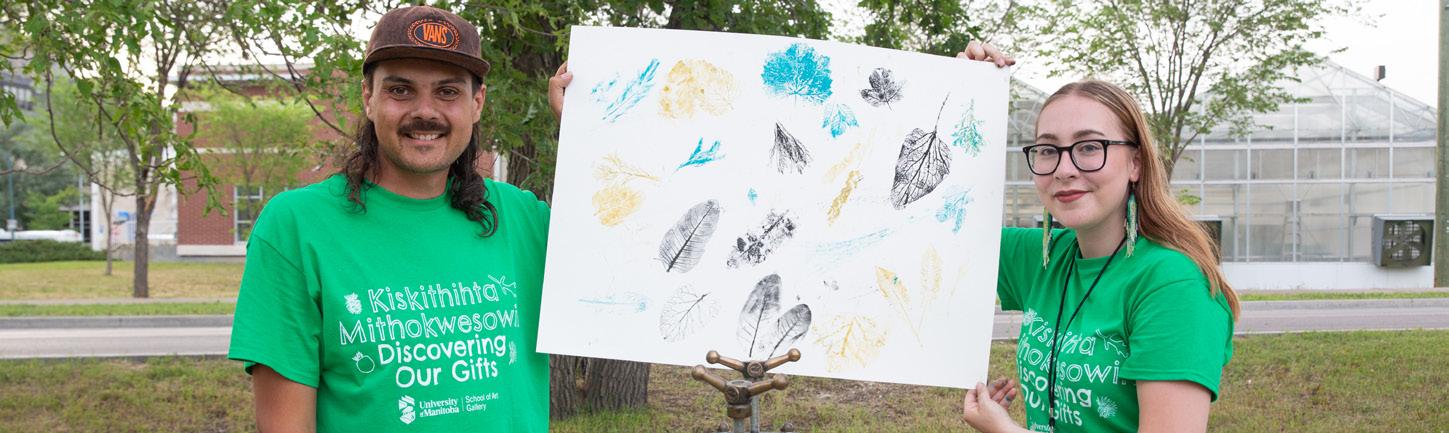
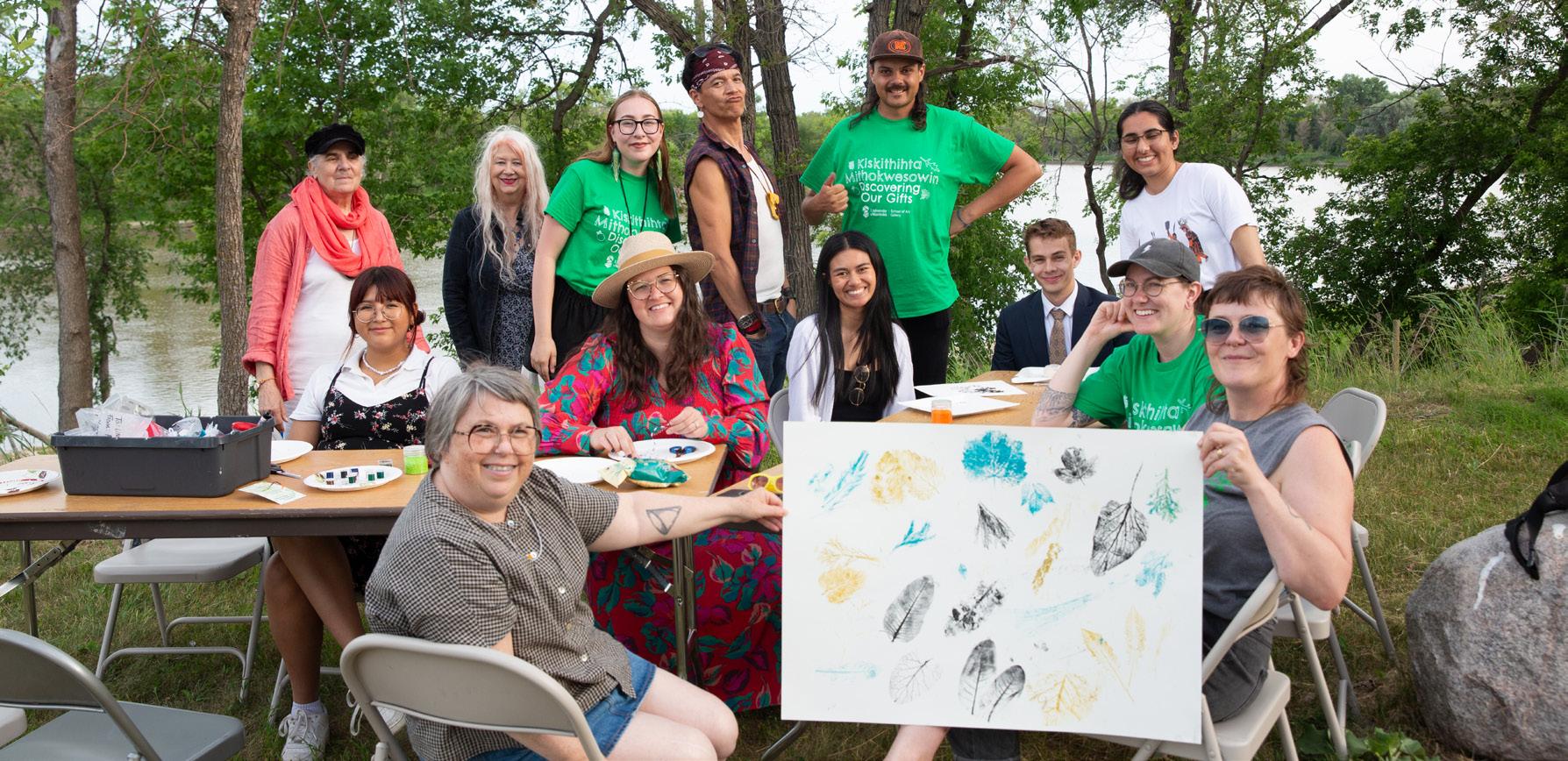
Kiskithihta Mīthokwesowin: Discovering Our Gifts kicked off its opening celebration on National Indigenous Peoples Day last Wednesday with a pipe ceremony, medicine walk and a monoprint workshop open to the public. The event was held at the ARTlab on U of M’s Fort Garry campus.
Created by the School of Art Gallery, the program is designed to take place over the summer in partnership with various community organizations in order to support, inspire and teach the Indigenous artists of the future.
The program is the first of its kind and will be led by Indigenous art education co-ordinator Justin Bear and Indigenous intern for the School of Art Gallery Jory Thomas.
“We noticed that, one, there [aren’t] a lot of Indigenous artists coming in here to do work, or there’s barriers with kids, Indigenous youth, doing art,” Thomas explained.
“A lot of the time these kids think, ‘Oh, art is not something that could work for me,’ and, ‘I’m good at art, but it could never be a job,’ and I feel
like that’s just a stigma that’s been presented for a long time.”
The Indigenous artists lined up for Kiskithihta Mīthokwesowin come from a range of artistic and technical backgrounds. Some artists have master’s or bachelor’s degrees in fine arts, while some simply do art as a hobby.
“That’s kind of what the intent is, showing youth that this is what you can do and we want to see your gifts,” Thomas said. “The university appreciates it, and the world is better with more Indigen-
ous artists.”
The community organizations involved in Kiskithihta Mīthokwesowin are Action Therapy Youth Services, Ka Ni Kanichihk, Marymound and Rainbow Resource Centre.
In collaboration with these organizations, the program will offer a series of workshops designed for many different youths, including those within the 2SLGBTQIA+ community and those with action therapists.
Each workshop is customized for each organization. The Marymound workshop
photo / School of Art / provided will be about video storytelling, and will utilize cellphones and cameras. Ka Ni Kanichihk’s event will involve spray paint, subverting the idea that the material is typically forbidden for youth. Rainbow Resource Centre will have a mixed-media workshop focusing on the relationships connecting two-spirit people to land, plants and animals, while the event involving Action Therapy Youth Services will have participants make their own paint to use on rawhide instead of traditional canvas.
The youths’ artwork will be showcased at the School of Art Gallery from late August to mid-September. A reception for the exhibition will be held Sept. 7.
Thomas highlighted the layered significance that a gallery exhibit holds for Indigenous artists.
“Traditionally, most Indigenous art was actually put in museums instead of art galleries because they considered it a dying thing that they need to preserve, rather than a thing you want to keep alive,” she said.
She hopes those who participate in the program will have an experience similar to her own, where they grow to realize that pursuing art as a career is possible and can positively impact the world around them.
“Even if you’re not having these extraordinary paintings that you’re selling, even learning how to do art and doing your own style of art might inspire someone else.”
arts@themanitoban.com
graphic / Teegan Gillich / staff
Manitoba connections
Hometown athletes are putting the province on the map
Grace Anne Paizen, staff
Vegas Golden Knights
Lord Stanley’s cup is on its way to Manitoba this summer. With the Vegas Golden Knights defeating the Florida Panthers 9–3 in game five of the NHL Stanley Cup Final on June 13, the Stanley Cup’s appearance in Manitoba was secured.
The Golden Knights boast six Manitobans on their roster: Winnipeg’s Mark Stone and Nolan Patrick, Brandon’s Keegan Kolesar, Oakbank’s Brett Howden, Winkler’s Byron Froese and Sioux Valley Dakota Nation’s very own Zach Whitecloud.
Of the 24 Golden Knights
players who made an in-game post-season appearance, 18 were Canadian, with 19 Canadians in total listed on the active roster hailing from British Columbia, Alberta, Saskatchewan, Manitoba, Ontario and Quebec.
Men’s national hockey team
It was a rematch 93 years in the making. The last time Canada faced off against Germany in the International Ice Hockey Federation’s (IIHF)
Men’s World Championship was the first-ever hockey World Championship in 1930.
The Canadian squad had a direct bye to the final game
and defeated the German squad 6–1.
After 93 years, on May 28, Canada would defeat Germany in the IIHF Men’s World Championship game 5–2.
Winning gold with the Canadian squad were Winnipeggers Cody Glass, who currently plays for the Nashville Predators in the NHL, and Joel Hofer, who currently plays for the NHL’s St. Louis Blues, along with a third Winnipegger, Kurt Keats, the team’s manager of hockey operations.
National soccer teams
The countdown is on for the women’s national soc-
cer team as it prepares for the FIFA Women’s World Cup. Co-hosted by Australia and New Zealand from July 20 to Aug. 20, Canada finds itself in Group B of the tournament, paired with Ireland, Nigeria and co-host nation Australia.
Winnipeg darling, 2022 Order of Manitoba recipient and former Bison all-star Desiree Scott will take to the field to add a FIFA World Cup title to her Olympic gold and bronze medal collection.
While there may be no local connections to the men’s national soccer team, it finished second in the Confederation of North, Central America and Caribbean Association Football (CONCA-
CAF) Nations League final held on June 18 in Las Vegas, Nev. Bested by the host team United States 2–0, it was a bittersweet parting gift for Canada’s team captain Atiba Hutchinson, as it was his last game before retiring from the international stage.
The men’s national team is currently playing in the CONCACAF Gold Cup, which runs from June 24 to July 16 and is being jointly hosted by Canada and the United States.
sports@themanitoban.com
Former Bison Nick Thomas faces off against the Winnipeg Blue Bombers in a pre-season game. Thomas was drafted to the Saskatchewan Roughriders in May and is currently on their active roster
Lake Country DockHounds @ Goldeyes May 19 — Final: 4 – 10
Kane County Cougars @ Goldeyes
Sioux Falls Canaries @ Goldeyes
Goldeyes @ Chicago Dogs
Goldeyes @ Lake Country DockHounds
Chicago Dogs @ Goldeyes
Kansas City Monarchs @ Goldeyes
Goldeyes @ Sioux Falls Canaries
Goldeyes @ Kane County Cougars
May 20 — Final: 1 – 7
May 21 — Final: 7 – 4
May 23 — Final: 2 – 3
May 24 — Final: 4 – 5
May 25 — Final: 3 – 2
May 26 — Final: 8 – 4
May 27 — Final: 6 – 11
May 28 — Final: 2 – 3
May 30 — Final: 8 – 14
May 31 — Final: 2 – 3
June 1 — Final: 4 – 9
June 2 — Final: 4 – 5
June 3 — Final: 0 – 6
June 4 — Final: 5 – 14
June 6 — Final: 5 – 7
June 7 — Final: 1 – 6
June 8 — Final: 4 – 5
June 9 — Final: 8 – 2
June 10 — Final: 8 – 7
June 11 — Final: 7 – 0
June 13 — Final: 6 – 2
June 14 — Final: 0 – 19
June 15 — Final: 5 – 7
June 16 — Final: 3 – 12
June 17 — Final: 11 – 6
June 18 — Final: 4 – 6
Lincoln Saltdogs @ Goldeyes
June 20 — Final: 7 – 1 June 21 — Final: 4 – 3
June 22 — Final: 6 – 5
Gary SouthShore Railcats @ Goldeyes June 23 — Final: 12 – 11
June 24 — Final: 1 – 6
June 25 — Final: 3 – 7
Goldeyes @ Lincoln Saltdogs June 26 — 8:05 p.m.
June 27 — 8:05 p.m.
June 28 — 8:05 p.m.
June 29 — 8:05 p.m.
Goldeyes @ Kansas City Monarchs June 30 — 8 p.m.
Goldeyes @ Sioux City Explorers July 3 — 8:05 p.m. July 4 — 8:05 p.m. July 5 — 8:05 p.m.
Milwaukee Milkmen @ Goldeyes
Cleburne Railroaders @ Goldeyes July 11 — 7:30 p.m.
Sioux City Explorers @ Goldeyes
Sea
Sea
Sea
Around-the-horns
Everything the herd has been up to this summer semester
Grace Anne Paizen, staff
Bisons basketball
The Canada West (CanWest) conference announced in May that the University of Manitoba will play host to the CanWest men’s basketball championship from Feb. 21 to 25, 2024.
Moving to a single-site format, all playoff games will be held at the Investors Group Athletic Centre.
The regular season tips off this November, with the Bisons men’s basketball team opening the season at home Nov. 2 against the Brandon University Bobcats.
And downtown, two former members of the herd are inaugural members of Winnipeg’s freshly minted Canadian Elite Basketball League (CEBL) team.
Both the 2022-23 Bisons and U Sports national Rookie of the Year
Simon Hildebrandt and 2017-18 Manitoba Male Athlete of the Year Justus Alleyn, who played for the Bisons from 2013 to 2018, play for the Winnipeg Sea Bears, along with fellow Winnipegger Chad Posthumus. Hildebrandt made CEBL history as the Sea Bears first-ever draft pick. The Sea Bears are currently first in the CEBL Western Conference, with a bestin-league 7-3 record.
Bisons football
Fresh off his 2022-23 Bisons
Male Athlete of the Year award, AK Gassama was one of four Bisons selected for the annual U Sports East-West Bowl. McMaster University played host to the game on May 13.
Bison receivers Gassama and Birhanu Yitna, as well as defensive backs Stephen Adamopoulos and Nick Conway, were named to team West.
While the game was a resounding East win — the final score 37–0 for team East, and its first win since 2015 — all four Bisons made positive impacts for team West.
It was Yitna who shone in the passing game, raking in 38 yards receiving in the fourth quarter and making him a favourite of West quarterbacks Hillock and Philip in the fourth quarter, who targeted Yitna five times.
Moreover, the four Bisons selected in the East-West Bowl were not the only members of the herd who made an impression in the football world this spring.
Bisons volleyball
Both the men’s and women’s volleyball teams have had an exciting off-season. At the 2023 Volleyball Manitoba Awards & Hall of Fame Banquet on June 11, Bisons own Raya Surinx received the Cheryl Cable Memorial Award for under 20 (20U) women’s player of the year and Jordon Heppner received the Mark Tennant Award for 20U men’s player of the year.
Bisons hockey
The Bisons men’s hockey team officially has a new coach. Gordon Burnett has been named Mike Sirant’s successor.
Adamopoulos made a huge interception off of team East quarterback Thomas Bolduc of the Université Laval Rouge et Or in the second quarter, stalling team East’s march down the field.
Conway and Adamopoulos also combined for four tackles over the course of the game and were part of team West’s huge goal line stand on its own 2-yard line in the third quarter.
While Gassama was targeted unsuccessfully twice in the game by team West quarterbacks Kinsale Philip of the University of Toronto Varsity Blues and Evan Hillock of the Western University Mustangs, Gassama had four successful punt returns over the course of the game, including successfully taking a missed team East field goal out of the end zone in the second quarter and a fantastic punt return to the 34-yard line in the third quarter.
Five Bisons were invited to the CFL 2023 Invitational Combine: defensive back Markos Bockru, quarterback Des Catellier and defensive linemen Tyrece Viner-Cox, Collin Kornelson, Tristan Francis and Bisons linebacker Nick Thomas took part in the 2023 CFL Combine.
Both Kornelson and Thomas were drafted by teams in the CFL this spring. Kornelson has been drafted by the Winnipeg Blue Bombers and Thomas by the Saskatchewan Roughriders.
Bisons golf
The Bisons golf team recently put an end to their drought at nationals. The herd made the cut for the first time since 2018 at the Canadian University/College Championship that ran from May 30 to June 2 at FireRock Golf Club in Komoka, Ont.
The team finished 10th overall, with a team total of +61. Cameron McIntyre had the best individual outing in the tournament for the Bisons, shooting +9. Teammate Cole Peters finished close behind at +12. Trent Robertson finished the tournament with +19, Derek Benson with +28 and Connor Stewart with +33.
Fresh off receiving her latest award, 2022-23 Bisons Female Rookie of the Year Surinx was named to Volleyball Canada’s women’s Indoor NextGen Team as part of its travelling roster. She was joined by fellow Bisons teammate Ella Gray, who was named to the practice roster.
Meanwhile, the Bisons men’s volleyball head coach Arnd (Lupo) Ludwig, assistant coach Mike Stephens and players Jonah Dueck and Sammy Ludwig are making a statement representing Canada in international volleyball. The Bisons foursome won bronze at the North, Central America and Caribbean Volleyball Confederation U-21 Pan American Cup that was held in Havana, Cuba, June 5–10, defeating Puerto Rico in four sets.
Dueck finished the tournament with 38 points and eight blocks, while teammate Ludwig finished the tournament with seven points and two blocks.
The bronze medalists’ next tournament is the Fédération Internationale de Volleyball U21 World Championship hosted by Bahrain July 7–16.
A Regina native, Burnett was a defenceman in his hockey career, having played in the National Collegiate Athletics Association (NCAA) for the College of St. Scholastica Saints, and in both the East Coast Hockey League and the Central Hockey League, including a stint with the Arizona Sundogs, who he would end up becoming assistant coach of from 2012 to 2014. In his coaching career, he was also assistant coach for the NCAA University of Notre Dame Fighting Irish, as well as for the Western Hockey League’s Kootenay Ice and Moose Jaw Warriors.
Burnett was head coach in 2019 for Team Saskatchewan at the Canada Winter Games, and has served as head coach of the Manitoba Junior Hockey League’s Winnipeg Blues.