The past, present, and future of the self-driving car
Part one, in which our sex colomnist tackles the big O Bison athletes set new school record in academics
Students raise concerns over U of M food
UMSU hosts open discussion forum between Aramark and students
Quinn Riche R t, Staff
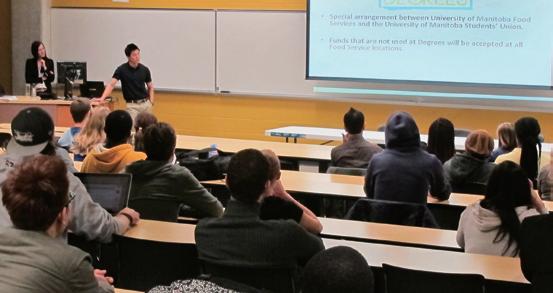
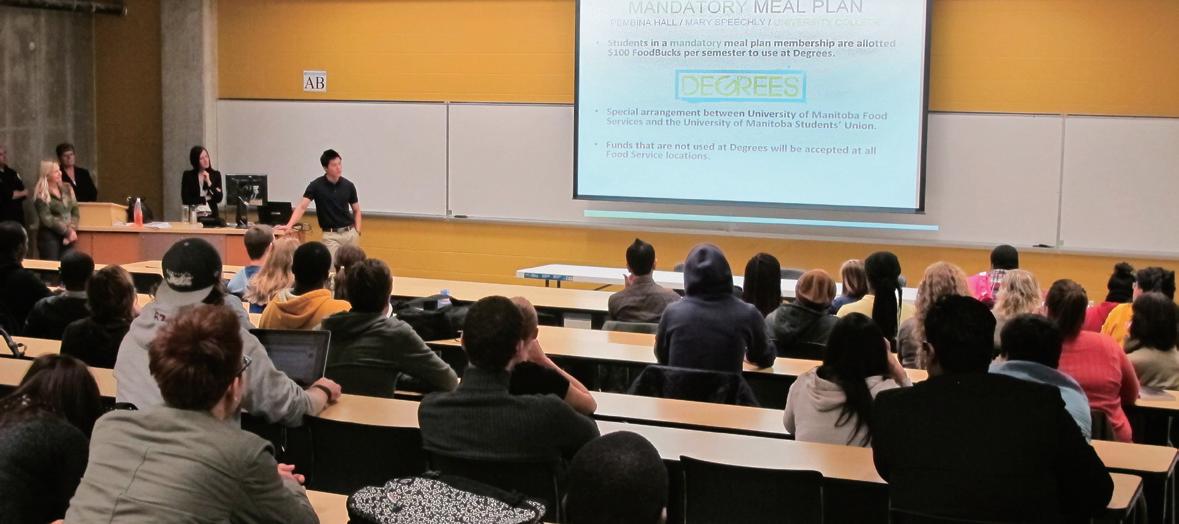
The University of Manitoba Students’ Union (UMSU) hosted an open forum on food services and meal plans on Oct. 4 at the Fort Garry campus, where students came to ask questions and voice their concerns regarding the access to, and quality of, food on campus.
Representatives from Aramark, the food supplier contracted by the U of M, were in attendance to take questions from students, as well as share a presentation detailing new changes to their delivery of food services on campus.
The panel representing Aramark included national director of wellness and sustainability Tina Horsley, operations coordinator Nathan Lo, manager of the fresh food company Joan Mandziuk, Aramark’s Manitoba marketing manager of food services for the fresh food company Ainsley Mitchell, and food services director Dean Duff.
Aramark’s presentation focused largely on the company’s attempts to move towards more environmentally neutral operations on campus.
A broad range of issues with Aramark’s policies and practices were raised by students, including issues pertaining to animal welfare, the inconsistent availability of Halal food and more diverse food, as well as more general concerns regarding the near-monopolization of food services on campus.
Concerning the availability of Halal food on campus, several Aramark representatives commented on the difficulty of consistently obtaining such items from suppliers.
The panel stated that “from a global perspective we are constantly struggling with a balancing act between cost for students, and what we have available. There is an additional cost to some of these items, and the biggest issue we have in obtaining them
is availability.”
A recurring grievance from students was the 50 cent fee charged with every debit use at Aramark-operated food suppliers, with one student describing the fee as “absolutely preposterous.”
“That is an issue across Canada that we are looking into,” responded Duff. “That is why we’d love to sell FoodBucks [ . . . ] that is the alternative to using your debit card.”
A related issue that was raised, pertaining to the FoodBucks cards, is the fact that declining balance money must be used up or it will disappear.
“I’ve seen situations where, sometimes, students have no choice at the end of the semester but to buy random things that they don’t like because they know that their declining balance is going to disappear,” commented one student claiming to represent international students on campus.
The panel responded that the situ-
ation where students have to use up their FoodBucks, and would not be able to carry them over, applies only to residences that come with a mandatory food plan, which is typically the case in University College. Students on a voluntary plan are eligible to carry their FoodBucks over to the next term.
Aramark pledged to work on building a better menu. A new menu item, “Bison Lasagne,” consisting of all-local ingredients was on hand for students to sample.
The day following the forum, Mitchell commented that she was pleased with what they had learned from meeting with students, and was excited to continue working with students on the issues addressed.
“A lot of constructive discussion was had regarding Food Services on campus and we are grateful to UMSU for putting on the event.”
Leading phenomenologist and social critic visits U of M
Alphonso Lingis relays his theory of community
Alyci A Rod Rigues, stA ff
Dr Alphonso Lingis presented his newest work, “One’s Own Voice,” at the University of Manitoba on Oct. 2. Lingis travelled to Winnipeg from Pennsylvania University, where he is a professor emeritus of philosophy.
Lingis’ lecture was sponsored by Mosaic, a journal for the interdisciplinary study of literature located at the U of M.
Mosaic publishes leading critical work within the realm of literature and theory, where Lingis’ work was recently published.
“Mosaic is a quarterly publication that brings insights from a variety of disciplines to bear on literary texts, cultural climates, topical issues, divergent art forms and modes of creative activity,” said Dawne McCance, editor of Mosaic and distinguished professor at the U of M. Lingis was introduced by a story and then a recording of a woman using various sounds depicting human emotion and sounds for communication. This led to the reading of his work “One’s Own Voice.”
His reading began by speaking of language and how language can depict character. Some of the examples used were the words spoken by a mother, a drug addict, guy talk or the language of chemistry. Each classification of person or language has their own way of speech, which can group them together, making it easier to identify the classification in which they belong.
The presentation of his essay took over an hour, yet time did not drag as all eyes were on Lingis. Light music playing in the background was added for dramatic effect. Each time
he reached a new page the old page was dropped to the ground, leaving a trail of his work and thoughts as he paced the floor.
When asked what prompted the exploration of the subject Lingis responded by saying that he is generally bothered by language that speaks about language. Academics in humanities tend to merely talk about texts and languages.
Lingis used the example of anthropologists who do not do research without grants, due to research being expensive, so they mostly write about prior anthropologists rather than communicating their own research.
Lingis’ goal is to say things as clear and forcibly as possible with liberation from academic forms of writing.
According to Lingis, “those who speak with their own voice, recognize the voice of others.”
Internationally, Lingis is known as a world-renowned philosopher, photographer, writer, and world traveler. The Pennsylvania professor is also known as an existentialist, phenomenologist, and world-renowned critic on the excesses and absurdities that abound in our society.
His criticism stems from the experience he has accumulated travelling to places like Brazil, Bolivia, Madagascar, Ethiopia, Papua-New Guinea, Bangladesh, Bali, and India.
Some of the world’s poorest countries have given Lingis a perspective that only world experience can create. His passion lies in meeting people from various communities to acquire a sense of what makes a community.
This passion has led him to theory
work about community, but he relates his theories in a way that is different to how academics usually present theories. He reiterates his
theories in beautiful prose, with intricate stories to illustrate his points.
edItor-I n-ch I ef Ryan Harby editor@themanitoban.com / 474.8293
voluntee R contR ibuto R s Caroline Norman, Jeff Kent, Emilie St. Hillaire, Justin Ladia, Dany Reede, Adam Peleshaty, Will Gibson, Ryan Tabachuk, Chris Hearn, Jess Chapman, Ian T.D. Thomson, Gem Newman, Michelle Saromo
MANITOBAN
105 UNIVERSITY CENTRE UNIVERSITY OF MANITOBA WINNIPEG, MB R3T 2N2
General Inqu I r I es & a dvert I s I n G
Phone: (204) 474.6535
Fax: (204) 474.7651
Email: manitoban@themanitoban.com
n at I onal & Mult I -Market a dvert I s I n G Campus Plus Media Services Toll-Free (In Canada): 1.800.265.5372
Email: info@campusplus.com
Canadian Publications Mail Product Sales Agreement #589160
A “volunteer staff” member is defined as a person who has had three volunteer articles, photographs, or pieces of art of reasonable length and/or substance published in three different issues of the current publishing year of the Manitoban. Any individual who qualifies must be voted in by a majority vote at a Manitoban staff meeting. Elected representatives and non-students may be excluded from holding votes as volunteer staff members in accordance with the Manitoban Constitution.
The Manitoban is the official student newspaper of the University of Manitoba. It is published monthly during the summer and each week during the academic year by the Manitoban Newspaper Publications Corporation.
The Manitoban is an independent and democratic student organization, open to participation from all students. It exists to serve its readers as students and citizens.
Yearly subscriptions to the Manitoban are available for $40.
A time-honoured tradition
Explaining the ins and outs of our student newspaper
Every so often there comes a time in the life of a student newspaper where, in the name of public awareness, efforts must be made to ensure the readership is kept abreast of both the operations and the services provided to the student body.
Because this is, in every sense of the term, the students’ paper, it only makes sense to explain to the nitty-gritty details, the behindthe-scenes tell-all of who we are, what we do, and why we do it. If you are in any way uninitiated, uninformed, or perhaps just mildly curious as to the workings of the U of M student paper then this, my friend, is the perfect editorial for you.
Let’s start first with the history of the Manitoban and a little bit of who we are, exactly.
I. HIstory
At some point in your university career you may have passed a paper stand in University Centre (or one of the many other buildings served on campus and around the city) and said to yourself, “Where do these things come from? What is their deal?”
Well, you’re in luck because I will tell you their deal.
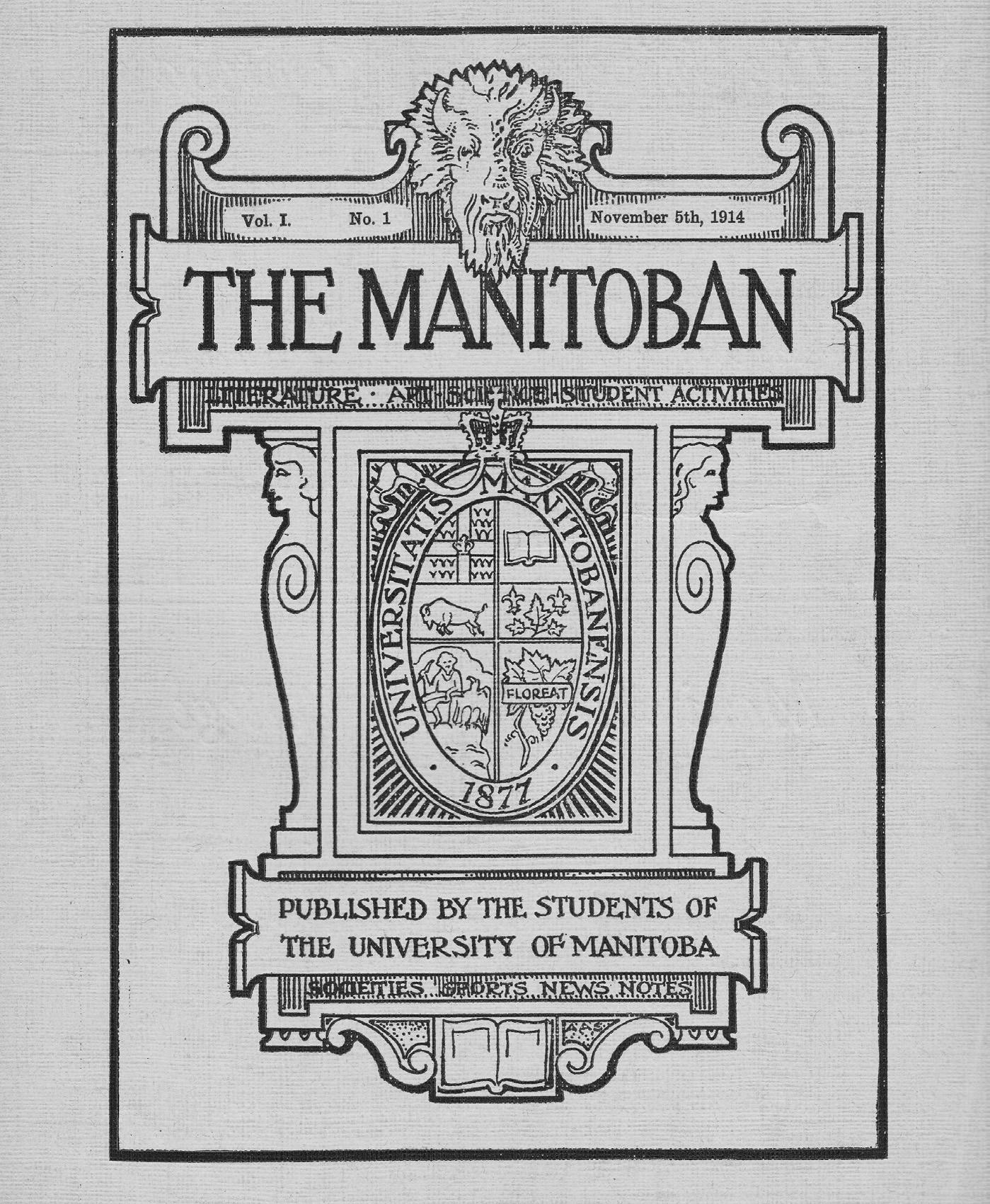
As you may have surmised from the cover, the Manitoban is the official student newspaper of the University of Manitoba. It was founded way back in 1914 when the university was little more than a co-operation of affiliated colleges and an in-house staff of 42 employees. At the time the U of M offered degrees in Arts, Medicine, Engineering, Architecture, Law, and Pharmacy.
The paper originated as a bi-monthly publication, produced for the first and third Thursday of each school month, with subscriptions available for a heaping one dollar per year.
In the first issue ever published, the Manitoban was described to be “a journal for all University men and women [ . . . ] the artist and the athlete, the poet and the preacher, the doctor, the druggist, the lawyer and the engineer.”
Since its origin the paper has witnessed a variety of changes in distribution, production, and even affiliation. Over the years it’s seen its fair share of trials—numerous occasions butting heads with the university’s student union—and tribulations. Most recently (in 2011) the paper earned a referendum vote from the U of M students to oversee an adjustment in the Manitoban’s operating budget for the first time in 15 years.
Faced with the prospect of cutting significant resources and positions, student voters saw fit to allow the U of M paper to address the widening gap caused by years of inflation and printing costs left unchecked. Our current, former, and (likely) future staff are now and will be forever grateful to the students for deeming this service worthy of attention.
Today the Manitoban operates as a notfor-profit corporation, printing 11 out of the 12 months of the year, dedicated (as ever) to serving all students at the U of M during every term of the school year.
II. PurPose
The Manitoban exists for many reasons but there are two in particular that are of most significance.
First, our U of M paper specializes in serving a community and culture that is, for the most part, otherwise unheard in both local and mainstream media. Not only do many students live in residence on campus, but there are countless others who spend nearly every waking hour at the U of M, devoting themselves fully to studies that will hopefully impact their future careers.
It’s often said that our university is the unofficial “third-largest city” in Manitoba, and to think there isn’t any news relevant or specific to this institution would be downright foolish (that’s my “editorializing” portion of this editorial). For nearly 100 years now each iterative staff of the Manitoban has strived to produce a paper that not only covers issues germane to life at the university but also to represent issues and topics that are of particular interest to our readership: students.
Second, and this is historically a lesser known point, the Manitoban exists to provide opportunity.
Certainly there are hundreds (upon hundreds) of U of M students who enjoy the act of writing. The Manitoban affords those willing to participate the opportunity to gain experience using their writing skills in the field of student journalism. We offer this service to all students eager to hone their
skills, work their craft, and see their efforts paid off in full print and publication. Not to be overlooked, this opportunity exists for the U of M’s more artistically inclined students as well – the Manitoban is always welcoming to those interested in the photo, graphic, or design aspects of the paper.
Because of this what you see in an issue of the Manitoban is not just stories written for the students of the U of M, but also stories written by students of the U of M. It is, in part, a representation of budding talent and hard work; in many ways it is a reflection of the student body the paper serves each year.
If you would like to volunteer for the Manitoban our doors are always open; you can drop by the office, visit the volunteering section of our website, or just shoot off an email to any of our section editors. The point is, we are here if you are interested.
Past U of M students and Manitoban staff/contributors have included such distinguished figures as: Graham Spry (founding member of the CBC), Marshal McLuhan, Marcel Dzama, Andrew Coyne, Nahlah Ayed, and Israel “Izzy” Asper. The staff and the volunteers of the student paper put in a lot of hours, sacrifice both school and personal time in effort to produce something worthy of the readers who help support the Manitoban. And let me make this clear: all of us, from top to bottom, feel very lucky to have the opportunity to do so.
RyA n hARby, Staff
Barack did not rock this debate
R Achel Wood, Staff
Warning: I will try to be completely unbiased in this analysis and base my arguments on the facts of the debate, not on the fact that I may or may not be wearing a shirt with the President’s face that reads, “Barack my world.”
The night that political junkies look forward to like kids waiting to overdose on high-fructose corn syrup on Halloween finally arrived on Oct. 3 – the U.S. presidential debates.
An aggressive Mitt Romney faced, and perhaps defeated, an exhausted-looking Obama in the first of four debates. The debate consisted of relatively—and surprisingly—friendly exchanges between the candidates, void of the usual personal and petty attacks.
Anyone who has access to mainstream media knows that Romney has had a tendency to put his foot in his mouth over the last few weeks. From the infamous 47 per cent comment (apparently most Americans are freeloaders who think they are entitled to basic human needs such as health care, food, and housing? Who do they think they are?) to the dumbfounding remark that he made about airplane windows (according to Romney, it’s an issue that these windows can’t be opened).
To top it all off, Romney now goes and states that he will defund PBS and fire Big Bird from his day job?
ducing a live fact-check of their claims.
According to this fact-checking system, Obama’s claim that, if elected, Romney would enforce a $5 trillion tax cut is fact. The New York Times explains that Romney has proposed cutting marginal tax rates by 20 per cent and replacing that revenue by clearing out “the underbrush of deductions and loopholes in the tax code,” never fully specifying how exactly he would do this.
It’s safe to say that the whole of the debate came down to fundamental ideological differences. Obama appeared tired and worn, but human. Romney appeared polished, sharp, and almost robotic.
Ideological differences were evident in their answers when the question of the role of government was asked. Romney argued that “we are all children of the same God,” demonstrating the inability of the Republicans to separate state and Church. This was in stark contrast to Obama’s answer, which was void of religious mention but focused on the government’s role to create opportunity, education, and cohesiveness between government and its citizens.
Warning: I will try to be completely unbiased in this analysis and base my arguments on the facts of the debate, not on the fact that I am may or may not be wearing a shirt with the President’s face that reads, “Barack my world.”
It’s clear that Romney desperately needed to redeem himself at this debate. This was achieved, not necessarily because his answers were “better” than the President’s, but because he appeared more confident, assertive, and enthusiastic. Obama’s frequent pausing and stuttering drowned the nostalgia of his eloquent and passionate hope-filled speeches from the 2008 campaign.
The debate was intended to focus on a range of domestic issues but centered, primarily, on the economy. Topics included the deficit, healthcare, and the role of government, all selected by the moderator, Jim Lehrer. I guess Lehrer doesn’t see LGBT and women’s rights as important domestic issues, which is a shame considering that these rights are under attack by Romney.
The question on the economy lasted nearly half of the debate, going back and forth between Romney pointing out that Obama has not yet repaired the economy that the Republican’s left a mess. and Obama accusing Romney of a proposed US $5 trillion tax cut. Both candidates relied heavily on contradictory claims and statistics that eventually lead to the New York Times pro-
Romney’s forceful attitude may have undecided viewers sway either way – his assertiveness could show that he would be a commanding and confident president, or it could turn individual’s off of him, viewing him as rude and arrogant as he continuously spoke over Lehrer.
Throughout the debate, the two candidates both exposed their greatest flaws. Romney desperately tried to appear as a down-to-earth guy, continually mentioning the working class, but remained unconvincing that he knows what it feels like to be middle class, rather than swimming in piles of cash in the backyard of his Utah vacation mansion. Obama, a product of the lower-middle class, appeals to the everyday person, but remained fatigued and uninspired throughout the debate, disappointing viewers and leaving them questioning his ability to fix the economy in a second term.
The good news is that there are more debates. One which features the vice-presidential candidates where, here’s hoping, Biden will point out the fundamentalist and right-wing fanatical ideas of Paul Ryan, and two more that consist of Romney and Obama going head-to-head once again.
So, perhaps, I couldn’t remain completely neutral in this analysis but, admittedly, I’m still hoping that Obama continues to Barack my world.
A clear consensus: Romney wins first debate
Rn A ndo, Staff
spence R fe
Last Wednesday, I sat down with the Manitoban's managing editor Chuthan Ponnampalam and sports editor Marc Lagace to watch the first U.S. Presidential Debate of the 2012 presidential campaign. We sat around a computer in the Manitoban office, watching the debate live streamed on CNN.com, which gave us a great opportunity to discuss and process the debate as it happened. Through that discussion, our consensus was that Mitt Romney was the winner, a consensus that has been confirmed by much of the post debate coverage.
I recognize that it can be difficult to find unbiased coverage of political events. Since many news organizations target their opinions towards supporters of specific political parties, there can be widely varying reporting on events like debates. What is important to look for then, is not the opinion of one or two news organizations, but an overall trend and sentiment that takes many different perspectives into account.
To give you as balanced an overview as possible of last Wednesday’s debate, I have compiled some quotes and statistics from news outlets and individuals across the political spectrum, as well as two folks right here at the Manitoban. Here they are:
“[Romney] seemed like he was happy to be there debating, President Obama gave you the impression that this whole thing was kind of a lot of trouble [ . . . ] I do think that Romney had a good night. I think he wanted to be there, I think he knew he needed this, and I think Obama just gave a sense that he wasn’t happy to be there.”
—Democratic consultant James Carville on CNN
“I think Governor Romney was definitely more crisp in his presentation tonight. He was leaning into the debate, where President Obama was a little bit more laid back. I also think he was able to be aggressive without being offensive. So, even though there were – I didn’t see any knockout punches.”
—ABC anchor George Stephanopoulos
“Look, you know how much I love the guy, and how much of a high-info viewer I am, but this was a disaster for Obama.”
—Commentator and blogger Andrew Sullivan
“From the very first answer of this 90-minute debate in Denver, Colorado, Mr. Romney took command of an occasion that pundits and public alike had largely presumed Mr. Obama would win. As it turned out on the night, they were wrong...”
“And it was vitality that was in short supply for Mr. Obama last night. He will have infuriated his supporters with a strangely stilted, passive performance; searching for his own lines, and then refusing to make eye contact with Mr Romney when it was his opponent’s turn to speak.”
—Peter Foster, the Telegraph ’s U.S. editor
A CNN poll of debate-watchers found Romney very clearly ahead, with 67 per cent
of registered voters saying he won the debate, against just 25 per cent for Obama.
—CNN
A CBS News poll of undecided voters who watched the debate found 46 per cent siding with Romney, 22 per cent for Obama and 32 per cent saying it was a tie.
—CBS
“Tonight was a big win for Mitt Romney. He dominated the debate in every way. This wasn’t even close.”
—Joe Scarborough, host of MSNBC’s Morning Joe
“It wasn’t just Mitt Romney’s strong performance. It was President Obama’s amazingly weak one. He’s never been punctured before. But by debate’s end Wednesday night, if you opened the window this is what you could hear: Ssssssss. The soft hiss of air departing from a balloon.”
"And—amazingly again—he did it to himself. He didn’t fight, he didn’t show, he wasn’t awake and hungry. He just said the same-old-same-old and let it go. He couldn’t even meet Mr. Romney’s gaze, never mind his arguments.”
—Peggy Noonan, Wall Street Journal
And what did my fellow Manitoban debate watchers Chuthan and Marc think?
“I was surprised by positions Romney took considering what I’ve heard from the media, that being said I was surprised by how well Romney did, and how little fire Obama threw at him.”
—Marc Lagace, the Manitoban sports editor
“I just don't believe Obama came prepared for the debate, and Romney seemed like he wanted it, and he got it.”
—Chuthan Ponnampalam, the Manitoban managing editor
The consensus seems clear: Romney was the winner of the first U.S. Presidential Debate. The results of the debate will likely narrow the polls, and some voter surveys show Romney closing the gap, or taking a slight lead in some of the crucial swing states. If a week ago the conventional wisdom was that Romney’s chances were slipping away, his performance in the debate has given his campaign a new lease on life.
Romney had to prove that he was a credible challenger who could hold his own on the same stage as Obama. He accomplished this. Now, with less than a month until Election Day, and two more Presidential debates to go, the presidential race resumes on a more even footing and appears headed for a close finish.
P.S. I would love to hear your thoughts on the debate and the election. Who do you think won? What part stood out for you the most? Scan the QR code to visit the Comment Section online where you can share your thoughts.
Spencer Fernando is the Comment Editor for the Manitoban.
The curious case of Omar Khadr
No easy answers
ch Ris h e ARn, volunteer Staff
After spending almost 10 years at the US detention center in Guantanamo Bay, Omar Khadr has arrived back in Canada to a polarized reception.
Now, here is what we know: Omar is a man who pled guilty to murder, attempted murder, spying, conspiracy, and material support for terrorism. After a gun battle with NATO forces, it is alleged Omar Khadr threw a grenade that killed one soldier and wounded another. He has been accused of helping make and plant bombs and watching movements of NATO forces. And, apparently he did all of this when he was just 15 years old.
Some characterize him as a hardcore terrorist who shouldn't be allowed back in Canada. Others see him as a victim, a child soldier who was tortured and abused who shouldn’t have been at Guantanamo in the first place, and should have been returned to Canada long before.
Who is right? Well, the truth is probably somewhere in the middle. The biggest problem with this case is that the “truth” as it were has been completely lost in lies, denials, lawsuits, myth, legend, secrecy, and polarization. Is his family a dangerous group of terrorists? The family insists not. Others argue that yes, they are. Sadly, in the middle is Khadr.
Do I sympathize? Yes. Do I have concerns? Yes.
Khadr’s family, who allowed him to be in an extremely dangerous situ-
ation, doing extremely scary activities at such a young age, failed him. His father, according to Canadian and British authorities, was a senior leader in Al Qaeda, and ended up dying in a firefight against the Pakistan military. His family failed Khadr long before he even got onto the frontlines, long before he even got to Guantanamo and I feel strongly that Khadr’s mother has been let off the hook over this.
The Khadr family seems to have turned Canada into a handy country of convenience for themselves, which I think, makes many in Canada understandably angry. One of Khadr’s brothers had a heart condition, was quite sick, and eventually died. They took full advantage of the Canadian health system in their care of him, which, as Canadians, was their right to do. At the same time, I think Canadians expected a certain amount of loyalty as a result. But, the family didn’t seem to want much to do with Canada unless it solely suited their interests.
him back to a country his family didn’t seem to want to raise him in the in the first place.
So, the anger and lack of sympathy are understandable. But is this Khadr’s fault? No. Should it factor in to how we judge him? Probably not, although it has an influence on the person he is, his beliefs and his actions and the kind of citizen he will be.
Now, although not a great place, Guantanamo was probably the only
serve a full sentence and would be out and back to Afghanistan. This was a kid that shouldn’t have been on the frontlines of a war but, once captured, could the U.S. just turn around and let him go back? Yes, he faced hard questioning, which makes sense given the people he was involved with, who were high up in Al Qaeda (although the Kadhr’s deny this). His family lived with enemy number one, Osama Bin Laden, for a time. Omar may have had information that could have saved lives.
This doesn’t sit well with many, especially when, after all of this, he was somehow dragged onto the frontlines of a war against Canadian soldiers. And then, to add insult to injury, people are frustrated that the Canadian government was being used to get Khadr back and were blamed for not working hard enough to get
answer for Khadr at the time. If he had been sent to Canada when first captured, at what point would he have ended up released and back on the battlefield? He was a prisoner of war. He was kept in Guantanamo, off of the field, away from fighting. He couldn’t help build bombs in jail. And, surely, the U.S. knew if Kahdr were sent to Canada, he probably wouldn’t
Now, I support human rights, but acknowledge that to save lives it is important to get information from people who have it. Torture? No, I’m not for that and there are legitimate concerns he was tortured. But, I am also aware that someone is not just going to open up and tell their secrets. So, we are faced with a real problem. How do we make the world safer, while maintaining human rights and dignity? I think the case of Omar Khadr will be studied well in the future to help answer a question I do not have an answer to at the moment.
So, is Omar Khadr being back in Canada a good thing? I don’t think there is an answer to that either. Canada doesn’t really have a choice anyway. He has Canadian citizenship, was born in Canada, and Canada is obliged to welcome him back. What
A four-point plan for democratic reform
How to make Canadian politics less insufferable
he American political system is superior to the Canadian political system. There, I said it. Oh, the American system has problems. Don’t get me wrong. Hyperpartisanship, the influence of special interests, the refusal of today’s Congress to think long-term about the nation’s debt crisis – they all need a decent burial, and the only thing that can kill them off is for lawmakers to look them in the eye and say, “You know what? No.”
By most measures, the Canadian system functions more efficiently. But what have we missed out on for the sake of efficiency?
The problems with the Canadian system require cutting down to the bone. They’re not as simple as putting aside ideological biases, or ripping up a check from the Koch brothers, or telling your constituents that the U.S. just can’t afford for the factory to build those new tanks. They require genuine, structural reform. Here are
some suggestions:
1. More free voting
The Canadian left wasn’t happy with Status of Women Minister Rona Ambrose for voting her conscience on the private member’s bill M312, which would have opened up a parliamentary debate on the starting point of human life. Perhaps they would have understood this sort of thing more if free votes were permitted on all other legislation. The practice of vote-whipping, in which all MPs vote with their party leader, essentially reduces 413 votes to four or five votes of completely unequal weight. In the U.S. parties in Congress have whips, but they cannot force MPs who stray from the party line to leave the party. Increased free voting will allow all MPs to do what Ambrose did: represent their ridings.
2. separation of powers
The prime minister of Canada
I do know is that the Khadr family is not a family I have much sympathy for. They have a worrisome history with what are sometimes quite radical views and radical actions.
What I worry about is Omar Khadr going back to this family. There is much talk about rehabilitation when he is released from jail. If he is around the same people that fed him radical ideas to begin with, what are the chances he will move away from his own radical ideas? And where will that lead him? Back onto the battlefield where next time he could end up dead?
Khadr has apparently refused to renounce Jihad. Is this his future? I believe strongly his family let him down, put him in a dangerous position by getting him involved with some dangerous people right from an early age and allowing him to be on the front lines of war.
Furthermore, they raised him around radical ideas, which have molded his current views. It seems that nothing has changed, and that he most likely will continue to be failed by his family and could wind up right back in the wrong place once again. So, now he’s back in Canada. So? How long will that be for? Canada has always been a country of convenience for this family. If he is allowed to travel, he most likely will.
Frankly, looking at the big picture, it doesn’t really matter where he is, it’s who he is with that will make the difference. And things don’t look good for Omar, if you ask me.
serves in both the executive and legislative branches. In the U.S. this is unconstitutional. This is to prevent the president from exerting too much influence over the practice of lawmaking, thereby ensuing actual debate on legislation. If you think Stephen Harper has made himself too powerful, think about all the power that was available to him already. Besides, never again would a cabinet minister have to choose between her riding’s wishes and what the rest of Canada thinks her portfolio mandates.
3. An elected senate
I don’t need to belabour this point too much – we’ve all rolled our eyes at a headline announcing three new appointees with no evident qualifications. Elect it or end it.
4. Pension reform
Who enjoys paying 23 dollars for every one dollar that an MP contrib-
utes to his or her pension? Anyone? Bueller?
It’s a shame that existing parties won’t take up the mantle of demo-
cratic reform. But perhaps a party in comeback mode could try it. Your move, Justin.
Science & technology
Not your father’s Oldsmobile
The present, past, and future of self-driving cars
tom i ng RA m, Staff
On Tuesday, Sept. 25, the state of California signed a bill into law that will allow self-driving cars on California roadways.
It sounds like science fiction, but it actually won’t be long until the technology for fully autonomous vehicles is all worked out. The bill was signed at Google’s headquarters in Mountain View, California, with Google cofounder Sergey Brin present. Google has been testing selfdriving cars for at least two years now with some fairly promising results. Earlier this year, they released a video in which Steve Mahan, a legally blind California resident, took one of their cars for a spin. It was only a tech demo with a “carefully programmed” route, but it’s pretty compelling as a proof of concept.
The California law acknowledges that “development is actively under way of new technology that [ . . . ] permits a motor vehicle to operate without the active control and continuous monitoring of a human operator.”
It authorizes self-driving cars on California roads, so long as the manufacturer can certify that the cars meet safety standards to be determined by the Department of the California Highway Patrol. A similar law was passed last year in Nevada. What makes this different is that California is one of the major centres of technological development, and home to several of the corporations and institutions that are developing self-driving cars – which, aside from Google, include teams at Caltech and Stanford University.
The idea of autonomous vehicles is nothing new. At the 1939 World’s Fair in New York, the “Futurama” exhibit raised the possibility of cars using radio to automatically maintain the proper distance from each other. The exhibit’s designer Norman Bel Geddes later argued in his 1940 book, Magic Motorways, that humans should be as far removed from the process of driving as possible. He speculated that by 1960, cars and highways would have devices installed to automatically correct human driving errors.
Bel Geddes was over-optimistic about the timing, but many of these technologies were eventually developed. The California law specifically name-checks several of them:
electronic blind spot assistance, automated emergency braking, park assist, cruise control, lane departure warning, and traffic jam and queuing assist. Some of these are cutting-edge mechanisms that can only be found in top of the line cars, but some are so common we hardly think of them as automated systems that take away our choices.
Actual self-driving cars have been developed since the late 1970s, when the Tsukuba Mechanical Engineering Lab in Japan ran a driverless car on a specially marked closed course. Three years later, Mercedes Benz tested a van that guided itself by examining video of the road ahead in real time.
In 1987, the European Commission funded the EUREKA Prometheus Project on autonomous vehicles to the tune of 800 million euros.
Things really started to get interesting in the last decade when DARPA, the US military research agency that was instrumental in the development of the Internet, offered a prize to the team whose car could complete their course through the desert. In 2004, no team managed to win the US $1 million prize. By the next year, huge advances had been made in the technology, and Stanford’s racing team was awarded the prize (now US $2 million) when their car completed the course in 6 hours and 53 minutes.
In 2007, DARPA held the Urban Challenge, which tested the cars’ ability to drive in traffic that consisted of both manned and unmanned vehicles.
Stanford’s vehicle was the first across the finish line, but the cars were being judged on their abil ity to fol low the rules of the road, not just their
speed. The team from Carnegie Mellon University, with their car nicknamed “Boss,” took home the first prize. Members of this team went on to work on Google’s project.
While the technology for selfdriving cars is very much within reach, it could be a complete game changer, causing us to overhaul our thinking about transportation. For example, by removing the human being from the system that drives the car, limiting the driver to choosing the destination, we would eliminate a huge number of car accidents.
Collisions in Canada have been on a downward trend at least since 1990. But 2009, the latest year for which detailed numbers are available, saw about 2,000 deaths and almost 173,000 injuries across the country due to car accidents. A study found that in 2004, car accidents generated $18 billion in social costs in Ontario alone, an average of $77,000 per accident.
These accidents are often the types that would become virtually unknown in a driverless Canada. For instance, 27 per cent of fatal accidents and 19 per cent of serious injuries involve speeding. Other important factors in collisions are aggressive, impaired, fatigued, or distracted driving. Self-driving cars simply would not have these
problems. They would also remove experience and skill from consideration – young drivers ages 16 to 24 are overrepresented among those killed or seriously injured in car accidents.
The possibilities of self-driving cars do not stop at increased safety. Currently, the flow of traffic is uncoordinated – drivers react to their immediate situation with no largescale plan, because they cannot know the intentions of the drivers around them. The small amount of central planning that exists, in the form of traffic lights, is too unwieldy to react quickly to new situations. The result, as anyone who’s tried to drive south on Lagimodiere Boulevard at 4:30 p.m. can attest, is not very efficient.
But self-driving cars could talk to each other and link up to a wider network, so that every car knows what every other car is going to do in the immediate future. This opens up the possibility of queuing that is calculated to maximum efficiency by a central computer, or traffic that automatically reconfigures its patterns to accommodate emergency vehicles.
Sergey Brin said that “self-driving cars do not run red lights,” but that’s not quite true: eventually, self-driving cars will not need red lights. These large-scale efficiency gains could have a major economic impact on countries that adopt self-driving cars. But there will also be advantages that are more salient to the individual. For example, think of how much time you spent driving last week. It’s probably several hours, all told. During that time, you were tied to the wheel and could not do anything else – read a book, do paperwork, text. Selfdriving cars would allow drivers to do these things on their commute, giving them all the advantages of public transit without all the disadvan-
tages of being in an enclosed space with dozens of strangers. It would essentially lengthen your lifespan by several hours a week, which would add up very quickly: assuming ten hours of commuting per week, you would gain almost 23 days in the first year.
The major difficulties with autonomous vehicles, at least at the outset, will probably be social and philosophical. The loss of control will be painful to some drivers, especially hardcore motorheads. There is a historical parallel in the transition from horses and other forms of transportation to automobiles a century ago. No doubt there were people who enjoyed riding in horse-drawn carriages for its own sake, but most people did not; they just wanted a way to get around town. They won, but it’s still possible for equine enthusiasts to ride horses –just not on the main streets of cities Reactions to the new law in California have not been uniformly positive. John M. Simpson, director of the Privacy Project at Consumer Watchdog, a California-based nonprofit advocacy organization, said “the law gives the user no control over what data will be gathered and how the information will be used.” He argues that the California legislature was too quick to jump on Google’s bandwagon, and did not adequately consider the possible downsides of self-driving cars. However, Simpson notes that it’s not likely that concerns over privacy will keep the technology from being developed. Certainly, similar concerns have not stopped Google from venturing into other areas.
There are still some hurdles to be leapt before you can own your own self-driving car. It will be interesting to see how these vehicles designed for sunny California handle a Winnipeg winter, for example. But they are not as far off as you might think. GM expects to make partially autonomous Cadillacs by 2015, and both Audi and BMW have both shown selfdriving concept cars. The Institute of Electrical and Electronics Engineers, an international society of technology experts, expects self-driving cars to dominate the traffic streams by 2040. Warts and all, it seems likely that this is the future of transportation. ILLUsTRaTION
The fear factor and chocolate abuse
iA n t d thomson, volunteer Staff
stU dy shows fear can be erased froM bra I n
A new study from Uppsala University in Sweden has shined light on the emotions involved with fear and its memory recall. Published on Sept. 20 in the journal Science, researchers indicate that it is possible to remove a fear-inducing memory by activating the fear followed by a disruption during a period known as “reconsolidation interval.” This added disruption is able to erase the developed fear memory from the amygdala in the brain. As the study states, “this mechanism holds great clinical promise in anxiety treatment in order to dissociate fear from cognitive memory.”
The amygdala is a set of neurons that is located in an area of the brain known as the temporal lobe. Involved in the processing of emotions such as fear, anger, and pleasure, the amygdala also plays a
function in determining what and where memories are stored in the brain. This ability to store memories ultimately leads to the inclusion of linking stressful events to previously neutral stimuli, which leads a person to become fearful.
Using a sample of 11 men and 11 women, researchers established a fear memory by giving a shock along with a cue. After the fear was established within the subjects, the study randomly assigned the subjects to two different groups: disruption during this reconsolidation interval and disruption after the reconsolidation interval. The study proved that subjects that received disruption during the reconsolidation period were able to eliminate the fear memory in the amygdala. The subjects that received disruption outside the interval had a recall of the fear stimulus.
“By activating memories and
The good and the bad
disrupting their reconsolidation, through protein synthesis blockade localized in the amygdala or through systematic administration of beta-adrenergic receptor antagonists, fear memories are inhibited,” noted researchers.
The knowledge gained from this study may help to reduce stress in patients in a more natural way. While pharmaceuticals are available to treat these forms of anxiety, they can only work so well, as relapses of the fear memory may result in a sudden and unexpected regression.
stU dy deter MI nes the caUse of oV erconsUM ptI on I n the bra I ns of rats
A new study, published by the online journal Current Biology on Sept. 20 has deciphered the physiological concept behind compulsive over-consumption. By performing microinjections in the brains of lab
rats, researchers were able to conclude that the anteromedial quadrant of the dorsal neostriatum of the brain generates motivation to overconsume. This motivation may help to explain nonstandard behaviours in humans such as binge eating and drug addiction.
With lab rats as its subjects, the researchers injected “mu opiod stimulation” through a polypeptide known as enkephalin. This was introduced into the anteromedial quadrant dorsal neostriatum of its brain. Using M&Ms as its testing material, the injection of enkephalin proved effective as the rats ate a significant amount more chocolates than the control group. It was noted that most rats ate at least 17 grams of M&Ms, equivalent to roughly five per cent of their body weight.
As the study notes, “That level of elevated consumption is roughly proportional to a 68kg human con-
suming [approx.] 3.6 kg of M&Ms in a single hour.”
The study was also able to deduce that while this micro-injection was able to stimulate an “eat now” command, it should not be confused with subjects increasing their “likeness” toward the M&Ms. This concept can also be noted in drug addicts, who may not necessarily “like” the drug they are taking but continue to consume because of this mu opoid stimulation.
While past studies have tried to understand the physiological concept behind overconsumption with little success, DiFeliceantonio et al. note that these studies did not distinguish the four quadrants of the dorsal neostriatum of the brain. The motivation that caused the rats to eat more M&Ms only occurred when mu opoid stimulation was injected into the anteromedial quadrant.
A profile of Canadian non-profit Bad Science Watch
g em n e Wm A n
Icare about science. I am fascinated by its attempt to systematically weigh evidence and weed out bias, ever striving to reach successively closer approximations of the truth. I also care about bad science, and I’m fascinated by the demarcation process distinguishing the good from the bad.
This is why I jumped at the chance to volunteer for Bad Science Watch. Bad Science Watch is a recently formed Canadian nonprofit activist organization dedicated to ensuring that important societal decisions are informed by good science rather than bad. I recently had the opportunity to speak with Jamie Williams, Executive Director of Bad Science Watch, who took a few minutes out of his busy schedule to discuss the vision of the organisation and the political/social climate that led to its formation.
and strengthening of consumer protection regulation against products and services promoted with bad science,” says Williams. “Everyone involved in the formation of Bad Science Watch is concerned [about]
consumer protection and science advocacy regarding these issues. We saw a need for an independent organization with no industry ties or other conflicts of interest to campaign for all Canadians.”
the harm to Canadians that can be caused by bad science and poor consumer protection.”
Williams is distressed by what he sees as problems with Canada’s health regulations, citing recent cases of infants dying of pertussis, a vaccinepreventable illness, as a disturbing example.
“[Bad Science Watch is] dedicated to improving the lives of Canadians by campaigning for the enforcement
“Irresponsible companies and health providers are being allowed to spread misinformation and sell ineffective ‘alternatives’ to vaccines based on bad science. I and the other founding members saw a void in Canadian
When asked how a non-scientist can distinguish good science from bad, Williams admits it can be a difficult process, and one that’s exacerbated by the way science is represented in advertising and the media.
“By bad science we are referring both to the misrepresentation and/or distortion of valid scientific information, and to claims that are made [either] using scientific jargon or presented as being scientific but in reality lack support and plausibility.”
Williams describes good science as “a consensus of experts justified by a weight of evidence accumulated over time using the best practices of the scientific method.”
Williams also provided examples of certain “red flags” that consumers should watch out for.
“Consumers should be wary of products or services that are promoted with testimonials, claims of 100 per cent effectiveness with no downsides, or claims that they work simply because they have been used for hundreds of years [ . . . ] Very rarely is information from sources with a commercial stake likely to be entirely unbiased, and if it sounds too good to be true, it probably [is].”
If you’re trying to figure out what the greater scientific community has to say on the subject, Williams recommends relying on international scientific organisations (such as the World Health Organization) and associations representing working scientists.
Turning the conversation toward the goals of the organisation, I asked Williams what he hoped Bad Science Watch could accomplish in the next few years.
“One of our major goals in the long term is the reform of the Natural Health Products Directorate of Health Canada, making it better positioned to benefit all Canadians rather than the interests of pharmaceutical companies and other manufacturers,” Williams said. “We are disappointed that the Directorate’s responsibility to Canadians to ensure safety, efficacy, and quality of products is undermined by various forms
of exemptions and ‘free passes’ for certain product types. This is of no benefit to the health of Canadians, and in some cases we see it as directly undermining Health Canada’s public health efforts.”
Bad Science Watch’s concerns, however, are not limited to the Natural Health Products Directorate.
When I brought up Gary Goodyear, who has served as Minister of State (Science and Technology) since 2008, Williams assured me that the fact this position exists doesn’t mean that the government policies are based in sound science. He also expressed concern that Goodyear doesn’t accept modern evolutionary theory, which Williams notes is “the underpinning of all modern biological science.”
Williams was quick to dismiss the idea that Bad Science Watch was simply another special interest group.
“I don’t think you could consider our interests ‘special.’ We don’t represent industrial or professional interests, and we’re not promoting an ideology or political agenda; we’re concerned with the health and wellbeing of all Canadians.”
Gem Newman volunteers as a member of the Bad Science Watch Steering Committee. Interested readers can find out more about Bad Science Watch at www.badsciencewatch.ca.
Arts & Culture
LA Eyeworks Trunk Sale
One Day only Thursday, October 11 9am-6pm
The eyes have it...
20% of all LA Eyeworks frames sold October 11 *with the purchase of lenses*
bright hues, retro styles in specs for fall
Reel Pride!
Films about comedy, love, awareness, and more
Jenn A d iubA ldo, Staff
The Winnipeg Gay & Lesbian Film Society has been organizing film screenings for the past 25 years or so, and this year marks the 19th annual Reel Pride Film Festival. This week-long GLBTTQ* film festival provides an outlet for artists to screen films that may not be viewed otherwise, and provides a venue for audiences to come together to learn about local artists and be inspired.
“You want to see what the queer community of Winnipeg looks like?” asks Eric Plamondon, one of the festival’s organizers. “Come on down, we’re a fun, confident, artistic group of people. We welcome everyone – no judgment here. We expect the festival to be about films, about people coming together in a space that is ripe for everyone to express themselves and be themselves.”
The festival features a variety of over fifteen GLBBTQ* films created by local artists screened from Oct. 9 to 14 at the Gas Station Arts Centre. Topics vary from film to film, and include genres such as comedy, love, awareness-raising, and much more.
“[The films] Weekend and Cloudburst are guaranteed audience pleasers. They’re beautifully made movies that will speak to you no matter who you are,” says Plamondon. “We also have a risqué showing of I Want Your Love that is very sexy but filmed in a real film style that will speak to a lot of people. I [also] have to plug the fact that we have a world premier in [the film] Route of Acceptance, and the
director is coming to the festival.”
This event functions purely on community support provided by local businesses, non-profit groups and countless volunteers.
“We’re a volunteer communitybased group - some of the best and most generous people around,” says Plamondon. “We have a large group of organizations and individuals stepping up and ensuring that the festival is something we can be proud of, but also something we can enjoy that will have an impact on our community.”
The Reel Pride Festival will kick off on Oct. 9 with a queer art show, and will come to a close with a screening of the two most popular films from the past 25 years of film festivals, as chosen by their loyal viewers.
“The last screening will be two movies decided by the public,” says Plamondon. “We fully give programming control over to the community – how great is that?”
Are you a student on a budget? Have no fear! A few of the Reel Pride events are free, and screenings are a mere $7 per show for students.
“If university is about expanding your experiences to capture the true reflection of our community then this is a good space to do just that,” says Plamondon. “And we’ll have beer and popcorn as well, of course.”
The Reel Pride Film Festival runs from Oct. 9 to 14 at the Gas Station Arts Centre. Check out www.reelpride.org for screening times and ticket information.
send + receive: a festival of sound
Aesthetic, physical, playful, emotional, and intellectual stimulation
Jodie lAyne, Staff
Audio artists from around the world are bringing their often underappreciated art form to Winnipeg for the 14th annual send + receive festival (Oct. 17 to Oct. 20).
The festival began under the supervision of Steve Bates in 2008 and the event became a registered non-profit arts organization in 2011. It has grown exponentially since 2005, under the direction of director and sound artist Crys Cole.
“The festival actually began the year that I left Winnipeg – 1998. Over the years I followed the festival activities and was always excited to see many of friends and peers travel to perform in Winnipeg,” she says. The event has become truly international, featuring artists from the UK and Japan and also building a reputation for itself around the world.
“I travel often and have always been amazed by how much acknowledgement and respect there is for send + receive in Europe and elsewhere. Audio art specific festivals and orga-
nizations are becoming more common, but it has taken some time. Send + receive is one of the oldest in North America.”
Each year, the event builds new relationships and spawns new collaborations both in the city and across the prairies, which Cole says is important for somewhere so geographically isolated.
Even with its reputation, evolution and reach, send + receive was not spared from cuts to arts funding that have affected arts organizations across the country, leading them to cut a day from their programming.
“We have been very lucky to be supported by local and national arts funding bodies for many years, but as everyone in the cultural sector has experienced, cuts these days are rampant and we have not been immune,” says Cole.
While most people in the mainstream might not even be aware of audio art, it has a thriving scene right here in Winnipeg. Send + receive
No time for a day job
The F-Holes release new vinyl on Oct. 1
The F-Holes are one Winnipeg band that you must see live. They boast a high-energy performance that practically grabs you by the shirt collar and flings you onto the dance floor. Their mix of rockabilly, blues, jazz, and country is a sound like no other in the city.
Red Hot is the newest release from the F-holes, available for purchase beginning Oct. 1. This album is comprised completely of covers, available only on vinyl, and showcases another side of the band.
“Some of [these] tunes have been in our live show for over five years now,” states Patrick Alexandre, bass player and lead vocalist for the band.
“We felt the cover tunes showcased some of our sound not found on the previous two records.”
Red Hot was recorded at Very Tape Studios, which allowed for a different recording process than the bands’ previous two releases.
“It was very laid back,” said Alexandre. “The product [ . . . ] came out with a little bit more of our character, which is ironic because these
aren’t our tunes. But the atmosphere made it maybe a little easier to dig in to the performances.”
The F-Holes have numerous tours on the horizon at all times—they’ve completed four this year alone—one might wonder how this band could possibly maintain day jobs.
“We don’t really have day jobs,” states Alexandre. “I’m a stay-at-home dad when I am home, but nobody wants to hire someone who can only commit to winters. Maybe we should try to get some Zamboni work.”
Not only do the F-Holes play music suitable for a hoedown, but they look damn good doing it, with all the members of the band often wearing slick outfits at shows, and maintaining impressive facial hair.
“My brother’s band [ . . . ] has their own brand of mustache wax – ‘100% Pure Bad Country Mustache Wax.’ The wax is much better than their music.”
The F-Holes will be throwing a Red Hot release show for their new vinyl on Dec. 8 at the Royal Albert Arms (provided that the venue is open by then).
definitely has had a role to play in the inspiration and support of local artists.
“For local artists send + receive has allowed a forum to explore ideas and experiment in a professional space. The educational aspect of send + receive, through our workshops and artist talks has brought much to the local community.”
However, Cole says the greatest local impact she has seen has not been amongst sound artists.
“Our audience is filled with artists of all types, students, writers and people of all walks of life. I think that one of the wonderful things about send + receive is that it brings a new creative experience to the Winnipeg audience and many people come simply to experience and learn something new and different.”
While all art is loosely defined, the definition of sound art can be even more abstract, which can make it seem inaccessible or too serious for people to appreciate – something that
Cole disagrees with strongly.
“Certainly there is a critical aspect to it—and I love that aspect—but it also provides aesthetic, physical, playful, emotional, and intellectual stimulation that anyone can appreciate,” says Cole. “Sound art and experimental music have an ability to transcend experience, and the key to this is letting go of expectations [and opening] yourself up to the experience.”
This year’s program is sure to delight all audiences, rookies or otherwise with an incredible lineup of legendary and emerging sound artists. Akio Suzuki is one of the highlights of the festival and one Cole has been trying to bring to Winnipeg since the beginning of her time as director. He is one of the first artists to ever label himself as a sound artist.
Cole describes him as modest and authentic and has no doubts about his ability to capture the audience’s attention and affections.
Send + receive will also see
UK composer and nature recorder
Chris Watson’s installation running 24 hours a day at the Cube in Old Market Square. Called “Forest Floor,” the piece features recordings from the Borneo rainforest.
Local artist Angela Forget is also installing work; her piece “Gesture” includes melting ice. Also, a group of eight local artists are forming the send + receive Temporary Ensemble, to perform a historic piece called “Stones” by American composer Christian Wolff.
“[These installations and performances] really bridge the visual arts and musical worlds and show the rich [and playful] history of audio exploration,” says Cole. “In a highly visual-based culture, people are impatient with things that can’t easily be quantified, [and yet] sound impacts us every moment of every day,” says Cole.
Next weekend, take the chance to really listen.
Mobile parties by bicycle
Rainbow Trout expands from musical festivals to bike rides
Jodie lAyne, Staff
R
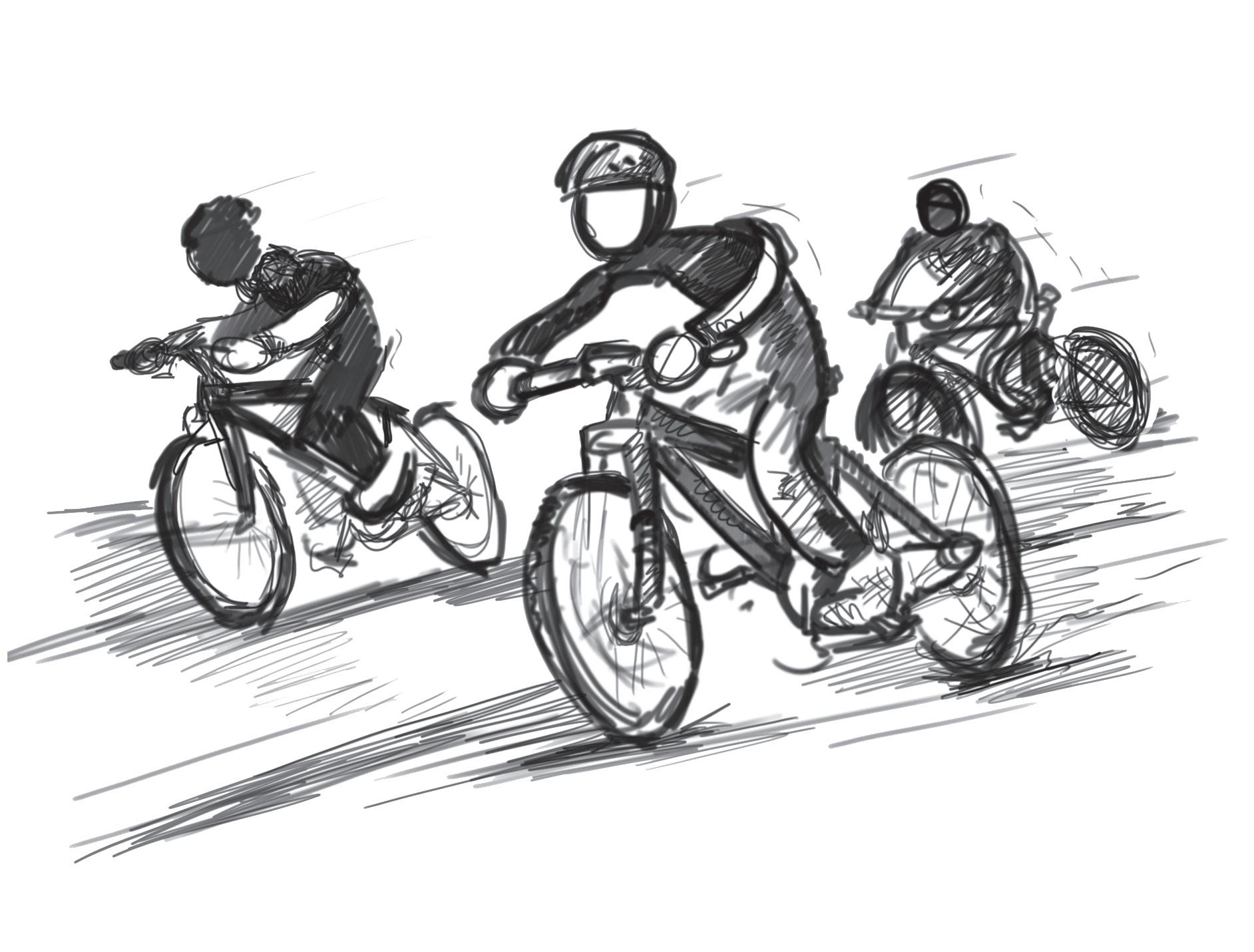
ainbow Trout Music Festival (RTMF) organizers Ben Jones and Will Belford have partnered with Andy Rudolph to throw mobile parties with participants biking from one outdoor location to the other.
Picture it: you are surrounded by over 250 of your closest friends, a giant three-wheeled bike hauling two mobile amps and a laser show, cruising through city streets blaring carefully-crafted playlists. Well— dream no longer—this fantasy is a reality thanks to two music festival organizers and a man with “a soldering iron and never-ending energy.”
The RTMF Bike Jams started in August and are holding their fourth and final event of the year on Oct. 27—meeting location to be determined—with The Ghost Ride. The events were born out of a few similar low-fi nights with Ben Jones, his brother Luke, and Will Belford.
“We rode, just the three of us. Pumping music, all night – and I mean all night. I fell asleep on a
massage table around 11:30 a.m. the next day. We rode everywhere that night. The bikes give us a beautifully tangible freedom that anyone can tap into. That combined with hype music was damned electric,” says Belford.
The bike rides quickly evolved when they hooked up with Andy Rudolph to create a giant trailer that could hold two giant amps, fuelled by a boat battery, and that debuted two laser boxes on their Nuit Blanche art crawl.
“The best way to get people out is nice loud music, the best way to produce loud music is big
amps!” says Belford. “And the best way to carry big amps is on a big crazy bike! Having access to the trike, and the system is a boon, certainly. But the biggest component is the people! Without people coming out, it’s all for naught.”
grown to 300+ participants – nearly one kilometre of bikers, all stretched out.
“With the larger numbers we’ve become very serious about safety. We’ve put an emphasis on being as polite as possible. With each other, and with the other vehicles on the
Life altering decisions
File review: i am a good person / i am a bad person
m ichelle sARomo, volunteer Staff
How do the choices that we make affect us? When we are forced to make a call on tough decisions, is there a necessary dichotomy between choices – that is, is one choice necessarily “bad,” and the other “good?” Moreover, does choosing or acting
“wrongly” automatically make one a bad person?
These are the questions that filmmaker Ingrid Veninger explores in her latest film, i am a good person / i am a bad person. The film follows a week in the life of filmmaker Ruby
White and her teenaged daughter Sara – played by real life motherdaughter duo Veninger and Hallie Switzer. The two women, both on the cusp of making life-altering decisions, are forced to look within themselves and reflect on what they truly believe is best for them.
By setting some ground rules, like no glass bottles and sharing the road with motorists, organizers are able to ensure that they retain community support.
“I think these rides are important to the cycling community and the city, all the same. It shows the riders that there’s a lot of ways to ride a bike and they’re
all good. This is showing those who don’t identify as a cyclist, that we’re out there! We’re going to keep growing whether we get more bike lanes or not. So we may as well just put them in, eh?”
The rides are becoming as important to the Rainbow Trout brand as the festival itself. The rides offer an amazing feeling of community to seasoned road warriors and newbies alike. Hanging out with friends new and old, drinking beverages out of old Nalgene bottles in parks and consuming a whole lane of traffic – feeling invincible instead of vulnerable on the city streets is an experience everyone should have at least once.
“Drivers are smiling and waving, or giving beeps of encouragement. Pedestrians are cheering us on. And cyclists join up and come with us! It’s all so natural feeling. This kind of thing is just supposed to happen. You can feel it.”
back to the hotel, it is relatively easy to place Ruby into the “bad mother” category. Yet as the movie progresses, layers of the contrived persona she strives to emulate are peeled back, and the core of Ruby is revealed.
Veninger makes the film worthwhile by employing full usage of the setting to emphasize the two main characters’ internal struggles and bring those struggles to the surface.
Dr. Martin Mansergh
Wednesday, October 10, 1:30 p.m.
Manitoba Room, University Centre 2nd oor, Fort Garry Campus
For more information, please call 204-474-6052. Parking on campus is limited. Public transportation is recommended.
As the Irish Government’s point person, Dr. Martin Mansergh was a key player in the negotiation process that led to the formation of the 1998 “Good Friday” Agreement, ending the war between the Provisional Irish Republican Army and the British government. Presented by
umanitoba.ca
MCO-00-009-Sol Kanee Lecture SeriesAd WFP October 2012 * PG
The pair embarks on a trip to Europe to promote Ruby’s new film, leaving behind Ruby’s husband and son in Toronto. After an audience member interrogates Ruby about the film’s intended message and catches her off-guard, she spirals into a frantic state of escapism. She surrenders herself to the Euro nightlife and turns to drinks, dancing, and other men.
When Sara—who is implied to be pregnant at the beginning of the movie and is battling her own anxieties—pleads with Ruby to take her back to the hotel, Ruby refuses, subsequently causing a rift in their already tense relationship. Sara decides not to accompany her mother on the rest of the trip; instead, she travels to Paris alone to visit her cousin.
We begin to see her not as an irresponsible mother with reckless abandon, but rather as a dejected woman just trying to regain her sense of joie
The characters’ uneasy dynamic partly stems from their polar differences in personality. Whereas Ruby is flighty and outgoing, Sara is more contemplative and reserved. I judged Ruby’s aloofness immediately; after blatantly refusing to take her daughter
de vivre. Sara’s own troubles, of course, are no less important. Deciding what to do with an unplanned pregnancy at nineteen is never a heads-or-tails kind of decision, and while it does not completely deter her from enjoying the sights of Paris, the weight of this responsibility continues to loom over her head throughout the trip.
The issues that the movie tackles are hardly uncommon, and the idea of watching two people travel around Europe until they finally make their respective decisions may even seem a bit mundane. However,
Rather than using Europe’s beautiful, foreign atmosphere as a place for Ruby and Sara to escape their troubles, Veninger uses the setting to echo their troubles back to them. Perhaps most intriguing of all is Veninger’s use of supporting characters as vessels of wisdom; the happy children playing with bubbles that Sara observes in Paris, or the inebriated man at the bar in Berlin who asks Ruby if she is a “good person or a bad person” – the people that the two women encounter are all necessary for facilitating their growth. Small details like these are so common in our everyday lives, yet Veninger draws from these experiences to show how they each play a part in how we formulate our identities.
i am a good person / i am a bad person is beautifully bittersweet. It reminds us that our choices are a matter of perception. It isn’t necessary that we come to an outwardly defined “right” solution; what’s necessary is to look within and truly ask ourselves what feels right for us.
Orgasms are awesome: Part 1
Jodie lAyne, Staff
The Big O, cumming, climaxing, busting a nut, jizzing - there are about a million slang terms for having an orgasm. We see it in movies, or in porn, and see it splashed on the cover of a certain women’s magazine. Orgasms are, clinically, an involuntary spasming of muscles and release of chemicals in one’s body. They can also take on a lot more baggage culturally – who is and isn’t having them, by what means people are having them, who they are or aren’t having them with?
Let’s get this out of the way first of all –orgasms are not the goal of sex. You can experience so much physical pleasure without actually orgasming, you can have great sex without cumming, and your partner can be a competent and skilled lover even if you don’t orgasm.
According to the Society of Obstetricians and Gynecologists of Canada, 10 per cent of women and 8 per cent of men are anorgasmic - meaning they can’t experience orgasm. Anorgasmia can also affect transgender people after hormone therapy or gender reassignment surgery. This doesn’t mean that sexual activities aren’t pleasurable and they can’t have fulfilling sexual relationships and experiences. Sex should be about causing each other’s bodies as much pleasure as possible and having fun exploring your bodies – orgasms are just a bonus and not a trophy you get for playing.
Orgasms can feel amazing physically, but their benefits go far past a few seconds of good
feelings. Endorphins and oxytocin released during sex allow you to better deal with stressful situations and having orgasms three times a week can add four years to your life. Sleep hormones are released when you orgasm – a sexologist once joked that his cure for insomnia was to “have one orgasm and call me in the morning.”
Cumming can also prevent colds! People have sex show higher levels of immunoglobulin antibodies, making you less susceptible to colds. The best part is that these benefits whether you having sex with other people or masturbating. So, go get laid or rub one out for your pleasure and health.
One of the chemicals released during orgasm is oxytocin, or the “bonding” hormone. This is the same hormone released by breastfeeding mothers and can cause you to feel intimacy or emotional attachment if you are having sex with a partner. This is one of the reasons why orgasms in a relationship can help build intimacy. Being able to be fully present, safe, and feeling uninhibited are also all feelings conducive to having an orgasm.
So now that you know why orgasms are amazing, how can you have one? What does it feel like? Read the column next week to find out, but in the meantime why not practice and see if you can figure it out?
You can confidentially submit a question or topic to jodie.m.w.layne@gmail.com
Surprisingly stirring
Review: Babel , Mumford & Sons
Jenn A d iubA ldo, Staff
“Iwill love with urgency, but not with haste,” croons Marcus Mumford from English folk rock band, Mumford & Sons. This line seems to accurately describe Babel the newest release from this UK quartet. An album that is written with a passion and aggression audible from first note to last, while maintaining technical grace and elegance that amounts to a beautiful collection of songs.
Admittedly, I can be somewhat of a music snob, and I had written this band off as the Coldplay of folk music – until my girlfriend forced me to listen to their music recently. Since then Babel has been playing on a constant loop in my car, and I have been happily singing along to Mumford’s charming folk anthems.
Mumford’s first full-length release Sigh No More, blew up internationally in 2009, going platinum an impressive four-times in the UK and another two-times platinum in the US. Creating a follow-up album that can match or surpass that kind of success is no small task but I believe that Babel is set to achieve just that.
Babel is much in line with Mumford’s first album but seems to be a bit more polished in terms of production value, specifically when taking notice of the vocal tracks. Marcus Mumford’s powerful voice is again at the forefront of the album, highlighting his masterful lyrical abilities, especially in tracks such as “Where Are You Now,” and title track, “Babel.” The band’s overall songwriting ability seems to have matured even more so since their last release with the ability to flow seamlessly from catchy love songs like their newest single “I Will Wait,” to aggressive pain-filled tracks like “Broken Crown.”
As far as negatives go, this album has few. I find it a bit annoying that some more intricate guitar tracks have been set very low in the overall mix, causing the ear to have to strain to hear important embellishments. Also, I don’t much care for the track “Lover of the Light” because it reminds me of a Dave Matthews Band song. That being said, I’m really straining to find imperfections in this album.
event Listings
Bradly Wohlgemuth
By Joseph Kalumba
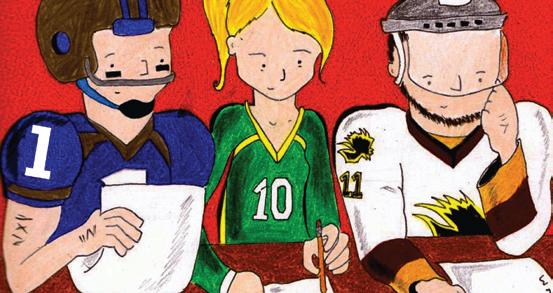
Bisons score high marks in the classroom
Student-athletes set new school record for excellence in academics
mARc lAg Ace, Staff
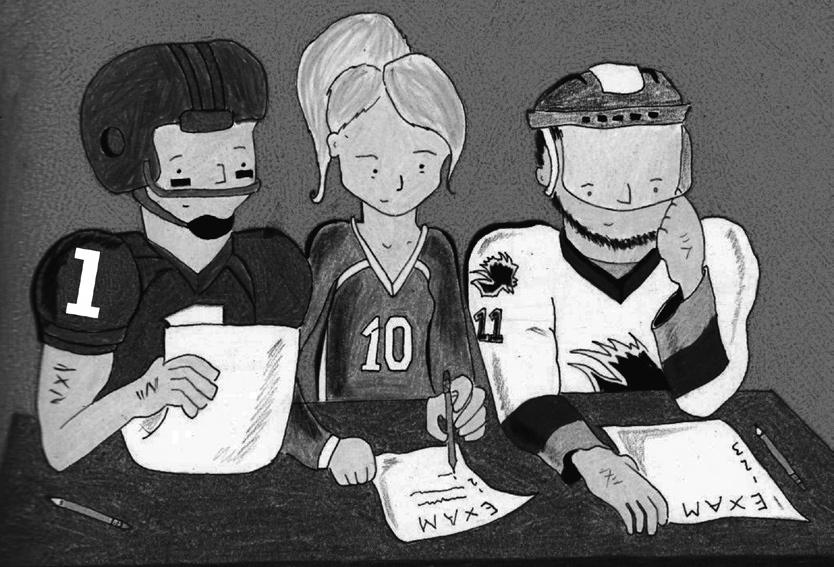
Bison Sports have set a new standard for the University of Manitoba, as 102 student-athletes achieved CIS Academic All-Canadian status for the 2010-11 season.
Out of the 308 U of M student-athletes enrolled in studies last year, just under one-third received national recognition for balancing their academic responsibilities with their passion for athletics.
Canadian studentathletes qualify as CIS Academic All-Canadian by maintaining a grade point average of 3.5 (80 per cent) or better in their field of study.
Some interesting stats:
Fifty-two per cent of the Bisons Academic All-Canadians are female (53 of 102). The football program had
recorded in 1998-99. Thirty-six Bison student-athletes earned a GPA of 4.0 or higher (90 per cent).
10 Academic All-Canadians for the first time since the status was first
Keeping a 3.5 GPA can be a daunting task for any university student, but trying to balance a full course load with a busy collegiate athletic career is no small task.
“I think it’s all about priorities. You have to prioritize school first,” explained Julie Lafreniere, one of 11 Bison soccer players that achieved CIS Academic All-Canadian status.
“It’s harder on the road, obviously we’re really busy. You have to prepare for the game and then you have to attend team meet-
ings. Before practice you have to study, after practice—even when you’re tired you have to tough it out—to get those good grades.”
It is no coincidence that the U of M is stocked with over 100 studentathletes with the focus and work ethic that Lafreniere describes. According to Bison Sports assistant athletic director Curt Warkentin, the academic success of Bison student-athletes can be attributed to an emphasis on academic success balanced with athletic success. From the recruiting process to day-to-day player-coach interactions, there is always a focus on education.
“It’s right from the recruiting process, trying to find outstanding student-athletes and being able to attract them [to enroll at the U of
Tennis Canada eyeing Winnipeg for Davis Cup
MTS Centre could serve up world-class tennis in February
After last month’s win against South Africa and advancing to the World Group for the second straight year, Canada’s Davis Cup team learned that they would be hosting Spain in the first round of the 2013 Davis Cup World Group from February 1-3. Spain is the reigning champions and will play for the 2012 title next month against the Czech Republic.
Tennis Canada has instituted a bidding process to determine the city to host the event. The opportunity to showcase up-and-coming Canadian tennis star Milos Raonic and (potentially) Spanish tennis legend Rafael Nadal will undoubtedly be coveted by many cities across Canada. Tennis Canada president and CEO Michael Downey told the Winnipeg Free Press that they are looking at a shortlist of a “half-dozen cities.” And Winnipeg is one of them.
tage when Tennis Canada makes their decision next month.
One of the main factors is the availability of the MTS Centre at the time of the tie. Currently, no events are being held at the arena from January 20 to February 4, which is more than enough time to turn it into a tennis court as well as holding other events for fans and media in conjunction with the tie. Meanwhile, all of the other six NHL arenas are hosting hockey games and other arenas, such as Hamilton’s Copps Coliseum and Toronto’s Ricoh Coliseum, are also unavailable. UBC’s Doug Mitchell Thunderbird Arena, last year’s Davis Cup venue, however, is available.
Tennis Manitoba has officially submitted their bid to Tennis Canada to host Canada’s Davis Cup tie at the MTS Centre and their Facebook page called “Davis Cup Winnipeg” has over 300 likes. Vancouver is looking to host again, as they did last year when Canada played France in Davis Cup play. However, there are factors that may give Winnipeg an advan-
Winnipeg’s location may also give an advantage to the Canadian team. The first round of the Davis Cup will be held the week after the Australian Open in Melbourne, meaning players will likely fly to Canada immediately after the tournament. Downey told the Free Press that despite the event being held indoors, no matter where it is held “there’s no doubt Winnipeg’s cold weather in February would be an advantage against our guests from Spain.”
The Davis Cup would be the most high-profile tennis event Winnipeg
would ever host. With the exception of two exhibitions held at the Winnipeg Arena (Boris Becker vs. Kevin Curran in 1987 and Monica Seles vs. Anna Kournikova in 2002), the city has not seen elite level tennis for some time. The ITF Manshield Futures, a low-level professional tournament that Winnipeg hosted this August, was the first professional tennis tournament in the city since the 1999 Pan Am Games.
The popularity of tennis in Canada appears to be localized in Ontario, Quebec, and British Columbia and almost all of its elite players are from those provinces. With the sport growing in popularity across the country, Tennis Canada may be inclined to choose Winnipeg if it wants interest in tennis to grow not only in Manitoba, but also throughout the Prairies. If Canada wants to become a tennis nation, Tennis Canada must promote the sport nationally.
Every time a Canadian national sports team plays in Winnipeg, the event turns out to be a success. Whether it was the 1999 World Junior Hockey Championship, the 2007 World Women’s Hockey Championship, or the Pan Am Games, Winnipeg always has a penchant for hosting successful one-off sporting events. The return of the Jets has also proven that fans in this city have tremendous enthusiasm for the home team. Even if only the lower bowl of the MTS Centre were filled, there would still be more people in attendance than in Vancouver.
Winnipeg would be an ideal candi-
date to host a Davis Cup tie but it also needs to be shown that there would be enough fan support. Downey told the Vancouver Sun that social media would definitely help in trying to attract this event.
M],” said Warkentin. “There’s a balance between athletic scholarships and academics. The more stronger students we’re able to attract, the more athletic scholarship money we can provide.”
“There’s a lot of coaches that have academic monitoring programs that will go on—especially for first-year, second-year, anybody who’s keeping a lower GPA—keeping track of them.”
Jaime Lacoste finished her Bison soccer career by achieving Academic All-Canadian status in her final year to cap off five straight years academic excellence. Ten other Bison athletes received the prestigious status for the fourth time in their athletic career.
ILLUsTRaTION BY CaROLINe
By the way, the
“Bring Davis Cup Back to Vancouver” Facebook page has over 3,350 likes. Winnipeg, we have some work to do.
ILLUsTRaTION BY BRad WOHLgemUTH
Wesmen United?
Potential U of W athletics name change proving unpopular
d e Rek gAgnon, Staff
U
pon finding out about the impending name change of the University of Winnipeg’s sports teams, I decided to seek the opinion of the coolest U of W alumnus I know: myself.
Having been a former student of the University of Winnipeg, I have come to have very strong feelings in regards to the school and the image it likes to convey. Part of that image is the Wesmen Athletics department. I cannot say I was ever a student-
Wesmen comes from a mash up of “Wesley Men,” in reference to Wesley College, founded in 1888, that was established as a stand alone Methodist College.
athlete, but I did follow the teams in their endeavours and so it piqued my interest when I found out about
the potential change away from the Wesmen name.
My initial response was relief, as it is my opinion that “Wesmen” is not a name that instills fear in the hearts of opponents. I had never asked my
parents to check under the bed for an evil Wesmen as a child. So hearing of the name change, I was hoping for the adoption of something more sinister. Something like the McMaster Marauders, the Waterloo Warriors
or the Manitoba Bisons.
I later found the Wesmen name change was about something more than a lame team nickname. The reason ended up being that administrators at the University of Winnipeg wanted to change the name from Wesmen because of it being gender exclusive and having religious connotations. Which is why the decision to rename the teams “United” makes just as little sense, as naming the team after United College, which operated from 1938 to 1967, is making a religious reference to the United Church, after which the United College was named. It’s just a religious trade off, as we switch from honouring a Methodist Church to a United Church.
On the issue of Wesmen not being gender-neutral, the idea that people would be highly offending by a word with “men” in it is laughable, as many have pointed out thus far. The idea that people would be offended by the word is to suggest that they get offended by “human” or “Manitoba” and that’s just absurd.
So here’s what I say to the University of Winnipeg: I have no issue with your choosing to replace the Wesmen name. Sometimes
change is good, as well the ability to sell and endorse a new brand. If you were becoming the University of Winnipeg Polar Bears, or Falcons, or Mosquitoes, or even the United just because you wanted to shake things up, people would be ok with it.
But when you come out with the reasoning currently being used to defend a name change, it’s never going to fly. Just as U of M students and alumni connect with the Bisons here on campus, Wesmen is a name U of W students have related to since its inception in the 1920s. Changing it after all of this time because it recently occurred to you that it might be offensive is nonsensical, and people have taken notice.
As of the time of this article a group on Facebook called “Save the Wesmen” has 790 “likes.” Meanwhile, various online polls show the public is very much behind keeping the Wesmen name. While highly unscientific, it still seems to be more research than whoever is in charge of this naming process put in to how University of Winnipeg students, athletes, alumni, and staff feel about this change.
It’s called a referendum. Look into it.
mage BY BRad WOHLgemUTH
FOLLOWING THE HERD
Taking advantage of a banged up Saskatchewan squad. Starting QB Drew Burko and their top receiving threat sat out against the Dinos. Backup Chase Bradshaw only completed five passes for 81 yards on the day. With an extra week of rest, Burko might be back. If he is, look for another close game like week two's 31-28 Bison win at University Stadium.
21-6-1
The combined home record for the Bisons over the past two seasons, heading into their home opener series vs Saskatchewan.
Puck drops on women’s hockey season
Bisons drop back-to-back losses to the Pandas
d e Rek gAgnon, Staff
The regular season got underway this past weekend for the Manitoba Bison women’s hockey team, as they played a pair of games against the University of Alberta Pandas. Heading into the games the Bisons were ranked #3 in Canada West, behind only Alberta (#2) and the University of Calgary Dinos (#1).
Coach Jon Rempel likes what he sees in his club this year and is optimistic of how the team will do.
“We would like to host a playoff round and finish in the top four is a realistic goal this season.”
Rempel keyed in on how his squad would be better this year than the team that finished fifth in Canada West and missed the playoffs last season.
After going 7-1 during this preseason, Rempel noted three things that stuck out as obvious improvements in how the girls played. “Special teams we’ve been working on really hard. That’s one thing that’s improved already, I can see that for sure.”
“Friday night games [were] a real problem for us, particularly at home last year so that’s something we’ve rectified,” Rempel said. “[The] ability to play three games in three days on
three consecutive weekends and still be able to [go 7-1] tell me we’re fit.”
While remaining optimistic about potentially beating Alberta, Rempel was also cautious, noting the Pandas exemplary record in Canada West.
“I expect them to be extraordinarily difficult to play against, they always are. It’s a good test for us.”
The Bisons would find out just how good a test the Pandas were in their season opener on Friday night. Less than five minutes in, Alberta Captain Sarah Hilworth would open the scoring when left unmarked in the slot. The Bisons responded rather quickly as a little over two minutes later the Bisons forced play deep into the Pandas’ end before a scramble left the puck on third-year forward Meagan Vestby’s stick, and she deposited it into the net, making it 1-1 after the first period.
cylinders in the second frame, but fell behind to a power play goal by Karla Bourke of Alberta. Despite outshoot-
shut them down time and time again. Jeffries ended up stopping 32 shots in a 2-1 Alberta win. In a post game
Saturday night did see an improvement in both the power play, which went 1-for-5, and penalty kill, which killed off all four penalties Manitoba took. A first period goal by thirdyear forward Maggie Litchfield-Medd gave the Bisons an early lead. Alberta responded with two second period goals and a late insurance goal that gave the Pandas a 3-1 win.
The Bisons came out firing on all
ing the Pandas 17-5 in the period, the Bisons were down a goal going into the third period. The Bisons once again poured it on in the final 20 minutes, only to have Alberta goalie Michala Jeffries
interview Coach Rempel attested the slow start to not playing in two weeks, and that the special teams would need to get better after the power play went 0-for-4, and the penalty kill went 3-of-4.
The Bisons looked to be the better team for long stretches of the game, however missed some crucial opportunities, including an extended 5-on-3 power play and breakaway in the dying minutes of the game. Jeffries was the difference once again, turning aside 30-of-31 shots, for a total of 62-of-64 in the two game set.
The Bisons next play against the Saskatchewan Huskies (0-1-1) in Saskatoon on Oct. 12-13.