Getting Degrees at an educational Hub raises IQ's and other such campus business(es)
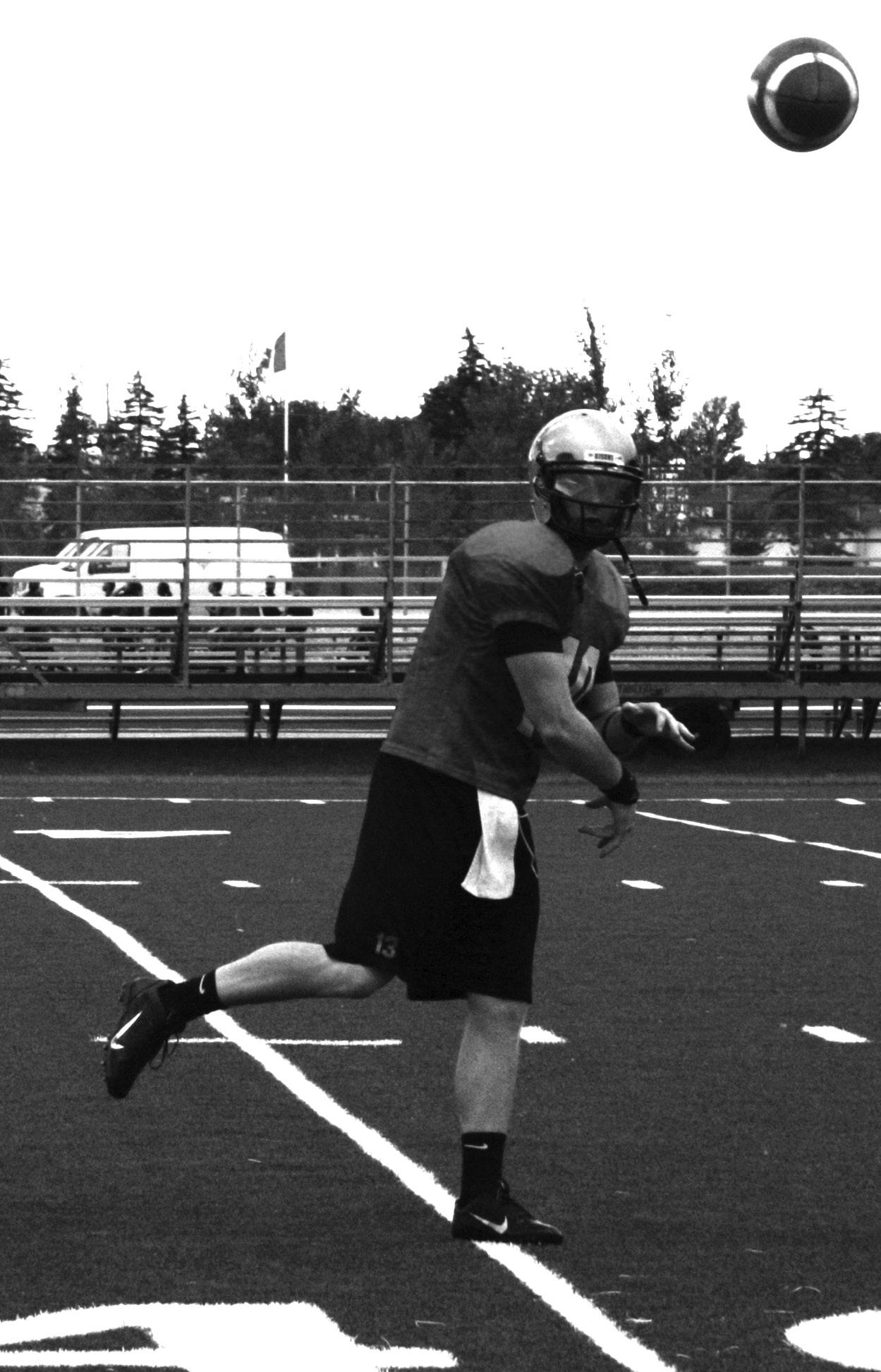
Bison soccer breaks even over the weekend
EDITORIAL
DESIGN
REPORTERS
VOLUNTEER CONTRIBUTORS
A “volunteer staff” member is defined as a person who has had three volunteer articles, photographs, or pieces of art of reasonable length and/or substance published in three different issues of the current publishing year of the Manitoban. Any individual who qualifies must be voted in by a majority vote at a Manitoban staff meeting. Elected representatives and non-students may be excluded from holding votes as volunteer staff members in accordance with the Manitoban Constitution.
The Manitoban is the official student newspaper of the University of Manitoba. It is published monthly during the summer and each week of regular classes during the academic year by the Manitoban Newspaper Publications Corporation.
The Manitoban is an independent and democratic student organization, open to participation from all students. It exists to serve its readers as students and citizens.
UMSU’s 2nd annual Frosh Fest to include international DJ as headliner
CRAIG ADOLPHE, STAFF; WITH FILES FROM DANA HATHERLY
The University of Manitoba Student Union’s second annual Frosh Music Festival will take place this Sunday, Sept. 14. The festival has drawn attention within the city for booking internationally renowned electronic dance music DJ Tiesto as its headliner.
The concert will take place at Bison Stadium and will run from 3:30 p.m. to 11 p.m. with an after party taking place at Area Nightclub after the concert.
Canadian DJ duo Dzeko and Torres have also been announced as part of the lineup according to Frosh Fest’s official website.
A Facebook post from Sunday by University 1 Student Council lists Lambo, Kaveman, Pypes and Doves, and Hollywood Hype among the other performers who will be taking the stage, but none of these have been confirmed on the Frosh Fest website as of publication.
The University of Manitoba Student’s Union contracted local business Prairie Promotions to find and recruit performers for Frosh.
Jeremiah Kopp, UMSU vicepresident internal, said the executive was happy with the work Prairie Promotions had done in finding a headliner.
“They had expressed interest last year. Of course, that was already given to a different entertainment company, but this year we really felt that they had the experience and the enthusiasm required to pull off a show like this.
“They were working hard all summer on sending out offers to different artists, and everybody was
pleasantly surprised that an artist of the size and magnitude of Tiesto is coming to Winnipeg,” said Kopp.
This is the second year for the UMSU-run Frosh Music Festival.
Last year’s executive renamed the campus’ orientation week “Frosh Week” and instituted the Frosh Music Festival, which featured Childish Gambino as a headliner.
“Everybody was pleasantly surprised that an artist of the size and magnitude of Tiesto is coming to Winnipeg” –Jeremiah Kopp
A scheduling conflict came up for the Friday concert and Childish Gambino gave UMSU an ultimatum: either he performed Saturday or not at all. The student union responded by extending the festival to a two-day event.
As a result of the expanded costs associated with extending the concert to include a second day and lower than projected ticket sales, the Frosh Fest went almost $150,000 over budget.
Kopp explained that UMSU would save money this year because Frosh will not have to be extended over two days, but added that there would be other additional costs this year – specifically, the costs of
added security.
“This year as a one-day show it’ll be far less expensive in terms of [ . . . ] rentals for different equipment, port-a-potties. Stuff like that obviously goes down when it’s one day.
“On the other hand, some costs are going to be way higher. We’re really investing in security this year. The last thing we want to see is anybody’s safety be jeopardized, and we’re working closely with the city and the university on that front where, I believe, we’re going to have 23 Winnipeg police officer staff members on site, which is a significant police presence, to guarantee the safety of the event, as well as expanded role for hired security services,” said Kopp.
“So even though the overall budget will be less because it’s a two-day event, per-capita, the ratio was larger just because how many people we’re expecting.”
Kopp told the Manitoban that the permit obtained for the festival allows for 7,000 people to attend.
The Frosh Fest website says that tickets can be purchased directly from diyobo.com.
Tickets are $45 for University of Manitoba students and $65 for non-students. VIP tickets are also available for $95. The diyobo website charges an additional $7.50 service fee for each ticket.
All tickets purchased at a student rate will be printed with the students’ name on them and require student ID to get in.
As of Sunday, the Frosh Music Festival Facebook page said that 90 per cent of their tickets are sold.
Addressing safety and preventing sexual violence at Frosh Festival
UMSU prepares for Frosh Festival after some universities across country opt-out
DANA HATHERLY, STAFF
Just one year after a Frosh Week chant at Saint Mary’s University (SMU) glorified non-consensual sex with underage girls, UMSU prepares for their second annual Orientation Week Frosh Festival.
Some universities across the country have taken precautionary measures to prevent and address sexual violence during their Frosh Festivals, while other universities have done away with the festival altogether.
Since the video footage of problematic behaviour at SMU went viral, Frosh Festivals have been accused of condoning and perpetuating inappropriate behaviours at the centre of sexualized violence on campus.
Saint Mary’s University mandated Frosh Week leaders and students’ union executives to attend sensitivity training, including how to confront unacceptable behaviours.
The SMU incidents have raised questions about sexualized culture on campus and how the Frosh name remains widely associated with it.
“While other university campuses have had challenges and tarnished the Frosh name, our executive and administration is extremely proud of the work that we’ve done to promote safety,” stated vice-president internal Jeremiah Kopp.
“UMSU would never condone anything that would make anyone feel unsafe.”
At the University of Manitoba, UMSU endorses Frosh Festival as the focal point of U of M Orientation Week. The students’ union is working diligently to ensure both fun and safety during the festivities.
“We really want to emphasize, first and foremost, the safety of everybody,” Kopp told the Manitoban, referring to UMSU’s priorities in preparation for the festival.
“These events are a fantastic time to party with your friends and have a great night out, but obviously everybody’s safety is a huge concern of ours.”
According to Kopp, UMSU, U of M administration, and the City of Winnipeg have been working together to ensure adequate levels of security during Frosh by reaching an agreement to supply 23 police officers to monitor the event.
But some academics and activists have noted sexual violence affects women at disproportionate rates, and that increased police presence does little to stop sexual assault.
In an article published earlier this month by the Winnipeg Free Press, U of M sociology professor Mary-Anne Kandrack and media critic Jean Kilbourne argue that society needs to re-examine the starring role of alcohol in our culture.
“UMSU would never condone anything that would make anyone feel unsafe”
– Jeremiah Kopp, UMSU vicepresident internal
The UMSU vice-president advocacy, Rebecca Kunzman, told the Manitoban, “It’s not so much Frosh – it’s the situation – the idea that there is alcohol involved, and it’s a sexually charged environment. In any situation like that, it’s about being cognizant [about the situation].”
Upon witnessing any form of violence or sexual harassment, Orientation Week volunteers are trained to contact security. Kunzman explained that although there are not security guards everywhere; there are volunteers everywhere – and it’s about maintaining open lines of communication between security and volunteers.
Kunzman and Kopp both highlighted the role of some student groups to ensure safe environments.
During social events like Frosh, Kopp told the Manitoban that the Red Frogs “promote having safe spaces for students when there is alcohol at an event [ . . . ] and promote that you can have fun in a non-alcoholic environment.”
The Red Frog tents may be found in locations on the Fort Garry campus near beer tents and some other venues on campus that sell alcohol during Frosh Festival.
Ex-gallery co-ordinator dismissed from UMSU without explanation
UMSU executive receives backlash after cutbacks to Gallery of Student Art
DANA HATHERLY
After losing her job as the Gallery of Student Art co-ordinator due to cutbacks this summer, UMSU administration has now fired Kira Koop from her newly re-located position within the union.
UMSU vice-president internal Jeremiah Kopp confirmed his understanding that ex-gallery coordinator Kira Koop was terminated Wednesday from her newly assumed position at Answers on the U of M Bannatyne Campus.
The Answers information booth on the Bannatyne Campus is temporarily closed, with the gates locked, and signage that directs people to contact UMSU offices for any questions .
UMSU administrative actions against Koop that resulted in her loss of employment at her new position followed last week’s publication of an article published by the Manitoban detailing cutbacks to GoSA that directly impacted her former position.
The scope of the article summarized the circumstances surrounding the cutbacks, and outlined her former position as gallery co-ordinator in terms of her responsibilities for facilitating GoSA.
On Tuesday, Sept. 2 the GoSA article was uploaded online. The following day, the article was published in print. On that same day, Kira Kopp was dismissed without explanation from her Bannatyne Campus position.
The sequence of events surrounding Koop’s termination has not been verified or justified to the Manitoban
The UMSU VPI did not comment directly on this, but claimed that although there is regular dialogue between UMSU administration and executives about these types of matters, “Contextually, this was an administrative decision.”
“Not that it has anything to do with the situation, but in general, employees of the union who are paid staff members may privately hold any opinions that they want, but just as if we were working for any company or organization, paid employees are not able to be insubordinate to any decisions made by the organization,” said Kopp.
“There is a lot of evidence – it wasn’t just speaking out in the Manitoban –but, we are all very aware of the secret Facebook group.”
Kopp claims that the Facebook group was initiated “definitely before” Koop's termination. The Manitoban spoke with Koop, also the creator of the page in question, Monday evening, and confirmed the group was
in fact initiated on Thursday, Sept. 4, at 2:13PM – nearly 24 hours after Kira Koop was dismissed from her position.
Both public outcry and solidarity ensued over social media from students, professors, and artists concerned about the state of the art gallery and termination of Kira Kopp. Some have accused UMSU executive of prioritizing Frosh Festival over student services that last throughout the academic year.
On Tuesday, Sept. 2 the GoSA article was uploaded online. The following day, the article was published in print. On that same day, Kira Kopp was dismissed without explanation from her Bannatyne Campus position.
The first meeting of a newly initiated group working to counter UMSU’s decision to dismiss Koop was held on Friday, Sept.5 . Attendees constructed a mission statement and plan of action to address a perceived lack of consultation on the part of UMSU with those most impacted by their decision to cutback GoSA’s budget.
Meanwhile, in reference to those cutbacks Kopp contended that, “Overwhelmingly, the response from students has been very supportive.
“The endowment fund was in dire straits, and it’s going through an extensive re-structuring process, and this was the beginning of it.”
“It’s not about the arts – it’s about the bigger financial picture,” Kopp added.
The UMSU VPI explained that there are public misconceptions about the operating budgets for Frosh Festival and GoSA, which are funded by separate budgets and governed by different entities.
The budget for GoSA comes from the endowment fund, which is governed by the Board of Trustees. The endowment fund is built upon mandatory student fees that are paid into it and generate capital over time.
In the case of the endowment fund’s previous structure, all of the
funds were unrestricted.
Recently, the UMSU VPI and the Board of Trustees re-evaluated the structure of the endowment fund and determined that UMSU had been inappropriately drawing from the funds’ capital reserve for several years. Moving forward, UMSU services that draw from the endowment fund will only be able to draw on interest produced each year from the funds’ capital reserves. Thus, the funds that had been sustaining student services – like GoSA – will now be restricted.
According to Kopp, the long-term process of re-structuring the endowment fund requires UMSU to make cutbacks in order to avoid total depletion; then look at the assets and how they are being used in order to maximize potential of the endowment fund; and then review and re-assess the distribution of funds to student services.
The operating budget for Frosh Festival is not derived from the same fund. According to Kopp, spending for Frosh Festival is governed by UMSU Council and operates on an entirely separate budget, including financial input from major private sponsors, like Canad Inns.
PHOTO BY CAROLYNE KROEKER
PHOTO BY DANA HATHERLY
U of M obtains major funding for First Nations research
Over $395,293 donated for residential schools and food security studies on campus
CRAIG ADOLPHE, STAFF AND TARIQ SOHAIL
The Social Sciences and Humanities Research Council (SSHRC) recently awarded the University of Manitoba $195,657 for the “Embodying empathy” development project, and another $199,636 over three years to find solutions to food insecurity in northern First Nation communities.
“Embodying empathy” project
The purpose of this project is to create a virtual Indian Residential School (IRS) in partnership with an interdisciplinary team of IRS survivors, indigenous communities, archivists, scholars, and technology experts, including Electric Monk Media and Legacy of Hope Foundation .
Consulting survivors and intergenerational survivors is emphasized to create an authentic virtual reality.
“Two primary objectives of the residential school system were to remove and isolate children from the influence of their homes, families, traditions, and cultures, and to assimilate them into the dominant culture,” Prime Minister Stephen Harper explained in a public apology to former students of the residential school system.
To this day, few of the buildings that housed residential schools remain to serve as knowledge centres about the history of forced assimilation. This project aims to re-create residential
school exhibits for educational purposes based on the testimony of survivors.
Andrew Woolford, professor of sociology at the U of M, is leading the project along with associate professors from the department of English, film, and theatre, Adam Muller and Struan Sinclair.
Woolford told the Manitoban that the Canadian Museum for Human Rights is creating exhibits that will make the Truth and Reconciliation Commission testimony available to the general public.
One of the outcomes of the “Embodying empathy” project will be to highlight the benefits and pitfalls of creating a virtual IRS, and determining whether virtual reality technology can actually bring audiences closer to the diverse experiences of forced assimilation in residential schools.
Sharing the Feast of Food from the Land in Northern Manitoba
The other research project receiving funding is a partnership between Shirley Thompson of the U of M’s Natural Resource Institute, co-applicants Ataharul Huq Chowdhury of the University of Guelph and Stéphane McLachlan of the University of Manitoba, Frontier School Division, O-Pipon-NaPiwin Cree Nation, and Manitoba Agriculture, Food and Rural Development.
The research seeks to find solutions to food insecurity and establish food sovereignty in northern First Nations communities.
“It all came out of a survey that we did in 14 communities. So, out of that, we did a lot of analysis around what was working in the communities: what they had, which communities were better off, and why?
“Is it gardening, is it connection to roads, is it connection to public transit? What are the factors that are improving food security?” Thompson told the Manitoban
“And so this research largely came out of that. And a growing partnership with [O-Pipon-Na-Piwin Cree Nation] over the years.”
AYour school A letter from your student union president
s the semester progresses, you will find yourself settling into new routines. Your schedule will become a familiar pattern and you may be tempted to remain in the comfort of established habits and in the company of established friends. It is easy to fall into the trap of envisioning a class as only a grade, an education as merely instrumental to a career, and university as simply a stepping-stone.
Do not fail to avail yourself of everything the University of Manitoba has to offer you.
Just as it is a place to learn and grow, university is a place to
indulge your curiosity and explore your whims. As then-president of the U of M Sydney E. Smith told students in the Sept. 25, 1936 edition of the Manitoban: “Education does not stop at the intellect.”
As you will find on these pages, the messages from our leaders of today are much the same; they too want you to be the leaders of tomorrow.
Perusing the Manitoban ’s archives, 100 years worth as of 2014, one of my favourite discoveries was an advertisement in the September 1920 issue:
“The Manitoban is your paper. If
you want to make it a bigger paper, a more interesting paper, a paper with more pages, more pictures, more interest, do so. It is yours. If you want a better paper, support the paper, subscribe to the paper, get out and work for the paper.”
Although a blatantly self-interested plug (we are looking for volunteers and reporters), this quote belongs here, in the introduction to the introduction to your school. It illustrates a theme that runs throughout the articles and letters herein. The experience you have at the U of M is yours to mould.
University of Manitoba president’s welcome to students
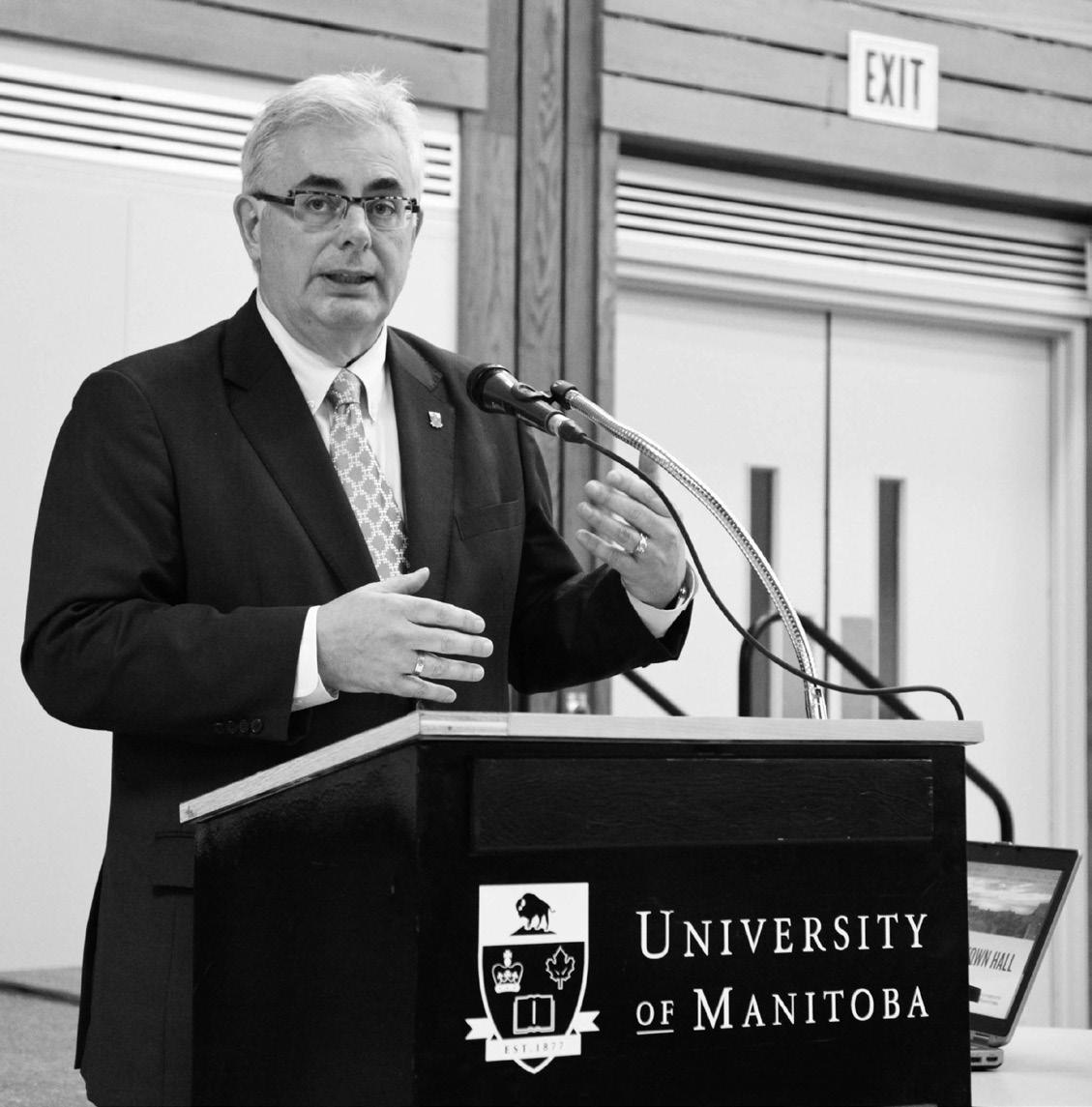
As a new school year begins, I welcome all students, returning and new, and issue you a challenge. Each school year at the University of Manitoba offers many opportunities, and this fall will be no different. There are many changes visible at both campuses to better serve both students and staff.
My challenge to you is to really take charge of your education in ways that will bring out the best in you as trailblazers, visionaries, and innovators. Whatever your field of interest, whatever your passion, commit to connecting with people inside and outside the classroom in ways that open you up to the rich possibilities available at a larger, research-intensive university like ours.
You and your classmates are the leaders of tomorrow. Your studies here will shape your futures and that of the community at large. You may have a role in changing how people think and act not only in Winnipeg but across Canada and around the world.
One only has to look at today’s news headlines to appreciate the impact University of Manitoba graduates have on the lives of people everywhere. Some of our medical researchers and students have returned from the field in Sierra Leone, working in the heart of the world’s worst Ebola epidemic. Many candidates running in the upcoming civic election and as school trustees are University of Manitoba graduates. And dozens of our students and faculty are involved in the development of the Canadian Museum for Human
Rights that will open next week.
A university degree is extremely valuable in today’s job market.
Almost 90 per cent of young university graduates age 25 to 29 were in full-time jobs in 2013, and more than 80 per cent of these were in full-time positions. What’s more, the vast majority of these jobs did not exist five years ago. The demand for your newly-acquired skills and knowledge will continue to rise, especially with new opportunities and skill sets projected into the future. Demand for university graduates across Canada is concentrated in professional, management, and administrative occupations, but employment is growing at all post-
secondary levels. The majority of jobs facing skills shortages require a university degree.
I urge you to take up the challenge to create in yourselves a desire to excel. To be pioneers in research and defenders of the disempowered in our society. To create something new that will shine as a beacon for others to follow. To explore our world and discover new things to the benefit of all.
Welcome to the University of Manitoba!
David T Barnard, PhD
University of Manitoba Students,
My name is Al Turnbull and I am your University of Manitoba Students’ Union President. I have served as president throughout the 2013-2014 school year, and I am equally excited to do so again over the coming year!
Last year, the Fresh executive made great strides in enhancing your overall campus experience; we made an overhaul with the UMSU businesses, started the annual Frosh Music Festival, and attempted to create an exciting atmosphere for all students on campus. This year Refresh wants to do the same and much more!
Refresh is excited to make your university experience the best possible, and to do so we need your help. This is the beginning of an exciting era of student life here at the U of M; speaking from experience, these will be some of the best years of your life.
So don’t squander it by not getting involved; getting involved is the key to making our university something we can all be proud of. I personally look forward to working to the utmost of my ability to ensure that we optimize your campus experience.
The University of Manitoba Students’ Union is here to advocate on behalf of all students at the U of M to all levels of government and the university administration. The union also provides a number of services for the benefit of all its members – which is you!
These services include: an affordable health and dental plan, a campus radio station (101.5 UMFM), a supportive tutor registry, and the Peers: Students Helping Students support group.
UMSU also owns and operates six businesses: The Hub campus bar is definitely something you want to check out. The Hub opened in 2012, and especially over the last
year has become the local watering hole here on campus. For great food and beverage, check out the Hub on the third floor of University Centre.
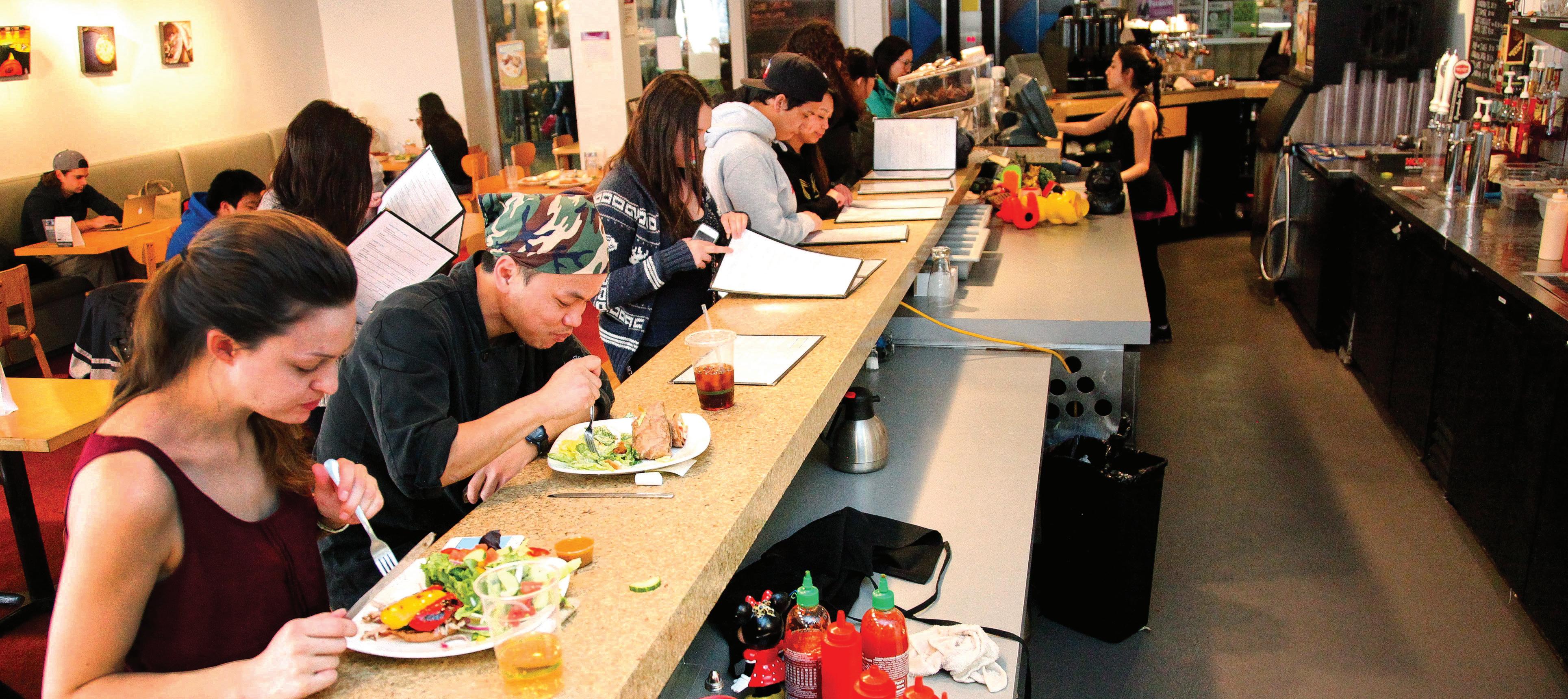
UMSU also has Degrees Restaurant. Degrees is a licensed restaurant offering an eclectic array of fast but healthy food and is located on the third floor of University Centre. IQ’s Café and Billiards makes for a great place to hang out, play pool, and maybe grab a coffee – also located on the third floor.
UMSU operates the university’s only convenience store, G.P.A.’s, which is located on the main floor of University Centre.
If you have printing or copying needs, the UMSU Digital Copy Centre can help you out.
Last but not least we operate Archives Used Book Store on the basement floor of Helen Glass.
We’re also excited to introduce a new UMSU business in January called UMSushi, which will be located on the third floor inside of IQ’s.
I have spent a lot of time on this campus, and have grown to love everything about the University of Manitoba; however, the work is not done. Sometimes it isn’t enough to simply accept things as they are. We’re tired of people saying, “I just go to the U of M”; we know we can achieve big things at our university. The quality of your experience starts here and now with you; don’t settle for mediocrity. With that being said, I extend to you my sincerest welcome (back) to the University of Manitoba for the 2014-2015 school year.
Don’t hesitate to contact me at any time – my door is always open! Let’s make this year the best yet.
Al Turnbull
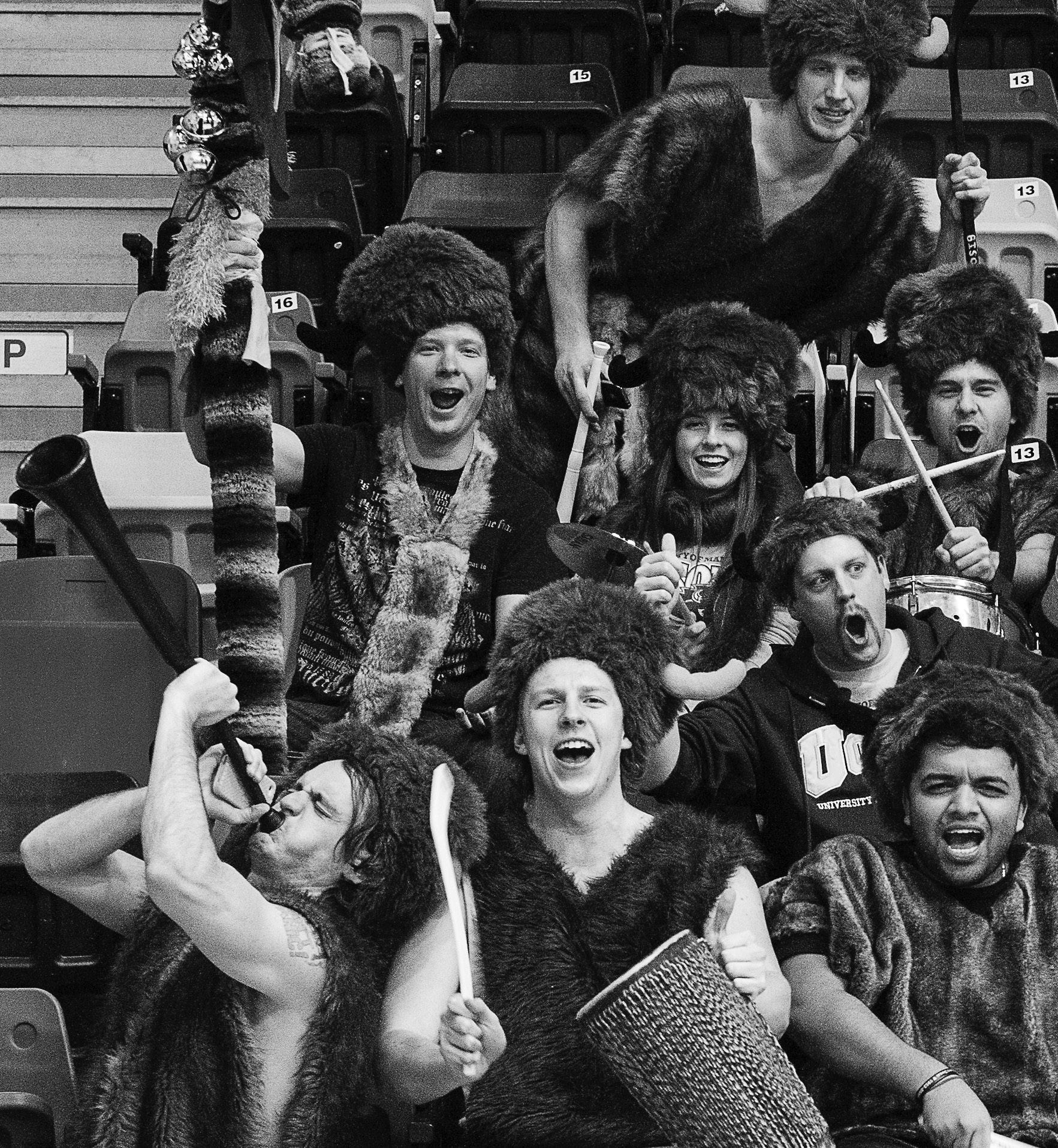
Big Horns fur up
What a die-hard University of Manitoba Bison fan aspires to be
MIKE STILL, STAFF
As new students, and even returning ones, it is sometimes hard to find a niche at the university – a place where you belong, and feel comfortable in your own skin.
There are many unique and diverse student groups which offer various opportunities to get involved on campus – one of these is the Big Horns.
“The Big Horns are known for wearing giant fur hats and making a scene at Bison games,” said cofounder and social media electronic wizard David Grad. “A furry flair and boisterous attitude is the hallmark of our members but our friendly nature is what we value the most.
“It can be hard to meet new people and it’s often a struggle to find a connection with campus outside of class, so our goal is simple: get students to games and events to meet new people and find a connection to our school.”
The process of getting involved with the Big Horns is rather simple.
“In terms of getting recruited, it’s best just to approach a Big Horn at a [Bison] game,” said current president Darren Sancartier. “That way you’re going to experience and see what you’re getting into.
“We do a lot of outreach, but at the same time, if you’re really interested and we haven’t had the opportunity to get to you, then coming to us at
a game or seeing us at the Hub will work. Those are kind of our digs.”
The Big Horns are implementing a few changes into their group this coming year in order to add more interest.
“Home
field advantage isn’t rocket science. Home field advantage is about atmosphere, support, and intimidation”
–David
Grad
The first is electing a representative for the students in residencies. These students have a big effect at Bison games, especially during the Spirit Cup.
“In terms of the residence population, we have a person that’s kind of repping that this year,” Sancartier said.
“He’s going to be going to a lot of Spirit Cup events—the pre-parties, so to speak—and doing a little bit of recruiting there as well.”
The second change has to do with the recruiting scheme, which is a bit more structured this year.
“Every individual Big Horn has the opportunity to recruit up to three Little Horns,” said Sancartier. “At that point, those Little Horns belong to the Big Horn, in terms of the group.”
The Little Horns will then accompany their Big Horn to sporting events, and UMSU events for three weeks. After those three weeks are up, the Little Horn will sit down with the Big Horn executives, and tell them why they feel they should be a part of the group.
An important aspect that Grad really stressed is the family atmosphere of the group – both within the Big Horns and toward the athletes participating in games.
“Home field advantage isn’t rocket science,” said Grad. “Home field advantage is about atmosphere, support, and intimidation.”
“Atmosphere is for fans. It involves a shared experience where everyone feels like they are part of the team and part of a larger family.”
Check out the Big Horns on Facebook (facebook.com/thebighorns) and Twitter (@TheBigHorns1) or via email (bisonpride@umanitoba.ca).
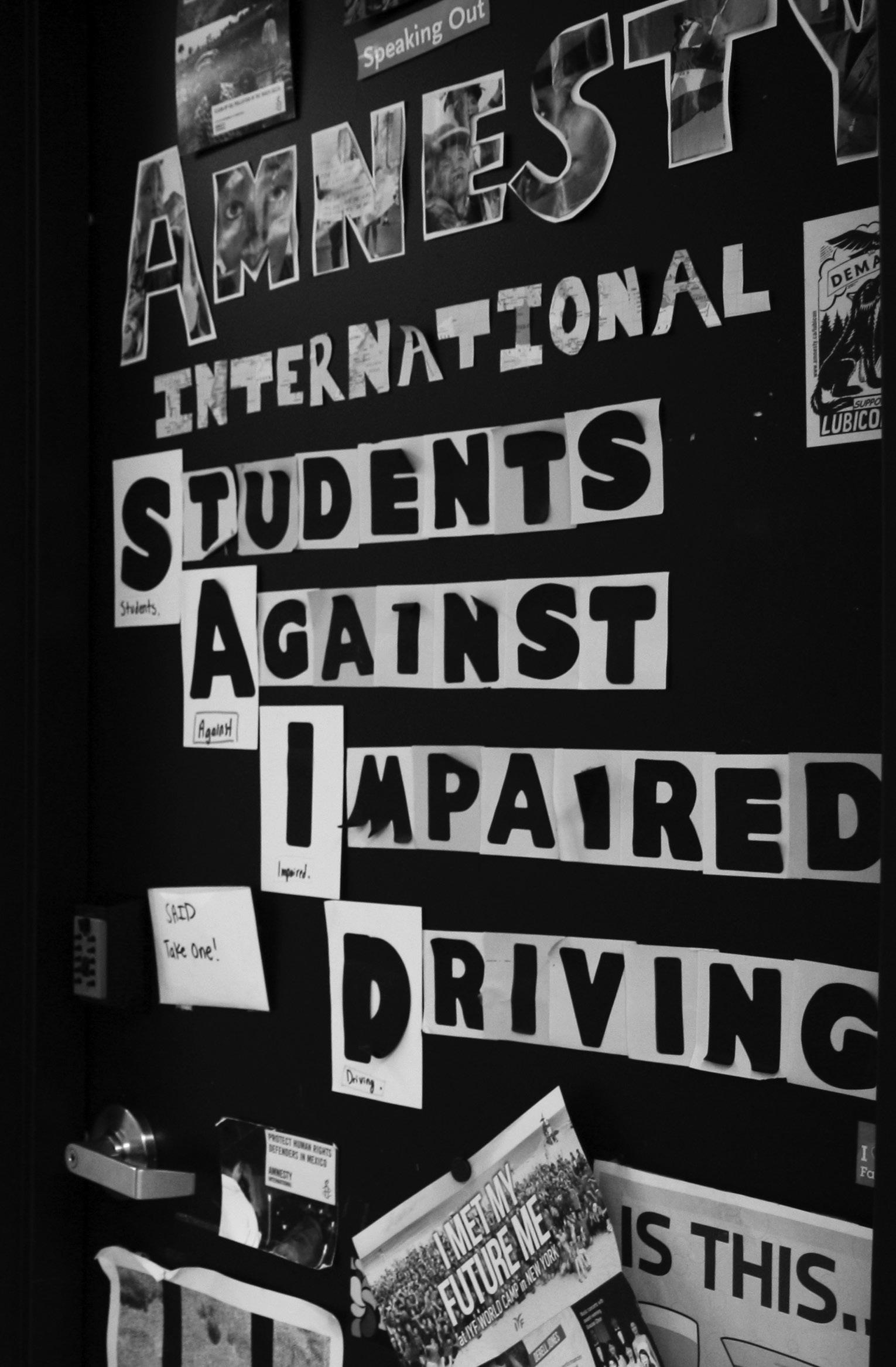
University of Manitoba Students Against Impaired Driving
CARLYN SCHELLENBERG, STAFF
University of Manitoba Students Against Impaired Driving (SAID) works to spread awareness of the dangers of impaired driving, and is “committed to promoting safe and responsible driving in Winnipeg,” says Yohanna Asghedom, an executive for SAID.
Students Against Impaired Driving was formed after a tragic car accident in October 2010 killed two women, friends of many of the student group members. Asghedom was also a victim of the crash. The 17-year-old driver who crashed into their vehicle was allegedly texting and driving after she had been drinking , and was reportedly speeding and ran a red light.
Students Against Impaired Driving offers students at the U of M volunteer opportunities both on and off campus, and volunteer hours will be recognized on their transcripts. They’re also looking to provide scholarships that students can apply for and use toward tuition fees.
Most importantly, the group, says Asghedom, “[helps] students who have been affected by impaired driving by giving them a place to come and talk with others who have also been affected by impaired driving.” The group was formed in the fall of 2012, and has been working with Operation Red Nose and in collaboration with MADD. This school year they will be hosting their usual samosa sales, and are planning a blood drive with St. John Ambulance. Students Against Drunk Driving meets on the first Tuesday of each month to discuss and brainstorm upcoming and future events and volunteer opportunities.
Visit SAID at their office at 185 Helen Glass Centre. Follow the group on Twitter @UofMSAID and on Facebook at facebook.com/uofmsaid
PHOTO BY SEAN COATES
PHOTO BY CAROLYNE KROEKER
Students Offering Support –Manitoba Chapter
CARLYN SCHELLENBERG, STAFF
Students Offering Support –Manitoba Chapter is a branch of a national charity that develops chapters in universities across North America. In the last 10 years, SOS chapters have tutored more than 25,000 students and raised over $1 million.
The Manitoba chapter is a group that enlists volunteers to tutor donating students. The proceeds fund development programs in Latin America, which operate on volunteer work.
The Manitoba chapter was founded in the fall semester of 2012 by Duaa Kanan, a then-student at the University of Manitoba, who recognized that students needed a program that helped them prepare for exams.
Kanan says the student group was formed to “creatively combine tutoring and fundraising to help students locally and children glob-
ally. My goal as the chapter founder and president was to provide highquality exam review sessions and work for the chapter’s sustainable development.”
In the Manitoba chapter’s first year, tutoring services were offered in more than 10 different science courses, and study packages were available for Organic Chemistry.
“SOS has reached out to more than 600 students in their first or second year at the University of Manitoba, and raised about $8,000 to this date. The money raised this year went to building a feeding centre, which will also serve as a tutoring space for children, in Honduras on an outreach trip this summer.”
For information on how to volunteer with the Manitoba chapter of SOS, or to register for a tutoring session, visit manitobasos.com, or check out their Facebook page.
University isn’t just for exercising your mind
Active living programs at the U of M
BAILEY RANKINE, STAFF
The University of Manitoba is not only a leading academic institute; it also places strong emphasis on fitness and recreation.
The faculty of kinesiology and recreation management operates the Active Living program, which offers programs under three branches: Bison sports, recreational services, and mini university.
The Bison sports facilities include Frank Kennedy Centre, Max Bell Centre, and Investor’s Group Athletic Centre. Combined they contain a swimming pool, indoor tracks, workout equipment, and an international ice hockey rink.
And don’t be fooled by the construction; the athletic facilities are still fully operational.
Recreational services offers yearround programs including adult swimming classes, kayaking, rock climbing, and group fitness classes.
Intramural sports, such as basketball, volleyball, and badminton are only $15 to participate, with the exception of ice hockey, which is $25. You have to sign up fast, though: registration fills up quick and games begin Sept. 29.
Mini university offers a total of 62 programs throughout the year to children ages 7-18. Participants
benefit from the university’s nationally-renowned facilities under the leadership and direction of experienced, attentive staff.
Students pay $17/month for a yearly gym membership that includes access to facilities and equipment at both campus locations, free group fitness classes, and court booking privileges.
If you’re still uncertain if the active living program is right you, then take advantage of the free week trial offered to students from Sept. 8-12 and try out the recreational facilities and fitness classes free of charge!
Profiling pre-election politics on campus
Political student groups and their platform policies, campus initiatives
DANA HATHERLY, STAFF
In the face of upcoming elections at the municipal, provincial, and federal levels of government, the Manitoban took the opportunity to talk politics with various politicallyfocused student groups on campus.
Introduced in randomized order here, the Manitoban spoke with student representatives from some major political parties on campus, including the University of Manitoba Campus Conservatives (UMCC), University of Manitoba Liberals (UML), and University of Manitoba New Democratic Party (UMNDP).
Each parties’ representative was provided the same information prior to interviewing, and an equal amount of time to respond to questions.
Two additional politically engaging student groups could not be excluded from this discussion due to their elevated level of political contributions on campus.
University of Manitoba Campus Conservatives
University of Manitoba Campus Conservatives general manager Justin Danyluk spoke about the student group.
“What sets us apart from a traditional conservative group is that we believe in fairness and equality. No matter who you are, and no matter what you stand for, there is a place for you at the UMCC,” Danyluk told the Manitoban
The UMCC group campaigned last year to “break barriers about what people think about conservatives,” such as “the stereotype that all conservatives are homophobic.”
Furthermore, the UMCC are working to ensure fiscal responsibility and small governance.
Last year, the UMCC held a poster spree to highlight fairness and equality, hosted a booth at Pride Week, and held major fundraisers for their campus initiatives.
The UMCC looks forward to
hosting their upcoming AGM, voting in new executives, and discussing new ideas for the upcoming year that will come forth with new dynamics.
Danyluk explained that the UMCC seeks to recruit new members and enhance the student experience by “networking with likeminded individuals.”
“No matter what kind of group it is, it is really important to start a group [of like-minded individuals] on campus,” said Danyluk.
The UMCC is not associated with progressive conservative parties or the Conservative Party of Canada. They do attempt to organize events to politically engage students, like beers with members of the Legislative Assembly, city councillors, and members of parliament that students are associated with.
“It gives students an opportunity to connect with [ . . . ] their elected representatives, so that we can make initiatives and changes on campus,” Danyluk explained.
“Everyone is invited to join, and lots of debates [occur] at council meetings.”
University of Manitoba Liberals
University of Manitoba Liberals president Jessica Morrison told the Manitoban that their group “promotes and supports the platform of the Liberal Party of Canada.” Their group mainly concentrates on the federal aspect, and strives to instill political energy among students for the upcoming elections at all levels of government.
Morrison told the Manitoban that she cannot speak on behalf of the federal party, but in her personal opinion, their group needs to focus on issues facing youth and promote policies that benefit youth.
Some major policies the UML are centred on include:
“The youth vote and targeting the
demographic with the lowest voter turnout [ . . . ]; supporting young Canadians who are pursuing postsecondary education; as well as tackling youth unemployment, with the youth hiring incentive, by giving youth and small businesses more opportunities for employment.”
On campus, Morrison said the UML seek to “organize and engage students in politics” by hosting panel discussions and casual pub nights.
She noted the significantly higher levels of political energy among students as more youth get involved in their campaigns.
Morrison said UML are working especially closely with federal candidates and building connections at the federal level, as well as attending events that connect campus clubs and candidates from across Manitoba.
“It’s a learning experience to get involved [ . . . ] and to learn more about how the federal party works,” Morrison noted, as the UML often directs youth into leadership positions in the wider community.
Morrison described the UML as an outlet for students to participate in networking and personal development opportunities.
“[The U of M Liberals] are fuelling a passion for politics on campus.”
University of Manitoba
New Democratic Party
The Manitoban spoke with UMNDP co-chair Erika Beaudry about their student group.
The UMNDP campus club focuses on affordable education for students supported by our provincial NDP government to maintain some of the lowest tuition levels in the country.
This growing group is seeking input from members by holding monthly meetings to discuss current politics and give back to the community.
According to Beaudry, “Politics is
a really big thing, and people aren’t as involved as they could be, or should be. I think we really just want to open that up to people, and then we can discuss [together] and learn at the same time.”
The UMNDP is in connection with the Manitoba Young New Democrats and provides opportunities for students to participate in their activities and events.
“We would like to encourage all progressive-minded students to get involved and come make this campus club what they would like.”
Non-partisan political engagement on campus
Aside from the dominant political student groups, there are various other politically-active groups at the U of M, such as the Global Political Economy Students Association (GPESA) and the Canadian Federation of Students-Manitoba.
Chad Wright, president of the GPESA, told the Manitoban that their student group is part of the U of M’s global political economy program.
“[Global political economy] is an interdisciplinary program that works with the [departments of] economics, politics, anthropology, sociology, and history to try to get a more wellrounded perspective of world issues and issues from the past,” Wright said.
According to the department’s website, the scope of the program includes international political, social, economic, and environmental issues. Its study involves investigating “critical issues in your hometown, or in cities halfway around the world, [and the ways in which these issues] interact with a global system of political economic forces and relations.”
The activities facilitated by GPESA (panel discussions, campaigning, fundraising, and regular gatherings) depend on the dynamic of the executive and participating GPE students.
The GPESA hosts weekly or biweekly Brown Bag Lecture gatherings at Degrees Restaurant throughout the academic year that provide a less intimidating way to discuss news and relevant political topics at hand. Brown Bag Lectures are an opportunity for students to engage with professors and fellow GPE students, and participate in critical debates.
Canadian Federation of StudentsManitoba chairperson Zach Fleisher also told the Manitoban about their group initiatives and the significance of political engagement on campus approaching election period.
“[The Canadian Federation of Students-Manitoba reaches] out to students across all campuses [in Manitoba] that we represent, and we seek to engage students on issues relating to access for post-secondary education, equity campaigns, and issues that are important to student life, such as transit and housing issues.”
International student new to campus
Happy to be at the University of Manitoba
ANGAD SINGH
If you come from a country where “heating” comes courtesy of the blazing tropical sun, the first thing you will notice in Winnipeg is the chilly weather.
The chilled weather is, however, completely eclipsed by the warmth of the people, especially here at the University of Manitoba.
I spent the first 22 years of my life on the hot, dusty plains of northern India, mostly confined to Delhi and Chandigarh, my birthplace – a place where the mercury dropping to 15 Celsius calls for heavy woolens to be pulled out.
Where I’m from five degrees is a “cold wave” and two degrees would be the coldest recorded temperature in 50 years. On the other end of the spectrum, it can be up to 49 C in the shade. You could actually fry an egg in the sun. Those not used to the climate could very well find it impossible to breathe outdoors.
The welcome at the “orientation,” organized by the International Centre for Students, instilled in each one of us a sense of belonging – or to put it more precisely, we were inducted into the “Herd.”
The concentration of cultural diversity at the U of M is astounding. You get to meet the most vibrant people from all across the globe, from places as remote as Siberia to as popu-
lous as China, in a matter of minutes, and all in the space of a large orientation hall.
When you’ve graduated from a university in Delhi, India with virtually no interaction with international students, the influx of new cultural information just blasts open the windows of your mind.
The general feeling of care for others that the people at our university offer rubs off on anyone and everyone. I get the sense that anyone who has lived in Canada for a year or more becomes more open-minded and benevolent. The level of acceptance that is offered in this country for all cultures is heartwarming.
The aura of the U of M provides a newfound sense of enthusiasm toward life. This enthusiasm is coupled with a subtle feeling of happiness that resonates off almost everyone you meet. Don’t be surprised if you catch yourself smiling from ear to ear for no apparent reason while walking from class to class.
While I am clearly still in the honeymoon phase of being on this campus, I sincerely feel that the honeymoon can be extended indefinitely. All you need to do is follow the ideas floated at orientation – that one must be engaged, get involved, and most of all, be resilient.
Your UMSU businesses
An introduction to the student-unionrun businesses on campus
CRAIG ADOLPHE, STAFF
As a new semester gets underway, University Centre is a hub of activity.
There are tables for student groups and companies trying to recruit new members and customers, and a sea of new and returning students in almost every direction.
For new students in particular it can be difficult to navigate the campus.
First-year students will have enough trouble adapting to their class schedules without the added confusion of learning the ins and outs of their new environment.
Here we provide an introduction to UMSU businesses – the businesses managed by your student union for the benefit of their members.
They’re meant to improve the campus experience and provide critical services to students.
Degrees Restaurant
Hours:
Monday to Friday: 8 a.m. to 8 p.m. Saturday: 11 a.m. to 7 p.m. Sunday: Closed
For most students, finding a comfortable place to eat is one of the key components in creating a routine on campus. Located on the third floor of University Centre, Degrees offers a cordial atmosphere and good eats. It features halal food options and a wide variety of vegetarian dishes for students who don’t eat meat.
Degrees manager Thomas Blumer says that this year there will be a greater emphasis on baked goods at Degrees.
“The baking is a huge and very new element to Degrees,” said Blumer. “I think we’re actually at a point this year that we can do so much more.
“Everything you see that says ‘baked in Degrees’ was actually done in-house, as well as utilizing a lot of local ingredients in doing so. We’ll be also be able to do birthday cakes, and torts, and desserts now. So I’ll be hoping that the community on campus will see and recognize this as well, that they can actually purchase cakes, birthday cakes, here on campus. Made locally and fresh. It’s going to be exciting.”
G.P.A.’s Convenience Store
Hours:
Monday to Thursday: 8 a.m. to 9 p.m.
Friday: 8 a.m. to 8 p.m.
Saturday & Sunday: 11 a.m. to 4 p.m.
G.P.A.’s is the student-union-run convenience store located on the first floor of University Centre.
The convenience store features a number of snacks and drinks, as well as newspapers.
G.P.A.’s benefits from its location, being directly on the path through UC’s main walkway. It’s often the fastest and closest place for students to grab food while transitioning from class-to-class.
Digital Copy Centre
Hours:
Monday to Thursday: 8:30 a.m. to 7 p.m.
Friday: 8:30 a.m. to 4:30 p.m.
Saturday & Sunday: Closed
Printing and getting photocopies on campus can be a hassle for those who aren’t familiar with the process or where to go. Fortunately, the digital copy centre, located on the main floor of UC, is there to assist students with all their printing needs.
The Digital Copy Centre does bulk digital print orders, colour prints, transparent slides, covers for reports, and binding. They also have self-serve photocopies available at the front of the store.
The Digital Copy Centre is the main place to get copies of the popular Grant’s Self-Help Study Guides. The study guides are available for several math and statistic classes including Basic Statistics 1, Basic Statistics 2, Intro Calculus, Calculus for Management, Calculus 2, Linear Algebra, and Matrices for Management.
Archives Used Bookstore
Hours:
Monday to Wednesday and Friday: 9 a.m. to 5 p.m.
Thursday: 9 a.m. to 7 p.m.
Saturday & Sunday: Closed
For students who’ve put off buying their textbooks (or those who make it to the next semester), Archives might be able to save you some money.
This used bookstore, located in 107 Helen Glass Centre, sells textbooks on consignment. Students who are done with their textbooks are able to drop them off at Archives with a requesting price. If the book sells, the owner can return to pick up 80 per cent of the selling price.
Although the University of Manitoba bookstore occasionally buys back books for resale, it’s at a set price and only certain books are accepted.
As such, Archives allows students to sell editions of books that are considered out of date. Remember to stop by Archives with your books after the semester is over if you’d like to sell them.
The Hub – Campus Community Pub Hours:
Monday & Tuesday: 11 a.m. to 1 a.m.
Wednesday to Friday: 11 a.m. to 2 a.m.
Saturday: 8 p.m. to 2 a.m.
Sunday: 5 p.m. to 1 a.m.
Situated on the third floor of University Centre, the Hub is UMSU’s pub and the primary drinking establishment and nightlife centre on campus.
The Hub serves grub that Jack Jonasson, manager for the Hub, calls “high quality bar foods,” including chicken wings, quesadillas, enchiladas, vegetable wraps, and burgers.
The Hub is popular for its Wednesday night Rez Night, where students living on campus get priority entrance and $2 flights of beer are available.
IQ’s Café & Billiards
Hours:
Monday to Thursday: 8 a.m. to 12 a.m.
Friday: 8 a.m. to 2 a.m.
Saturday: 12 p.m. to 2 a.m.
Sunday: 12 p.m. to 12 a.m.
Also situated on the third floor of University Centre, IQ’s is used as a pool hall and open space for students to sit, talk, and drink Starbucks coffee.
Pool table rental is $7.25 an hour, but tables can be rented by the minute for people who only want a short 15- to 30-minute game.
IQ’s also features Global Bubble Tea, a small bubble tea vendor, accessible from inside its front entrance. The UMSU executive has identified setting up a new sushi restaurant called UMSushi in its place as a priority in the new year.
While it does offer some food, mostly provided by the Degrees kitchen, the real appeal of IQ’s is as a place to lounge. The ample seating room, large television, and billiard tables ensure that the café maintains its own distinct niche amongst the UMSU businesses.
These businesses are run for students by your student union. They’re here for your benefit.
In the coming weeks, as you explore the U of M, make an effort to stop by the various UMSU businesses and incorporate them into your mental map of the campus. Stop by Degrees for some chicken fingers or a wrap, play a game of pool at I.Q.’s, or ask some classmates to join you for drinks at the Hub after an evening class.
PHOTOS BY CAROLYNE KROEKER
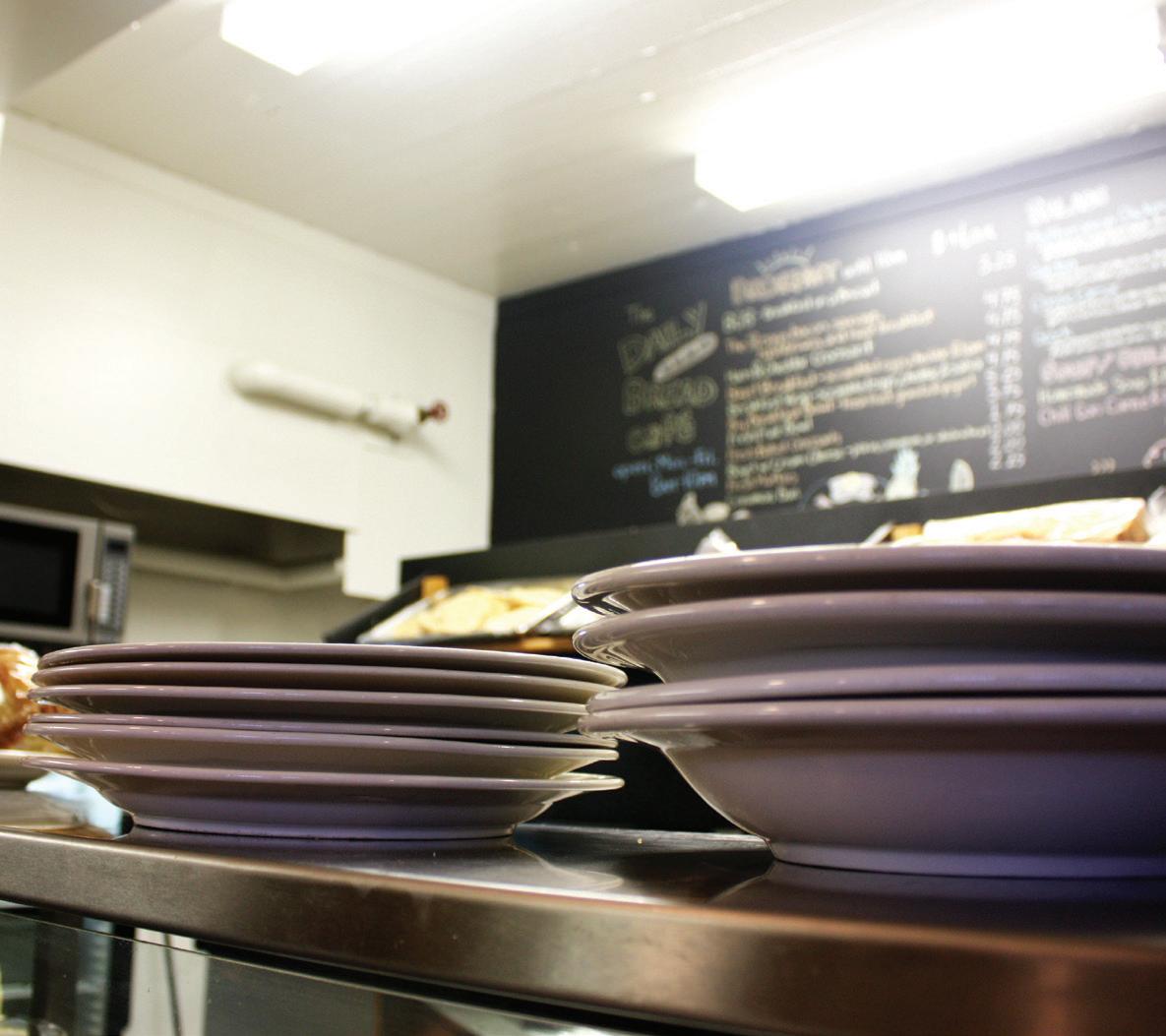
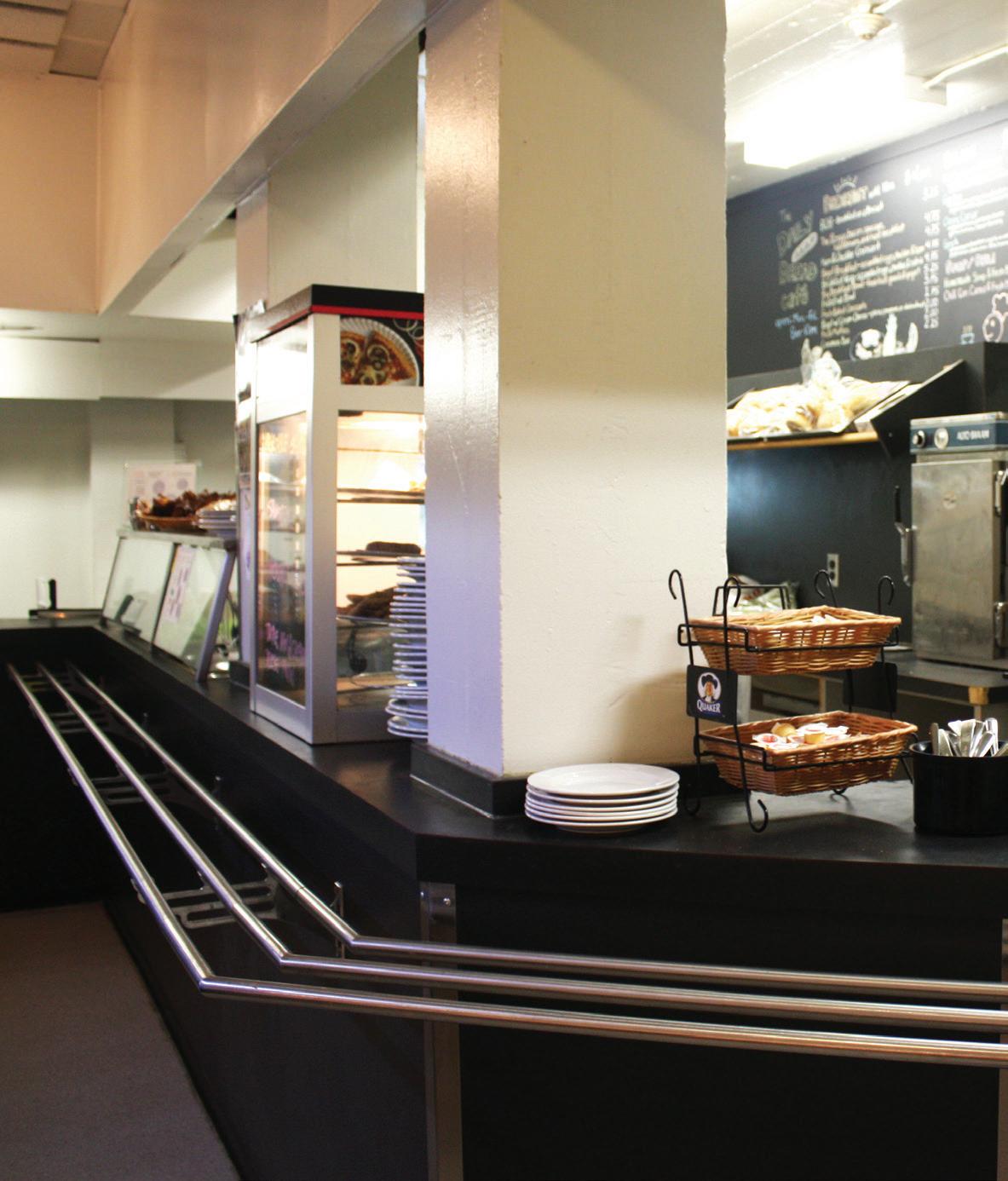
Daily Bread Cafe one of the best kept secrets on campus
Inconspicuous St. John’s College basement restaurant offers good value for food, drink
BRYCE HOYE, STAFF
Depending on who you ask, the Daily Bread Cafe is one of the best kept secrets on campus.
Unlike other campus eateries, Daily Bread doesn’t have the advantage of being situated prominently in some of the higher traffic areas of University Centre (UC). For this reason, the hunger-pang-inducing scents wafting from its kitchen may not reach and lure students through the doors.
That doesn’t mean it doesn’t offer a great product – it just means people don’t know what they’re missing.
“The thing I hear all the time is, ‘We didn’t know you were there,’” said Ian Park, St. John’s College and Daily Bread food services manager.
Tucked away in the basement of St. John’s College, a two-minute jaunt northwest of UC, Daily Bread boasts one of the most original menus on campus and provides a great atmosphere to take in a game with friends.
On top of serving everything from pizza, veggie stir fry, mango curry chicken, and an array of breakfast options that will run you around $6 (before taxes), Daily Bread also serves pickerel, bison stew, bannock, and local beers.
101.5
“We do things that showcase who we are,” said Park.
Patio and pints
Daily Bread’s comfy lounge is full of big screen televisions often tuned to the football or hockey games of the day. The cafe has an isolated patio area that has proven to be a popular pre-gaming destination for Winnipeg Blue Bomber home games. The patio is also enticing to the truant in all of us on those warm days when the prospect of cutting class to grab a chilled pint of Farmery or Fort Garry beer (both on tap) seems impossible to pass up.
“It’s a decent little patio, it’s secluded and people enjoy it,” said Park. “[But] that’s not really what we’re about. We’re not so much our tables and chairs.
“We serve good food at good prices consistently, we don’t close down because it’s not economically viable in the summer time as it is other times; we think it’s the right thing to do.”
Just the same, Park said the biggest thing working against the restaurant is that people just don’t know where it is.
“We’re not the university, so we’re
UMFM
not included in their advertisements; we’re not UMSU,” said Park. “We’re a very unique kind of place. We’re what university eateries used to be.”
Eco-friendly takeout
Both Daily Bread and Degrees are trying to help the environment by experimenting with a new system of reusable takeout containers called tiffins.
“We sell a refillable stainless steel container, and encourage customers to bring that container back, clean or dirty, and receive their new meal in a fresh, clean container,” said Park. Park hopes the new containers will help reduce the cafe’s, and by extension the university’s, Styrofoam usage. Daily Bread offers good food at an affordable price, so the popularity of the tiffin project and the continued success of the cafe are simply a matter of more students becoming more frequent customers and, as Park said, “letting people know we’re here.”
The Daily Bread Cafe is located at 92 Dysart Rd. downstairs in St. John's College, open 8 a.m. to 10 p.m., Monday to Friday. They're also open on Bomber game days on the weekends.
Your campus and community radio station
KATY MACKINNON, STAFF
N
estled down a blue hallway next to Degrees on the third floor of University Centre is 101.5 UMFM, your campus and community radio station. Jared McKetiak and Michael Elves, the station’s manager and program director, respectively, are there to welcome you with friendly, smiling faces and perhaps entice you to volunteer.
If you tune in to UMFM, you won’t be listening to your typical single-genre station. A multitude of diverse shows await your ear – punk, jazz, folk, electronic, talk, campusbased, and everything in between .
“We try to appeal to a bunch of different niche groups and put them all under the same umbrella,” says Elves.
If you’ve been toying with a great idea for a radio show, volunteering for UMFM will be right up your alley.
UMFM has a volunteer training program, where you’ll learn about the
station, the equipment, and rules that keep everything running smoothly.
After six hours of volunteer time, you’ll be considered a “volunteer at large,” making you a full voting member in the station’s annual general meeting.
Aside from pitching and hosting a show, you can work in production if you’re more technically inclined. You can do live band recordings, learn to mix ads, and learn to use the software. Or, you can become involved in marketing and promotion.
UMFM does receive a levy from UMSU, but due to inflation, the costs of running the station are augmented by the annual Pledge-ORama fundraiser in October.
During Pledge-O-Rama, a bunch of specialty programming is held throughout the week. Live bands perform, shows have guests and promotions, and there are special
“We’re not the university, so we’re not included in their advertisements; we’re not UMSU. We’re a very unique kind of place. We’re what university eateries used to be” — Ian Park, St. John’s College food services manager
A multitude of shows await your ear – punk, jazz, folk, electronic, talk, campus-based, and everything in between incentives for listeners who pledge.
UMFM puts together an incentive package all their own that includes a CD of live band performances at the station – and you won’t find those recordings anywhere else.
“[Pledge-O-Rama is] our listeners truly supporting us in the sense of putting their dollars where their ears are,” says Elves.
One of the best aspects of working at a campus radio station is the continually changing group of volunteers, says Elves.
“There’s a lot of unique and interesting voices that I get exposed to,” he says.
It’s time to make your voice heard and head on up to UMFM. A welcoming group of students and folks of all ages are ready and waiting for you.
PHOTOS BY CAROLYNE KROEKER
Editor-In-Chief:Bryce Hoye
Contact: Editor@themanitoban.com / 474.6770
You’re sad? Go for a walk.
Mental health misconceptions hamper access to treatment
KATY MACKINNON, STAFF
You’re depressed? Go for a walk.
That’s the common response to individuals with a mental illness seeking help.
A recent op-ed published in CBC Manitoba by David Grebstad demonstrates a prevailing attitude about the diagnostic process and access to treatment for individuals with mental illnesses: that these individuals aren’t really sick, are taking a toll on our tax dollars, and acquiring services they do not need.
This attitude is harmful and contributes to the overall stigma against mental illness, making it more difficult for individuals in need to access treatment.
New criteria necessary for those in need
A number of changes were made to the Diagnostic and Statistical Manual of Mental Disorders (DSM5) criteria for post-traumatic stress disorder (PTSD) in 2013, including the addition of two criterion that specify the nature of the exposure to the traumatic event: it can be witnessed (and not occur directly to the individual), or the individual can learn the event happened to a close friend or family member and experience PTSD symptoms themselves.
Grebstad wrote he had “reservations” about the latter criterion. He fears that with this change, PTSD will become “far too broadly diagnosed.”
This is highly unlikely to happen.
Post-traumatic stress disorder has a 9.2 per cent prevalence rate across
Canada, according to a 2008 study by McMaster University, and an eight per cent prevalence rate according to Statistics Canada.
The DSM-5 was published in May 2013, nearly 20 years after its previous version, the DSM-IV.
Over 500 scientists and clinicians were involved in the revision process, and all changes were subject to approval by the American Psychiatric Organization Board of Trustees, who then appointed a Scientific Review Committee to assess the changes.
Finally, a Clinical and Public Health Committee reviewed the changes and assessed the public health impact of the DSM-IV criteria.
One motive for updating the manual was to increase access to treatment for those whose symptoms were not well defined by the previous version.
“The changes [to the PTSD diagnostic criteria] in DSM-5 are a response to continuing new findings and new understandings about just what trauma is, and what trauma response is, and how tightly (or not tightly) trauma symptoms are linked to actually having been exposed to a trauma yourself,” said Ed Johnson, associate professor of psychology at the University of Manitoba.
Johnson said that this linkage between actually experiencing trauma and showing PTSD symptoms is not as tight as one might expect. The changes, he said, are an important step to capturing who exactly is experiencing trauma symptoms – the key point here being symptoms.
Take, for example, emergency personnel. These individuals are first on the scene of horrifically tragic events. These events may not be occurring to those individuals personally, but they are witnessing them or learning about them.
It’s hard to imagine an individual seeking out “undeserved” psychological and health services for an illness many deem to be a sign of weakness, or a defining feature of a person
The prevalence rate of PTSD in emergency personnel is twice that of the general population, according to a study by the University of British Columbia.
“In that context we can kind of understand that, yes, even if something didn’t happen to you, you may still suffer the effects of trauma,” said Johnson.
Increased access to treatment a step forward, not a step back Grebstad, a Canadian soldier who by his own admission does not suf-
fer from PTSD, said he is wary of increased access to treatment.
“It is unfortunate to say there will be those who will use this broader definition to acquire undeserved benefits, which will in turn divert those resources from where they really need to go,” he wrote.
For an individual to receive a diagnosis of PTSD, they must meet other symptomatic criteria – not just one single criterion. In other words, an individual must show a number of other symptoms that lead to a negative impact on their quality of life. Work performance and social interactions, for example, are significantly affected.
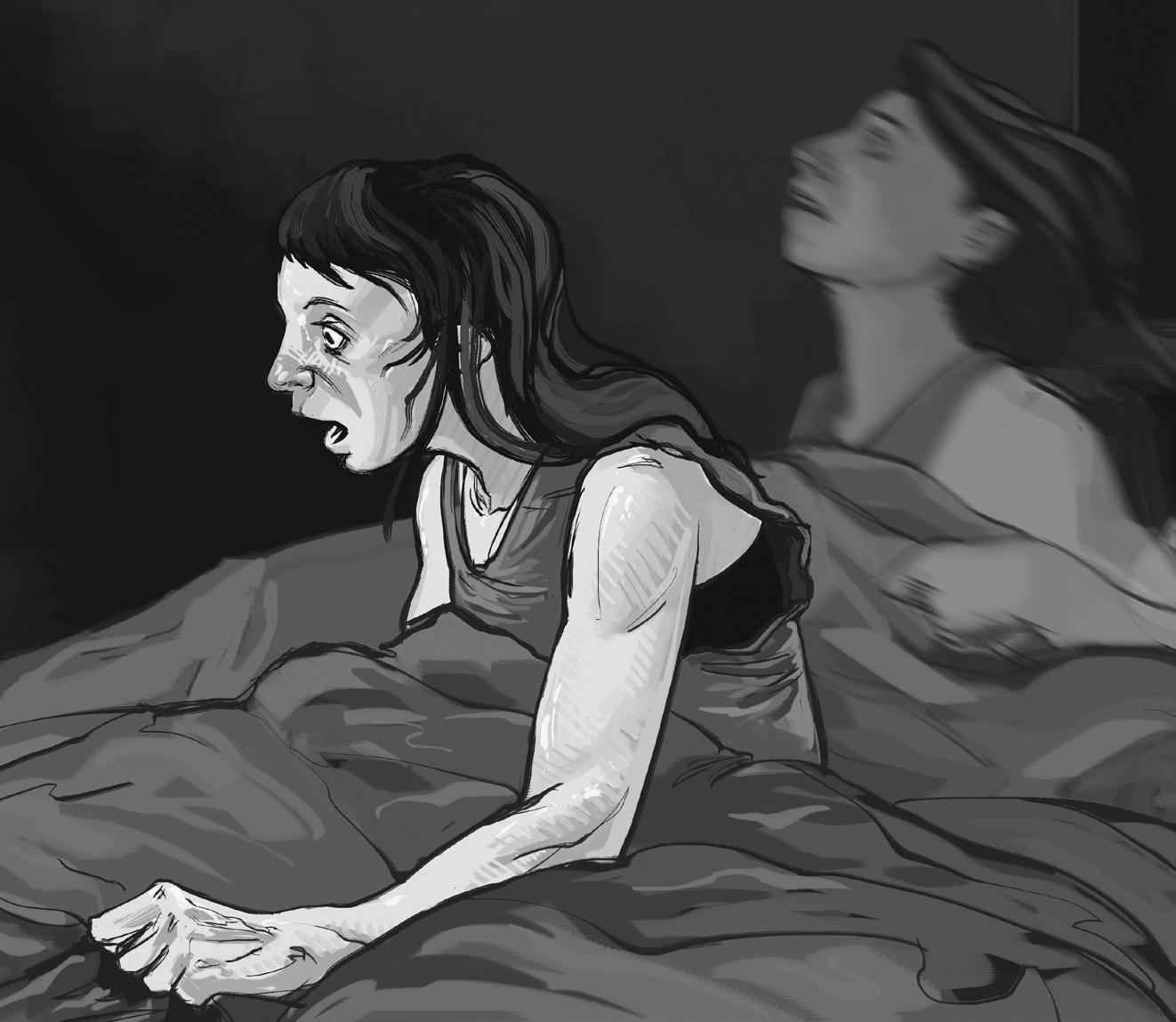
Post-traumatic stress disorder is a frightening illness. Symptoms of PTSD include but are not limited to: re-living the event in vivid detail through flashbacks and/or dreams, prolonged psychological distress, sleep disturbances, and self-destructive behaviour.
“Anyone who meets those criteria is, in my opinion, deserving of treatment. They’re suffering,” said Johnson.
Stigma persists
In the case of a physical illness, say, a kidney infection, one would go visit a doctor and receive antibiotics without a hitch. Kidney infections, like most physical illnesses, do not carry the stigma that exists for mental illnesses.
Recognizing that you need help when you have symptoms of a mental illness, and then actually going as far as trying to obtain that help,
is one of the most difficult steps to recovery. Much of this is due to the stigma that still surrounds mental illness in general.
The Mental Health Commission of Canada established a project in 2009 to combat stigma called “Opening Minds.” According to the commission, 60 per cent of individuals with a mental illness will not seek help due to fear of labelling (for example, stereotypes such as “crazy” or “has baggage”).
It’s hard to imagine an individual seeking out “undeserved ” psychological and health services for an illness many deem to be a sign of weakness or a defining feature of a person. It’s hard to imagine people would willingly place themselves at risk for being discriminated against and labelled.
“We know stigma is a significant barrier for people and there’s a lot of effort being put into reducing stigma, and that’s terrific. But it’s still there. The last thing we want is for people to avoid seeking help when they need it,” said Johnson.
We need to make an effort to work toward increasing access to treatment, not decreasing it. Whatever the origin of an individual’s mental illness, the illness is seriously impacting their life. Suffering individuals deserve treatment, and those who continue to perpetuate negative stigma against mental illness are only further impeding their recovery.
GRAPHIC BY BRAM KEAST
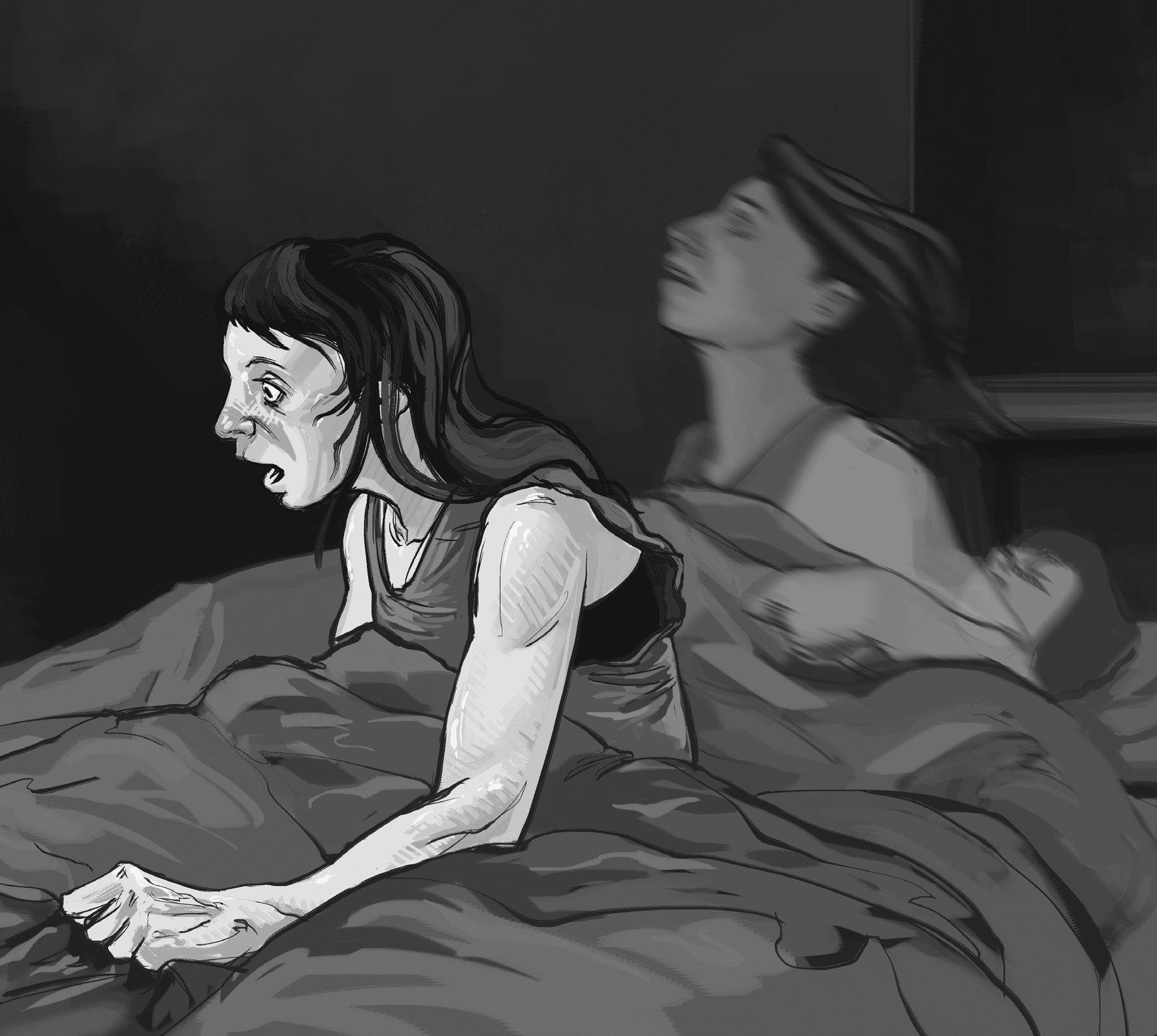
Night terrors are a common symptom of PTSD
ISIS and the contradictions of U.S. foreign policy
America harming its own long-term goals in Middle East
KEVIN LINKLATER
The rise of the Islamic State of Iraq and Syria (ISIS) has been covered a lot in the media, and some mention has even been made to how the 2003 US invasion and subsequent occupation of Iraq helped create this monstrous group . Little attention, however, has been paid to the power struggles and centuries-old rivalries in the region, and the contradictions that U.S. policy in the Middle East is producing for American security interests.
Recently, the Obama administration has floated the idea of attacking ISIS in Syria in order to curb their reach into neighbouring Iraq.
Anyone with a cursory knowledge of what has been going on in the Levant region must be shaking their heads. While the U.S. has come out against the Assad government in Syria’s civil war, they are now proposing to move militarily against Assad’s biggest foe, ISIS – the clearest manifestation of a U.S. foreign policy that is inconsistent and self-defeating.
This, however, is just the tip of the iceberg in terms of the contradictions of U.S. policy in the region.
While the relations between actors in the region are very complicated, there is a hugely important one that is barely mentioned in the Western media – the rivalry between Iran and Saudi Arabia, perhaps the fundamental tension in the region.
This centuries-old rivalry was for a long time just about plain old geopolitics and who would have dominance in the region. In the intervening years, however, this rivalry was overlaid with a religious element: the Sunni-Shia split within Islam.
In 1501, the Safavid Empire – a precursor to the modern state of Iran – converted from Sunni to Shia Islam, (and with it, so did a majority of the population). This helped to unify the new empire under one religion and set it apart from its Sunni Arab neighbours with whom the Persians had long been rivals.
During the Cold War, both Saudi
Arabia and Iran were closely allied with and received crucial support from the U.S., as their governments were conservative monarchies and staunchly opposed to communism.
This changed in 1979, when the Iranian revolution overthrew the U.S.-backed Shah and ushered in a new theocratic state. American and Saudi interests became even more closely aligned, as both countries saw the new government in Tehran as a direct threat to their interests .
The larger Sunni-Shia conflicts seen in Iraq, Syria, and Lebanon are being fomented by Iran and Saudi Arabia, as each backs its own side in the numerous conflicts throughout the region.
The problem is that American interests in Iraq and Syria now align more with the Iranian side than with the Saudi side . Even more troubling is the support that the U.S. gives to Saudi Arabia is helping to fuel the type of terrorism that America has become obsessed with fighting since
9/11: first in the form of al-Qaeda, and now in the form of ISIS.
When the West thinks about terrorism, usually what we are actually thinking of is Salafist-inspired Sunni Islamic terrorism – a fact we somehow always omit when addressing the subject.
Salafism or Wahhabism is an ultra-conservative, fundamentalist interpretation of Islam that was born and nurtured in the remote deserts in the interior of the Arabian Peninsula . It is also where the Saudi royal family originates.
In fact, the foundations of the Saudi state come from a pact between the Saud and Wahhab families – the former handling political affairs, and the latter handling religious matters and providing legitimacy to the monarchy.
While the Saudi state is careful not to directly fund terrorist groups like al-Qaeda or ISIS, it does directly support the madrassas (religious schools) and conservative clerics that
espouse the puritanical interpretations of Islam that form the basis of belief for these terrorist groups. Also, individual members of the Saudi royal family have provided support to these groups, although not in an official state capacity.
Thus we see American foreign policy at cross-purposes with itself in Iraq and Syria in the short term because of its opposition to the Iranian government. More worryingly, though, are the long-term effects that America’s relationship with Saudi Arabia are likely to have in fermenting Sunni Islamic fundamentalism in the region and globally.
The birth of ISIS can be traced to the numerous U.S. blunders in Iraq, but its growth and success is due in large part to the inability of America to manage the contradictions of its foreign policy in the region.
The urban prairie pothole: doing our part
Wetland restoration a solution to seasonal flooding
RACHEL EVANS
I
n recent years, flooding has been given a new meaning for many Manitobans.
The Assiniboine River experienced a 1-in-350-year flood in 2011 and numerous flooding events over the last three years.
What has shaken entire communities, destroyed infrastructure, is now at the forefront in provincial politics. Is it a changing climate? A few wet years?
While there is doubt on the cause, flood severity is now being linked to the decline of wetlands in our prairie pothole region.
In Canada, this region includes southwestern Manitoba, southern Saskatchewan, and southeastern Alberta. It is designated as being the primary agricultural region of both Canada and the United States.
A wetland is a depression in the landscape where the water table meets the soil surface. It discharges water from underground while also capturing and retaining overland flow from adjacent fields.
Wetlands can be either permanent or temporary and are surrounded by water-loving vegetation.
Wetlands create pockets in croplands, which hinder cultivation.
Economic drivers, such as increased grain prices and fuel costs have forced farmers to drain large portions of wetlands over the past 50 years.
Intricate drainage systems now facilitate water movement off farm fields. Farming is a business, and a crop that cannot be sown is a crop that cannot be reaped.
Recent work by Ducks Unlimited Canada demonstrates the ecological services that wetlands provide. Diminishing wetlands can accelerate the delivery of water and nutrients to surrounding lakes.
Wetlands act as buffer zones that sequester excess nutrients, but if the nutrients make their way to water bodies, such as Lake Winnipeg, the resulting algal blooms may be devastating to the commercial fishing industry.
Programs and incentives to
encourage farmers to leave wetlands intact are important for downstream water quality. But what about the contribution from our cities?
The City of Winnipeg contributes 14 per cent of the total phosphorus loading to Lake Winnipeg and 24 per cent to the Red River.
One innovative solution is the construction of naturalized storm water retention ponds, which are urban mimics of naturally occurring prairie potholes.
Native Plant Solutions (NPS), a business line of Ducks Unlimited Canada, specializes in wetland construction and native prairie installations.
If you live in a newer residential area in Winnipeg, chances are that you have one of these “duck ponds.”
To the untrained eye, they are just that. In reality, these ponds are multifunctional, complex ecosystems right in our backyards.
Duck ponds feature an open water body surrounded by a stratified plant community consisting of submerged
wetland plants, wet meadow plants, and an upland native tall grass prairie.
Each feature is installed and maintained under the sharp eye of a team of wetland biologists, plant ecologists, and agronomists.
The general purpose of a storm water retention pond is to ease stress on sewer systems.
A conventional storm water pond has a constant depth, gravel around the perimeter and sod uplands.
Alternatively, naturalized storm water ponds are built using sound science to support wetland plant communities. Special attention is given to the relationship between hydrology and plant ecology.
For example, in ideal conditions cattails need half a metre of water . So, when ponds are constructed, different levels are created to support plant growth.
Emphasis on pond morphology and plant community is important, and we know from the prairie pothole region that wetlands provide important water filtration.
In a study comparing conventional ponds to an NPS designed naturalized pond, algal communities were 18 times higher in the conventional ponds.
In addition, of the algal communities present, blue-green algae were 2,200 times higher in the conventional ponds.
So not only was there significantly more algae in the conventional ponds, but also the problematic kind of algae. The exciting part is that both ponds were in their first years, meaning the vegetation in the naturalized pond had only just begun to establish itself.
Naturalized storm water retention ponds are a relatively new service, having only been provided for the last 10 years by NPS.
This innovative model, mimicking our regional prairie pothole ecosystems, puts Winnipeg on the map for improving the sustainability of our residential communities, and will hopefully provide a template for communities across Canada.
Organic from roots to ruminants
Organic farms utilize the science of the natural environment to stay chemical-free
BAILEY RANKINE, STAFF
Students in the department of agroecology attended an annual field trip Sept. 3 to gain a perspective on real-life applications of coursework.
Students, ranging from first years to graduates, accompanied by a handful of faculty members, boarded a bus at 8 a.m. and began the two-hour drive to Howpark Farm, located in the Brandon Hills, south of Brandon.
Howpark Farm was established in 1897 and is owned and operated by Ian and Linda Grossart and their family. The primary focus of the family farm is to grow organic grain and raise organic grass-fed beef.
The farmland stretches across approximately 850 hectares and is divided almost equally between cultivated crops and native prairie range for beef cattle.
The most challenging aspect of organic farming is determining the best way to manipulate the innate biology of the plants and animals to replace the use of chemical fertilizers and herbicides.
Selecting the appropriate crops and establishing the most effective order of rotation are key to naturally introducing the necessary nutrients to the soil and reducing the invasion of weeds.
The Grossarts rotate four different crops over a six-year cycle.
Competitive sprouts
Alfalfa is the first crop and is planted for three consecutive years.
The roots of alfalfa have nodules, which contain nitrogen-fixing bacteria. The bacteria take up atmospheric nitrogen, N2, and convert it into ammonia, NH3+.
This is an important role because atmospheric nitrogen is a very stable molecule – too stable, in fact. Its inert nature inhibits it from being used in the biochemical reactions necessary to create the “building blocks of life”: nucleotides and amino acids.
The ammonia form of nitrogen is much more reactive and easily taken up by plants. It is in this form that nitrogen is found in conventional chemical fertilizers.
Not only does alfalfa provide biologically available nitrogen in the soil, it also rids the plot of rival vegetation.
Alfalfa is highly competitive and its dense growth enables it to easily dominate the area in which it’s planted. Unwanted wild varieties, such as thistle, are choked out of the cultivated cropland.
At the end of the season, the alfalfa is harvested, hayed, and baled. The bails are stored and used for cattle feed over the winter.
Flax to follow
Yellow flax is sewn following the three consecutive years of alfalfa crops
Flax is said to be one of the healthiest organic grains on the prairies amidst claims that it reduces heart disease, helps prevent cancer, and improves brain and immune function.
Since flax is a weak opponent to weeds, it is well-suited to follow alfalfa in rotation.
The low nutrient requirements of flax also make it an optimal choice in organic farming, which can sometimes face challenges in nutrient limitations. Flax leaves most of the nutrients behind for the needier crops that follow.
Although only the flaxseeds are desired, there is still a use for the fibrous stems after harvest.
Traditionally, flax fibre has been used to manufacture cigarette papers, but due to increasing health awareness this industry has plunged.
However, the Grossarts have a much more sustainable plan – they use the flax stems for cattle bedding .
Bunches of oats
In the fifth year, the third crop planted in the rotation is oats.
By the end of the flax season, the weeds initially controlled by the alfalfa have begun to re-establish themselves.
Oats are a great choice at this point because they are hearty enough to outcompete weeds and are expert nutrient scavengers.
Overall, oats are a staple cereal crop and consumed worldwide. Some evidence has suggested they may lower cholesterol levels and reduce the risk of heart disease.
Once the oats are harvested, some of the straw is left on the field to naturally decompose and return nutrients back into the soil.
Alfalfa hay is also treated this way, but flax seed is much too fibrous and does not break down rapidly enough under natural conditions.
The remainder of the straw is added with the flax stem to provide a cushion for the cattle.
‘Twice over’ grazing system
The final crop in the rotation is referred to as legume green manure. Growing green manure crops cover the soil, protecting it from leaching and erosion, while nutrients are replenished.
The legumes (peas), like alfalfa, have a partnership with bacteria that provide nitrogen to the soil. The peas are planted with oats, which provide a natural support for the peas to climb.
A major factor deterring farmers from this method is that there is no
harvestable product to profit from.
At Howpark Farm they have a solution to this and take the green manure crops one step further by incorporating them into a “twice over” grazing system, thus profiting from livestock.
In late spring, the cattle take to pasture and graze the protein-rich native grassland. By mid-July they are sent to “greener” pastures – green manure pastures, that is.
The rich greens ingested by the grazing livestock are excreted back onto the cropland with about 80 per cent of the nutrients still intact.
Around September, the cattle head back to the native pasture, where the grass has recovered from the initial graze and is once again lush
with protein.
In order to provide the necessary time for the grassland to recover prior to snowfall, the cattle do their final graze on the green manure crop, now ripe with hairy vetch and barley.
Calves require 13-17 per cent protein in their diet to gain the desired 1.25 kilograms per day from birth to weaning.
The twice-over method addresses concerns of economic loss during green manure years while meeting the protein demands of calves in a way that is sustainable for native grasslands.
Howpark Farm is a beacon of innovation in sustainable farming practices. The Gossarts are on the brink of achieving an entirely closed-
system farm through an understanding of natural biology and the landscape.
The transition from conventional farming to organic practices takes only 36 months. This typically means two crop years after the last non-certified, which has undergone pesticide applications - the third crop is usually certified organic . This transition is well worth it to farmers, as organic crops tend to generate as much as three times the revenue as their non-organic counterpart. Ian and Linda Gossart are pioneers now, but will be looked to as mentors as the push for sustainable farming and natural food intensifies.
GRAPHIC BY JUSTIN LADIA
Rise of the food trucks
From wood-fired pizza to deep-fried banana rolls, Winnipeg food trucks have dishes for all tastes
LAUREN SIDDALL, VOLUNTEER STAFF
Winnipeg may have been a latecomer to the food truck trend, but these mobile kitchens are now dominating the culinary scene.
Three years ago, food trucks were virtually nonexistent on the streets of Winnipeg. Unless you were looking for a greasy hotdog, you wouldn’t have thought to take to the streets in search of lunch.
That all changed in 2011 when El Torrito introduced their fresh Mexican food to the streets of Winnipeg. Winnipeggers loved the creativity behind the mobile Mexican restaurant, and so began the rise of the food trucks.
In the summer of 2013, Winnipeg saw a huge influx of street vendors setting up on the downtown pavement. Everything from wood-fired pizza, to Thai food, to Filipino food, to Southern barbecue, to falafels, to freshly made artisanal ice cream; all in the streets in a menagerie of multicultural cuisine, mirroring the demography of our city.
The majority of the rolling restaurants can be found weekdays on Broadway between Memorial Boulevard and Fort Street, with their locations varying daily, as locations are decided on a first-come-first-serve basis. To let customers know their location for the day, many vendors have taken to social media, tweeting their location and specials to dedicated followers.
Peg City Grub (@PegCityGrub), a food blog that posts about Winnipeg eats, retweets locations of the vendors to keep the foodies of Winnipeg up to date and well-fed.
The best of Broadway battled it out last weekend at Winnipeg’s downtown festival, ManyFest, to determine the People’s Choice Winner and the Judges’ Award Winners: Best Presentation, Best Bang for Your
Buck, and Most Original.
Participants included—but were not limited to—Falafel Queen; Fired Up; The Red Ember; Tot Wheels; Pimp My Rice; Habanero Sombrero; and the 2013 People’s Choice winner, Stuff It Foods.
The majority of the rolling restaurants can be found weekdays on Broadway between Memorial Boulevard and Fort Street; exact locations vary daily
With such an assortment of options for a mobile meal, it can be difficult to decide where to start.
Here are some highlights:
The Red Ember –@theredember
The Red Ember boasts the honour of being Winnipeg’s largest food truck. It’s two storeys high, has a wood-fire oven, four chefs, and a cashier working during peak lunchtime hours. The truck turns out approximately a pizza per minute, all made with locally sourced ingredients.
Chef Steffen Zinn , former executive chef at Pine Ridge Golf Club, often hits the St. Norbert Farmer’s market on weekends to garnish—and sell—his delicious gourmet pizzas.
Pimp My Rice –@pimpmyriceinc
Pimp My Rice aims to bring
the taste of the Philippines to the streets of Winnipeg, claiming “nothing transports a Filipino back to the motherland faster than his tastebuds.”
Ranging from their Pansit Bihon (a noodle dish) to Turon (deep-fried banana rolls), they deliver a delicious lunch every time. You can even buy your very own Pimp My Rice T-shirt.
Tot Wheels – @chefcrumb
Chef Darryl Crumb (Top Chef Canada) of Tot Wheels has adapted his grandmother’s potato pancake recipe to the benefit of Broadway. He uses fresh garden ingredients like vegetables and herbs, and adds a non-traditional spin to the latkes using grilled meat and mouth-water-
ing sauces.
But the creativity doesn’t stop there. Following in the tradition of the name of the rolling restaurant, each menu item is named after a car.
Vilai’s Spice Box –@vilaisspicebox
Vilai Pinasouc is a recent culinary arts graduate from Red River College, and the chef behind Vilai’s Spice Box. Her food is Asian-influenced, and she plans to stick around selling food on the streets throughout the winter. She sells coconut banana fritters, samosa nachos, Asian-inspired burgers, and spring rolls, to name a few. Her kitchen can typically be found around Broadway and Edmonton.
And this is all just the beginning. The process for a food truck to get out on the street involves some serious hoop jumping; in order to obtain licences from the province, vendors must first receive a permit from the city.
As of June 16, 123 mobile vendors were licensed, and another 25 were on a waiting list. By spring of 2015, the province plans for the licensing process for vendors to be simpler, as the province will take over both permitting and licensing. We will have many more food truck launches to look forward to in the upcoming year.
Review: Life Itself
T
he only thing Roger Ebert loved more than movies was Life Itself, according to the film’s tagline. Growing up in North America, it would be extremely difficult to not have heard of the late, famed critic. In the 90s, Siskel and Ebert’s “thumbs up” gimmick was everywhere; it was a cash cow that brought critiquing into the mainstream. Life Itself recounts the surprising and entertaining life of world-
renowned film critic and social commentator Roger Ebert – a story that’s personal, wistful, funny, painful, and transcendent.
The film explores Roger Ebert’s legacy: from his Pulitzer-Prizewinning film criticism to his long battle with cancer. Though the picture spends a decent amount of time dissecting his professional life, I would argue that the meat of Life Itself is the exploration of Ebert’s personal life.
Director Steve James shows a very human side of Ebert that the world has rarely seen. Here we see America’s darling critic at his most vulnerable: stuck in a wheelchair, ready to die at any given moment. At times only Ebert’s wife Chaz can bring him back; she is most certainly his rock. He gives her a note that says, “kill me”; she refuses. He chooses not to painfully climb a set of stairs; she pushes him to do it. While
part of the film is about physical suffering, mental suffering factors in as well.
Chaz breaks down and cries in front of the camera. She wants to be there for Ebert and be a great wife, but it’s incredibly stressful and difficult. Their love is a test of mental strength and fortitude, but they push on. Life Itself has a lot to say about life itself.
While the film is less compelling
in its exploration of Roger Ebert as a critic, it remains remarkably engaging. The director doesn’t strive for cheesy sentimentality and doesn’t ask us to worship this man. Rather, he asks us to to behold the critic’s humanity.
4/5
MICHAEL CARLISLE
PHOTO BY LAUREN SIDDALL
First annual Cassette Store Day
Old media making a comeback
MEG CRANE
Cassette Store Day, like Record Store Day, is meant to bring lovers of the dying media together. While this is the second year it has been held internationally, Winnipeg will be experiencing it for the first time.
Cassette Store Day is taking place across North America on Sept. 27. From noon to 6 p.m., the Purple Room will be packed with tapes, tape lovers, and musicians. And you can check it all out for free.
Dub Ditch Picnic Records, the music store hosting the event, was online-only until a few months ago. The new space is tricky to get into as the doors to 63 Albert St lock after business hours, but it’s worth the effort to make it down. Dub Ditch Records is guaranteed to be unlike any other music store in the city.
Chris Jacques, owner of the store, says he will be bringing no records or CDs from his stock – just tapes.
“I don’t want to be in direct competition with Into the Music [and] Music Trader,” says Jacques. “We want to be in the cracks.”
The medium can be great for lesser known musicians as well. They don’t have to invest to have hundreds of albums produced when they don’t know if the album will sell.
Besides actually carrying a wide selection of tapes, unlike other music stores, Jacques can make tapes for
customers coming into the store.
On the production side, Jacques says there are a lot of financial benefits to cassette tapes. For example, producers can do a run of only a few tapes, whereas with CDs or records it doesn’t make sense to produce less than a few hundred.
In fact, Jacques is playing with the idea of releasing an album on tape that listeners can only get their hands on by showing up to the release party and paying for it to be made right then and there. After that, he won’t make any more.
The medium can be great for lesser known musicians as well. They don’t have to invest to have hundreds of albums produced when they don’t know if the album will sell.
Jacques says there are some musicians who solely release albums on cassettes.
Birdapres and GreyJay’s If and Only If was released solely on cassette this past January.
Bane Goulet of Birdapres says cassettes are a good starting point for musicians, in part because of the cost.
“I think it’s important because it’s something that really does put the musician and the music first,” says Goulet.
While he doesn’t consider himself a collector of cassettes, he does have a collection and can see the appeal of them to music listeners.
“It’s not entirely the kitsch value,” says Goulet. There’s the nostalgia as well.
Birdapres will be performing live at Cassette Store Day.
“This is a chance to say, ‘This is a thing. We’re proud of what we do,’” says Jacques. “We know it’s niche, but it’s important to us.”
FemFest 2014: She’s Got the Power
Empowerment onstage and off
NIKU SHAERI
I
n the early 2000s, a time when women accounted for 27 per cent of the playwrights produced on Canadian stages, Sarasvati Productions launched FemFest, an annual theatre festival that showcases works written by women. This year’s festival, She’s Got the Power, runs Sept. 13-20.
The festival is run in an effort to increase the diversity of voices being represented onstage, as well as in the hopes that it will contribute to a shift toward gender equity in Canadian theatre as a whole.
The festival’s directors work hard to find scripts from all over Canada from women of diverse backgrounds .
This year, Tyler White is among those whose voices will be represented, as the playwright of Launched
In White’s play, the protagonist Cathy and her siblings are in their late 40s but have failed to “launch” –that is, to create an identity separate from their parents’. After the death of their mother, Cathy decides it’s not too late to face her fears and follow her dreams.
White, whose background is in social work, says she wanted to write a play that would “inspire, challenge, and encourage people to create change in their life.”
Thus empowerment is a major theme in Launched, and White hopes that audiences will be inspired to reflect on their own lives and choices, and maybe question some of the beliefs they’ve held about themselves, or dust off a dream they’ve put on the back-burner.
Although the protagonist is in her late 40s, White believes that the play is relevant to people of all ages because, as she says, “It is about dreams, and we have dreams at whatever age we are.”
For students in particular, she relates Cathy’s journey to the process of going to university and being exposed to different beliefs than one might have experienced in their families, schools, or communities.
FemFest organizers strive to have a variety of voices represented in the festival.
“I think it would be wrong for us to say that all women’s experiences are the same,” says FemFest founder and artistic director Hope McIntyre.
“We try to have a diversity of artists expressing their life experience [ . . . ] allowing audience members to experience a new point of view.”
McIntyre says that sometimes people worry that if a show is about social issues, it will be a lecture or
educational, but says that audiences find the shows above all entertaining and inspiring.
Admission is intentionally kept affordable at $10 for a single show ticket, with funding to cover costs sought in other ways to keep the festival accessible.
Beyond producing entertaining and inspiring theatre and showcasing talented women, the festival’s long-
term aim is to affect Canadian theatre on a wider scale.
McIntyre envisions the festival serving as a launching pad for female playwrights, and allowing emerging artists to have their first experiences, so that in the long term there are more women and people of culturally diverse backgrounds being produced on the main stages.
“Audiences can come and enjoy
theatre and also be supporting a shift towards more equity in terms of both women and cultural diversity,” says McIntyre.
FemFest 2014 runs September 13-20. Further information can be found at sarasvati.ca/fem-fest
GRAPHIC BY SILVANA MORAN
PHOTO PROVIDED BY SARASVATI PRODUCTIONS
ILLUSTRATION BY RENYL LANTANO
COMIC BY CAROLINE NORMAN
Shootout in Saskatchewan
Bison football falls in season opener
MIKE STILL, STAFF
Turnovers were the Achilles heel for the Bisons on Friday night. Manitoba surrendered four in the second half, as they dropped the opening game of the 2014 Canada West football season to the 10th-ranked Saskatchewan Huskies , 44-24 . Game summary
The Bisons looked strong out the gate offensively, securing a field goal from Ryan Jones on their first drive of the game. Just as quarterback Jordan Yantz had promised, Manitoba featured a quick tempo, no huddle offence to start the game, which appeared to shock the Saskatchewan defence .
Slotback Alex Vitt made two big grabs of 24 and 19 yards on the drive, establishing early chemistry with Yantz, which continued all game long. Vitt finished the night with 86 yards receiving on six receptions, and a touchdown.
Saskatchewan was able to respond quickly on the following drive. Running back Shane Buchanan led the way with 43 all-purpose yards , and quarterback Drew Burko finished the six-play drive off with an eight-yard toss to receiver Andre Lalonde – his first of four touchdown passes on the night.
The Bison offence kept rolling on their following drive. Kienan LaFrance flashed his speed on the first play, going 29 yards. Yantz con-
nected with four different receivers.
LaFrance finished off what he started with 4:15 left in the opening quarter, punching the ball in from one yard out, and Manitoba retook the lead at 10-7.
Numerous penalties on both sides halted any momentum for the next seven and a half minutes, until Manitoba struck again early in the second.
The Bisons needed just five plays to increase their lead to 10 . Manitoba worked quickly behind the workhorse abilities of LaFrance, who touched the ball three times on the drive –culminating in a tremendous diving grab in the end zone with 11:22 remaining in the first half.
Saskatchewan answered right back on their following possession, aided by a costly roughing the passer penalty early in the drive. Burko finished things off with another eightyard touchdown pass – this one to John Trumpy, with just over seven minutes left in the second quarter.
Both defences picked up the tempo following the Huskies’ touchdown, and Manitoba secured the first turnover of the game with just under three minutes left in the first half.
Safety Tyler Fong intercepted an overthrown toss from Burko, and returned it 27 yards, into the Huskies ’ red zone. The Bisons would capitalize just two plays later, as Yantz found
his favourite receiver, Vitt, from seven yards out.
Manitoba looked to catch Saskatchewan off guard on the ensuing kickoff, as they attempted an onside kick. The ball appeared to ricochet off of a Saskatchewan player, with the last touch going to Bison fullback Andrew Barry. Unfortunately, the referee saw things differently, and possession was awarded to the Huskies.
The Bison offence went cold in the second half, as they failed to register any points in the third or fourth quarter
Saskatchewan took advantage of the generous field position after the failed onside kick, taking the ball with just 1:35 remaining and travelling 65 yards. Burko would finish things off with a 10-yard touchdown pass to Kit Hillis. Saskatchewan entered the dressing room down 24-21, but with the momentum heading into the second half.
Costly Mistakes
The Bison offence went cold in the
second half, failing to register any points in the third or fourth quarter.
After a Denton Kolodzinski field goal tied things up at 24 on Saskatchewan’s first drive of the second half, their defence went to work. The Bisons failed to register a first down until 8:32 of the third quarter, and were stymied in all facets offensively.
Saskatchewan took the lead for the first time with 4:08 remaining in the third , and didn’t look back. Running back Jarvis James carried the ball in from six yards out on a one-play drive , after LaFrance had coughed the ball up on the previous Saskatchewan punt.
The Bisons unravelled in the final four minutes of the third quarter, as Yantz threw interceptions on two consecutive drives – the first was picked off by Mark Ingram, and the second by Keegan Arnyek. Manitoba came out relatively unscathed, as the two interceptions led to just three points , and the Bisons trailed by just 10 heading into the final 15 minutes.
The Huskies kept the pressure on Yantz in the fourth quarter, leading to a third interception – the second from Ingram – just over two and a half minutes into the final frame.
Saskatchewan didn’t waste their opportunity this time, as Burko found his third different receiver in the end zone – Brydon Ozmun from
16 yards out , giving Saskatchewan a 41-24 lead.
The Huskies would add another field goal at 9:55, which finished off the scoring , as well as Manitoba’s chances of a comeback.
Time for redemption
The Bisons will return to Investors Group Field on Friday, looking for their first win of the 2014 season in their home opener against the 1-0 Regina Rams . Prior to heading on the road to take on Saskatchewan, defensive end Evan Foster described the importance of knowing the playbook and keying in on each individual’s specific role, which will be further emphasized this week against the Rams.
“We’ve just got to do our assignments, do the plays to excellence,” Foster said.
“Just be physical at the point of attack, and like I said before, we’ve just got to get into our playbooks, and get all the plays right, and I think we’ll be okay.”
Friday’s game will also include a massive pep rally celebrating all student athletes, as well as the campus community, just prior to kickoff. All students are encouraged to attend. For more information, contact David Grad, at David_Grad@ umanitoba.ca
Green with envy
A look at the history of the Bombers and Roughriders’ rivalry
MIKE STILL, STAFF
A storied Rivalry
There is no denying the history between the Winnipeg Blue Bombers and the Saskatchewan Roughriders. There is an intrinsic rivalry and sense of pride at stake for us prairie neighbours, which has only been heightened as the years have gone along.
Take Troy Westwood’s now infamous comment about Saskatchewan fans being “banjopicking inbreds.” That occurred back in 2004, which helped spark the first annual Banjo Bowl that same year.
Multiple players have switched sides, such as Kevin Glenn (traded to Winnipeg in 2004), Glenn January (signed by Winnipeg in 2009 ), Barrin Simpson (signed by Saskatchewan in 2010) , and Brendon LaBatte (signed by Saskatchewan in 2012).
Over the past 80-plus years, the Blue Bomber organization has historically trumped Saskatchewan in a number of categories.
For example, the Bombers have the third most Grey Cup wins with 10, while Saskatchewan’s three is the least amount of any CFL team. Since 1936, Winnipeg has an alltime record of 128-99-4 against Saskatchewan, and also holds the record for the largest shutout in CFL history – a 56-0 drubbing in 1986 against none other than the Roughriders .
While these are interesting facts, the last decade’s worth of head-to-head matchups between the two teams have gone entirely in Saskatchewan’s favour. Each of the past 10 Labour Day Classics have ended with a Roughrider victory, as well as five of the last seven Banjo
Bowl contests .
Since the Banjo Bowl’s inception, the Roughriders have missed the playoffs just once. Winnipeg has only made it to the post-season four times over the same span . Saskatchewan has also captured two Grey Cups (2007, 2013) while Winnipeg’s drought carries all the way back to 1990.
Recent head-tohead matchups between the two teams have gone entirely in Saskatchewan’s favour.
Looking over the results of the past 10 seasons against Saskatchewan, as well as the Bombers’ statistics this year specifically, there are a few red flags which pop up immediately and have hindered the Bombers’ chances at success.
The first area of concern is turnovers. Winnipeg has committed 34 of them over the last 10 Labour Day Classics. This problematic statistic can be the difference between a win or a loss, especially since 4 of the matchups have been decided by 14 points or less.
Diagnosing the concerns
Pinpointing this year, the other glaring issue is the amount of sacks Winnipeg has given up. Heading into Sunday’s game, they had given up a league-worst 35, which is not
ideal, considering Saskatchewan boasts the CFL’s sack leader, John Chick – who recorded three in the first meeting between the two teams on Aug. 7. Overall through the first two matchups between the teams this year, Saskatchewan has recorded nine sacks – which is far too many.
Saskatchewan has already taken two of the three games against the Bombers this season , and now that Winnipeg has returned to the West division , the two teams’ matchups become even more critical in terms of potential playoff positioning.
Bomber head coach Mike O’Shea fully understands this fact, and gave his personal thoughts on what may be separating the two teams just prior to the 11th running of the Banjo Bowl this past Sunday.
“The first game, a couple more turnovers than we would’ve liked to have. This game [Labour Day Classic on Aug. 31] we gave up a couple big plays, and didn’t make a couple big plays, and I believe that’s the difference,” said O’Shea.
“They’re two pretty tight games. If you look at a couple sequences of plays go the other way, you guys [the media] might be writing a different story.”
Sunday’s result was much of the same, as Winnipeg kept things close late into the fourth quarter, but a costly Drew Willy interception in Saskatchewan territory ended any chance of a comeback.
If Winnipeg expects to make a run for the playoffs this season, they need to get over the hump, and prove that they can end their losing woes against their cross-province rivals.
Showdown on the prairie
Bison soccer splits opening weekend at home
MIKE STILL, STAFF, AND DAVID GRAD, VOLUNTEER STAFF
It was a weekend of highs and lows for the University of Manitoba Bison soccer team, who drew even in back to back matchups against our prairie neighbours: the University of Regina and the University of Saskatchewan.
Friday night saw the Bisons overcome a wild rainstorm and rough play to pull out an exciting 2-1 victory over the University of Regina . The torrential downpour delayed the game but didn’t deter fans from coming out in high numbers to create an electric atmosphere.
Rookie sensation Bruna Mavignier continued to impress, getting the Bisons on the board first just under eight minutes into the game. The goal came after a near 40-minute rain delay had sent both teams sprinting for cover.
The second half featured a few quality chances for both teams, with Manitoba capitalizing just under 54 minutes in. Megan Graca set up captain Sarah Haiko for the game-winning goal off a corner kick.
Regina finally solved Bison goalie Martina Arran at the 83-minute mark on a header from Adriana McCullough, but it was too little too late, as the Bisons emerged victorious.
Manitoba didn’t fare as well on Saturday, losing 3-1against a much bigger University of Saskatchewan squad . Head coach Vanessa Martinez-Lagunas lauded the skill of Saskatchewan, but felt her team could have matched up better.
“They were a good team, a strong team,” Martinez-Lagunas said. “They surprised us in the first half. We started a bit nervous, with a lot of turnovers.”
Jenelle Zapski made the difference for Saskatchewan. She helped
build up a 3-0 lead for the Huskies, scoring all three goals. They came at 26:50, 44:02, and 49:15 – all inside the penalty area . With the hattrick, Zapski now has four goals in two conference games.
Manitoba managed to get on the board in the 64th minute, as Mavignier tallied her second goal in as many games.
The Bison tally ignited the team. They continued to pressure Huskies goalie Kyleigh Vause, but could not find the back of the net.
Martinez-Lagunas felt the Bisons’ play Friday and Saturday was influenced by the difference in competition between opponents.
“[The] opponent makes a huge difference,” she said.
“We need to learn from this. Good teams are the teams that, after a defeat, they bounce back stronger, they learn from what happened in the last game. We are going to work in the things that we saw today, that the team exploited, so that doesn’t happen again.”
Bison rookies Camille Plett and Jamila Calvez, alongside Mavignier, were standouts for the Bisons yet again. Plett connected with Mavignier and Calvez continued to use her speed to cause problems for opponents.
“First of all, they bring a lot of freshness and creativity. They are rookies and they have been playing very well,” Martinez-Lagunas said, commenting on the play of her rookie forwards.
“They fight, they run, they are young, they are fit, they are going to help us a lot and keep our attack strong.”
The next Bison soccer action is on Sept. 13, when they take on city rivals the University of Winnipeg in the Duckworth Challenge.
PHOTO BY CAROLYNE KROEKER
PHOTO BY ALYSSA ARNOLD
Revisiting the rivalry
A brief history of the Duckworth Challenge
MIKE STILL, STAFF
N
ext week, the 24th annual Duckworth Challenge will commence, as the Winnipeg Wesmen will visit Manitoba in women’s soccer. Due to the timing, it seems like the perfect opportunity to provide a small background on the Duckworth Challenge, for students who may not know its history and why it has such a special meaning, both from a rivalry and school perspective.
The Duckworth Challenge is named after Henry E. Duckworth (1915-2008), who was born in Brandon and grew up in both Transcona and St. James. He graduated from Wesley College (now part of the University of Winnipeg) with a bachelor of arts in 1935 , and then obtained both a bachelor of science (1936), and a teaching certificate (1937) from the University of Manitoba. After
teaching in Stonewall from 1938-40, he travelled to Chicago, where he obtained a PhD in physics.
He returned to Manitoba in 1945, where he began his career as a professor in physics, at the U of M. During his time, he became one of Canada’s foremost scientists – specifically in the study of atomic masses.
In 1971, he became the second President of the U of W – a job he thoroughly enjoyed and stuck with until his retirement in 1981. Duckworth continued to be active in the university
scene after his retirement, and was elected chancellor of the U of M in 1986, where he served until 1992.
Manitoba has a winning record in the Duckworth Challenge’s 23-year history, with a total of 12 wins, six losses, and five draws
During that same year, Duckworth, a devoted fan of university sports, introduced the Duckworth Challenge, an annual series of games between various sports teams at the U of M and U of W. The event offers an opportunity for friendly competition between the cross-town rivals.
There are three sports involved in the Duckworth Challenge: volleyball, basketball,
and soccer . Last year was the first year soccer was incorporated into the series. Manitoba has a winning record in the Duckworth Challenge’s 23-year history, with a total of 12 wins, six losses, and five draws (when soccer wasn’t involved).
The overall record for Manitoba in all games is 52-39. Soccer stands at 1-0, basketball is 17-27 (women’s 7-15, men’s 10-12), and volleyball’s record is 34-12 (women’s 17-6, men’s 17-6). The Bisons swept the 23rd Duckworth Challenge, winning in all three sports. It was only the fourth sweep in the 23-year history.
One of best aspects of the Duckworth Challenge is the ability of students from either university to travel to every game, due to the schools’ relative proximity to each other. Having more students pack into the gym and onto the field
increases the energy.
As mentioned previously, women’s soccer starts things off this weekend on Sept. 13, at 6 p.m. at the West Turf Field. Men’s and women’s volleyball keep things rolling on Jan. 29, at 6 p.m. for the women and 8 p.m. for the men, at Investors Group Athletic Centre.
Men’s and women’s basketball finish things off the next night, on Jan. 30, at 6 p.m. for the women, and 8 p.m. for the men. Those two games will take place at the Dr. David F. Anderson Gym at the U of W. Tickets are only $2 for students at either university for any Duckworth Challenge game, so be sure to try and make it out, and support your Bison student athletes.